Wednesday, 16 June, 2021 I 5 Dhul-Qadah, 1442 I Rs 15.00 I Vol XI No 346 I 12 Pages I Islamabad Edition
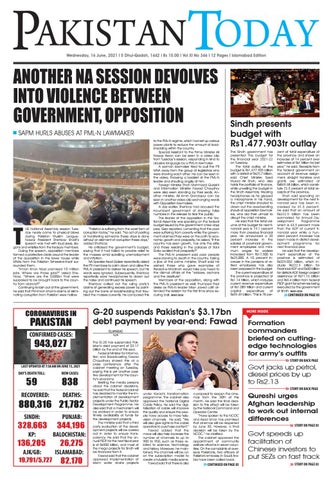
Another nA session devolves into violence between government, opposition g
SAPM HURlS ABUSeS AT PMl-N lAWMAKeR
t
He National Assembly session Tuesday nearly came to physical blows during Pakistan Muslim leagueNawaz President Shehbaz Sharif’s speech was met with loud jeers, slogans and whistles from the treasury members. During the speech, opposition members formed a protective circle around the leader of the opposition in the lower house while MNAs from the Pakistan Tehreek-e-Insaf surrounded them. “Imran Khan Niazi promised 10 million jobs. Where are those jobs?” asked Shehbaz. “Where are the $300bn that were supposed to be brought back to the country from abroad?” Continuing to lash out at the government, he said that PM Imran Khan’s claims of eliminating corruption from Pakistan were hollow.
“Pakistan is suffering from the worst form of corruption today,” he said. “No act of posting or transferring someone these days is done without an element of corruption these days,” added Shahbaz. He criticised the government’s budget, saying that it had failed to provide relief to the masses amid spiralling unemployment and inflation. NA Speaker Asad Qaiser repeatedly asked the PTI members to calm down and allow the PMl-N president to deliver his speech, but his words were ignored. Subsequently, Shehbaz reportedly wore headphones to drown out the noise and continued his speech. Shehbaz called out the ruling party’s claims of generating excess power by pointing out the bane of loadshedding that troubled the masses currently. He compared this
coronAvirus in
pAkistAn
CONFIRMED CASES:
943,027
LAST UPDATED AT 7:38 AM ON JUNE 15, 2021
DAY'S DEATH TOLL:
NEW CASES:
59
838
RECOVERED:
DEATHS:
880,316 21,782 SINDH:
PUNJAB:
328,663
344,196
KP:
BALOCHISTAN:
136,205 AJK/GB: 19,791/5,727
26,275 ISLAMABAD:
82,170
to the PMl-N regime, which had set up various power plants to reduce the amount of loadshedding within the country. Special Assistant to the Prime Minister Ali Nawaz Awan can be seen in a video clip from Tuesday’s session, responding in kind to abusive language by a PMl-N lawmaker. A woman lawmaker tried to pull the PTI MNA away from the group of legislators who were shoving each other. He can be seen in the video, throwing a booklet at the PMl-N leader and shouting angrily at him. Foreign Minister Shah Mahmood Qureshi and Information Minister Fawad Chaudhry were also seen standing by their seats. Another minister, Ali Amin Gandapur can be seen in another video clip exchanging words with Opposition lawmakers. A day earlier, Shehbaz had accused the incumbent government of showing false numbers in the release to trick the public. The leader of the opposition in the National Assembly was speaking on the federal budget issued by the government a few days prior, Geo reported. lamenting that the poor were suffering from poverty while the government claimed they were on the path to economic growth and prosperity, he asked, “If the country has seen growth, has only the elite and those residing in the palaces of Bani Gala availed that prosperity?” The PMl-N president said poor people were starving to death in the country. Taking a jibe at the prime minister, Sharif said he wished those who gave examples of Riyasat-e-Madinah would take pay heed to the dismal affairs of the “widows, orphans and the destitute”. Members of the opposition, along with the PMl-N president as well, thumped their desks as PMl-N leader Mian Javed latif attended the session for the first time since securing bail. News Desk
Sindh presents budget with Rs1.477.903tr outlay The Sindh government has presented the budget for the financial year 2021-22 on Tuesday. The total outlay of the budget is Rs1,477.903 billion with a deficit of Rs25.7 billion, said Chief Minister Syed Murad Ali Shah, who also holds the portfolio of finance, while unveiling the budget in the Sindh Assembly. Wearing headphones as he gripped a microphone in his hand, the chief minister shouted to drown out the reverberating shouts of opposition lawmakers, who did their utmost to disrupt the chief minister. He said that the total volume of the budget for next financial year is 19.1 percent more than previous financial year. He announced a 20 percent increase in the salaries of provincial government employees and minimum wages for workers increased from Rs17,500 to Rs25,000. A 10 percent increase in the pensions of retired employees has also been proposed in the budget. The current expenditure of the province is projected at Rs1.14 trillion, which includes current revenue expenditure of Rs1.089 trillion and current capital expenditure of Rs59.49 billion. “This is 78 per-
G-20 suspends Pakistan’s $3.17bn debt payment by year-end: Fawad ISLAMABAD tltp
The G-20 has suspended Pakistan’s debt payment of $3.17 billion by the end of this year. Federal Minister for Information and Broadcasting Fawad Chaudhary shared this at a press conference after the cabinet meeting on Tuesday, saying this is yet another positive development for the country’s economy. Briefing the media persons about the cabinet decisions, he said that the federal cabinet has decided to monitor the implementation of development projects under the Public Sector Development Programme. He also said that a mechanism will be evolved in order to ensure timely availability of funds for the development projects. The minister said that a third party evaluation of the development projects will be carried out in order to ensure transparency. He said that the annual PSDP for the next fiscal year is of Rs900 billion, and most of the mega projects for Sindh will be financed from it. Fawad said that the cabinet approved implementation of storm water drains projects
cent of total expenditure of the province and shows an increase of 14 percent over estimates of Rs1 trillion for last year,” he said. Receipts from the federal government on account of revenue assignment, straight transfers and grants are estimated at Rs869.68 billion, which constitute 72.5 percent of total receipts of the province. Shah said spending on development for the next financial year has been increased by 41.3 percent. He said that an amount of Rs222.5 billion has been earmarked for Annual Development Programme which is 43.5 percent more than the ADP of current financial year while a hundred percent increase has been made in district development programme for next financial year. He said that the development expenditure of the province is estimated at Rs329.032 billion, which include Rs222.5 billion for Provincial ADP and Rs30 billion for districts ADP, foreign project assistance of Rs71.16 billion and Rs5.4 billion from federal PSDP grant for schemes being executed by the government of Sindh. News Desk
CONTINUED ON PAGE 03
more inside
Formation commanders briefed on cuttingedge technologies for army’s outfits STORY ON BACK PAGE
Govt jacks up petrol, diesel prices by up to Rs2.13 STORY ON BACK PAGE under Karachi transformation programme. The cabinet also approved the National Digital Cable Policy. He said the digitalisation of cable will improve the quality and ensure the people have access to more television channels. He said, “We will also give rights to the cable operators to purchase content.” Fawad added that the move will also help increase the number of channels to up to 900 to 950, such as those related to science, technology and history. Moreover, he maintained, the channels will be run on the subscription model to create a futuristic media scene. Fawad said that there is also
a proposal to reopen the cinemas from the 30th of this month. He said the final decision to this effect will be taken by the National Command and Operator Centre. “Have spoken to the NCOC and Asad Umar has promised that cinemas will be reopened by June 30. However, a final decision will be taken by the NCOC,” he clarified. The cabinet approved the appointment of community welfare attache in seven countries. On the complaints of overseas Pakistanis, two officers of Pakistani embassy in Saudi Arabia have been called back.
Qureshi urges Afghan leadership to work out internal differences
CONTINUED ON PAGE 03
STORY ON PAGE 03
STORY ON PAGE 03
Govt speeds up facilitation of Chinese investors to put SeZs on fast track
02
Wednesday, 16 June, 2021
ISLAMABAD
NEWS
IHC granTs more TIme To FederaTIon In JadHav Case ISLAMABAD
a
TLTP
CCEPTINg the plea of federation for more time to appoint counsel for Indian spy Kulbhushan Jhadav on Tuesday the Islamabad High Court adjourned hearing of the matter till October 5. A three-member Bench of the Islamabad High Court (IHC), comprising Chief Justice Athar Minallah, Justice Aamer Farooq and
Justice Miangul Hassan Aurangzeb resumed hearing of the Ministry of Law and Justice seeking appointment of a lawyer for Jadhav. The Attorney general for Pakistan Khalid Jawed Khan appeared before the bench and requested for more time to deliberate over the issue of appointing counsel for the accused person. During last hearing in the matter, Attorney general for Pakistan Khalid Jawed Khan has apprised the bench that to comply with the ruling of the International Court of Justice (ICJ), Pakistan
last year promulgated the law, CJ (Review and Reconsideration) Ordinance, 2020, to enable Jadhav to avail himself of the statutory remedy. He also submitted that the Indian government deliberately avoided joining court’s proceedings and was raising objections to a trial before a Pakistani court and had declined to even appoint a counsel for the IHC’s proceedings saying it “is tantamount to surrendering sovereign rights”. Jawed further said that the Indian government has objected, not for non-
implementation of ICJ’s verdict but to engineer default on the basis of which it would [try to] justify going to the ICJ again. However, the Chief Justice has observed that the Indian High Commission in Islamabad had approached the IHC seeking the release of five prisoners and had secured a decision in their favour, questioning the legitimacy of the same court. He observed that despite negative remarks of the Indian government about Pakistani courts, the IHC was considering the Jadhav case on humanitarian
grounds to ensure a fair trial for him. “We are not against sovereign immunity of the Indian government but they should at least tell us how we would proceed to implement the ICJ’s decision,” the Chief Justice remarked. Later the court asked Khalid Jawed to take up the matter with the Ministry of Foreign Affairs for its onward communication with the Indian authorities. On Tuesday, the bench accepted the federation plea and adjourned the hearing till October 5.
838 new Covid-19 cases take total caseload to 943,027: nCoC ISLAMABAD STAFF REPORT
The country on Monday reported 838 new Covid-19 cases, bringing the total number of confirmed cases to 943,027, the National Command and Operation Center said on Tuesday. According to the NCOC, a department leading the fight against the pandemic, the country has recorded 880,316 recoveries. There are 40,929 active cases are under treatment across the country, including 2,611 who are in critical condition. According to the NCOC, the pandemic killed 59 people on Monday, increasing the death toll to 21,782. Punjab and Sindh are the worst-hit regions of the country with 344,196 and 328,663 infections.
FIa summons shehbaz sharif on June 22 over sugar scandal LAHORE
KARACHI: Police baton charge citizens protesting against an anti-encroachment operation in Karachi. ONLINE
INP
The Federal Investigation Agency on Tuesday summoned Pakistan Muslim League-Nawaz President and Leader of the Opposition in the National Assembly Shehbaz Sharif on June 22 for questioning regarding the sugar scandal. According to the FIA, they had evidence of over Rs25 billion fraud case. It may be mentioned here that the FIA had sent a questionnaire to the PML-N president earlier on December 18 last. Shehbaz Sharif had then said that he will submit his response after consulting his legal team. Earlier, an accountability court in Lahore on Monday granted Pakistan Muslim League-Nawaz president Shehbaz Sharif exemption from personal appearance in Ramazan Sugar Mills and Ashiana-e-Iqbal cases. The court adjourned the hearing of both cases until July 8. The leader of the opposition in the National Assembly submitted an application in the court stating that he couldn’t turn up before it as he was in Islamabad to take part in the ongoing budget session in the lower house of Parliament. He, therefore, requested the court to grant him exemption from personal appearance. On April 23, Shehbaz Sharif was released from Lahore’s Kot Lakhpat Jail after a full bench of the Lahore High Court granted him post-arrest bail in a money laundering reference. He was released from prison after nearly seven months. A three-member bench headed by Justice Ali Baqar Najafi and comprising Justice Aalia Neelum and Justice Syed Shahbaz Ali Rizvi announced a unanimous verdict, granting bail to Shehbaz. It is noteworthy that the larger bench was constituted after a two-member bench gave a split decision and the matter was forwarded to Lahore High Court Chief Justice Muhammad Qasim Khan.
KP Cm promises upcoming budget to be free of new taxes
SC bans sale, transfer, allotment of Railways land KARACHI TLTP
While seeking a comprehensive report from the federation pertaining to untoward recent train crash in ghotki, Justice gulzar Ahmad has observed the court will not allow the sale of even a single inch of railways land. While releasing written order in the antiencroachment case, the Supreme Court observed that Pakistan Railways affairs were in unprofessional hands, asking the government to take measures to ensure safety of passengers. Expressing concern over an alleged plan to sell the railways land in Sindh, the court said in its order, “The bench was informed that the federal government was reportedly planning to sell railway lands in Sindh and a meeting to this effect was held at the governor House in
Karachi,”. The bench noted that the government was approaching the court for removal of encroachments on its land, but on the other hand it seemed plans were under consideration to sell the railway land. The court said that not an inch of the railway land would be allowed to be sold and the apex court would strike down any such move. The court, while ordering the federal government to submit a detailed report on the train crash in ghotki, observed that the Pakistan Railways affairs were in unprofessional hands. The bench asked the government to take measures to ensure the safety of passengers. The bench also took exception to a statement of the Railways Minister after the recent ghotki train accident saying the government should give urgent attention to the dilapidated track from Khanpur to ghotki and Sukkur to Karachi.
Govt proposes manufacturers obtain license for brand registration ISLAMABAD STAFF REPORT
The federal government has proposed to make it mandatory for manufacturers to obtain brand licenses for each separate brand or Stock Keeping Unit (SKU). According to an update in the finance bill FY22, any specified brand or SKU found to be sold without obtaining a license from FBR shall be deemed counterfeit goods and liable to outright confiscation and destruction in the prescribed manner and any other penal actions.
AIt may be mentioned that SKU is a scannable barcode, most often seen printed on product labels in a retail store. The label allows vendors to automatically track the movement of inventory besides the characters are a code that tracks the price, product details, and the manufacturer. Similarly, it has also been proposed to make domestic consumers, who are not in the active taxpayers’ list, liable to pay 7.5 per cent advance tax over electricity bills exceeding Rs25,000 per month. Presently, domestic consumers whose gross bill exceeds Rs75,000 per month are paying 7.5pc tax.
PESHAWAR AZIZ BUNERI
Khyber Pakhtunkhwa (KP) Chief Minister Mahmood Khan has said that no new tax will be imposed in the upcoming financial budget whereas reforms will be introduced in the existing taxes. Addressing a news conference, he said that despite difficult situation, developmental projects in the province will not be compromised and commitments with government employees to increase their salaries will be fulfilled. He further said that the daily wages have been increased to 21,000 which will be implemented. Khan remarked that keeping in view the prevailing difficult financial situation, the provincial government will consider granting a one-time waiver in provincial taxes to the taxpaying private sector employees. The government of Khyber Pakhtunkhwa on Tuesday announced to present its budget for the year 2021-22 on June 18th (Friday) at 03:00 p.m. at the provincial assembly session. Provincial finance minister Taimur Saleem Jhagra was also present during the press conference.
Sindh refuses permission to IRSA teams to monitor water flow levels KARACHI STAFF REPORT
The Sindh government has refused to allow the monitoring teams from the Indus River System Authority to monitor the barrages, reports citing sources said on Tuesday. The provincial government expressed strong reservations on the constitution of the monitoring teams by the authority. It said that the teams to monitor the discharge of water were formed unilaterally. “We will not allow monitoring of the barrages until impartial teams are formed,” a spokesperson for the government said. Meanwhile, in a letter to IRSA, the provincial Irrigation Department has urged devising a framework for measuring the water level. The authority has also called for identifying the inspection sites through consensus. Sindh has accused the federal body of uneven water distribution. However, IRSA says that the province is
being provided its due share. Last month, IRSA chief Rao Irshad Ali Khan wrote a letter to Water and Power Development Authority chairman Muzammil Hussain and conveyed to him the instructions of the National Assembly Standing Committee on Water Resources for the appointment of inspectors at key locations to monitor discharges. The letter was written after days of a verbal spat between Khan and an IRSA member from Sindh, Zahid Hussain Junejo. The six locations in Punjab where inspectors are recommended to be appointed include Taunsa headway, Rasul headway, Marala headway, Trimmu headway, Chashma Barrage and Panjnad headway, whereas, in Sindh, inspectors will monitor water discharges at guddu, Sukkur and Kotri barrages. According to the sources, technical officials would work as inspectors and monitor the water flow levels after a further increase in water shares of Punjab and Sindh due to better inflows in rivers.
IHC turns down Faryal Talpur’s request to quash disqualification case
ISLAMABAD INP
The Islamabad High Court on Tuesday binned a petition moved by Pakistan Peoples Party leader and former president Asif Ali Zardari’s sister Faryal Talpur in a case related to her disqualification. IHC Chief Justice Athar Minallah dismissed the petition that sought to bar the Election Commission of Pakistan from taking up a petition seeking her disqualification as a member of the Sindh Assembly. The court directed the commission to proceed with the case. The ECP in February rejected a petition filed by Faryal seeking to quash the disqualification case against her. A five-member bench, headed by Chief Election Commissioner Sikandar Sultan Raja, announced the verdict. Subsequently, she approached the high court challenging the ECP ruling. At a previous hearing, her counsel, Farooq Naek, pleaded with the court to nullify the order which he argued violates the earlier rulings of the Supreme Court and Article 10 of the Constitution. Two Pakistan Tehreek-e-Insaf MPAs, Arsalan Taj and Rabia Afzal, had moved a petition in the ECP seeking disqualification of Talpur as MPA for allegedly concealing her assets. They maintained the PPP leader should be disqualified under Article 62 as she failed to declare details of her assets before the commission, which implied that she is no longer “sadiq and ameen“. Faryal owned properties in Larkana and Shahdadkot, the petitioner stated, adding she had been nominated in a case pertaining to billions of rupees corruption through fake bank accounts.
Wednesday, 16 June, 2021
ISLAMABAD
QurEShI urgES AFghAn lEAdErShIP to work out IntErnAl dIFFErEnCES ISLAMABAD
F
StAff RePoRt
OREIGN Minister Shah Mahmood Qureshi urged the Afghan leadership to sit together to work out their internal differences, Radio Pakistan reported. In a statement issued on Tuesday, the foreign minister noted that the peace dialogue has reached a critical phase where the stakeholders will “not gain anything” by trading allegations. The statement comes a day after he declared that Islamabad had no intention to interfere in Afghanistan’s internal affairs. Instead, he said, Pakistan is “sincerely”
working with the international community for peace in Afghanistan, which is in Islamabad’s own interest. Today, he reaffirmed Pakistan’s commitment to peace and stability in the region. Qureshi clarified that Pakistan will not allow its soil to be used against any country. India, he said, instead of playing the role of a spoiler, should work for ensuring peace in the region. Minorities in India are under great duress, and feeling insecure, he observed, adding that a large segment of the population had rejected the [antiMuslim] strategy of Prime Minister Narendra Modi. According to Afghanistan’s Tolo News, out of 387 districts and 34 provincial capitals, the centres of at least
17 districts have fallen to the insurgents over the last two months. TURKEY VISIT: Qureshi will leave for Turkey later this week to attend the two-day Antalya Diplomacy Forum scheduled for June 18-20. During the event, the world will “come together at the forum to discuss crises and opportunities amidst rising racism, xenophobia and terrorism that threatens humanity as a whole”, Daily Sabah said, citing a promotional video. There, the foreign minister is expected to meet his counterparts particularly those from Afghanistan, Iran and Kuwait, and also diplomats on the sidelines of the event.
Govt speeds up facilitation of Chinese investors to put SEZs on fast track ISLAMABAD MIAN AbRAR
Prime Minister Imran Khan Tuesday chaired a review meeting on foreign investment in the industries being setup under the Special Economic Zones being developed under the multi-billion-dollar project of China, Pakistan Economic Corridor. Federal Ministers Shaukat Fayyaz Tarin, Shah Mehmood Qureshi, Sheikh
Rashid Ahmed, Asad Umar, Makhdoom Khusro Bakhtiar, Ali Zaidi, Trade and Investment Adviser Abdul Razzaq Daud, Special Assistants Waqar Masood, Moeed Yousuf, CPEC Chairman Authority Lt Gen (r) Asim Saleem Bajwa and concerned senior officials attended the meeting. SBP Governor Reza Baqir joined through the video-link. The meeting was informed that the issues related to issuance of visas to the Chinese workers and officials coming
Punjab bans establishment of housing schemes on greenbelts LAHORE INP
The Punjab government on Tuesday stopped the deputy commissioners from issuing no-objection certificates to housing societies seeking to build structures on greenbelts. Through a communique, Chief Secretary Jawad Rafique Malik conveyed the policy change to all deputy commissioners. The Punjab government has decided that no housing society will be built on greenbelts, and they could only be built in the residential areas.
Parliament’s role important for strengthening of democracy: Sanjrani ISLAMABAD
under CPEC have been completely resolved while the Ministry of Interior is handling new cases on a daily-basis which has had a positive impact on the pace of CPEC projects. A detailed briefing on the comprehensive strategy formulated by the Board of Investment for the establishment of export industries in the SEZs. The meeting was informed about the identification of potential foreign investors in various sectors in China and
the incentives provided to them for direct foreign investment in Pakistan. The meeting was also briefed on the establishment of assembly units of three major international mobile companies in Pakistan and their positive impact on local consumption and exports. A briefing was also given on the steps taken by CPEC Authority, Ministry of Industries and Production and Board of Investment to fast track the facilitation to the Chinese investors.
Sindh presents budget with Rs1.477.903tr outlay COntInuED fROM pAgE 01 CM Murad said that the government has decided to continue the Rs30.90 billion social protection programme for the poor as the economic stability package. He said that the government has increased the budget for the education sector by 14.2 percent with an allocation of Rs277.56 billion, whereas Rs172.08 billion have been earmarked for the health sector which is 29.5 percent higher than current fiscal year. The government has allocated an amount of Rs24.73 billion for infectious diseases including Covid-19. He announced allocation for the agriculture sector has been increased to Rs15.26 billion from Rs14.8 billion. An amount of Rs119.97 billion has been allocated for the law and order in the province. An amount of Rs17 billion has been allocated for irrigation and Rs18.57 billion for the social welfare department. An amount of Rs38.2 billion has been earmarked for the road infrastructure and transport sector and Rs2.5 billion are allocated for the energy sector in the province. He said that Rs82 billion have been earmarked for local government and Rs500 million for various relief and
welfare measures in the next budget. In addition, an amount of Rs207 billion has also been earmarked for the environment, forest and wildlife sector. CM Murad said that Rs2 billion have been earmarked for purchase of PCR and PPE kits in context with Covid19 while Rs646.22 million have been proposed for purchase of oxygen in view of pandemic. He said that an amount of Rs571.975 million has been allocated for the women development department and Rs154 million rupees for minority affairs. He also said that in the financial year 2021-22, around 1033 schemes have been identified for completion in the first and second quarter and maximum resources will be provided for their timely completion. Ongoing schemes with remaining throw-forward up to Rs100 million have been fully funded for completion by June 2022. Ongoing schemes where 70 percent expenditure is made have been fully funded for completion by June 2022. The CM said that the output of the government is directly related to the performance of every individual employee. “All the employees of the provincial government have my gratitude,” he added.
APP
Senate Chairman Sadiq Sanjrani Tuesday said the role of Parliament is important for the promotion of democratic values in the modern era. Addressing an orientation workshop at the Pakistan Institute of Parliamentary Services to provide training to the newly elected members of the Senate business rules and regulations and parliamentary affairs, he said Pakistan has made many sacrifices for the spread of democracy. He said in the modern age, there were many challenges that need to be tackled with ground information and hard facts. PIPS is playing an important role in training parliamentarians and civil servants and solving problems by improving efficiency in the 21st century which is the need of the hour, he said. Sanjrani said that such training programmes hold great importance. It is necessary to conduct such training courses for the newly elected members of the Upper House and the chairmen of the committees, he said. He said that hardworking and experienced officers were ready to provide all kinds of guidance to the newly elected members of the House. The chairman said that Parliament is the central machinery of government. Its members must possess the required expertise in relevant matters to meet the challenges. New members will be helped in improving legislation and other issues by providing information, awareness on specific administrative courses will be provided to make parliamentary services more efficient. He also emphasised providing factual information to MPs so that they could play an effective role in legislation. It is time to legislate effectively for the newly elected members, for which we need to work hard, he said. Sanjrani expressed hope that through this training programme, MPs would get effective knowledge and play their role in the development of the country through effective legislation. PIPS Executive Director Muhammad Anwar, while addressing the workshop, said that parliamentary affairs were the same for parliaments across the world, but the practice was different.
G-20 suspends Pakistan’s $3.17bn debt payment by year-end: Fawad COntInuED fROM pAgE 01 The cabinet discussed the use of electronic voting machines in the elections. Fawad said the Election Commission of Pakistan has given a presentation on the EVMs. He said that the EVMs have been developed as per the aspiration of the Election Commission. He added, “It is our desire that the next by elections are conducted by using these electronic voting machines.” The minister said that the Ministry of Parliamentary
Affairs briefed the Prime Minister about the Elections (Second Amendment Bill) recently passed by the National Assembly. It was informed that this piece of legislation has been forwarded to the Senate for approval. He said, “We consider overseas Pakistanis an important part of Pakistan and our priority is to give them the right to franchise.” The information minister prayed to the Supreme Court that cases of Shahbaz Sharif be heard on a daily basis. He said that the people want to know the truth.
NEWS
03
JCSC chief, Egypt president discuss defence ties CAIRO StAff RePoRt
Joint Chiefs of Staff Committee chairman Gen Nadeem Raza called on Egypt President Abdel Fattah al-Sisi on Tuesday and discussed bilateral defence cooperation including security, counter-terrorism and regional environment. According to a statement released by Inter-Services Public Relations, al-Sisi conveyed his regard for Pakistan Army and said that he values brotherly ties between the two nations. On the occasion, Gen Raza reiterated that Pakistan is keen to expand its military-to-military cooperation with Egypt. The two also acknowledged Pakistan Army’s sacrifices in its fight against terrorism. ISPR further said that the JCSC chairman also held separate meetings with Egypt Minister of Defence Mohamed Ahmed Zaki, and the country’s Army Chief Lt Gen Mohammed Farid Hegazy. Gen Raza also led a second round of defence and security talks and highlighted Islamabad’s positive role in combating violent extremism, improving regional stability, connectivity and its impact on the South Asian region and beyond. He also shared Pakistan’s contributions and efforts for lasting peace and stability in Afghanistan. Earlier, on arrival at the Ministry of Defence, Gen Raza was presented guard of honour by a contingent of Egypt military.
First pre-monsoon rains likely to begin in Sindh on June 16: weather report KARACHI APP
A dust-thunderstorm or rain likely to occur at scattered places in Sindh during June 16 to 19, under the influence of the first pre-monsoon rainy spell expected to commence in the province on June 16. It was predicted in a weather warning issued by Assistant Meteorologist Zafar Mahmood from Regional Meteorological Centre Karachi on Tuesday. The report said that hot spell in central and upper Sindh would subside due to pre-monsoon rainy spell. Low lying areas in Badin, Thatta, Hyderabad, Umarkot, Thar, Dadu, Sukkur and Larkana districts may face waterlogging or inundation at times due to occasional heavy showers. Loose structured huts and billboards may experience damage due to dust/wind-storm, the warning said. Moreover, the Met Office said in an advisory that “the moist currents from the north Arabian Sea are likely to penetrate in Sindh with effect from June 16, 2021. Under its influence, the first rainy spell [is] expected in most of Sindh districts”. According to the alert, dust storms accompanied by thunder and rain are likely at scattered places in Sukkur, Larkana, Shikarpur, Jacobabad and Ghotki districts on June 16-17, reported Dawn. Meanwhile, dust storms, accompanied by thunder and rain, with a few moderate to heavy showers will hit all districts of Sindh, especially Dadu, Sukkur, Larkana, Shikarpur, Jacobabad, Ghotki, Hyderabad, Mirpurkhas, Umerkot, Thar, Badin and Thatta between June 17 and 19, the advisory added.
FIA ‘mistakenly delivered’ notice to Shehbaz instead of Imran: Marriyum ISLAMABAD APP
Four PAF officers promoted to rank of air vice marshal ISLAMABAD MIAN AbRAR
The government has promoted four officers of Pakistan Air Force (PAF) to the rank of Air Vice Marshal (AVM). The promoted officers include Air Vice Marshal Shahid Mansoor Jehangiri, Air Vice Marshal Kashif Qamar, Air Vice Marshal Asim Rashid Malik and Air Vice Marshal Syed Hasan Kashif. Air Vice Marshal Shahid Mansoor Jehangiri was commissioned in GD (P) Branch of Pakistan Air Force in May, 1991. During his career, he has commanded a fighter squadron, a flying wing and an operational air base. He has also served as Deputy Director General Air Intelligence at Air Headquarters, Islamabad. He is a recipient of Sitara-i-Imtiaz (Military). Air Vice Marshal Kashif Qamar was commissioned in GD (P) Branch of Pakistan Air Force in May, 1991. During his career, he has commanded a fighter squadron,
a flying wing and an air base. He has also served as Assistant Chief of the Air Staff (Safety) at Air Headquarters, Islamabad. He is a recipient of Sitara-iImtiaz (Military). Air Vice Marshal Asim Rashid Malik was commissioned in Engineering Branch of Pakistan Air Force in December, 1991. During his career, he has commanded an engineering wing. He has also served as Managing Director Mirage Rebuild Factory, Kamra. He is a recipient of Sitara-i-Imtiaz (Military). Air Vice Marshal Syed Hasan Kashif was commissioned in Engineering Branch of Pakistan Air Force in December, 1991. During his career, he has commanded an engineering depot and served as Deputy Managing Director (Avionics) at Kamra. He has also served as Assistant Chief of the Air Staff (Electronics Engineering) at Air Headquarters, Islamabad. He is a recipient of Sitara-i-Imtiaz (Military).
PML-N Secretary Information Marriyum Aurangzeb has lashed out against Imran Khan for “shamelessly abusing state institutions” against Shehbaz Sharif to vent his “desperation” and “frustration” over his failure to deceive the nation with a fraud budget 2021-22. In a statement, Marriyum said the FIA must have “mistakenly” sent the letter to Shehbaz because in essence it must have been sent to Imran. She said it was Imran who signed all decisions regarding the export of sugar against the advice of the relevant authority, that led to shortage and escalation of prices. It was Imran who signed the permission for the import of sugar that led to billions worth of corruption, she added. It was Imran who caused the shortage to benefit his ATMs and loot Rs450 billion from the nation’s pockets, she alleged. It was Imran who allowed the price of sugar to skyrocket from Rs52 per kilogram to Rs 120, she added. With all this on the record issuance of a notice to Shehbaz is an open proof of Imran abusing his power to save himself and victimise his political opponents, she further said.
04
Wednesday, 16 June, 2021
ISLAMABAD
NEWS
MiniSTry direcTS for recovery of iLLegaL SaLarieS, PerKS froM eTPB chairMan LAHORE
T
SHAHAB OMER
HE ministry of religious affairs and interfaith harmony (MoRA&IH) has directed for recovery of 211 days salary and other perks and privileges obtained contrary to rules from Evacuee Trust Property Board (ETPB) Chairman Dr Aamer Ahmed to avoid any audit objection, Pakistan Today learnt on Tuesday. The ministry wrote a letter to the ETPB chairman in this regard on June 8. The letter, written by the ministry’s Section Officer Imran Rashid stated, “I am directed to state that during an in house meeting, a question arose as to the date of admissibility of emoluments to the incumbent Chairman ETPB in
accordance with MP-I scale. A reference was made to the Establishment, Finance and Law Division for opinion in the matter. In response, it has been clarified that the admissibility of emoluments (salary, house rent and utility) as
Bandits release five hostages in Shikarpur area: police SHIKARPUR: The local police claimed on Tuesday that kidnappers have released five hostages from the Katcha area in Shikarpur district as a result of operation. “Bandits have released five hostages under the pressure of law enforcement agencies,” the police officials claimed. Five men released by the outlaws were Najeeb Pathan, Inayat, Abdul Hai, Manjhi and an unnamed person. The district police said that the targeted operation will be continued till the arrest of the kidnappers and recovery of all people taken hostage by the bandits. Earlier, two more people were abducted from the Garhi Tegho in Katcha area of Shikarpur, raising the number of abductees from the area, where police had launched an operation against bandits, to 10. A report said that the anti-bandit operation in the riverine forest area of Garhi Tegho in Shikarpur district remained suspended for the fourth consecutive day. “Even the intelligence-based targeted anti-bandit operation is yet to be started”, according to sources. SSP Shikarpur Tanveer Ahmed Tunio said that surveillance drones are being used to monitor the forest area along the Indus river. “We have gathered information and made maps of different points in the katcha area,” the police officer said. TLTP
Police arrest alleged killer of SP’s gunman in Lyari raid
pet MP-I scale to the Chairman ETPB would take effect from the date of its notification by the Establishment Division on 22-11-2019.” “Therefore, his salary/emoluments for the period from his date of joining the post i.e. 25-04-2019 to
21-11-2019 would be determined vide rule 5 of the ETPB's Chairman (Appointment and Other Terms and Conditions of Service) Rules, 2019 as are admissible to government servants in BPS-21 on contract. In view of the above, the emoluments, if drawn as per MP-I scale during the period from 25-04-2019 to 21-112019 over and above those prescribed under the rule 5 for a government servant In BPS-21, will have to be recovered to rectify this anomaly and avoid any audit objection at later stage.” Moreover, the ministry has also asked the ETPB to clarify as to whether the house situated at 22Zaman Park, Lahore is declared as the chairman’s residence or otherwise, and sought a comprehensive report in the emoluments’ matter from the board.
Sources told that the appointment of Dr Aamer Ahmed as ETPB chairman has been controversial from day one as a petitioner, Major General (R) Muhammad Saad Khattak, had approached the Islamabad High Court, objecting to the appointment. They further told that the Pakistan Hindu Council (PHC) had also objected to the appointment of the chairman. “One of the main reasons for the PHC's objection was that since all the properties administered by the ETPB belong to Hindus and Sikhs, the chairman of the board should also be a Hindu or a Sikh,” they said. They added that in a span of two years, the ETPB has not paid much attention to the Hindu and Sikh shrines. On the other hand, when ETPB
Chairman Dr Aamer Ahmed was asked if he had received 211 days salary and other benefits contrary to rules, he replied that when he joined the ETPB as chairman, a case for emoluments was sent to the ministry. “I joined in April, 2019 and the case was processed then. As soon as the case was presented before the federal cabinet, it got approved. During this time, I did not draw any salary as I started drawing salary only after the approval from cabinet,” he maintained. Similarly, when Ahmed was asked about the official residence at Zaman Park, Lahore, he replied that he never used the official residence of the ETPB. “The Zaman Park residence is designated for the ETPB chairman but I never used it. I have even written that I will not use this residence,” he concluded.
KP to unveil over Rs1tr budget on Friday PESHAWAR TLTP
The budget of the Khyber Pakhtunkhwa (KP) province for the next fiscal year 2021-22 with an outlay of over Rs1,000 billion will be presented before the provincial assembly on June 18. According to the salient features of the KP budget, the Annual Development Plan (ADP) for the province has been proposed at Rs205 billion for the next fiscal year. An increase of 25 percent in the salaries of the government employees from grade 1 to 19 has been proposed in the budget, while a 10 percent raise has been proposed for the employees above grade 19. The KP government has proposed a mega agriculture development package in budget 2021-22, focusing on increasing horticultural land, meat and poultry production, and assistance to farmers through the Kisan Card under the Prime Minister National Agriculture Emergency Programme (NAEP) amounting to over
Rs309 billion. Under the package, the government has decided to launch special projects related to strengthening of livestock, fisheries and food security programmes, besides providing assistance to farmers under Kisan Card to be issued by
August this year under the Agriculture Transformation Plan (ATP). Under the ATP, 150 moisture meters would be installed to ascertain the level of moisture in lands across KP to bring maximum areas under agriculture cover.
The prime minister’s Save the Calf and Poultry programmes would continue and under Save the Calf programme, about 380,000 male buffalo’s calves would be fattened in the country, including 30,000 in KP, to increase meat production. Around 287 trout fish farms mostly in Malakand and Hazara Divisions would be established with an estimated cost of Rs1286.914 million to utilise abundance of cold water reservoirs, lakes and favourable climate conditions, mostly suited for trout fish farming. The Sindh government had presented its budget on Tuesday while Punjab had presented its budget on Monday with Rs196 billion allocation for South Punjab and Rs370 billion for health sector. Presenting the Punjab budget with a total outlay of Rs2,653 billion, provincial Finance Minister Hashim Jawan Bakht had announced that the PTI government, despite all difficulties, is raising the development budget by 86 percent to Rs560 billion.
NTDC signs contracts with M/s Siemens for uplift of grid stations projects
KARACHI: The Karachi police, in a raid, has arrested an accused involved in the recent murder of a policeman in the city. According to reports, a police party arrested accused Abdul Rehman from Baghdadi area of Lyari and recovered a pistol and seven snatched mobile phones from his possession. SSP City Sarfaraz Nawaz said that the accused has been a hardened criminal. “He used to keep two pistols at a time with him,” the police officer said. The accused had killed a policeman, Moiz, who was a gunman of the SP. “Moiz, while seeing a street crime, took out his gun to intervene, but the accused promptly opened fire and martyred him on the spot,” the SSP City said. The accused had also murdered other three persons, Mumtaz Ahmed, Muhammad Asghar and Gul Muhammad, and injured other two persons over resisting robberies, the police officer said, adding that the accused was wanted in 10 heinous crimes, including terrorism, murder, attempt to murder and robberies. TLTP
Two brothers shot dead in Khuzdar KHUZDAR: Some unknown gunmen shot death two real brothers and escaped the scene of crime here on Tuesday. According to details, some unidentified armed men barged into a house located in Baghbana of district Khuzdar and opened indiscriminate fire at two people in the house. As a result of firing, two real brothers, Mohammad Rafique and Mohammad Akbar, were killed on the spot. The culprits fled the scene after committing dual murder. The bodies were shifted to a nearby hospital and investigation into incident was started. INP
LAHORE PRESS RELEASE
National Transmission and Despatch Company (NTDC) has signed three agreements with M/s. Siemens for extension/ augmentation works at its different 220 kV grid stations in KPK, Punjab and Sindh with the cost of Rs. 4.06 billion funded by the World Bank. A contract signing ceremony was held at a local hotel in Lahore today, wherein MD NTDC Engr. Muhammad Ayub and Managing Director Siemens (Pakistan) Mr. Markus Strohmeier signed the agreements. While speaking on the occasion MD NTDC said that
NTDC is committed to enhance and upgrade its transmission network across the country. The contracts have been signed with Siemens for design, supply and augmentation works of 220kV Samundari Road and 220kV Gakkhar Grid Station (Punjab) along with extension work at 220kV Daud Khel Grid Station and augmentation work at 220kV Bannu Grid Station (KPK).Whereas, design, supply and installation of extension works at 220kV Rohri Grid Station and augmentation works will also be carried out at 220 kV Grid station Dharki (Sindh) and 220 kV Bahawalpur Grid station. Engr. Muhammad Ayub appreciated the quality work carried out earlier by Siemens with NTDC and
especially at GIS University Grid station Islamabad and said that the augmentation and extension works will improve the voltage profile and provide better supply to the consumers and will also strengthen the NTDC network. He added that the commencement of these projects are expected by the end of July, 2021 which will be completed in Feb, 2023. Managing Director M/s Siemens also spokes during the ceremony and said that M/s Siemens enjoys good harmony with NTDC and has already executed number of projects with them and looking forward to complete said projects in a given timeline to facilitate the consumers of three provinces of the country.
Wednesday, 16 June, 2021
ISLAMABAD
TARIN ASKS FBR To ENSURE TRAcKINg PRogRESS oF PoS MAchINES ISLAMABAD
M
TLTP
INISTER for Finance and Revenue Shaukat Tarin on Tuesday directed the tax authorities to ensure effective tracking progress of installed Point of Sale (POS) machines and provide post deployment support to the retailers. He further directed to determine the total volume of sales by retailers to effectively tap the revenue generation through POS system after adjustment of input and output taxes. He directed to establish a cell at FBR HQ to fast track the progress on POS integration. Tarin visited the FBR headquarters
on Tuesday and held a meeting with FBR officers. The agenda of the meeting was to devise a strategy to increase integration of retailers with the Point of Sales system of FBR. The meeting also discussed the way forward to bring identified potential taxpayers into the tax net. Special Assistant to the Prime Minister on Finance & Revenue Dr. Waqar Masood Khan and Chairman FBR Asim Ahmad along with other members of FBR were present in the meeting. The chairman FBR, while briefing the meeting, said that the licensing of IT companies for installation and configuration of POS system would be completed by the end of August. He further briefed that monitoring cells would be
K-Electric, Easypaisa collaborate to offer convenient digital bill payment options KARACHI
formed in each RTO headed by the respective chief commissioner to supervise the POS integration for achieving desired results. Minister for Finance and Revenue directed to ensure effective tracking progress of installed POS machines and provide post deployment support to the retailers. He further directed to determine the total volume of sales by retailers to effectively tap the revenue generation through POS system after adjustment of input and output taxes. The finance minister directed to establish a cell at FBR HQ to fast track the progress on POS integration. The meeting also discussed the strategy to increase the tax net possibilities. The FBR team briefed that sizeable number of potential taxpayers have been
NEPRA takes notice of changes in minimum load limits of two IPPs ISLAMABAD AHMAD AHMADANI
PR
K-Electric (KE), Karachi’s electricity provider and Easypaisa, Pakistan’s leading provider of digital financial services have partnered together to extend a convenient and hassle-free bill payment solution for the power utility’s customers. The partnership with Easypaisa offers 5pc cashback, up to Rs100, to new Easypaisa customers on their first KE bill payment. Through this partnership, KE is encouraging customers to use digital modes of payments from the comfort of their homes. Furthermore, Easypaisa’s extensive agent network of 170,000 + registered agents spread across the country will also facilitate customers, especially those residing in the outskirts of the city where access to conventional banking facilities is limited.
Pay for your honda car instantly with hBL Mobile! LAHORE PR
HBL enables its customers to pay for their Honda cars directly using HBL Mobile! The bank is at the forefront of digitizing financial services in Pakistan through its technology driven initiatives. Digital payments adoption, especially through mobile apps and wallets have been growing at a very fast pace across Pakistan. Honda Atlas Cars Pakistan Limited aspires to expand the horizons to provide customer convenience through its numerous products, which can now be realized through digital payments directly from HBL Mobile. “Purchasing a car is not just a matter of convenience in Pakistan, a household brand name such as Honda Atlas Cars Pakistan Limited enables consumers to lock in value, while servicing customer needs for years to come. Enabling car purchases through HBL Mobile without the need to visit the bank branch will thus prove to be a milestone for the customers looking to invest in their future with a new purchase” said Honda Atlas Cars Limited General Manager Sales & Marketing Amir Nazir.
identified after retrieving available data of their withholding taxes through third party sharing. The chairman FBR briefed that efforts are being made to bring all the identified potential taxpayers into the tax net. The minster directed to remove all hurdles in bringing the identified potential taxpayers into the tax net. He directed to further identify the potential taxpayers on the basis of third party data being received through credible sources. The minister stressed on the need to finalise the modalities of third party audit which would not only increase the tax net but would also generate much needed revenue. The meeting ended after it was decided to hold regular meetings to pursue the targets on a fast track basis.
Taking notice of the changes in power purchase agreements (PPAs) by Independent Power Plants (IPPs) namely AES Lalpir and PakGen, has sought an explanation from the two over the matter, National Electric Power Regulatory Authority (NEPRA). In a letter to the Central Power Purchasing Agency’s (CPPA) chief executive officer (CEO), the regulator said that revision in minimum loading of M/s PakGen and M/s Lalpir from
20 percent (70MW) to 50pc (175MW) has a direct impact on the consumers-end tariff and therefore, directed CPPA to submit report in this regard within seven days. Power Control Center (NPCC), details of PPAs approving authority, provision of partial loading of the said plants, if any, and consideration of financial implications and the resulting impact on end-user tariff in terms of Fuel Cost Adjustment (FCA). Sources in the power sector said that a former National Transmission and Despatch Company (NTDC)
Indus Motor donates Rs5m to SIUT KARACHI: Indus Motor Company (IMC), true to its commitment to UNs Global Goal 3: Good Health and Wellbeing, has made a donation of Rs5 Million to the Sindh Institute of Urology and Transplantation (SIUT), in furtherance of the hospital’s mission. The cheque was presented by Asad Abdullah, Head of CSR at IMC, to Professor Anwer Naqvi, Professor of Urology SIUT and Provost, SIUT Institute of Medical Sciences. IMC is a regular donor to some of the biggest healthcare centers in the country including the JPMC, Shaukat Khanum Memorial Hospital, Indus Hospital, The Kidney Centre, etc. PR
NEPRA defers decision on K-Electric plea for power tariff hike The National Electric Power Regulatory Authority (NEPRA) on Tuesday deferred a decision on a petition filed by the KElectric seeking a hike in electricity tariff for its consumers. According to a local media report, the port city’s sole power distributor had requested the power regulator to allow an increase of Rs5.97 per unit in power tariff on account of monthly fuel cost adjustments (FCAs) for a period of January to March 2021 and a reduction of Rs0.86/unit for the month of April. The request, if accepted, will burden consumers with an additional Rs5.11 per unit. NEPRA has instead asked KElectric to file petitions for fuel cost adjustments for the months of May and June as well, which it said would ease the burden. MONITORING REPORT
managing director (MD), Dr Khawaja Riffat Ullah, had opposed changes in the minimum load of the two power plants and declared amendments contradictory to the regulations, adding that it would cause a loss of Rs15 billion per annum to the national exchequer as well as the masses. It is pertinent to mention that the said agreements were signed in November 1999 and February 1998 under Power Policy, 1994, with the approval of the federal cabinet’s Economic Coordination Committee (ECC).
Pakistani company bags enormous IT order from Japanese corporation ISLAMABAD APP
A Japanese company, building high-tech platform to expand its global services, announced to award orders to a Pakistani company for the creation of an information technology (IT) platform for real estate. “We are happy that Bears Inc Japan has chosen Saffran Group from Pakistan for this product, which will be completed by high-tech IT experts in Pakistan,” Pakistan’s Ambassador in Japan, Imtiaz Ahmad, said during a meeting with Bears Real Estate President Michiyoshi Takuma, and Saffran Group Chief Executive Officer (CEO) Mirza Asif Baig here on Monday. The total cost of product development will be JPY350 million, $3.2 million, out of which JPY130 million worth of work and an investment road map has already been developed. The ambassador congratulated Bears Inc Japan and Saffran Group for the project and assured full cooperation of the embassy and government of Pakistan for its successful completion. According to statistics by Pakistan Software Export Board (PSEB) and JETRO, the order was one of the largest direct orders from a Japanese corporation to Pakistan in the field of information technology.
NEWS
05
Foreign investors appreciate SBP FX remittance process: oIccI survey KARACHI: OICCI members have appreciated the significant improvement in the FX remittance processing time and in growing engagement of the State Bank of Pakistan leadership with the key stakeholders. The Overseas Investors Chamber of Commerce and Industry (OICCI), released the results of their latest annual Remittance Survey 2021, conducted amongst foreign investors, who are members of OICCI. This annual survey was conducted during May 2021 to measure the progress made during the past one year in terms of facilitating foreign remittances. A significant 94 percent of the survey respondents informed that Dividend remittances are now being approved by the central bank within 3 months of the applications, vs 72% in the last survey conducted in 2019, whereas 90 percent respondents indicated that Technical fee is also being remitted within three months vs 47% in the last survey and likewise 67 percent informed about similar timelines for Royalty remittance as opposed to a meagre 28 % in the last survey.” PR
STARZPLAY Pakistan, german broadcaster DW collaborate to launch new series hER KARACHI: STARZPLAY by Cinepax, Pakistan’s fastest growing streaming service has been keeping the country entertained with new blockbuster releases coming out almost every month. After the launch of Power Book II: Ghost, Part 2 of The Spanish Princess, Hulu’s Emmy winning and critically acclaimed series The Act, Angeline Malik’s hilarious short film Khushkhabri Kay Baad, season 10 of The Walking Dead, and last but not the least, STARZPLAY’s first original comedy series Khel Tamasha, the streaming service is now announcing a partnership with Deutsche Welle (DW), Germany’s leading international broadcaster, to launch three documentary series: ‘#PakistanIs’, ‘HER’ and ‘Unseen’. DW’s original production HER features universal, existential and controversial stories told by women themselves: What links them? What distinguishes them? What challenges do they face? Meet women across South Asia and hear their stories - they may look different, live in different countries and be from different parts of society - but are linked together by their shared experiences and perspectives. PR
Pakistan’s Safepay wows audience, wins Audience Favorite award at 2021 Visa Everywhere Initiative KARACHI: Pakistan’s Safepay was announced as one of the winners in the Visa Everywhere Initiative – a global innovation program and competition for startups and fintech companies - held for Central and Eastern Europe, the Middle East and Africa (CEMEA) on June 9. More than 700 fintech applicants entered Visa’s regional competition aimed at finding innovative payment and commerce solutions to solve the payment challenges of tomorrow With the most votes from the audience, Safepay from Pakistan won the Audience Favorite award for CEMEA and received $10,000 in prize money. Karachi-based fintech, Safepay, was founded in 2019 by Ziyad Parekh and Raza Naqvi with a vision to accelerate the adoption of digital payments in Pakistan by attracting a wave of entrepreneurs who want to accept online payments from their customers. Safepay specializes in secure payment processing for eCommerce stores and helps merchants increase checkout conversions, expedite receivables and streamline sales by allowing their customers to pay online. PR
UK and Australia sign post-Brexit free trade deal CANBERRA/LONDON AGENCIES
Britain and Australia announced a free trade deal on Tuesday which the British government hailed as an important step in building new trade relationships following its departure from the European Union that, and is expected to become a model for Britain’s post-Brexit commercial policy.Britain said cars, Scotch whisky and confectionery would be cheaper to sell in Australia because of the agreement, which removes tariffs and reduces red tape. Australia said it was a “great win” for Australian agriculture. The deal is the first bilateral trade accord
Britain has negotiated from scratch since leaving the EU last year. The government sees it as an important piece of its post-Brexit strategy to shift Britain’s economic center away from Europe and seek new opportunities in higher-growth Indo-Pacific nations. Australian Prime Minister Scott Morrison and Johnson overcame sticking points during talks after the Group of Seven advanced economies met in Britain at the weekend. Morrison attended the summit as a guest. “I think this is important economically, there’s no question about that … but I think it’s more important politically and symbolically,” Johnson said. “We’re opening up to each other and this is the prelude to a general
campaign of opening up around the world.” Britain is Australia’s eighth-largest trading partner and Australia is Britain’s 20th largest, with two-way trade worth A$26.9 billion ($20.7 billion).“This is the most comprehensive and ambitious agreement that Australia has concluded,” Morrison said. Prior to Britain joining the then European common market in 1973, Britain was Australia’s most lucrative trading market. The full agreement is yet to be published. According to British official estimates, it could add 500 million pounds to the country’s economic output over the long term, a small fraction for an economy worth around 2 trillion pounds.
CMYK
BIGGER PRIZE: The bigger economic prize could be the precedent the deal sets for freer access in trade that allows Britain’s services sector to export financial, legal and other professional services. “It is a fundamentally liberalizing agreement that removes tariffs on all British goods, opens new opportunities for our services providers and tech firms, and makes it easier for our people to travel and work together,” British trade minister Liz Truss said. Britain has applied to join a trans-Pacific trading bloc, of which Australia is also a member, that includes other countries where minister predict demand for digital, legal and professional services will grow rapidly.
That deal, Comprehensive and Progressive Agreement for Trans-Pacific Partnership, is also seen as important economic counterweight to China’s influence in the region. The deal with Australia will be scrutinized by British farmers, who fear they could be forced out of business if the deal eliminates tariffs on lamb and beef imports.Britain said its farmers would be protected by a cap on tariff-free imports for 15 years. Australian Minister for Trade David Littleproud said Australian farmers would benefit from the deal. “Overall, this is going to be a great win for Australian agriculture,” Littleproud told 4BC Radio.
Wednesday, 16 June, 2021
06 COMMENT
Budgeting for sustainable growth
Turning the National Assembly into a rubberstamp There’s no democracy without vibrant opposition
O
N Monday, Treasury members disrupted the Opposition Leader’s opening speech on the budget, something that has never happened in the country’s parliamentary history. Yesterday’s session was even worse, with abuses hurled and punches thrown. The move was spearheaded by two federal ministers, which led the opposition to claim that it enjoyed the support of the PM. The disruption took place despite the fact that the strategy for the budget session had already been finalised in a meeting of the house Business Advisory Committee comprising representatives of all the parties. It was the Speaker’s duty to intervene and let the Opposition Leader complete his speech. That he failed to do so, further strengthens the view that instead of being an independent custodian of the house, he acts as a PTI loyalist. The Rules of Procedure and Conduct of Business in the National Assembly (2007) provide the Speaker ample powers to maintain decorum in the house. Speaker Asad Qaiser’s partiality has all these years stood in his way to take action against offenders who are mostly from the ruling alliance. he has again and again deviated from parliamentary traditions and violated parliamentary procedures to please the PTI leadership. Treasury members have been allowed to hurl insults on the opposition leaders in their speeches but the opposition legislators are often not allowed to respond. Failure to control a nonstop torrent of unparliamentary language has led to brawls in the house. Bad manners being infectious, the opposition too has at times acted in a way that cannot be defended The Speaker has violated parliamentary traditions to please a vengeful government. he has the authority to issue production orders of Opposition members put under detention in order to enable them to attend the National Assembly session. The Speaker has avoided issuing production orders of those who were specially targeted by the government. Things have come to a pass where serious debate is increasingly becoming impossible in the National Assembly. There is a need for level-headed leaders on both sides to save the Assembly. Recourse to unparliamentary language has to be stopped, the opposition given more time to speak as is done in democracies, the Speaker needs to disallow any interruption from the floor during a speech, particularly when a parliamentary leader is speaking and the Opposition Leader must not be stopped whenever he rises to speak.
Fighting covid-19
Kashif Mirza
T
he government unveiled the budget for the fiscal year 2021-2022, with the outlay kept at Rs8,478 billion and the tax target set at an ambitious Rs5,829 billion. With certain limitations imposed by the ongoing covid-19 pandemic and the IMF programme, the budget is with an expansionary and feel-good approach, significantly increasing subsidies and incentives for big business, manufacturing, corporate market and agriculture sectors and proposing about 24 percent hike in revenues, including Rs 506 billion worth of additional measures. The government has set the target of tax revenue at Rs 5,829 billion, non-tax revenue at Rs2,080 billion. Other than that, non-revenue receipts are expected to be Rs 4,497 billion, non-bank borrowing to touch Rs 1,241 billion, net external receipts to come in at Rs1,246 billion, bank borrowing to be Rs 681 billion and privatization proceeds to fetch Rs 252 billion. Current expenditures will include interest payments of Rs 3,060 billion, pensions of Rs 480 billion, defence services spending of Rs 1,370 billion and grants and transfers to provinces and other subsidies of Rs 1,168 billion. Apart from this, development expenditures under the federal Public Sector Development Programme have been allocated Rs 900 billion, and Rs 64 billion for development purposes. In a year when, according to government data, 20.7 million people were rendered unemployed between March and October 2020, that the economy’s productive power kept going is more than a miracle for a government that won the 2018 election on the promise of creating 10 million jobs. The data also shows that the government’s decision to steer clear of a complete lockdown resulted in employment rising again after September 2020, and by the end of the year, Pakistan’s workforce was once again at about 55 million. Official estimates show that Pakistan’s economy has grown by almost 4 percent in the current fiscal year. Not only is this double what the government projected in July 2020, but it far outstrips the
West versus China A new cold war era?
U
S President Joe Biden is on his first foreign tour since getting elected, a necessary exercise that had to be put on hold until the Covid-19 pandemic settled down at home and abroad. The primary theme of this visit that includes a meeting of the G7, a NATO summit, a Uk visit and a meeting with Russian President Vladimir Putin, is to tell the world that ‘America is back’, following a diplomatically disastrous four years of Donald Trump. Additionally, he is leading with an anti-China narrative, speaking out against the country at the NATO summit, calling its ‘authoritarianism and growing military might’ a threat to the ‘rules-based International order’. The G7 forum was used to criticize China for alleged human rights violations in the Muslim-majority region of Xinjiang, to encourage hong kong to maintain a high degree of autonomy and emphasize the importance of peace and stability in the Taiwan Strait. China expectedly denounced the mention of Xinjiang, hong kong and Taiwan in the G7 statement, as all three are considered highly sensitive matters by the country. It seems the USA, with support of its allies, is making an attempt to diplomatically isolate China, an approach that is different from President Biden’s predecessor who tried to take the economic giant head-on with a trade war that ended up hurting the US economy more than anything else. In the last 20 years, China has solidified its place in the world as an economic giant whose astronomical rise is attributable to large-scale capital investment, both domestic and foreign, and rapid growth in productivity. It is no wonder that the country is sometimes referred to as ‘the world’s factory’. Many economists who believed that the Chinese economy would overtake the US by 2033 now suggest that the Covid-19 pandemic may cause that to happen as soon as 2028. Therefore, apart from concerns over its human rights record, expanding military and advanced weaponry base and alliances with Russia and Turkey, the USA also has a fear of losing the economic fight. From a regional perspective, the USA is propping up India as a sort of counterbalance to China’s dominance. China has invested heavily in Pakistan through CPeC and expects a certain level of support and loyalty in return. In this backdrop, Pakistan must be wary of being dragged into a new cold war, while it is still somewhat reeling from the previous one it became a part of.
MUsTafa aBDULLah BaLOCh
L
ARkANA and Lahore are two cities of the same country but with different reception from the centre. The former is the political epicentre of the Pakistan Peoples Party while the latter is of the Pakistan Muslim League (Nawaz). Both cities have given birth to national leaderships but still there is a sense of partisanship when the question is raised as to how the leaders from these respective cities have been treated differently in the past decades. If we turn back the pages of history to the 1970s then we learn how a visionary, iconic and national leader, Shaheed Zulfikar Ali Bhutto, was treated, giving a sense of deprivation to the people of the province he belonged to. Unlike today’s self-proclaimed revolutionary enjoying the pleasant weather of London despite being convicted. The blue-eyed leadership from Lahore often gets an easy exit with mild punishments but nothing of such soft attitude is seen for the leadership of Larkana. The
Editor Joint Editor
Umar Aziz Executive Editor
Lahore – Ph: 042-36300938, 042-36375965
The writer is an economist, anchor, analyst and the President of All Pakistan Private Schools Federation. President@pakistanprivateschools.com
Leaders get treated differently, resources are distributed unevenly
Arif Nizami
Managing Editor
gains tax on securities has been reduced from 15 percent to 12.5 percent. Likewise, record allocations for different initiatives of the ehsaas Programme, for afforestation, water security, the covid-19 vaccine, power infrastructure, reducing regional disparities and climate change are all steps in the right direction. To improve the purchasing power of the people, the minimum wage has been increased to Rs 20,000 per month. Likewise, a 10 percent increase has been made in government pays and pensions. Admittedly, these increases are not sufficient to cope with inflation. The government is expecting some proceeds from privatization and some provincial surplus but would have to borrow at least Rs3200-3500 billion if it gets some additional revenue from the above-mentioned heads. Unfortunately, the PTI Government has made no effort to reform the fragmented and highly complex tax system, remove policy distortions and reduce the fiscal deficit. Unfair taxation is the root cause of our multiple socio-economic ills, resulting in inequitable distribution of resources. earlier, section 64C of Income Tax Ordinance 2001 was withdrawn on the dictates of the IMF before the release of a tranche of $500 million, to make amendments in the Income Tax Ordinance 2001 immediately, which is a blatant violation of the Constitution. Pakistan has a complex tax system of over 70 unique taxes and at least 37 government agencies administering these taxes, yet not collecting enough and pushing the country into a deeper debt trap. The balancing of books through more loans— going to the IMF for 22 times and 13 bail-outs in 60 years— to bridge the fiscal deficit has been the favourite mantra of all governments. Maintaining fiscal stability and improving fiscal health while adopting a pro-growth and expansionary fiscal policy will be a real challenge for the government. ensuring and implementing sustainable growth will require relaxation in taxes and duties, economic growth, improved employment, pandemic support measures and managing fiscal imbalances. Moreover, Infrastructure, agriculture, manufacturing sector, as well as incentives to stimulate education, construction and housing are expected to be on the priority. The budget 2021-22 will require focus on inclusive and sustainable growth fostering with investment.
Moguls of Lahore and Martyrs of Larkana
Dedicated to the legacy of the late Hameed Nizami
Yousaf Nizami Aziz-ud-Din Ahmad
predictions of multilateral financial institutions, mainly the International Monetary Fund and the World Bank, whose growth projections for Pakistan were 1.3 and 1.5 percent, respectively. The economic Survey 2020-2021 indicates that much of the credit for the recovery goes to large scale manufacturing, which grew by about 9 percent overall. The government is targeting a GDP growth of 4.8 percent for FY22, compared to the 3.9 percent achieved in FY21; and if achieved, this will be the highest GDP growth since FY18. The government’s stimulus packages in the shape of tax refunds for exporters, deferment of loans for small enterprises, and of course the ehsaas programme payouts to the poorest sections of society, seem to have played a role in keeping production and demand going. In terms of key features, tax collection has been targeted at a record Rs 5829 billion, but the emphasis is on reducing rates and extending the tax net. even the tax collection target is almost 18% higher than this year’s collection, once again ambitious and stringent, possibly leading to an increased debt burden. Moreover, work towards automation of the tax system and implementation of the track-and-trace system is likely to be a key focus in achieving higher tax revenue. how this revenue will be collected is somewhat vague, when the government is reducing sales tax in some areas. There are also some business-friendly measures for small businesses, like raising the turnover tax ceiling quite drastically, from a turnover of Rs3 billion to Rs10 billion. The withholding tax on bank transactions has been removed, but whether all this happens depends entirely on how tax evasion is curtailed and the tax net widened. The strings attached to borrowing from the IMF are always directly linked to such budgetary indicators as tax collection, inflation, primary deficit, interest rate and currency value. The government also made some bold-steps by refusing the IMF demand to increase the tax burden on existing taxpayers and resisting the demand for electricity tariff increase, and eyeing on expanding the tax net through use of data and technology. The government has also resisted the IMF’s demand to increase the component of petroleum levy in the budget. however, the government is expected to keep total subsidies at around Rs530 billion compared to last year’s budget of Rs209 billion. Reduction of duties and taxes on small vehicles will also help the middle class. It will also increase the production of small cars, creating some jobs as well as additional revenue for the FBR. The capital
I
Karachi – Ph: 021-35381208-9
I
Daughter of the east was kept under arrest for three years and confined in Sukkur Jail without electricity and other basic necessities. Both Bhutto and Shaheed Mohtarma Benazir Bhutto had huge followings and were recipients of emotional attachment across the country and were known as symbols of federation, but unfortunately the biased treatment they received has been heart-wrenching for their voters and supporters. On 7 August 1990 former Prime Minister Shaheed Benazir Bhutto’s Nationl Assembly was dissolved and later her petition for nullifying the dissolution of the National Assembly was rejected, but there was a different course of action for former Prime Minister Nawaz Sharif when the then President’s decision to dissolve the Assembly was set aside and his government was restored by the courts. Article 58-2(b) was used by President Ishaq khan for both the Prime Ministers at different times but ironically there were two opposite decisions by the apex court; declining the petition of Benazir Bhutto and giving relief to Nawaz Sharif, making it evident how much the domicile matters. The convicted former Prime Minister from Lahore was recently allowed to travel abroad on medical grounds, and earlier he struck a 10 year deal with the then dictator and fled away. While the former Prime Minister from Larkana was hanged and today his party is facing the same discrimination, with former President Asif Zardari is being persecuted despite his health issues. he was continuously summoned by NAB in Islamabad for two years, was kept in prison and was not even provided a fridge to keep his insulin. even his sister was arrested the night before eid from the hospital where she was being treated, while a prominent leader of PPP khursheed Shah is still behind bars without any conviction for the past two years while Shahid khaqan visited the USA despite having his name on the eCL. Moreover, Sindh is facing an unprecedented water shortage. This may result in a severe drought and dip in agricultural yield, ultimately creating a negative impact on the country’s economy while leaving the peasants in a deplorable condition. Such is the alarming situation of water in the province that
Islamabad – Ph: 051-2204545
I
Web: www.pakistantoday.com.pk
I
relies mostly on agro-economy and in the midst of this crisis it was witnessed that the behavior of the Chairman IRSA towards the Sindh Member was distasteful and arrogant. The right to receive due water share for the province which is geographically situated on the tail remains protected without any hassle, this is an international norm followed by many countries. It is the duty of the federal government to take notice of such grievances of smaller provinces and avoid political vendetta as the ultimate sufferers are poor farmers. Today when we see a controlled democracy in Pakistan where the weak Prime Minister who is leaving no chance to curb the resources of smaller provinces like creating water crisis for Sindh, reducing the number of development schemes and ignoring the elected CM Murad Ali Shah who by far has proved himself much more efficient and competent than the other three chief ministerssince day one in all regards, while on the other hand the PM visits Lahore every other week just to spoon feed the inept CM, Usman Buzdar. This biased, egoistic and rude behaviour of the PM is not in any way giving a good message to the people of Sindh who are facing his wrath just because they rejected him in the 2018 general elections. This careless attitude and vengeance of the Prime Minister from Lahore for the people of Larkana is unfortunate. It’s not only the unjust treatment of the leaders from smaller provinces, but the unfair distribution of resources is also a big reason why today Pakistan is facing such challenges. It’s high time to treat all the provinces and their leaders equally and fairly. Just giving ceremonial positions to smaller provinces will not serve the purpose. If there is a sense of deprivation in the province which provided leaders of international stature, then definitely somewhere something is wrong and must be reviewed and corrected, so that the country may prosper and people from every corner may flourish. The writer is a columnist and member PPP) Twitter: MustafaBaloch_
Email: editorial@pakistantoday.com.pk
Wednesday, 16 June, 2021
COMMENT 07 Editor’s mail Send your letters to: Letters to Editor, Pakistan Today, 4-Shaarey Fatima Jinnah, Lahore, Pakistan. E-mail: letters@pakistantoday.com.pk Letters should be addressed to Pakistan Today exclusively
Writing skills The art of good writing comes from Good Reading. Writing is not an easy part as people think, if you skip the one part of learning then ultimately it will leave a harsh impact on your overall write up. Way of learning is preferred by the students’ own choices. Some students believe that online learning essay writing is easy while others believe that it is very challenging. To begin with, essay writing needs more practice to make an effective write up. During learning, students are making many mistakes even most of the time they ignore the teacher’s instruction to do the practice in an online system. Although it is beneficial for themselves, but Practice requires time and in homes, it is hard to make the environment for study purposes, therefore online essay writing is the challenging part. Furthermore, Concentration in online systems is a complex phenomenon. A human’s mind has the capacity of 45 minutes to hear the lecture with concentration. Nonetheless, some people said that when students see the videos then they can memorize all things quickly. But in online systems when students need to hear two or three videos of 30 minutes then there are chances to lose their concentration. In addition, according to a survey, some analysts argue that online essay writing is an effective part in enhancing the strong form of ideas. So, through online structure students can understand rapidly. however, Ideas come from effective learning, and it is dependent on the Self interest, education background, and method of preferences. Therefore, you should promote and diversify our level of thinking in advanced methods. Because competition is going to be increased, if you should not be able to update yourself with updating knowledge then you may suffer from complications. Ragni Lund dahaRki
Plunge in the right direction Something for everybody
MaLiK MUhaMMaD ashraf
W
hILe the opposition parties in the parliament have rejected the budget outright, dubbing it antipeople, and have vowed to obstruct its approval by the legislature, most of the economists, representative bodies of the business community and leaders of public opinion see it as a welfare and growth-oriented effort by the government. and rige htly so. The budget, coming on the heels of the fiscal year 2020-21 which against all predictions of low growth rate depicted GDP growth by 3.94 percent –as a result of the steps taken during the year by the government, which was undeterred by the debilitating impact of covid-19– corroborates the government claims that the economy has achieved stability and was now poised for sustained growth, building on the momentum it has achieved, also giving the government the liberty to focus on welfare measures to ameliorate the condition of the masses and nudging the development process. The onslaught of covid-19 had a devastating impact on the global economies besides the loss of lives it caused. The developing countries like Pakistan, which were already struggling to revive their economies, were severely hit by the pandemic, pulling down the GDP growth rate into the negative domain besides taking a toll on human lives, which thankfully was not as severe as in other countries of the world. Thanks to the prudent response devised by the government to deal with the challenge, its strategy based on protecting lives and livelihoods really worked as envisaged. The policy received international acclaim. It not only succeeded in saving lives but also in arresting a nosedive in the economy. The quick fiscal response by the Finance Ministry and the decisive steps taken by the central bank also supplemented the efforts to deal with the pandemic. To mitigate the sufferings of the people, the government also made cash transfers to them under the ehsas emergency relief programme. The package of incentives given to the construction sector, which was also given the status
of an industry, to a great extent imparted a tremendous boost to the revival of the economy. The multiplier effect of the investments made in the construction industry and the industries linked to it, with 10 percent added by the large scale industry, imparted required impetus to the economy. Bumper crops of wheat, sugar cane, maize and cotton, increased revenue collections, higher remittances, and a 46 percent growth in the IT sector also helped the economy to go beyond the projected growth rate. Those who are rejecting the government claim of 3.94 percent GDP growth, saying that it was not possible given that the international financial institutions and even the government itself had projected GDP growth as being in the vicinity of 1.5 to 2.1 percent respectively, conveniently forget that projections are mere expectations on the basis of thr existing situation and can change due to change in the economic variables. The current budget builds on that growth momentum. To give further impetus to the economy, the government has raised the allocation for development projects by 40 percent. On the welfare plank the budget aims at targeting four to six million low-income households through specific economic empowerment measures including: each citizen will be eligible for an interest-free business loan of up to Rs 500,000; each farmer will be eligible for an interestfree loan of up to Rs.150,000; each farmer will be eligible for a loan of Rs 2,000,000 for purchase of agricultural implements; each low-income household will be eligible for an interest-free loan of Rs two million for building a house; each low-income household will receive a Sehat Insaaf card and one member of each household will be eligible for free skills training. These are indeed revolutionary steps aimed at changing the socio-economic profile of the society. The decision by the government to reduce GST on locally assembled cars up to 850 CC to 12.5 percent from 17 percent in the budget, as well as the exemption from federal excise duty and value-added tax, will surely augur well for small-car buyers in terms of price relief. It would also lead to increased production and more jobs in the industry. The government was also able to increase
the defence budget to Rs 1370 billion which shows a 6.28 percent increase over the estimated allocations for the year 2020-21. The proposed defence allocations are 16.1 percent of the federal budget’s total outlay of Rs 8,480 billion. The budget also focuses on generating more indigenous revenues which, logically speaking, are an indispensable imperative. The government has to lay more emphasis on raising indigenous revenues to finance projects in the socio-economic domain and to be able to provide relief to the masses. It rightly envisages raising Rs 5,829 billion in taxes compared to Rs 4,963 billion raised during the last fiscal year, an increase of 17.4 percent, by bringing traders and other nontax paying sectors into the tax net. The enhancement of taxes will also lead to less borrowing. The decision to avoid increasing taxes on salaried people and giving 10 percent ad hoc relief to them and the pensioners, rationalizing withholding taxes, avoiding taxation on the internet as had been proposed, and the launch of multiple development projects which would give employment to the many still unemployed after the covid-19 crisis suggests that the government was at least attempting to find a way to ameliorate some of the misery of people burdened by the high prices of petrol and other daily needs. As is evident from the foregoing facts, the budget has something for every sector of the economy and the poor segments of the society who have been groaning under the impact of runaway inflation. The budget represents a plunge in the right direction. The Prime Minister was not off the mark when he said that all would be happy with the budget. In the given situation it was the best-ever effort by a sitting government to manage the economy. The detractors of the government and the opposition parties need to adopt a realistic attitude in regards to the state of the economy and the recipe suggested to fix the maladies afflicting it, instead of rejecting it outright. The budget is yet to be approved. The opposition is therefore well advised to play its role in in its finalization by presenting credible proposals which the government has already said would be duly accommodated.
The detractors of the government and the opposition parties need to adopt a realistic attitude in regards to the state of the economy and the recipe suggested to fix the maladies afflicting it, instead of rejecting it outright. The budget is yet to be approved. The opposition is therefore well advised to play its role in in its finalization by presenting credible proposals which the government has already said would be duly accommodated
Malik Muhammad Ashraf is an academic. He can be contacted at: ashpak10@gmail.com.
IMF hopes FeDeRAL Minister for Finance Shaukat Tarin, ruling out any disagreement between Pakistan and International Monetary Fund (IMF), on Monday said the extended Fund Facility (eFF) programme would continue as both wanted it to move forward. “Both the Government of Pakistan and the IMF want to continue the programme,” the minister said while talking to a private news channel. The minister said there was no danger of Pakistan coming out of the programme or its break down. The sides would definitely evolve an understanding, as the way Pakistan had chosen for sustainable growth would eventually convince the IMF, he added. he said the government had asked the Fund to check the country’s economic performance for a couple of months and observe the outcome of the policies announced in the budget. he said the both the IMF and the government were desirous of structural reforms. Pakistan, however, was working on the reforms keeping in view the ground realities, while the Fund wanted the same instantly. he said the IMF wanted to make some sectors of the economy, including power, financially viable and Pakistan’s target was also the same but it had adopted a path different than the one suggested by the former. he said the Fund also desired to enhance the revenues by removing exemptions. Pakistan, however, would utilize technology for the purpose to broaden the tax-base instead of burdening the existing taxpayers, he added. The minister said the way being pursued by the government would lead to economic stabilization and sustainable growth as desired by the Fund. he said the IMF had agreed to continue discussions and monitor the results of the policies adopted by the government for two or three months. The 6th IMF review scheduled in July would now be held two months later, he added. The minister categorically denied the accusations and claims made by a political party, saying the revenue target of Rs 5.8 trillion, which was set on the basis of logic, was achievable. he said the Rs 5.5 trillion target for the FY2020-21 could not be achieved as the base was just Rs 3,700 billion with economy growing on 2 percent but the next year’s target was logically achievable with the base of Rs 4,700 billion. he said with some exemptions already done away, the government was utilizing technology and innovations to broaden the tax base, which would help achieve the collection target. he categorically denied the claims by the opposition parties that the budget presented in the parliament for the fiscal year 2022-21 offered nothing to the poor. It offered relief packages for the poor, interest-free loans to the farmers, house building loans to help the low income class to build their own homes, besides giving Sehat Cards and skill development training to the youth to make them employable. he said the opposition was afraid of the government ‘bottom-up approach’, which would lift the poorest of the poor from poverty and they would not have to rely on the trickle-down effect. The minister said he was ready to have a debate with the opposition parties on the budget. There might be shortcomings or someone might disagree with the budget assumptions, but it was injustice to say that Shaukat Tarin was not telling the truth, he added. ahmaad manSooR kaRachi
“Poverty” I hope this email finds you in the best of health. I am a student of Mass Communication and doing my BS from the University of karachi. I am sending you a letter on Poverty which is obliged to be published in your newspaper. Poverty refers to lack of financial resources and basic needs. The shortage of water, food, and money comes under the term of poverty. In recent years, it has been recorded the poverty rate in Pakistan was 24.3% which means that the 24.3% population is living below the poverty line, deprived from fundamental needs. The rising rate of the growing population, increasing price rates, and unemployment are its major causes of poverty. It leads the poor people to criminal activities and such illegal means to earn money and run their households which has a very negative impact in our society. Poverty can affect the health of all ages. Children living in poverty are more likely to suffer from chronic diseases and diet-related problems. Children raised in poverty on average have worse adult health. The chances for incarceration are more likely to happen in poverty. The young people are more engaged to die from suicide in high poverty communities. If we think in a productive manner for the solutions for cancelling poverty from our country. here are some of the solutions: I -By creating jobs by the government or else invest in small startups and be self-employed. II -Government should also allow stipends for health and education to the privileges. numaiRa miR kaRachi
Wednesday, 16 June, 2021
08 WORLD VIEW
The US-RUSSia SUmmiT TWO RECENT MOVES ON MOSCOW’S SIDE SUGGEST THAT THE ENCOUNTER IN GENEVA WILL MARK THE START OF A LONG AND WELCOME PROCESS
Consortium news
C
PatrIck Lawrence
URIoUS it was to read that the Russian judiciary ruled last Wednesday that Alexei Navalny’s political network is an extremist movement. Its members should be grateful that the courts recognized it as a movement, given Navalny’s nationwide support has never exceeded 3 percent or so, but on paper they are now liable to arrest and prosecution and, if convicted of one or another charge, could be fined or imprisoned. There have been no arrests, so far as has been reported. But think of all those chances Western intel agencies and their clerks in the press may now have to lionize a new cohort of oppositionists as Navalny’s heroic followers. Let us not forget, a kooky poseur journalist named oleg Kashin had the nerve to call Navalny “Russia’s true leader” in a recent New York Times opinion piece. There is no limit to the silliness in all matters Russian, it seems. At least not at the Times. I say “curious” because, in the ordinary conduct of statecraft as we have had it for the past seven decades, the Moscow’s court’s ruling, exactly a week prior to President Joe Biden’s first summit with President Vladimir Putin, would have to be counted obtuse. Wouldn’t minding one’s manners — especially given that the Navalny network’s significance resides solely in the minds and news pages of Western propagandists — be the wise course? I don’t think so. I have no clue as to the independence or otherwise of the Russian ju-
diciary, but it is unthinkable the Russian leader did not know in advance of what the courts were about to determine. I think Russia was indeed minding its manners — a different and altogether more honorable set of manners than American pols and diplomats have exhibited lo these many decades. In a sensible read, the court ruling was a calculated gesture in response to Biden’s commitment, announced during a Memorial Day speech, to confront Putin in Geneva on June 16 with the question of human rights in the Russian Federation. “We will not stand by and let him abuse those rights,” said the man from Scranton. We will not stand by, Moscow replied in so many words, as you grandstand at Russia’s expense. Recall in this connection, Sergei Lavrov, Russia’s foreign minister, has lately made it a habit to note that Moscow is monitoring human rights in the U.S. since the Jan. 6 protests at the Capitol. “We have no taboo topics,” Lavrov said in evident response to Biden’s speech. “We will discuss whatever we think is necessary.” It would be very wrong to take this matter as a passing spat as the Russian and American presidents find their feet with one another. In my view, the court judgment last week and Lavrov’s remarks on human rights as a two-way street make the Geneva encounter far more important than it may have otherwise turned out to be. FIVE PRINCIPLES: To understand this, we must go back and back and back some more until we reach the early 1950s, when newly independent India and newly socialist China were working out how two very large neighbors ought best to conduct their relations. It was while negotiating a bilateral agreement on this question in 1953 that Zhou
Enlai, Mao’s cultured, subtle, farsighted premier, first articulated his Five Principles, the ethical code by which the People’s Republic would conduct its relations with all nations. These were incorporated into the Sino– Indian Agreement of 1954 and have been justifiably well-known since. Note that four of the five have to do with respectful conduct and parity: n Mutual respect for territorial integrity and sovereignty; n Mutual nonaggression; n Noninterference in the internal affairs of other nations; n Equality and mutual benefit among nations; n Peaceful coexistence. A year after New Delhi and Beijing signed their accord, Zhou’s principles were reiterated at the historically monumental conference of nonaligned nations Sukarno hosted at an Indonesian hill station called Bandung. When the Non–Aligned Movement was formally constituted six years after that, the Five Principles effectively became the non–West’s statement — of aspiration, of intent — to the West: This is what we have to offer the postcolonial world, the NAM said in so many words. This is our contribution to a new and peaceable world order. This is how we will manage our relations with others. The United States never had any time for the NAM. As readers of a certain age will recall, it dismissed the movement, with-us-oragainst-us style, as a badly dressed bunch of crypto–Communists or Soviet dupes. The decades since are an easy lesson in why Washington took this utterly awful position: It has not once, not in any given year, observed even one of Zhou’s principles. It has
always, in any given year, abused all five. one may admire or detest Vladimir Putin, but he is undeniably possessed of an excellent grasp of history, as many of his speeches attest. I doubt he thinks very specifically about the NAM or Zhou’s principles, but, without naming them, these are what he will have on the table when he meets Joe Biden. This is the meaning of the oddly timed court judgment against Navalny’s apparatus and the message Lavrov conveyed in response to Biden’s Memorial Day speech: Internal affairs are to be resolved internally. Geneva will mark the start of a long and welcome process. Its importance will lie in its formalization of a stance Russia — and China, too — have adopted since those two catastrophically stupid mistakes Biden and Secretary of State Blinken made last March, when Biden called Putin a murderer and tineared Blinken hollowly lectured the Chinese about human rights and democracy. Beijing and Moscow have ever since stiffened their backs toward the U.S., giving as good as they get on all the questions with which Washington customarily browbeats others. If we have begun a process, where will it lead? In my read to an excellent place, where nations mind the better set of manners noted above — Zhou Enlai’s manners, let us say. Before this century is out, and very possibly before the midway mark, Zhou’s Five Principles stand to become the norm in international relations. Zhou’s true topic was parity between West and non–West. This will be achieved, and strange it is that the opening months of the Biden administration have opened us to this salutary prospect. The U.S. will otherwise lead us all into an egregiously messy period of history, and I do not
think rising powers — Russia, China, India, others — will find this acceptable. one other matter must be clarified as Geneva approaches. I do not know the merits of the case against Navalny or, since last week, the ruling against his followers. But I have always found it curious that The New York Times and the other major dailies recite as rote that Navalny and his people consider the two charges of embezzlement (and the two convictions) that put him in jail in the first place to be “trumped up” or “politically motivated.” Why doesn’t the Times’ Moscow bureau do the gumshoe work and inform readers whether or not this is so? True, Times’ Moscow correspondents are among the worst in my lifetime, but this kind of kabuki requires one to consider carefully whether the charges are indeed legitimate. My read: The legal case against Navalny probably holds water, and the American press uses the power of omission to avoid acknowledging this. Pitiful, if this is the case. The larger point here: We must learn to put all such questions aside in contexts such as we have now in U.S.–Russia relations. Anyone who has ever been in a Marxist reading group knows the importance of distinguishing between primary and secondary contradictions. Let us not forget the essential lesson, no matter anyone’s political stripe. What is the primary contradiction here? It is Washington’s refusal to observe the principles of noninterference and sovereignty, and it is vital far, far beyond bilateral relations that Russia defends these. The Navalny case and the associated matter of human rights are, plainly and simply, a secondary contradiction — and one it is imperative to leave to Russians to resolve. Geneva in June, a rather nice place to be. Let us see if Biden and Putin mind their manners — and whose manners these turn out to be. Patrick Lawrence, a correspondent abroad for many years, chiefly for the International Herald Tribune, is a columnist, essayist, author and lecturer. His most recent book is Time No Longer: Americans After the American Century.
Results from Novavax vaccine trials in the UK and South Africa differ: Why, and does it matter? AN EXPLANATION OF THE GLOBAL FINDINGS ABOUT THIS NEW VACCINE FROM THE LEAD RESEARCHER IN THE SOUTH AFRICAN LEG OF THE TRIAL Conversation
T
Ina SkoSana
o fast track the response to the CoVID-19 pandemic, a broad range of candidate CoVID-19 vaccines are being investigated. The results of clinical trials being run on some of them have started to be released. The Novavax vaccine trial is one of them. Phase 3 trial results from the UK and phase 2b results from South Africa were recently announced. This week, results from Phase 3 trials in the US and Mexico were also announced and showed 90.4% efficacy. What are your main findings? Novavax vaccine trials run in South Africa and the UK indicate that its efficacy in the UK was 89% at least seven days after individuals had received two doses of vaccine. In South Africa, the vaccine efficacy was 60% in people living without HIV. A small group of individuals living with HIV – about 150 – was included in the efficacy analysis. However, the study didn’t have the statistical power to evaluate for vaccine efficacy specifically in this population. Why the major difference in risk between the UK’s 89% and South Africa’s 60%? We’ve got two different studies that have evaluated the same vaccine. But they’ve evaluated them under very different conditions. Firstly, conditions in South Africa and the UK are different in terms of the socio-economic environment, which could influence the force of infection by SARSCoV-2. over and above that, the trials evaluated vaccine efficacy against two very different variants, which would differ in their susceptibility to antibodies induced by vaccination (as well as by natural infection from past infection by prototype SARS-CoV-2). The South African efficacy readout is against the B.1.351 variant – 92% of all of the cases in the main analysis developed CoVID-19 following infection by this variant. The UK trial involved people infected with the B.1.1.7 and other variants. The variants originating in the UK and the one in South Africa share a common mutation (N501Y) that has been associated with increased transmissibility of
the virus. However, the variant found in South Africa has an additional three or four mutations involving immunodominant components of the spike protein that could interfere with the vaccine induced neutralising activity of the virus. How is the Novavax vaccine different from others that have reported data on their efficacy? Firstly, it’s a different vaccine based on a more novel technology. It’s a protein based vaccine. It involves the spike protein of the virus itself, which is produced and formulated as a nanoparticle type structure. once injected, it stimulates the immune system to start producing antibody and also induces T-cell immune responses. This is different to messenger RNA based vaccines. These aren’t delivering the actual protein, but delivering the blueprint coding for the spike protein. It’s important to understand that it wouldn’t be scientifically robust to do any head-to-head comparisons between the study that was done in South Africa and studies for the messenger RNA vaccines, as well as the AstraZeneca vaccine, where there was a pooled analysis of data from the UK as well as in Brazil. The same thing goes for the Sputnik V vaccine. Efficacy of 95% was reported for the two messenger RNA based vaccines from Moderna and Pfizer. For the AstraZeneca vaccine, an average of about 70% efficacy in the pooled analysis from the UK and Brazil was reported. For the Sputnik V vaccine, it was around 85%. Notably, however, none of these studies were done in settings similar to South Africa. And most importantly, the vaccine efficacy in those studies was evaluated against the prototype virus, which did not have the mutations evident in the B.1.351 variant against which the vaccine efficacy of the Novavax study was evaluated in South Africa. What makes the Novavax vaccine stand out? It’s the first vaccine that provides objective scientific evidence that it can protect people against the B.1.351 variant circulating in South Africa. This is true even though the vaccine efficacy is only 60% against all severe CoVID-19 illness, with the majority of cases being mild to moderate. The 60% efficacy reported for the Novavax vaccine needs to be benchmarked against the World Health organisation and other regulatory authorities criteria, that any CoVID-19 vaccine with at least 50% efficacy and which protects for at least six months would be consid-
ered to be useful from a public health perspective. Unfortunately, the vaccine is only likely to become available in April or May. The government needs to engage with the relevant stakeholders to secure supplies earlier given the threat of the new variant. Why was it important for South Africa to participate in this trial? I believe the data we’ve released speaks to why it was important to be active in getting vaccine studies done in South Africa. Without them we would simply be clueless whether vaccines work in South Africa. The first reason is that we’ve got different populations as well as different social and economic conditions. It was important to be able to evaluate vaccines within a context of high density of population and overcrowding. The types of infections that take place under those scenarios are very different from those taking place in highincome countries. And then there are the health factors and differences in terms of prevalence of comorbidities. These include HIV, obesity and hypertension. All these types of factors could influence the efficacy readout of the vaccines. It took a lot of convincing both for Novavax as well as for AstraZeneca vaccine for their sponsors to eventually agree to bring studies to South Africa. And the studies were largely led directly by us in South Africa. We also had to convince funders to support the studies in South Africa. The Novavax study, for example, is cofunded by the Bill and Melinda Gates Foundation and Novavax. The AstraZeneca vaccine study is sponsored by the University of oxford, but funded by the South African Medical Research Council and the Bill & Melinda Gates Foundation. This is just to emphasise that companies were not rushing to Africa to get their CoVID-19 vaccines evaluated on the continent. on the contrary, there seems to be little incentive for them to do their studies here, as it’s not seen as a market that will provide a return on their investments. Unless we are proactive in ensuring that studies are done in Africa, we will continue lagging behind in knowledge on how vaccines work in our own context. We are being compromised by not having more clinical trials done in Africa, especially for diseases which disproportionately affect Africans. Has South Africa secured access to the vaccine because of its involvement in a trial?
Shabir A. Madhi is a Professor of Vaccinology and Director of the SAMRC Vaccines and Infectious Diseases Analytical Research Unit at the University of the Witwatersrand. He was the lead researcher in the South African leg of the trial.
The involvement in a clinical trial and the ability of a country to procure vaccines are completely different processes. The role players involved in these processes differ within a company as well as within a country. As an investigator, my responsibility is to provide the scientific evidence as to whether the vaccine works or not. It would be a conflict of interest if, as an investigator, I started engaging with companies, even before the vaccine trials are done, to make a case, or at least to negotiate on behalf of the country, that South Africa should get vaccine if the vaccine studies are shown to be working. This would be construed as an undue incentive on my part, and could lend itself to the potential for manipulating study results to come up with a favourable answer. The data that’s been forthcoming from South Africa certainly should put it in a favourable position to engage with Novavax. But that type of engagement should have started when the vaccine trial started, rather than after the results were released. I’m uncertain whether the South African government has as yet engaged with Novavax, which is a small biotech company in the US. However, Novavax has partnered with the Serum Institute of India to produce the Novavax vaccine. It would be important for the government to engage with the Serum Institute of India on accessing this effective vaccine.
Wednesday, 16 June, 2021
BUSINESS 09
ISLAMABAD corporate corner Supporting the Green Belt and Road: GFLP, GIP collaborate to launch first regional chapter KARACHI: The Global Green Finance Leadership Program (GFLP), recently held a webinar on green finance for the Central Asia region, attended by more than 300 participants from central banks, financial regulators, local banks, international organizations (IOs), and research institutions in the region. More than 30 experts from Kazakhstan, Mongolia, Pakistan, China and the UK were convened to share their insights on green investments, green taxonomies, environmental and social risk management, and biodiversity. The event was co-hosted by the Beijing Institute of Finance and Sustainability (BIFS), the Astana International Financial Centre (AIFC), and the Mongolian Sustainable Finance Association (MSFA), with support from the UK PACT program. This event was a timely response to the many carbon neutrality announcements that developing countries have made recently, such as those along the Belt and Road, like Kazakhstan. It is imperative to examine their current capacity and future needs for achieving these goals. As a network for knowledge sharing and capacity building in green finance, the GFLP looked into this issue and launched the report, Paving the Way for Green Finance Development in Central Asia, which assessed the baseline of green finance progress in the region and developed recommendations for multiple stakeholders to scale-up green investments, including local governments and IOs. The report estimates that significant amounts of green finance and capacity building will be needed to achieve carbon neutrality goals in Central Asia, where economies rely significantly on fossil fuel related activities and therefore need deep and rapid energy transitions. Press release
Emirates Group Announces 2020-21 Results KARACHI: The Emirates Group on Tuesday announced its first year of loss in over 30 years caused by a significant drop in revenue, fully attributed to the impact of COVID-19 related flight and travel restrictions throughout its entire financial year 202021. Released today in its 2020-21 Annual Report, the Emirates Group posted a loss of AED 22.1 billion (US$ 6.0 billion) for the financial year ended 31 March 2021 compared with an AED 1.7 7 billion (US$ 456 million) profit for last year. The Group’s revenue was AED 35.6 billion (US$ 9.7 7 billion), a decline of 66% over last year’s results. The Group’s cash balance was AED 19.8 billion (US$ 5.4 billion), down 23% from last year mainly due to weak demand caused by the various pandemic related business and travel restrictions across all of the Group’s core business divisions and markets. His Highness Sheikh Ahmed bin Saeed Al Maktoum, Chairman and Chief Executive, Emirates Airline and group, said: “The COVID-19 pandemic continues to take a tremendous toll on human lives, communities, economies, and on the aviation and travel industry. In 2020-21, Emirates and dnata were hit hard by the drop in demand for international air travel as countries closed their borders and imposed stringent travel restrictions. For the first time in the group’s history, redundancies were implemented across all parts of the business. As a result, the group’s total workforce reduced by 31% to 75,145 7 employees, representing over 160 different nationalities. Keeping a tight control on costs, across the group, financial obligations were restructured, contracts renegotiated, processes examined and operations consolidated. The various cost reduction initiatives returned an estimated saving of AED 7.7 7 7 billion during the year. In 2020-21, the group collectively invested AED 4.7 7 billion (US$ 1.3 billion) in new aircraft and facilities, the acquisition of companies, and the latest technologies to position the business for recovery and future growth. It also continued to invest resources towards environmental initiatives, as well as supporting communities and incubator programmes that nurture talent and innovation to drive future industry growth. Press release
REFINERIES dEMANd GOVT TO REVISE FINANCE BILL FY22 ISLAMABAD
A
aHMaD aHMaDaNI
ll five of the country’s oil refineries have objected to the imposition of duties and taxes on crude oil and absence of incentives for the industry, demanding that the government realign the Finance Bill FY22 with the consensus between them and the Ministry of Energy (MoE) to ensure the sustainability of existing refineries. In a joint letter to the Ministry of Energy Petroleum Division, all the five refineries including Attock Refineries limited, BYCO Petroleum Pakistan limited, National Refinery limited and Pakistan Refinery limited noted that many clauses in the Federal Budget 2021-22 were “not aligned to the consensus between Ministry of Energy (MoE) and refineries and are counterproductive” to the agreed objectives. The refineries pointed out that objective of the collectively agreed incentive package under the refining policy was to ensure sustainability of existing refineries in the face of existential challenges and support cash generation for upgrading refineries’ production to environmental friendly Euro-V fuels and reduce furnace oil production. However, the budget 2022 had gone to the opposite direction. Criticising the imposition of 2.5pc customs duty on crude oil, the refineries said the two sides had agreed before the budget to keep the customs duty on crude oil at zero being a raw material for refineries. This was also in line with other industries where import of raw material has been exempted from application of customs duty. “This custom duty on crude oil will increase the cost of production and will negatively impact refineries’ profitability”, they said, adding consequently this will significantly reduce the cash generation for upgradation projects unless allowed to pass on to consumers. Similarly, the letter added that 17 per cent GST
proposed on crude under the budget for next fiscal year would not yield any additional revenue for the government as it was adjustable. However, it will create significant working capital issues in already financially stressed industry. It is estimated that this will increase financial charges and erode profitability of refineries, in addition to reducing cash generation required for upgrades. Regarding the tax holiday on upgradation, the letter said that under clause 126 B (b) of second schedule of the Income Tax Ordinance, tax holiday was already available to existing refineries for the purpose of upgradation, modernisation or expansion project. It was agreed as part of draft refining policy by two sides before budget that period of tax exemption of 10 years would be mentioned in this clause for the purpose of clarity and bringing it in the line with the incentive proposed in the draft refining policy. Contrarily, the budget 2022 has proposed that the tax holiday would be applicable on upgrades to deep conversion refinery’s project of at least 100,000 barrels per day (bpd) capacity. “This will exclude all of the existing refineries and is counter-productive to the objectives of the agreed package”, the refineries said. Furthermore, under clause 126B of second schedule of Income Tax Ordinance, a 20 year tax holiday was already available for new deep conversion refineries and it was agreed that this will be maintained. Unfortunately, budget has proposed the tax holiday applicable to new deep conversion refineries of at least 100,000 bpd capacity would be limited to 10 years. “This will discourage the much needed foreign investment in the refining sector”, the letter said. The refineries hoped the other duty and tax exemptions like custom duty and sales tax on import of plant and machinery etc agreed under incentive package, for both existing refineries’ upgradation and investment in new refineries will be notified separately at the earliest.
Parwaaz launches new skilling programmes with ICT, financial services, agri & foods business giants
LAHORE: Parwaaz has collaborated with HBL, Systems Limited, Engro Corporation, and Pakistan Agriculture Coalition to upgrade the roles of Farm Managers, Crop Advisors, Cybersecurity Specialists, and Full Stack Developers, under its Agriculture & Foods, Financial Services, and ICT sectors skills incubators. Parwaaz signed four skilling programmes in May with business leaders from companies that are part of Parwaaz’s Future Ready skills incubators, where existing gaps in skills and future job roles are identified. The skilling programs are innovative as they are backed by their relevant industry and provide confirmed jobs to successful program graduates. Press release
It is relevant to note here that a draft incentive package was prepared after extensive deliberation between the stakeholders, with the commitment of refineries for upgradation within five years to produce environmental friendly Euro-V spec products and reduce furnace oil production. After this duration, refineries will be in a position to operate at optimal capacity with technological enhancement, which will result in forex saving. Documents available with this scribe state that the proposed tariff protection formula would contribute revenue to refineries up to 40pc only and remaining 60pc investment would be arranged by refineries at their own, about $3.5 billion total cost, for upgrading activities during the next five years. As per estimates, the net revenues for the Federal Board of Revenue (FBR) will remain neutral due to tariff revision coupled with growing demand for petroleum products in the country. It is pertinent to mention that the last Petroleum Policy was announced in 1997. In the past 49 years, only two refineries have been commissioned in the country due to limited incentives. In view of discontinuation and reduction of the various incentives and pricing formulas from time to time, protection available to local refining industry has significantly eroded; coupled with low international margins, these have badly affected the profitability of refineries, causing heavy losses and thereby, putting the survival of local industry at stake and are now at the verge of closure. The prevailing pricing mechanism for local refineries is regulated and linked with the international market with low tariff protection. Despite various constraints, refineries kept on upgrading to produce Euro-II/Euro-III standard products. Accordingly, their survival is now at risk unless fiscal support and adequate tariff protection is urgently provided.
Uber appoints new country head for Pakistan, GM for MENA and Pakistan KARACHI: Uber has announced the appointment of Shahid Khan as the new country head for Uber in Pakistan. He has replaced Saad Naveed Pall, who has been promoted to the position of general manager across the Middle East, North Africa, and Pakistan (MENAP) region. Based in the Dubai headquarters, Saad will now be leading the next phase of growth for Uber’s ride-sharing business across the region, and will focus on working closely with inmarket teams to help identify areas of growth, lay down regional priorities, and drive operational excellence to fuel the Uber business. Press release
AkzoNobel Pakistan, SOS Children's Villages Pakistan partnership bolsters youth employability with paint
HUAWEI FreeBuds 4i goes on sale nationwide KARACHI: The whole-new TWS earphones, HUAWEI FreeBuds 4i is officially available to purchase in stores and online for PKR 16,499/-. It offers a powerful battery life, active noise cancellation (ANC), fashionable design and outstanding audio quality. The HUAWEI FreeBuds 4i inherits the superb features from HUAWEI FreeBuds Series, including comfortable ANC, remarkable battery life, and crystal clear audio, allowing all users to enjoy an unprecedented audio experience. HUAWEI FreeBuds 4i will quench user’s thirst for TWS earphones. Its comfortable active noise reduction, pure audio quality and powerful battery life allow users to fully release their vitality, creativity, and enthusiasm, and enjoy a comfortable listening experience anytime, anywhere. You can purchase them through authorized retailers nationwide and online at Daraz.pk, OLX.com.pk, Telemart.pk and Cubeonline.pk! Press release
KARACHI: Steel Cutting ceremony of fourth MILGEM Class Corvettes for Pakistan Navy was held at Karachi Shipyard & Engineering Works (KS&EW), Pakistan. CNS Admiral Muhammad Amjad Khan Niazi graced the occasion as chief guest. The event marked an important milestone in the construction schedule for fourth MILGEM Corvette for PN. Pakistan Navy has concluded contract with M/s ASFAT for construction of 04 x corvettes out of which two are being constructed at Istanbul Naval Shipyard whereas the remaining two at Karachi Shipyard and Engineering Works. These corvettes will be fitted with state-of-art Surface, Sub-Surface and Anti-Air Weapons & Sensors, integrated through an advanced Network Centric Combat Management System. Pr
CMYK
LAHORE: AkzoNobel has entered its 4th year of partnership with SOS Children's Villages Pakistan, as part of its global Let's Colour initiative between the two organizations. The initiative is designed to use education and renovation to drive a positive impact on youth unemployment. During a ceremony held on June 14, AkzoNobel made a generous donation of 15,000 euros to SOS Children’s Villages. AkzoNobel Pakistan CEO Mubbasher Omar presented the cheque to SOS Children’s Villages Pakistan National Director Saba Faisal. Press release
Wednesday, 16 June, 2021
10 FOREIGN NEWS
ISLAMABAD
China urges naTO TO sTOp exaggeraTing ‘China ThreaT TheOry’ BRUSSELS
C
ReuteRs
hina’s mission to the European Union urged naTO on Tuesday to stop exaggerating the “China threat theory” after the group’s leaders warned that the country presents “systemic challenges”. naTO leaders on Monday had taken a forceful stance towards Beijing in a communique at United states President Joe Biden’s first summit with the alliance. “China’s stated ambitions and assertive behaviour present systemic challenges to the
rules-based international order and to areas relevant to alliance security,” naTO leaders had said. The new Us president has urged his fellow naTO leaders to stand up to China’s “authoritarianism” and growing military might, a change of focus for an alliance created to defend Europe from the soviet Union during the Cold War. The naTO statement “slandered” China’s peaceful development, misjudged the international situation, and indicated a “Cold War mentality,” said China’s response, posted on the mission’s website. China is always committed to peaceful development, it said.
“We will not pose a ‘systemic challenge’ to anyone, but if anyone wants to pose a ‘systemic challenge’ to us, we will not remain indifferent.” G7 nations meeting in Britain over the weekend scolded China over human rights in its Xinjiang region, called for hong Kong to keep a high degree of autonomy and demanded a full investigation of the origins of the coronavirus in China. China’s embassy in London said it was resolutely opposed to mentions of Xinjiang, hong Kong and Taiwan, which it said distorted the facts and exposed the “sinister intentions of a few countries such as the United states.”
Front-runner for Iran presidency is hardline judge sanctioned by US TEHRAN ReuteRs
Ebrahim Raisi’s record of fierce loyalty to iran’s ruling clerics helps explain why the senior judge is a front-runner in Friday’s presidential election, a contest the authorities have limited almost exclusively to hardline candidates like him. a win for Raisi, 60, an implacable critic of the West whose political patron is supreme Leader ayatollah ali Khamenei, would burnish his chances of one day succeeding ayatollah Khamenei at the pinnacle of power, analysts say. accused by critics of human rights abuses stretching back decades — allegations his defenders deny — Raisi was appointed by ayatollah Khamenei to the high-profile job of judiciary chief in 2019. Later that year, Raisi headed the legal system as authorities used the courts to suppress the bloodiest political unrest since the 1979 islamic revolution. iran says its legal system is independent and not influenced by political interests. “Raisi is a pillar of a system that jails, tortures, and kills people for daring to criticize state policies,” said hadi Ghaemi, executive director of new York-based advocacy group the Center for human Rights in iran, in a statement. Iran denIes It tortures prIsoners: a mid-ranking figure in the hierarchy of iran’s shi’ite Muslim clergy, Raisi has been a senior judiciary official for most of his career. he served as deputy head of the judiciary for 10 years, before being appointed prosecutorgeneral in 2014.
Gaining a reputation as a feared security hawk, he was one of four judges who oversaw executions of thousands of political prisoners in 1988, rights groups say. amnesty international has put the number executed at around 5,000, saying in a 2018 report that “the real number could be higher”. support For Iran taLKs: The ChRi said that those executed were “buried in unmarked mass and individual graves, based on the committee’s determination of their ‘loyalty’ to the newly established islamic Republic. These prisoners had already been tried and were serving their issued prison sentences”. iran has never acknowledged the mass executions. however, some clerics have said the trials of the prisoners were fair, and those judges involved should be rewarded for eliminating the armed opposition in the
Kremlin says deals at putin-Biden summit unlikely but talks useful MOSCOW
revolution’s early years. Raisi himself has never publicly addressed allegations about his role. in 2020, Un human rights experts called for accountability over the 1988 deaths, warning “the situation may amount to crimes against humanity” if the iranian government continued to refuse to hold responsible those involved. The United states in 2019 sanctioned Raisi for human rights violations, including the 1980s executions and his part in the suppression of unrest in 2009. Raisi, who lost to pragmatist President hassan Rouhani in 2017, has offered no detailed political or economic programme during his election campaign, while wooing lower-income iranians by promising to ease unemployment. however, by promising not to “waste a single moment” in removing Us sanctions, Raisi signalled his support for talks with world powers aimed at reviving a 2015 nuclear deal. a Raisi presidency would strengthen Khamenei’s hand at home, and rights activists fear it could usher in more repression. “he would not have registered as a candidate if his chances were not all but certain, and Raisi’s decision to register would have almost certainly been guided by Khamenei himself,” said Kasra aarabi, a senior analyst at the Tony Blair institute for Global Change. neXt supreMe Leader? With the rejection of prominent moderate and conservative candidates by a hardline vetting body, voters will have a choice only between hardliners and low-key moderates in the election. Turnout is expected to be a record low amid rising
anger over economic hardship and curbs on personal freedoms. “By taking its exclusionary strategies to a new height, the Guardian Council has left no space for surprise,” said ali Vaez, senior adviser at the international Crisis Group. an election win could increase Raisi’s chances of succeeding Khamenei, who himself served two terms as president before becoming supreme leader upon founder of the islamic Revolution ayatollah Ruhollah Khomeini’s 1989 death, analysts say. “Raisi is someone that [ayatollah] Khamenei trusts […] Raisi can protect the supreme leader’s legacy,” said sanam Vakil, deputy director of Chatham house’s Middle East and north africa Program. Born in 1960 to a religious family in iran’s holy Muslim shi’ite city of Mashhad, Raisi was active in the 1979 revolution that toppled the Us-backed shah and continues to proclaim his fidelity to the “fundamental values” of Khamenei. “The deep state is willing to go as far as undermining one of its pillars of legitimacy to ensure that ayatollah Khamenei’s vision for the revolution’s future survives him when Raisi takes over the supreme Leader’s mantle,” said Vaez. Vaez was referring to the republican pillar of iran’s dual system of clerical and republican rule. Critics say a hardline election body’s rejection of leading moderate and conservative hopefuls to enter the election race has cleared the way for tyranny, a charge iranian authorities deny.
US Navy says carrier group operating in South China Sea
ReuteRs
a meeting between Russian President Vladimir Putin and his Us counterpart Joe Biden in Geneva on Wednesday is unlikely to yield concrete deals but the talks will still be useful, a Kremlin aide said. The leaders will meet for the first time since Biden became president as the bilateral relationship stands at the lowest point in years. Putin’s foreign policy adviser, Yuri Ushakov, told reporters that the agenda — apart from the final communique — was confirmed in his phone call with White house national security adviser Jake sullivan on Monday. nuclear stability, climate change, cybersecurity and the fate of Us and Russian nationals who are in prison in each other’s countries would be on the agenda, the Kremlin aide said. “i’m not sure that any agreements will be reached. i look at this meeting with practical optimism,” Ushakov told reporters in comments cleared for publication on Tuesday. Biden, who called former KGB operative Putin a killer in March, has cast Russia as engaging in unacceptable behaviour on a range of fronts. he has also talked about Russia’s “dilemmas” — its post-soviet economic collapse, what he called overreach in syria and problems with Covid-19. in a phone call in april, Biden proposed a summit with Putin to tackle their disputes. Russia-Us ties slumped to a post-Cold War low following Russia’s annexation of Ukraine in 2014. Washington also accused Moscow of interference in the 2016 presidential elections, imposing sanctions on Russian companies and individuals. “The situation is just close to critical. Of course, something should be done in this context,” said Ushakov, who was the Russian ambassador to the United states from 1998 to 2008. The leaders have separately opened the door to a possible exchange of prisoners — two former Us Marines held in Russia for Russians in Us prisons. a lawyer said last year that Russian arms dealer, Viktor Bout, was one of the prisoners Moscow wants freed.
BEIJING ReuteRs
a Us aircraft carrier group led by the Uss Ronald Reagan has entered the south China sea as part of a routine mission, the Us navy said on Tuesday, at a time of rising tensions between Washington and Beijing, which claims most of the disputed waterway. China frequently objects to Us military missions in the south China sea saying they do not help promote peace or stability, and the announcement follows China blasting the Group of seven
nations for a statement scolding Beijing over a range of issues. “While in the south China sea, the strike group is conducting maritime security operations, which include flight operations with fixed and rotary wing aircraft, maritime strike exercises, and coordinated tactical training between surface and air units,” the Us navy said. “Carrier operations in the south China sea are part of the Us navy’s routine presence in the indo-Pacific.” The carrier is being accompanied by the guided-missile cruiser Uss shiloh and the
guided-missile destroyer Uss halsey, it added. China has ramped up its military presence in the south China sea in recent years, including building artificial islands and air bases. The south China sea has become one of many flashpoints in the testy relationship between China and the United states, with Washington rejecting what it calls unlawful territorial claims by Beijing in the resource-rich waters. Us warships have passed through the south China sea with increasing frequency in recent years, in a show of force against the Chinese claims.
Wednesday, 16 June, 2021
sporTs 11
IslAmAbAd
HBL PSL 2021: Quetta GLadiatorS defeat LaHore QaLandarS By 18 runS ABU DHABI
t
AGENCIES
HE Quetta Gladiators bagged a much-needed two points to remain afloat in the competition, as their bowlers combined to fashion an 18run win over the Lahore Qalandars after Jake Weatherald, Azam Khan and Sarfaraz Ahmed had set them up with the bat. Left-arm pacer Usman Shinwari struck in the first over of the Qalandars' chase to make the perfect start to the Gladiators' defence of 158. Having had the the opposition captain Sohail Akhtar caught behind for a first-ball duck, Shinwari also dismissed Mohammad Hafeez in the fifth over. In between, Fakhar Zaman slogged at Mohammad Hasnain's scrambled-seam delivery and lost his middle stump. The Gladiators had more or less sealed the match by the seventh over when Ben Dunk departed to leave the Qalandars five down for just 47. After James Faulkner got Usman Khan to loft one down the throat of deep point in the second over, Weatherald initiated the repair job for the Gladiators. Weatherald was on 7 off 16 deliveries at one stage, having been pinned down by the movement of Shaheen Shah Afridi and the accuracy and pace variations of Faulkner. But Weatherald got stuck into Ahmed Daniyal in the fifth over, after the first four had produced only 16 runs for the Gladiators. He pulled Daniyal to deep square before driving his slower ball past mid-off for two fours in the over. And with one over of the powerplay to go, Weatherald took the aggressive route against Faulkner as well, cracking two fours and a six off him - a guide down to third man, a flick to deep square leg, and a pull over the square leg boundary. Weatherald didn't spare Haris Rauf and Mohammad Hafeez either, and eventually finished with 48 off 41. After Hafeez and Rashid Khan had removed Cameron Delport and Weatherald in quick succession, Azam Khan counterattacked from No. 5. After picking up a boundary off Rashid by skipping down to a googly, he bashed Rauf for four fours in the 12th over - a gentle dab, a pull and a whip down the leg side followed by a glide to deep point for four. But after Azam struck a six off Rashid in the next over, he fell to a well-disguised Faulkner slower ball off the first ball of the 15th. Five balls later, Faulkner's sharp reflex catch off his own bowling sent back Mohammad Nawaz. That began a quiet period with the bat for the Gladiators, who could muster only 18 off the next 17 balls before Sarfaraz
hit two fours and a six to provide the finishing touches with an unbeaten 34 off 27, having been on 18 off 19 at one point. Having folded for 124 in their previous match after being 86 for 2 in a chase of 153, the Qalandars crumbled once again, as 23 for 1 became 66 for 7, with Zeeshan Ashraf's 16 the highest score among their top five. Nawaz produced a beauty in the seventh over, giving the ball air outside off and spinning it between Dunk's bat and pad as he looked to drive. He followed that up by bowling Rashid in the ninth over with one that kept a touch low. The Qalandars needed a 84 from 45 balls with three wickets in hand when Tim David decided to throw everything at the Gladiators bowlers. He hammered 4, 6, 6 off the last three balls of Zahoor Khan's first over to drag the required rate down from 11.33 to 9.71. And after Nawaz finished his quota in the next over - he ended with 2 for 16 - David took consecutive fours off Shinwari, before he was caught behind off the last ball of the same over, having made 46 off 27 balls. The Gladiators' worries wouldn't end with that, with Afridi tonking 12 off 6 and No. 11 Rauf chipping in with 19 off 7. It had come down to 19 needed from 13 balls when Hasnain, who had taken a battering from the two tailenders, wrapped the match up with a yorker to dismiss Rauf.
Islamabad United beat Karachi Kings by 8 wickets ABU DHABI AGENCIES
Colin Munro and Iftikhar Ahmed pulled off a stunning turnaround in the second half of the innings as Islamabad United sealed a comprehensive victory over Karachi Kings. Overcoming a sluggish start, the pair finished unbeaten on 150 off 79 balls as they won with eight balls to spare. Munro finished with a 56-ball 88, while Iftikhar delivered the knockout punches at the end with a 39-ball 71 as the Kings came apart in defence.Dropped catches, extras, and visibly flustered bowlers were the picture for the Kings who had earlier put up 190 on a true surface. Babar Azam's 81 and Najibullah Zadran's unbeaten 71 had ensured that; it didn't prove to be enough. Kings were put into bat and went off to a decent start. While Azam took some time to suss the pitch out, they had the insurance of Sharjeel Khan, who managed to hit two sixes in the powerplay in an opening stand of 37. Once he fell, Babar opened up to find some boundaries. It was a role reversal, with No. 3 Martin Guptill struggling for timing
during his brief stay before eventually chopping on. However, the steady start to the innings meant they were still going at nine an over. From there, Babar and Zadran kept the rate up, finding the pitch to be conducive to driving on the up. Babar used the bounce and lift in the surface to bring out some delightful flicks, and drives through extra cover, with the occasional indulgence of hitting fast bowlers straight over their heads. He took a liking to Hasan Ali, but did end up falling to him on 81 in the 19th over. Zadran outlasted Babar, with whom he had put up 117 in just over 12 overs, and came into his own with confident aerial shots towards the end. He was lethal with the cut shot early on, and particularly took a liking to Shadab Khan off whom he hit sixes off consecutive deliveries in the 14th over - one over midwicket, one over extra cover. That 14th over was the start of a phase in which they score more than 15 an over on four occasions. It hauled them to 190, which didn't prove enough. United had a streaky, ungainly start to their chase. Amir had Usman Khawaja in knots in the first over with outswing, and Waqas Maqsood kept Munro reasonably quiet at the other end too. In their first three overs, United had
only three boundaries. At Khawaja's dismissal in the fifth over, they had only 28 on the board, and a brand new No. 3 in Muhammad Akhlaq lasted only two balls, losing his off stump comprehensively to Maqsood. The pattern would hold - much like the pitch seemed to be. Munro and Iftikhar had scarcely any scoring opportunities on a pitch that suddenly seemed to have slowed. On the occasions Munro seemed to have bludgeoned the ball, he unfailingly found the fielders as well. At 72 for 2 in 10 overs, they didn't look healthy in the chase - like a wicket would open up the gates for the Kings. That wicket never came. But it could have. At the start of the 12th over, Munro toe-ended a pull shot in the direction of mid-off, having charged down the track at Abbas Afridi. A simple catch was presented to Maqsood, who didn't have to move too much, but ended up dropping that. In the span of one over from there, Munro managed to hit four boundaries, including the one that took him to fifty. Iftikhar heaved one into the grass banks over square leg too. It was the start of the end for the Kings. United needed 80 off seven at that point, and Thisara Perera was handed the ball after the strategic break. Imad Wasim had suffered a finger injury trying to take a return catch, and couldn't finish his overs. Munro sent the first ball for six, the second for four, and then dispatched a waist-high full toss - Perera's second of the evening - over cover. His next ball, also a high full toss, was clubbed straight to long-off by Munro. But the third umpire intervened to rule it above waist height, and the resulting free hit was launched into the leg side by Iftikhar.
India includes Ashwin, Jadeja in WTC final squad NEW DELHI REUTERS
Spinners Ravichandran Ashwin and Ravindra Jadeja were both named in India's 15-man squad for the inaugural World Test Championship (WTC) final against New Zealand, which begins on Friday. Jadeja, along with Mohammed Shami, Hanuma Vihari, and Umesh Yadav, all of whom sustained injuries
during the tour of Australia in December and January, returns to India's Test squad after missing the home series against England earlier this year. Left-arm spinner Axar Patel, who starred in the 31 Test series win against England, and batsman KL Rahul, who underwent surgery for appendicitis in May, missed the cut after being named in the preliminary 20-man squad. Washington Sundar, Shardul Thakur, and Mayank
Agarwal were also left out. Earlier on Tuesday, New Zealand captain Kane Williamson and wicketkeeper BJ Watling were declared fit to play the final after the pair missed the eight-wicket victory over England at Edgbaston due to injuries. The WTC was launched in 2019 to create a pinnacle event for five-day international cricket, following the successes of the Twenty20 and 50-over world cups. Australia and England were in the race before India
and New Zealand pulled ahead to grab the top two spots in the final. The championship decider will be played at the Ageas Bowl in Southampton. INDIA SQUAD: Virat Kohli (captain), Rohit Sharma, Shubman Gill, Cheteshwar Pujara, Ajinkya Rahane, Hanuma Vihari, Rishabh Pant, Wriddhiman Saha, Ravichandran Ashwin, Ravindra Jadeja, Jasprit Bumrah, Ishant Sharma, Mohammed Shami, Umesh Yadav, Mohammed Siraj.
Euro 2020: Skriniar scores winner as Slovakia edge out Poland SAINT PETERSBURG AFP
Inter Milan defender Milan Skriniar fired Slovakia to a 2-1 victory over neighbours Poland on Monday in their opening game at Euro 2020 in Saint Petersburg. An own goal from Poland goalkeeper Wojciech Szczesny handed Slovakia the lead on 18 minutes, but Karol Linetty equalised for Poland right at the start of the second half. Poland were reduced to 10 men on the hour when midfielder Grzegorz Krychowiak picked up a second yellow card, and Slovakia made their advantage count as Skriniar drove in a well-taken winner at a corner. “We’re delighted to start the competition with a win. It was a difficult game, Poland are a quality team,” said Skriniar.
Poland striker Robert Lewandowski found his opportunities limited by Slovakia after a prolific season with Bayern Munich that saw him set a Bundesliga record with 41 goals. “Skriniar put in a great performance. I think the whole team played very well,” said Slovakia coach Stefan Tarkovic. “I’m really happy we managed to neutralise a great player such as Lewandowski.” Slovakia, who reached the last 16 on their European Championship debut five years ago, play Sweden next in Group E on Friday while Poland go to Seville to face Spain the following day. Poland coach Paulo Sousa opted to start Lewandowski as the lone striker, with his attacking options limited by injuries that ruled both Arkadiusz Milik and Krzysztof Piatek out of the tournament.
Marek Hamsik, who led Slovakia at the 2010 World Cup as well as Euro 2016, earned his record-extending 127th cap for his country after shaking off a niggling calf injury. Slovakia started well as Ondrej Duda’s shot squirmed just wide, and it wasn’t long before they went in front. Robert Mak danced past two defenders as he drifted in from the left wing, his low strike taking a slight deflection and smacking the post before bouncing off the grounded Szczesny and tricking over the line. Szczesny, who was sent off in the opening game of Euro 2012 when Poland were co-hosts, became the first goalkeeper in the competition’s history to be credited with an own goal. Slovakia midfielder Juraj Kucka’s dip-
CMYK
ping effort from distance dropped narrowly over, and Poland levelled 32 seconds after half-time as Linetty finished off a sharp team move with a scruffy shot that rolled into the corner. Linetty then stabbed a cross straight at Martin Dubravka, but the dismissal of Krychowiak proved costly as Skriniar controlled a corner and drilled home his third goal in his past four internationals to put Slovakia back on top. Jan Bednarek prodded wide in stoppage time as Poland pressed for an equaliser, but they have now failed to score more than once in 12 European Championship games, with Lewandowski stuck on just two goals in 12 matches at major finals. SWEDEN HOLD SPAIN TO GOALLESS DRAW: Meanwhile, Spain’s new team struggled with the familiar prob-
lems as a string of missed chances allowed Sweden to hang on for a goalless draw in Seville. Alvaro Morata wasted the best opportunity of a dominant first half, in which Spain churned out 419 passes, the most of any team on record in the opening 45 minutes of a European Championship fixture. Morata was whistled by his own fans when substituted with 25 minutes left, with Luis Enrique now facing questions over his decision to leave out Gerard Moreno, the Villarreal striker who scored 23 goals last season. Spain lost their rhythm after the interval and Sweden might even have won it, the excellent Alexander Isak hitting the post before his strike partner Marcus Berg missed a sitter from two yards out.
Wednesday, 16 June, 2021
PRayER TIMINGs
NEWS
FAJR SUNRISE
ZUHR
ASR MAGHRIB ISHA
3:54
12:00
4:44
5:21
6:39
8:07
FoRmAtion commAnDeRs BRieFeD on cuttinGeDGe technoloGies FoR ARmy’s outFits ISLAMABAD
t
MIaN abRaR
HE participants of the 78th Formation Commanders’ Conference were briefed on the cutting-edge technologies being harnessed to modernise Army’s outfits besides up-gradation of logistics infrastructure corresponding to emerging operational imperatives. The briefing was given to the two-day long Conference held here at the General Headquarters (GHQ). General Qamar Javed Bajwa, Chief of Army Staff (COAS), presided over the conference which was attended by Corps Commanders, Principal Staff Officers and all Formation Commanders of Pakistan Army. Participants were briefed on prevalent geo-strategic environment, challenges to national security and own strategy in response to evolving threat. Participants held detailed discussion on a host of professional matters. COAS expressed satisfaction over progress of the stabilization operations across Pakistan following the successes of Operation Radd-ul-Fasaad. Forum paid rich
tribute to the resilient nation particularly the people of tribal areas for their supreme sacrifices in the war against terrorism. The Forum also reviewed progress on transition and uplift of the Newly Merged Districts of Khyber Pakhtunkhwa and socioeconomic development in Balochistan as a
World Bank, ADB delay $1bn loans Pakistan will get only $800 million in budget support loans this month as the two largest lenders have postponed approval of another $1 billion due to delay in meeting some conditions and deadlock in talks with the International Monetary Fund (IMF). The World Bank would approve $800 million in policy loans on June 28 against the original plan of $1.5 billion, sources in the Ministry of Finance told The Express Tribune on Monday. Pakistan and the World Bank had negotiated three loans, each valuing at $500 million, they added. However, the World Bank postponed the approval of one loan – under the second Resilient Institutions for Sustainable Economy (RISE-II) programme – and reduced the size of other two loans from $500 million to $400 million each under the Securing Human Investments to Foster Transformation (SHIFT-II) programme and the Programme for Affordable and Clean Energy (PACE), said the sources. The World Bank decided to cut the loan amount after Islamabad could not fulfill some of the conditions, the sources said. Similarly, the Asian Development Bank (ADB) has delayed the approval of second tranche of the $300 million Energy Sector Reforms and Financial Sustainability programme, finance ministry sources said. The World Bank board is scheduled to consider the second series of SHIFT and PACE on June 28, a spokesperson for the bank’s local office confirmed to The Express Tribune. The spokesperson said that “RISE-2 has been delayed to accommodate the processes required by the government to implement the reforms outlined in the programme.” “The (RISE-II) operation focuses on strengthening fiscal and debt management institutions and intergovernmental arrangements to improve macro-fiscal stability,” said the World Bank documents. MO NITO RING RE PO RT
dividend of hard-earned peace and stability. Reviewing the prevailing situation on Eastern Border and latest developments in IIOJ&K, forum expressed complete solidarity with Kashmiri people in their just struggle for the inalienable right to self-determination as enshrined in UNSC Reso-
lutions. Forum was also apprised on Pakistan’s meaningful support to Afghan Peace Process and stringent measures being taken for enhancing border security. The COAS laid special emphasis on maintaining high standards of operational preparedness along the LOC / Working Boundary and Pak-Afghan International Border in the wake of evolving geo-strategic milieu. The army chief appreciated high standard of training displayed by formations during various exercises besides excellent performance of officers and troops participating in international training events and competitions. He commended the formations for their constant focus on training and high state of morale which augments their operational readiness. The COAS appreciated formations for their all-out support to national response for tackling COVID-19 pandemic, Locust and eradication of Polio. Pakistan Army shall continue defending and serving the nation in every possible way, COAS concluded. He also awarded trophies to Mangla and Multan Corps for their overall best performance in Sports and Training respectively.
Pakistan allows AstraZeneca shot for under 40s to help expatriates Pakistan has lifted a rule barring the use of AstraZeneca’s Covid-19 vaccine for people below 40 years old, in a bid to help inoculate people who need to travel for education or jobs abroad, particularly Saudi Arabia, a health official said. Pakistan, which relies heavily on remittances from its expatriate workers in Saudi Arabia, has primarily used Chinese vaccines — Sinopharm, CanSinoBio and Sinovac — in its inoc-
ulation drive and, till now, only used AstraZeneca for those above 40. The Saudi authorities have not approved the Chinese shots, so people with only those vaccinations still need to quarantine, which is unaffordable for many, Faisal Sultan, a health adviser to the prime minister, said. “From today, we have lifted the restriction for use of AstraZeneca for below 40 years,” Sultan told Geo TV
on Tuesday. Saudi Arabia has approved four Covid-19 vaccines for arrivals wanting to avoid quarantine, namely AstraZeneca, Pfizer, Moderna and Johnson and Johnson. Pakistan has received 1.2 million doses of AstraZeneca under the COVAX facility. Sultan said the government was using diplomatic channels to see if Saudi Arabia would approve Chinese
A beautiful view of Chenghai Lake in China. INP
Twin orphaned bear cubs given shelter near LoC MUZAFFARABAD REuTERs
Years of hostilities and an electric fence along the Line of Control, the de facto border between Pakistan and India, have taken a toll not just on humans. Wildlife has also been badly afflicted in one of the world’s most militarised regions. The latest victims of the decades-old conflict are two orphaned Asiatic bear cubs found on the Pakistan side of the disputed Himalayan region of Kashmir. Sharda and Narda were discovered last year by villagers at an altitude of 14,000 feet, alone, and unable to open their eyes, said Muhammad Ashraf, an official with the wildlife and fisheries department in Azad Jammu and Kashmir. “Our guards and volunteers reconnoitred the area for about two months but did not find any trace of the she-bear on our side of the divide,” Ashraf said. The mother bear may have been killed on the Indian side of the border by
a landmine or a shell, he said, with her cubs crawling across to be spotted by the villagers. The duo was nursed with bottled milk for two months, then raised on fruit and veggies and gradually introduced to other foods including wheat and maize. Now they keep busy climbing mulberry and walnut trees on the compound where they are kept, or sometimes onto a tin-roof shelter that houses a hatchery for rainbow trout, drawing a daily audience of both children and adults. A PICTURESQUE WAR ZONE: This compound is just outside the village of Dawarian, some 66 miles northeast of Muzaffarabad. The area’s fast-flowing rivers and streams, waterfalls, glacial lakes and forests make it popular with tourists. Kashmir has been a flashpoint since India and Pakistan gained independence from British rule in 1947, and they have fought two wars over the region. Both countries control parts of Kashmir and claim it in full.
Since 2004 there has been a 12-foot high fence cutting through the area to mark the border. India built the fence and says it is meant to keep militants from crossing. But it has also made it nearly impossible for wildlife to move freely in their natural habitat. “The bear cubs are just one example,” said Sardar Javaid Ayub, head of the wildlife and fisheries department in AJK. “They were born across the divide and when their mom got killed close to the fence they crossed over through some burrow or eroded portion of land (beneath the fence).” Ashraf recalls that a few years back department staff spotted a dead black bear in a ravine far from the fence. One leg had apparently been blown off by a landmine and it had fallen into the ravine and died. “This is what […] would be happening with many wild animals but we rarely come to know about it,” Asraf said.
Published by Arif Nizami at Plot # 7, Al-Baber Centre, F/8 Markaz, Islamabad, for PT Print (Pvt) Limited. Ph: 051-2204545. Email: newsroom@pakistantoday.com.pk
Govt jacks up petrol, diesel prices by up to Rs2.13 ISLAMABAD TLTP
The federal government on Tuesday increased the price of petrol by Rs2.13 per litre for the next 15 days of June 2021, according to a notification issued by the Finance Ministry. The government approved a Rs2.13 per litre increase on petrol and Rs1.79 per litre on diesel. The price of kerosene oil has been increased up to Rs1.89 per litre while the rate of light diesel was jacked up to Rs2.03 per litre. After an increase, the current price of petrol stands at Rs110.69 per litre, whereas the per-litre prices of diesel, kerosene oil, and light diesel are Rs112.55, Rs81.89, and Rs79.68, respectively. The new prices will come into effect from 12:00am on Wednesday. Earlier, the Oil and Gas Regulatory Authority (OGRA) proposed an upward revision of Rs4.20 in petrol price for the next 15 days from June 16 (Wednesday). According to details, the Ogra moved a summary to the Petroleum Division for approval, seeking an increase in petrol prices by Rs4.20 per litre and Rs3.50 per litre hike in diesel prices. It emerged that petroleum levy on petrol and diesel are expected to remain unchanged following the working on petroleum products for a new fortnight. Currently, a levy of Rs4.80 per litre is being charged on petrol and Rs5.14 per litre on diesel. It is pertinent to mention here that global crude prices at present stand at 32-month high and have regained all losses made during the coronavirus pandemic. Global crude prices marked a fourth week of gains on Monday amid better forecasts for fuel demand along with tightness in supply as increased levels of anti-Covid vaccinations resulted in the easing of travel restrictions.