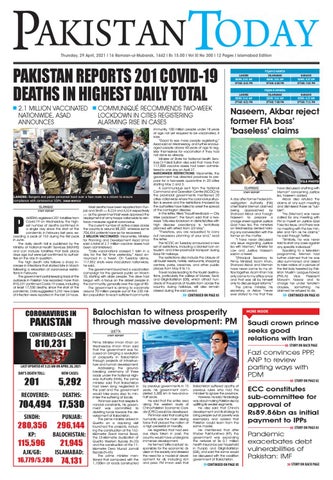
Thursday, 29 April, 2021 I 16 Ramzan-ul-Mubarak, 1442 I Rs 15.00 I Vol XI No 300 I 12 Pages I Islamabad Edition
Pakistan rePorts 201 Covid-19 deaths in highest daily total g
2.1 MiLLiOn vaCCinatED natiOnWiDE, asaD annOUnCEs
g
COMMUniQUé RECOMMEnDs tWO-WEEk LOCkDOWn in CitiEs REGistERinG aLaRMinG RisE in CasEs
lahore: Rangers and police personnel hand over a face mask to a citizen to ensure compliance with coronavirus SOPs. ZUBAIR MEHFOOZ
ISLAMABAD stAFF REpORt
P
akistan registered 201 fatalities from Covid-19 on Wednesday, the highest number of deaths confirmed in a single day since the start of the pandemic in February last year, exceeding a peak of 153 during the first peak in June. the daily death toll is published by the Ministry of national Health services (MonHs) and can include fatalities that took place days ago but were just confirmed to authorities on the day in question. the high death rate follows a sharp increase in infections that started late in March following a relaxation of coronavirus restrictions in February. the government portal keeping track of the outbreak in Pakistan has recorded more than 810,231 confirmed Covid-19 cases, including at least 17,530 deaths, since the start of the pandemic. Data suggested 5,292 new cases of infection were reported in the last 24 hours.
Most deaths have been reported from Punjab and sindh — 8,224 and 4,624 respectively — as the government last week approved the deployment of army troops nationwide to reinforce measures against coronavirus. the current number of active cases across the country is around 88,207, whereas some 704,494 patients have so far recovered. 2 MILLION VACCINATED: Meanwhile, Minister for Planning and Development asad Umar said a total of 2.1 million vaccine doses had been administered. “Daily vaccinations crossed 1 lakh in a day for the first time yesterday,” asad announced in a tweet. On tuesday alone, 117,852 shots were inoculated nationwide, he said. the government launched a vaccination campaign for the general public on March 10, starting with older people. the drive had begun with a focus on the oldest people in the community, generally over the age of 80. the government is aiming to vaccinate around 70 million people out of the 220 million population to reach sufficient community
Coronavirus in
Pakistan
CONFIRMED CASES:
810,231
LAST UPDATED AT 3:23 AM ON APRIL 28, 2021
DAY'S DEATH TOLL:
NEW CASES:
201
5,292
RECOVERED:
DEATHS:
704,494 17,530 SINDH:
PUNJAB:
280,356
296,144
KP:
BALOCHISTAN:
115,596 AJK/GB: 16,779/5,280
21,945 ISLAMABAD:
74,131
immunity. 100 million people under 18 years of age not yet required to be vaccinated, it says. “Good to see more people registering,” asad said on Wednesday, and further encouraged people above 40 years of age to register themselves for vaccination if they had not done so already. Minister of state for national Health services Dr Faisal sultan also said that more than 117,000 vaccine doses had been administered in one day on april 27. NATIONWIDE RESTRICTIONS: Meanwhile, the government has directed provinces to prepare for a two-week quarantine in 20 cities starting May 2 and 3. a communiqué sent from the national Command and Operation Centre (nCOC) to the provincial governments mentioned 20 cities nationwide where the coronavirus situation is severe and the restrictions imposed by the authorities have failed to arrest the spread of the contagion disease. in the letter, titled “input/Feedback — City Wise Lockdown”, the forum said that a twoweek “city-wise lockdown in districts/cities with high disease prevalence is tentatively planned with effect from 2/3 May”. “therefore, you are requested to carry out necessary planning at your end,” read the letter. the nCOC on tuesday announced a new set of restrictions, including a blanket ban on tourism and inter-provincial transport during Eidul Fitr holidays. the restrictions also include the closure of all tourist resorts, hotels, restaurants, shopping centers, parks, beaches, and other public places from May 8 to 16. travel nodes leading to the tourist destinations, particularly the valleys of Murree, swat, and Gilgit-Baltistan (GB), which attract hundreds of thousands of tourists from across the country during holidays, will also remain closed during the said period.
CONTINUED ON PAGE 05
fiqah-e-hanfia lahore sehr: 3:51 aM iftar: 6:41 pM
karachi sehr: 4:37 aM iftar: 7:01 pM
fiqah-e-jafaria lahore sehr: 3:41 aM iftar: 6:51 pM
islaMabad sehr: 3:41 aM iftar: 7:00 pM
karachi sehr: 4:27 aM iftar: 7:11 pM
Naseem, Akbar reject former FIA boss’ ‘baseless’ claims
file photo
ISLAMABAD stAFF REpORt
a day after former Federal investigation authority (Fia) chief Bashir Memon claimed being approached by shahzad akbar and Farogh naseem to prepare a charge sheet against Justice Qazi Faez isa, the ministers on Wednesday denied holding any conversation with the former on the matter. “i have never discussed any issue regarding Justice isa with Memon,” Minister for Law and Justice naseem said in a tweet. “[Principal secretary to Prime Minister] azam khan, shahzad akbar and Memon have never come to my office together. azam khan has only come to my office once and that was all by himself only to discuss legal reforms.” the prime minister, his secretary, or akbar “never ever stated to me that they
Balochistan to witness prosperity through massive development: PM QUETTA stAFF REpORt
Prime Minister imran khan on Wednesday imran khan said that the government was focused on bringing a revolution of prosperity in Balochistan through projects of infrastructure and human development. addressing the groundbreaking ceremony of three roads under the national Highway authority (nHa), the prime minister said that Balochistan had been long neglected in the past and the government would take every step to minimise the suffering of locals. PM imran said that despite financial constraints, his government was committed to diverting funds towards the development of Balochistan. the prime minister arrived in Quetta on a day-long visit launched the projects, including the construction of the 162kilometre Ziarat Harnai Road, the 23-kilometre dualization of Quetta Western Bypass (n-25) and the construction of the 11kilometre Dera Murad Jamali Bypass (n-65). the prime minister mentioned that compared with the 1,100km of roads constructed
islaMabad sehr: 3:51 aM iftar: 6:50 pM
have discussed anything with Memon” concerning Justice isa, naseem added. akbar also refuted the claims of any such meeting and dismissed those as “rubbish”. “He [Memon] was never called for any meeting with PM or myself on Justice Qazi Faez isa issue, and there was no meeting with the law minister and him as he claims,” he said through twitter. “similarly, he was never told to start any case against any specific individual.” speaking to a television programme, Memon had further claimed that he was also summoned and asked to take notice of a picture of the first lady tweeted by Pakistan Muslim League-nawaz (PML-n) vice President Maryam nawaz and to charge her under terrorism clauses, something he claimed he refused to do.
CONTINUED ON PAGE 05
more inside
Saudi crown prince seeks good relations with Iran STORY ON BACK PAGE
Fazl convinces PPP, anP to review parting ways with PDM STORY ON PAGE 02 by previous governments in 15 years, his government completed 3,300 km in two-and-ahalf years. He said that the entire area along the western route of China-Pakistan Economic Corridor (CPEC) would be developed. PM imran said that caring for humanity was the main driving force that placed the nation at a high pedestal of morality. He regretted that had serious steps taken in past, the country would have undergone immense development. He termed ‘elite capture’ responsible for the economic division in the society and stressed the need for a model of development for all, including rich and poor. PM imran said that
Balochistan suffered apathy of previous rulers who had the mindset to ignore the province. However, he said, his ideology was about making Pakistan rise by uplifting its weaker segments. He also said that China’s development and its strategy to bring people out of poverty was exemplary and added that Pakistan could learn from the same model. He mentioned that after khyber Pukhtunkhwa (kP), the government was expanding the network of Rs 0.1 million health insurance per household in Punjab and Gilgit-Baltistan (GB), and said the same would be discussed with the coalition government of Balochistan.
ECC constitutes sub-committee for approval of Rs89.86bn as initial payment to IPPs
CONTINUED ON PAGE 05
STORY ON BACK PAGE
STORY ON PAGE 03
Pandemic exacerbates debt vulnerabilities of Pakistan: iMF
02
Thursday, 29 April, 2021
ISLAMABAD
NEWS
FAzl ConvInCES PPP, AnP to rEvIEw PArtIng wAyS wIth PDM ISLAMABAD
I
MIAN AbrAr
CE has started to melt between major political parties of the Pakistan Democratic Movement (PDM) as Maulana Fazlur Rehman, the president of the anti-government coalition, has stopped the alliance leaders from speaking out against the Pakistan People’s Party (PPP) and the Awami National Party (ANP).
SOURCES SAY PPP, ANP LEADERS MAY ATTEND NEXT PDM MEETING MAULANA FAZL STOPS PDM LEADERS FROM MAKING STATEMENTS AGAINST PPP, ANP A source in the opposition alliance informed Pakistan Today that there have been backdoor contacts between Maulana Fazlur Rehman and the PPP. “Ice is melting and the PPP and ANP are expected to attend the next meeting of
Experts to prepare report on PSM oxygen plant revival KARACHI
PDM,” the source said. According to the source, Jamiat Ulema-e-Islam-Fazl (JUI-F) chief and PDM President Fazl has asked Pakistan Muslim League-Nawaz (PML-N) and PPP central leaders to show restraint and
Iran, Norway impose travel restrictions on Pakistan
INP
NEWS DESK
After completing the examination of the oxygen plant at Pakistan Steel Mills (PSM) on the directives of the federal government, Engineering Development Board (EDB), Pakistan Oxygen Private Limited, and a team of experts will now compile a report on how to revive the facility. Pakistan Army Corps of Engineers will also assist in the compilation of the report. The report will devise a roadmap as to how to overcome different challenges that stand in the way of the revival of the plant. A non-stop supply of industrial water, as well as seawater, is needed for the revival of the plant. Similarly, a supply of electricity and steam will also be required for this purpose.
Iran and Norway on Wednesday became the latest countries to impose travel restrictions on Pakistani citizens out of fear of the dangerous Indian variant of coronavirus. "The rate of infections is very high in India, among other countries. In order to limit the risk of imported cases of new Covid-19 variants, we are now introducing stricter entry restrictions for travellers arriving from India and its neighbouring countries, as well as Iraq," Norway’s Justice and Public Security Minister Monica Maeland was quoted as saying in a statement. Under the new rules, travellers coming from Bangladesh, India, Iraq, Nepal, and Pakistan will now be required to stay at a quarantine hotel. “This means that people who undertake necessary travel to these countries will also be required to stay
PAEC develops first ICU ventilator in Pakistan ISLAMABAD APP
Living up to the nation’s expectations amid the third wave of the pandemic, Pakistan Atomic Energy Commission (PAEC) announced it has developed its own intensive care unit (ICU) ventilator named “iLIVE”. According to a news release issued here, the ventilator has been developed by a PAEC team of diligent scientists and engineers applying all essential quality standards and regulatory requirements whereas doctors from PAEC Hospital Islamabad provided valuable input during its development process. Besides passing through all internal reviews and testing, the “iLIVE” ventilator also successfully passed the independent reviews and testing conducted throughout the development lifecycle by the evaluation team from Pakistan Innovation and Technology Center (PITC), Pakistan Engineering Council (PEC). Moreover, extensive clinical trials of i-LIVE were also conducted at Jinnah Hospital Lahore under the supervision of senior doctors, biomedical engineers and medical researchers. It is pertinent to mention that the ventilator successfully passed all stages of engineering evaluation and medical validation. PAEC Spokesperson Shahid Riaz Khan told the media that the ventilator has been awarded formal approval, licensing and registration by the Drug Regulatory Authority of Pakistan (DRAP). After this award of approval from DRAP, i-LIVE will be manufactured and supplied by PAEC to meet the critical needs of our hospitals. He said this is a giant leap towards self-reliance in designing and manufacturing life-saving equipment. The exercise opens new avenues for multidisciplinary experts from various fields like software, hardware, mechanical, bio-medical engineering, medical and quality management to come together and serve the nation in distinct ways. The contribution is also aligned with Pakistan’s vision of a knowledge-based economy and geo-economic strategy. PAEC Chairman Muhammad Naeem congratulated PAEC scientists, engineers and doctors for this great achievement.
at a quarantine hotel,” said the statement. The European country said that the measures will come into effect on Wednesday 28 April at 12pm. Separately, Iran announced the closure of its land border with Pakistan in fear of the coronavirus cases being reported from India. "The Southeastern borders with Pakistan would only allow the return of Iranian and Pakistani nationals to their countries after the new ban is imposed on Wednesday," said a statement issued by the Iranian customs office that was quoted by the publication. Iranian Customs Office Spokesman Rouhollah Latifi said that the Iranian government will introduce “hygiene controls” on trucks arriving from Pakistan for the next 10 days. He added that commercial vessels from Pakistan will only be allowed to load and unload at Iranian ports after going through some strict checks and controls.
Pakistan urges UNSC to protect civilians in armed conflicts NEW YORK APP
Pakistan on Tuesday called on the UN Security Council to “act boldly” in protecting civilians and critical infrastructure during the conflict, pointing out that attacks against hospitals, homes, and schools are used to coerce people in occupied territories into submission. “Empirical evidence shows that attacks on cultural and religious sites, military siege and collective punishment have often been used to advance military or political objectives in situations of foreign occupation and suppression of the right of peoples to self-determination,” Ambassador Munir Akram said in a statement submitted to a meeting of the 15-member body. The meeting was convened by Vietnam, which holds the presidency of the Security Council for the month of April, to debate “Protection of objects indispensable to the survival of the civilian population”. “Quite often such occupied territories are subjected to round-the-clock curfews, communications blackouts, closure of educational institutions, a bar on religious and public assembly, illegal and arbitrary detention of public figures, forced
disappearances and extrajudicial killings of youth, shutting down of local businesses and economic activity — all of which are critical to people’s livelihood and survival,” Akram said. Civilians, he said, have always been the main victims of war, subjected to mass extermination, indiscriminate attacks, deportations, hostage-taking, pillage and internment, leading the international community to adopt two sets of protection through international humanitarian law. Despite the categorical prohibition to target food products, agricultural areas for the production of foodstuffs, crops, livestock, drinking water installations and supplies, and irrigation works, Akram said the international humanitarian law (IHL) has often been breached. “The destruction of objects indispensable to the survival of the civilian population and the disruption of essential services have also been identified as major challenges to the safe and voluntary return of refugees.” He further said the challenge of addressing “gross violations of international human rights and humanitarian law are further exacerbated by the inequity in the international response,” pointing out that in some situations, there is a quick and even robust
Meals on wheels programme sets up account for donations ISLAMABAD APP
A fund has been established to solicit public donations for the expansion of the Ehsaas Koi Bhooka Na Soye — meals on wheels — initiative nationwide on the instructions of Prime Minister Imran Khan. The setting up of this fund in the month of Ramadan is an important step that invites public and civil society to contribute towards building a welfare
return to the PDM fold. The source said that there have been backdoor contacts between Fazl and the PPP leadership. “During these contacts, Maulana Fazlur Rehman has asked the PPP and the ANP to
state where no one goes to bed hungry, an announcement made by the prime minister at the multicity launch of the programme said. People can deposit donations in cash or through crossed cheques through branches of any of the commercial banks operating across the country. Contributions can also be made at field offices of the State Bank of Pakistan (SBP) in 15 cities across the country. SBP has advised commercial banks to make available pre-printed deposit
slips at their counters to facilitate the public in depositing the donations. Banks have also been advised to prominently display the “Fund Account Number” and “IBAN” on their websites and ATM screens enabling donors to make donations through alternate delivery channels (ADCs). Pakistan nationals living abroad can also send donations to any commercial bank in Pakistan using the account details given on the banks’ websites. Foreign nationals maintaining Roshan
response, while in others, the perpetrators enjoy virtual impunity to commit crimes. “The Security Council, as the primary organ of the UN tasked with maintaining international peace and security, must not fail and act boldly in all situations where the survival of millions of civilians, caught in the vice of violence and war is threatened,” Akram said. At the end of the meeting, the Security Council also unanimously adopted a Vietnamsponsored resolution on protection of civilians in armed conflict. Pakistan joined several countries in co-sponsoring the resolution. Resolution 2573 strongly condemns attacks in situations of armed conflicts directed against civilians and other protected persons or civilian objects and demands that all parties to armed conflict immediately put an end to such practices. It demands that all parties to armed conflict “fully comply with their obligations under international humanitarian law, including regarding distinguishing between, on the one hand, civilian populations, civilian objects, and all other persons and objects afforded protection, and, on the other hand, combatants and military objectives; prohibiting indiscriminate.
Digital Accounts (RDA) can also contribute to the fund through their RDA accounts. According to a press statement, Special Assistant to the Prime Minister on Poverty Alleviation and Social Safety Dr Sania Nishtar said: “We are setting up a robust fund governance mechanism at the Poverty Alleviation and Social Safety Division in order to ensure that all decisions related to funding utilisation and deployment are strictly rule-based and transparent.” For integrity and efficiency of donor management operations, Ehsaas is setting up a “Donation Management System”. Once fully operationalised, the system will assist fundings in terms of transparency, fund utilisation and traceability.
reconsider their position. That is why Maulana Fazlur Rehman has directed that the parties will not make statements against each other till the summit,” the source added. Moreover, Fazl is convinced that PPP and ANP are expected to participate in the next PDM summit. During the meeting on April 26, Fazl, while confirming the PPP’s contacts, said that the PDM had asked those who had split from the alliance to reconsider. He had said that the PPP and ANP can return to the alliance by admitting its mistake. He had added that the steering committee of the PDM also made suggestions on future strategies, which will be submitted to the summit for final approval. Talking to media after the meeting, Fazl had said that a summit would be convened soon after which a full-fledged mass contact campaign would be launched with full force.
top medical body urges general lockdown KARACHI INP
Sharing concerns over the worsening situation of Covid-19 in the country, the Pakistan Medical Association (PMA) on Wednesday urged the government to impose a full, countrywide lockdown to control the rising number of infections. PMA General Secretary Dr Qaiser Sajjad told a private television channel coming weeks can be tough for Pakistan given how the coronavirus is spreading. “Our situation is also turning like India[‘s],” he said and added that micro or smart lockdowns will not serve the purpose now. “We have to stop the movement of the masses as it is the need of the hour and only situation to control the situation,” he said. Dr Qaiser said the government should consider imposing a blanket lockdown to bring the number of cases down. Pakistan recorded more than two hundred Covid-19 deaths in a day for the first time since the start of the pandemic in February last year. A total of 201 new deaths were recorded, bringing the country’s overall death toll from the virus to 17,530, according to the National Command Operation Centre (NCOC), which oversees the government’s pandemic response. The previous highest daily death count was 157 recorded on April 23. A total of 5,292 new cases were reported on Tuesday, bringing the total cases to 810,231.
lhC issues notice to Punjab Ig on plea against PMl-n MP’s arrest LAHORE APP
The Lahore High Court (LHC) on Wednesday issued notices to Punjab police chief to submit a response before April 29 on a petition challenging the arrest of PML-N MP Mian Javed Latif. Justice Anwaarul Haq Pannun took up the petition filed by against Latif’s arrest. A counsel for the petitioner argued before the court that Latif was an MNA and arrested without prior approval from the National Assembly speaker. He submitted that without fulfilling legal requirements, there was no justification for the arrest. He claimed that the police had kept him in illegal custody. The court, after recording initial arguments, issued notice to the police chief and sought a reply. Latif was arrested on Tuesday after a sessions court dismissed his bail application in a case pertaining to defaming state institutions. In March, the township police station had registered a case against Latif for hurling insults at the state and its institutions during a talk show.
By-elections in nA-249, Karachi west-II today KARACHI INP
All is set to hold by-elections on National Assembly constituency NA-249, Karachi West-II on Thursday. Presiding officers have been directed that pictures of Form-45 be sent to returning officers in presence of polling agents of contesting candidates. Amjad Afridi of Pakistan Tehreek-e-Insaf (PTI), Miftah Ismail of Pakistan Muslim League-Nawaz (PML-N), Qadir Khan Madokhel of Pakistan People’s Party (PPP), Mustafa Kamal of Pak Sarzameen Party (PSP) and Mohammad Mursaleen of Muttahida Qaumi Movement-Pakistan (MQM-P) are taking part in the election in constituency.
Thursday, 29 April, 2021
ISLAMABAD
NEWS
03
ECC COnStItutES SuB-COmmIttEE fOr APPrOvAl Of rS89.86Bn AS InItIAl PAymEnt tO IPPS ISLAMABAD
t
ShAhzAd PARAchA
HE Economic Coordination Committee (ECC) of the Cabinet has constituted a sub-committee for further deliberations on approval of Rs 89.86 billion as the first payment to the Independent Power Producers (IPPs). The decision to constitute a subcommittee was taken at a meeting of the ECC on Wednesday. The sub-committee will be chaired by the federal minister for finance and will have ministers and secretaries from energy, petroleum, and other concerned ministries for further deliberations. The sub-committee would present a firmed-up proposal before the next ECC meeting for consideration and approval. At the meeting, the Power Division
another sub-committee constituted to review release oF subsidy For rlng suPPly to exPort-oriented industries presented a summary regarding the release of the first installment of Rs80.86 billion payment to the IPPs. Article continues after this advertisement The Cabinet Committee on Energy (CCoE) and ECC had approved the payment mechanism and agreements with IPPs on the recommendation of the implementation committee in meetings held on February 8 this year, and the same was ratified by the cabinet on February 9. The payment mechanism approved required the first installment of 40 per cent of the payables to IPPs (as these stood on November 30, 2020) to be paid within thirty
business days of the signing of the agreement for IPPs under the pre-NEPRA regime, and within five business days of notification of revised tariff determination for IPPs under NEPRA regime. NEPRA has issued the revised tariff determination for all the twenty-four IPPs, which have signed agreements including twelve 1PPs under the 2002 Power Policy and twelve IPPs under the 2006 RE Policy. Accordingly, the first installment will become due within five business days of its notification which was pending with the government of Pakistan. It was also informed by the Power Division that NEPRA has issued the
determinations mentioned on April 6, 2021, while the Federal Board of Revenue (FBR) had also initiated the process to look into the matter of “taxation of the contractors at 4 per cent of the relevant payment” in respect of the 1PPs under 1994 Policy. According to sources, the Finance Division has asked for a summary to be moved to ECC for seeking Supplementary Grant/Technical Supplementary Grant on account of outstanding subsidy claims of the fiscal year 2019-20 and 2020-21 under the Power Division’s demand for the financial year 2020-21 for release of payment to IPPs. The power division has proposed that the FBR may review the matter of taxation
Govt introduces Rs1.24tn stimulus package for SMEs to shield against insolvency
of contractors at the rate of 4 per cent and such recoveries may be made from future payables of the relevant IPPs after the determination of FBR. Similarly, payments to all 1PPs under Power Policy 2002, which have signed agreements pursuant to MOUs, may be withheld, till the conclusion of the NAB investigation. Moreover, the government may also suspend the process of signing arbitration submission agreements with IPPs under the 2002 Power Policy, and notification of their revised tariff as determined by NEPRA, till the conclusion of the NAB investigation. In addition to this, the power division also proposed to proceed with payments to all other IPPs according to the signed agreements and to take any other action ancillary thereto which may assist NAB investigation.
One police officer dead in Balochistan blast QUETTA StAff RePoRt
ISLAMABAD StAff RePoRt
Federal Minister for Finance and Revenue Shaukat Tarin has said that the government has introduced the largest-ever economic stimulus package of Rs1.24 trillion for Small & Medium Enterprises (SME) to shield them against insolvency during the COVID-19 pandemic. He stated this while delivering his remarks on behalf of Pakistan at a virtual event held on the sidelines of the 77th session of the United Nations Economic and Social Commission for Asia and the Pacific (UNESCAP). The talk was titled “Debt Relief in the Aftermath of the Pandemic: How can Regional Dialogue help”. In his virtual remarks, the finance minister apprised
Finance minister says Pakistan’s economy showing signs oF recovery but external suPPort required to keeP the momentum the forum about the economic challenges faced by Pakistan due to the COVID-19 pandemic. “Due to the precarious economic situation in 2018, the government of Pakistan had to opt for an IMF programme to fix the balance of payments crisis,” he said. “Pakistan successfully met all benchmarks during first performance review criteria while all fundamental economic indicators reflected significant improvement before the onset of COVID-19,” Train added. Article continues after this advertisement He further stated that unfortunately, the COVID-19 shock resulted in considerable economic contraction
SECP to allow special purpose acquisition companies ISLAMABAD StAff RePoRt
The Securities and Exchange Commission of Pakistan (SECP) is mulling to introduce the concept of a special purpose acquisition company (SPAC) to facilitate raising capital for acquisitions or mergers. SPACs, a new concept for the Pakistani capital market, are prevailing in many jurisdictions, including the USA, Canada, Malaysia, and others. Under the SPAC structure, a company comprises a group of persons/professionals that raise funds from the general public and those funds are utilised for the purpose of merger or acquisition transaction within a permitted time frame. A SPAC’s life begins with its initial formation (in the form of a company), followed by its IPO, its search for a target, shareholder approval for merger/acquisition, and finally, the close of an acquisition or else return of the SPAC’s proceeds back to its investors. Under the proposed regulatory framework, SPAC shall be a company or body corporate registered with the SECP, which shall be formed by a group of persons meeting the fit and proper criteria. The paid-up capital requirement for SPAC shall be Rs1 million and it shall raise at least Rs200 million through a public offering. Article continues after this advertisement. The acquisition/merger has to be completed within the permitted time frame of two years and at least 90% of the funds raised shall be kept in an escrow account managed by a custodian. The proceeds in the escrow account may be invested in permitted investments. Each merger or acquisition transaction shall be approved by the shareholders by way of special resolution. Upon merger, the merged entity shall be automatically listed and in case of acquisition, the SPAC shall list the acquired entity. Shareholder/(s) disapproving the merger or acquisition is entitled to a refund of their money out of the Escrow account as per the specified procedure.
leading to loss of livelihoods, disruption in supply lines and limited economic activity during partial lockdowns. “To lessen the severe impact on the economy, the government of Pakistan introduced the largest-ever economic stimulus package for SMEs to shield against insolvency and facilitated the construction sector and allied industries to stimulate growth during testing times,” according to Tarin. He apprised the forum that 16 million families were given direct cash transfers under the Ehsaas programme which roughly accounts for 46 per cent of the total population of Pakistan in order to protect the most vulnerable segments of the society.
Fazl's remarks an insult to martyrs' sacrifices: Fawad ISLAMABAD APP
Minister for Information and Broadcasting Fawad Chaudhry on Wednesday strongly condemned the statement of Jamiat Ulema-e-IslamFazl (JUI-F) chief Maulana Fazlur Rehman, in which he claimed that "we are not capable of fighting for 24 hours". It was tantamount to insulting the martyrs, who had sacrificed their lives in the war against terrorism and for the security of the motherland, the minister said in a statement. He said that the aging leader of JUI--F could not probably bear his 'disrespect' at the hands of young Bilawal Bhutto-Zardari and started talking on the issues about which he knew nothing. Advising Fazl to avoid giving such irresponsible statements, Fawad recalled that it was the JUI-F chief who had expressed skepticism about Pakistan's defence capabilities by stating that the Taliban had reached the
hills (near the federal capital). His misplaced suspicions were dispelled by Pakistan's valiant armed forces and law enforcement agencies by breaking the back of terrorists, he added. The minister said that it was better for Fazl not to cast such unfounded doubts on the matters of national interest only to satisfy his political ego. Where was Fazl when Pakistan had responded to the Indian aggression on February 27, 2019, he added. He wished that the JUI-F chief should have shown concern about innocent Kashmiris facing Indian brutalities when his "friend" Nawaz Sharif was embracing his Indian counterpart Narendra Modi in Raiwind. Attacking the national institutions for political reasons was highly reprehensible, Fawad added. Taking a jibe on the Pakistan Democratic Movement (PDM), the minister said any alliance, which was ever led by Fazl till today, could not "fight" for even 12 hours.
A roadside bomb went off near a police vehicle in Quetta on Wednesday, leaving an officer dead and five others hurt, police said. No one immediately claimed responsibility for the attack in the town of Qilla Abdullah in Balochistan. The town is located 75 kilometers (30 miles) north of Quetta. Police officer Abdullah Achakzai said the victims were taken to a nearby hospital. The attack came as Prime Minister Imran Khan was in Balochistan on a day-long visit. But he was far from where the attack happened. Imran had gone to Balochistan to perform the groundbreaking of various projects. These initiatives included a 22.7 kilometers dualisation of Quetta Western Bypass (N25) and the construction of an 11 kilometers Dera Murad Jamali Bypass on the N-65 highway.
PIA to airlift another two million jabs from China KARACHI INP
Pakistan International Airlines (PIA) on Wednesday finalised arrangements to airlift another two million shots of Covid-19 vaccines from China. A special plane will fly to Beijing this evening to bring the consignment to Pakistan. Earlier this week, the airline had sought permission from the government to send its plane to China for the purpose. Over the weekend, three PIA aircraft brought back a consignment of one million jabs from China. “Three PIA Boeing 777 aircraft have brought one million doses. The aircraft had left for China on Saturday,” Arab News had quoted PIA spokesperson Abdullah Niazi as saying. Another consignment of the vaccine will also be transported from China on April 29 [Thursday], Qadir Bux Sangi, PIA Country Manager for China, told APP at the time. The government launched the nationwide Covid-19 vaccination for the general public, starting with older people, in March. The drive began with a focus on the oldest people in the community, generally over the age of 80. The vaccination of people aged 50 and above began on April 21. The National Command and Operation Centre (NCOC) had started a registration drive for people in the age group on March 30. Last week, Minister of State for Health Dr Faisal Sultan announced that by the end of June, the government would have a stock of 17 million coronavirus vaccine jabs but stopped short of identifying the producer. “The challenge [for the government] is to deploy and use them. The number of people who have registered is in the hundreds of thousands, not millions, yet we need to vaccinate 40 to 50 million by the end of this year,” he said in an interview.
President stresses modern beekeeping techniques to up honey yield ISLAMABAD APP
President Dr Arif Alvi on Wednesday called for adopting modern beekeeping techniques to enhance the yield and quality of organic honey produced in Pakistan. He said that the government would encourage and facilitate beekeepers by providing them loans under Prime Minister’s Kamyab Jawan Programme in addition to imparting advanced training in training institutes like National Vocational and Technical Training Commission (NAVTTC) and Technical Education &
Vocational Training Authority (TEVTA). The president gave these remarks while chairing a follow-up meeting on beekeeping and honey production at Aiwan-e-Sadr. The meeting was attended by All Pakistan Bee Keepers and Honey Dealers Association President (APBKHDA) Naeem Qasmi, Pakistan Agricultural Research Council Chairman Dr Muhammad Azeem Khan, Khyber Pakhtunkhwa (KP) Environment and Wildlife Department Secretary of Forestry Islam Zaib, Secretary Agriculture, Livestock, Fisheries and Cooperative
Department of KP Muhammad Israr and other senior officials of the government of Pakistan. The president said that Pakistan had enormous potential to be one of the largest producers of honey as its climate and vegetation were suited to the production of premium quality honey. He underscored the need for strengthening and improving the beekeeping sector as it had great potential to provide employment to the people as well as earn foreign exchange. He expressed the hope that the government’s Ten Billion Tree Tsunami programme would help improve the
beekeeping environment of the country to enhance the production of quality honey. The president asked the relevant stakeholders to address the issues of the beekeeping sector enabling them to increase the production and exports of honey. He also asked the stakeholders to initiate steps for facilitating and guiding the beekeepers by arranging training courses and workshops for them. Qasmi briefed the meeting about the issues faced by the beekeepers and highlighted the activities being undertaken by the association for the promotion of beekeeping in Pakistan.
04
Thursday, 29 April, 2021
NEWS
farrukh Habib appointed as state minister for information ISLAMABAD TLTP
The federal government on Wednesday appointed Parliamentary Secretary for Railways Farrukh Habib as the state minister for information and broadcasting. Minister for Information and Broadcasting Fawad Chaudhry congratulated Habib on his new appointment and said that it is a well-deserved appointment. "Congratulations to Farrukh Habib for his well-deserved appointment as state minister for information and broadcasting. He will take oath tomorrow," Fawad tweeted. Habib was appointed as the parliamentary secretary for railways in 2018. On April 15, Fawad was reappointed as the minister for information and broadcasting. PTI Senator Faisal Javed Khan had congratulated Fawad on Twitter for his reappointment and wished him the best. “Congratulations Fawad for being reappointed as federal minister for information. Wish you all the best. Lots of prayers,” Faisal had said. On August 20, 2018, Fawad was appointed as federal minister for information and broadcasting in the federal cabinet. However, in April, 2019, he was removed from the ministry and subsequently, Shibli Faraz was sworn in as the new information minister in a ceremony held at the President House.
man kills two younger brothers over trees’ distribution dispute SWABI APP
A man shot dead his two younger brothers over a petty issue of sharing out some trees in the vicinity of Topi police station here on Wednesday. A police spokesman said two brothers namely Wilayat Khan (44) and Imroz Khan (42) were present in their fields in Zakowand area, when their elder brother Hassan Khan along with his son Shakir reached there for sharing out the trees. The three brothers indulged in exchange of harsh words following which the elder brother, Hassan Khan, resorted to indiscriminate firing at his younger brothers. As a result, both the younger brothers were killed on the spot. Hassan Khan escaped the scene after committing the double murder. The local people showed great displeasure over the incident as some of them said both the murdered brothers were much sincere and supportive and their murders on a petty issue during the holy month of Ramazan were extremely deploring.
ISLAMABAD
AsAd urgEs TrAdErs To EnsurE impLEmEnTATion of Covid-19 sops ISLAMABAD
f
TLTP
EdERAL Minister for Planning, development and Special Initiatives Asad Umar has urged the business community to ensure strict implementation of the Covid-19 standard operating procedures (SOPs) in markets and commercial areas in order to curb the spread of the pandemic. Asad, who also heads the National
Command and Operation Centre (NCOC), expressed these views during an online meeting with Islamabad Chamber of Commerce and Industry (ICCI) President Sardar Yasir Ilyas Khan, said a statement issued on Wednesday. The NCOC chief said that the third wave of coronavirus has spread to a dangerous level and this situation demands the business community to play its role for strict compliance with the SOPs in business areas in order to control further spread of the virus.
He said that reduction in coronavirus cases would also help the government to consider easing restrictions on businesses. The ICCI president apprised the minister of the consequences of reduced business hours and requested him to consider extending them during Ramazan. Later, he requested all trade bodies and market associations of Islamabad, Rawalpindi and across Pakistan to come forward and play a role for strict implementation of the SOPs in their re-
NTDC, PMLTC sign agreement for transmission line project AZHAR SAYS GOVT ACTIVELY PURSUING COMPLETION OF ENERGY PROJECTS ISLAMABAD sTAFF RePoRT
Federal Minister for Energy Hammad Azhar witnessed as chief guest the agreement signing ceremony of an agreement for ±660 KV HVdC Matiari–Lahore Transmission Line Project between National Transmission & despatch Company (NTdC) and Pak Matiari-Lahore Transmission Company (PMLTC) and an amendment document to the implementation agreement between Private Power & Infrastructure Board (PPIB) and PMLTC, held at conference room of the Power division on Wednesday. The documents were signed by PPIB Managing director Shah Jahan Mirza, NTdC Managing director dr Khawaja Riffat Hassan and PMLTC President & CEO Zhang Lei. SAPM on Power and Petroleum Tabish Gauhar and Power division Secretary Ali Raza Bhutta were also present on the occasion. The Economic Coordination Committee (ECC) has granted approval and under the new transmission services agreement (TSA), the required commercial operation date (RCOd) of transmission line has been extended from March 1 to September 1. Whereas, another addendum has also been made in operations and maintenance service agreement. The ±660 kV Matiari–Lahore Transmission Line Project is the first ever HVdC transmission line project in Pakistan, which is being executed under the framework of China-Pakistan Economic Corridor (CPEC) agreement. It is also the first project being developed pursuant to the provisions of Private Sector Transmission Line Policy Framework, approved and announced by the government of Pakistan back in 2015. This transmission line is spread over a span of 886 km and capable of transmitting 4000 MW power at ±660 kV. The project is being executed on Build-Own-Operate-Transfer (BOOT) basis and it will be transferred to NTdC after a term of 25 years.
The project entails foreign investment to the tune of $1,658.34 million. In the light of the aforesaid MoU, addendum agreements to the TSA and O&M agreement were agreed between PMLTC and NTdC, which were later approved by their respective Bods. Moreover, an amendment to the implementation agreement (IA) was also finalised and approved to harmonise these changes in the TSA and IA. These amendments were signed between the respective parties. Speaking on the occasion, Azhar said that the present government is actively pursuing the completion of energy projects, including the CPEC projects. He further said it is one of the mega projects that will eventually evacuate electricity from south of the country to the north, improving the economic merit dispatch order of the electricity. It will not only will benefit the electricity consumers but will also bring stability in the system, he added It is pertinent to mention that during the testing of the said project in december last year, frequency oscillations in the NTdC system had led to differences between the NTdC and Pak MLTC. However, the concentration of the ministry, PPIB, NTdC, Foreign Office, China CET chairman, and CPEC Authority had played vital role during the proceedings of negotiations. Resultantly, all technical and contractual issues were resolved amicably under the dispute resolution mechanism. Later, the MoU signed by the NTdC and Pak MLTC were approved by the board of directors of both the companies. The addendum was also approved by the ECC in March. Presently, the project is energised at low power and 800 MW electricity is being transferred through the transmission line as test energy and as per agreed points in the MoU, the project will continue to operate on trial run basis on low power till May 1. Thereafter, the high-power test of 2200 MW will be started and after its successful completion, the HVdC transmission line will be tested for trial run of 7 days to confirm the capability of the line at 4000 MW designed capacity.
SDGs to address climate change, biodiversity loss, pollution: UNEP ISLAMABAD TLTP
Three planetary crises, including climate change, biodiversity loss and pollution, are reinforcing one another and driving further damage to the environment and human health, said the United Nations Environment Programme (UNEP). Executive director Inger Andersen told an online discussion that the “significant and pathbreaking” information contained in the UN agency’s synthesis report, Making Peace With Nature, not only breaks down the science, but also shines a light on “the kind of gearshifts” needed for a steady trajectory forward. This includes reaching for the Sustainable development Goals (SdGs), particularly SdG 12, on sustainable production and consumption, as well as making societies “much more aware of our footprint” on earth. Notwithstanding the need to lift people out of poverty, turn the wheels of economy and end world hunger, the report looks at what the earth can provide, and how it must be treated to remain sustainable. Unless improvements are made, the planet is set to lose about a million species, out of an estimated eight million, Andersen warned. during the discussion, report writers Ivar Andreas Baste and Robert Watson, along with scientific advisor Joyeeta Gupta, explained how the key findings rested upon a range of assessments, including from UN agencies, intergovernmental environmental bodies and multilateral environmental agreements. “Overall about 50 leading experts helped us prepare and guide this synthesis”, Watson said, adding that the “options for ac-
tion” within the report are consistent with each other. They also outlined that the interconnectivity of the three challenges putting the world’s well-being at risk can be tackled jointly within the SdG framework. Since the Stockholm Conference on the environment over 50 years ago, Watson pointed out that both the number of environmental issues and their severity have grown, “we clearly know we have a planetary emergency”, he said. “Humanity is waging war on nature. This is senseless and suicidal”, Secretary General António Guterres said in the foreword. “The consequences of our recklessness are already apparent in human suffering, towering economic losses and the accelerating erosion of life on earth".
spective markets and business areas. He urged them to make sure of enforcement of the policy of no mask and no entry in shops, markets, shopping malls, commercial and industrial areas. He also appealed to the general public to contribute in their respective localities across the country for strict implementation of the SOPs, saying, “Together we can make Pakistan a safe country from Covid-19 pandemic and save our businesses and economy from further losses.”
Citizens suffer as Expo Centre remains closed during vaccination hours LAHORE JAWAD ZULFIQAR
Lahore’s largest coronavirus vaccination centre remained closed during vaccination hours without prior notice on Wednesday which led to citizens waiting outside the premises and returning without getting inoculated. The official vaccination hours are 10 am to 4 pm and 9 pm to 1 am, but the centre was closed early. Citizens who travelled from afar in the summer heat while fasting during the holy month of Ramadan to get vaccinated were left disappointed when they found the centre closed with a signboard informing them of the new timings. Elderly citizens waited outside the locked gates of the centre and complained about the unprofessional behaviour of the healthcare authorities. A representative of the government’s official helpline said that the timings have not been changed. It is worth mentioning here that the government started coronavirus vaccination for citizens aged 40 and above on Tuesday as the country continues to grapple with the third wave of the pandemic. The citizens who went to the Expo Centre on Wednesday included those who were scheduled to receive their second dose of the two-shot Sinopharm vaccine. While the administration exhibited unprofessionalism at Expo Centre, Federal Minister for Planning Asad Umar, who also heads the National Command and Operation Centre (NCOC), announced on Wednesday that over 0.1 million people were inoculated on Tuesday. He added that so far 2.1 million vaccine doses had been administered in Pakistan. Also on Wednesday, Pakistan registered the highest number of fatalities in a single day since the start of the outbreak in Pakistan. With 201 people dying in 24 hours, the death toll increased to 17,530. Pakistan also registered 5,292 new coronavirus cases, taking the total number of confirmed cases to 810,231. Pakistan Today reached out to provincial health minister but no response was received by the time of filing of this report.
Two killed, three injured in truckrickshaw collision in Lahore LAHORE: At least two people were killed and three others injured in a dreadful road mishap in the provincial metropolis on Wednesday. According to details, an overspeeding truck hit a rickshaw near Ferozwala in Lahore. Two people were killed on the spot in the accident while three others injured and truck driver fled the scene. The bodies and injured were shifted to a nearby hospital for medico-legal formalities and the police, after registering a case against the truck driver, started an investigation.INP
Thursday, 29 April, 2021
ISLAMABAD
PAkIstAN: ROAdsIde IFtAR Resumes AFteR A yeAR bReAk KaracHi
s
ANADOLU AGENCY
ITTING on a plastic mat on a stony footpath opposite the mausoleum of the country's founder, Muhammad Ali Jinnah, Khair-un-Nisa, together with dozens of other women, was awaiting for Maghrib adhan, Islamic sunset prayers call, to break her fast as honking traffic passed by. Volunteers were placing traditional delicacies and drinks on dozens of mats occupied by hundreds of people as the sun began to fade. Nearby, a volunteer was preparing a local drink for the fasting people. Motorists hurriedly pulled over, adjusting themselves around the tables or occupying the plastic mats to join them. They broke their fast as the Maghrib prayers call resounded from a nearby mosque. Another group of volunteers distributed food packets, water bottles, and juice to people who were fasting and sitting in their vehicles and on public transport. Each individual was served a platter of fruit, samosa (a deep-fried triangular savory pastry filled with potato and spices), pakora (deep-fried spicy snacks made from gram flour), fruit cocktail, dates, juices, and pulao (meat rice). Donned in a traditional burqa (an encompassing veil from head to toe), Nisa, a daily wager in her early 40s, has to break her fast in the makeshift dine because she
couldn't get home due to a choking traffic jam, which happens every day before sunset during Ramadan. This facility is one of the hundreds in Karachi that provide an Iftar meal for the entire month. However, the decades-long tradition that remained was put on hold last year due to the coronavirus lockdown, compelling charities and philanthropists to look for alternatives to provide food to the poor during the holy month. Although the situation this year is no different as a devastating third wave of the virus continues to wreak havoc on the South Asian country, roadside Iftars have been allowed by the government. "After a gap of one year, the (roadside) Iftar has been planned," Arif Lakhani, an official of Saylani welfare trust, which provides Iftar meal to fasting people throughout the month at 75 points in the metropolis, told Anadolu Agency while overseeing the arrangements. "This was the first time in ten years that we did not arrange the street Iftar for the people," Lakhani, whose charity has been providing meals since 2011, said, referring to the city's complete lockdown last year. Zaid Junaid, who recently graduated from a local university, has also resumed his activities of organizing roadside Iftar at a section of the University Road after a year's hiatus. Until 2019, he had been organizing Iftar for over 200 people every day with a group of 15-20 friends and the help of
Naseem, Akbar reject former FIA boss’ ‘baseless’ claims continued from page 01 He added that the government had also asked him to imprison Maryam for delivering anti-state speeches, which he refused to do as well. ‘GOVT USING INSTITUTIONS TO THREATEN OPP’: Maryam accused the prime minister of using state institutions to threaten and silence opposition leaders and “put them behind bars”. “Not even gangs and mafias commit the acts that are being committed from the Prime Minister’s House,” she said, in reference to Memon’s interview. “Never in [Pakistan’s] history have such heinous crimes been committed […] and chiefs of institutions are ordered to frame cases [against opposition politicians].” State institutions, she claimed, were being used for political engineering. “Now, people understand what mafias or gangs really are”. Maryam also lauded Justice Isa for “fighting conspiracies” and said the government “achieved nothing but defeat”. She also demanded the formation of a judicial commission to “investigate the conspiracy of a fake reference: against the judge.
some local philanthropists. "Instead of arranging street Iftar last Ramadan, we delivered food packets to people in a low-income neighborhood at their doorsteps," he told Anadolu Agency as he handed a water bottle to a young Afghan. Delivering food at home, he added, was a tougher job. "We didn't ask for permission, and the government didn't stop us," Junaid, attired in a jean and a polo shirt, said with a light smile. IFTAR STALLS TRADITION: A few individuals had started arranging roadside Iftar during Ramadan in Karachi – home to over 15 million people and the country's commercial capital – two decades ago, and it has now become a tradition. This tradition was quickly adopted by a number of other cities, including the capital Islamabad, where roadside Iftar stalls provide food to tens of thousands of people during Ramadan. Lakhani observed that things have changed after the pandemic in terms of safety precautions. Only a few volunteers and the guests were wearing face masks. "It's hard to convince them to follow the safety precautions. Most of them are still unconcerned about coronavirus," an apparently frustrated Lakhani said. Ignoring safety protocols, he noted, is a threat to not only the violators but also those who are following the precautions.
A visit to several Iftar points in the city revealed that safety precautions are the last thing for the majority to follow. The surging pandemic has also reduced the number of guests at the roadside Iftars. Supporting Lakhani's views, Junaid said some prefer to get food boxes instead of the huddle on mats. But, he added, a majority still prefer to sit and eat shoulder to shoulder. This year, the number of his visitors has decreased by almost half, he said. Although there are no official data, it is believed that tens of thousands of factory workers, laborers, and domestic employees have returned to their hometowns after losing their jobs due to a simmering economic crunch caused by the pandemic. Coronavirus fear, according to Junaid, could be another factor that has slashed the number of visitors. "I have noticed that many motorists do not stop to even collect the food boxes at Iftar time [this Ramadan]," he added. Endorsing the argument, Mohammad Faisal, who works at a local publishing house, said: "I used to drop by and break the fast at any of the roadsides points or a restaurant in case of traffic congestion." "But since the beginning of the pandemic, I have stopped this practice. I simply keep a couple of dates and a water bottle in my bag to break the fast in case I am unable to reach home on time due to traffic jams," he told Anadolu Agency.
Why is there a shortage of medical oxygen and how is it made? Difficulty breathing is one of the most common severe Covid-19 symptoms, and as photos of people waiting in long lines for oxygen canisters in India and elsewhere attest, supplies of medical oxygen are far from adequate everywhere in the world. WHY THE LONG WAITS FOR OXYGEN IN DEVELOPING NATIONS? India is only the latest country to confront a lack of medical oxygen supplies. Earlier in the pandemic, there were similar scenes of long lines in countries such as Brazil, the Democratic Republic of Congo, Peru and Venezuela. Unitaid, a global initiative that helps low- and middle-income countries confront public health challenges, puts the lack of supplies of medical oxygen down to its cost, limited infrastructure and logistical difficulties. Medical oxygen is key to treating people in respiratory distress, whether at home or in hospitals. According to the World Health Organisation (WHO), one person in five suffering from Covid-19 needs medical oxygen to ensure that the level of oxygen in their blood is sufficient. HOW MUCH IS NEEDED IN COUNTRIES FACING SHORTAGES? In February, the WHO estimated that half a million people
needed 1.2m oxygen canisters a day. Unitaid put the price tag of helping the countries facing the greatest need at $1.6 billion this year. “This is a global emergency that needs a truly global response,” said Unitaid's Executive Director, Dr Philippe Duneton, in February. It has identified some 20 countries facing the greatest difficulties with oxygen supplies, including Malawi, Nigeria and Afghanistan. HOW IS OXYGEN MADE? Oxygen is made in two ways. Medical oxygen: It is made by separating the oxygen from other gases and impurities found in air by repeated steps of compression, filtration and purification, according to Air Liquide Sante France. Such medical oxygen reaches more than 99.5 per cent purity and is rigorously tested. It can be highly compressed into a liquid form, but has to be maintained below -182°C, which according to Air Liquide Sante France is the best way to meet variations in demand as one litre of liquid oxygen is the equivalent to around 800 litres when it is in normal gas form. Canisters that can travel with patients with one litre of compressed litres of oxygen contain about 200 litres of normal oxygen.
Compressed oxygen: Machines that can separate out nitrogen from ambient air can raise oxygen levels to around 93pc. The machines can be portable or larger to serve a hospital. However, these machines cannot meet surges in demand — which rose by a factor of five or six in French hospitals as waves of Covid patients peaked. They require lots of electricity and need to be regularly maintained by a technician. WHO ARE THE MAIN PRODUCERS? Outside of China, the three main producers of medical oxygen are the German firm Linde, which is allied with Praxair in the United States; the French firm Air Liquide and the US company Air Products. But there are a large number of local and regional producers of medical oxygen given that it is difficult to shop long distances. Industrialised countries are better served as production facilities were designed to serve more than just the medical sector, such as the steel and chemicals industries. WHAT'S BEING DONE FOR INDIA? The Indian military has used its cargo aircraft to transport oxygen tanker trucks where supplies are lacking, and a train called the Oxygen Express was put into service on April 22.
NEWS
05
Pakistan reports 201 Covid-19 deaths in highest daily total continued from page 01 There will be a complete ban on inter-provincial and inter-city transport during the Eid holidays, except for the residents of GB, who will be allowed to travel to their hometowns. The government and health officials have repeatedly warned that if the ongoing pace of infections continues in the coming days, the country may face a situation similar to India, where the surging pandemic has battered the already weak healthcare system. According to MoNHS, in several district hospitals, including those in Lahore, over 90 percent of ventilators and oxygen beds are already occupied, raising new fears about the fatigued health system should the coronavirus cases slip out of control. However, a day earlier, Minister of State for Health Dr Faisal Sultan said the government was increasing the domestic production of oxygen. Dr Faisal said the government was preparing for a potential surge in infections, noting that the capacity of healthcare facilities was being increased. In a reference to India, where the ongoing peak has faced issues with ensuring oxygen supply for critical for serious patients, he said a special committee of the NCOC was monitoring the situation in Pakistan. The government has opted not to impose blanket restrictions seen in some other countries, saying such measures could endanger the lives of many who rely on daily wages. Instead, officials have said the percentage of tests returning positive would dictate what lockdown measures are taken in a given area. But even in those areas measures such as markets being closed after 6:00 pm each day, and maskwearing mandates have gone largely unenforced. With only around 2 million vaccine doses administered and supplies short, officials have pleaded with the public to follow the precautionary guidelines.
India: Overconfidence, protocol violations derail Covid-19 fight anKara ANADOLU AGENCY
The phone calls from the Indian capital New Delhi these days send shivers down the spine. For the past few days, whenever the phone buzzed, it brought news of the death of a friend or a former colleague. Many friends admitted in the hospitals are gasping for oxygen with their relatives running helter-skelter to arrange cylinders using every trick under their sleeves. A caller from Faridabad, in the outskirts of New Delhi, wanted help to get his dead father cremated. There are long queues outside crematoriums, he said. The iron grills of an electric crematorium got melted due to the constant burning of its furnace. Another caller complained that there is no wood left at the crematorium to perform his uncle's funeral. Vinay Srivastava, a journalist based in Lucknow, capital of India's largest province of Uttar Pradesh, was tweeting and tagging his friends and authorities pleading for an oxygen cylinder till he breathed last. Prominent hospitals are knocking doors of courts to ensure the supply of oxygen. At Ganga Ram Hospital, a leading health facility in New Delhi, 19 patients died as the supply dried up. Just a few hours ago, the hospital administration had sent frantic messages to authorities asking for oxygen tankers. Father of Smridhi Saxena, a prominent radio jockey in India's commercial capital Mumbai said that despite resources and influence, she has been unable to get a cylinder for her ailing father, who needs a constant supply of oxygen. She said the cost of a cylinder in the city has shot up to 20,000-30,000 rupees ($270$370) and it lasts for just two to three hours. The Mother-in-law of a former colleague and senior journalist tested corona positive. Despite resources and contacts at every level, they had to make rounds to four hospitals searching for a bed.
Balochistan to witness prosperity through massive development: PM continued from page 01 He said that the project of direct subsidy to farmers on seeds and fertilizer under Kisan Card had been launched while 80 per cent of data of deserving families had been registered for Ehsaas socio-welfare programme. Balochistan Chief Minister Jam Kamal Khan said that during the last 15 years, the previous governments left several development projects in tandem, while the incumbent was focused on their completion. He emphasised on enhanced connectivity of Quetta with Naseerabad and Sibbi through dualization to facilitate farmers and traders from adjoining areas. He said that the construction work on roads and dams would ensure the development of militancy-hit areas that had long witnessed unrest and suffering.
He also said that the provincial government was spending Rs35 billion out of its own resources for the development of Balochistan besides the Rs20 billion allocated by the federal government. Minister for Communication Murad Saeed said that the projects would usher in a new era of development in the province. He mentioned that PM Imran started the western route of China Pakistan Economic Corridor from Balochistan, turning the dream of prosperity into reality. The prime minister was also given a briefing on the overall situation of Balochistan and the development projects. Separately, Prime Minister Imran said that the coastal areas of Balochistan offered immense potential in fisheries and asked the local youth to learn techniques to fully tap the opportunities for revenue generation.
Addressing the ceremony of soft loan distribution among the youth of Balochistan under the Kamyab Jawan Programme, the prime minister said that the government would support the youth through proper training in fisheries and help them run their own businesses. The prime minister expressed satisfaction over the allocation of Rs10 billion for the small business and skill development of the people of Balochistan. PM Imran proposed that learning of cage fishing technique as an aquaculture fish production system could prove beneficial for poor fishermen who were struggling to meet their ends. He pointed that big cartels in fishery sectors were an impediment in removing the poverty of fishermen. He said that the promotion of the fisheries
cmYK
sector would help uplift the youth of Balochistan and would ultimately benefit Pakistan. Senior leader of Pakistan Tehreek-eInsaf (PTI), Muhammad Usman Dar, who is leading the Kamyab Jawan project, said that loans amounting to Rs8 billion had been disbursed among 10,000 youth and this had helped create around 70,000 employment opportunities. He said that in line with the directions of the prime minister, at least Rs5 billion would be distributed among the youth of Balochistan by this year-end for supporting them in setting up their own businesses. Earlier, the prime minister gave away cheques of soft loans to the successful candidates of the Youth Entrepreneurship Scheme (YES) from Balochistan. The programme was launched in October 2019 under the banner of the Kamyab Jawan
Programme to provide the youth soft loans for the initiation of their own businesses. Recently, the government has enhanced the scope of YES which was meant to offer a huge amount of concessionary loans ranging between Rs100,000 and Rs25 million to the youth. Earlier, it was limited to Rs5 million only. According to the State Bank of Pakistan, the financing under YES has been segregated into three tiers. Under tier-1, the loan limit is from Rs100,000 up to Rs1 million, whereas tier-2’s loan limit is from above Rs1 million and up to Rs10 million and under tier-3, the loan limit is from above Rs10 million and up to Rs25 million. For tier-1 loans, the markup rate is 3 per cent, while the markup rate for tier-2 loans is 4 per cent, and for tier-3, the markup rate is 5 per cent.
Thursday, 29 April, 2021
06 COMMENT
The process is flawed
PTI government and the pandemic The situation is getting really serious
The post of Principal Secretary to PM is crucial
Y
esteRDaY, 201 covid-19 patients died in the country in 24 hours, the highest tally so far. troops were deployed in 16 major cities with high positivity rates to help in curbing the spread of the virus. the kP government imposed complete lockdown in Mardan city, where positivity rate had gone up to 40 per cent. there were reports of the government seriously meditating lockdowns in several other virus-hit cities. the government’s appeals to citizens to follow coronavirus precautions have fallen on deaf ears, indicating a lack of public confidence in the administration. While there is a dire need to adhere to measures like wearing facemasks, frequently washing hands and maintaining social distance, herd immunity induced through mass vaccination is the final way out of the pandemic. it is here that the government has fared extremely badly. the government failed to place orders for vaccines when these were available in the market. the federal government decided instead to wait for donations of vaccines from the WHO and China, putting the lives of the citizens at risk. turkey with a population of 82 million decided to put timely orders for vaccines and got them and has administered close to 22 million doses of Covid19 vaccine so far, which is around 12.8 percent of the country’s population. Pakistan on the other hand with a population of 216.6 million has so far administered only 2.1 million vaccines to less than one percent of its population. as of March 2021, an average of 0.2 doses had been administered for every 100 people in Pakistan, strikingly lower than the regional average for asia which is 4.5 doses for every 100 people. Lack of capacity in the government is accompanied by delays in taking decisions. as hospitals in india ran short of oxygen, the issue cropped up at nCOC also. iran, which faces a bigger coronavirus threat than Pakistan and has banned export of oxygen, is being asked to provide oxygen to Pakistan. talks are being held to divert oxygen currently consumed by local industry to hospitals, and to revive the oxygen production unit of the defunct PsM. there is no move to import oxygen when it is still available.
Dr FariD a Malik
D
esPite best intentions, if results are not being achieved, it is a clear indication that the process is flawed. today Pakistan faces a serious crisis of management, not leadership. Perhaps after Zulfiqar ali Bhutto, imran khan is the most popular leader of the country. Leaders do the right thing while manager do things right is the popular saying. the big questions are; Why are the things not right? Who is in control of the files and the paperwork? What decision-making processes are followed? Bhutto’s main strength was his grasp of paperwork. He kept the files moving. the bureaucrats and the Principal secretary to the Prime Minister (PsPM) could not hide behind the files, as he read all of them and asked pertinent questions in writing which had to be answered. His PsPM, Waqar ahmed, followed his directives. the executive authority wrested with him, not the PsPM. as an elected leader the PM is trying his best but his intentions and directives are not being implemented by his own secretariat, mainly because the paperwork is not in his control. While the PM has a defined term of office, everyone else has to perform to stay there. Cabinet reshuffle is fine but the fault lines are somewhere else. Re-engineering of the PM secretariat is needed to improve governance. it is time to flowchart and study all the prevalent processes of this vitally important office. several examples can be quoted but the dissatisfaction is so wide that it calls for immediate action. i am willing to offer my free services as a Certified Lead auditor for the audit of the secretariat followed by implementable recommendations for improvement. Over the years with weak PMs whose credentials were questionable, the office of the PsPM has become very powerful. as PMs, both Yousaf Raza Gillani and Muhammad nawaz sharif appointed junior but loyal bureaucrats in this position. Ms nargis sethi, a Grade 21 officer was appointed PsPM by Gillani. During this period a serious crisis of out of turn promotions took place as senior officers were overlooked. Fawad Hasan Fawad, a Grade 21 officer was
Afghan imbroglio Pakistan cannot afford another resurgence of Taliban terrorism
i
F nothing changes, Us President Joe Biden’s decision to withdraw Us troops from afghanistan by september 11 may prove costly to all parties, particularly the regional countries, and especially to Pakistan, which has found itself in something of a soup now that the taliban have announced that they will not be going to the istanbul conference, which was a follow-up to the recent conference in Moscow. another problem is the taliban have finally abandoned the Qatar talks, which means that there is no progress on the question that is uppermost on the minds of all interested parties: what will be the political settlement of a future stable afghanistan? Without an answer to this question it is possible that there will be a replay of the 1989 soviet departure from afghanistan: not only was the country over-run, but the President the UssR left behind, najibullaah, was strung from the nearest lamp post. One of the most disturbing developments for Pakistan is the alliance that has been struck between the taliban and the tehrik-i-taliban Pakistan (ttP). the ttP has been at war with the Pakistan army in Waziristan, and has only just recently expanded its sights to China, whose ambassador it attacked when it attacked a Quetta hotel. if it is forming an alliance with the taliban, it indicates that the latter is also going to take on board its fights. the taliban seem to be positioning themselves now that they believe the Usa is going to withdraw; the ttP will provide additional fighters for the expected final struggle. it should not escape notice that, unlike 1989, the antioccupation resistance is not divided, and therefore, the karzai government needs an agreement if it is to have any chance of surviving. the impression that Pakistan has some sort of ability to compel the taliban to make peace is false, and no one should be allowed to continue with that delusion. at this point, Pakistan should concert measures with all other interested parties, such as turkey, Russia, China and even the Usa, with a view to getting the intra-afghan talks moving again. after all, if they do not resolve matters amongst themselves, they will merely be making the country vulnerable to a future intervention. that the afghan people cannot afford. and nor can Pakistan.
MujahiD Barelvi
P
akistan has a strong tradition of giving that dates back to the inception of the country in 1947. the Partition of the subcontinent resulted in the largest mass migration in human history. as a result, individuals and organisations came together to support the rehabilitation of the migrants. since then, there have been many occasions for Pakistanis to rise above challenges of varying degrees, presenting unique opportunities for people to demonstrate compassion and generosity. Over the past 74 years, Pakistanis have faced tragedies resulting from wars, floods, and earthquakes but we have always come through because of our resilience as a nation. Philanthropy, without doubt, is ingrained in the fabric of our society, which predominantly comprises of a Muslim community. islam promotes charity not only in the form of Zakat during Ramzan but also as sadqat throughout the year. according to a survey conducted by the Pakistan Centre for Philanthropy (PCP), published in 2017, the total philanthropic giving of households in Pakistan was estimated at Rs 240 billion, indicating that we contribute over 1 percent of our GDP as charity. Despite being a developing country that falls in the category of low and middleincome countries, Pakistanis have a charity-to-GDP ratio comparable to countries from the developed world such as the Uk and Canada. However, the survey also revealed that most donations in Pakistan go to individuals rather than charitable organisations. this finding is concerning because we can achieve more if individual giving is institutionalized. With structured giving, we can convert our nation’s powerful tendency of philanthropy into a more impactful phenomenon. there are many charitable institutions in our country that are excellent examples of achieving such a phenomenon and making huge, meaningful impacts in Pakistan. shaukat khanum Memorial trust (skMt) is one
Editor Joint Editor
Umar Aziz Executive Editor
Lahore – Ph: 042-36300938, 042-36375965
Management crisis that the country faces has to be overcome. The PM Secretariat under various PSPMs has a poor record of service to the people which cannot be overlooked. Their failure must not reflect on the leader, he must put the house in order. While he is answerable to the people the bureaucrats remain untouchable
A case for promoting institutionalized giving
Arif Nizami
Managing Editor
My personal experiences with the PM secretariat (2002 to 2005) were also not good. as Chairman Pakistan science Foundation (PsF), i transferred a Deputy secretary who had been in that position for about two decades and was in fact the defacto Chairman as he had been calling the shots before i took over. When i constituted an inquiry into his misdeeds, he got himself transferred to the PM secretariat. as he had managed to get there without the permission of his parent department, i asked the secretariat to absorb him on permanent basis if his expertise was so urgently needed there. i got a very funny letter from there that implied that the PM secretariat had the authority to assign any civil servant as it desired. it was an ordinance that was enacted during the ill-fated 1970 war when officers resisted their transfer to the eastern Wing. after the passage of the 1973 Constitution it had no legal significance yet it was being used. then again when my term as Chairman ended in august 2005, a 74-year-old retired scientist was appointed in my place as the PsF act had not specified age limit. i wonder how this highest office in the land gets away with such a charade. indeed imran khan is a leader, he is honest, upright and committed. He is a ray of hope for the exploited and suffering masses but he has to deliver as well. the management crisis that the country faces has to be overcome. the PM secretariat under various PsPMs has a poor record of service to the people which cannot be overlooked. their failure must not reflect on the leader, he must put the house in order. While he is answerable to the people the bureaucrats remain untouchable. to drive the point home again, today Pakistan has a leader but not a good manager like Chou enlai was to Mao Zedong and Comrades ahsan Rashid and to some extent naeem-ul-Haq were to their kaptaan. the highest office of the land needs an operation clean-up, the sooner the better. The writer is ex-Chairman, Pakistan Science Foundation. He can be contacted at: fmaliks@hotmail.com.
Maximizing the impact of philanthropy
Dedicated to the legacy of the late Hameed Nizami
Yousaf Nizami Aziz-ud-Din Ahmad
especially sent from Punjab on the retirement of nasir khosa to head the secretariat during the nawaz regime. Due to his closeness and and unflinching loyalty to the sharifs, Fawad now faces naB scrutiny. the current PsPM azam khan was imran khan’s choice as he worked closely with the Pti government in kP. He then brought his own team from his home province. While the liaison between the PM secretariat and kP remains good, it is not that smooth with other provinces. Perhaps Punjab faces most governance challenges under the existing set-up. the loss of Comrade naeem-ul-Haq is also being felt as he was easily accessible to the party members and played the role of Deputy PM. With his presence in the secretariat, he provided a link between the bureaucrats and the public. naeem sahib understood the party rank and file and tried to solve their problems to the best of his abilities. after his demise in February 2020, no one has been able to replace him. the balance has now titled towards the bureaucracy that operates within the secretariat. there is a lot of deadwood that needs to be cleaned up in the highest office of the land. another area needing improvement is the recordkeeping. the record room has to be organized with easy access to information for the PM enabling him to take quick informed decisions. as student leaders we had the chance of visiting the PM secretariat during the Bhutto regime. He worked long hours by burning the midnight oil. as he had insomnia, his sleep hours were short. every ministry had a night section Officer whose job was to feed the necessary information to the PM at odd hours. Files were processed and returned within 24 hours with clear directives. He kept the files moving. By contrast, the files that were sent to Zia seldom came back unless personal interests were involved. after his death rooms full of files were discovered that were stored by the President as his approach was ‘Do nothing’, he sat on them. the inertia that he created by this approach that lasted over 11 years has still not been overcome. in fact the entire administrative machinery has ceased to function because of this menace. the Zia legacy of doing nothing continues till today.
I
Karachi – Ph: 021-35381208-9
I
such institution which has an enormous operating budget each year, and nearly half of it is met with donations. skMt runs two tertiary care cancer hospitals that provide free treatment to over 75 percent of all patients. the example of skMt demonstrates that strengthening institutionalized giving can bring hope and life to thousands of patients who rely on such organisations for survival. the PCP’s report identified four main factors that drive the individual tendency of giving and charitable organisations can work on developing these aspects to encourage people to participate in structured giving. First, spontaneous giving is driven by compassion in the moment. second, religious entities have an infrastructure in place to collect small donations, such as door-to-door campaigns and donation boxes. third, lack of trust due to distance and fear of misuse of funds. Fourth, more wealth increases the tendency to give to both individuals and organisations. these claims are supported by trends indicating that organisations that have developed trust with the public because of transparency and accountability, have means to collect small donations, use human stories to inspire compassion in the moment, and are connected with high-net-worth individuals, have enjoyed widespread support amongst the public. there are many credible charitable organisations
Islamabad – Ph: 051-2204545
working in the areas of healthcare, education, et cetera in our country that show accountability to the public by publishing their audited financial reports on their websites. there are hospitals where a simple visit to the facility is sufficient to establish that the donations are being spent judiciously. simply by looking at patients in the outpatient area, one can tell by their dilapidated conditions that they can barely cover travel costs, let alone expensive treatments. Charitable hospitals like shaukat khanum have gone an extra mile in gaining trust of donors by exhibiting an exceptional commitment to patient safety and services endorsed by international accreditation, and delivered on the basis of equality. the services are of the same standard for all patients and dispensed in the same manner whether a patient is selfpaying or receiving financial support. By promoting institutionalized giving, we can channelize the support of the public to achieve incredible feats and we have seen this possible in our country where institutions are run with the support of the public to deliver hope. there is a dire need to strengthen the trend of institutionalized giving to maximize the impact of philanthropy in the fields of education, healthcare, poverty eradication and many other noble causes in our country. Pakistanis should proudly support credible charitable institutions and promote welfare of their fellow citizens.
By promoting institutionalized giving, we can channelize the support of the public to achieve incredible feats and we have seen this possible in our country where institutions are run with the support of the public to deliver hope. There is a dire need to strengthen the trend of institutionalized giving to maximize the impact of philanthropy in the fields of education, healthcare
I
Web: www.pakistantoday.com.pk
I
The writer is a freelance columnist
Email: editorial@pakistantoday.com.pk
Thursday, 29 April, 2021
COMMENT 07 Editor’s mail Send your letters to: Letters to Editor, Pakistan today, 4-Shaarey Fatima Jinnah, Lahore, Pakistan. E-mail: letters@pakistantoday.com.pk Letters should be addressed to Pakistan today exclusively
Misunderstanding Islam nOt a single religion on the planet supports brutality, bad form and contempt against the presence of various cultures and human advancement. thus, islam is one of the quick scattering religion which consistently confers the lessons of affection and harmony. islam is the main religion that elevates the norm of humankind and guarantees correspondence. sadly, the current world delineates the helpless picture of islam. From pre 9/11 to post 9/11 islam has been accused for obliteration and springing up dread mentality on the planet. Be that as it may, the truth of the matter is that fear based oppression knows no religion. as of late, islam announced outrageous religion for stopping the development of Hindu sanctuary in islamabad. Pakistan was made as islamic state and it is impermissible in islamic state to fabricate a sanctuary by the costs of Muslims. now from over the world, turkey president, tayyab erdogon is being censured for remodeling Hagia sophia as a mosque inside his domain. islam isn’t as inflexible as world consider. spreading love, guaranteeing harmony and controling prejudice are the welcoming standards of islam. HAYA FATIMA KARACHI
Quad Strategy against China’s military and economic ascent The Quad alliance is one prong of the US strategy Maha Qaiser
C
Hina’s military and economic rise has had a great impact on the geopolitics of the world, as well as on in east asia. However, China’s overall rise changed the political and nuclear dynamics of east asia and south-east asia, and has also influenced the strategies of the Usa and its global strategic partners in the world order. Mao Zedong’s and Deng Xiaoping’s strategic thought relies more on the goal of economic development, which the Usa sees as harmful for the global economic order. China, as one of the largest states, is seen by the Usa and its allies as the emerging power, threatening the Us hegemony and creating adverse implications in the region. However, China argues it does not want to become a superpower; its national military, foreign and economic strategies are more directed towards its development and modernization goal. the China’s People’s Liberation army has achieved its goal in modernizing the Military industrial Complex and nuclear development to become a national power. China’s modernization in its armed forces and military capabilities has created a far greater threat perception of China than of Russia by the Usa and its allies. China’s rise has an impact on the strategic dynamics and stability of east and south-east asia, as China is a veto power ans permanent member of the Un security Council and the founding member in many multilateral treaties and export control regimes. the Usa’s strategy towards neo-authoritarian China is more adversarial as the Us-india’s strategic partnership’s main goal is to counter China. China with the world’s largest army modernizes its conventional forces and is now the leading air and naval power. China’s steady rise andits impact has threatened the Us hegemony and changed the global hierarchical order. China’s rise has impacted taiwan, south korea, Vietnam and india, through its economic and defense policies. China’s military rise in the south China sea has impacted the Usa, Japan, north korea, india and south korea but also indonesia which does not even share a border with it. since Mao’s economic and military development, China’s rise has been seen as an east asian theatre in global politics; because of its focus on taiwan, Hong kong and the south China sea. China’s nuclear strategy is more significant as any miscalculation between China and the Usa can lead them to the nuclear threshold; while China defines its economic and military rise as peaceful since Mao. Us President trump’s strategy towards China, included every factor countering China in every aspect. that strategy focuses on hastening india’s rise in south east asia to counter China, as, during the global covid-19 pandemic, China and india had skirmishes in the aksaiChin Ladakh region. that Us strategy also includes supporting taiwan. the trump administration’s strategy also stated that india will be predominant in southeast asia while countering the China, and north
korea will no longer pose any threat to the Usa and its allies, while the Usa will work with strategic partners to resist and counter China in its economic, military and national rise by undermining China’s sovereignty and territory. that declassified document clearly shows the Us strategy towards China is all about countering and resisting it in its rise while using all the coercive means and allies; the strategy also stated it would support any independent and free movement in south east China to counter China such as, resisting one nation and two system theory in Hong kong and taiwan, as well as antiauthoritarian protests. Biden’s strategy towards China is a continuation of trump’s strategy, and now it includes the strategic partnership while strengthening security ties with the Quad ally; the australia-Japanindia-Us anti-China nexus. all these strategies are designed to counter China’s economic and military rise as it is undermining the Us security and hegemony in the global world order. the Quad naval alliance sends aircraft, submarines and warships to the indian Ocean. this shows the Quad’s strategy to counter China’s military rise in the south asian and indo-Pacific region. this happened in this global pandemic and China responds only with a statement to condemn the Quad’s Malabar naval exercises. Quad countries do not have good ties with China individually as well; india and China had border skirmishes in the Galwan valley since after 1975, and Japan and China have a territorial dispute in disputed waters of the east China sea. the four democratic countries of the Quad tried their own strategies to counter China’s military and economic rise as they envision China as challenging the status quo, Us hegemony in the indian Ocean and the south China sea. these Quad countries also see China’s growing interdependencies with southeast asian states as exploitation of the economic order. Hoever, the Quad informal alliance has faced challenges to deter and counter China. the Us policy towards China in the trump era was like a Cold-War style, where the strategy was containment. this containment strategy can be seen in the events happened in trump’s tenure such as the Covid-19 pandemic, the false prop-
aganda which the Doomsday clock triggers too, and the disagreements over trade. But the problem lies here in the Quads informal alliance; Japan and australia are one step back in the Us’s strategy, as australia and Japan are the largest and second largest trading partners of China, respectively. China said that Quad was the ‘asian natO’ with Japan, the Usa, india and australia lled by the Usa to counter China. the Quad alliance viewed the countering of China meeting their strategic interest in their informal alliance, as the south China sea and indian Ocean are significant for india, while the east China sea and south China sea are significant to both the Usa and Japan, while the Western Pacific is significant to australia, so, the lack of the mutual interest between the Quad countries; such as between Japan, the Usa, india and australia, led to the failure of their informal alliance to counter China. the Quad held a discussion in 2018 about the China’s economic initiatives, such as the BRi (Belt Road initiative), but the Quad was unable to make progress in this discussion. in response, China did not adopt the policy the UssR did in the Cold war. instead Deng Xiaoping stated that China will go for free trade with more countries with a strategy of cooperation and openness. Deng also stated China would enthusiastically cooperate with all countries, regions and enterprises around the world that are also willing. China’s economic and developmental initiative includes most likely the infrastructure, roads, bridges and technological advancement which somehow create the biggest difference to the Usa’s educational and other initiatives. in December 2020, China stated that it would continue the dialogue with natO. the reason was the 30-member north american and european security block identified China as a rising threat beside Russia. natO also added China to its list of the countries that needed internal reform. it stated that China needs to change its policies, such as spending highly on its defence budget, and the interdependences and influence China is creating on other countries through its strategy of infrastructure investment such as the Belt Road initiative.
China’s economic and developmental initiative includes most likely the infrastructure, roads, bridges and technological advancement which somehow create the biggest difference to the USA’s educational and other initiatives. In December 2020, China stated that it would continue the dialogue with NATO. The reason was the 30-member North American and European security block identified China as a rising threat beside Russia.
The wrtier is a freelance columnist
Private schools fees tHe private sectors are going to demand for the fees after reopening the institutions. Owing to Covid-19 there was lockdown and it almost took about 7 months to take off everything smoothly and slowly. in turbat, there were not even online classes due to lack of internet. But, private sectors will still ask for fees as now after 7 months of closure they can face bankruptcy. Despite being the richest province in Pakistan, Balochistan is quite poor and people over here face a lot of hardships due to poverty. Parents work day in day out, so there children can get education but demanding for couple of months fees together despite of teaching nothing can push them to drop-out their children. Henceforth, i request the private sectors to lessen their fees as everyone is already in lose due to closure of every business. ZAHRA BAIG HOTH TURBAT
Extinction of wildlife tHe increasing rate of extinction of wildlife is a matter of worry for us. as animals have been very useful to human for ages. they balance our environment and are the beauties of nature. its really dissapointing that humen are hunting them for fun or money. according to in Defense of animals, over 200 million animals are reported killed by hunters every year. approximately 30,000 species per year about three per hour are being driven to extinction. Over 90 species of animals facing extinction in Pakistan: including 50 mammals, 27 birds and 17 reptiles. We need to raise awareness about endangered species. Pakistan is a member of the World Organisation on animal health she must enforce laws relating to animal welfare. the government must also formulate a national policy on animal protection and welfare. AFROZ MJ TURBAT
Corona tests for teachers PUnJaB school education Minister Dr. Muraad in his latest press Conference which was held at QaeD said , “ it is mandatory for all school teachers to conduct Corona test before joining the schools which will reopen on 15th september.” Minister must be acknowledged that Govt. school teachers are the most vulnerable community of civil servants. their salaries are very low. they cannot afford huge fee of Corona test. Govt has already denied to increase salaries of its employees in budget 2020-2021 and has been deducting conveyance allowance from teachers salaries since march 2020. the entire teacher community is worried on latest announcement of Minister. Did all others Govt. employees joine their respective offices after conducting Corona test? if it is necessary to curb the spread of this deadly virus then Govt should pay the fee of this test or sanction “ corona test fee allowance “ in upcoming pay so the teachers can conduct their tests before joining the school again. Minister should review his decision. MAHTAB AlI KHAn BAHAwAlnAGAR
Keeping informed neWsPaPeR which was firstly introduced in 16 century,in China,has become a supreme part in every individual’s life in the present age. However, it is not wrong to say that newspaper is a store house of knowledge. it provides current newses related the country and the world. Further, it gives information about the governmental programs and it’s works for the country. newspaper reading informs one about the latest science discoveries and technological changes about many industries. Besides, now-a-days there are some pages in newspapers which are particularly printed for students. it not only acquaints them with all important happenings , but also supplies various knowledge about different subjects. newspapers have removed the global distance between the countries. in fact, one part of the world has been linked up with another through newspapers. in the modern world newspapers are the part of civilization and a product to facilitate human beings. so,we must accept the habit of reading newspaper regularly. FARAHnAZ FAROOq AHMEd TURBAT
Thursday, 29 April, 2021
08 WORLD VIEW
COVID anD Mr MODI’s bearD BEARDS CAN BE ACTS OF MASCULINE MESSAGING. NARENDRA MODI IS USING HIS BEARD FOR IDENTITY POLITICS
Globalist
I
try in india, devoted to the analysis of its symbolism.
PALLAVI AIyAR
NDiA’S ongoing COViD-19 tsunami has turned the country into a global hotspot. The horrific scale of the pandemic’s latest outbreak in the world’s largest democracy has come as a shock to audiences around the world. Until recently, india had appeared to have weathered the pandemic better than many other countries. THE PRIME MINISTER’S SURPRISING NEW LOOK: That the medical infrastructure in india is failing to cope is no surprise. The hospital systems of far richer countries have also come up short in the face of the virus. A greater surprise for audiences who haven’t seen recent images of india’s Prime Minister, Narendra Modi, has been his transformed physical appearance. in the year since the pandemic began, Mr. Modi has gone from sporting a manicured bonsai of a beard to a flowing, weeping willow of one. it is a visual transformation that is so startling as to have given rise to a cottage indus-
JIBES AT MODI’S BEARDSMANSHIP: Modi’s beard has also been at the receiving end of jibes from indian opposition leaders and critics. for example, Mamta Banerjee, the chief minister of West Bengal, who is contesting elections against Mr Modi’s political party, mocked the Prime Minister, saying his growing beard was inversely proportional to the state of the economy in the country. “The indian economy has gone for a toss. There is no industrial growth. There is no growth, except for the beard of Narendra Modi,” she said. BEARDS AS MASCULINE MESSAGING: A full-grown beard makes claims on behalf of its bearer of virility, masculinity, strength and abundance. And Mr. Modi, has long projected himself as a strongman, making his long beard just the right cocktail of attributes to signal. OPTION 1: NO BARBER AVAILABLE? A straightforward reading of the length of his beard would attribute it simply to the cir-
cumstances of the pandemic. for many around the world, longer hair (on the face and scalp) has resulted from delayed trips to the barber. But, given that india has not been under lockdown since last summer, this is an unlikely explanation. OPTION 2: TOO BUSY DEALING WITH NATIONAL CRISIS? A beard can also be an acknowledgement of the national crisis. A reminder that the leader of the country is too busy handling various challenges to get a trim. Although if you look carefully, Mr. Modi’s bush has been pruned more than it might at first appear. it is the male, Prime Ministerial equivalent of the no-makeup makeup look. OPTION 3: BEARDS AND IDENTITY POLITICS, INDIAN STYLE: i think the likeliest explanation is that the beard is a corporeal extension of Mr. Modi’s political project: the increasingly strong identification of the erstwhile secular state with religion, or Hinduism more specifically. in Hindu culture, a long white beard is strongly associated with the philosopher-sage or sadhu. This is someone who blends wisdom, asceticism and dharmic (religious) duty.
India’s COVID-19 tsunami ALTHOUGH INDIA PRODUCES 60% OF THE WORLD’S VACCINES, THE GOVERNMENT TOOK NO STEPS TO SCALE UP PRODUCTION OF THE TWO COVID-19 VACCINES CLEARED FOR MANUFACTURE IN THE COUNTRY Project syNdicate
I
SHASHI THAROOR
T is humbling when a columnist must retract his words soon after penning them. Just two months ago, after india rushed millions of doses of COViD-19 vaccines to over 60 countries, i praised the country’s “vaccine diplomacy.” india’s aspirations to be recognized as a global power had been given a real boost. Now, with more than 300,000 new cases a day and the death toll evidently much higher than reported, india is no one’s idea of a global leader. in my own defense, i was worried that india had exported three times as many vaccines as it had administered domestically. The country was clearly lagging behind its own target of immunizing 400 million people by August, after vaccinating some 3 million health care workers in a campaign that began only on Jan. 16. “[M]ounting concern about rising case numbers, the emergence of COViD-19 variants that may not respond to existing vaccines, and an economy that has not yet fully recovered,” i noted, “will intensify the challenge india confronts in fulfilling its obligations to developing countries while also meeting domestic demand.” At the time, i did not realize the scale of the challenge. The number of infections surpassed 17 million in recent days and the official death toll now exceeds 190,000. Hospital beds are now overflowing, oxygen supplies have dwindled, vaccination centers have run out of doses and pharmacies are unable to meet the demand for antivirals. india is reeling. How did everything go so wrong so soon after india recovered from the first wave of the pandemic last year, resumed normal life and economic activity and started exporting vaccines? The list of errors is long. Begin with symbolism over substance. On national television, Prime Minister Narendra Modi urged indians to bang plates together. Two weeks later, he instructed them to light lamps at a specific moment. Superstition replaced science-based policies in confronting the pandemic. Modi also enlisted Hindu nationalism in the fight against COViD-19. Just as the epic Mahabharata war was won in 18 days, he claimed, india would win the war against the coronavirus in 21 days. At no point was this based on anything more than wishful thinking. Another error was ignoring the World Health Organization’s advice. from the start of the crisis, the WHO recommended a containment strategy that required testing, contact tracing, isolation and treatment. While a handful of states, like Kerala (which recorded india’s first COViD-19 case on Jan. 30, 2020), initially implemented such measures successfully, the Modi government’s ham-handed response resulted in their uneven application in several states. Then there was over-centralization. from the first nationwide lockdown, announced by Modi in March 2020 with less than four hours’ notice, the central government managed the pandemic under obscure provisions of the epidemic Diseases Act and the Disaster Management Act, which allowed it to ride roughshod over india’s federal structure. instead of delegating india’s 28 state governments the authority to design strategies tailored to local conditions, the central government tried to manage COViD-19 by decree from Delhi, with calamitous results. And, no surprise, the initial lockdown was mismanaged. State governments, the public and even central gov-
ernment officials were caught unprepared. Chaos resulted, with some 30 million migrant workers, stranded without work in cities, forced to walk home, sometimes for days. it is estimated that 198 people died along the way. Some 5 million micro and small enterprises closed, unable to recover from the shutdown. india’s unemployment reached the highest levels ever recorded. As the crisis began to slip out of control, the central government, following then-U.S. President Donald Trump’s precedent, passed off more and more responsibilities to state governments without adequate funding. The state governments struggled to mobilize doctors, nurses, health workers, testing kits, personal protective equipment, hospital beds, ventilators, oxygen cylinders and medicines to fight the pandemic. The government mobilized a huge amount of funds for a new relief entity called “PM-CAReS,” but to this day there is no public accounting of how much money is in the opaque PM-CAReS fund and where its resources have been allocated. When the pandemic seemed to have waned, the authorities settled into complacency, taking no precautions or preventive measures against a possible second wave that many warned could be more devastating than the first. Testing, tracking and isolation of infected people and their contacts fell rapidly into disuse by the end of 2020. And just when people stopped following appropriate behavioral guidelines, the virus evolved an extremely infectious variant. Super-spreader events proliferated: election rallies and religious festivals packed together unmasked throngs. The contagion raged. Although india produces 60% of the world’s vaccines, the government took no steps to scale up production of the two COViD-19 vaccines cleared for manufacture in the country. Nor did it permit the import of foreign vaccines, help expand available manufacturing facilities or license other indian firms to produce doses. india launched its vaccination drive nearly two months after the United Kingdom; but by April, only 37% of health workers, and barely 1.3% of india’s 1.4 billion people, had been fully vaccinated. Only 8% had received at least one vaccine shot. Here, too, the authorities initially bet on centralization. And its refusal to grant emergency-use approval to vaccines from abroad led to a nationwide shortage of vaccines by mid-April. it was only at this point that the government delegated the vaccine roll-out to state governments and public and private hospitals and permitted the import of vaccines approved by the United States, the U.K., the european Union, Russia and Japan. even then, the central government failed to distribute vaccines equitably to the various states, resulting in some of the worst-affected (like opposition-ruled Maharashtra and Kerala) running short of vaccines as cases peaked. Like india’s government, i was prematurely self-congratulatory about the country’s vaccine diplomacy. At a time when indians were unable to access the vaccines that might have protected them, india’s Vaccine Maitri program was not smart, but hubristic. Global leadership must begin at home, and today home is a country whose mortuaries, graveyards and crematoria are running out of space. Shashi Tharoor, a former U.N. under-secretarygeneral and former Indian minister of state for External Affairs and minister of state for Human Resource Development, is an MP for the Indian National Congress.
MODI PROJECTS HIMSELF INTO THE SAINTLY DIMENSION: The beard goes some way in elevating Mr. Modi from a mere political leader who serves at the whim of the electorate, to a philosopher-king whose duty is to guide the nation along the path of righteousness. The resonance of Mr. Modi’s beard with classical Hindu culture might not be immediately clear to foreign audiences. Just as the notion of his political project itself remains fuzzy abroad. from afar, many persist in viewing the indian Prime Minister with admiration, although it is not always clear what the admiration is centered on. MODI VS. INDIA´S PLURALISM: Since coming to power in 2014, Mr. Modi has proved himself a majoritarian, to the detriment of india’s many minorities. The Prime Minister’s brand of nationalistic Hinduism, known as Hindutva, negates the pluralism that is foundational to india and that is arguably foundational to Hinduism itself. Hinduism is polytheistic. Historically it has been capacious enough to allow for many strands of thought to coexist, some of which disagree with each other on important points of meta-
physics. This cultural context goes someway in explaining india’s post-colonial embrace of democracy and freedom of speech. HINDUTVA AND THE INDIAN CONSTITUTION: The Hindutva version of Hinduism interprets the religion as a much more rigid, rule-bound and narrowly-defined identity. One that mirrors monotheistic religions with their book-based strictures. Hindutva’s political values, to which Mr. Modi subscribes, are in fact at marked variance with the secular, liberal values enshrined in the indian constitution. COVID BUNGLING: The harm wrought by the rise of anti-minority sentiments under his BJP government is now compounded by major policy bungling on the COViD front. for example, just prior to, and even during, the ongoing second wave of the virus, mass gatherings at Hindu festivals and state election rallies were held without any censure from Mr. Modi. More than 4.8 million (mostly unmasked) devotees thronged the city of Haridwar for the Kumbh Mela festival, between April 1 when it started and April 17, when it was finally called off. The upshot is that beard notwithstanding, the idea of Mr. Modi as sage-like-savior of the indian nation is increasingly untenable. He may as well shave it. Pallavi Aiyar is Deputy Editor-in-Chief of Th Globalist.
Authoritarian tech is on the rise Newsweek
L
RAPHAEL TSAVKKO GARCIA
ife in a refugee camp is an unimaginable horror. it’s the reality of thousands of people who fled war-torn countries, poverty, hunger and sometimes death. Greek refugee camps are often overpopulated, with scarce access to water, heat, food, or toilets, set up over contaminated soil. They are the closest thing to hell on earth. The pandemic worsened camps on several fronts. There has been a serious uptick in surveillance technologies administered to refugees since the pandemic started. Not only are refugees detained in inhumane conditions, but they are also subjected to strict surveillance inside and outside the camps, serving as guinea pigs for authoritarian technologies that are then used on the general population. There are plans to increase and implement such invasive and often harmful tech on everyone. from things that seem quite simple, such as forcing refugees to wear electronic ankle monitors in Canada and implementing voice recognition in Germany to discover migrants’ origins, to video border surveillance in Greece and invasive uses of contact tracing technology, Big Brother is keeping tabs on refugees in camps worldwide. Other technologies, like body heat scanners, iris scanners and social media scraping was used in refugee camps and on borders for years before the pandemic. They were prototyped then, before moving into mainstream use when the pandemic hit. in January, i interviewed Petra Molnar, director of the international Human Rights Program at the University of Toronto’s faculty of Law. She spent time visiting refugee camps in Greece, on the island of Lesbos. “The [Greek] government is ... basically weaponizing COViD to use it as an excuse to lock the camps down and make it impossible to do any research,” she said. Molnar said the situation was “quite bad in terms of things like access to health care, water, shelter. ... it’s far from ideal. The Kara Tepe camp is windy, it gets flooded, [people have] no access to water. it’s difficult to wash hands and isolate in any meaningful way.” The most invasive and harmful tech available, what Molnar called “sexy tech,” was not being used within the camps. She said there are plans to use the tech eventually, which is already in use at the Greek border and in europe. from drones and cameras to facial recognition and voice recognition, rarely refugees are aware that their data is being collected and freely shared with other countries without their consent, with little care for their privacy and data security. Refugees are often more concerned with survival and making it through the day than caring about how their biometric data is being collected, stored and shared. According to Jan Theurich, a German journalist and member of the DunyaCollective who spent several months in Greece, refugees have more pressing needs, such as being able to drink potable water, not freezing to death in windy and humid camps, or not die in a fire caused by the use of smuggled electric heaters. “This is a political catastrophe and then a humanitarian catastrophe. it’s not just the pandemic, but there’s a political will behind the situation creating a humanitarian catastrophe,” he said. Leaving the camps is not always the best choice as any financial support a refugee gets can run out quickly, causing them to find their own way. in the end, a lot of people decide to stay. “it’s like making a decision between getting the pest and cholera,” Theurich said. One must remember that inside the camps,
refugees “are the last ones to get information from the outside world. You can imagine the effect this all have on them—there’s increase in self-harm behavior, domestic violence, rapes and harassment, also stabbings.” Several countries deployed surveillance measures, either to monitor compliance to social distancing and quarantine rules or to track the spread of COViD-19. “if these measures are actually necessary and proportionate to confront the pandemic—if they are subject to public oversight and can be rolled back once the pandemic is over,” then they should be implemented, said Marcus Michaelsen, a Marie Skłodowska-Curie postdoctoral fellow at the Vrije Universiteit Brussel. We don’t know what kind of tech is being used on us at any given moment. But we can guess, investigate and denounce governments and companies alike. One type of tech focuses on contact tracing, with apps installed on our mobile phones to track and limit contagion. “There are still lots of apps that pose a threat to citizens’ right to privacy,” said Samuel Woodhams, digital tights researcher at internet research firm Top10VPN. At least 19 apps, with 4 million downloads combined, don’t have dedicated privacy policies according to Woodhams, meaning that users cannot know for sure how their data is managed—or by whom. Yet here we are discussing the rights of citizens. One can wonder what happens to the data of those who are running for their lives and those living in less-thandemocratic countries. But the fact is that even socalled democracies have shady records when it comes to surveillance, which leads many to worry. Contact tracing apps’ location data are not precise enough to track the spreading of the virus but reveal a lot of personal information. The same is true for credit card data, facial recognition and CCTV cameras in public places. Who collects the data and where will it all be stored? is it sufficiently anonymized, protected against data theft and abuse out of potential economic and political interests? The answers are generally far from what most people would expect—at least from those who have full confidence in the democratic ideals of their respective countries. in authoritarian and illiberal contexts, the pandemic accelerated the decline of internet freedoms, a trend in line with a broader crisis for democracy and shrinking civic space. it is not to say that we don’t need the means to track and prevent the spreading of diseases, or that we don’t need to monitor borders and protect ourselves from terrorism and potential harm. We need better rules in place, transparency and accountability. Otherwise, the same measures used to protect us will end up harming society and create a virtual police state. We must know who is collecting our data and to what purpose. We as a society must be able to set boundaries and limits. Otherwise, little by little, the differences between democratic states and authoritarian or illiberal ones will decrease and we will end up unwillingly giving up on our privacy—which is what is happening with refugees today, all over the world. The pandemic is being used to justify expanding sometimes draconian surveillance. it is interesting that amid such heavy use of authoritarian tech, violation of privacy and 24 hour monitoring, some people prefer to fall for conspiracy theories about microchips in vaccines. Reality in itself is frightening enough. Raphael Tsavkko Garcia is a Brazilian journalist based in Belgium. He holds a PhD in human rights from the University of Deusto (Spain).
Thursday, 29 april, 2021
business 09
islamabad corporate corner coca-cola appoints aisha Sarwari to lead the Public affairs, communications & Sustainability function
US goodS trade deficit vaUltS to record high in March WASHINGTON
t
KARACHI: The Coca-Cola Export Corporation, Pakistan has appointed Aisha Sarwari as the new Director, Public Affairs, Communications and Sustainability, for the Pakistan and Afghanistan region. She joins at a time when the Company identifies Pakistan as the largest market in the region, and also a time of global restructuring to instill a flat and integrated system that gains enterprise efficiencies amidst the Covid-19 pandemic. PrESS rElEASE
PSX holds gong ceremony on listing of Service global footwear limited
KARACHI: In an exciting development at Pakistan Stock Exchange (PSX), yet another company has been listed on the Exchange. The recently concluded Initial Public Offering (IPO) of Service Global Footwear Limited results in the sixth listing on the equity board of the Stock Exchange for the fiscal year 2021. This is a positive development as additional companies are getting listed intermittently since the beginning of this fiscal year.The IPO was a resounding success with the strike price being discovered at PKR 53.20 per share. A large number of investors, totaling 416 in number, including institutions as well as (foreign & local) individuals took part in the successful bidding in the book building phase.The general public portion of the Issue was oversubscribed by 4.9 times showing tremendous interest by the public. Applications for a total of 50,973,130 ordinary shares against the issue size of 10,221,875 ordinary shares were received.The Issue of Service Global Footwear Ltd. consisted of 40,887,500 ordinary shares or 20% of the total post-IPO paid-up capital of Service Global Footwear Ltd. The entire issue was offered through book building method at a floor price of PKR 38/- per share with a maximum price band of up to 40% (PKR 53.2 per share). Initially, 75% of the issue size i.e. 30,665,625 ordinary shares were allotted to successful bidders and 25% of the issue size i.e. 10,221,875 ordinary shares were offered to retail investors at the Strike Price. The book building dates of the Issue were April 7th & 8th, 2021, whereas the public subscription dates for the retail portion of the Issue were April 12th and 13th, 2021.The principal purpose of the IPO was to raise capital for equity investment into a subsidiary company (of the parent company, Service Industries Limited), Service Long March Tyres (Pvt) Limited (SLM) and become a stakeholder of approximately 18.91% of the total shareholding of SLM.Speaking about the successful public subscription of the Issue of Service Global Footwear Limited, Mr. Farrukh H. Khan, MD & CEO of PSX, stated, “The IPO of Service Global Footwear Limited will lead to the sixth listing on the equity board of PSX in the current fiscal year, FY 2021. Pakistan Stock Exchange is immensely proud of the fact that an industrial house related to the tyre, rubber and footwear industry has made yet another entry on the bourse. The parent company, Service Industries Limited, has had an enviable record in the historical annals of Pakistan’s business and industry. It dates back to 1957 when it was incorporated as a private limited company. It was listed on the Stock Exchange in 1970 and therefore has a historic association with the Stock Exchange of more than five decades. The entry of its subsidiary, Service Global Footwear Limited, is a very welcome development. The listing of a company that manufactures footwear with a focus on exports will add significantly to not only the business prospects of the company itself but also the export economy of Pakistan while providing a good investment opportunity for investors”. He further stated, “The listing of Service Global Footwear Limited reflects the confidence issuers have in the Stock Exchange as a robust conduit for raising capital. PrESS rElEASE
AGENCIES
hE U.S. trade deficit in goods jumped to a record high in March, suggesting trade was a drag on economic growth in the first quarter, but that was likely offset by robust domestic demand amid massive government aid. Economic activity in the United States has rebounded more quickly compared to its global rivals. The pent-up demand is drawing in imports, eclipsing a recovery in exports and keeping the overall trade deficit elevated. The report from the Commerce Department on Wednesday also showed inventories at retailers were drawn down in March, underscoring the strong domestic demand. “The widening in the goods deficit suggests that trade will be a drag on first-quarter GDP,” said Ryan Sweet, a senior economist at Moody’s Analytics in West Chester, Pennsylvania. “This won’t be a big issue, as other parts of the economy are still doing well, such as business investment in equipment and consumer spending.” The goods trade deficit surged 4.0% to $90.6 billion last month, the highest in the history of the series. Exports of goods accelerated 8.7% to $142.0 billion. They were boosted by
shipments of motor vehicles, industrial supplies, consumer and capital goods, and food. The jump in exports was offset by a 6.8% advance in imports to $232.6 billion. Imports rose broadly. There were large gains in imports of motor vehicles, industrial supplies, consumer goods and food. Capital goods imports also rose solidly. Demand during the pandemic shifted to goods from services, with Americans cooped up at home. Consumption has been boosted by the very generous fiscal stimulus, including the White house’s $1.9 trillion COVID-19 pandemic rescue package, which dispatched onetime $1,400 checks to qualified households and extended a $300 unemployment subsidy through early September. Economists expect the goods trade deficit will remain large at least until year-end, with demand reverting back to services like air travel and dining out following the expansion of the COVID-19 vaccination program to all adult Americans. “The goods deficit will start to shrink by the end of 2021 and into 2022,” said Bill Adams, senior economist at PNC Financial in Pittsburgh, Pennsylvania. “As the pandemic comes under control in the United States, American consumers will spend less on imported goods, shrinking imports, and
foreigners will buy more U.S. exports as their economies recover further.” Stocks on Wall Street were mixed. The dollar rose against a basket of currencies. U.S. Treasury prices were mixed. STRONG GDP GROWTH ANTICIPATED: The report was published ahead of Thursday’s advance first-quarter gross domestic product data, which is expected to show the economy grew at a robust 6.1% annualized rate in the first three months of the year after expanding at a 4.3% pace in the fourth quarter, according to a Reuters survey of economists. That would be the secondfastest growth pace since the third quarter of 2003. Strong consumer spending and business investment as well as the housing market are expected to boost growth. Some of the goods imported in March ended up in warehouses at wholesalers, which could blunt the drag on GDP growth from trade. The Commerce Department reported wholesale inventories shot up 1.4% last month after rising 0.9% in February. But stocks at retailers tumbled 1.4% after gaining 0.1% in February. Retail inventories excluding autos, which go into the calculation of GDP, rose 0.6% after advancing 1.4% in February.
Brexit hit to British banks still not fully felt, UK finance ministry says LONDON: The hit to the City of London from Brexit has been less severe than initially predicted but may have further to play out, Britain’s top financial services official said on Wednesday. Britain was under “no illusions” that a post-Brexit “steady state” has been reached, in terms of banks settling on locations for their European operations, Katharine Braddick, head of financial services at Britain’s finance ministry told an event held by the Peterson Institute for International Economics. “There is still a lot in play,” she said. Banks in London face pressure from the European Central Bank to relocate staff and activities to the EU. “There is quite a lot of pressure to move quite a lot quite quickly. That is very much at the sharp end of where we are seeing the new border arise,” she said. Euro share and swaps trading has moved from London to Amsterdam, and Brussels wants clearing to follow. “Clients decide where businesses locate, and that’s certainly been the case so far on clearing and we will see that in investment banking,” Braddick said. AGENCIES
How private equity firms buy assets from themselves What’s a fair price when you are selling something to yourself? On Wall Street, that’s not a trick question. A growing number of private equity firms are establishing new funds to buy portfolio companies from funds they already control. With the buyer and seller each an entity controlled by the same private equity firm, scrutiny is growing over how they price such deals. “Transactions must be done at fair value and this must be sufficiently mitigated to make sure everybody feels good about the deal being done,” said Brian Rodde, managing partner at Makena Capital, a private equity investor. In a traditional private equity transaction, investors will give a private equity fund money to invest in a portfolio of companies with the expectation that they will get their money back, plus profit, once those companies have been sold to outside buyers, usually in a 5-7 year timeframe. The coronavirus pandemic initially disrupted private equity funds’ ability to exit companies and return funds to investors because would-be buyers were wary of deals. Raising new funds to buy the firms allowed private equity funds to hang on to good companies, keep charging investors lucrative management fees and give cash back to those investors who didn’t want to wait for their return. The value of transactions involving buyout firms acquiring companies from themselves reached a record $21.8 billion in 2020, accounting for 87% of all deals in the secondary market initiated by private equity firms, according to fund placement agent Campbell Lutyens. That is up from $17 billion in 2019, when they accounted
CMYK
for 68% of all deals in the secondary market for private equity fund stakes. A new record may be hit this year, as deal volume in the first quarter reached $15 billion, up from $7 billion from a year ago, according to a Citigroup Inc estimate. Industry executives say these deals are becoming more popular because as market fears around the pandemic recede and record levels of mergers and acquisitions ensue, some fund investors want to cash out to avail of new opportunities. The risk for investors looking to exit is that they may be forfeiting the opportunity for extra profit by selling too early or at too low a price, while those buying may be overpaying for assets that may not deliver on promised returns. Existing investors can, however, stick with the asset if they believe there is more value to be had in the future. “Investors generally have the option to roll their exposure if they believe there is more upside on a go-forward basis,” Orcun Unlu, Citigroup’s global head of private funds, said. Private equity funds have an incentive to hold on to good companies because increased competition for new acquisitions has driven up valuations, meaning it is expensive for them to go hunting anew. It is also risky; there is no guarantee that the next company they buy will be as successful as the one they own now. “There was an expected duration for an exit for some of these (fund managers) on certain transactions and that got pushed out,” said Chris Perriello, co-head of secondary fund investments at AlpInvest Partners, a division of buyout firm Carlyle Group Inc. AGENCIES
law enforcement agencies visit BoP head office, express Satisfaction over Measures taken by BoP to combat covid-19 Law Enforcement Agencies today visited BOP Head Office and its Branch located at Main Boulevard, Gulberg, Lahore. They inspected the protective and precautionary measures taken by BOP against COVID-19 including reduction of staff strength to 50%. Incharge LEA showed his satisfaction and appreciated the measures taken by BOP. On this occasion, BOP’s senior management appreciated the efforts of all LEAs (Police, Rangers, Army) and District Administration for implementation of Covid-19 SOPs and expressed gratitude over their visit to BOP. PrESS rElEASE
Bank al habib declares rs. 4.60 billion profit after tax The Board of Directors of Bank AL Habib Limited (the Bank) announced the Bank's financial results for the period ended 31 March 2021. The Bank posted profit after taxation of Rs. 4.60 billion i.e. an increase of 60.90 percent compared to corresponding period last year. The Bank’s profit before tax was recorded at Rs.7.06 billion, showing a growth of 47.36 percent as compared to corresponding period last year, driven by markup income as well as fees and commission income translating into an EPS of Rs. 4.14 per share as against Rs. 2.57 per share for the corresponding period last year. Net markup income increased by 16.56 percent as compared to corresponding period last year bringing it to Rs. 13.11 billion, reflecting the Bank’s success in maintaining sustainable growth. Despite the challenging conditions and free online offerings during the pandemic COVID 19, the Bank managed to increase its fee and commission income by 38.23 percent as compared to the first quarter of 2020. Total Assets reached to Rs. 1.61 trillion, an increase of 5.65 percent as compared to 31 December 2020. Net loans and advances grew by 4.54 percent to reach Rs. 533.43 billion whilst the investments increased by 10.38 percent to reach Rs. 844.31 billion, leading to overall growth in the total assets. Due to the Bank's sound risk management practices and prudent financing strategy, the NPL ratio was recorded at 1.24 percent. The Bank achieved a coverage ratio of 182.87 percent which reflects the prudent approach adopted towards nonperforming loans. Deposits of the Bank increased 6.16 percent bringing the total deposits to Rs. 1.17 trillion as on March 31, 2021. The Bank’s Capital Adequacy Ratio (CAR) recorded at 14.10 percent as of March 31, 2021 against the regulatory capital requirement of 11.50 percent (including capital conversion buffer of 1.50 percent as reduced under the BPRD circular letter no. 12 of 2020). Gross Advances to deposit ratio stood at 46.75 percent. The Bank continued with its strategy for outreach expansion, adding significant number of branches every year. The Bank’s branch network has now reached 912 branches / sub branches & 2 booths having coverage in 366 cities in Pakistan in addition to 3 foreign branches (one each in Bahrain, Malaysia, Seychelles) and 4 representative offices (one each in Dubai, Istanbul, Beijing, Nairobi) outside Pakistan. In line with the Bank’s vision to provide convenience to customers, the Bank is operating a network of over 1,071 ATMs across Pakistan. Pakistan Credit rating Agency (PACRA) has maintained the Bank’s long term and short term entity ratings at AA+( Double A plus) and A1+ (A One plus), respectively. The ratings of our unsecured, subordinated Term Finance Certificates (TFCs) are AA (Double A) for TFC-2018, and AA- (Double A minus) for TFC- 2017 (perpetual). These ratings denote a very low expectation of credit risk emanating from a very strong capacity for timely payment of financial commitments. PrESS rElEASE
ffc announces first Quarterly results for Year 2021 Fauji Fertilizer Company Limited (FFC) has announced its financial results for the quarter ended March 31, 2021 with net profitably of Rs 5.82 billion translating into an EPS of Rs 4.57 which was 36% higher than the last year. The company also declared first interim dividend of Rs 3.50 per share for the quarter. FFC attained urea production of 628 thousand tonnes, operating at combined efficiency of 123% and registered aggregate sales revenue of Rs 21.59 billion which was 5% higher than first quarter of last year. Other income of Company also increased due to higher dividend distribution by an associated company. The Company was able to maintain an uninterrupted business operations including continued supply chain, besides maintaining highest standards of health and safety for the employees under the adverse conditions of Covid-19. PrESS rElEASE
Thursday, 29 April, 2021
10 FOREIGN NEWS
ISLAMABAD
IndIA's CovId-19 deAth toll pAsses 200,000 As Who sAys vArIAnt found In 17 CountrIes NEW DELHI
I
AGENCIES
NDIA'S coronavirus death toll passed 200,000 on Wednesday, with more than 3,000 fatalities reported in just 24 hours, as the World Health Organization warned that a variant of Covid-19 feared to be contributing to a surge in coronavirus cases in India has been found in over a dozen countries. A total of 201,187 people have now died, 3,293 of them in the past day, according to health ministry data, although many experts suspect that the true toll is higher. India has now reported 18 million infections, an increase of 360,000 in 24 hours, which is a new world record. This month alone the country has added almost six million new cases. The explosion in cases, blamed in part on a new virus variant as well as mass political and religious events, has overwhelmed hospitals with dire shortages of beds, drugs and oxygen. The crisis is particularly severe in New Delhi, with people dying outside packed hospitals where three people are often forced
to share beds. Clinics have been running out of oxygen. India has so far administered 150 million vaccine shots and from Saturday the programme will be expanded to include all adults, meaning 600 million more people will be eligible. However, many states are warning that they have insufficient vaccine stocks and experts are calling on the government to prioritise vulnerable groups and badly hit areas. INDIA VARIANT FOUND IN 'AT LEAST 17 COUNTRIES': The worsening health crisis came as the World Health Organization warned on Tuesday that the new Covid-19 variant, identified as B.1.617, had been detected in over 1,200 sequences uploaded to the GISAID open-access database "from at least 17 countries". "Most sequences were uploaded from India, the United Kingdom, USA and Singapore," the WHO said in its weekly epidemiological update on the pandemic on Tuesday. The WHO recently listed B.1.617 -which counts several sub-lineages with slightly different mutations and characteristics -- as a "variant of interest". But so far it has stopped short of declar-
ing it a "variant of concern". That label would indicate that it is more dangerous than
the original version of the virus by for instance being more transmissible, deadly or
Dubai police arrest attackers in massive brawl that led to 3 deaths DUBAI AGENCIES
Police in Dubai have arrested 10 suspects in a massive knife fight that killed three people, authorities said on Wednesday, a relatively rare outburst of violence in the Gulf Arab sheikhdom. The police said the melee stemmed from a dispute over money, with 13 men armed with knives and wooden bats fighting over 5,000 dirhams. The brawl
drew others in, killing three and seriously wounding more. Police did not identify the suspects beyond saying they were of Asian descent, or specify where the fight took place. Dubai police rarely offer overall crime statistics, but previously have acknowledged similar incidents in low-income expat communities and labour camps, dormitory-style housing for many of the migrant workers from Asia, Africa and the Middle
East, who drive the machinery of daily life in the emirate. The killings come as Dubai suffers from an economic downturn precipitated by the coronavirus pandemic, which has triggered waves of lay-offs in the service-heavy economy. The region’s financial hub relies heavily on the tourism, hospitality and retail sectors — all hit hard by the virus. The city-state has redoubled efforts
in recent months to protect and boost its safe and tourist-friendly image. The US State Department has assessed that Dubai’s crime rate “appears to be significantly lower” than similarly sized cities worldwide. “However, do not let this lull you into a false sense of security,” its 2020 United Arab Emirates security report warned, citing petty theft and “rare incidents of violent assault” in workingclass communities.
EU legal case against AstraZeneca begins in Brussels court BRUSSELS AGENCIES
The European Commission's lawsuit against drugmaker AstraZeneca over Covid-19 vaccine supplies began at a Brussels court on Wednesday, where the bloc's lawyers pressed for immediate deliveries from all factories, including from Britain. The case in the Brussels court is the latest twist in an often bad-humoured EU dispute with the AngloSwedish drugmaker, and at times with Britain. The bloc accuses the company of failure to respect its contract. With the pandemic still raging across the continent, the AstraZeneca vaccine was seen as a central part of Europe's immunisation campaign and a way to send
coronavirus jabs to poorer countries because of its easier storage requirements. But cuts and delays in AstraZeneca deliveries have weighed on the choppy inoculation campaign in the EU, which trails behind Britain, the United States or Israel on vaccination. A lawyer for the EU executive Commission told the Brussels court hearing that the bloc was seeking immediate deliveries from all factories listed in its contract, including those in Britain, which is no longer a member of the European Union. A lawyer representing AstraZeneca told the hearing, which is public and is being conducted under an emergency procedure, that the company contract did not include an obligation to deliver vaccines from all
production plants. The company has plants in EU members Belgium and the Netherlands, and also in Britain, which helped develop the two-jab coronavirus vaccine. "AstraZeneca deeply regrets the decision of the European Commission to start this legal action in relation with the Covid-19 supply agreement. We hope to resolve this dispute as soon as possible," company lawyer Hakim Boularbah said. The Commission launched the proceedings accusing the company of failing to fulfil its contract for the supply of Covid-19 vaccines, and for not having a "reliable" plan to ensure timely deliveries. In the court, the first session ended in just over an hour on Wednesday and the parties agreed to hold two hearings on May 26. The judge aims for a decision in June.
Quake of magnitude 6 strikes India’s Assam, damages some buildings NEW DELHI AGENCIES
An earthquake of magnitude 6 struck India’s rugged northeastern state of Assam on Wednesday, causing cracks in the walls and floors of some structures, but no immediate casualties were reported. The quake hit at a depth of 34 kilometres (21 miles) near the town of Dhekiajuli, 140 kilometres (86 miles) north of the main city of Guwahati, the United States Geological Survey said. “This earthquake was the biggest I can remember, there was first a big jolt and then a smaller one,” said a police official in the town. “We did not receive any distress calls, but people did run out of their homes.” People streamed into the streets for fear of fresh tremors, with some saying the quake left cracks in their homes. “Our entire multi-storied apartment has witnessed massive damage with roofs and walls caving in,” said Subham Hazarika, a businessman living in an upmarket apartment in Guwahati. “Luckily no one got injured.” Strong tremors repeatedly struck other northeastern areas and the neighbouring mountainous region of Bhutan. “We don’t have reports of any casualties but we are seeing images and visuals of extensive damage,” Health Minister Himanta Biswa Sarma told Reuters. Earlier, the European Mediterranean Seismological Centre (EMSC) had put the quake’s magnitude at 6.2. India’s disaster management officials were assessing reports of destruction and casualties, said one of the officials, who sought anonymity. “I pray for the well-being of all and urge everyone to stay alert,” Chief Minister Sarbananda Sonowal told Reuters television partner ANI.
UK's Johnson faces formal probe into funding of apartment renovation LONDON AGENCIES
Britain's Electoral Commission opened a formal investigation into the financing of the refurbishment of British Prime Minister Boris Johnson's Downing Street apartment, saying there were grounds to suspect an offence may have been committed. Eight days before local elections across England, as well as the election of the Welsh and Scottish regional assemblies, Johnson is facing a stream of allegations about everything from his muddled initial handling of the Covid-19 crisis to questions about who leaked what from his office. "We are now satisfied that there are reasonable grounds to suspect that an offence or offences may have occurred," the Electoral
Commission said of the financing of the apartment above Number 11 Downing Street where Johnson resides. "We will therefore continue this work as a formal investigation to establish whether this is the case," the commission said. The investigation will determine whether any transactions relating to the works fall within the regime regulated by the commission and whether such funding was reported as required. If it finds that an offence has occurred – and that there is sufficient evidence – then the commission can issue a fine or refer the matter to the police. Asked last month about the refurbishment, Johnson's spokeswoman said all donations, gifts and benefits were properly declared, and that no Conservative Party funds were being used to pay for the refurbishment.
Though Johnson has over the years repeatedly weathered gaffes, crises over Brexit and disclosures about his adultery, he is now grappling with an array of accusations which opponents say show he is unfit for office. The opposition says the allegations show Johnson's government is riddled by sleaze and cronyism, including lobbying by former Prime Minister David Cameron on behalf of the finance company Greensill Capital. His supporters deny he has done anything wrong and say he is focused on the Covid-19 crisis. DOWNING STREET APARTMENT: Johnson has a taxpayer-funded 30,000 pound ($42,000) allowance each year for maintaining and furnishing his official residence, but anything above that must be met by the prime minister.
able to dodge vaccine protections. CALL FOR MORE RESEARCH: The WHO acknowledged that its preliminary modelling based on sequences submitted to GISAID indicates "that B.1.617 has a higher growth rate than other circulating variants in India, suggesting potential increased transmissibility". It stressed that other variants circulating at the same time were also showing increased transmissibility, and that the combination "may be playing a role in the current resurgence in this country." "Indeed, studies have highlighted that the spread of the second wave has been much faster than the first," the WHO said. It highlighted though that "other drivers" could be contributing to the surge, including lax adherence to public health measures as well as mass gatherings. "Further investigation is needed to understand the relative contribution of these factors," it said. The UN agency also stressed that "further robust studies" into the characteristics of B.1.617 and other variants, including impacts on transmissibility, severity and the risk of reinfection, were "urgently needed".
Ministers have said Johnson has paid for the work himself, but it is unclear when he paid, and whether the refurbishment, reported to have cost 200,000 pounds ($280,000) was initially financed by a loan of some kind. Under political financing rules, Johnson would have been required to declare this. Critics say that if the funds had come originally from a Conservative Party supporter, this would raise the question of influencepeddling. The opposition Labour Party has demanded an explanation. Labour deputy leader Angela Rayner wrote to Simon Case, the head of the civil service, asking him to investigate answers about the affair given by Johnson's thenpress secretary earlier this year. Allegra Stratton, a former BBC journalist, was John-
son’s press secretary from October until last week. Dominic Cummings, who was Johnson's key adviser on the Brexit campaign and helped him to win an election in 2019 before an acrimonious split last year, said on Friday that Johnson had wanted donors to pay for the renovation secretly. Cummings said he had told the prime minister such plans were "unethical, foolish, possibly illegal". Asked if Johnson had received a loan from the Conservative Party for the refurbishment, transport minister Grant Shapps told Sky News: "The prime minister has already paid for it." In a further potentially damaging allegation, the Daily Mail newspaper on Sunday cited unidentified sources as saying that, in October, shortly after agreeing to a second lockdown, Johnson had told a meeting in Downing Street: "No more fucking lockdowns – let the bodies pile high in their thousands." Asked on Monday whether he had made the remark, Johnson told broadcasters: "No, but again, I think the important thing, I think, that people want us to get on and do as a government is to make sure that the lockdowns work, and they have."
Thursday, 29 April, 2021
SPORTS 11
ISLAMABAD
PAkiStAn look to tAme ZimbAbwe withoUt injUreD YASir HARARE
P
AGENCIES
AKISTAN take on Zimbabwe without key leg-spinner Yasir Shah in a two-Test series which starts in Harare on Thursday (today), but are “confident” after beating South Africa earlier this year. Yasir has been an integral part of Test bowling attack since making his debut in 2014, only missing two tours — to Ireland for a single Test and a two-match visit to England — both in 2018. Yasir, who has taken 235 wickets in 45 Tests, is absent with a knee injury. The visitors will also be without frontline seamer Mohammad Abbas, now starring for Hampshire in English county cricket, who lost favour with selectors early this year.
The Babar Azam-led Pakistan will instead rely on the pace trio of Shaheen Shah Afridi (15 Tests), Hasan Ali (11) and Faheem Ashraf (eight), while Nauman Ali (two Tests) is the frontline spinner. They also have leg-spinner Zahid Mahmood and off-spinner Sajid Khan to chose from, who both have not played a Test yet. Hasan’s 10 wickets anchored a victory over South Africa in last Test in Rawalpindi two months ago. Head coach Misbah-ul-Haq believes his team can kick on from that 2-0 series win. “Our confidence level is good after winning the home series against South Africa so we hope to carry that good performance,” Misbah told AFP. “Yes, we don’t have Yasir but the backup spinners, like Sajid and Mahmood, are good and in the absence of Yasir they have a good opportunity to perform.”
The batting will revolve around veteran Azhar Ali, Babar, Fawad Alam and in-form wicketkeeper Mohammad Rizwan. Azhar is one of the two survivors from the last Test between the two sides in Harare seven years ago, when the hosts upset Pakistan by 24 runs to achieve a 1-1 series draw. Pakistan still lead the teams’ head-to-head record with 10 wins in 17 bilateral Tests. Zimbabwe have won three, with four drawn. impRoVinG Zimbabwe: Zimbabwe will hope to continue their form from the preceding three-match T20 series. Despite losing 2-1, they gave their higher-ranked opponents a tough contest. “It was a very good series with a young side,” said skipper Sean Williams, who has hit hundreds in each of his last three Tests. Zimbabwe drew a two-match Test series 1-1 against Afghanistan in the United Arab
SQUADS Zimbabwe (possible): Sean Williams (captain), Regis Chakabva, Tendai Chisoro, Tanaka Chivanga, Luke Jongwe, Roy Kaia, Kevin Kasuza, Wellington Masakadza, Prince Masvaure, Tarisai Musakanda, Blessing Muzarabani, Richard Ngarava, Victor Nyauchi, Milton Shumba, Brendan Taylor, Donald Tiripano. pakistan (possible): Babar Azam (captain), Imran Butt, Abid Ali, Abdullah Shafique, Azhar Ali, Fawad Alam, Saud Shakeel, Agha Salman, Faheem Ashraf, Mohammad Nawaz, Mohammad Rizwan, Sarfaraz Ahmed, Shaheen Shah Afridi, Haris Rauf, Tabish Khan, Hasan Ali, Shahnawaz Dhani, Nauman Ali, Zahid Mahmood, Sajid Khan. Emirates (UAE) last month. “We’ve got some talented young batsmen and bowlers and we are really excited for the Test series.” Besides Williams, the other crucial batsman remains Brendan Taylor, the only other player who featured in the Pakistan-Zimbabwe Test in 2013. In Blessing Muzarabani
and Victor Nyauchi, Zimbabwe have a potent pace attack strengthened by Luke Jongwe, expected to make his Test debut after taking nine wickets in the T20 series. The second Test will also be in Harare from May 7, with the full tour played behind closed doors due to Covid-19.
Russell, Shakib to play in Champions League: Benzema remaining PSL matches rescues Madrid against Chelsea as semi-final hangs in balance NEWS DESK
The Lahore Qalandars have picked up allrounder Shakib Al Hasan as their replacement for Rashid Khan for the remainder of PSL 2021. The Karachi Kings snapped up Martin Guptill to fill in for Colin Ingram, while the Quetta Gladiators picked Andre Russell to replace Tom Banton, and Islamabad United brought in Usman Khawaja to cover for Alex Hales in their top order. These were some of the biggest signings made on Tuesday night, when the six PSL teams met to choose replacements for the players who will miss the remainder of the 2021 season, which is set to resume on June 2. On March 4, the tournament was suspended mid-season when a number of players tested positive for Covid-19. The teams' rosters of local players remain intact but most of the overseas players, who were around before the postponement, will not be available for one reason or another. The English players will be busy with the Vitality Blast T20 tournament, while some others will be on national duty. The six teams were given a list of over 135 players across all five categories. Lahore took a big hit, losing their middle-order core as well as their ace spinner Rashid. They picked up five players at the replacement draft to fill their vacant slots. Peshawar Zalmi suffered a big blow to their roster too, with key players Mujeeb Zadran, Saqib Mahmood and Ravi Bopara unavailable. They plugged the gap by signing three West Indian players in Fabian Allen, Rovman Powell and Fidel Edwards, with all three available for the entire remaining leg. Karachi and the Multan Sultans picked up four players each while Quetta picked just one
replacement. The order of picks was settled through a randomiser, and Lahore won the first pick in the Platinum category. Russell was a high-profile option, but since he will only be available for a part of PSL 2021's remainder, they went with Shakib instead. Other than Hales, Islamabad will miss Lewis Gregory and Phil Salt but the franchise have roped in Khawaja and the South Africa batsman Janneman Malan and will welcome back Colin Munro, who missed the initial leg due to New Zealand's quarantine rules. Quetta have only picked one replacement so far but may look for more once the availability of Chris Gayle and Dale Steyn become known. The PSL will clash with several other series, making it tricky for the franchises to choose their combinations. An initial seven-day mandatory quarantine in the last week of May will directly clash with the IPL playoffs. This will be followed by an ODI series between Sri Lanka and Bangladesh. West Indies and South Africa, meanwhile, are playing a Test and T20I series in June, while England will host New Zealand and Sri Lanka in the same timespan. Apparently, the newly picked players will not be considered for retention for the next edition of the PSL. The nineteen players picked so far will be treated as provisional while the original roster (before the postponement) will be effective for next year's pre-draft business. The remainder of the tournament will be played in June, with all matches in Karachi, in a bio-security bubble being put in place by a UK-based company. The teams will assemble by May 23 to begin their mandatory seven-day quarantine, and action will resume on June 2, with the final on June 20.
Rizwan storms into top 10 for T20I batters NEWS DESK Mohammad Rizwan continued his rapid rise as a T20I batter by entering the top 10 in the ICC rankings on the back of his player-of-the-series performance in Zimbabwe. Rizwan hit 82* and 91* in the two matches Pakistan won, and that took him up five slots to tenth. He went past Eoin Morgan and Rohit Sharma on the table where Dawid Malan, Aaron Finch, Babar Azam, Devon Conway and Virat Kohli retained the top five positions. Haris Rauf was the other Pakistan player to make a noteworthy gain, up 17 places to 21st after taking four wickets in three matches. Zimbabwe, who won the second T20I to give themselves a chance of a rare series win, moved up one slot - past Ireland - to No. 11 in the team rankings, while Pakistan remained in fourth place. Elsewhere, Nepal's victory in the T20I tri-series at home against Netherlands and Malaysia meant a move up (by one spot, past
Scotland) to No 14, while Netherlands slipped from 17th to 18th and Malaysia stayed at No. 31. The drawn first Test between Sri Lanka and Bangladesh in Pallekele had a number of major performances by the batters of the two sides, and that reflected in the Test batting rankings too. Dimuth Karunaratne's career-best 244 helped him gain seven places to reach the 15th position. His 676 rating points was also his best since last January. The other Sri Lanka batter to move up was Dhananjaya de Silva, who scored 166, and was involved in a 345-run stand for the fourth wicket with Karunaratne in Sri Lanka's only innings. He gained seven spots to reach his careerbest 28th position. Among Bangladesh batters, Mominul Haque's 11th Test century, and first overseas, took him from 35th to joint 31st, while Vishwa Fernando was the only bowler to have a decent haul, and his 4 for 96 in the first innings took him to 43rd place.
LONDON AGENCIES
Karim Benzema came to Real Madrid’s rescue again on Tuesday, his acrobatic volley earning them a 1-1 draw against an impressive Chelsea side in the first leg of the Champions League semi-final. Christian Pulisic grabbed Chelsea a deserved away goal in a soaking wet contest at Valdebebas but they might regret not pulling away, with the struggling Timo Werner again missing a golden chance. It means Madrid will be satisfied too, after recovering from a chastening opening half an hour before Benzema’s brilliance left the tie in the balance. Eden Hazard was given 24 minutes off the bench against his former club but despite some twinkling touches, he was unable to add a late twist. “It’s always good to play against friends,” Hazard told BT Sport afterwards. By the time the Belgian entered the contest, it was drifting, the early adrenaline lost, with both teams seemingly content to defer to the return leg at Stamford Bridge next Wednesday. Benzema’s goal was his 71st in the Champions League, making him the joint-fourth top scorer in the competition’s history with Raul, behind only Cristiano Ronaldo, Lionel Messi and Robert Lewandowski. When Real Madrid were suffering, and in the absence of the injured Sergio Ramos, Benzema was the one dragging his team back into this match, at times
CMYK
through sheer force of will. With Werner clearly short of confidence, the Frenchman’s precision at the other end could yet prove the difference. “We should have won the first half,” said Chelsea coach Thomas Tuchel. “We should have scored at least one more.” “The result is fair,” said Zinedine Zidane. “Our first half wasn’t the best, their pressure caused us difficulties but we adapted and in the second half we were better.” These two teams were both among the Super League’s ‘Dirty Dozen’, with Madrid president Florentino Perez, the face and voice of the breakaway project, watching on at the Alfredo di Stefano Stadium. Despite stirring scenes of protests outside Premier League stadiums last weekend, Real Madrid’s - admittedly remote - training ground was untouched by any sign of discontent with the club. And there was no Real Madrid revolt against Uefa either, with the Champions League anthem ringing out as normal and the stadium announcer loyally declaring: “The Uefa Champions League brings together the best teams in Europe.” Chelsea were electric in the first half an hour, their passing slicker and their movement quicker than Madrid, who were unable to keep up. weRneR misses sitteR: Werner should have scored when Mason Mount’s deflected, looping shot was headed across goal by Pulisic but he missed from six yards, his volley blocked by the right leg of Thibaut Cour-
tois. But Chelsea’s dominance was such that another chance never felt far away, in the 14th minute Pulisic taking advantage. Antonio Rudiger was given time to float a delightful ball over the top for the darting American, whose first touch took him left but he recovered his poise, nipping past Courtois and firing between Marcelo and Raphael Varane on the line. Chelsea were rampant but as the rain began to pour, Madrid found a way back. Benzema led the resistance, one shot from distance shaving the post before another from close drew Madrid level. A short corner worked its way to Marcelo on the edge of the area and his cross was headed back in via Casemiro and Eder Militao. Benzema, with his back to goal and surrounded by blue shirts, tamed the ball with his forehead before throwing his body into the air and volleying in before his markers could react. Marcelo and Jorginho were both guilty of sloppy passes early in the second half but neither Werner nor Benzema could capitalise. And for 20 minutes the game drifted, both sides nervous of opening up. Four substitutes came on just after the hour, Hazard and Kai Havertz among them. Hazard was making his third appearance in three months. But Benzema’s shot was blocked, Hakim Ziyech’s free-kick curled into the hands of Courtois and a late Madrid cross flashed past the far post. A draw was a fair result.
Thursday, 29 April, 2021
PrAyer Timings
NEWS
SAuDI Crown PrInCe SeekS GooD relAtIonS wIth IrAn
S
AuDI Arabia’s crown prince on Tuesday struck a conciliatory tone towards the kingdom’s archnemesis Iran, saying he sought “good” relations, after sources said the rivals held secret talks in Baghdad. The two countries, locked in a fierce struggle for regional dominance, cut ties in 2016 after Iranian protesters attacked Saudi diplomatic missions following the kingdom’s execution of a revered Shia scholar. “Iran is a neighbouring country, and all we aspire for is a good and special relationship with Iran,” Saudi Crown Prince Mohammed bin Salman said in a television interview broadcast late on Tuesday. “We do not want Iran’s situation to be difficult. On the contrary, we want Iran to grow […] and to push the region and the world towards prosperity.” He added that Riyadh was working with regional and global partners to find solutions to Tehran’s “negative behaviour”. That marks a change in tone compared to Prince Mohammed’s previous inter-
views, in which he lashed out at Tehran, accusing it of fuelling regional insecurity. The prince did not mention any negotiations with Tehran. The talks in Baghdad, facilitated by Iraqi Prime Minister Mustafa al-Kadhemi,
remained secret until the Financial Times reported that a first meeting had been held on April 9. An Iraqi government official confirmed the talks to AFP, while a Western diplomat said he had been “briefed in ad-
vance” about the effort to “broker a better relationship and decrease tensions”. Riyadh has officially denied the talks in its state-backed media while Tehran has stayed mum, asserting only that it has “always welcomed” dialogue with Saudi Arabia. The initiative comes at a time of shifting power dynamics, as uS President Joe Biden is seeking to revive the tattered 2015 nuclear deal that was abandoned by Donald Trump. Saudi Arabia and Iran have backed opposite sides of several regional conflicts, from Syria to Yemen, where a Saudi-led coalition is fighting the Houthis. Iran allegedly supports the Houthis, who are battling the Saudi-led military coalition that intervened in Yemen’s war in 2015. The Houthis have also stepped up drone and missile strikes on Saudi targets, including its oil facilities. In his interview, Prince Mohammed renewed calls for a ceasefire and negotiations with the rebels. Agencies
Pandemic exacerbates debt vulnerabilities of Pakistan: IMF ISLAMABAD TLTP
Power tariff likely to decrease by up to 68 paisa per unit ISLAMABAD AhmAd AhmAdAni
The National Electric Power Regulatory Authority (NEPRA) is likely to slash power tariff by up to 68 paisa per unit under the head of monthly fuel price adjustment (FPA) for the month of March 2021. In that regard, the Central Power Purchasing Agency (CPPA), in an application, had earlier sought NEPRA’s approval for 61 paisa per unit decrease in the electricity tariff on account of FPA. NEPRA on Wednesday concluded its hearing on the matter. During the course of the hearing on FPA for March 2021, the NEPRA has hinted to decrease the power tariff by 63 to 68 paisa per unit. However, NEPRA will soon issue a detailed decision on the FPA after a thorough scrutiny of data and examining of the relevant records.
The International Monetary Fund (IMF) has said that the Covid-19 pandemic has exacerbated existing debt vulnerabilities of Pakistan and led to a surge in its financing needs. According to the IMF, across the Middle East, North Africa, Afghanistan and Pakistan (MENAP), countries responded to the Covid-19 pandemic with unprecedented scale and urgency. While this strong response helped save lives and cushion the economic blow, it also exacerbated existing debt vulnerabilities and led to a surge in financing needs. According to the IMF, many countries were already facing high debt. With limited access to external financing, governments and large stateowned enterprises turned to domestic banks. This expanded banks’ exposure to the public sector in several of MENAP’s emerging markets — ranging from over 20 per cent of total banks’ assets in Iraq, Jordan, and Qatar, to above 45 per cent in Algeria, Egypt, and Pakistan, and up to 60 per cent in Lebanon. Banks’ excess liquidity in some countries and an underdeveloped institutional investor base in others, to-
gether with the lack of a more vibrant private sector, have created incentives for banks to hold government bonds until maturity, hindering domestic debt market liquidity and development. The collapse in economic activity led to losses in fiscal revenues. These higher deficits, combined with the economic slowdown, resulted in a 7 percentage-point average increase in debt-to-GDP ratios. Though one-third of MENAP countries tapped international financial markets, the governments in Egypt, Jordan, Pakistan, and Tunisia covered more than 50 per cent of their public gross financing needs with domestic bank financing in 2020. According to the IMF, public gross financing needs of these countries are projected to rise to a total of $1,044 billion in 2021–22, from $780 billion in 2018–19. Financing needs during 2021–22 are expected to remain above 15 per cent of GDP, on average, in most MENAP’s emerging markets, albeit with limited needs from external debt amortisation (about 4 per cent of GDP). Moreover, the Regional Economic Outlook estimates that budgetary needs could be further exacerbated by 3 per cent of GDP under a potential shock scenario involving rapid tightening of global financial conditions along with
delayed fiscal adjustment due to a protracted recovery. If domestic banks fund these unexpected needs, in addition to the expected financing needed during 2021–22, Egypt, Oman, Pakistan, and Tunisia would absorb an additional 10 to 23 per cent of banks’ assets as government debt by the end of 2022. As a result, Egypt and Pakistan’s banks could reach levels of public sector exposure similar to those currently seen in Lebanon. The IMP proposed that the countries will need credible and clearly communicated medium-term fiscal and debt management strategies. Countries with limited or no fiscal space will need to initiate growth-friendly consolidation plans as the crisis subsides. In countries with market access, policymakers should work to proactively mitigate rollover and refinancing risks. Engaging in liability management operations can improve terms on existing debt and the medium-term debt profile. Developing domestic capital markets, gradually broadening the investor base, and expanding banks’ opportunities to diversify their assets, including from further progress on financial inclusion, would help reduce risks from banks’ overexposure to the state.
FAJR SUNRISE
ZUHR
ASR MAGHRIB ISHA
3:54
12:00
4:44
5:21
6:39
8:07
Imran, Gates discuss joint action on Covid-19, climate change ISLAMABAD APP
Prime Minister Imran Khan and Bill and Melinda Gates Foundation co-chairman Bill Gates on Wednesday discussed various subjects including Covid-19 response, polio eradication, and climate change, and agreed to continue working together on the shared objectives. In a telephonic conversation, the two agreed on the importance of urgently stopping the spread of coronavirus, polio, and other diseases in Pakistan. Imran expressed appreciation for the work being done by the foundation for fighting poverty, combating the Covid-19 pandemic, and inequalities around the world. Recalling his recent letter addressed to Gates on climate change, the prime minister apprised him about Islamabad’s flagship initiatives including the billion tree Tsunami. Commending the foundation’s strong advocacy to promote equitable access to the Covid-19 vaccine, Imran underscored the importance of equitable, timely, and scaled delivery doses to low-income countries. Imran also reaffirmed that eradication of polio remained a key priority of the government and efforts were underway to intensify the anti-polio campaign across the country despite Covid-19 related challenges. He affirmed his commitment to strengthening efforts nationwide to achieve a polio-free Pakistan. Gates acknowledged Pakistan’s commitment to addressing climate change and agreed that the world must come together to face this global challenge. Highlighting that food systems are particularly vulnerable to climate change, he emphasized that global leaders should prioritise investments in agricultural research for adaptation. He also suggested Prime Minister Khan to leverage his country’s unique voice to raise awareness for increasing global support for smallholder farmers. Pakistan has a robust partnership with the Bill and Melinda Gates Foundation, including, inter alia, the foundation’s continued support to the Ehsaas programme, which helps the most vulnerable segment of the population.
ADB projects Pakistan’s growth at 4pc in 2022 ISLAMABAD TLTP
Pakistan’s economic growth is expected to rebound this year before gaining pace in 2022 as business activity gradually resumes after the coronavirus disease (Covid-19) pandemic, the Asian Development Bank (ADB) said in a report on Wednesday. According to the Asian Development Outlook (ADO) 2021, ADB’s annual flagship economic publication, Pakistan’s economy will grow by 2 per cent in 2021 as Covid-19 restrictions ease. Assuming the Covid-19 vaccine rollout is successful and economic stabilisation measures are implemented, growth is expected to accelerate to 4 per cent in 2022 with improved consumption and investor confidence.
Akram urges closing of digital divide for disparity reduction NEW YORK APP
Pakistan Ambassador at uN Munir Akram has underlined the need for political commitment to address the “digital divide”, the gap between under-connected and highly digitalised countries, to help the developing world unlock opportunities for rapid allround progress. “While the coronavirus pandemic has revealed the world’s dependence on computers, international cooperation was essential to optimise the opportunities offered by digitalisation and the associated frontier technologies,” Akram said in a high-level debate on “Digital Cooperation and Connectivity” held in the uNGA Hall. “Among these opportunities were higher productivity in all sectors, agriculture, manufacturing, services, finance, trade and communication, job creation, the fastest growth in employment is now in work related to the ICT sector, and expanding digitalisation,” Akram, who also heads the uN Economic and Social Council (ECOSOC), said. To highlight the digital divide, he said
that while 87 per cent of people are online in the advanced countries, only 19 per cent are connected in the poorest countries, pointing out that women were doubly disadvantaged, especially in the developing countries. Bridging the digital divide, Akram said, will require investment in both hardware and software. The poor people cannot access the tools required for education, commerce, or production with this software. “We need to invest in the infrastructure. Infrastructure for broadband, the Internet cables, and the last mile solutions that are required to connect the world,” he said. “Investment in software requires developing the skills in education, as well as the ability to access computers and other devices at affordable prices.” “Indeed,” the envoy said, “with appropriate national support and international cooperation, developing countries can aim, not so much to emulate the existing development model in the advanced economies, but to leapfrog with the help of a digitalised knowledge and skills into the economies of the future.” “The key to the developing countries’
success was the political will of their governments to invest in the essential hardware and software and to foster participation in the emerging frontier technologies — G five, robotics, artificial intelligence, and the cables and broadband required for connection.” Akram also warned of the dark sides of the web, a world where the internet is used to
propagate terrorism, purvey pornography, defame people and states, target minorities in vulnerable groups, intrude into personal privacy, conduct cyber warfare against sovereign nations and instigate conflict and rivalries. “We must develop the digital tools to identify such malicious activities and to defend against them, and to neutralise them,”
Published by Arif Nizami at Plot # 7, Al-Baber Centre, F/8 Markaz, Islamabad, for PT Print (Pvt) Limited. Ph: 051-2204545. Email: newsroom@pakistantoday.com.pk
he told delegates. “It is self-evident that these objectives to optimise the opportunities offered by digitalisation and to defend against this misuse, cannot be achieved without inclusive international cooperation among all stakeholders.” 70 per cent of the ICT infrastructure was owned by private companies located in two countries, and they collect most of the data generated by internet use. The uN and its functional agencies and bodies, including ECOSOC, Akram said, possess the legitimacy and the convening power to promote and serve as the venue for international cooperation and effective governance of the digital space. He expressed the hope that “while seeking to bridge the north, south digital divide, we will be cautious not to trigger an equally debilitating east, west digital divide,” adding that the competition to harness technology should not become the face of future trade wars. “It will divide the world and erode the promise for accelerated global growth and transformation, and the realisation of a world which is sustainable, green, and equal.,” the ECOSOC chief added.