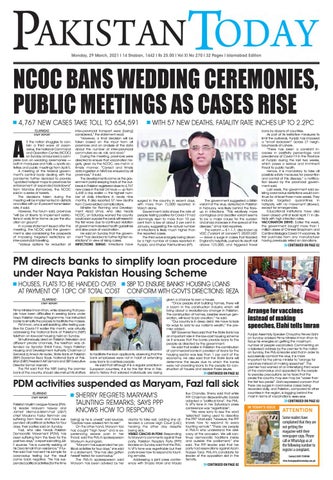
Monday, 29 March, 2021 I 14 Shaban, 1442 I Rs 25.00 I Vol XI No 270 I 32 Pages I Islamabad Edition
NCOC bANs wEddINg CErEmONIEs, publIC mEEtINgs As CAsEs rIsE g
4,767 new CaSeS take toLL to 654,591 ISLAMABAD
A
Staff rEport
S the nation struggles to contain a third wave of coronavirus, the national Command and operation Centre (nCoC) on Sunday announced a complete ban on wedding ceremonies — both in marquees and halls — sports activities and public meetings from april 5. a meeting of the federal government’s central body dealing with the pandemic further decided to provide “updated hotspot maps to provinces for enforcement of expanded lockdowns” from Monday (tomorrow), the nCoC said in a series of tweets. the decisions taken during the meeting will be implemented in districts and cities with an 8 percent transmission rate, it said. however, the forum said, provinces “will be at liberty to implement restrictions in early time frame as per the situation on ground”. in a press statement issued after the meeting, the nCoC said the government is also considering the prospects of imposing targeted restrictions on inter-provincial travelling. “Various options for reduction of
inter-provincial transport were [being] considered,” the statement read. “however, a final decision will be taken based on the input from all provinces and an analysis of the data about the number of inter-provincial commuters via air, rail, and road.” during the meeting, provinces were directed to ensure that vaccination targets, given by the nCoC, are met in a timely manner. “Correct and timely data ingestion in niMS be ensured by all provinces,” it said. the developments come as the government portal keeping track of the outbreak in Pakistan registered close to 4,767 new cases in the last 24 hours — up from 4,468 a day earlier — the highest number of daily infections in nearly nine months. it also reported 57 new deaths from Covid-related complications. Minister for Planning and development asad umar, who also heads nCoC, on Saturday warned the country could soon surpass the peak witnessed in the first wave due to continued violation of government-devised health guidelines and slow pace of vaccination. he said on Sunday that the government “has decided to further tighten restrictions” in view of rising cases. INFECTIONS SURGE: infections have
g
with 57 new deathS, FataLity rate inCheS uP to 2.2PC
surged in the country in recent days, with more than 72,000 reported in March alone. government data shows the rate of people testing positive for Covid-19 had alarmingly risen to more than 10 per cent from a low of about 3 per cent in January, suggesting the actual number of infections is likely much higher than the reported cases. the third wave is largely being driven by a high number of cases reported in Punjab, and khyber Pakhtunkhwa (kP).
the government suggested a British variant of the virus, detected in Pakistan in February, was likely behind the flareup in infections. “this relatively more contagious and deadlier variant seems to be a major cause for the sudden and sharp increase in the spread of the disease,” umar told reporters. the variant — B.1.1.7, also known as VoC (“variant of concern”) 202012/01 — drove a surge in cases that flooded england’s hospitals, pushed its death toll above 125,000, and triggered travel
bans by dozens of countries. as part of its restrictive measures to limit the outbreak, Punjab has imposed a “smart lockdown” across 27 neighbourhoods of Lahore. “there has been a constant increase in positivity percentage and prevalence of Covid-19 in the Province of Punjab during the last two weeks, which poses a serious and imminent threat to public health. hence, it is mandatory to take all possible safety measures for prevention and control of this disease,” a notification issued by the provincial government said. Last week, the government said existing coronavirus restrictions would continue for at least three more weeks. they include targeted quarantines in hotspots, with no movement allowed, except for emergencies. educational institutions have also been closed until at least april 11 in districts with high infection rates. VACCINATION DRIVE: earlier this week, the government bought more than 1 million doses of Chinese Sinopharm and CanSino Biologics Covid-19 vaccines, its first purchase from any manufacturer having previously relied on donations.
CONTINUED ON PAGE 02
PM directs banks to simplify loan procedure under Naya Pakistan Housing Scheme g
houSeS, FLatS to Be handed oVer g SBP to enSure BankS’ houSing LoanS at PayMent oF 10PC oF totaL CoSt ConForM with goVt’S direCtionS: reZa ISLAMABAD Staff rEport
Prime Minister imran khan, while observing that people have been difficulties in seeking loans under naya Pakistan housing Programme, has instructed banks to simplify the process to facilitate the masses. PM imran, who is self-isolating after testing positive for Covid-19 earlier this month, was virtually addressing the national Bank of Pakistan’s (nBP) telethon on low-cost housing held on Sunday. Simultaneously aired on Pakistan television and different private channels, the telethon was attended by Senator Shibli Faraz, naya Pakistan housing and development authority Chairman Lt general (r) anwar ali hyder, State Bank of Pakistan (SBP) governor reza Baqir, national Bank of Pakistan (nBP) President arif usmani and SBP executive director Samar hasnain. the PM said that the nBP, being the premier bank of the country, should also instruct its staffers
to facilitate the loan applicants, observing that the bank employees were not in habit of extending easy loans to cashless people. he said that although it is a regular practice in european countries, it is for the first time in Pakistan’s history that salaried individuals are being
given a chance to own a house. “once people start building homes, there will a boom in the construction industry which will bring about a revolutionary change in Pakistan. the construction of homes, besides revenue generation, will lead to job creation,” he said. “our country is in deep debt. we have to look for ways to add to our nation’s wealth,” the premier added. SBP governor reza said that the State Bank has an important role in the low-cost housing scheme as it ensures that the banks provide loans to the people as directed by the government. he said that earlier in Pakistan the contribution of commercial banks in provision of loans for the housing sector was less than 1 per cent of the economy. he also said that the State Bank will determine the issues due to which the banks were not providing loans to the people for construction of houses and resolve those issues.
CONTINUED ON PAGE 02
PDM activities suspended as Maryam, Fazl fall sick ISLAMABAD Staff rEport
Pakistan Muslim League-nawaz (PMLn) leader Maryam nawaz and Jamiat ulema-e-islam-Fazl (Jui-F) chief Maulana Fazlur rehman are suffering from fever and have suspended all political activities for four days, their parties said on Sunday. Fazl, who also heads Pakistan democratic Movement (PdM), has been suffering from the fever for the past two days,” a report said citing JuiF sources. “he is currently residing at his dera ismail khan residence.” it further said Fazl had sent his sample for coronavirus testing but the result came back negative. “he has suspended political activities [for the time
g
Sherry regretS MaryaM’S taunting reMarkS; SayS PPP knowS how to reSPond
being] as he is unwell,” said sources. “doctors have advised him to rest.” on the other hand, Maryam too has caught “high fever” and is experiencing severe pain in her throat, said the PML-n spokesperson Marriyum aurangzeb. “Maryam has suspended her political activities for four days,” she said in a statement. “She has also gotten herself tested for coronavirus.” the PML-n spokesperson said Maryam has been advised by her
doctor to take rest, adding she attended a Lahore high Court (LhC) hearing the other day despite being sick. VISIBLE CRACKS IN PDM: responding to Maryam’s comments against their party, Pakistan People’s Party (PPP) leaders on Sunday said that the PMLn VP’s tone was regrettable but their party knows how to respond to taunting remarks. addressing a joint press conference with Shazia Marri and Maula
Bux Chandio, Sherry said that while PPP Chairman Bilawal-Bhutto Zardari adopted a “political tone”, the PMLn VP’s tone in her Saturday’s press conference was “regrettable”. “we were sorry to see the word ‘selected’ being used to describe the PPP,” Marri said. “however, the PPP knows how to respond to every taunting remark.” “there are people in PML-n who understand the delicacy of the occasion. we will continue democratic traditions inside and outside the parliament,” she said. the PPP leader said that her party had reservations against azam nazeer tarar, PML-n’s candidate for leader of the opposition slot in the Senate.
CONTINUED ON PAGE 02
Arrange for vaccines instead of making speeches, Elahi tells Imran Punjab assembly Speaker Chaudhry Pervez elahi on Sunday advised Prime Minister imran khan to focus his energies on getting the maximum number of people vaccinated. Commenting on a televised address by the premier to the nation on Sunday, the PML-Q leader said that in order to successfully combat the virus, it is more important for the prime minister to “arrange for vaccines instead of making speeches”. the premier had warned of an intensifying third wave of the coronavirus and appealed to the people to exercise precautions as he fears that the peaks the country may see may be “worse than the first two peaks”. elahi expressed concern that there are surges in coronavirus cases being recorded daily, and Pakistan, compared to other countries in the region, is lagging behind the most in terms of vaccinations. NEWS DESK
CONTINUED ON PAGE 02 in today’s issue
attention Some readers have complained that they are not getting the magazine with their newspaper copy. Please call or WhatsApp us at the following number to register a complaint. Contact: 0307-7338168 irfan.farooq@pakistantoday.com.pk
02
Monday, 29 March, 2021
ISLAMABAD
NEWS
JANi KHel reSideNtS refuSe to Bury murdered teeNS, BegiN mArcH to cAPitAl
d
news desk
UE to the failure of a jigra of clerics in convincing the residents of Jani Khel to bury four recently shot teenagers, the protestors have on Sunday elected to begin a march towards the federal capital. The protesters – comprising local tribesmen and relatives of four teenage boys – of Jani Khel had been staging a week-long sit-in outside after the boys’ bullet-riddled bodies were found in a field on Sunday, for the last six days. The boys had gone missing three weeks ago. They demanded the immediate arrest of the culprits involved in the kidnapping and murder of the four teenagers. They have been protesting with the coffins of the deceased boys, refusing to bury them until the culprits and punished. “What do we want? Peace!”, “We want
justice!” and “negligent state! were among the slogans chanted by the 10,000-strong group of protestors who originated from the Janikhel area of Bannu bordering South Waziristan and started a long march to Islamabad along with the bodies of the slain boys, demanding action against anti-state elements. “We are staging a sit-in outside the Jani Khel Police Station for the past seven days. We will not bury these bodies until their killers are found and punished. They were just young boys who had a verbal fight with some local militants and afterwards they were kidnapped and killed before being buried in a local graveyard,” said a local while talking to a news outlet. “Disappointed with the provincial government, the elders of Janikhel decided to march to Islamabad and agreed to not bury the bodies till the arrest of the killers,” another person told the news.
Heated debate on SBP autonomy likely as NA meets today news desk President Arif Alvi has summoned a speical session of the National Assembly (NA) on Monday at the Parliment House at 4 pm, according to the a communique from the NA secretariat’s directorate general of media. The session was called under section 1 of Article 54 of the Constitution. This will be the NA’s third and the ninth session of the third parliamentary year, during the incumbent government’s tenure. The session would deal with the contention upon the bill regarding increasing the autonomy of the State Bank of Pakistan (SBP). Since greater autonomy for the SBP was one of the preconditions of the International Monetary Fund (IMF) for releasing tranches of its $6 billion loan, many have raised fears about its long-term impact not only on the economy but also on the country’s overall sovereignty. A day earlier, Pakistan Peoples Party (PPP) Chairman Bilawal Bhutto-Zardari had termed the recently-promulgated SBP ordinance as dangerous for the people of the country, saying that step is illegal and tantamount to an attack on Pakistan’s sovereignty. In a statement on Saturday, Bilawal had maintained that the PPP also wants SBP to be independent and to make decisions that are in the interest of Pakistan and the people of Pakistan independently. “However, the ordinance doesn’t make the SBP independent, it makes it independent from Pakistan’s law, it makes it independent from the parliamentary and judicial oversight,” he had added. He had demanded the government to withdraw the ordinance immediately. Bilawal had also lashed out at the government over rising inflation in the country. The PPP chairman had said that the government made special assistant “a scapegoat” in the petrol fiasco while the whole cabinet took the decisions. “We demand that all those ministers who were part of the decision-making process should step down.” He had said that it is “a historical scandal” and the PPP will not accept this robbery. “Some individuals benefited from the petrol crisis,” he added. On Friday, Prime Minister Imran Khan had asked Nadeem Babar to step down from the position for a 90-day period, during which the Federal Investigation Agency (FIA) will conduct a forensic investigation into the “criminal acts” that led to the June 2020 fuel crisis. Earlier this week, Pakistan Muslim League-Nawaz (PML-N) leader and main spokesperson for party supreme leader Nawaz Sharif, Muhammad Zubair, had said that the PML-N will not allow the SBP bill, which grants the bank great autonomy in line with the recommendations of the IMF, to pass. The federal government had agreed to grant absolute autonomy to SBP. The central bank’s primary objective under the SBP Amendment Bill, 2021, would be to ensure domestic price stability as it would be free from the responsibilities of supporting economic growth and providing budgetary loans to revive the stalled IMF programme. The bill states that supporting economic policies has been declared as a “tertiary objective” of the central bank, while the National Accountability Bureau (NAB) and the Federal Investigation Agency (FIA) cannot investigate the SBP governor, deputy governors, its executives and board and committee members. Zubair had said that the PML-N had no reservations on the SBP being an independent institution but did have reservations over the fact that the bill was being brought at the behest of the IMF. “The IMF and World Bank have been trying since quite some for a bill to be passed on the SBP’s autonomy,” Zubair had said, adding that this was “dangerous”. The PML-N spokesperson had said that the bill would allow the SBP to escape accountability. He said that would only inform the parliament annually on their policies, while the parliament itself would not be able to call on them.
According to the reports, the protest had begun peacefully, but then the police blocked the road and attempted to use tear gas to disperse the crowd. After keeping the road blocked for several hours, police allowed the march to continue, according to Lateef Wazir, one of the protestors. On the other hand, police in Karak district took Pashtun Tahaffuz Movement (PTM) leader and tribal MNA Mohsin Dawar into custody to prevent him from travelling to Bannu to join and lead the march. PTM chief Manzoor Pashteen was also taken into custody in Kohat, it emerged. Khyber Pakhtunkhwa (KP) Social Welfare Minister Hisham Inamullah Khan and a few elders of the Marwat tribe also went to Bannu to hold talks with the protesters. He informed the protest leaders that the tribes of Marwat and Bannu had brotherly ties and the former shared the grief of the local residents over the killing of the
innocents. The minister urged the protesters to bury the bodies, saying he would convey their “legitimate demands” to the chief minister
and Prime Minister Imran Khan. There was no immediate result of the negotiations, with the protest leaders seeking time to consult the Janikhel tribe.
PEMRA directive violates liberties of expression and information: CPNE COUNCIL SAYS CORRUPT ELEMENTS CONSPIRING TO OVERTURN PM-APPROVED PAYMENT SYSTEM kARACHI Staff RepoRt
The Council of Pakistan Newspaper Editors (CPNE), expressing concern over the Pakistan Electronic Media Regulatory Authority (PEMRA) directive regarding reporting of the National Accountability Bureau (NAB) activities, has termed it as a transgression of the canons of press freedom and free speech. CPNE asserted that PEMRA has, through this directive, barred the TV channel administrations from airing all analyses and comments regarding NAB activities in their current affairs programmes and news bulletins. CPNE declared the PEMRA directive a grave violation of Article 19 and sub-clause 19-A of the Constitution of the Islamic Republic of Pakistan that guarantees the common citizen’s inalienable right to information. The meeting also expressed extreme disquiet at the federal government’s unceasing anti-media attempts through ever-newer means and actions. This stance was confirmed in a resolution adopted at a CPNE standing committee meeting chaired by the CPNE President Arif Nizami. The virtual meeting was held through video-link in view of the continuing Covid-19 pandemic. The meeting reviewed and discussed at length the on-ground situation regarding press freedom, the difficulties faced by the newspapers and the new payment system for advertisement adopted by the government through CPNE efforts. Assuring fullest support to the new mechanism devised by the federal government as well as Sindh, Punjab and Khyber Pakhtunkhwa (KP) governments, for the payment of outstanding to the media, satisfaction was expressed over the commencement of direct payments to newspapers. CPNE Vice-President Sardar Khan Niazi said that certain ill-famed elements were actively involved in conspiracies against the agreed-upon system adopted at the instructions of the Prime Minister. He, however, hoped that the PM and the federal information minister would
not let these conspiracies succeed. The meeting resolved that if the new system for payments to newspapers for government advertisement is altered the CPNE will forcefully resist any such attempt. The opponents of the new media-friendly system of payments in fact wish to restore the previous corrupt practices whereby, since several decades, the billions of rupees from the public exchequer allocated for the media were rerouted to the coffers of the corrupt elements. These were the ill practices that created the acute financial crises for Pakistani media. Discussing the Punjab media policy and Punjab Publications Bill, 2020, Vice-President Irshad Ahmed Arif told the meeting that CPNE has forwarded its proposals to the provincial government and has recommended to the Punjab Information Department to frame solid and coordinated policy in this regard. Furthermore, he said, the Punjab government has also commenced directed payments to the newspapers. On this occasion, Joint Secretary Tahir Farooq said that the KP government has started direct payments under the new system and the provincial information department is also making payments to the newspapers. However, it is essential that payments should be made at a fixed date so that the newspaper establishment and the journalists should not face financial uncertainties, he added. He also demanded that the provincial KEPRA tax on KP newspapers should be abolished as promised by the chief minister last year. Joint Secretary Ghulam Nabi Chandio expressed grave concern on extreme delay in payment of dues by the Sindh government and the unjust distribution of government advertisements. He demanded urgent and solid policymaking for timely payments as well as transparent, self-regulatory and just distribution of government advertisements. The standing committee, on the recommendations of the provincial committees, also approved a number of membership requests. On the recommendation of the Punjab Committee,
Daily Afaq Lahore, Daily Pal Pal News Lahore, Daily Payam-e-Waqt Lahore, Daily Qadamat Lahore, Daily Siyasi Dost Lahore, Daily Rehbar Bahawalpur, Daily Sadae-Pakistan Bahawalpur, Daily Sang-e-Meel Bahawalpur, Roznama 92 News Faisalabad, Daily Almanzoor Dera Ghazi Khan, Daily Multan Post Multan, Roznama 92 News Multan, Daily Safeer-e-Punjab Multan, Daily Cholistan Times Rahim Yar Khan, Daily Jamhooristan Sahiwal, Roznama 92 News Sargodha, Daily Dar-ulKhabar Vehari, Daily Sangram Vehari, Monthly Dhamak Lahore and Weekly Zaban-e-Khalq Bahawalpur’s membership request was approved. The memberships approved on the recommendation of Islamabad/Rawalpindi were Daily Aajir Rawalpindi, Daily Akhbar-e-Haq Islamabad, Daily District News Rawalpindi, Daily Multi News Islamabad, Daily Parliament Times Islamabad, Roznama 92 News Islamabad, Daily Urdu Times Islamabad and Monthly Waqt Islamabad and on the recommendation of Sindh Committee, Roznama 92 News Karachi, Daily News Lark Karachi and Daily Ekta Karachi got district associate membership. The decisions on other applications will be done after due diligence. The meeting was attended by CPNE President Arif, Secretary General Dr Jabbar Khattak, Vice Presidents Sardar Khan Niazi, Irshad Ahmed Arif, Dr Hafiz Sanaullah Khan, Deputy Secretary General Aamer Mahmood, Former Secretary General Aijazul Haq, Finance Secretary Syed Hamid Hussain Abidi, Information Secretary Abdul Rahman Mangrio, Joint Secretaries Tahir Farooq, Ghulam Nabi Chandio, Arif Baloch, Tanveer Shaukat, Shakeel Ahmed Turabi, Senior Members Kazam Khan, Maqsood Yousufi, Saeed Khawar, Khalilur Rehman, Mumtaz Ahmed Sadiq, Abdul Khalique Ali, Muhammad Tahir, Muhammad Akmal Chohan, Faqir Manthar Mangrio, Zulfiqar Ahmed Rahat, Sher Muhammad Khuhawar, Zia Tanoli, Ahmed Shafiq, Tazeen Akhtar, Zubair Mehmood, Waqas Tariq Farooq, Sardar Naeem, Muhammad Arshad Roohani, Abid Aleem, Munnaza Seham and several others through video-link.
President, PM, others felicitate Hindu community on Holi IsLAMABAd tLtp
President Dr Arif Alvi, Prime Minister Imran Khan and others have wished all the Hindu community a very happy Holi, the festival of colours. In a tweet
on Sunday, President Alvi wished all Hindu brethren celebrating Holi and prayed that this joyous event of colours bring happiness, peace and prosperity for all. He tweeted, “Wishing a Happy Holi to all our Hindu brethren celebrating. May this joyous event of
colours bring happiness, peace and prosperity for all of us and our region. Pakistan stands committed to the rights of minorities.” In a tweet, the Prime Minister wrote, “Wishing all our Hindu community a very happy Holi, the festival of colours.”
Foreign Minister Shah Mahmood Qureshi has wished the Hindu community in Pakistan and across the world a very happy Holi. In a tweet on Sunday, he prayed that the festival of colours might bring peace and happiness. National Assembly (NA) Speaker Asad Qaiser as well as Deputy Speaker Qasim Suri also wished the Hindu parliamentarians and the community at large on their special occasion.
Pakistan to accept peace pact reached between Afghan sides: FO IsLAMABAd tLtp
Pakistan on Sunday announced that it would accept any agreement for peace reached between the Afghan sides. The Foreign Office (FO) spokesman said that there is no military solution to the Afghan conflict and the Doha agreement has provided a historic
opportunity for a durable political solution to it. The withdrawal of the US Army from Afghanistan should be in a responsible and organised manner in order to avoid a vacuum, the FO said. It is pertinent to mention here that Foreign Minister Shah Mahmood Qureshi has said numerous times that Pakistan will continue playing a reconciliatory role in the Afghan peace
process. During a telephonic conversation with his Afghan counterpart Hanif Atmar on March 20, FM Qureshi underlined that the intraAfghan negotiations provided a historic opportunity to achieve an inclusive, broad-based and comprehensive political settlement in Afghanistan. He urged Afghan parties to work constructively for the shared objective of a stable and
peaceful Afghanistan. FM Qureshi underscored the need to remain cognisant of the challenges and impediments on the way, which could be overcome through patience, perseverance and persistence. He reaffirmed Pakistan’s resolve to facilitate all efforts for a negotiated political settlement and in this context also underlined the importance of exercising vigilance against the role of “spoilers.”
Monday, 29 March, 2021
ISLAMABAD
NEWS
03
Punjab Flexes Muscles against soPs violators; 9 arresteD
a
newS deSK S many as nine people were arrested in Chishtian area of Bahawalpur district over violation of coronavirus-related standard operating procedures (SOPs) on
Sunday. According to details, the cases were registered against shopkeepers for not wearing face masks despite clear directions of the Punjab government after an alarming
ncoc bans wedding ceremonies, public meetings as cases rise
MAN BOOKED FOR NOT WEARING A MASK increase in the Covid-19 cases. They were arrested under the Punjab Pandemic Control Act, 2020. A large number of people are being seen violating the SOPs in the markets and other public places in Punjab. Earlier in the day, a resident in Lahore was booked over neglecting SOPs. Amid an alarming increase in Covid-19 cases in
Punjab, especially in Lahore, the police have become active in ensuring implementation of the SOPs designed to control the pandemic spread. A resident, named Muhammad Javed, was booked at PS Islampura for not wearing face mask, which has been declared mandatory by the government
FM to highlight Pakistan role in Afghan peace in Heart of Asia today iSLamaBad
Continued from page 01
Staff RePoRt
The shots are due to be delivered before the end of this month, with talks under way for another 7 million doses from the same companies. The government is currently vaccinating frontline healthcare workers and citizens over the age of 60 free of charge using over 1 million Sinopharm doses donated by China in February. Pakistan has so far relied on such donations and on allocations from the World Health Organisation-backed COVAX/GAVI scheme for developing nations. The first COVAX/GAVI batch of up to 4 million doses of the Oxford-AstraZeneca vaccine had been due to be delivered to Pakistan this month, Umar said, adding it was delayed due to the issues the vaccine was facing worldwide.
Foreign Minister Makhdoom Shah Mahmood Qureshi will lead the Pakistan delegation at the 9th Heart of AsiaIstanbul Process (HoA-IP) Ministerial Conference, being held on Tuesday in Dushanbe, Tajikistan. According to a statement issued by the ministry of foreign affairs on Sunday, the ministerial meeting will be preceded by Senior Officials Meeting (SOM) on Monday. The theme of the conference is “Strengthening Consensus for Peace and Development.” During the ministerial conference, the foreign minister will deliver a statement highlighting Pakistan’s positive contributions to the Afghan peace process and its support for Afghanistan’s development and connectivity within the regional framework. On the sidelines of the conference, the foreign minister will hold consultations with key regional and international partners. During his visit to Dushanbe, the foreign minister will have bilateral engagement with the Tajik leadership.
arrange for vaccines instead of making speeches, elahi tells imran
Continued from page 01
He also spoke of the government’s failure to control prices of essential commodities, saying that with the amount of inflation Pakistan is witnessing today, it has “become difficult for people to manage even two meals a day”. The Pakistan Muslim League-Quaid (PML-Q) leader said that if the people are not provided immediate relief, “the PTI-led government will find itself in a pickle in the next election”.
He further said that due to the prime minister’s scheme now people can get loans worth Rs1 million, which they can pay back in monthly instalments worth Rs6,600. Faraz said that Prime Minister Imran is committed to making Pakistan a welfare state and the scheme for lowcost housing is aimed at providing housing facilities to the common people. He said that the success of the scheme depends on the role of the banks. The government is ensuring that banks facilitate the people without any difficulties, he added. Speaking on the occasion Haider said that the process of providing loans to the people under the prime minister’s low-cost housing scheme has begun. Usmani said that the National Bank is facilitating people to get loans for construction of houses and for this purpose 1,500 branches of NBP are providing information to the people, whereas 680 branches across the country are processing the applications for loans. The citizens participated in the telethone via telephone and asked questions regarding the process of applying for the loan in the Naya Pakistan Housing Scheme. Earlier, PM Imran had decided to increase the scheme’s loan limit by 100 per cent. The decision was announced by PTI Senator Faisal Javed Khan, who added on Twitter that discounted
newS deSK Anti-polio campaign of varied duration will start across the country from Monday. The standard operating procedures (SOPs) to protect from coronavirus will be strictly implemented during the campaign. In Punjab, 20 million children of two to five years of age will be administered anti-polio vaccine during a five-day drive. According to a spokesman of Punjab Health Department, 120,000 health workers will take part in the campaign. In Sindh, nine million children under the age of five years will be administered anti-polio drops during a week-long drive. In Khyber Pakhtunkhwa (KP), more than six point four million children up to five years of age will be administered anti-polio drops during the fiveday campaign. According to KP Emergency Operation Centre, about 30,000 teams have been constituted which will visit door to door to vaccinate the children. Polio teams will also be available at bus stops, railway stations, Afghan refugee camps and other public places to ensure vaccination of every child. In Gilgit-Baltistan (GB), over 242,000 children upto five years of age will be administered anti-polio vaccine. The Health Department has constituted 1690 fixed and mobile teams for this purpose. In Azad Jammu and Kashmir (AJK), children will be administered anti-polio drops, during the five-day anti-polio campaign. According to AJK Health Department, 2,000 mobile teams have been constituted for the drive, while 397 fixed and 124 transit points have also been set up to make the anti-polio drive successful.
Besides holding talks with Foreign Minister Sirojiddin Muhriddin, Foreign Minister Qureshi will have interaction with other Tajik dignitaries and review the entire gamut of bilateral relations. Pakistan highly values its close fraternal ties with countries in Central Asia. Pakistan’s relations with Tajikistan are firmly rooted in common faith, shared history, and geographic proximity. There is a mutual interest in developing close cooperative ties in all areas. Pakistan hopes that the return of peace and stability in Afghanistan would further strengthen its historic links with Central Asia, including Tajikistan. The foreign minister’s visit to Tajikistan will help deepen bilateral cooperation in diverse fields and reinforce the growing partnership between the two brotherly countries. The Heart of Asia-Istanbul Process, initiated in 2011, is an important platform to promote peace, stability and prosperity in Afghanistan through regional cooperation, confidence-building measures (CBMs), and dialogue. Pakistan attaches high importance to this Process and has been a regular contributor to the advancement of its objectives. Pakistan is the lead country
PM directs banks to simplify loan procedure under Naya Pakistan Housing Scheme
Continued from page 01
nationwide anti-polio campaign starts today
after the Covid-19 surge. A meeting held at Capital City Police Officer (CCPO) Office Lahore on Saturday decided to register cases against those who do not wear masks and ordered strict action against those who do not follow government guidelines. CCPO Ghulam Mahmood Dogar said that government guidelines should be implemented at any cost. Lahore Commissioner Muhammad Usman said that joint teams and control
markup rate has also been reduced to 3pc and 5pc. On March 18, the premier had allotted 1,008 flats and 500 houses for poor workers and widows on low-cost mortgages in a bid to uplift the weaker segments of society. The prime minister had said that rent paid would be converted into installments of the total cost of the house or flat under the mortgage system, in addition to ensuring that the markup rate does not exceed 5pc. He had assured to allocate more funds for the housing programme with the increase in the revenue of the government so that the working and the salaried class could build their houses. Constructed in Zone V of the federal capital and around 15 minutes drive from the Islamabad Expressway, the multi-storey units will provide a decent living for small families with electricity, natural gas, and water supply. Each housing unit comes with a living room, two bedrooms a kitchen, and a bath. It is pertinent to mention here that around 3,000 labourers had got themselves registered, while 1,500 of them were able to obtain housing on the basis of an open ballot, in the first phase. Under the project, disabled persons will also be provided with housing units. The project aims at providing accommodation to people with an annual income of less than Rs500,000.
Saudi jets arrive for multinational Aces Meet 2021-1 exercise iSLamaBad Staff RePoRt
A Saudi Royal Air Force (RSAF) contingent has arrived to participate in the two-week-long multinational air exercise called ‘Aces Meet 2021-1’. The Saudi Air Force team arrived at Pakistan Air Force’s (PAF) Mushaf airbase with a number of RSAF’s Tornado combat aircraft and air, technical and support crew. The United States Air Force (USAF) will also participate with their aircraft in the exercise along with PAF and RSAF while Jordan, Egypt and Bahrain air forces will attend as observers. Pakistan Air Force’s F-16 and JF-17 fighter jets and Saudi Air Force’s Tornado aircraft will take part in the exercise. Aces Meet 2021-1 exercise aims to maximise the combat readiness of participating units by providing them realistic, multi-domain training and to build partnerships and interoperability among allies. “The exercise is aimed at sharing experiences and enhancing interoperability among participating air forces” with focus on roleoriented and near-realistic combat training, PAF statement said. Pakistan hosted the first Aces exercise in 2017 in which PAF, RSAF and Turkish Air Force participated with aircraft. It focused on exploring and developing air
power to contribute effectively to the counter-insurgency and counter-terrorism campaigns. The PAF established the Airpower Centre of Excellence (ACE) in 2016 to transform air force capabilities to meet future challenges and to strengthen relations with friendly air forces through experience sharing and joint training. Pakistan has the seventh largest air force in the world with an active fleet of 1364 aircraft, according to 2021 world air forces report. The PAF enjoys close cooperation with many countries in the Middle East and frequently participated in bilateral exercises and joint training. Pakistan has a long-standing close relationship with Saudi Arabia dating back to the 1940s and strategic military ties formalised after a 1967 defence accord. Over the decades, Saudi Arabia stood by Pakistan during its difficult times, ensuring economic assistance and oil supply. In response, Pakistan provided military expertise and support to the kingdom for decades and also helped develop the Royal Saudi Air Force and trained its first fighter jet pilots in the 1960s. Pakistan helps Saudi Arabia with military training, defence production and joint military exercises under a bilateral security cooperation agreement. Pakistan’s former military chief, General Raheel Sharif, is the current head of the Islamic Military Counter Terrorism Coalition – an alliance of 41 states.
rooms have been set up, and police and district administration should take joint action against violators of Coronavirus SOPs. He ordered strict implementation of the order to wear masks. According to the commissioner, those who do not wear masks will be detained and can be jailed for six months. The meeting decided to register cases against those who do not wear masks and ordered strict action against those who do not follow government guidelines.
for Disaster Management and Agriculture Development CBMs under the Heart of Asia-Istanbul Process. In 2015, Pakistan co-chaired the Heart of AsiaIstanbul Process, along with Afghanistan, and hosted its 5th Ministerial Conference in Islamabad. PAKISTAN LAUDS SAUDI INITIATIVE FOR YEMEN PEACE: Separately, Foreign Minister Qureshi appreciated the steps taken by the Saudi leadership in resolving differences among the countries of the Gulf Cooperation Council (GCC), as well as the recent initiative for promoting resolution of issues in Yemen through dialogue and diplomacy. Qureshi said this during a telephonic conversation with Saudi Foreign Minister Prince Faisal bin Farhan AlSaud on Sunday, said a press statement. Foreign Minister Qureshi underscored Pakistan’s continued support for Saudi efforts aimed at promoting peace, security and prosperity in the region. He also reiterated Pakistan’s support for the kingdom’s territorial integrity and sovereignty. Conveying his profound regards for the Custodian of the Two Holy Mosques King Salman bin Abdulaziz, and Crown Prince Mohammad bin Salman, Qureshi reaffirmed Pakistan’s abiding fraternal ties with Saudi Arabia. The Saudi foreign minister acknowledged Pakistan’s continued and steadfast support to the Kingdom of Saudi Arabia. Praising the “Saudi Green Initiative” and the “Green Middle East Initiative” announced by Crown Prince Mohammad bin Salman, Qureshi termed it as a major initiative for reducing global carbon emissions.
Five killeD, 12 injureD in roaD acciDent SHeiKHupura INP
At least five people were killed and 12 others injured when a bus collided with a trailer on Sunday in Punjab, media reported. The accident happened in the wee hours of the day in the Sheikhupura district when a speeding passenger bus collided head-on with a trailer, the reports said. The victims have been shifted to the hospital. Road accidents are frequent in the country mainly due to poor roads, badly maintained vehicles, and unprofessional driving.
MeDic FounD DeaD LaHore INP
The body of Services Hospital’s Assistant Medical Superintendent (AMS) Dr Hassan was found at the hostel of the facility in Lahore on Sunday. The deceased was suffering from fever and typhoid and late last night, vomited blood, a hospital official said. He was also administered intravenous drip at the hostel, the official added. The body was shifted to the emergency ward for further investigation.
PDM activities suspended as Maryam, Fazl fall sick Continued from page 01 Advising Maryam, Sherry said that the PML-N VP must “reorient her political objectives” and “stick to [the aim of] ousting the Pakistan Tehreek-e-Insaf (PTI)-led government [instead of issuing controversial statements]”. “We do not want the PDM to dissolve, therefore, the PML-N should refrain from issuing remarks that would empower the selected government,” she stressed. Adding to the comments, Maula Bux Chandio said that the PDM is neither “anyone’s property” nor “a child’s play.” “Therefore, saying that the long march will not take place is [inappropriate],” Chandio said.
04
Monday, 29 March, 2021
ISLAMABAD
NEWS
FIA FIndS 20 more SpeculAtorS reSponSIble For SugAr prIce hIke LAHORE
A
SHAHAB OMER
S many as 20 more satta players (speculators) have been found to be behind the rise in sugar prices while a report containing 17,500 pages from three WhatsApp groups of speculators has also been prepared by the Federal Investigation Agency (FIA) Lahore, Pakistan Today learnt on Sunday. The FIA Punjab Zone-1 directorate has also written a letter to FIA Sindh Zone 1&2, Karachi director to crack down on the accused. According to the letter, the price of sugar was ramped up fraudulently by speculators and in this regard the public was harmed to the tune of Rs110 billion whereas the speculators' contacts were through 16 active secret
7 ARRESTED FOR INVOLVEMENT IN SUGAR HOARDING, ARTIFICIAL PRICE HIKE WhatsApp groups. “The director FIA Inquiry team and investigation teams have discovered irrefutable evidence of clandestine satta through various 16 secret WhatsApp groups whereby sugar prices were being dishonestly and fraudulently ramped up. The satta mafia, acting in active connivance with each other, operating directly and through their frontperson fraudulently escalated the ex-mill prices of sugar (essential commodity especially for the poor) from Rs69.05 per kg (March 2021) to Rs90/Kg (March 2021) and defrauded the masses at least Rs110 billion,
during this period. The satta mafia managed this dishonest and fraudulent escalation amidst a hoax of impending sugar shortages, when sufficient sugar-stocks were lying in sugar-mills and godowns,” the letter stated. The letter also revealed that black money investors were also associated with speculators and sugar mills. “Examination of sugar satta WhatsApp groups, seized by FIA Lahore u/s 14 AMLA 2010, reveal that over 20 satta players of Karachi/Sindh were actively participating in satta with the respective sugar-mills and in active connivance with satta players of Pun-
jab. The digital evidence recovered from the communication-log of three main WhatsApp satta groups (Pakistan Sugar Group, Sugar Merchants, Sugar Traders Group STX), wherein over 20 satta players of Karachi/Sindh were actively participating is also being transmitted to your good office, through official e-mail and digital means. The evidence, if carefully examined will reveal the black money investors associated with sugar Satta Mafia and mills as well,” letter concluded. Earlier in the day, it emerged that the Karachi chapter of the FIA arrested seven brokers suspected to be involved in artificial shortage and price hikes of sugar. The Commercial Banking Circle (CBC) of the agency said that the brokers were acting with the connivance of sugar mills' owners. The accused were operating through
electronic means to maneuver, manipulate and artificially hike sugar prices, amidst rumours of impending sugar shortages while stocks were lying unsold or sold/unlifted in mills and godowns, thereby, creating an artificial demand and supply gap. Furthermore, the suspects were also indulged in opening/operating fake/unrevealed third-party accounts to conceal/disguise the illegitimate crime proceedings. The said accounts have been seized. The agency also recovered mobile phones, registers, and laptops, etc. An FIR has also been registered and further investigations were underway.
Indian war hysteria threatens regional peace: Sarwar LAHORE STAFF REPORT
Punjab Governor Chaudhry Muhammad Sarwar has said that Indian war hysteria has become a constant threat to regional peace. In a tweet on Sunday, the governor termed Indian Prime Minister Narendra Modi a murderer of innocent people of Indian Occupied Kashmir (IOK). He said that people of Bangladesh are also exposing the real face of Modi in their protests. The governor urged the Muslim Ummah to raise its voice for the oppressed Muslims of IOK and India. He said that entire Pakistani nation stands united and solid as a rock, behind their Kashmiri brethren. It is pertinent to mention that at least four people were killed and dozens got injured in violent protests in Bangladesh, set off by the arrival of Indian Prime Minister Narendra Modi to mark 50 years since Bangladesh gained independence. The deaths occurred in the southeastern district of Chattogram, where students from a prominent Islamic school and members of an Islamic group clashed with the police, police said. Police further said that five injured people had been taken to a Chattogram hospital and that four had died during treatment.
ISLAMABAD: Police personnel mishandle residents of Ghauri Town who were protesting for the fulfilment of their demands on Islamabad Highway. ONLINE
Islamabad gets first ever shelter for stray dogs ISLAMABAD
Doctors express concern over Covid vaccine price gouging ISLAMABAD TLTP
The Association of Physicians of Pakistani-descent of North America (APPNA) has written a letter to Prime Minister Imran Khan to express its concerns over the inflated prices of the coronavirus vaccines, voicing fear it would render them too expensive for the poor in the country. The letter begins by bringing to the prime minister's attention to the Drug Regulatory Authority of Pakistan's (DRAP) measure to allow a 40 per cent mark-up for importers of the vaccines plus an additional 15 per cent mark-up for retailers. "As per this formula, the price for two doses of the Sputnik-V vaccine has been fixed at Rs8,449 and that for a single dose of the Cansino Biologics vaccine at Rs4,225," reads the letter. The association said that this 15 per cent mark-up over a life-saving drug in a poor country like Pakistan "cannot be justified by any means".
"APPNA is concerned that in a country where 30-40 per cent people live below the poverty line, this price gouging and inflated prices for the Covid-19 vaccines will make these beyond the reach of a very large proportion of the populace," stated the letter. It said that the vaccine was the only
way of controlling the coronavirus pandemic, adding that if hundreds of millions in the country will be unable to afford it, the results would be 'catastrophic'. "A human tragedy must not be allowed to be used for profiteering. APPNA appeals to you to urgently re-
view the situation yourself," said the association. Saying that the government is in the best position to negotiate the prices of coronavirus vaccines, the APPNA urged the government to import them itself. "Ideally the government should make the vaccine available to all the people free of cost. If the financial situation of the country however precludes that, then it should be made available to the population at no more than cost," the APPNA said in the letter. The letter said that provincial and federal governments should work together to provide subsidies to the poor, and aid people in the delivery and administration of the coronavirus vaccine. "APPNA also takes the opportunity to appeal to you to make live telecast of the meetings of regulatory authorities such as DRAP mandatory for the sake of transparency," said the APPNA. The APPNA further said that it is ready to help Pakistan in its current time of crisis in any way it can. "We remain at your call," the letter concluded.
APP
Dr Inam Abdul Ghani, a volunteer from Islamabad, has come forward to provide shelter and medical care to stray dogs after a ban is imposed on their culling by the city managers. He opened the first-ever sanctuary for stray dogs in Chauntra village, located on the outskirts of Islamabad, to provide care and a home. Giving details about the initiative, Dr Ghani told the media that earlier such facilities only existed in Karachi and Lahore, but now Islamabad also had a set-up, which was one of its kind. Explaining his human-canine bonding, the volunteer said he was providing care to stray dogs for the last 15 years as he had a great association with them since his childhood. Initially, he used to bring ill dogs to his home for providing medical treatment and shelter, but later on, “I felt that there is need to set up a dedicated facility for such animal and then I decided to open a shelter for them.” Dr Ghani added he established the first shelter in Rawat some four years ago to rehabilitate the stray animals. To a query, he said, so far, 50 adult dogs and 20 puppies were given shelter at the facility. Most of the puppies were those whose mothers were culled by the authorities. He added the puppies were given to people as “guard dogs” after grooming. Dr Ghani also hailed the district administration’s decision for banning the dog shooting in the capital and implementing the court’s order which underscored humane ways for controlling the stray dogs’ population. He hoped the local administration would engage non-government organisations to launch the “Trap, Neuter, Vaccinate and Release” campaign for reducing stray dogs’ population in the capital. Under the TNVR process, he explained surgery of a healthy dog was conducted to deprive him of reproduction capability.
Monday, 29 March, 2021
ISLAMABAD
NEWS
NADRA centres to distribute Covid-19 vaccination certificates KARACHI: National Database Registration Authority (NADRA) on Sunday said that Covid-19 vaccination certificates can be collected from all three mega centres in Karachi. Nadra Sindh Director General Ajam Durrani said the facility has been provided at the authority’s mega centres operating in the metropolis. “The certificate can also be accessed at our website with the national identity card number,” he said. INP
Selection of college principals streamlined under the HED reforms agenda LAHORE STAFF REPORT
The Higher Education Department Punjab has developed a policy framework to select suitable candidates for the vacant positions of principals at public sector colleges across Punjab. The move was made as part of the departmental reformatory agenda; Higher Education Department Punjab is adapting itself to the competitive educational environment in line with the international trends and practices. In pursuit of the same, department has undergone a transition with the modern solutions through policy initiatives, Nadeem Mahbub, provincial secretary for higher education said. Under the said policy initiative, the suitability of the potential candidates shall be gauged after thorough scrutiny by a special committee. The candidates shall be given marks on the basis of seniority, expertise, relevant administrative experience and aptitude for the job, all related traits shall be quantified and placements shall be made accordingly. A high-powered committee to be chaired by the Punjab minister for higher education shall conduct interviews of the potential candidates for the vacant seats of Principals – whose charge lies with the most senior teachers in the respective colleges for trouble-free operations, currently. Role of a principal lies at the heart of the college administration and quality education at the same time, therefore, these positions are not supposed to be filled randomly but through a competitive process. The newly-defined selection process shall streamline principals’ placement on merit through transparency and a fair competition, he added. For further promotion of a competitive educational environment, Higher Education Department is all set to launch an annual competition of all public sector colleges across Punjab. Provincial Minister for Higher Education Raja Yassir Humayun Sarfraz shall formally launch the contest. A special performance review committee has been constituted at the Higher Education Headquarters to analyse yearly progress of all colleges and present the findings at the end of every academic year. As per the predefined criteria, public sector colleges shall be judged on the basis of quality of education being imparted, discipline at the campus, methodology of the teaching staff and smooth administrative operations. Competitions shall have a trickle up effect – from district level to divisional scale, leading it to a provincial contest. Resultantly, this contest shall promote healthy competition among colleges to perform better. Therefore, principals and leadership of these colleges shall have a trickle-down motivation effect on teachers and students, making them a part of this challenging educational experience, Nadeem added.
05
BlESSiNg pEoplE witH tHE CoRoNAviRuS cITy NOTES M A NIAzI
i
think people missed the point when they spoke about the prime minister’s meeting with the Pakistan Tehreek-e-Insaf (PTI) spokesmen when he was supposed to be in quarantine due to his coronavirus positive status. Critics pounced on him for not having observed that quarantine. PTI supporters told everyone, including anyone who would not listen, how great the Kaptaan was for having the courage to work for the country despite being ill. No one seems to have considered one aspect of the quarantine, which was the effect of being infected by Imran. Would that not have miraculous curative powers? Would it not beat being infected by someone ordinary and prosaic? I mean, the sudden emergence of variant strains is taking place, so why should the virus not undergo a mutation under the magnetic effect of Imran’s su-
perior biology, and turn into a virus that is actually beneficial to catch? The military knew how beneficial he is, because they postponed the 23 March parade to March 25, but he still did not show up, and had to make do with Pervez Khattak. I wonder if this was a March 23 parade. So, actually Imran was doing the spokesmen a favour, giving them the golden chance of catching a beneficial virus. In fact, Imran should send across his plasma to the Pakistan cricket team, in the hope they might catch some of the spirit and ability which won the 1992 World Cup. This might explain why then-United States president Donald Trump took out Secret Service agents while he was in isolation after testing positive for covid19. He had symptoms, but even now, details remain sparse. It is a risky way of spreading one’s charisma, as the president of Tanzania, John Magufuli, died, suspectedly of Covid-19. ‘Suspectedly’? Yes, I use the word because he was a Covid denier. It had been beaten in Tanzania. Hmmm…. Sound familiar?
Well, Pakistan (or rather Imran) has received WHO praise for how it has handled the pandemic. Well, President Maguduli was not the first head of state or government to die of the coronavirus. President of Burundi, Pierre Nkurunziza, died last year. He had caught the virus from his wife. But he also had to face a problem that Imran is spared. It seems there was only one ventilator in the country. We might not have a surplus. We might even have a shortage. But we have more than one. Of course, Covid-denying is not the only thing Imran shared with Trump. Also, his willingness to throw people under the bus. The latest person to be crushed is Nadeem Babar, the SAPM on natural resources, who had been inducted as an example of what Imran was all about when it came to attracting talent. Nadeem came to government after a career in the oil and gas industry. And now he is carrying the can for last year’s fuel shortage. The enquiry committee says he is resigning, as is his secretary, not because he is guilty, but so that he would not influence the in-
quiry. Normally, people are stopped from influencing an enquiry when there is reason to believe they might want to influence it. When at least some grounds exist to believe that they did something wrong. That is how Imran threw Jahangir Tareen under the bus, despite the rides in his airplane that he had taken. However, both Babar and Tareen should take heart from Babar Awan’s and Aleem Khan’s examples, which show that there is always a comeback possible. The rejection of Nawaz Sharif’s passport renewal request should have reminded someone that he was responsible for the fuel shortage. The best advice to Nawaz would be to burn his passport and disappear, probably to work as illegal labour in his sons’ store. One of the problems for which he escaped blame is the shooting down of 10 people in Boulder, Colorado, by the Syrian-born Ahmad Al-Aliwi Alissa. Biden should blame Trump. Colorado is both liberal with gun sales and hash, which it has made legal. But no one seems to blame the weed.
US condemns China’s sanctions in dispute over Uighurs BEIJING/OTTAWA AgENcIES
The United States on Saturday condemned China’s sanctions against two American religious-rights officials and a Canadian lawmaker in a dispute over Beijing’s treatment of Uighur Muslims and other minorities. China’s moves “only contribute to the growing international scrutiny of the ongoing genocide and crimes against humanity in Xinjiang. We stand in solidarity with Canada, the UK, the EU, and other partners and allies around the world in calling on the (China) to end the human rights violations and abuses,” US Secretary of State Anthony Blinken said in a statement. Beijing’s sanctions followed those imposed by the United States, European Union, Britain and Canada earlier this week for what they say are violations of the rights of Uighur Muslims and other Turkic minorities in the western Chinese region of Xinjiang. Activists and UN rights experts say at least a million Muslims have been detained in camps in Xinjiang. The activists and some Western politicians accuse China of using torture, forced labour and sterilisations. China has repeatedly denied all accusations of abuse and says its camps offer vocational training and are needed to fight extremism. Blinken’s statement came after Canadian Prime Minister Justin Trudeau denounced Beijing and vowed to defend human rights. China sanctioned Canadian opposition lawmaker Michael Chong, vice-chair of parliament’s Standing Committee on Foreign Affairs and International Development and its Subcommittee on International Human Rights, which this month presented a report concluding that atrocities in Xinjiang constitute crimes against humanity and genocide. Beijing also said it will take measures against the chair and vice-chair of the US Commission on International Religious Freedom, Gayle Manchin and Tony Perkins. The individuals under Beijing’s sanctions are banned from entering the Chinese mainland, Hong
Kong and Macau, and Chinese citizens and institutions are prohibited from doing business with the three individuals or having any exchanges with the subcommittee. “The Chinese government is firmly determined to safeguard its national sovereignty, security and development interests, and urges the relevant parties to clearly understand the situation and redress their mistakes,” the Chinese foreign ministry said. “They must stop political manipulation on Xinjiang-related issues, stop interfering in China’s internal affairs in any form and refrain from going farther down the wrong path. Otherwise, they will get their fingers burnt.”
China’s previous sanctions on US individuals who it says have seriously undermined China’s sovereignty and interests on Xinjiang-related issues remain in effect. Chong, who is a member of the opposition Conservative Party in Canada, said he would “wear (the sanctions) as a badge of honour”. “This demonstrates that parliamentarians are being effective in drawing attention to the genocide of the Uighur people that is taking place in western China,” Chong said in a telephone interview. Chong urged the Trudeau government to “officially recognize the Uighur genocide,” and said the sanctions would have no practical effect because he had no plans to travel to China.
Tugs, dredgers still struggle to free ship blocking Suez Canal ISMAILIA AgENcIES
Suez Canal salvage teams were alternating between dredging and tugging on Sunday to dislodge a massive container ship blocking the busy waterway, while two sources said efforts had been complicated by rock under the ship’s bow. Dredgers working to dislodge the stranded vessel have so far shifted 27,000 cubic metres of sand, to a depth of 18 metres (19.7 yards), and efforts would continue around the clock according to wind conditions and tides, the Suez Canal Authority (SCA) said in a statement. Egypt’s President Abdel Fattah al-Sisi has ordered preparations for the possible removal of some of the ship’s 18,300 containers, SCA Chairman Osama Rabie told Egypt’s Extra News. Any operation to lighten the ship’s load would not start before Monday, an SCA source said, as salvage teams try to take advantage of high tides before they recede next week to manoeuvre the ship free. The 400-metre (430-yard) long Ever Given became jammed diagonally across a
southern section of the canal in high winds more than five days ago, halting shipping traffic in one of the world’s busiest waterways. At least 369 boats are waiting to transit the canal, Rabie said, including dozens of container ships, bulk carriers, oil tankers and liquefied natural gas (LNG) or liquefied petroleum gas (LPG) vessels. Shippers affected by the blockage may be offered discounts, Rabie said, adding that he believed investigations would show the canal was not responsible for grounding the Ever Given, one of the world’s biggest container ships. Rescue workers from the SCA and a team from Dutch firm Smit Salvage have been weighing how much tugging power they can use on the ship without risking damage, and whether some cargo will need to be removed by crane in order to re-float it. Experts have warned that such a process could be complex and lengthy. Rabie said he hoped it would not be necessary, but that Egypt would take up offers of international assistance if it did switch to that strategy. A ballast tank at the bow of the ship has been damaged, and the vessel will have to be inspected once it is freed, two people familiar with the salvage operation said.
‘POSITIVE INDICATORS’: “There are positive indicators from yesterday and the day before yesterday,” Rabie told Egyptian state TV. “The rudder was not moving and it is now moving, the propeller is working now, there was no water underneath the bow, and now there is water under it, and yesterday there was a 4-metre deviation in the bow and
CMYK
the stern.” However, two SCA sources told Reuters that a mass of rock had been found at the bow of the ship, complicating salvage efforts. From the dredging done so far it was still unclear whether the ship was stuck on soft sand, compact sand or clay, which will determine how easily it may shift free, said one official involved in the salvage operation.
Two more powerful tugs are expected to arrive by Monday. “We believe that is what you are going to need in terms of horse power … to have a decent attempt, a decent chance of trying to float her,” the official said. “We’re dividing the day into two halves, 12 hours for dredgers and 12 hours for tugs, because not all times are suitable for tugs due to the tide,” said Rabie, adding that 14 tug boats in total were being deployed. About 15% of world shipping traffic transits the Suez Canal, which is a key source of foreign currency revenues for Egypt. The current stoppage is costing the canal $14-15 million daily. Shipping rates for oil product tankers nearly doubled after the ship became stranded, and the blockage has disrupted global supply chains, threatening costly delays for companies already dealing with Covid-19 restrictions. If the blockage drags on, shippers may decide to reroute their cargoes around the Cape of Good Hope, adding about two weeks to journeys and extra fuel costs. The SCA has said it can accelerate convoys through the canal once the Ever Given is freed.
Monday, 29 March, 2021
06 COMMENT
Govt succumbs to Tehrik-eLabbaik Pakistan again
Coronavirus surge
Government needs to start acting
W
ITh the number of cases of covid-19 infections approaching the peak of the first wave last year, one would have expected the government, any government, not just one which would has to face an election, to take action, instead of its coronavirus-positive head who should be quarantining, holding a meeting of spokespersons to plan for a hearing that was postponed. The SAPM for health Services, dr Faisal Sultan, blamed the surge in cases on people failing to observe SOPs. he did not say what was the result of people who had tested positive ignoring the SOPs for quarantine, perhaps because that would have led to criticism of his boss, Prime Minister Imran Khan, whose own quarantine has not exactly been exemplary. Instead of blaming people for the situation for not following SOPs, the government should accept that its own failure to impose strict lockdowns has led to people becoming relaxed and casual about those SOPs. It should not be forgotten that people judge the seriousness of the situation from the seriousness with which the government enforces lockdowns. The policy of ‘smart lockdowns’ does not really seem to have worked, and with the more infectious UK variant spreading in the Subcontinent, the government needs to work even harder. Another dimension the government seems to be neglecting is that of getting people vaccinated. Pakistan is facing a spiraling positivity rate, combined with a low rate of vaccinations. even within the region, where the comparison is with countries with similar poverty, deficiencies in healthcare systems and problems, the country is lagging behind. A more vigorous vaccination programme is needed, and the government should realize that much of the boost it got from Mr Khan’s very public vaccination was washed out when he got infected later. Still, this only proved that vaccination was not a cure, but a preventative only if the person was not already infected. however, to vaccinate more people, there have to be vaccines. The government should import them and distribute them, rather than have dr Sultan announce that vaccines were being imported and would be available soon. The government should realise that its response to the covid-19 crisis is not adequate, and that it will not be enough to say that people need to be more careful observing the SOPs. There is much more that must be done.
Sulman ali
T
he Pakistan government has agreed another deal with another extremist organization. This time the government has once again signed an agreement with the radical Tehreek Labaik Pakistan (TLP). The government and the TLP had been in talks since January 2021 and while talking to the media, Prime Minister Imran Khan confirmed this. “The TLP’s demands will be discussed in Parliament and it has postponed its protest till April 20,” he said The agreement has been signed over the expulsion of French ambassador and boycott of French products. Islamabad would not appoint an envoy to the european state and release all TLP workers. Furthermore, the government has agreed to remove the TLP workers from the fourth schedule of the Anti-Terrorism Act (ATA). Under the fourth schedule, the suspect has to inform police before leaving his hometown. “Negotiations have been going on between the Government of Pakistan and TLP on this problem for a month during which the government has reaffirmed its resolve,” reads the agreement. “Terms of the [previous] agreement will be presented in parliament by April 20, 2021, and decisions
Rising debt The IMF tranche is not a signal
T
he latest IMF tranche is not meant to be a signal to contract fresh debt, which is what the present government seems bent on doing. It should be remembered that the debt being contracted is by the government of a party whose members were righteously condemnatory of the previous government for the debt it was contracting. The government is not content getting a World Bank loan; it is also going to float a sukuk bond issue, both apparently on the strength of the IMF tranche. The problem with World Bank loans is that they come with conditions, and carry a political cost. The problem with going to the money markets is that, while they do not impose political or economic conditions, they do charge the sort of interest that forces the government to go, cap in hand, to the international financial institutions like the IMF, which will impose conditions. This means that the cycle will be repeated. The government’s debt has reached 98 percent of GdP, and the way things are going, it is just a matter of a few years before all tax revenue is swallowed up by debt servicing. Apart from austerity, the government must also work on enhancing tax collection, and stop giving exemptions to anyone with access to the Prime Ministers, who asks. The necessary reform of the tax collection machinery is also essential. The consequences are horrendous. It hardly bears thinking about what will be the political conditions imposed when the ordinary expenditure of civil government and the military are met by borrowing. Military spending is particularly sensitive, with the country already having paid a high political price for the privilege of buying essential defence equipment. The government should also realize that there might well come a time when it is not possible to borrow any more. There is a possibility that this might come on the present government’s watch. It might realise that its orations against corruption and hand-wringing about the loot of previous governments will not serve it when it happens.
anaya Shahid
I
NdIA’S nuclear test of 1974, the so-called Peaceful Nuclear explosion (PNe), by diverting peaceful nuclear technology to military developments was the watershed moment in the history of South Asia. India’s nuclear test was the first case of horizontal nuclear proliferation since the formal inception of Nuclear Nonproliferation Treaty (NPT) in 1967. India detonated a nuclear weapon at Pokhran-1 test site using plutonium, believed to have been produced by the Canadian and US-supplied CIRUS reactor. despite international sanctions and widespread condemnation over its nuclear test, India, did not stop there. It, yet again, demonstrated its nuclear capability in May 1998 by conducting multiple nuclear tests. It not only forced Pakistan to follow suit but also pushed South Asia towards a nuclear arms race. The overt nuclearization of India offered two major challenges to the proponents of nuclear arms control: how to deal with a nuclear India which is also outside the NPT, and how to restrict India’s vertical nuclear proliferation post-1998? Soon after its first test, both Canada and the USA suspended their peaceful nuclear cooperation with India. Following the test, Canadian personnel working in India on another reactor were called back and also the Canadian government further tightened its nuclear policies. The USA also imposed sanctions on India, which made her a nuclear pariah. despite severe global pressure, India did not roll back its nuclear programme and refused to sign the NPT. The second challenge proved a daunting task for the international community. despite multiple efforts to restrict India from vertical proliferation, its nuclear arsenal not only modernized technically but also significantly increased in terms of warheads. According to the Stockholm International
Editor Joint Editor
Umar Aziz Executive Editor
Lahore – Ph: 042-36300938, 042-36375965
The federal government has been urged by critics, analysts, and rights groups to tackle the radical organization with dominance, not through extensive power, but through proper policies with state power. Islamabad has been asked to show that the state doesn’t run on the mere wishes of a few, rather it has to take steps while keeping in mind the social, economic, security and diplomatic consequences of every policy.
The author is a https://twitter.com/sulman_85
staff
member.
A RSS man controls Indian nuclear weapons
Arif Nizami
Managing Editor
tation in Parliament and got recognition after the hanging of Mumtaz Qadri, killer of former Punjab Governor Salman Taseer for blasphemy charges. The move is being seen as evidence that TLP is becoming stronger, despite that fact that its head and founder Maulana Khadim hussain Rizvi passed away. Now his son is leading the party, which seems to still hold an upper hand over the government. The most important aspect of this whole scenario is Pakistan’s inclusion in the grey list of the Financial Action Task Force (FATF). Although Islamabad has fulfilled 24 conditions out of 27 of the organization, still it has remained unable to come out of the grey list. In the last meeting, FATF announced to review Pakistan’s status in June 2021 again, to see whether it fulfills the remaining three conditions or not. There are evident concerns over the message the FATF will receive through this agreement, which can negatively impact Islamabad’s effort to come out of the list in June. The federal government has been urged by critics, analysts, and rights groups to tackle the radical organization with dominance, not through extensive power, but through proper policies with state power. Islamabad has been asked to show that the state doesn’t run on the mere wishes of a few, rather it has to take steps while keeping in mind the social, economic, security and diplomatic consequences of every policy.
India and vertical nuclear proliferation
Dedicated to the legacy of the late Hameed Nizami
Yousaf Nizami Aziz-ud-Din Ahmad
will be taken with the approval of the parliament.” Confirming the deal, Minister for Religious Affairs, Noor ul haq Qadri said: “Our stance on the issue of blasphemy of holy Prophet Muhammad (Peace Be Upon him) is clear and unambiguous.” earlier, while addressing a large crowd, TLP head Saad Rizvi said: “If you have forgotten the promise, see our history. Now we’re even more ready to die (for the honour of the Prophet (SAW). You’ve got to expel the French ambassador.” Critics question if there is anything new in the Pakistani state succumbing to radical groups. This is not the first time the government has bent in front of extremists. The federal government signed a similar agreement in 2017, then in November 2020 and now this one. Furthermore, all the TLP workers who caused distress, blocked the roads and destroyed public properties will be set free. Analysts say that the government holding a session over potential expulsion of an envoy of another state means that it couldn’t face the pressure from a radical organization. Critics also question what kind of message it would give to the other countries, where we are already facing an issue of image. The current government has claimed to work for enhancing the country’s image in the global community, and observers maintain that such agreements will not help at all on that front. Those questioning the move maintain that the foreign policy of the country appears to be controlled by an organization which has almost-zero represen-
I
Karachi – Ph: 021-35381208-9
I
Peace Research Institute (SIPRI), India has over 150 nuclear weapons and its stockpile continues to grow rapidly. however, this figure does not take India’s three-stage unsafeguarded nuclear power programme into account. According to a Belfer Center report, over the next decade, India will supersede China, France, and the UK in weapons stockpiles to become the third behind the USA and Russia. The study further posits that India is already working to install more than five fast breeder reactors which will increase its weapons-grade plutonium production capacity by 20 times (700 kg) every year. Likewise, expansion in its centrifuge enrichment program will enable it to increase production of highly enriched uranium for nuclear weapons to 160 kg every year, which means that India can build approximately 80 to 90 plutonium-based and 7 to 8 uranium-based weapons annually. That would have disastrous ramification for South Asian stability in particular, and the world at large. While world powers somehow managed horizontal nuclear proliferation by introducing NPT, vertical proliferation remains the biggest challenge for the arms control instruments and mechanisms. India currently has the world’s fastest growing nuclear weapons programme, its nuclear arsenal increasing by leaps and bounds. despite global pressure, India has refused to participate in arms control measures. At the moment, the rate of India’s nuclear mod-
Islamabad – Ph: 051-2204545
ernization is unmatchable. India is massively spending in modernization of its conventional forces and war machinery. According to the SIPRI, India was the world’s largest arms importer from 1990 to 2019. Its defense budget grew 259 percent over a 30-year period and 37 percent over the decade (2010-19). Besides this massive spending on conventional weapons, India is also splurging on nuclear weapons. It is not modernizing its nuclear arsenal to deter but to fight a nuclear war. India, therefore, has counterforce temptation, which is a doomsday scenario for South Asia. Today’s India is headed by an RSS veteran, who is the sole custodian of India’s nuclear weapons, with a history of threatening Pakistan with them. Prime Minister Narendra Modi threatened Pakistan, saying that India had not kept its nuclear weapons for diwali fireworks. This was not the first time he had threatened Pakistan with nuclear weapons. In Balakot crisis, Modi had threatened Pakistan with ‘Qatal ki raat (a night of slaughter),’ referring to use of nuclear weapons by India. This is the level of India’s strategic behavior towards its nuclear capability. Nuclear weapons in India are literally in the wrong hands. There is a need of greater attention from international community to address India’s nuclear madness as Indian nuclear capability is fast becoming a global migraine.
Nuclear weapons in India are literally in the wrong hands. There is a need of greater attention from the international community to address India’s nuclear madness as Indian nuclear capability is fast becoming a global migraine
I
Web: www.pakistantoday.com.pk
I
The writer can at shahid.anaya@yahoo.com
Email: editorial@pakistantoday.com.pk
be
reached
Monday, 29 March, 2021
COMMENT 07 Editor’s mail Send your letters to: Letters to Editor, Pakistan Today, 4-Shaarey Fatima Jinnah, Lahore, Pakistan. E-mail: letters@pakistantoday.com.pk Letters should be addressed to Pakistan Today exclusively
Great teachings will do
Dealing effectively with water crisis Pakistan is at the front line of this battle
dr Omer Javed ‘Securing an adequate supply of clean water despite the damaging effects of climate change is one of the world’s most urgent challenges. Billions of people are going without safe drinking water and sanitation, and only 60% of households worldwide have the water and soap necessary for the handwashing still seen as helpful for preventing the spread of COVId-19. Meanwhile the shrinking of water bodies like Lake Chad is spurring migration. Agriculture accounts for roughly three-quarters of global freshwater withdrawals, and related nutrients are polluting watersheds in the world’s breadbaskets. These problems can be addressed with more prudent planning and cooperation - and through greater investment, data analysis, and technological innovation.’ – excerpt from ‘Water: dynamic briefing’, World Economic Forum (WEF)
W
ORLd Water day (WWd) was recently celebrated on March 22, and the UN Secretary General in his message on the occasion, highlighted the underlying challenges in the water sector as follows: ‘This year’s World Water day, with the theme “Valuing water”, asks: What does water mean to me? … For me, water means protection. A well-managed water cycle– encompassing drinking water, sanitation, hygiene, wastewater, transboundary governance, the environment and more– means a defence against ill-health and indignity and a response to challenges from a changing climate and increasing global demand. … Today, we are not on track to ensure everyone has access to water and sanitation by 2030, as set out in Sustainable development Goal 6. While advances are being made, current progress needs to quadruple to achieve universal access.’ While these challenges were already there, the pandemic has highlighted the cracks in the water sector even further, as pointed out by The Guardian’s environmental editor, Fiona harvey, in her recent article ‘Failure of governments to value water leading to widespread waste, says UN’ as ‘Some of the current problems have been highlighted by the covid-19 crisis, as 3 billion people around the world lack access to basic handwashing facilities, and a similar number are now affected by water shortages.’ This is in addition to
her remarks from her last year’s comments on the WWd, which she made in her article ‘Poor infrastructure puts world at greater risk from coronavirus’, whereby she pointed out ‘Good hygiene– soap and water– are the first line of defence against coronavirus and a vast range of other diseases, yet three-quarters of households in developing countries do not have access to somewhere to wash with soap and water, according to Tim Wainwright, chief executive of the charity WaterAid. A third of healthcare facilities in developing countries also lack access to clean water on site.’ Globally, research indicates that during a time period of 1985-2015, the average number of deaths per year due to drinking unsafe water stood at 780,000, which was much higher than the average number of deaths per year caused by conflicts at 75,000, and natural disasters at 63,000. In the particular case of Pakistan, the water situation is indeed very precarious, since for instance, it falls in a group of countries where a large proportion of people, somewhere between 10-24 percent of the people in the overall population of the country, do not even have access to basic drinking water! Moreover, a 2019 report by World Bank Group titled ‘Quality unknown: the invisible water crisis’ highlighted the issues facing Pakistan in the agriculture sector with regard to wastewater usage, whereby, while wastewater has many benefits in terms of a)lesser quantity needed than water alone, b)containing dissolved nutrients that work as a fertilizer, and c)in the case of urban wastewater having many useful macronutrients, but as the Report further points out ‘Nevertheless, if not carefully managed, wastewater irrigation can harm crop quality and cause health concerns and environmental damage. Urban wastewater is often high in concentrations of heavy metals, particularly in cities where heavy industry is present. When fields are repeatedly irrigated with this water, concentrations of heavy metals build up in the soil. This can be harmful both to crop production— reducing the yield benefits of wastewater irrigation over time— and to humans and animals who consume the metal-rich plants.’ In the case of Pakistan, wastewater usage has produced many health-related issues, for instance, as pointed out in the Report as ‘vegetable crops grown using wastewater often have significantly higher levels of heavy metal concentration, exceeding World health Organization (WhO) thresholds. Thus, consuming food grown from untreated wastewater irrigation may lead to slow poisoning over time. … In Pakistan, for instance, untreated wastewater irrigation was linked to Giardia duodenalis infection from a parasite, which can cause nausea and diarrhea. households that farmed with wastewater had significantly higher risks of infection than those that did not, and nonfarming laborers employed near areas that farmed with wastewater were at risk, likely through food transmission.’ Pakistan also suffers from water scarcity, which according to Food and Agricultural Organization (FAO) means water demand being higher than its supply. In this regard, the UN World Water development Report (2021) points out ‘Continued increase in water use for food production over the last decades has exacerbated water scarcity conditions in many regions around the
world (e.g. northeastern China, India, Pakistan, the Middle east and North Africa), where available surface water is limited due to lower precipitation and higher evaporation rates. In these regions, when the available surface water resources are insufficient for productive farming, groundwater resources serve as a main source for irrigation. … however, excessive groundwater pumping often leads to overexploitation, causing groundwater depletion, which constrains sustainable food production and has devastating effects on groundwater-dependent ecosystems sustaining the livelihood of millions of people.’ Moreover, in terms of economic impact of water scarcity, the Report highlighted that ‘The World Bank (2016a) estimated that regions affected by water scarcity could see their growth rates decline by as much as six percent of Gross domestic Product (GdP) by 2050 as a result of losses in agriculture, health, income and property – sending them into sustained negative growth.’ The world population is expected to grow from the current level of around 7.6 billion, to about 9.8 billion by 2050, which according to WeF’s same report, means that during the next 40 years the farmers of the world will have to grow more food than they have done during the last 10,000 years; whereby the world will have to produce more ‘crop per drop’ since according to the Report, ‘Agriculture already places significant pressure on the world’s freshwater, by accounting for nearly 70 percent of global water withdrawals (the number actually rises to nearly 90 percent in countries where farming is most intensive).’ This will not be easy, given also because of the climate change crisis, since as per the Report ‘just a 0.5°C increase in temperatures can significantly impact water systems and human health’, and therefore, global warming under climate change poses a big risk. hence, while the climate change crisis needs to be reversed for reasons such as due to its link with the current pandemic, as one of the pandemic’s causal factors, it is indeed also very important to effectively deal with this existential crisis of climate change to improve the state of water sector through needed institutional, organizational, and market reform, through an overall focussed approach by governments and multilateral institutions. Among other benefits of this focussed approach towards improvement of water sector, include improving the resulting impact on crop production, effectively dealing with scarcity of water and clean drinking water, and the appropriate level of water availability for the production of clean energy, in the shape of hydroelectricity. The writer holds PhD in Economics degree from the University of Barcelona, and previously worked at International Monetary Fund.Prior to this, he did MSc. in Economics from the University of York (United Kingdom), and worked at the Ministry of Economic Affairs & Statistics (Pakistan), among other places. He is author of Springer published book (2016) ‘The economic impact of International Monetary Fund programmes: institutional quality, macroeconomic stabilization and economic growth’.He tweets @omerjaved7
IN english language, there are interesting phrases like "last time around," "this time around," and "next time around." Incidentally, all such phrases can be aptly used to describe the gun culture in the US. This time around, at least 10 people including a police officer have been killed in the deadly shooting at a supermarket in Colorado. Shooting after shooting such sad incidents have been creating panic and fears among the people. Clearly enough, the gun culture has been in existence in America regardless of the ruling regimes. Of course, the Biden administration has to look into other ways and means to stop the menace. A man with a machine cannot be a human, meaning that America has to shift away from the prevalent machine or machine-made lifestyle. Undoubtedly, technology has been good for all and America has been contributing a lot to the technology world. But it should think and go beyond that. For example, great teachings have been instrumental in making positive impacts on society. expanding education sector, establishing more libraries and shunning nasty things in hollywood movies could be all steps forward in the right direction. The Asian continent has been the real hub of all great teachings and cultural beauty in terms of various languages and people out there. In my native areas like Tirunelveli, Kanyakumari, Korkai, Tuticorin and Tiruchendur in Tamil Nadu, big school, college and public libraries have been all common sights to spread the knowledge and great teachings. The ancient America had indeed been thriving on such great things because of the then social reformers and beautiful culture. But this new America is a bit different, full of chaos and confusion created by modern machine lifestyle. There are many more ways out of the current gun culture in America. The US should take steps to emulate such great ancient things and follow holistic approach across the board to end the shooting menace at once. P SEnthil Saravana Durai MuMbai
Somali pirates IT is in the media on a regular basis that the Somali pirates have hijacked a ship and are asking for ransom to release the ship and its crew. Many Pakistani seamen and their families have suffered. It gives an impression that all the Somalis are pirates. Or, all the pirates are from Somalia. Somalia is a lawless place. There is no dispute and no doubt about it. The lawlessness in turn, is contributing directly to the piracy and all other problems. The dispute is that who is responsible for the lawlessness and still contributing to prolong it. The pirates are the foot soldiers; petty criminals, hired to carry out the actual acts of piracy. They cannot plan, hijack and keep a ship somewhere on their own. There must be a big organization with hundreds of people and control over a vast area to undertake an operation on such a scale. A ship is too big to be kept in a safe or locker just like cash or jewelry. It is not a car also to be kept in a garage. It will have to be kept in a port or at an anchorage; an area of several square kilometers. That vast area with its own infra structure, must have several hundred people to run and maintain it. Those hundreds of people must have an overall in charge, just like any other port and port city. That in charge must be an admiral, a general or a minister in the Somali transitional government. Or, at least, he must be closely linked to some powerful man in the transitional government. It means that he is a business partner of a man on the USA payroll. The entire world knows that the transitional government was set up and is still being sustained by USA. KhurShiD anwar PEShawar
Kuwait ties KUWAITI Foreign Minister dr Ahmed Naseer Al Sabah said that his country was committed to developing strong relations with Pakistan. however, he held a meeting with prime minister Imran Khan and identified education, economy, trade and investment between two countries and tried to intensify cooperation with Pakistan. The two sides are right now delivering the third round of bilateral trade. We expect Pakistan would be very loyal to Kuwait in any types of occurrence. hope the countries maintain good relations in future. barKatullah turbat
Polluted Turbat POLLUTION means to make something dirty or demolish the purity of something. Generally pollution denotes the presence of harmful materials, chemicals and gases and etc in our atmosphere. It has become a grave problem which is destroying the purity of air, fertility of land, the life giving freshness of rivers and the sea. It is undefinable fact that our developing city Turbat is very polluted with the garbages, smoke and harmful vapours. The atmosphere getting dangerously polluted due to burning of oil, gases and chemicals in large quantity. As being educated, we throw garbages on the roads and it is our weakness that the uneducated people sweap the road and pick up the garbages. We can see the garbages in our streets and lacalities which create unhygienic conditions. Apart from these, tons of garbages and industrial wastes are dumped underground or thrown in strams, canals, rivers and sea which are harmful for the living arganism. Whereas we need to take immediate steps to control the various types of pollution as being a good citizen and keep our Turbat pollution free. It is responsibility of each citizen to throw the garbages in right place and live a pollution free life. FatiMa Fazal turbat
Karachi is dirty I want to draw your kind attention towards an important issue that is hygiene problem in Karachi.Karachi is the biggest city of Pakistan but saddened to see that Karachi is slowly transforming in to the city of darkness due to its broken roads,tons of garbage,load shedding of electricity and gas and what not?There is no one to awaken these sleeping authorities. Whenever I pass through a street,piles of garbage are growing there.Seems like we are waiting for a miracle to happen and save this city because not a single soul is ready to take a step towards this issue.I request the higher authorities to please take strict actions on it. hiba ShahzaD Karachi
Monday, 29 March, 2021
08 WORLD VIEW
no sPAce for lIberAl educAtIon the reSignAtion of PrAtAP BhAnu MehtA Should MAke the univerSity SySteM ASk itSelf if it hAS outgrown the ColoniAl legACy of loyAlty to the PowerS thAt Be indian express navneet ShaRma and PRakRati bhaRgava
r
ESIGNATION letters are supposed to be answers, but few resignations pose more questions than the answers that they were supposed to give. Pratap Bhanu Mehta’s (PBM) letter of resignation from Ashoka University or his earlier letters of resignation from the National Knowledge Commission and Nehru Memorial Museum and Library have raised more questions than answers. The fundamental questions about the idea of education and the functioning of educational institutions; what education may produce if it is not expected to inculcate critical thinking and reflection; why educational institutions must be accountable to the state and what does autonomy mean for a privately-funded university which stands on the idea of liberal education? Mehta’s resignation is not about an individual and an institution coming to an agreement to terminate their mutual agreement but how and why a higher educational institution (even though it is private) could ask a teacher to resign only because s/he had a different and dissenting opinion, which became a political liability for his/her employer. It is not about Mehta’s writings alone — the people at the helm may have rejoiced when he compared the PM to Charles De Gaulle — but it is about the inability of the system to reckon with dissent. It also speaks of how the Indian higher education system has evolved, especially in its attempt to get decolonised. The privatisation of educational institutions — schools as well as higher
educational institutions — promised a “liberal” space, but these institutions could never get out of the control of the state and the government of the day. It sounds like a cliché that education is a liberating force, when it could not liberate even the institutions where liberal education is imparted. The Indian Higher Education System (HES) is the second-largest such system in the world. It is experiencing severe challenges related to autonomy and academic freedom. Autonomy and academic freedom are prerequisites for the production and dissemination of knowledge to create a truly democratic and just society. But the system is also erected on the model of affiliating and examining university, set up during the colonial period when the Indian academic profession had to affirm loyalty — not creativity and research. Indian HES is still in search of its own objectives and models. In recent years, some private enterprises — Nalanda, Azim Premji, Shiv Nadar, and Ashoka — have promised to provide an alternative to shrinking spaces of dissent and discourse in public universities not only with regard to courses, curriculum, pedagogy, and cultural events but also in the realm of university administration and organisation. Although committed to the values of liberal art and science education, these universities are witnessing challenges and constraints of varied forms. The idea of liberal art and science education propounded by John Henry Newman in The Idea of a University underlines the function of a university that promotes liberal education: “Here then is real teaching – it at least tends towards the cultivation
of the intellect; it at least recognises that knowledge is something more than a sort of passive reception of scraps and details; it is a something and it does a something, which never will issue from the most strenuous efforts of a set of teachers, with no mutual sympathies and no intercommunion, of a set of examiners with no opinions which they dare profess, and with no common principles, who are teaching or questioning a set of youths who do not know them, and do not know each other, on a large number of subjects different in kind, and connected by no wide philosophy”. Drawing from Newman’s idea of liberal art and science education, universities in modern times have to profess universal knowledge. However, liberal arts and science education in the third world is often re-configured according to the socio-political, economic and cultural climate of the time. Any endeavour to transplant the concept of liberal education in India has to negotiate with varied challenges emanating from the values practised in the society. Indian public universities have witnessed several shifts — from liberal democratic to ideological conformity, from academic and intellectual freedom to conservatism, from liberal knowledge to knowledge management, and from socially inclusive to financially progressive. In contrast, private universities in India are largely embedded in the political economy of the state. They claim relative autonomy yet cannot shrug off political patronage. The controversy around the “University of Eminence” status in 2018 by the MHRD to the yet-to-take-off Jio University speaks of the intimate relationship of state and private universities. A private university which thrives to promote the liberal idea of the university has to adjust and administer in accord with the invisible structures of power and agency. Universities like Ashoka University which advocate the idea of liberal art and science university with a vision of promoting critical thinking and a strong commitment to public service have to negotiate with the existing climate of Indian HES. There was a shift, not so long ago, from public universities to private universities when senior academics deserted public universities. The love lost for public education and educational institutions and the public culture that we have created needs, in Mehta’s own words, “a massive repudiation” or we may not be able to recover and reclaim our nation, freedom, truths, and religion. Mehta himself had forewarned that liberalism, which was an insurgent ideology once, will turn hegemonic if it runs too long and too well. The events leading to his resignation is an outcome of a deadly mix of liberalism and cultural nationalism. The writers are faculty, Department of Education, Central University of Himachal Pradesh.
In-house secrets: on A P cM’s chArges AgAInst JustIce rAMAnA Supreme Court must waive confidentiality rule and disclose reasons for rejecting A P CM’s charges Hindu The Supreme Court has dealt with a grave matter concerning issues of judicial propriety with characteristic opaqueness. It has dismissed a complaint from Andhra Pradesh CM Y.S. Jagan Mohan Reddy, containing explosive allegations against CJI-designate Justice N.V. Ramana, but declined to disclose the findings of an inhouse inquiry. The rejection was disclosed on the Court’s website on the day CJI S.A. Bobde recommended Justice Ramana as his successor. Going by procedure, a committee of three judges must have inquired into the charges. The lack of transparency is based on a 2003 judgment of the apex court that any inquiry under this procedure is meant only for “the information and satisfaction” of the CJI, and is not meant for the public. However, this may be an instance when not many will agree with the confidentiality norm. The allegations came from a person holding the high office of CM, and the crux of his grievance was that the A.P. High Court was hostile to him and his regime due to the influence wielded by Justice Ramana. Further, he accused the judge of proximity with Mr. Reddy’s political rivals and alleged involvement of his family members in a land scam that involved prior knowledge that Amaravati was to be declared the State’s capital and speculative buying of land there. There is little to commend the requirement of confidentiality in a probe of this nature, as the dismissal of the complaint ipso facto means that a serving CM has levelled false and motivated charges against a senior Supreme Court judge as well as those in the High Court. Mr. Reddy is surely in contempt of court if the committee found no merit in the allegations that he raised in a signed affidavit. Should the confidentiality rule always hold the field? Is it possible to dismiss the allegations without disclosing who were heard as witnesses and what material was considered as evidence? Was Mr. Reddy given an opportunity to substantiate his charges? And, does he get to know the conclusions? The unsavoury charges are bound to come up in some form or the other again. The A.P. government has appealed against a High Court judgment that stayed a police investigation in the Amaravati land issue. Mr. Reddy faces prosecution in corruption cases himself. A key allegation against him is that his animosity towards Justice Ramana arises from an order that a Bench headed by the latter had passed, that cases involving elected representatives be expedited. In a separate development, the High Court had also ordered a CBI probe into social media posts targeting judges. The charges being bandied about are overtly political, and the episode has become unpleasant. Notwithstanding the confidentiality norm laid down for in-house probes, it behoves the Court to demonstrate that justice was both done and was seen to be done.
The British military is about to be radically transformed BudgetAry reAlitieS following yeArS of AuSterity, Brexit, And A PAndeMiC MeAn there’S no Avoiding tough ChoiCeS when ShAPing the future BritiSh MilitAry
national interest SebaStien Roblin
o
N Monday, the UK’s Ministry of Defense presented a Command Paper to parliament outlining plans to radically transform the British military in the 2020s. As expected, the document outlines future shipbuilding plans for the Royal Navy and sets aside £2 billion in new funding for the development of a next-generation stealth fighter, while indicating significant cuts in personnel and equipment to the British Army. That’s in line with Whitehall’s ambition, sketched out an Integrated Review released earlier this month, to help allies counterbalance growing Chinese power in the Pacific. But it comes at the cost of stripping down the UK’s contributions to European defense to the bare bones. To be fair, the UK can’t afford to do everything it used to. The new proposed Army order of battle emphasizes more efficiently farming out units for training and counter-insurgency/terrorism operations around the globe, while trimming down the heavy mechanized formations required in a high-intensity conflict. The British Army will shrink from 76,500 (out of a target strength of 82,000) to 72,500 full-time trained personnel, and adopt a U.S.-style Brigade Combat Team organization. Most brigades will have four line battalions/regiments and an artillery regiment, plus the necessary support units (signals, engineering, medical, logistics, etc.) to operate independently. There will remain just two heavy brigades suitable for capturing and defending ground in a high-intensity conflict, each with one tank battalion, two mechanized infantry battalions in wheeled Boxer armored personnel carriers, and one armored cavalry regiment mounted in tracked Ajax reconnaissance vehicles. They will be supported by a Combat Aviation
Brigade with 50-ish Apache attack helicopters and an innovative Deep Recce Strike Brigade combining artillery regiments with Ajax-mounted reconnaissance units for locating targets. For counterinsurgency and global response missions alongside local allies, there are two Light Brigades and a parachute-deployable Air Maneuver Brigade (enlarged with a fourth line battalion). One Light Brigade will ride in “Heavy Protected” Foxhound and Jackal armored trucks fortified against mines and IEDs, the other will use softer vehicles. At least two more understrength brigades may administer garrison units in the UK and abroad. The Army will also form a Security Force Assistance Brigade dedicated to cost-efficiently training allied forces, and reorganize its Special Operations brigade by forming a new Ranger Regiment focused on Green Beretstyle advising and assistance of local forces. British defense expert Jack Watling estimates this will allow the UK to conduct three resourced training missions (or four in a pinch) across the globe simultaneously. Though not eliminated entirely, the British tank fleet will downsize from 227 main battle tanks to 148. £1.3 billion will be spent upgrading 75-ton Challenger 2 tanks to a Challenger 3 model with a new turret incorporating a 55-caliber Rheinmetall 120-millimeter gun, as well as defensive and sensor improvements. The longer German smoothbore will increase accuracy and penetration and make ammunition sharing possible with NATO allies. However, the MoD is nixing an upgrade to its 388 tracked Warrior Infantry Fighting Vehicles (IFVs) equipped with 30-millimeter cannons, instead replacing them in the mid-2020s with 8x8 Boxer armored personnel carriers. Currently, over 520 are on order for £2.3 billion, with delivery starting 2023. Though lacking tracked mobility, the Boxer offers lower operating costs, better mine protection, and modular mission systems—but those currently ordered by UK are armed only with remotely-operated machine guns. As well-armed IFVs are ubiquitous in modern armies, the UK may consider ordering Boxers with 30millimeter gun turrets, or an IFV variant of the Ajax, so that its mechanized infantry have a fighting chance against adversary IFVs. The UK is also taking delivery of nearly 589 Ajax tracked armored vehicles, including 245 scout variants
with 40-millimeter gun turrets and powerful sensors. The MoD hopes to harness sensors on Ajax and Watchkeeper drones to enable future precision artillery capabilities to destroy opposing forces at a distance before they can enter close battle. To reinforce the spottershooter kill chain and disrupt the adversary’s, £200 million will go to modernizing and expanding Army electronic warfare and signals units. By 2029 to 2032, the Army plans to invest £800 million replacing its AS90 self-propelled howitzers with a new Mobile Fires Platform with modestly extended range (40 kilometers up from 30), and a dramatically higher rate of fire and deploy/un-deploy time. These might shoot the equivalent of a lengthy bombardment in two minutes, then scoot before counter-battery fire can hit them. The UK will likely seek an off-the-shelf solution, like South Korea’s K9 Thunder, the German Panzerhaubitze 2000, the U.S. M109A7 Paladin or the Boxer-based RCH155. For rocketry, the MoD plans to sustain its Exactor precision-strike missiles and spend £250 million on GMRLS rockets with greater range and GPS-guided strike capability. Air-defense artillery will receive a new short-range air defense system optimized for defeating drones, as well as mobile and deployable medium-range air-defense system to support field forces—though specifics are lacking. Army Aviation will receive three major updates: license-built Augusta-Westland Apache attack helicopters will be replaced with the latest AH64E Apache Guardian model, with major improvements to engine power, sensors, and communication systems. Older Chinook heavy transport helicopters will be replaced with the latest CH-47F variant. And the Army’s aims to replace its diverse medium transport fleet with a single medium-lift helicopter type—though funding for that may prove dicey. THE MASS PROBLEM: The Ministry of Defense is betting that a reduction in numbers can be made good by leveraging technology to enhance lethality, as described by Watling: In theory, these brigade combat teams should combine into a screen of small manoeuvre elements, backed by long-range precision fires and attack aviation, so that they can see the enemy first, avoid presenting a compelling target and then concentrate firepower across the battlefield when the enemy masses to push through.” However, he argues this concept requires a volume
of precision strike munitions the British Army lacks, as well as artillery, command-and-control and air defense technologies that won’t enter service until the 2030s. The same is true of unmanned ground combat vehicles that might compensate for diminished manned vehicle fleets. Even assuming these hi-tech elements, the British Army will lack mass (ie. numbers) in a high-intensity fight—and improved quality isn’t always interchangeable with quantity. Watling writes: “There are many tasks – ground holding, resupply, reconstitution, force protection and more – where mass is paramount.” For example, with just two deployable tank battalions, the British Army can only attack in two places at once, and lacks reserves to replace inevitable combat losses. Cyber, space and AI capabilities cannot always substitute for troops in big steel vehicles on the ground. To be fair, the UK today is only likely to fight a highintensity conflict alongside allies. The shifts in funding are a tacit admission the MoD wants to specialize more in contributing air and sea power, special ops, and security assistance. But even if the British military is best in those roles, the UK’s NATO allies may not see it that way. Many analyses argue that more mechanized forces deployed close to the Baltics are needed for NATO to credibly deter a Russian attempt to capture those countries in a coup-de-main. RUSI military analyst Peter Robertson argues “An army formation that makes Russia stand up and take notice has impact; another carrier strike group occasionally deployed in the Pacific will not have the same impact on China, nor will it exert the same level of coercive control on Russia.” Of course, it’s ultimately up to the British people to decide how to fund and organize their military—and budgetary realities following a decade punctuated by austerity, Brexit, and a pandemic mean there’s no avoiding tough choices when shaping the future British military. Sébastien Roblin writes on the technical, historical, and political aspects of international security and conflict for publications including The National Interest, NBC News, Forbes.com, and War is Boring. He holds a Master’s degree from Georgetown University and served with the Peace Corps in China.
Monday, 29 March, 2021
BUSINESS 09
ISLAMABAD
BOI urGeS eXPedItInG relOCatIOn OF ChIneSe InduStry In SeZS Goldman sells $10.5bn of stocks in blocktrade spree NEW YORK AGENCIES
Goldman Sachs Group Inc liquidated $10.5 billion worth of stocks in block trades as part of a selling spree that erased $35bn from the values of stocks of major companies, Bloomberg News reported on Saturday. The bank sold $6.6bn worth of shares of Baidu Inc, Tencent Music Entertainment Group and Vipshop Holdings Ltd, before the US market opened on Friday, the report said, citing an email to clients seen by Bloomberg News. Following this, Goldman sold $3.9bn worth of shares in ViacomCBS Inc, Discovery Inc, Farfetch Ltd , iQIYI Inc and GSX Techedu Inc, according to the report. Goldman Sachs did not immediately respond to a Reuters request for comment. Article continues after this advertisement Most of the unregistered stock offerings were managed by Morgan Stanley, on behalf of one or more undisclosed shareholders, the report added, citing people familiar with the matter. Calculations based on Bloomberg data showed that some trades exceeded $1bn in individual companies, the report said. Shares in ViacomCBS and Discovery tumbled around 27PC each on Friday, while US-listed shares of China based Baidu and Tencent Music plunged this week, dropping as much as 33.5pc and 48.5pc, respectively, from Tuesday’s closing levels.
ISLAMABAD
t
App
HE Board of Investment (BOI) has emphasised that Pakistan and China need to focus and work towards expediting the relocation of Chinese Industry in the Special Economic Zones (SEZs) including Rashakai SEZ. In this regard, BOI Chairman Atif Bokhari met with China Road and Bridge Corporation (CRBBC) Vice President Sun Yaoguo and his
delegation on Sunday and appraised the delegation about approval of two major incentives for SEZs i.e. custom and duty exemption on capital goods and elimination of 1.5 percent turnover tax. He assured the delegation that BOI will support CRBC in coordination with relevant departments and ministries, as well as offering assistance within BOI’s mandate. “BOI looks forward to closely working with CRBC to not only facilitate their progress in Pakistan but also to jointly work towards Pakistan’s fast
paced industrialisation,” he said. He also shared that domestic companies have shown keen interest in setting up enterprises in the Rashakai SEZ. The CRBC suggested better communication with the Chinese business community about incentives and sectors for investment, to which Bokhari agreed and further said that he would organise a webinar on the issue. The Chinese delegation highlighted that aggressive marketing of the SEZ to local and foreign investors is crucial for its speedy occupation and operationalisation.
The meeting agreed that the standard of services combined with attractive incentives offered by the government of Pakistan would make Rashakai a hub of economic activity. Further, the delegation also briefed the meeting about CRBC’s mega project, the Karachi Coastal Comprehensive Development Zone, in collaboration with the Ministry of Maritime Affairs, which aims at developing Karachi as a regional hub for economic activity while simultaneously generating employment opportunities for millions and bringing in sizable FDI.
Cattle en route to Pakistan among 14 vessels stuck in Suez Canal PSX likely to sustain Covid pressure amid strong rupee, external position
Sialkot-Kharian motorway project approved
KARACHI tLtp
The Board of Directors (BoD) of the Public-Private Partnership Authority (PPPA) have approved the construction of the Sialkot-Kharian Motorway project under the federal government’s Public-Private Partnership Programme. The development came during a meeting of the PPPA, presided over by Minister for Planning Development and Special Initiatives Asad Umar. The meeting reviewed the working paper and presentation for the National Highway Authority’s (NHA) construction of the 69 km long four-lane Sialkot-Kharian Motorway proposed on a Build, Operate and Transfer (BOT) basis. Asad Umar directed the authorities concerned to continue their collaboration to make the project a success. The minister said that there was huge potential for PPP projects and the government would make sure that the same was fully tapped. After a detailed discussion, the board also accorded approval to the commercial and financial feasibility study, the transaction structure, and the request for a proposal package. MoNItorING rEport
Bank deposits surge 17pc in Feb The Pakistani banking sector deposits continued to show healthy growth during the pandemic, as the total deposits held by commercial banks clocked in at Rs17.25 trillion in February 2021, depicting a growth of 17 per cent MoM. The government remained the single largest borrower from commercial banks and depositor as well during the pandemic. At the same time, banks’ lending to the private sector slightly improved with a partial revival in economic activities. However, growth in lending to the private sector remained slow compared to the ones in deposits and investment in government papers. Banks’ investment in government debt securities soared 33pc in one year to Rs11.61 trillion in the month under review compared to Rs8.72 trillion in the corresponding month of the previous year. Article continues after this advertisement Further, lending to the private sector enhanced just around 4pc to Rs8.53 trillion in the month compared to Rs8.21 trillion in February 2020. MoNItorING rEport
ISLAMABAD tLtp
Of all the millions of tonnes of cargo that’s piled up in the Suez Canal, none is more delicate than the animals crammed into the hulls of several of the ships, as at least 14 vessels stuck in and around the canal could be carrying 92,000 of livestock. According to details, a US shipment of dairy cattle left the Texas port of Galveston late last year en route to Pakistan via the Suez A source privy to the development said that mortality rates for livestock are generally no higher at sea than on land, with most ships having a veterinarian. Cattle can also be transported by sea, and ships would generally have at least two or three days’ worth of extra hay or feed on board. “If the feed runs out, they could get more from a port while refuelling. A ship that can’t get to dock could get feed from a barge in what’s known as “midstream loading", he said. However, if they are getting low on feed, they could look at coming into port and putting on extra feed or find a country that needs sheep. The shorter route would be back to Romania. While much of the waylaid cargo is commodity products such as oil that can be stored on ships for long periods, livestock need food and water, and such deliveries usually carry only enough for a few extra days. That could create a critical situation for ships to find supplies at a local port, or force them to turn around. Dislodging the vessel blocking the canal may take at least a week, longer than initially feared, people familiar with the matter said. “I wouldn’t expect just after a two-day delay for a problem to have built up,” said Peter Stevenson, chief policy officer at animalwelfare group Compassion in World Farming, which has called for an end to the live-animal shipments.
“It’s as time goes by that the problems get worse. Occasionally, there are real scandals when things go wrong, but it’s a day-to-day horror.” Seven livestock vessels that were due to arrive at Aqaba on March 21 are stranded near the Suez Canal, Capt George Dahdal, Representative of Jordan Navigation Syndicate, said. Vessels that crowd thousands of sheep and longer journeys raise the risk of disease and stress, said Stevenson, of the animal welfare group. Some ships used to transport animals also have been converted from other purposes and aren’t ideally suited, he said. It can be difficult to reverse course after departure because of health rules. On the other hand, the president of Shoei Kisen — the Japanese firm which owns the giant container vessel — said it could be freed from the canal bed later on the coming Saturday, while the parent company of the Dutch salvage firm in charge of the operation eyed a target of early next week. Millions of dollars are at stake. Billions of dollars of cargo are now stalled at either end of the vital shipping lane between Asia and Europe, with their owners mulling whether to wait it out or take the longer and more expensive route around the Cape of Good Hope at the cost of up to 12 additional days at sea. The MV Ever Given, which is longer than four football fields, has been wedged diagonally across the span of the canal since Tuesday, blocking the waterway in both directions.“We are continuing work to remove sediment as of now, with additional dredging tools.” In the Netherlands, the executive director of Royal Boskalis, parent company of Smit Salvage, set a less demanding target. “With the ships we’ll have in place by then, the earth we’ve managed to dredge, and the high tide, let’s hope that’ll be enough to budge the ship at the start of next week,” Peter Berdowski said.
Pakistan Stock Exchange (PSX) is likely to move north this week amid strengthening Pakistani rupee against the dollar and stable external position despite rising cases of Covid-19 in the country and smart lockdowns. The benchmark KSE-100 Index of PSX gained 620.32 points (+1.38 percent) during the last week as it opened at 44,901.31 points on Monday and closed at 45,521.63 points on Friday last. Appreciation of Pakistani rupee against the US dollar continued last week and overall local currency gained Rs1.38 against the greenback. According to the State Bank of Pakistan, the US dollar opened at Rs155.97 on Monday and closed at Rs154.59 on Friday last. This is the highest level of Pakistani rupee against the greenback since March 09, 2020. The approval of $500 million third tranche from the International Monetary Fund (IMF) and $1.336 committed from the World Bank (WB) have further stabilized Pakistan's external position. With inflows of foreign funds, the central bank reserves climbed up by $275 million on a week-on-week (WoW) basis. The oil prices in the international market remained almost flat on a WoW basis, with Brent gained a little from $64.53 to $64.57 and West Texas Intermediate (WTI) fell modestly to $60.97 from $61.42 per barrel. However, the closure of Suez Canal can push the prices up as witnessed on Wednesday and Friday last when prices went over 4 percent up on both days. Again, this closure has shot up the rates of tankers, which are likely to impact both imports and exports. Last week also witnessed the roll-over week and this pressure on traders is no more for coming weeks, as traders roll over futures contracts to switch from the front month contract that is close to expiration to another contract in a further-out month to avoid the costs and obligations associated with settlement of the contracts. Additionally, Current Account Deficit for the month of February 2021 witnessed 75 percent YoY and 76 percent MoM decline. The benchmark KSE-100 index is currently trading at a PER of 6.8x (2021) compared to Asia Pac regional average of 17.0x and while offering DY of around 7.0 percent versus 2.6 percent offered by the region.
Bailouts to limit airline consolidations in next 5 years: Iata chief ISLAMABAD tLtp
Greater government intervention in airlines amid the pandemic will limit consolidation within the industry in the next three to five years. Foreign ownership rules and a liquidity crunch will also slow down consolidation in the industry, Alexandre de Juniac, outgoing director general of the International Air Transport Association (Iata), told the media. “I do not believe consolidation will be very active in the coming three to five years because you still have foreign ownership
limitations everywhere and because the intervention of states has increased, potentially through shareholding," he said. “I do not see them giving up their shares in a company in which they have invested taxpayer money to sell to a neighbouring country or partner.” Consolidation will also be an expensive proposition for cashstrapped airlines, said de Juniac. “I do not think airlines have the money to commit to any consolidation in the next three to five years ... they don’t have a penny to do that.” Governments have poured in aid worth $225 billion to prop up airlines ravaged by
the Covid-19 crisis that has shut borders, hit revenue and grounded aircraft. Iata has called on governments to support a restart in international travel through stimulus measures such as subsidies for air tickets, routes and domestic journeys. The aviation industry will have fewer players operating smaller networks in the next three to five years, with the possibility of further bankruptcies given that many small and medium-sized airlines remain fragile, de Juniac said. A shrinking industry “is not good news” for the market and it is “not good news for passengers”, he said. “It means
CMYK
less destinations, less connectivity and – perhaps, in some cases – higher fares and reduced competition.” The structure of the industry will remain unchanged, centred around budget and fullservice airlines that will overcome Covid-induced challenges – mainly due to government support. “Long-haul, low-cost is still a question mark,” he said. “It is in a very, very difficult situation. I do not know if and when it will restart.” Meanwhile, Iata continues to maintain and push for its gender balance programme called 25 by 2025. The Iata boss will hand over the reins
to IAG veteran Willie Walsh in April, after more than four years at the helm. The start of Mr de Juniac’s tenure at the lobby group was marked by a decade of airline profitability. However, he faced mounting challenges that rocked the industry – from two Boeing 737 Max crashes to Britain’s complicated exit from the EU, the long-term crisis of climate change and Covid-19. Mr de Juniac, whose motto was aviation is “the business of freedom”, said this has never been more true than now. “This crisis has shown that perfectly, more than I could have ever known, unfortunately,” he said.
Monday, 29 March, 2021
10 FOREIGN NEWS
ISLAMABAD
SuSpected Suicide BomBing at indoneSian church woundS 14 people JAKARTA Agencies
t
WO suspected suicide bombers attacked a Catholic church in the Indonesian city of Makassar on Sunday, wounding fourteen people on the first day of the Easter Holy Week, officials said. The congregation was concluding their mass inside the church on the island of Sulawesi when the attackers detonated at least one device outside, police said. The two suspects were the only fatalities. “I strongly condemn this act of terrorism
and I have ordered the police chief to thoroughly investigate the perpetrators’ networks and tear down the networks to their roots,” President Joko Widodo said in an online broadcast following the attack. Authorities were looking into which radical networks the bombers came from and whether the attack was linked to recent arrests of suspected militants, national police spokesman Argo Yuwono said. In January, a counter-terrorism unit raided a militant hideout in Makassar and killed two men suspected by police of involvement in twin bombings at a Philippine church in 2019 that killed
more than 20 people. Jokowi, as the president is widely known, urged people to remain calm and said everybody could worship “without fear”. Father Wilhemus Tulak, a priest at the church, told Indonesian media that a suspected bomber tried to enter the church grounds on a motorbike, but had been stopped by a security guard. Security camera footage showed a blast that blew flame, smoke and debris into the middle of the road. Ansyaad Mbai, former chief of the National Counterterrorism Agency, said
the perpetrators were likely part of the same group responsible for a bombing in Jolo, the Philippines, in 2020. “They want to show that they still exist and use this to propagate their group and recruit new members,” he said. Police blamed the so-called Islamic State-inspired Jamaah Ansharut Daulah group for suicide attacks in 2018 on churches and a police post in the city of Surabaya that killed over 30 people. Makassar, Sulawesi’s biggest city, reflects the religious makeup of Indonesia, the world’s largest Muslim-majority country with a substantial Christian minority
and followers of other religions. “Whatever the motive is, this act isn’t justified by any religion because it harms not just one person but others, too,” Yaqut Cholil Qoumas, Indonesia’s religious affairs minister, said in a statement. Gomar Gultom, head of the Indonesian Council of Churches, described the attack as a “cruel incident” as Christians were celebrating Palm Sunday, and urged people to remain calm and trust the authorities. Indonesia’s deadliest militant attack took place on the tourist island of Bali in 2002, when bombers killed 202 people, most of them foreign tourists. In subsequent years, security forces in Indonesia scored some major successes in tackling militancy, but more recently there has been a resurgence of militant violence. Meanwhile, Indonesian police identified one of the bombers as part of a group involved in a militant attack in the Philippines in 2018, police chief Listyo Sigit Prabowo told reporters.
Troops fire at funeral as Myanmar mourns bloodiest day since coup AGENcIES
Beijing enveloped in hazardous sandstorm, second time in two weeks BEIJING Agencies
Beijing woke on Sunday morning shrouded in thick dust carrying extremely high levels of hazardous particles, as a second sandstorm in two weeks hit the city due to winds from drought-hit Mongolia and northwestern China. Visibility in the city was reduced, with the tops of some skyscrapers obscured by the sandstorm, and pedestrians were forced to cover their eyes as gusts of dust swept through the streets. “It’s quite serious today. There’s always a day or two like this (of pollution or dust) each month,” said Mr. Fan, 39, who did not wish to disclose his full name. Beijing’s official air quality index reached a maximum level of 500 on Sunday morning, with floating particles known as PM10 surpassing 2,000 micrograms per cubic metre in some districts. Readings of smaller PM2.5 particles were above 300 micrograms per cubic metre, far higher than China’s standard of 35 micrograms. PM2.5 particles are especially harmful because they are very tiny and can enter the bloodstream, while PM10 is a larger particle that can enter the lungs. The China Meteorological Administration issued a yellow alert on Friday, warning that a sandstorm was spreading from Mongolia into northern Chinese provinces including Inner Mongolia, Shanxi, Liaoning and Hebei, which surrounds Beijing. The meteorological office said the recent sandstorms to hit Beijing originated from Mongolia, where relatively warmer temperatures this spring and reduced rain resulted in larger areas of bare earth, creating favorable conditions for sandstorms. Beijing might face more sandstorms in April due to the unfavorable weather this year, the meteorological office said.
Myanmar security forces opened fire on Sunday, witnesses said, at people gathered for the funeral of one of the 114 people killed the previous day, the bloodiest day of protests since the military coup on February 1. There were no immediate reports of casualties in the firing on the funeral in the town of Bago, near the commercial capital Yangon, according to three people who spoke to Reuters. “While we are singing the revolution song for him, security forces just arrived and shot at us,” said a woman called Aye, who was at the service for Thae Maung Maung, a 20-year-old student who was shot on Saturday. “People, including us, run away as they opened fire.” Two people were killed in firing on protests on Sunday in separate incidents elsewhere, witnesses and news reports said. One person was killed when troops opened fire overnight on a group of protesters near the capital Naypyitaw, Myanmar Now news reported. So far on Sunday, there were no reports of largescale protests in Yangon or in the country’s second city, Mandalay, which bore the brunt of the casualties on Saturday, Myanmar’s Armed Forces Day. Funerals were held in many places. At least six children between the ages of 10 and 16 were among those killed on Saturday, according to news reports and witnesses. The bloodshed drew renewed Western condemnation. The UN Special Rapporteur for Myanmar said the army was carrying out “mass murder” and called on the world to isolate the junta and halt its access to weapons. Foreign criticism and sanctions imposed by some Western nations have failed so far to sway the military leaders, as have almost daily protests around the country since the junta took power and detained elected leader Aung San Suu Kyi. “We salute our heroes who sacrificed lives during this revolution and we must win this revolution,” one of the main protest groups, the General Strike Committee of Nationalities, posted on Facebook. Saturday also brought some of the heaviest fighting since the coup between the army and the ethnic armed groups that control swathes of the country.
Military jets had killed at least three people in a raid on a village controlled by an armed group from the Karen minority, a civil society group said on Sunday, after the Karen National Union faction earlier said it had overrun an army post near the Thai border, killing 10 people. The air strikes sent villagers fleeing into the jungle. Fighting erupted on Sunday between another armed group, the Kachin Independence Army, and the military in the jade-mining area of Hpakant in the north. The Kachin forces attacked a police station and the military responded with an aerial assault, Kachinwaves media reported. There were no reports of casualties. A junta spokesman did not answer calls seeking comment on the killings or the fighting. Senior General Min Aung Hlaing, the junta leader, said during a parade to mark Armed Forces Day that the military would protect the people and strive for democracy. ‘RINGING HOLLOW’: Saturday’s dead included 40 people in Mandalay and at least 27 in Yangon, Myanmar Now said. The casualties took the overall number of civilians reported killed since the coup to more than 440. Countries including the United States, Britain and the European Union strongly condemned the violence.
UN Special Rapporteur Tom Andrews said it was time for the world to take action — if not through the UN Security Council then through an international emergency summit. He said the junta should be cut off from funding, such as oil and gas revenues, and from access to weapons. “Words of condemnation or concern are frankly ringing hollow to the people of Myanmar while the military junta commits mass murder against them,” he said in a statement. UN Special Adviser on the Prevention of Genocide Alice Wairimu Nderitu and UN High Commissioner for Human Rights, Michelle Bachelet called the killings “shameful, cowardly, brutal actions of the military and police, who have been filmed shooting at protesters as they flee, and who have not even spared young children”. The top military officer from the United States and nearly a dozen of his counterparts said in a statement that a professional military must follow international standards for conduct “and is responsible for protecting — not harming — the people it serves”. The military took power saying that November elections won by Suu Kyi’s party were fraudulent, an assertion dismissed by the country’s election commission. Suu Kyi remains in detention at an undisclosed location and many other figures in her party are also in custody.
Without Trump, political disinformation dips — for now WASHINGTON Agencies
Twitter said it permanently suspended Donald Trump’s account after the January 6 Capitol riot because there was a risk of further incitement of violence, following months of tweets disputing Joe Biden’s presidential election victory. False and misleading claims about American politics have since plummeted, a trend Twitter and Facebook — which also blocked Trump but may reverse course — are keen to take credit for. With Trump muted, a comparatively media-shy Biden in the White House, and no election cycle underway, Americans remain interested in economic recovery and a Covid-19 vaccine rollout but are not as consumed by politics as they were in 2020. It is that shift in the news cycle, rather than any fundamental change in how people spread inaccurate information, that is responsible for a lower volume of political
falsehoods, experts say. “The single most important thing was de-platforming Donald Trump,” according to Professor Russell Muirhead, co-author of “A Lot of People Are Saying,” a book title that plays on one of Trump’s most popular sayings, used when promoting unproven theories. “It has removed a daily blizzard of misinformation from the ecosystem,” Muirhead told AFP. “Not being bombarded is helping people’s misinformation immune systems to reset themselves and recover.” But the effect is likely temporary in an online environment where news shapes misinformation. Conspiracy theories about vaccines, for example, have flourished in 2021. “The business of government, at its best, is not entertaining,” said Muirhead. “And the Biden administration is determined to be unentertaining. That being said, we can expect the volume of misinformation to go back up when we approach an election.” Trump had more than 88 million followers when his Twitter account was suspended.
Along with Facebook posts, tweets were his primary method of alleging without evidence — more than 60 court cases have been lost — that voter fraud cost him a second term. Researchers are currently analyzing the effects of election misinformation and the bans on Trump, but an early study in December showed that soft warning labels describing his tweets as containing disputed information did not stop them being shared. In fact, those tweets tended to spread longer and farther, most probably a reflection of the partisanship and loyalty of Trump supporters. Only a hard label that said a Trump tweet was false or misleading stopped it from being shared. “The overwhelming source of misinformation in 2020 was about the integrity of this election,” said Joshua Tucker, a professor of politics and expert on data science and social media at New York University. “We have this weird situation where twothirds of Republicans still think the election was fraudulent. The drawn-out period of two
and a half months between November and the inauguration meant the misinformation itself was interesting because there was an unresolved question about who was going to be president on January 21,” he said. “That question got a lot less interesting after January 21.” But conspiracy theories have not died out. After Biden’s inauguration, the shadowy QAnon pushed the claim that Trump would come back to power on March 4, which led the government to take steps to defend Washington. The date passed uneventfully, further marginalizing the cult that baselessly claims that Biden and other Democrats are part of a Satan-worshipping global cabal of pedophiles. Other studies, meanwhile, highlight why people continue to share inaccurate information. Researchers earlier this month said Americans spread falsehoods on social media because they are simply not paying attention to whether the content is accurate. For Tucker, the fact that Biden is president and dozens of
Trump court cases failed means fewer people are convinced that de-platforming him is a threat to free speech. “A benefit of a social network is being able to communicate with your friends,” Tucker said of Facebook. “People say they are going to leave, but it’s really difficult to break these network effects. There has been no apocalypse at Facebook.” Without Twitter and Facebook, a handful of lackluster television interviews have highlighted Trump’s relative isolation, though aides of the former president say he may launch his own social media platform to help mount a comeback. Tucker is skeptical if the idea could move beyond its political conceit to the point of capturing people’s imagination. “Trump’s happy to start new things if he thinks he can make money. But there are lots of reasons why people are on social platforms, besides politics,” he said. “If you’re TikTok or Clubhouse, you’re shooting for the whole of the American market. But if you’re Trump, you’re starting with one hand behind your back. A Trumpassociated platform means tons of people won’t go near it.
Monday, 29 March, 2021
ISLAMABAD
QaTaR MoToGP: VinalES PaSSES DucaTi QuaRTET To win
Y
AGENCIES
AMAHA’S Maverick Vinales ended Ducati’s Qatar Grand Prix stranglehold with a stunning victory in the 2021 MotoGP seasonopener as world champion Joan Mir was denied a podium on the line. Ducati has won the previous two Qatar GPs courtesy of Andrea Dovizioso, but Vinales ended that run after battling his way through the Desmosedicis after a slow start. Poleman Francesco Bagnaia led a Ducati charge off the line, as teammate Jack Miller, Pramac’s Johann Zarco and his rookie teammate Jorge Martin from 14th on the grid blitzed the Yamahas into Turn 1. Martin and Zarco engaged over third, with the Frenchman holding firm at Turn 6 while pre-race favourite Franco Morbidelli plummeted to 20th from seventh on the grid. The Yamaha trio of Vinales, Fabio Quartararo and SRT’s Valentino Rossi regrouped later on the opening lap, with Quartararo leading them back to fifth. The Frenchman would get ahead of Martin at Turn 6 on the third lap, with Vinales following him through at Turn 10. Bagnaia’s lead over Zarco stood at
seven tenths, while Quartararo’s charge behind continued as he got ahead of Miller at Turn 15 on lap six and shut the door on the Ducati rider on the run into Turn 1. Vinales would follow his teammate through two tours later, with the Spaniard taking third from Quartararo on lap 11. Zarco could do nothing to stop Vinales’ charge a lap later at Turn 10, with the strong headwind on Sunday stopping the Ducatis from utilising their horsepower advantage over the rest. Vinales launched a raid on Bagnaia’s lead on lap 14 at Turn 10, but the Ducati would not yield and the pair came close to contact as they ran side-
Harare to host three T20s and two test matches against Pakistan ISLAMABAD Agencies
Zimbabwe has chosen Harare as the venue for its first international cricket games since the pandemic began with Pakistan due to play three T20s and two test matches in April. The T20 series will be played from April 2125, followed by the test matches on April 29-May 3 and May 7-11. Pakistan will fly out to Harare from Johannesburg on April 17 following its three ODIs and four T20s against South Africa. “The Pakistan Cricket Board has been at the forefront of the revival of international cricket in the post Covid-19 world and the tour of Zimbabwe is another step in that direction,” PCB director of international cricket, Zakir Khan, said in a statement on Sunday. “We have always maintained that cricket and Covid-19 can co-exist in a safe and secure environment, and we continue to demonstrate this to ensure the game develops and flourishes in these difficult and challenging times.” Pakistan has won all of the 14 T20 matches the teams have played. It has also won 10 of the 17 test matches it played against the African nation. Zimbabwe has won three of the test matches. Zimbabwe last hosted Sri Lanka for a two-test series in January last year before the coronavirus halted most sports around the world.
by-side through Turn 11. The Yamaha rider got the job done a lap later at the same place and immediately pulled out a lead of over half a second as the Ducati riders ran into grip troubles. Vinales’ charge at the front was relentless, his lead as large as 1.6s as he started the penultimate lap. He came under no threat across the final lap to score his ninth career MotoGP victory and take an early lead in the championship. Suzuki’s Mir came through from 10th on the grid to grab second from Zarco at Turn 15 on the final lap. But the world champion ran wide at the last corner and allowed both Zarco and
Bagnaia back through on the run to the chequered flag to demote him to fourth. Quartararo made a late rally after being pushed down the order to end his first race as a factory Yamaha rider in fifth, with Alex Rins’ podium charge on the second Suzuki ultimately ending in sixth. Aleix Espargaro was seventh on the Aprilia ahead of brother Pol on his factory Honda debut, while Miller faded to ninth ahead of top rookie Enea Bastianini on the Avintia Ducati. Rossi couldn’t convert a strong fourth in qualifying to his 200th MotoGP podium on his SRT debut, the nine-time grand prix world champion an average 12th behind Honda’s Stefan Bradl. Miguel Oliveira headed KTM teammate Brad Binder in 13th, while Martin faded to 15th in the end following his rapid start to the race. Morbidelli’s woes persisted through the race, the 2020 championship runner-up taking the chequered flag in 18th behind Avintia rookie Luca Marini and Tech 3’s Iker Lecuona, but ahead of Aprilia’s Lorenzo Savadori. Tech 3’s Danilo Petrucci crashed out on the opening lap, with LCR duo Takaaki Nakagami and Alex Marquez joining him on the sidelines through separate tumbles.
England chase 330 for series win after bowling India out with ten balls unused INNINGS INDIA 329 (PANT 78, DHAWAN 67, HARDIK 64, WOOD 3-34, RASHID 2-81) VS ENGLAND PUNE Agencies
England will chase 330 to win the third and final ODI and take the series after they bowled India out with ten balls to spare in Pune on Sunday. Half-centuries from Shikhar Dhawan, Rishabh Pant and Hardik Pandya had India looking strong at times as the momentum swung more than once in the innings, but England must have gone into the break the happier of the two teams despite the steep chase. England's spinners made the early inroads after a century opening stand from Rohit Sharma and Dhawan, before Mark Wood's three wickets at the end restricted India to a total that the tourists would regard as attainable, given that they successfully chased down 337 with 39 balls up their sleeves to level the series on Friday. India's openers began with more intent and aggression than in the previous two matches, Sharma and Dhawan guiding their side to 65 without loss after ten overs, compared to the 39 for no loss in the first match and 41 for 2 in the second. They started sedately and were 16 for nought after four overs, but sig-
nalled a shift in gears in the fifth, which went for 15 runs as Sharma began with consecutive fours off Sam Curran before Dhawan joined in. England held control over the next two overs, one of them a maiden from Wood, who appeared to be battling illness throughout the innings. The Indian pair responded well, as Dhawan helped himself to three boundaries off four Reece Topley deliveries and then Sharma punished a full toss to the fence through midwicket. Sharma and Dhawan brought up India's 100 from 14 overs and their 103run stand came off 91 balls before Adil Rashid made the breakthrough in his second over, the 15th of the innings, with a googly that beat Sharma's inside edge and hit the top of off stump. It was a double-strike for Rashid, who dismissed Dhawan with a sharp caught and bowled in his next over and, when Moeen Ali got Virat Kohli out cheaply, shaping to smash him through extra cover only to miss and see the ball jag back to take out leg stump, India were 121 for 3. Liam Livingstone, playing only his second ODI and bowling for the first time, claimed a wicket with his second ball, a hip-high full toss on leg stump
that KL Rahul swiped behind square where Ali took the catch leaping to his left. With Wood off the ground, England had three spinners in action and the fact they accounted for all four wickets to fall at that point may have given India some food for thought after they opted for the death-bowling option of left-arm seamer T Natarajan over left-arm wristspinner Kuldep Yadav, who had been expensive as England's batsmen went to town in the second ODI. Pant responded in Livingstone's next over with a six and a four off consecutive balls but Livingstone managed to contain the damage with three dot balls. Hardik then went after Ali with three sixes in the next over as he and Pant wrested back control, illustrating the fluctuating nature of the contest. Curran ended Pant's knock with a full delivery that found the outside edge and Jos Buttler's glove, thrust out to his left at tremendous speed behind the stumps. Pant had shared a 99run stand with Hardik, who brought up his fifty off 36 balls and was joined at the crease by brother Krunal upon Pant's departure. Ben Stokes bowled Hardik round his legs attempting to turn the ball to fine leg to end his innings on 64. Shardul Thakur offered a neat cameo of 30 from 21 balls and Krunal, playing his third ODI after making a half-century on debut in the first match of this series, managed 25 before holing out to Jason Roy off Wood.
SPORTS 11 Portugal coach says 'not possible' Ronaldo goal ruled out BELGRADE: Portugal coach Fernando Santos said "it isn't possible" that what he saw as a clear goal scored by Cristiano Ronaldo in Saturday's World Cup qualifier against Serbia could be ruled out. With the scores level at 2-2 in Belgrade, Ronaldo thought he had won the game in the 93rd minute. However, without VAR or goalline technology in use, officials decided that Serbia defender Stefan Mitrovic had cleared even though images appeared to show the ball had crossed the line. A fuming Ronaldo was booked for his protests and at the final whistle stormed from the pitch, throwing his captain's armband to the ground. "We scored a goal that was not given when the ball went in," Santos told Portuguese broadcaster RTP. "In a match of this level, that isn't possible." Ronaldo later posted on his Instagram page: "I always give and will give everything for my country, that will never change. "But there are difficult times to deal with, especially when we feel that an entire nation is being harmed." The match had started brightly for the Portuguese with two first-half headers from Diogo Jota that gave the away side a commanding lead at the break. However Aleksandar Mitrovic pulled one back for the hosts seconds after the restart and Filip Kostic levelled the scores on the hour mark when he collected Nemanja Radonjic's through ball and slotted home a smart finish. Nikola Milenkovic was sent off a minute into added time before the key moment of the match denied Ronaldo a last-gasp winner. Portugal midfielder Danilo Pereira was equally dumbfounded at the decision to not award the goal. Agencies
Kane targets England glory amid speculation over Spurs future LONDON: Tottenham Hotspur striker Harry Kane said he would not let speculation over his future at the London club distract him from his goal of captaining England to European Championship glory this year. Kane, who broke into Spurs' starting line up in 2014, has scored 215 goals in all competitions, but he is yet to win a trophy with the north London club. The 27-year-old signed a six-year contract extension in 2018 that would keep him at Spurs until 2024, but British media have linked him with a host of top clubs, including Manchester United, Manchester City and Real Madrid. He heads into the Euros in June bidding to become the first man to captain the nation to an international trophy for 55 years. "It's important all my focus is on the two England games now and the rest of the season with Spurs and then the Euros," Kane, who top scored at the 2018 World Cup with six goals, told The Telegraph. "To be thinking about speculation or rumours would be damaging in terms of my own performance. "I like to be focused on one goal and that's to finish strong with Spurs...and go on and have a great Euros. I'm fully focussed on doing the job on the pitch and then we'll see." Spurs have dropped to sixth in the Premier League after leading the table in November and were also knocked out of the Europa League this month after losing 3-2 on aggregate to Croatian side Dinamo Zagreb in the round of 16. Jose Mourinho's side can still salvage their season by winning next month's League Cup final against Manchester City, which would be their first major trophy since 2008. Agencies
Verstappen on Bahrain pole, says 'no guarantee' of beating Hamilton SAKHIR Agencies
Max Verstappen claimed pole position for Sunday's season-opening Bahrain Grand Prix with a flawless final lap in a tense qualifying session, beating defending champion Lewis Hamilton by three-tenths of a second. The Dutchman grabbed the fourth pole position of his career for Red Bull with an emphatic demonstration of speed to deliver a first front row start alongside seven-time champion Hamilton in his Mercedes. Verstappen clocked a best lap in one minute and 28.997 seconds to outpace Hamilton by 0.338 seconds with Valtteri Bottas third in the second Mercedes. "It's looking good. Of course, it's no guarantee for the rest of the season, but to start like this is really great. I haven't experienced that at Red Bull, so I'm very happy with it," said the 23-year-old. "You can also see that the team got a bit
THE DUTCHMAN CLOCKED A BEST LAP IN ONE MINUTE AND 28.997 SECONDS TO OUTPACE THE BRIT BY 0.338 SECONDS of a lift after that win in Abu Dhabi (in the final race of 2020). That's paying off now." He added: "I'm looking forward to the race -- we have a good car and we want a good clean start and first lap and then we will see. "Hopefully after the first lap we can do our thing and it's good enough. So far, everything has actually gone very well, so of course, I'm very happy." Charles Leclerc was fourth on Saturday for Ferrari ahead of Pierre Gasly of AlphaTauri and the McLarens of Daniel Ricciardo and Lando Norris. Carlos Sainz was eighth in the second Ferrari ahead of twotime champion Fernando Alonso, on his return to F1 with the Alpine team, and Lance Stroll, who was 10th for Aston Martin.
Stroll's new team-mate four-time champion Sebastian Vettel struggled and qualified 18th, failing to make it out of Q1. Hamilton, who showed much-improved speed compared to the pre-season test, congratulated his rival. "He was so fast on that last lap. I gave it everything, but it wasn't enough. "There is always more, but that was the best I could do in getting it out of my car." After a hot day at the Bahrain International Circuit, the track temperature was 35 degrees Celcius and the air was 30 as the floodlit session began with George Russell of Williams leading the way. He pitted immediately without logging a time and it was left to Mick Schumacher to take that honour, in the process putting the letters MSC on top of the
CMYK
lists for the first time since his father seventime champion Michael retired in 2012. The usual suspects were soon joining in with Hamilton and then Verstappen going top before Japanese rookie Yuki Tsunoda split them in his AlphaTauri to take second with an impressive lap. At 20, the feisty Tsunoda is the first driver born this century to race in F1 and he made an immediate impact. Encouraged by his early speed, Hamilton chose a set of worn tyres for his second run while Verstappen rued some damage to his car after running over a kerb. At the top it remained unchanged, but there was a shock among those taking an early exit with Vettel eliminated in 18th along with Alpine's Esteban Ocon, Williams' Nicholas Latifi, and the Haas pairing of rookies Schumacher and Nikita Mazepin. Maranello new boy Sainz squeezed through in P15, but his engine cut out as he limped back to the pits before Q2 began with the leaders running on mediums.
Hamilton topped the first runs with a three-tenths advantage on Verstappen ahead of Bottas while Red Bull's Sergio Perez and Ricciardo, still adjusting to their new teams and cars, lost their laps by running off at Turn Four. The second runs saw Ferrari, choosing to run on softs, sweep to the front with Leclerc and then Sainz going fastest, ahead of Hamilton, Norris and Bottas on mediums. The Ferrari pair represented Ferrari's youngest line-up since 1968 and have clearly reinvigorated the Italian team. Verstappen secured his place in the topten shootout in seventh, but Perez missed the cut in 11th. Tsunoda qualified 13th. Q3 began with Gasly setting the pace before Hamilton went top until Verstappen, hunting him down, beat his time by just 0.023 seconds. Bottas was fourth behind Gasly and Sainz fifth. Bottas led the train ahead of Hamilton for the final run, but neither could stop Verstappen who delivered an emphatic final flying lap.
Monday, 29 March, 2021
prayer timings
NEWS
FAJR SUNRISE
ZUHR
ASR MAGHRIB ISHA
5:36
12:14
3:07
7:01
5:27
6:52
PM rules out CoMPlete loCkdown oPtion ISLAMABAD
P
staff report
RIME Minister Imran Khan has urged the people to follow coronavirus standard operating procedures (SOPs), warning that the number of cases in the country are rising at an alarming rate. “This third wave of Covid-19 is more lethal than the previous ones and I advise everyone to take precautions [against Covid-19] particularly wearing face mask,” the premier, who was himself infected with coronavirus earlier this month and is in self-isolation, said this in a recorded message on Sunday. However, the prime minister again ruled out the option of imposing a complete lockdown in the country, saying the government does not have enough resources to afford the economic cost of the business shutdown. He said that hospitals in different parts of the country are nearing their capacity as those who returned from England have spread the
new variant of coronavirus which is highly contagious. He urged the masses to avoid going places which are termed superspreaders of the virus like wedding ceremonies, restaurants and other enclosed spaces. The prime minister, while disclosing the reason as to why he was infected with the virus, admitted that he flouted the SOPs during the recently-held Senate elections.
Coronavirus in CONFIRMED CASES:
654,591
LAST UPDATED AT 7:43 AM ON MARCH 28, 2021
NEW CASES:
57
4,767
RECOVERED:
DEATHS:
595,929 14,215 SINDH:
PUNJAB:
264,607
212,918
KP:
BALOCHISTAN:
AJK/GB:
ISLAMABAD:
84,609
12,367/4,999
virus. Following the development, the Ministry of National Health Services clarified that the premier was “not fully vaccinated” when he contracted the virus. The ministry had added that only the first dose of the vaccine was administered, which was “too soon for any vaccine to become effective”. It maintained that antibodies against the virus develop two to three weeks after the second dose of the vaccine is administered. On March 25, the prime minister chaired a meeting of the party leadership in person to take stock of Pakistan Muslim LeagueNawaz (PML-N) Vice President Maryam Nawaz’s decision to take a rally to the National Accountability Bureau (NAB) office in response to a call-up notice. Soon after that, Senator Shibli Faraz shared a photo of himself, Premier Imran, SAPM on Overseas Pakistanis Zulfikar Bukhari, Standing Committee on Ministry of Information and Broadcasting Chairman Faisal Javed and SAPM on Media Yusuf Baig Mirza on Twitter.
Bangladesh violence spreads after Modi visit, attacks on Hindu temples, train
Pakistan
DAY'S DEATH TOLL:
“Allah has been so kind to me and my wife [Bushra Bibi] but this virus can prove very dangerous if it enters into the human chest,” said the PM while warning the public about the deadly virus. According to the National Command and Operation Centre (NCOC), Pakistan’s tally for confirmed cases has reached 654,591, with at least 4,767 cases being re-
ported during the last 24 hours. Moreover, the country’s death toll now stands at 14,215 after it recorded 57 fatalities in the last 24 hours. The country still has 3,043 patients in critical condition. As per the Covid portal, a total of 595,929 patients have recovered from the virus in Pakistan so far. Separately, Special Assistant to Prime Minister on Health Dr Faisal Sultan has said that Prime Minister Imran has made steady recovery from Covid-19, nearly a week after he contracted the virus. “PM Imran Khan has made steady clinical recovery from Covid and his lab parameters have remained stable,” the SAPM said in a tweet on Sunday. “He has been advised that he may resume work and build up his work routine over the next few days. This is in line with national and int’l guidelines,” Dr Faisal added. Earlier on March 20, Dr Faisal confirmed that the premier had tested positive for coronavirus, adding that he had been isolating at home. The news came two days after PM Imran was vaccinated against the
19,497
55,594
RELIGIOUS GROUPS ACCUSE MODI OF DISCRIMINATING AGAINST MINORITY MUSLIMS IN HINDU-MAJORITY INDIA DHAKA agencies
Hundreds of members of a hardline religious group attacked Hindu temples and a train in eastern Bangladesh on Sunday, police and a local journalist said, as violence spread across the country in the wake of a visit by Indian Prime Minister Narendra Modi. At least 10 protesters were killed in clashes with police during demonstrations organised by Islamist groups against the Indian leader’s visit, and violence raged on after his departure as anger swelled over the deaths. Modi arrived in Dhaka on Friday to mark the 50th anniversary of Bangladesh’s nationhood, and he left on Saturday after gifting Prime Minister
Sheikh Hasina some 1.2 million Covid19 vaccine shots. The groups accuse Modi of discriminating against minority Muslims in Hindu-majority India and violence escalated rapidly during his visit. On Friday, dozens of people were injured in the densely-populated capital Dhaka as police fired tear gas and rubber bullets at protesters. Thousands of Islamist
activists marched down the streets of Chittagong and Dhaka on Saturday in protest. On Sunday, activists with the Hefazat-e-Islam group attacked a train in the eastern district of Brahmanbaria, resulting in ten people being injured. “They attacked the train and damaged its engine room and almost all the coaches,” one police official told Reuters, declining to be named as he was
Published by Arif Nizami at Plot # 7, Al-Baber Centre, F/8 Markaz, Islamabad, for PT Print (Pvt) Limited. Ph: 051-2204545. Email: newsroom@pakistantoday.com.pk
not authorised to speak to the media. “Brahmanbaria is burning. Various government offices were set on fire indiscriminately. Even the press club was attacked and many injured, including the press club president. We are in extreme fear and feeling really helpless,” Javed Rahim, a journalist in the Brahmanbaria town, told Reuters by phone. Several Hindu temples in the town were also attacked, he said. Activists allegedly also set alight two buses in the western district of Rajshahi on Sunday, while hundreds of protesters clashed with police in Narayanganj, pelting them with stones, police said. Protesters used timber and sand bags to block roads, as police retaliated with rubber bullets and tear gas, leaving dozens injured in Narayanganj, just outside the capital, Dhaka. The protests sparked by Modi’s visit have since flared into wider demonstrations against police killings, and the Hefazat-e-Islam enforced a nationwide strike on Sunday. “Police opened fire on our peaceful supporters,” Hefazat-e-Islam’s organising secretary Azizul Haque told a rally in Chittagong on Saturday. “We will not let the blood of our brothers go in vain.”