Friday, 19 March, 2021 I 4 Shaban, 1442 I Rs 15.00 I Vol XI No 260 I 12 Pages I Islamabad Edition
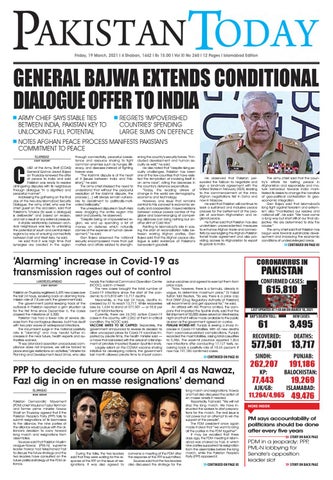
General Bajwa extends conditional dialoGue offer to india g
g
ARMy chIeF SAyS STAbLe TIeS beTWeeN INDIA, PAkISTAN key To uNLockINg FuLL PoTeNTIAL
g
RegReTS 'IMPoveRISheD couNTRIeS' SPeNDINg LARge SuMS oN DeFeNce
NoTeS AFghAN PeAce PRoceSS MANIFeSTS PAkISTAN'S coMMITMeNT To PeAce ISLAMABAD
c
staff report
hIeF of the Army Staff (coAS) general Qamar Javed bajwa on Thursday renewed the offer of peace to India and said Pakistan was ready to resolve all lingering disputes with its neighbours through dialogue “in a dignified and peaceful manner”. Addressing the gathering on the final day of the two-day Islamabad Security Dialogue, the army chief, who was the chief guest on the occasion, said that Pakistan’s “choice [to seek a dialogue] is deliberate” and based on reason, and not a result of any external pressure. A stable relationship between archrival neighbours was key to unlocking the potential of south and central Asian regions by way of ensuring connectivity between east and West Asia, he said. he said that it was high time that synergies are created in the region
through connectivity, peaceful coexistence and resource sharing to fight common enemies such as hunger, illiteracy, and diseases instead of fighting forever wars. “The kashmir dispute is at the heart of it [issues between India and Pakistan],” he said. The army chief stressed the need to understand that without the peaceful resolution of the kashmir dispute, the process […] will always remain vulnerable to derailment to politically-motivated bellicosity.” The unresolved disputes in South Asia were dragging the entire region into debt and poverty, he observed. “Despite being an impoverished region, we end up spending a lot of money on defense which naturally comes at the expense of human development,” he said. gen bajwa observed the national security encompassed more than just matters and affairs related to strength-
ening the country’s security forces. “It included development and human security as well,” he said. he also noted that “despite rising security challenges, Pakistan has been one of the few countries that have resisted the temptation of involving itself in an arms race”, citing the decrease in the country’s defence expenditure. “Today, the leading drivers of change in the world are demography, economy and technology. however, one issue that remains central to this concept is economic security and cooperation. Frayed relations between various powers centres of the globe and boomeranging of competing alliances can bring nothing but another stint of cold War.” Pointing to Islamabad’s role in easing the start of reconciliation talks between warring Afghan parties, gen bajwa said that the Afghan peace dialogue is solid evidence of Pakistan’s benevolent goodwill.
he observed that Pakistan persuaded the Taliban to negotiate and sign a landmark agreement with the united States in February 2020, leading to the commencement of the intraAfghan negotiations first in Doha and now in Moscow. he said that Pakistan will continue to seek a sustained and inclusive peace process for the betterment of the people of war-town Afghanistan and regional peace. he further said that Pakistan has also undertaken unprecedented measures to enhance Afghan trade and connectivity by reenergising the Afghan-Pakistan transit trade agreement and also providing access to Afghanistan to export its goods to India.
‘Alarming’ increase in Covid-19 as transmission rages out of control LAHORE/ISLAMABAD staff report
Pakistan on Thursday registered 3,495 new cases over the last 24 hours, receiving back an alarming transmission rate of 7.8 per cent, the government said. The government portal keeping track of the outbreak in Pakistan reported a grim situation as for the first time since December 6, the cases crossed the milestone of 3,500. Pakistan has had a lower rate of severe disease from the contagious disease, but it has dealt with two prior waves of widespread infections. The incumbent surge in the national positivity rate is “alarming” and may herald further increases in the near future, health experts and authorities warned. “If sop [standard operation procedures] compliance does not improve, we will be forced to place stronger restrictions on activities,” Minister for Planning and Development Asad umar, who also
heads the National command operation centre (Ncoc), said in a tweet. The new cases brought the total number of covid-19 infections since the start of the pandemic to 615,810 with 13,717 deaths. Meanwhile, in the last 24 hours, deaths increased by 61 to reach 13,717. While recoveries rose by 1,634 to stand at 577,501 — or 93.8 per cent of total infections. currently, there are 24,592 active covid-19 cases in the country, with 2,062 of them in critical condition, the Ncoc said. VACCINE RATES TO BE CAPPED: Separately, the government announced to reverse its decision to allow uncapped prices for covid-19 vaccines imported by private firms, the health minister said — a move that coincided with the arrival of a first shipment of privately imported Russian Sputnik-v shots. Largely reliant on the covAX vaccine sharing initiative for developing nations, the government last month allowed private firms to import coron-
Pakistan
CONTINUED ON PAGE 05
PPP to decide future course on April 4 as Nawaz, Fazl dig in on en masse resignations’ demand mian abrar
Pakistan Democratic Movement (PDM) chief Maulana Fazlur Rehman and former prime minister Nawaz Sharif on Thursday agreed that if the Pakistan People’s Party (PPP) fails to submit resignations of its lawmakers to the alliance, the nine parties of the alliance would pursue with the alliance’s decision to carry forward long march and resignations from assemblies. Sources said that Pakistan Muslim League-Nawaz (PML-N) supreme leader Nawaz had telephoned Fazl to discuss the future strategy and the two leaders have consulted on the future political strategy of the PDM alliance.
During the talks, the two leaders said that they were waiting for the response of the PPP on the issue of resignations. It was also agreed to
convene a meeting of the PDM after the response of the PPP is submitted. Sources said that the two leaders also discussed the strategy for the
CONTINUED ON PAGE 05
coronavirus in
avirus vaccines and agreed to exempt them from price caps. “Now, however, there is a formula, already in vogue, to determine maximum price,” Dr Faisal Sultan told Reuters. “So yes, there is a price cap that DRAP [Drug Regulatory Authority of Pakistan] will recommend and get approval for,” he said. An official with Ag Pharma Limited, the company that imported the Sputnik shots, said that the first shipment of 50,000 doses arrived on Wednesday night and that it will be made available to the public as soon as the government agreed on a price. PUNJAB WORSE-HIT: Punjab is seeing a sharp increase in covid-19 fatalities. With 43 new deaths from coronavirus-related complications, Punjab recorded the most fatalities, raising total casualties to 5,986. The worst-hit province reported 1,824 new infections after conducting 17,127 tests, receiving back a positivity rate of 10.65 percent. It now has 191,186 confirmed cases.
ISLAMABAD
The army chief said that the country’s efforts for lasting peace in Afghanistan and responsible and mature behaviour towards India manifested its desire to change the narrative of geo-political contestation to geoeconomic integration. gen bajwa said that Islamabad’s long fight against terrorism and extremism also “manifested our resolve and national will”. he said: “We have come a long way but short still of our final objective. We are determined to stay the course.” The army chief said that Pakistan has begun work towards sustainable development and improving the economic conditions of underprivileged areas.
long march and resignations. Nawaz and Fazl also discussed the option of en masse arrests if needed. Reportedly, Fazl said: “We will not stop the long march. We have instructed the workers to start preparations for the march. The real issue is not power but an attempt to win the support of the people”. The PDM president once again made it clear that “we want to bring all the parties in the PDM together”. It may be recalled that three days ago, the PDM meeting in Islamabad was chaired by Fazl, in which nine parties supported his resignation from the assemblies before the long march, while the Pakistan People’s Party (PPP) opposed it.
CONTINUED ON PAGE 05
CONFIRMED CASES:
615,810
LAST UPDATED AT 7:50 AM ON MARCH 18, 2021
DAY'S DEATH TOLL:
NEW CASES:
61
3,495
RECOVERED:
DEATHS:
577,501
13,717
SINDH:
PUNJAB:
262,207
191,186
KP:
BALOCHISTAN:
AJK/GB:
ISLAMABAD:
77,443
11,264/4,965
19,269 49,476
more inside
PM says accountability of politicians should be done after every five years STORY ON BACK PAGE
PDM in a jeopardy: PPP, PML-N lobbying for Senate’s opposition leader slot
STORY ON BACK PAGE
02
Friday, 19 March, 2021
ISLAMABAD
NEWS
MAkiNg PAkiStAN A ModEl of StAtE of MEdiNA iS fiNAl goAl, SAyS PrESidENt Alvi MADEJI
P
OFFICIAL EMPHASISES THAT UN IS COMMITTED TO USING EDUCATION AS A TOOL TO COUNTER HATE SPEECH
ppI
RESIDENT Dr Arif Alvi on Thursday said that making Pakistan a model of the State of Medina is the final goal as envisioned by the Prime Minister of Pakistan Imran Khan. The president was addressing the opening ceremony of a series of webinars entitled, “Nurturing Peaceful, Respectful and Inclusive Societies in Pakistan: Seerat counters hate speech through decisive action”, being jointly organised by the United Nations Office on Genocide Prevention and the Responsibility to Protect (OSAPG) and the Higher Education Commission (HEC), Pakistan. He underlined that lack of
communication generates phobias among individuals, states, and nations, yet cooperative and peaceful discussions, as enshrined in the UN Charter, are the key to address these phobias. Alvi stated that hate speech should have no standing in Pakistan. “We need to make sure that the laws isolating communities must be condemned,” he said. Highlighting the role of media, he stressed the need for judiciously handling the ‘weapons of misinformation’ and communicating to the world that Pakistan is a peaceful country, and the Muslims around the world are peaceful. According to the HEC statement issued on Thursday, the introductory webinars will
Pakistan condemns Niger attacks that killed 58 NIAMEY Staff RepoRt
Pakistan on Thursday condemned a militant attack in a convoy and a village in Niger that killed at least 58 people. Monday’s attacks occurred in the Tillabery region which is near the border with Mali and Burkina Faso and has seen increasingly deadly attacks by militants active across the region with links to the socalled Islamic State and Al-Qaeda. “Pakistan strongly condemns the terrorist attacks in [the] Tillaberi region of [the] Republic of Niger that resulted in [the] loss of so many precious lives,” the Foreign Office (FO) said in a statement. “The government and people of Pakistan extend their deepest sympathies and condolences to the bereaved families and pray for the speedy recovery of those injured,” it added. The attacks echoed a January massacre that left 100 people dead in two villages also in the Tillaberi region that hadn’t been claimed by any extremist group or militia. “Pakistan reiterates its unequivocal condemnation of terrorism in all forms and manifestations,” the FO statement said. “We reaffirm our strong support and solidarity with the government and people of Niger in this moment of grief.” The violence is part of a wider security crisis in West Africa’s Sahel region. Many of the militant attacks are concentrated where the borders of Niger, Mali and Burkina Faso meet, a zone that a 5,000-strong French anti-militant task force has targeted heavily. Extremists staged mass attacks on Niger’s military in the Tillaberi region, killing more than 70 in December 2019 and more than 89 in January 2020. It’s near the area where four US Special Forces soldiers were killed along with five Nigerien colleagues in 2017.
ECP panel mulls over use of technology in Senate polls today ISLAMABAD tLtp
The Election Commission of Pakistan (ECP) has called a meeting of its committee formed to review possibilities of using technology in future Senate elections on Friday. “The meeting of the committee constituted to review the possibilities of use of technology in Senate elections and draft recommendations will be held on March 19,” said a statement issued by the electoral authority on Thursday. The meeting shall take place at the ECP Secretariat, with Additional Secretary (Admin) Manzoor Akhtar Malik in chair, the communique added. The committee comprises Joint Provincial Election Commissioner Punjab, Saeed Gul and Director General Information Technology Khizar Aziz among others. A day ago, March 17, Minister for Science and Technology Fawad Chaudhry said that the government was in the process of making the electoral system fully automated. “We are working on shifting the electoral system from manual to a fully automatic one,” the minister said during a media briefing held after a cabinet meeting in Islamabad, with Prime Minister Imran Khan in chair. “It will help address the concerns of political parties in general,” he added. The minister had reiterated that Prime Minister Imran Khan was making efforts since the beginning to introduce reforms in the electoral process and make it transparent.
continue for three days to cover six sessions, including topics like Seerat of the Holy Prophet (Peace Be Upon Him), minorities, and the role of youth in combating hate speech. The series of webinars are aimed at encouraging peaceful, inclusive, and empathetic communities in Pakistan through tools like active and continuous intersectional participation, dialogue, and collaboration. It also aims to contribute to achieving the Sustainable Development Goals (SDGs), in particular SDG16 on building peaceful, inclusive and just societies. Alvi said that it is imperative that all of us hold ourselves to the true principles of
Islam which can counter all kinds of religious, ethnic and gender hatred, marginalisation, discrimination, and inequality. He underlined that Islam establishes the fact that all human beings are equal, and there is no point of discrimination among them except piety. He said that Arabs had a patriarchal society wherein slavery was common, yet the Holy Prophet (PBUH) encouraged people to break the chains of slavery. He maintained that the Holy Prophet (PBUH) taught and emphasised forgiveness, putting compensation as a secondary and vengeance as a last resort in case of any confrontation. He added that the Holy
Prophet (PBUH) laid emphasis on adopting a just approach in financial affairs to set up an economically just society. He added that the father of the Pakistani nation, Muhammad Ali Jinnah, was also a staunch advocate of unity and peaceful coexistence. On this occasion, UN Special Adviser Alice Wairimu Nderitu emphasised that the United Nations was committed to using education as a tool to counter hate speech. “Education highlights the difference between good and bad, right and wrong, and true and false,” she said, adding that the promotion of quality education and the establishment of peace, justice and strong institutions were among the UNDP’s SDGs. None of the SDGs to establish inclusive and resilient societies by 2030 can be achieved without the promotion of education, she affirmed. She also acknowledged the world’s accumulative response to Covid-19. Nderitu said that the past decade witnessed an increase in access to education, however, there was still a lot to be done in this direction. She appreciated Pakistan for its commitment to achieving the goal of ensuring free and compulsory education for all, as per the Constitution.
Naya Pakistan centres on economic security, says foreign minister ISLAMABAD Staff RepoRt
Foreign Minister Shah Mahmood Qureshi on Thursday said that Pakistani leadership’s vision of Naya Pakistan is focused on economic security for the wellbeing and welfare of the people. He was addressing the National Security Dialogue in the federal capital. The foreign minister said that Pakistan is advocating co-existence and win-win cooperation instead of partaking in geo-political competition and rivalries. He said that Pakistan has decided not to be a part of any regional conflict and has consciously chosen to be only a partner for peace and development. Qureshi said that Pakistan is calling for inclusive and cooperative approaches based on enhanced economic partnerships. He said that Pakistan is emerging as the gateway to landlocked Central Asia and Afghanistan. The foreign minister said that durable peace, security and development in the region hinge on peaceful resolution of the long-standing Jammu and Kashmir
PAKISTAN IS EMERGING AS GATEWAY TO LANDLOCKED CENTRAL ASIA, AFGHANISTAN dispute. He said that India must stop violations of human rights and fundamental freedoms in occupied Kashmir, halt its illegal attempts to change the demographic structure in the occupied territory and implement the United Nations Security Council resolutions. The foreign minister said that India must also rethink its policy of fomenting destabilisation in Pakistan and embrace a progressive agenda that can benefit the entire region. Talking about peace in Afghanistan, Qureshi said that Pakistan has steadfastly supported an Afghan-led an Afghan-owned peace process as there is no military solution to the conflict in Afghanistan.
US consul general lauds access programme graduates MULTAN Staff RepoRt
US Consul General in Lahore Catherine Rodriguez on Thursday congratulated 250 students on the successful completion of the State Department-funded English Access Microscholarship Programme (Access). She appreciated the hard work of the teachers, the dedication of the students, and the cooperation of their parents. During the virtual graduation event, the students shared their success stories, recited their poetry, and sang a song. In her address, Rodriguez said: “Congratulations, students, on reaching this milestone in your educational journey. We know that you worked many extra hours each week to attend classes, practice at home, and collaborate with your classmates. Thank you to your families for their support of your studies, too.” Thanking the partners, she said: “I would like to give a special ‘bohat shukriya‘ to our implementing partner, the Education for Skill Development Association (ESDA), CEO Hammad Haseeb and to Fahad Khan, the English Access Manager, for your dedication to our shared goals of increase Englishlanguage education.” She observed in Punjab, the US Mission to Pakistan has sponsored five English Access sites in Lahore,
Faisalabad, Gujranwala, Der Ghazi Khan, and Multan. “In these programmes, our partners help young adults not only to learn English, but also to learn about the similarities and differences between Pakistani and American culture, society, art, music, and traditions. The Access programme is a platform for engagement between students, women entrepreneurs, different US exchange programmes alumni, emerging leaders in Pakistan, and US diplomats, students, and experts.” She added: “We know that English language proficiency can open doors to more opportunities for young adults. It’s a pathway to higher education, to studying science, and conducting business on a national, regional, and global market level. It is one way to help build a stronger rapport with other countries around the globe.” She said that strong English skills are essential to take advantage of our many exchange programmes offered through the Consulate such as Fulbright scholarship and study of the US educational institutes. We are eager to see more Pakistanis take part in our people-to-people exchanges, she added. The programme benefits economically disadvantaged students between the ages of 13 to 20 years. So far, about 22,000 students in Pakistan have experienced this initiative.
NAB summons Maryam in land allotment case LAHORE Staff RepoRt
The National Accountability Bureau (NAB) summoned Pakistan Muslim League-Nawaz (PML-N) leader Maryam Nawaz in connection with its investigation into illegal acquirement of hundreds of acres of land in Raiwind to include in Sharifs’ Jati Umra estate. She is also scheduled to appear before the anti-graft body in the Chaudhry Sugar Mills (CSM) reference on the same day. The CSM case accuses Maryam of involvement in money laundering through investments of variable heavy amounts being the main shareholder of the mills. It alleges she was involved in money laundering with the help of some foreigners during the period of 1992-93 when her father Nawaz Sharif was the prime minister. In the latest summons, the agency directed Maryam to bring along the required documents. “The Sharif family got thousands of kanals of land adjacent to its Jati Umra residence declared residential area in 2014 and former Lahore Development Authority (LDA) director general Ahad Cheema played an important role in this respect,” the reference states. Noorul Amin Mengal, former Lahore DCO, a post now abolished, has also been included in the investigation, reports said. NAB has nominated Nawaz, his brother Shehbaz Sharif and daughter Maryam as prime suspects in the case. Shehbaz’s son Suleman, who is absconding in the United Kingdom, and other family members are among the 16 suspects in this case. Maryam has been on bail in the CSM case since November 2019. Nawaz has been in London since November 2019, for his medical treatment after securing bail in the CSM and Al-Azizia Mills corruption cases, in which he was serving a seven-year sentence in Kot Lakhpat prison.
SC seeks response from former PTI leader in funding case ISLAMABAD INp
Declaring Prime Minister Imran Khan’s petition in the ongoing foreign funding case as maintainable, the Supreme Court (SC) on Thursday served a notice on Akbar S Babar, the applicant in the case. A two-member bench, headed by Justice Mushir Alam took up the petition.
Imran’s counsel, Anwar Mansoor Khan, in his argument, said that the prime minister had no objection to the scrutiny committee formed by the Election Commission of Pakistan (ECP). Babar was expelled from the party before filing the case, but ECP declared he was still a member of Pakistan Tehreek-e-Insaf (PTI), he said. “ECP has no right to declare Akbar S Babar as PTI
member.” The court, after hearing initial arguments, admitted the request for the hearing and sought a response from Babar. Last week, the petition was moved on behalf of the prime minister against the ECP declaration that was upheld by the Islamabad High Court (IHC) in December 2019. The petition had requested that the
high court had indulged in fact-finding and argued that the IHC decision came without defining the ambit and power of the ECP. The ECP, the petition alleged, had acted as a court of law or a tribunal and travelled beyond the scope of plea rather extended its jurisdiction in matters of factual controversy, in contravention of the settled law.
Friday, 19 March, 2021
ISLAMABAD
NEWS
PM for deePer PakIstan-kuwaIt eConoMIC, trade, InvestMent CooPeratIon ISLAMABAD
P
Staff RepoRt
RIME Minister Imran Khan on Thursday, reaffirming Pakistan’s long-standing fraternal ties with Kuwait, rooted deep in shared faith and culture, underscored the imperative of forging deeper economic, trade and investment cooperation between the two countries. Lauding the efforts on both sides to build an enhanced partnership, he also appreciated the two countries working closely to ensure ease of travel and enhancing people-to-people linkages. The prime minister expressed these views during a meeting with Kuwait Foreign Minister and Minister of State for Cabinet Affairs Dr Ahmed Nasser AlSabah who called on him in the federal capital. Pakistan-Kuwait bilateral relations, Covid-19 situation, and regional issues were discussed. The Kuwaiti foreign minister conveyed cordial greetings of the emir and of the Kuwaiti premier to Prime Minister Imran. He also delivered a letter from his counterpart. Highlighting the high esteem accorded to the Kuwaiti leadership by the government and people of Pakistan, the prime minister warmly reciprocated the sentiments. Lauding the successful measures by Kuwait against the global pandemic, He highlighted the strategies adopted by Pakistan to fight the Covid-19 pandemic, balancing the imperatives of saving lives and securing livelihoods. Prime Minister Imran thanked the Kuwaiti leadership for the care afforded
PAKISTAN WANTS TO INCREASE BILATERAL TRADE WITH KUWAIT: QURESHI
to Pakistani expatriates during the pandemic and urged the further strengthening of this strong bond of friendship between the two countries. The Kuwaiti FM expressed his country’s firm resolve to further expand cooperation with Pakistan in diverse fields. He expressed thanks for Pakistan’s steadfast support and noted that the two countries always stood by each other at difficult times. He also thanked the premier for Pakistan’s valuable cooperation, especially during the testing times of the global pandemic. Recently, more than 600 Pakistani doctors and paramedics were employed by Kuwait to strengthen its health sector. The Kuwaiti foreign minister identified education, economy, trade and investment, and people-to-people linkages as priority areas of cooperation. He underscored the need to further strengthen the institutional frameworks of bilateral cooperation.
PM directs to ascertain status of Baloch missing persons ISLAMABAD: Prime Minister Imran Khan on Thursday directed his principal secretary to quickly ascertain the exact status of the missing members of 13 Baloch families. The prime minister, in a meeting with a three-member committee on Balochistan missing persons, representing the 13 families which had staged a sit-in last month, committed to updating them on the progress, Human Rights Minister Dr Shireen Mazari said on Twitter. The prime minister also reiterated that the government would fast track its bill to criminalise the enforced disappearances besides amending whatever laws required. Moreover, he also asked to keep him informed of the progress on the whereabouts of the missing Baloch family members. The families of purportedly missing persons, who had gathered in a camp outside the National Press Club in Islamabad last month, had agreed to postpone their sit-in on the persuasion of minister for human rights. app
The prime minister highlighted Pakistan’s efforts in support of the Afghan peace process and stressed the importance of an inclusive, broad-based and comprehensive political solution to the conflict in Afghanistan. He also appreciated the active and constructive role played by Kuwait in promoting regional peace and harmony, especially among the countries of the Gulf Cooperation Council (GCC). The prime minister congratulated the Kuwaiti leadership on the recent successes achieved in this regard. The Kuwaiti FM, on behalf of his country’s leadership, cordially invited Prime Minister Imran to visit Kuwait, which was graciously accepted. PM Imran also conveyed that he looked forward to welcoming the emir as well as the prime minister of Kuwait in Pakistan at the earliest convenience. Separately, Foreign Minister Shah Mahmood Qureshi on Thursday said that Pakistan wants to increase the volume of bilateral trade with Kuwait.
Talking to his Kuwaiti counterpart who called on him in Islamabad, he said that the government is looking forward to the early convening of Fifth Joint Ministerial Commission between Pakistan and Kuwait. Qureshi said that there are vast opportunities of cooperation between the two countries in the energy, technology, health, education and defence sectors. The minister said that more than 100,000 Pakistanis living in Kuwait are playing a positive role in the development of the country. He said that Pakistan has transformed its geopolitical priorities into geo-economic priorities. The foreign minister said that Pakistan is facilitating the foreign investment in different sectors of economy. This is the reason that Pakistan’s ranking in the ease of doing business has improved, he said, welcoming Kuwaiti investment in the country. Qureshi also apprised the Kuwaiti counterpart about the prevailing situation in Indian Occupied Kashmir (IOK). He said that India has brought controversial legislation to change the demographic structure of the disputed territory. He also said that Pakistan is looking towards positive role of the world community, including that of Kuwait, to get freed the oppressed Kashmiri people from cruel Indian clutches. He thanked Kuwait for supporting Kashmir resolution passed by the Organisation of Islamic Cooperation (OIC) foreign ministers at its meeting in Niger.
Federal cabinet, bureaucratic reshuffle on cards again ISLAMABAD Mian abRaR
With the Senate elections over, Prime Minister Imran Khan has decided to reshuffle the federal cabinet and a decision is likely to be taken in the next few days. Sources in the ruling party told Pakistan Today that other than some new faces making their way into the federal cabinet, the portfolios of some of the ministers are also likely to be changed. According to the sources, proposals are being prepared in the cabinet as well as in the bureaucracy. These changes are likely to concern the offices of the Punjab chief secretary, Home Department federal secretary and information secretary. As frustration grows in the party circles, the premier stands firm in his belief that the ministers have to perform without giving any excuse. As such, sources say that Prime Minister Imran will reshuffle the cabinet on the performance of the ministers and the newly elected senators are also likely to be included in the federal cabinet. “Prime Minister Imran Khan is not happy with
the performance of several key ministers, so he has decided that only those who can deliver will remain in the cabinet,” a source said on condition of anonymity. “Delivery and performance are the things in which the prime minister is interested because he does not like to hear excuses after extraordinary delays in the completion of projects for any reason,” the source said. Reportedly Barrister Ali Zafar, Aun Abbas Bappi and Dr Zarqa are likely to be added to the federal cabinet while the Prime Minister’s Office (PMO) is also looking to name a new minister to take the key offices of information and communications. Furthermore, Murad Saeed is likely to lose one of his ministries as Communications is likely to be handed over to someone else due to his failure to launch even a single project during the past two and a half years. The sources said that due to controversy around his US nationality, it is yet to be decided whether or not Faisal Vawda would be handed the reigns of the Ministry of Water again. It also emerged that Prime Minister Imran reportedly wants a change in the Ministry of Information while Senator Faisal Javed may also be given a cabinet slot.
Constitutional, electoral reforms are need of the hour: NA speaker ISLAMABAD Staff RepoRt
National Assembly (NA) Speaker Asad Qaiser on Thursday said that constitutional and electoral reforms are the need of the hour. Talking to Information Minister Shibli Faraz and Minister for Science and Technology Fawad Chaudhry in Islamabad, he said that parliamentary leaders in the NA and Senate will be consulted to form a parliamentary committee to bring reforms. Speaking on the occasion, Faraz said that it is a joint responsibility of government and opposition to ensure transparency in electoral process through constitutional amendments. Fawad said that all political parties have always raised reservations over the transparency of Senate elections and now they should come forward for electoral reforms. This meeting comes a day after it emerged that Prime Minister Imran, in a letter, directed Qaiser to form a interparty parliamentary committee to discuss electoral reforms and to review the election reforms bill tabled by the Pakistan Tehreek-e-Insaf (PTI)-led
government in October 2020. Federal Minister for Planning and Development Asad Umar shared the premier’s letter addressed to the NA speaker in a tweet on Wednesday, wherein PM Imran stressed upon Qaiser the need to form a plan “on how to introduce best practices including the use of technology and introduction of EVMs (electronic voting machines) to strengthen our electoral system and democracy”. The premier, in the letter, highlighted that the treasury bench had submitted a bill for “meaningful electoral reforms to remove the prevailing stigma attached to our electoral process”. He underscored that the recent Senate elections had brought to the forefront the prevailing issue of vote buying and selling. The prime minister highlighted that the government had moved the Supreme Court (SC) in this regard and the judiciary directed the Election Commission of Pakistan (ECP) to ensure transparent, fair, and free elections and stated that secrecy of the ballot was not absolute”. Prime Minister Imran lamented the fact that the electoral body had not paid heed to the demands for transparent election and that the SC had not released a verdict in favour of open ballot.
03
Man launChes bloody knIfe attaCk In uPsCale karaChI neIghborhood, CrItICally Injures two KARACHI: Two men were brutally attacked at a housing society in Karachi over a minor parking dispute yesterday night. Following a verbal spat, the suspect, one Ibrahim Durrani violently attacked two people, whose identity could not be ascertained, with a small Swiss Army knife that can be seen attached to his car keys, injuring two persons in the limits of Pakistan Air Force (PAF) Falcon Complex Karachi. One of the victims arguing with the perpetrator seen here holding the weapon, shortly before the attack Graphic videos doing rounds on social media show Durrani hurling threats at both victims as while a security guard attempts to diffuse the situation. Durrani during the entire verbal exchange is wielding the knife that he later uses to cut and stab the victims. A bloodied motionless shirtless body of one of the more critically injured victims can later be seen in the video as his terrified family and nearby residents attempt to revive him. According to police, the suspect fled the scene after the attack. A case has been lodged against the suspect who remains at large. Reportedly both victims were shifted to hospital in time and are in a stable condition. Various posts on social media and the attacker’s LinkedIn page showed that he is an employee of multinational company Philip Morris International Pakistan, working there since 2012, however, a spokesperson from Philip Morris clarified to Pakistan Today that Durrani left the company a year ago and no longer works there. “Despite being a well-guarded and patrolled neighborhood under the management of the PAF, such an incident still took place and the attacker got away as well. Thankfully there was no loss of life”, commented a resident of the housing society who was not a witness. Pakistan Today contacted the Head office of Falcon Complex based in Islamabad and were told that at the moment no relevant person was available to comment. Web DeSk
PM Imran receives first dose of Covid-19 vaccine ISLAMABAD: Prime Minister Imran Khan received his first dose of the Covid-19 vaccine on Monday, his office announced. After receiving the shot, Imran appealed to the people to continue exercising precaution in view of a third wave of the contagious disease. “These vaccines will protect you and those you love from this dangerous and deadly disease,” he said. In the last 24 hours, 3,495 people tested positive, the most daily infections since December 6. Total cases rose past 615,000. Deaths rose by 61 to reach 13,717. Most of the new cases came from densely populated Punjab. Minister for Planning and Development Asad Umar said that hospital beds were filling fast, warning of stricter curbs if rules were not followed. “The new strain spreads faster and is more deadly,” he said on Twitter, referring to the United Kingdom variant. Staff RepoRt
04
Friday, 19 March, 2021
ISLAMABAD
NEWS
PunjAb to Provide 3-MArlA houses on eAsy instAllMents: hAshiM
PAF’s multinational drill Aces Meet 2021 starts from 27th ISLAMABAD STAFF RREPORT
LAHORE
P
STAFF REPORT
UNJAb Minister for Finance Makhdoom Hashim Jawan bakht on Thursday said that the Punjab government is providing the best opportunity to low-income homeless people to get houses on easy instalments. For this purpose, in the first phase, three-marla houses will be constructed in semi-rural (pre-urban) areas on government land identified by the board of Revenue, he said while presiding over the 54th meeting of the Cabinet Committee on Finance and Development on Thursday. The Punjab government will provide land and revolving funds for the construction of houses. The construction of houses will be completed in collaboration with the New Pakistan Housing Development Authority and bank of Punjab and other banks. Industries Minister Mian Aslam Iqbal directed the Department of Housing and Urban Development to verify the non-agricultural nature of
the land in pre-urban areas before the commencement of the scheme so that after the commencement of the scheme it would be declared as green land. Adviser to Chief Minister for Economic Affairs Dr Salman Shah termed the scheme as a benchmark plan of the Punjab government and stressed on the need to expand its
scope. The Punjab chief secretary directed the concerned departments to activate the Punjab Land Development Company to expand the scope of the scheme in future. The meeting discussed that 15 agendas were tackled by various departments in the meeting. The meeting approved the purchase of
equipment for heart surgery at Children's Hospital Multan, allocations of additional funds of Rs8.913 million for payments due to the agriculture department for the financial year 2017-18, and a supplementary grant to the Population Welfare Department for the Punjab Population Innovation Fund. The meeting also approved the funds of the scheme for payment of pensions and Phase-I of preparation of starting business in Punjab Small Industries. Further, the proposal of the local government for the grant of the share of the Metropolitan Corporation Rawalpindi in the tax on immovable property and allocation of funds for the treatment of the son of the Naib Qasid of scale one. The meeting approved the funds for providing shade at bus stops in Lahore while instructed the transport department to brief the committee in detail about the current status of the Lahore Transport Company. The finance minister directed the law and parliamentary affairs department to present the request for lifting the ban on recruitment to the concerned committee.
The Pakistan Air Force (PAF) will host a two-week-long multinational air exercise from March 27 in which some of the country’s top Middle Eastern allies, including Saudi Arabia and Palestine, are also going to participate. The Aces Meet 2021 exercise is designed to maximise the combat readiness of all participants by providing them a realistic training environment for air combat and counterterrorism operations. “The Royal Saudi Air Force and the United States Air Force will be participating with their aircraft,” added the spokesman who did not want to be named. “However, the Iraqi Air Force and Palestinian paratroopers will attend the exercise without fighter jets.” “The exercise will help the participants benefit from each other’s diverse experiences and different aircraft operations,” he continued. The PAF spokesman said that the Pakistani side would use F16 and JF17 fighter jets while the Royal Saudi Air Force would bring Tornado aircraft. He said that the PAF enjoyed close cooperation with many countries in the region and frequently participated in bilateral exercises with them. “We have been part of different exercises with Saudi Arabia in the past,” he said. “Recently, we participated in Al-Saqoor II exercise in Saudi Arabia with our aircraft.” The PAF official added that Pakistan had also participated in Zilzal exercise with Qatar, Anatolian Eagle exercise with Turkey and Shaheen exercise with China. “The full participation of the Royal Saudi Air Force is a reaffirmation that both countries are doing their best to enhance bilateral cooperation and ties,” he noted. The PAF spokesperson said the participants of the exercise would follow strict Covid-19 protocols, adding that the Pakistan Navy had also successfully conducted the recent Aman-2021 exercise during the pandemic.
AtC reserves verdict in lahore-sialkot motorway gang-rape case LAHORE: An anti-terrorism court (ATC) on Thursday reserved its verdict after completing proceedings in the Lahore-Sialkot motorway gang-rape case. The court, presided over by Judge Arshad Hussain bhutta, will announce the verdict on Saturday. The ATC conducted the case hearing at Camp Jail, wherein jail authorities produced Abid Malhi and Shafqat Ali, prime accused and co-accused. The two suspects were indicted in the case but they had pleaded not guilty and opted to contest the charges. The victim had identified suspects Abid Malhi and Shafqat Ali. Their samples were also matched in the DNA test. Overall, 37 witnesses have recorded their statements against the accused. On September 9 last year, a woman along with her children was waiting for help on the LahoreSialkot motorway near Gujjarpura area on the outskirts of the provincial capital, after her car ran out of fuel, when she was forcefully pulled out of the car and gang-raped at gunpoint. INP
LAHORE: Punjab Chief Minister Sardar Usman Buzdar, Adviser to Prime Minister on Accountability Barrister Shahzad Akbar and Special Assistant to CM Dr Firdous Ashiq Awan address a press conference in the provincial capital.
Safdar escapes ‘egg attack’ outside PHC, gets bail extension PESHAWAR TLTP
An unidentified man tried to throw an egg on Pakistan Muslim League-Nawaz (PML-N) leader Captain (R) Mohammad Safdar Awan outside the building of the Peshawar High Court (PHC) on Thursday. Luckily, Safdar escaped the egg attack as it hit the nearby vehicle. The man managed to run away from the scene after Safdar picked a baton and chased the man to hit him. In the video, the PML-N leader can be seen walking outside the court premises with a few workers by his side and journalists, when a man throws an egg. The man can then be seen running
away from the reporters and journalists as Safdar, with a stick in hand, chases after him. The man got onto a rickshaw and managed to flee temporarily before he was caught by some people near the Cantt Railway Station. He was then handed over to the local police. The incident took place a few days after ink was hurled at Special Assistant to Prime Minister (SAPM) on Political Communication Dr Shahbaz Gill by the PML-N workers in the premises of the Lahore High Court (LHC), where he had arrived to appear in a case. They had also tried to throw eggs at him but the PTI workers present there had thwarted the bid and thrashed the attackers. Later, Safdar appeared before the PHC in connection with his pre-arrest bail plea. The PHC heard the pre-arrest
bail plea of Safdar and the counsels of the petitioner concluded their arguments. They argued that the National Accountability bureau (NAb) should provide the details of inquiries being carried out in a case. It is the violation of Article 13 for running parallel inquiries of a single case in Lahore and Peshawar, the counsel said. Moreover, the NAb’s private counsel presented a chart of properties before the court. Justice Lal Jan Khattak remarked that the chart has no signature that has been provided to the court. The court ordered the NAb prosecutor to provide the chart to the counsels of the petitioner. The court also granted permission to the anti-graft watchdog to hire a private counsel for the case. Later, the court extended the bail of Safdar and adjourned the hearing.
FBR probes distributors’ involvement in cigarettes’ benami sales KARACHI SHAHZAD PARACHA
The distributors in Karachi are reportedly involved in benami sales of non-duty paid cigarettes, Pakistan Today learnt on Thursday. Sources said that after receiving a complaint about involvement of the local distributors in benami sales of non-duty paid cigarettes, the Federal board of Revenue (FbR)’ Anti-benami Zone-III Karachi has ordered an inquiry to gather third-party information of the local distributors to assess the genuineness of the complaint. The complaint alleged that the tobacco companies have used their sales department officials as front men
as these people have supplied cigarettes worth billions of rupees to the local distributors. The sales department officials not only keep such type of sales out of the FbR’ radar but also make financial transaction through their personal bank accounts, causing loss to the national exchequer, sources added. The Inland Revenue’s enforcement, and Intelligence and Investigation teams have seized around 4.4 million non-duty paid cigarettes, worth Rs9.75 million, in the last six months. Moreover, the customs department has also confiscated smuggled cigarettes, worth Rs5.4 million, during the said period. On the other hand, the department has also recovered approximately Rs2.2 million in taxes from ware-
houses and shops. Overall, the local industry just pays 2 per cent tax whereas the multinational companies deposit 98 per cent tax. Sources said that the Anti-benami Zone will not only get the details of the companies' sales department officials but also of the distributors so it could know the exact statistics of transactions between the officials and distributors. The department has also sought the companies’ registered details in order to unearth the tobacco industry’s involvement in benami sales. It is pertinent to mention that tobacco sector costs Pakistan over Rs100 billion on yearly basis due to counterfeit and non-duty paid cigarettes.
Ministry submits report on dr Aafia in ihC ISLAMABAD: The Ministry of Foreign Affairs on Thursday submitted its report on Dr Aafia Siddiqui in the Islamabad High Court (IHC). The MIT-trained neuroscientist, Aafia Siddiqui, is serving 86-year prison sentence after being convicted by a United States (US) court of seven counts of attempted murder and assault on US military personnel in Afghanistan. A petition filed for the release and repatriation of Dr Aafia was heard by IHC Justice Amir Farooq, wherein the Foreign Ministry’s report was presented by an official of the Foreign Office. Deputy Attorney General of Pakistan Raja Khalid Mahmood appeared before the court. The lawyer of Dr Aafia sought time from the IHC for his arguments on the report, which was accepted by the court. Later, the hearing was adjourned for two weeks. Earlier, Advisor to Prime Minister on Parliamentary Affairs babar Awan had said that the federal government is taking serious steps for the return of Dr Aafia Siddiqui. Dr Fauzia Siddiqui, the sister of Dr Aafia, had met Dr babar Awan and they had discussed the progress of the government’s efforts for the return of Dr Aafia from the US. TLTP
Four killed, two injured in firing in lodhran LODHRAN: At least four people were killed and two injured when some unidentified armed men sprayed bullets on a car in Lodhran on Thursday. The local police said that some unknown culprits attacked a car at Allah Wasaya Chowk in Kahror Pakka. Four people, travelling in the car, were killed on the spot while two passersby were injured. The attackers fled the scene. The bodies and injured were shifted to a nearby hospital for medico-legal formalities. The police added that the reasons behind the murders could not be ascertained, however, a case has been registered against unidentified assailants and investigations have been started. INP
Friday, 19 March, 2021
ISLAMABAD
NEWS
‘Alarming’ increase in Covid-19 as transmission rages out of control ontinued from page 01 Amid the rising cases, the provincial government imposed a lockdown in seven high-burdened cities, restricting the movement of the people to their homes, while all commercial activities, establishments, markets and areas throughout the province shall be closed by 6:00 pm. Ministry of National Health Services and Regulations has urged people to adopt health guidelines as fears grew that the country was now in the grip of a third wave of Covid-19. “We are trying our best to take all necessary measures to control the infections, but it is almost impossible without public support,” a spokesperson for the ministry said earlier this week. VACCINATION DRIVE: Authorities have administered at least 72,882 doses of Covid-19 vaccines so far. Assuming every person needs 2 doses, that is enough to have vaccinated less than 0.1 per cent of the country’s population. The government on Wednesday received another Chinese donation of 500,000 doses of Sinopharm vaccine, bringing the country’s total supply to 1 million shots, Health Minister Dr Faisal Sultan confirmed. “These 500,000 doses will ensure smooth continuation of our vaccine drive, currently underway for senior citizens,” Dr Faisal said in a tweet. Sinopharm, the only vaccine currently available in the country, requires two doses. The country has not secured any vaccine from drug manufacturers and is depending on the GAVI/WHO COVAX initiative for poorer nations and the donations. The government is expecting to get GAVI’s first batch of 2.8 million doses of AstraZeneca sometime later this month, officials said. Besides Sinopharm and AstraZeneca, Pakistan has approved Russia’s Sputnik and China’s CanSino vaccines for emergency use. CanSinoBIO has released interim efficacy results from a multicountry trial, which included Pakistan, showing 65.7 per cent efficacy in preventing symptomatic coronavirus cases and a 90.98 per cent success rate in stopping severe infections. In Pakistan, the efficacy of the CanSinoBIO vaccine at preventing symptomatic cases was 74.8 per cent and 100 per cent at preventing severe disease.
PM to ANNouNCe Rs250BN uPlIFt PlAN FoR GB sooN iSLamaBad
A
GHUlAM ABBAS
S the apex committee constituted by the federal government has completed its proposals for Gilgit-Baltistan (GB) development plan, Prime Minister Imran Khan is expected to announce a historic GB development package, worth over Rs250 billion, soon. According to an official source, the apex committee has proposed at least 57 development projects in the five-year development plan (2021-26), which included earlier approved projects, some ongoing projects and some new projects -- to be funded by the Center as well as through public-private partnership (PPP). "The prime minister will soon approve the 'Socio-Economic Development Plan (2021-26)' for GB, following which the details of the package would be shared. The apex committee has finalised
the ground work on these projects and will submit the entire plan to the PM by next week. The PM may also visit Gilgit to announce the same," the official source said while revealing the details of the apex committee meeting held on Thursday under the chairmanship of Planning, Development & Special Initiatives Minister Asad Umar. The development plan included potential projects in the public sector, nonPSDP initiatives, as well as PPP projects, which had been conceived through consultations between GB authorities and federal ministries/divisions. Priority sectors such as clean energy/hydropower, health, education & skill development, tourism, private sector development, agriculture, women's development, social welfare, and youth have also been included in the plan. The purpose of formulating the package was to accelerate socio-economic development in GB by increasing the livelihood opportunities
for the people and realising the economic potential of the region. As per documents available with this scribe, projects worth Rs104.6 billion have been proposed in the transport and communication sector, while projects worth Rs86.3 billion have been recommended for clean energy and off-grid solutions. Similarly, projects worth Rs9.8 billion have been proposed in gems, mineral, trade and commerce sectors. For the development of human resources, which included health, education and skill development, a sum of Rs29.4 billion has been proposed. Besides, Rs5.4 billion would be spent on tourism and allied facilities, Rs13 billion on climate change/environment, and Rs1.3 billion on agri business development. Out of the Rs250 billion development plan, projects worth Rs47.7 billion would be funded through GB annual development plan; projects worth Rs91.7 billion would be financed through PSDP,
while those worth Rs110.5 billion would be funded by the federal government through the Ministry of Kashmir Affairs and Gilgit Baltistan (federal PSDP). However, an insider claimed that many of the projects included in the development package were those already approved by various forums and waiting for funding. In January 2021, the government had decided to announce a major economic package for GB as promised before regional elections in November last year. The Ministry of Planning had constituted two technical groups to finalise the integrated development plan on the pattern of the recently announced Karachi Transformation Plan. An apex committee under the GB chief minister and an inter-ministerial committee under the deputy chairman of Planning Commission were monitoring the preparation and implementation of the development plan.
General Bajwa extends conditional dialogue offer to India continued from page 01
Court directs FIA to file harassment case against Babar Azam LaHore tltp
A local court on Thursday directed the Federal Investigation Agency (FIA) to file a case against Pakistan skipper Babar Azam related to harassment allegations. The sessions court is hearing a plea filed by a woman named Hamiza Mukhtar, during which the FIA submitted its report on the case. As per the report, Hamiza alleged that the skipper had blackmailed and threatened her, after which Azam was summoned. However, instead of the cricketer, his brother, Faisal Azam, appeared before the FIA. The captain had sought time to reply, but he has not responded and neither has he recorded his statement with the FIA, the report said, adding: “It appears that he is guilty.” Following the submission of the report, the additional session judge directed FIA to launch a complaint against Azam and take action against him in line with the law. In January, the Lahore High Court (LHC) had suspended a session court order directing the police to register a case against Azam on a complaint. Last year in November, Hamiza, hailing from Lahore, levelled violence and sexual abuse allegations against Azam. “When I asked him to marry me, he tortured me,” she had said.
05
ISLAMABAD: PAF fighter jets during a rehearsal for the Pakistan Day parade. INp
NA body expresses concerns over additional import of wheat iSLamaBad GHUlAM ABBAS
The National Assembly's Standing Committee on Commerce has expressed serious concerns over the government's decision to import 300,000MT wheat despite the arrival of fresh crop. The committee, which met with MNA Syed Naveed Qamar in the chair, termed the government's decision a 'recipe for disaster'. Briefing the committee on wheat import, the Trading Corporation of Pakistan (TCP) chairman said as per the target given by the government, the TCP has imported 2.16 million MT wheat through in-
ternational tendering and PASCO, adding that 30 bulk vessels of TCP arrived from October 2020 to March 2021, while tenders for additional 300,000MT have been floated by the corporation. After deliberating over import figures, the committee chairman noted that imported wheat was more expensive than the local market, and that consequences would start next year when nobody would be ready to sow the crop. “With this permanent cycle of wheat import, the government is providing incentives to foreign farmers instead of local growers. This situation is entirely against the agriculture sector," the chair remarked.
The committee invited the food secretary to give a detailed briefing on the wheat situation in the next meeting. Meanwhile, the NA panel also discussed issues related to the import of Cotton. The commerce ministry informed the committee that due to less-than-expected production, domestic production of cotton yarns remained low, which resulted in a yarn shortage and high prices. "Value-added sector is not able to cover yarn to materialize export orders. The committee observed a continuous decline in cotton production since FY16. It constituted a subcommittee on the matter, tasking it to present its report within 30 days.
He said that the military has contributed immensely towards this national cause by rebuilding and mainstreaming some of the most neglected areas through massive development, besides ensuring peace and security. He also said that the China-Pakistan Economic Corridor (CPEC) has been at the heart of Pakistan’s economic transformational plan. He added that Pakistan has made sincere efforts to make the gamechanger project “inclusive, transparent, and attractive for all global and regional players with the aim of bringing its benefits to everyone”. Speaking on the occasion, National Security Adviser (NSA) Dr Moeed Yusuf said that expansion in political diplomacy is of vital importance for economic development. He said that the government was also working on several policies concerning the corporate sector. He stressed the need to expose those involved in negative propaganda against Pakistan.
PPP to decide future course on April 4 as Nawaz, Fazl dig in on en masse resignations’ demand continued from page 01 The PDM leadership gave the PPP some time to agree to resign. Fazl had announced that the long march should be postponed till the response of the PPP. PPP CEC TO DECIDE ON RESIGNATIONS ON APRIL 4: On the other hand, the PPP has convened a meeting of the Central Executive Committee (CEC) on April 4 to decide on the issue of the en masse resignations. The party’s top decision-making body would convene on April 4 in the federal capital as the party has also decided to observe the death anniversary of its founding chairman Zulfiqar Ali Bhutto in Rawalpindi. Sources said that after the public meeting at Liaquat Bagh Rawalpindi, a meeting of the CEC will be held in which the central leadership including party chief Asif Zardari and Bilawal Bhutto-Zardari will also attend.
Oil falls as inventories rise and vaccine rollout stalls Oil prices fell for a fifth day running on Thursday after official data showed a further increase in US crude and fuel inventories while the ever-present Covid-19 pandemic clouded the prospects for demand recovery. Brent crude fell 50 cents, or 0.74pc, to $67.50 a barrel by 1150 GMT after dropping 0.82pc on Wednesday. US oil was down 53 cents, or 0.82pc, at $64.07 after shedding 0.3pc in the previous session. Both contracts
are down nearly 3pc over the past five days. “Short-term developments – stuttering vaccine rollouts and the build in US oil inventories – are driving sentiment, but the longerterm oil outlook is still encouraging,” said PVM Oil Associates analyst Tamas Varga. “Yesterday’s US Federal Reserve meeting provided a boost to equities … US economic growth has been revised upwards while unemployment is expected to decline.”
Government data on Wednesday showed US crude inventories have risen for four straight weeks after severe cold weather forced shutdowns at refineries in the south. An industry report estimating a decline had raised hopes of a halt to the gains. US crude inventories rose by 2.4 million barrels last week, the US Energy Information Administration (EIA) said on Wednesday, a day after the American Petroleum
cmYK
Institute (API) estimated that there had been a 1 million barrel decline. Varga added that the market would waiting for US manufacturing data next week for further indications on the health of the world’s largest economy. A slowdown in some vaccination programmes and the prospect of more restrictions to control the coronavirus tempered expectations for a recovery in fuel use.
Britain said on Thursday that global supply bumps meant its vaccine rollout would be slower than hoped in the coming weeks but it expected deliveries to increase from May. A number of European countries have halted use of the AstraZeneca shot because of concerns about possible side effects, though the World Health Organization said that Europe should continue to use the vaccine. AGENCIES
Friday, 19 March, 2021
06 COMMENT
The election that rocked the nation
The patron, the client and the opposition
Even the winners have to do a rethink
There are lessons for all
T
he threat posed by the long march and resignations is no more there while the PDM’s house is in disarray. This has led Prime Minister Imran Khan to heave a sigh of relief and declare that he has won the war. he is sadly mistaken, as he is confusing survival with victory. The opposition has suffered a setback. But the failure of JUI(F) chief Maulana Fazlur Rehman’s long march at the end of 2019 didn’t deter him joining hands with ten opposition parties to plan another assault. The PDM, set up six months back, has already a number of feathers to its cap: a major defeat administered to the PTI in by- elections, exposing the PM’s claims of honesty and transparency in the Daska by-polls and delivering a stunning blow to the PTI government by defeating its Finance Minister in the Senate. The PDM also exposed what constitutes the PTI government’s Achilles’ heel: the party cannot win even an electoral battle without the establishment’s help. The PM is further tarnishing his image by attacking the election Commission of Pakistan, an action triggered by the PDM’s victory in by-elections. There are differences between the PML(N) and PPP on strategy that are reflective of their peculiar political interests. The PML(N) and nine other PDM components have supported a confrontational stance with resignations and a long march as tactics. With Punjab still its stronghold, it suited the PML(N) to seek fresh elections at a time when the PTI’s ratings are falling like a stone. A government formed at the centre with help from other PDM allies would end the PML(N)’s miseries and lead to the return of its leader Mian Nawaz Sharif. With little support in Punjab, the PPP stands to gain little from an immediate overthrow of the government. The party therefore decided to work through the system, strengthen itself in the Senate, forge alliances and wait for good times. Both the confrontationists and those working through the system forgot that when the push came to shove, the establishment was bound to come to the support of its protégé. While the government remains confident of the establishment’s support, it needs to realize that there comes a time when the client becomes a liability for the patron and then the unexpected happens.
At Penpoint M A NIAZI
T
he defeat of Yousaf Raza Gilani for the Chairmanship of the Senate by incumbent Sadiq Sanjrani meant that instead of the country’s politics settling down, everyone had to consider fresh options. however, if he had won, the only beneficiary would have been the PDM, though it would have meant that the country’s politics would have been readied for more instability. Only stockbrokers and market players seem to have noticed that the country’s stock market is declining. This may reflect a worldwide trend, which is based on the covid-19 pandemic is staying despite the rollout of vaccines, but the current political instability has not helped. That must be lurking in the background of the government’s mind, which has got to keep in mind two major economic pressures on it: the pandemic-caused economic downturn; and the need to fulfill IMF conditionalities, with a massive electricity tariff hike looming this year. The hike will probably be staggered, but the first hike will be in time for the payment of summer power bills. There is expected to be a doubling of the subsidy to lifeline consumers, but that is not enough to bring political calm. As the opposition alliance, the Pakistan Democratic Movement, has based its campaign so far on inflation, a further power tariff hike will strengthen its hand, which it would need now that the participation in the Senate elections have not provided the way forward. There seems to be a mixed signal emitted. Gilani’s election seems to have been an expression of the feeling among PTI MNAs that the party leadership was failing them. however, the PDM should have also notice that the disaffection did not extend beyond Gilani, and that its candidate for the women’s seat lost by a vote on party lines. Imran Khan then won a vote of confidence on party lines. That the PDM was sprung no surprises either indicates that the PTI was concentrating on the Chairmanship contest, or that the PDM members were holding firm. The Chairmanship election showed signs of overkill, an indication of panic, not necessarily among the PTI, as among those who wanted Sanjrani elected, and Gilani defeated, which would include the PTI’s backers. The military establishment would also need to reassess the situation, for it has seen itself, to its horror, increasingly dragged into the open. The discovery of cameras in the polling booth was blamed on intelligence agencies by the PDM, and even if they were not involved, no one believed it. The PTI made a brave attempt to blame the opposition for planting the cameras, with Science and Technology Minister
The trade balance Indications are not for relief for inflation, just a repeat of old problems
T
he improvement of the rupee-dollar parity by Rs 0.98 on Wednesday from Rs 156.72 per dollar to Rs 155.74 per dollar was mainly because exporters were busy bringing home export proceeds, not because of an increase in exports or a decrease in exports. As the decline was occurring because exporters were anticipating further increases in the value of the rupee, it indicates it was not really happening because of a genuine strengthening of the rupee, but because of an under-valuation of the rupee, which was leading to a readjustment caused by the ordinary laws of supply and demand. The most worrisome aspect of the current decline is that it might well lead to exporters keeping their proceeds abroad rather than bringing them home and handing them to the State Bank of Pakistan for conversion into rupees. exporters are allowed to keep proceeds abroad for up to 90 days. exporters would obviously want as high a parity as possible, so as to earn more rupees. however, there is the import end to consider. A lower rupee-dollar parity may not be sustainable if the demand for fuel imports keeps growing. Another significant increase in the import bill is likely from the food items, where the import of wheat is causing an increase in the international price of wheat. Not only is that driving up the retail price of flour, but it is creating another point of pressure on the government The improvement in the foreign exchange reserves, it must be mentioned, is mainly because of the release of the tranche of the IMF extended Fund Facility held up, which does nothing to solve the basic problem of the Pakistani economy, that not enough is being exported to cover the cost of what is being imported. With fuel imports needed to provide extra electricity at the advent of summer, and food imports to end shortages created by horrible decision-making from which ruling-party made money, an improvement in the rupee-dollar parity does not mean a structural improvement in the economy. That would require an improvement in the balance of trade that is not visible yet.
AttIyA MuNAwer
T
he PDM was calling for a long march after the Senate chairman election defeat, though no more, while the people had more reason to worry about rising inflation rather than the long march, as it has spiraled out of control even before Ramadan. Despite government measures, artificial inflation is on the rise in all major cities of the country. In this situation, civil society and citizens have expressed serious concerns, saying that if the situation remains the same, inflation will reach a peak during Ramadan. According to a survey, last week the retail price of nine vegetables has gone up by Rs 25, eight fruits by Rs 10 and a dozen farm eggs by Rs 9, while the price of one kg of sugar has gone up to Rs 100 and the price of a 16-kg can of ghee has reached Rs 4,320. A month before the arrival of Ramadan, the trend of increase in food prices clearly shows that prices of daily necessities will skyrocket during Ra-
Editor Joint Editor
Umar Aziz Executive Editor
Lahore – Ph: 042-36300938, 042-36375965
However, there is another possibility that the PTI might have to face, that curbing corruption is indeed the way to bring about prosperity, but that the PTI is not the party to do it. One symbol of how much it became like the parties it said it would replace, is how it has used traditional methods to do so. From the time that it had electables joining its ranks, to the recent Senate elections, it has used the methods it has condemned. Its inability to differentiate itself means that it might find itself where it started, looking for a nod from the selector
The government must make the price control committees effective
Arif Nizami
Managing Editor
ing the Sindh Assembly before the long march. The others may only have to resign from the Opposition, and there is no guarantee that resignations handed to party leaders will be accepted by presiding officers. One of the results of the Senate elections has been to see how far the PPP strategy of removing Imran through a vote of confidence would go. The PPP gameplan involved removing the Punjab CM first, probably replacing him by Punjab Speaker Ch Parvez elahi, followed by removing Imran himself, replacing him by Bilawal Bhutto Zardari. That is still the way forward, but now the long march-sit-in route needs to be adopted. The PDM’s underlying appeal is to Imran’s backers. The PML(N) and the PPP are both old favourites, and would like to get back into the good books of the military. The PTI would like to resist that as much as possible, but to do so, it might have to change the way it does things. It is already virtually past the midway point of its tenure, and it is now time to think of the next election, even if it does not does not fulfill the opposition’s wish and dissolve early. More than the covid-19 pandemic and the charges of being ‘selected’, the PTI is being hurt by the inflation which might tell the people that the strategy of curbing corruption has failed. however, there is another possibility that the PTI might have to face, that curbing corruption is indeed the way to bring about prosperity, but that the PTI is not the party to do it. One symbol of how much it became like the parties it said it would replace, is how it has used traditional methods to do so. From the time that it had electables joining its ranks, to the recent Senate elections, it has used the methods it has condemned. Its inability to differentiate itself means that it might find itself where it started, looking for a nod from the selector.
The writer is a member of staff.
Uncontrolled inflation before Ramadan!
Dedicated to the legacy of the late Hameed Nizami
Yousaf Nizami Aziz-ud-Din Ahmad
Fawad Chaudhry claiming that the Opposition members finding the cameras, had mistaken a cable for a camera. This display of expertise notwithstanding, there do not seem many takers for this outside the ranks of PTI stalwarts. The military is faced with a problem that might well be beyond the PTI’s ability to handle. The PTI has used the backing of the establishment to pull its chestnuts out of the fire. It must find a way to convey at least to its base the narrative of military neutrality. It is noticeable that there has been a dialing down of the PTI’s samepage rhetoric. Obviously, it didn’t go down well with some. The PTI is caught in a cleft stick. It cannot boast of its ‘special relationship’, but at the same time, it would like to get out of political tough spots. This may well raise competency issues. The anti-corruption narrative is now merely a hangover, and the latest application by the government, to cancel Maryam Nawaz’s bail is being seen as an attempt to put a roadblock on the expected PDM Long March, for which there was less than a month to go. One was promised before the end of this month. however, the PDM would not like to go for one too close to Ramazan, which begins in a months’ time. And if the PDM wants to convert a long march into a sit-in, as Imran himself did back in 2014, then it might prefer to wait until after eid. If the long march idea is following Imran’s own playbook, it might well be an eid-to-eid sit-in that is aimed at. Just as much as Imran’s PTI was given the stiffening of the religious cadres of the Tehrik Minhajul Quran, the PDM relies on the madrassa students of the JUI(F) for the manpower of the sit-in. The madrassa students were in evidence during the PDM’s pre-long march rallies. however, the failure to agree is not over eid, but over resignation. The PPP does not want to resign. It does not want to take the irrevocable step of dissolv-
I
Karachi – Ph: 021-35381208-9
I
madan. The PTI had hoped to save the people from inflation and unemployment, but the government has not been able to deliver on its promises even after two and a half years. While acknowledging the rise in inflation, several reasons have been cited, one of which is the state of the economy, with former rulers and previous governments responsible for it. every effort was made by the government to revive the economy. The economy was recovering and was once again affected by the COVID-19 catastrophe but with better policies of the government, the economy has been spared from the losses of covid-19. Today, the government claims that the economy has strengthened significantly, foreign exchange reserves and migrant remittances have risen to record levels, wheat, rice, sugarcane production has been abundant in Pakistan. Then logically this should reduce inflation in the country and other daily consumables should be cheaper, but if people seem to be complaining about inflation then where is the problem? The authorities need to contemplate this and take action. Prime Minister Imran Khan, on the occasion of obtaining a vote of confidence, had expressed confidence in all possible measures to reduce inflation. Federal Information and Broadcasting Minister Senator Shibli Faraz also said that the Prime Minister had declared a jihad against inflation, but so far the results of the declaration of jihad against inflation have not come to light, rather the price of the necessities of life, including sugar and ghee, are being raised by profiteers. In these circumstances, there is a need to mobilize inactive price control committees with emergency measures and ruthless accountability. Apart from the occasional sudden awakening of these committees, they are active near the time of Ramadan and for the first few days of Ramadan, there are reports of raids by them for show, then things gradually cool down. The truth is that during Ramadan, the sale of goods at inflated prices is checked only for show and for public consolation. Surprisingly, even before the raid by the Price Control Committee, shopkeepers and peddlers would have been informed of the raid. And they start selling items at official prices even before the magistrate arrives, and as soon as the magis-
Islamabad – Ph: 051-2204545
I
Web: www.pakistantoday.com.pk
I
trate leaves the scene with his team, the items start selling again at arbitrary prices. This trend is expected to continue this year as well and there is a strong hope that the people will have to bear the brunt of inflation more than ever despite all the claims of the administration. If the real aim is to give real relief to the people, then a permanent and highly effective system should be set up so that no one can be complacent in setting arbitrary prices. Apart from ordinary days, especially in the holy month of Ramadan, it is the joint responsibility of the federal and provincial governments to save the people from the storm of inflation. Strong measures are needed in this regard. It is necessary to appoint responsible persons on merit in the price control committees set up to encourage serious action against profiteers. Millions of rupees of Ramadan subsidy should also be checked and balanced. There should be tax exemption on daily use items. If the government wants to control inflation, it must strictly curb hoarding. On the one hand, the government proclaims deflation and on the other hand, the prices of electricity and petroleum are increased, which raise the price of everything, including rents. Despite the summary by the government, the price of petroleum has been maintained twice in a row which was appreciated by the common man while the price of electricity continues to rise in the name of fuel adjustment. While the government has to make the administration active in controlling the prices, it has to bring the prices of electricity and petroleum to a standstill in any way, then the rising inflation will come to a halt to some extent. The biggest problem of the people today is inflation and other difficulties of life to which PML(Q) chief Chaudhry Shujaat hussain pointed out when he said that the government and the opposition are doing bhangras on defeat and victory and the people are lamenting the deteriorating state of hunger and inflation. Instead of promoting the dignity of the vote or the note, we should focus on solving the problems of the people. If inflation and unemployment are not brought under control immediately, there will be no point in winning or losing but everything will get out of hand The writer tweets @AttiyaMunawer
Email: editorial@pakistantoday.com.pk
Friday, 19 March, 2021
COMMENT 07 Editor’s mail Send your letters to: Letters to Editor, Pakistan Today, 4-Shaarey Fatima Jinnah, Lahore, Pakistan. E-mail: letters@pakistantoday.com.pk Letters should be addressed to Pakistan Today exclusively
Not the whole truth
Reservation and caste in India Quotas are running into problems in India
Dr rAjkuMAr SINgh
T
ODAY the demand for reservation is coming from various sections and groups in India. There are demands that reservation be extended to women and to Muslims. The private sector and military have been excluded from the reservation system, but there are already demands that both be included. even the Christians are demanding reservation as well. In the situation, anxiety is deepened by the realisation of the fact that in addition to our old enemies in the form of castes and creeds, we are going to have many political parties with diverse and opposing political creeds. Implementation of any reservation or promotion policy on ad-hoc considerations under pressure of political mobs without rational classification as required under the law, may prove to be discriminatory. Thus, it is right to expect that the government would take proper measures to honour the basic mandates of accountability at appropriate levels so as to avert any possibility of unconstitutional functioning and possible cause of contempt of constitution. Reservation of 27 percent jobs in public sector undertakings for Other Backward Classes (OBCs) was based on the central premise of the Mandal Commission that India should proceed from an ideology that rested upon hereditary hierarchy to an ideology that emphasised equality of outcomes, not equality of opportunity. “If a tree is to be judged by its fruits”, wrote the Commission, “equality of results is obviously the most reliable test of our aspirations and efforts to achieve a just and equitable order. A formidable task under any circumstances, it becomes particularly so in a society which has remained segmented in a finely graded caste hierarchy for centuries.” Until 1985, the affairs of the Backward Classes were looked after by the Backward Cell in the Ministry of home Affairs. A separate Ministry of Welfare was established in 1985, renamed in 1998 the Ministry Social Justice and empowerment, to attend to matters relating to Scheduled Castes, Scheduled Tribes and OBCs. The Backward Classes Division of the Ministry looks after the policy, planning and implementation of programmes relating to social and economic empowerment of OBCs and matters relating to two institutions set up for the welfare of OBCs, the National Backward Classes Finance and Development Corporation and the National Commission for Backward Classes. The 400 castes enumerated in the Mandal
Commission report were to be given reservation. The annual number of jobs in government service to be set aside was small, estimated at 50,000 annually, but the government’s announcement triggered large-scale violence across northern India, especially in the universities. Though many of the opponents of reservation did so because they were excluded, there was also a growing sense that a moral injustice was being committed, that equality of opportunity was being eroded, that appointments would be made on the basis of membership in a caste irrespective of whether the individual was economically or socially handicapped, and that the government had extended the benefits for political reasons. The issue of reservation presented before us the extreme polarisation of positions between these groups suggests the failure of social revolution, wherein annihilation of caste has not been accomplished. Instead we have a situation where the “upper castes” believe that only the “lower castes” are stuck with a premodern identity while they have transcended it. The Court’s ruling too seems to endorse this belief when it suggests that excessive reservation would have the effect of discriminating against the socially advantaged classes. Discrimination is now regarded as a problem that the “upper castes” have to grapple with. Within this scheme, what continues to be conceded to the “lower castes” is their “deprivation” or “backwardness”. In the context the court’s approach has taken a observable shift in the discourse on castebased reservation, from the idea of discrimination to deprivation. In a country like India, once a system of group preferences was introduced, leaders of political parties regarded support for preferences as a strategy for winning political support. Reservation based upon religion and caste is divisive and disintegrative in the long run. Recently and in earlier phase the Andhra Pradesh high Court has declared reservation for religious minorities constitutionally invalid. The government of the day had demonstrated by providing that minority backward classes forming part of the sub-quota were more backward than the other backward classes. even of the prevailing caste system and social polarization, political parties take full advantage. They know that reservations are no way to improve the lot of the poor and the backward. They support them because of the self-interest of the “creamy layer”, who use the reservations to further their own family interests and as a political flag of ‘achievement’ during election campaigns. Several studies show that the OBC class is comparable with the general caste in terms of annual per capita consumption expenditure, and
the top strata of OBC is ahead in a host of consumption areas. Most often, only economically sound people from the so-called lower castes make use of most of the reserved seats, thus countering the spirit of reservation. especially in this era of globalisation and privatization, multi-national companies will be deterred by this action of the government and foreign investment in India may dry up, hurting the growth of the Indian economy. Recently in September 2012, when Parliament was discussing the reservation for SCs/STs in promotion in the light of a judgement given earlier by the Supreme Court of India, in which the apex court had made backwardness, adequate representation and administrative efficiency andatory criteria for giving promotion quota to SC/STs, members of political parties including the Indian National Congress raised the issue of OBC reservation in promotion. V. hanumantha, a Congress MP in Rajya Sabha and prominent leader from Andhra Pradesh, said, ‘There is a sizable backward class in the country and it should be given reservation in promotion as is proposed to be done for the SCs and STs.” Further in response to the statement of Dravida Munnetra Kazhagam chief M. Karunanidhi, who supported the demand for “promotion quota” for OBCs on par with the one proposed for SCs and STs, other chieftains of the cause, Lalu Prasad Yadav, N. Chandrababu Naidu and Mulayam Singh Yadav demanded the promotion quota for OBCs. In a further development, members of the OBC Parliamentary Forum, headed by V. hanumantha Rao, demanding that the Centre bring a law to institute promotion quota for backward castes, submitted a formal demand to Prime Minister Manmohan Singh. The issue was again raised on 8 March 2013, and in reply to a Lok Sabha question Minister of State in the Ministry of Personnel, Public Grievances and Pensions and Minister of State in the Prime Minister’s Office, V. Narayanswamy submitted that government should consider extending reservation to the members of other backward classes in promotion also and bring an amendment to the Constitution to give effect to this proposal. This view was also supported in a Department-related Parliamentary Standing Committee’s report in the year 2004 which observed that to meet the constitutional obligation to provide adequate representation to OBCs the government should consider extending reservation to the members of other backward classes in promotion.
Most often, only economically sound people from the so-called lower castes make use of most of the reserved seats, thus countering the spirit of reservation. Especially in this era of globalisation and privatization, multinational companies will be deterred by this action of the government and foreign investment in India may dry up, hurting the growth of the Indian economy
The writer is Head of the Department of Political Science and Dean of the Faculty of Social Sciences at the B.N.Mandal University, Madhepura, Bihar, India and can be reached at rajkumarsinghpg@gmail.com
The inquiry report by NTDC into the Jan 19 , 2021 incidence of countrywide total blackout lasting for over 20 hours is not the whole truth as it invites many questions on its desired working and at the same time exposing the great pitfalls in planning , execution and operation & maintenace of the national power system . The break - up of the WAPDA power system into a number of autonomous generation and distribution companies ( gencos & discos ) did not augur well technically as some of the tasks crucial for an efficient , secure and a reliable power system were compromised in the name of decentralisation . For example , there does not exist a single supreme " protection " authority which is responsible to ensure an optimal , reliable and a discriminative power system operation against indiscriminate trippings & outages of transmission lines and powerplants throughout the grid network . NTDC's claim that its protection system detected the fault accurately and isolated the system in correct sequence and coordination , is false . had it been so , all the transmission lines and powerplants from north to south should not have tripped and shut down . The report admits that there have been inordinate delays in carrying out and in approval of studies for provision of stability schemes including determination of electrical centres and proposal of island operation in emergencies . That there is no provision of black start in the power stations is highly deplorable . One wonders how a new powerplant is given a go ahead signal by the planners and regulators without the provision of in - built black start facility. The statement of NTDC that the fact that the system was restored without any equipment damage is the proof that its protection gear was in perfect working order is not maintainable and to be proud of , as the system protection system failed to isolate only the faulty system of the grid network sparing the remaining system to keep on supplying power to the customers which is a pre- requisite of a well designed and coordinated protection system . NTDC needs to stop blaming Guddu powerplant ( run by CPGCL Cetral power generation company ltd ) to be entirely responsible for the nationwide total blackout . had its protection & control gear were set and coordinated correctly throughout the power system , the catastrophic cascade trippings and outages of all the powerplants and transmission network should not have taken place . The inadequacy and incompetancy of the national power control centre ( NPCC ) has also come to lime light as its staff is ill equipped in the knowledge and techniques necessary to quickly restore the power system in a relatively shorter time to save the nation of enormous finanancial loss and agony . All is not well in NTDC and NPCC and a thorough unbiased independent third party investigation into their affairs is warranted immediately to pinpoint the weaknesses and to correct these soonest possible . Otherwise , similar blackouts can not be ruled out in future and which we can ill afford. Engr riaz Bhutta LahorE
Post-pandemic challenges SINCe the outbreak of the Covid-19 pandemic, many myths regarding modernity and scientific developments have been shattered. The foremost amongst them is the idea of globalization. Many believed that the world was turning into a global village. however, a sudden pandemic struck the world and unveiled all the imagined myths. Now the consciousness of nationalization has been increased. The majority of the people around the world are limited to their homes. A race for producing vaccines has been started, and every country wants to surpass the others. Meanwhile, many poor countries are pushed back to more poverty and more challenges for their governments. One of them is Pakistan. The pandemic has wreaked havoc on the country in many ways: poverty, unemployment, poor healthcare, food scanty, and a severe dent in the already fragile economy are some of the areas the country has experienced since the pandemic engulfed it. It means the government needs to revisit its policies and prioritize the areas which need more attention. The first and foremost area which needs government attention is human Capital development. The government should focus on the availability of food to the masses which disappears every now and then in spite of being an agricultural country; it should provide the masses with essential healthcare facilities, and local pharmaceutical companies should be encouraged so that enough medicines may be produced locally, and there would no hue and cry if borders closed; then it should invest in education because frequent closure of educational institution is not a healthy solution. The last but not least challenge for the government is to defuse the bomb of population explosion. The population of the country is growing swiftly and the government has no tangible policy for it. If it fails to reduce the population growth rate, there will be more mouths to feed, and with poor economic conditions and scarcity of food, there may be chaos and disorder in the country. At this moment, around 65 percent population of the country comprises youth, the government can change it into an asset or a liability. how the government prioritizes its policies will determine the future of the country. aLi haSSan Mandi Bahauddin
Deadlier than before
The third wave of covid-19 had arrived in the country. however, it is considered one of the most dangerous virus in the world.Moreover, it has killed a number of people and the fastest virus which can spread in the shape of everything. But unfortunately, people are taking it in easy task and they are not following standard operating procedures which are the sources to be safe from this virus. So, the government is requested to force the people not be together with each other, avoid shaking hands and to use sops in order to save your health from this pandemic virus. haShiM BaLoch turBat
Friday, 19 March, 2021
08 WORLD VIEW
QuesTIons abouT uK’s decIsIon To raIse nuclear weapons sTocKpIle THIS MAY BE THE BIGGEST RESET FOR FOREIGN AND DEFENCE POLICY SINCE THE COLD WAR – DOES WHITEHALL UNDERSTAND WHAT IS HAS DONE?
independenT
T
JonAtHAn SHAw
he Integrated Review may indeed be the biggest reset for foreign and defence policy since the Cold War, but Whitehall seems surprised that the world’s focus has been on the rise in the cap on nuclear warheads, a rise that was flagged up in none of the advance press briefings sent to opinion formers such as myself. Does Whitehall understand what it has done? A reading of the IR gives no reassurance that the Ministry of Defence has not
forgotten the basic theology of deterrent theory and UK’s nuclear posture, hence fails to grasp the profundity of the changes its announcement implies. This paper is just the first of a set, with detail to follow. here are some questions that the subsequent papers need to answer. 1. Why have nukes at all? The nuclear deterrent has always been sold as the weapon of last resort, only to be used in response to an existential threat. The Cold War was a battle for global supremacy between competing universalist ideologies; truly a battle for globalisation. China and Russia both abandoned the ideology after, respectively, Mao and the Cold War (and Biden’s US has now formally abandoned regime change). This means that there is no existential threat to the physical land mass of the UK. So what now is the justification for nuclear weapons? 2. The paper makes much of how our nuclear weapons form part of our Alliance commitments. The abandonment of the Intermediate Nuclear Forces agreement has indeed raised fears of a nuclear arms race in
europe. But the INF treaty dealt with short and medium range weapons, which the UK has never embraced; an appropriate Alliance response should logically have been left to France and the US. Potentially increasing our strategic arsenal in response to the potential increased tactical threat from Russia seems inappropriate and disproportionate. 3. Why are nukes a relevant response to the Russian threat? Russia is a threat to us because it fears our example will encourage unrest internally. Undermine the soft power competitor abroad and Russia increases its security at home. Brexit was celebrated in the Kremlin and we should expect Russia to back Le Pen against Macron in the next French presidential elections, with potentially terminal consequences for the eU. The reason Russia has eyes on the Baltic nations is two fold: ice free access to the Atlantic, and large native Russian populations (50 per cent in Latvia’s case). As the example of Ukraine and Crimea show, should Russia wish to get involved in the Baltics, it would not involve nuclear, chemical or biological
weapons, it would use “little green men” and hybrid war techniques as per the Gerasimov doctrine. how is our cap on strategic nuclear weapons of any relevance to this scenario? 4. have we moved from an assured to an ambiguous nuclear posture? The paper talks of raising the cap on nuclear warheads; it does not commit to increasing their number. either there is a funding line for warhead enhancements or there isn’t; whether we shall be allowed to see this is crucial to our posture. To date, our nuclear posture has been based on the certainty of our response. Transparency has always been a key part of deterrence theology. As former British defence strategist Michael Quinlan defined it, “Deterrence works by displaying the prospect of costs in terms of values prized by the ‘deteree’.” The cost must be assured; that is the essence of Mutually Assured Destruction. In response to my question, I was told that the IR’s raising of the nuclear cap creates a constructive ambiguity which will keep the opponents guessing. Is the MoD
aware of the profundity of the change it has thus embraced? 5. how are nuclear weapons relevant to the multiplication of threat vectors? The paper talks of the multiplication of threats, including non-state threats. Again, Quinlan makes the point succinctly: nuclear weapons “can certainly play no useful direct role against terrorists, who themselves have no evident asset base that nuclear weapons could credibly threaten”. And if it is seriously the government’s intent for nuclear weapons to be a potential response to a cyber attack, then the moral, legal and practical difficulties of this posture need exposing in future papers; for the challenges are legion. 6. Do the opportunity costs of raising the cap (assuming we do raise our warhead numbers) fatally undermine our overall deterrence posture? Deterrence works by overfacing the enemy at every level of competition; the nuclear weapon is the ultimate ace up the sleeve. But, as any bridge player knows, it is folly to bid four spades when all you have in your hand is the ace of spades. The nuclear card can only be played once and if we get beaten at a lower level of conflict at which a nuclear response is incredible, then we lose with our nukes still up our sleeve. have we the resource to win at every escalatory level? Given the reports on how threadbare our conventional forces are, this seems unlikely. And any financial commitment to raise our warhead cap will only make this worse. Major General Jonathan Shaw was Director Special Forces (DSF) and the commander of UK forces in southern Iraq in 2007.
India’s image in free fall, but How Asian women are govt in denial on real causes relentlessly objectified “INDIA HAS CONTINUED ON A PATH OF STEEP DECLINE, TO THE in American culture EXTENT IT HAS ALMOST LOST ITS STATUS AS A DEMOCRACY”
AsiAn Age
I
AAkAr PAtEL
N 2020, the Narendra Modi government decided to improve India’s standing on various indices that showed a deterioration in governance. These indices that were upsetting New Delhi spanned from those produced by nonprofits working in specialised areas, multilateral bodies like the United Nations, institutions traditionally seen as being on the Right, like the World economic Forum and The economist, and also the government’s own data. The government was clearly concerned about its drop. We know this as it put out a press release on July 10 with the headline: “NitiAayog organises a virtual workshop to monitor performance of 29 select Global Indices”. At this workshop it was decided that the government would prepare a “single, informative dashboard for all the 29 Global Indices” which would allow for “monitoring of the parameters as per official data as well as the data source used by the publishing agencies”. This monitoring exercise was “not just to improve rankings but to improve systems and drive reforms to attract investments and to shape India’s perception globally”. The government appeared to believe that the issue was one related to image rather than reality. A report the next month said the government was “working to improve India’s ranking on 29 global indices, and it wants the message to reach everyone loud and clear”. The way it would do this was “a massive publicity campaign” that
would “shape India’s perception” through advertising and “micro-sites of ministries” and it would also “publicise the problems, parameters and data sources of global indices”. Would this address the problem at hand? It would not. The issue was not one of perception or bias, but one of fact. The world was not conspiring to show us in a bad light. The solution lay in acknowledging that India had been declining in several areas since 2014 and working on trying to improve them. Spending money on a media campaign would not change the numbers. India’s discrediting the data of all these agencies and institutions was unlikely to reverse the views of those who had looked at and understood the facts. Under Prime Minister Modi, India’s ranking rose on three indicators (including the World Bank’s Doing Business index), it remained the same on two but fell on forty-one. The decline was so broad and so pronounced that organisations captured similar results through different methodologies. India since 2014 has done poorly on six indices that tracked civil liberties and pluralism, five that tracked health and literacy, two tracking religious freedom and minorities, two tracking Internet denial, six tracking national power of various types, four tracking the rule of law and corruption, four tracking sustainability and environment, four tracking gender issues and their safety, four tracking economic freedoms of Indians and four tracking urban spaces. The record leaves little room for debate or dispute. The scale and rapidity of decline in governance is manifest. It may appear strange that the Modi government should have thought reversing this performance required “a massive publicity campaign” which would “shape India’s perception” through advertising and more websites, but it is how the government thought. A more credible response might have been to say that the decline was not the Narendra Modi government’s doing entirely; to deny it altogether was to run away from the problem. The solution was not “image correction” but improving performance through governance.
After the publicity strategy had fallen through for whatever reason, the government then decided at the end of 2020 that if it asked ministries to “ensure swift and updated data” it would help on the indices. This was based on the assumption that the government’s work was excellent; it was merely data lag that caused it to plummet. This was also of course wrong, and the indices that have come out after that showed continued decline. The latest report has come last week from Freedom house, which says that India is not free but “partly free”. This is not opinion; it is based on a set of indicators. India says it is democratic. Freedom house agrees. It gives India 34/40 on political rights. Full marks for free and fair elections, election Commission impartiality, freedom to start political parties, opportunities for the Opposition to increase their power. Not full marks on whether voting is hampered by violence and affected communal tension. All this we already know. The fact is that we do very well on political rights, and in fact the government gets 3/4 on transparency, which is hardly accurate. The real problem is political rights are only 40 per cent of the Freedom house score. The other 60 per cent is civil liberties. here we perform poorly (33/60). On the issues of freedom of expression, religion, academic freedom, freedom of assembly, freedom for NGOs to work (the report names the attack on my former organisation Amnesty India specifically), rule of law, independence of judiciary, due process by the police and so on, our rating is poor. Can we disagree with this? We cannot. The answer is not to deny, as the government has done through a one-page response. This will not work because another report is coming soon: the reputable Varieties of Democracy report from the University of Gothenburg. Last year’s report had said: “India has continued on a path of steep decline, to the extent it has almost lost its status as a democracy.” Our precipitous decline is being noticed and recorded abroad with alarm. It is strange that within India we are carrying on as if it is business as usual.
THE FACT THAT ASIAN WOMEN ARE PUNISHED FOR THE WAYS WHITE SUPREMACY HYPERSEXUALIZES OUR BODIES IS NOT UNFAMILIAR TO ME
L A Times
T
MAY-LEE CHAI
he police knocked on my door as I stood in my underwear, before my closet, trying to pick out a well-coordinated outfit for the day. The men in my department often dressed casually, some even came to work in shorts, but as a woman of color in a predominantly white university, I knew I’d be judged by different standards. The knocking continued, loud and insistent. I threw on my pants and a shirt and rushed to the door. I saw two uniformed officers through the peephole: a white woman and a Black man. I cautiously opened the door. “Good morning, Ma’am,” the woman said. “We received a call that there was shouting coming from inside your apartment. Are you all right?” “Yes, I’m fine. hmm, that’s weird,” I said. “I’m the only person here and I haven’t heard any shouting.” “May I come in and look around?” the woman asked. “What for?” “I want to make sure that you are not being held against your will. The caller said they heard voices shouting and they thought a woman was in danger. I want to
make sure you’re not being trafficked.” Startled, I had no idea how to respond. Part of my brain said: Don’t ever let cops in your home unless they have a warrant. They could plant drugs, something, charge you with a crime. On the other hand, I didn’t want any trouble with the police. If I put up a fuss now, would they brand me a troublemaker and harass me in the future? I let the officers inside. The woman looked through my apartment quickly — it was small and mostly empty. I had recently moved to North Carolina for a tenure-track teaching position and I was still unpacking. There was a foot-high stack of flattened cardboard boxes on the floor. The woman returned and said, “There’s no one.” She turned to me, “Thank you.” And the cops left. I wondered if they went around to the other apartments, asking if the inhabitants were trafficked or in distress. All the people I saw in the complex were white and I was the sole Asian American. A few weeks after I’d arrived, a white woman had followed me across the grounds. She managed to catch up to me at the “club house” where the apartment management company had their offices. “Konichiwa! I did my missionary work in Japan,” she said. “I’d love to practice Japanese with you sometime.” “I’m Chinese, not Japanese,” I said, which I knew was really more information than she deserved but it just came out of my mouth. had some of my neighbors seen me walking on the grounds and assumed I was a “trafficked” woman, a sex worker, because I am Asian? The fact that Asian women are punished for the ways white su-
premacy hypersexualizes our bodies is not unfamiliar to me. I was 13 or 14 years old when white veterans first started coming up to me to tell me stories of the sex workers in Asia. When I complained to my mother, who was white, she would get angry at me, for complaining. “Oh, they like you!” she said. When I shared this story with other white women in college, they reacted with envy, “It’s not fair! They think you’re exotic.” The most recent example of this objectification of Asian women’s bodies came after six Asian women were shot and killed Tuesday in Georgia. A captain in the sheriff’s department in Cherokee County said of the white gunman at a news conference Wednesday: “Yesterday was a really bad day for him and this is what he did.” Press reports have said that the suspect, Robert Aaron Long, claimed he had a “sex addiction,” as if that would excuse murdering Asian women. After the police came to my apartment that morning, I went to work as scheduled. Although I knew Asian American history and I knew that racism against me is not my fault, I could not escape the lingering psychological effects of having been racially profiled. Between my classes and student meetings, I kept running to the women’s restroom to check my attire. My buttons were buttoned, my fly zipped, my blouse tucked into my pants. Still, for the entire day I couldn’t shake the feeling that I’d never finished dressing, that something embarrassing was exposed and visible to everyone but me. May-lee Chai, an associate professor of creative writing at San Francisco State University, is the author most recently of “Useful Phrases for Immigrants.”
Friday, 19 March, 2021
BUSINESS 09
ISLAMABAD
KP govT PlAnS To BUild PiloT CRYPToCURRenCY Mining FARMS
corporate corner
LAHORE: Packages Convertors Limited has signed a contract with Zero Carbon, wherein the former would be able to save over 2,600 tonnes of carbon emissions by using a customized commercial solar installation by the latter. Packages Convertors Group Head of Supply Chain Aftab Khan, Head of Packaging Asghar Abbas and Zero Carbon CEO Bilal Afzal witnessed at the MOU signing ceremony. PR
LAHORE: The National Incubation Center at LUMS (NICL) opens applications for innovators to operationalise techenabled solutions for real-world impact. NICL’s mission is to partner with visionary thinkers and radical doer. PR
Meezan Bank, Chapal Builders sign MoU to offer Shariah-compliant house financing solutions KARACHI: Meezan Bank has recently signed a memorandum of understanding with Chapal Builders & Developers, one of the oldest real estate builders and developers in Pakistan, to offer Shariah-compliant housing finance solutions for Chapal’s flagship residential project – Chapal Courtyard. The MoU was signed by Arshad Majeed, Group Head Consumer Finance – Meezan Bank, and Jawad Chapal, Director – Chapal Builders at the project’s site location, adjacent to Chapal Sun City near Safoora Chowk, Karachi. Being the pioneer of Islamic housing finance in Pakistan, Meezan Easy Home product has been refined to enable all the segments of society to have easier access to this facility. Commenting on the occasion, Arshad Majeed said, “Meezan Bank is committed to expanding its product offering to make Shariah-compliant housing finance affordable to many Pakistanis through convenient banking solutions.” PRESS RElEASE
ACCA report calls out extractive industry to clarify on climate change risks ISLAMABAD: A detailed analysis of mining, oil and gas companies by the Association of Chartered Certified Accountants (ACCA) and the University of Glasgow Adam Smith Business School reveals the need for more clarity and depth in climate change related disclosures. The scrutiny of 60 companies’ 2019 annual reports indicates that many companies do not sufficiently engage with disclosures about their climate changerelated risks. Richard Martin, head of corporate reporting at ACCA, said, “Our study sheds light on the current climate change-related reporting practices of these companies, revealing that they provide, on average, overly generic disclosures and they refrain from discussing how climate change risks affect their operations. Only a small number of companies acknowledge the central role of climate change on their current and future activities.” PRESS RElEASE
K
HYBER Pakhtunkhwa is planning to build two hydroelectric-powered pilot “mining farms” to capitalise on a bullish global cryptocurrency market, a minister overseeing a new government crypto policy told Reuters. The announcement comes as cryptocurrencies are gaining mainstream acceptance, with Bitcoin’s price reaching record levels as investors such as Elon Musk pour funds into it, and the first big US bank, Morgan Stanley, offering its wealth management clients access to bitcoin funds. Crypto mining farms involve large
investments in computer data centres which require vast amounts of power. Pakistan has formed a federal committee to formulate a new crypto policy, even as neighboring India is planning to ban cryptocurrencies entirely. The cost of the mining project has yet to be determined. “People have already been approaching us for investment, and we want them to come to Khyber Pakhtunkhwa, earn some money and have the province earn from that as well,” Zia Ullah Bangash, adviser to the provincial government on science and technology said.
Both mining and trading in cryptocurrencies currently exists in a legal grey area in Pakistan, though, and federal authorities would have to provide a clear path towards legalizing the sector before it could be formally opened to investors. In 2018, the State Bank of Pakistan said cryptocurrencies were not legal tender and the regulator had not authorized anyone to deal in them in the country. Pakistan also is currently on the global Financial Action Task Force grey list, and one of the areas the global money laundering watchdog has asked Islamabad to better regulate is cryptocurrencies.
CCoP approves reserve price for Services International Hotel ISLAMABAD STAFF REPORT
Finance and Revenue Minister Dr Abdul Hafeez Shaikh on Thursday reiterated the necessity to expedite the process of privatisation in the country. He said this while chairing a meeting of the Cabinet Committee on Privatisation (CCoP). According to details, the Privatisation Division presented a summary regarding the approval of a reserve price for the privatisation of Services International Hotel, Lahore. The additional secretary briefed the committee that all codal formalities were met during the valuation process. After due deliberation, the committee approved the reserve price for the sale of Services International Hotel, as recommended by the Privatisation Commission. Meanwhile, the Privatisation Division presented various proposals regarding award of man-
agement contracts for smooth running of DISCOs in compliance with the earlier directive of the CCoP meeting held on 4 January 2021. It was informed that management contracts would improve the service delivery and thu, serve the larger interest of electricity consumers in Pakistan. In addition, the Privatisation Division also requested the permission to hire a transaction adviser for completing the aforesaid tasks. After detailed discussions, the committee directed to speed up the process of completion of prior actions pertaining to award of management contracts for DISCOs and present a roadmap with firmed-up proposals within a week, after seeking requisite approval from the Privatisation Commission Board. The committee also allowed hiring of a transaction adviser as permissible under the rules. Moreover, the Privatisation Division submitted a compliance
report on the implementation status of public sector enterprises (PSEs) in real estate, industries, banking and finance, energy and other sectors which are on active privatisation list. The committee reiterated the government's firm commitment to spearheading the privatisation process with transparency and fairness in consultation with stakeholders. The finance minister said that the time is of the essence in undertaking a well-structured privatisation activity to bring in competitive efficiency, improve service delivery and enhance customer satisfaction. He said that privatisation would diversify sources of income for the government, generate employment opportunities and contribute towards overall economic growth and development. The minister urged the officials to observe the timelines and carry forward the entire process expeditiously.
PM stresses facilitation of SMEs to uplift economy ISLAMABAD STAFF REPORT
Prime Minister Imran Khan has expressed commitment to taking every possible measure to uplift the economy and improve the inflow of investments in the country. He was chairing a review meeting regarding 'priority areas for economic stability and development' on Thursday. The PM opined that promotion of the small and medium industry would accelerate economic growth and create wealth in the country. "Facilitation of SMEs this will strengthen economy, create better jobs opportunities for youth, besides helping retire the country's debt."
He stressed that increase in industrial productivity was the only way through which the country could be brought out of the quagmire of debts taken by the previous government, adding that the incumbent regime was committed to providing all possible facilities to the business community to achieve this objective. Imran Khan directed the officials concerned to remove all impediments in the way of businesses through timely measures. He sought a regular update in this regard. During the meeting, State bank of Pakistan Governor Dr Reza Baqir claimed, "For the first time in the history of Pakistan, loans are being provided to SMEs without seeking any collateral guarantee," adding that collateral free lending would help promote SMEs in the country.
MARKET DAILY
Bears dominate PSX as benchmark index sheds over 726 points KARACHI STAFF REPORT
The Pakistan Stock Exchange (PSX) on Thursday declined sharply, with the benchmark KSE-100 Index shedding over 800 intraday to fall below 45,000 mark. "Bears dominated the bourse today, as increase in leverage levels from Rs35 billion level (across MTS, MFS and Futures) on March 12 to Rs41 billion on March 17 reignited the issue of overleveraging at a time when key economic decisions are pending on account of monetary policy as well as withdrawal of tax exemptions. Selling was observed across the board, with cement, steel, refinery and tech stocks contributing to the on-
slaught," a report issued by Arif Habib Ltd read. SUMMARY: The benchmark KSE-100 endured a volatile session on Thursday, registering its intraday high at 45,612.95 (+162.64 points) and low at 44,641.49 (808.82 points). It settled lower by 726.22 points at 44,724.09. Among other indices, the KMI-30 Index plunged 1,310.40 points to end at 73,599.87, while the KSE All Share Index dropped 402.31 points, closing at 30,655.84. The overall market volumes appreciated from 510.36 million shares in the previous session to 553.99 million shares (+8pc). Average traded value, however, declined 5pc, to $153.3 million as against
$160.4 million. Byco Petroleum Pakistan Ltd (BYCO -0.59pc), K-Electric Ltd (KEL +0.49pc) and TRG Pakistan Ltd (TRG -6.29pc) led the volume chart, exchanging 57.88 million, 49.49 million and 39.22 million shares, respectively. Sectors that drove the benchmark index south included technology & communication (-118.59 points), banking (115.12 points) and oil & gas exploration (-89.30 points). Among the companies, TRG Pakistan Ltd (TRG -103.56 points), Pakistan State Oil Company Ltd (PSO 35.64 points) Pak Petroleum Ltd (PPL 34.69 points) dented the index the most. Shedding 4.23pc from its cumulative market capitalization, the refinery sector ended as the session's worst performer,
CMYK
with Attock Refinery Ltd (ATRL 5.57pc), Pakistan Refinery Ltd (PRL 5.83pc) and National Refinery Ltd (NRL -7.50pc) posting significant losses. Meanwhile, in a notification to the exchange, Sazgar Engineering Works Ltd (SAZEW -3.82pc) announced that the company has sought relevant government authorities' approval for manufacturing/assembly, sales and after sales service of passenger and commercial vehicles under brand GWM "HAVAL". Also, Philip Morris Pakistan Ltd (PMPK 0.00pc) announced its financial performance for FY20. The company's sales appreciated 24.46pc YoY, pushing the gross profit up 54pc. Earnings per share improved from Rs32.15 in FY19 to Rs16.76.
Still, mining and trading in cryptocurrencies thrives in Pakistan, with apps like Binance and Coinbase among the most popular downloads in the country, according to web analytics company SimilarWeb. “It’s really just our government that is not participating right now, people all over Pakistan are already working on this, either mining or trading in cryptocurrencies and they are earning an income from it,” Bangash said. “We are hoping to bring this to a government level so things can be controlled and online fraud or other scams can be prevented.” AGENCIES
KTBA announces to take up filers’ issues with FBR chief KARACHI TlTP
The Karachi Tax Bar Association (KTBA) said on Thursday that it will take up problems faced by taxpayers in a meeting with the Federal Board of Revenue (FBR) chairman. In the communication to its members, the KTBA said that it is well aware of the issues faced by the members in updating taxpayers’ profile, which is mandatory under Section 114A of the Income Tax Ordinance, 2001. The KTBA advised its members to send the nature of problems they faced while updating taxpayers’ profiles on the IRIS portal. The tax bar also advised the members to send their issues by March 25, 2021 to enable the KTBA to take up the issues with the FBR chairman for resolution. The last date for updating the tax profile was December 31, 2020. However, it was extended to March 31, 2021. The FBR through various statements has made it clear that those who failed to update the profile would be excluded from the Active Taxpayers List (ATL). The FBR has also imposed monetary penalty for failure in updating the profile. Under the Income Tax Ordinance, 2001 an amount of Rs2500 per day with minimum penalty of Rs10,000.
Foreign borrowing soars to $7bn in 8MFY21 Foreign lenders disbursed over $7 billion in loans during the first eight months of the current fiscal year (8MFY21), higher by 12 per cent. According to local media reports, China remained the largest creditor that gave $2.4 bn or over one-third of the total new loans, excluding a $1.5 bn trade finance facility. The $1.5 bn facility is not part of the federal government borrowing of $7 bn and is booked on the balance sheet of the central bank. According to the Ministry of Economic Affairs, during the (July-February) period, the government obtained slightly over $7 bn in external loans from multiple financing sources. The gross loans were higher by 12pc or $757 million over the same period of the previous fiscal year. In February, the government received $539m in foreign loans, including $380m from commercial banks, which were the most expensive ones. Out of the $7 bn, an amount of $3.1 bn was on account of foreign commercial loans. NEWS DESK
Philip Morris Pakistan posts Rs1.76bn profit for 2020 Philip Morris (Pakistan) Limited has announced a profit after tax of Rs1,765 million for the year ended 31st December 2020 as compared to a loss after tax of Rs1,980 million in the corresponding period last year. "The overall increase in profit after tax from last year is mainly due to a significant decrease in other expenses by Rs2,732 million, which is largely attributable to the one-off impairment and employee separation cost charged on account of closure of the company’s factory in Kotri during 2019," a statement issued by the company read. During the year under review, the company’s volume declined by 20pc, mainly reflecting the pressure faced by the legally compliant taxpaying cigarette sector from the expanding illicit one, which now accounts for approximately 37pc of the total market for the year 2020 versus 33.1pc for the year 2019 (retail audit). The company’s contribution to the national exchequer, for the year ended December 31, 2020, in the form of excise duty, sales tax and other government levies, stood at Rs22,210 million, a decrease of 6pc compared to the preceding year. NEWS DESK
Friday, 19 March, 2021
10 FOREIGN NEWS
ISLAMABAD
MyanMar faces growing isolation as Military tightens grip YANgON
M
AGENCIES
yANMAR faced increasing isolation on Thursday as further more restrictions on internet services hampered the ability of opponents of military rule to organise and report on violence, but protesters still rallied in defiance of a deadly crackdown. While the security forces have focused on stamping out dissent in the commercial capital yangon and other cities since a military coup ousted elected leader Aung San Suu Kyi on February 1, small demonstrations have erupted elsewhere. Several thousand people marched in the central town of Natmauk on Thursday, the Democratic Voice of Burma reported. Natmauk is the birthplace of Aung San, who is still revered as the leader of Myanmar’s drive for independence from colonial power Britain, and is Suu Kyi’s father. Security forces have used increasingly violent tactics to suppress daily demonstrations. The documented total of those killed in the unrest stands at 217, the Assistance Association for Political Prisoners activist group said, but the actual toll is probably much higher, Coup leader General Min Aung Hlaing took part in a video conference with other Southeast Asian defence chiefs, his first international engagement since seizing power, state television showed. There was no indication the Myanmar crisis was discussed. Western countries have condemned the coup and called for an end to the violence and for the release of Suu Kyi and others detained since the coup. Asian neighbours have offered to help find a solution, but the military has
shown no sign of seeking reconciliation. The army has defended its coup, saying its accusations of fraud in a November 8 election swept by Suu Kyi’s party were rejected by the electoral commission. It has promised a new election but not set a date. MOTORBIKE PROTESTS: About 1,000 protesters on motorbikes drove around the central town of Taungoo on Thursday and hundreds marched in the northern jade-mining town of Hpakant, the Irrawaddy news service reported. Protesters also gathered in the central town of Monywa after a 24-year-old campaigner against military rule died, three days after security forces detained and beat him,
the Irrawaddy and Myanmar Now news portal reported. A junta spokesman did not answer telephone calls seeking comment. Opponents of the coup also gathered in some neighbourhoods of yangon, which has seen the worst of the weeks of violence. Parts of the city are under martial law. In one district, security forces opened fire and torched protesters’ barricades, detaining 20 people, the Irrawaddy reported. There were unconfirmed reports of one person wounded. yangon residents said soldiers also ordered people to dismantle barricades and remove posters on some streets. Authorities have restricted the internet services that protesters use to organise and
post reports and pictures, with access to Wi-Fi in public areas largely shut off by Thursday. Residents of some towns, including Dawei in the south, reported no internet at all. The private Tachilek News Agency in the northeast published photographs of workers cutting cables it said were the fibre links with neighbouring Thailand. Reuters could not verify the report. Information within Myanmar is becoming increasingly difficult to verify. Some 37 journalists have been arrested, including 19 who remain in detention, the UN human rights office said. While authorities have ordered some newspapers shut, others have ap-
parently been forced to close for reasons of logistics. The last private newspaper stopped publishing on Wednesday. State-run media have not been affected. REFUGEES: The junta has stepped up its efforts against Suu Kyi. The Nobel peace laureate, 75, is hugely popular for her struggle against military rule since 1988, during which time she has spent years in detention. State television said on Wednesday she was being investigated for bribery in connection with accepting four payments worth $550,000 from a businessman. The junta said last week that authorities were investigating her for receiving illegal payments. Her lawyer dismissed that accusation as a joke. He was not available for comment on Thursday. Suu Kyi, who is being held in an undisclosed location, already faces various charges including illegally importing walkietalkie radios and infringing coronavirus protocols. If convicted, she could be barred from politics and face imprisonment. On Myanmar’s border with Thailand, hundreds of people who have fled towns and cities are sheltering in areas controlled by ethnic insurgents, an official from the Karen National Union (KNU) said. They included strike leaders, government staff, deserters from the police and military, and MPs from the ousted government, said Padoh Saw Taw Nee, whose KNU has been fighting the Myanmar army for decades. Thai authorities were bracing for a surge of refugees and have set aside areas to shelter more than 43,000 people in MaeSot district, according to plans seen by Reuters. The United Nations food agency said this week that rising prices of food and fuel meant many poor families faced shortages and hunger.
Tanzania's President John Magufuli dead at 61 NAIROBI AGENCIES
Tanzania’s President John Magufuli, one of Africa’s most prominent coronavirus sceptics, has died aged 61, Vice President SamiaSuluhu Hassan said on Wednesday after a more than two-week absence from public life that led to speculation about his health. She said he died from the heart disease that had plagued him for a decade. She said burial arrangements were under way and announced 14 days of mourning and the flying of flags at half staff. State television broadcast mournful and religious songs. Magufuli, had not been seen in public since February 27, sparking rumours that he had contracted Covid-19. Officials denied on March 12 that he had fallen ill and on Monday the vice president urged Tanzanians not to listen to rumours from outside the country
g7 remains committed to sanctions on russia over Ukraine BERLIN AGENCIES
The G7 remains fully committed to the implementation of sanctions on Russia over its annexation of Ukraine’s Crimea peninsula and will continue to assist Ukraine in maintaining its independence, the German foreign ministry said on Thursday. “We unanimously condemn Russia’s continued activities to undermine sovereignty, territorial integrity and independence of Ukraine,” the Group of 7 foreign ministers said in a joint statement released by Germany on the seventh anniversary of the annexation. The G7 comprises the United States, Canada, Japan, Britain, France, Germany and Italy.
and said it was normal for a human being to be checked for the flu or fever. “Dear Tanzanians, it is sad to announce that today (17 March 2021) around 6 p.m. we lost our brave leader, President John Magufuli who died from heart disease at Mzena hospital in Dar es Salaam where he was getting treatment,” the vice president said on state broadcaster TBC. He was Tanzania’s first president to die while in office. Prime Minister KassimMajaliwa said on Friday that he had spoken to Magufuli, and blamed the narrative of the president’s ailment on some “hateful” Tanzanians living abroad. TunduLissu, Magufuli’s main rival in the October election when the president won a second five-year term, had suggested Tanzania’s leader had been flown to Kenya for treatment for Covid-19 and then moved to India in a coma.
After the death was announced, opposition leader ZittoKabwe said he had spoken to Vice President Hassan to offer condolences for Magufuli’s death. “The nation will remember him for his contribution to the development of our country,” Kabwe said in a statement published on Twitter. HASSAN WOULD BE FIRST FEMALE PRESIDENT: According to Tanzania’s Constitution, Vice President Hassan, 61, should assume the presidency for the remainder of the five-year term that Magufuli began serving last year after winning a second term. She would be the East African nation’s first female president. Born in the semi-autonomous archipelago of Zanzibar, Hassan studied economics in Britain, worked for the UN’s World Food Programme and then held various government posts prior to becoming Tanzania’s first female vice president in 2015.
Hassan said Magufuli was admitted on March 6 to JakayaKikwete Cardiac Institute for heart problems and discharged the next day. A week later he felt bad and was rushed to Mzena hospital where he was getting treatment under supervision of doctors from the cardiac institute, she said. In Dar es Salaam, the country’s commercial capital with more than two million residents, the streets were empty when news of Magufuli’s death was announced just before midnight. “I remember him since his days when he was minister of works and then he became president, a president who worked hard that even if you didn’t agree with him it got to a point that you agreed with him. I appreciated him, he did a really good job,” one man, Patrice Tarimo, said in Dar es Salaam after hearing the news. ‘THE BULLDOZER’: Nicknamed “The
Bulldozer” because of his reputation for pushing through policies despite opposition, Magufuli frustrated the World Health Organization (WHO) during the pandemic by playing down the threat from Covid-19, saying god and remedies such as steam inhalation would protect Tanzanians. The former chemistry teacher had mocked coronavirus tests, denounced vaccines as part of a Western conspiracy to take Africa’s wealth, and opposed mask-wearing and social distancing. Tanzania stopped reporting coronavirus data in May last year when it had reported 509 cases and 21 deaths, according to the WHO, which has urged the government to be more transparent. He was re-elected for a second term in 2020, winning 84 per cent of the vote in an election the opposition said was marred by irregularities and whose results it rejected.
Covid-19 reinfection rare, but more common in older people, study finds LONDON AGENCIES
The majority of people who have had Covid-19 are protected from getting it again for at least six months, a study published on Wednesday showed, but older people are more prone to reinfection than younger people. The study, appearing in the Lancet medical journal, found that just 0.65 per cent of patients tested positive a second time for Covid-19 after previously being infected during Denmark’s first and second waves. That was much lower than the 3.27 per cent who were positive for the virus using highly accurate PCR tests after initially being negative. However, the study found that people over the age of 65 had only 47 per cent protection against repeat infection, compared to 80 per cent protection for younger people. “Our study confirms what a number of others appeared to suggest: reinfection
with Covid-19 is rare in younger, healthy people, but the elderly are at greater risk of catching it again,” said Steen Ethelberg of Denmark’s Statens Serum Institut. “Since older people are also more
likely to experience severe disease symptoms, and sadly die, our findings make clear how important it is to implement policies to protect the elderly during the pandemic.”
The authors of the study found no evidence that protection against reinfection declined over a six month follow-up period, but said further studies were needed to assess protection against reinfection from variants of the coronavirus. The data analysed was collected through Denmark’s national testing strategy, under which 69 per cent of the population, or 4 million people, were tested over the course of 2020. Commenting on the results, Imperial College London professors Rosemary Boyton and Danny Altmann, said the results showed lower protection and were “more concerning” than previous studies. “These data are all confirmation, if it were needed, that for SARS-CoV-2 the hope of protective immunity through natural infections might not be within our reach and a global vaccination programme with high efficacy vaccines is the enduring solution,” they said in a linked comment piece also published in the Lancet.
Friday, 19 march, 2021
SPoRTS 11
iSlAmAbAD
IndIa beat england by eIght runs to level serIes AHMEDABAD
s
AGENCIES
URYAKUMAR Yadav smashed 57 and India's bowlers stifled England's batters in a tense finale to claim an eight-run victory in the fourth Twenty20 international Thursday that levelled the five-match series at 2-2. Shardul Thakur claimed three wickets while Hardik Pandya and Rahul Chahar took two each as India kept England to 177-8 in their chase of 186 at the Narendra Modi Stadium in Ahmedabad. With the pressure to score mounting, Ben Stokes hit a defiant 46 off 23 deliveries before falling to Thakur as the series witnessed its first unsuccessful run chase. Jofra Archer led a final run blitz and England needed 23 from the final over. Archer gave India a scare by hitting a six and a four, then there were two no balls
and Archer's bat broke going for a big hit as the visitors fell short. "They were swinging hard in the last over, and it was important to bowl a couple of dot balls and then the game was sealed," said Thakur. Eoin Morgan said that India deserved their win in the match where dew made bowling difficult. "They controlled large parts of the game," the England captain admitted. Jason Roy hit a quickfire 40 before England hit trouble at 66-3 but Stokes raised England's hopes with a 65-run fourth-wicket stand with Jonny Bairstow, who made 25. But Indian bowlers kept coming back with wickets and Yadav, after his exploits with the bat, took two catches to cap a dominating day. Morgan won the toss and India started strongly with Rohit Sharma hitting a six off the first ball of the innings.
South Africa names squads for Pakistan series CAPE TOWN AGENCIES
Yadav also flicked Archer for a six over fine leg with the first ball he faced in an international innings after missing out on batting in the second match which India won. His innings came off just 31 balls and included three sixes and six fours. Rishabh Pant (30) and Shreyas Iyer (37) also made useful innings. England hit back with two quick wickets as Stokes sent back KL Rahul for 14 and skipper Virat Kohli was stumped off Adil Rashid's googly. Archer claimed four wickets including two in the 20th over to return his T20 best of 4-33. Left-arm quick Sam Curran finally cut short Yadav's innings with Dawid Malan taking a sharp catch which was repeatedly reviewed by the TV umpire to check whether it was a clean take in the deep. The deciding match is on Saturday at the same venue.
All-rounder Wihan Lubbe and fast bowler Lizaad Williams received maiden call-ups as South Africa on Thursday announced squads for the limited-overs series against Pakistan, scheduled to be held from April 2. Lubbe has been included in the T20I set-up while Williams features in both the formats. This will be Temba Bavuma's first assignment after he was recently named South Africa's captain in the limitedovers format. Returning to the side are Aiden Markram and Wiaan Mulder. The duo last played in 2019 and will be back after injuries had kept them out of the white-ball sides last season. Sisanda Magala, Migael Pretorius, Kyle Verreynne, who have previously been a part of the South African dressing room, have also received a nod. Faf du Plessis is one of the big names missing in the squad. Also missing from the T20I set-up is Quinton de Kock, who features in the ODI squad. CSA Convenor
of Selectors Victor Mpitsang said that they are looking forward to seeing what the new additions to the team will contribute to the Proteas’ system. The three ODIs will be played from April 2 to 7, while the four T20Is will take place from April 10 to 16. ODI squad: Temba Bavuma (captain), Quinton de Kock (wk), Beuran Hendricks, Heinrich Klaasen, Janneman Malan, Keshav Maharaj, Aiden Markram, David Miller, Lungi Ngidi, Anrich Nortje, Andile Phehlukwayo, Kagiso Rabada, Tabraiz Shamsi, Jon-Jon Smuts, Rassie van der Dussen, Junior Dala, Lutho Sipamla, Wiaan Mulder, Sisanda Magala, Kyle Verreynne, Daryn Dupavillon, Lizaad Williams. T20I squad: Temba Bavuma (captain), Bjorn Fortuin, Beuran Hendricks, Reeza Hendricks, Heinrich Klaasen, George Linde, Rassie van der Dussen, Janneman Malan, Sisanda Magala, Dwaine Pretorius, Tabraiz Shamsi, Lutho Sipamla, Kyle Verreynne (wk), Pite van Biljon, Migael Pretorius, Lizaad Williams, Wihan Lubbe.
Dubai Tennis C’ships: Rublev, Shapovalov, Nishikori reach quarter-finals, Sinner beats Agut DUBAI AGENCIES
Fatima Fertilizer lauds national equestrian team on winning gold in India KARACHI PR
The Fatima Fertilizer Limited has lauded the national equestrian team on winning a gold medal in the World Cup Qualifiers of the Equestrian Tent Pegging Championship 2021 in India. The event took place at the Indian city of Greater Noida from March 16 to 18. Pakistani team made the nation proud by winning
a gold medal in the individual lance event and a silver medal in the team lance event. The Fatima Fertilizer has been a long-standing partner of the Equestrian Federation of Pakistan, supporting it to revive this traditional sports that is most admired by the Pakistani farmers community, and to promote Pakistan’s soft image in the world by earning international accolades at global competitions.
Second seed Andrey Rublev recorded his 15th victory of the season with a 6-3, 6-1 dismissal of American Taylor Fritz in Dubai on Wednesday to reach the quarter-finals. The Russian extended his winning streak at 500-level tournaments to 22 victories in a row. Only Roger Federer has pulled off a longer stretch of wins at this level, with the Swiss amassing 28 consecutive victories at ATP 500 events between 2014 and 2016. The 23-year-old Rublev saved all six break points he faced against Fritz and will next play Hungarian Marton Fucsovics for a second time in three weeks, with a last-four place at stake. “I’m really happy I could win in straight sets, quite confident. I’ve known Taylor since juniors and it’s always tough to play against him because he has a huge serve and he’s playing really fast,” said Rublev, who is through to the last-eight stage for the fourth time in as many events in 2021. Italian teenager Jannik Sinner overcame 2018 champion Roberto Bautista Agut 6-4, 36, 7-5 to reach his third quarter-final of the sea-
son. Making his tournament debut this week, the 19-year-old Sinner fired 16 aces during the two-hour, 24-minute battle to set up an encounter with recent Australian Open semi-finalist Aslan Karatsev. The youngest player in the top 100, Sinner is already a two-time winner on tour, having picked up trophies in Sofia and Melbourne within the last six months. Sinner squandered a 4-2 lead in the decider and was limited to a 38 per cent success rate behind his second serve, but played some clutch tennis in the dying moments of the match to squeeze past the fourth-seeded Bautista Agut with his 48th winner of the contest. “He’s an incredible player, he’s very, very solid. For me, personally, it has been tough to have the right balance on court, not going for too much and not going too slow. So I think that was the key today,” said the 16th-seeded Sinner. EXPLOSIVE SHAPOVALOV: Earlier on centre court, Canadian third seed Denis Shapovalov advanced to the 21st ATP Tour quarter-final of his career with a commanding 6-4, 6-3 victory over Polish world number 35 Hubert Hurkacz. Contesting the 200th match of his career, the 21year-old Shapovalov scored his first win in three
meetings with Hurkacz to set up a last-eight showdown with in-form French veteran Jeremy Chardy. Shapovalov brought his explosive brand of tennis from the start, and it earned him an early break in game three. The world number 12 secured the opening set in 43 minutes, dropping just one point on his first serve along the way. Shapovalov kept up the pressure in the second set and lost a mere four points on serve throughout to advance in dominating fashion. “For sure, I’m playing some really good tennis,” said Shapovalov. “Obviously I’ve struggled against Hubert in the past. He’s such a great player, he’s got great weapons.” Japan’s Kei Nishikori moved into the first Dubai quarter-final of his career with a hardfought 6-4, 6-4 win over Slovenian Aljaz Bedene. “I think all of the second set he was playing much better than me. So it was tough to win but I think the last couple of games I tried to be a little more aggressive and more focused on every point,” said Nishikori. The 31-year-old will be seeking a first ATP Tour semi-final appearance in two years when he faces Lloyd Harris.
Chelsea ease past Atletico Madrid into Champions League quarters LONDON AGENCIES
Thomas Tuchel said “super hungry” Chelsea have their sights set on reaching the Champions League final after Hakim Ziyech ended his goal drought to inspire a 2-0 win against Atletico Madrid in the last-16 second leg on Wednesday. Mo rocco forward Ziyech grabbed his first goal since October to put the hosts ahead in the first half at Stamford Bridge. Emerson came off the bench to score the late goal that sealed a comfortable 3-0 aggregate victory over the lacklustre La Liga leaders. Adding to Atletico’s misery, Stefan Savic was sent off in the closing stages for elbowing Antonio Rudiger in the stomach. While Chelsea were the superior side for long periods, Atletico could justifiably claim they should have had penalty for Cesar Azpilicueta’s challenge on Yannick Carrasco when the score was still 0-0. Tuchel admitted it could have been a
penalty, saying: “Azpi got a bit frightened because his ball was short, I was a bit frightened as well.” But Atletico boss Diego Simeone added: “We are not looking for excuses. We were beaten by a better team. We tried to press them up the field, but couldn’t attack the way we like.” That was the only major scare for Chelsea as they extended their unbeaten run to 13 matches since Tuchel replaced the sacked Frank Lampard in January. Tuchel boasts the longest ever unbeaten start by a Chelsea boss after moving past Luiz Felipe Scolari. Revitalised by Tuchel, Chelsea have conceded just two goals in his brief reign and are on a run of six consecutive clean sheets in all competitions. “A very good performance, unbelievable effort. I could feel we totally wanted it,” Tuchel said. “We enjoyed the battle. The guys were totally on and sharp. We were super hungry to go through.” Leading Chelsea into the last eight for
the first time since 2014 is another feather in Tuchel’s cap as the German eyes a return to the Champions League final following his defeat with Paris Saint-Germain against Bayern Munich last season. “They play with a special bond. Fixtures and results like this give you a certain edge to achieve special things. I’m pretty sure noone wants to play against us,” Tuchel said. “Quarter-final means there’s only four games (until the final). It’s a big step and feels excellent.” Chelsea, Champions League winners for the only time in 2012, had been eliminated in the first knockout stage in their last four appearances. But they never looked in danger of losing the 1-0 lead given to them by Olivier Giroud’s overhead kick in the first leg in Bucharest. AZPILICUETA ESCAPE: Crucially, Azpilicueta escaped without punishment when the defender’s under-hit back-pass allowed Carrasco to nip ahead of him in the penalty area. Azpilicueta responded with a panicked
tug that sent Carrasco tumbling but Atletico’s penalty appeal was controversially rejected by referee Daniele Orsato, with VAR bizarrely opting not to intervene. Simeone’s anger only increased as Chelsea made the most of their good fortune to take the lead in the 34th minute. Timo Werner now has just two goals in his last 27 appearances for Chelsea. But Tuchel backed Werner to come good this week and the Germany forward repaid his manager’s faith with a strong performance capped by the key contribution to Ziyech’s opener. Breaking at pace after Werner blocked Kieran Trippier’s cross, Kai Havertz fed his team-mate on the left flank. Werner accelerated away from the outof-position Atletico defence before clipping a perfectly-weighted pass into Ziyech’s path. Unmarked 10 yards from goal, Ziyech finished Chelsea’s thrust with a clinical strike. Savic’s frustration boiled over in the 81st minute as he was dismissed for a needless elbow that drew a theatrical fall from
Rudiger. With Chelsea’s injured defender Thiago Silva roaring on Emerson from the stands, the left-back blasted home from Christian Pulisic’s pass in stoppage-time, sparking a wild celebration that encapsulated the feel-good factor fuelling the Blues at present. Meanwhile, holders Bayern Munich cruised into the quarter-finals as a 2-1 win over Lazio in the last-16 second leg sealed a 6-2 aggregate victory. Robert Lewandowski converted a penalty before a deft chip from his secondhalf replacement Eric Maxim Choupo-Moting doubled the advantage on the night. Lazio grabbed a consolation when Marco Parolo was left unmarked to head in a late free-kick from close range. “The win is very important to us. It’s in our DNA that we want to win every game,” Bayern midfielder Joshua Kimmich told Sky. “We played confidently, even if it wasn’t a brilliant performance and it was annoying to concede a goal.” Their passage into the last eight takes Bayern past Barcelona’s tally of 18 Champions League quarter-final appearances since the competition was rebranded from the European Cup. Snow fell during the game at the Allianz Arena, but Bayern made light work of the wintry conditions. They extended their unbeaten run in the Champions League to 19 games over two years.
Friday, 19 March, 2021
prayEr TimiNgS
NEWS
FAJR SUNRISE
ZUHR
ASR MAGHRIB ISHA
5:36
12:14
3:07
7:01
5:27
6:52
PM SayS accountaBility of PoliticianS Should Be done after every five yearS ISLAMABAD
P
STaff rEporT
RIMe Minister Imran Khan on Thursday said that as the mandate of the government is for five years, politicians should be held accountable every five years to see what they have done for the masses. Speaking to the media in Islamabad, the PM said that when the Pakistan Tehreek-e-Insaf (PTI) government came into power, opponents commented that the government will be sent packing within a week. He added that at the time, predictions as to when the government would be dissolving were being made every day. He regretted that the opponents of the government from day one wished that the government failed, as they had some specific agenda. “The people of Pakistan have given a mandate to our government for five years and at the completion of the term, they can judge whether we delivered or not.” Prime Minister Imran, for the first time in the country’s history, allotted 1,008 flats and 500 houses to poor workers and widows on a low-cost mortgage in a bid to uplift the weaker segments of the society. He performed the balloting at the site of the affordable residences constructed in the suburbs of Islamabad, under the Naya Pakistan Housing Project carried out by Workers Welfare Fund and Overseas Pakistanis and Human Resource Development. Speaking on the occasion, the premier said that the project was in line with the vision of facilitating the lower class which faced hardship in owning a house, particularly in urban areas. “Naya Pakistan is in fact a vision of empowering weaker segments of the society through economic emancipation and provision of basic necessities of life,” he maintained. He spoke about giving ownership rights of flats and houses to poor workers and widows. The premier said that under the mortgage system, the rent paid would be converted into instalments of the total cost of the house or flat. He said that the government would
Prime Minister Imran Khan draws residential allotments for workers' widows and special persons under Naya Pakistan Housing Programme.
give Rs0.3 million subsidy on each house and would also ensure that the mark-up rate did not exceed 5 per cent. He lauded the efforts of the team of Workers Welfare Fund for reviving the project that lingered on for the last 25 years and regretted that the previous governments never gave priority to the working class. PM Imran acknowledged that without the support of banks, the project could not be accomplished. The passage of new foreclosure law for banks took two years to get approval by the courts, he added. He said that in the first phase, over 1,500 flats and houses would be distributed and the same number would be replicated in the second phase as well. The project will be expanded to other parts of the country, he added. The premier said that owning a house was a big dream in one’s life, adding that even rich countries could not give away houses free of cost but on the mortgage. He said that the government gave concessions to the construction industry during a
pandemic that resulted in a boom, including an increase in demand for cement. He further said that the construction industry would generate massive employment opportunities, expressing hope that the step would lead to wealth creation and strengthening of the economy. Moreover, Prime Minister Imran said that early completion of master plans of 10 major cities was on top of the government’s priority list to check their unplanned expansion and to specify separate areas for farming, accommodation and business activities. “We are the first government to focus on this issue, and we want the cities to have high -rise zones, so as to stop their spread and ensure that food security is not threatened,” PM Imran said while responding to a question about the loss of agriculture lands due to the mushrooming housing colonies across the country. He said that early next month, his government will bringing forth a new plan for food security and to address this crucial issue. “For the first time a government is revising the master plan of all [major] cities
and we want the cities to rise upwards, as expanding cities place a huge burden on provision of necessary services like electricity, water and sewerage and sanitation services.” He cited the example of London, New York, and Dubai, which he said were a living example of high-rise living. The haphazard expansion of cities was endangering the environment and there was a need to preserve the precious agricultural land, he added. He said that the master plans of the cities were in various phases of completion and hoped the first few will be available by the middle of the year. PM Imran said that he was looking forward to the accomplishment of all projects, envisioned by his government including the launch of two new megacities besides a Central Business District at Lahore’s old Walton airport. The things, he said, were moving in the right direction after the completion of the first half of his government’s tenure. He was optimistic that his government would be able to accomplish its target of the construction of five million housing units and pointed that work was also going on for the construction of two major mega water projects besides two new cities – Ravi River, Bundal Island and Central Business District. The positive impact of this huge economic activity would be evident soon, PM Imran said. The prime minister, to another question, said that the governments of Khyber Pakhtunkhwa (KP), Punjab and Balochistan were very proactive in the housing sector, however, he noticed a lacklustre approach from the Sindh government, probably due to the 18th Constitutional Amendment. When asked about the measures taken for securing investment of the overseas Pakistanis, PM Imran said that his government has launched a “jihad” against the land grabbers. He was particularly appreciative of the Punjab government that successfully got vacated precious public and private lands from land grabbers worth over Rs200 billion. He said that special courts have also been established to resolve their cases on fast track basis.
three killed, 11 wounded in bombing of govt bus in Kabul KABUL agENciES
Three people were killed and 11 wounded when a roadside bomb hit a bus carrying Afghan government employees in Kabul on Thursday, officials said. The bombing comes on the day the Afghan government, Taliban, and key countries, including the United States and Russia, gather in Moscow to push for a reduction in violence to propel the Afghan peace process forward. A spokesman for the Kabul police confirmed the casualty figures but gave no further details. Another official said the vehicle was carrying Afghan government employees. The blast hit a bus which was rented by the Afghan ministry of information and technology to transport employees, said Abdul Samad Hamid Poya, a ministry adviser. He added that it was unclear at the moment who the victims are. No one claimed immediate responsibility for the blast, but the Afghan government has blamed the Taliban for running an assassination campaign against government employees, civil society figures and journalists. The insurgent Taliban has denied being involved in the campaign.
PDM in a jeopardy: PPP, PML-N lobbying for Senate’s opposition leader slot ISLAMABAD iNp
It seems that the gulf between the opposition’s alliance, Pakistan Democratic Movement (PDM) is widening fast as a new controversy has surfaced between Pakistan People’s Party (PPP) and other parties of the alliance that may lead to dismembering of the alliance. In a new twist to the differences among the PDM parties, the PPP has decided to bring its opposition leader in the Senate – a decision that is being labeled by the alliance as ‘betrayal to the PDM’s steering committee’s decisions’. Sources in the PPP informed Pakistan Today that the PPP has decided to nominate Sherry Rehman as the Leader of the Opposition in the Senate and Awami National Party (ANP) and Balochistan National Party-Mengal (BNP-M) have assured support to the PPP. According to
PPP sources, the PPP has 21 votes in the Senate, while four senators of ANP and BNP-M, who have two members each, have assured their support to Sherry. Sources said that the PPP will submit the petition signed by 25 centres to the Senate Secretariat in a few days, claiming the slot of opposition leader in the Senate. On the contrary, the Pakistan Muslim League-Nawaz (PML-N) says that the PPP has betrayed the alliance and it has also started a signature campaign from the PDM senators to sign in favour of its nominee, Azam Nazir Tarar as opposition leader in the Senate. The PML-N has 18 seats in the Senate and the Jamiat Ulema-e-Islam-Fazl (JUI-F) has five – this takes the tally to 23. Now the BNP-M and ANP have key decision to make. Whosoever they support would get the slot of the opposition leader in Senate if the PPP and PML-N fail to reach a thaw.
According to the PML-N, the committee had decided that slot of Senate chairman would go to the PPP while the PML-N would get leader of the opposition while the JUI-F would get deputy chairman’s slot. AMONG PDM, ONLY PPP, PML-N, JUI HAVE STAKES IN ASSEMBLIES: An interesting fact has come to light about the nine parties of the PDM that have called for the resignation of the PPP from assemblies – most of the parties have little or no stakes in assemblies at all. However, the PPP is vehemently opposing it. Interestingly, the nine-party assembly that called on the PPP to resign have only a few seats in National Assembly (NA). Jamiat Ulema-e-Pakistan, which is a member of PDM, has no seat in the National Assembly. So is Qaumi Watan Party headed by Aftab Sherpao which has
no member in the National Assembly. He also has no seat in the NA. Jamiat Ahle Hadith also has no seat in the lower house and its leader, Sajid Mir, has been elected on PML-N ticket. Dr Abdul Malik Baloch’s National Party (NP) also has no member in the NA. Mahmood Achakzai’s Pakhtunkhwa Milli Awami Party (PkMAP) also has no member in the lower house. Five of the nine parties have no seats in the National Assembly. The sixth party is the ANP which has only one member in the National Assembly. Akhtar Mengal’s BNP-M has four seats. The JUI has 14 seats in the lower house while PMLN has 83 seats in the NA. In other words, seven out of nine parties supporting the resignation have only five members in the NA. There are five parties calling for resignation from the assemblies which have no member in the lower house.
SBP reserves up $4m to $13bn The foreign exchange reserves held by the State Bank of Pakistan rose 0.03pc on a weekly basis, according to data released by the central bank on Thursday. On March 12, forex reserves held by the SBP were recorded at $13,019.7 million, up $4 million compared with $13,016.1 million in the previous week. The central bank gave no reason for the increase in reserves. Overall, liquid foreign currency reserves held by the country, including net reserves held by banks other than the SBP, stood at $20,159.1 million. Net reserves held by banks amounted to $7,139.4 million. NEWS DESK
Islamabad, Kabul need more work to end trust deficit: Abdullah KABUL TLTp
Dr Abdullah Abdullah, the chairman of High Council for National Reconciliation (HCNR) of Afghanistan, has said that Pakistan’s consistent support for Afghan peace process is crucial for peaceful settlement in the war-torn country. “There are no winners in fighting and there are no losers in peaceful settlement. The Taliban should hear from all countries, including the Islamic Republic of Pakistan, that continuation of the war does not have any support anywhere in the world,” he said
while talking to a private Pakistani television channel before heading to Moscow. Talking about the trust factor between the two countries, he said that it is improving between Afghanistan and Pakistan and added that during his last visit to Islamabad he discussed all aspects of bilateral relations between the two neighbouring countries. “I am also grateful to the government of Pakistan and the National Assembly of Pakistan for the steps they have taken with regards to facilitation of visa and trade and transit. But we need to continue to work together, and I wouldn’t say that now there is no mistrust but both sides need to work
more,” Dr Abdullah said. Pakistan, he said, is an important player in the Afghan peace process and its support is crucial for the peaceful settlement in the war-stricken country. The HCNR chairman said that Afghan people have suffered a lot due to the unrest in the country over the last 42 years and “now there is no option other than peace for Afghanistan”. He assured Pakistan that the Afghan government had done its best to ensure peace in the country and vowed to continue its efforts to end decades-old conflict. “I am not disappointed but I see the need
for urgency, and that’s what the people of Afghanistan and the world community expect from us but both sides need to realise that there is no military solution.” When asked about his expectations from the Moscow Dialogue and Istanbul process, Dr Abdullah said that the start of negotiations after so many years of war is itself good news and an important opportunity. “With the pace of the progress, neither I nor the people of Afghanistan are satisfied. We should have utilised the time available for us in better way for us the Doha process will continue and the negotiating team will
Published by Arif Nizami at Plot # 7, Al-Baber Centre, F/8 Markaz, Islamabad, for PT Print (Pvt) Limited. Ph: 051-2204545. Email: newsroom@pakistantoday.com.pk
have its role but recently there was an idea that if we move it to the next level in order for the process to be re-energised by the top leaders of the country and an inclusive team in a different venue, that does not mean that peace process will stop. We need support of all of the countries and also in every way and means to try to help it.” On Pak-Afghan relations, the Afghan leader said that the relations between the countries should be strengthened further. “I can only see opportunities for all countries around Afghanistan and beyond. Potentials are enormous for both countries and both nations.”