Wednesday, 10 February, 2021 I 27 Jamadi-ul-Sani, 1442 I Rs 15.00 I Vol XI No 223 I 12 Pages I Islamabad Edition
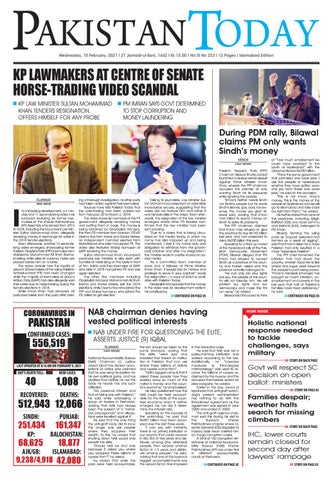
KP lawmaKers at centre of senate horse-trading video scandal g
KP lAw MiNister sultAN MohAMMAd KhAN teNders resigNAtioN, offers hiMself for ANy ProBe
g
PM iMrAN sAys govt deterMiNed to stoP corruPtioN ANd MoNey lAuNderiNg
During PDM rally, Bilawal claims PM only wants Sindh’s money karachi staff report
islamabad Mian abrar
i
N a shocking development, a 2 minutes and 11 seconds-long video has surfaced featuring six former lawmakers of the Khyber Pakhtunkhwa (KP) Assembly who served from 2013 to 2018, including the incumbent law Minister sultan Mohammad Khan, allegedly receiving money in exchange for votes in the 2018 senate elections. soon afterwards, another 16 secondslong video emerged, showcasing former Pakistan People’s Party (PPP) lawmaker from Malakand, Muhammad Ali shah Bacha, smoking while piles of currency notes are placed before him on a table. the video reveals how the loyalty of around 20 lawmakers of the ruling Pakistan tehreek-e-insaf (Pti) had been changed while the majority of lawmakers of qaumi watan Party (qwP) had also allegedly sold their votes due to horse-trading during the senate elections in 2018. while imran Khan had removed 20 party lawmakers from the party after hold-
ing a thorough investigation, no other party had taken action against their lawmakers. sources have told Pakistan today that the vote-trading had been carried out from february 20 to March 2, 2018. the video shows six members of the Pti government allegedly receiving money and putting them in bags. the money is being obtained by obaidullah Ma’ayar, the then Pti member from Mardan, Pti MP deena Naz from Karak and sardar idrees, an independent member elected from Abbottabad who later had joined Pti. the video also featured Mairaj humayon of qwP receiving the money. sultan Mohammad Khan, incumbent provincial law minister, is also seen with bundles of notes lying on the table in front of him. sultan was then lawmaker of qwP, who later in 2018 had joined Pti and was again elected. the other five members including obaidullah Ma’ayar, Mohammad Ali shah Bacha and sardar idrees, lost the 2018 elections, while deena Naz who joined the PPP and Mairaj humayun, who joined the Pti, failed to get elected.
coronavirus in
PaKistan
CONFIRMED CASES:
556,519
DAY'S DEATH TOLL:
40
RECOVERED:
NEW CASES:
1,008 DEATHS:
512,943 12,066 SINDH:
PUNJAB:
251,434
161,347
KP:
BALOCHISTAN:
AJK/GB:
ISLAMABAD:
68,625
18,877
9,238/4,918 42,080
talking to journalists, law Minister sultan Mohammad presented an ostensibly incredulous excuse, suggesting that the video did not feature him and rather it was his look-alike in the video. soon afterwards, the resignation of the law minister emerged where other Pti leaders confirmed that the law minister had been sent packing. “due to a video that is being circulated on the media today, in which my name has also cropped up and being mentioned, i feel it my moral duty and obligation to withdraw from the [provincial] cabinet and offer my resignation,” the minister wrote in a letter shared on social media. “As a committed team member of yours and a follower of Prime Minister imran Khan, it (would be) an honour and privilege to serve in your cabinet,” reads the resignation – a copy of which is available with Pakistan today. obaidullah Ma’ayar said that the money in the video was for development works in his constituency.
CONTINUED ON PAGE 05
NAB chairman denies having vested political interests g
NAB uNder fire for questioNiNg the elite, Asserts Justice (r) iqBAl islamabad staff report
LAST UPDATED AT 8:16 AM ON FEBRUARY 9, 2021
Pakistan People’s Party (PPP) chairman Bilawal Bhutto-Zardari launched a vicious verbal assault against Prime Minister imran Khan, wherein the PPP chairman accused the premier of only wanting sindh for its resources while ignoring the people. “[imran] neither needs sindh nor sindh’s people but he wants sindh’s islands, gas, coal, tax revenue, the money you give” Bilawal said, adding that imran had failed to spend money on sindh to solve its problems. the PPP chairman claimed that imran had refused to give the province its due rs160 billion last year, and had projected to deny rs200 billion this year. speaking to a fired up crowd at the hyderabad rally of the Pakistan democratic Movement (PdM), Bilawal alleged that PM imran had refused to accept sindh as a province of the country and therein asked who the province actually belonged to. “he can only rob your rights but you, the people of this country will not tolerate him. we will protect our rights and our democracy and make this PM run away,” he added. Bilawal told the crowd to think
National Accountability Bureau (NAB) chairman (r) Justice Javed iqbal has denied accusations of critics who claimed that he was using his position for his own political gains, and has clarified that neither he nor the body he heads has any such affiliation. “My personal interest and that of NAB is only with Pakistan,” he said while addressing a group of traders in Peshawar, adding that NAB had always been the subject of a “nefarious propaganda” and allegations were levelled against it. he said that the only thing the anti-graft body did to incur this anger was ask people where they acquired their wealth. to this, he added that shutting down NAB would only benefit the elite. “should NAB be shut only because it asked you where you acquired these billions of rupees from?” he asked. he stated that while the poor were held accountable,
the rich should be taken to the same standard, adding that the elite “were sad and shocked that there’s an institution in Pakistan that can ask where these billions of dollars and rupees came from”. “NAB’s biggest crime is that it asked these people how they wasted away so much of the nation’s money and the country’s economy,” he emphasised. he also questioned how the NAB could be held accountable for the state of the countries economy when it neither charged tax nor did it determine the interest rate. speaking on the success of the watchdog, he said that rs487 billion had been recovered over the last three years. “i can say with certainty there is no [other] institution in our country that could recover in rs2.5bn in two years and distribute among [the affected] people, then recover another rs2bn in 1.5 years and distribute among people,” he said, adding that one of the bureau’s biggest accomplishments was the record rs1bn fine imposed
in the Modarba case. he said that NAB was not a policy-framing institution and worked according to the law. Additionally, no “coercive measures or third-degree methodology” was used to recover the billions of rupees reclaimed by the bureau and the accused themselves opted for plea bargains, he added. earlier in the day, Javed (r) iqbal said that anti-graft watchdog’s present administration has nothing to do with the Broadsheet agreement as the agreement was signed in year 2000 and ended in 2003. the anti-graft agency chairman said this during his visit to the Bureau’s Khyber Pakhtunkhwa chapter where director general (dg) Brigadier (r) farooq Nasir Awan briefed him on mega corruption cases. A total of 182 corruption references of National Accountability Bureau (NAB) Khyber Pakhtunkhwa (KP) are under trial in different accountability courts of Peshawar.
CONTINUED ON PAGE 05
of “how much employment we could have provided to the youth of hyderabad” with the aforementioned rs200 billion. “this is the same government that promised one crore jobs. i ask the people of hyderabad whether they have gotten even one job from those one crore jobs,” he said on the occasion. “this is not imran Khan’s money, this is the money of the people of hyderabad and we will go to islamabad and take back our right from them,” he added. he further stated that none of the provinces, including gilgitBaltistan (gB) and Azad Jammu and Kashmir (AJK), belonged to PM imran. Bilawal, terming the ruling party as “puppet, selected and formed as a result of rigging”, said that imran’s vision for a Naya Pakistan had only resulted in a more “expensive Pakistan”. the PPP chief lamented the inflation that had struck the country, wherein food items like wheat and sugar were beyond the people’s purchasing power. “imran’s tabdeeli (change) has brought so much inflation, unemployment and poverty in the last year that half of Pakistan’s families have food deficiency,” he said.
CONTINUED ON PAGE 05
more inside
Holistic national response needed to tackle challenges, says military STORY ON BACK PAGE
govt will respect sc decision on open ballot: ministers STORY ON PAGE 03
Families despair; weather halts search for missing climbers STORY ON BACK PAGE
ihc, lower courts remain closed for second day after lawyers’ rampage STORY ON PAGE 03
02
wednesday, 10 February, 2021
islamabad
nEws
PakIStaN rePortS LoweSt SINgLe Day CovID-19 CaSeS SINCe oCt 31 ISLAMABAD
P
STAFF REPORT
AKISTAN has recorded the lowest single-day coronavirus cases since October 31, as 1,008 new infections were reported during the past 24 hours, said the National Command and Operation Centre (NCOC) on Tuesday. According to the NCOC, Covid-19 claimed 40 more lives during the aforementioned period, surging the overall death toll to 12,066. With the inclusion of the infections in the country, the national tally of cases now currently stands at 556,519. As many as 1,441 patients have
1,008 NEW CASES EMERGE, 40 MORE KILLED OF CORONAVIRUS-RELATED COMPLICATIONS IN 24 HOURS recovered from the virus in the past 24 hours, while 512,943 people have recovered from the deadly disease so far. Around 1,797 patients were stated to be in critical condition. The total count of active cases is 31,510 and the positivity rate stands at 3.19 per cent. A total of 31,509 tests were conducted across the country during the past 24 hours while 8,256,378 samples have been tested so far. Meanwhile, Sindh's tally for
confirmed coronavirus cases reached 251,757 after the province recorded 324 fresh cases of the virus in a day. Around 25 more fatalities were also recorded, taking the death toll to 4,157. As many as 644 people recovered from the virus overnight. The total number of people to have recovered from Covid-19 in the province now stands at 228,592. Meanwhile, a smart lockdown has been imposed in six localities of Lahore
after a rise in the number of coronavirus cases was reported. The Punjab Primary and Secondary Health Care Department issued a notification for it on Tuesday. These areas will be sealed for the next two weeks. Entry and exit points have been closed. There has been a constant increase in the positivity percentage and prevalence of Covid-19 cases across Punjab in the last two weeks which poses a serious threat to public health, the notification read. It gave the SOPs of the smart lockdown in detail with timings for grocery stores, fruits and vegetable shops, and petrol pumps, what can stay open and what cannot.
ECP fines Vawda for seeking adjournment of disqualification claim ISLAMABAD STAFF REPORT
The Election Commission of Pakistan (ECP) on Tuesday handed out a fine of Rs50,000 on Minister for Water Resources Faisal Vawda for repeatedly seeking adjournment of disqualification proceedings against him. The commission also directed him to appear in-person in the next hearing. The ECP has been since January 2020
hearing the claim against Vawda seeking his disqualification for purportedly holding dual nationality at the time of filing of nomination papers for the 2018 general elections. Presiding over the proceedings, Chief Election Commissioner (CEC) Sikandar Sultan Raja said that the case has already been delayed, reprimanding the defense counsel for indulging in delaying practices. As the hearing resumed Tuesday, assistant defence counsel,
Hasnain Ali Chohan, sought an adjournment due to the engagement of Vawda’s counsel, Muhammad bin Mohsin, in a Lahore court. At this, a member of the ECP asked him: “In which capacity have you appeared, you don’t even have the power of attorney.” Another member, Altaf Ibrahim Qureshi, said that the lawyer has not attached any evidence in this regard and the minister’s attorney should have managed his time with the court.
On this, the petitioner, Qadir Mandokhel, responded to Chohan, saying: “You are the minister’s coordinator in Karachi.” CEC Raja said that the minister was supposed to respond to questions regarding his dual nationality in the hearing. “If the defendant failed to respond on the next haring, the ECP will itself approach the US Consulate for details,” the CEC said and adjourned the hearing till February 24.
Long march will prove to be a nightmare for PDM: Firdous LAHORE STAFF REPORT
Punjab Chief Minister's Special Assistant for Information, Dr Firdous Ashiq Awan has said that long march will prove a scary dream for Pakistan Democratic Movement (PDM) leadership. Dr Firdous expressed these views during her visit to the head office of Punjab Safe Cities Authority (PSCA) established at Qurban Lines on Tuesday. She said that the long march' plan will also fail like their announcement of tendering resignations. She said that the negative politics of this gang has been ruined in front of transparent politics of Prime Minister Imran Khan. The SACM said that Maulana Fazlur Rehman is suffering from the pains of removal from power corridors. It seems that Maulana has realised and recognised his real political enemies and has updated his software as he has stated that he is not against the state institutions. She said that the most neutral role played by the armed forces in the 2018 elections has unnerved the opposition as it has devastated their political designs. She also said that the Punjab Safe Cities Authority (PSCA) is a project of vital importance to continuously protect the lives and property of the people. She
SACM APPRECIATES SERVICES OF PSCA IN IMPROVING SECURITY SITUATION
further said that the PSCA by incorporating modern technology and methods aims to redefine the capabilities of law enforcement agencies and help ensure public safety. The SACM said that the Punjab Police Integrated Command, Control and
Communication (PPIC3) Centre has the support of law enforcement agencies to respond to any emergency. She said that the project was launched with the installation of 8,000 cameras in Lahore which is being gradually extended to other divisional headquarters, adding that
work is underway on the Rawalpindi and Nankana Sahib City projects as well. In line with the vision of Prime Minister Imran Khan, the government is setting up a Safe City Centre in Nankana Sahib to provide security to the locals and the visitors, she said. The special assistant said that 60,000 phone calls are received on ‘Pucar 15’ on the daily basis from across the province and police help is provided to the citizens timely. The PSCA received more than 15 million emergency calls in the year 2020 alone, she said. Firdous said that the use of modern technology by the PSCA has improved the police response time and police are providing assistance to citizens in 10 to 15 minutes across the province. “With the help of the Safe City project, we have brought international cricket back to our country and this most advanced and improved security system is being acknowledged by the security experts,” she said. The SACM said that the CCTV cameras installed on city streets provide footage of dozens of incidents every day to assist the police in the investigation, adding that so far more than 7,000 audio and video recordings have been provided to police for help in the investigation process.
Pakistan-Turkey joint military exercise begins RAWALPINDI STAFF REPORT
A three-week-long joint military exercise involving Turkish and Pakistan’s special forces began in Tarbela on Tuesday. The opening ceremony of ATATURK-XI, 2021 was held at Special Service headquarters in Tarbela, Khyber Pakhtunkwa. Turkish Special Forces and troops of the Pakistan Army’s elite Special Services
Group (SSG) are participating in the exercise. The exercise includes counterterrorism, close quarter battle, cordon and search, rappelling, fire and move techniques, helicopter rappelling, compound clearance, hostage and rescue, and free-fall operations, a statement issued by the military said. “The joint military exercise will further strengthen the bond of two brotherly nations and will help in
adapting the emerging trends in military modernization and cooperation,” the statement added. Ankara and Islamabad have increased defense and military cooperation in recent years. The exercise would further strengthen the bond between the two brotherly nations and help adapt emerging trends in military modernisation and cooperation. In 2018, Pakistan Navy signed a
contract for the acquisition of four Turkish-built MILGEM corvettes with Turkish state-owned defense contractor ASFAT. According to the plan, two corvettes will be built in Turkey and the next two will be built in Pakistan which also involves technology transfer. Turkey is one of the 10 countries in the world which can build, design, and maintain warships using its national capabilities.
PDM didn’t drag any institution into politics: PML-N ISLAMABAD STAFF REPORT
A day after Pakistan Army urged the stakeholders not to drag it into politics, Pakistan Muslim League-Nawaz (PML-N) central spokesperson Marriyum Aurangzeb on Tuesday insisted that the Pakistan Democratic Movement (PDM) had not involved any national institution into its fight against the government. Talking to reporters, Aurangzeb said that the Constitution does not allow any state entity to interfere in the political affairs. Lamenting the teetering economy, she said that jobs were available only to “friends of Bani Gala” in a thinly-veiled reference to Prime Minister Imran Khan. The prime minister is exercising his “incompetent” political skills since August 2018, she stated. On the other hand, PML-N Secretary General Ahsan Iqbal said that promulgation of the ordinance for open Senate vote despite PTI lacking a supermajority in the Parliament is the height of ignorance of incumbent government. Iqbal, while speaking to reporters outside an accountability court in Lahore, claimed PM Imran wanted to issue Senate tickets to his friends. He further said that the ordinance was an attempt to pressurise the Supreme Court (SC) into ruling in the government’s favour on a reference seeking the apex forum’s advice on the matter. Iqbal, while announcing to challenge the ordinance, said the Constitution could not be amended just to benefit the “friends of Imran Khan”. He also urged the apex court to reject the reference.
Increase in government employees' salaries approved ISLAMABAD TLTP
The federal cabinet has approved an increase in the salaries of 370,000 government employees, from grades one to 16, while provincial officers will not benefit from the move. According to sources, the decision came during a federal cabinet meeting chaired by Prime Minister Imran Khan on Tuesday, where views were exchanged on the country's economic and political situation. Sources said that Federal Minister for Defence Pervez Khattak briefed the federal cabinet about salaries of government employees. Moreover, a report on organisations' CEOs and heads was also presented during the meeting. As many as 80 top positions are vacant in several ministries, divisions, and departments, to which PM Imran Khan, taking stern notice, reprimanded the concerned secretaries. Asking why the posts of chiefs were vacant, the premier ordered to determine who was responsible. As the premier was updated on the coronavirus vaccination drive, he said that the inoculation should be done without any discrimination and coronavirus standard operating procedures (SOPs) should be implemented. Moreover, a briefing on the metro bus service project in Islamabad was postponed till the next meeting.
SHC asks Sindh to explain appointments of advisers, special assistants KARACHI STAFF REPORT
The Sindh High Court (SHC) on Tuesday sought a reply from the Sindh government over the appointments of advisers and special assistants by the provincial government. A petition has challenged the appointments, claiming the portfolios have been given allotted in violation of the relevant laws. The petitioner had in its petition requested the court to reverse the appointments, and stop the government from doing so in the future. During the proceedings, the high court expressed resentment over the Sindh government’s failure to submit its response in the matter. “Why did the government fail in the submission of its reply,” Justice Muhammad Ali Mazhar questioned. “The court will submit notices to all advisers and special assistants if the office of the Sindh advocate general won’t submit its reply,” the court warned. “The Supreme Court has already ruled on the matter and the petition is non-maintainable,” the assistant advocate general told the court. “The Sindh government has been lying on the issue,” the petitioner said. “The high court had in the past declared such appointments as void.
Wednesday, 10 February, 2021
ISLAMABAD
NEWS
03
Govt will respect sc decision on open ballot: ministers ASAD SAYS GOVT WILL TAKE EVERY POSSIBLE STEP TO ENSURE TRANSPARENCY
F
NEWS DESK
eDeRAl Minister for Planning, Development, and Special Initiatives Asad Umar has said that the Pakistan Tehreek-eInsaf (PTI) will “take every possible measure, within the Constitution, to ensure transparency in the upcoming Senate elections and to end horsetrading in the polling process”. The above was said during a press conference in the federal capital alongside Federal Minister for Information and Broadcasting Shibli Faraz, wherein the minister was defending the decision by the ruling party to introduce the presidential ordinance upon the upcoming Senate elections. The minister explained that it was a necessary ordinance to stop the “tradition” of horse-trading within the elections, adding that the PTI had promised to abolish such practices once it came into power. He added
that those who have been buying and selling votes in the past are the ones objecting to the move. The minister added that the government filed a presidential reference to the Supreme Court (SC) with a request for interpretation of the law pertaining to the Senate polls, asking whether the elections could be held through show of hands instead of the secret balloting. In this regard, the planning minister declared that the government would definitively respect the decisions taken by the SC. Separately, Foreign Minister Shah Mahmood Qureshi on Tuesday concurred that the government will accept the guidance of the SC in the case of open ballot in Senate elections. He pointed out that while the opposition had demanded open ballot elections previously, they are now speaking against it. He added that the opposition parties had been invited to hold a dialogue on the matter, but they had repeatedly refused to do so.
The foreign minister said that the PTI-led government has filed a petition in the court and the government has two options, either to seek guidance or make an amendment in the Constitution, for which twothirds majority is required in the Parliament. Referring to the opposition’s claims in regards to the army’s role in the politics of the country, he said that the armed forces were protecting the borders and guarding
IHC, lower courts remain closed for second day after lawyers’ rampage
the security of the country. “Politicians should not politicise the role of armed forces,” he added. Qureshi also paid tribute to the martyrs in Indian Occupied Kashmir (IOK) and said that the government of Pakistan is raising the matter of the atrocities of the Indian fascist regime against innocent Kashmiris at all world forums and will continue to support the oppressed Kashmiris.
Five arrested from outside court for carrying weapons LAHORE INP
ISLAMABAD STAFF REPORT
Islamabad High Court (IHC) and its subdivisional courts remained closed for a second day on Tuesday, after hundreds of lawyers stormed into the court building and vandalised it. On Monday, an angry mob protesting the demolition of their illegally constructed chambers by the Capital Development Authority (CDA) besieged the courtroom and the chamber of IHC Chief Justice Athar Minallah, holding him hostage for around three hours. Photos and videos from the site show the mob breaking the windows and doors of the Chief Justice Block (CJB) and refusing to accept Justice Minallah’s calls for calm.
The protesting lawyers also manhandled the staff and even beat up the superintendent of police deployed at the CJB. They forcibly stopped the media from covering the incident and also beat up some journalists. The siege continued until paramilitary Rangers and police reinforcements took control of the situation. Due to the tense situation, the security for the high court as well as the Supreme Court remained beefed up on Tuesday, with heavy contingents of police and Rangers guarding the premises. late on Monday, Islamabad police booked 21 lawyers under various sections of the Pakistan Penal Code (PPC) and the Anti-Terrorism Act.
Five individuals were arrested from outside lahore sessions court’s gate reserved for judges for carrying arms and ammunition. According to the court’s security in-charge, the men tried to enter the premises through the judges’ gate on Tuesday morning. The men, he said, had brought weapons with them to attend a hearing. Three rifles, two pistols, six magazines, and 45 bullets were seized from their possession. He said that the men were shifted to the Islampura police station for further action.
Police also said it were conducting raids in various parts of the capital to arrest the accused and added separate
contempt of court proceedings would also be initiated against those found involved in vandalism.
larger sc bench to take up issuance of development grants to lawmakers ISLAMABAD
SC directs PC to submit plan regarding PSM SHAHID BAJWA, COUNSEL FOR PAKISTAN STEEL MILLS, SAYS THAT THE STEEL MILL NEEDS ONLY 40 OFFICERS ISLAMABAD STAFF REPORT
The Supreme Court (SC) on Tuesday directed the Privatisation Commission (PC) to submit plan regarding privatization of Pakistan Steel Mill (PSM). The court also appointed senior lawyer Rashid A Rizvi as a mediator for settlement between employees and mill management. The court therein directed Rizvi to submit a report after
meeting with the mill employees and management. While hearing the case at the apex court related to the promotion of PSM employees, Chief Justice of Pakistan (CJP) Gulzar Ahmed remarked that Karachi Shipyard, Heavy Mechanical Complex, and Steel Mills were nonfunctional, while the employees would “sell all the remains of the mills and retire”. The CJP remarked that the steel mill was getting electricity, water, salaries and everything but the mill was
closed. Federal Ministers Asad Umar and Muhammad Mian Soomro also appeared before the bench. During the course of proceedings, Justice Mazahar Ali Naqvi said that if private steel mills were profitable then what was the problem of PSM. Soomro said that the bidding would take place in September or October, with the mills’ assets worth $100 million. Moreover, Federal Minister for Planning and Development Asad Umar said that the steel mills’ ownership would
remain with the government. The counsel for the employees said that administration was responsible for the closure of the mill. Shahid Bajwa, counsel for PSM, said that the steel mill needs only 40 officers. According to Chinese experts, Rs500 million were required to run the steel mill, he added. The court summoned secretaries of Privatisation and Industries to appear before the court during the next hearing scheduled for two weeks from today.
Tethyan’s legal consultants to arrive in Islamabad to discuss Reko Diq dispute ISLAMABAD STAFF REPORT
The legal team of Tethyan Copper, a gold and copper exploration company involved in Balochistan to develop the Reko Diq mine, will reach Islamabad on Wednesday to settle the billion-dollar dispute with the government. According to Civil Aviation Authority (CAA), the office of the attorney general had requested a travel permit for the team from February 9 to 15. Following the AG office’s request, the team was allowed to visit the country.
In 2013, the Supreme Court (SC), in a long-running dispute between the Balochistan government and Tethyan Copper Co — a joint venture between Chile’s Antofagasta and Canada’s Barrick Gold — over the right to develop a $3.3 billion copper-gold deposit, ruled against the latter, citing imbalanced stakes. According to the original agreement signed in 1993, Balochistan holds a 25 percent stake in the project, with Tethyan holding the remaining 75 per cent. Subsequently, in July 2019, a World Bank arbitration court ordered the government to pay damages of $5.8
billion to Tethyan. Since then, the government is in talks with Tethyan to settle the dispute. “We have been engaged in negotiations with parties involved in the Reko Diq dispute,” said an official who is part of the team handling negotiations, without providing further details. The parties have been in talks for an extended period since Tethyan in 2018 expressed willingness to explore a negotiated settlement, Reuters quoted a second official as saying in 2019. A spokesman of CCA said that Covid-19 protocols would be strictly followed keeping in view the health of
the foreigners. Reko Diq, located in Pakistan’s southwestern province of Balochistan, is one of the world’s biggest untapped copper and gold deposits. Development of the asset has been stalled for nearly a decade by the long-running dispute. Following the World Bank’s International Centre for Settlement of Investment Disputes (ICSID) order, Tethyan board chair William Hayes had said in a statement the company was still “willing to strike a deal with Pakistan,” but “it would continue protecting its commercial and legal interests until the dispute was over.”
STAFF REPORT
The Supreme Court (SC) on Tuesday constituted a five-judge bench to hear a suo motu case pertaining to the development funds approved for members of the national and provincial assemblies. Headed by Chief Justice of Pakistan (CJP) Gulzar Ahmed, the bench will also include Justice Qazi Faez Isa who took notice of the move, and begin the hearing on Wednesday. In this regard, the apex court has served notices on the prime minister’s principal secretary, Cabinet Division secretary, finance secretary, federal and provincial advocate generals, and provincial chief secretaries. In January, Prime Minister Imran Khan announced a grant of Rs500 million for each member of the national and provincial assemblies under sustainable development goals to enable them to carry out development schemes for their voters. However, last week, Justice Isa took notice of the development, warning of legal proceedings if the move was found to be in contravention of the Constitution. On the occasion, he had asked Attorney General Khalid Jawed Khan to update the court on the issue based on the government’s response. However, Khan responded he would update the court after receiving instructions from the government and further reassured that “whatever action is taken will be in the light of the law, Constitution and legal precedent.” Subsequently, Justice Isa referred the matter to the top judge for the formation of a bench.
Wednesday, 10 February, 2021
04 NEWS
ISLAMABAD
KaSur poLice requeST To Keep SexuaL aBuSe iNcideNTS SecreT LAHORE
T
SHAHAB OMER
he Kasur police have decided not to make public the details of incidents of murder and rape of innocent girls, Pakistan Today learnt on Tuesday. According to details, the Kasur district police officer (DPO) has writ-
ten a letter to a government agency on Monday, mentioning that the people of Kasur were annoyed due to the Zainab murder case and other similar incidents in the district. “Due to the happening of infamous child abuse case [Zainab murder case] as well as number of other incidents of the same series in Kasur, the public of the city became very agitated and public's precious
infrastructure was destroyed during different public protests, causing loss of millions of rupees. Moreover, heavy contingents of police were deployed and an environment like curfew was developed, causing loss to government exchequer and damage to social and economic conditions of the city,” the letter stated. The letter further stated that the Pun-
jab government was compelled to execute “Punjab Safe City Authority” project in the district and two civilians also lost their lives during the agitated public demonstrations. “Subsequently, a similar child abuse incident was surfaced at Chunian, where four minor children were brutally murdered, and law and order situation in Kasur came at stake. The public is very
concerned about abuse against children and women and its perspective is very intimidating with regard to law and order situation.” At the end, the DPO requested the government agency to keep the incidents of sexual abuse and murders of girls in Kasur secret so that the law and order situation could be maintained.
No conspiracy against journey of development can succeed: Buzdar LAHORE INP
Punjab Chief Minister Sardar Usman Buzdar has said that frustration is visible on the faces of those promoting anarchistic politics and assured that no conspiracy against the government’s development journey will ever succeed. In a statement issued here on Tuesday, the chief minister added that the Pakistan Tehreek-e-Insaf (PTI) government has selflessly served the masses and there is not a single corruption scandal against the incumbent government. Buzdar further said that the politics of looters has come to an end and those spreading confusion through their negative politics have no future. “No hindrance has been allowed in public service despite difficulties, because people want development and prosperity. The Pakistan Democratic Movement should read the writing on the wall because anarchistic designs never work,” he added.
Six Lahore neighbourhoods placed under smart quarantine LAHORE INP
LAHORE: An aerial view of traffic on a busy road in the provincial capital. Zubair Mehfooz
BISP asks ECC to approve Rs109.3m incurred on campaign of EECP ISLAMABAD SHAHZAD PARACHA
The Benazir Income Support Programme (BISP) has asked the economic Coordination Committee (eCC) to approve Rs109.3 million incurred on the campaign of ehsaas emergency Cash Programme
(eeCP). Sources said that the ministry of information and broadcasting (MoIB) has requested the BISP for transfer of funds of Rs109.3 million incurred on the campaign of eeCP during 2019-20 to clear the liabilities of different advertising agencies. The eCC in its meeting held on April, 2020 had approved a summary
regarding the transfer of Rs300 million by the BISP to the MoIB through technical supplementary grant (TSG) for carrying out the campaign of eeCP and other social protection programmes, launched in the last three months of fiscal year 2019-20. A meeting of eCC is scheduled to be
held on Wednesday (today) under the chair of Minister for Finance Abdul hafeez Shiekh, in which two agenda items would be discussed. The eCC would also discuss the ministry of industries’ agenda item with regard to outstanding payment to a German company for PSM.
NAB gives clean chit to PPP MP in graft case
The Punjab government on Tuesday imposed a smart lockdown in six neighbourhoods of Lahore following a hike in coronavirus transmission rate there. The areas put under restrictions include Ali View Garden; street 1, Bedian Road; streets 20 and 21, A-Block, Phase 5, DhA; street 21, WBlock Phase 3; main street, C-1, Faisal Town; Chenab Block, Allama Iqbal Town; and A-Block of Al-Ahmad Garden. “There has been a constant increase in positivity percentage and prevalence of Covid-19 in Punjab during last two weeks which poses a serious and imminent threat to public health. hence, it is mandatory to take all possible safety measures for prevention and control of this disease,” read a notification. In this regard, the provincial health secretary ordered: “There shall be ‘controlled entry and exit’ in the areas of district Lahore identified as hotspots of Covid-19 […] with immediate effect till 19th February 2021.”
Nine-year-old girl raped in Vehari VEHARI INP
KARACHI INP
The National Accountability Bureau (NAB) on Tuesday gave a clean chit to Pakistan People’s Party (PPP) MP Sardar Mohammad Bux Mahar in a case pertaining to misuse of office during his party’s previous stint (2013-2018) in Sindh. The development came during the proceeding into a
petition moved by Mahar against the reference. During the hearing Tuesday, a NAB prosecutor informed Sindh high Court (ShC) the agency had not found any evidence to support the corruption claim against the MP. The agency, he said, has informed its Chairman Justice (r) Javed Iqbal of the status of the probe. When asked, the prosecutor sought time from the court to get Iqbal’s response in this case.
Later, the court extended Mahar’s interim bail till March 11 before adjourning the hearing. NAB had been investigating the allegations since 2019. In June last, it emerged Mahar had manipulated government record to grant 176 acres of state land to his brother Bangal Khan as a “gift” and occupied 2,031 acres of government land. The Ghotki revenue department, it emerged, had tried to save Mahar by altering record on a massive scale.
A man raped a nine-year-old girl in the jurisdiction of Saddar police station here on Tuesday. According to details, accused Shahzeb, 22, raped the girl in a suburban village. On hearing the screams of girl, the local people held the culprit and handed him over to the police. The victim was shifted to a nearby hospital for medical treatment. The police said that a case has been registered against the accused and medical report is awaited for further action.
KCFR holds webinar on Russia-Pakistan relations KARACHI
T
PRESS RELEASE
he Karachi Council on Foreign Relations (KCFR) held a webinar on Russia-Pakistan relations here on Tuesday. The webinar was moderated by the KCFR senior Vice chairman and Ambassador Dr Mustafa Kamal Kazi. Russian Ambassador to Pakistan h.e. Danila Ganich addressed the participants at the webinar, which was organised in dedication to Russian Diplomats Day. Ambassador Mustafa in his introductory remarks said that the global and regional transformation towards a
multilateral order facilitates closer cooperation between Russia and Pakistan for greater good of the region. he added that multilateralism is the solution for complex global issues. he stressed on the importance of SCO as a platform for regional cooperation and integration, and highlighted the Belt and Road Initiative (BRI) and China–Pakistan economic Corridor (CPeC) as components of a new global growth engine that will bring Asia, europe and Africa closer. he further said the relations between Russia and Pakistan have moved into a new era and would continue to grow stronger by boosting regional cooperation,
progress, prosperity and stability in the region. Ganich expressed confidence towards the positive bilateral relations between Pakistan and Russia on the basis of the consensus that has developed between both the countries. he highlighted that the two countries have common interests, including stability of the region and peace in Afghanistan, and said they can cooperate on those. Voicing concern about the US sanctions on Iran and misjudgement by the US of Russia as only a ‘marginal’ player in the Indo-Pacific region, the ambassador expressed hopes for new opportunities and avenues of cooperation between Rus-
sia and Pakistan that the CPeC will bring. he also expressed gratitude to the organisers for the invitation to address the webinar. KCFR Chairman Ikram Sehgal, in his concluding note, pointed out towards the CPeC and said, “The real corridor is from Russia and Central Asia down to the Arabian Gulf, which connects us to eurasia. he added that Pakistan is a geographical pivot and it must take advantage of its geo-strategic position while remaining neutral to avoid repeating mistakes of the past. In the end, he conveyed gratitude to the Russian ambassador and expressed hope for continued engagement between both the countries.
Wednesday, 10 February, 2021
ISLAMABAD
NEWS
KP lawmakers at centre of Senate horse-trading video scandal continued from page 01 When asked why and how he would receive cash for development works in any official capacity, he said that the government had paid him in cash. Deena Naz, Mairaj Humayun, Sardar Idris and Mohammad Ali Shah Baacha did not respond despite successive calls made on their phones. PM REACTS TO LEAKED VIDEO: Reacting to the videos, PM Imran Khan expressed on Twitter: “The videos showing the shameful way in which politicians buy & sell votes in Senate reflects the total destruction of the nation’s morality by successive ruling elites as they drowned the nation in debt. Cycle of corruption & money laundering is a sordid tale of our pol elite.” “They [the ruling elites] spend money to come to power & then use this pol power to make money to purchase bureaucrats, media & other decision-makers to consolidate their power & rob nation’s wealth – money laundering it into offshore accts/ foreign assets/palatial residences abroad,” he tweeted. “This is what the PDM cabal wants to now protect by supporting a corruption-friendly system. We are determined to stop this cycle of corruption & money laundering that is debilitating the nation,” the premier added. HISTORY OF HORSE-TRADING: In the 2018 Senate elections, the PTI only won seven seats in the KP assembly despite having a clear majority in the house. Moreover, it was necessary for any candidate of Senate elected to a general seat to get over 15 votes from the assembly. The PPP, with only four members of KP Assembly, had obtained two Senate seats. Behramand Tangi had won the general seat with 16 votes while Rubina Khalid won the women’s seat by securing 47 votes. At the time, the PPP was accused of buying votes. QWP at the time had nine members in the house but its nominee for Senate could not get a single vote in the Senate election. Mohammad Ali, the then lawmaker of Jamaat-eIslami (JI), had later told media that he was offered Rs90 million at the hotel near KP assembly in exchange for his solitary vote, but he had refused to sell his vote, putting his party’s interest first. Soon after the Senate elections, PTI Chairman Imran Khan had said at a press conference on April 18, 2018, that 20 lawmakers of his party who found involved in selling their votes. According to Khan, PTI’s Nargis Ali, Deena Naz, Obaidullah Ma’ayar, Zahid Durrani, Fauzia Bibi, Naseem Hayat, Qurban Khan, Arif Yusuf, Amjad Afridi, Abdul Haq, Javed Naseem, Yaseen Khalil, Faisal Zaman, Samiullah Alizai and Sardar Idris were involved in vote-trading. Moreover, Khatoon Bibi and Babar Saleem of Awami Democratic Alliance and PML-N’s Sardar Wajihuz Zaman. The then PTI chairman had alleged at the time that each member who sold his vote had allegedly received Rs40 million each.
NAB chairman denies having vested political interests continued from page 01 In a special briefing, the DG apprised him that the KP bureau has recovered Rs3,018 million from corrupt elements in the last three years and deposited the recovered amount in national exchequer. Awan apprised the chairman that the bureau is pursuing 307 complaints, 68 complaint verifications, 95 inquiries and 38 investigations in accordance with law. The bureau had also recovered millions of rupees from fake housing societies and returned the looted money to poor investors, Awan stated. Speaking on the occasion, Justice (r) Iqbal said that KP bureau is playing a key role in enhancing the overall performance of NAB. A total of 1,230 corruption references having corruption volume of Rs943 billion are under trial in various accountability courts. NAB has decided to file early hearing pleas for early conclusion of these references.
05
ADB reAFFirmS SuPPort For eNergY Sector reFormS iN PAKiStAN iSLamaBad TLTP
t
HE Asian Development Bank (ADB) has reaffirmed its support for energy sector reforms in Pakistan. Special Assistant to Prime Minister on Petroleum Nadeem Babar on Tuesday held a virtual meeting with the ADB team in Manila together with ADB Country Director Xiaohong Yang and the energy team, said a statement issued by the Petroleum Division. The meeting was aimed to discuss the progress on the reform programme in the petroleum sector of Pakistan. The forum was informed that energy sector reforms were part of the government’s policy to improve energy economics and secure gas and oil supplies across the country. In opening remarks, the SAPM thanked and appreciated ADB for support and cooperation in energy sector
reforms, adding that the government had made significant progress in every agenda item of reforms despite challenges caused by the Covid-19 Pandemic. The SAPM informed the forum that the third-party access (TPA) policy has been fully implemented. "In addition, the government had advertised the unused capacity of terminals to private companies, enabling them to purchase and sell LNG to consumers of their own choice by this April," he added. Highlighting exploration & production (E&P) activities in the country, Babar said that the first bidding round for 15 onshore oil & gas blocks had been completed. "The minimum investment carried out by E&P companies for studies & investigations in these blocks will be over $71 million in three years, which will be followed by the development program in the identified blocks running into hundreds of million of dollars in located areas." He said that the second and third round of biddings
would be completed by the end of this year. The SAPM further informed that the government had prepared a framework of regulatory authority for the upstream petroleum sector, which it would be put in place after approval by Council of Common Interest (CCI) and necessary legislation. Apprising the participants on Unaccounted Gas Factor (UFG), the SAPM said that both Sui companies had made significant progress on the UFG Reduction Plan. He appreciated the support of ADB for hiring consultants and conducting study for strategic underground gas storage project and lauded the interest of ADB in funding such a project. He underlined the importance of the underground gas storage facilities and said that this project would enhance the country's capability to import gas and ensure sustainable economic growth. At the conclusion of the meeting, ADB Country Director Xiaohong Yang lauded the efforts of the government for bringing reforms in the energy sector.
PCB appoints Bookme.pk as ticketing partner for HBL PSL 6 LaHore TAIMOOR HASSAN
Pakistan Super League (PSL) is set to go all digital for season 6 ticketing, with the Pakistan Cricket Board (PCB) appointing Bookme.pk as its official ticketing partner. As announced by the PCB last week, around 7,500 ticketed spectators will be allowed access inside the National Stadium per match day, while around 5,500 will be able to attend matches at the
Gaddafi Stadium. With a socially distant seating plan, both PSL 6 venues will have 20pc of the total seating capacity available for spectators, whereas tickets will only be available online. The PCB maintained that it will strictly adhere to the government's Covid19 SOPs, including social distancing. According to details, all tickets booked digitally at Bookme.pk will carry a QR code that will be generated when the ticket is booked online. The QR code
will be scanned at the stadium ensuring minimal physical contact and allowing entry to the spectators. Profit has learnt that the startup, Bookme.pk, outdid both TCS and Leopards Courier to win the contract for digital tickets for PSL Season 6. Commenting on the partnership, PCB Commercial Director Babar Hamid said, “We are delighted to partner with Bookme.pk in the HBL PSL 6. We are confident that as ticketing part-
During PDM rally, Bilawal claims PM only wants Sindh’s money continued from page 01 In further criticism of the government, he said that the prime minister had once said that he would “commit suicide before going to the IMF (International Monetary Fund)” to ask for a loan. On the occasion, he accused the government of giving relief to the rich while bringing pain to the poor. He said that Imran had also promised houses to the people, but so far no results from the affordable housing schemes had been shown. He said that the people have been “suffering the burden of an incompetent and corrupt government”. During his address, Pakistan Muslim League-Nawaz (PML-N) senior leader and former prime minister Shahid Khaqan Abbasi told the people of Sindh to join the PDM in their long march on March 26, stating that the struggle would be for only a few days but it would help secure a better future for Pakistan. Abbasi said that PDM’s struggle aims at bringing a change in the system of governance. “We have to restore the system to a parliamentary, constitutional one.” “This war will be fought by
PDM for the people of Pakistan. I want to promise you that we will not let anyone take away the rights of the people of Sindh granted under the 18th Amendment,” he added. Abbassi added that the alliance that stands before the government now collectively held 70 per cent of the votes in the last elections without “rigging”. He said that the price of electricity had nearly doubled from Rs13 per unit to Rs25 due to the actions of the PTI and maintained that the only solution to the current state of affairs was to support the ideology of the PDM. Moreover, Jamiat Ulema-ePakistan (JUP) leader Owais Noorani replied to Inter-Services Public Relations (ISPR) DirectorGeneral (DG) Major General Babar Iftikhar’s statement regarding the army being kept out politics. “You say don’t drag army into politics, no one dragged you into politics. Please say, who dragged [the country’s first military dictator] Ayub Khan into politics?” Noorani said. “They say don’t drag us into politics, then who was distributing the Rs1,000 notes [at Faizabad sit-in]?” National Party (NP) President
Dr Abdul Malik Baloch, during his address, stressed that the way the parliament and the Constitution were currently being treated should be ended. “Today, islands of Balochistan and Sindh are being occupied by the Centre. Under what law? They belong to Sindh and Balochistan,” he maintianed. Alongside Bilawal and Abbassi, the stage was shared with Jamiat Ulema-e-Islam-Fazl (JUIF) Senator Maulana Abdul Ghafoor Haideri and other opposition leaders. PML-N Vice President Maryam Nawaz could not attend the rally as she was tending to her daughter, who had recently been involved in a road accident. The host political party installed thousands of chairs at the rally’s venue on Hyderabad’s Hatri By-pass; moreover, flags and banners to welcome the opposition’s central leadership were installed on major streets and roads. The night prior, fireworks were seen launched in preparation of the rally. On Saturday, Sindh Chief Minister Syed Murad Ali Shah had claimed that there would a “historic” rally of the PDM, an alliance of almost all opposition parties, in Hyderabad.
ners, Bookme.pk will deliver top-quality services.” Meanwhile, Bookme.pk CEO Faizan Aslam said, “We are grateful to PCB for awarding us the opportunity to serve the most beloved game of our nation. Bookme is geared up to ensure contactless and secure digital services for Pakistani cricket fans so that they don’t need to stand in queues and can easily access tickets from the comfort of home with a digital one-click solution."
Basmati exports fall 38pc in 1HFY21 Pakistan’s rice exports remained subdued in the first half of the current fiscal year (1HFY21) due to low prices offered by India for non-basmati and issues of higher freight and shipments from October 2020 amid the Covid-19 pandemic. According to a report by a local media outlet, the country’s overall rice export plunged by 10 per cent to 1.824m tonnes and 6.74pc in value to $963m in July-Dec FY21 as compared to the corresponding period in FY20. Out of total exports, the share of basmati exports plunged by 38pc in quantity to 265,672 tonnes and 31pc in value to $262m while nonbasmati exports fell by 3pc in quantity to 1.558m tonnes and 7.45pc in value to $700m in 1HFY21 as compared to the same period last fiscal. Earlier on January 27, after formally opposing the Indian application for exclusive Geographical Indication (GI) tag for Basmati, Pakistan finally registered the variety as its GI product in order to protect its trade in the international market whereas on February 5, REAP filed the Reasoned Statement in opposition to India’s claim on the GI tag. Hearings in DG Agriculture of European Commission will commence after a period of three months. NEWS DESK
Honda and Nissan to sell a quarter of a million fewer cars because of chip shortage TOKYO: Japan’s second and third largest automakers, Honda Motor and Nissan Motor, will sell a combined 250,000 fewer cars in the current financial year as a global shortage in semiconductor chips hits production. The automakers made the announcement as they unveiled brighter outlooks for the financial year ending March 2021 as automobile markets, led by China, rebounded from a coronavirus-induced slump. AGENCIES
South Korean boy investor with 43pc gains is new retail trading icon SeouL AGENCIES
Watching the business news first thing is a new routine for 12-year-old South Korean Kwon Joon, as he dreams of becoming the next Warren Buffett after earning stellar returns of 43pc from a hobby picked up just last year: buying stocks. Kwon pestered his mother to open a retail trading account last April with savings of 25 million won ($22,400) as seed money, just as the benchmark KOSPI index began recovering from its biggest dip in a decade. “I really talked my parents into it, because I believed an expert who was saying (on TV)
that this is a once-in-a-decade opportunity,” said Kwon, who rode the steepest jump by year-end among MSCI’s country indexes.. “My role model is Warren Buffett,” he added, in a reference to the US billionaire investor. “Rather than short-term focused day trading, I want to keep my investment for 10 to 20 years with a long-term perspective, hopefully to maximize my returns.” South Korea’s rookie investors like Kwon, who pursues “value investing” in blue chip shares with funds garnered from gifts, trading mini-car toys and running vending machines, have led the blistering rise of retail trade amid the coronavirus pandemic. More retail investors are teenagers or
even younger, making up more than twothirds of the total value traded in the nation’s shares, versus less than 50pc in 2019. The trend has grown as equity markets lure parents disillusioned with the education system and millennials working from home. “I wonder, in this day and age, whether a college degree would be all that important,” said Kwon’s mother, Lee Eun-joo, who fuelled his passion by looking to expose him to business rather than tuition, seen as key to getting ahead in academics. “Because we live in a different world now, it could be better to become an ‘onlyone’ kind of person,” added Lee, who feared even a good schooling might not arm her son
cmYK
against dwindling job opportunities. About 70pc of the 214,800 stock brokerage accounts for minors at Kiwoom Securities, South Korea’s most retail-friendly brokerage, with a market share of more than a fifth, were set up in January 2020 or after, its data shows. Kwon, with time on his hands during last year’s school closures for the pandemic, drew up a wish list of purchases, which he made during market corrections. These ranged from South Korea’s largest messenger app operator Kakao Corp., to the world’s biggest memory chip maker Samsung Electronics Co., and Hyundai Motor. Kwon’s success also reflects the employment challenges for young South Koreans,
with one in four out of work by January, the worst level on record, despite being among the most highly educated cohort in the OECD club of advanced nations. Three-quarters go on to college after high school, versus the grouping’s 44.5pc average, but finding rewarding, creative work is tough. “There aren’t enough jobs for college graduates, so many are opting out to diversify their career path early,” said vocational researcher Min Sook-weon. That is something Kwon understands. “Rather than going to good schools like the Seoul National University, I’d rather become a big investor,” he said. “I also hope to do a lot of charity work.”
Wednesday, 10 February, 2021
06 COMMENT
A cover-up of reckless spending
All must stay in limits History is behind blame for intervention
d
India’s defence budget 2021-2022 doesn’t even try to hide aggressive intentions
G iSR Maj Gen Babar iftikhar has not only denied that the army has made any contacts with the Pakistan democratic Movement (PdM), but has also called for an end to claims of the army intervening in politics. The reason for such claims is deeply rooted in our history, for while there have been four military takeovers, those episodes have been associated with egregious interference in politics, both before and after those takeovers. That interference was never revealed; it just came out unofficially, mostly in the shape of memoirs by participants, often enough after retirement from service. it is a fair estimate that now, if indeed anyone is dickering with the PdM, no one is willing to talk at the moment. But some time later, when the PdM will have passed into history, if there have been any discussions, an account will emerge. General iftikhar needs to remember that involvement has itself led to this being spoken of. Former PM Mian nawaz Sharif is the one who let this cat out of the bag, going so far as to name names. However, he himself benefited from this intervention in the Zia era, when he became Punjab Finance Minister and then Chief Minister. Only as Prime Minister, in 1993, did he fall afoul of the establishment for the first time. However, his being an insider only enhances his credibility, but does not create it. However, his evidence is of the same category as of those officers who speak out after retirement. One problem has been the present government’s claim that it was ‘on the same page’. it should not be forgotten that those being supported will claim it, and the others, seeing opponents getting support they are deprived of, will squawk. The only real way for the noise to die down is for all institutions to observe the limits set on them by the Constitution. if there is no intervention, even the loudest claims that it is taking place will not be believed. The maligned institution may have to pay for the errors of seniors by accepting patently false charges, but only going strictly by the book, and keeping quiet, will counter the rumors. Only when sufficient memoirs make no revelations about the past, will the task be accomplished.
Amjed jAAved
I
ndian Finance Minister nirmala Sitharam presented the budget amid rumpus. She stammered a lot and avoided reading out defence allocations. When questioned why the finance minister didn’t mention the defence budget allocation during her speech, niTi aayog Vice Chairman Rajiv Kumar said that it (defence) was not a part of the speech but it was there in the Budget. Opposition leaders have criticised the budget for being proindustrialist. instead of cutting wasteful expenditure, the budget provides for disinvestment of assets. The true quantum of the allocations could be ascertained when the actual documents and Explanatory Memorandum become available. However, information published in the media is shocking. Riding the China bogey, the armed forces went on a spending spree. Prime Minister narendra Modi had told the all-party conference that China had not trespassed on an inch of indian territory. However, the indian armed forces exploited the China factor to overspend their capital budget by Rs 23,000 crore last year. Still, the new budget provided a 0.4% hike in capital expenditure. The budget allocated a further Rs 1.35 lakh crore for additional capital expenditure. The total outlay for the defence ministry, including the aforementioned capital expenditure, is Rs 4.78 lakh crores. The total allocation for defence services in 202122, including pensions, is Rs 4.78 lakh crore compared to Rs 4.71 lakh crore, last year. Without pension allocation, it is Rs 3.62 lakh crore in comparison to last year’s Rs. 3.37 lakh crore. The capital is meant to purchase fighters, submarines, helicopters and other modern military systems. it has been increased from Rs 1, 13,734 crore last year to Rs 1, 35,060 crore, a whopping 19 percent
Violent lawyers strike again The higher judiciary has only itself to blame
i
T has become a matter of routine for lawyers to air their illegitimate grievances not through constructive dialogue but by using violence. a group of a hundred-plus charged lawyers ransacked the islamabad High Court (iHC) in protest at the demolition of their illegal chambers at islamabad district Courts by the Capital development authority (Cda). not only was extensive damage done to iHC property but the mob practically laid siege to the chambers of iHC Chief Justice athar Minallah who was unable to safely exit the premises until three hours later when the situation was diffused. Outside, journalists reporting on the developments were threatened with physical violence. a similar incident took place back in 2017 when Multan’s Judicial Complex was vandalised after being stormed by enraged lawyers who were unhappy that the new premises would not house their chambers. in 2019, following a feud with young doctors of Lahore, violent lawyers went on a rampage at Lahore’s Punjab institute of Cardiology (PiC) that resulted in deaths of at least three patients, a minister being manhandled by the mob as he tried to reason with them and several police mobile vans being torched. inside courtrooms, lawyers frequently misbehave with judges, often beating them up. The unchecked impunity enjoyed by these ‘practitioners of the law’ after having committed serious illegal offences is part of the reason why these events continue to take place on a regular basis. Lawyers also draw a lot of their power from their respective bars that are heavily politicised as they hold tightly contested elections periodically. Leaders of these bars hold a lot of sway over a section of the senior judiciary and are therefore able to provide a lot of protection to members. Often they are the very people who incite the violence in the first place. Much of the blame however for what a shameful spectacle the legal profession has become in the country resides with the superior judiciary that has turned a blind eye to the behaviour of its junior factions. For instance, the Supreme Court Bar association (SCBa), instead of outrightly condemning the actions of the lawyers, has criticised the iHC CJ for what transpired two days back. in this backdrop, the next violent attack by lawyers on a high court premises, district level court or any other sensitive installation, seems imminent.
1/6 was worse than 9/11
Washington Watch dr jAmes j Zogby
T
RaUMaTiC, violent acts bookended the first two decades of this century. The first was the terrorist attacks of September 11, 2001, which claimed the lives of almost 3,000 innocents. The second was the January 6, 2021 storming of the US Capitol which took its own unique toll on american life. Though vastly different, 9/11 and 1/6 both hit hard. during the more than four decades i’ve lived in Washington, no other events so dramatically impacted daily life of people. They left us stunned. in the wake of both attacks, we witnessed unprecedented security measures that left parts of Washington looking as though we were under armed military control. Both left us feeling violated and vulnerable. What we had taken for granted was no longer assured. a significant difference between the two attacks was the reaction of lawmakers and political leaders. Because the perpetrators of 9/11 were foreigners and the death toll was so staggering, americans generally unified. in response to the state of insecurity, de-
Arif Nizami Editor Umar Aziz
Asher John
Joint Editor
Executive Editor
Deputy Editor
Lahore – Ph: 042-36300938, 042-36375965
developing tactical nuclear weapons. The surreptitious manner in which india’s defence budget has been presented should open the eyes of Pakistan’s defence budget critics. The main criticism is that defence outlay is given in a lump sum. But, that does not mean it is secret. details are available with the defence ministry, which is under its minister, not the army chief. The main points of criticism are thus articulated by Hafiz a. Pasha, in Growth and Inequality in Pakistan: Agenda for Reforms: a. The military has been considered as a kind of `sacred cow’ in Pakistan. The perception has been augmented by the role played either directly or indirectly by the defence establishment in the running of the affairs of the country’. b. The most vivid demonstration… is that the defence budget is not subject to any Parliamentary scrutiny…This is over30 percent of the total.’. c. ‘defence expenditure has gone up from 3.4 percent of the GdP in 2007-08 to 4 percent of the GdP in 2017-18.’ Parliamentarians lack the ability to scrutinize the budget. Budgetary analysis is a technical task which could be done only by qualified people. india’s rising defence outlays ratchet up Pakistan’s. it is smaller than india, with a smaller GdP,. Pakistan’s defence demands undergo a rigorous scrutiny by relevant parliamentary committees and audit bodies. Legislators and the Ministry are properly briefed about the need for provisions. Most legislators lack acumen to analyse numerical rigmarole. So they themselves do not wish to be bothered with the job being done by competent professionals in various ministries and parliamentary committees. Pakistan should separate expenditure of forces to defend China Pakistan Economic Corridor and key installations, including Parliament, from normal demands. Only such states survived as were able to strike a balance between security and welfare. Garrison or warrior states vanished as if they never existed. Client states, living on doles from powerful states, ended up as banana republics. Just think of austria-Hungary, Spain, Portugal, the netherlands, Sweden and Tsarist Russia and even the erstwhile USSR. a common feature of all strong states had been that they had strong military and civil institutions, de jure capability to defend their territory and policies that favoured the citizenry rather than dominant classes. The writer is a freelance journalist, has served in the Pakistan government for 39 years and holds degrees in economics, business administration, and law. He can be reached at amjedjaaved@gmail.com
Our democracy was at risk
Dedicated to the legacy of the late Hameed Nizami
Aziz-ud-Din Ahmad
hike. during the Ladakh standoff with China, a lot of emergency purchases were made. Last year, the iaF overspent Rs 11,773 crore and the navy overspent Rs 10,854 crore. in comparison, the army overspent Rs 821 crore. The indian navy spent nearly Rs 5000 crore extra on its fleet. The budget documents cryptically say, `The air Force increased its expenditure to procure several equipment and special projects’. The engineers also fished in hot waters. While the estimated budget for civil work was Rs 14,500 crore, it increased to Rs 15,914.06 crore as the government spent on building infrastructure in border areas. in this year’s budget, the capital outlay for the indian army is Rs 36,481 crore, for air Force it is Rs 53, 214 crore and for the navy, it’s Rs 33,253 crore. ignoring principles of financial propriety, the government has created a non-lapsable fund for defence. The details are a guarded secret. To hoodwink the general reader, india deflates its military expenditure through clever stratagems. it publishes its `demands for grants for “defence” services’ separately from demands for grants of civil ministries that includes its defence ministry (Mod). it clubs military pensions in civil estimates. There are several other quasi-military provisions that are similarly shoved in civil estimates. Such concealed defence provisions include public-sector undertakings under Mod like dockyards, machine tool industries, and Bharat Heavy Electrical Limited, besides space-and-nuclear/chemical/biological-research projects, border and strategic roads and a host of paramilitary forces (Border Security Force, industrial Reserve Force, etc.). it does this to `lower’ its military budget as a proportion of its GnP. Through such ploys, india, as compared with its neighbours, gets a favourable image in The Military Balance, Jane’s Defense, and other international publications. The analyses of india’s military spending suffer from an inherent shortcoming. They have to rely on figures showcased by india on official websites. as such, the true quantum of military budget is deflated. The deflated figures are used to make inter-country, inter-region or endogenous comparisons like military budget as a proportion of total civil outlay. indian policy of increasing her military outlays is based on strategic misconceptions. india thinks it would be suicidal for Pakistan to increase her military budget pari passu with india’s. in any case, Pakistan could not afford to spend more than half the increase in india’s military budget. a higher allocation would sap Pakistan’s future growth resource potential. india’s perceptions historically have proved wrong. Pakistan neutralised the impact of this differential economic performance by going nuclear, and
I
Karachi – Ph: 021-35381208-9
I
mocrats and Republicans in Congress joined together to expand the reach of law enforcement. in many cases, it meant violating constitutionally protected rights while contributing little to protecting americans from future attacks. in the process, thousands of arab and Muslim immigrants were deported without due process. Thousands more were profiled, denied access to flights, and lost employment and housing opportunities. and the door was opened to intrusive and unwarranted surveillance of arab citizens and residents– with bipartisan support. after an exhaustive investigation, a congressionally-created commission concluded that the terrorists were not homegrown. They were sent here on an evil mission to take the lives of as many americans as possible. They kept largely to themselves and had no domestic support base. it also became clear that, had the various US intelligence agencies communicated with one another, they might have been able to avert the disaster. instead of placing the blame where it belonged, Republicans and democrats continued to support legislation and practices that singled out arabs and Muslims– as if they had been the cause of the attacks. as a result, many in these communities lived in fear, feeling that segments of the larger public had become suspicious of them. Hate crimes rose, as did acts of outright discrimination. during the decade after 9/11, accelerating after Barack Obama’s election, the GOP continued to prey on this fear of arabs and Muslims, exploiting it as a partisan issue in successive election cycles. it was the Republicans’ growing use of anti-Muslim sentiment that paved the way for donald Trump’s xenophobic campaign for the Presidency. Unlike 9/11, the 1/6 insurrection and violent assault on the Capitol was a domestic affair– with several far right and anti-government militias coordinating the attack. as we now know, law enforcement anticipated violence before the inauguration, but appeared unprepared for the magnitude of the disruption. as throngs of violent rioters stormed the building, officials were slow in responding, leaving the ill-equipped Capitol Police to fend for themselves.
Islamabad – Ph: 051-2204545
I
Web: www.pakistantoday.com.pk
I
it was traumatizing to witness the scenes of armed thugs storming the halls of Congress, shattering windows to gain entrance, vandalizing offices, beating police, and terrorizing Members. Even more shocking was the fact that this violent insurrection was incited by the President, his son, his attorney, and members of Congress with the expressed purpose of overturning the results of the election. after the national Guard and several area police departments arrived on the scene, the Capitol was cleared, leaving in its wake five dead, dozens wounded, significant property damage, and a nation in shock. in the aftermath of this violent insurrection, some guardsmen remained deployed to secure the Capitol and other federal sites. despite the trauma of seeing a symbol of our democracy under attack, initial indications of national unity were short lived. Republicans who supported Trump’s claim of election fraud, initially recoiled in horror at the violence and condemned the former President’s behaviour. a few days later, these same partisans were once again backing Mr Trump. While 9/11 brought us together, 1/6 appears to have done the opposite. after 9/11, i was struck by how many commentators and political leaders foolishly claimed that the terrorist attack posed an “existential threat” to our country. That was nonsense. al Qaeda’s ideology or the massive toll never challenged our guiding values. if anything, it was discriminatory counterterrorism policies that drove our endless “war on terror” that posed the existential threat to our country. What’s disturbing is how rarely the term “existential threat” is used to describe the assault on our democracy by Republican politicians and white supremacist thugs– when that is exactly what it was. With 70 percent of Trump voters still believing the election results were fraudulent and little, if any, repercussions for those who incited the violent insurrection seeking to overturn the results of a lawful election, we are facing an existential crisis of historic proportions. With 9/11, our security and rights were put at risk. With 1/6, it was our very democracy that was threatened. The writeris President of the Arab-American Institute
Email: editorial@pakistantoday.com.pk
Wednesday, 10 February, 2021
COMMENT 07 Editor’s mail Send your letters to: Letters to Editor, Pakistan Today, 4-Shaarey Fatima Jinnah, Lahore, Pakistan. E-mail: letters@pakistantoday.com.pk Letters should be addressed to Pakistan Today exclusively
Appeal to Prime Minister, Adviser to PM on Finance & FBR i represent a society of children suffering from a group of rare diseases collectively known as “Lysosomal Storage disorders” (LSds). These are genetic disorders arising from consanguineous marriages. These children suffer from movement disorders, seizures, dementia, enlarged livers/spleens, pulmonary /cardiac problems etc. and require ‘Enzyme Replacement Therapies’ for survival otherwise these children face early fatality or a slow, painful death. in Pakistan, certain categories of life-saving medicines, on the recommendation of dRaP, are allowed to be imported at 0% custom duties in the Customs Fifth Schedule. Similarly, 2 years ago LSd therapies were notified as lifesaving by dRaP and recommendation sent to FBR for implementation. Unfortunately, despite my constant follow-up, the dRaP recommendation is still not implemented. i appeal to the Prime Minister, adviser to PM on Finance, Chairman FBR & Secretary Tariff to alleviate the difficulties faced by the patients and implement dRaP recommendation on an urgent basis allowing 0% duties on LSd therapies. ATIF EJAz QuRESHI LAHoRE
Human rights
Modi trying the impossible Imran is a true ambassador of the Kashmiri people
mAlik muhAmmAd AshrAf
P
RiME Minister imran Khan’s address to the mammoth public rally at Kotli (azad Kashmir) on Kashmir Solidarity day was the pragmatic and visionary discourse of a statesman par excellence who was unraveling the gravity of the situation in indian-Occupied Kashmir to his people in the backdrop of the unilateral action by the indian Modi government to end the special status of indian-Occupied Kashmir and mobilizing their support for thwarting any indiscretion by india. it was an expression of unflinching solidarity with the people of Kashmir and commitment to support their cause irrespective of the cost involved; it was a loud and clear message to india that it would not be allowed to get away with its indiscretions and any miscalculation on its part would be forcefully answered; it was a genuine warning to the world community about the lurking dangers and the looming human crisis of unimaginable magnitude in indian-Occupied Kashmir and a passionate call to it to stop the fascist RSS ideology in its tracks before it destroyed the regional peace with horrendous consequences. The Prime Minister also urged india to rescind its actions in indian-Occupied Kashmir and resolve the issue of Kashmir through dialogue with Pakistan in regards to finding a solution in conformity with the Un resolutions. He also assured the Kashmiris on both sides of the LoC that Pakistan would grant them the right to decide whether they wanted to be with Pakistan or be a free state. it was in fact a reiteration of the commitment of Pakistan to their right of selfdetermination. Kashmir is not a territorial dispute, but is an issue about the right of self-determination promised to the people of the state by the Un. One can hardly take an issue with his warning to india that it could never win the war against the people of indian-Occupied Kashmir, as this is corroborated by history. The Modi government, by pursuing the supremacist RSS ideology of Hindutva, scrapping article 370 of the indian Constitution and consequently trying to suppress the Kashmiri freedom struggle, is playing with fire. Modi is trying the impossible. no power on the earth has ever been able to suppress the freedom movement of
a people. it is pertinent to point out that the conscientious voices within india, and those who could perceive the dangers inherent in the reckless move by the Modi government, condemned the scrapping of article 370 of the indian Constitution. The Congress strongly opposed the bill when it was presented in the Lok Sabha. One of its senior leaders, P. Chidambaram, while speaking in the Rjaya Sabha, rightly remarked, “Momentarily you may think you have scored a victory... drum beats that you will hear on the streets, certainly will encourage you to believe that you have corrected a so-called injustice, but history will prove you wrong.... and future generations will realize what a grave mistake this House is making today. This will be a catastrophic blunder. it is a sad day. This will be the black day”. He appealed to the Modi government not to ‘dismember the state’ terming it a cardinal blunder. Even pro-indian politicians of Kashmir, Farooq abdullah and Mehbooba Mufti, who had not served as Chief Ministers of the state, condemned the repeal of article 370. The latter admitted that it was a mistake on their part to prefer india over Pakistan. History cannot be decimated or reversed. The Modi government has indeed made a historical and dangerous mistake. Prime Minister imran Khan vowed not to let india succeed in her designs and in the blunder that it had committed, and also pledged that he would keep raising the issue at all forums as ambassador of the people of Kashmir. The reality is that never before has any Pakistani leader advocated the Kashmir cause so vociferously and with such unswerving determination. His advocacy of the Kashmir cause, inviting the world attention to the humanitarian crisis likely to unfold in indian-Occupied Kashmir at different international forums, the interface with international media and interactions with world leaders, has surely produced positive results. it is undoubtedly due to those efforts that Kashmir issue has been internationalized.
The endorsement of the Un Security Council of its resolutions on Kashmir as a means to resolving Kashmir dispute; the European Union’s showing concern on the human rights violations in Kashmir and emphasizing solution of the dispute on the basis of Un resolutions; the scathing criticism of the violation of human rights in indian-Occupied Kashmir by the Chairman of the Un Human Rights Council; the call by the OiC for resolving the Kashmir issue in the light of the relevant Un resolutions; the endorsement of the precarious humanitarian situation in indian-Occupied Kashmir by the international media and human rights organizations, are surely the gains of the diplomatic offensive unleashed by the PTi government under the stewardship of imran Khan. He undoubtedly is an uncompromising leader when it comes to humanitarian causes and the inalienable right of self-determination of the people of Kashmir. He is the best—ever advocate of the cause of Kashmiris and rightly calls himself their ambassador. The Un and the big powers need to act immediately to defuse the situation, persuade india to rescind its action of 5 august 2019 and facilitate the resolution of the Kashmir dispute in conformity with the Un resolutions. That is the only possible solution to avert the humanitarian crisis brewing in indian-Occupied Kashmir and thwart the impending dangers to peace and security in the region. The continued indifference of big powers to the suffering of the people of Kashmir, and their looking the other way at the Modi government’s anti-Muslim policies in pursuance of its fascist agenda, could even jeopardize their strategic and commercial interests in the region. The Un Secretary General, who in a presser last week observed that there was no military solution to the Kashmir dispute and any confrontation between Pakistan and india could have disastrous consequences for the region, must act to have the Un resolutions implemented instead of merely expressing concern.
The UN and the big powers need to act immediately to defuse the situation, persuade India to rescind its action of 5 August 2019 and facilitate the resolution of the Kashmir dispute in conformity with the UN resolutions. That is the only possible solution to avert the humanitarian crisis brewing in Indian-Occupied Kashmir and thwart the impending dangers to peace and security in the region. The continued indifference of big powers to the suffering of the people of Kashmir, and their looking the other way at the Modi government’s antiMuslim policies in pursuance of its fascist agenda, could even jeopardize their strategic and commercial interests in the region.
Malik Muhammad Ashraf is an academic. He can be contacted at: ashpak10@gmail.com.
THERE are many roles for us regarding human rights, but i am going to tell you about some of them. Such as injustice, women education, and domestic violence. 1.InjustIc: in my opinion it’s our duty we should highlight our issues and work together to fight again injustice.The reason is that, we should need to raise our voices to people and authorities do something around us.also, it’s our responsibilities we should convenience friends, family members, and acquaintances do impressive works for there neighbourhoods and socities. 2.Women educatIon: Women education is the biggest problems in Balochistan where large members of students are out of school. Specially, in the villages side, it’s our labilities to convince the village people let there women or girls for education because a country never prosperous until it’s women are uneducated or unemployment. Recently, there’s is a girl who wanted to study further in her life, but her family didn’t allow her even they are educated people. now the question arises if they are educated than why they didn’t leave her because they said she is alone, but i met with her one member of family and i said his. if i request you one matter will you accept it. He said yes, i said his i am going to supply my documents for M.a and you should leave your sister with me. Than soon my friend inform me i supplied my document for M.a and we both got admission there. Look at here how it changed one life. if we do more, we will get more information and education our female in our areas. 3.domestIc vIolence: it’s the common illegal issue in not only Balochistan in all Pakistan domestic violence. There are almost women following by violence of house works, sexual abuse, forced by husbands etc. Women are not made for violence they are made for honor, respect and making bright the families. in conclusion, i think that, we should make something positive for the human rights regarding to three issues injustice, women education and domestic violence we should highlight on other issues and write notice to the government to take action of human rights. ZaiwEr Baqi awaran
Increased domestic violence dURinG the severe conditions of Covid-19, the issue of domestic violence has touched its heights. according to dW, the authorities registered 3217 cases between March and May. The government officials announced 25% increase in domestic violence in Eastern Punjab province. a woman stated she was beaten up by her husband for demanding the money for food items. The sources disclose that the reason is mental issues arising because of critical financial problems resulting from unemployment. The domestic violence makes the children at the house indirect survivors of violence causing juvenile psychological and mental problems. We are still facing second wave although its not as severe as other countries but there’s the threat as warned by WHO and the cure by available vaccine is not obvious so God forbid if the pandemic situation demands lockdown back,there would be immense and alarming increase in domestic violence all across the country. The authorities need to pay heed to these violent conditions and work is needed to be done at country level to make this country safe and respectful place for women especially who are facing the unemployment and critical financial issues. LaiBa KaLEEm LahorE
No to dowry a powerful message addressed Un Women Pakistan supports nUMaiSH - a pledge against dowry by @aLiXEESHan. His new collection aims to educate today’s youth to pledge that we will say no to dowry. The evil of dowry has marred several lives. it has assumed an alarming situation these days of soaring prices. dowry system is curse in islam. it is social evil. Today, no marriage is considered to be complete unless it is followed by a train of dowry. Hardy a day passes when we do not hear of a case of brideburning here and there in the country. The poor parents of the girls heave cold sighs when the marriage becomes a wreck. The evil practice of dowry has given rise to many social ills. This cruel practice must be done away with. Boys and girls should come forward and take vow not to take or give dowry. Mothers should be discouraged from giving dowry. Much should not be spent on marriages. day-marriages should be popularized. The number of guests should be limited. Strict action should be taken against the defaulters. Let us hope that this monster of dowry is not allowed to blast the happy meadows of married life. i request you to give wide publicity to these views of mine. Thanking you. nEha JavEd Karachi
Wednesday, 10 February, 2021
08 WORLD VIEW
JoE BidEn’s A-TEAm of JEwish AdvisErs, cABinET mEmBErs And sTAff IT WILL BE FASCINATING TO WATCH HOW A STRONGLY LIBERAL JEWISH-CATHOLIC ADMINISTRATION OPERATES
JeruSaleM poSt
U
shlomo mAitAl
S President Joe Biden has appointed a strong, experienced team for his new administration. Among them are a minyan and a half of Jews. Indeed, I wonder if there has ever been a more Jewish US administration – and as well, a full minyan of strongly liberal Catholics, including Biden himself. Here are the 15 Jews who comprise Biden’s Jewish A-Team. I strongly believe that a vigorous American presence in world affairs, spearheaded by the Jewish A-Team, is in Israel’s long-term interest, more than an “America first” administration that made the US largely irrelevant in global affairs. • Antony Blinken, Secretary of State. Blinken is a veteran career diplomat. His stepfather, Samuel Pisar, was the only Holocaust survivor of some 900 children in his Polish school; he was rescued after fleeing from a Nazi death march and finding refuge in a US armed corps tank – an episode Blinken recounted movingly when Biden introduced him. • David Cohen, Deputy CIA Director. Cohen returns to this role after filling it from 2015 to 2017. Cohen is the son of a prominent Boston Jewish physician. • Janet yellen, Secretary of the Treasury. She is the first woman to fill this role; previously, she headed the Federal reserve Board of Governors. A 2016 Trump attack ad featured three Jews, including yellen, and reflected anti-Semitic tropes. She is a
renowned labor economist. • Merrick Garland, Attorney-General. Garland was blocked from becoming a Supreme Court Justice by then-Senate majority leader Mitch McConnell, in the last year of the Obama presidency. After being nominated Garland spoke of his grandparents, who fled antisemitism in europe and moved to the US. • Avril Haines, Director of National Intelligence. She was deputy director of the CIA under Obama, the first woman to hold this job. Her mother was a well-known Jewish painter, Adrian rappin (rappaport) and Haines identifies with Israel; she visited Israel with her non-Jewish father. • ron Klain, Chief of Staff. He was Biden’s chief of staff in his vice presidential days. Klain speaks of his childhood synagogue in Indianapolis, where he learned multiple Torah portions for his bar mitzvah, and of his commitment to raising Jewish children. • eric Lander, Director, Office of Science & Technology Policy. Lander is a leading geneticist. His position has been elevated to Cabinet level. Lander has spoken of being the subject of antisemitic criticism by James Watson, discoverer of the DNA double helix. • rachel Levine, Deputy Secretary, Health and Human Services. Levine grew up in a Conservative Jewish home in Massachusetts. She is the first open transgender person to be nominated for a position requiring Senate confirmation. • Alejandro Mayorkas, Secretary of Homeland Security. Mayorkas, 60, was the
Deputy Secretary of Homeland Security under Obama. He was born in Cuba, to a Cuban Jewish father and romanian Jewish mother who survived the Shoah. He has worked closely with Jewish groups in the past. • Anne Neuberger, Director of Cybersecurity, National Security Agency. She is an Orthodox Jew, from Brooklyn, educated through college in Orthodox schools. She helped establish the US Cyber Command and led security efforts in the 2018 midterm elections. Her grandparents are Holocaust survivors and her parents were among the passengers on the Air France flight in 1976, kidnapped to Uganda and rescued in Israel’s entebbe operation. She founded Sister to Sister, an NGO that serves single mothers across the US. • Wendy Sherman, Deputy Secretary of State. She was born in Maryland to a Jewish family. Her father served in the Marines. She will be the first woman to be appointed Deputy Secretary of State. A career diplomat, she was the lead negotiator for the controversial Iran nuclear deal. • Jeff Zients, COvID-19 Coordinator. He was born in Washington, DC, and was raised in Kensington, Maryland. His family is Jewish. From 2014 through 2017 he was the director of the National economic Council. He will fill the crucial role of directing and coordinating efforts to overcome the COvID-19 pandemic. • rochelle Walensky, Director, Center for Disease Control. She and her husband are members of Temple emanuel, in Newton, Massachusetts, a prominent Conservative
What’s public and what’s private? “THERE IS NO SUCH THING AS SOCIETY.” IN THATCHER’S WORLD VIEW, WHICH HAS SINCE BECOME UNIVERSAL, ONLY INDIVIDUALS EXIST
Sydney MornIng Herald
T
ElizAbEth FArrElly
He pool looked so glorious in the morning sun. On impulse, I raised my phone and snapped it. Leafage, water, sky and higgledy-piggledy urban roofs: what could be more typically, deliciously Sydney? yet within seconds the attendant was upon me. “No photography allowed in this pool. People are nearly naked. It’s a privacy issue.” I complied, of course. Half expecting, in a momentary fugue, a machinegun-toting guard to snatch my camera, rip the film from it and stomp it into the snow at the base of the Berlin Wall, I tucked my phone away. My mind, though, was running footage from our beach trip the previous weekend. It was hot, crowded with families and umbrellas like some Streeton watercolour. yet at every cliff overhang, rockpool or creek mouth a pair of teenage girls posed and pouted as they photographed each others’ near-naked, invitationally protruding booty. “Do I look hot?” they asked each other in scholarly consternation. “Do I look fat?” It’s Insta-fodder and honestly, if they want to front the world butt-first, fine. I’m just intrigued that we’ve created a culture where Max Dupain’s famous 1937 Sunbaker image would be considered an invasion of privacy but the strewing of privates across the internet by persons too young to vote is considered jim-dandy normal. This is not some simple slide toward social openness or self-exposure. Messier and more contradictory than that, it’s a failure to distinguish between public and private, or even understand that such a distinction exists. Does it, though, exist? Does it matter? Well, yes. Consider urban theory, where public-private discussion goes way back. Back in 1972, US ar-
chitect and planner Oscar Newman produced his seminal book, Defensible Space. So influential was the book that its subtitle, Crime Prevention Through environmental Design, spawned a whole discipline, CPTeD. But the debate also broadened, examining how clear public-private definitions enhance not only safety, but delight. Newman’s interest was sparked by the famously crime-ridden 11storey Pruitt-Igoe housing estate in St Louis, Missouri, where he was a professor. The estate – designed on Corbusian principles with lofty intentions of verdant community living by renowned architect Minoru yamasaki (who also designed Manhattan’s Twin Towers) – had become so dangerous that mothers had to group for safety to walk their kids to school. Stranger still, a smaller, older building nearby with the same demographic mix was almost entirely trouble-free. Newman wondered why. His thesis was that everyone behaves better when ownership is evident: private space should be defensible, public space should be surveilled. Definition is key. It relies on a spatial syntax of fences and hedges, markers and signs, levels, textures and colours. We read such clues so habitually it’s almost a shared language of space. These ideas spread. The discussion broadened across cities and suburbs. When definition is vague – when it is unclear whether the resident or the council is responsible for the grass verge – no one takes responsibility. Dereliction ensues. Now, half a century later, it’s almost as if the public realm has vanished altogether. Traditional city buildings took pains to demark public from private space. Think of the Burns Philp building on Sydney’s Bridge Street, a personal favourite. Built in 1899-1900 from a design by A.L. and G. McCredie, it invests heavily in its civic presence, garnishing the street with a rich tapestry of carved granite and sandstone, oriel windows and gold leaf, and investing even greater grandiosity in elaborating the passage from one to the other. enter Modernism. When modern towers hit town in the early 60s, they
strove to dissolve the street wall altogether. Seidler’s Australia Square (1964) fronts the public with nothing more solid than a glass atrium wall, and even that set back 20 metres. The street, left like that unloved grass verge to define itself, dissolves into nothingness. True, Australia Square’s sunken courtyard is pleasant enough, as fauxpublic spaces go, but it offers nothing to the street. All the focus is on thrusting floorspace into the sky for private pleasure and profit. Along with all towers like it, it is a prophetic diagram of Thatcher’s maxim, “There is no such thing as society.” In Thatcher’s world view, which has since become universal, only individuals exist. But COvID-19 has forced us to recognise the immense value of the public realm, especially the outdoor version. That is, mainly, streets. you might think it a stretch from the humble street to bare butts on Instagram. But think about it. Built stuff – as Pruitt Igoe showed – shapes our collective lives. It may not determine our behaviour, but it colours how we feel. In particular, it can impart pride, a sense of dignity: the public realm choreographs our lives as citizens. That’s why the romans considered exile worse than death. It’s why military coups always instate curfew. Streets are our shared habitat. Their unalloyed publicness – the fact that, here, we wear our public, civic dress – is critical. So, those people in the pool weren’t “nearly naked”. They may have been wearing swimmers but, wittingly in public they were, to that extent, robed. And sure, there’s a generation of adults who’ve shared every lust and rage and wrinkly bit on social media since childhood and still see fit to take offence at even unintended slights. But that’s why a social code, defining private and public, would benefit us all. In behaviour, as in cities, definition enhances both realms. It also lets us, like Burns Philp, dramatise and delight in the passage between. Elizabeth Farrelly is the author of Killing Sydney: The Fight for a City’s Soul.
synagogue. She is an expert on AIDS and HIv and served as Chief of Infectious Diseases at Massachusetts General Hospital, and professor at Harvard Medical School. • Jared Bernstein, member, Council of economic Advisors. Under Obama, Bernstein was the chief economist and economic adviser to Biden. • Douglas emhoff, second gentleman, husband of US vice President Kamala Harris. He is the first-ever husband of a US vice President. He was born in Brooklyn, son of Jewish parents Barbara and Michael emhoff. He grew up in New Jersey. He is an entertainment lawyer and teaches at Georgetown University Law Center. This completes the 15 Jews in senior positions in the Biden administration. And, just for interest, here are the ten Catholics among Biden’s appointees, also a possible all-time high. Foremost, Biden himself, a churchgoing liberal Catholic; Gen. Lloyd Austin, already been confirmed as secretary of defense; Deb Haaland, Interior; Tom vilsack, Agriculture; Gina raimondo, Commerce; Marty Walsh, Labor; Denis McDonough, veterans Affairs; Jennifer Granholm, energy; Xavier Becerra, Health and Human Services; and John Kerry, presidential envoy for climate. To be fair, the Trump administration, too, had many Jews in senior positions. Among them: Jared Kushner, son-in-law and senior advisor; elliot Abrams Special representative for venezuela, then Iran; David
Friedman, Ambassador to Israel; Jason Greenblatt, Special representative for International Negotiations, the Israeli-Palestinian Conflict; Steve Mnuchin, Secretary of the Treasury; Stephen Miller, Senior Advisor, Policy; Gary Cohn, Director, White House National economic Council; reed Cordish, Assistant to the President, Intragovernmental and Technology Initiatives; Avrahm Berkowitz, Deputy Advisor to the President; rod rosenstein, Deputy Attorney General; elan Carr, Special envoy to monitor and combat anti-Semitism; Jeffrey rosen, Attorney General; Morgan Ortagus, Spokesperson, State Department; David Shulkin, Secretary of veterans Affairs; Lawrence Kudlow, Director National economic Council; Ivanka Trump, daughter, Advisor to the President; John eisenberg, National Security Council Legal; ezra Cohen-Watnick, Acting Under-Secretary of Defense for Intelligence; Len Khodorkovsky, also Deputy Special envoy to monitor and combat antisemitism. It will be fascinating to watch how a strongly liberal Jewish-Catholic administration operates. There is considerable irony attached to it, because the non-religious, irreligious Trump, who famously held a Bible upside down, was and is fanatically supported by evangelical Christians, who were and who remain a key part of his base. The writer heads the Zvi Griliches Research Data Center at the S. Neaman Institute at the Technion and blogs at www.timnovate.wordpress.com.
I worry about my family’s safety in India – they face violence, arrest and death for defending their livelihoods Independent
E
Anonymous
very evening I hear my 80-year-old mother crying as she desperately tries to contact our family back in India. Phone lines go dead, emails remain unanswered, a communication blackout leaves us fraught with worry until a solitary brief message arrives: “We’re okay. For now”. I turn to Twitter for news but accounts have been shut down at the request of the Indian government. We turn on the Indian Tv channels in our UK home and there are reports of journalists being detained and tortured. We see a statement from the Press Club of India condemning the actions of the government and its attempts to silence media channels that dare report what is going. Meanwhile, the state-controlled media has gone into overdrive spreading fake news and outright lies to stoke communal violence. This is daily life for so many British Indians as we frantically try to keep track of our families on the frontline of protests against the farming laws implemented by the government. India’s new laws will allow big corporates to manage the agricultural economy and the farmers claim it will put them into debt, and further into poverty, driving them off their land with no recourse in the legal system for injustices by big business. The land they desperately fought for, that fed the nation as India struggled with famine in the aftermath of independence, will now literally be taken away from them. The violence being used against the protesters of these laws is horrific. My family have sent me videos of old men being battered with iron rods, women and children being trampled by tractors, and bodies left lifeless in the streets. I have known my cousin Bahadur all my life. He travelled to Delhi last month – leaving behind his wife, son and grandchildren – to peacefully protest and stand up for what he believes in. each day his family wonders if they will ever see him again, or if there will be a knock at the door and they will all be taken away. I worry Bahadur will be arrested for defending their livelihoods. Standing up for democracy and an honest day’s work. The India of today is a distant memory from that which my ancestors campaigned and fought for under British rule. Independence activist and former Indian prime minister Jawaharlal Nehru’s words in August 1947 crackled over my grandfather’s wireless: “At the stroke of the midnight hour, when the world sleeps, India will awake to life and freedom”. Fast forward to 2021, on republic Day, the day India declared independence, Indians awoke to the sound of gunshots, brutal beatings, detention and death inflicted on its own citizens by its own government. Prime Minister Narendra Damodardas Modi’s ultra-right-wing government has, through its links with the right-wing rashtriya Swayamsevak Sangh
(rSS) paramilitary organisation, implemented a number of controversial policies that have led to tensions with its own citizens and its neighbours China and Pakistan. The gulf between rich and poor has never been greater and farmers claim these new agricultural ‘black laws’, which were rapidly passed without consultation or debate, using Covid-19 as an excuse, will push them further into poverty. When Modi was chief minister of the Gujarat region he was banned from travelling to the eU, Britain and the US for his part in instigating vicious riots in 2012 that saw more than 1,000 Muslim men, women and children killed. Local reports account mothers dragged into the streets, raped, and murdered in front of their families. Now Modi is the prime minister, the world remains silent as his government passes laws enabling the wealthy to control land and farms owned by families for generations. The government then enforces horrific brutality against anyone who defies it. every day I panic that their next victim could be one of my loved ones. It’s nothing short of suppression of democracy and economic terrorism against the people of India. It is estimated that approximately 50 per cent of the population of India works in the agricultural sector. The farmers in their desperation, as the last stand to protect their families, are prepared to die for their cause. These protests are the largest of their kind in history, with one million farmers opposing a right-wing, fascist regime propped up by a clutch of billionaires. On 26 January, republic Day, a peaceful protest made its way through the streets of the capital, but soon erupted into carnage. Undercover officials infiltrated unions and broke out into violent protest, giving police reason to attack the crowds. My family told me they saw rSS thugs dressed in police uniforms carrying out horrific attacks of violence on the elderly, women and children. There are reportedly around 100 missing protesters, allegedly abducted. After months of protests, the western world has mostly ignored the violence in India, despite the horrific images spreading across social media from witnesses in the epicentre of it. While overseas governments are distracted by the pandemic, human rights violations on a gargantuan scale are being allowed to continue. each night my mother and I attempt to make contact with our family, to make sure they are still alive. each night she sits in tears and I wonder when – and if – our government will ever sit up, take notice and take action. The writer is a 57-year-old chartered accountant from Berkshire. He was born and raised in Britain but visited India several times a year, until coronavirus hit.
Wednesday, 10 February, 2021
BUSINESS 09
LAHORE
PaKiStan amonG countRieS effectively SafeGuaRdinG SmeS fRom covid-19 imPact
corporate corner
LAHORE
P
MANAMA: Gulf Air, the national carrier of the Kingdom of Bahrain, recently welcomed its new Airbus A321neoLR which landed in the new terminal of Bahrain International Airport. The aircraft is designed with the special 70th anniversary Golden Falcon livery which showcases the airline’s iconic and vintage design from the last century with a revamped look. PR
SBP to open branch office in Gilgit The State Bank of Pakistan (SBP) is going to establish its branch office in Gilgit-Baltistan (GB) to regularise the government transactions and monitor financing. According to details, GB Chief Minister Muhammad Khalid Khursheed and State Bank of Pakistan (SBP) Governor Dr Raza Baqir during a meeting in the federal capital have agreed to set up a joint committee for the establishment of the central bank's branch office in Gilgit and to settle other commercial matters. Matters pertaining to finance and other related issues came under discussion during the meeting. The branch would govern the GB Council account as well as GB's Consolidated Fund. NEWS DESK
KP approves plan to procure Rs32bn loan for hydropower projects PESHAWAR
HASSAN NAQVI
AKISTAN has been ranked 3rd in government support provided to SMEs to mitigate the impact of Covid-19, according to a recently launched survey report titled “Impact of Covid-19 on SMEs” conducted online by Small and Medium Enterprises Development Authority (SMEDA), Asian Development Bank Institute (ADBI) and Asian Productivity Organisation (APO). The survey was conducted by
ADBI and APO in other countries of the region, including Indonesia, India, Bangladesh, Malaysia, Vietnam, Mongolia and Lao PDR. The online survey was administered in August 2020 and lasted till September 2020, in which 236 SMEs from Pakistan participated. Findings of the survey revealed that the majority of enterprises in Pakistan were facing 82 per cent cash flow and 65pc raw material shortage. However, 11.44pc SMEs in Pakistan expected their sales revenue to increase as compared to 2019, while 12.29pc respondent enterprises expected their sales
revenue to remain the same. Among the changes reported in the business environment between February and April 2020, Pakistan was the best performer in the region, in terms of the percentage of enterprises, with only 36.44pc respondents reporting a significant decline in domestic demand. In comparison, 72.29pc of enterprises in Bangladesh, 50pc in India, 42.52pc in Indonesia and 63.5pc in Malaysia reported a significant drop in domestic demand. In terms of government support provided, the government’s electricity
PM seeks plan to set up farmers' markets in Punjab, KP ISLAMABAD APP
Prime Minister Imran Khan has tasked the governments of Punjab and Khyber Pakhtunkhwa to present an implementable plan, within 24 hours, to increase the number of farmers' markets and to allow private sector to establish their own markets. "The plan should also include rationalization of the regulatory regime with a shift towards compliance regime and doing away with the condition of obtaining No Objection Certificate (NOC) from the government for setting up a farmers' market," the PM said while chairing a meeting to review the progress on administrative measures to bring prices of essential commodities down.
The PM also tasked the provincial chief secretaries to present a comprehensive plan for rationalization of wheat grinding ratio, so that the production of flour could enhanced while its prices are brought down. Federal ministers, advisers to PM, provincial ministers and senior government officials were also present on the occasion, whereas provincial chief secretaries attended the meeting via video link. The PM expressed serious concerns over the existing price differential at wholesale and retail level, varying even at district level. He observed that the existence of huge price difference at the two levels pointed towards weak implementation mechanism and inefficient regulatory mechanism. Imran Khan noted that limited
number of farmers’ markets in the major cities was one of the causes of exploitation of farmers, undue profits being made by the middlemen and resultant price-hike that adversely affected the poor. He also took serious notice of the complaints of non-adherence to officially determined price list of essential commodities at retail level, and directed strict action against violators. The chief secretaries briefed the meeting about action taken against various flour mills over violations, including less grinding of wheat, observed by the provincial governments. The PM also inquired from Sindh chief secretary about reports on the release of sixyear old 32,000MT wheat, which was unsuitable for consumption.
AZIZ BUNERI
The Khyber Pakhtunkhwa (KP) government has approved a plan to procure a loan of Rs32 billion from the World Bank for reconstruction and development of hydropower projects in the province over the next seven years. According to details, the KP government has formulated a plan, worth over Rs116.35 billion, to utilize hydropower and renewable energy resources in the province, of which the Pakhtunkhwa Energy Development Organization (PEDO) would procure a loan of Rs32 billion from the WB. The World Bank’s International Development Association would also invest Rs40 billion in this regard. In addition, the KP government would borrow Rs29.6 billion from local commercial banks, besides spending Rs14.72 billion from its own resources. According to documents, PEDO would collect the loan and would be responsible for the loan and interest repayment. Of the total amount, Rs60 billion would be spent on hydropower projects, including the 88-megawatt Gabral Kalam hydropower plant, and installation of turbines, generators and electromechanical equipment for various power plants in Madian and Swat. Hydropower facilities would also be provided at these locations. “An amount of Rs4 billion would be spent on institutional strengthening in the energy sector; Rs3 billion would be spent to oversee social management planning, economic development of local population and environmental improvement,” the document read. The projects would run for seven years and will receive Rs72 billion in installments by 2027. Of the total, $10 million would be received in 2021, $25 million in the second year, $75 million in third year, $95 million in fourth year, $90 million in fifth year, $90 million in sixth year, and $65 million in 2027. During the implementation of the projects, PEDO would be responsible to take care of environmental protection, environmental standards and the health of local people and would be required to submit quarterly report to the provincial government. Budget review, including the annual work plan, would be completed in March every year.
FrieslandCampina Engro posts Rs177m profit for 2020 FrieslandCampina Engro Pakistan Limited (FCEPL) on Tuesday announced its financial results for the year ending 31st Dec 2020. “The business continued its strong growth trajectory recording a 9th consecutive quarter of robust topline growth. During the year, the company reported a revenue of Rs44.2 billion, registering a 14pc growth versus last year, despite Covid-19 related lockdowns and closure of retail and leisure outlets. The overall cost environment remained challenging, with high increases in the commodity costs in the last 12 months due to record food inflation and devaluation of the Pakistani Rupee. In particular, the business has witnessed a sharp hike in the cost of milk, which is a key input for the company, in the last three months. However, the company has already taken several initiatives to drive savings and efficiencies to manage inflation and drive financial performance, whilst a few more initiatives have subsequently been exe-
cuted in Q1FY21. As a result, the company achieved an 80bps improvement in gross margins versus the FY2019. The company also continued to drive efficiencies in distribution and administrative expenses through multiple cost optimization initiatives. Accordingly, FCEPL registered a profit after tax of Rs177 million versus a loss of Rs955 million in the same period last year. Led by its core brands Olper’s and Tarang, the dairy and beverages segment registered a 17pc growth versus the same period last year, reporting a revenue of Rs40.5 billion. Both brands continue to win in the marketplace through strong brand and trade investments and have consolidated market share leadership in their respective categories. The business also continued expansion of its retail footprint by more than 11,000 outlets and explored newer channels and routes to market during the year. NEWS DESK
NEPRA to conduct hearing as KE seeks Rs3.23 tariff hike K-Electric has submitted an application requesting the National Electric Power Regulatory Authority (NEPRA) to increase the power tariff by Rs3.23 under the monthly fuel adjustment mechanism. As per details, As per details, KE has requested NEPRA to increase the price of electricity for four months and reduce it for three months for monthly Fuel Charges Adjustments. The plea has requested to hike the price of electricity for the period June 2020 to December 2020, quarterly adjustments for the quarter ending June 2020, September 2020, and December 2020 under the Multi Year Tariff 2017-2023. Similarly, the power distributor has also requested the increase of Rs3.80 and a decrease of Rs3.91 for tri-monthly adjustment for the period of April 2020 to December 2020 NEPRA will conduct a hearing of K-Electric’s plea on February 23. According to NEPRA documents released on Monday, power consumers have paid Rs366.18 billion rupees, or 65 per cent, above the actual cost of producing electricity in the past year. The documents show 119.72 billion units of electricity were produced for the year at a total cost of Rs561 bn. Consumers have paid a total of Rs961 bn for the electricity, including taxes and surcharges levied by the government, in addition to profits of producers and distributors. NEWS DESK
support package played a role in supporting SMEs directly during these trying times with 27pc respondents in Pakistan reporting that they received support through payment of utility bills. Respondents in other countries, however, reported different areas of support received, such as new bank loans or deferred payment of bank loans. Businesses being impacted by the economic crunch due to the debilitating pandemic reported that they require support in payment of utilities, tax exemptions or lower tax rates and rent payment to deal with the impact of Covid-19.
MARKEt dAily
Stocks close flat in volatile trade KARACHI STAFF REPORT
The Pakistan Stock Exchange (PSX) endured another volatile trading session on Tuesday, with the indices swaying both ways in search of a clear direction before finally settling flat. Global equity markets, on the other hand, displayed positive sentiments, whereas crude oil prices continued to move north; WTI crude price increasing 0.28pc to $58.13 while Brent crude price rising 0.07pc to $60.75 (as at 3:55pm PST). "Anticipation of better quarterly results as well as continued bull run in international crude oil prices encouraged the investors to take new positions in O&GMCs, E&P and refinery sectors, but persistent selling pressure in the banking sector dragged the index lower towards the end," a report issued by Arif Habib Ltd read. MARKET SUMMARY: The benchmark KSE-100 Index moved within a narrow range on Tuesday, registering its intraday high at 46,990.92 (+269.05 points) and low at 46,628.97 (-92.90 points). It settled lower by 47.10 points at 46,674.77. Among other indices, the KMI-30 Index gained 141.43 points to end at 76,126.14, whereas the KSE All Share Index dropped 80.25 points, closing at 32,166.69. The overall market volumes surged from 428.33 million shares in the previous session to 663.71 million shares (+55pc). Average traded value also increased by 28pc, from $139.2 million to $178.1 million. Telecard Ltd (TELE +20.45pc), Pakistan Refinery Ltd (PRL +1.79pc) and Hascol Petroleum Ltd (HASCOL +4.90pc) led the volume chart, exchanging 62.85 million, 43.18 million and 39.68 million shares, respectively. Sectors that dragged the benchmark index lower included banking (-91.88 points), pharmaceutical (24.77 points) and textile composite (-22.33 points). Among the companies, banking players United Bank Ltd (UBL -35.53 points), Habib Bank Ltd (HBL -30.81 points) and MCB Bank Ltd (MCB -28.28 points) dented the index the most. Shedding 1.28pc from its cumulative market capitalization, the pharmaceutical sector ended as the session's worst performer, with Abbot Laboratories (Pakistan) Ltd (ABOT -1.04pc), The Searle Company Ltd (SEARL -1.18pc) and GlaxoSmithKline Consumer Healthcare Ltd (GSKCH -2.64pc) closing in the negative. Meanwhile, Pakistan International Bulk Terminal Ltd (PIBTL -0.54pc) announced its financial performance for the second quarter of FY21. The company’s sales increased 26.19pc YoY, which pushed the gross profit up 25.78pc. Earnings per share appreciated from Rs0.22 in 2QFY20 to Rs0.45.
Pakistan to seek debt relief on BRI projects from China Pakistan plans to ask China for relief on payments for power projects Beijing financed over the past eight years in a bid to ease repayment of debts, Bloomberg reported on Tuesday. According to the report which points out that Pakistan is the “latest” developing nation struggling to repay debt under the Belt and Road Initiative (BRI), officials from China and Pakistan have discussed easing terms on the repayment of debt on about a dozen power plants. However, the government has not made a formal request to Bei-
jing regarding the matter as yet. The international journal reported that the parties have canvassed Beijing’s willingness to stagger debt payments, as opposed to lowering equity returns. “An enormous build-out of Chinese-financed power plants in Pakistan, which was originally intended to solve its electricity shortages, has resulted in a surplus that Islamabad isn’t able to afford. Infrastructure projects funded by China’s initiative in other developing nations, such as Sri Lanka and Malaysia, have suffered is-
sues ranging from heavy debt loads to corruption,” the report adds. Meanwhile, China rejected US criticism that the initiative leads to debt traps while acknowledging that countries have had difficulties repaying loans due to the pandemicinduced global recession. Quoting a person privy to the matter, the report has claimed that Pakistan will formally make the request to defer debt payments to China, as well as other plants that were part of the latest power policy after it concludes deals with those local power pro-
CMYK
ducers to reduce electricity tariffs. The BRI, which was launched in 2013 as the signature foreign policy initiative of President Xi Jinping, is aimed at building infrastructure and boosting China’s influence around the world. Most of the 138 countries that have officially signed up to the BRI are developing nations, many with the weakest credit ratings in the world. China releases few of the financial details in BRI infrastructure projects. But RWR Advisory, a Washington-based consultancy, estimated that the total announced
lending by Chinese financial institutions to BRI projects since 2013 was $461bn. Even allowing for the low completion rates of announced projects, such a sum makes the BRI by far the biggest development initiative in the world. Several of the countries that have applied to Beijing for debt relief are understood to be in Africa, where the Chinese government, banks, and contractors have lent $143bn between 2000 and 2017, according to the Johns Hopkins School of Advanced International Studies. NEWS DESK
Wednesday, 10 February, 2021
10 FOREIGN NEWS
ISLAMABAD
MyanMar coup opponents defy bans and water cannons to extend protests YANGON
M
AGENCIES
YANMAR protesters opposed to last week’s military coup defied roadblocks and bans on large gatherings to extend the biggest demonstrations in more than a decade on Tuesday, chanting and confronting police who fired water cannons and warned them to disperse. The February 1 coup and detention of elected civilian leader Aung San Suu Kyi has brought four straight days of protests across the Southeast Asian country of 53 million and a growing civil disobedience movement affecting hospitals, schools and government offices. Myanmar police fired water cannon at peaceful protesters in the country’s capital Naypyitaw for a second day, as the crowd refused to disperse, video posted on Facebook showed. Video in Bago, northeast of the commercial hub of Yangon also showed police firing water cannons and confronting a large crowd. Residents said bridges connecting central Yangon to populous districts outside were shut early on Tuesday, reviving memories of almost half a century of military rule that lasted until 2015, before being opened to some traffic.
“The coup always come into our thoughts, every time we eat, work and even during resting time,” said Yangon resident Khin Min Soe. “We are so disappointed and so sad whenever we think about why this has befallen us again.” Promises on Monday from junta leader Min Aung Hlaing to eventually hold a new election in his first address since seizing power drew scorn. He repeated unproven accusations of fraud in last November’s election, won by Suu Kyi’s National League for Democracy (NLD) in a landslide. “We will continue to fight,” said a statement from youth activist Maung Saung Kha, calling for the release of political prisoners and the “complete collapse of dictatorship”. Activists are also seeking the abolition of a constitution that gave the army a veto in parliament and for federalism in ethnically-divided Myanmar. An older generation of activists formed during bloodily suppressed protests in 1988 called for the continuation of the strike action by government workers for another three weeks. The civil disobedience movement, led by hospital workers, has resulted in a plunge in coronavirus tests, official testing figures showed. Myanmar has suffered one of the worst coronavirus outbreaks in Southeast Asia with a total of 31,177 deaths from
five killed in Kabul as attacks increasingly target civilians KABUL AGENCIES
Five government employees were killed in two separate attacks in Afghanistan’s capital on Tuesday, officials said, the latest in a series in which civilians have been targeted. Unknown gunmen opened fire on a vehicle carrying employees of a provincial rural economic development department in southern Kabul, killing four people. The head of the department was among those killed as they headed back to the central province of Maidan Wardak where their department was based, a spokesman for the national rural rehabilitation department said. A foreign affairs ministry vehicle was hit by a roadside bomb in eastern Kabul, killing the driver, the ministry said in a statement. Almost daily deadly attacks with small, magnetic bombs attached to the undercarriages of vehicles, roadside explosive devices and shootings are unnerving Afghan officials, activists and journalists. The attacks are concentrated in urban centres and come as protracted peace talks take place in Doha between Taliban, fighting since 2001 to regain power, and Afghan government officials. Taliban spokesman Zabihullah Mujahid told Reuters in a text message that Tuesday’s attacks “had nothing to do with us”. A number of Western embassies recently said in a statement, before Tuesday’s bloodshed, that the Taliban were responsible for “the majority of this targeted violence”. US President Joe Biden’s administration is reviewing how to handle the peace process, including a troop withdrawal agreement Washington signed with the Taliban under previous President Donald Trump.
more than 141,000 cases. ELECTION PROMISE: After tens of thousands of people took to the streets across
Myanmar in recent days, local orders banning gatherings of more than four people were imposed. The US Embassy said it had
received reports of an 8:00 pm to 4:00 am local time curfew in the two biggest cities, Yangon and Mandalay.
North Korea developed nuclear, missile programmes in 2020: UN report NEW YORK AGENCIES
North Korea maintained and developed its nuclear and ballistic missile programmes throughout 2020 in violation of international sanctions, helping fund them with some $300 million stolen through cyber hacks, according to a confidential United Nations report seen by Reuters on Monday. The report by independent sanctions monitors said Pyongyang “produced fissile material, maintained nuclear facilities and upgraded its ballistic missile infrastructure” while continuing to seek material and technology for those programmes from abroad. The annual report to the Security Council’s North Korea sanctions committee comes just weeks after US President Joe Biden took office. A State Department spokesperson said on Monday the administration planned a new approach to North Korea, including a full review with allies “on ongoing pressure options and the potential for any fu-
ture diplomacy.” North Korean leader Kim Jong Un and former US President Donald Trump met three times in 2018 and 2019, but failed to make progress on US calls for Pyongyang to give up its nuclear weapons and North Korea’s demands for an end to sanctions. In the past year, North Korea displayed new short-range, medium-range, submarine-launched and intercontinental ballistic missile systems at military parades, the UN report said. The UN report said an unnamed member state had assessed that, judging by the size of North Korea’s missiles, “it is highly likely that a nuclear device” could be mounted on to long-range, medium-range and short-range ballistic missiles. “The Member State, however, stated it is uncertain whether the DPRK had developed ballistic missiles resistant to the heat generated during re-entry,” into the atmosphere, the report said. North Korea’s formal name is Democratic People’s Republic of Korea (DPRK). While there were no nuclear or ballistic missile tests in 2020, Pyongyang “announced preparation for testing and
production of new ballistic missile war heads and development of tactical nuclear weapons.” North Korea’s UN mission in New York did not immediately respond to a request for comment on the report. NORTH KOREA, IRAN, MISSILES: North Korea blew up tunnels at its main nuclear test site, Punggye-ri, in 2018, saying it was proof of its commitment to end nuclear testing. However, an unidentified member state told the UN monitors there were still personnel at the site, showing it had not been abandoned. According to an unidentified country, North Korea and Iran have resumed cooperation on long-range missile development projects, including the transfer of critical parts, the monitors said. The most recent shipment was last year, they said. In a letter in December to the UN sanctions monitors, annexed to the report, Iran’s UN Ambassador Majid Takht Ravanchi said a preliminary review of the information given to it by the monitors indicated that “false information and fabricated data” may have been used in their investigation.
North Korea has been subjected to UN sanctions since 2006. They have been strengthened by the 15-member Security Council over the years in a bid to cut off funding for Pyongyang’s nuclear and ballistic missile programs. The UN monitors assessed that in 2020 North Korea-linked hackers “continued to conduct operations against financial institutions and virtual currency exchange houses to generate revenue” to support its nuclear and missile programmes. “According to one member state, the DPRK total theft of virtual assets, from 2019 to November 2020, is valued at approximately $316.4 million,” the report said. In 2019, the sanctions monitors reported that North Korea made at least $370 million by exporting coal, which is banned under UN sanctions. But last year, they said coal shipments appeared to have been largely suspended since July 2020. The isolated Asian nation imposed a strict lockdown last year amid the coronavirus pandemic that has slashed its trade, hurting an economy already burdened by international sanctions.
28 garment workers killed in flooded factory in Morocco RABAT AGENCIES
Heavy rains flooded an illegal garment factory in the northern Moroccan city of Tangier, killing at least 28 workers Monday, state television quoted a medical official as saying. That raised the death toll from 24, reported earlier by the Moroccan news agency MAP. Local authorities said firefighters and emergency workers rescued 10 people from the factory, in the basement of a residential villa. Rescuers
searched for others who might have been trapped in the sudden flooding. The total number of labourers at the site wasn’t immediately known. An investigation was opened. A shaken unidentified woman who emerged from the flooded basement told TanjaNews, a local site, that no one was prepared for the deadly deluge. “There was nothing to worry about. We were working as usual,” the woman said. “And then because it was raining, as you can see … the water started entering, a little water, even my shoes didn’t get wet. But suddenly …” She could not finish her sentence.
To meet growing international demand, numerous factories in Morocco, notably in Casablanca and Tangier, rely on unregulated shadow factories to speed up production and meet deadlines. Factories subcontract to such illegal units to better compete with cheaper Chinese and Turkish products. Such hidden factories are mainly located in residential areas and up to 40 people often work in them, sometimes minors. Long hours and low wages are a mark of such illegal work, usually in unsafe conditions, without fire extinguishers, emergency exits and indoor plumbing.
Indian police arrest man suspected of leading farm protest violence NEW DELHI AGENCIES
Police in the Indian capital arrested a man on Tuesday accused of leading a group of farmers who clashed with police and stormed the historic Red Fort last month during the worst day of violence in months of protests against agriculture reforms. Tens of thousands of farmers have been camping out on main highways on the outskirts of New Deli for more than two months in a bid to force the government to
withdraw new agricultural laws they say benefit private buyers at the expense of growers. When India celebrated its Republic Day with a military parade on January 26, farmers organised a procession of tractors that turned violent when some protesters deviated from the route and broke into the Red Fort complex. One person died and hundreds were injured. In the first arrest linked to that violence, police arrested a little-known actor from the northern state of Punjab, Deep Sidhu, and several others suspected of joining him at the Red Fort.
Sidhu is a Sikh and many farmers from Sikh-dominated Punjab have been at the vanguard of the protest. Police did not give details of charges against Sidhu but would interrogate him, said officer Chinmoy Biswal. Disassociating themselves from the violence, leaders of farmers’ unions, said Sidhu had not been a part of the protest and had infiltrating their tractor procession on January 26. Farmer union leaders have accused Sidhu of being sympathetic to fringe groups demanding an independent Sikh state called Khalistan, carved out of India. Sikh separatists waged an insurgency against the
government in the 1980s and activism by Sikhs can risk reviving painful memories. The farmers say the new laws will mean the end of guaranteed prices for their crops but Prime Minister Narendra Modi, urging farmers to end the protest, has assured them the government would still buy grain at set prices. Rakesh Tikait, a prominent farmer leader, said the protest would go on until the government withdraws the laws, makes it mandatory for buyers to pay guaranteed prices for all crops and drops police cases filed against protesters.
Wednesday, 10 February, 2021
SPORTS 11
ISLAMABAD
England thrash IndIa by 227 runs In fIrst tEst In ChEnnaI CHENNAI
J
AGENCIES
OE Root led England to an emphatic 227-run win over India in the opening Test on Tuesday, boosting their hopes of securing a rare series win against the hosts on their own patch. The victory has also propelled England to the top of the ICC World Test Championship standings chart with 442 points. Spinner Jack Leach claimed four wickets and paceman James Anderson three as India were dismissed for 192 on the final day while chasing a record 420 to win. Victory was all the more impressive for England as it came just a month after India's upset series triumph in Australia, where they handed the hosts their first defeat at Brisbane's Gabba ground since 1988. England captain Root outfoxed India, on a high after that win, with his bat and tactics. He became the first batsman to score a double century in his 100th Test as his 218 guided England to 578 in the first innings. He was also the top scorer with 40 in the second innings of 178. India were never in the chase after Leach
struck early with the wicket of overnight batsman Cheteshwar Pujara for 15 and Anderson also used his reverse swing on the wearing pitch. Shubman Gill completed his third Test fifty in just his fourth game before Anderson took away his off-stump. Three balls later he cleaned up Ajinkya Rahane for nought. Anderson got India's first innings hero Pant for 11 and spinner Dom Bess chipped in with the wicket of Washington Sundar for nought as India slipped to 117-6. India captain Virat Kohli fought a lone battle, reaching his 24th Test fifty before being bowled by Ben Stokes on a delivery that stayed low. Leach and fast bowler Jofra Archer combined to run through the tail. Root came into the Test on the back of match-winning scores of 228 and 186 against Sri Lanka last month. India, who were bowled out for 337 in their first innings, faltered in the record chase after Leach sent back Rohit Sharma for 12 at the end of day four. The second Test begins on Saturday with spectators allowed at Chennai's M.A. Chidambaram Stadium–a first for Indian cricket since the coronavirus pandemic outbreak.
Coach Misbah aims high after South Africa sweep
Nadal, Barty advance in straight sets at Australia Open MELBOURNE
RAWALPINDI AGENCIES
Head coach Misbahul Haq has his eye on a top-three world ranking for the national side in all formats of the game following their first Test series win over South Africa since 2003. Pakistan earned a hard-fought 95-run victory in the second Test in Rawalpindi on Monday to claim the two-match series 2-0. Misbah — whose position as head coach was in danger after a 2-0 defeat in the preceding series in New Zealand — said his team were now heading in the right direction. “The ultimate goal is to be number one in Tests and top three in other formats,” Misbah told reporters on a video call on Tuesday. “We have been telling the players about this target all
through.” It was under Misbah’s captaincy in 2016 that Pakistan were ranked the number one Test team for the only time. They topped the T20 rankings in 2018, a year after his retirement. Misbah also praised all-format captain Babar Azam, now regarded as one of the world’s best batsmen. “We are heading in the right direction and this win over South Africa has boosted the team’s confidence under a new skipper who is developing with every game,” said Misbah. Pakistan next play three T20 internationals against South Africa in Lahore on February 11, 13 and 14. After that they will tour South Africa for a limited-overs series in April, followed by a short Test and T20 series in Zimbabwe. They are also scheduled to play the West Indies in an away series and host Australia, England and New Zealand in the next two years.
Bamford reaches century as Leeds sink Palace LEEDS AGENCIES
Patrick Bamford scored his 100th career goal as Leeds United cruised to a 2-0 win against Crystal Palace on Monday. Marcelo Bielsa s side took the lead through Jack Harrison’s early strike at Elland Road. Bamford reached his century after the interval to seal Leeds third win in their last four Premier League games. His 12th goal of the season was a sweet moment for Bamford, who had a miserable loan spell at Palace in 201516 while on the books at Chelsea. "The most important thing is getting the three points but it’s nice to get to 100 career goals. It’s probably long overdue," Bamford said. "I captained myself in Fantasy Football. After I missed that one in the first half I was kicking myself so I’m glad I scored." Leeds are up to 10th place and their impressive first season back in the top-flight could yet feature a late push for a Europa League berth. A first clean-sheet since December 29 was another welcome boost for Bielsa after six games without keeping the opposition at bay. "Not having conceded is important. We didn’t commit any errors that would facilitate their attack. Our offence was good enough to get the two goals and we could have scored more," Bielsa said. "The most important thing is to show consistency. To have a period of
the season where we have consistent results." Mid-table Palace have now lost 17 of their past 19 league matches without Ivory Coast forward Wilfried Zaha, who was sidelined after suffering a hamstring injury in the win at Newcastle. Jean-Philippe Mateta, a January loan signing from Mainz, made his Palace debut in Zaha s absence, but his first contribution was one to forget. Leeds made the perfect start in the third minute when Tyrick Mitchell s clearance bounced off Mateta. The ball ran to Harrison on the edge of the area and his shot took a substantial deflection off Gary Cahill before looping into the net. It was Leeds’ fastest Premier League goal for 17 years and they
nearly followed it with another moments later. Bamford s well-timed run across Cahill gave him the space to test Palace keeper Vicente Guaita with a powerful header. Bamford missed a better chance after intercepting a loose pass from Luka Milivojevic and evading Cahill, only to blaze wide with just Guaita to beat. Picked out by Kalvin Phillips’ cross, Pascal Struijk should have doubled Leeds’ advantage before half-time, but he headed woefully wide from three yards. Palace had won just one of their last 23 league games after conceding the first goal. Bamford ensured they would not improve on that dismal sequence when he netted his landmark goal in the 52nd minute.
CMYK
AGENCIES
Facing a break point late in the third set, Rafael Nadal sprinted to his left and hit a running forehand winner from way out wide. A slow-motion fist pump was a very subdued celebration by his standards. The 20-time major champion was not going to let the lingering back soreness, that bothered him ahead of the Australian Open, stop him from getting through the first round as soon as he possibly could. Laslo Djere, ranked 56th, watched the winner land, held out both hands, and no doubt wondered what more he needed to do to win a point. When Djere, going for everything, double-faulted to open what became the last game of the match, a woman in the crowd at Rod Laver Arena yelled out “It’s all right, Laslo.” Easy for her to say. Nadal finished off a 6-3, 6-4, 6-1 win in just under two hours Tuesday in his first competitive match of the year–he did not play for Spain at the ATP Cup last week because of the back stiffness. “My back is not perfect, as I said a couple of days ago,” Nadal said. “Every day that I’m able to go through, probably there are more chances to get better. That’s the thing now–there is always a chance to improve, and that’s why I’m here playing and fighting to try to get better and then give myself a chance.” A minor change to his service motion was among the precautions he took “survive” for the first round. “I need to go day-to-day," he said, "and just try to stay positive.” He will next play American qualifier Michael Mmoh, who outlasted Viktor Troicki 7-6 (3), 6-7 (3), 3-6, 7-6 (3), 7-5. While Nadal has been slowly building into the tournament, Russia's ATP Cup-winning teammates have been on a roll. Daniil Medvedev extended his winning streak to 15 matches with a 6-2, 6-2, 6-4 win over Vasek Pospisil and seventh-seeded Andrey Rublev beat Yannick Hanfmann 6-3, 6-3, 6-4. In night matches to cap Day 2, fifth-seeded Stefanos Tsitsipas beat Gilles Simon 6-1, 6-2, 61 and No. 9 Matteo Berrettini defeated Kevin Anderson, a two-time finalist at majors, 7-6 (9), 7-5, 6-3. In her first match at a major in more than a year, top-ranked Ash Barty dropped only 10 points in a 6-0, 6-0 rout of Danka Kovinic. Barty lost to Sofia Kenin in the Australian Open semifinals last year and then skipped the US Open and her title defence at the French Open because she stayed in Australia during the Covid19 pandemic. Sofia Kenin struggled with nerves in her first match as a defending champion at a Grand Slam tournament earlier in the day before beating 133rd-ranked wild-card entry Maddison Inglis 75, 6-4, But Barty only needed 44 minutes to advance, saying she had missed tennis “every single
day” during her time away from the sport. “The competitor in me missed what this is all about,” she said. “Coming out here and really enjoying the thrill of the fight.” Garbiñe Muguruza, the Australian Open runner-up last year, defeated Margarita Gasparyan 64, 6-0. Players who were forced into hard lockdown — not allowed to leave their rooms for 14 days after landing in Australia last month — have struggled in the opening round. Victoria Azarenka, a two-time Australian Open champion and the runner-up at last year's US Open, appeared to have trouble breathing and received medical attention in the second set of a 7-5, 6-4 loss to Jessica Pegula of the United States. Azarenka noted how difficult it was to prepare for a major tournament after being one of 72 players who were in a hard quarantine for two weeks — not allowed to leave their hotel rooms for any reason — after potentially being exposed to Covid-19 on her flight to Australia. “The biggest impact for me personally has been not being able to have fresh air,” the 12thseeded Azarenka said. “That really took a toll.” Sloane Stephens lost to No. 26-seeded Yulia Putintseva 4-6, 6-2, 6-3 and Paula Badosa, who went through a three-week isolation because she tested positive for Covid-19, served for the match but dropped the last four games and was beaten by Liudmila Samsonova 6-7 (4), 7-6 (4), 7-5. Two-time Australian Open quarterfinalist Tennys Sandgren also went through the hard lockdown. After losing to No. 21 Alex de Minaur 7-5, 6-1, 6-1, Sandgren said for those who'd been through it, the tournament is “not feasible.” “I’ve never walked on to a court in a Grand Slam knowing that I’m probably not going to be able to win,” he said. In other results, Australian wild-card entry Alexei Popyrin saved four match points to beat No. 13 David Goffin 3-6, 6-4, 6-7 (4), 7-6 (6), 63 and 17-year-old Spaniard Carlos Alcaraz defeated Botic Van de Zandschulp 6-1, 6-4, 6-4 to become the youngest man to win a Grand Slam match since Thanasi Kokkinakis in 2014. And an even younger player, 16-year-old Coco Gauff, won 6-3, 6-2 against Jil Teichmann to set up a second-round showdown against fifthseeded Elina Svitolina. Other seeded players advancing included No. 6 Karolina Pliskova, No. 21 Anett Kontaveit and No. 25 Karolina Muchova. No. 13 Johanna Konta left the court for medical treatment after winning the first set against Kaja Juvan and retired after dropping serve and falling behind 2-0 in the second. Mayar Sherif made history for Egyptian tennis, beating fellow qualifier Chloe Paquet 7-5, 75 to become the first woman from her country to win a Grand Slam match. “Obviously, it means a lot. Because finally this is barrier that I had to pass, a mental barrier," Sherif said.
Wednesday, 10 February, 2021
PRAyER TImINGS
neWs
HOlIsTIc naTIOnal resPOnse needed TO Tackle cHallenges, says mIlITary RAWALPINDI
U
STAFF REPORT
NDERSCORING the need to ensure continuous operational preparedness to thwart any possible misadventure from adversary, the corps commanders of Pakistan Army have noted that a holistic national response is required to tackle the enormity of the security challenges while "keeping national interest above everything else". This was stated during the 239th Corps Commanders’ Conference which was held at General Headquarters (GHQ) on Tuesday with Chief of Army Staff (COAS) General Qamar Javed Bajwa in chair, according to the InterServices Public Relations (ISPR). The participants undertook a comprehensive review of the regional and domestic security environment with special focus on situation along borders, internal security and other professional matters of the army. In the backdrop of Kashmir Solidarity Day, the forum positively noted the in-
creasing realisation at international forums about worsening humanitarian and security crises in Indian Occupied Kashmir (IOK). “Forum reaffirmed Pakistan's unwavering support to resilient Kashmiri people for their just struggle for right to self-determination in accordance with relevant UNSC resolutions,” said the ISPR. It said that the military leadership while dilating upon Afghan peace process, expressed hope for peaceful and stable Afghanistan for regional peace and stability. The top military huddle, the ISPR
said, also deliberated upon the improved security situation in erstwhile FATA in detail and concluded the requirement for early implementation of reforms in the newly-merged tribal districts especially towards enabling the law enforcement agencies (LEAs) apparatus to achieve sustainable peace in the area. The forum also expressed complete satisfaction over countering hostile intelligence agencies’ design to disrupt peace and progress particularly in Balochistan and Gilgit-Baltistan (GB),
which the statement said “lay exposed to the entire world thus vindicating Pakistan’s stance on role of hostile agencies in training and funding of terrorists”. “Dividends of improved security situation including return of international cricket in the country is a result of numerous sacrifices rendered and challenges overcome to eliminate extremism and terrorism from Pakistan,” the ISPR quoted General Bajwa as saying. “We will stay the course Insha’Allah,” the army chief added.
Families despair; weather halts search for missing climbers HOPES FOR THE SURVIVAL OF THE THREE — ALI SADPARA, JOHN SNORRI OF ICELAND AND JUAN PABLO MOHR OF CHILE — WERE WANING AS HEAVY CLOUDS CONTINUED TO OBSCURE K2 ISLAMABAD AGENCIES
Families of the three mountaineers who went missing in the Gilgit-Baltistan (GB) region last week while attempting to scale K2, the world’s second-highest mountain, were growing more desperate on Tuesday, a day after bad weather halted the search for the climbers. Hopes for the survival of the three — Ali Sadpara, John Snorri of Iceland and Juan Pablo Mohr of Chile — were waning as heavy clouds continued to obscure K2. Pakistan Army helicopters were grounded, waiting for an opening in the weather to resume the search, said Karrar Haidri, head of the Pakistan Alpine Club. The three lost contact with base camp late on Friday and were reported missing on Saturday after their support team stopped receiving communications from them during their ascent of the 8,611meter (28,250-foot) high K2 — sometimes referred to as “killer mountain.” Located in the Karakorum mountain range, K2 is one of the most dangerous climbs — one never accomplished in winter until last month, when a team of 10 Nepalese climbers made history by scaling K2 for the first time in winter. The three-day search for the climbers was halted on Monday as heavy clouds enveloped most of K2.
The families in a statement late Monday said that they made the “difficult decision” to wait for the weather to improve before the search resumes. The statement said that the search-and-rescue mission was receiving high-resolution satellite imagery that can enable it to view “areas inaccessible to helicopters because of harsh winter conditions and excessive winds.” In winter, winds on K2 can blow at more than 200 kph (125 mph) and temperatures can drop to minus 60 degrees Celsius (minus 76 Fahrenheit). In one of the deadliest mountaineering accidents ever, 11 climbers died in a single day trying to scale K2 in 2008. From New York, where she is assisting in the search and rescue mission, Vanessa O’Brien, the first American woman to summit K2, said she has spoken with the families of the climbers as time is running out and the survival of the three seems more impossible with every hour. Together they crafted the statement thanking all those who have been assisting the search, including the Pakistani military which has been flying the helicopters, even as clouds hid the mountain and made each successive run increasingly dangerous. The family statement said of the search that, before it halted, it was “72 grueling hours of nonstop intensive searchand-rescue efforts.”
The dimming hope was particularly poignant as Tuesday marks the Chilean climber Mohr’s 34 birthday. “The families are so gutted as weather and winds have stopped the search and rescue,” O’Brien said in an email to The Associated Press. Among those waiting at the base camp was Sadpara’s son Sajid Ali Sadpara, who had begun the climb with his father but was forced to abandon the summit attempt after his equipment failed. He waited 20 hours at a lower camp before making the descent last week. Since the search started, he has been on helicopter flights, searching for his father. “We know only a miracle can bring them back alive and we are waiting for the miracle,” Sajid said on Tuesday. He also said his father had volunteered for dozens of search operations and had “saved many climbers.” Dwarfed by Mount Everest, K2 is considered one of the most difficult ascents — for every four climbers attempting to summit K2, one climber dies, said O’Brien, compared to one in every 20 attempting to climb Nepal’s Mount Everest. Chhang Dawa Sherpa, a member of the Nepalese expedition last month, has also been assisting in the search and rescue, as has Sadpara’s close friend Roa Ahmad. O’Brien summitted K2 in 2017, after three unsuccessful attempts, becoming the first American and British woman — since she holds dual nationality — to summit the treacherous peak. It was a “tough summit,” she recounted to the AP. “Sixteen hours one-way.” Few people would consider something as difficult and dangerous as a summit ascent, she added, but “mountaineers do it all the time.”
FAJR SUNRISE
ZUHR
ASR MAGHRIB ISHA
5:36
12:14
3:07
7:01
5:27
6:52
Twitter says seeking talks with India after order to remove ‘Pakistan-backed’ accounts NEW DELHI AGENCIES
Twitter said late on Monday it was seeking talks with India’s technology minister, days, after the country asked the social media giant to take down 1,178 accounts it says, are allegedly spreading misinformation about ongoing farmers’ protests. New Delhi wrote to Twitter on February 4 asking it to remove the accounts, which it said were backed by Pakistan or operated by sympathisers of Sikh separatists, two technology ministry sources said, adding the company had yet to comply. India’s security agencies said some of the accounts were being operated from outside the country and were sharing and amplifying misinformation and provocative content on the farmers’ protests, one of the tech ministry sources told Reuters, declining to be named as the order was not public. Twitter did not comment on whether it had complied with the government’s order. “We continue to be engaged with the government of India from a position of respect and have reached out to the Honourable Minister for a formal dialogue,” a spokeswoman for Twitter in India said, adding that the safety of its local staff was a top company priority. Tens of thousands of farmers have camped on the outskirts of India’s capital New Delhi for months demanding the withdrawal of new agriculture laws they say benefit private buyers at the expense of growers. Prime Minister Narendra Modi’s government says the reforms open up new opportunities for farmers. Last week, India sent Twitter a notice of non-compliance, threatening its executives with jail terms and fines after the company did not obey another government order to block content that alleged Modi’s administration was trying to wipe out the protesting farmers. The incident drew criticism of the company from members of Modi’s Bharatiya Janata Party (BJP), in one of Twitter’s top markets by users. On Monday, Twitter for the first time said it had formally acknowledged receipt of the government’s non-compliance notice. Twitter reviews all government reports promptly and takes action while ensuring it upholds free speech, the Californiaheadquartered company said. “We strongly believe that the open and free exchange of information has a positive global impact and that the Tweets must continue to flow,” the Twitter spokeswoman said. India’s IT ministry did not respond to a request for comment outside business hours.
Oil hits 13-month highs on supply cuts, weak dollar LONDON AGENCIES
Oil hit 13-month highs on Tuesday with the Brent benchmark staying above $60 a barrel, supported by supply cuts, a weak dollar and optimism over a recovery in fuel demand. Brent crude futures for April were up 16 cents, or 0.3pc, to $60.72 a barrel by 1301 GMT. US West Texas Intermediate crude (WTI) for March was at $58.00 a barrel, up 3 cents. Both contracts had hit their highest since January 2020 earlier on Tuesday after having risen for six straight sessions. The dollar was down 0.4pc against a basket of currencies, making dollar-priced commodities more attractive to holders of other currencies. Top exporter Saudi Arabia is curbing supply in February and March, on top of cuts by producers in the Organization of the Petroleum Exporting Countries and their allies, prompting forecasts of a supply deficit this year. Also, Libya’s output has fallen to 1.04 million barrels per day (bpd) from 1.3 million bpd late last year due to an ongoing strike by Petroleum Facilities Guards, a Libyan oil source said on Monday. Signalling no swift return of Iranian barrels into the market, Tehran and Washington appeared to be deadlocked over a resolution of sanctions on the OPEC member. Investors are also pinning hopes on demand recovery when Covid-19 vaccines take effect and as governments and central banks deploy huge stimulus packages to shore up economic activity. “Given the amount of liquidity in the system thanks to the US Fed (Federal Reserve), all asset prices are inflated.
WHO mission to China fails to find source of coronavirus WUHAN AGENCIES
The WHO mission to China to uncover the origins of the coronavirus failed to identify the source of a pandemic which has swept across the world, but the team Tuesday ruled out the Wuhan lab-leak theory propagated by Donald Trump. Experts believe the disease — which has killed more than 2.3 million people worldwide — originated in bats and could have been transmitted to humans via another mammal. WHO foreign expert Peter Ben Embarek said identifying the animal pathway remains a “work in progress”, adding the absence of bats in the Wuhan area dimmed the likelihood of direct transmission. It was “most likely” to have come from
BEIJING IS DESPERATE TO DEFANG CRITICISM OF ITS HANDLING OF THE CHAOTIC EARLY STAGES OF THE OUTBREAK an intermediary species, he said, before backing up China’s position that there was no evidence of “large outbreaks in Wuhan” before December when the first official cases have been recorded. Liang Wannian, head of the China side of the joint mission, said animal transmission remained the likely route, but “the reservoir hosts remain to be identified”. Ben Embarek also quashed the theory that a leak from a virology lab in Wuhan could have caused the pandemic. “The laboratory incident hypothesis is extremely unlikely,” he said, adding it “is not in the hypotheses that we will suggest for fu-
ture studies”. The mission was a diplomatically knotty one — presaged by fears of a whitewash — with the US demanding a “robust” probe and China firing back with a warning not to “politicise” the investigation. The WHO experts spent a month in China including two weeks in quarantine. Liang said studies showed the virus could be “carried long-distance on cold chain products”, appearing to nudge towards the possible importation of the virus — a theory that has abounded in China in recent months. Beijing is desperate to defang criticism
of its handling of the chaotic early stages of the outbreak. It has refocused attention at home — and externally — on its handling and recovery, and also floated the theory the virus emerged abroad and was brought into China possibly via frozen foods. Reporters were largely kept at arms’ length from the experts during their closelymonitored visit, but snippets of their findings crept out via Twitter and interviews. But, already over a year after the virus emerged, some of it was of questionable relevance to their stated aim of finding the virus source — including a visit to a propaganda exhibition celebrating China’s recovery from the pandemic. The group spent just an hour at the seafood market where many of the first reported clusters of infections emerged over a
Published by Arif Nizami at Plot # 7, Al-Baber Centre, F/8 Markaz, Islamabad, for PT Print (Pvt) Limited. Ph: 051-2204545. Email: newsroom@pakistantoday.com.pk
year ago. They also appeared to spend several days inside their hotel, receiving visits from various Chinese officials without venturing out into the city. Deeper research was carried out at the Wuhan virology institute where they spent nearly four hours and said they met with Chinese scientists there including Shi Zhengli, one of China’s leading experts on bat coronaviruses and a deputy director of the Wuhan lab. Scientists at the laboratory conduct research on some of the world’s most dangerous diseases, including strains of bat coronaviruses similar to Covid-19. Former US president Donald Trump frequently repeated a controversial theory that a lab leak may have been the source of the pandemic.