CMYk
5 September, 2021 I 27 Muharram, 1443 I Rs 15.00 I Vol XII No 66 I 12 Pages I Karachi Edition
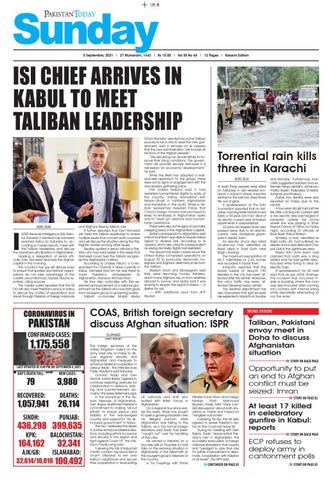
ISI chIef arrIveS In Kabul to meet talIban leaderShIp
news deak
I
nter-Services Intelligence (ISI) Director General Lt General Faiz Hameed reached Kabul on Saturday to, according to media reports, meet with the taliban leadership and discuss the overall security situation in Afghanistan. Leading a delegation of senior officials, Gen Hameed reached the Afghan capital in the morning. the country’s top spy will discuss ways to ensure that spoilers and terrorist organisations do not take advantage of the volatile circumstances, express tribune reported, citing sources. the media outlet reported that the ISI DG will also meet Pakistan’s envoy in Kabul to discuss the matter of repatriation and transit through Pakistan of foreign nationals
and Afghans fleeing taliban rule. It further reported that Gen Hameed will meet the taliban leadership to review multiple issues that concern both countries and will discuss the situation along the PakAfghan border among other issues. reuters quoted a senior official in Pakistan who had said earlier in the week that Hameed could help the taliban reorganise the Afghanistan military. According to Lindsey Hilsum, a correspondent for Channel 4 news currently in Kabul, Hameed told him he was there to meet Pakistan’s ambassador to Afghanistan, Mansoor Ahmad Khan. His tour also coincides with the expected announcement of a national government by the taliban who now shift gears from insurgent group to governing power. taliban co-founder Mullah Abdul
coronavIruS In
paKIStan
CONFIRMED CASES:
1,175,558
LAST UPDATED AT 4:49 PM ON SEPTEMBER 4, 2021
DAY'S DEATH TOLL:
NEW CASES:
79
3,980
RECOVERED:
DEATHS:
1,057,941
26,114
SINDH:
PUNJAB:
436,298 399,635 KPK:
BALOCHISTAN:
AJK/GB:
ISLAMABAD:
164,162
32,341
32,614/10,016 100,492
Ghani Baradar, reported by some taliban sources to be in line to lead the new government, said in remarks on Al Jazeera that the new administration “will include all factions of the Afghan people.” “We are doing our utmost efforts to improve their living conditions. the government will provide security because it is necessary for economic development,” he said. While the West has adopted a waitand-see approach to the group, there were some signs of engagement with the new leaders gathering pace. the United nations said it had restarted humanitarian flights to parts of the country, linking Islamabad with Mazar-i-Sharif in northern Afghanistan and Kandahar in the south. While a taliban spokesman tweeted Friday that China’s foreign ministry had promised to keep its embassy in Afghanistan open and to “beef up” relations and humanitarian assistance. there were also some signs of normality creeping back in the Afghanistan capital. Qatar’s ambassador to Afghanistan said a technical team was able to reopen Kabul airport to receive aid, according to Al Jazeera, which also cited its correspondent as saying domestic flights had restarted. the airport has been closed since the United States completed operations on August 30 to evacuate diplomats, foreigners and Afghans deemed at risk from the taliban. Western Union and Moneygram said they were resuming money transfers, which many Afghans rely on from relatives abroad to survive, and Qatar said it was working to reopen the airport in Kabul — a lifeline for aid. — With additional input from AFP, Reuters
Torrential rain kills three in Karachi news desk At least three people were killed on Saturday in rain-related incidents in Karachi where torrential rainfall for the last two days threw life out of gear. A spokesperson of the edhi Foundation reported that on Saturday morning Malik Mohammed Sabir, a 50-year-old man, died of an electric current near Al-naseer apartments in Liaquatabad. 42-year-old Yaqeen Khan also passed away due to an electric current, near Abidabad graveyard in Baldia town. An electric shock also killed 34-year-old man identified as Asad Iqbal in Shali Goth near Bagh-i-Korangi the maximum precipitation of 66.7 millimetres or 2.62 inches was recorded in Saadi town K-electric reported that the power supply of around 190 feeders in the city has been affected after the rainfall. Moreover, the city’s traffic has been affected following heavy rainfall. the weather department has also forecasted that light showers are expected in Karachi on Sunday
COAS, British foreign secretary discuss Afghan situation: ISPR IsLaMaBad staff report
the foreign secretary of the United Kingdom called on the army chief late on Friday to discuss regional security and Afghanistan and measures to enhance bilateral cooperation in various fields”, the Inter-Services Public relations said Saturday. Dominic raab and Gen Qamar Javed Bajwa “agreed to continue exploring avenues for collaboration in defence, training and counter-terrorism domains,” the press statement said. In the backdrop of the taliban takeover of Afghanistan, Gen Bajwa reaffirmed Pakistan’s commitment to making “all-out efforts” to ensure peace and stability in the war-ravaged country and support to “an allinclusive government” in Kabul. the two “reiterated the desire to further enhance bilateral relations, including efforts for peace and security in the region and fight against Covid-19”, the military’s media wing said. Following the fall of Kabul last month, London has launched a charm offensive to win over Kabul’s neighbours and secure their cooperation in evacuating
and Monday. Furthermore, forecasts suggested isolated and extremely heavy rainfall in Jamshoro, thatta, Badin, tharparkar, Umerkot, Sanghar and Khairpur. earlier, two deaths were also reported on Friday due to the rainfall. A four-year-old girl had lost her life after coming into contact with a live electric wire submerged in rainwater outside her home where she was playing in Shah rasool Colony of Clifton on Friday night, according to officials at Boat Basin Police Station. Similarly, a man, identified as Sajid Lodhi, 45, had suffered an electric shock and died near Chapal Gali in the Lighthouse area. risala SHO Amir Ikram had claimed that Lodhi was a drug addict and he had gotten electrocuted while trying to steal an electric bulb. A spokesperson for Ke had said that as per initial findings, the incident was occurred inside a building where the man was electrocuted after coming into contact with internal wiring while reportedly attempting to cut the wires.
more inside
Taliban, Pakistani envoy meet in Doha to discuss Afghanistan situation STORY ON BACK PAGE
UK nationals and staff who worked with British forces in Afghanistan. On a regional tour since earlier this week, raab has sought to quell a growing backlash over his alleged inaction while Afghanistan was falling to the taliban, as a tory former foreign secretary said raab had been “caught out” over his handling of the crisis. He arrived in Pakistan on a two-day visit on thursday to hold talks on the evolving situation in Afghanistan in the aftermath of the insurgent group’s takeover of the country. In his meetings with Prime
Minister Imran Khan and Foreign Minister Shah Mahmood Qureshi, raab held “frank candid discussions” about both situations on Friday and hoped for “tangible outcomes”. Following his trip, the UK also agreed to review Pakistan’s status on the Covid red travel list. During his meeting with Gen Bajwa, raab “appreciated Pakistan’s role” in Afghanistan, the successful evacuation of foreign nationals stranded in that country and “pledged to play their role for further improvement in diplomatic cooperation with Pakistan at all levels”, the ISPr said.
CONTINUED ON PAGE 05
Opportunity to put an end to Afghan conflict must be seized: Imran STORY ON PAGE 02
At least 17 killed in celebratory gunfire in Kabul: reports STORY ON BACK PAGE
eCP refuses to deploy army in cantonment polls STORY ON PAGE 03
02
Sunday, 5 September, 2021
KARACHI
NEWS
OPPOrtuNIty tO Put AN eNd tO AfgHAN cONfLIct MuSt Be SeIzed: IMrAN ISLAMABAD
P
TlTP
RIME Minister Imran Khan has assured support to the United Nations (UN) for smooth operation of humanitarian mission in Afghanistan. Prime Minister Khan spoke on the telephone with the Secretary General of the United Nations Antonio Guterres on Saturday. The two leaders discussed the developments in Afghanistan, with a particular focus on the humanitarian situation. The prime minister highlighted the
importance of peace, stability and an inclusive political settlement in Afghanistan. He stressed that the opportunity to finally put an end to 40 years of conflict in Afghanistan must be seized by enabling the Afghans to achieve lasting peace, security and prosperity. The prime minister underscored the need for the international community to become more engaged with Afghanistan, according to the urgent priority of addressing the humanitarian needs and ensuring economic stability. Such steps would not only reinforce security but also preclude any mass exodus of Afghans from their country, thus
NAB summons PML-N MPs in assets cases LAHORE InP
The National Accountability Bureau summoned two Pakistan Muslim League-Nawaz (PML-N) MPs, Javed Latif and Barjees Tahir, in cases of assets beyond declared wealth. The dirty money watchdog asked Latif to appear before it on September 9 while Tahir has been summoned on the following day. Latif is accused of accumulating assets worth Rs500 million while Tahir is investigated for being in possession of assets worth Rs300 million. The former said he had not received the notice yet and would appear before the agency only after it is delivered.
Interim bails of Shehbaz, Hamza extended
NEWS DESK A banking court in Lahore on Saturday extended the interim bails of Pakistan Muslim League-Nawaz chief Shehbaz Sharif and Punjab Assembly Opposition Leader Hamza Shehbaz in a case pertaining to money laundering. Both Sharif and his son appeared before the court for the hearing presided over by Additional District and Sessions Judge Muhammad Aslam Gondal who extended the bail period until September 25. During the proceedings, Sharif told the court the probe was initiated by the National Accountability Bureau but now the Federal Investigation Agency has also joined it. The reference mainly accuses Sharif of being a beneficiary of assets held in the name of his family members and benamidars who had no sources to acquire such assets. It says the suspects committed offences of corruption and corrupt practices as envisaged under the provisions of the National Accountability Ordinance, 1999, and money laundering as delineated in the Anti-Money Laundering Act, 2010. A total of 20 people had been nominated in the reference, including four approvers Yasir Mushtaq, Muhammad Mushtaq, Shahid Rafiq and Aftab Mahmood. The main suspects are Sharif’s wife Nusrat, his two sons Shehbaz and Suleman (absconder), and his daughters Rabia Imran and Javeria Ali. According to NAB, Sharif accumulated assets worth Rs7,328 million — which are disproportionate to his known sources of income — “in connivance with his co-accused family members, benamidars, front persons and close associates […] developed an organised system of money laundering”. The accountability watchdog further said that the accused in the case had “created fake/fictitious sources of income” in order to “justify the assets” which are beyond their known sources of income. Sharif was arrested in October 2018, in other cases — Ramzan Sugar Mills and Ashiana-i-Iqbal Housing Scheme.
preventing a refugee crisis in Afghanistan, he noted. The prime minister appreciated the vital role of the United Nations in delivering much needed humanitarian assistance to the Afghan people. He highlighted the facilitation being provided by Pakistan to the UN in that regard including by assisting in the evacuation and relocation efforts. Assuring Secretary General Guterres of Pakistan’s continued cooperation with the UN in the fulfilment of its mandate, the prime minister reaffirmed Pakistan’s full support for the smooth operation of the UN humanitarian mission for Afghanistan.
Bilawal, Shehbaz discuss political situation of country NEWS DESK Pakistan People’s Party (PPP) Chairman Bilawal Bhutto Zardari held a telephonic conversation with Leader of the Opposition in the National Assembly Shehbaz Sharif on Saturday, during which the two spoke about appointments to the Election Commission of Pakistan’s vacant posts and overall political situation of country. Last week, Prime Minister (PM) Imran Khan had informed the opposition leader regarding the vacant
ECP appointments due to the retirement of two members from Punjab and Khyber Pakhtunkhwa (KP) on July 26. PM has nominated Ahsan Mehboob, Raja Aamir Khan and Syed Pervaiz Abbas from Punjab while Ikramullah Khan, Faridullah Khan and Muzammil Khan have been recommended from KP. According to the statements issued by PPP and the Pakistan Muslim League-Nawaz (PML-N), Bilawal and Shehbaz discussed the matter and agreed to put a united front.
Coronavirus kills 79, infects 3,980 in a day NEWS DESK The country reported 79 more deaths due to coronavirus during the past 24 hours, taking the overall death toll to 26,114, according to the data shared by the National Command and Operation Centre on Saturday. According to the NCOC data, the country reported 3,980 new cases of coronavirus during the past 24 hours, taking the tally for confirmed cases to 1,175,558. The positivity ratio in the country currently stands at 6.21 percent, as some 64,053 tests were carried out to detect the virus on Friday. The country reported a coronavirus positivity rate of less than 7 percent for the fourth consecutive day. Since August 24, Pakistan's positivity rate has been under 7 percent on 10 out of 12 days. Pakistan is reporting 3,885 new infections on average each day, 66 percent of the peak — the highest daily average reported on June 17. The country has administered at least 59,384,758 doses of Covid-19 vaccines so far. Assuming every person needs 2 doses, that’s enough to have vaccinated about 13.7 percent of
the country’s population. During the last week reported, Pakistan averaged about 1,072,051 doses administered each day. At that rate, it will take a further 41 days to administer enough doses for another 10 percent of the population. Meanwhile, Punjab reported 1,941 Covid-19 cases and 34 more deaths due to the virus during the past 24 hours. According to provincial health secretary Imran Sikandar Baloch, 12 deaths were reported from Lahore during the period. He said that active cases in Punjab now total 25,602, adding that the tally of the positive cases in the province stood at 397,695. The official further stated that the total number of deaths due to the virus is currently at the 12,011 mark. The health secretary said that some 362,023 patients have recovered from the disease so far. “As many as 25,441 tests were conducted in Punjab since Sunday, totalling 6,889,751 tests,” he added. The official informed that the positivity ratio in the province is currently at 7.6 percent, adding specific SOPs have been issued for various sectors. He urged
Bilawal and Shehbaz also agreed to “go to whatever extent it takes” to oppose the government’s proposed Pakistan Media Development Authority. According to a report, the Opposition agreed to have a joint stance on President Arif Alvi’s speech during a joint session of the parliament that kicks off its fourth year. Meanwhile, the PPP, which also issued a statement following the meeting, said that the two, besides the appointment of the ECP members, also discussed the overall political situation in the country.
the public to take strict precautions and get vaccinated, terming it the only and effective solution against the virus. Meanwhile, the NCOC announced that all vaccination centres would remain open on Sundays to vaccinate those individuals who are awaiting to get the second dose of the Covid-19 vaccine. According to the NCOC, all those individuals for whom the required gap prior to a second shot has lapsed, can get their second jab on a Sunday from any vaccination centre, without waiting for a confirmation SMS. Sundays have been exclusively reserved to cater to the needs of such individuals, the NCOC said. The vaccination drive for people aged 17 years or above began on September 1 as part of the government's strategy to contain the spread of the novel coronavirus. Earlier, people who were 18 or older were being immunised against coronavirus in the country. The country is also preparing to offer inoculations to 15year-olds, for which the government will announce a day soon, according to Asad Umar, the head of the National Command and Operation Centre (NCOC), and Dr Faisal Sultan, the Special Assistant to the Prime Minister on National Health Services, Regulations, and Coordination. Moreover, citizens with impaired immune systems aged 12 and up will also receive the Covid-19 shots.
Geelani’s ‘strength, perseverance’ hailed ISLAMABAD AnAdolu Agency
Tributes were paid to Syed Ali Shah Geelani, the veteran pro-freedom leader from Indian-occupied Kashmir, who passed away on Wednesday, for his unwavering commitment to the cause. The 91-year-old died at his home in Srinagar, the capital of the disputed region, where he was under house arrest for the better part of the last decade. He was buried in a tightly controlled pre-dawn ceremony on Thursday as Indian authorities imposed a lockdown. His family alleged that police forcibly snatched Geelani’s body and buried him in a local graveyard, some 200 meters away from his Hyderpora residence — against the leader’s wishes who wanted to be buried in Martyrs Graveyard, Kashmir’s largest cemetery. The clampdown has been condemned by Pakistan and the Organisation of Islamic Cooperation’s Independent Permanent Human Rights Commission. Police, however, called the allegations “baseless” and “propaganda,” saying they facilitated the burial process to avoid any untoward incident. “Similar restrictions and internet shutdown will continue tomorrow. We shall review the situation […] and take further course of action,” a statement read. ‘GREAT LOSS’: The Malaysia Consultative Council of Islamic Organisations, a coalition of Islamic organisations in Malaysia, called Geelani’s death a “great loss for the Kashmir cause.” Mohammad Azmi Abdul Hamid, president of MAPIM, hailed the veteran leader as “a great inspiration for all Kashmiris.” “We salute his resoluteness to pursue the struggle for freedom and self-determination. He was an
inspirational figure who showed great leadership and courage in establishing the Tehreek-e-Hurriyat (Movement for Freedom) group,” he said in a statement. ‘TICKING TIME BOMB’: Mubeen Ahmed Shah, a Kashmiri businessman and diaspora leader, said denying Geelani a traditional and dignified burial is “not only shameful for India but for the entire international community.” “A so-called democracy is doing it and the international community is silent,” he told Anadolu Agency over the phone. “Kashmiris will never forget this treatment […] the situation is a ticking time bomb.” ‘LIKE A ROCK’: US-based Kashmiri rights group Stand with Kashmir said Geelani stood like a rock in the face of India’s “illegitimate and repressive occupation of Jammu and Kashmir.” “Geelani sahib was a firm believer of the Pakistan movement as a homeland for the Indian subcontinent’s Muslims, and advocated for Kashmir’s merger with Pakistan,” it said in a statement. “He never wavered in his principles and relentlessly stood for Kashmiris’ right to selfdetermination. His life was an example of unfettered resolve and passionate resistance. He always spoke truth to power, for which he spent years under detention in Indian prisons.” UN MANDATE: Ghulam Nabi Fai, a Washingtonbased Kashmiri diaspora leader, said Geelani’s decision to “not give up on the UN has been right all along.” “The UN Security Council resolutions provide a critical international justification for waging the
Kashmiri struggle. Although the struggle has been so long, the cause is finally attracting more attention, and the world is more aware of the cause that Geelani struggled for,” he said in a statement. Recalling his first meeting with Geelani in 1963, Fai, who is also the secretary general of World Kashmir Awareness Forum, said: “I vividly remember him [Geelani] whispering in my ear during a hug in 1965 at a bus stand in Sopore: ‘We badly need the youth.’ I was 18 then. I’m sure thousands of youths heard that whisper. This is the message that I would like to share with my beloved Kashmiri youth everywhere. Geelani’s strength, perseverance, and unwavering hope for a brighter future lives on in all of us.” CALL FOR PROBE: “Syed Ali Geelani was a public figure, a man of the people who had dedicated all his life for the cause of Kashmir. The circumstances leading to his death and then the forceful burial have raised serious concerns,” said Shehryar Khan Afridi, the chairman of the parliamentary committee on Kashmir. “We fear if Geelani’s killing is not probed, other Kashmiris incarcerated by India may also be killed in custody,” he said, urging the UN Human Rights Council and other rights organisations to hold an impartial inquiry into what he called a “custodial killing.” He claimed this was the “second high profile custodial killing” after Tehreek-e-Hurriyat chairman Muhammad Ashraf Sehrai, who died in custody earlier this year.
Sunday, 5 September, 2021
KARACHI
ECP rEfusEs To dEPloy army in CanTonmEnT Polls nEwS DESk
T
NEWS
03
Bail of four suspects in TikToker assault case extended LAHORE
HE Election Commission of Pakistan (ECP) has rejected the Pakistan Tehreek-i-Insaf’s request for deployment of army troops inside and outside the polling stations during the cantonment elections, scheduled to be held on September 12, Geo News reported on Saturday. Earlier, PTI chief organiser Senator Saif-ullah Khan Nyazee had written a letter to Chief Election Commissioner Sikandar Sultan Raja that in order to ensure transparency, the assistance of the army is required to maintain law and order in the polls for 42 cantonment boards across the country. However, according to the report on Saturday, the ECP has denied the request of the PTI government. The elections were originally scheduled in 2019 but got postponed due to the Covid-19 pandemic. These elections will be the first grassroots level electoral contest between the country’s political parties after the 2018 general elections.
INP
A district and sessions court in Lahore on Saturday extended until September 14 the interim bail of four suspects in a case pertaining to an assault on a TikTok user in Great Iqbal Park. Khizar Hayat, Muhammad Umar, Muhammad Asif and Akhtar Ali had requested the court to do the same. The defense told the court that the suspects were willing to cooperate with the police in the investigation but feared their arrest. Last month, police opened cases against hundreds of unidentified men after Ayesha Akram was assaulted and purportedly groped by a crowd of more than 400 men in the park as she made a TikTok video. The shocking assault was captured on several videos, which went viral and showed a mob descend on the woman. Akram registered a case against 300 to 400 unidentified persons with Lahore police, according to the case report.
Pakistan urges international community to help Afghanistan nEwS DESk Pakistan is urging the international community to adopt a three-pronged approach to Afghanistan following the Taliban takeover: quickly deliver aid to 14 million people facing a hunger crisis, promote an inclusive government, and work with the Taliban to attack all terrorist groups in the country. Pakistan’s ambassador to the United Nations, Munir Akram, laid out his government’s vision for a future international role in Afghanistan in an Associated Press interview, saying Pakistan has been in contact with regional countries and the broader global community on working together on the three priorities. He stressed that humanitarian help must be the top priority and called it “very unhelpful” for Afghanistan’s assets to have been frozen, by the United States and others, because this leaves the Taliban with no access to dollars or foreign exchange to buy food or import oil. “There will be inflation. The prices in Afghanistan will rise further. The poverty level will rise,” Akram warned. “You will then have a refugee crisis which is exactly what the West is afraid of.” The Taliban swiftly captured territory in
Afghanistan in the final days of last month’s withdrawal of US forces at the end of America’s 20-year war, prompting the government of Ashraf Ghani to blame Pakistan for the insurgents’ success in taking control of their country. But analysts say Pakistan’s leverage over the Taliban is overstated and Akram agreed. He called his country’s influence “exaggerated” though he said Pakistan has “a fairly relaxed policy” toward the three million Afghan refugees on its soil. “We know better than others that you cannot force the Afghans to do anything, and I think the experience of the last 40 years has indicated that nobody actually from the outside can dictate to the Afghans,” he said. “So, persuasion, yes. Talks with them, consultations, yes. But it’s very difficult to persuade the Afghans.” Pakistan initially brought the Taliban to the negotiating table to get them to stop the onslaught and go back to talks. Akram said the prime minister and army chief went to Kabul to talk to Ghani and invited the leadership to Pakistan. But Ghani “remained intransigent about reaching a political settlement with the Taliban” and the Taliban also had “a very strong” position against negotiations, he said. With the Taliban now in control of the
country, Akram said Pakistan hopes its leaders “will listen to a sincere friend in trying to form an inclusive government” where all the ethnic groups and minorities including Tajiks, Hazaras and Shi’ite Muslims are represented. “I think that if they are responsible, they will see the wisdom of inclusive government, and hopefully, we will have a government which can bring actually peace to the country,” he said in the virtual interview from Geneva. Under the Taliban’s previous rule from 1996 to 2001, women were not allowed to go to school, work outside the home or leave their house without a male escort. Though they faced many challenges in the country’s male-dominated society after the Taliban’s ouster, Afghan girls were not only educated but over the last 20 years, women increasingly stepped into powerful positions in government, business, health and education. “I think that the Taliban at least are conscious of the fact that their policies towards women the last time were horrible, that they were unpopular within the country as well as outside the country, and that they have therefore promised that the rights of women will be respected within the framework of Sharia,” or Islamic law, Akram
said. “Of course, Sharia law is quite broad and can be interpreted in different ways,” he said. “We hope at the very least that there will be no coercion, there will be no imposition, and the basic fundamental rights of women to be able to work, to have freedom of speech, to have the ability to educate themselves will be respected.” Akram repeatedly stressed that “one of the mistakes” the United States made in Afghanistan and Iraq was trying to impose Western democracy. “A foreign culture cannot be imposed on a people,” he said. After the September 11, 2001 attacks on the United States, Akram said the Americans also made “a fundamental mistake” by focusing on elites in the cities who benefited from the building of a modern society while ignoring the development of 70 percent of the Afghan population who live in rural areas and whose lives in poverty remain unchanged after 20 years. Akram said the Taliban’s support has been based in rural areas and villages where the “corrupt government” in Kabul “was unable to bring clear, transparent, honest governance.” He said the international community needs to help Afghans in rural areas educate
themselves and acquire knowledge of the benefits of modern societies and modern values including human rights. He admitted this has been a struggle in Pakistan as well as India, Iran, Saudi Arabia and other countries. Another important objective for the international community “is to engage with the Taliban in order to address the problem of terrorism from Afghanistan,” Akram said, citing terrorist groups linked to al-Qaida and the Islamic State as well as others targeting China and Pakistan. “We have to get a grip on all these terror groups, and we will not be able to do it by being selective,” he said, citing the US saying it will attack the Islamic State affiliate that claimed responsibility for the August 27 suicide attack outside Kabul’s airport that killed at least 169 Afghans and 13 American service members, but not others. He said Pakistan will wait to see how inclusive the Taliban government is and how well it’s received in Afghanistan before deciding whether to recognise it. “Our hope is that the Taliban with their actions, with an inclusive approach, will be able to bring together not only the whole country […] but also the international community and the regional countries,” Akram said.
At Torkham border crossing, people face uncertainty and a long wait
ISLAMABAD ReuteRs
Shafiq Mohammad, 40, stands at a closed pedestrian crossing gate on the Pakistan side of the Afghanistan border, holding a passport and a stack of identity cards and imploring officials to let him and his family through. The crossing at Torkham, now manned on the other side by armed Taliban soldiers, has long been the busiest between the two countries, but since last month has seen a sharp dip in pedestrian crossings as tight controls
have been imposed. “I don’t know (why they’re not letting us in), we’re also standing here asking why you do not let us […] what is the procedure, how can we proceed,” Mohammad says through a metalbarred gate from the Afghanistan side of the border. With air traffic suspended, Torkham is one of the few gateways out of Afghanistan. But worsening security has prompted authorities to clamp down on border movement, with an average of just 85 daily crossings in August at
Torkham, against 7,0008,000 in March and April. Pakistan said a fresh wave of Covid-19 infections has also led it to exercise tighter scrutiny. Commercial traffic has kept up, with a steady stream of trucks passing through. But crowds have been pushed back from the border area by Taliban fighters and kept on the Afghanistan side on the Jalalabad-Peshawar highway. Pakistan has had to work with the Taliban on the local level to make sure the borders remained staffed and orderly after Afghanistan’s forces
melted away in August with the departure of President Ashraf Ghani. Sajid Majeed, deputy inspector general of Frontier Corps, said coordination was necessary to check documents and there were regular contacts at the local level between Pakistani officials and their Taliban counterparts. “That is part of the routine. Beyond that, I think things are still in the pipeline,” he said. The mountainous, and often lawless, border had historically been fluid for pedestrians, with families and tribes living on either side. They crossed from all points and mostly without hindrance. However, for the last few years, both Pakistan and Afghanistan have traded accusations that the other side has sheltered militant groups and allowed them to conduct attacks across the border. Pakistan has now almost completed a metal fence along the 2,600 kilometre (1,600 mile)long frontier. Pakistan began erecting the fence, which
snakes through snowpeaked mountains and treacherous ravines, four years ago. It now has over 440 forts in the northwestern region alone, as well as cameras, watchtowers and over 800 drones. With only five official crossing points, including Torkham, now remaining between the two sides, things have changed for
people like Mohammad, who said he had previously crossed the border frequently. “We were allowed to pass (previously). Now the rules have changed. Every day the rule is changing,” Mohammad complains. “This time if I cross the border then […]” Mohammad says, gesticulating to suggest he
would not cross into Afghanistan again. He seems careful not to say anything that might upset the Taliban guards hovering behind him. After negotiations with Pakistan border officials, which are unsuccessful for reasons that are unclear, Mohammad, his family, and some others are ushered away from the
crossing by the Taliban border guards. They threaten to hit some people with whip-like devices to keep the line moving. Another family does manage to get through. A girl in a wheelchair crosses into Pakistan as Mohammad and his wife and children disappear back into the crowd on the Afghanostan side.
Sunday, 5 September, 2021
04 NEWS
KARACHI
Charities bring Change to Pakistan’s southern thar desert KARACHI
i
AnAdoLu Agency
N the middle of a rugged swath on the edge of Thar desert, a state-of-the-art hospital treats more than 250 patients daily free of cost.
With weathered faces and attired in traditional garments, a group of women, some holding infants, were waiting to be seen as two female doctors checked on patients in the corner of a sprawling hall. Located in remote Mithi, one of two towns where Hindus make up half the population, the 60-bed hospital is not a government facility but was established by the Al-Khidmat Foundation, welfare wing of the Jamaat-i-Islami party. The foundation also runs a nationwide chain of charity hospitals and is one of several key charities oprating in the country. It shares a significant burden in terms of food, health, education and other services which otherwise are meant to be provided by the government. The hospital, which mainly focuses on female and pediatric health care, was planned in 2014 after the deaths of hundreds of children in the Thar desert region due to drought, and when malnutrition hit global headlines. In addition to long distances, there are more structural issues that have contributed to the extraordinary number of deaths. “We decided to set up a modern hospital in this remote area with the help of philanthropists to cater to hundreds of villages located deep inside the desert that have been badly affected by the drought,” Aijazullah Khan, an official of the charity, told Anadolu Agency. The only government-run hospital in the area, Khan said, does not have proper laboratory and pharmacy services. Almost 75 percent of the lives, he observed, could have been saved if malnourished children were taken to the hospital in time, diagnosed and required medical facilities were available. “Apart from general checkups, all kinds of tests, pharmacy, and even operations are totally free of cost,” he said, adding that the hospital also conducts 100 eye surgeries every month.
The availability of doctors at the staterun hospital, Khan acknowledged, has improved in recent years due to strict government actions. The southern Thar region, also known as the Tharparkar district, comprises six towns and spans more than 22,000 square kilometres with a population of 1.5 million. Agriculture and livestock, which heavily depend on monsoon rains, are key sources of income for Tharis — a term uses to designate residents. GENEROUS COUNTRY: Apart from the hospital, the Al-Khidmat Foundation has dug scores of tube wells across the desert to provide potable water to residents, who otherwise relied on rainwater. The Dua Foundation, a Karachi-based charity group, launched an agro-farms project to make use of subsoil water for the cul-
tivation of different crops throughout the year. According to Dr Faiyaz Alam, the foundation’s general secretary, 28 farms have been set up in different parts of Thar, making 250 acres of barren land arable and cultivable, where peasants are growing wheat, cotton, mustard, onions and different types of fodder for their livestock. Pakistan is among a handful of countries that contribute more than 1 percent of their GDP to charity, according to a report by Stanford Social Innovation Review — a magazine that looks into cross-sector solutions to global problems. The contributions push it into the ranks of far wealthier countries like the UK and Canada that contribute 1.3 percent, and 1.2 percent, respectively. It is about twice what India gives to those in need as a percentage
Gold price jumps to Rs98,200 per 10gm
Exports increase 27.6pc in 2MFY22 ISLAMABAD APP
Pakistan's exports witnessed an increase of 27.59 per cent during the first two months of the current fiscal year (2MFY22) as compared to the corresponding period of last year (2MFY21), Pakistan Bureau of Statistics (PBS) reported on Saturday. According to data released by the PBS, the exports from the country stood at $4.573 billion during July-August FY22, as against the exports of $3.584 billion recorded during July-August FY21, showing a growth of 27.59 per cent. The imports during the months under review also went up by 72.59 per cent by growing from $6.990 billion in 2MFY21 to $12.064 billion in 2MFY22. Based
of its GDP. People of Pakistan give around Rs240 billion (nearly $1.5 billion) annually to charity, according to a study conducted by Pakistan Centre for Philanthropy. Around 98 percent of people, the report indicates, give in some way — if not cash, with in-kind donations or volunteering for needy causes. LARGEST FREE AMBULANCE SERVICE: Local charities have contributed immensely, mainly in terms of cooked food and rations during coronavirus lockdown restrictions across Pakistan. The Edhi Foundation — a relief agency founded by the internationally acclaimed social worker, Abdul Sattar Edhi — was the first NGO that imported coronavirus testing kits and provided them to the government
and charity hospitals in remote areas, in addition to distributing rations to needy families. The charity, which runs a nationwide ambulance service, made a bulk of its ambulances available to transport suspected virus patients to hospitals and quarantine centres. A network of charity hospitals in Pakistan is currently treating 350,000 patients every month. Located in a low-income eastern outskirt of the port city of Karachi, Indus Hospital — the largest campus of the chain — caters to more than 2,500 deprived patients every day, free of cost. From primary health care to cardiac surgery and even the treatment for challenging ailments like pediatric cancers are available for free in the network of hospitals, established by a group of doctors led by Dr Abdul Bari Khan in 2007. Saylani Welfare, another nationwide charity, introduced a mobile phone application and telephone service where needy families can register to get rations and other essential items. Also, volunteers from the Alamgir Welfare Trust, Pakistan Islamic Medical Association — a nationwide group of professional doctors — Baitul Salam Trust, and other NGOs are still assisting the government in tackling the economic and medical needs of hundreds of thousands of needy people, especially those who have gone jobless due to the pandemic. PIMA has set up an online facility to guide and assist suspected coronavirus patients. ERDOGAN TRUST: In addition to local charities, Turkey’s Recep Tayyip Erdogan Trust is also running a chain of hospitals and blood centres which are operated by Indus Hospital. The chain comprises seven hospitals — five in Lahore and one each in Multan and Muzaffargarh districts. The 400-bed Recep Tayyip Erdogan Hospital Trust in the Muzaffargarh district was gifted in 2014. It provides free health care to patients, irrespective of their background. The trust has also been running two blood banks one each in Multan and Bahawalpur districts.
NEWS DESK
on the data, the trade deficit during the period under review was recorded at $7.491 billion, showing an increase of 119.94 per cent over the deficit of $3.406 billion recorded during the period under review, the PBS data revealed. Meanwhile, on a year-on-year (YoY) basis, the exports of the country increased by 41.04 per cent clocking in at $2.234 billion during the first two months as compared to the exports the exports of $1.584 billion in the corresponding period of FY21. Similarly, imports into the country increased from $3.316 billion 2MFY21 to $6.463 billion in 2MFY22, showing a growth of 94.90 per cent. However, on month-on-month (MoM) basis, exports from the country witnessed a decline of 4.53 per cent during the period under review.
Gold price regained positive traction amid disappointing US Non-Farm Payroll (NFP) report and weakened US dollar and shot to near one-month tops. Gold in the international market was available at $1,828.60 per ounce after gaining $18 to close the week. Meanwhile, the price of 10 grams of yellow metal in Pakistan increased to Rs98,200 after gaining Rs200. The closing prices of the yellow metal in the country remained Rs98,000 on Friday last. As the local market closes ahead of the international market, the difference is settled on the very next day. According to experts, gold caught some fresh bids in reaction to disappointing headline NFP data. The US dollar weakened across the board after the closely-watched US monthly jobs report showed that the US economy added 235,000 new jobs in August.
This was well below the previous month's upwardly revised reading of 1,053,000 and missed expectations by a big margin. Investors pushed back their expectations for the likely timing when the Fed will begin rolling back its massive pandemic-era stimulus. This, in turn, exerted some additional pressure on the already weaker US dollar and provided a goodish lift to dollar-denominated commodities, including gold. Meanwhile, the data now seemed to have raised doubts about the US labour market recovery and fueled worries about the potential risks associated with the fast-spreading delta variant of the coronavirus. This was evident from a weaker tone around equity markets, which further benefited the safe-haven gold. However, a sharp spike in the US Treasury bond yields held bulls from placing aggressive bets and kept a lid on any further gains for the non-yielding gold.
Central Business District organises pre-bid sessions for commercial plots LAHORE TLTP
The Central Business District (CBD) on Saturday organised successful pre-bid interactive sessions across Islamabad, Karachi and Lahore. According to a statement issued here, the Central Business District is now contributing to the urbanisation of Pakistan and has so far amalgamated their resources to build first-ever business infrastructure in the country. These interactive sessions were attended by the notable developers, investors, realtors and other rel-
evant stakeholders from three metropolitans. The event was hosted by the commercial team of CBD Punjab to share details of the upcoming auction of “Lahore Prime” where five commercial plots are scheduled for an open auction on September 7, 2021 in Lahore. The location of these plots is adjacent to the main boulevard Gulberg, Kalma Chowk and Ferozepur Road, Lahore. The Central Business District was constituted through an act of the parliament and is completely backed by the government of Punjab. This mega highrise development project has the most favourable by-
CMYK
laws along with a very promising floor area ratio (FAR) of the construction sites for the builders. Mohammad Omer, executive director commercial, said; “[The] CBD Punjab is an optimistic contributor to the national exchequer, by offering bespoke real-estate to the potential investors/bidders, local and international both. This mega project will certainly put Pakistan on the list of global business districts.” The bidders from national and international leading investment groups and developers are showing huge interest for these commercial plots. The business district is aiming at playing a pivotal
role in increasing the economic growth of Pakistan by attracting the people seeking employment opportunities and conducive environment for their businesses. Through the vision of smart city concepts, the Central Business District has come up with amazing initiatives, which are planned for the benefit of the residents spread across the CBD Punjab and its surroundings. It has also initiated the fast-track one-window facility to address all the queries of the clients. They will assist their clients on the common problems of depositing the dues, taking over possession, getting building plans approved, etc.
Sunday, 5 September, 2021
KARACHI
NEWS
COAS, BritiSh fOreign SeCretAry diSCuSS AfghAn SituAtiOn: iSPr CONTINUED fROM pAGE 01
t
HE diplomat also visited the Pakistan-Afghanistan border at Torkham, an important crossing point, to see for himself the situation on the ground, a handout from his office said. He also met members of the team supporting the current crisis response.
pakisTan cOmmiTTed TO kashmir cause: Meanwhile, newly-elected Kashmir Prime Minister Abdul Qayyum Niazi called on General Bajwa on Saturday and discussed with him the prevailing situation in the Indianoccupied Kashmir. According to an ISPR press statement, the two leaders discussed “unilateral steps” India is taking in the held
region and the situation along the Line of Control. Paying tribute to Syed Ali Shah Geelani, the army chief said the deceased pro-freedom leader “selflessly struggled” for the right of self-determination of the people of Kashmir throughout his life. He also felicitated Niazi on assuming the office of the Kashmir prime minister
and expressed his best wishes for the stability of the state. Niazi praised the military for its role in the provision of security and development of the region. General Bajwa assured him that his institution stood by the people of Kashmir firm as a rock and it would continue to lend support until they achieve their right of self-determination.
05
un to convene Afghanistan aid conference on September 13 ZURICH REUTERS
In a bid to help avert what UN Secretary General Antonio Guterres called a “looming humanitarian catastrophe” in Afghanistan, the United Nations has decided to convene an international aid conference in Geneva on September 13. Taking to Twitter, UN Chief Antonio Guterres announced the conference that he said would seek a swift scale-up in funding for humanitarian relief. “I will convene a high-level humanitarian conference for Afghanistan on September 13 to advocate for a swift scale-up in funding and full, unimpeded access to those in need,” he said. "We need the international community to stand together and support the Afghan people," Guterres wrote. "We also appeal for full and unimpeded humanitarian access to make sure Afghans continue to get the essential services they need," he said. He said, “Now more than ever, Afghan children, women and men need support and solidarity from the international community.” Many Afghans were struggling to feed their families amid severe drought well before Taliban seized power last month and millions may now face starvation with the country isolated and the economy unravelling, aid agencies say. "The United Nations stands in solidarity with the people of Afghanistan and is committed to staying and delivering for them," said Guterres.
PiA plane grounded ISLAMABAD TLTP
LAHORE: Punjab police organise a rally to create awareness of women’s safety. ZUbaiR MEhfooZ
FIR registered against Geelani's family NEWS DESK The Indian Occupied Kashmir (IOK) police have registered a case against the family of Syed Ali Shah Geelani (late), according to media reports. According to Geo news, the case was registered at
the Budgam police station for "raising pro-independence slogans". Moreover, it was reported that the case was registered in view of the fact that the body of Geelani, who had passed away on Wednesday in Srinagar, was wrapped in the green and white flag of Pakistan prior
to his burial. The bereaved family had chanted slogans in favour of independence and Pakistan when Geelani’s body was taken away. They were tortured and locked in a room by the Indian forces, according to media reports.
A Boeing aircraft of Pakistan International Airline (PIA) was grounded at Islamabad International Airport after its nose wheel was damaged during pushback on the tarmac. According to details, the aircraft’s nose wheel was damaged after a connecting rod between the plane and tug master suddenly broke during pushback at the airport. After the accident, the passenger plane was grounded. The Quetta-bound flight from Islamabad was delayed due to the accident. Meanwhile, a spokesperson for the national flag carrier confirmed the news as well, adding that details of the accident are being sought. Earlier in March, a PIA plane had been grounded after it hit a bird soon after take-off. According to a PIA spokesman, the bird had collided with the right engine of the national airline flight PK368, but the plane safely landed at Karachi airport. The PIA spokesperson had said the bird crashed into the plane after take-off. He had said there were 162 passengers on board.
Biden wants Afghan exit to end US global cop role WASHINGTON afP
“America is back,” goes President Joe Biden’s catchphrase, but his unapologetic exit from Afghanistan shows America won’t be back to business as usual. Beyond the trauma of the Kabul evacuation, Biden is pitching a much broader retreat: a halt to using vast military resources to impose order and US values around the planet. “This decision about Afghanistan is not just about Afghanistan,” Biden said in what many see as a historic speech on Tuesday. “It’s about ending an era of major military operations to remake other countries.” “Human rights will be at the centre of our foreign policy but the way to do that is not through endless military deployments,” he said. “Our strategy has to change.” Benjamin Haddad, director of the Europe Center at the Atlantic Council and an expert on transatlantic relations, called the speech “one of the most eloquent repudiations of liberal internationalism by any US president in the last decades.” For those Americans fond of imagining their country to be a unique, invincible superpower — winner of the Cold War, then awesome military interventionist everywhere from Iraq to Africa ever since — this
is a shock. For most, though, polls show Biden’s pivot is likely to be popular. Where Trump, Biden agree: Biden’s presidency is usually seen as a repudiation of the Donald Trump administration. It’s true that a lot — from things like White House decorum to re-entering the Paris climate accord — changed the moment Biden walked into the Oval Office on January 20. But Biden’s abandonment of open-ended US military adventures — what detractors call being “the world’s policeman” —is Trumpian. When Biden announced “it’s time to end this forever war,” about Afghanistan, “it could just as easily be Trump,” said Charles Franklin, a Marquette Law School professor and director of the Marquette opinion poll. Today “the public is not committed to a large international role, certainly not of the sort the US played in the 1950s-1990s,” Franklin told AFP. Regarding Afghanistan in particular, polls show strong backing for exiting — 77 per cent, according to a new Washington Post- ABC News poll — even if Biden is taking a battering for the chaotic manner of the withdrawal. alliances aT risk? Where Biden differs sharply from isolationist Trump is in
enthusiasm for building alliances. The United States may not be a swaggering global cop, the Biden theory goes, but it can
CMYK
be a friendly community leader. His administration moved quickly to put Washington back at the centre of tortuous
negotiations between major powers and Iran over its nuclear policy, the climate accord, and traditional alliances like Nato. A June trip to Europe for G7 and Nato summits — Biden’s only foreign trip to date — resembled the diplomatic equivalent of a band getting back together. Now, though, some of those allies might be feeling nervous, analysts say. Tricia Bacon, an expert on counter-terrorism at American University’s law department, told AFP that allies feel “a fair degree of frustration” over the lack of coordination in the US departure from Afghanistan. The US “message will have to be very consistent to regain the lost credibility,” she said. And Imad Harb, research director at the Arab Center in Washington, said European partners aren’t the only ones left wondering. “Arab regimes accustomed to a close relationship with the United States should be worried about what happened in Afghanistan,” he wrote on the think tank’s website. “Biden may have finally drawn the curtain on American military interventionism in the wider Middle East,” Harb said. Calling Biden’s post-withdrawal speech “sobering,” Harb said the apparent “contours of a ‘Biden Doctrine’” will have sown “trepidation” across a region that for two decades has known no other reality than US intervention.
Sunday, 5 September, 2021
06 COMMENT
A liver transplant for an alcoholic
It takes one to know one Three years of PTI rule
Does the Single National Curriculum solve anything?
P
RIMe Minister Imran Khan started his tenure by vowing to fulfil promises made during the election campaign. he constantly referred to his ability as the captain of that cricket team which had brought home the World Cup. he boasted about having personally trained his party leaders for over a decade. It was given out that the PTI had a highly qualified team of administrators who had delved deep into national issues and had prepared guidelines about how to resolve them after coming to power. The major stress was on uprightness. It was maintained that with an honest PM leading the country, corruption would be eliminated within months. A simplistic Imran Khan declared that the people did not pay taxes when the rulers were dishonest. With a virtuous PM holding office the defaulters would automatically start paying their dues regularly. It was maintained that with the induction of an honest PM, there would be no rise in the prices of essential commodities of daily use. Naya Pakistan would come into being soon after the PTI’s assumption of power. The thinking revealed that the PTI chief had not been a deep studentof history, sociology or human psychology. The thinking caused a lot of harm during the last three years. PTI government set a record of transfers of senior bureaucrats, holding them responsible for the failure of its own faulty policies or its own inefficiency. After completing three years of his tenure Imran Khan has suddenly gone back on much that he had stood for before assuming power. At the Islamabad Chamber of Commerce and Industry’s housing, Construction and Property expo, he said Naya Pakistan could not be created by pushing a button. he complained that since people failed to pay taxes there could not be development. Further there could be no change in people’s lot unless there was a change in their mindset combined with a protracted struggle. One wonders if Imran Khan would have won the elections if he had expressed these views during the 2018 campaign instead of promising everyone the pie in the sky. Imran Khan is fortunate for the opposition which looked formidable despite losing the 2018 elections turned out to be shortsighted and factious, and its leaders lacked the ability to sort out their differences. The PML(N), once considered a monolith, stands divided from top to bottom while the PPP is more interested in wheeling and dealing than fighting the government.
RAbIA AhmEd
L
AST month, on the 16 August, the Prime Minister launched the first phase of the Single National Curriculum (SNC), which is supposed to ‘guide the youth of the nation in one direction to achieve success.’ It is said to be an important step towards providing the growing generation of Pakistanis an equal opportunity for a good quality education across the board. This curriculum has apparently now been implemented from classes 1 to 5 across the country, except as yet in Sindh. It is planned to implement the SNC among the higher classes by stages. The directives that go with the SNC apparently include teaching certain subjects, including science, in Urdu. As with so many other initiatives in this country, this is a ‘virtuous’ idea, but a sadly impractical one, not one likely to survive the initial zeal of its initiators; it is an initiative that provides great press at first glance, but is certain to share the fate of sundry other initiatives stemming from the same source, rather like the gymnast who decided to swing impressively from vine to vine in the jungle, in the same way as he swung on ropes in the gym, only to find that vines growing in the wild were less hospitable than the ropes in his gym, so he immediately lost interest and looked around for other interests to push. The fact is that ‘equal opportunity’ is an unknown commodity in this country, where it seems to be the aim of most citizens to make sure that no such aberration gets off the ground. It is also a fact that simply plonking down a syllabus is not going to cut any ice. What we need, very badly, is an overhaul of the national brain, which seems to bank on inequality.
Making Afghanistan work The government must let Afghanistan chart its own course
Challenges to the Taliban
M
ATTeRS have not settled in Kabul, which is still shaken after the Taliban took it over three weeks ago, but at least the contours of a future settlement have begun to be visible. Perhaps the most salient feature is that Maulvi Abdul Ghani Bradar will indeed head the new government. While this was expected, it was by no means certain. Perhaps the first task that awaits the new government he heads will be that of forming it, which means that it has to be capable of handling the many problems that afflict the country. The very first question is how to return the airport to normal. While airlifting out refugees, its closure was perhaps understandable, but now it is not. While the airlift has stopped, there are still people who want to get out. This has created issues of border control that will need governmental action promptly. Then there is the prospect of government financing. There is the related development of growing ties with China. Pakistan’s establishment has always offended a proud people with an overbearing attitude that has rubbed Afghan governments the wrong way. A strict policy of non-interference must be followed, and Pakistan must be doubly careful if the new Afghan government aligns with China. A coincidence of strategic alignment, or a coincidence of views, should not be a cause of the kind of quasi-colonialism that has rubbed so many Afghans the wrong way in the past. It is perhaps no coincidence that there seems to be more triumphalism about the Taliban victory in certain Pakistani circles than among the Taliban themselves. This is unhealthy, and cannot have any good result. It is essential at this point for all stakeholders to realize how crucial will be a peaceful, stable Afghanistan, whose government can enforce its writ, to enforce security of movement within its territory. That is a goal which must be met if not just Afghanistan, but also its neighbours, are to enjoy a peace dividend. It should also not be forgotten that its precisely this degree of control that China needs from Afghanistan, if its One Belt One Road initiative is to enjoy success.
WALI EJAZ NEKOKARA
T
he fall of Kabul to the Taliban has left many political pundits flabbergasted and has also proved a huge chunk of books or research papers wrong. It has further indicated the uncertainty and ambivalence of politics. After getting control of Kabul, the Taliban are going to face multiple challenges from multiple fronts. The first issue is about access to money and foreign funds. Taliban need money to keep the country running. Afghanistan massively depends upon foreign countries. Foreign aid contributes 20 percent to Afghanistan’s gross income. Furthermore, the USA’s move to freeze the Afghan central bank’s assets, which were equal to $9.5 billion and the suspension of the International Monetary Fund programme has exacerbated the situation. The opium trade can provide the Taliban with $300 million to $1.6 billion but $5.5 billion is required to meet the annual budget of the government. Many analysts believe China and Russia will extend the Taliban financial support. At the time when the Taliban are looking for financial assistance, China can take this as an opportunity to expand its influence to Kabul. The second issue is governance. Taliban lack the technocratic experience to govern a country. They are adept at fighting but managing state affairs, public services, and economic affairs is a different kettle of fish. Professional and well-trained people are direly
Dedicated to the legacy of late Hameed Nizami
Arif Nizami (Late) Founding Editor
Yousaf Nizami M. A. Niazi
Editor Aziz-ud-Din Ahmad
Umar Aziz
Joint Editor
Joint Editor
Executive Editor
Lahore – Ph: 042-36300938, 042-36375965
equality is not something our feudal systems and elitist society appreciate, nor something our begums look kindly upon. There is also the sad fact that equality, in Pakistan, where women are fighting for existence, invariably applies to men only. It is unlikely that the private school system, which under the SNC is permitted to teach students extra material/books of their choice– but must also teach the SNC books, will take much notice of either that rule, or those books, always presuming that the SNC books are worth taking notice of. We cannot seriously imagine, that the parents of children who expect their progeny to gain admission in expensive universities will take the SNC seriously, or allow it to be used for very long, and we know who calls the shots. What is far more likely to happen is that since all schools are to be examined to ensure they are using the SNC, expensive private schools will teach it so as to ‘get it over with’, and then move on with their own system. The schools that do take the SNC seriously will become the ones to be mocked, and they would be the ones already suffering from that attitude. It will end up as the same gap with a few additions to contend with. What with the disruptions due to the pandemic, the last thing children need is sudden changes, and further disruptions. The good thing is that the SNC is to be implemented in all streams of education (Pubic, Private and Deeni Madaris); that latter is the best aspect of the whole venture. The number of deeni madaris (religious seminaries/schools) in Pakistan rose sharply in the 1980s. These schools are particularly popular among the poorer segment of society, because in addition to providing literacy they also provide lodging, which includes food. These schools are the only option many parents have of providing a good meal and an education for their boys, a question of ‘one down, three more to go’, if they have four children to feed. These religious seminaries teach little beyond their version of religious studies, which judging by what is seen when you pass the open door for some of them involves much rocking backwards and forwards sitting cross-legged at a low table. Apparently, a few also teach logic, philosophy and mathematics, with the aim of furthering the understanding of said religious subjects. It also appears that most militant extremists once attended these schools, as indicated by the profile of suicide bombers. The SNC can therefore only be an improvement as far as the curriculum there goes.
I
Karachi – Ph: 021-35381208-9
I
required to govern the country. Some professionals have also fled the country owing to the Taliban’s takeover. Taliban are searching for capable people to govern the state institutions. The third issue is related to different approaches in the Taliban group. Jacob N. Shapiro (A professor of politics and International Relations at Princeton University) talks about two different mindsets in the Taliban. One is an extremist mindset and the second is moderate. he contends that the military chief Mohammad Yaqoob and Jurist Abdul hakeem are having a moderate approach, but another military leader Sirajuddin haqqani is deemed a proponent of the extreme approach. The Supreme leader haibatullah Akhundzada has divided the control of the military between Yaqoob and haqqani to avert clashes. Jacob thinks that the future of Afghanistan revolves around the majority inside the Taliban. If moderates take lead they will curb abuses but in the case of an extremist majority, Afghanistan can witness further economic, social, and political decay. The fourth issue is about recognition. Taliban need recognition to get legitimacy and for achieving recognition they have to work on two important principles. First, they have to ensure an inclusive or nonmonopolizing government and have to provide women and minorities with their prerogatives. Secondly, they have to ensure that Afghan soil will not be used against the USA. The fifth challenge is akin to the form of government and constitution. Taliban will not follow the western concept of democracy. A Supreme State council might be established to make decisions and policies. This council will work under an emir. A prominent security analyst, Muhammad Amir Rana, writes that the ‘Taliban will neither accept democracy nor a man-made constitution. The Iranian model with some amendments can be applicable’. he further says that there are two kinds of constitutions attributed to the Taliban. First is ‘Dastur emarat Islami’ prepared at the time when the Taliban were in power in 1998. The second is ‘Manshur emarat Islami Afghanistan’ which was leaked in 2020 but the Taliban did not accept it as a constitution. So, there is no surety about the form of government and the formation of the constitution by the Taliban. The sixth challenge is emanating from the opponent's forces. The recent attack on Kabul airport by IS-K has exposed the Taliban’s sense of complacency about security. IS wants its expansion around the globe. The Taliban and IS both are Sunni extremist
Islamabad – Ph: 051-2204545
I
Web: www.pakistantoday.com.pk
I
Is the SNC really likely to close or narrow the gap between the various systems of education in this country? Wouldn’t it be a better option not to mess with the ‘better’ education wherever found, and improve what is taught elsewhere? The english language is a factor at the crux of this issue. It is indisputable that so long as one segment of society is taught in english, and the other poorly taught and in Urdu, ne’er the twain shall meet. But is for example teaching science in Urdu a rational alternative? Tell me, what do you call a telephone in Urdu? Or is there a word for Sodium Nitrate? Or pertussis, or syncope? According to maulana google, syncope in urdu means ‘hum ahangi’, which is translated into english as ‘harmony’. But that is not at all what syncope means in english, it means fainting or losing consciousness. So how do we propose to teach this subject in Urdu? I know we are proud of the fact that the first doctors, chemists and astronomers were Muslim, but there is no such thing as a ‘Muslim language’; in Pakistan Urdu is the national language, yet only a small percentage of Pakistanis actually speak it; and what is equally of note is that Urdu has not kept up with the developments in science. Is there any point in teaching a subject in one language (that few people understand), loaded with words belonging to another? What, moreover, do we do about those children who may have a single curriculum if they go to school, but who are unable to go to school, because they work? What do we do about people who employ children in their homes, factories and other businesses? What do we do about families that are unable to manage without the earnings of every single one of their members, and so their children work too instead of attending school, about parents who consider education to be overrated and a waste of time, about children who do not attend school because there is no school where they live? Those are the issues to take care of before a thing such as the SNC can be implemented. It may have been set in place with the best will in the world, but that will tend not to last very long here. What do we do about this? Just as sufferers of cirrhosis of the liver are never given a liver transplant if they continue to be alcoholic, the people of Pakistan are desperately in need of education, and a better one, but there is little point in going through the expense of putting a new one in place if it is almost certain to be rejected before long. Rabia Ahmed is a freelance columnist. Read more by her at http://rabia-ahmed.blogspot.com
groups, but they are not allies, rather rivals. The IS’s objective is to establish the IS Khorasan province in Afghanistan. IS and Taliban have been at war since 2015 when IS entered Afghanistan. The IS’ bid to accommodate defectors from the Taliban group is a matter of concern for the Taliban. Mullah Mansoor Akhtar wrote to Abubakar AlBaghdadi and told him not to recruit Taliban defectors. Some analysts are viewing the Taliban as a bulwark against IS. Some experts like Bruce hoffman maintain that the presence of IS in Afghanistan can be a common ground for the USA and the Taliban. If the Taliban join hands with the USA against IS, then the former has to go through a dilemma. On one hand, countering IS with the help of the USA will be beneficial for both parties but on the other hand, it can be deleterious to the Taliban’s organization. It can create a trust deficit among the members of the Taliban group because a faction of the Taliban is not ready to cooperate with the USA. Another rising challenge is food insecurity. According to the local U.N. humanitarian coordinator, Ramiz Alkbarov, one third of the total population of the country is running short of food. This challenge can further add to Taliban’s difficulties. Furthermore, the Panjshir Valley has appeared to be a place of resistance against the Taliban. The Panjshir Valley has a history of resistance. In the AntiSoviet resistance in the 1980s and the anti- Taliban resistance in the 1990s, the Panjshir Valley remained dominant. Local militia members and former members of security forces have built the National Resistance Front. This NRF is working under Ahmad Massoud, the son of the famous Panjshir commander. Amrullah Saleh, the former vice-president, is also part of this resistance force. It will be premature to say anything about the fate of Panjshir due to its history on one side and the Taliban’s commitment to take control of the whole of Afghanistan on the other. The Taliban and Resistance forces are fighting and both sides have experienced heavy causalties. Conquering Panjshir is a big challenger for Taliban. Taking control of Kabul was the first stage of the Taliban’s game but now managing Kabul seems a hard nut to crack. All the challenges are unavoidable, especially money-related issues, governance, recognition, and form of government. China and Russia may help the Taliban but still, they have to embark on a long journey to govern Kabul. The writer can be reached at waliejaz04@gmail.com
Email: editorial@pakistantoday.com.pk
Sunday, 5 September, 2021
COMMENT 07 Editor’s mail send your letters to: Letters to Editor, Pakistan Today, 4-Shaarey Fatima Jinnah, Lahore, Pakistan. e-mail: letters@pakistantoday.com.pk Letters should be addressed to Pakistan Today exclusively
Functions of student societies
A decaying system A three-pronged spectre nibbling away at the health of the state
Candid Corner RAOOf hAsAN “There comes, not seldom, a crisis in the life of men, of nations, and of worlds when the old forms seem ready to decay, and the old rules of action have lost their binding force. The evils of existing systems obscure the blessings that attend them and where reform is needed, the cry is raised for subversion.” –Benjamin N. Cardozo
D
ISCONTeNTMeNT is a phenomenon that comes across more often than any other sentiment these days. Various people trace it to different aberrations and maladies, but no one really comes up with a clear vision for a possible solution. This discontentment is multifaceted and deep-rooted which virtually relates to every aspect of life. It is also a cause for enormous pain. even among leaders from across political divides, there are murmurs that the system is failing and something drastic needs to be done to help it address the problems people are faced with. echoes of a dysfunctional system also emanate from the judicial hierarchy who, ever so often, are heard lamenting the performance of various institutions and organisations, specifically the bureaucracy. It appears there is a level of detachment which has assimilated, rendering the functionaries insensitively oblivious to the woes of the common people. It is, well-nigh, established that “there is something rotten in the state of Denmark”. The looming challenge is to pinpoint the nature and extent of this malady and find out ways and methods to address it. In undertaking this momentous task, one must begin with facing the truth that the system that we all keep talking about has been grievously manipulated by everyone who ascended the seat of power solely to advance their personal agendas, and not to serve the cause of the state and the people. So, while the state kept plunging into depths of enfeeblement, it is the individuals who benefitted from its largesse, mostly in an illicit manner. There are hardly any exceptions that would come to mind in this context. everyone exploited the opportunities to the hilt to fatten their kitties, thus adding further to the miseries of the impoverished millions living off the throw-away morsels of others. So, the equation that has remorselessly evolved in the country is based on granting some the status of being more equal than others. Consequently, the ones who are less so must always be dependent on the will and indulgence of the more equal ones for their survival, nay their life. This inherent inequality of separating some from the vast majority of people and making the latter subservient to the will of the former is the vilest form of cruelty that could be in-
flicted upon any people. In Pakistan, a bulk of them are born to be forever wedded to this debased system. There is a three-pronged spectre that is nibbling away at the health of the state. In its current shape and form, this comprises the bureaucracy, judiciary and a no-holds-barred media which has become a source of disseminating fake and concocted news and generating perceptions which are wickedly flawed and misleading. each of these constituents has a history of progressing to their current destinations and the roles that they have assumed to playing. The Bureaucracy, it appears, is the wickedest of the three constituents as it controls the levers of implementing the government’s agenda. Unfortunately, it has never been able to divorce its colonial heritage, not because it could not, but because it did not want to. Instead, it wanted to further perpetuate the ‘gora sahib culture’ with them acting as their veritable descendents and followers. The bureaucracy has been the principal cause for the emergence of a dysfunctional system. This has been a monumental tragedy which continues to afflict the state. While the critical importance and relevance of the bureaucracy in administering the affairs of the state has never been denied, it is the utter misuse of this authority which has created mountains of problems. The Quaid had shared his vision with members of the service back in 1948: “The services are the backbone of the state. Governments are formed, governments are defeated. Prime Ministers come and go, ministers come and go, but you stay on. Therefore, there is a very great responsibility placed on your shoulders. You should have no hand in supporting this political party or that political party, this political leader or that political leader. This is not your business.” What they did instead is to make politics their business, forever sold out to the rulers of the time to earn disproportionate benefits for themselves, be they in cash or kind. It is as if the country had been created to bring profit to them alone. Working under a changed environment where accountability has been a key pillar of the agenda, they have virtually put their pens down, the reason being that they don’t want to be held to account. They want to lord over everything unquestioned. Consequently, they have been instrumental in misguiding and misdirecting the executive to bring embarrassment. If things are to change, one will have to start with changing the culture of the bureaucracy and ensure that they operate as genuine servants of the people, and not their masters. For any state to survive, delivery of timely justice is critically important. Unfortunately, the
previous rulers opted for purchasing judgements when they did not deserve them. There have been instances of the rulers passing orders even over telephone and the judges obliging condescendingly, but not without ensuring their pound of flesh. In rare instances when a judge could not be bought over by the lure of money, the apex court was attacked to force it to surrender. The ghastly scenes of the assault still haunt one’s consciousness. A popular saying that evolved over time is that one should not invest money in appointing lawyers to fight cases. Instead, one should invest that money in judges. So, justice is perceived as a purchasable commodity which is available for a cost. That is why it is generally assumed that one major reason for the gross malfunction of the judiciary is the stock of judges who adorn the benches. In this context, the criminal role of one Justice Iftikhar Chaudhry has been particularly sickening who recruited trails of his supporters as judges of various courts without paying due attention to calibre or character. Major reforms are necessary to ensure that the justice system prevalent in the country actually delivers justice. For that to happen, alongside other steps, effective parliamentary oversight in the appointment of judges will have to be ensured and a viable mechanism installed in selecting the very best to sit on judgement on others. The third constituent of this pervasive malaise is the media which operates without an ethical or professional code. It, therefore, has bequeathed upon itself the license to say whatever it may want to, in whatever form it may want to. In the absence of effective laws to hold others to account for mala fide intent, the media gets away with daylight murder. This is also owed to the manner in which licences were issued to people to start their channels without being subjected to due scrutiny to ascertain their professional credentials and their relevance to the profession. Another feature of this malady was to allow cross-ownership which has contributed to accumulation of the profession in a few hands who manipulate it to meet their objectives. With many things working for Pakistan on the external front, it is imperative that we put our house in order in the context of rationalising these three constituents. Unless their stranglehold is broken and they begin promoting the cause of truth and refrain from spreading false and fabricated perceptions, the state cannot come together to serve the impoverished people who are buried under a pile of existential issues. The state will be able to attend to its core responsibilities only when it is fully functional. There are no shortcuts to delivering at the grassroots level.
With many things working for Pakistan on the external front, it is imperative that we put our house in order in the context of rationalising these three constituents. Unless their stranglehold is broken and they begin promoting the cause of truth and refrain from spreading false and fabricated perceptions, the state cannot come together to serve the impoverished people who are buried under a pile of existential issues. The state will be able to attend to its core responsibilities only when it is fully functional. There are no shortcuts to delivering at the grassroots level
The writer is a political and security strategist, and heads the Regional Peace Institute – an Islamabad-based think tank. Email: raoofhasan@hotmail.com. Twitter: @RaoofHasan
SOCIeTY is a group of folks that commonly proportion values, requirements and pastimes. scholar is an important pillar in building and educated society as schooling is the idea for dwelling in a world network as change, industry, financial or political. For the prosperity and betterment of a society, the foremost position of pupil is to acquire expertise and wisdom and should now not waste his/her treasured time carelessly. he ought to put up himself to the regulations of discipline to construct a civilized society. They have to understand their roles and duties in the direction of a elegant society. They must expand conduct of self-reliance and attempt no longer to apply unfair approach in each thing. A scholar can recognize and help common humans to understand their rights. he is expected to be properly informed as well as balanced in his perspectives. he have to recognise that he is ready to offer his co-operation and services for the well being of the society. As he's conscious of right and wrong, top and awful; he will no longer comply with any other guy dictates blindly. scholar must contribute himself for improvement, choose and act for a civilized society. they will stand for the strength of will, truthfulness, high sense of obligation and honor, spirit of provider and sacrifice. A pupil have to recognise his skills and put it to use in a proper manner. fabric attention and getting reputation ought to not pass him from the right direction. If we had a look on records, we see that students played essential function in the course of struggle for independence. but sadly, now-a-days students waste their time and attention in pastimes, as education is most effective away to get academic stages. these days the conduct of college students is very casual, which if no longer diverted right into a healthy channel could take form of destruction. college students of today are leaders of the next day so they have to perform their duties for the goodness of their society and in the long run for his or her cherished native land. The university and college college students are just like the sinews of society. they are matured, extra responsible and aware socially and politically. accordingly, they could carry out their responsibilities and help in developing a healthful tone of the society, sadly, they have got evolved bad, as a substitute unfavorable altitudes. They take pride in bunking faraway from the lessons, in jogging truant and in sowing wild oats. They overlook their studies; use unfair way in the examinations and try and skip with the aid of hooks or crooks. They overlook that they're the future hopes of the us of a.simplest patriotic, law-abiding and disciplined youths (college students) can uplift the society and construct the state. they could make a contribution to social work in diverse ways. in preference to wasting energy in regional and political rivalries, they can assist in positive programmes. they are able to educate the illiterate and take person training inside the night. they can assist in preventing against social evils. they are able to do lots in maintaining the city easy, in producing site visitors feel most of the humans. they can render helping hand to the sick, old and terrible. they could play the position of second for the police. Kashif ali Khosso DaDu
A case against zoology/botany SINGLe national curriculum initiative is a good step but it mainly aimed at eradicating inequality and discriminatory feelings amongst the diversified population of Pakistan at the primary level only. Our education system is going through plenty of drawbacks which require reforms. But here I want to draw the attention of government to an overshadowed unnoticed plight in our education system. That the government should not let our youth get wasted by putting their energies and time in useless, fruitless degree programs. We are producing a massive amount of useless workforce that could give no contributions to the socioeconomic development of the country. I want to point out at the bachelors, masters, MPhil and PhD programs in Zoology and botany in Pakistan. Approximately half million students take admission in these disciplines every year. Neither a single student come out as a potential contributor to the society till now, in both disciplines. There is a fruitless cycle going on since decades, that a student gets admission in zoology/botany at bachelor level then does masters, MPhil or PhD in the same discipline and started teaching the same in any college or university and the cycle repeat itself again and again. That youth, energy, time and money could be invested in a more skilled or productive work which could bring some utility to the society and the state. When it comes to zoo services, there are only 14 zoo in Pakistan, which don't require any services of a zoologist in reality, they need a veterinary doctor there. There is no need of such ridiculous degree programs when there are prevailing other parallel programs like veterinary sciences, environmental science, agricultural science, microbiology, biochemistry, genetics, wildlife management etc. I am not arguing to discard the zoology/botany degree programs completely from Pakistan but atleast the Government should immediately take some measures to reduce such useless degree programs to a short diploma course levels. This will eventually persuade a shift of fresh-energetic youth towards the other disciplines which are not that useless. For those students who have no interest in studies, but still want to be known as graduates due to social pressure and their integrity, should avail the option of "BA" and "MA" degree programs as they are not that unproductive as the above mentioned degree programs. heera KhaliD lahore
Baldia Town and its problems BALDIA town has no infrastructure, poor road maintenance. And there's no authorities clinic or another making plans infrastructure in Baldia. Basic facilities isn't always to be had to humans here. home of Baldia are low pay individuals, they're not getting their essential necessities and that they are suffering for an all-encompassing time. The issue of water is terrible individuals do not get water at all and what they get is not spotless for drinking. Individuals gets sick because of the inaccessibility of clean water. While, water was seen overflowing out of the haggard lines, shaping water pools to a great extent and causing challenges for people on foot and the traffic. Roads aren't totally developed and their condition is very awful. Mishaps happen each day in light of the fact that the roads and streets are broken. Roads development and fix projects are begun yet never finished.In entire Baldia town not have a solitary public hospital. Individuals likewise travel to get a great deal their treatment. Individuals here become ill due to trash dumps, residue and heaps of contamination. seema ejaz KaraChi
Sunday, 5 September, 2021
08 WORLD VIEW
HOW TO DEFEND YOURSELF AGAINST THE POWERFUL NEW NSO SPYWARE ATTACKS DISCOVERED AROUND THE WORLD
A
intercept Security teAM
n international group of journalists detailed extensive new evidence that spyware made by Israeli company nsO Group was used against activists, business executives, journalists, and lawyers around the world. Even apple’s iPhone, frequently lauded for its tight security, was found to be “no match” for the surveillance software, leading Johns Hopkins cryptographer Matthew Green to fret that the nsO revelations had led some hacking experts to descend into a posture of “security nihilism.” security nihilism is the idea that digital attacks have grown so sophisticated that there’s nothing to be done to prevent them from happening or to blunt their impact. That sort of conclusion would be a mistake. For one thing, it plays into the hands of malicious hackers, who would love nothing more than for targets to stop trying to defend themselves. It’s also mistaken factually: You can defend yourself against nsO’s spyware — for example, by following operational security techniques like not clicking unknown links, practicing device compartmentalization (such as using separate devices for separate apps), and having a virtual private network, or VPn, on mobile devices. such techniques are effective against any number of digital attacks and thus useful even if nsO Group turns out to be correct in its claim that the purported evidence against the company is not valid. There may be no such thing as perfect security, as one classic adage in the field states, but that’s no excuse for passivity. Here, then, are practical steps you can take to reduce your “attack surface” and protect yourself against spyware like nsO’s. PEGASUS OFFERS “UNLIMITED ACCESS TO TARGET’S MOBILE DEVICES” The recent revelations concern a specific nsO spyware product known as Pegasus. They follow extensive prior studies of the company’s software from entities like the Citizen Lab, amnesty International, article 19, r3D, and socialTIC. Here’s what we know about Pegasus specifically. The software’s capabilities were outlined in what appears to be a promotional brochure from nsO Group dating to 2014 or earlier and made available when WikiLeaks published a trove of emails related to a different spyware firm, Italy’s Hacking Team. The brochure’s authenticity cannot be confirmed, and nsO has said it is not commenting further on Pegasus. But the document markets Pegasus aggressively, saying it provides “unlimited access to target’s mobile devices” and allows clients to “remotely and covertly collect information about your target’s relationships, location, phone calls, plans and activities — whenever and wherever they are.” The brochure also states the Pegasus can: • Monitor voice and VoIP calls in real-time. • siphon contacts, passwords, files, and encrypted content from the phone. • Operate as an “environmental wiretap,” listening through the microphone. • Monitor communications through apps like Whatsapp, Facebook, skype, Blackberry Messenger, and Viber. • Track the phone’s location via GPs. For all the hype, Pegasus is, however, just a glorified version of an old type of malware known as a remote access Trojan, or raT: a program that allows an unauthorized party full access over a target device. In other words, while Pegasus may be potent, the security community knows well how to defend against this type of threat. Let’s look at the different ways Pegasus
EVEN IPHONES WERE VULNERABLE TO THE SURVEILLANCE SOFTWARE, WHICH APPEARS TO HAVE BEEN USED AGAINST ACTIVISTS, JOURNALISTS, AND OTHERS can potentially infect phones — its various “agent installation vectors,” in the brochure’s own vernacular — and how to defend against each one. DODGING SOCIAL ENGINEERING CLICKBAIT There are numerous examples in reports of Pegasus attacks of journalists and human rights defenders receiving sMs and Whatsapp bait messages enjoining them to click malicious links. The links download spyware that lodges into devices through security holes in browsers and operating systems. This attack vector is called an Enhanced social Engineer Message, or EsEM, in the leaked brochure. It states that “the chances that the target will click the link are totally dependent on the level of content credibility. The Pegasus solution provides a wide range of tools to compose a tailored and innocent message to lure the target to open the message.” as the Committee to Protect Journalists has detailed, EsEM bait messages linked to Pegasus fall into various categories. some claim to be from established organizations like banks, embassies, news agencies, or parcel delivery services. Others relate to personal matters, like work or alleged evidence of infidelity, or claim that the targeted person is facing some immediate security risk. Future EsEM attacks may use different types of bait messages, which is why it’s important to treat any correspondence that tries to convince you to perform a digital action with caution. Here are some examples of what that means in practice: • If you receive a message with a link, particularly if it includes a sense of urgency (stating a package is about to arrive or that your credit card is going to be charged), avoid the impulse to immediately click on it. • If you trust the linked site, type out the link’s web address manually. • If going to a website you frequently visit, save that website in a bookmark folder and only access the site from the link in your folder. • If you decide you’re going to click a link rather than typing it out or visiting the site via bookmark, at least scrutinize the link to confirm that it is pointing to a website you are familiar with. and remember that it’s possible you will still be fooled: some phishing links use similar-looking letters from a non-English character set, in what is known as a homograph attack. For example, a Cyrillic “О” might be used to mimic the usual Latin “O” we see in English. • If the link appears to be a shortened UrL, use a UrL expander service such as UrL Expander or ExpandUrL to reveal the actual, long link it points to before clicking. • Before you click a link apparently sent by someone you know, confirm that the person really did send it; their account may have been hacked or their phone number spoofed. Confirm with them using a different communication channel from the one on which you received the message. For instance, if the link came via a text or email message, give the sender a call. This is known as out-of-band verification or authentication. • Practice device compartmentalization, using a secondary device without any sensitive information on it to open untrusted links. Keep in mind that if the secondary device is infected, it may still be used to monitor you via the microphone or camera, so keep it in a Faraday bag when not in use — or at least away from where you have sensitive conversations (a good idea even if it’s in a Faraday bag).
• Use nondefault browsers. according to a section titled “Installation Failure” in the leaked Pegasus brochure, installation may fail if the target is running an unsupported browser and in particular a browser other than “the default browser of the device.” But the document is now several years old, and it is possible that Pegasus today supports all kinds of browsers. • If there is ever any doubt about a given link, the safest operational security measure is to avoid opening the link. THWARTING NETWORK INJECTION ATTACKS another way Pegasus infected devices in multiple cases was by intercepting a phone’s network traffic using what’s known as a manin-the-middle, or MITM, attack, in which Pegasus intercepted unencrypted network traffic, like HTTP web requests, and redirected it toward malicious payloads. Pulling this off entailed either tricking the phone into connecting to a rogue portable device which
going to websites. • Bookmark secure (HTTPs) UrLs for your favorite sites, and use those instead of typing the domain name directly. • alternately, use a VPn on both your desktop and mobile devices. a VPn tunnels all connections securely to the VPn server, which then accesses websites on your behalf and relays them back to you. This means that an attacker monitoring your network will likely not be able to perform a successful MITM attack as your connection is encrypted to the VPn — even if you type a domain directly into your browser without the “https://” part. If you use a VPn, keep in mind that your VPn provider has the ability to spy on your internet traffic, so it’s important to pick a trustworthy one. Wirecutter publishes a regularly updated, thorough comparison of VPn providers based on their history of third-party security audits, their privacy and terms of use policies, the security of the VPn
pretends to be a cell tower nearby or gaining access to the target’s cellular carrier (plausible if the target is in a repressive regime where the government provides telecommunication services). This attack worked even if the phone was in mobile data-only mode, and not connected to Wi-Fi. When Maati Monjib, the co-founder of the Freedom now nGO and the Moroccan association for Investigative Journalism, opened the iPhone safari browser and typed yahoo.fr, safari first tried going to http://yahoo.fr. normally this would have redirected to https://fr.yahoo.com, an encrypted connection. But since Monjib’s connection was being intercepted, it instead redirected to a malicious third-party site which ultimately hacked his phone. Typing just the website domain (such as yahoo.fr) into a browser address bar without specifying a protocol (such as https://) opens the possibility for MITM attacks, because your browser by default will attempt an unencrypted HTTP connection to the site. Usually, you reach the genuine site, which immediately redirects you to a safe HTTPs connection. But if someone is tracking to hack your device, that first HTTP connection is enough of an opening to hijack your connection. some websites protect against this using a complicated security feature known as HTTP strict Transport security, which prevents your browser from ever making an unencrypted request to them, but you can’t always count on this, even for some websites that implement it correctly. Here are some things you can do to prevent these kinds of attacks: • always type out https:// when
technology used, and other factors. ZERO-CLICK EXPLOITS Unlike infection attempts which require that the target perform some action like clicking a link or opening an attachment, zero-click exploits are so called because they require no interaction from the target. all that is required is for the targeted person to have a particular vulnerable app or operating system installed. amnesty International’s forensic report on the recently revealed Pegasus evidence states that some infections were transmitted through zero-click attacks leveraging the apple Music and iMessage apps. This is not the first time nsO Group’s tools have been linked to zero-click attacks. a 2017 complaint against Panama’s former President ricardo Martinelli states that journalists, political figures, union activists, and civic association leaders were targeted with Pegasus and rogue push notifications delivered to their devices, while in 2019 Whatsapp and Facebook filed a complaint claiming nsO Group developed malware capable of exploiting a zero-click vulnerability in Whatsapp. as zero-click vulnerabilities by definition do not require any user interaction, they are the hardest to defend against. But users can reduce their chances of succumbing to these exploits by reducing what is known as their “attack surface” and by practicing device compartmentalization. reducing your attack surface simply means minimizing the possible ways that your device may be infected. Device compartmentalization means spreading your data and apps across multiple devices. Specifically, users can: • reduce the number of apps on
your phone. The fewer unlocked doors your home has, the fewer opportunities a burglar has to enter; similarly, fewer apps means fewer virtual doors on your phone for an adversary to exploit. Your device should have the bare minimum apps that you need to perform day-to-day function. There are some apps you cannot remove, such as iMessage; in those cases you can often disable them, though doing so will also make text messages no longer work on your iPhone. • regularly audit your installed apps (and their permissions), and remove any that you no longer need. It is safer to remove a seldom-used app and download it again when you actually need it than to let it remain on your phone. • regularly update both your phone’s operating system and individual apps, since updates close vulnerabilities, sometimes even unintentionally. • Compartmentalize your remaining apps. If a phone only has Whatsapp installed and is compromised, the hacker will get Whatsapp data, but not other sensitive information like email, calendar, photos, or signal messages. • Even a compartmentalized phone can still be used as a wiretap and a tracking device, so keep devices physically compartmentalized — that is, leave them in another room, ideally in a tamper bag. PHYSICAL ACCESS a final way an attacker can infect your phone is by physically interacting with it. according to the brochure, “when physical access to the device is an option, the Pegasus agent can be manually injected and installed in less than five minutes” — though it is unclear if the phone needs to be unlocked or if attackers are able to infect even a PIn-protected phone. There seem to be no known cases of physically launched Pegasus attacks, though such exploits may be difficult to spot and distinguish from online attacks. Here’s how you can mitigate them: • always maintain a line of sight to your devices. Losing sight of your devices opens the possibility of physical compromise. Obviously there is a difference between a customs agent taking your phone at the airport versus you leaving your laptop behind in a room in your residence when you go to the bathroom, but all involve some risk, and you will have to calibrate your own risk tolerance. • Put your device in a tamper bag when it needs to be left unattended, particularly in riskier locations like hotel rooms. This will not prevent the device from being manipulated but will at the least provide a ready alert that the device has been taken out of the bag and might have been tampered with, at which point the device should no longer be used. • Use burner phones and other compartmented devices when entering potentially hostile environments such as government buildings, including embassies and consulates, or when going through border checkpoints. Generally: • Use amnesty International’s Mobile Verification Toolkit if you suspect your phone is infected with Pegasus. • regularly back up important files. • and finally, there’s no harm in regularly resetting your phone. although Pegasus is a sophisticated piece of spyware, there are tangible steps you can take to minimize the chance that your devices will be infected. There’s no foolproof method to eliminate your risk entirely, but there are definitely things you can do to lower that risk, and there’s certainly no need to resort to the defeatist view that we’re “no match” for Pegasus.
Iran warns US against wasting time in nuclear talks
I
Al-Monitor StAff
ran's newly appointed foreign minister, Hossein amir-abdollahian, said his country will not accept protraction in talks with the United states over the revival of the Iran nuclear deal, also known as the Joint Comprehensive Plan of action (JCPOa). six rounds of those talks have been held in Vienna between the moderate government of former President Hassan rouhani and the remaining signatories of the accord, namely the UK, France, Germany, russia and China. The United states, which abandoned the deal in 2018, has been indirectly engaged to draw an agreement on its re-entry. negotiations, however,
have been on hold since June 20 to allow for a transition in Tehran, where hard-line cleric Ebrahim raisi has taken office and appointed amir-abdollahian as the top Iranian diplomat. Unlike his predecessor, Mohammad Javad Zarif — who is known as the architect of the JCPOa — the new Iranian foreign minister has maintained a tough stance toward world powers and the United states in particular. In an interview with state TV's channel 2 on aug. 30, amir-abdollahian criticized officials in Washington for their "unconstructive remarks." The Iranian foreign minister was referencing his Us counterpart, antony Blinken, who warned back in July that the nuclear talks "cannot go on indefinitely."
"They need to abandon such rhetoric," amir-abdollahian said, "because it does not send a positive message to the Iranian people." While the European Union has stressed the need for a resumption of the Vienna talks, no specific timetable has been set by the parties involved. The raisi government has not ruled out continuing the negotiations but has also refused to unveil a roadmap. "It takes two to three months before the new [raisi] administration settles down and starts planning," amirabdollahian said, noting, "We are not skipping the negotiating table." still, a big nut that has to be cracked in Iran these days is whether the country's Foreign Ministry will re-
main in charge of the nuclear file. speculations have been rife lately that the supreme national security Council, a powerful body controlled by supreme Leader ayatollah ali Khamenei, will once again take the helm in nuclear negotiations, a responsibility it assumed until 2013, two years before the rouhani government clinched the JCPOa with world powers. Despite what appears to be Tehran's political reluctance toward fresh negotiations, the raisi government continues to face a rapidly crumbling economy and worsening public livelihood — key challenges that have largely been blamed on Us sanctions, which could only be lifted as part of a revived nuclear deal.
Sunday, 5 September, 2021
BUSINESS 09
KARACHI
TeRRiToRiAl dispUTe oveR diAmeRBhAshA dAm finAlly Resolved ISLAMABAD
Govt offers to slash power tariffs during winter Power consumers will find relief in winter as the government is planning to cut down power tariffs for domestic and commercial consumers in order to encourage the shift of space heating from gas to electricity. This will aid the government in solving the gas shortage during winters. Energy Minister Hammad Azhar tweeted, “Ministry of Energy is moving a proposal for seasonal emerging pricing for domestic & commercial consumers to encourage power consumption during off-peak months. The success of Industrial Energy Package demonstrates that such incentives provide relief & absorb part of surplus capacity.” Special Assistant to the Prime Minister on Power Tabish Gauhar had suggested this when he joined office last year. He explained that power demand could be boosted through reducing consumer tariff and that would have a denominator effect. According to Gauhar’s stats even at the existing electricity and gas tariffs, if 300,000 three-phase “well-off” consumers were to switch from gas to electricity — AC Inverter — for space heating, “we could potentially see a 300MW increase in power demand and 50mmcfd decrease in gas usage”. He further mentioned that if the power tariff is discounted and if gas charges are enhanced, the impact on the power demand will be much more. MONITORING REPORT
Govt to borrow Rs4.8tr from commercial banks
The government has planned to borrow Rs4.80 trillion from commercial banks over the next three months against issuing its sovereign bonds like Pakistan Investment Bonds (PIBs), T-bills to partly repay previous debt and partly to finance its projects, according to a report by The Express Tribune. The report citing data released by the State bank of Pakistan (SBP) and information provide Arif Habib Limited stated that the Ministry of Finance is scheduled to repay Rs3.92 trillion against maturing T-bills of three to 12-month tenures and PIBs (eg three to 20-year tenure) during September to November 2021 whereas the rest of the raised amount at Rs872 billion “may be utilised to finance new and/or ongoing development projects (like roads and dams), finance defence requirements, and issue funds to different ministries. The breakdown suggests the government would raise Rs450 billion through issuing three to 30-year PIBs at a fixed rate of return ranging from 7-11 per cent against maturity of mere Rs18 billion during Sept-Nov 2021. It would raise another Rs450 billion through issuing two to five-year PIBs on floating rate ranging between 7.2293-7.6463% against zero maturity, as they remained relatively new in Pakistan. It would raise Rs3.90 trillion against issuing three to 12-month T-bills against maturing of such bonds amounting to Rs3.91 trillion, according to the central bank. MONITORING REPORT
i
GHULAM ABBAS
N a major development, the long-standing dispute over the multi-billion-dollar DiamerBhasha dam land site between two tribes of Khyber Pakhtunkhwa (KP) and Gilgit Baltistan (GB) has finally been resolved by a local jirga in coordination with WAPDA and local administrations. The issue was resolved after various sittings of a 20-member jirga that was constituted in December 2020 to resolve long awaited territorial dispute between Harban tribe of Kohistan and the Thor tribe of Diamer. According to insiders privy to the development, all matters related to the land were finalised during a meeting of concerned parties held in Islamabad on Friday. The meeting was held at Islamabad WAPDA Office and was attended by General Manager (LA&R, HRD) Brigadier (r) Shoaib Taqi, Diamer Bhasha Dam Project General Manager Rao Muhammad Yousuf, Deputy Commissioner (DC) Diamer Lt. (r) Saad Bin Asad, Deputy Commissioner (DC) Upper Kohistan Arif Yousafzai and senior WAPDA officials. According to sources, WAPDA has agreed to compensate tribes of both sides of the boundary as per their demands.
GOVT TO ANNOUNCE DETAILS OF AGREEMENT IN FORMAL CEREMONY AT DAM’S SITE SOON Apart from the compensation of land which falls under the project, especially the reservoir area, the jirga has also made arrangements regarding the bifurcation of boundary on the remaining land of the border which, sources claim, has been mutually agreed upon by the two tribes. “It has been decided that the announcement regarding the breakthrough and details of agreement would be made in a formal ceremony to be held at the dam’s site soon,” an official informed this scribe. An insider informed Profit that WAPDA has agreed to distribute over Rs750 million among the tribes as compensation for letting go of their land. During the meeting on Friday, Brig (r) Shoaib Taqi informed that a steering committee consisting of WAPDA officials and members of local administrations would be constituted to ensure payments of compensation amount in a transparent manner whereas both tribes assured their cooperation and support for the construction of the dam and to continue cooperation with officials. It is pertinent to mention here that the disputed
land was hampering the project’s progress. as related development activities were affected off and on. The boundary dispute had deepened with the passage of time, with both tribes refusing to budge from their stance. Both tribes had claimed ownership of a piece of land spanning over eight kilometres in Gandlo Nala area. In 2014, the dispute turned violent when seven people died in a clash between the two parties. Although a one-member commission was constituted to find a solution to the dispute in the past, the two sides had rejected its findings. Soon afterwards, the GB government had suggested that the federal government form a ‘grand jirga’ to resolve the dispute. Further, the KP Assembly had also passed a resolution, claiming that 8km of land on the right side of the dam was part of the province. The move infuriated GB’s political leaders, who constituted a committee of all sitting lawmakers from Diamer valley to probe the issue. The committee had traced documents signed between representatives of Kohistan and Diamer in 1947, declaring the land as part of Diamer. Former chief justice of Pakistan (CJP), Saqib Nisar, had also taken notice of the land dispute when he took the initiative to raise funds for the project, and asked the ruling PTI to try for an out-of-court settlement of the issue.
Penalty enhanced for not integrating with online tax system
The government has decided to enhance penalties by 300 per cent against individuals and businesses that will not integrate with the online tax system and has also decided to imposed Rs1 per invoice tax for Point of Sales (POS) users so that the state may improve its system and allocate funds for schemes. As per details, the decision has been made to increase the
penalties because the government failed to generate the desired results for the collection of tax during the first two months of the fiscal year through the integration of the POS with the Federal Board of Revenue (FBR) system. According to a local media report, the finance ministry has proposed to increase maximum penalties from Rs1 million to
Rs3 million against those persons and businesses that will not integrate their POS with the FBR’s online system Further, FBR has explained that the Rs1 per sales tax invoice fee has been imposed to raise financing for giving away prizes and improving systems. This tax has been imposed under Section 76 of the Sales Tax Act, which allows the finance minister to levy any fee. To appease critics, a prize scheme might be launched by the end of this month with a first prize of Rs1.5 million and second prize of Rs1 million. Statistics suggest that by charging Rs1 FBR will be able to generate around Rs260 million in this fiscal year (FY22). Through the integration, FBR will get access to POS and it will be able to check the under-invoicing of sales. MONITORING REPORT
Twitter launches new feature to allow creators to generate revenue Twitter has launched a “super follows” feature on its social media platform, which would allow creators to generate monthly revenue by sharing subscriber-only content with their followers. Announcing the development earlier this week, twitter said that people in the U.S. and Canada using iOS can super follow a select group of people within the United States, the company said, adding that it would roll the feature out to people using iOS globally in the next few weeks. In February, the company had outlined plans, which included tipping and paid subscriptions to
“super follow” some accounts, to attain at least $7.5 billion in annual revenue and 315 million monetizable daily active users (mDAU) by the end of 2023. Creators can set a monthly subscription of $2.99, $4.99 or $9.99 a month to monetize bonus, behindthe-scenes content for their most engaged followers through the feature, Twitter said. Earlier in the day, Twitter said it would launch a safety feature that allows users to temporarily block accounts for seven days for using harmful language or sending uninvited replies. MONITORING REPORT
Western Union restarts money transfers to Afghanistan KABUL AGENCIES
Western Union has announced that it would resume its money transfer service to Afghanistan as the Taliban deal with enormous economic hurdles following their takeover last month. “Western Union is pleased to share that it is resuming its money transfer services into Afghanistan, starting September 2, so that our customers can once again send money and support their loved ones at this time,” a spokesperson said. “We understand the urgent needs of our customers and their families and are committed to supporting them,” the spokesperson said, adding that Western Union would waive transfer fees from September 3 through 17. Remittances from Afghans living abroad are crucial for the impoverished country’s economy and amounted to almost $789 billion last year, according to the World Bank. The Washington-based development bank last week announced it would suspend aid to the country, saying it was “deeply concerned about the situation in Afghanistan and the impact on the country’s development prospects, especially for women.” The IMF announced shortly after the Taliban’s takeover that it would suspend its assistance to the country, citing uncertainty surrounding its leadership.
EU-Pak business forum to be launched on September 8 ISLAMABAD APP
The delegation of the European Union (EU) to Pakistan is all set to launch the first-ever EU-Pakistan Business Forum here on September 8 for providing opportunities for EU and Pakistani businesses to enhance bilateral trade. In this regard, EU Ambassador to Pakistan Androulla Kaminara while talking to APP said that the initiative was aimed at to promote and facilitate trade activities between Pakistan and EU with a focus to further enhance public interaction for boosting economic cooperation. She said that such projects and forum
would help further deepen relations between Pakistan and EU, strengthen people to people contacts, as well as contribute to the development of scientific and educational cooperation. She informed the inauguration ceremony of the EU-Pakistan Business Forum for Small and Medium Enterprises (SME) was expected to be attended by the representatives of local SMEs from four key sectors including gems, jewellery and mining, information technology, handicrafts, fashion wear, and travel and tourism. “We are confident that the business community – especially the small and medium enterprises will take full benefit from the upcoming forum and establish the right link-
ages to expand their trade in the EU market while the EU granted GSP+ concessions are in place,” Androulla Kaminara said. She said the first part of the EU-Pakistan Business Forum in the federal capital will be followed by subsequent meetings in Lahore and Karachi later this year whereas more sectors including the agricultural and autoparts manufacturers will also be included. Kaminara said that the participants of this forum will also be informed about the European Union’s GSP+ scheme and the ways to benefit from it. It is pertinent to mention here that the GSP+ status provides two thirds of tariff lines duty free access to the EU market with the rest on preferential duties.
Sunday, 5 September, 2021
10 FOREIGN NEWS
KARACHI
Biden orders release of secret 9/11 docuMents WASHINGTON
u
AFP
S President Joe Biden on Friday ordered declassification over the next six months of still secret documents from the government investigation into the 9/11 terrorist
attacks. Biden is responding to pressure from families of some of the approximately 3,000 people killed on September 11, 2001. They have long argued that the classified documents might contain evidence that the government of Saudi Arabia, a close US ally, had links to the hijackers who flew into the World Trade Centre and Pentagon. "Today, I signed an executive order directing the Department of Justice and other relevant agencies to oversee a declassification review of documents related to the Federal Bureau of Investigation's September 11th investigations," Biden said in a statement. Declassification must take place "over the next six months." "We must never forget the enduring pain of the families and loved ones of the 2,977 innocent people who were killed during the worst terrorist attack on America in our his-
tory," Biden said. The move comes ahead of the 20th anniversary of the attack, which spurred then-president George W. Bush soon after to order the invasion of Afghanistan, where the Taliban sheltered Al-Qaeda's leadership. Biden pulled the last US troops out of Afghanistan this week, completing a dramatic evacuation from Kabul's airport after the Taliban defeated the US-backed government and surged back to power. The push for more information is being driven by victims' families suing Saudi Arabia for alleged complicity in the horrific attack. The families have long expressed frustration at the number of documents that remain off limits. The official 9/11 Commission, which was set up by Congress, said there was "no evidence that the Saudi government as an institution or senior Saudi officials individually funded" Al-Qaeda. That phrasing has been interpreted by some as suggesting that unofficial or lower ranking Saudi figures might have played a role. Some of the investigation may still be deemed too sensitive to release. In an executive order triggering the de-
classification process, Biden noted the "events in question occurred two decades ago or longer, and they concern a tragic mo-
ment that continues to resonate in American history." "It is therefore critical to ensure that the
United States Government maximizes transparency... except when the strongest possible reasons counsel otherwise."
New Zealand to criminalise attack planning after mall stabbing WELLINGTON ReuteRs
Malaysia appoints former prime minister to lead coronavirus recovery council KUALA LUMPUR ReuteRs
Malaysia has appointed former prime minister Muhyiddin Yassin as chairman of a council that will focus on economic recovery from the coronavirus pandemic, the government chief secretary said on Saturday. The cabinet had on Wednesday agreed to the minister-level appointment for Muhyiddin based on confidence in him to lead a recovery strategy to “achieve the best economic impact and restore the lives of people affected by the pandemic”, the chief secretary said in a statement. Muhyiddin stepped down in August after losing majority support in parliament. His premiership received criticism for mishandling the coronavirus pandemic after infections hit record highs despite more than two months of nationwide lockdowns.
New Zealand Prime Minister JacindaArdern vowed on Saturday to tighten counter-terrorism laws this month after a knife-wielding militant known to the authorities stabbed and wounded seven people in a supermarket. Police shot dead the 32-year-old attacker, a Sri Lankan national who had been convicted and imprisoned for about three years before being released in July, moments after he launched his stabbing spree on Friday. Ardern said earlier the man was inspired by the Islamic State group and was being monitored constantly but could not be kept in prison by law any longer. "I am committing, that as soon as Parliament resumes, we will complete that work – that means working to pass the law as soon as possible, and no later than by the end of this month," Ardern told a news conference. The Counter Terror Legislation Bill criminalises planning and preparation that might lead to terror attacks, closing what critics have said has been a loophole allowing plotters to stay free. But Ardern said it would not be fair to assume that the tighter law would have made a difference in this case. "This was a highly motivated individual who used a supermarket visit as a shield for an attack. That is an incredibly
tough set of circumstances," she said. Ardern said the attacker came to the attention of the police in 2016 because of his support for a violent ideology inspired by Islamic State. Police were following the man when he went into the Countdown supermarket in New Lynn mall in Auckland. They said they had thought he had gone in to do some shopping but he picked up a knife from a display and started stabbing people. Police said they shot him within a minute of the start of the attack.
SEEKING INFAMY: Ardern said the man arrived in New Zealand in 2011 on a student visa and was not known to have held any extreme views. He came to the attention of police in 2016 after he expressed sympathy on Facebook for militant attacks, violent war-related videos, and comments advocating violent extremism. In May 2017, he was arrested at Auckland's airport where authorities believed he was travelling to Syria. He was charged after restricted publications and a hunting knife were discovered at his
house but was released on bail. In August 2018, he again bought a knife and was arrested and jailed. He was released into the community in July this year when surveillance began, Ardern said. Ardern was briefed on the case in late July and again in late August and officials, including the commissioner of police, raised the possibility of expediting the amendment to the counter-terrorism legislation. Ardern said she wanted to explain why the attacker had not been deported but could not because to do so would violate court suppression orders, which also prevented her from identifying, him, she said. But she said had no intention of naming him anyway. "No terrorist, whether alive or deceased, deserves their name to be shared for the infamy they were seeking," she said. New Zealand supermarket group Countdown said on Saturday it had removed knives and scissors from its shelves while it considers whether it would continue to sell them. "We want all of our team to feel safe when they come to work," said Kiri Hannifin, Countdown’s general manager for safety said in a media statement. Other supermarket chains had also removed sharp knives from their shelves, media reported.
Google locks Afghanistan government accounts as Taliban seek emails: report WASHINGTON ReuteRs
Google has temporarily locked down an unspecified number of Afghanistan government email accounts, according to a person familiar with the matter, as fears grow over the digital paper trail left by former officials and their international partners. In the weeks since the Taliban’s swift takeover of Afghanistan from a US-backed government, reports have highlighted how biometric and Afghan payroll databases might be exploited by the new rulers to hunt their enemies. In a statement on Friday, Alphabet Inc’s Google stopped short of confirming that Afghan government accounts were being locked down, saying that the company was monitoring the situation in Afghanistan and “taking temporary actions to secure relevant accounts.” One employee of the former government has told
Reuters the Taliban are seeking to acquire former officials’ emails. Late last month the employee said that the Taliban had asked him to preserve the data held on the servers
of the ministry he used to work for. “If I do so, then they will get access to the data and official communications of the previous ministry leadership,” the employee said. The employee said he did not comply and has since gone into hiding. Reuters is not identifying the man or his former ministry out of concern for his safety. Publicly available mail exchanger records show that some two dozen Afghan government bodies used Google’s servers to handle official emails, including the ministries of finance, industry, higher education, and mines. Afghanistan’s office of the presidential protocol also used Google, according to the records, as did some local government bodies. Commandeering government databases and emails could provide information about employees of the former administration, ex-ministers, government contractors, tribal allies and foreign partners.
“It would give a real wealth of information,” said Chad Anderson, a security researcher with internet intelligence firm DomainTools who helped Reuters identify which ministries ran which email platform. “Just even having an employee list on a Google Sheet is a big problem,” he said, citing reports of reprisals against government workers. Mail exchanger records show that Microsoft Corp’s email services were also used by several Afghan government agencies, including the ministry of foreign affairs and the presidency. But it isn’t clear what steps, if any, the software firm is taking to prevent data from falling into the hands of the Taliban. Microsoft declined to comment. Anderson said the Taliban’s attempt to control USbuilt digital infrastructure was worth keeping an eye on. Intelligence drawn from that infrastructure, he said, “maybe far more valuable to a fledgling government than old helicopters.”
Sunday, 5 September, 2021
SPORTS 11
KARACHI
Teens shOck OsAkA, TsITsIpAs AT Us Open TOKYO
D
AFP
EFENDING champion Naomi Osaka of Japan and Greek third seed StefanosTsitsipas were both ousted from the US Open by 18year-olds in epic stunners on Friday at Arthur Ashe Stadium. Four-time Grand Slam champion Osaka was shocked by Canadian left-hander Leylah Fernandez 5-7, 7-6 (7/2), 6-4 after Spain's Carlos Alcaraz upset French Open runner-up Tsitsipas 6-3, 4-6, 7-6 (7/2), 0-6, 7-6 (7/5). "Honestly the Alcaraz match gave me motivation and gave me the energy to do the same," Fernandez said. "I saw his match and I saw the way he won and I'm like 'I'm going to do that next now.'" After the upset, defending champion Osaka announced she was taking a break from playing tennis. "I honestly don't know when I'm going to play my next tennis match," Osaka said, wiping away tears. "I think I'm going to take a break from playing for a while." Osaka, who had won her prior 16 Grand Slam matches, was foiled in a bid for her third US Open crown in four years and the first back-to-back title since Serena Williams in 2014. Alcaraz is the youngest man in the US
Open fourth round since 17-year-old American Michael Chang in 1989, and at any Slam since Ukraine's Andrei Medvedev in the 1992 French Open. "Incredible. Incredible feeling for me," Alcaraz said. "This victory means a lot to me. It's the best match of my career, the best win. "To beat StefanosTsitsipas is a dream come true and to win here is even more special for me." Osaka had a major meltdown on court during the final moments of the second set after she was unable to hold serve for the victory. "From the very beginning, right before the match, I knew I was able to win," Fernandez said. "Thanks to New York fans. They helped me get the win." Osaka, who hadn't played since Monday thanks to a second-round walkover, took the first set in 37 minutes on her sixth ace. But she was broken in the 12th game of the second set, an errant forehand sending her to a tie-breaker. That began a sequence of repeated racquet smashings as she was humbled in the tie-break to force a third set. "I wanted to stay on court a little longer," said Fernandez, who turns 19 on Monday. "One hour was just not enough for me." Fernandez then hit a forehand winner to break Osaka to start the third set.
Osaka saved two break points to hold in the third game and from there both held to the finish, which came after two hours and four minutes, sending Fernandez against German 16th seed Angelique Kerber in her first Grand Slam fourth round appearance. "It'll be a battle," Fernandez said. "We're just going to have fun. I'll put on a show like I did tonight." Fernandez, the daughter of an Ecuadoran father and Filipino-Canadian mother, won her first WTA title in March at Monterrey.
She had never beaten so high-ranked a rival as third-rated Osaka and the same was true for Alcaraz when he sent home the men's world number three. Alcaraz became the youngest man to beat a top-three player at the US Open since the rankings began in 1973. World number 55 Alcaraz next faces 141st-ranked German qualifier Peter Gojowczyk, who ousted Swiss Henri Laaksonen 36, 6-3, 6-1, 6-4. Alcaraz won his first ATP title at Umag
Openers help haul India back in front against England LONDON REUTERS
Openers KL Rahul and Rohit Sharma put on an opening stand of 83 to haul India back into contention against England by lunch on day three of the fourth Test at The Oval on Saturday.
Resuming on an overnight score of 430, the two Indian batsmen initially saw off the seaming ball in challenging overcast conditions, before latching on to anything loose from the England fast bowlers. The visitors ended the session on 108-1, nine runs ahead of England over-
all. England's only success came with the wicket of Rahul, dismissed for 46 shortly before the break when he edged one to the keeper that nipped off the seam from James Anderson. Rohit (47 not out) was dropped by Rory Burns before the drinks break but otherwise looked in fine touch and was
ably assisted by CheteshawarPujara (14 not out), who struck three quick boundaries leading up to lunch. Put into bat by the hosts on day one, India were bowled out for 191. England, led by Ollie Pope with 81, responded with 290 all out. The five-test series is so far tied at 1-1.
'Hurricane Hannah', 'Paralympics Bolt' strike gold as pandemic Games lauded TOKYO AFP
Hannah Cockroft and Nick Mayhugh enjoyed yet more golden success on the athletics track as the successful staging of the Games was lauded as "remarkable" on Saturday's penultimate day of Paralympics action in Tokyo. Britain's Cockroft won her seventh Paralympics gold while American Mayhugh said he wanted to be the "Usain Bolt of the Paralympics" after claiming his third Tokyo gold. "Hurricane Hannah" clocked 1min 48.99sec in the T34 800m, obliterating her own Paralympic Games record set in Rio by almost 12 seconds. "I don't think it will ever sink in," Cockroft said of winning her second Tokyo gold to go with her three golds won at Rio 2016 and two from London 2012. "Not many athletes get the privilege of doing this for 10 years or get to stand on the podium that many times." Mayhugh smashed his own world record, set only the day before, to take gold in the men's T37 200m in 21.91sec. "I know I'll never be able to run 9.5 for the 100m, but I want to be the Usain Bolt of the Paralympics," said the former footballer, who also took gold in the 100m and Friday's night's 4x100m universal relay. He won silver in the 400m. "You set your own limits. You believe in yourself and you set your own barrier and surpass it. Usain Bolt did exactly that with me. He was my greatest inspiration so thank you to him." 'OUT OF THIS WORLD': International Paralympic Committee spokesperson Craig Spence hailed "an amazing team effort" that enabled the Games to take place in a pandemic. "It's remarkable. There were doubts in the past two years when I thought these Games weren't going to happen," Spence told reporters. "We took inspiration from our athletes. They seem to make the impossible possi-
ble. The sporting performances have been out of this world." Deng Peicheng upset Australian world record holder James Turner to win the men's T36 100m gold in a new Paralympic record of 11.85sec, sparking wild celebrations from the ecstatic Chinese athlete. But Peter Genyn of Belgium claimed his wheelchair had been sabotaged and had to be patched up with duct tape before he won the T51 100m late on Friday night. "We had just arrived 45 minutes before the warm-up and we had three flat tyres and a broken compensator," he said. "The day before we had a flat front tyre, and it looked like a knife but we didn't want to believe it." The first tennis gold of a busy final day of action went to Australia's
Dylan Alcott who defended his Rio title in the men's quad singles final 7-6 (7/2), 6-1 against Sam Schroder of the Netherlands. Later, home favourite and Japan wheelchair tennis legend Shingo Kunieda will round off proceedings at the Ariake Tennis Park in the men's singles final against Tom Egberink of the Netherlands. There was more success for Australia and Britain as the sprint canoeing programme concluded at the Sea Forest Waterway. Australia's Curtis McGrath, who lost his legs when he trod on an explosive device while serving in Afghanistan, won his second gold in the men's VL3 final. Britain's Charlotte Henshaw and Laura Sugar both struck kayak gold, in the women's KL2 and KL3 respectively. CheahLiekHou of Malaysia had the
honour of winning the first Paralympics badminton gold in history when he beat Indonesia's DhevaAnrimusthi 21-17, 21-15 in the men's Singles SU5 final at the Yoyogi National Stadium. A few minutes later, Japan's Sarina Satomi became the first woman to win badminton gold when she came from a game down to beat Thailand's SujiratPookkham 14-21, 21-19, 21-13 in the wheelchair WH1 singles. The racquet sport is making its Paralympics Games debut in Tokyo, 29 years after being admitted to the Olympics. Midfielder Raimundo Mendes scored the only goal of the game as Brazil beat Argentina 1-0 in a clash of South American football giants in the five-a-side gold medal match.
in July, becoming the tour's youngest champion since 18-year-old Kei Nishikori in 2008 at Delray Beach. The teen nicknamed "Next Nadal" was the crowd darling at Arthur Ashe Stadium, with roars erupting as he blasted 33 winners past Tsitsipas. "Without this crowd, I haven't the possibility to win the match," Alcaraz said. "I was down at the beginning of the fourth set so thank you to the crowd for pushing me up in the fifth." Tsitsipas opened the final tie-break with an ace but Alcaraz jumped ahead 5-2 and 63 before finishing matters with a forehand winner after four hours and seven minutes of play. He collapsed on the court to celebrate. "It's one of those matches where you feel like you're in control and it doesn't go your way," Tsitsipas said. "It's kind of bitter." American Frances Tiafoe sprung an upset, ousting fifth-seeded Russian Andrey Rublev 4-6, 6-3, 7-6 (8/6), 4-6, 6-1 in a latenight encounter. Russian second seed Daniil Medvedev, the 2019 US Open and 2021 Australian Open runner-up, beat Spain's 74th-ranked Pablo Andujar 6-0, 6-4, 6-3. He will next face British 24th seed Daniel Evans. Women's second seed ArynaSabalenka of Belarus also advanced with ease, beating American Danielle Collins 6-3, 6-3.
Afghanistan likely to host Australia, West Indies for T20I tri-series in October NEWS DESK Afghanistan are likely to host Australia and West Indies for a T20I tri-series in the first week of October before the upcoming T20 World Cup, which is scheduled to run from October 17 to November 14 in UAE and Oman, ESPNcricinfo reported. The Afghanistan Cricket Board (ACB) has also confirmed that the side's first-ever Test against Australia - a one-off match - on November 27 at the Bellerive Oval in Hobart will go ahead as scheduled. Since the Taliban takeover of Afghanistan, there's been uncertainty around the country's involvement with cricket. But ACB CEO Hamid Shinwari was positive about the resumption of cricket in the country as well as future tours. The board even hosted a friendly T20 game which was played between two Afghan teams at the Kabul International Stadium on Friday. The tri-series, which will be confirmed once the venue availability is clear, is likely to take place in Qatar or the UAE, according to Shinwari. The one-off Test was originally slated for December 2020, but was postponed due to the Covid-19 pandemic. This will be Afghanistan's seventh Test since they gained the Full Member status in 2017. "Our team will be travelling abroad to play the tri-series hopefully, and that we could accommodate two important nations Australia and the West Indies," Shinwari told ESPNcricinfo. "We are planning to conduct this series in one of the Arab countries, maybe in Qatar or the UAE. It still hasn't been decided. The series is confirmed given that a venue is available. "We have support for cricket from the management. After the T20 World Cup, we are going to Australia to play a one-off Test match. Talks with Cricket Australia are in the pipeline. After the World Cup, the team will be heading there." If it goes ahead as planned, the tri-series is likely to run alongside IPL 2021, which is scheduled from September 19 to October 15 in the UAE. As a result, a number of big names from all three sides could be missing from the tri-series. Earlier, Afghanistan's three-match ODI series against Pakistan, which was supposed to begin on September 3, was postponed indefinitely. Talks between the two boards concluded that logistical challenges were making it tough for the Afghanistan contingent to travel to Sri Lanka, while the ongoing political situation in Afghanistan was also considered. The PCB also tweeted that both boards will try to reschedule the series for 2022. Meanwhile, Afghanistan's Under-19 team's scheduled tour of Bangladesh, due to start later this month in Sylhet, is also set to go ahead. Originally published on ESPNcricinfo
sunday, 5 september, 2021
PRAyeR timings
news
TAlIbAn, PAkIsTAnI envOy meeT In DOhA TO DIsCuss AfghAnIsTAn sITuATIOn
A
NewS DeSK
delegation of the Afghan Taliban and Pakistan Ambassador to Doha Syed Ahsan Raza Shah met on Friday to discuss the current Afghanistan situation and bilateral relations between the two countries. Taliban Political Chief Sher Mohammad Abbas Stanikzai led the delegation to the Pakistani embassy in Doha. In a tweet, Taliban spokesman Suhail Shaheen said, “Both sides discussed the humanitarian assistance, [and] bilateral relations based on mutual interest and respect” Shaheen also revealed that border movement issues at Torkham and Spin Boldak was also discussed. The Pakistani envoy also hosted a dinner in honour of the visiting delegation. Earlier, the delegation of Afghan Taliban also met with the German and United Kingdom (UK) representatives in Doha. In the meeting with Simon Gass, the UK representative in Doha, the Taliban spokesman said matters of mutual cooperation were discussed. “The UK delegation reiterated that they had already increased their humanitarian assistance and was ready to cooperate with Islamic Emirate of Afghanistan (IEA) in future as well. The PO delegation welcomed their humanitarian assistance,” Shaheen tweeted.
KABUL At least 17 people were killed in celebratory gunfire in Kabul, news agencies said on Saturday, after Taliban sources said their fighters had seized control of Panjshir, the last province in Afghanistan
ZUHR
ASR MAGHRIB ISHA
12:35
4:04
6:09
7:00
8:19
Iraqi prime minister set to visit Pakistan BAGHDAD AnAdolu Agency
With the German representative in Doha, the Taliban delegation discussed issues related to economic development and humanitarian cooperation. “The Ger-
man delegation emphasised boosting and continuing their humanitarian assistance to Afghanistan which was appreciated by the PO delegation,” said Shaheen.
At least 17 killed in celebratory gunfire in Kabul: reports
Agencies
FAJR SUNRISE 4:51
holding out against the group. Leaders of opposition to the Taliban have denied that the province has fallen. The Shamshad news agency said “aerial shooting” in Kabul on Friday killed 17 people and wounded 41. Tolo news agency gave a similar toll. At least 14 people were injured in
celebratory firing in Nangarhar province east of the capital, said Gulzada Sangar, spokesman for an area hospital in the provincial capital of Jalalabad. The gunfire drew a rebuke from the main Taliban spokesman, Zabihullah Mujahid.
“Avoid shooting in the air and thank God instead,” Mujahid said in a message on Twitter. “The weapons and bullets given to you are public property. No one has the right to waste them. The bullets can also harm civilians, don’t shoot in vain,” he said. In Panjshir, former vice president Amrullah Saleh, holed out alongside Ahmad Massoud — the son of legendary anti-Taliban commander Ahmad Shah Massoud — admitted the perilous position of the National Resistance Front (NRF). “The situation is difficult, we have been under invasion,” Saleh said in a video message. Usually known for his sharp Western suits, Saleh was filmed wearing a traditional shalwar kameez tunic and a flat woollen pakol cap favoured by Panjshiris. “The resistance is continuing and will continue,” he added. Taliban and resistance tweets suggested the key district of Paryan had changed hands several times in the last few days, but that could not be independently verified. Fighters from the so-called NRF — made up of anti-Taliban militia and former Afghan security forces — are understood to have stockpiled a significant armoury in the valley, around 80 kilometres north of Kabul and guarded by a narrow gorge.
Iraqi Prime Minister Mustafa al-Kadhimi will visit Pakistan for talks on boosting cooperation between Baghdad and Islamabad, said Pakistani Ambassador Ahmed Amjad Ali on Saturday. “Al-Kadhimi’s visit to Pakistan in the next few days aims to strengthen bilateral relations, and sign several agreements and memoranda of understanding in the fields of culture and trade between the two countries,” the envoy told state-owned Al-Sabah newspaper. He, however, did not give an exact date for the visit. The Iraqi authorities have yet to confirm al-Kadhimi’s visit. The Pakistani diplomat said the annual trade exchange between Iraq and Pakistan amounts to $64 million. “We are discussing concluding several contracts with the Iraqi army in logistical support and pilot training,” the ambassador said. He hailed Iraq’s important role in the region, describing the recently concluded Baghdad summit for neighboring countries as “a positive step.” Last week, Iraq hosted a regional summit aimed at promoting cooperation and partnership in the Middle East. The summit was attended by heads of state, top diplomats, and representatives at the regional and international levels. Baghdad seeks to ease tension in the region, strengthen its economic relations with neighbouring countries, and open its doors to investments and large infrastructure projects in areas damaged during the war against Da’ish/ISIS terror group.
Covid vaccination certificate mandatory for air travel from Oct 1: CAA ISLAMABAD tltP
The Civil Aviation Authority (CAA) has issued a fresh advisory, making a Covid-19 vaccination certificate mandatory for air travel from October 1. According to the latest directives, international and domestic travel will not be allowed without Covid-19 vaccination after September 30. Those under 17 or patients are exempted from showing a vaccination certificate. Patients, however, need to show a doctor’s note to get an exemption. The aviation regulator had earlier extended the restrictions imposed on inbound flights till September 30, as it continues the ban placed on countries in Category C. All Pakistanis whose return to Pakistan from Category C countries is scheduled till September 30 may travel to the country without grant of a special exemption, the notification had said. They should also possess a negative PCR test result conducted within 72 hours prior to commencement of travel to Pakistan, it had added. Earlier, the CAA had said all inbound passengers of age six years and above will be required to possess a valid negative PCR test result conducted within 72 hours prior to commencement of travel to Pakistan. "All arriving passengers of age 6 years and above will be tested through rapid antigen testing upon arrival in Pakistan," the travel advisory had said. Positive testing passengers between the age of six and 12 years will be home quarantined under the supervision of concerned authorities, it had said. "Positive testing passengers above 12 years of age will be quarantined at a designated facility as per procedure already in vogue," the travel advisory had said. Considering the volatile nature of the Covid-19 situation, any or all arriving passengers may also be subjected to additional stipulations as mandated by the relevant health authorities upon arrival in Pakistan," the advisory had added.
Philippines set to lift Covid travel ban on Pakistan, 9 others MANILA ReuteRs
Philippine President Rodrigo Duterte is lifting a coronavirus ban on travellers from 10 countries, including Pakistan, his spokesperson said on Saturday. The ban, introduced in April then expanded to more countries in July to prevent the spread of the more contagious Delta variant, will be lifted on Monday, Harry Roque said in a statement. Travellers from Pakistan, India,
Bangladesh, Sri Lanka, Nepal, the United Arab Emirates, Oman, Thailand, Malaysia and Indonesia will have to spend 14 days in quarantine upon arrival, Roque said. The Philippines, with 111 million inhabitants, is the second country with the highest number of infections in Southeast Asia after Indonesia, which exceeds 4 million. In August, authorities imposed a third confinement on 13 million residents of capital Manila, barring them from leaving other than for hospital or grocery trips.
The city, which is the country’s pandemic epicentre, has endured one of the world’s longest lockdowns. It was under strict confinement between March and August last year, when some measures were relaxed, and again between March and April, when the 15,000 new daily infections were reported. The Philippines is one of the places that exports the most health workers to the rest of the world, but in the country, professionals in the sector denounce a lack of personnel and means to face the pandemic.
Published by Arif Nizami at Plot No 66-C, 1st Floor, 21st Commercial Street, Phase-II (Extension), DHA Karachi and printed at Ibn-e-Hassan Printing Press, Hockey Stadium, Karachi, for PT Print (Pvt) Limited. Ph: 021-35381208-9. Email: newsroom@pakistantoday.com.pk