Tuesday, 28 September, 2021 I 20 Safar, 1443 I Rs 15.00 I Vol XII No 89 I 12 Pages I Islamabad Edition
‘CONVENIENT SCAPEGOAT’
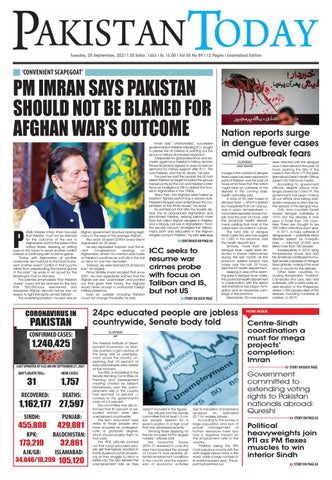
PM IMran says PakIstan should not be blaMed for afghan war’s outcoMe
P
rime minister imran Khan has said that Pakistan must not be blamed for the outcome of the war in Afghanistan and for the losses of the United States, stressing on setting eyes on the future to avoid another conflict instead of continuing with a blame game. “Today, with Afghanistan at another crossroads, we must look to the future to prevent another violent conflict in that country rather than perpetuating the blame game of the past,” he wrote in an op-ed for The Washington Post on monday. The premier emphasised that Pakistan “surely” could not be blamed for the fact that “300,000-plus well-trained and equipped Afghan security forces saw no reason to fight the lightly armed Taliban”. The underlying problem, he said, was an
Afghan government structure lacking legitimacy in the eyes of the average Afghan. Also read: US spent $290m every day in Afghanistan for 20 years He also expressed “surprise” over the recent Congressional hearings on Afghanistan, where “no mention was made of Pakistan’s sacrifices as a US ally in the war on terror for over two decades”. “instead, we were blamed for America’s loss,” he added. Prime minister imran recalled that since 2001, he had repeatedly warned that the Afghan war was “unwinnable” and pointed out that given their history, the Afghans would never accept a protracted foreign military presence. even an outsider including Pakistan could not change this reality, he said.
coronavIrus In
PakIstan
CONFIRMED CASES:
1,240,425
LAST UPDATED AT 9:22 AM ON SEPTEMBER 27, 2021
DAY'S DEATH TOLL:
NEW CASES:
31
1,757
RECOVERED:
DEATHS:
1,162,177 27,597 SINDH:
PUNJAB:
455,808
429,081
KPK:
BALOCHISTAN:
173,210 AJK/GB:
32,861 ISLAMABAD:
34,046/10,299
105,120
imran said “unfortunately”, successive governments in Pakistan following 9/11 sought to please the US instead of pointing out the error in a military-dominated approach. “Desperate for global relevance and domestic legitimacy, Pakistan’s military dictator Pervez musharraf agreed to every American demand for military support after 9/11. This cost Pakistan, and the US, dearly,” he said. The premier said the people the US had asked Pakistan to target included the groups trained jointly by the CiA and Pakistan’s interServices intelligence (iSi) to defeat the Soviets in Afghanistan in the 1980s. “Back then, the Afghans were hailed as freedom fighters performing a sacred duty. President reagan even entertained the mujahideen at the White House,” he wrote. He pointed out that after the Soviets’ defeat, the US abandoned Afghanistan and sanctioned Pakistan, leaving behind more than five million Afghan refugees in Pakistan and a bloody civil war in Afghanistan. “From this security vacuum emerged the Taliban, many born and educated in the Afghan refugee camps in Pakistan,” he said. news desk
CONTINUED ON PAGE 03
ICC seeks to resume war crimes probe with focus on Taliban and IS, but not US STORY ON BACK PAGE
Nation reports surge in dengue fever cases amid outbreak fears ISLAMABAD staff report
A surge in the number of dengue fever cases has been reported in parts of Pakistan over the past 24 hours amid fears that the nation might face an outbreak of the disease in the coming days, health authorities said. A total of 90 new cases of dengue fever — which is spread by mosquitoes that can only survive in warm temperatures — have been reported across Punjab over the past 24 hours, said the provincial health department, adding that most of the cases were recorded in Lahore. The total tally of dengue fever cases this year has surged to 1,082 in the province, said the health department. Similarly, more than 800 dengue fever cases were detected in Khyber Pakhtunkhwa during the last month as the province added several new cases over the last 24 hours, said the KP health department. Keeping in view of the alarming spike in dengue fever cases, the provincial health department in collaboration with the district administrations has begun fumigation and an awareness campaign in the province. meanwhile, 32 more people
24pc educated people are jobless countrywide, Senate body told ISLAMABAD inp
The Pakistan institute of Development economics on monday painted a grim picture of the rising rate of unemployment across the country, underlining that 24 percent of educated people were jobless at the moment. The PiDe, in its briefing to the Senate Standing Committee on Planning and Development meeting chaired by Saleem mandviwala, said the unemployment rate in the country had reached 16 percent — contrary to the government’s claim of 6.5 percent. The committee was also informed that 40 percent of educated women were also unemployed countrywide. The term ‘educated’ here refers to those people who have acquired an undergraduate or graduate degree, which should enable them to find a job. The PiDe officials pointed out that some educated people get themselves enrolled in m.Phil studies to continue learning as they struggle to fetch a better job. This also skewed the unemployment rate as they
were infected with the dengue virus in islamabad in the past 24 hours, pushing the tally of the cases in the city to 177 this year, islamabad District Health Officer Zaeem Zia told local media. According to government officials, despite various challenges posed by Covid-19, the government has been making all-out efforts and taking adequate measures to stem the further spread of the dengue virus. Only nine countries faced severe dengue outbreaks in 1970. But the disease is now seen in more than 100 countries. There are thought to be 390 million infections each year. in 2011, a major outbreak of dengue fever — potentially lethal disease spread by mosquito bites — infected 20,000 and killed more than 300 people. Subsequently, in 2019, rising temperatures across Asia and the Americas contributed to multiple severe outbreaks of dengue fever globally, making it the worst year on record for the disease. Other Asian countries, including Bangladesh, Thailand, Cambodia and Laos, also had outbreaks, with a particularly severe situation in the Philippines, where 1,000 people died of the disease, including hundreds of children, in 2019.
more inside
Centre-Sindh coordination a must for mega projects’ completion: Imran STORY ON BACK PAGE
weren’t included in the figures. The officials told the Senate committee that at least 1.5 million people applied for a peon’s position in a high court that was advertised recently. “Among those applying for the job included m.Phil degree holders,” officials said. The economic Survey 2020-21 released in June this year had revealed the spread of Covid-19 had severely affected employment conditions in the country and the suspension of economic activities
due to imposition of lockdowns rendered an estimated 20.71m workers jobless. According to the survey, a large population and lack of proper management of human resources have also had a negative impact on the employment rate in the country. “Pakistan being the fifth most populous country with the ninth largest labour force in the world, adds a large number to its workforce every year,” the report had pointed out.
Government committed to extending voting rights to Pakistan nationals abroad: Qureshi STORY ON PAGE 03
Political heavyweights join PTI as PM flexes muscles to win interior Sindh STORY ON PAGE 03
02
Tuesday, 28 September, 2021
ISLAMABAD
NEWS
Supreme Court binS petitionS Seeking preSidential government ISLAMABAD
t
stAff rePort
HE Supreme Court on Monday dismissed as non-maintainable identical petitions seeking shift to a United States-style presidential system from the incumbent parliamentary government. “There is no clause in the Constitution which mandates the Supreme Court to issue
instructions to the prime minister for a referendum for the presidential form of government,” it ruled. A three-member bench — headed by Justice Umar Ata Bandial and comprising Justice Mansoor Ali Shah and Justice Munib Akhtar — upheld the objections on petition raised by the court’s Registrar Office. The court took up an appeal against the objections. “It is a political question, how could the court intervene in it [n the
process],” Justice Shah questioned. “If [a parliamentarian] has raised a question or demanded in the parliament on the presidential form of government.” “How can a single person make such a demand […] changing the system of government,” Justice Akhtar asked. “It is prime minister’s discretion to refer the matter for a referendum on the issue to the joint sitting of the parliament.” “[In any case] the matter will be decided
by the parliament,” Justice Akhtar said. “The parliament is currently dysfunctional,” a petitioner, Ahmad Raza Khan Kasuri, claimed. “I am [one of the] founder[s] of the 1973 Constitution,” he said. “Did you sign for the parliamentary system in the constitution,” the court questioned. “Neither I voted nor signed on the constitution,” he replied. “Then you could not claim to be a founder of the constitution,” Justice Akhtar
said. Four petitioners — Kasuri, Sadiq Ali, Tahir Aziz Khan and Hafeez ur-Rehman Chaudhry — had filed identical constitutional petitions under Article 184(3) of the Constitution arguing for a presidential form of government in the country. They requested the Supreme Court, “being the custodian of the rights of people and the Constitution”, may direct the prime minister to hold a referendum under Article 48(6) in order to ascertain and determine the will of the people.
PML-N united behind Nawaz’s leadership, says Maryam LAHORE MiAn AbrAr
Pakistan Muslim League-N Vice President Maryam Nawaz Monday admitted differences within the Sharif household but said that they stand behind Nawaz Sharif’s leadership. “Hamza [Shehbaz] and me may have a difference of opinion [over certain issues] but we are untied and Hamza Shehbaz is my younger brother,” said Maryam Nawaz while addressing a party meeting. The PML-N vice president said that she and Hamza Shahbaz are united and stand behind Nawaz Sharif’s leadership. “I pray for Hamza from the bottom of my heart. We both are united and Nawaz Sharif is only head of our family and the entire party. I sincerely appreciate the services of Shehbaz Sharif too,” she added. Maryam also mentioned that the worst tactics were used in the recently held
Cantonment Board elections to help the ruling party win the elections which were even worse than the dictatorship era. “Thank God, we got a huge victory. We were defeated in the Kashmir election on TV as the ruling party got 600,000 votes and we got 500,000 votes,” she said. “We lost only one seat in Sahiwal in the 2018 General Elections. I can still see the spirit of victory and commitment on your faces today. This happens only when you remain attached to the party leadership and do not deviate from their mission,” the PML-N leader added. Maryam Nawaz further said that the PML-N is the only present, past and future option for Pakistan. She also criticized Prime Minister Imran Khan for skyrocketing inflation and rising prices of daily-use commodities. “It is our national responsibility not to let this country fall into the wrong hands. The principle of nature is that time does not remain the same and time is changing now,” she concluded.
ISLAMABAD: Shia Muslims participate in an Arbaʽeen procession in Sector G-6-2. online
PPP to forcefully oppose ‘illegal extension’ in NAB chairman’s tenure KARACHI inP
Pakistan People’s Party (PPP) Chairman Bilawal Bhutto-Zardari said on Monday his party would “forcefully” oppose the possible extension in Justice (r) Javed Iqbal’s tenure as National Accountability Bureau (NAB) chairman. “Illegal extension in Chairman NABs tenures would be forcefully opposed by PPP,” the young PPP leader tweeted. “Law specifies tenure my not be extended. Even attempting an extension, for most controversial chairman in history, would serve to prove our argument that National Accountability Bureau is an extension of IKs govt not impartial.”
On Saturday, Law Minister Farogh Naseem dismissed reports that his ministry has drafted an ordinance to extend the incumbent NAB chief’s tenure. Talking to journalists, the law minister Farogh Naseem said the issue of the possible extension of the incumbent NAB chairman’s tenure has come up in meetings with Prime Minister Imran Khan four to five times. The situation will become clear next week, he hoped, adding that it is the prime minister’s prerogative to pick a person for the post of the head of the corruption watchdog and that he could only give his advice on the issue. Farogh said that the prime minister would consider more than one name for the post and will pick whoever he thinks is fit for the slot.
CAA allows Afghanistan airline to operate Islamabad-Kabul flights KARACHI: Pakistan has allowed an Afghanistan airline to operate its flights from Islamabad to Kabul, a Civil Aviation Authority official said late on Sunday. Kam Air — Afghanistan’s largest private airline — will operate three flights a week, becoming the first Afghan airline to operate outside Afghanistan after the Taliban takeover, Irfan Sabir, director of CAA Air Transport, told Anadolu Agency. The permission, he said, has been granted at the request of Kam Air, which, until now, is the only Afghanistan airline to apply for the flight permit. Initially, he said, that the airline might only operate chartered flights from Islamabad to Kabul due to limited passengers. In the coming days, he added, it might start commercial flights. Flight operations in Afghanistan came to a halt after the Taliban takeover of Kabul on August 15. The domestic flights were resumed on September 5. AnAdolu Agency
Covid-19 cut life expectancy by most since World War II: study LONDON reuters
The Covid-19 pandemic reduced life expectancy in 2020 by the largest amount since World War II, according to a study published on Monday by Oxford University, with the life expectancy of American men dropping by more than two years. Life expectancy fell by more than six months compared with 2019 in 22 of the 29 countries analysed in the study, which spanned Europe, the United States and Chile. There were reductions in life expectancy in 27 of the 29 countries overall. The university said most life expectancy reductions across different countries could be
linked to official Covid-19 deaths. There have been nearly 5 million reported deaths caused by the new coronavirus so far, a Reuters tally shows. “The fact that our results highlight such a large impact that is directly attributable to Covid-19 shows how devastating a shock it has been for many countries,” said Dr Ridhi Kashyap, co-lead author of the paper, published in the International Journal of Epidemiology. There were greater drops in life expectancy for men than women in most countries, with the largest decline in American men, who saw life expectancy drop by 2.2 years relative to 2019. Overall, men had more than a year shaved
off in 15 countries, compared to women in 11 countries. That wiped out the progress on mortality that had been made in the previous 5.6 years. In the United States, the rise in mortality was mainly among those of working age and those under 60, while in Europe, deaths among people aged over 60 contributed more significantly to the increase in mortality. Kashyap appealed to more countries, including low- and middle-income nations, to make mortality data available for further studies. “We urgently call for the publication and availability of more disaggregated data to better understand the impacts of the pandemic globally,” she said.
Tuesday, 28 September, 2021
ISLAMABAD
GOverNmeNt COmmitted tO exteNdiNG vOtiNG riGhtS tO PakiStaN NatiONalS abrOad: QureShi iSLamaBad/London:
t
app
HE Pakistan Tehreek-i-Insaf government was committed to granting voting rights to Pakistan nationals living abroad and facilitate them through various initiatives, Foreign Minister Shah Mahmood Qureshi said. Addressing at a gathering of Pakistan diaspora in the United Kingdom in London, the foreign minister lauded the contributions of the British-Pakistanis in cementing the ties between Islamabad and London. The event was attended by the Pakistan community including MPs, academics, corporates and professionals, the Foreign Office said in a statement. Qureshi apprised the participants
of the measures taken by the government to facilitate them including granting the right to vote to overseas nationals. He appreciated in particular the buy-in of initiatives such as Roshan Digital Accounts on part of the community. He apprised the gathering of efforts being made by Pakistan to raise the Kashmir dispute and highlight severe rights and humanitarian crises in Indian-occupied Kashmir at every forum, including the UN General Assembly Session in New York that concluded last week. A dossier containing evidence of war crimes committed by India had been prepared which included audio recordings and video evidence of rights violations. He invited the attendees to confirm
for themselves the veracity of the evidence shared therein. He reaffirmed Pakistan’s unflinching commitment to stand in solidarity with its Kashmiri brethren until the realisation of their inalienable right to self-determination. The foreign minister informed the audience that Pakistan had extended every possible support for the evacuation of foreign and Afghanistan locals who wanted to exit the country and also set up a humanitarian corridor to serve the purpose. It was imperative that the international community did not repeat mistakes of the past, stayed engaged, and acted to prevent a humanitarian disaster, he said. Earlier, welcoming Qureshi, Pakistan’s high commissioner to the UK, Moazzam Ahmad Khan, apprised
the foreign minister of the measures being taken to enhance communication with the Pakistan community and improve their access to the services offered by the mission and its consulates across the Britain. He thanked the foreign minister for taking a personal interest in resolvong the issue of removal of Pakistan from the so-called travel red list. He also recounted that pursuant to the foreign minister’s emphasis on economic diplomacy, the mission had been making concerted efforts to increase and diversify exports, enhance remittances and encourage Foreign Direct Investment. This had resulted in a substantial and unprecedented increase in exports and remittances, and an improvement in FDI.
NEWS
03
Jinnah's statue bombed in Gwadar neWS deSK A statue of Father of the Nation Quaid-e-Azam Muhammad Ali Jinnah was bombed by miscreants in the port city of Gwadar. The statue was erected earlier this year at Marine Drive, a major thoroughfare of the developing city. Official sources said that the miscreants planted an explosive device under the statue and blew it up. “The statue of Quaid-e-Azam Muhammad Ali Jinnah was blown up using explosive device,” Dr Farhan Zahid, an official, stated and added that the statue was completely destroyed by the blast. He also said that the Bomb Disposal Squad (BDS) will investigate the incident. No human loss was reported in the incident, the official confirmed. Security was beefed up in the port city following the incident, with additional security personnel deployed at various points. A banned organisation has claimed responsibility for the bombing. A week ago, the Counter-Terrorism Department foiled a terrorism plan hatched by the Balochistan Liberation Army during an intelligence-based operation on the outskirts of Quetta city. According to a CTD spokesperson, a terrorist was arrested during the operation and a large amount of explosives was recovered from his possession.
Editorial: Building monumEnts on pagE 06
NCOC daily update: 1,757 new cases, 31 deaths from Covid-19 iSLamaBad Staff report
rs2bn released to upgrade cyber security apparatus: minister iSLamaBad Staff report
The government has released an initial budget of Rs2 billion to improve and upgrade its obsolete cyber security apparatus, Minister for Interior Sheikh Rashid Ahmad said. Cyber security is the practice of defending computers, servers, mobile devices, electronic systems, networks, and data from malicious attacks. The decision to invest in the computer security regime comes months after the government announced to probe the reports of pro-India malware spying on top civilian leadership, including the prime minister, and the military. In July, Islamabad announced it was investigating whether a mobile phone number once used by Imran Khan was part of a surveillance hacking attempt using the Pegasus software. Months before that, in February, Lookout Inc., a California-based cybersecurity company, reported that two malware programs on an Android-based platform that emerged in India have been spying on the Pakistan military. Addressing a press conference in Islamabad on Monday, Ahmad said the amount will help engage technocrats to improve Pakistan’s cyber security regime. He said the cyber-attacks and threats on government entities have increased manifold, revealing his ministry has received 100,000 complaints since December last when he assumed office. The minister said it has also been decided to introduce e-passports. In this regard, a summary is being forwarded to the cabinet for approval to add 15 additional countries to the visa-on-arrival list, taking the number of the nations to 65. These countries include the United States, Canada, France and Iran, he said. Ahmad said those elements behind the cancellation of the tour of the New Zealand cricket team will be exposed soon and the Federal Investigation Agency was working on it. The government has also contacted Interpol and “we will give good news to you soon”, he said. While threats from various terrorist bodies were present, the military and the security agencies were “well-equipped and passionate” about eliminating them, he said. “If anyone raises their head for terrorism in the country, they will be trampled.” Commenting on the political situation, the minister said the Election Commission of Pakistan and the government were “coming closer” and the “combative atmosphere” between the two on the introduction of electronic voting was “diminishing”. He also stressed the need for a cordial atmosphere between state institutions to conduct fair elections. Ahmed predicted there would be “three factions” within the Pakistan Muslim League-Nawaz party and it would be subject to internal strife and conflict two years later when a new political atmosphere would present itself. He said PML-N chief Shehbaz Sharif should worry about his party instead of thinking, and planning, of going after the government. Responding to a question, the interior minister said good news will soon be shared with the nation concerning the use of electronic voting machines as it was the demand of the people, and not the government.
political heavyweights join pti as pm flexes muscles to win interior sindh iSLamaBad Mian abrar
In a major political breakthrough, former chief minister Sindh Syed Ghous Ali Shah along with other political heavyweights called on Prime Minister Imran Khan and announced they would be joining the ruling Pakistan Tehreek-e-Insaf. Others who joined the ruling party included former federal minister Syed Zafar Ali Shah, Syed Safdar Ali Shah and Barrister Mustafa Mehsar. Former ministers Liaquat Ali Jatoi, Sadaqat Ali Jatoi, MNA J. Prakash, Syed Zulfiqar Shah, Gul Muhammad Rind, Syed Jalal Mehmood Shah, Allah Bakhsh Unnar, Raja Khan Jhakrani, Ali Mughiri, Asad Shah and Ameer Bukhsh Bhutto were also present who met the premier. Federal Ministers Asad Umar, Syed Ali Zaidi, Special Assistant to PM Arbab Ghulam Rahim, Governor Sindh Imran Ismail and Leader of Opposition in Sindh Assembly Aleem Adil Shaikh were present in the meetings. The premier welcomed the political leaders in the party and expressed his desire to expand the PTI to deep into Interior Sindh.
According to a source within the PTI, Prime Minister Imran Khan has decided to mobilise the public across Sindh Province, and in this regard, the premier has decided to hold political rallies across Sindh Province. “In these rallies to be held in Sindh, political heavyweights will join the PTI. Moreover, Prime Minister Imran Khan has convened an important meeting of party leaders in the federal capital which the Sindh Plan will be finalized,” the sources added. The source said that the names of the Sindh Advisory Committee will also be finalized in this meeting. “Important decisions would also be taken to tackle the obstacles to the execution of federal projects across Sindh as well as consultations with political leadership would also be made on action to be taken against provincial bureaucrats involved in corrupt practices,” the source said. In addition, it was reported that PTI has also decided to give a tough time to the Pakistan People’s Party and the possibility of upheaval is also being discussed. The top leadership of the PTI has also started extensive contacts with the political heavyweights in this regard, the source said.
Pakistan reported 1,757 new Covid-19 cases over the past 24 hours, the National Command and Operation Centre said on Monday. The total tally of the infected people climbed to 1,240,425 in the country, the department leading campaign against the pandemic said. Sindh has been the worst hit, with a total of 455,808 cases, followed by Punjab where the virus was detected in 429,081 people. A total of 27,597 people died from the virus, with 31 new deaths, the NCOC said. The country currently has 50,651 active cases, while 1,162,177 others have recovered.
PPP robbing Sindh’s people for last several decades: Gill iSLamaBad inp
Special Assistant to the Prime Minister on Political Communication Dr Shahbaz Gill on Monday said Pakistan People’s Party has been robbing the rights of Sindhi’s people for the last several decades. In a tweet, he said provision of transport, roads, health and education was sole responsibility of the provincial government after the 18th constitutional amendment which did not fulfill so far. Gill said PPP was still looting the national wealth while Imran Khan was serving the people of Karachi through repairing of roads of Karachi and Circular Railway.
‘Convenient scapegoat’: PM Imran says Pakistan should not be blamed for Afghan war’s outcome Continued from page 01 Post 9/11, he continued, the US needed Pakistan again, “but this time against the very actors we had jointly supported to fight foreign occupation”. He said the mujahideens of the past were declared terrorists overnight, while militant groups declared a war against the Pakistani state after Pakistan supported the US war on terror. Prime Minister Imran said Gen Musharraf offered Washington logistics and airbases, allowed a CIA footprint in Pakistan and even turned a blind eye to American drones bombing Pakistanis on their soil. “For the first time ever, our army swept into the semiautonomous tribal areas on the Pakistan-Afghanistan border, which had earlier been used as the staging ground for the anti-Soviet jihad,” he recalled. He said for the locals, the US was an “occupier” of Afghanistan just like the Soviets, deserving of the same treatment. As Pakistan was now America’s collaborator, “we too were deemed guilty and attacked,” he said. “This was made much worse by over 450 US drone strikes on our territory, making us the only country in history to be so bombed by an ally,” he added. “These strikes caused immense civilian casualties, riling up antiAmerican (and anti-Pakistan Army) sentiment further.” He recounted the suffering in Pakistan after it joined the Afghan war.
“The die was cast,” the premier said. “Between 2006 and 2015, nearly 50 militant groups declared jihad on the Pakistani state, conducting over 16,000 terrorist attacks on us.” Pakistan suffered over 80,000 casualties and lost over $150 billion in the economy, besides driving 3.5 million citizens from their homes, he added. Imran said the militants escaping the Pakistani counter-terrorism efforts entered Afghanistan and were then supported and financed by Indian and Afghan intelligence agencies. “Pakistan had to fight for its survival,” he wrote, quoting a former CIA station chief in Kabul in this regard who wrote in 2009 that the country was “beginning to crack under the relentless pressure directly exerted by the US”. Yet the US continued to ask Pakistan to “do more” for the war in Afghanistan, he said. The prime minister recalled that a year earlier, in 2008, he met then-senators Joe Biden, John Kerry and Harry Reid, among others, to explain this dangerous dynamic and stressed the futility of continuing a military campaign in Afghanistan. Even so, political expediency prevailed in Islamabad throughout the post-9/11 period, he said. He said former president Asif Ali Zardari — whom he termed “undoubtedly the most corrupt man to have led the country” — told the Americans to continue targeting Pakistanis because “collateral damage worries you Americans. It does not worry me.” Nawaz Sharif, the next prime minister, “was no
different”, he added. Imran said while Pakistan defeated the terrorist onslaught completely by 2016, the Afghan situation continued to deteriorate. Explaining the “difference” in the outcomes of the two countries, he said “Pakistan had a disciplined army and intelligence agency, both of which enjoyed popular support.” In Afghanistan, meanwhile, the lack of legitimacy for an outsider’s protracted war was compounded by a corrupt and inept Afghan government, seen as a puppet regime without credibility, especially by rural Afghans. “Tragically, instead of facing this reality, the Afghan and Western governments created a convenient scapegoat by blaming Pakistan, wrongly accusing us of providing safe havens to the Taliban and allowing their free movement across our border,” the prime minister said. He said in order to satisfy Kabul, Pakistan offered a joint border-visibility mechanism, suggested biometric border controls, advocated fencing the border, and other measures. “Each idea was rejected,” he said, noting that Pakistan had now fenced the border largely “on our own”. “Instead, the Afghan government intensified the ‘blame Pakistan’ narrative, aided by the Indian-run fake news networks operating hundreds of propaganda outlets in multiple countries.” He emphasised that a more realistic approach would have been “to negotiate with the Taliban much earlier”, avoiding the embarrassment of the collapse of the Afghan army and the Ashraf Ghani government.
Fia initiates action against makers of ‘fake’ Covid vaccine certificates iSLamaBad Staff report
Federal Investigation Agency Director General Sanaullah Abbasi on Monday said action has been initiated against individuals generating fake Covid-19 vaccination certificates.
Addressing a press conference, he said the step was taken as per guidelines of the National Command and Operation Center and so far, 41 people have been arrested and cases have been registered. He said people who received certificates from these people were under probe by the FIA and the agency has called
many of them, it’s and calling others as well. He said their certificates have been cancelled and the FIA has been working with a tracking system to trace these people who were committing such crimes that could lead to death. He said though the scale of the operation was small — as more than 75
million doses were administered so far — the people should beware of them. He said these people were bringing embarrassment to the nation and the state as a whole. “I urge the nation to complete their families’ vaccination under the free nationwide inoculation programme as per law.”
Tuesday, 28 September, 2021
04 NEWS
ISLAMABAD Bitcoin rises to $43,800 as cryptos consolidate gains
ISLAMABAD: Families of the martyred FC personnel protest for the fulfilment of their demands. ONLINE
Gold price increases to Rs95,400 per 10gm Gold prices remained almost flat in a cautious trade on Monday amid improving market mood as fears of China’s Evergrande bankruptcy recede. At 1130 hours GMT, gold in the international market was available at $1,749.40 per ounce after shedding $1.80. Meanwhile, the price of 10 grams of yellow metal in Pakistan increased to Rs95,400 after gaining Rs300. The closing prices of the yellow metal in the country remained Rs95,100 on Saturday last. The increase in local gold prices was also due to depreciation of Pakistani rupee against the US dollar. According to experts, gold is easing off the higher levels, as the risk-on market environment amid ebbing China Evergrande fears and US stimulus optimism dulls the safehaven appeal of the bright metal. They said that gold inched down despite a broadly weaker US dollar, as the Treasury yields retreat from multi-month tops. They said that gold traders refrain from placing fresh long bets on the metal ahead of the critical US durable goods data. From a technical point of view, gold is facing the first resistance at $1760, which is the bearish 21-Simple Moving Average (SMA). If gold bulls succeed to find a strong foothold above that level, then the downward-sloping 50-SMA at $1765 could be immediately probed. A fresh upswing will be initiated on a four-hour candlestick closing above the 50SMA, opening doors towards the descending 100-SMA at $1783. NEWS DESK
Govt offering loans to promote businesses: Farrukh
RuPee Falls to 169.60 aGainst dollaR KARACHI
P
US dollar in the current year 2021. The local currency has maintained a downtrend after it touched 22-month high of Rs152.27 in May 2021, losing a cumulative Rs17.29 in the past four months to date. Earlier, the rupee made a historic low of Rs169.12 on September 15 last against the dollar. According to currency dealers, the demand for the US dollar remained high as the market opened after two weekly holidays. They said the dollar’s demand is high because of import and corporate payments due to the quarterend. They added by every quarter-end, foreign entities operating in Pakistan repatriate profit and dividends to their parent companies abroad. They said that widening of trade deficit and the current account deficit also deteriorated the market sentiments.
TLTP
AKISTANI rupee continued struggling against the US dollar in the inter-bank for the fourth consecutive session on Monday and set an all-time low of Rs169.60. According to the State Bank of Pakistan, the local unit depreciated by 52 paisas (-0.31 percent) against the greenback, as the US dollar opened at Rs169.08 and closed at Rs169.60. Within the open market, the rupee was traded at Rs170.50/171.50 per dollar. The Pakistani rupee shed Rs0.91 during the last week against the US dollar, while depreciation during the fiscal year 2021-22 has been Rs12.18. The local unit has shed Rs9.33 against the
Brent crosses $79 as crude prices rally to three-year high Crude prices extended gains on the fifth day in a row on Monday, rallying to their highest levels since October 2018 as global refineries fail to keep up with fuel demand that is projected to reach pre-pandemic levels by early next year. At 1105 hours GMT, Brent, the international benchmark for two-thirds of the world’s oil, gained $0.99 (+1.27 percent) to reach $79.08 a barrel. Similarly, the US West Texas Intermediate (WTI) reached $74.85 a barrel, up by $0.84 (+1.14 percent). The price for Opec Basket was recorded at $75.44 a barrel with 1.32 percent increase, Arab Light was available at $77.44 a barrel with a 1.51 percent increase, while the price of Russian Sokol jumped to $77.87 after gaining 1.55 percent. According to experts, the crude price rally is being attributed to the swift recovery of demand across the world as economies open up with the easing of pandemic restrictions. NEWS DESK
KSE-100 sheds 255 points to drop below 45,000-mark KARACHI TLTP
Minister of State for Information and Broadcasting Farrukh Habib has said that the government is taking steps for promotion of business in the country and loans up to Rs10 million are being offered in this regard. While addressing businessmen on Monday, the minister said that the global economy took a major hit due to the coronavirus pandemic but the Pakistan Tehreek-e-Insaf (PTI) government decided against a complete lockdown despite repeated demands from opposition parties. He said that due to this decision of Imran Khan, businesses continued and pace of vaccination was also increased. NEWS DESK
They said that import payment hit a historic high of around $6.4 billion in August while the previous peak was recorded in June at $6.3 billion. On the flipside, export earnings have remained sluggish at around $2.2 billion a month during the same months. The uptrend in international commodity prices suggests that Pakistan’s import bill would remain high going forward. The prices of oil and food items are soaring in the world markets. In addition to this, businesses are set to make hefty imports of plant and machinery to set up new factories and expand the existing production lines under the central bank’s initiative Temporary Economic Refinance Facility (TERF), they said. Imports are set to skyrocket due to the government’s policy of expansion and growth in the domestic economy, they said.
The cryptocurrency market remained positive for the third straight day on Monday, with the market cap gaining 1.8 percent to reach $2.4 trillion mark as of 1100 hours GMT. The price of bitcoin (BTC), the largest cryptocurrency, gained 1.70 percent to reach $43,800. With this increase in price, the market capitalisation of the biggest cryptocurrency has reached $824.6 billion. Likewise, ether (ETH) price went up by 4.78 percent to reach $3,102. With this increase in price, the market capitalisation of ETH has reached $363.9 billion. Similarly, XRP price gained 2.90 percent to reach $0.962. The market capitalisation of XRP stands at $96.1 billion after this increase. However, cardano (ADA) price faced selling pressure and shed 0.73 percent to reach $2.23. Its market capitalisation has reached $72.1 billion after this decrease. On the other hand, dogecoin (Doge) price gained 1.51 percent to reach $0.206. With this increase in price, the market capitalisation of doge has increased to $27 billion. Meanwhile, cryptocurrency-linked stocks dropped in Hong Kong on Monday morning, after Chinese authorities intensified their clampdown on the industry, while major cryptocurrencies steadied. Shares of crypto asset manager and trading firm Huobi Tech, an affiliate of Huobi Global, one of the world’s largest exchanges, fell more than 30 percent after the opening bell. Huobi Global said on Sunday it has stopped taking new mainland customers from Friday and would close accounts belonging to mainland-China based clients by the end of the year to comply with local regulations. China’s regulators intensified the clampdown on Friday, banning cryptocurrency transactions and mining, and saying that overseas exchanges are barred from providing services to mainland investors via the internet and that mainland-China based employees of overseas crypto exchanges would be investigated. NEWS DESK
The Pakistan Stock Exchange (PSX) started the week with a roller-coaster session on Monday amid rupee depreciation against the US dollar, with the benchmark KSE-100 Index shedding 255.76 points (0.57 percent) to close at 44,817.76 points. The market opened on a positive note but remained volatile throughout the trading session. At one point, the benchmark index shed over 700 points; however, a sharp recovery was witnessed in the last half an hour where the index recovered most of its intra-day losses. The KSE-100 Index moved in a range of 894.5 points, showing an intraday high of 45,236.4 points and a low of 44,341.5 points. Among other indices, the KSE All Share Index shed 233.4 points (-0.76 per-
cent) to close at 30,544.31 points, while All Share Islamic Index shed 204.14 points (-0.93 percent) to close at 21,723 points. A total of 375 companies traded shares in the stock exchange, out of them shares of 101 closed up, shares of 259 closed down while shares of 15 companies remained unchanged. Out of 95 traded companies in the KSE-100 Index, 33 closed up, 59 closed down, and three remained unchanged. The overall market volumes decreased by 68.14 million to 301.39 million shares. Total volume traded for the KSE-100 Index was 162.70 million shares. The number of total trades decreased by 20,388 to 101,455, while the value traded decreased by Rs0.60 billion to Rs11.18 billion. The market capitalisation decreased by Rs58.45 billion. Among scrips, UNITY topped the volumes with 34.95 million shares, followed by WTL (32.65 million) and BYCO (32.17
million). Stocks that contributed significantly to the volumes include UNITY, WTL, BYCO, HUMNL and BAFL, which formed 40 per cent of total volumes. The index on a sector-wise basis was let down by commercial banks with 100 points, refinery with 34 points, paper & board with 25 points, investment banks/ investment companies /securities companies with 23 points and pharmaceuticals with 20 points. The most points taken off the index were by TRG which stripped the index of 51 points followed by HBL with 51 points, MEBL with 29 points, UBL with 18 points and PSO with 16 points. The sectors propping up the index were fertilizer with 19 points, chemical with 11 points, cable & electrical goods with 5 points, oil & gas exploration companies with 2 points and textile spinning with 2 points. The most points added to the index
was by SYS which contributed 49 points followed by FFC with 18 points, MTL with 8 points, KTML with 7 points and EPCL with 7 points. According to Topline Securities, higher international commodity prices coupled with an outstanding futures position of Rs12.48 billion marked as delivery resulted in aggressive selling pressure from the participants. Analysts at Arif Habib Limited said that market posted gains of 163 points earlier in the session, but faced the onslaught sooner which caused the erosion of these gains and netting a loss of 732 points during the session. They said that leveraged positions mostly got thrashing; however, resumption of PKR slippage was another reason cited for the panic selling in the market. Volumes remained thin compared with the activity in recent times, where ample volumes were witnessed in blue chips, they added.
Economic reforms needed for sustainable growth: Sanchez NEWS DESK Federal Minister for Industries and Production Makhdum Khusro Bakhtyar has said that the government is committed to engaging the International Monitoring Fund (IMF) to broaden the economic development in the country.
The minister said this while talking to IMF County Representative for Pakistan Teresa Daban Sanchez who made a farewell courtesy call on him on Monday along with Esther Perez Ruiz, newly appointed IMF country representative in Pakistan, according to a press statement.
The minister welcomed the appointment of Ruiz in Pakistan and conveyed well wishes to outgoing IMF Resident Representative Teresa Daban. During the interaction, the sides exchanged views on economy of Pakistan in post-pandemic situation.
CMYK
Teresa lauded the efforts of the government of Pakistan to curb the negative impacts of the pandemic through well-timed monetary and exchange rate policies. She also commended Pakistan’s response to the health and economic crisis amidst the pandemic and said the vital economic reforms
are needed to achieve the sustainable economic growth in Pakistan. The minister highlighted the government’s endeavours to develop a long-term sustainable and viable economic plan to address issues pertaining to the fiscal and monetary situation in Pakistan.
Tuesday, 28 September, 2021
ISLAMABAD
HeAvy rAInFAll In KArACHI, OTHer AreAS exPeCTed TOdAy H
EAVy to very heavy rainfall is expected in Karachi and other southeastern districts of Sindh from Tuesday. Met Office has predicted that strong monsoon currents are likely to penetrate in Sindh from Monday and to continue till Saturday. Pakistan Meteorological Department has forecast chances of dust-thunderstorm and rain at evening or night tomorrow. Rain with wind-thundershower with heavy to very heavy falls is expected in Mirpurkhas, Tharparker, Umarkot, Sanghar, Thatta, Badin, Karachi,
Hyderabad, Tando Allayar, Tando Muhammad Khan, Matiari, Shaheed Benazirabad and Dadu, from tomorrow till Saturday with occasional gaps. Heavy falls are also expected in Karachi, Thatta, Badin, Dadu and Hyderabad during the wet period. Rainfall is also expected at scattered places in Sukkur, Larkana, Jacobabad, Kohlu, Sibbi, Naseerabad, Barkhan, Zhob, Dera Ghazi Khan, Rajanpur and Bahawalpur from Tuesday to Thursday. Isolated rainfall is expected in Kashmir, GilgitBaltistan, Islamabad, Northeast Punjab, Upper Khyber
Pakhtunkhwa from today and tomorrow till Thursday and Friday, according to the weather department. Heavy fall may generate urban flooding in Karachi, Thatta, Badin, Hyderabad and may trigger flash flooding in Kalat, Khuzdar and Lasbella during the forecast period. Weather remained hot and dry over most parts of Sindh on Sunday. However light to heavy rainfall occurred in Mirpurkhas division. Maximum rainfall reported at Kaloi 25 mm, Mitthi 10 mm and Chhachhro 08 mm. Traces of rainfall also reported from Badin and Islamkot. NEWS DESK
Sindh govt hands over 32 schools to private parties BOP for Promotion of Cricket The management of the Bank of Punjab has incorporated promotion of sports in the country as an essential element of the new strategy of the Bank. In the same spirit, a meeting of the senior management of the Bank of Punjab, led by Mr. Zafar Masud, President & CEO, was held with Mr. Rameez Raja, Chairman Pakistan Cricket Board and Mr. Waseem Khan, CEO of the PCB, on Monday, September 27, 2021 at the BOP Head Office. Those present at the meeting also included Ms. Alia Zafar, Group Head HR at the BOP, as well as member Board of Governors, Pakistan Cricket Board, Mr. Javed Kureishi, member Board of Governors, PCB, Mr. Samih Khan, Chief of Staff & Strategy, BOP, Mr. Nadeem Amir, Chief Financial Officer, BOP and Mr. Asad Zia, Unit Head Corporate Communications Department, The Bank of Punjab. The purpose of the meeting was to discuss opportunities and avenues for collaboration between the two organizations for the promotion of cricket in the country, so that BOP may play its role as a responsible corporate entity. pr
Omer Sharif’s US departure delayed after health worsens Ailing comedian Omer Sharif’s US departure delayed after his health worsens on Monday. Cardiologist Syed Tariq Shahab, who is actor Reema Khan’s husband, said that Omer will have to wait 48 hours before the experts can make a decision about travel. The flight was postponed after Omer’s blood pressure dropped during dialysis, Dr Tariq added. Omer was set to travel on a German air ambulance to Washington, where he will be treated at the George Washington University Hospital. The Civil Aviation Authority had allowed the aircraft to land in Pakistan on September 26, Sunday. The comedian was to travel without his family. Omer’s first wife and sons, Jawad and Fawad, were booked on a commercial flight by the Sindh Health Department. Omer was diagnosed with mitral valve regurgitation (a condition in which blood leaks backward instead of flowing out to the rest of the body) after being admitted to the Aga Khan University Hospital for congestive heart failure. A team of eight specialists, including Dr Shahab, will treat Omer. NEWS DESK
The running of 32 schools in Sindh is going to be outsourced to three private groups, the Sindh government has decided. School Education Secretary Akbar Laghari signed agreements with three Education Management Organizations – Sindh Madressah-tulIslam Board, Dare-e-Arqam Schools (Pvt.) Ltd. and MDZed (Pvt.) Ltd the manage the schools for 10 years. The schools include 13 constructed under USAID’s Sindh Basic Education Programme, according to a handout from CM House. Sindh Madressah-tul-Islam Board will manage four new schools (made with USAID) and 10 other select Sindh government schools in Malir and West districts of Karachi. The Dare-e-Arqam Schools (Pvt.) Ltd. will manage four new schools and four grouped schools in district Qambar Shah-
dadkot, and MDZed (Pvt.) Ltd. will manage five new schools and five Sindh government schools in districts Kashmore and Jacobabad. Sindh Chief Minister Murad Ali Shah appreciated the support of the US government at the concession agreement signing ceremony Monday at CM House. The ceremony was attended by Education Minister Syed Sardar Ali Shah, US CG Mark Stroh and staff from the USAID. Through USAID the U.S. government is contributing $159.2 million for the program. The Sindh government spends $10 million. The project aims to increase and sustain enrolment by developing a conducive learning environment in Sindh government schools in select areas of the province. The focus is on bringing girls back to the school if they dropped out.
USAID’s SBEP supports the reconstruction of 106 Sindh government schools affected by the catastrophic 2010 floods. These 106 state-of-the-art buildings are being reconstructed in seven districts of northern Sindh (Dadu, Jacobabad, Kamber-Shahdadkot, Kashmore, Khairpur, Larkana, and Sukkur) and three districts in Karachi Division (Malir, West and South). The reconstructed schools along with a group of other government schools are being handed over to the private groups for improved efficiency. With the signing of these concession agreements, the operational management of 81 SBEPUSAID reconstructed schools along with a group of 90 select government schools, stands outsourced to 10 EMOs. The construction of the remaining 25 schools is at different stages. NEWS DESK
85pc people drink contaminated water due to negligence of Sindh govt: Haleem Adil The Central Vice President PTI and Leader of the Opposition in Sindh Assembly, Haleem Adil Sheikh has said that due to negligence of Sindh government, over 85 percent of the population of the province is forced to drink contaminated water. He rebuked the provincial government for not implementing report of Supreme Court mandated water commission. Speaking during his visit to Phulleli and Pinyari canals in Hyderabad on Monday, he said that more than 85 percent people of Sindh were compelled to consume sewerage mixed contaminated water as neither provincial government controlled drainage of sewerage water into irrigation channels nor treatment plants were installed as per directives of the water commission. Haleem Adil expressed annoyance over disposal of highly contaminated sewerage water without any treatment into Phulleli and Pinyari canals and said that over 5 lac people in Sindh were affected by Hepatitis while Cancer, Ulcer, Typhoid and other water borne disease were common in the province due to air and water pollution. A water commission was constituted on directives of the Supreme Court that compiled a detailed report over the situation of water contamination in Sindh, he said adding that the report was sent to the provincial government but PPP government failed to implement recommendations of the commission. Sewerage water including the hazardous industrial and hospital waste was being disposed of in River Indus and its irrigation canal which were major source of drink-
ing water for the most of the population in the province, he observed. The PTI leader said that Murtaza Wahab remained provincial environment minister for more than six years and it his responsibility to ensure implementation on report of the water commission but not a single effluent treatment plant could be made operational. Sewerage water of Sukkur was being disposed of in river Indus, sewerage drains in Shikarpur fall in Baghari canal, Larkana’s drains were falling into Rice canal and sewerage water in Dadu was being disposed in MNV drain, Haleem Adil Sheikh mentioned. He said that sewerage water of Hyderabad and Jamshoro found its disposal in Phulleli, Pinyari and Akram canals while industrial areas of Kotri and Nuriabad were draining out industrial waste and sewerage water into KB Feeder that feed Keenjhar Lake the major water source of Karachi. Manchhar Lake, once the largest sweet water lake of Pakistan, has been spoiled and now PPP government was up to Keenjhar Lake, the Opposition Leader said adding that statistics revealed that in Karachi 95 % piped water was contaminated while the ratio in Hyderabad was 85 %, in Larkana 88 % and in Shikarpur 78 %. It was fundamental responsibility of the government to provide basic facilities to masses and do away with their problems but Sindh government was busy in corruption and kept neglecting the people, he alleged and went on saying that PPP government had devastated the entire province of Sindh. NEWS DESK
NEWS
05
Group photo of Minister for Maritime Afairs, Mr. Syed y Ali Haider Zaidi with participants of workshop held at National Institute of Maritime Affairs (NIMA) at Bahria Univeristy y Islamabad. pr
Old enmity claims father, son’s lives in Thatta THATTA INp
A father and his son were murdered outside Girls High School over an old enmity in Thatta, police said on Monday. The dead were identified as Muhammad Hanif and Ghulam Muhammad. Two tribes Khoosa and Rind had old enmity over a long period of time. The police shifted the bodies to Gharo hospital. Both hailed from Badin but had recently shifted to the Gharo area. The family member of the deceased told the police that his father and brother were attacked and murdered by Khoosa and Rind tribes.
Three men rape 12-yearold boy in Tandlianwala TANDLIANWALA INp
Police in Tandlianwala on Monday registered a case against three men for raping the son of a vendor in a suburban village of Tandlianwala. When the minor boy, who had gone outside in the evening to play with the other children, did not return home all night, his father and other male members of his family started looking for him and eventually found him dumped in a sugarcane field in an unconscious condition. Later, in his statement to the police, 12-year-old Ali Husnain said that a man named Arshad had lured him to a deserted place where he and his two accomplices raped him all night.
FIA initiates action against fake Covid-19 vaccine certificate generators Federal Investigation Agency (FIA) Director General Sana Ullah Abbasi on Monday said that an action has been initiated against individuals generating fake Covid vaccination certificates along with provincial departments. Addressing a press conference, he said that the step was taken as per guidelines of National Command and Operation Center (NCOC) and over 41 people have been arrested and FIRs have been registered. He said that people who got certificates from these people were under probe by the FIA and the agency has called many of them and calling others as well. He said that their vaccination certificates have been cancelled and the FIA has been working with a complete tracking system to trace these people who were committing crime that could lead to death. He said that though the scale was very small as more than 75 million doses were administered so far this number was small. He said that the people should beware of them. He said that these people were bringing embarrassment to the nation and the state as a whole. “I urge the nation to complete their families’ vaccination under the free nationwide inoculation programme as per law.” NEWS DESK
Khuzdar-Kuchlak Road’s dualisation another step towards prosperous Balochistan ISLAMABAD INp
In another step towards the prosperity of Balochistan, National Highway Authority (NHA) is launching the dualization work of Khuzdar-Kuchlak Section of National Highway (N-25), Gwadar Pro reported on Monday. “Alhamdulillah another milestone achieved. One of the most needed and important roads in Balochistan,” Chief Minister
Balochistan Jam Kamal Khan tweeted. According to Home Minister Balochistan Meer Zia ullah Langau, CM Kamal Khan has laid the foundation for “Emerging Balochistan”, and the dualization of Khuzdar-Kuchlak Section of N-25 is the fulfillment of the Government’s commitment to the people of Balochistan. “We will build a prosperous and emerging Balochistan,” Mr. Langau added. NHA, Ministry of Communications, has
invited e-bidding for the project and is providing an online platform to carry out procurement activities and to ensure efficiency, transparency and accountability in the process. The eligible contractors are taking part in the bidding, which will be closed on September 27. Earlier in May, Central Development Working Party Meeting (CDWP) had approved 15 projects including ‘Dualization of Khuzdar Kuchlak’ section of N-25 with a
CMYK
length of 330.52 km. The project will cost Rs. 81,582,219 million. People from different walks of life in Balochistan hailed the “most needed” connectivity project that would usher in a new era of development in the province. Muhammad Iqbal, a netizen from Balochistan while reacting to CM Kamal Khan’s tweet, termed the project as a “Great achievement for the people of the area”. According to Shafiq Khan, the development of
Balochistan means the development of the whole country. Since the launch of China-Pakistan Economic Corridor (CPEC) in 2015, the Government of Pakistan has given special attention to the development of the historically neglected province of Balochistan. Several joint projects under CPEC and the Government of Pakistan’s own initiatives in the province are overcoming the socio-economic problems of the local population.
Tuesday, 28 September, 2021
06 COMMENT
Survival of the dumbest?
Promises attract voters before elections But govts are judged by performance
On the curse of the camera
t
hE ruling Pti seems to have realised that to win over voters in Karachi it was not enough to continue to berate its political opponents as it had been doing non-stop since coming to power. instead it was required to take concrete measures for the uplift of a city which provides 65 percent of federal and about 90 percent of Sindh’s revenue but faces severe transport and civic problems. hopefully government has realised the urgency to implement at least a part of its promised Karachi transformation Plan (KtP). Karachi, with over a 16 million population lacks a dependable public transport system. Besides the suffering that people endure, the economic cost of the insufficient public transport is unsustainably high. On Monday PM imran Khan laid the foundation stone of Karachi circular railway, which is a 43 km long affordable mass transit system using eco-friendly electric trains. this would provide a decent and comfortable transport to tens of thousands of people every day. But this too is insufficient for the megapolis. Another mass transit project in the offing is the green Line BrtS, a modern technology-based transport system that would cater to the needs of 135,000 passengers per day. the project is supposed to be operative with nearly 100 buses by end of november 2021. PM imran Khan deserves praise for recognizing during the Kcr ceremony that the uplift of Karachi requires joint efforts by both the Federal and Sindh governments. PM Khan’s tweet regarding Karachi coastline plan having been included into cPEc and calling it a game changer however looks like another pie in the sky. As things stand it is no more than a plan on paper. We are told that the project is solely based on chinese investment. there is no word about the terms and conditions that convinced the chinese investors to pour in $3.5 billion in the project. Pakistan has yet to pay dues to chinese investors in the power sector while the Dasu project remains closed for failure to pay compensations for the chinese engineers killed by terrorists. As some of the PM’s most important promises made before the elections are yet to materialize, few are likely to be carried away by the Karachi coastline project.
HASAN AFTAB SAEED
W
hiLE the world grapples with covid19, let us consider another pandemic that in the long haul is arguably more terrifying. Posting on the social media minute details about their whereabouts and activities is becoming a way of life for an everincreasing number of people. restaurants visited, food eaten, sights seen, gates checked in, and buses boarded are all reported in real time as a matter of course. these bulletins are duly supported by photographic evidence lest anyone doubt the veracity of the running commentary. A whole generation and more has become accustomed to seeing things, not through their own eyes but, through the eye of the camera. this is indicative of an unconscious preference for being somewhere other than where one happens to be, spatially as well as temporally. What matters is not now but a later undisclosed date when one will supposedly cherish the present ‘wonderful’ moments, which, if they were nearly as wonderful, one would have savoured now instead of worrying about capturing them on camera. Similarly, what matters more than real life is one’s persona on the social media where others must know how awesome one’s life is; so awesome that instead of living it, one is thinking of the future or of social media ‘friends’, or of timbuktu – anything but the here and now. Psychologists have a great deal to say about those
Building monuments Not worth the trouble if they can’t be protected
PMDA is undemocratic MAHEEN MuSTAFA
A
new entity has been proposed, the Pakistan Media Development Authority (PMDA), which will be solely responsible to control film, electronic, print, tV, digital media in the country. government officials say once PMDA is formulated, the government is likely to abolish all other media regulatory authorities. Experts say the draft for the PMDA hints at mainly bringing the emerging branch of media “digital media” under the government’s watch, as previously established regularity authorities were not able to put chains on social media. Many independent observers claim that Pakistani politics is moving toward ‘authoritarianism’ after Pakistan tehreek-e-insaf (Pti) took power in the country, with the government being accused by the opposition parties of being selected rather than elected. critics say the PMDA is a step towards totalitarianism where people are deprived of their basic rights including freedom of speech and from raising voices over rights violations such as incidents of forced disappearance. they warn this could have disastrous consequences. Pakistan Electronic Media regulatory Authority (PEMrA) has been used to put off air some of the known journalists. recently, prominent journalist and anchorperson hamid Mir has been taken off the air just days after he spoke out against the country’s military at a protest against an attack on another journalist. Mir said he has been informed he will not be hosting ‘capital talk’ on geo news. “i’ve only been told by geo management that i won’t be hosting the show,” Mir said. “they said there is a lot of pressure [after the statements at the protest]. they did not say who it is coming from.” Analysts also say the PMDA could be used as a tool against political opponents. they point to the case of former prime minister nawaz Sharif who is residing in UK these days after being ousted from the power corridors and sent to jailed after conviction, later he managed to get bail on medical grounds and went to London for treatment. the government decided to put a ban on his speeches on the mainstream media, but failed to put a full stop on the digital media due to lack of legislation and authority in the hands
Dedicated to the legacy of late Hameed Nizami
Arif Nizami (Late) Founding Editor
Yousaf Nizami M. A. Niazi
Umar Aziz
Joint Editor
Joint Editor
Executive Editor
Lahore – Ph: 042-36300938, 042-36375965
before they are toilet-trained, so they can hardly be expected to know any better. they observe their seniors taking the silliest photos and posting them on the social media all the time. it would be an especially heroic youth who grows up to become any different from those he finds himself surrounded by. But something had to be seriously wrong with the generation that got hooked on this lifestyle in adult life. Something important must already have been missing from their lives for them to make the camera the focal point of their existence. A man who has a genuine and meaningful interest in life is unlikely to be obsessed with mindless trivialities. Despite all its ennui, unpleasantness, even tragedy, life is likely to continue being fascinating to him on account of his interest. not looking to shy away from reality, he does not have to cling to meaningless distractions. What is especially alarming in all this is that the photos, instead of being about the world and all the exciting things in it, overwhelmingly revolve around the ego – my clothes, my food, my flight, my life… this narcissism, so accurately summed up by the word ‘selfie’ (another gift of the camera-culture), is diametrically opposed to a healthy attitude toward life that looks outward instead of constantly admiring self. Life is hardly something to be spent standing in front of the mirror. Yet it appears that this is practically all everybody does now. to be fair to the camera, it has its positives as well. For example, if not for the camera, how would the new generations know what gen Zia looked like. it would be safe to conclude however that on balance, weighed against its cons its pros come off a clear second best.
Modern day children get access to cell phones before they are toilettrained, so they can hardly be expected to know any better. They observe their seniors taking the silliest photos and posting them on the social media all the time.
The author is a connoisseur of music, literature, and food (but not drinks). He can be reached at www.facebook.com/hasanaftabsaeed
New authority to enhance crackdown on media
E
rEcting statues as homages to the founding fathers of any country is an important responsibility of the state but it should be treated as a privilege that is earned. the shocking and unfortunate incident that took place in gwadar yesterday, where Quaid-i-Azam Mohammad Ali Jinnah’s statue, situated on Marine Drive was blown away, either by an explosive device planted under it and detonated remotely or by a grenade hurled at it, is a perfect example of why such installations should not be built until and unless their protection and preservation can be confidently ensured at all costs. A statue of an individual with the title of ‘Father of the nation’, is not simply some stone and metal thrown together and sculpted to look like him, it is in fact a symbol and reminder of the man’s struggle and sacrifice to carve out an independent democratic nation for his people. that the location where the attack took place was considered a safe zone, in the vicinity of the residence of the general Officer commanding (gOc) and the office of the Deputy inspector general, clearly indicates that there was insufficient security in the area. the outlawed Balochistan Liberation Army (BLA), an anti-Pakistan terrorist outfit, that usually does not go for inanimate objects, rather live targets, has claimed responsibility for the attack, making it an act that is symbolic in nature, motivated by an innate hate for Pakistan and the foundation it was built upon. Balochistan remains a highly volatile part of Pakistan that has neither seen the sort of stability, prosperity and peace that other provinces have. gwadar is being developed as a port city under the china Pakistan Economic corridor (cPEc) that has immense strategic importance as it is considered a counter to iran’s chahbahar port, which is also being developed by india. it is therefore imperative that the law and order is maintained there and the BLA is a persistent menace that is sabotaging its peace. in the presence of such a threat, it is perhaps wise to avoid constructing monuments that are prone to vandalism and bomb attacks, especially when no one has specifically asked for their construction in the first place.
Editor Aziz-ud-Din Ahmad
who are obsessed with the desire to impress others. But it hardly requires Freudian or Jungian psycho-analytical skills to know that the strength of the desire to impress is inversely proportional to how good one feels about one’s life. though these are ancient problems, instant photography has taken them to the next level. through long decades following the invention of the camera there was a limit to the number of photographs you could take. Each click costed money, and there were only so many photos in the reel. this changed with the digital camera, but things remained relatively under control because everybody did not own one and those who had it did not have it handy all the time. Enter the cellphone camera, which proved to be the death knell for the old-fashioned notions of living in the moment and enjoying things while they were happening. thus, started the era of recording every trivial detail for the benefit of posterity; and of perpetually looking forward to a distant day when one would look back fondly at one’s past. the fact that it costed nothing meant that people could now go berserk if they wanted. they did not need a second invitation. this coincided with universal access to the social media, and the rest is history. Everything is now viewed as a potential social media post. Exceptions are few and far between. A friend comes to mind who reformed a common friend (who was addicted to giving up-to-theminute updates on his exciting life) by posting two-letter replies to all such updates. Every time he saw the status ‘At restaurant X’, or ‘Eating Y’, or ‘checked into airport Z’, he posted ‘Ok’. the frequency of the updates dropped, and soon they disappeared altogether. Our friend remains cured to this day. But such success stories are rare; and for every man who sees the folly of his ways, there are probably a million who join the happy club. Which makes it a losing battle. Modern day children get access to cell phones
I
Karachi – Ph: 021-35381208-9
I
of the government. Sources say this bill will provide insight of the digital media organisations to government to keep a check on the income of these organisations generated through online advertisements. Opposition parties also criticised the Pti-led government for suggesting the establishing of the PMDA through an executive ordinance instead of discussing and voting on it in the parliament. While the authenticity of the document is undetermined — information Minister Fawad chaudhary claimed it was fake — officials confirm that the government planned to replace all individual media regulatory bodies with one centralized authority that regulates print, electronic, and digital media together. Pakistan Peoples Party (PPP) has rejected the Media Development Authority Bill, 2021 calling it a bid to curb freedom of speech in Pakistan. condemning “the motives” behind the bill, PPP Vice President Sherry rehman said the government wanted to pressurize media through the ordinance, which her party would fully oppose. “it is a double standard of the government to prepare the said ordinance after passing of the Journalist Protection Bill,” she said adding that the international organisations had also expressed their concern over the censorship in Pakistan. the current regulatory mechanism in Pakistan is composed of several bodies and directives, mainly including print and electronic media regulation. PEMrA, established through a presidential ordinance in 2002, regulates private electronic media. Press council of Pakistan, the Audit Bureau of circulation (ABc), and the press registrar regulate the print media. in contrast, digital media regulation is limited to cybercrime laws implemented by the Federal investigation Authority (FiA). Observers note the repeated claims of how the country is dealing with fifth generation warfare, with social media being the biggest weapon in this war. they warn the new media authority could be used to accomplish some hidden agendas under the guise of national security.
Islamabad – Ph: 051-2204545
Analysts point out that the Pashtuns and Balochs are the most neglected communities in the country and they often use digital media to reach out to international community and human rights organisations to bring into notice of the world community the tyranny they often face on the name of ‘national security’. “it is the political fault lines around ethnic Pashtun… that arguably worry the Pakistani state the most,” notes analyst Michael Kugelman, the Deputy Director of the Asia Program and Senior Associate for South Asia at the Wilson center. “Pakistani officials have long feared the specter of Pashtun nationalism growing into a separatist movement, and of efforts—possibly sponsored by Afghanistan, where Pashtuns have been the country’s dominant ethnolinguistic group since the Afghan state was founded—to unite Pashtuns on both sides of the disputed border.” there is a growing fear among the marginalised communities that the PMDA could be used to silence those demanding their rights and freedom of speech in the country. While the Pti government believes the proposed media regulatory ordinance could improve the media regulatory structure in Pakistan, civil society views it as an attempt to suppress the media. in order to address criticism of the PMDA ordinance, the Ministry of information and Broadcasting has constituted a committee to liaise with relevant stakeholders. Observers say even considering qualification of the ordinance through an executive order is antithetical to democratic norms, and is bound to generate severe resistance from media houses and opposition parties. Analysts say that while disinformation and harmful content on social media remain key concerns globally, there are no easy methods to regulate cyberspace. regulating digital content and finding a consensus on regulatory standards that avoid violating constitutional freedoms is a complex undertaking.
Observers note the repeated claims of how the country is dealing with fifth generation warfare, with social media being the biggest weapon in this war.
I
Web: www.pakistantoday.com.pk
I
Maheen Mustafa is a freelance journalist
Email: editorial@pakistantoday.com.pk
Tuesday, 28 September, 2021
COMMENT 07 Editor’s mail Send your letters to: Letters to Editor, Pakistan today, 4-Shaarey Fatima Jinnah, Lahore, Pakistan. e-mail: letters@pakistantoday.com.pk Letters should be addressed to Pakistan today exclusively
Pakistan and Bangladesh Economic ties
Strategies for regional collaboration in South Asia Better and more efficient connectivity is key
ProF. ABDul SHAkoor SHAH
S
OUth Asia is the least economically integrated region in the world, with regional trade accounting for approximately 5% of the overall trade. this is a result of deep-rooted distrust among countries that have a collective history, political and suave disquiet, and that are threatened by intimidation. the populace of these countries has a common civilization, lingo and history, disparate in other incorporated expanses, counting Europe but paradoxically South Asia is the least integrated region on the planet. the Second World War extensively impinged on states and they started looking for a new replica that would not only endorse and inflate trade but would also throw in to world serenity. Since the 1980s there has been an increase in regional accommodating ventures all over the world. Eventually it trickled down to South Asia and SAArc was instituted in 1985. SAPtA was signed in 1993 and SAFtA came into force in 2006. notwithstanding these mechanisms, regional cooperation remained relatively low. the SAArc is nothing more than an ineffective structural body. it lacks the potential of implementing the South Asian Free trade agreement (SAFtA). Economic, non-economic, regional and extra regional factors are responsible for this chaos. there are certain other concrete and abstract barriers too. Flexibility in dealing with highly political issues in order to make way forward to regional growth and economic development is very important. regional block has become inevitable for the peace, security and prosperity of the region. the years 2003-2008 marked an epoch of economic augmentation for the South Asian region. With an average annual growth rate of 7.8% for the given period, South Asia’s growth was the second highest, following only East Asia. roughly more than 40% of the world’s poor live in South Asia. With a quarter of the world’s population living in the region, South Asia shared only an average around 3.3% of the global gross domestic product (gDP) as per World Bank report. South Asia’s intra regional trade rose from 4.5% in 2008 to 7.6% in 2015
moderated to 6.9 % in 2018. these levels are still significantly low, compared to the intraregional trade of other regional blocks in Asia Pacific and Europe. the south Asian states trail the unyielding trade strategy instead of their attempts of liberalized trade. As of 2016, South Asia’s average tariffs were at 13.6%, which are significantly higher than the world average 6.3%. in relation to the sensitive lists, 44 % to 45 % of the imports from other SAArc members fall under the sensitive lists of both Bangladesh and Sri Lanka. For example, more than 39% of india’s exports to the region fall under the sensitive lists of various South Asian states. Dealing with technical barriers is often a very time consuming and tedious process due to lack of bureaucratic efficiency. South Asia demands non-traditional regional collaboration from all stakeholders. We must adopt contemporary models of regional cooperation for a better, stable, prosperous and peaceful south Asia. there is a dire need for a strong regional block against extra regional factors. the initiatives must be taken on common goals. the south Asian states should ponder on fragmenting government as it is being practiced in several countries. the greatest regional barrier is the long-standing Kashmir issue between india and Pakistan. the easiest solution to the problem is to let Kashmiris free from both sides as an independent state. the extra regional factors have become habitual of crossing regional frontiers due to lack and absence of regional cooperation. the South Asian states are not willing to play out of the box and remain limited to national views instead of regional ones. All the stakeholders must resolve to modify their regional strategies and public opinion to look at problems from Asian lens rather than vested interests. the model should be easy to difficult not vice versa. issues of informal trade, asymmetric economic budding, non-tariff blockades and inadequate transport connectivity, power discrepancy and security coercion are also present in the region. Weak insti-
tutions, mistrust, economic and strategic dependency are also barriers in regional collaboration. the notion of functionalism can be enhanced to boost regional collaboration as political issues are too hard to break the ice. We must figure out the bottlenecks for policy makers to restructure, re-evaluate, and redesign strategies to provide a more appropriate milieu for regional cooperation in South Asia. infrastructures and transportation is a crucial component of regional cooperation. Without efficient and effective physical connectivity between countries, trade becomes strenuous and classy progression. Physical connectivity remains a big obstacle for South Asian regional cooperation despite existing railroad and road networks. india and nepal have a trade agreement allowing more than 22 border ports for the movement of goods between the two states and 15 ports for transit traffic however, out of all these; only six are being used constantly. india possesses 75% of SAArc’s population and accounts for a guesstimate of 80% of its gDP, while the second and third largest states only make up 10% and 7% correspondingly. india’s bullying in the region has climaxed the trepidation and distrust among other South Asian states. the smaller South Asian states tend to look outwards, away from the region, to form a counterweight against indian supremacy. Another decisive point to deem is geography. in South Asia, all countries, except Afghanistan, Sri Lanka and Maldives, share a common border with india. this geographical dependency affects these countries’ internal and external decision-making competence. this evident disparity has pushed policy makers to devise policies and have legislative frameworks based on their country’s strategic and political interests. the region is also hunted by European imperialism after colonialism. South Asia is also the best market for European weapons and the west has no factual intention of resolving the longstanding Asiatic conflicts.
All the stakeholders must resolve to modify their regional strategies and public opinion to look at problems from Asian lens rather than vested interests. The model should be easy to difficult not vice versa. Issues of informal trade, asymmetric economic budding, non-tariff blockades and inadequate transport connectivity, power discrepancy and security coercion are also present in the region.
The Writer is Prof. in english and freelance Columnist, based in Lahore, Pakistan
tWO south Asian counties with Muslim majority are trying to reduce gap that other countries has taken advantage of. Pakistan and Bangladesh are making a push to build diplomatic, economic, cultural ties that could upend decades of historic arrangements in the region. number of developments have been made for diplomatic ties. For instance, as Bangladesh PM haseena sent haribhanga mangoes as a gift to imran khan which is a sign of development in terms of relations. Almost half of the population of South Asia is under poverty. it is sad that many South Asian countries are seen to prefer distant countries as trade partners instead of their closest neighboring economies. A 2018 study by the World Bank strongly argues that regional cooperation in South Asia can power the entire region to grow faster and improve Standards of living. it has been estimated that in 2015, the trade between Bangladesh and Pakistan has a potential to be valued at $1,376M. but instead of it only $837M. was recorded. it is because of the gap between trade potential and actual trade which is attributed to the gap in bilateral trade between Pakistan and Bangladesh. hence it is stated that a stronger regional cooperation for sustainable peace and prosperity can be achieved through the improvement of bilateral ties and people to people exchange. the reason for enhancing bilateral trade with neighboring countries can be explained by the price hike of onion in Bangladesh in 2019 which reached at tK 300(USD 3.54). Onion prices were hiked at a hike because of indian government banned export of onions to Bangladesh. to bring down the price of Onion, Bangladesh started to import onions from other countries like china, Pakistan, turkey and Uzbekistan. it was an important lesson for Bangladesh from the price hike of onions, that not depending solely on one country for any essential item, and enhancing bilateral relations with neighboring countries is a must to curb the price of essentials. currently, Bangladesh’s volume of exports to Pakistan is very small. it is as small as $72 million which is just 0.2% of her total export. And import from Pakistan is small as well which is $784 million and it is just 1.3% of Bangladesh’s overall imports. And from Pakistan’s side it is 3.3%. trade between both countries are on only a few things like textile fiber, paper yarn and woven fabrics. Other major exports are tobacco, cotton, apparel and clothing accessories which constitutes nearly 90% of Bangladesh’s imports from Pakistan. Bangladesh and Pakistan should sign a bilateral free trade Agreement. the reconciliation process between two countries, indubitably, is a welcome step. there is dire need for policy shifts by both governments to resolve the old issues in an expeditious manner to meet new challenges posed by the emerging world order. Mujeeb-ur-rahMan Lahore
A closer look at Jinnah’s vision of Pakistan thiS year we are celebrating 75th birthday anniversary of Pakistan, but what Jinnah envisioned for Pakistan as a state remains a distant dream. the debate about the nature and character of the Pakistani state has never been more intense than it is today. Some still voice the demand for a theocratic state while others argue that religion has nothing to do with the business of state. Since Jinnah did not write a book or monograph, the main clues to his thinking are to be found in his speeches. Let us clear some fog about Jinnah’s vision of Pakistan through his speeches. the first speech was delivered on 11th August 1947 when the first constituent Assembly elected him as their first President and the second on 14th August, which is now celebrated as independence Day in Pakistan. if we put together these two of Jinnah’s speeches in crucial month of August 1947 we can glimpse his vision for the state he had created. the most significant and most moving speech was the one given on 11th August as it was outpouring of ideas on the state and the nature of society. On 11th August Jinnah said to his people “you are free: you are free to go to your temples, you are free to go to your mosques or to any other places of worship in this state of Pakistan. You may belong to any religion or caste or creed, that has nothing to do with the fundamental principle that we are all citizens and equal citizens of one state; now i think we should keep that in front of us as our ideal and you will find that in course of time, hindus would cease to be hindus, and Muslims would cease to be Muslims, not in religious sense because that is the personal faith of each individual but in the political sense as the citizen of the state”. From this powerful passage comes a vision of a brave new world. the words were Jinnah’s: the thought and belief were an inheritance from the Prophet (SAW) who said thirteen centuries before that “all men are equal in the eyes of god and your lives and properties are all scared and in case you should attack each other’s life and property. today i trample under my feet all distinctions of caste, color and nationality”. this is the vision of an islamic society which would be equitable, compassionate, and tolerant, and from which the poison of corruption, nepotism, mismanagement and inefficiency would be eradicated. if Pakistanis could follow these ideals, Jinnah would be confident of the future. Jinnah specifically did not want a theocratic state run by mullahs. Jinnah made his position clear in a broadcast to the people of the United States of America recorded in February, 1948 : in any case Pakistan is not going to be a theocratic state to be ruled by priest with a divine mission. We have non- Muslims- hindus, christians and Parsee- but they are all Pakistanis. they will enjoy the same rights and privileges as any other citizen and will play their rightful part in the affairs of Pakistan. Acceptance of minorities in the statements of Jinnah is also very significant as he had regularly reminded his Muslim audience of what islam maintains. he said, ‘our own history and our Prophet have given the clearest proof that non- Muslims have been treated not only justly and fairly but generously’. Unfortunately, in today’s Pakistan there is an extreme discrimination on the basis of religion and there are certain laws which are instrumentalised by the religious lot and by sectarian and violent groups. there are centers of intolerance against minorities. therefore, we need to keep our Quaid’s legacy alive and endeavor to achieve a state of affairs consistent with his ideals, principles and vision that constitutes Jinnah’s Pakistan. Mian rauf Lahore
Tuesday, 28 September, 2021
08 WORLD VIEW
BrItaIn Is ensurIng the death of a PalestInIan state AS LONG AS BRITAIN AND OTHER STATES CONTINUE TO SUPERFICIALLY ENDORSE A TWO-STATE SOLUTION, ISRAEL WILL BECOME ENTRENCHED AS A FULL-BLOWN APARTHEID STATE WITH INTERNATIONAL BLESSING
COnSORTiUM nEwS
B
ilan PaPPé
RITAIn today is a secondary actor in the international arena and its ability to influence the socalled peace process in Israel and Palestine is limited. It cannot be considered a significant contributor to efforts to find a solution to Israel’s continued colonization and occupation of Palestine. Yet Britain bears massive historical responsibility for the situation of the Palestinian people and shares the overall Western blame for the present reality in the occupied territories. In 1917, after the so-called Balfour Declaration, Britain enabled the settler colonial movement of Zionism to begin a project of state building in Palestine. During its subsequent rule as a ‘mandatory’ power, the U.k. provided assistance to the small community of Jewish settlers to build the infrastructure of their future state, while being aware that the indigenous people of Palestine, who were 90 percent of the population in 1917, rejected this prospect. Support was given while many British officials on the ground were aware of the Zionist desire to take as much of Palestine as possible and have in it few Palestinians. Then came the nakba (catastrophe), the Zionist ethnic cleansing of Palestine in 1948, when British officials and officers responsible for law and order watched passively as Israel expelled half of Palestine’s population, destroyed half of its villages, and demolished most of its urban space. each such chapter in this history should have left some residues of guilt and a sense of accountability on the part of the British establishment, but it did not. For example, Britain’s shameful policies did not prevent it from joining Israel in an attempt to topple the most pro-Palestinian Arab leader, egyptian leader Gamal Abdul nasser, in 1956.
And while Britain was a co-author of U.n. resolution 242, which could have led to a full Israeli withdrawal from the West Bank and the Gaza Strip in 1967, it did very little to insist on its implementation as a permanent member of the U.n. Security Council. DAILY ABUSES: Then came years of systematic and daily abuses of the Palestinians’ basic civil and human rights. The British consulate in east Jerusalem, and the British legation in Ramallah in the West Bank, hosted decent diplomats over the years, some of whom I knew personally. But their reports were dumped and left in Whitehall’s amnesiac memory hole. One day a researcher investigating these forgotten reports will be able to compile a revealing journal of the occupation and its evils. While still a member of the european Union, Britain diligently followed e.U. policies of not standing up with any seriousness for the Palestinians and their plight. There was stronger British condemnation during the brutal Israeli attacks on the Gaza Strip in 2012 and 2014, but these protestations were not followed by meaningful action. The U.k., alongside France and Germany, led an e.U. policy that here and there condemned Israeli human rights violations in the occupied territories. More significantly it moved to label goods as coming from the illegal Jewish settlements, a policy which allowed conscientious european consumers to boycott the products their governments were refusing to. But all in all, the policy continued to provide a shield of immunity for Israeli actions on the ground. A potentially symbolic moment arrived on nov. 2, 2017 – the centenary of the Balfour Declaration. It could have been a moment of reckoning for Britain, but it was not. Instead, the government of Theresa May celebrated with Israel’s Prime Minister Benjamin netanyahu the moment the U.k. gave carte blanche to the Zionist movement to colonize Palestine.
There is a pattern to British policy that can be identified today as it could in 1948: staff on the ground watch and report the destruction of Palestinian life and the apartheid aspects of Israel while U.k. policy-makers remain loyal to the description of Israel as the only democracy in the Middle east. Like previous U.k. governments, official Britain has stalled when it needed to articulate clear positions on key issues such as recognition of Palestine and investigations by the International Criminal Court (ICC) into crimes committed in the occupied territories. When asked for clarification on the question of Palestinian statehood, then Foreign Secretary Dominic Raab sent a letter in February this year to the Balfour Project, which monitors Britain’s past and current stance towards Palestine. He reiterated an old position: “The British Government will recognize a Palestinian state at a time when it best serves the objective of peace.” I do not think this needs much elaboration or interpretation. It is a rehash of an old Israeli position that claims that Israel’s abuses of Palestinian rights will cease once ‘peace’ is achieved, while Israel makes no genuine effort to end the occupation and colonization. FACTS ON THE GROUND: But there is a more profound issue at hand. Like the e.U., Britain is part of a Western consortium that claims to be helping the Palestinians build a state of their own. This stems from the declared British and european support for the “two-state” solution: a Palestinian state side-by-side with Israel. But the British government knows all too well that with every passing day unilateral Israeli policy establishes facts on the ground in the occupied territories – notably, settlements – that render an independent Palestine impossible. Yet, Britain still employs the discourse of the two-state solution, despite the fact Israel has already killed the idea and seeks to create a de facto Greater Israel. Moreover, no real steps are being taken
don’t let presidents start nuclear wars on their own SUCH UNRESTRICTED POWER POSES UNACCEPTABLE RISKS BLOOMBERG
I
Editorial Board
n the final days of Donald Trump’s administration, Gen. Mark Milley, the chairman of the Joint Chiefs of Staff, offered some very unusual instructions to senior military officials. If they received orders to launch an attack, up to and including the use of nuclear weapons, they were to “do the process” of consulting with him first. The general asked all of the officers to verbally signal their assent, which he reportedly considered “an oath.” That’s according to a new book by Bob Woodward and Robert Costa. Milley had become so alarmed at Trump’s addled behavior, the authors say, that he felt the added safeguards were necessary to forestall a calamity. In issuing the orders, he knew full well that he was “pulling a Schlesinger,” or echoing the actions of Secretary of Defense James Schlesinger, who took similar measures to constrain an increasingly erratic Richard nixon in 1974. Both incidents also highlight a longstanding but largely unresolved danger: the lack of guardrails to prevent a reckless or unstable president from starting a nuclear war. Following the latest revelations, Republicans have accused Milley of everything from insubordination to treason. But whether he acted improperly is debatable. It’s unclear if Milley actually sought to usurp civilian control of the military, as some critics charge, or merely urged officers to keep him informed if they received any outlandish orders — a not unreasonable request at a time when the president appeared unhinged and much of the Pentagon’s civilian leadership consisted of acting officials who’d only spent weeks on the job. As it happens, there’s no evidence that Trump was contemplating using nukes. But that doesn’t mean the world is safe from future presidents in a similar situation. Under current pol-
icy, the commander in chief possesses sole authority to order a nuclear strike against an adversary, at any time and place. Although he or she would be expected to seek the advice of Cabinet members and military leaders before issuing the order, there’s no requirement to do so. Once the president chooses from the list of attack options contained in the nuclear “football,” strikes could begin in a matter of minutes. Aside from the possibility that individual members of the military might refuse to carry out orders they deemed unlawful, there are no formal constraints on a president’s ability to initiate a nuclear war. Such unrestricted power poses unacceptable risks. As commander in chief, the president should of course retain authority to take all necessary retaliatory measures if the U.S. were to come under nuclear attack. But stronger safeguards are needed to limit the danger of an unprovoked first use of such weapons. At a minimum, a presidential order for a preemptive nuclear strike should be certified as authentic by the secretary of defense and reviewed by the attorney general to determine its legality. The vice president, as well as leaders of both parties in Congress, should be notified of the order. In theory, a president hell-bent on using the bomb would still be able to ignore objections raised by other branches of government. But involving more elected and appointed officials in the process could delay hair-trigger action, buy time to consider less destructive options and allow for more aggressive measures — such as invoking the 25th Amendment to remove the president — if necessary. nuclear war, in Ronald Reagan’s words, cannot be won and must never be fought. Since the start of the atomic age, every American president has accepted the grim logic of deterrence, but that may not always hold true. A more deliberate process for nuclear decision-making is necessary to protect the country — and the world — from the consequences of presidential miscalculation.
against the more immediate consequences of this unilateral policy, which include the ethnic cleansing of Palestinians in Israeli-controlled ‘Area C’ in the West Bank (nearly 60 percent of it) and in Greater Jerusalem as well as the continued inhuman siege of the Gaza Strip. The same hypocrisy is revealed in British policy towards the ICC. Boris Johnson recently confirmed the U.k. government opposes the ICC investigating Israeli war crimes in the occupied territories. He said the U.k. government “do not accept that the ICC has jurisdiction in this instance” partly since “Palestine is not a sovereign state.” Johnson’s foreign minister, James Cleverly, repeated the position in parliament last week. He said the reason the U.k. opposes an ICC investigation is because “the U.k. does not currently recognize Palestinian statehood.” Britain’s position on the two-state solution is not entirely its fault. As long as the Palestinian Authority itself supports it, one cannot expect Britain not to support it. But it is important to recognize that the body of this ‘solution’ has been in the morgue for quite a while, but nobody dares to have a funeral. Its death means that while countries like Britain continue to superficially endorse the two-state solution, Israel is becoming established as a full-blown apartheid state — with international blessing. DOMESTIC AND FOREIGN POLICY: Implicitly, U.k. assistance to Israel in continuing its politics of dispossession is ensured through domestic politics where the Israel lobby has successfully launched an assault on freedom of thought on the issue. The demonization of former Labour leader Jeremy Corbyn and the false allegation about institutional antisemitism in the Labour Party were part of it. The U.k. government’s adoption of the controversial International Holocaust Remembrance Alliance (IHRA) definition of antisemitism indicates that domestic British
policies cannot be disassociated from foreign policy towards Israel and Palestine. In its present form, this definition does not allow any serious criticism of the state of Israel and its policies towards the Palestinians. It prevents civil society from playing a meaningful role in shaping the U.k.’s foreign policy on the issue. Both Communities Secretary Robert Jenrick and education Secretary Gavin Williamson threatened last year to withdraw government funding from universities that did not adopt the IHRA definition. This weaponization of the issue aims to silence open discussion of Palestine on campuses and has to be seen as part of overall British policy towards Israel and Palestine. More direct support to Israel comes through Britain’s military. Last December, Britain and Israel signed a military cooperation agreement. The U.k.’s Ministry of Defence has bought £46-million worth of military equipment from Israeli arms firm elbit since 2018. British troops are also present in Israel, admittedly in small numbers, but they offer training services to the Israel Defense Forces. Britain played a crucial role in the catastrophe that befell the Palestinian people in 1948, and later continued policies disregarding Palestinians’ rights and basic aspirations for a normal life in their homeland. In this century, Britain has been part of a continued european policy that provides immunity for Israel’s actions on the ground. This stance does not reflect British civil society’s sense of responsibility about the past and concern for the Israel’s systematic abuse of Palestinian civil and human rights. The U.k. government urgently needs to reorient an old, biased and immoral policy towards a people and land who are experiencing an “ongoing nakba.” lan Pappé is professor of history and director of the European Centre for Palestine Studies at the University of Exeter in the UK.
hold facebook accountable if Instagram harms teens IF FACEBOOK AND OTHER SOCIAL MEDIA PLATFORMS CAN’T SHOW THEIR PRODUCTS ARE HARMLESS, CONGRESS HAS TO STEP IN TO PROTECT CHILDREN USA TODAY
a
Editorial Board
SkeD about the mental health impact of social media on children, Facebook CeO Mark Zuckerberg told Congress this year, “The research that we’ve seen is that using social apps to connect with other people can have positive mental health benefits.” That’s not the whole story. According to documents uncovered by The Wall Street Journal, Facebook has spent years doing research that shows just the opposite. The research was cited in a “presentation given to Mr. Zuckerberg” the year before his testimony to Congress in March. The research raised concerns about how teenagers’ mental health is hurt by the use of Instagram, a Facebook social media platform that attracts 22 million U.S. teens each day: n “Among teens who reported suicidal thoughts, 13% of British users and 6% of American users traced the desire to kill themselves to Instagram,” The Journal reported about Facebook’s own research. n An internal Facebook presentation noted, “We make body image issues worse for one in three teen girls.” n The same presentation said, “Teens blame Instagram for increases in the rate of anxiety and depression. This reaction was unprompted and consistent across all groups.” n Facebook’s own research from March 2020 stated, “The tendency to share only the best moments, a pressure to look perfect and an addictive product can send teens spiraling toward eating disorders, an unhealthy sense of their own bodies and depression.” SUICIDE, DEPRESSION AND ANXIETY: Facebook’s research isn’t the first to raise alarm bells about links tying social media to heightened risk of suicide, depression and anxiety among teen girls. In the 2018 book “The Coddling of the American Mind,” Greg Lukianoff and Jonathan Haidt argued
that the mental health of kids ages 12 to 17 entered a precipitous decline in the years after social media became available on smartphones. The news was particularly bad for girls. Depression rates had nearly doubled between 2010 and 2018, according to the national Survey on Drug Use and Health conducted by the Department of Health and Human Services. The Centers for Disease Control and Prevention’s fatal injury statistics reveal the suicide rate for girls had nearly doubled, too. And boys weren’t immune to the effect. Other researchers reached the same conclusion. Instagram is particularly important to Facebook in its competition with Snapchat and TikTok for young users, key to powering $100 billion in annual ad revenue for the social media giant. American teens have drifted away from Facebook’s flagship social media platform in the past decade and now spend 50% more time on Instagram as Facebook. nick Clegg, Facebook’s vice president of Global Affairs, defends the social network company from the allegations, calling them “just plain false.” He says Facebook’s “researchers, experts and engineers ... strive to improve the quality of our products and understand their wider impact.” The revelations come as Facebook and other tech giants face scrutiny of their business practices from Congress, state governments, federal regulators and foreign governments, but action can’t come fast enough for the teens caught up by social media’s dark side. Facebook has a responsibility to understand the impact of its products on mental health before they are used by tens of millions of teens for hours every day. If Facebook and other social media platforms can’t show their products are harmless, Congress has to step in to protect children. The bipartisan investigation announced by Sens. Marsha Blackburn, R-Tenn., and Richard Blumenthal, D-Conn., is a good first step. America’s children aren’t test subjects in a giant social experiment funded by digital profits. Facebook declined to provide an Opposing View to Our View.
Tuesday, 28 September, 2021
BUSINESS 09
ISLAMABAD
PSQCA reLuCtAnt to reduCe mArkinG Fee oF Food, non-Food itemS
corporate corner Listing of Frontier Foundry Steel
ISLAMABAD
t
Karachi: Frontier Foundry Steel (FF Steel), one of Pakistan’s leading and fastest growing steel manufacturers and Financial Advisory Consortium held a signing ceremony for the award of mandate for the upcoming listing of FF Steel on Pakistan Stock Exchange (PSX). A Financial Advisory Consortium (FAC), comprising of HBL, Bank Alfalah Limited, AKD Securities Limited, and Alfalah CLSA Securities Private Limited, has been engaged to advise the Company for listing at the local bourse. Nauman Wazir, Chairman - FF Steel, Zarak K. Khattak, CEO - FF Steel, Muhammad Aurangzeb, President & CEO – HBL, Atif Bajwa, President & CEO Bank Alfalah, Aqeel Karim Dhedhi, Chairman - AKD Securities, Ali Ansari, Chairman – Alfalah CLSA, and other senior team members of the FAC were present at the ceremony. The FAC together holds strong credentials with access to deep-rooted capital market investor base, both domestically and internationally. Incorporated in 1986, FF Steel produces top quality Grade-60 steel bars having plants in Peshawar and Lahore and ranks amongst the top three rebar manufacturers in Pakistan. The Company also intends to explore different opportunities in the South region. FF Steel, with its focus on achieving efficiency and capturing growth opportunities, has undertaken backward integration at its Lahore plant. The Company has also heavily invested in its IT infrastructure and boasts state of the art ERP system. Press release
GHUlaM aBBas
HE Pakistan Standard and Quality Control Authority (PSQCA), a self-sustaining organisation, has not been able to reach a decision about reducing the marking fee of food and non-food items in accordance with the Prime Minister (PM) Imran Khan's wish to facilitate ease of doing business (EODB) as the authority depends on revenue largely generated from the fee. During a recently held meeting of the Board of Directors (BoD) of the authority which was chaired by Minister of Science and Technology Shibli Faraz, the issue was discussed in detail and it was decided that a committee would be formed to deliberate the options, an official source informed this scribe. The committee would involve officials from both PSQCA and the Board of Investment (BoI). The meeting was informed that BoI has asked for an amendment in relevant rules/S.R.O.29 (KE) 2008, to charge marking fee on a flat rate instead of ex-factory price. It was informed that PSQCA is a self-financed organisation and the major source of revenue is marking fees collection. Currently, PSQCA is charging marking fees on ex-factory price according to which the marking fee for non-food items is 0.1 per cent and
0.05pc for food items. As per documents, a fee is being charged for the use of quality mark of the certifying body internationally and within the region e.g. Conformity to European standards (CE) for Europe and Federal Communications Commission (FCC) for USA where fee varies from $60 to $60,000 based on the product type while separate charges are incurred for verification and testing. Within the region, Bangladesh Standards and Testing Institute (BSTI) for Bangladesh, Bureau of Indian Standards (BIS) in India, and SSI in Sri Lanka also charges a marking fee. Bangladesh charges 0.07pc for food items on ex-factory price which is higher than Pakistan and Sri Lanka charges on the basis of slabs of total annual sales which is higher for lower annual sales and lower for higher annual slabs. Furthermore, PSQCA is going to outsource some conformity assessment activities which are purely based on revenue sharing. It will not be possible to adopt Public Private Partnership (PPP) model for PSQCA if it reduces the marking fee. However, following the instructions of the Prime Minister’s Office, PSQCA has submitted two proposals including the existing marking fee structure which is similar to Bangladesh as well as a marking fee proposal on a flat rate similar to Sri Lanka. Sources said that Shibli Faraz suggested forming
Govt pays record high price for importing sugar
Crypto exchange giants stop taking China users as Beijing widens ban
Govt taking steps to facilitate businessmen, providing enabling environment: president ISLAMABAD aPP
BEIJING aGeNCIes
Two of the world’s largest bitcoin exchanges have halted new registrations for Chinese users, taking one of the first actions to comply with Beijing’s latest cryptocurrency ban. Exchange operators Huobi and Binance no longer allow traders to use mainland China mobile numbers to register new accounts, after the People’s Bank of China said on Friday all crypto-related transactions will be considered illicit financial activity. New sign-ups are still available for Hong Kong users on both platforms, but mainland China is no longer an option for new-account creation. A Huobi spokesperson declined to comment. A Binance spokesperson said the company doesn’t have exchange operations in China and blocks Chinese IPs, without commenting on the mobile registration move. “Binance takes its compliance obligations very seriously and is committed to following local regulator requirements wherever we operate,” the spokesperson said in an email. China’s latest pronouncement – issued by the central bank along with nine other government agencies, including the public security ministry – is the culmination of years of attempted crackdowns on the rise of bitcoin and its peers. Friday’s notice specifically called out offshore exchanges targeting Chinese users, banning them from hiring locally for roles from marketing to payment settlement and tech. In 2017, China told local exchanges to stop hosting trades between fiat money and crypto tokens, forcing Huobi and Binance to set up shops in friendlier jurisdictions such as Singapore and Malta for their main trading platforms.
a committee to review the options keeping in view the authority's revenue issue. During the meeting, however, various regulatory reforms in the PSQCA license and inspection process were approved. The BoD also ratified the authority's decision to harmonise the standard of all mandatory and nonmandatory food products in compliance with the decision of CCI. Furthermore, the authority was directed by the PM office to introduce risk-based inspection that instead of quarterly inspections. The matter has been examined by PSQCA which submitted that food products have a direct impact on human health and the same are always declared as risky products. However, as per directions of the PM office, PSQCA has reduced the quarterly inspections to bi-annual inspections. Meanwhile, the BoD also approved abolishing 29 posts to facilitate the appointment of its director general (DG). The MoST had directed to initiate the process of abolishing the dying cadre posts of BS-16 and below in lieu of pay enhancement for the post of director general in MP scale. It was informed that the federal government has approved the post of in MP scale, subject to the condition that any enhancement will be offset by surrendering vacant posts in BS-16 and below to make the conversion budget neutral.
The federal government has imported the ‘most expensive’ sugar in the history of the country for Utility Stores. According to a report by The Express Tribune on Monday, A consignment of 28,760 metric tons of sugar imported by the Trading Corporation of Pakistan (TCP) has reached the country. The TCP paid Rs109.90 per kg for the imported sugar at the port. In comparison, last year the land cost of 100,000 tons of sugar was Rs89.26 per kg. Adding all the expenses, the Utility Stores would receive sugar at around Rs123 per kg.
The government has fixed the ex-mill rate of sugar produced in the country at Rs84.75 per kg. Therefore, the imported sugar would be Rs25.15 per kg more expensive than the official exmill rate. The Utility Stores would receive sugar at a higher cost of Rs33.25 per kg than the official rate. According to the government’s decision, the imported sugar would be sold at Rs85 per kg at Utility Stores and the difference between the purchase price and sale would be met through subsidy. On Monday, the TCP had
also issued an international tender to purchase and import 640,000 tons of wheat. The deadline for submission of price offers in the tender is September 29. The Economic Coordination Committee (ECC) of the cabinet had recently approved the import of 50,000 metric tonnes of sugar to maintain sufficient stock in the country. Last month, the ECC had held discussions on the import of sugar after they were informed that the current sugar reserves stood at 1.18 million metric tonnes, which will be exhausted by end-October 2021. MONITOrING rePOrT
President Dr Arif Alvi on Monday said that steps were being taken to facilitate businessmen and the industrial sector by providing them an enabling environment to expand economic and commercial activities in the country. He stated that the government was conducting intensive trade diplomacy and was trying to obtain access to new and better markets for local traders and industry through Free Trade Agreements (FTAs) and Preferential Trade Agreements (PTAs) to encourage and strengthen the Small and Medium Enterprises (SMEs). The president made these remarks while talking to a delegation of the Jhang Chamber of Small Traders & Small Industry (JCST&SI) led by its president, Liaqat Ali Malik, who had called on him here at Aiwan-e-Sadr. JCST&SI Senior Vice President, Vice President Muhammad Adnan Sarwar, Abdul Quyoum, and executive members attended the meeting. Liaqat Ali Malik briefed the President Alvi about the role of JCST&SI in creating job opportunities and appreciated the government for approving an industrial estate for the businessmen of Jhang. Talking to the delegation, the president said that reforms had been initiated to improve the business climate of the country and attract foreign investment. He added that the government was making concerted efforts to help the industrial sector by reducing the cost of production to enable businessmen to compete in the international markets. He stated that the government was encouraging the youth to establish their own businesses and, in that regard, Rs100 billion had been allocated under the Kamyab Jawan Programme. He urged the chambers of commerce and industries to play their role in encouraging the traders to pay taxes and support the government’s endeavours with regard to the documentation of economy. The president appreciated the role of JCST&SI in the country’s economic development and assured the delegation of his support to help address their problems.
Pakistan’s women-focused fintech startup Oraan announces raising $3mn in seed funding LAHORE TaIMOOr HassaN
Oraan, which positions itself as Pakistan’s first gender-inclusive fintech startup, has claimed to raise $3 million in the largest seed funding closed by a local women-founded and led startup. According to a statement, the financing round was co-led by Zayn Capital and Wavemaker Partners, with participation from Resolution Ventures, i2i Ventures, Hustle Fund, Haitou Global and Plug and Play. Notable angels like Claire Diaz-Ortiz, former partner at Magma Partners, who has also come on board as an advisor to the company also participated in the round. Oraan has raised financing from Tharros which has earlier invested in Bykea, Zayn Capital, an angel syndicate led by Google executives, and Graph Ventures, bringing its total funding raised to just over $4 million. Founded in 2018 by Halima Iqbal, a for-
THE WOMEN-FOUNDED AND LED STARTUP PROVIDES SAVINGS, CREDIT AND INSURANCE PRODUCTS AND AIMS TO BECOME A GENDER-INCLUSIVE NEOBANK mer investment banker, and Farwah Tapal, a design strategist, Oraan, focusing on genderspecific innovation, has designed products and services around credit, insurance, and savings in Pakistan. “Oraan was founded when we realised that the large majority of the Pakistani population struggles to access financial services simply because they are not designed for them,” said Halima Iqbal, CEO and founder at Oraan, in a press statement. “While there is a demand among women for credit, insurance and savings services, they are unable to approach financial institutions due to mistrust, complexity of products and challenges around mobility.”
Oraan Committees, the startup’s flagship product, is the digital reimagination of Rotating Saving and Credit Associations (‘ROSCAs’), an age-old method of group saving and credit. “ROSCAs are known as committees in Pakistan and used by 41 per cent of the Pakistani population, with up to $5 billion rotating annually,” the statement read. Using the Oraan app, users are able to sign up for committees that suit their needs and allow them to save with groups beyond their immediate geographical and social networks. Today, Oraan claims it has a community of over 10,000 savers, 84 per cent of whom are women, from across 170-plus cities in Pakistan. The startup claims it has 28 per
cent growth month-on-month in terms of demand for committees. “The idea is to use savings as an entry point to service women and build a very gender-centric product, and then eventually build a neobank which is gender-inclusive,” Halima told Profit. Women use Oraan Committees to save, borrow, build emergency funds, and achieve other goals like travel and pay for education, working capital, as well as medical treatments. “Having been involved with Oraan since early 2020, we are excited to co-lead Oraan’s latest funding round to help promulgate indigenous finance across Pakistan and in the region,” says Faisal Chowdry, general partner at Zayn Capital. “Our belief is that the digitisation of indigenous finance solutions and behaviours is the key to unlocking the fintech opportunity in Pakistan and providing real utility in terms of product for customers. In addition, being able to be a part of the story of the only
women-led and founded fintech in Pakistan, with a goal of empowering women who sit at the financial helm of every household, fits with our ethos at Zayn. “ “With half of Pakistan’s 200-million population being female, it is striking that bank account penetration for women in the country stands at just 7 per cent, making the gender gap in banking access in Pakistan one of the most serious in the world,” said Gavin Lee, general partner at Wavemaker Partners in Southeast Asia. “We believe that designing a femalefriendly financial product to help women access the banking system, and in turn allow them to access credit, insurance, and investment is one of the most critical ways to promote sustainable economic growth in Pakistan.” “The latest round of funding will be used to accelerate Oraan’s expansion into other products with its extremely sticky user base,” the fintech startup said.
Tuesday, 28 September, 2021
10 FOREIGN NEWS
ISLAMABAD
MyAnMAr Air strikes reported in bAttle, internet cut in More AreAs naypyItaw
M
REUTERS
yANMAR'S military launched air strikes at the weekend after clashes with fighters opposed to the junta in the Sagaing region, according to media and a militia member, as phone lines and the internet were also severed in some districts. The Southeast Asian country has been in crisis since the army seized power on Feb. 1, ending a decade of tentative steps towards democracy and triggering outrage at home and abroad and the setting up of People's Defence Forces (PDFs) to take on the military. The DVB news portal reported the air strikes occurred as the army staged an offensive in the Pinlebu area of Sagaing in northwest Myanmar, citing residents who heard aircraft and explosions on Saturday night before phone lines and the internet went down. A member of the Pinlebu PDF, speaking from outside the area, also confirmed by telephone that air strikes had taken place, but said there had been no casualties amongst his group. "We cannot contact them due to the internet and phone lines blackout," the activist, who declined to be identified, said of his opposition colleagues. Reuters could not independently verify any of the claims and a spokesman for the military did not answer
Muslim woman attacked in Austria for wearing hijab VIEnna AnAdolU AgEncy
A Muslim woman living in the Austrian capital Vienna was physically harmed as she was subjected to a racist attack for wearing hijab. "This was truly upsetting for me, I did not really know how to react for it was the first time I found myself in such situation," Baraa Bolat said in an interview with Anadolu Agency. Noting that the attack took place in a city bus, Bolat said: "A woman approached, and told me to go back to Turkey with prejudice as I was wearing hijab, even though I am not from Turkey." Bolat went on to say that she ignored the racist attack and moved toward the front of the bus, however, the assailant did not leave her alone and continued with insulting and racist remarks. "I ignored her until she spat on me, which, during the epidemic, who knows, maybe she was carrying the disease. I thereupon got off, she followed me and attacked my hijab, pulling it very hard. The pulling caused needle attached to my hijab under my chin to wound me. I yelled at her but she did not stop until I took out my mobile phone and started taking pictures (of her), she then crossed to other side of street," she said. Bolat also shared the incident on social media. "I thought I had to take a stance against this incident, and everyone should learn about it. Regardless of wearing hijab or not, skin color or ethnicity, nobody should go through an incident of this sort, and this should not be ignored in any way," she said. LegaL ProCess InItIated: Many people contacted Bolat following her post on social media, wishing her well and standing in solidarity, according to the Muslim woman, who said she filed a report to local police authorities and a legal process was launched. She went on to say that the racist assailant was notorious for such acts and had previously targeted several others the same way. "I am not the first person attacked, spat on by this person; many women wearing hijab were unfortunately been subjected to similar attacks by the same individual. So, she has to pay the price. If she has been psychologically disturbed, then she should be hospitalized or another solution must be found. It is unacceptable that the person is somehow outside and harms other people," she added. In addition, she regretted to note that no other passenger on the bus opted to help her but instead stood as mere spectators, adding there should be more efforts for sake of awareness that would make people help others in need regardless of their different backgrounds.
calls seeking comment. The National Unity Government (NUG), a shadow administration set up by ousted lawmakers and others opposed to the junta, said an arms cache including a rocket propelled grenade, small arms and shells had been seized in the fighting. It said more than 25 government soldiers had been killed. There has been an upsurge in bloodshed in areas like Sagaing after the underground NUG declared an uprising on Sept. 7 and called on PDFs to target the junta and its assets. Earlier in the conflict, the military had at times shut down the internet, particularly in cities, in a bid to curb demonstrations. Since Thursday, the military had cut internet access in 11 conflict-hit districts in Chin State and in the Magway region, the Myanmar Now news portal reported, citing residents and members of PDFs. Last week, thousands fled from the town of Thantlang in Chin State, bordering India, after fighting in which a Christian pastor among those killed. Some militia groups have also claimed responsibility for blowing up scores of telecommunication towers run by Mytel, a partly army-controlled company. US-based democracy watchdog Freedom House said in a report published last week that internet freedom slumped by 14 points in Myanmar – the largest annual decline ever recorded on its 100-point scale – after the coup.
Panic buying leaves up to 90pc of fuel pumps dry in major British cities LOnDOn REUTERS
Up to 90 percent of British fuel stations ran dry across major English cities on Monday after panic buying deepened a supply chain crisis triggered by a shortage of truckers that retailers are warning could batter the world's fifth-largest economy. A dire post-Brexit shortage of lorry drivers emerging after the Covid-19 pandemic has sown chaos through British supply chains in everything from food to fuel, raising the spectre of disruptions and price rises in the run up to Christmas. Just days after Prime Minister Boris Johnson's government spent millions of pounds to avert a food shortage due
to a spike in prices for natural gas, the biggest cost in fertilizer production, ministers asked people to refrain from panic buying. But queues of dozens of cars snaked back from petrol stations across the country on Sunday, swallowing up supplies and forcing many gas stations to simply close. Pumps across British cities were either closed or had signs saying fuel was unavailable on Monday, Reuters reporters said. The Petrol Retailers Association (PRA), which represents independent fuel retailers which now account for 65 percent of all UK forecourts, said members had reported that 50 percent to 90 percent of pumps were dry in some areas. "We are unfortunately seeing panic buying of fuel in many areas of the country," Gordon
Balmer, executive director of the PRA, who worked for BP for 30 years, told Reuters. "We need some calm," Balmer said. "Please don't panic buy: if people drain the network then it becomes a self-fulfilling prophecy." Britain is considering calling in the army to ensure fuel supplies reach consumers, according to The Times and Financial Times. But hauliers, gas stations and retailers warned that there were no quick fixes as the shortfall of truck drivers - estimated to be around 100,000 - was so acute - and because transporting fuel demands additional training and licensing. sUPPLY ChaIn CrUnCh: Britain's retail industry warned the government on Friday that unless it moves to alleviate an acute shortage of truckers in the next 10 days significant disruption was inevitable in the run-up to Christmas. For months, supermarkets, processors and farmers have warned that a shortage of heavy goods vehicle (HGV) drivers was straining supply chains to breaking point making it harder to get goods onto shelves. BP said on Sunday that nearly a third of its British petrol stations had run out of the two main grades of fuel as panic buying forced the government to suspend competition laws and allow firms to work together to ease shortages. Business Secretary Kwasi Kwarteng said the suspension would allow firms to share information and coordinate their response. "This step will allow government to work constructively with fuel producers, suppliers, hauliers and retailers to ensure that disruption is minimised as far as possible," the business department said in a statement. The government on Sunday announced a plan to issue temporary visas for 5,000 foreign truck drivers.
Covid-19 treatments: What works, what doesn't, what might Iran Afp
Overshadowed by the global push for vaccines, the search for treatments for Covid19 has made steady — if slower — progress. Here is a look at what works, what might work, and what definitely doesn't. The World Health Organisation (WHO) has approved three types of Covid-19 treatment. The first is a class of steroids called corticosteroids, recommended in September 2020 by the UN's health authority, which said it should only be used by seriously ill patients. Inexpensive and widely available, the steroid fights the inflammation that commonly accompanies severe cases, reducing the need to be placed on a ventilator and the likelihood of death. The WHO has also endorsed two known arthritis drugs — tocilizumab and sarilumab — which have been shown to suppress a dangerous overreaction of the immune system to the Sars-CoV-2 virus that causes Covid.
Both drugs, approved in July, likewise reduce the risk of death and the need for ventilators. And last week the WHO recommended Regeneron, the expensive synthetic antibody cocktail given to former US president Donald Trump during his brush with the virus. But it said it should only be used in patients with specific health profiles, for example with non-severe Covid who are still at high risk of hospitalisation. Critically ill patients who cannot mount an adequate immune response can also take the antibody combo, the WHO said. Several labs are working on antiviral drugs that can be taken orally as pills. One of the most advanced is molnupiravir, an experimental therapy developed by Ridgeback Biotherapeutics and Merck that is meant to stop the virus from replicating. Currently in phase 3 trials, the drug is being tested on Covid patients and also as a preventative measure for contact cases. Results are expected by the end of the year.
Atea Pharmaceuticals and Roche laboratories are evaluating a similar treatment. Vaccine maker Pfizer is also working on a medication that combines two molecules, including one that is already used to combat HIV. The market for treatments that are “effective and easy-to-administer against early forms of Covid is potentially huge”, said infectious disease specialist Karine Lacombe. So far, antiviral medications have not been very effective against Covid. In May, the US Food and Drug Administration gave sotrovimab — a new monoclonal antibody therapy developed by GSK — emergency use approval for the treatment of mild-to-moderate Covid-19. The European Commission later classified it as one of the five most promising treatments for the disease. AstraZeneca released preliminary results of its antibody cocktail at the end of August, saying it could prevent Covid in fragile patients.
And French company Xenothera is working on a different kind of synthetic treatment called “polyclonal antibodies”. Its therapy — based on pig antibodies adapted to the human immune system — is in the final stages of clinical trials. What doesn't Work: Hydroxychloroquine, remdesivir, ivermectin and the HIV drug lopinavir-ritonavir (Kaletra), have all proved ineffective against Covid-19, according to multiple studies and trials. Despite this, demand for these drugs as Covid treatments remains high, fuelled in large part by dodgy or fraudulent claims on social media. Researchers had hoped to 'reposition' these drugs — try them on Covid patients even though they were created to fight other conditions. “Repositioning a drug is what you do in an emergency at the very beginning of a pandemic,” said Lacombe. But the fact that no therapies were able to be repurposed — besides the arthritis anti-inflammatory medication — shows the limit of that kind of approach, she said.
Tuesday, 28 September, 2021
SPORTS 11
ISLAMABAD
Team eurOpe wiN fOurTh cONsecuTive Laver cup BOSTON
a
REUTERS
NDREy Rublev and Alexander Zverev clinched the Laver Cup for Team Europe with a 6-2 6-7(4) 10-3 win over Team World's Reilly Opelka and Denis Shapovalov on Sunday in Boston. Team Europe entered the final day of the event needing one victory from any of the four scheduled matches to secure the win and wasted no time as they picked it up in the lead encounter for an insurmountable 14-1 lead. "At the end of the day, the score says that it was 14-1, but it could have gone both ways a lot of the time," Zverev said in an on-court interview. "We (did) a lot of hard work for this victory throughout the whole week... The group of this team has been absolutely amazing. I think a lot of us came a lot closer together and to be honest, I can't wait for London next year." Russian Rublev, who won a gold medal in mixed doubles with Anastasia Pavlyuchenkova at the Tokyo Olympics,
said the Laver Cup victory was a special moment for him. "This year I had two really emotional moments. One was the Olympic gold medal and this week is the second," Rublev said. "It's something that's going to stay forever with me." Each win at the Laver Cup is awarded one point on Friday, two points on Saturday and three points on Sunday, with the first team to reach 13 points declared winners of the event. Team World needed to win all four matches on the final day to claim the trophy but Opelka and Shapovalov were unable to finish the job after winning the second set. Australian Nick Kyrgios, who lost his singles and doubles matches for Team World, said he had played his last Laver Cup. "I'm sure I won't be here again, so I took everything in this week," Kyrgios said. "I will be watching from my couch next Laver Cup, cheering for Team World." Team Europe have now won the first four editions of the three-day event named after Australian great Rod Laver.
Napoli maintain perfect start to go top, Lazio beat AS Roma in derby NAPLES AFP
Naomi Osaka feels 'itch' to make tennis return 'soon' TOKYO AFP
Four-time Grand Slam champion Naomi Osaka says she will return to tennis soon after feeling the “itch” to play again. Osaka said earlier this month she planned to take an indefinite break from the sport after an early exit from the US Open. The 23-year-old had previously pulled out of the French Open and skipped Wimbledon to protect her mental health. “I know I’m going to play again,” Osaka told HBO show ‘The Shop’. Adding that her return would be “probably soon”, Osaka said: “I kind of have that itch again. “It wouldn’t really matter to me if I won or lost, I’d just have the joy of being back on the court.” Osaka, who recently dropped out of the top five in the world rankings, said her problems were exacerbated by speaking to the media after matches. She had also made an early exit from Cincinnati last month, and had bowed out of the Tokyo Olympics in th*e early rounds in July. “I used to love the competition and just being competitive,” she said. “If I were to play a long match, the longer it was the more fun it was for me. “I just started to feel recently the longer it was the more stressed out I became, but I just needed a break to go within myself.” Osaka was fined for failing to meet mandatory media requirements after her opening round win at Roland Garros. She withdrew from the tournament a day later. Roger Federer has joined calls to improve the relationship between players and the media. “Players, the tournaments, journalists, we need to sit down together in a room and go, ‘OK, what would work for you and what works for us,’” the 20-time Grand Slam winner told GQ magazine on Monday. “We need a revolution. Or at least an evolution of where we are today. “Even when I am feeling down I know I need to act a certain way in front of the world’s press. We need to remember that tennis players are athletes and professionals, but we are also human too.” The 40-year-old Swiss also said tennis needed to do more to help young stars, such as Osaka and US Open winner Emma Raducanu, deal with negativity and abuse on social media. Britain’s Raducanu, 18, had received criticism after retiring from her fourth round match in her maiden Wimbledon appearance with breathing difficulties. “It’s been amazing, both of their stories,” said Federer. “But it hurts when you see what happens and when they don’t feel well. “The stress is so great. And I think a lot has to be down to social media.”
Napoli maintained their perfect start to the Serie A season on Sunday with a 2-0 win over Cagliari which ensured they reclaimed top spot, while Lazio won an eventful derby 3-2 to down Jose Mourinho’s Roma. Luciano Spalletti’s side cruised to their sixth victory in as many league games against a Cagliari team coached by former Napoli manager Walter Mazzarri thanks to Victor Osimhen’s sixth goal in all competitions this month and a secondhalf penalty from Lorenzo Insigne who pre-match celebrated his 400th Napoli appearance. They are two points ahead of AC Milan after another confident display that ends a week in which they scored 10 goals without reply in three league matches. “The best way to celebrate was to win and score a goal,” said Insigne to DAZN, who is four goals away from Diego Maradona’s Napoli total of 115. “We did it together as a team. We’ve got to keep our feet on the ground, keep our heads down and work because there is a very, very long way to go.” Next weekend Napoli travel to Fiorentina in what will be the first true test of their title credentials, as their 2-1 win over Juventus earlier this month came against a team missing a host of starters. They made easy work of a passive
Cagliari, with Osimhen making it four Serie A goals in five appearances this campaign in the 11th minute when he met Piotr Zielinski’s low cross with a typically assured finish. Osimhen was involved again when a low-key match was settled in the 57th minute, the in-form Nigeria attacker being cleaned out by Diego Godin and Insigne lashing home the subsequent penalty to ensure a simple win. LAZIO WIN DERBY HONOURS: Goals from Sergej Milinkovic-Savic, Pedro and Felipe Anderson gave Lazio a tight derby win over Roma at a raucous StadioOlimpico which saw two teams attack each other for 90 minutes.
Maurizio Sarri’s side were winless in three league matches heading into the weekend but now sit sixth on 11 points, seven behind Napoli and just one behind fourth-placed Roma, who twice pulled goals back through Roger Ibanez and Jordan Veretout. In the aftermath Mourinho lashed out at referee Marco Guida and the VAR officials after what he saw as a clear foul on NicoloZaniolo just before Lazio launched the counter-attack which ended with former Roma player Pedro putting Lazio 2-0 ahead in the 19th minute. “The referee and VAR weren’t up to the standards of a match of this level. From
2-0 it could have been 1-1, the referee made a mistake on the field and VAR made a mistake... they all made a mistake,” Mourinho said to DAZN. DYBALA MISSES CHELSEA: Juventus will have to face Chelsea in the Champions League without Paulo Dybala after the Argentina forward limped off with a thigh injury early in their 3-2 win over Sampdoria. Dybala opened the scoring with nine minutes on the clock at a wet Allianz Stadium, with Leonardo Bonucci and Manuel Locatelli netting the other goals to move Juve ninth on eight points, but soon afterwards the 27-year-old left the field in tears after the latest in a long line of injuries. Massimiliano Allegri’s side host European champions Chelsea on Wednesday and the coach said Dybala and centre-forward Alvaro Morata, who also exited with a thigh problem towards the end of the match, would be out of action until after the next international break which runs from after next weekend’s matches to October 15. Fiorentina bounced back from midweek defeat to Inter Milan with a battling 1-0 win at Udinese which moved them into fifth on 12 points, six behind Napoli. Promoted Empoli are threatening the European places after beating Bologna 4-2 to win their second match on the bounce and climb up to eighth, while Salernitana remain rooted to the bottom of the league with a single point after losing 1-0 at Sassuolo.
England all-rounder Moeen Ali announces retirement from Tests LONDON AFP
England all-rounder Moeen Ali on Monday announced he was retiring from Test cricket to focus on his white-ball career, saying the format’s “intensity can be too much sometimes”. The 34-year-old scored five centuries and took 195 wickets in 64 Tests, including a top score of 155 not out and five five-wicket hauls. But Moeen felt he needed to abandon cricket’s longest format to prolong his career and rekindle his love for the game. “I want to play for as long as I can and just want to enjoy my cricket,” he said. “Test cricket is amazing. When you’re having a good day it’s better than any other format by far. “I will miss playing against the best in the world with that feeling of nerves but also knowing with my best ball I could get anyone out. “I’ve enjoyed Test cricket but that intensity can be too much sometimes. I feel like I’ve done enough of it and I’m happy with how I’ve done.” Moeen began his Test career batting at number six and offering part-time off-spin,
scoring a maiden Test century against Sri Lanka at Headingley in 2014. But his role changed as his improved bowling led England’s management to prioritise his offspin and move him around the batting line-up from opener to number nine. Moeen finished with 2,914 Test runs at an average of 28.29 but regretted not being more productive with the bat. “I do feel like my batting was a little bit
wasted,” he told ESPNcricinfo. He was named player of the series in England’s 3-1 series win against South Africa in 2017, becoming the first cricketer to take 25 wickets and score more than 250 runs in a four-match series. A key member of the England white ball team that won the 2019 ODI World Cup, Moeen played just one Test in the subsequent Ashes series and lost his central contract.
He made 35 runs and claimed two wickets as vice-captain in his final Test against India at the Oval earlier this month. ‘BIGGER PURPOSE’: Moeen has been credited with inspiring Britain’s minority ethnic communities as a practising Muslim sporting a long, bushy beard. He became the first British Asian since Nasser Hussain in 2003 to captain an England team when he skippered the Twenty20 side against Australia last year. “There was a bigger purpose for me than just batting and bowling. There was a purpose of trying to inspire others,” he added. “It does take a little spark and hopefully I’ve provided that. I’d love one day, in 10 years’ time, somebody to say, ‘Moeen made it easier for me’.” His comments about enjoying cricket come amid fears for the mental well-being of England players, who have lived in biosecure bubbles during the coronavirus pandemic to allow matches to take place. Ben Stokes took an indefinite break from all cricket in July to prioritise his mental health and there are fears England’s five-Test tour of Australia starting in December will not go ahead if players’ families cannot travel.
Tuesday, 28 September, 2021
pRAyER timiNgS
NEWS
CeNTre-SiNdh CoordiNATioN A MUST for MeGA ProjeCTS’ CoMPLeTioN: iMrAN KARACHI
U
StAFF REpoRt
RGING the Sindh government to reconsider the Bundal island project, Prime Minister Imran Khan called for renewed coordination between federal and provincial governments for the successful accomplishment of the game-changer projects. In October last, the twin islands of Bundal and Dingi at the mouth of Korangi Creek off the Arabian Sea coast in Karachi were taken over by the federal government through an overnight presidential ordinance. With an investment of about $50 billion, the government aims to develop a city that will “surpass Dubai” and create 150,000 jobs, Sindh Governor Imran Ismail said at the time. But fisherfolk say the development on the islands — spread over 12,000 acres (49 square kilometres) — could destroy their livelihoods and that they have not been consulted.
PML-N’s Mohammad Zubair denounces ‘fake and doctored’ video
“To resolve the problems being faced by Karachi, both the federal and Sindh governments will have to join hands,” the prime minister said while performing the groundbreaking of the ambitious Karachi Circular Railway project during a day-long visit to the metropolis. “All this is interconnected. We cannot do anything without the cooperation of the provincial government, and there are several things the Sindh government cannot do with the federal government.” During his address, he spoke about the problems related to transportation faced by the residents of Karachi and said, unfortunately, this sector was neglected and investment to update the network remained scarce. The Karachi Circular Railway project, Imran said, would shift the burden off Karachi’s roads and onto the railway. Federal ministers Asad Umar, Azam Swati, Fawad Chaudhry and Ali Haider Zaidi, Sindh Governor Imran Ismail and Chief Minister Syed Murad Ali Shah attended the ceremony. The prime minister said the metropolitan cities were engines of growth for any country, citing the example
of London, New York and Karachi. He said Karachi was about to take off in the 1980s when it was hit by ethnic riots, thereby impacting the [economy of the] entire country. He recalled that in September, the federal and Sindh governments jointly announced the Karachi Transformation Plan for the uplift of the provincial capital. He believed Karachi could attract investment from across the world but the provision of basic infrastructure like quality public transport was a prerequisite. He said the needed investment was not made in the public transport sector in Karachi. Earlier in the day, Minister for Railways Azam Swati, in a statement, said the project will be completed in three years at a cost of Rs207 billion. The 29-kilometre track will have 16 stations and 24 level crossings. Frontier Works Organisation will lay the track while automatic air-conditioned coaches will run on the track, he said. Each train will comprise a locomotive and four coaches and will facilitate 814 passengers at a time. Global tenders will be invited for procurement of the trains.
ICC prosecutor seeks to resume Afghanistan war crimes probe with focus on Taliban and IS, but not US forces
ISLAMABAD iNp
Pakistan Muslim League-Nawaz leader Mohammad Zubair denounced on Monday what he termed a “new low” in politics after an alleged video of him and an unidentified women went viral on social media. The video, which seemingly emerged on Sunday night, allegedly showed Zubair getting intimate with an unidentified woman. The video was among the top trends on Twitter. In a statement issued early on Monday, the PML-N leader said: “This is no politics. In fact a new low.” He said that the video was “fake and doctored”. “Whoever is behind this has done an extremely poor and shameful act.” Zubair, who served as the governor of Sindh during the PML-N government’s tenure that ended in 2018, said he had served his country with honesty, integrity and commitment and would continue to raise his voice for its improvement. Anchorperson Gharidah Farooqi tweeted that Zubair intended to conduct a forensic audit of the video. Earlier this year, the PML-N leader was embroiled in another controversy when reports had emerged that his daughter and son-in-law were inoculated out of turn even though they were neither health workers nor elderly. At the time, a health department official had said the facilitator was suspended and an inquiry would be conducted. Planning Minister Asad Umar, who is the head of the National Command and Operation Centre (NCOC) overseeing Pakistan’s Covid-19 response and also happens to be Zubair’s brother, had also taken note of the reports. He had explained that during a meeting with an NCOC team led by Special Assistant to the Prime Minister on Health Dr Faisal Sultan, Sindh government representatives were “strictly pressed for vaccination of health workers only”.
The International Criminal Court’s new chief prosecutor said Monday he wants to focus his investigation in Afghanistan on the Taliban and Islamic State-Khorasan (IS-K), and to “deprioritise” alleged war crimes by US forces. A statement said the request was being made to the court’s judges in light of developments since the Taliban movement seized control of Afghanistan in a lightning advance last month. The ICC had already spent 15 years looking into alleged war crimes in Afghanistan before opening a full investigation last year. That probe was put on hold by the Afghan government, which said it was investigating the crimes itself. The Hague-based ICC is a court of last resort, intervening only when
a member country is unable or unwilling to prosecute war crimes, crimes against humanity or genocide. The fall of the internationally recognised Afghan government and its replacement by the Taliban represent a “significant change of circumstances”, new prosecutor Karim Khan said in a statement. The Afghanistan probe’s inclusion of alleged US crimes had infuriated Washington. The administration of former US president Donald Trump imposed sanctions on Khan’s predecessor Fatou Bensouda over the issue. Khan said that he would now narrow his focus in Afghanistan due to the “limited resources” of the ICC as it investigates various situations around the world.
“I have therefore decided to focus my office’s investigations in Afghanistan on crimes allegedly committed by the Taliban and the Islamic State-Khorasan Province ( “ISK “) and to deprioritise other aspects of this investigation,” he said. This was because of the “gravity, scale and continuing nature of alleged crimes by the Taliban and the Islamic State” and the need to “construct credible cases capable of being proved beyond a reasonable doubt in the courtroom,” Khan said. The ICC prosecutor specifically mentioned the deadly August 26 attack on Kabul airport claimed by ISK in which 13 US service members and more than 100 Afghan civilians were killed. REutERS
Tarin hopes successful completion of upcoming IMF review Federal Minister for Finance and Revenue Shaukat Tarin has said that the government is committed to the International Monetary Fund (IMF) programme and hopes to successfully complete the upcoming review as well as Article IV consultations. The finance minister said this during a meeting with Esther Perez Ruiz, newly nominated resident representative of the IMF, who paid a courtesy call on him along with outgoing representative Teresa Sanchez on Monday. Ms. Ruiz is currently visiting Pakistan on a pre-assignment mission. The finance minister felicitated the nominated resident representative and expressed his best wishes for her upcoming assignment beginning in November 2021. While extending a warm welcome, the finance minister stated that Pakistan is firmly committed to
pursuing an all-inclusive and sustainable economic growth with key focus on “bottom-up” approach to uplift marginalised segments of the society. To this end, the government intends to engage development partners to broaden economic development through fiscal consolidation and prudent economic measures amid Covid-19 pandemic and in post-Covid-19 scenario, he added. He commended the IMF for extending timely assistance during testing times. The finance minister underlined the key initiatives of the government to provide maximum relief to the masses. He said the government is taking a range of administrative, policy and relief measures to absorb the upward pressure on prices of basic food commodities due to the pandemic. NEWS DESK
FAJR SUNRISE
ZUHR
ASR MAGHRIB ISHA
4:33
12:02
3:30
5:54
6:08
7:31
Afghanistan envoy withdraws from General Assembly debate: UN Afghanistan’s ambassador to the United Nations pulled out of delivering an address to world leaders at the General Assembly later on Monday, a UN spokesperson said. Ghulam Isaczai, who represented president Ashraf Ghani’s regime that was ousted last month, had been due to defy the Taliban with a speech but his name was removed from the list of speakers early on Monday. “The country withdraws its participation in the general debate,” Monica Grayley, a spokeswoman for the assembly’s president, confirmed to AFP. She added that Afghanistan’s mission to the UN had not cited a reason for the withdrawal. The Taliban wrote a letter to UN Secretary-General Antonio Guterres last week requesting that its new foreign minister, Amir Khan Muttaqi, be allowed to “participate”. The letter insisted that Isaczai “no longer represents” Afghanistan at the global body. The letter said that the Taliban had nominated their Doha-based spokesman Suhail Shaheen as Afghanistan’s permanent representative to the UN. The note came after Guterres had received a separate letter from Isaczai, dated September 15, containing the list of Afghanistan’s delegation for the session. That letter listed Isaczai as Afghanistan’s permanent representative. The UN still considers Isaczai the head of Afghanistan’s mission. “Only the mission can withdraw,” from addressing the assembly, a UN official told AFP on condition of anonymity. The Afghan mission was not immediately available for comment. A nine-member credentials committee that included the United States, Russia and China, has to approve the Taliban’s request but it did not meet in time. AFp
Anadolu Agency enters Sengesar village in Taliban heartland KABUL: Anadolu Agency became the first news agency in the world to showcase the Sengesar village, where the Taliban was founded in 1994 under the leadership of Mullah Omar. An Anadolu Agency team reached the house of the late leader, passing through many checkpoints along the way following the Taliban’s takeover of the country. Nearly 300 families still live in the Taliban heartland of Sengesar village, which is located in the Zhari district, 75 kilometres (over 46 miles) from the urban centre of southern Kandahar province. In Sengesar, there are four important Taliban-related structures, though some of them are little more than ruins, including Omar’s house, the mosque where Omar served as an imam, the seminary where the Taliban was first established, and the house where one of its prominent leaders, Abdul Ghani Baradar, was born and raised. Omar had served as both imam and seminary teacher in the village. Locals in the village told Anadolu Agency how the house of Omar, who refused to surrender Osama Bin Laden to the US after the September 11, 2001 attacks citing an absence of evidence, was destroyed in three separate US airstrikes. Today, only a garden wall remains. Some of the seminary’s walls are still standing after it, too, was destroyed in US attacks. Here, Omar had held his first meetings with a small number of companions to shape the structure of the group that would become the Taliban. Adjacent to the mosque was the house where Baradar, the deputy prime minister of the current Taliban government, was born. Members of the Taliban still stand guard in and around the house as a tribute to the memory of Omar. Many Taliban members and civilians died in the region during the periods of conflict and bombardment. Some of Omar’s living companions told Anadolu Agency about the process of the Taliban’s emergence. “When the Taliban was first established, there were only three heavy weapons. I was also involved in the first attack on a school in Maiwand district of Kandahar,” Mohammed Hashim Hashemi told Anadolu Agency. ANADolu AgENcy
India’s farmers renew protests, challenging Modi government NEW DELHI thE ASSociAtED pRESS
Thousands of Indian farmers blocked traffic on major roads and railway tracks outside of the nation’s capital on Monday, marking one year of demonstrations against governmentbacked laws that they say will shatter their livelihoods. The farmers have renewed their protests with calls for a nationwide strike on the anniversary of the legislation’s passage. The drawn-out demonstrations have posed one of the biggest political challenges to Prime Minister Narendra Modi, who swept the polls for the second time in 2019. Waving colourful flags and distributing free food, hundreds of farmers gathered Monday at one of the protest sites on the
edges of the capital, New Delhi. “The enthusiasm we had on the first day, it is much stronger and bigger now,” said Manjit Singh, a 45-year-old farmer and protester. Mohini Kaur, a 61-year-old New Delhi resident travelled to the protest site to show her support for the farmers. “These lion-hearted farmers are here today under the hot sun. They have been exposed to rain, heat and the cold,” she said. Protesters expressed their determination to keep the movement going — some even brought mattresses with them, camping out as the day went on. Along New Delhi’s southwest and eastern fringes, protesting farmers crowded highways, choking traffic and cutting off access from the capital to neighbouring states. Police were deployed to three main protest
sites on the outskirts of the city to maintain law and order. A coalition of farmers’ unions — known as the Samyukta Kisan Morcha, or United Farmers’ Front — has called on shops, offices, factories and other institutions to shut their doors in solidarity for the 10-hour strike. The calls for a strike, however, seemed to go largely unanswered, with most businesses continuing work as usual across the capital. The government has defended the legislation, saying it is necessary to modernise agriculture and that the laws will boost production through private investment. But the farmers say the new legislation will devastate their earnings by ending guaranteed pricing and force them to sell their crops to corporations at cheaper prices. In neighbouring Punjab and Haryana
states — which are the country’s two biggest agricultural producers — thousands of demonstrators also blocked highways, bringing traffic to a halt in some areas. In the eastern state of Bihar, trains were halted as farmers squatted on railway tracks. Protesters also took to the streets, raising slogans against the Modi government, burning tires and blocking roads across the region. Police said some 500 protesters had been taken into custody but added that the shutdown remained peaceful. In the southern city of Bengaluru on Monday, hundreds of people marched in support of the protest against the government. In the southern state of Kerala, the ruling Left Democratic Front called for a total shutdown, reported local media. Opposition parties in India, including the
Published by Arif Nizami at Plot # 7, Al-Baber Centre, F/8 Markaz, Islamabad, for PT Print (Pvt) Limited. Ph: 051-2204545. Email: newsroom@pakistantoday.com.pk
Congress Party, have supported the farmers. Senior leader Rahul Gandhi called the government “exploitative” and said he stood with farmers on Monday. A number of talks between the government and farmers have failed to resolve the issue. In November, the farmers escalated their movement by hunkering down on the outskirts of New Delhi, where they have camped out for nearly a year, pushing through a harsh winter as well as a coronavirus surge that devastated India earlier this year. While the farmers’ protest movement has been largely peaceful, demonstrators in January broke through police barricades to storm the historic Red Fort in the capital’s centre. Clashes with police left one protester dead and hundreds injured.