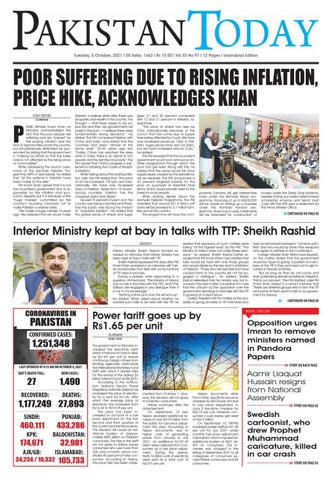
Tuesday, 5 October, 2021 I 28 Safar, 1443 I Rs 15.00 I Vol XII No 97 I 12 Pages I Islamabad Edition
POOR suffeRing due tO Rising inflatiOn, PRice hike, acknOWledges khan stAff RepoRt
P
ISLAMABAD
RIME Minister Imran Khan on Monday acknowledged the fact that the poor people are suffering and are “pained” by the soaring inflation and the lack of opportunities across the country, but simultaneously defended his government by stating that the government is “making full efforts so that the lower class is not affected by the rising prices of commodities”. While addressing the launch ceremony of the Kamyab Pakistan Programme (KPP) in Islamabad, he stated that “all the systems in Pakistan have been made for the elite.” PM Imran Khan opines that it is not the incumbent government who is responsible for the inflation and economic disparity but it is because of the “huge mistake” committed by the country’s founding members not to make Pakistan a welfare state. “We made a huge mistake 74 years ago. We believed that we would make
Pakistan a welfare state after there was prosperity and wealth in the country. The thought — that there needs to be surplus first and then we (government) will invest in the poor — I believe these were fundamentally wrong decisions.”, he stated. The PM compared Pakistan with China and India, and stated that the countries had been “almost at the same level” 35-40 years ago but “today, China has reached the skies while in India, there is an island of rich people and the rest [live in] poverty.” The PM opines that China’s progress is subjected to following the model of Riyasate-Madina. While talking about the soaring inflation rate, the PM stated that “The price of oil has increased 100 per cent internationally. We have only increased 22pc in Pakistan. Aside from 19 oil-producing countries, Pakistan has the cheapest petrol and diesel.” He said 75 percent of palm oil in the country was being imported and therefore the public was facing the impact of “imported inflation”. He stated that the global prices of wheat and sugar
grew 37 and 40 percent compared with 12 and 21 percent in Pakistan, respectively. “The price of wheat has risen by 37pc internationally because of the crunch that has come due to supply lines being affected by Covid. We have only increased prices by 12pc in Pakistan. Sugar prices have risen by 40pc, but we have increased only by 21pc,” he added. The PM revealed that the incumbent government would soon announce another programme through which the poor can get relief. Along with this, he added that the prices would fall once supply issues caused by the pandemic will be resolved. The PM announced a 40 percent targeted subsidy for the poor on purchase of essential food items, which would provide relief to the lower-income people. While sharing details about the Kamyab Pakistan Programme, the PM revealed that around Rs1.4 trillion soft loans will be provided to 3.7 million families across the country. The programme will have five com-
ponents. Farmers will get interest-free loans under the Kamyab Kissan programme, financing of up to Rs500,000 will be made for setting up a business under the Kamyab Karobar programme, financing on easy installments will be extended for construction of
houses under the Sasta Ghar scheme, besides linking successful skilled-based scholarship scheme and Sehat Insaf Card with the KPP, said a statement by the Prime Minister Office.
CONTINUED ON PAGE 05
Interior Ministry kept at bay in talks with TTP: Sheikh Rashid Agencies Interior Minister Sheikh Rashid Ahmed revealed on Monday that Interior Ministry has been kept at bay in talks with TTP. Sheikh Rashid expressed this days after PM Imran Khan revealed in an interview with Turkish broadcaster that talks with some factions of TTP were in process. During a presser, while responding to a question, Ahmed said, “The Ministry of Interior has no role in this [talks with the TTP], and if the Taliban are engaged in any dialogue then it is not in my knowledge.” “Nothing is final as to how this will end up”, he added. When asked about whether he wanted such talks to be held with the TTP, he
cOROnaviRus in
Pakistan
CONFIRMED CASES:
1,251,348
LAST UPDATED AT 8:15 AM ON OCTOBER 4, 2021
DAY'S DEATH TOLL:
NEW CASES:
27
1,490
RECOVERED:
DEATHS:
1,177,249 27,893 SINDH:
PUNJAB:
460,111
433,286
KPK:
BALOCHISTAN:
174,671 AJK/GB:
32,981 ISLAMABAD:
34,234 / 10,332
105,733
replied that decisions on such matters were taking “at the highest level” by the PM. “The Ministry of Interior does not make these decisions,” he added. Sheikh Rashid further revealed that PM Imran Khan had clarified that talks would be held with only those groups who would abide by the law and Constitution of Pakistan. “Those who are terrorists and have caused harm to the country will not be engaged in dialogue.”, he added. Sheikh Rashid reiterated that his ministry was not involved in the said matter. It is pertinent to note that the criticism by the opposition over the government deciding to hold talks with the TTP is growing at a rapid pace. Earlier, President Arif Alvi hinted at the possibility of giving amnesty to TTP members who
Power tariff goes up by Rs1.65 per unit isLAMABAD NewS DeSk
The government on Monday increased the electricity tariff, which it had put on hold in April, by Rs1.65 per unit to ensure continuous foreign inflows from lending agencies, particularly the International Monetary Fund (IMF) with which it started talks for the revival of the stalled $6 billion Extend Fund Facility (EFF). According to the notification, National Electric Power Regulatory Authority (Nepra) has increased the price of electricity for a year by Rs1.65, after which the average price of electricity has increased from Rs16.44 to Rs18.09 per unit. The price has been increased on account of a fuel price adjustment for the first, second and third quarters of the current and last fiscal years. The decision will cause an additional burden of approximately Rs90 billion on Pakistani consumers. The hike in the tariff will not apply to lifeline power consumers who use more than 300 units a month, which constitutes 80 percent of total consumers. According to Nepra, the price hike has been imple-
had not remained involved in “criminal activities” and who would lay down their weapons and agree to adhere to the Constitution. Foreign Minister Shah Mahmood Qureshi, on the matter stated that the government would be “open to giving” a pardon to members of the TTP if they promised not to get involved in terrorist activities. “But as long as they do not come and start undertaking terrorist activities [in Pakistan]. That is our concern,” the FM clarified. Later PM Imran Khan stated in a recent interview that “there are different groups which form the TTP and some of them want to talk to our government for peace.
CONTINUED ON PAGE 05
MORE INSIDE
Opposition urges Imran to remove ministers named in Pandora Papers STORY ON BACK PAGE
mented from October 1. However, the decision will not apply to K-Electric consumers. Article continues after this advertisement On September 15 last, Nepra revealed additional receipts of over Rs193 billion from the public for fuel price adjustment this year. According to Nepra documents, due to higher costs of generating power from January to July 2021, an additional Rs193.49 billion were collected from consumers as a fuel price adjustment. During this period, Rs48.74 billion units of electricity were sold at a total cost of Rs3.97 per unit.
Nepra documents state that in May, electricity became cheaper by Rs0.26 per unit due to fuel price adjustment. In June it became cheaper by Rs0.19 per unit. However, consumers could barely get relief of Rs4.5 billion. On September 10, NEPRA increased power tariff by Rs1.38 per unit for July 2021 under monthly fuel price adjustment mechanism which imposed an additional burden of Rs21 billion on consumers. The increase was charged in the billing of September 2021 to all categories of consumers except lifeline consumers and KE consumers.
Aamir Liaquat Hussain resigns from National Assembly STORY ON PAGE 02
Swedish cartoonist, who drew Prophet Muhammad caricature, killed in car crash STORY ON PAGE 03
02
Tuesday, 5 October, 2021
NEWS
ISLAMABAD
AAMIR LIAquAt ReSIgNS fROM NAtIONAL ASSeMbLy ISLAMABAD
Soldier martyred in N Waziristan terror attack
INp
P
AKISTAN Tehreek-e-Insaf MP Aamir Liaquat Hussain said Monday he has resigned from his seat in the National Assembly. Hussain made the announcement in a post on Twitter. “[I] have sent my resignation from the National Assembly. May Allah support Imran Khan and PTI. Allah Hafiz,” he wrote. Earlier, in July last year, Aamir Liaquat had
tweeted: “I am a helpless MNA from Karachi, unable to provide electricity to the people of my city. I cannot bear to witness the suffering and agony of Karachi’s people, as well as the lies of [K-Electric CEO] Moonis Alvi.” He said he had asked Khan to meet him so that he could present his resignation to him in person. However, the premier had rejected Hussain’s resignation. “You are an asset for Tehreek-e-Insaf, there is no need to leave anything,” the MP quoted Khan as saying in his tweets.
ISLAMABAD Staff RepoRt
A soldier was martyred when terrorists targeted a check post of the security forces in the North Waziristan district of Khyber Pakhtunkhwa province, an Inter-Services Public Relations statement said on Monday. The troops responded promptly following the attack and a clearance operation is in progress to eliminate any terrorist found in the area, the military’s media wing said. During the exchange of fire with the terrorists, Sepoy Muhammad Amir Iqbal, 30, embraced martyrdom. A surge in terrorist attacks on security forces in Pakistan has recently been witnessed in Khyber Pakhtunkhwa and Balochistan. The ISPR said on Saturday that five security personnel were killed when terrorists attacked their vehicle in North Waziristan.
PIA resumes flights to Kuwait after five-month hiatus ISLAMABAD Staff RepoRt
Pakistan International Airlines (PIA) resumed Monday its flight operations to and from Kuwait after the Gulf state lifted travel curbs imposed in the wake of the Covid-19 pandemic. “PIA is resuming its [Kuwait] operation with two weekly flights,” the airline said in a statement. “Foreign Ministry, Pakistan’s ambassador to Kuwait and Kuwait’s envoy to Islamabad played role in resuming operations.” PIA Chief Executive Officer Arshad Malik thanked the Minister for Aviation, secretary aviation and Aviation Division’s management for playing an
Lucky Motors set to launch Peugeot cars NewS DeSk The Lucky Motors Company (LMC) is all set to bring French car brand Peugeot to Pakistan. The LMC has launched the website and social media pages of Peugeot Pakistan to spread the word in the market. “Alhamdulillah, we have officially launched the Peugeot Pakistan website and accounts on social media platforms today. It has been a roller coaster journey for us so far. With passion, commitment, dedication and persistence of our brand team and guidance of our management, we have achieved this milestone. The goal of the website and accounts on social media platforms is to spread the brand in the market and create utmost excitement for our customers, employees and business partners,” the LMC said. “We are optimistic that after the successful launch of Kia, the launch of Peugeot cars will raise the LMC flag even higher in Pakistan. This is a proud moment for us to start a promising journey for this historic brand. Together as a team, we can do wonders, so let the Peugeot magic begin,” it added. For the local market, the LMC was testing three Peugeot cars; Peugeot 2008, Peugeot 3008 and Peugeot 5008. These three cars are featured on the Peugeot official website as the “Lions of our time”. The LMC is expected to launch Peugeot 2008 by the end of 2021. The other two will be launched in 2022.
Nawaz Sharif’s name used for another fake COVID-19 vaccine entry NewS DeSk Another fake entry has been registered under former PM Nawaz Sharif’s name, at a vaccination centre in Narowal on Wednesday. “The suspects had used Nawaz Sharif’s name for the data entry […] they had used the former prime minister’s identity card to get the entry done,” the DC revealed. As per the DC’s statement, the suspects, identified as Rauf and Saqib, have been arrested adding that action would be taken in line with the law. The first fake COVID-19 vaccine entry made using the Nawaz Sharif’s name was at the National Immunisation Management System (NIMS) at the Government Kot Khawaja Saeed Hospital on September 22. As per the fake entry, Nawaz Sharif, who is currently in London, got his first shot of the COVID-19 vaccine Sinovac at 4:03pm Wednesday at the hospital. Interior Minister Sheikh Rasheed and Minister for Health Punjab Dr Yasmin Rashid had termed the matter a “conspiracy”. It is pertinent to note that the Primary and Secondary Health Care Department Punjab has constituted a two-member committee to investigate the matter within the next 24 hours. The committee is supposed to track the officials responsible for the fake entry, the notification from the health care department stated.
active role in the resumption of the operation. He also acknowledged the special efforts of the Ministry of Foreign Affairs, Pakistan’s ambassador to Kuwait and the Kuwait ambassador to Pakistan for extending all possible assistance in that regard. The CEO, in a tweet, vowed the PIA would continue serving Pakistan nationals and valuable passengers with all professional dedication. Kuwait began issuing business and family visas to Pakistan nationals in March after a decade of suspensions for people from Iran, Iraq, Syria, Pakistan and Afghanistan in 2011 over what it claimed were “difficult security conditions” in the five countries.
Mufti Aziz, six others indicted in sexual assault case NewS DeSk A Lahore court on Monday indicted Mufti Aziz-urRehman, his sons and accomplices in the sexual assault case of a madrassah student. Judicial Magistrate Rana Rashid heard the case and adjourned the hearing till Tuesday. The magistrate asked the police to submit record and ordered the public prosecutor to present witnesses on the next hearing. Earlier on June 17, the police had registered a case against Aziz, his sons, and two other unidentified men,
after a video of the cleric, which showed him sexually assaulting a student, provoked outrage on social media. In his video, the student said Aziz had “sexually abused” him and then the cleric’s sons started “blackmailing and threatening to kill” him. “If justice is not done, I will commit suicide,” the student had warned. Mufti Aziz had denied the accusation of sexual abuse in a video statement and claimed that he was drugged by his student before he was filmed. The cleric had claimed that the videos were a conspiracy to remove him from Jamia Manzoorul Islamia, Lahore.
Legislation against fake news to be done in consultation with stakeholders: Fawad NewS DeSk Minister for Information and Broadcasting Fawad Chaudhry on Monday said that the issue of fake news is serious and legislation against it is being done all over the world. Speaking to the journalists outside Parliament House, the minister said that legislation against fake news would be done in Pakistan with the consultation of all stakeholders. He said a draft of the Pakistan Media Development Authority (PMDA) has been prepared which would be presented before the joint action committee, which comprises representatives of Pakistan Broadcasters Association (PBA) and All Pakistan Newspapers Society (APNS) among others, for consultation and building consensus. To a question about Pandora Papers, Fawad said that a meeting will be held shortly to decide about process on the issue of Pandora
Papers. He said Prime Minister Imran Khan has already announced that the government would investigate all Pakistani citizens mentioned in the Pandora Papers and take appropriate action, if any wrongdoing is established. Last month, Fawad had stressed that Pakistan Tehreek-e-Insaf government firmly believes in fundamental, democratic and constitutional rights of freedom of
expression and wants to take all stakeholders on board to create consensus on the draft of PMDA. During a meeting with British High Commissioner to Pakistan Dr Christian Turner, the minister had said that the PMDA aims to ensure a cohesive approach to media development and efficient management besides providing onewindow operation to media practitioners and the consumers.
Road accident leaves 7 killed, 28 injured in Punjab ISLAMABAD Staff RepoRt
Seven people were killed and 28 others injured when a passenger bus fell off from a flyover in Khanewal district of Punjab, the police said on Monday. The incident happened late Sunday night when the driver lost control over the vehicle due to a tyre burst, said the police. Five people died on the spot while two others succumbed to injuries at the hospital on Monday morning, police said. The bus was on its way to Karachi from Chakwal district when it had the accident. The injured are being treated at the hospital where some are in critical condition. Road accidents are frequent in the province mainly due to poorly maintained vehicles and unprofessional driving.
Tuesday, 5 October, 2021
ISLAMABAD
SWEDISh cArToonIST, Who DrEW BLASPhEMoUS cArIcATUrES, kILLED In cAr crASh sTOCkHOLM
S
REutERS
WEDISH artist Lars Vilks, who stirred worldwide controversy in 2007 with drawings blasphemous depictions of Prophet Mohammad (PBUH), was killed in a car crash near the southern town of Markaryd on Sunday, police said. Vilks, 75, who had been living under police protection since the drawings were published, was travelling in a police vehicle that collided with a truck. Two police officers were also killed. “This is a very tragic incident. It is now important to all of us that we do everything we can to investigate what happened and what caused the collision,” Swedish
police said in a statement on Monday. “Initially, there is nothing that points to anyone else being involved.” Muslims consider any depiction of the prophet as offensive. Since the publication of the cartoons, Vilks had been living under a round-the-clock police guard following threats against his life. He had a bounty put on his head and his house was fire-bombed. In 2015, one person was killed in Copenhagen, Denmark, at a meeting meant to mark the 25th anniversary of an Iran fatwa against British writer Salman Rushdie, which Vilks attended. Vilks was widely seen as the intended target. Vilks had said that the cartoons were not intended to provoke Muslims, but to challenge political correctness in the art world.
Adviser to the Prime Minister on Commerce, Abdul Razak Dawood announced on Monday that exports grew by 27.4% to $2.41 billion in September 2021 compared to $1.89 billion in September 2020, In a series of tweets, he said that export figures for the first quarter of FY2021-22 were up by 28% to $6.99 billion as compared to $5.47 ‘million’ (typo in tweet, should be billion) in Q1 of FY2020-21. In August 2021, exports grew by 43% to $2.257 billion compared to $1.584 billion in August 2020 even though there were shipment delays due
to bad weather. Last month Prime Minister Imran Khan had directed the concerned officials to take immediate measures to check the existing gap between imports and exports. During the months of July and August, Pakistan’s trade deficit surged to a worrying $7.337 billion in the current fiscal year (2021-22) as imports drastically outpaced exports. The State Bank of Pakistan (SBP) had projected CAD to hover around 2-3% of GDP, equivalent to $6 billion to $9 billion for the current fiscal year. However, independent economists like Dr Hafiz Pasha see the CAD going up to $12-13 billion for the current fiscal year.
Special Assistant to Prime Minister on
National Health Services, Regulations and Coordination Dr Faisal Sultan on Monday said that post-exam analysis of
The excise department’s director general (DG) in Karachi on Monday accused police of misusing their powers and illegally taking away a “habitual criminal” from the custody of excise personnel. Earlier on Saturday, the police had recovered the allegedly kidnapped man, identified as Ali Hussain, from the office of the excise DG in Karachi, saying that a ransom of Rs2 million was demanded for his release. Pirabad SHO Wasim Ahmed had said that police had carried out a raid at the DG’s office and recovered Hussain, besides arresting one excise constable and two private persons. He had added that neither senior excise officers were aware that Hussain was kept in their office nor the excise department had informed the police about his arrest from
their area of jurisdiction. However, in a statement on Monday, the DG criticised the police officials, who had raided his office, for damaging the reputation of his department and announced
News Desk WhatsApp, Instagram and Facebook have gone down in several parts for the world, users reported on Monday evening. All three apps are owned by Facebook and run on a shared infrastructure. “Sorry, something went wrong. We’re working on it and we’ll get it fixed as soon as we can,” a message on the Facebook website said. Users posted messages on Twitter saying the popular social networking and communication platforms were inaccessible from around 9 pm Pakistan time. The website downdetector.com, which tracks web services, also reported a sharp spike in complaints by users.
Dawlance Proudly Sponsors Pakistan Pavilion at “Dubai Expo 2020” Karachi: Dawlance is the #1 home-appliances brand in Pakistan has collaborated with the government of Pakistan by committing to be the ‘Supporting Sponsor’ of the ‘Pakistan Pavilion’ at the Dubai Expo 2020 – one of the biggest exhibitions in the world, beginning from 1st of October, 2021. Participation in the Dubai Expo reflects Dawlance’s continuous support in government’s “Make in Pakistan” vision towards boosting economy and creating income opportunities, by nurturing largescale investments for a robust future. PRESS RELEASE
Meezan Bank signs MGPay to Launch Fast Track Digital Payments in Merchant Acquiring Business
Medical and Dental College Admission Test will ensure transparency in the examination system. In a statement, Dr Faisal said that the step was taken to achieve the confidence of parents and students in the examination system, which is already decided by Pakistan Medical Commission. He said that this third-party review will be on a scientific basis as Quaid-e-Azam University will conduct the post-exam analysis. He said that the analysts will be fully empowered to freely analyse the MDCAT exam. He added marks will be given on all unclear or doubtful questions while
marks will also be given to students in case of more than one true answer in multiple-choice. Medical students across Islamabad have been protesting near the DChowk for over 10 days. They want the PMC to re-conduct MDCAT on a single day across the country. The protesters claim that the data of students was stolen after the website of the private company holding the MDCAT was hacked. “The questions in the tests were completely off the syllabus,” one of the students said. “Most of the students had bad internet connection because of which they couldn’t complete the exam.”
Excise DG accuses police of misusing power after recovery of man from his office News Desk
WhatsApp, Instagram, Facebook down globally, report users
On October 1st, 2021, President FUI, Mr. Waqar Ahmed Malik along with Rector FUI, Maj.Gen. Nasir Dilawar Shah HI(M) (Retd) and other University officials gave a briefing to the President Dr. ArifAlvi on the performance of Foundation University Islamabad. PRESS RELEASE
Post-exam analysis will ensure transparency in MDCAT, says Dr Faisal
News Desk
03
Presentation to President at FUI
Exports up 27.4pc in September, year-on-year basis, says Razzak Dawood News Desk
NEWS
to take legal action against them. The DG said that the Pirabad SHO and other police personnel overstepped their authority, climbed over the walls of his office, took the watchman hostage at
gunpoint and beat him. He said that Hussain was arrested and booked in a case pertaining to the possession of 8.2 kilogrammes of drugs, adding that Hussain is a habitual drug dealer with previous criminal record. “An illegal FIR was lodged against Excise Constable Jan Muhammad and two other persons who were assigned cleanliness work,” he said, adding that senior officers of the excise police are in touch with senior officials of Sindh Police so that legal action can be taken against this illegal act of SHO Wasim Ahmed. Meanwhile, the police booked the arrested excise constable and two private persons on charges of kidnapping for ransom, dacoity and forcible entry into Hussain’s house in New Mianwali Colony of Orangi Town. They were arrested after an FIR was registered on behalf of Hussain’s son, Kashif Afridi.
Karachi: Meezan Bank, the Best Bank in Pakistan and MYGLU Pvt. Ltd., a wholly owned subsidiary of the US based MYGLU LLC offering next generation business solutions via integrated information technology products and services, have entered into a strategic collaboration to enable Point Of Sale (POS) payment services, branded as MGPay. According to this recently signed agreement, MGPay will be deploying POS terminals and signing up new merchants on behalf of Meezan Bank as an independent sales organization. PRESS RELEASE
Tuesday, 5 October, 2021
04 NEWS
ISLAMABAD
MooNiS ditChed offShore plANS AMid ‘CoNCerNS’ over tAx Authority
A
News Desk
minister in Prime Minister Imran Khan’s government pulled out of making planned investments through offshore tax havens after he was told Pakistan’s tax authorities would be informed, documents in the Pandora papers suggest. Moonis Elahi, minister for water resources and a member of the influential Chaudhry family from Gujrat, expressed “concerns” in August 2017 about the investment being reported to his home country, according to the papers, and instead decided to establish a trust structure in the UK, Guardian reported. The leaked documents, reviewed by the Guardian and International Consortium of Investigative Journalists (ICIJ), do not specify why Elahi became concerned. But they show he had presented as his source of funds for the investments a $33.7m (£25m) sale of a family-owned company in Lahore that had been the subject of historical corruption allegations. The revelations are likely to raise serious concerns in Pakistan, where in 2016 Khan, as an opposition challenger, expressed outrage after offshore interests linked to the political elite were exposed by the Panama papers. “It is disgusting the way money is plundered in the developing world from people who are already deprived of basic amenities: health, education, justice and employment,” Khan said then. “This money is put into offshore accounts, or even western countries, western banks. The poor get poorer. Poor countries get poorer, and rich countries get richer.” At the time, Elahi was a member of Punjab’s legislative assembly. In June this year, Khan appointed him as a minister. A spokesperson for the Elahi family rejected any allegations of wrongdoing and said the family’s assets were all declared as required by law. According to the Pandora documents, in January 2016, Elahi met officials from the offshore wealth management company Asiaciti Trust to discuss buying a 24 percent stake in RYK Mills, a large sugar and renewable energy company headquartered in Lahore. Elahi told the officials he wanted
to set up a trust and fund that would buy the 24 percent stake and also hold two properties in Britain. To evidence his source of funds, Elahi showed Asiaciti a contract from his family’s May 2007 sale of their own sugar company, CSK Limited — previously called Phalia Sugar Mills — for which they were paid Rs2 billion, equivalent to $33.7m in 2007. That sale, to another Lahore-based company, Colony Mills, was later subject to intense scrutiny in Pakistan, including allegations made by the Bank of Punjab that its own loan to finance the deal had been corrupt. Due to Elahi’s status as a prominent politician — a “politically exposed person” (PEP), according to compliance rules — Asiaciti commissioned a thorough due diligence report on him by the risk management arm of the global information company Thomson Reuters. Their report, dated 21 January 2016, based largely on media coverage in Pakistan in both Urdu and English, noted there had been serious allegations surrounding the $33.7m deal, including that the Bank of Punjab itself had filed complaints against the Elahi family to National Accountability Bureau. The key complaint at the time was that the bank had made a corrupt loan that enabled the Elahi family to sell the Phalia sugar mill. Elahi’s father, Chaudhry Pervaiz Elahi, still a prominent politician holding the position of the speaker in the Punjab assembly, was at the time chief minister of the
Punjab authority that owned the bank. The Asiaciti due diligence report noted: “The BoP through its complaint alleged that [Moonis] Elahi, and the others [including his father], sanctioned an illegal BoP loan to the company of a director of the bank, in a bid to allow him to purchase Phalia Sugar Mills owned by Elahi’s family.” Federal Investigation Agency was also reported to have instigated an investigation into the loans. The Thomson Reuters report to Asiaciti stated that there were risks of corruption, money laundering and fraud relating to Elahi, but noted he and his family had always denied the allegations. The investigations had not concluded with any findings of wrongdoing against them, according to the report. Asiaciti agreed to take Elahi on as a client, and did register a trust structure located in low-tax Singapore and the Pacific tax haven of Samoa, the papers show, in preparation for the investment in RYK Mills and to hold the two properties in the UK. Asiaciti officials then advised Elahi that if they were to go ahead with the investments, they would need to share his financial information with the relevant tax authorities in Pakistan under the Common Reporting Standard (CRS), a global information-sharing system set up to combat tax evasion. At that point, Elahi appears to have become concerned and decided not to go ahead. Asiaciti noted of a telephone call
with Elahi: “Moonis has concerns about the CRS reporting requirements of the structures to Pakistan […] Moonis advised that he obtained advice from his legal advisers and as a consequence established a structure in the UK, whereby [sic] his wife and children are residents.” It is not clear what Elahi’s concerns were about CRS reporting to Pakistan or what the legal advice was that led to him establishing a structure in the UK. A prestigious London property linked to him does appear to have subsequently been transferred, legally, into a trust. The property, an apartment at Riverlight Quay, near the South Bank, had been bought for £5.45m in September 2015 by a company named LO89 Ltd — the same company that paid Asiaciti its £7,000 in fees for the Elahi work. Two years later, LO89 transferred the property, for no payment, to a UK company owned by a family member of Elahi’s. In November 2018, the family member’s company transferred the apartment, again for no payment, to another British resident, who appears to hold it on trust. The British resident did not respond to the Guardian’s questions about the property, and whether she does hold it on trust for the Elahi family. Citing confidentiality, the solicitor who worked on the property transfer also declined to answer questions, including whether he had been involved in forming a trust for the Elahi family, and if he carried out due diligence on the family and the source of their funds, particularly due to their probable status as PEPs. A spokesperson for the Elahi family rejected any allegations of wrongdoing, saying: “In the past due to political victimisation, misleading interpretations and data have been circulated in files for nefarious reasons against the family in the name of socalled accountability.” The family’s assets were all declared as required by law, the spokesperson added. The Bank of Punjab said it could not answer questions about the allegations or its response at the time due to laws requiring customer confidentiality. Colony also did not respond to questions from the Guardian and ICIJ.
No breakthrough in efforts to bridge gap between Balochistan CM, dissidents QUETTA: The deadlock between Balochistan Chief Minister Jam Kamal Khan and estranged members of his coalition persists as all efforts of the committee formed to bring about reconciliation between the two have failed to yield fruit on Monday. Although Kamal met with six disgruntled members of his government in recent days to win their support, the MPs were still adamant that he tenders his resignation. They were of the view that they will not decide on their own but will go by the decision taken by the entire group of dissidents. Senate Chairman Sadiq Sanjrani, on the other hand, is expected to visit Quetta again today to bring about a rapprochement between the chief minister and disgruntled MPs. He had visited the provincial capital on Sunday too and held a meeting with Balochistan Assembly Speaker Abdul Qudoos Bezanjo. He then left for Islamabad in the evening. On the other hand, the opposition’s plan to table a no-confidence motion against Khan in the Balochistan Assembly is presently restricted to merely statements due to what is described as a technical fault in the resolution drafted for the purpose. Sanjrani and other members of the coalition will resume their efforts today to bridge differences between the chief minister and the group of dissidents. INP
Strict measures, vaccination help bring down Covid cases, restore daily life ISLAMABAD: An increasing vaccination rate and strict health measures, including a ban on businesses and lockdowns in selected areas, have helped Pakistan bring down the daily number of Covid-19 cases by more than 50 percent in September. According to the statistics released by the National Command and Operation Center (NCOC) on Friday, the daily cases dropped to 1,411 on September 30 from 4,103 on September 1. During the first 11 days of September, daily cases hovered well above 3,000, prompting the government to impose strict measures, according to the NCOC, the department leading the anti-pandemic campaign. The stern measures included school closure, a ban on gatherings and dining at restaurants, closure of cinemas and sports centres, besides restrictions on business activities. Head of the NCOC, Asad Umar, told the media last week that the strict measures and the vaccination campaign have brought positive results. On Wednesday, Umar said in a statement that the only way out of the pandemic is to get a high percentage of citizens vaccinated. “There will be higher restrictions on cities with low level of vaccination and on citizens who are not vaccinated,” said Umar, adding that the NCOC has decided to relax restrictions in eight cities with the highest level of vaccination. Starting from Friday, the NCOC imposed a ban on unvaccinated people on boarding domestic and international flights and entering educational institutions, shopping malls, wedding halls, hotels and guesthouses. Following the decision, Pakistan International Airlines (PIA) announced that only vaccinated passengers will be able to travel on domestic and international flights of the PIA after providing the vaccination certificate. Considering the falling number of Covid-19 cases, the Civil Aviation Authority of the country on Thursday allowed the serving of in-flight meals and beverages on domestic flights. All the airlines were barred from serving food on domestic flights in August after a surge in cases. The government has also allowed increasing spectators by up to 50 percent of the stadium capacity for the domestic cricket matches to be played from Friday to Sunday. The Pakistan Cricket Board said that only fully vaccinated people would be allowed to buy the tickets and enter the stadium. XINhua
Taliban-style security welcomed by some, feared by others kABUL aP
It wasn’t 7:00 am yet and already the line outside the police station’s gates was long, with men bringing their complaints and demands for justice to Afghanistan’s new Taliban rulers. Something new they immediately found: The Taliban fighters who are now the policemen don’t demand bribes like police officers did under the U.S-backed government of the past 20 years. “Before, everyone was stealing our money,” said Hajj Ahmad Khan, who was among those in line at the Kabul District 8 police station on a recent day. “Everywhere in our villages and in government offices, everyone had their hands out,” he said. Many Afghans fear the harsh ways of the Taliban, their hard-line ideology or their severe restrictions on women’s freedoms. But the movement does bring a reputation for not being corrupt, a stark contrast to the government it ousted, which was notoriously rife with bribery, embezzlement and graft. Even residents who shudder at the potential return of punishments — such as chopping off the hands of thieves — say some security has returned to Kabul since the Taliban swept in on August 15. Under the previous government, gangs of thieves had driven most people off the streets by dark. Several roads between cities are again open and have even been given the green light for travel by some international aid organizations. Still, there are dangers. On Sunday, a bomb outside Kabul’s Eid Gah mosque killed several civilians and targeted Taliban members attending a memorial service. No one took responsibility for the bombing but the rival Islamic State group has ramped up attacks against the Taliban in an IS stronghold in eastern Afghanistan. During their last time in power in the late 1990s, the
Taliban offered a trade-off: They brought a stability Afghans desperately sought and eliminated corruption, but they also imposed their harsh interpretation of Islamic law. That included punishments like hand amputations, executions of murderers with a single bullet to the head, most often by a relative of the murder victim and all carried out in public. Religious police beat men for trimming their beards or for not attending prayers. In the past week, the Taliban arrested 85 alleged criminals, some accused of petty crimes, and others of murder, kidnapping and robbery, said Noor Ahmad Rabbani of the Taliban’s anti-crime department. The Taliban say they will bring back their previous punishments. The only question is whether they will carry them out publicly, Mullah Nooruddin Turabi, former justice minister and current official in charge of prisons, told The Associated Press. Some punishments have already reappeared. The bodies of four men were hung from cranes in the centre of the city of Herat, after being killed by the Taliban while allegedly attempting a kidnapping. On at least two occasions in Kabul, petty thieves were paraded around the streets to shame them, handcuffed, with their faces painted or with stale bread stuffed in their mouths. Gun-toting Taliban have taken up positions at checkpoints across Kabul and gradually some have been made to wear uniforms — the beginnings of a new national security force, officials say. For many Kabul residents — particularly the young who grew up on horror stories about the previous period of Taliban rule — the sight of the fighters is frightening as they roam the streets freely, with their signature long hair, traditional dress and Kalashnikov rifles hanging by their sides. But so far, they appear to have brought relief from corruption. Before the Taliban takeover in August, people had to pay bribes simply to settle a utility bill. Ram-
CMYK
pant fraud in the military was one reason it collapsed so quickly in the face of the advancing Taliban. Despite the overt graft, the U.S. and Europe poured billions of dollars into the government with little oversight. As in the past, the Taliban have turned to tribal elders to settle disputes. Last week, a group of elders gathered in a Kabul mosque to adjudicate a stabbing attack that caused minor injuries. The elders ordered the culprit’s father to pay the victim the equivalent of nearly $400, enough to cover the medical expenses. Muhammed Yousef Jawid accepted his punishment. “It’s fast and much less expensive than it was under the previous system,” he said. At the District 8 police station, the new commander, an affable Taliban named Zabihullah, said the Taliban had fought for 20 years to bring Islamic laws to Afghanistan. “Now people are safe under our government,” he said. Zabihullah, who like many Afghans goes by one name, is from central Ghazni province, where the insurgents waged some of their most bitter battles during
the last two decades. At 32, he said he hasn’t trained to be a police commander, with most of his education at a madrassa, or religious school. But Zabihullah said his years at war and adherence to the Taliban interpretation of Islamic law had prepared him. Outside the police station gates, the line was getting longer. Sixty-year-old Khan had come from eastern Khost province to seek Taliban help in collecting an outstanding loan. He said he supported Taliban punishments like amputations, though not for petty thieves. He said they have brought some security “because they treat the criminal under Islamic law.” A school principal, who didn’t want to give his name fearing repercussions, had come to the police station to complain about parents who are months behind on school fees. He said he wanted to give Taliban rule a chance. Under the previous government, he was charged bribes each time he went to the police to complain about delinquent payments. “America invested lots of money in Afghanistan, but it was a mafia that was running the country,” he said. Another complainant, who gave his name only as Dr. Sharif, had returned recently from Saudi Arabia where he had worked for several years. He had no objection to Taliban-style punishments but argued strenuously against putting Taliban leaders and religious clerics in charge of government departments. “We need professional people […] we need economic specialists, not a maulvi who has no idea about business,” he said, using a word for a Muslim cleric. Still, he welcomed having his complaint heard without any demand for a bribe from the Taliban police. Before, police demanded a bribe just to get into the station. “The mistake of the past governments,” he said, “was that they put all the money into their pockets.”
Tuesday, 5 October, 2021
ISLAMABAD Palm oil gains on concerns over dwindling Sept stockpile KUALA LUMPUR AGENCIES
Malaysian palm oil futures rose on Monday, paring sharp losses from the previous session, as industry estimates of weaker September output amid a surge in exports raised concerns over a decline in inventories. The benchmark palm oil contract for December delivery on the Bursa Malaysia Derivatives Exchange rise 48 ringgit, or 1.07%, to 4,553 ringgit ($1,091.85) a tonne in early trade, after declining nearly 2% in the previous session. The Southern Peninsula Palm Oil Millers’ Association estimated production in September declined 2.3% from the month before, traders hsaid on Friday. Exports of Malaysian palm oil products for September rose 43.2% to 1.7 million tonnes from August, cargo surveyor Societe Generale de Surveillance had said on Friday. India’s palm oil imports in September more than doubled from a year ago to a record 1.4 million tonnes as buyers increased purchases of refined palm oil ahead of key festivals and to take advantage of newly lowered duties. Soyoil prices on the Chicago Board of Trade were down 1.12%.
POOR suffering due to rising inflation, price hike, acknowledges Khan ContinUed fRoM PAge 01 The PM justified the economic disparity between the rich and the poor across Pakistan by calling it a fault of the education system. The PM called it a “huge misfortune” that SNC was not implemented from the very beginning. He stated that only those who went to English medium schools got good jobs, while the rest of the public was not able to progress. “A different standard of education for one class [of society] and a different one for another — education apartheid. And then there were madrasahs. Nobody tried to synthesize it. [This is] one country, one nation, at least it should have a core syllabus. Our kind of elite was benefiting from it, our children were getting good jobs so we had no incentive to change it.”, he conclude.
Interior Ministry kept at bay in talks with TTP: Sheikh Rashid ContinUed fRoM PAge 01 So, we are in talks with them. It’s a reconciliation process.” “The case of those who were involved in incidents like the APS is different. And the case of those who left the country for different reasons is different,” he had said in reply to a question about the merit and mechanism of talks with the TTP. “We are not surrendering to anyone and this process is at a very early phase. No one needs to jump to conclusions at this stage.”, he added. PPP leaders are of a view that this move was more like “sprinkling salt on the wounds of martyrs’ families.” More recently on Sunday, opposition parties have demanded from the incumbent government to take the parliament into confidence over the terms of engagements with TTP and raised suspicion over the government’s act of keeping the talks with the TTP secret.
NEWS
05
STaTeS MuST RaISe hydROgen InveSTMenT TO helP Reach neT zeRO: Iea PARiS AGENCIES
Governments need to step up investment in hydrogen production and storage chains to help cut net emissions to zero, the International Energy Agency (IEA) said on Monday. States and private investors had so far only come up with about a quarter of the $1,200 billion needed by 2030 to develop and deploy hydrogen and make it part of global net zero strategies, the Paris-based organisation said. Efforts should be directed on getting hydrogen into more sectors and developing technologies to make it cheaper to produce with renewables, its report added. Hydrogen is light, storable and energydense, and produces no direct emissions of pollutants or greenhouse gases when used as a fuel. But the cost of production, and worries over how it is produced, have been a barrier to expanded use. Hydrogen produced with renewable supplies can cost be-
tween two to seven times as much as producing it from natural gas without carbon capture, the report said. New technologies and economies of scale could help close the gap, it added. “Almost all hydrogen produced today comes from fossil fuels without carbon capture, resulting in close to 900 million tonnes of CO2 emissions, equivalent to the combined CO2 emissions of the United Kingdom and Indonesia,” the IEA said. Global capacity of electrolysers, which produce hydrogen from water using electricity, doubled over the past five years, and nearly 400 projects are under development or in early stages of development, the report said. These projects should put hydrogen supply at 8 million tonnes per year by 2030, up from the less than 50,000 tonnes in 2021. But that was still a tenth of what was needed by 2030 to reach net zero emissions by 2050, they said. Nearly all hydrogen consumption was in the refining and industrial sectors in 2020, the report
said. But it could also play a major role in chemicals, steel, transport and aviation – all sectors where emission reduction is currently a challenge. Government policies currently focus on production but need to incorporate consumption in new sectors to foster the con-
struction of the necessary storage, transmission and charging facilities, the report said. Currently 17 governments have hydrogen strategies, and more than 20 others have announced they are developing plans, up from three countries in 2019, the agency said.
Biden’s new China trade plan echoes Trump’s, but assumes Beijing won’t change WASHington AGENCIES
US Trade Representative Katherine Tai on Monday will seek new talks with China over its failure to keep promises made in a “Phase 1” trade deal struck with former president Donald Trump, but will not pursue “Phase 2” negotiations over Beijing’s state subsidies and other structural issues. Senior Biden administration officials said Tai will pursue a virtual meeting with Chinese Vice Premier Liu He to discuss the trade deal “soon” while starting a “targeted” process to revive exclusions for certain Chinese imports from punitive US tariffs. However, she will not rule out the use of new tariffs to push China to meet the Phase 1 commitments made under Trump, said the officials, speaking on condition of anonymity. Tai will deliver long-awaited remarks outlining the Biden administration’s China trade strategy at the Center for Strategic and International Studies, a Washington think-tank, at 10 a.m. EDT (1400 GMT). “For too long, China’s lack of adherence to global trading norms has undercut the prosperity of Americans and others around the world,” Tai is expected to say during her remarks, according to excerpts from her speech shared by the White House. Tai will also say that she intends to have “frank conversations” with her counterpart in China. “That will include discussion over China’s performance under the Phase One Agreement and we will also directly engage with China on its industrial policies.” Tai will not rule out the use of any trade tools, to bring China into compliance with the deal, officials said, but did not offer a time frame for such actions. The deal is scheduled to expire at the end of 2021.
One of the administration officials told reporters on a preview call that China has not met commitments it made under the phase one deal. Excerpts from Tai’s remarks show she will raise commitments made by China that were intended to benefit American industries, including agriculture. The Phase 1 deal was crafted at the end of 2019, just as the coronavirus outbreak was starting to emerge in China. The subsequent COVID-19 pandemic caused the steepest drop in global GDP since the 1930s Great Depression, wreaking havoc on trade flows and global supply chains, which continue to struggle as demand recovers. China agreed to boost purchases of US
farm and manufactured goods, energy and services by $200 billion above 2017 levels over two years. The deal, which halted escalation of a trade war that heaped tariffs on hundreds of billions of dollars worth of goods from both countries, also called for China to improve protections for some US intellectual property and market access for American agricultural biotechnology and financial services firms. The coronavirus pandemic hit Chinese purchases of US goods hard, and they have been running at only 62% of the target, according to estimates by Chad Bown, a senior fellow at the Peterson Institute for International Economics. US President Joe Biden kept in place the tariffs imposed by
Trump as Tai conducted a top-to-bottom review of China trade policy. Biden officials have said little about their strategy, focusing instead this year on rebuilding ties with US allies to present a more united front to Beijing. A system of exclusions from the tariffs of up to 25% on Chinese imports expired at end of 2020, except for some medical imports needed to fight the COVID-19 pandemic. US officials said Tai would relaunch a new, “targeted” tariff exclusion process and would “keep open the potential for additional exclusion processes in the future.” China ‘may not change’ The United States will not pursue “Phase 2” negotiations with China on deeper structural issues such as massive subsidies to vital industries that skew global markets, because Beijing is “doubling down on its authoritarian state-centric approach,” officials said. Tai will run through a history of China’s failure to live up to its trade and reform commitments over the past two decades, from its accession to the World Trade Organization to the Phase 1 deal, the officials said. “We recognize that China simply may not change, and that we have to have a strategy that deals with China as it is, rather than as we might wish it to be,” one of the officials said. The officials said the Biden administration is pursuing investments in technology, education and stronger supply chains to boost US competitiveness with China and will continue work with other major democracies to address China’s “non-market” behavior. The United States would pursue a flexible approach to its trade relationship with Beijing, with its actions tailored to Beijing’s response, one official said, adding: “It takes two to tango.”
geTTIng SquaSh InTO cRIcKeT CIty NotES M A NIAzI
T
HE New Zealand head coach has said that the team didn’t decide to pull out of the tour. It seems the next step is for New Zealand to say that the tour wasn’t cancelled at all. Or maybe they’ll have the decency to admit that the tour was cancelled, but blame Imran Khan. In fact, they may say that he called his New Zealand counterpart to tell her that he was doing so. It’s enough to make Imran find out her corruption. I hope there’s no corruption involved in the decision to make Tania Mallick the head of women’s cricket. Her main qualification is that she has been women’s badminton champion. I don’t know the connection be-
tween women’s badminton and cricket, but I do know that Ameer Bi was once All-India badminton champion. And she was the mother of the Mohammad brothers, four of whom played for Pakistan, two (Heer Bianif and Mushtaq) captaining it. With motherly partiality, she said that her fifth son, Raees was the best batsmen of them all, even though he was the only one who never played Test cricket. Or maybe he was, for while sportswomen become mothers, they’re usually honest, even if it’s about another game. But apart from that link, if we’re going to have sports cross-fertilizing each other, maybe squash great Jehangir Khan can be inveigled as batting coach, and javeliner Nadeem Arshad, who almost won a medal at the recent Olympics, can be made bowling coach. You might remember that Rameez
‘Rambo’ Raja began his stint as PCB President by blowing away the New Zealand team. He had also got the coaches to resign, and installed people of his own choosing. Now he’s made PCB Chief Executive Officer Waseem Khan to step down. No replacement has been named yet, but maybe a former hockey captain like Kaleemullah would probably fit the bill. Rambo cannot be held accountable for Inzamamul Haq’s heart attack, though both he and Imran should think about how someone very much their junior has had a heart attack. True, neither has been as hearty a trencherman as Inzamam, but abstention from greasy food does not cover for age. And Inzamam was younger than both. Anyway, maybe the PCB needs a female CEO. Why should female sportsmen be restricted to Women’s cricket? I mean, in the recent
CMYK
Iceland elections, they almost elected a female majority legislature. They did, actually, according to the first count, but after a recount were down to 30 of 63 seats. Elections in Germany meant that not only were they no longer to have a female Chancellor in Angela Merkel, who has held office since 2005 (making her the longest serving Chancellor since Helmut Kohl), but they’ve seen a change in party. Elections in Canada and Russia have seen no change. Imran would like elections like those in 2023. Perhaps not as in Canada, where he PM asked for a majority. Before the poll he headed a minority government, supported from outside by the LDP, which is headed by a Sikh, which sort of makes Canada the nearest thing they’ve got to Khalistan. Ahead of our elections, though, there’s been dirty work done at the crossroads. The UK’s National Crime Agency has applied
for the unfreezing of various accounts of the Sharif family, not having found any evidence of money laundering. All is explained by Mian Nawaz’s presence in London. He must have bribed the NCA investigators. When Shehzad Akbar, the head of the Assets Recovery Unit, held a press conference, he didn’t mention he most telling evidence of Shahbaz’s corruption: his face. Not to mention that he had never won a World Cup for Pakistan. The NCA had not heard the proof that Fawad Chaudhry presented that the Avenfield flats were the results of corruption on the Motorway. Well, nobody else heard the proof either. Which is that Shehbaz Sharif didn’t build a cancer hospital. The piece of evidence that sets the capstone on the proof of his corruption was that he didn’t eat organic food. Not to forget that all his children were born in wedlock.
Tuesday, 5 October, 2021
06 COMMENT
On clubs, polygamy, and patriarchy
Pandora Papers Unmasking hidden wealth
T
he Pandora Papers have revealed the inner workings of a shadow economy that benefits the wealthy and well-connected. Two years long research by the International Consortium of Investigative Journalists (ICIJ) has uncovered financial secrets of 35 current and former world leaders, more than 330 politicians and public officials in 91 countries and territories, and a global lineup of fugitives, con artists and murderers besides a top sportsman and a world-famous singer. The list does not include the name of PM Imran Khan, a fact that the PTI spokesmen continue to underline. The list, however, contains the names of some of the key members of his inner circle, including cabinet ministers, their families, major financial backers and political allies. A number of high-ranking ex-servicemen and their relatives also find mention in the list. PM Khan has promised a thorough investigation into all citizens mentioned in Pandora Papers and an appropriate action in case wrongdoing is established against any one of them. Mr Khan has over the years conducted a campaign against those accused of sending the country’s looted wealth abroad and appealed to countries to return the money. Last year, addressing a UN FACTI panel, he noted that $7 trillion in stolen assets is parked in safe tax havens. Reacting to the publication of Pandora Papers he has called on the international community to treat this grave injustice similar to the climate change crisis. On account of the complexity and secrecy of the offshore system, it’s not possible to know how much of that wealth is tied to tax evasion and other crimes and how much of it involves funds that come from legitimate sources and have been reported to proper authorities. What is needed therefore is to avoid mudslinging or spreading fake news. The matter must be probed justly and in a transparent manner. What needs to be determined is whether the money was earned through legal means, whether taxes had been paid and whether the money was sent abroad through legal means. Anyone, civilian or exserviceman, belonging to the ruling party or opposition found guilty should then be taken to court and awarded punishment in accordance with the law.
A few answers but many more questions
HASAN AFTAB SAEED
T
he Lahore Gymkhana Member’s handbook, which is posted on the club’s official website for the benefit of current and prospective members alike, has an interesting clause. It was pointed out to me by my brother yesterday. I thought it a good idea to write on the topic before he goes ahead and does a vlog on it himself. I am sure he would understand because he is no stranger to a writer’s desperation especially when the dreaded deadline draws near. Let me start by making some prefatory remarks. Some moons ago on a TV program, a religious scholar was asked a question by a man who was contemplating doubling the number of his wives and was apparently facing spirited resistance from certain quarters. The man could not understand why he must refrain from exercising his rights by marrying another woman that he had fallen in love with only because he already had a wife. The scholar replied that while there was no religious reason that forbade the second marriage, the responsibility for the social implications rested squarely with the man if he decided to go ahead with it. Sane advice indeed, because practical, social considerations are usually the first casualties amidst all discussions on the legitimacy and illegitimacy of acts, with some extremely unfortunate re-
Building from the bottom-up Kamyab Pakistan Programme is a welcome change
A
The Battle of Tongue not Tanks
ProF. ABDul SHAkoor SHAH
L
eT us never negotiate out of fear, but let us never fear to negotiate. John F Kennedy. State conciliation with Tehrik-i-Taliban Pakistan (TTP), the debarred umbrella group of the Pakistani Taliban has opened a new Pandoras box on national and international fronts. Although it is not the first time that the state and anti state factors are heading to negotiation. TTP had offered negotiation 8 years back. The two APCS had also been conducted by ANP and JUI in this regard. Both the APCs supported negotiation with TTP but TTP nullified the first and accepted the second. The lack of reconciliation strategies by Political parties and reluctance of establishment pushed it to the cold corner. Mr. Khan’s rhetoric of negotiation with Taliban instead of war has proved logical and practicable. It is sane to negotiate and merge anti state factors to national streamline instead of continued confrontation with them. Dialogue is the best way forward to solve problems and avoid unwanted wars. Mr. Khan has been considered pro-Taliban as he had been a staunch supporter of negotiation regarding the Afghan issue. Major peace agreements in the past include: the Shakai Agreement in 2004, Sararogha Agreement in 2005, Miranshah Agreement in 2006 and Swat Peace Agreement in 2009. All the agreements were straightforwardly parleyed by forces excluding Swat peace agreement of 2009 which was parleyed by the ANP through Maulana Sufi Muhammad. During the past peace accords, the state was on the loose end but now the situation is paradoxical. The past peace accords had been
Dedicated to the legacy of late Hameed Nizami
Arif Nizami (Late) Founding Editor
Yousaf Nizami M. A. Niazi
Umar Aziz
Joint Editor
Joint Editor
Executive Editor
Lahore – Ph: 042-36300938, 042-36375965
Practical, social considerations are usually the first casualties amidst all discussions on the legitimacy and illegitimacy of acts, with some extremely unfortunate results.
Negotiation with TTP
CCeSS to credit at affordable rates for lower to middle income groups in Pakistan is quite limited. The risk appetites of commercial banks are such that only those corporations with healthy balance sheets and individuals with steady salaries are considered as viable candidates. This reality financially excludes a significant portion of the population, making it difficult and near impossible for small business and those with personal finance needs to secure loans. The PTI government’s ambitious Kamyab Pakistan Programme (KPP) is therefore a step in the right direction as it aims to provide Rs1.4 trillion micro loans to 3.7 million households across the country. That only those families who have a cumulative average monthly income of Rs50,000 per month would qualify for the loans means that the lowest income segments of society will be targeted. It is likely that those who are undeserving of this facility will attempt to deceive the system to make a quick buck. It is imperative that the scrutiny mechanism is foolproof in a way that it keeps such elements at bay while making sure that it is not too stringent for genuine applicants. A user-friendly portal called Kamyab Information System (KPIS) has been deployed to that end, making verification and eligibility efficient and accurate. At the same time, it is also important that there is sufficient oversight over the generation and disbursement of funds so that any possibility of financial malfeasance by those in charge is at least deterred if not eliminated. KPP would also act as a much-needed departure from the more conventional trickle-down approach towards the economy whereby businesses and the wealthy are minimally taxed in order to create momentum in the economy in terms of jobs and spending that would benefit the middle to lower income groups. Although not a stated policy in Pakistan since the Ayub era, some form of it is still prevalent. A bottom-up approach makes more sense not only because it helps uplift the poorest sections of society directly but also because trickle-down economics has demonstrably failed to garner the desired outcomes.
Editor Aziz-ud-Din Ahmad
sults. With the ground now prepared so to speak, we are in a better position to return to our Gymkhana Club rulebook that we left in the opening paragraph. The clause in question is entitled ‘Members more than one wives [sic]’. In a manner which could not have been any more matter-of-fact, it states the following: ‘When a member has more than one wives, only one wife and her children can avail of the Club facilities and it shall be the first wife and her children unless the member expresses his will in writing to exclude the name of the first wife and her children from the computer record and nominates the other wife and her children for club membership cards.’ how come this clause has failed to cause a commotion is a mystery. For it is obvious that it renders impossible the delicate act of treating all wives equally, which is a necessary condition for polygamy in Islam. It turns out that the Lahore Gymkhana was founded in 1878, and this clause, in all probability, is a remnant of the colonial era. even so, it has been a fair while since Independence was won, and one especially wonders how the clause has survived the multiple periods of heightened religiosity in the country. Men in polygamous relationships have traditionally elicited mixed sentiments in those of us who only have the solitary set of wife and children. The feelings are alternately those of a reverential awe and extreme pity. Talking of clubs, on the one hand one wonders how these men can tend to multiple wives and their children and still have ample time and energy left to spend at a club. On the other hand, after some quick extrapolation, it is not inconceivable that the more the number of wives, the greater the necessity to spend time out of their reach – at the office, playground, club, anywhere except home. Luckily, with the one-wife clause in place the only option left for a self-respecting club member who takes his religion seriously and who has two or more wives is to avail of the club facilities in his individual capacity,
I
Karachi – Ph: 021-35381208-9
I
i.e., alone. By not picking one over the rest, he can be just to all his wives. Not to mention the minor detail that that is probably the most relaxing option for him as well. This may have been the original intent behind the clause; and if that is the case then one bows down to the wisdom of those responsible for the advent and the continuation of the clause. The latter-half of the clause is scarcely less interesting. To expect a man to have the guts to express his will in writing to exclude the name of his first wife and her children from the computer record and nominate a newer wife and her children instead is to expect superhuman courage from a mortal. But then again, gallant men who have the heart for polygamy are hardly your ordinary mortals; and therefore, if anybody is equipped with that kind of pluck, it is this select group. That is probably the reason the promulgators of the clause did not consider the act to be beyond the capability of these men. What is equally astonishing (now that I have gone through the whole document) is that the Gymkhana people have not yet been taken to task by the feminists. For nowhere does the handbook say anything about a member’s husband – as if a woman cannot have membership of the club in her own right, and who in turn nominates her husband. The document mentions the word ‘spouse’ only once but makes it immediately clear that it does not mean the husband when it says that upon death of a member the spouse may be enrolled as ‘lady member’, who ‘shall not be entitled to attend General Body meetings or to cast votes in Club elections.’ At another place the handbook announces rather patronisingly that Squash Court No. 4 has priority for women members who may enter their names in the register and wait for their turn. One does wonder how the feminists, who overlook few things, have failed to react to such blatant and tasteless exhibitions of the pungent patriarchal mindset.
favoring TTP as they became more powerful after every accord. The government remained inefficient to disarm tribal regions from TTP. Previously, the TTP had two primary demands namely the implementation of Sharia Law and withdrawal from the US led war in Afghanistan. In the past TTP had been nominating certain parties and political heads as guarantors. Now the Taliban chair Kabul and the situation is quite different from the past. Surely, the TTP will jump to an out of the box option in negotiations with the government. Their fundamental demands seem to be release of their captured leadership. earlier the TTP had been using dialogues as a delay tactic to regroup and reorganize and avoid military operations against them. The Military operation put an end to the TTP. TTP is not a united group, it is divided into several factions. We have to proceed with reconciliation with all factions collectively or term them to get responsibility for the rest of factions otherwise it will be insane for national interests. What will be the fate of thousands of sacrifices offered by civilians, personnel and officials? Secondly it will convey the message to other insurgent groups about the power of TTP and they might come under TTP umbrella which may create problems for the state in the future. It will also encourage TTP sympathizers in the country. The other banned organizations may follow suit for concession and under this pretext they will regroup and reorganize. The hope of disarming TTP apparently seems futile as they have murdered several tribal heads during their hold and the tribal tradition of revenge and avenge might not allow them to disarm themselves under any amnesty by the state. Ibni Amin, the TTP Swat Chapter top operational commander refused to disarm for the above reason after the 2009 peace agreement. The negotiation with TTP may strengthen Pakistani grip on the Afghan issue but its consequences are drastic. We had failed in the past via negotiation with these anti state factors and resultantly, the military operation eliminated them. TTP has been explicitly skirmishing Pakistan and now two active members of TTP, residing in western Afghanistan are considered
Islamabad – Ph: 051-2204545
The author is a connoisseur of music, literature, and food (but not drinks). He can be reached at www.facebook.com/hasanaftabsaeed to be the torch bearers of this negotiation. earlier the reconciliation was initiated through the haqqani Network in 2020. TTP has also forwarded a list of 10 members for their representation and they have offered to put an end to their war against Pakistan in return they have demanded the release of their captives and retreat from certain tribal areas and pledging to safeguard the border. They surely have demanded implementation of Sharia Law in the vacated region. Back in 2009 Islamabad had permitted implementation of Shariah in some areas which was uprooted by violence later on. Islamabad would surely demand compensation for the martyred, injured, the disarming of TTP as well as handing over weapons to Pakistan and possibly the expenditures of the dialogue expedition. The demand for united groups will be sensible rather than reconciliation with splinter groups. The negotiation might be a tactic of current TTP leadership to reunify the split factions. Third party arbitration cannot be out of question as the United Nations report and defense minister Pakistan have pointed out about high level negotiation. The Pakistani populace is divided on the issue, some favoring and some defying recompilation with the TTP. The opposition is also very critical of the jerky bursts of negotiation. If the government negotiates from the upper rim, the reconciliation can be ominous, that it will prove a muddle of chaos. The rhetoric of opposition seems insane as they have been favoring negotiation with other anti state factions like Balochistan insurgents triggered by India and now the opposition is tarnishing the government regarding negotiation with TTP calling it an NRO. Islamabad has to go a long way to embark on the negotiation with TTP. The negotiation is initiated by TTP from inside Afghanistan. Mr. Khan, being a staunch supporter of solution through dialogues has never been favoring the military solution both for Pakistani and Afghan issue. The opposition is showing its concerns over sidelining parliament on this matter. Both the sides are waiting to see how the cat jumps. Surely the formula of give and take will be effective and by keeping in mind the past experience of dialogues with TTP it might not lead to regrouping, reunification and eruption of violence in the country.
Their fundamental demands seem to be release of their captured leadership. Earlier the TTP had been using dialogues as a delay tactic to regroup and reorganize and avoid military operations against them. The Military operation put an end to the TTP.
I
Web: www.pakistantoday.com.pk
I
The Writer is Prof. in English and Freelance Columnist based in Lahore. He can be reached at Prof.abdulshakoorsyed@gmail.com
Email: editorial@pakistantoday.com.pk
Tuesday, 5 October, 2021
COMMENT 07 Editor’s mail Send your letters to: Letters to Editor, Pakistan Today, 4-Shaarey Fatima Jinnah, Lahore, Pakistan. E-mail: letters@pakistantoday.com.pk Letters should be addressed to Pakistan Today exclusively
Books over drugs The dream that our children will hold books instead of heroin must not just remain a dream. In Buleda, Kech drugs are supplied so easily under the open sky with no fear, which is why every other person in buleda is a drug addict, including children. The people of Buleda region of district Kech has came out from their homes and took out the third rally on Sunday against the widespread use of drugs. The people had appealed the concerned authorities to take immediate action against the drug dealer and users. Particularly, the new generations who are our future, has to be protected against the use of drugs. The reason behind the unfavorable situations in Buleda is the increasing rate of drug trafficking. We beseech the government to take concrete actions against the smugglers to prevent the future of our youth against narcotics. Fiza NaSir TurbaT
Voice for justice
The occupation severely endangers Israel’s national security The Israeli argument against the establishment of a Palestinian state on the grounds of national security concerns is baseless
Dr AloN BEN MEir
F
OR decades, Israeli leaders have been engaged in a deliberate and persistent false public narrative to justify the occupation on the grounds that it is central to Israel’s national security and that the creation of a Palestinian state will pose an existential danger to Israel. While many top Israeli military officers and national security experts disagree with this assessment, no Israeli prime minister or defense minister in office has yet convincingly argued how a demilitarized Palestinian state is more dangerous than maintaining the occupation. In fact, a Palestinian state immersed in nation-building and fully collaborating with Israel on all security matters (which will be a precondition to the creation of a Palestinian state) enhances rather that threatens Israel’s national security. It is about time for the Israelis to wake up and stop swallowing the falsity of this narrative that makes Israel’s national security synonymous with the occupation, which has been regularly dished out by self-serving leaders like Netanyahu, current Israeli Prime Minister Bennett, and their ilk. They portray the Palestinians as perpetual enemies who pose an existential threat and must therefore be forcefully controlled. Their real agenda, however, is to annex yet more Palestinian land, populate the West Bank by at least a million Jews, and make the establishment of a Palestinian state with a contiguous land mass virtually impossible. To be sure, the occupation continues to galvanize the Palestinians’ resistance in and outside the territories, deepens their resentment and hatred of Israel, and poisons the next generation of Israelis and Palestinians alike, who view each other, like the past three generations, as sworn perpetual enemies. They are preparing for the next war rather than for a peaceful, neighborly, and prosperous relationship. There are three arguments that clearly demonstrate how the occupation is actually inviting violence, undermining Israel’s national security, and shattering its moral solvency. Instigating continued resistance: To begin with, how can Israel claim that it is the most powerful country in the region and yet be more fearful of small groups of renegade Palestinian extremists than a unified Palestinian state that is committed to protect its independence and will-
ing to cooperate with Israel on all security matters? Yes, the occupation allows Israel to roam unrestricted in most of the occupied territories in pursuit of militants and conduct night raids, evictions, home demolitions, and incarceration at will as a means by which to subjugate the Palestinians. however, these brutal measures taken in the name of national security in fact make Israel less secure and far more vulnerable. No Palestinian who had a child killed, or a home demolished, or was forcefully evicted can ever forget what has befallen him by Israeli forces. Basically, Israel is sowing the seeds of the next Palestinian generation which will grow even more militant and far more determined to end the occupation by any means necessary— even if they must sacrifice themselves to that end. When they have nothing else to lose, they would rather die as martyrs than remain perpetual slaves living in indignity and despair. It is only a question of time when they will rise up again—and rise they will, which will be far more violent than ever before. Emboldening Israel’s enemies: The occupation further emboldens Israel’s enemies, who use it as a pretext to further their own regional agenda. If Israel is so concerned about Iran’s threats, it should know that Iran does not have any ideological bent to destroy Israel. In 2003, Iran offered a secret peace proposal in which Iran would accept peace with Israel, end material assistance to Palestinian militant groups, and pressure such groups to stop terror attacks within Israel. The proposal, which was obtained by Inter Press Service (IPS), was conveyed to the US in late April or early May 2003. There is no reason to assume that a future Iranian proposal would materially change in any significant way once Israel and the Palestinians reach a peace agreement. ending the occupation with or without such a proposal would have neutralized Tehran’s opposition to Israel’s existence and pulled the rug from underneath its proxies—hezbollah, hamas, and other jihadist groups—which use the occupation to justify their violent resistance against Israel. So, one might ask, in which way does the occupation counterbalance extremism? In fact, it only exponentially intensifies violent reactions. Nurturing a fifth column: The occupation is further alienating the nearly two million Israeli Arabs who have deep affinity to their brethren in the West Bank and Gaza. They are infuriated by Israel’s lawless conduct in the West Bank and the blockade of Gaza. They are put in the untenable situation where they must choose between
their loyalty to the county they live in, or their kinship to their larger Palestinian family. Their violent confrontation a couple of months ago with the Israeli police and ordinary Israeli Jews in the wake of the incident at the al-Aqsa Mosque in May and the subsequent eruption of violence between hamas and Israel, speaks volumes about where they stand if they must choose. By virtue of its determination to maintain the occupation, Israel is in fact nurturing a fifth column within Israel which makes it increasingly more vulnerable from within. One cannot rule out the possibility that any grave incident, be that a forced eviction or the callous shooting death of Palestinians, could ignite an uprising of Israeli Arabs and Palestinians in the West Bank. It is a given that hamas would enter the fray and potentially be joined by hezbollah and elements of Iranian-backed militias in Syria. Together they are in possession of 200,000 rockets, and thousands of them have precision targeting mechanisms that can reach anywhere in Israel. Nevertheless, successive Israeli leaders feel confident that the occupation can be sustained indefinitely, believing that over time the Palestinians will accept their stateless lot as a way of life. The Bennett/Lapid government further trusts that if Israel provides the Palestinians with more crumbs in the form of economic development, job opportunities in Israel, some building permits, and less intrusive security measures, the Palestinians will just forget about statehood and live happily subjugated to Israel’s whims. By taking these measures, the current Israeli government is seeking to “shrink the occupation” and ease the blockade over Gaza by also offering hamas an extensive economic development program à la the Lapid proposal. The Palestinians, the argument goes, will be happy to run their affairs as they see fit as long as they cease and desist any violent activity against Israel. While these measures are necessary for a process of reconciliation, they will never be a substitute for an independent Palestinian state. This may well be the greatest illusion that has gripped the Israelis. The occupation remains an occupation no matter how well masked it is and no matter how massive Israel’s military presence in the West Bank is. The occupation remains the most significant threat to Israel’s national security and the Israeli public must wake up to this bitter reality.
No Palestinian who had a child killed, or a home demolished, or was forcefully evicted can ever forget what has befallen him by Israeli forces. Basically, Israel is sowing the seeds of the next Palestinian generation which will grow even more militant and far more determined to end the occupation by any means necessary—even if they must sacrifice themselves to that end.
Dr Alon Ben-Meir is a professor of international relations at the Centre for Global Affairs at NYU. He teaches courses on international negotiation and Middle Eastern studies. alon@alonben-meir.com
A Baloch from Turbat, hayat Mirza Baloch was killed by a FC personal, after a blast in absor, despite being innocent. Now the question is how many parents have to lose their hayats like this? It was called a mistake but the young man was shoted eight bullets that clearly shows it wasn’t a mistake. he lost his life with the dream of being a CSS officer and serve his country. None of us can imagine the heartbreaking scenario of his parents as he was gunned down in front of them. Undoubtedly, hayat cannot be back but raising our voice is necessary to give him justice. MahNaz MuShTaq TurbaT
Transgender issue in Pakistan PAKISTAN is the second largest Islamic state in the world. Islam has given equal rights to everyone. Through electronic and print media, we found that being an Islamic state; still transgender are neglected by the government and the local society. There is many NGO’s working for human rights, but also they have ignored the transgender. We found, that in Pakistan the transgender are ignored in every walk of life including, education, government jobs, health care and even security for their life. The Supreme Court of Pakistan gave certain rights to the trans community, but these rights are still not properly implemented. even their own families do not accept them. One of the most sensitive social issues in Pakistan is discrimination and violence against the transgender community. Trans people, also known as the “third” gender, are considered an abomination by society. We stand together in opposition to such abuse and inequality. As believers in human rights and justice, it is our duty to support all marginalised communities as they fight for respect and equality. And as feminists, we believe that we need to keep fighting for gender-based services and resources together. irMa youSuF Karachi
Power problems to continue TheRe is a misunderstanding that recent negotiations between the government and IPPs resulting in signing of MoUs have settled the power issues in favour of the client . As a matter of fact , the contracts signed between the parties still hold good . The government does not gain anything materially through these MoUs , as their contents are not binding on the IPPs as long as the wishes of the client ( the government) as mentioned there in are not converted into fresh contracts between the parties . IPPs have not given any legal undertakings to undo the previous sovereign contracts already in force . So there is no occasion of being optimistic prematurely on the final fate of the MoUs . The problem of continuously rising circular debt haunts us as before and the authorities are silent on this grave issue which is eating away our economy. The wretched power distribution system continues unattended with its technical and commercial pitfalls . It is pity that many parts of the country suffer load shedding even in these times of surplus generating capability simply because power can not reach the end consumers because of transmission & distribution bottle necks . Only God knows when will our power system will be corrected . ENgr riaz bhuTTa LahorE
Reopening with caution The Government took a bold decision to lift restrictions on many sectors following a drop in Coronavirus cases. This decision was taken for the sake of economic survival. The business community, industrialists, and mill owners and the general public will benefit from this concession as it would likely revive the economy. however, this also puts the responsibility on everyone to do their part to stop the spread of this deadly disease. It is our collective responsibility to avoid social and physical contact as much as possible. We must all do our part by wearing masks, avoiding unnecessary handshakes, hugging, and close interactions to reduce the spread of Coronavirus. The owners of big Stores and Malls should use their influence on their customers to encourage safe behaviors. I would go to the extent that the business community must not only follow all precautions itself but also refuse to entertain anyone not following the SOPs at their business. Similarly, politicians (MNAs, MPAs, and ministers) and prominent personalities should lead by example and follow all precautions in public. We must as a nation understand that the decision by the government to lift the restrictions was to revive the economy and by no means it should be taken as a declaration that the virus is over. The Coronavirus is still lurking around and we all must exhibit responsible behaviors to stay safe while keeping the economy going. raja ShaFaaTuLLah iSLaMabad
Tuesday, 5 October, 2021
08 WORLD VIEW
DrOne Killing AnD The lAWS OF WAr “JUST WAR” THEORISTS IDENTIFY RULES GOVERNING THE QUESTION OF WHEN IT IS MORALLY PERMISSIBLE TO GO TO WAR (JUS AD BELLUM) AND RULES PERTAINING TO WHAT MAY AND MAY NOT LEGITIMATELY BE DONE IN THE PROSECUTION OF A JUSTIFIED WAR (JUS IN BELLO)
newSweek
F
ROBERT P GEORGE AND CORNEL WEST
OR two decades, our nation’s military has used armed drones to attack targets and kill enemy combatants. The use of such drones began under George W. Bush and was then substantially expanded by Barack Obama. Drone warfare is popular because it means that fewer American soldiers’ lives are put at risk. however, it has resulted in many deaths of noncombatants. Most recently, in what the Pentagon now admits was a mistake, a drone strike in Afghanistan killed 10 entirely innocent Afghan civilians, including seven children. Neither of us is a pacifist. We affirm the sanctity of human life, but we believe that there can be cases in which the use of lethal force—in self-defense, for example, or defense of someone else who is under unjust attack—can be justified. So we believe that there are conditions under which wars may legitimately be waged—these are traditionally called “just wars.” The war against Nazi Germany and Imperial Japan is an example. The war against southern secession is another. even when lethal force can be justified, however, there are moral norms—rules, laws of war—governing what may and not be done in the pursuit of military victory. “Just war” theorists identify rules governing the question of when it is morally permissible to go to war (jus ad bellum) and rules pertaining to what may and may not legitimately be done in the prosecution of a justified war (jus in bello). In the former category is the norm excluding aggression (for example, wars of conquest to acquire territory or secure markets) and restricting the legitimate use of force to defensive ends. In the latter category is the rule that says the use of force must be proportionate to the good end (for example, protecting potential victims of attack or persecution) for which the war is justified. Another key principle of jus in bello is the norm forbidding attacks on noncombatants (including prisoners of war). This is sometimes called “noncombatant immunity.” It is in part a specification of the sanctity of life principle—the general norm prohibiting the deliberate taking of innocent human life, whether as an end in itself or as a means to some other end. Neither the great figures in the tradition of “just war theory” (St. Augustine, St. Thomas Aquinas, the 20th-century popes who eliminated the concept of “punitive wars” from the category of just wars) nor either of us, condemn under this principle every act in war that foreseeably results in the deaths of noncombatants. In almost any war, there will be “collateral damage” not just to property, but also to persons—persons whose deaths or injuries are not sought but occur, and were foreseen to occur, as a result of military acts whose objective is something other than those deaths or injuries. These acts can be legitimate.
Can be. Not necessarily will be. even when it comes to deaths that are properly regarded as outside the scope of intention—that is, side effects of otherwise justified actions, not sought as ends or means—norms of justice, and above all norms of fairness, apply. Unjustly causing collateral damage—above all, unfairly causing the deaths of noncombatants—is profoundly morally culpable. It is as much a sin against the sanctity of human life as intentionally killing innocent people. The key to thinking through this question in any particular case is to attend steadily and clear-headedly to the moral truth that each and every member of the human family is equally the bearer of profound and inherent dignity. No human being is inherently superior or inferior to any other. No one’s life is worth more or less than anyone else’s. We may have different obligations to different human beings—for example, we, as married men and as fathers, have different and greater obligations to our wives and children than we have to other people; nations and political leaders have certain obligations to their own citizens that they do not have to others. But all of us have the obligation to treat everyone’s life as equal in worth and dignity—to respect the life of every human being equally. Concretely in the circumstances of war, this means we are strictly obligated to avoid performing acts that will result in the deaths of, say, innocent Afghans, that we would not perform if the likely victims were, instead, our fellow Americans. And so, in contemplating the use of drones, given all the risks they pose to innocent people in the vicinity of the strike, we must ask this question: would we launch the strike if those people were Americans, if they were our neighbors, our friends? The key thing is to respect—strictly—the equal dignity of human beings. We must recognize, for example, that an elderly Afghan man bears no less dignity than a young and healthy American woman; that the lives of all human beings are inestimably precious—that the life of a Christian child is no less or more worthy or important than the life of a Jewish or Muslim child. What we would decline to do if the likely victim were “like us” we must refuse to do when the likely victim is “different.” The temptation in warfare, especially where drones can eliminate risks to our own soldiers and make it possible to kill from thousands of miles away, is to undervalue the lives of those “not like us” in lands far away. Their deaths—precisely because we do not see them as “like us”—will seem abstract, and will not engage our concern, our compassion, our pity. Their deaths will seem to us to be “worth it” because a drone strike enables people “like us,” who would otherwise be at risk in carrying out military operations to achieve the objective, to stay out of harm’s way. In the long history of human affairs and human conflict, undervaluing those who are “not like us”—not of our tribe, not of our culture or religion, not of our race—has been all too common. It is what has given us slavery, exploitation, imperialism, conquest, domination, eugenics and every other manner of injustice. And it has resulted in immoral choices even in the prosecution of justified wars. It takes discipline—moral discipline—to hold fast to the equal dignity principle and avoid the unfairness of undervaluing the lives of some of our precious fellow human beings in places like Afghanistan. It is this discipline that we, as individuals and as a people, need to muster. Robert P. George is McCormick Professor of Jurisprudence and Director of the James Madison Program in American Ideals and Institutions at Princeton University. Cornel West is Dietrich Bonhoeffer Professor of Philosophy and Christian Practice at Union Theological Seminary.
The false promise of AUKUS GIVEN HOW DEEPLY THE DEAL HAS DIVIDED THE WEST, THE BIGGEST LONG-TERM WINNER MAY WELL BE CHINA Project Syndicate
T
MARK LEONARD
he geopolitical story of the last few years has featured Western democracies’ gradual awakening to the realities of an increasingly ambitious and authoritarian China. european countries have gone from competing with each other to be China’s best friend to sharing the view that China represents a profound, multifaceted challenge. For example, on global issues such as climate change, european governments must now find a way to work effectively with a difficult partner. On economic and technological issues such as artificial intelligence, China has emerged as a fierce competitor. And on human rights, democracy, and the role of the state in the economy, it is now seen as a “systemic rival.” In addition to becoming more realistic about China, europeans are also becoming more engaged with Asia. France led the pack in 2016 by signing a deal to provide Australia with its diesel-powered Barracuda submarines, and by inspiring the rest of europe to develop a new strategy for the Indo-Pacific. Its position on China in recent years has been light years away from that of British Prime Minister Tony Blair, French President Jacques Chirac, and German Chancellor Gerhard Schröder, who supported ending a european Union embargo on arms sales to China and granting that country “market economy status.” But now France has been shoved aside by AUKUS, a new security and technology alliance between the United States, Australia, and the United Kingdom. In Washington and London, this deal to provide Australia with US-made nuclear submarines is being framed as one of the most significant strategic advances in decades, even though it has infuriated France. For the US, AUKUS comes hot on the heels of its chaotic withdrawal from Afghanistan, and thus is being held up as evidence that the Biden administration is serious, competent, and tough on foreign policy. Furnishing Australia with a nuclear-powered submarine fleet will significantly extend America’s own ability to project power in the Indo-Pacific – hence China’s displeasure at the pact. AUKUS is also the first and (so far) only expression of “Global Britain,” the newly empowered global player that was supposed to arise after Brexit. The deal is being touted as proof that the UK’s “special relationship” with the US is robust. even the French could benefit from the new arrangement. By pointing to yet another example of American flakiness, France can bolster its own case for pursuing european strategic autonomy. Since news of the deal broke, there have been attempts to lower the temperature between Western powers. US President Joe Biden has called French President emmanuel Macron, admitted that the “situation would have benefited from open consultations among allies,” and promised more US support for France’s anti-terrorism campaign in the Sahel. Now that the French have blown off some steam (by temporarily recalling their ambassadors to the US and Australia), many American foreign-policy observers seem to think there will be a return to business as usual. Yet whatever tactical advances the US, the UK, and
Australia may have made, the strategic gains to be had from AUKUS are dubious at best. Yes, the Indo-Pacific is central to America’s competition with China, and a wellequipped Australia can enhance US naval control over that theater. But there are other, more important battlegrounds to consider. As we have seen, the China challenge is also about the regulation of AI, global finance, and green technologies and infrastructure. On these issues, the eU has far more to contribute than Australia or the UK does. It is in America’s own long-term interest that the eU become more of a sovereign power capable of participating in the defense of shared Western values and interests. By humiliating France, the one eU member state that has openly embraced deeper engagement in the Indo-Pacific, the Biden administration has made this outcome less likely. And the UK has been no less myopic. having left the eU, it is struggling to develop relationships with other countries that have less in common with it than its immediate european neighbors do. even a committed Brexiteer would have trouble arguing that Australia is more important to British military and trade interests than are France or other continental europeans. It is not Australia that can help the UK by providing emergency truck drivers or stemming the flow of migrants across the english Channel. But the French are not blameless. Most other eU members see France’s foreign-policy agenda as ultimately anti-American, so the best way to bring them along would be to convince them otherwise. Reducing europe’s dependence on the US thus should be framed as a pro-American project that will help both europe and the US confront the challenges of the twenty-first century. By precipitating a major transatlantic spat and confirming eU Atlanticists’ suspicion that it harbors anti-American resentment, France has undercut its own goals. It is not too late to realign the various strategies being pursued by Western powers. France, the UK, and the US may have generated headlines with moves that feel tactically savvy and emotionally satisfying. But China may turn out to be the strategic winner. Rather than fighting over submarines, Western democracies should be exploring how their Indo-Pacific strategies might complement one another on other critical fronts such as the digital economy, trade, and climate change. Achieving that kind of alignment could provide a foundation for bringing on other major partners such as Japan, South Korea, and India. China’s response to AUKUS implicitly acknowledges this. It has applied to join the Comprehensive and Progressive Agreement for Trans-Pacific Partnership, a major deal that was originally promoted by the Obama administration to contain China’s economic rise. In the decade since its negotiation, the US has lost its interest in trade deals, and China has been exploiting its retreat from the global stage. China’s cynical move to take America’s place in the CPTPP shows a ruthless pragmaticism that could leave Western approaches – including AUKUS – looking flat-footed. Mark Leonard is Co-Founder and Director of the European Council on Foreign Relations and the author of The Age of Unpeace (Bantam Press, 2021)
When targeted killings become ‘tragic mistakes’ SINCE THE 9/11 ATTACKS, US FORCES FIGHTING IN AFGHANISTAN, IRAQ, SYRIA, AND ELSEWHERE HAVE CARRIED OUT TARGETED KILLINGS THAT FREQUENTLY KILL AND INJURE CIVILIANS
ProgreSSive Magazine
O
ANDREA J PRASOW
N September 17, Gen. Kenneth McKenzie, the head of U.S. Central Command, gave an extraordinary news conference in which he admitted that the United States had killed an aid worker in Kabul and his family; McKenzie apologized, adding that the U.S. would consider providing compensation. Although the admission was rare, the error was not. For years, the United Nations and international nongovernmental organizations urged the United States to take steps to curb civilian casualties. But in recent years,
existing restraints have been disregarded. Since the 9/11 attacks on the United States, U.S. forces fighting in Afghanistan, Iraq, Syria, and elsewhere have carried out targeted killings that frequently kill and injure civilians. In many cases, these deaths are blamed on purportedly impeccable intelligence that was later proven to have been wrong. Moreover, successive U.S. administrations have supported problematic partners, such as the Saudi-led coalition in Yemen, whose pattern of unlawful attacks on civilians was so egregious that State Department lawyers wrote a memo outlining potential U.S. legal liability for the harm caused. On Aug. 29, two days before the U.S. withdrawal from Afghanistan was complete, U.S. forces launched a drone attack on a man believed to be a member of the Islamic terrorist group ISIS-K, seen as responsible for the Aug. 26 suicide attack that killed at least 170 Afghans and 13 U.S. service members. Instead, they killed aid worker Zemari Ahmadi and his family, including seven children. General Mark Milley, chairman of the Joint Chiefs of
Staff, initially pronounced it a “righteous” attack. But after questions were raised by The New York Times and the Washington Post, the Pentagon admitted the strike was a “tragic mistake.” Ahmadi’s suspicious travel turned out to be ordinary work; the containers he was seen loading into his car that drone operators thought were explosives were actually jugs filled with water for his family. Though the strike that killed Ahmadi was apparently intended to stave off another suicide bombing, the military’s immediate response was a page out of an all-toofamiliar playbook. It is a strategy that too easily considers the lives of Muslims and people of color expendable in the name of countering terrorism. In Afghanistan, civilian harm has been emblematic of the U.S. and international presence. For years, the United Nations and international nongovernmental organizations urged the United States to take steps to curb civilian casualties. But in recent years, perhaps because of Taliban advances, existing restraints have been disregarded. In Iraq and Syria, U.S. forces and their Iraqi partners have conducted airstrikes that were unlawfully indis-
criminate, failing to distinguish between military targets and civilians. Few have been investigated, and almost none resulted in compensation for the civilians harmed. In this sense, the U.S. response to the Aug. 29 attack represents a rare exception. The question is not whether the Pentagon is genuinely apologetic, or if it will conduct a prompt, thorough and transparent investigation, though of course it should. The question is what happens next. The military should issue its long-awaited instruction on harm to civilians, results of the investigation should be made public, and those who violated procedures or broke the law should be disciplined or prosecuted. The families affected should receive compensation. But unless there is a real reckoning with a U.S. approach to global terrorism that sees so many Muslim lives as dispensable, it is only a matter of time before another “righteous” strike turns into another “tragic mistake.” Andrea Prasow is the deputy Washington director at Human Rights Watch.
Tuesday, 5 October, 2021
BUSINESS 09
ISLAMABAD CORPORATE CORNER
CemeNt deSPatCHeS dRoP By 12.2PC aS CoaL PRICeS SuRGe MANUFACTURERS CONCERNED ABOUT CONTINUOUSLY INCREASING INPUT COSTS IslAMAbAd
Martin Dow Group is honored with the "Special Merit Export Award" for the 5th consecutive time under the category of pharmaceutical products.at the 44th Federation of Pakistan Chambers of Commerce and Industry (FPCCI) awards recently held in President House Islamabad.
Nutshell Group establishes strategic engagements division
C
GHUlAM ABBAS
EMENT despatches declined by 12.17 per cent in September FY22 whereas total cement despatches during the month were 4.589 million tonnes against 5.225 million tonnes despatched during the same month of last fiscal year. Profit has learnt cement manufacturers are worried regarding continuous increase in input cost as coal free on board (FOB) prices have increased from around $68 per tonne in September 2020 to over $210 per tonne during September 2021. According to a statement of All Pakistan Cement Manufacturers Association (APCMA), the API4 Richards Bay coal FOB prices have increased from around $68 per tonne in September 2020 to over $210 per tonne during September 2021. Ocean freight from South Africa to Karachi has also increased from $11 per tonne in September 2020 to $30 per
tonne in September 2021. The Pak rupee parity to dollar has increased from Rs165 per dollar to over Rs171 per dollar during the same period. He further added that the power and energy rates are constantly increasing and the transportation cost has also gone very high due to increase in petroleum prices adding to the cost of delivery to different destinations. These price escalations have seriously affected the cost of doing business in local as well as international markets. He also expressed concerns about the slide in demand. He was, however, quite hopeful that the cement industry will regain its growth momentum in the coming months mainly due to government policies related to the construction sector. According to the data released by APCMA, local cement despatches by the industry during the month of September 2021 were 4.018 million tons compared to 4.095 million tons in September 2020, showing a reduction of 1.88 percent. Exports despatches suf-
fered a massive decline by 49.45 percent as the volumes reduced from 1.131 million tons in September 2020 to 0.572 million tons in September 2021. During September 2021, North based cement mills despatched 3.451 million tons cement in domestic markets showing a decline of 2.04 percent over 3.523 million tonnes despatches in September 2020. South based mills despatched 567,445 tons cement in local markets during September 2021 that was slightly less compared to the despatches of 571,639 tons during September 2020. Exports from North based mills massively declined by 61.63 per cent as the quantities reduced from 287,287 tonnes in September 2020 to 110,245 tons in September 2021. Exports from the South also decreased by 45.29 percent to 461,340 tonnes in September 2021 from 843,334 tonnes during the same month last year. During the first quarter of the current fiscal year, total cement despatches (domestic and exports)
were 12.825 million tonnes, which calculates to 5.67 per cent lower than 13.596 million tons despatched during the corresponding period of last fiscal year. Further analysis indicate that domestic uptake of the commodity increased by 3.92 per cent to 11.279 million tons from 10.853 million tons during July-September 2020 whereas exports during the same period declined by a massive 43.64 per cent to 1.546 million tons from 2.743 million tons during July-September 2020. North based Mills despatched 9.483 million tons cement domestically during the first quarter of current fiscal year showing a slight increase of 0.22 per cent than cement despatches of 9.463 million tons during July-September 2020. Exports from the North declined by 37.69 per cent to 387,667 tons during July-September 2021 compared with 622,186 tons exported during the same period last year. Domestic despatches by South based Mills during July-September 2021 were 1.795 million tons showing a healthy increase of 29.15 per cent over 1.39 million tons of cement despatched during the same period of last fiscal year.
Balochistan govt working to preserve nature IslAMAbAd
KARACHI
PRESS RElEASE
PR
Maj Gen (R) Shahzad Naeem Khan has joined Nutshell Group as Chief Public Affairs Officer, whereas Brigadier Riaz Ahmed (R) has joined as Group Executive Director. Maj Gen (r) Shahzad Naeem Khan has had an illustrious 40-year career in the Pakistan Army; he remained on various important positions, notably Division Commander and General Officer Commanding at Karachi, Brigade Commander at Multan, and Director General at Joint Staff Headquarters, Rawalpindi. Brigadier Riaz Ahmed (r) brings more than 30 years of professional experience in strategic and operational planning, policy formulation, security operations, management of large organizations, building and leading high-performance teams, administration, and human resource management. Nutshell Group comprises Nutshell Conferences, Nutshell Communications (Private) Limited and Nutshell Solutions (Private) Limited. The group has been in the business of convening, attracting, harnessing, and sharing excellence for the last 18 years. Nutshell Communications provides proactive, perceptive, and strategic solutions to communication challenges, helping position brands and businesses through innovative strategies and perception management. The most recently established Strategic Engagements division of Nutshell Communications designs and implements interventions that infiltrate both the public policy ecosystem and organizations’ target markets. The collective synergy of the three group companies promises to provide its clients with the competitive advantage crucial to their success.
Balochistan – The largest province of Pakistan, is often designated as “Land of Opportunities” due to the vast number of untapped, natural resources which entice both local and international investment. In addition to these resources, there is an abundance of opportunities in renewable and clean energy resources. To bolster positive exploitation of such opportunities and to promote optimum utilization of indigenous resources, the Government of Balochistan, is not only consistently pursuing and enabling a con-
Silkbank Credit Cards hit another innovation milestone KARACHI PRESS RElEASE
Silkbank, one of the fastest Credit Card issuers in Pakistan has partnered with Silverlake, a technology powerhouse, to successfully deploy the Mastercard module for the launch of Mastercard Credit Cards. With this deployment, Silkbank is all set for the pilot launch this month and the commercial launch next month, November 2021. Shahram Raza Bakhtiari, Director Retail Banking Silkbank commented on this successful deliverable: “The successful launch of Mastercard is in line with Silkbank’s robust Consumer Strategy. We are fully committed to heavily investing in technology to cater to our many new initiatives, which are technology-driven and will create a competitive advantage for us by creating solutions for our customers that are ahead of the technology trend.” Maris Ozolins, Chief Operating Officer at Silkverlake Symmetri commented on this successful collaboration: “We understand that every customer is unique; hence we bring hyper-personalized and configurable technology together with experience to execute the transformation. Our methodologies are proven not solely on technology, but the commitment and expertise behind that technology, which has ensured our 100% successful track record for over 30 years.”
ducive economic policy environment, it has also taken a pivotal role to promote the renewable and clean energy resources of Balochistan at the international forum. For the said purpose, GOB will conduct a seminar in the Pakistan Pavilion at the Expo 2020, Dubai. In-line with that intent, an exclusive seminar on over the legacy and future of sustainable, renewable energy and its profound impact will be held. Titled “Renewable Energy and Clean Energy for a Better Tomorrow” will be held between 12 – 2pm on October 7, 2021 at the Terra Auditorium. During the two-hour session, prominent speakers
India coal crisis brews as power demand surges, record global prices bite CHENNAI AGENCIES
Indian utilities are scrambling to secure coal supplies as inventories hit critical lows after a surge in power demand from industries and sluggish imports due to record global prices push power plants to the brink. Over half of India’s 135 coal-fired power plants have fuel stocks of less than three days, government data shows, far short of federal guidelines recommending supplies of at least two weeks. Prices of power-generation fuels are surging globally as electricity demand rebounds with industrial growth, tightening supplies of coal and liquefied natural gas. India is competing against buyers such as China, the world’s largest coal consumer, which is under pressure to ramp up imports amid a severe power crunch. Rising oil, gas, coal and power prices are feeding inflationary pressures worldwide and slowing the economic recovery from the COVID-19 pandemic. “The supply crunch is expected to persist, with the non-power sector facing the heat as imports remain the only option to meet demand but at rising costs,” ratings agency S&P’s unit CRISIL said in a report this week, adding it expected Asian coal prices to continue to increase. “Coal inventory at (Indian) thermal plants will improve only gradually by next March.” Indian power producers locked in long-term agreements with distribution utilities cannot pass on higher input costs unless a clause to pass on such expenses is written into the contract. Traders and officials at utilities said buying by power plants dependent of imported coal had been muted due to high prices. India’s average weekly coal imports during August through late September – when global coal prices rallied over 40% to all-time highs – dropped by over 30% from the average for the first seven months of the year, according to data compiled by Kplr. The import total for the most recent week was under 1.5 million tonnes, the smallest in at least two years. Websites of major coal importing state utilities
did not show any new tenders seeking new cargoes this month. Coal prices from major exporters have scaled alltime highs recently, with Australia’s Newcastle prices rising roughly 50% and Indonesian export prices up 30% in the last three months. The September Indonesia coal price benchmark was as much as seven times higher than similar quality fuel sold by Coal India to Indian utilities, according to Reuters calculations. “Traders who bought coal from Coal India in the spot auctions are making a killing. They are selling at 50-100% premiums,” said a senior official in charge of sourcing coal at a large Indian utility operator. State-run Coal India said this week higher global prices of coal and freight rates have pushed utilities dependent on imported coal to curtail power production, resulting in higher dependence on domestic coalfired plants. India is the world’s second largest importer of coal despite having the fourth largest reserves. Utilities make up about three-fourths of its overall consumption, with Coal India accounting for over 80% of the country’s production. IndustrIal power demand surge: India’s power plants are also grappling with surging demand from industries as economic activity rebounds from the latest wave of COVID-19 pandemic. Power consumption in industrialised states including Maharashtra, Gujarat and Tamil Nadu grew between 13.9% and 21% in the three months ended September, a Reuters analysis of data from federal grid regulator POSOCO showed. The three states account for nearly a third of India’s annual electricity consumption. Industries and offices account for half the country’s annual electricity consumption. During the last two quarters of the fiscal year ending March 2021, the residential and agricultural sectors were key drivers of power consumption after the first wave of coronavirus. “This year we have seen a tremendous growth in industrial demand,” said Shahmeena Husain, Managing Director of Gujarat’s electricity regulator told Reuters.
will highlight the Government of Balochistan’s interventions in various areas related to ecological development and Sustainable development. The program will commence with a welcome address and a video presentation by the Secretary, Energy Department. His remarks will be preceded by a joint presentation on Renewable Energy Projects with a special focus on Concentrated Solar Power Project (CSP), by Dr. Kamran Sami and Mr. Shayan Ali accordingly. The seminar will conclude with an interactive Q&A session followed by a keynote address by the Balochistan Representatives.
Naya Nazimabad Hospital receives sanction of Rs1bn from HBL KARACHI PR
The parent company of Naya Nazimabad, Javedan Corporation Limited (JCL), has received a sanction of Rs1 billion from Habib Bank Limited (HBL) under SBP’s Islamic Refinance Facility at zero percent (0%) mark-up for construction of Naya Nazimabad Hospital. Nay Nazimabad had initially planned to construct this hospital in 2025 but SBP’s Islamic Refinance Facility and HBL’s contribution to participate in this project initiative by passing on this facility at zero percent (0%) enabled and encouraged Naya Nazimabad to advance construction of the Hospital by 4 years. Naya Nazimabad Hospital, a tertiary, not-for-profit but self-sustainable institution, will be developed in two phases. The first phase will consist of 250 beds across 4 floors and is targeted to be inaugurated by April 2023. First phase’s architectural approval has been granted by Sindh Building Control Authority (SBCA), Government of Sindh, while engineering approval is in process at a swift pace.
Iran lifts ban on Pakistanis with student, business visas MONITORING REPORT Immigration clearance to Iran started on Sunday after Iranian authorities lifted travel ban on Pakistani citizens having business and student visas and allowed several people to enter the country via Taftan. According to a local media report, the immigration clearance at Taftan border was closed almost three months ago following restrictions after resurgence of coronavirus cases in Iran. The report added that although Pakistani citizens travelling by air and with latest PCR tests and vaccination certificates against coronavirus would be allowed to enter the country, Pakistani tourists and pilgrims still cannot travel to Iran. Meanwhile, ban on pedestrian movement at the Pak-Iran Taftan border also resumed. It is pertinent to mention that due to the increasing number of coronavirus cases, Iranian authorities banned Pakistani nationals from entering Iran on June 29.
Tuesday, 5 October, 2021
10 FOREIGN NEWS
ISLAMABAD
JaPan’s ParLiament eLects former diPLomat Kishida as new Pm TOKYO
J
The AssociATed Press
APAN’S parliament on Monday elected Fumio Kishida as the new prime minister, who will be tasked with quickly tackling the pandemic and security challenges before an imminent national election. Kishida replaces Yoshihide Suga, who resigned from his Cabinet earlier in the day. Kishida and his Cabinet will be sworn in at a palace ceremony later Monday. Suga left after only one year in office after seeing his support plunge over his government’s handling of the pandemic and insistence on holding the Olympics as the virus spread. A former foreign minister, Kishida, 64, used to be known as a dovish moderate but turned hawkish apparently to win over influential conservatives in the party. He is firmly entrenched in the conservative establishment and his victory in the party election was a choice for continuity and stability over change. All but two of 20 Cabinet posts under Suga will be
Leaked ‘Pandora’ records show how the powerful shield assets LONDON The AssociATed Press
A new report sheds light on how world leaders, powerful politicians, billionaires and others have used offshore accounts to shield assets collectively worth trillions of dollars over the past quarter-century. The report by the International Consortium of Investigative Journalists involved 600 journalists from 150 media outlets in 117 countries. It’s being dubbed the “Pandora Papers” because the findings shed light on the previously hidden dealings of the elite and the corrupt. Hundreds of politicians, celebrities, religious leaders and drug dealers have been hiding their investments in mansions, exclusive beachfront property, yachts and other assets, according to a review of nearly 12 million files obtained from 14 firms located around the world. The more than 330 current and former politicians identified as beneficiaries of the secret accounts include Jordan’s King Abdullah II, former UK Prime Minister Tony Blair, Czech Republic Prime Minister Andrej Babis, Kenyan President Uhuru Kenyatta, Ecuador’s President Guillermo Lasso, and associates of both Prime Minister Imran Khan and Russian President Vladimir Putin. The billionaires called out in the report include Turkish construction mogul Erman Ilicak and Robert T. Brockman, the former CEO of software maker Reynolds & Reynolds. Many of the accounts were designed to evade taxes and conceal assets for other shady reasons, according to the report. “The new data leak must be a wake-up call,” said Sven Giegold, a Green party lawmaker in the European Parliament. “Global tax evasion fuels global inequality. We need to expand and sharpen the countermeasures now.” Oxfam International, a British consortium of charities, applauded the Pandora Papers for exposing brazen examples of greed that deprived countries of tax revenue that could be used to finance programs and projects for the greater good. “This is where our missing hospitals are,” Oxfam said in a statement. “This is where the pay-packets sit of all the extra teachers and firefighters and public servants we need. Whenever a politician or business leader claims there is ‘no money’ to pay for climate damage and innovation, for more and better jobs, for a fair postCOVID recovery, for more overseas aid, they know where to look.” The Pandora Papers are a follow-up to a similar project released in 2016 called the “Panama Papers” compiled by the same journalistic group. The latest bombshell is even more expansive, relying on nearly 3 terabytes of data — the equivalent of roughly 750,000 photos on a smartphone — leaked from 14 different service providers doing business in 38 different jurisdictions in the world. The records date back to the 1970s, but most of the files span from 1996 to 2020. In contrast, the Panama Papers culled through 2.6 terabytes of data leaked by one now-defunct law firm called Mossack Fonseca that was located in the country that inspired that project’s nickname. The latest investigation dug into accounts registered in familiar offshore havens, including the British Virgin Islands, Seychelles, Hong Kong and Belize. But some of the secret accounts were also scattered around in trusts set up in the US, including 81 in South Dakota and 37 in Florida. The investigation found advisers helped Abdullah, the king of Jordan, set up at least three dozen shell companies from 1995 to 2017, helping the monarch buy 14 homes worth more than $106 million in the US and the UK. One was a $23 million California ocean-view property bought in 2017 through a British Virgin Islands company. The advisers were identified as an English accountant in Switzerland and lawyers in the British Virgin Islands. Abdullah denied any impropriety in a comment Monday by the Royal Palace, citing security needs for keeping the transactions quiet and saying no public funds were used.
replaced, 13 of them appointed to ministerial posts for the first time, Japanese media reported. Most of the posts went to powerful factions that voted for Kishida in the party election. Only three women are reportedly included, up from two in Suga’s government. Foreign Minister Toshimitsu Motegi and Defense Minister Nobuo Kishi are to be retained, ensuring continuity of Japan’s diplomacy and security policies as the country seeks to closely work with Washington under the bilateral security pact in the face of China’s rise and growing tensions in the region, including around Taiwan. Kishida supports stronger Japan-US security ties and partnerships with other like-minded democracies in Asia, Europe and Britain, in part to counter China and nucleararmed North Korea. Kishida is to create a new Cabinet post aimed at tackling economic dimensions of Japan’s national security, appointing 46-year-old Takayuki Kobayashi, who is relatively new to parliament. Japan faces growing nuclear and missile threats from North Korea, which last month test-fired ballistic
missiles capable of hitting targets in Japan. Kishida also faces worsening ties with fellow US ally South Korea over history issues even after he struck a 2015 agreement with Seoul to resolve a row over the issue of women who were sexually abused by Japan’s military during World War II.
An urgent task at home will be turning around his party’s sagging popularity, hurt by Suga’s perceived high-handedness on the pandemic and other issues. Kishida is expected to make a policy speech later this week before dissolving the lower house of parliament ahead of the general election expected by mid-November. He’ll also have to ensure Japan’s health care systems, a vaccination campaign and other virus measures are ready for a possible resurgence of COVID-19 in winter, while gradually normalizing social and economic activity. Kishida said last week that his top priority would be the economy. Kishida’s “new capitalism” is largely a continuation of Abe’s economic policies. He aims to raise the income of more people and create a cycle of growth and distribution. A third-generation politician, Kishida was first elected to Parliament in 1993 representing Hiroshima and is an advocate for nuclear disarmament. He escorted former President Barack Obama during his 2016 visit to the city that, along with Nagasaki, was destroyed in US atomic bombings in the closing days of World War II.
Taliban say forces destroy Islamic State cell hours after Kabul blast KABUL The AssociATed Press
Taliban government forces destroyed an Islamic State cell in the north of Kabul late on Sunday, a spokesperson for the movement said, after a blast outside a mosque in the Afghan capital killed and wounded a number of civilians. There was no confirmation that the operation was directly connected with Sunday’s blast, which appeared to be the most serious attack in the Afghan capital since the withdrawal of US forces at the end of August. The local affiliate of the Islamic State, known as ISIS-Khorasan, has already claimed to have carried out attacks on Taliban targets and remains unreconciled to the movement which swept to victory over the Western-backed government in Kabul in August.
Taliban spokesperson Zabihullah Mujahid said a special Taliban unit carried out an operation against ISIS elements in Kabul’s 17th district, in the city’s north late on Sunday. “The ISIS base was entirely destroyed and all of the ISIS members inside were killed as a result of this decisive and successful attack,” he said in a statement on Twitter early on Monday. Earlier, local media had reported heavy clashes in the area and residents contacted confirmed they had heard explosions and gunfire during the night. The Taliban, who are also fighting the remnants of forces loyal to Ahmad Massoud, an opposition leader from the Panjshir region north of Kabul, have said they have almost complete control of the country. But Sunday’s violence, and a string
of smaller incidents in recent days in areas including Nangarhar on the border with Pakistan and Parwan north of Kabul, have shown that security threats have not disappeared. Islamic State has claimed responsi-
bility for bomb attacks in the eastern city of Jalalabad as well for a suicide attack that killed 13 US troops and scores of Afghan civilians who had crowded outside the Kabul airport gates, desperate to secure seats on evacuation flights.
Twitter restricts account of Taliban spokesman KABUL AnAdolu Agency
In a surprise move, Twitter has restricted the account of the Taliban’s longstanding spokesman Zabihullah Mujahid. The social media giant cited “some unusual activity” from Mujahid’s account as the reason for the move, which occurred minutes after he condemned a deadly bomb blast in the Afghan capital Kabul. Officially, Mujahid now serves as deputy minister of information and culture for the Taliban government in Afghanistan. Though his Pashto and
Dari language Twitter handles have been restricted, his recently created English account is still easily viewable. The move has triggered mixed reactions among Afghans. Supporters and members of the Taliban have dubbed it a slap in the face of freedom of speech. “Freedom of speech advocates and ‘false’ claimants must now remain committed to their words, their actions and words are as different as heaven and earth,” tweeted one of his supporters, using the hashtag #Unblock_zabehullah_m33. Others, welcoming the move, pre-
sented their own arguments in similar ways through tweets. “Zabihullah Mujahid, who days ago used to claim responsibility for targeted terror attacks against Afghan forces and civilians, is now condemning terror attacks aimed at him and his men. If you plant rice, you will harvest rice,” tweeted a user who hailed the blockade. Neither Mujahid nor the Taliban have responded so far to the development. At least eight people were killed in a blast at a mosque in Kabul on Sunday, according to media reports. 20 people were wounded in the
bombing, the BBC Pashto service reported. Saeed Khosti, a spokesman for the Interior Ministry in the interim Taliban government, said three people have been arrested in connection with the attack. Mujahid earlier said on Twitter that “a “number of civilians” had died in the blast “near the entrance of the Eid Gah Mosque in Kabul”. People had gathered at the mosque for a memorial service for the late mother of Mujahid. There was no immediate claim of responsibility for the attack.
Cyclone Shaheen hits Oman with ferocious winds, killing four DUBAI reuTers
Tropical Cyclone Shaheen killed four people as it slammed into Oman on Sunday with ferocious winds and heavy rain, flooding streets, prompting evacuations from coastal areas and delaying flights to and from the capital, Muscat. As the cyclone approached, a child who had been swept away by water was found dead, the state news agency said, and another missing person was also found dead. Two Asian workers were killed when a hill collapsed on their housing area in an industrial zone, the state news agency reported. When its eye crossed land, the cyclone was carrying winds of between 120 and 150 km per hour (75-93 mph), Omani authorities said. It was throwing up waves of up to 10 metres (32 feet). Video footage from Omani broadcasters showed vehicles submerged as people tried to make their way
through muddy brown floodwater. Part of the eyewall of the storm, where the most severe weather occurs, had entered Al Batinah South governorate, the state news agency said. The eye also entered between the states of Musanah and Suwaiq. Up to 500 cm (20 inches) of rain was expected in some areas, raising the risk of flash floods. Cyclones steadily lose their power over land and Shaheen was downgraded to a tropical storm after it cleared the ocean, the meteorology service said on Twitter. The national emergency committee said the power supply would be cut in al-Qurm, east of the capital, to avoid accidents. More than 2,700 people were put up in emergency shelters. Most of the oil-exporting country’s five million people live in and around Muscat. Authorities said roads in the capital would be open only to vehicles on emergency and humanitarian work until the storm dies down. A wooden ship sank at Sultan Qaboos Port and
its crew was rescued, the National Committee for Emergency Management said on Twitter. PRECAUTIONS IN UAE, SAUDI ARABIA: In the United Arab Emirates, authorities said precautionary measures were being taken. Police were moving to ensure safety with patrols near beaches and valleys where torrential rains were expected. Government and private-sector employees in the city of Al Ain on the border with Oman had been urged to work remotely on Monday and authorities called on residents to avoid leaving home except for emergencies, the Abu Dhabi Government Media Office said. “Authorities are working proactively around the clock to evaluate residential units in expected affected areas and transport families to safe locations until it is safe to return,” it said. Saudi Arabia’s civil defence authorities called for caution in several regions from Monday to Friday in expectation of high winds and possible flooding, the state news agency reported.
Tuesday, 5 October, 2021
SPORTS 11
ISLAMABAD
Ramiz Raja to meet buSiNeSS commuNity iN KaRachi to StReNgtheN cRicKet ecoNomy
P
News Desk
AkISTAN Cricket Board (PCB) Chairman Ramiz Raja has stated on Monday that he aims to strengthen the country’s cricket, and that can only be done by a good influx of cricket economy. It is pertinent to note that the PCB Chairman has especially visited karachi for this purpose. The chairman’s spokesperson has stated that the newly-elected chief would be holding meetings with representatives of the corporate institutions and business community of karachi. The spokesperson further revealed that the Chief Operating Officer PCB Salman Naseer is also accompanying the Chairman during the visit. Ramiz Raja stated that “We have to
strengthen cricket’s economy […] only after strengthening cricket’s economy can we rake on the world [teams].” Raja was elected as the new chairman on September 13. In a presser, he announced that would not make any changes in the T20 team and aims to fix the direction of the PCB in order to restore Pakistan cricket’s glorious and victorious past. The PCB chairman stated that his prime focus would be on ensuring consistency in the board’s policies. He further revealed that he would also ensure improvement pertaining to the club cricket, new talent, coaching, and the national cricket team’s performance. Ramiz Raja concluded by stating that he is determined to fulfil his long-term and short-term goals to bring about improvement to the Pakistani cricket.
Neville urges Solskjaer to hold talks with Ronaldo News Desk Gary Neville has warned Ole Gunnar Solskjaer that he needs to “have a word” with superstar Cristiano Ronaldo. After Machester United’s poor 1-1 draw with Everton at Old Trafford, the striker stormed off down the tunnel at fulltime. Neville criticised Ronaldo for his behaviour and claimed his reaction put “real pressure” on boss Solskjaer, who he urged to hold talks with the forward. Despite the Portugal legend’s thrilling homecoming to the Theatre of Dreams, with five goals in six matches, he was visibly furious after the final whistle was blown – but Neville was not impressed. Speaking on his own podcast, Neville said: “I watched the game and I watched him walk off. I can’t say I like it. “Is Cristiano upset when he doesn’t play? Yes. Is he upset when he doesn’t score? Yes. Is Cristiano annoyed as hell when the team doesn’t win? Of course. We know these things, he doesn’t need to prove that. “He walked off the pitch muttering to himself which in some ways throws the questions up in the air. “What’s he saying? Who’s he annoyed with? And it can only come back to the manager. “So I do think actions like that – Ronaldo is smart enough to know – will bring real pressure, more pressure on Ole Gunnar Solskjaer. “It is what it is but I think that has to be managed in the next couple of months. Cristiano won’t always score and can’t play every single game, but I think if he’s going to walk off like that it’s going to put immense pressure on Ole. “There’s no doubt the talk after the game was about the manager.” There has been growing pressure on Solskjaer as United continue to look unimaginative and without a plan against teams that they should be beating comfortably. With upcoming games against rivals Manchester City and Liverpool, as well as tricky tests against Leicester, Tottenham and Atalanta, United are at risk of falling behind if they cannot find the best form. However, despite these concerns over Solskjaer, Neville praised his former teammate for being an “incredible bridge” for the club following a difficult period after Sir Alex Ferguson’s retirement. He said that the club had “lost its way” but returned to some of its values and identities under Solskjaer. In spite of this, Neville thinks Solskjaer should pull Ronaldo to one side and make it clear any public shows of discontent are not good for the team. He added: “The signings have been a lot like Manchester United, but I do feel now with the signing of Cristiano Ronaldo, Raphael Varane and Jadon Sancho… they’re recognised world-class talents, and with that comes a pressure to deliver.“Ole knows it’s make or break this season. You have to win a trophy with players like that. “So he needs to look after himself, be selfish and make sure he manages Cristiano in such a way and has a word with him to say, ‘look, come on, if you’re going to do that, do it in the changing room because ultimately that does bring extra pressure on me’. “I don’t think it would have helped Ole but on the other hand, Cristiano is not a sheep and won’t just follow. He will demonstrate his dislike and his lack of happiness in that situation.”
Buttler says England can win T20 World Cup even without Archer, Stokes LONDON ReuteRs
England are favourites to win the T20 World Cup despite the absence of pace bowler Jofra Archer and all-rounder Ben Stokes, wicketkeeper-batter Jos Buttler said. Stokes was not included in England’s 15-man preliminary squad as he extends his break from cricket to focus on his mental health, while Archer ruled himself out after he suffered a recurrence of a stress fracture in his right elbow. Coach Chris Silverwood named batter Liam Livingstone and fast bowler Tymal Mills as the replacements in the England squad for the World Cup, which will be held in the United Arab Emirates and Oman from October 17. “We are certainly one of the favourites, we are a brilliant team,” Buttler said on Saturday. “I know we’re going to be missing Ben and Jofra, two superstars, but you still look down that list and there’s some real match-winners in our side. “Liam Livingstone, with the way his game was in those T20 series against Sri Lanka and Pakistan and The Hundred, he will go into the World Cup with fantastic
confidence. “And seeing Tymal Mills […] coming back is a fantastic story for him. He has that left-arm angle, that extreme pace and he’s got a pretty good slower ball as
well so he is a great guy to have in your squad who can pose a lot of problems.” England lost to West Indies in the final of the 2016 T20 World Cup but bounced back by winning the 50-over
World Cup in 2019. Led by captain Eoin Morgan, they take on West Indies in the opening match of this year’s World Cup on October 23 in Dubai.
All tickets of Pak vs India T20 World Cup match sold News Desk The tickets for the T20 World Cup’s Pak-
istan versus India match in Dubai have completely sold out just a few hours after the sale was launched.
The match is scheduled to be held October 24 at the Dubai International Stadium. Moments after the announce-
ment of the ticket sale by the International Cricket Council, the website was flooded with cricket fans who booked their seats online. According to sources, tens of thousands of them were even placed in an online queue that had to wait for hours for their turn. The tickets for the Premium and Platinum category seats were available on the website for AED1500 and AED2600, respectively, till Sunday night but both became unavailable on the very next morning. The T20 World Cup is set to start on October 17 in Muscat and will conclude on November 14 in the UAE. The ICC stated on Sunday that “all venues in the UAE will be operating at approximately 70% of the maximum seated capacity in the upcoming international event” under the COVID-19 Standard Operating Procedures (SOPs). The tournament starts off with the Round 1 match between Oman and Papua New Guinea in Muscat. Australia and South Africa will play the first match of Super 12s on October 23 in Abu Dhabi, followed by the replay of the 2016 final between England and West Indies also on October 23 in Dubai.
Tuesday, 5 October, 2021
PrAyer TimiNgs
NEWS
FAJR SUNRISE
ZUHR
ASR MAGHRIB ISHA
4:42
11:57
4:07
6:04
5:48
7:11
OPPOsItION Urges ImrAN tO remOve mINIsters NAmed IN PANdOrA PAPers ISLAMABAD
t
AgeNcies
HE opposition on Monday called on Prime Minister Imran Khan to order cabinet ministers and aides named in leaked financial documents known as the Pandora Papers to resign from office and face investigation. Major news organisations published the leaked documents on Sunday. The International Consortium of Investigative Journalists (ICIJ), a Washington, DC-based network of reporters and media organisations, said the documents link about 35 current and former national leaders and more than 330 politicians and officials in 91 countries and territories to secret stores
of wealth. Among those named in the papers are more than 700 Pakistan nationals, including several members of Khan’s cabinet, Pakistan partners of the ICIJ said. Finance Minister Shaukat Tarin, who was among the Pakistanis identified, told Geo TV everyone would be investigated, including himself. He denied wrongdoing. The ICIJ did not say how the files were obtained, and Reuters could not independently verify the allegations or documents detailed by the consortium. A spokeswoman for the main opposition Pakistan Muslim LeagueNawaz (PML-N) party of former Prime Minister Nawaz Sharif told Reuters Khan had to remove all of those identified in the files.
“Imran Khan is bound to direct all his ministers and aides named in Pandora leaks to resign with immediate effect,” Maryam Aurangzeb said. The Supreme Court sacked Sharif as prime minister in 2017 on corruption charges after his family’s London properties came to light in an earlier leak of documents known as the Panama Papers. Sharif, who lives in self-exile, denied wrongdoing. Khan said his government would investigate all of those mentioned in the latest documents. “If any wrongdoing is established we will take appropriate action,” he said on a Twitter. Sherry Rehman, a leader of the opposition Pakistan Peoples Party, questioned “shallow” accountability slogans.
After Pakistan tour cancellation, ECB looking to cancel Ashes series NEwS DESk Following the English Cricket Board’s (ECB) cancellation of its tour to Pakistan in mid-September following New Zealand pulling its team at the last minute ahead of its series due to “security concerns”, it seems the ECB is likely to cancel its Asher series in Australia as well. The England and Wales Cricket Board has refused to guarantee that the 2021/22 Ashes series will go ahead, with a final decision to be made this week. The much anticipated series are clouded in uncertainty after players within the England camp voiced concerns about travelling to Australia and dealing with the country’s strict quarantine regulations — especially if their families are not allowed to join them. Cricket Australia (CA), the host nation’s cricket governing body has proposed that England’s squad arrive in Queensland in November and complete a 14day quarantine, during which they would be allowed to train. However, an ECB statement released yesterday indicating that some players were still unwilling to go through Australia’s strict Covid-19 protocols. “Over the weekend we have been talking to England men’s players and management to provide them with the latest information about the proposed arrangements for this winter’s scheduled Ashes tour,” the statement read. “We remain in regular and positive dialogue with Cricket Australia over these arrangements as the picture is constantly evolving. With health and wellbeing at the forefront, our focus is to ensure the tour can go ahead with conditions for players and management to perform at their best. According to The Australian, the five-Test series is estimated to be worth AUD$200 million to Australian cricket. Some cricket pundits have suggested the ECB
At UN, Pakistan expresses concern over Indian illegal actions in Kashmir UNITED NATIONS News Desk
statement is merely a ploy to pressure the Australian government into giving England’s squad special treatment. Last week, England skipper Joe Root shared his concerns about the Ashes tour, claiming he was “desperate” for the series to go ahead. “It‘s really important everyone makes a decision that they’re comfortable with,” he said. “There’s so many different factors that fall into it, so we just have to be patient, and wait until we know what’s happening and then make a decision on the back of that. “I‘m very hopeful, and think I speak on behalf of everyone that Ashes cricket – an away tour to Australia – is one of those things that you’re just desperate to be on. “Until we have information it’s very difficult to know where everything sits.”
Australian Test captain Tim Paine gave a blunt response to the ongoing controversy. “The Ashes are going ahead. The first Test is on December 8th — whether Joe is here or not. They all want to come, there’s no doubt about that,” Paine told his SEN Hobart radio show on Friday. “It’ll be worked out above us and then they’ll have a choice whether to get on that plane or not. “No one is forcing any England player to come. That’s the beauty of the world we live in — you have a choice. If you don’t want to come, don’t come. The Aussies toured England for a white-ball series in August last year before vaccines were available. However, the Test side has not played an away match since September 2019, six months before the pandemic started.
Investigation cell established to probe citizens named in Pandora Papers: Fawad ISLAMABAD News Desk
Minister for Information and Broadcasting Chaudhry Fawad Hussain on Monday said that Prime Minister Imran Khan has constituted an investigation cell to probe all those citizens named in the Pandora Papers. He announced the development in a series of tweets, in which he also mentioned the functions of the investigation cell. The minister said that the cell would seek an explanation from all those citizens who were named in the Pandora Papers to publicize the facts. “It is very unfortunate that names of some major media houses’ owners have also been included in the Pandora Papers while allegations of money laundering have also been leveled against some of them. Therefore, the ministry of informa-
tion and broadcasting is going to launch a transparent investigation in this regard while the PEMRA is being asked to seek explanation [from them],” he tweeted. Meanwhile, State Minister for Information and Broadcasting Farrukh Habib said that the investigation cell constituted by Prime Minister Imran Khan would determine whether the public office holders named in Pandora Papers had declared their offshore assets in tax returns or not. In a tweet, he said if it is found in the investigation report of the cell that the public office holders had not declared their offshore assets, then a corruption case would be referred to the National Accountability Bureau (NAB). In case of money laundering, the matter would be sent to FIA while the FBR would investigate if the person is not a public office holder, he added.
A top Pakistani diplomat Monday drew United Nations’ attention to the threat to international peace and security posed by India’s Hindutva regime through actions in occupied Kashmir, saying Pakistan will counter any potential Indian aggression. Speaking in the General Assembly’s First Committee, which deals with disarmament and international security matters, Ambassador Munir Akram said that the “fascist” regime’s actions were in violation of the Security Council resolutions, calling for plebiscite to enable the Kashmiri people to exercise their inalienable right to self-determination. “It (India) has unleashed a most brutal reign of terror and oppression on the Kashmiri people – youth, women and civilians – and against its own 200 million Muslim minority,” the Pakistani envoy said, adding that It has financed, facilitated and directed state-sponsored terrorism against Pakistan and other neighbours. “To camouflage its crimes, it has resorted to the world’s most notorious disinformation campaign,” he added. Noting that India’s oppressive policies are accompanied by the quest for regional hegemony and “great power” status, despite its domestic political and economic disarray, Ambassador Akram told the committee about it’s massive militarization, spending $73 billion last year on the acquisition and development of new conventional and non-conventional land, air and sea weapons systems. “India has also nuclearized the Indian Ocean, deployed anti-ballistic missile systems, acquired anti-satellite weapons, and increased the range and sophistication of all its delivery systems,” he said. “Those states which so eagerly provide these advanced weapons systems and technologies to India must know that 70 percent of India’s weaponry and forces are deployed against Pakistan. And, India has operationalized its dangerous doctrines of pre-emptive aggression against Pakistan.” “Pakistan will do whatever it takes to preserve full spectrum deterrence to prevent and defeat any potential Indian aggression,” Ambassador Akram declared. Peace and stability in South Asia, he said, can be achieved through the resolution of the disputes between Pakistan and India, the maintenance of a balance of conventional and strategic military forces between Pakistan and India, and reciprocal measures for nuclear and missile and military restraint between the two countries. “Pakistan’s proposal for a strategic restraint regime in South Asia remains on the table,” the Pakistani envoy said.
Published by Arif Nizami at Plot # 7, Al-Baber Centre, F/8 Markaz, Islamabad, for PT Print (Pvt) Limited. Ph: 051-2204545. Email: newsroom@pakistantoday.com.pk