Tuesday, 12 October, 2021 I 5 Rabi-ul-Awwal, 1443 I Rs 15.00 I Vol XII No 104 I 12 Pages I Islamabad Edition
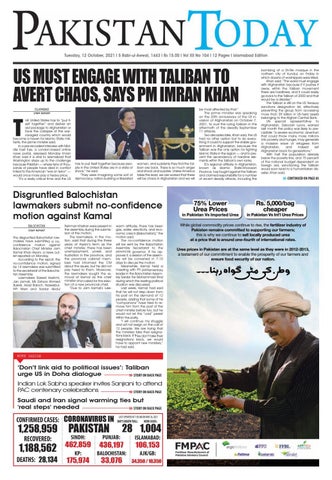
US mUSt engage with taliban to avert chaoS, SayS Pm imran Khan ISLAMABAD
t
staff report
he United States has to “pull itself together” and deliver an aid package to Afghanistan or face the collapse of the warravaged country which would become a haven for Islamic State militants, the prime minister said. In a pre-recorded interview with Middle east eye, a London-based online news portal, released Monday Imran Khan said it is vital to Islamabad that Washington steps up to the challenge because Pakistan — where tens of thousands of people have died in conflict linked to the American “war on terror” — would once more pay a heavy price. “It’s a really critical time and the US
has to pull itself together because people in the United States are in a state of shock,” he said. “They were imagining some sort of democracy, nation-building or liberated
women, and suddenly they find the Taliban are back. There is so much anger and shock and surprise. Unless America takes the lead, we are worried that there will be chaos in Afghanistan and we will
Disgruntled Balochistan lawmakers submit no-confidence motion against Kamal BALochIStAn staff report
The disgruntled Balochistan lawmakers have submitted a noconfidence motion against Balochistan Chief Minister Jam Kamal Khan Alyani, a news outlet reported on Monday. According to the report, the no-confidence motion, signed by 14 lawmakers was submitted to the secretariat of the Balochistan Assembly. Lawmakers Saeed hashmi, Jan Jamali, Mir Zahoor Ahmed Buledi, Asad Baloch, Naseebullah Marri and Sardar Abdul
Rehman Khetran were present in the assembly during the submission of the motion. The lawmakers, in the motion, said that during the three years of Alyani’s term as the chief minister, there has been unemployment, unrest, and frustration in the province, and the provincial cabinet members had informed the CM about the issues, but he did not pay heed to them. Moreover, the lawmakers sought the removal of Kamal as the chief minister and called for the election of a new provincial chief. “Due to Jam Kamal’s luke-
warm attitude, there has been gas, water, electricity, and economic crisis in [Balochistan],” the motion said. The no-confidence motion will be sent by the Balochistan Assembly Secretariat to the provincial governor. If he approves it, a session of the assembly will be convened in 7-10 days to discuss the motion. Meanwhile, Kamal held a meeting with PTI parliamentary leader in the Balochistan Assembly Sardar Yar Mohammad Rind during which the existing political situation was discussed. Last week, Kamal had said that he will not step down from his post on the demand of 12 people, adding that some of his “companions” have tried to remove him from the post of the chief minister before too, but he would not let this “void” persist within the party. “I will continue my struggle and will not resign on the call of 12 people. We are trying that the ministers take their resignations back. If they don’t take their resignations back, we would have to appoint new ministers,” he had said.
MORE INSIDE
‘Don’t link aid to political issues’: Taliban urge US in Doha dialogue STORY ON BACK PAGE Indian Lok Sabha speaker invites Sanjrani to attend PAC centenary celebrations STORY ON BACK PAGE Saudi and Iran signal warming ties but 'real steps' needed STORY ON BACK PAGE
CONFIRMED CASES: coronavirUS in
1,258,959 RECOVERED:
PaKiStan SINDH:
LAST UPDATED AT 7:38 AM ON MAY 26, 2021
DAY'S DEATH TOLL:
NEW CASES:
28 1,004
PUNJAB:
ISLAMABAD: AJK/GB:
1,188,562
462,859
436,197
DEATHS: 28,134
KP:
175,974
BALOCHISTAN:
33,076
106,153
34,350 / 10,350
be most affected by that.” The prime minister was speaking on the 20th anniversary of the US invasion of Afghanistan on October 7, 2001, to oust the ruling Taliban in the aftermath of the deadly September 11 attacks. Two decades later, Khan said, the US had no other option but to do everything it could to support the stable government in Afghanistan, because the Taliban was the only option for fighting Islamic State in the region — and to prevent the ascendency of hardline elements within the Taliban’s own ranks. IS’s regional affiliate in Afghanistan, known as Islamic State-Khorasan Province, has fought against the Taliban and claimed responsibility for a number of recent deadly attacks, including the
bombing of a Shi’ite mosque in the northern city of Kunduz on Friday in which dozens of worshippers were killed. Khan said: “The world must engage with Afghanistan because if it pushes it away, within the Taliban movement there are hardliners, and it could easily go back to the Taliban of 2000 and that would be a disaster.” The Taliban is still on the US Treasury sanctions designation list, effectively preventing the group from accessing more than $9 billion in US-held assets belonging to the Afghan Central Bank. UN special representative to Afghanistan, Deborah Lyons, warned last month the policy was likely to precipitate “a severe economic downturn that could throw many more millions into poverty and hunger, may generate a massive wave of refugees from Afghanistan, and indeed set Afghanistan back for generations.” With half the population already below the poverty line, and 75 percent of the national budget dependent on foreign aid, sanctioning the Taliban would soon lead to a humanitarian disaster, Khan said.
CONTINUED ON PAGE 03
02
Tuesday, 12 October, 2021 | ISLAMABAD
NEWS
Govt should focus on inflation reduction by keeping everything else aside: Jahangir Tareen NewS deSk Estranged PTI leader, Jahangir Khan Tareen, on Monday, criticized the federal government by stating that it should keep everything aside and focus on reducing inflation only. Speaking to the media in Kahror Pakka tehsil of Lodhran, Tareen said that the incumbent government has failed to reduce inflation, thus causing great inconvenience to people. He said that inflation is controlled by applying the theory of supply and demand, adding that had the government taken timely decisions in the past, people wouldn’t have to suffer. “Had decisions regarding imports been made on time, the issues of wheat, sugar and other commodities wouldn’t have been there,” said Tareen. Despite taking a jibe at the PTI-led federal government, the leader stressed that PTI is his party and “all of us are in PTI”. Speaking about the developmental works in Lodhran, he said that he is trying that the works are completed soon. Tareen, who was previously one of the closest confidants of Prime Minister Imran Khan, had formed his own separate group within the PTI after accusing the Punjab government of targeting politicians who were loyal to him. He accused the Punjab government of transferring officers of the ministers that were loyal to Tareen, “left, right and centre”, and were putting pressure on them. The estranged PTI leader said the pro-Tareen group had, as a result, decided to “raise their voices against this in the Punjab Assembly”.
74 held during snap checking for having illegal weapons iSlAMABAd PR
Islamabad Police have arrested 74 persons during snap checking in last week and recovered 61 pistols, three Kalashnikovs, six guns, five daggers and 457 rounds from them. Following the directions of Inspector General of Police (IGP) Islamabad Qazi Jamilur Rehman, Islamabad police have accelerated efforts to nab those persons involved in criminal activities. Zonal SPs, SDPOs and SHOs are conducting snap checking themselves along with police teams and ensuring effective policing. During the last one week, Islamabad police arrested 74 persons during snap checking in last week and recovered 61 pistols, three Kalashnikovs, six guns, five daggers and 457 rounds from them. The overall snap checking efforts are being monitored by the DIG (Operations) Afzaal Ahmed Kausar and the purpose is to ensure effective security and protection to the lives and property of the citizens. Owing these efforts, crime rate is also declining in the city and such endeavors will continue.
LAHORE: The Bank of Punjab (BOP) has signed anMoU with The Citizens Foundation (TCF), one of Pakistan’s leading nonprofits, educating 275,000 less-privileged students through 1,687 school units across Pakistan. The MoU was signed by ZafarMasud, President and CEO – BOP&Syed AsaadAyub Ahmad (President and CEO – TCF. PR
CJP forms Three-member benCh To hear aPPeal on saCked emPloyees’ Case
C
NewS deSk
HIEF Justice of Pakistan (CJP) Gulzar Ahmed on Monday constituted a threemember bench to hear the review petition pertaining to the decision regarding striking down the Sacked Employees (Reinstatement) Ordinance Act, 2010, a news outlet reported. According to the report, the bench, led by Justice Umar Ata Bandial, will hear the case on October 14. Earlier in its August 19 verdict, the top court had
struck down the Sacked Employees (Reinstatement) Ordinance Act of 2010, ruling that the legislation enacted by the then PPP government did not meet the criteria laid down by the apex court in numerous cases. However, last month, Additional Attorney General Sajid Ilyas had filed a review petition against the verdict, stating that the court had passed the judgment without issuing a formal notice under order XXVIIA CPC and hearing the Attorney General of Pakistan, particularly with reference to the
constitutionality of the Act. Furthermore, the employees who had been conferred benefits under the Act, and who numbered in thousands, were neither heard nor provided an opportunity of hearing before the adverse action was taken against them, the review petition had said. “It is submitted that legitimate rights and interests of the existing employees including their seniority positions and promotion prospects could have been protected without declaring the entire Act as ultra vires the Constitution,” it had maintained.
Iran’s chief of armed forces Major-General Mohammed Bagheri to visit Pakistan today NewS deSk Chief of Staff of Iranian Armed Forces Major-General Mohammed Bagheri is scheduled to pay an official visit to Pakistan in a bid to develop military and defense diplomacy. Bagheri has been invited by the Chief of Army Staff or COAS General Qamar Javed Bajwa. Heading a high-ranking military and security delegation, the chief of staff of the Iranian armed forces
is scheduled to meet with a number of senior political, security, and military officials in Pakistan. He will hold talks with Prime Minister Imran Khan, the COAS, the chief of staff of the armed forces, as well as other military officials, during his stay in Islamabad. Later, the Iranian team would also visit Karachi. This trip is seen boosting military, defense, and security collaborations between the two countries. Experts believe that the upcoming visit of the
President urges NAB to prosecute officer for misconduct in Sharjeel Memon reference iSlAMABAd APP
President Dr Arif Alvi while rejecting the appeal of exAssistant Director NAB, Muhammad Umair has urged NAB to prosecute him to the maximum extent of the law on account of him being guilty of grave “inefficiency and misconduct”, and stealing 15 original deeds of property in reference no. 15/2019 (State v/s Sharjeel Inam Memon & Others). The President upheld the maximum service
punishment in law of “major penalty” of “dismissal from service”, which he considers definitely not enough considering the crime involved, a press release issued by the President’s Media Wing here on Monday said. Muhamamd Umair, ex-Assistant Director (AD), had submitted an appeal to the President of Pakistan against the orders of Chairman National Accountability Bureau (NAB) imposing a major penalty of “Removal from Service”. Rejecting the appeal, the President stated that it was a case of blatant corruption, and was tantamount to
Iranian delegation to Pakistan is important in view of recent developments in the world, especially in Afghanistan. The trip also indicates that Pakistani and Iranian military officials are determined to cooperate to enhance security in joint border areas, help regional peace, restore security and stability in Afghanistan, as well as hold consultations on problems of the Muslim world and show commitment to the fight against terrorism.
throwing mud in the eyes of the people of Pakistan who had been betrayed. He said that Pakistan had suffered a great deal because of corrupt looters and plunderers, adding that so-called accidental fires destroy entire floors to remove every bit of evidence. The President said that documents were stolen even in foreign countries where corruption of Pakistani politicians was being investigated. According to the details, NAB had taken possession of 15 original deeds of property from the Secretary of Sharjeel Memon, Izhar Hussain, at the time of his arrest from his house in April 2019. Subsequently, the documents were kept in a steel Almirah in NAB which had been specifically provided to ex-Assistant Director, who was made the sole custodian of these documents.
CHINA - a confident global player Syed Ali NAwAz GilANi People Republic of China’s rise over the past two decades has reshaped the landscape of global politics. After joining WTO, China has rapidly transformed its economy from a lowcost “factory to the world” to a global leader in advanced technologies and also successfully transformed the supply chains around the globe with international diplomacy, leveraging its success to become the primary trading and development partner for emerging economies across Asia, Africa and Latin America. China’s emergence as a global power has also created tensions within the ranks of Western block as it was early expected that China’s integration into the global economy would lead to liberalization at home and moderation abroad have proven overly optimistic for the western block, especially since President Xi Jinping rose to power in 2012. China’s “quiet rise” has given way to more vocal expressions of great power aspirations and a more assertive international posture. Combined with Chinese military modernization program that has put Asia, as well as the United States, on notice that China’s economic power will have geopolitical implications. Now even the global spread of the COVID-19 pandemic has opened up opportunities for China to expand its influence, even as it has called into question both China’s credibility as a responsible stakeholder and the future of the supply chains that have fueled its economic success story. The think tanks around world are covering regularly China in detail, and continues to examine key questions about what will happen next. Like can China sustain its economic miracle in the face of demographic and environmental challenges? Will
China’s military modernization program change the balance of power in Asia and beyond? Is China seeking to reshape the rules-based international system to better reflect its interests, or is China’s goal to undermine and replace it? These types of questions are their topics of study in routine. Although, China has a long history of aid and investment in the developing world. Now since 2013 President Xi Jinping’s Belt and Road Initiative (BRI) of global infrastructure investment is making inroads not only in Asia and Africa, but also Europe. BRI, at present has grown up in to one of the most attractive platform for international cooperation new pathway enabling China successfully attract more than 126 countries and 29 International organizations successfully which clearly shows its influence. China’s Military Modernization is another reason of its global presence and modernizations of its forces not only enhanced its professional capabilities to fight at ground air and in sea. The Chinese defense industry that has itself become a global player with confidence. This is fact that in recent past the Chinese President Xi Jinping rose as a strong leader at world platform. The twin goals, to be achieved by 2049, are the “rejuvenation of the Chinese nation” both economically and territorially by reunifying with Taiwan. President Xi has reason to be grandiloquent. China’s $14tn economy is second only to the US; Standard Chartered reckons that on the basis of purchasing power parity, China will take the number one slot as early as next year. Chinese economy is expected to surpass the US at some point in the 2030s even some key areas earlier. China is also the world’s
largest trading nation in goods. Chinese companies successfully improved there ranking every year at Global Fortune 500. It ranks in the world’s top countries for receiving and giving foreign direct investment and is the second biggest spender on research and development at some $300bn. The Chinese Leadership in recent past has made a top priority in its economic planning through a number of high-profile initiatives, such as “Made in China 2025,” a plan announced in 2015 to upgrade and modernize China’s manufacturing in 10 key sectors through extensive government assistance in order to make China a major global player in these sectors. However, such measures have increasingly raised concerns that China intends to use industrial policies to decrease the country’s reliance on foreign technology. The rise of China will undoubtedly be one of the great real time dramas of the twenty-first century. China's extraordinary economic growth and active diplomacy are already transforming East Asia, and future decades will see even greater increases in Chinese power and influence. The famous historian Niall Ferguson has written that the bloody twentieth century witnessed "the descent of the West" and "a reorientation of the world" toward the East. Realists go on to note that as China gets more powerful and the West position erodes, two things are likely to happen: China will try to use its growing influence to reshape the rules and institutions of the international system to better serve its interests, and other states in the system. This year 2021 was very important for the China as the leadership made important decisions, the adaptation of 14th Five-Year Plan in spring. It set the agenda for achieving China’s ambition to become more
economically independent and for taking the next steps to modernizing China’s industry. Innovation strategies – not least in fields like climate protection and environmental technology – will be at the forefront. At the same time, spending on "national security" and investments in digital surveillance systems are likely to rise significantly. Learning from the adverse experience of others, the Chinese leadership resolved to build a moderately prosperous society instead of some entrepreneurs becoming filthy rich while others languished in poverty. China’s eradication of poverty has been an enigma for foreign scholars. They have summarized the solution as “5Ds”— Determined Leadership, Detailed Blueprint, Development Oriented, Data-based Governance and Decentralized Delivery. China’s role in world affairs is bound to increase, given its growing weight and relevance due to its population size, its role as the globe’s second, eventually largest economy, its military capabilities, its technological advances as well as its status as a Permanent Member of the UN Security Council. China’s growing impact therefore raises the central question whether it will uphold the very order that enabled it to rise to prosperity and eminence. China undeniably plays a greater role in international affairs, and as this continues it is important to understand grand overarching questions like what its policies are, why they are, where change is occurring, and how they are changing. (The writer is the SecretaryGeneral of Pakistan China Friendship Association Khyber Chapter & Senior Media Consultant can be reached by email syeed.gilani@gmail.com)
Tuesday, 12 October, 2021 | ISLAMABAD
PM Khan for taKing all Measures to facilitate chinese investors in seZs isLamaBaD
P
MiaN abrar
RIME Minister Imran Khan on Monday directed the authorities concerned to take all possible measures to provide land, electricity and gas connections as well as tax incentives to attract more Chinese companies to invest in the Special Economic Zones (SEZs) in across Pakistan. The meeting was attended by Chinese Ambassador to Pakistan Nong Rong, Federal Ministers Shaukat Tarin, Makhdoom Khusro Bakhtiar, Asad Umar, Muhammad Hammad Azhar, Advisor on Commerce Abdul Razzak Dawood, Special Assistant to PM on CPEC
Affairs Khalid Mansoor and senior officers concerned. “Pakistan needs investment to accelerate industrialisation,” the prime minister said while chairing a meeting on facilitating the Chinese investors in SEZs. “It is critical to create maximum employment opportunities for our growing population, 65 per cent of which is under the age of 35”, he added. The prime minister was briefed that out of the total of 27 SEZs in the country, work on five SEZs including Dhabeji in Sindh, Rashakai in KPK, Bostan in Balochistan, Allama Iqbal Industrial City in Punjab, and Gwadar in Balochistan was in full swing.
He was informed that an effective one window operation facility was being set up at each of these SEZs along with a facilitation center at China Pakistan Economic Corridor (CPEC) Authority to resolve all issues of potential Chinese investors under one roof. An official source told Pakistan Today that Prime Minister Imran Khan has been informed that foreign investors, who have bought land in the nine special economic zones (SEZs) in Punjab, are getting concerned as they are unable to execute their plans of industrial development in the absence of power and gas supplies. The official said that the prime minister has assured the Chinese investors
of provision of all the basic and fundamental facilities to the SEZs as well as release of funds allocated in the Public Sector Development Programme (PSDP) for provision of the services. The official said that the prime minister also got a review of the status of the nine SEZs in Punjab during his daylong visit to Punjab province recently. The PM also chaired various meetings to review the development plans in Lahore and also held a one-on-one meeting with Chief Minister Usman Buzdar at the chief minister’s secretariat. The official said that investors from China, Turkey, Korea, the Netherlands and Japan have procured land for setting up
Minar-e-Pakistan incident: Recording of call between Ayesha, Rambo surfaces News Desk During the investigation of Minar-e-Pakistan incident, in which TikToker Ayesha Akram was assaulted by dozens of men in Lahore’s Greater Iqbal Park on August 14, an audiotape of call between Ayesha and suspect Amir Sohail alias Rambo has surfaced, a news outlet reported on Monday. According to the report, the police seized Rambo’s phone, found a recording of a telephone conversation between him and Ayesha, and made the phone call recording a part of the case. According to the audio recording, Akram and
Rambo were planning to take money from all the suspects who have been arrested in the case so far. They discussed the number of suspects arrested and how much money should be taken from them, besides discussing that most of them belong to a low income group. Ayesha had nominated Rambo, who is currently in police custody, and 12 others in a statement, holding them responsible for the incident. According to the police, of the 104 suspects initially taken into custody for allegedly assaulting Ayesha, six have so far been identified by the victim, while three have confessed to the crime.
Petrol prices feared to surge again News Desk The price of petrol is likely to be increased by Rs7 per litre and high speed diesel (HSD) by Rs10 per litre from October 16. “We have worked out this huge increase in the price of both products keeping the first 10 days in view. The data shows that the prices of refined products have gone up from $79 to $91 per barrel from October 1,” sources in the industrial sector told The News. POL prices are generally based on 13-day data and oil prices will continue to rise over the next three days. So far, the government, in the last two fortnights, has approved an increase in the price of petrol of Rs9 per litre and high speed diesel of Rs7.01 per litre from September 16. It increased the MS price by Rs5 per litre
to Rs123.30 per litre and HSD by Rs5.01 per litre to Rs 120.04. From October 1, the government also approved a hike in petrol prices by Rs4 per litre to Rs127.30 per litre and in HSD by Rs2 to Rs122.05 per litre. This would be the third consecutive hike in POL prices if the government further increases the POL prices from October 16 as has been worked out. Oil went up more than 60 per cent for 2021 as demand rebounds, while supply remains tight. Industrial experts said that unless the OPEC acts to meaningfully increase the supplies, the prices will still stay high. Since May, global prices of Brent have surged by almost one-third (32 per cent) to $82 per barrel although forecasts by the US Energy Information Administration average $62 per barrel in 2021 and $60 in 2022 against the
“If they leave Afghanistan like this, my worry is that Afghanistan could easily revert back to 1989 when the Soviets and US left and over 200,000 Afghans died in the chaos,” he said, referring to the civil war that followed Soviet retreat from the country. The interview was recorded ahead of the arrival in Islamabad of US Deputy Secretary of State Wendy Sherman to meet Foreign Minister Shah Mahmood Qureshi. US State Department spokesperson Ned Price said the two officials discussed “the importance of the U.S.-Pakistan relationship and the way forward in Afghanistan”. “Deputy Secretary Sherman emphasised the importance of a coordinated approach to Afghanistan and other issues vital to regional stability,” said Price. Over the weekend, US officials also held talks with senior Taliban representatives in Doha, Qatar. “The two sides […] discussed the United States’ provision of robust humanitarian assistance, directly to the Afghan people,” said Price. “The discussions were candid and professional with the U.S. delegation reiterating that the Taliban will be judged on its actions, not only its words.” But Khan said Biden was not listening — the two leaders have still not spoken, he revealed. Khan recalled he had warned Biden, John Kerry and Harry Reid — then all senators — in 2008 that they were creating a quagmire in Afghanistan for which there was no military solution. He said they did not listen. Two years later Gen Ashfaq Parvez Kayani, then chief of army staff, delivered the same message to US President Barack Obama. “But unfortunately, they were led by their generals. And do you know what generals always say: give us more troops and more time.” Khan was visibly angry when asked about suggestions that he had gloated about the fall of Kabul
to the Taliban. Speaking one day after the group took control of the capital, prompting thousands of people to attempt to leave the country, Khan said Afghans had “broken the shackles of slavery”. He responded: “We have been so relieved because we expected a bloodbath but what happened was a peaceful transfer of power. But we also felt we were blamed for this. Three hundred thousand [Afghan army] troops surrendered without a fight, so clearly we did not tell them to surrender.” Asked whether the Taliban had formed an inclusive government, Khan admitted it was not inclusive, but observed the government was a transitional one. He said he was working with neighbouring states, notably Tajikistan and Uzbekistan, which have sizeable ethnic minorities inside Afghanistan, to encourage the Taliban to widen representation. “They need an inclusive government because Afghanistan is a diverse society.” WOMEN’S RIGHTS: Khan stressed that the only bar to entry into government applied to members of what he called the “former regime“, which he accused of corruption. One of the first things Zabiullah Mujahid, the Taliban’s spokesperson, did after the fall of Kabul was to reassure Afghan women that “our sisters and our men have the same rights”. But Human Rights Watch has accused the group since taking the power of “implementing a massive rollback of human rights,” with universities closed, access to healthcare restricted and demonstrators beaten and threatened. Khan said the Taliban should be given time: “They have made the right statements and have no other option. What else are we going to do if we sanction them? The best way is to incentivise them to walk the talk. “But if you force them, I would imagine the nature of the people is such that they will push back and it
03
industries and urgently needed power and gas. Since the federal government has allocated funds for the facilities in its PSDP, the Punjab government has demanded the finances be released at the earliest so that the province could begin work on establishing grid stations and laying power lines and gas pipes, the official added. The official said that PM Khan also directed the Punjab government to focus more on China-Pakistan Economic Corridor projects in Sheikhupura and Faisalabad, and resolve the administrative matters of the Faisalabad Industrial Estate Development and Management Company.
Summary to award constable Jamal Kalhoro Tamgha-e-Shujaat moved on PM Imran’s recommendation A summary has been moved to award Tamgha-e-Shujaat to Jamal Kalhoro who was filmed while saving the life of a man who fell off a moving train. PM Imran Khan nominated Sindh Police Constable Jamal Kalhoro for the medal. He recommended President Arif Alvi to award the medal to the police Constable. The Tamgha-e-Shujaat will be awarded to the Kalhoro next year on the occasion of Pakistan Day. Earlier in August, the PM had announced on his twitter handle to honor the constable, saying they decided to honor Constable Jamal Kalhoro on Pakistan Day 23rd March for his dedication to duty. News Desk
PMA calls for cancellation of MDCAT results International Monetary Fund’s (IMF) projections of about $60 per barrel in 2021 and slightly above $56 in 2022. Meanwhile, Pakistan’s oil import bill more than doubled up to almost 103 per cent totaling $3.1bn in July-August 2021, against $1.5bn as compared to the corresponding period last year whereas overall consumption of oil products in the first three months of the current fiscal (3MFY22) posted about 24pc growth to 5.86m tonnes as industrial output and transportation business rebounded. Earlier last week, Finance Minister Shaukat Tarin had said that the government was absorbing the impact of the decade’s highest price-hike at international level to provide relief to people through various measures, including direct food subsidy to the poor. He said that Covid-19 pandemic had triggered price hikes all across the globe, adding that since Pakistan was importer of some essential commodities, hence it was impacted too; however, the government had not passed on the impact to the public.
US must engage with Taliban to avert chaos, says PM Imran Khan CoNtiNueD from page 01
NEWS
would be counterproductive.” He said there were clearly different currents within the movement and a lack of clear leadership on some issues. Pakistan is currently engaged in delicate and politically sensitive negotiations with the proscribed Tehreek-e-Taliban Pakistan. The TTP and the army have fought their own bloody conflict on the sidelines of the “war on terror”, with the loss of more than 80,000 lives — mostly civilians. The TTP, which was driven out of the tribal areas five years ago, has since relaunched its campaign with renewed clashes with the army. The TTP has made two conditions for a ceasefire – Sharia law in the tribal areas, and the release of prisoners. The Pakistan government insists only the constitution applies to these areas. Khan told MEE the TTP consisted of 50 groups and that he was trying to reconcile those elements who were willing to talk. “Now, we are trying to talk to those who can be reconciled because it’s from a position of strength. I always believed all insurgencies eventually end up on the dialogue table, like the IRA [Irish Republican Army] for instance,” he said, referring to the Northern Irish peace deal. COST IN LIVES: He said the Taliban government in Afghanistan had told Pakistan that the TTP would not be allowed to launch attacks on Pakistan from inside Afghanistan. He also recalled how Indian intelligence agencies supported these attacks under the former government in Kabul. “We now have to talk to those we can reconcile and [persuade to] give up their arms and live as normal citizens.” Khan condemned the continued use of drones by the US in Afghanistan.
The Pakistan Medical Association (PMA) has lashed out at the Pakistan Medical Commission (PMC), demanding the commission hold the MDCAT exams again on the same day and cancel the one already held. The PMC was formed overnight and is working without consultation, said PMA Secretary-General Dr Qaisar Sajjad on Monday. Responding to the results announced by the commission on Saturday, he said that many students have failed the examination. “PMA demands MDCAT results be cancelled and the exam should be held again on the same day,” he said, adding that exams should not be conducted for 30 days. He underlined that the PMC — previously known as PMDC — is a worldwide recognized body and people know the PMC as a registration body. Dr Sajjad said doctors will encounter difficulties if each province has a different registration body. “The PMC is doing everything without consultation,” the official reiterated. PMC National Medical Authority (NMA) last week announced the final result of the MDCAT 2021 after the conclusion of the post-exam analysis held on the completion of the test. While sharing details of the final result, PMC President Dr Arshad Taqi said that out of the 194,133 students, 68,680 students passed the exam resulting in a national pass percentage of 35.4%. News Desk
04 NEWS 12th October 2021 (ISB)_Layout 1 10/11/2021 10:10 PM Page 1
Tuesday, 12 October, 2021 | ISLAMABAD
04 NEWS
PakISTaN doeSN’T waNT INSTabILITy IN afghaNISTaN, hoPeS for INcLuSIve govT: aLvI ISLAMABAD
P
APP
RESIDENT Arif Alvi said peace in Afghanistan will bring prosperity to the region and open a fresh window of business opportunities for the world to connect with central Asian states through the war-torn country. “Devastation in Afghanistan means more refugees in Pakistan. We don’t want any instability in our neighbouring country and hope to see an inclusive government representing all political stakeholders,” he said in an interview with Khaleej Times during his two-day visit to the United Arab Emirates. Dispelling the impression that Islamabad has been backing the regime change, the president said Pakistan was not an active player in Afghanistan. “We are just helping the Taliban on humanitarian grounds as the Afghans are suffering due to sanctions and blockage of funds. There is a flight of capital from Pakistan to Afghanistan. So, it is in our interest to bring stability in the country,” he said.
PTI gets access to PPP, PML-N accounts in funding case ISLAMABAD: The Election Commission of Pakistan on Monday accepted the Pakistan Tehreek-i-Insaf (PTI) petition seeking to secure access to the accounts of Pakistan Peoples Party and Pakistan Muslim LeagueNawaz in the foreign funding case against it. The commission accepted the request of the Minister of State for Information and Broadcasting Farrukh Habib during a hearing on the case here. Talking to the media after the hearing, the minister said the PML-N had kept seven accounts while the PPP kept 12 accounts secret from the Election Commission of Pakistan. He said he requested the commission to give the ruling party access to the financial accounts of both parties for an audit. He hailed the acceptance of his petition, saying the parties were defeated big in the Kashmir by-election. The minister vowed to bring the facts before the nation which he declared the PPP and PML-N were hiding. “We will bring to light the fake accounts of PPP Chairman Bilawal Bhutto-Zardari and PML-N Vice President Maryam Nawaz,” he said. He stated these people have hidden their corruption owing to delay by the ECP to make a decision on his petition. “Now, we would not let them run away,” he added. Habib expressed the resolved that after analysing the accounts of the PPP and PML-N, the government would put the record before the scrutiny committee and “our financial experts would assess these accounts”. AhmAd SAAd
Nine killed in attack by gunmen in S Punjab LAHORE: At least nine people were killed by gunmen in Southern Punjab late on Sunday, police said. Local police chief Asad Sarfraz told reporters a group of armed assailants riding three motorbikes stormed two gas stations simultaneously in the town of Sadiqabad, killing nine and injuring several others. The attackers, according to Sarfraz, suspected some of the deceased of being police informers. At least six members of the gang had been killed in a clash with police a few months ago in Rahim Yar Khan. The attackers, who shared the same community with the deceased, suspected their accomplices had been killed after a tip-off by their victims, the police chief said. AgencieS
Schools resume regular classes ISLAMABAD: Schools across the country resumed regular classes on Monday after the National Command Operation Centre (NCOC) eased the coronavirus restrictions following a reduction in the new cases across Pakistan. The institutions were earlier operating on 50 percent capacity after they reopened following intermittent closures due to the prevalence of Covid-19. All the students were attending the school on alternate days and the school timings were also reduced. Last week, NCOC head Asad Umar announced that all educational institutions would start normal classes from October 11 (today). The planning and development minister had also made this announcement in a post shared on his official Twitter handle. inP
The newspaper quoted President Alvi as terming the US withdrawal “a hasty call” and that there was no military solution in Afghanistan. “We always tried to persuade the US into avoiding war, and back negotiations as a better solution. If US and Nato forces are unable to bring stability in Afghanistan despite spending $2.3 trillion, then how will Pakistan be able to do that,” the president questioned. Alvi said Pakistan has been hosting four million refugees and stressed that such a gesture must be considered as a matter of goodwill by the Afghan people. “We have also played an active and positive role in the repatriation of diplomats and other people from Afghanistan and the world has acknowledged our efforts,” he said. He said inflation was on the rise worldwide and Pakistan was not the only country in the world facing this challenge. “Inflation is high because commodities and oil prices are increasing in the international market. However, the government will be taking steps to control the food inflation through supply chain mechanism and good governance,” he said. Replying to a question, he said the
country was on the right track and its future was bright. “The government has taken the right steps at the right time to overcome serious challenges such as the
Covid-19, jobs creation and reviving the economy. We have managed to register close to four per cent GDP growth rate in last financial year despite the pandemic,” he said. About the Dubai Expo 2020, the president said it was a wonderful event and all credit goes to the visionary leadership of the shekhdom for hosting a successful show despite a challenging environment worldwide. “The Expo 2020 is a landmark event not just for the UAE, but also for the whole region. It offers a unique opportunity to the countries of the region and beyond to establish linkages and partnerships with multinational companies,” the president said. “We have a very beautiful pavilion at the Expo. I suggest everyone should go to the Expo and must visit the pavilion projecting Pakistan’s positive image as a peaceful country,” the president said. Alvi also expressed grief over the sad demise of nuclear scientist Abdul Qadeer Khan who passed away in Islamabad on Sunday morning at the age of 85. “He helped us develop nation-saving nuclear deterrence and a grateful nation will never forget his services in this regard,” he said.
Islamabad new hotspot as dengue continues to wreak havoc ISLAMABAD StAff rePort
As many as 78 new cases of dengue fever were reported in Islamabad during the last 24 hours, health authorities said Monday, expressing fears that the nation might face an outbreak of the disease in the coming days. According to the Ministry of National Health Services data, five people have died of the viral disease so far in Islamabad and 1,229 cases have been reported. In rural towns of the capital, 817 people contracted the disease while in urban centres, 412 were diagnosed with the virus which is spread by mosquitoes that can only survive in warm temperatures. Keeping in view of the alarming spike in dengue fever cases, the health department in collaboration with the district administrations has begun fumigation and an awareness campaign in the province. On the instructions of Punjab Primary and Secondary Healthcare Department Secretary Imran Sikandar Baloch, the campaign to eliminate the disease was going on in full swing across the province. The authorities have expedited efforts to destroy dengue larvae, he said. Baloch further said during the past
24 hours, 169 dengue patients were reported in Punjab. Of these, 124 were reported from Lahore, 26 from Rawalpindi, three from Sargodha, while Multan, Khanewal, Gujranwala, Layyah, and Vehari announced two cases each. To date, 3,975 cases of viral fever have so far been reported in Punjab. The bulk of these cases were reported from Lahore where the total number of infections is 3,145. The secretary further said 428 patients were being treated across the province, while 238 additional were
admitted to Lahore hospitals. He urged the people to take extra care in order to prevent the spread of dengue. KP REPORTS 135 NEW CASES: According to the Khyber Pakhtunkhwa Health Department, 135 new dengue cases were reported during the last 24 hours. The total number of these cases reached 2,795 after recording new cases. The disease has so far killed four people in the province. In Peshawar, 38 people were diagnosed with dengue Sunday. Peshawar’s caseload with the new cases
surged to 803. Lower Dir reported 14, Shangla 12 and Haripur reported 39 dengue cases, the department said. Meanwhile, in Balochistan, a total of 1,750 dengue cases have been reported from the Gwadar, Kech and Lasbela districts this year. According to government officials, despite various challenges posed by Covid-19, the government has been making all-out efforts and taking adequate measures to stem the further spread of the dengue virus. Only nine countries faced severe dengue outbreaks in 1970. But the disease is now seen in more than 100 countries. There are thought to be 390 million infections each year. In 2011, a major outbreak of dengue fever — potentially lethal disease spread by mosquito bites — infected 20,000 and killed more than 300 people. Subsequently, in 2019, rising temperatures across Asia and the Americas contributed to multiple severe outbreaks of dengue fever globally, making it the worst year on record for the disease. Other Asian countries, including Bangladesh, Thailand, Cambodia and Laos, also had outbreaks, with a particularly severe situation in the Philippines, where 1,000 people died of the disease, including hundreds of children, in 2019.
Punjab moves top court against LHC order to release TLP chief LAHORE StAff rePort
Punjab Monday challenged in the Supreme Court a Lahore High Court (LHC) order declaring the detention of the chief of the proscribed Tehreek-e-Labbaik Pakistan (TLP) party illegal and directing the provincial government to release him immediately. Saad Hussain Rizvi, son of the late firebrand cleric Khadim Hussain Rizvi, was arrested in April on charges of inciting his followers and party activists to take the law into their own hands after, according to him, the government had reneged on its promise to expel the French ambassador over the publication of blasphemous caricatures. His detention was scheduled to end on July 10 in light of a decision of the review board of the Supreme Court. However, the office of the deputy commissioner issued a fresh notification extending the detention for another three months under Section 11-EEE (powers to arrest and detain suspected persons) of the Anti-Terrorism Act, 1997. On August 2, Rizvi, through his uncle, filed another petition with the high court, claiming the government extended his detention with “mala fide intention”. He said it implicated him in 14 criminal cases following his detention. Through the petition, Rizvi’s uncle asked the court to declare the extension of the detention period illegal and order his release. Two weeks later, on August 17,
CMYK
the court sought replies from the authorities on the request. Subsequently, on October 1, the court declared as illegal the detention of Rizvi. Following the court order, the Lahore deputy commissioner, Umer Sher Chattha, also issued orders for his release. The orders have yet to be complied with, however, and Rizvi is still in custody. TLP FIASCO: The government outlawed the hardline religious group in April after it blocked main highways, railways and access routes to major cities, assaulting police and burning public property. Four police officers were killed and more than 500 wounded. The violence erupted after the government detained Rizvi ahead of a planned countrywide anti-France campaign to pressure the Islamabad government to expel the French ambassador in response to the publication of blasphemous cartoons in France last year. In subsequent talks, the TLP presented four main demands. They included the expulsion of the French ambassador, the release of Rizvi and around 1,400 arrested workers, lifting the ban on the group and the dismissal of Minister of Interior Sheikh Rasheed Ahmed. Relations between Paris and Islamabad worsened last year after President Emmanuel Macron paid tribute to a French history teacher who was beheaded by an 18-year-old man of Chechen origin for showing cartoons of Prophet Muhammad (PBUH) in a class on freedom of speech. Protests erupted in several Muslim countries over France’s response to the killing of the teacher. The car-
toons were reprinted elsewhere as well. At the time, the government allegedly signed a deal promising to present a resolution in parliament by April 20 to seek approval for the expulsion of the French envoy and to endorse a boycott of French products.
Tuesday, 12 October, 2021 | ISLAMABAD
NEWS
05
PAkistAN CONdEmNs dEtENtiON Of OvEr 1,400 kAsHmiris iN iiOJk ISLAMABAD
P
stAFF RePoRt
AKISTAN on Monday strongly condemned the arrest of over 1,400 Kashmiris on orchestrated charges by the Indian occupied forces in one of the biggest ever crackdowns in Illegally Indian Occupied Jammu and Kashmir (IIOJK). The Foreign Office spokesperson Asim Iftikhar stated that these arbitrary arrests and detentions by the Indian forces are prime examples of New Delhi’s state terrorism and trampling of fundamental human rights in IIOJK. He went on to say that the recent surge in extra-judicial killings, staged cordonand-search operations, and arbitrary arrests in IOJK are a source of serious alarm for the international community. Earlier, Pakistan unveiled a comprehensive dossier comprising irrefutable evidence of gross and systematic human rights violations, war crimes, and false flag operations in the occupied valley being carried out by Indian occupation forces with impunity. The spokesperson further said that
Evidence sought against suspect’s mother in Noor murder ISLAMABAD stAFF RePoRt
The Supreme Court Monday ordered the prosecution to present on October 18 its evidence against the mother of the prime suspect as it took up her bail petition in the murder of a former ambassador’s daughter. Noor Mukadam, 27, was found murdered at the residence of one Zahir Zakir in Sector F-7/4 of Islamabad in July. Zakir, widely believed to be the killer, was arrested the same day for his purported involvement in the gruesome incident. Investigators say the two were friends, and Zakir lured Mukadam to his home, held her there for two days, and then brutally murdered her. A first information report registered on the complaint of Ambassador Shaukat Ali Mukadam, Mukadam’s father, nominated Zakir under Section 302 (premeditated murder) of the Pakistan Penal Code. Zakir Jaffer and Asmat Adamjee, the parents were arrested days later on charges of abetting the murder, filed separate petitions challenging the rejection of their bail petitions by the Islamabad High Court. The court had also ordered authorities to keep them in detention until the completion of the trial. During the hearing, Justice Umar Ata Bandial pointed out there was no mention of Adamjee in the IHC order denying bail to the duo. Justice Qazi Amin remarked that the murder was a sad incident and added that “we sympathise with the family of the deceased”. The petitioner’s counsel, Khawaja Haris, told the court he is yet to receive the forensic reports. He expressed apprehension the high court order to complete the trial in two months will affect the right to a fair trial. The court, however, observed while the right to a fair trial was a must, “but the delay in handling the case only adds to anxiety”. Subsequently, adjourning the proceedings until October 18, the court directed the prosecution to submit all the evidence against Adamjee before the next hearing. Last week, a district and sessions court in Islamabad fixed October 14 for the indictment of suspects. A total of 12 people will be indicted in the case, including Zakir, his parents Zakir Jaffer and Asmat Adamjee, three household staff — Iftikhar, Jan Muhammad and Jameel — and six Therapy Works employees including Tahir Zahoor, Amjad, Dilip Kumar, Abdul Haq, Wamiq and Samar Abbas. The court had last month set October 6 for framing charges in the case, but deferred it after the suspects filed fresh petitions, seeking certain documents along with the copy of the challan.
India must recognize that no amount of brutalities committed against the Kashmiris can suppress their voice and their
legitimate movement to achieve their inalienable right to self-determination. “Nor will India’s illegal and unlawful
actions be able to mislead the world into accepting India’s false narrative against the Kashmiris,” he conluded.
Pakistan among 24 signatories to global methane pact WASHINGTON ReuteRs
Two dozen countries have joined a US- and EU-led effort to slash methane emissions 30 percent by 2030, giving the emerging global partnership momentum ahead of its launch at the UN climate summit in Glasgow later this month, a government official told Reuters. Pakistan and Japan are among the 24 new signatories to the Global Methane Pledge, which was first announced by the United States and EU in September with the aim of galvanising rapid climate action before the start of the Scotland summit on October 31. It could have a significant impact on the energy, agriculture and waste sectors responsible for the bulk of methane emissions. The nine original partners include Britain, Indonesia and Mexico, which signed on to the pledge when it was announced at the Major Economies Forum last month. The partnership will now cover 60 percent of global GDP and 30 percent of global methane emissions. US special climate change envoy John Kerry and Eu-
ropean Commission Executive Vice President Frans Timmermans will introduce the new partners at a joint event on Monday and also announce that a dozen philanthropic organisations, including ones led by Michael Bloomberg and Bill Gates, will mobilise over $200 million to help support countries’ methane reduction efforts, said the official, who declined to be named. The source said the countries represent a range of different methane emissions profiles. For example, Pakistan’s main source of methane emissions is agriculture, while Indonesia’s main source of methane is waste. Several countries most vulnerable to climate change impacts, including some African nations and island nations like Micronesia, have also signed the pledge. In the weeks leading up to the UN climate summit, the United States will engage with other major emerging economy methane emitters like India and China to urge them to join and ensure the “groundswell of support continues,” the official said. ‘ONE MOVE LEFT’: Methane is a greenhouse gas and the biggest cause of climate change after carbon dioxide (CO2). Several recent reports have highlighted the need for governments to crack down on methane to limit global warming to 1.5 degrees C, the goal of the Paris climate agreement. Methane has a higher heat-trapping potential than CO2 but breaks down in the atmosphere faster. A landmark United Nations scientific report released in August said “strong, rapid and sustained reductions” in methane emissions, in addition to slashing CO2 emissions, could have an immediate impact on the climate. The United States is due to release oil and gas methane regulations in the coming weeks and the European Union will unveil detailed methane legislation later this year. Larry Kramer, president of the William and Flora Hewlett Foundation, which contributed to the $200 million fund, told Reuters the money will “help catalyse climate action” and that reducing methane is the quickest way to help carry out the 1.5-degree goal. Durwood Zaelke, president of the Washington-based Institute for Governance and Sustainable Development, said the partnership was a “great start” for focusing the world’s attention on the need to slash methane. “There’s one move left to keep the planet from catastrophe — cutting methane as fast as we can from all sources,” he said by email ahead of the announcement.
NAB Ordinance 2021 challenged in LHC LAHORE INP
A petition challenging the National Accountability Bureau (Amendment) Ordinance, 2021, was refiled with the Lahore High Court (LHC) Monday. The petition was re-submitted after removing the objections raised on it by the court’s registrar office. The plaintiff requested the court to halt implementation of the bill until a final decision on the petition. The ordinance cannot be issued for a single person, he added. The federal government and other ministries have been nominated as respondents. President Dr Arif Alvi promulgated the ordinance earlier this month, paving the way to extend the tenure of the anti-graft agency chief. Later, addressing a joint news conference along with Minister for Information and Broadcasting Fawad Chaudhry, Minister for Law and Justice Farogh Nasim said the president will appoint National Accountability Bureau chairman after consultation with the Leader of the House and Leader of the Opposition in the National Assembly. Nasim said the government was bringing in a presidential ordinance to introduce some amendments in the NAB laws for more transparency and clarity. He said the matter will be referred to a parliamentary committee to be constituted by the National Assembly speaker with equal representation from the treasury and the opposition benches if the consultation with the prime minister and the opposition leader does not remain consensusoriented. He said a provision has been inserted in the new ordinance deleting the word non-extendable.
Five Indian soldiers killed in IIOJK shooting NEW DELHI AFP
Five Indian soldiers were killed during a search operation in Indian Occupied Jammu and Kashmir (IIOJK) on Monday, Indian army said, stoking tensions in the occupied territory. Separately, two freedom fighters embraced martyrdom in different incidents, authorities said. Colonel Devendar Anand told AFP that one officer and four soldiers “were killed during a search operation probably by in-
filtrators” in a mountain pass near the Line of Control (LoC). “The operation is ongoing,” he added. The shootings were the deadliest attack on military forces in the area since a ceasefire along the LoC was announced in February. For over three decades, separatist groups have been fighting Indian soldiers and demanding independence for IIOJK or its merger with Pakistan. Tens of thousands of civilians, soldiers and rebels have died in the fighting. Prime Minister Narendra Modi’s Hindu nationalist government angered Kashmiris in
2019 by scrapping the Muslim-majority region’s semi-autonomous status. This was accompanied by a huge security operation and communications blackout with tens of thousands of extra soldiers joining the estimated half a million already on the ground. Tensions have flared further in recent weeks with a spate of shootings of civilians in the area, with seven killed last week alone in attacks. Some 650 residents suspected to have links with rebel groups have been detained following the shootings, a police source said.
CMYK
“No stone will be left unturned to find the killers,” the senior police officer told AFP on condition of anonymity. A relatively new group The Resistance Front claimed responsibility for the seven killings last week and accused those killed of working for “occupier mercenary forces and occupier stooges”. The statements, issued only in English, were circulated in numerous WhatsApp groups and could not be independently verified by AFP. One of the two suspected rebels killed on Monday was suspected of being involved,
authorities said. His family told reporters that soldiers picked him up on Sunday at then shot him while in their custody. On Saturday, the Human Rights Watch called for Indian security forces accused of abuses including harassment, torture and extrajudicial killings to be held accountable. “Kashmiris are caught in unending violence from attacks by militants and abuses by government authorities and security forces,” HRW’s South Asia director Meenakshi Ganguly said in a statement.
06-07 Comments - 12th October 2021_Layout 1 10/11/2021 8:53 PM Page 1
Tuesday, 12 October, 2021
06 COMMENT
Pak-US relations
PM’s changing priorities Out of sync and out of touch
P
M Imran Khan made two concrete promises during the election campaign: corruption would be eradicated and people’s livelihood improved by providing five million houses, 10 million jobs, bringing down service charges and improving people’s purchasing power. Failing to achieve either of these objectives, Mr Khan has now moved the goalposts. Corruption, he complains, can only be controlled if society is helpful which, according to him, it is not as shown by people showering rose petals over the corrupt. People’s welfare has been replaced by what Mr Khan calls the war against obscenity which according to the PM is the second biggest problem facing the country after corruption. The surge in sex crimes, he maintains, has been caused by obscene Hollywood and Bollywood movies, over which he has no control. Improving the livelihood of the people being a stone too heavy to lift, the PM has announced instead the formation of Rehmatul-Lil-Aalamin Authority as an answer to all our ills. But can any group of “renowned” religious scholars be allowed to usurp the constitutional rights of the provincial governments including monitoring of the curricula. The Authority is also entrusted with the task of presenting the true image of Islam to the world. But can any single country nominate clerics of its choice to tell the world, which also includes countries like Saudi Arabia, Iran and Turkey, what true Islam really is? Any attempt by the Authority in the direction can only create rifts in the Muslim world. Similarly, in democracies, mainstream media as well as social media enjoy freedom subject only to fair laws of the country. Pakistani media has fought hard against restrictions imposed by military rulers and civilian autocrats. It is too much to expect from it to allow any religious scholar to take decisions on its behalf. What has already drawn a lot of flak is the PM’s remark regarding Caliph Hazrat Omar telling off the ever victorious General Hazrat Khalid Bin Walid and dismissing him from the command and appointing a new general in his place. The second Caliph could do that because besides being a companion of the Holy Prophet, he commanded the loyalty of the entire Muslim community rather than being the head of the government in a hybrid democracy duly confronted by a strong opposition.
Nothing but fantasy
AttiyA MunAwer
R
eLATIOnS between Pakistan and the United States have always been volatile and Pakistan has not been able to please the United States by becoming an ally against the will of the people in the region. Pakistan sacrificed more than 70,000 lives in the Afghan war, while it is impossible to estimate the fiscal deficit yet, the United States not only demanded to ‘do more’ but also tried to put its weaknesses in Pakistan’s account and is still doing so. The United States has always expected its own will from Pakistan, while never taking any practical steps to win Pakistan’s confidence. It is clear that the United States has always used Pakistan for its interests. Whenever the United States needs Pakistan, it will not hesitate to establish relations. US Deputy Secretary of State Wendy Sherman also visited Pakistan. There is a link in this chain. But we should not expect too much from the United States.
IOK violence
A
fresh spate of violence has gripped Indian Occupied Kashmir (IOK) for the past few days, with over 500 people being arrested in a crackdown against suspected attacks and targeted killings after three Hindus and a Sikh person were shot dead. A day later, an army officer and four other soldiers were killed in action during an encounter between security forces and terrorists in Jammu and Kashmir’s Poonch district yesterday. The lockdown enforced in the Valley after the revocation of Article 370 has shut off entire communities as well as their communication to the outside world. Kashmiris in the Valley have been deprived of political rights, and of that modern means of communications, the Internet. Many political workers are still under arrest while those who aren’t remain under threat of being packed off to jails in far-off Indian states. The numbers of army and paramilitary forces remain very high. The condition of the people worsened during the covid-19 pandemic and health workers going to attend cases were frequently harassed, even thrashed. Staged encounters still continue. Several militant leaders have also been killed and their mortal remains interred in far-off areas because the Indian government fears large public participation and anti-India slogans at funerals; Syed Ali Geelani’s last rites, forced to be performed in relative secrecy, is a recent example of this cowardice. Protests have been contained but could not be throttled despite the free use of the Indian state’s coercive power. Sparks continue to fly off from what look like ashes. In June, killings of nine militants led to protests and clashes as hundreds of residents tried to march to the site of the encounter. Chanting slogans demanding an end to India’s occupation of Kashmir, demonstrators threw stones at police and paramilitary soldiers, who fired shotgun pellets and tear gas. The revocation of Article 370, the lockdown of the valley and subsequent Indian atrocities received ample coverage in international media, putting India on the defensive. But until the international community as a whole does not outrightly condemn Indian atrocities in IOK, there will be no letup in the latter’s cruel activities. Spurts of violence and uprising are bound to prop up with more frequency as Indian atrocities against the indigenous people of Kashmir continue. They are bound to fight back one way or another.
P
AKISTAn has always been presented as a country where women are deprived of facilities, they face violence, discrimination and where nothing good is happening for them. no one can deny that the women in Pakistan face problems. They face prejudice, biases, violence and assaults. They become victims of honour killings, acid attacks, domestic violence, sexual assaults and rapes. I firmly believe that all this should be highlighted but at the same time, I also want the world to see those women who have achieved extraordinary positions in different fields of life by passing through all the hurdles. Women like Saima Saleem, Marium Mukhtar, Pakistan’s first fighter pilot who got martyrdom in the line of duty, Lieutenant-General nigar Johar, ACCA topper Zara naeem Dar are the true face of women in Pakistan. Since the Minar-i-Pakistan incident, a negative atmosphere had spread across Pakistan about the status of women in society. electronic, print and social media were flooded with the news, articles, and stories about the crimes against women not only national media, international Media also gave coverage to the issue. It not only created a discouraging atmosphere but also spread fear among women. Pakistan is not the only country suffering from these evils. All over the world, women face discrimination, violence and assaults. And, such brutal acts are inhuman and condemnable wherever and by whom they occur. The media should not create an atmosphere in which parents start to fear the life and security of their daughter and prevent them from going outside of their homes. A positive and encouraging environment, on the other hand, can support women empowerment. By creating fear and by preventing women from expressing themselves in different fields of life, for example as a student, teacher, doctor, engineer, businesswoman, lawyer, sportswoman politician or as a public servant and in many other fields, we cannot prevent them from violence, assaults and attacks. As a student of psychology, I conducted a survey comprising a hundred women from different fields of life. I considered students and working women from different professions that travel alone without any family member. The result was shocking. More than 80% of the women revealed that their parents expressed fear and anxiety and were far more worried about the safety of their daughters than they were before the recent wave of fear after the Minar-i-Pakistan incident. 70%
Founding Editor
Yousaf Nizami Umar Aziz
Joint Editor
Executive Editor
Lahore – Ph: 042-36300938, 042-36375965
The writer tweets @AttiyaMunawer
ZAinAb Ali Alvi
Arif Nizami (Late)
Joint Editor
As Afghanistan’s neighbor, Pakistan itself is an inflicted party to the changing situation in the region. Nevertheless, the views expressed by the US Deputy Secretary of State regarding Pakistan are worrisome.
Saima Saleem is an encouraging reminder of the true potential of women in Pakistan
Dedicated to the legacy of late Hameed Nizami
M. A. Niazi
Afghanistan, only it seems that no country, including Pakistan, will recognize the Taliban government as long as other countries in the world do not recognize them. Its apparent purpose is to increase pressure on the Taliban to fulfill its commitment, but steps are being taken to implausibly thwart the Taliban government. The purpose of establishing an interim government in Afghanistan was to facilitate dealings with the world until a permanent government is established but no significant progress has been made in the last month and a half in which Western countries have made any effort to coordinate with the Taliban. In this vacuum, the crisis of necessities of life in Afghanistan is intensifying, no one is paying attention to it, nor is anyone seeing the growing threats of ISIS. The problems that the US approach to Afghanistan’s interim government has created for Afghanistan and the region cannot be ignored. As Afghanistan’s neighbor, Pakistan itself is an inflicted party to the changing situation in the region. nevertheless, the views expressed by the US Deputy Secretary of State regarding Pakistan are worrisome. When the US does not want to have relations with Pakistan like India. So Pakistan should not show warmth either. Pakistan has to take into account the attitude of the United States in formulating its foreign policy. The US has formed an alliance against China called Quad, in which India along with Japan and Australia involved, while Pakistan is China’s closest friend in the region. Thus, the prospect for a resumption of Pak-US relations is nothing short of imaginary.
The real face of Pakistani women
Bound to happen
Editor Aziz-ud-Din Ahmad
The US Deputy Secretary of State said during his visit to India before Pakistan that his visit to Pakistan is for very specific and limited purposes and at the moment we do not wish for a broad-based relationship with Pakistan. There was no room for a warm welcome for the US Deputy Secretary of State in Pakistan after that. However, after meeting the US Deputy Secretary of State, Foreign Minister Shah Mehmood Qureshi and national Security Adviser Moeed Yousaf contrary to the usual procedure, did not issue a statement on Twitter but Wendy Sherman did say in her Twitter statement that she had met with Pakistan’s Foreign Minister to discuss the future of Afghanistan and the longstanding US-Pakistan relations. We anticipate moving forward to address regional and global challenges. This is not the first time that the United States has done this to Pakistan. The United States has done the same to Pakistan before, although in principle it should not be the case. But we have to keep in mind that we don’t live in an ideal world. We have to consider the other side of the picture and other possibilities. Our emotional attitude shows that we don’t consider the other side of possibility. That’s why when someone changes their attitude towards us, this situation causes psychological stress for us. We have to formulate a plan of action keeping in view the facts instead of psychological pressure if the United States has made it clear that it is not thinking for a broad-based relationship with Pakistan and the central point of the relationship will be the situation in Afghanistan, so we should also be limited to Afghanistan, the US Secretary of State has not made clear during his visit what the US wants to do in
I
Karachi – Ph: 021-35381208-9
I
of women revealed that their parents now wanted a family member to escort them to their destination. Here, the focus is not on the way a female should travel to reach her destination but on how the negative atmosphere affected the women. On the contrary, there was another story that made Pakistan proud. It was of Saima Saleem, a differently-abled female FSP officer who gave a befitting reply to India through Pakistan’s first right of reply and made the whole nation proud at the United nations General Assembly. She delivered a powerful speech and presented the country’s position in the United nations General Assembly session. She is the first envoy at the United nations to use braille and deliver a speech. She is also Pakistan’s first visually impaired Civil Servant to address the United nations General Assembly. Her life is the epitome of courage, bravery and hard work. Saima Saleem, crossed all hurdles and became the first-ever blind civil servant of Pakistan. not only that, she secured sixth position overall and first position among the female candidates. Her life is a source of inspiration for people all over the world and especially for women in Pakistan. In front of her commitment, struggle and perseverance the government of Pakistan had to even amend the recruitment rules to pave the way for her to join Pakistan’s Foreign
Islamabad – Ph: 051-2204545
Service (FSP). She should have been given far more coverage on electronic, print and social media. Her example should have been used as a driving force to motivate women across Pakistan. But my question is that did she get coverage as she should have been given? The answer is no. It could have created a positive environment. Women could have taken inspiration from her. But, she disappeared from the limelight quickly. Astonishingly, nGOs and organisations working in Pakistan in the name of women rights stitched lips at the remarkable presentation of Saima Saleem. International media which hurries in reporting any misconduct with women in Pakistan with or without proof quickly did not give coverage to the inspirational story of Saima Salim. We need to give hope to women instead of spreading negativity. They should be encouraged rather than being discouraged. The problems faced by women will only end if they are free to participate and contribute. Lastly, Saima Saleem deserves much more praise as she has achieved what many find difficult to imagine. no doubt she is the real face of Pakistani women.
It was of Saima Saleem, a differently-abled female FSP officer who gave a befitting reply to India through Pakistan’s first right of reply and made the whole nation proud at the United Nations General Assembly.
I
Web: www.pakistantoday.com.pk
I
The writer can at zainabali.alvi9@gmail.com
Email: editorial@pakistantoday.com.pk
be
reached
06-07 Comments - 12th October 2021_Layout 1 10/11/2021 8:53 PM Page 2
Tuesday, 12 October, 2021
COMMENT 07 Editor’s mail send your letters to: Letters to Editor, Pakistan Today, 4-Shaarey Fatima Jinnah, Lahore, Pakistan. e-mail: letters@pakistantoday.com.pk Letters should be addressed to Pakistan Today exclusively
Pakistan and Bangladesh Economic ties TWO south Asian counties with Muslim majority are trying to reduce gap that other countries has taken advantage of. Pakistan and Bangladesh are making a push to build diplomatic, economic, cultural ties that could upend decades of historic arrangements in the region. number of developments have been made for diplomatic ties. For instance, as Bangladesh PM Haseena sent Haribhanga mangoes as a gift to Imran khan which is a sign of development in terms of relations. Almost half of the population of South Asia is under poverty. It is sad that many South Asian countries are seen to prefer distant countries as trade partners instead of their closest neighboring economies. A 2018 study by the World Bank strongly argues that regional cooperation in South Asia can power the entire region to grow faster and improve Standards of living. It has been estimated that in 2015, the trade between Bangladesh and Pakistan has a potential to be valued at $1,376M. but instead of it only $837M. was recorded. It is because of the gap between trade potential and actual trade which is attributed to the gap in bilateral trade between Pakistan and Bangladesh. Hence it is stated that a stronger regional cooperation for sustainable peace and prosperity can be achieved through the improvement of bilateral ties and people to people exchange. The reason for enhancing bilateral trade with neighboring countries can be explained by the price hike of onion in Bangladesh in 2019 which reached at TK 300(USD 3.54). Onion prices were hiked at a hike because of Indian government banned export of onions to Bangladesh. Mujeeb-ur-rahMan Lahore
Freedom denied How India colonised the volatile North East this narrow corridor. But back home when Hiroshima and nagasaki were A-bombed they retreated from the Imphal and Kohima fronts. a buffer zone: Before leaving India, the British pondered over many proposals for postPartition of India. The local people were however never consulted. Finally the British divided the region such that some parts went to Pakistan but the lion’s share to India. Over the years local democratic movements erupted as the people aspired to a new social and political order. One important example is a strong popular democratic movement against feudalism and colonialism in Manipur, led by Hijam Irabot Singh.
AMjed jAAved
T
He freedom movements in the volatile north-eastern state of India were afoot even before the Partition of India. The englishman realised the importance of the north east as it could provide a corridor to the Japanese in World War II. India applied the Armed forces Special Powers Act first to the north eastern states of Assam and Manipur, a cauldron of unrest. The act was amended in 1972 to extend to all the seven states in the north eastern region of India. The states affected by the draconian law included Assam. Manipur, Tripura, Meghalaya, Arunachal Pradesh, Mizoram and nagaland, also known as the seven sisters. The forces brutally applied the AFSPA to the states. It ignored outcry by people against has mounting incidents of arbitrary detention, torture, rape and looting. The Indian government continued to extend the initial period for imposition of the law ad infinitum sometimes with ex post facto notifications. Its pleas were that without AFSPA all the north eastern states will secede from India. Gunpoint diplomacy: A large part of the original region that constitutes the seven states of the republic of India had strong political, economic and socio-cultural links with South east Asia. The great Hindu and Muslim empires that reigned over the Indian subcontinent never extended east of the Brahmaputra River. The British colonists were the first to repress freedom movements. . In the early nineteenth century they moved in to check Burmese expansion into today’s Manipur and Assam. The British, with the help of the then Manipur king, Gambhir Singh, crushed the Burmese imperialist dream and the treaty of Yandabo was signed in 1828. Under this treaty Assam became a part of British India and the British continued to influence the political affairs of the region. The resentment against the englishman led to the bloody Anglo-Manipuri Conflict of 1891. The British were subdued by the fighting spirit of the local people. So, they preferred not to administer directly but only through the King. During the Second World War, the Japanese tried to enter the Indian subcontinent through
the treacherous annexation of manipur: The post-Partition India reconstituted the kingdom of Manipur as a constitutional monarchy by passing the Manipur Constitution Act 1947. elections were held under the new constitution. A legislative assembly was formed. In 1949 V.P Menon, a seminar representative of Government of India, invited the king to a meeting on the pretext of discussing the deteriorating law and order situation in the state in Shillong. Upon his arrival, the king was forced to sign under duress. The agreement was never ratified in the Manipur legislative Assembly. Rather, the Assembly was dissolved and Manipur was kept under the charge of a Chief Commissioner. There were strong protests but using violent and brutal repression the Government of India suppressed the democratic movement in Manipur and has continued applying the same methods ever since. colonisation of naGaland: The inhabitants of the naga Hills, sprawling across IndoBurmese border, formed the naga national Council (nnC) aspiring for a common homeland and self-governance. During 1929, the nnC petitioned the Simon Commission for independence. The Commission was examining the feasibility of the future of self-governance of India. The naga leaders forcefully articulated the demand of self-governance once the British pulled out of India. Gandhi publicly announced that nagas had every right to be independent. Under the Hydari Agreement signed between nnC and British administration, nagaland was granted protected status for ten years, after which the nagas would decide whether they should stay in the Indian union or not. However, shortly after the British withdrew, the new Indian rulers colonized nagaland and claimed it to be Indian Territory. The naga national Council proclaimed nagaland’s independence in retaliation, and the Indian authorities arrested the naga leaders. The AFSPA was used to violently suppress the democratic aspirations of the people of north east. In 1975, some naga leaders held talks with the Government of India which resulted in the Shillong Agreement. Democratic forces of nagaland smelt a rat in this deceptive agreement and rallied the people for national liberation of nagas. One of the organizations which articulated the democratic demand of naga people is national
Revamping Agriculture Sector Socialist Council of nagaland (nSCn). mizoram: Mizo national front was a phenomenal product of a famine. In the Lushai Hills of Assam in the early sixties a famine broke out. A relief team requested for help from the Government of India. But there was little help. The relief team organised themselves into the Mizo national front (MnF) to liberate themselves from the neo-colonial occupation of India. Against the democratic aspirations of the people Indian army moved in. The rebellion was so strong, that the Indian air force had to bomb the villagers. The armed forces compelled people to leave their homes. This devastated the structure of Mizo society. In 1986, the Mizo Accord was signed between MnF and Government of India. This accord was as deceptive as the Shillong Accord made with the nagas earlier. To promote dominance by high caste Hindus, India clubbed poor non-feudal ethnic groups with Adivasis, cheating them in the name of scheduled tribes and in the process forcing them to be marginalized and stigmatized by the upper caste ruling elites of India. Gradually it became the neocolonial hinterland for exploitation by the Indian state, where local industries were made worthless and now the people are entirely dependent on goods and businesses owned predominantly by those from the Indo-Gangetic plains. The new Indian unscrupulous businesses pull the economic strings of this region. tripura: In Tripura the indigenous population has been reduced to a mere 25% of the total population of the state because of large scale immigration from the north east and Bangladesh. A series of repressive laws were passed by the Government of India in order to deal with this rising national liberation aspiration of the people of north east. In 1953 the Assam maintenance of Public Order (Autonomous District) Regulation Act was passed. It was applicable to the then naga Hills and Tuensang districts. It empowered the Governor to impose collective fines, prohibit public meetings, and detain anybody without a warrant. Indian atrocities from 1980 onwards include: the massacres of civilians at Heirangoi thong (Manipur) in 1984, at RIMS Manipur in 1995, at Malom (Manipur) in 2000; the horror of army torture and violence on civilians during operation Blue bird (Manipur) in 1987 and operation Rhino (Assam) in 1991. Indiscriminate firing on civilians by armed forces personnel when their own vehicle burst in the town of Kohina (nagaland) in March 1995, the shelling and destruction of the town of Makokchung (nagaland) in 1994, the enforced disappearances of Loken and Lokendro (Manipur) in 1996, and the rape of Miss n Sanjita (who subsequently committed suicide) (Manipur) in 2003. concludinG remark: After the Partition, India emerged as the new-colonial power. The north east still yeans for freedom. The writer is a freelance journalist, has served in the Pakistan government for 39 years and holds degrees in economics, business administration, and law. He can be reached at amjedjaaved@gmail.com
FOR decades we were taught that agriculture is the backbone of our country. It is drowning in shame being an agri-state, a devastating situation came today i.e. Import of basic commodities such as wheat and sugar. At the time of independence, 13 agri-based districts of British ruled Punjab went to India while 17 districts merged in Pakistan. These 13 districts are fulfilling the requirement of a 1.353bn population. Why these 17 districts can’t meet the needs of the 220million population? Agriculture wasn’t ever a priority in both civil and military rule. The incumbent government is no longer different from the previous one. Khan & his selected team can’t introduce even a single agriculture reform. The federal government keeps focusing to facilitate the businesses, introducing energy relief packages. now under the umbrella of China Pakistan economic Corridor (CPeC), Khan’s government is going to privatize the agriculture sector. This private-sector plunges agriculture into crisis, govt. employees deliberately damaged the Agri-business and are co-offender with the mafia. India Five times bigger than Pakistan, 600 seed companies are registered all over India while in Pakistan 300 seeds providing companies are registered. Although the Tahreek-e-Insaaf government announced to do agriculture reforms but probably Khan and the glorified selected team don’t have time for agriculture -development, and reforms. Agro-business termed as the economic backbone of the country but due to outdated, impractical policies of subsequent government & conflict of interests damaged the agriculture sector resulting in static growth. 60% of the country’s population lives in rural areas. not developing the agriculture sector may affect the rural economy badly, as the population of Pakistan is growing wildly due to the lack of family planning. Because of the mercurial policies & delaying tactics used by sugar beneficiaries, cotton production drastically reduced in a cotton belt in south Punjab. farmers are in deep distress, suffering in silence. Sugar mills shifted to South Punjab, expanding housing societies ruined the agricultural land. One of the reasons behind this land grabbing by real estate tycoons is farmer’s fear of not getting their due share in crops harvesting. This illegitimate land grabbing needs to be stopped. In Pakistan, only wheat has a support price while in India 23 crops have a support price. engr. M. usMan javed siaL bahawaLpur
Secure food supply AGRICULTURe research centers (PARC) across the country are ineffective due to incompetent, dishonest & inadequate staff & lack of interest and support from the government. Currently, there is no research happening at their, become a white elephant on the national exchequer. Universities can play a pivotal role in the socio-economic uplift of rural Pakistan & developing agriculture into the export mode. The Islamia University of Bahawalpur is whole-heartedly contributing to the welfare of Pakistani living in rural areas especially the south Punjab region by leading in agriculture research. Professor Dr. Muhammad Iqbal Bandesha (Chairman Plant breeding & Genetics Department, IUB) is Pioneer in agriculture research all over Pakistan. IUB provided Cottonseed is being cultivated in 70% of total cotton cultivation land across Punjab with the highest yield ever. While on the government side, Pakistan’s biggest cotton research center Multan introduced only 23 BT& non-BT cotton seeds in 48 years since their inception. Professor Dr. Bandesha & his team of scientists developed IUB-222, MM-58 & IUB-13 cottonseeds to revive the dying cotton sector which was gifted to cotton growers of the Bahawalpur division. Bahawalpur division contributes 36% of total cotton production in Pakistan. Recently IUB’s whitefly resistant cottonseed (IUB-4) showed outstanding performance. Islamia University under the vision of Dr. Bandesha through mentoring development programs keeps focusing to bring R&D of different agro-products such as cotton, wheat & fruits to a new horizon. Furthermore, the value addition of agriculture products, illiterate farmers, small scale farming & outdated field practices needs to be seriously addressed. At the time of every crop, most of the resulting crop wasted because of the lack of value-addition & marketing strategies. Imran Khan government should facilitate value-addition of agro-products & introducing technology such as drip irrigation prior to the training of farmers including interest-free loans trespassing provincial governments. javed Lahore
08 WORLD VIEW 12th October 21_Layout 1 10/11/2021 9:16 PM Page 1
Tuesday, 12 October, 2021
08 WORLD VIEW
The CITy of London IS hIdIng The WorLd’S SToLen Money
nEW York timEs
I
NIcHolAs sHAxsoN
N 1969, two years after the Cayman Islands, a British territory, passed its first law to allow secretive offshore trusts, an official government report struck an ominous note. A tide of glossy propositions from private developers, it warned, was washing through the islands. Cayman was fast becoming a state captured by shady finance. Those were the pungent beginnings of a modern system brought to light by the Pandora Papers, an enormous data leak coordinated by the International Consortium of Investigative Journalists. The papers exposed a smorgasbord of secretive and questionable financial dealings by more than 330 politicians and public officials from over 90 countries and territories — and over 130 billionaires from Russia, the United States and elsewhere. on display was a dizzying array of chicanery and wealth hoarding, often by the very people who should crack down on it. The revelations, published on oct. 3, are global in scope. But if there is one country at the system’s heart, it is Britain. Taken together with its partly controlled territories overseas, Britain is instrumental in the worldwide concealment of cash and assets. It is, as a member of the ruling Conservative Party said last week, “the money laundering capital of the world.” And the City of London, its gilded financial centre, is at the system’s core.
BRITAIN IS INSTRUMENTAL IN THE WORLDWIDE CONCEALMENT OF CASH AND ASSETS. IT IS, AS A MEMBER OF THE RULING CONSERVATIVE PARTY SAID LAST WEEK, “THE MONEY LAUNDERING CAPITAL OF THE WORLD.” AND THE CITY OF LONDON, ITS GILDED FINANCIAL CENTRE, IS AT THE SYSTEM’S CORE For Britain, whose bloated financial sector exacerbates widespread economic problems, that’s bad enough. For the world, at the mercy of an economic system rigged for the rich, it’s even worse. The offshore ecosystem is, by design, fiendishly complicated. Many intricate and opaque instruments — including offshore trusts, tax loopholes and shell companies — plus banking secrecy and negligent financial regulation shroud the wealthy’s assets in murky legal mists. Central to it all are tax havens, such as the Cook Islands, British Virgin Islands and Jersey (one of the Channel Islands), which can operate like smugglers’ coves. The wealthy and nefarious take their money there to protect it, but also to escape from rules, laws and taxes they don’t like. The wealth held in tax havens is staggering: Estimates range from $6 trillion to $36 trillion. And some tax havens are closer to home than many would imagine. The United States, with its shady Delaware shell companies and South Dakota trusts, has long been a big part of the secrecy system. A cluster of European countries, including Luxembourg, Ireland and Switzerland, offer another menu of escape routes. Asia, of course, has Hong Kong and Singapore.
But the British network is surely the biggest. The Tax Justice Network’s Financial Secrecy Index, a ranking of tax havens, shows that Britain and its “spider’s web” of offshore satellites would rank first. over two-thirds of the 956 companies that the Pandora Papers link to public officials were set up in the British Virgin Islands. Central to the process is the City of London. Through international stock market listings, currency trading, bond issuance and more, the City handles perfectly respectable financial activity from around the world. But it is also the main nerve centre of the darker global offshore system that hides and guards the world’s stolen wealth. once the finance-pumping heart of the British Empire, the City has refashioned itself as a crucial conduit for international capital of all sorts. The key moment came when, amid decolonization, the Bank of England let the country play host to the new Eurodollar market. This was an almost unregulated and highly profitable offshore space, separate from the British economy, where foreign banks, mostly American, could do things they could not at home. In the 1970s, this fast-growing market began to meld with Britain’s tax havens, and others, into a seamless global network. The
Why should Spain despise its greatest explorer?
Washington ExaminEr
M
DAN HANNAN
oNUMENTS to Christopher Columbus are regularly vandalized throughout the Americas, but Spain remains faithful to his memory. Last week, I visited Seville Cathedral, where his supposed remains are carried shoulder-high by massive statues representing the kings of Castille, Leon, Navarre, and Aragon. I say “supposed remains” because the old rogue traveled almost as much in death as in life, being interred first in Valladolid, then in Seville, then in Hispaniola, then in Cuba, and finally, when the United States ousted Spain from its last colony in 1898, in Seville again, leading to some dispute over where his bones actually lie. Whether or not the relics are his, there is no mistaking Spain’s pride in the Italian adventurer who opened the Western Hemisphere and made Spanish the world’s second language. (In an eerie coincidence, Antonio de Nebrija published the first Spanish grammar in 1492, a few weeks before Columbus returned with his world-changing news, asserting in his foreword that “language is the perfect instrument of empire.”) The anniversary of his reaching the New World, oct. 12, is Spain’s national day. The only concession to modern sensibilities is that it is now known as the Día de la Hispanidad rather than the Día de la Raza. Seville’s Plaza de España is connected to the Plaza de America by streets named after Hernan Cortes and Francisco Pizarro, who respectively conquered the Aztecs and the Incas. The ideology of inherited grievance and identity politics has burst its American levees and flooded the rest of the Anglosphere, but, so far, the sea walls of Europe are holding. At a tapas bar, I heard a university professor at the next table loudly telling a group of friends that Spain had never engaged in slavery, that the colonization of the Americas had been a selfless exercise in improving the lives of savages, and that stories to the contrary were a “black legend”
originating in English propaganda. Leaving aside whether he was right, can you conceive of a British or American academic making such an argument? Can you imagine a book extolling imperialism becoming a bestseller, as Madre Patria by the Argentine political scientist Marcelo Gullo has just done? Never mind the supposed English slanders. Columbus comes across as a nasty piece of work in accounts written by his immediate colleagues. He sent back false reports to convince the Spanish crown to finance more voyages. He unleashed horrors on the tribes he found in the Caribbean, shipping them to Europe as slaves, handing their women, including young girls, to his followers as prizes. He was obsessed with gold: Natives who failed to hand enough of it over were liable to have their hands lopped off. Unsurprisingly, the descendants of indigenous Americans have little time for him. In my Lima nursery school in the 1970s, we were taught songs celebrating his arrival. Now, aboriginal Peruvians revile him, and white Peruvians tend to maintain an embarrassed silence. The turning point came during the quincentennial commemorations in 1992. Spain marked them with a massive party: The world’s fair in Seville was perhaps the most successful ever. But indigenous groups from all over the Americas came together and declared that they would rather not have been “discovered,” thank you very much. It should not be controversial to say that both sides, according to their own lights, have a point. An intrepid explorer from a Spanish perspective can be a cruel master from a native American perspective. In any context except colonialism, we take different standpoints for granted. It is perfectly reasonable for the French to cheer Napoleon, just as it is reasonable for the British to revile him and revere his nemesis, the Duke of Wellington. But the idea that Britain might celebrate, say, Cecil Rhodes in the way that Spain does Columbus seems almost heretical. The English-speaking peoples evince a peculiar compulsion to apologize for their overseas victories — a compulsion not much shared by Arabs or Portuguese or Russians or Turks or Italians. When it comes to self-criticism, only the Germans give us a run for our money. Why should that be? Is it some curious manifestation of Protestant guilt? Is it that Anglosphere universities, unusually, remove students from their families and their hometowns, leaving them in each other’s company and making them unusually vulnerable to purity spirals and silly ideas? or is it simply that everyone loves an underdog and the Englishspeaking peoples are almost never underdogs? Whatever the explanation, we have reached a strange cultural moment when the countries that did the most to spread personal freedom and representative government across the globe are also the ones most embarrassed about their achievements.
British havens have since acted as collecting vessels for diverse financial activity from around the globe, legal or not, often passing the accounting, banking and lawyering to companies in the City. In tandem, the two have caused untold damage. The tax revenue lost is eye-watering: Corporations use tax havens to escape paying an estimated $245 billion to $600 billion a year. (A new global deal for a 15 percent minimum corporate tax rate will curb those losses.) Individuals stash vast sums, too. But tax is only part of the story. The global game of deceit, played for decades by the wealthy and their functionaries in the City, has eroded the rule of law — and stripped away citizens’ trust in the system. After the global financial crash in 2008, which exposed the extravagant excesses of the financial system, there were some efforts at reform. The “London loophole,” as the chairman of a U.S. regulatory agency, Gary Gensler, called it, was reined in. But now, as memories of crisis fade and Brexit begins to bite, the government wants to revive the City’s darker arts. “A New Chapter for Financial Services,” a key guidance document it published in July, clearly signaled a return to more permissive times. “Competitiveness” and “competitive,” code words for low
taxes, weak regulation and lax enforcement, appear over 15 times. Britain’s deference to shifty money is self-defeating. Its overly “competitive” financial centre is a curse whose consequences are legion: regional inequality, an unbalanced economy, waning productivity, stalled investment, asset-price inflation and political corruption. After years of austerity, and amid food and fuel shortages, Britain can ill afford an oversize City. But it’s the world that suffers the most. For shady businesspeople and long-serving political leaders, the offshore ecosystem provides impunity, cloaking capital and shielding wealth. Unaccountable and often untraceable, the system ensures that prosperity remains the preserve of the few. To overturn inequality and injustice, exposed so starkly by the pandemic, we must take on the havens — and the vested interests in London that protect them. Nicholas Shaxson (@nickshaxson) is a staff writer for the Tax Justice Network and a co-founder of the Balanced Economy Project, an antimonopoly organization. He is the author of “Treasure Islands: Tax Havens and the Men Who Stole the World” and “The Finance Curse: How Global Finance Is Making Us All Poorer.”
India should’ve been centre of South Asian studies, but lacks enough experts on region
I
KANTI BAJPAI
t is a basic, commonsensical thought that in strategy and so much else, you must put yourself in the shoes of others if you want to deal with them. It is one of the key things I tell students when I teach foreign policy and national security courses. Stephen Walt, Harvard political scientist, recently made the same point in an article on “empathy” in international affairs in the US magazine, Foreign Policy. Constantino Xavier of the Indian think-tank Centre for Social and Economic Progress (CESP) endorsed Walt’s view in insisting that it is “impossible to understand India’s regional policies in South Asia without looking at Delhi from the perspective” of its neighbours. India’s diplomats are paid to do many things, including lie for our country, but they are also paid to tell us the truth about how others see us, especially in our neighbourhood. I am not privy to what they write and say, but they could do with help from academics and think-tank analysts. Whereas our diplomats and intelligence officers switch roles and responsibilities every few years, researchers can spend an entire career on a subject and bring much-needed depth of knowledge. As I tweeted in response to Xavier, it is an absurdity that given India’s population of 1.3 billion people, we cannot field even 20 well-trained China and Pakistan specialists. The emphasis in the previous sentence is on the word “well-trained”. Happily, things are getting somewhat better with respect to China specialists. But on Pakistan, Nepal, Bhutan, Bangladesh, and Sri Lanka, that is not the case. MISSING SOUTH ASIAN STUDIES CENTRES: Part of the problem is that India has very few South Asian studies centres. The discipline is a vast field, but my reference here is to South Asian studies within the context of Political Science and International Relations, where the focus is on the internal and external policies of the regional countries. When I Googled “South Asian Studies in India”, I found a couple of dozen US and other Western research centres studying the region. However, I found only four campuses in India that offered South Asian studies: Jawaharlal Nehru University, Pondicherry University, Madras University, and South Asian University. Search for Pakistan studies in India and you will draw a complete blank. In 2010, Panjab University in Chandigarh was contemplating such a centre, but after trawling three Google pages I was
unable to find it. There is a Bangladesh and Myanmar studies centre at Dibrugarh University, and Delhi University is supposed to have a Bangladesh chair, but you can open several pages of Google searches and those are the only dedicated Bangladeshi studies “hits” you will get. Fortunately, India does better at understanding Bangladesh, primarily because of West Bengal’s cultural affinities and engagement with its neighbour. Again, though, India has not invested in Bangladesh studies in any systematic way. Beyond South Asian study centres, there are of course individual South Asian specialists in Political Science departments or departments of International Relations in India. I mean no offence to those who study contemporary South Asia, but has there been anyone after S.D. Muni of JNU who has written a book of any depth and who has any real name recognition? In 2020, an Indian Association of South Asian Studies was launched. The president is a historian, and not surprisingly, the “Distinguished Speakers” it advertised at the first conference were historians of modern South Asia. Tellingly, there was only one historian based in India who featured among those speakers, and that was Delhi University’s Shahid Amin. If we had a conference of political scientists who do South Asia, we could well end up with a similar advertisement, with the distinguished speakers largely from outside India. THE EDUCATIONAL RABBIT HOLE: What is to be done? Given the abysmal state of Indian public universities, there is little hope of invigorating South Asian studies on the old campuses, at least in the foreseeable future. Indeed, all indications are that higher education standards are going to decline further, essentially because university governance is so dysfunctional and the government’s contempt for anything apart from STEM studies so deep that social science cannot flourish. The only real hope in India is with the private universities and think-tanks. Their biggest problem is funding and the scale of operations they can mount. It is worth saying that Indian governments themselves have stifled South Asian studies. Indian scholars who seek to understand our neighbours must be careful in what they say, or else risk being called liberals, (is there any dirtier word in India today?), appeasers, or worse, anti-nationals. If the government is hostile to open inquiry and debate, then there is little hope of fostering high-quality South Asian studies. NEIGHBOURHOOD FIRST? India talks the talk on being a “leading power” and having a “neighbourhoodfirst” outlook in its foreign policy, but it rarely walks the talk. This is quite apparent in terms of how much it invests in knowing the world outside its borders including its immediate neighbourhood. Given our connections in the region, we should be the global centre for South Asian studies. Unfortunately, we are nowhere near that position. If India wants to manage its region better, it must first face up to its ignorance of its neighbours. We cannot leave an understanding of South Asia to our generalists and hardpressed diplomats, and even our intelligence officers, who flit from subject to subject. Kanti Bajpai is an author and Wilmar Professor of Asian Studies at the National University of Singapore.
Tuesday, 12 October, 2021 | ISLAMABAD
NEWS
CORPORATE CORNER
Beaconhouse Int’l College partners with Innovators Garage lAHORE: The Beaconhouse International College (BIC) recently signed an agreement with the Innovators Garage aimed at fostering new ideas and encouraging students to embrace entrepreneurship as a post academic career and plan their own start-up ventures that are committed to tackling real-world problems. The agreement was signed during a special ceremony attended by top management officials from both entities including Nassir Mahmud Kasuri, CEO of Beaconhouse International College, Imran Jattala, Co-Founder of Innovators Garage as well as other notable officials such as Rizwan Buttar, CIO of Zauq Group, and Raana Sarmad, Country General Manager of Beaconhouse International College. Under this partnership, Beaconhouse International College and Innovators Garage will join forces to offer entrepreneurship training programmes, panel discussion events, and training workshops that aim to create direct engagement between students and industrial experts with the purpose of encouraging transfer of knowledge and professional learning. PRESS RELEASE
NEPRA IMPoSES RS26M FINE oN HESCo HESCO FOUND GUILTY OF NEGLIGENCE, COMPENSATING OWN EMPLOYEE MORE THAN GENERAL PUBLIC ISLAMABAD
T
AHMAD AHMADANI
HE National Electric Power Regulatory Authority (NEPRA) has imposed a fine of Rs26 million on Hyderabad Electric Supply Company (HESCO) on account of a transformer blast at Latifabad, wherein 10 persons died and around 12 were injured. As per details, NEPRA also noticed that HESCO provided compensation worth Rs3.5 million to the
family of a deceased employee who lost his life in the said incident; however, the families of nine deceased persons from the general public were given a compensation of Rs750,000. The authority has directed HESCO to compensate these families with the same amount given to the deceased employee’s family and share documentary evidence of the same with the authority. According to a statement by the authority, it had constituted a three member investigation committee
upon receiving reports of the transformer blast incident. The team presented a detailed report to the authority after visiting the site, recording statements of residents, questioning concerned officers of HESCO, conducting an analysis of the damaged transformer, and visiting the manufacturer of the transformer. The report revealed that there had been a total of 10 fatalities, including one of HESCO’s own employee and 9 persons from the general public as well as 12 injured persons. NEPRA then issued a show cause
ADB approves technical assistance for Pakistan
09
notice to HESCO under Section 27B of the NEPRA Act, 1997 and later provided it with an opportunity of hearing. Based on the evidence available on record, submissions of HESCO and relevant provisions of the laws, rules and regulations, the authority concluded that HESCO failed to discharge its statutory obligations to maintain safety standards as laid down in the relevant laws, code and manual, said NEPRA in a statement issued on Monday. It is pertinent to mention here that frequent faults in the PMTs of HESCO are commonplace mainly, as claimed by the company, due to overloading - the linking of a higher number of power supply connections than the PMTs capacity.
IMF says still no decision on whether Georgieva keeps job WASHINGTON AGENCIES
BANK AIMS TO HELP IMPROVE CORPORATE GOVERNANCE AND PERFORMANCE OF 212 SOES MONITORING REPORT
Pak Suzuki completes construction project at Pipri Govt Boys Sindhi Primary School KARACHI: Under “School Improvement Program” of CSR, Pak Suzuki successfully completed the Construction of Suzuki Block-II Project in Government Boys Sindhi Primary School, Pipri. The project was inaugurated by Pak Suzuki MD & CEO Masafumi Harano on September 10; other Pak Suzuki Officials also attended the ceremony. This project includes, construction of new Suzuki Block-II with three classrooms, donating furniture (i.e. benches, Chairs, Tables, Books racks) & play ride, etc. Stationery pouches have also been distributed among students as a gesture of goodwill. PRESS RELEASE
BankIslami organises design-a-thon to promote art and culture KARACHI: In an effort to promote the country’s potential for arts, BankIslami, Pakistan’s leading Islamic finance Institution, organized Design-a-thon-a creative marathon- for aspiring creators across Karachi. The grand finale for the event was held on the 11th of October. A distinguished panel of judges from the creative arts industry including Ahmed Ali, Chief Creative Executive, RG Blue Advertising and Rashna Siddiqa Abdi chief Creative Officer, IAL Saatchi Saatchi selected the winners. The top designs from a diverse range of artistic individuals were shortlisted for the finals where 3 of the top were awarded prizes and participants were presented with certificates. Syed Amir Ali, President and CEO, BankIslami along with Dr. Khalid M Iraqi, Acting Vice Chancellor, University of Karachi were also present at the occasion. PR
The Asian Development Bank (ADB) has approved technical assistance to Pakistan for reforming stateowned enterprises (SOEs) and supporting the government in high priority areas included in the draft SOE (Governance and Operations) Bill, 2021, as well as the new SOE Ownership and Management Policy currently being developed, according to a report by Dawn on Monday. The report which claims to have viewed an ADB document states that the Bank assistance aims to help improve the corporate governance and performance of 212 state-owned enterprises in the country. The assistance contains actions and initiatives in
support of reforms in four areas. The three areas are: the strategic policy framework for state-owned enterprises improved; the level and regulatory framework for SOE reform improved; SOE corporate governance improved; and institutional capacity for SOE reform implementation and ownership monitoring improved. Pakistan has 212 SOEs which are incorporated under various legal structures. The SOEs operate in most economic sectors, including transport, ports, power, highways, manufacturing and heavy industries, postal and financial; they are often either the dominant or monopoly service providers in their respective sectors.
The International Monetary Fund said Sunday it still hasn’t reached a decision on whether its embattled chief Kristalina Georgieva will keep her job. The lack of clarity over her future comes with the IMF and the World Bank set to began their fall meetings on Monday. An investigation by a law firm has concluded that Georgieva manipulated data in favor of China while in a senior role at the World Bank. The IMF board met again with representatives of the firm, WilmerHale, and with Georgieva over the weekend. The board said in a statement published late Sunday that it made “further significant progress today in its assessment with a view to very soon concluding its consideration of the matter.” It added: “The Executive Board has consistently expressed its commitment to a thorough, objective, and timely review.”
Crude jumps to multi-year highs on global energy crunch LONDON AGENGIES
Oil prices rose more than $2 on Monday, extending gains as an energy crisis grips major economies amid a pick-up in economic activity and restrained supplies from major producers. Brent crude was up $2.17, or 2.6%, at $84.56 a barrel by 1136 GMT, its highest since October 2018. US West Texas Intermediate (WTI) crude rose $2.67, or 3.4%, to $82.02 for its highest since late 2014. "Oil prices are likely to continue climbing in the short term," said Com-
merzbank analyst Carsten Fritsch. Prices have risen as more vaccinated populations are brought out of coronavirus lockdowns, supporting a revival in economic activity, with Brent advancing for five weeks and US crude for seven. The pace of economic recovery combined with cold weather has increased the demand for energy, while pressure on governments to accelerate the transition to cleaner energy has slowed investment in oil projects to boost supplies. World leaders are due to meet in November at the United Nations Climate Change Conference (COP26)
taking place in Glasgow to flesh out commitments on energy transition. Prices for coal, gas and electricity have also surged to record highs in recent weeks, driven higher by widespread energy shortages in Asia, Europe and the United States. In India, some states are experiencing electricity blackouts because of coal shortages. China's government, meanwhile, has ordered miners to ramp up coal production as power prices surge. "The news from last week that the (US) Department of Energy is not planning to tap into strategic reserves for now is keeping the oil market tight
and is supporting prices," said UBS analyst Giovanni Staunovo. US Energy Secretary Jennifer Granholm last week said the administration was considering tapping the country's emergency oil reserves to cool gasoline prices, though the Energy Department later said it had "no plans to take action at this time". Drillers in the United States added five new oil wells last week for the fifth straight weekly increase in oil and gas rigs. The Organisation of the Petroleum Exporting Countries (OPEC) and allies, together known as OPEC+, last week decided to maintain a steady and gradual increase in output. "Depleting stocks, OPEC discipline and the ongoing energy crunch will provide solid price support in the next three months," said Tamas Varga, oil analyst at London brokerage PVM Oil Associates.
Uber & Easypaisa partner to introduce cashless payments
Four social enterprises emerge victorious in UNDP-Jazz SDG Bootcamps 1st cohort
REDRETAIL to offer mobile top up solutions through retail stores across the country
IslAmAbAd: Uber is introducing digital payments for its riders and partner drivers, in collaboration with Easypaisa, Pakistan’s leading digital payments platform. Under this partnership, Uber riders and partner drivers will both be able to pay for their Uber rides and platform fees respectively, using Easypaisa. For this purpose, Uber is adding an in-app feature called ‘Uber Cash’ to the app, that will allow users to add funds to the Uber Cash balance, and use them to pay efficiently and safely for their rides. Riders will be able to top-up their balance with Easypaisa, and use it to pay for rides without the need of exchanging physical cash. While currently Uber offers the option of making payments via cash and Debit/Credit cards, this new facility of cashless transactions opens its gates to almost 10 million Easypaisa App users. Uber Cash not only minimizes the risk of fraudulent transactions, it also adds value to Uber’s global safety campaign, aimed to curb the risk of Covid-19 infections, by limiting unnecessary physical contact. PR
IslAmAbAd: Four social enterprises have emerged victorious from the first cohort of the UNDP-Jazz’s SDG Bootcamps for Social Enterprises.Overall, 70 social enterprises from across Pakistan participated in the first cohort with over 40 percent participation by women. The winning social enterprises include Digital Libas, an initiative from Balochistan providing skilled women workers with the opportunity to become financially independent; Sukoon, a health-tech initiative from Punjab aiming to revolutionize mental health care; Asani.io, an IoT and automation based social enterprise from Sindh working on solving water scarcity and mismanagement issues; and Peshawar Waste Management Company from Khyber Pakhtunkhwa, a social enterprise working towards building sustainable communities by converting daily waste into natural fertilizers. The winner of the national bootcamp, planned later this year, will be provided with an opportunity to join Youth Co:Lab, the largest youth social entrepreneurship movement in Asia and the Pacific along with access to mentorship opportunities and exclusive digital giveaways by Jazz. PR
KARACHI: REDRETAIL has signed an agreement to enable mobile payment services at retail stores across Pakistan in partnership with Telenor Pakistan. Under the agreement, REDRETAIL will now offer mobile top-up integration with additional value-added features at Kiryana stores. This agreement with Telenor Pakistan is a testament that REDRETAIL’s collaboration with a leading telecom and digital services provider of Pakistan will ensure top quality and seamless services via REDRETAIL’s product offerings. Recently the government has taken up several initiatives towards financial inclusion and this looks like a step in the right direction. Picture shows (L to R) Malik Muhammad Bilal, Manager Acquisition & Partnership Management, Telenor Pakistan, Muhammad Ahsan Akhtar, Senior Manager Distribution Planning & Trade Marketing Planning, Telenor Pakistan, Bilal Javed Bhatti, Director Channel Planning, Telenor Pakistan, Wasay Bin Rais, General Manager Digital Solutions, REDRETAIL and Talal Kamal Zuberi, Assistant Manager Communication and strategy, REDtone Telecommunications Pvt Ltd. PR
Tuesday, 12 October, 2021 | ISLAMABAD
10 FOREIGN NEWS
ChIna CarrIeS out BeaCh landIng drIllS In ProvInCe oPPoSIte taIwan BEIJING
C
Agencies
HINA’S military said on Monday it had carried out beach landing and assault drills in the province directly across the sea from Taiwan, though it did not link the exercises to current tensions with Taipei. Democratically ruled Taiwan, claimed by China as its own territory, has complained of stepped-up military and political pressure from Beijing to force it to accept Chinese
Iraqi forces capture deputy of IS slain leader Baghdadi: PM Mustafa DUBAI ReuteRs
Iraq has captured Sami Jasim, a high-ranking member of Islamic State in charge of the group’s finance and a deputy of slain leader Abu Bakr al-Baghdadi, Prime Minister Mustafa Al-Kadhimi said on Twitter on Monday. “While our [Iraqi security forces] heroes focused on securing the elections, their [Iraqi national intelligence services] colleagues were conducting a complex external operation to capture Sami Jasim,” he said, without providing further details of the operation. Baghdadi was killed in a raid by US special forces in northwestern Syria in 2019. The US state Department had at the time offered a reward for information leading to the location of Islamic State leaders it identified including Jasim.
Bangladesh starts installing reactor for nuclear power plant BEIRUT AnAdolu Agency
Bangladesh on Sunday started installing a major component of its first nuclear power plant. Attending the event via videoconference, Prime Minister Sheikh Hasina said the day was “very important and historic” as installation efforts began for the reactor pressure vessel in the first reactor building of the Rooppur Nuclear Power Plant (RNPP), located in the west of the country. Hasina said the plant would meet the country’s growing electricity needs, while also contributing to its socio-economic development. “Bangladesh has become a part of the nuclear world. This is for peace, which is very important. Electricity will be generated in the nuclear power plant which will be supplied to every corner and village across the country,” the prime minister said. The plant, which is slated to be operational in 2023 and is located in the district of Pabna, consists of two units, each having a capacity of 1,200 megawatts. She added that the second unit of the same nuclear plant would be operational in 2024, adding that her government was searching for a suitable location for it in the southern part of the country. The installation of reactor pressure vessels is one of the most critical tasks in a nuclear power plant’s construction. Hasina lauded Russian President Vladimir Putin and a Russian company assisting with the implementation of the country’s largest megaproject. Alexey Likhachev, the director-general of the Russian state-owned nuclear power company Rosatom, joined the event from the plant’s project site. The Bangladesh Atomic Energy Commission is carrying out the project with the technical and financial support of Russia. Russia will take care of waste management under the agreement by removing radioactive waste from the project site. Bangladeshi workers involved in the project are being trained in Russia and India. 100 economic zones: Bangladesh is working to establish 100 economic zones and electricity will be required for industrial activity, the prime minister said. “We have already provided electricity to nearly 99% villages. However, in the growing economic development and rise of people’s income capacity, use of electricity will rise further,” she said. She also stated that once the Rooppur project is completed, her administration was looking for a suitable location to develop a second nuclear power station, adding: “If we can build another nuclear power plant, there’ll be no problem in power supply in the country.” The prime minister stated that Bangladesh was aware of the risk of environmental contamination, as well as the safety and security of the power plant, and that three to four safety layers were in place to protect it.
rule, including massed air force incursions into Taiwan’s air defence identification zone. The official People’s Liberation Army Daily newspaper, in a brief report on its Weibo microblogging account, said the drills had been carried out “in recent days” in the southern part of Fujian province. The action had involved “shock” troops, sappers and boat specialists, the Chinese military newspaper added. The troops were “divided into multiple waves to grab the beach and perform combat tasks at
different stages”, it added, without providing further details. It showed a video of soldiers in small boats storming a beach, throwing smoke grenades, breaking through barbed wire defences and digging trenches in the sand. The drills appeared to involve a small number of troops. The weather was clear and the seas were calm – suggesting the drill did not happen on Monday as southern Fujian is currently being affected by a tropical storm passing between Taiwan and the Philippines.
Fujian would be a key launching site for any Chinese invasion of Taiwan due to its geographical proximity. China routinely carries out military exercises up and down its coast as well as in the South China Sea. Taiwan has denounced what it calls China’s coercive tactics against it and says it will defend itself if attacked. Over the weekend, Chinese President Xi Jinping reiterated a vow to “reunify” Taiwan, and Taiwan President Tsai Ing-wen said Taiwan will not be forced to bow to China.
India, China trade blame as talks to defuse border tensions fail NEW DELHI the AssociAted PRess
Talks between Indian and Chinese army commanders to disengage troops from key friction areas along their border have ended in a stalemate and failed to ease a 17-month standoff that has sometimes led to deadly clashes, the two sides said on Monday. The continuing standoff means the two nations will keep troops in the forward areas of Ladakh for a second consecutive winter in dangerously freezing temperatures. India’s defence ministry, in a statement, said it gave “constructive suggestions” but the Chinese side was “not agreeable” and “could not provide any forward-looking proposals.” A statement from a Chinese military spokesperson said “the Indian side sticks to unreasonable and unrealistic demands, adding difficulties to the negotiations.” The commanders from both armies met for the talks on Sunday after a gap of two months at Moldo on the Chinese side in the Ladakh area. Since February, both India and China have withdrawn troops from some faceoff sites on the northern and southern banks of Pangong Tso, Gogra and Galwan Valley, but they continue to main-
tain extra troops as part of a multi-tier deployment. Troops have been added at Demchok and Depsang Plains, Indian media reports say. Sunday’s talks came amid frustration expressed by the Indian army chief at what he called the massive deployment of troops and weaponry by the Chinese side. “Yes, it is a matter of concern that the large-scale buildup has occurred and continues to be in place, and to sustain that kind of a buildup, there has been an equal amount of infrastructure development on
the Chinese side,” General Manoj Mukund Naravane said on Saturday. “So, it means that they (China) are there to stay. We are keeping a close watch on all these developments, but if they are there to stay, we are there to stay, too,” he said. The Chinese statement from Senior Col Long Shaohua of the Western Theater Command said “China’s determination to safeguard its sovereignty is unwavering, and China hopes India will not misjudge the situation.” Temperatures in the forward areas
in Ladakh drop to 30 below zero Celsius (22 below zero Fahrenheit) around January. The troops from both sides used to retreat to their traditional summer holding positions around this time, but have continued to remain close to the disputed border since the faceoff started. Both countries have stationed tens of thousands of soldiers backed by artillery, tanks and fighter jets along the de facto border called the Line of Actual Control. Last year, 20 Indian troops were killed in a clash with Chinese soldiers involving clubs, stones and fists along the disputed border. China said it lost four soldiers. The Line of Actual Control separates Chinese and Indian-held territories from Ladakh in the west to India’s eastern state of Arunachal Pradesh, which China claims in its entirety. India and China fought a deadly war over the border in 1962. Since the standoff began last year, the Chinese have been building dozens of large weather-proof structures along the LAC in eastern Ladakh for their troops to stay in during the winter. New helipads, widening of airstrips, new barracks, new surface-to-air missile sites and radar locations have also been reported by Indian media.
Salaries to remittances: Afghans embrace crypto amid financial chaos KABUL ReuteRs
When Roya Mahboob began paying her staff and freelancers in Afghanistan in bitcoin nearly 10 years ago, little did she know that for some of these women the digital currency would be their ticket out of the country after the fall of Kabul in August. Mahboob, a founder of the non-profit Digital Citizen Fund along with her sister, taught thousands of girls and women basic computer skills in their centres in Herat and Kabul. Women also wrote blogs and made videos for which they were paid in cash. Most girls and women did not have a bank account because they were not allowed to, or because they lacked the documentation for one, so Mahboob used the informal hawala broker system to send money — until she discovered bitcoin. “It wasn’t feasible — or safe — to send cash to everyone, but mobile money wasn’t used as widely, and options like PayPal didn’t exist. Then we heard about bitcoin,”
Mahboob, 34, told the Thomson Reuters Foundation. “It was easy to use, cheaper and more secure than other options. So we taught the girls how to use it and began to pay our staff and contributors with it — we told them it was an investment for the future,” she said. About a third of the nearly 16,000 girls and women who learned basic computing skills at Mahboob’s centres also learned how to set up a crypto wallet and receive funds – and, if they were keen, how to trade and invest in bitcoin and ethereum, another major cryptocurrency. Several of these women left the country after Kabul was captured by the Taliban on Aug. 15, and some have used their crypto wallets to move their money out, help evacuate their families and to settle in new countries, Mahboob said. Adoption of cryptocurrencies is growing quickly across the world, with El Salvador last month becoming the first country to adopt bitcoin as legal tender, despite fears of excluding the nations’ poor. Even as large institutional investors have pushed bitcoin to record highs this year, it is also increasingly
embraced by those without access to the formal banking system, those in conflict zones or in nations with weak governance, tech and financial experts say. ‘GooD oPTion’: Cryptocurrencies are shifting from the fringes of finance to the mainstream, with major investors, companies and even countries moving to embrace them as an asset and as a routine payment vehicle. But it is in countries such as Afghanistan, where a majority do not have bank accounts, where banks are closed for long stretches of time, and the currency has nosedived that its most ardent fans are emerging. Like Farhan Hotak, 22, who helped his family flee the southern province of Zabul into Pakistan, then returned to keep a watch over his home and post vlogs on Instagram on the evolving situation to his more than 20,000 followers. Hotak got into cryptocurrency around 2019, he said, when he began to hear about the huge profits to be made in bitcoin. With the lockdowns last year to contain the coronavirus pandemic, he was online most of the time and began investing.
Turnout in Iraq’s election reached 41pc: electoral commission BAGHDAD ReuteRs
Initial turnout in Iraq’s parliamentary election on Sunday was 41 percent, the electoral commission said, in a sign of dwindling trust in political leaders although participation was not nearly as low as election officials had earlier feared. The established, Shi’ite Islamist-dominated ruling elite, whose most powerful parties have armed wings, is expected to sweep the vote, with the movement led by populist Shi’ite cleric Moqtada al-Sadr, who opposes all foreign interference and whose main rivals are Iran-allied Shi’ite groups, seen emerging as parliament’s biggest faction. Such a result would not dramatically alter the balance of power in Iraq or the wider Middle East, say Iraqi officials, foreign diplomats and analysts, but for Iraqis, it could mean that a former insurgency leader and conservative Islamist could increase his sway over the government.
The total turnout was 44.5 percent in the last election in 2018. The electoral commission said early on Monday the lowest turnout was in Baghdad, with between 31 percent and 34 percent. Two electoral commission officials told Reuters on Sunday that nationwide turnout of eligible voters was 19 percent by midday and participation was low at polling stations in several parts of the country visited by Reuters. Commission official Muhammad Mustafa said turnout picked up in the final hours of voting. Initial results are expected today. Iraqi elections are often followed by protracted talks over a president, a prime minister and a cabinet under the democratic system brought in by the 2003 US-led invasion. In Baghdad’s Sadr City, a polling station set up in a girls’ school saw a slow but steady trickle of voters. Election volunteer Hamid Majid, 24, said he had voted for his old school teacher, a candidate for the Sadrists. “She educated many of us in the area so all the young people are voting for her. It’s the time for the Sadrist Movement.
The people are with them,” Majid said. The election was held several months early under a new law designed to help independent candidates — a response to widespread anti-government protests two years ago. “Jockeying and government formation will look the same – the same parties will come to either to share power and not provide the population with basic services and jobs and on top of that will continue to silence dissent. It’s very concerning,” said Renad Mansour of the Iraq Initiative at Chatham House. FoReiGn inFLUence: The United States, Gulf Arabs and Israel on one side and Iran on the other compete to influence Iraq, which provides Tehran with a gateway to back armed allies in Syria and Lebanon. The 2003 invasion toppled Saddam Hussein, a Sunni Muslim, and catapulted to power majority Shi’ites and the Kurds, who were oppressed under the autocrat. It unleashed years of sectarian violence, including the takeover of a third of the country by the Islamic State between 2014 and 2017.
Tuesday, 12 October, 2021 | ISLAMABAD
SPORTS 11
‘Any oThEr CombinATion is ouT of quEsTion’: bAbAr posiTivE AbouT pArTnErship WiTh rizWAn
C
NEws DEsk
APTAIN Babar Azam and wicket-keeper batsman Mohammad Rizwan will open for Pakistan at the T20 World Cup. Babar is confident about his partnership with Rizwan, and stated that any other combination is out of question. He stated that his and Rizwan’s combination has given record-breaking performances and there’s more to come from them as a pair. “Look at how well that’s gone, at our performances in the past year, at the records
Everything that you need to know about T20 World Cup NEws DEsk The ICC Men’s T20 World Cup returns this month after five years. The much-awaited event will officially commence on Sunday and the series of matches will bring 16 teams together. The T20 World Cup will kick off on October 17 and conclude on November 14. The 45 matches of T20 will be played in two international venues, Oman and Dubai. According to the format of the game, the ICC’s Men T20 World Cup will take place in three rounds. In Round 1, two groups of four teams will participate in a round-robin. The top two teams from each group will progress to the Super 12 stage. Each of the Round 1 groups features three teams from the 2019 qualifier and one of the two automatic qualifiers — Sri Lanka and Bangladesh. The top seed from Group A and the second seed from Group B will enter Group 1 of the Super 12, with the top seed from Group B and the second seed from Group A going into Group 2. Round 2 — the Super 12 stage — will see two groups of six play a round-robin with the top two teams from each group progressing to the knock-out stage, consisting of two semi-finals and a final. The two Super 12 groups each feature four of the automatic qualifiers — tournament hosts India and the top seven teams on the MRF Tyres ICC rankings at the cut-off date — and two Round 1 qualifiers. ICC reveals about setting reserve days. The cricket council has set reserved days for both semi-finals and the final. Although, no other matches shall have a reserve day allocated. For both the semi-finals and final, every effort will be made to complete the match on the scheduled day with any necessary reduction in overs taking place. Only if the minimum number of overs necessary to constitute a match (at least 5 overs per side) cannot be bowled on the scheduled day will the match be completed on the reserve day. According to the rules set, if a match starts on the scheduled day and overs are reduced following an interruption but no further play is possible, the match will resume on the reserve day at the point where the last ball was played. The T20 World Cup schedule suggests that the event will kick off on October 17 with a Round 1, Group B match between co-hosts Oman and Papua New Guinea at Oman Cricket Academy Ground in Al Amerat. Later that day, Group B opponents Bangladesh and Scotland will play at the same venue. Group A begins the following day in Abu Dhabi, with Ireland and the Netherlands playing the afternoon match, and Sri Lanka and Namibia the evening encounter. Round 1 will finish on October 22 after Group A NamibiaIreland and Sri Lanka-Netherlands doubleheader at Sharjah. Group B’s final matches will take place in a double-header at Oman Cricket Academy on October 21. The top two teams from each group will move further to the Super 12 stage. Super 12 stage will commence from October 23 just a day after Round 1 concludes, with Group 1 sides Australia and South Africa playing in Abu Dhabi. Group 2 will begin the following day with a clash between India and Pakistan in Dubai. Super 12 stage will conclude on November 8 with India playing the final match of the phase at Dubai against their group’s Round 1 Group A qualifier. Semi-finals are scheduled to be played on November 10 and 11. Meanwhile, the final of the World Cup series will be played on November 14 at Dubai International Stadium.
he has broken, said the skipper. The year’s not done yet and he has already scored the most ever T20I runs in a calendar year. What more do you need, really?”, he added. Babar said him and Rizwan set the tone for the batsmen coming down the order and there’s a special understanding between the both. “We always want to start well to set the tone for the guys coming after us,” said the right-hander. “That’s our mindset, and in the year we’ve been opening, we have come to understand each other’s games. “We communicate well, and if he’s struggling to tee off, I go after the bowlers,
and if I’m struggling, he does. We’ve built on that very well, and you’ll have noticed when we bat together we have built big partnerships,” he added. “I became No. 1 in the world as an opener, so I’m comfortable there,” Babar stated. “That’s where I performed so well, so I’m very comfortable opening.”, Babar concluded. It is pertinent to note that Pakistan is taking along Fakhar Zaman and Mohammad Hafeez to the United Arab Emirates as well, but their experience and expertise at the top of the batting order will not mean they will bat there.
Rashford thanks fans for overwhelming support after racist abuse at Euros LONDON ReuteRs
England and Manchester United forward Marcus Rashford said he had never experienced the kind of support he received from fans after he was the target of racist abuse following his penalty miss in the final of the European Championship in July. Rashford’s penalty miss in the shootout against Italy ultimately cost England the title at Wembley. The 23-yearold’s young team mates, Jadon Sancho and Bukayo Saka, were also targeted after missing their spot kicks. A Rashford mural in Manchester was defaced too but the community came together and left messages of support
to cover up the vandalism and the player said that was a “special moment”. “It’s nice to have that support from different types of people. It’s probably something that I’ve not really experienced before,” Rashford told the BBC. “You never want to get that far in the tournament and then get to the final game and lose. But to lose on penalties it’s such, such fine margins. “But there’s never a time that racism is acceptable, or we should accept racism and just get on with our lives. But probably on the biggest stage that racism has been in front of us as young players, it was nice to see so many people supporting us without us even saying anything.” Rashford has been sidelined ever since after undergo-
ing surgery for a shoulder injury he said he had been carrying since September last year but is on the comeback trail after returning to full training. “My recovery is, I wouldn’t say coming to an end because obviously I have to keep looking after it, but I’m in a much better place physically and mentally,” he said. Rashford also said he was looking forward to playing with Cristiano Ronaldo having been a fan of the 36-yearold during his first stint at the Old Trafford club. “It’s always nice when a club legend finds a way back to the club,” he added. “To be playing with him back at Old Trafford is a terrific feeling and hopefully gives us a push to start winning more trophies.”
Covid snags could see Australian Open join summer sports scrapheap MELBOURNE ReuteRs
Australia’s hopes of rebooting its golf tour remain thwarted by Covid-19 and its premier event may be a casualty of the pandemic for a second year running, Golf Australia boss James Sutherland told Reuters. The country’s biggest tournaments were cancelled last year and this year’s have been pushed back to early-2022 but organisers remain hamstrung by strict travel curbs and quarantine rules. Australia’s borders are effectively shut and unlikely to open to non-residents until 2022, while the mandatory 14-day isolation in quarantine hotels is putting off the nation’s top players from returning home to support the domestic tour. That adds up to a nightmare for tournament organisers whose supply of talent required to sign sponsors and sell tickets has been all but choked off. “The uncertainty sort of puts us in a difficult situation,” Sutherland said in an interview on Monday. “From our perspective, we are just trying to get a little bit of certainty as to what things look like and may look like. “There’s usually a bit of crystal balling there but unfortunately these players tend to make arrangements a long way in advance.” The flagship Australian Open, which
boasts former world number ones Jordan Spieth and Rory McIlroy among its recent winners, was pencilled in for late January or early February last month after its November scheduling proved untenable. Both the Australian Open and the 2022 women’s event in Adelaide in February, which is also a stop on the elite LPGA Tour, are now in doubt. “We’ve just got to now weigh up what do the events look like and is it possible to play at some lesser scale?” said Sutherland. “They’re the sorts of things we’re trying to work through at the moment.” The loss of the tournaments would be another hammer blow for the local tour while adding to a growing list of cancelled sport events in Australia. Melbourne’s Formula One Australian Grand Prix was postponed from its traditional March window to a November slot before being scrapped for a second year, along with motorcycling’s MotoGP event at nearby Phillip Island. Road cycling’s Tour Down Under, a race on the top UCI World Tour, was cancelled last month, and there are doubts over whether the team-based ATP Cup tennis tournament can go ahead before the Australian Open Grand Slam at Melbourne Park in January. Even organising small golf events for home-based players desperate for the
competition is proving a huge challenge for administrators, with Australia’s southeastern states effectively isolated from the rest of the country while battling Covid-19 outbreaks.
“(That’s) another layer of complexity with state borders and how players can move themselves around,” said Sutherland. “For players, time is money and they can’t afford two weeks in quarantine.”
ICC announced to feature DRS for the first time in T20 World Cup DUBAI News Desk
The International Cricket Council (ICC) has confirmed on Sunday that the upcoming Men’s T20 World Cup will be the first to feature the Decision Review System (DRS). As per existing rules of T20 international cricket, each team will be provided with two reviews per innings, ICC revealed. The COVID-19 pandemic and its resulting travel restrictions had made it dif-
ficult for authorities to ensure the presence of neutral umpires across all formats of cricket. Hence, less experienced umpires were put on the field to officiate matches. To make up for that setback, the teams were given an extra review per innings across all formats – effectively three reviews per innings in Test matches and two in white-ball internationals. While the ICC’s Elite Panel of Umpires and Match Referees has been brought together for the T20 World Cup in the United Arab Emirates and Oman, ICC
acting CEO Geoff Allardice confirmed the extra review would remain in place for the tournament. This would be the first T20 World Cup that will make use of the DRS system. Allardice hoped neutral umpires will return soon in international cricket but said it depended more on a “country-bycountry” basis. “We’re able to get all of our Elite Panel umpires here and our referees here to officiate in this tournament. The UAE is a country that is fairly straightforward
now to move in and out of. The issue is in other countries which have different levels of restriction,” he said. “The home country umpires have performed extremely well over the last 18 months and supported by DRS, whether we need an extra review or not I think we’re in a rhythm with that at the moment. The aim is to get neutral officials back once a lot of those restrictions are lifted. It may happen more after this tournament but it’s very much a country-by-country assessment,” he concluded.
Tuesday, 12 October, 2021
PRAyeR timingS
NEWS
‘Don’t lInk aID to polItIcal ISSueS’: talIban urge uS In Doha DIalogue dOha
t
AgencieS
HE Taliban Monday said the talks with the US were held in a pleasant atmosphere and urged that aid should not be linked to political issues. In a statement issued Monday after the talks were concluded in Qatar, the foreign ministry in Kabul said the two-day meeting went well. It welcomed the US offer of humanitarian assistance and said local authorities would facilitate delivery and cooperate with aid groups but said such assistance “should not be linked to political issues”.
“Detailed discussions were held during the meeting about all relevant issues. And efforts should be exerted to restore diplomatic relations to a better state,” the ministry said in a statement, adding that similar meetings would be held in future if required. The statement further reads that the US delegation was told that the implementation of the Doha agreement is the only way to solving current problems. US officials have met with senior Taliban representatives in Qatar to discuss security and human rights in Afghanistan, the State Department had said Sunday. A US interagency delegation flew to
FIA busts gang involved in ‘dollar flight’ news desk The Federal Investigation Agency (FIA) has arrested eight persons over their alleged involvement in the smuggling of foreign currencies worth millions of rupees, a news outlet reported on Monday. According to the report, the FIA personnel raided a money exchange company in Karachi’s Saddar area and busted the gang involved in illegal business of ‘hawala and hundi’. The FIA team also seized local and foreign currency from the possession of suspects, besides
mobile phones, laptops and other documents. The arrested suspects include Company Director Mohammad Yaseen, Manager Mohammad Adnan, Mohammad Meraj, Osama, Junior Officer Fahad Lamada, Mohammad Athar Mehboob and cash carriers Saifuddin and Sanaullah. The accused were running illegal hundi businesses under the guise of the company and were providing US dollars to people of Balochistan illegally without any receipts and entries, a FIA official was quoted as saying in the report.
Saudi and Iran signal warming ties but 'real steps' needed Riyadh AFP
Regional arch-rivals Saudi Arabia and Iran are showing signs of warming relations, but experts say more work is needed to ease tensions after a five-year rift. Sunni kingpin Saudi Arabia and Shiite-majority Iran cut ties in 2016 after protesters attacked Saudi diplomatic missions in the Islamic republic following the kingdom's execution of a revered Shiite cleric. In recent weeks, officials from both countries, on opposing sides in multiple Middle East conflicts, have spoken positively about breakthrough talks held in Baghdad since April. The discussions were launched under Iran's former moderate president Hassan Rouhani and have continued under his ultraconservative successor, Ebrahim Raisi. A foreign diplomat residing in the kingdom who is privy to the negotiations said that the two sides "were on the verge of agreeing... to ease tensions between them and the (diplomatic) proxy war in the region" during the last round of talks.
LahORe President of Lahore chapter of Pakistan Muslim League-Nawaz (PML-N) and member of the National Assembly, Pervaiz Malik, passed away of cardiac arrest on Monday, his family said. Malik, 73, had been ill for a long time, reports citing people close to the
ZUHR
ASR MAGHRIB ISHA
11:55
3:59
6:09
5:39
7:02
Doha on Saturday and Sunday for talks “focused on security and terrorism concerns and safe passage for US citizens, other foreign nationals and our Afghan partners,” according to State Department spokesman Ned Price. Other areas of focus were “human rights, including the meaningful participation of women and girls in all aspects of Afghan society,” Price had said in a statement. The two sides had also discussed “the United States´ provision of robust humanitarian assistance, directly to the Afghan people.” According to the State Department, the discussions were “candid and professional” and US officials reiterated that “the Taliban will be judged on its actions, not only its words.” The Taliban were seeking international recognition, as well as assistance to avoid a humanitarian disaster, after they returned to power in August following the withdrawal of US troops following 20 years of war.
Indian lok Sabha speaker invites Sanjrani to attend pac centenary celebrations new deLhi/ isLaMaBad AgencieS
PML-N MP Pervaiz Malik passes away StAFF RePoRt
FAJR SUNRISE 4:47
deceased said. University of Health Sciences Vice Chancellor Professor Dr Javed Akram confirmed that he had died due to a heart attack. Malik had excused himself from the presidency due to his illness but continued to look after party affairs on the leadership’s direction, his son, Ali Pervaiz Malik, told the media. His funeral will be held Tuesday at 10:00 am at a
ground near Gaddafi Stadium, the family announced through a communiqué. A longtime member of the party, Malik had been elected to the National Assembly five times from Lahore on a PML-N ticket. He was elected from the NA-133 (Lahore-XI) seat in the 2018 elections. His wife, Shaista Pervaiz, and son, Ali Pervaiz Malik, both are sitting parliamentarians representing the party in the lower house. In a statement, party president Shehbaz Sharif expressed grief over Malik’s death and said the party had lost a “sincere leader and a good man”. “He was a sincere brother, friend and ally and his demise is a great loss,” Sharif said, noting his commitment and loyalty to the party and PML-N supreme leader Nawaz Sharif. PML-N parliamentarian Hina Pervaiz Butt offered her condolences on hearing the news, referring to Malik as a “true companion” of the party’s supreme leader and deposed prime minister, Nawaz Sharif.
The speaker of India’s Lok Sabha, Om Barela, has invited Senate Chairman Sadiq Sanjrani to India to attend the centenary celebrations of the Public Accounts Committee (PAC), Express News reported on Monday. Barela has written a letter to Sanjrani and stated that “It would be an honour for you to attend the 100th anniversary of the PAC which is the oldest parliamentary committee in India”. “It would be an honour for us to be a guest of the Parliament of India on this historic occasion,” the letter added. The PAC celebrations would be held in New Delhi on December 4 and 5, while occasion would be inaugurated by Indian President Ram Nath Kovind. The closing session of the celebrations would be addressed by Indian Prime Minister Narendra Modi on December 5.
pDM postpones meeting till oct 18 news desk The Pakistan Democratic Movement (PDM) has postponed it’s meeting, which was scheduled to be held on Monday, till October 18, a news outlet reported. The alliance, in a meeting chaired by Maulana Fazlur Rehman, decided to postpone the meeting due to the demise of Pakistan Muslim League-Nawaz (PML-N) Lahore President and Member National Assembly Pervez Malik and Pakistan’s nuclear scientist Dr Abdul Qadeer Khan. The meeting was attended by former premier Nawaz Sharif and Leader of the Opposition in National Assembly Shehbaz Sharif via video link, Aftab Sherpao, Hafiz Hamdullah, Owais Noorani and other leaders. The leaders of alliance offered their condolences on the demise of the PML-N leader and Dr Abdul Qadeer Khan. However, the PDM will hold a public gathering in Faisalabad on October 16 as per schedule.
Israel can’t lose sight of need to establish Palestinian state: Angela Merkel agencies German Chancellor Angela Merkel on Monday implored Israel not to “lose sight” of the need to establish a Palestinian state, as she wrapped up a two-day farewell visit. Merkel’s support for a two-state solution has been one of the key disagreements with Israel’s leadership during her 16 years in office, which were characterised by unwavering support for Israel. Speaking at an Israeli think tank, Merkel welcomed the historic diplomatic agreements reached last year between Israel and four Arab countries — led by the United Arab Emirates. But she said the deals, known as the Abrahan Accords did not erase the need for Israel to reach a peace agreement with the Palestinians. “We must not lose sight of the right of the Palestinians to have a chance to live,” she said. “Therefore one should under no circumstances, even as it becomes more and more difficult because of the settlements, lose sight of the issue of a two-state solution,” Merkel told a panel at the Institute for
National Security Studies in Tel Aviv. Backers of the Abraham Accords, which were brokered by the Trump Administration, have praised them as breaking the longstanding belief that Israel could not forge ties with the Arab world before reaching an agreement with the Palestinians. Israel’s new prime minister, Naftali Bennett, a hard-liner who opposes a Palestinian state on Israeli-occupied lands, has ruled out peace talks with the Palestinians. Instead, he has advocated what he says is a more pragmatic approach for improving living conditions for the Palestinians as a way of lowering tensions. His government, a patchwork of dovish, nationalist and Arab parties that took office in June, so far has not announced any major changes in policy. Merkel welcomed Bennett’s intentions but said such an approach would not be enough. “I think that such a long-running issue (the conflict with the Palestinians) will not disappear from the agenda, even if there are improved relations with neighbouring Arab states,” she said.
Throughout Merkel’s visit, she was welcomed as a “true friend” of Israel. Her agenda included meetings with Israeli leaders and a stop at Israel’s national Holocaust memorial, Yad Vashem. She repeatedly professed Germany’s
commitment to Israel’s security and said she was confident that her country’s next government — to be determined in lengthy coalition talks following an inconclusive election last month — would take a similar stance.
Published by Arif Nizami at Plot # 7, Al-Baber Centre, F/8 Markaz, Islamabad, for PT Print (Pvt) Limited. Ph: 051-2204545. Email: newsroom@pakistantoday.com.pk
A key issue on the agenda was Iran’s nuclear programme. Germany was one of the world powers that negotiated the 2015 international nuclear deal with Iran. The deal fell apart after then US president Donald Trump, with Israel’s support, withdrew in 2018. The Biden administration has been trying to revive that deal over Israeli objections. Israel considers Iran its greatest enemy, citing the country’s military presence in neighbouring Syria and its support for hostile militant groups across the region. It accuses Iran of trying to develop nuclear weapons — a charge Iran denies — and believes that international deal did not contain sufficient safeguards. In the meantime, Iran has marched forward with its nuclear activities, such as increased uranium enrichment — a step that can move it closer to building a bomb. Merkel said that disagreements among the world powers that negotiated the original deal have weakened their position and allowed Iran to buy time and expand its military activities across the region.