Friday, 5 November, 2021 I 29 Rabi-ul-Awwal, 1443 I Rs 15.00 I Vol XII No 127 I 12 Pages I Karachi Edition
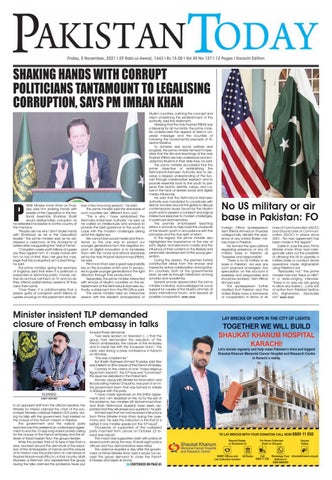
Shaking handS with corrupt politicianS tantamount to legaliSing corruption, SayS pm imran khan
p
RIME Minister Imran Khan on Thursday said him shaking hands with Leader of the Opposition in the National Assembly Shahbaz Sharif would destigmatise corruption as he reiterated his resolve to rid the country of the menace. “People ask me why I don’t shake hands with [Shahbaz] as he is the Opposition leader,” the prime minister said as he addressed a ceremony at the Academy of Letters after inaugurating the “Hall of Fame”. “Corruption cases worth billions of rupees are filed against him. If I shake hands with him on top of that, then I will give the message that this [corruption] isn’t a bad thing,” he said. The prime minister, giving the example of England, said that even if a politician is suspected of siphoning public money, neither do anchors call them on TV, and nor do they attend parliamentary sessions till they clear their name. “Over there, it is unfathomable that a person guilty of corruption worth billions of rupees would go to the parliament and de-
liver a two-hour-long speech,” he said. The prime minister said the standards of such countries are “different from ours”. “This is why I have established the Rehmatul-lil-Alameen Authority,” he said, as he called on intellectuals and scholars to provide the best guidance to the youth to cope with the modern challenges arising amid the digital era. We cannot ban social media and the internet, so the only way to protect our younger generations from the negative impact of digital innovation is to familiarise them with the moral and ethical standards set by the Holy Prophet Muhammad (PBUH), he said. PM Imran Khan said a great responsibility lies on the shoulders of film and TV producers to guide younger generations in the right direction through their productions. Separately, the prime minister interacted with envoys of Muslim countries on the establishment of the Rehmatul-lil-Alameen Authority, a statement from the PM Office said. The prime minister held an interactive session with the resident ambassadors of
Muslim countries, outlining the concept and vision underlining the establishment of the authority, said the statement. Stressing that the Holy Prophet (PBUH) was a blessing for all humanity, the prime minister underscored the appeal of Islam’s universal message and the bounties of following the fundamental precepts of Riasat-e-Madina. To achieve real social welfare and progress, the prime minister termed it imperative that the life and teachings of the Holy Prophet (PBUH) are fully understood and emulated by Muslims in their daily lives, he said. The prime minister elucidated that the prime objective of establishing the Rehmatul-lil-Alameen Authority was to develop a deeper understanding of the Sunnah through collaborative research and to provide essential tools to the youth to preserve their Islamic identity, values, and culture in the face of diverse social and digital media influences. He said that the Rehmatul-lil-Alameen Authority was mandated to coordinate with Islamic scholars around the globe to discuss contemporary issues faced by the Muslim youth and to present a coherent and logical intellectual response to modern challenges, in particular Islamophobia. The premier emphasised teaching ethics in schools to help build the character of the Muslim youth in accordance with the principles and the true spirit of Islam. In this regard, the prime minister also highlighted the importance of the role of print, digital, and electronic media and the influence of their content on the lifestyle and personality development of the young generation. During the session, the premier invited constructive ideas from the envoys and hoped for active collaboration among Muslim countries, both at the governmental level, as well as through interaction among scholars and academia. Several envoys appreciated the prime minister’s initiative, acknowledged his vocal support for causes of the Muslim Ummah at every international forum, and assured all possible cooperation. news desk
Minister insistent TLP demanded closure of French embassy in talks
ISLAMABAD staff RepoRt
In an apparent shift from the official narrative, the Minister for Interior claimed the chief of the proscribed Tehreek-i-Labbaik Pakistan (TLP) party, during his talks with the government, had insisted on the closure of the French mission in Pakistan. The government and the radical party reached over the weekend an undisclosed agreement to end the 10-day long violent protest calling for the closure of the French embassy and the release of Saad Hussain Rizvi, the group’s leader. While the protest, third of its type in less than a year, revolved around the demands of the expulsion of the ambassador of France and the closure of its mission over the publication of caricatures of Prophet Muhammad (P.B.U.H.) in that country, Mufti Muneeb ur-Rehman who represented the group during the talks claimed the protestors never put
forward those demands. “Lies were spoken on television […] that the group had demanded the expulsion of the French ambassador, the closure of the embassy and to break ties with the European Union,” the cleric said during a press conference in Karachi on Monday. “This was a blatant lie.” But Sheikh Rasheed Ahmed Thursday said Rizvi was insistent on [the closure of the] French embassy. Contrary to the claims of one “major religious figure from Karachi”, the TLP boss was “convinced” this issue be debated in the Parliament. Ahmed, along with Minister for Information and Broadcasting Fawad Chaudhry, was part of an initial government team that was formed to initiate a dialogue with the party. “I have made signatures on this [initial agreement] and I am steadfast on this. As for the rest of the problems, two ministers [Ali Muhammad Khan and Shah Mahmood Qureshi] have been appointed and they will answer your questions,” he said. Ahmed said that he had received instructions from Prime Minister Imran Khan during the ceremony and “he said the instruction is this that [it is better] if one minister speaks [on the TLP issue]”. Thousands of supporters of the outlawed party marched from Lahore on October 22 toward Islamabad. The march saw supporters clash with police at several points along the way. At least eight police officers and four demonstrators were killed. The violence erupted a day after the government of Prime Minister Khan said it would not accept the group demand to close the French Embassy and expel its envoy.
CONTINUED ON PAGE 03
No US military or air base in Pakistan: FO Foreign Office Spokesperson Asim Iftikhar Ahmed on Thursday categorically denied the presence of any United States’ military base in Pakistan. He termed the speculations regarding presence of any US military base in Pakistan as “baseless and irresponsible”. “There is no US military or air base in Pakistan; nor was any such proposal envisaged. Any speculation on this account is baseless and irresponsible and should be avoided,” Asim Iftikhar Ahmed said. The spokesperson further clarified that Pakistan and the United States have a framework of cooperation in terms of Air
Lines of Communication (ALOC) and Ground Lines of Communication (GLOC) in place since 2001. “No new agreement has been made in this regard.” Earlier in June this year, Prime Minister Imran Khan had categorically ruled out the possibility of allowing the US to operate a military base or conduct drone operations inside Afghanistan using Pakistan’s soil. “Absolutely not,” the prime minister had told “Axios on HBO” in a wide-ranging interview. “There is no way we are going to allow any bases […] any sort of action from Pakistani territory into Afghanistan. Absolutely not.” news desk
02
Friday, 5 November, 2021 | KARACHI
NEWS
CeMeNt deSPAtCheS droP bY 9.07PC iN oCtober IsLAMABAD
d
ghulAm AbbAS
UE to the continuous increase in cost of doing business plus devaluation of local currency against dollar, cement despatches are showing a declining trend for the past few months. As per details, cement despatches declined by 9.07 percent in October 2021. Total Cement despatches during October 2021 were 5.214 million tons against 5.735 million tons dispatched during the same month of last fiscal year. According to data released by All Pakistan Cement Manufacturers Association (APCMA), local cement shipments by the industry during the month of October 2021 were 4.603 million tons compared to 4.859 million
Strong Pak, Kazakhstan ties need to translate into boosting bilateral trade, says Amb Yerzhan Kistafin
tons in October 2020, showing a reduction of 5.29 percent. Exports despatches suffered a massive decline by 30.09 percent as the volumes reduced from 875,266 tonnes in October 2020 to 611,884 tonnes in October 2021. In October 2021, North based cement mills dispatched 3.831 million tonnes cement in domestic markets showing a decline of 8.01 percent against 4.164 million tonnes dispatched in October 2020. The South based mills despatched 771,755 tonnes cement in local markets during October 2021 that was 11.01 percent higher compared to the despatches of 695,221 tonnes during October 2020. Exports from North based mills massively declined by 74.03 percent as the quantities reduced from 283,389 tonnes in October 2020 to 73,608 tonnes in October 2021. Exports from the South also decreased by 9.06 percent to 538,276 tonnes in October 2021 from 591,877
tonnes during the same month last year. During the first four months of the current fiscal year (4MFY22), total cement despatches including domestic and exports were 18.039 million tonnes, which calculates to 6.68 percent lower than 19.331 million tonnes dispatched during the corresponding period of last fiscal year. Further analysis indicate that domestic uptake of the commodity slightly increased by 1.1 percent to 15.882 million tonnes from 15.713 million tonnes during JulyOctober 2020 whereas exports during the same period declined by a massive 40.4 percent to 2.157 million tonnes from 3.617 million tonnes during July-October 2020. North based Mills despatched 13.314 million tons cement domestically during the first four months of current fiscal year showing a decline of 2.3 percent than cement despatches of 13.627 million tons during JulyOctober 2020. Exports from the North declined by 49.06
Iran says it blocks US attempt to confiscate oil in Sea of Oman
LAHORe
AgencieS
ShAhAb omer
The Kazakh Ambassador to Pakistan Yerzhan Kistafin said that Kazakhstan and Pakistan have an ideal relationship that could lead to work in new areas, while there is also a strong political dialogue between the both countries, which should be reflected in bilateral trade and trade relations. During his first visit to Lahore after his deployment to Pakistan, the Kazakh ambassador also invited media representatives here on Thursday and praised the hospitality of the people of Pakistan, especially Lahore. “We see Pakistan as a regional power and promoting cooperation between both countries will benefit the entire Central Asian region. Due to large population, Pakistan is both a promising market and an attraction for foreign investors. Kazakh investors are also considering investing in Pakistan,” he said. The Ambassador said that for better trade relations between both countries, he had also met representatives of Lahore Chambers of Commerce and Industry and All Pakistan Textile Mills Association. “Pakistan and Kazakhstan have had exemplary diplomatic relations that could extend to new areas of cooperation. There is a strong political dialogue between the two countries, which should be reflected in bilateral trade. We need to focus on our transport and logistics issues as well as economic cooperation. The state agencies of the both countries should work together to address the issues and challenges facing our bilateral economic cooperation,” he added. Speaking about the situation in Afghanistan, Kistafin said that Kazakhstan is the largest landlocked country in the world and understands the importance of regional ties. “Afghanistan could be the most lucrative country if trade between Pakistan and Kazakhstan increases. If there is peace and stability in [Afghanistan], it could serve as a regional transit hub between Central and South Asia. Kazakhstan’s special envoy recently visited Kabul and held talks with the current Taliban government. We discussed resuming our trade and economic cooperation with Afghanistan for the mutual benefit of both countries. If Afghanistan does not stabilize, it will have wider regional implications,” he warned. Speaking about the trade relation between Pakistan and Kazakhstan, the envoy informed that bilateral trade last year was $45 million, and co-operation between Pakistan and Kazakhstan’s customs services was needed to remove barriers to trade.
percent to 461,275 tons during July-October2021 compared with 905,575 tonnes exported during the same period last year. Domestic despatches by South based Mills during July-October2021 were 2.56 million tons showing a healthy increase of 23 percent over 2.08 million tonnes of cement dispatched during the same period of last fiscal year. There was, however, a massive decline of around 37.45 percent in exports from the south zone as the volumes reduced to 1.696 million tonnes in the first four months of the current fiscal year from 2.712 million tonnes during corresponding period of last fiscal year. Official spokesman of All Pakistan Cement Manufacturers Association (APCMA) claimed that continuous increase in input costs coupled with recent hike in rupee to USD parity are major concerns for the industry. These price escalations are seriously affecting the cost of doing business in local as well as international markets.
Iran’s Revolutionary Guards said on Wednesday they thwarted an attempt by the United States to detain a tanker carrying the Islamic Republic’s oil in the Sea of Oman. US officials, speaking on condition of anonymity, said that the Iranian report was not true and there had been no American attempt to seize a tanker. The American officials said that in reality Iranian forces had seized a Vietnamese-flagged oil tanker last month and US naval forces were just monitoring the situation. “With the timely and authoritative action of the Guards naval forces, the US terrorist Navy’s operation to steal Iranian oil in the Sea of Oman failed,” the elite Guards said in a statement published by Iranian state media. “The tanker carrying Iran’s oil docked at the port of Bandar Abbas on October 25.” While Iranian media identified the seized tanker as “SOTHYS” — the name tanker tracking websites give for a Vietnam-flagged vessel — state TV aired footage
showing a red tanker surrounded by about 10 speed boats. It also included a recording of what TV said was the encounter between Iranian and US forces. Iran has repeatedly warned the United States about its military activities in the Gulf, saying that the Guards’ naval forces have increased patrols to also secure the passage of Iranian ships and combat fuel smuggling. Giving details of the reported incident, Press TV said the Guards had reacted “promptly” when the Iranian oil tanker was detained in the Sea of Oman. “Members of the Guards naval forces carried out a heliborne operation on the detained tanker’s deck, gained control of the vessel, and directed it back toward Iran’s territorial waters,” Press TV reported. Separately, American officials told Reuters that several drones, believed to be Iranian, had come close to the US Navy amphibious assault ship Essex in the Strait of Hormuz in the past 24 hours. Tensions have risen between Tehran and Washington amid stalled talks on reviving Iran’s 2015 nuclear deal with world powers, under which Tehran
curtailed its uranium enrichment programme in exchange for a lifting of global sanctions. Iran’s top security official Ali Shamkhani said on Wednesday the talks would fail unless US President Joe Biden could guarantee Washington would not renege on the nuclear agreement in the future. The deal has eroded since 2018 when thenPresident Donald Trump withdrew the United States from it and reimposed US sanctions on Iran, prompting Tehran to breach various limits on uranium enrichment set by the pact.
‘Engine of occupation’: UN experts slam Israeli settlement plans GeNeVA AnAdolu Agency
UN human rights experts on Wednesday condemned Israel’s plan to build thousands of new housing units in illegal settlements in the occupied West Bank and East Jerusalem. Israeli settlements are “the engine of the occupation” and their illegality is “one of the most widely accepted issues in modern international law,” read a statement by Michael Lynk, special rapporteur on human rights in occupied Palestinian territories, and Balakrishnan Rajagopal, special rapporteur on adequate housing. “The Israeli settlements are a presumptive war crime under the Rome Statute of the International Criminal Court, and should be treated as such by the international community,” they said, adding that the UN has “repeatedly … demanded that Israel cease its settlement expansion and remove its settlements.” “The very raison d’etre of the Israeli settlements in occupied territory – the creation of demographic facts on the ground to solidify a permanent presence, a consolidation of alien political control and an unlawful claim of sovereignty – tramples upon the fundamental precepts of humanitarian and human rights law,” read the statement. The strong condemnation comes as the Israeli government has recently approved plans for more than 1,700 new housing units in the illegal Givat Hamatos and
Pisgat Zeev settlements. It is also pushing forward with plans for 9,000 new units in Atarot, some 3,400 more in the E1 area just east of Jerusalem, and around 3,000 in a number of illegal settlements in the occupied West Bank, the statement said. In addition, reports indicate that the Israeli government plans to retroactively legalise several illegal settlements. The UN experts pointed out that close to 700,000 Israeli settlers live in illegal settlements in East Jerusalem and the West Bank. “The Israeli settlements are the engine of the occupation. They are responsible for a wide range of human rights violations against the Palestinians, including land confiscation, resource alienation, severe restrictions on freedom of movement, mounting settler violence, and racial and ethnic discrimination,” the UN experts said. “Most seriously, the purpose of settler implantation – rupturing the relationship between a native people and its territory – is the denial of the right to self-determination, which is at the very core of modern human rights law.” The experts welcomed the criticism of Israel’s plans “by leading actors in the international community in recent weeks, including by the United States and the European Union.” “However, criticism without consequences means little in these circumstances. Israel has paid a minuscule cost over the past five decades for building its 300 settlements and defying international law,” they added.
Asad Umar reveals 48pc of population in Pakistan is partially vaccinated News Desk National Command and Operations Centre (NCOC) head and Planning Minister Asad Umar on Thursday stated that 48% of the population has received at least one COVID-19 jab and lauded the Punjab government for taking lead in the vaccination campaign from other provinces. “Punjab becomes the first province to have more than half of its eligible population with at least one dose at 52%,” he tweeted. In Khyber Pakhtunkhwa, the federal minister revealed that 48% eligible population has received at least one dose of COVID-19. He maintained that Sindh’s 40% and Balochistan’s 17% population
have partially been vaccinated so far. “Federal territories leading vaccination with Islamabad 87%, AJK 59% and GB 54%,” he added. Over all, Pakistan’s 48% of eligible population has received a fist vaccine dose, the minister said. Earlier, a meeting of the NCOC was attended by the NCOC National Coordinator Major General Zafar, Special Assistant to the Prime Minister on Health DR Faisal Sultan, and National Disaster Management Authority
in
chairman. During the meeting, the forum was briefed about the progress of the nationwide vaccine administration, with a particular emphasis on the obligatory vaccination regime, while and a comprehensive future vaccine strategy was presented before the forum. As many as 108 million Pakistanis have so far been vaccinated, the meeting was apprised. Meanwhile, the NCOC appreciated all the federating units
to reach out to the population and facilitate necessary vaccine administration. It also expressed satisfaction with the implementation of the non-pharmaceutical interventions (NPIs) as well as the national immunisation management system. Moreover, the forum appreciated the pandemic control mechanism in various sectors, particularly in terms of the implementation of NPIs in mosques and the role of ulema in ensuring communication on immunization. Earlier on October 31, The National Command and Operation Centre (NCOC) had decided to roll back all Covid-19 related restrictions from cities where at least 60 percent of the population had gotten itself vaccinated against the disease.
Marriyum Aurangzeb assures PML-N’s attendance in NSC meeting News Desk PML-N Information Secretary Marriyum Aurangzeb said on Thursday that PMLN did not boycott the National Security Committee (NSC) meeting, a day after her explosive presser slamming Prime Minister Imran Khan before he announced a historic relief package for Pakistanis amid rising inflation in the country. She reiterated that her party had always participated in NSC meetings in the past, while stating that PML-N President Shehbaz Sharif will give PML-N’s position in the meeting. The joint opposition will attend the NSC meeting, she confirmed. The prime minister had said that the price of petrol will go up and there would be a shortage of gas, the PML-N spokesperson continued, questioning what kind of government gives relief to its people after three years of being in power. Addressing the premier, she asked for an explanation on the status of his past promises. “Prime Minister, tell me what happened to your previous promises?” the PML-N spokesperson said. She added that the middle class, today, is getting crushed under inflation. National Assembly Speaker Asad Qaiser has convened a meeting of the Parliamentary Committee on National Security (PCNS) on November 8. Top military officials will brief the PCNS on current national security issues, according to reports. The National Assembly secretariat has sent the invitation to the parliamentary leaders of all the parties in both the houses of Parliament, including Foreign Minister Shah Mehmood Qureshi, Opposition Leader in the National Assembly Shehbaz Sharif, Chairman PPP Bilawal Bhutto Zardari and others. Advisor to PM on Parliamentary Affairs Dr Babar Awan and SAPM on National Security Moed Yousaf will be special invitees. Besides, the chief ministers of all the four provinces, the president and prime minister of Azad Jammu and Kashmir as well as chief minister Gilgit Baltistan have also been invited to attend the security briefing.
Friday, 5 November, 2021 | KARACHI
Major shakE uP in LahorE PoLiCE ovEr ‘FaiLurE’ in handLinG TLP MarCh LAHore
T
Staff RepoRt
OP police officers of Punjab have been transferred on Thursday for “failing to halt the protest march of the Tehreek-e-Labbaik Pakistan (TLP), which left at least seven policemen martyred and scores injured. The development comes two days after at least 60 police officers deputed on GT Road in Punjab’s Sadhoki to restrain protesters asked Punjab Police Inspector-General Rao Sardar to order an inquiry to ascertain responsibility for the “flawed security plan”. Prime Minister Imran Khan and Punjab Chief Minister Usman Buzdar had also expressed annoyance over the failure of the Lahore police to prevent the religious party workers from leaving the
provincial capital. Additional IG Fayyaz Ahmed has reportedly been appointed as new Capital City Police Officer (CCPO) Lahore. According to the official notifications issued on Thursday as many as 12 senior police officers, who were responsible for chalking out security plan and halting the protest rally of TLP, had been transferred. DIG operations Lahore Sohail Chaudhry and DIG investigations Shariq Jamal are among the officers who have been transferred and asked to report to the Services and General Administration Department of the Punjab government. DIG Shahzad Sultan has been posted as DIG investigations. He was serving as DIG headquarters. CCPO Rawalpindi Ahsan Younis has been posted as DIG operations. The chief minister office had pointed out the
negligence of top brass Lahore police at three points – letting the protesters gather, failure to prevent the rally from leaving Lahore and poor intelligence gathering regarding the protesters’ plan. The demonstrators had stayed overnight in Lahore before leaving the city but despite having too much time police officials could not come up with a plan that could block the exit points of the city and prevent the workers from beginning their march on Islamabad. In the recent meeting with the Punjab CM, PM Imran also raised questions over the poor performance of the anti-riot police force despite the government spending billions of rupees on the force. The provincial government believe that the Lahore police department is primarily responsible for aggravating the crisis which weakened the authorities’ position to deal with the protesters.
Senate approves bill allowing advisers of CM to attend sessions of provincial assembly NewS DeSk A meeting of the Senate Standing Committee on Law and Justice has approved the amendment bill seeking to provide advisers of the chief ministers the right to attend provincial assembly sessions. The meeting, chaired by Senator and Barrister Syed Ali Zafar, took up several constitutional amendment proposals on Wednesday. At the outset of the meeting, Senator Zafar lauded Senator Sadia Abbasi for proposing some major constitutional amendments concerning public interest and remarked that there should be no discrimination between the Centre and provinces. “The advisors of the chief ministers should be allowed to attend sessions of the provincial assemblies like the advisors to the prime minister,” Senator Zafar said. The committee then unanimously
Govt encouraging foreign investment to increase microfinance banking footprint in Pakistan: Tarin ISLAMABAD Staff RepoRt
Advisor to the Prime Minister on Finance and Revenue Shaukat Tarin has said that the government is encouraging the foreign investment and focusing on increasing the footprint of microfinance banking in Pakistan to stimulate economic activity in the country. He stated this while meeting with the delegation of FINCA Microfinance Bank led by its Global Chief Executive Officer (CEO) Andree Simon at the Finance Division here on Thursday. Secretary Finance Division and senior officers of the Finance Division also participated in the meeting. Andree Simon briefed the meeting about operations of FINCA and apprised that the bank is working to provide microfinance services to the underprivileged segments of society. She further added that FINCA is operating in 20 developing countries in the world, including Pakistan, with 130 branches across the country and is very keen to expand its operations in Pakistan. “FINCA Global considers Pakistan as a very promising market for its operation,” she said. Article continues after this advertisement Tarin said that the present government is determined to uplift the living standards of the under privileged, especially in rural areas. He appreciated that FINCA for reaching out to remote areas of Pakistan where the formal banking sector is not available. “The government is ready to provide all out support and cooperation to the microfinance banking sector in Pakistan,” he added.
approved the inclusion of a new article, 17A, under the Constitutional Amendment, that provides advisers of the chief ministers the right to attend sessions of provincial assemblies. Meanwhile, conferring the inclusion of Article 38A as proposed by Abbasi under the Constitutional Amendment Bill 2021, Senator Zafar noted that the fact that heritage sites are national assets and have to be protected and preserved at all costs is unquestionable. He said that heritage sites are historical monuments that not only reflect a country’s history but also represent the culture of a nation and can be a source of huge tourist attraction. “Under the 18th Amendment, the subject of heritage has been devolved upon each province but due to the lack of funds and technical know-how, heritage sites are being damaged due to human and natural causes.” Senator Zafar said that it
should be the constitutional duty of the state, therefore, to ensure the safety and preservation of such sites the responsibility of protecting and preserving heritage sites should be shared by the federal and provincial governments. The session continued with a debate over the Constitutional Amendment seeking to make bail a fundamental right. The majority of the members noted the Article 9 of the Constitution already guarantees the right to bail. They maintained that the proposed amendment would restrict Article 9, particularly with the many other liberties like protection against bonded labour. The majority agreed that Article 9 should not be tampered with. Instead, the bail laws, as contained in CrPC and National Accountability Bureau laws, should be further strengthened to ensure the right to bail. The committee by majority rejected the proposal to make bail a fundamental right.
UK pledges over £55m to help Pakistan tackle climate change NewS DeSk The United Kingdom has announced to provide over £55 million to Pakistan to tackle climate change. British High Commissioner Dr Christian Turner announced this at a reception for climate change stakeholders at the British High Commission on Thursday. “For Pakistan, climate change could be catastrophic. That is why we are working together on trees and finance and mobilising leading Pakistani businesses. This £55 million new funding will ensure Pakistan becomes more resilient to climate impacts, with more sustainable water use and greater access to climate finance, improving lives and livelihoods,” Dr Christian Turner said.
The new funding for climate change in Pakistan is split into three parts: a five-year climate resilience programme – worth £38 million – will help Pakistan’s poorest communities to protect themselves from the changing climate; a five-year water governance programme – worth £15 million – will make water use in Pakistan more sustainable and water access fairer; an additional £2.5 million to support new ways of attracting much-needed climate investment to Pakistan, including on the development of a Nature Performance Bond. Earlier this year, the UK launched a new programme in Lahore to promote cleaner brick production practices which will help improve air quality, reduce smog and fight climate change.
Sugar price rises to Rs136 per kg NewS DeSk The government’s efforts to bring down sugar prices have failed to produce any results so far, as the price of sugar has been jacked up in various parts of the country. The ex-mill price of the essential commodity has gone up Rs9 in Sindh after which its price has soared to Rs136 per kilogram now. In two weeks, the ex-mill price of sugar has gone up by Rs44 per kg. In Lahore, the price of sugar currently stands at Rs135 per kg as the price of the commodity has increased by Rs5 per kg in the open market. The market sources said that the price of sugar in the wholesale market has increased by Rs9 per kg. The price of sugar in Akbari Mandi has risen to Rs135 per kg, whereas retail sugar is being sold at Rs140 per kg. The sources said that an artificial shortage of sugar has been created while a 50kg bag’s price has increased to Rs6,600 from Rs6,200 in the metropolis. In the wholesale market of Peshawar, the price of sugar has increased by Rs8 per kg. A similar situation is being
witnessed in Quetta, where the price of sugar has gone up from Rs124 to Rs129 per kg. The experts were of the view that delay in decisions by the centre and provinces is to be blamed for the crisis and people are paying the price of this. Sugar price has gone up by Rs36 in one month to Rs136 while retailers are not willing to sell it below Rs145. Earlier on October 31, Punjab Chief Minister Usman Buzdar announced to fix the minimum support price for sugarcane in the province at Rs225 per 40 kilograms. In a series of messages from his personal Twitter handle on Sunday, Usman Buzdar said that until 2018, the sugarcane growers used to get Rs110 to Rs120 per 40 kilograms as compared to the set price of Rs180 by the government. “Even this amount was being received by them after months,” he said, adding that however, the policies of the incumbent government have ensured timely and due payments during the past three years. Meanwhile, the Sindh cabinet decided to fix the minimum support price for sugarcane at Rs250 per 40 kilograms.
NEWS
03
Minister insistent TLP demanded closure of French embassy in talks CoNtINueD froM pAge 01 It wasn’t immediately clear Sunday when the party would end its rally. Thousands of supporters have since halted their march in Wazirabad, about 185 kilometres from the capital. Paramilitary rangers have also been deployed for two months to stop the protesters from continuing toward the capital. Sajid Saifi, a TLP spokesman, said supporters were ready to “pack up” but were awaiting instructions from the party’s leadership. He said he hoped Rizvi — who was arrested in April for inciting supporters to stage an anti-France protest — and all the supporters arrested in recent days would be released soon. The party started demanding the expulsion of the French envoy in October 2020 after French President Emmanuel Macron tried to defend the caricatures as freedom of expression. Macron’s comments came after a young man beheaded a French school teacher who had shown the caricatures in class. The images were republished by the satirical magazine Charlie Hebdo to mark the opening of the trial over the deadly 2015 attack against the publication for the original caricatures. Rizvi’s party gained prominence in the 2018 general elections, campaigning on the single issue of defending the blasphemy laws.
ECC cancels floating fresh tender to import wheat ISLAMABAD NewS DeSk
The Economic Coordination Committee (ECC) of the Cabinet has cancelled the floating of a fresh tender to import wheat on the recommendations of the Technical Advisory Committee (TAC). The meeting of ECC was held here under the chair of Minister for Economic Affairs Omer Ayub on Thursday. According to details, the meeting reviewed the summary tabled by the Ministry of National Food Security and Research with regard to demand and supply of wheat in the country. Sources said that the Trading Corporation of Pakistan (TCP) had issued six tenders for the import of 90,000 metric tonnes wheat during the shipment window of January 2022; however, the committee, under the chair of minister for MSD&R, recommended scrapping the tenders due to higher price. However, the ECC recommended that there is no need for further import of wheat through G2G arrangements keeping in view the sufficient stock position of wheat flour, as well as the demand and supply situation, international wheat prices, and local releases to flour mills. The Ministry of National Food & Security also presented a summary before the committee to reshuffle the chairmanship of the committee for accepting or scrapping tenders floated by TCP to import wheat and sugar. The ECC recommended that the adviser to the PM on Finance & Revenue may head the aforesaid committee for taking operational decisions related to tenders for import of wheat and sugar floated by the TCP.
Friday, 5 November, 2021 | KARACHI
04 NEWS
KP to ComPUteRISe lAnd ReCoRd In tRIbAl dIStRICtS peSHaWaR
t
aziz BuneRi
HE Khyber Pakhtunkhwa (KP) government has decided to computerise the land record of the merged districts. According to sources in the KP finance department, work will be started on the land computerization program of the tribal districts
in phase-wise manner. The government had started land record computerization program from Mardan in 2014. The program was later extended to other districts of the province, but the government yet to complete the project in entire settled districts. According to sources, the provincial government has allocated Rs192.5 million for land computerization project in 21 dis-
King Salman Relief Centre launches Winter Relief project in Pakistan – 2021 Staff RepoRt King Salman Humanitarian Aid and Relief Center (KSRelief) has launched a project to distribute 29,000 winter kits among poor and deserving people living in Balochistan in collaboration with NDMA, Balochistan Government and with the help of distribution partner. 10,000 winter kits will distribute in district Harnai which is recently affected with earthquake. No of 2100 kits will distribute among North Waziristan IDPs living in Bakakhail TDP Camp. Each package comprises 2 Quilts, men’s and women’s shawls, 10 pairs of socks for men women and children, 4 Children Cap, 4 Children Maflars and 4 men’s and women’s warmers for needy families living in the colder regions of Balochistan. The project will benefit about 203,000 people in Pakistan. The distribution will include 10 areas in Balochistan province which are Quetta, Ziarat, Pashin, Killa Abdullah, Killa Saifullah, Kalat, Mastung, Harnai, Loralai Chagai and Bakakhail in KPK. This project comes under the umbrella of humanitarian projects by the Kingdom of Saudi Arabia, represented by the King Salman Humanitarian Aid and Relief Center to assist needy families living in the coldest areas in Pakistan.
tricts in the development program of the current financial year in which the department has spent more than Rs41 million in the first quarter. Senior member Board of Revenue Zafar Ali Shah has said that about 40% of computerization process in the province including Peshawar has been completed. He said that by December, this year, 70% of land record will be computerised in the
province. Zafar Ali Shah said that computerization will not only save the citizens from having to visit the offices of the Patwaris, but will also enable them to get fard numbers and transfers without any delay. According to the Board of Revenue officials, in addition to the settled districts of the province, a digitization project will be launched soon in the merged districts as well.
CM Buzdar approves summary recommending removal of TLP proscription
MonitoRing RepoRt The navies of Pakistan and the United Kingdom conducted a joint drill in the northern Arabian Sea, the Pakistan Navy said. According to a statement, the drill, which covered a “wide range of naval operations,” was held on the completion of the visit of the UK Navy’s ship HMS Richmond to Karachi port. The exercise, it added, was aimed to enhance “interoperability and contribute towards international efforts for ensuring maritime security in the region.” Discussions on professional matters and bilateral interactions were also held. “Pakistan Navy and UK Navy enjoy longstanding relations based on training, development, mutual interest, and cooperation in naval affairs,” the statement further said. The UK Navy ship’s visit to Karachi and joint naval drills are a testimony of Pakistan’s resolve to work towards regional peace and further strengthen mutual collaboration between the two navies, it maintained.
PIA boss, Iraq tourism chief discuss visa on arrival for Pakistan pilgrims
LaHoRe Staff RepoRt
The Chief Minister Punjab of Usman Buzdar has granted the initial approval to the summary sent to him for the revocation of the Tehreek-e-Labbaik Pakistan (TLP)’s proscribed status. The summary was sent to him by the Punjab home department on Thursday. After granting preliminary approval to the summary, the CM has now sought approval from the Cabinet to end the party’s proscribed status through circulation. The document was forwarded after approval was accorded by the cabinet’s sub-committee on law and order. Once Buzdar signs the document, the federal government will be approached to do away with the radical group’s proscribed status, said the provincial department. The government outlawed the hardline group under the anti-terrorism laws in April but the fact that TLP enjoys a fiercely loyal following of tens of thousands made it difficult to enforce the ban. Also Thursday, in compliance with the deal between the government and the group, the provincial government re-
Pakistan, UK conduct joint naval drill
iSLaMaBaD app
moved from the fourth schedule the names of at least 90 activists and supporters of the outfit. The decision was taken during a meeting chaired by Minister for Law Raja Basharat. It reviewed the decisions taken by the steering committee formed to implement the agreement.
The meeting also decided to release 100 more protestors from different jails in the province. Punjab police chief Rao Sardar Ali Khan, Additional Chief Secretary (Home) Zafar Nasrullah Khan and other members of the committee attended the meeting.
Pakistan International Airlines (PIA) Chief Executive Officer Arshad Malik held a meeting with Iraq Tourism Board Chairman Thafer Mehdi in Baghdad and discussed matters pertaining to visa on arrival for pilgrims from Pakistan. Iraq is home to a number of sites considered holy by the Shi’ite Muslims: Imam Hussain ibn Ali is buried at Karbala, and the tomb of his father, Ali ibn Abi Talib, is in the nearby city of Najaf. Both of these cities have become pilgrimage sites for the Shi’ite faithful, secondary for them in importance only to Mecca. During the meeting, the two also deliberated on exploring the possibility of a visa on arrival initiative. Malik said the “consent is there to sign” a memorandum of understanding between the two nations. Recently, the airline has launched its flight operations to and from Najaf to transport pilgrims visiting the holy sites in Iraq.
Will COP26 deforestation pledge be gamechanger or just more broken promises? KUaLa LUMpUR ReuteRS
A new pledge by world leaders to halt deforestation by 2030 is likely to fail unless quickly backed by more funding, transparent monitoring and tough regulation of businesses and financiers linked to forest destruction, environmentalists warn. More than 100 global leaders late Monday pledged to halt and reverse deforestation and land degradation by the end of the decade, underpinned by $19 billion in public and private funds to invest in protecting and restoring forests. The commitment — made at the COP26 climate talks in Glasgow — included countries such as Brazil, Indonesia and the Democratic Republic of Congo which collectively account for the majority of the world’s tropical forests. While broadly welcomed, many conservationists noted that similar zero-deforestation pledges had repeatedly been made and not met by both governments and businesses. Those include the 2014 New York Declaration on Forests (NYDF), the United Nations sustainability goals and targets set by global household brands. “While the Glasgow Declaration has an impressive range of signatories from across forest-rich countries, large consumer markets and financial centres, it nevertheless risks being a reiteration of previous failed commitments if it lacks teeth,” said Jo Blackman, head of forests policy and advocacy at London-based Global Witness. “The question is whether (the) headlinegrabbing announcements on deforestation will end up amounting to more of the same empty promises or if they will be followed up with
CMYK
the real regulatory action that is so urgently needed.” Cutting down forests has major implications for global goals to curb warming, as trees absorb about a third of the planet-heating carbon emissions produced worldwide, but release the carbon they store when they rot or are burned. Forests also provide food and livelihoods, help clean air and water, support human health, are an essential habitat for wildlife, regulate rainfall and offer flood protection. Last year, an area of tropical forest the size of the Netherlands was lost, according to monitoring service Global Forest Watch. Although deforestation rates have fallen over the last two decades, about 10 million hectares are still lost each year, said Tim Christophersen, who leads the United Nations Environment Programme’s nature-for-climate branch. “There is no shortage of these political commitments,” he told the Thomson Reuters Foundation. “What there is a shortage of is the money and political will to make them happen.” The 2014 New York declaration, backed by more than 200 countries, companies and green groups, sought to at least cut in half losses of natural forests by 2020 and then end deforestation by 2030. Kiki Taufik, global head of Greenpeace Southeast Asia’s Indonesian forests campaign, said the pledge committed to restoring an area of forests and cropland larger than India by 2030. Instead, forests the size of Spain have been destroyed for commodities like soy and palm oil since 2010. “We need an immediate end to deforestation, backed up by water-tight domestic laws and policies which (can) recognise the land rights of local and indigenous peoples, properly protect forests, eliminate deforestation
through supply chains and start to phase out industrial meat and dairy,” he added. An additional slew of government and private initiatives were announced on Tuesday in Glasgow to help reach the new declaration’s 2030 goal, including billions in pledges for indigenous groups and sustainable agriculture. Fran Raymond Price, global forest practice lead at green group WWF International, welcomed the fresh commitments, saying they acknowledged the important value of forests and other natural ecosystems. But “what we need now is urgent action and implementation of these commitments, coupled with time-bound targets and a common transparent framework for monitoring and verification of such targets. There’s no time to waste,” she added. Gabonese President Ali Bongo said effectively protecting forests also required overcoming other challenges such as combatting the organised crime rings that help drive deforestation in his African nation. Preventing forest loss “requires consistent vigilance” as well as new technology, cash and skilled forest managers, Bongo said in Glasgow. Ensuring Africans benefit from their forests is also key to their protection, said Bongo, whose country remains 88 percent forested as a result of concerted conservation efforts. Under the Glasgow agreement, 12 countries will provide $12 billion of public funding between 2021 and 2025 to help developing countries cut deforestation, restore degraded land and tackle wildfires. At least a further $7 billion will be provided by more than 30 private sector investors.
Friday, 5 November, 2021 | KARACHI
ImRan exTends dIwalI GReeTInGs To HIndu communITY ISLAMABAD/KARACHI
P
stAff report
RIME Minister Imran Khan on Thursday extended greetings to the members of the Hindu community on the joyous occasion of Diwali. “Wishing all our Hindu community a happy Diwali,” Khan tweeted.
muRad saeed aRRanGes FaRewell In HonoR oF ouTGoInG IG nH&mP dR. Kaleem Imam Islamabad: Federal Minister for Communications and Postal Services Mr. Murad Saeed has said that Ministry of Communications and its attached departments are performing active role for national construction and development. Outgoing Inspector General National Highways and Motorway Police Dr. Kaleem Imam rendered remarkable services for maintaining peaceful environment on motorways and national highways. The motorway police has also been be honor for providing quality travelling and civic amenities to the travelers during their journey. His services will ever be remembered for transforming motorway police into an exemplary force. He was addressing a farewell ceremony held in honor of outgoing Inspector General National Highways and Motorways Police Dr. Kaleem Imam at Ministry of Communications here today. Federal Secretary Communications Mr. Zafar Hasan, Chairman NHA Capt ® ️ Muhammad Khurram Agha, incoming Inspector General National Highways and Motorway Police Mr. Inam Ghani, Director General Postal Services Capt ® ️ Khalid Javed, Senior Joint Secretary Ministry of Communications Muhammad Salman and Senior officers of Construction Technology and Training Institute (CTTI) participated. It is to recall that outgoing Inspector General National Highways and Motorway Police is posted as Federal Secretary for Narcotics. pr
PoweR susPensIon scHedules FoR 05th and 06th noVemBeR 2021 According to Islamabad Electric Supply Company (IESCO)’s spokesman, System Maintenance/Development Work is in process. Therefore power supply of below mentioned feeders/areas will be temporary suspended as per given schedule: On 05th November from 09:00 AM to 05:00 PM, Brahma, Multi Orchard, Dharek Feeders. On 06th November from 09:00 AM to 02:00 PM, Sihala, Kahuta City 2, Doberan, Fazal Ahmed Shaheed, New Chua, Panjar, Sohdran, Wapda Colony, Khanna Dak, Karpa, F-6/2, Melody, Pandori, PHA-2, DCI. G-10/4, H-8/2, G-11 Markaz, Railway Road, T&T, Upper Topa, Company Bagh, Nimble, Bari Imam, Malikabad, A Block, Airport, Tamasmabad, Gulshanabad, Sarafa Bazaar , Pirwadhai, Mohammadi Colony, Bani, Azizabad, Zeeshan Colony, Officer Colony, Bijnial, I-16, Rata, Mall Road, Sir Syed Road, Mecca Chowk, PWD-2, Morgah, National Park, KH Road, Chontra. Padial, Girja-1, Chongi No. 22, New Mandira, Jhatta Hathial, Karnab Kaswal, Syed Kasran, Bhal, Ghauri, Hara, Hassan Abdal, Islampura, Brahma, Shah Dir, Aminabad, Wesa, Boliwal, Miskinabad, Soni, Azeem Shaheed, Chabh, Gulyal, Dharnal, Gagan,. pr
Pakistan Peoples Party (PPP) chief Bilawal BhuttoZardari also extended greetings. The community spread nationwide is celebrating the five-day festival of lights with fervour today. Diwali is celebrated with jubilation and enthusiasm as one of the biggest Hindu festivals. Hindus living in Pakistan are celebrating Diwali by decorating their homes with flowers, rangolis, lights and diyas. They began the day with special morning prayers in
SHC extends protective bail of PTI lawmaker in land allotment case KARACHI inp
The Sindh High Court (SHC) extended for 10 days the protective bail of Pakistan Tehreek-i-Insaf (PTI) lawmaker Firdous Shamim Naqvi in a land allotment case. The court also directed him to contact the accountability court in this regard. The National Accountability Bureau (NAB) had launched an inquiry against Naqvi over the allotment of land on a 30-year lease to a private business in 2006 where he was working as the director for the company. After receiving a call-up notice from the anti-corruption watchdog,
Naqvi had moved to the court for obtaining protective bail in November last. Earlier, the high court had expressed outrage over the absence of Naqvi in the hearing of his bail petition in the case. PPP LEADER GETS PRE-ARREST BAIL: Meanwhile, a Pakistan Peoples Party leader and former Sindh minister Zia ul-Hasan Lanjar was granted protective bail by the SHC in assets beyond income case. The high court approved the 10-day protective bail of Lanjar. During the hearing, the dirty money watchdog told the court its headquarters raised objections re-
garding the inquiry. Moreover, the SHC forwarded the matter regarding his bail to the accountability court in Sukkur. The court also directed Lanjar to appear before the trial court. According to the NAB, they had traced Lanjar’s residence in Karachi’s Defence neighbourhood which it said was missing from his asset declaration form. During the inquiry, it was found the sale agreement of the house was in his name but he had it transferred in his father-in-law’s name. Lanjar, through a frontman, allegedly deposited public funds, including that reserved for a medical college, in his own accounts.”
Yield of three-month T-bills hiked by 25bps
Gold price leaps by Rs2,800 per tola VALUE OF PRECIOUS COMMODITY EXPECTED TO FURTHER INCREASE Gold prices on Thursday took a massive leap due to the uptrend in commodity prices in the global market as well as rupee depreciation. As per details, prices in the local bullion market soared by Rs2,800 per tola and Rs2,400 per 10 grams to reach Rs120,200 per tola and Rs103,052 per 10 grams. A day earlier, the precious commodity closed at Rs117,400 per tola and Rs100,652 per 10 grams. Market experts have predicted that the price of the yellow metal will increase further as it continues to attract safe-haven investment. Meanwhile, silver prices in the domestic market remained unchanged at Rs1,420 per tola and Rs1,217.42 per 10 grams. news Desk
Pakistan’s public debt to GDP ratio to ease in FY22, FY23 ISLAMABAD: The World Bank has projected Pakistan’s debt to Gross Domestic Product (GDP) ratio to ease to 90.6 per cent in the current fiscal year (FY22) to and to 89.3pc in next fiscal year (FY23). In its recent report “Pakistan Development Update October 2021”, the international financial institution has said that the total debt to GDP ratio had peaked to 92.7pc in FY20, however, it had been declining since then. The public and publicly guaranteed debt declined to 90.7pc of GDP in end-June FY21, down from 92.7pc in end-June FY20. In endJune FY21, external debt accounted for 33.9pc of the total public debt, whereas short-term debt accounted for 16.2pc – indicating low rollover risks, the report added. The public and publicly guaran-
their temples while youth and children exploded crackers and distributed sweets among each other. Members of the community also took to social media platforms to extend felicitations. “May the light of Diyas enlighten your life. May your every prayer be heard. Good wishes for your health, wealth and prosperity,” Rekha Maheshwari, a Twitter user, tweeted.
teed debt includes external general government debt, domestic general government debt, guaranteed debt, and public and publicly guaranteed debt. The report states that the rupee had already depreciated by 7.7pc against the US dollar over the first quarter of FY22 (Q1FY22). Given that external public debt is a third of the total public debt stock, the depreciation of the currency has implications for public debt, which is already above 90pc of GDP. Meanwhile, the report said that in FY21, the fiscal deficit excluding grants had narrowed to 7.3pc of GDP from 8.1pc in FY20, as revenue growth, underpinned by stronger domestic activity, outpaced higher expenditures. Further, it added that despite fiscal consolidation efforts, the deficit excluding grants is projected to re-
main high at 7.1pc of GDP in FY22 and widen to 7.2pc in FY23 due to pre-election spending. Implementation of critical revenue-enhancing reforms, particularly the harmonisation of the General Sales Tax (GST), will support a narrowing of the fiscal deficit over time. Public debt will remain elevated in the medium-term, as will Pakistan’s exposure to debt-related shocks. The report also projected Pakistan’s povrty rate to ease in coming years. Bolstered by the recovery in the industry and services sectors and resultant off-farm employment opportunities, poverty incidence, measured at the international poverty line of $1.90 purchasing power parity (PPP) 2011 per day, is expected to have declined to 4.8pc in FY21 from 5.3pc in FY20, the report says. App
CMYK
The cut-off yields on three-month treasury bills (Tbills) were further increased by 25 basis points in the auction on Wednesday, leading to a 127-basis point increase since the last monetary policy announced in August, according to a report by Dawn. The government had rejected the six-month T-bills in the previous auction. However, on Wednesday it accepted higher returns as it increased the cut-off yields by 31 basis points — the rate increased by 101 basis points since the last monetary policy. Monitoring report
NEWS
05
corporate corner
Pakistanis most generous nation, says Farrukh Habib State Minister for Information and Broadcasting Farukh Habib Thursday said Pakistani nation was most generous in giving away the charitable. During his visit to the Saylani Welfare International Trust head office and meeting with Trust's Chairman Maulana Bashir Farooqi , the State Minister praised the welfare work of Saylani Welfare Trust. He said Prime Minister Imran Khan had restricted all the cabinet members from unnecessary foreign visits as an austerity measure in order to reduce government expenditures. Farukh Habib said Premier had also saved over Rs. 1 billion from the allocated budget of Prime Minister House. He said Maulana Bashir Farooqi of Saylani Welfare Trust was also following the concept of Riyasat-e-Madina. Saylani Welfare Trust was working on huge level welfare activities. Minister also lauded the provision of IT trainings to unprivileged students by Saylani Welfare Trust. Chairman Saylani Welfare Trust Maulana Bashir Farooqi informed the State Minister that Saylani was feeding over 0.15 million people with meals on daily basis in Karachi. pr
Pink october at Pakistan's leading hotels Pink October at Pakistan’s leading hotels Hashoo Group, in collaboration with Shaukat Khanum Memorial Hospital and Cancer Research Centre, actively worked towards spreading awareness on the early detection of breast cancer. Statistics show that one in every nine Pakistani women develop breast cancer at least once during the span of their lives. It is possible to prevent thousands of deaths caused by breast cancer with early detection. Therefore, calling attention to this awareness remained the topmost corporate social responsibility of Hashoo Group, this October. This October marked the fifth consecutive year, since Hashoo Group, joined hands with Shaukat Khanum Memorial Cancer Hospital and Research Centre for the Breast Cancer Awareness campaign, to help raise awareness. pr
06-07 Comments - 5th November 2021_Layout 1 11/4/2021 11:20 PM Page 1
Friday, 5 November, 2021
06 COMMENT
Relief only for the time being?
The subsidy that wasn’t The subsidy announced may not give the relief it promises
P
Why all the secrecy?
RIMe MINISTeR Imran Khan has announced a Rs 120 billion subsidy to enable 20 million families to get a 20 percent discount on wheat flour, ghee and pulses. he has called it the biggest welfare programme in the history of the country, though there are enough question marks about it to make the benefits doubtful. Apparently, individuals or families will not get the subsidy, but will identify themselves as qualifying, and will be given the discount by participating retailers, who presumably will charge them the discounted price, and the government the difference. That seems like a bottleneck readymade: government officials charge ‘under the table’ routinely whenever there are payments to be released. There was also no clarity about the incentive for retailers to obtain digital connections. Utility Stores showed the way to other retailers by raising the prices of the subsidised items. After all, the subsidy does not fix prices; if wholesalers raise their prices, consumers end up paying more to retailers, even if the subsidy is claimed. The programme is experimental, and runs six months. What is to happen after that, is anybody’s guess. however, it is perhaps to be welcomed that Mr Khan conceded that food inflation had got so out of hand that the subsidy had to be given. At the same time, Mr Khan may have also indirectly admitted that Pakistan no longer was interested in an IMF programme, for it is notorious that the IMF is almost reflexively anti-subsidies, and their elimination is virtually the first demand it makes. Its plugging away at the subsidy for lifeline power consumers is Pakistan’s previous experience with this tendency. however, Mr Khan’s saying that oil prices will rise further, as will gas prices, indicates that he has not entirely given up on the IMF, for the leverage of being given a programme cannot be equalled among other multilateral lenders, or the money markets, by the recent Saudi package which has kept Pakistan afloat. It is almost as if the subsidy has been proffered to reduce public ire ahead which will be caused by continuing inflation. The danger of the subsidy being too little too late is compounded by the slew of doubts about its feasibility. If Mr Khan thinks enough will benefit to make a difference at election time, he will have to ensure that there is not even a whiff of corruption about it.
At Penpoint M A NiAZi
T
he end of the Tehrik e Labbaik Pakistan (TLP) march on Islamabad may have ended for now, but the very fact that both the government and the TLP were unwilling to reveal the details of the agreement, indicates that one, or more likely both, sides had made commitments that they did not want made known to their supporters. The origin of the TLP is in doubt, with some claiming the PML(N) encouraged it, as a means to breaking off Barelvi support from Tahirul Qadri’s Tehrik e Minhajul Quran around the time of the Modeltown shootings, but the TLP then staged a sit-in at Faizabad, which only ended when a member of the Nawaz Cabinet was forced to resign. The TLP accused him of being a member of the Qadiani minority, posing as a Muslim. The TLP then shifted focus, to blasphemy, taking up the case of the French President supporting the blasphemous cartoons othe the holy Prophet (PBUh) and demanding the expulsion of his representative in Pakistan, the French Ambassador. The Ambassador having left Pakistan, the TLP demands the closing down of the French embassy. Did the government agree to do so? even if it did, it realized that it could not fulfill this demand, not with the clout France has within the european Union, and the fact that Pakistani textile exports go to the eU. The government committed to bring the subject up in Parliament, which it did not. This led to the TLP launching a movement, which not just led to a grinding to a halt of normal life, but clashes of protesters and police. Policemen were killed, and the protests ended with a new deadline. Meanwhile, new TLP chief hafiz Saad Rizvi was not just arrested, but detained. his detention was not extended, because the state had failed to prepare any sort of case against him. This led to the present protests, with the demands being not just for the closing of the embassy but also the release of Saad Rizvi. Along with Saad, the release of those arrested the last time was also demanded. This march saw an escalation, as the Rangers were called out. The Rangers are better armed, but they are not generally trained for crowd control. During their deployment in Sindh, at least one person ended up getting killed. however, there was luckily no clash and
Covid-19 vaccination drive
the Rangers suffered no blemishes on their reputation. The TLP has made demands from which it cannot resile, while the government cannot concede any of them. The TLP may be under the influence of extraneous powers, but they have clearly touched a nerve. Islam may well be a religion of tolerance, but the honour of the Prophet (PBUh) is a red line, as much a red line as the freedom of speech which the blasphemous cartoons rest on. This is perhaps the only issue on which liberals do offer pushback. There may be rejections of hudood punishments as excessive, but the is no denying that the Prophet (PBUh) must be defended. There may be debate about how it is to be defended, such as the argument that it does not attract the death penalty. At the same time, the TLP has entered uncharted territory by suggesting breaking diplomatic relations. When Sultan Abdul hameed II of Turkey was faced with a similar situation, of blasphemy in France, he threatened war. however, he did not even threaten the breaking of diplomatic relations. Actually, the punishment is to be applied to the blasphemer, not an entire nation. True, if his nation chooses to defend him, that defence is to be combatted. however, refusing to talk to that country might not cut it theologically. It is interesting that an economic argument is being made. That France leads the eU and the eU takes our exports is not supposed to matter. The law is supposed to be blind, and whether or not blasphemy is a legal fact, not an economic one. To take an extreme example, would exports justify the French state killing any Pakistani citizens? One problem with banning the TLP, which the government claims it has done, but which it has apparently not told the election Commission about, which is probably why its candidates still contest elections is to to let the TLP join the political mainstream. Is there an effort to harness the religious vote? The TLP has shown that religious issues are touchbutton issues. At the same time, economic issues loom large. Indeed, the economic argument of exporting to the eU has so far trumped the religious one of blasphemy. however, the TLP, or any other religious party, will have to argue that it had a solution for the country’s economic problems, and that it had the competence to deliver. The problems that Imran Khan is facing are not just about law-and-order, or even how top-level appointments, such as of the DG ISI, are made, but about the economy. Whatever the reasons, whatever the excuses, the economy has tanked, jobs are being lost, and those who manage to remain in employment, are being badly hit by inflation. It seems that the natural instincts of the masses,
to turn back to their belief system, Islam, is only stymied by doubts about whether such a party would be able to solve their economic problems. This wish has been encouraged by the inability of any type of rule, of whichever party, or of the military, to solve those problems. Another issue that needs to be considered in the context of religious forces agitating is the effect on the police. It should not be forgotten that the steel framework of the empire, whether in India or West Africa, was the police, not the military. The military was only meant to ‘act in aid of the civil power’ when the forces opposing the police had too much force, in being too many, or too well-armed. It might seem an extreme example, but in the Partition, when so many were massacred, the vaunted Punjab Police collapsed, and it was two Boundary Security Forces, drawn from the Army, which performed policing functions, like bringing refugees to safety. The troops were Indian, and were commanded by Indian officers. The TLP protests have been testing the Punjab police, which has so far been true to its salt. however, that cannot be guaranteed forever. It should be noted that while most continue on the line of duty, religious belief may be greater than loyalty. While the police force may hold, individuals may break. Most recently, a Punjab Police sub-inspector broke, Mumtaz Qadri, when he assassinated Punjab Governor Salman Taseer, whom he had been assigned to guard, but Satwant Singh and Beant Singh of the Delhi Armed Police, assigned as bodyguards to Indian Prime Minister Indira Gandhi, assassinated her in October 1984, in response to Operation Blue Star, which was the attack on the Akal Takht and the slaughter of Sant Jarnail Singh Bhindrawale and his followers. As a matter of fact, Partition too divided people on religious lines. A policeman no longer was a cop, but a Muslim or hindu or Sikh. The British had no answer to that. They had all along run their empire on the basis of recruiting natives for both police forces and armies, but with a final layer of British troops behind them. After World War II, when the British government realized that it could not provide sufficient troops to serve as the stiffening force, and that its armies and police forces were infected by communal feeling, it decided to withdraw. There is going to be a limit to how much the police will stolidly take casualties, especially when they feel that the crowd’s cause is just. If that ever happens, the government may find that even the military can no longer be relied on.
The writer is a member of staff.
Getting it right
Our double standards and the brain drain
W
ITh 108 million doses of the covid-19 vaccine administered, the health authorities in Pakistan are on course for reaching the 60 percent figure nationwide which will allow a lifting of restrictions, or rather non-pharmaceutical interventions. There is much work to be done, with only one city, Mandi Bahauddin, having qualified so far, but the direction seems to be set, with 108 million doses administered so far nationwide. With a population of 200 million, only the administration of 400 million doses would mean that 100 percent of the population would be covered. The present situation is not certain whether all are fresh vaccinations, or whether some are second doses, meaning that persons receiving them are completely vaccinated. One of the most praiseworthy aspects of the vaccination drive, and probably a major factor behind its success, was the ease of vaccination, which the government ensured by such steps as converting various large halls, like expo centres, into vaccination centres, and operating them round the clock. One of the major achievements of the government was vto ensure that the supply of vaccines did not dry up. Other countries, especially in the Third World, have suffered from vaccine shortages, but Pakistan’s procurement, whether through purchase or through donations, has kept the centres going, and thus the vaccinations. Apat from the need to keep the drive going, there is also a lesson in all of this for the Punjab government, not just as it goes about playing its role in the covid-19 struggle, but in the struggle against dengue. The dengue epidemic has not been beaten back, and the Punjab government’s hope that the onset of winter would kill off the vector for the infection, has been dashed by the late onset of the cold in the Indus plain. More proactive measures are needed at this juncture, lest this public health crisis become as deadly as covid-19. After all, it doesn’t matter whether someone dies of covid-19 or dengue: in both cases, the person is dead.
A problem that reaches right to the top Mujeeb Ali SAMo
P
eOPLe in our country have strange standards. Our people prefer government jobs but they don’t wish to obtain services of the government public hospital, its transport facilities, or its schools. One seeks the privilege of a government vehicle with monthly petrol credit, housing facility, and medical allowance. But that must not be his responsibility to maintain and repair at his expense. every individual lives in the country but they prefer wearing foreign brands and purchasing imported products. The students seek government scholarships at the foreign universities, fully funded by the government. But, when they achieve the qualification from the university to perform as a practical professional and serve their own country, they skip with the mean purpose to earn lucrative money in the foreign country. The student prefers to continue his job in a foreign country. Instead of benefiting his people and discharging his skill for his own country which paid for his stay at the foreign university so that he could serve it sincerely. As of 2011, there were 5,045 Pakistani students in the USA, putting Pakistan among the top 25 countries sending students there. The volume of Pakistani students migrating to the USA has been relatively stable over the past few years. China also attracts a large number of students from Pakistan, with 2006 estimates putting their number at well over 1,000; in Xinjiang alone, there are over 500 Pakistanis in universities. In total, there were over 5,000 Pakistani medical students studying in China as of September 2012. In 2016, there were 19,000 Pakistani students in China, making Pakistan the fourth largest source of international students in the country. The main disciplines of studies pursued included medicine, engineering, economics and management. According to a report provided by the Bureau of emigration and Overseas employment, more than 10 million Pakistani citizens have bid-adieu to the country for better professional and financial opportunities. The record indicates more than 300,000 Pakistanis left the country in 2018. The figure soared to
Dedicated to the legacy of late Hameed Nizami
Arif Nizami (Late) Founding Editor
Yousaf Nizami M. A. Niazi
Editor Aziz-ud-Din Ahmad
Umar Aziz
Joint Editor
Joint Editor
Executive Editor
Lahore – Ph: 042-36300938, 042-36375965
I
Karachi – Ph: 021-35381208-9
I
500,000 this year. The data from the bureau shows a growing trend of what easily qualifies as the flight of human capital from the country. Most of these individuals are fresh graduates from local universities. Close examination of the figures provided by the bureau reveals about 10,000 engineers, 3,500 doctors, and 9,500 accountants traveled abroad for jobs during the Pakistan Tehreek-i-Insaf (PTI) government’s tenure, which came into power with the promise of reducing unemployment in the country. Details provided by the Bureau of emigration show Saudi Arabia as the most popular destination for Pakistani workers. More than 5.3million moved to the kingdom for better opportunities. The United Arab emirates took the second spot with 3.8million Pakistani citizens seeking better professional opportunities in the country. More than 25, 500 doctors were also forced to look for better opportunities outside Pakistan. Brain drain is a situation where talented and highly skilled human capital moves to another place to look for jobs or career goals’ continuity. Brain drain is a big loss to a country. The country has lost the talent and expertise that can increase economic progress, life development, and people’s wellbeing. This needs to be stopped on the premise that the country has invested a sum of money and facilities in an individual’s career development. even more worrying, those involved in this brain drain happen to be in the most critical jobs, such as engineers, doctors, IT experts, architects, astronomers, academicians, and so on. These standards and duplicity are not only found in the ordinary people but these commonalities are in the politicians. They prefer holding the passports of foreign countries but they wish to be part of the government in their own country. It is very unfortunate that these politicians cur-
Islamabad – Ph: 051-2204545
sorily see the foreign countries that are well ruled and planned for infrastructure. These politicians exploit their own country and enjoy living as ordinary men in foreign countries. They use public transport and live in government hotels at cheap rates when they go on their 6wn expense. On the contrary, when they go on official visits, they extravagantly use the money of the government. These standards are not positive for the development of the country. We must use our products so that our economy becomes stable. Our manufacturing industry should realize the need that it is valued in the country. If they produce in this way, our domestic products will be cheap and easy to purchase. Our politicians must realize that when they visit foreign countries, they behave and stand normally with the people, so why not here when they are living like a common man in the service of the public. One must take care of government facilities as borrowed items, to be returned in the same condition as they were obtained. When one owns the things then he will be caring for them with full responsibility. Unfortunately, our country has talent but it is a victim of brain drain. This practice is not only in the common people; the politicians and the business class is also one step ahead. If this tradition is in full swing then in the future we will be left with unskilled and less educated people without proper qualifications. It is hoped that every individual citizen of Pakistan will realize the fact that brain drain is a curse. It is dishonesty with one’s own country and showing loyalty to the other country. The benefit of one’s talent and skill must be discharged for the benefit of the compatriot.
Unfortunately, our country has talent but it is a victim of brain drain. This practice is not only in the common people; the politicians and the business class is also one step ahead. If this tradition is in full swing then in the future we will be left with unskilled and less educated people without proper qualifications
I
Web: www.pakistantoday.com.pk
I
The writer can be mujeebalisamo110@gmail.com
Email: editorial@pakistantoday.com.pk
reached
at
06-07 Comments - 5th November 2021_Layout 1 11/4/2021 11:20 PM Page 2
Friday, 5 November, 2021
COMMENT 07 Editor’s mail Send your letters to: Letters to Editor, Pakistan Today, 4-Shaarey Fatima Jinnah, Lahore, Pakistan. E-mail: letters@pakistantoday.com.pk Letters should be addressed to Pakistan Today exclusively
AUTISM in children
Who will bear the Financial burden of the Rohingya? The funding for the Rohingya is running out KAZi MohAMMAd jAMShed
A
S of July 2021, only $366 million of the total required, around $1 billion, humanitarian assistance fund for the Rohingyas has been disbursed. The disbursement has declined to 34 percent, which used to be within the range between 72 to 75 percent of the total required funds in the first three years of the Rohingya influx since 2017. This downward trend in foreign donations raises a question,”has the world forgotten the plight of the Rohingyas?” The year 2021 marks the fourth year of the military-backed inhumane “clearance operation”followed by an massive exodus of hundreds of thousands of Rohingya in what UNhRC dubbed as a“textbook example of ethnic cleansing.” While the rest of the world had turned a blind eye to the Rohingyas, Bangladesh generously extended temporary shelter to them. These stateless people have equal rights to lead a dignified life and build a stable future in Rakhine like everyone else, which can be guaranteed only if the world communities express solidarity with them. Stable funding commitments from longstanding donors is a prerequisite for food security, safe water, healthcare, and non-food items for 1.1 million Rohingya. The ultimate sustainable solution, safe and sustainable repatriation, seems a distant reality now, even after signing two repatriation agreements, due to Myanmar’s unwillingness to create conducive conditions. Until repatriation becomes possible, the world must stand by the world’s one of the largest refugee-hosting countries, Bangladesh, to uphold the dignity of the ‘world’s most persecuted minority’ of our time. As one crisis competes with another, a newly emerged crisis usually dissipates the global concentration with respect to fund and focus towards a previou sone, thereby worsening the former. Donors’ unwillingness to open purses as much as the crisis demands may further intensify the crisis.The foreign aid for Rohingyas has started declining after the onset of economic fallout triggered by covid-19. Moreover, the Taliban’s takeover in Afghanistan had created a new humanitarian crisis by displacing millions of Afghans. This crisis has resulted in the significant slashing of foreign donations to the Rohingya by shifting the spotlight onto the ongoing Afghan crisis. Along with incurring social decadence and environmental degradation, Bangladesh is also bearing a substantial economic burden for supporting the persecuted Rohingya. The Center for Policy Dialogue (CPD), a Bangladeshi think tank, reported that Bangladesh has to spend around $1.22 billion every year on Rohingya refugees, which will bump up with the growth of population, the rise of inflation, and decreasing trend in foreign aid. The CPD also estimated
that once repatriation starts, it will take 12 years if 300 Rohingyas are being repatriated everyday, assuming current population growth remains constant. According to the CPD, around $7 billion would be required to host and support the Rohingya refugees for the first five years without repatriation. It is next to impossible for a country like Bangladesh to afford this colossal expenditure as it relies heavily on external debt to meet its budget deficit. The Rohingya crisis is the result of a longsmoldering conflict which may be a catalyst for new sources of conflict. The tremendous funding shortage may lead to the emergence of newer challenges. Such as extortion, prostitution, human trafficking, drug dealing, radicalization as well as intra-group and inter-group conflictssuch as the recent killing of Rohingya leader Mohibullah. Moreover, the financial shortage will have a devastating impact on children and women who require age and gender-sensitive interventions. Ignoring these challenges may be a boomerang not only for Bangladesh but also for the rest of the world by causing a worsening of regional stability. As international aid is dwindling, Bangladesh faces increased challenges in managing this beleaguered community. Besides, the unavailability of funds at the right time may create immense pressure on Bangladesh to deliver essential services to these displaced refugees. Many local NGOs are now providing humanitarian assistance to Rohingya with their own funds, which they will not be able to sustain longer without external donations. The best way to counter the aforementioned challenge is to ensure regular financial flow which cannot be borne alone by Bangladesh. To plug the funding gap, the Bangladesh government may initiate a joint fund-raising campaign to pool contributions from individual and institutional donors by convincing them to extend hands for distressed Rohingyas who have scant access to basic needs. Bangladesh should leave no stone unturned to make sure that the Rohingya issue is not sidelined and international focus remains on it. To
obtain international attention, Bangladesh must keep the agenda alive through strong diplomatic manoeuvres pointing out how insufficient funds are intensifying the trauma already inflicted upon the Rohingya. Bangladesh must echo this issue in different regional and global platforms to steer humanitarian response on the heel of declining funding. Moreover, it is equally important to emphasize effective utilization of funds, which can be done by slashing foreign employees and involving more local NGOs. The Rohingya communities are in dire need of international support now than ever before. A well-coordinated humanitarian response is needed to alleviate the sufferings of “forcibly displaced Myanmar nationals”. The world community must wake up to keep the pledges committed at the beginning of this crisis and should not pass the burden on to Bangladesh alone as the country is not in a position to take the burden any more. The “Do No harm” principle must be followed while delivering lifesaving assistance to Rohingya to avoid inadvertently fueling any new conflicts. The shared efforts of the global community are needed to achieve the conditions required to end the plight of the persecuted Rohingya. The world must not turn its back on these vulnerable refugees and should stand shoulder-to-shoulder with Bangladesh to fill the staggering funding gap, the lion’s share of which comes from foreign donors. The UN should play the role of a torchbearer in bringing the global donors together to address the financial strain highlighting how this may create an acute human rights crisis and worsen the circumstances unimaginably. Though safe repatriation is the ultimate sustainable solution to the protracted Rohingya crisis, it is equally crucial to redress Bangladesh’s growing challenges in hosting Rohingyas through ensuring comprehensive financial assistance. Failure of repatriation and funding shortage involves the risk of untoward developments, the toll of which the international community will not be able to avoid.
Though safe repatriation is the ultimate sustainable solution to the protracted Rohingya crisis, it is equally crucial to redress Bangladesh’s growing challenges in hosting Rohingyas through ensuring comprehensive financial assistance. Failure of repatriation and funding shortage involves the risk of untoward developments, the toll of which the international community will not be able to avoid
The writer can kazi.duib@gmail.com
be
reached
at
AUTISM and Attention Deficit hyperactive Syndrome (ADhA) have become common disorders among children. The children suffering from these disorders need our special attention and care. The wellbeing of their emotional, mental and physical health depends largely on society they live in. Research shows that such children overcome their shortcomings with time, provided they get complete attention, a supportive environment, and understanding people around them. In Pakistan, it is heartbreaking to see that these children are mistreated and mishandled. At times, callous people even advise the ill-fated parents to keep the child home. To avoid any untoward situation, some parents do keep such children in isolation. This non-acceptance by society leads to the exclusion of these children from social, academic and physical activities that are important for their growth and development. It is naïve of people to hate these innocent children or consider them a burden on society when we all are dependent on each other in one way or the other. Depriving anyone of their freedom and rights is a sin. Special children need our love, and their appetite for love is much more than a normal child’s. Let us feed them accordingly. According to the Pakistan Autism Society, about 400,000 children are suffering from autism spectrum disorder (ASD) in Pakistan. Autism is a developmental disability that remains with a person for life. This condition affects the afflicted person’s brain functions. The first signs usually appear before a child is three years old. People with autism often find social interaction difficult as they are likely to have problems with verbal and non-verbal communication, demonstrate restrictive and repetitive behaviour, and have a limited set of interests and activities. Autism is a complex group of neurodevelopmental disorders, also referred to as autism spectrum disorder (ASD). The term ‘spectrum’ is used to describe the symptoms involving a wide range of skill impairments in ASD children. Some children display milder impairments while others may present more severe forms of ASD. Therefore, there is a need to explore the genetic markers responsible for ASD in Asian populations. So far, most of the ASD-related genetic association studies have been performed on Chinese, Korean, and Indian populations, but there is no genetic association study reported in the Pakistani population yet. There is no reliable data available regarding the prevalence of ASD in Pakistan. however, the Pakistan Autism Society has estimated that approximately 400,000 children in Pakistan are suffering from ASD. examining the genetic variants in Pakistani individuals has been challenging, as individuals with psychiatric disorders do not report their disease due to the possibility of social stigma. This results in an underreporting of the number of individuals in Pakistan with mental illnesses and prevents patients from receiving care by trained professionals. AtiqA Gul PEShAwAr
Importance of ambulances INCReASeD population has led to an increase in traffic on roads as most people use vehicles of their own. People often avoid following traffic rules because everyone is in a rush to reach their destination in time. Amid all this chaos, ambulances boarded with patients are stuck in traffic for hours. every now and then, we hear patients losing their lives in the ambulance due to severe traffic jams. Despite, ambulances having a distinct siren to alarm people to clear the route, most vehicles remain stagnant or refuse to clear the way for the ambulance. The patients inside ambulances require immediate medical support and assistance, which ambulances alone cannot offer. The government should implement policies to facilitate ambulance services. For instance, there should be separate lanes on roads, and a warden must be present to clear the roads and allow red signal lanes to move. Ambulances should be treated with grave importance, unlike other vehicles that often disrupt traffic with VIP movements. hotlines and GPS should be used to alert traffic wardens a few minutes before so that they keep at least one lane free for emergency vehicles. As citizens, we also have a responsibility to fulfil. Whenever an ambulance is behind your car, clear the way for them to pass. We must recognise that every second counts during a medical emergency, which is why it is important to give way to any approaching ambulance. It can mean the difference between life and death. Also, the relevant authorities must implement steps to equip ambulances with the latest specialised technology to assist the patients on their way to the hospital. AhmEd KhAn lAhorE
Positive thoughts POSITIVe thoughts allow our thoughts to achieve good things in life. A negative mindset will never give you a positive life. We are in our most innovative and productive space when we feel positive. You’re better able to handle every day stress in a more constructive way Not many realise that positive thinking is a source of happiness because the way you think has an immense impact on your mental and physical health. however, positive thinking doesn’t mean that you keep your head in the sand and ignore life’s less pleasant situations. It just means that you approach the unpleasantness in a more positive and productive way. By thinking about small positive things in your life, you can get rid of the anxiety and sadness that haunt you. Optimism can therefore help encourage a person to adopt a healthy and peaceful lifestyle. Such an attitude helps bring some calmness in your life so that you are better able to take important life decisions. Negative thinking, on the other hand, will have the opposite effect. Constantly, hating on people and things can bring about immense sorrow and loneliness. It exacerbates feelings of anger and hatred and can often lead to psychotic outbreaks. Positive thinking often starts with self-talk, which means understanding the endless stream of thoughts that run through your head. These thoughts can be both positive or negative. Some thoughts emerge from logic and reason while other thoughts may arise from misconceptions that are created because of the lack of knowledge. In order to promote positivity, one needs to create a positive environment. This means hanging out with people who are constantly happy regardless of the situation they are in. Reading self-help books will also help but first you must ask yourself: is your glass half-empty or half-full? FAriS KhAliq turbAt, KEch
08 WORLD VIEW 5th November 21_Layout 1 11/4/2021 9:49 PM Page 1
Friday, 5 November, 2021
08 WORLD VIEW
The bonfire of The currencies? TWO RECENT BOOKS BY RENOWNED ECONOMISTS HAVE SET THE STAGE FOR TODAY’S GREAT DEBATE OVER THE FUTURE OF MONEY IN A DIGITAL AGE
ProjecT SyndicaTe
r
BENJAMIN J COHEN
eAdy or not, the financial world is being forced to face the possibility of a future without traditional notes and coins. Is cash going the way of the dodo? Should the prospect of its extinction be welcomed or feared? And what would its disappearance mean for domestic and global markets and politics? Two recent books by renowned economists have set the stage for the coming debates, highlighting two questions in particular. The first is whether cash should disappear. The second is whether it actually will disappear. Kenneth Rogoff of harvard University and eswar Prasad of Cornell University have much to say on both issues. DOES MONEY MAKE THE WORLD GO AROUND? For Rogoff, cash is a curse. Paper currency, he argues, “lies at the heart of some of today’s most intractable public finance and monetary problems,” and thus should be phased out as quickly as possible. he highlights two big problems. On one hand, by permitting large recurrent and anonymous transactions, cash facilitates tax evasion and other crimes. high-denomination bills like US “Benjamins” ($100 notes) or Switzerland’s 1,000 franc note play a starring role in a broad range of criminal activities, from drug trafficking and money laundering to racketeering and extortion. On the other hand, cash handicaps monetary policy. The availability of currency effectively sets a “zero lower bound” on interest rates. Returns on Treasury bills or other fixed-income securities cannot fall much below zero so long as people have the option of holding paper money, which at least pays zero interest. Cash therefore ties central bankers’ hands, inhibiting negativeinterest-rate policies. The Curse of Cash represents the culmination of a campaign that Rogoff has waged for more than two decades, and he pulls no punches in his advocacy of a “less-cash” economy. Written in accessible if somewhat colorless language, it is a clarion call for action – in effect, a manifesto for our times. The sense of urgency is palpable. CURSE OF CASH: Prasad, by contrast, is more in the forecasting business. he believes we are in the midst of a financial revolution that is being driven by “FinTech” – the ongoing wave of innovations in financial technologies that are dramatically disrupting traditional ways of doing business. In the vanguard are cryptocurrencies, a new class of financial instruments that threaten to displace conventional notes and coins. “The era of cash is drawing to an end,” Prasad declares, though he hesitates to offer any firm predictions concerning what will come next. Prasad’s text is relatively easy to read, showing flashes of humor despite the complexities of the subject. Its analysis, however, is ultimately inconclusive, because most of its discussions end cautiously (and rather unhelpfully) with words like “seem,” “may,” or “could.” In a book that aspires to be virtually encyclopedic in its coverage, Prasad’s takeaway message is that there remain “many unanswered questions.” THE FINTECH DISRUPTION: Cryptocurrencies have become one of the hottest sectors in finance, led by Bitcoin, which is barely a decade old. New cryptocurrencies have since proliferated like dandelions; according to the International Monetary Fund, there are around 9,000 digital tokens listed on various exchanges today. earlier this year, the market value of all crypto assets sur-
CYBERCURRENCIES HAVE PRIMARILY BECOME A VEHICLE FOR RISK-LOVING INVESTORS, SERVING AS A CLASS OF SPECULATIVE ASSETS REMINISCENT OF THE SEVENTEENTH-CENTURY TULIP MANIA IN THE NETHERLANDS, WHEN A SINGLE BULB SOLD FOR THE EQUIVALENT OF A MANSION ON THE AMSTERDAM GRAND CANAL passed $2 trillion – a tenfold increase in not much more than a year. The roots of the crypto boom go back to the dawn of the digital age in the last years of the twentieth century. Traditional notes and coins are creatures of an analog world, physical in nature and reliant on face-to-face interactions. Cryptocurrencies, by contrast, are digital – that is, based on encrypted strings of zeros and ones – and transferable through vast electronic networks. Once computers and the internet came to be part of our daily life, smart operators realized that it might be possible to create units of purchasing power that would be fully usable through cyberspace. The race was on to produce “virtual” money that could be employed as easily as conventional paper money or coins to acquire real goods, services, or assets. The earliest attempts to achieve this, going back to the 1990s, aimed simply to facilitate the settlement of payments electronically. These initiatives, which The economist once playfully labeled “e-cash version 1.0,” included diverse card-based systems as well as network-based systems. Operating on a principle of full pre-payment by users, each scheme functioned as not much more than a convenient proxy for conventional cash – in effect, something akin to a glorified traveler’s check. Few caught on with the general public. Subsequent models, “e-cash version 2.0,” were more ambitious, aspiring to produce genuine substitutes for traditional notes and coins. examples included Flooz (using the comedienne Whoopi Goldberg as a spokesperson) and Beenz. But the impact of these schemes, too, was limited, because most were offered as a reward for buying products or services from designated vendors – constituting, in effect, updated electronic versions of ancient scrip. Vendor-specific media live on in airline mileage programs and the like; but they failed to provide a direct substitute for traditional currency. Most disappeared after the brief downturn in financial markets at the turn of the century. REVOLUTIONARY DAWN: Then came Bitcoin, a revolutionary innovation introduced in 2009 by a person (or persons) who remains anonymous. Bitcoin could be called “e-cash version 3.0.” designed as a decentralized payments system independent of governments and private financial institutions, the currency has soared in popularity. Since Bitcoin’s unheralded inception, its price has skyrocketed from $1 per unit to as much as $66,000 earlier this month. Many other digital currencies, including increasingly well-known rivals such as ether, Litecoin, and Ripple, have followed in its wake, especially over the past year. Prasad calls Bitcoin the “granddaddy” of cryptocurrencies. digital money is now an established part of the global financial ecology, and has been declared legal tender in two countries, el Salvador and Cuba. Prasad finds it hard to conceal his enthusiasm for Bitcoin, which he describes as “truly ingenious and innovative.” Words like “magic,” “genius,” and “elegant” are liberally sprinkled throughout his discussion. For anyone who really wants to understand how the currency works in all its technical splen-
Gurugram namaz
T
“THE ERA OF CASH IS DRAWING TO AN END”
Tribune, india
he Gurugram namaz issue is becoming increasingly contentious. Just four days after the police arrested 26 protesters for attempting to disrupt Friday namaz, the district administration withdrew permission to hold weekly namaz at eight of the 37 spots that had earlier been designated for the purpose. The administration declared that the decision was taken after objections from ‘local residents and resident welfare associations’. It also an-
dor, there is no better introduction than Prasad’s fourth chapter, which dwells on the Bitcoin revolution in elaborate detail. FUTURE OF MONEY: There you will find a step-by-step tutorial on the currency’s underpinnings – the so-called blockchain technology that enables Bitcoin to function without any trusted central authority to manage it. No government agency or private institution is needed to validate transactions. Instead, blockchain relies exclusively on a public consensus mechanism managed through a peerto-peer network that alerts participants to every exchange in real time. A publicly shared ledger of transactions is created and maintained in a decentralized network. The ledger is called a blockchain because once transactions coming into the network are grouped into blocks of data and validated, the blocks are then chained together. The “magic” comes from delegating trust and verification to the public square. As Prasad breathlessly puts it, “This is people power, backed up by computing power, at its finest.” People power to manage money is obviously attractive to libertarians and others who, taking inspiration from the Austrian economist Friedrich von hayek, have long argued for the “denationalization” of currency. Governments, driven by politics, all too frequently abuse their control of “state” money, sooner or later generating runaway inflation. In recent years, we have seen that ruinous process devastate countries like Venezuela and Zimbabwe. Cybercurrencies, by contrast, are designed to rely on market forces to keep the growth of money supply in line with real economic activity. Inflation, crypto enthusiasts contend, will be contained by the wisdom of crowds. THE CRACKS IN CRYPTO: But there are also downsides, and they are not insignificant. First and most obvious is the danger that competition among cybercurrencies could lead their sponsors to take ever greater risks. Many of the thousands of digital tokens currently available are backed by nothing more than flimsy promises. even so-called “stablecoins” like Tether or USd Coin, which in principle are fully backed by conventional reserves, are in practice often
quite lacking in transparency. Observers frequently liken today’s cybercurrencies to the private bank notes that circulated in the United States during the co-called free-banking era of the nineteenth century. But that system was fragile and frequently subject to “runs,” owing to the ebb and flow of public trust. Crowds did not always show the greatest wisdom. Why should we expect today’s cybercurrencies to be any less prone to panics and wild price fluctuations? Just in the last year, Bitcoin has traded up and down by over 50%. Prasad calls it “wacky ... a wild rollercoaster ride.” Others might call it a bubble that could burst any time. Second, the prospect of unfettered price volatility limits cybercurrencies’ usefulness as a medium of exchange. Who wants to accept payment in a currency whose value might drop through the floor tomorrow? Admittedly, there will always be some market actors, particularly criminal elements, who might value cryptocurrencies’ supposed anonymity enough to take the risk. It stands to reason, then, that Rogoff’s complaints about the role of cash in facilitating tax evasion and other nefarious activities apply to cybercurrencies as well. But Rogoff himself suggests that the real threat from cybercurrencies lies elsewhere. “yes,” he says, “digital currencies raise important questions for the future, but more as competitors for other financial instruments and institutions, not so much for paper currency.” Prasad agrees, suggesting that the allure of digital currencies for illegal activities is wearing off. Some scholars, however, estimate that criminal activities still account for as much as 50% of Bitcoin transactions. Moreover, the legitimate business world does not appear to be attracted to the quotidian use of cybercurrencies. Instead, cybercurrencies have primarily become a vehicle for risk-loving investors, serving as a class of speculative assets reminiscent of the seventeenth-century tulip mania in the Netherlands, when a single bulb sold for the equivalent of a mansion on the Amsterdam Grand Canal. In a sense, the “cybercurrency” label is a misnomer, because none of these new creatures actually perform all three of the traditional functions of money: medium of exchange, unit of account, and store of value. They are, at best, liquid quasi-moneys. THE STATE VS CRYPTO: Looming over the entire incipient debate is the possibility of a real threat to state authority in monetary affairs. The more that ordinary transactions come to be conducted in cryptocurrencies, the more difficult it will be for monetary authorities to manage existing payments systems via traditional interest-rate policy or open-market operations. If traditional cash becomes largely extinct, so, too, does much of the power of central banks. That is why we now see mounting interest around the world in the development of central-bank digital currencies (CBdCs). As Prasad points out, there is nothing mysterious about central-bank digital money. It is simply an existing fiat currency that is issued by a monetary authority in digital form as a complement to or in place of conventional notes and coins. For a clear guide to the merits and risks of such an innovation, readers
could do worse than to consult Prasad’s sixth chapter, which provides a careful point-bypoint examination of the case for CBdCs. The rationale for CBdCs is simple: fight fire with fire. If conventional paper money really is going the way of the dodo, monetary authorities should create a more attractive alternative. In any competition with privately issued rivals, CBdCs would have the advantage of being firmly backed by the full faith and credit of their sovereign governments. One country, the Bahamas, has already created a CBdC of its own – the sand dollar – and others like Sweden and Uruguay are quickly moving in the same direction. Who will prevail? Writing some five years ago, before the cryptocurrency craze really took off, Rogoff expressed confidence in governments’ ability to fend off any competitive threat from the private sector. This is not the first time, he points out, that currency innovations have emerged from the private sector to leapfrog ahead of publicly issued money, at least for a time. In every previous instance, he insists, innovations were either tamed by regulation or appropriated by governments, which have broad advantages in providing a safe guaranteed asset. Some governments, most notably China, have already begun cracking down on cryptocurrencies. “If the private sector comes up with a much better way of doing things,” Rogoff observes, not without a touch of cynicism, “the government will eventually adapt and regulate as necessary to eventually win out.” But Prasad is not so sure. Writing more recently, he notes that cryptocurrencies have come a long way in the last half-decade. yes, he concedes, central banks are likely to remain central. But that does not rule out sustained rivalry between the private and public sectors. Privately issued digital currencies have competitive advantages of their own, including faster, lower-cost transactions and broader access to financial products and services. A “glorious future” beckons, Prasad concludes – before adding, “perhaps.” Benjamin J. Cohen, Distinguished Professor Emeritus of International Political Economy at the University of California, Santa Barbara, is the author of Currency Statecraft: Monetary Rivalry and Geopolitical Ambition. Eswar S. Prasad, The Future of Money: How the Digital Revolution Is Transforming Currencies and Finance, Harvard University Press, 2021. Kenneth S. Rogoff, The Curse of Cash: How Large-Denomination Bills Aid Crime and Tax Evasion and Constrain Monetary Policy, Princeton University Press, 2017.
GOVT MUST BE EVEN-HANDED IN DEALING WITH PUBLIC NUISANCE
nounced the formation of a committee — comprising government officials and members of the hindu and Muslim communities — to identify spots where Friday namaz could be offered in the future. It’s unfortunate that so much energy and emotion are being expended over offering prayers in public — as if this is the most pressing issue of the times, and as if we have defeated all challenges in fields such as healthcare, law and order, poverty and education. Then, using public space for religious affairs is a debatable issue, one with which the authorities must deal in an even-handed and
equitable manner. If religious events cause nuisance and law and order issues, they all must attract the same attention of the government and law — the state cannot single out minorities. experience has taught us that the rights of minorities and the weakest sections of society are secured best in secular democracies — where the separation between the church and the state is absolute. The Indian version of secularism, however, has not led to a separation of the state and religious institutions; perhaps it’s so because in South Asia, religious and ideo-
logical contestations have a bitter history and an increasingly unpleasant present. As Marx noted, ‘religion is the sigh of the oppressed creature, the heart of a heartless world, and the soul of soulless conditions’; yet, if justice, social security and gainful employment could be provided in this very world by man-made institutions, it would be possible to wean people away from dogma and even religion. Until then, dogmas and religious practices will be widely followed — it’s just that if public nuisance occurs, the law must be blind to the faith of those causing it.
Friday, 5 November, 2021 | KARACHI
corporate corner Bank alfalah and adal fintech collaborate to provide Digital supply chain financing
GovT faciliTaTinG foreiGn invesTors ThrouGh eoDB policY: pM ADVISORS BRIEF PREMIER ON ONGOING ECONOMIC ACTIVITIES
Bank Alfalah, one of the largest private banks in Pakistan, and Adal Fintech, a Techlogix subsidiary focused on ‘Digital Financing,’ have collaborated to offer Digital Supply chain financing all over Pakistan. The scope of this alliance is to extend digital lending facility to the retailers in coordination with their suppliers. This solution enables the retailer to opt for financing facility on the real-time basis. This digital access to finance Small and Medium Enterprises in the Retail space offers instant financing solution with the use of robust and sophisticated machine learning techniques and software solutions to make it accessible to even the most remote locations. President & CEO – Atif Bajwa was pleased to put the cornerstone in the automation of Small and Medium scale financing in Pakistan and said, “This collaboration is indeed in line with the Bank’s vision to offer seamless banking services to its customers the digital way. It further demonstrates our continued commitment to collaborate with Fintechs and invest into innovative ventures in the digital sphere that are promising and also to provide ease of use for our customers”. The CEO of Adal Fintech - Salman Akhtar stated, “We are delighted to offer a breakthrough innovation for Digital Lending in Pakistan, in partnership with Bank Alfalah. Our solution will offer real-time access to lending and will help in significantly expanding the access to credit for the SME sector in Pakistan. Our Digital Lending Platform has already enabled more than 10,000 loans over the past few months and we expect to scale this further in collaboration with our partner banks”. pr
The 14th edition of the ‘school of Tomorrow’ conference to host virtual discussions on educational reforms Karachi: Beaconhouse, the country’s largest network of private educational institutions, is set to launch the 14th edition of its flagship ‘School of Tomorrow’ (SOT) conferences, this weekend on the 6th and 7th of November, 2021. The two-day virtual event, themed ‘Towards Happier Futures’ will host over fifty global and local thought leaders from various sectors, including education, development, healthcare, and digital media, for insightful panel discussions on the prevailing education system in the country and varying factors impacting the general public. The conferences will be streamed live on the SOT website and social media profiles, and will consist of thirteen individual sessions ranging from discussions on the Single National Curriculum and its impact and restrictions, concerns around Covid-19, parenting and the intergenerational gap, the impact of digital media on young minds, child labour in Pakistan, and much more. There will also be two virtual workshops for the audience – one titled ‘Designing your School of Tomorrow’, and the other on project-based learning for those affiliated with the education management sector. Speaking about the upcoming event, Kasim Kasuri, CEO Beaconhouse, stated, “School of Tomorrow Events aim to build our understanding of local and global perspectives on the intersection between education and multiple other domains. Education lies at the heart of everything we do, and as leaders and decision makers in this sector, it is imperative that we engage, connect, brainstorm, and initiate thought-provoking discussions that advance the global agenda on reshaping our futures.” Among the many thought leaders speaking at and attending the virtual conference are Arshad Saeed Hussain, Managing Director at Oxford University Press; Dr Mariam Chughtai, Project Director at the National Curriculum Council; Dr Omar Chughtai, Director Operations at Chughtai Healthcare; Sabina Khatri, Founder and Chairperson of Kiran Foundation; actor and producer Adnan Malik; Mehnaz Rehman, Director at Aurat Foundation, and many others. The School of Tomorrow was initiated by Beaconhouse as a series of events to support the institution’s quest to redefine education in Pakistan. The Beaconhouse Group holds a legacy of 45 years of educational expertise and currently has over 315,000 students enrolled full-time across more than 190 private school branches in eight countries. pr
NEWS
09
ufone secures its largest syndicated financing of 4G spectrum & rollout
Pakistani Telecom Company, Ufone has secured its largest syndicated financing facility jointly led by MCB Bank Limited (MCB) (Agent bank), Allied Bank Limited (ABL), Bank of Punjab (BoP), National Bank of Pakistan (NBP), and United Bank Limited (UBL) to fund the acquisition and rollout of its 4G services across Pakistan. President and Group CEO, PTCL & Ufone, Mr. Hatem Bamatraf signed the agreement for the syndicated financing of PKR 21 billion at a ceremony held in Islamabad, which was also attended by President, MCB Bank, Mr. Imran Maqbool; Group Head, Corporate Finance & International Banking, MCB Bank, Mr. Shoaib Mumtaz; President Allied Bank, Mr. Aizid Razzaq Gill; Chief, Corporate & Investment Banking, Allied Bank, Mr. Owais Shahid; Head Investment Banking, Bank of Punjab, Mr. Umer Khan, Mr. Abid Kitchlew Divisional Head C&IBG, National Bank, and Mr. Farooq Ahmed Khan Group Head Corporate & Investment Banking, United Bank Ltd. Ufone has recently been awarded 4G Spectrum License as a result of competitive bidding during the spectrum auction held by the Pakistan Telecommunication Authority (PTA). The company’s investment in 4G spectrum will go onto enhancing its network capacity and readiness besides delivering superior connectivity and user experience to its customers. Speaking at the ceremony President and Group CEO, PTCL & Ufone, HatemBamatraf expressed his gratitude to the banking consortium for the timely financial support and said “The Financing Solution will go a long way in bringing high quality mobile broadband services to the people of Pakistan. It will improve quality of network services and usher in a host of socioeconomic opportunities for growth and development for our customers.” He further added that it is a mutual goal that both Pakistan’s banking and telecom industries are working to achieve in order to create shared value for the communities we serve. pr
Book launch of “steering the pakistani Wheel”
ISLAMABAD
p
app
Rime minister imran Khan on Thursday said the government was extending all possible support to foreign investors through the policy of ease of doing business (eODB). The prime minister expressed these views in a meeting with his Finance Adviser Shaukat Fayaz Tarin and Commerce Adviser Razak Dawood.
The premier emphasised on improving trade with regional countries, which he said, would help increase exports. Shaukat Tarin briefed the prime minister on the overall economic situation. Razak Dawood apprised the prime minister about his recent visit to Turkmenistan for improving connectivity in the region for maximum economic gains. He also informed about his upcoming visit to iran and its importance in improving prospects of regional connectivity and bilateral trade between the two countries.
Go DonaTes saplinGs as parT of iTs iniTiaTive of ‘Go nurserY proJecT' Under the umbrella of its “GO Nursery Project” Initiative, Gas & Oil Pakistan Ltd. (GO) has planted more than 100,000 sapling trees at its retail outlets, depots as well as government, non-government and educational institutes. Expressing his views, Khalid Riaz, CEO, GO said "Pakistan is extremely vulnerable to climate change effects. It is our collective responsibility, as a nation, to take sustainable actions.” He further said, “GO is and always has been committed to reduce its carbon footprint and support the Government in its efforts for a greener Pakistan. We are committed to playing our part with full vigor across Pakistan and our dealers too have joined hands with us in the GO Nursery Program to make Pakistan green and healthy”. In the current season, GO has donated 95,000 saplings to various educational institutions, governmental/nongovernmental organizations, Commerce College, Sahiwal, Government Degree College for Girls, Dipalpur, Government Degree College, Arifwala, DPO Office, Vehari, KPK Police, Pakistan Rangers (Punjab), Fort Abbas and Civil Hospital, Harrappa. Global climate continues to change dramatically. GO's initiative 'GO Nursery' aims to enhance the quality of air and help mitigate the effects of climate change that is a problem faced across the World. pr
We sTanD ToGeTher - ToTal parco inTroDuces forecourT incenTive proGraM Total PARCO Pakistan Limited (TPPL) has introduced an industry leading incentive initiative for the forecourt staff. Through the Forecourt Incentive Initiative Total PARCO is taking the lead in one of its value of “standing together”. Through this incentive scheme, the forecourt staff will be able to fulfill the financial needs of their families by being eligible for additional earning besides monthly salaries. Forecourt Staff are also provided with access to product knowledge and customer care training, to be of greater service to Total PARCO customers all over Pakistan. TPPL aims to continue its mission of providing value to their ever-growing diverse customer base by revolutionizing the customer experience through its staff training and incentives. pr
Author: Murtaza Y. Mandviwalla On Oct 29, 2021 at Beach Luxury Hotel, Karachi Pakistan Dated: Oct 29, 2021, Karachi Pakistan A launch of the first book on the Pakistan automotive landscape was held at the Beach Luxury Hotel on Friday 29th October 2021. Authored by Murtaza Y. Mandviwalla, “Steering the Pakistani Wheel” is a 100 year history of the Pakistan automotive landscape. Attended by over 200 persons, including CEO’s of Automotive companies, Auto Parts makers, Dealers, Auto financiers, Insurers, enthusiasts and the academia. Speakers included Polad M, Polad, a senior member of the automotive fraternity, Dr. Junaid Ahmed a wellknown author and academic, Masafumi Harano the Managing Director of Pak Suzuki Motor Company, and Saquib Shirazi, CEO of Atlas Honda. Javed Jabbar, who has also written the foreword to the book, presented his concluding remarks. This was followed by a vote of thanks by the author who announced that all proceeds of the book would be donated towards a training in the automotive landscape. The book is available at Liberty Books and through their Facebook page, www.facebook.com/steeringthepakistaniwheel. pr
Yield of three-month Tbills hiked by 25bps The cut-off yields on three-month treasury bills (T-bills) were further increased by 25 basis points in the auction on Wednesday, leading to a 127-basis point increase since the last monetary policy announced in August, according to a report by Dawn. The government had rejected the six-month T-bills in the previous auction. However, on Wednesday it accepted higher returns as it increased the cut-off yields by 31 basis points — the rate increased by 101 basis points since the last monetary policy. The government raised Rs285 billion through the three and six-month T-bills and rejected all bids for 12-month papers. However, once the again the government remained much below its target set for this auction with Rs500bn. Monitoring report
Friday, 5 November, 2021 | KARACHI
10 FOREIGN NEWS
TaliBan Chief warnS againST infilTraTorS in The rankS KABUL
T
AFP
HE supreme leader of the Taliban warned Thursday against the danger of turncoats and infiltrators in the movement that has taken charge of Afghanistan. Reflecting the seriousness of the threat, the reclusive Haibatullah Akhundzada issued a rare written public statement to urge Taliban commanders to purge their ranks. In it, he says “all those elders of their groups must look inside their ranks and see if there is any unknown entity working against the will of the government, which must be eradicated as soon as possible.
“Whatever wrong happens, the elder will be responsible for the consequences of the actions in this world and in the afterlife,” he warned, in a statement tweeted out by multiple Taliban accounts. The movement seized power in August after overrunning the capital and ousting the collapsing US-backed government, declaring a new Islamic Emirate of Afghanistan. But after 20-years of guerrilla warfare, the Taliban has been forced to expand their ranks rapidly by recruiting former foes, allied militants and young students. Now that it is the government, the movement faces attacks in its turn from hardline factions like the so-called Islamic
State-Khorasan (IS-K). The groups are now bitter rivals, but there has been movement between them over the years and they both employed tactics like suicide bombings and civilian massacres to destabilise the former regime. On Tuesday, at least 19 people including a Taliban commander were killed in a gun and suicide bomb attack claimed by ISK on a military hospital in the heart of Kabul. Taliban commanders insist that they can re-establish stability and security, but there have also been killings blamed on Taliban elements or extremist infiltrators. Last week, for example, gunmen who presented themselves as Taliban shot dead
three wedding guests in a dispute about the playing of music, which the movement frowns upon. Taliban spokesman insisted the killers were not acting under orders and promised they would be punished. In his statement, Akhundzada said Taliban unit commanders must take the time to sit down with their recruits to “try to work on their manners and behaviour so that these mujahideen can work better for his leader.”
US journalist detained in Myanmar hit with third charge: lawyer LONDON AFP
China says US report on nuclear arsenal ‘full of prejudice’
An American journalist detained for months by Myanmar’s junta has been denied bail and hit with a third criminal charge, his lawyer told AFP on Thursday. Danny Fenster, managing editor of Frontier Myanmar, was held in May as he attempted to leave the country. He is currently on trial for allegedly encouraging dissent against the military and unlawful association, and faces six years in jail if convicted on both counts. At his latest hearing inside Yangon’s Insein prison on Wednesday, “he was told another charge was added” for allegedly breaching immigration law, his lawyer Than Zaw Aung told AFP.
The charge carries a maximum of five years in jail and the trial was expected to begin on Friday, he said. “We do not know the exact reason
for adding (the) immigration charge,” he said, adding Fenster’s visa was still valid when he was detained. The new charge comes a day after former US diplomat and hostage negotiator Bill Richardson met junta chief Min Aung Hlaing in the capital Naypyidaw, handing the increasingly isolated junta some rare publicity. Richardson is in the country on a “private humanitarian mission”, his organisation said in a statement announcing the trip that did not mention whether he would seek Fenster’s release. The former governor of New Mexico has negotiated “the release of hostages and American servicemen in North Korea, Cuba, Iraq and the Sudan”, according to his centre’s website.
BEIJING AFP
Beijing hit back Thursday against a US report on China’s expansion of its nuclear arsenal, calling it “full of prejudice”, and accused Washington of overhyping the threat. The Chinese foreign ministry’s comments came after the Pentagon said that China was growing its nuclear weapons much more quickly than anticipated, narrowing the gap with the United States. The US report said China could have 700 deliverable nuclear warheads by 2027, and top 1,000 by 2030 — an arsenal twoand-a-half times the size of what the Pentagon predicted only a year ago. But it noted Beijing was likely not seeking a capability to launch an unprovoked atomic strike on a nuclear-armed adversary. “The report released by the US Department of Defense, like previous similar reports, ignores facts and is full of prejudice,” said Chinese foreign ministry spokesman Wang Wenbin. He added that Washington was using the report to “hype up talk of the China nuclear threat”, and described the United States as the “world’s largest source of nuclear threat”. The US assessment came in the Pentagon’s annual report to Congress on Chinese military developments.
Britain approves Merck’s oral Covid pill in world first LONDON ReuteRs
Britain on Thursday became the first country in the world to approve a potentially game-changing Covid antiviral oral pill jointly developed by Merck and Ridgeback Biotherapeutics, in a boost to the fight against the pandemic. The Medicines and Healthcare products Regulatory Agency (MHRA) recommended that the drug, molnupiravir, be used as soon as possible following a positive Covid test and within five days of the onset of symptoms. The government and the NHS will confirm how this Covid treatment will be deployed to patients in due course. Separately, Merck said it was expecting to produce 10 million courses of the treatment by the end of this year, with at least 20 million courses set to be manufactured in 2022.
N Korea can produce more uranium than current rate, report says SEOUL ReuteRs
North Korea can get all the uranium it needs for nuclear weapons through its existing Pyongsan mill, and satellite imagery of tailings piles suggests the country can produce far more nuclear fuel than it is, a new academic study concludes. Despite a self-imposed moratorium on nuclear weapons tests since 2017, North Korea has said it is continuing to build its arsenal, and this year it appeared to have restarted a reactor that is widely believed to have produced weaponsgrade plutonium. According to research published last month in the journal Science & Global Security by researchers at Stanford University and an Arizona-based mining consulting company, North Korea may be able to increase production and has no need for other uranium mills. “It is clear that the DPRK appears to have substantially more milling capacity than it has been using to date,” said the report, using the initials of North Korea’s official name, the Democratic People’s Republic of Korea. “This means that the DPRK could produce much greater quantities of milled natural uranium if desired.” The Pyongsan Uranium Concentration Plant and its associated mine are North Korea’s only publicly acknowledged source of yellowcake, or uranium ore, according to analysts. The report comes as other satellite imagery shows North Korea is building a large expansion at its Yongbyon nuclear reactor, which analysts say may be used to produce weapons-grade uranium. “Given the DPRK’s active nuclear program, it is of utmost importance to assess and understand its nuclear materials production capabilities,” wrote the report’s authors, who submitted their findings in April. These capabilities govern the rate at which North Korea might expand its nuclear arsenal, determine the magnitude of the threat to international security and the
challenge of potential nuclear disarmament, and measure North Korea’s ability to fuel its future nuclear energy program, the report said. GROWING NUCLEAR ARSENAL: The question over how many nuclear weapons North Korea possesses is a key issue for intelligence agencies in South Korea and the United States, as well as for any talks aimed at limiting or reducing North Korea’s arsenal. The United States, which wants Pyongyang to surrender its nuclear arsenal, has said it is open to meeting with North Korea without preconditions. North Korea says talks are only possible after the United States and its allies drop hostile policies. Intelligence on North Korean nuclear weapons is limited, but David Albright, president of the Institute for Science and International Security, has told Reuters he estimates the country has the capacity to produce material for four to six warheads a year. The head of the International Atomic Energy Agency (IAEA) said in September that North Korea’s “nuclear programme goes full steam ahead with work on plutonium separation, uranium enrichment and other activities.” There have been no reported accounts of outside inspector access to the Pyongsan uranium mine after the IAEA visited in 1992, leaving details of the mill uncertain, the academic report said. The authors used artificial intelligence algorithms developed by Orbital Insight, a California-based geospatial analytics company, to analyse satellite imagery for land use patterns around the Pyongsan facility. Yellowcake from the mine and mill is a key component of North Korea’s nuclear fuel production, including its 5megawatt (MW) reactor, which is seen as capable of producing weapons-grade plutonium. The IAEA and other analysts reported over the summer that the reactor appeared to be operating for the first time since 2018.
Fenster, 37, “is in good health physically but he’s upset because of increased charges”, Than Zaw Aung said. He is believed to have contracted Covid-19 during his detention, family members said during a conference call with American journalists in August. Myanmar has been in turmoil since the military seized power in a February 1 coup and ousted Aung San Suu Kyi’s elected government. More than 1,200 people have been killed by security forces in a crackdown on dissent, according to a local monitoring group. The press has also been squeezed as the junta tries to tighten control over the flow of information, throttling internet access and revoking the licences of local media outlets.
US cities in Michigan elect first Muslim mayors WASHINGTON AnAdolu Agency
In Tuesday’s mayoral elections in the US, two Muslim Americans were elected to lead cities in Michigan. Abdullah Hammoud became Dearborn’s first Muslim mayor. The 31year-old state representative defeated former state representative Gary Woronchak garnering nearly 55% of votes. Dearborn is a city known for its large Arab and Muslim population. “Dearborn, we won! I’m honored & humbled by today’s support. Our residents spoke loudly — we want change & bold leadership to tackle the challenges our city faces. We live in the greatest city in America and I’m excited about what we can achieve together. Let’s get to work!” he wrote on Twitter following his projected victory. And Arab-American Amer Ghalib made history after beating longtime Hamtramck Mayor Karen Majewski. Ghalib garnered 68% of the votes while Majewski 31%. Hamtramck is the only city in America with a Muslim majority population. The Michigan chapter of the Council on American-Islamic Relations (CAIR) congratulated the two mayors-elect for their victories in the elections. “Their victories are signs of not only the increased political engagement of Muslims in our region but also the comfort fellow Michiganians of other faiths have in supporting Muslim candidates,” said Dawud Walid, executive director of CAIR-Michigan. CAIR is the nation’s largest Muslim civil rights and advocacy organization.
Friday, 5 November, 2021 | KARACHI
Run RAte to decide fAte of top teAms in t20 WoRld cup kARACHI AnAdolu Agency
W
ITH four straight wins, favourites Pakistan have sealed their place in the semi-finals of the ongoing T20 World Cup in the United Arab Emirates, whereas the fate of other top teams still relies on “ifs and buts.” Pakistan became the first team from Group 2 to cruise through to the last four after comfortably knocking out Namibia on Tuesday, and are likely to be followed by England, who are eyeing a fifth consecutive win in Group 1 to avoid a clash with the Green Shirts in the semi-finals.
Currently, both teams are top of their groups with 8 points each. Apart from these two, Australia, India, South Africa, New
Afghanistan need more big-time matches to be merrier, says Rashid DUBAI AFP
Spin wizard Rashid Khan believes more international cricket will help Afghanistan overcome the pressure of facing big teams after they went down to India by 66 runs in the T20 World Cup. But Khan insists their morale is high ahead of their must-win Super 12 match against New Zealand on Sunday as the clash will decide their fate in the tournament. India bounced back from their two opening losses to outplay Afghanistan on Wednesday after they posted 210 for two and kept down the opposition to 144-7. “I think as a team we hardly get the opportunity to play with them, against India and other good sides. We don’t get that opportunity. We only play with them in the World Cup,” said Khan. “It’s just that belief. Once it comes, I think we can beat any side, but that will come when we play more cricket with those teams.” Khan, who has played league cricket all around the globe, including the Indian Premier League, was the fastest to reach 100 T20 international wickets in 53 matches. But his leg-spin rarely troubled the Indian batsmen in Abu Dhabi as he went wicketless for 36 runs in his four overs including getting hit for two sixes by Rohit Sharma who clubbed a 47-ball 74. Sharma’s blitz, and his 140-run opening stand with KL Rahul, who made 69, took apart the Afghanistan bowling that missed Mujeeb Ur Rahman’s mystery spin. Mujeeb has missed two matches due to an injury and Khan said there is no clarity on his availability for the remaining matches. Khan said the team remains upbeat ahead of their final group game in Abu Dhabi. “We will just try our best as a team to keep the same process, come against New Zealand in the next game and play with a fresh mind. That could be quarter-final for us, as well,” said Khan. “If we win we know we have a good run rate so we could be the team to be in the semi-finals.” New Zealand face Namibia on Friday and then play Afghanistan two days later. Spinner Mitchell Santner said their focus is on winning their final two matches rather than looking at the net run-rate scenario. “I guess for us it’s a matter of winning the next two games and we are through,” said Santner. “So we are going to look first at playing our best cricket at Sharjah and beating Namibia and moving on from there and seeing what Abu Dhabi has for us against Afghanistan. “It’s in our control if we win two games. I don’t think we need to look too much into the run-rate.”
Zealand, and trailblazing Afghanistan are still on the hunt for a place in the semifinals. An otherwise demoralised
India after consecutive defeats to archrivals Pakistan and New Zealand kept its hopes alive for the semifinals when they routed Afghanistan in the must-win contest on Wednesday. But it is still not enough to get them through. Virat Kohli and his side will have an anxious wait until Sunday’s do-or-die contest between New Zealand and Afghanistan. Afghanistan stands second in Group 2 with four points in four matches with a healthy run rate and it must beat New Zealand to secure a place in the last four. New Zealand also have four points in three matches but it lags behind Afghanistan in terms of run rate. However, they still have two
SPORTS 11
matches to play. If Kiwis lose to Afghanistan and beat Namibia, then there will be a run rate row between India, New Zealand, and Afghanistan to secure a birth in the semifinals as they will get up to six points each. Wednesday’s thumping 66-run victory against Afghanistan, however, has rekindled India’s hope, but they have to beat Scotland and Namibia in the forthcoming matches and pray for Kiwis’ defeat against Afghanistan. In Group 1, formidable England seem to be in a comfortable position so far with eight points in four fixtures. However, they still have to eye out the outcome of at least three forthcoming matches to seal their top place in the semifi-
nals. South Africa also appear to be a strong contender with six points in four matches to reach the last four after their overwhelming triumph against Bangladesh. Strong South Africa, who are also known as “chokers” due to their repeated poor performances in the final stages of big tournaments, have a daunting task ahead to beat hot-favourite England in their last match. If South Africa win, it will get eight points, equalising England. However, Australia that collected four points in three matches, have two games to go — against Bangladesh and West Indies — and if they win both, they can get up to eight points as well. In that case, there will be a three-way tie at eight points, allowing the run rate to play a decisive role. In this scenario, Australia will be in a difficult position as they have a low run rate compared to England and South Africa. The Kangaroos need to win their last two games by a combined margin of around 160 runs to get anywhere near England and South Africa.
PCB announces schedule of West Indies tour News Desk The Pakistan Cricket Board on Thursday announced the schedule of the upcoming West Indies tour of Pakistan in December. According to a statement by the PCB, West Indies will arrive in Karachi on December 9 to play three Twenty20 Internationals and an equal number of ICC Men’s Cricket World Cup Super League matches at the National Stadium from December 13 to 22. “After missing out on home internationals in September and October, the West Indies tour will formally kick-off of an exciting and entertaining season of men’s international cricket in Pakistan with HBL
Pakistan Super League 2022 and Australia’s first full series to follow,” said PCB Chairman Ramiz Raja. “The West Indies have always remained one of Pakistan cricket fans’ favourite sides. I am hopeful that the NCOC will support this series by allowing maximum crowds so that the fans can watch live in action their favourite players and back both the sides,” he added. Schedule: 13 December – 1st T20I, Karachi 14 December – 2nd T20I, Karachi 16 December – 3rd T20I, Karachi 18 December – 1st ODI, Karachi 20 December – 2nd ODI, Karachi 22 December – 3rd ODI, Karachi
Boom not bust as ‘unique’ Azam, Rizwan build Pakistan foundation DUBAI AFP
Captain Babar Azam and wicketkeeper-batsman Mohammad Rizwan, the most destructive opening pair at the T20 World Cup, have been described as “unique” by batting coach Matthew Hayden. The Australian legend should know — over a 15-year international career, left-hander Hayden was a fixture at the top of the order, compiling more than 8,000 Test runs and over 6,000 in ODIs. “Babar and Rizwan have created a unique opening for themselves,” Hayden told AFP at the T20 World Cup where Pakistan have already made the semi-finals with four wins in four games. “They are very independent players with their own styles but that blend and mix make for the perfect combination. “They are unique and it’s special to watch the way they have gone about playing in this World Cup. They chased down a target against India for victory in a perfect run chase, none down for a victory that Pakistan will remember.” In 2021, Azam and Rizwan have amassed 826 runs in 14 T20 international partnerships. They put on an unbroken 152-run stand — their third as an opening pair — as Pakistan trounced India in Dubai by 10 wickets — their first win over their arch-rivals in 13 World Cup matches. They combined once more for a 113-run stand to anchor Pakistan’s win over Namibia in Abu Dhabi, becoming the first team to reach the semi-finals after four wins in as many games. “We support each other and although we are not power hitters, we have a good record,” Rizwan said after his man-of-the-match 79 not out against Namibia. “If I get out early, he is needed to anchor the innings; if he falls, I am given the task to carry on.”
Azam has three half-centuries at the World Cup and his only failure came against New Zealand when he was dismissed for just nine. With his run spree — 721 in 21 matches this year — Azam has regained the number one spot in the T20 batsmen rankings. Rizwan has 951 runs this year in the same number of matches. His average is an astonishing 95.10. Rizwan is now number four in rankings. “The whole team takes inspiration watching Rizwan bat and it brings us confidence,” Azam said. “His commitment and belief is exemplary and I enjoy his company at the crease.” Ever since they were asked to open a T20 innings in February, they have made the spots their own. As partners, they have shared four-century stands and one partnership of fifty. They both, however, differ in demeanour. Azam appears the more serious, fitting for the under-pressure status as national captain. Rizwan is chirpy, even sometimes smiling ruefully on his way back to the pavilion after being dismissed. While Azam was an early starter in the team, Rizwan had to bide his time. Azam got support at home while Rizwan’s conservative family did not want him to play cricket. Azam made his mark in two Under-19 World Cup editions in 2010 and 2012 — captaining Pakistan in the second. Rizwan had a real struggle to get picked, waiting five years for his chance after establishing himself as a first-class cricketer of repute. Once he replaced wicketkeeper Sarfaraz Ahmed in late 2019 he has made the spot his own, shining in all three formats with his best form coming in Twenty20 cricket. Now, both Azam and Rizwan are the heart and soul of the Pakistan team as they target a second T20 World Cup title.
Australia crush Bangladesh by eight wickets DUBAI AFP
Adam Zampa claimed his maiden five-wicket haul to help Australia boost their semi-final hopes at the T20 World Cup with an eight-wicket thrashing of Bangladesh on Thursday. Zampa returned figures of 519 with his leg spin and combined with the Australian pace bowlers to skittle out Bangladesh for just 73 in the Super 12 contest in Dubai. Skipper Aaron Finch, who hit 40, and David Warner put on 58 for the opening wicket as Australia romped home in 6.2 overs to move ahead of South Africa on net run-rate and boost their semi-final hopes. Taskin Ahmed bowled Finch after the batsman smashed two fours and four sixes in his 20 ball knock, and Warner was out for 18 but the wickets remained minor blemishes in Australia’s third win in four matches. They are in a direct race with the Proteas to seal a final-four spot from Group 1 led by England who have effectively sealed one of the two semi-final places with four wins in as many games. South Africa play England on Saturday after Australia take on the West Indies. “Zampa’s 5 for 19 was outstanding,” said Finch. “It was a really clinical performance.” Leftarm quick Mitchell Starc bowled Liton Das for nought on the third delivery of the innings to set the tone for Australia’s dominance. Soumya Sarkar dragged a Josh Hazlewood delivery onto his stumps and Glenn Maxwell trapped Mushfiqur Rahim lbw for one as Bangladesh slipped to 10-3 and then 33-5 in 6.1 overs. Captain Mahmudullah Riyad, who made 16, put up some resistence with a 29-run partnership with Shamim Hossain, who scored 19, before Zampa broke through with his second wicket. Zampa struck again off successive balls of his third over to be on a hattrick that nearly materialised with his opening ball of his final over but wicketkeeper Matthew Wade dropped a catch. Zampa then took two more to wrap up the innings in 15 overs and surpass his previous T20 best of 3-14. Bangladesh, who have now lost all their five matches, witnessed a second straight collapse after they were bowled out for 84 in the previous loss to South Africa. “We have been outplayed by the opposition. I hope the supporters keep supporting us,” said a rueful Mahmudullah. “There are a lot of areas we have to look at, especially our batting. The wickets that we have played on have been among the best for batting.” Australia came out roaring in their run chase as Finch and Warner punished the opposition bowlers with hits all around the ground.
Friday, 5 November, 2021
prAyer tiMings
NEWS
FAJR SUNRISE
ZUHR
ASR MAGHRIB ISHA
5:23
12:16
3:28
6:39
5:52
7:09
OmbUdSPERSOn givES diRECTivE TO diSmiSS dg PEmRa fOR invOlvEmEnT in SExUal haRaSSmEnT
f
EDERAl Ombudsperson for Protection against Harassment of Women at Workplaces Kashmala Tariq ruled on Thursday that a senior official of the Pakistan Electronic Media Regulatory Authority (Pemra) be dismissed from service on allegations of sexually harassing a female employee and pay Rs2 million in compensation to her. In her order, Tariq stated that a woman, who was working at Pemra’s headquarter in Islamabad on a contingent basis, had filed an online complaint with the ombudsperson on January 20, 2020, accusing one of Pemra’s directors general, Haji Adam, of harassing her. Quoting the complainant, the order said when she refused “sexual favours” to Adam, his behaviour turned “rude, disgusting and demeaning” towards her. “Bringing all the pieces of evidence together […] the complainant has proved her allegation that [Adam] sexually harassed her [at] her workplace on November 11, 2019,” the order said. On the other hand, Adam failed to substantiate his stance that he had been falsely implicated in the case by the complainant “at the instigation and conspiracy of someone else”, it added.
The ombudsperson said action was to be taken against Adam under the Protection against Harassment of Women at the Workplace Act, 2010, and directed that he be dismissed from service and pay Rs2m in compensation to the complainant. She also declared another Pemra official, Fakhruddin Mughal, as having been proven to be “a facilitator” of Adam, and ruled that he, too, was to face action under the Protection against Harassment of Women at the Workplace Act, 2010.
Top oil producers to assess output as prices soar
Tariq ordered Mughal’s demotion along with a payment of Rs500,000 in compensation to the complainant. Moreover, the ombudsperson said in her order: “I deem it essential to ask the Pemra top management to constitute [a] permanent harassment committee to look into, probe and decide […] harassment cases, and also install CCTV cameras [at] conspicuous places to monitor the activities of staff at the workplace.” “Similarly, I would also like the management to display [the] code of
conduct and guideline[s] of FOSPAH (Federal Ombudsperson Secretariat for Protection against Harassment) [in] common areas,” it added. The ombudsperson directed the Pemra management to submit a compliance report within seven days after receiving the order. According to sources, Adam had then approached the President’s Secretariat against the decision, but his request was not entertained. Adam then went to the Islamabad High Court, the report said. The court “passed a verdict asking the ombudsperson to give a proper hearing to both sides before passing a speaking order within 15 days,” it added. “By August 28, [2020], Kashmala Tariq upheld her decision to suspend him (Adam) to prevent him from influencing the investigation.” In her order on Thursday, Tariq said Adam approached different forums against her initial decision which was one of the reasons for the delayed decision in the case. “If analysed, fairly, the responsibility of such [a] delay heavily lies upon the accused because he kept on moving the case file from one forum to the other,” the ombudsperson stated. news desk
Former Kashmir president tipped as new ambassador to US
LONDON
ISLAMABAD
Agencies
stAff report
Major oil producers on Thursday are expected to continue planned moderate output increases despite pressure to further ramp up production amid soaring prices. The 13 members of the Organization of Petroleum Exporting Countries (OPEC) and their 10 allies meet from 1300 GMT for their regular monthly meeting via videoconference and are expected to reconfirm their July decision. The powerful producers led by Saudi Arabia and Russia in the so-called OPEC+ grouping agreed in July to modestly step up production after steeply slashing it last year as the pandemic hit global markets. “While there is plenty of pressure on OPEC+ to increase output more aggressively, members continue to resist and instead seem to prefer to stick to their plan of easing cuts by 400,000 barrels per day per month,” ING analysts said in a note this week. With prices for the benchmark WTI contract rising to $85, the highest since 2014, US President Joe Biden appealed on the sidelines of the G20 summit in Rome over the weekend to OPEC to pump more. “The idea that Russia and Saudi Arabia and other major producers are not going to pump more oil so people can have gasoline to get to and from work, for example, is not right,” he said. Other oil-consuming nations, such as India and Japan, have also called for more output to lower prices. Helima Croft of RBC Capital Markets said she would not rule out that Saudi Arabia could greenlight a rise beyond 400,000 barrels per day “given the intensity of the White House pressure and from other key consuming countries like India”.
A summary has been prepared to appoint former Azad Jammu and Kashmir president Masood Khan as Pakistan’s new ambassador to the United States, reports claimed on Thursday. If confirmed, Masood would replace Asad Majeed Khan whose term will expire in January. The government has reportedly decided not to extend Khan’s tenure. The Prime Minister’s Office could make a formal announcement about the selection of Masood later this week. Khan was appointed to post in January 2019. He replaced Ali Jehangir Siddiqui, a career banker, who was appointed in May 2018 by the government of then-prime minister Shahid Khaqan Abbasi days before its departure. Siddiqui held the position for more than seven months until December 2018 before being relieved of his duties by the incumbent government. Masood has also served as Pakistan’s permanent representative to the United Nations, and ambassador to China. His nomination is aimed at projecting the Kashmir dispute at the international level. The development comes less
than a month after President Joe Biden nominated Donald Blome, his ambassador to Tunisia, as his top diplomat in Islamabad. “By the time this process [of Blome’s arrival in Islamabad] is complete, Ambassador Khan will be done with his tenure,” a report quoted a senior diplomat as saying. The last US ambassador to Pakistan, David Hale, left Islam-
abad in August 2018, shortly after the formation of the incumbent Pakistan Tehreek-e-Insaf-led government. After his exit, Paul W. Jones took charge of the American mission in Islamabad as charge d’affaires. He left Pakistan in August 2020, with incumbent Angela Aggeler serving as charge d’affaires in Islamabad since then.
Rupee breaks winning streak, closes over 170 against US dollar The rupee on Thursday snapped a six-day winning streak against the dollar, losing 0.02 per cent to close the session at Rs170.01 in the interbank market — a slight loss from yesterday’s close of Rs169.97. On October 26, the rupee had dropped to its lowest level, closing over the 175 level for the first time. The rupee has been on an uptrend since Pakistan received funds worth $3 billion from Saudi Arabia last week and had gained around Rs5.30 against the greenback during the period between October 27 and November 3. Media reports have claimed that the rupee will remain in the consolidation phase as with the revival of the IMF programme, Pakistan will also get funds/loans from World Bank and Asian Development Bank. Monitoring report
Oil prices rise 2pc ahead of OPEC+ meeting LONDON Agencies
Oil prices rose more than 2% on Thursday, lifted by expectations that OPEC and its allies will stick to slow output increases despite calls from the United States and large importers for additional supply to cool the market. Brent crude was up $1.75, or 2.1%, at $83.74 a barrel by 1154 GMT and US West Texas Intermediate crude rose $1.72, or 2.1%, to $82.58. The Organization of the Petroleum Exporting Countries (OPEC) and allies including Russia, a group known as OPEC+, meets later on Thursday and is expected to reconfirm plans to keep monthly supply increases at 400,000 barrels per day (bpd). “Oil prices have traded in a narrow range thus far this week, with investors assessing the likelihood of OPEC+ succumbing to pressure to add more crude to global oil markets as well as deliberations from the Federal Reserve policy meeting,” said Ehsan Khoman, head of emerging markets research at MUFG. Citi analysts said that OPEC+ is likely to stick to current policy despite pressure from oil importers. “The majority of OPEC+ members cannot raise production from current levels,” the bank said in a note, adding that even Saudi Arabia has emphasised the need to exercise caution given continuing uncertainty over the COVID-19 pandemic. Top producers Saudi Arabia and Russia are also more confident that higher oil prices will not elicit a fast response from the US shale industry, OPEC+ sources said, reflecting a desire to rebuild revenue and supporting the case against raising OPEC+ output more quickly. However, several large oil companies plan to increase output or shale spending next year, which could undercut OPEC+ efforts to control supply and support prices. Oil prices had earlier been in negative territory after Iran and six global powers agreed to resume talks on Nov. 29 to revive the 2015 deal on Iran’s nuclear programme. Iran has demanded that the United States drops sanctions that have limited its oil exports. On Wednesday both benchmarks posted their biggest daily percentage declines since early August after weekly inventory data from the US Energy Information Administration showed a larger than expected rise in crude stocks last week.
Imran underscores need for implementing principles of Islam ISLAMABAD App
Prime Minister Imran Khan said in order to achieve progress in the arena of social welfare, it is imperative the life and teachings of Prophet Muhammad (P.B.U.H.) are fully understood and incorporated by Muslims in their lives. The prime minister expressed these views in an interaction with the ambassadors of Muslim countries on outlining the concept and vision underlining the establishment of the Rehmatul-lil-Aalameen Authority, his office said. Composed of scholars, the new authority is tasked with researching how to spread the prophet’s teachings among children and adults and make them relevant to their lives. Stressing the prophet was a blessing for all humanity, the prime minister underscored
the appeal of Islam’s universal message and the bounties of following the fundamental precepts of the state of Medina, in particular, the principles of justice, rule of law, the welfare of the people and an unswerving focus on the acquisition of knowledge. Khan elucidated that the prime objective of establishing the authority was to develop a deeper understanding of the life of the prophet through collaborative research and to provide essential tools to the youth to preserve their Islamic identity, values and culture in the face of diverse social and digital media influences. He said that the body was mandated to coordinate with Islamic scholars around the globe to discuss contemporary issues faced by the Muslim youth and to present a coherent and logical intellectual response to modern challenges, in particular Islamophobia. Prime Minister Khan laid emphasis on
teaching ethics in schools in order to help build the character of the youth, in accordance with the principles and the true spirit of Islam. In this regard, he highlighted the importance of the role of print, digital and electronic media and the influence of their content on the lifestyle and personality development of the young generation. During the session, the prime minister invited constructive ideas from the envoys and hoped for active collaboration among Muslim countries, both at governmental level, as well as through interaction among scholars and academia. Several diplomats of the Muslim countries appreciated the initiative of the prime minister and shared the ideals of his endeavor. They also acknowledged the prime minister’s vocal support for the cause of the Muslim world at every international forum, and assured all possible cooperation.
Published by Arif Nizami at Plot No 66-C, 1st Floor, 21st Commercial Street, Phase-II (Extension), DHA Karachi and printed at Ibn-e-Hassan Printing Press, Hockey Stadium, Karachi, for PT Print (Pvt) Limited. Ph: 021-35381208-9. Email: newsroom@pakistantoday.com.pk