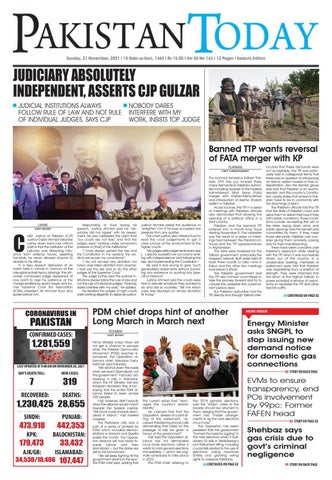
Sunday, 21 November, 2021 I 15 Rabi-us-Sani, 1443 I Rs 15.00 I Vol XII No 143 I 12 Pages I Karachi Edition
Judiciary absolutely independent, asserts cJp Gulzar g
g NOBOdy dArES judICIAl INSTITuTIONS AlwAyS FOllOw rulE OF lAw ANd NOT rulE INTErFErE wITH My OF INdIVIduAl judgES, SAyS CjP wOrK, INSISTS TOP judgE
Banned TTP wants reversal of FATA merger with KP ISLAMABAD Staff CorreSpondent
LAHORE Staff report
c
HIEF justice of Pakistan (CjP) justice gulzar Ahmed Saturday came down hard over critics’s claims that the institution of the judiciary was attracting influence from external forces, asserting forcefully he never allowed anyone to dictate to his office. In a fiery speech delivered at an event held in lahore in memory of the late rights activist Asma jahangir, the otherwise composed judge appeared at one point to lose his patience at the charge levelled by senior lawyer and former Supreme Court Bar Association (SCBA) president Ali Ahmad Kurd who spoke before him.
responding to Kurd during his speech, justice Ahmed said he “absolutely did not agree” with his assessment. He also rubbished the claim that “our courts are not free” and that the judges were “working under someone’s pressure or [that] of the institutions.” “I have always upheld the law and the Constitution in my verdicts. My verdicts are as per my conscience”. “I do not accept any dictation nor have I ever taken dictation from anyone. I work per the law and so do the other judges of the Supreme Court.” The judge further said the judicial institutions always follow the rule of law and not the rule of individual judges. “Nobody dares interfere with my work,” he added. He iterated the judges of high courts were working diligently to dispense justice.
coronavirus in
pakistan
CONFIRMED CASES:
1,281,559
LAST UPDATED AT 9:48 AM ON NOVEMBER 20, 2021
DAY'S DEATH TOLL:
NEW CASES:
7
319
RECOVERED:
DEATHS:
1,230,425 28,655 SINDH:
PUNJAB:
473,918
442,353
KPK:
BALOCHISTAN:
179,473 AJK/GB:
33,432 ISLAMABAD:
34,530/10,406
107,447
justice Ahmed asked the audience to “enlighten” him if he ever accepted any pressure from any quarter. The chief justice also offered Kurd to read the court judgements to get a clear picture of the environment at the higher courts. “My judges write judgements every day […] see [for yourself] how our court is working with independence and following the law, and implementing the Constitution.” He said it was wrong to give “such generalised statements without providing any evidence or quoting any [specific] instance”. justice Ahmed said the courts were free to decide whatever they wanted to do and did so routinely. “Tell me which case was decided on whose dictation till today.”
The banned Tehreek-e-Taliban Pakistan (TTP) has put forward three major demands to Pakistani authorities including reversal of the Federal Administered Tribal Areas (Fata) merger with Khyber-Pakhtunkhwa and introduction of Islamic Shariah system in Pakistan. As per sources, the TTP in a series of meetings with Pakistani officials also demanded that allowing the opening of a political office in a third country. Pakistan and the banned TTP entered into a month-long truce starting November 9. The ceasefire was the result of a series of meetings held between the Pakistani officials and the TTP representatives in Afghanistan. The talks were brokered by the Taliban government, particularly the Haqqani network. Both sides held at least three rounds of talks—one in Kabul and the other two meetings took place in Khost. The Pakistan government and the TTP also formed committees to take the process forward and try to convert the ceasefire into a permanent peace deal. But Pakistani authorities told the TTP directly and through Taliban inter-
PDM chief drops hint of another Long March in March next PESHAWAR Staff report
Prime Minister Imran Khan will not get a chance to escape when the Pakistan democratic Movement (PdM) reaches Islamabad, the Opposition alliance’s chief, Maulana Fazlur rehman said Saturday. “we will shut down the roads when we reach Islamabad, not the government,” Fazl said, addressing a rally in Peshawar, which the KP Minister Kamran Bangash declared ‘flop show’, saying that the entire PdM alliance failed to even amass 200 people. Fazl, however, didn’t specify when the alliance would march towards the federal capital. “will block roads towards Islamabad in March,” Fazl insisted however. The Peshawar rally was a part of a series of protests by PdM, which included demonstrations in Karachi and Quetta earlier this month. The Opposition alliance will now head towards lahore and then Islamabad — but the dates are yet to be announced. “we will keep fighting till the government drowns in the sea,” the PdM chief said, adding that
locutors that these demands were not acceptable. The TTP was particularly told in categorical terms that there was no question of introducing an Islamic system based on their interpretation. Also the terrorist group was told that Pakistan is an Islamic republic and the country’s Constitution clearly states that all laws in Pakistan have to be in conformity with the teachings of Islam. The Pakistani officials told the TTP that the state of Pakistan could only allow them to restart their lives if they fulfil certain conditions. Those conditions include accepting the writ of the state, laying down arms, and public apology over the terrorist acts committed by them. If they meet those demands, Pakistan can consider giving them amnesty, paving way for their mainstreaming. There have been concerns over Pakistan’s approach while dealing with the TTP when it was successfully driven out of the country. In a closed-door briefing, members of parliament were told that Pakistan was negotiating from a position of strength. They were informed that the return of the Afghan Taliban to power provided a window of opportunity to neutralise the TTP and other terrorist outfits.
CONTINUED ON PAGE 02
more inside
Energy Minister asks SNGPL to stop issuing new demand notice for domestic gas connections STORY ON BACK PAGE
the current setup had “damaged the country’s Islamic identity”. He claimed that that the Opposition, ahead of a joint sitting of the parliament, “received threatening phone calls demanding that votes for the passage of bills be given in favour of the government”. Fazl said the Opposition alliance has not demanded local body elections, rather it wants to hold general elections immediately — which are originally scheduled to take place in 2023. The PdM chief, referring to
the 2018 general elections, said the “stolen” votes of the people should be returned to them, alleging that the government has “made arrangements to rig the next elections once more”. The Opposition has been persistent that the government “formed the basis for rigging” in the next elections when it bulldozed 33 bills in wednesday’s joint Parliament sitting, including crucial bills related to the use of electronic voting machines (EVMs) and granting voting rights to overseas Pakistanis.
CONTINUED ON PAGE 02
EVMs to ensure transparency, end POs involvement by 99pc: Former FAFEN head STORY ON PAGE 02
Shehbaz says gas crisis due to govt’s criminal negligence STORY ON BACK PAGE
02
Sunday, 21 November, 2021 | KARACHI
NEWS
EVMs To EnsurE TrAnsPArEncy, End Pos inVoLVEMEnT By 99Pc: ForMEr FAFEn hEAd isLamaBaD
F
agenCieS
ORMER Secretary-General of Free and Fair Election Network (FAFEN) Sarwar Bari on Saturday said the use of Electronic Voting Machines (EVMs) would help ensure transparency in the polls to great extent and end the involvement of Polling Officers (POs) by 99 percent. “About 99 percent involvement of POs in the election process after the introduction of EVMs will come to an end and the chances of rigging will be eliminated to great extent as compared to the old election
process,” he said while addressing a news conference here. He said the EVMs would minimize the role of humans in the election process as now “it will be done through the machines.” He said the use of EVMs was a part of the strategic plan 2019-23 of the Election Commission of Pakistan (ECP) but no development had been made in that regard. He said it was a commitment of the ECP to use EVMs, start a biometric system and give the right of vote to overseas Pakistanis through internet voting. As per the FAFEN reports, he said hundreds of thousands of irregularities were committed in the past elections, expressing
confidence that there was a zero percent chance of any vote rejection after the introduction of the EVMs. “As per the plan, it was agreed by the ECP that EVMs will be utilized again and again as a pilot project but it was unfortunate that the exercise was the ECP done it once only,” he regretted. Now, he said a bill related to the use of EVMs had also been passed by the Parliament and this technology would be used in the upcoming general elections. “This is the matter of rule of law, so I fully support it.” He was of the view the ECP should start work on efficient use of EVMs in the next polls instantly without any further delay as
the manufacturers had assured to ready the required machines before the 2023 elections. Sarwar Bari said free elections meant that every registered voter of the country must be allowed to choose their candidates and exercise voting rights with his/her free will in a conducive atmosphere. He recalled that after the 2013 elections, protests were started in the country as form 14 was not given to contesting candidates after the vote count ended at polling stations. He claimed that the 2013 elections were rigged as turnout in various polling stations particularly in Ayaz Sadiq’s constituency was more than 100 percent. He said that Pakistan Muslim League
Nawaz registered 14 cases against FAFEN for exposing rigging in elections in various parts of the country. Sarwar Bari said he took a stand on the issue but the FAFEN management tendered an apology to the then caretaker chief minister Najam Sethi. He said he had witnessed some form 14 in which counting were mentioned wrong and the number of votes was written on blank papers. He said without intimating, the ECP had changed the numbers of polling stations and in some cases, polling booths were merged. He also questioned Trust for Democratic Education and Accountability (TDEA) for spending funds on ECP officials and their families, adding the TDEA without the approval of the board had spent funds on traveling and accommodation of ECP officials and family members. Sarwar Bari said as a result of an investigation into the 2013 elections, it had come to the FAFEN’s notice that the TDEA committed forgery in the forms of a number of constituencies.
SBP, FIA join hands to curb money laundering, digital fraud karaCHi Staff CorreSpondent
State Bank of Pakistan (SBP) Governor Dr Reza Baqir on Saturday emphasised the need for closer cooperation amongst banks, the central bank and the Federal Investigation Agency (FIA) so that “white-collar crimes are expeditiously investigated and fraudsters are apprehended and prosecuted.” According to a statement issued by the central bank, a meeting was held under the chairmanship of Baqir to
strengthen coordination against money laundering, digital fraud and cyber attacks. Officials present during the meeting were informed that the SBP has taken several measures in the recent past to strengthen its work on Anti-money Laundering (AML) as well as taken regulatory and supervisory measures to improve bank controls to prevent digital and social engineering frauds. During the meeting, it was decided that in addition to having better control at the level of financial institutions and enhanced customer awareness, effective investigation and prosecution of
criminals is needed to substantially reduce the incidence of money laundering, digital fraud and cyber attacks. “The FIA team offered support in strengthening cyber security at banks and suggested banks carry out Information Security (IS) audit of their systems,” the statement read. Welcoming the suggestion, the SBP noted that as per existing regulations, banks are required to regularly carry out an information systems audit and penetration testing: however, the same would be reemphasised to the industry through PBA.
Students observe Children’s Day by donating gifts to orphans
Moeed disagrees with Fawad, says govt can deal with groups like TLP News Desk
isLamaBaD Staff report
Expressing solidarity with the orphan and kids in need, students demanded the elders to protect the rights of the children as well as to make this world a better livable place. In order to project the message of children rights and to promote good living facilities for orphans and poor children, the students organized a 5 kilometers walk. They also collected gifts to be handed over to the children of Pakistan Sweet home. On Saturday, the Preparatory School Islamabad (PSI) children organized a colorful function and a walkathon on the
occasion of International Children’s Day. Children sang special songs to project the message of children rights in the society. On this occasion the children gave the message that for the protection of children’s rights, resolution of world’s problems and for the spread of peace and love the elders should play a practical role. The children presented a special tableau in which they project the theme of children representing the core of this world. The children received a lot of applause from the audience for this presentation. At the end of the function a walk was organized, which started after the chief guest Saad Ashraf cut a ribbon for this purpose. Children, teachers
and parents participated in the walkathon. During the walkathon the children were holding placards in their hands on which the slogans for children right, peace and harmony in the world and providing support to the helpless and such themes and slogans were inscribed. In connection with the International Children Day, the blue ribbons were tied to the wrists of children and blue balloons were released in the air. On this occasion children of the school gave away the gifts that they had brought with them to the children of Pakistan Sweet Home as a token of solidarity with them.
PDM chief drops hint of another Long March in March next CoNtiNueD from page 01 The joint Opposition has warned that it will move the Supreme Court against the legislation in the Parliament, with the government asking it to sit on the negotiation table instead. ‘These are not the people’s representatives’ For his part, PML-N leader and former prime minister Shahid Khaqan Abbasi said the incumbent government was “not the people’s representative”.
The former premier said the “events that led to the rigging of the 2018 elections” were gradually coming to light, as he reminded the people that former chief justice of Gilgit-Baltistan Rana Shamim had blamed ex-chief justice of Pakistan Saqib Nisar for “playing a part in rigging” the polls. Abbasi said the government would now “rig” the next general elections, just like it had “rigged” the Daska byelections. “The legislation done in the Parliament will not resolve the country’s problems,” he added.
National Security Advisor Moeed Yusuf on Friday said that the state can deal with groups like Tehreek-e-Labbaik Pakistan (TLP), according to a news outlet. Speaking to anchor Saleem Safi during the Geo News programme Jirga, he disagreed with Information Minister Fawad Chaudhry’s earlier statement on the government’s talks with the TLP, in which he had said that neither the state nor the government is ready to fight extremism. “I do not agree at all that the state does not have the capability to deal [with TLP]. I had also said this publicly that a red line has to be drawn because the policemen martyred [during clashes with TLP] were also the state’s responsibility,” said Yusuf, responding to Chaudhry’s earlier remarks. Yusuf said that a National Security Committee (NSC) meeting was held to discuss the TLP issue by all relevant stakeholders. He said that after the meeting, the government released a statement stressing that “a red line has been drawn” but added that it also said it would prefer to resolve the matter through talks. “After that, the matter progressed through talks,” he said.
Banned TTP wants reversal of FATA merger with KP CoNtiNueD from page 01 When the Taliban took over Kabul in August, Pakistan handed the new government a list of demands including seeking action against the TTP terrorists operating out of Afghanistan. The Taliban government, however, instead of taking action against them offered Pakistan its “good offices” to seek a solution through talks. Pakistan accepted the offer in the hope that the Afghan Taliban would not act as mediators but guarantors of any peace deal with the TTP. Parliament was told during the national security briefing that a final peace deal would be struck taking into account all the factors and even traditional jirgas and other local customs would be employed to make sure that the TTP does not take up arms again. Observers, however, are wary of the positive outcome of ongoing talks with the TTP as terrorist groups used peace deals in the past to regroup.
Sunday, 21 November, 2021 | KARACHI
World can’T remain indifferenT To uGly SiTuaTion in bleedinG iioJK: niazi MIRPUR (AJK)
a
Staff RepoRt
ZAD Jammu and Kashmir Prime Minister Sardar Abdul Qayyum Niazi has said that the world could not remain indifferent, for further long time, to the grave situation prevailing in the bleeding Indian Illegally occupied Jammu & Kashmir (IIOJK). He expressed these views while talking to a delegation of senior Kashmiri journalists which called on him under the leadership of the Azad Kashmir Newspaper Society (AKNS) President Sardar Zahid Tabbasum at Jammu and Kashmir House in the federal metropolis on Saturday. AJK Information Minister Faheem Rabbani and Director General Jammu Kashmir Liberation Cell Ershad Mahmud were also present on the occasion. Lambasting New Delhi the AJK Prime Minister said that India had intensified its reign of state terrorism in IIOJK in occupied Kashmir to suppress the indigenous freedom movement launched by the valiant people of Jammu & Kashmir for securing their fundamental right to self determination. He lauded Pakistan Prime Minister Imran Khan for raising Kashmir question at all relevant global forum seeking early peaceful solution of the Kashmir issue, he added. Qayyum Niazi said “recently we have presented
the case of Kashmir issue before the Organization of Islamic Cooperation (OIC) delegation calling upon the OIC to raise its voice for resolving the Kashmir dispute without further loss of time. Sardar Abdul Qayyum Khan Niazi said that his government was fully aware of the problems of the common man and taking revolutionary steps to make life easier for the people according to the vision of the party’s Supremo and Prime Minister Imran Khan. Niazi said that the AJK print media had always played an unforgettable role in protecting the Kashmir issue at international level and has exposed the Indian forces’ repressions over the globe. He said the government is fully aware of the problems being faced by the working journalists and its affiliated journalists
and will utilize all resources to solve their problems. The AJK Prime Minister said the media was a powerful pillar of the state and the government will utilize all possible resources to solve their problems. In response to the demands of the AKNS, the Prime Minister assured increase the normal budget and transfer one percent of the development budget to the Press Information Department at the request of AKNS. In this connection the Prime Minister ordered constitution of a committee headed by the Information Minister Sardar Fahim Rabbani which will hold a formal meeting in Muzaffarabad next week to resolve the issue of payment of arrears of state newspapers will be settled shortly and the problems created by the previous government will also be solved as soon as possible. The Prime Minister appreciated the role of state media in projecting the Kashmir issue at international level and added that state newspapers were playing a vital role in projecting the voice of Kashmiri people against Indian forces’ repressions effectively at international level He said our priority is to make state newspapers the strongest weapon of Azad Kashmir and to solve their basic problems to strengthen the institutions and make the workers associated with news papers prosperous. He said newspapers have a big role to play in providing information in the most backward areas of Azad Kashmir.
NEWS
03
Sharif family most organized mafia in Pakistan: Gill ISLAMABAD app
Special Assistant to the Prime Minister on Political Communication Dr Shahbaz Gill on Saturday said that Sharif family was not only involved in corruption but also misled the people. In response to the statement of Leader of the Opposition in National Assembly Shehbaz Sharif, he said the Sharif family was the most organized mafia in Pakistan and they would never provide details of their accounts. Incompetent Sharif was unable to produce receipts for their properties built through corruption, he said. Gill said it was a tradition of the Sharif family to attack Supreme Court, intimidate judges and take decisions of cases as per their wishes. He said now the ‘Showbaz Sharif’ has to be made accountable for his corruption. Gill said assets of Shehbaz Sharif have increased 70 times in the last 10 years with the blessings of TTs. Similarly, the assets of Hamza Shehbaz have also increased 3,000 times through black money, he added. He said champion of money laundering Salman Shahbaz’s assets have also increased 8,000 times.
The right to use of force should only rest with the state, say experts ISLAMABAD Shahzad paRacha
Govt making all-out efforts to control inflation: Ghulam Sarwar RAWALPINDI Staff RepoRt
Federal Minister for Aviation Ghulam Sarwar Khan on Saturday said the government was focusing on real issues like inflation and not worried about opposition parties, Pakistan Democratic Movement and elections. Addressing a press conference here, he said the incumbent government was making all-out efforts to control inflation. Ghulam Sarwar said the opposition parties were responsible for all the problems being faced by the citizens and the country, adding, they remained involved in looting and plundering of national exchequer during last 35 years. They could not dislodge the government by launching long marches, sit-ins and other moves. They would fail in their designs, he added. To a question, he said the inflation and price hike which were being confronted by the citizens were results of the decisions made by the past regimes, but the incumbent government was making earnest efforts and taking solid steps to provide relief the people. To another question, the minister said Pakistan Muslim League-Nawaz (PML-N) had been trying to weaken the institutions and confronting with each institution of Pakistan. The PTI government tried to strengthen the institutions of the country, he added. Sarwar Khan said the legislation made in joint session of the parliament was earlier discussed in the cabinet meetings and approved by the cabinet. The allied parties were fully onboard. As many as 31 bills including Electronic Voting Machines (EVMs) and IVoting were passed in the joint session of the parliament, he added. He said there was no election credible in the past as all the political parties of the country had been leveling allegations of rigging on each other after defeat. Either, it was rigged by the candidate individually or rigged by presiding officers and other authorities. Every politician who loses election never accepted their defeat and leveled allegations on those who succeeded, Ghulam Sarwar said. PML-N and PPP had also been leveling allegations of rigging on each
other in all the past elections, he added. The electoral reforms package which was introduced by the government was need of the hour, he said adding, the government had offered the opposition parties to come and sit to give suggestions to finalize election reforms. The government was making all-out efforts to make the election process credible, free, fair and transparent. But, unfortunately, the opposition parties were using delaying tactics and trying to escape the process. They were not ready to sit with the government for any constructive work, he added. He further said that despite, majority of the opposition parties in the senate, the government succeeded to get passed four bills in the senate on Friday with majority as their several members were not present. The issues of national importance were resolved and it was not only the success of the government and its allied parties rather, it was success of Pakistan as free, fair and transparent elections were need of the hour to strengthen democracy in the country, he added. EVMs were needed to make the elections process credible, he said adding, the government was ready to talk on EVMs and I-Voting procedures to further improve the election systems. A bill was get passed to give right to vote to nine million overseas Pakistanis who were asset of the country. They were contributing remittances of $ 30 billion in national economy. They were sending foreign exchange to the country which was more than overall exports of the country which were $ 28 billion currently. Overseas Pakistanis were backbone of the country’s economy, he said adding, more than 70 percent overseas Pakistanis were affiliated with PTI and supporters of the party. It was included in the manifesto of the PTI that the overseas Pakistanis would be given right to vote. He further said Kulbhushan Jadhav was arrested during PML-N regime, but, his arrest was not discussed in the parliament due to the relations of the then Prime Minister Nawaz Sharif with his Indian counterpart Narendra Modi. He said “Six adjournment motions on arrest of Kulbhushan were given by him. Several other
adjournment motions were given by other members of the opposition parties at that time which were killed in the chamber of the then Naitonal Assembly Speaker.” The minister said that Kulbhushan Jadhav was arrested with solid evidence. He had also confessed to his crimes and his statements were on the record. Despite difficulties, military trial of Indian RAW agent was completed here in Pakistan. He was given death sentence while India approached the International Court of Justice. The PML-N government should have not participated in that process. The International Court of Justice gave a judgment which was not against the sentence but the court ordered for giving right of appeal to Kulbhushan. It was a direction from the International Court of Justice, he added. The PTI government made legislation in the best interest of Pakistan. The bill was passed to give him a right of appeal which would come to Islamabad High Court. It was a strong case and definitely, the RAW agent could not escape the death sentence, he added.
The right to use of force should only rest with the state and ensuring rule of law, civic education, equality of citizens and youth and women’s engagement are imperative to end extremism and terrorism in the country. These views were expressed by experts in a two-day regional consultation on “Promoting soft approaches in countering terrorism & extremism in Pakistan” organized by Pak Institute for Peace Studies (PIPS) here at a local hotel. The event was aimed at seeking input from experts from all regions of Pakistan to formulate a charter of peace, which, with the support and endorsement of key stakeholders would be pursued for realizing the goal of sustainable peace in the country. Besides others, journalists, religious scholars, academics, rights activists, former military officials, representatives of civil society and law enforcement agencies attended the event and took part in different sessions. PIPS Director Muhammad Amir Rana and Najam U Din, Project Manager of the institute, were the moderators. The speakers underlined that students of mainstream schools and colleges were as vulnerable to radicalization as those from seminaries and needed to be engaged by creating spaces for them at different platforms including activation of local bodies. They emphasized the need to engage peaceful youth movements that stood for human rights and democratic values. They said these were the basic ingredients of a much needed charter of peace in the country. The state, the political parties and parliament should move forward to give a counter narrative on extremism and terrorism and realize their responsibilities and ensure civic education and constitutional literacy to promote tolerance and equality for all citizens in society. The participants were of the view that whatever space was available to political parties must be used to give counter narratives on extremism and they should engage the youth. “Less space for youth gives opportunities to extremist elements to influence and trap them.” They said that economic, political and social empowerment of women would prove instrumental in countering radicalization. They also said that the situation in Afghanistan since the takeover of Kabul by Taliban had a direct impact on Pakistan and the government should consider implications of the same for internal peace and rule of law. An inclusive and holistic approach would have to be taken while making policies on counter extremism, de-radicalization and re-integration of militants, they said. Dr Zafar Nawaz Jaspal of the Quaid-e-Azam University said that there were no tangible initiatives to de-radicalize in society.
EVMs to help getting rid of rigging forever: FM Qureshi MULTAN Staff RepoRt
Foreign Minister Makhdoom Shah Mehmood Hussain Qureshi on Saturday said Pakistan Tehreek-e-Insaf (PTI) wanted to hold elections through electronic voting machine (EVMs) to strengthen democracy and end the outdated system. He said this during different functions held at various union councils of NA-156, and meetings with different delegations, said a press release issued here. “We made attempt to utilize modern technology to ensure that the next elections should be transparent and no political could make allegation of rigging. We want to get rid of the word rigging from the country forever by holding elections through EVM,” said Qureshi. He added “Overseas Pakistanis are the
backbone of the country’s economy as they were sending billions of rupees” , the FM mentioned and questioned that why they could not vote. He said the government had given the expatriates their basic right. The foreign minister maintained that Overseas Pakistanis, being well wishers of
the country, wanted to take part in the election process. They always wished eradication of corruption, promotion of justice and better governance in Pakistan, Qureshi said and opined that the democracy would be strengthened when all people at home and abroad would exercise their right to vote. The PTI had made a new history by giving the expatriates their right to vote, maintained Shah Mahmood Qureshi. He also regretted that the opposition always opposed every good move of the government. While there was no harmony among their (Opposition) own ranks. The government and its allied were united while the opposition was in a turmoil. The opposition was unable to digest the country’s progress. In past tenures, the previous rulers ruthlessly plundered the national treasury and left the people poor and
destitute. The nation was still suffering the consequences, said FM Qureshi. The PTI government inherited the economic crisis and faced many challenges after coming into power, it faced many challenges, Qureshi said and added the government worked hard to meet these challenges. He said that Inflation was a huge challenge for the government and it was struggling to overcome it. During coronavirus pandemic, the government provided financial assistance to millions of families. The foreign minister apprised that PM Imran Khan was bringing a programme under which every poor citizen would be given a discount to reduce effects of global inflation. The PTI government feel the pain of the poor and it was striving hard to do something for them. Prime Minister Imran Khan was
sincerely working for development of the country and welfare of masses, he said and added that development of South Punjab was top priority of the incumbent government. “The government wants to shift the journey of development from urban to rural and backward areas. In the past, no attention was paid to rural areas. Due to which the southern districts became backward,” remarked Qureshi. Commenting on South Punjab Secretariat, he stated, the government gave the gift of Secretariat to the people of this region. Now, the local people would not have to travel to Lahore for getting their problems resolved, he stated. Qureshi informed that development projects worth billions of rupees were being implemented in the city. “Completion of the projects will usher in a new era of development in Multan,” the foreign minister said. Foreign Minister Qureshi spent a busy day in the constituency and visited the residences of deceased persons in various union councils of the constituency.
04 NEWS 21th November 2021_Layout 1 11/21/2021 12:12 AM Page 1
sunday, 21 november, 2021 | KARACHI
04 news
‘Our futurE’: ImraN SayS GOvErNmENt StrIvING tO ENSurE ChILdrEN’S rIGhtS ISLAMABAD
W
App
ITH its policies aimed at future generations, Prime Minister Imran Khan Saturday said the government was determined to ensure that children’s rights including development, education, healthcare, participation, dignity and security were upheld. The prime minister, in his message to the nation on World Children’s Day, said he was pleased that Pakistan joined the world community in celebrating the day. He said the 2021 theme — A Better Future for Every Child — reaffirmed his government’s commitments to the children of Pakistan.
“In line with our manifesto, our policies are aimed at future generations. Our Government is determined to ensure that every child’s rights including development, education, healthcare, participation, dignity and security are upheld,” he said. The prime minister said in order to ensure the protection of children’s rights, the government established the National Commission on the Rights of Child (NCRC) — to inquire into complaints of violations of children’s rights — and the Zainab Alert, Response and Recovery Agency (ZARRA) which will activate the state machinery at regional and district levels for effective emergency response and recovery of missing children. The Child Protection Institutes are being established and various
ECP notifies delimitation committees for LG elections in Sindh ISLAMABAD inp
The Election Commission of Pakistan (ECP) on Saturday announced the schedule of delimitation committees for holding local government polls in Sindh. The regulator said the delimitation for the election will be finalised from December 1 to February 23, according to a notification issued by the body. The final list of delimitations will be displayed on February 23, it added. “In the first phase, groundwork including maps will be prepared from December 1-15,” according to the election commission. “From December 16 to January 1, the limits of the union councils and committees wards will be determined.” The election commission has constituted new delimitation committees, comprised of three members, in each district of Sindh. “The delimitation commission committee will be comprised of district election commissioner, additional deputy commissioner and the election officer. It will be authorised to determine limits of the union council, union committee and wards,” the ECP announced. Sindh had amended its local government law in February 2015 to give delimitation powers to the election commission. The ECP has earlier announced twice the constitution of delimitation committees for local government polls in Sindh — in September last and June this year. The local councils had completed their previous tenure in the province on August 31.
Petition of suspect in Noor murder dismissed ISLAMABAD inp
A district and sessions court in Islamabad dismissed a private complaint filed by an employee of the Therapy Works organisation seeking legal action against Investigation Officer Abdul Sattar and prime suspect Zahir Zakir in the murder of Noor Mukadam. Mukadam, 27, was found murdered at the residence of Zakir in Sector F-7/4 of Islamabad in July. Zakir, widely believed to be the killer, was arrested the same day for his purported involvement in the gruesome incident. A first information report registered on the complaint of Ambassador Shaukat Ali Mukadam, Mukadam’s father, nominated Zakir under Section 302 (premeditated murder) of the Pakistan Penal Code.
legislations are being introduced to eliminate child labour, he added. Khan said other welfare measures taken since 2018 also catered for children including nutrition support to malnourished children, universal health care through healthcare cards. “We have also introduced a Single National Curriculum. Moreover, social welfare programs through Ehsaas provide social safety to children against poverty. Most important of all, Clean and Green Pakistan has been initiated keeping in view our future generation,” the prime minister remarked. He also called for reaffirming the pledge for the protection of the rights of children in Pakistan and to provide them with equal opportunities to become productive citizens of Pakistan.
Sidhu urges Modi, Imran to open borders KARTARPUR stAff RepoRt
Indian politician and former TV host Navjot Singh Sidhu Saturday urged both Prime Minister Imran Khan and Indian Premier Narendra Modi to “open doors for peace” and end the enmity between their two countries. Sidhu’s name was left out from the delegation of Indian Punjab Chief Minister Charanjit Singh on Thursday. The omission was blamed on a “technical glitch” by Indian officials. Sidhu, who calls Prime Minister Imran Khan a close friend visited the Kartarpur shrine of Sikh Guru Nanak Dev and spoke to journalists at Kartarpur. He said if Pakistan and India could end the enmity, the trade between them and other countries would increase to $37 billion. After returning from Kartparpur later in the day, he held a press conference in the Indian territory and said that he desired prosperity not only for 30 million Indian Punjabis but for everyone. He cited the example of Europe which was embroiled in internal conflicts for cen-
turies but later became united under the European Union. He said goods between Pakistan and India have to travel 2,100 kilometres before arriving at markets. The same distance could be reduced to 21 kilometres, he said. He also urged the two nations to reopen shrines in both countries to devotees. Renowned Indian politician and former cricketer Navjot Singh Sidhu arrived in Pakistan on Saturday via Kartarpur Corridor to take part in the annual commemoration of the birth of Guru Nanak, the founder of Sikhism. On behalf of Prime Minister Imran Khan, Kartarpur Corridor Project Management Unit chief executive officer welcomed Navjot Singh Sidhu upon arrival in Pakistan. Speaking on the occasion, Sidhu thanked the prime minister for the rousing welcome. The former Indian cricketer-turned politician says, “He [PM Imran Khan] is my elder brother.” Novjot Singh Sidhu at Gurdwara Darbar Sahib.
Singh Sidhu at Gurdwara Darbar Sahib. Later, he visited Gurdwara Darbar Sahib and performed religious rituals. Indian Punjab CM, other Indian politicians visit Gurdwara Sahib Earlier on November 18, Important Indian politicians, including the Indian Punjab chief minister, had visited the Gurdwara Kartarpur Sahib, a day before Gurpurab, which marks the birth anniversary of Sikhism founder Baba Guru Nanak. The Kartarpur Corridor, which links Gurdwara Darbar Sahib in Pakistan, the final resting place of Sikhism founder Guru Nanak Dev, to Dera Baba Nanak shrine in Gurdaspur district, was reopened on Wednesday. Pilgrimage to the Kartarpur Sahib gurdwara was suspended in March 2020 due to the COVID-19 pandemic. Indian Punjab CM Charanjit Singh Channi, along with his ministers, were part of the first delegation to visit Gurdwara Darbar Sahib in Kartarpur. Pakistan Sikh Gurdwara Prabandhak Committee (PSGPC) president Sardar Ameer Singh had greeted and received them on their arrival.
Government to use artificial rain to reduce smog: climate minister ISLAMABAD stAff RepoRt
The government will deploy artificial rains ahead of the dry season’s peak next year as the nation attempts to combat the seasonal repeat of winter smog that blankets Pakistan every year, Minister of State for Climate Malik Amin Aslam said. Speaking to a news channel, Aslam said the ministry was contemplating the use of cloud seeding technologies in response to severe air pollution in Punjab, particularly Lahore. It’s not clear when exactly the government will seed the clouds to produce the rain, but the officials are rushing the closure of traditional brick kilns of Punjab in the meantime. In the regional neighbourhood, China has frequently made use of cloud seeding technology to relieve droughts or clear the air ahead of major interna-
tional events. It has also been building a weather modification system in the QinghaiTibet plateau, Asia’s biggest freshwater reserve, with the aim of pumping large quantities of silver iodide into the clouds in a bid to increase rainfall. If Pakistan follows the China model to be able to modify the weather, it will have to extend an artificial rain “two to three times in the next year”, Aslam said. “We are currently studying the phenomenon,” he said, acknowledging the use of weather modification technology was crucial to deal with the health hazard. Lahore, the bustling metropolis of nearly 11 million people, regularly ranks among the worst cities in the world for air pollution — a mixture of low-grade diesel fumes, smoke from seasonal crop burn off, and colder winter temperatures coalescing into stagnant clouds. Over the past weeks, in what has be-
come a dreaded seasonal occurrence, Lahore has suffered pollution levels many times higher than the levels deemed healthy by the World Health Organisation (WHO) and a thick brown smog settled over the city. Aslam said that 40 percent of the smog was caused due to smoke emitting from vehicles “which is why the government is shifting fuel from Euro 2 to Euro 5 fuels. “We are also taking action
against smoke-emitting vehicles,” he said. The use of electric vehicles would also help in lessening the pollution, he added. The minister said the government was taking measures to deal with the toxic air and would hold talks for similar effective measures in neighbouring India to avoid any fallout. “All countries in the region [would] have to sit together to deal with the challenge of climate change,” he said.
India’s Reliance abandons $15bn Saudi Aramco deal MUMBAI Agencies
India’s Reliance oil-to-telecoms giant is abandoning a $15 billion deal for Saudi Aramco to buy a 20% stake in its oil refining and chemicals unit, it said, as the firm pivots towards renewable energy. The deal was announced more than two years ago by Reliance chairman Mukesh Ambani, Asia’s richest man, and touted as the biggest foreign investment in the conglomerate’s history. But Reliance and other major Indian firms have since poured billions of dollars into green power as the government pushes to reduce its
dependence on imported fossil fuels and as the country’s cities are assailed by pollution. Saudi Aramco is the world’s biggest oilproducing company and vies with Apple for the title of the most valuable firm on the planet. Ambani in June this year pledged to invest $10 billion in renewable energy over the next three years. Reliance said in a late-night statement Friday that due to its “evolving” portfolio of businesses, the two firms had “mutually determined that it would be beneficial for both parties to re-evaluate the proposed investment”. It was withdrawing a legal application that would have paved the way for Saudi Aramco to take the stake in its oil-to-chemicals divi-
sion, it added. The unit includes Reliance’s refining, petrochemicals and fuels marketing businesses, among them the giant Jamnagar refinery in Gujarat, Prime Minister Narendra Modi’s political powerbase. Reliance recently announced it would build four “giga factories” at Jamnagar making solar panels, storage batteries, and hydrogenrelated products to create one of the largest integrated renewable energy manufacturing facilities in the world. The Mumbai-headquartered firm’s rise was powered by its oil and petrochemicals businesses but in recent years it has diversified into areas ranging from telecoms to retail.
Sunday, 21 November, 2021 | KARACHI
NEWS
corporate corner IgP inaugurates ‘oneWindow operation desk’ to facilitate police personnel
PM Khan dIREcTS RESoLvIng ISSuES facEd by chInESE InvESToRS ISLAMABAD
P
Mian abRaR
RIME Minister Imran Khan Saturday directed the authorities concerned to facilitate all Chinese investors, who were setting up industries in Pakistan, on an emergency basis by resolving their issues related to road connectivity and the provision of utilities. “We will support Chinese businesses in Pakistan on the priority basis, and are grateful to them for their keen interest in accelerating their investment in Special Economic Zones (SEZs),” said Prime Minister Imran Khan in a meeting with a Chinese business delegation led by Chen Yan from Challenge Fashion (Pvt) Ltd.
Inspector General of Islamabad Police (IGP) Qazi Jamil ur Rehman on Saturday inaugurated a ‘OneWindow Operation Desk' here at the Central Police Office aimed at extending maximum facilities to the personnel. The Deputy Inspector General, Senior Superintendent of Police (Headquarters) and other senior officials were also present on the occasion, a news release said. Under one-roof facility, a big initiative of the IGP, all departmental issues of police personnel like leave, transfers, service records, promotions, pensions, penalties and other governmental matters would be solved within three to seven days. Speaking at the inaugural ceremony, the IGP said the desk had been set up to make it possible for police personnel to access all facilities and services under one roof. He said police personnel would be able to take full advantage of the facility and get complete information through it. “Now police personnel will not need to visit other offices for their work as the staff of One Window Operation Desk will be bound to provide complete information about status of different pending matters.” With provision of digital information, he said all departmental matters of police personnel would be solved on priority without any undue delay. Police personnel have expressed happiness over the establishment of the one-window facility for instant resolution of their official matters without any typical bureaucratic hurdles. pR
Pearson kicks off English proficiency initiative in Pakistan
ISLAMABAD: As the Covid-19 pandemic coupled with lockdowns and travel restrictions has entirely changed trends especially in education learning as well as job market, Pearson has reached out to Pakistan to improve English language proficiency of those aspiring to get education or job in an English country. Pearson is an international identity working in about 110 countries offering opportunities for improving English language proficiency through both online and physical classes especially for those who aspire to get education or employment in an English country. Statistics show that there is very little percentage of those who aspire to move to an English country especially UK for getting education or employment proficient in English language, which is a major instrument in proper communication there with their supervisors or faculty. “Online learning has been proved the best workable option during the Covid-9 pandemic the world over offering professional opportunities to learn and work,” Premila Paulraj, Director of Employability & Qualifications, South Asia at Pearson, told media here. She revealed that from its Islamabad-based center Pearson has recently launched Pearson Test of English Academic (PTEA) in Pakistan; a UK Home Office approved English test for the people applying to work or live in the UK, she added. Mr. Waqar Shah, Deputy General Manager, Pearson Pakistan said that, “Due to Covid restrictions, PTEA is being offered in Pakistan as a new online proctored option for the people who prefer to take the test remotely,”. Waqar informed that the UK Home Office has also awarded Pearson commercial agreements to provide Secure English Language Tests (SELTs) to people who need to demonstrate their English language skills to work or live in the UK. pR
05
During the meeting, the prime minister was told that Chinese businessmen are almost ready to start operations in the glass, ceramics and information technology sectors. The prime minister said that Pakistan and China were connected not only in the past or present but would remain united through their future generations too. “We appreciate the valuable relationship of the peoples of the two countries,” he added. It is worth mentioning that OPPO, one of the leading tech manufacturers in the world, is going to establish a local mobile manufacturing unit and a research and development centre in Pakistan. It would not only save a lot of foreign exchange reserves on the import of smartphones annually but would also cre-
ate employment opportunities for our tech graduates. The meeting was also attended by Energy Minister Muhammad Hammad Azhar, Advisor on Commerce Abdul Razzak Dawood, SAPM on Political Communication Dr Shahbaz Gill, SAPM on CPEC Affairs Khalid Mansoor and Chinese Ambassador Nong Rong along with senior officers concerned. In his remarks, Chinese Ambassador in Pakistan Nong Rong said that he was very happy since the prime minister’s previous meeting with the Chinese businessmen on September 13, a lot of issues had been resolved and great progress had been achieved. He said that the Chinese entrepreneurs were encouraged and hoping great progress after this meeting. “We will send
Experts call for skilled labour force to attain economic growth
more positive information to China to encourage more Chinese businessmen to make decision to invest in Pakistan,” he commented. A Chinese entrepreneur representing OPPO, said that the company had already been present in Pakistan for more than seven years and had made around $150 million investment in the country. He said like other companies, for OPPO too, it was a very good environment in Pakistan to continue to invest there and the interaction with the prime minister helped the swift resolution of the issues. He thanked the prime minister for helping the Chinese businessmen by extending facilitation to them. “If anybody comes to me and ask should they invest in Pakistan, I will say yes,” he remarked.
Ice Melting: PTI Senator meets TLP chief Rizvi LAHORE Staff RepoRt
ISLAMABAD pR
Stressing the need to grab a substantial share of employments in international as well as local labour market, experts at a webinar have said this goal can be achieved only through getting technical education and vocational training that will also ensure economic stability in Pakistan. The webinar titled ‘Accelerating Pakistan’s Economic Growth through Skilled Labour Force’ was arranged by the TVET Sector Support Programme (SSP) with the aim to highlight the significance of skills development for the youth to become globally competitive as well as ensure sustained economic and social development. The TVET SSP is funded by the European Union, Germany and Norwegian Embassy while its implementing partner is the Deutsche Gesellschaft für Internationale Zusammenarbeit (GIZ) in close collaboration with the National Vocational and Technical Training Commission (NAVTTC), provincial Technical Education and Vocational Training Authorities (TEVTAs) and many other private
sector organizations. Labour Market, TVET and gender expert Sabina Ahmed, labour economist and labour market expert Dr Zafar Mueen Nasir and Head of TVET SSP Iris Cordelia Rotzoll were the experts in the webinar panel. Moderator Sonia Omair, Technical Advisor Communication TVET SSO, explained the importance of TVET sector and technical and vocational trainings to achieve strong careers in the national and global labour market. Giving her expert opinion in the webinar, Sabina Ahmed said that education merely is not the way to progress and has the sustainable position in the job industry. “Trainings both technical and vocational for our people especially youth are direly needed to attain best career opportunities at national and international level,” she maintained. Dr Zafar Mueen Nasir spoke in detail about how to gain the sustainable growth in social & economic sector. He mentioned that “sustainability in economic and social growth is related to the employment opportunities.” He, however, linked job opportunities with the skills enhance-
ment. “More the people are technically trained, more they have the chances to be recruited in reputable organizations,” he stressed. Participating in the discussion, Iris Cordelia Rotzoll expressed the satisfaction that people are now realizing the importance of technical and vocational education and trainings for the workforce employability. “People are enhancing their skills through TVET SSP and thus workforce employability is also increasing. Through green skills and digital skills, we can do more for the economy of Pakistan,” he said. The experts also focused on disparity between labour market demand of trained individuals and education given to the population in the contemporary era which is not according to the needs of the industry. According to them, workforce employability depends on various factors such as education, managerial skills, adaptation of technology, level of investment and but technical and vocational competence remains on the top. They also stressed that the workforce must have a high-quality education along with demand-driven skills training.
PTI Senator Ejaz Chaudhry on Saturday met Tehreek-e-Labbaik Pakistan (TLP) chief Maulana Saad Rizvi, with a TLP spokesperson saying that “doors never close in politics”. The TLP chief was released from jail on Thursday after more than seven months following a deal between the government and the party, the contents of which are yet to be publicly shared. Rizvi was taken into custody on deputy commissioner Lahore’s directives in April shortly after the party announced countrywide protests. Chaudhry, in his meeting with Rizvi at the Rehmatul Lil Alameen Mosque in Lahore, also presented a bouquet to the TLP chief and congratulated him on his release from prison. By showing up with a bouquet, Chaudhry made good on a promise he had made earlier this month. Speaking to Geo News, he said: “I will present a bouquet to Saad Rizvi when he is released.” Speaking to the media after the meeting, Chaudhry said he came to meet Rizvi as a gesture of goodwill and that it is the government’s responsibility to stay in contact with leaders who are “different from others”. “It is the responsibility of the state to build such ties with the people that create an atmosphere of harmony,” Chaudhry added. The PTI leader said he had expressed satisfaction over the government’s agreement with TLP, and following the implementation of the deal, he had arrived at Rizvi’s residence to meet him. In response to a journalist’s question whether he had visited Rizvi after seeking permission from Prime Minister Imran Khan, he said he “never meets” anyone without the premier’s nod. Responding to another question, he said it was too early to say whether the prime minister would hold a meeting with the TLP chief. Govt strikes secretive deal with TLP Rizvi’s release on November 18 follows days of protests staged by the then-proscribed party.
KSE-100 rebounds amid monetary policy announcement KARACHI Staff RepoRt
The Pakistan Stock Exchange (PSX) recouped losses from the previous week with the benchmark KSE-100 index gaining 740 points or 1.6% to settle at 46,489.41 points. Trading remained volatile throughout the week with the index finishing three out of five sessions in the red. The week started on a negative note as a result of uncertainty regarding the International Monetary Fund (IMF) disbursements and mounting inflationary pressure. However, the sentiment reversed on Tuesday and the market gained momentum with the government agreeing to pay Rs190 billion to independent power producers (IPPs) and unchanged petroleum prices. Unfortunately, investors failed to maintain the momentum and the market recorded losses on Wednesday and Thursday as in a surprise move, the State Bank of Pakistan (SBP) decided to move its next meeting forward from the previously announced date of November 26, 2021. The schedule change had sparked speculation that the State Bank may be tightening interest rates to control inflation. Moreover, investors kept a wary eye on developments on the political front, with the joint sitting of the Parliament forcing many to watch from the sidelines during the two sessions. Fortunately, the anxiety was temporary as a rally
CMYK
was witnessed on the last day of the trading week as investors became optimistic due to the large-scale manufacturing Industries (LSMI) output number that increased by 5.15% in the first quarter (July-September) of the current fiscal year 2021-22 compared to the same period of the last fiscal year 2020-2021, as almost all major manufacturing sectors posted growth. Nonetheless, some volatility was observed due to the anticipation that the SBP was set to announce a new benchmark interest rate towards the end of the session, where most believed the policy rate would be increased. Later, in line with market expectations, the central bank increased its benchmark policy rate by 150 basis points to 8.75% for one month. Other major developments during the week were: Adviser to Prime Minister on Finance and Revenue Shaukat Tarin outlined five actions demanded by the IMF, the government decided to pay IPPs Rs190 billion as equity of DISCOs, remittances touched $10.6 billion in July-October, and foreign direct investment declined by 12% in four months. Foreign selling continued this week, clocking at $25 million against a net sell of $5.3 million recorded last week. Selling was witnessed in commercial banks ($14.7 million) and fertiliser ($4.7 million). On the domestic front, major buying was reported by insurance companies ($13.5 million) and companies
($7.7 million). During the week under review, average volumes clocked in at 245 million shares (down by 23% weekon-week), while average value traded settled at $53 million (down by 17% week-on-week). Major gainers and losers of the week: Sector-wise positive contributions came from banks (+430 points), fertiliser (+127 points), cement (+158 points), exploration and production (+140 points), and power (+43 points), whereas negative contributions came from technology (-176 points), and fast-moving consumer goods (-41 points). Scrip-wise major gainers were Meezan Bank (+96 points), Lucky Cement (+76 points), UBL (+73 points), Pakistan Petroleum (+72 points) and MCB (+71 points). On the flip side, major losers were TRG Pakistan (-233 points), Unity Foods (-32 points) and PSX (-16 points). outlook for next week: A report from Arif Habib Limited predicted that following clarity regarding the monetary policy, “we believe the market will react accordingly next week”. “The recent bill to make SBP autonomous, as well as the MPC’s stance, should now effectively remove another pre-condition of the IMF and therefore, we believe that market sentiment is hinged upon announcement of the IMF package,” it said, adding, once through, the market is likely to post a rebound.
06-07 Comments 21st November 2021_Layout 1 11/20/2021 11:20 PM Page 1
Sunday, 21 November, 2021
06 COMMENT
Preparing for future Pandemics
Opposition’s Senate debacle
There are going to be others
And the Trojan Horse
o
nlY days earlier there was talk in the opposition circles to move a no-confidence resolution against senate Chairman sadiq sanjrani. the idea was based on the fact that the opposition enjoyed a majority in the upper House. that Yusuf Raza Gilani was elected leader of the opposition in the senate with the help of the Dilawar Khan group led the PPP to claim that it was an independent group which was now supporting the PPP and not the government. it was forgotten that those who had sent the Dilawar group to help the PPP to create a rift in PDM could easily recall it. Had the Dilawar group not voted against the opposition, the government could not have succeeded. the government defeated the opposition in senate by passing four important bills, including the national accountability amendment Bill 2021 and the Protection of Journalists and Media Professionals Bill 2021. Despite the opposition’s outcry, the treasury benches also managed to have the Higher education Commission (amendment) Bill 2021 and the Higher education Commission (second amendment) Bill 2021 passed during the senate session. the belief in the opposition enjoying majority was so strong that nearly a dozen opposition senators left the House toward the tailend of the proceedings, some avowedly to offer their Friday prayers. taking advantage of the absence of so many opposition senators, the government introduced two bills on a supplementary agenda. a better management of the senate session, particularly by ensuring the presence of its members till the end of the sitting, could have provided some relief to the opposition. the opposition needs to close its ranks instead of indulging in mutual recrimination in days to come.
rabia ahmed
I
t is impossible to come up with a figure, but at an approximate estimate there have been about five and a half million deaths worldwide due to the coronavirus, and the world economy has lost about $4 trillion as a result of this pandemic. With the world population growing at a steady rate and no improvement in essentials such as safe drinking water, clean and breathable air, wider availability of medical care, or a better understanding of disease, human susceptibility to pandemics in the future remains very high. the best we can do between one pandemic and the next is to work on those factors mentioned above, so as to minimise the fall-out in the next one, because the only thing we can be sure of is that there will be another pandemic, and another and another, unless we manage to kill ourselves by some other method in the meantime, something we come close to achieving all the time. Most things vary according to state in the Usa, but, generally in the United states, education from the age of five or six is compulsory right up to the age of 16 or 17. in Pakistan, however, education is not compulsory and at an estimate there are well over 20 million children out of school in this country. Yet the similarities in the general population of both countries are startling. Given that more people are ‘educated’ in the Usa than in Pakistan, you wonder what the common factors are in both societies that give rise to such similar reactions, if not education?
Precarious economic condition Tough to navigate out of
t
He state Bank of Pakistan (sBP) hiking up the discount rate by a significant 150 basis points to 8.75% in its latest monetary policy statement (MPs) clearly shows that an aggressive approach towards tackling inflation has begun. although the move was largely expected, it remained unclear how much the sBP would raise its policy rate. that the sBP had a week earlier raised banks’ C`ash Reserve Ratio one percentage point from 5 to 6 percent, for the first time in 13 years, was an obvious precursor to the MPs aimed at drying up excess liquidity from the market to control inflation. While this move was the obvious route to take, it does little to address other major fundamentals that are in a particularly bad state. the current account deficit (CaD) has swelled to $5.08 billion in the first four months of current fiscal year in the wake of a spike in imports and higher international commodity prices, despite the government’s attempts to curb imports. there is an extent to which the government can go to reduce its import bill. Commodities such as oil, which account for most of the country’s imports, cannot be substituted. a significant amount in taxes is also raised through imports of goods and services as well, revenue that the government cannot let go of. owing to these limitations, there is a need to increase exports and FDi to reduce the gap. separately, the iMF is unwilling to budge on key conditions that the government is having a tough time fulfilling. Further hikes in energy tariffs, removal of tax breaks to certain industries and increasing tax revenue are all measures that the iMF is demanding, which will fuel inflation and reduce disposable incomes. allowing rupee depreciation to continue is another expectation, one that will contribute heavily towards imported inflation. the economy is in a precarious position and the government’s inability to take timely measures that would have addressed some of the systemic underlying issues of the economy has landed the country in this mess. lack of consistency and continuity in the economic team coupled with poor decision making, was a recipe for disaster. navigating a way out of this economic quagmire anytime soon would be a miracle; the worst effects of this economy will unfortunately need to be borne by the poorest sections of the population for the foreseeable future, it seems.
Historic rivalry can turn to trade cooperation Shazia anwer Cheema
R
elations between iran and turkey gor from cold to warm amd back from time to time, even tracing back to ottoman empire and iran’s safavi period. they inherited a certain sense of rivalry but after the safavis lost authority, the balance of regional importance tilted towards turkey. today’s turkey is much more stronger militarily, economically, and socially and is far ahead of any country within its proximity. on november 15, turkish Foreign Minister Mevlut Cavusoglu along with his counterpart Hossein amirabdollahian at a news conference in tehran said that iran and turkey will continue high-level diplomatic talks to draft a “long-term cooperation road map. Foreign affairs experts in eastern europe believe that the reason behind this Cooperation Road Map has more regional relevance than national. Russia and turkey, two powerful players in the region, are always allies when it comes to the western world. Both firmly believe that western influence is dangerous for the autonomy of the region. turkey has strong ties with azerbaijan and showed5t full support last year, resulting in azerbaijan’s decisive victory over armenia. Russia has good relations with both azerbaijan and armenia however it was not so proactive during the 44-day Patriotic war, which armenia felt badly as it was expecting Russia to intervene and help. there is no doubt Russia poured water on the spreading fire which saved armenia from total disaster. on 10 november 2020, armenia, azerbaijan and Russia signed an agreement to end the military conflict and both countries accepted the role of Russia as peacekeeper. now as a temporary arrangement, Russian Peacekeeping forces are managing sensitive routes joining and separating both countries. the vibe in Moscow was that this territorial conflict must not be solved decisively, b4t on the contrary turkey provided full support to Baku and war experts now gave huge credits to turkish drones for winning
Arif Nizami (Late) Founding Editor
Yousaf Nizami M. A. Niazi
Umar Aziz
Joint Editor
Joint Editor
Executive Editor
Lahore – Ph: 042-36300938, 042-36375965
We need to improve the speed with which strategies are put into place, seamlessly at the first sign of infectious disease, and of preventing violations, without the need for hair brained ideas such as tiger forces, on standby to perform nebulous tasks. One of the jobs of the tiger force is apparently to help control illegitimate rising prices, but no raw, untrained force can control the brazen jacking up of prices that has taken place of late
The writer is a freelance columnist. Read more by her at http://rabia-ahmed.blogspot.com/
Iran Turkey Cooperation Road Map can make Caucasian Region a Trade Hub
Dedicated to the legacy of late Hameed Nizami
Editor Aziz-ud-Din Ahmad
education includes literacy, and a very important aspect of education is its quality. to simply turn out literate beings is not likely to go a long way towards producing an understanding of matters. Quality of education is as important, an education in which curiosity, questioning and research is encouraged. nor is education the only thing that makes a difference. organisation, discipline and method are as important, and these are not our strong points. the attitude towards problems faced by humanity also counts in a big way. it is clear that the attitude of the powers that be in either country towards poverty and its resultant issues is very low on the agenda. this means that while much more of the population in Pakistan may be poor, those who are poor in the Usa are as disadvantaged as those in this country, and there is as little help for them at times of need. the poor man in the Usa is up the creek, in ways that are far more reminiscent of Pakistan than the UK or europe. Decent healthcare for such persons is a major issue, as is housing. it also seems that religious and other demagogueries thrive in such an atmosphere, and Donald trump at the start of the pandemic was at his worst, pushing the solution of injecting bleach as a means of fighting the Covid 19 virus, while rubbishing scientific cures. He had many followers, and there are many like him in our own country where many pulpits are speaking of prayer as the cure of all evil at the expense of action. a large segment in both countries does not believe in viruses and germs. as a result, these segments of society do not accept cures based on scientific research. Conspiracy theories and a mistrust of the authorities abound among both people, and in both countries anyone who rants and raves and sprinkles his or her speech with a liberal dose of religion is taken seriously. there must be a concerted effort to bring an understanding of infection to the masses, to make
them understand that viruses are not a figment of Bill Gates’ imagination, that vaccinations are not a weird Western conspiracy to implant chips into each citizen. Pakistan, in fact has done quite well in controlling covid-19, and its covid helpline works efficiently, but there are always factors that require attention. the population of the world must be led to better understand disease and what causes it. teachers must work practically so students can see microbes under the lens, to help them accept their existence which at present they are unable to do. Violence is also the solution of choice in response to a given problem in both countries. the wider and long-term effects of violence versus peaceful action must be explained clearly to everyone. Masks have been a problem in both countries, as well as a refusal to accept isolation as a means of controlling the spread of infection. of course, in impoverished segments of both countries, isolation has been a practical challenge, as well as an economic one. something needs to be done about this. those who depend upon daily wages must be given ways in which they can earn a livelihood even under lockdown. teachers need training for holding classes online for when schools shut down. We need to improve the speed with which strategies are put into place, seamlessly at the first sign of infectious disease, and of preventing violations, without the need for hairbrained ideas such as tiger forces, on standby to perform nebulous tasks. one of the jobs of the tiger force is apparently to help control illegitimate rising prices, but no raw, untrained force can control the brazen jacking up of prices that has taken place of late. We urgently need the ability to manufacture our own vaccinations, made to standard quality, to minimize our dependence on donations. these factors must be incorporated, not just into the planning for pandemics, but into our education, to facilitate life both during or after pandemics.
I
Karachi – Ph: 021-35381208-9
I
the war. this 44-day war between azerbaijan and armenia is considered by Caucasian politicians as one of the most tectonic, paradigm-shifting events impacting the south Caucasus. apart from Russia’s and turkey's alliance against the western world, they both have reservations about each other. Russia wants to maintain the role of big brother in the Caucasus and a shield from Us-led western war games. However, on the ground it is turkey wh5ch is helping in decisive conflict resolutions and is considered a more reliable partner by regional players as compared to Russia. the resolution of former nagorno-Karabakh (now called Karabakh after being liberated from armenia) was neither expected nor foreseen by Russia. several territorial disputes all over the world lingered for decades andhVe Been sitting on the doorsteps of the Un for any salvation. this territorial decisive settlement has set up a precedent for many and threat for others. Coming back to iran-turkey Road Map, its agenda revolves around a few core points. iran wants turkey to watch its back. this could be the first and foremost but there is also foresightedness regarding regional peace, turkey is looking forward to a peaceful region to work on the Chinese economic model. Just like China, no war, just trade is becoming a fashionable option even for the warmonger Usa, which is talking in the same language. at the moment, trade is being done via two routes, turkey-azerbaijan and iran-turkey. Both are lengthy and turbulent; these have to be swift and efficient. the foremost option for swift and steady transportation is the Zangezur corridor. it can connect the nakhchivan part of azerbaijan with the rest of azerbaijan via armenia's syunik Province. nakhchivan is perfectly linked with turkey via the road network. the concept of using the Zangezur corridor has been increasingly promoted by azerbaijan since the end of the 44-days war, while armenia has steadily objected to it. turkey does not want Baku to engage in a military sense to acquire that armenian strip as an answer for a swift and efficient route; on the contrary, turkey is looking for a middle nonviolent ground including a possible passage from iranian lands to nakhchivan. How-
Islamabad – Ph: 051-2204545
I
Web: www.pakistantoday.com.pk
I
ever, it is too early to give details because the Road Map that turkey is working out with iran is yet to come out publicly. a swift trade route would be beneficial for Pakistan also, which is targeting the Caspian sea market and wishes to reach Baku, which is a throbbing hub of trade activities. iran would be a passage again as it was during the era of the Regional Cooperation for Development (RCD) Highway. there is no doubt that trans-Caspian east-West trade and transit Corridor will be strengthened with Zangazur Corridor but this solution has a prospect of involving both the countries again in a military conflict. azerbaijan has earned a historic victory with dignity and pride and the use of hard tools (military solution) can put a question mark on that. at least for a considerable time military solution must not be an option. the 44-days War has shown a reality that Russia is still reluctant in taking sides, especially in former UssR territories. Unstable and fighting for boundary walls could be a favourable situation for Russia, but turkey is more looking towards dispute settlement. the future and survival in it is not war but strong economic viability. the turkish initiative to involve iran practically as an ally in the region is a lifetime opportunity for iran. iran must take advantage of any road or road map because the prosperity of the entire region is dependent on all stakeholders and all would be beneficiaries from trade activities. iran already has a strategic economic pact with China so several opportunities are at the doorsteps of iran. Putting the dream of being in the lead role in the region aside and being a partner of regional stakeholders is much more viable for iran than consuming energies otherwise. “Don’t develop a friendship with the enemy of your friend; otherwise, your friend will turn into an enemy.”ali ibn abi talib (Ra) The writer is a Prague-based foreign affairs expert who writes for national and international media. She is a doctoral student. Researcher in semiotics and philosophy of communication at Charles University in Prague. She heads the DND Think Tank. She can be reached at her: Twitter @ShaziaAnwerCh Email: shaziaanwer@yahoo.com
Email: editorial@pakistantoday.com.pk
06-07 Comments 21st November 2021_Layout 1 11/20/2021 11:20 PM Page 2
Sunday, 21 November, 2021
COMMENT 07 Editor’s mail Send your letters to: Letters to Editor, Pakistan today, 4-Shaarey Fatima Jinnah, Lahore, Pakistan. E-mail: letters@pakistantoday.com.pk Letters should be addressed to Pakistan today exclusively
Preservation of heritage in Pakistan
The mafias and their wickedness With the worst well-night over, the future holds unprecedented promise for Pakistan
Candid Corner raoof haSan “Democracy is not simply a licence to indulge individual whims and proclivities. It is also holding oneself accountable to some reasonable degree for the conditions of peace and chaos that impact the lives of those who inhabit one’s extended community.” –Aberjhani
E
leCtions, fair elections, are a key constituent of sustainable democracy without which the very concept of espousing it as a preferred system of governance becomes an extensively debatable subject. the history of elections in Pakistan has, at best, been a chequered one. it is believed that the only time fair elections were held and results endorsed by all contesting parties were in 1970 which actually led to the dismemberment of the country itself. otherwise, every election result has been contested by the losing political parties, often violently. But the manner in which the 2018 election has been assaulted in accordance with a sinister and pre-planned manner has no precedence. this may even be dangerous for the cause of the democratic system catching roots in the country and the acrimonious divisions it may generate. there is little dispute that elections in Pakistan have been manipulated in multiple ways – not by one political party or the other, but by everyone who got an opportunity to do so. the PMl(n) and the PPP have been notorious in this realm with the former operative mostly in Punjab and the latter employing the trick to win in interior sindh. Between the two of them, there was this stated and unstated contract that they would not disturb the status-quo and would take their turns at the centre to do their bidding which often jolted the foundations of the state. after the General Musharraf era, this turned into a horrendous nightmare as one could see the state wilting on both the strategic and economic fronts. the reason why imran Khan’s victory was made controversial is because he was construed as a threat by all the status-quo parties to their continuing hegemony in the political domain. He brought a whiff of fresh air which aimed at changing the grassroots reality of Pakistan’s politics and introduced the essentials of transparency and accountability to take the country forward. His commitment was to
the state and the need to make it stronger in preference to individuals taking precedence to fill up their coffers. this spelt doom for these corrupt and fossilised minds and their attenuations both within their political parties and sundry individuals who acted as bootleggers in exchange for their pound of flesh. these soul-sellers have a tradition of making themselves indispensable for the promotion of demeaning corrupt practices. they reside in all administrative domains including the bureaucracy and the state institutions which were fraudulently staffed with people of lowly character and integrity so that they could be easily manipulated to advance the self-serving interests of the leaders. in the process, the governance structure was infested with blood-sucking worms which constantly nibbled at the state to render it weak and vulnerable. the accusation that the so-called major parties and leaders hurled at imran Khan is that he was brought in by the powers that be (read military). the reality is the other way round. Where did nawaz sharif come from? Who was he in the late 1970s and early 1980s? Did he have any place of relevance in the political context? Who made him the F inance Minister of Punjab and later the Chief Minister of the province? He did not ascend the citadels of power by winning elections. He was nurtured and patronised to all those positions by the forces which he is now subjecting to unsubstantiated accusations and abuse. these were the very forces which he eulogised when he was the recipient of their favours. Where has the PPP come from? Where did Bhutto start his political career? He remained a minister first in iskandar Mirza’s and later in ayub Khan’s cabinets for well over eight years. He was also the vice president of the country in General Yahya Khan’s cabinet and the principal architect of the break-up of the country. His demeaning letter to sing praises of iskandar Mirza is a classic example of how much he would degrade himself to win favours of his leaders. the massive loot and plunder perpetrated under the tutelage of the Benazir/Zardari clan can only be matched by their one-time political partners– the sharif clan. Between the two of them, the state was rendered irrelevant. only they and their crony interests mattered which were always accomplished at the cost of the state and its impoverished people. the story of the religious-cum-political parties is even more ignominious. they opposed the creation of Pakistan and called the Quaid a kafir. they did their best to frustrate the dream of Pakistan. Faced with the unbending resolve and single-minded devotion of the Quaid, they did not succeed in their nefarious designs. as a back-up strategy, they quickly espoused the new state and wrapped it in the colours of religiosity which did it incalculable damage through the succeeding years. it is a phenomenon which the state is still fighting to undo. in the process, they also served dictatorships and partook of the loot of the political oligarchs they became partners with, be they Bhutto/Zardaris or sharifs. their only interest was to sneak a place in the corridors of power so that they could unleash their plan to defraud the state of its foundational principles enunciated by the Quaid in his august 11 speech be-
fore the Constituent assembly. this loot spree continued relentlessly during the tenures in power of these mafias. it was only fractured by imran Khan’s entry into politics. so powerful was the hold that these bands of corrupt tricksters had established over the functionality of the state that he was made to survive in the wilderness for over two decades. But this did not deter him. in fact, it further strengthened his resolve to secure Pakistan from their poisonous tentacles and help it to realise the full potential of its creation. His ultimate victory margin did not quite live up to the pre-election promise which can only be attributed to the use of manipulative tactics by this coterie of corrupt politicians and their cronies anointed at positions of power through their stranglehold on the power apparatus of the country spread over more than three decades. When these traditional political mafias realised that their interests were jeopardised, they unified to wage a battle against him and seek his ouster. they coined crooked fabrications including the role of the establishment in hoisting him in power. in the process they forgot that it was his message for establishing the supremacy of Pakistan that resonated with people across the country who thronged to support him through a series of unprecedented public gatherings– a support that has continued after the elections in spite of the economically devastated country that he inherited and the deadly effects of the pandemic. With a prolonged history of chequered elections in the country, imran Khan set out to introduce technology to eliminate the prospect of manipulation. Having been accustomed to always winning by using foul methods and mechanisms, this prospect was anathema to these mafias. so, they tried to wage a battle in opposing the move. But, yet again, they miscalculated the resolve and determination of the person they were pitted against who is charged with unmatched confidence in his cause to rid the country of all ailments which are the product of decades of abominable misrule. He successfully saw the critical amendments through a joint session of Parliament which will facilitate the holding of the next elections by using technology vide eVMs and also granted the long-delayed right of vote to the Pakistani expatriate community. in a further jolt to the much-trumpeted opposition majority in the senate, the government successfully piloted four key bills through the Upper House. it has been a Herculean struggle against well dug-out mafias. the worst is well-nigh over. the deadly mafias have become vulnerable and the system is in the process of being cleansed of the ailments of a harrowing past. the future holds promise for the state and its beleaguered people who have long suffered the excesses perpetrated by these corrupt family fiefdoms. their hold has weakened considerably and, with the passage of time, it will whittle away completely. it is then that Pakistan would be able to breathe again and begin its upward journey to realise internal cohesion and establish itself as a substantive player on the international stage. The writer is a political and security strategist, and heads the Regional Peace Institute – an Islamabad-based think tank. Email: raoofhasan@hotmail.com. Twitter: @RaoofHasan
GilGit-Baltistan has a unique literary and cultural heritage with almost seventeen different languages being spoken in the region. However, the culture and languages of the region are now being threatened by the spread of english and the homogenisation of cultures through the internet. the creation of community libraries in different parts of the region has promoted reading and education. Due to this Gilgit-Baltistan has fared much better in literacy rates compared to other parts of Pakistan. However, the youth remain unaware of the literary history and prominent personalities of the region. one way to remember and preserve the history, cultural diversity, and heritage of the region is through the public or community libraries. the Municipal library of Gilgit also known as Biddulph House library has an exceptional collection of books as well as other historical documents and manuscripts from the pre-partition era. Unfortunately, now the library is in a poor state and requires funding for maintenance and preservation of the books. the refurbishment of the library will attract both foreign and local tourists because of its exemplary collection of books and encourage people to read. also, libraries can be utilised as community centres to initiate other cultural activities and gatherings. literary festivals at the library can help revive a culture of reading and promote awareness of heritage and culture. i want to urge the Chief Minister of G-B to take concrete steps to preserve the library and protect the heritage of the region. the previous governments had little to no preference to preserve/protect cultural heritage. However, the government in power today has taken steps to encourage and increase the number of tourists coming to Pakistan and also aims to improve its economy through tourism. it is crucial for all the concerned departments (Ministry of tourism, Ministry of Foreign affairs, Ministry of national Heritage and the Provincial departments) to come up with futuristic policies that aim towards the preservation of heritage, whether natural or cultural, and to use it to promote tourism. additionally, the concept of sustainable tourism needs to be incorporated within these polices and existing legal framework. in order to comply with sustainable Development Goals 2030, as laid down by the United nations, the concept of sustainable tourism has become vital for the protection and the management of the cultural and natural world heritage sites and their UoV. sustainable tourism will allow Pakistani communities to thrive and will have an increased sense of responsibility towards the conservation of World Heritage sites. there have been a few notable projects undertaken to preserve Pakistani tangible and intangible cultural heritage. these projects range from the establishment of the national History Museum, heritage walks in the old city of different cities, the restoration of the shahi Hamam in lahore to the events to restore cultural life in the walled city of lahore by the Walled City authority. there still remains a lot which is needed to be done in order to push the boundaries and prevent the cultural life and heritage from diminishing. additionally, Pakistan’s legislative regime on the preservation of cultural heritage and prohibition of illegal trafficking of antiquities lags behind and still a lot needs to be done in order to bridge the gap between the law and the issue of illegal trafficking of artefacts. Federal and Provincial governments should amend laws and introduce penalties proportional to the offense. the government should also make serious efforts towards formulating inventories and ensuring better security checks on borders and ports to curtail this lucrative black market of illegally trafficked art pieces. ShAkir ShAmim SkArdu
Brutal killing machines PaKistan, being a nuclear state is expected to have writ of law and the constitution enforced across the length and breadth of the country, whose citizens have a right to exercise dissent, and protest in a civilized manner prescribed by law. the right to protest is guaranteed by the constitution, but not the right by mobs to kill and destroy state and private property. nowhere in the world is this allowed or tolerated. Pakistan is a Muslim majority state, which was created through a political and constitutional struggle led by Quaid-e-azam Muhammad ali Jinnah. He elaborated that Pakistan would be a modern democratic welfare state with a constitution as the supreme law. the Quaid made it clear that all citizens were equal before the law and would enjoy fundamental rights, irrespective of their differences. the state is not responsible for determining any citizen’s piousness or belief in islam, nor who is sadiq and ameen because that is the sole jurisdiction of almighty. Unfortunately, after Quaid’s death, democracy was derailed, the constituent assembly was dismissed, and Jinnah’s modern democratic welfare state was replaced by a security state. the British Raj policy of divide and rule was adopted by dictators to prevent any united struggle to restore Jinnah’s vision. Religion was exploited and politicians of integrity banned under eBDo were replaced by opportunists and religio-political parties promoting sectarian divide. extremism and political intolerance were patronised, and state sovereignty was compromised to fight proxy wars. seminaries that were once devoted to religious studies became the tools to brainwash young males to fight proxy wars. What this country has witnessed recently is a ferocious blood bath perpetrated by brainwashed zealots unleashed on the streets and roads, blocking the main Gt road for almost two weeks by few within this country, devoid of any political vision, who since its creation are bent upon derailing and demolishing the vision of Father of nation Quaid-e-azam MaJ. the Writ of state was allowed to be humbled by few thousands, few of them armed with Kalashnikovs, accompanied by mobile cranes capable of demolishing concrete structures. all this unfortunately in the name of a religion that forbids resort to violence.instead of some remorse, an arrogant Mufti is empowered to belittle and abuse federal ministers and all citizens who believe in Jinnah’s vision of a modern democratic welfare state, whose citizens enjoy equal rights, and the writ of law to prevail over the whims of few. those who dare to stand up and protest or demand that Jinnah’s Pakistan be restored are branded as “liberals”, a term normally having a positive meaning, but reduced to almost the status of an abuse. our enemies don’t need to spend billions to inflict harm and project this country as a state under siege by militants and extremists. What if they exploit religion, brainwash few and adopt tools so often resorted to by those involved in political engineering maneuvers? mAlik TAriq
Sunday, 21 November, 2021
08 WORLD VIEW
as tHe world Burns, glasgow's cop26 deeMed a failure "WE SHOULD CALL IT THE 'GLASGOW SUICIDE PACT' FOR THE POOREST IN THE WORLD"
dEmocracy now! AMY GOODMAn AnD DEnIs MOYnIhAn
"w
ILDLy here without control, Nature reigns and rules the whole…" scotland's most famous poet, Robert Burns, wrote those lines in 1787. If only the delegates to cOP26, the United Nations climate summit that wrapped up last saturday in Glasgow, had heeded his words. the negotiations ended with a document dubbed the "Glasgow climate Pact" which many climate activists called a failure. "We should call it the 'Glasgow suicide pact' for the poorest in the world," Asad Rehman of the cOP26 coaltion said on the Democracy Now! news hour. "It does not keep us below the 1.5 degree [celsius, or 2.7 degrees Fahrenheit] guard rail. In fact, it heads us closer to 3 degrees [c, or 5.4 degrees F]…they're ramming through so many loopholes that it makes a mockery of these climate negotiations."
Poor, developing nations haven't contributed significantly to the overall climate crisis, but are suffering disproportionately. One draft of the climate pact included an historic first, calling for "the phasing out of coal and subsidies for fossil fuels." Polluting nations and armies of fossil fuel industry lobbyists managed to dilute that down to "the phase-out of unabated coal power and of inefficient subsidies for fossil fuels." thus, coal, the dirtiest fossil fuel, can still be burned with the promise that the resulting pollution will be "abated" with carbon capture and storage, an unproven technology. And the same fossil fuel corporations that have profited for so long while sowing disinformation about the climate will continue to enjoy lavish subsidies at taxpayer expense. "this summit was betrayal," Mitzi Jonelle tan, a climate justice activist from the Philippines, said on Democracy Now! "It is painful for me, knowing that the Philippines is such a vulnerable country for the climate crisis and that we know that we are hit year after year, month after month, with climate impacts." the Philippines, described as the most storm-vulnerable nation on earth, has been hard hit by a succession of especially destructive, climate change-fueled typhoons over the past decade. "All countries," she added, "should be phasing out the fossil fuel industry. that doesn't just stop at coal, but also oil and gas, which the U.s. and the U.K. conveniently took out of the text."
Indigenous land defenders from the Amazon were also in Glasgow for cOP26. the world's largest rainforest is called "the lungs of the planet" for the vital role it plays in absorbing carbon dioxide from the atmosphere. "We must first change our relationship to nature, change the way we think about the world, and really put at the center of our thinking our connection to life and our commitment to future generations," Domingo Peas, an Achuar indigenous leader from the Ecuadorian Amazon, said on Democracy Now! "there are 30 indigenous nations and 30 million hectares of intact forest that are at stake. We must protect this…the forest is calling on us." the United states and European nations built their enormous wealth by burning coal with abandon for over a century and a half, a cheap but dirty way to achieve growth. the U.s. remains the single largest historical emitter of greenhouse gases, with close to twice the total that china has emitted, based on 2017 data. china is now by far the largest emitter globally. In recent years, the U.s., the U.K., and most European Union nations have been able to decrease their reliance on coal, shifting to oil, fracked gas, and renewable sources. Poor, developing nations haven't contributed significantly to the overall climate crisis, but are suffering disproportionately. to recover from disasters, to adapt to the changing climate, and to build their economies responsibly toward a zero carbon future, these countries need money. cOP26 was supposed to deliver on long-
BritisH politics is Blind to tHe rise of sinn féin WESTMINSTER JUST CANNOT ACCEPT WHAT HAPPENS IN IRELAND MATTERS OVER THERE
IrIsh TImEs
f
FInn McREDMOnD
EW things in life are inevitable. But British parliamentarians ignoring high-octane and intensely consequential political developments in Ireland is one of them. It seems the news that sinn Féin is polling at 37 per cent in the Republic, leaving Fine Gael and FiannaFáil in their dust, has failed to generate so much as a raised eyebrow in Westminster. What you’re currently feeling is deja vu. In the lead up to the Brexit referendum Northern Ireland was conspicuous in its absence from the national conversation. Boris Johnson was asked about Brexit’s impacts on the peace process in a final debate in 2016. His answer masterfully managed to avoid mentioning Northern Ireland in its entirety, but instead demonstrated his keen interest in the history of the Balkans. It was as characteristically lofty as it was evasive. Kevin Maguire, an editor at the Daily Mirror, recently complained that he struggled to convince his newspaper to pay heed to the central importance of the Border in the lead up to the vote. the technicalities and details of the Northern Irish question were simply squeezed out by the paper’s editorial focus on immigration and the economy. In 2019 journalist Peter Oborne expressed his regret at voting Leave, acknowledging he did not understand the reverberations Brexit would have on the region. Out of the few high-level political interventions before Brexit, few have been treated well by history. Least of all Johnson’s assertion that Border arrangements would remain unchanged. the then home secretary theresa May pointed out that the possibility of the Border going completely unmodified was “inconceivable”. she experienced that reality at first hand a few years later when, as prime minster, she tried and repeatedly failed to get her Brexit deal – with the much maligned backstop – through parliament. And what of the other correct but ultimately unimpactful interventions? John Major and tony Blair emphasised the urgency of protecting Ireland’s fragile peace while on a visit to Derry. It made sense: Blair oversaw the signing of the Good Friday Agreement and Major was prime minister when the IRA called a ceasefire in 1994.But these were exceptions that proved the rule. the Leave campaign didn’t engage with the question in the knowledge that it was hardly going to bolster its case – one that relied on emotive appeals to Britain’s future freed from the shackles of an oppressive European bureaucracy. And the Remain campaign was too busy making uninspiring economic arguments shorn
of any feeling or moving sentiment. the wilful ignorance of Northern Ireland reflected a deeper dismissal of Ireland and its politics – a dismissal that finds its provenance not just in an ignorance of Anglo-Irish history but a failure to recognise the reverberations that domestic Irish politics can wreak on the machinery of Westminster. None of the above is a particularly new or subtle observation. Northern Ireland was an afterthought and never a deciding issue for the English electorate. that is in many ways understandable – the depth of knowledge or interest required to understand the North’s unique political make-up was simply not there. the designation of the Border question to a second- or even third-tier issue by campaigners and politicians is less forgivable. But it is the failure to recognise the emergence of yet another non-trivial development in Ireland’s political landscape that beggars belief. Were no lessons learned? there is something anxiety-inducing here: a frequent refusal to acknowledge that what happens here matters there. And several years on from the referendum it seems this disposition has not been modified. the protocol now (and the backstop shortly prior) has received protracted prominence in the press since it forced itself into the political topography of the UK. But “forced” is the operative word. It seems this is a parliament, media landscape, and Number 10 chronically indisposed to paying attention to what happens just a stone’s throw over the Irish sea. Rather it creeps up slowly and then asserts itself as a major and often intractable problem once it’s too late. And sinn Féin’s non-frivolous growth in popularity (not just a recent phenomenon, of course) is just the latest reincarnation of this foolish Westminster sensibility. Projected to be the largest party in stormont, the UK might see its first sinn Féin First Minister. the party could potentially be in power on both sides of the Border within a couple of years. Not much of a whimper of interest has been expressed. the seeming indifference to these developments is curious for two reasons. In the first instance it could be enormously existentially consequential for the UK, not least when we remember it is accompanied by shifting demographics in the North. But reading the runes on those developments is difficult and fraught with capacity for error. the second is that even if sinn Féin’s electoral horse does not come in as predicted, the factors that brought us here are inseparable from the political manoeuvres of Britain as it decided to leave and then navigated its departure from the European Union. Most consequential? Its decision to pursue a hard-as-nails Brexit. this very fact alone should be sufficient evidence to prove the symbiosis between Ireland and the UK’s politics. But it seems it will take even more to make Ireland’s oldest and closest neighbour pay attention.
promised financing for these needs, but failed to do so. At cOP15 in copenhagen in 2009, the U.s. and other developed countries pledged $100 billion per year to developing and climate-vulnerable nations from 2020 through 2025. Only a fraction of those funds have materialized, much of it as loans, not as climate aid. Meanwhile, a consortium of African nations recently estimated that the true cost for them to effectively respond to climate change would be closer to $1.3 trillion per year. Polluters should pay, and the United states should lead the way. Robert Burns died in 1796, when the age of coal was in its infancy. the current National Poet of scotland is Kathleen Jamie. Inspired by the River clyde that flows through Glasgow, this week she penned "What the clyde said, after cOP26," which ends, "sure, I'm a river, but I can take a side. From this day, I'd rather keep afloat, like wee folded paper boats, the hopes of the young folk chanting at my bank, fear in their spring-bright eyes so hear this: fail them, and I will rise." Amy Goodman is the host and executive producer of Democracy Now!, a national, daily, independent, award-winning news program airing on over 1,400 public television and radio stations worldwide. Denis Moynihan is a writer and radio producer who writes a weekly column with Democracy Now's Amy Goodman.
How tHe legacy of BHopal’s MusliM rulers is Being erased THE RENAMING OF HABIBGANJ RAILWAY STATION IS PART OF THE PROJECT TO CRAFT A POLARISED PRESENT IndIan ExprEss
a
Anshu sAlujA
cts of naming and renaming have become important to political calculations, with cities, localities and landmarks being renamed in recent times. Allahabad has been changed to Prayagraj and Faizabad gave way to Ayodhya. this trend is not limited to a single state. Recently, on a visit to Bhopal, the Prime Minister inaugurated the refurbished Habibganj Railway station and “dedicated it to the nation”. It was also renamed as Rani Kamlapati station, after a Gond queen who reigned in the area in the 18th century. While floating this new name, the BJP leadership has been quick to proclaim her as “the last Hindu ruler of Bhopal”. this is not an isolated attempt to rewrite Bhopal’s history along communal lines, and efface the role and legacy of its Muslim rulers. Local leaders, including MLAs and municipal corporators, have made repeated attempts to rename Bhopal as Bhojpal, after Bhoj, a Parmar king who ruled over the Malwa region in the 11th century, whom they regard as the original founder of the city. In these narratives, the exploits of figures such as Bhoj and Kamlapati are privileged, while the developments that took place under Dost Muhammad Khan, who founded the state of Bhopal in the 18th century, and his successors are pushed aside. supporters of the Hindu right even go to the extent of claiming that the original city of Bhoj lies buried beneath the bustling marketplaces and mosques of present-day Bhopal. through such attempts, history is purposely fragmented along communal lines. the state of Bhopal was founded in 1722 by Dost Muhammad Khan, an Afghan adventurer who had served for a time in the Mughal army, before trying his fortunes in central India. His successors continued to rule over the state throughout the period of colonial domination as dependents of the British. In the 19th and early 20th centuries, the state was led by four remarkable Begums — Qudsia, sikandar Jahan, shah Jahan and sultan Jahan. the line
of Bhopal’s Begums ended with sultan Jahan in 1926. significantly, younger generations of Bhopal’s residents today seem, by and large, oblivious to this history. In 1947, the state of Bhopal acceded to the Indian Union. In 1949, it was formed into a chief commissioner’s province, and in 1956 it became the capital of the newly-reorganised state of Madhya Pradesh. If we compare Bhopal to other major cities of Madhya Pradesh, namely Indore and Gwalior, which too were headquarters of princely states, a striking contrast emerges. In Indore, many prominent establishments and institutions bear the names of its former Holkar rulers. Likewise, in Gwalior, most localities and government buildings carry names of the scions of the scindia clan. But in Bhopal, very few places bear names of the former royals. the large-scale planning exercise, initiated, in the wake of the city’s declaration as the state capital, accounted for this difference. Bhopal’s bureaucrat planners deliberately disregarded its princely past. Neighbourhoods were identified by numbers — 45 Bungalows, 1100 Quarters and 1250 Quarters — rather than being named after people. Bus stops too got designated by numerals. But, even in this seemingly detached naming scheme, several Hindu icons found a place. What started as a practice of disregarding Bhopal’s princely past gradually acquired far more sinister connotations. Over time, it came to be inflected by intentional subversion, misrepresentation and distortion. the initial consideration to suppress this shared past has come now to be supplemented by vigorous attempts to recast it, framing it in oppositional terms as either Muslim or Hindu. Of late, this project has been invested with considerable energy. And in this process, strategies of naming and renaming have been put to good use. the intent is evident — to overwrite residents’ collective cultural memory, dislocate experiences of mutual solidarities and, thereby, craft a sharply polarised present that can secure rich political returns. The writer is a Delhi-based historian.
Sunday, 21 November, 2021 | KARACHI
NEWS corporate corner FrieslandCampina Engro Pakistan Ltd awards educational aid to farmers’ children
SC tErMS DEPrIVINg WoMEN oF rIgHt oF INHErItANCE ABoMINABLE ISLAMABAD Staff report
KARACHI: FrieslandCampina Engro Pakistan Ltd initiated their scholarship program aimed specifically for the children of their farmers, awarding 2 students from Sahiwal with monetary assistance in November. Recipients of the scholarship included Muhammad Nabeel, son of Amjad Ali and Iqra Sharafat, daughter of Sharafat Ali. Earlier this month, the two award winners were welcomed by Mr Sohail Sarwar, Head of Agribusiness, who recognized that FCEPL is proud to sponsor the entirety of their higher education. The enrichment of the community is a core objective within the 150-year-old dairy cooperative’s vision and the scholarship program for the farmer’s children is the newest iteration of that commitment. Dairy farmers are the backbone of FCEPL’s supply chain, the foundation for providing quality milk products to its valuable customers ergo, the enhancement and uplift of the farmers’ families is a vital part of the company’s ethos. FCEPL believes that the farmer community is integral to the Pakistani dairy economy and their empowerment and upkeep is the responsibility of all stakeholders. Financially facilitating the farmer’s children will enable them to receive quality education and ultimately improve their quality of life for generations to come while simultaneously boosting employee morale. This relationship of trust between the dairy farmers and FrieslandCampina spans decades and the Company is committed to strengthening this bond for years to come. FrieslandCampina Engro Pakistan Limited is a Pakistani dairy company and a subsidiary of the Dutch multinational corporative Royal FrieslandCampina. The Company launched as Engro Foods in 2005 with our first production facility in Sukkur, Pakistan and the introduction of our flagship UHT milk brand: Olper’s. Engro Foods then entered into a strategic partnership with Royal FrieslandCampina of Netherlands in 2016. The company is an advocate of the environment, gender equality, no poverty and zero hunger. With two production facilities, in Sukkur and Sahiwal, a dairy farm in Nara, over 1300 milk collection centres and a resource network encompassing thousands of individuals, their expansive and robust footprint ensures a sustainable, efficient supply chain, knowledgeable farmers and empowered communities. pr
Federal Minister / Chairman, Kashmir Committee Mr. Shehryar Khan Afridi, Member Provincial Assembly KP Mr. Zia Ullah Bangash, Vice-Chancellor KUST, Prof. Dr. Safdar Khan and Group Head Conventional Banking BOK Mr. Sher Muhammad inaugurates BOK Sub Branch at Kohat University of Science & Technology (KUST). pr
Momento was presented to Mrs Humaira Mehmood on behalf of Dha Lahore by Chief guest Mrs Administrator DHA Lahore Sadia Waheed. pr
Mrs Administrator DHA Lahore Sadia Waheed awarding medals to position holders of National Swimming Championship 2021. pr
The Supreme Court on Saturday issued a written order on the inheritance of women in the country. The top court termed depriving women of the shariah right of their inheritance ‘an abominable act’. “It has become common to deprive women of the inheritance specified by the shariah, which is a violation of commandment of Allah (SWT),” reads the judgement.
Deprivation of inheritance through different tactics and fraud hurt female members, the SC said adding that everyday male heirs strip female heirs of their right. Justice Qazi Faez Isa authored the judgement on women inheritance. In September, the apex court had ruled that women must claim their inheritance within their lifetime otherwise their children would not be able to claim any of their assets. The court had said that the law protected women’s
right to inheritance. The court had announced while hearing a case filed by children of two women, after their mothers’ departure, seeking share in properties of their maternal grandfather. The women had never claimed their right in the inheritance during their lifetime. A civil court had decided the matter in the children’s favour, however, the Peshawar High Court had annulled the court verdict. The SC had also upheld the PHC’s decision.
Rupee likely to recover amid increase in key policy rate KARACHI Staff report
The rupee is likely to make some recovery against the dollar next week due to significant rise in the key policy rate. The Monetary Policy Committee (MPC) in its meeting on November 19, 2019 decided to increase the key policy rate by 150 basis points to 8.75 per cent. The decision was unexpected for the market but, according to the central bank, the tightening of policy rate may ease pressure on the local currency and arrest inflation. The State Bank of Pakistan (SBP) in the last few weeks has taken a number of measures to discourage the demand for the dollar for external payments. However, the efforts of the central bank resulted in a failure, as after taking some breath the deterioration in the rupee value started again. During the outgoing week, the exchange rate witnessed a mixed movement. During the first three sessions, the rupee makes a comeback. But in the last two sessions the dollar rebounds. The exchange rate ended the week at Rs175.23 against the greenback in the interbank foreign exchange market. The outgoing week opened with positive sentiments, as the central bank had taken effective stance by increasing the Cash Reserve Requirement (CRR) to 6 per cent from 5 per cent. The SBP announced this measure on November 12, 2021, which was the day when the local currency hit the historic low of Rs175.73 against the dollar in the interbank foreign exchange market. Following the announcement of enhancing
the CRR, the exchange rate witnessed recovery in the rupee value for the next three consecutive sessions. The rupee recovered the value to Rs173.76 against the dollar on November 17, 2021. A statement by Adviser to the Prime Minister on Finance and Revenue Shaukat Tarin resulted in a blow to the local currency. Tarin had said that the International Monetary Fund (IMF) has demanded ‘prior actions’ for the approval of the next tranche under $6 billion Extended Fund Facility. He also said he could not give a timeline for the release of the next tranche, despite the settlement of all the issues with the IMF. After this statement, the dollar jumped to Rs175.23 to the dollar in the next two sessions to close the week. The SBP in its latest monetary policy statement said: “The rupee has depreciated by a further 3.4 per cent since the last MPC meeting. The US dollar also appreciated against [the] most emerging market currencies since May, as expectations of tapering by the Federal Reserve have been brought forward. However, the fall in the value of the rupee since May has been comparatively large.” “As other adjustment tools normalize, including interest rates and fiscal policy, pressures on the rupee should abate.” Market analysts has been reported saying the tight monetary stance may help ease the pressure on the local unit but it would be temporary till the foreign inflows are not realized. The realization of inflows under the IMF tranche and pledge support by the Saudi government for $3 billion may help the rupee stable for a longer period.
DDRAP notifies new rules for doctors, pharma marketing ISLAMABAD: Drug Regulatory Authority of Pakistan (DRAP) has issued a new code of conduct for pharmaceutical companies and doctors. Sources disclosed that after getting approval from the Federal government, DRAP has notified the new code of Conduct for Pharmaceutical Companies and doctors. DRAP stated in the notification that the pharmaceutical companies will not bear the travel expenses of the family and other members of doctors. Meanwhile, doctors will not be given the costs of foreign travel without getting issued a No objection certificate (NOC) from their respective institution, stated in the DRAP notification. The notification further stated that for educational and scientific conferences, unnecessary payments should not be paid to doctors, while the given amount will be calculated. Staff CorreSpondent
Daraz Supports Affected Businesses and Sellers in Victoria and Cooperative Markets KARACHI: Daraz, Pakistan’s leading e-commerce marketplace, is taking additional measures to help sellers and victims of the fire that engulfed Victoria and Cooperative markets. As a company grounded in the belief of uplifting communities, Daraz will be giving affected sellers the flexibility and resources necessary to re-set their businesses by waiving commission for the next three months along with higher visibility on its platform to access millions of customers. Daraz is also offering support to other SMEs affected by the fire. If they decide to join the platform, Daraz will waive any commission earned in the first three months – helping them set up their businesses online seamlessly and recover lost earnings. Daraz’s Managing Director of Pakistan, Ehsan Saya said that in this time of need, Daraz is focused on fulfilling its responsibility to helping these affected communities get back on its feet. “We are committed to supporting the communities where we operate and in a time of need it is important that all corporates operating in these areas step up. We hope that our efforts will in some way ease the burden that people are feeling in these communities,” said Mr Saya. To help new sellers’ set-up businesses stress-free Daraz will provide added assistance to all merchants extensive training through its seller education platform - Daraz University. pr
09
Fastest Century: K-Electric Becomes the First Utility Company to Achieve 100,000 Subscribers on WhatsApp, Infobip KARACHI: Marking the success of its initiative taken to facilitate customers in a digital world, K-Electric became the first company in the power sector of Pakistan to achieve 100,000 unique subscribers on its WhatsApp service, that too within a record time of just 68 days, as per Infobip – a global leader in omnichannel communication. The 24/7 service was launched on 13th September, 2021, to provide consumers with a hasslefree experience with real-time responses. The fully automated service is being used to lodge technical or billing complaints, obtain duplicate bills as well as income tax certificates, and download the forms for new connections along with a checklist of required documents. The service was initially only in the English language but for further convenience of the customers, it is now available in Urdu as well which immediately approximately 41% users opted for. Currently, the most common queries at this self-care channel is of duplicate bill issuance, technical complaints and power status inquiry, all which are also the fastest to avail feedback through WhatsApp. As KE works towards development towards bettering consumer experience, the response via the new platform is within seconds, which in turn is accommodating Karachi’s electricity consumers at an expected faster turnaround-time. Now even the call centre and experience centre teams are routing traffic towards the the automated channel, creating more awareness and aiming to increase percentage of success of enquiries managed. With the advent of COVID-19, Pakistan has seen a steady rise in internet usage with more and more people becoming digital-savvy across the country. Reports estimate that smartphone ownership increased by at least 10% since then. Assessing the potential of WhatsApp as a tool to connect with customers in real-time, K-Electric launched this service that turned out to be a massive success. Elated at this achievement, Chief Marketing & Communications Officer at K-Electric, Sadia Dada said “We have a firm belief that an informed customer is an empowered customer. By leveraging the latest technologies, we are constantly offering our consumers new communication platforms that not only offer instant access to their desired information but also provide them the flexibility to communicate with us from anywhere in the world. The substantial rise in subscribers of our newly launched WhatsApp service indicates that we are keeping up with our consumers’ changing preferences of how they wish to engage with us. This also shows that we are heading towards the right direction while being on the path of becoming a truly customer-driven company.” Connecting with KE through the WhatsApp service is as easy as saying hello to a friend. Consumers simply need to add the number +92-348-0000118 on their phones and message to begin their journey. They may be prompted to provide their 13-digit KE account number only once, after which they will be registered in the system. The platform is free however, mobile internet data charges from telecommunication service providers may apply. The 24/7 WhatsApp service is another addition to the suite of existing services for customers including the call center 118, SMS service 8119, KE Live App, and social media platforms. pr
Nestlé Pakistan installs benches, waste bins made from 100% recycled plastic waste in Hunza ISLAMABAD: In line with its global vision for a waste-free future, Nestlé Pakistan recently stepped-up efforts under the Clean Gilgit and Hunza Project by installing benches and waste bins made from 100% recycled plastic waste, in Hunza. Clean Gilgit & Hunza Project is an initiative on waste management, in partnership with Nestlé Pakistan, Gilgit Baltistan Waste Management Company (GBWMC) and KADO. It focuses on waste management and recycling system for Gilgit and Hunza by encouraging waste management of 200,000 kgs of plastics in 2021, eventually leading up to 1000 tons by 2025 to make the area waste-free and promote sustainable tourism in the region. Sharing his views, Muhammad Ali Randhawa, Secretary Home, Govt of Gilgit-Baltistan said, “The way Nestlé is playing a responsible role, we encourage corporate and private sector entities to come forward so that we can facilitate them on such projects.” Talking on the occasion, Waqar Ahmad, Head of Corporate Affairs and Sustainability, Nestlé Pakistan said, “We are accelerating our actions to reduce the environmental impact of various kinds of packaging waste. Our vision is that none of our packaging, including plastics, ends up in landfill nor in oceans, lakes and rivers. We are delighted that these benches and waste bins, made from 100% recycled plastic waste, complete the cycle of waste minimization and are a step towards promotion of circular economy.” The waste bins and benches have been placed at popular tourist locations in Hunza, to encourage waste management. Earlier this year, Nestlé Pakistan also installed two machines for compressing and bailing plastic and packaging waste in Hunza and Gilgit respectively, these compressed bails are then transported downstream for recycling. In addition, Nestlé Pakistan also donated reusable bags to District Councils in Gilgit and Hunza for distribution among communities. pr
Sunday, 21 November, 2021 | KARACHI
10 FOREIGN NEWS
IndIan PM ModI’s controversIal PolIcIes, reversals neW DeLhi
B
ReuteRs
UOYED by huge mandates in back-to-back general elections in 2014 and 2019, Indian Prime Minister Narendra Modi has pushed through many controversial policies. Here are a few of his aggressive decisions, some of which have backfired.
FARm REFORmS: Modi’s aim of bringing private investments into India’s huge agriculture sector through three laws, enacted by parliament late in 2020, triggered the country’s longest-ever farm protests. Multiple rounds of discussions between farmers’ groups and the government failed to end the agitations, as ten of thousands of protesters in tractors, trucks and SUVs
at least 30 dead or missing in India floods: reports
blocked roads leading into New Delhi. Ahead of elections in some big rural states, Modi said on Friday he was repealing the laws. The announcement came on the birth anniversary of Guru Nanak, the founder of Sikhism. Many of the farmers camped out near the capital are Sikhs from Punjab, which votes early next year. One of the other states where elections are due and where Modi is facing a backlash in some pockets is Uttar Pradesh, India’s most populous. ‘D I S c R I m I N ATO Ry’ cITIzENSHIP LAW: In late 2019, Modi’s Hindu nationalist government secured parliamentary approval for a citizenship law that
KaBuL
At least 30 people are dead or missing after flash floods hit southern India, reports said Saturday, with three buses washed away in one incident. Rescue teams pulled out a dozen bodies after three buses were washed away in Andhra Pradesh state on Friday. At least 18 other people were still missing, media outlet The News Minute reported. Analysts say unpredictable and extreme weather across South Asia is driven by climate change, exacerbated by damming, deforestation and excessive development. Dozens have died since October in India after heavy rains triggered floods and landslides, and the country’s Met office said more heavy rains were expected in several southern areas on Saturday. At least 42 people were killed last month when heavy rains pummelled Kerala, and on Friday authorities in the state halted entry to Sabarimala, one of Hinduism’s holiest shrines, due to heavy rains in the area. Hundreds of devotees have been making the trek to Sabarimala since the shrine opened last week for the annual two-month-long pilgrimage season. Rising water levels in the Pamba river, considered holy by the pilgrims, forced officials to stop devotees for a day, the Hindustan Times newspaper reported Saturday.
ReuteRs
reuters Iran’s Revolutionary Guards said on Saturday they had seized a foreign ship in Gulf waters loaded with what they described as smuggled diesel. Guards commander Ahmad Hajian said the ship’s 11 crew had been detained, but did not give details on their nationality or identify the ship. “After inspection, more than 150,000 litres of smuggled diesel were discovered,” Iran’s state broadcaster quoted Hajian as saying. The semi-official Fars news agency, which is close to the Revolutionary Guards, released video footage showing speed-boats intercepting a vessel and masked armed Guards boarding it. Iran, which has some of the world’s cheapest fuel prices due to heavy subsidies and the fall of its national currency as it faces U.S. sanctions, has been fighting fuel smuggling by land to neighbouring countries and by sea to Gulf Arab states. It has frequently seized boats it says are being used for smuggling fuel in the Gulf. Hajian said his unit would “deal decisively” with fuel smuggling in the sea to protect Iran’s economy. Earlier, the official IRNA news agency released a photo of what it said was a “foreign vessel carrying bootleg fuel” seized in the Gulf.
split the state of Jammu & Kashmir into two federal territories under the direct control of New Delhi. To keep a lid on protests, the administration detained many Kashmir political leaders and sent many more paramilitary police and soldiers to the Himalayan region also claimed by Pakistan. LAND AqUISITION DEcREE: In 2015, Modi let an executive order making it easier for businesses to buy land lapse after failing to win support from opposition parties. This meant that projects in defence, rural electrification, rural housing and industrial corridors continued to need the consent of 80% of the affected landowners as mandated.
The policy had united India’s disparate opposition parties and farmers in protest. DEmONITISATION: Modi stunned the nation of 1.35 billion people on the night of Nov. 8, 2016, announcing a plan to ditch 500- and 1,000-rupee notes, a demonetisation campaign he said would uncover unaccounted wealth and counterfeit money. The sudden implementation of the move sparked chaos, forced people to queue outside banks to exchange the now-banned notes, and killed many cash-dependent businesses. The economy was just finishing absorbing the shock when it was hit again by the coronavirus pandemic.
Taliban to start paying overdue salaries of Afghan government workers
AFP
Iran’s Guards seize foreign ship in Gulf smuggling diesel: state media
critics say undermines India’s secular constitution by excluding Muslim migrants from neighbouring countries. The law grants Indian nationality to Buddhists, Christians, Hindus, Jains, Parsis and Sikhs who fled Afghanistan, Bangladesh and Pakistan before 2015. The United Nations human rights office said the law, which led to a wave of protests in parts of the country including sit-ins in New Delhi, was “fundamentally discriminatory in nature”. KASHmIR: Fresh after a thumping re-election win in 2019, Modi’s government revoked the special status of Kashmir in a bid to fully integrate the Muslim-majority region with the rest of the country. It also
Afghanistan’s Taliban administration will begin paying the overdue salaries of government workers from Saturday, officials said. Thousands of Afghan government workers are owed at least three months of salary, one of the many crises faced by the Taliban since the movement took over the country in August. “The finance ministry says that, starting today, the past three months salaries of all government workers and staff will be paid totally,” Taliban spokesman said on Twitter. It was not immediately clear where the funds to pay the salaries would come from. Even before the Taliban seized control last in Au-
gust, many public sector workers said they had not been paid for weeks. After the movement took power, billions of dollars of Afghan government funds parked abroad in the United States and Europe were frozen. Foreign governments have been unwilling to fund the Taliban-led administration directly to help with financial commitments such as payment of workers. Global financial institutions have also halted funding. After a meeting on Thursday between the special envoys of Germany and the Netherlands and Taliban officials in Kabul, the envoys expressed willingness to explore paying health and education sector workers directly through international organisations. It is unclear if the Taliban’s announcement on Saturday is related to this.
Another Taliban spokesman, Inamullah Samangani, said on Twitter on Saturday that the daily revenue collections of the Taliban administration had been increasing daily. “The finance ministry says that in the last 78 working days of the last three months, we have generated income of about 26.915 billion Afghanis ($288 million),” he said. “We collected 557 million Afghanis ($5.9 million) in revenue on Wednesday alone,” Samangani said, quoting the finance ministry, adding the payment of pensions of retired workers would also resume soon.
What is the real story of China’s ‘Hidden Debt’? By DeBorah Brautigam anD yufan huang ON SEPTEMBER 29, AidData, A RESEARCH LAB at William & Mary, released a detailed overview of their new data on China’s global lending, Banking on the Belt and Road. The report has generated much commentary. Yet most people will likely read only the headlines: that US$ 385 billion of a purported US$ 676 billion in Chinese loans made to developing countries between 2000 and 2017 was not being reported to the World Bank. “The average government,” the authors contend, “is underreporting its actual and potential repayment obligations to China by an amount that is equivalent to 5.8% of its GDP.” How worried should observers be about this claim? The AidData team has released their data publicly, allowing others to examine the underlying data. In this briefing paper, we examine the data underpinning the AidData conclusions. While we agree with many of the points in their paper, our own analysis of the data puts a very different spin on their headline conclusions. By providing averages, not discussing outliers, and allocating the entire Chinese loan for joint ventures to only the host government partner, the report is unduly alarmist. Three countries account for 61 percent of the debt not disclosed to the World Bank. Out of the US$ 385 billion that AidData calculated as Chinese loans not being disclosed to the World Bank, 61 percent — US$ 235 billion — was committed to just three countries: Venezuela, Russia, and Kazakhstan. Venezuela is not a World Bank borrower and is therefore not required to report its borrowing. AidData’s methodology includes the full value of a Chinese loan to a joint venture investment as the host government’s “underreported debt” contrary to World Bank guidelines. Approximately US$ 153 billion was loaned to joint ventures (JVs) and special purpose vehicles (SPVs), limited liability companies set up for specific projects. Some of these are majority owned by host governments, but in several significant cases they are controlled by private companies — ExxonMobil, for example — with modest shareholdings by host governments. The World Bank does not classify these latter loans as public debt (unless it has a government guarantee), and does not require borrowing governments to report it. Finally, the median figure for “underreported debt” is 1.8 percent of GDP. AidData reports, instead, the average figure of 5.8 percent of GDP. This is distorted by several very large outliers such as 49.7 percent for Equatorial Guinea, 30.6 percent for the Republic of Congo, and 21.1 percent for Venezuela. THE NEW DATA A LOAN-BY-LOAN DATASET ON Chinese global lending like the one compiled by AidData is a major con-
tribution. The data (for Africa, at least), appears to be very high quality, reflecting the four years it took to collect and clean it. This data release follows the decision by the World Bank in July 2020 to publish, for the first time, information detailing what each of its borrowers owes to official and private creditors, by creditor country. This means that the World Bank’s International Debt Statistics (IDS), an online repository and annual publication of information about debt held by all the World Bank’s borrower countries, now contains data on loan commitments, outstanding debt, and debt service by creditor country. Yet the World Bank’s aggregated data gives no details about how the loans are used, which banks issued them, or which entity borrowed them. The AidData report includes these details for 165 borrowing countries and territories, and is an important boost to much needed transparency about Chinese development finance.We at the China-Africa Research Initiative (CARI) at Johns Hopkins University and researchers at Boston University maintain two similar loan-level public databases of Chinese lending, but each with a narrower focus than AidData. WHAT ARE “UNDERREPORTED” AND “HIDDEN” LOANS? AidData has introduced two separate concepts in this paper. The first, “underreported” loans, refers to loans that are not reported to the World Bank’s Debtor Reporting System, the source of the data in the IDS. Most of the headline takeaways from the report refer to these “underreported” loans. The second, “hidden” loans, refers to the entire set of loans to host country state-owned enterprises (SOEs) and state-owned banks and SPVs with some degree of host government ownership but without state guarantees. We discuss these separately below. It is important to emphasize that despite its reputation for secrecy, it is not the Chinese government that is “underreporting” or “hiding” these loans. There is no global creditor reporting system for China to use. While members of the Paris-based OECD, an organization of 38 wealthy democracies, are required to report their lending to the OECD’s Creditor Reporting System, China is not an OECD member. “Underreported” Loans. AidData counted US$ 385 billion in “underreported” debt. “Underreported” means that the loans are, by AidData’s assessment, not properly reported by the
borrowers to the only global repository for debt information, the World Bank’s IDS. Since 1951, all of the World Bank’s borrowers have been required to provide loan-byloan data on all loans acquired by public agencies or by the private sector, if guaranteed by a public agency. In turn, countries that do not borrow from the World Bank have no obligation to disclose their debt statistics to the IDS repository. The World Bank has specific rules about the debt data that should be reported. For example, public sector debt includes the central government and all its departments, and regional and municipal governments, and also all borrowing by SOEs (emphasis added) including railways, utilities, and so on. In some cases, host governments have set up SPVs that limit their legal liability for repayment, and take the debt off the central government balance sheet. This mode is increasingly used for public private partnership (PPP) projects that bring private sector investors to partner with the public sector to build and manage large infrastructure projects. The World Bank has cautioned that, “current account practice permits governments to keep the costs and liabilities associated with PPPs off-balance sheet, thus circumventing budgetary constraints and obfuscating scrutiny by the national legislature.” Nevertheless, the World Bank specifies that JV debt or SPV debt should still be reported to the IDS repository, where “the government owns more than 50% of the voting stock” [or] “if, in case of default, the state would become liable for the debt of the institution”. In other words, if the government is the major shareholder or if there is a public guarantee, it should be reported as public debt. Otherwise, it is considered private sector debt. Underreporting can be significant for some countries. Our own work on Zambia describes how the Zambian government has not reported to the World Bank the Chinese debts of its SOEs like ZESCO, the state electricity company, or SPVs like the Kafue Gorge Lower hydropower project, even though the Zambian public sector is the sole shareholder. AUTHORS DEBORAH BRAUTIGAM is the Bernard L. Schwartz Professor of International Political Economy and the Director of the International Development Program and founding director of the China Africa Research Initiative (CARI) at Johns Hopkins SAIS. Her Ph.D. is from the Fletcher School of Law and Diplomacy, Tu!s University. YUFAN HUANG is a Ph.D. student at the Government Department of Cornell University. From 2018 to 2020, he was a researcher with CARI. Before that, he was a researcher on foreign and defense a”airs at the New York Times Beijing Bureau. Yufan has an M.A. in China Studies from Johns Hopkins SAIS, and a B.A. in International Politics from Renmin University of China.
Sunday, 21 November, 2021 | KARACHI
SPORTS 11
PakIsTan clInches T20 serIes wITh 8-wIckeT wIn agaInsT Bangladesh DHAkA
F
The AssociATed Press
AKHAR Zaman hit 57 not out to guide Pakistan to an eight-wicket victory over Bangladesh that clinched the three-match T20 series 2-0 on Saturday. Zaman and opener Mohammad Rizwan put on an 85-run stand that was instrumental in overhauling Bangladesh’s paltry 108-7 with 11 balls to spare. Rizwan scored a patient 39 off 45 with four boundaries. Zaman was watchful after captain Babar Azam (5) dragged fast bowler Mustafizur Rahman’s (1-12) delivery on to his stump in the third over, similar to his dismissal in the
first match. He paced the innings, especially after being reprieved on 26 when Saif Hassan dropped his catch in deep midwicket off legspinner Aminul Islam (1-30). Zaman brought up his seventh half-century off 40 balls and then finished the game off on his own, as Pakistan got to 109-2. Shaheen Shah Afridi (2-15) and Shadab Khan (2-22) caused the damage to Bangladesh amid Najmul Hossain’s resistance after captain Mahmudullah opted to bat first. Najmul struck 40 off 34, hitting five fours. Afridi, replacing Hasan Ali, continued his habit to strike in the first over as he trapped Saif Hassan leg-before for a duck in the fifth ball. Naim Sheikh edged Mohammad
Wasim’s delivery to first slip for 2 in the second over, leaving Bangladesh at 5-2. Afif Hossain flicked Afridi to six over backward square leg in the first ball he faced. He also cut Wasim past point for a boundary as Bangladesh appeared to be in control. Najmul Hossain Shanto at the other end recovered from his vulnerable start to dominate bowlers. But Shadab Khan stifled the innings and brought an end to the 46-run partnership when Afif’s premeditated reverse paddle cost his wicket for 20. Najmul chipped in the air to give Shadab, who dived to his left to take an excellent catch, his second wicket. Haris Rauf in between took the wicket of Mahmudullah, edging to wicket-keeper
for 12, as the home team was 82-5 in 14th over. Afridi and Wasim came back to their
second spells to torment Bangladesh further, allowing them to score just 23 runs in the last five overs.
Hasan reprimanded for breaching ICC Code of Conduct LAHORe APP
Babar becomes highest T20I scorer from Pakistan News Desk Pakistan cricket team captain Babar Azam on Saturday became the highest T20I scorer from the country after scoring 2,515 runs from just 64 innings, moving past Mohammad Hafeez, who had scored 2,514 runs from 108 innings, according to a news outlet. The skipper scored only 1 run in the second T20I against Bangladesh on Saturday, but that was enough to make him the highest T20I scorer from Pakistan. He achieved the milestone with an average of 47.43 and a strike rate of 129.78, besides scoring one century and 24 half-centuries. In the ongoing calendar year, he has scored 834 runs in 22 innings.
Positivity must bring Barca results, says Xavi MADRID AFP
Xavi Hernandez said on Friday Barcelona must convert the positivity around his arrival into results, as he prepares for his first match in charge against local rivals Espanyol this weekend. Barca are ninth in La Liga ahead of Saturday’s game at Camp Nou on, when a bumper crowd is expected to welcome Xavi home. The 41-year-old played 767 times for the club and is widely regarded as one of their greatest ever players. Xavi has a formidable task ahead of him as coach, with Barcelona adrift of the top four, let alone La Liga’s title race. The hope is that his appointment can kickstart a recovery. “What I’ve seen in training I’ve liked,” said Xavi in a press conference. “We have the players and we will also need the fans. The club has to translate this positivity that exists at the moment into results, starting from tomorrow.” The majority of Barca’s players only returned from international duty this week but others like Gerard Pique, Sergi Roberto, Samuel Umtiti and Sergino Dest have been able to begin regular sessions with their new coach. “We have tried with the players who have stayed during the break to implement our idea and to analyse Espanyol,” Xavi said. “We have not had many days to work together but a lot of the players already know our plans.” Xavi said “there may be some surprises” in his first starting lineup although he was optimistic about the squad, in a notable contrast to the more pessimistic assessments of his predecessor Ronald Koeman. Asked what had surprised him most so far, Xavi said: “The talent in the team.” He added: “I’ve seen tremendous commitment. I like what I’ve seen.” Barcelona also welcomed Dani Alves back to the club this week after signing the 38-year-old on a free transfer. Alves, who won six La Liga titles and three Champions Leagues with Barca, cannot play until January. “He will improve us in all ways,” Xavi said of his former team-mate. “He is a winner, he has character.
Pakistan fast bowler Hasan Ali has been reprimanded for breaching Level 1 of the ICC Code of Conduct during the first T20I against Bangladesh in Dhaka on Thursday. According to an ICC statement issued on Saturday, Hasan was found to have breached Article 2.5 of the ICC Code of Conduct for Players and Player Support Personnel, which relates to “using language, actions or gestures which disparage or which could provoke an aggressive reaction from a batter upon his/ her dismissal during an international match.” In addition to this, one demerit point has been added to the disciplinary record of Hasan, for whom it was the first offence in a 24-month period. The incident occurred in the 17th over of Bangladesh’s innings, when Ali gave an inappropriate sendoff to batter Nurul Hasan after dismissing him caught
behind the wicket. Level 1 breaches carry a minimum penalty of an official reprimand, a maximum penalty of 50 per cent of a player’s match fee, and one or two demerit points.
Meanwhile, the Bangladesh team has been fined 20pc of their match fees for maintaining a slow over-rate in the match as they were ruled to be one over short of the target after time allowances were taken into consideration. “In accordance with Article 2.22 of the ICC Code of Conduct for Players and Player Support Personnel, which relates to minimum over-rate offences, players are fined 20pc of their match fees for every over their side fails to bowl in the allotted time,” the statement read. Ali and Bangladesh captain Mahmudullah admitted the offences and accepted the sanctions proposed by Neeyamur Rashid of the Emirates ICC International Panel of Match Referees and ratified by the ICC’s cricket operations department as per the Covid-19 interim playing regulations, it said, adding that there was no need for formal hearings in either of the cases. On-field umpires Sharfudoulla Ibne Shahid and Masudur Rahman, third umpire Gazi Sohel and fourth official Tanvir Ahmed levelled the charges.
Cummins the frontrunner to lead Australia after Paine scandal sYDNeY AFP
Pat Cummins emerged as the frontrunner Saturday to take over from disgraced former Australia Test skipper Tim Paine, with the likes of Mark Taylor, Dennis Lillie, and Steve Waugh all singing his praises. The 28-year-old, who has served as vice-captain in both Test and white-ball formats since 2019, is widely seen as in a two-way race with Steve Smith to assume the reins after Paine’s shock departure on Friday over a sexting scandal. The bombshell move came just weeks before the blockbuster Ashes series against arch-rivals England, with selectors expected to act quickly to anoint a successor. Paine stepped down after a series of allegedly sexually graphic text message exchanges with a Cricket Tasmania employee in 2017 came to light, despite being cleared by cricket authorities of any offence at the time. Smith, who was stripped of the captain’s armband and banned for a year after a ball-tampering scandal in South Africa in 2018 which culminated with Paine taking over, has support to complete a remarkable career revival. But Cummins appears to be the heir apparent, with Smith tipped to be his deputy. If appointed, Cummins will become the first specialist fast bowler to captain the side since Ray Lindwall did so for a single Test in 1956. Former captain and Cricket Australia (CA) board director Mark Taylor said he expected the governing body would make a clean break with the past given the circumstances in which Paine quit. “I think CA will probably want to go for someone fresh and clean. The timing will make it a more comfortable decision for CA to make Pat the captain. It will be hard to go back after another controversy to Steve,” he told the Sydney Morning Herald Saturday. “I know Pat very well, he’s a terrific fella,” he added. “I think it is harder for a quick bowler to be captain, but in terms of leadership he will be very good because he’s a good, solid human being.” Fast bowling great Lillie is also a big fan, having mentored Cummins in recent years. “He’s an intelligent guy but more than that, he’s got real cricket smarts,” he told cricket.com.au before Paine’s announcement. Ready to go: Despite Australia never before opting for a fast bowler as permanent captain, Lillie doesn’t see a
problem, pointing to other teams successfully going down this route. “There’s been fast bowlers who have captained. Imran Khan (Pakistan), Bob Willis (England) (…) they are modern cricketers that have proven really strongly that a fast bowler certainly can captain the side.” Fellow Australia legend Waugh also has faith in Cummins but said he would need to lean on his deputy, particularly while bowling. “I’ve always thought that if he’s bowling the vice-captain could set the field to give him a mental break,” Waugh said. “He has good acumen, the respect of the players and he’s ready to go.” While Cummins and Smith are at the forefront, Josh Hazlewood and Travis Head — who are both in the Ashes squad — have also been vice-captain at various stages. Paine has only stood down as skipper and insisted in his tearful press conference that he still wants to keep wicket against England, but that appears in doubt. “I’d say it’s going to be tough for him to hold his spot in the team now,” former national selector and Test star Mark Waugh told commercial radio station 2GB. “He’s 36 years of age, he’s coming back from injury, and he’s got this scandal hanging over his head (…) there’s a lot of things against Tim Paine now.” If Paine is cut loose, Alex Carey or Josh Inglis could take the gloves for the opening Test in Brisbane on December 8.
Football cup Balochistan edition enters intensive super 8 round IsLAMABAD News desk
The Balochistan leg of Ufone Football Cup Tournament 2021 has finally entered the intensive Super 8 round, which will be played between the top 8 contenders who prevailed through the Eliminator round. To set the new round in motion, a special ceremony was held to unveil the beautiful winner trophy in presence of the captains of all Super 8 teams. The teams qualifying for the Super 8 include DFA Quetta Zorawar, DFA Panjgur, DFA Khuzdar, Baloch Club Quetta, Muslim Club Chaman, DFA Turbat, DFA Quetta United, and DFA Zhob who will face one another for glory at the famous Ayub Stadium Quetta. The first Super 8 match will be played between DFA Quetta Zorawar and DFA Panjgur on Sunday, 21st November at 1PM. DFA Khuzdar will face Baloch Club Quetta in the second Super 8 match on the same day at 3PM. The next two Super 8 matches will be played on Monday, 22nd November where Muslim Club Chaman will take on DFA Turbat at 1PM while DFA Quetta United will face off with DFA Zhob at 03 PM. The winners of the Super 8 matches will meet in the Semifinals on 24th November. The two Semifinals will be played at 2PM and 5PM at Ayub Stadium to decide the two finalists of the Ufone Football Cup’s Balochistan Edition. The final will be played on 25th November at Ayub Stadium at 5PM in the evening. The winner of the Balochistan title will go on to play a Super Final on Dec 03 in Peshawar against the winner of the KP Edition of the tournament. All the Semifinals and Finals will be live broadcast from PTV Sports. The Balochistan leg of Ufone Football tournament which is the 4th instalment of the tournament has been a successful sports event in terms of hunting promising footballing talent as well as entertaining football enthusiasts from across the province. Both players and spectators keenly await the crucial Super 8, Semifinal, and final matches of the tournament.
Sunday, 21 November, 2021
prayer timings
NEWS
ENErGy MINIStEr ASkS SNGPL to StoP ISSuING NEw dEMANd NotICE For doMEStIC GAS CoNNECtIoNS ISLAMABAD
I
ahmad ahmadani
N an apparent bid to meet rising gas demands during this winter season, energy minister Hammad Azhar has advised a state-owned gas utility to completely stop issuing new demand notice/proposal letters in respect of domestic gas connections. According to sources, Federal Minister for Energy, Hammad Azhar has strictly advised Sui Northern Gas Pipelines Limited (SNGPL) to completely stop issuing new domestic gas connections. And, following the strict advice of Federal Minister for Energy, SNGPL has stopped issuing new demand notices/proposal letters in respect to domestic gas connections and assured the federal minister that no demand notice/proposal letter in respect of domestic connections
will be issued in both normal and urgent fee cases while the domestic gas connections against the cases where payments have already been received will be provided at slower pace. “Worthy federal minister for MoE has strictly advised to ensure true compliance and that no demand notice/proposal letter is issued in back dates,” said sources. They added that SNGPL in a meeting held on 10th November, 2021 with Hammad Azhar had assured that issuance of demand notice/proposal letter in respect of domestic gas connections had been completely stopped. Sources also said that the SNGPL has also advised its regional staff to confirm compliance in this regard. However, they said that this suspension in the issuance of demand notice/proposal letters by the SNGPL will end soon and the issuance of demand notice/proposal letters will start in the near future.
LG polls in Punjab to be held in March next year: Fawad ISLAMABAD staff report
Minister for Information and Broadcasting Chaudhry Fawad Hussain has said that the Punjab local government elections would be held in March next year as Prime Minister Imran Khan issued directives to Punjab Chief Minister and provincial local government in that regard. Radio Pakistan reported on Saturday that in an interview, the Information Minister said new local government law would be presented in the Punjab Assembly next week. According to the new law, mayors would be elected directly at the district level, while a 13-member panel would contest the village council election. Earlier, the Election Commission of Pakistan (ECP) has told the Punjab government to ensure compliance with its directions regarding the conduction of the local government elections in the province within 120 days after Dec 31, 2021— the last day of the five-year term of the local governments came into existence under the Punjab Local Government Act-13 — failing which it may exercise the option of passing “Order” as it did in case of Khyber Pakhtunkhwa and Islamabad Capital Territory. “On the expiry of the term of Local Government Institutions on the 31st December 2021, the ECP is determined to conduct next LG elections in the Punjab Province, in any way, within 120 days as required under subsection (4) of the section-219 of the Elections Act, 2017. In case of lacklustre response or noncompliance of the directions, the commission may exercise the option of passing “order” as it did in case of KP & ICT,” the commission warned in a letter received to the local government and community development department.
The sources also informed that maximum gas supply available is in the range of 4300Million Cubic Feet per Day (MMCFD) against the average demand of 6500MMCFD while this demand is likely to go up to 8000MMCFD in the peak winter season in severe winter season. They said that the total availability of gas from domestic resources is approximately 3300MMCFD and roughly 1000MMCFD of Re-gasified Liquefied Natural Gas (RLNG) is coming into the main gas system of the country. They said it is estimated that shortage of natural gas is estimated at 600 million cubic feet per day for the next month of December 2021 and 800mmcd in January 2022. Total estimated gas supply in the SNGPL network would be 1,574mmcfd while gas load curtailment would be at 600mmcfd in December and the gas supplies would almost remain unchanged at 1,579mmcfd in January 2022
but gas curtailment would go further up to touch 800mmcfd, said sources. An official of SNGPL on condition not to be named has confirmed the information regarding the advice of the Energy Minister to SNGPL to stop issuing demand notice/proposal letter in respect of domestic gas connections in back dates. He, however, declined to comment. It is pertinent to mention that gas shortfall in the winter season has become a permanent feature of the country from almost the last one decade mainly owing to growing gas demand and depleting domestic gas reserves and Liquefied Natural Gas (LNG) imports since 2015 have only partially filled the domestic supply gap. However, gas shortage during this year is likely to worsen because of uncertainty regarding LNG supply to the country during the next few months on the back of an upward trend in the prices of LNG in the international market.
Shehbaz says gas crisis due to govt’s criminal negligence LAHORE staff report
Opposition Leader in National Assembly Shehbaz Sharif alleged the government’s criminal negligence, incompetence and corruption for the country’s is one of the major reason for prevailing worst gas crisis. According to a private television, he said that the gas crisis is a sign of failure after the failure of the sitting rulers. Pakistan Muslim League-N
(PML-N) President Shehbaz Sharif said for the last three years, the people have been suffering from troubles and sufferings. He said that the people are being punished for the criminal incompetence of the government. The gas crisis in spite of the terminals built by Nawaz Sharif shows the extreme incompetence of the present government, he added. He said there are terminals and capacity but the government has not
been able to provide gas in a timely and reasonable manner, adding that at present, less than half of the gas storage capacity in the terminals is being utilized. He said that every step taken by the criminal minded government reminds the people of old Pakistan in the face of inflation and problems. It has been proved that only by getting rid of this government can the people and the country get rid of crises, he concluded.
Nationwide hunger strike in Bangladesh for treatment of ex-PM abroad DHAKA news desk
Bangladesh’s main opposition political party on Saturday observed a nationwide hunger strike, seeking government permission for treatment of former prime minister Begum Khaleda Zia abroad. Thousands of supporters and leaders of Bangladesh Nationalist Party (BNP) gathered in front of the party’s central office in the capital Dhaka to start the hunger strike in the morning. BNP Secretary General Mirza Fakhrul Islam Alamgir formally inaugurated the event, calling for a peaceful strike. He, meanwhile, warned the government against more stern moves if their demands for the release of Zia and advanced treatment of her abroad were not met immediately. Bangladeshi Law Minister Anisul Huq on Thursday told parliament that there was no legal basis currently to allow Zia to fly abroad for medical treatment as a con-
victed person. Alamgir opposed Huq’s claim, accused him of lying in parliament. Under current law, he said, Zia can be allowed to go abroad for treatment. The seven-hour hunger strike is set to continue till 4 pm local time (10AMGMT), according to the schedule announced by the BNP on Thursday. Zia, 76, was readmitted to a health facility in Dhaka on Nov 13, just six days after her discharge from the same hospital, as her physical condition reportedly deteriorated further. Later she was shifted to the coronary care unit (CCU) of the hospital. Last month, she was hospitalised with various old-age complications and other diseases including arthritis, diabetes and dental and eye problems. In April, Zia was infected with the coronavirus and treated at her residence in Dhaka’s upscale Gulshan area. However, she was admitted to hospital on April 27 for better treatment.
FAJR SUNRISE
ZUHR
ASR MAGHRIB ISHA
5:33
12:18
3:22
6:51
5:44
7:03
Court extends bails of Shehbaz, Hamza in money laundering case A banking court in Lahore on Saturday extended the bails of PML-N President Shehbaz Sharif and his son Hamza Shehbaz till December 11 in the money laundering case as the Federal Investigation Agency (FIA) failed to submit challan in the court. Judge Sardar Tahir Sabir of the banking court heard the petitions of interim bails of Shehbaz and Hamza. The PML-N president told the court that in his capacity as chief minister Punjab, he never did anything illegal. He said it was his children’s business and he had nothing to do with this. “Contrary to the FIA claim, my children’s business was suffered due to my decisions. Today, the FIA is accusing me of money laundering and involving me in the cases. If I had to do this, why did I incur a loss of billions of rupees to my family’s business,” he added. He said he did not accept the demands of sugar mills owners. During the hearing, the FIA could not submit challan against Shehbaz and Hamza and sought from the court three more weeks for the submission. The court accepted the request and adjourned the case till Dec 11. news desk
PML-N supports PML-Q candidate for PAC-II chairman slot PML-Q’s Sajid Ahmed Bhatti was elected ‘unopposed’ chairman of Punjab Assembly’s Public Accounts Committee (PAC-II) during the PAC meeting held at the assembly secretariat on Friday. According to a news outlet, PML-N supported PMLQ in the election as PTI MPA Nawabzada Waseem Khan proposed Bhatti’s name for the slot and PML-N lawmakers Khwaja Salman Rafique and Malik Ahmed Khan seconded it. Bhatti replaced PTI’s Yawar Abbas Bokhari, a relative of Zulfi Bokhari, a close aide to Prime Minister Imran Khan. Yawar had resigned from this post after he was appointed a provincial minister. “We wanted to defeat the PTI and we succeeded in it,” Malik Ahmed Khan, who is PML-N president Shehbaz Sharif’s spokesperson, said. Talking about PML-N’s stance over its claim to the PAC-I slot, Khan said, “The PAC-I must be given to the opposition leader and we will not rejoin the standing committees of the assembly till our demand is met”. Around 100 PML-N lawmakers had resigned from the standing committees of the Punjab Assembly in protest against denying the opposition leader the PAC-I chairman slot more than two years ago. “After opposition members’ resignations, the standing committees have no democratic standing in their decisions,” it says. news desk
Pakistan rebuffs Indian reports on ‘radioactive material seizure’ ISLAMABAD: Pakistan has rebuffed the reports carried by a section of Indian media claiming “seizure of possible radioactive material” on shipping containers of a commercial vessel loaded from Karachi port. “We have noted the reports in the Indian media about seizure of possible radioactive material by Indian port authorities at the Mundra Port on containers loaded on a Shanghai bound commercial vessel from Karachi Port,” Foreign Office Spokesperson Asim Iftikhar Ahmed said in a statement on Saturday. In this regard, the Karachi nuclear power plant authorities have informed that these were “empty containers” being returned to China which were earlier used for the transportation of fuel from China to Karachi for K-2 and K-3 nuclear power plants, he explained. Both K-2 and K-3 nuclear power plants and fuel used in these plants are under the International Atomic Energy Agency (IAEA) safeguards, the statement further added. staff report
CM Buzdar directs departments to take result-oriented steps to curb smog LAHORE app
Punjab Chief Minister Sardar Usman Buzdar has ordered for taking effective measures to overcome smog in the province and made it clear that no negligence would be tolerated in this regard. Chairing a meeting at his office on Friday, the CM stressed that anti-smog measures should be result-oriented and ordered for continuing indiscriminate crackdown on factories and smoke-emitting vehicles in the province. Similarly, action be initiated against factories involved in burning of tires, the CM said, adding that such units should be sealed along with imposition of fine on them.
Water should be sprinkled in the city daily and steps should be taken immediately for procurement of electric buses, he added. The CM expressed his displeasure over delay in procurement of electric buses and asked to submit a final plan in this regard. He ordered for reducing the number of official vehicles by 50 per cent. He directed the secretaries to submit a compliance report to his office. The scope of the anti-smog squad would be further expanded as five anti-smog squads have already been constituted in Lahore, he said. The CM ordered for taking effective action against those responsible for burning stumble. The environment protection department,
agriculture, industries, transport and officials of the administration should personally monitor anti-smog measures in the field, he added. Smog has been declared a calamity in the province and any violation of the ban on burning the solid waste would not be tolerated, he said and added that action would be initiated against the officials concerned of the waste management companies over any incident of burning of trash. Earlier, the CM was briefed about the antismog steps taken by different departments. Provincial EPD Minister Muhammad Rizwan, Energy Minister Dr Akhtar Malik, SACM Hasaan Khawar, chief secretary, SMBR, administrative secretaries, commissioner Lahore and others attended the meeting.
Published by Arif Nizami at Plot No 66-C, 1st Floor, 21st Commercial Street, Phase-II (Extension), DHA Karachi and printed at Ibn-e-Hassan Printing Press, Hockey Stadium, Karachi, for PT Print (Pvt) Limited. Ph: 021-35381208-9. Email: newsroom@pakistantoday.com.pk