Wednesday, 17 November, 2021 I 11 Rabi-us-Sani, 1443 I Rs 15.00 I Vol XII No 139 I 12 Pages I Islamabad Edition
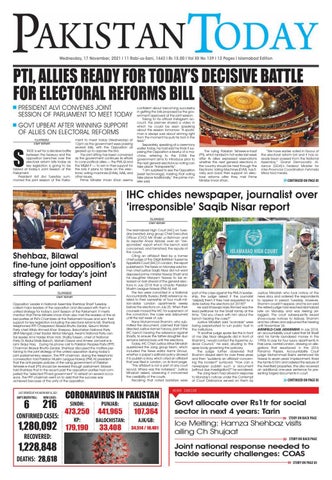
PTI, allIes ready for Today’s decIsIve baTTle for elecToral reforms bIll g
g
President Alvi convenes Joint session of PArliAment to meet todAy Govt uPbeAt After winninG suPPort of Allies on electorAl reforms ISLAMABAD
s
Staff RepoRt
tAGe is set for a decisive battle between the treasury and the opposition benches over the electoral reform bills today as key legislation is going to be tabled at today’s Joint session of the Parliament. President Arif Alvi tuesday summoned the joint session of the Parlia-
ment to meet today (wednesday) at 12pm as the government eyes passing several bills, with the opposition all geared up to oppose the bid. the joint sitting has been convened as the government continues its efforts to coax political allies — the Pml-Q and the mQm-P — to rein in their support for the bills it plans to table on the electronic voting machines (evms), nAb, and other issues. Prime minister imran Khan seems
confident about becoming successful in getting the bills proposed by the government approved at the joint session. taking to his official instagram account, the premier shared a video in which he could be seen speaking about the session tomorrow: “A sportsman is always sure about winning right from the moment he puts his foot in the field.” separately, speaking at a ceremony earlier today, he had said he finds it surprising the opposition is fearful of a machine, referring to the evms the government aims to introduce prior to the next general elections so voting can take place “transparently”. “i am surprised to see the opposition [resist technology], insisting that voting take place traditionally,” the prime minister said.
the ruling Pakistan tehreek-e-insaf (Pti), which landed in hot water last week after its allies expressed reservations whether the next general elections in the country should be held through the electronic voting machines (evm), has finally won back their support on electoral reforms after they met Prime minister imran Khan.
“we have earlier voted in favour of the electoral reform bill and it has already been passed from the national Assembly,” Grand democratic Alliance (GdA)’s federal minister for inter-Provincial coordination fehmida mirza told media.
CONTINUED ON PAGE 05
IHC chides newspaper, journalist over ‘irresponsible’ Saqib Nisar report ISLAMABAD Staff RepoRt
Shehbaz, Bilawal fine-tune joint opposition’s strategy for today’s joint sitting of parliament ISLAMABAD Staff RepoRt
opposition leader in national Assembly shehbaz sharif tuesday called major leaders of the opposition and discussed with them a unified strategy for today’s Joint session of the Parliament. it merits mention that Prime minister imran Khan also met the leaders of the allied parties at Pm’s chambers at the Parliament House and won their support for key legislation including the electoral reforms bill. shehbaz telephoned PPP chairperson bilawal bhutto Zardari, Qaumi watan Party chief Aftab Ahmed Khan sherpao, balochistan national Party (bnP-mengal) chief sardar Akhtar mengal, Awami national Party central leader Amir Haider Khan Hoti, shafiq tareen, chief of national Party dr Abdul malik baloch, mohsin dawar and Ameer Jamaat-e-islami sirajul Haq. during his phone call to Pakistan Peoples Party (PPP) chairman bilawal bhutto-Zardari, shehbaz discussed the matters pertaining to the joint strategy of the united opposition during today’s joint parliamentary session. the PPP chairman, during the telephonic conversation told Pakistan muslim league-nawaz (Pml-n) president that the anti-people policies of the ruling government of Pakistan tehreek-e-insaf (Pti) should be reversed through parliament. bilawal told shahbaz that in the recent past the opposition parties had compelled the “selected Pti-led government” to retreat on several occasions. the PPP chairman went on to add that the success was achieved because of the unity of the opposition.
LAST UPDATED AT 9:45 AM ON NOV 16, 2021
DAY'S DEATH TOLL:
6
NEW CASES:
216
CONFIRMED CASES:
1,280,092 RECOVERED:
1,228,848 DEATHS: 28,618
the islamabad High court (iHc) on tuesday berated Jang group chief executive officer (ceo) mir shakil ur-rehman and its reporter Ansar Abbasi over an “irresponsible” report which the bench said concerned, and tarnished, the repute of the courts. citing an affidavit filed by a former chief judge of the Gilgit-baltistan supreme Appellate court (sAc) in london, the report published in the news on monday said former chief justice saqib nisar did not want deposed prime minister nawaz sharif and his daughter maryam nawaz to be released on bail ahead of the general elections in July 2018 that a chaotic Pakistan muslim league-nawaz (Pml-n) lost. the two were convicted in a national Accountability bureau (nAb) reference related to their ownership of four multi-million-dollar london apartments weeks before the elections on July 25. when their counsels moved the iHc for suspension of the conviction, the case was adjourned until the last week of July. rana muhammad shamim, who submitted the document, claimed that nisar directed Justice Aamer farooq, part of the iHc bench hearing the reference against sharifs, to ensure the father-daughter duo remains behind bars until the elections. today, iHc chief Justice Athar minallah questioned the Jang group team, which included the news editor Aamir Ghouri, whether a paper’s editorial policy allowed it to publish a story, which cited an affidavit that was filed in london, on its front page. “this affidavit is not a part of any court record. where was this notarised,” Justice minallah asked, observing it concerned the credibility of the courts. recalling that noted barristers were
coronavIrus In PakIsTan SINDH:
473,250
PUNJAB:
441,965
ISLAMABAD:
KP:
BALOCHISTAN:
AJK/GB:
179,190
33,408
107,364
34,514 / 10,401
part of the case against the Pml-n leadership, the judge asked if the journalist “ask[ed] them if they had requested for a date before the elections [of 2018]?” He said Khawaja Haris Ahmed was the lead petitioner for the sharif family at the time. “did you check with him about the bench hearing the case?” Justice minallah said “scandals” were being perpetuated to ruin public trust in the institutions. “if another judge spoke like this in front of me [like nisar allegedly did in front of shamim], i would contact the supreme Judicial council,” he said, alluding to the apex body governing the judiciary. the judge further observed that shamim stayed silent for over three years and then “suddenly an affidavit concerning the incident” surfaced. “How can a newspaper publish such a document [without due investigation]?” he wondered. the Jang team had arrived in response to monday’s notices under the contempt of court ordinance served on them by
Justice minallah who took notice of the news story and ordered the respondents to appear in person tuesday. However, shamim couldn’t appear, and his son said the retired judge had reached islamabad late on monday and was feeling jetlagged. the court subsequently issued show-cause notices to Abbasi, shamim and two others and adjourned the hearing until november 26. AVENFIELD CASE JUDGEMENT: in July 2018, an accountability court ruled that mr sharif and his family laundered money in the 1990s to pay for four luxury apartments in Park lane, central london, drawing on allegations that resurfaced in the 2016 Panama Papers. Accountability court judge mohammad bashir sentenced ms nawaz to seven years’ imprisonment, fined the family £10m and ordered the seizure of the Avenfield properties. she also received an additional one-year sentence for presenting forged documents in court.
CONTINUED ON PAGE 05
MORE INSIDE
Govt allocate over Rs1tr for social sector in next 4 years: Tarin STORY ON BACK PAGE
ice melting: Hamza shehbaz visits ailing ch shujaat
STORY ON BACK PAGE
Joint national response needed to tackle security challenges: COAS STORY ON PAGE 03
02
Wednesday, 17 November, 2021 | ISLAMABAD
NEWS
PakisTan condemns sTaged encounTer of four in occuPied kashmir ISLAMABAD
P
STAff RePoRT
AKISTAN has strongly condemned the extrajudicial killing of another four people in occupied Kashmir by the Indian troops. Since the rise to power of the Taliban in Afghanistan in August, a deadly wave of attacks in the disputed Himalayan region claimed the
Two killed, 10 injured as train slams into school van ISLAMABAD STAff RePoRT
At least two students were killed and 10 others injured on Tuesday morning when a school van collided with a train while passing through an unmanned railway crossing in Sheikhupura. Rescue workers and the local people retrieved the victims and rushed them to a nearby hospital. The accident reportedly occurred due to the negligence of the van driver who allegedly ran away from the site. Overall, at least six people were killed while 10 others injured in separate road accidents during the last 24 hours, media reported. Four people were killed Monday night in a road accident in Islamabad. The accident took place when a car overturned after hitting a road divider and eventually collided with four other vehicles, causing serious injuries to four people. The rescue team reached the spot and shifted the injured to a hospital where they succumbed to their injuries during the treatment. Road accidents frequently happen in the country, mainly due to poorly maintained vehicles, dilapidated roads as well as negligence of road safety measures.
Parliamentary panel expresses concern over devaluation of rupee, rise in inflation ISLAMABAD ShAhzAd PARAchA
A meeting of the National Assembly Standing Committee on Finance and Revenue has expressed grave concern over the devaluation of the Pakistani rupee to US dollar as well as the increase in inflation, asking the SBP deputy governor to apprise the committee in this regard. The parliamentary panel meeting was held under the chair of Faiz Ullah on Tuesday in this regard. The committee was of the point of view that devaluation of the rupee will not provide any space to control inflation in the country. The committee also noted the effects of trade deficit and current deficit on the economy. The SBP deputy governor informed the committee that currency devaluation does not have an immediate effect on inflation, adding that the depreciation on inflation will be felt in the next four to six months, not immediately. However, he said that imports are expected to decline while exports will increase. He added that the value of currency is determined by the market but the SBP may intervene if an extraordinary situation arises. It may be mentioned here that the rupee has depreciated by 10.3 per cent from July 1 to November 12. Committee members were of the view that the SBP governor should brief the committee in-person and decided to invite him in the next meeting for further discussion in this regard. Furthermore, the committee discussed issues noted during the visit of the parliamentary delegation to Azerbaijan headed by the Speaker regarding prolonged due diligence by Pakistani banks over the use of Taftan border as transit country, and Anti-Money Laundering (AML) requirements set by the SBP. Special Invitees briefed the committee that in many instances, documents have to be changed showing other Central Asian countries as appetites to conduct trade between Pakistan and Azerbaijan. They recommended that selected commercial banks may be asked to do away with these onerous requirements. The committee directed the central to come up with a viable solution of the problems being faced to both sides in consultation with all stockholders within thirty days.
lives of 39 people in October alone, including several Indian soldiers and freedom fighters. After the attacks continued into November with the shootings of a local Muslim shop staffer, New Delhi deployed an additional 5,500 troops into the picturesque valley. In the latest episode of staged encounters, four people, including an overground worker and a civilian, were killed in Hyderpora town of Srinagar on Monday
evening, The Hindu reported, citing local police officials. All four were Muslims. A statement from Foreign Office issued Tuesday observed that since October 1, at least 25 people have been killed in staged encounters and so-called cordon and search operations. Extra-judicial killings, illegal detentions, daily harassments, and restrictions on fundamental freedoms, continue to be the norm in the region, it said. “India must understand that no amount of
systematic brutalities, rampant use of force and brutal clamp-downs can suppress the indigenous Kashmiri struggle. Kashmiris remain resolute in their just cause in the face of repulsive Indian state-terrorism.” Pakistan has also shared with the global community a comprehensive dossier containing irrefutable evidence of Indian human rights violations and war crimes in occupied Kashmir. The Foreign Office said Pakistan calls on the international community to hold India accountable for its gross and systematic violations of human rights and international humanitarian law in Kashmir. “The Indian government must allow international human rights and humanitarian organisations and UN Special Mandate Holders unhindered access to IIOJK to conduct independent investigations and allow the people of the occupied territory to exercise their right of self-determination as enshrined in the UN Security Council resolutions,” it said.
UN panel adopts Pakistan’s draft targeting disinformation UNITED NATIONS APP
A United Nations General Assembly (UNGA) committee Monday unanimously adopted a Pakistansponsored resolution that called for a multidimensional response to counter all forms of disinformation eroding human rights. The 25-power resolution, Countering Disinformation for the Promotion and Protection of Human Rights and Fundamental Freedoms, was the outcome of extensive consultations with all member states, diplomats said. The resolution was passed by the Third Committee, which deals with social, and cultural issues. It will come up for formal endorsement of the 193member assembly next month. Introducing the draft, Ambassador Munir Akram reaffirmed Pakistan’s commitment to countering disinformation, saying: “The world is plagued today by the exponential proliferation of disinformation, which is exacerbating social discord, competing for nationalism, discrimination, hate
speech, stigmatisation, racism, xenophobia, Islamophobia and related intolerance.” “This,” he added, “has been exacerbated by the Covid-19 pandemic and the extreme reliance on Information Technology, yielding phenomena from fake cures to antivaccine conspiracies.” At the same time, the envoy said the “big lies” could inevitably be discerned, as truth and reality was readily revealed by the application of reason and common sense.
“Today, technology especially the information and telecommunications, has provided the purveyors of disinformation the means to confuse reality and fantasy, truth and lies, authenticity and its opposite in ways that can defy even close examination,” he said. Ambassador Akram said Pakistan would continue to use all means to counter disinformation by both national means and through international cooperation with member states and other stakeholders under the umbrella of the
United Nations. The resolution also highlights the negative impact on the enjoyment of human rights and fundamental freedoms of the rapid spread of disinformation, through online platforms and social media. It notes with concern that ICTs (Information Communication Technologies) have enabled pathways for false or manipulated disinformation to be created, disseminated and amplified for political, ideological, or commercial motives at an unprecedented scale, speed, and scope. The resolution further underlines that this Infodemic has affirmed that freedom of expression is not only a right but a shared responsibility and that responses to the spread of disinformation must comply with international human rights law. It also emphasises the responsibility of business enterprises, including online platforms and social media companies, to ensure that their commercial objectives do not undermine human rights. They must not allow their platforms to be used for spreading disinformation, which leads to discrimination, incitement to hatred, hostility, violence, and polarisation.
Fawad apologises to ECP for caustic comments ISLAMABAD STAff RePoRT
Minister for Information and Broadcast Fawad Chaudhry apologised to the Election Commission of Pakistan (ECP) over his caustic remarks against the constitutional body. The commission served notice on Chaudhry and Minister for Railways Azam Khan Swati on September 16, asking them to provide evidence of the accusations of bribes and always rigging” the elections they had levelled against it and Chief Election Commissioner (CEC) Sikandar Sultan Raja. In a press conference along with Swati in September, Chaudhry had accused Raja of acting as a “mouthpiece for the opposition parties”. Later that month, during a meeting of the Senate Standing Committee on Parliamentary Affairs to discuss proposed amendments to the Elections (Amendment) Act, 2021, Swati came down hard on the commission and said it should be “set on fire” for making fun of the government and “ruining” the democracy in Pakistan.
Responding to the duo, the ECP rejected his allegations and decided to demand evidence from them in this regard. The ECP members also expressed anger over
ministers for accusing them of taking bribes. The allegations are baseless and unacceptable as the ECP is a constitutional department, they said. Chaudhry appeared before the commission on Tuesday for the hearing during which the bench ordered him to tender an apology “in black and white”. The minister said he appeared before the commission because he did not want to indulge in any sort of rejoinders, requesting the commission to close the case. Chaudhry said he was a lawyer himself and was also the spokesperson of the government. “I did not swear […] or abuse anyone. I’m also a barrister. Please accept my apology,” he pleaded. At this, the commission asked him to submit a written response before the bench. This was not the first time when the body faced strong criticism and serious allegations from the ruling party. In March as well, the commission after the Senate polls had advised the party to stop mudslinging and come up with evidence if it had any objections to the constitutional requirements, declaring the institution would not succumb to any pressure.
PSX jumps 806 points on expectation of positive news from IMF KARACHI TLTP
The Pakistan Stock Exchange (PSX) turned bullish on Tuesday amid expectation of positive conclusion of talks between Pakistan and International Monetary Fund (IMF), with the benchmark KSE-100 Index gaining 806.65 points (+1.76 percent) to close at 46,542.91 points. The market opened on a positive note and remained bullish throughout the session. The KSE-100 Index moved in a range of 887.5 points, showing an intraday high of 46,623.7 points and a low of 45,736.2 points, the last day closing point. Among other indices, the KSE All Share Index gained 468.75 points (+1.5 percent) to close at 31,649.27 points, while All Share Islamic Index gained 425.33 points (+1.92 percent) to close at 22,543.54 points. A total of 369 companies traded shares in the stock exchange, out of them shares of 240 closed up, shares of 105 closed down while shares of 24 companies remained unchanged. Out of 97 traded companies in the KSE-100 Index, 79 closed up, 14 closed down and four remained unchanged. The overall market volumes increased by 70.34 million to 243.19 million. Total volumes traded for the KSE-100 Index increased by 38.95 million to 96.45 million shares. The number of total trades increased by
43,649 to 116,728, while the value traded increased by Rs5.3 billion to Rs10.43 billion. Overall market capitalisation increased by Rs117.35 billion. Among scrips, GGL topped the volumes with 16.61 million shares, followed by TPLP (15.24 million) and WAVES (11.62 million). Stocks that contributed significantly to the volumes include GGL, TPLP, WAVES, TELE and SURF, which formed around 26 percent of total volumes. The sectors taking the index toward north remained cement with 189 points, technology & communication with 121 points, oil & gas exploration companies with 104 points, power generation & distribution with 78 points and commercial banks with 63 points. The most points added to the index were by TRG which contributed 96 points followed by LUCK with 82 points, PPL with 62 points, OGDC with 52 points and HUBC with 51 points. The sectors taking the index toward south were automobile parts & accessories and sugar & allied industries with one point each. The most points taken off the index was by BAHL which stripped the index of 8 points followed by MARI with 7 points, POL with 4 points, PKGS with 3 points and AKBL with 2 points. According to experts, the textile sector did not perform up to the mark. They said the investors were choosy in selection of stocks and that is why some
stocks of the same sector performed better than others as was the case in cement and oil & gas exploration sectors. They said that rumours about finalisation of the IMF package caused the bullish trend, which was further supported by appreciation of the Pakistan rupee by 40 paisas against the US dollar. They said that the political situation has dented the bourse recently and if the government manages to get the bill on electronic voting machines passed through the joint sitting of the parliament on Wednesday (today), it will impact the market positively.
Wednesday, 17 November, 2021 | ISLAMABAD
NEWS
Joint nAtionAl Response needed to tACkle seCuRity CHAllenGes: CoAs isLaMabaD
C
staff RepoRt
HIEF of Army Staff (COAS) General Qamar Javed Bajwa has stressed upon the need for a joint national response to tackle national security challenges, said the military’s media wing on Tuesday. He said this while addressing the participants of 23rd National Security Workshop at General Headquarters (GHQ) in Rawalpindi, according to the Inter-
Services Public Relations (ISPR). The participants were given comprehensive briefing on overall security situation and challenges being faced by Pakistan. Later, the ISPR said, an interactive session was held with the army chief. “Pakistan has emerged stronger from the war against terrorism as a resilient nation, and now it is our collective responsibility to work wholeheartedly for the progress and prosperity of our nation,” Gen Qamar was quoted as saying. The COAS emphasised that army was
focused on maintaining its operational preparedness and ensuring security of the country against all threats. National Security Workshop is an annual event held at the National Defence University in Islamabad. Representatives from all segments of society, including parliamentarians attended the seminar, said the official statement. Last week, the top military leadership, including COAS Gen Qamar and Director General of Inter-Services Intelligence (ISI)
Lt Gen Faiz Hameed briefed lawmakers of the Senate and the National Assembly on matters pertaining to national security, foreign affairs, as well as internal and external challenges faced by the county.
03
An official statement released after the meeting stated that the Parliamentary Committee on National Security met under the chairmanship of National Assembly Speaker Asad Qaiser at the Parliament House. National parliamentary and political leadership, members of the National Assembly and Senate, provincial leadership, the Azad Jammu and Kashmir (AJK) prime minister and military leadership participated in the meeting. The statement added that the participants were comprehensively briefed about matters pertaining to national security, foreign affairs, and internal and external challenges faced by county. They were also briefed about regional and political challenges, especially the situation in Indian Illegally Occupied Jummu and Kashmir (IIOJK) and Afghanistan.
Russia conducts anti-satellite weapons test MosCow News Desk
Gang allegedly involved in gang-raping busted News Desk The Federal Investigation Agency’s (FIA) cybercrime wing on Tuesday arrested a fourmember gang, including two officials of Punjab Police, on the charge of sexually harassing two teenage girls and filming their videos in Rawalpindi, according to a news outlet. The FIA, while taking action on a complaint filed by the victims, raided various places in the city and apprehended the suspects. One of the victims told the agency that a man named S* called and asked her to meet the other day, where she was accompanied by her friend. The girl narrated that S* picked them up in a car and took them to his friend Adnan’s house. She alleged that the suspect’s other accomplices also joined them at the house where they subjected them to sexual assault. Subsequently, according to one of the complainants, S* started sending objectionable videos to her and demanded Rs500,000 in exchange for not leaking them online. She added that the suspect also threatened to send the video to her parents if she did not pay the money. The investigators, however, said that further probe is underway.
Russia said on Tuesday it had conducted a weapons test that targeted an old Russian satellite with “razor-sharp precision” and denied allegations by the United States, Britain and NATO that the test had been dangerous for orbiting spacecraft. US officials said Monday’s test had generated a debris field in low-Earth orbit that endangered the International Space Station (ISS) and that would pose a hazard to space activities for years. NATO Secretary-General Jens Stoltenberg said the test was reckless, posed a threat to the ISS and an
orbiting Chinese spacecraft, and showed Russia was developing new weapons systems. A British government spokesperson condemned the test and urged Moscow to join discussions at the United Nations on “responsible behaviour when it comes to space.” Russia’s Defence Ministry said the debris from the test had not posed a threat to the ISS, and that Washington knew this. “We did indeed successfully test a promising system. It hit the old satellite with razor-sharp precision. The fragments that formed pose no threat to space activity,” Defence Minister Sergei Shoigu was quoted as saying by the RIA news agency. The target was a non-operational spacecraft, Tselina-
Imran Khan government will fail to complete term, says Asif Zardari News Desk Former president Asif Ali Zardari has stated on Tuesday that the incumbent PTI government will fail to complete its five-year tenure. Zardari stated that “Those who brought Prime Minister Imran Khan are now admitting that they committed a mistake,” while adding that they are now figuring out how to undo that mistake. While speaking to the reporters during his appearance at an accountability court, he stated that “Only Allah knows best how they can fix this mistake” While responding to a question related to Maryam Nawaz’s petition, Zardari said he would not talk about it as “Maryam Nawaz is like a daughter to me.” When asked about ex-chief justice GilgitBaltistan Rana Shamim’s affidavit, the former
president stated that “We have already seen this. Justice Qayyum had a tape with Saif-ur-Rehman and some friends as well.” It is pertinent to note that the NAB prosecutor, in two references against the former president, sought a month’s time to prepare his arguments on his appeals pending since 2014. A division bench of the Islamabad High Court comprising IHC Chief Justice Athar Minallah and Justice Amir Farooq heard the National Accountability Bureau’s (NAB) appeal against Zardari’s gold reference and Ursus tractors deal. It merits mention that the IHC approved a twoweek deadline for the National Accountability Bureau’s prosecutor to finalise his arguments, warning National Accountability Bureau’s that if it fails to prepare arguments by that time, then the court will decide on the existing record available with it.
SKMCH&RC, Karachi is bringing a new dawn of hope for cancer patients of Sindh and Balochistan Pr Construction work for the new ShaukatKhanum Memorial Cancer Hospital and Research Centre (SKMCH&RC), Karachi is underway at full pace and the project is expected to be commissioned at a total cost of Rs. 16.4 billion. Construction is progressing according to the planned project time-lines and the new hospital located in DHA City is planned to open in 2023. The structural work on the lower ground, ground and first floor are close to completion. The lower ground floor will house the clinical and radiation oncology department, which has ten bunkers for radiation machines and the department of nuclear medicine. The radiology department, the outpatient clinics, the emergency assessment unit, pharmacy and cafeteria will be located on the ground floor and the first floor will house the chemotherapy bays, the bone marrow transplant unit, the endoscopy unit, the pathology lab and the blood bank. The new ShaukatKhanum Hospital will be commissioned at a total cost of Rs. 16.4 billion. It is expected to complete in less than three years. In terms of constructed area and services, this will be Pakistan’s biggest tertiary care cancer hospital. It will hugely enhance the country’s capacity to treat cancer. According to the Global Cancer Observatory report, there are over 170,000 new cancer cases recorded in Pakistan each year and the huge number of new cancer patients means that ShaukatKhanum Hospitals in Lahore and in Peshawar are able to serve only a proportion of those suffering from cancer in Pakistan. The treatment of cancer is often a long and arduous process, with many patients having to make repeated, and expensive, trips over long distances in order to seek treatment. Successful completion of treatment is followed by several years of further visits for follow-up. It is for this reason that the second ShaukatKhanum Hospital was constructed in Peshawar, and this is why the third one is being built
in Karachi. Construction of the third SKMCH&RC will hugely enhance the country’s capacity to treat cancer and provide access to cancer care for ever-increasing numbers of patients. At SKMCH&RC, Karachi, patients will receive state-of-the-art cancer treatment based on the principles of quality and equality, irrespective of their ability to pay Even during the ongoing coronavirus pandemic, SKMCH&RC remains committed to bringing state-ofthe-art and comprehensive cancer care closer to patients, especially for the people of Sindh and Southern Balochistan. The third Hospital, at one million square feet of constructed area, will be twice the size of our hospital in Lahore. It is planned to open as a fullyfunctional cancer hospital, with all clinical disciplines in place, in 2023. It is being constructed based on SKMT’s experience of running two tertiary care cancer centres for over two decades, according to international healthcare standards. It will be equipped with the latest in medical technology and staffed by highly-trained professionals. The new hospital will continue the legacy of SKMCH&RC in Lahore and Peshawar, and all patients will receive the best possible curative and palliative therapy, irrespective of their ability to pay. You can participate in building the ShaukatKhanum Hospital in Karachi from anywhere in the World by donating Rs. 100 for a brick. You can become a Founding Donor against a
contribution of Rs. 500,000 or dedicate a room in honour or memory of a loved one. Re-tRacing the jouRney of hope The inspiration to build ShaukatKhanum Memorial Cancer Hospital and Research Centre (SKMCH&RC) came after Imran Khan’s mother, Mrs. ShaukatKhanum, succumbed to cancer in 1985. During his mother’s illness, he also witnessed the plight of underprivileged cancer patients in the hospitals of Pakistan and deeply felt the need for a specialized cancer centre in his country. Being a developing country where the majority do not have access to even elementary health care facilities, cancer was considered the ultimate symbol of hopelessness and almost certain death. After receiving overwhelming support from generous donors, SKMCH&RC in Lahore opened on December 29, 1994. The ShaukatKhanum Memorial Trust aims to build a series of hospitals in various cities of Pakistan to bring cancer care closer to the patients. Since nearly 30% of patients in Lahore came from the Khyber Pakhtunkhwa province and adjoining areas, the second hospital was opened in Peshawar on December 29, 2015. Providing treatment based on the principles of quality and equality The supporters of SKMT have always donated with confidence, knowing that their contributions are spent judiciously on needy cancer patients, while simultaneously helping to raise standards of healthcare for all those who are suffering from cancer in Pakistan.
D, that had been in orbit since 1982, the ministry said in a statement. It said the United States, China and India had conducted similar tests in the past. Russia’s space agency said the ISS’s crew had temporarily to moved into their respective spacecraft. The Defence Ministry said Russia was forced to beef up its defence capabilities because of weapons tests by the United States and Washington establishing a space force in 2020. Moscow said it had sought an agreement to stop weapons being deployed in space for years, but that Washington and its allies had blocked the deal at the United Nations.
Climate Change and Capitalism: A Hand in Glove Relationship Zohaib Tariq With the COP26 meeting in Glasgow, some concrete steps have been taken by many states to reduce dependency on fossil fuel for energy consumption. However, a holistic approach is needed to combat climate change at structural level and make a universal policy regarding carbon emissions. Just like the world gathered in 1948 to lay down the charter of Human Rights, a charter of Climate Change has to laid down and it should address the political, economical and social responsibilities of each nation state at all levels. One of them is to reform capitalism and consumerism. This individualistic profit oriented system of capitalism often come at the cost of collective good and puts survival of humanity in jeopardy. Someone told me once that just like the five fingers of a hand, there are five Gods that humans worships by default. 1) Power, 2) Wealth, 3) Estate, 4) Women and like a pharaoh the fifth is himself, when he attain the rest of four. Same is the case of climate change, this greed for power, wealth and hegemony of nation states at global level and corporations and individuals at societal level is coming at the cost of survival of humanity in the context of climate change. For example, according to CIA’s fact book, seventy percent of USA’s energy needs come from fossil fuel consumption while China’s energy dependency on fossil fuel is eighty eight percent. Since, both are at odds with each other in the political and economic dynamics, none will be willing to mitigate their dependency of coal because it’s a matter of maintaining a hegemony. Capitalism has been one of major reasons for world wars and it is still one of reasons why the world is losing the war against climate change because it creates an unprecedented competition between competitors that often come at the cost of survival of humanity. The world needs to draw a line today, it needs to reform capitalism so that a healthy competition takes place but not to that extent when even the collective good is put in jeopardy. WTO protocols needs to be amended and trade tariff should be reduced for those states that are taking concrete steps combating climate change while MFN (most favoured nation) protocol should also be amended and so that carbon tariff can be added to the products coming from those states that are not taking active measures in the war against climate change. Similarly, at the state level, governments need to put carbon tax and carbon tax exemption for those industries that do comply with the war against climate change. Global financial institutions such as IMF and World Bank also needs to support the cause and provide debt relief to those states that are taking steps in fighting climate change. If, we are the save our future generation from the misery, we have to work together with a holistic approach. The writer is a graduate of London School of Economics and a former research officer at Ministry of Foreign Affairs, Islamabad.
04 NEWS 17th November 2021 (K)_Layout 1 11/17/2021 12:07 AM Page 1
Wednesday, 17 November, 2021 | ISLAMABAD
04 NEWS
TariN PrOmiSES Tax waivEr fOr firST-TimE hOmE BuyErS REAL ESTATE DEVELOPER HAD DEMANDED EXEMPTION FOR FIRST-TIME HOME PURCHASES OF LESS THAN RS50M
OPEC chief urges caution amid signs of oil surplus building ABU DHABI Agencies
OPEC is seeing signs of an oil supply surplus building up next month so its members and allies will have to be “very, very cautious” when they review output policy, the group’s secretary general said on Tuesday. The Organization of the Petroleum Exporting Countries and allies, known as OPEC+, is gradually unwinding record output cuts made in 2020 by raising output 400,000 barrels per day per month. OPEC+ holds its next policy meeting on Dec. 2. “The surplus is already beginning in December,” OPEC Secretary General Mohammad Barkindo said on the sidelines of an energy conference, when asked if he was sure there would be an excess in oil supply next year. “These are signals that we have to be very, very careful,” he told reporters. Barkindo declined to say if he thought OPEC+ would stick to existing policy when it meets on Dec. 2. On Monday, the energy minister for OPEC member the United Arab Emirates indicated that OPEC+ would probably stay the course, despite an expected first-quarter surplus. While world oil demand is recovering from the pandemic-induced collapse in 2020, OPEC forecasts that demand growth next year is expected to slow and supply from rival producers such as U.S. shale companies is expected to rise. OPEC follows the level of OECD oil inventories closely as an indicator of oil market health and is wary of any renewed build up that might depress prices. As of September, oil stocks in OECD member states stood at 2.8 billion barrels, 374 million barrels lower than the same time a year ago, according to OPEC data, reflecting the impact of the OPEC+ supply cuts. “The projections, not only from OPEC but from the IEA and other sources, show that throughout the quarters of next year there will be oversupply in the market using the metric of the OECD stocks,” Barkindo said. “This is also further evidence why we should be very cautious and measured in the decisions we take every month.” OPEC has a vested interest in ensuring the global economic recovery continues, Barkindo said.
a
MonItoRIng RepoRt
DVISER to the Prime Minister on Finance and Revenue Shaukat Tarin has assured land developers that the federal government will extend the exemption on wealth reconciliation statement for first-time home buyers beyond Dec 31, according to a report by Dawn. He was the groundbreaking ceremony of Naya Nazimabad Hospital on Sunday. Speaking at the occasion, real estate developer Arif Habib had said: “I won’t ask you to waive the requirement of a wealth reconciliation statement for devel-
opers when they buy land for housing projects. They’ve already benefited from quite a few amnesties. But please continue the fixed tax regime and wealth reconciliation exemption for first-time home buyers beyond 2021,” he said, noting that most developers are now getting their payments from allotees through cheques instead of cash. He demanded that the exemption be extended for first-time home purchases of less than Rs50 million. The finance minister said that the government would “definitely consider it as it is everyone’s right to receive a tax break” in response to Habib.
Textile exports surge 26.55pc in 4MFY22 IMPORT OF TEXTILE MACHINERY INCREASED BY 110PC IN JULY-OCT FY22
ISLAMABAD APP
The exports of textile commodities witnessed an increase of 26.55 per cent during the first four months of the current fiscal year to $6.02 billion compared to $4.75bn during 4MFY21, according to data released by the Pakistan Bureau of Statistics (PBS). On a year-on-year basis (YoY), the exports of textile and clothing posted growth of 24pc during the month of October 2021 as compared to the same month of last year. As per details, textile exports were recorded at $6021.815 million in JulyOctober FY22 against the exports of
$4758.473 million in July-October FY21, showing growth of 26.55pc. The Pakistan Bureau of Statistics (PBS) data showed that textile commodities that contributed in trade growth included cotton yarn, exports of which increased from $230.329 million in FY21 to $394.765 million during the current fiscal, showing growth of 71.39pc. Likewise, the exports of cotton cloth increased by 18.54pc from $624,878 million to $740,710 million, carded and combed cotton by 100pc to $1,543 million from zero exports last year, yarn other than cotton yarn increased by 114.6pc from $8.035 million to $17.239 million whereas exports of
knitwear increased by 34.5pc from $1,182,604 million to $1,601 million. Similarly, ready-made garments exports jumped by 22.34pc in value and in quantity by 20.50pc during July-Oct FY22, while those of knitwear edged up 35.45pc in value, but dipped 13.11pc in quantity, bedwear posted positive growth of 21.30pc in value and 23.53pc in quantity. On month-on-month (MoM) basis, exports from the country witnessed an increase of 7.65pc during October 2021 when compared to the exports of $1487,144 million in September 2021. It is pertinent to mention here that the import of textile machinery increased by 110pc in July-Oct FY22.
Court extends remand of suspects in Nazim Jokhio murder KARACHI inP
A district and sessions court in Malir on Tuesday extended physical remand of suspects in a case pertaining to the murder of a local journalist in Sindh. Nazim Jokhio was allegedly tortured to death at the farmhouse of a Pakistan Peoples Party (PPP) lawmaker Jam Awais Khan Jokhio for trying to prevent his guests from illegal hunting endangered houbara bustard. An autopsy had found severe torture marks and bruises all over the body of the deceased. The investigation officer in the case told the court that Nazim’s burnt mobile phone and clothes have been recovered and sent to the forensic lab. However, the claimant on behalf of family members of the victim told the court that accessories belonging to Nazim were not verified by them and sent to forensic and lawyers were not present when important evidence was recovered. The petitioner also filed an application for a forensic test of the mobile of the SHO Memon Goth as it was alleged that the SHO was in contact with the accused killers of Nazim Jhokio. The Court will hear the argument in the next hearing to include the terrorism sections in the FIR. The court ordered the accused to produce the accused on November 18. Earlier, the Sindh Assembly on Monday echoed the brutal murders of Nazim and Fahmida Sial with members from both sides of the aisle strongly condemning the incidents demanding justice to the victims’ families.
SBP to announce monetary policy on Nov 19 MonItoRIng RepoRt The State Bank of Pakistan (SBP) on Tuesday decided to prepone the Monetary Policy Committee’s (MPC) meeting from the previously announced date of November 26 . According to a statement issued in this regard, the central bank said that the committee will now convene at SBP Karachi on Friday, November 19. According to the statement, the meeting has been moved forward in light of “recent unforeseen developments that have affected the outlook for inflation and the balance of payments.” It added that the meeting will be convened earlier in order to help reduce the uncertainty about monetary settings prevailing in the market.
Oil prices bounce back on tight inventories, demand worries limit gains SIngApoRe Agencies
Oil rebounded from a weak start on Tuesday as worries over tight inventories underpinned prices, although optimism was limited by fears over demand following a pickup in COVID-19 cases in Europe. Brent futures added 61 cents, or 0.74%, to $82.66 a barrel, as of 0421 GMT, while US West Texas Intermediate (WTI) crude climbed 54 cents, or 0.67%, to $81.42 a barrel. “At these oil prices, supply is going to grow but it might take six months and inventories have come down so low. We don’t have a safety margin,” said Tony Nunan, a Tokyo-based senior risk manager at Mitsubishi Corp. “We have very low inventory levels and if we have a very cold winter and OPEC is still sluggish at increasing supplies that could push oil prices up.” Russian crude grades sold in Asia fetched the highest spot premiums in 22 months for cargoes loading in January, extending gains for a fourth straight month as robust demand and firm refining margins support prices, trade sources said on Tuesday. Still, worries about demand destruction due to the
COVID-19 pandemic weighed. Europe has again become the epicentre of the COVID-19 pandemic, prompting some governments to consider re-imposing lockdowns, while China is battling the spread of its biggest outbreak caused by the Delta variant. The Organization of the Petroleum Exporting Countries (OPEC) last week cut its world oil demand forecast for the fourth quarter by 330,000 barrels per day (bpd) from last month’s forecast, as high energy prices hampered economic recovery from the COVID-19 pandemic. Fears of declining demand come as supplies are expected to rise. Last week, US energy firms added oil and natural gas rigs for a third week in a row, encouraged by a 65% increase in US crude prices so far this year. US shale production in December is expected to reach pre-pandemic levels of 8.68 million barrels a day, according to Rystad Energy. Money managers raised their net long US crude futures and options positions in the week to Nov. 9, the US Commodity Futures Trading Commission (CFTC) said on Monday. The speculator group raised its futures and options position in New York and London by 11,328 contracts to 353,807 during the period.
CMYK
Wednesday, 17 November, 2021 | ISLAMABAD
NEWS
LaStING PeaCe IN SoutH aSIa LINked wItH ReSoLutIoN of kaSHmIR dISPute: QuReSHI iSLamaBad
f
aPP
OREIGN Minister Shah Mahmood Qureshi on Tuesday said sustainable peace in South Asia was contingent upon the resolution of the Jammu and Kashmir dispute. In his address to the participants of the National Security and War Course at the National Defence University, he said the onus remains on India to create a conducive environment for meaningful and result-oriented engagement with Pakistan. The foreign minister’s lecture on the topic of “Contours of Pakistan’s foreign policy and challenges” was attended by the civil and military officers besides the course participants from other nations. Qureshi said following India’s illegal and unilateral actions of August 2019, under Prime Minister Imran Khan’s instructions, the government took up the cause worldwide with renewed vigour and determination, and highlighted the dire hu-
manitarian and human rights situation in occupied Kashmir. He mentioned the government also exposed the threat posed to international peace and security by Indian belligerence at all available forums. Despite provocations from India, he said Pakistan opened up the Kartarpur Corridor in November 2019 giving Sikhs from India and all over the world, visa-free access to one of their holiest sites. “Our gesture is a manifestation of Prime Minister Imran Khan’s vision for the region and for Pakistan-India relations, which consists of peaceful co-existence, interfaith harmony, and peaceful resolution of disputes,” he said. The foreign minister said Pakistan lies at the crossroads of South Asia, Central Asia, the Middle East, and China. Better connectivity is therefore essential to promoting the nation’s economic interests and reinvigorating our cultural and historical ties. Terming China-Pakistan Economic
Corridor (CPEC) as a flagship undertaking in regard to connectivity, he said Pakistan sees this framework as a game-changer not only for itself but for the region as well. He said Gwadar port was one of the vital components of the CPEC framework, including being the world’s only natural deep-sea port, linking the BRI and the Silk Road projects, and being the shortest route to Central Asia and Afghanistan. “We see Gwadar as the harbinger of immense possibilities for regional cooperation and common economic benefits,” he said. He said Pakistan was open to third countries investing in the Special Economic Zones being developed along CPEC. This would bring to fruition our vision of regional connectivity and common development, he added. Qureshi said Pakistan’s foreign policy must respond adequately to these shifting trends. “Keeping our interests supreme, we must navigate through this external environment to ensure that Pakistan’s sover-
Non-customs paid vehicles registered illegally in Bahawalpur SOURCES ALLEGE MAFIA IN BAHAWALPUR MOTOR REGISTRATION DEPT SPECIALISES IN ILLEGAL REGISTRATION OF NON-CUSTOMS PAID CARS LaHore Shahab Omer
The Excise, Taxation and Narcotics Control (ET&NC) Department, Bahawalpur, has revealed that vehicles smuggled under the amnesty scheme and other technical means have been registered with the help of bogus verification and bogus docu-
ments, Profit learnt here on Tuesday. According to details, Bahawalpur ET&NC Director Jam Siraj has sought reply from the Bahawalpur Motor Registration department Excise and Taxation Officer (ETO) on the revelation of forgery. In a letter written in this regard, the director questioned why legal action had not been taken against the person who are in-
volved in submitting documents which were verified as fake by the Custom authorities. “Your office is legally bound to initiate legal proceeding against the culprits by registering a case under the relevant law. You may also apprise the Lahore Motor Registering Authority of the situation by bringing all the information in his knowledge,” the letter adds.
PTI, allies ready for today’s decisive battle for electoral reforms bill Continued from page 01 “It would be odd to do the opposite this time around,” she added. Verbally, the IPC minister said, everyone is in favour of using technology in the polls but the reservations of allies came as they have not been given presentations on the EVMs. “The MQM has also been given a presentation on EVM,” Fehmida said, adding that the MQM-P members said that they would give suggestions on the electoral reforms soon. On the deadlock between the government and allies, Fehmida said that the federal cabinet has long been discussing the matter but proper presentations were not given to the allied parties and it led to creating some distance between the government and the allies. Speaking about reservations, Fehmida
said that GDA wants the federal government to play more role in Sindh as the provincial government has left no stone unturned in destroying Sindh. She said the GDA also wants representation in the standing committees. About the opposition parties’ allegations that the government had support from the quarters concerned, Fehmida said that if the government and its allies had the support, why they would go for ensuring transparency in the polls. “The opposition’s statements are contradictory … if we had the support then there was no need to take a step for ensuring transparency in the elections,” Fehmida said. “The GDA would stand by the government and vote for the electoral reform bills.” PML-Q’s Federal Minister for Housing and Works Tariq Bashir Cheema remained tight-lipped over the issue while
MQM’s Amin-ul-Haq said his party would support the key legislation. Haq said that the MQM-P has extended its support as the federal government has ensured to table two more bills. The bills related to the construction of Hyderabad University and Census will be tabled along with the EVMs, he added. Following the meeting with allies, Federal Minister for Information and Broadcasting Fawad Chaudhry said that PM Imran Khan had addressed the reservations of the coalition partners and evolved a consensus on the matter of electoral reforms. “All allied parties have expressed full confidence in the leadership of Prime Minister Imran Khan,” Chaudhry said, adding that it was unanimously decided that the joint session would be summoned on Wednesday. “All electoral bills will be tabled and
eignty, territorial integrity, and independence are secured and its development agenda is advanced,” he said. “We have tried to reinvigorate existing partnerships and establish new ones on the premise of mutuality of interest, transparency and respect for sovereignty,” he said. On Afghanistan, he said Pakistan believes that the biggest opportunity right now was the convergence of the international community on the need for durable peace and stability in Afghanistan. Speaking of spoilers in the region, he said the greatest threat to our region and global security emanates from the Hindutva ideology that drives Indian officialdom. He said Pakistan was pursuing a proactive foreign policy sensitive to national aspirations and global dynamics. “We have the resilience and experience to deal with the challenges posed by the unpredictable and rapidly changing international scenario,” he said. Well maintained sources in the ET&NC informed this scribe that Customs authorities not only seized vehicle number BR-14-662, vehicle number BR-14-928 and and other smuggled ones registered on bogus documents in the Bahawalpur Motor Branch but also auctioned them and informed the ET&NC in writing. However, Motor Branch Bahawalpur has refused to cancel the registration of the illegal vehicles in its records, therefore, they are still present in tax records. Sources also informed that this was not a new phenomenon but that a mafia operating in the department specialises in various illegal techniques for registration of non-customs paid vehicles. On the other hand, speaking about the registration of non-custom paid vehicles, Siraj said that he has sought clarification from the concerned ETO and referred the matter to the Enforcement and Audit director.
allied parties will support them,” he said. Last week, the beleaguered government tasted defeat twice in the National Assembly during voting on two bills and, later on, it had to put off the joint session of parliament within 24 hours of its summoning after its allies maintained distance. Since then, the opposition parties have exerted pressure on the government and are devising strategies for countering the government in the joint sitting. Soon after the “moral victory” over the government, the leader of the opposition in NA Shehbaz Sharif had invited the opposition parties to a dinner at the Parliament House where he along with other opposition leaders had vowed to give a tough time to the government in and outside parliament over spiraling inflation, increasing poverty and “bad governance”. Though the PPP and the ANP had parted ways with the opposition parties’ alliance – the Pakistan Democratic Movement (PDM) – the opposition leader has been trying to keep the opposition parties united against the government when they would go for changing the voting system of the country today (Wednesday).
Rupee climbs due to technical correction, closes at Rs174.89 monitoring report The US dollar lost 40 paisas against the rupee on Tuesday in the inter-bank market, with currency experts believing that the rebound came on the back of technical correction. With a fresh increase of 0.23 per cent, the Pakistani rupee settled at Rs174.89 against the US dollar in the inter-bank market today. The rupee on Friday last hit an all time low of Rs175.73 against the greenback. However, in the last two days, the rupee recovered 88 paisas against the greenback. Article continues after this advertisement Overall, the rupee’s depreciation during the fiscal year 2021-22 (FY22) has been Rs17.47, and Rs14.72 in the current year, 2021.
CNG price hiked by over Rs10 per kg in Punjab, Sindh iSLamaBad ahmaD ahmaDaNi
The consumer price of Compressed Natural Gas (CNG) has increased by over Rs10 per kilogramme across the country following a hike in the General Sales Tax (GST) imposed in the price of gas. In this regard, the All Pakistan CNG Association (APCMGA) on Tuesday stated that the price of CNG has increased by after a two time increase in the GST collected on CNG by the government. As per details, after the increased of 10.30 per kg, CNG in Karachi and other cities of Sindh is now available at an all-time high price of Rs195 per kg. Similarly, in Punjab and Islamabad, the fuel of the masses now costs more than Rs150 per kg. Consumers have lamented that the hike is causing them great financial difficulties; however, the CNG sector has stated that it is also unable to bear the additional burden of taxes. Article continues after this advertisement. Expressing concern over the recent increase in the sales tax, APCNGA said that the sector is all about paying taxes; however, they differ in principle with the basic formula of withholding tax and sales tax. The association said that the reservations have been conveyed Adviser to the Prime Minister on Finance and Revenue Shaukat Tarin, who has so far not consulted the association before raising the GST. The APCNGA also said that the government has been reducing sales tax imposed in petrol price while surprisingly increasing the GST on gas.
IHC chides newspaper, journalist over ‘irresponsible’ Saqib Nisar report Continued from page 01 The family has long struggled to explain how the Avenfield flats came into their possession. Family members initially told different stories. During the National Accountability Bureau trial, Mr Sharif’s defence claimed that a Qatar investment fund gave the expensive properties to the family to repay a debt owed to Mr Sharif’s father, Mian Muhammad Sharif. Commentators in 2017 mocked a letter from a Qatar prince apparently testifying to that deal as a rabbit pulled out of a hat. Mr Sharif and members of his family have denied any wrongdoing, and supporters claim the charges against them are politically motivated.
University of Gwadar inks historic sports commercialization agreement gWadar NewS DeSk
University of Gwadar (UoGr) has inked a historic University Sports Commercialization Agreement. On this occasion, Prof. Dr. Abdul Razzaq Sabir, Vice Chancellor UOGr, Mr. Saghir Naseem Sports In-charge UOGr, Mr. Rahmatullah PSO to VC, Mr. Naseer Ahmed Assistant and Mr. Akmal Khan, Business Development Officer Elite Sports Pakistan Pvt Limited (Balochistan) were present at university campus. Mr. Saghir Naseem and Mr. Akmal Khan
signed the agreement in the presence of university officials. Mr. Akmal Khan while briefing the university officials mentioned that ESP will Commercializing University Sports through filming, broadcasting and creating university players and team fan following in print and electronic media and also in social media which will boost the morale of the said University students and they will start liking, following and supporting their players and teams which in turn will benefit everyone in the long run and will set a precedent. Dr. Abdul Razzaq Sabir Vice Chancellor
of University of Gwadar expressed his contentment and congratulates the Sports faculty and ESP over the occasion. He pledged to implement this agreement in its true spirit to uplift university sports. Muhammad Jamal Qureshi CEO and Muzammil Khan Wazeeri Director Operations of the Elite Sports Pakistan Pvt Limited also send their greetings and congratulations to Prof. Dr. Abdul Razzaq Sabir Vice chancellor UoGr and sports faculty in realization of this agreement and expressed their contentment to join hands with the University for Development of the sports culture in the region.
CmYK
05
06-07 Comments - 17th November 2021_Layout 1 11/16/2021 10:43 PM Page 1
Wednesday, 17 November, 2021
06 COMMENT
Wage gaps and social inequality: The epitome of segregation?
Fawad Ch saved by the skin of his teeth But where is Swati?
s
AyINg sorry is not a part of the PtI’s (anti)culture. PtI’s big mouthed information minister who viciously attacks political opponents chose a wrong target this time by leveling slanderous charges against the Election commission of Pakistan (EcP). since Fawad chaudhry is a lawyer by profession, he is supposed to know the consequences of making false accusations against the court. He took recourse to accusation partly on account of his being a blabbermouth and partly to please a graceless PM . After receiving a notice from the EcP Mr chaudhry took refuge in excuses to delay the inevitable. the EcP thankfully took a firm stand, by bringing him to book Against his very nature Mr chaudhry apologised to the EcP for his remarks against the electoral body and the chief election commissioner (cEc) over the allegations he had levelled against them. Fawad ch’s s apology however showed little repentance on his part. “I am the mouthpiece of the cabinet, I often say things that are not my words. I did not insult anyone, I apologize,” In other words he could say anything desired by his master against any institution or individual and then apologise. the apology is motivated by fear of punishment, that could debar him from having a political office or could lead to the cancelation of his practicing license as had happened in the case of Babar Awan. While Mr chaudhry has apologized to the EcP, Railways Minister Azam swati is still taking recourse to all sorts of excuses to avoid facing his moment of truth despite the knowledge that once a case has been registered there is no way to dodge it . Hopefully the way shown by Mr chaudhry will encourage Mr swati also to apologize to the EcP.
Women are worse off in the workplace Ali HAmzA
S
ocIAL inequality and wage gaps are synonymous with one another; while social inequality can be viewed as an umbrella term that consists of restricted voting rights, access to education, health care, and freedom of speech and assembly, it is also linked to the economic divisions present within a society. these divisions are usually established through discriminatory laws that are connected to various societal evils: racial inequality, gender inequality, and wealth inequality. As a result of these underlying relational processes, a person belonging to a particular race would be more at risk of being in poverty in comparison to another whom the society favours. In light of these assertions, one may ask: to what extent do social constructs hold influence over social inequality? In terms of individuals, certain factors determine the amount of wealth distributed to them in the light of their country’s structural context to establish equality. A person having a low-paid or precarious job would have limited access to a decent income and social networks. similarly, an individual with low levels of education and skills would find himself or herself lacking in the job market and thus, would be labeled as an anomaly in society. though these factors are linked to an individual’s experience directly, there are certain elements they have no control over- elements that suffocate their chances of attaining social equality. social inequality can also be viewed through the lems of gender inequality; gender wage gaps refer to the cumulative difference in earnings between women and men. Women have been shown to consistently earn less than men, and this trend increasingly prevails amongst women of colour as well. there are differences in industries that keep women from attaining fewer benefits and lower paychecks in comparison to their male counterparts. this phenomenon has been illustrated by researchers as they highlighted the effects of occupational segregation and the funneling of women and men into different types of jobs per social gender norms and expectations; the supposed “women’s jobs” - jobs that were historically filled with majority female-workforces - such as home health aides and child care workers, tend to be less economically stable in comparison to “men’s jobs”, which usually consist of jobs in trades such as building and construction. these gender differences stand true across all industries and the vast majority of occupations - from frontline workers to mid-level managers to senior leaders. Although gender-based pay discrimination is illegal, it is still a prevalent, widespread practice in the modern-day era - particularly for women of colour. For
Taliban take on ISIS in Afghanistan Not an easy battle to win
F
oLLoWINg a string of deadly attacks in various parts of Afghanistan carried out by IsIs-K (Islamic state-Khorasan Province), the taliban government has decided to launch an operation against the outlawed group that is posing a serious challenge to the new regime in establishing and maintaining the violence-free country with law and order that it has promised its people. Responsible for some of the most reprehensible acts of terrorism themselves during the Us occupation, including a brutal attack on a hospital, the taliban chasing IsIs-K is a case of setting a thief to catch a thief. However, the task at hand is not so straightforward and is riddled with complexities. to start with, the taliban are no longer exclusively operating as a militant group engaged in Jihad to establish sharia law through violence; it now has an entire country to run, one that has been in an active state of war for over 20 years and faces immense economic, social and political problems. on the other hand IsIs-K only has to hit its targets, something that it has been evidently doing very successfully so far. It is also necessary to understand that the IsIs-K primarily consists of former members of the taliban from Eastern Afghanistan and the tehreek-e-taliban Pakistan (ttP) who defected between 2014 and 2015 in the pursuit to establish their own caliphate in the region. there is no denying the fact that certain members of the new Afghan regime, especially the low to mid-tier fighters, share the IsIs-K ideology of an extreme and relentless form of terrorism to achieve its goal and therefore not completely on board with the taliban’s newfound moderation. that these are the same foot soldiers expected to track down and eliminate IsIs-K might not be a very effective strategy. IsIs-K also has crossborder ambitions and the group has expressed its intent to make Pakistan a primary target in that endeavour. this does not bode well for Pakistan’s civil and military leadership that is already finding it hard to contain a growing wave of terrorism in Balochistan attributable to Baloch separatist groups that have allied with the ttP to attack security personnel. taliban-brokered Pak-ttP ceasefire talks are reportedly ongoing, but have not reached any meaningful conclusion. the government and military’s focus and resources should be deployed towards effective border management and security while the intelligence apparatus must work overtime to preempt attacks by hostile groups.
Washington Watch Dr JAmes J zogby
M
ost policymakers and pundits are confounded by what to do about Lebanon. they ask: “What do the Lebanese people want? How strong is the hold of the sectarian elites and Hizbollah over the population? And is change even possible in Lebanon?” In an effort to answer these questions, the American task Force on Lebanon (AtFL) and Zogby Research services (ZRs) conducted a nationwide poll from september 20–29, of 859 Lebanese citizens asking them to assess their current situation and to identify their political priorities and their hopes for the future. the findings are both instructive and fascinating. For example, in the results we find multiple areas where a consensus on critical issues exists among Lebanese citizens from every demographic and religious sub-group. We are also able to conclude that
Arif Nizami (Late) Founding Editor
Yousaf Nizami M. A. Niazi
Umar Aziz
Joint Editor
Joint Editor
Executive Editor
Lahore – Ph: 042-36300938, 042-36375965
men and women who work at similar jobs for the same period are paid differently is still prevalent in the modern-day era. However, many claim this concept to be absurd and detracted from reality. It is to be noted that “men [work] longer than women - 8.4 hours compared to 7.8 hours,” as the Bureau of Labor statistics states that “full time” is regarded as 35 hours of work: “Men work longer hours than women.”. since women are far more likely to work fewer hours to accommodate for parental leave and other unpaid tasks, they get lower hourly paychecks and incentives in comparison to fulltime employees. Wage gaps do tend to rise as a consequence of social gender-based constructs. Even though our society is plagued by the likes of wage gaps and social inequality, certain measures can be taken to curtail the expansion of these problems. An example of this would be better enforcement of the “Equal Pay Act” passed by the UsA in 1963 which required employers to pay men and women equal wages for equal work. similarly, pay transparency should be encouraged between companies and their employees; a bill in the congress called the “Paycheck Fairness Act” aims to stop employers from requiring their employees to keep their salaries a secret, retaliating against those who do not condemn this practice, and refrain them from using salary history to set wages. It would also impose stiffer penalties for violations of the “Equal Pay Act” and require government studies of gender pay disparities. Additionally, more flexible work schedules could be introduced to facilitate women’s earning. since the majority of women are more likely to work part-time than men, they holistically earn less in comparison due to working for fewer hours. Measures, such as those aforementioned would help establish a policy-friendly zone for both the genders to work within and be satisfied with what they earn. Although the issue of wage gaps still pertains to the modern-day era, newly reformed legislation and governmental incentives can help counter this social evil at large to curtail social inequality at large.
It would also impose stiffer penalties for violations of the “Equal Pay Act” and require government studies of gender pay disparities. Additionally, more flexible work schedules could be introduced to facilitate women’s earning. Since the majority of women are more likely to work part-time than men, they holistically earn less in comparison due to working for fewer hours.
The writer is a freelance columnist
What the Lebanese people really want
Dedicated to the legacy of late Hameed Nizami
Editor Aziz-ud-Din Ahmad
instance, Hispanic women make less than white nonHispanic men at almost every educational level; it has been projected that Latinas won’t achieve equal pay until the year 2197. Moreover, their unemployment rate rose from 4.8 percent to 12.5 percent between the years 2019 - 2020, indicating the unfavourable conditions of the job market for these women of color. this example shows that members of minority ethnic communities and immigrants suffer from factors such as racial discrimination, and thus, have a lesser chance to access employment; these socioeconomic conditions result in them being forced to live in substandard physical environments and have inadequate accesses to essential services— circumstances that define social inequality as a whole. on the other hand, claims of existing wage disparities between men and women have been made throughout the era - with many saying that women are paid roughly 80 percent of what men acquire from the industrial sector. However, this figure depicts the overall amount of compensation given to men and women in the United states whilst ignoring various critical aspects involved in the entire process, such as occupation, skills, type of company, experience, hours worked, and a slew of other considerations that go into the company’s legislation. Hence, when these basic characteristics are taken into consideration, the pay gap between both the respective genders narrows dramatically. Many also argue that paying women less is unavoidable due to the inherent nature of their labour; this is often seen in the guise of child care. though men have the option to invest their time in the aforementioned activity as well, their decision’s influence on their employment carries minimal influence. According to research conducted by the telecoms provider “PowWowNow”, shared parental leave (sPL) was launched in 2015 but only 3.5 percent of families eligible for this option chose it in 2018. the data provided by the organization illustrated that one-third of men who did not take the shared parental leave asserted that they couldn’t afford it— provoking revolts from the masses for the administration to enhance constitutional paternity payment. similarly, the notion that
I
Karachi – Ph: 021-35381208-9
I
despite the extreme hardships they are enduring, and for a strong majority of Lebanese, next year’s elections present a make-or-break moment for the future of their country. What comes through quite clearly from the findings is the profound impact the economic collapse is having on Lebanese across the country. Nine in 10 respondents tell us that they are worse off now than they had been just five years earlier. More than eight in 10 tell us they have experienced shortages in fuel, electricity, and drinking water. one third of respondents say that there are occasions when they have been forced to go without food. Among the poorest Lebanese, one in five say that they “very often go without meals.” And almost two thirds of Lebanese respondents report that they do not have enough income to make ends meet. As a result, a disturbing two thirds report that, if given the opportunity, they would emigrate to another country. Despite these hardships, Lebanese retain confidence in some of their country’s institutions— with the Lebanese Armed Forces, civil society, the religious leadership, judiciary, and the october 17th thawra movement scoring quite high among all religious sects and demographic sub-groups. Attitudes toward Hizbollah are divided, leaning negative, and confidence in the Parliament and in the traditional parties are quite low. on the issue of Hizbollah, it is striking that two thirds of all Lebanese, including a majority of respondents from every religious sect, express the belief that their “weapons and forces” should not be allowed to operate independent of the state and instead should be under the control of the Lebanese Armed Forces. It is important to note that despite their desperate situation Lebanese are looking forward to next year’s elections. three in five respondents tell us that they believe that the “elections will bring the political change Lebanon needs,” with two thirds expressing their intention to vote for the “new alternative parties.” on the other hand, only one in five say that they would vote for the traditional parties.
Islamabad – Ph: 051-2204545
I
Web: www.pakistantoday.com.pk
I
What the Lebanese want from their government also comes through quite clearly in the survey results. When asked to identify the number one issue facing the country, far and away, “ending corruption” is the top-rated priority followed by education, health care, and employment. A substantial majority also want to see an end to the taif formula of sectarian governance. And when asked to provide their primary source of personal identity, eight in 10 respondents say “Lebanese,” while fewer than one in 10 say their “sect” provides their primary identification. And, most significantly, 97 percent of Lebanese respondents say that it is important that there be “a full investigation of and accountability for the explosion in the Port of Beirut.” these are only a few of the topline results from the AtFL/ZRs poll— which the remainder of the findings serve to accentuate. In summation, the Lebanese people: are hurting from the economic collapse; are fed up with an ossified and broken sectarian political system that they want to see changed; want an end to government corruption; want Hizbollah reined in and brought under the control of the state; want accountability for the government’s failings— in particular the devastating explosion in the port; and have their hopes pinned on the belief that next year’s elections will bring needed change. It is vital when speaking about Lebanon that these areas of consensus be factored into any discussion about the future of the country. For years now, we have been saying that Lebanon is at the breaking point. What I conclude from this AtFL/ZRs poll is that if next year’s elections do not happen because the sectarian elites or Hizbollah sense that they pose a risk to their control, if the elections are not free and fair, or if Lebanon’s sectarian electoral system brings the same old traditional elites back into power, then the hopes of the Lebanese people will be shattered. the country will go from the breaking point to being broken. The writer is President of the Arab American Institute
Email: editorial@pakistantoday.com.pk
06-07 Comments - 17th November 2021_Layout 1 11/16/2021 10:43 PM Page 2
Wednesday, 17 November, 2021
COMMENT 07 Editor’s mail Send your letters to: Letters to Editor, Pakistan today, 4-Shaarey Fatima Jinnah, Lahore, Pakistan. E-mail: letters@pakistantoday.com.pk Letters should be addressed to Pakistan today exclusively
Facade of Global Inflation A few days ago, during a press conference, the Prime Minister claimed that inflation in Pakistan is a consequence of global inflation. He announced a package of Rs120 billion to some 20 million poor families, which was meant to offer some form of relief to the inflation-stricken population. However, the relief and rejoicing did not last long as fuel prices were increased once again along with the unit price of electricity. In the last three years, Pakistan has witnessed a record rise in inflation. the government has failed to stabilise the economy and control the worsening economic situation. the covid pandemic is often used as an explanation for the economic crisis, but the situation was deteriorating even before the pandemic. the government compared prices of fuel and essential commodities with other countries in the region. However, it must also account for inflation and gDP in those countries. the inflation levels in these countries in relation to per capita income are much lower than in Pakistan. the Pakistani rupee has continuously depreciated in the last three years, which has contributed to inflation because we regularly import several essential items. Many of these items are now becoming inaccessible for people. the government can no longer hide behind the facade of global inflation. Saddam, BaBar Solangi iSlamaBad
Environmental catastrophe is worse than nuclear weapons Commitments were not made at Glasgow HAfizur TAlukDAr
D
EvELoPINg countries are the biggest victims of the catastrophic response or situation that has arisen to global climate and climate change due to continuous environmental pollution. However, in most cases, developed countries are not coming forward to save the developing countries from the plight caused by the industrialized countries. In this case, the tendency to donate knowledge more than money is seen more in the western industrialized countries or superpowers. that’s why greta thunberg, a young scandinavian environmentalist, called the coP-26 World summit in glasgow, UK, from october 31 to November 12, a “global North green Wash.” Which has a general Bengali connotation, the green bleaching of the industrialized north. What has been achieved is too late is very insignificant. Although the rulers of china and Russia did not attend, it was attended by leaders of 200 countries and a large contingent of 20,000 delegates. there is no denying that the current climate and the magnitude of climate change in the world have prompted them to come together this severe winter. Leaders and environmentalists in the world’s least developed, developing and especially small and large islands say that if the current global temperature rises slightly above the record 2.5° c last May, it will be a sure death warrant for them. this will increase the impact of droughts, wildfires, tidal surges, floods, and other natural disasters. Many archipelagos or lowlands will be submerged due to the rising sea level and water levels. temperatures rose significantly in West and North Asia and North Africa in the middle of this year. this trend has been on the rise for the last few years. Its effects are beginning to be felt, even in one or two areas of canada, from the western UsA. In the middle of this century, the amount of global damage caused by various natural disasters due to climate and climate change due to environmental pollution could increase to $7.9 trillion every year. In that case, what will the least developed, developing countries and backward island nations stand? Even now, it was difficult to get $100 billion a year in aid from the industrialized nations for the coP-27. Adequate assistance from the private sector is therefore desirable to assist the least developed, developing, and island nations. In addition, there is a need to take more stringent measures to protect the climate and the environment. otherwise, the difficult development efforts of the above countries will be ruined by the natural calamities and the curse of poverty is likely to spread among them. the developed world cannot be at ease in that. Because it will increase the tendency or fear of the landless and helpless poor to become refugees. the coP-26 was held in glasgow with the aim of achieving four goals. the most notable of these was lowering the global temperature 5ncrease to 1.5 °c by the middle of this century and not allowing it to rise to 2°c under any other circumstances. Environmentalists say that managing global temperatures at the pre-industrial level will go a long way in protecting the world from weather and environmental disasters. the
global temperature rise must be kept below at least 1.5°c. scientists have repeatedly warned that there is no alternative to controlling environmental pollution and controlling temperatures to control natural disasters such as floods, cyclones, droughts, tidal surges, and eruptions that are constantly disrupting human society and development. In this case, it is recommended to take strict measures to protect the forests of the world and to prevent the emission of methane gas. A hundred countries of the world have agreed to keep the temperature rise to 1.5°c within the mentioned period. they have agreed to stop deforestation and reduce methane emissions by 30 percent by 2030. It has been asked to reduce greenhouse gas emissions to zero between coP-26 and 2050. Almost all the industrialized countries of the world use coal for energy production, which has been identified as the deadliest in terms of environmental pollution. Many countries, including china, Russia, and India, have failed to deliver on their promises to reduce coal use by 80 percent by 2030. china alone contributes 30 percent to the world’s pollution. However, it did not agree to reduce it within the stipulated time. china has stated that it will not invest in coal-fired power generation in the future, but has made no promises to stop it at home. the coP-26 glasgow conference, organized between the UK management and the UN framework, called for zero carbon emissions by 2050, china and Russia said they would reduce their carbon emissions to zero by 2060, but India said it would not be able to achieve its targets until 2070. It has indigenous coal. Apart from that, it uses coal for fuel production. Besides, it does not have adequate alternative arrangements. the UsA is the only country announcing it will reduce its carbon emissions to zero within the mentioned period. the UN says oEcD members should stop using coal by 2030 and lock up coalfired power plants by 2040. However, china, Russia, India, and Brazil, the world’s largest coalconsuming industrialized nations, have already stated inability to reduce carbon emissions. the UsA and the UK are the only exceptions. Although germany has agreed to the coP-26 goals, it has said it will not meet them in time. the coP-26 summit failed to secure a $100 billion aid package to protect underdeveloped, developing, and small island nations from climate change or natural disasters as a result of environmental pollution. However, the UK, the conference host country, seems to be very sincere. Because British Prime Minister Boris Johnson wants to be remembered in history for leaving the EU, and for a fruitful environmental conference. Along with him, Us President Joe Biden has also been praised and applauded for bringing his country back to the Paris Agreement. the people of the least developed, developing and island nations are now suffering the brunt of globalization due to pollution by industrialized countries. countless people are losing their homes every year due to heavy rains, droughts, droughts, floods, or tidal surges. Many people are losing their livelihood due to river erosion. But who caused this disaster, humiliation, and suffering? At home and abroad, that is, internationally, the government and the industrialists or the rich owners of the factories have to think about those unfortunate people. We need
to understand why the people of the backward countries around the world are suffering. only then will it be easier to raise $100 billion a year. the world is aware that factory production is not possible without fuel. Almost all countries in the world have coal-fired energy production systems. yet green fuel production is not enough for industrial production. Industrial production needs to be gradually converted from fossil fuels to green fuels. Nuclear energy has not yet become cost-effective. Apart from that, neither solar nor wind power generation has become available worldwide in low- and middle-income countries. therefore, in order to move towards a totally dependent energy system, the people of the least developed and developing countries need to be helped and assisted at the governmental and non-governmental levels worldwide. In addition to the richest countries in the world, regular grants from large industrial, banking, and other commercial organizations will have to come up with part of the $100 billion funds mentioned in coP-26. the contribution of those who are causing the most damage to the environment should be the most significant. But in reality, it is the complete opposite. several countries, including china, Russia, India, Brazil, Europe, and the UsA, have contributed the most to environmental pollution. they are not poor countries. they have a large amount of trade worldwide. so should their contribution to environmental and climate development be large. Anyone would be surprised to know in detail the military budgets of the world’s superpowers. the military budgets of the UsA, china, Russia and India surpass all other sectors. the UsA is now the world’s leading nuclear threat. china is in the second position. In this repect, India is gradually rising. the UsA currently has 3750 deadly weapons, including atomic bombs. In addition, by 2030, china is working tirelessly to increase the number of missiles, including its atomic bomb, to more than 1000. Although India and Pakistan are not povertyfree, their defense budgets are surprising. But the most surprising thing is that neither the UsA, nor china, nor Russia, nor India has announced any large grants or contributions to the $100 billion environmental protection fund. Although India and Pakistan are not as prosperous economically as the UsA, china, Russia or germany, or France in Europe, their defense budgets are not small. Although it has not been able to provide sufficient funds for the development of different regions of the country including environmental protection, the expenditure in the defense sector is generous. Many countries, including Bangladesh, have not been able to get rid of this condition yet. If you can’t save your country and your beloved world because of the environmental catastrophe, then what will happen with nuclear weapons or a huge defense budget? governments of all countries, industries, and businesses must come forward to contribute to coP-26’s declared environmental fund or else no military or nuclear power will be able to save world humanity from the catastrophe that is about to come. It should not be forgotten that environmental pollution or catastrophe is far more deadly and destructive than nuclear power. The writer is a freelance columnist
Dengue prevention tHE dire situation of dengue is not new to Pakistan, yet the country is once again battling this preventable disease. In the past month, there has been an alarming increase in the cases of dengue in parts of Punjab and Khyber-Pakhtunkhwa. considering that we are already struggling with the covid pandemic, our healthcare cannot afford another widespread epidemic outbreak. the healthcare system, municipal corporations, and the public need to collectively alleviate the threat of dengue. Dengue is a viral infection caused by a group of viruses, represented by DENv. Unlike other viruses, DENv is not spread through human contact. Rather, an Aedes mosquito serves as its carrier. symptoms of the virus include high fever and low platelet count, which can result in further complications. In severe cases, blood transfusions might be required as any bleeding cannot be controlled. Fortunately, covid has been somewhat controlled through vaccines, however, such a solution is not possible for dengue. What’s more stressful is that any previous contact with the virus does not guarantee future immunity. the only way is to undertake preventive measures to stop the virus from spreading. the best way to get rid of it is to maintain cleanliness as the carrier mosquito breeds in stagnant waters, close to human habitations. We have previously been successful in containing dengue. However, it must be noted that that success was the result of proactiveness and awareness campaigns. Awareness is immensely important to initiate preventive measures. Hafiza zainaB laHorE
Olive plantation PAKIstAN has a varied climate and geography because of which it enjoys climatic flexibility – something that most countries of the world lack. the climate in Pakistan’s mountainous regions particularly supports olive cultivation that needs to be utilised to benefit from this untapped potential. According to the Pakistan Bureau of statistics, Pakistan’s olive import bills stood at $4771.471 during the financial year 2020-21. such seepage in the national exchequer, which already has low foreign exchange reserves, adds miseries to the troubled economy. Pakistan has begun realising the importance of oil production. However, these efforts have been confined to only some parts of the country. the 10 Billion tree Afforestation Project which was launched by Prime Minister Imran Khan has discovered 70 million wild olive trees. Approximately 40 million wild olive trees will be grafted, and new ones will be planted under the initiative. the provinces of sindh and Balochistan also have millions of wild olive trees. However, both provinces have been neglected in nationallevel projects. Agricultural scientists have suggested that the Kirthar Range, which extends over 310 kilometres, has more than 10 million wild olive trees. If grafted properly, they can help generate thousands of employment opportunities in both provinces. the initiative will also allow Pakistan to export olive oil, in turn, supporting the dwindling foreign exchange reserves and helping to mitigate environmental impacts. I request the Prime Minister to extend the Billion tree initiative to other parts of the country – with the Kirthar Hills taken under specific consideration. SHaHnawaz KHoSo HydEraBad
Fifth generation warfare tHE fifth-generation warfare (5gW) poses a great risk to the safety and sovereignty of Pakistan. It begins as psychological warfare — the technique of propaganda warfare is employed to spread anarchy, chaos, and depression. A recent example of 5gW is the withdrawal of New Zealand from the cricket series against Pakistan. In the 5gW, people of the targeted country are divided based on sectarian, ethnic and linguistic lines. conspiracies are hatched to isolate the targeted country in the comity of nations. the 5gW poses several challenges at the same time. they include political challenges, which involve a continuous threat to democracy, and disruption of peace and political harmony. this also influences public psychology. Due to the absence of a rule of law, there is an increase in the crime rate. the main aim of this warfare is to spread misinformation and false agenda to manipulate the people. the economic challenges posed by 5gW include damage to property and other infrastructure through violence and civil unrest. When a powerful group hatches a conspiracy against the targeted country, sanctions are imposed which devalues the country’s currency. the growing sectarian divide and threat to religious minorities demonstrate religious challenges. In today’s globalised world, Pakistan is also a victim of 5gW, which can threaten its sovereignty. to respond to these challenges, Pakistan must form and implement a code of conduct for the media and impose strict rules and regulations on the use of social media to prevent the spread of misinformation. mujEEB-ur-raHman KaracHi
08 WORLD VIEW 17th November 21_Layout 1 11/16/2021 10:48 PM Page 1
Wednesday, 17 November, 2021
08 WORLD VIEW
Modi’S india iS ‘one oF tHe MoSt danGeRouS countRieS FoR jouRnaliStS’
naTion, us
j
SucHITRA VIJAyAn And FRAnceScA ReccHIA
OuRNalIST Siddique Kappan has been in prison since October 2020. he has been charged under India’s sedition law and the draconian unlawful activities (Prevention) act (uaPa) for trying to report on the hathras gang rape and murder case. In hathras, a 19-year-old Dalit woman was gang-raped by upper-caste Thakur men and later died in the hospital. She was hurriedly cremated by the uttar Pradesh Police in the middle of the night without the consent or the presence of her family. The gruesome violence and the police complicity in protecting the perpetrators made headlines in India. Kappan and three others—two student activists, atikur Rahman and Masood ahmed, and their driver, aalam—were arrested. after his arrest, Kappan was tortured by the police and denied medication for diabetes. almost six months after his arrest, a 5,000-page charge sheet was filed against Kappan accusing him of failing to write like a “responsible journalist” and of orchestrating riots by reporting on oppressed and marginalized communities. The charge sheet said, without irony, that such reports could “incite Muslims,” and cited 36 articles written by Kappan as evidence for his crimes. What the uttar Pradesh Police considers sedition is in reality reporting—on the Indian government’s failed Covid response, on the stigmatization of Muslims during the nationwide lockdown in March 2020, on protest against the citizenship laws, on arrests of student activists and political prisoners, and on the February 2020 Delhi Pogrom. The charge sheet doesn’t claim that Kappan’s reports are factually inaccurate or false, instead charging him merely with the crime of reporting. a year after his arrest, Kappan has been denied bail, and his lawyer, Wills Mathews, says that he has “yet to receive authorized copies of this charge sheet” from the police. Kappan is not alone. Kashmiri journalist aasif Sultan has been in jail for more than three years. he is also held under the uaPa and targeted for a story he wrote.
Kappan and Sultan, along with others, remain incarcerated without a trial on fabricated charges: They are in jail simply for being journalists. Most recently, others have been harassed and threatened for reporting and documenting anti-Muslim violence in the Indian state of Tripura, where hindu mobs attacked mosques and properties owned by Muslims. Since then, Tripura state police have charged 102 social media accounts, including journalists Meer Faisal and Shyam Meera Singh, under terrorism laws for posting about anti-Muslim violence in Tripura. The 2021 World Press Freedom Index by Reporters Without Borders has ranked India at 142 out of 180 countries, calling it “one of the world’s most dangerous countries for journalists.” Since Narendra Modi’s Bharatiya Janata Party (BJP) won a second mandate in 2019, the report stated, “pressure has increased on the media to toe the hindu nationalist government’s line. Indians who espouse hindutva…are trying to purge all manifestations of “anti-national” thought from the public debate.” Modi and the BJP first rose to power in India in 2014. Since then, there have been constant attacks on journalists who question or criticize the ruling regime. While physical violence is the most visible manifestation, journalists face a range of threats, including censorship, economic hardships, political pressures, and job insecurity. Journalists are routinely threatened, intimidated, arrested, booked—and silenced through gag orders and charges concocted by the state. Those who speak up against the current government are also at risk of being booked for sedition or arrested under draconian laws such as the uaPa, which unilaterally designates individuals as terrorists without the need to provide evidence. Watch the State (WTS), set up by the Polis Project in 2019, documents and analyzes patterns of state violence, aiming to understand what constitutes it by looking at the physical, structural, and symbolic dimensions of violence and its various social, political, and economic manifestations. “Mapping patterns of violence against journalists in India” is a WTS data journalism research project that gathers and visualizes verified instances of violence against journalists in India between 2019 and 2021. India has indeed become a very dangerous place to be a journalist: WTS documentation shows that between May 2019 to august 2021, 256 journalists were attacked
‘Hindutva kills Sikhs & Muslims’ says Rahul Gandhi, but can he tell us what killed Sanjith?
Times of india
F
RAHul SHIVSHAnKAR
OR some years now hindutva has been bracketed alongside the Boko haram, ISIS and other revanchist Islamist ideologies by a section of India’s political and academic class. It doesn’t matter that the ‘left lashkars’ can’t advance even one rational argument to justify the odious analogy. Recently, a shadowy group drawn from various “top” uS universities assembled liberal bleeding hearts from across India to “dismantle” hindutva as if an idea is some physical construct that can be reduced to rubble with a strategically placed gelatin stick. any attempt by subalterns to decolonise received Marxist wisdom on Indian history is immediately dismissed as an insidious attempt to saffronize scholarship. In other words, Indic academics must never commit the blasphemy of questioning certain holy of holies. This explains the long periods of academic silence over Mughal contempt for hindu traditions, Mahatma Gandhi’s omissions over the Moplah genocide, the Indian State’s institutionalised bias against hindus or the decades old slander campaign against Savarkar. The assault on hindutva and its votaries has continued despite the Supreme Court rejecting that the term “hindutva” has communal undertones. here’s what the apex court ruled in a landmark judgement: “It is a fallacy and an error of law to proceed on the as-
sumption that any reference to hindutva or hinduism in a speech makes it automatically a speech based on hindu religion as opposed to other religions …these words (hindutva and hinduism) are used in a speech to emphasise the way of life of the Indian people and the Indian cultural ethos.” The sagely pronouncement is lost on partisans like Rahul Gandhi who repeatedly claim that “hindutva kills Muslims and Sikhs”. The equation of hindutva with rabid obscurantism has led to a hateful backlash. any number of hindus who are thought to serve hindutva organisations like the Rashtriya Swayamsevak Sangh (RSS) and Bharatiya Janta Party BJP are routinely lynched by antagonists. The antagonist could be drawn from a mainstream political party like the Indian National Congress (INC), Trinamool Congress (TMC), or the Communist Party of India (Marxist) an Islamist group like the Popular Front of India (PFI), etc. The hate and prejudice against hindutva groups is now so normalised that not one sanctimonious left-liberal head turns when the PFI, for instance, stages mock parades where its cadre dressed like RSS and BJP workers are chained and whipped. Vigilantism, as it were, is justified when the life being snuffed out is that of a saffron sympathiser. Predictably then, no conscience was pricked when a worker of the RSS was hacked to death in Kerala on Monday. The local police said that 27-year-old Sanjith, who worked in a private firm, was stabbed 50 times. his body was then dismembered by a group of assailants as his wife pleaded for mercy. This lynching was borne out of hate. Sanjith was on a kill list as evidenced by the fact this wasn’t the first attempt on his life. Sabeer ali and anwar Sadiq of the PFI were arrested in June 2020 for trying to lynch Sanjith. The question is if, as Rahul Gandhi and his cohorts claim, “hindutva kills Muslims and Sikhs”, what ideology is responsible for the lynching of hindutva activists like Sanjith? Rahul Shivshankar is the Editor-in-Chief, Times Now.
for doing their job. The police appear to be the main perpetrators in BJP-ruled states, in Indian Occupied Jammu and Kashmir, and in Delhi, where they directly report to the Ministry of home affairs. The BJP-ruled states are in general significantly more dangerous for journalists than others. Since its inception, WTS has kept track of systematic aggressions against journalists who report on events such the Covid-19 pandemic, the anti–Citizenship amendment act protests, the Delhi Pogrom in 2020, and the ongoing Farmers’ Protests. The data collected by WTS over the course of two years show that the Indian state and its agencies have used First Information Reports (or FIRs)— documents police draw up when they receive information about an alleged offense for which an officer can make an arrest or begin an investigation on their own initiative, without, respectively, a warrant or a court order—physical assault, threats, intimidation, detention, arrests, sexual assault, sedition charges, and charges under uaPa to attack journalists and limit the ability to do their job. The database also sheds light on the ongoing media clampdown in Indian-Occupied Kashmir, where harassment, intimidation, and assaults at the hands of the army and the police are the norm rather than the exception. In the union Territory, besides charges under draconian laws, systemic threats, intimidation, harassment, physical assault, and gag orders, the state has also started cutting access to funding to media organizations that don’t amplify the government’s propaganda. according to uNESCO, between 2006 and 2019, 1,200 journalists have been killed globally while or for doing their job. The agency in 2020 also ranked India the sixth-most-dangerous country for journalism in the world, after afghanistan, Mexico, Syria, Somalia, and Yemen. This terrifying figure does not include the thousands of reported or unreported nonlethal attacks that include harassment, aggressions, threats as well as arbitrary detention, torture, and enforced disappearances. In the case of India, the techniques of intimidation are both physical and legal. On the one hand, journalists have been killed, subjected to physical violence, threats, assaults, and online and offline attacks; on the other, the state and its agencies make them the constant target of legal threats through arrests, illegal detentions, denial of bail, and FIRs. The WTS database shows the unprecedented legal
harassment of journalists, in effect turning their profession into a criminal activity. The police now routinely file criminal charges against them, including sedition charges, for the crime of reporting. Journalists have been detained and arrested for reporting victims’ versions during instances of police violence or for contradicting the state-sanctioned description of events. By agreeing to uphold non-bailable charges and interminable pretrial detentions, the judiciary has also become actively involved in the persecution of journalists. The judiciary has not only failed to prosecute crimes against journalists; it has also contributed to their persecution through the systematic violation of their rights. ad hoc violations of the right to due process have been systematically employed to destroy the free and fair press in India. India’s descent into an authoritarian police state characterized by arbitrary arrest and imprisonment of political and ideological opponents in the middle of a pandemic has been well-documented. The Indian state is effectively using courts, the police, and the prison system to punish journalists. What we see is the emergence of a model where the judiciary coexists and collaborates with the arbitrary power of the ruling government. law enforcement and robust institutions are key to fighting and ending impunity for attacks against journalists. In India today, however, the very institutions that are meant to protect them play an active role in enabling and sustaining the ongoing assault against journalists and their freedoms. The complicity between the state, the judiciary, and the police in the attempt to silence journalists needs to be acknowledged and countered. When the judiciary is the midwife of tyranny, law becomes the most lethal weapon of a fascist state. Pooja George and Vedika Inamdar contributed to this report. Suchitra Vijayan is a barrister at law and the author of Midnight’s Borders: A People’s History of Modern India. She is the executive director of the Polis Project. Francesca Recchia, a researcher and writer and former director of the Institute for Afghan Arts and Architecture, is the editor and creative director of the Polis Project.
Hindutva vs Hinduism
Tribune, india
R
AVIJIT PATHAK
ahul Gandhi’s recent speech on the occasion of the aICC orientation programme organised at the Sevagram ashram in Wardha seems to suggest that he is trying to inspire the Congress cadres, and urging them to think ideologically, understand the distinction between the subtlety of hinduism and the grossness of hindutva, and provide a rigorous politicocultural critique of the Sangh Parivar. In a way, this is like recalling our turbulent history, and remembering the qualitative difference between, say, Mahatma Gandhi’s experimental and creatively nuanced engagement with hinduism and what the likes of Savarkar and Golwalkar propagated— hindutva as an exclusivist and totalitarian doctrine of nationalism. at this moment of our political history when we witness a meticulously thoughtout design to consolidate the hegemony of hindutva, and anybody who critiques this project is necessarily seen with suspicion, it is important to realise that the enchanting music of religiosity (it is always liberatory) cannot be in tune with the kind of politics that spreads hatred and violence in the name of religion. For instance, I love to be enchanted time and again by the upanishadic quest for the transcendental; Mira’s bhajan enters my soul; Sri aurobindo’s classic The life Divine whispers in my ears. Yet, this ‘hindu smell’ has never prevented me from walking with Freudo-Marxist psychoanalyst Erich
Fromm, Sufi mystic Jalaluddin Rumi, Vietnamese Buddhist monk Thich Nhat hanh, or Christian existentialist philosopher Paul Tillich. In a way, the music of religiosity teaches us the art of dialogue and practice of compassionate listening — the way Mahatma Gandhi, for instance, conversed with leo Tolstoy and Sermon on the Mount; or walked with hindus, Muslims, Sikhs and Christians with the imagination of a compassionate and oceanic idea of India, at a time when the followers of Savarkar and Jinnah — intoxicated with the divisive ideology of the ‘two-nation theory’ — were sowing the seeds of division and hatred. hence, Rahul Gandhi’s ideological critique of hindutva — its implicit violence, narcissism and totalitarianism — arouses our attention. however, there are two issues which Rahul Gandhi — if he is sincere in his proposed mission to fight hindutva — ought to think about. To begin with, it has to be realised that what blocks the creative flow of emancipatory ideas is not just political hindutva; it is also the way hinduism — with its heavy burden of ritualism, dictates of the priestcraft, and oppressive/hierarchical/patriarchal caste practices — manifests itself in everyday life. In modern times, Nehru with his discourse of ‘scientific temper’, and ambedkar with his critique of ‘patriarchal Brahminism’ sought to remind us of the danger of this dead weight of past. and yet, even now know these practices are so deeply ingrained in our lives that it is not easy — particularly, for a politician — to acquire the courage to question, and imagine a refreshingly new way of looking at the world, both outer and inner. Is it the reason that even when our ‘secular’ politicians critique hindutva, they do not want to hurt ‘hindu sentiments’, and through diverse forms of dramaturgical practices, assure the audience that they, too, can visit temples and recall their gotras? This is like falling into the trap of the same discourse (you must show your hindu card to succeed politically) through which the proponents of hindutva politics have already poisoned our collective psyche. Emancipatory politics requires a kind of education that sensitises us, and gives us the confidence to realise that true religiosity is not the loud demonstration of the markers of an organ-
ised religion: mandir darshan or celebrating the iftar party in front of the television camera. Instead, it is about love, connectedness, spiritual cleansing and fusion of horizons. as politics is becoming instrumentally instrumental, and winning the elections at any cost seems to have become its primary objective, will it be possible for Rahul Gandhi to retain his patience, work hard, initiate a rigorous debate, and orient the party cadres in a way Mahatma Gandhi and Nehru would have imagined? Second, it is also important to acknowledge that the assertion or popularisation of a totalitarian doctrine like hindutva cannot be seen in isolation; it is deeply related to the rise of fundamentalism all over the world, be it Islamic or Christian fundamentalism. and in this subcontinent with its traumatic history of hindu-Muslim conflict, the divisive forces are never tired of exploiting the memory of the wound, erecting the walls of separation, ghettoising our consciousness and nurturing the politics of revenge and blame game. In this vicious and toxic game of majority communalism vs minority communalism, there is no winner. Instead, we move towards collective suicide. Who understands it better than a Muslim woman in Indian Occupied Kashmir who has to see the dead body of her young son killed in an ‘encounter’, or a hindu father whose daughter was raped in a riot? In fact, the psychology of fundamentalism, or the politics centred on a fixed religious identity abhors civility; it is terribly patriarchal; it is inherently against women, critical thinking, spiritual practice and cosmopolitanism. It robs us of our shared concerns, like education, employment, health and social security. hence, for our collective redemption, the communalism or fundamentalism of any kind or colour ought to be resisted with equal intensity and conviction. This requires immense courage because this is like being condemned by both the orthodox priests of mandir politics as well as the bunch of non-reflexive mullahs inclined to the Talibanisation of consciousness. Will the Machiavellian statistics of vote-bank politics enable Rahul Gandhi to think of this transparent, honest and bold step?
Wednesday, 17 November, 2021 | ISLAMABAD
NEWS
09
PM Khan to inaugurate tracK & trace systeM for sugar sector IslAMABAD
P
Staff RePoRt
rIME Minister Imran Khan will inaugurate the Track and Trace system of the Federal Board of revenue (FBr) for the sugar industry on 23rd November, 2021 here at PM House. The Track and Trace system will ensure electronic monitoring of manufacturing and sales of products of important sectors con-
sisting of Tobacco, Fertilizers, Sugar and Cement. The scope of electronic monitoring ranges from manufacturing of the products to its usage by the end users, thus bringing much needed revenue for the country and preventing tax evasion in these sectors. After rolling out electronic monitoring of Tobacco Sector, FBr is now implementing Track and Trace System in the next significant Sugar Sector which will be followed by the remaining sectors. In this regard, FBr has already issued Sales Tax General Order
CORPORATE CORNER educational excellence
No-5 vide powers conferred under Section 40C (2) of the Sales Tax Act-1990 and rule 150 ZF of the Sales Tax rules-2006. The said STGO ordains that no Sugar Bag will be allowed to move out of a production site, factory premises or manufacturing plant without affixation of activated stamps/Unique Identification Marking (UIMs) with effect from 11th November, 2021. The Stamps/Unique Identification Markings (UIMs) are to be obtained/procured from FBr’s Licensee Ms.
AJCL/MITAS/Authentix Consortium. The provisions of Section 40C (2) of the Sales Tax Act-1990 read with rule 150 ZF of the Sales Tax rules-2006 mandate FBr to notify the date for the implementation of Electronic Monitoring of Production and Sales of goods in the manner prescribed in the law on all manufacturing sites of notified sectors. It is pertinent to mention that automation of processes and digitization of the economic transactions remain at the heart of the FBr’s
larger vision. FBr is vigorously moving from manual systems to automated technology, which is set to bring a commendable revolutionary change in the taxation system. The Track and Trace System and many other similar initiatives and interventions are meant to increase revenues, promote transparency and thereby maximize tax compliance in Pakistan. In the next phase, FBr is planning to cover Beverages and Petroleum sector into the Track and Trace System.
Home-Based Workers – prime victims of gender based violenc PRess ReleAse
Abiha Malik daughter of Amir Malik (roll # 490121) has passed her 9th class Lahore board exams successfully with scoring 504 numbers out of 505 and made her parents proud.
Pakistan and china to collaborate on poverty eradication IslAMABAD PR
Chinese Ambassador to Pakistan, Mr Nong rong called on Senator Dr. Sania Nishtar, SAPM on Tuesday to explore avenues of collaboration in poverty alleviation. On the Cooperation for Poverty Alleviation in the field of commerce, the Poverty Alleviation and Social Safety Division (PASSD) of the Government of Pakistan and Ministry of Commerce of China are entering a memorandum of understanding (MoU). The MoU has been approved by the Federal Cabinet on October 27, 2021 and will be inked soon between China and Pakistan. The meeting discussed the implementation arrangements of the MOU. China and Pakistan are all-weather strategic partners. Under the MOU, both the countries will enhance cooperation and exchange of experience, especially in the context of poverty reduction, through leveraging potential for commerce. The Chinese side is led by Ministry of Commerce and Pakistan’s side by PASSD. The Chinese side will take advantages of commerce in connecting urban and rural areas, linking home and abroad, matching production and marketing, focus on the exchange of experience on developing poverty alleviation industries, creating employment opportunities, promoting the domestic and foreign trade in poverty-stricken areas, and thus helping to eradicate poverty in the strategy of precise poverty alleviation and eradication, to help Pakistan expand its vision and innovate its method for poverty alleviation, promote better economic and social development in Pakistan. Both countries will also establish a communication mechanism to exchange poverty alleviation experience in the field of commerce under the framework of China Pakistan Joint Economic and Trade Committee. Also, regular exchanges will be organized on the implementation mechanism, management mode and main effectiveness of commerce-based poverty alleviation to promote programmatic cooperation. Dr. Sania appreciated great achievements and experience of China in poverty alleviation.
In the patriarchal structures of our society violence against women is considered as a normal practice. Where no matter what working status a woman enjoys, she is seen in subordinate roles. Women are taught to be submissive and inferior beings. Both men and women can be victims of violence; however, women are more vulnerable due their positions within the home, at workplace and in society. Violence is any act or threat that result in suffering for women. This violence can be physical, sexual, economic and mental in nature. Women often face oppression since the beginning of age. Over the years the common practice of Patriarchy has become deep rooted with creating a mindset that strongly see women as a problem to society and a threat to male dominancy, therefore, needs to be restricted in certain roles in subordination. In Pakistan, domestic violence is considered a private matter, as it occurs in the family. Spousal abuse is rarely considered a crime socially unless it takes an extreme form of murder or attempted murder. Various forms of domestic violence include physical, mental and emotional abuse. According to an estimate, approximately 70 to 90% of Pakistani women are subjected to domestic violence. Almost one in three married Pakistani women report facing physical violence from their husbands. Only 22% of women are formally reported to participate in the Pakistani workforce. There are presently 12 million Home-Based Workers (HBWs) in Pakistan and 80% of them are women and their number is growing with each passing day. Due to lack of health and safety measures these workers face accidents and suffer from different diseases. Despite all of their hardships, these home-based workers are not even considered as workers under any labour laws, which is why they are deprived of all facilities and perks provided under these laws. Women are the targets of such discriminatory behaviour by society, including profit hungry industrialists, which makes the lives of working women even more difficult. Industries were outsourcing work to women at home while not caring about their rights to adequate wages, health and
safety allowances, social security and others. He added that investors exploited women and underage workers by offering them the lowest rates. Merely 27 years old Sultana is a true example of gender based violence. Sultana was married at a tender age without her will. Carrying orthodox mentality of early child marriage, her mother forced her into an arranged marriage. Her in-laws detested her presence and to them, she was a maid for their house. Socialized to be a submissive woman like many others in our society, Sultana never raised her brows on her ill-behaved in-laws. When Sultana gave birth to her first child, a daughter, she was being verbally abused by in-laws as bearer of “solely daughters”. Behavior of her in-laws worsened upon birth of her second daughter. She tolerated the abuse for the sake of her family and to protect their honor as divorce is associated with stigma for a woman. She thought that things will change as later she gave birth to a son, but soon her husband planned to go to Dubai for job, leaving her behind with his cruel mother, his sister and her husband. Aware of the lecherous acts of her male in-laws, Sultana demanded her husband to shift her in a new house as she wasn’t comfortable with her male in-
laws alone in his absence. Her husband refused to fulfill any such demands. Sultana was more worried about her daughters than herself. All her pleas were disregarded by her husband which led her to take a strong decision to file for divorce. Unconcerned for her children, her husband agreed and fled to Dubai leaving Sultana and 3 children behind. Having dexterity in stitching and stone work Sultana started as a home based worker to earn for her children. She was introduced to HomeNet Pakistan (HNP) by HNP’ social mobilizer. HomeNet Pakistan strives to empower HBWs to realize their economic, political and social rights through the strengthening of their respective organizations, adoption of fair trade practices, resulting in the improvement of their working and living conditions. So, Soon Sultana became a member of HNP and attended numerous trainings to empower herself socially and economically. Among these trainings were financial literacy, leadership, ecommerce, 3-day capacity building, group formation, business development, digital literacy and training of trainers. With the help of these trainings, Sultana was able to gain bargaining skills, communication skills, costing and soon she formed her own group of 50
women home workers. Initially Sultana used to work for someone but with progress in work, she started getting work in bulk, enough to provide to her own group of workers. She further attended the awareness sessions of HNP that included, awareness on HBWs law, study circle on early child marriage, Violence against women and exposure visits to market and women development department. The exposure visits acquainted her with the knowledge of various products and their worth in market, as well as, knowledge of women’ right. 95% of women home based workers are unaware of their rights as a women and thus end up becoming an easy victim of gender discrimination. Upon consulting the advocate through the exposure visit, arranged by HNP, Sultana received guidance and soon filed a case against her husband for maintenance of their children. Sultana believed she could’ve done this early but she was unaware of her rights and laws for women. She was at a stage where she begged her husband to stay and now she has empowered and become economically independent that her ex-husband wants to reunite with her. Sultana believes she is much better off now and she will not sacrifice her peace for any further gender based violence.
Engro Polymer & Chemicals joins WEF’s global plastic action partnership to promote circular economy KARACHI PR
Engro Polymer & Chemicals (EPCL) has become the first affiliate member from Pakistan to join the World Economic Forum’s (WEF) Global Plastic Action Partnership (GPAP), as part of its sustainability efforts to promote circular economy and contribute to achieving zero plastics waste. EPCL is a subsidiary of Engro Corporation, which is a strategic investment of Da-
wood Hercules Corporation, the partner level company of World Economic Forum. By leveraging the GPAP platform, EPCL will be able to forge national and international partnerships, learn from global best practices and lead circular plastics initiatives to help overcome the plastic pollution challenge in Pakistan. According to Jahangir Piracha, CEO of Engro Polymer & Chemicals, “As a responsible company, we
are actively pursuing three sustainability streams, including carbon reduction/offsetting, water conservation and circular plastics. Joining GPAP is part of our vision to help the Government fulfill its vision of making Pakistan cleaner and greener for our future generations. We look forward to working closely with the Ministry of Climate Change and other stakeholders to build momentum towards a national multistakeholder platform that will make
circular economy a key part of the government policy.” Kristin Hughes, GPAP Director, added that, “I am delighted Engro has joined GPAP at this critical time. Engro is bringing high level expertise, valuable localized insights and leadership that is urgently needed to tackle the devastating impact of plastic pollution. Engro will undoubtedly be a key player in helping Pakistan accelerate action towards a circular economy and to achieve net-zero waste by 2030.”
Wednesday, 17 November, 2021 | ISLAMABAD
10 FOREIGN NEWS
Xi, Biden reject cold war, reaffirm importance of china, US tieS WASHINGTON/BEIJING
U
ReuteRs
S President Joe Biden pressed his Chinese counterpart on Beijing’s human rights practices, in an over three-hour call on Monday, while Xi Jinping warned that China would respond to provocations on Taiwan, officials said. The closely watched conversation between the leaders of the world’s biggest economies was described by both sides as frank and direct as the two sides tried to lower the temperature and avoid conflict. The talks appeared to yield no immediate outcomes,
but gave the two leaders the opportunity to nudge their relations away from icy confrontation. They discussed North Korea, Afghanistan, Iran, global energy markets, trade and competition, climate, military issues, the pandemic and other areas where they frequently disagree. Xi, who has not left his country since COVID-19 spread worldwide nearly two years ago, compared the two countries to “two giant ships sailing in the sea” that needed to be steadied so they didn’t collide, Chinese state media reported. “I hope that, Mr. President, you can exercise political leadership to return the United States’ China policy to a rational and pragmatic track,” Xi told Biden, according
to Xinhua. Biden spoke of avoiding conflict as well: “It seems to me our responsibility as leaders of China and the United States is to ensure that our competition between our countries does not veer into conflict, whether intended or unintended,” Biden said during a short exchange observed by American reporters. “Just simple, straightforward competition.” The two leaders had a “healthy debate,” a senior US official said afterward. Biden stressed the importance of China fulfilling its commitments under a trade negotiated with Biden’s predecessor, Donald Trump, the US official said. China is lagging in a commitment to buy $200 billion
more in US goods and services, but Chinese officials said Xi told Biden that it was important to avoid politicizing the issue. The two leaders also discussed taking measures to address global energy supplies, US officials said. Chinese officials said Xi agreed to upgrade a “fast track lane” for US business officials to come to China. The contentious issue of whether the United States will send White House envoys to the Beijing Winter Olympics in February did not come up, the US official said. Red line foR taiwan: Sharp differences over Taiwan remain, it was clear after the talks. While Biden reiterated US’s long-standing support for the “One China” policy under which it officially recognises Beijing rather than Taipei, he also said he “strongly opposes unilateral efforts to change the status quo or undermine peace and stability across the Taiwan Strait,” the White House said. Xi said those in Taiwan who seek independence, and their supporters in the United States, are “playing with fire,” according to Xinhua. “China is patient and seeks peaceful reunification with great sincerity and effort, but if Taiwan secessionists provoke, or even cross the red line, we will have to take decisive measures.”
PID (I) 3198/21
Wednesday, 17 November, 2021 | ISLAMABAD
SPORTS 11
PakiStan to hoSt 2025 ChamPionS troPhy
t
REutERS
HE International Cricket Council (ICC) on Tuesday announced host nations for the One-Day International (ODI) World Cups, Twenty20 World Cups and Champions Trophy tournaments from 2024 to 2031. Australia, Bangladesh, England, Ireland, India, New Zealand, Pakistan, Scotland, South Africa, Sri Lanka, West Indies and Zimbabwe have all been named as hosts, while the United States and Namibia are set to stage an ICC event for the first time. Pakistan will stage an ICC event for the first time since it co-
England will educate themselves over Qatar issues: Southgate LONDON AFP
Gareth Southgate says England will “educate themselves” before deciding whether to protest Qatar’s human rights record after sealing their place at the World Cup. Southgate’s side qualified for next year’s tournament with a 10-0 demolition of San Marino in their last Group I match on Monday. Qatar’s human rights record has been criticised by Amnesty International in relation to the World Cup and the treatment of migrant workers building infrastructure including stadiums for the tournament. The Netherlands, Norway and Germany national teams have made protests ahead of the tournament and Southgate’s team are mulling whether to follow suit. England defender Conor Coady said this week that Southgate’s squad would discuss how to express their concerns about human rights in Qatar once they have qualified. Speaking at a press conference after the San Marino game, Southgate said he and his squad would investigate the “complex” issues surrounding Qatar. “We have to go and work with people and represent the country in a foreign land and when you are doing that you have got to be 100 per cent sure of your facts,” he said. “That’s not easy because it’s hard to work through what is current and what is historic. We have a responsibility to represent our country in the right way. “There are clear cultural differences between the two nations. It is hugely complex but we will take the time to educate ourselves and if we feel there are areas we can highlight and help, we have always tried to do that and we will do that.” England finished their qualifying campaign with an unbeaten record and they will arrive at the World Cup in November 2022 as one of the favourites to lift the trophy. Without major silverware since the 1966 World Cup, England have trended upwards in the Southgate era, reaching the Euro 2020 final earlier this year and the World Cup semi-finals in 2018. CliniCal England: Thrashing San Marino, FIFA’s lowest-ranked team, won’t count for much in Qatar, but it was a stylish way to finish off a memorable year for England. England won more games (15), scored more goals (52) and kept more clean sheets (14) in 2021 than in any calendar year in their history. “We gave a performance that was enjoyable for the supporters that travelled, was clinical in the way we went about it, and then showed some exciting young players coming through,” Southgate said. “Of course we will have much tougher tests but I’ve been involved in nights like this with England that have been horrible, where the crowd were on our backs, where the whole environment was very different. “I just like the fact we have got a mentality where we don’t take our foot off the gas and whatever the challenge I have set the players they have responded to it.” Harry Kane scored four times to move alongside Gary Lineker in third place in England’s all-time scoring charts with 48 goals, with only Bobby Charlton (49) and Wayne Rooney (53) ahead of the Tottenham striker. Southgate believes the 28-year-old England captain could go on to set a new benchmark that could last for many years. “I think that would definitely be one of his goals. The remarkable thing is we haven’t given him the opportunities with nights like this too often,” he said. “It’s not ‘Is he going to break the record?’, it is when, and what might he do once he is beyond that point.”
hosted the 1996 ODI World Cup along with India and Sri Lanka. “To have 14 members hosting eight events is a reflection of the truly global nature of our sport and I’d like to thank every member that submitted a bid and offer our congratulations to the successful bidders,” ICC chief Greg Barclay said in a statement. “It’s fantastic to be returning to so many previous hosts, but what is really exciting about this process is the countries who will stage ICC events for the first time including the USA which is a strategic growth market for us. “This gives us the opportunity to deepen our connection with fans in
traditional cricket nations and also reach new fans around the world.” The ICC added that a similar process would be in place next year to identify hosts for women’s and Under-19 events for the next cycle. HOSTS: T20 World Cup 2024: US and West Indies 2026: India and Sri Lanka 2028: Australia and New Zealand 2030: England, Ireland and Scotland Odi World Cup 2027: South Africa, Zimbabwe and Namibia 2031: India and Bangladesh Champions Trophy 2025: Pakistan 2029: India
Ufone Football Cup: Eliminator round enters final stage ISLAMABAD News Desk
The ongoing Ufone Football Cup Tournament is witnessing all the teams fire on full cylinders as the eliminators round enters its final phase. Both Balochistan and KP legs of the tournament are happening simultaneously and are designed to converge on a super final match played in Peshawar on Dec 3 between the winners of both editions. Under the Balochistan leg of the tournament, two matches were played at Mir Ghous Baksh Bazinjo Stadium in Khuzdar on Friday. In the first match, DFA Khuzdar faced DFA Lasbella on its home turf. The team appeared in premium form sporting extraordinary confidence and commanded the match through and through. DFA Khuzdar player Shams scored the first goal in the 10th minute of the match. His teammate Jalil scored the second in the 17th minute. Ibrahim solidified his team’s domination through a 3rd goal in the 25th minute. Flamboyant Shams then returned for two more successive goals in the 49th and 63rd minutes of the match to put his team through by 5-0. Riding the momentum and form from the 1st match, DFA Khuzdar went on to meet DFA Kalat in the second match. DFA Kalat however proved to be a more formidable opposition. It gave DFA Khuzdar a run for its money however, couldn’t outplay its superb form and ambition. DFA Khuzdar’s Amanullah scored in the 25th minute of the match which could never be equated by the opposition. Meanwhile, the KP edition of the cup is going on with the same vigor. Home team DFA Kohat faced DFA Karak at Municipal Football Ground, Kohat on Friday. The visitors made their intentions known by scoring in the 11th minute of the match. However, the domination didn’t last long as DFA Kohat’s Amir scored an equalizer in the very next minute. DFA Karak’s Arsalan responded with another goal in the 27th minute but DFA Kohat’s Sharoon took 15 minutes to level scores. The competition intensified by folds at this level. DFA Karak’s Arsalan scored another goal to put his team in command of the match which couldn’t be broken by the opposition and DFA Karak clinched victory by 3 against 2. On Saturday, two matches were played at Yunus Stadium Mardan. The first was played between DFA Buner and DFA Swabi. Both teams proved an equal match for one
another. Despite intense competition and fierce attacks nearly the entire 1st half went without a goal. DFA Swabi player Wasim scored the first goal in the 42nd minute of the match. DFA Buner staged a comeback in the 62nd minute were Adnan scored an equalizer. Despite all out efforts, the rest of the match didn’t see any worthwhile development and the match was declared a draw. For the second match of the day, DFA Mardan met DFA Malakand. The entire first half passed without any goal. In the 67th minute of the match, DFA Mardan’s player Mansoor scored a goal which proved decisive and helped his team proceed further in the event. The Super 8, semi-final and finals of the tournament will be live broadcast from PTV Sports. The Football Tournament organized by Pakistani telecom company, Ufone is an annual sporting event to promote and nurture promising talent besides helping bring up a healthy younger generation for the country’s social and economic well-being.
New Zealand captain Williamson skips India T20 series NEW DELHI AFP
New Zealand captain Kane Williamson will sit out this week’s T20 internationals against India to focus on the upcoming Test series, the Black Caps said as they confirmed their squads Tuesday. The talismanic batsman has been in blazing form, hitting 85 off 48 balls in Sunday’s T20 World Cup final defeat to Australia in Dubai. The 31-year-old arrived with the squad in Jaipur on Monday, with the first of three T20 internationals against India taking place on Wednesday. But Williamson has joined the Test specialist group to focus on red-ball preparation, New Zealand Cricket said. Paceman Tim Southee will captain the T20 side for the matches in Jaipur, Ranchi on Saturday and
Kolkata on Sunday. Southee said he was upbeat about leading the side, but admitted the tight scheduling and the team’s long spells in Covid bubbles were concerns. “It’s three games in five days with travel days in between and then after a couple of days we’re into a Test series,” Southee told reporters during a virtual press conference. “(But) it’s something we can’t control. This is something we just have to adapt to and get used to, but it does take its toll,” added the 32-year-old. “I know a few players that have been in a number of bubbles for long periods of time (and) it does weigh (you) down after a while, so hopefully we don’t have to deal with bubbles for too much longer.” The two-Test series begins in Kanpur on November 25. The second Test is in Mumbai from December 3. Indian Test skipper Virat Kohli will also be rested for the T20 games. The players are likely to have to contend with high levels of air pollution across northern India for the tour, particularly in Jaipur and Kanpur. New Zealand T20 squad: Tim Southee (capt), Todd Astle, Trent Boult, Mark Chapman, Lockie Ferguson, Martin Guptill, Kyle Jamieson, Adam Milne, Daryl Mitchell, Jimmy Neesham, Glenn Phillips, Mitchell Santner, Tim Seifert, Ish Sodhi New Zealand Test squad: Kane Williamson (capt), Tom Blundell, Kyle Jamieson, Tom Latham, Daryl Mitchell, Henry Nicholls, Ajaz Patel, Glenn Phillips, Rachin Ravindra, Mitchell Santner, Will Somerville, Tim Southee, Ross Taylor, Neil Wagner, Will Young.
Sania grateful to Shoaib malik for birthday surprise WEB DESk Indian tennis star Sania Mirza, who is also the wife of Pakistani cricket all-rounder Shoaib Malik, thanked everybody who wished the star on her birthday. Sharing pictures from her birthday celebrations, the tennis ace wrote on Instagram: “Thank you, everyone, for all the wishes and love, my heart is full.” The star player celebrated her 35th birthday with close friends and family members in Dubai as Malik and sister Anum Mirza managed to surprise her. Thanking the two, Sania said: “I had the most amazing time with my loved ones, missed a few special [people].” “Thank you @realshoaibmalik and @anammirzaaa for pulling off a surprise, I am impressed,” she added. On Monday, sharing a snap with his Mirza on Twitter, Malik had wished her as he wrote: “Happy birthday Sanu.” The couple, along with their son Izhaan Mirza-Malik, celebrated Sania’s big day in Dubai with close friends and family. Both sports stars regularly share a glimpse of their personal life on their social media accounts to keep fans thoroughly entertained and engaged. Recently, Shoaib and Sania shared a couple of hilarious Instagram videos about their married life. The power coupled got married on April 12, 2010.
Wednesday, 17 November, 2021
pRayeR timingS
NEWS
FAJR SUNRISE
ZUHR
ASR MAGHRIB ISHA
5:15
11:53
3:26
6:41
5:04
6:30
Govt alloCateS over rS1tr For SoCIal SeCtor In next 4 yearS: tarIn IsLAMABAD
a
app
DVISER for Prime Minister on Finance and Revenue, Shaukat Tarin on Tuesday said that the government has allocated Rs1.4 trillion for economic development and social sector development in the country during the next four years. While addressing the ‘Corporate Philanthropy Award’ Ceremony organised by Pakistan Centre for Philanthropy here, he said that “This package will be spent
SBP AUTONOMY BILL TO BE PASSED SOON, FINANCE ADVISOR SAYS through industry and agriculture, the ehsaas programme, agriculture and the youth programme”. The adviser said that an amount of Rs260 billion of this amount will be spent through Ehsaas Programme to provide relief to the deprived people in the society as the government was working to eradicate economic inequality and disparity in the country. He said that sustainable and inclusive
economic growth is the first priority of the government, which will bring economic equality and stability in all sections of the society. He emphasised the role of public and private charity institutions to provide relief to the people, adding that Pakistan has an annual charity of Rs500 billion, which is only 1 per cent of the total budget. Adviser to Prime Minister on Finance Shaukat Tarin revealed that the International
Monetary Fund (IMF) has linked the approval of the sixth review on fulfilling five prior actions including State Bank of Pakistan autonomy. Talking to a media person after the award distribution ceremony, the adviser said that the approval of sixth IMF review was dependent on five prior actions including the power tariff, withdrawal of tax exemptions, State Bank of Pakistan (SBP) autonomy, monetary policy and exchange
rate. He said that the government has increased the power tariff besides also withdrawing tax exemptions. “On the other hand, the Ministry of Law is reviewing the SBP autonomy bill and it will also be passed soon,” he added. Replying to the question with regard to the depreciation of the rupee, he said that the rupee would be strengthened after the completion of the sixth review of the IMF. About the fiscal as well as a monetary policy board and interest rate, he said that it was the domain of the SBP and the question be placed before it.
India allows reopening of Kartarpur Corridor from today kARTARpUR afp
Govt coercing smaller parties to partake in joint Parliamentary session: Fazl QUETTA Staff RepoRt
The PTI-led government is pressuring parties with smaller representation to participate in Wednesday’s joint Parliament session, Pakistan Democratic Movement (PDM) and JUI-F chief Maulana Fazlur Rehman said Tuesday. The government has decided to convene the joint sitting as it continues its efforts to coax political allies — the PML-Q and the MQMP — to rein in their support for the bills it plans to table on the electronic voting machines (EVMs), NAB, and other issues. The PDM chief, addressing a press conference along with other Opposition leaders in Quetta, said: “The incompetent rulers are gearing up to extend their reign [by getting the bills passed in the Parliament]. The incumbent government is ruling on a ‘fake’ majority.” “Struggling against such elements is ‘jihad,” he said, adding that Opposition parties’ lawmakers had received calls, asking them to not attend the joint session. The PDM chief claimed that someone else was “pulling the strings of the government”, as it could not function on its own. “The country is running under oppression.” Fazl advised the government that if it introduced legislation in the Parliament through coercion, it would hold no value. “I have a lot to say.” Meeting with Bilawal: Speaking of his meeting with PPP Chairman Bilawal Bhutto, Fazl said he had visited him as “his doors were not closed for anyone.” The PPP chairman had last week met Fazl, with the meeting culminating in both leaders deciding to adopt a joint strategy against the PTI government in the Parliament.
India gave the green light for thousands of Sikh pilgrims to cross the border into Pakistan from Wednesday ahead of the birth anniversary of the religion’s founder Guru Nanak. The Kartarpur Corridor, a visa-free crossing allowing Indian Sikhs to visit the temple in Pakistan where Guru Nanak passed away in 1539, first opened in 2019
for Nanak’s 550th birth anniversary but was closed last year because of the pandemic. India’s Home Minister Amit Shah announced that the corridor will re-open from Wednesday ahead of Nanak’s birth anniversary celebrations this Friday. “In a major decision, that will benefit large numbers of Sikh pilgrims, PM @narendramodi govt has decided to reopen the Kartarpur Sahib Corridor from tomorrow,” he said on Twitter.
“I am sure that [the] govt’s decision to reopen the Kartarpur Sahib corridor will further boost the joy and happiness across the country,” Shah added. A Pakistani official source said the corridor had never been closed on the Pakistan side, and that they were waiting for confirmation from Indian authorities that the pilgrims would be allowed to cross. The white-domed shrine in Kartarpur, a small town just four kilometres (2.5
miles) inside Pakistan, had remained out of reach of Indian Sikhs for decades because of hostile relations between the two countries. There are an estimated 20,000 Sikhs left in Pakistan aftez millions fled to India following the Partition. Guru Nanak, born in 1469 to a Hindu family near present-day Lahore, is revered both by Sikhs and Hindus who prepare community feasts known as langars to mark his birth anniversary.
Ice Melting: Hamza Shehbaz visits ailing Ch Shujaat
PML-N accused of smear campaign against judiciary
LAHORE Staff RepoRt
IsLAMABAD app
Minister for Information and Broadcasting Fawad Chaudhry said on Tuesday Pakistan Muslim League-Nawaz (PML-N) launched a smear campaign against the judiciary as part of its agenda to malign the state and its institutions. Talking to the reporters outside the officers of the Election Commission of Pakistan (ECP), he said such conspiracies have always been hatched in the run-up to the appearance of deposed prime minister Nawaz Sharif or his daughter Maryam Nawaz in a court of law. He recalled that in the past as well, when Sharif was summoned to the Supreme Court, the PML-N had attacked the apex court and on Monday, it attacked the judiciary again through a fake affidavit. Chaudhry said there was no doubt that the former Gilgit-Baltistan chief judge was residing in London and Sharif and his family were bearing his expenses. The minister said that the Sharif family also paid the fee for the affidavit, and Sharif’s elder son, Hussain Nawaz, was dealing with this issue. The minister opined that when individuals
were used against institutions to tarnish their image, a crisis emerges. Islamabad High Court (IHC) chief justice took suo-moto notice of the development which the minister dubbed as an appropriate measure, saying the matter should reach a logical conclusion. He said that those responsible for contempt of court have been summoned by the courts today, adding the matter needs to be taken forward. The minister said a joint sitting of parliament has been convened Wednesday (tomorrow) for the presentation of the electoral reforms bills. He said that electoral reforms and electronic voting machines legislations were not the agenda of the government and Prime Minister Imran Khan rather it was a national agenda. “In every election, we demand reforms but when we move towards reforms, the opposition starts making hue and cry,” he said. He urged the opposition parties to sit with the treasury benches during tomorrow’s session and consider the amendments with an open heart. The issues on which the opposition wanted amendments could be discussed and a way forward could be achieved, he remarked.
Punjab Assembly Opposition Leader Hamza Shehbaz Tuesday paid a visit to former prime minister and Pakistan Muslim League-Quaid (PML-Q) President Chaudhry Shujaat Hussain, who is admitted to a hospital in Johar Town neighbourhood of Lahore, to inquire about his health. The meeting comes amid reported tensions between the PML-Q and the ruling Pakistan Tehreek-i-Insaf (PTI) ostensibly on the proposed legislation on electronic voting. Interestingly, Hamza also held a meeting with Hussain’s cousin and Punjab Assembly Speaker Pervaiz Elahi. During the visit, Shehbaz met and spoke with Elahi as well as Chaudhry Salik Hussain, Shujaat’s son. “Chaudhry Shujaat Hussain is a senior politician of the country and a very fine person,” Hamza told reporters. Shehbaz also prayed for Hussain’s speedy recovery. Meanwhile, PML-N supremo Nawaz Sharif and PML-N Vice President Maryam Nawaz made phone calls to Saalik to ask about Shujaat’s health. Nawaz said that Shujaat is a “symbol of elegance” while Maryam said that she is praying for his speedy recovery. Shahbaz Sharif had also called Saalik to inquire about Shujaat’s health on Monday. During a recent meeting chaired by Elahi, the PML-Q parliamentary committee claimed it was becoming difficult with each passing day to continue supporting the PTI governments in Punjab and the Centre while expressing concern over price hikes and inflation. Prime Minister Imran Khan’s government has come under heavy criticism for not reining in the price hike. The petrol price is over Rs145 a litre, and the rupee value is rapidly depreciating.
PM Imran states ‘it’s surprising that Opposition is fearful of a machine’ NEws DEsk PM Imran Khan has stated on Tuesday that he finds it surprising that the Opposition is afraid of a machine, referring to the electronic voting machine the government aims to introduce prior to the next general elections so voting can take place fairly and “transparently”. While speaking at the launch ceremony of Lilla-Jhelum Dual Carriageway, the PM stated that “I was reflecting on the fact that we used technology and inaugurated this project with the touch of a hand, and that technology has come so far,” while adding that “I am surprised to see the Opposition [resist technology], insisting that voting take place traditionally” The PM went on to add that “the whole world” now uses technology for voting so it can be a “better, more transparent exercise”. However, “I am surprised the Opposition have a problem with it; they are afraid of a machine or I don’t know of what” The PM further added that “People can find out very easily who did what, what con-
ditions prevailed when the government came into power,” he said, adding that everyone can now see on their smartphones how Pakistan was deep into the country’s “biggest deficit” and how it “paid back the greatest number of loans in the country’s history”. The premier further revealed that the government’s aim was to first stabilise the country and then bring about long-term development. “Countries advance when they think of future generations while planning,” he said. “They don’t think of the upcoming elections. They think of our youth, which form 60% of our population, and what is to be done for them,” he added. The prime minister while citing China’s example, stated that the country’s secret to its success is that its leadership thought far ahead. “First they thought of how to bring their people out of poverty and then they ascertained which projects will take China forward.” He said a country will “never progress” if leaders think they should spend money on a “metro bus project right before elections so I can win”.
“I am proud our government thought of future generations rather than the next elections,” he stated. The PM further recalled how when his government in Khyber Pakhtunkhwa first began planting trees in 2013, they were “made fun of”. He regretted how past governments did not realise that entire forests were razed and how tree cover sorely needed to be replenished for Pakistan to arrest an imminent climate change crisis. The PM recalled how he had spent his childhood in several such forests which the British had left behind but were wiped out, and how he drank “sweet water from a tap” in those days, whilst growing up in Lahore. “No one thought of the effects tree-cutting over the last 30 years would have [on the climate]. Look at what state the city has been left in,” he stated. “Pollution has sky-rocketed. No one thought of planting trees. This is the first government to have planted 2.5 billion trees and InshaAllah, our target is 10 billion trees.”
The premier stated that every government in the past tooted its own horn, taking credit for initiatives taken. “But in this government’s case, the UK prime minister cited Pakistan’s excellent measures against climate change at the United Nations General Assembly” PM Imran Khan further stated that coronavirus was the “biggest crisis in the world in 100 years”. The PM while speaking about the Economist ranking, which is recognised worldwide for its accurate analysis of countries, judged Pakistan to be “no 1” when it comes to handling the crisis — “saving the people, not letting the hospitals be overwhelmed, as well as keeping the economy afloat”. The PM went on to add that the World Bank had assessed that in Pakistan, poverty has declined in the PTI era. “This is not us saying it,” he stated. The PM further said that “yes, it’s a difficult time”, but urged the people to have “complete trust that the government which has kept you safe from coronavirus, the tough decisions it has made in tough times, and the way we made a body like the NCOC
Published by Arif Nizami at Plot # 7, Al-Baber Centre, F/8 Markaz, Islamabad, for PT Print (Pvt) Limited. Ph: 051-2204545. Email: newsroom@pakistantoday.com.pk
[…] we say with a lot of pride that we are the country that better handled the worst crisis seen in a 100 years [than most others]”, while promising that this “flood of inflation” will be dealt with, terming it an “external influence”. PM Imran Khan further stated that oil prices have “doubled in the past three months”, explaining that it has led to a direct rise in import and freight costs by as much as “six times”. The PM went on to claim that “This will last only till the winter,” while hinting at “another big package” for the relief of the common man, to be unveiled “soon”. While talking about the water crises, PM Imran Khan said when one thinks of the future, one thinks of Pakistan’s water needs. “The way our population is growing, we have land, but are about to face water shortages,” the PM stated, while noting that the country’s food requirements have ballooned with the spurt in population growth. “When Pakistan first came into being, this part, which was West Pakistan then, had a total population less than 40 million and now it stands at 220 million.”