Tuesday, 16 November, 2021 I 10 Rabi-us-Sani, 1443 I Rs 15.00 I Vol XII No 138 I 12 Pages I Karachi Edition
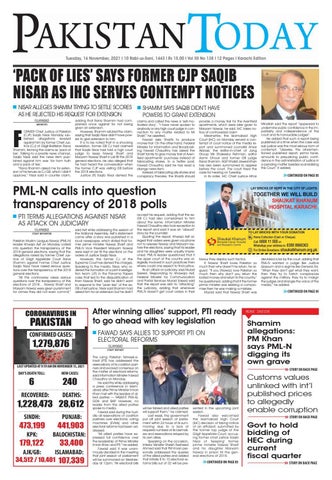
‘Pack oF lies’ says Former cJP saqib Nisar as iHc serves coNtemPt Notices g
nisar alleges shamim trying to settle scores as he rejected his request For extension ISLAMABAD Agencies
F
ormer chief justice of pakistan (cjp) saqib nisar monday rubbished allegations leveled against him by former chief justice (cj) of gilgit-balitistan rana shamim, terming the claims as ‘pack of lies’. talking to a private news channel, saqib nisar said the news item published against him was ‘far from truth and a pack of lies’. “rana shamim asked me for extension of his tenure as cj gb, which i didn’t approve,” nisar said in counter claim,
adding that rana shamim had complained once against for not being given an extension. however, shamim refuted the claim, saying that saqib nisar didn’t have powers to give extension to him. it is to be noted that in a shocking revelation, former gb cj had claimed that saqib nisar had told a high court judge to keep nawaz sharif and maryam nawaz sharif in jail till the 2018 general elections. he also alleged that he had heard the conversation when the former cjp was visiting gb before the 2018 elections. justice (r) saqib nisar denied the
g
shamim says saqib didn’t have powers to grant extension
claims and called the news a ‘self-motivated story’. “i have never spoken to anybody or any high court judge in connection to any matter related to mr sharif,” he asserted. Fawad asks sharifs to produce money trail on the other hand, Federal minister for information and broadcasting Fawad chaudhry has asked the sharif family to give money trail of avenfield apartments’ purchase instead of fabricating stories. in a twitter post, Fawad chaudhry said he has read a strange news item. instead of fabricating silly stories and conspiracy theories, the sharifs should
provide a money trail for the avenfield apartments, which were later given to maryam nawaz, he said. ihc takes notice of controversial claim meanwhile, the islamabad high court (ihc) on monday served a contempt of court notice of the media report and summoned journalist ansar abbasi, the editor-in-chief of jang group mir shakeelur rehman, editor aamir ghouri and former gb judge rana shamim. agp Khalid jawed Khan has also been summoned to appear before the court. the court fixed the case for hearing on tuesday. in its order, ihc chief justice athar
minallah said the report “appeared to undermine public confidence in the impartiality and independence of this court and its honourable judges”. he added that such a report being published at a time when the case was sub judice was the most serious form of contempt. “likewise, the aforementioned published report, prima facie, amounts to prejudicing public confidence in the administration of justice in a pending matter besides scandalizing this court,” it added.
CONTINUED ON PAGE 05
PML-N calls into question transparency of 2018 polls g
pti terms allegations against nisar as attacK on judiciary ISLAMABAD stAff RepoRteR
pakistan muslim league-nawaz (pml-n) leader Khwaja asif on monday called into question the transparency of the 2018 general elections, saying that the allegations raised by former chief justice of gilgit appellate court rana shamim against Former chief justice saqib nisar have raised serious questions over the transparency of the 2018 general elections. “all this controversy raises serious questions over the transparency of the elections of 2018… nawaz sharif and maryam nawaz were given punishment for crimes they did not even commit,”
said asif while addressing the session of the national assembly. asif’s statement came after a story was published in a local newspaper, which stated that former prime minister nawaz sharif and pml-n vice president maryam nawaz were kept in jail till the elections on the orders of justice saqib nisar. however, the former cj of the supreme court has denied the charges. speaking to the media, nisar, who ordered the formation of a joint investigation team (jit) in the panama papers case that led to the disqualification of then nawaz sharif, said he didn’t want to respond to the “plain lies” of the exgb chief justice. nisar said shamim had asked him for an extension but he didn’t
coroNavirus iN
PakistaN
CONFIRMED CASES:
1,279,876
LAST UPDATED AT 9:19 AM ON NOVEMBER 15, 2021
DAY'S DEATH TOLL:
NEW CASES:
6
240
RECOVERED:
DEATHS:
1,228,473 28,612 SINDH:
PUNJAB:
473,199
441,903
KPK:
BALOCHISTAN:
179,122 AJK/GB:
33,400 ISLAMABAD:
34,512 / 10,401
107,339
accept his request, adding that the exgb cj had also complained to him about the same. information minister Fawad chaudhry also took exception to this report and said it was an “absurd” story by the journalist. quoting the report, Khwaja asif alleged that orders were given via phone not to release nawaz and maryam before the elections, saying that his leader and his daughters were unjustly imprisoned. pml-n leader questioned that if the apex court of the country was allegedly involved in such practices then where could one expect to find justice. its an attack on judiciary, says murad saeed. responding to Khawaja asif, Federal minister for communication and postal services murad saeed said that the report was akin to “attacking” the judiciary, adding that whenever pml-n doesn’t get court orders in their
favour they deploy such tactics. if nawaz sharif loves pakistan so much then why doesn’t he return, he argued. “if you (nawaz) love pakistan so much then why don’t you return the looted money and return to the country,” he questioned, adding that if the former prime minister was seeking a compromise then he was making a mistake. murad said that nawaz sharif was
After winning allies’ support, PTI ready to go ahead with key legislation g
Fawad says allies to support pti on electoral reForms ISLAMABAD stAff RepoRt
the ruling pakistan tehreek-einsaf (pti) has addressed the reservations of its coalition partners and evolved consensus on the matter of electoral reforms, said information minister Fawad chaudhry on monday. he said this while addressing a press conference in islamabad after prime minister imran Khan met with the leaders of allied parties — mqm-p, pml-q, gda and bap. however, no leader from the allied parties spoke to media. Fawad said during the huddle all reservations of coalition partners over electronic voting machines (evms) and other electoral reforms had been addressed. “all allied parties have expressed full confidence over the leadership of prime minister imran Khan and pti,” he added. Fawad said it was unanimously decided in the meeting that joint session of parliament will be summoned on wednesday at 12pm. “all electoral bills
declared a liar by the court, adding that pml-n wanted a judge like justice qayyum and a regime like general Zia. “when they don’t get what they want, then they try to hatch conspiracies against the military, they try to malign the judges and strangle the voice of the media,” he added.
CONTINUED ON PAGE 05
MORE INSIDE
Shamim allegations: PM Khan says PML-N digging its own grave STORY ON BACK PAGE
will be tabled and allied parties will support them,” he claimed. last week, the government put off joint session of parliament within 24 hours of its summoning due to a lack of required numbers of its lawmakers and reservations relayed by its own allies. speaking on the occasion, interior minister sheikh rasheed ahmed said that pm imran personally addressed the queries of the allied parties and added that initially 8 to 10 electoral reforms bills out of 32 will be pre-
sented in the upcoming joint session. Fawad also welcomed the islamabad high court (ihc) decision of taking notice of an affidavit, submitted by the former top judge of the gilgit appellate court, accusing former chief justice saqib nisar of ‘keeping’ former prime minister nawaz sharif and his daughter maryam nawaz in prison till the general elections of 2018.
CONTINUED ON PAGE 05
customs values unlinked with int’l published prices to allegedly enable corruption STORY ON BACK PAGE
Govt to hold bidding of HEC during current fiscal quarter STORY ON BACK PAGE
02
Tuesday, 16 November, 2021 | KARACHI
NEWS
PM deCides aGainst OGRa’s ReCOMMendatiOn tO jaCk uP POL PRiCes
P
StAff REPoRt
RIME Minister (PM) Imran Khan on Monday decided against jacking up the prices of petroleum products (POL) by rejecting the Oil and Gas Regulatory Authority (OGRA) recommendation to hike the prices for the next fifteen days of November. A statement release federal government in this regard said, “The prime minister has desired that the prices of petroleum products from November 16, 2021, shall remain the same as notified on November 4, for providing maximum relief to the general public.” The statement added that the government will bear
Govt reconstitutes Pay and Pension Commission
the burden by making adjustment in sales tax rate, etc. The petrol price will remain unchanged at Rs145.82 per litre and that the price of diesel will remain Rs142.62 per litre as before. The prices of kerosene oil and light diesel are also expected to remain at Rs116.53 and Rs114.07, respectively. According to sources, OGRA had worked out a Rs5 per litre hike in the price of petrol and HSD for the remaining half of the current month. Earlier on November 5, the government had jacked up the prices of petrol and diesel by more than Rs8 per litre, days after the prime minister had announced a relief package for the masses. Taking to Twitter, Finance Minister’s Spokesperson
Muzzammil Aslam said: “History has been made today. In today’s petrol prices, the sales tax is effectively zero per cent”. Meanwhile, National Business Group Pakistan Chairman and former provincial minister Mian Zahid Hussain on Monday said that oil prices are falling in the international market but there is no relief in sight for the people in Pakistan. He said that the price of oil in the global market has been falling for three consecutive weeks due to lack of demand and expectations of increased supply. “The government is not transferring the benefit of reduced oil prices in the international market to the masses who are braving the destructive impact of inflation on their buying power.”
“Rather, the government is planning to increase the oil prices which will further burden the masses which are already reeling under record inflation,” he said. A day earlier, Prime Ministers Advisor on Finance Shaukat Tarin had hinted that petrol will become more expensive as the Pakistani rupee continues to depreciate against the US dollar. Tarin had said that that if global prices go up, then Pakistan will also have to follow suit.
‘Local auto industry to manufacture 8m vehicles by 2026’
iSLAMABAD
iSLAMABAD
stAff rePort
GhulAm ABBAs
The federal government has reconstituted the pay and pension commission by making the appointment of Zafar Ahmad Khan as Chairman. Document states that the Ministry of Finance has notified the 21 members pay and pension commission including 8 members from private and 13 as Ex-officio members. The PM has been pleased to revise not only the pay and pension commission but the Term of Reference (TORs). Former CEO PIA, PTCL and Engro Zafar Ahmad khan would be now the chairman of commission while, Owner Fulcrum Rukhsana Asghar, Senior partner KPMG Amyn Malik, senior partner A.F Ferguson and Co Salman Hussain, retired civil servants Nazhat Bashir, Masood Akhar Chaudhary, Mahfooz Ali khan and vice-admiral shah Sohail Masood (r) would-be members. Document states that the Pay & Pension Commission on the advice of Dr Ishrat Hussain shall submit its recommendations within three months. Scope of Work: The scope of work of the Commission will include federal and provincial civil servants, other government servants, civilians paid from defence estimates. All armed Forces/Civil Armed Forces personnel and holders of the posts in management scales and employees of such public sector corporations/autonomous/semi-autonomous bodies, other than banks and DFIs, which have adopted the scheme of basic pay scales in toto. Employees of Public Sector Corporations/Autonomous/Semi-Autonomous bodies who are regulated under the pay scales prescribed by these organizations and the employees governed under the Industrial Relations-Ordinance, 1969 and/or whose financial terms of service are settled through collective bargaining agents. are excluded from the scope of work of the Pay & Pension Commission. Tor of commiSSion: The TOR of the commission included a study on the adequacy of the existing Basic Pay Scale System and to evaluate the current salaries of government employees throughout the federation including the provincial government and recommend measures for its improvement and uniformity. In addition, it will also make recommendations for the streamlining of existing classification from BPS 1-22. Moreover, study the separation of existing basic pay scales for specialized departments/occupations/cadres, Review of Special Scales such as Management Grades, Management Position Scales (MP Scales), Special Professional Pay Scales (SPPS), Project Pay Scales and propose measures for uniformity and improvement. Furthermore, the TOR of the commission also included a review of admissible regular allowances as well as special incentives, existing parks as well as facilities, to align the compensation of the government employees with the market, to propose measures as to how to merge the present allowances and ad-hoc allowances into the pay scales and to propose measures to bring uniformity in the present salaries being drawn by different divisions of the government in consonance with the professional expertise of the employees. It is also mandated to research international best practices of how civil servants are remunerated and how pensions are paid, especially with regards to the countries that are in the region and similar to Pakistan but better performers, Highlight existing distortions and anomalies in the pension scheme and recommend remedial measures and Verify the sustainability of the current model after critically evaluating future liabilities through an actuarial study.
Engineering Development Board (EDB) Chairman Almas Hyder has claimed that around eight million vehicles in different auto categories would be produced annually by the year 2026. “The new auto policy has a strong focus on export as well as capacity enhancement of the industry,” Hyder said during an event hosted by Pakistan Association of Automotive Parts & Accessories Manufacturers (PAAPAM) here on Monday. He added that the volumes expected to be produced under the policy include of over 600,000 four wheelers, over 100,000 tractors, and over 7 million units per annum motorcycles in the next five years. Meanwhile, PAAPAM announced that the 19th edition of Pakistan Auto
Show (PAS), one of Pakistan’s most popular exhibitions, is going to be held at Karachi Expo Center from January 21-23. “The auto show is a very important opportunity for local companies and businesses in Pakistan to showcase their
capabilities,” said Zain Shariq, Convener of PAS 2022. He added that the auto show reflects the level of engineering that’s being undertaken in Pakistan and how it is adding value to the local manufacturing
Oil prices slide as supply boost, weaker demand fears weigh SingAPoRE AGencies
Crude oil prices fell on Monday, under pressure from expectations of increasing supplies and a lower demand forecast amid higher energy costs. Brent crude futures fell 45 cents, or 0.6%, to $81.72 a barrel, as of 0604 GMT. U.S. West Texas Intermediate (WTI) crude lost 36 cents, or 0.5%, to $80.43 a barrel. Oil markets have dropped for the last three weeks, hit by a strengthening dollar and speculation that President Joe Biden’s administration might release oil from the U.S. Strategic Petroleum Reserve to cool prices. “The White House has been debating how to tackle higher inflation, with some officials calling for the strategic reserve to be tapped, or halting U.S. exports,” ANZ analysts said in a report. U.S.
energy firms this week added oil and natural gas rigs for a third week in a row with crude prices hovering near a seven-year high, prompting some drillers to return to the wellpad. The oil and gas rig count, an early indicator of future output, rose by six to 556 in the week to Nov. 12, its highest level since April 2020, energy services firm Baker Hughes Co said on Friday. Meanwhile, the Organization of the Petroleum Exporting Countries (OPEC) last week cut its world oil demand forecast for the fourth quarter by 330,000 barrels per day (bpd) from last month’s forecast, as high energy prices hampered economic recovery from the COVID-19 pandemic. Russia’s Rosneft, the world’s second-biggest oil company by output after Saudi Aramco, warned on Friday of a potential “super cycle” in global energy markets, raising the prospect of even higher prices as demand outstrips supply.
Gold price drops by Rs1,900 per tola as rupee extends gains MonitoRing REPoRt Gold prices on Monday dropped by Rs1,900 as the Pakistani rupee held its ground and showed an uptick against the dollar in the wake of strong remittance inflows. According to details, The yellow metal lost Rs1,900 to settle at Rs126,200 per tola and Rs1,629 to fall to Rs108,196 per 10 grams in the domestic market. Local media reports, gold prices edged lower on the international front, pulling back from a more than five-month peak hit in the previous session, as cautious investors assessed whether rising inflation would prompt a more aggressive response by central banks. The international gold price fell by $3 per ounce to $1,863. Meanwhile, silver prices in the domestic market remained unchanged at Rs1,480 per tola and Rs1,268.86 per 10 grams today.
KP authorities fail to control rising prices of basic food items PESHAWAR Aziz Buneri
Due to a lack of check and balances by the Khyber Pakhtunkhwa (KP) government and district administration, the prices of basic food items have increased manifold in the provincial capital, Peshawar. According to a flour dealer in Peshawar, Fahad Khan, the supply of
wheat to Punjab Flour Mills has been suspended by the government, due to which there is a further risk of flour shortage in KP. He that the provincial government should immediately take steps to deal with the crisis and raise the issue with the Punjab government to avoid blockage of wheat and flour supply to the province so that food prices remain under control. He further said that due to the
ongoing inflation, people have lost their purchasing power due to which traders are also facing a lack of customers and added financial difficulties. It may be mentioned here that due to a shortage of flour and an increase in its prices, bakers have announced a protest on Tuesday to fix the price of bread at Rs20-30. Meanwhile, the KP Food Department has compiled an
ECC grants exemption of PPRA rules for importing urea iSLAMABAD shAhzAd PArAchA
The Economic Coordination Committee (ECC) of the Cabinet has granted exemption of Public Procurement Regulatory Authority (PPRA) rules for importing urea. A handout issued by the Economic Affairs Division (EAD) in this regard on Monday stated that the EAD Federal Minister Omar Ayub Khan chaired the ECC meeting and took several important decisions.
As per details, the ECC, on the summary of the Ministry of Industries and Production, granted PPRA rules exemption to Trading Corporation of Pakistan (TCP), for republishing the tender till fetching a low price during the Rabi session 2021-22 (FY22). Presently, urea is selling at Rs2,100 per bag in the market whereas the factory rate is approximately Rs1,750. DAP fertiliser is available above Rs9,000 per bag while the factory rate is around Rs8,250. Sources said that small farmers were facing hurdles due to the surge in prices of
urea and DAP while most of them, despite having a Kissan Card, were unable to get the subsidy announced by the federal and Punjab governments. On the other hand, the Agriculture Department of Punjab was not clearing subsidy files due to which there were chances that small farmers would not cultivate wheat in this season. It is pertinent to mention here that the federal cabinet, in its last meeting, had constituted a sub-committee to determine the minimum support price (MSP) for the wheat
industry, hence a good avenue for our consumers and policymakers to witness local development. Zain added that a strong showcase of diverse models is expected at the show since a large number of new entrants have entered the market. “Several electric vehicle manufacturing companies are already on board while the launching of a few new models will also be in the offing at the show,” said Zain. According to PAAPAM Chairman Razzak Gauhar, the association has always played a pivotal role for the provision of business opportunities and growth of the Auto Engineering Industry as a whole. At the PAS 2022, he said, PAAPAM has established a substantive business generation model for everyone including members who are not exhibiting and representatives of allied industries.
crop of 2021-22 (FY22) as the Ministry of National Food Security and Research (MNFS&R) had recommended Rs2,180 MSP to meet the production target of 29 MMT. Earlier in October, the fertiliser industry had requested the federal government for a complete deregulation of the sector without gas subsidies or any other benefits because urea manufacturers are competitive internationally and can operate without any government support. Moving on to other agenda items, the ECC also deliberated over a summary presented by the Ministry of
investigation report saying thousands of official sacks of flour are being sold in the markets instead of being provided to deserving families. Arif Khan, a resident of Peshawar, said that the daily increase in prices of food items in has put the people in a difficult position. He said that the district administration has adopted complete silence on the price-hike. “Prices of vegetables, fruits and pulses have skyrocketed due to the continuous rise of the dollar and rising prices of petroleum products. Tomatoes are being sold at
Industries and Production on Small and Medium Enterprises (SMEs) policy 2021-25. The policy framework is based on reforming the policy and regulatory environment and addressing SME market constraints, both demand and supply side. The meeting approved Technical Supplementary Grants (TSGs) worth of Rs10 billion during FY22 under the Sustainable Development Goals Achievement Programme (STGAP). In addition, the chair also approved TSG worth of Rs134.783 billion for the payment of 60 per cent second installment to IPPs and Rs338 million during FY22 in favour of the National Rahmatul-lil-Alameen Authority (NRA), and Ministry of Federal Education and Professional Training.
Tuesday, 16 November, 2021 | KARACHI
NEWS
FBR notiFies hike in minimum pRices oF steel as int’l pRices suRge ISLAMABAD
i
ghuLam abbaS
N the wake of increased prices of steel products in domestic and international markets, the Federal Board of Revenue (FBR) on Monday increased the minimum prices of steel products through amendments in SRO-985 issued on
August 4, 2021. As per details, the new prices of steel bars has been fixed at Rs153,000 per metric tonne, billets at Rs131,000 per MT, ingots/bala and ship plates at Rs126,000 per MT, and scrap at Rs119,000 per MT. According to official sources, an upward revision was essential in the wake of the recent surge in local and international prices
03
of steel products and to prevent a possible loss of revenue. Earlier, the steel industry too had demanded a revision in the minimum prices stating that prices were on an increasing trend. Moreover, the FBR has indicated that minimum prices would be fixed on a quarterly basis.
SBP launches module in RAS for banking policy, regulations KArACHI tLtp
The State Bank of Pakistan (SBP) has now achieved another milestone by launching a module in the Regulatory Approval System (RAS) pertaining to banking policy and regulations. According to a press statement issued on Monday, with the launch of this module in RAS, banks, development finance institutions (DFIs) and microfinance banks (MFBs) can now submit their request letters/ proposals on a dedicated online portal to SBP’s Banking Policy and Regulations Department whereby SBP, after digitally processing them, would also be in a position to disseminate the regulatory decisions to them through the same portal. Earlier in October, SBP Governor Dr Reza Baqir had launched the SBP FX RAS for end-to-end digitisation of Foreign Exchange (FX) related case submission process. The system turned out to be a huge success as it enabled customers to lodge FX related requests from the location of their convenience thereby sparing time
Bitcoin jumps to $65,704 as cryptos’ cap hits $3tn mark again SINGAPOrE agencieS
The cryptocurrency market remained bullish on Monday, with the market capitalisation gaining 1.5 percent to reach $3.01 trillion as of 1400 hours GMT. The largest cryptocurrency bitcoin, which hit an all-time high of $68,382 on Tuesday last, gained 1.2 percent to reach $65,704. With this increase in price, the market capitalisation of the biggest cryptocurrency has reached 1.24 trillion. Ether, the world’s second-largest cryptocurrency by market capitalisation that set a new high of $4,823.95 per coin on Tuesday last, gained 2.5 percent to reach $4,751. With this increase in price, the market capitalisation of ETH has reached $562.8 billion. Likewise, cardano (ADA) price edged up by 0.60 percent to reach $2.06. Its market capitalisation has reached $66.2 billion with this increase. Similarly, XRP price increased by one percent to reach $1.21. The market capitalisation of XRP stands at $56.9 billion after this increase. However, dogecoin (DOGE) edged down by 0.5 percent to reach $0.263. With this decrease in price, the market capitalisation of doge has reached $34.7 billion. Meanwhile, cryptocurrency taxes have arrived in Argentina, at least in certain provinces. Now, users that trade and hold cryptocurrencies must disclose their earnings and pay taxes at least in two provinces: Cordoba and Tucuman. The reason behind this lies in a new regulation adopted at the province level that stipulates cryptocurrencies will be taxed like other international currencies when traded. The inclusion of cryptocurrencies in the scope of taxes is something that is being considered in several countries of the world, due to the rising popularity of these instruments as an asset class and also as a payment method. The governments are starting to realise that by not regulating these payments they are losing out on a lucrative income source. The government of Mexico has recommended taxing this kind of transaction with a 20 percent fee. Cryptocurrencies started picking up steam in Argentina after the government put a limit on the number of dollars each citizen could buy monthly. This was the breaking point for a country that was not known for its cryptocurrency involvement, to take interest in these new crypto tools that provided a savings alternative amidst the aforementioned situation.
‘Govt to move 70pc energy production from fossil fuels to hydel-based by 2030’ ISLAMABAD Staff report
Federal Minister for Economic Affairs, Omar Ayub Khan has said that the government intends to move away 70 per cent of energy production from fossil fuels to hydel-based and renewable sources by 2030. The Economic Affairs Division minister said this during a meeting with USA’s Alternative Executive Director to the Asian Development Bank (ADB) John Hurley here on Monday. EAD Secretary Mian Asad Hayaud Din, ADB Country Director Yong Ye and Pakistan’s Executive Director to ADB Noor Ahmed also attended the meeting. As per details, the minister welcomed Hurley on his first official visit to Pakistan and expressed his gratitude to the ADB management for efficiently processing and successfully procuring Covid-19 vaccines to support the government’s national vaccination drive. The minister highlighted the financial and budgetary importance of two ADB funded programme loans intended to target reform initiatives within the energy and capital market sectors. John Hurley reiterated ADB’s commitment to support Pakistan’s reform agendas, especially within the energy and financial markets sectors, and to speed up the economic recovery process as soon as the ongoing IMF
review is completed. Hurley appreciated the government’s national vaccination drive, and informed the minister that the APVAX facility remains available if the government chooses to opt for additional financing of Covid-19 vaccines in the near future. Hurley also emphasised the importance of pipeline ADB funded programme loans such as the Domestic Resource Mobilisation Programme to increase the tax base and enhance overall revenue collection targets of the country for future debt sustainability and growth. Omar Ayub said that given the rapid pace of urbanisation and population growth, the urban services sector was a priority area of the present government. He highlighted the importance of developing farm to market roads such as communication linkages and ensuring power supply to remote areas for increasing market accessibility and enhancing the rate of return. The minister informed Hurley that through the National Coordination Committee on Foreign Funded Projects (NCC-FPP), EAD had significantly improved performance of ongoing projects by removing major bottlenecks. The minister also highlighted additional efforts within EAD to improve project management and oversight by creating a dedicated monitoring cell.
JS Bank Hosts Delegates From US Venture Capital Firm 500 Global Karachi: JS Bank hosted an interactive discussion between 500 Global, the world’s leading early stage Venture Capital (VC) investor and high-growth local startups including Brandverse, Ailaaj, Kuickpay, Knowledge Platform and others. The 500 Global delegation which included Courtney Powell - Chief Operating Officer, Max Scheder-Bieschin - Member of the Board and others visited Pakistan to evaluate opportunities for foreign investment in the technology sector. JS Bank has a rich history of partnershipdriven growth and is the first in-country Bank to partner with VCs. With a leading position in the SME and entrepreneurship financing (KamyabJawan) spaces, the Bank is now working to build the digital ecosystem. Speaking at the occasion, Imran Shaikh – Chief Operating Officer, JS Bank said, “It is an honor for us to host the 500 Global team. Together, we aim to build meaningful industry linkages that lead to sector growth and ultimately wealth creation. Our Bank aims to work with the right partners to provide low-cost financial structuring and funding solutions to the digital and tech market.” Courtney Powell added, “Pakistan is a land of innovation with a strong technical base, and a thriving entrepreneurial sector which we believe is ripe for global exposure. The conversation isn’t just about funding; early-stage entrepreneurs want advice on going global and we look forward to having these conversations.” pr
PepsiCo Pakistan achieves 100 percent Covid-19 vaccination rate as part of holistic pandemic response Pr PepsiCo Pakistan has reached a 100 percent Covid-19 vaccination rate in partnership with the Secondary and Primary Healthcare Department, Government of Punjab through extensive vaccination drives at the company. This effort was complemented with comprehensive awareness-raising campaigns organized across PepsiCo’s facilities in Pakistan. The milestone was celebrated at a ceremony in the presence of Mr. Imran Sikandar, Secretary Primary and Healthcare Department, Government of Punjab, district health officials, and PepsiCo representatives. The publicprivate sector partnership resulted in preventing Covid-19 infection transmission and played an instrumental role in raising awareness, prioritizing employee safety, and safeguarding families, and created positive community impacts.
previously spent in navigating paper-based processes. It also enabled banks to submit FX related cases electronically for regulatory approval of SBP and SBPBanking Services Corporation (BSC). Implementation of RAS for banking policy and regulation related issues will be effective from November 24. It will enable banks, DFIs and MFBs to digitally submit their requests and receive regulatory decisions through a single window. Nevertheless, in addition to online submission, banks, DFIs and MFBs shall also continue with the manual submission of their cases that will cease after a brief transitory period till December 31, 2021. Furthermore, the implementation of RAS is expected to conserve precious resources, contribute towards the central bank’s green banking initiative and bring efficiency in the communication between banking sector and SBP. Moreover, this arrangement will also replace paper based submissions that are prone to logistic and storage issues, and cause inadvertent and unnecessary delays for relevant stakeholders.
PepsiCo is one of the fastest companies in Pakistan to attain 100 percent Covid-19 vaccination rate as more than 3,000 employees and frontline associates benefitted from the partnership which set out as a positive step towards nurturing and protecting community health, safety, and wellbeing. The vaccination drive is part of
PepsiCo’s holistic response to the Coronavirus outbreak and demonstrates the company’s long-term commitment towards stepping up support for the government’s ongoing national efforts for vaccine roll-out and improving Pakistan’s overall Covid-19 vaccination rate. Moving forward, as Pakistan navigates through recovery from the pandemic, PepsiCo will unite with the government and explore ways to offer possible support to the ongoing efforts while striving to make positive impacts in the community and workplace. Mr. Imran Nazir, Secretary Primary and Secondary Healthcare Department present at the ceremony remarked, “Thank you, PepsiCo Pakistan for being a responsible organization and vaccinating 100% of your employees. This is a prime example of what a joint venture between public and private sectors can do. Congratulations to PepsiCo along with the healthcare workers of primary and secondary healthcare departments for achieving this milestone!"
Mr. Furqan Ahmed Syed, CEO PepsiCo Pakistan shared his remarks on the successful culmination of the vaccination drive and stated, “It is very encouraging to witness our vaccination teams, associates, and frontline heroes come together to vivaciously fight the pandemic. I also express my sincere gratitude to the health authorities for supporting our employees’ well-being through vaccinations roll-out.” PepsiCo Pakistan has taken a significant number of proactive steps to support Pakistani communities at large in navigating through testing times during the evolving pandemic. The company created long-term alliances and leaned in on critical partnerships with government authorities, local partners, volunteers, and civil society entities to help underserved communities. At the onset of the COVID outbreak in 2020, PepsiCo announced the launch of the ‘Millions of Meals’ program, an inclusive, nationwide disaster relief program which mobilized 500 volunteers and civil society partners to distribute over 13 million meals to meet the nutritional needs of the most underserved communities impacted by the pandemic.
04 NEWS 16th November 2021_Layout 1 11/15/2021 10:42 PM Page 1
Tuesday, 16 November, 2021 | KARACHI
04 NEWS
PAkISTAn BIdS To qUEll rISE In TTP ATTACkS ISLAMABAD
S
AFP
INCE the Taliban’s takeover of Afghanistan, Tehreek-i-Taliban Pakistan (TTP), the offshoot of the hardline group, has ramped up attacks on Pakistan’s side of the border, leaving the government scrambling to curb the violence. Active in the remote tribal areas bordering Afghanistan, experts say the militant group has been emboldened by the Taliban’s successful ousting of the United States from the war-ravaged nation. TTP — a separate movement that shares a common history with the Afghan Taliban — plunged the country into a period of horrific violence after forming in 2007. Also made up mostly of ethnic Pashtuns, it carried out hundreds of suicide bomb attacks and kidnappings across the country, seizing control of some border regions and imposing its interpretation of Islam as law in the territory where it held sway. It was a TTP gunman who opened fire on schoolgirl Malala Yousafzai in Swat Valley before she won the Nobel Peace Prize. The group was also linked to the assassination of former prime minister Benazir Bhutto. But it wasn’t until a gun massacre of nearly 150 children at the Army Public School in Peshawar in 2014 that the military finally crushed the movement and forced its militants to retreat into Afghanistan. Now, nearly a decade later and with the
Afghanistan Taliban back in control in Kabul, Pakistan is trying to quell a TTP comeback. “The (militants) feel more comfortable after the fall of Kabul to the Taliban, they can now move freely in Afghanistan,” a TTP militant told AFP on condition of anonymity. “They have no fear of US drone strikes. And they can meet and communicate easily.” AttACKIng SECuRIty fORCES: The TTP claimed 32 attacks in August, 37 in September and 24 in October — the highest monthly totals for at least five years, according to their own published data.
SC summons FIA, ETPB bosses in evacuee properties case ISLAMABAD: Taking notice of the purportedly illegal sale and purchase of historical properties belonging to Evacuee Trust Property Board (ETPB), the Supreme Court on Monday summoned its chairman and directorgeneral of Federal Investigation Agency (FIA). The court took a suo motu notice of torching of a Hindu temple in the Karak district of Khyber Pakhtunkhwa. While hearing the case, Chief Justice Gulzar Ahmed said the board had sold all the trust properties. He wondered under which law, the board had sold the property. “How can the government sell the evacuee trust property? Selling evacuee trust property is against the law,” Justice Ahmed said, adding the board had raked in millions of rupees by selling the properties. The counsel for the board told the court it was true that the evacuee trust properties had been sold out. At this, the judge remarked that the very purpose of the board had died down when it had sold out the assets. The board has failed to perform its responsibilities, he added. INP
SHC allows Memon to travel abroad KARACHI: The Sindh High Court (SHC) on Monday allowed Pakistan Peoples Party lawmaker Sharjeel Memon to travel abroad to attend an exhibition as focal person of the provincial government. Memon, a formal Sindh minister, had filed a petition in the court for a temporary removal of his name from the exit control list (ECL) to visit Dubai. His name was put in the ECL after his bail in the National Accountability Bureau (NAB) references. “The provincial government has nominated him for the exhibition as its focal person,” Memom’s counsel said. “His attending the exhibition on behalf of the Sindh government is necessary,” he argued. Memon with other accused is facing 5.76 billion graft reference in the Sindh Information Department advertisements and accumulation of Rs2.43 billion assets beyond known sources of income. In a previous hearing, the petitioner’s counsel had submitted to the court Memom was on bail in NAB cases and standing the trial. He, however, was required to travel abroad to attend the exhibition being held in the UAE as a focal person of the provincial government. The court had issued notices to federal and provincial law officers on Memon’s petition in the hearing. INP
Jati Umrah residence of Sharif family to be auctioned LAHORE: The Board of Revenue (BoR) pasted notices on the walls of Jati Umrah residence of deposed prime minister and Pakistan Muslim League-Nawaz (PML-N) supreme leader Nawaz Sharif as it speeds up the process of auction of his property following the imposition of £8 million penalty on him. The land will be auctioned on November 19 (Friday). The Revenue Department has also requested the Lahore and Rawalpindi office-bearers of the National Accountability Bureau (NAB) to participate in the process. Out of the total 1,580 kanals, a piece measuring 1,180 kanals was agricultural land whereas the remaining 400 kanals comprises mansions. INP
Across all of 2020, when the United States first pledged to start withdrawing its troops from Afghanistan, it claimed 149 assaults — three times more than in 2019. The renewed confidence became apparent in October when the group’s leader Noor Wali Mehsud came out of hiding and was photographed shaking hands with residents and speaking in public — something unimaginable just a few months ago. More than a dozen militant factions have since July 2020 rallied under his leadership. In an attempt to improve the TTP’s image and distinguish them from the Islamic
State’s extremism, Mehsud has largely taken the group in a new direction — sparing civilians and ordering attacks only on security and law enforcement officials. Recent attacks have been far less deadly than the mass casualty bombings that once terrorised the country. ‘A SECOnD CHAnCE’ For Islamabad, part of the apparent strategy to keep the threat of the TTP at bay is by accommodating them. Prime Minister Imran Khan announced in October that the government was in talks with the TTP for the first time since 2014, facilitated by Afghanistan’s new leaders. Both sides have announced a truce until at least December 9, while they hammer out an agreement. “Those people who want to come back and respect our law and constitution, we would like to give them a second chance,” said Minister for Information Fawad Chaudhry. Neither side has openly divulged details about the negotiating points. The release of about 100 TTP militants was a key demand for the militants to agree to a ceasefire, a source from the group told AFP. The militants are also appealing to be able to come out of hiding and return to the tribal areas. But without the support of elders — hundreds of whom have been killed over the years — any deal risks being meaningless. “It will be difficult for them to return without laying down arms because they have enemies there, they have killed people,” Baadshah, a tribal elder, told AFP in Peshawar.
“They have grudges against the Taliban. But they are ready to accept them unwillingly if it solves the problem,” he added. Chaudhry has said those affected by the bloody insurgency would be included in talks. A nEw gEnERAtIOn: Made up of multiple factions, some of which also swore allegiance to Al-Qaeda, the TTP remains a distinct group from Afghanistan’s Taliban. The TTP has some 4,000 to 6,000 militants, down from 20,000 at its peak, according to estimates from the authorities. Their top leadership was wiped out by military operations backed by US drone strikes after 2014. An official who asked not to be named told AFP that the TTP is “not the same group as it was eight years ago”. The current negotiations were taking place with young militants and “third-tier leaders”, he added. Still, peace talks between the two sides have angered many within Pakistan, who remember the brutal attacks on schools, hotels, churches and markets which killed around 70,000 people. Its militants are not openly roaming as before, “but people can feel their presence”, especially at night, an elder of the Mehsud tribe told AFP. In his traditional and religious district of South Waziristan, “most people love the Afghan Taliban because what they do is in the name of Islam”, he said. But many fear that the TTP’s return will open a new era of violence.
Electronic voting will ensure transparency in elections: minister ISLAMABAD APP
Minister for Interior Sheikh Rasheed Ahmed on Monday said transparency in elections would be ensured with the use of electronic voting machines (EVMs) and termed it necessary to guarantee the electorate’s trust in the elections. Talking to the reporters, he said Prime Minister Imran Khan has reaffirmed the commitment of his government to ensure free, fair and transparent elections in the country. Ahmed said he fully endorsed the idea of using EVMs as Prime Minister Khan said these devices would resolve the issue of trust deficit in the apparatus. He said the prime minister always spoke in favour of transparent elections and expressed his displeasure over the regime in use since the 1970s. He said the prime minister was enjoying the support of MPs from his own party and allies. He said all members of the government and allied parties have one agenda that was to change the lives of the public. Ahmed said the government was taking sincere steps to improve the professional capabilities of the Islamabad
police. He said police were a frontline response unit and added it was necessary to keep the morale of the force high. The minister directed the police officials to boost the morale of their subordinates which was also necessary for improving the performance of the police. He said that efforts were being made to include additional 2,000 policemen in Islamabad police. He said that an MoU had been signed with the Punjab government for the start of the 1122-like rescue service in the capital. The minister said the air patrolling unit of the Islamabad police, which consisted of high-tech drones and locators for live surveillance and tracking purposes, would initially patrol areas with high rates of burglaries, robberies, snatching, street crimes, and auto theft. He said that apart from airborne tracking and surveillance, it would also be responsible for providing additional support to the on-ground patrol and specialized teams of the Islamabad police. Ahmed said that while equipping the Islamabad police with the latest technology, they would significantly be able to ensure the safety of the public, decrease the crime rate, and consolidate
the overall security of the capital. He said that Islamabad police would be made the model and most advanced force in the country as they had adopted modern technology to tackle crimes, automate different processes, making the city safer for both residents and visitors. He added the Islamabad police were facing more challenges as handling
daily protests was not an easy task. He said the police had also installed security cameras across the capital under the Safe Cities project. Ahmed said all heirs of the martyred police personnel would be covered under the package. He assured to increase the salaries of Islamabad Police besides starting a housing project for them.
Karachi coastal project under CPEC to boost economy: officials ISLAMABAD XINhuA
The recent inclusion of the Karachi Coastal Comprehensive Development Zone (KCCDZ) project in the China-Pakistan Economic Corridor (CPEC) will boost Pakistan’s economy and enhance industrial and development cooperation between Pakistan and China, said experts and officials. The decision to include the project in Karachi into the CPEC was made at the CPEC’s recent 10th Joint Cooperation Committee Meeting. Covering a total area of about 930 hectares, of which 640 hectares are reclaimed, the environmentfriendly KCCDZ envisages four new berths for the Karachi Port Trust (KPT), according to a statement from the Ministry of Maritime Affairs of Pakistan. The mega project, being built with an expected investment of $3.5 billion, will also house a state-of-theart fishing port, with a world-class fisheries export processing zone to boost the country’s trade potential, said the ministry. It will also drastically improve the marine ecosystem and reduce pollution with the establishment of a water treatment plant, the ministry said. Terming the project a game-changer for Pakistan, Prime Minister Imran Khan recently said the coastal
CMYK
development project will bring Karachi on a par with developed port cities of the world. The project will present opportunities for investors, he said on Twitter, adding that it will also help clean up marine habitats for fishermen and develop 20,000 low-income housing units. The KCCDZ is the first of its kind under the CPEC, which reflects the commitment of Pakistan and China to forge high-quality cooperation to improve people’s livelihoods, Minister for Maritime Affairs Ali Haider Zaidi told Xinhua. “As all-weather strategic cooperative partners, China and Pakistan are stepping up cooperation in various sectors, giving impetus to the growth of bilateral relations, economic and social development of the two countries,” the minister said. Speaking to Xinhua, Syed Hasan Javed, director of Chinese Studies, School of Social Sciences and Humanities at the National University of Science and Technology in Islamabad, said the KCCDZ is a 21st-century modern project replete with the latest technologies, town planning, urban infrastructure, municipal amenities and environment-friendly marine development. “It will take Pakistan’s economy to the next level of prosperity by attracting foreign direct investment, generating employment and revenue, boosting exports and promoting regional and global connectivity,”
Javed said. Muhammad Asif Noor, director of the Islamabadbased think tank Institute of Peace and Diplomatic Studies, said the project carries enormous potential to spur the country’s blue economy and exports. “Fishing ports and fisheries export processing zones are critical to boost trade in fishing as coastal areas of Pakistan are rich in maritime trade, giving a way to promote the blue economy in Pakistan through infrastructure development and industrial cooperation in the said sector,” Noor told Xinhua. The project will also build up the confidence of global investors towards the country and its entire ecosystem for providing and offering a lucrative environment to set up businesses and profit, he said “Furthermore, it has the potential to boost industrial cooperation between Pakistan and China due to its proximity with Karachi, the financial hub of the country,” he added. Noor said that the low-budget housing under the initiative will create affordability for poverty-stricken fishermen to own a house, boosting their socio-economic profile. He said Pakistan can learn from the Chinese experience of tackling climate change and how to effectively use the project to clean up marine habitats and strengthen biodiversity conservation.
Tuesday, 16 November, 2021 | KARACHI
NEwS
05
PuNJAb LeADiNg iN DeveLoPMeNT ProCess DesPiTe oPPosiTioN’s NegATive PoLiTiCs: buzDAr
P
news desk
UNJAB Chief Minister Sardar Usman Buzdar has said that the Punjab province is leading the development process in the country. Talking to parliamentarians and the Pakistan Tehreek-e-Insaf (PTI) office-bearers in Muzaffargarh, who discussed with him the city’s problems, the chief minister said that the government would leave no stone un-
turned to serve masses and pointed out that unprecedented development work has been completed in a period of three years. No area would remain deprived of development, he promised. The development schemes would be completed speedily while ensuring transparency, he said, adding that the government is following a comprehensive plan to provide the best healthcare and educational facilities to people living in far off parts of the province.
On the other hand, the opposition lacked any agenda for the public service and it is trying to interrupt the development process, he regretted. The opposition alliance’s negative politics cannot survive in the new Pakistan, the CM said, adding that people have rejected the anti-development mafia and the development process is continuing despite negative politics of the opposition. Buzdar said that the government would fulfill its constitutional term.
Karachi coastal project under CPEC to boost economy: officials isLamaBad Xinhua
The recent inclusion of the Karachi Coastal Comprehensive Development Zone (KCCDZ) project in the China-Pakistan Economic Corridor (CPEC) will boost Pakistan’s economy and enhance industrial and development cooperation between Pakistan and China, said experts and officials. The decision to include the project in Karachi into the CPEC was made at the CPEC’s recent 10th Joint Cooperation Committee Meeting. Covering a total area of about 930 hectares, of which 640 hectares are reclaimed, the environment-friendly KCCDZ envisages four new berths for the Karachi Port Trust (KPT), according to a statement from the Ministry of Maritime Affairs of Pakistan. The mega project, being built with an expected investment of $3.5 billion, will also house a state-of-the-art fishing port, with a world-class fisheries export pro-
cessing zone to boost the country’s trade potential, said the ministry. It will also drastically improve the marine ecosystem and reduce pollution with the establishment of a water treatment plant, the ministry said. Terming the project a game-changer for Pakistan, Prime Minister Imran Khan recently said the coastal development project will bring Karachi on a par with developed port cities of the world. The project will present opportunities for investors, he said on Twitter, adding that it will also help clean up marine habitats for fishermen and develop 20,000 low-income housing units. The KCCDZ is the first of its kind under the CPEC, which reflects the commitment of Pakistan and China to forge high-quality cooperation to improve people’s livelihoods, Minister for Maritime Affairs Ali Haider Zaidi told Xinhua. “As all-weather strategic cooperative partners, China and Pakistan are stepping up cooperation in various sectors, giving impetus to the growth of bilateral rela-
tions, economic and social development of the two countries,” the minister said. Speaking to Xinhua, Syed Hasan Javed, director of Chinese Studies, School of Social Sciences and Humanities at the National University of Science and Technology in Islamabad, said the KCCDZ is a 21st-century modern project replete with the latest technologies, town planning, urban infrastructure, municipal amenities and environment-friendly marine development. “It will take Pakistan’s economy to the next level of prosperity by attracting foreign direct investment, generating employment and revenue, boosting exports and promoting regional and global connectivity,” Javed said. Muhammad Asif Noor, director of the Islamabad-based think tank Institute of Peace and Diplomatic Studies, said the project carries enormous potential to spur the country’s blue economy and exports. “Fishing ports and fisheries export processing zones are critical to boost trade in fishing as coastal areas of Pak-
Justice Saqib Nisar levels counter allegations against Justice Shamim Continued from page 01 The court also directed the respondents to explain “why proceedings under the Contempt of Court Ordinance, 2003, may not be initiated against them under Article 204 of the Constitution of the Islamic Republic of Pakistan, 1973.” Rana Muhammad Shamim, former chief judge of Gilgit-Baltistan Supreme Appellate Court (SAC), claimed in an alleged affidavit that Mr Nisar ensured the father-daughter duo remains behind bars until the elections. Mr Nisar had traveled to the mountainous region for vacations in 2018, the affidavit read. On one occasion, the judge appeared “very disturbed” while speaking to the Supreme Court registrar on the phone, asking him to get in touch with a
high court judge. Once able to get in touch with the judge, Mr Nisar ordered him that “Nawaz Sharif and Maryam Nawaz Sharif must remain in jail until the general elections are over. On assurances from the other side, he [Nisar] became calm and happily demanded another cup of tea.” The other judge was not named in the affidavit. The now-retired top judge said he could only remember speaking to Mr Shamim when he called him to offer condolences about the latter’s wife’s death. Mr Shamim could have “any motive” for making the claims, he said. The News reported Mr Shamim gave his statement under oath before the oath commissioner on November 10. The affidavit contained his signature and an image of his computerised national identity card (CNIC). The article further said
Mr Nisar categorically denied the allegations. Mr Shamim insisted he was witness to the incident that happened at the guest house of Gilgit-Baltistan court when Mr Nisar came on vacation. He added when he asked the former chief justice why he conveyed such a message to the other judge, the now-retired top judge responded by saying: “Rana sahib! you won’t understand. You must treat it as if you never heard anything.” When he further said that Mr Sharif had been falsely implicated, Mr Nisar said: “The chemistry of Punjab is different from [that of] Gilgit-Baltistan.” AVENFIELD CASE JUDGEMENT: In July 2018, an accountability court ruled that Mr Sharif and his family laundered money in the 1990s to pay for four luxury apartments in Park Lane, central London,
LaHore Punjab government has finally prepared the final draft of the Local Government Act, according to which the mayor will be
elected on party basis in the local body elections. According to the details, in the new local government system, the mayor has been directly appointed as the head of ten authorities besides local government. According to the draft, elections for Mayor, Neighborhood, Village Council and Panchayat will be held on party basis while the new local government system will have 11 metropolitan corporations. Similarly, the draft states that the houses of the Metropolitan Corporation Lahore will consist of 70 members, of which 45 members will represent the General Councilors and 25 members will represent the reserved seats. The draft further
states that the House will have two Traders Councilors, a Senior Citizen Councilor, four Youth Councilors, six Farmers Councilors and ten Women Councilors and the new local government system will have 109 municipal committees, 125 town committees and 35 district councils. Similarly, the new local government system will have 260 urban and 35 rural local governments while it has been decided not to form Neighborhood Council in town committees. According to the draft, a house with a population of 5 million to 10 million will have 63 members whereas the house with a population of 1.1 million to 5.5 million will consist of 56 members. Similarly, the House, with a population of 500,000 to 800,000, will consist of 42 members and the house with a population of 250,000 to 500,000 will have 35 members while a house with a population of 50,000 to 125,000 will have 15 members. The Punjab Minister for Local Government and Community Development (LG&CD) Mian Mahmood Ul-Rasheed
CmYk
Another LHC judge refuses to hear Jamshed Cheema’s petition news desk
istan are rich in maritime trade, giving a way to promote the blue economy in Pakistan through infrastructure development and industrial cooperation in the said sector,” Noor told Xinhua. The project will also build up the confidence of global investors towards the country and its entire ecosystem for providing and offering a lucrative environment to set up businesses and profit, he said “Furthermore, it has the potential to boost industrial cooperation between Pakistan and China due to its proximity with Karachi, the financial hub of the country,” he added. Noor said that the low-budget housing under the initiative will create affordability for poverty-stricken fishermen to own a house, boosting their socio-economic profile. He said Pakistan can learn from the Chinese experience of tackling climate change and how to effectively use the project to clean up marine habitats and strengthen biodiversity conservation.
Another Lahore High Court (LHC) judge refused on Monday to hear petitions filed by PTI leader Jamshed Iqbal Cheema and his wife Musarrat Cheema, challenging the rejection of their nomination papers for NA-133 (Lahore) by-election. The petitions came up for hearing before a division bench, comprising Justice Shujaat Ali Khan and Justice Faisal Zaman. Justice Zaman recused himself from the case, after which the matter was referred to the LHC chief justice to form a new bench to hear and decide it. Last week, the LHC chief justice had reconstituted the bench after Justice Shahid Waheed had declined to hear the petitions. Cheema and his wife had approached the LHC after an election tribunal dismissed their appeals against the returning officer’s (RO) decision to reject their nomination papers. The petitioners had pleaded with the high court to set aside the rejection of their papers and allow them to contest the by-election scheduled for December 5. It is pertinent to mention that the returning officer (RO) had rejected the nomination papers of Cheema and his wife Musarrat (his covering candidate) on the ground that the proposers and seconders for the two are not residents of the constituency as required under the relevant election laws.
drawing on allegations that resurfaced in the 2016 Panama Papers. Accountability Court judge Mohammad Bashir sentenced Ms Nawaz to seven years’ imprisonment, fined the family £10m and ordered the seizure of the Avenfield properties. She also received an additional one-year sentence for presenting forged documents in court. The family has long struggled to explain how the Avenfield flats came into their possession. Family members initially told different stories. During the National Accountability Bureau trial, Mr Sharif’s defence claimed that a Qatar investment fund gave the expensive properties to the family to repay a debt owed to Mr Sharif’s father, Mian Muhammad Sharif. Commentators in 2017 mocked a letter from a Qatar prince apparently testifying to that deal as a rabbit pulled out of a hat. Mr Sharif and members of his family have denied any wrongdoing, and supporters claim the charges against them are politically motivated.
Manzoor Ahmad takes over as acting MD of NTDC
Punjab government prepares final draft of new LG system Shahab Omer
He also issued orders for restoration of a recreational park near Chenab River, along with improvement in facilities at ladies park in Muzaffargarh city. The chief minister also visited the mausoleum of Khawaja Ghulam Farid and laid the foundation stone of a conservation and development project to provide facilities to the devotees. He announced that Rs70 million would be spent on providing facilities to the devotees visiting the shrine.
has taken the provincial members of assembly including ministers into confidence by briefing them about the new local government system. On the other hand, along with the preparation of the final draft of the Act, the LG&CD Department has also prepared the working paper of the Master Plan of 260 Urban Local Governments in which the estimated cost was RS 499.39 million and the project will be completed in June 2024. The LG&CD while giving its point of view in a letter states, “A legislation as an Act is underway for establishment of a Master Planning Authority as an autonomous body of LG&CD for the master planning of LGs at provincial level and ensuring its execution and updation at regular intervals (being a continuous process). The LG&CD department intends to shift the ADP scheme and funds to this Authority providing a revenue base at the outset and execution of the project through the authority,” letter states.
isLamaBad Staff repOrt
In pursuance of Ministry of Energy (Power Division) notification, Engr. Manzoor Ahmad has taken over as acting Managing Director National Transmission and Despatch Company (NTDC) on stop gap arrangement. On Monday, the NTDC spokesman said that Engr. Manzoor Ahmad did his Bachelors in Electrical Engineering from UET Lahore. He enjoys over 36 years of extensive experience of power sector. He has served in NTDC on key appointments like Deputy Managing Director (P&E), General Manager (Project Delivery / GSC) South, General Manager (Design & Engineering) alongwith cross border project CASA1000. The spokesman also said that Engr. Manzoor Ahmad has the expertise in Project/ Program Management, Substation Construction, Transmission Lines Construction, Handling of Mega Projects, Contracts Management and Strategic Planning, while serving in NTDC.
PML-N calls into question transparency of 2018 polls Continued from page 01 The minister said that both Nawaz Sharif and former finance minister Ishaq Dar were fugitives. “I ask them when would they come to Pakistan? coronavirus pandemic ended… US left Afghanistan… now what is your excuse? Those who were in London are still there.” ‘EVMs will be used in next general elections’ Federal Planning Minister Asad Umar, while addressing the house, told the opposition parties that the electronic voting machines (EVMs) will be used during the next general elections and the vote theft will be stopped. Talking about the opposition’s planned long march, he said that JUI-F Ameer Maulana Fazlur Rehman had come to Islamabad before but returned empty-handed. “One of their (opposition) leaders (Nawaz Sharif) a while ago was instigating his workers to go against the army since he was residing comfortably in London,” he added. Asad said that the government doesn’t fear the PDM or the independent media and his statement was about those people belonging to the media who act as facilitators of PDM. “Journalists were asking questions [about PDM] so I said that they were just ‘seasonal illness’,” he concluded.
06-07 Comments - 16th November 2021_Layout 1 11/15/2021 9:32 PM Page 1
Tuesday, 16 November, 2021
06 COMMENT
Addressing the air quality problem
A test of opposition’s sincerity Don’t miss the chance for selfish ends
D
ESPITE three years in power, Imran Khan failed to establish a working relation with the opposition. This caused a lot of undeserved suffering to the Opposition which it bore stoically. now it is the turn of the PTI government to face the consequences, particularly after the government allies are still not willing to support its policies without prior consultations. The government may ultimately win over the allies by offering more kudos, provided the establishment is helpful. As things stand the establishment cannot afford the fall of the government and consequent chaos. So far the establishment has failed to work out an alternative arrangement. The move by PML-n against Sadiq Sanjrani is considered a litmus test to gauge the neutrality of the establishment. In a move seen by critics of the Pakistan Tehreek-i-Insaf (PTI) as a Chutzpah, two federal ministers facing allegations of contempt of the Election Commission of Pakistan (ECP) have been inducted into a reconstituted parliamentary panel on appointment of ECP members. Does it indicate that the government still believes that the since the establishment has no alternative, it can get away with blue murder? The opposition’s move to unseat the arch survivor Senate Chairman is seen by the opposition as a trial balloon. The idea is that if “get Sanjrani” succeeds, “‘Get Imran” will become easier, perhaps even inevitable. The logic behind the ‘Get Sanjrani’ operation goes something like this: his three victories — first election as chairman, surviving the vote of no confidence, and reelection as chairman — were directly linked to the support of the establishment. It was this support that magically moved votes from the opposition to the treasury benches. But the fresh air from last month carries a whiff of neutrality. If the establishment is therefore stepping back — which is all that the opposition wants for now — then the opposition’s waferthin majority should hold in the Senate. With no late night phone calls weaving magic means the numbers stay on their side of the aisle. If this be so, Sanjrani will fall. If he falls — goes the logic — it will be the first and clearest evidence that the establishment has indeed turned neutral. This in turn means that the PM is alone. What stands in the way of the great strategy are the differences between the opposition, particularly the PML-n and PPP. While struggling against the PTI both have eyes fixed on leading the next government.
Be a part of the solution not pollution
Prof. Abdul ShAkoor ShAh
N
OBODy is safe from air pollution. 9 out of 10 people on the planet are now breathing polluted air. Globally it is causing about 7 million annual deaths. It is killing 800 people per hour. Worldwide 5.93% of children live in polluted areas as per WHO guidelines. 600,000 children under 15 are dying of respiratory tract infections. Air pollution is responsible for 26% deaths. Air pollution is cutting off global life expectancy to 1.8 years. Pakistan being the fifth highest air polluted country in the world is losing 2.7 years life expectancy due to pollution. Annually 135,000 deaths are attributed to ambient air pollution, making it the leading cause of sickness and death in Pakistan, Smog is a public health emergency. 5.88% of GD Por $47.8 billion is the estimated economic burden of air pollution in Pakistan. Lahore, the most polluted district is losing 5.3 years life span of its dwellers. During several past decades Japan, the United States, and the United Kingdom, have enacted and successfully enforced policies to lessen air pollution, accentuating that today’s air pollution need not be tomorrow’s fate. Smog is a heinous hog creeping in the country and turning it into a national bog. We must step forward to control the rogue otherwise it will accelerate the pollution cog. If immediate measures are not taken, smog will prove itself Gog. Smog is jogging dimin-
PTI and media Constant confrontation goes in no one’s favour
T
HE media landscape in Pakistan, especially for conventional print and electronic mediums has changed considerably under the PTI government, and not for the better. In addition to having to operate in a suffocating environment dominated by a constant fear of suspension of broadcast or circulation, forcing selfcensorship in order to remain financially viable as a business, there is also a looming threat of violence against journalists, incidents of which have increased in the past three years. Difficult decisions that come at the expense of following a state-directed editorial policy therefore have to be taken. Federal Minister for Planning Asad Umar has threatened to beat up the PDM and the media that ‘supports’ the opposition alliance “black and blue” if they advance towards Islamabad. Given the spate of attacks on media persons in recent months, his statement is both highly inappropriate and in poor taste. It is also a bit rich coming from a senior leader of a party that held a sit-in for 126 days in the capital during the PML-n’s tenure, a protest that Mr Umar comprehensively participated in. These warnings display fascist tendencies unbecoming of a party that claims to be a strong proponent of democratic values and freedom of press. It seems the government’s expectation from the media with regards to covering and reporting on its policies and actions is to focus on the positives and ignore the negatives, which is a tall ask considering the precarious condition of the economy, law and order and governance in the country presently. Efforts are also afoot to formalize this indirect method of regulating the media through legislation. The Pakistan Media Development Authority (PMDA) ordinance, a law that the PTI has so far been unable to pass due to the media’s collective objection and protest against is draconian and arbitrary in nature, giving the government sweeping powers to not only decide what appropriate content is but also prosecute, heavily fine and imprison those who go against that definition. Prime Minister Imran Khan regularly provides an incorrect assessment that the UK’s legal approach towards regulating the media through its Office of Communications (Ofcom) makes it less free, and because no such body exists in Pakistan, the media here has more liberty. This is a ridiculous oversimplification of a complicated problem. The PTI must stop perceiving and treating Pakistan’s media as an enemy and should rather pass sensible laws that strengthen legal recourse to defamation and libel cases to allow and facilitate meaningful action against the real enemy: fake and slanderous news.
Remnant of past ill-doings
dr. rAjkumAr Singh
I
n today’s India the programme of affirmative action or reservation based on caste criteria has been set on different dimensions and practical experiences as existed in pre and post-independence society, such as, social discrimination, economic discrimination, compensation for historical wrongs, etc., not to talk about the social discrimination at the time of independence, even today, especially in rural India, despite the collapse of the traditional subsistence economy, caste continues to exert its strong presence in different forms and manifestations. Untouchability, a legacy of curse is present and survived by adopting to new socio-economic realities where tea stalls keep separate cups for Dalit customers which they have to wash themselves, not buying milk or vegetables from Dalit vendors, making Dalit children sit separately at the back of the class room in schools, and the worst form of punishment comes when a marriage is performed flouting the caste norms between a Dalit and an upper caste woman. Although, in urban India we hardly come across with such instances, it’s a shame for us to continue the practice, outlawed more than seven decades ago. Constitutionally, socially and practically it should have no place in any part of India in which we are committed to live with dignity of labour and without any form of discrimination.
Arif Nizami (Late) Founding Editor
Yousaf Nizami M. A. Niazi
Umar Aziz
Joint Editor
Joint Editor
Executive Editor
Lahore – Ph: 042-36300938, 042-36375965
mishandle it. Brick-kilns, factories, power plants, crop burning, smoke emitting vehicles and many other factors keep on contaminating the air round the clock throughout the year but PEPA slumbers on sleeping like Koalas. Closing down air pollution factors for a few weeks is not the remedy of the malady. We must take solid and long term measures to cope with the issue seriously. According to WHO, more than 98%, 200 million Pakistanis are inhaling polluted air as per WHO guideline for annual air pollution. 97% of our population lives in areas where we cross our own PM 2.5 standards. There has been an alarming 54% increase in PM2.5 since 1998 but none has bothered about it. The residents of eastern border regions in Punjab live 3.8 years less than the rest of the areas. Lahore, with a population of more than 11 million is the worst polluted. The air pollution in Lahore has boosted up during the last two decades. In 1998 there were 33 ug/m3 pollution concentrations while in 2016 it has doubled to 64which is 6 times higher than WHO requirement. We can add 5.3 years to the expected life span by controlling air pollution, contrary to that our 5.3 years will end in smoke due to smoke and smog. On one hand the govt. is permitting coil-fire power plants and on the other hand calling the public for pollution control is quite contradictory. Mr.PM seems quite serious about climatic change and air pollution. All cats love fish but hate to get their paws wet. Mr. PM has to get his feet wet. We all must start a joint effort to cope with the national problem. The government should provide the alternative to the smoke producing factories and vehicles instead of shutting them down. Historical review of pollution is evidence that we are not the only ones facing the pollution nexus. With the dawn of the industrial era, pollution intensified. It is a universal phenomenon but many other countries like China have controlled it to a maximum level reducing it to 32% in its cities. India has targeted 2030 %pollution reduction by following the Chinese model. We must adopt it too. If we succeed in achieving 32 % pollution reduction as experienced in China and sustain it, we would not only live1.2 years longer on average but it will also pave the way to gain 52 % air quality standard and 43 % in meeting the WHO guideline. The Lahoris will be lucky to live 2 more years of their present life expectancy. The Writer is Prof. in English and Freelance Columnist based in Lahore. He can be reached at Prof.abdulshakoorsyed@gmail.com
Reasons behind caste-based reservation in India
Dedicated to the legacy of late Hameed Nizami
Editor Aziz-ud-Din Ahmad
ishing the air purity and leaving only logs. The authorities are playing on the pog about smog defeating one another doing nothing except national robbery. The responsible always appear in political togs to make public jokes. Being unaware of the outcome we are relishing smog like a wok. Most of the air contamination is due to vehicular and manufacturing secretion and crop burning. Vehicular traffic contributes 45%, domestic fuel burning 20% and industries and generators contribute 15% air pollution. A total 291 air control index was recorded in Lahore last week: Airport areas 420, Gulberg 317, Upper Mall 291, Kahna 281and FC College 255. Sundar and Quaid-eAzam industrial states are the worst polluted zones. 45% of air pollution is caused by smoke emitting vehicles. Though the govt. has claimed to collaborate with Safe City Authority to monitor smoke emission in the city yet it seems a far cry. If the govt. had been so public caring why has it not done it earlier so that we might not be facing the issue at present. Our Govt. always cries over spilt milk. Arriving in winter, Covid-19 and Smog are going to be a Bermuda Triangle for Pakistanis and particularly for Lahore residents. Covid-19 is creepingagain and winters will intensify. The symptoms of winter flu and Covid-19 have great similarities. It will push the masses into psychological complexities. Mental health issues have already become unavoidable due to Covid-19, crumbling economy and price hike. The youths are prone to crimes due to psychological pressures and the crime rate is boosting up with every passing day. We are habitual of lip service regarding public safety and awareness instead of taking practical initiatives. 45% smoke emission by vehicular share in air pollution is the evidence of utter failure of transport authority because smoke emitting vehicles are still on the roads. Instead of calling transport authority to account we are proclaiming heavy fine which will compel the already back-bone broken masses under economic burden to suicide. Politicized institutions, bureaucracy and bribery have annihilated the system. Punjab Environmental Protection Agency (PEPA) only wakes up for a few days to show its vigilance. As the smog makes its place in the news, PEPA is miraculously activated to shut down some factories pushing hundreds of laborers to unemployment. What has PEPA been doing 11 months of the year if they are detecting smoke emitting factors now? Can’t they do it earlier? They could certainly do it, but the government. institutions stir at the eleventh hour for tackling the issue and mostly they
I
Karachi – Ph: 021-35381208-9
I
Outlines Of ecOnOmic discriminatiOn: The second major cause of making the caste a basis for reservation is economic discrimination which reflected in our society in public and private enterprises where we found a wide gap in wages of SCs/ STs/ and OBCs workers in comparison to ‘Others’. As these two groups enter the market with substantial differences in education levels, their pre-market discrimination showed a thorough gap in the whole professional life wherever thy move and work regardless of the position of the market- active or inactive. Surprisingly, this factor is working more explicitly in urban areas where identification of caste is difficult and the nature of market is both-modern and formal than in rural and less developed zones. In the context it’s is also a fact that urban markets are supposed to more merit-oriented and naturally decision is taken on access to education, quality of education, access to resources which enhance overall learning and develop skills in suitable for the work as well as responsive. In addition, this factor becomes clearer when we focus the role of networks in informal and personalized recruitments where “who you know” is often more important than “what you know” as a well knitted chain of people you know, especially in case of important places and famous institutions where talents are easily earned and used in favour of people produced from the same institutes. Employers across the country, including who belong to Multinational Companies care much about social identity, region, and merit along with conviction that merit is distributed by caste and things we value most. In the circumstances, it is clear that only preferred position for reserved category is not a remedy of discrimination and the public sector is only place, they can be employed/engaged for improvement of their overall status in society as they found very limited entry in private enterprises. a legacy Of the past: In fact, the past illdoings have generated systematic disparity between caste groups and actively kept untouchables at the very bottom of the social and economic order. It motivated the Indian government to compensate the historical wrongs and enact legislation for reservation for some of these disadvantaged groups in education, public sector employment, and politics. Although, from the beginning the Indian government provided for reservation to compensate the historical injustices, it is not sufficient to resolve the problems of discrimination which led to exclusion to a large number of unprivileged people, originated to the division of labour in the household, in the community, and in the
Islamabad – Ph: 051-2204545
I
Web: www.pakistantoday.com.pk
I
world of work. The contours of exploitation evolved and muted in different forms over the centuries, its manifestations like inequality and injustice in society remained the same throughout the period. In the context, deep and large-scale exploitation gave rise to exclusion which contains multiple dimensions-social, economic, and political. It is not simply used to describe a situation but also to focus on a process which excludes individuals or groups from communities, livelihoods, and rights, thus depriving them of freedoms that are constitutive of, and instrumental in development, which is a source of well-being for people, ordinary people. Closely related to it is the concept of exclusion from markets available in society. In general markets exclude people as consumers or buyers as well as producers and sellers if they do not have income, People excluded from the society experience the feeling if they have neither asset, physical or financial which can be used to yield an income in the form of rent, interest, or profits. initiatiOn Of remedial measures: In pre and post-Independence periods the provision for reservation was made to uplift the position of Scheduled Castes and Scheduled Tribes through adequate representation who were also lagging far behind socially, educationally and as a result in employment in comparison to other members of society who were in the mainstream of society, politics and decision-making of the State as well. For the purpose, the Constitution itself provided three-fold scheme bearing a. Protective arrangements, which required to enforce equality, to provide punitive measures for transgression, to eliminate and to eliminate established practices that perpetuate inequality; b. Affirmative action, which provide positive or preferential treatment in allotment of jobs and access to higher education for integration in the mainstream society. In Independent India the reservation for SCs and STs community was first implemented in 1950 with 12.5% and 5% respectively which later revised in proportion of their as 15% and 7.5% in direct recruitment in services of Central and State Government. They were getting the facility of reservation in promotion since 1954 and further in the year 1982 the government specified 15 and 7.5% job in public sector undertakings government-added educational institutions as quota reserved for SCs and STs candidates. The writer is head of the political science department of the B.N.Mandal University, Madhepura, Bihar, India and can be reached at rajkumarsinghpg@gmail.com
Email: editorial@pakistantoday.com.pk
06-07 Comments - 16th November 2021_Layout 1 11/15/2021 9:32 PM Page 2
Tuesday, 16 November, 2021
COMMENT 07 Editor’s mail Send your letters to: Letters to Editor, Pakistan Today, 4-Shaarey Fatima Jinnah, Lahore, Pakistan. E-mail: letters@pakistantoday.com.pk Letters should be addressed to Pakistan Today exclusively
Traffic menace
Prospects of resolving land issues in KP’s merged districts Action required by provincial governments and tribal politicians khAn Zeb
L
AnD disputes are one of the contested issues inherited the tribal districts, but after the merger, it has been constantly erupting into violence due to the government’s inactiveness. These disputes could be broadly categorized as 1) between individuals, 2) between tribes, 3) and government and the locals. Meanwhile, the lack of government interest in establishing a land record is not only the reason behind the violence, but an impediment to the progress of the tribal society. The former FATA has an area of 27,220 sqkm with a population of over five million, but there is no official land record publicly available. Keeping in view the need for the land records the FATA reform committee had one of the recommendations of establishing a Geographic Information System (GIS) based online land records available and easily accessible to all. After the formal merger of FATA into Khyber Pakhtunkhwa (since May 2018) the process of land record has not been initiated in the merged districts, except a pilot project successfully carried out in the Alamsher and Dingeela villages of Kurram district and the land record is made available online. A proper revenue department has not been established in more than three years. In 2019 the land-laws were extended to the merged districts, empowering the deputy commissioner and additional district commissioner, political tehsildars were entrusted to collect the revenues. The KP revenue department outlined a project for land distribution in 2020 (available on their official website) but so far, practical steps are missing. Another land-related issue is illegally acquiring local land by the government institutions which eventually results in conflict/dispute between the government and locals, erupting into violence (for instance; national Logistics Cell claims on locals’ land at Torkham and Angoor Ada border). Though there is no visible formal record, locals verbally (informally) recognize the ownership of land, yet still, claims over each other’s land rise and turn into conflict causing human losses (like the Karkanra dispute in South Waziristan, Sherjan Kallay and Sago Kallay in Kurram clashes over shamilat). The multi-reasoned various nature disputes can be resolved amicably through local engagement and participation but require the commitment of the government. The land record and distribution of land (referred to as land reforms) is essential for social and economic growth, satisfying human rights, and promoting peace in the merged districts. We cannot hope for progress and better life without land distribution and formal documentation. Land reforms in the first-place secure indi-
viduals’ ownership rights of the land. Most of the land is owned by families and tribes and individual ownership is limited. Secondly, individuals would be able to sell/purchase land or start business activities such as market, hotel, industry, cultivate crops, cattle farming, to add in Agri-production. This could be helpful to boost economic activities in the region and hence economic prosperity in the long run. The social impact could be enormous as it would bring an end to the existing social rifts amid land issues. The justified distribution of land can end inter-families or intra-tribe disputes over land. In the Waziristan district, it has been observed that a segment of tribal society in the post-military operation phase did not return to their areas. Their houses are destroyed during the conflict and since then the family size has increased so it requires a larger area to rebuild. So, the land distribution will allow the displaced families to construct homes on their ancestral land. It is now the responsibility of the tribal elders and government to initiate the land distribution process and distribute it among individuals to make possible the return of the fellow tribesmen. The returning of the locals will re-establish social cohesion and will enhance social relations that have been weakened over decades of displacement. Social services such as education and health facilities will be established by private entities to foster competition and improve access to social services along with government institutions. Land ownership rights are guaranteed by the constitution of Pakistan and international laws. Land reforms will enable individuals to secure the right to own property. The women in the merged districts in the present pattern of land are in a disadvantageous position and cannot claim their right to land or cannot own or inherit property. To facilitate the female folk of the society the land distribution and establishing a land record is necessary. The courts (established after the merger) cannot protect individual rights to land ownership due to the absence of a revenue department and documents of the land. The land disputes cannot be brought into the courts as the
court requires documentary proof that is not available to the individuals. The exact number of individuals killed over land disputes is unknown, but every village or tribe and even every family has land disputes and some of them erupted into violent conflict. Land reform will reduce the cases of violence in the merged districts which remain volatile over decades. The government role in such conflict is questioned as it failed to intervene and resolve the dispute. The government’s unwillingness to establish land records or provide the available documents to allow the resolution of land-based conflict is very disappointing. The available document with the government should be handed over to the elders who are involved in dispute resolution. To stop the violent disputes, the police, local administration, and the elders are needed to play their roles actively. To ensure land records the revenue department system should be properly extended to all merged districts where it can start work on land documentation and establishing of GIS-based land records. The social and political leadership of the respected districts should be engaged to smoothly run the process instead of adopting a bureaucratic and colonial approach as observed in the Mines and Mineral Act, which, unfortunately, deprived the locals of the resources in the land they owned for centuries. A public centric approach should be adopted instead of a state-centric approach where decisions come from above without local participation. To ensure smooth distribution of land, the British era available land records could be consulted. The British era records would help resolve land-based conflicts which is the demand of the parties in the dispute over Karkanra (located in the Wana subdivision). The tribal wisdom and distribution practices could further facilitate land reforms. Keeping in view the prospects of land reforms priority actions are required from the government and the tribal political and traditional elders.
Land reforms in the firstplace secure individuals’ ownership rights of the land. Most of the land is owned by families and tribes and individual ownership is limited. Secondly, individuals would be able to sell/purchase land or start business activities such as market, hotel, industry, cultivate crops, cattle farming, to add in Agri-production.
The writer is a research scholar and can be reached at burki313@gmail.com
TODAy Quetta’s population stands at approximately 1,001,205 million, which is much more than what the city was designed for. While the city’s population has constantly increased, there have been little to no advancements in the city itself to accommodate and facilitate the growing population. Over the years, there have been minor modifications to the roads and routes in Quetta but most of them are the same as they were prior to Pakistan’s independence. The infrastructure of the city is in dire straits — one that needs immediate reformation. It is impossible for people to travel during rush hour because of extensive traffic jams in different parts of the city. The poor traffic system is an outcome of the crumbling infrastructure, many roads cannot be used at all because they are a safety hazard. Therefore, people are forced to take the same routes. The traffic jams have become severely distressing for the citizens because they often result in spat amongst drivers, cause delays in reaching destinations, and are tiresome. Traffic signals on the roads do not work and there is an absence of sergeants to control the traffic. Regular VIP movements cause further chaos. The city lacks management, which needs to be addressed by the governing bodies. Funds allocated for the development of the infrastructure should be used efficiently. Roads, flyovers, and underpasses must be constructed to ease travel within the city, and traffic signals must be instated. Sergeants should be placed in commercial areas to control and regulate the flow of traffic. On more than one occasion, the citizens of Quetta have protested the poor traffic conditions. Unfortunately, their calls have fallen on deaf ears. Through this letter, I want to draw the attention of the relevant authorities to consider this matter in earnest. Imran mohammad ShahI QuEtta
Lyarri Expressway In January 2018, the long-delayed construction of the northern track of Lyari Expressway was finally completed and became operational. The Lyari Expressway is a 16km long road that runs along the Lyari River. The south-bound track that connects Sohrab Goth and Mauripur road was completed earlier and has been operational since 2010. It has eased travel between Sohrab Goth and Mauripur because of signal-free traffic movement. Recently, the city administrator, Murtaza Wahab, announced that a committee would be set up to work out the possibility of opening the Lyari Expressway for heavy vehicles. In 2019, the PTI government had also suggested the same idea because it is believed that rerouting the heavy traffic from Karachi Motorway towards Lyari Expressway will relieve the Motorway of traffic. I strongly oppose this idea because the traffic of heavy trucks, trailers, and cargo vehicles will disrupt the smooth flow of traffic on the Expressway. At present, people can travel between Mauripur and Sohrab Goth within a matter of 15-20 minutes. It will become tedious to travel through the Expressway once it opens to heavy transportation because the road will become congested and reach a gridlock during rush hours. Detouring traffic from the Karachi Motorway to the Lyari Expressway is not a feasible solution as one part of the city will be relieved of the traffic whilst another will be obstructed. To resolve the traffic problems in Karachi, there needs to be an overhaul of the entire infrastructure of the city. There is a need to plan for the development and construction of new roads, and expressways to smooth the flow of traffic in the commercial parts of Karachi. SyEd mukarram Sultan BukharI karachI
Deep-rooted corruption THE PTI government took charge in 2018 when Pakistan was already badly entangled in the debt trap. There was no way out except to take more loans to run the economy. Prime Minister Imran Khan was and hopefully still is against seeking loans from international lending institutions. He believes that loans do little to strengthen the economy and only open the gates of corruption. He has tried to curb corruption, but with little success. Corruption is deep-rooted in our society ever since the colonial period. We inherited it when we gained freedom from the British. I learnt of this firsthand while working as a lower division clerk in the office of the commissioner at the Rawalpindi division before the partition. I used to share a room with two other clerks, one of whom was a senior clerk who attested the orders being issued to applicants. He used to openly take bribes and only facilitate those who paid him. One day, he took whatever money an appellant had to give him his required order copy. The appellant pleaded to the clerk that the money was for his return fare to Mianwali, to which this clerk suggested that he go back on foot. Watching this, I lost my temper and slapped the senior clerk. I forcefully took the money from him and returned it back to the appellant. At this point two lawyers present there grabbed me to stop me from further roughing him up. The HVC, Lala Ram narain, entered the room and asked what had happened. He then took me to another room and told me that it was quite alright if people are willingly to give money as long as you don’t get caught. I refused to accept this principle and had myself transferred. I sometimes feel that the same philosophy transcends across our society today and corruption is only bad if you get caught. I wonder if our PM would ever be successful in ending corruption, especially with the kind of team he is working with. amna ISlam karachI
08 WORLD VIEW 16th November 21_Layout 1 11/15/2021 11:00 PM Page 1
Tuesday, 16 November, 2021
08 WORLD VIEW
WhAt tO expect frOM JOe BIden’s suMMIt WIth chInA CHINA MAY BE A SERIOUS COMPETITOR, BUT IT IS NOT INSULATED FROM THE REALITIES OF A CHANGING WORLD. IT WOULD BE A MAJOR MISTAKE FOR US OFFICIALS TO BELIEVE OTHERWISE
national intereSt
t
DAnIel R DePeTRIS
He last time President Joe Biden saw Chinese president Xi Jinping face-to-face, the year was 2015 and Biden was vice president of the United States. that long streak, however, will end as Biden and Xi hold their first-ever virtual summit, at a time when U.S.-China relations can fairly be described as more acrimonious than they were six years ago. this video conference couldn’t come at a more important moment, when Washington and Beijing are competing on everything from cybersecurity and trade to strategic stability and taiwan. Despite the characterization of the Biden-Xi summit as a clash of wills between the world’s two greatest powers, this summit provides a rare chance to bring stability to the U.S.-China relationship. this is no easy task though: U.S.-China relations have become so unproductive over the last several years that even the mere
semblance of cooperation on a single issue (like climate change) can get blown out of proportion as a major breakthrough. the dispute is fed in large part by China’s transition from a relative backbencher in the international system to a serious, powerful player in its own right. As Beijing has grown wealthier over the last two decades, increasing its GDP twelve-fold since the turn of the century, the country’s leadership has predictably sought to translate this wealth into military power. In the past, China was not militarily or economically capable to pursue its interests forcefully. But this isn’t the case today. Look no further than taiwan, the self-ruled island the Chinese Communist Party (CPP) remains intent on unifying with the mainland—through military force, if required. Chinese military aircraft flying into taiwan’s self-declared air defense zone, a rare if not nonexistent maneuver only a few years ago, is now practically a monthly occurrence. the Chinese economy, the second largest on the planet, is the engine of Asia’s economic growth. China is the number-one trading partner for many nations inside and outside of Asia; last year alone, Japan exported 20 percent of its goods to China, overtaking the United States as tokyo’s largest export market. for Beijing, trade is not only good for its bottom-line but another leverage point on the road to regional power. China is now at the center of the U.S. foreign policy discussion and is likely to remain there for decades into the future. Washington, DC is where the talk of
China’s inevitable rise is most widely assumed. Biden consistently argues that China is not only catching up to the United States, but could soon surpass it if Washington doesn’t get its own house in order. U.S. officials, however, need to keep a cool head and add some desperately needed perspective into the policy debate. Hyping the threat Beijing poses to U.S. interests will do nothing to help Washington manage U.S.-China relations adequately—indeed, it’s primed to worsen the problem and complicate any prospect of a functional bilateral relationship between the world’s two largest economic powers. China is not the ten-foottall geopolitical giant in the room, nor is Beijing immune to external shocks, economic malaise, or strategic overreach. the CCP, after all, is still dealing with one of its most disruptive energy crises in years—so disruptive, in fact, that half of Chinese cities had to ration electricity due to a coal shortage. Yes, Beijing is continuing to make intense investments in places like Africa and Latin America and is enhancing its diplomatic weight at the United Nations. But Beijing’s so-called “wolf warrior” diplomacy and politicization of Covid-19 aid donations haven’t endeared many to China. While the CPP is notoriously sensitive to criticism on issues like human rights, its thin skin has cost Beijing dearly. One would have been hard-pressed a year ago to imagine the european Union sanctioning Chinese officials over policies in Hong Kong and Xinjiang, exploring deeper relations with taiwan, or suspending a comprehensive trade agreement that took seven
years to negotiate. China was once viewed in europe as an opportunity; now, it is increasingly seen as a strategic challenge, with nearly two-thirds of europeans believing Beijing has a negative influence on global affairs. China’s immediate neighbors are beginning to respond to Beijing’s rough-handedness as well. the competing territorial claims and military buildup are pushing countries like Japan to hike their defense budgets and accelerate purchases of big-ticket weapons platforms like advanced fighter jets and medium-range missiles. Some Japanese politicians are calling on tokyo to double defense spending to 2 percent of GDP, in line with NAtO benchmarks. Australia, once wary of alienating China and potentially jeopardizing tens of billions of dollars in trade, is now on track to spend an additional $187 billion on its military over the next decade. Canberra is also advocating for a more active role in stabilizing the IndoPacific, no doubt a consequence of Beijing’s year-long trade war with Australia. In an attempt to seek dominance, China has in effect created more problems for itself. All of these developments should give Biden some degree of confidence as he talks with Xi. China may be a serious competitor, but it is not insulated from the realities of a changing world. It would be a major mistake for U.S. officials to believe otherwise. Daniel R. DePetris is a fellow at Defense Priorities and a foreign affairs columnist at Newsweek.
India has lost its Modi’s anti-Muslim jihad THE LAST SEVEN YEARS IN INDIA, THE PERSECUTION OF MUSLIMS HAS BEEN leverage in Afghanistan OVER GRADUALLY NORMALIZED, AND INDIANS HAVE BECOME INCREASINGLY INURED TO IT. PRIME NEW DELHI MUST RELY ON REGIONAL ACTORS TO EXERT INFLUENCE IN TALIBAN-LED KABUL
Foreign Policy
O
MIcHAel KugelMAn
N Wednesday, India hosted a regional security conference on Afghanistan, where the taliban takeover has dealt a blow to its interests. New Delhi enjoyed close relations with Kabul for nearly 20 years, but engagement with the new taliban regime presents a challenge. the group has a long relationship with Pakistan and seeks close relations with China—both rivals of India. the taliban victory also galvanized Islamist militants in the region, raising fears in New Delhi about terrorism. this week’s conference included national security advisors from russia, Iran, and five Central Asian states. India sought to emphasize regional concerns about the risks of an unstable Afghanistan, including terrorism and drug trafficking. Indian officials also saw the conference as an opportunity to put New Delhi back into the conversation. As one source told the Indian express, “when you are not at the table, you are on the menu.” the conference did allow New Delhi to convey its core concerns to friendly regional actors that still enjoy influence in Kabul, a strategy it’s likely to embrace in the coming months. India only recently established formal channels of communication with the taliban, and it has had only one known meeting with taliban officials since the takeover: an exchange in Doha, Qatar. But the conference will do little to strengthen India’s influence in Afghanistan. Its limited relations with the taliban, along with the likelihood of deepening Pakistani and Chinese footprints in the country, suggest India will be written out of the script. Both Pakistan and China have already hosted sen-
ior taliban officials. Beijing seeks to invest in infrastructure in Afghanistan, and Islamabad has already permitted taliban officials to take up diplomatic posts. China and Pakistan’s decision not to attend Wednesday’s conference further demonstrates that neither country plans to help India pursue its interests in Afghanistan. Islamabad, which alleges that New Delhi sponsors anti-Pakistan terrorists in Afghanistan, won’t cede an inch of ground. It has already failed to respond to a recent request to allow Indian trucks to cross through Pakistani territory to deliver food shipments to Afghanistan. India’s waning influence in Afghanistan not only represents a strategic loss but also puts its many investments in the country at risk. Since 2001, New Delhi’s $3 billion in development assistance has produced more than 400 projects in Afghanistan, including a dam, a highway, a pediatric hospital, and its parliament building. Although India finds itself suddenly locked out, it won’t sit on its hands. New Delhi seeks assurances from the taliban that its assets and remaining nationals in the country remain safe. However, India lacks sufficient leverage to reverse its strategic setbacks in Afghanistan under the new regime. the Indian government will need to resign itself to conveying its concerns through countries with more influence, including the United States—which met with China, Pakistan, and russia in Islamabad on thursday. Prospects for U.S.-India cooperation in Afghanistan are limited, although New Delhi can count on Washington taking its interests into account. But India can start with the countries present at Wednesday’s conference. russia has engaged closely with taliban leaders in recent months; Iran has provided military support and safe havens to taliban leaders. Central Asian states also enjoy leverage by providing electricity to Afghanistan and presenting cross-border trade opportunities. their territory also could offer staging grounds for U.S. counterterrorism activities. In Afghanistan, India must carry out a delicate diplomatic dance: compensating for its loss of influence by tightening ties with other regional actors while steering clear of its Chinese and Pakistani rivals. Michael Kugelman is the writer of Foreign Policy’s weekly South Asia Brief. He is the Asia Program deputy director and senior associate for South Asia at the Wilson Centre in Washington.
MINISTER NARENDRA MODI AND HIS BHARATIYA JANATA PARTY ARE ENTIRELY TO BLAME
Project Syndicate
A
SHASHI THAROOR
fter India’s recent defeat by Pakistan at the t20 World Cup cricket tournament, Indian bowler Mohammed Shami confronted vicious trolling on social media. It was the latest display of the Islamophobic bigotry that has consumed Indian society under the rule of Prime Minister Narendra Modi’s Bharatiya Janata Party (BJP). Shami had performed poorly in the match. But so had ten other Indian players in the rout by Pakistan. Shami was singled out because he is Muslim. His failure was viewed not merely as a sporting issue, but as a failure to do his best against an opposing team composed of his co-religionists. Unpleasant as it was, the Shami episode pales in comparison to other recent incidents of Islamophobia in India. In Darrang district, in the northeastern state of Assam, the state’s BJP government launched an eviction drive against Muslims whom it decided were “illegal settlers” on public land. During a protest against the evictions, police shot and beat a villager, and a photographer officially documenting the demolition drive brutally stomped him, in full view of cameras, even after his body appeared lifeless. Video footage of the murderous assault went viral on social media, prompting much hand-wringing among those sections of the public not yet inured to stories of violent hate crimes against its Muslim minority, which have proliferated under BJP rule. In recent years, a spate of inflammatory anti-Muslim rallies have sometimes erupted in violence. In february 2020, riots consumed parts of the capital, New Delhi, leaving more than 53 dead. Most of the victims were Muslim. there has also been a dramatic in-
crease in lynchings of Muslims, especially for the “offense” of transporting or consuming beef (the cow is considered holy in Hinduism). Most states have enacted laws prohibiting the slaughter of cows, and both police and self-appointed mobs are enforcing them with greater zeal than judgment. Cow “vigilantes” have been known to beat Muslims, forcing them to chant Hindu religious slogans. Such hate crimes are committed with impunity. Meanwhile, police have charged Muslim students under draconian terrorism and sedition laws for the frivolous “crime” of cheering for Pakistani cricketers. four Muslims were arrested in the city of Indore for attending a popular annual college dance celebration that was abruptly classified as restricted to “Hindus only.” A Muslim journalist, Siddique Kappan, has been jailed for more than a year on charges of sedition, terrorism, and incitement, when all he did was his job. As disturbing as these trends are, they should not be surprising, given that senior political figures express their bigotry openly. Modi once declared that anti-government protesters could be identified by their clothes – that is, traditional Muslim attire. And prior to the 2019 general election, BJP President Amit Shah called Bangladeshi Muslim immigrants “termites” and pledged that a BJP government would “pick up infiltrators one by one and throw them into the Bay of Bengal.” Islamophobic sentiment is stoked further via social media, often in BJP-curated WhatsApp groups, where the sins – both real and imagined – of past Muslim invaders and rulers are blamed on the entire community. Whereas previous governments sought to temper communal passions, promote harmony, and provide official support (including tax incentives) for efforts to promote India’s pluralism and diversity, the BJP unapologetically embraces an intolerant majoritarian Hindutva ideology. those close to the ruling establishment routinely excoriate the Muslim minority – and previous governments’ alleged appeasement of it – as a threat to India’s Hindu identity. Under BJP rule, campaigns have been launched against interfaith romance (with Muslim men being accused of waging “love jihad” to entrap Hindu women), religious conversion (despite it being permitted by India’s constitution), and Muslim practices of marriage, divorce, and alimony (which are viewed as incompatible with women’s rights). A popular apparel firm was browbeaten into withdrawing an
advertising campaign deemed by zealots to be inserting Muslim elements into the Hindu festival of Diwali. A Muslim religious gathering was deemed a COVID-19 super-spreader event, even as the far larger Hindu Kumbh Mela festival was allowed – even encouraged – to proceed. the BJP government also enacted a law offering fast-track citizenship to refugees from neighboring Muslim-majority countries – provided they were not Muslim. And family-planning campaigns have been portrayed as efforts to preserve India’s “demographic balance” – India is 80% Hindu – in the face of higher Muslim fertility. What dismays liberals like me is how thin the veneer of India’s constitutional secularism has turned out to be. In just seven years of BJP rule, the cultural pluralism and Hindu-Muslim amity that India has touted for decades have been annihilated. there was a time when government officials would point proudly to Muslims in prominent positions as evidence of India’s ability to overcome the bitter legacy of Partition with Pakistan. today, Muslims are dramatically underrepresented in the police forces and elite central administrative services, and they are overrepresented in the prisons. Sentiments that would have been deemed impolite to express a generation ago are declaimed from political platforms. the police often enable, rather than stop, the torment of Muslims. Islamophobia now seems to have colonized a significant segment of north Indian society, though the south has yet to succumb. India’s much-vaunted free press has been complicit – and even an active participant – in the erasure of its longstanding syncretic cultural traditions. Under BJP rule, the segregation and disempowerment of Muslims – the division of Indian society into “us” and “them” – is being gradually normalized, and Indians are becoming desensitized to the routine expression and practice of antiMuslim bigotry. A Muslim who points this out will be told to “go to Pakistan.” Hindus like me are derided as “anti-national.” I have been called that myself. In 2015, speaking in parliament, I repeated a friend’s observation: in BJP-ruled India, it is safer to be a cow than a Muslim. Sadly, that rings even truer today. Shashi Tharoor, a former UN undersecretary-general and former Indian Minister of State for External Affairs and Minister of State for Human Resource Development, is an MP for the Indian National Congress.
Tuesday, 16 November, 2021 | KARACHI
NEWS
09
Saudi arabia unveilS preStigiouS moSqueS in manSehra, muzaffarabad iSLAMABAD
S
Staff RepoRt
AuDI Arabia government Monday unveiled two prestigious mosques it constructed and handed over in Mansehra and Muzaffarabad cities to Pakistani and Azad Kashmir authorities. “The Govern-
ment of the Kingdom of Saudi Arabia presents the Islamic Republic of Pakistan to the King Abdul Aziz Mosque and King Fahd Mosque,” says an official statement issued here by Saudi Arabian Embassy. “The Kingdom of Saudi Arabia, represented by its embassy in Islamabad, donated the King Abdul Aziz Mosque in the city of Manserah and the King Fahd Mosque in the
city Muzaffarabad to the Pakistani government and the brotherly Pakistani people, in the presence of the Minister of Religious Affairs Mr. Noor-ul-Haq Qadri,” the statement said. The King Abdul-Aziz Mosque can accommodate more than 10,000 thousand worshipers and King Fahd Mosque in Muzaffarabad would host more than 6000 worshipers. The mosques contain spacious courtyards and distinct designs inspired by the two mosques in the Great Mosque in Mecca and the Prophet’s Mosque. Ambassador Al-Maliki clarified that the Kingdom has endeavored to assist Pakistan at all times and circumstances, under the generous guidance of the wise leaders of the Kingdom of Saudi Arabia, from its founder King Abdul-Aziz and his sons to the Custodian of the Two Holy Mosques King Salman bin Abdul-Aziz Al Saud, and His Royal Highness Prince Muhammad bin Salman bin Abdul-Aziz Royal Crown Prince, Deputy Prime Minister and Minister of Defense – may Allah protect them.
Tarin, Arbab fine-tune ministries’ performance agreement iSLAMABAD Staff RepoRt
The Adviser to the Prime Minister on Finance and Revenue Shaukat Tarin held a meeting with Arbab Shahzad, Special Adviser to the Prime Minister on Establishment at the Finance Division on Monday. As per the details, members of a team led by Arbab Shahzad gave a detailed presentation on the concept of reward to the best performing Federal Ministries and Divisions in achieving the targets given and the Performance Agreement signed by the Minister Incharge with the Prime Minister. SAPM on the Establishment apprised that the concept of performance evalua-
tion will promote a sense of ownership among the Ministries and Division and it will ensure smooth service delivery in the respective Divisions and Ministries and Organizations. The Adviser to the Prime Minister on Finance and Revenue appreciated the efforts of the SAPM and his team and urged the concept of incentives for high performers in the Performance Agreement of all the Ministries and Divisions across the board. He also urged to choose high performers on the Bell Curve Model among Divisions and Ministries and stressed the importance of conducting quarterly reviews and requisite followups to gauge the performance on a regular basis.
Authorities release 20 Indian fishermen, hundreds yet in prison MOnitORing REpORt The authorities have freed 20 Indian fishermen who spent four years in prison in Karachi for violating Pakistan’s territorial waters, an official said. Arshad Shah, a prison official, said late Sunday the group left the Karachi central prison and boarded a bus for Lahore. Shah said they would be handed over to Indian authorities at the Wagah border crossing. Shah said 588 more inmates were in the prison awaiting completion of legal formalities. Both India and Pakistan periodically arrest each other’s fisher-
men for allegedly crossing the water frontiers in search of a better catch. But both sides every year release some inmates after authorities negotiate and fulfil legal formalities. The two nuclear-armed neighbours, who gained independence from British colonial rule in 1947, are archrivals mainly because of the disputed Himalayan region of Kashmir. The region is divided between them but both claim it in its entirety. The two sides have strained relations since India unilaterally abolished the autonomous status of occupied Kashmir in August 2019.
Lahore declared most polluted city globally LAHORE INp
Lahore has been declared the most polluted city in the world, leaving the Indian capital of New Delhi far behind, after its air quality index (AQI) went above 400. The data was released on Monday and put Lahore on the top of the list of the most polluted cities in the world while Karachi came in fourth. On the other hand, PM2.5 concentration in the city is currently 75.6 times above the World Health Organisation’s annual air qual-
ity guideline value. Lahore suffers from high levels of air pollution, with the city regularly ranking at the top of live pollution rankings of major global cities. However, pollution only rose to the top of the public’s consciousness in early 2017. When is Lahore’s air pollution at its worst? Air quality in Lahore usually worsens during the winter season from October to February when farmers in the wider Punjab set light to the remnants of crops, producing smoke that adds to smog. At the same time, weather changes mean
pollutants remain trapped in the air for longer. What causes air pollution in Lahore? Air pollution in Lahore is caused by a combination of vehicle and industrial emissions, smoke from brick kilns, the burning of crop residue and general waste, and dust from construction sites. Other factors of air pollution include large scale losses of trees to build new roads and buildings. Winter air pollution is worse due to temperature inversion, which results in a layer of warm air that is prevented from rising trapping air pollutants.
Coronavirus transmission rate remains below 1pc for third straight day LAHORE Staff RepoRt
The daily coronavirus positivity rate remained below 1 percent for a third day in a row on Monday, with the National Command and Operation Center (NCOC) reporting 240 new cases, further reducing the rate to 0.73 percent. The body also reported six deaths by the coronavirus, taking the tally to 28,612. Meanwhile, the recoveries increased by 298 to 1.2 million, or 96 percent of total cases, the data showed. There are currently 22,791 active cases across the country, with the data suggesting 1,111 of them require critical care. Sindh is the most affected province of the country in terms of the number of cases with 473,199 infections, followed by Punjab which has reported 441,903 cases. The government has so far tested 21 million samples with 32,466 in the last 24 hours. So far, 77 million people have received at least one dose of the vaccine, including 0.5 million in the last 24 hours. 47 million people have been fully vaccinated while 0.57 million received their second dose Sunday. The number of total administered doses has reached 118 million with 1.08 million in the last 24 hours.
Tuesday, 16 November, 2021 | KARACHI
10 FOREIGN NEWS
Abu DhAbi crown prince to visit turkey After yeArs of tension ANKARA ReuteRs
A
BU Dhabi Crown Prince Sheikh Mohammed bin Zayed al-Nahyan, the UAE’s de facto ruler, will visit Turkey for the first time in years as the regional rivals work to repair frayed ties, two Turkish officials said on Monday. The visit, which will include talks with Turkey’s President Tayyip Erdogan, is scheduled to take place as soon as Nov. 24, the officials said. Turkey and the UAE have been battling for influence in the Middle East since the Arab uprisings erupted a decade ago. They have supported opposing sides in Libya’s civil war, and their disputes extended to the eastern Mediterranean and the Gulf, before Ankara started a charm offensive in the region last year.
In August, Erdogan said Turkey and the UAE had made progress in improving ties, which could lead to significant investment in Turkey, after a rare meeting with UAE National Security Adviser Sheikh Tahnoun bin Zayed Al Nahyan. Two weeks after their talks, Erdogan held a phone call with the Sheikh Mohammed. The two leaders will discuss bilateral ties, trade, regional developments and investments, one of the Turkish officials said on condition of anonymity. The second official said the final date had not yet been set. “Sheikh Mohammed’s visit will contribute to bringing ties to a better place,” the second official said, adding that a “high-level visit” from Turkey would be on the agenda soon. The UAE foreign ministry declined to comment. A Turkish presidency communications official could not immediately be reached for comment.
Last year Turkey accused the UAE of bringing chaos to the Middle East through interventions in Libya and Yemen, while the UAE and others criticised Turkish military actions. Erdogan had also threatened to break off diplomatic ties with the UAE after the Gulf state’s move to normalise ties with Israel. Ankara’s efforts to repair ties come after similar overtures this year towards Egypt and Saudi Arabia which have yielded little public progress. With political differences still running deep between Abu Dhabi and Ankara, the two sides have focused on economic ties and de-escalation, rather than resolving their ideological rift. Turkey said it was in talks with the UAE over investments in energy, such as power generation. The UAE has said it seeks deeper trade and economic ties with Turkey, and Abu Dhabi’s sovereign wealth funds have also made
China’s Xi expected to prioritise Taiwan issue in Biden discussion BEIJING ReuteRs
Chinese President Xi Jinping is expected to use his first virtual meeting with US President Joe Biden to warn the United States to “step back” on the Taiwan issue, according to Chinese state media editorials printed on Monday. Xi and Biden are scheduled to meet virtually on Tuesday morning Beijing time — Monday evening in Washington — as friction between the countries persists across a range of issues including trade, technology, Xinjiang and especially Taiwan, a self-ruled island claimed
by China. An editorial in the English language China Daily on Monday said it was likely that Xi would impress upon Biden that Beijing is resolved to “realise national reunification in the foreseeable future no matter the cost”. State media outlets such as China Daily are briefed by authorities on important issues such as China-US relations and have been accurate in reflecting the priorities of Chinese leaders. “The Taiwan question is the ultimate red line of China”, wrote a Monday editorial by Global Times, a tabloid published by the ruling Communist Party’s
People’s Daily. “In order to reduce the risk of a strategic collision between China and the US, the latter must take a step back from the Taiwan question and show its restraint,” it wrote. In a call with US Secretary of State Antony Blinken on Saturday, senior Chinese diplomat Wang Yi warned Washington against sending the wrong signals to Taiwan pro-independence forces. Some experts said China’s emphasis on Taiwan amidst other friction points reflects its reluctance to be drawn into armed conflict with the United States unnecessarily, despite its recent words and
actions, including sending an unprecedented number of planes into Taiwan’s air defence zone. “Chinese leaders are aware that China has not completed its modernisation and still faces many challenges in its domestic economy,” said Li Mingjiang, associate professor at the S. Rajaratnam School of International Studies in Singapore. “A war could severely disrupt this modernisation and set back its rise,” he told Reuters. China also does not have full confidence that it can secure a clear military victory at this stage, Li said.
significant investments in Turkish online grocer Getir and e-commerce platform Trendyol. Turkey and the UAE will also hold a business forum in Dubai on Nov. 23.
British police arrest 3 men after deadly car blast outside hospital AFP British police announced the arrest of three men after a car exploded in front of Liverpool Women’s Hospital, in the city centre, killing one man and injuring another on Sunday morning. Officers arrested the three men, aged 29, 26 and 21, in Liverpool’s Kensington district under the antiterrorism laws, Greater Manchester Police said in a tweet. The man killed in the blast has not yet been identified, the statement said. The injured man, who was driving, was in a stable condition in hospital. Counter-terrorism police in the region were work-
ing closely with the Liverpool force, the statement added. Merseyside police, who cover Liverpool, said in a separate statement that while anti-terrorism police were leading the investigation, the blast has not yet been declared a terrorist incident. They were keeping an open mind as to the cause of the blast, the force added. “So far we understand that the car involved was a taxi which pulled up at the hospital shortly before the explosion occurred,” said Merseyside police. ‘Calm, but vigilant’: “We would urge the public to remain calm (but vigilant),” Merseyside Police added. On Twitter, Prime Minister Boris Johnson praised the emergency services for their work on the incident so far. Interior Minister Priti Patel tweeted earlier that police were keeping her up to date on developments. “Our police and emergency services are working hard to establish what happened and it is right they are given the time and space to do so,” she added.
PID (I) 3160/21
Tuesday, 16 November, 2021 | KARACHI
BaBar azam named capTaIn Of Icc’s ‘mOsT ValuaBle Team Of The TOurnamenT’
T
StAff report
HE International Cricket Council (ICC) has released the official Men’s T20 World Cup Upstox Most Valuable Team of the Tournament and to the delight of many Pakistanis around the globe, Babar Azam has been selected as its skipper. Cricketers from six different teams were named in the Most Valuable Team of the Tournament. Cricketers from the World Cup-winning Australia, runners-up New Zealand, semi-finalists England and Pakistan as well as Sri Lanka and South Africa have been featured in the line-up. From Australia, Player of the Tournament David Warner, leg-spinner Adam Zampa and seamer Josh Hazlewood all make the cut. Jos Buttler has been selected as the team’s wicketkeeper, Pakistan’s Babar Azam has been selected as the captain, New Zealand left-armer Trent Boult and Sri Lanka star Wanindu Hasaranga – the tournament’s leading wicket-taker – are also in the line-up. The line-up, featuring the stars from all cricket teams, has been selected by commentators, former international players and journalists Ian Bishop (Convenor), Natalie Germanos, Shane Watson, Lawrence Booth – of Wisden, the Daily Mail and Mail on Sunday – and
‘I could have won Tokyo Olympics 100m’, says retired Bolt DUBAI
Shahid Hashmi of Agence France Presse. Notably, the team of the tournament does not mention any Indian cricketer at all. Pakistan’s left-handed destructive fast bowler Shaheen Shah Afridi has been selected as the 12th man of the squad. “As with any team selection, there will be varying opinions and robust discussion on the final composition of the squad. The panel respects that, and we encourage the strong debate that will ensue. This team was incredibly difficult to select over such a highly competitive tournament. Selections were based predominantly on the Super 12 onward to the final,” said Ian Bishop. the team of the iCC men’s t20 WorLd Cup 2021 (in Batting order) is: n David Warner (Australia) – 289 runs at 48.16 n Jos Buttler (wk) (England) – 269 runs at 89.66, five dismissals n Babar Azam (Captain, Pakistan) – 303 runs at 60.60 n Charith Asalanka (Sri Lanka) – 231 runs at 46.20 n Aiden Markram (South Africa) – 162 runs at 54.00 n Moeen Ali (England) – 92 runs at strike rate of 131.42, seven wickets at 11 n Wanindu Hasaranga (Sri Lanka) – 16 wickets at 9.75 n Adam Zampa (Australia) – 13 wickets at 12.07 n Josh Hazlewood (Australia) – 11 wickets at 15.90 n Trent Boult (New Zealand) – 13 wickets at 13.30
Anrich Nortje (South Africa) – nine wickets at 11.55 12th: Shaheen Afridi – seven wickets at 24.14 regarding skipper BaBar azam, the iCC Wrote: “Captaining the side at No.3 is Pakistan skipper Babar, who was the only batter to break the 300run barrier throughout the duration of the competition. “His 68 not out against old rivals India powered Pakistan to a memorable 10-wicket victory, while three further half-centuries in the Super 12 stages helped book his team’s slot in the semi-final against Australia,” it added. “And while they were unable to battle past Aaron Finch’s outfit, Babar helped himself to 39 in the first innings to finish his campaign in a typically consistent fashion.” The ICC also spoke highly of Shaheen Afridi, whose opening overs in Pakistan’s clashes against India, Australia and other teams helped the Men in Green deliver emphatic blows to the opposition and in most cases, helped them win the crucial matches. “Taking his place as 12th man is Pakistan prodigy Shaheen Afridi, who started his tournament in style with a blistering new ball spell against old foes India,” reads the post on the ICC’s website. “Afridi, 21, removed the talismanic top three trio of Rohit Sharma, KL Rahul and captain Virat Kohli to end with figures of three for 31 and lay the foundations for n n
a memorable victory. “The left-arm pacer finished the tournament with seven wickets at 24.14 and will no doubt continue to star at multiple more ICC World Cup events throughout an exciting future career,” it added. Speaking to Geo News, a member of the panel that put together the team spoke highly of Pakistan’s wicketkeeper batsman Mohammad Rizwan, saying that he had not been included in the team as it already featured three of them: Babar Azam, Jos Buttler and David Warner. There was no room for a fourth opener, hence Rizwan was dropped, said the member of the committee. However, the panelist did recognise Rizwan’s important contributions for the Men in Green in the T20 World Cup.
No T20 World Cup team could benefit from powerplay as much as Pakistan: Mohammad Rizwan
AFP
Sprint legend Usain Bolt said he could have emerged from retirement to win a fourth straight Olympic 100m title in Tokyo this year, insisting the winning time was within his reach. Bolt, 35, told AFP that it was frustrating to watch the delayed 2020 Games from his home in Jamaica as his male countrymen flopped and Italy’s Lamont Jacobs claimed a shock victory. “I really missed it. I was like, I wish I was there,” he said in an interview at the Dubai offices of his sponsor PepsiCo on Sunday. “Because for me, I live for those moments. So it was hard to watch.” Bolt dominated sprinting for a generation, winning eight Olympic gold medals and only losing a ninth when his 2008 4x100m relay team-mate Nesta Carter failed a retrospective drugs test. The first Olympic 100m final since the great showman’s departure was a subdued affair, with Jacobs clocking 9.80sec at a Covid-emptied Tokyo National Stadium. “My coach said something to me at the end of my career. He said, ‘People are not getting faster. I was getting slower.’ I never looked at it that way,” said Bolt. “And it’s the facts because a lot of guys don’t really get faster. Because I have pushed the barrier so far and then I started going backwards time-wise, so for me 9.80 was possible to get done.” But Bolt, who has dabbled in football and music since retiring, said it was “all about motivation” when he was considering a potential comeback in Tokyo. “For the Olympics, it was gonna be different,” said the father of three. “I always show up ready because I think this is the highest level, but I’ve already done everything in the sport so it was all about motivation.” ‘Lightning BoLt’ Loses sparkLe: With a rueful shake of the head, Bolt said it was “not looking good” for Jamaica’s men’s sprinters after they failed to reach the Tokyo 100m final and were fifth in the 4x100m relay. And he said none of the current athletes looked capable of beating his 100m and 200m world records of 9.58 and 19.19, rarely threatened since he set them in 2009. “I don’t think I’ve seen anybody in this generation right now which I personally feel will break the records,” he said. “So I think I have a couple more years before somebody will actually break my world records.” Bolt, instantly recognisable worldwide, said he’d “love” to help World Athletics promote the sport and had approached its leader, Sebastian Coe, about a formal role. But he said he had no designs on the presidency. “No, I don’t want that job. That’s a lot of stress and a lot of work,” he said. He added that he would “definitely” have taken the knee to protest against racism on the Tokyo podium, where it was banned under International Olympic Committee rules. “I understand what it’s about. Racism, we’ve been through it so I understand the necessary aspect of it and what is needed,” he said. But he revealed that after years of striking the ‘Lightning Bolt’, his signature pose was beginning to grate. “Sometimes it gets a little bit, I wouldn’t say annoying. But I understand that I’ve done it to myself,” he said with a chuckle.
SPORTS 11
MonItorIng report Pakistani batter-wicket keeper Mohammad Rizwan has said that none of the teams in the T20 World Cup could benefit much from the powerplay in UAE during the entire
tournament. He said that Pakistan may have not scored more than other teams during the powerplays but if one realises, “even the power hitters in every team could finish around 42-45,” while Pakistan’s finished at 40 on average.” Rizwan termed Pakistan’s performance during the powerplay “better than other teams,” saying that “taking wickets and not letting the opponent team do the same was our strength during the tournament”. The cricketer said that he is not making a claim on his own but renowned cricketers of the world, who came to watch the World Cup, have also admitted this. He said that he is glad on setting the world record of scoring the most runs in a calendar year but he is happier because Pakistan got the title on his behalf. Rizwan shared the credit for his achievement with former English cricketer Richard Pybus and former Pakistani cricketers Inzamam-ul-Haq and Shahid Aslam, who coached the national squad. “No one can hold the bat for you on the stage to make a difference but it is their guidelines and tips that give you the clue [about how to play],” said Rizwan. He said that Pakistan’s batting coach for the T20 World Cup Mathew Hayden’s tips would be helpful not for only him but all the batters in the national squad in their careers. When asked what conditions does he expect in the field in Dhaka, Rizwan said that conditions are different at every venue. He said that the conditions in Dhaka were favourable for spinners in the last Bangladesh tour in 2020. “In the pre-World Cup scenario, the ball was gripping, spinning and turning a lot in Dhaka,” said Rizwan while referring to Pakistan’s previous Bangladesh tour. He said that he can just have an idea about the pitch but he will assess what preparations have been done when he goes to train before the series. Rizwan said he is feeling much better and he will start training from tomorrow (November 16). Before Pakistan’s semi-final clash in the T20 World Cup, Rizwan was down with the flu and spent two nights admitted to a Dubai hospital, where he was kept in the Intensive Care Unit (ICU). Reportedly, he had developed a severe chest infection and was given special medical attention.
Pakistan announces squad for Bangladesh Test series DHAKA Agencies
National selectors Monday announced the Pakistan men’s cricket team for the two Tests against Bangladesh, which will be played in Chittagong from November 26 to November 30 and in Dhaka from December 4 to December 8. Opener Imam-UlHaq, middle-order batter Kamran Ghulam and offspinner Bilal Asif have been named in the 20-player squad, replacing Haris Rauf, Imran Butt, Shahnawaz Dahani and Yasir Shah, who were part of the 21-player side that toured the West Indies in July/August. Left-handed Imam has been recalled following his stellar performances in the ongoing Quaid-e-Azam Trophy in which he has aggregated 488 runs in five innings of four matches, including an unbeaten double-century. Imam had played his 11th and last Test against Australia in Adelaide in November/December 2019. Bilal has replaced Yasir Shah who is still recovering from a thumb injury he sustained during the National T20 and is yet to feature in the Quaid-e-Azam Trophy. The off-spinner has taken 16 wickets in five Tests and has been drafted in the side considering the Bangladesh squad includes left-handed batters and also looking ahead to the home Tests against Australia. Kamran has returned to the side after missing the West Indies tour. He was in the squad for the home series against South Africa after scoring a Quaid-e-Azam Trophy record of 1,249 runs in the 2020-21 season.
Kamran is presently in Sri Lanka with the Pakistan Shaheens where he scored 58 not out and 45 in two innings of the rain-affected two-match fourday series. Chief Selector Muhammad Wasim said that selectors have selected the squad following discussions with the team management and after taking into consideration the opposition’s potential make-up and the conditions in which the Tests will be played. “As we already have four frontline fast bowlers, we have allowed Haris Rauf and Shahnawaz Dahani to return to Pakistan after the T20Is so that they can play in the Quaid-e-Azam Trophy and prepare for Australia Tests. An in-form left-handed Imam-Ul-Haq has replaced Imran Butt, who managed to score at 17.8 in 10 Test innings, but he has a chance to continue to play and perform in the Quaid-e-Azam Trophy so that he can force his way back in the side. “Bangladesh are strong side in their backyard but we have the resources, talent and experience to perform strongly and then carry that momentum into the Australia Tests, which will be part of the ICC World Test Championship.” pakistan test squad: Babar Azam (captain), Mohammad Rizwan (vice-captain), Abdullah Shafique, Abid Ali, Azhar Ali, Bilal Asif, Faheem Ashraf, Fawad Alam, Hasan Ali, Imam-ul-Haq, Kamran Ghulam, Mohammad Abbas, Mohammad Nawaz, Naseem Shah, Nauman Ali, Sajid Khan, Sarfaraz Ahmed, Saud Shakeel, Shaheen Shah Afridi, and Zahid Mahmood.
pakistan vs Bangladesh: Tamim Iqbal ruled out of Test series because of thumb injury reUterS Bangladesh batsman Tamim Iqbal has been ruled out of their two-Test series at home against Pakistan because of a thumb injury, ESPN Cricinfo reported. Cricinfo said an X-ray report on Sunday revealed Tamim had a fracture on his left thumb, which he injured during a franchise Twenty20 match in Kathmandu last month. “The fracture had almost healed but my thumb remained swollen,” Tamim said. “So we wanted to have another X-ray, which revealed that there was a fracture. “Probably there were two, but it didn’t come out in the first scan […] I can’t move it. The whole process has to start again.” Tamim opted out of this year’s Twenty20 World Cup citing a lack of game time as he recovered from a knee injury. Bangladesh, who were knocked out in the group stage at the T20 World Cup, are due to play three T20 matches against Pakistan in Dhaka starting from Friday. The first Test will be played in Chattogram from Nov 26 followed by the second in Dhaka from Dec 4.
Tuesday, 16 November, 2021
Prayer Timings
NEWS
FAJR SUNRISE
ZUHR
ASR MAGHRIB ISHA
5:30
12:17
4:08
6:49
5:44
7:03
ShAMiM AlleGAtiONS: PM KhAN SAyS PMl-N DiGGiNG itS OwN GrAve ISLAMABAD
P
sTaff rePorT
RIME Minister Imran Khan Monday told the leaders of the allied parties of the ruling PTI that the PML-N leadership was ‘digging its own grave’ by getting involved with the case where ex-chief justice of Gilgit-Baltistan apex court Rana Shamim
leveled allegations against former chief justice of Pakistan, Justice (retd) Saqib Nisar. The prime minister’s comments came during a meeting with the PTI-led government’s coalition partners, where the matter came under discussion, the sources said. The allied parties leaders opined that the PML-N leaders could be served with a contempt of court notice for its statements over
the matter, the sources added. The sources said that the prime minister said the matter is in the court and the court will do whatever seemed fit, the sources added. Media reports said that Shamim had alleged Nisar of issuing instructions to keep former prime minister Nawaz Sharif and PML-N Vice-President Maryam Nawaz in jail till the general elections in 2018, a claim
which ex-chief justice completely denies. PM, core group discuss Rana Shamim allegations Meanwhile, chairing a special meeting of the party’s core group, Prime Minister Imran Khan has said that the PML-N has its own history of attacking the courts. He said that the PML-N has always attacked state institutions and the political mafia can go to any extent to secure its interests.
Customs values unlinked with int’l published prices to allegedly enable corruption UNLINKING CUSTOMS VALUES WITH INTERNATIONALLY ACCLAIMED PUBLICATIONS, PERIODICALS, BULLETINS ETC. OF MANUFACTURERS ENCOURAGING MISDECLARATION AND MONEY LAUNDERING ISLAMABAD ghulam abbas
Although the Customs authorities in March had linked customs value with London Metal Bulletin (LMB), the internationally published prices, in a bid to avoid confusion at the time of goods’ clearance at ports, the authorities have now unlinked it for unknown reasons, it emerged on Monday. Sources have alleged that a group of influential persons in the department did not want the new system to be functional to secure their interest as the traditional system encourages misdeclaration and money laundering. In a letter sent to the Federal Board of Revenue (FBR), the steel industry has claimed that delay in linking customs value with Internationally Published Prices (LMB) on the import and export of metals has throttled industrialisation in Pakistan as it encourages illegal businesses. As per the letter written by Pakistan Association of Large Steel Producers (PALSP) in this regard, in the absence of international pricing systems, the menace of under-invoicing has thrived unabated. Article continues after this advertisement Professional trade criminals have become well organised and strong because of
delays in implementation of effective countermeasures by the federal government, the letter states, adding that forex dacoity through under-invoicing in export is parked outside Pakistan and utilised in misdeclaration of customs value on imports to evade taxes. This laundered money is being exploited by organised criminal groups and professional money launderers to facilitate a myriad of financial flows, the letter further adds. The association claims that Pakistan faced loss of foreign exchange of over $255 million through illegal business practices during the fiscal year 2020-2021 (FY21). As per assessment of the data, the country faced loss of Rs2 billion revenue per month. It may be recalled that through the Finance Bill FY21, the federal government had allowed Pakistan Customs to incorporate values from internationally acclaimed publications, periodicals, bulletins or official websites of manufacturers or indenters. On the request of PALSP, the Directorate General of Customs Valuation issued valuation rulings linking customs value with LMB for the export of copper and import of metal scrap having copper content. London Metal Bulletin, now Fastmarkets, is an international publication that provides data in the light of transaction
PDM to move top court against ‘controversial bills’ LAHORE sTaff rePorT
Pakistan Democratic Movement (PDM) on Monday decided to challenge the government’s ‘controversial bills’ in the Supreme Court and ramp up the Opposition alliance’s country-wide protests. In a virtual meeting held today, with PDM chief Maulana Fazlur Rehman in the chair, the alliance tasked JUI-F Senator Kamran Murtaza, PML-N Deputy Secretary Atta Tarar, and former prime minister Shahid Khaqan Abbasi to prepare legal grounds for challenging the bills in the top court, a statement said. The ‘controversial bills’ include The National Accountability (Third Amendment) Ordinance 2021, electronic voting machine, and the bill which seeks to ‘curtail’ the State Bank of Pakistan’s powers and ‘handing it over to the International Monetary Fund’. The Opposition leaders have been tasked to consult with lawyers and draft a strategy to challenge the bills in the top court, the statement said. “The [participants of the meeting decided to call a meeting of PDM’s steering committee on November 22, in which legal suggestions against the government’s bills will be presented,” the statement said. The steering committee has also been asked to make recommendations for the “decisive” anti-government long march and present them in the PDM leadership’s meeting on November 23. The Nov 23 meeting will give the final nod for the long march, the statement said. The next protests: Quetta — Nov 17, Peshawar — Nov 20, Apart from Fazl, PML-N’s top leadership, including Nawaz Sharif, Shahbaz Sharif, Pashtunkhwa Milli Awami Party chief Mahmood Khan Achakzai, Qaumi Watan Party Chairman Aftab Ahmad Khan Sherpao, Balochistan National Party Chairman Sardar Akhtar Jan Mengal, and others were in attendance via video link.
The meeting of government spokespersons also discussed the issue of affidavit of former Gilgit-Baltistan judge. the PM was briefed that the purpose of the affidavit looked to be aimed at making the cases against Sharif family controversial and the PML-N is behind it. Barrister Ali Zafar said that Rana Shamim may face contempt of court as his allegations may have affected the court proceedings.
Senate session: Opp demands inquiry on amount recovered by NAB ISLAMABAD sTaff rePorT
The opposition on Monday demanded an inquiry into the amount recovered by the National Accountability Bureau (NAB). Members wrote a letter to the Senate Finance committee seeking an inquiry as the NAB claimed to have recovered more than Rs821 billion. The letter said, it has been revealed that not all the money has been deposited in the national treasury so a sub-committee to investigate the matter should be formed. The letter was written by Senator Saleem Mandviwalla, Sherry Rehman Farooq Hameed Naek, Kamil Ali Agha, Sadia Abbasi, Musaddiq Malik and Anwar-ul-Haq Kakar. The letter said that the transfer of hot money to Pakistan and its implications is also an important issue. The letter demanded that the sub-committee should investigate whether the money recovered by NAB has not been deposited in the national treasury. values between traders on import and export of metals and metal scraps. The prices published in the bulletin are market-reflective, assessing both the buy and sell side of transactions on a purely unbiased basis. The association through valuation rulings provides a transparent platform for uniform assessment for all importers regardless of their category or sector whereas the data also helped Pakistan Customs to discover the actual composition of metal scrap and helped in effective determination of customs value.
It is pertinent to mention here that perusal of trade data shows significant improvement in collection of revenue and foreign exchange on exports. The steel industry has requested the FBR chairman for taking immediate measures to associate customs value with international prices on import and export of all metals and metal scraps. Pakistan imports over six million tonnes of metal scrap every year and even a small variation can cause loss of billions to the national exchequer.
Govt to hold bidding of HEC during current fiscal quarter BIDDING PROCESS TO BE INITIATED AFTER APPROVAL OF RESERVE PRICE OF BIDDING BY CABINET, CCOP ISLAMABAD shahzad Paracha
The federal government will hold the bidding of Heavy Electrical Complex (HEC) during the current fiscal quarter (Q2FY22) as the state owned entity’s (SOEs) privatisation has entered its final stages. As per details, the Privatisation Commission will conduct the bidding of HEC after the approval of a reserve price of bidding by the Cabinet and Competition Commission of Pakistan (CCOP). HEC is a government owned entity under the administrative control of State Engineering Corporation (SEC), the shares of which are fully owned by the Ministry of Industries & Production. Located in Taxila, HEC started its commercial operations in 1998. The prime business of the HEC is to prepare high voltage electric transformers used by the power distribution entities along with services for testing, repairs and onsite commissioning of transformers. Article continues after this advertisement Currently, different options for determination of reserve price for the bidding of HEC shares are being considered by the Privatisation Commission. Importantly, a breakthrough has been achieved in several of pending matters related to employees and settlement of liabilities due towards financial institutions. The commission is ensuring that no further liabilities are added to the balance sheet of HEC, the Ministry of Industries & Production is also playing its role to retain
the entity’s credit rating while the power division is making sure that no adverse action is taken against HEC by any DISCO. Further, settlement of long-standing dues of KPEZDMC is another milestone which has been successfully achieved with the cooperation of the concerned stakeholders. The privatisation of HEC has generated interest from a number of investors. The bidders were pre-qualified by the commission in a pre-bid meeting held in August. Most of the issues raised by the pre-qualified bidders in the meeting were satisfactorily addressed. It is expected that the privatisation will lead to the creation of a positive sentiment for the overall privatisation programme presently underway. Many other privatisation transactions of larger ticket size and quantum are also queued up which include two RLNG based power plants, Pakistan Steel Mills (PSM), Guddu Power Plant, and Nandipur Power Plant. Privatisation is a thorough process wherein extensive due diligence and due care is involved in each phase; starting from the financial, legal, and technical analysis of the entity being privatised, to its marketing, inviting interests of potential bidders, outreaching to potential investors and most importantly clearing the encumbrances which could adversely impact the transaction. Most of the entities offered for privatisation by the ministries are loss-making and have complex financial and legal issues which take extensive efforts to bring to come to the level where the HEC transaction has reached.
Sikh pilgrims arrives Pakistan for Guru Nanak’s 481st anniversary ISLAMABAD sTaff rePorT
Over 8,000 Sikh yatrees (pilgrims) from across the world are visiting Pakistan to celebrate the birth anniversary of Baba Guru Nanak. Pakistan has given special permission to the Sikh pilgrims from India, US, UK, Afghanistan and Canada among other counties to attend the celebrations from November 17 to 26. It has been reported that Sikhs from Afghanistan have arrived through the Torkham border while Indian yatrees will be arriving on November 17 through the Wagah border. During the celebrations, Sikh pilgrims will also visit Gurdwara Darbar Sahib. Last week, Pakistan issued around 3,000 visas to the Indian Sikh pilgrims on the eve of the 552nd birth anniversary of Baba Guru Nanak, a statement from the Pakistan High Commission in New Delhi said. During their stay in Pakistan, the statement added, the Sikh pilgrims would pay obeisance at different Gurdwaras including Gurdwara Janam Asthan in Nankana Sahib and Gurdwara Darbar Sahib in Kartarpur. “Visas to the Sikh pilgrims have been issued u der the Pakistan-India Protocol on Visits to Religious Shrines of 1974, which provides for the visit of 3,000 Sikh pilgrims from India for the birthday celebrations of Baba Guru Nanak. Thousands of Sikh pilgrims residing in countries other than India would also be visiting Pakistan to attend the event,” it added. It has been stated that Prime Minister Imran Khan had taken several initiatives for the facilitation of Sikh pilgrims including the historic opening of the visa-free Kartarpur Sahib Corridor in November 2019 on the occasion of the 550th Birth Anniversary of Baba Guru Nanak. The magnificent newly-built Gurdwara Kartarpur Sahib complex was a gift by the people of Pakistan and their leadership to the Sikh community from India and worldwide.
Published by Arif Nizami at Plot No 66-C, 1st Floor, 21st Commercial Street, Phase-II (Extension), DHA Karachi and printed at Ibn-e-Hassan Printing Press, Hockey Stadium, Karachi, for PT Print (Pvt) Limited. Ph: 021-35381208-9. Email: newsroom@pakistantoday.com.pk