Saturday, 26 March, 2022 I 22 Sha’ban, 1443 I Rs 15.00 I Vol XII No 267 I 12 Pages I Islamabad Edition
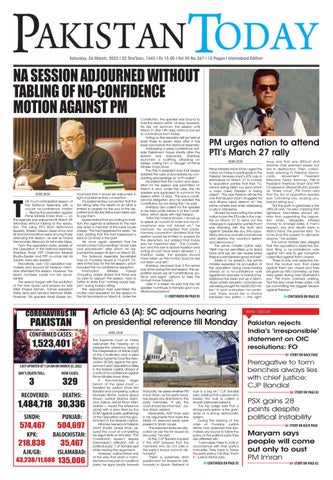
NA sessioN AdjourNed without tAbliNg of No-coNfideNce motioN AgAiNst Pm
News Desk
t
he much-anticipated session of the National Assembly with a crucial no-confidence motion — filed by the opposition against Prime Minister Imran Khan — on the agenda was adjourned till March 28 (Monday) without tabling of the resolution. The ruling PTI’s Shah Mahmood Qureshi, Shireen Mazari, Asad Umar and Ali Muhammad Khan were among those attending the session, as well as Grand Democratic Alliance’s Dr Fehmida Mirza. From the opposition ranks, Leader of the Opposition in the National Assembly Shehbaz Sharif, PPP Chairman Bilalwal Bhutto-Zardari and PPP co-chair Asif Ali Zardari, were also present. Reportedly, over 150 opposition lawmakers and around 50 treasury members attended the session. however, the exact numbers could not be ascertained. The session began with the recitation of the holy Quran and prayers for late MNA Khayal Zaman, former president Rafiq Tarar and Senator Rehman Malik. however, NA speaker Asad Qaiser an-
nounced that it would be adjourned in light of parliamentary convention. It is parliamentary convention that the first sitting after the death of an MNA is limited to prayers for the soul of the departed and tributes fellow lawmakers wish to pay them. Qaiser stated that according to tradition, the agenda is deferred to the next day when a member of the lower house passes. “This has happened for years,” he said, adding that this had happened a total of 24 times in the past. he once again asserted that he would conduct proceedings “as per rules and procedures” after which he adjourned the session till 4pm on March 28. The National Assembly Secretariat had on Thursday issued a 15-point ‘Orders of the Day’ for the NA session, which included the no-confidence resolution. Information Minister Fawad Chaudhry, earlier stated that there was no plan to adjourn the session, took to Twitter to state that “nothing would happen” during today’s sitting. The opposition had submitted the motion and requisition for the session to the NA Secretariat on March 8. Under the
coroNAvirus iN
PAkistAN
CONFIRMED CASES:
1,523,401
LAST UPDATED AT 7:24 AM ON MARCH 25, 2022
DAY'S DEATH TOLL:
NEW CASES:
3
329
RECOVERED:
DEATHS:
1,484,718 30,336 SINDH:
PUNJAB:
574,467
504,697
KPK:
BALOCHISTAN:
218,838
35,467
AJK/GB:
ISLAMABAD:
43,238/11,688
135,006
Constitution, the speaker was bound to hold the session within 14 days. however, he did not summon the session until March 21 [the 14th day], which is now set to commence from today. Voting on the resolution will be held at least three to seven days after it has been laid before the National Assembly. Addressing a press conference outside Parliament house shortly after the session was adjourned, Shehbaz launched a scathing attacking on Qaiser, calling him a “stooge” of Prime Minister Imran Khan. The PML-N president said that Qaiser violated the rules of procedures by conducting proceedings as “a PTI worker”. he stated that the motion and requisition for the session was submitted on March 8 and, under the rules, the NA speaker was supposed to summon the session within 14 days. “This was a constitutional obligation and he violated the Constitution by not doing this,” he said. Shehbaz also called for the speaker to be tried under Article 6 of the Constitution, which deals with high treason. “After the Fateha khwani, I stood up to speak on a point of order but my microphone was not turned on,” he claimed. he accepted that parliamentary convention dictated that the session would be limited to prayers for the departed, but added that today was “an important day”. “The Constitution and the law is above tradition and voting should have been allowed […] tradition aside, the speaker should have taken up the motion [but] he did not listen and left.” Shehbaz declared that if the same was done during the next session, the opposition would use all “constitutional, political and legal” options to take the no-trust move forward. Later in a tweet, he said that the NA speaker “continues to trample upon constitutional provisions”.
CONTINUED ON PAGE 05
PM urges nation to attend PTI’s March 27 rally News Desk Prime Minister Imran Khan urged the nation on Friday to participate in the Pakistan Tehreek-i-Insaf’s (PTI) rally in Islamabad on March 27 to convey to opposition parties that their “funeral is being taken out upon which a naya (new) Pakistan is being raised”. “The new Pakistan will be the one that Quaid-i-Azam struggled for and Allama Iqbal dreamt of,” the prime minister said while addressing a rally in Mansehra. he said he was inviting the entire nation to join the PTI’s rally in the capital on March 27 to send out the message to opposition parties that it was standing with the truth and against “people like you (the opposition) who buy and sell consciences and destroy the country’s system and democracy”. The prime minister further said, “Allah has not permitted us to stand back and say we are neutral when there is a war between good and evil.” earlier in his speech, the prime minister repeated his accusation of the opposition doing horse-trading ahead of a no-confidence vote against him and said “a mandi (marketplace) has been put up in Islamabad where people’s consciences are being bought for Rs200-250 million.” In such a situation, he continued, there would be a choice between two paths — the right-
Article 63 (A): SC adjourns hearing on presidential reference till Monday News Desk The Supreme Court on Friday adjourned the hearing on a presidential reference seeking the interpretation of Article 63(A) of the Constitution and a plea filed by Supreme Court Bar Association (SCBA) against the government and Opposition’s rallies in the federal capital, ahead of a vote of no-confidence against Prime Minister Imran Khan. A five-member larger bench of the apex court — headed by Justice Umar Ata Bandial and comprising Justice Muneeb Akhtar, Justice Aijazul Ahsan, Justice Mazhar Alam, and Justice Jamal Khan Mandokhel — heard the reference along with a plea filed by the SCBA against public gatherings of the Opposition and the government in the federal capital. Attorney General of Pakistan (AGP) Khalid Javed Khan assured the court of completing his arguments on Monday. “The Constitution doesn’t require [lawmakers’] affiliation with a political party,” CJP Bandial said while hearing the arguments. however, Justice Ahsan was of the view that when a member becomes part of a political party, he signs loyalty towards
eous one that was difficult and another that seemed easier but led to destruction. Then, collectively referring to Pakistan Democratic Movement President Maulana Fazlur Rehman, PML-N President Shehbaz Sharif and PPP Chairperson Bilawal Bhutto-Zardari as “ three mice”, PM Imran said that the trio of opposition leaders was “criticising you, scaring you, blackmailing you”. “But the path to greatness is the difficult one,” he said, implying that righteous lawmakers should abstain from supporting the opposition when, allegedly, offered money to change sides. A man’s respect, rizq and death were in Allah’s hand, the premier said. “So none [has the power] to demean anyone,” he added. The prime minister also alleged that the opposition’s objective behind filing a no-confidence vote against him was to get corruption cases filed against them closed. “There is only one objective behind this no-trust war: that cases against them are closed and they be given an NRO (amnesty), as they were given during Gen Musharraf’s era,” PM Imran claimed, adding, “But the day I close these cases, I will be committing the biggest treason against Pakistan.”
CONTINUED ON PAGE 05
MORE INSIDE
Pakistan rejects India’s ‘irresponsible’ statement on OIC resolutions: FO STORY ON BACK PAGE
Prerogative to form benches always lies with chief justice: CJP Bandial that party. he asked whether PM Imran Khan, as the party head, has issued any directives to the party members. “If yes, the court should be informed,” Justice Ahsan added. Meanwhile, AGP Khan said in his arguments that even the MNAs on reserved seats were present in Sindh house. “The reserved seats are allocated as per the list issued by the party,” he said. At this, CJP Bandial inquired if the AGP believes that the members who do not vote in the party’s favour commit dishonesty? “There is extremely strict punishment for khayanat (dishonesty) in Quran. Betrayal of
trust is a big sin,” CJP Bandial said, adding that a person who breaks the trust is called a khaain [dishonest person]. The top judge said that a strong party system is the guarantor of a strong democratic system. During the hearing of the case on Thursday, Justice Akhtar had observed that lawmakers are bound to follow the policy of the political party they are affiliated with. “Lawmakers have to vote in accordance with their party’s mandate. They have to follow the party policy. Full stop, that’s it,” Justice Akhtar said.
CONTINUED ON PAGE 05
STORY ON PAGE 02
PSX gains 28 points despite political instability STORY ON BACK PAGE
Maryam says people will come out only to oust PM Imran STORY ON PAGE 02
02-03 NEWS 26 MARCH_Layout 1 3/26/2022 1:40 AM Page 1
02
Saturday, 26 March, 2022 | ISLAMABAD
NEWS
PrerogATIve To forM beNcheS AlwAyS lIeS wITh chIef jUSTIce: cjP bANDIAl
c
News Desk
HIEF Justice of Pakistan (CJP) Umar Ata Bandial on Friday took exception to “unnecessary” criticism directed at him, saying the prerogative to constitute benches historically lay with the chief justice. He made these remarks at a full court reference held to bid farewell to Justice Qazi Amin Ahmed of the Supreme Court. Justice Bandial said the chief justice had been forming benches for the last 20 years. “Why are objections raised without any reason?” He said it is the chief justice who decides which case will be fixed for hearing and which bench will take it up. “If someone has an objection, come and talk to me.” He went on to say that judges must not be targeted on the basis of hearsay since they cannot respond to criticism. “One can criticise judgments, but not judges.” The statement from the top judge comes
two days after his colleague and the senior most judge on the SC after him, Justice Qazi Faez Isa, wrote a three-page letter to the CJP, questioning the formation of benches without incorporating senior judges. In his letter, Justice Isa had pointed out that the composition of the five-judge bench that is hearing a presidential reference on Article 63(A) of the Constitution consisted of judges who were 4th, 8th and 13th in the seniority list of the court. “This has been done by discarding the good practice of structuring the CJP’s discretion by predecessors of constituting benches consisting of senior-most judges when cases involved important constitutional questions,” he had said. “There is no discernible criterion in the constitution of the present bench,” the letter said, adding that this was “most troubling and gave rise to unnecessary and avoidable misgivings”. The Constitution recognises the most senior judge of the apex court and with seniority comes responsibility, which must
PTI MNA Dehr says he is with govt on no-trust vote
not be shirked, the letter said, adding that the senior-most judge also ensures continuity of the Supreme Court as an institution, but this practice has been discarded, which may have an adverse consequence for the institution. Before the CJP, Supreme Court Bar Association (SCBA) President Ahsan Bhoon addressed the gathering and said the principles of meaningful and purposeful appointments to the top court should be formulated. He observed that qualified lawyers like Justice Qazi Amin should be appointed as judges of the Supreme Court. He also noted that Justice Qazi Faez Isa is a symbol of dignity for the judiciary. “The letter written by Justice Isa gives the impression of division in the judiciary,” said the SCBA president, adding: “I hope the chief justice will create an atmosphere of unity on the issue.” Bhoon also hoped that the judiciary under the current chief justice would rise and its supremacy would be established. In his address, SCBA Vice President
court reference, Justice Bandial also maintained that judges in the Supreme Court were very competent and professional. “Procedures for appointment of judges are being worked out unanimously,” the CJP said, adding that the criterion for [appointment of judges] was based on “competence, conduct and excellent reputation”. He was of the view that judges took decisions on the basis of their conscience. “We are all accountable to Allah, whatever is said in public is only for the media. Judges cannot be targeted without proof.” Justice Bandial said the registrar of the Supreme Court had complete understanding of the law and administrative affairs. “Do you want me to do administrative work too?” he asked, purportedly responding to criticism of the apex court’s registrar’s appointment and his handling of administrative matters. He also called upon critics [of the judiciary] to talk about “useful knowledge” and shun criticism of judges.
Maryam says people will come out only to oust PM Imran News Desk PML-N Vice-President Maryam Nawaz on Friday told PM Imran that the people of Pakistan will “definitely come out to rally but only to oust him and his government.” Her statement, which was issued while she was addressing a PML-N rally in Lahore, was a response to PM Imran’s request to the nation to come out of their houses to support him ahead of the no-confidence motion that the joint Opposition has submitted against him. “People will definitely leave their houses, but only to send you home,” she said. Maryam added that the PM often says he has “trump cards” that he will use to the benefit of the nation. “You only have one trump card and that is your resignation,” she responded.
News Desk Days after claiming that Prime Minister Imran Khan’s conduct had forced him to change his loyalty and join hands with the opposition, PTI MNA Malik Ahmad Hussain Dehr said on Friday that he supports the prime minister in the no-trust vote. Talking to reporters at Parliament House after attending the National Assembly session, Dehr, while replying to a question about where he stood on the no-trust vote, said, “God willing, I am with the government.” When asked whether his concerns had been addressed, he said, “They are [being addressed]. Discussions are being held.” Dehr acknowledged that he had met Prime Minister Imran, saying, “I have some issues that he (PM Imran) will solve. They are being solved and after that, I will support (him).” In response to another question, the MNA said he was still a part of the ruling party. Dehr was one of the dissident PTI MNAs, allegedly found staying at the Sindh House in Islamabad earlier this month. The revelation had come a day after Prime Minister Imran and some cabinet ministers accused the opposition of indulging in horse-trading ahead of the crucial vote on the no confidence resolution, disclosing that Sindh House in Islamabad had become a centre for buying and purchasing members. But while government members continued to claim that these dissidents had “sold their souls for money”, a number of TV channels that sent their teams into Sindh House to verify the claims were faced with nearly a dozen PTI members, who said they had grievances with the ruling party and would vote in “accordance with their conscience”. Talking to the media a few days later, Dehr had criticised the premier and Punjab Chief Minister Usman Buzdar. “I was disappointed to see that PM Imran himself was meeting PML-N dissident MPAs in Lahore to get their support,” he had said and asked how the PTI could call any of its MNAs or MPAs corrupt if they joined hands with the opposition. Answering a question about how much money he had been offered to vote against the prime minister, the MNA had asked a counter-question that the PM should tell how much money he had offered to the four PML-N MPAs whom he met in Lahore. Dehr had also leveled allegations of corruption against CM Buzdar, saying that he himself had given bribe at the CM secretariat to get his job done. Asserting that he could prove the bribe case before the PM, he also threw an open challenge to the premier saying, “the PM should resign if I prove corruption at CM Secretariat. I will resign and even leave politics if I fail to prove corruption.” Subsequently, the PTI issued show-cause notices to 13 MNAs, including Dehr, on grounds of alleged defection, and sought an explanation from them by March 26 as to why they may not be declared defectors and disqualified as a member of the National Assembly. The government had later changed its tone, with Interior Minister Sheikh Rashid appealing to the dissident MNAs to return to the party, assuring them that they would not be questioned. The government has also filed a presidential reference in the Supreme Court, seeking its opinion on whether the votes of dissident MNAs can be counted and whether there disqualification on grounds of defection under Article 63-A of the Constitution will be permanent.
Chaudhry Hafeez said the decision of Justice Qazi Amin in the case of Justice Isa had raised concerns in the bar. He said some judgments of Justice Amin in criminal cases were considered contrary to the Constitution. Hafeez said everyone knew “how history remembers judges from Justice Munir to Justice Gulzar”. Without naming anyone, the SCBA representative said some judges acted like civil servants. He went on to say that some parties were not given a fair chance of hearing at the top court. “For many years, cases are not fixed in the Supreme Court and they eventually become ineffective,” he added. He warned that the institution would suffer “irreparable damage” due to division within judges in the wake of the current situation. Hafeez said all eyes were on the Supreme Court, adding that the apex court must take decisions that upheld the supremacy of the Constitution. During his remarks today at the full-
Usman Mirza, four others get life imprisonment in Islamabad couple harassment case News Desk A sessions court in Islamabad on Friday sentenced Usman Mirza to life imprisonment for holding a couple at gunpoint, forcing them to strip, beating them up, and filming the entire ordeal. Four of Mirza’s accomplices and co-accused — Hafiz Ataur Rehman, Adaras Qayyum Butt, Mohib Bangash and Farhan Shaheen — have been sent to jail for life as well, while two other men, Umar Bilal and Rehan Hassan Mughal, have been acquitted. Additional Sessions Judge Ata Rabbani announced the verdict. According to the court’s order, Usman and his accomplices have been sentenced to life imprisonment under Section 354-A (assault or use of criminal force to a woman and stripping her of her clothes) of the Pakistan Penal Code. The court has ordered them to pay a fine of Rs200,000 each. In case of non-payment, they would have to undergo six months of simple imprisonment. The convicts have also been sentenced to seven years in prison for criminal intimidation (Section 506) and three years for intending to insult the modesty of a woman (Section 509(i)). The sentences would run concurrently with the benefit of Section 382(B) (period of detention to be considered while awarding sentence of imprisonment) of the Criminal Procedure Code granted to the convicts. The case surfaced when a video of four people harassing the couple at gunpoint went viral on social media in July 2021. Initially, an FIR was registered under section 341 (punishment for wrongful restraint), 354A (assault or use of criminal force against woman and stripping her of her clothes), 506 (ii) (punishment for criminal intimidation) and 509 (word, gesture or act intended to insult the modesty of a woman) of Pakistan Penal Code.
She also said that PM Imran is using money from the national treasury to fund his rallies and that the people will hold him accountable for it. PM Imran is being ousted only due to the nation’s curses, Maryam added. “People beg me to spare them from him whenever I go to Islamabad.” While talking about the national exchequer, she added that the PM fears people finding out about the money he has stolen. “He is afraid of the money he has stolen in Bani Gala,” Maryam remarked, adding that “no one will come to his rescue now.” “He used to claim he will never give a National Reconciliation Ordinance (NRO),” Maryam claimed, “now look how he is begging for one.” She further added the next PML-N rally, which will cross the GT Road, will be headed by her and Hamza Shahbaz. It will cause “the prosperous time of Nawaz Sharif’s leadership to come back.”
US chargé d’affaires visits Karachi, meets Sindh governor News Desk
Later, sections pertaining to rape, sexual abuse, extortion, and wrongful confinement were also added to the FIR. The E-11 torture case, which lasted seven months, made headlines once again in January 2022 when the woman complainant retracted her statement against the accused and told a trial court that she did not want to pursue the case. She said she never filed the complaint with the police, adding the investigation officer had taken her thumb impressions on blank papers. She also refused to identify the accused and said she saw them for the first time in the police station. Immediately afterwards, Parliamentary Secretary for Law Maleeka Bokhari said that the state would take up the case as it had “irrefutable video and forensic evidence on record”. “The video of Usman Mirza (primary accused) has been verified by the Pakistan Science Foundation, and we have photogrammetry (pertaining to the technique for making measurements through photographs) evidence,” she had said in a statement.
The United States Chargé d’affaires Angela Aggeler visited Karachi from March 23 to 25 and met with Governor of Sindh Imran Ismail, Port Qasim Authority Chairman Hasan Nasir Shah, industry leaders, and professional female athletes to promote ties between the US and Pakistan on the 75th anniversary of bilateral relations between the two countries. Aggeler held a discussion with women athletes and sports journalists in conjunction with Women’s History Month, and she commended the Pakistani sports stars for breaking barriers on the pitch, in the arena, and on the Olympic podium. “We reaffirm our support for the advancement and achievements of Pakistani women,” she said. The envoy further stated that a better, more secure and prosperous world is created by elevating the societal status of women and girls. The chargé d’affaires also toured Port Qasim and met Port Qasim Authority Chairman Hasan Nasir Shah to discuss opportunities for broader trade and economic engagement between the US and Pakistan. She visited Exquisite, which is LNG company Excelerate’s floating liquefied natural gas and the re-gasification unit, and met with crew members and learned about the company’s contributions toward Pakistan’s energy sector. “Economic cooperation between our countries has long been a fundamental aspect of our partnership and brings prosperity to both our countries,” Aggeler noted. She also observed the operations of US companies Cargill, and Procter and Gamble while at Port Qasim. The US remains one of Pakistan’s largest sources of foreign investment and Aggeler’s visit to Karachi highlighted the importance of strengthening the two countries’ economic relationship, said the statement released. Earlier this week, the US Embassy in Islamabad, while extending its “best wishes to the Pakistani people”, announced the launch of a year-long joint campaign to celebrate the 75th year of the two countries’ bilateral relations.
02-03 NEWS 26 MARCH_Layout 1 3/26/2022 1:40 AM Page 2
Saturday, 26 March, 2022 | ISLAMABAD
NEWS
fM PreSeNTS coNSTITUTIoNAl AMeNDMeNT bIll To NA SPeAKer for creATINg SoUTh PUNjAb
f
119 seats, according to the draft bill moved to create the fifth province of Pakistan. The Ministry of Law and Justice on Thursday circulated the Constitution Amendment Bill 2022 for the approval of the federal cabinet for the creation of a separate new province comprising Multan, Bahawalpur
and Dera Ghazi Khan divisions called South Punjab, according to the cabinet’s summary. Prime Minister Imran Khan has chosen to seek the cabinet’s nod through circulation instead of bringing the summary in the regular cabinet meeting for discussion and then approval.
PTI challenges ECP’s decision to reject petitions in IHC News Desk The Pakistan Tehreek-e-Insaf (PTI) on Friday challenged the Election Commission of Pakistan (ECP) March 18 decision of rejecting the party’s plea to disassociate petitioner Akbar S Babar from the foreign funding case in the Islamabad High Court (IHC). The ruling party also challenged the ECP’s decision which rejected the petitions filed on January 25 and January 31. The petition rejected by the ECP, on PTI’s decision of not providing Babar with the party’s response on the scrutiny committee report, has also been challenged. The party prayed upon the court to accept both petitions rejected by the ECP. “Both the petitions were rejected by the election commission and we pray that the order dated March 15, 2022, be declared null and void. The Election Commission of Pakistan is an administrative authority,
Minister for early implementation of IT package IsLAMABAD TLTP
The government’s package announced for information technology (IT) companies and freelancers should be implemented as soon as possible so that the economy can reap its benefits. Federal Minister for Information Technology and Telecommunication Syed Aminul Haq said this while attending a meeting of the board of directors of Pakistan Software Export Board (PSEB) on Friday. Considering the regulations, such measures should be expedited which would reduce government expenditure but increase revenue, he added. “There is no doubt that the IT industry is playing an important role in the economy of the country but we want the industry to be of fundamental importance in the economic development of the country,” he said, adding in this regard, all the relevant stakeholders and institutions have to work hard, he noted. The meeting was attended by Secretary IT Dr Muhammad Sohail Rajput, MD Software Export Board Usman Nasir, Chairman Pakistan Software House Association Badr Khushnood and other officials and members.
News Desk
OREIGN Minister Shah Mehmood Qureshi on Friday presented a constitutional amendment bill to National Assembly Speaker Asad Qaiser with regards to creating South Punjab as the fifth province of Pakistan by splitting the preexisting province into two. FM Qureshi maintained that he had presented the bill on Prime Minister Imran Khan’s order and that the establishment of South Punjab as a province was part of the Pakistan Tehreek-e-Insaaf’s election manifesto. At the request of Qureshi, the speaker decided to make the bill a part of the house’s agenda for Monday, March 28. “Today we have fulfilled another promise made to the people of South Punjab”, Qureshi said. Deputy Speaker Qasim Khan Suri was also present at the occasion. Earlier this week, the incumbent government circulated a summary for the cabinet’s approval to amend the Constitution in order to split the Punjab province and create a fifth province of Pakistan amid serious political crisis and questions over its majority in the National Assembly. The South Punjab province – proposed to comprise of three divisions – will have 56 seats of the National Assembly and the new provincial assembly will have
03
not a court of law. A three-member bench headed by Chief Election Commissioner Sikandar Sultan Raja had decided to reject the petitions. Only bound to ECP to declare funds’ details,” the petition stated. It further contended that Babar should be separated from the case and PTI’s reply to the scrutiny committee report should not be given to him for the time being. It should be noted that the foreign funding case has been pending in ECP since November 2014. The petitions filed in the IHC against the foreign funding case were disposed of as Justice Mohsin Akhtar Kayani returned the case to the commission on January 29, 2018. A day earlier, a founding member of the Pakistan Tehreek-e-Insaf (PTI) and petitioner in the party’s foreign funding case, Akbar S Babar, claimed that the party has declared 11 of its own accounts illegal in the case. During a press conference in Islamabad, Babar
stated that the foreign funding case has been ongoing for eight years while the scrutiny committee also took four years. “The State Bank of Pakistan’s records show that PTI has disassociated itself from 11 accounts containing Rs23 million, claiming they are illegal,” the petitioner added. According to the estranged PTI leader, the accounts belonged to National Assembly Speaker Asad Qaiser, Governor Khyber-Pakhtunkhwa Shah Farman, Governor Sindh Imran Ismail and Mian Mahmood Rashid and Ahmed Rashid. The petitioner said that “declaring the accounts illegal means the ruling party mistrusts its own people”. “In light of this, the Election Commission of Pakistan (ECP) should take notice and the 11 people whose accounts have been declared illegal should resign immediately,” he added.
NhMP Ig takes notice of complaints PR Inspector General National Highways and Motorways Police Inam Ghani took notice of complaints of commuters regarding overcharging at motorway service areas. National Highways and Motorway Police has received several complaints that shopkeepers at service areas are selling food items at exorbitant prices. In addition, services provided at service areas like workshops, tire shops and restaurants etc. are charging more than the normal market rates. Inspector General Inam Ghani has directed all the Zonal and Sector commanders of the National Highways and Motorways Police to make good efforts with the help of concerned food authorities and the district administration to stop the trend of overcharging.. He further directed to ensure the provision of quality food items and other facilities at reasonable prices at all service areas. An effective check and balance system should be implemented with the help of concerned authorities to discourage such active elements at motorway service areas. on this occasion Inspector General Inam Ghani said that the commuters travelling on the motorways are highly respectable for us and providing best services, timely assistance and taking appropriate actions to redress of their grievances are our top prioritises.
KP PDwP approves rs112.104bn for 25 uplift schemes PesHAwAR TLTP
SC addresses ‘imbalance’ in invoking suo motu jurisdiction News Desk The Supreme Court (SC) has observed that the time had come to recognise the ‘imbalance’ in exercising suo motu jurisdiction, which the court said ought to be ‘addressed’. “The suo motu invoking of the jurisdiction of the Court under Article 184(3) has, over the years, come in for its share of analysis, debate, discussion and, indeed, criticism. It must be acknowledged that this is not something confined just to the Bar but extends to the Bench also. That the jurisdiction can be so invoked cannot now be gainsaid. But the time has come to recognize that there is acertain imbalance, which ought to be corrected”, stated a 40-page detailed judgment authored by Justice Munib Akhtar in a case in which it is declared that Chief Justice of Pakistan (CJP) is the “sole authority by and through whom the suo motu jurisdiction can be, and is to be, invoked/assumed” under Article 184 (3) of the Constitution”.
In August 2021, a five-judge larger bench headed by then acting CJP Umar Ata Bandial had recalled its two-member order regarding harassment of media persons by state institutions. Now, the larger bench has issued reasons for that order. Justice Akhtar, while authoring detailed judgment, said that the imbalance lies in what has been called the “fourth element” above, i.e., the link or bridge between the invoking of the jurisdiction and the exercise of it. “Law and practice require that the suo motu invoking of the jurisdiction lie solely with the Chief Justice. As also seen the law mandates that the constitution of Benches for the exercise of the jurisdiction lies with the Chief Justice alone. It is this that creates an imbalance, and we need not dwell on whether this is a matter of perception only, or both perception and reality. Either way, it is something that, it must be fairly conceded, ought to be addressed,” the judgement read. It posed the question of how was the balance to be
achieved? “To this different answers can be given. However, the one that seems to us to be most readily capable of application is for a suitable practice to develop and crystallize in relation to the ‘fourth element’. Since both the suo motu invocation of the jurisdiction and the constitution of a Bench to exercise that jurisdiction lie in the same hands, it is for those hands, in our respectful view, to act in a manner that dispels any perception of the imbalance”, says the judgment. The court also held that it was constitutionally impermissible and conceptually non-viable for a bench of the court. constituted and acting judicially to exercise suo motu jurisdiction. as it is the chief justice alone who may do so. The judgment noted that a division bench led by Justice Isa acted in a ‘constitutionally impermissible manner’. “We are, with respect, unable to subscribe to the action taken by the learned Bench-II. The order of 20.08.2020 could not be allowed to stand,” the judgement added. The court also noted that when the bench was hearing the matter, another extraordinary event occurred. “The learned senior member of Bench-II (Justice Qazi Faez Isa), on 25.08.2021, filed an application (“CMA”) in this matter. The text of the CMA ran to 15 pages. In it, the learned Judge sought, inter alia, to justify the order dated 20.08.2021 and to criticize and attack the formation of the Larger Bench by the HACJ and the order of 23.08.2021 made by the Larger Bench. Indeed, the order last mentioned was referred to as a ‘purported order’ passed by a ‘monitoring Bench’. A wholly unwarranted attack ostensibly directed at the Registrar of the Court was also launched,” the apex court noted. The apex court further noted, “this was an extraordinary and unprecedented intervention in pending proceedings. We say no more. While we chose, in order to maintain the dignity of the Court, not to draw attention to the CMA during the course of the hearing, it is necessary, as a matter of law, to give quietus to it. It is hereby declared, and directed to be, expunged from the record”.
The Provincial Development Working Party (PDWP) of Khyber Pakhtunkhwa has approved 25 uplift schemes, worth Rs112.104 billion. The 17th PDWP meeting was held under the chairmanship of Shahab Ali Shah, additional chief secretary of P&D department, on Friday. The meeting was attended by senior officers of the concerned departments and members of PDWP. The approved 25 project schemes pertain to rural development, C&W, sport & tourism, elementary and secondary education and public health engineering sectors for the uplift of the province.
04-NEWS-26-March ISLAMABAD_Layout 1 3/25/2022 11:56 PM Page 1
Saturday, 26 March, 2022 | ISLAMABAD
04
NEWS
AlvI, SANjrANI Urge BrItISh BUSINeSSmeN tO INveSt IN SeZS, gwADAr ISLAMABAD
P
TLTP
RESIDENT Arif Alvi has said that there are vast opportunities of investment in Pakistan and foreign investors should take advantage of the business friendly environment. The president said this while talking to a British business delegation on Friday. He pointed out that Pakistan and Britain enjoy excellent economic and trade relations. He said the British businessmen should invest in different sectors of Pakistan’s economy. He said the government is encouraging investment in special economic zones (SEZs) by offering incentives to the investors. The British delegation also called on Chairman Senate Muhammad Sadiq Sanjrani at Parliament House and discussed ways for enriching bilateral cooperation
in the field of investment. Apprising the delegation of Pakistan’s friendly investment policies, the chairman underlined that the environment for investors in Pakistan is conducive which the British should also take benefit from.
“Business and economic ties between the two countries would help bring people closer together. In order to stabilise the economy, we should try to build the confidence of the investors”, he stresses. The chairman also highlighted the im-
portance of Gwadar and how the Gwadar Port could become a game-changer for the entire region. He said that the multibillion dollar project is emerging as a new economic hub and the British investors should also need to seize the opportunity by investing in Gwadar. He said, “Gwadar will play a key role in the development and prosperity of the region.” Pakistan had historical ties with the United Kingdom. Such business and investment-related visits would help accelerate the economic activities, Sanjrani said. On the occasion, Sadiq Sanjrani emphasized that scores of Pakistanis living in the UK were playing the role of a bridge between the two countries. The delegation included Albert Barry lesse (MD Cribgogh Ltd), Thomas Albert Lesse (MD Trulux Group), Jeremy Derek Moxey ( Trulux Group) and Andrew John Edwards ( Trulux Group). Senators Shibli Faraz and Saifullah Khan Niazi were also present in the meeting.
TIPP aims to improve transparency, facilitate trade PR Pakistan Single Window PSW, organized the preview of the ‘Trade Information Portal of Pakistan (TIPP)’ today before a group of public and private sector stakeholders to mark the roll out of the portal in compliance with Pakistan’s commitment under the WTO Trade Facilitation Agreement. The Portal is aimed at facilitating cross-border trade by providing complete trade related information and guidance to individuals and businesses engaged in cross trade. The portal, found at www.tipp.gov.pk will be live on 31st March, 2022 and will provide a single access point for all crossborder trade related information. Over 530 laws, regulations, procedures, and other trade-related measures from over 77 government agencies have been completely digitized and can now be accessed online. Businesses can also access and download licenses, permits, certificates and other documents from the portal and get complete information on applicable fees, processing times and step-by-step procedure. The portal also provides guidance to oversea Pakistanis and foreign investors on various trade related rules and regulations. Welcoming the participants to the event, Chief Domain Officer PSW Naveed Abbas Memon said, “The portal
will provide Pakistan's business community with easy access to information on import and export regulations and procedures. Also, it aims to improve the predictability and transparency of Pakistan’s business environment and provide foreign and domestic investors with quick and timely access to trade rules and regulations. ” With the launch of TIPP, PSW hopes that Pakistan’s business community will have a useful tool to find the information necessary to facilitate their import-export
activities. PSW is committed to closely coordinating with the public and private sectors as well as international organizations to ensure the sustainability of the portal. A guided journey for TIPP users was provided by Mr. Umair Mahmood Siddiqui, Project Lead TIPP, and a visual documentary on TIPP was screened. It was shared that the core features of PSW include digitized customs tariff, trade statistics with latest and current data on 9.2 million transactions. Moreover, it is
available in English and Urdu languages. The portal is the latest government initiative to improve cross-border trade and to facilitate Pakistan's accession to the World Trade Organization (WTO) by complying with the WTO Trade Facilitation Agreement. The development of the trade information portal is also a major step towards creating a conducive environment for doing business in Pakistan. As a single, easily searchable platform containing all trade regulations and procedures, the portal will save businesses time and operational costs, especially smaller enterprises interested or involved in the import, export, and transit businesses. It will also improve trade regulations, as stakeholders will be able to suggest ways government could modernize and simplify regulations and procedures. Pakistan Single Window (PSW) is an initiative of Pakistan’s federal government with a focus of transforming the trade and industry ecosystem. The program encompasses several aligned smaller initiatives to support PSW’s cause of transforming trade such as business processes re-engineering, integrated risk management, ports community systems, introduction of new technology for trade management, data standardization and harmonization and integrated tariff management system.
Education minister inaugurates centre of excellence PR Federal Minister for Education and Professional Training Mr. Shafqat Mahmood
inaugurated the NAVTTC Centre of Excellence in Modern Technologies at National Vocational and Technical Training Commission, Islamabad. It has been es-
tablished by NAVTTC with the cooperation of GIZ, European Union, Norway and Germany. The Minister emphasized the need for more Centres of Excellence which provide state of the art cutting edge technology trainings to the youth, which are in high demand internationally and in industry. NAVTTC has established COE Islamabad with multiple labs in modern technologies through donors, for Mechatronics, IT and CNC lab. The Minister further said that Government gives top priority to the TVET sector and has provided Rs.10 Billion under NAVTTC’s Prime Minister’s Skills for All - Kamyab Jawan Program, which is the flagship program of the government for providing income generating Hi-TECH skills to youth. The Government continues to give a high priority to skills training especially in Hi Tech like Artificial Intelligence, Robotics, cyber security etc. The Government has given NAVTTC the target to produce one million skilled youth workforce, and availability of such a big skilled labour will cause a massive improvement in the jobs market and industry. The government is focusing on the reforms in TVET sector to bring the technical and vocational trainings in line with the requirements of the marketplace, in order to prepare the workforce with accreditation from
CMYK
international bodies. Chairman NAVTTC, Syed Javed Hasan shared that NAVTTC is working hand in hand with the training partners for enhancing quality of the TVET sector. NAVTTC has so-far successfully trained 74,736 youth in 150 High-TECH and 100 Conventional technologies with 71% employment. Another batch of 63,000 youth are being given skill trainings through 989 Training partners and reputed universities. 95% youth have expressed satisfaction over the quality of the trainings by NAVTTC. He mentioned that Skills for All Strategy of government is working as a catalyst for imparting quality training among youth. Executive Director NAVTTC Sajid Baloch assured that NAVTTC is fully committed to provide quality trainings and thanked the donors the EU, Germany and Norway for their valuable support to Pakistan. The Minister appreciated the efforts of NAVTTC team for accomplishing the task of establishment of CoE in Modern Technologies. NAVTTC COE Islamabad will be a Center for training of Chief Master Trainers and Master Trainers, who would then train a large number of youth in modern employable technologies. This will further pave the way towards allowing the Pakistani TVET system to sustainably improve delivery of training and assessment, career counselling and job placement.
AIOU celebrates Pakistan Day PR Great nations never forget the sacrifices of their forefathers, which is why today the Pakistani nation pays homage to Quaid-e-Azam Muhammad Ali Jinnah, the poet of the East, Dr. Allama Muhammad Iqbal and other leaders of Tehreek-ePakistan”, said by the Vice Chancellor AIOU, Prof Dr Zia Ul-Qayyum while presiding over a function on the occasion of “Pakistan Day” at Karachi campus. He further said that, this day teaches us a great lesson that those who contribute to the tireless and sincere efforts for the national cause are always remembered with utmost devotion. Director Regional Services, Dr. Malik Tauqeer Ahmad Khan, former DGRS, Inamullah Sheikh, Regional Director Karachi Campus Irfan Ali Ansari, heads of local educational institutions, tutors and a large number of students attended the event.VC AIOU, Prof Dr Zia Ul-Qayyum added that no country can develop unless it emerges as a nation. Let’s make a resolution today to form a society free of prejudice comprised of tolerance and brotherhood. DGRS, Dr. Malik Tauqeer Ahmed Khan, Inamullah Sheikh and Irfan Ansari also addressed the function. Meanwhile, Prof Dr Zia Ul Qayyum while giving details of expansion of educational network in remote areas of Sindh shared that, we have successfully acquired plots for construction of campus buildings in Hyderabad, Dadu, Jamshoro, Thatta, Umar Kot and Mithi on which construction work has been started. He was sharing these details with the journalists of Karachi at Karachi Press club. Talking about the MoU’s, he shared that Open University of Leicester, in collaboration with UK would train MPhil and PhD senior and middle management tutors. These train tutors will further train tutors to become master trainers for other tutors and students to use the online Agahi portal. The Vice Chancellor also met Saleem Raza Jalbani, Chairman Sindh Technical Education and Vocational Training Authority (STEVTA) in which he assured of its full support for professional development in Sindh.
Shafqat inaugurates National Skills University Islamabad PR Federal Minister for Education and Professional Training inaugurated National Skills University Islamabad today. Speaking on the occasion, he described the ceremony organized for this event as a dream come true. According to him, on his first visit to the university, it was a barren and deserted place with disappointed employees. Illegal occupants occupied several areas of the university. With the arrival of Founding Vice Chancellor, Professor Dr. Muhammad Mukhtar, the area has improved gradually. It is one of the most thriving skill education centers with hardworking, highly qualified, skilled employees. The university's contributions towards Prime Minister's Hunarmand Pakistan Program are praiseworthy. The Minister lauded Chancellor Dr. Arif Alvi's continued support towards the university, mainly in establishing an industry advisory council. The Federal Minister also appreciated the university Vice Chancellor's efforts in implementing a new skills education model in collaboration with several international partners across the globe. Speaking on the occasion, the Vice Chancellor, Prof. Dr. Mukhtar briefed how the university got its national and international recognition within the shortest span. Moreover, he briefed that six undergraduate programs in various technology domains have been introduced initially. Besides this, high-tech short courses under the umbrella of Prime Minister Hunarmand Pakistan Program are also ongoing. The most prestigious IT company, Systems Ltd, is also running a program on Professional Programming at the university's premises. Both the Minister and Vice Chancellor appreciated Mr. Mohyuddin A Wani, Additional Secretary, MoFE & PT, for resolving several complex governance matters related to the NSU. Mr. Shahid Ahmad Khan, a member of the Industrial Advisory Council of the university, briefed about contributions of this body constituted by the University Senate and its accomplishments. The Federal Minister also inaugurated a 50 computers IT laboratory. All these computers have been provided through Muller & Phipps and Dell Technologies.
Saturday, 26 March, 2022 | iSlAMAbAd
NewS
05
Yemen rebel attack on Saudi oil plant SetS off huge fire bY f1 track JEDDAH
a
AFP
Yemeni rebel attack on a Saudi oil plant set off a huge fire near Jeddah's Formula One circuit during practice sessions on Friday, part of a wave of assaults on Aramco facilities. Smoke billowed near the circuit and drivers complained of the smell in the most visible of 16 drone-and-missile attacks claimed by the Iran-backed rebels around the country. The wave of assaults comes ahead of the seventh anniversary of a Saudiled coalition's military intervention against the Houthis in Yemen, a country in the grips of a major humanitarian crisis. Oil prices have soared since Russia's in-
vasion of Ukraine sparked supply fears, prompting Western powers to implore OPEC countries to ramp up production. The attacks targeted "Aramco facilities in Jeddah and vital facilities in the capital of the Saudi enemy, Riyadh", tweeted Houthi military spokesman Yahya Saree. Facilities of oil giant Aramco were also attacked in Jizan, Najran, Ras Tanura and Rabigh with "a large number of drones", he added. The Saudi-led coalition fighting the Iran-backed rebels confirmed the Jeddah oil plant attack. "They are trying to impact the nervecentre of the world economy," the coalition said in a statement. "These attacks have no impact on life in Jeddah," it added. Red Bull's world champion Max Verstappen said he could smell the blaze as he
drove in practice sessions that were beamed live around the world. "I can smell burning... is it my car?" the Dutchman asked over team radio. An F1 spokesperson said: "The position at the moment is that we are waiting for further information from the authorities on what has happened." The rebel attacks also included an electrical station in Jizan, bordering Yemen, which was set ablaze. The Saudi-led coalition intervened to support Yemen's internationally recognised government in 2015, after the rebels seized the capital Sanaa the previous year. The war has killed hundreds of thousands directly or indirectly and left millions on the brink of famine in what the UN calls the world's worst humanitarian catastrophe. Saudi Arabia, one of the world's biggest
oil exporters, warned this week that rebel attacks posed a "direct threat" to global supplies. Saudi Arabia "will not incur any responsibility" for shortages in oil supplies in light of the Iran-backed Houthi attacks,
Article 63 (A): SC adjourns hearing on presidential reference till Monday ContinuED from pAgE 01 Justice Mandokhel, while addressing AGP Khan, remarked that he is the attorney-general of the country instead of a party representative or a counsel. He asked if staying loyal to the party was necessary even if the prime minister does anything wrong. “Can’t I disagree with the prime minister if he takes action against national security,” Justice Mandokhel asked. At this, AGP Khan asked the judge to give up the
discussion on the prime minister as it is irrelevant in this situation. He argued that the prime minister takes oath as a member of the assembly and then as the premier. “Responsibilities of a prime minister and an MNA are different,” he said. AGP Khan said that the practice to run a party according to its manifesto is followed in the sub-continent. “When military courts were established, Raza Rabbani supported his party’s stance despite his differences with the party.” “If your [lawmakers’] conscience has
woke up then render resignations.” Responding to AGP’s argument, Justice Mandokhel inquired why should an MNA hand down the resignation. “Should a member who is using the right to vote/freedom of speech be disqualified for life,” Justice Mandokhel inquired. At this, AGP Khan maintained that there are some limits regarding the right to vote/freedom of speech. “You cannot enjoy the freedom of speech by yelling at an ailing person and becoming his cause of death,” AGP said.
NA session adjourned without tabling of no-confidence motion against PM ContinuED from pAgE 01 “This partisan behaviour does not suit the custodian of the house. Adjournment of NA session is part of desperate efforts to disrupt no-confidence process,” he said. “You cannot stop the inevitable through such underhand tactics!” Bilawal claimed that the premier was “fleeing the pitch” and reiterated that Qaiser had violated the Constitution. However, the PPP chairman asserted that opposition parties were united and would not let the premier “run away”. “The no-trust motion is going to be our democratic weapon. We will move towards free and fair elections,” he said, adding that the prime minister had lost “his majority and government”. He later added that Qaiser had provided a “weak excuse” to avoid tabling the no-trust move. “Imran can’t run forever. The PM has no sportsman sprit and cannot face defeat with grace. The once great Kaptaan will go down like a rat on a sinking ship,” he said. Separately, Foreign Minister Shah Mahmood Qureshi demanded an apology from Shehbaz for his tirade against the NA speaker “The words you have used against Asad Qaiser are inappropriate and I want you to retract the remarks immediately,” he said, adding that the speaker was responsible for conducting proceedings in whatever manner he sees fit. He also refuted claims that the government was “running away” from the no-confidence motion. “We will deal with it in a democratic, political, and legal way.” Responding to a question from a journalist, the minister that the opposition was set to receive another surprise on March 27. Opposition leaders had also gathered for a meeting prior to the session during which, according to the PPP, “important instructions” were given to lawmakers. Zardari, who was hounded by reporters as he made his way inside the Parliament House, had appeared to be confident. “All eyes are on you. You have pre-
CmYK
vious experience. How confident are you?” asked one reporter. “God willing, if my Maula wants, 100 per cent,” he replied. He had added that the opposition would “create a ruckus” if the NA speaker did not allow the motion to be tabled. He had also brushed aside concerns that “undemocratic powers” could take advantage of the situation. “We have a strategy for that: If you are so interested, then you are most welcome.” His son, Bilawal Bhutto-Zardari, was also all smiles and told reporters that the no-confidence motion had been included in today’s agenda. “Going forward, the people will win and the ‘selected’ will face defeat. Winning and losing are in the hands of God [but] we are working hard,” he said. Asked what would happen in case the motion is not taken up, he said: “See how we manage it […] we are completely prepared.” Shehbaz said that the opposition would exercise its right to table the motion during today’s session. However, if the motion is not tabled, then we will consult among ourselves, he said. Meanwhile, the NA speaker had on Thursday issued guidelines for MNAs in view of strict security arrangements being made for the session. According to the speaker’s notification: “No visitor/guest/security guard of the ministers/parliamentarians will be allowed in the precincts of Parliament House and it would be advisable to restrict them up to D-Chowk, in front of Parliament Lodges.” To avoid traffic congestion, a shuttle service will operate between Parliament Lodges, government hostels and Parliament House to facilitate members of parliament, the order said. It said personal drivers of parliamentarians were required to park their vehicles at the designated parking area and not to leave the vehicle unattended. Security agencies deputed at the Parliament House have also been instructed to make arrangements accordingly and ensure the implementation of the speaker’s instructions.
the foreign ministry said. The statement on Monday came a day after the kingdom acknowledged a temporary drop in production after the Houthis attacked a refinery with an armed drone.
pm urges nation to attend pti’s march 27 rally ContinuED from pAgE 01 Again referring to opposition leaders and the no-trust vote brought by them, he said the “three stooges, the three mice are out to hunt me”. “But I will defeat them,” he said. The prime minister also alleged that opposition leaders, when they were in power, had looted the country’s money and transferred it to bank accounts abroad, “which enslaved the entire nation”. “And when I became the prime minister, I was resolute that I would not let the country become a slave to [any other entity],” he said, adding that “I will prove [this by ensuring] that the green passport is respected across the world.” He further said the only way for Pakistan to progress was to abide by the principles laid by Prophet Muhammad (Peace Be Upon Him) in the state of Madinah. “And only then the green passport will be respected in the world,” he added. Listing different initiatives taken by his government, such as the issuance of health cards, PM Imran said the country was now on the path to becoming an example for the rest of the world. The prime minister further said he told himself every time before addressing a rally that he would not refer to Pakistan Democratic Movement President Maulana Fazlur Rehman as “diesel”. But, he continued, “What should I do? Whenever I stand up to deliver my speech, shouts of diesel start coming from the [crowd], from every direction.” “And in bad and difficult times, I tried to bring down the price of diesel,” he remarked. Taking a jibe at Shehbaz, the prime minister said he “is begging every other person to become the prime minister”. “You polish everyone’s boots and so, I have named you Cherry Blossom,” he commented. Continuing his tirade against the Sharif family, the prime minister said it seemed to him that they might shift to London and practice politics there. “And if that happens, the UK would approach us for a loan saying that they have bankrupted the country,” the premier remarked.
06-07 Comments - 26th March 2022_Layout 1 3/25/2022 9:57 PM Page 1
Saturday, 26 March, 2022
06 COMMENT
Justice Qazi Faez Isa’s letter
Unauthorised accounts The emperor has no clothes
W
HAT Akbar S. Babar, founding member of the Pakistan Tehreek-e-Insaf (PTI), revealed on Thursday raises serious questions about the financial integrity of the PTI leadership which continues to use religion and morality to advance its political agenda while accusing its political opponents of indulging in corruption, calling them thieves and dacoits. As Babar put it, on March 15 the PTI at long last submitted written replies to the ECP in response to queries raised by the Commission’s scrutiny committee, in which it declared as “unauthorized” 11 bank accounts that were opened and operated by key party leaders for a number of years. According to the reply, the “illegal” accounts received hefty amount of Rs 23.22 million from the PTI’s central accounts, adding that an additional Rs 57 million was deposited in them from local sources that were not accounted for with the party’s Central Accounts. According to the PTI, it initiated “an appropriate and required exercise” upon learning of the accounts, adding that it had been “unaware” of them until the SBP had disclosed their details. This reveals an unconscionable naivety on the part of the PTI leadership which has taken on with a messianic zeal the mission of naming, shaming and jailing opposition leaders it accuses of misappropriating public funds The individuals involved in the unauthorized activity include national Assembly Speaker Asad Qaiser, Sindh Governor Imran Ismail and Khyber Pakhtunkhwa Governor Shah Farman besides several others. In case these party leaders had opened and operated accounts worth millions of rupees for a number of years without the party leadership’s knowledge or permission, why were they not chargesheeted and punished by the PTI leadership instead of being rewarded with public offices? This could create a perception that the unauthorized accounts were being operated for some unmentionable purposes with the knowledge and connivance of the top party leadership. That the PTI opposed sharing the report with the party which has taken the foreign accounts case to the ECP, indicates it wanted to keep facts secret from the general public for fear of exposure. The nature if these acoun ts, and what happened to any interest that may have accrued, is not known. The question of whether the donation came from a legal source or not is an entirely separate matter, though it too needs answers which are not forthcoming from the PTI.
His letter casts a harsh-seeming light on the Supreme Court
Dr Qaisar rashiD
O
vER the years, owing to issuing politically motivated decisions and submitting to the pressure of intelligence agencies, Pakistan’s higher judiciary has lost its credibility. Pakistan has also witnessed the time when the higher judiciary took suo motu notices on even tweets of journalists. Just one tweet of a journalist could move the highest court to divert its eyes from thousands of pending court cases. On 22 March, the Supreme Court’s senior-most judge Justice Qazi Faez Isa wrote a three-page letter to the Chief Justice of Pakistan Justice Umar Ata Bandial. The letter offers a four-pronged insight into the functioning of the Supreme Court (SC). First, the SC has transgressed its constitutional mandate by fixing for hearing the presidential reference which had invoked the SC’s advisory jurisdiction to interpret Article 63-A and which had not been filed for hearing. This matter had sought opinion and not an order of the SC. Second, the SC has overstepped its constitutional mandate by fixing the presidential reference for hearing along with the writ petition of the Supreme Court Bar Association (SCBA) on the no-confidence motion under Article 184(3), which is the original jurisdiction of the SC. The SCBA’s petition had sought an order of the SC. With that, the two matters cannot be heard simultaneously. Third, the SC has not made any set rules and regulations to constitute benches. Even the past practice of constituting benches on the basis of seniority to hear important constitutional cases has been abandoned for no reason. This is where biases creep in. Like-mindedness is preferred to merit. The outcome of hearing is predetermined. Some judges are deliberately debarred from hearing cases despite the fact that they are the senior-most judges having more experience and knowledge than those who have been included. Fourth, the SC has made a compromise on collec-
Wang in Kabul China’s message to the Taliban is quite clear
C
HInESE Foreign Minister Wang Yi dropped in on the Taliban regime at Kabul when returning home after visiting Pakistan for his special presence at the OIC Foreign Ministers’ meeting, and to attend the Pakistan Day Parade. During his visit, Mr Wang gave the Taliban what must by now be a familiar message: that if it hopes to join the international community, winning general recognition from other countries, it must conform to the standards set by the international community, which include allowing women to obtain an education, and protect civil rights more generally. The Taliban administration has got precious little to show on all fronts. Another issue which is perhaps of more concern to the whole world, is the Taliban choosing to back terrorism. Of particular concern to China would be the East Turkestan Islamic Movement, which has been active in Xinjiang province, where the Chinese state is in conflict with the Uighur residents. The Taliban should remember that it was the support of terrorist groups that had got them in trouble after 9/11, and the world will not tolerate their providing terrorist groups safe havens to operate from. Though so much triumph was expressed in Pakistan at the Taliban victory, and so much sadness expressed in India, that it almost seemed Pakistan had entered Kabul, within weeks there was an unmistakable upsurge in terrorist activity by the Tehrik i Taliban Pakistan. One reason for this was that the TTP was able to find protection from the Afghan Taliban, who simply refused to hand over any of those suspected by Pakistan of being guilty of terrorism. Almost as if encouraged by the TTP, the IS-KP also became active, The IS-KP is opposed to the Taliban, and their revival shows that Taliban control may be very loose. This is also one of the issues Mr Wang raised. The Taliban depend on Chinese investment, and participation in the Brick and Road Initiative, for survival. That investment, and extension of the BRI, depends on their being able to provide security. Apart from failing to come good on any of the requisites for international recognition, they no longer seem to provide what was supposed to be a hallmark of their previous regime: law and order. If Mr Wang’s visit does not convey the message, what will?
The presidential reference is a delaying tactic Dr Tausif Kamal
I
n the face of its looming defeat in the national Assembly’s impending vote and the President’s Reference to the Supreme Court regarding the Opposition’s no-Confidence Motion, it seems that the PTI Government has resorted to delaying tactics in the hope that this might change the outcome. The central point of this Reference, in which the Government’s application seeking advisory jurisdiction of the Supreme Court has been joined with with the Supreme Court Bar Association’s petition for the SC’s original suo motu jurisdiction, is the interpretation or judicial clarity of Article 63A of the Pakistan Constitution. This provision specifically deals with the subject of disqualification of the members of national Assembly on the ground of defection from their political party. Firstly, it states that on a no-confidence (or confidence) motion under consideration in the Assembly, if a member does vote or abstain from voting contrary to the direction of his political party, the head of his party (“Party Head”) may declare that the member has defected from the party. However, prior to issuing such a written declaration of defection the Party Head “shall” send a show cause notice to the member as to why he should not be declared to have defected from the party. Secondly, the Party Head “may” then send a copy of this declaration to the Speaker (Presiding Officer) of the Assembly. Thirdly, the Speaker “shall” forward the declaration within 2 days to the Chief Election Commissioner. Fourthly, the Chief Election Commissioner then tables the declaration to the Election Commission within 30 days for its decision to confirm this declaration. Upon such confirmation the defecting member “shall” stop being a member of the Assembly and his seat to be declared vacant. Fifthly, the member “may” file an appeal within 30 days against the confirmation order of the Election Commission to the Supreme Court. Sixthly and finally, the Supreme Court “shall” render its decision within 90 days of filing the appeal. As is evident, disqualification of a member on account of his dissenting vote is neither automatic nor mandatory. It’s the end result of a long, deliberative
Arif Nizami (Late) Founding Editor
Yousaf Nizami M. A. Niazi
Umar Aziz
Joint Editor
Joint Editor
Executive Editor
Lahore – Ph: 042-36300938, 042-36375965
I
Karachi – Ph: 021-35381208-9
I
of the SC. The case proceeded against him. As a court reporter, a senior journalist Matiullah Jan, known for his outspoken views, pointed out the biassed behaviour of his fellow judges against Justice Isa. On 21 July 2020, Jan got abducted from the capital city, Islamabad. This was a case of enforced disappearance. He was handcuffed, blindfolded, transported, locked up and beaten, besides being reproved for his crime as a reporter. Though he got released after 12 hours of illegal detention, a hue and cry gripped the country questioning the democratic credentials of the current government. Interestingly, the fellow judges who heard the case for almost one year acknowledged that the allegations were unfounded, but they shied away from extending a full relief to Mr Justice Isa. On 26 April 2021, the SC exonerated Mr Justice Isa of any blame of misconduct. Anyway, for the truth spoken by a judge, not only the judge but a journalist also paid the price. Unfortunately, this is what Pakistan has turned out to be. Speaking the truth has a cost that the speaker has to pay. It is unfortunate that the SC becomes an instrument for launching a procrustean rule characterized by reduced opposition, controlled society and structured consent, overlooking the fact that Pakistan is an established democracy run by a written constitution. Jugglery has no place. It is known that frequent martial laws have dented democracy, injured the SC’s desire for independence, and mauled the normalcy of people at large. The Pakistanis desire that their country practice untainted democracy, exercise the supremacy of law, and respect the constitution in letter and spirit. This is why judges like Justice Isa are considered a ray of hope and this is why journalists like Matiullah Jan are revered in society. It is high time the SC reversed its stature of compromise and observed constitutional supremacy. Reforms should be introduced in the functioning of the SC to restore the trust of people in it.
The SC exonerated Mr Justice Isa of any blame of misconduct. Anyway, for the truth spoken by a judge, not only the judge but a journalist also paid the price. Unfortunately, this is what Pakistan has turned out to be.
No confidence reference
Dedicated to the legacy of late Hameed Nizami
Editor Aziz-ud-Din Ahmad
tive wisdom. The past practice of consulting with the senior-most judges on matters of public importance in order to make a decision has been terminated. Fourth, the SC has made a compromise on its independence by retaining a bureaucrat as its registrar, despite the fact that judicial officers can fulfill this post. The current practice of keeping a bureaucrat as the SC’s registrar has made the SC vulnerable to external influences and pressures, besides opening a channel to leak out the proceedings of the court. The letter shows that the SC still runs in a manner prejudiced to public interests. This is not the kind of higher judiciary that the people of Pakistan dreamt of. The question is this: when the SC itself is overstepping the prescribed constitutional limits, how can the country run along constitutional lines? A higher judiciary violating rules, laws and constitution cannot discipline other institutions of the country. Such a higher judiciary serves no purpose, other than gobbling up the taxpayers’ money in the name of salary and security. Millions of rupees are spent on the SC each year to deliver what: a compromised higher judiciary, amenable to external pressures. Its efforts for the delivery of justice are otiose meant for an outright dismissal. This one letter has exposed the sordid state of affairs gripping the SC. Mr Justice Isa is no ordinary judge. He is known for his integrity and intrepid decisions sparing no center of power. In his judgments, he produces legal references and logical reasons that convince a reader of his command of law and h5ssanity. He is also known for his fearless pro-democratic penchant. The reason for his being ostracized despite being a senior judge is known. In February 2019, in the Faizabad sit-in case, Justice Isa issued a judgment which pointed the finger at the clandestine role of Pakistan’s top intelligence agency in organizing demonstrations– by marshalling religiously fanatic people and by assisting them financially– against a sitting government to make it tumble. In retaliation, the intelligence agency cooked up a case against Mr Justice Isa to blemish his name. The ultimate objective was to exclude him (or make him step down) from the panel
process in which the Party Head may or may not commence disqualification proceedings in the first place and in which the dissenting member has full due process rights of show cause and appeal. We must also note that the disqualification process for defection is triggered only when and after a member actually casts such vote in the Assembly. His/her vote is fully effective and valid to be counted no matter how hostile and anti-party his/her behaviour has been before voting. By the way in other democracies, people’s representatives have an unassailable right to vote as they deem fit and vote according to their conscience. If ordinary citizens have this right why can’t their representatives in the assemblies have the same right? In U.S. Congress, according to GovTrack (www.Govtack.us) an entity that compiles Congressional data, dissenting votes against party lines are cast 30 percent of the time without any action taken against the defecting Congressperson. In the UK also contrary votes against the dictates of the party are often cast by the parliamentarians with the maximum punishment of being expelled from the party. Regarding the period of a defecting member’s disqualification from the Assembly, the constitutional provision of Article 62, that deals with qualification of members cannot be applied for the purpose of determining the disqualification period on account of defection. Disqualification and qualification of members are separate subjects in our Constitution for which separate Articles are provided. As far as determining the period of disqualification for defection is concerned, the courts have to
Islamabad – Ph: 051-2204545
The writer may qaisarrashid@yahoo.com
be
reached
at
look within the parameters of Article 63A, the Constitution’s only and exclusive provision on this specific subject. It’s a basic principle of constitutional interpretation that where provisions for specific topics exists in the Constitution, they takes precedence over other articles or provisions that do not specifically pertain to that particular topic. Article 63 that deals with disqualification on grounds other than defection and Article 62 that pertain to the qualifications for members would be hard pressed to be applied in this case. Though length of disqualification is not mentioned in Article 63A, the legislative intent is obvious: to limit the disqualification and unseating of the errand member to the fixed term of the national Assembly. Pursuant to Article 63AI4), upon confirmation of defection declaration by the Election Commission,”…the member shall cease to be a member of the House and his (her) seat shall become vacant.” “House” means the national Assembly (or the Senate as the case may be)—Art 63A(7)(b). Article 52 fixes the term of the national Assembly as five years maximum. So its evident that the defecting member shall be disqualified from the national Assembly for the remaining term of that Assembly, not exceeding five years. We must understand that when our Constitution is talking about “national Assembly” (or House) in this disqualification clause, it’s not talking about a concrete or mortar building of the national Assembly. It is talking about the national Assembly in session comprising human members who have been elected by the people for a period of five years. Furthermore a member’s seat in the Assembly, which becomes vacant upon his disqualification, is only for five years-the maximum duration for which a member can be disqualified for this reason.
When our Constitution is talking about “National Assembly” (or House) in this disqualification clause, it’s not talking about a concrete or mortar building of the National Assembly. It is talking about the National Assembly in session comprising human members who have been elected by the people for a period of five years
I
Web: www.pakistantoday.com.pk
I
Dr Tausif Kamal is a U.S.based attorney at law, and can be c6ntacted at Tausifkamal@hotmail.com and ktklaw147@gmail.com
Email: editorial@pakistantoday.com.pk
06-07 Comments - 26th March 2022_Layout 1 3/25/2022 9:57 PM Page 2
Saturday, 26 March, 2022
COMMENT 07 Editor’s mail Send your letters to: Letters to Editor, Pakistan Today, 4-Shaarey Fatima Jinnah, Lahore, Pakistan. E-mail: letters@pakistantoday.com.pk Letters should be addressed to Pakistan Today exclusively
Gas woes I would like to register a complaint against SnGPL. My family has been a resident of Gulberg 5 in Lahore, since 1970. My husband and I moved here in 1982. Our gas meter was removed from the outer wall on March 9, 2022. Today is March 23 and we are still without gas. My 77-year-old husband is a heart and cancer patient. We have suffered immense mental and physical torture and we demand a full investigation by the SnGPL. Despite being under review for excessive billing, the meter was removed by SnGPL from the outer walls of our house. I demand a full compensation for the mental stress caused to us. We had received a bill for Rs220,060. I immediately went to the SnGPL office to contest the bill. They accepted my complaint and immediately put my case under review. I am grateful to SnGPL for this. I want my meter restored immediately. This is not the way to behave with people aged 75 years and 77 years old. Kindly examine our history and the manner we have always paid our bills. For a company that prides itself on customer service, this is unconscionable. NUSRAT JAMIL LAHORE
Reforming organisations
OIC conference and Rohingya refugee issue Bangladesh bears the burden of millions of Rohingya refugees hafizur TaluKDar
A
conference of foreign ministers of the Organization of Islamic Cooperation (OIC) started at the Parliament House in the Pakistani capital Islamabad on March 22. This year the conference was held under the theme ‘Building Cooperation for Unity, Justice and Development’. The conference was very important to address some common problems for the Muslim world. At the beginning of the conference, the Foreign Minister of Pakistan Shah Mahmood Qureshi welcomed the OIC foreign ministers to the conference. “The OIC is the collective voice of 200 million Muslims around the world,” he said. It is a bridge between the Muslim nations and the world community with the Muslim world. Foreign ministers from 46 countries of the 57-member bloc are taking part in the conference. Delegations from other countries are being led by senior foreign affairs officials from those countries. The conference discussed the challenges that the Muslim world is currently facing. The Prime Minister of Pakistan Imran Khan delivered the inaugural address of the conference. He highlighted Pakistan’s role in the OIC. At the same time, the Pakistani Prime Minister talked about the challenges facing the Muslim world. Mr Qureshi also addressed the gathering. It is pertinent to mention that the Rohingya refugee crisis is a crisis not only for Bangladesh-Myanmar but also for the whole Muslim world. There are many crises increasing day by day worldwide. Bangladesh Foreign Secretary Masud bin Momen participated on behalf of Bangladesh. He said that the sustainable solution to the Rohingya issues lay in their repatriation. Bangladesh cannot bear the immense socio-economic and environmental costs by hosting millions of refugees for an indefinite period; therefore, these people must be repatriated to their place of origin in Rakhine State, he said during his speech on the open-ended meeting of the OIC Ad Hoc Ministerial Committee on Accountability for Human Rights violations against the Rohingyas. The meeting was convened on the sidelines of the 48th session of the OIC) Council of Foreign Ministers. Being as a major crisis in the Muslim world, members of OIC should be concerned on the Rohingya refugee crisis. There is no way for all members without supporting Bangladesh. The Muslim world must remember and consider the Rohingya are also one of the persecuted Muslim communities in the world like Palestinians and 6thers. Foreign Secretary Momen in his statement reiterated the importance of repatriation of the Rohingya to avoid transnational socio-economic catastrophe due to millions of Rohingya, especially thousands of juveniles and youths apprehensive of no hope for their future. While thanking Gambia and the OIC and for the kind support for the legal action, he called for keeping the momentum going to provide justice to the
Rohingya. He also called for strong solidarity from the member states by contributing voluntarily to meet the legal expenses of the case. Turkey committed to contributing $200,000 to the fund. The members of the ad-hoc committee praised Bangladesh for hosting this large number of refugees over the years and even bringing them within the Covid-19 vaccine program. But Bangladesh faces some challenges to deal with the problems. The member states must help Bangladesh resolve the Rohingya crisis. The Organization of Islamic Cooperation (OIC) Secretary-General Hissein Brahim Taha stressed that the Rohingya case is one of the top priorities on the OIC’s agenda, one that the organization has been following for over two decades. The OIC must be committed to resolving the crisis as soon as possible. Unity on the issue amongst the member states must be essential to compel Myanmar to take back the Rohingya. In comments to mark the outcomes of the ad hoc Ministerial Committee on the Accountability for Myanmar over Human Rights violations against Rohingya, he stated that the committee’s meeting was held at a critical time in the midst of important developments related to the case against Myanmar at the International Court of Justice. As the Chinese foreign minister attended the conference, OIC member states can seek assistance from China to help solve the Rohingya refugee crisis because China has warm relations with Myanmar. He pointed out that this case sends a strong message to the international community about the OIC’s collective and coordinated work to support the Rohingya people, as well as its firm commitment to global ideals and principles of justice and accountability for human rights violations. The situation of the Rohingya has not improved despite the efforts and calls of the OIC and the international community, the Secretary-General noted. He pointed out that Myanmar continues to turn a blind eye to the horrific violations against the Rohingya’s rights and did not fulfill its international obligations to create an environment for willful, safe, sustainable, and dignified return of the Rohingya to their homeland. Moreover, the OIC Secretary-General praised the pivotal role of Gambia, in its capacity as chair
of the committee, in leading the organization’s efforts on the international stage to ensure that Myanmar is held accountable for the atrocities committed against the Rohingya Muslims. He also commended Bangladesh for hosting and sheltering over a million Rohingya refugees. Meanwhile, ever since Bangladesh welcomed the 1.2 million Rohingya refugees from Myanmar, she has been paying the price of her generosity. Despite many diplomatic efforts, the repatriation of Rohingya people has been lingering for quite a long time. The OIC must engage with Bangladesh. And OIC members must try to compel Myanmar to repatriate the Rohingya as they must have birthrights in their original birthplace. Intensifying pressure as much as possible on Myanmar must be ensured by the OIC member states. The solidarity of all members is very essential to address this common problem. With the backing of OIC, Gambia, an OIC member, volunteered to file a case against Myanmar at the International Court of Justice (ICJ) for the alleged genocide of the Rohingya in november 2019. On 23 January 2020, the ICJ unanimously passed a resolution on the protection of Rohingya refugees, preventing acts of genocide and killings. On the other hand, OIC countries commenced their fund-raising campaign in December 2020 and could donate $1.2 million to Bangladesh. All in all, the OIC’s support in resolving the crisis has been commendable. Apparently, the OIC has contributed a lot but there is still a long way to go. In recent times the Rohingya refugee crisis and repatriation are not getting much attention as the focus shifted to other issues, such as the Ukraine war. The OIC must make sure that the Rohingya crisis never loses the attention of international agencies. The OIC member states must help Bangladesh as much as possible. Don’t let Bangladesh alone bear the burden of Rohingyas. Bangladesh has always been an obedient member of the OIC and promptly responded to any resolution. As pledged, the OIC should show solidarity with Bangladesh to help solve the humanitarian crisis of the Muslim world.
Apparently, the OIC has contributed a lot but there is still a long way to go. In recent times the Rohingya refugee crisis and repatriation are not getting much attention as the focus shifted to other issues, such as the Ukraine war. The OIC must make sure that the Rohingya crisis never loses the attention of international agencies. The OIC member states must help Bangladesh as much as possible. Don’t let Bangladesh alone bear the burden of the Rohingya
The writer is a freelance columnist
In March 1990, Justice Fakhruddin G Ebrahim, as Sindh Governor, took the initiative of establishing the Citizens-Police Liaison Committee (CPLC). The committee was a symbol of pride for Sindh because it used technology and modern techniques to successfully deliver on many objectives and developed the capacity and competence to deal with exceptional situations and notorious criminals. Although it is still a credible organisation, the CPLC has lost much of its original steam, sheen and shine. It has spread itself thinly and remains unclear about the basic mandate. Should it be helping and enabling other law-enforcement agencies to develop and improve their respective systems or should it become another glorified department of the Sindh Police? The CPLC was formed to lend support in areas where the police were unable to address the different problems. However, in the last 22 years, the capacity of the organisation has remained undeveloped. Instead of mentoring and improving the CPLC, the Sindh government has now decided to place it under the provincial Home Minister. This will inevitably transform the CPLC into an extension of the party in power, adding one more body to the vast graveyard of dead commissions in the Sindh province. Instead of extinguishing the CPLC, it should be reformed and improved. The CPLC must be transformed into a professional, apolitical and effective organ of the state. It takes vision and wisdom to build such institutions. NAEEM SADIQ KARACHI
Reforming medical research PAKISTAn was already lagging in medical research, which became further apparent because of the Covid-19 pandemic. The country remained unable to produce a local vaccine and was forced to make purchases from China and fulfil vaccine shortages through aid from other countries. Pakistan’s medical research department has remained incompetent because the researchers are not equipped with critical and analytical skills. They are not encouraged to innovate and put their ideas into practice. Instead, they are advised to learn from others’ ideas and research and apply it to their studies and practices. This has curbed the imagination of our medical researchers and shrunken the scope of progress in the medical department. In 2016, global health regulators updated mandatory universal guidelines for health-related research involving humans. The guidelines mandated that the principles of ethical research should be followed in performing research experiments internationally and should be upheld in the ethical review of research protocols. The main purpose was to enhance and maintain a standard of research. Unfortunately, in Pakistan, the guidelines are seldom followed as most institutes have not implemented them. Resultantly, even renowned professors do not produce authentic research. Despite appealing to several authoritative figures about the matter, all my efforts have gone in vain. nonetheless, the relevant authorities must pay attention to this issue in earnest because medical research is integral for building a strong healthcare department. DR QAISAR RASHID LAHORE
Socio-economic crisis THE opposition has constantly criticised the current government for the growing socio-economic crisis in the country. I cannot help but wonder if the opposition parties have a plan or solution to manage the fiscal debt? In the past, Pakistan has approached IMF time and again under different governments. Even Pakistan’s exports have long been in a decline. Economies neither aggravate nor ameliorate in a day; long-term policies, planning, and strategies form the economic trajectory of any country. Pakistan has never been self-sufficient and has continuously relied on loans to meet the budget deficit. Throughout their tenure, all governments claim that five years are not enough to resolve all the problems. However, when they are not reelected, the new party that assumes leadership blames the previous government. This cycle has continued for decades and now the economic situation is spiralling out of control. Both past and present governments have focused on providing subsidies and short-term solutions. Consequently, one of the biggest challenges faced by Pakistan is the gap between exports and imports. We rely heavily on oil imports for power generation, which account for nearly $10 billion. Had past governments focused on building dams, our reliance on oil imports could have been reduced. Another major problem is the fiscal deficit as the expenses always exceed the revenues collected through tax and other means. Given the small number of taxes paid, the government has resorted to raising indirect taxes, which have harmed the lower and middle-income groups. The government has also had to cut down on development and welfare programmes and reduce public spending that has negatively affected education, healthcare, etc. This can explain Pakistan’s poor position on human development indices. Instead of rallying against the government, the opposition must work with the government to resolve the recurring problems. Otherwise, the country will remain entrenched in a socio-economic crisis while the leaders remain involved in their political blame game. ADIL KHAN ISLAMABAD
08 WORLD VIEW 26th March 22_Layout 1 3/25/2022 10:34 PM Page 1
Saturday, 26 March, 2022
08 WORLD VIEW Trial for mariTal rape Karnataka HC ruling adds new dimension to debate
There’s a darkness over india, who will show The lighT? THE COUNTRY NEEDS A BAND OF LEADERS WHO WILL FIGHT FOR DEMOCRACY AND SECULARISM AND NOT SEEK POWER FOR THEMSELVES
Tribune, india
T
he Karnataka high Court’s rejection of a petition filed by a husband to drop charges of rape levelled against him by his wife lends a significant dimension to the ongoing debate and legal proceedings on the petitions for criminalising marital rape. Section 375 of the Indian Penal Code, that defines rape, carries an exemption that sexual intercourse or sexual acts by a man with his wife, if she is above 18 years of age, is not rape. The single-judge Bench did not strike down the marital rape accusation — the constitutionality of which is under challenge before the Delhi and Gujarat high Courts — but forced the husband to face trial. Justice Nagaprasanna’s call to lawmakers to hear the ‘voices of silence’ came with stark observations such as ‘rape is rape’, the need to efface the ‘regressive thought that husbands are the rulers of their wives, their body, mind and soul’, and how the institution of marriage does not and cannot ‘confer any special male privilege or licence for unleashing of a brutal beast’. The case before a Special Bench of the Delhi high Court against marital rape immunity has put the spotlight on issues of violation of a married woman’s right to say no, state control on female sexual autonomy and correcting the historical prejudices in law. Domestic violence is hugely entrenched in the country. Surveys point out that about 99 per cent of sexual violence cases go unreported and that the average Indian woman is 17 times more likely to face sexual violence from her husband than from others. Like the UN Committee on elimination of Discrimination Against Women in 2013, the Justice Verma Committee set up in the aftermath of the Nirbhaya gangrape had also recommended criminalisation of marital rape. Changing the law, it is being argued, would signal legal consequences for husbands, even if most cases of domestic violence are not reported, and fewer are brought to trial.
indian express Yashwant sinha
i
N 1946, I was nine years old, growing up in the then small town of Patna. I was hardly aware of the momentous goings-on around me but I clearly remember the cries of “Bajrang bali ki jai” and “Allah hu Akbar”, especially as darkness fell on the city. I knew from the precautions taken by the elders in the family that something sinister was afoot. Luckily, we were not attacked by the rioters and remained safe in our mohalla. I remember that on August 15, 1947, sweets were distributed in the neighbourhood school where I was a student. I partook of the sweets and was told that our country was independent now, though I was not aware that it had also been partitioned into India and Pakistan. The riots, Independence and Partition did not leave much of an impression on my mind as a child. What stayed with me was a story told to us by one of my elder brothers. he had gone to attend a University Training Corps (later replaced by the National Cadet Corps) camp and was returning to Patna by train. Given the prevailing law and order situation, the cadets were required to stand guard in full military gear outside the compartment. When the train reached Masaurhi, a small station near Patna, it was my brother’s turn to stand guard. he told us that the platform was so full of dead bodies that he could barely find space to stand. These were the bodies of the victims of communal riots. I have never forgotten that conversation. But despite my background and experience, I have remained a liberal throughout. Communal riots took place all over the country. Mahatma Gandhi’s call for peace had no immediate takers until he went on a fast unto death in Calcutta (now Kolkata). Around the same time, the wise people who were elected
to the Constituent Assembly of India by the provincial assemblies sat down in the central hall of today’s Parliament building to draft the Constitution. On August 29, 1947, the Assembly set up a seven-member drafting committee headed by B R Ambedkar. B N Rau, an ICS officer, was appointed the constitutional advisor. The painstaking work of preparing the Constitution began in earnest. The Assembly finally adopted the Constitution on November 26, 1949. All those who were involved in the drafting of the Constitution had been witness to the catastrophic events that had just happened in India — the communal riots, Partition, the massive transfer of population from one country to another, the bitterness and hatred between the two major communities, the fact that Pakistan decided to become an Islamic republic and the temptation to do something similar in India. Yet, they settled for a liberal, democratic and secular Constitution, though the word “secular” itself was inscribed only later during the emergency. Who persuaded India to adopt a democratic, liberal and secular Constitution and, despite the fraught times through which the country had passed, not make the country a hindu Rashtra? It was the leadership of the time — Gandhi, Nehru, Patel, Maulana Azad, Rajendra Prasad and Ambedkar. It was India at its best; an India which, throughout the centuries, had been a liberal, tolerant, inclusive and largely non-violent society. The leaders were only responding to this innate character. The people celebrated the adoption of the Constitution with jubilation. What has changed today? Is our independence threatened? Is our unity in danger? has the Constitution failed to serve us well? has the hindu become unsafe? have unprecedented communal riots broken the back of communal harmony for good? What has changed is the nature of the leadership. The destiny of the country is in the hands of people who are out to change the centuries-old character of Indian society. They want the hindu community to feel threatened, and if current events do not lend support
to creating this atmosphere of fear, then they will dig deep into history to do so. And for what? To win elections. Religion is the opium being used by power-hungry politicians on an unsuspecting people. They have no use for hinduism except as means to grab power. hinduism does not teach hatred and violence. Anyone who spreads hatred and violence is not a true hindu. The country today hungers for statesmen like Nehru, Patel and Vajpayee. Is there light at the end of the tunnel? I do not know. I am now 85 years old — mentally alert but physically not fit enough to wage a struggle. But India is in peril today and I hope some selfless person or a group will take up this fight before we are consumed completely by darkness. The important thing is to recognise that this is a clash of ideologies, not merely a question of changing a government. People who were in the shadows in 1947 are today out in the open. Misuse of social media and complete control over the print and visual media and the falsehood they dish out day in and day out is having its impact on the minds of the people. I see it happening in my own extended family. Of course, this clash is not confined to India alone. The war in Ukraine is a struggle between a democracy and a dictatorship. In India, the talk of parties in opposition to the BJP uniting to challenge and change the government takes a shortsighted view. The struggle is greater and more difficult than it was during the emergency. Indians’ commitment to democracy is proven. We only need the leadership to take the right message to the people. Those who seek power cannot do this. Jayaprakash Narayan succeeded because he never sought power for himself. We need a band of leaders who must declare that they are fighting an ideological battle and not seeking power for themselves. Only then will they be believed. Will I live to see that day? I am not sure. But I know one thing. People will wake up from their slumber one day, whatever the quality of opium used to keep them sedated. I have great faith in the people of India.
francis fukuyama’s discontent LiTerary review RichaRd V ReeVes
i
N the middle of the 19th century, Auguste Comte, the French positivist thinker and forefather of sociology, devised a new faith. his Religion of humanity would channel the natural desire for worship towards scientific and humanist ends. There was no God, but to be human was divine. Comte described the liturgy in detail. Rather than crossing themselves, for example, congregants would tap themselves in three places on their heads, signifying love, order and progress. Temples of humanity sprang up in cities across england, as well as the United States and Brazil (the Porto Alegre temple is apparently still functioning). Most of Comte’s contemporaries, however, even those who admired his work in other fields, were not converted. John Stuart Mill wrote that some of Comte’s proposals ‘could have been written by no man who had ever laughed’. Comte’s attempt to turn rationalism into a religion is an unusually vivid example of a general habit in modern liberal thought: triumphalism. Liberal intellectuals are prone to a superiority complex, believing that history is marching on their side, ushering in ever-widening individual freedoms and dissolving stifling constraints of religious piety, national pride, tribal loyalty and even family obligation. Liberals forget their limits. In the chapters of recent history, the period from 1989 to 2009 could be titled the ‘Age of Liberal hubris’. With communism defeated, democracy spreading and the market roaring, the victory of liberal values seemed assured. Freedom was in the air – not only for people but for markets and commerce too. Pretty much everyone was signing new trade agreements and opening up borders. Sure, China was an outlier, but the pundits confidently predicted that economic growth would eventually bring liberal democracy in its wake there too. With his 1992 book The end of history and the Last Man, Francis Fukuyama became the intellectual poster boy of this late 20th-century liberal triumphalism. his central argument was that liberal democracy was becoming a global standard, the inevitable destination of political progress. Things haven’t quite worked out that way,
HIS CENTRAL ARGUMENT WAS THAT LIBERAL DEMOCRACY WAS BECOMING A GLOBAL STANDARD, THE INEVITABLE DESTINATION OF POLITICAL PROGRESS. THINGS HAVEN’T QUITE WORKED OUT THAT WAY making Fukuyama one of the most interesting public intellectuals around. Indeed, the recent decade has seen liberalism and democracy in full-scale retreat. To his credit, Fukuyama has been trying to figure out why, producing a fine pair of books on the historical origins and development of political order, as well as treatises on trust, biotechnology and identity. But his new book, Liberalism and Its Discontents, is his first full-throated defence of the liberal project since 1992. It is, necessarily, more humble. Fukuyama, like many of us, is a chastened liberal. But his argument is more persuasive as a result. he takes seriously the criticisms of liberalism from left and right and is not sparing in his own criticisms of public policy. his basic message is that liberal democracy is the best way to arrange a society, but that much more attention has to be paid to ameliorating some of the downsides of liberal economic policies and more respect has to be paid to traditional views and forms of life. There’s no liberal magic dust. It takes work and humility. In foreign policy, liberal hubris led to the extraordinary idea that democratic nations could be built on foundations of sand. It is to Fukuyama’s credit, then, that he was critical of the US invasion of Iraq. The war was the result in part of the fevered atmosphere created by 9/11 and in part of the geopolitical ambitions of Washington neo-cons. But it also reflected a general sense that the virtues of liberalism and democracy were so blindingly self-evident that the Iraqi people would rush to embrace them, even when they were delivered by the US military at gunpoint. But the greater damage has been at home. The puncture wound in the puffed-up liberalism of the 2000s was the financial crash of 2008, which laid bare the economic precarity of the working class. In the United States, the wealth of many black families was simply wiped out. The lesson that liberals forgot is that market economies can generate huge economic inequalities, especially when they are opened up to international competition or mass immigration. The technocrats at the helm failed to see that while they and their friends were happily surfing the waves of change, many of their fellow citizens were
being left behind. If they dared to complain, they were dismissed as reactionaries. The message to the working class was, effectively, get with the programme or get lost. Bill Clinton, for example, pushed hard for free trade, but failed to deliver promised investments in training and education for dislocated workers. Like many liberals of his generation, he was a budget hawk, bowing to pressure from Wall Street and the Federal Reserve to curb spending. As Robert Reich, Clinton’s labour secretary, wrote, Fed chair Alan Greenspan had ‘Bill’s balls in the palm of his hand’. It is clear now that when most of the proceeds of economic growth are going to the liberals of the uppermiddle class, liberalism becomes less popular among the masses. Inequality is a mess of liberals’ own making. *** Fast-forward to 2016, and this neglect resulted in populist revolt. The populists placed themselves in direct opposition to the liberal internationalists – ‘globalists’ was the preferred term – and tapped into nationalistic sentiments. This is an old feud: nationalism and liberalism are natural enemies. That is why liberals prefer, like John Lennon, to imagine a world without countries. During the age of liberal hubris, they put their faith in transnational institutions that they hoped would gradually supplant nation-states. Fukuyama himself was an enthusiast for the european Union as a model (he’s less sanguine about it in the new book). But as he writes, ‘liberal theory has great difficulties drawing clear boundaries around its own community, and explaining what is owed to people inside and outside that boundary.’ The reason for this is that liberalism is founded on a claim of universal and equal human dignity. The liberal ideal of universalism is at odds with the political reality of nation-states. This is a genuine tension to be lived with and worked through rather than resolved. It should be clear by now that there is no supranational short cut: liberalism will have to be built one nation at a time. Meanwhile, the goal should be a peaceful pluralism among nations, liberal or not, based on a shared interest in peace
but reinforced by international alliances sufficiently strong to act when this is not enough. If nationalism makes liberals uncomfortable, religious faith brings them out in a rash. At worst, liberals have sometimes appeared to wish to expunge religion altogether as a relic of an unenlightened age. As Fukuyama writes, for too many liberals, ‘deeply held religious beliefs on issues like abortion and gay marriage do not represent acceptable alternative understandings of important moral issues, but are merely examples of bigotry and prejudice that need to be rooted out’. What’s needed instead is what philosopher William Galston calls ‘modus vivendi liberalism’, one that is as accommodating as possible of multiple ways of life. In his desire to resuscitate liberalism, Fukuyama occasionally gives too much ground to its critics. An especially important case is his treatment of autonomy. Fukuyama suggests that leaving individuals to come up with their own life plans and their own idea of the good provides too ‘thin’ a conception of human society. he points out that ‘human beings crave respect’. True. he furthermore argues that they desire this not just for themselves but ‘also for external things like religious beliefs, social rules, and traditions, even when such craving leads them to behavior that is individually costly’. Also true. Liberals simply insist that these ‘thicker’ identities are created by individuals themselves, very often drawing on tradition and history, rather than universally imposed by society. Fukuyama is too worried about the supposed amorality of liberalism, however. he contrasts two imaginary individuals, one lying around playing video games, ignoring the needs of others and smoking weed, the other working hard, taking part in civic life and supporting friends and family. he suggests that the most influential modern theories of liberal justice, including that of John Rawls, ‘would not allow either public authorities or the rest of us to pass judgment on these two individuals’. This is an odd claim. There is nothing in Rawls’s writing that disallows moral judgement. It is hard to imagine a liberal society in which the layabout wouldn’t face serious stigma, even ostracism. There is plenty of judging going on in liberal societies, it is just that, unlike in illiberal ones, most of it remains outside the legal realm. The irony here is that liberals often put more faith in moral tradition, and in its enforcement through social pressure, than many modern conservatives, who now seem to think that only state power can engender a good society. These are challenging times for liberals, for sure. For them, pretty much the only thing on the menu in recent years has been humble pie. The limits of liberalism have been brutally exposed. Many liberal values, including pluralism, tolerance, equality and individuality, have been shown to be more fragile than we knew. But surely more precious, too.
Saturday, 26 March, 2022 | ISLAMABAD
China to open Khunjerab border from april 1 a GHuLAM ABBAS
FTER keeping the only land route between Pakistan and China closed for over two years following the outbreak of Covid-19 pandemic, China has finally announced to open the Khunjerab border from April 1, 2022 for trade activities. According to a circular issued by Foreign Affairs office of Kashgar administration, Xinjiang Uygur Autonomous Region of China on March 24, 2022, the Hongqi Lafu port (Khunjerab dry port) would officially be opened next month. “In accordance with the agreement between the government of Pakistan and China on border crossing and their management system signed on May 22, 2013, CMB Hongqi Lafu Suster port will officially be opened on April 1, 2022,” the circular said. However, as per the circular all inspection units and foreign related enterprises are directed to make preparations in accordance with the port epidemic prevention and control requirements. “Since the circular has not mention whether the border will be opened for two sides or one side we are still not clear about the full opening of the border for bilateral trade,” said Mr Mushtaq an office bearer of Gilgit Chamber of Commerce adding that the strict compliance of Covid-19 related SOPs as mentioned in the circular, had facilitated only one side trade on this route previously. According to him, the border should be opened for all kinds of trade from both sides as the trade on this route is halted for over two years badly affecting the importers/ex-
porters/traders of this route. The Khunjerab border has remained closed for routine trade since December 2019. As per an official at the Ministry of Commerce, Adviser to PM on Commerce and Investment Abdul Razak Dawood has taken up the matter with Chinese officials and subsequent meetings with the Chinese ambassador in Islamabad were planned for discussing the matter. Pakistan had previously asked China to reopen the border to facilitate cross-border trade and people-to-people exchanges. In a letter sent to the Embassy of China in Pakistan, the Ministry of Foreign Affairs had stated that the border was closed on December 1, 2019 as per schedule due to the winter season, while its opening on April 1, 2020 was postponed due to the outbreak of the Covid-19 pandemic. “To support the lives and livelihood of the local population on both sides of the border, it is imperative that regular cross-border trade and P2P exchanges may be resumed. Therefore, the border may be opened from April 1,” the ministry stated, adding “the esteemed embassy is requested to take up the matter with relevant quarters to open the border on the said date for smooth and regular cross-border movement.” Earlier, following Pakistan’s persistent requests, China had agreed to open the Khunjerab border for trade on May 1, 2021 with stiff conditions in view of the Covid-19 situation. However, the neighboring country had not opened the border despite all arrangements made on Pakistan’s side. After a meeting at the Ministry of Commerce, China again promised to allow goods
Govt approves 10pc tax cut on imported edible oil StAff RePoRt The federal government has approved tax relief of 10 per cent on import of edible oil for April and May 2022, this was decided in a meeting held under Federal Minister for Finance and Revenue Shaukat Tarin on Friday. The finance minister was apprised that monthly average retail prices of RBD palm oil are highly volatile and have increased almost twice compared with last year. In order to deal with the expected shortfall in the month of Ramzan due to a hike in prices, the finance minister approved tax relief of 10 per cent on import of edible oil for April and May 2022. The tax relief measure on the import of edible oil is being undertaken for the short term to ensure a smooth supply of edible oil to consumers as 90 per cent of the nation’s annual demand for ghee/cooking oil is dependent on imported inputs.
to cross the border by July 10, for only cargo containers, leaving the goods near the border from where the same would be lifted by Pakistani importers. As per a letter issued in April, 2021 the Chinese government had informed that their exporters would leave the goods on a specific location of Pakistan’s side of the border from where importers may receive them after following the SOPs. Similarly, exporters would also leave
Sugar production likely to increase by 7.5m tonnes SHAHzAD PARACHA Federal Finance minister Shaukat Tarin has said that sugar production is likely to increase by 2 million tons from last year to 7.5 million tons. The finance minister on Friday tweeted that sugar production is likely to increase by 2 million tons from last year to 7.5 million tons. As a result, Pakistan is back to a sugar surplus country.
Rupee falls to 181.78 against dollar KARACHI TLTP
Pakistani rupee rejoined the streak of setting new lows against the US dollar after a pause of one session, and plummeted to 181.78 on Friday. The State Bank of Pakistan said in a statement that the dollar opened at Rs181.73 in the interbank market and closed at Rs181.78 after shedding 5 paisas (-0.03). The rupee has set 10 all-time lowest levels in the interbank market against the greenback during the last 13 sessions and they are 181.78 (March 25), 181.73 (March 22), 181.25 (March 21), 180.57 (March 18), 180.07 (March 17), 179.44 (March 16), 179.22 (March 15), 178.98 (March 14), 178.63 (March 09) and 178.61 (March 08). The rupee witnessed a trading range of 22 paisas during the session, showing the intra-day high bid of 181.95 and low offer of 181.75. Within the open market, the rupee was traded unchanged at 181.70/182.70 per dollar. On the other hand, the US Dollar Index, which gauges the greenback against a basket of its main competitors, slipped to 98.40 following two daily gains in a row. The dollar shed ground on the back of the better mood in the riskassociated universe and a mild corrective downside in the US treasury bond yields. Overall, the rupee shed Rs1.21 during this week and Rs2.06 last week. The local unit devalued by Rs24.35 during the ongoing fiscal year 2021-22 and Rs5.33 during the current year 2022. According to experts, political instability in the country along with higher commodity prices in the global market has badly hit the stability of the rupee in the interbank. They said the ongoing conflict between Russia and Ukraine has pushed
their goods at the same location which buyers from China would receive after completion of the same process on their side of the border. Personnel and the vehicles of both parties were directed to work in different time frames to avoid direct contact. In this regard, loading and unloading, dropping and hanging up the trailer was to be done separately when the cargo inspection channel was opened. However these arrangements could also not work
commodity prices to their record historic high level. Given the rising commodity prices, the soaring import bill has badly hit the current account balance of Pakistan which created a spell of depreciation around the rupee. The country’s overall import bill in February jumped 28.09 percent to $5.89 billion against $4.6 billion in the corresponding month last year. They said that higher dollar’s demand for oil payment may further deteriorate the rupee value.
Ex-mill sugar prices are now around Rs81 per kg substantially lower from last year, he also mentioned in his tweet. Sources said that sugar mills used to hide exact sugar production statistics in every season to the government despite the fact, governments relied on the industry statistics. The Federal Board of Revenue (FBR) in November last year installed the Track and Trace system for around 80 sugar mills due to which the government has exact sta-
NEWS
09
for unknown reasons. It may be mentioned here that apart from the prolonged closure of border for Covid-19 issue, the China-Pakistan border usually remains closed from December 1 till March 31 every year due to severe weather conditions, as per the bilateral agreement. For the rest of the year, however, the border remains open for two-way movement of passengers as well as transportation of goods and cargo.
tistics of sugar production in this season. Sources said that almost all the sugar mills cooperated with FBR with regard to installment of the Track and Trace system so that is why FBR is not only getting the real-time production information but also has the stock details of mills. Sources said that sugar production is likely to touch 8 million tons during this season as the season would end next week. It is pertinent to mention here that FBR had awarded the billion rupee contract to AJCL and Consortium for installing the Track and Trace in four sectors. Sources said that FBR has focused on the sugar sector with regard to T&T due to the ongoing season adding that FBR will now press all the sectors including tobacco to install this system for real-time production.
Gold rises to rs114,300 per 10gm ISLAMABAD TLTP
Gold price edged lower on Friday after surging for two consecutive days, as the US treasury bond yield remained elevated. As of 1320 hours GMT, gold in the international market was available at $1,951.70 per ounce, shedding $5.20. Out of a $5.20 per ounce decrease, +$0.65 was due to the dollar’s weakness and -$5.85 was due to predominant sellers, according to Kitco Gold Index. The price of 10 grams of 24-carat yellow metal in Pakistan, meanwhile, increased to Rs114,300 after gaining Rs500. Gold price in the local market settled at Rs113,800 on Thursday last. An increase in the local gold price was due to overnight increase in the prices globally when the local market was closed. Moreover, the rupee’s depreciation against the US dollar also impacted the local prices negatively. According to experts, gold prices consolidated the upside amid indecisive markets after two straight days of gains. They said that investors are awaiting a clarity on the Russia-Ukraine crisis amid ongoing hostilities in Ukraine and a stronger Western response on Russia. They said that volatility in gold prices could briefly return amid inflation and geopolitical developments. From a technical perspective, the gold price is looking to find acceptance above $1,960, the previous year’s high, which seems to be the first resistance level. Gold bulls will then target the previous day’s high of $1,966, with the $1,970 round level next in sight. The previous month’s high of $1,975 will be the level to beat for bulls. If bulls manage to clear decisively this level, the momentum could then push gold towards the key $2,000 psychological mark. On the flip side, the $1,949 seems to protect the immediate downside ahead of the support level at $1,942. The previous day’s low at $1,937 will challenge the bullish commitments should the downside pick up steam. Sustained weakness below will reaffirm the negative bias and drag gold prices towards the next relevant support of March 22 lows of $1,910.
10 Foreign 26 ISLAMABAD_Layout 1 3/26/2022 12:57 AM Page 1
Saturday, 26 March, 2022 | ISLAMABAD
10 FOREIGN NEWS
IndIa tells vIsItIng ChInese mInIster that border faCe-off Impedes tIes
I
Agencies
ndia sees the complete disengagement of Chinese and indian troops from a face-off on their remote border as key to better relations, its foreign minister said on Friday, following talks in new delhi with his Chinese counterpart. Wang Yi is the most senior Chinese official to visit india since border clashes in the northern Himalayan region of Ladakh in June 2020 led to a sharp deterioration in relations between the asian giants.
Both nations have deployed thousands of troops on the high-altitude border. But there has been little progress in more than a dozen rounds of talks between senior military officers to try and defuse the situation. “i was very honest in my discussions with the Chinese foreign minister, especially in conveying our national sentiments,” india’s Subrahmanyam Jaishankar told a news briefing after his three-hour meeting with Wang. “The frictions and tensions that arise
from China’s deployments since april 2020 cannot be reconciled with a normal relationship between the two neighbours.” in a statement, Wang said the two sides should resolve their differences, adding that the world would listen if China and india spoke with one voice. Jaishankar, a former ambassador to Beijing, said it was at China’s request that india did not announce Wang’s trip before his arrival in the capital late on Thursday. Wang met india’s national security adviser, ajit doval, who also pressed him
for a de-escalation at the border. it was not immediately clear if india offered to pull back its troops if China did. Wang and Jaishankar also discussed their nations’ approaches to tackling Russia’s invasion of Ukraine. “Both of us agreed on the importance of an immediate ceasefire, as well as a return to diplomacy,” Jaishankar said. india and China each consider Russia a friend and have rejected Western calls for condemnation of Russia’s invasion of Ukraine, which Russia calls a “special
military operation”. Wang, who visited Pakistan and afghanistan earlier this week, is set to fly to the Himalayan nation of nepal later on Friday during a whirlwind tour of South asia, where China is trying to strengthen its influence. Before his arrival, Wang drew a rebuke from india for remarks in Pakistan on disputed Kashmir, a Muslimmajority region each rules in part but claims in full, an issue on which China has generally backed its close ally, Pakistan.
Analysis: With largest test yet, N Korea’s ICBM programme hits new heights Agencies north Korea’s resumption of long-range missile tests – including a flight of its largest-ever weapon – puts it closer than ever to having a reliable way of deliv-
ering multiple nuclear warheads anywhere in the United States, analysts say. north Korea’s latest launch was the Hwasong17, a huge new intercontinental ballistic missile
(iCBM), fired on Thursday in a test that leader Kim Jong Un said was designed to demonstrate the might of its nuclear force and deter any US military moves. it was the first full-
scale iCBM test launch since 2017. There were two launches in February that US officials said were preliminary tests of the Hwasong-17. With a range that the Japanese government said probably exceeds 15,000 km (9,320 miles), the missile could strike targets anywhere in the world outside of a few countries in South america and parts of antarctica. That range – and its massive size – suggest north Korea plans to tip it with multiple warheads that could hit several targets or deploy decoys to confuse defenders, analysts say. north Korea’s smaller Hwasong-15 iCBM, tested in 2017, can reach any part of the United States, but cannot carry as large of a payload. “Since there aren’t any good targets farther away, this missile is likely about carrying more weight — in the form of multiple nuclear warheads,” said Melissa Hanham, a researcher at Stanford University’s Center for international Security and Cooperation (CiSaC) in California. “This makes US ballistic missile defence even more difficult to
achieve.” along with other new weapons such as hypersonic missiles, smaller nuclear warheads, and drones, north Korean leader Kim Jong Un has made deployment of a 15,000km-range iCBM with multiple warheads a goal. “The offensive arithmetic will be in their favour soon; they may be able to keep up with advances in american defences,” said ankit Panda, a senior fellow at the US-based Carnegie Endowment for international Peace. US officials have predicted such advancements, and last year selected Lockheed Martin and northrop Grumman to compete to build a next Generation interceptor (nGi) designed to shoot down missiles from “rogue nations” such as north Korea and iran, said Thomas Karako, the director of the Missile defense Project at the Center for Strategic and international Studies (CSiS). “This (new missile) gives north Korea more options,” he said, noting that the longer range could also allow it to be fired at the United States using more indirect flight paths,
potentially confusing defenders. South Korean president-elect Yoon Suk-yeol has vowed to boost missile defences to counter north Korean weapons, and has suggested that developing a preemptive strike capability may be the only way to prevent a missile attack. ‘Credible deterrenCe’: The “lofted” tests north Korea has conducted, which send missiles high into space rather than far away, help confirm some elements of the system, such as full engine burns and staging. But other elements, such as accuracy and the survivability of the reentry vehicles that would carry a nuclear warhead, remain less verifiable in such tests, said Joseph dempsey, a defence researcher at the international institute for Strategic Studies. “Typically there would be dozens of partial and full flight tests through a full spectrum of operational parameters before a system is accepted and mass produced for service,” he said, noting that north Korea faces diplomatic and geographical constraints on longrange tests. “However,
even limited successful tests can still provide enough minimal credible deterrence value.” For instance, lofted tests expose reentry vehicles to much more heat and stress than a normal attack trajectory, meaning they might not survive or perform as designed. north Korea said it fired Thursday’s missile “in a vertical launch mode” to ensure the safety of neighbouring countries. Rachel Minyoung Lee, with the Washingtonbased 38 north programme that monitors north Korea, said Pyongyang’s goal seems to be to strengthen its leverage so it can turn denuclearization talks into nuclear-reduction talks. “The message of the north Korean readout of yesterday’s iCBM launch is clear: north Korea will continue to develop its nuclear arsenal,” she said. A missle thAt’s too big? The Hwasong-17 had already been unveiled at military parades and defence expos, giving experts a good idea of what to expect. Thursday’s launch revealed for the first time,
however, that the Hwasong-17 was launched directly from its massive transporter, erector, launcher (TEL) vehicle, which has 11 axles. Previous north Korean iCBMs were transported and raised by such vehicles, but then usually fired from detachable platforms. TELs make it easer to conceal missiles until they are deployed for use, but Panda said the Hwasong-17 is so large there could be serious concerns about its operational practicality. “There’s a reason that no other country has ever decided to deploy a liquidfuelled missile that’s this big on a road-mobile launcher: it’s unsafe and operationally unwieldy,” Panda said, while noting north Korea seems to accept the risk. “a silo, which might make more sense for a missile this size, would be strategically worse for the north Koreans given its vulnerability to prompt preemption.” The next step for north Korea would be building solid-fuel missiles, which are more stable and can be launched with almost no warning or preparation time.
maldives’ former president plots comeback with ‘India out’ campaign Agencies a former Maldives president jailed on corruption charges has returned to politics with a campaign against indian influence in the country, worrying new delhi, which is battling China for supremacy in its own back yard. abdulla Yameen wants to cancel defence deals signed with india, with which Maldives shares decades of close and friendly ties. He alleges new delhi has developed a major military presence in the archipelago off the coast of Sri Lanka – claims the ruling party denies. But the growth of the campaign since a graft conviction against Yameen was overturned in november has drawn large crowds at rallies and galvanized his Progressive Party of Maldives, seen as being closer to Beijing. “it not only endangers our national security but also impedes our progress and development,” Yameen told Reuters in a rare interview in the capital Male, referring to india’s military presence. “it’s imperative that we get the indian military out before the end of this year. We certainly don’t like to play second fiddle here in our own country.” “i don’t want the indian Ocean especially in our neighbourhood to be militarized. i like this area to be a demilitarized zone. We don’t like to see any foreign power here,” he said, adding it could encourage other nations like China and the United States to build up its presence in the region. defence minister Mariya didi told Reuters india’s military presence in the country was limited to the operation and maintenance of three search-and-rescue and surveillance aircraft used by Maldives’ defence forces, as well as a medical team at a military hospital. “There is no additional foreign military presence in Maldives,” she said. Some of the deals with india Yameen is seeking to cancel were signed during his own time in power, she added. a spokesperson for india’s foreign ministry declined to comment on Yameen’s claims.
PID (I) 6765/21
11 Sports 26 MARCH_Layout 1 3/26/2022 1:06 AM Page 1
Saturday, 26 March, 2022 | ISLAMABAD
SPORTS 11
AustrALiA win thirD tEst to cLAim historic sEriEs AgAinst PAKistAn o aFP
ff-spinner Nathan Lyon took five wickets to help Australia beat Pakistan by 115 runs in the final session of the deciding third Test in Lahore and clinch the threematch series 1-0 on Friday. The 34-year-old took the prized wickets of Imam-ul-Haq, Azhar Ali and Babar Azam to end Pakistan's resistance and finished with figures of 5-83 in Pakistan's second innings. Fast bowler Pat Cummins provided ample support by picking up three wickets as Pakistan folded for 235 on the final day of the Test match at the Gaddafi Stadium, chasing a target of 351. Pakistan captain Babar, who saved the hosts from the jaws of defeat in the second Test in Karachi with a 196 in the second innings, made 55. Cummins dismissed Fawad Alam and wicketkeeper Mohammad Rizwan, who also struck an unbeaten 104 in the second innings of the drawn Karachi Test, in successive overs with both batters falling leg before wicket. Television replays, however, showed Rizwan would have survived if he had asked for a review of the umpire's decision. Australia also erred by not reviewing a not-out decision for catch against Babar with replays showing the hosts' batting mainstay had got a glove to a Lyon delivery which was taken at slip by Steve Smith. Lyon should have picked up Babar on 45 just before tea but Travis Head failed to hold on to the catch at deep midwicket. The off-spinner had the last laugh when
he induced an edge from Babar with Smith, who had a tough time in the series with his catching, completing a brilliant grab low at slip. The first two Tests in the series — the first between the sides in Pakistan since
1998 — were drawn. Opener Imam looked the most confident at the crease for Pakistan, defending resolutely during his knock of 70. He was, however, out straight after lunch when he got an inside edge to his
pad against Lyon to be caught by close-in fielder Marnus Labuschagne. The experienced Azhar, playing his 94th Test but the first at his home ground, also fell for 17 to Lyon after a decision that stoked controversy.
England take three wickets to put West Indies on back foot SaINT GEORGE'S AFP
England claimed three wickets after a bright West Indies start as the home side stuttered to 71 for three in reply to the tourists' first innings total of 204 at lunch on the second day of the third and final Test on Friday. A bright opening partnership of exactly 50 saw the hosts in the early ascendancy but the complexion of the morning changed dramatically with the dismissal of Kraigg Brathwaite by Ben Stokes in the second hour. That was followed by the demise of new batsman Shamarh Brooks to Saqib Mahmood. When the other opener John Campbell, who had survived a torrid examination from Craig Overton, fell to the
same bowler just before the interval, England were in much better heart than midway through the session when the openers looked very comfortable on a pitch expected to encourage the faster bowlers. Brathwaite, a virtual immovable object in the previous match in Barbados where he faced more deliveries than ever before by a West Indies batsman in Test cricket,
looked in similar mood as Campbell did most of the scoring at the other end in bringing up the half-century stand. But it took a delivery from Stokes which barely got off the ground to remove him as he was trapped plumb leg-before for 17 off 56 deliveries. Brooks looked comfortable in his early moments at the crease, stroking two boundaries before he also became an lbw victim,
Mahmood getting a delivery to skid through on the right-hander to send him on his way for 13. Campbell found Overton to be his greatest challenge, eventually succumbing to the pacer. Twice the left-hander was struck on the helmet and though he resumed his innings both times, he never looked settled against the continued hostility of his opponent, eventually gloving another lifting delivery on the body down the legside for wicketkeeper Ben Foakes to take the catch and end his effort on 35. Nkrumah Bonner and Jermaine Blackwood will be the pairing to resume the contest for the West Indies after lunch with England keen for their faster bowlers to continue to exploit a helpful surface in defence of a modest first innings total.
Italy players go from heroes to zeros as World Cup dreams are shattered again
Australia asked for a review of the not-out decision, and the third umpire ruled in favour of the touring side after replays showed a faint edge when the ball passed the bat, although Azhar was convinced he had not hit it.
ICC WOMEN'S WORLD CUP
Australia battle past gritty Bangladesh WELLINGTON AFP
Favourites Australia beat Bangladesh by five wickets in howling winds in Wellington to maintain their perfect record at the Women's Cricket World Cup on Friday. It ends Bangladesh's slim hopes of securing a semi-final berth, although the Tigers pushed the six-time champions hard in a match where innings were reduced to 43 overs because of the weather. Bangladesh made 135-6 after being put in to bat, with Lata Mondal top-scoring on 33 in a match that was essentially a dead-rubber for Australia, who are guaranteed a playoff spot. The wind was so strong at Wellington's Basin Reserve that the bails would not stay on the stumps and the umpires made the rare decision to play on without them. Players from both teams waited to bat huddled on the sidelines wrapped in blankets, rubbing their hands to ward off the cold. "It's certainly the hardest conditions I've played in," Australia captain Meg Lanning said. "I was freezing cold... today was about finding a way to get through it and win. We certainly had to fight, Bangladesh put us under pressure and played extremely well." Bangladesh's batters made a slow start in the atrocious conditions, reaching 58-2 after 18 overs. Sharmin Akhter's departure on 24 made runs even harder to come by, with Bangladesh scoring only eight from the next eight overs as Australia's spinners piled on the pressure. Mondal showed aggression late in the innings but fell in the final over as Bangladesh finished on 135-6. Beth Mooney anchored Australia's reply with an unbeaten 66, backed up by Annabel Sutherland's 26 not out, while Salma Khatun took 3-23 for Bangladesh.
Event to celebrate success of KPL begins in Dubai DubaI PR
ROME REUTERS
Eight months after winning the European Championship trophy and being feted as national heroes, Italy's soccer team have crashed back to earth, missing out on the World Cup finals for the second time running. "To Hell," daily Corriere dello Sport said in its front-page headline, summing up the sense of horror after Italy lost 1-0 at home to littlefancied North Macedonia, ensuring they would not take part in the 2022 Qatar World Cup. It was a shock repeat of four years ago, when Italy failed to reach soccer's global showpiece tournament for the first time since 1958. But after the team's victory in the European final against England last July, few people believed a repeat calamity was looming. "This is an epoch-making disaster. The shame is worse than ever," Il Messaggero wrote on Friday. Italy have won the World Cup four times,
most recently in 2006. However, they exited at the group stage in 2010 and 2014, and this latest setback suggested that the European triumph in 2021 was merely a blip in a prolonged period of decline. "What can I say, we got too lucky at the Europeans and we paid for it. It is that simple," said Rome resident Carlo de Marchi. Just like in 2018, Italy are the only former champions not to make it to the finals and newspapers saw the elimination as a reflection of wider problems in the national game. For the last two seasons, no Italian teams have reached the quarter-finals of the prestigious Champions League, a trophy which has eluded Italy since 2010, with many domestic clubs weighed down by debt and unable to attract the top talent that once flocked to Serie A. "The system, Italian soccer in its entirety, needs to be put on trial," Italy's top-selling sports daily Gazzetta dello Sport, wrote in an editorial, blaming a "total lack of vision"
among sport administrators. The newly appointed head of the top-flight Serie A league acknowledged that a shake-up was needed. "This failure... must lead everyone to serious reflection and profound change in our system," said Lorenzo Casini, without giving details of what needed doing. After the last World Cup debacle, Italy laid the blame squarely on team coach Gian Piero Ventura and soccer federation chief Carlo Tavecchio, who both resigned shortly afterwards. This time around there were no calls for the removal of coach Roberto Mancini, an urbane leader who still gets huge credit for masterminding the 2021 European Championship success. However, he himself has not ruled out stepping down. "Let's see. The disappointment is too big at present to talk about the future," he said on Thursday when asked about his plans. "I just don't know what to say."
To showcase the success of the Kashmir Premier League, three days KPL showcase with the title “Magnificent Kashmir with its Premier League.” has begun in Kashmir Gallery at Pakistan Pavilion in Expo 2020 Dubai on Friday, 25th March 2022. Honorable guests from Pakistan, Azad Jammu & Kashmir, and UAE joined the KPL showcase while a large number of visitors joined in and highly cherished the events of the day. A welcome note was delivered by Mr. Arshad Khattak (Chairman of KPL) who greeted the guests of honor and the visitors of the KPL section at Kashmir Gallery. He wowed that the KPL showcase will be a unique experience for them to enjoy and learn about Kashmir as well as KPL. Mr. Arif Malik (President of KPL) then presented the success story of the globally recognized Kashmir Premier League Season 1. He also elaborated on the challenges on his way to bringing this inimitable dream to reality. Further, he added that KPL season 2 will be a much bigger and healthier event about the prosperity and development of the Kashmir region The Secretary of Sports & Tourism of AJ&K Mr. Mansoor Qadir Dar delivered the vote of thanks to the participants as well as the spectators visiting the Kashmir Gallery. He enlightened the vision behind the Kashmir Premier League and its outcome global recognition of the first season. Chief Guest Mr. Abdul Majid Khan (Finance Minister of AJ&K) highly appreciated the Kashmir Premier League and expressed his facilitations on the success of KPL season 1.
Saturday, 26 March, 2022
PrAyer Timings
NEWS
FAJR SUNRISE
ZUHR
ASR MAGHRIB ISHA
4:40
12:14
4:38
6:04
6:24
7:47
Pakistan rejects india’s ‘irresPonsible’ statement on oic resolutions: Fo ISLAMABAD
P
APP
AKISTAN Friday strongly rejected the totally untenable and irresponsible statement by the Indian Ministry of External Affairs (MEA) on the unanimously adopted outcomes and resolutions of the 48th Session of the Organisation of Islamic Cooperation Council of Foreign Ministers (OIC-CFM) held in Islamabad from March 22-23. The Foreign Office spokesperson in a statement said: “The OIC is the collective voice of the Muslim Ummah and the second largest international organisation after the United Nations with 57 members and 6 observer states.” The OIC has a long-standing principled position in support of the legitimate struggle of the Kashmiri people for their right to self-determination, granted to them by the relevant resolutions of the UN Security Council, he added. While refusing to implement the UNSC resolutions, India had for decades tried to suppress the voice of the Kashmiris through brutal and indiscriminate use of force and gross and systematic violations of human rights in the Indian Illegally Occupied Jammu and Kashmir (IIOJK), he noted. Besides, the ascendant BJP-RSS inspired 'Hindutva' ideology has restricted the
space for minorities, especially Muslims, whose persecution under state patronage has become a norm in today’s India, he added. He said the OIC has accordingly condemned massive human rights abuses in IIOJK, and has once again firmly rejected India’s illegal and unilateral actions of 5 August 2019 and subsequent steps aimed at altering the demographic composition of the occupied territory. He said: “The OIC has also denounced the blatant and widespread discrimination, intolerance and violence against Muslims in India, and called upon India to ensure their rights including religious freedom." "The OIC has also, inter alia expressed grave concern over the incident of 9 March 2022, involving a supersonic missile launched into the territory of Pakistan from India," he added. Devoid of any logic or substance, the MEA statement reflects the frustration of a country that stands exposed and isolated. Instead of denying the historical facts and realities, attempting to mislead the international community through fictional claims over the disputed territory, and dismissing valid concerns as reflected in the OIC resolutions, India would be well-advised to pay heed, review its current behaviour, and act responsibly to urgently address those concerns.
PSX gains 28 points despite political instability NEWS DESK The Pakistan Stock Exchange (PSX) closed the rollover week on a positive note, with the benchmark KSE-100 Index gaining 28.59 points (+0.07 percent) to close at 43,551.14 points. The PSX opened on a negative note and hit the day’s low at the opening; however, volumes were very low at that stage. Later, the index remained volatile and after hitting the day’s high within the next two hours, it moved sideways and finally closed in the green. The market remained lacklustre due to political instability in the country as the parliament’s session has started that will decide on a vote of no-confidence against Prime Minister Imran Khan, most probably during the next week, with both treasury and opposition benches expecting a victory. On the other hand, the Pakistani rupee plunged to a new low of 181.78 against the US dollar. Moreover, the State Bank of Pakistan reported a day earlier that foreign exchange reserves of the country dropped for the sixth straight week by $843.7 million on a week-on-week basis to reach $21.44 billion. All these factors and a lack of fresh triggers eroded the investors’ confidence and they preferred cash to stocks at the end of the week. The KSE-100 Index moved in a range of 310.84 points, showing an intraday low of 43,375.51 points and a high of 43,686.35. Among other indices, the KSE All Share Index gained 46.37 points (+0.16 percent) to close at 29,859.99 points, while KMI All Share Islamic Index gained 2.54 points (+0.01 percent) to close at 21,518.32 points. A total of 342 companies traded shares in the stock exchange, out of them shares of 169 closed up, shares of 144 closed down while shares of 29 companies remained unchanged. Out of 90 traded companies in the KSE-100 Index, 37 closed up and 52 closed down and one remained unchanged. The overall market volumes increased by
12.15 million to 161.94 million shares. Total volumes traded for the KSE-100 Index increased by 3.91 million to 68.44 million shares. The number of total trades decreased by 10,913 to 71,054, while the value traded decreased by Rs1.49 billion to Rs4.15 billion. Overall, market capitalisation increased by Rs11.43 billion. Among scrips, WTL topped the volumes with 22.17 million shares, followed by DSL (9.83 million) and CNERGY (9.41 million). Stocks that contributed significantly to the volumes included WTL, DSL, CNERGY, TELE, and PIBTL, which formed over 34 percent of total volumes. In terms of rupee, MEHT remained the top gainer and witnessed an increase of Rs61.15 (7.48 percent) per share, closing at Rs879. The runnerup was SAPT, the share price of which climbed up by Rs48.96 (4.95 percent) to Rs1,038.95. SFL remained the top loser in terms of rupee and witnessed a decrease of Rs72.67 (7.5 percent) per
share, closing at Rs896.32, followed by RMPL, the share price of which declined by Rs57 (0.49 percent) to close at Rs11,633 per share. The sectors taking the index towards north were commercial banks (35 points), fertilizer (28 points), automobile assembler (9 points), refinery (8 points) and investment banks/ investment companies/ securities companies (6 points). The most points added to the index were by LUCK (35 points), HBL (28 points), MEBL (21 points), MTL (13 points) and EFERT (12 points). The sectors taking the index towards south were oil & gas exploration companies (35 points), technology & communication (20 points), textile composite (9 points), oil & gas marketing companies (7 points) and real estate investment trust (3 points). The most points taken off the index were by SYS (17 points), POL (15 points), UBL (11 points), and CHCC and OGDC (10 points each).
Weekly inflation increases 1.1pc ISLAMABAD TLTP
The Sensitive Price Indicator (SPI) based inflation increased by 1.10 percent during the week ended on March 24 after registering a decline in the preceding week. According to the data released by Pakistan Bureau of Statistics (PBS) on Friday, inflation on a yearon-year basis increased to 15.67 percent from 15.12 percent recorded a week earlier. The weekly inflation for the lowest income group (Q1) witnessed an increase of 1.24 percent, while it went 13.22 percent up on a year-on-year (YoY) basis for the same group. Overall for the other four income groups, the weekly inflation increased from 0.95 percent (Q5) to 1.31 percent (Q2), while it went up from 14.32 percent (Q2) to 16.58 percent (Q5) on a year-on-year (YoY) basis. According to the PBS, the combined index was at 170.92 on March 24, 2022 as compared to 169.06 on March 17, 2022 while the index was recorded at 147.76 a year ago on March 25, 2021. The SPI is computed on a weekly basis to assess the price movements of essential commodities at a shorter interval of time so as to review the price situation in the country. The SPI with base 2015-16=100 comprises 51 essential items and the prices are being collected from 50 markets in 17 cities of the country for all expenditure groups/quintiles and combined. During the week under review, out of 51 items, prices of 25 (49.03%) items increased, prices of 08 (15.69%) items decreased, and prices of 18 (35.29%) items remained stable. The SPI for the current week recorded an increase in the prices of food items including chicken (8.47%), vegetable ghee 2.5-kg (4.59%), bananas (4.04%), cooking oil (2.55%), potatoes (1.56%), vegetable ghee 1-kg (1.12%), and curd (1.02%); and non-food items including lawn (1.17%) and shirting (1.03%), with joint impact of 0.91 percent into the overall SPI for combined group of 1.10 percent. On the other hand, a decrease was observed in the prices of garlic (4.94%), tomatoes (4.17%), eggs (4.13%), LPG (1.59%), gur (1.03%), sugar (0.92%), pulse gram (0.36%) and pulse Masoor (0.22%). According to the PBS data, the year on year trend depicts an increase of 15.67 percent and the items whose prices increased included LPG (71.57%), garlic (71.50%), mustard oil (57.99%), vegetable ghee 2.5-kg (55.63%), vegetable ghee 1-kg (55.39%), cooking oil 5-litre (53.53%), tomatoes (52.11%), washing soap (39.17%), pulse Masoor (36.13%), petrol (33.42%), beef (24.55%) and diesel (23.75%). On the other hand, a decrease was observed in the prices of chillies powdered (37.44%), pulse Moong (29.02%), eggs (22.13%), sugar (12.27%), potatoes (5.46%) and electricity charges for Q1 (0.16%).
Fawad predicts end of opposition leaders’ politics ISLAMABAD APP
Federal Minister for Information and Broadcasting Fawad Chaudhry Friday predicted the end of the opposition leaders’ politics as the massive public support for Prime Minister Imran Khan has left them in a state of shock. “Have a look at the public gathering addressed by Imran Khan in Mansehra," he wrote. "Opposition walon ki kanpy abhi se
taang rahi hain [the legs of opposition leaders have already started shaking],” he said in a tweet which also entailed a short video clip of the Mansehra public meeting. “Look at their condition…. the "doll of plastic" held a jalsa before three dozen people by inviting them to a lunch,” the minister said while taking a dig at PML-N Vice President Maryam Nawaz. Lashing out at the opposition leaders, Fawad termed them “rodents” and said their politics would come to end next month.
Earlier in the day, PM Imran Khan, during his Mansehra address, had alleged that the joint opposition had offered MNA Saleh Muhammad Rs200-250 million to vote in favour of the opposition's no-confidence motion against the premier. PM Imran Khan had said that all the dissident PTI MNA’s had these two options when they entered this buying and selling market in Islamabad ahead of the voting on the no-confidence motion.
Published by Arif Nizami at Plot # 7, Al-Baber Centre, F/8 Markaz, Islamabad, for PT Print (Pvt) Limited. Ph: 051-2204545. Email: newsroom@pakistantoday.com.pk