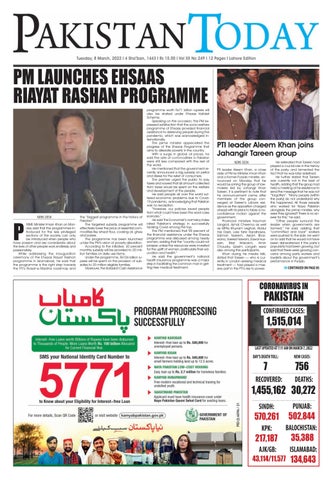
Tuesday, 8 March, 2022 I 4 Sha’ban, 1443 I Rs 15.00 I Vol XII No 249 I 12 Pages I Lahore Edition
PM launChes ehsaas riayat rashan PrograMMe
P
News Desk
rime minister imran Khan on monday said that the programmes introduced for the less privileged sections of the society can only be introduced when people who have passion and are considerate about the lives of other people work endlessly and passionately. While addressing the inauguration ceremony of the ehsaas riayat rashan programme in islamabad, he said that the programme is the right step towards the PTi’s riasat-e-madina roadmap and
the “biggest programme in the history of Pakistan”. The targeted subsidy programme will effectively lower the price of essential commodities like wheat flour, cooking oil, ghee and pulses. The programme has been launched under the Pm’s vision of poverty alleviation. According to the initiative, 30 percent monthly subsidy will be provided to 20 million families on daily use items. Under the programme, rs106 billion rupees will be spent on the provision of subsidies to 20 million eligible families. moreover, the Kafaalat Cash Assistance
programme worth rs71 billion rupees will also be started under ehsaas Kafalat Scheme. Speaking on the occasion, the Pm expressed satisfaction that the socio-welfare programme of ehsaas provided financial assistance to deserving people during the pandemic, which was acknowledged internationally. The prime minister appreciated the progress of the ehsaas Programme that aims to alleviate poverty in the country. With a surge in global oil prices, he said the rate of commodities in Pakistan were still less compared with the rest of the world. He mentioned that the government recently announced a big subsidy on petrol and diesel for the relief of consumers. The premier urged the public to pay taxes and vowed that all amount collected from taxes would be spent on the welfare and development of the people. He said people all over the world suffered economic problems due to Covid19 pandemic, acknowledging that Pakistan was no exception. “However, our policies saved people from what could have been the worst case scenario.” He said The economist’s normalcy index rated Pakistan’s strategy in successfully tackling Covid among the top. The Pm mentioned that 98 percent of the financial assistance under the ehsaas programme was disbursed among needy women, adding that the “country could not prosper unless the resources were invested for the uplift of women, particularly their education and health.” He said the government’s national health insurance programme was a major step in facilitating the common man in getting free medical treatment.
PTI leader Aleem Khan joins Jahangir Tareen group He reiterated that Tareen had played a crucial role in the history of the party, and lamented the fact that he was later sidelined. He further stated that Tareen was currently not in the best of health, adding that the group had held a meeting at his residence to send the message that he was not “forgotten”. “many people [within the party] do not understand why this happened. All those people who worked for Naya Pakistan alongside the prime minister, why were they ignored? There is no answer for this,” he said. “Other people surround the leader when governments are formed,” he said, adding that “committed and loyal” workers were pushed to the side. He went on to add that he would not have been disheartened if the party’s popularity had been growing, but said that there were growing concerns among party workers and loyalists about the government’s performance in Punjab.
News Desk PTi leader Aleem Khan, a close aide of Prime minister imran Khan and a former Punjab minister, announced on monday that he would be joining the group of lawmakers led by Jahangir Khan Tareen. it is pertinent to note that his announcement came after members of the group converged at Tareen’s Lahore residence as the opposition charged ahead with its plans to table a noconfidence motion against the government. Provincial ministers Nauman Langrial, Ajmal Cheema as well as mPAs Khurram Leghari, Abdul Hai Dasti, Lala Tahir randhawa, Salman Naeem, Aslam Bharwana, Saeed Nawani, Zawar Hussain, Bilal Warraich, Amin Chaudry, Qasim Langah were also among the participants. Khan during his media talk, stated that Tareen — who is currently in London seeking medical treatment — had played a massive part in the PTi’s rise to power.
CONTINUED ON PAGE 05
Coronavirus in
Pakistan
CONFIRMED CASES:
1,515,014
LAST UPDATED AT 7:11 AM ON MARCH 7, 2022
DAY'S DEATH TOLL:
NEW CASES:
7
756 DEATHS:
RECOVERED:
1,455,162 30,272 PUNJAB:
SINDH:
570,261
502,844
KPK:
BALOCHISTAN:
217,187
35,388
AJK/GB:
ISLAMABAD:
43,114/11,577
134,643
02
Tuesday, 8 March, 2022 | LAHORe
NewS
OppOsiTiOn decides TO OusT pM, BuzdaR ThROugh nO-cOnFidence MOTiOns IsLAMABAD
i
Naveed Miraj
N order to ramp up further pressure on the government, the opposition parties, as a major shift in their policy, have now decided to also target Punjab Chief Minister Sardar Usman Buzdar through a no-confidence motion parallel to moving the same either against National Assembly Speaker Asad Qaiser or Prime Minister Imran Khan. Reliable sources within the opposition parties said a decision to this effect was taken after a series of meetings between the Pakistan Democratic Movement (PDM) and the Pakistan People’s Party (PPP). They said that the decision to simultaneously target Usman Buzdar was taken following growing rifts within the PTI’s ranks in Punjab. They pointed out that
Jahangir Tareen group, now also joined by another PTI stalwart Aleem Khan, has the support of about 40 lawmakers. “Usman Buzdar’s position is very weak and he is not liked by most of his own party members,” they added. It merits mentioning here that the Jahangir Tareen group has so far not announced its strategy regarding the opposition’s proposed no-confidence motions Sources within the ruling party are confident that the Tareen group will not support the opposition parties in their noconfidence motions, but they admitted that the group members could pressurise the government to replace Buzdar with a person of their own liking. “In such a scenario, Aleem Khan will be their favorite candidate for the top slot in Punjab,” they said, adding that given the
Former president Rafiq Tarar passes away in Lahore News Desk Former president and Supreme Court judge Muhammad Rafiq Tarar passed away in Lahore on Monday, according to his grandson and fellow PML-N leader Ataullah Tarar. He was 92. “My grandfather Mohammad Rafiq Tarar has passed away,” Ataullah said in a tweet. His funeral prayers will be offered at Jamia Ashrafia, Lahore at 4.45pm after Asr prayers today. It is pertinent to note that Tarar had served as the president of the country for around two and a half years. He had taken the oath as the head of the state on Jan 1, 1998 and remained in the office till June 20, 2001. He was nominated for the president’s office by then prime minister Nawaz Sharif. Before stepping into politics with the PML-N, Tarar had also served as a judge of the Supreme Court from January 17, 1991 to November 1, 1994. Prior to it, he was also the chief justice of the Lahore High Court from March 6, 1989 to October 31, 1991. Later, he had joined the Pakistan Muslim League-Nawaz. Prime Minister Imran Khan made prayers for the former president and his family. President Dr Arif Alvi also expressed grief over the death and offered prayers for the deceased along with extending condolences to his family. PML-N President Shehbaz Sharif remembered the deceased as a “kind and compassionate elder, shrewd legislator, fair judge and very good man”. He said the news of the former president’s death was a personal shock for him and his absence would always be felt. PML-N secretary general Ahsan Iqbal also had high words of regard for the deceased. He said Tarar had persevered, “courageously” confronted the martial law of former military ruler retired Gen Pervez Musharraf and refused to resign as the president.
current circumstances, the top PTI leadership may succumb to Tareen group’s demands. The sources said that the government is maintaining a contact with the Tareen group in order to thwart the designs of the opposition parties. According to the present position in Punjab Assembly, out of 371 total seats, the PTI has 183, PML-N 165, PML-Q 10 and PPP has 7 representatives. Moreover, there are 5 independent candidates and one representative of Pakistan Rah-e-Haq Party in the assembly. On the other hand, in the National Assembly, the opposition has around 160 votes in its ranks and for the success of its no-confidence motion either against the prime minister or the NA speaker, they will have to show the support of 172 members.
Swift prosecution of terrorists needed to set example, says PM IsLAMABAD TLTP
Prime Minister Imran Khan has said that the government has zero tolerance for terrorists and swift prosecution is required to set an example out of terrorist elements. Chairing a meeting of the Apex Committee on National Action Plan on Monday, the prime minister emphasised that a multi-pronged approach, full spectrum and vigorous implementation of NAP is required to thwart threat of terrorism. He stressed upon taking proactive measures to tackle such incidents in future. He expressed the belief that nefarious designs to destabilise the country will never succeed as the entire nation is united to defeat the menace of terrorism. He said that the public realises that some elements are trying to create disharmony on the basis of sectarianism and hate speech, but the state will never allow such designs to succeed. The Apex Committee strongly condemned the Peshawar attack and offered condolences for the martyrs who lost their lives in the attack. It stressed upon the need to strengthen the role of National Counter Terrorism Authority (Nacta) to coordinate measures essential for countering terrorism and capacity building of counter terrorism departments.
It was also highlighted that provinces need to allocate more resources for conducting effective investigations by adopting scientific techniques and setting up modern forensic labs. The need to accord conclusive end to terrorism cases in courts of law was emphasised. The secretary interior presented a detailed briefing on the implementation status of NAP, including measures taken to choke terror financing, counter violent extremism, and investigation and prosecution of terrorism cases.
The secretary also briefed the meeting on the government’s zerotolerance policy towards militancy, capacity building of law enforcement agencies, regulation and registration of seminaries, the merger of former FATA areas, reforms in the criminal justice system, eliminating sectarian terrorism, curbing smuggling, narcotraffic and human trafficking, the reconciliation process in Balochistan, and issues related to refugees. The meeting was briefed that satisfactory implementation has been achieved on majority action points;
however, support from provincial governments is required for interprovincial issues. The meeting was attended by Chief of Army Staff (COAS) General Qamar Javed Bajwa, federal ministers Fawad Chaudhry, Sheikh Rasheed and Asad Umar, and National Security Advisor Dr Moeed Yusuf. The chief ministers of Punjab, Sindh, Khyber Pakhtunkhwa, Balochistan, and Gilgit-Baltistan, chief secretaries, inspector generals of police, and senior civil and military officers were also present.
IHC gives ‘last chance’ to Rana Shamim to file affidavit about ex-CJP Nisar News Desk Former Gilgit-Baltistan CJ Rana Shamim on Monday has been given last chance by the Islamabad High Court (IHC) to submit an affidavit executed by him in which he alleged that former chief justice of Pakistan (CJP) Mian Saqib Nisar influenced a high court judge to deny bails to the top PML-N leadership before the 2018 general elections. IHC Chief Justice Athar Minallah, during today’s proceedings, asked Shamim whether he had submitted the affidavit yet, at which the ex-judge sought another three weeks to submit the affidavit. “I have given the affidavit to the lawyer and will submit it after he reviews it,” he said. At that, Justice Minallah replied, “You have served as a law officer. Don’t treat the court like this.” He further said Shamim had made “serious accusations” in the affidavit that he could not defend. “Either you move forward the process or the court will take action,” Justice Minallah warned. “This court has given you a fair chance.” It is pertinent to note that the matter had surfaced when reports on Shamim’s affidavit last year. The affidavit in question alleged that ex-CJP Nisar had made
a phone call to a judge of the IHC asking that former prime minister Nawaz Sharif and his daughter Maryam Nawaz not be released from prison until after the 2018 elections. The court had taken notice of the news report and initiated proceeding against Dr Shamim, Jang Group Editor-in-Chief Mir Shakeelur Rehman, Investigation Editor Ansar Abbasi and Resident Editor Aamir Ghauri. It had indicted Shamim in the case on January 20 but deferred the framing of charges against the media personnel included in the case. Shamim later challenged his indictment through an intra-court appeal. During today’s hearing, Shamim expressed ignorance about how that affidavit was leaked and by what means it reached journalist Abbasi. Following that, Justice Minallah pointed out that Shamim had not even sent a notice to those who had leaked the affidavit. “Did you send a notice to the newspaper that published the report about the affidavit? Did you challenge them?” he asked In reply, Shamim told the IHC chief justice that his lawyer had stopped him from doing so. “If I am unable to get information about how the affidavit was leaked, I will send a notice to the
newspaper,” he said. “If I get information about who leaked the affidavit, I will send them a notice [as well],” he added. “You now have to tell how the affidavit was leaked,” Justice Minallah said, adding “It would not be appropriate if you treat courts in such a manner.” When it was his turn to speak, Attorney General Khalid Jawed Khan made an ironic comment, saying that Shamim was able to file an intra-court appeal [against his indictment] but could not submit the affidavit in question. The court gave Shamim the last chance to submit the affidavit by April 4 and adjourned the hearing. At today’s hearing, a written application by Shamim’s lawyer, Latif Afridi, was moved before the IHC for deferral of case proceedings on grounds of his (Afridi’s) ill health. The application, supplemented by Afridi’s medical certificates, stated that the lawyer had not been able to submit a reply sought by the court about the affidavit on his client’s behalf as he was unwell and on bed rest. When the court had indicted Shamim, it had also sought from him a written statement about his affidavit. But Shamim failed to comply with the directive at subsequent hearings.
It must be noted that the application sought more time for the submission of the statement.
Tuesday, 8 March, 2022 | LAHORe
NewS
03
pM says OppOsiTiOn pOses nO ThReaT TO gOvT
p
News Desk RIME Minister Imran Khan has said that “[The Opposition] may go ahead and fulfil its desire to table the no-trust motion but we are fully prepared,” the premier said while
presiding over the PTI’s core committee meeting in Islamabad. He further stated that the Opposition parties’ coalition to table the no-confidence motion against his government, saying there is “no threat to the democratic government”. While referring to the politicians who
are facing corruption cases in the courts, PM Khan said that those who fear their trials cannot bring revolution with the money that they have illegally acquired. “We will foil the agenda of the thieves,” he said. Earlier, the core committee meeting
PM’s rants won’t come in way of opposition’s no-confidence motion: Shehbaz News Desk Pakistan Muslim League-Nawaz (PML-N) President Shehbaz Sharif on Monday stated that the nation will soon hear the good news as opposition’s no-trust bid nears. Shehbaz told PM Imran that his “rants won’t come in the way of the no-confidence motion”. It is pertinent to note that the statement comes a day after the prime minister warned the opposition parties they would face the consequences if their no-trust motion against his government failed. “Are you ready for what I will do with you once your plans for a notrust motion fail?” the PM said while addressing a rally in southern Punjab’s Mailsi town. While reacting to the PM’s fiery speech, Shehbaz said that Imran Khan’s behaviour provided evidence of how worried he was, and that his perturbation will further rise in coming days. He further claimed that the no-trust move was a demand of the people of this country and that the opposition was only acting on their decision. According to him, no-trust motion was the only way to save the country from “economic bankruptcy”, and that the removal of the government was imperative to revive economy and rid masses of inflation and provide them relief.
The PML-N leader further said that the, “mines laid by the incumbent government for the economy and in the foundations of the country will have to be removed.” He observed that inflation had become unbearable for people and termed it an outcome of the policies and decisions of the current regime. Shehbaz termed PM Imran’s “abrupt talk” regarding foreign affairs atop a ‘container’ worrisome, saying “Niazi and the state are currently in opposite direction which isn’t a good omen for national interests.” He further stated that one who couldn’t handle politics at home shouldn’t advise on the country’s stance on international politics. He also said that the premier had already tarnished his reputation and shouldn’t do the same with the country. On the other hand, PML-N Vice-President Maryam Nawaz also reacted to the premier’s speech and said that “Imran Khan has not only cursed and threatened the opposition, but he has done the same to other countries as well.” Taking to Twitter, Maryam added that the premier “does not have a right to put Pakistan at a disadvantaged position due to his political disagreements.” “Shut him in a room, or else if a monkey gets hold of a matchstick, there would be a threat of fire!” she ironically wrote, suggesting that the no-confidence motion is vital in order to get PM Imran off his seat.
Bilawal invites Fazl to PPP rally in Islamabad News Desk Pakistan Peoples Party (PPP) chairman Bilawal Bhutto Zardari invited the chief of Pakistan Democratic Alliance (PDM) and Jamiat-e-Ulema Islam (JUI-F), Maulana Fazlur Rehman to his party’s long march rally scheduled to be held on March 8 in Islamabad. As per the sources, senior PPP leaders Khursheed Shah and Naved Qamar extended the invitation during a meeting at Fazl’s residence in Islamabad. During the meeting, matters related to noconfidence vote against Prime Minister Imran Khan and the political landscape of the country were discussed. The JUI-F chief, while talking to the media after the meeting, said that the information they shared during the meeting was “encouraging”, adding that the nation would get soon hear “good news”. The PDM head said that Imran Khan used foul language on every street of this country because that is the kind of person he is. “When the mouth of a gutter opens, only the unpleasant smell comes out… Imran Khan, who you are threatening here?” he added. To a question regarding working with PPP — a party with which JUI-F have had a frosty relationship
in the past — Fazl said that some “common needs” brought the two together and one cannot always look at past relationships. “The people will not like us repeating what had happened in the past… we now need to see what people really need,” he added. Fazl further said that they will bring the noconfidence vote in National Assembly within 48 hours. Shah further said that the motion would soon be brought in the lower house and the party’s leadership will take a final decision in this regard today, adding that the entire opposition was working to oust PM Imran. He confirmed that Maulana Fazl has been invited to PPP’s long march rally but added that all details cannot be revealed at this point in time. Meanwhile, PPP chief Bilawal stated that it is better for PM Imran to resign now, dissolve assemblies and call new elections in the country. He gave the premier a 24-hour deadline to resign and go home. Addressing a rally in Gujrat, he said that Imran Khan is in power not because of the votes of the people but because of the finger of the “umpire”. “Whenever he gets into trouble, he looks to them to bail him out… Imran Khan does not deserve this post,” he added.
reviewed the current political situation of the country. PM’s adviser on Parliamentarian Affairs Babar Awan briefed the meeting on legal affairs. Minister for Foreign Affairs Shah Mahmood Qureshi, Minister for Planning and Development Asad Umar and Minister for Defence Parvez Khattak also attended the meeting. Addressing a public rally in the Tehsil Mailsi of the Vehari District on Sunday, PM Imran Khan had told the masses about the leaders moving the motion. Starting with his arch-rival Nawaz Sharif, the premier reminded the public how the former prime minister acted like a “Bollywood star” in a bid to leave the country. “If PML-N is listening to me, then think: can a jackal ever become a leader?” asked PM Imran. The premier claimed that the PML-N was moving the no-confidence motion as Nawaz was missing Pakistan. Targeting the Leader of the Opposition in the National Assembly Shahbaz Sharif, PM Imran said that if someone wants to learn about him, they should find “Maqsood chaprasi”. Meanwhile, sources privy to the matter said that PM Imran Khan decided to table the bill for the formation of the South Punjab province in the National Assembly soon. Both the government and joint
Opposition has been claiming each others failure in the ongoing war between the two sides as the latter’s efforts to topple the government grow intense with every passing day. While PPP Chairman Bilawal BhuttoZardari lead a long march towards Islamabad, which will be joined by other opposition parties on the way, the PTI-led government is carrying out separate rallies and marches. Bilawal has suggested PM Imran Khan resign before the joint Opposition tables the no-confidence motion against the incumbent government. The statement came during Bilawal’s interaction with the media at Afzal Nadeem Chan’s residence in Lahore. He said that the incumbent government has the biggest assessment in front of it in the form of a notrust motion. “We defeated the government earlier in the Senate and in the National Assembly and will do it again in the future,” Bilawal said while referring to the latest Senate elections. He challenged PM Imran Khan to dissolve the assembly, “which he has always threatened to do,” if he has trust in the people that they would elect him again. “Even if he doesn’t resign and dissolve the assembly, the Opposition is well prepared. We will bring the no-trust motion and take this democratic war to Parliament and get successful,” Bilawal said.
Tuesday, 8 March, 2022 | LAHORE
04 NEWS
ZardarI, FaZl, SHeHBaZ dISCuSS no-truSt motIon agaInSt govt
P
News DesK
AKISTAN Democratic Movement (PDM) chief Maulana Fazlur Rehman and PML-N President Shehbaz Sharif visited Zardari House in Islamabad on Monday to hold a “delegation-level” meeting with PPP co-chairperson Asif Ali Zardari and other leaders of the party. According to a statement by the PMLN, the current political situation and the opposition’s plan to table a no-confidence motion against the government were discussed in the meeting. As per the details, Fazl and Shehbaz were accompanied by PML-N leaders Ahsan Iqbal, Rana Sanaullah, Khawaja Muhammad Asif, Sardar Ayaz Sadiq, Khawaja Saad Rafique, Marriyum Aurangzeb and Shahid Khaqan Abbasi. From the PPP, Syed Naveed Qamar, Murtaza Wahab, Sindh Chief Minister Syed Murad Ali Shah, Yousuf Raza Gilani and Syed Khursheed Shah were present at the meeting. Earlier, Fazl had announced that the PDM would be holding a crucial meeting with the PPP at the “leadership level” today. “So far, the information that we have
shared is encouraging and God willing, the nation will see results that will meet their expectations,” Fazl said. Moreover, Khursheed Shah said the details of the meeting would also be shared with the media. The meeting between the PDM and PPP took place as the opposition stepped up efforts to table a no-confidence motion against the government. On February 11, Fazl had announced that the PDM would be tabling a no-trust motion against the premier and will take the government’s allies on board to ensure that they had enough votes in the National Assembly to succeed. Since then, an apparent bonhomie has been developing between opposition parties on this front, with the PDM and PPP joining hands to make the no-confidence move a success. The opposition had been reaching out to the Pakistan Tehreek-i-Insaf’s (PTI) allies in the centre to seek their support, notably the Pakistan Muslim League-Quaid. Last week, PDM spokesperson Hafiz Hamdullah had issued a statement that quoted Fazl as saying that the opposition would submit the no-confidence motion in the next 48 hours. While the plan is yet to be realised, Fazl
told media persons today that the no-trust move would be tabled soon. “It will happen before 48 hours,” he said. When a reporter pointed out that the opposition had not given a final date for submitting the confidence motion, he replied: “We have always played this game with you. We never share all details and keep some hidden. And this keeps you busy. [We are employing] that tactic here [as well].” Moreover, PPP’s Shah said the time for tabling the no-trust move would be discussed and decided at the meeting with PDM
leaders today. To a question about whether the PDM had the support of the PTI’s allies for the notrust move, Fazl said, “When we say the majority is united against them (the PTI), understand for yourself what this means.” In this regard, Shah was asked whether opposition parties had finalised matters with the ruling party’s allies. To this, he said, “Everything will be fine. Don’t worry.” In reply to another question about PPP having invited the PDM to join its anti-government march, Shah said Fazl had
been invited but the meeting that was to take place today was the priority and “these matters will be decided there”. When Fazl was asked whether the opposition had the support of estranged PTI leader Jahangir Khan Tareen, he said he was not in contact with him. To another question about the chances of opposition parties staying united against the government, he explained that each situation had a different requirement and “we have to forget the past”. He said there may be disagreements and differences between political parties, “but I believe that even the public would not appreciate if we repeat our actions of the past”. Asked to respond to a hard-hitting speech by PM Imran in Vehari yesterday, in which he warned the opposition to be prepared for what he would do to them once their planned no-confidence motion against him failed, Fazl remarked, “This is the real Imran,” who used offensive language. He said the no-trust move was a political process and “who is he to threaten us”. “Our workers, too, have clubs … in their houses and ready to fight on every front,” he added.
UNSC denounces Peshawar imambargah attack KARACHI AnAdolu Agency
IHC CJ says will not allow Baloch students to be silenced News DesK Islamabad High Court (IHC) Chief Justice Athar Minallah on Monday has stated that the court will not allow the voice of Baloch students to be silenced. He made the remarks during the hearing of a petition against the registration of a case against Baloch students who protested outside the National Press Club in Islamabad against enforced disappearances. It is pertinent to note that the federal Minister for Human Rights Dr Shireen Mazari’s daughter Advocate Imaan Hazir-Mazari and others had moved the court on Saturday for the dismissal of the case. Attorney General of Pakistan (AGP) Khalid Javed Khan, Inspector-General Islamabad Ahsan Younis and additional home secretary appeared before the court today. Justice Minallah, during the hearing remarked that the children of Balochistan were protesting peacefully and that the federal government should have paid more attention to them as no one has visited them yet. He maintained that the federal government should provide Baloch students with forums where they could be heard. “This is a very serious matter,” the IHC CJ said. The AGP reiterated that the matter at hand was important and that it was wrong to harass Baloch students. He ensured that someone from the government would go see the students. “I apologize to the students for what happened. They are our children. This should not have happened,” he said. Justice Minallah stated that the premier himself should have visited them and further questioned if the first information report (FIR) filed against them should be declared null and void, as the court “will not allow the voice of Baloch students to be silenced”. AGP Khalid said that the court should not dismiss the case but allow the police to do so. Subsequently, the court adjourned the hearing till March 21. In this regard, the petitioners have sought clarification regarding the implementation of Section 144 so that the administrators do not take unfair advantage of it. They contended that the case against the student protesters is baseless and illegal, therefore it should be dismissed. It merits mention that the court has already restrained the police from making any arrests in the case.
The UN Security Council has condemned “in the strongest terms” a suicide bombing late last week inside an imambargah in Peshawar that killed 63 people and injured nearly 200 others. “The members of the Security Council expressed their deepest sympathy and condolences to the families of the victims and to the government of Pakistan and they wished a speedy and full recovery to those who were injured,” said a statement from the foreign ministry. The Da’ish terrorist organisation claimed responsibility for the attack, which occurred at an imambargah during Friday prayers. The council reaffirmed that terrorism in all its “forms and manifestations” constitutes one of the most serious threats to international peace and security.
It underlined the need to bring the “perpetrators, organisers, financiers and sponsors of these reprehensible acts of terrorism to justice and urged all States, in accordance with their obligations under international law and relevant Security Council resolutions, to cooperate actively with the government of Pakistan and all other relevant authorities in this regard.” If further reiterated that any acts of terrorism “are criminal and unjustifiable, regardless of their motivation, wherever, whenever and by whomsoever committed.” They reaffirmed the need for all countries to combat by all means, in accordance with the UN charter and other obligations under international law, including international human rights law, international refugee law and international humanitarian law, threats to international peace and security caused by terrorist acts.
‘Doomsday’: Pakistani student recalls dreadful journey from Ukraine to hometown ANADolu AgeNCy Junaid Hassan, a Pakistani student studying in Ukraine, sensed the war was coming. But it came before he expected, compelling him to spend several sleepless nights in his hostel basement in an attempt to avoid shelling by Russian forces. “It was 5:05 a.m on Feb. 24, when a powerful explosion shook my room. The first thing came to my mind was that the war has come,” Hassan, the first Pakistani to evacuate from the war-hit country via neighboring Hungary and then Turkiye, told Anadolu Agency. There were five to six explosions in the next hour, forcing him together with hundreds of students to run for shelter to the hostel basement, which otherwise was used as a storeroom. “After a few hours, we were asked by the hostel management to store food and water and stay indoors,” Hassan, who hails from the port city of Gwadar, said adding that they spent next five nights in the basement until students were allowed to leave Kyiv for the Vannnytsia city and subsequently Hungary border in a bus arranged by the Indian embassy. Russian forces, according to Hassan, would usually shell at night, while mornings were relatively peaceful until March 1, the day he left Kyiv. “We would spend nights in the middle-size basement like sardines and go to our rooms in the morning to sleep,” he maintained. Ukraine has become a key destination for students
CMYK
from Asian and African countries over the past decade due to relatively low-priced education, and hassle-free visa policy. Currently, some 76,000 foreign students are studying in different Ukrainian universities, mainly in the fields of medical and engineering, of them a quarter are from India followed by Nigeria, Bangladesh and Pakistan. Although many Pakistani students have managed to flee Ukraine, however they are still stuck in Poland, Hungary, and Romania, desperately waiting for flights to take them back home as, Hassan charged, the diplomatic missions are not “assisting.” Thousands of Indian students are also trapped in several Ukrainian cities, which are the target of heavy shelling from Russian forces, appealing for an urgent evacuation. Hassan’s another Pakistani colleague also managed to arrive in Pakistan via Istanbul on Monday. Frightening journey: Over 3,500 Pakistani students are enrolled in different medical and engineering universities in the former Soviet state. However, hundreds had already left Ukraine either due to semester breaks or sensing the looming war. “We were only two Pakistanis at the hostel, while a majority were Indians. They kept us in the loop as their embassy was constantly trying to evacuate them,” he further said thanking his Indian classmates for not abandoning him at testing time. Recalling his two-day frightening journey from the Ukrainian capital Kyiv to the Hungary border, Hassan,
a second-year student at Kyiv Medical University, said he was not sure if he would manage to reach the border due to ferocity of the war. Their first target was to get to a train to reach the Vannnytsia city, which is located 1,006 Kilometers (625 miles) from Hungary border. “It was a doomsday scene at Kyiv railway station as thousands poured in to catch trains. We managed to get to our train after hours-long struggle,” he reminisced. A five-hour journey took the 73-member group to Vannnytsia, where they spent night at a hostel of a medical university already abandoned by the students for safety. “We were expecting same shelling and bombing there but luckily it was a peaceful night,” he maintained. The next morning, the group embarked on an 18hour journey to Hungary border amid fears of being caught in fighting. “We could spot heavily armed Ukrainian troops throughout our journey to the border, however, nothing untoward (shelling and firing) happened,” Hassan went on to say. Another surprise was awaiting him at the Hungary border, where contrary to his apprehensions, the border authorities let him enter Hungary without any complication. The UN has acknowledged that people from Indian and African descent have faced racial treatment at borders with neighboring states, while attempting to leave Ukraine.
Tuesday, 8 March, 2022 | LAHORE
NEWS
air chief expresses grief over demise of rafiq Tarar Press release: Air Chief Marshal Zaheer Ahmed Baber Sidhu, Chief of the Air Staff Pakistan Air Force, expressed heartfelt condolences on the sad demise of former president of Pakistan and Supreme Court judge Rafiq Tarar. “May Allah bless the departed soul and give strength to the bereaved family to bear this irreparable loss, Ameen!” the CAS said.
PTI leader aleem Khan joIns jahangIr Tareen grouP continued from Page 01
nePra super league 5 held in Islamabad Pr To encourage a heathy lifestyle, social interaction and general well-being at work, NEPRA arranges outdoor activities for its employees and their families from time to time. In this regard, NEPRA today arranged 5th Edition of the NEPRA SuperLeague, an Inter-Departmental Tape Ball Cricket Tournament at Islamabad. Apart from the cricket league, a family gala and a number of fun activities were also arranged for NEPRA female employees and families of the employees; in-which all participated with immense enthusiasm. NEPRA Super league is a regular feature of NEPRA and its 5th Season was inaugurated by Chairman NEPRA, Mr. Tauseef H. Farooqi and Member NEPRA, Mr. Rafique Ahmad Shaikh along-with DG (Admin/HR), Mr. Naweed Illahi Shaikh at 9:30 am in a colorful and graceful ceremony. The following four (04) teams participated in the league:
ISLAMABAD: Prime Minister Imran Khan chairs an event to mark three years of completion of Ehsaas programme. PR
05
He also stated that he had met more than 40 MPAs during the last four days, all of whom had expressed concerns over Punjab’s governance. “All of us who were part of the tehreek and were sincere. Let us all come together on one platform,” he said. It is pertinent to note that the government was not perturbed by the sudden political activity in Lahore. Speaking to the media in Islamabad, Information Minister Fawad Chaudhry asserted that Tareen and Khan were still an integral part of the ruling PTI. “They are a part of our party,” he said, adding that internal politics within a party was a common occurrence. “They are doing their politics and
have relations with several of our MPAs […] Aleem Khan and Tareen have close relations with PM Imran,” he said, reiterating that internal party politics was common. Earlier, Punjab chief minister’s former adviser, Awn Chaudry, who was also among the attendees, was hounded by reporters as he made his way inside. Speaking to reporters camped outside, Chaudry asked them to “let some of the suspense remain”, adding that whatever will happen will be for the best. “Are you with the opposition or with the government?” asked one journalist. “Whatever will happen will be for the best,” he reiterated with a smile. He added that the members of the group would welcome Aleem Khan, saying that he was their “brother”. “Is (Punjab chief minister Usman)
Buzdar going or staying?” asked another reporter. “Have some patience. Watch and see what will happen,” he said, moving inside. Meanwhile, the meeting of the Tareen group comes as the Pakistan Democratic Movement (PDM), an alliance of opposition parties, is in the process of finalising a no-confidence motion against the prime minister, claiming to have the support of enough lawmakers in the parliament to make the ouster a success. In February, the PML-N had confirmed the party was in touch with the disgruntled group to seek its support to oust the government. At the same time, the group had also met at the residence of PML-Q leaders, who are a key ally of the PTI government in Punjab and centre. Speaking to reporters at the time, Tareen said the purported no-confi-
dence motion had not been tabled yet and it was not clear whether it would be at all. To a question about any contacts with the opposition, he said the group had gathered after a long time and it was yet to be seen how it should play its role in the current political scenario. He further maintained political leaders stayed in touch with each other, adding the group would hold more huddles to discuss their future strategy. Tareen said they also talked about inflation during the meeting, but nothing specific about the no-confidence motion. “It is premature to discuss this issue,” he had said, urging the premier to provide relief to the masses. Meanwhile, it was reported that PM Imran reached out to Tareen in what appeared to be a bid to ensure he hadn’t lost his old friend to the opposition.
COMSATS holds moot on sustainable technologies Pr “Our Government intends to harness power from renewable resources with the full participation of the private sector”, said Shibli Faraz while inaugurating a two-day International Seminar on ‘Sustainable Technologies in Modern Energy: A Roadmap Towards Green Economy’ at the Pakistan Academy of Sciences on Monday. Shibli was of the view that small conservations from energy efficient appliances translate into savings on large energy projects. He called on adopting the approach of the Japanese with regard to conservation of energy and modernizing domestic appliances. The seminar was organized by the Commission on Science and Technology for Sustainable Development in the South (COMSATS) with funding of the United Nations Educational, Scientific and Cultural Organization (UNESCO), and COMSATS’ Centre of Excellence in Islamabad, the COMSATS University Islamabad (CUI) from March 7th to 8th 2022.
KE honours women working in energy sector Karachi PR
The City School held Long Service Awards 2022 on Monday. The ceremony was attended by Jahangir Firoz, CEO of City School Holdings International, and other senior officers. PR
Recognizing the role of women in the workforce, K-Electric organized a mega-event to honor their untiring contribution towards changing Pakistan’s energy sector. Organized at a public park in Karachi, the women-centric event also served as the graduation ceremony of almost 100 Women on Wheels (WoW), who have undergone training to operate and maintain a motorcycle. Elated at the occasion, the Chief Guest of the event Afia Salam who is
also member of the Board at Salman Sufi Foundation commented "K-Electric is the perfect partner for Salman Sufi Foundation because both these organizations share the same vision of creating an enabling environment for
women so that they can become independent. We are glad to witness that the utility in its essence, understands the role women can play in uplifting the society and the economy if they are truly empowered."
Mazari’s message for International Women's Day PR
On the occasion of International Women’s Day, I take the opportunity to re-affirm our national and international commitments for the protection of women’s rights with especial emphasis on this year’s theme “Gender equality today for a sustainable tomorrow”, recognizing the contribution of women and girls around the world, who are leading the charge on climate change adaptation, mitigation, and response, to build a more sustainable future for all. It is unfortunate that Pakistan is amongst the top ten most vulnerable countries to climate change, and what is even more alarming is that adverse climate change has a direct impact on women and their economic and social prosperity. In Pakistan, a significant portion of our workforce, specifically comprising women, is directly involved in the agriculture sector and resides in rural areas. In the aftermath of increasing droughts, rising temperatures and seasonal flooding, working women often find themselves without access to land, shelter and means of food
production. On this day, I would like to congratulate not just the women of Pakistan but women all over the world for their relentless efforts and sacrifices which they have made and are still making to free this world from discrimination, inequality and gender biases. As part of the positive measures taken by the Ministry of Human Rights in light of the Covid-19 pandemic, special emphasis was placed on the protection and welfare of women. The Ministry of Human Rights has played a leading role in spreading awareness amongst women, including women in prisons and victims of gender based violence. The Ministry has also initiated a rigorous gap analysis of Pakistan’s COVID-19 response with a human rights perspective to identify areas where COVID-19 or its preventive measures have led to violations in human rights of certain population groups. We are committed to protect women’s social, political and economic rights with particular focus on marginalized women. In this regard, discriminatory laws against women are being amended continuously with the sup-
port of Women Parliamentarians. The present Government has taken concrete steps towards strengthening legislation to address issues such as violence against women, domestic abuse, harassment, social protection, economic participation and inheritance. The Islamabad Capital Territory Senior Citizens Act, 2021, ICT Rights of Persons with Disability Act, 2020, Legal Aid and Justice Authority Act, 2020, Protection against
cmYK
Harassment of Women at the Workplace (Amendment) Act, 2022, Zainab Alert, Response and Recovery Act 2019, Protection of Journalist and Media Professionals Act, 2021, The Protection of Women’s Property Rights Act 2020, the Letters of Administration and Succession Certificates Act 2020 are significant pieces of legislation passed by the present Government for the protection of human rights including women rights.
The Ehsaas Programme is our flagship social protection programme designed to provide social assistance to women and improve financial inclusion and economic empowerment of women. I would like to emphasise that a lot still needs to be done, and the foremost step is to bring a positive change in the attitude of men towards women in Pakistan. Affirmative actions are being taken to sensitize and bring awareness amongst our citizens about the women’s rights protected under the Constitution of Pakistan and as well under the many international conventions ratified by Pakistan. I also urge the International Community, UN Agencies and NGOs to play their due role to stop the massive human rights’ violations in the Illegally Indian Occupied Jammu & Kashmir, including abuse and mass violence against Kashmiri women in IIOJK. The World must also act against the deprivation of Muslim women’s rights in India today as a deliberate policy of the BJP government. There cannot be a selective approach to women rights by the international community.
06-07 Comments - 8th March 2022_Layout 1 3/7/2022 9:47 PM Page 1
Tuesday, 8 March, 2022
06 COMMENT
The hadees-rejector epithet
Reading the tea leaves Tensions mount as things move slowly
T
He PTI’s coalition partners and its dissidents are still holding discussions among themselves while simultaneously bargaining with the opposition parties. The opposition has finally agreed that the general elections would follow within months of the success of the no confidence move rather than delayed for over a year. The opposition is however still divided over offering the PML-Q the slot of the Punjab CM which suits Zardari’s strategy but not that of the PML-N. The opposition has directed its MNAs not to travel abroad and be ready to be called at any time. This shows that necessary decisions are likely to be taken by the opposition parties within the next few days The PM’s pubic meeting at Mailsi turned out to be a large and enthused gathering. This was on account of the polarization in district Vehari where PTI and PML-N won two NA seats each in 2018 elections. The audience in Mailsi was charged, though its response to the PM’s claims about benefits received by the farmers was tepid. Imran Khan used the occasion to ridicule by name the top PML-N, PPP and JUI-F leaders, accusing them of theft of national wealth. What is more, he hurled unspecified threats if the no-trust move failed. When senior political leaders spew poison, this encourages the younger lot of followers to cross all boundaries even to the extent of indulging in violence which is unfortunate. In his speech, the PM lambasted european Union envoys over their letter in which they demanded that Pakistan should condemn Russian invasion of Ukraine and vote against Moscow at the UN. Pakistan, he said was a neutral country supporting peace and would not like to be treated as slave. Many would agree with the sentiment but question whether the public meeting was the right forum to agitate the issue against countries that Pakistan still depends upon for aid and GSP-plus status. There have been minor defections from the PTI with Nadeem Afzal Chan rejoining the PPP and the maverick Sardar Yar Mohammad Rind resigning as Advisor to the PM and calling on former President Zardari. The much more significant development however is that of former Punjab Minister Aleem Khan’s presence in Jehangir Tareen’s camp and the subsequent press conference confirming mutual consultations at this juncture.
Responding to it once for all
haSan aFTaB SaeeD
F
olks who engage in religious debates for the sole purpose of winning them have many cards up their sleeves. One such card, to be played when the going gets especially tough, is declaring that their opponent is a hadeesrejector. Such are the emotions involved in these issues that it is supposed to end any debate there and then. It is never made clear what ‘hadees-rejector’ means in the first place. And for good reason; because the card loses its force the moment it is shorn of all its delicious ambiguity. What typically happens is this: Somebody presents something as a binding belief in Islam. This belief clearly contradicts an explicit Quranic tenet (at worst) or has no basis whatsoever in the Quran (at best). When you ask him to bring evidence from the Quran in support of his position, he cites a hadees instead. You insist that since the Quran is complete when it comes to vital, necessary beliefs, he must either bring proof from the Quran or stop insisting that the belief in question is indispensable. He responds to this by labelling you a hadees-rejector and delivering a comprehensive lecture on how people like you are detrimental to the cause of religion. It could well be that he does it innocently. Alternately, he could be intelligent enough to know the difference between rejecting a hadees and granting it a status where it can add anything new to religion or even overrule the Quran. In either case, the debate, as far as he is concerned, is over, and the issue settled. If the discussion continues after this at all, it is
Mishandling the media PM should heed PML-Q leader’s advice
The erosion of freedom speech
Shazia anwer Cheema
T
He Chinese philosopher Sun Tzu writes in his book “The Art of War” that “all warfare is based on deception”. “The Art of War” written around the fifth century BC is still considered as the Bible of warfare and propaganda. This book has 13 chapters and each one is devoted to a different set of skills (or “art”) related to warfare and how it applies to military strategy and tactics. I follow conflict zone reporting as a part of my studies and always try to figure out propagated news in reference to works like the “Art of War” and Ukraine war is the recent part of my study. Since the time of ancient Greek playwright Aeschylus (550 BC) who justifies promoting “false” against “truth” while his nation had been at war, we all know that truth cannot come out of war zones and the first causality of conflict is the truth. If so then why do we follow war news? What do we spend hours and hours sitting in front of the radio, television, or looking at the screens of our smartphone for? I believe this is due to the human quest to know something we wish to know. This proposition offers us another proposition that if we wish to know only what we wish to know then how can we get balanced knowledge? Are we interested only in the propaganda of our choice when war is around us? Do we like to be part of echo chambers? I believe there is a need for deep research to find several questions of the same kind I raised above. We know that echo chambers restrict the reasoning and evaluation process and primarily rely on Filter Bubbles thus adhering to low
Dedicated to the legacy of late Hameed Nizami
Arif Nizami (Late) Founding Editor
Yousaf Nizami M. A. Niazi
Umar Aziz
Joint Editor
Joint Editor
Executive Editor
Lahore – Ph: 042-36300938, 042-36375965
I
Karachi – Ph: 021-35381208-9
I
have genuine misunderstandings. The words themselves have a way of playing tricks, especially when they are not reported verbatim. The connotations change with the choice of words. Over a long chain it can easily become a case of Chinese Whispers. Utmost care is therefore called for when it comes to ascertaining whether a narration did originate with the Prophet (peace be upon him) and that it did not get contaminated along the way. That is where Quran, as the verbatim speech of God, is so indispensable. It is not at all a matter of judging some things to be too fantastic or ‘unscientific’ for one’s liking. After all, the Quran – which is also given to us by the Prophet (peace be upon him) – talks about the Day of Judgment. What could be more ‘unscientific’ than that? And yet, no Muslim has any qualms believing in it. That is because he is satisfied with the careful transmission. The Quran calls itself The Criterion. That is, while it will judge all belief; nothing will ever judge it. The insistence of understanding the Quran in the light of the hadees violates this Quranic principle. It should be the hadees instead that should be understood in the light of the Quran. That makes much more sense, because the text of the Quran (not the hadees) is what we are certain about. It is the Quran (not Hadees) that God has promised to preserve. It is the Quran (not the hadees) that forms a coherent book – and from God Almighty, no less! Hadees is an invaluable resource. It includes history of the life and the times of the last Prophet (peace be upon him) of God. It includes fruitful information about how he viewed religion. It contains many supplications of the Prophet (peace be upon him) (which are especially valuable as most of them have been reported verbatim). Only an extremely foolish man would dispense with hadees or be indifferent to it in any degree. Studied in the light of the Quran, hadees undoubtedly enhances one’s understanding of religion. But hadees never supplants or overrules the Quran. Neither does it add anything new to religion or take anything away from it. That is beyond its very scope.
God has left nothing that is fundamental to religion at the mercy of the whims of random chains of reporters and transmitters. He has ensured that everything essential was transmitted by consensus and continuity.
Ukraine War and Dadaist media
T
He PTI’s relationship with the media is a complicated one. As an opposition party it received crucial support from the latter in promoting and projecting the party as a realistic third national-level political party option for voters; an alternate to the PML-N and the PPP. However, since coming to power, the PTI has been unable to fully develop and maintain a healthy working relationship with the media. The recent weaponization of PeCA 2016 through a presidential ordinance, enhancing its ability to take cognisance, making the punishments stricter and longer and converting bailable into non-bailable ones, was a controversial and unnecessary move. While the government knew that it was going to face criticism, it probably did not realize that it would face such broad-based opposition, which was also so strong. Bar associations and press bodies, including not just print but electronic body representatives, as well as bodies representing both owners and editors, as well as workers, were all up in arms against the ordinance, which all rightly saw as a violation of the freedom of press. This latest faux pas and previous attempts such as the Pakistan Media Development Authority Ordinance, 2021 to restrict press freedom is exactly what the PTI’s key ally in Punjab and the center, Chaudhry Pervez elahi was referring to when he warned the PM Imran Khan to be cautious of his advisers “who are creating a gulf between him and the media”. Prime Minister Imran Khan would do well to heed this warning as it is quite apparent that his cabinet was split on the decision pass this law, that too through an ordinance, bypassing parliament to avoid any debate or voting on the matter, and lasting for only 120 days. The attorney general called it a ‘bad law’ and Information Minister Fawad Chaudhry has recently stated that the government is now ready to withdraw the PeCA Amendment Ordinance. Perhaps if more time had been given to formulate a better law with input from all relevant stakeholders, the exercise would have been more productive without further damaging relations with the media.
Editor Aziz-ud-Din Ahmad
never on the original topic. It will instead proceed along a tangent when he challenges your assertion about the completion of the Quran. Little does he realize that he is no longer arguing with you; that he is arguing with the Quran, which explicitly declares that it is complete as far as beliefs are concerned. He asks: ‘Without hadees, how do you know how and when to perform the daily prayers and how much? Do you find that information in the Quran?’ My usual response to this is asking him how he learned to pray. In all my years debating these issues, I have yet to meet one man who has owned up to learning it from a hadees book. Like driving, we all learn how to pray by emulating our elders and teachers. When it comes to matters of practice, can it be any other way? Sure, many prophetic narrations include references to these details; but does that change the way these practices have been transmitted? It is the subject of Sunnat, not Hadees. The difference between the two is fundamental. God has left nothing that is fundamental to religion at the mercy of the whims of random chains of reporters and transmitters. He has ensured that everything essential was transmitted by consensus and continuity. Beliefs were transmitted by the consensus of the companions of the Prophet (peace be upon him) followed by oral continuity down to our time (the Quran). Practices were transmitted by consensus of the companions followed by practical continuity down to today (Sunnat). Islam is quite complete in the Quran and the Sunnat. A single or a few chains of narrations cannot add to or remove anything from the religion that is thus transmitted so meticulously and unmistakably. I have often unfairly been accused of being a rationalist who cannot wrap his head around some of the miracles reported in the hadees literature. May God preserve us all! Let there be no mistake: If it can be ascertained that something was said by the Prophet (peace be upon him), then that is the end of the debate. The doubt (wherever it is) is always regarding the narrators and the chains of communication. The contexts of the narrations are often missing. To add to that, men often forget; they occasionally lie; they sometimes
moderation and directed control which leads to falsified communicative webs. Following the Ukraine war, one can understand that human morality has nothing to do with aggression and concepts like right, wrong, truth, falsehood, freedom of speech, censorship, democracy, dictatorship, and all such notions lost their meanings and the only quest that drives during a war is “success”. The western world is a champion of freedom of speech but has officially banned Russian news outlets like Russian Television (RT), Tass news agency while stating that these are propaganda tools of Russia. Only western media outlets like Fox News, CNN, Sky News, BBC, and western inclined television channels can be aired in the western world because according to the western governments they are not propaganda tools and provide only truth. Russia on the other hand is intercepting western media. The world is standing where it was during the Cold War era when onesided information had been provided to populations. Whatever freedom of speech humanity achieved in the last three decades has abruptly been seized by states. Today’s media is providing us only claims and blames. Western censorship has actually supported autocratic rulers and now the west will have no justification and no face to teach or promote freedom of media or right of speech to dictators and autocratic rulers. Stuart Allan and Barbie Zelizer in their book “Reporting War, Journalism in Wartime” write that the most important question to a war journalist is that “to whom are you true?”. They say that the above-mentioned question is a radical question, which cuts to the core of the media business and the ethical problems faced by war reporters and war reporting. While watching and reading news about the Ukraine war, I think that western media is true to the western target market and Russian media is true to the Russian market so there is no question of objectivity rather objectivity is not needed at all. If we go through the files of Operation Desert Storm (Iraq invasion) and Operation enduring Freedom (Afghanistan invasion), we find western media was not too blunt in giving a one-
Islamabad – Ph: 051-2204545
sided version and we could find words like “it is claimed”, “according to Pentagon”, “it is said by official sources”. However, today we do not find such balancing words in the news, and official versions are aired as reports coming from media outlets. This situation indicates that the line between the State Media and independent media is no more blur rather has been erased. Ukraine war will have a lasting impact on journalism and media ethics and thousands of books written about media ethics will have to rewrite and republish I believe works of Greek playwright Aeschylus and Sun Tzu will have to be included in them. I believe there should be now two kinds of Curriculums for media studies—-one for “pre-War situation” and another for “Way situation”. We can also publish media ethics books with two parts—-part one can deal with the western viewpoint of media ethics for non-western countries and the second part can be western media ethics when the west is a physical or political war with someone. We need to include “Fake News” as an important genre of news in new books with a new name like “Otherwise Fake News” and we can write that such kind of news is legitimate if released by states whenever they consider it appropriate for national interests. I also suggest that dictions like disinformation, misinformation, fabricated, concocted should also be rephrased and it should be written that nothing is fake, disinformation, misinformation, fabricated and concocted that comes from State media outlets and private media outlets shall have to use all material without reviewing and without using fact check tools. I do not want to be sarcastic but I want to find a way for students of mass communication and journalism to work effectively under new norms because transparency in news is a bygone case. I believe that every student of media ethics should become Dadaist if wishes to survive in the era of the biggest lie of “wars for peace”. Dadaism rejects the idea that anything should make any sense. Dadaists believed that if the war can be justified, anything can be art, even a toilet seat as a sculpture. Dadaists’ beliefs are based on having no truths, beliefs, or rules. Dadaism was about twisting reality and being outside the mainstream. Should we call today’s media moving towards Dadaism?
Western censorship has actually supported autocratic rulers and now the west will have no justification and no face to teach or promote freedom of media or right of speech to dictators and autocratic rulers.
I
Web: www.pakistantoday.com.pk
I
Email: editorial@pakistantoday.com.pk
06-07 Comments - 8th March 2022_Layout 1 3/7/2022 9:47 PM Page 2
Tuesday, 8 March, 2022
COMMENT 07 Editor’s mail Send your letters to: Letters to Editor, Pakistan Today, 4-Shaarey Fatima Jinnah, Lahore, Pakistan. E-mail: letters@pakistantoday.com.pk Letters should be addressed to Pakistan Today exclusively
Dengue and its impact on biochemical parameters
Waste treatment Urgent Need for Environmental Sustainability ayaan waqar
I
NeFFeCTIVe waste management is a serious issue affecting countries all over the world. Although a lot of nations have managed to curb the issue via various technological means, Pakistan has not been able to gain a foothold while the amount of waste and the corresponding untreated landfill dumps continue to grow with each passing day. Pakistan is one of the most polluted countries in the world and ineffective waste management is one of the major contributors to that. Time and again, provincial governments have come up with waste management strategies but the promises have always fallen short causing the crisis to become more widespread. Major cities like Lahore and Karachi are consistently ranked among the most polluted metropolitans of the world. The national average daily solid waste production is 87,000 tons with an expected growth rate of 2% per year, there seems to be no end in sight. There are four major waste producers in Pakistan and other countries 1. Municipal Solid Waste: this waste comes from households, schools, offices, hotels, shops, and other institutes. The composition of municipal solid waste in Pakistan is as follows: Ash, Bricks, and Dirt 18%; Glass 6%; Textile 2%; Cardboard 7%; Food Waste 30%; Leather 1%; Paper 6%; Plastic 9%; Rubber 1%; Metal 4%; Wood 2%; and Yard Waste 14%. This waste is either buried, dumped, or burned which is a threat to health and welfare of the population. 2. Industrial Waste: it is produced in factories and factories and industries of developed and underdeveloped countries. And mostly this is dumped in rivers and sea causing pollution. Pakistan ranks 12th in Asian countries out of 15 to produce a severe and unacceptable level of industrial waste. 3. Agriculture Waste: This waste is a natural waste of livestock, agriculture crop, and agro-industrial byproduct. Pakistan produces 16% agriculture waste and 68% of crop waste. 4. Hazardous Waste: It’s the waste that comes from agriculture, industrial, commerce, and hospitals. A number of toxic chemicals are produced which is dangerous for human health. In Pakistan, it has rapidly grown. In Pakistan, there is a troubling lack of seriousness in the government’s attitude towards waste management. The absence of a strong waste handling system can generate conditions that are harmful for human health and the natural environment. Governments, at the provincial as well as local levels, must understand and highlight appropriate waste management processes. This is even more relevant during the ongoing pandemic as the country cannot afford to put more pressure on its
weak healthcare system and economy. The governments must strengthen relevant legislation, in collaboration with stakeholders, and ensure that such laws are implemented properly. Technological advancements have made waste management systems more effective in the developed world. Pakistan can adopt some of these solutions to address this issue. The most efficient process of waste management involves the Waste to energy method. This procedure, commonly referred to as the WTe, involves conversion of non-recyclable waste into energy. Methane Munching is one such example. Landfill sites produce methane which is one of the major contributors to the climate crisis being faced today. By extracting this gas from the waste disposal sites, it can then be used to produce electricity hence helping to reduce the waste while also tackling one of the other major issues of the country, i.e. energy crises. With only 3 landfills in Karachi and 2 in Lahore, Smart Landfills and Composting Sites is one the most crucial steps when it comes to solving the waste management crises of the country. Smart landfills have the ability to automatically separate the incoming waste into different categories (recyclable/non-recyclable, etc.) and then direct it to the next relevant unit for further processing – all within the same facility. Transport Route Optimization is a very effective waste collection method. Having an AI optimized route for daily waste collection and disposal not only reduces the time required for the procedure but also helps with making the process much more efficient and cost effective. Smart Automatic Solar Trash Compactors are devices which upon reaching the fulfilment level of the waste bin, triggers an automatic compaction which results in an increased bin capacity (5 to 8 times). Moreover, an additional dispatcher added on top of the bin alerts the regional unit (Lahore Waste Management Company for instance) to empty the bin in a timely manner and prevent the trash from piling up. No matter how efficient and technologically advanced a country’s waste management system is, the core component of success lies in personal responsibility. With the level of population that we have and the amount of waste that our cities generate, one cannot expect the relevant authorities to
With only 3 landfills in Karachi and 2 in Lahore, Smart Landfills and Composting Sites is one the most crucial steps when it comes to solving the waste management crises of the country.
handle everything flawlessly. Along with public awareness, a very good way of tackling this issue and taking some burden off of their shoulders is to segregate our trash at source (home, commercial sites, etc.) before the waste management personnel take it away. The city of Kamikatsu in Japan is the pioneer when it comes to following this strategy and it has helped them tremendously. The people over there divide their daily trash into 34 categories which results in only 20% of the total waste going to landfills. The rest of the 80% goes directly to their respective sites for recycling. Smart Bins is another method to ensure household compliance and has been working effectively in some other countries in the world. RFID technology is used to identify and then tag everything that is put into the bins. By showing a green light (and sometimes paying a small amount of money) in the case of a recyclable product and charging consumers for their un-recycled waste, this encourages people to recycle and play their part in tackling the issue first-hand. Autonomous Solar Boats – Although not being used by a lot of countries at the moment, this is a very promising solution to clean the debris from our seas and rivers. Being solar powered allows them to run all-day long without requiring much maintenance and the robotic arms enable them to pick the trash (plastic bags, etc.) with great accuracy. Improper waste management can lead to serious risks for human health and the natural environment. Developing countries, including Pakistan, often fail to implement required measures in this context. Pakistan’s waste handling system has gaps in separation, collection, storage, transportation and disposal which shows that significant improvement is needed. In this area, the provincial as well as local governments need to be actively involved. Waste handling processes must be analysed, so that the main weaknesses can be identified, and appropriate strategies should be developed to address these using available resources. Global guidelines should also be taken into account when developing these plans. Implementation of such policies must be treated as a priority by government authorities. Another important change needed is quality research on the topic. A relevant database should be built and maintained so that progress can be monitored, policy effectiveness is revealed and corrective actions can be taken. In addition, there is a need for collaboration in such projects. The country’s governments should join hands with businesses, educational institutions, and other stakeholders to achieve the objectives.
In Pakistan, there is a troubling lack of seriousness in the government’s attitude towards waste management. The absence of a strong waste handling system can generate conditions that are harmful for human health and the natural environment.
The author is a student of C1 at Aitchison College.
DeNGUe is currently affecting half of the world population. Several factors such as globalization, travel, trade, socioeconomics, and climate change have played a vital role in dengue transmission and expansion. The largest number of dengue cases ever reported globally was in the year 2019 when several countries were affected. Dengue has emerged as a major health concern for Pakistan since 2010 where 10,416 cases with 51 deaths were reported. According to data of the National Institute of Health (NIH) Islamabad, over 2700 cases with 370 deaths in 2011, 8546 cases with 33 deaths in 2013, 24,807 cases with 69 deaths in 2017, over 3200 cases with 34 deaths in 2018, 53,498 cases with 95 deaths in 2019 and 3442 cases in 2020 were reported. Now, in November 2021, the dengue outbreak is again rearing its head in different cities of Punjab. More than 48,906 cases with 183 deaths have been recorded till 25 November 2021. It is considered among one of the major outbreaks of the world. Dengue infection is being caused by the dengue virus that is a small spherical particle and exists in four serotypes namely DeNV1 to DeNV4. Recently the fifth serotype has also been identified in Malaysia. Dengue virus is transmitted to the humans by the bite of female mosquito that belongs to species within genus Aedes principally, Aedes aegypti and Aedes albopictus. Dengue infection has been classified into three classes i.e., dengue fever (DF), dengue hemorrhagic fever (DHF) and dengue shock syndrome (DSS), according to the severity of disease by the World Health Organisation (WHO). DF is an acute onset of febrile illness that lasts for 2-7 days and patient suffers from two and more of the following symptoms: myalgia, headache, retro-orbital pain, arthralgia, rash, and petechiae. Patients suffer from thrombocytopenia, liver injury, multi-organ haemorrhages, circulatory failure and neurological disorders. DHF/DSS patients can die within 4-6 hours if proper supportive treatment is not provided in time. early detection of the dengue virus is essential for the proper treatment of patients as well as for clinical and epidemiological surveillance. The PCR is the most widely used molecular tool for dengue diagnosis, as it is a quick, cost-effective and most reliable method for early detection of dengue virus. Reduction in morbidity and better care of dengue patients depends upon the early diagnosis of disease as the first 48 hours are important for the patient treatment. Severe cases of dengue (DHF/DSS) require rapid medical intervention for victim survival. Dengue virus infects different organs of the body and deranges various haematological and biochemical parameters. Some of these parameters can predict that patient will develop a severe form of infection. Scientists at the University of Veterinary & Animal Sciences, Lahore conducted a study on dengue patients, to explore a set of parameters that could easily be investigated in the clinical laboratory and could be used as indicators of dengue severity. The investigation of the complete blood count of dengue patients revealed that thrombocytopenia and leucopenia were common among dengue patients. The deranged hematocrit levels were associated with the severity of the disease. The elevated levels of liver function enzymes, low levels of total protein and serum albumin in DHF and DSS patients revealed that the dengue virus affects liver function. Acute kidney injury is documented in some patients of DHF/DSS. According to this study, elevated levels of hematocrit, transaminases, bilirubin, urea, creatinine, triglycerides, VLDL, LDH, and CK-MB were associated with the severity of the disease. Similarly, low hematocrit due to excessive blood loss, leukocytosis, thrombocytopenia, hyponatremia, hypokalemia and hypocalcemia are also indicators of poor prognosis and patients with these features need proper and timely medical care. MS. NUSRAT BANO AND DR MUHAMMAD TAYYAB LAHORE
Tharparker through the lens of Transparent Hands THe fact that Tharparker is one of the remotest areas in the Sindh province (in fact in the whole country) is not the most important point that you need to be focusing on in this debate. No, what is most worrisome is the lack of quality healthcare facilities in the Tharparker district. There aren’t just many world-class quality healthcare facilities in the district, which means that the patients from this district are always facing a challenge, as far as their access to healthcare is considered. Keeping this rather sad state of affairs in mind, team Transparent Hands decided to organize free medical camps in the Tharparker district. But wait a minute, we have a question for you. Is this the first time you are reading about Transparent Hands? When it comes to crowdfunding for health, there is no platform bigger than Transparent Hands in Pakistan. The range of healthcare services offered by Transparent Hands is astoundingly vast. From medical and surgical treatments to medical camps and telehealth facilities, the trust organization makes sure that the underprivileged Pakistanis have access to quality healthcare services. The trust organization believes in creating a patient-donor bond while making sure that the protocols of transparency aren’t breached at any point. The trust organization realizes the need for free medical camps in the rural areas, hence it actively sets up such camps as well. To donate, donors can log in to the Transparent Hands crowdfunding web portal from anywhere in the world. Payment modes are one hundred percent secure. every donor has absolute freedom in selecting and funding patients of their choice. The trust organization makes sure that regular updates until complete recovery are sent to the concerned donor. Now then, let us talk about the point around which this whole discussion has been orchestrated. Transparent Hands in Tharparker. How did the trust organisation make an impact in this remote district of Pakistan? Well, free medical camps were organized with the sole intention of providing quality healthcare facilities to the underprivileged resident and patients of this district. It is pertinent to mention here that while conducting these medical camps, COVID-19 SOPs were followed to the letter, free face masks and sanitisers were distributed among the attendees as well. The participants in these free medical camps were offered, not only free medicines and consultation but quality diagnostic services as well. Testing for Hepatitis B & C, hyper and hypoglycaemia, and hypertension comprised a major percentage of diagnostic testing. The theme was constant in all of the free medical camps conducted in different areas of Tharparker. One more important point that we have to share with you before we jump to the specific details is that the scope of these free medical camps wasn’t just limited to areas of Tharparker only. RAHEEL ABBAS LAHORE
08 WORLD VIEW 8th March 22_Layout 1 3/7/2022 10:27 PM Page 1
Tuesday, 8 March, 2022
08 WORLD VIEW
Ukraine crisis makes oil at $130-150 a barrel very Possible
arab news DR NAMAT ABU AL-SOOF
t
He crisis in Ukraine has dominated the headlines in the past two weeks and will likely continue to do so until some form of settlement is reached. In the meantime, it has further enhanced the bullishness on the energy markets. On Feb. 24, Brent was above $100 a barrel for the first time in 7 years, hitting $106 a barrel, before falling back and closing at $99. The reversal occurred in the middle of that day as all indications were that sanctions imposed on Russia would not target its energy sector. The setback was also reinforced by a statement on a coordinated release of crude oil from the Strategic Petroleum Reserves (SPR) by the IeA countries. However, as sanctions strengthened, financial institutions started to refuse to back Russia-related transactions and, as most of the Russian seaborne crude oil exports have become untouchable for buyers, oil prices resumed their upward trend. On March 4, after a highly volatile week, oil prices closed at their highest level since 2008, with WTI touching $116 a barrel and Brent more than $118 a barrel. This is despite the fact that the sanctions against Russia did not include SWIFT restrictions and bans on energy and energy payments. Russia is one of the world’s largest petroleum exporters, sending 4.5 to 5 million bpd of oil and 2.5 to 3 million barrels per day of refined products to other markets. This is a significant volume, accounting for about 8 percent of world supplies, and there is practically nothing to replace this. energy Intelligence estimates that around 1.5 million bpd of crude and 1 million bpd of refined products are not making their way to the market. In addition, the crisis puts Black Sea trade at risk, and with 2 million bpd of Russia, Kazakh and Azeri oil passing through the Novorossiysk terminal on the Black Sea coast daily, any disruption would have a direct upward risk premium. Also at immediate risk is the transport of Russian oil via the Druzhba pipeline, which can carry one million bpd of exports to europe. So Russia is one of the main players in the oil market. In 2016 it joined the Declaration of Cooperation with OPeC. Both Saudi Arabia and Russia are key members of the OPeC+ group, which plays a vital role in maintaining the stability in the global oil markets. The DoC agreement is still intact. The cooperation within the framework of
BOTH SAUDI ARABIA AND RUSSIA ARE KEY MEMBERS OF THE OPEC+ GROUP, WHICH PLAYS A VITAL ROLE IN MAINTAINING THE STABILITY IN THE GLOBAL OIL MARKETS OPeC+ was discussed last week during a telephone conversation between Crown Prince Mohammed bin Salman and Russian President Vladimir Putin. With regard to the impact of the Ukraine crisis on energy markets, the Crown Prince reiterated the “Kingdom’s keenness to maintain the oil market’s balance and stability, and stressed the role of the OPeC+ agreement in this and the importance of maintaining it.” In the near term, the crisis will continue driving the bullish trajectory in oil prices and the potential responses to ease this are likely to come from the supply side. There are few options available, but each has its own challenges and limitations. One of these options is the supply response from OPeC+. On paper, the group is carefully adding 400,000 bpd each month, but real production is well behind the plan. In addition, after a record-short meeting on Wednesday, the group decided to leave the plan as it is and did not mention the war in Ukraine. The meeting noted “that current oil market fundamentals and the consensus on its outlook pointed to a well-balanced market, and that current volatility is not caused by changes in market fundamentals but by current geopolitical developments.” Another supply source is the potential increase in Iranian production if sanctions on the country are lifted. However, the US State Department warned that there are still a number of unresolved issues and they need to be sorted quickly as Iran actively continues to conduct nuclear development. Iranian oil is not expected to enter the market in the first half of 2022. even when it does, it cannot match Russian supplies in terms of quantity. The release of stocks from the SPR will also contribute to the supply side. On March 1, 2022, IeA announced an international coordinated release of 60 million barrels of crude
oil from emergency stock to moderate prices and ease any potential shortfalls as a result of the crisis. The release, which on paper may seem big, is a drop in the ocean compared to the Russian crude and refined products exports that are at risk. The demand side response is also important but will not likely become noticeable until later this year. According to Rystad energy, the crisis in Ukraine could result in as much as 1 million bpd of oil demand being removed from the global market. Oil demand in both Ukraine and Russia is set to plunge if an end to the conflict does not materialize quickly. To sum up, oil markets experienced one of the most volatile weeks in recent history, and there is no sign of things slowing down anytime soon. The situation will remain in this state for a while, not least because fundamentals are still imbalanced with tight supply and strong demand. In addition, the global commercial oil inventories are at their lowest level since 2014. These market fundamentals indicate serious consequences in the event of large-scale interruptions to the Russian oil exports. So the catastrophic scenario of oil at $130 or $150 a barrel no longer looks extreme. The situation is critical, and it remains to be seen if further sanctions will be imposed on Russian energy exports, possibly causing a breach of the resistance level of $120 a barrel, which will have a disastrous impact on the world economy. The US and european economies may face a high risk of recession this year as the crisis has severely disrupted supply chains and caused inflation to accelerate at the fastest rate since the 1970s. Dr. Namat Al-Soof is an Iraqi oil expert with long experience in upstream and market analysis. He held senior analyst positions at OPEC, IEF in Riyadh, and OPEC FUND for International Development. Currently, he is a consultant to a number of companies in the oil industry.
Power and resPonsibility Judges’ indiscretion can erode public faith in judiciary Tribune, india The Punjab and Haryana High Court’s ‘unprecedented’ order giving blanket protection from arrest till April 20 to former Punjab DGP SS Saini in all pending and future criminal cases against him has hit national headlines for its apparent indiscretion. Shocked by the sheer expanse of the order, a three-judge Bench of the Supreme Court led by CJI NV Ramana asked the chief justice of the High Court to either hear the matter himself or assign it to another judge and decide it in two weeks. The criminal jurisprudence followed in India presumes an accused to be innocent until proven guilty and it’s nobody’s case that Saini should not be given interim or anticipatory bail in the cases he faces. But protection in future cases? ‘How can future courses of action be stayed?’ the CJI wondered. Courts play an important role in the criminal justice system as they represent the larger interests of society and the State. While the power to arrest is known to be misused by the police at times, the opposite is also witnessed quite often. Courts are expected to correct such wrongdoings on the part of the police in order to sustain people’s faith in the system. Of late, certain orders passed by HCs have attracted opprobrium from the apex court. Be it the MP High Court’s 2020 order granting bail to a molestation accused on the condition that he would request the victim to tie him a rakhi or the Bombay HC’s 2021 ‘skin-to-skin contact’ verdict in a child sexual abuse case — the SC corrected them both. Now, the Allahabad HC order granting bail to Ashish Mishra, prime accused in the Lakhimpur Kheri case, is under challenge before the top court. Power comes with responsibility. It’s more true of judicial powers. Such misuse of powers by judges in utter disregard for wellestablished constitutional principles designed to check arbitrariness and indiscretion has the potential to erode public faith in the judiciary. The Supreme Court’s immediate intervention in Saini’s case should be a lesson to judges across India.
time to revive the iran nuclear deal DONALD TRUMP BETRAYED I BELIEVED THEN, AND BELIEVE NOW, THAT IRAN COULD IRAN FOR NO REASON. TIME EASILY MAKE A BETTER FRIEND TO AMERICA THAN ITS TO MAKE AMENDS NEIGHBOURS IN THE REGION american ProsPecT RYAN COOPER
n
eGOTIATIONS with Iran over reviving the Obama-era nuclear deal have gained new urgency. American policymakers are now overwhelmingly concerned with Russia, and eager to get more oil supply online. Iran, of course, would very much like the punishing sanctions inflicted on it removed. A deal may be reached imminently. This is an excellent idea for three reasons. First and perhaps most important is basic fairness. Iran did nothing to deserve the sanctions it is currently suffering. On the contrary, Donald Trump unilaterally reneged on the first iteration of the deal inked in 2015 for no reason, other than the war lust of Iran hawks in the D.C. “Blob,” as President Obama’s foreign-policy aide Ben Rhodes memorably dubbed the bloodthirsty foreignpolicy establishment. This fact is often lost in chauvinist American media, which often covers the issue in a “my ex-wife, who I dumped, is cheating on me” fashion. It was a blatant betrayal of promises the American government had already made. One administration said that if Iran fulfilled certain conditions, it could get sanctions lifted, and it duly complied. Then our janky Constitution elevated a reality TV sex pest to the presidency, and he stabbed Iran in the back. He compounded the betrayal by assassinating a popular Iranian general, which nearly caused a full-blown war. The reimposed sanctions have bitten hard into the Iranian economy, causing serious inflation, shortages of all kinds of goods (including medicine, which greatly hindered its response to the pandemic), and widespread
poverty. As always, ordinary Iranian people suffered the most from American sanctions, not the elite. Removing them would help restore a modicum of prosperity to a citizenry that has felt immeasurable pain for half a decade through no fault of its own. The second reason is oil, the price of which is shooting through the roof. Before Vladimir Putin invaded Ukraine, oil was already near historic highs, thanks to the combination of high demand from the booming Biden economy and supply disruptions from the pandemic. But since the invasion, it has shot up another 10 percent or so, as of the time of writing. Despite the fact that the sanctions regime clamped on Russia exempts most oil and gas transactions, many traders are reportedly avoiding Russian oil out of fear or solidarity with Ukraine, and multinational oil and gas firms are pulling out of Russia as well. Meanwhile, the Russian economy is cratering, and the war might disrupt production. Further price increases are highly likely. As much as it pains me to say as a climate hawk, it would be nice to have some more oil over the next few months. It is still maddening that the world didn’t build out masses of zero-carbon energy a decade ago so humanity was not so dependent on filthy oil energy. And as Alex Pareene argues, it is still a good idea to start doing that now, as quickly as possible. But that will take years at a minimum, and in the immediate future, oil shooting up to $150 or $200 a barrel would be an economic disaster. It would mean higher inflation, both directly and because oil is a key input to hundreds of industrial processes, not to mention shipping and transportation of goods. Higher gas prices especially would knock more points off Joe Biden’s approval rating. It would threaten the economic recovery and potentially even slow down a green transition, as cash that could have gone into zero-carbon energy instead goes to higher energy bills.
As my colleague David Dayen argues, contrary to witless propaganda from conservatives, fracked oil from domestic U.S. producers is not going to cut it. Wells take months to years to drill and get producing, and in any case fracking firms ruled by Wall Street’s whims are none too eager to expand supply because they are currently collecting easy fat profits, and returning them to investors in dividends and buybacks. However, that is not true of Iran. Bloomberg reports that the country has approximately 103 million barrels literally loaded up on tankers ready to go tomorrow. That is not all that much in the grand scheme of oil production, amounting to somewhat more than one day’s worth of global oil demand. But it would still be a sizable supply injection in a market that has become very tight. Then Iran has something like 1.5 million barrels a day of additional capacity that could likely be brought online very quickly. Better still, unlike fracking wells, this would not require wasteful new investment—just turning on the machinery that has been idled since the Trump betrayal. It’s the best source of supply available. The third reason is diplomacy. Iran has long been a fairly close Russian ally, in part because of aligned interests, and in part because of the isolation imposed by America. Peeling Iran away from the Russian camp would further isolate the Putin regime, defuse a potential source of dangerous conflict, and possibly even lead to a salutary regional realignment. When the nuclear deal first passed, I argued that its greatest potential benefit was its example—the U.S. dealing fairly with an overwhelmingly Muslim country in a way that cuts against the wretched tit-for-tat politics of the war on terror. I believed then, and believe now, that Iran could easily make a better friend to America than its neighbors in the region.
Just look at the total uselessness of America’s other so-called allies in the Middle east in the current crisis. Neither Saudi Arabia, nor the Gulf monarchies, nor Israel are supporting the effort against Putin. every one of these nations treats the U.S. with entitled contempt, expecting U.S. backing for whatever they feel like, and providing no similar compromises in return. Israel demands free use of the American veto at the U.N. Security Council, while spying constantly on the American government, and refusing to heed American requests that it stop building settlements in the occupied West Bank. Saudi Arabia spends ungodly sums buying influence in Washington and has also deepened its relationship with Russia and is refusing to increase oil production amid spiking prices. And it’s not like Iran’s government is some great outlier in terms of repressiveness. Unlike Saudi Arabia, it is at least sort of democratic, sometimes. Unlike Israel, it does not maintain an apartheid regime over millions of people. Anyway, sorting out America’s diplomatic relationships in the Middle east so they make some sense would take a long time. But that is all the more reason to get started now. Reportedly, Iran would like assurances that it will not be betrayed again, for obvious reasons, though it’s hard to see how Biden could provide them. I would advise Iranian negotiators to strike while the iron is hot—and once that oil money starts flowing, invest it in non-oil businesses, especially zero-carbon energy. Oil may be expensive now, but it’s only a matter of time before the price collapses once more. Ryan Cooper is the Prospect’s managing editor, and author of ‘How Are You Going to Pay for That?: Smart Answers to the Dumbest Question in Politics.’ He was previously a national correspondent for The Week.
Tuesday, 8 March, 2022 | LAHORE
NEWS
Gong ceremony held at PSX to announce listing of Adamjee Life Assurance Company Karachi Press release
A Gong Ceremony was held at Pakistan Stock Exchange (PSX) to announce the listing of Adamjee Life Assurance Company Limited (ALACL) which was listed on PSX on March 4, 2022. This is an exciting moment for PSX as it is the seventh equity listing on the Main Board of PSX and another step forward for the capital market of Pakistan in the current fiscal year 2021-22. Present at the ceremony were Chairman of Nishat Group, Mian Muhammad Mansha; CEO ALACL, Mr. Umer Mansha, and senior management of ALACL. The CEO of Next Capital Limited (NCL) Mr. Najam Ali, and his team were also present at the occasion. NCL was the Lead Manager to the Offer and the Book Runner. The guests were welcomed by the Chairperson PSX, Dr. Shamshad Akhtar; MD PSX, Mr Farrukh H. Khan; Board Members PSX and senior management of PSX. The Gong Ceremony was held at the Trading Hall of the Exchange and included speeches by the PSX MD, Nishat Group Chairman and an interactive session with the media. The gong was struck by Chairman Nishat Group, Mian Mansha, and by the CEO of ALACL, Mian Umer Mansha, amidst the presence of the senior management of PSX, ALACL and NCL. The listing follows the Offer of 25,000,000 ordinary shares of par value Rs 10/-, i.e. 10% of the total post-IPO paid-up capital of the Company, through the book building process. The entire Offer of 25,000,000 shares was offered through book building process at a floor price of Rs 28/per share. Initially, 75% of the Offer size was allotted to the successful bidders and 25% of the Offer was offered to retail investors. The book building phase of the Offer attracted significant response from investors with the Offer being oversubscribed by 1.04x by value and 1.03x by volume or number of shares. The strike price being Rs 28/- per share. 81 investors took part in the book building, of which 53 investors became successful participants. Applications for a total of 1,453,500 ordinary shares against the Offer size of 6,250,000 ordinary shares were received in the general public portion of the Offer. The EIPO system of PSX also attracted good response from investors as a total of 154 applications for 150,000 shares were filed through the EIPO system. The principal purpose of the Offer for Sale of shares of Adamjee Life Assurance Company Limited was to enable the holding company to realise a gain on its investment in ALACL, broaden the shareholder base of ALACL by bringing in public shareholders, HNWIs and FIs, which will aid in increasing ALACL’s transparency and enhance good governance measures. The PSX MD, Mr. Farrukh Khan, stated, “PSX is very pleased to welcome Adamjee Life Assurance Company Limited to the Main Board of PSX – the seventh equity listing for the fiscal year 2021-22. The inclusion of a company dedicated to providing life assurance to its subscribers is a welcome development for the capital market as it is the first Life Assurance Company being listed on the Exchange since 1996. This shows there is a lot of potential for the banking, insurance and financial sector to raise capital from the capital markets.” He further stated, “Adamjee Life is backed by a top Pakistani business house, Nishat Group. I am also very happy to welcome Mian Mansha, Chairman and founder of Nishat Group, to PSX. The Group has a number of listed companies in many of the key sectors of the economy. The Group is truly an engine of growth for Pakistan’s economy, with a large and loyal investor base. I hope other business groups and entrepreneurs will follow Mian Sbs lead and leverage the capital markets for the growth of their businesses. It is no longer possible or sustainable to rely solely on the banking sector.” On successful closing of IPO of Adamjee Life, Mian Muhammad Mansha, Chairman of Nishat Group, expressed his gratitude and thanked valued investors for their confidence by subscribing to the Offer. He also appreciated the trust of the Policyholders and efforts of Management & Employees in making Adamjee Life the 3rd largest life insurance company in private sector and making it a profitable entity within a short span of time and congratulated them on enlistment. Mr. Mansha added, “Considering the low penetration of life insurance together with high penetration of cellular density in Pakistan, there is a huge potential of growth and untapped market for insurers to explore by introducing new channels and products.” In his remarks, CEO of Next Capital Limited, Mr. Najam Ali, said, “Next Capital Limited is pleased to achieve successful completion of the Offer for Sale of Adamjee Life Assurance Company Limited.
09
KSE-100 indEX LoSES ALMoSt 1,500 PointS in intrAdAy trAdinG
P
Monitoring rePort
AKISTAN Stock Exchange (PSX) on Monday declined as its benchmark KSE-100 index shed nearly 1,500 points in intraday trading, according to a media report. The stock exchange was under severe selling pressure right from the start, with KSE-100 losing 514 points and sinking to 44,037 within the first 10 minutes. Following a brief respite, the market continued its downward trajectory again, reaching the day’s low at 43,050.88 points and representing a loss of 1,472.45 points. The benchmark index closed at 43,266.97 points, a loss of 1284.38 points. Raza Jafri, Head of Equities at Intermarket Securities, said a variety of domestic and international factors were behind the dip.
“The key risk factors for Pakistan have all come together at the same time whether it is domestic politics or geopolitics, commodity prices, inflation or even security. The market will price in these risks quickly and it is doing so.” said Raza Jafri. It is pertinent to mention here that things are set to heat up in domestic politics as Prime Minister Imran Khan faces the prospect of having a no-confidence motion tabled against him in the parliament. However, the CEO of Topline Securities, Mohammad Sohail, linked the stock plunge with the news of rising oil prices, which he said was an unfavorable development for the country’s economy in terms of higher fiscal and current account deficit. “As a result of this, investors are selling shares in panic,” he said.
Use of crypto currency risky for Pakistan, says SBP governor By Monitoring rePort Dr-reza-Baqir
State Bank of Pakistan (SBP) Governor Reza Baqir during a panel discussion at the 13th Karachi Literature Festival on Sunday said that for Pakistan the use of cryptocurrencies has a much higher risk than benefit, according to a media report. The use of Bitcoin is mainly seen in making speculations and to transfer money abroad, SBP cannot allow it for such activities. In addition Reza Baqir said that financial inclusion and innovation are the main objectives of the central bank. Cryptocurrencies, although based on a useful technological framework, are not relevant in achieving the goals of the banking regulator. Governor State Bank added that cryptocurrency is also being misused for the purpose of money laundering and other violations across the world. It is not possible for the regulator or a law enforcement agency to keep an eye on
the transactions done while using cryptocurrencies. According to the governor Pakistan is on the grey list of the Financial Action Task Force (FATF). The FATF is keeping a close eye on Pakistan’s financial system therefore we need to be extra careful and vigilant in our dealings. He added that cryptocurrency is not illegal in Pakistan but we have been asked by FATF to implement better regulations on the industry. In the past Pakistan’s financial system has been misused for money laundering and terror financing. “Presently SBP has concluded that for a country like Pakistan the risk of using cryptocurrencies is higher than its benefits, although the central bank will work on developing a better understanding of these currencies in the future.” said the governor. He further said that countries like China, India and Russia have made similar decisions on the use of cryptocurrencies and there is a need to see how they develop in the future.
ECC approves fortnightly reimbursement mechanism of PDC ahMad ahMadani The Federal cabinet’s Economic Coordination Committee (ECC) on Monday granted its approval to implement a mechanism of fortnightly reimbursement of Price Differential Claims (PDCs) of the Oil marketing Companies (OMCs) and refineries in order to avert shortage of petroleum products. According to sources, the Petroleum Division has forwarded a summary to ECC of the cabinet and sought its necessary approval for the fortnightly reimbursement of PDCs of OMCs and refineries. And, a special meeting of the ECC held on Monday has given its important approval to implement the proposed fortnightly reimbursement mechanism of PDC ostensibly in order to avert shortage of petroleum products in the country in the near future. “The Minister for Energy has seen and authorised submission of the summary with subject ‘Reimbursement of Price Differential Claims of Oil Marketing Companies (OMCs) and Refineries’ to the ECC of the cabinet for consideration and approval,” said sources. According to available copy of the procedure for payment of PDC for November 1-4, 2021 and March 1st to 30th June, 2022, the finance division will provide permission to open an assignment account to be operated by Pakistan State Oil (PSO) within three days after the approval of PDC payment mechanism by ECC while the division will also allocate and transfer budget in the assignment account as estimates provided by the Oil and Gas Regulatory Authority. Similarly, within three days of close of
Minister chairs meeting on low-cost housing Shahzad Paracha
fortnight, the Oil Marketing Companies (OMCs) and refineries will submit claims of PDC fortnightly based on the procurement (import and local refineries) of the petroleum products category wise supported with relevant documents duly certified by the external auditor of the OMCs and refineries to OGRA. In addition, refineries and OMCs will subsequently share the sales tax documents with OGRA as soon as these are submitted to FBR for the purpose of audit. Likewise, OGRA will review the claims and forward to PSO and a copy to the finance and petroleum division within three days of receipt of claims. Moreover, the PSO will transfer the amount from the assignment account to the designated commercial bank account of the respective OMCs and refineries and keep an auditable record within one day. Furthermore, the finance division will advise Auditor General of Pakistan (AGP) to conduct audit of the claims and disbursement at the end of scheme on the basis of the record submitted to OGRA in-
cluding the sales tax documents within a week of the close of financial year while any over payment pointed will be recovered by OGRA. As per details, the petroleum division, in its summary for ECC, said that a special PDC payment procedure has been developed in consultation with the industry, Oil and Gas Regulatory Authority (OGRA) and Finance Division. Similarly, the Petroleum Division proposed that a special assignment account may be opened with Pakistan State Oil (PSO) to be used for withdrawal of PDC by PSO for its own claims and issuance of PDC to other OMCs and refineries, in accordance with the proposed mechanism. Furthermore, it is proposed that initially an amount of Rs 20 billion may be provided through a supplementary grant to PSO in accordance with the mechanism. “The proposals for further supplementary grants, if any, will be submitted to the ECC, subsequently in accordance with the anticipated requirements, as and when required,” said the sources.
Federal Minister for Finance and Revenue Shaukat Tarin, presided over a meeting on low cost housing at the Finance Division on Monday. Naya Pakistan Housing and Development Authority (NAPHDA) Chairman shared the up to mark progress on low cost housing proposals. Various issues arising in this regard have been resolved in consultation with the State Bank of Pakistan (SBP). Further, it was shared that awareness campaigns by the lending banks on housing loans are in the pipeline. The finance minister ensured that performance of banks is being comprehensively monitored in this regard for greater facilitation to the public. Moreover, required steps are being undertaken for easing out the loan disbursement process along with greater access and transparency. Governor SBP shared about the citizen feedback mechanism being placed for providing information to the public and redressal of complaints. He also apprised about the pertinent concerns of the banks related to low cost housing loans. The finance minister took notice and ensured to resolve legitimate concerns at the earliest time possible.
Tuesday, 8 March, 2022 | LAHORE
10 FOREIGN NEWS
Russia opens humanitaRian coRRidoRs to ukRainian cities
R
Agencies
ussia’s military held fire and opened humanitarian corridors in several Ukrainian cities on Monday, the Defence Ministry said, after fighting halted weekend evacuation efforts and civilian casualties. The corridors opened at 10 am Moscow time (0700 GMT) from the
capital Kyiv as well as the cities of Kharkiv, Mariupol and Sumy and were being set up at the personal request of French President Emmanuel Macron, the ministry said. According to maps published by the RIA news agency, the corridor from Kyiv will lead to Russian ally Belarus, and civilians from Kharkiv will only have a corridor leading to Russia. Corridors from Mariupol and Sumy will lead both to other
Ukrainian cities and to Russia. Those who want to leave Kyiv will also be able to be airlifted to Russia, the ministry said, adding it would use drones to monitor the evacuation. “Attempts by the Ukrainian side to deceive Russia and the whole civilised world … are useless this time,” the ministry said. Russia calls the campaign it launched on Feb. 24 a “special military operation”. It has repeatedly denied attacking civilian areas and says it has no plans to occupy Ukraine. Oil prices soared to their highest levels since 2008 in Asian trade after the Biden administration said it was
exploring banning imports of Russian oil. Russia provides 7% of the global supply. Japan, which counts Russia as its fifth-biggest supplier of crude oil, is also in discussion with the United States and European countries about possibly banning Russian oil imports, Kyodo News reported on Monday. Europe relies on Russia for crude oil and natural gas but has become more open to the idea of banning Russian products, a source familiar with the discussions told Reuters. The general staff of Ukraine’s armed forces said Russian forces were “beginning to accumulate resources for the storming of Kyiv”, a city of 3 million, after days of slow
progress in their main advance south from Belarus. About 200,000 people remained trapped in the besieged Black Sea port of Mariupol, most sleeping underground to escape more than six days of fighting that has cut off food, water, power and heating, according to the Ukrainian authorities. About half of the 400,000 people in the city were due to be evacuated on Sunday but that effort was aborted for a second day when a ceasefire plan collapsed as the sides accused each other of failing to stop shooting and shelling. Ukrainian authorities said on Monday the southern city of Myko-
layiv was being shelled. The civilian death toll from hostilities across Ukraine since Russia launched the invasion was 364, including more than 20 children, the United Nations said on Sunday, adding that hundreds were wounded. US Secretary of State Antony Blinken claimed the United States had seen credible reports of deliberate attacks on civilians and was documenting them to support a potential war crimes investigation. As antiwar protests took place around the world, Ukraine renewed its appeal to the West to toughen sanctions and also requested more weapons, including Russian-made planes.
Russia boycotts UN court hearing on Ukrainian ‘genocide’ Agencies
modi urges putin to hold direct talks with Zelenskiy neW DeLHi ReuteRs
Indian Prime Minister Narendra Modi urged Russian President Vladimir Putin to hold direct talks with Ukraine’s Volodymyr Zelenskiy in a phone conversation on Monday, according to an Indian government source. “President Putin briefed Prime Minister Modi on the status of negotiations between the Ukrainian and Russian teams,” the source said, declining to be named ahead of an official statement. “Prime Minister Modi urged President Putin to hold direct talks with President Zelensky of Ukraine, in addition to the ongoing negotiations between their teams.”
Russia issues list of countries that took 'unfriendly actions' against it MOscOW AnAdolu Agency
The Russian government issued on Monday a list of countries "taking unfriendly actions against Russia, Russian companies, and citizens," referring to the economic sanctions introduced amid the RussiaUkraine war. According to a decree published on the government's website, the list includes Albania, Andorra, Australia, Great Britain, including Jersey, Anguilla, British Virgin Islands, Gibraltar, EU member states, Iceland, Canada, Liechtenstein, Micronesia, Monaco, New Zealand, Norway, South Korea, San Marino, North Macedonia, Singapore, US, Taiwan, Ukraine, Montenegro, Switzerland, and Japan. The government allowed Russian citizens and companies, the state itself, its regions and municipalities that have obligations in foreign currency to foreign creditors from the list of unfriendly countries to pay back their debts in rubles. For that, a debtor may ask a Russian bank to create a special ruble account "C" in the name of a foreign creditor and transfer payments to it in ruble equivalent at the exchange rate of the central bank on the day of payment. The new order is temporary and is valid to payments exceeding 10 million rubles (around $72,202). Russia's war on Ukraine has been met with outrage from the international community, with the European Union, UK, and US, among others, imposing a range of economic sanctions on Moscow. At least 364 civilians have been killed and 759 others injured in Ukraine since Russia launched a war against the Eastern European country on Feb. 24, according to UN figures, with the real toll feared to be higher. More than 1.7 million people have fled Ukraine to neighboring countries, according to the UN refugee agency.
Ukraine sought an emergency order from the United Nations’ highest court on Monday to halt hostilities on its territory, arguing that Russia – which boycotted the hearing – had falsely applied genocide law to justify its invasion. The hearing was held at the International Court of Justice (ICJ) without legal representation for Russia. “The fact that Russia’s seats are empty speaks loudly. They are not here in this court of law: they are on a battlefield waging an aggressive war against my country,” Ukrainian envoy Anton Korynevych said. The court said it regretted Russia’s non-attendance. After Ukraine presented its arguments Monday the court said it would start deliberations and rule “as soon as possible”. Countries usually, but not always, follow the court’s orders, which are legally binding. A spokesperson for the Russian Embassy in the Netherlands did not reply to a request for comment. After the hearing Korynevych stressed that Russia’s absence would not impact the proceedings and Moscow would have to heed any court orders. “They need to listen and they must listen to the court, under international law,” he told reporters. ‘NO EVIDENCE’ OF GENOCIDE: Russian President Vladimir Putin has said Russia’s “special military action” is needed “to protect people who have been subjected to bullying and genocide” – meaning those whose first or only language is Russian – in eastern Ukraine. Russian-backed separatists have fought Ukrainian forces in two eastern breakaway regions of the country since 2014, with some 15,000 people killed, according to the government in Kyiv.
A leading association of genocide scholars has backed Ukraine and Western powers’ view that Russia was misappropriating the term genocide to describe the treatment of Russian speakers in eastern Ukraine. “There is absolutely no evidence that there is genocide going on in Ukraine,” Melanie O’Brien, president of international Association of Genocide Scholars, told Reuters. Russia’s new invasion of Ukraine began on Feb. 24. Moscow has repeatedly denied targeting civilians in the assault. The official U.N. civilian death toll
is 406, including 27 children, though officials say the true toll is probably higher. The case centres on the interpretation of a 1948 treaty on the prevention of genocide, signed by both countries. The treaty names the ICJ as the forum for resolving disputes between signatories. Kyiv’s legal team stressed on Monday that Moscow was violating and abusing the treaty by using it as a justification for war. The world was witnessing Russia kill civilians with indiscriminate attacks, Oksana Zolotaryova of the Ukrainian
foreign ministry, told the court. “We don’t know yet the true number of Ukrainians that Russia has murdered in the past 11 days. We can only guess how many more will be murdered in the next 11 days if this senseless aggression does not stop,” she said, as she asked the court to grant the provisional measures. The ICJ is the highest court for resolving disputes between states, and while cases there usually take years, it has a fast-track procedure to look at requests for “provisional measures”, to prevent a situation from worsening.
Former India stock exchange boss arrested in mystic scam AFP The former chief executive of India’s National Stock Exchange has been arrested, officials said Monday, in a bizarre corporate misgovernance scandal featuring a supposed Himalayan yogi. Chitra Ramkrishna — a high-flying executive once feted as the “queen of the bourse” — allegedly took business advice from a mystic throughout her 20132016 tenure at one of the world’s largest derivatives exchanges. She was detained by Central Bureau of Investigation, India’s equivalent of the FBI, in Delhi late Sunday, a senior officer told AFP. Spiritual leaders and “godmen” have long enjoyed vast followings in India and the business world is no exception in the highly religious nation of 1.4 billion people. A 190-page report released by regulators last month revealed damning details of how Ramkrishna, 59, shared sensitive information with a spiritual adviser she supposedly met by the River Ganges. The former boss of India’s largest stock exchange “had abdicated all her powers to the unknown person” and “was merely a puppet in his hands”, regulators said in the report, without identifying the yogi.
Last month, federal police arrested Ramkrishna’s former protege Anand Subramanian, whom she hired and later promoted on an astronomical salary — despite him having no relevant experience — allegedly on the advice of the yogi. The scandal began in 2015 with allegations of mar-
ket manipulation, with brokers said to have been given preferential access to the bourse. Both executives resigned from the National Stock Exchange the following year. NSE’s own board concluded on the basis of an E&Y forensic audit that Subramanian had in fact invented the yogi to manipulate Ramkrishna for personal gain. The CEO maintained in her statements to the markets regulator that her adviser was a “spiritual force” and their informal interactions were akin to those with a coach or mentor. The yogi “would manifest at will and I did not have any locational coordinates”, she told officials. “Accordingly, he gave me an (email) ID to which I could send my requests.” Emails uncovered in the probe show the yogi proposed meetings in the Seychelles, one of several tax havens including Singapore and Mauritius where investigators are probing possible tax evasion. A special lift was reserved for Ramkrishna and Subramanian at the NSE and a dedicated team ensured he had separate hand towels and soap dispensers in the toilet, according to press reports. Both former executives are barred by authorities from leaving India or accessing financial markets.
Tuesday, 8 March, 2022 | LAHORE
SPORTS 11
AusTrAlIA neAr PAkIsTAn ToTAl, drAW looMs over rAWAlPIndI run-feAsT
A
Agencies
USTRALIA came close to matching Pakistan’s first innings total of 476-4 declared in the opening Test as the run-feast in Rawalpindi appeared to be heading for a dull draw on Monday. Wet outfield caused by overnight rain not only wiped out the entire morning session on day four but also effectively dashed prospects of victory by either side in Australia’s first Test in Pakistan in 24 years. The touring side finished the penultimate day on 449-7, 27 runs behind, after four days of bat dominating ball on a flat track at the Rawalpindi Cricket Stadium. Marnus Labuschagne made 90 and Steve Smith contributed 78 in a
strong batting performance by the tourists. Mitchell Starc was on 12 when bad light stopped play with skipper Pat Cummins on four at the other end. Earlier, Pakistan struck twice in the morning session after the delayed start to the penultimate day’s action. Armed with the second new ball, Shaheen Afridi induced a loose drive from Labuschagne and Abdullah Shafique dived to his right to take a sharp catch in the slip. Labuschagne’s fluent knock included 12 boundaries. Travis Head made eight before edging spinner Nauman Ali and wicketkeeper Mohammad Rizwan took a smart catch behind the stumps. Cameron Green (48), who was
not even born when Australia last toured Pakistan in 1998, began well but fell short of what could have been the fifth half-century in their top six. Green fluffed his sweep short against Nauman to find Iftikhar at short fine leg. Left-arm spinner Nauman (4107) kept bowling outside the legstump, which also earned him the prize wicket of Smith who gloved a ball to Rizwan attempting a sweep shot. Smith was the fourth batsman in Australia’s top four who passed the 50-mark but could not convert it into a hundred. Alex Carey made 19 but never looked convincing and eventually lost his off-stump to fast bowler Naseem Shah. Pakistan skipper Babar Azam
brought himself in for the final over of the day but Starc and Cummins had no problem in dealing with his innocuous part-time off-spin.
Australia are on their first tour to Pakistan since 1998, having previously refused to visit over security fears.
The second Test of the series is in Karachi from March 12-16 and the third in Lahore from March 21-25.
Golden day for Canada at Paralympics BeiJing AFP
Thiem pulls out of Indian Wells, Miami to focus on claycourt return ReuteRs Former US Open champion Dominic Thiem further delayed his return to action from a niggling wrist injury on Monday, saying he was pulling out of ATP Masters 1000 tournaments in Indian Wells and Miami to focus on the claycourt season. Thiem, who has an excellent record on clay, has not played since suffering the injury at the 2021 Mallorca Open and the 28-year-old, who has slipped to 50th in the world rankings, was unable to defend his US Open crown last year. The Austrian had withdrawn from tournaments in Argentina, Brazil and Chile this year but had said he was hopeful of a return at Indian Wells, generally considered the most prestigious tournament outside the four grand slam events and where Thiem won the title in 2019. “I had really good practice weeks. The wrist is perfectly fine, the hand is getting better and better but still I decided to pull out of Indian Wells and Miami and to start on the clay court,” Thiem said in a video posted on Instagram. “It’s still the surface where I feel most comfortable so I think it’s the perfect time to start there.” The claycourt season starts in April.
A hat-trick of gold medals propelled Canada from sixth to third in the Beijing Winter Paralympics medals table on Monday, as hosts China extended their streak of success. On the third day of action in the Chinese capital, Natalie Wilkie powered home in the standing long distance crosscountry skiing event, while fellow Canadian Brian McKeever, 42, claimed victory in the visually impaired category. At the snowboarding cross, first-time Paralympian and double-amputee Tyler Turner made his mark with gold for Canada in the LL1 category. Four years ago, after a skydiving crash, he didn’t think he would snowboard again — the road to Paralympic glory physically and emotionally challenging. “I like to tell people it’s not pretty, it’s not sexy — it looks like I lost my legs yesterday and woke up tomorrow on the top of the podium, but that’s not how it goes,” the 33-year-old Turner told AFP. Fellow Canadian boarder Lisa Dejong netted a silver in the women’s event, which was won by France’s Cecile Hernandez, 47, with Brenna Huckaby taking bronze in a race that had plenty of thrills and spills. The men’s UL snowboarding cross final was an all-China affair with JiLijia, 19, coming out trumps over Wang Pengyao and Zhu Yonggang to win his
country’s seventh gold. “Four Chinese athletes in the big final. We were really happy. Our goal is to bring glory to our home country,” Ji told reporters. Top-of-the-table China’s medal haul is now up to 25, seven of them gold – an impressive feat considering their first Winter Paralympics medal only arrived in 2018. On that occasion it was a gold in wheelchair curling. Cross-country skier Oksana Shyshkova added another gold medal to Ukraine’s tally, bringing their total num-
ber of golds to four. The team, which netted seven biathlon medals including three gold on day one, faced an arduous journey last week to make it to Beijing for the Paralympics after the Russian invasion of their homeland. The United Nations estimates 1.5 million Ukrainians have fled the country as part of the fastest growing refugee crisis since World War II. “With the situation in Ukraine, it is very difficult to focus on the race and to be emotionally stable, but we know that
we have to do everything we can,” Shyshkova told reporters. “Our battle is here and we should prove that Ukraine is a strong country.” Australia’s top medal hope Ben Tudhope, who has cerebral palsy, pocketed bronze in the snowboard cross LL2 category at his third Paralympics. “I still can’t wrap my head around it. It doesn’t feel real yet,” the 22-year-old told reporters. “Flying Finn” Matti Suur-Hamari claimed gold, with the United States’ Garrett Geros winning silver.
Autopsy shows Shane Warne died due to natural causes Agencies An autopsy showed the death last week of Australian cricket great Shane Warne on an island in Thailand was due to natural causes, the Thai police said on Monday. Warne’s family had accepted the finding and his body would be transferred to Australian consular officials for return to the family, a deputy police spokesman said. “Today investigators received the autopsy result, in which the medical opinion is that the cause of death is natural,” Kissana Phathanacharoen said in a statement. “Investigators will summarize the autopsy result for prosecutors within the timeframe of the law.” Warne’s body would be flown to Australia on Tuesday, Police Lieutenant General Surachate Hakparn told a news conference. The senior police official ruled out any foul play and said Warned died due to a suspected heart attack. The autopsy report showed Warne died of a “congenital disease”, Songyot Chayaninporamet, deputy director of Samui Hospital, told a news conference. “There is no COVID-19 infection and no sign of assault or murder,” Songyot added. Allan McKinnon, Australia’s ambassador to Thailand, who has been on Koh Samui since the day after Warne’s death, thanked authorities for their professionalism. “It was very important that this whole case be con-
ducted very smoothly,” he said. Well-wishers left tributes of flowers, flags, an Australian sports shirt, a can of beans and a packet of cigarettes outside the villa on the northeast coast of Koh Samui where Warne was found unconscious. Warne, 52, one of the finest spin bowlers of all time, whose talent and personality transcended the sport, died on Friday, spurring tributes, with Australian Prime Minister Scott Morrison calling him “one of our nation’s greatest characters”. Tom Hall, who was staying at the same resort where Warne was found unconscious in his room, said there were “no unusual circumstances” surrounding the flamboyant former cricketer’s death. Hall, chief executive of website the Sporting News, said none of Warne’s travelling companions were aware of him visiting a doctor, though he had complained to a friend of “some chest pains and shortness of breath”. Earlier, Thai police said Warne also had asthma and some heart issues, citing information from his family. Australian media said Warne’s family funeral would be followed by a memorial service at the Melbourne Cricket Ground (MCG) within two or three weeks. The Great Southern Stand at the MCG, where the spinner took his 700th wicket on Boxing Day 2006, will be renamed the S K Warne Stand.
Tuesday, 8 March, 2022
Prayer Timings
NEWS
FAJR SUNRISE
ZUHR
ASR MAGHRIB ISHA
5:02
12:14
4:24
6:23
6:05
7:25
PM stresses need for ceasefire in Ukraine ISLAMABAD
P
TLTP
rime Minister Imran Khan has stressed the need for a ceasefire and de-escalation in Ukraine. The prime minister expressed this while talking to President of the European Council Charles Michel on Monday. In a tweet, the prime minister said that he has shared concern with Charles Michel over the continued military conflict in Ukraine and highlighted its adverse economic impact on the developing countries. He also emphasised the importance of humanitarian relief and reiterated the call for a solution through dialogue and diplomacy. “We agreed that countries like Pakistan could play a facilitating role in this endeavour. I look forward to close engagement to promote shared objectives,” he remarked. Earlier on Sunday, the prime minister hit out at Islamabad-based Western envoys who last week urged Pakistan to condemn Russia’s actions in Ukraine, asking them if they thought Pakistan was their “slave.” The heads of 22 diplomatic missions, including those of European Union member
states, released a joint letter on March 1 urging Pakistan to support a resolution in the United Nations General Assembly condemning Russia’s aggression against Ukraine. The move to release the letter publicly was rare. “What do you think of us? Are we your slaves … that whatever you say, we will do?” Khan said while addressing a political rally.
In the event, Pakistan, a traditional ally of the West, abstained from voting as the UN General Assembly overwhelmingly reprimanded Russia for invading Ukraine. “I want to ask the European Union ambassadors that did you write such a letter to India?” Khan said, noting that Pakistan’s arch-rival had also abstained. He also said European countries had not censured India for its actions in Kashmir, a mountainous region over which Pakistan and India have fought two wars. He said Pakistan has suffered because it supported the Western NATO alliance in Afghanistan, and instead of gratitude faced criticism. Khan and his government found themselves in the spotlight after he went ahead with a visit to Moscow in late February as fears of an invasion were growing, and met Vladimir Putin a few hours after the Russian president had ordered his troops into Ukraine. “We are friends with Russia, and we are also friends with America, China and Europe. We are not in any camp,” Khan added, saying Pakistan would remain “neutral” and work with those trying to end the war in Ukraine.
Death toll surpasses 6 million for pandemic now in 3rd year BANGKOK The associaTed Press The official global death toll from COVID-19 eclipsed 6 million on Monday — underscoring that the pandemic, now entering its third year, is far from over. The milestone, recorded by Johns Hopkins University, is the latest tragic reminder of the unrelenting nature of the pandemic even as people are shedding masks, travel is resuming and businesses are reopening around the globe. Remote Pacific islands, whose isolation had protected them for more than two years, are just now grappling with their first outbreaks and deaths, fueled by the highly contagious omicron variant. Hong Kong, which is seeing deaths soar, is testing its entire population of 7.5 million three times this month as it clings to mainland China’s “zero-COVID” strategy. As death rates remain high in Poland, Hungary, Romania and other Eastern European countries, the region has seen more than 1.5 million refugees arrive from war-torn Ukraine, a country with poor vaccination coverage and high rates of cases and deaths. And despite its wealth and vaccine availability, the United States
is nearing 1 million reported deaths on its own. Death rates worldwide are stillhighest among people unvaccinated against the virus, said Tikki Pang, a visiting professor at the National University of Singapore’s medical school and co-chair of the Asia Pacific Immunization Coalition. “This is a disease of the unvaccinated — look what is happening in Hong Kong right now, the health system is being overwhelmed,” said Pang, the former director of research policy and cooperation with the World Health Organization. “The large majority of the deaths and the severe cases are in the unvaccinated, vulnerable segment of the population.” It took the world seven months to record its first million deaths from the virus after the pandemic began in early 2020. Four months later another million people had died, and 1 million have died every three months since, until the death toll hit 5 million at the end of October. Now it has reached 6 million — more than the populations of Berlin and Brussels combined, or the entire state of Maryland. But despite the enormity of the figure, the world undoubtedly hit its 6 millionth death some time ago. Poor record-keeping and testing in many parts of the world has led to an undercount in coronavirus deaths, in addition to excess deaths related to the pandemic but not from actual COVID-19 infections, like people who died from preventable causes but could not receive treatment because hospitals were full. Edouard Mathieu, head of data for the Our World in Data portal, said that — when countries’ excess mortality figures are studied — as many as nearly four times the reported death toll have likely died because of the pandemic. An analysis of excess deaths by a team at The Economist estimates that the number of COVID-19 deaths is between 14.1 million and 23.8 million. “Confirmed deaths represent a fraction of the true number of deaths due to COVID, mostly because of limited testing, and challenges in the attribution of the cause of death,” Mathieu told The Associated Press. “In some, mostly rich, countries that fraction is high and the official tally can be considered to be fairly accurate, but in others it is highly underestimated.” The United States has the biggest official death toll in the world, but the numbers have been trending downward over the last month. Lonnie Bailey lost his 17-year-old nephew, Carlos Nunez Jr., who contracted COVID-19 last April — the same month Kentucky opened his age group to vaccinations. The Louisville resident said the family is still suffering, including Carlos’ younger sibling, who had to be hospitalized himself and still has lingering symptoms. The aggressive reopening of the country has been jarring for them to witness. “For us it is hard to let our guard down; it’s going to take a while for us to adjust,” Bailey said. The world has seen more than 445 million confirmed COVID-19 cases, and new weekly cases have been declining recently in all regions except for the Western Pacific, which includes China, Japan and South Korea, among others, the World Health Organization reported this week. Although the overall figures in the Pacific islands seeing their first outbreaks are small compared to larger countries, they are significant among their tiny populations and threaten to overwhelm fragile health care systems. “Given what we know about COVID … it’s likely to hit them for the next year or so at least,” said Katie Greenwood, head of the Red Cross Pacific delegation. Tonga reported its first outbreak after the virus arrived with international aid vessels following the Jan. 15 eruption of a massive volcano, followed by a tsunami. It now has several hundred cases, but — with 66% of its population fully vaccinated — it has so far reported people suffering mostly mild symptoms and no deaths. The Solomon Islands saw the first outbreak in January and now has thousands of cases and more than 100 deaths. The actual death toll is likely much higher, with the capital’s hospital overwhelmed and many dying at home, Greenwood said. Only 12% of Solomon Islanders are fully vaccinated, though the outbreak has provided new impetus to the country’s vaccination campaign and 29% now have at least one shot.
Published by Arif Nizami at Qandeel Printing Press, 4 Queens Road, Lahore, for PT Print (Pvt) Limited. Ph: 042-36300938, 042-36375965. Email: newsroom@pakistantoday.com.pk