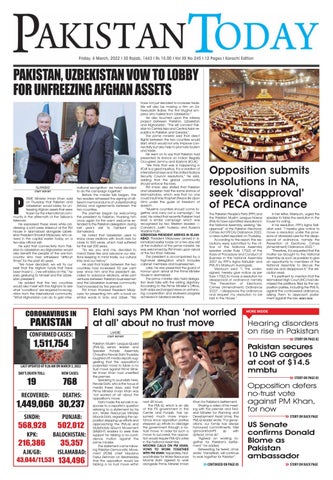
Friday, 4 march, 2022 i 30 rajab, 1443 i rs 15.00 i vol Xii no 245 i 12 pages i karachi edition
Pakistan, Uzbekistan vow to lobby for Unfreezing afghan assets
ISLAMABAD
P
staff report
rime minister imran Khan said on Thursday that Pakistan and Uzbekistan would lobby for unfreezing Afghan assets that were frozen by the international community in the aftermath of the Taliban’s takeover. He expressed these views while addressing a joint press stakeout at the Pm House in islamabad alongside Uzbekistan President Shavkat mirziyoyev, who arrived in the capital earlier today on a two-day official visit. He said that connectivity from Pakistan to Uzbekistan via Afghanistan would also benefit the people of the war-torn country who had witnessed “difficult times” for the past 40 years. “We have decided, we will try our best that the Afghan funds that have been frozen […] we will lobby on this,” he said, gesturing to himself and the Uzbekistan president. He added that the two countries would also meet with the Afghans to see what “conditions” are required for recognition from the international community. “What Afghanistan can do to gain inter-
national recognition: we have decided to do this campaign together.” Before the media talk began, the two leaders witnessed the signing of different memorandums of understanding (moUs) and agreements between the two countries. The premier began by welcoming the president to Pakistan, thanking him once again for the warm welcome extended to the Pakistani delegation during last year’s visit to Tashkent and Samarkand. He noted that Uzbekistan used to enjoy close relations with South Asia for close to 500 years, which had suffered for the last 200 years. “So we, you and me, decided to mend these ties and advance our relations keeping in mind trade, our cultural links and our history.” He said that trade between the two countries had increased 50 per cent ever since him and the president decided to advance relations, while joint ventures between Pakistani businessmen and the Uzbakistan business community had increased by five percent. Pm imran thanked President mirziyoyev for presenting him with a book on similar words in Urdu and Uzbek. “We
CoronavirUs in
Pakistan
CONFIRMED CASES:
1,511,754
LAST UPDATED AT 9:26 AM ON MARCH 3, 2022
DAY'S DEATH TOLL:
NEW CASES:
19
768
RECOVERED:
DEATHS:
1,449,060 30,237 SINDH:
PUNJAB:
568,928
502,012
KPK:
BALOCHISTAN:
216,386
35,357
AJK/GB:
ISLAMABAD:
43,044/11,531
134,496
have not just decided to increase trade. We will also be making a film on Zaheeruddin Babar, the first mughal emperor who hailed from Uzbekistan.” He also touched upon the railway project between Pakistan, Uzbekistan and Afghanistan. “This will connect Pakistan to Central Asia and Central Asian republics to Pakistan and Gwadar.” The prime minister said that direct flights between the two countries would start, which would not only improve connectivity but also help to promote tourism and trade. He went on to say that Pakistan had presented its stance on indian illegally Occupied Jammu and Kashmir (iiOJK). “We think that was is happening in iiOJK is a great injustice. it is a violation of international laws and the United Nations Security Council resolutions,” he said, adding that the global community should enforce the laws. Pm imran also stated that Pakistan and Uzbekistan had the same stance of islamophobia, which was that no one could insult Holy Prophet (Peace Be Upon Him) under the guise of freedom of speech. “muslims countries should come together and carry out a campaign,” he said. He noted that recently Pakistan had lead a similar campaign which was recognised by two Western leaders — Canada’s Justin Trudeau and russia’s Vladimir Putin. Uzbekistan president arrives in islamabad: President mirziyoyev arrived in islamabad earlier today on a two-day visit at the invitation of the prime minister. He was welcomed by Pm imran upon arrival at the Nur Khan Airbase. The president is accompanied by a high-level delegation which includes cabinet members and businessmen. Later, he was presented the guard of honour upon arrival at the Prime minister House in islamabad. The prime minister also held delegation level talks with the visiting dignitary. According to the Prime minister’s Office, both sides exchanged views on enhancing cooperation and reviewed progress achieved in bilateral relations.
Opposition submits resolutions in na, seek ‘disapproval’ of peCa ordinance The Pakistan People’s Party (PPP) and the Pakistan muslim League-Nawaz (PmL-N) have submitted resolutions in the National Assembly, seeking “disapproval” of the Pakistan electronic Crimes Act (PeCA) Ordinance 2022, a news outlet reported on Thursday. According to the report, the resolutions were submitted to the office of the National Assembly speaker under rule 170(2) of the rules of Procedure and Conduct of Business in the National Assembly 2007 by PPP’s Agha rafiullah and PmL-N’s marriyum Aurangzeb. marriyum said: “i, the undersigned, hereby give notice as per rule 170(2) to move a resolution for disapproval of ordinance namely “The Prevention of electronic Crimes (Amendment) Ordinance 2022”. i disapprove the ordinance and request my resolution to be laid in the House.”
elahi says pm khan ‘not worried at all’ about no trust move LAHORE staff report
Pakistan muslim League-Quaid (PmL-Q) senior leader and Speaker Punjab Assembly Chaudhry Pervaiz elahi Thursday laughed off media reports suggesting that the opposition’s purported move to table a no trust move against Prime minister imran Khan had unsettled the premier. Speaking to journalists here, Pervaiz elahi, who is the focus of media these days, said that Prime minister imran Khan was ‘not worried at all’ about the opposition’s move. elahi made this remark in response to a reporter’s question referring to a statement by his son, Water resources minister moonis elahi, regarding the opposition stepping up efforts and approaching the PmL-Q and mutahidda Qaumi movement (mQm-P) leaders to seek their support for tabling a no-confidence motion against the prime minister. The statement came following Pakistan Democratic movement (PDm) chief maulana Fazlur rehman on Wednesday that the opposition would be tabling a no trust move within
in her letter, marriyum, urged the speaker to table the resolution in the house for voting. in his resolution, PPP’s Agha rafiullah said: “i hereby give notice to move a resolution under the provisions of aforesaid rules for the disapproval of ordinance, namely the Prevention of electronic Crimes (Amendment) Ordinance 2022.” “Therefore, it is requested that this matter be brought to the National Assembly as soon as possible to give an opportunity to members of the National Assembly to discuss the said law and disapprove it,” the resolution read. it is pertinent to mention that the islamabad High Court (iHC) had dismissed the petitions filed by the opposition parties, including the PmL-N, against the controversial ordinance, asking them to approach parliament against the law. news desk
more inside
Hearing disorders on rise in Pakistan STORY ON PAGE 02
pakistan secures 10 lnG cargoes at cost of $14.5 mmbtu STORY ON PAGE 03
next 48 hours. The PmL-Q, which is an ally of the PTi government in the Centre and Punjab, has assumed much more importance since opposition parties stepped up efforts to dislodge the government through a notrust move. in order for such a move to succeed, the opposition would require PmL-Q’s votes in the National Assembly. mOOnis Calls On pm khan, vOws tO wOrk tOGether with pm khan: Separately, Federal minister for Water resources moonis elahi agreed to work alongside Prime minister imran
Khan for Pakistan’s betterment. Sharing a video of his meeting with the premier and Federal minister for Planning and Development Asad Umar, the PmL-Q leader wrote: “For generations, our family has always honoured commitments. met @imranKhanPTi sb with @Asad_Umar sb”. “Agreed on working together for Pakistan’s betterment,” he added. retweeting his tweet, Umar wrote: “inshaAllah, will continue to work together for Pakistan”.
CONTINUED ON PAGE 05
Opposition defers no-trust vote against Pm Khan, for now STORY ON BACK PAGE
Us senate confirms donald blome as pakistan ambassador STORY ON BACK PAGE
02
Friday, 4 March, 2022 | KARACHI
NEWS
HearINg DIsorDers oN rIse IN PaKIstaN LAHORe
e
aNaDolu ageNcy
VER-INCREASING air and noise pollution, self-medication, and inappropriate treatment are the key factors behind the rise in hearing disorders in Pakistan, which already ranks among the top polluted countries in the world, according to health experts. Speaking to Anadolu Agency on the occasion of World Hearing Day, which falls on Thursday, Dr Shahid Rajput, a Karachibased audiologist, said the number of hearing disorders in Pakistan has surged by 15 percent over the past decade. According to the Pakistan Society of Audiology and Speech (PSAS), of which Rajput is president, hearing problems range from mild to moderate to severe.
“Increasing noise pollution, especially in the major cities, is the key factor behind a surge in high frequency or noise-induced hearing loss, whereas infectious air is the reason for growing ear infections among people,” Rajput explained. Karachi, Lahore, Peshawar, Rawalpindi, and Faisalabad are among the most polluted cities in the region. Lahore, along with India’s capital New Delhi and Bangladesh’s capital Dhaka, has topped the daily rankings of the world’s most polluted cities this winter, owing primarily to escalating industrialization and unplanned urbanisation in recent decades. More vulnerable segMents: Apart from the big cities, Rajput observed, hearing disorders and ear infections are also common in the rural areas because of the unnecessary use of medicines, oils, and
cotton swabs for ear crunching and treatment by quacks. A recent PSAS study lists security agencies’ personnel, industrial workers, lawyers, and journalists as “more” vulnerable to hearing disorders. The study included 2,000 airport security and traffic police personnel, textile and factory workers, lawyers, and journalists with more than 10 years of service. “The study shows that 75 percent of the traffic police and airport security personnel suffer from different levels of hearing disorders, followed by 70 percent of textile workers and 60 percent of lawyers and journalists who are also vulnerable to noise and air pollution on a regular basis,” he said. Dr Hafiz Khizir Mahmood, a Faisalabadbased audiologist, backed up the study by stating that a recent survey of local franchises of an international soft drink brand revealed
that 40-50 percent of their workers suffered from noise-induced hearing loss. DisorDers rising aMong newborns: The PSAS study further shows that around 3 percent of children are born with hearing impairment, either completely or partially. Dr Mahmood, who heads the audiology department at a state-run children’s hospital, said the number of children with hearing issues has increased by up to 30 percent over the past three years. “We have a four to five months wait even for different hearing tests as the number of patients keeps increasing,” he told Anadolu Agency. He cited cousin marriages, high-grade fever, and birth-related issues as major contributors to the rise in hearing disorders in children. He noted another cause of hearing disorders in children, positioned ear
infections, which occur as a result of mothers failing to position their newborns properly while feeding. living in state of Denial: Constable Mujahid Ali is seen struggling to manage the streams of honking vehicles coming from all four sides as he stands in the middle of the bustling M.A Jinnah Road intersection in downtown Karachi. A green surgical mask is his only defense against the swirling dust and carbon emissions from the vehicles. His once-neat white uniform is stained by tiny carbon particles after eight hours of duty at this noisy and most polluted spot in the city. Ali is one of the hundreds of Karachi traffic police officers who have gradually developed hearing issues from mild to severe levels. “During the initial years, I did not notice anything wrong. But over the past few years, I have started feeling crackling noises in my ears and a hearing problem,” Ali, who has been serving in the traffic police for the last six years, told Anadolu Agency.
Ukraine: Pakistan embassy rescues India students after staff flees office KYIV/ISLAMABAD web Desk
Interior ministry gets notice on refusal to allow Czech model to leave ISLAMABAD staff RepoRt
The Islamabad High Court (IHC) served a notice on the Ministry of Interior on a petition filed by a Czech model blaming the government for refusal of permission to return following her acquittal in a drug case. Tereza Hluskova, 24, who was sentenced in 2019 to eight years in prison on charges of attempting to smuggle heroin from Pakistan to the United Arab Emirates (UAE), was released from prison in November weeks after her acquittal. She was handed over to representatives of the Czech Embassy and headed to Islamabad, according to her attorney, Saif ul-Malook. On Thursday, Justice Aamer Farooq ordered the ministry to submit a response to Hluskova’s petition within two weeks. Hluskova was arrested in January 2018 in possession of 8.5 kilograms, or 19 pounds, of heroin at the Allama Iqbal International Airport in Lahore from where she was heading to Ireland via Dubai. Her sentence also included an $800 fine. She was acquitted in November by the Lahore High Court (LHC). At the time of the arrest and during her trial, Hluskova, who had come to Pakistan to work as a model, pleaded she was innocent and that someone else placed the narcotics in her luggage.
MQM-P leader apologises for party’s ‘misjudgment’ during May 12 tragedy NewS DeSK Convener of Muttahida Qaumi Movement-Pakistan (MQM) and Member National Assembly Khalid Maqbool Siddiqui has apologised for his party’s “misjudgment” during the May 12 tragedy that saw dozens of people lose their lives to riots in Karachi, a news outlet reported on Thursday. On May 12, 2007, the deposed chief justice of the Supreme Court, Iftikhar Mohammad Chaudhry, was scheduled to visit the city and take part in a function of the Sindh High Court Bar Association. Members of civil society, including lawyers, were not allowed to reach the airport to welcome the then chief justice, thus leading to clashes between the supporters of the judge and the then-MQM activists. Nearly 50 people lost their lives and hundreds of others were wounded during riots on that day. According to the report, Siddiqui, on Thursday, expressed his regret on the incident while addressing a gathering organised by the Balochistan High Court Bar in Quetta. He conceded that the MQM’s image was tarnished in the wake of the May 12 clashes. “MQM should have tendered an apology and I apologise for that. And this apology is for making a wrong judgment,” he told the gathering. “We had been used and we regret that but that was not our intention and this is not how we function as a party,” he insisted. Siddiqui admitted that MQM-P had “slightly weakened ideologically”. However, he expressed hope that his party would again produce a new crop of young leaders who will “prove to be the future of the country”.
Amid the chaos following Russia’s attacks in Ukraine, Pakistan’s embassy in Kyiv rescued students from India who were looking to cross the border into Romania but found themselves stranded in the war-hit Eastern European country after New Delhi’s diplomatic mission apparently fled their offices ostensibly to escape the firing. In a video making rounds on social media, the staff at Pakistan’s mission appear to provide the students — who had travelled from the eastern city of Kharkiv, Ukraine’s second-largest, to Lviv in the west — with food in a cafeteria-like setting and make necessary arrangements to ensure their safety. Last Thursday, President Vladimir Putin asked Ukrainian forces to lay down their arms in a televised address before asking his troops to launch a series of
attacks in the neighbouring country. The ensuing violence created an emergency situation for foreign nationals in Ukraine, including Indian families and students, who urged their respective governments to make arrangements for their evacuation. The city of Lviv, a tourist hub otherwise, is around 70 kilometres from the border with Poland and has since the beginning of the crisis become a refuge for the displaced. “We looked for the staff at the Indian embassy but could not find anyone there,” a student says in the video. Commenting on the development, Foreign Minister Shah Mahmood Qureshi said the mission helped the “distressed” students on humanitarian grounds. “They were kids, they were in distress [and under] stress so we did what was possible for them on a humanitarian basis,” said Qureshi while speaking to the media in Mirpurkhas district of Sindh where he along with several other party leaders is currently
Pakistan, Saudi Fund for Development signs debt service suspension agreements worth $846 million ISLAMABAD staff RepoRt
Government of Pakistan and the Saudi Fund for Development (SFD) on Thursday signed two Debt Service Suspension Agreements amounting to $846 million under the G-20 Debt Service Suspension Initiative (DSSI) Framework. As per the details, Ambassador of the Kingdom of Saudi Arabia Nawaf bin Saeed Al-Malkiy to Pakistan witnessed the signing ceremony held in Islamabad while the Director General for Asia Dr.
Saud Ayid R. Alshammari represented the SFD in the signing ceremony. This amount which was due to be paid during the testing period from May 2020 to December 2021 will now be repaid over a period of six years starting from 2022 in semi-annual installments. Due to the support extended by the Saudi Fund for Development – one of the major bilateral development partners of Pakistan – along with other bilateral creditor countries, the G-20 DSSI has provided the fiscal space which was necessary to deal with the urgent health and socioeconomic
Food security, climate change major challenges: Gardezi MULTAN staff RepoRt
Punjab Minister for Agriculture Syed Hussain Jahanian Gardezi has said that food security and climate change are major challenges which need to be tackled with a strong and long-term strategy. “The earth is an invaluable gift of nature because it plays an important role in fulfilling our nutritional needs. We have to perform our national obligation to protect it,” Gardezi further said while addressing the participants of the inaugural function of a two-day national conference on soil fertility and protection held at Bahauddin Zakariya University. The provincial minister said that Pakistan is one of the 10 countries in the world which are most affected by climate change. Climate change has intensified the weather and increased the average temperature which is directly affecting the yield of our crops. Continuous cultivation of various crops, unbalanced use of pesticides and chemical fertilizers is
seriously affecting the fertility of the soil, he added. He said the conference will discuss issues related to food security, environmental pollution, climate change, agricultural water management which will help in accomplishing the objectives of the conference. “Climate change, land degradation, increasing soil erosion, deforestation, misuse of pesticides and chemical fertilizers, burning of crop residues are the main factors which affect our soil fertility which need to be addressed permanently … With this we can not only restore the fertility of the earth but also improve the ecosystem,” he said. The minister said that promotion of modern agricultural technology
requires time to engage with other stakeholders, including universities, to raise awareness about soil fertility. On the occasion, Pro-Vice Chancellor BZU Prof Dr Ali Muhammad said that it is necessary to hold such conferences to create awareness on the agricultural challenges facing Pakistan. “Pakistan is an agricultural country and our economy is dependent on agriculture. In order to improve the economy, we have to get production according to the potential of our lands,” he added. He said that farmers will also have to be guided on a regular basis to increase the organic matter of the land. In order to meet the needs of a growing population, it is important to focus on increasing the soil potential and restoring its fertility, he added. In the seminar, the scientists gave lectures to the participants on climate change and soil management. The conference was attended by Additional Secretary Agriculture South Punjab Imtiaz Ahmed and soil scientists from across the country.
leading a protest march against the Pakistan Peoples Party (PPP) government. “Pakistan cares about the kids […] our own or any nationality,” tweeted Muhemmed Aejaz, Pakistan’s ambassador in Hungary. Russian forces are firing artillery and laying siege to Kharkiv and other major cities, a Ukrainian official said, as the invasion of the former Soviet republic entered its eighth day. Indians make up about a quarter of the 76,000 foreign students in Ukraine, by far the largest number, according to Ukrainian government data. New Delhi has evacuated about 4,000 students in the last month, but some 16,000 remain trapped, according to the latest data from India’s foreign ministry. The criticism over New Delhi’s evacuation of students from the war-torn country has been mounting. Over the weekend, a student was killed in shelling in Kharkiv, that nation’s foreign ministry said.
needs of the Islamic Republic of Pakistan. The total amount of debt that has been suspended and rescheduled under the DSSI framework, covering the period from May 2020 to December 2021, is US$ 3,688 million. Pakistan has already concluded and signed 80 agreements with 21 bilateral creditors for the rescheduling of its debts under the G-20 DSSI framework, amounting to rescheduling of US$ 2,088 million. The signing of agreements with the Saudi Fund for Development brings the total rescheduled amount to US$ 2,934 million while negotiations for the remaining US$ 754 million are underway. The agreements for this amount are expected to be signed with respective bilateral development partners within the current fiscal year.
Prof Dr Nasira Khatoon takes charge as acting KU VC KARACHI News Desk
Professor Dr Nasira Khatoon has assumed charge as acting Vice Chancellor of the University of Karachi. She is the first female professor appointed to the post of vice chancellor KU. The Secretary Universities and Boards Department Government of Sindh Muhammad Mureed Rahimoon, though a notification dated February 28, 2022 notified Professor Nasira Khatoon, the KU Dean Faculty of Science as the acting KU VC as an interim arrangement till further orders. She did her PhD in 1994 in Parasitology from KU department of zoology, while her field of specialization is clinical and veterinary Parasitology and Pathology, Fish Pathology. Professor Dr Nasira Khatton completed her MSc in 1986 with the first division from the department of zoology, and BSc in 1983 with the first division from APWA College for Women. She had served as the chairperson department of zoology from 25-10-2019 till 03-11-2020. Professor Dr Nasira Khatoon was appointed as the professor at the department of zoology on 11-11-2005. To date, seven students have completed their PhDs under her supervision while three students have completed MPhil under her supervision. Besides, being the dean of the faculty of science, she was also the acting dean of the faculty of engineering. Since 2021, she was serving as a convener of the postgraduate admission process and from 06-11-2020 holds additional charge of the KU Director CEMB and the KU Director M.A.H. Qadri Biological Research Center from 27-08-2012 till 08-05-2015.
Friday, 4 March, 2022 | KARACHI
Pakistan secures 10 LNg cargoes at cost of $14.5 mmbtu ISLAMABAD
t
staff RepoRt
HE country has purchased around 10 liquefied natural gas (LNG) cargoes at a weighted average cost of $14.5 mmbtu (Metric Million British Thermal Units) for the current month, which is almost 75 percent less as compared to the existing rate of $60/mmbtu in the international spot market. Minister for Energy Hammad Azhar said this in a tweet on Thursday, adding: “LNG spot cargoes have touched $60/mmbtu in international markets”. “However Pakistan’s weighted average of 9-10 cargoes arriving in March is priced only at $14.5/mmbtu of
long term and spot cargoes purchased. This is despite 2 defaults of long term cargoes,” added the minister. Hammad said the ‘most competitive
cargoes’ are arriving under the contracts signed by the Pakistan Tehreek-e-Insaf (PTI) government. Elaborating the default of cargoes,
he said there were two defaults on part of those traders with whom the previous government of the Pakistan Muslim League-Nawaz (PML-N) had signed the contracts. “This will be their 8th default/nonperformance in just a 6 months period. Last spot purchase was of $25/mmbtu on February 22. Today’s price is $60/mmbtu.” Meanwhile in another tweet, Hammad Azhar said that protecting people from the effects of global inflation is the government’s topmost priority. He said that the government has decided to make the subsidy package of Rs5 per unit on electricity more efficient and he will soon announce the details in this regard.
IHC gives another chance to India to hire lawyer for Kulbhushan Jadhav NewS DeSK The Islamabad High Court (IHC) on Thursday gave another chance to India to hire legal representative for its convicted spy Kulbhushan Jadhav. The court gave New Delhi time till April 13 to provide the spy with legal representation. A larger bench comprising of Chief Justice Athar Minallah, Justice Amir Farooq and Justice Miangul Hassan Aurangzeb heard the law ministry’s request to provide government counsel to Jadhav. During the hearing, Attorney General of Pakistan (AGP) Khalid Javed Khan said that India does not consider Jadhav as human, but asset. According to a news outlet, IHC Chief Justice Athar Minallah remarked that the decision of the ICJ had expressed confidence in the Pakistani judicial system and left the matter of reviewing the death penalty to Pakistan. The AGP appraised the court of the progress made
with contacts to India regarding Jadhav. When asked by the court if an act has been passed in this regard, the AGP stated that an act has been passed on the matter in December last year, according to which the law ministry can file a petition against a foreigner, but India has no interest in providing a lawyer to Jadhav. CJ Minallah stated that India should treat its citizen as a human being, as Pakistan views Jadhav as a human being. In 2016, Pakistan had arrested the Indian spy – a serving officer in the Indian Navy – in Mashkel in Balochistan, a few miles from the border with Iran. He was accused of running a spy network for the Research and Analysis Wing (RAW), India’s premier intelligence agency, from the Iranian port of Chabahar. Video confessions of his activities were released by the government and a military court had sentenced Jadhav to death in April 2017 on espionage and terrorism charges. His appeal is pending in the IHC.
NEWS
03
IHC summons interior secretary, ICt chief commissioner in Lg case ISLAMABAD News Desk
The Islamabad High Court (IHC) on Thursday summoned the interior secretary and ICT chief commissioner in a case against local body elections under the Islamabad Local Government Ordinance 2021. The court also extended its stay order against the local body polls till next date of hearing. During the hearing of the case by Justice Mohsin Akhter Kayani, the assistant attorney general (AAG) informed the court that the ordinance has been sent to a parliamentary committee to turn it into a law. The lawyer of Election Commission of Pakistan (ECP) adopted the stance that his department was not provided maps of delimitation and other data, adding that the ECP has started work at its own. The court observed that the top court had ordered the federal and provincial governments to conduct local government elections. It further said the secretary interior and ICT chief commissioner could not fulfill their responsibilities. Later, the court adjourned further hearing of the case till next date.
‘safety and succor to passengers hallmark of railway Police’ LAHORe staff RepoRt
University of Karachi, NIMa to cooperate for research in maritime affairs KARACHI News Desk
A Memorandum of Understanding was signed between the National Institute of Maritime Affairs (NIMA) and the Department of International Relations University of Karachi for bilateral cooperation in promoting education and foster joint efforts in the area of research. The Ceremony was held at the University of Karachi. The documents were duly endorsed with the signatures of Vice Admiral (Retd) Abdul Aleem, Director General, National Institute of Maritime Affairs (Hilal-e-Imtiaz-eMilitary) and Dr. Naeem Ahmed Chairman of the Department of International Relations University of Karachi. The Vice Chancellor, University of Karachi Dr. Nasira Khatoon also graced the occasion and appreciate that initiative and congratulated both Institute. The purpose of the agreement is to improve the research and academic collaboration between the two institutes, to promote and intensify the cooperation in maritime domain. The agreement will not only enhance bilateral collaboration but will also play an important role in promoting joint activities, exchange of information, experts and researchers in for furtherance of areas of mutual interest. Speaking on the occasion, Head of Department Dr. Naeem Ahmed said that, the Department of International Relations is the oldest Department established in 1958, to study the field of geostrategic dynamics, foreign policy, Indian Ocean affairs and international relations in Pakistan. He said that this is the first (MoU) of the Department with outside institute and we are hopeful that this will collaboration will be of great opportunity to be benefited from it. Director General (NIMA), Vice Admiral (Retd) Abdul Aleem, assured wholehearted support from National Institute of Maritime Affairs (NIMA) To IR Department in research, policy analysis and other related subjects. Furthermore, Director NIMA Karachi commodore (Retd) Ali Abbas also joined the event along with the researchers team.
CJCSC holds wide-ranging talks on defence cooperation with Kenyan dignitaries RAwALPINDI staff RepoRt
Chairman Joint Chiefs of Staff Committee (CJCSC), General Nadeem Raza who is on an official visit to Kenya held wide-ranging talks on bilateral defence cooperation with dignitaries from Kenya Defence Forces, Inter Services Public Relations (ISPR) said. According to the military’s media wing, the dignitaries called on by the CJCSC included Hon. Eugene Ludovic Wamalwa, Cabinet Secretary, Ministry of Defence, General Robert Kariuki Kibochi, Chief of Defence Forces, Lieutenant General Walter R. Koipaton Commander Kenya Army, Major General John Mugaravai, Commander Kenya Air Force and Major General Jimson Longiro Mutai, Commander Kenyan Navy. During meeting of General
Nadeem Raza with dignitaries of Kenyan Defence Forces, besides security and defence cooperation, matters related to enhancing the level and scope of bilateral military engagements in various fields were discussed during separately held
meetings. Both sides reaffirmed their commitment for strengthening and enhancing existing defence and security relationship between the friendly countries. Chairman JCSC said that Pakistan accords high importance to its long-standing relations with Kenya and believes that both countries would develop meaningful and long-term strategic relationship through enhanced bilateral engagements especially relations in the field of defence and security. Kenyan dignitaries remained appreciative of the high professional standards of Pakistan Armed Forces, their achievements in fight against terrorism and continued efforts for regional peace and stability especially for peace in Afghanistan. Earlier upon arrival at Kenya Defence Headquarters, a smartly turned out contingent presented Guard of Honour to General Nadeem Raza.
Opposition by indulging in politics of anarchy providing discomfort to masses: Buzdar LAHORe staff RepoRt
Punjab Chief Minister Sardar Usman Buzdar has said that Pakistan Tehreek-e-Insaf (PTI) government is providing maximum relief to the masses and opposition by indulging into politics of anarchy is providing discomfort to the masses. He stated this while talking to National and Provincial Assembly Members who called on him at CM office on Thursday and discussed matters pertaining to mutual interest, development projects and political affairs. Usman Buzdar categorically remarked that no-trust move holds no weightage and opposition neither had
majority in number-game earlier nor they have now. He emphasized that defeat is written on the wall for the opposition. He condemned that the opposition wants to create unrest in the country for the sake of attaining power. He further stated that people have come to know that the opposition have no agenda for their welfare. He denounced that those elements doing politics of unrest only want to impede progress in the country. The chief minister vowed that the PTI government would steadfastly foil the undemocratic designs of the opposition. Those who met with the CM included Member National Assembly Maj. (R) Tahir Sadiq, Members Provincial Assembly Khan Sher Akbar Khan and Muhammad Atif.
Help Desks of Pakistan Railways Police are being established in all major Railways Stations for every possible assistance to the passengers. “In last five months, from Oct-28th Feb 241 vulnerable lost children were returned to their heirs. Similarly, 854 precious lost luggage amounting 9.5277 million were preserved and handed over to their owners,” says a statement issued by Pakistan Railways. As many as 183 passengers also received first aid in emergency cases, while 185 times wheel chairs and 83 stretchers were served to handicapped, old and disable passengers, it added. “Pakistan Railways Police help desk enthusiastically serving the passengers in the form of medical, informative, welfare, rescue and general assistance. Help Desks in all major Railways Stations are also playing a key role in preventing sexual harassment, mishandling of lost children, and theft of lost luggage of passengers,” it concluded.
Friday, 4 March, 2022 | karachi
04 news
ProPhet MuhaMMad’s (PBuh) life the Best guide to ensure huMan rights, socio-welfare norMs: PM ISLAMABAD
P
app
RIME Minister Imran Khan on Thursday said to ensure human rights and socio-welfare norms, following the footsteps of Prophet Muhammad (PBUH) is the best way to achieve the goals. Addressing a ceremony organised in Islamabad to mark the complete operationalisation of Rehmatul-lil-Aalameen Authority, the prime minister said a journey of transformation towards morality and ethics would help the nation emerge as a strong entity in the world, adding that one of the main reasons for establishing the authority is to guide the young generation about the teachings of Prophet Muhammad (PBUH) for real success in this world and hereafter. He said the last address of Prophet Muhammad (PBUH) is the charter of human rights that focuses on the rights and respon-
sibility towards each other. He emphasised the importance of character-building of the new generation, adding that a morally strong society does not allow the powerful and elite to plunder the public money through corruption. He mentioned that corruption leads to the downfall of a nation and regretted that the society has accepted the corrupt practices and failed to distinguish between right and wrong. He said the cases of rape and child abuse are increasing in the country, while the families of victims are reluctant to report. He stressed the need for the involvement of various segments of society to join hands against sex crimes by promoting the culture of ethics and morality. He said the Rehmatul-lil-Aalameen Authority has been made functional, where the scholars would play their role in educating the society about the teachings of Prophet Muhammad (PBUH). He expressed confidence that the schol-
UN urged to work with Taliban to stabilise Afghanistan, ensure regional peace UNITED NATIONS app
The new mandate for the United Nations Assistance Mission in Afghanistan (UNAMA) must be based on respect for the war-torn nation’s sovereignty and conducted with the consent of the Taliban government — recognized or not — to promote stability and improve people’s lives, Pakistan told the UN Security Council. “Any effort to create a parallel governance structure to the actual government is likely to be unacceptable and will erode the trust and cooperation which exists presently between UNAMA and the authorities in Kabul,” warned Ambassador Munir Akram ahead of the 15-member bloc’s review of the mission’s mandate. Earlier, the top UN envoy in Kabul also urged the international community to begin engaging more substantively with the de facto Taliban authorities, citing economic challenges that have left Afghanistan on the brink of “irreversible” ruin. Briefing the Security Council, Deborah Lyons, the head of UNAMA, recalled that when the mission’s mandate was rolled over for six months in September last year, it was still too early for the international community to react to the Taliban’s seizure of power. It was now clear, however, it will be impossible to truly assist Afghanistan’s people without working with the de facto authorities. In his remarks, Ambassador Akram said UNAMA’s new mandate must focus on humanitarian and emergency assistance, the revival of the economy, building the capacity of institutions, and facilitating the reconstruction and connectivity projects. “Political objectives, such as promoting ‘inclusive’ governance is the sole purview of Afghanistan and its au-
thorities,” he said, pointing out the six neighbours’ platform has also helped to move the process in that direction. At the same time, the envoy stressed there is, finally after four decades, a chance to promote durable peace in Afghanistan as one government controls the entire country and there is no existential threat to its survival. The international community must work to stabilise the country and ensure durable peace in the region by addressing the massive humanitarian crisis and preventing the collapse of the Afghan economy, he said. Expressing hope that recent crises — the conflict in Ukraine — will not lead to abandoning Afghanistan — a mistake made twice in the last 40 years with devastating consequences — the envoy welcomed United Nations-led efforts to inject cash into the banking system. Further, all of Afghanistan’s financial reserves must be released, it is regrettable that half of these are proposed to be sequestered by another country, Ambassador Akram said. Beyond humanitarian help, the envoy said stabilising Afghanistan requires reconstruction — to rebuild damaged infrastructure and implement the connectivity projects, such as the Turkmenistan-Afghanistan-Pakistan-India (TAPI) Pipeline, Central Asia-South Asia (CASA-1000) power project and the Central Asia-Afghanistan-Pakistan railroads, as well as the envisaged extension of CPEC to Afghanistan. UNAMA is engaging constructively with the new authorities in Kabul, he noted, hoping it would continue to play this role. Security remains a preeminent concern for Afghans and for their neighbours, he said, adding, “There are still some who wish to continue using Afghan territory to promote terrorism, including against regional countries, especially against Pakistan.”
ars of the Council of Islamic Ideology and Islamic International University would immensely contribute to the authority with their positive intellectual input. He mentioned that national health insurance card and Ehsaas programmes with shelter homes and soup kitchens are the best steps towards attaining the goal of a sociowelfare state. The prime minister also lauded and appreciated the Rehmatul-lil-Aalameen Authority’s chairperson, Dr Anis Ahmad, on the occasion for preparing a complete roadmap that detailed the body’s short-term, mediumterm and long-term steps to achieve these objectives. He assured the chairperson of complete support from all relevant government departments, including the Prime Minister’s Office and education department, in the authority’s endeavours to implement the roadmap aimed at character building and the education of youth, protection of family system and promotion of interfaith harmony.
Secretary Petroleum, OGRA chairman assure OMCs of fortnightly payment of PDC ISLAMABAD ahmad ahmadani
Secretary Petroleum Division and Oil and Gas Regulatory Authority (OGRA) chairman on Wednesday assured the oil companies that a fortnightly mechanism for payment of the Price Differential Claims (PDC) will be developed soon in consultation with the Finance Ministry. Sources privy to the development informed that a meeting to resolve the concerns of oil industry regarding payment of PDC was held on Wednesday where Secretary Petroleum Division Ali Raza Bhutta, Chairman OGRA Masroor Khan and representatives of Oil Marketing Companies (OMCS), refineries and Oil Companies Advisory Council were in attendance. Sources said that Secretary Petroleum and OGRA chairman assured the oil companies that they will raise the issue of PDC with the finance ministry and will come up in a few days
with a fortnightly payment mechanism of PDC. They said that OMCs have also complained regarding pending PDC of 2004 and insisted to resolve the overall PDC issues of oil companies due to their cash flow problems. They said both the Secretary Petroleum and OGRA chairman assured to develop an early payment mechanism for clearing the PDC of the oil companies.
The two officials (Secretary Petroleum and Chairman) have assured that a mechanism for payment of PDC will be developed and shared with the oil industry before it is implemented, said sources. “They assured to revert in a few days”, said the sources. When contacted, a senior official of oil industry who was also present on the occasion said
on condition not to be named that no certain deadline to clear the PDC of oil industry was given in the meeting while only bureaucratic promises/reply were made to appease the oil industry. “You know how the Ministry of Energy (MoE) and OGRA works”, said the official. The Oil Companies Advisory Council (OCAC) in a letter dated March 1, 2022 to Secretary Petroleum requested to remove the Price Differential Claim (PDC) by revising petroleum product prices immediately or develop an alternate subsidy mechanism in order to avoid imminent petroleum shortage of the petroleum products in the country. OCAC also requested for an urgent meeting within the next few days with industry representatives to appraise the current precarious situation and challenges being faced by the oil industry and to save the country from imminent shortage of the petroleum products.
Former fiancé kills polio worker in Peshawar PESHAWAR Staff RepoRt
Gunmen in Peshawar shot and killed a woman polio worker as she was returning home Wednesday after taking part in the latest antipolio campaign, police said. Wednesday’s attack happened in Daudzai town of the city. Iqra Iqbal was gunned down on her way home, said Iftikhar Khan, a police official. There was no immediate claim of responsibility for the attack but it later emerged the incident was a matter of personal enmity. A spokesman of the police said the victim’s father, Hayat Khan, nominated a former fiancé, Saif Ullah, as the prime suspect in the first information report (FIR). Khan claimed the suspect killed Iqbal out of rage as he had ended their engagement. Pakistan regularly launches anti-polio campaigns in an effort to eradicate the highly infectious disease. The latest five-day drive
against polio started on Monday. Since January last year, Pakistan has not reported any new cases, raising hopes the nation is close to becoming a polio-free coun-
try. Pakistan and Afghanistan are the only remaining countries in the world still trying to eradicate polio, which can cause severe paralysis in children.
Disparity reduction allowance for KP civil servants: minister PESHAWAR Staff RepoRt
Khyber Pakhtunkhwa announced a 15 percent disparity reduction allowance for provincial government servants with effect from March 1. The announcement was made
by the Minister for Finance Taimur Jhagra via video message. He said Chief Minister Mahmood Khan approved in principle to follow the federal government in approving the allowance.The increment will be offered only to those civil servants who are not receiving other al-
lowances. Jhagra said he had held a meeting with the finance secretary and that all paperwork would be completed soon and the file sent to Khan for approval. He said the chief minister would make a formal announcement and relevant notifications would be followed in this regard.
Friday, 4 March, 2022 | kArACHI
newS
05
PaKistan turns to ExPEnsivE diEsEl on lnG suPPly Crisis: rEPort ISLAMABAD
Elahi says PM Khan ‘not worried at all’ about no trust move contInueD froM pAge 01 The planning minister wrote: “With our family ties, which span more than one generation, I know that your family honours commitments”. Earlier this week, PM Imran Khan held a short meeting with the Chaudhry brothers of PML-Q as the Opposition targets PTI’s allies to topple the incumbent government. The prime minister’s meeting at the Chaudhry brother’s residence in Lahore — which was more than 30 minutes long — with PML-Q’s top brass, who are allies of the government in Punjab and the Centre, came as he was on a one-day visit to the provincial capital. Federal Minister for Education Shafqat Mehmood, Energy Minister Hammad Azhar, Information Minister Fawad Chaudhry, Chief Minister Punjab Usman Buzdar, and other PTI leaders had accompanied the prime minister during the meeting. Apart from former prime minister Chaudhry Shujaat and Speaker Punjab Assembly Pervaiz Elahi, MNA Salik Hussain and Shafay Hussain were also part of the meeting. During the meeting, the prime minister inquired about Shujaat’s health. The former prime minister thanked PM Imran Khan for visiting his house and inquiring about his health. In a notable development on this front, PML-N President Shehbaz Sharif had approached Shujaat for the first time in 14 years earlier this month. However, Prime Minister Imran Khan had said a day later that Moonis had conveyed to the PTI that “We shouldn’t worry about the meetings.” The premier had said this while addressing a ceremony in Islamabad, where Moonis was also present. When a reporter referred to the statement today and asked Pervaiz Elahi whether he had the same message for the prime minister as Moonis, he laughed and then replied that PM Imran is not worried. “He is not worried at all,” he asserted. Pervaiz’s statement comes after PM Imran called on the PML-Q leadership on Tuesday, in a bid to ensure their support as opposition parties prepare to move a no-confidence motion against the premier. When asked whether the much-talked-about no-trust move was discussed during the meeting, the PML-Q leader replied in the negative. To another question about the opposition’s plans of tabling the no-confidence motion, Pervaiz made a cryptic remark. “Ingredients are in the pot and I will speak on this after smoke rises after the first boil.” Asked what would be the outcome of the no-confidence motion, he said, “Such a large pot is on the stove. Something will come out of it.” When a reporter asked him to share his views on a statement issued by PDM spokesperson Hafiz Hamdullah that quoted Fazl as saying that the opposition would submit the no-confidence motion in the next 48 hours, Pervaiz said only the PDM president could speak on the matter. He also appreciated the government’s decision to reduce petrol and electricity prices as part of a series of relief measures amid rising inflation in the country. The Chaudhrys’ residence has been a hub of political activities over the last month or so, hosting opposition leaders, from PMLN president Shehbaz Sharif and PPP co-chairperson Asif Ali Zardari to Fazl, all of whom hoped to win over the government ally for a possible no-trust move. However, the most recent visit to the Chaudhrys was not by an opposition leader but PM Imran and a group of federal ministers. Shujaat had told the prime minister during the visit, “Shehbaz Sharif came to inquire after my health a few days ago and offered the chief ministership [of Punjab] to Pervaiz Elahi [in exchange for voting against Imran Khan].” “However, we know them well and do not trust them. He had offered us the same slot [in the 90s], but backed off after winning the elections. The excuse was that his father did not agree to the proposal,” the report quoted him as saying. “Although he has offered it again, we don’t trust (him) and continue to stand by the government,” the report quoted Shujaat as saying.
a
tltp
S a major supply crunch of liquefied natural gas (LNG) looms amid Russia’s invasion of Ukraine, Pakistan is switching to expensive and dirty diesel fuel to generate electricity, Bloomberg has reported. Pakistan’s diesel-fired power generation surged to the highest level in at least seven years in January, while LNG-based output dropped to the lowest in almost two years, according to government data compiled by Arif Habib Ltd. It is prudent to note that the two fuels each generated about 7% of the South Asian country’s electricity in January. That’s bound to continue as Pakistan has failed to find replacement
LNG cargoes after long-term supplies were forced to cancel deliveries. “LNG supply looks tight at the moment and LNG prices were expected to remain elevated even before the invasion of Ukraine,” said Simon Nicholas, an analyst at the Institute for Energy Economics and Financial Analysis. “It’s likely Bangladesh and Pakistan will need to continue to use more diesel and oil in power generation.” All of this comes when energy prices have already remained elevated due to imbalance between supply and demand as the world recovers from the pandemic. Given the current shortfall in supplies in global energy markets, the energy prices have been touching high following the invasion and severe sanctions on Russia in response. Meanwhile, Pakistan’s fuel costs
doubled in January, compared with the same period a year ago, data from Arif Habib show. According to January data by the National Electric Power Regulatory Authority, Diesel is the most expensive fuel for power generation in Pakistan, costing 14% more than fuel oil and 55% more than LNGbased generation. Diesel use also comes as the nation’s refineries have been filled with fuel oil, meaning that there are other options for power, said Tahir Abbas, Arif Habib’s head of research. Liquefied natural gas imports into India, Pakistan and Bangladesh are expected to hit a low point in February due to unaffordable spot LNG prices, according to BloombergNEF. A total of 39 cargoes arrived in January, the lowest since February 2019. BloombergNEF estimates the
share of spot volume in South Asia’s total LNG imports fell to just 18% of January supply, down from 25% in the previous month. Pakistan’s growing gas shortage this winter forced consumers to turn to cylinders in Karachi and authorities offered a winter incentive package to make users switch from gas to electricity for heating rooms and water. The country’s domestic gas production has fallen by about a fifth over the past two years, making LNG supply even more crucial. Diesel is used only when there are constraints and largely for system stability and restoration in instances of blackouts and outages, Pakistan’s energy ministry said in a response to questions. There is no requirement for diesel fuel for power generation until June, it added.
Appointment of DG PSQCA challenged in IHC ISLAMABAD Ghulam aBBas
The Islamabad High Court (IHC) was approached on Thursday against the summary moved by the Ministry of Science and Technology (MoST) for appointment of Director General of Pakistan Standard and Quality Control Authority (PSQCA), an attached department of the ministry. Dr Shahzad Afzal, filed a petition naming the Secretary MoST, Secretary Establishment Division and Acting Director General PSQCA as respondents. During the first hearing of the case on Thursday Justice Arbab Tahir of Islamabad High Court issued notices to respondents to file their comments, upon the Writ Petition. The counsel for the petitioner, Raja Saif Ur Rehman, submitted that the proposed appointee is a retired air force officer and has no background of quality standards. Through the petition, the counsel submitted that the petitioner had challenged the proposed appointment of DG
PSQCA on grounds that nepotism-based appointment was to be made in an illegal manner and against the prevailing law. The petitioner said that appointment of a person having no background in the field of standards and quality assessment was being made whereas the advertisement was not in accordance with Management Scales Policy 2020 rather in violation of said policy. The petitioner said the appointment was made by a ‘defective and incomplete’ Selection Board and in violation of law laid down by the Supreme Court of Pakistan. Proposed appointment was totally biased and seems to be favoring a retired officer from the forces without any lawful reason, he added. The petitioner claimed that the proposed appointment was to be made against a post of BPS22 whereas the post of DG as per rules falls in BPS-21 category. Besides the proposed appointment was to be made in a tailored manner where the experience mentioned in advertisement was not in line with
management scales policy rather it was in line with experience of the proposed candidate to favor him. The petitioner said the proposed appointment was to be made in order of merit as laid down in a management scales policy 2020 but merit was violated and candidates from bottom were picked. “The proposed appointment was being made without forwarding the score sheet to the cabinet which is a requirement of law mentioned in management scales policy 2020, section 3(vi),” the petitioner said in the petition. The counsel for petitioner claimed that Dr Shahzad Afzal, a highly qualified candidate, having vast international experience in relevant fields, was the suitable candidate for the post of DG PSQCA. PSQCA is an organization responsible for maintaining quality and standards of foodnon-food products being imported/ produced in Pakistan and plays an important role in the development and wellbeing of citizens.
1,435 Pakistanis evacuated from conflict-hit Ukraine ISLAMABAD staff report
As many as 1,435 Pakistanis have been evacuated from Ukraine, Pakistan’s embassy in the war-hit country said on Thursday. 1,262 Pakistani nationals have reached Poland, 123 Romania, 12 Hungary, and nine each Slovakia and Moldova, it said, adding that a total of 21 Pakistanis have been brought back to their motherland. The embassy said as many as 20 Pakistanis are on the Ukraine border and 40 at different places in Ukraine.
The embassy has appointed focal persons for assisting the stranded Pakistanis in Ternopil, Kyiv and Lviv. The stranded Pakistanis have been directed to contact the officials of the Pakistani embassy in Ternopil at 0038063698164 and 380681734727. On Wednesday, Dr Noel Khokhar, Pakistan’s ambassador to Ukraine, had said Pakistan has almost completed the evacuation process of its nationals from conflict-hit Ukraine. The envoy further said that they will remain alert at the Ternopil, Romania and Poland borders to ensure that not a single Pakistani is left stranded.
CM KP approves costenhancement of three power infrastructure projects in Khyber district peSHAWAr aziz Buneri
Chief Minister Khyber Pakhtunkhwa Mahmood Khan, on the recommendations of Provincial Development Working Party (PDWP), has approved the Cost-Enhancement of three projects for the construction of power supply infrastructure in newly merged Khyber district aimed at the provision of uninterrupted power supply to the area. These projects include construction of 132 KV Grid station Shahkass, 132 KV grid station BaraII and 132 KV grid station Tribal Subdivision Kohat along with transmission lines. It is pertinent to mention here that initially these projects were included in Accelerated Implementation Program (AIP) with an estimated cost of Rs.471 million, Rs. 530 million and Rs.650 million respectively. However, TESCO prepared PC-1’s for the said projects based on the ground realities resulting in enhanced/additional cost of Rs. 171.59 million, Rs.147.093 million Rs. 325.958 million respectively. These PC-1 were submitted to PDWP for approval with the enhanced cost. The forum approved these PC-1 subject to condition that Energy & Power department will move summaries to Chief Minister being the competent authority for approval of cost enhancement. Consequently, Energy & Power Department had moved summaries for the approval of Chief Minister which was approved. These projects, on completion would ensure provision of uninterrupted power supply to domestic as well commercial consumers which would boost industrial activities in the area.
FBR moot on implementation of Track & Trace System in the fertilizer sector ISLAMABAD shahzad paracha
The Federal Board of Revenue (FBR), along with its licensee, AJCL Private Limited, a leading local company, and its consortium partners Authentix Inc of USA and MITAS Corporation of South Africa, held a symposium on the implementation of Track & Trace System in the fertilizer sector. As per the information, many key players and industry experts participated in the event including representatives from the Fertilizer Sector such as Agritech Fer-
tilizer Limited, Barket Fertilizers (Pvt) Limited, Engro Fertilizers Limited, Fatima Fertilizer Company. The Track and Trace System (TTS), which has already been rolled out in the sugar and tobacco sectors, shall ultimately be extended to multiple other sectors of the economy including cement and others. The TTS is a transformational, one-of-akind, initiative that integrates real-time production monitoring, tax-stamp affixation and data sharing with the FBR’s network in a seamless manner, resulting in transparency of taxation process, digital record keeping,
tracking of goods throughout the supply chain, and thereby improving ease of business for manufacturers and consumers alike. The TTS shall also assist in capturing undeclared markets, help with the under-reporting of production and sales, restrict the flow of illegal/untaxed products and prevent leakage of revenue. The role of AJCL consortium and the industry stakeholders is invaluable in this effort and the FBR has already obtained great benefits from the program by gaining more visibility over production and through the automatic generation of relevant tax forms.
cMYK
At present, Track and Trace technologies are being used around the globe, as means to assist governments in digitization of economy and to enhance tax collection; with the successful implementation of this system in Pakistan, FBR aims to ensure that there is ‘No Production Without Taxation’. This program shall be accretive for the national economy, and should provide much-needed fiscal leeway to the Federal Government to spend on areas such as healthcare, education and infrastructure development. FBR’s Project Director Track and Trace Tariq Hussain Sheikh commented on the in-
crease in tax revenue from the sugar industry, highlighting that the majority of the companies have paid four times the taxes this year as compared to last year. “Track & Trace will help in bringing transparency to the tax collection process and that is the reason behind the strong support of the Prime Minister of Pakistan and Chairman FBR for the Track & Trace Program.” He further applauded the government of Pakistan for their continuous support and was positive that this program will carry on with the cooperation of the manufacturers and in turn, increase the revenue of Pakistan.
06-07 Comments - 4th March 2022_Layout 1 3/3/2022 10:34 PM Page 1
Friday, 4 March, 2022
06 COMMENT
The beginning of something larger?
No-confidence move A double-edged sword
T
he threat of the no-confidence move is turning out to be a double-edged sword. If passed, the PTI government will be sent home before completing its tenure. If the opposition fails despite having tried all the tricks of the trade and creating a hype, it would lose much of its credibility. Both sides have cared little for their avowed principles during the fight. The PM lost the moral high moral ground by seeking help from political leaders he had directly accused of corruption and contacting those he had dropped from the list of close associates for similar reasons. Imran Khan accepted blindly all the terms dictated by the IMF like raising power rates and petroleum prices, caring little for the common man’s suffering. Realising that he might have to go for elections ahead of the normal schedule, he made a U-turn, threw the IMF’s cautions to the wind and announced reduction in petrol prices and electricity charges besides an interest-free loan programme worth Rs 407 billion. he has thus spent billions to meet an immediate political challenge, ignoring imminent economic consequences. The two major opposition parties who have all along opposed any role for the establishment in politics have reportedly maintained a secret liaison with those who matter. even the PDM chief was reluctant to contradict these reports. The opposition is convinced that its noconfidence move would be successful despite no clear commitment of support either from the government’s allies or the PTI’s dissidents. even those in PML(N) who maintained that a no-trust move could never succeed in a hybrid democracy have suddenly become supporters of the move. The opposition has however kept its cards close to its chest while claiming that it stands united and would succeed in toppling the PTI’s government even without the PML(Q)’s votes. A minority comprising more cautious opposition leaders has however kept an escape hatch open if things don’t work out. The government’s fall was imminent, they maintain, provided no one interfered. Many would call it an excuse for shoddy groundwork. The opposition has thus put its credibility on line. There have been no talks about the government that will be made after the current one falls. It is saddening that despite nearly four years out of power, the opposition parties have failed to jointly work out an outline of a common economic programme, a neutral accountability system, and a policy to ensure media freedom.
The invasion creates dangerous precedents for India to use against Pakistan at Penpoint M a nIazI
T
he invasion of Ukraine by Russia was inevitable precisely because it was unreasonable. President Vladimir Putin wishes to upend the world order, and restore one in which Russia’s wishes are taken account of. his real enemy is thus the USA, not Ukraine, but Ukrainians are dying, not Americans. That means that he may end up defeating the Ukrainians, but still not achieve his war aim. What Putin has managed to do, probably, inadvertently, is strike a blow at the modern concept of sovereignty, of the nation-state, that has prevailed since the Treaty of Westphalia. he may also be drawing the wrong lessons from recent events. The lesson he is supposed to have drawn from the US withdrawal from Afghanistan is that the USA is now weak, or more precisely not strong enough militarily to impose its will on anyone willing enough to resist. Another lesson is the futility of trying to attempt regime change. One might be successful, but the ousted regime comes back. That was not the Soviet experience when the USSR invaded. Sardar Daud had been ousted, but his regime apparently sank without a trace. The Soviet proxy, the Babrak Karmal regime, was replaced first by chaos, then the Taliban. Thus if Russia achieves its goal of installing a pro-Russian government in Kyiv, there is no guarantee that the Zelensky government in some form or the other, will not return. The world order that Putin envisages is also dubious. It is almost as if he has forgotten why the USSR collapsed, and left the field open to the USA: it could not afford the military expenditure needed to compete. It should be noted that one of the reasons for the USSR flying apart is that it had been forced to spend too much on the invasion of Afghanistan. The inability to maintain its military not only prevented it from following an expansionist policy abroad, but also caused it to fly apart, because it had maintained its presence in the other republics because of the Red Army. The inability of the centre to pay for it meant that the USSR collapsed. Russia will have to be ready to make the necessary expenditure; it may find that the precedent war might overtax its resources. The USA certainly found, after Afghanistan and Iraq, that its way of waging war was hideously expensive. The expense of conflict was one reason why european countries gave their colonies independence after World War II: they could no longer afford to garrison them. One important reason was that they could no longer find enough recruits for their militaries. Russia may not have the funds, but the reaction of the
Destroying heritage Spate of incidents indicates no one is minding the store
T
he Walled City of Lahore has been designated a World heritage Site to be protected by the government. The Walled City of Lahore Authority has been set up to manage the Walled City, and to make sure it is managed properly. Recent incidents indicate that this may not be happening, as attempts continue to use the ambience of the Old City. Perhaps the most hurtful part of the whole exercise is that in two cases, the activity engaged in was the one for which permission had been granted. That indicates that the permission should not have been granted in the first place. The incident in which there was something else done instead of the event for which permission had been sought indicates that the WCLA seems to regard its job as done once it has pocketed the fee, and does not see its job as ensuring that no illegal activity is carried out. There was the shooting of a teleplay in Masjid Wazir Khan, which ended with a case registered against the cast members for acting there, and the playing of music. The very fact that a case could be registered indicates that permission was granted too casually, without obtaining sufficient details of what was to go on. Similarly, the recent permission for a vehicle to race around while shooting for a commercial shows the authorities failing to carry out due diligence. But the most egregious example must be the wedding held against the permission for a corporate event. The absence of a mechanism to ensure that events are held according to the permission given, and do not exceed them, was shown up. The pity is that this government of philistines does not understand that the Walled City has received the designation not just because it provides Lahorites with a link to the past, but because its forms part of the heritage of all humanity, and should not be frittered away like this. Not only must an enquiry be conducted into why these lapses occurred, but arrangements must be made to stop such episodes from continuing.
It’s for the whole country
Dr IllahI Bakhsh MarghazanI
T
he horse and Cattle Show Sibi is commonly known as ‘Sibi Mela’. It is an historical national event that has been celebrated since the last many centuries. however, during British rule, it improved with more official activities under the governance of Sir Robert Sandeman, in 1885. The present government of Balochistan has finally decided to hold this grand event of the province from 4 to 8 March. Sibi, ‘the hot Bowl of Asia’, lies 160 km away from Quetta valley to the south east. The historical Bolan Pass connects these two leading cities of Balochistan province. The name ‘Sibi’ is derived from the word ‘Sewi’ (a hindu lady of Sewa race) which is still a popular and native name of the city, being used by the people. A quick historic review of this city shows that it had remained under the control of Multan, the Amirs of Sind and Kandahar. This territory came under the rule of the Kalhoros (Amirs of Sind) in 1714. The Durranis took over the territory from the Kalhoros and appointed local governors,
Arif Nizami (Late) Founding Editor
Yousaf Nizami M. A. Niazi
Umar Aziz
Joint Editor
Joint Editor
Executive Editor
Lahore – Ph: 042-36300938, 042-36375965
This is perhaps the biggest worry for the world. The pullbacks from the abyss by India and Pakistan had made Kashmir the most likely nuclear flashpoint.
The writer is a member of staff.
Sibi Mela- A living history
Dedicated to the legacy of late Hameed Nizami
Editor Aziz-ud-Din Ahmad
Russian people to having to fight will prove a test. Another test is the one Ukraine faces. Can it engage in the kind of prolonged guerrilla struggle that the Taliban waged? Or have they become too europeanized? The image of Stepan Bandera must be there for Ukraine, for he operated with the Nazi invaders, as well as went to a concentration camp, during World War II. Putin’s rather cryptic reference to de-Notifying Ukraine may be a reference to Bandera’s struggle against the Red Army when it went through eastern europe on its way to Berlin. Bandera may be a controversial figure because of his role in the holocaust, but he was a Ukrainian patriot, who waged a a guerrilla war against the USSR as it returned. The USSR imprisoned Ukrainian nationalists as members of the ‘Banderist gang.’ That brings up perhaps Putin’s most egregious defence of his invasion, that Ukraine has cultural, linguistic and spiritual affinities to Russia. That might be true, but it smacks of a kind of old-fashioned nationalism. It does not take into account the greater inclination of the Ukrainian people for Western europe. It runs counter to the brutal suppression of the Chechen drive to independence, and must be music to the ears of the BJP in India, for the same argument applies to any reversal of the Partition. It does emphasize similarities, but it does not acknowledge differences. It might be used as a justification for Russia conquering all the Slavic countries. Why stop at Slavic. All the Indo-european countries then become fair game, which means all of europe. This same view can be seen in the opinion, which has been expressed but which is not seriously held by any scholar, that all the Romance languages (like French, Spanish and Italian) are not really descendants of Latin, but dialects of it. There is the famous joke that a language is a dialect with an army. Within Pakistan, there is the Seraiki question. Is it a separate language or just a dialect of Punjabi? Should there be a separate province or two? And if Pakistan is the homeland of three Punjabis, what about the Punjabi dialects spoken in India? Does Pakistan have a claim on east Punjab and himachal Pradesh? extending this a little further, that logic would allow India to claim Pakistani Punjab and Sindh, because they spoke members of the Indo-Aryan languages that had a common origin. Pushto and Balochi are Indo-Iranian languages, and could be taken in the next phase. But then, Persian is an Indo-Iranian language too… The linguistic argument would make Russia
ready to conquer the whole of all who speak Indoeuropean languages. And as the Indo-Aryan languages can have their origins traced to Indo-european, we could have Putin’s Russia aiming to take over the Subcontinent. Pakistan is left high and dry in all of this. Pakistan’s PM was in Moscow when the invasion started, which is not being seen favourably in the West despite his protests that Pakistan did not want to get involved in any blocs. however, blocs are forming. India is dithering about choosing between the old friend (Russia) or the new (the USA). Its relations with Ukraine have not been ideal, and its failure to choose reflects the pull of the USA. Its abstention in the UN General Assembly is being seen as support for Russia. If so, what price Pakistan’s abstention? Pakistan has got to see how it avoids annoying China (Russia’s ally) or the USA (Ukraine’s). Indeed, the visit to Russia was made because China had helped arrange the visit. however, Russian President Vladimir Putin does not seem to have been impressed enough with the Chinese introduction to make any move away from India. Perhaps the futility of this war is most sharply shown by the fact that it will probably not change the dynamic in the Sino-Russian relationship. When the dust settles, China will still be the rising power, and Russia will still be its junior partner. The latest european War harks back to outbreaks around the second decade of the century. By that standard, the invasion was a little late, In 1618, the Thirty Years’ War started, ending only with the Treaty of Westphalia, which gave substance to the idea of the modern state, which evolved into the idea of a nation-state. Then in the 18th century was the War of Spanish Succession (1701-1714), in the 19th the Napoleonic War, which ended at Waterloo in1815, and in the 20th, World War I began in 1914. In that respect, it is possible to talk of slippage. The Thirty Years War was terrible, but every succeeding war was worse. Is the latest outbreak a harbinger of an even more terrible war, of one that was presaged in World War II, of a nuclear conflict. Putin’s increase in Soviet nuclear readiness indicates that a nuclear war could happen. The USA has held back, and there are some who begin to doubt Putin’s mental stability because of this. This is perhaps the biggest worry for the world. The pullbacks from the abyss by India and Pakistan had made Kashmir the most likely nuclear flashpoint. The likeliest points of conflict between China and the USA were the South China Sea and Taiwan. Russia’s invasion has overtaken them all.
I
Karachi – Ph: 021-35381208-9
I
particularly the Barozai clan of the Panni Pathans. Later, the British, like other Afghan areas, obtained this territory through the treaty of Gandamak in 1879. The winter and spring seasons of Sibi have been an attraction spot for the inhabitants of colder parts of the province. hence, since the 15th century, this town has been honored as convention place/Jirga place of Baloch and Pathan tribal leaders from all areas of the province. With these social and tribal activities, the dealings for the sale and purchase of animals gradually transformed into an animal market. Then, the market used to be held annually during the spring season. When english rulers occupied the territory, they realized the importance of this conventional tradition. To remain relevant, they functionalized the annual traditional “Darbar” with official ceremonials. Later on, for formal gathering of tribesmen, they built a residency and the Victoria Memorial hall known as “Jirga hall”. They also improved the annual animal market with pleasurable colours of rural people. Since independence, leaders of the nation have attended it during their respective periods of governance. Quaid-e-Azam Muhammad Ali Jinnah, the first Governor General of Pakistan, also honored this annual event and addressed the annual Sibi Darbar in February 1948. After that, it has become a tradition that the opening ceremony of the Sibi Mela is presided over by the head of the State. Unfortunately, the federal and provincial governments have shown an apathetic attitude and ave neglected to honour this historic event for a couple of decades. however, this event provides a greater opportunity for people to get together. The staff of the Livestock and Dairy Development Department and tribesmen flock with their animals from all over Balochistan, Sindh, Khyber Pakhtoonkha and Punjab. This historic event has enveloped itself with animal market, animal breeds competitions, industrial exhibition, cultural and children programmes, sports competitions, flower shows, cavalcades, floats, tent pegging, buzkashi, paratrooping, handicrafts, tribal dresses, folk dances, firework and other things of in-
Islamabad – Ph: 051-2204545
I
Web: www.pakistantoday.com.pk
I
terest for rural people. The nucleus of the event and source of economic blessings of the region is the ‘Bhagnari’ cattle breed. This cattle breed is the heaviest draught breed of Pakistan. The Bhagnari cattle are, in fact, an unearthed “Grey Gold’ which has shown significant potential in the lives of farmers. Progressive farmers of the region rear this breed with utmost affection and attention throughout the year in order to participate in the Mela because it brings pride and prestige for them. In a nutshell, Sibi Mela has profound impact on the lives of people of this area. It has deep cultural, social and economic impact. It has been observed that the natives of the area usually organize their social ceremonies like marriages in connection with this event. Likewise, farmers used to exchange financial matters (sale and purchase) during or after Sibi Mela. The Sibi Mela serves multi-pronged functions. Furthermore, such kind of traditional activities are rare in the country and abroad as well. hence, it is imperative to improve such events so that they can be a source of tourism. The newly established Mir Chaker Rind University Sibi can also play its role in advancing scientific and literary knowledge by holding international conferences on Agriculture, Livestock, Culture and Literature during Mela celebrations. The inclusion of ‘Camel Caravan’ trips to the historic Bolan Pass and the site of ancient civilization, Mehr Garh, can enhance the event. Restoration and renovation of historic Sivi Fort (misnomer; Chaker Killa) and ‘Suhbat Inn’ is essential for conserving cultural inheritance. These historic places are ideal avenues for conducting cultural programmes. Therefore, the federal government needs to cooperate with the provincial government for making this festival more attractive, action packed and lively. The writer is a Professor and Head of Department in Lasbela University of Agriculture, Water and Marine Sciences (LUAWMS), Uthal, Balochistan, and can be reached at marghazani76@yahoo.com
Email: editorial@pakistantoday.com.pk
06-07 Comments - 4th March 2022_Layout 1 3/3/2022 10:34 PM Page 2
Friday, 4 March, 2022
COMMENT 07 Editor’s mail Send your letters to: Letters to Editor, Pakistan Today, 4-Shaarey Fatima Jinnah, Lahore, Pakistan. E-mail: letters@pakistantoday.com.pk Letters should be addressed to Pakistan Today exclusively
No library in Herronk
Why India and Bangladesh need to sign the Teesta Treaty Indian intransigence is costing it and Bangladesh a lot John rozarIo
O
Ne of the long-standing unresolved issues between Bangladesh and India is the Teesta water-sharing agreement. The agreement between Bangladesh and India on Teesta water sharing has been discussed for the last few years. But the Teesta issue has stopped with assurances. After the Ganges Treaty in 1996, the issue of distribution of water of the river Teesta became the most important topic of discussion. The issue of Teesta water sharing between Bangladesh and India started at the ministerial level meeting of the two countries in August 1983. In September 2011, the then Prime Minister of India Manmohan Singh visited Dhaka. At that time the Teesta water-sharing agreement was to be signed. The term of the interim agreement was 15 years. According to the agreement, India’s right to 42.5 percent of the Teesta’s water and Bangladesh’s t6 37.5 percent was to be established. But the deal was not finalized due to opposition from West Bengal Chief Minister Mamata Banerjee. Later, in 2014, Prime Minister Sheikh hasina visited India. The visit sparked hopes of the signing 6f the Teesta Treaty. During the visit, she had a meeting with Ms Banerjee. h6wever even then, she did not agree. She said that the main reason for her disagreement was that she was not willing to give water to Bangladesh by depriving the people of North Bengal. even in 2015, she visited Dhaka with Indian Prime Minister Narendra Modi. Although positive statements were made about the Teesta treaty at that time, no results were obtained. There are 54 inter-border rivers or common rivers flowing through Bangladesh and India. Of these, India holds most of the waters of 43 common rivers, which is unfair to neighbouring countries. The technical committee of 54 IndiaBangladesh Joint Rivers Commission met for two days from 5 January 2021. The meeting was held virtually due to the coronavirus pandemic. The meeting discussed a framework agreement for the distribution of water in the common rivers. earlier, the Bangladesh government agreed to draw 1.82 cusecs of water from the Feni River for humanitarian reasons to address the water crisis in the town of Sabroom in Tripura. however, the issue of distribution of Teesta water has remained unresolved. The agreement was important in sharing water across a transboundary river, as it ensured a country’s water share and availability. If the agreement is not completed then it will not be possible to meet the water shortage in the city of Sabroom and even in Bangladesh, it will not be possible to implement it by constructing an irrigation project with a pump house. The agreement would benefit both countries. Ghazaldoba Dam was established in 1998 in
the Malbazar subdivision of Jalpaiguri district in India upstream of the Teesta river in Nilphamari. Through the construction of this dam, the control of the river Teesta passed into the hands of India. The dam has 54 gates that are closed to divert water from the mainstream of Teesta to various sectors. The dam was built mainly to divert the Teesta water into the Teesta-Mahananda canal. Before the Ghazaldoba Dam, 2500 cusecs of water were available in the Teesta Basin, but now the water flow is less than 400 cusecs due to the withdrawal of water from India. During the dry season in Bangladesh in 1997, the flow of water in the Teesta was about 6,500 cusecs, which dropped to 1,348 cusecs in 2006, and in 2014 it stood at only 800 cusecs. This is affecting the entire economy of Bangladesh. Many lands have become uncultivable due to a lack of water. As a result, ordinary farmers are facing losses, which is affecting their livelihood. Due to insufficient water flow, the river is filling up with chars. even in summer, there is no water in the river at all. People cross the river on foot. The Teesta has turned into a dead river. If this continues, not only public life but also biodiversity will be threatened. The Teesta water-sharing agreement is now the demand of the time. But India’s procrastination over the Teesta water-sharing deal suggests they are reluctant to abide by it. The Teesta project will excavate 115 km of the river Teesta flowing through the border of Bangladesh. The depth of the river will be significantly reduced through excavation. Many rivers will be rescued through river management. Land along the river will be made suitable for cultivation. It will even be possible to build industrial cities on both the banks of the river Teesta which will create employment opportunities for many people. Which will enrich the economy of the country. Basically not signing the Teesta River agreement is belittling the neighbourly spirit between India and Bangladesh. India should remember that Bangladesh is a well-trusted ally in the region. If India doesn’t sign the agreement with Bangladesh, Bangladesh will definitely try to
find an alternative. It is often said that Bangladesh and India are currently witnessing a golden age in their bilateral relations. India should take immediate steps to resolve the dispute before accepting China’s cooperation on the Bangladesh issue. Bangladesh has already agreed to be a part of China’s Belt and Road Initiative (BRI). But despite this, Bangladesh has indicated that it still considers India as its most important neighbour and ally. Due to the growing domestic demand, Sheikh hasina is keen to solve the problem of Teesta River distribution. But if it is too late on the part of India, Bangladesh may think of an alternative path. But it needs to be signed as soon as possible. India should sign the treaty with Bangladesh for ensuring its own interest. A fruitful solution to the Teesta problem will not only benefit Bangladesh economically but also help strengthen bilateral relations between India and Bangladesh. The Teesta Treaty will also greatly benefit India also. If this bilateral agreement goes ahead, it will be able to satisfy all the stakeholders of Bangladesh. India will definitely be able to strengthen its position as a strong ally of Bangladesh and build a strong economic and diplomatic partnership. Therefore, speedy action should be taken in this regard and the ‘golden age of bilateral relations with Bangladesh should be utilized in the best interest of India. The river Teesta has immense potential. If the proper implementation of the Teesta watersharing agreement or Teesta project is possible then not only the people of the Teesta coast or North Bengal but the whole of Bangladesh will enjoy its benefits. The change will come in the public life of the people of North Bengal. Bangladesh’s economy will be prosperous. Overall, it is important to take effective steps to implement the Teesta Agreement or the Teesta Project.
The river Teesta has immense potential. If the proper implementation of the Teesta water-sharing agreement or Teesta project is possible then not only the people of the Teesta coast or North Bengal but the whole of Bangladesh will enjoy its benefits. The change will come in the public life of the people of North Bengal. Bangladesh’s economy will be prosperous. Overall, it is important to take effective steps to implement the Teesta Agreement or the Teesta Project
The writer is based in Karnataka, India, and has completed a master’s degree from Jawaharlal Nehru University in International Relations. He can be reached at johnrojariojnu@gmail.com
IN recent decades, herronk has been through multifarious phases of deprivations and yet no extrinsic assists have reached so far to resolve these specified issues. The total population of herronk is approximately 15,000 and availability of resources or facilitations for such a little population should not have been an issue. Despite of being situated nearly 60 kilometers from the second biggest city of Balochistan (Turbat), it is still cryptic to perceive that the residents of the village clench the occupation of twenty-first century remains still cultivation, tending sheep, and shop-keeping. Apart from the failed education system herronk also lacks the number of library.Library is reckoned the most integral facet of any society in term of gaining knowledge and it too is a huge prospect of learning mechanism. Library has an educational environment and such circumstances create congruous motivations for students and it also creates an educational mentality among the students. In library, students initiate engaging with multitudinous collections of the knowledgeable books and sometimes even they would be counselled by scholars and intellectuals within the library. haplessly, herronk has a single library without any well-organized facilitations and a very shabby structure with limited chairs and tables including a few course related books and most of the books are locked in the shelves and are not given to the students. The library opens at 9:00 PM and closes at 1:00 PM which is a critical timing for school students as they are in schools. The timing is just suitable for graduate students and most of them are out of the village. The total number of the students in the library are nearly three or four and sometimes there is no students in the library. Moreover, the library does not have enough access to water and without any toilets. The unavailability of newspapers in the library is also a tremendous issue and students are unable to be in touched with the current issues and the absence of internet has even made it worse. MEHRAJ ALTAF HERRoNK
Vaccine concerns SIR, as the rollout for the vaccine to combat covid-19 begins in earnest in the country, the government has announced to equip and spread the vaccine soon to the health works and other victims successfully. But there should not be the concept of excitement in the country. Our government's words never turn into real actions. Government's announcement about vaccine is like a daydream without any achievement. This is mysterious. The covid-19 pandemic has destroyed life around the world and changed the manner in which we live for the worse . It has also caused an economic meltdown in many countries, with nations everywhere struggling to recover. Government must make promises to vaccinate the victims of covid-19 pandemic around the country and take this problem serious till covid-19 pandemic should be eradicated soon . IMTAIz JAvID AWARAN
Standing for peace PRIMe Minister Imran Khan on Saturday said Pakistan always stood for peace and remained ready to move forward to resolve all outstanding issues with India through dialogue. The Prime Minister congratulated the nation and saluted the armed forces on the second anniversary of the country's response to India's illegal, reckless military strikes against Pakistan. "As a proud and confident nation, we responded with determined resolve at a time & place of our choosing," he said in a series of tweets. Imran Khan said, "We also demonstrated to the world Pakistan’s responsible behaviour in the face of India's irresponsible military brinkmanship, by returning the captured Indian pilot." he welcomed restoration of ceasefire between Pakistan and India along the Line of Control."The onus of creating an enabling environment for further progress rests with India," he said. The Prime Minister stressed that India must take necessary steps to meet the long-standing demand and right of the Kashmiri people to self determination according to the United Nations Security Council resolutions. Ali KhAn iSlAmAbAd
Unfavourable conditions IN the year 2021, Pakistan continues to face economic and political. In these following days of price hike, the government is terribly criticized with allegations by the opposition and reinforces a fraught environment. Further, the opposition gave a deadline to Prime Minister to resign and step down or get ready to face a march in the capital. Otherwise, if both conditions are not fulfilled so PDM can be attentive for Long March toward Islamabad. even these conflicting views continue to escalate pressure on government. It is very greatly emphasized by the PPP leader Bilawal Bhutto Zardari that resignations card are our nuclear option which should be given soon. And along with Sindh government give a response to resign which should again restart fresh election rather they refuse to accept the selected. The ongoing political dilemmas are once again bring unfavorable conditions and unpreventable crisis. And remember that these resignations will no more affect government's from power. bArKAtullAh turbAt
TCF doing good work TCF (The citizens foundation) is such an organization which is rendering its services in entire Pakistan for the purpose of quality education. It aims at providing quality education in less privileged areas. TCF was established in 1995; In this short period of time, it has changed the lives of many poor students and has made innumerable doctors and engineers. It has more than thousand branches in Pakistan and more than one lac students. It has assisted poor students a lot by taking small amount of fee monthly and providing excellent education. Not only this, it also helps students in availing scholarships and prepares its students for the test of different universities spontaneously. The overwhelming services of such foundations and schools must not be over looked; they should be appreciated for their efforts. Long live, TCF. WASEEm AhmEd hub
Friay, 4 March, 2022
08 WORLD VIEW
Putin is nOt crazy, the russian invasiOn is nOt failing THE WEST'S DELUSIONS ABOUT THIS WAR - AND ITS FAILURE TO UNDERSTAND THE ENEMY - WILL PREVENT IT FROM SAVING UKRAINE
DAILYMAIL.COM
W
biLL Roggio
IShFUL thinking has the upper hand in the battle to shape Western perceptions of the war in Ukrai ne. Sympathy for the outnumbered and outgunned defenders of Kyiv has led to the exaggeration of Russian setbacks, misunderstanding of Russian strategy, and even baseless claims from amateur psychoanalysts that Putin has lost his mind. A more sober analysis shows that Russia may have sought a knockout blow, but always had well-laid plans for follow-on assaults if its initial moves proved insufficient. The world has underestimated Putin before and those mistakes have led, in part, to this tragedy in Ukraine. We must be clear-eyed now that the war is underway. Yet even the professionals at the Pentagon are letting sympathy cloud their judgement. Just two days into Russia's invasion of Ukraine, U.S. Department of Defense briefers were quick to claim that failing to take Kyiv in the opening days of the war amounted to a serious setback. DoD briefers implied that Russia's offensive was well behind schedule or had even failed because the
capital had not fallen. But U.S. leaders should have learned to restrain their hopes after their catastrophic withdrawal from Afghanistan. Once again, U.S. and Western officials are falling into the trap of failing to understand the enemy and his objectives. Allegedly, Putin believed that the Ukrainian government would collapse once Russian troops crossed the frontier and pushed to Kyiv, and that the operation has failed because the Ukrainian government remains in place. Putin certainly hoped for a swift victory, but he clearly was not relying on his opening salvo as the only plan for success. Rather, the Russian military was prepared to take the country by force if a swift decapitation strike fell short. This kind of plan should be familiar to Americans who remember the 2003 invasion of Iraq. In the first hours of the war, the U.S. Air Force launched its 'shock and awe' campaign in an attempt to kill Saddam hussein and other key leaders and bring down the government. Saddam survived, but the U.S. military was fully prepared to follow up with a ground assault. A look at the Russian military offensive demonstrates there was a plan for a full-scale invasion, which Russia is now executing. Conventional, mechanized warfare is a time and resource consuming enterprise, and an operation of this scope isn't cobbled together in days. The Russian offensive is taking place on four separate fronts. On a fifth front, in eastern Ukraine, which Putin declared independent last week, Russian forces are tying down Ukrainian troops that are
needed elsewhere. The bulk of the Russian forces are advancing southward from Belarus to Kyiv. Russian advance forces, including air, mobile and reconnaissance troops, have been engaged with Ukrainian troops outside of Kyiv since the start of the war. A massive column of Russian troops, estimated at over 40 miles long, is just 20 miles north of Kyiv, and is likely assembling to surround the capital. If Russian forces can take Kyiv and push southward to link up with forces on the Crimean front, thus splitting Ukraine in two, it would be a major blow to the Zelensky government. What matters more than a handful of setbacks is that Russian forces have pushed 70 miles into contested terrain in less than a week and are on the outskirts of the capital. This is not a sign of a disorganized, poorly assembled, and failed offensive. The southward push from Belarus to Kyiv is supported by another Russian column, launched from the east in the vicinity of Kursk. If this column can link up with Russian troops near Kyiv, it will envelop Ukrainian forces in most of Chernihiv and Sumy provinces, depriving the Ukrainian military of much needed soldiers and war material needed elsewhere, and cutting off the government from two northern provinces. Further east, Russian forces have launched a broad offensive aimed at Kharkiv, Ukraine's second largest city, which is now under siege. In the south, Russian forces, supported by amphibious assaults from the Sea of Azov, have poured into Ukraine from Crimea.
On this front, Russian forces have branched out along two main axes, one northwest along the Pivdennyi Buh River, and another northeast along the coast and inland towards the Donbas region, which Russia declared independent shortly before the invasion. If Russian columns from either southern front can link up with forces further north, they would cut off many Ukrainian troops from reinforcement—one of the two columns has already advanced roughly 160 miles. Russian generals have often chosen to bypass towns and cities that are putting up stiff opposition and isolating them to deal with later. There are reports that Russian forces have escalated attacks on civilians, particularly in Kharkiv. At the moment, the artillery and rocket attacks there have been limited, perhaps to send a message to the citizens as a warning of what may come. Putin appears to want to take Ukraine intact, but will not hesitate to increase the level of brutality if needed. The systematic nature of the Russian assault is at odds with speculation that Putin has lost control of his senses. Nobody knows for sure, but Putin's actions appear to be that of a cold and calculating adversary. Dismissing his decision to invade Ukraine as a form of madness is effectively an excuse to ignore Putin's likely motivations and future actions. Strategically, Putin's advance on Ukraine began well over a decade ago, when he invaded and Balkanized Georgia by recognizing the Kremlin's puppet regimes in the regions of Abkhazia and South Ossetia. In
2014, Putin occupied and annexed the strategic Ukrainian region of Crimea, which served as a launchpad for the current invasion. Putin paid little price for either action. The United States and europe imposed limited sanctions but continued to engage with him on the Iranian nuclear deal and other top issues. Today, Putin has calculated that taking Ukraine by force is in his and Russia's interest. he no doubt anticipated that the West would impose diplomatic and economic sanctions, which U.S. and european leaders threatened beforehand. Putin may have miscalculated Ukrainian resistance and the intensity of the West's opposition, but it doesn't mean he is crazy, or didn't consider the possibilities and chose to invade regardless. It remains to be seen if Putin's plan will succeed or fail, but what is clear is that there was a plan to invade Ukraine in force, and that plan has been executed since day one. Ukrainian troops are putting up a valiant fight facing long odds and difficult conditions. Russia holds most if not all of the advantages. It can, and has, attacked Ukraine from three different directions. The Russian military holds a decided advantage in manpower, as well as air, naval and armor superiority. It has vast resources to draw on. While Ukraine has the support of much of the international community, which is providing weapons, Ukraine is fighting alone. Believing Russia's assault is going poorly may make us feel better but is at odds with the facts. We cannot help Ukraine if we cannot be honest about its predicament. Bill Roggio is a senior fellow at the Foundation for Defense of Democracies and editor of FDD's Long war Journal. From 1991 to 1997, Roggio served as a signalman and infantryman in the U.S. Army and New Jersey National Guard.
The US and NATO have never been sanctioned for starting wars. Why? THE REACTION TO RUSSIA’S ATTACK ON UKRAINE, NO MATTER WHAT YOU THINK ABOUT IT, HAS EXPOSED THE WEST’S DOUBLE STANDARDS
RT
t
RobeRt bRidge
he West has taken an extreme stance against Russia over its invasion in Ukraine. This reaction exposes a high degree of hypocrisy considering that US-led wars abroad never received the punitive response they deserved. If the current events in Ukraine have proven anything, it’s that the United States and its transatlantic partners are able to run roughshod across a shell-shocked planet – in Afghanistan, Iraq, Libya, and Syria, to name a few of the hotspots – with almost total impunity. Meanwhile, Russia and Vladimir Putin are being portrayed in nearly every mainstream media publication today as the second coming of Nazi Germany for their actions in Ukraine. First, let’s be clear about something. hypocrisy and double standards alone do not provide justification for the opening of hostilities by any country. In other words, just because NATO-bloc countries have been tearing a path of wanton destruction around the globe since 2001 without serious consequences, this does not give Russia, or any country, moral license to behave in a similar manner. There must be a convincing reason for a country to authorize the use of force, thereby committing itself to what could be considered ‘a just war’. Thus, the question: Can Russia’s actions today be considered ‘just’ or, at the very least, understandable? I will leave that answer up to the reader’s better judgment, but it would be idle not to consider some important details. Only to the consumers of mainstream media fast food would it come as a surprise that Moscow has been warning on NATO expansion for well over a decade. In his now-famous speech to the Munich Security
Conference in 2007, Vladimir Putin poignantly asked the assembled global powerbrokers point blank, “why is it necessary to put military infrastructure on our borders during this [NATO] expansion? Can someone answer this question?” Later in the speech, he said that expanding military assets smack up to the Russian border “is not connected in any way with the democratic choices of individual states.” Not only were the Russian leader’s concerns met with the predictable amount of disregard amid the deafening sound of crickets, NATO has gone on to bestow membership on four more countries since that day (Albania, Croatia, Montenegro, and North Macedonia). As a thought experiment that even a dolt could conduct, imagine Washington’s reaction if Moscow were building a continuously expanding military bloc in South America, for example. The real cause for Moscow’s alarm, however, came when the US and NATO began flooding neighboring Ukraine with a dazzling array of sophisticated weaponry amid calls for membership in the military bloc. What on earth could go wrong? In Moscow’s mind, Ukraine was beginning to pose an existential threat to Russia. In December, Moscow, quickly nearing the end of its patience, delivered draft treaties to the US and NATO, demanding they halt any further military expansion eastwards, including by the accession of Ukraine or any other states. It included the explicit statement that NATO “shall not conduct any military activity on the territory of Ukraine or other states of eastern europe, South Caucasus and Central Asia.” Once again, Russia’s proposals were met with arrogance and indifference by Western leaders. While people will have varying opinions as to the shocking actions that Moscow took next, nobody can say they were not warned. After all, it’s not like Russia woke up on February 24 and suddenly decided it was a wonderful day to start a military operation on the territory of Ukraine. So yes, an argument could be made that Russia had concern for its own security as a justification for its actions. Unfortunately, the same thing may
be more difficult to say for the United States and its NATO minions with regards to their belligerent behavior over the course of the last two decades. Consider the most notorious example, the 2003 invasion of Iraq. This disastrous war, which the Western media hacks have chalked up as an unfortunate ‘intelligence failure’, represents one of the most egregious acts of unprovoked aggression in recent memory. Without delving too deep into the murky details, the United States, having just suffered the attacks of 9/11, accused Saddam hussein of Iraq of harboring weapons of mass destruction. Yet, instead of working in close cooperation with the UN weapons inspectors, who were on the ground in Iraq attempting to verify the claims, the US, together with the UK, Australia, and Poland, launched a ‘shock-and-awe’ bombing campaign against Iraq on March 19, 2003. In a flash, over a million innocent Iraqis suffered death, injury, or displacement by this flagrant violation of international law. The Center for Public Integrity reported that the Bush administration, in its effort to bolster public support for the impending carnage, made over 900 false statements between 2001 and 2003 about Iraq’s alleged threat to the US and its allies. Yet somehow the Western media, which has become the most rabid proliferator for military aggression bar none, failed to find any flaw in the argument for war – that is, until after the
boots and blood were on the ground, of course. It might be expected, in a more perfect world, that the US and its allies were subjected to some stiff sanctions in the wake of this protracted eight-year ‘mistake’ against innocents. In fact, there were sanctions, just not against the United States. Ironically, the only sanctions that resulted from this crazy military adventure were against France, a NATO member that had declined the invitation, together with Germany, to participate in the Iraqi bloodbath. The global hyperpower is not used to such rejection, especially from its purported friends. American politicians, self-assured in their Godlike exceptionalism, demanded a boycott of French wine and bottled water due to the French government’s “ungrateful” opposition to war in Iraq. Other agitators for war betrayed their lack of seriousness by insisting that the popular menu item known as ‘French Fries’ be substituted with the name ‘Freedom Fries’ instead. So the lack of French Bordeaux, together with the tedious redrafting of restaurant menus, seems to have been the only real inconveniences the US and NATO suffered for indiscriminately destroying millions of lives. Now compare this kid gloves approach to the US and its allies to the current situation involving Ukraine, where the scales of justice are clearly weighed down against Russia, and despite its not unreasonable
warnings that it was feeling threatened by NATO advances. Whatever a person may think about the conflict now raging between Russia and Ukraine, it cannot be denied that the hypocrisy and double standards being leveled against Russia by its perennial detractors is as shocking as it is predictable. The difference today, however, is that bombs are going off. Aside from the severe sanctioning of Russian individuals and the Russian economy, perhaps best summed up by the French economy minister, who said his country is committed to waging “a total economic and financial war on Russia,” there has been a deeply disturbing effort to silence news and information coming from those Russian sources that might give the Western public the option of seeing Moscow's motivations. On Tuesday, March 1, YouTube decided to block the channels of RT and Sputnik for all european users, thereby allowing the Western world to seize another chunk of the global narrative. Considering the way that Russia has been vilified in the ‘empire of lies’, as Vladimir Putin dubbed the land of his politically motivated persecutors, some may believe that Russia deserves the non-stop threats it is now receiving. In fact, nothing could be further from the truth. This sort of global grandstanding, which resembles some sort of mindless virtue-signaling campaign now so popular in liberal capitals, aside from unnecessarily inflaming an already volatile situation, assumes that Russia is totally wrong, period. Such a reckless approach, which leaves no room for debate, no room for discussion, no room for seeing Russia’s side in this extremely complex situation, only guarantees further standoffs, if not fullblown global war, further down the road. Unless the West is actively seeking the outbreak of World War III, it would be advisable to stop the hideous hypocrisy and double standards against Russia and patiently listen to its opinions and version of events (even ones presented by foreign media). It’s not as unbelievable as some people may wish to believe. Robert Bridge is an American writer and journalist. He is the author of 'Midnight in the American Empire,' How Corporations and Their Political Servants are Destroying the American Dream.
Friday, 4 March, 2022 | KARACHI
NEWS
Administrator DHAI-R opened the possession of residential plot in Sector K Phase 5 for construction of houses. Secretary DHAIR along with senior officials were also present at the occasion it was attended by a large number of respected member and real estate community. PR
PMO, MoST sign MoU on performance agreement Performance Agreement signing ceremony between Prime Minister Office and Ministry of Science and Technology was witnessed by SAPM on Establishment Mr. Shahzad Arbab and Federal Minister for Science and Technology Senator Shibli Faraz. A ceremony was held in Ministry of Science and Technology (MoST) to mark the inclusion of new targets in the Performance Agreement. The agreement was signed by Secretary Ministry of Science and Technology, Ms Humaira Ahmed and heads of various organizations of MoST. The signing of agreement was witnessed by Federal Minister for Science and Technology Senator Shibli Faraz and SAPM on Establishment Mr. Shehzad Arbab. This was the first time a tier-two performance agreement was signed between heads of attached departments and the Secretary of a Ministry which will result in ensuring ownership and improved delivery. Twenty eight new initiatives are now included in the Performance Agreement. Eight heads of organizations were present, including Rector NUST, Chairman PCSIR, Chairman PSF, DG NIO, DG NIE, DG PSQCA and DG PCRET. PR
AIOU inks an MoU with Ibne Khaldoun University, Turkey
ISLAMABAD: Allama Iqbal Open University (AIOU) has achieved another significant milestone of its international collaborations and linkages program. AIOU has signed a Memorandum of Understanding (MoU) with Ibne Khaldoun University, Turkey to collaborate mutually to enhance quality of higher education imparted and promoting and strengthening research culture at both the universities. According to the MoU, both the universities will initiate joint projects to collaborate academically to offer new educational programs in various disciplines as well as seek benefits from their mutual experiences and specialized expertise to enhance not only the quality of education but also to promote and strengthen research practices and culture at both the universities. Furthermore, it will also open new opportunities for faculty and students exchange programs. Prof Dr Zia ul Qayyum, VC, AIOU and Prof Dr Atilla Arkan, President, Ibne Khaldoun University, Turkey signed the MoU in the presence of AIOU delegation. PR
09
In A fIrST, PAKISTAn elecTed TO Un envIrOnMenT ASSeMbly S
PECIAL Assistant to Prime Minister (SAPM) on Climate Change Malik Amin Aslam has been elected as vice president of the UN Environment Assembly bureau to represent Pakistan on the global forum, during its week-long 5th session. “It is, of course, a great achievement and honour for Pakistan for having been elected as a member of the UNEA body as vice president to lead the global efforts towards goals of making the world climate-resilient and environmentally-sustainable place through a global climate action,” an official statement quoted the PM’s aide as saying. This is the first time in history that Pakistan has been elected to the global policy-making forum, as per the communiqué. The UNEA’s ministerial bureau consists of 10 members — one president, eight vice presidents one rapporteur — from among its members, with two members representing each region, who work in various global and regional fora on the environment. The president, the vice-presidents and the rapporteur hold office for two years. “They shall commence their terms of office at the closure of the session at which they are elected and remain in office until the closure of the
next regular session.” The bureau’s overarching mandate is to “assist the president in the general conduct of the business of the UNEA”. Its periodic meetings provide the Secretariat of the United Nations Environment Programme’s governing bodies and stakeholders with guidance in the preparations for the next session of the UNEA. The UNEA bureau is deemed as a governance body of the UNEP which oversees global environmental policies and priorities. PM’s aide Malik Amin said that Pakistan’s election to the UNEA bureau is a clear indication that the world community is appreciative of the government’s globally-acclaimed green programmes, particularly the Ten Billion Tree Tsunami Programme, being implemented as a part of the efforts for global climate action for environmental sustainability. Hosted by the UN Environment Programme, the UNEA brings together representatives of the 193 member states of the UN, businesses, civil society and other stakeholders to agree on policies to address the world’s most pressing environmental challenges. The resumed fifth session of the United Nations Environment Assembly (UNEA-5.2) took place online in Nairobi from February 28 till March 2, 2022.
The overall theme for UNEA-5 was “Strengthening Actions for Nature to Achieve the Sustainable Development Goals,” highlighting the pivotal role nature plays in our lives and in social, economic and environmentally sustainable development. The fifth United Nations Environment Assembly was followed by a special two-day session, called UNEP@50, which kicked off from March 2. Held under the overall theme of “Strengthening UNEP for the implementation of the environmental dimension of the 2030 Agenda for Sustainable Development”, the special session aims to commemorate the 50th anniversary of the establishment of the United Nations Environment Programme (UNEP). Addressing the session, SAPM Malik Amin Aslam reminded the participants from over 193 countries that the world is facing unprecedented challenges due to rapid climate change. In this uncertain landscape, there is a need for international collaborations facilitated by organisations such as the UNEP. The UNEA platforms, the fifth session of which has just successfully been concluded, provide an opportunity for members to bring their local perspectives to discussions, he stressed. However, the PM’s aide assured
the global community of Pakistan’s fullest support and commitment in carrying forward the agenda to achieve the environmental dimension of the 2030 sustainable development goals. True to this commitment, Pakistan hosted the World Environment Day on 5 June 2021, which was a success in creating national and regional awareness regarding environmental issues. Spelling out the government’s green programmes, he said that the government is making a shift towards a “clean and green” Pakistan through a well-articulated climate change agenda consisting of a number of on-theground flagship initiatives. Malik Amin Aslam also highlighted that subsequent to the successful achievement of planting a billion trees in Khyber-Pakhtunkhwa from 2014 to 18, which enhanced the provincial forest cover by 6%, the authorities were now implementing the “10 Billion Trees Tsunami” initiative which will restore and enhance over 1 million hectares of forest across the country. This project is expected to deliver multiple dividends by creating green jobs, sequestering carbon as well as promoting ecosystem-based adaptation. A truly win-win naturebased solution. staff RePoRt
Uzbek delegation appraises agriculture research activities of PARC ISLAMABAD PR
A high level delegation headed by Uzbek Agriculture Minister Jamshid Khodjaev visited NARC to witness the agriculture research activities being carried under different institutes at NARC. Honorable Federal Minister for M/o NFSR Syed Fakhar Imam along-with Senior Joint Secretary, M/o NFSR Dr. Javed Humayun, Chairman PARC Dr. Ghulam Muhammad Ali were also present during the visit. Chairman PARC briefed the delegation about the structure, research activities and important research initiatives of PARC. On the occasion, Syed Fakhar Imam M/o NFSR spoke that both countries are agreed to enhance bilateral cooperation in the agriculture sector particularly in agriculture trade and machinery to develop and promote local agriculture sector on modern lines. The Minister also added that Uzbekistan side has shown their keen interest in importing germplasm from Pakistan and exchange of scientists can benefit both countries. The delegation visited Ecotoxicology program, Food Sciences Institute (FSRI), Insect Pest Management Program (IPMP), Bio-resources Conservation Institute (BCI), Agricultural and Biological Engineering Institute (ABEI), and National Institute of Genomics and Advanced Biotechnology (NIGAB).Chairman, PARC briefed the delegation regarding each research institute. During their visit to ecotoxicology labs, it was told that the lab which is ISO17025 accredited and its results are worldwide accepted. The Honorable Uzbek Minister took keen interest in the state-of-theart equipment. The labs of “Food Science Research Institute” are carrying out wide range of food related testes, the visitors were told. The delegation showed keen interest in Quality testing of Grains especially Rice testing through software operated grain scanner with data management. Later, the delegation was described the RampD activities of IPMP viz. biological control, development
of bio pesticides, developing resistant varieties against insect pests and management of quarantine pests like fruit flies. The visitors took deep interest in mechanism of dissemination of Biological control agents to farmers, design and protocol of insect mass rearing facilities. Another area of their interest was the management of fruit flies by the sterile insect technique (SIT) and melon fly, which is a serious pest in Uzbekistan and they extended their interest for scientific and technical cooperation in the areas of pest control. At Bio-resource Conservation Institute, the delegation was informed about National Gene-bank of Pakistan. The gene-bank has more than 43,000 accessions of different plant germplasm that is collected locally and internationally. While visiting NIGAB, the honorable delegate was told that the institute has embarked on new breeding technologies including
speed cloning, speed breeding, genomic selection and genomic editing for enhancement of crop production. NIGAB is actively involved in developing vaccine for disease prevention and epidemic control and also in selecting superior breeds of animals using NGS data for improved milk and meat productivity. While indicating the yield potential 80 to 120 mound per acre and grain length of 8.6 mm, the Chairman PARC told the guest that Green Super Rice (GSR) could be a harbinger of economic prosperity. Banana varieties of PARC i.e. NIGAB-I & NIGAB-2 with higher productivity and shelf life were also discussed. The delegation highly appreciated the work being carried out at the Center. The Honorable Federal Minister for M/o NFS Syed Fakhar Imam presented a Shield to H.E. Jamshid Khodjaev Uzbek Agriculture Minister.
Pakistan’s biggest spatial dataset: Graana.com partners with PropSure to promote transparent real estate transactions Transforming the real estate sector through innovative practices, Graana.com partners with Propsure Digital Solutions to promote transparent transactions by giving its customers access to Pakistan’s biggest spatial dataset. Replacing conventional practices, this historical initiative also transparent real estate transactions by allowing data integration of Propsure Digital Solutions - services including property verification and inspection, feasibility studies, technical advisory, and digital services with Graana.com.
In this regard, Graana.com - represented by Director Mr. Farhan Javed, and Propsure - represented by Director Mr. Taimoor Abbasi, signed a Memorandum of Understanding (MoU). While speaking on the occasion, Director Mr. Farhan Javed said, “Graana.com is transforming conventional real estate practices to cater the needs of Pakistanis through geotagging technology that will help make informed real estate investments.” Currently, more than 70% of complaints on Call Sarzameen are also of real estate.
The absence of a consolidated database for property verification had resulted in multiple malpractices throughout the real estate sector amassing 60 to 70% of the country’s total wealth. The launched Digital Property Verification System is of paramount importance to ensure safe and secure transactions. Through these facilities, Graana.com Pakistan’s first online real estate marketplace truly enables its customers to make informed real estate decisions by accessing the digital database, thus mitigating any risk of a capital trap. PR
Friday, 4 March, 2022 | KARACHI
10 FOREIGN NEWS
China says draft resolution on ukraine Crisis at unGa inConsistent with it’s position over the issue
C
sTAff rePorT
HINA on Thursday termed the draft resolution adopted by the United Nations General Assembly (UNGA) on Ukraine crisis not reflective of the importance of the principle of indivisible security or the urgency of promoting political settlement and stepping up diplomatic efforts which resulted Beijing to abstain the voting. “The draft resolution adopted by the United Nations General Assembly (UNGA) on Ukraine crisis does not highlight the importance of the principle of indivisible security or the urgency of promoting political settlement and stepping up diplomatic efforts, which is
trump engaged in ‘criminal conspiracy’ to block transfer of power: us panel WAshiNGToN ReuteRs
The congressional committee investigating the January 6, 2021, attack on the US Capitol on Wednesday said former President Donald Trump may have engaged in criminal conduct in his bid to overturn his election defeat. “Evidence and information available to the Committee establishes a good-faith belief that Mr. Trump and others may have engaged in criminal and/or fraudulent acts,” the committee said in a court filing. “The Select Committee also has a good-faith basis for concluding that the President and members of his Campaign engaged in a criminal conspiracy to defraud the United States,” the filing said. The document is one of the most detailed releases of findings yet from the committee, and indicates it may formally urge prosecutors to charge Trump with criminal wrongdoing. The court document was filed in federal court in Los Angeles as part of the US House of Representative Select Committee’s dispute with John Eastman, a lawyer who advised Trump on a plan to invalidate election results in key battleground states. Eastman sued the committee in December, seeking to block a congressional subpoena requesting that he turn over thousands of emails. The Select Committee’s members have said they will consider passing along evidence of criminal conduct by Trump to the US Justice Department. Such a move, known as a criminal referral, would be largely symbolic but would increase political pressure on Attorney General Merrick Garland to charge the former president. Representatives of Eastman and Trump did not immediately respond to requests for comment. Trump has repeatedly called the Select Committee’s inquiry a politically motivated investigation. The court filing included emails obtained by the Select Committee from the day of the Jan. 6 attack, including one where a lawyer for then-Vice President Mike Pence said no judges would endorse Eastman’s legal strategy for overturning Trump’s election defeat. “Thanks to your bullshit, we are now under siege,” the Pence lawyer, Greg Jacob, wrote to Eastman. “The ‘siege’ is because YOU and your boss did not do what was necessary to allow this to be aired in a public way so the American people can see for themselves what happened,” Eastman replied. The committee’s leaders said in a statement that “Eastman’s emails may show that he helped Donald Trump advance a corrupt scheme to obstruct the counting of electoral college ballots and a conspiracy to impede the transfer of power.” Attorney regulators in California said Tuesday they have been investigating Eastman and whether he acted unethically in his work for Trump. The investigation could lead to disciplinary action against Eastman, such as suspension of his law license.
inconsistent with China’s position on the issue,” said Chinese Foreign Ministry spokesperson Wang Wenbin at a regular media briefing on Thursday, explaining why China had to abstain from voting. The resolution, adopted on Wednesday, demands that Russia “immediately, completely and unconditionally withdraw all of its military forces from the territory of Ukraine within its internationally recognized borders.” “Any action by the UN and the relevant parties should give priority to regional peace and stability and the universal security of all parties, and should play a positive role for de-escalation and diplomatic solutions,” Wang said.
The draft resolution did not undergo “full consultations within the whole membership” of the UN and did not taken into complete consideration the “history and complexity” of the crisis, he said. China’s stance on Ukraine-Russian tensions is consistent, transparent and open, the spokesperson reiterated. “We have long held the basic position of respecting all countries’ sovereignty and territory integrity, and abiding by the purposes and principles of the UN Charter,” Wang said. The most important issue now is to exercise restraint to avoid further escalation of tensions and oppose actions that hype up war, he said.
Russia accuses West of fixating on ‘nuclear war’ AGeNcies Russia’s Foreign Minister Sergei Lavrov on Thursday accused Western politicians of fixating on nuclear war, one week after Moscow launched the invasion of Ukraine. “It’s clear that World War Three can only be a nuclear war,” Lavrov said in an online interview with Russian and foreign media. “I would like to point out that it’s in the heads of Western politicians that the idea of a nuclear war is spinning constantly, and not in the heads of Russians,” he said. “Therefore I assure you that we will not allow any provocations to throw us off balance,” Lavrov added. He also compared the United States to French Emperor Napoleon Bonaparte and German dictator Adolf Hitler. “In their time, both Napoleon and Hitler set them-
selves the task of subjugating Europe. Now the Americans have subdued it,” Lavrov said. On Sunday, Russian President Vladimir Putin ordered Russia’s nuclear forces be put on high alert, accusing the West of taking “unfriendly” steps against his country. Moscow has the world’s largest arsenal of nuclear weapons and a huge cache of ballistic missiles which form the backbone of the country’s deterrence forces. Putin announced the invasion last week in Ukraine to defend separatists in the east of the country, and “demilitarise and de-nazify” its pro-Western neighbour. The foreign minister also accused Ukrainian President Volodymyr Zelenskiy, an ethnic Jew, of presiding over “a society where Nazism is flourishing”. He said he had no doubt that a solution to the crisis in Ukraine would be found, and a new round of talks were about to start between Ukrainian and Russian officials.
But he said Russia’s dialogue with the West must be based on mutual respect, accused NATO of seeking to maintain supremacy and said that while Russia had a lot of goodwill, it could not let anyone undermine its interests. Moscow would not let Ukraine keep infrastructure that threatened Russia, he said. Moscow could also not tolerate what he said was a military threat from Ukraine, he said, adding that he was convinced that Russia was right over Ukraine. Ukrainian officials have accused Russian forces of hitting civilian areas but Lavrov said Russian troops had strict orders to use high-precision weapons to destroy military infrastructure. Offering no evidence, Lavrov said Russia had information that the United States was worried about the prospect of losing control over what he described as chemical and biological laboratories in Ukraine and accused Britain of building military bases there.
Neutral Finland, Sweden warm to idea of Nato membership in wake of Russia’s invasion of Ukraine The AssociATed Press Through the Cold War and the decades since, nothing could persuade Finns and Swedes that they would be better off joining Nato — until now. Russia’s invasion of Ukraine has profoundly changed Europe’s security outlook, including for Nordic neutrals Finland and Sweden, where support for joining Nato has surged to record levels. A poll commissioned by Finnish broadcaster YLE this week showed that, for the first time, more than 50 per cent of Finns support joining the Western military alliance. In neighbouring Sweden, a similar poll showed those in favour of Nato membership outnumber those against it. “The unthinkable might start to become thinkable,” tweeted former Swedish Prime Minister Carl Bildt, a proponent of Nato membership. Neither country is going to join the alliance overnight. Support for Nato membership rises and falls, and there’s no clear majority for joining in their parliaments. But the signs of change since Russia began its invasion last week are unmistakable. The attack on Ukraine prompted both Finland and Sweden to break with their policy of not providing arms to countries at war by sending assault rifles and antitank weapons to Kyiv. For Sweden, it’s the first time offering military aid since 1939, when it assisted Finland against the Soviet Union. Apparently sensing a shift among its Nordic neighbours, the Russian Foreign Ministry last week voiced concern about what it described as efforts by the United States and some of its allies to “drag” Finland and Sweden into Nato and warned that Moscow would be forced to take retaliatory measures if they joined the alliance. The governments of Sweden and Finland retorted that they won’t let Moscow dictate their security policy. “I want to be extremely clear: It is Sweden that itself and independently decides on our security policy line,” Swedish Prime Minister Magdalena Andersson said. Finland has a conflict-ridden history with Russia, with which it shares a 1,340kilometre border. Finns have taken part in dozens of wars against their eastern neighbour, for centuries as part of the Swedish Kingdom, and as an independent nation during the world wars, including two fought with the Soviet Union from 1939-40 and 1941-44. In the postwar period, however, Finland pursued pragmatic political and economic ties with Moscow, remaining militarily nonaligned and a neutral buffer
between East and West. Sweden has avoided military alliances for more than 200 years, choosing a path of peace after centuries of warfare with its neighbours. Both countries put an end to traditional neutrality by joining the European Union in 1995 and deepening cooperation with Nato. However, a majority of people in both countries remained firmly against full membership in the alliance — until Russia’s aggression against Ukraine. The YLE poll showed 53pc were in favour of Finland joining Nato, with only 28pc against. The poll had an error margin of 2.5 percentage points and included 1,382 respondents interviewed from February 23 to 25. Russia’s invasion began on Feb 24. “It’s a very significant shift,” said senior researcher Matti Pesu from the Finnish Institute of International Affairs. “We’ve had a situation in the past 25-30 years where Finns’ opinions on Nato have been very stable. It seems to now to have changed completely.” While noting that it’s not possible to draw conclusions from a single poll, Pesu said no similar shift in public opinion occurred after Russia’s 2008 war with Georgia and the 2014 annexation of the Crimean Peninsula, “so this is an exception”.
US ‘misappropriation’ of Afghan assets inhumane: Chinese envoy UNiTed NATioNs Xinhua
The US ‘misappropriation’ of frozen Afghan assets while the Asian country is facing an avalanche of hunger and poverty is inhumane, said a Chinese envoy on Wednesday. Against the backdrop of such a grim humanitarian and economic situation, the US government decided last month to divert 7 billion US dollars in frozen Afghan assets for other purposes, which triggered widespread protests across Afghanistan, said Zhang Jun, China’s permanent representative to the United Nations. Noting that those assets belong to the Afghan people and the sovereign state of Afghanistan, Zhang stressed that the practice of arbitrarily handling other
countries’ overseas assets under US domestic law has no precedent. It is not only an infringement on Afghanistan’s sovereignty and property, but also a serious contravention of international law, he said. The envoy pointed out that those funds are the only few available assets owned by Afghanistan, playing a crucial part in the stability and development of the country. For the Afghan people, those assets are their life-saving money and their hope for survival. When Afghans need them the most, the ruthless deeds of freezing and misappropriation have inflicted “secondary damage” on them and that are completely against the due spirit of morality and justice. What the United States has done is illegal, unreasonable and inhumane, he
said, noting that China once again calls on related countries to immediately and unconditionally return those assets in full to the Afghan people, instead of making things worse. Moreover, the United States should stop applying double standards on humanitarian issues, Zhang added. Afghanistan has going through a lot of trials and tribulations, and is now standing at a crucial stage of reconstruction. The country is working hard to improve its political structure, restore order in production and livelihood, and actively carry out foreign exchanges and cooperation. There is a good trend that more and more countries are engaging with the Afghan interim government in various forms, he said. The international community should continue to adhere to the “Afghan-led, Afghan-owned” principle, step up
engagement with the Taliban in an equitable, rational and pragmatic approach, and patiently guide the Taliban to respond to the expectations of the international community. “Only in this way can Afghanistan gradually achieve lasting peace and stability and eliminate the breeding ground of terrorism. Afghan women and children can thus achieve better development,” Zhang said. As a friendly neighbour, China has always been committed to supporting the peaceful and stable development of Afghanistan. China will work closely with countries in the region, actively participate in various Afghan-related multilateral mechanisms, and promote coordinated actions by all parties to create synergy and help Afghanistan walk on a path of sound development, he said.
Friday, 4 March, 2022 | KARACHI
SPORTS 11
RAin dAmpens pRepARAtions foR 1st pAkistAn-AustRAliA test
i
the aSSociateD preSS
NJURIES, positive Covid-19 cases and inclement weather have taken the lead on the eve of the historic first Test between Pakistan and Australia in Rawalpindi on Thursday. There’s at least one positive Covid-19 case in both the camps, with Pakistan fast bowler Haris Rauf ruled out of the first Test. Australia’s spin bowling consultant Fawad Ahmed also tested positive on Wednesday and will remain in isolation for the next five days. Pakistan Test regulars — fast bowler Hasan Ali and all-rounder Faheem Ashraf — were ruled out due to injuries they picked up during last week’s Pakistan Super League (PSL) with fast-bowler Naseem
Shah and all-rounder Iftikhar Ahmed coming into the side. The rain in Rawalpindi today kept both teams in their hotels and more rain is forecast for the last three days of the Test match. It’s the first time Australia have played a Test match in Pakistan since 1998 due to concerns over security from several terrorist attacks in Pakistan. Australia, which arrived in Pakistan on Sunday, have had just two training sessions at the Pindi Cricket Stadium. Visiting captain Pat Cummins said he knows who his playing XI will be. “We’ve got a fair idea what we want to do, but just don’t want to make the call too early without fully knowing what the wicket is,” Cum-
mins said during a virtual media conference on Thursday. “I don’t think it’ll be a super quick wicket … probably two spinners or three quicks.” Cummins, who led Australia to a 4-0 win in the home Ashes series against England, didn’t reveal whether leg-spinner Mitchell Swepson will make his debut or will partner Ashton Agar if Australia opts to go with two spinners. “I’d probably prefer to keep it quiet,” he said. “I think that they’re both great options. Swepy, you know, leg spinner, it’s just a real luxury to have. He’s been bowling fantastically. He’s ready to go … [Ashton Agar] has been fantastic whenever he’s played for Australia.” Cummins didn’t think that Pak-
istan will be weakened by the injuries to Ali and Ashraf. “[In] international cricket, you’ve got to have a squad of players,” he said. “I’m sure that would be a big loss … but there’s always another guy that can step up.” Pakistan captain Babar Azam had a nightmare period in the PSL when he led Karachi Kings to just one win in 10 league games to finish last in the six-team Twenty20 competition. But Azam believes Pakistan will carry the momentum of its last Test series in Bangladesh which Pakistan won 2-0 with Test specialists Fawad Alam and Azhar Ali along with spinners Nauman Ali and Sajid Khan having good preparations in the training camp at Karachi.
“As a captain, I am confident that I will have the best playing XI to give a tough fight to Australia in this historic home series,” Azam said. “Unfortunately, it rained today, but we will see the wicket before finalising the final squad.” Azam said it was a setback to miss Ali and Ashraf and it has affected the team’s preparations. “Faheem has contributed with the bat and ball while Hasan has
been performing for us consistently in test matches,” Babar said. “But we do have batters like Azhar, Fawad and Rizwan, and I am quite confident that against the best side in the world we will do well.” Both the cricket boards have agreed to name the trophy the Benaud-Qadir Trophy, after two legendary leg-spinners Richie Benaud of Australia and Pakistan’s Abdul Qadir.
Javed Afridi in race to buy iconic Chelsea club: report iSLaMabaD/LonDon Staff RepoRt
Australia suffer Covid blow on eve of Women’s World Cup SYDneY afp
Australia’s star all-rounder Ashleigh Gardner has tested positive for Covid-19 on the eve of the Women’s Cricket World Cup and will miss the opening two matches, officials said Thursday. Cricket Australia (CA) said Gardner, the 2021 Australian women’s cricketer of the year, was in isolation for 10 days in line with New Zealand health protocols. She will miss Australia’s opening matches against England on Saturday and Pakistan next Tuesday but could return for the fixture against New Zealand on March 13. “All remaining Australian players and support staff have tested negative following subsequent RATs (Rapid Antigen Tests), and will proceed with existing plans,” CA said in a statement. Australia have won the World Cup six times and are favourites for the one-day showcase in New Zealand, which begins Friday after a year’s delay because of pandemic travel restrictions. The positive case comes amid a surge of coronavirus infections in New Zealand, which kept the virus at bay for much of the pandemic but now has the Omicron variant spreading rapidly in the community. A record 23,183 cases were recorded on Thursday. World Cup organisers have introduced a special rule for the tournament allowing Covid-affected teams to compete with only nine players if necessary. There have been no other confirmed cases among the eight teams at the tournament.
A group of businessmen led by Javed Afridi, owner of HBL Pakistan Super League (PSL) franchise Peshawar Zalmi, is in talks to buy Chelsea Football Club, a Spanish sports website reported. The report came hours after Russian businessman and club’s incumbent owner Roman Abramovich said he would sell Chelsea, 19 years after buying it for a reported 140 million pounds and setting the team on a path to sporting glory, and promised to donate money from the sale to help victims of the violence in Ukraine. Amid growing calls for Abramovich to be hit by sanctions after Russia’s invasion of its neighbour, the metals magnate said in a statement that a sale was in the best interests of the reigning European and world soccer champions. “Well, it seems that the Pakistani @JAfridi10 is the first placed to try to buy Chelsea from Abramovich,” tweeted
Soy Madridista on Wednesday. Citing a source, Khaleej Times reported a meeting has already taken place. A team representing Afridi “held a meeting this afternoon (Wednesday) with a sports and legal agency in the United Kingdom. There’s a bunch of investors who are interested in Club,” it said. “They believe it’s the right time and opportunity to invest in football. And someone from Asia should come and invest. They are in negotiation with them right now.” But the consortium will face stiff competition from Swiss billionaire Hansjoerg Wyss who claimed to have received an offer from Abramovich. Also in the race to replace Abramovich is American real estate magnate Stephen Ross, Soy Madridista said. The club is now worth more than $3 billion, according to a Forbes estimate from last year. Abramovich is reportedly looking to sell for at least $2.5 billion. Interested parties have been invited
to make official bids by March 15, the Guardian reported. “The sale of the club will not be fasttracked but will follow due process. I will not be asking for any loans to be repaid. This has never been about business or money for me, but about pure passion for the game and club,” Abramovich said. He said the sale was an “incredibly
difficult decision” and that “it pains me to part with the club in this manner”. Interested parties had been looking to move swiftly in case Abramovich is sanctioned by the British government, at which point it is unlikely a sale would be permitted. It is understood the Raine Group, an American global merchant bank, has been tasked with making the sale.
Beijing 2022 Winter Paralympic Games torch relay kicks off in China Staff report The torch relay for the 2022 Paralympic Winter Games has begun a three-day journey covering the Beijing, Yanqing and Zhangjiakou competition zones. The Paralympic Heritage Flame was lit on Monday in Stoke Mandeville, a village northwest of London regarded as the birthplace of the Paralympic Games. Another eight flames will be collected at eight locations on Wednesday in the three competition zones. The locations feature special schools and libraries for the blind, cultural and historical landmarks, and the 2008 Beijing Summer Paralympic Games flame collection site. All nine
flames will be united as one flame cluster at the Temple of Heaven to become
the Beijing Winter Paralympic Games Flame.
On Thursday, the torch will make its way to the Thaiwoo Ski Resort in Zhangjiakou, Beijing Expo Park, before being relayed by torchbearers in the Olympic Forest South Park inside the closed loop. On the final stretch of the journey, the Beijing Disabled Persons’ Culture and Sports Guidance Center and the China Disabled Sports Management Center will lead the relay before the torch is used to light the Beijing Paralympic Cauldron at the opening ceremony on Friday. According to the organizers, the flame will be carried by 565 torchbearers, of which people with disabilities account for 21 percent.
Xi to attend opening ceremony of Beijing 2022 Paralympic Winter Games Mian abrar Chinese President Xi Jinping will attend the opening ceremony of the Beijing 2022 Paralympic Winter Games scheduled on Friday night at the National Stadium. Xi, also general secretary of the Communist Party of China Central Committee and chairman of the Central Military Commission, will declare the Games open. China’s progress in parasports contributes to the world: white paper China’s State Council Information Office released a white paper on Thursday titled “China’s Parasports: Progress and the Protection of Rights,” one day before the opening of the Beijing 2022 Paralympic Winter Games. Since the founding of the People’s Republic of China in 1949, along with making
progress in the cause of the disabled, the country has steadily developed parasports, blazing a path that carries distinct Chinese features and respects the trends of the times, according to the white paper. China had made an outstanding contribution to international parasports, as the country has succeeded in hosting the Beijing 2008 Summer Paralympics, the Shanghai 2007 Special Olympics World Summer Games, the Sixth Far East and South Pacific Games for the Disabled, and the Guangzhou 2010 Asian Para Games, and made full preparations for the Beijing 2022 Paralympic Winter Games and Hangzhou 2022 Asian Para Games. The public’s understanding of provisions for the disabled and their sports has increased. The concepts of “equality, partici-
pation and sharing” are taking root, while understanding, respecting, helping, and caring for the disabled are becoming the norm in society. China has established and improved a winter sport system to encourage more disabled people to engage in ice and snow sports. The white paper also noted that the remarkable achievements of parasports in China reflect both the sportsmanship and sporting prowess of the disabled, and the progress China is making in human rights and national development. As of February 20, 2022, 647 athletes from 48 countries and regions registered and would be competing in the Beijing Winter Paralympics taking place from March 4 to 13.
Friday, 4 March, 2022
Prayer Timings
NEWS
OPPOSITIOn DeferS nO-TrUST vOTe agaInST PM Khan, fOr nOW ISLAMABAD
T
sTaff rePorT
HE opposition parties have decided to delay its much-talkedabout no trust motion against Prime Minister Imran Khan after their failure to woo the major allies of Pakistan Tehreek-i-Insaf (PTI). Sources in the opposition alliance have confided in Pakistan Today that despite tall claims on media, the opposition could not muster the required numbers and hence it was decided to put off the move for w while. Meanwhile, Pakistan Democratic Movement (PDM) Chief Maulana Fazlur Rehman told media here after his meeting with Pakistan Peoples Party (PPP) chief Asif Zardari that the draft of the no trust move against the PTI-led government has been prepared and the motion will be tabled in the National Assembly within the next 48 hours. “We will move the no-confidence in a day or two… we have a support of majority [of lawmakers],” announced Fazl following a three-hour-long meeting with Zardari. Responding to a question, Fazl expressed hope that the allies of the PTI government might support the opposition’s no-trust vote to oust Prime Minister Imran Khan. However, a joint statement issued following the meeting between the two
opposition leaders did not mention any date for the no-trust vote. The communiqué said that it was decided in the meeting that further consultation with the opposition parties will be held on the matter. The official statement also said PML-N President Shehbaz Sharif also participated in the discussion via telephone and added that the final date for tabling the no-trust motion was deferred for a few days as the latter fell ill. The statement added that the opinion of legal experts on the no-confidence motion has been sought and both the leaders also discussed the draft of the no-trust move. On Thursday, opposition parties claimed of having managed to muster the support of enough lawmakers to oust the PTI-led government and they are expected to move a requisition for the National Assembly session on Friday (tomorrow) to move a no-confidence motion against Prime Minister Imran Khan. Sources said a nine-member opposition committee had completed its preparations to file the no-trust motion. The Pakistan Democratic Movement (PDM) has finalised the draft of the motion which purportedly has been signed by the over 80 MPs. The three parties combined have 154 seats in the National Assembly. Overall, the ruling coalition is supported by 176 MPs whereas the opposition enjoys the
Pakistan, India vow to implement Indus Waters Treaty in ‘true spirit’
backing of 162 legislators. The draft, a formal version of which is yet to be released, claims the country is in a state of economic limbo and there is no clear road map to get the country out of the crisis. There is also an issue of political instability and uncertainty and the government has also failed at the foreign policy front. The draft further declares the Leader of the House has lost the confidence of the majority of the legislators. The opposition has prepared a requisition to convene a session of the National Assembly and the chamber of Opposition Leader Shehbaz Sharif been alerted since the motion as well as requisition can be submitted any time. The development comes a day after the opposition committee gave its approval to move the motion in the parliament. The nine-member committee recommended moving the motion as soon as possible, insisting it would be successful even without the support from the allies of the government. The committee has submitted its recommendations after thorough talks and negotiations with parliamentarians, it said. Ayaz Sadiq, Khawaja Saad Rafique and Rana Sanaullah Khan represented the PML-N in the committee, while the PPP was represented by Yousaf Raza Gillani, Raja Pervez Ashraf and Syed Naveed Qamar.
JUI-F had selected Kamran Murtaza, Asad Mehmood and Akram Durrani to represent it in the committee. The opposition has begun to tighten its grip over the government with protest and the looming threat of a motion of no confidence. PUNJAB CM POST NOT OFF THE TABLE FOR PERVAIZ: PML-N: Meanwhile, the PML-N said appointing Punjab Assembly Speaker and Pakistan Muslim League-Quaid (PML-Q) leader Pervaiz Elahi as the chief minister of the province is not off the table. “All I want to say right now is that it is not off the table,” Khan told Geo News, without elaborating any further. There has been speculation off late that the opposition political parties could appoint Elahi as the chief executive. However, the Chaudhry brothers, the leaders of the party, have assured the prime minister of their full support. The party — which is considered proestablishment, and has five seats in the National Assembly and 10 in the Punjab Assembly — is a member of the coalition, led by Pakistan Tehreek-e-Insaf (PTI), in power in Punjab and at the centre. It has assumed great importance since the PDM ramped up efforts to dislodge the government. But in order for such a move to succeed, the opposition would require the support of Q-League MPs in the House.
Navy blocked Indian submarine incursion: ISPR ISLAMABAD sTaff rePorT
Islamabad and New Delhi have reiterated to implement Indus Waters Treaty (IWT) following the 117th meeting of the India-Pakistan Permanent Indus Commission (PIC). The meeting was held in Islamabad from March 1-3, according to an official statement issued on Tuesday. Under the relevant provisions of the IWT 1960, the meeting takes place alternatively in Pakistan and India annually. The Indian delegation comprising 10 members was headed by the Indian Commissioner for Indus Waters PK Saxena, while Pakistan’s delegation was led by Pakistan Commissioner for Indus Waters Syed Muhammad Mehar Ali Shah. The entire gamut of water-related issues between Pakistan and India were discussed in the meeting. Pakistan reiterated its observations on the Kiru Hydroelectric project (HEP) located upstream river Chenab and India’s new run-ofthe-river small HEPs on Western rivers. Response to Pakistan’s objections to Indian projects including Pakal Dul and Lower Kalnai was also sought, read the communiqué. The Indian side was also urged to communicate advance floodflow information as per the provisions of the treaty and the practice in vogue from 1989 until 2018. “Both sides reiterated their commitment to implement the Indus Waters Treaty in its true spirit and expressed the hope that the next meeting of the commission would be held at an early date in India,” it added. The second round of high level talks between Islamabad and New Delhi on the construction of hydropower projects by India in the disputed border areas of China, India and Pakistan, including Kargil, remained inconclusive on Wednesday. India has categorically rejected Pakistan’s concerns over the provision of data on the flow of eastern rivers Ravi, Satluj and Beas as per the 1989 datasharing arrangement. sTaff rePorT
The navy “intercepted and tracked” an Indian military submarine from entering Pakistan’s territorial waters earlier this week, the Inter-Services Public Relations (ISPR) said, the fourth such reported incursion by an
Indian submersible vessel since 2016. The Anti-Submarine Warfare Unit intercepting “the latest Kalvari class Indian submarine” on March 1 showed its competence and resolve to defend the maritime frontiers of the country, the military’s media wing said. The incident was a reflection of the navy’s competence and re-
solve to defend the maritime borders, it added. The ISPR also shared the video of the intruding submarine. Thursday’s incursion is the fourth time Pakistan’s military has detected an Indian submarine since 2016. The three previous incursions occurred in November 2016 and in October 2021.
Pakistan abstains from UN vote to condemn Russia over Ukraine violence UNITED NATIONS sTaff rePorT
Pakistan abstained on Wednesday in a United Nations General Assembly (UNGA) vote deploring Russia’s “aggression against Ukraine” and demanding that Moscow stop fighting and withdraw its military forces. The resolution, supported by 141 of the bloc’s 193 members, passed in a rare emergency session called by the Security Council while Ukrainian forces battled to defend the port of Kherson in the face of air strikes and a devastating bombardment that forced hundreds of thousands of people to flee. The text of the resolution deplores Russia’s “aggression against Ukraine.” Russia was joined by Belarus, Eritrea, North Korea and Syria in voting
against the resolution. 35 members, including China and India, abstained. The last time the Security Council convened an emergency session of the General Assembly was in 1982, according to the UN website. While General Assembly resolutions are non-binding, they carry political weight, with Wednesday’s vote representing a symbolic victory for Ukraine and increasing Moscow’s international isolation. Even Russia’s traditional ally Serbia voted against it. Ahead of the vote, Munir Akram, Pakistan’s permanent representative to the UN, told the session that Prime Minister Imran Khan regrets the crisis, and had during his recent visit to Moscow hoped that diplomacy could avert military conflict. Khan spoke to President Vladimir Putin during the historic visit, and
Foreign Minister Shah Mahmood Qureshi followed up with his counterparts from Russia and Ukraine in support of efforts aimed at promoting cessation of hostilities and revival of dialogue between the two nations. “We have since repeatedly stressed the need for de-escalation, renewed negotiations, sustained dialogue, and continuous diplomacy,” Akram recalled. “Pakistan is committed to the fundamental principles of the UN Charter: self-determination of peoples, non-use or threat of use of force, sovereignty and territorial integrity of States, and pacific settlement of disputes,” he asserted. “Equally, Pakistan upholds the principle of equal and indivisible security for all. These principles must be consistently and universally respected.”
FAJR SUNRISE
ZUHR
ASR MAGHRIB ISHA
5:39
12:45
4:05
6:55
6:34
7:50
US Senate confirms Donald Blome as Pakistan ambassador WASHINGTON/ISLAMABAD sTaff rePorT
The Senate of the United States confirmed President Joe Biden’s nominee for ambassador to Pakistan, Donald Blome, filling the high-profile post nearly five months after his nomination. “Partnership with Pakistan is key to progress on regional security, trade and investment, the climate crisis, and human rights,” said the State Department following the confirmation. Blome assumes the post in Islamabad as the United States works to manage the situation in Afghanistan following the withdrawal of foreign troops in August last year. Blome, who was previously the US ambassador in Tunisia, has served American diplomatic missions in Kabul, Jerusalem, Cairo, Baghdad and Kuwait. He is a career Foreign Service diplomat with long experience in the region who once worked in the Kabul embassy, shuttered last year during the US military withdrawal from Afghanistan. According to his profile, Blome possesses over 20 years of experience working in the Middle East with postings in Jerusalem, Kabul and Cairo. The last US ambassador to Pakistan, David Hale, left Islamabad in August 2018, shortly after the formation of the incumbent Pakistan Tehreek-i-Insaf (PTI) government. After his exit, Paul W. Jones took charge of the American mission in Islamabad as charge d’affaires. He left Pakistan in August 2020, with incumbent Angela Aggeler serving as charge d’affaires in Islamabad since then. In December, US Secretary of State Antony Blinken made a plea to the Senate to speed up the confirmations of President Biden’s nominees to the post of ambassador, observing delays hampered efforts to tackle foreign policy challenges. Nominees do not become ambassadors until they are confirmed by the US Senate. Biden has pledged to restore US leadership in the world through diplomacy, after four years of a unilateral approach espoused by his predecessor Donald Trump, and having Senateconfirmed nominees is crucial in achieving that goal. Pakistan is playing a major role in diplomacy with its Taliban-ruled neighbour. International agencies have warned that Afghanistan is on the verge of humanitarian collapse without access to aid or foreign reserves, which remain frozen in the United States. Pakistan’s relationship with China has also been of interest to the Biden administration, which regards Beijing as its chief international rival. Tunisia, where Blome has worked as ambassador since 2019, is an important diplomatic outpost for the United States in North Africa, representing interests beyond the country’s borders, including in neighbouring Libya.
Jadhav arrest ‘evidence’ of India’s involvement in terrorism inside Pakistan: minister ISLAMABAD: The involvement of India in promoting militancy inside Pakistan was confirmed yet again in 2016 when Kulbhushan Jadhav, a serving officer of its navy and member of its premier Research and Analysis Wing (RAW) spy agency, was arrested from Balochistan, Minister for Information and Broadcasting Fawad Chaudhry said. Jadhav was arrested in March 2016 from Mashkel town in Balochistan. He was convicted of planning espionage and sabotage, and sentenced to death by Field General Court Martial (FGCM) in April 2017. India claims Jadhav is innocent and had asked the International Court of Justice (ICJ) to intervene, declaring his trial had been unfair and Pakistan had denied him diplomatic assistance. Islamabad had provided the spy — who confessed before the court he was tasked by RAW to plan, coordinate and organise subversive activities in Karachi and Balochistan — with a defending officer as per legal provisions. In a tweet, the minister recalled the army had arrested Jadhav, who masterminded terror attacks in Balochistan and Karachi, six years ago this day. “This arrest proves once again the involvement of India in militancy in Pakistan,” he said. sTaff rePorT
Pakistan, Uzbekistan sign agreements for enhanced cooperation in diverse areas Pakistan and Uzbekistan on Thursday signed various agreements and memorandums of understanding (MOUs) for increased cooperation in the areas of trade, culture, tourism, connectivity, climate change and security. Prime Minister Imran Khan and Uzbek President Shavkat Mirziyoyev, who also signed the Pakistan-Uzbekistan joint declaration – Next Step in the Strategic Partnership, witnessed the signing ceremony here at the PM House after the two leaders had a one-on-one meeting and wide-ranging delegation-level talks. The agreement on cooperation in the
field of Television and Radio Broadcasting between the National Television and Radio Company of Uzbekistan and the Pakistan Television Corporation was signed by Minister for Information Chaudhry Fawad Hussain and Uzbek Minister for Culture Ozodbek Nazabekov. The MoU between the Uzbek Ministry of Tourism and Sports and Pakistan’s Ministry of Religious Affairs and Interfaith Harmony for the promotion of pilgrimage tourism was signed by Minister for Religious Affairs Noor ul Haq Qadri and Uzbek Minister for Foreign Affairs Abdulaziz Kamilov.
The MoU on cooperation in the field of environment and climate change was signed by Special Assistant to the PM on Climate Change Malik Amin Aslam, and Uzbek Deputy Prime Minister and Minister for Investment and Foreign Trade Sardar Umurzakov. Advisor to the PM on Commerce Abdul Razak Dawood and Uzbek Minister for Investment and Foreign Trade signed the Pakistan-Uzbekistan Preferential Trade Agreement. The action plan of practical measures (roadmap) to further develop cooperation between Pakistan and Uzbekistan in the fields
of security was signed by National Security Advisor Dr Moeed Yousaf and Secretary to the Uzbek Security Council Viktor Makhmudov. Earlier, PM Imran gave a red-carpet welcome to the Uzbek president at the PM House upon his arrival. The visiting official was also given a guard of honour by the contingents of the three services. Two kids clad in cultural dresses presented a bouquet to the guest as cannons boomed on his arrival. The visiting dignitary also planted a sapling on the lawn of the PM Office.
This is the Uzbek president’s maiden visit to Pakistan after taking over his country’s highest office in 2016. The Foreign Office spokesperson, in its curtain raiser of the visit, had said that President Mirziyoyev’s arrival marks the 30th anniversary of the establishment of diplomatic relations between Pakistan and Uzbekistan. The spokesperson had said that during the visit, the two leaders will review the entire gamut of bilateral relations including cooperation in political, trade and economic, connectivity, education, culture, security, and defence domains.
Published by Arif Nizami at Plot No 66-C, 1st Floor, 21st Commercial Street, Phase-II (Extension), DHA Karachi and printed at Ibn-e-Hassan Printing Press, Hockey Stadium, Karachi, for PT Print (Pvt) Limited. Ph: 021-35381208-9. Email: newsroom@pakistantoday.com.pk