tuesday, 1 March, 2022 I 27 rajab, 1443 I rs 15.00 I Vol XII no 242 I 12 pages I Islamabad edition
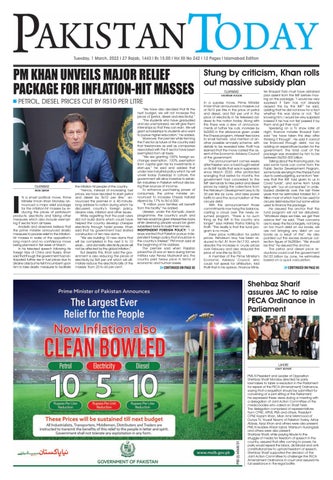
PM Khan unveils Major relief PacKage for inflation-hit Masses g
Petrol, diesel Prices cut by rs10 Per litre
ISLAMABAD
i
Mian abrar
n a smart political move, Prime Minister imran Khan Monday announced a major relief package for the inflation-hit masses by reducing the prices of petroleum products, electricity and taking other measures which also include exempting it sector from all taxes. Analysts and observers believe that the prime minister announced drastic measures to provide relief to the inflationhit masses in wake of the opposition’s long march and no confidence move being planned in first week of March. in his televised speech following his foreign trips of china and russia, Khan said that though the government had anticipated further rise in fuel prices due to ukraine crisis but he felt it incumbent upon him to take drastic measures to facilitate
the inflation-hit people of the country. “Hence, instead of increasing fuel prices, we have decided to slash petrol and diesel by rs10 per litre,” announced the premier in a 40-minutelong address to nation during which he discussed country’s foreign policy, ukraine crisis, inflation and other issues. While regretting that the past rulers did not build dams which could have helped the country develop cheaper electricity through hydel power, Khan said that his government had started construction of ten new dams. “We are building 10 new dams that will be completed in the next 5 to 10 years… and domestic electricity prices will not be affected by the global inflation.” but despite this, Khan said the government is also reducing the prices of electricity by rs5 per unit which will ultimately reduce the electricity bills of the masses ‘from 20 to 60 per cent’.
“We have also decided that till the next budget, we will not increase the prices of [petrol, diesel and electricity].” “the students who have graduated and are unemployed, we will give them internships so that they can earn. We will grant scholarships to students who want to pursue higher education,” he added. Moreover, the premier while terming the it sector as future of the country said that freelancers as well as companies associated with the it sector have been exempted from all taxes. “We are granting 100% foreign exchange exemption. 100% exemption from capital gain tax for investments in start-ups,” he said and added that under new industrial policy which he will unveil today (tuesday) in lahore, the government will allow investors to establish industries in Pakistan without disclosing their sources of income. to enhance purchasing power of consumers, the prime minister announced to increase ehsaas Kafalat stipend by 17% to rs14,000. “8 million poor families will benefit from this facility,” he added. likewise, under the Kamyab Jawan programme, the country’s youth and farmers would be given interest-free loans while deserving people would be given subsidised loans to build their homes. Independent foreIgn polIcy: “i always wanted that Pakistan pursue independent foreign policy that should be in the country’s interest,” PM imran said at the beginning of his address. the premier said when Pakistan joined the us war on terror during former military ruler Pervez Musharraf era, the country paid heavy price in terms of economic and human losses.
CONTINUED ON PAGE 05
Stung by criticism, Khan rolls out massive subsidy plan ISLAMABAD KhurraM husain
in a surprise move, Prime Minister imran Khan announced a massive cut of rs10 per litre in the price of petrol and diesel, and rs5 per unit in the price of electricity in his televised address to the nation today. Along with this there was a slew of announcements of further tax cuts, increase by rs3000 in the allowance given under the ehsaas program, interest free loans to small farmers and mention of another possible amnesty scheme, with details to be revealed later. Profit has learned that the move carried the assent of the economic Advisory council of the government. the announcement comes weeks after Pakistan won a hard fought restart on its iMF facility that was in suspension since March 2020. After protracted wrangling that lasted for months, the government had conceded to the iMF demands to hike petrol and diesel prices by raising the collections from the Petroleum development levy to rs 30 per litre by June, and raise power tariffs to end the accumulation of the circular debt. With this announcement those commitments now hang the balance, casting a cloud over the newly resumed program. “there is no such thing as the iMF in this country any longer” says Hafeez Pasha talking to Profit. “the reality is that the fund program is no more.” (new price notification for petrol prices. Petroleum levy has been reduced to rs1.81 from rs17.92, which absorbs the increase in crude prices over February and also reduced the price of one litre by rs10) A member of the Prime Minister’s economic Advisory council, who could not speak for attribution, told Profit that in his opinion, Finance Minis-
ter shaukat tarin must have obtained prior assent from the iMF before moving on this package. “i would be very surprised if tarin has not already okayed this by the iMF” he said, adding that he did not know for a fact whether this was done or not. “but knowing him, i would be very surprised indeed if he has not first passed it by them and got their nod.” speaking on a tV show later at night, finance minister shaukat tarin said “we have taken this step after thinking it through”. He said it cannot be financed through debt, nor by adding an expenditure burden for the government. the total cost of the package was revealed by him to be between rs250-300 billion. talking about the financing plan, he said some funds can come from the Public sector development Program, some funds are lying in the ehsaas Fund due to overbudgeting, some from “leeway that the iMF had given to us in covid funds”, and some from funds lying with “our oil companies” in undisbursed dividends over the last three years that he estimated totaled rs1.3 trillion most of which had to be used for circular debt reduction but some will be used to finance this package. He assured the anchor that the fund program will not be disturbed. “Whatever steps we take, we get their advice first” he said. “their concerns are to keep the fiscal targets, not bring on too much debt on our books, we are not bringing any debt on our books as a result of this”. He also pointed out the excess revenue collection figure of rs280bn. “We should be fine” he assured the anchor. the petrol and diesel price reductions could cost the government rs120 billion by June, he estimates based on a quick calculation.
CONTINUED ON PAGE 05
Shehbaz Sharif assures JAc to raise pecA ordinance in parliament
LAHORE staff report
PMl-n President and leader of opposition shehbaz sharif Monday directed his party lawmakers to table a resolution in the Parliament for repeal of the PecA (Amendment) ordinance, saying that a requisition should be submitted for convening of a joint sitting of the Parliament. He expressed these views during a meeting with a delegation of Joint Action committee of the media bodies who called on sharif here. the delegation comprised of representatives from cPne, APns, PbA and others. President cPne Kazam Khan, Mian Amir Mehmood of dunya tV, yousaf nizami of Pakistan today, Azhar Abbas, Ayaz Khan and others were also present. PMl-n leaders Ahsan iqbal, Marriyum Aurangzeb and others were also present. shahbaz sharif, while paying tribute to the struggle of media for freedom of speech in the country, assured that after coming to power, his party would repeal the black, dictatorial and anticonstitutional law to uphold freedom of speech. shehbaz sharif supported the decision of the Joint Action committee to challenge the PecA Amendment ordinance in court and assured his full assistance in the legal battle.
02
Tuesday, 1 March, 2022 | ISLAMABAD
NEWS
PM KhAN dISCuSSeS tArgetINg oF MINorItIeS IN INdIA wIth ArChbIShoP oF CANterbury ISLAMABAD
P
Staff RePoRt
RIME Minister Imran Khan Monday received Archbishop of Canterbury here and discussed that minorities in India, including Muslims and Christians, were being subjected to the worst kind of religious discrimination and
intolerance. The prime minister highlighted the importance of interfaith harmony, religious tolerance and affinity among the people of different faiths. He reiterated his government’s resolve to protect the rights of minorities as enshrined in the Constitution of Pakistan. Imran Khan conveyed that Pakistan
was a culturally diverse country, and was home to various religious minorities, including Hindus and Christians and all of them were living peacefully and contributing to its development. The prime minister shared that his government had established the Rehmatullil Alameen Authority to promote the true message of Islam, which was interfaith harmony and peaceful co-
existence of the mankind. The Archbishop of Canterbury said religious tolerance and peaceful coexistence of the mankind was need of the hour. Earlier the Archbishop of Canterbury Justin Welby participated in the Sunday mass at Peshawar’s All Saints Church, and delivered a message of peace and religious harmony.
499 stranded nationals evacuated from Ukraine, says ministry ISLAMABAD/WARSAW Staff RePoRt
Court defers indictment of Shahbaz, son in money laundering case LAHORE INP
An accountability court in Lahore on Monday deferred the indictment of Pakistan Muslim LeagueNawaz (PML-N) president and National Assembly Opposition Leader Shahbaz Sharif and his son and Punjab Assembly Opposition Leader Hamza Shahbaz in a money laundering case against them until March 10. The court also extended the interim bails of both PML-N leaders until March 10. During the hearing, Federal Investigation Agency (FIA) requested the court to conduct the hearing on daily basis. Talking to media outside the court, Hamza said the “incompetent government” has not fulfilled a single promise it made to the people. He said the economic growth was 5.8 percent when PML-N left the government in 2018 but the PTI has devastated the economy. He further said it was now time to hold PTI accountable, however, stressed that opposition will only challenge the government through constitutional means.
ANF seizes drugs
The government has evacuated at least 499 Pakistan nationals, including those who took up studies, from war-ravaged Ukraine after the Russian invasion until early Monday, the Ministry of Foreign Affairs (MoFA) said. In a statement, the ministry said a further 160 people were awaiting evacuation at the Ukraine-Poland border, and an additional 21 were currently en route to the Ukraine-Hungary border. The Eastern European nation of Ukraine is home to roughly 7,000 Pakistan nationals under normal circumstances, the ministry said, including at least 3,000 students. Most of those individuals had already left the country before Russia launched its invasion last week, it added. The families of hundreds of students stuck in Ukraine are also urging the government to help bring them home. At a media briefing over the weekend, Foreign Minister Shah Mahmood Qureshi said the Pakistan embassy had been temporarily moved
from Kyiv to Ternopil on the border with Poland, to facilitate evacuations. In a tweet on Monday, Piotr A. Opaliński, Poland’s ambassador in Islamabad, said Warsaw has “so far facilitated the evacuation of 472 nationals [including students] from Ukraine”. The evacuees are being transported to the capital of Warsaw where accommodation has been arranged for
them by Pakistan’s embassy. A first batch of students is already brought from Ukraine and settled in Warsaw, he added. Media reports say some 1500 nationals, including 500 students, have been stuck in Ukraine since the Russian invasion on Thursday. Syed Waqar Abbas, a software engineering student at Kharkiv National University, is among the students in Ukraine waiting for consular help. His
Daily coronavirus infections, deaths dip: NCOC ISLAMABAD Staff RePoRt
The nation reported 856 new infections of coronavirus and five deaths during the last 24 hours, the data released by the National Command and Operation Centre (NCOC) on Monday showed. Figures show that after the addition of the latest deaths, the toll reached 30,178, representing a ratio of 2 percent. The positivity rate in Pakistan has fallen to 2.56 percent after 856 new cases emerged Sunday after conducting 33,357 tests. They took the tally to 1,509,360. The number of active cases in the country is 35,898 with 1,052 patients in critical condition. There were 1,756 more recoveries recorded in the last 24 hours as the
number of total recovered cases reached 1,443,284 with a 95.6% recovery rate. Punjab, the most populous province of the country, reported 262 new cases in the last 24 hours, taking the provincial tally to 501,370 with 4,728 active cases. One patient died of coronavirus as the death toll reached 13,498. With 835 new recoveries reported, 483,144 patients have recovered from the virus in Punjab so far. Sindh has recorded 452 new cases during the last 24 hours taking the provincial tally to 567,761 with 22,676 active cases. There were no new death reported related to the deadly disease as the death toll in Sindh remained at 8,067. With 443 new recoveries, 537,018 patients have recovered from the virus in the province so far.
Khyber Pakhtunkhwa has recorded 68 new cases during the last 24 hours taking the tally to 216,119 with 7,235 active cases. The province reported 2 new virus-related death as the death toll reached 6,248. With 341 new recoveries, 202,636 patients have recovered from the virus in the province so far. Balochistan recorded 1 new case as the tally reached 35,326 with 74 active cases. The province reported no new death as the death toll reached 375. With 13 new recoveries, 34,877 patients have recovered from the virus in the province so far. Islamabad has recorded 44 new cases during the last 24 hours taking the tally to 134,336 with 581 active cases. With 2 new deaths reported in the
British Airways ceases Lahore-London operations ISLAMABAD MoNItoRINg RePoRt
The Anti-Narcotics Force (ANF) seized 62.8 kilogrammes of drugs in two separate operations in different areas of the country, according to a spokesperson. The spokesperson said a team of the ANF personnel conducted an operation at the cargo section of the Islamabad International Airport and seized 2.8 heroin hidden in goods booked to be delivered to a client in the United Kingdom. The spokesperson said an operation was also launched to arrest the culprits who booked the consignment. In the other operation, which was conducted in the Pishin district of Balochistan, ANF personnel found 60 kilogrammes of hashish hidden in secret sections of a car. The personnel arrested two persons who were trying to smuggle the drugs to Punjab.
family in Karachi said Saturday that they remain worried about his safety. “My son is in Kharkiv which is being bombarded. He lives close to the border and that area is very dangerous,” said Shabana Bano Abbas, his mother. She told the Associated Press that her son had no resources to help him get out. “He has just informed us that a station close to his area has been bombarded, how will my son get out of that place?” she said, demanding the government to help stranded children return. His sister Rubab blamed the authorities of being unresponsive. “He has been trying to contact the Pakistan Embassy for two days but the embassy has not been giving any response to him.” The embassy in Ukraine said in a tweet it was helping stranded Pakistanis to evacuate, advising them to reach Ternopil so they can be transported to Poland. Pakistan International Airlines (PIA) said it was ready to airlift citizens home from Poland.
LAHORE Staff RePoRt
British Airways has stopped operating direct flights between Lahore and London Heathrow on completion of the duration of the agreement, it emerged. The last flight BA-258 left for Heathrow Airport from Allama Iqbal International Airport on Monday at 10:09 am. The airline will continue to operate flights between Islamabad and London, however. British Airways resumed flights to the country in 2019, over a decade after they were suspended in the wake of the 2008 truck bombing of the Marriott hotel in Islamabad, which killed at least 54 people and wounded 270. Flights three times a week between London and Islamabad began in June, just ahead of the Eid ul-
Fitr holiday marking the end of the holy month of Ramadan. But UK airlines are now facing higher fuel costs and longer journey times on flights to Asia and beyond after Russia banned British carriers from its airspace. The move came in swift response to Boris Johnson’s decision to ban Russian national carrier Aeroflot from landing in the UK as part of a range of new sanctions against Moscow over its invasion of Ukraine. Virgin Atlantic said the flight ban would increase flight times to Pakistan by up to an hour. The airline had decided from Thursday evening to avoid Russian airspace before Moscow’s edict confirming the ban. The longer flight paths will affect four Virgin routes, between London Heathrow to Islamabad, Lahore and New Delhi, and between Manchester and Islamabad.
capital, the death toll reached 1,013. With 59 new recoveries, the number of recovered patients is 132,742 in the capital so far. Azad Jammu and Kashmir (AJK) recorded 22 new cases during the last 24 hours as the tally reached 42,968 with 419 active cases. With no new deaths reported, the death toll remained at 787. There were 65 new recoveries in the AJK as 41,762 patients have recovered so far from the virus. Gilgit-Baltistan recorded 7 new cases during the last 24 hours, as the tally reached 11,480 with 185 active cases. With no new death reported in the province, the death toll remains at 190. With no new patients recovered, the number of patients recovered from the deadly disease reached 11,105.
Indictment of Murad in power plant case deferred ISLAMABAD INP
An accountability court in Islamabad Monday deferred the indictment of Sindh Chief Minister Syed Murad Ali Shah in the Nooriabad power plant reference. Shazia Jaffer, a co-accused, submitted a petition seeking acquittal in court. Accountability judge Syed Asghar Ali heard the case during which Shah and other suspects appeared before the court. A counsel for NAB presented details of some 45 bank accounts and as per the report, the suspect held no account. The defence counsel said the lawyer for Niaz Ali Sheikh was not able to appear before the court. Lawyer Arshad Tabraiz said the accused had submitted an acquittal plea in which they have challenged the reference against them.
Tuesday, 1 March, 2022 | ISLAMABAD
Archbishop acknowledges Pakistan Army’s efforts in combating terrorism, providing secure environment to minorities
J
STAff REpORT
USTIN Welby, Archbishop of Canterbury (ABC), Head of the Church of England and Dr Christian Turner, British High Commissioner called on General Qamar Javed Bajwa, Chief of Army Staff (COAS) here at the GHQ. During the meeting matters of mutual interest, religious and inter-faith harmony were discussed. The COAS acknowledged the role of Christian brethren not only towards creation of Pakistan but also for their contributions towards its progress. He appreciated role of various institutions in the fields of education, health and public welfare being managed by Christian community across Pakistan. He especially acknowledged their contributions in defence of motherland as part of Pakistan Armed Forces. Honorary Archbishop acknowledged Pakistan Army’s efforts in combating terrorism and providing secure environment to the minorities in the country. He also pledged that the Christian community shall contribute wholeheartedly towards public welfare.
The benchmark to track the performance of PSX – the KSE-100 Index gained 476.77 points (+1.08 percent) on Monday closing in at 44,461.01 points. “Market opened on a negative note on the backdrop of ongoing conflict between Russia and Ukraine and increased political noise, as the index declined to make an intraday low of 339 points (down by 0.77%). However some recovery was observed in latter hours of trade, as value investors came in to accumulate near 44,000 index level, as a result index gained to close at 44,461 level (+477 points; up by 1.08%) On the corporate announcement front, SEARL disclosed it 2QFY22 earnings where company posted an EPS of Rs. 2.6 (down 6% YoY). The result was higher than expectation due to higher than anticipated other income. Bank, Cement, Fertilizer and Power sectors’ stocks took the lead today where MEBL, LUCK, ENGRO and HUBC cumulatively added 164 points to the index. On the flip side, COLG, NBP and TRG lost value to weigh down on the index by 36 points. Traded volume and value for the day stood at ~208mn shares and Rs.6bn respectively. AGL was today`s volume leader with 15.7mn shares” – Topline securities The PSX opened on a positive note but high international crude prices trimmed all gains within minutes and pushed the market in the red territory for the next four hours. However, the market turned around in the last oneand-a-half hour session on the back of anticipation that Prime Minister Imran Khan will announce a few incentives, and a massive buying activity was observed which led the benchmark index to close after making decent gains. The KSE-100 Index moved in a range of 911.52 points, showing an intraday low of 43,645.58 points and a high of 44,557.10 points. Among other indices, the KSE All Share Index and the KSE30 index gained 306.19 points (+1.01 percent) and 221.81 (1.3 percent) to close at 30,523.62 points and 17,312.87 points, while the KMI All Share & the KMI30 Islamic Indices gained 326.86 points (+1.5 percent) and 1,328.99 points (+1.88 percent) to close at 22,133.36 points and 72,148.81 points respectively.
A total of 350 companies traded shares in the stock exchange, out of them shares of 225 closed up, 106 closed down, and 19 remained unchanged. Out of the 91 companies that traded under the KSE100 Index, 69 closed up and 18 closed down, while four remained unchanged. The overall market volumes were at 208.12 million shares, decreasing by 33.52 million from friday. While the total volumes traded for the KSE-100 Index decreased by 9.02 million to 81.02 million shares. The number of total trades decreased by 6,480 to 96,526, while the value traded decreased by Rs0.67 billion to Rs6.06 billion. Overall, market capitalization increased by Rs75.57 billion. Among the scripts, AGL topped the volumes with 15.68 million shares, followed by TPLP with 14.27 million,
03
Pakistan reopens key Afghanistan border days after deadly clash pESHAWAR MoNItoRINg RePoRt
A key border crossing between Pakistan and Afghanistan has reopened, officials said, days after fighting between security forces left at least three dead. Since the Taliban returned to power last year border tensions between the neighbours have risen, with Pakistan saying militant groups were planning attacks from Afghan soil. The Taliban deny harbouring anti-Pakistan militants, but are also infuriated by a fence Islamabad is erecting along their 2,700-kilometre (1,600-mile) border, drawn up in colonial times and known as the Durand Line. “The border has reopened for all sort of activities,” a spokesman for the paramilitary border force told AFP. A security source said it came after “successful talks” between Pakistani officials and the governor of Afghanistan’s Kandahar province. Mahmood Azaam, a spokesman for the governor, confirmed it had reopened. Each side blamed the other for Thursday’s clashes at the Chaman-Spin Boldak crossing, which locals said involved light and heavy weapons. Thousands usually cross every day, including traders, Afghans seeking medical treatment in Pakistan, and people visiting relatives.
bottom-up approach in focus for inclusive, sustainable development: tarin
PSX lands in positive returns despite rising oil prices SAAD TAnvIR
NEWS
FlyingR1 with 12.93 million, WTL with 10.54 million, GGL with 10.51 million, and CNERGY with 8.44 million shares respectively. These stocks contributed significantly to the volumes forming over 30 percent of the total. In absolute terms, RMPL remained the top gainer for the fifth straight day witnessing an increase of Rs233.33 (2.17 percent) per share, closing at Rs11,000, whereas the runner-up was INDU, the share price of which climbed up by Rs55.9 (3.94 percent) to Rs1,473.9. On the other hand, COLG remained the top loser in absolute terms witnessing a decrease of Rs83 (3.68 percent) per share, closing at Rs2,172, followed by UPFL, the share price of which declined by Rs50 (0.23 percent) to close at Rs21,400 per share.
The top performing sectors were – fertilizer with 99 points, oil & gas exploration companies with 82 points, cement with 70 points, power generation & distribution with 36 points, and commercial banks with 36 points, while the major points points contributor to the index were by MEBL contributing 52 points followed by LUCK contributing 43 points, ENGRO contributing 36 points, HUBC contributing 33 points and OGDC contributing 27 points. The worst performing sectors were – Real Estate Investment Trust (REIT) with 5 points, leather & tanneries, and chemical with 3 points each. The worst performing shares from the index were COLG and NBP losing 15 and 11 points, followed by TRG which lost 10 points, UBL which lost 7 points and BAFL which lost 6 points.
AHTASAM AHMAD The finance minister Shaukat Tarin met with United Nations Development Programme (UNDP) Resident Representative Knut Ostby on Monday. While addressing the UNDP official, he said, “The government is moving away from trickle-down approach and is focusing on a bottom-up approach for a more inclusive, equitable and sustainable development.” Furthermore, Tarin gave an overview about the ongoing economic challenges and respective reform projects being undertaken by the present government. He maintained that the government of Pakistan is committed to introducing reforms in various sectors for tackling long-standing structural issues with a special focus on sustainable and inclusive growth. The finance minister apprised that the loans for agriculture, production and business development are being disbursed. Further, it was informed that issues such as fragmented Industries, undue profits by middleman, direct access of producers to markets, and access to capital and financial intermediation are on priority for the government and any assistance of the UNDP in these areas will be welcomed. Knut Ostby reaffirmed commitment to continue support for the implementation of Ehsaas, Kamyab Pakistan Program (KPP), and explore further areas to support Pakistan in its efforts for sustainable development. He appreciated and supported the efforts of the government for bringing improvement in social and economic sectors. Ostby also briefed about the UNDP’s commitment toward achieving Sustainable Development Goals (SDGs) and maintained that for developing countries, it was easier to achieve SDGs with support of multilaterals and engagement with the private sector. He said that ‘development for everybody’ was at the center of UNDP’s development agenda adding, on the same lines, UNDP was focusing on sustainable investment potential present in the private sector of Pakistan. Assistant Resident Representative UNDP Ammara Durrani, Technical Advisor UNDP on Financing for Development Haroon Sharif, Senior Policy Analyst UNDP Umer Akhlaq Malik and other senior officials also participated in the meeting. Founded in 1966, UNDP is a United Nations programme that is tasked with poverty alleviation, human development and sustainable growth goals across 170 countries around the globe. In Pakistan, UNDP has launched multiple programs aimed at policy making, sustainable governance and climate change.
Police approached as dual uK national goes ‘missing’ ISLAMABAD MoNItoRINg RePoRt
British High Commissioner Christian Turner wrote a letter to an Azad Jammu and Kashmir deputy inspector general (DIG) of police, expressing concerns after a dual United Kingdom national purportedly went missing from a Jhelum town, it emerged Monday. Zahida Parveen, along with a nephew, went to Dhudial some two months ago and has not returned since. Police recovered her vehicle from the Islamgarh town of Mirpur in Azad Kashmir. Police believe Parveen went to settle a domestic property dispute.
IHC moved against electioneering ordinance ISLAMABAD Staff RePoRt
A former local government official from the capital on Monday challenged The Elections (Amendment) Ordinance, 2022,
in the Islamabad High Court (IHC). The plaintiff claimed the ordinance was based on malice and through it, public office holders have been permitted to take part in electioneering.
The court has been requested to strike down the ordinance. Justice Aamer Farooq, after the initial hearing on the plea, issued notices to the secretary of the president and Attorney General Khalid Javed Khan.
The further hearing on the plea was adjourned until March 15. On the other hand, the Election Commission of Pakistan (ECP) also decided to consult political parties over changes made to laws governing the code
of conduct for elections by the federal government. According to reports citing sources, the decision was made in a meeting headed by Chief Election Commissioner (CEC) Sikandar Sultan Raja.
Tuesday, 1 March, 2022 | ISLAMABAD
04
NEWS
BHC ISSueS noTICeS To AGP oveR PleA AGAInST PeCA oRdInAnCe
KARACHI: SHC orders to raze illegal portions in Shah Faisal colony KARACHI inp
Sindh High Court (SHC) on Monday ordered to raze illegal portions in Al-Badar Society located in Karachi’s Shah Faisal Colony. A citizen moved the court against illegal construction of ground plus fourfloor at plot number S-2 in Al Badar Society. Sindh government, the DG Sindh Building Control Authority (SBCA), deputy commissioner Korangi and others have been made respondents in the plea. Hearing the plea, the SHC bench ordered to immediately take down the illegal structures in the society. Submit a progress report in the court within 30 days, the bench asked the Sindh Building Control Authority (SBCA) officials. It may be noted that the Sindh High Court has been hearing a number of pleas against illegal constructions in the metropolitan city. In one such judgement, the SHC had ordered to immediately raze illegal portions in North Nazimabad Block-L, Karachi. The lawyer of the applicant had said that ground plus three-storey building had been constructed and now the building is constructing the fourth floor on the residential plot no B165 in North Nazimabad. The SHC had directed immediate action against illegal constructions on Plot No. B165 in North Nazimabad Block-L and also directed the DG Sindh Building Control Authority (SBCA) for immediate action against the builder.
Karachi: Two children allegedly set on fire over rent dispute
T
HE Balochistan High Court (BHC) issued notices to the attorney general of Pakistan, asking the federal government to submit a reply within two weeks, after accepting a petition on Monday filed by the Balochistan Bar Council and Balochistan Union of Journalists against the controversial Pakistan Electronic Crimes Act (PECA) Ordinance 2022. It is pertinent to note that the media professionals are observing a ‘black day’
today on the call of the Pakistan Federal Union of Journalists (PFUJ). In a statement announcing black day, the union had termed the law draconian and said it would not accept any law gagging media. Earlier on February 20, President Arif Alvi promulgated the ordinance making online public defamation a cognisable and a non-bailable offense while increasing the jail term for defamation of any person or institution from three years to five years.
Before the ordinance came into effect, Section 20, which pertains to the registration of complaints against individuals by aggrieved parties over defamation, was a bailable and non-criminal offence. Meanwhile, the bar councils and media bodies moved the high courts against the law and in a subsequent order, the Islamabad High Court (IHC) barred the Federal Investigation Agency (FIA) from arresting anyone under Section 20 of PECA.
Islamabad welcomes Spring with food, music after two-year hiatus ISLAMABAD XinhuA
Islamabad Eat, a famous food festival, returned to the city in its true spirit, after a two-year absence induced by the outbreak of Covid-19, which halted many other excursions and sports activities in the country besides the festival. The two-day event was on over the weekend in the famous F-9 park with around 70 stalls of mainly local food, and scores of foodies are thronging to the venue to celebrate the festival of food and music and take a sigh of relief. The festival is an indication that life is slowly getting back to normal despite the pandemic. Amal Mubeen, a 21-year-old student, and her group of friends are
some of the many visitors to the festival. They came to the event not only to enjoy food but also to formally restart normal life activities after the recent social curbs amid a fifth wave of the crisis driven by the Omicron variant. “The best way to welcome the spring is to have a get-together with friends at a scenic place, enjoying good food and listening to good music, and Islamabad Eat is an opportunity to have it all,” Mubeen told Xinhua. “I hope that more such events will keep on taking place this whole spring not only to mark the beginning of spring but also to celebrate the success against the pandemic,” she said. The festival’s organisers believed the event is more than just a celebration of food, as it also gives a chance
to home-based chefs especially women to display their cooking skills and expand their business. “The idea of the festival came to us nine years ago when we started it in the southern port city of Karachi, then over the next three years, we expanded it to other cities including Islamabad,” Aslam Khan, one of the organisers, told Xinhua. “We are proud to say that over the last few years, 60 to 70 big restaurants of the home-based cooks who started off with the eat festival have been opened in the country and are doing successful business,” Khan added. He said the basic concept of the festival is to promote home-based food business and celebrate local chefs who are good at making local or foreign food that is famous in the country.
KARACHI inp
In a shocking incident, two children were allegedly set on fire by the house owner over a rent dispute in Karachi on Monday. As per details, the dreadful incident took place in Sohrab Goth’s Janat Gul Town area, where a widow alleged that her house owner set her two children on fire over failure to pay rent. The woman said she was asked to vacate the premises last month and was taken to visit another house and when she was visiting new premises, her two children were set on fire after spraying petrol. The children were moved to Civil Hospital, where they succumbed to their burn injuries, the woman alleged. The woman along with the body of one of her dead children reached Karachi Press Club to record her protest. She demanded of the higher authorities to serve justice into the matter. Meanwhile, the SSP East said they got information about the fire incident Sunday and an investigation into the matter was underway. The facts would be revealed soon, he added. Separately, a domestic helper was set on fire by his landlord in Multan over asking for a salary. The boy Irshad succumbed to his burn wounds and breathed his last at the hospital.
After a stream of criticism from the opposition parties, rights organisations and civil society, the MQM-Pakistan — an ally of the ruling PTI — also joined the bandwagon, raising objections over the controversial ordinance. Federal Minister for Information Technology Syed Aminul Haq, who belongs to the MQM-P, has written a letter to Prime Minister Imran Khan, saying that he did not agree with the amendments as the government did not take the stakeholders into confidence. news Desk
President & CEO U Microfinance Bank Limited (U Bank) Mr. Kabeer Naqvi and President & CEO MCB Bank Limited (MCB) Mr. Shoaib Mumtaz signed a Memorandum of Understanding (MOU) of strategic partnership to promote financial inclusion in the country. pR
Suspect in murder of Karachi journalist remanded in police custody KARACHI stAff RepoRt
An anti-terrorism court (ATC) in Karachi on Monday remanded the suspect in the murder of a Karachi-based journalist in police custody until March 11. Thieves on a motorcycle shot and killed Athar Mateen, a TV producer who worked for the SAMAA news channel, when he tried to ram them with his car to prevent a street robbery last week. Police produced the suspect, Ashraf, before the court on Monday seeking his physical remand. He was brought to the court in an armoured personnel carrier with his face covered with a piece of cloth. The investigation officer in the case informed the court Ashraf was involved in the murder and said his custody was needed for investigation purposes. The court handed over the detainee to the police and directed them to produce him at the next hearing on March 12 along with a progress report. Several suspects have already been taken into custody, some of them from as far away as Balochistan, on suspicion of their involvement in the murder. Prime Minister Imran Khan had condemned the “brutal murder” and expressed sorrows with the grieved family. He had directed law enforcement to take every possible step to bring the perpetrators to justice.
Karachi world’s fourth largest polluted city: report Karachi has turned out to be the world’s fourth largest polluted city as its air quality index has surged to an unhealthy level of 193, showing utter negligence of the federal and Sindh governments towards environmental reforms, according to a new investigative report released on Sunday. PM2.5 concentration, as per IQAir organisation report, in Karachi has been recorded 11.8 times higher this month which is above the WHO annual air quality guideline value. This clearly proves that the federal and Sindh governments’ claims of making huge investments for improving the environment and public health in the city are nothing but disinformation and misinformation, says the investigation report. The investigation finds that air pollution in Karachi contains solid and liquid particles, and certain gases in the air. The major polluters are transport and industrial emissions followed by burning of garbage, emissions from refrigerators, generators, flying of dust, and stoves used in houses and hotels. The investigation says that all types of forests, including mangroves along Sindh’s
coastline, which used to help absorb carbon dioxide and clean air in Karachi, have been hacked to an alarming level. Karachi’s present mangroves forest cover is 50,000 hectares. In the last 50 years, Karachi has lost 10,000 hectares of mangrove forest due to encroachments, commercialisation and infrastructure development. A Sindh Environmental Protection Agency report says that the important ecosystems in Sindh, such as mangroves, have come under extreme pressure due to seawater encroachment and deforestation. There has been mass depletion of mangrove forests in the area due to illegal logging, irrigation and untreated industrial waste. The report says that only 130,000 hectares of mangroves of the 600,000 hectares that existed at the start of the 20th century are now left. The total land area of Sindh is 34.84 million out of which 8 per cent is forest cover. According to international standard, a country should have at least 25 per cent of its total land under forest cover to tackle environmental degradation including air pollution.
The new annual economic survey of Pakistan released in June 2021 says that Pakistan is a forest deficient country as it has 5.01 per cent area under its forest cover. According to WHO, air pollution is one of the biggest environmental threats to human health, alongside climate change. From smog hanging over cities to smoke inside the home, air pollution poses a major threat to health. It causes diseases including heart ailments, strokes, chronic obstructive pulmonary diseases, cancer and pneumonia. Seven million people die globally each year due to exposure to ambient and household air pollution. Air pollution is a complex mixture of solid particles, liquid droplets, as well as gases. It can come from many sources such as household fuel burning, industrial chimneys, traffic exhausts, power generation, open burning of waste, agricultural practices, desert dust and many other sources. Air pollutants measured include PM2.5 and PM10 (particles with an aerodynamic diameter of equal or less than 2.5, also called fine, and 10 micrometre respectively), ozone (O3), nitrogen dioxide (NO2), carbon
CMYK
monoxide (CO) and sulfur dioxide (SO2). Fine particulate matter (PM2.5) can penetrate through the lungs and further enter the body through the bloodstream, affecting all major organs. Exposure to PM2.5 can cause diseases both to the cardiovascular and respiratory system, provoking stroke, lung cancer and chronic obstructive pulmonary disease. New research has also shown an association between prenatal exposure to high levels of air pollution and developmental delay at the age of three, as well as psychological and behavioural problems later on, including symptoms of attention deficit, hyperactivity disorder, anxiety and depression. Air pollution is a threat to health in all countries, but it hits people in low-and middle-income countries the hardest,” WHO Director General Tedros Adhanom Ghebreyesus said. In an interview, National Forum for Environment and Health President Naeem Qureshi said that air pollution was continuously rising in Karachi, mainly due to emissions from transport, followed by industrial emissions and burning of garbage. Transport
is creating 70% air pollution in the city. “The federal and provincial governments have formulated environment policies but they are not being implemented in true spirit, as a result, there is no control on pollution in Karachi,” he said. Qureshi maintained that certification system of vehicles in the city was bogus which needed to be improved. There should be effective checking of smoke-emitting vehicles to reduce harmful emissions, he said, adding that mass transit be launched in Karachi at the earliest besides launching electrical vehicles. Separately, Pakistan Medical Association Secretary General SM Qaisar Sajjad noted that Karachi had turned out to be the world’s fourth largest air polluting city. “Air pollution is a slow poison and can even take life in severe conditions,” he said, observing that air pollution contributes to asthma, nose elegy, sore throat, and heart diseases. The PMA president stressed the need to regulate transport and industrial systems, and cease all smoke-emitting and dilapidated vehicles which cause air pollution. Agencies
Tuesday, 1 March, 2022 | ISLAMABAD
NEWS
05
Stung by criticiSM, Khan rollS out MaSSive SubSidy Plan contInueD froM pAge 01
t
OLIVE Technical Services; a wholly owned subsidiary of Fauji Fertilizer Company (FFC) and HydroChina Dawood Power (Pvt) Ltd (HDPPL) signed a Services Agreement on Monday 28th February, 2022 at Gharo, Pakistan. Under this agreement, OLIVE Technical Services shall carry out detailed End of Warranty Inspection Services for 49.5 MW Wind Power Plant of HDPPL located at Gharo, Sindh, Pakistan. pr
PM Khan unveils major relief package for inflation-hit masses contInueD froM pAge 01 “I always opposed that [Pakistan] had nothing to do with the US war in Afghanistan”. PM Imran Khan while referring to the past governments of PPP and the PML-N said: “Both the democratic governments remained tight-lipped when the US was carrying out drone strikes in Pakistan … even [former president] Zardari told one US official that ‘we did not care about collateral damage’.” “I always opposed that [Pakistan] had nothing to do with the US war in Afghanistan,” he insisted. The prime minister told the nation that the leaders having assets and offshore accounts abroad could never take decisions in nation’s interest and advised the people against voting such leaders. PM Khan said his recent visit to Russia was aimed at strengthening economic ties with country was planning to import two million tons of wheat as well as gas from Moscow. He also briefly touched on his visit to China where he attended Beijing Olympics, saying the result of the visit will be visible with the start of the CPEC’s second phase. PM defends Peca ordinance: The premier also defended the amendments to the Pakistan Electronic Crimes Act (Peca), 2016, dismissing criticism that it was being used to curb media freedom. “The Peca law was made in 2016. We are only amending it.” He said that a leader of a country who was not corrupt or had not broken the law would never be in danger from media freedom. “Today, 70 per cent of the news is against us. This has no effect on us, but there is a reason why we have brought this law.” The premier said “filth”, such as child pornography, was being shared on social media. He regretted that he was also not being spared, recalling that a few years ago a journalist had reported that his wife had left him and that he had “done something illegal” at his Bani Gala residence. “I filed a case in the courts. It has been three years, but the prime minister has not been able to get justice and the same journalist now writes that [my] wife has left the house. If this can happen with the country’s prime minister … imagine what would happen with the rest of the people.” PM Imran said that the same journalist was locked up and beaten for three days when he wrote about Nawaz’s corruption during the PML-N government. He said that mafias were doing blackmail under the guise of media freedom. “They have other agendas. There are journalists who are taking money, flinging filth and doing blackmail.” The premier reiterated that the amendment to the Peca law was not related to media freedom, adding that “good journalists would want fake news to be eradicated”.
HE power price reduction could cost Rs50bn, plus Rs10-15bn in lost revenue. “The subsidy on small loans” he continues, pointing to another of the measures announced by the PM, “could cost close to Rs40bn over two years, then the internship program Rs50bn (annual), allowance Ehsaas increase is another Rs25-30bn.” Confusion surrounded the mechanism by which these price reductions will be obtained. In a tweet, Energy Minister Hammad Azhar said the price reductions will be absorbed first in the development levy charged on fuel and later via direct subsidy. “On the instructions of the PM, Fuel Cost Adjustments that have been incurred in electricity bills (due to rise in prices of imported fuels) since last few months to the tune of Rs 4-5/unit will be absorbed by the govt henceforth for residential/commercial consumers” he tweeted shortly after the speech. “Similarly, petrol/diesel prices to be reduced by Rs 10/litre. This will be achieved by reducing PDL in the short-term but by a funded subsidy in
the long term.” Oil marketing executives were sceptical about the resort to direct subsidy, however. “Around 4-6 months ago they tried something similar” a senior oil marketing executive tells Profit. “And within two weeks they had to reverse the whole thing, but in the meantime a tab was built up with the OMCs and the refineries that to this day has not been settled.” Apart from the mechanism, confusion also swirled about the impact this will have on the commitments made in the IMF program. In that program, the government had specifically committed to raising collections through the Petroleum Development Levy as well as power tariffs. “[W]e will raise by PRs 8/liter the PDL and we commit to raise the PDL by PRs 4/liter per month for the remainder of FY 2022 until the maximum of PRs 30/liter is achieved” the Letter of Intent for that facility says. The IMF staff had noted that Pakistan “just recently caught up with passing through pending power tariff adjustments” and was committed to further hikes in the months ahead. “Staff stressed that the regular im-
plementation of tariff adjustments in line with established formulas is critical to lend credibility to the newly independent energy regulator” the staff report notes, referring to the new powers given to the power sector regulator and tariff setting body, Nepra. “The EFF is now in jeopardy, clearly” says Mushtaq Khan, who served as Principal Economic Advisor to the State Bank Governor before setting up a private macroeconomic consultancy of his own. “With three months of uncertainty on global commodity prices given what’s happening in Ukraine, this is way too heavy a fiscal burden” he adds. “Getting this past the IMF is going to be tough. It makes me wonder about what their back up plan is. If this unhinges business sentiments about the future, it could have repercussions for the stock market, but even more importantly, the FX market.” The financial markets were similarly left wondering how the government intends to finance these measures, and what it means for the future of the fund program. “There are tough times ahead for investors” said Fahad Rauf, head of research for
Ismail Iqbal Securities. “The move will be negative for all the three markets, debt, stocks and foreign exchange. Debt market yields are likely to rise immediately” he says, referring to secondary market yields on government paper, while “some investors in stocks might see the positive, but the broader direction for the economy is not positive. FX market is already under pressure, we are on course to hit an all-time high deficit in the CAD, rupee was already under pressure, and this could only escalate things on that front.” The reduced price of fuel and power will help consumers and industry in the short term. But the impact of its financing burden is likely to hit the exchange rate hard. Everybody Profit spoke with agreed on this point. As such any disinflationary impact will end up being self defeating. Everybody also agreed that this was a political move more than anything else, coming from a government under pressure from the rising political temperature in the country. “This is purely election mode coming up” says Rauf. “The looming no confidence vote is weighing on the PMs mind”.
BAP submitted bill for giving GB provincial status catches ire of GB lawmakers ISLAMABAD Ghulam abbas
In an interesting development, a group of Senators from Balochistan have submitted a constitutional Amendment Bill in the senate for granting provincial status to Gilgit-Baltistan which has caught ire of the GB lawmakers. The senators of Balochistan Awami Party (BAP) including Senator Ahmed Khan, Senator Naseebullah Bazai, Senator Kauda Babad and Senator Prince Ahmed Umar Ahmedzai have submitted the bill known as ‘Constitutional (Amendment) Act, 2022’ here on Monday. Interestingly, the ministers, lawmakers and other representatives from GB were surprised to know about the development as the draft bill submitted by the senators was quite contradictory to the one being proposed by the regional government in consultation with stakeholders. A minister of GB, who is also actively engaged in the drafting and consultation of the reform bill, claimed that the bill submitted by the senators has nothing to do with the already under-discussion draft bill. “The senators from Balochistan have neither consulted us nor have they discussed with the stakeholders before submitting the bill. We have serious reservations over the bill which does not include the required amendments in
the constitution for granting provincial status to GB,” the minister said. “Surprisingly, the political party of Balochistan (BAP) has even no existence/presence in GB. The party has even not discussed with any political party of GB before submitting the bill,” said a member of the 18-member committee of GB which is presently discussing the proposed amendment bill in Islamabad. According to an official source, the committee of ministers, bureaucrats and representatives of opposition parties in GB have started an immediate meeting over the bill in the Senate to give their reaction. “We may submit another bill in the senate or National Assembly regarding provincial status to GB, which would be the one after consensus of all parties and stakeholders,” he added. As per the draft bill submitted by the senators, amendment in Article 1 of the constitution is proposed with the addition of the Province of Gilgit Baltistan, having the status of provisional province. The senators have also proposed an amendment in Article 51 of the constitution to give three seats to GB in the National Assembly increasing the total number of seats to 329 from existing 326. As per the amendment, three members of the National Assembly from GB would be elected in the next general election.
Through the bill, it has been proposed to give four seats to GB in the Senate which included two seats on general seats, one woman and one technocrat including aalim to be elected from provincial assembly on GB. The senators from GB would be elected in the next senate election of the country whereas two members shall retire in March 2027 and two members would retire in March 2030. Amendment in Article 106 has also been proposed under which total number of provincial assembly in GB would be 26 including 22 on general seats, three women and one non-Muslim. Interestingly, there are 32 members in the existing GB assembly including women and technocrats. As per the bill, the election of provincial assembly would be held in the next general election in the country which meant the existing members of the GB assembly would complete their terms three years ahead of their tenure. The bill has also proposed amendments in Articles 198, 218 and 175A to extend limits of the judiciary and election commission of the country to GB. The senators have given the reasons for the bill saying it is aimed at granting full rights as citizens of Pakistan to GB. “This constitutional amendment bill seeks to meet the demand of GB creating the province of GB comprising the existing administrative areas
of the territory. The Legislative Assembly of GB has unanimously adopted resolutions urging it to grant it provincial status and provide it with representation in parliament and other constitutional bodies,” it said. It may be added here that the government has accelerated the process of granting GB a provincial status; with almost all major political parties having agreed for the required legislation. According to provincial ministers and lawmakers from opposition parties, a consensus has finally been made among all major political parties regarding making GB a province through amendments in the constitution. During the past two weeks, a number of meetings among the stakeholders have been held in Islamabad where a draft proposal regarding amendments in the constitution, prepared after thorough deliberations, was discussed. Earlier, GB Chief Minister Khalid Khurshid had circulated among members of the GB Legislative Assembly and his cabinet a draft bill seeking to amend the constitution to grant “provisional province status” to the strategically-located region, asking them to submit their “feedback and views”. Later, the same draft was shared with heads of political parties including PML-N, PPP, JUI-F, MQM, PMLQ and others by their representatives in the GB assembly for approval and feedback.
Lord Afzal lauds efforts by Shehryar Afridi for raising Kashmir dispute globally ISLAMABAD staff report
A delegation of United Kingdom leaders of Kashmiri and Pakistani origin on Monday lauded the efforts of Pakistani government and Chairman Kashmir Committee for raising the Kashmir dispute at the international level. The delegation was led by the Lord Mayor of Birmingham, Chaudhary Muhammad Afzal along with, Councilor Waseem Zafar and Cabinet Member for Transportation and Environment Birmingham City Council, among others. The delegation represented the largest Kashmiri diaspora community in the world, residing in Birmingham. The delegates showered praises on Shehryar Afridi for adding new vigor to Kashmir narrative. Chairman Kashmir Committee Shehryar Khan Afridi deplored the fact that India’s tyranny in Indian Illegally Occupied Jammu
and Kashmir (IIOJK) was being reinforced. “The Line of Control is not only a line dividing the heavenly valley of Kashmir but it is also a line that, metaphorically and in many cases literally, depicts the division of Kashmir between Heaven and Hell. On the Indian side of the LOC in Jammu and Kashmir are clouds of doom and gloom whereas the other side in Azad Kashmir is growing towards peace and prosperity,” he said. Afridi said that in Indian Illegally Occupied Jammu and Kashmir, the occupational Indian forces are employing all tools of genocide against the people of Jammu and Kashmir. “While on the other side of the LOC, Pakistan is putting an all-out effort for raising the standard of Human living for the Kashmiris,” he added. Afridi further added that on one side the people of Azad Jammu and Kashmir were enjoying the fruits of development while the residents in Indian IIOJK were facing pellet guns,
humiliation and atrocities every single day. “In Azad Jammu and Kashmir citizens are reminiscing sports and festivities whereas in IIOJK citizens are being buried by their loved ones. When mothers and children are enjoying festivities in Azad Jammu and
cMYK
Kashmir, IIOJK had cases of half-widows and half orphans being covered up by the Illegal Indian Occupational forces,” he added. Chairman Kashmir Committee Shehryar Khan Afridi appraised the delegation of the role of the Parliamentary Committee of
Kashmir Role of Kashmir Committee in raising awareness om Kashmir dispute globally. He told that the committee consists of 28 members from both Houses of Parliament and Parliamentary supremacy is ensured through functioning of the Parliamentary Committee. He briefed the delegation on new initiatives launched by the Kashmir Committee to revive and re-energize the narrative on Kashmir. He told that the world is taking notice of the fact that in Indian Illegally Occupied Jammu and Kashmir, tyranny is order of the day and Kashmiris are being subjected to genocide and their voices are being muzzled and war crimes are being committed by the occupational regime. “But in Azad Kashmir, there is development, festivity and a thriving nation. Recently held first season of Kashmir Premier League (KPL), the true face of Kashmir’s culture and heritage has been projected to the world audience,” he added.
06-07 Comments - 1st March 2022_Layout 1 2/28/2022 11:59 PM Page 1
Tuesday, 1 March, 2022
06 COMMENT
On heroes and hero-worship
Have the ides of March come? Amidst government-opposition confrontation
W
And why care and caution cannot be stressed enough
hILe the opposition’s no-confidence move has yet to gain traction, opposition parties have started to put their resources into long marches. The purpose is to build public pressure on PTI’s legislators and allies to jump ship. The marches are also aimed at pressurizing the establishment to become neutral. While the PDM still has four weeks to prepare for its show, the PPP initiated its march three days back. The two separate marches indicate that the opposition has yet to overcome internal divisions. Bilawal Bhutto Zardari and other party leaders addressed rallies of enthusiastic workers and sympathizers at various cities and towns on their way. Sindh being the stronghold of the PPP, public enthusiasm witnessed at Karachi and interior Sindh was not unexpected. It remains to be seen how the party fares as it enters Punjab where efforts by Zardari and Bilawal have so far failed to attract the so-called “electables”. It is also unclear what would be the next step after the PPP procession reaches Islamabad. Will the march end there or turn into a sit-in? As the PPP marchers head towards the Sindh-Punjab border, the PTI has initiated its “haqooq-e- Sindh march” from the opposite direction, beginning from Ghotki to end in Karachi Led by Foreign Minister Shah Mahmood Qureshi and Shipping Minister Ali Zaidi, the march is intended to challenge the PPP in its sphere of influence. One hopes that the organisers of both the parties have ensured that two highly charged marches do not come into confrontation. There is meanwhile a need on the part of the contending parties to abide by law and avoid confrontation. Political rivalries should not be taken to a point conducive to the intervention of off-stage players. elected governments at the Center and provinces need to ensure that there is no provocation to peaceful protestors. The government is apparently unmoved by the march. One of the reasons is the persisting divisions within the opposition parties. Maintaining his sangfroid Fawad Chaudhry claims that the ‘leaderless and aimless opposition poses no threat to PTI government’. CM Buzdar calls it a storm in teacup as no-confidence move remains confined to talks. Unless the combined opposition is able to overcome internal divisions, it would be premature to claim, as Bilawal does, that the time has come for a final push.
HasaN aFtaB saEED
T
he hero-worship impulse in humans is so potent that if they do not have a genuine hero, they readily invent one. even when they have a legitimate hero-figure, they tend to keep on inflating his merits and continue elevating his stature, until he or she attains a humanly impossible level. It is always instructive to observe individuals who revere two different men from the same field fighting hammer and tongs regarding whose hero is bigger and better. On YouTube, for example, and to name but one rivalry, Rafi and Kishore aficionados can be seen slugging it out in the comments sections of songs sung by one or the other. To an extent this is to be expected, what with the urge to dominate (by proxy if not directly) being so irresistible in man. however, too often the veneration of heroes is taken to a degree where it defies all reason. By no means does this happen exclusively on YouTube or for that matter the social media at large. Few drawing room conversations are complete without somebody magnifying his hero to unbelievable proportions. For instance, somebody would causally state (as if it were an established fact) that Lata Mangeshkar recorded 30,000 songs in her illustrious career. he is not likely to take kindly to anybody
Stranded in Ukraine Prompt action to evacuate Pakistanis required
Lessons for the world and Pakistan Faysal Hayyat
W
ILL Durant, in his famous book, the lessons of history, propounds that in the last 3421 years of history, only 268 has seen no war; therefore, war is the only constant in the history of humanity. The recent standoff between Russia and Ukraine supported by the clout of the West is one such example. There are many questions on the ongoing and protracted conflict of the eurasian land. The Russian enigma, the european aversion to the Russian policy of expansionism to defend itself from NATO’s speculative aggression, the biased role of NATO has put the world into a precarious milieu. Pakistan, a country ostensibly of meager significance, has found itself yet again into another predicament with the visit of her premier to Russia at the eleventh hour when Putin was about to unleash a war of terror on innocuous Ukrainians. Firstly, we need to understand that the battles, in essence, are not a crusade of ideologies or values. Interests are the single most responsible factor of all the wars that have been fought in different time and space. Often we wonder why some lives matter the most while others are mere souls trapped in the flesh that carries weight to none. The history of the world is replete with examples where men and women, children and oldsters were slaughtered, massacred, and brutalized for the sake of their interests. As Beacon in one of his essays noted, humans are inherently selfish and self-centered; they always yearn to fulfill their interests irrespective of the price or dividends their outcome entails. Their prime motives always overpower their cost-benefit analysis. Many scholars have propounded the fact that the state is individual’s writ large. It imbibes all the characteristics that glorify individual’s interests in their personal domains. The current logjam between Russia and Ukraine and the response by the west in divided form is hallmark validation of this principle. human rights, values, freedom, respect for sovereignty have always been relative terms. Their definition and application have been subjected to the whims and wishes of the powerful since the inception of life on this planet. The west popularly cherished the principles of liberalism and human values but vehemently and blatantly crucified people in every part of the world. The hubris and war casualties are reminiscent of those widely celebrated so-called values.
Dedicated to the legacy of late Hameed Nizami
Arif Nizami (Late) Founding Editor
Yousaf Nizami M. A. Niazi
Umar Aziz
Joint Editor
Joint Editor
Executive Editor
Lahore – Ph: 042-36300938, 042-36375965
The pathology of this brand of hero-worship is such that it tends to escalate with time – the ‘facts’ reported become more and more dubious, with the links between arguments and conclusion becoming more and more tenuous.
Ukraine Crisis
W
ITh over 1500 Pakistanis stranded in Ukraine, comprising 500 students as well, waiting for the government to facilitate their evacuation from the country where war is intensifying, a crisis is brewing that requires immediate attention and resolution. So far only 35 students have been able to make it to Poland via train from Ukraine’s northeastern city of Kharkiv with the remaining still stranded and taking cover in shelters to avoid getting caught in the crossfire. That the Pakistani embassy in Ukraine has advised the remaining students in Kyiv to somehow reach Ternopil, which is close to the Polish border, underscores a lack of understanding and awareness of on-ground conditions and dangers being faced by stranded Pakistanis. In the absence of any reliable transportation, it is near impossible for the students to travel hundreds of kilometers on foot, especially with the risk of falling victim to indiscriminate Russian bombing and shelling on the way. Those lucky few who were able to secure the rare conveyance to the Polish border were reportedly ejected from buses 40 kilometers before the final destination, forcing them to cover the remaining distance on foot. There have also been reports that many students have been unable to contact the embassy in Ukraine to no avail for days, possibly because it has been moved from Kyiv to Ternopil. It is apparent that a state of confusion and mismanagement prevail in Ukraine with the Foreign office in Pakistan and embassy staff in Ukraine at the center of an avoidable debacle. In stark contrast, India has approached a similar situation much more seriously, preempting the invasion, it was able to evacuate a chunk of its people who were in Ukraine before Russia began its campaign. Yesterday, the Indian government, meeting for a second time in a week to discuss the situation of stranded students, deputed four of its senior ministers to fly to Ukraine’s border nations and coordinate the evacuation effort. Pakistan must do better than this but unfortunately it seems that the Foreign Office, upon which majority of the responsibility falls to find a practical solution, is sleeping at the wheel.
Editor Aziz-ud-Din Ahmad
doubting this figure. he has heard it from somebody who has probably read the number from one of the numerous websites that do not think twice before reproducing the ‘information’ that originated nobody knows where. This sort of fan is motivated by the best of intentions: that of elevating Lata’s stature. he fails to realize that somebody who has sung Saawan ke jhoole pare would hardly require her stature to be elevated by anybody. Unfortunately, it is not merely random individuals and obscure websites that are guilty of failing the fact- and sanity-check on this sort of ‘information’. Guinness World Records for many years maintained that Lata was the most recorded artiste in the world, having already sung 25,000 songs by 1974 (a number with no basis in anything). Though the ‘record’ was ultimately erased, the figure has kept doing the rounds to this day. When, three weeks ago, a renowned and well-respected newspaper (which shall remain unnamed) carried an obituary piece on Lata, it stated that she had sung more than 44,000 songs in her career. A simple calculation demonstrates that had she sung one song every day (without fail) from 1950 to 1990 (her busiest period), that would have amounted to a total of 14,600 songs. For 30,000 she would have required 80 years; for 44,000, 120 years! When the editors of newspapers do not bother with simple logic, what chance the fanatic? The pathology of this brand of hero-worship is such that it tends to escalate with time – the ‘facts’ reported become more and more dubious, with the links between arguments and conclusion becoming more and more tenuous. These things typically start benignly enough, before exaggeration gets the better of one’s judgment. A Mehdi hasan fan of this ilk would not stay content for long with his belief that Mehdi hasan was an accomplished, trained singer with an impressive body of work to his credit (something few
I
Karachi – Ph: 021-35381208-9
I
sensible men would doubt). Soon he starts opining that hasan is better than this singer or that one, based on queer chains of reasoning. he may additionally tell you that hasan must be the last word in semi-classical music because it is on record that one fine day (or night) he broke a glass merely by singing; just as Tansen all those centuries ago used to make it rain by singing Malhaar. Well-meaning but particularly diehard Muhammad Rafi fans are apt to tell you that at a particular part of O duniye ke rakhwaale Rafi had hit a note nobody had ever managed to hit before him, and which nobody has achieved since. Who is one to doubt such a fascinating report, but one does wonder about its source when presumably Rafi himself had no clue he had hit an unprecedented note. What is the harm in such benign (sometimes outright amusing) exaggeration, you might be wondering. Well, adding absurd arguments dilutes one’s case because it detracts from one’s valid arguments as well. While genuine heroes are immune from getting their greatness diminished by the absurdity on the part of a passionate devotee, all that this exaggeration does is demonstrate how foolish the exaggerator is. It is always advisable to resist the temptation to be silly. But there is much more to it than that. Being reasonable or otherwise is a habit that does not make a distinction between significant and trivial matters; nor does it confine itself to one’s thinking about any department of life in isolation. While for obvious reasons I would like to avoid going into details, intricate religious systems have developed as a result of devotees of great men elevating the latter to the status of superhuman beings (sometimes even making them deities) by exaggerating their quite real merits. This has had consequences that are much more serious and unfortunate than a random individual merely sounding silly.
Digging deeper, the Russian enigma is full of surprises, twists, and turns. Its foreign policy, approach towards foreign nations, and diplomacy have nothing but a mystery riddled in many layers. Since the days of the Vikings and the Mongol invasion, Russia has faced the dilemma of having no strategic depth. As henry Kissinger in his famous book the new world order asserted, “Since Peter the Great, Russia had been expanding at the rate of one Belgium per year.” The only reason behind that was the Russian skepticism of being invaded by foreign elements, as it did happen in WW1 and wWW2. Therefore, they directed all resources and prowess to secure the eastern border by advancing in the east, which was supposed to be the most vulnerable side. The Crimean issue, the deliberate violation of pact signed with the US secretary of the state and NATO with Gorbachev, which assured no eastward expansion of NATO have intensified the situation on the ground and compelled Russia to take military action and secure its strategic interests without taking into account the ramifications of this glaring move. The role of the US in dominating the world is ambiguous, flawed, and marred with inconsistent policy formulations. It has invaded countries whenever its leader wanted with utmost impunity. They wreaked havoc upon different countries till the rise of an alternative superpower in the form of china, which was a child of Americans’ game of tackling the fire with fire to halt the rise of Russia in the future after the deterioration of the USSR in 1989. The Washington-based think tanks and the establishment miscalculated the intensity of the situation, and as a result, in the post-2008 economic crisis, it faced grave repercussions. In the case of Ukraine, the US now and in the past has followed a principle policy of pursuing strategic interests. So, in that case, the west, in compliance with us, cannot be pardoned for the sins they have committed in the name of universal values and democracy.
Islamabad – Ph: 051-2204545
The author is a connoisseur of music, literature, and food (but not drinks). He can be reached at www.facebook.com/hasanaftabsaeed
Concomitantly, this conflict is full of lessons for all the third world countries and the countries of the world which are aligned with one country or another. As hobbes put it: in a state of anarchy, always the mightiest rules. It is a universal rule that small states are merely scapegoats. The powerful use them to further their interests and accomplish them without considering the indigenous interests of the parent countries. Ukraine supported the aggression of Israel against Palestine to applause the US. It took part in the famous Iraq war. Its military murdered people of different ethnicities in broad daylight just for having ethnic affinities with a country that was deemed a foe. This all was done to appease a single government and a block and to be a part of them in US vs. them fierce. Now, they relinquished it and. left it with no option but to defend themselves in the face of augmenting Russian advancement by themselves. The other option is apparent and certainly appears more viable than the first one that is to submit to the wishes of Putin. Ukraine cannot withstand the Russian onslaught for so long, considering the superiority of Russia in almost all spheres. So, the cure to power is more power. The role of Pakistan in present circumstances is undoubtedly full of concerns and surprises. All the academics vociferously criticized the visit of our premier at a time of the invasion with a view of more financial sanctions and dereliction by the west. But as we discussed earlier, the US is faithful and loyal to none. If that is the case, the visit was the right step because Pakistan has been trying to move away from being permanently aligned to one camp or another. The same was enunciated in the national security policy of Pakistan, which promised to usher in a new era of geo-economics over geo-strategic. The US has chosen India to counter China and provided them with modern military equipment and tools to enhance their warfare abilities. On the other hand, the relationship between us and Pakistan was not symbiotic. It was onesided and marked with the geostrategic interest of the US. Therefore, the course adopted by Pakistan can be hazardous short. Still, eventually, it will make Pakistan a more assertive regional country because the forthcoming time is of regionalism.
The US has chosen India to counter China and provided them with modern military equipment and tools to enhance their warfare abilities. On the other hand, the relationship between us and Pakistan was not symbiotic.
I
Web: www.pakistantoday.com.pk
I
The writer is a freelancer and he can be reached at faysalhayyat79@gmail.com
Email: editorial@pakistantoday.com.pk
06-07 Comments - 1st March 2022_Layout 1 2/28/2022 11:59 PM Page 2
Tuesday, 1 March, 2022
COMMENT 07 Editor’s mail Send your letters to: Letters to Editor, Pakistan Today, 4-Shaarey Fatima Jinnah, Lahore, Pakistan. E-mail: letters@pakistantoday.com.pk Letters should be addressed to Pakistan Today exclusively
Does marriage guarantee happiness IN Pakistan, marriages are considered compulsory for one’s happiness. But can it really make a person happy if it is done without one’s consent? According to UK’s forced marriage unit, Pakistan ranked highest among the top four focus countries in 2018. According to human rights activists, 250 overseas Pakistani girls were forced into marriages with Pakistani relatives in 2002 alone. Young girls are forced into marriages in the name of honour, money and even to settle the issues between families. The same girls have to face domestic violence after marriages. They suffer physically, emotionally, socially and sexually due to torture and trauma. If a girl wants to be free, her parents don’t accept her deeming it a disrespect to their family. Overseas and minorities girls are forced into marriages. Apart from ensuring strict enforcement to curb forced marriages, the government should also enforce laws against domestic violence to uproot this issue. HIRA SARDAR HASILPUR
World shouldn’t forget the Rohingya Refugee crisis The Ukraine crisis notwithstanding
JuBEDa CHowDHury
T
he Rohingya and Afghan refugee issues are also currently important international issues. More than 1.1 million Rohingyas have taken refuge in Bangladesh since August 2017 due to genocide and ethnic cleansing in Myanmar. About 50,000 newborn Rohingya children are added to it every year. earlier, the Rohingya had been subjected to systematic discrimination, deprivation of the right to vote, and regular targeting of violence in Myanmar for decades. In the last four and a half years, despite various initiatives, no real progress has been made in resolving the Rohingya crisis. Under pressure from the international community, the Myanmar government signed an agreement on Rohingya repatriation, but to no avail. According to the agreement, the Rohingyas were to be repatriated in stages. The repatriation process has not started for a long time. The Myanmar government has failed to repatriate the displaced Rohingya and resolve the crisis. Bangladesh has repeatedly urged various international forums to take effective steps to resolve the Rohingya crisis. The proposal is based on the human rights situation of Rohingya Muslims and other minorities in the context of the state of emergency in Myanmar. Top politicians were arrested after a military coup overthrew a democratic government in the country on February 1 and declared a state of emergency. Political unrest, protests and clashes are going on in the country. Thousands of people have lost their lives in the repression of the army. Whatever the context, the unanimous resolution adopted by the Third Committee of the UN General Assembly is very important for Bangladesh. 108 countries have supported it. The proposal calls for finding out the root cause of the Rohingya problem. The resolution, with a number of guidelines for the introduction of democratic governance, called on all human rights organizations, including the UN Secretary-General’s Special envoy to Myanmar, to cooperate. A resolution presented by the OIC and the eU on the protection of the Rohingya was unanimously adopted by the United Nations in 2021. Observers say the UN recognition is a reflection of the international community’s strong commitment to resolving the crisis. In addition to the eU
and OIC, the resolution is supported and co-sponsored by a large number of countries in various geographical regions, including the United States, Canada, Mexico, Argentina, Australia, New Zealand, Switzerland, Japan, and South Korea. The world community has been expressing solidarity with Bangladesh for the shelter of Rohingyas for humanitarian reasons and urging for repatriation of Rohingyas. Myanmar authorities have agreed to repatriate Rohingya in the face of international pressure. They did not take back the Rohingyas even after two rounds of time. In this situation, as part of regular diplomacy, Bangladesh has raised the issue of the Rohingya crisis in various forums of the world, but everyone is listening quietly, no response or action is seen. Citizens of neighboring Myanmar have been given asylum in Bangladesh for humanitarian reasons. The extra responsibility of this huge number of people is definitely a big burden for Bangladesh. The frustration of the Rohingya is intensifying due to the lack of progress on repatriation, which is creating various security concerns and instability in the region. The International Criminal Court (ICJ) continued hearing the case of genocide against the Rohingya people in Myanmar from February 21 to February 28. According to human Rights Watch and the Global Justice Center, the hearing is a crucial step in bringing justice to Myanmar’s military’s crackdown on the Rohingya people. The Gambia filed a lawsuit against Myanmar in the ICJ in November 2019 for failing to stop the genocide against the Rohingya or punish the perpetrators. The case, filed by Gambia, alleges that the Rohingya in Myanmar violated various antigenocide memoranda and agreements by torturing the Rohingya. This case is not a criminal case against any individual, but an entire nation has been blamed for the genocide. earlier, at the request of Gambia, the ICJ issued an interim order on January 23, 2020 to The hague in the Netherlands to take emergency measures to protect the Rohingya in Myanmar. Originally, the order was issued for the safety of the remaining 6 lakh Rohingyas in the country. Specifically, the ICJ asked the Myanmar government to take four temporary measures. These include preventing genocide, ensuring that military and police forces do not commit genocide, preserving evidence of genocide, and reporting on compliance with these orders within 4 months. This report should be reviewed every 6 months. The ICJ issued the order on the basis of hearing the case. however, human Rights Watch has accused Myanmar’s military junta of committing genocide, torture, violence, harassing arrests and other human rights abuses since the military coup in 2021. They allege that security forces killed about 1,500 people, including 100 children, and detained more than 11,000 people for harassment.
Detainees include human rights activists, politicians, journalists and others. Those who tried to flee the Rakhine state were severely punished. In 2019, the Myanmar government appointed former leader Aung San Suu Kyi to represent the country in the ICJ delegation. But during the 2021 coup, she was detained by the military. She was later sentenced to 150 years in prison in various cases. A panel consisting of six senior members of the military junta was then formed to represent the court. Representatives from Myanmar and the Gambia argued whether the ICJ has the authority to investigate and prosecute genocide allegations against Myanmar at the hearing. The hearing was hold in a hybrid format in the wake of the ongoing coronavirus epidemic. earlier, Myanmar security forces cracked down on Rohingyas on several occasions. Bangladesh is still a shelter. Teknaf in Cox’s Bazar became the largest shelter in the world. Bangladesh has held several talks with the Myanmar government on Rohingya repatriation. Although an agreement was reached between the two countries in December 2016, the result was zero. In this situation, after the army coup in February last year, it also fell into disrepair. Read more: Rohingya genocide case unfounded: Myanmar junta Despite repeated repression of the Rohingya, Western countries, including the United States, have been limited to condemnation. The United Nations has not taken any action, citing reports of genocide after an investigation by the Independent International Fact-Finding Mission in Rakhine. That is why millions of Rohingya are now waiting for the verdict of the International Court of Justice in The hague. We hope that this crisis will be resolved soon. A political solution to the Rohingya issue is essential for lasting peace, stability, and security in the region. The regional crisis is also growing. The locals are suffering from various problems due to Rohingyas. The only way to resolve the crisis is to send the Rohingya back to Myanmar as soon as possible. Amidst these, last Thursday, Russian President Vladimir Putin announced the attack on Ukraine. In response, the United States and its Western allies have imposed a series of sanctions on Russia. eventually a full-fledged war broke out between Russia and Ukraine. Moscow on Thursday launched an attack on neighboring Ukraine, which is seen as a new crisis in the world, which has been devastated by the quake. Observers say it is the largest attack in any european country since World War II. This is the most important burning international issue now. Definitely this is a burning international issue. But there are also some other important international issues also. World shouldn’t should forget those international crises.
A political solution to the Rohingya issue is essential for lasting peace, stability, and security in the region. The regional crisis is also growing.
Jubeda Chowdhury is a freelance writer working as a teacher in Dhaka city
Pathetic education system ONe of the reasons for Pakistan’s poor literacy rate is the absence of educational reforms and the lack of decorum in institutes. Cheating, deception, fraud are commonplace in most examination boards of the country — especially amongst the high schoolers during board examinations. even university students are promoted based on forged results. Although rote learning, memorising and cheating allow students to progress from one academic level to another, they cannot achieve much in life without any real knowledge or skills. Often students cheat or rotelearn because of lackadaisical teaching. Teachers either simply read the content of the textbooks or assign tasks to students without any proper instructions. Resultantly, students’ grasp of concepts is weak and quells their creativity and curiosity. Poor teaching outcomes often compel students to opt out of education and start working to support their families. however, they usually end up in low-skilled jobs and cannot move up the social ladder later. Our weak education system is the chief reason behind Pakistan lagging in overall societal and economic development. There are fewer individuals that are equipped with the knowledge and skills to contribute back to the economy, which will continue shrinking if the education system is not reformed. The government must overhaul the entire system from primary schooling up to the university level. Strict measures should be enforced to alleviate cheating and bribes in institutes. There should be regulatory checks on administration and teaching faculty to ensure that they are fulfilling their duties. ZAKIR ULLAH MARDAN
Servants of the nation DURING my service as an upper-division clerk in the commissioner office of Rawalpindi, I saw that an honest and hardworking officer who cares for people would always focus on discharging his/her duties at the best rather than appeasing higher-ups. One such officer that I had the honour to work with was Mr Wajihuddin who was appointed commissioner Rawalpindi at a time when the movement against the martial law of General Ayub Khan was at its peak. The public was protesting, taking out rallies, and staging sit-ins in Rawalpindi and other parts of the country on a daily basis. The commissioner was appointed after two of his predecessors failed to control mobs and reinstate law and order. When he took charge, I was working in the control room responsible for collecting the information from various sources and presenting it to the commissioner. he changed the process and kept close contact with the DIG and deputy commissioners asking for daily progress. he frequently went on visits to various parts of the city to make sure everything was under control. he did not let the police use a heavyhanded approach and advised the administration to refrain from violating the rights of people and would only allow the use of force if the red line was being crossed. The commissioner discharged his duties with full honesty and served the public in a true sense unlike the civil servants of today who are more interested in keeping the higher-ups and politicians happy instead of performing their job. My purpose in recalling his service is meant to inspire today’s civil servants to adopt a similar demeanour and be honest and upright in their service. RAJA SHAFAATULLAH ISLAMABAD
Pakistan’s loans investigation The honourable Prime Minister of Pakistan, Mr Imran Khan during his live question/answer session dated 23rd January 2022 with the public on national television mentioned and complained that half of the tax revenue collected by his government has to be spent on interest and repayments of loans taken by the last two governments Pakistan Muslim League-Nawaz (PML-N) (years 2013 to 2018) and Pakistan Peoples Party (years 2008 to 2013). That is why, he explained, not much money is left with the government to spend on education, health etc. This reminded me of Prime Minister’s address to the nation dated 12th June 2019 when he vowed to nab the “thieves who plunged the country in debt badly.” he further said: “I am constituting a high-powered enquiry commission with a one-point agenda: how they accumulated so much debt in 10 years”. The enquiry commission, the Prime Minister said will have representatives from the Investigation Bureau, Federal Investigation Agency, Federal Board of Revenue, Security and exchange Commission and Inter-Services Agency. I would like to request the Prime Minister to share with the nation the findings of the above mentioned high-level commission and actions taken in this matter so far. EJAZ AHMAD MAGOON LONDON
08 WORLD VIEW 1st March 22_Layout 1 2/28/2022 10:08 PM Page 1
Tuesday, 1 March, 2022
08 WORLD VIEW
Can the West IgnIte a fInanCIal CRIsIs In RussIa? EUROPE RELIES ON RUSSIAN ENERGY FOR MORE THAN 35 PER CENT OF ITS OIL AND GAS NEEDS
Sydney Morning Herald StEphEN BaRthOLOmEUSz
C
An the West trigger a financial crisis within Russia? It’s certainly trying to. The range of sanctions on Russian institutions and individuals widened dramatically at the weekend when the United States, European Union and United Kingdom agreed to lock key Russian banks out of the SWIFT global messaging system that underpins almost all global financial transactions. They went a step further – a big and near-unprecedented step – when they included Russia’s central bank in the new sanctions, freezing most of the $US640 billion ($890 billion) of Russia’s foreign exchange reserves. The European Commission president, Ursula von der Leyen, said the new sanctions were designed to ensure Russia’s big banks were disconnected from the international financial system and their ability to operate globally harmed. The assets of the Russian central bank would be “paralysed” and the sanctions against it would stop Vladimir Putin from using his “war chest,” she said. While kicking the Russians off SWIFT has often been described as the “nuclear option” that the West
could use to punish Russia for its invasion of Ukraine, it is one that carries within it the potential to do significant harm to the rest of the world and Europe, so heavily reliant on Russia for its energy supplies, in particular. That’s why the sanctions on the banks include its two largest banks but exclude the third-largest, Gazprombank, the most important conduit for payments related to Russian oil and gas. Europe relies on Russian energy for more than 35 per cent of its oil and gas needs. Including banks involved in energy-related transactions would have a greater impact on the Russian economy – oil and gas accounts for about 40 per cent of all Russian government revenue – but the EU wants to minimise the level of self-harm and the exclusion of the banks central to its flows of oil and gas was the price of EU support for the sanctions. The increasing layers of sanctions, the exclusion of Russia’s government, banks and other key companies from international debt markets and the bans from SWIFT will have some unpleasant impacts on Russia’s economy and its ability to finance the Ukraine incursion without economic pain, although it might take some time for them to be discernible.The inclusion of its central bank, however, should have some quite immediate consequences and could induce a financial crisis. That’s because the central bank and its $US640 billion of foreign exchange reserves were a key plank of the defences Putin had created against the threat of sanctions. After 2014, when the West imposed sanctions on Russia for its invasion of Crimea, Russia sacrificed economic growth to reduce government debt. It built and diversified its foreign exchange reserves so that it could defend its currency and it created a domestic financial messaging system to reduce the vulnerability of its reliance on SWIFT. It would seem that Putin didn’t envisage a scenario where his central bank and the “war chest” he had accu-
mulated to future-proof Russia against Western sanctions would ever be targeted. While the Bank of Russia has spread its reserves around to reduce a previous over-exposure to the US dollar – it has roughly halved its exposure to US dollar assets, doubled the proportion of euro-denominated assets and increased its holdings of China’s yuan and gold – two-thirds of its reserves are directly exposed to the sanctions and even the rest could be impacted by the exclusions from SWIFT. How this will play out is an open question. no economy of Russia’s size and (thanks to its role in energy and other commodity markets) significance has been subject to the range of sanctions Russia now confronts. Those foreign exchange reserves are held by central banks offshore and therefore the bulk of them are now frozen beyond Russia’s reach. How this will play out is an open question. no economy of Russia’s size and (thanks to its role in energy and other commodity markets) significance has been subject to the range of sanctions Russia now confronts. The sanctioning of central banks had been confined to states like Iran and north Korea. The combination of the freezing of Russia’s offshore reserves and the sanctions on most of its biggest banks could be devastating. The Bank of Russia last week intervened in foreign currency markets, selling foreign currencies and buying roubles to arrest what was developing into a plunge in its value. The rouble has depreciated by more than 10 per cent in the past fortnight. Denied access to those reserves the central bank will be unable to defend its value in the face of a likely flood of selling foreign and domestic selling as individuals and companies try to quit their Russian exposures. There may be no floor for the rouble, which raises the prospect of hyper-inflation, soaring interest rates, “runs” on banks, a sharemarket implosion (it’s already
fallen by a third) and economic devastation that spreads the cost of the invasion from the government, financial institutions and the elites to ordinary Russians. There have already been some panicky runs on banks and the Russian ATM network as depositors try to get their funds out while they can. Moscow might have to bail out its banks, although its access and that of its companies and individuals to foreign exchange will be limited by the sanctions. The ingredients of a financial crisis — bank runs, stock market crashes, interest rates that blow out as the value of bonds collapses, illiquidity-driven corporate failures – are in place. Russia could seek aid from its new best friend, China, to try to circumvent and offset the impact of the sanctions. China recently signed massive long-term deals to buy Russian gas and wheat and the two countries have been trying to develop a bilateral alternative to SWIFT. World leaders have united in condemning Russia after President Vladimir Putin formally recognised the sovereignty of two contested regions of Ukraine. China’s larger banks, however, will be very wary of being caught up in secondary sanctions against those who ignore the raft of financial sanctions and the exclusions from SWIFT. The power of the US dollar – it is used in nearly 90 per cent of global foreign exchange transactions – is intimidating to any institutions involved in international finance. The new sanctions announced at the weekend are as tough as any ever imposed on an economy as large, and of significance to the global economy, as Russia’s. Even though they exclude, for the moment at least, sanctions on Russia’s energy and grain exports and don’t freeze dealing with all of Russia’s institutions, beyond the harm they do within Russia there will be collateral damage beyond its borders. There’s also, of course, the question of how Putin might react if the new round of sanctions does have the effects its authors intended. Stephen Bartholomeusz is one of Australia’s most respected business journalists. He was most recently cofounder and associate editor of the Business Spectator website and an associate editor and senior columnist at The Australian.Connect via email.
Russia’s war and the global economy THE GLOBAL IMPACT OF PUTIN’S WAR WILL BE CHANNELLED THROUGH OIL AND NATURAL GAS, BUT IT WILL NOT STOP THERE Project Syndicate NOURIEL ROUBINI
I
n late December, I warned that 2022 would prove to be much more difficult than 2021 – a year when markets and economies around the world fared well overall, with growth rising above its potential after the massive recession in 2020. By the eve of the new year, it had become apparent that the surge of inflation would not be merely temporary, that the ever-mutating coronavirus would continue to sow uncertainty around the world, and that looming geopolitical risks were becoming more acute. First among the three geopolitical threats that I mentioned was Russian President Vladimir Putin’s massing of troops near its border with Ukraine. After two months of stop-start diplomacy and badfaith negotiations on the part of the Kremlin, Russia has now launched a full-scale invasion of Ukraine, in what American officials say is an operation to “decapitate” the current democratically elected government. Despite repeated warnings from the Biden administration that Russia was serious about going to war, the images of Russian tanks and helicopter squadrons blitzing through Ukraine have shocked the world. We now must consider the economic and financial consequences of this historic development. Start with a key geopolitical observation: This is a major escalation of Cold War II, in which four revisionist powers – China, Russia, Iran, and north Korea – are challenging the long global dominance of the United States and the Westernled international order that it created after World War II. In that context, we have entered a geopolitical depression that will have massive economic and financial consequences well beyond Ukraine. In particular, a hot war between major powers is now more likely within the next decade. As the new cold war rivalry between the US and China continues to escalate, Taiwan, too, will increasingly become a potential flashpoint, pitting the West against the emerging alliance of revisionist powers. A STAGFLATIONARY RECESSION: A major risk now is that markets and political analysts will underestimate the implications of this geopolitical regime shift. By the close of the market on February 24 – the day of the invasion – US stock markets had risen in the hope that this conflict will slow down the willingness of the US Federal Reserve and other central banks to raise policy rates. But the Ukraine war is not just another minor, economically and financially inconsequential conflict of
the kind seen elsewhere in recent decades. Analysts and investors must not make the same mistake they did on the eve of World War I, when almost no one saw a major global conflict coming. Today’s crisis represents a geopolitical quantum leap. Its long-term implications and significance can hardly be overstated. In terms of the economy, a global stagflationary recession is now highly likely. Analysts are already asking themselves if the Fed and other major central banks can achieve a soft landing from this crisis and its fallout. Don’t count on it. The war in Ukraine will trigger a massive negative supply shock in a global economy that is still reeling from COVID-19 and a year-long build-up of inflationary pressures. The shock will reduce growth and further increase inflation at a time when inflation expectations are already becoming unanchored. The short-term financial market impact of the war is already clear. In the face of a massive risk-off stagflationary shock, global equities will likely move from the current correction range (-10%) into bear market territory (-20% or more). Safe government bond yields will fall for a while and then rise after inflation becomes unmoored. Oil and natural gas prices will spike further – to well above $100 per barrel – as will many other commodity prices as both Russia and Ukraine are major exporters of raw materials and food. Safe haven currencies such as the Swiss franc will strengthen, and gold prices will rise further. The economic and financial fallout from the war and the resulting stagflationary shock will of course be largest in Russia and Ukraine, followed by the European Union, owing to its heavy dependence on Russian gas. But even the US will suffer. Because world energy markets are so deeply integrated, a spike in global oil prices – represented by the Brent benchmark – will strongly affect US crude oil (West Texas Intermediate) prices. Yes, the US is now a minor net energy exporter; but the macro-distribution of the shock will be negative. While a small cohort of energy firms will reap higher profits, households and businesses will experience a massive price shock, leading them to reduce spending. Given these dynamics, even an otherwise strong US economy will suffer a sharp slowdown, tilting toward a growth recession. Tighter financial conditions and the resulting effects on business, consumer, and investor confidence will exacerbate the negative macro consequences of Russia’s invasion, both in the US and globally. The coming sanctions against Russia – however large or limited they turn out to be, and however necessary they are for future deterrence – inevitably will hurt not only Russia but also the US, the West, and emerging markets. As US President Joe Biden has repeatedly made clear in his public statements to the American people,
“defending freedom will have costs for us as well, here at home. We need to be honest about that.” Moreover, one cannot rule out the possibility that Russia will respond to new Western sanctions with its own countermeasure: namely, sharply reducing oil production in order to drive up global oil prices even more. Such a move would yield a net benefit for Russia so long as the additional increase in oil prices is larger than the loss of oil exports. Putin knows that he can inflict asymmetrical damage on Western economies and markets, because he has spent the better part of the last decade building up a war chest and creating a financial shield against additional economic sanctions. DAMAGE CONTROL IS LIMITED: A deep stagflationary shock is also a nightmare scenario for central banks, which will be damned if they react, and damned if they don’t. On one hand, if they care primarily about growth, they should delay interest-rate hikes or implement them more slowly. But in today’s environment – where inflation is rising and central banks are already behind the curve – slower policy tightening could accelerate the de-anchoring of inflation expectations, further exacerbating stagflation. On the other hand, if central banks bite the bullet and remain hawkish (or become more hawkish), the looming recession will become more severe. Inflation will be fought with higher nominal and real policy rates, increasing the price of money, and thereby dampening the overall economy. We have seen this movie twice before, with the oil-price shocks of 1973 and 1979. Today’s re-run will be almost as ugly. Although central banks should confront the return of inflation aggressively, they most likely will try to fudge it, as they did in the 1970s. They will argue that the problem is temporary, and that monetary policy cannot affect or undo an exogenous negative supply shock. When the moment of truth comes, they will probably blink, opting for a slower pace of monetary tightening to avoid triggering an even more severe recession. But this will deanchor further inflation expectations. Politicians, meanwhile, will try to dampen the negative supply shock. The US will try to mitigate the increase in gasoline prices by drawing down its Strategic Petroleum Reserves, and by nudging Saudi Arabia to use its spare capacity to increase its own oil production. But these measures will have only a limited effect, because widespread fears of further price spikes will result in global hoarding of energy supplies. Under these new circumstances, the US will feel even more pressure to reach a modus vivendi with Iran – another potential source of oil – on reviving the 2015
nuclear deal. But Iran is effectively allied with China and Russia, and its leaders know that any deal they do today could be tossed aside in 2025 if Donald Trump or a Trump wannabe comes to power in the US. A new nuclear deal with Iran is thus unlikely. Worse, in the absence of one, Iran will continue to advance its nuclear program, heightening the risk that Israel will launch a strike against its facilities. That would deliver a doublewhammy negative supply shock to the global economy. The upshot is that various geopolitical constraints will severely limit the West’s ability to counter the stagflationary shock inflicted by the war in Ukraine. A NEW-OLD PROBLEM: nor can Western leaders rely on fiscal policy to counter the growth-dampening effects of the Ukraine shock. For one thing, the US and many other advanced economies are running out of fiscal ammunition, having pulled out all the stops in response to the COVID-19 pandemic. Governments have amassed increasingly unsustainable deficits, and servicing these debts will become much more expensive in an environment of higher interest rates. More to the point, a fiscal stimulus is the wrong policy response to a stagflationary supply shock. Though it may reduce the negative growth impact of the shock, it will add to inflationary pressure. And if policymakers rely on both monetary and fiscal policy in responding to the shock, the stagflationary consequences will become even more severe, owing to the heightened effect on inflation expectations. The massive monetary and fiscal stimulus policies that governments rolled out after the 2008 global financial crisis were not inflationary because the source of that shock was on the demand side, driven by a credit crunch at a time when inflation was low and below target. The situation today is entirely different. We are facing a negative supply shock in a world where inflation is already rising and well above target. It is tempting to think that the Russia-Ukraine conflict will have only a minor and temporary economic and financial impact. After all, Russia represents merely 3% of the global economy (and Ukraine much less). But the Arab states that imposed an oil embargo in 1973, and revolutionary Iran in 1979, represented an even smaller share of global GDP than Russia does today. The global impact of Putin’s war will be channelled through oil and natural gas, but it will not stop there. The knock-on effects will strike a massive blow to global confidence at a time when the fragile recovery from the pandemic was already entering a period of deeper uncertainty and rising inflationary pressures. The knock-on effects of the Ukraine crisis – and from the broader geopolitical depression it augurs – will be anything but transitory. Nouriel Roubini, Professor Emeritus of Economics at New York University’s Stern School of Business, is Chief Economist at Atlas Capital Team, CEO of Roubini Macro Associates, and Co-Founder of TheBoomBust.com. He is a former senior economist for international affairs in the White House’s Council of Economic Advisers during the Clinton Administration and has worked for the International Monetary Fund, the US Federal Reserve, and the World Bank.
Tuesday, 1 March, 2022 | ISLAMABAD
NEWS
09
GovT fACIlITATING IT SECToR To CREATE EMPloyMENT oPPoRTUNITIES foR yoUTH: PM ISLAMABAD
P
staff report
RIME Minister Imran Khan has said that facilitating IT sector to create huge employment opportunities for the tech-savvy youth in the country is top priority of the government for which all possible steps are being taken. Chairing 4th meeting of Board of Governors of Special Technology Zones
Chairman PTA Meets Secretary General APT at GSMA MWC 2022 iSLaMaBaD: Chairman PTA, Maj. Gen. (R) Amir Azeem Bajwa, and Secretary-General of the Asia-Pacific Telecommunity (APT), Mr. Masanori Kondo, held a bilateral meeting at the GSMA Mobile World Congress (MWC) 2022 on 28th February 2022. The Chairman briefed the SecretaryGeneral about the digital connectivity landscape in Pakistan, PTA’s efforts to bridge the digital gender divide and major regulatory interventions by PTA such as cellular license renewals, spectrum auction, 5G preparations, spectrum rationalization and state of fixed line sector and fiberization in Pakistan. The Secretary-General appreciated the efforts of PTA to advance the digital transformation process in Pakistan and also offered to extend APT’s support for the gender inclusion initiatives, frequency information system, and capacity building. The Chairman expressed PTA’s willingness to host an APT event. The leaders agreed to deliberate on the possibility of establishing a PTA led training facility to offer technical and regulatory trainings for regional peers in standardization, spectrum management and rural connectivity. pr
Jazz invests PKR 13.9bn in 4Q21, 4G population coverage reaches 65% iSLaMaBaD: Jazz, Pakistan’s number one 4G operator, and the largest internet and broadband service provider invested PKR 13.9 billion under its '4G for all ambition' during 4Q21. Jazz’s total customer base grew by 9.2% YoY to 72.6 million including 35.0 million 4G subscribers and approximately 1,500 additional 4G sites were added during the last twelve months. Aamir Ibrahim, CEO of Jazz, said, “Under our digital operator strategy, we are pursuing a three-pronged approach; expanding the outreach and capacity of our 4G network specially in semiurban and rural areas with consistent investment; strengthening our digital services portfolio to serve as our customers’ digital lifestyle partner; and driving financial inclusion with Pakistan’s leading fintech JazzCash. pr
Engro Corporation sets up a trading subsidiary in UAE Karachi: Engro Corporation, Pakistan’s premier business conglomerate, has commenced office operations of its wholly owned subsidiary, Engro Eximp FZE, in the Jebel Ali Free Zone, Emirate of Dubai. Engro Eximp FZE will explore potential trading opportunities in the energy, fertilizers, petrochemicals and food & agriculture sectors. According to Ghias Khan, President & CEO of Engro Corporation, “With a vision to expand the Group’s footprint outside Pakistan, we have opened our trading company in Dubai. Through its trading activities, Engro Eximp FZE will aim to create more export engines for sustainable economic growth.” pr
Authority (STZA) here on Monday, he said that Special Technology Zones were being established in major cities to facilitate IT professionals and for this purpose, Compliance Regime has been introduced in place of NOC Regime. Premier Imran Khan highlighted that youth constitutes around 68% of our population, and IT sector has the full potential to engage them productively for socio-economic uplift. Earlier the Board of Governors approved to declare various technology
and innovation clusters in Islamabad as Special Technology Zones to create enabling environment for the IT sector to utilise existing infrastructure for the growth of tech startups and freelancers. The Prime Minister directed the authorities concerned to take all possible measures for the creation of techfriendly ecosystem in the country. These measures include tax holiday for the registered Tech Startups and freelancers, launch of Pakistan Technology Startup Fund, and attracting local and
foreign VC funding in startups. The meeting was attended by Finance Minister Shaukat Fayyaz Tarin, Information Minister Chaudhry Fawad Hussain. Energy Minister Muhammad Hammad Azhar, Industries Minister Makhdoom Khusro Bakhtiar, SAPM on Poverty Alleviation Dr Sania Nishtar, SAPM on Political Communication Dr Shehbaz Gill, Chairman STZA Amir Hashmi, Chairman CDA Amir Ali Ahmed and other senior officers concerned.
Commander Iranian Air Force calls on Air Chief, lauds professionalism of PAF
ISLAMABAD pr
Brigadier General Hamid Vahedi, Commander of the Air Force of Islamic Republic of Iran ON Mon-
day called on Air Chief Marshal Zaheer Ahmed Baber Sidhu, Chief of the Air Staff, Pakistan Air Force here. A smartly turned out contingent of Pakistan Air Force presented him the Guard of Honour.
Brigadier General Hamid Vahedi also laid floral wreath at the Martyrs’ Monument to pay homage to the PAF’s Martyrs. During the meeting, both the dignitaries discussed matters of professional and mutual interest. The guest commended the professionalism of PAF and acknowledged its rising indigenous capacity in aviation industry. The Air Chief said that Pakistan and Islamic Republic of Iran enjoy longstanding religious, cultural and historical bonds which are manifested through strong ties between both air forces. The Air Chief reiterated his resolve to further enhance the existing bilateral cooperation between the two brotherly countries.
Spanish Ambassador calls on Shibli Faraz Federal Minister for Science and Technology Senator Shibli Faraz received Spanish Ambassador Mr. Manuel Duran Gimenez-Rico at his Office in Islamabad today. Meeting was focused on strengthening relations and co-operation in the field of Science and Technology. Federal Minister briefed the Ambassador about initiatives taken by Ministry of Science and Technology. The National Science Technology and Innovation Policy introduced by Ministry will play a pivotal role in determing the direction of Science and Technological Development in the country. He opined that STEM and STEAM programs are the steps in the right direction to ensure paradigm shift in the field of education and development of young brains. The Ambassador
appreciated the proactive role played by Federal Minister and encouraged the co-operation and collaboration of two countries in the field of Science and Technol-
ogy. The Federal Minister said that continuous engagement with Spain for scientific collaborations will further enhance the pace of development and growth. pr
Women of World festival in Pakistan focuses on voice, recognition in a post-pandemic world Karachi: The British Council, the UK’s international organisation for cultural relations and educational opportunities, in partnership with the WOW Foundation, a UK based independent organisation working to build, convene and sustain a global movement to advance the empowerment of women and girls, and curating partners Entrepreneurship and Community Development Institute (ECDI) and Olomopolo Media are set to host the second virtual edition Women of the World (WOW) festival in Pakistan, on 5 and 6 March. With the theme of ‘Rani’, the two-day festival explores the many facets of the female identity, and will feature critical conversations on leadership, allyship, and accountability in a post pandemic world while also celebrating progress made toward a more equitable future. pr
foodpanda, one of the leading e-commerce companies in Pakistan, today became the first e-commerce player in Pakistan to launch e-bikes on its platform for delivery riders. As part of the ground-breaking initiative, which is being undertaken in collaboration with the Federal Ministry of Climate Change, foodpanda handed over the first set of e-bikes to its riders in a ceremony held in Islamabad - which was attended by Malik Amin Aslam - Special Assistant to the Prime Minister on Climate Change. pr
IG, NHMP Inam Ghani in live ‘E-Khuli Kachehri’ directs officials to resolve issues of general public As per the directive of the Prime Minister of Pakistan Imran Khan and Minister for Communications, The National Highways and Motorway Police is holding "E-Khuli Kachehri", on regular grounds. In this regard, Inspector General, National Highways and Motorways Police Inam Ghani participated in the "E-Khuli Kachehri", on FM-95 Radio and NHMP official Face book and answered the frequently asked questions from across the country and from abroad as well. The IG Inam Ghani issued immediate directions to resolve the problems of the general public. He said that the E-Khuli Kachehris are the best way to remain in direct contact with general public and solution of problems. Keep motorways, highways and expressways free from traffic accidents, to save precious lives and to ensure safe travel of passengers snap checking of unregistered vehicles, tinted glasses, without driving license, seat belts, unfit vehicles fancy number plates, drunk driving, overcharging, with extra lights and overloaded vehicles, effective and more stringent enforcement has been started at various toll plazas. Expensive highways are being destroyed due to overloading, so overloaded vehicles will not be allowed to enter motorways and highways. In addition, the rate of fines will be increased soon. Accidents are happening on highways due to illegal U-turns and motorcyclists, for which the Motorway Police has started closing down the illegal Uturns. Strict action has been ordered against those who set fire to the grass around the motorways. Every possible step is being taken to meet the shortage of manpower. In this regard, advertisement has been issued for recruitment on 440 different posts from Grade 1 to 5. Further enhance operational capacity and ensure safe travel of passengers extensive uniform and non-uniform vacancies based on merit will soon be recruited. Young men and women from minority communities must join the National Highways and Motorways Police Force. The National Highways and Motorways Police has great opportunities for men as well as women to move forward. pr
Karachi: Special Assistant to PM Malik Amin Aslam visited the Pakistan Cables Urban Forest to observe private sector initiatives supporting Pakistan’s green progress towards net zero emissions. pr
Tuesday, 1 March, 2022 | ISLAMABAD
10 FOREIGN NEWS
Russian aRtilleRy pOunds ukRaine’s khaRkiv as ceasefiRe talks end with nO headway
R
AgENciEs
USSIAN artillery bombarded residential districts of Ukraine’s second largest city Kharkiv on Monday, killing possibly dozens of people, Ukrainian officials said, as Moscow’s invading forces met stiff resistance from Ukrainians on a fifth day of conflict. The attacks took place while Russian and Ukrainian officials met on the Belarusian border to discuss a ceasefire. The talks ended with no breakthrough. Russia also faced deepening isolation and economic turmoil as Western nations, united in condemnation of its assault, hit it with an array of sanctions that created ripple effects around the world. Global shares slid and
palestinians ignored in us deal on stolen antiquities JERUsALEM AFP
When US prosecutors struck a deal with a hedge-fund billionaire to surrender 180 stolen artefacts to their places of origin, they insisted victims of his plunder would see “justice”. But Palestinians doubted it would apply to them. They saw Michael Steinhardt’s December agreement with prosecutors in Manhattan as yet another setback in their ill-fated quest to retain control of precious antiquities found in Israeli-occupied territories. Steinhardt’s collection, estimated to be worth $70 million, featured multiple items taken from the occupied West Bank, including areas where even Israel recognises Palestinian civilian control. Emails published by prosecutors between Steinhardt and dealers show his collection included a Carnelian fish amulet from around 600 BC and an Iron Age cosmetic spoon, both found in Kom, near Hebron, an area the Palestinian Authority controls. Other, highly valuable, items were found in the West Bank’s so-called Area C, a Palestinian territory under full Israeli control. But the New York prosecutors said all 40 of the items illegally taken from Israel and the Palestinian territories should be returned to Israel. Justifying the decision, they said: “The looting took place either at an area within Israel’s borders or at an area over which Israel exercises legal authority.” It was a jarring conclusion for Palestinian officials, as it appeared to back Israeli ownership of all West Bank artefacts, regardless of where they were found. The prosecutors did not comment when asked by AFP on whether they considered returning any of the items to the Palestinian Authority, even when their own investigation established the Palestinian provenance of pieces. The Israel Antiquities Authority (IAA) said that, from their perspective, the items listed in the Steinhardt case “were stolen, sold and exported out of Israel illegally”, without commenting on those found in Kom. ‘Wild WeSt’: Wael Hamamra, head of the Palestinian Ministry of Tourism and Archaeology, said the Steinhardt settlement was unjust. The collection included “Palestinian archaeological artefacts (that) should be returned to their place of origin”, he told AFP. Morag Kersel, an archaeology professor at Chicago’s DePaul University, described Israel as the “wild west” in the antiquities trade. Israel has become a black market hotspot in part because it is one of the world’s few countries with a legally sanctioned antiquities trade among private dealers. And, unlike the Palestinian Authority, it has not ratified the 1970 UNESCO convention against illicit trade in antiquities. Israel has tense relations with the Paris-based agency after it became the first in the United Nations system to accept Palestine as a member state in 2011. ‘archaeological theft’: In addition to private markets and auctions, disputed pieces also show up at leading Israeli museums. The most valuable items in Steinhardt’s collection were a five-piece set of stone masks believed to be worth more than two million dollars. Dated from 7,000 BC, they are considered by scholars to be among the oldest masks in the world, used in ceremonies to represent the spirits of the dead. They were found in the Judean desert, which spans both Israel and the West Bank. Their provenance remains uncertain, but Hamamra insisted they were looted from Palestinian territory. Two of the masks remain on display at the Israel Museum in Jerusalem, where a plaque that said “on loan from the collection of Judy and Michael Steinhardt” was recently removed. Chemi Shiff, a researcher at Israel’s Emek Shaveh organisation that works to curb the politicisation of archaeology, said Israeli practices were regularly in breach of binding international rules. That notably included the 1954 Hague Convention which prohibits excavation in occupied territory unless the site is “under threat” and forbids moving antiquities across borders. “Israel is obliged by this convention,” Shiff said. He told AFP that former Israeli military chief Moshe Dayan committed “archaeological theft” when he took a collection of Bronze Age sarcophagi, also displayed in the Israel Museum, from a cemetery in Gaza after the 1967 Six-Day War.
oil prices jumped. But Russian President Vladimir Putin showed no sign he was reconsidering the invasion he unleashed on Russia’s western neighbour last Thursday. He dismissed the West as an “empire of lies” and replied to the new sanctions with moves to shore up Russia’s crumbling currency. The Russian invasion — the biggest assault on a European state since World War Two — has failed to make the decisive early gains that Putin would have hoped for. But Kharkiv in Ukraine’s northeast has become a major battleground. Regional administration chief Oleg Synegubov said Russian artillery had pounded residential districts even though no Ukrainian army positions or strategic infrastructure were there. At least 11 people had been killed, he said. “This is happening in the daytime, when people have gone out to the pharmacy, for groceries, or for drinking water. It’s a crime,” he said. Earlier, Russia and Ukraine met for their first talks since the outbreak of war last week, with Kyiv demanding an “immediate ceasefire” as the number of refugees
fleeing the country hit more than 500,000. As the delegations arrived for talks on the border between Belarus and Ukraine on day five of Moscow’s invasion, the Ukrainian presidency demanded the ceasefire “and the withdrawal of troops” — which Moscow is almost certain to reject. “I do not really believe in the outcome of this meeting, but let them try,” Ukrainian President Volodymyr Zelensky has said. Severe financial sanctions imposed by the West on Moscow showed their impact on financial markets on Monday morning, with the Russian ruble collapsing to a record low and the Russian central bank more than doubling interest rates to 20 per cent. The sanctions targeting the Russian financial sector are intended to change the calculus of Kremlin leader Vladimir Putin, but on the ground the roughly 100,000 Russian troops thought to be inside Ukraine continued an invasion from the north, east and south. Western defence officials and the Kyiv government say battling Ukrainian troops have kept the country’s major cities out of Russian hands despite incursions in
the capital Kyiv and the second largest city, Kharkiv, over the weekend. “The Russian occupiers have reduced the pace of the offensive,” the general staff of the Ukrainian armed forces said on Monday, again claiming that Moscow had suffered “heavy losses”. The small southern city of Berdyansk has been occupied by Russian soldiers, however, Ukrainian officials said. In the capital on Monday, after a relatively calm evening, people rushed out to buy food after the lifting of a strict blanket curfew imposed on Saturday, with local forces given shoot-on-sight orders over the weekend. Amid reports of further Russian troop movements towards Kyiv, Moscow said it had now “gained air superiority over the entire territory of Ukraine”, while accusing Ukrainian troops of using civilians as human shields. Putin on Sunday ordered Russia’s nuclear forces onto high alert in response to what he called “unfriendly” steps by the West, whose unity and speed in imposing sanctions on the Russian economy has surprised observers.
Senior CPC officials report work to CPC Central Committee, Xi Jinping MiAN ABRAR Senior officials of the Communist Party of China (CPC) have recently submitted reports on their work to the CPC Central Committee and Xi Jinping, general secretary of the CPC Central Committee in China’s capital, Beijing. The officials are members of the Political Bureau and the Secretariat of the CPC Central Committee, and members of the leading Party members groups of the Standing Committee of the National People’s Congress, the State Council and the National Committee of the Chinese People’s Political Consultative Conference, as well as secretaries of the leading Party members groups of the Supreme People’s Court and the Supreme People’s Procuratorate. After reading through their work reports, Xi urged them to take historical initiative and greet the convocation of
the upcoming 20th CPC National Congress with concrete action. He called on them to maintain a high degree of unity with the CPC Central Committee and steadfastly implement its policies and work arrangements. Xi asked them to push the sectors and departments under their watch to fully, accurately and comprehensively apply the new development philosophy and accelerate the formation of a new development paradigm to promote high-quality development. He also urged them to live up to the leadership responsibility for the full and strict governance over the Party. Their reports summed up experiences over the past year and stated the main points of their future work, which include: – remain committed to closely aligning themselves with the CPC Central Committee with Comrade Xi Jinping at its core in terms of political stance, di-
rection, principle, and path; – take the lead in studying and implementing Xi Jinping Thought on Socialism with Chinese Characteristics for a New Era, and actively promote the great founding spirit of the CPC; – resolutely implement the decisions and plans made by the CPC Central Committee and Xi’s instructions, coordinate
China issues report on U.S. human rights violations AgENciEs China’s State Council Information Office on Monday issued the Report on Human Rights Violations in the United States in 2021. The report said the human rights situation in the United States, which has notorious records, worsened in 2021. Its political manipulation led to a sharp surge in COVID-19 deaths while shooting deaths in the country hit a new record. Fake democracy trampled on people’s political rights and violent law enforcement made life harder for migrants and refugees in the United States, it said. The report also highlighted the country’s growing discrimination against ethnic minority groups, especially people of Asian descent. Unilateral U.S. actions created new humanitarian crises across the globe, it added. U.S. entrenched violent thinking threatens lives The entrenched violent thinking of the United States has threatened lives of its people, according to a report. The report noted that deterioration of social order has accelerated the proliferation of guns in the United States. The United States is the country with the largest number of privately owned guns in the world. The U.S. public have lost confidence in the government’s social security governance and felt extremely insecure, which drives many to purchase guns to protect themselves, it added. The country’s gun violence seriously endangers people’s lives. The United States has the worst gun violence in the world, said the report. According to statistics released on January 5, 2022 by the Gun Violence Archive website, there were 693 mass shootings in the United States in 2021, up 10.1 percent from 2020. Meanwhile, police brutality tramples human life. According to data compiled by Mapping Police Violence, at least 1,124 people died in 2021 due to U.S. police violence, according to the report. The report pointed out that human rights violations by prison staff are commonplace in the United States and the credibility of its judicial system is in tatters. CTV News reported on November 14, 2021 that since 2019, more than 100 U.S. federal prison staff members have been arrested and convicted of sexual abuse, murder and other offenses, said the report. U.S. fake democracy trampleS on
political rightS: The United States is playing with fake democracy, which has resulted in trampling on political rights, said the report The American-style democracy has descended to a game of transferring interests. Money politics has become increasingly rampant in the United States, which makes politicians more neglectful of people’s interests and demands, according to the report. The report said political polarization led to an increasingly divided U.S. society. The election chaos in the United States has further intensified political polarization and continues to tear the society apart. It added confrontations between political parties restrain and harm electors’ right to vote. The report also noted the international community’s confidence in U.S. democracy continued to decline. U.S. indUlging in racial diScrimination exacerbateS Social injUStice: The report said the “virus” of deeply-entrenched racism in the United States is spreading along with the coronavirus. Racism has led to an even widening racial economic divide and growing racial inequality, according to the report. The report said Asian Americans face increasingly severe discrimination and violent attacks. As a result of U.S. politicians’ manipulation over racial issue, the number of attacks targeting Asian Americans has drastically increased. Statistics released by the New York Police Department on December 8, 2021 showed that antiAsian hate crimes in the city rose by 361 percent from that of 2020.
epidemic prevention and control with economic and social development, and coordinate development with security; – steadily improve Party conduct and root out corruption in the fields they are in charge of; – set up good examples, uphold integrity and enhance self-discipline, and willingly submit to oversight.
Oil soars on Russia nuclear alert, bank sanctions impact MELBOURNE ReuteRs
Oil prices jumped on Monday on escalating sanctions against Russia over its invasion of Ukraine, which in turn led President Vladimir Putin to put his country’s nuclear deterrent on high alert. Brent jumped back above $100 a barrel, initially surging more than $7, as the nuclear alert and bank payment constraints heightened fears that oil shipments from the world’s secondlargest producer could be disrupted. Russia accounts for about 10 percent of the global oil supply. At 0228 GMT (7:28 am in Pakistan), Brent crude futures were up $3.95, or 4 percent, at $101.88, after hitting a high of $105.07 a barrel in early trade. Last week the benchmark hit a more than seven-year high of $105.79 after Russia’s invasion of Ukraine began. The April Brent contract expires on Monday. US West Texas Intermediate (WTI) crude futures were up $4.55, or 5 percent, at $96.14 a barrel, after hitting a high of $99.10 early in the day. WTI climbed to as much as $100.54 last week. “Moves by the US and Europe to remove certain Russian banks from the SWIFT system have raised fears of a disruption to supply of some sort in the near term,” said ANZ commodity strategist Daniel Hynes. “The risk to supply is the greatest we’ve seen for some time and it comes in a tight market,” he said. Putin raised the stakes on Sunday, ordering Russia’s “deterrence forces” — which wield nuclear weapons — onto high alert, citing aggressive statements by NATO leaders and the range of economic sanctions imposed on Russia by the West. Russia calls its actions in Ukraine a “special operation.” “President Putin’s decision to put Russian nuclear forces on high alert is a clear and worrying escalation that can only be supportive for oil prices,” said Stephen Brennock of oil broker PVM. Escalating war came days ahead of a March 2 meeting of the Organization of the Petroleum Exporting Countries (OPEC), Russia and allies, together called OPEC+. The group is expected to stick to plans to add 400,000 barrels per day (bpd) of supply in April. Ahead of the meeting, OPEC+ revised down its forecast for the oil market surplus for 2022 by about 200,000 bpd to 1.1 million bpd, according to a technical committee report reviewed by Reuters on Sunday. Further underscoring how tight the market is, the data also showed stocks in the developed world falling to 62 million barrels below the 2015 to 2019 average by the end of the year.
Tuesday, 1 March, 2022 | ISLAMABAD
SPORTS 11
FIFA orders russIA to plAy World Cup quAlIFIers At neutrAl venues
F
AgeNcies
IFA has announced that Russia will have to complete their 2022 World Cup qualifiers without their flag and anthem at neutral venues under the name of the Football Union of Russia. The decision comes in response to Russia’s military operation in Ukraine which has sparked global attention and concern. The European football governing body UEFA has already stripped St Petersburg of the Champions League final on May 28 and moved the showpiece event to Paris. “FIFA will continue its ongoing dialogue with the International Olympic Committee, UEFA and
other sport organizations to determine any additional measures or sanctions, including a potential exclusion from competitions, that shall be applied in the near future should the situation not be improving rapidly,” FIFA said in a statement. “The Bureau of the FIFA Council remains on standby to take any of these decisions. Importantly, FIFA strongly believes that the sport movement should be united in its decisions on this topic and that sport should continue being a vector of peace and hope,” it added. FIFA legend Tiago Mendes draws out the card of Russia during the 2022 World Cup play-off draw in Zurich, Switzerland, November 26, 2021. Russia are scheduled to play Poland at home in a World Cup play-
off on March 24, with the winner going on to meet the Czech Republic or Sweden, but Poland, Sweden and the Czech Republic have said they refuse to play against Russia. FIFA’s latest announcement failed to satisfy Poland, whose football association described the decision to allow Russia to continue to play as “unacceptable.” “We are not interested in participating in this game of appearances,” Polish FA President Cezary Kulesza tweeted within minutes of the announcement. “Our stance remains intact: Polish National Team will NOT PLAY with Russia, no matter what the name of the team is.” This stance was echoed by Swedish FA President Karl-Erik Nilsson. “Our opinion is not differ-
ent today and the situation has not changed in Ukraine just because we have received the message from FIFA, so we have no other opinion today,” he told Swedish media outlet Fotbollskanalen. “We also want to talk to Poland and the Czech Republic so that we can give back to FIFA what we think, but we had expected a sharper stance from FIFA. We would have done so,” he added. Marina Fedorova of Russia is tackled by Stine Larsen of Denmark during their Women’s World Cup 2023 qualifier at Energi Viborg Arena in Copenhagen, Denmark, November 30, 2021. Earlier on Sunday, the English FA confirmed that England will not play any international matches against Rus-
sia for the “foreseeable future.” Russia have qualified for the Women’s European Championship, which is being hosted by England in June. Meanwhile, French FA president Noel Le Graet has called for the expulsion of Russia from the World Cup. “I am leaning toward the exclusion of Russia from the next World Cup. This is my first impulse,” he told Le Parisien. “Usually, I believe that sport is there to reconcile people and ease tensions. But this is going much too far,” he added. “And the world of
sport, and in particular football, cannot remain neutral. I will certainly not oppose the exclusion of Russia.” Spartak Moscow’s Brazilian defender Ayrton in action during their Europa League clash with Legia Warsaw in Warsaw, Poland, December 9, 2021. At club level, Spartak Moscow, the only remaining Russian representative in the European competition this season, will be allowed to continue playing in the Europa League, but their round of 16 opponents RB Leipzig are in no mood to involve.
Indian account bids to stop Australian cricket team’s tour of Pakistan AFP KARACHI: EBM, the makers of Peek Freans, continues to support the Special Olympics Pakistan’s Unified Marathon. With this partnership, EBM aims to promote diversity and inclusion of people who are differently-abled. PR
Australian team spokesperson states ‘death threat against Ashton Agar is not credible’ AgeNcies Australian spinner Ashton Agar, who is currently with his national team in Pakistan for a historic Test series, was the subject of a death threat on social media, according to a report by The Sydney Morning Herald. The threat was reportedly received by Agar’s partner Madeleine, who was warned on her Instagram account that the cricketer must not travel to Pakistan. The report cited a statement by Cricket Australia (CA), which said it was aware of the social media post, “the nature and content of which has been investigated by the PCB (Pakistan Cricket Board), CA and combined government security agencies”. “There are extensive security plans in place for this type of social media activity, which, in this case, is not considered a risk. No further comment will be made at this time,” the statement read. According to The Sydney Morning Herald report, a spokesperson for the Australian cricket team confirmed to the publication that Madeleine had indeed received “death threat” on social media. But team security had investigated the threat and did not believe it was a credible threat, the report quoted him as saying. The report further said it was being suggested that the threat was made from a fake Instagram account, potentially from India. The Australian cricket team flew into Pakistan on Sunday for their first cricket tour in nearly a quarter of a century — and into a high-security bubble that will envelop them throughout their six-week stay. Pakistan has struggled to attract top cricket sides since a fatal terror attack on the visiting Sri Lanka team’s bus in 2009. Australia had stopped touring Pakistan even before that. It had pulled out of a tour five years before the Sri Lankan attack after a suicide blast at a Lahore church. They last played in Pakistan in 1998, winning the three-Test series 1-0 and blanking the hosts in the three one-day internationals. Having been forced to play their home games abroad — mostly in the United Arab Emirates — Pakistan appeared to have reassured international cricket authorities last year with both New Zealand and England scheduled to tour. But the Black Caps hastily departed in September just minutes before their first match was due to start, citing security fears, and England postponed tours by both their men’s and women’s teams soon after. The decisions incensed Pakistan cricket authorities, who felt they had done everything possible to ensure safety and security. They say they are again leaving nothing to chance, with nearly 4,000 police and military personnel guarding the team hotel in Islamabad and the cricket stadium in Rawalpindi.
In a bid to stop the Australian cricket team’s tour of Pakistan, threatening messages were sent to the family members of an Australian player from an Instagram account based in the Indian state of Gujarat, as reported on Monday. On February 26, a day before the Australian team landed in Pakistan, the family of a cricket player received messages, warning them of grave consequences for playing in Pakistan.
The account jyot.isharma391 was used to send the messages and is reportedly run by a man named Mridul Tiwari, based in India’s Gujarat state bordering Pakistan’s Sindh province. Tiwari works as an environmental health and safety officer in IMC Limited whereas his email address is mridul.tiwari07@gmail.com. This is not the first time Indian accounts were used to threaten cricket teams visiting Pakistan. In September last year, New Zealand cancelled its tour
and flew out of Pakistan at the eleventh hour over security concerns. In a press conference afterwards, the information minister had said that “fake news was generated by India to scuttle the tour”. The threatening email was generated using Proton mail and Pakistan has requested Interpol for assistance in further probe, Fawad Chaudhry had said at the time. Following the abrupt departure of the Kiwis, England had also postponed its visit to Pakistan. Similarly, West Indies players were
PM’s prediction about Shaheen lifting HBL PSL trophy comes true News Desk Lahore Qalandars thrashed Multan Sultans by 42 runs in the final game of the HBL Pakistan Super League (PSL) on Sunday to claim their first title in seven years. Ahead of the tournament, Prime Minister Imran Khan had met the winning team’s Chief Executive Officer (CEO) Rana Aatif, skipper Shaheen Shah Afridi, upcoming talent Mohammad Zahid, and coach Aqib Javed. The meeting had come a few days after Lahore had announced that Shaheen would lead their side. As soon as the announcement was made, many had questioned whether the Qalandars had made the right call by appointing Shaheen as their captain. However, PM Imran Khan, in his meeting with the Qalandars leadership, had lauded the team for giving Shaheen the key responsibil-
also threatened by India to stop them from touring Pakistan. The WI players had also shared threats of a ban from the Indian Premier League (IPL) on social media. It is pertinent to note that Australia will play three Tests — in Rawalpindi, Karachi and Lahore — fresh off the back of a comprehensive home Ashes victory against England. They will also play three one day internationals and a T20 capping the month-long tour on April 5.
HBL PSL Final: Hug between Shaheen and Rizwan won everyone’s hearts after Qalandar’s victory News Desk
ity and predicted that the 21-yearold may guide his team to victory in the mega tournament. “Youth always change results, and the Lahore Qalandars could win the PSL trophy this time [due to this decision],” the prime minister was quoted as saying.
The Lahore skipper apart from fulfilling PM Imran’s prediction has also become the youngest captain to lead a franchise to lift a major T20 tournament trophy, leaving behind Steve Smith, who led Sydney Sixers to a Big Bash League (BBL) title in 2012 when he was 22 years old.
The Lahore Qalandars have finally emerged as champions for the first time. A hug between the Qalandars and Sultans captains Shaheen Shah Afridi and Mohammad Rizwan at the end of the final showed everyone why people are so emotionally invested. It was a night to remember for Lahore fans as their beloved Qalandars erased the pain of years of failure to finally bag their maiden PSL title by defeating favourites Multan Sultans by 42 runs at Gaddafi Stadium on Feb 27. Captain Shaheen took to Twitter to express gratitude for the first Qalandars win in seven years and showed true sportsmanship spirit by appreciating their opponents as well. Shahid Afridi congratulated his son-in-law to-be and said, “The entire Qalandars squad and in fact entire Lahore deserves this!” Sarfaraz Ahmed and Wasim Akram also congratulated the team. But what really made the match special was this cute moment between the two captains.
Sania Mirza lauds Mohammad Hafeez after Lahore Qalandars’ victory News Desk
Farhan Faridi, Group Head – Retail Operations, Administration & Marketing, Jubilee Life Insurance presenting the Wicketkeeper of the Tournament award to Muhammad Rizwan, Captain of Multan Sultans after the grand finale of the HBL PSL 7 between Lahore Qalandars and Multan Sultans. PR
Indian tennis star Sania Mirza Monday heaped praise on Lahore Qalandars’ all-rounder Mohammad Hafeez after his side won their maiden Pakistan Super League (PSL) title after a seven-year-long wait. Lahore Qalandars had Sunday put up a clinical performance to defeat Multan Sultans by 42 runs, with some amazing fireworks from the veteran all-rounder. Not only did Hafeez perform with the bat, but he also played with the ball sensationally. Lahore, after electing to bat first, got off to the worst possible start as they were reduced to 25-3 in 4.2 overs. After that, Hafeez showed his experience and class as he steered the ship for Lahore by playing sensibly. With Kamran Ghulam, he forged an important 54-run partnership to steer the inning. Hafeez took the attacking mode as he went after the opponent bowlers, and was finally removed for 69 runs by Dahani. He scored those runs off 46 balls with one six and nine fours.
Tuesday, 1 March, 2022
pRayeR timings
NEWS
FAJR SUNRISE
ZUHR
ASR MAGHRIB ISHA
5:28
12:23
3:29
6:52
5:53
7:17
OPPOsitiOn MuLLs bringing nO-trust MOve against gOvt in first weeK Of March ISLAMABAD
P
inp
ML-N President Shehbaz Sharif and PDM Chief Maulana Fazlur Rehman have decided to intensify the antigovernment campaign as the opposition has prepared a strategy to table the no-confidence motion against the incumbent government in the Na-
tional Assembly. According to sources, the opposition wants to move a no-trust motion against the government and for this purpose, it would ask NA Speaker Asad Qaiser to call assembly session immediately. The opposition will submit the requisition in the first week of March. The decision to request for summoning the assembly session was unanimously taken by a nine-member
committee of the opposition. However, the central leadership will decide when the requisition will be submitted to the speaker. As soon as the assembly would be in session, the opposition would move a noconfidence motion, the sources said. In the backdrop of the opposition’s ongoing anti-government efforts, Shehbaz and Fazl made a telephonic contact, decided to step up the anti-government
drive to oust Prime Minister Imran Khan and discussed the contacts between opposition members and government allies. They also exchanged views on the recommendations forwarded by the committee formed on the no-confidence motion. Sources revealed that both Shehbaz and Fazl decided to meet in Islamabad in a few days to take a final decision on the no-trust move and other issues.
Bilawal challenges PM to step down, dissolve assemblies to pave way for fresh polls HYDERABAD news desk
PM to meet PML-Q leadership soon: report Prime Minister Imran Khan will meet PML-Q’s leadership during his day-long visit to Lahore, Geo News reported on Monday. According to the report, Imran Khan will listen to the concerns of PML-Q – which is an ally of the government – and try to retain their support. Moreover, he would meet Punjab Chief Minister Sardar Usman Buzdar, Governor Chaudhry Mohammad Sarwar, and provincial cabinet members and lawmakers. The decision to meet PML-Q leaders was made last week after several opposition leaders held meetings with them in order to take them on board for their no-confidence motion against the premier. Imran would also chair a meeting of the Punjab parliamentary board, the report said, adding that important decisions regarding local body elections will be taken during the meeting. Shehbaz, Fazl agree to rev up anti-govt drive: On the other hand, PML-N President Shehbaz Sharif and PDM Chief Fazl ur Rehman made a telephonic contact, decided to step up the anti-government drive to oust Imran Khan and discussed the contacts between opposition members and government allies. They also exchanged views on the recommendations forwarded by the committee formed on the no-confidence motion. Both Shehbaz and Fazl decided to meet in Islamabad in a few days to take a final decision on the no-trust move and other issues. news desk
Pakistan People’s Party (PPP) Chairman Bilawal Bhutto Zardari has challenged Prime Minister Imran Khan to announce his resignation and dissolve the National Assembly in his address to the nation to pave way for fresh elections in the country. The PPP’s march, which had begun in Karachi on Sunday, reached Hyderabad on Monday, where Bilawal addressed the participants and criticised PM Imran over the Pakistan Tehreek-iInsaf (PTI) government’s policies. The march will pass through 34 cities to reach Islamabad after 10 days on March 8, according to a plan shared by the party. Addressing the charged crowd, Bilawal said that there is no comparison between former president Asif Ali Zardari and PM Imran as there are numerous achievements of Zardari such as restoring the 1973 constitution, 18th amendment in the constitution, giving rights to the provinces, giving identity to Khyber Pakhtunkhwa, Iran-Pakistan gas pipeline, Gwadar port, CPEC, BISP etc. He said, on the other hand, Imran has deprived people of their rights, robbed the pockets of the poor people and stolen gas, sugar, and essential commodities from the people of Pakistan. He said Imran, who changed the name of BISP, thinks that it is his pro-
gramme, adding that now the time has come to send this selected and puppet Imran Khan packing. He said that the people of Hyderabad have always supported the PPP and he has come to ask for the same support to dislodge this puppet, selected and incompetent Imran Khan. He said the PPP has always fought for the rights of the poor people, students, labourers, and growers, adding that the Sindh government had set the minimum wage at 25 thousand rupees per month, which was later challenged in the court, and now we assure the labourers that the minimum wages will be set higher than 25 thousand rupees. “We have to send Imran Khan home so that we can make pro-people and pro-poor policies.” The PPP chairman said that Imran has sent a few of his jesters to Sindh for a march in the name of Sindh’s rights, adding that the rights of Sindh have been usurped by none other than the selected [Imran Khan]. “Imran Khan has usurped the rights of all provinces as he has robbed water, gas, constitutional rights and the NFC award from provinces. This drama will not continue now. Imran Khan is a coward, who does not tolerate any criticism.” He said that Imran has imposed an ordinance to protect himself and his wife from criticism, and arrested journalist Mohsin Baig just because he had said something about Imran’s friend.
“Now, the time has come to hold Imran Khan responsible for all the injustices he has committed. He will have to go as the jiyalas [PPP workers] are coming to Islamabad. This long march is a campaign for the noconfidence motion. The time has come for this no-confidence against Imran Khan and his government,” he added. pti’S MarCh: On the other hand, PTI, which had initiated its own “Haqooq-i-Sindh March’” from Ghotki on Saturday, continued its march towards Karachi for a third day on Monday. Addressing the participants of the march, Foreign Minister Shah Mahmood Qureshi said while the PPP has been saying it is prepared for elections, but it actually wants delays in polls. He accused the PPP of aiming to table a no-confidence motion against the government by means of “buying” lawmakers. “But any elected representative with a conscience will not be sell-out because he has to answer his voters in his constituency … they stand by their principles,” he said, adding that the opposition’s “drama” of tabling a notrust motion would be unsuccessful. According to the PTI, it will hold a “huge rally” in Hyderabad on March 5 while a day later it would stage another “massive rally” on its final destination, Karachi.
Indian delegation arrives Pakistan to hold water talks ISLAMABAD staff RepoRt
The Indian Indus Water Commissioner on Monday reached Lahore via Wagah border along with his delegation. Indian Indus Water Commissioner PK Saxena arrived here along with his 10-member technical team to participate in the annual meeting with his Pakistani counterpart Mehr Ali Shah to be held Tuesday (today) in Islamabad. According to sources, during their meeting, a 12-megawatt wind
turbine power project planned by India on Indus River would be discussed. The under-construction 19megawatt Durbuk Shyok Hydro Power project launched by India would also be discussed. Delegations of both the countries would hold talks on India’s planned 24-megawatt Nimu Chilling power project. Apart from the Indus River basin, India does have river systems like Ganges and Brahmaputra. Sources revealed that the Pakistani Indus Water Commissioner wrote a letter to his Indian counterpart
inviting him to the annual session. The Indian delegation will stay in Islamabad till March 4. It is pertinent to mention here that it will be the first meeting after Pakistan raised objections to the Indian water projects including Pakal Dul, Lower Kulnai, Durbuk Shyok and Nimu Chilling. Pakistan asked India to share data of water flows as per the agreement of the Indus Water Treaty following the practice in vogue since 1989. Pakistan seeks early resolution of the outstanding issues in accordance with the provisions of the treaty.
MQM yet to decide about opposition’s no-trust motion: Khalid Maqbool LAHORE staff RepoRt
Muttahida Qaumi Movement-Pakistan (MQM-P) leader Khalid Maqbool Siddiqui said on Monday that we have options to choose between Pakistan Tehreek-e-Insaf (PTI) government and opposition. While talking to the media, the former Federal Minister for Information Technology and Telecommunication said that we have mentioned it to the government before that they need to be a little more serious on the issue of inflation, if they do so, we will be standing with them. The MQM-P leader also said that the issue of inflation can be tackled in a better way. The former minister further said that in Karachi, the Mayor is held accountable instead of the Chief Minister (CM). When so called democracy prevails it eradicates the basics of democracy, he said.
Polio eradication campaign kicks off nationwide ISLAMABAD staff RepoRt
More than 30 million children under the age of five will be administered polio drops during the fiveday drive across the country. In Punjab, the government has a target of vaccinating 22 million children and has deployed more than 150,000 polio workers. Sindh aims to vaccinate over 10 million children in thirty districts. Seventy-thousand health workers and 10,000 supervisors have participated in the campaign. Meanwhile, in Balochistan and Khyber Pakhtunkhwa, approximately nine million children will be administered polio drops. More than thirty-thousand teams have been formed to administer anti-polio drops to the children during the door-to-door campaign. Earlier, Special Assistant to the PM Dr Faisal Sultan said, “Pakistan aims to be polio-free by 2023.” On his first-ever visit to Pakistan, Microsoft cofounder Bill Gates, too, expressed satisfaction over Pakistan’s “inspiring” efforts for polio eradication. He appreciated the government’s efforts in a tweet. “I’m encouraged by the country’s commitment to eradication and am optimistic that if everyone remains vigilant, we can end polio.” Gates added that it has been over a year since wild polio paralyzed a child in Pakistan, presenting an incredible opportunity to stop this disease for good. “I traveled to Pakistan to learn from their polio program leaders.”
Rupee falls for a third straight day ISLAMABAD ahtasam ahmad
The Pakistani rupee depreciated by 36 paisas (-0.20 percent) against the US dollar for the third straight session on Monday as commodity prices surged globally on the back of the Russia-Ukraine conflict. According to the State Bank of Pakistan, the dollar opened at Rs177.11 in the interbank market and closed at Rs177.47. The rupee witnessed a trading range of 49 paisas during the session, showing the intraday high bid of 177.55 and low offer of 177.30. Within the open market, the rupee was traded unchanged at 177.50/178.50 per dollar. Overall, the rupee shed Rs1.25 against the dollar last week, while depreciation re-
mained 75 paisas in February. The local currency devalued by Rs20.04 during the ongoing fiscal year 2021-22 and 96 paisas during the current year 2022. As per the market experts, the surging trend in the global crude oil prices is likely to keep the rupee under pressure, while the deteriorating situation between Russia and Ukraine will continue to take its toll on the currency market. The crude oil prices crossed $100 per barrel mark last week as tension mounted between Russia and Ukraine. Further, the rupee is bearing the brunt of increasing trade deficit, surging import bill due to rise in oil prices, shrinking reserves, and speculative elements. The oil import bill recorded a sharp increase in the first seven months (July-Janu-
ary) of 2021-22 compared to the same period last year, owing to rising prices on the international market and massive depreciation of the rupee. The oil import bill rose by 107.35 percent to $11.7 billion in the first seven months of the current fiscal year. Moreover, the decline in the value of PKR is also attributable to the deteriorating current account balance owing to the increase in imports as the current account deficit (CAD) rose to $2.6 billion in January 2022 from $1.9bn in December 2021. In addition, the shrinking foreign exchange reserves have also played their due role to put pressure on the local unit as the total liquid foreign exchange reserves dropped to $23.23 billion.
Published by Arif Nizami at Plot # 7, Al-Baber Centre, F/8 Markaz, Islamabad, for PT Print (Pvt) Limited. Ph: 051-2204545. Email: newsroom@pakistantoday.com.pk