01 FRONT PAGE (28-6-2022)_Layout 1 6/28/2022 1:09 AM Page 1
Tuesday, 28 June, 2022 I 28 Dhul-Qadah, 1443 I Rs 15.00 I Vol XII No 359 I 12 Pages I Islamabad Edition
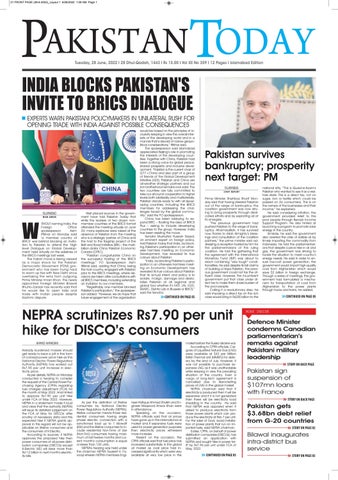
IndIa blocks PakIstan's InvIte to bRIcs dIalogue g
ExPERTS WARN PAKISTANI POLICyMAKERS IN 'UNILATERAL RUSH' FOR OPENING TRADE WITH INDIA AGAINST POSSIBLE CONSEqUENCES
iSLAmABAd
W
Mian abRaR
ITHOUT naming India, the Foreign Office spokesperson Asim Iftikhar on Monday said ‘a member country of BRICS’ was behind blocking an invitation to Pakistan to attend the ‘High level Dialogue on Global Development’ held virtually on the sidelines of the BRICS meetings last week. The Indian move is being viewed as a major shock for the Pakistan Democratic Movement (PDM) government who has been tr ying hard to warm up ties with New Delhi since overtaking the reins from outgoing Prime Minister Imran Khan. The newly appointed Foreign Minister Bilawal Bhutto-Zardari has recently said that he would like to open talks and trade with Indian people despite Kashmir dispute.
Well placed sources in the government have told Pakistan Today that while the leaders of two dozen nonmember countries of the BRICS format attended the meeting virtually on June 24, many eyebrows were raised at the absence of Pakistan from the meeting who is a strategic partner of China and the host to the flagship project of the Belt and Road Initiative (BRI) – the multibillion-dollar China Pakistan Economic Corridor (CPEC). “Pakistan congratulates China on the successful hosting of the BRICS meetings,” FO Spokesperson Asim Iftikhar said, adding that China, being the host country, engaged with Pakistan prior to the BRICS meetings, where decisions are taken after consultations with all BRICS members, including extending an invitation to non-members. “Regrettably, one member blocked Pakistan’s participation,” the spokesperson added. “However, we do hope that future engagement of the organisation
would be based on the principles of inclusivity keeping in view the overall interests of the developing world and in a manner that is devoid of narrow geopolitical considerations,” Iftikhar said. The spokesperson said Islamabad appreciated Beijing’s role in promoting the interests of the developing countries. Together with China, Pakistan had been a strong voice for global peace, shared prosperity and inclusive development. “Pakistan is the current chair of G77+China and also part of a group of friends of the Global Development Initiative (GDI). Pakistan and China are all-weather strategic partners and our iron brotherhood remains rock solid. The two countries are fully committed to take our all-round cooperation to higher levels both bilaterally and multilaterally. Pakistan stands ready to with all developing countries, including the BRICS members for addressing the challenges faced by the global community,” said the FO spokesperson. China has been lobbying to expand BRIC – floating the idea of BRICS Plus – asking to include developing countries to the group. However, India has been resisting the move. Senator Mushahid Hussain Sayed, an eminent expert on foreign policy, told Pakistan Today that India, by blocking Pakistan’s participation in an otherwise harmless meeting on Economic Development, has revealed its true colours about Pakistan. “India, by blocking Pakistan’s participation in an otherwise harmless meeting on Economic Development, has revealed its true colours about Pakistan that its actual intent and policy is to isolate, malign, damage and destabilise Pakistan at all regional and global fora whether it’s FATF, UN, G20, SAARC, Disinfo Lab in Brussels or BRICS,” said the Senator.
CONTINUED ON PAGE 05
Pakistan survives bankruptcy; prosperity next target: PM iSLAmABAd Staff RepoRt
Prime Minister Shehbaz Sharif Monday said that having steered Pakistan out of the verge of bankruptcy, the coalition government was now striving to bring prosperity through dedicated efforts and by exploiting all of its energies. “The previous government had pushed Pakistan to the verge of bankruptcy. Alhamdulillah, it has survived now thanks to Allah Almighty’s blessings and consultation of the coalition partners,” the prime minister said addressing a reception hosted by him for the parliamentarians of the ruling coalition. He told the gathering that the agreement with the International Monetary Fund (IMF) was about to reach containing “very tough” conditionalities. He said despite its tall claims of building a Naya Pakistan, the previous government could not tax the affluent class. However, the incumbent government put that class under direct tax to make them share burden of the poor people. Calling it a revolutionary step, he said imposing a direct tax on the rich class would bring in Rs200 billion to the
NEPRA scrutinizes Rs7.90 per unit hike for DISCO’s consumers AhmAd AhmAdAni Already burdened masses should get ready to bear a jolt in the form of colossal power price hike as the National Electric Power Regulatory Authority (NEPRA) has worked out Rs7.90 per unit increase in electricity price. As per details, NEPRA on Monday conducted a hearing to consider the request of the Central Power Purchasing Agency (CPPA) regarding fuel charges adjustment (FCA) for the month of May 2022. And hinted to approve Rs7.90 per unit hike under FCA of May 2022. However, NEPRA in a statement made it loud and clear that the authority (NEPRA) will issue its detailed judgement on the FCA of May for DISCOs after scrutiny of necessary data and this expected hike if NEPRA grants approval in this regard will not be applicable on lifeline consumers and the consumers of K-Electric. According to sources, if NEPRA approves the proposed hike then power consumers of all power distribution companies (DISCOs) except K-Electric (KE) will bear more than Rs112 billion in next month’s electricity bills.
As per the definition of lifeline consumers by National Electric Power Regulatory Authority (NEPRA), lifeline consumer means those residential consumers having single phase electric connection with a sanctioned load up to 1 kilowatt (KW) and the lifeline consumers to include residential Non-Time of Use (Non-ToU) consumers having maximum of last twelve months and current month’s consumption is equal or lesser than 100 units. NEPRA’s hearing was held under the chairman NEPRA Tauseef H. Farooqi wherein NEPRA members Engi-
neer Rafique Ahmed Shaikh and Engineer Maqsood Anwar Khan were in attendance. Speaking on the occasion, NEPRA officials said that oil prices have gone up in the international oil market and if expansive fuels were used for power generation purposes then electricity prices witnessed more increase. Present on the occasion, the CPPA officials said that fuel price has increased substantially in the global oil market as coal price had increased significantly which were very available at very low price in the
market before the Russia-Ukraine war. According to CPPA officials, Cargoes of Liquefied Natural Gas (LNG) were available at $42 per Million British Thermal Unit (MMBTU) for delivery by the end of July. However, it was not possible to purchase expansive LNG as it was unaffordable while keeping in view the prevailing situation of the country. Even a cargo of long-term agreement is cancelled due to skyrocketing prices of LNG in the global market. NEPRA chairman said that if electricity is produced then it will be expensive and if it is not generated then there will be electricity load shedding in the country. He said that NEPRA was opposed when it asked to produce electricity from those power plants which can produce the electricity at Rs6-7 per unit. For the sake of God, avoid installation of power plants that run on imported fuels, said NEPRA chairman. Earlier, CPPA, on behalf of power distribution companies (DISCOs), has submitted an application with NEPRA and sought hike in power tariff by Rs7.96 per unit under FCA of May, 2022.
CONTINUED ON PAGE 05
national kitty. “This is quaid-e-Azam’s Pakistan who wanted to see it as a welfare state. This is a direct tax, not on sugar, iron or textile which could be passed on (to consumers). This is on the owners of the businesses and their income,” he explained. He said considering inflation, the government provided relief to the poor people through Benazir Income Support Program. He also hinted at launching a program to promote solar energy in the country. Similarly, he said the government also averted the crisis of edible oil by timely importing the commodity from Indonesia. He told the parliamentarians that despite a price hike in oil and gas, the government was striving to tackle the situation to meet country’s energy needs. He said in order to ensure low-cost power generation, the government would import high-quality coal from Afghanistan which would save $2 billion in foreign exchange. Through a series of meetings, the government had formulated a mechanism for transportation of coal from Afghanistan to the power plants through trucks and trains, he added.
CONTINUED ON PAGE 05
MORE INSIDE
Defence Minister condemns Canadian parliamentarian’s remarks against Pakistani military leadership STORY ON BACK PAGE
Pakistan sign suspension of $107mn loans with France STORY ON BACK PAGE
Pakistan gets $3.68bn debt relief from G-20 countries STORY ON PAGE 02
Bilawal inaugurates intra-district bus service STORY ON PAGE 03
02
Tuesday, 28 June, 2022 | ISLAMABAD
NEWS
SenatoR IShaq DaR lIkelY to RetuRn next month
P
INP
AKISTAN Muslim League Nawaz Senator Ishaq Dar will likely return to Pakistan in the third week of July to face a court battle. Dar will decide on joining the federal cabinet only after winning the court cases against him, sources say. The PML-N leader, who has served as federal minister of finance four times between 1998 and 2017, has been living in a self-imposed exile in the United
Kingdom since November 2017. An accountability court declared him proclaimed offender in assets beyond means case in December 2017. Dar contested the claims from the National Accountability Bureau (NAB), saying that he had duly declared his assets and had been filing his returns for the past 32 years. Sources say after returning to Pakistan Dar will face the court case and assume his responsibilities as Senator. But he will not join the federal
Pakistan gets $3.68bn debt relief from G-20 countries The global debt payments suspension initiative by the G-20 countries has provided temporary relief of around $3.68 billion to Pakistan. As per details, Pakistan and France have inked an agreement deferring payment of $107million. The agreement was signed by the Secretary of Economic Affairs Division, Mian Asad and France’s envoy Nicolas Galey. The press statement released by the Economic Affairs Division stated that Pakistan has also inked loan deferred agreements with G-20 countries worth $3.68 billion. The loan amount was to be paid between July to December 2021. Meanwhile, the PakIMF deal providing Pakistan with the $1 billion loans is expected to be sealed today as IMF plans to hand over Pakistan the economic and financial policy. According to the finance ministry, the International Monetary Fund (IMF) will hand over the economic and financial policy for the renewed deal providing an economic relief package to Pakistan. INP
GB presents Rs119bn budget for FY23 ISLAMABAD Ghulam abbas
Gilgit Baltistan’s (GB) budget for the next fiscal year with a total outlay of over Rs119.3 billion was presented at the Gilgit Baltistan (GB) Assembly in Gilgit on Monday. Out of the total outlay of Rs119.32 billion, it has been proposed that Rs61.4 billion be allotted for nondevelopment expenditure and Rs47.88 billion for total development schemes during the next fiscal starting from July 1, 2022. Presenting the provincial budget, Minister for Finance Javed Ali Manwa said that the nondevelopment budget of Rs61.4 billion includes Rs47 billion of federal grants allocated for FY23 whereas the estimated budget deficit of Rs9 billion would also be met by the federal government. The non-development side includes Rs3.50 billion as non-tax revenue which the regional government expects for the next financial year. Besides, Rs1.21 billion as a lapsed amount during FY22 has also been included in the estimates whereas Rs221 million has been included as unbudgeted non-tax revenue of FY22. The minister also informed that the development budget for next fiscal year has also been set at previous level of Rs47.88 billion which included Rs17.96 billion of provincial Annual Development Plan (ADP), Rs18.50 billion of federal PSDP, Rs8.24 billion of non-spent development budget of outgoing fiscal year, Rs2 billion as foreign exchange component, Rs1.18 billion of unspent vertical projects. Moreover, the total budget outlay also includes Rs10 billion of wheat subsidy, including the center’s share of Rs8 billion and Rs2 billion of sold prices of the commodity for the next fiscal year. The minister announced that an increase of at least 15% increase in salaries of government employees are being proposed in the budget whereas the minimum wage for contingent employees would be fixed at Rs25,000 per month in the region. As per the budget from July 1, 2017, employees will be given 15% DRA allowance of basic salary while officers above BPS 20 would be given 25% DRA. During the next fiscal year, Rs2.25 billion have been proposed for the education department and Rs1.20 billion for health sector development. The government has allocated Rs1 billion for local government and rural development, Rs765 million for agriculture, Rs174 million for forest department, Rs121.7 million for minerals and industry development and Rs48 million for food sector. It is also proposed to allocate Rs288.5 million for the Department of Tourism and Culture and Rs266.5 million for the Department of Social Welfare.
cabinet immediately and will decide on the issue only after winning the case, they said. In addition former premier and ruling Nawaz League’s leader Shahid Khaqan Abbasi has said that no one can stop selfexiled ex-finance minister Ishaq Dar to return home if he has a will. The vice president of Nawaz League in an informal talk on Monday said that he did not know that Ishaq Dar is returning home. Shahid Khaqan Abbasi said Ishaq
Dar’s repatriation is not a decision at the party level, it will be his own decision. He said Pakistan is the country of Ishaq Dar and repatriation is his right so no one can stop him whenever he wants to return home. About the cases against Ishaq Dar in Pakistani courts, the ruling party’s leader said the former finance minister will deal with court matters himself. Commenting about any change in the Ministry of Finance, Khaqan said that it is the prerogative of the Prime Minister.
Parliament house gets additional Rs5bn funds for FY2022-23 INP Parliament House will get an additional amount of Rs5 billion in the next fiscal year 2022-23 amid a recent unprecedented hike in fuel and electricity prices and inflation which the government declared that they have no other choice than taking difficult decisions. The Parliament is comprised of the Upper House of the Parliament, Senate and Lower House- National Assemblyand it will receive additional funds as
compared to the previous fiscal year under the heads of salaries of the employees, expenditures, and allowances. The National Assembly will get an additional fund of nearly Rs3 billion as it would get a total of Rs34.53 billion during the next fiscal year. It is pertinent to mention here that Finance Minister Miftah Ismail during his post-budget presser said that there is no choice for the government other than going out for difficult decisions. Speaking during the post-budget
presser while flanked by State Minister of Finance Aisha Ghous Pasha and Information Minister Marriyum Aurangzeb, the finance minister said that the nation and history would not forgive them if Pakistan faces a Sri Lanka-like situation. “Next year, the country will face a budget deficit of Rs4598 billion,” he said. He said that the government was taking necessary difficult decisions and asked media to take into account the current situation and avoid unnecessary
CDNS achieves Rs1,110bn through fresh bonds by June 25 APP The Central Directorate of National Savings (CDNS) on Monday attained the target of issuing Rs1,110 billion fresh bonds in the last months of current fiscal year 2021-22, from July 1, 2021 to June 25, 2022. The Central Directorate of National Savings has collected recorded Rs1,100 billion this time by the last months of current FY 2021-22, the senior official of CDNS told APP here. The CDNS had set an annual gross receipt target of Rs980 billion from July 1 to June 30 of the previous fiscal year 2020-21 to promote savings in the country. The senior official said the CDNS had set Rs250 billion annual collection target from July 1 to June 30 for the year 2020-2021 as compared to Rs352 billion for the previous year (2019-20) for the same time span to enhance savings in the country. The CDNS had set Rs352 billion annual collection target for the year 2019-20 as compared to Rs350 billion for the previous year (2018-19), he said. Replying to a question, he said the CDNS has decided to start Islamic finance and will start implementing its procedural work from next month to provide the facility of Islamic finance in the institution. In this regard, under Islamic Sharia Compliance, Prize Bonds and Savings Certificates will be issued for investment in accordance with Sharia Principles,
he said. The CDNS will provide Islamic investment opportunities to its consumers in an institution like the rest of the private and public sector banking, where Islamic sharia business has now reached 20 percent. Replying to another question, the senior official said that (CDNS) has started working to increase new investment opportunities and promote digital investment through many new projects. The CDNS in collaboration with State Bank of Pakistan was developing digital Prize Bonds, which will be available through online electronic channels, he said. He said the CDNS is in process of launching its first Mobile App for online purchase and encashment of National Savings Schemes. The official said that for better and efficient transfer of funds electronically, the CDNS is going to adopt RAAST in the current month for speedy flow of funds through its financial tributaries, he said. Initially, the CDNS has opened three separate accounts in State Bank of Pakistan (SBP) to avoid/stop direct access to the Non-Food Account-1 for its Alternative Delivery Channel (ADC) operations, 1Link Payment, UPI Payment and RAAST payment. Finance Division will allocate budgetary ceiling on a daily basis and the CDNS will operate within the allocated funds limit. Accordingly, the PFM Act, 2019 is adopted in its true spirit for the Alternative Delivery Channels of CDNS.
ReuteRs
India and the European Union resumed talks Monday on a free-trade deal after a nine-year gap, as Western countries seek to wean New Delhi off its close economic ties to Russia. Dubbed the “tariff king” by ex US president Donald Trump, India has become more open to lowering trade
Pakistan notifies revised export control lists related to nuke, bio weapons NEWS DESk The Government of Pakistan has notified revised Control Lists of Goods, Technologies, Material and Equipment that are subject to SECDIV license for export under the Export Control Act 2004 on Monday. The government has notified the lists in accordance with the Export Control on Goods, Technologies, Material and Equipment related to Nuclear and Biological Weapons and their Delivery Systems Act 2004. The Act enables the Government to control the export, re-export, trans-shipment and transit of goods, technologies, materials and equipment related to Nuclear and Biological Weapons and their Delivery Systems. As part of the regular review process, the Strategic Export Control Division (SECDIV) of the Ministry of Foreign Affairs has revised and updated the Control Lists, in consultation with other relevant Ministries and Departments. The revised Control Lists have been notified vide Gazette of Pakistan S.R.O. 551(I)/2022 dated 12 April 2022. The Control lists were originally notified in 2005 and subsequently revised in 2011, 2015, 2016 and 2018. Over the years, Pakistan has streamlined and strengthened its export control regime and enhanced its engagement with international export control regimes i.e., the Nuclear Suppliers Group, the Missile Technology Control Regime and the Australia Group.
PSX gains 826 points, closing at 41,878 APP The KSE 100-index of the Pakistan Stock Exchange (PSX) on Monday witnessed bullish trend, gaining 826.78 points, a positive change of 2.01 percent, closing at 41,878.57 points against 41,051.79 points on the last working day. A total of 247,901,404 shares were traded during the day compared to the trade of 424,229,317 shares the previous day, whereas the price of shares stood at Rs7.378 billion against Rs12.806 billion on last trading day. As many as 333 companies transacted shares in the stock market, 228 of them recorded gain and 90 sustained losses, whereas the share price of
15 companies remained unchanged. The three top trading companies were K-Electric Ltd with a volume of 32,041,500 shares and price per share of Rs3.09, Treet Corp with volume of 19,925,500 and price per share of Rs30.12 and Unity Foods Ltd with volume of 14,428,500 and price per share of Rs20.49. Bata (Pak) witnessed a maximum increase of Rs128.24 per share, closing at Rs2,132.90 whereas the runner up Mari Petroleum, the share prices of which climbed up by Rs97.51 to Rs1,790.97.Unilever Foods witnessed maximum decrease of Rs250 per share closing at Rs25,400 followed by Bhanero Tex, the share price of which declined by Rs25 to close at Rs1,465.
India, EU resume free trade talks after nine-year gap NEW DELHI
criticism. “We are not taking this money collected through difficult decisions to our home,” he said. Miftah Ismail said that in the budget, they have proposed the collection of more money from rich segments of the society rather than overburdening the poor and middle classes. Speaking on a hike in salaries of employees despite austerity measures, Miftah said that they were able to set aside the money from the amount left in the exchequer.
barriers in recent years and is negotiating pacts with several other countries. The Asian giant has refused to condemn Russia’s invasion of Ukraine, even increasing oil purchases from its longstanding strategic ally and biggest supplier of arms. The European Union is India’s second-biggest trading partner after the United States but talks with the bloc broke down in 2013 over issues including tariff reductions and patent
protection. Merchandise trade hit an alltime high of $116 billion in 2021-22, with India’s exports to the 27-member European Union hitting $65 billion, according to New Delhi. “Both sides are aiming for the trade negotiations to be broad-based, balanced and comprehensive, based on the principles of fairness and reciprocity. There will also be discussions on resolving the Market Access Issues
which are impeding bilateral trade,” India’s commerce ministry said earlier this month when announcing the first round of talks in Delhi, which were due to run until Friday. India in February signed a major economic partnership agreement with the United Arab Emirates and in April agreed an interim free-trade deal with Australia, aiming to finish off a full pact by the end of the year.
Bilawal inaugurates intra-district bus service Bilawal Bhutto Zardari Monday unveiled a plaque to formally inaugurate a fleet of 140 Intra-District Bus Service out of 240 at Fatima Jinnah Road here on Monday. Chairman PPP Bilawal Bhutto Zardari along with Sindh Chief Minister Syed Murad Ali Shah, provincial ministers and party leaders boarded on a bus and travelled from Fatima Jinnah Road to Shahrah-eFaisal, Nursery Bus stop to mark inauguration of Intra-District Peoples Bus Service. He took round in the bus after the inauguration. Sindh Minister for Transport and Information Sharjeel Inam Memon, Sindh Minister for Labour Saeed Ghani, Administrator Karachi Murtaza Wahab and PPP MPAs including Sharmila Farooqui were also present on the occasion. The modern hybrid buses will operate on seven routes of the metropolise, initially, it has been made operational on one route from Malir to Tower. The service on other routes would also be made operational soon. News Desk
Tuesday, 28 June, 2022 | ISLAMABAD
GDa, laI alleGe RIGGInG In laRkana’S lB ReSultS, DemanD Re-eleCtIon
S
NEWS DESk
ECRETARY General, Grand Democratic Alliance (GDA) and Convenor, Larkana Awami Ittehad (LAI), Dr Safdar Ali Abbasi, on Monday rejected the local bodies election results and demanded re-election after proper preparation by ECP. Local bodies elections in Larkana and Kambar-Shahdadkot districts were a product of sheer rigging, he said while addressing a press conference at Larkana Press Club along with JUIFazal’s Provincial Secretary General Maulana Rashid Mahmood Soomro. He said that on the election day, the ECP’s claims proved false, as the voters
were missing, there were no polling stations, while the PPP’s Sindh government had appointed 14th grade officers in place of the 18th grade who openly and daringly supported PPP candidates. He said that the last date for the candidates’ scrutiny was May 20 which was extended till 27th by them, in which many forms of our candidates were rejected while results of Ghotki had not yet been declared who had staged a sitin adding that a similar situation prevailed in Dokri. He said after the vote counting, election results were always given to the agent of the candidates but it had not yet been done which showed that it was a game of money. He said our voters were subjected to
manhandling whereas PPP voters were provided protection by police which was negligence of the Election Commission of Pakistan (ECP). He said the Sindh government did not allow the army and Rangers to be deployed in the elections adding if there was deployment of the army and the Rangers, the election would not have been rigged. He demanded that the ECP must prepare very well at the very outset and hold re-elections, because they were completely rejecting this election. Maulana Rashid Soomro said that he addressed media persons in 14 districts of Sindh before elections and informed the relevant authorities about the preplanning of the Sindh government that ROs and DROs would be acting like
servants of PPP. He said his family’s 14 votes were not available in the voter lists and he had to run from one to another polling station to cast his vote. He demanded of the prime minister Shehbaz Sharif to inquire from Asif Zardari as to why rigging was made in Sindh and also demanded of JUI-F chief Maulana Fazlur Rahman to take up the issue of rigging with the coalition government and dispense justice with the people of Larkana. He said they would discuss the issue in their provincial central committee meeting. MPA Moazim Ali Abbasi said that in one UC, there were 6000 registered votes and in another only 400 which proved that election rigging was preplanned.
PM forms committee for fast completion of model jail project pending for 10 years NEWS DESk Prime Minister Shehbaz Sharif on Monday directed the authorities concerned to complete the underconstruction model prison in the capital, which has been facing delay for the last 10 years. Taking notice of the delay, the prime minister formed a six-member committee headed by Interior Minister Rana Sanaullah Khan by to review the prison project. Other members include Secretaries of the
uS dollar declines in open market amid interbank gains ISLAMABAD: The value of the US dollar moved in opposite directions in the interbank and open bank markets on Monday, with the greenback registering gains in the former and declining by a wide margin in the latter. In the interbank market, the rupee shed 46 paisas, or 0.22%, against the US dollar on Monday after failing to sustain its early gains. The rupee rallied against the US dollar in the morning session with the greenback falling to Rs206.65 at one point. However, the local currency soon lost steam and faltered against the US dollar, which closed at Rs207.94 in the interbank market on Monday, according to the data shared by the State Bank of Pakistan (SBP). In the open market, however, the US dollar fell by Rs1.5 to Rs206.50, according to rates shared by the Forex Association of Pakistan (FAP). In one of the rarest events, the US dollar was traded below than the interbank rates in the open market, says currency dealer Wakilur Rehman. He said that the open market saw fewer buyers than sellers and, consequently, the exchange rate registered a decline. INP
Ministries of Interior, Housing and Planning, the Chief Commissioner Islamabad and the Chairman Capital Development Authority (CDA). The prime minister sought the report from the committee within a week. The notification of the directive was issued as signed by Secretary to the Prime Minister, Dr. Tauqeer Shah, the PM Office said. The construction of Islamabad jail as per international standards and facilities could not be completed due to unavailability of funds.
Due to non-construction of the building, the Islamabad prisoners have been accommodated in Adiala Jail for the last six decades. The modern 90-acre jail being built in Sector H-16 adjacent to the motorway will house around 2,000 inmates. Schools, mosques, training centers, playgrounds, and Islamabad Capital Territory courts will also be built in the premises. A training center for prison officials will also be built in the complex.
E-tolling on motorways to help collecting accurate data, facilitate people: Asad Mahmood NEWS DESk Federal Minister for Communications and Postal Services Asad Mahmood has said that e-tolling system would help collecting accurate data related to toll tax collection, ultimately facilitating people with non-stop traveling. Addressing an agreement signing ceremony between National Highway Authority (NHA) and the Frontier Works Organization (FWO) for the installation of etolling on motorways, the minister said that e-tolling system would ensure smooth flow of traffic, save time and promote trade activities. The minister revealed that he expressed desire to convert motorways on e-tolling during his first visit to facilitate the road users. The project would be completed before stipulated time of one year, he added. He asked the NHA experts to introduce reforms in traffic laws coping with the advance technologies and new dimensions of motorways.
Asad expressed the resolve that more trees would be planted on the sides of motorways to make them beautiful and environment friendly. He was of the view that it was the responsibility of NHA to provide better-traveling facilities to people. In this regard, he said, expertise of NHA engineers would be utilized and reforms would be brought. The minister said that the communications sector would be put on one direction and the whole system would be digitized. He said the communication ministry would take steps on war footing to achieve set targets. Later, the minister witnessed the signing ceremony between NHA and FWO, titled e-tag-based video tolling on all motorways of Pakistan. Chairman NHA Captain (R) Khurram Agha, Inspector General National Highways and Motorway Police (NH&MP) Khalid Mahmood, Brigadier (R) Asif Siddiqui Director IT FWO were also present on the occasion.
PTI expresses concerns over ECP’s inaction on ‘massive poll rigging’ in Sindh ISLAMABAD staff RePoRt
The Pakistan Tehreek-e-Insaf (PTI) in its top-brass meeting on Monday expressed serious concerns over the role of the Election Commission of Pakistan (ECP) against the violations in the elections. The political committee of PTI reviewed in detail the overall political situation in the country and future course of action. The meeting was attended by Central Secretary General Asad Umar and other central and regional leaders. The meeting condemned in the strongest terms the worst lawlessness and sedition of the ruling party during the first phase of local body elections in Sindh. The Committee expressed its deep concern over the failure of the ECP to hold clean, transparent and credible elections. The meeting also expressed deep concern over the complaints of preelection rigging by the ruling coalition during the by-elections in 20 constituencies of Punjab. The meeting also expressed satisfaction over the decisive victory of PTI in the PK-7 Swat by-elections. The meeting was also briefed on preparations for holding a grand protest rally on July 2 at the Parade Ground in Islamabad. PTI Chairman Imran Khan said that
only a peaceful democratic movement of true freedom will lead the nation out of the catastrophe in which slaves have thrown it. He said the governments of thieves in Sindh and Punjab are busy looting elections while the ECP is a silent spectator. Imran Khan said the whole democratic system is being put at stake to keep the slaves in control of the nation. PTI BegInS PrePArATIonS for ‘hISTorIc’ JuLy 2 ProTeST: PTI on Monday formally begun preparations for ‘historic’ July 2 protest against rising inflation and country’s economic catastrophe. According to details, the PTI has began preparations for the protest
against inflation and what they termed ‘imported’ government at the Parade Ground in Islamabad on the call of former prime minister and party’s Chairman Imran Khan. In this regard, PTI Secretary General Asad Umar chaired an important meeting, which was attended by central leaders including Amir Kayani, Omar Ayub, Ali Nawaz Awan, Raja Khurram, Siraj Ahmad Khan, Iftikhar Durrani and others. The meeting discussed the preparations for the ‘historic’ protest at Parade ground and reviewed strategies to mobilize citizens from Rawalpindi and Islamabad. Meanwhile, the meeting also considered the stage preparation, transportation routes and comprehensive security plan in detail.
PTI Central Additional Secretary General Omar Ayub Khan was made incharge of Jalsa’s management committee, while other leadership and workers were directed to ensure standard arrangements for the protest. Speaking during the meeting, Asad Umar said that the ‘imported’ government has imposed a burden of inflation and destroyed the National Accountability Bureau (NAB) and judicial system to save their ‘corruption’. The former planning minister further said that due to the measures taken by the incumbent government, it has become difficult for the salaried and white-clad majority to make ends meet. “By taking dictation from International Monetary Fund (IMF), he government has made people’s lives miserable and destroyed the economy,” he added. Talking about the July 2 protest, the PTI Secretary General said that the people will take the streets against ‘imported’ government, rising inflation, lawlessness and civil dictatorship. “The only way out of the crisis is transparent and immediate elections,” he reiterated. Former prime minister Imran Khan has said he will lead a protest on July 2 at the Parade Ground in Islamabad. Pakistan Tehreek-e-Insaf (PTI) chief Imran Khan in his tweet said on July 2, we will protest against the imported government and he will lead the protest at Parade Ground Islamabad.
NEWS
03
Imran khan invites youth to join tiger Force, launches website NEWS DESk Pakistan Tehreek-e-Insaf (PTI) Chairman Imran Khan on Monday urged the youth to get themselves registered in the party’s Tiger Force to foil the expected bids for rigging in the upcoming by-polls in Punjab and in the next general elections in the country. In a video message, Imran Khan has appealed to the youth for immediate registration in the Tiger Force through their newly launched website and has stated that youth, “especially women,” will have to take responsibility for the byelections in Punjab. Former prime minister said that the current government has been imposed on us by an external intervention. He stated that for 30 years, the two parties — PML-N and PPP — have remained the slaves of the West and have been imposed on the people. These two parties have “sucked people s blood and destroyed the justice system, the NAB, and other institutions.” He claimed that cases involving Rs16 billion in assets had been buried and that there was no accountability. He lamented that the government had filed eight to nine cases against him and that the incumbent government has created an environment in which “opposition is finished.” He said that the current Punjab parliament is “nothing more than a farce.” Imran Khan claimed that the government will hold rigged elections. Earlier, Awami Muslim League Pakistan (AMLP) leader Sheikh Rashid warned of ‘anarchy’ in case of repeat of incidents of stealing of ballot boxes and kidnappings of presiding officers (POs) witnessed during local bodies’ (LBs) polls in Sindh on Sunday, June 26, 2022 in the by-elections to be held in Punjab on July 17, 2022. Talking to the media at F-8 Kutchery in Islamabad, he said democracy would be harmed and the country’s economy would suffer if such incidents recurred during the by-polls. “Muttahida Qaumi Movement-Pakistan (MQM-P) must have realized yesterday that it had made a mistake by joining the coalition government,” he said, adding, “Same must have been the case with the Awami National Party (ANP).” Former Interior Minister said what was witnessed in Sindh yesterday was pure violence and killings of people.
nePRa scrutinizes Rs7.90 per unit hike for DISCo’s consumers AHMAD AHMADANI Already burdened masses should get ready to bear a jolt in the form of colossal power price hike as the National Electric Power Regulatory Authority (NEPRA) has worked out Rs7.90 per unit increase in electricity price. As per details, NEPRA on Monday conducted a hearing to consider the request of the Central Power Purchasing Agency (CPPA) regarding fuel charges adjustment (FCA) for the month of May 2022. And hinted to approve Rs7.90 per unit hike under FCA of May 2022. However, NEPRA in a statement made it loud and clear that the authority (NEPRA) will issue its detailed judgement on the FCA of May for DISCOs after scrutiny of necessary data and this expected hike if NEPRA grants approval in this regard will not be applicable on lifeline consumers and the consumers of K-Electric. According to sources, if NEPRA approves the proposed hike then power consumers of all power distribution companies (DISCOs) except K-Electric (KE) will bear more than Rs112 billion in next month’s electricity bills. As per the definition of lifeline consumers by National Electric Power Regulatory Authority (NEPRA), lifeline consumer means those residential consumers having single phase electric connection with a sanctioned load up to 1 kilowatt (KW) and the lifeline consumers to include residential Non-Time of Use (Non-ToU) consumers having maximum of last twelve months and current month’s consumption is equal or lesser than 100 units. NEPRA’s hearing was held under the chairman NEPRA Tauseef H. Farooqi wherein NEPRA members Engineer Rafique Ahmed Shaikh and Engineer Maqsood Anwar Khan were in attendance. Speaking on the occasion, NEPRA officials said that oil prices have gone up in the international oil market and if expansive fuels were used for power generation purposes then electricity prices witnessed more increase. Present on the occasion, the CPPA officials said that fuel price has increased substantially in the global oil market as coal price had increased significantly which were very available at very low price in the market before the Russia-Ukraine war. According to CPPA officials, Cargoes of Liquefied Natural Gas (LNG) were available at $42 per Million British Thermal Unit (MMBTU) for delivery by the end of July. However, it was not possible to purchase expansive LNG as it was unaffordable while keeping in view the prevailing situation of the country. Even a cargo of long-term agreement is cancelled due to skyrocketing prices of LNG in the global market. NEPRA chairman said that if electricity is produced then it will be expensive and if it is not generated then there will be electricity load shedding in the country. He said that NEPRA was opposed when it asked to produce electricity from those power plants which can produce the electricity at Rs6-7 per unit. For the sake of God, avoid installation of power plants that run on imported fuels, said NEPRA chairman. Earlier, CPPA, on behalf of power distribution companies (DISCOs), has submitted an application with NEPRA and sought hike in power tariff by Rs7.96 per unit under FCA of May, 2022. The CPPA in its plea informed that 22.89 per cent of the electricity has been generated with Re-gasified Liquefied Natural Gas (RLNG) at a cost of Rs27.92 per kilowatt hour (kWh), while 13.77 percent of electricity has been produced with coal at a cost of Rs18.01 per kWh, and 12.90 per cent of electricity has been generated with nuclear at a cost of Rs1.05 per unit in the month of May 2022.
Tuesday, 28 June, 2022 | ISLAMABAD
04 NEWS
ECoSySTEm of EnTIRE HImAlAyAn REgIon IS In dAngER, ExPERTS wARn
A
staff report
DDRESSING the participant of a virtual dialogue on the environmental issues of Azad Jammu and Kashmir, experts said on Monday that the local environment and the ecosystem of the entire Himalayan region was in danger. They said that if forests, rare species of animals, precious birds that act as environment filters, valuable herbs, and ecosystem-balanced plants are not protected, the region would lose its ecological balance. The environmentalists warned that the timber mafia should be curbed to protect the precious forests of the region. They also said that irregular construction of guest houses in Neelum Valley should be stopped and alternative sources of energy should be provided to the people to stop the relentless deforestation. “If steps are not taken at the grassroots level, we will lose a great deal of national capital, which will have a devastating effect on the local
environment and the ecosystem of the entire region,” they said. Speaking on the environmental issues of Neelum Valley, the speakers unanimously adopted that a massive awareness campaign and steps need to be taken to create awareness among the people about climate change. District-wise steps must be taken in accordance with international norms to promote eco-friendly and sustainable tourism. Necessary changes need to be made in the curriculum to make the new generation aware of the dangers facing the environment. Prof. Dr. Muhammad Siddique Awan, a top researcher on wildlife, conservation, and biodiversity, said that the growing population, deforestation, the influx of tourists to protected areas, and pollution have resulted in the greenhouse gas effect. He emphasized that both mitigation and adaptation measures were urgently needed to address important environmental issues. He further said that rising greenhouse gas emissions have multiplied the risk of gla-
IHC dismisses PTI plea on expats’ voting procedure News Desk The Islamabad High Court (IHC) on Monday dismissed the Pakistan Tehreek-e-Insaf’s (PTI) petition challenging the constitutional amendment on voting procedure of the Overseas Pakistanis. IHC Chief Justice Athar Minallah heard the case filed by PTI leader Dawood Ghaznavi against the amendment in electoral laws made by the incumbent government. The IHC Chief Justice after hearing the arguments of the petitioner’s counsel declared the petition “inadmissible” and remarked that the Parliamentary legislation could not be malafide. “This is a very complex matter. The security and secrecy of the vote is very important”, the CJ remarked. He hoped that the Election Commission of Pakistan would take necessary steps for providing right to vote to Pakistani expats.
ciers erupting in the Neelum Valley, which poses a serious threat to the ecological balance of the whole Himalayan region. He said that we have to make the new generation aware of the dangers facing the mountains and forests through changes in the curriculum. “Local data on climate change is very limited, and more funds are needed for further research into the wise use of water, minerals, and medicinal plants,” he mentioned in his keynote address. The illegal extraction of medicinal plants from the Neelum Valley needs to be stopped and the movement nomads-especially those migrating from the mountains to the plains, also needs to be monitored. The endangered animals, birds, and other wildlife in the Neelum Valley are our national heritage, which is depriving us of the great national capital by eradicating them through poaching and cruelty. Dr.Siddique Awan, citing the serious effects of climate change on the local climate, said that the monsoon
season has now started in the Neelum Valley, which is astonishing and has led to catastrophic glacier eruptions in recent years. “The growing population has become a major threat to the environment. Due to this, the areas of Athmaqam and Kundal Shahi have now merged, although, in the light of Islamic injunctions, it is necessary to keep a distance of a few kilometers between the two big cities”, he explained by highlighting the need for allocation of green space between cities. Environmentalists further said that there is no check and balance in the tourism sector as the tourists are spreading pollution in mountainous areas and causing other environmental problems. We need to introduce a proper system to prevent tourists from spreading pollution. They should be given orientation on the protection of local resources. Sardar Mohammad Akram- a representative of the state forests department while speaking in his personal capacity, said that the forests of
staff report A sessions court on Monday confirmed the interim bail of 10 MPAs of Pakistan Tehreek-e-Insaf (PTI) in the Punjab Assembly ruckus case. The court confirmed the interim bail of Dr Yasmin Rashid, Sibtain Khan, Mian Aslam Iqbal, Mian Mehmood-ur-Rasheed, Sadia Sohail Rana, Sania Kamran, Zainab, Sher Akbar Khan, Mian Atif and Umar Aftab. Additional District and Sessions Judge Yasin Mohal passed the orders after hearing detailed arguments of the
parties and examining the case record. The police presented the case record, during the proceedings and apprised that all accused had joined the investigation. The MPAs had approached the court for the grant of bail, saying that they were not involved in the case and it was registered with mala fide intentions. Qila Gujjar Singh Police had registered a case under sections 324, 353, 186 and 427 of the Pakistan Penal Code against unidentified people for creating ruckus and torturing Deputy Speaker Dost Muhammad Mazari and other members during an assembly session held on April 16.
President calls for settlement of fire insurance claim of garment shop owner in Lahore
News Desk
staff report President Dr Arif Alvi has directed a private Insurance company to settle the rightful Fire Insurance claim of Rs 2.1 million filed by the owner of a garment shop in Lahore and termed it an act of maladministration on part of the Company. The president rejected a representation preferred by M/s Asia Insurance Company contesting the Federal Insurance Ombudsman’s (FIO) decision wherein the Insurance Company was directed to settle the insur-
ance claim of Rs 2,100,706 of its client within 30 days, which was unlawfully denied to him. The president in his decision observed that the company had admitted the authenticity of the Fire Cover Note which acknowledged that the Fire Insurance Policy was in force. It also admitted the findings of the survey report which determined a loss of Rs. 2.11 million by a fire ignited due to electricity short-circuiting, but still denied the rightful claim of its client, which the President termed as an act of maladministration. As per details, the insurance company had refused to pay the Fire Insurance Claim of M/s Taha Mohid Enterprises (Franchise) Garments (the complainant) on the ground that when the fire incident occurred, the Fire Insurance Policy was not in force. The complainant filed an appeal before the Federal Insurance Ombudsman (FIO). FIO admitted the claim of the Complainant and directed the company to pay the claim to its client within 30 days. Instead of complying with the impugned decision, the Insurance company preferred representation before the president which was also rejected in favour of the complainant.
Court orders further probe in Dua Zehra case staff report Judicial Magistrate-East on Monday issued written order over the C-class challan of the police in Karachi’s teenage girl Dua Zehra’s alleged kidnapping case. The police submitted statements of Dua, accused Zaheer and witnesses along the C-class challan. According to the complainant’s lawyer police challan based on the report of determination of the age of the girl. The complainant has submitted an application to the Secretary Health against the medical report, which has determined the age of Dua Zehra. “The report about age is false, as Dua’s age has been below 14 years,” the counsel said. The court in its written order said
concerned agencies should ensure the implementation of the Building Code and other laws to save local resources. Forty-five percent of the non-local tourists visiting Azad Kashmir are going to Neelam Valley. But relevant laws are not being implemented to check the extraordinary number of tourists. There is a need to increase partnerships between local communities and the government to save deforestation, and relevant departments and agencies must play their part in enforcing solid waste and building codes in tourist areas. Speaking on the objectives of the Press for Peace Foundation’s environmental awareness campaign, host Mazhar Iqbal Mazhar said that the organization has carried out numerous activities on the environment in Azad Jammu and Kashmir in the last two decades including seminars, workshops, community projects, public awareness, and media sensitization campaigns. The purpose of these activities is to raise public awareness of local environmental issues.
Court confirms interim bail of 10 PTI MPAs
IRSA releases 16642 cusecs water, with inflow of 27142 cases Indus River System Authority (IRSA) Monday released 16642 cusecs water from various rim stations with an inflow of 27142 cases. According to the data released by IRSA, the water level in the Jhelum River at Mangla Dam was 1097.15 feet, which was 47.15 feet higher than its dead level of 1,050 feet whereas the inflow and outflow of water was recorded a 45609 and 40000 cusecs respectively. The release of water at Kalabagh, Taunsa and Sukkur was recorded as 98865 ,115193 and 68190 cases respectively. Similarly, from the Kabul River, a total of 27900 cusecs of water was released at Nowshera and 27142 cusecs released from the Chenab River at Marala.
Neelum Valley are equal to about half of the forests of the whole state of Azad Jammu and Kashmir. And luckily, we have some trees in the area that have become extinct all over Pakistan. He described that deforestation is not based on scientific principles and that irregularities in deforestation are harming forests and wildlife. The area of forests near population centers is shrinking as human populations are increasingly using forests for fuel and construction. To save the forests, the people need to take ownership of environmental and natural assets as their personal valuables. The government and civil society must work together to save the forests. Focal Person Tourism Department Khawaja Raisuddin said that due to climate change, the temperature difference between Neelum Valley and Muzaffarabad Valley has remained non-existent and this is due to extraordinary tourism activities. In view of the increasing number of tourists in the Neelum Valley, the
that the government lawyer has not objected over further investigation of the case. “The issue is still required to be investigated that what was the age of Dua Zehra when she left home,” the court order read. “An appropriate age required for leaving the home for one’s free will,” order read. “The court approved the plea of the complainant for further investigation of the case,” according to the court order. The court while ordering the health department to decide the complainant’s plea within seven days, also directed to inform the court in case of decision for constitution of a medical board. The court also ordered the investigation officer to submit a supplementary challan after completion of further probe
of the case. In previous hearing, the investigating officer (IO), had filed a challan before the judicial magistrate, urging the court to quash the FIR in Zehra case after categorizing the case as “C-class”. In the charge-sheet, the IO maintained that Dua Zehra, travelled from Karachi to Punjab and tied the knot with Zaheer Ahmed of her own free will. He said that no evidence was found that the girl had been abducted as the medical report confirmed Dua Zehra’s age between 16 to 17 years. The IO removed Section216 and Child Marriage Act against suspects in teenage girl abduction case. The challan also declared suspects, Asghar and Ghulam Mustafa, arrested in Zehra case as innocent.
Islamabad’s air quality recorded moderate amid dry hot weather News Desk The air quality of the federal capital on Monday was recorded moderate amid dry hot weather after increased humidity in the atmosphere reduced the ratio of ambient contaminating pollutants leaving the atmosphere risky for only vulnerable groups. The air quality was moderate as suspended particles were recorded below permissible limits in the atmosphere due to persistent dry weather and heavy vehicular traffic on the roads. The air quality data has been collected from different locations of the city by Pakistan Environmental Protection Agency (Pak-EPA) that monitors air pollutants ratio for 24 hours based on three intervals of eight hours. The Pak-EPA data revealed that the air quality throughout the three intervals of data monitoring remained low as the pollutants were below the permissible limits of national environmental quality standards (NEQS). The hazardous air pollutant particulate matter of 2.5 microns (PM2.5), which was a lethal atmospheric contaminant, remained 26.14 micro grammes per cubic meter on average, which was lower than the NEQS of 35 mic-programmes per cubic meter and denotes the air quality healthy. The PM2.5 is generated through combustion of an engine, industrial emissions, burning garbage or inflammable material and dust blown by fast moving cars plying on noncemented patches of the roads. Moreover, the frequent forest fires in the federal capital also created high suspended particles, dust and particulate matter in the atmosphere. However, a spike was witnessed during the peak hours of hot dry weather in the past week that was mainly due to congestion of automobiles plying on the roads after school vans, office buses and public cars caused congestion on the main thoroughfares, an official of EPA told APP. The particulate matter had remained above the permissible limits beyond 40 microns prior to the onset of rainfall which was mainly due to persistent hot and dry weather.
05-NEWS 28-June 2022_Layout 1 6/28/2022 1:17 AM Page 1
Tuesday, 28 June, 2022 | ISLAMABAD
Khursheed shah tests positive as Covid-19 on the rise again isLamaBad
F
Staff RepoRt
EDERAL Minister for Water Resources and Pakistan People’s Party (PPP) leader Syed Khursheed Ahmed Shah has tested positive for the novel coronavirus, sources said on Monday. The federal minister has contracted the novel coronavirus after which he has quarantined himself. Sources said that Khursheed Shah was suffering from fever and cough since last night. The minister’s test was carried out today which came back positive, they added. Meanwhile, the COVID-19 positivity ratio in Karachi has reached an alarming level of 22.65 percent, the highest in the country.
According to details shared by the health department, the positivity ratio in Karachi soared to 22.65 pc in the last 24 hours, followed by Muzzafarabad with 6.25 pc and Abbottabad with 4.17pc. In addition, Islamabad’s was recorded as 2.31pc while Peshawar’s was 3.32pc. Cities including Quetta, Skardu, Swabi, Bannu, Multan, and Jhelum reported no COVID cases in past 24 hours, say the health department. Earlier, the National Command and Operation Centre (NCOC) on Monday made it mandatory for all passengers to wear face masks on all domestic flights, railways, and public transport. The NCOC order came after the country witnessed uptick in the coronavirus infection rate.
MQM-P urges PPP to fulfill its promises for parties’ alliance future news desk Reminding Pakistan People’s Party (PPP) that the Muttahida Qaumi Movement-Pakistan (MQM-P) had entered into an alliance with it following a ‘deal’, Member of Muttahida Qaumi Movement-Pakistan’s (MQM-P) coordination committee and former Karachi mayor Wasim Akhtar warned of parting of the
ways in case the party’s demands listed in the deal were not met. Addressing a presser here, he said that right now he was speaking in a low tone, and that he and his party expected the PPP to deliver on its promises. Wasim said the local bodies’ (LBs) elections held in Sindh Sunday had confirmed his party’s fears that there would be hooliganism
national savings refuse to extend date for cashing, changing of prize bonds
and indiscipline. “And what we witnessed the day was complete disorder so much so that not a single political party is satisfied with the electoral exercise,” he regretted. At several places, he went on to add, even members of the polling staff were kidnapped. “And we don’t want same scenes to be repeated during LB polls in Karachi and Hyderabad,” he added.
Continued from page 01
There comes a last opportunity for the people for changing or cashing bonds as the National Savings Monday refused to extend the date for exchanging or returning the old prize bonds after June 30. According to National Savings there will be no extension on the given date of June 30. It merits a mention here that the SBP has extended the date either for changing or cashing old, non-registered prize bonds of worth Rs40,000, Rs25, 000, Rs15, 000 and Rs7, 500 until June 30.
“But this should be a wake up call for our policymakers, and all others, who are in an unseemly rush and eager, keen and pleading for opening up trade with India unilaterally, while India leaves no stone unturned to harm Pakistan, even preventing Pakistani participation in a harmless economic development forum. Pakistani policymakers should realise there’s a very short distance between appeasement and surrender,” concluded Senator Mushahid Hussain who has an eagle eye on regional and
news desk Prime Minister Shehbaz Sharif on Monday summoned a meeting of the federal cabinet tomorrow (Tuesday). The meeting will be held at the Prime Minister House in Islamabad. A 15-point agenda has been released for the meeting.The national waste management policy, 2022 will be presented before the federal cabinet. Besides this, the cabinet will endorse the Economic Coordination Committee’s decisions taken on June 22. The cabinet members will also review the visa policy for different countries. The endorsement of June 23 decisions of cabinet’s legislative committee is also part of the agenda item. The cabinet will also determine the energy standards for the electric fans.
pakistan survives bankruptcy; prosperity next target: pM Continued from page 01 The prime minister said the government was also strategizing to enhance indigenous production of edible oil to save $4 billion. Similarly, the enhancement of cotton and wheat production was also on our agenda to support and stabilize the national economy, he added. He said in order to achieve the said goals, Pakistan would seek technical support from the friendly countries, instead of seeking aid from them. “Begging should come to an end. This will come to an end. A new era will usher in. In 14 months of our term, we will change fate of the country,” he resolved.
05
Syed Maz Hashmi, Director of Finance foodpanda, Sardar Mohammad Abubakar Chie Fnance and Digital Officer MMBL, and Salman Akhtar, CEO AdalFi sign an MoU to enhance micro-financing solutions for household chefs in Pakistan. Senior officials from all three organizations were also present at the ceremony.
Interior, HR secretaries summoned in Baloch students’ case news desk The Islamabad High Court has summoned interior and human rights secretaries in personal capacities in the Baloch students’case. IHC Chief Justice Athar Minallah on Monday was hearing petitions against the racial profiling and harassment of Baloch students. The court summoned interior and human rights secretaries for an explanation in the case. The chief justice inquired why complaints of the Baloch students were not removed. He further asked despite the formation of an inquiry commission, why its meeting was not held as yet. He remarked that it seemed that the Baloch students were facing serious problems which had not been solved. Justice Minallah said it was de-
plorable if the Baloch students ever felt that authorities were doing their racial profiling. He said the court would not let it happen. All parties are involved in the inquiry commission, then what is the hitch, the CJ wondered asking further what the government was doing in this connection. He said all security agencies were under the federal government, then who was responsible. Lawyer Imaan Mazari told the court that the Quaid-e-Azam University administration wrote to initiate disciplinary proceedings against an officer who visited the varsity. She said that the defence secretary was yet to submit his reply in this regard. On this, the court ordered the defence secretary to present a report regarding disciplinary proceedings against that officer in the court. The court then adjourned the case till July 25.
India blocks Pakistan's invite to BRICS dialogue
news desk
pM summons federal cabinet meeting
NEWS
global developments. Ambassador Nafees Zakaria said that Pakistan’s absence from the BRICS dialogue has afforded an opportunity to the gossipers, critics and of course Pakistan’s adversaries who would not let go off any occasion to hurt and cast a shadow on PakistanChina relations. “These efforts have increased ever since CPEC has been formalised. It is not a secret which all countries and their backed propagandists are involved. BRICS was founded in 2006 and first summit was held in 2009. A
close follow-up of the outcomes of BRICS would reveal, the malicious role India has on many occasions played to hurt Pakistan at this forum,” said the former diplomat. “I recall that in 2016-17 BRICS summit, when (India) tried to vilify Pakistan, a BRICS member criticised India. It is understood that BRICS decisions are taken on the basis of consensus. No Pakistani, in particular, and others in general, should have any doubt that India would ever give space to Pakistan at any forum, which India would have joined prior to Pakistan.
IOR ARC is one example,” he said. Zakaria said India remains focussed to malign and vilify Pakistan using all forums where Pakistan is absent. “FATF is a case in point. I think it’s important to see things in their correct perspectives,” he concluded. Ambassador Zamir Akram said that this is typical malevolent and churlish Indian behaviour towards Pakistan. “They did the same in the UNSC debate on Afghanistan a few months ago. Those in Pakistan who think they can improve relations with India should wake up to this reality,” he concluded.
NEPRA scrutinizes Rs7.90 per unit hike for DISCO’s consumers Continued from page 01 The CPPA in its plea informed that 22.89 per cent of the electricity has been generated with Re-gasified Liquefied Natural Gas (RLNG) at a cost of Rs27.92 per kilowatt hour (kWh), while 13.77 percent of electricity has been produced with coal at a cost of Rs18.01 per kWh, and 12.90 per cent of electricity has been generated with nuclear at a cost of Rs1.05 per unit in the month of May 2022. Similarly, 8.80 percent of the power has been produced with furnace
oil at a cost of Rs33.67 paisa per unit, while 9.99 percent of electricity has been generated with the gas at a cost of Rs10.12 per unit, 0.37 percent of electricity with imported Iran at a cost of Rs18.95 per unit, 0.11 percent of the electricity has been generated with mixed fuel at cost of Rs4.68 per unit and 0.53 percent of the electricity has been produced with bagasse at a cost of Rs5.98 per unit. Furthermore, 24.5 percent of electricity out of the total power generated in May 2022 has been generated with hydel source, 5.32 per-
cent of electricity with wind and 0.61 percent with solar source in the month of May 2022. It is also learnt from CPP plea that total 14,656.89 Gigawatt hour of electricity was produced while net delivered to DISCOs was 14,264.95 GWh in the month of May 2022. It is pertinent to mention here that already burdened masses would find a severe blow if the NEPRA approves the proposed hike in the power tariff which in result would add salt to their injuries in the form of additional burden of billions
of rupees through electricity bills. Pursuant to Section 31 (7) of the NEPRA Act (XL of 1997) and the mechanism for monthly fuel price adjustment prescribed by the Authority (NEPRA) in the tariff determination of Ex-WAPDA Distribution Companies (DISCOs), the Authority may on monthly basis make adjustments in the approved tariff on account of any variations in the fuel charges and policy guidelines as the federal government may issue and notify the tariff so adjusted in the official gazette.
MDCAT dental program passing percentage reduced to 55%: PMC news desk Pakistan Medical Commission’s (PMC) Medical and Dental Council on Monday approved reducing the MDCAT passing percentage for the dental program from 65% to 55% for the upcoming admissions in dental colleges of Pakistan. The council meeting chaired by the President of PMC, Dr. Arshad Taqi, upon the recom-
mendations of the National Medical and Dental Academic Board in respect of the MDCAT curriculum weightage of subjects was approved with minor changes. The topic of Gout as recommended by the Academic Board has been removed from the MDCAT curriculum. Academic Board recommendations are based on inputs from Provincial Higher Secondary Boards while confirming that the MDCAT
CmYk
curriculum is in line with National Curriculum 2006 as well as with the provincial curriculums and does not exceed or appear to hold anything to be out of the syllabus. Some of the Provincial Boards suggsted the removal of certain topics in biology even though they exist in the HSSC curriculum. The Academic Board rejected the request as these are the topics which are significant in terms of knowledge-based for a student to be ad-
mitted to dental and medical college. The weightage of questions in respective subjects of the MDCAT curriculum has been slightly modified with Biology from 32% to 34%, Physics and Chemistry from 26.5% to 27%, English from 10% to 9%, and Logical Reasoning from 5% to 3%. The medical and dental college admission test would consist of 210 questions based on the decided percentages.
06-07 Comments - 28th June 2022_Layout 1 6/27/2022 10:27 PM Page 1
Tuesday, 28 June, 2022
06 COMMENT
Political survival
A tough fight for Punjab It’s about to get a whole lot worse
W
HILe by-elections on 20 crucial Punjab assembly seats are due on July 17, the election campaign has already started. the PML-N and PtI are the main contenders in the race for control over the country’s largest province. On Sunday Imran Khan toured four constituencies in Lahore to support PtI candidates against the party’s renegades who had joined hands with the PML-N to get Hamza Sharif elected new CM. the PtI’s victory in PK-7 (Swat) where it defeated a joint PDM candidate on Sunday had buoyed up its morale. the party now hopes it can claw back to power in Punjab. As usual Imran Khan gave a religious touch to a purely mundane election campaign, calling it a jihad to win real independence for Pakistan. He vowed that he would bring back Rs1,100 billion allegedly laundered abroad by the Sharifs who were “forgiven under the NRO-2 through the NAB amendment” the PtI chairman also strongly criticized the election Commission of Pakistan for its avowed `leanings’ towards the PML-N and asked his workers to stay vigilant at polling stations on July 17. At an election related meeting in PP-7 (Rawalpindi), where Lt Col (rtd) Shabbir Awan is contesting as PtI’s candidate, former ISI chief retired Lt Gen Zaheerul Islam, took to the rostrum in support of Awan, indicating that a desperate PtI was using all its assets to win the battle for Punjab. the PtI’s strong points are its charged up voters who are angry over the removal of Imran Khan’s government. the PML-N too has its strong points. Of all the byelections held in Punjab from 2018 to 2021, the PML-N won a majority while still being in opposition. Now it is not only in power but also enjoys the support of PPP as well as religio-political parties which are part of the PDM. Among the disadvantages faced by PML-N is the presence of tLP in several constituencies where it has always vociferously attacked PML-N, thus depriving it of a particular variety of religious votes. Similarly three of the four candidates the PML-N is supporting in Lahore are PtI renegades who have been issued tickets at the cost of PML-N aspirants which is resented by many party loyalists. the elections will test the mettle of Hamza Sharif who is supposed to resolve the problems and lead the party to success.
The ‘economic saviour’ narrative was easier to sell
Yousaf Nizami
O
Ne thing is clear; this government does not have the time or the money to resolve the ongoing economic crisis and provide any reasonable tangible relief to the masses. It is not as if this reality now facing the nation came to be only after the current coalition government came to power, it was an eventuality even during the previous regime. Most, if not all, macroeconomic indicators during the PtI’s tenure were headed south as well. Whichever way one cuts it, this uphill battle, visibly lost from the get go, would have had to be fought primarily by the PML-N as it was the party in the alliance with a majority of the numbers and a clear ambition for the top slots of Prime Minister and finance minister. the PPP in particular and the JUI-F along with smaller parties that left the PtI alliance gained tremendously however, securing cushy federal cabinet portfolios with practically none of the responsibility of addressing economic issues that carries its own significant political cost. If the writing on the wall was so clear then why did the PML-N, PPP and JUI-f unholy alliance run from pillar to post to oust former Prime Minister Imran Khan? After all, the PDM’s platform for bringing the vote of no confidence to a vote in the National Assembly was to clinch power and ‘fix the economy destroyed by three and a half years of PtI rule’. Not even 90 days into its tenure, the coalition government is being asked exactly what was the purpose of removing Imran Khan from power rather than let him fall under the weight of the economic woes he faced that were much of his own making? If Federal Minister for Power Khurram Dastgir Khan is to be believed, answering this very question on a private television channel talk show, a larger motivation was political survival than economic repair work. According to Dastgir, Imran Khan as Prime Minister was gearing up to get senior opposition politicians disqualified for life through NAB and the courts
Missing persons Plus ça change, plus c’est la même chose
HasaN afTaB saEED
Founding Editor
Yousaf Nizami Joint Editor
Joint Editor
Executive Editor
Lahore – Ph: 042-36300938, 042-36375965
3.
I
t would not be an exaggeration to say that untold millions struggle to derive a fraction of the benefits the Quran has to offer on account of their faulty understanding of the kind of book it is. this, despite a lot has been written and said on how best to approach the Quran. therefore, it may be a good idea to broach the subject from the opposite direction; namely, what the Quran is not, and how not to approach it. We all are not only error-prone, but we also tend to forget after once knowing things well; therefore, what follows is meant to be a reminder, and not a criticism of anybody. So, here – in no particular order – are some things the reader would be well advised to keep reminding himself about the Quran: 1. Not meant to be read blindly. Like any other book, the Quran is meant to be understood. A visitor from Mars would probably wonder why something so obvious needs to be even stated. Until he comes to know the millions of Muslims who insist on reading the Quran blindly for the sake of ‘blessings’. Although the Quran is much more than merely an intellectual exercise, none of its benefits can be expected if one chooses to bypass the understanding part of it. For the truly blessed are only those whose beliefs, actions, and temperament all reflect the teachings of the Quran. 2. Not a collection of miscellaneous verses. Ide-
Arif Nizami (Late)
Umar Aziz
It is also a sad commentary on the role of the judiciary in such matters, which has on multiple occasions in the past handed down controversial decisions that have had far reaching political consequences.
How not to approach it
Dedicated to the legacy of late Hameed Nizami
M. A. Niazi
failed extraconstitutional method of running the country from the shadows. therefore, considering Imran Khan’s own words describing a highly inappropriate and overt overdependence on the former ISI chief to ensure the continuation of his government, Mr Dastgir’s apprehensions are not completely unfounded. It is also a sad commentary on the role of the judiciary in such matters, which has on multiple occasions in the past handed down controversial decisions that have had far reaching political consequences. the misuse of the extremely vague, open-ended and draconian Zia-era articles 62, 63 of the constitution requiring parliamentarians to be Sadiq and Amin by the Apex Court is an unfortunate reality. the verdict in the Panama case against Nawaz Sharif is a case in point, considered by many senior lawyers and judges as an atrocious decision by the Supreme Court. the dissenting notes in a more recent SC decision, in the wake of the successful vote of no confidence against Imran Khan, regarding clarity on article 63A of the constitution, states that the apex court has overreached and essentially amended the constitution. With some reprieve in the form of traditional allies China and Saudi Arabia committing financial relief (yet to be received), the likelihood of an upgrade from FAtF’s grey to white list and promising prospects of the IMF deal restarting on the back of accepting and implementing most of their conditionalities, it seems the immediate crisis could be averted in the very short term. With a bit of luck, all this brings is fragile stability, at best! It was never about being economic saviours replacing an incompetent setup that was en route to crash and burn the system, that was just the easier narrative to sell. Securing a political future and regaining power was at the core of what transpired over the past year. the political uncertainty that ensued took a toll on the economy in addition to what was already a severe mess. expectations should be managed and one must strap in for the long haul now. Writer is joint editor at Pakistan Today
What the Quran is not
t
He more things change, the more they stay the same. With the departure of the so-called hybrid regime, we see some more of the hybrid nature in the current dispensation in areas that matter the most. On the issue of missing persons in the restive province of Balochistan, the federal minister for human rights said that some of them had been engaged by Indian spy Kulbhushan Yadhav. He said that there have been a number of poor people who had chosen to be a part of the operations of foreign-backed and home-grown miscreants on account of the money that they were offered. If that, indeed, were the case, where is the due process that has been followed by the said agencies? Has anything by way of investigation been performed? And even if so, why have people been kept under unlawful incarceration and not been detained at prison facilities? His views echo those of the nation’s security and intelligence agencies. Not surprisingly, he said that instead of a commission, the missing persons issue should be investigated by these aforementioned agencies. If the issue weren’t so serious, the statement is enough to elicit a chuckle. the very agencies accused of enforced disappearances are proposed for investigating the disappearances. In order to curry favour with the civil society, or perhaps out of a temporary genuine empathy, PML(N) vice president and heir apparent Maryam Nawaz attended a missing persons’ camp protest in Islamabad. Ms Nawaz, who otherwise dispenses with the need for optics and propriety when instructing the finance minister to “please look into” import restrictions on pet food quite publicly on twitter. But she is conspicuous by her silence on the issue now. these are real individuals and their families whose lives have been disrupted. they are citizens of the Republic. they deserve better.
Editor Aziz-ud-Din Ahmad
as part of a broader strategy to ‘remain in power for the next fifteen years’. there is no denying that Imran Khan has threatened to ‘lock up everyone’ from Shahbaz Sharif to Asif Ali Zardari downwards, but for that to be taken as anything more than hyperbole by those in the crosshairs to engineer a takedown of the PtI government at a significant and obvious political cost, is a bit of a stretch. However, one must view this statement in the context of how quickly the PtI government’s thin majority in the centre and Punjab began to crumble as soon as Imran Khan fell out of favour with the establishment. While relations between the two had deteriorated significantly from the ‘same page’ days to being on very different pages within three years, it was Imran Khan’s inexplicable reluctance to change then ISI chief Lt Gen Faiz Hameed when COAS Bajwa wanted to, that blew a hole through the notebook containing those mutually occupied ‘pages’. Although Imran Khan has clarified his position that he never wanted to appoint Gen Faiz Hameed as the next army chief when Gen Bajwa’s tenure ends in November this year, this is exactly what the opposition at the time feared. He does however maintain that keeping Gen Faiz intact was to handle the fallout from the US exit from Afghanistan and to counter the then opposition’s efforts to topple his government, of which he had become aware months before it eventually transpired, going so far as to term the ISI chief as the “eyes and ears of the government”. How exactly was Gen Faiz as ISI chief expected by Imran Khan to thwart a constitutionally mandated process of bringing a vote of no confidence against a sitting Prime Minister? Was there to be a concentrated effort to retain allied parties that gave the PtI its majority in the National Assembly through those infamous “phone calls”, a euphemism for blackmail using sticky intelligence matter? Was there to be some sort of crackdown on opposition leadership of the time through a reinvigorated NAB that would make multiple new cases against them to enable fresh arrests? None of this would be new; it is a tried, tested and
I
Karachi – Ph: 021-35381208-9
I
4.
Islamabad – Ph: 051-2204545
ally, this too would hardly warrant mention let alone emphasis. Because the Quran must have a coherent structure to it if it is to be a binding discourse. Unfortunately, there are many Muslims who treat it as a collection of random verses. Since each verse is standalone and independent of the other verses (as far as they are concerned), each can have multiple meanings. With no coherence among the verses, there is no way to decide which of the meanings is the correct one, and it becomes a matter of arbitrarily picking and choosing based on one’s temperament and/or convenience. Since the Quran is one organic whole, the context of a particular verse and what the Quran has to say in other places must be considered if disagreements regarding the meanings of verses are to be settled. Not a device for reinforcing one’s prior biases. If somebody approaches the Quran to find validation for his way of life and that of those he loves, he is sure to find therein plenty of material that satisfies this desire. Similarly, if one wants confirmation of the evil ways of one’s real and perceived adversaries, he is apt to find that too in abundance. But that is not what Quran is for. It is meant to be a guidance instead – first and foremost for the reader himself. It is best read with the reader’s mind approaching a state as close to a clean slate as humanly possible, with the sole aim to improve himself – not to congratulate himself on how pious he is as compared to the rest of the mankind. Read the Quran to learn from it; do not read your preferred interpretations into it. Not like any other books. the books we are accustomed to consist of chapters, sections, and subsections. they move from chapters to chapter in pretty much a linear fashion, starting with the introduction to a topic, treating the different aspects of it in separate sections and subsections, and completing the discussion before moving on to the next topic. there is none of this linear progression in the Quran. the Quran calls itself remembrance; therefore, one finds threads of key beliefs continuing even while it gives detailed instructions regarding some other matter. Also, it has a way of taking up the same issue at different places separated by hundreds of pages, everyI
Web: www.pakistantoday.com.pk
I
5.
6.
where focusing on a separate aspect of it, or a particular application of it. this is what makes the practice of consulting it through its index so tricky. to learn Quranic wisdom then, the reader must therefore not only surrender his preference for a linear narrative, but also resist the temptation of quick word-searches. there is just no shortcut to spending time with the Quran, reading it over and over, pondering on its verses, and befriending it in the process. Does not merely address the intellect. Reading the Quran is not meant to be an armchair exercise – far from it. It is much more than just an intellectual activity. the Quran needs to be read – not only to understand it, but – to live it. If its contents do not make an integral part of one’s actions and temperament, it raises legitimate questions regarding one’s understanding too. the religion presented by the Quran is a holistic affair: a sound beliefsystem prompts the right actions, and righteous deeds in turn reinforce one’s beliefs; while both combine to make one’s temperament to conform more and more to the kind that constantly looks to improve its God consciousness. the Quran, in this way, conditions one’s very soul – at any rate, it should. Anything less, and the reader has failed to benefit from it as he should have. In the fashion of many armchair and professional philosophers for example, it will not do to ‘believe’ in determinism and absence of free will and at the same time live a life that is completely at odds with that philosophy. Not amenable to private interpretation. No doubt the Quran is God’s speech, but since God is speaking to man it is couched in Arabic – one of the languages that men speak. therefore, if you want to directly access it, you have no option but to do that via the Arabic language. If you do not have that kind of competence, you must naturally rely on somebody else’s expertise. In either case, you must guard yourself against personal symbolism. Beware of any teacher/exegete who employs private interpretation by inventing peculiar meanings of words. Or who tears verses from their contexts and declares something to be literal or figurative disregarding the accepted and standard norms of literature. Here, too, the context will settle the matter one way or the other.
The author is a connoisseur of music, literature, and food (but not drinks). He can be reached at www.facebook.com/hasanaftabsaeed
Email: editorial@pakistantoday.com.pk
06-07 Comments - 28th June 2022_Layout 1 6/27/2022 10:27 PM Page 2
Tuesday, 28 June, 2022
COMMENT 07 Editor’s mail Send your letters to: Letters to Editor, Pakistan today, 4-Shaarey Fatima Jinnah, Lahore, Pakistan. E-mail: letters@pakistantoday.com.pk Letters should be addressed to Pakistan today exclusively
Who is responsible?
The Abraham accords Implications for the Israeli-Palestinian conflict rael’s harsh occupation further intensified the Palestinians’ resistance, and violence between the two sides became more frequent. the PA’s negotiating stance further hardened, afraid of being seen as betraying the Palestinian cause. thus, little room was left for meaningful concessions to reach any agreement with Israel, especially under former PM Netanyahu’s 13 consecutive years in power, who vowed not to allow the establishment of a Palestinian state under his watch.
Dr aloN BEN mEir Righting the WRong: there is a prevailing sense among Israelis that the Abraham Accords suggest that the Arab states have, for all intents and purposes, abandoned the Palestinian cause. to the Israelis, those Arab states have presumably concluded that they can benefit greatly on a number of spheres from normalization of relations with Israel, which override their concerns over the Palestinians’ fate. this is just another fallacy that Israelis like to embrace. It suits their baseless contention that the occupation no longer presents an obstacle to normalizing relations with the Arab states, and Israel’s long-standing resistance to the establishment of a Palestinian state is now accepted as a fait accompli. that said, Israeli leaders still view the Abraham Accords as a historic breakthrough that will have major regional and national positive implications. they forget the fact that these Accords will remain hostage to the geopolitical winds that sweep the region as well as what the Palestinians might or might not do in the months and years to come. A bRief histoRicAl bAckgRound: Since the introduction of the Arab Peace Initiative (API) in 2002, the Arab states, led by Saudi Arabia, have de facto recognized Israel’s right to exist but conditioned normalization of relations with Israel upon “the acceptance of the establishment of a sovereign independent Palestinian state on the Palestinian territories occupied since June 4, 1967 in the West Bank and Gaza Strip, with east Jerusalem as its capital.” Once these conditions are met by Israel, the API notes that the Arab states will “enter into a peace agreement with Israel, and provide security for all the states of the region….and establish normal relations with Israel in the context of this comprehensive peace.” From the time the API was introduced 20 years ago, however, the geopolitical environment in the Middle east has dramatically changed. On the Israeli side, the eruption of the Second Intifada in 2002 on the heels of the API destroyed what was left of Israel’s trust of the Palestinians, and the peace negotiations between the two sides in 2008-2009 and 2013-2014 ended in failure. In the interim, Israel has vastly expanded its settlements enterprise and annexed more Palestinian land, while the Israeli public was steadily moving to the right-of-center, making the prospect of establishing a Palestinian state ever more remote. On the Palestinian side, extremism was on the rise, especially by Hamas and Islamic Jihad. the Palestinian Authority (PA) was plagued by internal rivalry, corruption, and stark polarization, especially between Hamas and the PA. Is-
Recognizing isRAel’s pRoWess: the growing Iranian threat against Israel and the Arab states, and tehran’s ambition to become the region’s hegemon, provided a common national security cause between Israel and especially the Arab Gulf states to rally against Iran’s threats and to disabuse tehran from its regional ambitions. to that end, going back nearly two decades, Israel began to share intelligence and provide military-related advanced technology with the United Arab emirates, Bahrain, and Saudi Arabia in particular, who felt directly threatened by Iran. Hence, the Gulf states began to view Israel as a strategic partner due to four critical factors: a) Israel’s military prowess is second to none in the region and rivals even both Shiite Iran and Sunni turkey; b) Israel’s unmatched intelligence capability which the Gulf states have and continue to eagerly seek; c) Israel’s world-renowned advanced technology which they badly needed to enhance their military machine and fighting capabilities among many other civilian uses; and finally, d) Israel is a nuclear power on which the Gulf states can rely, even more so than the US because Israel itself is existentially threatened by and is in the forefront to deter Iran. the above four factors provided Israel with huge political leverage, and even though Israel continues to occupy Palestinian land, the regional geopolitical conditions and the Gulf states’ desire to collaborate with Israel presented them with a challenge and a choice: to normalize relations with Israel now or stick to the API, which conditioned normalization with Israel upon settling the conflict with the Palestinians. the signatories to the Abraham Accords opted for the first option because what Israel has and continues to provide them is critically important and urgently needed to serve their national security. Moreover, the Abraham Accords put Iran on notice that the region was growing more united in its opposition to tehran. the ARAb stAtes’ evolving position: Making that choice however, does not translate, as many Israelis believe, to the Arab states abandoning the Palestinian cause. to the contrary, they view the Abraham Accords as a means by which to serve their national interest on one hand, while changing the dynamic of the Israeli-Palestinian conflict on the other, and in so doing break the impasse between them that prevailed especially under Netanyahu’s tenure. It should be noted that the Abraham Accords clearly stipulates that the parties will “…[commit] to continuing their efforts to achieve a just, comprehensive, realistic and enduring solution to the Israeli-Palestinian conflict.” In an interview, UAe Ambassador to the United States Yousef Al Otaiba reinforced that specific provision, stating that the normalization agreement was a result of the emirates’ efforts to stop further Israeli annexation of the West Bank. In fact, since the Accords were signed, Israel has not annexed another inch of Palestinian territory, albeit it continues planning for the future expansion of existing settlements.
this is not merely lip-service. the Arab states, just like Israel, are stuck with the Palestinians. they may disagree with them on a host of issues, especially with Hamas’s extremism, but they cannot and will not indefinitely accept or tolerate the brutal Israeli occupation. the recent conflagration between Israeli soldiers and police and Palestinian youth at the temple Mount should serve as a reminder to the Israelis as to where the Arab world really stands. the occupation humiliates not only the Palestinians but the Arab states as well. they can swallow only so much of Israel’s gross human right abuses, settlers’ unprovoked violence against innocent Palestinians, and the killings of hundreds of Palestinians each year, often without any justification. And if there were to be a major violent eruption between Israel and the Palestinians, which is only a question of time, the Arab states with no exception, will side with the Palestinians regardless of who instigated the violence. isRAel’s lost peRspective: every Israeli who does not seek to end the Israel-Palestinian conflict should ask themselves where Israel will be 15-20 years down the line. Do they really believe that the Arab states will gradually forget about the Palestinians? Do they think that Israel’s founders envisioned a Jewish state that would permanently occupy Palestinian land in the West Bank, maintain an indefinite blockade on Gaza in the east, and systematically and openly discriminate against Israeli Arab citizens? How many more generations of warriors does Israel want to raise and train, only to rain havoc on the Palestinians? What damage has this already done and will do to the Jewish Israeli character? the one and only Jewish state will become a pariah state and hit a new moral bottom, constantly threatened and living by the gun. the pRomise of the AbRAhAm AccoRds: the recent free trade agreement between Israel and the UAe and the extent of their bilateral trade is extremely significant, as such an agreement would further cement their relations. Moreover, the UAe along with Bahrain and other Gulf states are discussing the prospect of a security alliance, which the Biden administration fully supports. to be sure, the ties in many spheres between Israel and the Gulf states will continue to grow as long as no major violent Israeli-Palestinian conflagration erupts. However, regardless of how desperate the Gulf states may be for Israeli technology, intelligence, trade, and knowhow, for them the establishment of an independent Palestinian state with its capital in east Jerusalem remains sine qua non to a comprehensive Arab-Israeli peace. to be sure, as long as there is no Israeli-Palestinian peace based on a two-state solution, the current normalization process will remain fragile at best, subject to the changing geopolitical environment as well as to the intensity and the pitfalls of the Israeli-Palestinian conflict. Now that new elections are scheduled to be held in October, every Israeli should remember that Israel’s ultimate national security rests on peace with Palestinians. to that end, they should elect leaders who commit to ending the IsraeliPalestinian conflict. the Abraham Accords should be viewed then as the building block on which to erect a comprehensive Arab-Israeli peace that includes the Palestinians, and not as Accords that expunge the Palestinians’ rightful demand for an independent state of their own. the Abraham Accords offers Israel the unique opportunity to move in that direction, and any Israeli leader who does not realize that is forfeiting the promise of Israel’s founders and the premise on which the state was created. Dr Alon Ben-Meir is a professor of international relations at the Centre for Global Affairs at NYU. He teaches courses on international negotiation and Middle Eastern studies. alon@alonben-meir.com
exPLOItAtION through subcontractors is an old imperial tradition that was often practised through well-known private companies, such as the east India Company. this unethical and exploitative tradition received much greater sponsorship and patronage after 1947, as it became the preferred modus operandi for every government in Pakistan. the governments find subcontracts very lucrative. the mere fact that they involve a ‘contract’ means an inherent opportunity for exchange of funds a few inches below the surface of a table. It also means absolving oneself of every responsibility, mishap or poor performance. the signing of a contract is a signal that the government department can now go to sleep and the subcontractor can unleash whatever the intention happens to be. Consider the heart-rending gang rape of a woman in a Pakistani train a few days ago, and see how wrong things can go. tragically, the heinous act was performed in a train named after a revered Sufi saint Bahauddin Zakariya. It looks as if the subcontracted private company specialised in gang-rapes rather than operating trains. the railway department unfortunately absolved itself of all responsibility of the act committed by three employees of the subcontracted company. there are similar subcontractors dispensing long-term financial and social injustice to millions of sanitary workers across municipal committees and solid waste management organisations in the country. Many of these sanitary workers are children in their teens. these modernday slaves are paid Rs500 per day with no social security cover worth its name. Yet other gangs of heartless subcontractors torture thousands of private security guards by making them work 12 hours a day, paying half the minimum wage, depriving them of even a weekly holiday and placing them in equally heartless government organisations. Not even 75 years are enough for the country and its managers to learn that any organisation subcontracting a task is itself directly responsible for any violation of labour laws or a requirement stated in the contract. It may therefore be best to begin teaching this lesson by holding the head of Pakistan Railways directly responsible for the recent gang-rape in the train. Will somebody in the power corridors wake up to do just this much? NAEEM SADIQ KARACHI
Dangerous development A private cement company has been damaging the local environment and the health of the people in Choa Saidan Shah area of Chakwal district. the company is in the process of building a new cement manufacturing plant for which it is eying an area spread over 10,000 acres, covering a large portion of the Diljabba and Karangal reserve forests. A public hearing in this regard is expected to be held in July. this is a matter of grave concern for the local population which is already suffering from the damaging effects of the already existing two cement plants of the same company in Choa Saidan Shah that have been functional for some time. Since the completion of these plants, the area’s groundwater has drastically gone down and the weather has become warmer on account of thermal pollution caused by cement plants. the area residents now routinely suffer from dust allergies and the incidence of cancer has also increased compared to the days when there were no cement plants around. the relevant authorities need to intervene on behalf of the hapless residents and allow them to be given a fair chance to air their grievances against the very idea of allowing cement manufacturing in a populated area. Building another cement plant in the area will not only considerably reduce the local forest cover, but will also bring other catastrophic changes in the environment, causing harm to the health of the people. MIRZA AMJAD BAIG CHAKWAL
Project management challenges MALAKAND is an administrative unit of the Malakand District located in Khyber Pakhtunkhawa (KPK). Malakand Rural Development Project (MRDP) is a poverty alleviation project financed by the Asian Development Bank and sponsored from the Government of NWFP. the loan was requested by the Government of Pakistan for the development of MRDP in Malakand region. the primary objective of the loan was poverty reduction. Despite this, the validation report of the Malakand Rural Development Project states that the project failed to achieve its two primary objectives. the guidelines for procurement of goods and civil works set out by the Bank were not followed. the distribution of rams, bulls, and chicks ended up in the hands of either inexperienced acquaintances or locally connected persons. In addition to this, the recruitment of NGOs and social organization staff which compromised their merit and neutrality. It created an organization with a nonprofessional culture and politically motivated staff. this led to the social organizations serving their personal interests over national interests. Due to lack of leadership and institutional anchor, PMU had a disproportionate focus on the physical input without linking them to project output and outcomes. the PPRA identified severe irregularities and non-compliance with the Asian Development Bank (ADB)’s guidelines leading to dissatisfactory performance and implementation delays. It was due to poor supervision of the engineer consultants, possible fraudulent practices in contract executions, and lowquality materials used, and work done for roads. there was also poor communication of the project scope among the executing agencies and individuals. MRDP was a multifaceted project with multiple line departments which made project implementation and coordination difficult. there were not enough incentives given to the employed staff and PMU and line departments were seen to be busy in turf battles. there was also ineffective change management. Under the Devolution Plan, no formal arrangements were made with the new district governments to assist them coordinate in the project area and carry out their new responsibilities. the project also had a weak accountability mechanism, and no risk mitigation system was created to ensure successful completion of the project. According to the performance report, the road development component of the project had an environmental impact due to inappropriate road designs and other related factors. Given the difficult socioeconomic environment and weak implementation and coordination capacity, it’s important to develop a detailed and objective analysis of project implementation risks. Secondly, the project scope was too wide to cover insignificant subprojects. CHERYLL PATRAS LAHORE
08 WORLD VIEW 28TH June_Layout 1 6/27/2022 10:22 PM Page 1
Tuesday, 28 June, 2022
08 WORLD VIEW
Is The sTaTe DeparTmenT TrollIng henry KIssInger? “THE BIDEN ADMINISTRATION, INCLUDING TONY, IS CONSULTING HIM REGULARLY,” SAYS MARTIN INDYK, A FORMER TWO-TIME U.S. AMBASSADOR UNDER BILL CLINTON, MIDDLE EAST ENVOY UNDER BARACK OBAMA, AND AUTHOR OF A WELL-REVIEWED RECENT BOOK ON KISSINGER, REFERRING TO SECRETARY OF STATE ANTONY BLINKEN. “IT’S ONE OF THE IRONIES OF HIS ARC THAT THESE DAYS HE’S MORE APPRECIATED BY LIBERALS THAN BY CONSERVATIVES (INCLUDING ME!)” politico MaGazine miCHaeL SCHaFFer
W
heN the State Department hosts a gathering next week to dedicate a conference room to the memory of Archer K. Blood, the official man of the hour will be the late American diplomat who in 1971 protested a U.S. ally’s shockingly bloody crackdown in what was then east Pakistan. But another name will likely linger, unspoken: henry Kissinger, the former secretary of State most associated with America’s support for what many scholars now understand as a genocide. It’s not hard to interpret the honor as an implicit slap at the 99-year-old master of realpolitik, delivered in the Foggy Bottom building that Kissinger used to rule — and where Blood saw his career derailed for protesting his policy. Not that it’s being billed that way. To the department, it’s all about celebrating an individual’s heroism, not sticking it to his stateside antagonist. “Fifty years later we think back to the values that were required at that point and hope that we continue to hold those values as part of our own professional ethics,” says Kelly Keiderling, a deputy assistant secretary in the South and Central Asian Bureau, which is organizing the commemoration. No institutional rebuke of Kissinger — or broader post-Trump embrace of civil servant dissent — is intended. In fact, Blood’s story offers a lot to admire, with or without a malevolent Kissinger cameo. But its central conflict involves a run-in with the White house over democratic values, national interests and the duties of federal employees — a clash that seems all too politically relevant today, however apolitical the intent may be. A career Foreign Service officer, Blood spent 1970 and 1971 as the U.S. consul in Dhaka, now the capital of Bangladesh but then the major city in Pakistan’s impoverished, restive eastern wing. The posting in the isolated, military-ruled province made Blood the senior American witness to one of
the worst humanitarian crises of the twentieth century. Ten million refugees fled to neighboring India. “A reign of terror,” Blood reported in a cable back to Washington soon after Pakistan’s launch of “Operation Searchlight.” “Thousands were slaughtered, innocent along with allegedly guilty.” In another cable, he called it “selective genocide.” The problem for Blood was that Washington didn’t want to hear it. As far as Richard Nixon’s administration was concerned, Pakistan was a crucial cold war partner and the staffers calling attention to the violence were an unwelcome complication. Nixon and Kissinger had their reasons: That same Pakistani regime was facilitating Kissinger’s secret outreach to China; the Bengalis’ supporters, meanwhile, included the Soviet Union and India, a Moscow-friendly government the administration loathed. (White house tapes captured Nixon deriding Indians in racist terms.) Kissinger, then the national security adviser, argued against even asking the Pakistanis to avoid violence, according to meeting notes from the time. To officers stationed in violence-haunted Dhaka, conveying reports of friends massacred, it was an excruciating policy to abide by. Two weeks into the crackdown, young colleagues from the consulate used the department’s newly established “dissent channel,” designed to let diplomats register their disapproval of American policy without being punished for it. Blood endorsed and joined the cable. The document “was probably the most blistering denunciation of U.S. foreign policy ever sent by its own diplomats,” in the words of Gary J. Bass, a Princeton professor and former journalist who wrote an award-winning book about Blood. “Our government has failed to denounce the suppression of democracy,” the telegram reads. “Our government has failed to denounce atrocities. Our government has failed to take forceful measures to protect its own citizens while at the same time bending over backwards to placate the [West Pakistani] dominated government and to lessen likely and deservedly negative international public relations impact against them. Our government has evidenced what many will consider moral bankruptcy. ...
Private Americans have expressed disgust. We, as professional public servants, express our dissent with the current policy and fervently hope that our true and lasting interests here can be defined and our policies redirected in order to salvage our nation’s position as a moral leader of the free world.” The cable did not alter American policy. But in Washington, and particularly within the culture of the State Department, what became known as the Blood Telegram had a profound effect, one that continues to reverberate. The classified cable leaked, to the administration’s chagrin. Nine employees in Washington signed a memo endorsing its content. (Full disclosure: One of them was my late father.) Beyond the specifics of the Pakistan crisis, it’s easy to see why this first use of the dissent channel drew admiration: At a time when officials were delivering glowing reports about imminent victory in Vietnam, the spectacle of staffers speaking unwelcome truth to power appeared downright heroic. A half-century later, it doesn’t take a leadership coach to understand why an organization might want to celebrate that sort of legacy. The five decades since the Blood Telegram have featured no shortage of imbroglios that might have been avoided by listening to folks on the ground, far from the group-think. Of course, it didn’t play out that way at the time. The telegram enraged administration higher-ups. In a tape-recorded Oval Office conversation with Nixon, Kissinger called Blood “this maniac in Dhaka.” In short order, Blood was recalled to Washington, sacked. Once a rising star, he was consigned to an hR job. A critical annual evaluation accused him of whipping up underlings in an anti-Pakistan frenzy. Pressured by his bosses to stay out of sight, he rode out Kissinger’s secretary of State tenure seconded to the Army War College, not taking another overseas post until after Kissinger had departed. he never became an ambassador. The story doesn’t end there, though — for Blood or for Kissinger. Blood was an obscure figure when he retired, but thanks in part to Bass’ book has since become a hero of sorts, the straight-laced career man who told the truth. “An honorable, highly profes-
sional, extremely talented Foreign Service officer who did his professional and his moral duty when it was personally dangerous and professionally dangerous,” Bass says. “he’s exactly the sort of person who you want working for the United States government.” When he died in Colorado in 2004, the government of now-independent Bangladesh sent representatives to his funeral. Kissinger, meanwhile, remains one of the most famous figures in America, but the makeup of his admirers has changed, for reasons relevant to the Blood story. Always loathed on the left, in the past couple decades he fell out of favor on the right, too, first as Republicans embraced democracy-promotion during the George W. Bush era. (Ironically, when Bush’s moralistic neocons were riding high, the Foreign Service — Blood’s home — was derided for allegedly preferring a more cold-blooded, Kissingerian approach.) The GOP swung in a radically different direction during the Trump years, but Kissinger the globetrotting advocate of alliances, balance-of-power and global order was never going to be an idol for the America First set. “The Biden administration, including Tony, is consulting him regularly,” says Martin Indyk, a former two-time U.S. ambassador under Bill Clinton, Middle east envoy under Barack Obama, and author of a wellreviewed recent book on Kissinger, referring to Secretary of State Antony Blinken. “It’s one of the ironies of his arc that these days he’s more appreciated by liberals than by conservatives (including me!).” I reached out to Kissinger to ask how he felt about the State Department naming a room for the man he’d called a “maniac.” In an email sent via a spokesperson, the former Secretary of State said he didn’t think it was inappropriate. “It is appropriate for the State Department to honor a Foreign Service Officer who protested in pursuit of his conception of duty,” he wrote. But is it a slap at his
own tenure? Unlikely. “If the purpose was an institutionalized criticism of a preceding Secretary of State, it would be unprecedented.” The email from Kissinger’s spokesperson also said that “you might also note that his protest did not impede Mr. Blood’s career during Dr. Kissinger’s remaining five years in office,” a claim that Bass scoffs at: “he can try and deny stuff decades later, but the facts of what he did are frozen on the tapes.” Washington may be officially elevating Blood to its pantheon, but it’s not clear that things are any easier today for employees who stand on principle. Perhaps the most famous example since Blood, former ambassador Marie Yovanovitch, also lost her post after running afoul of an administration — in her case, being accused of undermining an effort to get Ukraine to dig up dirt on Donald Trump’s political rival Joe Biden. Yovanovitch testified at the hearings ahead of Trump’s first impeachment, a much more public forum than a dissent-channel cable. But she, too, wound up out of a job. Six days before Trump’s acquittal, she announced her retirement. Michael Schaffer is a senior editor at POLITICO. His Capital City column runs weekly in POLITICO Magazine.
The nature of what a great power is has changed NEW TECHNOLOGIES ENABLE SMALL POWERS TO ENGAGE MUCH LARGER POWERS. THE CORE OF THE FORCE IS THE TECHNOLOGISTS WHO MAINTAIN AND UPGRADE SYSTEMS – A FRACTION OF THE MANPOWER NEEDED BY THE OLD DEFINITION OF GREAT POWERS
Geopolitical Futures GeorGe Friedman
T
he evolution of military power is one of the most important if underrated geopolitical changes happening in the world today. Throughout the 20th century, military power was the province of large nations. Machines dominated the battlefield, and the production of these machines, the materials that fueled them and the ordnance they used required access to complex factories and massive amounts of raw materials. This, in turn, required vast numbers of workers – and the housing and food the workers needed to function. An economy of this scale needed to produce large numbers of ships, planes, tanks and all other manners of wartime materiel, even as they required functioning economies outside the wartime economy, providing the basic necessities of life and, ideally, maintaining national morale. Battlefields are black holes of consumption. Any nation can build a plane or tank or send a man to his death, but wars were won by nations that could build enormous numbers of planes and tanks and replace the ones that
had been destroyed by the enemy – not to mention replenish the steady stream of dead soldiers. Small nations could not engage in high-intensity war because they lacked the resources to do so. The definition of a great power, then, was a country with a large population, the agricultural system that fed it and the mineral base that could arm it. Given the deaths and damage the enemy could inflict, the key to military power was the size of the population and its resources. It also ideally had to be vast, with resources dispersed such that an enemy victory in one region would not mean a victory in all regions. As important, successful wartime nations needed technical expertise. Aircraft, warships and tanks needed to be planned and built, and the designs needed constant upgrading in response to the technical evolutions of the enemy. This meant that great powers had large numbers of inherently scarce technicians. After World War II, only the United States and the Soviet Union had the potential to wage war as great powers. (They were later joined by China.) Before the war, smaller powers, like Germany, the United Kingdom, France or Japan could be considered great powers too, but in the end, they either lost or participated in an alliance. In the intervening years, there has been a vast evolution of martial technology. It was once necessary to bring a 40-ton tank 2,000 miles away to deliver 40 or 50 pounds of explosives on an enemy position. The first British bomber attack was so inaccurate that the Germans couldn’t figure out what the British target was. Ships could not see farther than the horizon, where an
enemy fleet could be lurking. Special aircraft had to be launched simply to see deep. Paradoxically, the more primitive the system, the more resources were required to sustain it. The more aware of its environment and the more accurate the guidance, the lower the drain. For example, a satellite can provide an enemy’s location, and automated internal guidance systems on munitions can strike precisely. There are new satellites that belong in a new class. As a result of accuracy, a force requires fewer munitions. The concentration of manpower shifts from the active battlefield to managing intelligence and rapidly innovating technologies. War no longer required a massive population, nor does it require massive consumption of raw material. This has significant geopolitical consequences. Small and even very small countries can wage war, particularly against older model militaries that lack the precision and range of the new class of countries. These small countries shift from a dependence on depth to time. The more room a country had, the more room it had to disperse. In the emerging model of war, the more time they have in which to react to dangers, the more effective they are. It is not a single evolution so much as a set of evolutions, from space-based intelligence to long-range autotargeted weapons to automated anti-missile systems. We can see this evolution most clearly in Israel. Founded first on French and then American weapons, the Israeli military now has homegrown capabilities that it (ironically) can sell to others. They are designed around the principle that putting troops at risk is a possible but rare event, while using unmanned force as the
dominant element of strategy. Israel has come the furthest with this strategy, but it can be seen also in places such as the United Arab emirates and Singapore. As a result, each wields international political power far beyond what might have been expected from it during the prior era. New technologies enable small powers to engage much larger powers. The core of the force is the technologists who maintain and upgrade systems – a fraction of the manpower needed by the old definition of great powers. Of course, manned militaries remain indispensable. But the conversion to a new mode of thought is well underway. Israel has a striking amount of regional influence, but its technology cannot fully defend against a massive force from the last era’s great power. Maintaining one culture while creating new ones sparks crises between cultures – and within budgets. The new technology is ready for operation, but by itself it is not yet proven. Still, the evolution is underway, and that means that the definition of great power will have to change. Russia expected to defeat Ukraine with older weapons. That has not happened, at least not yet. Russia has to evolve its military. So will other large great powers if they wish to have effective forces. There is no inherent reason they can’t evolve, but their size is no longer decisive. Smaller nations can become great powers, decisive and dangerous. George Friedman is an internationally recognized geopolitical forecaster and strategist on international affairs and the founder and chairman of Geopolitical Futures.
09 Business 28 June 2022_Layout 1 6/28/2022 12:36 AM Page 1
Tuesday, 28 June, 2022 | ISLAMABAD
NEWS CORPORATE CORNER
SIgnIfIcant dIScOvery Of gaS by MarI PetrOleUM In bannU weSt blOcK PeshaWar
O
President of Pakistan Arif Alvi is interviewed by Muhammad Azfar Ahsan, Founder Nutshell Group and CORPORATE GROUP PAKISTAN recently. Arif Alvi says that leadership is crucial for the progress of the country, hence the nation should elect competent leadership for their future.
staff rePort
n June 01, 2022 Mari Petroleum Company Limited (MPCL) an associated company of Fauji Foundation announced a gas discovery resulting from its exploratory efforts in Bannu West Block, located in North Waziristan district, KP Province. The discovery is of significant importance for Pakistan and is a step towards building the energy security of the country. The well was initially tested at a rate of around 25 MMSCFD and 300 BPD of condensate at 32/64” choke. A post acid clean-up well test has now been conducted to better understand
well’s behavior and expected improvements in its performance. The new test rates are in the order of 50 MMSCFD of gas and 300 Barrels per Day of condensate. These results have further established the confidence in the discovery and additional potential in this area. MPCL together with its joint venture partners Oil & Gas Development Company Limited (OGDCL) and Zaver Petroleum Corporation (Pvt) Limited (ZPCL), is now developing the appraisal program and plan to bring this discovery on early production. The company is also working closely with Sui Northern Gas Pipelines Limited (SNGPL) who shall lay a transmission pipeline providing connectivity of the well with the national grid.
Mr. Faheem Haider, Managing Director & CEO has said that we are committed to implement a fast track appraisal and development program to fully exploit the hydrocarbon resources in the Block. He thanked the Minister of State for Energy, Secretary Petroleum, Director General Petroleum Concession, Provincial Government, Law Enforcement Agencies and Local Community for extending their cooperation during the operational activities. He highlighted that during the last 5 years the Company has contributed over Rs 80 million for the welfare schemes in the concession area. In addition, the Company is also implementing various projects worth Rs 86 million in education,
JazzCash and Bank of Khyber Enter Strategic Partnership for KPK’s Insaaf Food Programme IsLamabad Press release
three-day training on child Protection case Management and referral System held ISLAMABAD: National Commission for Child Welfare and Development (NCCWD), Ministry of Human Rights in collaboration with UNICEF conducted three-day training on Child Protection Case Management and Referral System (CPCMRS) for the relevant stakeholders at ICT level from 22-24 June, 2022 at Islamabad. The representatives of various Ministries/Divisions/Institutions i.e. Islamabad Police, Pakistan Bait-ul-Mal, FIA, NADRA, NCCWD, ZARRA, National Health Services, Regulation and Coordination, MoHR, Child Protection and Welfare Bureau, Federal Directorate of Education, Health (PIMS and Polyclinic), Labour (ICT Commissioner), Special Education, Social Welfare Centers, ICT Child Protection Institute, National Commission on the Rights of Child, National Child Protection Center, and Civil Society attended the training. At the opening ceremony Ms. Rabeea Hadi, Director General, Child Protection Institute, Ministry of Human Rights and Ms. Daniela Luciani, Chief, Child Protection, UNICEF welcomed the participants and highlighted the issues of child protection and the actions required for addressing these issues through a collaborative mechanism by involving all relevant stakeholders. They also appreciated the efforts of the team of NCCWD and UNICEF for organizing this important training. The objective of the training was to understand the child protection issues, ICT Child Protection Act, 2018, Rules of the Act and the overall process involved in the child protection case management and referral system. Besides to know that how to play role in child protection case management and referral system for preventing child abuse, protecting children from abuse and rehabilitate the children who have experienced abuse. At the closing ceremony, Ms. Rabeea Hadi, DG, Child Protection Institute and Ms. Daniela Luciani, Chief, Child Protection, UNICEF thanked the resource persons from NCCWD and Oxford Policy Management for delivering training sessions and making the session interactive.
naval chief addresses particpants of Pakistan navy war college LAHoRe: Chief of the Naval Staff, Admiral Muhammad Amjad Khan Niazi visited Pakistan Navy War College Lahore and addressed the course participants of 51st PN Staff Course. On arrival at War College, the Naval Chief was received by Commandant PN War College Rear Admiral Shifaat Ali Khan. While addressing the course participants, Chief of the Naval Staff highlighted evolving geo-strategic milieu and its interplay with prevalent security dynamics focused on maritime security challenges. The Admiral emphasized that Indian Ocean region is witnessing geopolitical changes of seismic nature and it adds to the responsibilities of Pakistan Navy. While focusing on threat perception, the Naval Chief underscored Pakistan Navy’s capabilities to deal with this paradigm shift in combating traditional and non-traditional security challenges. Naval Chief appraised upon various initiatives and developmental plan in line with his vision for Pakistan Navy to be a formidable regional maritime power. Press release
09
Pakistan’s leading fintech JazzCash, in collaboration with Bank of Khyber (BoK), is strengthening the country’s digital payments ecosystem. JazzCash users living in Khyber Pakhtunkhwa (KPK) will now be able to receive PKR 2,100 for the government’s Insaaf Food Programme through the JazzCash retail network and existing JazzCash customers will receive funds in their JazzCash mobile wallets. The signing took place at the BoK office in the presence of Managing Director and CEO BoK, Muhammad Ali Gulfaraz, CEO JazzCash, Atyab Tahir and Chief Financial Officer Mobilink Microfinance Bank Limited, Sardar AbuBakr. Through this strategic partnership, JazzCash and BoK will facilitate the Govt of KPK for their Insaaf Food Program, which requires BOK to distribute an amount of PKR 2,100 for 1,000,000 KPK individuals who fall within their criteria, for 3 years, every month. Families will be provided easy and convenient payments on their JazzCash Mobile Wallets and if they do not have a JazzCash account, the same will be transferred on their CNICs payments can be cashed out through JazzCash retail network. Speaking at the occasion, Atyab Tahir, CEO JazzCash, said, “JazzCash executed over 1.7 billion transactions generating a volume of more than 3 trillion for the year 2021. We have a network of 17,000 agents
across KPK, with an aim to grow our network even further. Through our mobile wallet, we have always prioritized financial inclusion (Particularly amongst women) in the country and to achieve this, key strategic partnerships like the one with BoK are critical. Through our facilitation of services like food subsidies, healthcare, etc, we are enabling a stronger financial ecosystem in Pakistan.” MD and CEO BoK, Ali Gulfaraz, commented, “The Insaaf Food Programme is an initiative by the KPK government to facilitate 10 lac impoverished households. BoK through the JazzCash mobile wallet will enable quick and easy accessibility to these financial services for all the deserving families. Enabling an ecosystem of inclusion and promoting economic diversity in Pakistan.
health and water supply schemes. The Company has also created numerous employment opportunities for the local population during the project execution period and will continue to do so going forwards. The company remains fully committed and is engaged with all stakeholders to improve the socio economic environment of the area through its social welfare programs. Mr. Waqar Ahmed Malik, on behalf of Board of Directors of MPCL thanked the management for accomplishing this splendid task for augmenting the depleting gas resources. He in particular thanked the honorable Prime Minister on constituting a steering committee to oversee and implement fast track development of the project.
24th convocation ceremony of bahria university Islamabad campus ISLAMABAD: 24th Convocation Ceremony of Bahria University Islamabad Campus (BUIC) was held at Ibn e Khuldoon Auditorium, Islamabad. During three days of Convocation Ceremony, degrees were awarded to graduates of Humanities & Social Sciences, Business & Management and Engineering & Applied Sciences programs. Rector Bahria University, Vice Admiral (R) Kaleem Shaukat HI (M), Pro Rector (Admin), Pro Rector (Health Sciences), Pro Rector (Academics) and Pro-Rector (RIC) were the Chief Guests of the Convocation Ceremony and awarded degrees to graduating students of PhD, MPhil, Masters and Undergraduate programs. During the Ceremony, a total of 970 degrees were conferred to the Undergraduate and Graduate students of Management Sciences, Humanities and Social Sciences, Computer Sciences, Law, Earth and Environmental, Electrical Engineering and Software Engineering Departments. Moreover, 70 Gold and 62 Silver medals were awarded to students who achieved top positions in their respective programs. Speaking on the occasion, Rector Bahria University Vice Admiral (R) Kaleem Shaukat HI (M) offered his heartiest congratulations to all graduates upon completion of their degree programs successfully.
Leading auto brands showcasing their products at Pakistan Auto Show Lahore Press release
All is set to enthral the car lovers and popular auto players to exhibit their innovations at the Pakistan Auto Show 2022 (PAPS-22) at the International Expo Centre, Lahore, on the 29th, 30th, and 31st, July 2022, under the theme "MADE IN PAKISTAN." The Pakistan Association of Automotive Parts and Accessories Manufacturers, a leading trade body of more than 350 members, is behind this mega event which fascinates the leading auto-players of the auto world. The well-known official sponsors of this muchawaited mega event, as of now, are MG motors, Indus Motor Company (IMC), Honda Atlas Cars Pakistan Limited (HACPL), Atlas Honda Ltd., (AHL), Al-Haj Automotive (Pvt) Ltd, Pak Suzuki Motor Company Limited (PSMC), and Chevron Pakistan Ltd.
More than 150,000 local visitors show up every year at PAPS to see the renowned companies from Japan, Germany, Korea, China, France, Turkey, Thailand, Taiwan, England, USA, UAE, and Sri Lanka; while over four hundred international visitors, including 150 global buyers and delegations too visit this bustling Auto Show. The diverse categories of exhibitors include Passenger Cars, Trucks, Buses, Tractors, Rickshaws, Motorcycles, Auto parts Manufacturers, Services providers, Machinery makers, Toolmakers, Antique cars, and Heavy motorbikes, along with related service industries like accessories, tracking & insurance, etc. The Chairman of PAPAAM, Mr Abdur Razzaq Gauhar, stated, "With the exponential growth of auto and related industries in Pakistan, the local consumers and international investors are showing keen interest in the automotive sector."
Inauguration of new UK visa centre in Karachi KARACHI: The UK Visa Application Centre is situated in the city center of the hustling and bustling city of Karachi; the new and state-ofthe-art facility in Karachi was inaugurated by H.E. Mr. Christian Turner, British High Commissioner to Pakistan, present at this historic moment were H.E. Mr. Mike Nithavrianakis, British Deputy High Commissioner- Karachi, and Mr. Martin Dawson, Deputy Head of Mission- Karachi. Pr
Kazakhstan envoy calls on Agha Hassan Bloch Press reLease The Ambassador of the Republic of Kazakhstan to Pakistan H.E Yerzhan Kistanfin called on the Federal Minister for Science and technology Agha Hassan Bloch in his office today on June 27, 2022. Federal Minister welcomed the Ambassador of Kazakhstan and said that Pakistan highly values the ties with Kazakhstan and wants to further expand bilateral cooperation in various areas of mutual interest. He highlighted the tremendous opportunities for cooperation that exist between the two countries which need to be explored for the immense benefit of both sides. He expressed the desire for a broad-based and deeper relationship with the Republic of Kazakhstan. Agha Hassan Baloch said that Pakistan is very fertile and full of potential that must be explored. He said that Gwadar port offers enormous avenues for Kazakhstan for promoting trade with the Middle East and other countries of the world. He said soon the Gwadar will be the trade hub and landlocked republics will avail access to the world through the development of Gwadar port which will
Musadik Malik visits PSO Head office Karachi
bring about socio-economic uplift in the whole region. He also mentioned the rich mineral resources in Baluchistan and the strategy for developing the mineral sector there. Both the dignitaries discussed the process of signing a Memorandum of Understanding (MoU) for a joint research council for cooperation in the field of science and technology that is likely to be inked in the next couple of months.
KARACHI: Minister of State (Petroleum Division), Ministry of Energy, Mr. Musadik Malik visited PSO’s Head Office in Karachi. Managing Director & CEO, Pakistan State Oil (PSO), Syed Taha welcomed the guest along with the company’s senior management. The honorable minister was given an overview of the company’s financial and operational performance, milestones achieved and key challenges. The minister acknowledged PSO’s role in reshaping Pakistan’s energy landscape with technological advancements and digitization. PSO continues to set new industry benchmarks and reaffirm its role as the national flag bearer and leader of positive change in Pakistan.
Tuesday, 28 June, 2022 | ISLAMABAD
10 FOREIGN NEWS
Munich echoes with ‘Modi not welcoMe’ slogans as g-7 Moot starts isLAMABAD
a
Agencies
S Indian Prime Minister Narendra Modi arrived in Munich to attend the G-7 summit, his countrymen held a protest demonstration and chanted ‘Modi not Welcome’ and ‘Go Back Modi’ slogans to denounce his government’s policies of Hindu supremacy. The Indian expatriates living in Germany gathered to protest against their prime
minister for pursuing the Hindutva ideology by marginalizing the non-Hindu communities in India. “Indians in Munich make a bold statement. Sounds of “Modi not welcome in Munich” echo in the historic grounds of Munich today. Proud moment for standing up to Hindutva’s communal tones,” the International Council of Indian Muslims said on its Twitter handle. The Council’s social media page also contains the video footage of the protest gathering where the people carried placards inscribed with anti-Modi slogans. “Modi, this is what you get for spoiling communal harmony of great India. You have spoiled the name of India – our motherland. The Indians of Germany reject your ultra-nationalist, right-wing Hindutva government. You are nobody here,” said a protestor attending the protest demonstration.
The hashtag #ModiNotWelcomeInMunich also trended on Twitter with the people from varying nationalities expressing their reaction towards the Narendra Modi’s policies targeting the Indian Muslims as well as other minorities. “Modi is arriving at Munich tomorrow to attend G7 as one of the five guest country leaders. Before his arrival, today Indians in Munich are calling for Modi not Welcome in Munich and chanting Modi Go back. This is what Indian media will never show,” said Ashok Swain, a renowned scholar and critic of the BJP government. This is not the first time that Modi has meted out such treatment abroad. In May this year too during his visit to Europe, Narendra Modi was received by similar protest demonstrations against international silence on human rights violations and mass atrocities against religious minori-
ties in India. The rights activists associated with The London Story placed empty shoes in front of the Amalienborg Palace, Copenhagen. The protesters hailing from India and other nationalities held banners and placards with slogans such as ‘Modi Not Welcome’, ‘India is close to genocide’ and ‘We don’t let you forget Gujarat 2002.’ In 2015, a large image of the Narendra Modi wielding a sword with the words ‘Modi not welcome’ was displayed on the British parliament by Indian activists ahead of his planned visit to the country. The image which was created by the Awaaz Network also bore the Hindu symbol ‘Om’ which slowly changed into the Nazi Swastika. In 2019, as Modi addressed the Howdy Modi event at the NRG Stadium in Houston, the protestors outside displayed placards saying ‘Free Kashmir’, ‘8 million people caged’, ‘Go back Modi’ and more.
In September 2021, as Modi visited the United States, scores of Indian Americans gathered in front of the White House to protest against Modi’s visit and chanted “Save India from fascism”. The netizens also spoke up against the Modi’s policies arguing that the chilling effect on the people of Kashmir after the abrogation of Article 370 had to be reversed. Calling for an end to genocide, they asserted that the prime minister aimed to rule over a Hindu-only India with no place for Christians, Muslims, Dalits or other minorities. “Modi has tarnished India’s Image overseas which happened never ever before, wherever he goes, people shout #ModiGoBack, now #ModiNotWelcomeInMunich,” said a Twitter handle ‘India against Hate. “Hitler’s birthplace doesn’t want to see one more Hitler,” wrote another Twitter user.
G7 leaders discuss Russian oil price cap, agree on infrastructure plan Agencies The Group of Seven (G7) leaders discussed plans to cap the price of Russian oil at the group’s annual meeting on Sunday. At the start of the meeting in the Bavarian Alps, Britain, France, the United States, Germany, Japan, Italy and Canada had “really constructive” talks on a possible price cap on Russian oil, a German government source told Reuters. The price cap scheme, promoted by Washington, is part of broader G7 discussions on how to further crank up the pressure on the Kremlin over its “special military operation” in Ukraine without stoking global inflationary pressures. But it was unclear whether there was a G7 consensus on the plan, with European Council President Charles Michel saying the issue would need to be handled carefully and discussed further. With the conflict between Russia and Ukraine entering its fourth month, Russia stepped up air strikes on Ukraine over the weekend, which has also seen the fall of a strategic eastern city to proRussian forces. Russia’s defense ministry said it had used high-precision weapons to strike Ukrainian army training centers in
Chernihiv, Zhytomyr and Lviv, an apparent reference to strikes reported by Ukraine on Saturday. At least four explosions shook Kyiv on Sunday. The last major strike on the city was on June 5, when a rail car repair facility was hit on the outskirts. Russia had abandoned an early advance on Kyiv before focusing its military operation on the south and Donbas, an eastern territory made up of Luhansk and its neighbor Donetsk. The Western alliance supporting
Kyiv is starting to show signs of strain as leaders fret about the growing economic cost. However, despite the energy and food shortages and a darkening global economic outlook, Britain, the U.S., Japan and Canada moved to ban imports of Russian gold on the first day of the G7 summit. Russian gold exports were worth $15.5 billion last year. Infrastructure plan: The G7 leaders agreed on a pledge to raise $600 billion in private and public funds for needed infrastructure in developing
countries. The plan aims to counter China and soften the impact of soaring food and energy prices. U.S. President Joe Biden said his country would mobilize US$200 billion in grants, federal funds and private investment over five years to support projects in low- and middle-income countries that help tackle climate change and improve global health, gender equity and digital infrastructure. Europe will mobilize 300 billion euros ($316 billion) for the initiative over the same period to build up a sustainable alternative to China’s Belt and Road Initiative scheme, which Beijing launched in 2013, European Commission President Ursula von der Leyen told the gathering. In response to the expected infrastructure plan at a press conference in mid-June, Chinese Foreign Ministry spokesperson Wang Wenbin said global infrastructure development requires mutual cooperation rather than mutual antagonism. The infrastructure plan, which was proposed by the U.S., ignores the common wishes of the international community but reveals a propensity to antagonize, Wang said, adding that it will not win popular support.
Zelensky urges G7 to help end Ukraine war by winter Agencies President Volodymyr Zelensky on Monday urged world powers to do their utmost to help end Russia’s invasion by the end of the year, as G7 leaders planned new sanctions and vowed to support Ukraine “as long as it takes”. US President Joe Biden and his counterparts from the Group of Seven rich nations, meeting for three days in the Bavarian Alps, promised to tighten the economic screws on Moscow over its February 24 invasion. They also put on a show of unity over Ukraine, even as the fallout from the war intensifies with soar-
ing energy and food prices driving up global inflation. “We will continue to provide financial, humanitarian, military and diplomatic support and stand with Ukraine for as long as it takes,” the G7 said in a statement on the summit’s second day. Addressing the gathering via video-link, Zelensky urged leaders to help end the war before winter sets in and conditions for his troops become tougher. He urged allies to keep up the pressure and “intensify sanctions” on Moscow, including by imposing an oil price cap to limit Russia’s energy revenues. German Chancellor and summit host Olaf Scholz signalled the G7’s readiness to do more, saying “we
will continue to increase pressure on (Vladimir) Putin. This war has to come to an end”. Among the new steps being discussed by G7 leaders is the price cap on Russian oil imports sought by Zelensky and sanctions targeting Russia’s defence industry. Washington meanwhile is planning to send Ukraine sophisticated anti-aircraft missiles, a source familiar with the process told AFP. Zelensky has long asked allies for more powerful defences against Russian attacks. An announcement is “likely this week” on the purchase of an “advanced medium to long-range surfaceto-air missile defence system”, the source said.
simran singh says his victory strengthens Khalistan movement news Desk Simranjit Singh Mann, President Shiromani Akali Dal (Amritsar) and a leader of Sikh Khalistan Movement in Indian Punjab, who made it to the Indian parliament, Monday declared that with his success, the Khalistan movement had entered into the final stages. According to the Indian media, his victory and announcement to strive for the rights of the Sikh community and an independent Khalistan, have also set off alarm bells for Narendra Modi’s government. The Sikh leader had emerged successful on Sangrur Lok Sabha seat which fell vacant after the election of chief minister from Aam Admi Party (AAP). Mann had defeated an AAP candidate. The Sangrur constituency was considered as a stronghold of AAP. Paying tributes to the Sikhs who laid down their lives for the Khalistan movement, the 77-year-old leader told Indian media to fight for the cause of the oppressed Kashmiri people of Indian Illegally Occupied Jammu and Kashmir and other minorities of India in the Lok Sabha. “The Sikh community is very upset with the death of Deep Singh Sidhu and Sidhu Moosewala and now the Indian government will not behave in the same way that it is behaving with the Muslims, like their localities are being questioned, like the Indian Army is committing atrocities in occupied Kashmir and killing Muslims on a daily basis”, he told Indian reporters. According to Indian media, in the meanwhile, the government had removed to remove a song of slain Sikh singer Sidhu Moosewala in which he had highlighted the issue of injustices done to the Sikh farmers over distribution of irrigation water. Similarly, the Indian government took certain measures to restrict the movement of Sikh Yatrees who wanted to visit their religious places in Pakistan. Despite all the curbs and oppressive tactics by the Indian government, Simran’s triumph spoke volume of his determination for an independent Khalistan, reports further added.
China welcomes infrastructure initiatives but opposes smears against BRI BeiJing MiAn AbrAr
China said on Monday that it welcomes all initiatives on improving global infrastructure but opposes attempts to smear the Belt and Road Initiative (BRI). “China always welcomes all initiatives to promote the building of global infrastructure,” Chinese Foreign Ministry spokesperson Zhao Lijian said in response to a question on the “Partnership for Global Infrastructure and Investment” launched by the Group of Seven (G7). China believes that different infrastructure initiatives will not replace each other, but the country opposes “advancing geopolitical
calculations” or “smearing the BRI” in the name of building infrastructure, Zhao said at a regular press briefing. A photo taken on September 12, 2021 shows a view of the China-built Padma Multipurpose Bridge under construction in Munshiganj on the outskirts of Dhaka, Bangladesh. /Xinhua U.S. President Joe Biden and other G7 leaders relaunched the newly renamed “Partnership for Global Infrastructure and Investment” on Sunday at their annual summit at Schloss Elmau in southern Germany. They pledged to raise $600 billion in private and public funds over five years to finance infrastructure in developing countries.
The move is seen as an attempt to counter the China-proposed BRI. Western officials have claimed that countries participating in the BRI could fall into a “debt trap,” which China has repeatedly denied. Proposed by China in 2013, the BRI comprises the Silk Road Economic Belt and the 21st Century Maritime Silk Road, and aims to build trade and infrastructure networks connecting Asia with Europe and Africa along and beyond the ancient Silk Road routes. Zhao said the so-called “debt trap” problem of the BRI is an “utterly false proposition.” No country participating in the BRI endorses the claim, he said. The BRI has brought tangible
benefits to people in countries involved, he said. According to a report from the World Bank, BRI transport projects could help lift 7.6 million people out of extreme poverty and 32 million people out of moderate poverty globally from 2015 to 2030, he noted. The United Stated is the real creator of “debt traps,” he said, adding that U.S. behaviours such as “expansionary monetary policy, underregulated financial innovation and malicious short selling” have exacerbated the debt burden of developing countries. Zhao said the U.S. had proposed the Build Back Better World (B3W) plan at last year’s G7 summit as an alternative to the BRI on infrastructure building.
“No matter it is the B3W plan or some other initiatives, the international community hopes to
see real investment and projects that bring tangible benefits to people,” he concluded.
tuesday, 28 June, 2022 | ISLAMABAD
SportS 11
BalochisTan, sindh vicTorious in Blind crickeT T-20 suPer leaGue 2022 maTches
B
NewS DeSk
ALOCHISTAN and Sindh earned victories in the matches of the 5th PBCC Blind Cricket T-20 Super League 2022 at Ayub Medical College Cricket Ground, Abbottabad on Monday. Balochistan downed Punjab by 10 wickets in the first match. Baloshistan won the toss and asked Punjab to take guard. Punjab
posted 208 runs on the board for the loss of 8 wickets in allotted 20 overs. Muhammad Safdar played beautifully for his 66 runs off 39 balls while Muhammad Rashid made 32 runs for Punjab. Badar Munir and Abdul Manan shared a wicket apiece. The target of 209 runs wasn’t proved tough to the robust batting lineup of Balochistan and they chased down quite easily in just 16 overs without losing any wicket. Badar Munir once again shined with
Pakistan snooker contingent to feature in World Games 2022 A three-member Pakistani snooker contingent would be featuring in the World Games 2022 scheduled to be held in USA from July 13. According to Pakistan Billiards and Snooker Association (PBSA), Pakistan snooker team have been granted visas for the championship and the team would depart for USA on July 9, said a press release issued here. The three-member Pakistani snooker contingent includes Ahsan Ramzan (player), Jawed Karim (official delegate, president PBSA) and Abdul Wahid (official coach, vie president PBSA). The association also lauded Ehsan ur Rehman Mazari, Federal Minister IPC; Sohail Mahmood, Foreign Secretary, Ministry of Foreign Affairs; Muhammad Mudassir Tipu, Director General, (Americas), Ministry of Foreign Affairs; Shoaib Siddiqui; Ahmed Hamid Orakzai, Secretary Sports IPC and Col. (R) Muhammad Asif Zaman, Director General, Pakistan Sports Board for their support in this regard. NewS DeSk
Tariq Pervez elected as President Pakistan Bodybuilding Federation Former Mr Pakistan Tariq Pervez, hailing from Khyber Pakhtunkhwa, and Tariq Zafar from Sindh were elected as the President and the General Secretary respectively of the Pakistan Bodybuilding Federation in an election held at Peshawar Services Club here on Monday. Associate Secretary Pakistan Olympic Association Zulfiqar Ali Butt participated in the election as an observer. Representatives of host Khyber Pakhtunkhwa, Sindh, Balochistan, Islamabad, Athlete Commission, WAPDA, Army, Higher Education and Pakistan Judging Association participated in the election. All the members except the secretary general were elected unopposed. The election for the seat of secretary general was held in which Tariq Zafar from Sindh was elected by securing 13 votes, while his rival Syed Saeed Jamil, also from Sindh, got only one vote. It was for the first time that a person from Sindh was elected for the post of secretary general. The meeting also decided that Pakistani athletes would participate in the forthcoming Mr Asia in Kyrgyzstan and World Cup in Korea and World Bodybuilding Championship to be held in November this year in Spain). Tariq Pervez previously served as Secretary General Pakistan Bodybuilding Federation. After being elected as the president of the bodybuilding federation, he paid tribute to the delegates from all over Pakistan for their confidence in him. He thanked Pakistan Olympic Association (POA) Secretary General Khalid Mahmood for holding a successful election and said that he was under the supervision of the POA . General Secretary Tariq Zafar said that he would work hard for the promotion and development of bodybuilding and would work for the promotion and development of sports across the country. Senior Vice President Pakistan Olympic Association and President KP Olympic Syed Aqil Shah was specially invited to see the election. Aqil congratulated the newly elected office bearers and congratulated all the participants on behalf of President POA Lt. General (Retd) Syed Arif Hassan. NewS DeSk
the bat and played a marvelous innings of unbeaten 105* runs off 53 balls and was declared man of the match. Mohsin Khan was the second highest scorer with unbeaten 86* runs off 46 balls. In the second match Sindh outplayed Khyber Puktunkhwa by 8 wickets. KP won the toss and opted to bat first. KP set the competitive total of 219 runs on the board for the loss of 4 wickets in allotted 20 overs. Mati Ullah was the highest scorer with 78
runs off 42 balls while Muhammad Rizwan made 57 runs off 40 balls for KPK. Israr Hassan and Kashif took 1 wicket each. In reply, Sindh team’s captain Nisar Ali played a superb innings of unbeaten 121* runs off 55 balls, helping his side to beat KP
by 8 wickets. He was also declared man of the match. Muhammad Faisal was the second highest scorer with 50 runs off 25 balls. Sindh reached the target in 17.5 overs by losing their 2 wickets. Mati Ullah and Ayyas shared a wicket each.
Bairstow seals England clean sweep of New Zealand AgeNcIeS Jonny Bairstow led England to a whitewash of Test world champions New Zealand with a stunning fifty on his Headingley home ground on Monday. England, set a target of 296 for victory, finished on 296-3 to win the third Test by seven wickets. Bairstow was 71 not out, having compiled England’s second-fastest Test fifty of all time by reaching the landmark in just 30 balls. Former England captain Joe Root was 86 not out, having started the day on an unbeaten 55 before sharing a partnership of 111 with Yorkshire team-mate Bairstow.
Rain washed out the morning session to leave England, 183-2 overnight, with a nominal 78 overs in which to score the 113 more runs they needed for victory. But they required just 15.2 overs, with Bairstow ending the match after just over an hour’s play Monday with a six over deep midwicket off spinner Michael Bracewell. Victory gave England a 3-0 clean sweep of New Zealand in their first series under new captain Ben Stokes and red-ball coach Brendon McCullum, a former New Zealand skipper. England will not have long to rest on their laurels, however, with the Covid-delayed final Test of last year’s series against India starting at Edgbaston on Friday.
Jr Squash Circuit No 2 kicks off NewS DeSk The first round matches of the PSF Junior Squash Circuit No 2 were played here at the Mushaf Squash Complex on Monday. According to a release issued here, as part of Juniors’ Development Programme and Talent Hunt at the grassroots level, Pakistan Squash Federation organised the ‘Junior Squash Circuit No 2’. The tournament included Boys U-11, 13, 15, 17, 19 and Girls U-19 age categories. An amount of Rs 600,000 would be distributed as prize money amongst the players. The first event of the Junior Circuit2022 was held in March this year, wherein a group of 198 players participated from all over the country. However, as a result of continuous PSF efforts, the number of participants for Circuit-2 has significantly increased and 263 players have entered for the said tournament, with 99 players from Punjab, 121 from Khyber Pakhtunkhwa, 29 from Sindh and 14 from Balochistan. The opening ceremony of the tournament was held on Monday in which Air Marshal Aamir Masood Senior Vice President was the chief guest. Squash legend Qamar Zaman, Vice President PSF Adnan Asad, referees and officials also attended the ceremony. In Boys U-11, the main draw was of 64 players out of which 09 players got Bye in the 1st round. Maaz (Bal) beat Saim Paul Victor (KP) 3-0, Joshou Tariq (Pb) beat Atif Ali Naz (KP) 3-0, Mustafa Khan (Pb) beat M Saad Butt (Pb) 3-0, Abdul Rafay (Bal) beat Daniyal Owais (PAF) 3-0, Salman Adnan (Pb) beat Jasim (Pb) 3-0, Ibrahim Ahmed (Pb) beat Salman Tahir (Pb) 3-2, Raheel Masih (Sindh) beat Attai Mustafa (Pb) 3-1, Ahmed Safwan Gul (PAF) beat Rayyan Khan (Pb) 3-0, Ahmed Naz (PAF) beat
Zadran Khan (KP) 3-0, Hammad Adil (KP) beat M Taha Khan (KP) 3-0, Ayyan (Pb) beat Ahmed (Bal) 3-0, Aziz Ali Naz (KP) beat Sudais Nazir (KP) Walk Over, Muhammad Faizan (KP) beat Muhammad Ayan (Pb) Walk Over, Syed Yoza (Sindh) beat Abdul Hadi (PAF) 3-0, Abdul Kabeer (PAF) beat Sameer Khan (KP) 30, M Rayyan Zaman (KP) beat Hassan Ali (Pb) 3-1, Mustafa (KP) beat Abdullah Khan (KP) 3-1, Anas Rafay (KP) beat Safdar (KP) 3-0, Muhammad Hamza (KP) beat Muhammad Hammad (Pb) 3-0, Golden Arif (Pb) beat Abdullah Khan (KP) 3-0, Abdul Rehman (Pb) beat Abdullah Anique (Pb) 3-0, Ayan Mehboob (KP) beat Ajman Ibrahim (KP) 3-0, and Muhammad Luqman (KP) beat Shahzain Khawaja (Pb) 3-0. In Boys U-13, the main draw was of 64 players out of which 21 players Got Bye. Danish Sikandar (KP) beat Kabeer Khan (Pb) Walk Over, Umar Usmani (Sindh) beat Hassan Khan (KP) 3-0, M Fawad Khan (PAF) beat Saif Ullah (Bal) 3-0, Safi Ullah (Bal) beat Muhammad Umar (KP) 3-0, Arslan Farman (KP) beat Suleman Khan (Sindh) 3-0, Ayan Mansoor (Pb) beat Tauseef (Pb) 3-0, Qadeer Khan (Pb) beat Ayan Khan (Pb) 3-0, Sameer Khan (Pb) beat Ahmed Javed (Pb) 3-0, Rayyan Bahadur (PAF) beat Muhammad Ansar (KP) 3-0, Abdullah Shah (KP) beat Khizar Hayat (KP) 3-0 and M Inshal Abbas (Pb) beat Owais Jan (KP) 3-2. In Boys U-15, the main draw was of 64 players out of which 19 players got Bye. M Dawood Ahmed (Pb) beat Farat Khan (Bal) 3-0, M Raza (Bal) beat Haroon (KP) Walk Over, Yahya Asad (PAF) beat M Muzammil (Pb) 3-0, Ali Bakhshish (KP) beat Abdul Ahad (KP) 3-0, Rohan Mehd (KP) beat Saif Zaman (Pb) Walk Over, Ali Usmani (Sindh) beat Sanan Gohar (KP) 3-0, Is-Haq Arshad (KP) beat Adil Javed (Pb) 3-0,
Faseeh Ur Rehman (Pb) beat Abdul Rehman (KP) Walk Over, Muhammad Anas (KP) beat Luqman Khan (Pb) 3-1, Asmat Ullah (Bal) beat Arman Shah (KP) 3-1, Raheel (KP) beat Moiz Khawaja (Pb) 3-0 and Nahil (Pb) beat Adbul Ahad (Sindh Walk Over). In Boys U-17, the main draw was of 64 players out of which 17 players got Bye. Muhammad Zubair (Pb) beat Mir Khawja (Pb) 3-0, M Arslan Ali (Pb) beat Huzaifa Adeel (KP) Walk Over, Noor Khan (PAF) beat Haji Nawaz Khan (Pb) 3-0, Shayan Ali (PAF) beat Shamlan Gul (KP) 3-2, Shamil Khan (Pb) beat Omar Safraz (Sindh) 3-0, Saim Asif (Pb) beat Waqif (KP) 3-0, Hikmatyar Khan (Pb) beat Shayan Ikram (KP) 3-0, Salahuddin Ayaz (Pb) beat Anas Khan (Bal) 3-0, Ammad Ahmed (KP) beat Mufariq Ali (KP) 3-0, Mustafa Asghar (Pb) beat Abdul Rehman (KP) 3-0, Huzaifa Jahanzeb (KP) beat Edwin Jamir (KP) 3-0, Ahmed Kamran (Pb) beat Muhammad Raza (KP) 3-0, Hassan Shamir (Pb) beat Ibrahim Mansoor (Pb) 3-0, Hassan Fareed (KP) beat Abdul Moiz (KP) 3-0 and Rana Zohaib Ali
(Pb) beat M Abdullah (Pb) 3-0. In Boys U-19, the main draw was of 64 players out of which 17 players got Bye. Talha Bin Zubair (Pb) beat Shayan (KP) 3-0, Shahzad (KP) beat Arslan Shariq (Pb) 3-0, Hamza Shaukat (Pb) beat Abu Bakar (KP) 3-0, Waqar (Bal) beat Nabeel Ahmed (KP) 3-0, Shayan Adnan (Sindh) beat M Abbas (KP) 3-0. Meanwhile, in Girls U-19, the main draw was of 32 players out of which 05 players got Bye. Hafsa Yousaf (KP) beat Mahin Zafar (KP) 3-0, Luiza Aftab (PAF) beat Maliha Shah (KP) 3-0, Zarlish Safdar (KP) beat Maryam Zahra (KP) 3-2, Sunzil Safdar (KP) beat Iqra Shah (KP) 3-0, Ronaq Saleem (KP) beat Mahnoor Fazal (KP) Walk Over, Zohra Abdullah (KP) beat Laiba Khan (Sindh) 3-0, Tayyaba Abbas (Pb) beat Rania Qazi (KP) 3-1, Nimra Batool (Sindh) beat Syeda Sarah (Sindh) 3-0, Sehrish Ali (KP) beat Afsah (KP) 3-0, Fajar Hamid (Pb) beat Hafsa Umar (KP) 3-1, Mahnoor Ali (KP) beat Neha Natan (KP) 3-0. The second and third round matches would be played on Tuesday.
KPL clears players dues for inaugural season after lapse of one year ISLAMABAD Staff RepoRt
The management of Kashmir Premier League (KPL) on Monday cleared all dues of franchise players of the inaugural season 2021. According to the sources, the organization did not pay the KPL players their dues and after a lapse of almost one year the dues are paid for the inaugural season of year 2021.
The sources said that the players did register protest but to no avail. Finally, when the new season is about to commence in August, the KPL management has cleared all payments pertaining to player awards and price money for season one which including Man of the Series, Man of the Match awards of all matches (including the final MOTM), Best bowler award, Best fielder, Best wicket keeper of the series and
best batsman of the tournament. In the Inaugural season of KPL, Man of the Match in the final and bowler of the tournament was Asif Afridi (Rawalakot Hawks), Zeeshan Ashraf (Muzaffarabad Tigers) was the best batsman of the tournament, Wasim Jr. (Muzaffarabad Tigers) was the best fielder, Bismillah Khan (Rawalakot Hawks) was the wicketkeeper of the series and Hussain Talat (Rawalakot Hawks) was the
man of the series (MVP). A total of 16 Players were awarded man of the match awards throughout the tournament which included household cricketers like Bismillah Khan, Osama Mir, Shan Masood, Hussain Talat, Zeeshan Ashraf, Haider Ali, Amir Yamin, Ahsan Ali, Anwar Ali, Nasir Nawaz, Kamran Akmal, Shadab Majeed, Kashif Ali, all their price money dues have been cleared by the KPL (Pvt) Ltd.
BACK PAGE 22 June 2022_Layout 1 6/28/2022 1:12 AM Page 1
Tuesday, 28 June, 2022
pRayeR timingS
NEWS
FAJR SUNRISE
ZUHR
ASR MAGHRIB ISHA
3:16
12:11
5:11
4:59
7:22
9:06
DEFEnCE MInISTEr ConDEMnS CAnADIAn PArlIAMEnTArIAn’S rEMArkS AgAInST PAkISTAnI MIlITAry lEADErShIP
M
NEWS DESk
INISTER for Defence Khawaja Muhammad Asif on Monday strongly condemned Canadian parliamentarian’s remarks against Pakistan’s military leadership and urged the Canadian government to take notice of irresponsible statement. Speaking in the National Assembly he said, “Pakistan and military leadership was criticized by a Canadian parliamentarian, which is deplorable, the Canadian government should take action on irresponsible statement.” He said that a protest had also been registered through diplomatic channel against the remarks but it was necessary to debate the issue in Pakistan’s Parliament too. Pakistan is enjoying cordial ties with Canada but the remarks against the Pakistan state and its institution cannot be tolerated, he said. He alleged that PTI chief Imran Khan is involved in an anti-state campaign outside the country.
He said that the government in Pakistan had been changed through legal process and according to the constitution. The Minister said that change of government had also been endorsed by Pakistan judiciary and the majority supported the move. He said that, in the incident of Isamophobia in Canada, Muslims from 2017 to 2022 were targeted and killed in various incidents.”During the last five years, Canada is leading in the cases of Isamophobia in G-7 countries. The human rights violations are on the rise in Canada” he added. He expressed displeasure over the silence in human rights violations in Indian Illegally Occupied Jammu Kashmir, Palestine and against the Muslim living in India. The Defence Minister said what an irony it is that western countries always exercise selective sense of justice and look aside when there is a matter of the rights of Muslims in Kashmir, Palestine and Myanmar. He said it was unfortunate, when the issue of targeting Muslim come, the international human rights institutions showed crim-
inal silence. Khawaja Asif said that Pakistan Tehreek-e-Insaf leadership had divided the Pakistan society and overseas Pakistanis. “9.5 million Overseas Pakistanis are assets of the country” he added. He alleged that PTI chief Imran Khan had promoted hate inside Pakistan and outside Pakistan. He said that all the country’s institutions had been used by Imran Khan for political victimization. Leader of opposition in National Assembly Raja Riaz Ahmed Khan has also condemned parliamentarian remarks against military leadership. “The house strongly condemned Canadian parliamentarians remarks against Pakistan institutions and its leadership.” Federal Minister for Poverty Alleviation and Social Safety Shazia Marri also called upon the Canadian government to take notice of the irresponsible statement given by a Canadian Parliamentarian against the democratic system of Pakistan. “I am truly offended as a Pakistani to hear such an irresponsible statement made on the floor of
the Canadian Parliament,” she added. She said the Pakistan government sees the bilateral relationship with Canada as a respect but it does not mean that its parliament should raise questions over the Pakistan’s democratic government and the security institutions. “Pakistan is a sovereign nation, Pakistan is a nuclear state, and Pakistan has true democratic system that has to be respected”, she added. She said such statements on the international level are being made only due to the former Prime Minister Imran Khan’s antiPakistan and anti-democratic behavior who is telling blatant lies in his interviews with the international media. Responding to the grievances expressed by the Muhammad Aslam Bhootani, the minister added that the issues and the grievances of Balochistan needed to be addressed by action not by words. She said the model of Aghaz-e-Huqooq Balochistan introduced by the PPP President Asif Ali Zardari can be adopted to minimize the deprivation of the province.
LHC directs ECP to notify five PTI lawmakers on reserved seats of Punjab Assembly LAHOrE Staff RepoRt
The Lahore High Court (LHC) Monday directed the Election Commission of Pakistan (ECP) to notify the members on the Punjab Assembly’s reserved seats after accepting a plea registered by the PTI. The PTI had approached the LHC against the ECP’s decision deferring the issuance of a notification on the reserved assembly seats till the by-elections on 20 vacant seats. The decision was announced by the
LHC on Monday after hearing all arguments of relevant stakeholders. Speaking to the media, PTI’s counsel Ali Zafar welcomed the decision and termed it a “game-changer”. After the LHC order, five reserved seats will be allocated to the PTI which will increase their number in the provincial legislature. Number’s Game: The Punjab Assembly has a total of 371 members, of which, at the moment, 20 seats are vacant and are up for re-polling on July 17. This brings the total number of MPAs in the Punjab Assembly down to 351.
Protests held in India over Modi govt’s ‘chilling’ arrest of rights activist Teesta Setalvad NEW DELHI agencieS
Protests were held in several Indian cities on Monday over the arrest of a rights activist who attempted to have Prime Minister Narendra Modi declared complicit in deadly sectarian riots 20 years ago. One of India’s worst outbreaks of religious violence saw at least 1,000 people — mostly Muslims — hacked, shot and burned to death in Gujarat when Modi was premier of the western state in 2002. Activist Teesta Setalvad was detained on Saturday, a day after India’s top court rejected a lawsuit filed by her and her NGO challenging a ruling that cleared Modi over the bloodshed. Hindu nationalist Modi, who ran Gujarat from 2001 until becoming Indian prime minister in 2014, was briefly subject to a travel ban by the United States over the violence. The unrest began after 59 Hindus died in a fire on a train returning from one of Hinduism’s most sacred sites. Thirty-one Muslims were convicted of criminal conspiracy and murder over the incident. Setalvad was a co-petitioner in the appeal to the Supreme Court filed by Zakia Jafri, the widow of a former lawmaker, Ehsan Jafri, who was killed in the riots. “I am not a criminal,” Setalvad shouted to waiting journalists on Saturday after anti-terrorist police detained her for alleged criminal conspiracy, forgery and placing false evidence in court. The Mumbai Press Club expressed “shock and dismay” at the arrest, calling for an end to the “politics of vengeance”. “Setalvad and others, who lent their voice to the victims of communal violence in 2002 and after, have now been made scapegoats in a chilling process of vendetta unleashed by the executive and judiciary,” the organisation said. Mary Lawlor, UN special rapporteur on human rights defenders, said she was “deeply concerned”. “Teesta is a strong voice against hatred and discrimination. Defending human rights is not a crime. I call for her release and an end to persecution by #Indian state,” Lawlor tweeted. “It’s not just politically motivated, it’s beyond that. It is a fascist mindset,” said Balan, 60, one of several dozen lawyers and activists protesting in Bangalore on Monday. He declined to give his last name.
The ruling PML-N has a majority of 165 members. However, four of its MPAs had previously rebelled against the party leadership, of which two are still undecided about staying with the PML-N. This leaves the PML-N with only 163 MPAs. On the other side is the opposition, therefore the PTI, which is 158 MPAs strong at the moment. But if allotted the five reserved seats after the orders of the Lahore High Court, the PTI will also bring up its numbers to 163. In the House are also five independents, of which Chaudhry Nisar,
the former interior minister, is unlikely to vote. While the PPP has seven MPAs, PML-Q has 10 and the Rah-eHaq party has one. Earlier today, the LHC directed the Election Commission of Pakistan (ECP) to notify the members on the Punjab Assembly’s reserved seats after accepting a plea registered by the PTI. The PTI had approached the LHC against the ECP’s decision deferring the issuance of a notification on the reserved assembly seats till the by-elections on 20 vacant seats.
NA gives nod to charged expenditure worth Rs27.9tr DR AYESHA PASHA SAYS 98% OF CHARGED EXPENSES RELATED TO DEBT, DEBT SERVICING ISLAMABAD app
The National Assembly (NA) on Monday approved the charged expenditure of Rs27.9 trillion including servicing of domestic and foreign debt. The charged expenditure is included in demands for grants and appropriations for the financial year ending on June 30, 2023. The charged expenditure includes Rs10 million for the Pakistan Post Office Department, Rs3.458 billion for superannuation allowances and pensions, and Rs22 billion for grants, subsidies and miscellaneous expenditures. Rs510.971 billion have been earmarked for servicing of foreign debt, Rs3.792 trillion for foreign loans repayment, Rs142.771 billion for repayment of short term foreign credits, Rs6.095 billion for audit, Rs3.439 trillion for servicing of domestic debt, and Rs19.654 trillion for repayment of domestic debt. Similarly, Rs296.876 billion shall be given for ex-
ternal development loans and advance by the federal government. Furthermore, Rs50 million have been allocated for foreign missions, Rs310.2 million for the Law and Justice Division, Rs2.707 billion for the National Assembly, Rs2.348 billion for the Senate and Rs645 million has been allocated for staff, while personal household and allowances of the president, Rs3.091 billion for the Supreme Court, Rs1.12 billion for Islamabad High Court (IHC), Rs6.289 billion for the Election Commission of Pakistan (ECP), Rs100 million for the Federal Ombudsman Secretariat for Protection against Harassment of Women at the work place, Rs943 million for the Wafaqi Mohtasib and Rs 306 million for the Federal Tax Ombudsman. Speaking on the occasion, Pakistan Tehreek-eInsaf (PTI) MNAs stressed the need for reducing the country’s imports and increasing exports to strengthen the national economy while others called upon the government to adopt more austerity measures to reduce expenses. Minister of State for Finance and Revenue Dr Ayesha Ghous Pasha said that around 98% of the charged expenses are related to debt and debt servicing, adding that the government was introducing structural reforms in the country’s finance and revenue system to reduce the budget deficit.
‘Made in Pakistan’ auto show to be started at Lahore expo from June 29 INP All is set to enthrall the car lovers and popular auto players to exhibit their innovations at the Pakistan Auto Show 2022 (PAPS-22) at the International Expo Centre, Lahore, on the 29th, 30th, and 31st, July 2022, under the theme “MADE IN PAKISTAN.”The Pakistan Association of Automotive Parts and Accessories Manufacturers, a leading trade body of more than 350 members, is behind this mega event which fascinates the leading auto-players of the auto world. The well-known official sponsors of this muchawaited mega event, as of now, are MG motors, Indus Motor Company (IMC), Honda Atlas Cars Pakistan Limited (HACPL), Atlas Honda Ltd., (AHL), Al-Haj
Automotive (Pvt) Ltd, Pak Suzuki Motor Company Limited (PSMC), and Chevron Pakistan Ltd. More than 150,000 local visitors show up every year at PAPS to see the renowned companies from Japan, Germany, Korea, China, France, Turkey, Thailand, Taiwan, England, USA, UAE, and Sri Lanka; while over four hundred international visitors, including 150 global buyers and delegations to visit this bustling Auto Show. The diverse categories of exhibitors include Passenger Cars, Trucks, Buses, Tractors, Rickshaws, Motorcycles, Auto parts Manufacturers, Services providers, Machinery makers, Toolmakers, Antique cars, and Heavy motorbikes, along with related service industries like accessories, tracking & insurance, etc.
Pakistan sign suspension of $107mn loans with France SHAHzAD PArAcHA The Government of Pakistan on Monday signed suspension of loans worth USD 107 million with France, under the G-20 Debt Service Suspension Initiative (DSSI) framework. The Government of Pakistan has signed a Debt Service Suspension Agreement with the French Republic, amounting to suspension of loans worth USD 107 million, under the G-20 DSSI framework. This amount, initially repayable between July and December 2021 will now be repaid over a period of six years (including one-year grace period) in semi-annual installments. The agreement was signed by Mian Asad Hayaud Din, Federal Secretary for Economic Affairs Division and H.E. Nicolas Galey, the Ambassador of the French Republic to Pakistan in Islamabad on Monday. The GOP has already signed agreements with the French Republic for suspension of USD 261 million. Due to the support extended by the development partners of Pakistan, the G-20 DSSI has provided the fiscal space which was necessary to deal with the urgent health and economic needs of the Islamic Republic of Pakistan. The total amount of debt that has been suspended and rescheduled under the DSSI framework, covering the period from May 2020 to December 2021, stands at USD 3,688 million. Pakistan has already concluded and signed 93 agreements with 21 bilateral creditors for the rescheduling of its debts under the G-20 DSSI framework, amounting to rescheduling of almost USD 3,150 million. The signing of above-mentioned agreements brings this total to USD 3,257 million. Negotiations for remaining agreements to be signed under the G-20 DSSI are on-going.
PM approves re-composition of 18 member EAC Staff RepoRt
Economic Recovery - Concept. Golden Gears with Economic Recovery Concept. Economic Recovery on Mechanism of Golden Cogwheels with Lens Flare. 3D Render. Prime Minister has approved the re-composition of 18 member Economic Advisory Council (EAC). As per the letter of finance ministry, Prime Minister has approved the re-composition of 18 members EAC. The EAC shall be chaired by PM and 18 new members included Shahid Khaqan Abbasi, Ahsan Iqbal, Miftah Ismail, Mariyum Aurangzeb, Dr Aisha Ghous Pasha, Musaddiq Masood Mali, Dr S Akbar Khan, Dr Nadeem Javed, Samina Khalil, Dr Masood ahmad, Dr Ijaz Nabi, Dr Hafeez Pasha, Dr Ali Cheema, Dr Syed Muhammad Hassan Shah, Dr Akbar Hussain Shah, Dr S Manzoor Ahmad, Khurram Hussain and Sakib sherani. “Editor Profit Khurram Hussain told that government includes his name in EAC without informing him so he will decline this offer”. Earlier, PM approved 22 members EAC on April 29 comprising Tariq Pasha, Mian Muhammad Mansha, Mohammad Ali Tabba, Arif Habib and Dr Asim Hussain.
Published by Arif Nizami at Plot # 7, Al-Baber Centre, F/8 Markaz, Islamabad, for PT Print (Pvt) Limited. Ph: 051-2204545. Email: newsroom@pakistantoday.com.pk