Saturday, 19 June, 2021 I 8 Dhul-Qadah, 1442 I Rs 15.00 I Vol XI No 349 I 12 Pages I Islamabad Edition
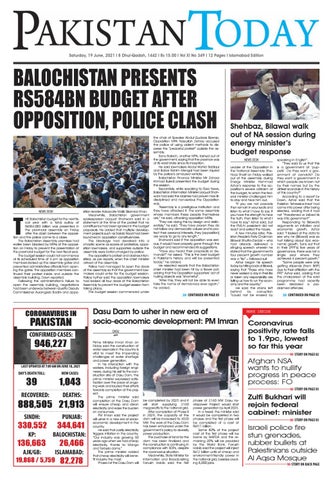
Balochistan presents rs584Bn Budget after opposition, police clash
NewS DeSk
t
HE Balochistan budget for the next fiscal year with a total outlay of Rs584.083 billion was presented in the provincial assembly on Friday after the clash between the opposition and the police came to a close. The Balochistan Assembly premises had earlier been blocked by MPAs of the opposition on Friday to prevent the presentation of the provincial budget for the new fiscal year. The budget session could not commence at its scheduled time of 4 pm as opposition members locked up the assembly gates and prevented administrative officials from opening the gates. The opposition members continued their protest inside and outside the assembly building, Dawn reported. Following the administration’s failure to open the assembly building, negotiations had been underway between Quetta Deputy Commissioner Aurangzeb Badini and oppo-
sition leader Advocate Malik Sikandar Khan. Meanwhile, Balochistan government spokesperson Liaquat Shahwani said in a statement at the time of the protest that no constituency had been ignored in the budget proposals. He added that multiple development projects such as Sariab Road had been launched in opposition constituencies. The blockage had devolved into a chaotic scene as scores of protestors, opposition lawmakers, and supporters outside the assembly were baton-charged by police. The opposition’s protest and clashes intensified, as per reports, when the chief minister arrived at the assembly. Police had managed to open the doors of the assembly so that the government lawmakers could enter for the budget session. Police further said the opposition lawmakers had locked all four doors of the Balochistan Assembly to prevent the budget session from taking place. The budget session commenced under
coronavirus in
pakistan
CONFIRMED CASES:
946,227
LAST UPDATED AT 7:09 AM ON JUNE 18, 2021
DAY'S DEATH TOLL:
NEW CASES:
39
1,043
RECOVERED:
DEATHS:
888,505 21,913 SINDH:
PUNJAB:
330,552
344,641
KP:
BALOCHISTAN:
136,663 AJK/GB:
26,466 ISLAMABAD:
19,868 / 5,759
82,278
the chair of Speaker Abdul Qudoos Bizenjo. Opposition MPA Nasrullah Zehray accused the police of using violent methods to disperse the “peaceful protest” outside the assembly. Sana Baloch, another MPA, lashed out at the government, saying that the province was at its worst state since its inception. He said lawmakers Abdul Wahid Siddiqui and Babar Rahim Mengal had been injured by the police’s armoured vehicle. Balochistan Finance Minister Mir Zahoor Ahmad Buledi presented the budget during the session. Separately, while speaking to Geo News, Balochistan Information Minister Liaquat Shahwani had said the clashes had proven how illdisciplined and non-serious the Opposition was. “Assembly is a prestigious institution and they have attacked it. The same assembly whose members these people themselves are,” he said, attacking opposition MPAs. “They are doing this by design and deliberately,” he said. “They have proven they do not follow any democratic values and to protect their personal interests, they [opposition] are ready to go to any length.” Shahwani said if the opposition was serious, it would have properly gone through the budget and recommended its suggestions. “Have you heard their proposals or demands?” he asked. “This is the best budget in Pakistan’s history and will be presented today,” he added. He rejected reports that the Balochistan chief minister had been hit by a flower pot, adding that the Opposition supporters’ act of hurling objects was “shameful”. “After this, they will not be able to even take the name of democracy ever again,” he added.
CONTINUED ON PAGE 05
Shehbaz, Bilawal walk out of NA session during energy minister’s budget response NewS DeSk Leader of the Opposition in the National Assembly Shehbaz Sharif on Friday walked out of the assembly during Energy Minister Hammad Azhar’s response to the opposition’s severe criticism of the budget, to which the federal minister challenged him to stay and hear him out. “If you are not cowards then remain in your seats and listen to what I have to say. If you have the strength to hear the truth, then listen to what I have to say,” Azhar said, but the PML-N president did not react and exited the house. A few minutes later, Pakistan People’s Party Chairman Bilawal Bhutto-Zardari – who had already delivered a stinging speech wherein he stated that the government’s four percent growth number was a “lie” – followed suit. Azhar began his speech today by hitting back at Bilawal, saying that “those who have never worked a day in their life or taken any responsibility are telling us how to run the economy and the country.” He said the stains left behind by corruption “could not be erased by
Dasu Dam to usher in new era of socio-economic development: PM Imran DASU APP
Prime Minister Imran Khan on Friday said the construction of water reservoirs in the country is vital to meet the impending challenges of water shortage and power generation. In his interaction with the workers, including foreign engineers, during his visit to the construction site of Dasu Dam, the prime minister expressed satisfaction over the pace of ongoing work and lauded their efforts towards completion of the project. The prime minister said completion of the Dasu Dam will ensure cheap and clean electricity and ease the burden on consumers. PM Imran said the project will usher in a new era of socioeconomic development in the country. He said that costly electricity triggers inflation in the country. “Our industry was growing 50 years ago when we had cheap electricity, thanks to Manga and Tarbela dams.” The prime minister added that cheap electricity will benefit industry the most. Phase-I of the Dasu Dam will
speaking in English”. “They said to us that this is a government of ‘puppets’. Do they want a government of convicts? Do they want a government in which people are known not by their names but by the dirtiest scandals in the history of this country?” According to a report by Dawn, Azhar said that the Pakistan Tehreek-e-Insaf had come into power after being elected, adding that it had not “threatened or bribed its way into government”. Responding to Bilawal’s arguments on inflation and economic growth, Azhar said: “I looked at the data to see why he [Bilawal] was so hurt talking about 4pc economic growth. Turns out that in their [PPP’s] five years of governance, there was not a single year where they achieved 4 percent growth.” “Some people were only getting stipends [from BISP] due to their affiliation with the PPP,” Azhar said, adding that the chairperson of the said programme had recently been declared a proclaimed offender.
CONTINUED ON PAGE 05
MORE INSIDE
Coronavirus positivity rate falls to 1.9pc, lowest so far this year STORY ON PAGE 02
Afghan NSA wants to nullify progress in peace process: FO STORY ON PAGE 03 be completed by 2025 and it will start supplying 2160 megawatts to the national grid. After completion of Phase II in 2029, the capacity of the dam will be increased to 4320 MW. The work at the Dasu Dam has been enhanced under the government’s policy to diversify power production. The purchase of land for the dam has been finalized and the construction is continuing in compliance with SOPs, despite the coronavirus situation. Meanwhile, State Minister for Information and Broadcasting Farrukh Habib said the first
phase of 2160 MW Dasu Hydropower Project would start power generation by April 2025. In a tweet, the minister said it would be completed in two phases and the first phase will be completed at a cost of Rs511 billion. Some 80% of the project cost of the first phase will be borne by WAPDA and the remaining 20% will be provided by the World Bank. Farrukh Habib said the project will inject Rs12 billion units of cheap and environment-friendly power in the national grid, besides creating 8,000 jobs.
Zulfi Bukhari will rejoin federal cabinet: minister STORY ON PAGE 03
Israeli police fire stun grenades, rubber bullets at Palestinians outside Al Aqsa Mosque STORY ON BACK PAGE
02
Saturday, 19 June, 2021
ISLAMABAD
NEWS
coronavirus posiTiviTy raTe falls To 1.9pc, lowesT so far This year
p
NewS DeSk
AKISTAN has reported the lowest coronavirus positivity rate so far this year. During the last 24 hours, the positivity rate was recorded as 1.9 percent, Geo News reported. For the last two weeks, the positivity rate has hovered at around 3%. According to the National Command and Operation Centre, 54,647 tests were conducted in the last 24 hours, of which 1,043 samples came back positive. The country reported another 39 deaths
from coronavirus, the NCOC report showed. According to the official portal, the rate of positive cases of coronavirus in the country has dropped to 1.9 percent. The total number of deaths from Covid-19 in the country so far has reached 21,913 and the total number of cases has reached 946,227, while 888,505 people have recovered from the virus so far. The active number of cases currently stands at 35,809. Earlier this week, the number of active Covid-19 cases in Pakistan came down to less than 40,000 for the first time since
Three sTudenTs killed, five injured in hunza road accidenT HUNZA inP
Three students were killed and five others injured in a dreadful road accident on Friday morning. According to details, a vehicle carrying students of high school and DG School from Jamaabad to Sust got out of control due to technical fault and it turned turtle in Moro Khoon area of Hunza. Three students Shakir s/o Saddaruddin, Syed Anwar s/o Syed Karim and Shohaib Ali s/o Ijaz were killed in the accident while Muddasir, Sahadat Karim, Syed Ahmed and Faiz Karim were injured. The bodies and injured were shifted to District Headquarter Hospital Hunza where the wounded students were referred to Agha Khan Health Centre Gilgit.
construction of underground drain tank at Burney Gardens causes concern LAHORe Shahab OMer
People from different walks of life have expressed concern over the construction of an underground drain water tank by the Water and Sanitation Agency (WASA) at the Burney Gardens outside the Al-Hamra Arts Council. Speaking to Pakistan Today the president of Amateur Gardening Club (AGS) of Lahore, Noshin Sarfraz, expressed grief over the situation and said, “It is a good idea to construct an underground drain water tank, but why did Burney Gardens choose it? It is a small but historic garden built during the British era and has always had flower shows. How is it possible that the construction in this garden will not affect its beauty? We were told that a 1,500 square feet tank was being constructed under the garden and later the garden would be restored and trees would be planted here. The question is, how can trees be planted here when there is concrete under the garden? Many other people associated with this garden also think that there is no point in constructing an underground drain here. Currently, cranes are installed inside the garden and the garden has been closed with green nets on all sides. The government should plan properly before starting such projects,” she said. A PHA official informed this scribe that on the one hand, the government is claiming to plant trees and greenery and on the other hand, construction and repair work is being started in the existing gardens. “A lot of people are asking us about the project being started by WASA, why there is digging in this garden. We had raised an objection before the project started that for an underground drain that this garden should not be chosen but still this project was started here,” official said. Zulfiqar Zulfi, director, Al-Hamra Arts Council, informed this scribe that the Punjab government was constructing underground drain water tanks in the entire city so that rain water would not stand on the roads. “As a result of the rains, about four feet high water would stand on the roads of the city for which the government started this project in the whole city. The purpose of these drains is to save roads from being destroyed and people from getting into trouble. The government is building underground tanks all over the city where pockets have been found. The condition for these underground tanks is that no trees will be cut down during this time, nor will the outer structure of the garden be demolished. Everything that will be built will be just underground and there will be no entrance. Only pipes will be installed through which water can be drained,” he said. Zulfi further informed, “Since this project is doing WASA, the form in which we have given them this garden will return to us in a more beautiful form and they have ample funds to restore the garden to its former glory. No trees are being cut down in this project as the trees are located at a distance of 20 feet from the project site. WASA has also promised us that a ramp will be built here in the future and when there is no rain, the space can be used for parking,” he concluded.
March 24. On March 24, the number of active cases was 37,985. COVID-19 VACCINE SHORTAGE HITS SINDH: Amid the Sindh government’s escalated vaccination campaign, several parts of the province, including Hyderabad, ran short of vaccines a day earlier. According to the Sindh Health Department, 40 percent of the vaccination centres in Hyderabad and parts of lower Sindh were temporarily closed due to the unavailability of vaccines. Meanwhile, the remaining vaccination
centres only facilitated those who were visiting to get the second dose of the coronavirus vaccine. Per the Sindh Health Department, the shortage of vaccines is being faced because the federal government has not sent supply to the province, adding that the new stock is expected to arrive by June 20. In Hyderabad, 21 vaccination centres have run out of vaccine stocks, the district health officer said.
Sindh govt dispels rumours of vaccine shortage NewS DeSk The Sindh government Friday dispelled rumours of the so-called shortage of vaccines within the country and said that it was only reducing the time during which vaccine centres would be open to the public. In response to queries regarding reports of vaccine shortages and closures of centres, Chief Minister Syed Murad Ali Shah told Dawn that only 225 mobile vaccination units had been temporarily shut, which should not be confused with vaccination centres. He added that the Sindh government had earlier allowed 60 private hospitals in the province to administer vaccines, but “the facility has also been closed because of a lack of availability of vaccines.” The chief minister, who responded to the queries via his spokesperson Rasheed Channa, added that the province was
expecting to receive 0.5 million doses of the Sinovac vaccine by June 21 and another 0.7 million doses by June 23, which will help overcome the shortage. Meanwhile, Sindh Health Department spokesperson Mehar Khursheed confirmed to Dawn.com that the province was facing a shortage of vaccines, but blamed the Centre for inadequate supply. She did not, however, have any information on the number of vaccine centres that had to temporarily closed or their timings curtailed due to the shortage. On the other hand, Young Doctors Association Sindh President Dr Omer Sultan told Dawn that the Sinovac vaccine was not available at any vaccination centre across the city, while some doses of AstraZeneca were still in stock at a hospital in Malir, the Jinnah Postgraduate Medical Centre and the Expo Centre. He said some people were reluctant to get the AstraZeneca shots because of
the reported side effects, while the stock of Sinopharm vaccines had been reserved for people awaiting their second doses. Meanwhile, witnesses at the Expo Centre Karachi said that Sinovac and Sinopharm were not available for the first dose, while only AstraZeneca was available for the initial dose. A telephone operator at the Sindh Government Modern Hospital in district East of the city told Dawn.com they were administering vaccines to only those aged above 40. At the Liaquat National Hospital, the telephone operator said they were administering vaccines all week except Sundays from 9 am to 4 pm. He added that anyone looking to get the jab should come by 9 am to get an appointment. According to the provincial health department, as many as 55,728 doses of Covid-19 vaccines were administered on Thursday, taking the total number of shots administered to over 2.8 million, or 8.13
per cent of the population. Of these, 2.23 million shots have been administered as a first dose, while 567,550 shots have been administered as a second dose. The province had a stock of 341,558 doses remaining as of Thursday, a breakdown of which is as follows: Sinopharm: 169,806 Cansino: 31,428 SinoVac: 65,373 AstraZeneca: 50,652 PakVac: 12,299 Recently, the NCOC also lifted a rule barring the use of AstraZeneca’s Covid19 vaccine for people below the age of 40 years. On June 16, Special Assistant to the Prime Minister on Health Dr Faisal Sultan had said that the Covid-19 vaccine shortage being reported at some vaccination centres was a temporary issue, adding that the situation was expected to improve after June 20.
Iranian expats come out in large numbers to vote for presidential polls ISLAMABAD Mian abrar
Iranians living in Pakistan came out in large numbers to vote in the thirteenth presidential election of Iran. The polls started at 8 am local time on Friday to participate in determining their country’s destiny. Seyed Mohammad Ali Hosseini, Iranian Ambassador to Pakistan told media that polling stations for the 13th presidential election have been set up in the Pakistani capital Islamabad, Karachi, the country’s most populous city, as well as in Lahore and Quetta, while
Iranians living in Pakistan’s Khyber Pakhtunkhwa province are 200 kilometers away to cast their ballots. They travel to the capital and participate in the elections, he added. Officials from various Iranian institutions, their families, teachers, educators, businessmen, students and many other Iranian citizens living in various cities in Pakistan are among those who cast their ballots to choose the candidate. Also, the presence of a number of primary voters at the ballot box and their enthusiasm and desire to participate in determining the fate of their country was
Senate resumes discussion on budget proposals ISLAMABAD inP
The Upper House (Senate) resumed its discussion on the budget proposals for next fiscal year 2021-22 on Friday. The House offered Fateha for the martyred soldier in Turbat before the resumption of the budget debate. Senator Mushtaq Ahmed led the prayer. Participating in the budget debate, Senator Ejaz Ahmad Chaudhary said due to prudent policies of the
government, farmers have earned profit in all crops. He said that more than 65% people in Pakistan are associated with agriculture which makes this sector immensely important. He said this budget will provide an opportunity to the farmers to avail easy loan facilities for purchase of tractors and other agricultural tools. Senator Mushtaq Ahmed termed the current budget risky and based on assumptions. He said this is not a budget which supports the poor segment of the society. He said that government has taken record loans and 60% of country’s revenue will be spent on the payment
another notable scene in the voting of the 13th Iranian presidential election in Pakistan. It should be noted that despite the threat of the Corona Virus, the active and maximum participation of Iranians living in Pakistan in the elections 2021 and their presence at the ballot box in compliance with all health measures shows their love and interest in Iranian identity and importance to their right to selfdetermination. According to the board of the executive and supervisory boards, the voting process will continue until 18:00 local time in all four polling stations. of loans. He said people are struggling to afford even the essential commodities. Special Assistant on Poverty Alleviation Dr Sania Nishtar said there is no new tax on salaried class and minimum wage has been fixed at 20,000 rupees. She said unprecedented facilities have been provided in budget industry. She further said Rs 260 billion have been allocated for Ehsaas program. She said 100% utilization of funds was made in budget 2019-20 whereas 97% utilization of funds was observed in the budget of fiscal year 2020-21. The special assistant said stipend for the poor has been increased to 13,000 per family. She said total number of enrolled families have been increased from seven million to 10 million.
Wang Yi urges SCO states to make joint efforts in building closer SCO community ISLAMABAD Mian abrar
Chinese State Councilor and Foreign Minister Wang Yi has called on the Shanghai Cooperation Organization (SCO) members to make joint efforts in building a closer SCO community with a shared future. He made the remarks when delivering a video speech at the reception of the SCO Day in Beijing as SCO marked the 20th birthday of the organization. SCO’S 20 YEARS WITH MUTUAL RESPECT AND COOPERATION: The organization was first expanded in 2017 when India and Pakistan joined as full members. With its six founding members – China, Kazakhstan, Kyrgyzstan, Russia, Tajikistan, and Uzbekistan, the bloc currently has eight full members, four observer countries and six dialogue partners. Invoking the “Shanghai Spirit,” a set of values underpinning the SCO, Wang recalled the achievements of the SCO in the past 20 years and said that the past two decades saw the development of the organization in various areas. Wang defined the two decades with the keyword
“unity,” saying that the SCO members have supported each other on issues concerning core interests and major concerns. “Shared development” is another keyword. Wang highlighted the SCO members’ cooperation in fighting against “three evils” and joint construction of the Belt and Road. The “three evils,” also called “three evil forces,” refer to terrorism, separatism, and extremism. The concept was first defined in June 2001 during the first SCO summit. In 2020, the joint economy of the member states reached $18.4 trillion and the mutual trade volume reached $6.2 trillion, 11 and eight times higher respectively compared with the early days of the SCO, according to Wang. He also highlighted the spike in the cultural communication among the SCO members, saying that in 2019, before the Covid-19 epidemic, more than seven million visits were made between China and other member states, 3.5 times the number in 2001. The contributions of the SCO in upholding multilateralism and promoting political solutions to hotspot issues were also pointed out by Wang. OPEN NEW CHAPTER OF SCO WITH GREATER EFFORTS: The Chinese Foreign Minister
then presented several proposals for the organization’s future, calling on the member states to make greater contributions in promoting world peace and development. He emphasized the importance of the “Shanghai Spirit,” which features mutual trust, mutual benefit, equality, consultation, respect for diverse civilizations and pursuit of common development, saying that the SCO should set a new example of building a community with a shared future. The SCO should unleash new drivers of win-win cooperation, he added, referring to jointly addressing data security, biosecurity, further cooperation in digital economy and artificial intelligence, and promoting trade and investment liberalization and facilitation. He said that the organization should strengthen exchanges and cooperation among the youth, women, think tanks and the media. The SCO should shoulder new responsibilities for global governance, promote genuine multilateralism and uphold the common values of peace, development, fairness, justice, democracy and freedom for all humankind, he added.
Saturday, 19 June, 2021
ISLAMABAD
NEWS
03
KP PreSeNtS relieF-OrieNted rS1.1 trilliON Budget PesHAwAR
K
inP
HyBER Pakhtunkhwa Finance Minister Taimur Saleem Khan Jhagra on Friday presented a relieforiented budget for fiscal year 2021-22 in the provincial assembly with a total outlay of Rs1.1 trillion. Unveiling the budget, Taimur Saleem Khan Jhagra said that no new tax has been imposed in the provincial budget and relief would be provided to the masses. He said that the budget estimate for the next financial year is estimated at Rs 1118 billion. He said Rs 199 billion has been allocated for the integrated tribal districts, Rs 371 billion for annual development program and Rs 100 billion for tribal districts for annual development program. He said that Peshawar Institute of Cardiology was set up and new OPD block was constructed in Khyber Teaching Hospital, while ambulance service was extended to 35 districts. The provincial finance minister said out
of the total budget allocation, Rs919 billion earmarked for settled districts and Rs199.3 billion for development of merged tribal districts during Fy 2021-22. Out of total Rs371 billion ADP, KP government earmarked Rs270.7 billion for settled districts and Rs100.3 billion for merged tribal districts. Likewise, Rs648.3 billion earmarked for settled districts and Rs 99 billion for merged districts in total allocation of Rs747.3 billion for current budget expenditure. Jhagra said present budget was based on five main pillars including a record increase in salaries of government employees, development budget, devoted services to people, increasing KP’s own resource revenue and introduction of goal oriented reforms and innovation in the overall governance system. He said two innovative approaches ‘development plus budget’ and ‘service delivery budget’ were being introduced under which Rs500 billion would be spent on former focusing on mega projects such as Sehat Plus Cards, provision of furniture to
Afghan NSA wants to nullify progress in peace process: FO IsLAMABAD TLTP
Pakistan has strongly condemned the baseless insinuations by Afghan National Security Advisor Hamdullah Mohib, alleging Pakistan’s involvement in the internal affairs of Afghanistan. Responding to unwarranted remarks by the Afghan National Security Advisor, Foreign Office Spokesperson Zahid Hafeez Chaudhri said that Pakistan’s role in the Afghan Peace Process has been widely acknowledged by the international community. He said the repeated impertinent and unwarranted remarks by the Afghan National Security Advisor are deeply concerning as they are tantamount to a calculated attempt by his office to disregard and nullify the progress in the peace process so far. The spokesperson said, “We would also like to remind the Afghan NSA, of mutual understanding reached in Afghanistan-Pakistan Action Plan for Peace and Solidarity, obligating both sides to avoid public blame-game and use official channels to discuss complete gamut of bilateral relations.” The diplomatic spat between Pakistan and Afghan national security adviser (NSA) is not subsiding as the latest diatribe by Hamdullah Mohib on Friday prompted Foreign Office to call his statement a deliberate attempt to nullify the peace efforts. This is the second time Pakistan had to issue a strong rejoinder to the Afghan NSA in recent weeks and comes at a time when Afghan peace process hangs in balance. The latest war of words was triggered by Mohib’s tweet, accusing Pakistan of interfering in the internal matters of Afghanistan while referring to the recent interview of Foreign Minister Shah Mehmood Qureshi to an Afghan television. Qureshi in his interview said Afghan Taliban alone could not be held responsible for the violence in Afghanistan as he pointed fingers to other players including ‘spoilers’ who did not wish peace to return to the war-torn country.
Govt schools and increase in medicines budget to public sector hospitals while Rs424 billion out of Rs747 billion would be spent on the latter with priorities to payment of salaries of doctors, nurses, and teachers besides provision of medicines to hospitals and fuels to Rescue1122 ambulances. About generation of income and revenue during 2021-22, the minister said Rs1018 billion revenue and income target was set for Fy 2021-22 that would be achieved from different financial resources, duties and taxes. He said Rs475.6 billion would be collected through federal taxes, Rs57.2 billion through federal divisible pool of 1pc share under terrorism affected province, Rs26.5 billion under Gas and Oil royalty and surcharge (direct transfer), Rs74.7 billion under hydle new profit (according to MoU 2015-16) and arrears, A sum of Rs 75billion for provincial tax and non-tax revenue, Rs85.8 billion through foreign development assistance (for settled areas) and Rs3.3 billion foreign development assistance (for merged areas), Rs187.7billion under special assistance grant for the merged
areas and Rs132.5billion from other revenue resources. About details of expenditure budget during Fy2020-21, the minister said total of Rs374 billion would be spent on salaries including Rs60billion in merged areas and Rs314 billion in settled districts. Similarly Rs92.1 billion would be utilized for payment of pension including Rs0.1billion for merged areas and Rs92billion for settled districts. Besides salaries, Rs203.9billion would be spent for operation and maintenance expenditures, emergencies and district expenses including Rs38.9billion for merged areas and Rs164.9 billion while Rs74.4billion for other current expenditures. A total of Rs 244.6billion proposed for expenditures under Provincial Development Program including Integrated Implementation Program (AIP) for merged areas, he said, adding Rs 17.4billion earmarked for Annual Development Program including Rs 2.4billion for merged areas and Rs 85.8billion for settled districts while a record Rs 19.9billion to be obtained from Federal government PSDP.
EU’s Strategic Engagement Plan ushered in new era of solid cooperation: FM ANTALYA aPP
Minister for Foreign Affairs Shah Mahmood Qureshi on Friday said the Strategic Engagement Plan of the European Union had ushered in a new era in bilateral ties and provided a solid architecture for multidimensional cooperation. The minister, in a meeting with the EU High Representative/Vice President Josep Borrell on the sidelines of the Antalya Diplomacy Forum in Turkey, stressed that Pakistan-EU relations had further strengthened with the implementation of SEP signed in June 2019, the Foreign Office said. The two leaders discussed the entire spectrum of Pakistan-EU relations as well as the global and regional situation, including the Afghan peace process and Indiaoccupied Jammu and Kashmir. Emphasising the importance of bilateral trade, the foreign minister highlighted that the GSP Plus had been a mutually beneficial undertaking and played an important role in the growth of trade between the two sides.
He reiterated Pakistan’s firm commitment towards the GSP Plus preferential trade regime and effective implementation of the 27 related international conventions. The two leaders also exchanged views on the Covid-19 pandemic. Appreciating the EU’s support, the foreign minister delineated the steps taken by Pakistan to effectively tackle the situation. Qureshi also briefed the EU vice president on Pakistan’s progress towards the comprehensive implementation of the Financial Action Task Force Action Plan and sought the EU’s support in the review process. He emphasised that at a time of rising Islamophobia, racism and populism, the international community must show a common resolve against xenophobia, intolerance and incitement to violence on the basis of religion or belief. AFGHAN PEACE PROCESS: In the regional context, Qureshi briefed Borrell on Pakistan’s vital contributions to the Afghan peace process and stressed that the conflict could only be settled through an Afghan-led and Afghanowned political process.
Pakistan values UK’s balanced role in global, regional affairs: Army chief to British HC News Desk Chief of Army Staff General Qamar Javed Bajwa on Friday said that Pakistan “values UK’s balanced role in global and regional affairs”. According to a statement by Inter-Services Public Relations, Gen Bajwa made the remarks in a meeting with British High Commissioner Dr Christian Turner, who called on him today. During the meeting, matters of mutual interest, the regional security situation including the recent developments in the Afghan peace process and collaboration in the fight against COVID-19 were discussed, said the ISPR. “[Gen Bajwa] said that Pakistan values UK’s balanced role in global and regional affairs and we look forward to optimise the strategic potential of our relationship based on convergences,” read the statement. Turner
Mian abrar
Secretary-General of the Shanghai Cooperation Organization (SCO) Vladimir Imamovich Norov has said that Afghan conflict can only be solved through political dialogue and not through military means and an inclusive peace process should follow the principle of ‘Afghan-led’ and ‘Afghan-owned’. It may be mentioned here that Pakistan and China both have taken this principled position that Afghan conflict can only be solved through political dialogue and not through military means. “Our starting point is that the conflict in Afghanistan can only be solved through political dialogue, and an inclusive peace process should follow the principle of ‘Afghan-led’ and ‘Afghan-owned’,” said the secretary general of the SCO in an exclusive interview with Global Times. “We are ready to continue the joint work of the “SCO-Afghanistan” liaison group. The next high-level meeting of the liaison group will be held in Dushanbe in July this year. The purpose is to discuss specific measures to implement the joint “roadmap” for further
action. In addition, the SCO is one of the first regional organizations to put the issue of information security on the agenda,” he added. PAKISTAN, INDIA ADDITION TO SCO CLUB WELCOMED: Norov said that the addition of Pakistan and India to the SCO has significantly expanded the scope of SCO activities and the cooperation in ensuring regional security. He added that the induction of Pakistan and India has also increased and deepened the economic and cultural cooperation of the SCO. “The rising geopolitical tensions, common threats, and challenges today call for our collective efforts to build a more just and polycentric world order and to develop comprehensive programs to combat these threats,” said the SCO Secretary General. He added that the growing negative trends in the international community and the increasing common threats and challenges facing the SCO countries make it necessary for us to coordinate our efforts in order to safeguard our positions and interests. The most important task now is to reject populism and protectionist ideas, he said during an interview with Global Times. “In practice, the SCO followed the
Both sides urged all the Afghan factions to seize the historic opportunity presented by the current peace process to settle the conflict through political means. The foreign minister emphasised the need for continued engagement of the international community after the withdrawal of foreign forces from Afghanistan. The two sides agreed to cooperate in facilitating the peace process, resettlement of Afghan refugees, preserving the socio-political gains of the past two decades and supporting Afghanistan post-withdrawal. SITUATION IN INDIA-OCCUPIED JAMMU AND KASHMIR: The foreign minister also briefed the EU HR/VP on the continued precarious human rights and security situation in occupied Kashmir and the latest moves by the Indian government to perpetuate its illegal occupation. He urged the EU to take note of the systemic and gross human rights violations in the occupied territory and play its role in the resolution of the dispute in accordance with the United Nations Security Council resolutions and the aspirations of the people of Jammu and Kashmir. Borrell also shared his concerns on the prevailing situation in India-occupied Jammu and Kashmir. The two leaders agreed to continue to maintain highlevel engagement to further strengthen Pakistan-EU relations. The EU High Representative extended an invitation to Prime Minister Imran Khan for a working visit to Brussels. The foreign minister reiterated an invitation to the High Representative to visit Pakistan.
Zulfi Bukhari will rejoin federal cabinet: minister News Desk
acknowledged Pakistan’s “continuous efforts for peace and stability in the region” and “pledged to further enhance bilateral relations” between both the countries.
Political dialogue only mean to resolve Afghan conflict, says SCO secretary general IsLAMABAD
The salaries of all government employees except those who didn’t get special allowances are being increased to 37% including 20% increase in Functional or Sectoral Allowance, 10% increase in Adhoc Relief Allowance, 7% in house rent for those employees who don’t benefited from government’s accommodation scheme. Jhagra said 100% increase in pension expenditure has been witnessed in last couple of years and share of pensions, which was only 1% in 2003-04 had jumped to record 13.8 percent of total budget in 2021-22. To overcome pension expenses, he said two proposals including increase in upper age limit of Govt employees ie 55 years for early retirement up or completion of 25years service were under consideration that would save Rs 12 billion per year. Similarly, Rs 1 billion per year would be saved from change in the pension rules under which widow, children and parents of deceased employees would be entitled for pension benefits. The minister announced that minimum wages of labourers and daily wagers were being increased to Rs 21,000.
guidelines of the SCO Development Strategy until 2025 and is prepared to continue its efforts to expand and deepen cooperation within the SCO as well as with the international community, with a view to ensure security and prosperity in the Eurasian region,” he said. Norov said that new threats and challenges to global and regional security posed by the pandemic, information, and communication technologies, bioterrorism, drug trafficking, and cross-border organized crime call for an integrated approach to deal with them on an inclusive and multilateral basis. “Since its establishment, the main purpose of the SCO has been to maintain and strengthen regional peace and stability. Three months before the September 11 incident in 2001, the SCO signed the Shanghai Convention on Combating Terrorism, Separatism and Extremism, and for the first time clearly defined terrorism, separatism and extremism,” he added. The adoption of the document shows that the founding countries of the SCO had a clear recognition of the new challenges and threats facing international security at the time, and have since embarked on the path of uncompromising struggle against them.
Former special assistant to the prime minister on overseas Pakistanis Zulfi Bukhari’s resignation has not been accepted, Federal Aviation Minister Ghulam Sarwar Khan has said, further stating that he would rejoin the federal cabinet after the inquiry into the Rawalpindi Ring Road project concludes. Speaking on DawnNewsTV show ‘Live with Adil Shahzeb’, the minister said that Bukhari had nothing to do with the scam. “He is young so he got a little emotional and offered his resignation,” he said, adding that it “had not been accepted”. The former SAPM was also not being investigated, the federal minister informed. “An inquiry is being conducted against government officials who changed the alignment etc. No political figure played a role in this.” He said that once the inquiry concludes and Bukhari is cleared of all charges, he will rejoin his office, Dawn reported. Talking about himself, Khan also said that the prime minister was “satisfied since day one” that he had nothing to do with the scam. “I have a political attachment to it as it is of national importance,” he said. “This [project] is also a major necessity of Rawalpindi and Islamabad. An inquiry needs to be conducted so that those responsible can be held accountable,” he said, adding that it was a flagship project for the Pakistan Tehreek-e-Insaf. He said that he raised this point during his meeting with the prime minister on Wednesday. “This project will soon begin with a new alignment,” he claimed, adding that it will also be completed on time. When asked about the fact that the project was not included in the Annual Development Programme of the Punjab government, the minister said that money was allocated last year of which some was also released. “The project is still alive at the same stage. The Punjab government had to do land acquisition and it was supposed to be completed through a public-private partnership. Only the alignment needs to be changed.” In early June, Bukhari had said while talking to reporters at Islamabad Airport soon after returning from the United Arab Emirates that he offered himself for inquiry into the Rawalpindi Ring Road scandal.
Saturday, 19 June, 2021
04 NEWS
ISLAMABAD
Punjab Governor, CM disCuss PolitiCal situation, adMinistrative issues LAHORE
P
INP
unjab Chief Minister Sardar Usman Khan Bazdar called on Governor Punjab Chaudhry Mohammad Sarwar on Friday and discussed with political situation, administrative issues including Covid-19 situation. Governor Punjab congratulated the chief minister for presenting peoplefriendly budget and also apprised him about the projects of Punjab Aab-e-Pak Authority in constituencies of Provincial and National Assembly which was commended by the Chief Minister. Governor and the Chief Minister maintained that the government will easily succeed in getting the federal and provincial budgets passed, adding that the opposition will continue the war of words on the budget, but the government will be successful in getting the federal and provincial budgets passed.
Chaudhry Muhammad Sarwar said that a new era of development and prosperity has begun in the country under the leadership of Prime Minister Imran Khan. He further said that electronic voting is the only option to make the next election transparent but the opposition’s unsupportive
attitude is disappointing. He said that the Punjab government has given relief to the public including labourers, and salaried class by presenting a people-friendly budget. He further said that a Separate development package for each district is a great initiative of the Pun-
jab government, adding that serving people is the government’s topmost priority, and the opposition must give priority to national interest over political interest. Chaudhry Sarwar also apprised CM Usman Buzdar about the development in the projects of Punjab Aab-e-Pak Authority in the constituencies of National and Provincial Assemblies across Punjab. Chief Minister Punjab assured of extending full cooperation for providing clean drinking water to the people and appreciated the steps taken by the Governor for the Punjab Aab-e-Pak Authority. Usman Buzdar said that the conspiratorial politics of the opposition has come to an end. He said: "We have always confronted the negative politics of the opposition with public service and no obstacle would be tolerated in providing relief to the public." The Punjab government has given a historic annual development program. Punjab has entered a new era of development by allocating equal funds for each region, he added.
PTI government committed to treat all federating units alike, says Faraz NEWS DESK Federal Minister for Science & Technology, Shibli Faraz has said that the Imran Khan-led PTI government was committed to treat all the federating units alike. He visited the office of Opposition Leader in Sindh Assembly, Mr Haleem Adil Sheikh on Friday The Federal Minister Shibli Faraz said that he was pleased to see the Sindh Assembly , which had played a crucial role in the creation of Pakistan adding he thanked Mr Sheikh for inviting him. Speaking to the media persons, the federal minister said that the Prime Minister Khan was the person who always treated all the federating units alike and dispelled the impression created by PPP leadership that he and the PTI government were least interested towards issues of the province. He said that it was the matter of deep concern that the PPP government in Sindh, despite getting enough funds from the Federal government, had done nothing to provide relief to the people, who according to him, were facing hardships even in getting drinking water. The Federal Minister said that it was the responsibility of the provincial government to provide the basic amenities of life adding he lamented that PPP rulers despite ruling Sindh for past 13 had miserably failed to provide the modern facilities to the people of the province." It is a matter of concern that Sindh is lagging far behind in development as compared to other provinces" he added and held PPP rulers responsible for the poor state of affairs in Sindh. He said that the PTI government had earmarked the huge funds for various districts of the province adding he said that they would also bring the change in the damaged infrastructure of Karachi." The people of Karachi gave us huge mandate during the previous general elections so its is our responsibility to launch the projects in the city so that people could get benefit" he added and said that it was the matter of deep concern that various localities of Karachi were facing water crisis. He said that he was shocked to learn that the supply of the water of the constituency of Mr Haleem Adil Sheikh was stopped on the orders of chief minister Sindh adding he asked PPP rulers to refrain from such vindictive policies
towards the political opponents. Shibli said that by carrying out more schemes and projects in Karachi and other districts of Sindh they would not win more seats from Karachi but from other districts since the people of Sindh had already sick of the corrupt and incompetent rulers. He said that the tigers of Prime Minister Imran Khan were fighting against the rampant corruption and those involved in such ugly practices adding he lauded the role of Mr Sheikh. He said that it was a misconception and propaganda that water of Sindh's share was being stolen by other provinces and asked the PP rulers to mend their ways and
ensure the available water to the farmers of the province in a fair manner. He said that Mr Adil had played the true role as the Leader of Opposition both on the floor of the house and by visiting each nook and corner of the province. He praised Mr Sheikh for making the hectic efforts to raise the real issues of the whole province. He said that PTI leaders and workers had always raised their voice for the real issues of Sindh. The PPP lawmaker Firdos Shamim Naqvi, Bilal Ghaffar and other leaders and workers of PTI were present at the media talk and during the visit to Sindh Assembly.
Punjab passes apprenticeship act 2021 after 60 years LAHORE PRESS RELEASE
Punjab becomes the 1st province to pass the Apprenticeship Act 2021 while replacing the Apprenticeship Ordinance1962 after 60 Years to provide Skilled Youth with better Economic Opportunities and the Industry with Skilled Labour according to their specifications. The New Act has made fundamental changes to the previous law from being applicable only to the Manufacturing Sector to now covering all Sectors of the Economy. The New Law has also done away with Time-Consuming Procedures for Approvals Related to Apprenticeship Program Registration while the new law has also empowered provincial TVET Assessment bodies such as PBTE for examination on the footprint of CBT&A, an internationally recognized teaching and assessment system initiated by Tevta Punjab in their Institutes. Chairperson Ali Salman Siddique has said that the Apprenticeship Act is a Critical Step towards Realization of Our Vision 2023 which Focuses on Quality Demand Driven Skills with Economic Opportunities for our Trainees where they will not only be given Technical and Vocational Education in our Institutes but also On the Job Training in Industry. This is in line with the Prime Minister Vision of 10 million jobs. He was addressing a high level meeting at Tevta Secretariat appreciating the role of the Apprenticeship Section for achieving a milestone for Tevta Punjab. He further said that unlike in the past where Apprenticeship Law was used as a tool against the Industry, Tevta through its New Skill Ecosystem has created a direct linkage with the Industry through Sector Skill Councils and Public Private Partnerships to empower the Industry in its decision making process. This New Industry - Tevta nexus will be further strengthened by empowering the private sector led Sector Skill Councils to regulate the Apprenticeship Act. Chairperson further stressed the need for a major awareness drive to make businesses and organizations in Punjab aware of the benefits of apprenticeships for employers and vowed to constantly expand and convert all their 350 plus Vocational Institutes onto the Apprenticeship Model on the footprint of German and British Apprenticeship Model. Independent Experts term Apprenticeship Act as a hallmark of this Government’s tenure and an Important step in the right direction for the Skill Sector. Speaking on the occasion, a renowned industrialist Mr Rehan Barera said that Apprenticeship is a Fundamental Step for the Provision of Jobs. This Act will also resolve Industries problem for the requirement of Customized Skilled Manpower. “If we get Customized Skilled Manpower and can govern the process through Sector Skill Council it will resolve our issues and greatly help in Economic Growth of our Country ”, he said. Apprenticeship is a dual system for Training a New Generation of Practitioners of Trade or Profession Couple with On-the-Job Training at Industry/ Companies & Technical Education in Institutes. This System is Widely Used by The Developed Countries & TEVTA Punjab through its newly legislated Apprenticeship Act 2021 will follow the European Dual Track Training System to Bridge the Gap between Industry & TEVTA. The Act Will Provide Youth with Approximately 100,000 Employment Opportunities Every Year.
Economists declare budget a pack of empty promises lacking sustainability, inclusivity ISLAMABAD INP
The economists have termed federal budget 2021-22 a pack of empty promises meant to satisfy the countrymen and it lacks sustainability and inclusivity. Addressing the webinar organizer by Institute of Policy Studies (IPS), Islamabad on Friday, they said that the growth target of 4.8% set by the government in the budget for 2021-22 is unlikely to be sustained in the longer run given the state of the fundamentals of the economy. The proposed growth target can be short term but will pose a challenge to the government in the future as Sustainable Development Goals (SDGs), renewable energy, climate change and capacity-building of
the public sector are not in focus. The panelists included Dr Mahmood Khalid, senior research economist at Pakistan Institute of Development Economics (PIDE), Dr Shahida Wizarat, dean College of Economics and Social Development, Institute of Business Management, Dr Pervez Tahir, former chief economist at Planning Commission, and Dr Abdul Saboor, dean faculty of Social Sciences, PMAS Arid Agriculture University. IPS Vice Chairman Ambassador (r) Syed Abrar Hussain chaired the session whereas senior practitioners including Mirza Hamid Hassan, former federal secretary at ministry of power, and Zaigham M. Rizvi, expert consultant on housing and housing finance, also took part in the discussion. The speakers observed that better sec-
toral performance and fiscal discipline during the pandemic have improved growth rate. However, the revenue target of Rs5.8 trillion, which they opined has been set to appease the IMF, is unrealistically high despite the fact that the government has failed in achieving the tax collection target for this fiscal year. They termed incentivizing the stock market as a way to benefit the privileged at the cost of the poor and the middle class who constitute the major chunk of the society. They warned about further increase in food inflation which is likely to happen as the government has entertained industry bigwigs in the budget but ignored the common man. They were of the view that if the government fulfils its promise of providing afford-
CMYK
able housing, it will give a boost to dozens of industries that fall within the ambit of the construction industry. However, the government’s initiative of doling out funds through lawmakers was criticized as it will only serve vested interests and give rise to corruption, the speakers said. Ruing misplaced priorities in the budget, the discussants were of the view that the primary focus in the Public Sector Development Programme (PSDP) is on brick and mortar projects whereas human development initiatives that can actually drive growth and development are ignored. During the webinar, it was also discussed that the budget does not offer much to the common man as debt servicing and defense expenditure consume most of the
budget allocations, resulting in a mere 11% appropriation for development funds that too largely remain underutilized at the end of the year. Excessive reliance in the budget on indirect taxation, including withholding tax as part of indirect taxes, will further widen the gap between the poor and the affluent. Sustainable and inclusive growth will remain a pipedream in the absence of a paradigm shift in initiating structural reforms, they added. The speakers also maintained that there is a massive crowding out in the financial sector due to the government’s borrowings, starving the private sector of credit for investment in the country. Furthermore, there is a trust deficit between the government and the private sector that needs to be addressed.
Saturday, 19 June, 2021
ISLAMABAD
UN chief Urges debt relief exteNsioN for middle-iNcome coUNtries SEEKS NEW MECHANISM COMPRISING DEBT SWAPS, BUYBACKS, CANCELLATIONS
t
neWS deSK
HE United Nations (UN) Secretary General Antonio Guterres has said that middle-income countries should have their debts suspended into 2022 to cope with the social and economic impact of the coronavirus. Addressing a high-level meeting on these nations, which account for more than half of the UN’s 193 member states, he underlined the need for financing to help them recover in the wake of the global crisis. He said that that innovative measures to address debt are required to help the world’s more than 100 middle-income countries expand their economies and exit the Covid19 pandemic. “In small island states, for example, the collapse of tourism has greatly hindered their capacity to repay debts. And while the global response to the debt crisis is rightly attempting to support low-income countries, middle-income countries must not be left behind”, he stated. He said that diversity defines the world’s middleincome countries, which were already home to some 62 percent of the world’s poor prior to the pandemic. The list includes India, which has a population of more than one billion, and Palau, an archipelago in the Pacific island with less than 20,000 people. Besides population size, these countries also
vary in economic activity, geography and income levels per capita, which ranges from $1,000 to $12,000 annually, meaning they often exceed per capita income thresholds for debt relief. Guterres stressed the need for better mechanisms and international cooperation to address what he characterised as their mounting and unsustainable debt levels. “Even if these countries manage to avoid default, they will see long-lasting limitations on critical government spending on a variety of development and climate objectives in the years to come”, he warned. He underlined the need for “a new debt mechanism” that includes debt swaps, buy-backs and cancellations. “This is the moment to tackle long-standing weaknesses in the international debt architecture, from lack of agreed principles, to restructuring that provide too little relief, too late. Innovative instruments to allow debt restructuring and meaningful debt reduction can help middle-income countries expand their fisc al space to boost investment and steer a resilient and sustainable recovery from the crisis,” he said. This past March, the secretary-general convened world leaders for a meeting to bolster support for action to stave off the debt crisis in developing countries. Last year, the G20 leading economies announced a debt service suspension initiative which allows the world’s poorest countries to temporarily halt bilateral credit payments.
NEWS
05
Balochistan presents Rs584bn budget after opposition, police clash Continued from page 01 Once the sit-in had finished, Balochistan Finance Minister Zahoor Ahmed Buledi presented the budget in the house and said that no new tax has been imposed. He said that Rs237 billion have been allocated for developmental and more than Rs346 billion for nondevelopmental expenditures. Buledi said more than Rs55 billion have been allocated for the betterment of the health sector while over Rs61 billion for the school and education sector. About Rs21 billion have been allocated for the uplift of higher education in the province. The finance minister said more than Rs20 billion have been allocated for the agriculture sector. Buledi said that the government is presenting a balanced budget for the new fiscal year. It has been suggested to allocate Rs3.6 billion in the new budget to combat the coronavirus pandemic, whereas the province aims to vaccinate all citizens. He said that Rs500 million will be spent on the expansion of the children’s hospital, he added. The government announced an end to the slip system from all state-administered hospitals across the province, whereas emergency centres are being established alongside roads. An amount of Rs5.5 billion is allocated for the health insurance card programme by the provincial government. More than Rs76 billion have been allocated for the initiation of 2,086 new schemes, announced Buledi. “Rs200 million are allocated for the construction of two new hostels in Bolan Medical College; more than 200 government schools will be upgraded; Rs112 billion for ongoing development schemes while the budgeted development outlay is Rs189.19 billion for the new fiscal year.” The government employees will get a salary raise up to 10 percent, announced the finance minister. He
said that 5,000 new vacancies will be generated in the new fiscal year. He said that Rs71 billion for education sector, Rs52 billion for law and order, Rs2.2 billion for Balochistan Enterprise Development, Rs2 billion support fund for differently-abled persons, Rs3 billion for Apna House Fund for government employees, Rs500 million for minorities welfare fund, Rs500 million for women economic empowerment, Rs3 billion for Balochistan pension fund, Rs2 billion for Balochistan Public Endowment Fund, and Rs11 billion have been allocated for upgrading District Headquarters Hospitals. On the other hand, the Khyber Pakhtunkhwa cabinet, headed by Chief Minister Mahmood Khan, approved the provincial budget for the fiscal year 2021-22, proposing a hike in salaries by 25 per cent for government employees. According to details, the budget proposals were presented before the provincial cabinet for discussion and after its approval from the forum, KP CM Mahmood Khan also signed it. The overall outlay for the KP budget is estimated at Rs1.118 trillion with Rs316 billion earmarked for the development portfolio. An amount of Rs250 billion was earmarked for the ‘Bandobasti’ districts of the province. According to a previous report, an increase of 25 percent in the salaries of the government employees from grade 1 to 19 has been proposed in the KP budget, while 10 pc raise has been proposed for the government employees of above grade 19. The minimum wage of workers would be increased to Rs21,000. The government has allocated funds for Rescue 1122 new ambulances while the government will also announce the recruitment of new teachers in the budget 2021-22. It is pertinent to mention here that besides the Centre, the Punjab and Sindh provinces have already tabled their budgets before the respective assemblies.
Shehbaz, Bilawal walk out of NA session during energy minister’s budget response Continued from page 01 The minister said Bilawal had contradicted his own claims. “He said that poverty and unemployment has increased, but didn’t give any figures. Then he cited an institution and said that according to them, poverty rates have fallen in three provinces.” “[Bilawal] said that the price of petrol has been increased. In my opinion, such statements are made by those who have achieved nothing in their life […] right now Pakistan has the world’s lowest oil prices,” according to the minister. Azhar then turned his attention towards Sindh, where the PPP has been ruling since 2008. “Bilawal asked us how we are able to visit our constituencies. But we are not the ones with rising dog bite cases or an HIV/AIDS outbreak,” the minister said, in an apparent reference to the situation in Larkana, which is reeling from an HIV outbreak, and from where Bilawal has been elected to the NA. Azhar said some people in the opposition say that despite corruption, there is also progressive work being done. “If corruption had anything to do with development, Sindh would have progressed beyond California.” If someone wants to see the destruction that corruption brings, then go and look at the state of Sindh, the minister said. “You will see how corrupt rulers ruin the lives and the futures of people. Sindh is a living example of this.” Recounting his government’s achievements, Azhar said the first two years of the PTI government were spent on stabilising the economy, while the focus now was on growth. The minister said foreign exchange reserves were the highest they had been in six years while the current account deficit was in surplus. He added that the country had also witnessed bumper crops of wheat, sugarcane and maize, the direct benefit of which was going to the farmers. He concluded by saying that the PTI was laying the foundation for “Riyasat-i-Madina” under the leadership of Prime Minister Imran Khan. Earlier during the session, PPP Chairman Bilawal Bhutto-Zardari said that both the budget and the budget session of the PTI-led government are “illegal.” He added that it seems the government is playing the role of the opposition instead of running the country, Geo reported. Criticising Prime Minister Imran Khan famous rhetoric, Bilawal said that likening the country — which is being ruled by an “illegitimate government” — to the state of Madina is not appropriate. Speaking about the budget recently presented by the PTI-led government, Bilawal said the masses are aware of the fact that “claims of 4% growth are based on lies.” “I think both this budget and the budget session are illegal,” he said, adding that ever since the government has taken over, no new National Finance Commission
(NFC) award has been given to provinces. It should be noted that the NFC award is meant to distribute financial resources between the federal government and the provinces. “Every budget will be unconstitutional until the NFC award is given,” said Bilawal. Shedding light on the growing inflation in the country, Bilawal said that the PTI government has “abandoned people and left them in a destitute condition.” He said that people will never forgive the government for further pushing them below the poverty line. “If the budget raises petrol, gas, and electricity prices, then every Pakistani has to bear the burden of the government’s incompetence,” said Bilawal, adding that had there been economic growth, so many people would not be unemployed. “The prime minister had promised to grant 10 million jobs to people, but on the contrary, even those who were previously employed have now been rendered jobless,” the PPP chairman said. Bilawal said that if the country has seen economic growth, as claimed by the PTI-led government, then why does it have to “beg before the International Monetary Fund (IMF)?” “If the economy has significantly improved, then the government should immediately opt out of the IMF’s deal,” he said. Taking a jibe at the government once again, Bilawal said that as per the economic survey, if nothing else, the population of donkeys has increased in the country, for which Prime Minister Imran Khan’s policies must be lauded. Bilawal further said that the PTI government did not even spare Azad Jammu and Kashmir and burdened the people there with the imposition of taxes. He said that only Rs12 billion had been earmarked for the agricultural sector, which is the backbone of the economy. “The government has abandoned the farmer community. They have not even been provided with fertiliser subsidy,” said Bilawal. Separately, Pakistan Muslim League-Nawaz Vice President Maryam Nawaz has said that the speech of party president Shehbaz Sharif in the National Assembly represented the pain every Pakistani feels while watching the abysmal condition of the country’s economy. In a post on the social-networking website Twitter, the PML-N leader posted, “His [Shehbaz Sharif] concerns about inflation and continued destruction of the economy because of International Monetary Fund dictation are shared by every Pakistani.” She further termed the dignity and patience with which Shehbaz Sharif faced the shameful hooliganism and street vandalism as truly remarkable. The reaction came after PML-N President Shehbaz Sharif said that 220 million people have elected MNAs of both sides of the aisle for their representation but what happened in last few days in National Assembly, sent a
very bad image of Pakistan internationally. During his address, Opposition Leader Shehbaz Sharif said that the economic situation of the public has deteriorated after massive taxes by the government in the last three years. The proposed budget will further increase poverty and inflation in the country, he added. He further said that when PML-N left government in 2018, GDP was at 5.8 percent but when PTI came into power, GDP fell to 2.1 percent in 2019 and the economy performed worst in the next year after 1952. Government policies have forced the labourers to choose between food and paying school fees for their children or buy clothes. Salaries of government employees also decreased in real terms and many of them are now even below the poverty line, he added. During the session on Thursday Shehbaz Sharif heavily criticised the PTI government for its “fake budgets”, saying they had resulted in job losses for five million people. Many taxes were imposed by the PTI government in the last three years because of which the “poor man’s meals have been halved,” Shehbaz had said. Hunger and hopelessness had been created in the country because of previous budgets, he added, further stating that budget 2021-2022 would further increase inflation and the poor would suffer more. “Twenty million people have fallen below the poverty line in these three years. Income has been reduced by 20 per cent. People are asking where are the 10.5m jobs [promised by the PTI]. As a result of these fake budgets, 5m people have lost their jobs.” Shehbaz claimed that posh housing projects had also been included in government housing schemes aimed at poor people. “What is bigger fudging and deception than this?” he questioned. He said 15 percent unemployment had been combined with 16 percent inflation, asking whether “anyone had imagined that a man would sleep hungry in Riasate-Madinah”. “They say we will create Naya Pakistan. It is obvious that the old Pakistan was better when the country was somehow made to progress,” he quipped. Shehbaz listed several demands from the government, vowing that the opposition would “stand like a wall and we will not let this budget pass” if the “storm of inflation” worsened. During his speech, Shehbaz demanded new taxes on the prices of essentials should be eliminated; the duty on milk powder for children should be reversed; there should be a 20 percent increase in salaries of government employees; minimum wage for labourers should be set at Rs25,000; taxes on LNG and RLNG should be removed and electricity tariffs reduced to rates set during the PML-N’s tenure. Moreover, he demanded that DAP fertiliser, urea prices and tariff on tube wells should be reduced to the level in 2018; sales tax on machinery should be ended
immediately. Work on China-Pakistan Economic Corridor projects should be restarted immediately. The PML-N leader pointed out that there was a “lack of trust” among provinces and between the provinces and the federal government, claiming that “such differences have never been seen before.” “If only Punjab progresses and the rest of Pakistan does not, then it is not progress,” he emphasised. Shehbaz said that instead of solving issues such as food inflation, the PTI government had spent the time “taking revenge from the opposition”. He said nobody was saying that accountability should not happen but “fairness should be the benchmark” for it. Shehbaz also criticised the PTI government’s response to the Covid-19 pandemic, saying “the entire opposition termed Covid as a ‘national emergency’ which [they and the government] would tackle together after setting aside our differences.” He recalled that National Assembly Speaker Asad Qaiser had then called a conference which was also attended by Prime Minister Imran Khan. “We were all [united] on this but the prime minister left after his speech. Was there something more important than Covid?” The Rs1.2 trillion package to deal with the coronavirus that was announced by the government also “fell victim to incompetence and negligence,” Shehbaz said. He added that people would “laugh” if he gave them examples of how the PTI government had “set up [signboards] and [ended] projects started in the PML-N’s tenure”. Shehbaz said that while the government should help in setting up langars (soup kitchens), but its “real work” was policymaking and making sure that those who had to go to the soup kitchens were able to stand on their feet. “The aim is not to raise an army of beggars but an army of doers and nation builders. If agriculture and industry are destroyed and poverty and unemployment are taken forward, then nations do not progress,” he said. This was the reason that after the latest budget, people were “screaming that their pockets are empty and [asking] how to feed their children”, he added. Talking about Finance Minister Shaukat Tarin’s speech in the NA last week, Shehbaz recalled that “the minister said Pakistan was a very successful crop-producing country but in the very next breath he said that Pakistan had become a food importer.” He questioned why people were queuing in long lines to purchase sugar at subsidised rates and save just Rs20 in Ramazan if there had been “record produce”. “Have you ever seen this scenario before? If there was a bumper crop, why did the prices of sugar and flour increase?” he asked, saying the PTI government would have to answer to the nation.
Saturday, 19 June, 2021
06 COMMENT
China-Bangladesh relations: From Co-operation to Strategy
Need for review Legislation done in indecent haste
P
RIME MINIStER Imran Khan is in haste to get the electronic voting system in place and enfranchise the expatriates through e-voting. He continues to insist that electronic voting machines (EVMs) alone can bring transparency and put an end to every election becoming disputed. the PML(N) has questioned why the government has suddenly started pressing for electoral reforms after repeatedly facing defeats in by-polls. the PPP has called the electronic voting system institutionalized rigging as the EVMs can easily get hacked and the vote count can be tampered with. Meanwhile Spanish firm Minsait hired by the government for third-party audit has reported that the existing e-voting solution for overseas Pakistanis “does not fulfill the constitutional requirements of vote secrecy, and neither the voters nor the ECP would have any guarantee that the results obtained from the system represent the choices made by the voter.” the way the government bulldozed 21 bills without proper debate has given birth to suspicions. the Elections (Amendment) bill, 2020, comprising 49 amendments to Elections Act 2017 was adopted by the Standing Committee on Parliamentary Affairs on June 8, when only eight out of the total 21 members were present. Why didn’t the government ensure the presence of most of the committee members when a bill entirely changing the country’s decades-old electoral system was being passed? the bill was then urgently put before the National Assembly on June 10 and passed as a part of 20 other bills the same day without any debate. As the government already knew the opposition’s reservations about EVMs, it was all the more necessary to create a consensus if it was genuinely interested in an electoral system acceptable to all. the ECP holds that several reforms proposed by the government are in conflict with the Constitution. Even if the government manages to get the reforms passed by steamrollering the opposition, the Supreme Court could overturn these for being unconstitutional. the controversy revolves around the EVMs, the insecure e-voting system for overseas Pakistanis, the handing over of some of the constitutionally mandated functions of an independent ECP to a government-controlled Nadra and the delimitation of constituencies based on the number of voters rather than total population. the government needs to review its position before putting the electoral reforms to vote in the Senate.
Bangladesh has been wooed by China with some success
Dr rajkumar Singh
A
bout a decade before the liberation war of bangladesh beginning in early 1971, the People’s Republic of China became an ally of Pakistan following its declared war with India in october 1962, and beijing began using Islamabad as a conduit for rapprochement with Richard Nixon and Henry Kissinger of the uSA. Earlier China also supported Pakistan during the latter’s war with India in 1965. In 1971, it got membership of the united Nations replacing taiwan, and it also used its first veto at the uN to support Pakistan in the IndoPakistan war of 1971. on the other hand, at the time of Independence bangladesh was close to the uSSR, a country rival of China’s, and it was considered a nation of the Indo- Soviet fold, beijing vetoed bangladesh’s entry in the united Nations till 1974. but it all changed with the military coup in bangladesh and the new regime kept itself aloof from the Indo-Soviet axis of Cold War in South Asia. the new military rulercum- President of bangladesh, Ziaur Rahman, fitted in the Sino-Pak fold and diplomatic relations between the two established in 1976 and in the succeeding years frequent high-level exchange of visits took place and the groundwork for strengthening their relationship was made. In the coming years and decades their relations expanded to economic and military relations, culminating ultimately in a strategic relationship.
Hasty statements on Kashmir Latest Indian troop deployment cause for concern
Contribution in Science and Technology
P
AKIStAN’S foreign policymakers have not let some of the recent developments in Indian-occupied Kashmir (IoK) go unnoticed, issuing a warning to New Delhi that any further ‘unilateral steps’ there could ‘undermine regional peace’. After the Modi government sent in more troops to IoK a week back, a number of rumors have been circulating that India may be gearing up to carve up IoK further, with one theory suggesting that South Kashmir would be merged into Jammu to create a new administrative region. While these reports are at the moment just rumours, it must be remembered that the last time there was heavier than usual troop deployment in the area, it was followed by the abrogation of Articles 35A and 370 of the Indian Constitution, a major development that caught everyone off guard. It seems the government has not been caught sleeping on the job this time round, with Foreign Minister Shah Mehmood Qureshi writing a letter to the President of the united Nations Security Council (uNSC) and the united Nations Secretary General warning of the likelihood of India attempting to advance its ultra-nationalistic agenda. However, the ineffectiveness of the PtI government’s efforts and inconsistency of its narrative over the Kashmir issue remains as problematic as ever. only two weeks back, Prime Minister Imran Khan gave a statement that Pakistan was ready for talks if India provided a roadmap to restore Kashmir’s status. Is the PM simply unaware of what India is apparently planning to execute in IoK with more troops or is there no coordination with the Foreign office before such bold statements are made that eventually become a source of embarrassment? backchannel talks with India, brokered by the uAE, have thankfully resulted in a well-implemented ceasefire along the LoC but this has become another source of unchecked glee emanating from various federal cabinet ministers. Hammad Azhar announcing the opening of trade with India and withdrawing the announcement days later after a severe backlash from within the PtI ranks is a case in point. It is welcome that the Foreign office is on top of things for a change, monitoring the situation in IoK and responding in a timely way. It would be even better if related statements made by other functionaries of government were made more prudently after discussion without haste.
Islam is not anti-science as some try to portray
ZEEShan raSOOL khan
I
N the present era when Muslims are no more in the picture of science and technology, some people think that Muslims have always been averse to science. they have coined the term “Madrasa Men” for Muslims, which in their terminology means ‘ignorant and backward’. Muslims and science are considered antagonistic to each other. this comes as a challenge to the Muslim science student who does not have access to his glorious past. When we revisit our history, we find the story contradictory to the present scenario. one can hardly believe that we have been pioneers in the scientific field and have titanically contributed to the scientific world. In a wide range of areas, especially astronomy, mathematics, medicine, chemistry, zoology, geography, cartography, optics, photography, etc. we find the role of Muslims. According to Howard turner, Muslims began the organized and detailed observations of the skies soon after the early expansion of Islam. this effort was naturally accelerated by the importance of the moon and sun in the everyday life of Muslims, because with the help of the moon, Muslims determine the beginning and end of the months in their lunar calendar and with the help of the sun they calculate the times for prayers and fasting. Consequently, several observatories were established at centres such as Rayy, Isfahan, and Shiraz in Persia, Egypt, and the like. In the early part of the ninth century, Habash al-Hasib directed the composition of astronomical tables. In the second half of the ninth century, Al-Nairizi composed a great treatise on the spher-
Dedicated to the legacy of the late Hameed Nizami
Arif Nizami Editor Yousaf Nizami Aziz-ud-Din Ahmad Managing Editor
Joint Editor
Umar Aziz Executive Editor
Lahore – Ph: 042-36300938, 042-36375965
Establishment of diplomatic relations between the two in 1976 consolidated and enhanced Chinabangladesh relations and served the fundamental interests of both countries, meeting the common aspirations of their people conducive to peace development in the region and the globe. It paved the way for the exchange of high-level visits between government agencies, parliamentarians, political parties, armed forces, and non-governmental groups from both sides which also included various trade committees, diplomatic consultations and joint agriculture committees. over the years, especially after the disintegration of the uSSR in the early 1990s and ending of its superpower status, China became active and after a reasonable time gap began to stake a claim for great-power status in the region and beyond. Its main global rival remained the uSA while at the regional level India was its target also, because in the last three decades New Delhi has developed as a dependable partner of the uSA in the region, particularly in South Asia. As a result, for China bangladesh became more important due to its geographical location. With the polarisation of countries at regional and global levels, beijing came forward with a number of major and minor developmental projects suited to small and mediumgrade countries with poor infrastructure, to win their goodwill and make them aligned with China. As a first step to narrow down the trade gap, China not only provided economic aid to bangladesh but also signed the Asia Pacific trade Agreement (APtA) to remove the barriers and offered resources to develop natural gas and nuclear power plants to meet the growing energy requirements, while bangladesh, in return, offered to set up a Special Economic Zone for China. In addition, the two agreements, the Agreement on Economic and technical Co-operation and a framework agreement on a concessional loan provided by China to bangladesh, proved very helpful for the country. Particularly in the last one decade the different angles of China- bangladesh understandings reached a new height and as a result, the two countries signed a bilateral trade and investment agreement to give bangladesh duty-free access for 97 percent of its products, which came into force from 1 July 2020. Earlier too, according to the notice of the tariff Commission of the State Council of China on 16 June 2016, in which zero-tariff facility has been applied to
8,256 products originating from bangladesh. However, despite these facilities the Chinabangladesh bilateral trade is highly tilted in favour of beijing and latter’s bilateral trade deficit with China has increased 1600 percent in the last 20 years. In 2018-19, 25 percent of bangladesh’s total imports were from China, worth $13.6 billion, while bangladesh’s export to China was only $0.56 billion. Apart from this, there are several loans given to bangladesh on less favourable terms in comparison to India and this could lead bangladesh into a debt-trap. Likewise, in the defence sphere the bangladesh Army has been equipped with Chinese tanks, its navy has Chinese fighters and missiles and the bangladesh Air Force flies Chinese fighter jets. between 2002 and 2006, several defence cooperation agreements were signed which cover military training and defence material, and as revealed in a Chinese report to the uN, Dhaka is emerging as a major buyer of Chinese-made weapons. In a further move, in 2008 bangladesh set up an anti-ship missile launch pad near the Chittagong Port with Chinese assistance and a maiden missile test was performed on 12 May 2008 with the help of Chinese experts. Like India alike, bangladesh also has a ‘Look East Policy’ which has been specially designed to lessen the country’s dependence on India and open up new avenues of co-operation with China and South-East Asia. In fact, many areas encompassing South Asian states and its maritime spaces are of growing strategic importance to China, and beijing’s involvement in bilateral relationships appear beneficial, but actually they are driven by deep and longterm Chinese designs to fulfil its political, economic and strategic interests. by saying bangladesh is adopting a diplomatic line with the guiding principle of its Constitution which says,’ Friendship towards all, malice towards none’, but in trying to implement this the country has heavily leaned to beijing which, in practice has meant greater dependence on China and the economic and defence understandings that were reached between the two countries, soon transformed into a strategic partnership. Even the present Prime Minister of bangladesh, Sheikh Hasina Wazed, wants to take maximum advantage of the country’s geographical position which abuts the sea lanes of the Indian ocean linking China with the Persian Gulf, which has a role in securing the energy supply for beijing. this vision and approach have put bangladesh in a ‘win-win’ situation, bypassing all odds of the present and past.
I
Karachi – Ph: 021-35381208-9
I
ical astrolabe. the Muslim astronomer Al-battani significantly contributed to the discovery of solar apsis. He discovered a new method for determining the time of the vision of the new moon and made a detailed study of the solar and lunar eclipses, which were later employed by English astronomer Richard Dunthorn in his determination of the gradual change in lunar motion. Albiruni contributed by determining latitudes and longitudes, his contemporary Ibn Yunus was later applauded for his work by George Sarton, a noted scientist. American Astronomer E.S. Kennedy named the planetary model as “tusi-Couple” after Nisar al-din-al-tusi’s work in explaining the apparent motion of planets. Ibn al-Shatir completed the lunar model in his work entitled A Text of the Final Inquiry in Amending the Elements. It has been found that the lunar theory proposed two centuries later by Copernicus is almost similar to that introduced by Ibn al-Shatir. there is a great probability that Ibn al-Shatir’s views would have served as the base of the theory of Copernicus. Al-Zarqawi, Al-Shirazi, Abu Sahl al-Kuhi, Abd al-Rahman al-Sufi, Abu Said al-Sijzi, Abul Wafa al-buzjani, and al-Kirmani are some among other shining Muslim astronomers who have shown special interests in astronomy. No one can underestimate the role of Muslim mathematicians such as Al-Khwarizmi who developed methods in algebra, geometry, and trigonometry. Muhammad Ibn Musa-Al Khwarizmi in his Compendious Book on Calculation by Completion and Balancing presented the first systematic solution to linear and quadratic equations in Arabic, and explained how to use algebraic equations with unknown variables, besides establishing the basis of trigonometry. Algebra is considered a valuable contribution of Muslims to the Modern Age. Ibn Sina died as a polymath having a good grip on medicine, mathematics,and chemistry in addition to philosophy. Ibn Sina authored a five-volume medical encyclopedia, The Canon of Medicine (Book of Healing). It was used as the standard medical textbook in the Islamic world and Europe up to the 18th century. the Canon is still relevant in unani Medicine. Ibn Sina was at the cutting-edge of Muslim discoveries in medicine. His discovery that tuberculosis was contagious and could be transmitted through the air earned him a position as one of the greatest physicians of all time. Even to this day, the quarantine methods (Iisolation to prevent the spread of infectious disease) he introduced have helped to limit the spread of infectious diseases. Al-Nafis and Abdul Lateef Al-
Islamabad – Ph: 051-2204545
I
Web: www.pakistantoday.com.pk
I
baghdadi cleared several misconceptions and proved many opinions of Galen, a Greek physician, wrong. After the fall of the Western Roman Empire, the focus of alchemical development moved to the Caliphate and the Islamic Civilization. Much more is known about Islamic alchemy as it was better documented. According to Ibn al-Nadim, bibliographer, the first Muslim alchemist was Khalid ibn Yazid. besides him, Jabir bin Hayaan, Abu bakr AlRazi, Ibn umayi, Al-tughrai, Jaldaki Khorasani made significant contributions in chemistry. Among them, Jabir bin Hayaan is without any doubt, one of the greatest Muslim scientists. Holmyard legitimately names him ‘the Father of Chemistry’. Jabir is credited with the use of over 20 types of now-basic chemical laboratory equipment, such as the retort and alembic. Many fundamental chemical processes, such as crystallization, distillation, calcination and sublimation, were invented by him. According to Ismail al-Faruqi and Lois Lamya al-Faruqi, he invented a kind of paper that resisted fire and an ink that could be read at night. He invented an additive, which when applied to an iron surface, inhibited rust and when applied to a textile, would make it water-repellent. According to the Ancient Greeks, the vision was a visual spirit emanating from the eyes that allowed an object to be perceived. the modern concept of human vision was developed by Ibn Haythem, the 11th-century Iraqi scientist. He explained that the eye was an optical instrument, and light enters the eye rather than leaving it. the pinhole camera and camera obscura are his famous inventions. Interestingly, the first person to give a detailed account of the human eye was also a Muslim, namely Abu Al-Hassan. the contributions of Muslims are endless and due to space constraints, I mentioned only a few. However, it is pertinent to note that Muslim scientists do not find much mention in our books, even if there is mention, their name has been Latinized like Algoritmi (Al-Khawarizmi), Anaritus (Al-Nairizi), Albatgenius (Al-battani), Avicenna (Ibn-i-Sina) Alhazen (Abu Al-Hasan) perhaps aimed at keeping the present Muslim generation incognizant about them. but, the truth can never be concealed, that science is not new to Islam but it is Islam and Muslims that have played a vital role in its evolution. but it does not mean that the present generation would keep highlighting their brilliance and themselves do nothing. Instead, we need to deliberate and introspect why we are lagging far behind now. We ought to strive for regaining the lost glory by reconnecting with science that is the only way to make strides.
Email: editorial@pakistantoday.com.pk
Saturday, 19 June, 2021
COMMENT 07 Editor’s mail Send your letters to: Letters to Editor, Pakistan Today, 4-Shaarey Fatima Jinnah, Lahore, Pakistan. E-mail: letters@pakistantoday.com.pk Letters should be addressed to Pakistan Today exclusively
Prevalence of mouth cancer MOUTh cancer is one of the very biggest diseases in Pakistan. Oral cancer is a pernicious disease which occures on the lips, gums, tongue and moth cancer mostly affects those people who are drugs users. excessively use of tobacco including cigarettes, cigars, pipes and snuff among others. Mouth cancer affected many people in Pakistan and among them also can cause death sometimes. Most cases of mouth cancer occurs in able adult12,5090 cases affect people younger then 50 overal can around 60% of people with mouth cancer will live at least five years affect their diagnosis and many will live much longer without the cancer returning. Mouth cancer is very dangerous cancer, it is affecting to inside. Lip and oral cancer is the second most proralent. diagnosed and leading cases of cancer death in Pakistan with an estimated 5 year prevalence of 30,6417 cases 12761 newly diagnosed cases and 7266 deaths in 2012. The one case came in Pakistan now 2020, he was an affected and died due to mouth cancer at age of 56 year. It is my humble request to the government, she should take out the treatment of mouth cancer. Saba baran KarKi
Common evils
Whither the HEC? The mechanism to retain the HEC exists in the Constitution
Dr Faqir Hussain
T
he removal of Dr Tariq Banuri, Chairman of higher education Commission led, inter alia, to a critique of the state of higher education in the country. The critics joining the debate– mostly academics/scholars– agree on the falling standards and quality of teaching and research in public sector universities and institutes of research. The reasons are curtailment of functional autonomy, reduction in funding and political/bureaucratic interference in their affairs, through amendments in their statutes. Thus, The KP Universities Act 2012 has led to political and bureaucratic interference in the administration and policies of universities. This has resulted in erosion of their administrative and functional independence and autonomy, so vital for developing critical thinking in arts and sciences and scholarly research for economic growth, social progress, cultural development and advancement in scientific and technological fields. And the situation in other provinces is no better. Thus, the sacking of Dr Banuri, through legal manipulation, is a replication of such a strategy. That the head of a regulatory body, appointed on merit for a guaranteed tenure, is removed without due process, is an example of maladministration. That it is done through legal manipulation (presidential ordinance) is contemptuous of law and the Constitution. It is not expected of a government which stands– or at least vouches– for strengthening institutions and letting them perform independently without pressure. Alas, all such tall claims were dashed to the ground by this unwise and illegal action! Pending the judicial outcome of Dr Banuri’s case, the debate goes on the crisis of higher education, accentuated by the adoption of the 18th Amendment. This Amendment divested the heC of its key powers namely planning, policy formulation, curriculum/syllabi, standards of higher education/research, and son. Therefore, it should have cut itself to size, but didn’t. It maintains a huge establishment and conducts activities and studies, and publishes reports, which it lacks the power to enforce. Such expenditure, besides being superfluous, is a drain on the meagre finances given to it for disbursement to universities. The Province of Sindh has cut off its
link with heC by establishing its own heC through a statute in 2013, followed by Punjab in 2014. KP has also opened a higher education Department within the Ministry of education. That leaves the Province of Balochistan, still confused or undecided as to its future course of action as regards the devolved subjects. The heC claims its functioning to be based on an order of the Supreme Court, passed in 2011. It was a temporary injunctive relief, wherein the notification of its devolution was nullified. The matter came up in a peculiar environment: following complaints of law makers holding fake degrees, the Chairman heC was tasked to verify their degrees. he was under pressure to clear them but he resisted, so the Government hurriedly issued the Notification (under the 18th Amendment to abolish the heC and devolve its functions on provinces, which could be easily manipulated. The notification was perceived to be a stratagem to save the unworthy parliamentarians from disqualification. But the measure failed, as meanwhile, the civil society had come out on streets, demanding action against corrupt leaders and fake degree holders. The Attorney General appeared in the Court and stated that there was no plan to abolish the heC, and that the Government contemplated changes in the heC Ordinance 2002, in consultation with the stakeholders. The Court therefore nullified the Notification, it being contrary to the heC statute. Notwithstanding the Court order, the 18th Amendment is a reality. No one, not even the Supreme Court, can envisage any variation of, or deviation from the command of the supreme law, that is, the Constitution. What is required now is to review the heC Ordinance. With the devolved subjects taken out, the heC will become redundant. The Federal Legislative List contains few subjects like “libraries, social studies, Federal agencies/institutes for research and professional/technical training and the education of local students abroad and foreign students in land”, but these functions are performed by the relevant Government ministries, not the heC. The 18th Amendment was a great achievement, especially the clauses that restored the 1973 Constitution in its original (parliamentary) form. The abolition of the Concurrent List and transfer of additional subjects to provinces also strengthened the principle of provincial autonomy, and was well received. Their implementation however leaves a lot to be desired! The provincial governments were Ill-pre-
pared to assume responsibility for handling autonomous teaching/research institutes. By amending their governing statutes, they are bereft of autonomy, exposed to political/bureaucratic maneuvering and starved of funds. Leaving aside finances for building libraries, buying equipment, conducting research and sending teachers abroad for higher studies, no funds are available to pay salaries to faculty/staff. Thus, the crisis deepens with the passage of time. Not able to run schools and colleges, the provinces are unlikely to perform any better in managing the institutes of higher learning and research. The way out is to keep in mind that the heC is a national body, necessary in a federal republic for Centre-provincial and inter-provincial cooperation/coordination. It has to its credit valuable services rendered in planning and implementing policies for improving the quality of teaching/research, designing courses/syllabi, training of faculty and career development, and so on. It is a national institution, in touch with the institutions of higher education and research, both home and abroad, and has qualified and trained professional staff to discharge its obligations. This unique expertise should not go to waste. There are two ways to revive and make it functional: First, by transferring to it the subjects listed in Part II of Federal Legislative List, including “legal/medical professions, standards in institutions for higher education/research, scientific/technological institutions, national planning and coordination of scientific/technological research”. They were placed under the control and supervision of the Council of Common Interest (CCI), headed by the PM and comprising the four chief ministers and 3 members from the Federal Government. Its recommendations are placed before Parliament (in joint session) for decision and legislation/policy formulation. The CCI or Parliament may therefore assign such subjects to the heC. Second, under Article 144 of the Constitution, a province may (through a resolution, passed by the Provincial Assembly) assign a provincial subject to Parliament for legislation. Thus, the devolved subjects may return back to heC. There is a pressing need for uniform national education policies and fixing standards of higher education and research in the interest of socioeconomic development and national unity and solidarity; and the heC is best suited to perform the task.
There is a pressing need for uniform national education policies and fixing standards of higher education and research in the interest of socioeconomic development and national unity and solidarity; and the HEC is best suited to perform the task
The writer served as Registrar of the Supreme Court of Pakistan, Secretary of the Law and Justice Commission and Director General of the Federal Judicial Academy)
AS we all a aware that rape cases are increasing like the population of the world. According to the research millions of rape cases are happening in this world per year. Pakistan is among those countries where rape has become a big issue. For some years even the small kids are being targeted to rape. The rapists have become so cruel that they not only sexually abuse the girls or women but also kill them. In most of the cases the subjected girl or women is found dead. Recently in the motorway case the women was in search of help and the men who had to help her, sexually assaulted her and killed her. Such cases are not taken seriously by the government. The silence of government is a proof that not only our society but the parliament and assemblies are also Male-dominant. I don’t understand why do we call ourselves Muslims? Why do we call ourselves the most powerful Islamic nation? We have never done anything a Muslim has to do. We should not claim to be Muslims but we should prove that. JamShEr KhurShid TurbaT
We are not ATMs AS schools have started reopening categorically, they are demanding all six months of pandemic period fees at once. At the time when inflation is on its peak from 3.8 to 7.2 in the term of ongoing government, giving as much money at one time looks a milestone for a poor. We send our children to private schools to ensure that they get better education, but educational institutions do not even take pity on us. Moreover, the school bus runs on its will. It takes the same amount for the ones who are nearby to schools and as well to the ones who are far in distance. We are being looted but the authorities are in deep slumber. We do not know how to survive in this country. I have found your newspaper a source to highlight the issues of ours. hammal naEEm bugh
Vaccination IT is an undeniable fact that a majority of Pakistanis easily fall for conspiracy theories. ever since the government started its vaccination programme, many posts that wrongly suggested that the vaccine has dangerous side effects have gone viral on social media. A few days, a piece of fake news was doing the rounds on different social networking sites. It suggested that vaccinated people would die within two years. This news spread like wildfire. Now, a majority of people are not ready to get vaccinated. Also, they are not allowing their family members to get vaccinated. International news outlets have already clarified that the post was misleading. The healthcare authorities are requested to take quick action against such misleading news. The media should play its part and create awareness among people about the safety and efficacy of the vaccine. We’ve already seen the failure of polio vaccination and its consequences. This time our government should be more active and must take all steps to fight against fake news. haSan noor umEr anSari KaraChi
Poor sewage system I would like to draw your kind attention towards the bad condition of sewage system in our locality through the column of your well known newspaper. Due to the unhygienic condition of our area people are facing many health issues, it has increased number of diseases such as typhoid, diarrhea. The Air we smell is stinking all the time even now the condition of roads are also getting worse because of it. All we can we see is garbage and polythene bags everywhere. These issues need immediate attention which requires appropriate steps taken by concerned authorities. Being a regular reader of your magazine, I hope a solution to the sewage problem in our colony. m Zuhair Zubair KaraChi
Saturday, 19 June, 2021
08 WORLD VIEW
How mucH can Lina KHan do To rein in Big TecH? NEW HEAD OF US REGULATOR FTC FAVOURS WORKING THROUGH REGULATION THAN HAVING COURT BATTLES
FInanCIal TImEs
a
richArD WATErS
s Democrats in Washington made their final preparations for an assault on the power of Big Tech, it looked like a decisive one-two punch. a week ago, the house of Representatives proposed a clutch of new antitrust laws. This followed public hearings and a damning Congressional report last year that owed much to the behind-the-scenes work of Lina khan, an academic who has been influential in shaping the response to tech power. Then, this week, it emerged that khan will become the next head of the Federal Trade Commission, setting her up as one of Washington’s foremost trustbusters. The natural questions that follow: will Congress follow through with new legisla-
tion? If not, will a khan FTC go it alone in trying to set new rules to rein in the tech giants? and if it does, how much could it hope to achieve under existing antitrust laws? The legislative agenda is ambitious. Inevitably, most attention has fallen on a bill to break up the big tech companies. Forcing a complete restructuring of america’s most conspicuously successful — and still generally popular — industry sounds like a tall order, even in a period less riven by partisan politics. a degree of Republican backing for the house bills has been notable. But getting to a filibuster-proof 60 votes in the senate will be hard. a less drastic law would prevent the companies giving unfair preference to their own services. This fits closely with the approach that khan has advocated through her scholarly work, most notably on amazon, where she showed a preference for non-discrimination rules of the kind applied to essential utilities. Yet many see little chance of any of this getting into law. There may be a consensus in Washington about restraining the tech companies, but opinions about legislation to do it are all over the map, making it more likely the Biden administration will go for quick action under the existing laws, accord-
ing to nicholas Economides, a new York University economics professor. at the FTC, khan inherits an action against Facebook and investigation into amazon. But she made it clear she would prefer to work through regulation rather than the courts. Last year, she co-authored a paper in favour of a significant rethink of how the agency wields its powers to prevent “unfair methods of competition”, advocating sweeping, industry-wide rules. The FTC has already taken steps in this direction, creating a new centralised staff group this year to come up with rulemaking proposals. There are likely to be other influential voices calling for swift action outside Congress. Tim Wu, a Columbia law school professor (like khan) who was named an adviser to the White house this year, has been influential in arguing that current laws give the trustbusters some powerful weapons, they just need to be enforced more aggressively. not that unilateral regulatory action would be plain sailing. Moving ahead without the backing of Congress would leave khan politically exposed. Legal challenges would be inevitable. Even if the FTC tries to set sweeping new non-discrimination rules for tech plat-
Australia’s growing thirst for alcohol-free wine and beer
“T
Phil MErcEr
hIs stuff is sexy!” australian entrepreneur Irene Falcone’s enthusiasm is as bright as the labels on the non-alcoholic wine and beer that fill the shelves in her groundbreaking store - sans Drinks - on sydney’s affluent northern Beaches. “This is the first non-alcoholic bottle shop in australia and I picked a location directly across the road from a major liquor store,” she says. “I am here to disrupt an industry.” The ground is - without question - shifting. Major australian brewers are reporting an “explosion” in the popularity of non-alcoholic beer. Retail heavyweights BWs and Dan Murphy’s say sales of alcohol-free beer have more than doubled in the past 12 months, making it one of their fastest growing categories. “Drinking this stuff is fun, it’s cool and it is not daggy [unfashionable] like it used to be,” says Ms Falcone. ‘BIG WAVE COMING’: australia has a harddrinking reputation forged from its early days as a British penal colony, where rum was used as a de facto currency alongside English guineas and Indian rupees. While it’s far from the top of global alcohol consumption league tables, australia can be a thirsty place. Booze is socially acceptable, easy to buy and relatively cheap. But attitudes appear to be shifting. “There is a big wave coming,” says alistair Whiteley, who set up alcohol-free distillery seadrift with his wife Carolyn. he says non-alcoholic products need to go “head-to-head” with what’s offered by sophisticated drinks brands. Then, they need to recreate the entrenched ritual of drinking without that powerful social lubricator, alcohol. “The viability of this category is going to come down to drinks that you want to drink,” says Ms Whiteley. “It’s about socialising, it’s about having fun [and] you don’t need alcohol to do that,” she says. still, alcohol is australia’s drug of choice. health authorities have said while there is no safe level of drinking, they’ve called time on overindulgence, recommending that healthy men and women drink no more than 10 standard drinks - or 10g of pure alcohol - each week. CUTTING BACK: according to The Centre for alcohol Policy Research at La Trobe University, the number of 18-24-year-old australians who don’t drink has doubled in the past 20 years. Jess stor, 27, is among those embracing abstinence. she quit drinking last august. “I was a G&T loving, craft beer-chugging, martini sipping gal for a big part of my life”, she says. “But anxiety and binge drinking [were] heavily sprinkled through my twenties, and
my mental state is so much more balanced these days. It’s amazing how once you stop numbing the world, your senses become much more enlivened, too.” Older australians are also enjoying abstinence. “I fell in love with sobriety,” said 44-year-old Janene Young, a married mother of two teenage children in Brisbane. she was 15 when she started drinking, and later in life could on some days consume up to two bottles of wine. Two years ago, she gave up. “It [alcohol] was more of an emotional painkiller. I wasn’t very nice. I wasn’t as present as I could be for my kids or for my husband. Very moody, extremely anxious and depressed. “There was so much anxiety that has all gone since I stopped drinking.” at the same time, there appears to be wider acceptance of the decision to give up alcohol. “not drinking is beginning to be seen… as a positive lifestyle choice, instead of something you only have to do if you’re an alcoholic,” says sarah Connelly from sober Upside, an australian support and advice website. ‘LOOKING FOR BALANCE’: Covid has also forced habits to be reappraised. Jaz Wearin is cofounder of the Modus Operandi craft brewery in sydney. The firm released its popular zero-alcohol nort beer last september. “People were drinking a little bit more than they were [before the pandemic], and probably relying on alcohol as a bit of an escape. “This was my chance to really bring some balance to people’s lives… and I knew I could bring out a ‘non-alc’ that tasted like beer. But we weren’t expecting the growth that it has had,” Ms Wearin says. she says australians aren’t giving up alcohol altogether, but rather “looking for balance”. “People are sick of waking up hungover. They’re sick of not being able to go out for a surf. That australian mindset is shifting. We live in a beautiful country, let’s make the most of it.” For Carlton & United Breweries, maker of Victoria Bitter (VB), one of australia’s most famous brands, it is also an opportunity. “We are proud to have helped entrench australia’s moderation trend by launching non-alcoholic beers such as Carlton Zero, which set the trend for the explosion in non-alcoholic beer in australia just three years ago,” said Brian Phan, the company’s marketing general manager. It’s a similar message from Endeavour group, which owns the popular alcohol retailers BWs and Dan Murphy’s. They say non-alcoholic options are available across a wide range of products - from rosé, to bubbles and bourbon. across the industry, retailers say the quality of alcohol-free options is better than ever. But consumers will have to make up their own minds. “When it comes to non-alcoholic drinks you do need to kiss a few frogs first,” says sans Drinks owner Ms Falcone.
Despite all this, some investors are already looking ahead to an opening up of the platforms that will give a new lease of life to a set of specialised internet services. since november’s presidential election — and even before Democrats gained narrow control of the senate — shares in Yelp, the local search company that has been a longtime critic of Google, have more than doubled. Travel company Expedia, another arch-foe of the search company, is up 77 per cent. Investors in these and many similar companies will be hoping that khan, after doing much to set the agenda for the Democrats’ assault on Big Tech, can deliver the goods.
Defending the cartoonist’s right to ridicule
ACCORDING TO THE CENTRE FOR ALCOHOL POLICY RESEARCH AT LA TROBE UNIVERSITY, THE NUMBER OF 18-24-YEAR-OLD AUSTRALIANS WHO DON’T DRINK HAS DOUBLED IN THE PAST 20 YEARS BBC
forms, meanwhile, there are serious questions about how effective these could be. Europe’s efforts on the issue have been underwhelming. These included forcing Microsoft to offer new PC customers a choice of their default internet browser, and requiring Google to prompt android users to select their preferred search engine. neither action had any noticeable effect on competition. how to give internet users real choice on today’s dominant platforms presents huge design challenges. at this stage, it is questionable how many iPhone customers would jump at the chance of using a non-apple app store, or how many android users would welcome the choice of a non-Google search engine.
IndIan ExprEss
T
E P Unny
hanks to Twitter, cartooning gets a new normal. Instead of a single cartoon or two, a cartoonist’s repertoire is faulted. Possibly by a software application that is tasked to rate cartoons on the basis of reader reactions. This could well be a routine exercise but the result is way too judgmental. Enough to wreck a contextual art. The whole content of cartoonist Manjul’s Twitter account has been dubbed as unlawful and unseen “authorities” have urged the microblogging site to act. Manjul has been tweeting his editorial cartoons regularly since May 2009. he is as active an online presence as any news cartoonist these days. The work of a cartoonist on Twitter would typically run into hundreds of thousands of cartoons. how can the whole lot collectively cause offence, hurt sentiments, or threaten the state? so far, citizens, organisations and governments have singled out a cartoon for law-breaking and initiated remedial action. The case against the cited cartoon would be argued with detailed analysis of its specific content after which the court would decide. Even when the Congress government in 2012 chose to delete cartoons en bloc from textbooks, it appointed the Thorat committee which examined individual cartoons for offence. This was embarrassing enough because our massive community of young learners was expected to use the cartoon as a useful tool in classroom debates as their peers do in advanced societies. here is a stranger case of prima facie violation being alleged on a substantial body of artwork from a single cartoonist. how would the courts handle this? Can cartoons offend sequentially? Or, collectively? news properties feature a cartoonist’s work regularly. habit is central to cartoon reading. To facilitate this, the cartoon is slotted for maximum everyday attention. That is just about the only constant in the day’s cartoon, apart from the protagonist if it has one. Everything else is a variable, particularly so in a news cartoon, the kind most in India, including Manjul, draw. The cartoonist has no control over the day’s news. One day the work would be on the economy, the next on foreign policy and the day after on the bully next door. so there is no question of the creator targeting the same leader and party or developing a theme over the days. This has been so ever since the cartoon became a newspaper art back in the 18th century. Even comics with recurring characters are often episodic, not serials. Garry Trudeau’s Doonesbury is unusual. True, over weeks and months, the news cartoon tends to target the ruling party more than the Opposition. This is because the government makes more news and the inherently adversarial work practice is meant to confront power. The confrontation can get quite unsparing as it did during Rajiv Gandhi’s prime ministerial stint. In the columns of this paper, cartoonist Ravi shankar ran a fine stretch of advocacy cartooning that went with well-argued editorial positioning. Even here the cartoons were firmly pegged on
HOW CAN AN ENTIRE BODY OF WORK CAUSE OFFENCE, WHEN CARTOONING IS VERY MUCH THE ART OF THE FLEETING MOMENT THAT LEAVES NO SCOPE FOR PREMEDITATION? the news of the day, reported and edited rigorously. The only time the rulers became ultra-powerful in independent India, during the Emergency, the censor stamped out cartoons, not cartoonists. In the early days of censorship in July 1975, at least seven pocket cartoons of abu abraham were disallowed. not one of them, as is their wont, featured any known leader and none was noticeably provocative. By year-end, on December 10, abu’s devastating display cartoon that went on to become iconic, appeared in this newspaper — President Fakhruddin ali ahmed signing away ordinances from the bathtub. This was by no means evasive and, in fact, was unusual in dragging the President into the rectangle of ridicule. One can only assume that the authorities either relaxed considerably in five months or were plain inconsistent. Either way, they didn’t build up a case against the cartoonist as a habitual offender. Forty-six years later, you can still blame the odd cartoon, but it is harder to find patterns of lawlessness across cartoons. With the advent of satellite TV, news breaks any time of the day or night. To catch up, a round-the-clock interactive platform, like Twitter, is just what an alert cartoonist needs. Equipped with a web-friendly pad and stylus, the cartoonist can draw even on the commute. his work goes online within hours of the newsbreak, ready for readers to respond. In this much hastened everyday practice, there is no leisure to plan and plot a trajectory of attack. Even in the days of print-only journalism, when a whole day stretched between successive cartoons, cartoonists weren’t exactly a relaxed lot. now when cartoons get updated across the day on the web, they are even less. Cartooning is very much the art of the fleeting moment that leaves no scope for premeditation. These are intricacies best left to the practitioner. Mature democracies do so and take the day’s cartoon in their stride. Readers, including the targeted newsmakers, either like it or leave it. When the odd one hurts, the best practice is to debate, protest and do another cartoon to counter the first. Cartoon watchers have their favourites. some might even have pet hates. But branding the cartoonist is pointless. It could be thoroughly arbitrary because there is no way it can be done mindfully. Those who task unseen “authorities” to rate a cartoonist could turn to the judiciary for a perspective on cartoons. In a landmark judgment of the Madras high Court in 2018, Justice G R swaminathan held that “the cartoonist has the right to ridicule”. not just mock. In a democracy, public life must take a fair amount of irreverence which is key to cartooning, said the judge. The law is meant for “reasonable persons” and not “touchy and hyper sensitive individuals”. strong words there. Best to follow when the nation is preparing for the 75th Independence Day next year. When the right notes are struck from a new Parliament house, citizens shouldn’t laugh out loud, with no help from cartoons.
Saturday, 19 June, 2021
ISLAMABAD
OPEC tOld tO ExPECt limitEd US Oil OUtPUt GrOwth, FOr nOw LONDON
O
REUTERS
PEC officials heard from industry experts that U.S. oil output growth will likely remain limited in 2021 despite rising prices, OPEC sources said, giving it more power to manage the market in the short term before a potentially strong rise in shale output in 2022. Officials from OPEC’s Economic Commission Board (ECB) and external presenters attended a meeting on Tuesday focused on U.S. output, the sources said. OPEC heard from more forecasters on the outlook for 2021 and 2022 at a separate
“Investment discipline and free cash flow for the investor,” said one OPEC+ source on condition of anonymity, summarising one of the ECB meeting’s talking points. The ECB advises OPEC ministers and does not set policy. Two sources said a presentation made to the meeting forecast U.S. output would rise by a low rate of 200,000 barrels per day this year. A third source said this level of growth was the consensus for this year among most presentations. The lack of a large shale rebound could make it easier for OPEC and its allies, known as OPEC+, to manage the market. OPEC+ is gradually unwinding record output curbs made last year as demand recovers,
meeting on Thursday. While there was general agreement on limited U.S. supply growth this year, an industry source said for 2022 forecasts ranged from growth of 500,000 bpd to 1.3 million bpd. “The general sentiment regarding shale was it will come back as prices go up but not super fast,” said a source at one of the companies that provided forecasts to OPEC. U.S. shale oil output usually responds rapidly to price signals and U.S. crude has this week hit its highest since October 2018 at nearly $73 a barrel. But U.S. producers are still focusing on capital discipline and investor returns, rather than expanding supply, the ECB heard.
Fed's Bullard looks to a bond-buying taper not on 'automatic pilot' REUTERS The coming reduction in the Federal Reserve's bond purchases may bear little resemblance to the "automatic pilot" tapering exercise the U.S. central bank conducted seven years ago, as officials grapple with volatile data on inflation in particular - during the rebound from the COVID-19 pandemic, a Fed official said on Friday. "In the 2013-2014 taper we went on automatic pilot and didn't do much," St. Louis Fed President James Bullard said in an interview on CNBC. "This time around, I mean look at this data," he said. "Look at how outsized all these numbers are and how volatile everything has been. I think we're going to have to be more state-contigent than we have been in the past." The Fed currently holds nearly $7.5 trillion of Treasuries and mortgage-backed securities (MBS) within its $8.1 trillion balance sheet and is adding to those holdings at a rate of $80 billion and $40 billion, respectively, each month as part of its extraordinary measures to support the economy during the pandemic. At a two-day policy meeting this week, Fed officials opened a dialogue about when and how to slow - or taper - those purchases as the economy recovers and inflation runs above the central bank's 2% target. read more Bullard, who also told CNBC that he was among seven Fed policymakers to predict a first rate hike in 2022 , is not only eyeing a less steady-as-it-goes approach to the taper this time around. He said he might favor also a more rapid reduction in MBS purchases in the face of a housing boom that could evolve into a "threatening housing bubble." "I'm leaning a little bit toward the idea that maybe we don't need to be in mortgage-backed securities with a booming housing market and even a threatening housing bubble here, according to some people," he said, echoing concerns raised by some other Fed officials, such as Dallas Fed President Robert Kaplan. "So we don't want to get back in the housing bubble game. That caused us a lot of distress in the 2000s." "Some people argue that there's not much difference between MBS and Treasuries anyway, so there's no reason to go one way or the other," Bullard said. "But I would be a little bit concerned about feeding into the housing froth that seems to be developing." 'READY TO MAKE ADJUSTMENTS': Bullard, who becomes a voting member of the policy-setting Federal Open Market Committee next year, predicted a "healthy debate" in coming meetings as officials devise and announce their plan. Should the taper play out as Bullard described, it would mark a notable departure from the Fed's script last time. Then, after formally announcing its plan at its December 2013, meeting, the central bank cut its then-monthly purchases of $45 billion of Treasuries and $40 billion of MBS by $5 billion each at each ensuing meeting, wrapping up the wind-down by the end of October 2014.
and meets to decide policy on July 1. “It looks like the shale oil genie is going to stay in the bottle for now,” said the source at one of the companies that provided forecasts. “OPEC and Saudi Arabia have a lot of power at this time.” MORE SHALE IN 2022: At Thursday’s technical meeting, OPEC+ considered forecasts from a range of organisations, including the International Energy Agency, Argus Media, the U.S. Energy Information Administration, Wood MacKenzie, IHS, Energy Intelligence and Energy Aspects, sources said. One of the OPEC sources said the forecasts were not projections OPEC was adopting and a fourth OPEC source said, while it
A hawkish shift from the Federal Reserve has woken up a slumbering dollar, sending the U.S. currency to its highest level in months and stoking expectations that an unwind of bearish positions could fuel more gains. The dollar was on track for its biggest two-day percentage increase against a basket of major currencies in 15 months on Thursday and stands at its highest level since mid-April, a day after the central bank shifted its first projected rate increase into 2023 in the face of surging inflation. Betting against the dollar has been a
was clear that capital discipline remained a priority for U.S. producers, the production outlook was not clear. OPEC itself has been forecasting a limited shale rebound this year, as have U.S. producers themselves. The latest OPEC forecast is for U.S. crude production in 2021 to decline by 120,000 bpd to 11.2 million bpd, and for output of tight crude - another term for shale to drop by 140,000 bpd to 7.15 million bpd. The group keeps a close watch on the outlook for U.S. supply. OPEC producers were sent reeling by a 2014-2016 price slide and global glut caused partly by rising U.S. output. In 2014, U.S. production rose by 1.5 million bpd.
Dow drops 1pc after hawkish Bullard remarks REUTERS The Dow fell 1% on Friday after Federal Reserve official James Bullard said inflation was stronger than anticipated and it would take the central bank several meetings to figure out how to pare back stimulus. The blue-chip Dow and the benchmark S&P 500 were set for their worst day in a month after Bullard, president of the St. Louis Federal Reserve, said he was among the seven officials who saw rate increases beginning next year to contain inflation. The CBOE volatility index, Wall Street’s fear gauge, spiked to 20.60 points, its highest level since May 21 following his comments. “It may indicate that inflation is becoming a concern for the Fed,” said Rick Meckler, partner at Cherry Lane Investments, a family investment office in New Vernon, New Jersey.
“Second, it suggests that tightening could crimp the growth of the economy and the earnings of the S&P 500 sooner than investors thought.” Wall Street’s main indexes were jolted earlier this week after the Fed unexpectedly signaled it could begin tapering its massive stimulus sooner than expected, setting the benchmark S&P 500 on course to snap a threeweek winning streak. Surprisingly weaker-than-expected weekly jobless claims on Thursday prompted a move out of economylinked financials, energy and materials stocks. Rate-sensitive bank stocks shed 1.8% as U.S. yield curve flattened. “The surprising drop in longer-term yields this week is showing the market is potentially worried about the strength of the recovery in the second half of this year,” said Ryan Detrick, senior market strategist for LPL Financial.At 11:47 a.m. ET, the Dow Jones Industrial Average was down 386.62 points, or
1.14%, at 33,436.83, the S&P 500 was down 39.84 points, or 0.94%, at 4,182.02. The Nasdaq Composite was down 111.22 points, or 0.79%, at 14,050.13. Friday is also “quadruple witching day,” the quarterly simultaneous expiration of U.S. options and futures contracts which bring about increased trading volume at the market close. It is the largest options expiration in history, noted Randy Frederick, vice president of trading and derivatives for Charles Schwab. Transportation finance and logistics company CAI International Inc surged 46.5% after it agreed to a $1.1 billion takeover by Mitsubishi HC Capital Inc. Declining issues outnumbered advancers for a 2.88-to-1 ratio on the NYSE and for a 2.63-to-1 ratio on the Nasdaq. The S&P index recorded 12 new 52-week highs and one new low, while the Nasdaq recorded 32 new highs and 38 new lows.
Google's adtech business set to face formal EU probe by year-end BRUSSELS REUTERS
Alphabet (GOOGL.O) unit Google could face its biggest regulatory threat, with EU antitrust regulators set to open a formal investigation into its lucrative digital advertising business before the end of the year, said people familiar with the matter. It would mark a new front by the EU competition enforcer against Google. It has in the last decade fined the company more than 8 billion euros ($9.8 billion) for blocking rivals in online shopping, Android smartphones and online advertising. An EU probe would focus on Google's position vis-a-vis advertisers, publishers, intermediaries and rivals, one of the people said, indicating deeper scrutiny than the French antitrust agency's case concluded last week. Google made $147 billion in revenue from online ads last year, more than any other company in the world. Ads on its properties, including search, YouTube and Gmail, accounted for the bulk of sales and profits. About 16% of revenue came from its display or network business, in which other media companies use Google technology to sell ads on their website and apps. Both units are under fire. The U.S. Justice Department, joined by some states, sued Google last year for abusing its dominance in search ads. A group of states led by Texas in a later lawsuit focused on anti-competitive behaviour on the network side of the house. France last week settled with Google for $268 million and
various commitments over similar allegations related to the network business, and the unit also must work closely with Britain's competition regulator on upcoming software changes as part of a settlement reached days later. The Commission declined to comment. Google did not immediately respond to a request for comment. A new EU inquiry could end up targeting all of Google's ad empire. Market researcher eMarketer expects Google to control 27% of global online ad spending this year, including 57% for search ads and 10% of display. While the numbers may not look monopolistic at first blush, advertisers and rivals contend that Google's various software play a role in so many facets of the market that the company is impossible to avoid. They say Google takes advantage of the dependence buyers, sellers and intermediaries have on it to extract high fees from all sides and block rivals from fairly competing with it. In a questionnaire sent to Google rivals and third parties earlier this year and seen by Reuters, the EU watchdog asked if advertisers receive rebates when they use Google intermediaries which allow advertisers or media agencies to buy advertising inventory from many sources. read more The Commission should conclude ongoing cases before starting new ones, said Thomas Hoppner, a partner at law firm Hausfeld, and who advises several complainants against Google. "From the practitioner's point of view and from the industry's point of view, it appears equally important to bring investigations into local search and Google's job search to an end when other authorities have opened investigations into Google's adtech," he said.
As Fed wakes sleeping dollar, jolted bears may bolster gains REUTERS
BUSINESS 09
popular trade for months, as the Fed’s insistence that it would maintain its ultra-dovish stance despite rising inflation drove the currency to a near 3-year low earlier this year. The slightly hawkish shift in Wednesday’s statement appears to be changing that calculus: the prospect of a sooner-than-expected rise in U.S. rates boosts the dollar’s attractiveness to yield-seeking investors over currencies such as the euro and yen. Both Goldman Sachs and Deutsche Bank, for instance, after the Fed meeting recommended investors cut their bets on the euro rising against the buck. “I think FX markets have finally awoken to the idea of earlier normalization
from the Fed,” said Simon Harvey, senior FX market analyst at Monex Europe. Large bets against the U.S. currency may accelerate the recent move if the threat of more gains pushes investors to reverse their bearish positions. Net bets against the dollar in futures markets stood at nearly $18 billion last week, a three-month high, according to data from the CFTC. “In the coming weeks and months, the short-dollar thesis that has been so dominant and popular for much of the past year will be severely tested,” said Stephen Jen, portfolio manager at hedge fund Eurizon SLJ. Momtchil Pojarliev, head of currencies
at BNP Asset Management in New York, bought the dollar against the Japanese yen after the Fed meeting. “The Fed has been patient, but we all know the Fed is going (to turn hawkish) at some point,” he said. “I didn’t think that it was going to be now.” Because of the dollar’s central position in the global financial system, its fluctuations tend to ripple through a wide range of assets. A stronger dollar tends to weigh on the balance sheets of U.S. multinationals, making it less favorable for them to change foreign earnings back into their home currency.
'Quadruple witching' Friday to see $818 billion single stock options expiration: Goldman REUTERS A near-record dollar amount of single stock equity options -totaling $818 billion - is set to expire at the close of trading on Friday afternoon, potentially driving sharp moves in some stocks throughout the day, Goldman Sachs analysts wrote. A recent surge in interest in options trading, fueled in part by droves of retail traders looking to place wagers on the swings in so-called meme stocks such as GameStop Corp and AMC Entertainment Holdings, has boosted trading in U.S. single stock options to record highs this year. Single stock open interest now stands at nearly $3 trillion in notional terms, close to the highest level since Jan. 15, according to the report, which was authored by analysts Vishal Vivek and John Marshall and published on Friday morning. The sheer volume of trading in some of these options is enough to move the stocks, analysts say. “We know that the activity in the equity options from a lot of the younger meme traders and speculative trade is very high,” Randy Frederick, vice president of trading and derivatives for Charles Schwab in Austin, Texas, said. Price action in GameStop and AMC was comparatively muted, with the companies’ shares down 3.52% and up 0.74%, respectively, on Friday afternoon. The S&P 500 was off 0.90%. Friday also marks “quadruple witching day,” the quarterly simultaneous expiration of U.S. options and futures contracts, a market event that has in the past spurred record trading volumes as investors and dealers buy and sell derivative contracts and shares to replace expiring positions. Stocks where a large percentage of contracts, relative to their average daily volume, are set to expire on Friday are worth watching, Goldman Sachs analysts wrote. Hilton Worldwide Holdings Inc, Valero Energy Corp, International Business Machines, General Motors Co, Alphabet Inc and Salesforce.com Inc , were some names to focus on, the report said.
Saturday, 19 June, 2021
10 FOREIGN NEWS
ISLAMABAD
IranIans voTe In presIdenTIal elecTIon marred by dIsqualIfIcaTIon row
I
NEWS DESK
RAnIAnS are voting to elect a new president, with all but one of the four candidates regarded as hardliners, BBC reported. The winner will replace incumbent Hassan Rouhani, a relative moderate who has served the maximum two terms. Dissidents and some reformists have called for a boycott, saying the barring of several contenders has removed any genuine competition. The elections come at a time of widespread discontent among Iranians over economic hardships. Supreme Leader Ayatollah Ali Khamenei cast his vote early on Friday morning in Tehran and encouraged people to go the polls. "Each vote counts ... come and vote and choose your president," he said. "This is important for the future of your country." However, there is widespread apathy among voters, after three years of crippling sanctions reinstated by the US when it abandoned a nuclear deal between world powers and Iran. "Whether I vote or not, someone has already been elected," a Tehran shopkeeper was quoted by AFP news agency as saying.
"They organise the elections for the media." Another, named as Vahid, a woodcraft teacher in the city, told Reuters he would vote "because my leader [Ayatollah Khamenei] wants me to". The elections coincide with the latest round of talks in Vienna aimed at reviving the accord, which saw Iran agree to limit its nuclear programme in return for sanctions relief. Almost 600 hopefuls, including 40 women, registered for the election. But in the end only seven men were approved last month by the 12 jurists and theologians on the hardline Guardian Council, an unelected body that has the ultimate decision with regard to candidates' qualifications. By Thursday, three of the approved candidates had dropped out. If no candidate wins more than 50% of the vote in the first round there will be a runoff election. WHO'S IN THE RACE? Ebrahim Raisi The 60-year-old cleric has served as a prosecutor for most of his career. He was appointed judiciary chief in 2019, two years after he lost by a landslide to Mr Rouhani in the last election. Mr Raisi has presented himself as the best person to fight corruption and solve Iran's economic problems.
However, many Iranians and human rights activists have expressed concern over his role in the mass executions of political prisoners in the 1980s. AbdOlNASSER HEmmATI: The 64year-old technocrat became governor of the Central Bank of Iran in 2018. He was dismissed from the position after becoming a candidate. His appointments to prominent positions under Mr Rouhani and his hard-line proces-
sor, Mahmoud Ahmadinejad, are seen as evidence of his ability to work with all factions in Iran. But he faced criticism from the other candidates for failing to mitigate the effects of US sanctions on Iran's currency, whose value has plummeted. mOHSEN REzAI: The 66-year-old hardliner is the secretary of the Expediency Council, which advises the Supreme Leader and has ultimate adjudicating power in dis-
putes over legislation. He was commander of the powerful Islamic Revolution Guard Corps (IRGC) during the 1980-88 Iran-Iraq war, and has run for the presidency three times since leaving the force. Amirhossein Qazizadeh Hashemi Amirhossein Qazizadeh Hashemi is an ear, nose and throat (EnT) surgeon who has been an MP since 2008 and first deputy speaker since this May. The 50-year-old hardliner is the youngest of the candidates. WHY IS TURNOUT ImPORTANT? About 59 million people are eligible to vote in Iran, which has a population of 80 million. Turnout for the last presidential poll in 2017 was 73%, but the most recent survey by the state-backed Iranian Students Polling Agency (ISPA) suggested that it could be only 42% on Friday. That would be a historic low for any election in Iran since the 1979 Islamic Revolution and would pose a problem for Iran's leaders, who see turnout as a sign of legitimacy. On Thursday, Mr Rouhani told Iranians not to let the "shortcomings of an institution or a group" stop them from voting - an apparent reference to the Guardian Council. "For the time being, let's not think about grievances tomorrow," he said.
Delta Covid variant becoming globally dominant, WHO official says GENEVA REUTERS
The Delta variant of Covid-19, first identified in India, is becoming the globally dominant variant of the disease, the World Health Organization's chief scientist said on Friday. Soumya Swaminathan also voiced disappointment in the failure of CureVac's (5CV.DE) vaccine candidate in a trial to meet the WHO's efficacy standard, in particular as highly transmissible variants boost the need for new, effective shots. Britain has reported a steep rise in infections with the Delta variant, while Germany's top public health official predicted it would rapidly become the dominant variant there despite rising vaccination rates. The Kremlin blamed a surge in COVID19 cases on reluctance to have vaccinations
and "nihilism" after record new infections in Moscow, mostly with the new Delta variant, fanned fears of a third wave. "The Delta variant is well on its way to becoming the dominant variant globally because of its increased transmissibility," Swaminathan told a news conference. Coronavirus variants were cited by CureVac when the German company this week reported its vaccine proved only 47% effective at preventing disease, shy of the WHO's 50% benchmark. The company said it documented at least 13 variants circulating within its study population. Given that similar mRnA vaccines from Pfizer (PFE.n) and BionTech (22UAy.DE) and Moderna (MRnA.O) posted efficacy rates topping 90%, Swaminathan said the world had been expecting more from CureVac's candidate.
Embarrassing defeat as UK PM Johnson’s party loses out at election LONDON REUTERS
British Prime Minister Boris Johnson suffered an embarrassing defeat in a election on the outskirts of London on Friday, when his governing Conservative Party lost a previously safe parliamentary seat to the Liberal Democrats. The Conservatives had comfortably held the leafy, affluent Chesham and Amersham constituency in southern England since its creation in 1974, capturing more than 50% of the vote on every occasion. At the last poll in 2019, Conservative Cheryl Gillan, who died this year, won by a majority of 16,223 votes. Since a divisive referendum in 2016, Brexit has helped reshape Britain's political landscape, with people switching party loyalties in a way not seen for generations. Support for the Conservatives has surged in northern England. On Wednesday, Sarah Green, the candidate for the Liberal Democrats - a centrist, pro-European Union party - won a majority of 8,028 votes over the Conservative candidate. The main opposition Labour Party came fourth, with 1.6% of the vote, its worst showing in decades. Johnson said it was a "disappointing result", suggesting there were "particular circumstances" in the area and "it was a bit bizarre" to suggest his party were on the back foot. "We are a great one-nation party and we will continue with our mission to unite and
level up because that is the best way to deliver jobs, prosperity across the whole country," he told reporters. But Lib Dem leader Ed Davey said it was a sign of things to come, with his party ousting the Conservatives from traditional strongholds in England's affluent south. "Across the south, the Tory Blue Wall is beginning to crumble," he said in a statement. "Here and in great swathes of the country, only the Liberal Democrats can beat the Conservatives and breach their Blue Wall." NEW NORTH/SOUTH dIVIdE? The result may cause some nervousness in the Conservative Party, which has targeted traditional Labour-supporting voters in northern England but, according to some of its lawmakers, has increasingly ignored its strongholds in the south. read more Johnson's parliamentary seat is just 10 miles away, in West London. While governing parties often lose out at so-called by-elections, the Lib Dems focused their campaign on local issues, such as the new High Speed 2 rail link between London and northern England which cuts through the area. The Conservatives have also been criticised about changes to planning laws, which some fear could mean more building of homes over green fields, something Johnson said was a misunderstanding as the government wanted construction on brownfield sites.
"Just because it's another mRnA vaccine, we cannot presume all mRnA vaccines are the same, because each one has a slightly different technology," Swaminathan said, adding the surprise failure underscored the value of robust clinical trials to test new products. WHO officials said Africa remains an area of concern, even though it accounts for only around 5% of new global infections and 2% of deaths. new cases in namibia, Sierra Leone, Liberia and Rwanda have doubled in the last week, WHO emergencies programme head Mike Ryan said, while vaccine access remains miniscule. "It's a trajectory that is very, very concerning," Ryan said. "The brutal reality is that in an era of multiple variants, with increased transmissibility, we have left vast swathes of the population, the vulnerable population of Africa, unprotected by vaccines."
Twitter’s India woes worsen as police summon chief over viral video LUCKNOW REUTERS
Police in India have summoned Twitter’s top official in the country to answer allegations that the U.S. firm failed to stop the spread of a video that allegedly incited “hate and enmity” between Hindu and Muslim communities. An official police notice, seen by Reuters, showed a case had been registered in Ghaziabad in northern Uttar Pradesh state over a video of a few men, apparently Hindu, beating an elderly man believed to be a Muslim and cutting his beard. The police report names Twitter Inc, its local unit and seven others for their alleged roles in disseminating a video that was deemed insulting to religious beliefs and causing public mischief in a state with a long, bloody history of communal violence. The controversy comes just as India’s federal government is locking horns with Twitter over non-compliance with new IT rules, which have raised doubts whether the platform would continue to enjoy protection against legal liability for user-generated content. The new rules became effective in late May. In a notice dated Thursday, Ghaziabad police wrote to Twitter India head Manish Maheshwari to appear before officials within seven days of the receipt of the summons.
Saturday, 19 June, 2021
SPORTS 11
ISLAMABAD HBL PSL 2021
SpEctacular Multan SultanS ScorE Big triuMpH ovEr laHorE QalandarS
t
NEWS DESK
HE Multan Sultans on Friday put up a good bowling show as they defeated Lahore Qalandars by 80 runs in match number 28 of the Pakistan Super League (PSL) 6 at Abu Dhabi’s Sheikh Zayed Cricket Stadium, Geo News reported on Friday. The Sultans had set a 170-run target after the Qalandars had invited them to bat first. Imran Khan Sr. gave the Multan Sultans the first breakthrough as he got the important wicket of Ben Dunk (6) in the second over, while Shahnawaz Dhani took the second wicket of Fakhar Zaman (13) in the fifth over. In the sixth over, Blessings Muzarabani was able to pick up the third wicket for the Sultans by dismissing Mohammad Hafeez for 14 runs, while Imran Tahir, in the 10th over, got the wicket of Qalandars' skipper Sohail
Akhtar (5) after Mohammad Rizwan stumped him. Muzarabani took his second wicket in the 10th over when he dismissed Agha Salman (13) and Imran Khan crushed the hope of Qalandars as he bowled Tim David (10) in the 13th over — right after the delivery when he had appealed for lbw. In the second ball of the 14th over, Dhani dismissed James Faulkner for 22 — after a failed DRS review — thanks to a great catch by veteran Imran Tahir. The charged Dhani, in the last ball of the same over, was able to get the wicket of Rashid Khan (2), with a spectacular catch from skipper Mohammad Rizwan, who ran toward the deep fine leg. Imran Sr. took the wicket of Haris Rauf (1), thanks to a great catch — again — by Tahir, while Dhani took the final wicket of Shaheen (2). MULTAN SULTANS' INNINGS: Multan
'Blame it on the button': Hamilton shrugs off Baku blunder LE CASTELLET: Lewis Hamilton insisted Thursday that he was not at fault for the lock-up on his Mercedes which robbed him of victory at the Azerbaijan Grand Prix. The world champion was heading for victory on the streets of Baku earlier this month with just two laps left when he ran off the track. He was eventually classified 15th in a race won by Sergio Perez in a Red Bull. Speaking ahead of this weekend's French Grand Prix, Hamilton said his car's so-called "magic brake button" had been accidentally activated which caused the run-off and lock-up. Title rival Max Verstappen in the second Red Bull also failed to score points after a tyre blowout while leading. "I don't even count it as a mistake," said Hamilton. "You can't always be perfect but a mistake is where you drive off the track through missing your braking point or hitting the wall. "But it was an unforced error, really something we had that was sitting there that could have happened at any point and it unfortunately bit us pretty hard." To avoid a similar incident this weekend, Hamilton said "we've just put a shroud around it (the button) just to make sure that you can't accidentally touch it in future, but that's for the short-term". Seven-time world champion Hamilton won the French Grand Prix from pole position in 2018 and 2019. Verstappen has a four-point lead in the drivers' title race while his buoyant Red Bull team head the constructors' championship by 26 points. AFP
Sultans have handed the Lahore Qalandars a 170-run target. The Qalandars had won the toss and invited Sultans to bat first. On the first ball of the match, in-form Masood was out lbw, as Shaheen Shah Afridi gave a golden start to the Qalandars. The undeterred Sultans, however, kept the scoreboard ticking. In the fifth over, Rizwan thrashed Haris Rauf, but at the end of the over, Rauf got the upper hand as he dismissed the Sultans' skipper for 15. Charles (10) was lbw in the eighth over after spinner Rashid Khan appealed for a review, as the umpire had earlier declared Charles not out. In the second ball of the 12th over, Haris Rauf would have been able to take his second wicket — and an important one of Sohaib Maqsood — but Mohammad Hafeez failed to catch the ball — keeping the Sultans' hopes alive.
What next for Sergio Ramos after Real Madrid departure?
AFP
Manchester United captain Harry Maguire will return to the England squad for Friday's Euro 2020 clash with neighbours Scotland. Maguire has not featured since suffering ankle ligament damage nearly six weeks ago. But his inclusion in Southgate's squad despite fitness concerns spoke volumes of his importance to the Three Lions' chances of winning the European Championship for the first time. "Harry will be involved tomorrow," Southgate said at
Eriksen defibrillator aims to cheat death but football doubtful PARIS
SEVILLE REUTERS
Sergio Ramos declared on Thursday that leaving Real Madrid had never been on his mind but he must now find a new destination after ending a 16-year, silverware-laden era with the Spanish side. Ramos recently turned 35 and had a season littered with injuries which led to him being left out of Spain's Euro 2020 squad, but said he wants to keep proving himself at the highest level. Yet only a few European clubs could afford his high wage demand, reported by newspaper Marca to be 12 million euros per year. Paris St Germain could be a good fit for Ramos given the club's resources and the French side could certainly do with the personality of the four-time Champions League winner to help them finally get their hands on club football's holy grail. Manchester United and Manchester City are two of the few Premier League clubs that could afford his high salary. City, however, are well equipped in central defence and the Spaniard might also struggle in a high defensive line favoured by coach Pep Guardiola. Ramos held talks with United in 2015 before eventually opting to stay at Real. While his salary demands remain the same, he is now six years older and there are increased questions about his fitness. Manuel Flores, a resident of Camas, the Seville district
Maguire fit for England return against Scotland LONDON
Ahmed Daniyal, in the 15th over, took the wicket of Rilee Rossouw (25), aiming to keep the pressure up on the Sultans. Shaheen, in the 16th over, took the key wicket of Sohaib Maqsood (60), and then the Sultans' run rate fell. In the third and fifth balls of the 18th over, pacer James Faulkner — who did not get a breakthrough in the entire match — finally dismissed Khushdil Shah (6) and Imran Tahir (4), respectively. Shaheen, in the 18th over, bowled Blessing Muzarabani for a duck. With the Qalandars skipper Akhtar looking to keep the score at a minimum, Sohail Tanvir smacked some good shots in the last over — three fours and two sixes — to put a score of 169. Shaheen was able to take dismiss three players, Faulkner two, while Rauf, Rashid, and Daniyal took a wicket each.
The Qalandars are desperate to avoid any if-and-but situation in today's match as they look to cement their place in the tournament's playoffs. The Qalandars started the PSL on a remarkable note, winning five out of its first six games before losing three consecutive matches. Once considered favourites to win the sixth edition of the PSL, the team has now put themselves in a position where they can be knocked out of the race. The Sohail Akhtar-led side has got 10 points from nine games and the match against Sultans is their last in the league stages. They have a net run rate (NRR) of -2.02 and placed currently in the third position. Peshawar Zalmi with NRR or 0.586 and 10 points in 10 games is at 2nd place. Playing XI: Lahore Qalandars: Sohail Akhtar (capt.), Fakhar Zaman, Agha Salman, Mohammad Hafeez, Ben Dunk (wk), Tim David, James Faulkner, Rashid Khan, Ahmed Daniyal, Shaheen Afridi, Haris Rauf. Multan Sultans XI: Mohammad Rizwan (wk/capt), Shan Masood, Sohaib Maqsood, Rilee Rossouw, Johnson Charles, Khushdil Shah, Sohail Tanvir, Imran Tahir, Blessing Muzarabani, Shahnawaz Dahani, Imran Khan.
his pre-match press conference on Thursday. "The decision we've got to make is whether he's ready to start but we're really pleased with his progress. "He's trained with the team for four or five days now and had no reaction. Each session that he's involved with he gets more confident and I think he's on a really good path." After a 1-0 win over Croatia to start their tournament, England can seal their place in the last 16 with another three points at Wembley. Harry Kane failed to fire in that opening game, but he admitted his perspective has been impacted by the cardiac arrest suffered by his former Tottenham teammate Chris-
MANCHESTER UNITED, MANCHESTER CITY AND PSG ARE THREE OF THE FEW EUROPEAN CLUBS THAT COULD AFFORD HIS HIGH SALARY where Ramos grew up, said Paris would suit the defender better than Manchester as it would be closer to Spain, where his wife Pilar Rubio works as a television presenter. "I don't see him going to England," said Flores, adding the 2010 World Cup winner had put the district on the map. But while he felt a sense of pride in sharing a hometown with Ramos, Flores said the player was not overly loved locally after an acrimonious split from Sevilla to join Real in 2005. And on a rainy afternoon in Camas, the overall feeling among locals approached by Reuters was one of indifference towards their most famous son. Flores said he would love to see the player return to Sevilla but Ramos quashed hopes of a homecoming in his farewell press conference while also ruling out joining Real's rivals Barcelona, declaring: "It is a resounding no, so you can all relax."
tian Eriksen in Denmark's 1-0 defeat to Finland on Saturday. Eriksen, 29, is to have a heart defibrillator implanted after he suddenly collapsed on the field. Kane and Eriksen spent seven-and-a-half years together at Spurs. "It's been difficult. Obviously to watch it last week and see it happen was really hard. Thankfully Christian is alive and seems to be doing well," said Kane. "I've not had no contact with him personally but my wife has spoken to his wife and from what I understand everything's going in a good way. "Obviously we've had to try and switch off from it and focus on the game but of course Christian is in all of our hearts. Not just our team but the whole football family. "It's a reminder of how quickly things can change in life. Never to take things for granted."
AFP
Danish footballer Christian Eriksen is to be fitted with a type of miniature defibrillator to detect and correct heart rhythm disorders to prevent the repeat of a near-fatal heart attack. The Inter Milan player had to be revived after his heart stopped in the middle a Euro match on Saturday, casting a dark shadow over his career. It is an implantable cardioverter defibrillator, or ICD. Like its better-known cousin, the pacemaker, an ICD is made up of one or more leads and a small housing placed under the skin. The leads can be inserted through a blood vessel directly into the heart or placed under the skin, in contact with the chest wall. Via the lead, the device detects heart rhythm disorders and corrects them if necessary. If the heart is beating too slowly, the ICD can send weak electrical impulses to speed it up. In this case, it works like a pacemaker. But unlike a pacemaker, the ICD can also prevent the heart from beating too fast. "The idea is to prevent sudden death," cardiologist Jeremy Descoux told AFP. The device can determine whether the increased heart rate (tachycardia) is normal, worrying or even very dangerous. Based on this, it can trigger several responses. "The therapy of last resort is an electric shock," Descoux says. This works as a miniaturised version of the defibrillators installed in public places in case of emergency. The device can also send a series of rapid pulses to regain control of the heart's rhythm. "It can help you get over the hump without delivering an electric shock, which can be a bit traumatic," Descoux says. "In my opinion, it's over," Descoux says. "Unless we find a pathology that caused (the accident) without any link to sport." Since Eriksen's accident, the parallel has been drawn with Dutchman Daley Blind, who resumed his career after having a heart device fitted.
Pakistan javelin-thrower sharpens hopes of rare Olympic medal LAHORE/ PAKISTAN AFP
Arshad Nadeem once dreamed of becoming a star cricketer, but after switching to athletics he has the opportunity to grab Pakistan's first individual Olympic medal in more than 30 years. "Right now there is a chance for me," Nadeem told AFP as he prepared for next month's Covid-delayed Tokyo Games. "If I throw my best then, God willing, I will win a medal." Since its first Olympics in London in 1948, Pakistan have won three gold, three silver and two bronze medals in field hockey. The bronzes won by wrestler Mohammad Bashir in Rome in 1960 and boxer Hussain Shah in Seoul in 1988 are Pakistan's only individual Olympic medals. But ahead of next month's games, Nadeem has the world's sixth-best javelin throw of the year -- a personal best 86.38
IF I THROW MY BEST THEN, GOD WILLING, I WILL WIN A MEDAL, SAYS ARSHAD NADEEM metres achieved in April in Iran, where he was forced to travel in order to seek topflight competition. The strapping 24-year-old, who ditched cricket for athletics as a teenager, will face tougher opponents in Tokyo, but he said he won't be fazed. "I don't look at any of the other javelin throwers... I don't focus on them," he said after a training session in Lahore. "I focus on myself and how I throw and I try my best -- and that is how God honours me." FAMILY FIRST: Nadeem already has a taste for gold, having stood atop the podium at last year's South Asian Games in Nepal. He took bronze at the 2018 Common-
wealth Games behind gold-winner Neeraj Chopra of India, the farmer's son who has thrown the third-longest distance this year. It hasn't been an easy path for the 1.87 metre-tall (six feet two inches) Nadeem, who comes from a village in a wheat and cottonproducing area of Punjab. With sons and daughters put to work early, he had little time for his first love, cricket, and facilities and proper training were scarce. Despite the difficulties, Nadeem shone as an all-rounder. "I was good," he said. "There was a chance for me to be part of the national team, but conditions were such that I couldn't do it." On the advice of a brother, Nadeem
turned to athletics -- which took less time than days-long cricket matches -- trying his hand at a variety of events. "There was shot put, javelin, discus, hammer, long jump, high jump and triple jump," he said. "I even ran in the 100 metres, 200 metres and relay -- and thankfully I won about seven to nine events at divisional level." Nadeem's big break came in 2015 when he was taken on by Pakistan's water and power board, a government authority with a modest budget for nurturing sports talent. There he was taken under the wing of coach Fayaz Hussain Bukhari. "He threw well so we gave him a job," said Bukhari, who has been Nadeem's coach ever since. 'GOOD LEARNER': Still, sacrifices had to be made in order to produce a world-class athlete -- not least in getting the right diet. "Yes, food is a big problem... But that is something that needs to be dealt with as part
of life," he said. Bukhari said getting Nadeem in the right condition for the Games had been difficult during the pandemic. "Training is the real challenge. He sat at home for a year because of corona," said the coach. "All the gyms and stadiums were closed. I had to work him hard to bring him to a point where he could compete and win again." Bukhari, who is paid just 15,000 rupees a month (around $100) to look after his charge, said Nadeem was a great student. "He trains well and is a good learner," he said, adding: "We are going to do our best, and the rest is in God's hands." Whatever the result in Tokyo, Nadeem knows he can count on the support from his family and neighbours. "We have a small village which has become famous not just in all of Pakistan but the entire world because of Arshad Nadeem," he said. "They are very happy.
Saturday, 19 June, 2021
PrayEr TImINgs
NEWS
IsraelI polIce fIre stun grenades, rubber bullets at palestInIans outsIde al aqsa Mosque
I
APP
SRAELI police fired stun grenades and rubber bullets at Palestinians who turned up in large numbers on Friday at the Al-Aqsa Mosque compound in Jerusalem, leaving at least three demonstrators wounded. A series of far more violent clashes at the site in April and May helped ignite last month’s 11-day Gaza war. The site is
the third holiest in Islam and the holiest for Jews, who refer to it as the Temple Mount because it was the location of the biblical temples. It has frequently been the scene of Israeli-Palestinian violence. This time, the police refrained from entering the compound and appeared to act with more restraint, possibly on the orders of Israel’s newly swornin government. The Red Crescent emergency service
said two Palestinians were wounded by rubber bullets and a third by a stone that was thrown. Young Palestinians could be seen throwing stones at police stationed at an entrance to the compound, who fired stun grenades and rubber-coated bullets. Hundreds demonstrated after Friday prayers in response to a rally held by Jewish ultranationalists on June 15 (Tuesday) in which dozens had chanted “Death to
Arabs” and “May your village burn.” The Palestinians protested against insulting Holy Prophet Muhammad (Peace Be Upon Him), after online videos showed some of the participants in the Tuesday march denigrating him. Tensions have remained high since an informal cease-fire halted the Gaza war on May 21. Tuesday’s rally was held to celebrate Israel’s capture of east Jerusalem, including the Old City and its holy sites,
FAJR SUNRISE
ZUHR
ASR MAGHRIB ISHA
3:13
12:09
5:10
4:57
7:21
9:05
during the 1967 war. Police forcibly cleared Palestinians from the route of the march and provided security as many in the crowd made racist chants. In Gaza, meanwhile, activists mobilised by the territory’s Hamas rulers have sent incendiary balloons across the frontier into Israel, setting fields and farmland ablaze. Israel launched airstrikes on Wednesday and Thursday, targeting what it said were Hamas facilities. There were no casualties from the strikes, but the violence risked unraveling the truce brokered by Egyptian mediators, who have been meeting with both Israel and Hamas to solidify it. Israel swore in a new government last weekend, ending Prime Minister Benjamin Netanyahu’s 12 years in power. It relies on a fragile coalition of parties from across Israel’s political spectrum, and is expected to try and sideline the Palestinian issue as much as possible. Israel captured the West Bank, Gaza and east Jerusalem in the 1967 war, territories the Palestinians want for a future state. The peace process ground to a halt more than a decade ago.
FDI falls by 27.68pc to $1.75bn in 11 months POWER SECTOR TAKES LEAD WITH $856.1M FDI, FOLLOWED BY FINANCIAL BUSINESSES, $226.7M, OIL & GAS EXPLORATION SECTOR, $206.2M KARACHI TLTP
The foreign direct investment (FDI) fell by over 27.68 percent during the 11 months of the current fiscal year 2020-21 compared to the same period in the previous financial year. However, data released by the State Bank of Pakistan (SBP) showed that the inflow during May 2021 increased compared to the same month of last fiscal year. The country received $1.75 billion FDI during July-May FY21 against the inflows of $2.42 billion in the same period last financial year — a decline of around $670 million, or 38 percent. The FDI on a month-on-month basis increased by 25 percent in May 2021 to reach $198.3 million against the net inflow of $158.4 million in April 2021. According to the SBP data, on a year-on-year basis, FDI increased by 63.34 percent when compared to the net investment of $121.4 million during May 2020. During the month of May 2021, the foreign private investment into the country amounted to $193.5 million, out of which, $198.3 million were attributed to direct investments, whereas disinvestment of $4.8 million was attributed to equity securities i.e. a part of portfolio investments. Within the direct investments, there was an inflow of $263.5 million and an outflow of $65.1 million during the month. Under the foreign public investment, $5.2 million worth of disinvestment witnessed in debt securities during May 2021 against the investment of $2.47 billion recorded in April 2021. All in all, the foreign investments in Pakistan during the month amounted to $188.3 million, down by 93 percent on a month-on-month basis when compared to net inflows of $2.61 billion recorded in April 2021.
According to the SBP data, the power sector received the highest net FDI worth $856.1 million, up by 16 percent on a yearon-year basis during Jul-May FY21, followed by the financial businesses and oil & gas exploration sector with net FDI of $226.7 million and $206.2 million, respectively. However, in the month of May 2021, the communication sector emerged as a major recipient of the foreign inflows, as it fetched a net $73.8 million, followed by the trade and power sectors with net FDI of $54.5 million and $43.3 million, respectively. According to the data on total foreign investment received by sectors, coal power projects under power segment received the highest net inflows of $493.3 million during 11MFY21 compared to the net inflows of $554.9 million in July-May FY20, down by 9% YoY. This was followed by thermal power projects which attracted a net FDI of $175.9 million during the period mentioned above as against $64.4 million in the corresponding period of last year. The detailed analysis revealed that the second sector with higher net flows in Pakistan is financial businesses. During JulyMay FY21, the sector fetched 12% lower investment when compared with the net investment of $257.8 million in the same period of FY20. The third-highest net FDI receiver is the oil & gas exploration sector with net inflows of $2.6.2 million during the period under review, showing a notable decline of 25 percent YoY as the sector observed $275.9 million net foreign inflows in JulyMay FY20. The next in line is the trade sector which fetched a net of $159.6 million, compared with the net investment of $43 million net in 11MFY20, depicting a whopping increase of 271 percent on a year-on-year basis.
LAHORE: A beautiful view of Badshahi Mosque in the provincial capital. ONLINE
UN re-elects Antonio Guterres as secretary-general REUTERS United Nations Secretary-General Antonio Guterres was appointed for a second-five year-term on Friday by the 193-member UN General Assembly. “I will give it my all to ensure the blossoming of trust between and among nations large and small, to build bridges, and to engage relentlessly in confidence building,” Guterres told the General Assembly after taking the oath of office. The 15-member Security Council earlier this month recommended the General Assembly re-appoint Guterres. His second term begins on January 1, 2022. Guterres succeeded Ban Ki-moon in January 2017, just weeks before Donald Trump became US president. Much of Guterres’ first term was focused on placating Trump, who questioned the value of the United Nations and multilateralism. The United States is the largest UN financial contributor, responsible for 22 per cent of the regular budget and around a quarter of the peacekeeping budget. President Joe Biden, who took office in
January, has started restoring funding cuts made by Trump to UN agencies and re-engaged with the world body. US Ambassador Linda Thomas-Greenfield said the United Nations faced historic challenges, but she hoped that with Guterres at the helm, “the next five years will see more peace, more security, and more prosperity than the last.” “It will require hard work, political will, and accountability from all UN member states,” she said in a statement, adding every member state should have “an impassioned commitment” to human rights. Guterres, 72, was prime minister of Portugal from 1995 to 2002 and head of the UN refugee agency from 2005 to 2015. As secretary-general, he has been a cheerleader for climate action, Covid-19 vaccines for all and digital cooperation. When he took the reins as UN chief, the world body was struggling to end wars and deal with humanitarian crises in Syria and Yemen. Those conflicts are still unresolved, and Guterres is also now faced with emergencies in Myanmar and the Tigray region of Ethiopia.
PSX snaps losing streak with 81 points gain KARACHI TLTP
The Pakistan Stock Exchange (PSX) turned green on Friday after three consecutive bearish sessions, with the benchmark KSE-100 Index gaining 81.04 points (+0.17 percent) to close at 48,238.67 points. The market opened on a positive note due to ease in commodity prices internationally, however, it oscillated between green and red zones. The KSE-100 Index traded in a range of 389.1 points, showing an intraday high of 48,411.8 points and a low of 48,022.7 points.
Among other indices, the KSE All Share Index gained 79.32 points (+0.24 percent) to close at 32,869.23 points, while All Share Islamic Index gained 71.21 points (+0.3 percent) to close at 23,761.85 points. A total of 383 companies traded shares in the stock exchange, out of them shares of 210 closed up, shares of 151 closed down while shares of 22 companies remained unchanged. The overall market volumes decreased by 366.87 million to 750.56 million shares. The number of total trades decreased by 18,804 to 174,087, while value traded increased by Rs1.06 billion to Rs20.67 billion.
The overall market capitalisation increased by Rs20.05 billion. Among scrips, HUMNL topped the volumes with 88.08 million shares, followed by WTL (76.46 million) and BYCO (70.89 million). Stocks that contributed significantly to the volumes include HUMNL, WTL, BYCO, UNITY and Silk, which formed over 44 percent of total volumes. The sectors propping up the index were cement with 58 points, refinery with 39 points, technology & communication with 19 points, fertilizer with 17 points and insurance with 14 points. The most points added to the index were by
LUCK which contributed 31 points followed by NRL with 20 points, POL with 20 points, TRG with 19 points and FFC with 14 points. Sector-wise, the index was let down by commercial banks with 77 points, food & personal care products with 16 points, automobile assembler with 10 points, power generation & distribution with 6 points and glass & ceramics with 3 points. The most points taken off the index were by HBL which stripped the index of 63 points followed by MTL with 15 points, OGDC with 14 points, MCB with 13 points and UNITY with 12 points.
Published by Arif Nizami at Plot # 7, Al-Baber Centre, F/8 Markaz, Islamabad, for PT Print (Pvt) Limited. Ph: 051-2204545. Email: newsroom@pakistantoday.com.pk
The analysts at Arif Habib Limited said that following a three-day losing streak, the benchmark KSE-100 took a breather as it gained 81 points, after losing 567 points in the past three sessions, consolidating the day’s session at 48,238 level. They said that the positive trend in stocks mainly stemmed from easing commodity prices internationally. However, concerns of redemption with some mutual funds maintained selling pressure, they added. The index remained range-bound, as it traded between its intraday high of 48,411.72 and a low of 48,023.53, they maintained.