Friday, 11 June, 2021 I 30 Shawwal, 1442 I Rs 15.00 I Vol XI No 341 I 12 Pages I Lahore Edition
Tarin for inTroducing self-assessmenT of Tax sysTem for businessmen g
SayS pakiStan beatS growth target aS induStrieS, ServiceS lead v-Shaped recovery
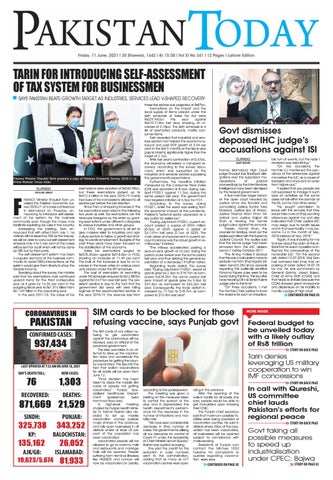
Finance Minister Shaukat Tarin presents a copy of Pakistan Economic Survey 2020-21 to Prime Minister Imran Khan.
ISLAMABAD
f
GHULAM ABBAs
inance Minister Shaukat tarin unveiled the pakistan economic Survey 2020-21 at a press conference in islamabad on thursday, announcing to introduce self-assessment of tax system for the business community even though the move may facilitate exploiting tax rules in the country. addressing the briefing, tarin announced that with effect from July 1, no notices will be issued by Fbr as the taxpayers will be able to carry out self-assessment whereas only 4 to 5 per cent of the cases will be sent for audit which will not be done by Fbr but by third party. the self-assessment system has been a popular demand of the business community to avoid Fbr’s interventions as the system would give them liberty to show the taxable income. Speaking about the survey, the minister said that tax exemptions cost continued upward trend for the third consecutive year as it grew by 14.36 per cent in the outgoing fiscal year to rs1.314 trillion from rs1.149 trillion in the preceding year. in the year 2017-18, the value of tax
exemptions were reported at rs540.98bn, but these exemptions jacked up to rs972.4 billion in the year 2018-19 mainly because of tax concessions allowed to all sectors just before the last election. Since then a whopping increase in the tax exemptions were noted in the following two years as well. tax exemptions are the revenues foregone by the state by granting exemptions under different categories to various industries and other groups. in Fy22, the government is all set to give massive relief to industries and agriculture sectors to follow a growth-led strategy to create employment. budgets of the past three years have been focused on the stabilisation of the economy. Sales tax exemptions surged to rs578.456bn against rs518.8bn in Fy20, showing an increase of 11.49 per cent. the bulk of the increase is due to an increase in the lower rates on various products placed under the 8th schedule. the cost of exemption of zero-rating under 5th schedule reduced to rs12.887bn against rs13.671bn over last year. the persistent decline is due to the fact that the government did away with zero rating regimes of five export-oriented sectors. in the year 2018-19, the revenue loss from
coronavirus in
PakisTan
CONFIRMED CASES:
937,434
LAST UPDATED AT 7:52 AM ON JUNE 10, 2021
DAY'S DEATH TOLL:
NEW CASES:
76
1,303
RECOVERED:
DEATHS:
871,669 21,529 SINDH:
PUNJAB:
325,738
343,252
KP:
BALOCHISTAN:
135,162 AJK/GB: 19,623/5,674
26,052 ISLAMABAD:
81,933
these five sectors was projected at rs87bn. exemptions on the import and the local supply of items placed under the sixth schedule of Sales tax act were rs329.942bn this year against rs310.714bn last year, showing an increase of 6.18pc. the sixth schedule is a list of exempted products, mostly consumer items. tarin revealed that industrial and services sectors had helped the economy rebound and post gdp growth of 3.94 per cent in the first 9 months of the fiscal year (July to March), significantly higher than the target of 2.1pc. after last year’s contraction of 0.47pc, the economy witnessed a v-shaped recovery, according to the survey document, which was supported by the industrial and services sectors surpassing the government's expectations. Furthermore, the headline inflation measured by the consumer price index (cpi) was recorded at 8.6pc during Julyapril Fy2021 against 11.2pc during the same period last year. the government had targeted inflation of 6.5pc for Fy21. according to the survey, during Fy2021, while the world was reeling from the economic impact of the pandemic, pakistan's "external sector appeared as a key buffer for resilience." "during July-March Fy2021, current account posted a surplus of $959 million (0.5pc of gdp) against a deficit of $4,147m last year (2.1pc of gdp). the main driver of improvement in current account balance was the robust growth in remittances," it stated. "the inflows accelerated posting a year-on-year growth of 26.2pc during the period under review over the same period last year and thus defying the general expectation of a decrease," it further noted. regarding trade deficit, the survey said: "during July-March Fy2021, export of goods grew by 2.3pc to $18.7bn as compared to$18.3bn the same period last year. import of goods grew by 9.4pc to $37.4bn as compared to $34.2bn last year. consequently, the trade deficit increased by 17.7pc to $18.7bn as compared to $15.9bn last year".
Govt dismisses deposed IHC judge’s accusations against ISI ISLAMABAD stAff report
Former islamabad high court judge Shaukat aziz Siddiqui’s allegations over the supposed manipulations of judicial proceedings by the inter-Services intelligence have been dismissed by the federal government. a five-member larger bench of the apex court headed by Justice umar ata bandial and comprising Justice Sardar tariq Masood, Justice ijaz ul ahsan, Justice Mazhar alam khan Miankhel and Justice Sajjad ali Shah is hearing the former judge’s plea against his removal. therein, hamid khan, the counsel for Siddiqui, read out the replies submitted with the Supreme Judicial council. the replies said that the former judge had been removed from the ihc division bench-1 before october 2017. “the timing makes it obvious that this was a calculated move to exclude me from [the] regular [division bench] db-i since appeals regarding the politically sensitive panama papers case were to be heard during this time. this too after i was heading db-i as Senior puisne Judge prior to this time” “on three occasions, i met the hon’ble chief Justice to know the reasons for such an inexplica-
SIM cards to be blocked for those refusing vaccine, says Punjab govt the SiM cards of any citizen refusing to get vaccinated against the coronavirus will be blocked, said an official of the provincial government. this step was taken in an attempt to drive up the vaccination drive and accelerate the procedure for getting the country vaccinated. this ties into the fact that walk-in vaccinations for all adults will be open from June 12. “Final decision has been taken to block the mobile SiM cards of people not getting vaccinated,” punjab Specialised healthcare department spokesman Syed hammad raza said. a high-level meeting chaired by punjab health Minister dr yasmin rashid also decided to set up mobile vaccination camps outside major shrines in the province, and fully open businesses in all districts where at least 20 per cent of the population has been vaccinated. vaccinated people will be allowed to go to cinema halls and restaurants and marriage halls will be opened. people suffering from terminal illnesses like hiv/aidS and cancer will now be vaccinated on priority,
ble turn of events, but the reply i received was astonishing.” “on two occasions, the hon’ble cJ mentioned the pendency of the references against me before the SJc as a cause of exclusion and once [on] an order from higher-ups.” “i replied that you people are not supposed to indulge in such type of activities as the same does not fall within the domain of the iSi, but he had other views.” “he sought permission to leave with the remarks that they would take care of [the] pending references against me and also indicated that chief Justice ihc may resign due to health issues and in that eventuality, i may become cJ in the month of Sep, 2018 instead of nov, 2018.” “again, it was shocking for me to know about the claim of this official that he was in a position to influence the proceedings of the honorable SJc. “on the second visit, dated 19.07.2018, Maj gen Faiz hameed told [me] that on passing of order dated 18.07.18 by me, he was summoned by general Qamar Javed bajwa, chief of army Staff [coaS] and that his job is at stake because the coaS showed great annoyance and displeasure on his inability to handle a judge of high court.
CONTINUED ON PAGE 05
more inside
Federal budget to be unveiled today with a likely outlay of Rs8 trillion STORY ON BACK PAGE
tarin denies leveraging uS military cooperation to win iMF concessions STORY ON BACK PAGE
according to the spokesperson. the meeting was given a briefing on the measures taken to control the spread of the virus and it appreciated the health department’s performance for the decrease in the number of infections and mortality rate. “we have seen considerable decrease in [the] number of cases. the government is utilising all our resources for control of covid-19 under the leadership of chief Minister usman buzdar,” rashid was quoted as saying. She said the credit for the reduction in case numbers went to the administration, adding that as many as 677 vaccination centres were oper-
ating in the province. after the opening of the walk-in facility for all adults, she said, people would be able to get inoculated upon showing their cnic. the punjab chief secretary said that maximum possible facilities were being provided at vaccination centres. he said in districts where 20pc of the population has been vaccinated, all businesses will be opened subject to compliance with mask-wearing. residents of punjab can contact the toll-free 1033 helpline for complaints or queries regarding vaccination. News Desk
CONTINUED ON PAGE 05
In call with Qureshi, US committee chief lauds Pakistan’s efforts for regional peace STORY ON BACK PAGE
govt taking all possible measures to speed up industrialisation under cpec: bajwa STORY ON PAGE 03
02
Friday, 11 June, 2021
LAHORE
NEWS
SC diSPoSeS oF CaSe oF HiNdu FaMiLy Murdered iN iNdia ISLaMaBaD
T
inP
HE Supreme Court on Thursday disposed of a petition concerning the killing of members of the Pakistan Hindu community in India on the assurance of the federal government, declaring it cannot interfere in the “policy matters”. The bodies of 11 people from a single family were found in a field in the Jodhpur district of Rajasthan state in August 2020.
The family had migrated from Pakistan and only one member of the family now remains. A three-member bench headed by Justice Umar Ata Bandial heard a petition filed by Sharmati Makhni against the killing of her family. The court said that the Ministry of Foreign Affairs was looking into the matter. It said that the government had assured the court that it would order an investigation into the incident through the Foreign Office. The court said that it could not interfere in the policy matters of the government. It
further said that the Foreign Office was looking into the case. The counsel for the petitioner, Syed Qalb-e-Hassan, said his client wanted the foreign minister to speak to the Indian government on the matter. At this, Justice Mansoor Ali Shah wondered what the court could do to help the petitioner? The lawyer said that the court should instruct the federal government as it was a very sensitive affair. Justice Bandial responded that it was a policy matter and the court could not pass any instruction.
Firdous slaps PPP MP on set of talk show Lahore staff rePort
Special Assistant to Punjab Chief Minister Firdous Ashiq Awan landed in hot waters again on Thursday after she engaged in a physical altercation with Pakistan Peoples Party MP from Karachi Qadir Khan Mandokhail during a political talk show. Video clips of the programme — Kal Tak, hosted by journalist Javed Chaudhry — show the two shouting at each other and hurling claims of corruption as Pakistan Muslim League-Nawaz leader Uzma Bukhari, a third guest, and Chaudhry watch on. In the video, Mandokhail tries to grab Awan’s arm to defend himself. However, other people present on the set quickly intervene before the situation escalates. The incident comes merely a month after the adviser flayed a lady assistant commissioner after she found shopkeepers at a government Ramadan market in Sialkot selling “substandard” food items. In response to the incident, Awan defended her actions by claiming that “one-sided” propaganda was being carried out as the clip did not include what she said was the vulgar language used by Mandokhail against her and her late father. “The picture being painted about the argument with Mandokhail during Javed Chaudhry’s TV show highlights only one side of the story,” she said in a series of tweets. “Such rude individuals have nothing to do with politics and ethics. These people are a blemish on the face of society and politics,” Awan said, announcing that legal action will be taken against Mandokhail’s conduct. “Express TV should release the complete footage of the incident.”
Cleric in KP arrested after threatening Nobel laureate NewS DeSk A Khyber Pakhtunkhwa cleric from the Lakki Marwat district, Mufti Sardar Ali Haqqani, has been placed under arrest for purportedly threatening violence against Nobel laureate Malala Yousafzai over her recent comments on marriage. “I still don’t understand why people have to get married. If you want to have a person in your life, why do you have to sign marriage papers, why can’t it just be a partnership?” Malala had said during an interview with Vogue earlier. The arrest of Mufti Haqqani had taken place on Wednesday, the Lakki Marwat District police office confirmed, adding that the cleric was arrested after an FIR was registered against him under the Anti-Terrorism Act. Station House Officer Wasim Sajjad Khan is the complainant in the case. According to the FIR, a video went viral on social media showing Mufti Sardar – who was armed at the time – instigating people at a gathering in Peshawar to take the law into their own hands and attack Malala. “When Malala comes to Pakistan I will be the first to attempt a suicide attack on her,” the FIR quoted him as saying, adding that the speech had threatened peace and incited lawlessness. It added that the mufti did not file an application in any legal forum and took the law into his hands. After the FIR was registered, a police team raided a house and arrested him. Recently, Malala’s views on marriage also echoed in the KP Assembly, with members of the opposition Pakistan People’s Party and Muttahida Majlis-e-Amal urging her family to clarify their position on the issue. The issue was raised by a PPP lawmaker from Upper Dir district, Sahibzada Sanaullah, on a point of order. Saying Malala’s interview to Vogue had been circulating on the mainstream and social media for some days, he demanded the government probe whether the education activist really made those marriage remarks or not. The member insisted that life partnership was not allowed in any religion and if Malala favoured it, then the stand was condemnable. “She [Malala] should clarify if she has not made that statement,” said the lawmaker, who had quit the Jamaat-e-Islami to join the PPP.
RAWALPINDI: Woodcuters at work in Ammar Pura area of Rawalpindi. online
Opp submits no-trust motion against NA deputy speaker NewS DeSk The opposition parties during an unusual parliamentary session on Thursday filed a no-confidence motion against National Assembly Deputy Speaker Qasim Suri. Reportedly, 80 items on the agenda were bulldozed and 21 items passed. The opposition tried their best to have their voices heard — they identified the lack of quorum, surrounded the speaker dias and protested, but despite all that, the
“rules were suspended” and the items passed one after the other. The no-trust resolution against NA Deputy Speaker Qasim Suri was submitted by Pakistan Muslim League-Nawaz lawmakers Khurram Dastgir Khan and Muhammad Javed Abbasi under Rule 12 of Rules of Procedure and Conduct of Business in the National Assembly. The opposition lawmakers accused Qasim Suri of running the house “illegally”. They said that Qasim Suri had continued NA proceedings despite the opposition
South Punjab candidate gets rare feat in Rotary election from Punjab, KP district ISLaMaBaD Mian abrar
In a rare win, a candidate from South Punjab has won the election for district governor for the year 2023-24 for Rotary International District 3272 comprising of whole of Punjab and Khyber Pakhtunkhwa. Salman Mubarak hails from the City of Saints – Multan. This is a special victory for South Punjab as he is the first District Governor to be elected in the last 50 years from the region. Salman is a health activist and joined Rotary back in 1999. He has served at many positions both at home and at the International level in his 21 years association with Rotary International and has been involved in many community projects including Global Grant. Salman is serving as Member Cadre of Technical Advisors (2020 -2023) of TRF – The Rotary Foundation. He is a Benefactor, Member of the PHS – Paul Harris Society and of TRF – Salman was awarded “Regional Service Award for A Polio free
World” by The Rotary Foundation in 2018. Salman is also the Director Indus Peace Park Society incorporated in BC, Canada striving to create a Peace Park on the borders of Pakistan and India to foster peace among the two nuclear armed states. He is a life member of many Rotarian Action Groups. Life Member RAG for Blindness Prevention RAG Against Slavery Life member RAG against Diabetes Life member and Country representative RAG for Food Plant Solutions Life member and Contry Representative RAG for Population Development . He is Silver Ambassador, Elen Meadows Foundation, California, USA actively involved in providing Prosthetic Hands free. Rotarians from across the world and at the National level have congratulated him and are excited and looking forward to working together for the less fortunate and for under privileged under his leadership.
lawmakers pointed out the lack of quorum in the house. The motion states that all the legislation passed today was done so in an illegal manner and that the voices of the people were suppressed as the opposition was not allowed to speak. It further states that a person, for whose case a court stay order has been issued, does not have the right to occupy the deputy speaker’s seat. In addition, it says that the deputy speaker had demonstrated a clear bias towards the government.
Leaders lament failure to uphold fundamental rights in Pakistan Lahore Press release
Leaders representing various walks of life have said that the Constitution of Pakistan guarantees freedom of expression and protection of fundamental rights of others in accordance with certain moral and legal requirements. Unfortunately, today's social and electronic media is unable to play its balanced and positive role. There is a need to play its role within the framework of freedom of expression enshrined in the Constitution so that the rights of any class are not affected. These views were expressed at a conference on "Freedom of Expression and Violations of Fundamental Rights" held at the Punjab Bar Council. Asif Mehmood Lakhan Chairman Free Legal Aid Committee and members Punjab Bar Council Raja Farrukh Abbas Bhatti, Chaudhry Asif Shehzad, Abrar Ahmed Jasra, Irfan Hayat Bajwa, Kamran Bashir Mughal participated in the conference. Representing the rights of minorities, Samuel Piara and Javed Gul expressed their views. The speakers said that all institutions and individuals are respectful of each other. Lawyers leaders said that they are always striving for the rights of the minority community and the Constitution of Pakistan also provides all kinds of protection to the minorities. But constitutional and legal restrictions must also be taken into account.
Friday, 11 June, 2021
LAHORE
NEWS
03
GovT TaKiNG aLL PoSSibLe MeaSureS To SPeed uP iNduSTriaLiSaTioN uNder CPeC: baJwa ISLaMaBaD
C
aPP
HINA-PAKISTAN Economic Corridor Chairman Authority, Lieutenant General (r) Asim Saleem Bajwa on Thursday said that all-out efforts are being made to speed up industrialization under CPEC, a flagship project of the Belt and Road Initiative. Promotion of industry is a key target for CPEC which is imperative for the economic development, revenue enhancement and job creation, he said. Bajwa said that private investors would be encouraged for joint ventures; however,
the maximum focus would be on the industries that could support import substitution or boost exports. He was talking to a delegation of leading industrialists of Islamabad led by ICCI President Sardar Yasir Ilyas Khan which called on him here. Islamabad Industrial Association President Tariq Sadiq, Senior Vice President Omais Khattak, Khalid Javed, Sheikh Amir Waheed, Chief Coordinator Malik Sohail Hussain were also present at the occasion. The CPEC chief said that the demand of the industrial community of Islamabad will be considered and a new industrial estate will be established for them after studying their proposal in detail.
Earlier Kh Khalid Javed, a noted industrialist, apprised Bajwa of the problems confronted by their community. He said that there are no plots left in the Islamabad industrial area which is hampering expansion and new investments. Therefore, he said, a new industrial estate should be established on CPEC route at Hakla D I Khan Motorway so that new industrial units could be established there as land is already available there. Tariq Sadiq said that we have identified a site at Hakla D I Khan Motorway while CDA and RDA are also in the process of studying the proposals. Bajwa informed that CPEC Authority
is already studying proposal regarding establishing Special Economic Zone in Islamabad and if found feasible, an industrial zone would be established to fulfill the demand of industrialists of Islamabad. He said that the government has allocated Rs87 billion in the upcoming budget for execution of CPEC projects and we are expecting increased Chinese investments. Bajwa said that China was also cooperating with Pakistan in the agriculture sector and supporting in cottonseed development while many Chinese investors are keen to invest in modern corporate farming.
official urges public not to miss second vaccine dose ISLaMaBaD aPP
Parliamentary Secretary for National Health Services Dr Nausheen Hamid Thursday said taking two doses of the vaccine is important and people should remember that a single jab will not provide sufficient immunity to the coronavirus. Speaking to a news channel, Hamid said Pakistan has achieved a target of 10 millionth vaccine doses on Wednesday and aimed to inoculate 70 million people by year-end. She said Pakistan has received the first batch of Pfizer vaccine under the COVAX facility which would be prioritised administering coronavirus vaccines to chronic and transplanted patients to build their immunity fast. Hamid said public trust in the vaccine was increasing every day. She added that a walk-in vaccination facility for all people above 18 would start from Friday and the government was opening up registrations for more age groups as the vaccine supply continues to improve. The government, she said, is now prioritising booster shots for the elderly and those with chronic diseases as part of its vaccination efforts. “Therefore, we call on everyone to get vaccinated and support the national recovery efforts,” she added. In response to a query, Hamid made it clear that the National Command and Operation Centre had announced that vaccines will be mandatory for all public and private sector officials, adding that government staffers must be fully vaccinated by end of this month.
CHINIOT: A farmer examines Colocasia leaves in a field. online
Composite development to be main focus of budget 2021-22 Lahore aPP
Punjab Chief Minister Sardar Usman Buzdar has said that composite development will be the main focus of the provincial budget 2021-22. In a statement issued on Thursday, he said that parliamentarians have been consulted to determine the regional needs and attention is given to benefit the people through public welfare schemes. Buzdar said that a separate development package has been devised for every district and disclosed that megaprojects will be initiated under the public-private partnership to provide additional facilities to the citizens by
expediting the development process. The public-private partnership will be encouraged in different sectors to promote investment; he added and announced to provide every area with its rights. New projects will be started along with the completion of ongoing schemes, Buzdar said. The chief minister said the upcoming budget will depict the aspirations of the people and the government will work to facilitate the people according to the available resources. Meanwhile, steps will be taken to overcome unnecessary expenditures, he said and vowed to increase resources for giving relief to the general public. He further said the development
program will be realistic and public needs will be prioritized. Development of south Punjab will be given due attention, he stated. The CM said the new budget will start a new era of development and the development of the social sector will be given particular attention. The budget will depict public aspirations and resources will be allocated for the development of backward areas, he added. More funds will be allocated for the social sector, he announced and regretted the farmers remained victim to the exploited system in the past. The PTI government has protected farmers’ rights and the growers of wheat and sugarcane crops received the full reward of their
hard work, he added. Buzdar announced to earmark record funds for the agriculture sector as it is a priority area. Meanwhile, unnecessary expenditures will be curtailed to provide additional resources for public welfare, he maintained. The chief minister said that provision of additional resources will help to minimize public problems and the government will also ensure financial discipline in public sector departments. A culture of austerity will be promoted at every level. It is the need of the hour that government expenditures should be minimised. However, customary practices are needed to be avoided to increase resources, the CM concluded.
1,303 infections, 77 deaths from Covid-19: NCOC ISLaMaBaD staff rePort
Pakistan confirmed 1,303 new Covid-19 cases on Wednesday with a 3.12 percent positivity rate, the National Command and Operation Centre said on Thursday. The NCOC said in a statement that the overall caseload had risen to 937,434, including 871,669 recoveries since February last year when the first case of its kind was reported in Pakistan. There are a total of 44,236 active cases who are under treatment across the country, including 2,967 being in critical condition. According to the NCOC, the pandemic killed 76 people during the last 24 hours, increasing the death toll to 21,529. Punjab is the worst-hit region by both the number of infections and deaths where 343,252 people were infected and 10,436 lost their lives, followed by Sindh which reported 325,738 infections and 5,183 deaths. On Wednesday, the NCOC said the country has vaccinated over 10 million doses of Covid-19 vaccines across the country.
aJK elections on July 25 MUZaFFaraBaD inP
Elections for the legislative assembly of Azad Jammu and Kashmir will be held on July 25. AJK Election Commission has announced the schedule of the elections and asked the candidates to submit their nomination papers on June 21 by 4:00 pm. A final list of the candidates will be released on July 2. More than 2.8 million people will exercise their right to vote. Rangers and police will be deployed to assist the civil administration during the polls. National Command and Operation Centre had proposed to the commission to postpone the elections in view of the threat of coronavirus. In a letter sent to the AJK chief election commissioner, the body said the coronavirus could spread during the general elections and advise that the elections be postponed for two months. “Political gatherings due to elections will lead to the further spread of the virus in the state,” the letters said.
Policeman abducted in Lahore Lahore inP
A sub-inspector of Punjab police was abducted by unidentified men in Lahore late on Wednesday midnight. The men who reports said came on two vehicles kidnapped the policeman deployed in the investigation wing of Harbanspura police station from the jurisdiction of Manawan station. Lahore police chief has constituted special teams for the recovery of the official. A spokesperson for Lahore police said that footages of security cameras are being checked and the family members of the official were being investigated to find out the reasons behind the incident.
Friday, 11 June, 2021
04
LAHORE
NEWS
Kashmir Committee grills Pta over failure to taKe aCtion against faCebooK iSLaMaBaD MIAN ABRAR
t
HE Parliamentary Committee on Kashmir on Thursday criticised the Pakistan Telecommunication Authority (PTA) over failure in taking action against the Facebook management after the social media platform took ‘selective action’ against Pakistani and Kashmiri social media activists. The criticism was made during the 18th meeting of the committee, chaired by its Chairman ShehryarKhan Afridi. Some senior officials of the ministry of foreign affairs, PTAchairman, and several members of All Parties Hurriyat Conference (APHC) at-
tended the meeting while Canada-Pakistan Global Congress President Chaudhry Zafar also participated from Canada. The committee also passed two unanimous resolutions to denounce the recent Indian army deployment in Indian Illegally Occupied Jammu and Kashmir (IIOJK), and terrorist attack on a Muslim family in Canada amid rise of Islamophobia. The committee gave a nod to the roadmap of international visits for lobbying on Kashmir. Briefing the committee on the future engagement with diplomatic corps, Afridi said that in the wake of significant reduction in Covid-19 pandemic, the committee delegations would soon be visiting Turkey, Central Asian states, US and UK to
talk on Kashmir dispute. He said other than the Kashmir committee members, the APHC leadership would also be a part of these delegations. The committee gave a detailed hearing to PTA Chairman Maj Gen (R) Amir AzeemBajwa over action taken against the Facebook management. Bajwa said that the PTA had sensitised about the concerns of Pakistanis and Kashmiris regarding censorship of activists against human rights abuses in Jammu and Kashmir. He said that the reduction of complaints reflects that there is a change in the mind-set of the social media sites’ management. However, Afridi confronted the PTA chief and asked that why the managements of Facebook and Twitter have not set up their offices in Pakistan yet?
LWMC saves Rs60 million in procurement of vehicles LaHORE PR
Lahore Waste Management Company (LWMC) had decided to do the primary collection of waste on its own. In order to run the cleanliness operation of the city smoothly, Lahore Waste Management Company required more than 900 new vehicles for which the department has started the procurement process as per PPRA rules. Lahore Waste Management Company complying with the directions saves nearly 59,160,701 Million rupees. The procurement committee of the Board ensured the timely bidding process and evaluation
of the procurement for which the efforts of Chairman Procurement Committee Barrister Amir Zafar and other members are commendable. Secretary LG & CD Noor-ul-Amin Mengal and Chairman Lahore Waste Management Company acknowledged and appreciated the efforts of on saving Rs. 60 million in the procurement of fleet. Secretary LG & CD stated that the credit for saving Rs 60 million goes to Chairman Procurement Committee Barrister Amir Zafar for ensuring the transparent procurement process. He added that the first lot of machinery will be delivered before Eid-ul-Adha and all the machinery will be mobilized in the city.
Referring to a recent statement of the Facebook management about suspension of several accounts and pages of Pakistani users, Afridi asked that what action has been taken by the PTA against the Facebook team and why the Facebook team has refused to participate in the Kashmir committee meeting, besides directing the PTA to ensure that Facebook representatives must attend the next meeting of the committee. The PTAchairman said that the PTA is engaging with the Facebook management and it would do whatever it takes to protect the rights of the Pakistani and Kashmiri users in accordance with the Pakistani laws. He said Pakistan has directed the Facebook management to set up its office in
Pakistan. Afridi argued that how the Facebook management is not adhering to the directives of a country with 220 million population and how can any company violate basic rights of over 220 million people. Afridiquestioned that why the PTA has failed to take action against the Facebook management and why the Facebook is not blocked in Pakistan if it had failed to comply with the directions of the government of Pakistan. MNA KhurramDastagir said that Pakistan needs to form a new law to help social media companies comply with the aspirations of the people of Pakistan. On this, Afridi asked the PTA chairman to bring his legal team to the Kashmir committee’s next meeting so that a legal course could be taken against the Facebook management. National Security DivisionSecretary Amir Hassan said that there is a need to amend the PTA law to empower it to take action against the social media companies working in Pakistan. He also proposed that the FIA’s cyber team may take action against the Facebook management.
NHA arranges Covid-19 vaccines for employees iSLaMaBaD PR
In order to control spread of coronavirus, National Highway Authority has undertaken steps for providing vaccine to its employees and their families. To this effect, about 250 employees and their family members were vaccinated by Sinovacon Thursday at NHA head office. This process of corona vaccine will also be continued in the future. The objective of such steps is to fur-
ther the efforts being made by the government to control coronavirus in the country. The welfare section of National
Highway Authority has asked its employees to avail this opportunity to add a safety layer against coronavirus.
What China’s poverty reduction experience means to the world? Yi Fan Earlier this year, China declared the eradication of extreme poverty. For anyone trying to assess what it means to the country, it would be useful to look at what persistent penury has done to some of its population. Even just 30 years ago, in desert-covered villages of northwest China, it was not unusual for brothers from the same family to share just one pair of pants. Some villagers lived inside
earthy caves and slept on rock beds. Young women accepted arranged marriages for dowries worth the price of a donkey. Though hard to believe, this was the reality in Xihaigu, regarded by the United Nations as “one of the most unfit places for human settlement”. Xihaigu was not the only place in China plagued by humiliating poverty. Liangshan, a prefecture in southwest China, captured the nation’s heart in 2016 with
pictures of children climbing a cliff with bare hands on a vine ladder, the only thing connecting their mountainous village with the nearest school at the foot of the hill — and the world beyond. By 2012, China had 832 counties and 128,000 villages just like Xihaigu and Liangshan. They were all listed as priority targets for the nationwide antipoverty campaign. The enormity of the task is mind-boggling. So not unexpectedly, when China announced the end of extreme poverty, the news was met by scrutiny and disbelief in some quarters. Questions have been raised about the reliability of the figures, the adequacy of the poverty standard and the cost-effectiveness of the effort. Let me address each of these questions in turn. WHO HAS BENEFITED? According to Chinese President Xi Jinping, 98.99 million rural residents have been lifted out of poverty in the past eight years, bringing the total number of Chinese escaping poverty in the last four decades to 770 million, which accounted for over 70 percent of poverty reduction worldwide. This also means that China met the poverty reduction goal in the 2030 Sustainable Development Agenda ten years ahead of schedule. “We should not forget the fact that China has contributed the most in world poverty alleviation in the past decade,” noted UN Secretary-General Antonio Guterres. Leaders of South Asian countries such as Bangladesh, Nepal, Pakistan and Sri Lanka also expressed congratulations. Liu Yongfu, director
of the government agency overseeing the effort, told reporters last year that the threshold for extreme poverty was set at 4,000 RMB yuan ($628) per annum. Slightly above the World Bank benchmark of $1.9 a day, it was “only part of the package”, according to Liu. “The government also guarantees proper food and clothing, safe housing, free education for children and essential medical services.” Apart from benefiting its own people, China’s poverty reduction experience has helped other developing countries as well, particularly its neighbors. For example, China hosted a seminar on poverty policy and practice for Afghanistan, Bangladesh, Nepal, Pakistan and Sri Lanka in 2007. Similar exchanges and projects on development cooperation have been carried out with the five South Asian nations as well as under the China-SAARC framework, including sub-national poverty reduction exhibitions, construction of roads, airports and schools, and vocational and agro-tech training programmes. WHY IT HAS WORKED? China’s anti-poverty success can be explained by what may be called a L-E-A-P strategy (i.e., Leadership, Empowerment, All-sector participation and Paired assistance). Hopefully some elements of the strategy can help other developing countries move faster towards the Sustainable Development Goal of “ending poverty in all its forms” by 2030. FIRST LEADERSHIP: A campaign on such an enormous scale would not
have been possible without the mobilization and execution capacity that the Chinese system is best known for. Strong leadership is the key to delivering it. In 2017, the leadership of the Communist Party of China (CPC) declared “war” on poverty. The choice of word made it abundantly clear to party officials that their leaders were treating the issue with utmost seriousness and urgency. President Xi personally took charge of the matter. He promised that “no one will be left behind” and warned officials against deceptive efforts. Apart from setting an ambitious goal, President Xi also called for “targeted poverty alleviation”, demanding tailor-made solutions for different villages and groups. This strategy avoided the easy, one-sizefits-all solution that often created waste and discontent in a vast, diverse country such as China. SECOND EMPOWERMENT: As a Chinese saying goes, “Better teach people how to fish than just give them fish.” Experience shows that people who get rid of poverty by receiving handouts instead of training would soon fall back into poverty once the help is withdrawn. In Liangshan’s case, young adults were taught vocational skills to help them find jobs in cities. Agricultural experts were sent to pass on know-how about growing cash crops. Peasants who had only small potatoes for supper have become planters of organic strawberry, a business which brings over 20,000 yuan ($3,140) per head a year. THIRD ALL-SECTOR PARTICIPATION: What was most remarkable is the human resource committed
to this campaign. More than 255,000 teams of 3 million up-and-coming party officials were sent from across the country to join millions of local officials in the battle against poverty. They were asked to stay in their posts until their villages were declared “poverty-free”. Many of them were promoted or rewarded with national honours afterwards. The government channelled 1.6 trillion yuan ($251 billion) into this endeavor, roughly one-sixth of the GDP created by the world’s second largest economy in 2020. Yet poverty alleviation shouldn’t and can’t be the business of the government alone. China’s corporate sector invested over 1 trillion yuan ($157 billion) in the povertystricken areas. Many companies made donations to rebuild ramshackle dwellings, create funds that rewarded work on village roads or set up convenience stores that sold daily necessities at reduced prices. What did they get in return? A debt of gratitude and millions of potential customers. FOURTH PAIRED ASSISTANCE: Richer provinces and cities from China’s eastern coast also stepped forward to form
pairs with poor ones in the interior. For example, the coastal province of Fujian partnered with the northwestern province of Ningxia, of which Xihaigu is a part. When serving as Fujian’s deputy party secretary in the 1990s, Xi visited Ningxia to discuss how to help villagers in Xihaigu emerge from poverty. He was behind the momentous decision that led to relocating the villagers to more hospitable places at the government’s expense. Min-Ning, the place name coined by Xi from a combination of Min (another name for Fujian) and Ning (the usual shorthand for Ningxia), has since prospered with the help of farm experts travelling half the country to teach the locals how to grow grapes, wolfberries and raspberries and start their own winery business. Their rags-to-riches story had been adapted into a drama series which was aired early this year. It became an instant hit with viewers young and old and received a rating of 9.4 out of 10. WHAT NEXT? China has reason to be proud of what it has accomplished, but the battle is far from over. By delivering what it has prom-
ised, the CPC is driving up expectations. Today, people in Liangshan and Xihaigu no longer worry about whether there are enough pants or what to put on the dinner table. They want better education for their children, more accessible healthcare and more comfortable nursing homes. As the CPC celebrates its centenary on July 1st, it must embark on another mammoth task to raise living standards for all Chinese and lift hundreds of millions into middle-income status. China, Afghanistan, Pakistan, Nepal, Sri Lanka and Bangladesh all have great development potential. They have much to offer each other and contribute to the 2030 Agenda for Sustainable Development. Their foreign ministers agreed at a recent virtual meeting to create a China-South Asia poverty reduction and development cooperation center to share best practices. China will host a forum on the role of e-commerce in reducing rural poverty and post-Covid economic recovery. No one should be left behind as the world embraces a better, shared future. China and South Asia are natural partners and there is a lot that can be achieved together. The author is a current affairs commentator based in Beijing.
Friday, 11 June, 2021
LAHORE
Govt dISMISSeS dePoSed IHC judGe’S aCCuSatIonS aGaInSt ISI continued from page 01
“a
S per him, the COAS directed him to hold a meeting with me to know ‘what Judge sb wants? In [my] reply, I stated that I need nothing except that all organs of the state and the respective departments of the executive may remain within the limits prescribed by the Constitution and the law of the land.” “On this, he stated, Sir, it is better to forgive bitterness as you are considered as a very upright and loyal Pakistani even in the ranks of army except a few individuals, therefore, good working relations may be in the interest of Pakistan.” “I inquired from him that if this reputation of mine exists then why have they exercised their influence to ensure that DB-1 headed by me must dissolve the moment cases related to Panama start to land in IHC?” “He very frankly conceded that some members of the team dealing with the cases were of the view that Justice Siddiqui is prodefence and there is apprehension that he may grant relief to accused persons.” “When I asked how they manage constitution of a bench to hear appeal against conviction of Nawaz Sharif, he told me that Justice Anwar Khan Kasi, CJ IHC was approached at Quetta through a mutual friend, where he was asked to constitute a division bench not headed by Justice Shaukat Aziz Siddiqui. “Justice Kasi in reply informed me that he will constitute a bench to which we are comfortable.” “He [Major Gen Hameed] further informed that they wanted assurance that [the]
bail plea of accused Nawaz Sharif is not heard/taken up before the General Election dated 25.07.18.” Thereafter, he stated, “They wanted the matter to be brought before the DB headed by me for attaching some credence to the proceedings.” “To this, I categorically replied that if, from the material brought on record, I feel convinced for enhancement of the sentence, I will not hesitate in issuing [a] notice for enhancement of the conviction, but if the judgment would not be sustainable in the sight of law, I will not spoil my hereafter to protect [the] worldly affairs of any.” “From his demeanour, I could tell that this reply of mine did not please him and he left my residence along-with his companion. On both occasions, Major Hameed came on an official vehicle of the ICT administration.” “The statements made by DG ISI and the unfolding of events on the ground clearly substantiate the disclosure of facts by me to the Rawalpindi bar as a gospel truth,” the statement concluded. In reply to the above, Additional Attorney General Sohail Mahmood submitted a onepage statement in the Supreme Court of Pakistan wherein it stated, “as specific allegations about certain officers of the state were made in the petition and read out in court, on instructions it is placed before this court that the allegations made are baseless, misleading and therefore denied”. Earlier, the SC on Tuesday adjourned the hearing on former IHC Justice Shaukat Aziz Siddiqui’s appeal to date in office indefinitely. During the course of proceedings, Advocate Khan said according to the Constitution, the SJC conducted its own inquiry. Justice
Mazhar Alam asked did the SJC itself recorded statements in the inquiry. Hamid Khan replied all records and evidence had to be reviewed by the SJC. He said his client was removed from office by issuing a show-cause notice. He said the SJC had the power to make inquiries against a judge but could not dismiss a judge. He said Justice Shaukat Aziz Siddiqui had replied to the show-cause notice. Shaukat Aziz Siddiqui denied any links with any officer in the army, with his lawyer telling the SC that a top intelligence officer had allegedly himself visited the judge at the latter’s residence. During the hearing, senior counsel Hamid Khan, who is pleading Siddiqui’s case, argued that his client had been “deliberately targetted” by some forces. “While the SJC has the authority to conduct an inquiry against a judge, it cannot dismiss him,” the lawyer argued. Khan recalled that Justice Siddiqui had submitted a reply, the same year, to the showcause notice issued to him. Siddiqui, in reply to the notice, said that “General Faiz Hameed [current DG ISI] came to his residence”, the lawyer told the court, adding: “Gen Faiz asked [Siddiqui] to withdraw the order for the removal of encroachments from [outside] the ISI headquarters and green belts.” At this, Justice Bandial remarked that it was “surprising” that the ISI chief had made such a demand from Siddiqui. “You were dismayed at something else and you insulted your own institution and the chief justice,” the judge said while addressing Siddiqui, who was present in the court.
Pension reform: ‘Relatively low hanging fruit’ mr. Zafar masud There has been an enlightening seminar organized by SDPI recently on pension reforms. It was not only educating but an eye-opener to an issue which has multifaceted impact on the performance of the Government and it’s delivery, as it’s directly related to the performance and compensation of civil servants. I was invited as one of the penalists due to my active engagement in the past on tapping long term project finance funding through capital market instruments, and exposure to this concept of being on the board of various public sector entities. I have always been aware about the seriousness of the issue of growing pension liability for the Government and the public sector entities, but it was only during the research on this topic, it was dawned upon me how grave are the circumstances. I must, at the outset, thank my colleagues, Sayem Ali and Irteza Qureshi, who had done the research for me on this very critical topic which helped me realize how this existing/ emerging fiscal burden could be addressed. This also motived me to put a brief paper together on the subject and was invited to write for newspaper for the mass awareness on this very critical matter which touches almost entire populous one way or the other. Let’s begin with context and extent of challenge of the rising pension bill. Federal pension bill has increased to Rs 480bn in 2021, from Rs 150bn in 2011. According to reports from donors, federal government’s unfunded liability currently stands at around Rs 3trn. Post 7th National Finance Commission award, provincial governments’ pension bill have also increased exponentially to Rs 500 bn in 2020, from Rs 75 bn in 2011. This is clearly an unsustainable path. Studies suggest that with no changes to the existing pension arrangements, federal pension bill will rise to an alarming level of Rs 750bn by 2023. Provinces are likely to face similar challenges. This is very frightening situation indeed which becomes more complicated due to the presence of fiscal pressures from compromised tax collections, SOE losses, accumulating circular debt, etc. However, silver-lining is that out of all fiscal challenges of the Government, this appears to be an easier one to plug, given that this problem was faced by almost every country, particularly in developed world where the average life expectancy is must higher. There’re real examples of how various countries had dealt with this issue successfully. Before we go any further, would like to elaborate on fundamental concepts about
pension scheme options which will help readers, especially who’re not much familiar with this theme, to understand it and relate to ensuing discussion better. Employee benefits classify post-employment plans into two categories: 1). Defined Contribution (DC), whereby employer’s liability is limited to the amount that it agrees to contribute to the post-retirement fund, consequently, actuarial risk and investment risk falls on the employee. In other words, the risk of investment performance of fund, and resultant pension returns, rests with the employee or its representatives. The return could be better or worse depending on market factors and competence of fund manager(s); whilst, on the other hand, 2). Defined Benefit (DB), is the scheme where the amount of pension benefit is defined; therefore, all actuarial as well as investment risks are borne by the employer. Irrespective of what the market circumstances are, and if pension liability is funded or not, the employee will get a defined (pre-set) return post retirement; there will be no upside or downside for the employee(s), unlike DC. Experience from last 30 years show significant changes in pension schemes in most developed and emerging markets. As per international best practices, Pakistan Government’s DB and unfunded pension arrangements are out of line. Non-contributory, or DB, schemes are reducing: many countries have switched to DC plans due to financial stress. PAYG financing is also reducing: most countries have moved to full or partial funding of future pension liability. Advantage is that financing burden can be spread across different periods in a more stable and predictable manner. New accounting standards have helped Governments to better understand the underlying accrued liabilities and the long-term costs of their pension arrangements. DC pension program, therefore, are replacing DB plans. DC system, by very nature, automatically ensures that the accrual of benefits are fully funded. Thus, employers are guaranteed that no unfunded liabilities would emerge. However, this could have an adverse impact on employees since, the value of their accumulated pension assets are not defined, and because they depends on the investment performance of underlying pension funds. Most importantly, DC schemes allow employees to play a role in the investment decisions. This allows individual risk/ reward preferences as well as other religious (such as, investment in Islamic securities, etc.) or ethical views, etc., to be incorporated into the management of pension assets. The employee will essentially become master of his
own destiny with respect to investment decisions about his retirement benefits, and may fetch more satisfying returns (both financially and otherwise) than he or she could have under the guaranteed DB system. With enhanced life expectancy and widening fiscal deficits in emerging markets, this problem is becoming more glaring. There’re successful examples from the countries where the make-up of the society and the community are very similar to our’s and they have been able to put a check on this mushrooming concerns around this dilemma. Some of these country experiences worth evaluating for adoption in Pakistan which are: India, Philippines, and Thailand. Starting from the most relevant one - India: All new entrants in the government with effect from 2004 were hired on the National Pension System, a DC pension arrangement into which 10% of pay is contributed by both the employee and the employer. Those hired prior to 2004 continues to receive pension benefits based on the earlier DB pension program. In 1997, Philippines set—up an institution called Government Service Insurance System (GSIS) which provides DB retirement benefits. Employees pay 9% of their salary to GSIS and the employer adding another 12%. Retirement benefits are determined based on age and years of contribution and are a combination of lump-sum amount and lifetime annuity. In Thailand for new hires starting 1997, parametric changes were made in the DB pension method, supplementing it with a DC pension arrangement to which employee and employer contribute 3% each. Therefore, Pakistan has ample instances to draw on, in order to box-in this looming crisis of sorts at the Government level. There’re, however, some islands of excellence in this space within our own country, albeit on a micro-level, and that also in public sector only, which shall be looked at, celebrated and encouraged in other public sector entities. Oil & Gas Development Company Limited (OGDCL) management and board, in June 2016, took cognizance of the menacing situation of ballooning pension liability for the company, which was posing an unprecedented threat to cashflows and sustainability of pension scheme itself, decided to rationalize the pay package and introduced far-reaching changes in the structure of both pay and pension, as they both are bosom-buddies and can’t be separated. Accordingly, maximum salary caps were introduced for each pay-scale, which by default put a check on the extent of ex-
cmYK
“You are accepting yourself that you had meetings with the DG,” Justice Bandial told him. “You met him twice; you had relations with him.” This prompted Justice Siddiqui to stand up in his seat and reply, “I have no relations with anyone in the army,” adding that he was residing in Islamabad along with his family “despite all kinds of threats”. Justice Bandial assured the former judge that members of the court knew that he was an “honest person”. Siddiqui then said he had delivered the speech that led to his ultimate sacking “to reduce the pressure” on judges. “Unfortunately, I have been under pressure since December 2015,” the former judge said, alleging that former chief justices Mian Saqib Nisar and Asif Saeed Khosa “had always wanted to show me the door”. “We don’t want to hear your speech,” Justice Bandial replied, saying Siddiqui had “started naming names”. Justice Bandial told Siddiqui that he was “angry at the ISI” but had resorted to disrespecting the judiciary. “You should have worked for the protection of your institution. Think of the institutions that work for the protection of the judiciary,” he said. Siddiqui’s counsel Khan said: “The bar too works for the protection of the judiciary.” Justice Bandial replied that although the bar was always present for the assistance of judges, “with due respect, the bar has its own policy according to which it functions”. “It was due to the bar’s criticism that Justice Iqbal Hameedur Rehman resigned. The bar often gets emotional,” the judge added.
treme liability for each grade of employee, plus started creating much-needed difference between performers and non-performers within the organization. Concurrently, effective 1st January 2016, DB pension formula was discontinued for new inductees. While existing employees continued to enjoy protection of their terms & condition of service, including DB pension entitlement, new inductees have been governed under gratuity scheme which does not put the company under any long term obligation. As a result of foregoing steps, at that time, actuaries worked out a cumulative benefit of Rs. 186bn to OGDCL in the form of savings in salaries and pension contribution over the next 10 years. Based on the above, this could be concluded that on fiscal management front, Pension Reforms are “low hanging fruit in relative terms” and could be fixed while keeping following considerations in perspective: “Political Will” is required to implement pay & pension reforms. Tried & tested solutions could be borrowed from across the globe. All new hiring in Government shall be under DC system with restructured payscales having ranges backed by pension fund management structure. Other than maximum salary & pension entitlement capping, halt on retrospective increase in future retirees, and (subject to legal provisions) cull the number of pension beneficiaries; extending retirement age or provide less benefits in early retirements are two option which could be implemented in the existing DB plans as a package. There is no argument that pension funds are needed to be developed in Pakistan, and pension liability of the Government is required to be funded. There has to be a plan which should be managed through pension fund regime only. Existing DB pension liability shall be funded through a combination of in-kind assets of the Government (for example, existing properties/ offices given to pension funds and rented back by the Government, lands could be handed to funds for development, etc.) and in-cash, albeit in tranches, as funding in onego is not possible, as Government is in borrowing mode and that would put unnecessary debt burden on the Country. This plan ticks lots of boxes with the biggest box being conversion of dead assets into an earning ones. Pension Funds have multifaceted benefits for the Country: Capital Market Development: OECD countries pension assets stood at over US$ 33 trillion (38% of Global GDP) in 2020. US has the largest pension assets (88% of GDP), followed by UK (123% of GDP), Australia (132% of GDP) and Switzerland (143% of GDP).
NEWS
05
SIM cards to be blocked for those refusing vaccine, says Punjab govt continued from page 01 The decisions come a day after the National Command and Operation Centre announced that coronavirus vaccines will be mandatory for all public- and private-sector employees, and that government employees must be fully vaccinated by June 30. Moreover, Lahore Deputy Commissioner Mudassar Riaz on Wednesday installed a coronavirus vaccination centre at Lahore College for Women University. During his visit to the institute, Riaz reviewed arrangements and expressed his satisfaction. Model Town Assistant Commissioner Ibrahim Arbab, LCWU Vice Chancellor Bushra Mirza and other officials were present on the occasion. Riaz said it was necessary to vaccinate teachers, students and administrative staff in order to reopen the education sector of the country, adding that all professors, staff and students would be vaccinated at this point. He said that coronavirus guidelines were being strictly enforced across the city, adding that after their implementation, a reduction in the daily new cases was observed. “District administration will continue its efforts to ensure the SOPs are enforced in provincial capital,” he added.
Yield curve emergence: Pension funds are the biggest investors in the global equity and bond markets, contributing 70% of the market capitalization in some of the OECD markets. Unfunded government pension arrangements are a key factor for the low depth in our bond and equity markets. Real Estate/Mortgage funding: Real estate developments will help grow the market for pension funds and vise versa. Most important will be the growth in long term debt markets through pick-up in housing market mortgages as they require purchase value of the home to be spread out over around twenty years or more, at a fixed rate. Buyers of such long-term Fixed Rate bonds are typically pension and life insurance fund managers. This whole idea fits perfectly with the Government’s vision of promoting housing and construction activities, particularly low cost housing. Enhanced saving options: In Pakistan, the overall saving rates are one of the lowest in the world. In 2020, the national savings fell below 10% of GDP. Even the Bond markets in Pakistan are small at less than 5% of GDP. Corporate bond markets are virtually non-existent, which would be given a necessary boost by the active pension funds; thus, offering safe & secure saving products to general public. Alternate to Government’s Public Sector Development Program (PSDP): Pension funds, by very nature of return requirements, typically have long term liquidity and appetite for high risk assets which generally are out of the scope of banks. A robust pension fund regime would mitigate the fiscal pressure on the Government for funding important infrastructure projects with long gestation periods. Investment in commerce & industry: If we look around the globe, pension funds own large businesses and industries; thus, offering a very solid partnership opportunity for local and international investors to promote trade and commerce and create jobs. Development of Universal Health Insurance: The universal insurance schemes being launched by the provinces are going to boost the Assets Under Management (AUMs) of the insurance companies, a key component of the pension arrangements in most countries. Therefore, pension funds will go hand in hand in promoting the universal health insurance initiative of the Government. To reiterate, DC pension arrangements are fully funded while return depends on underlying pension fund performance; therefore, it must allow employees to be party to investment decisions of their own funds. This is a way of empowering employees and making them incharge from their own fate about their future decisions. President & CEO – The Bank of Punjab
Friday, 11 June, 2021
06 COMMENT
In search of Afghan peace
Fighting a constantly mutating virus Avoid triumphalism and complacency
It’s not just about Afghanistan, but the BRI
O
N Wednesday, the coronavirus positivity rate fell below four percent for the first time in three months. A day earlier, Pakistan had launched its homemade covid-19 vaccine “PakVac”, developed with the help of China. As only a fraction of the population has been immunized so far, the government has taken a welcome decision to commit $1.1 billion for vaccines to cover the eligible population that from today will also include those aged 18. As the commitment of the funds is fairly late, Pakistan will have to stand in long queues formed because of demand for the vaccines outstripping their supply. The government has announced certain relaxations which were badly needed. There would now be a compulsory 100 percent presence in government offices while shopping areas will remain open for six days a week. After June 15 transporters will be allowed to fill 70 percent of seats in buses and coaches. To discourage those still unwilling to get a shot, vaccination has been made compulsory for every government or private sector employee. The administration cannot afford to lower its guard. There is unfortunately a tendency in some of the PTI leaders to overplay their government’s success. Any display of triumphalism or complacency could be extremely harmful on account of new and more dangerous corona variants appearing in various countries. Information Minister Fawad Chaudhry’s “world recognizes the struggle waged by Pakistan against COVID-19” remark reminds one of similar accolades that brought tragedy to India. By mid-February, India was counting an average of 11,000 cases a day. The seven-day rolling average of daily deaths from the disease had slid to below 100. Modi was called a “vaccine guru” and an overconfident India announced key elections in five states. In less than a month, things began to unravel. India was in the grips of a devastating second wave of the virus and cities were facing fresh lockdowns. Pakistan is still far away from reaching herd immunity and its vaccination rate remains slow. It has yet to enable its civilian institutions like police to enforce covid-19 SOPS instead of calling in the Army. Pakistan would do better to err on the side of caution. So long as there is no herd immunity through all-out vaccination, things can go out of hand because of overconfidence or carelessness.
At Penpoint M A NIAZI
T
here seems to be an assumption that the Taliban are amenable to persuasion by Pakistan. This would explain the pressure from both the USA and the Afghan government to make the Taliban take part in the final talks which will lead to a post-withdrawal dispensation that will allow the war-torn country to achieve some kind of peace. The problem is that the Taliban are realists enough to deal directly with the Pakistani establishment, rather than the government of the day. The Afghan government shares that characteristic, with the result that COAS Gen Qamar Javed Bajwa has had to visit Kabul to talk to Afghan President Ashraf Ghani, and had to be accompanied by the DG ISI, Lt Gen Faiz hameed. however, there have been some worrying developments for Pakistan as the USA prepares for the withdrawal of its own and other NATO forces by September 11, mainly in the shape of a resurgence of militant activity in the tribal areas. That the attacks are coming against Pakistan armed forces indicates that the militants are continuing their war against the USA under the impression that the Pakistan armed forces are a surrogate. This harks back to the struggle of the Faqir Ipi, which straddled the raj and Pakistan, and perhaps of the Mullah Mastaan, the Mad Mullah of Swat, who fought the raj at the turn of the century in Malakand. The Faqir Ipi, whose base was Waziristan and belonged to the Mahsud tribe, is particularly relevant to the present. his readiness to fight Pakistani forces shows he did not buy into the argument that the British had left,and the Pakistan Army was a national army, not an occupying force. It might also be noted that the Faqir Ipi, the Mad Mullah,or the Mullah Powindah (another anti-British rebel from the Waziristan Agencies), were all adopted by the Afghan royal government as Pakhtun nationalist figures. As a matter of fact, the Faqir Ipi did use the Partition to demand a third option for Pakhtuns, and even set up a short-lived Pakhtunistan in 1947. While the Pakhtuinistan movement had a support base in the form of the redshirts after Partition, their political heirs, the ANP, are not inclined to make an alliance with the Taliban. The recent diplomatic spat over the remarks by the Afghan National Security Adviser should show the reality that the present Afghan government is not so much pro-Indian as anti-Pakistan. As Pakistan has been a friend of its main enemy, the Taliban, and as the Taliban seek to return, presumably with Pakistani
If you can’t take the heat… Firdous Ashiq Awan hits out
S
ACM for information Firdous Ashiq Awan has got a problem. hardly had the furore died down of her tonguelashing of a hapless AC Sialkot at a ramazan Bazar, that she plunged into controversy once again by slapping PPP MNA Abdul Qadir Mondokhail for having called her corrupt. The first thing is the violent reaction to an imputation against one’s personal integrity. The SACM should remember the number of times she herself has made such imputations against members of the opposition. She cannot be blamed for this, because her party chief, and the party faithful, have vocally made allegations against opposition leaders. Opposition stalwarts may have grown visibly hot under the collar, but it is PTI people who have hit out physically. Apart from the inability to take what they have themselves been dishing out, the advisability of trying to settle anything by physical violence is not rational. Clearly, Dr Awan suffered a rush of blood. That is no excuse. The party’s head has been leading the chorus trying to howl down the opposition leaders with cries of corruption, and it is perhaps too much to expect from them or their followers to keep quiet. Dr Awan has now been sacked already from the Federal Cabinet, where she was SAPM, now to take on this job. Though she reports to Punjab CM Usman Buzdar, her appointment must have the approval of Prime Minister Imran Khan. he not only took no action against previous talk-show violence, he overlooked her outburst against the AC Sialkot. Not only must there be an understanding among all parties of how far they are to go in making political attacks, but he will have to set a personal example. Otherwise, a shoe was flung at Mian Nawz Sharif, and recently French President emanuel Macron got slapped. Mr Khan must ensure that the dignity of his office is not violated. Not only is this incident, sadly not the first, it is unlikely to be the last, if the culture of school-playground incivility that has been brought in to political discourse, is allowed to continue.
Czech-Pakistan Chamber of Commerce at work
ShAZIA ANwer CheeMA
E
CONOMIC relations are the foundation of today’s diplomacy, and history has witnessed that the failure of economic diplomacy caused the disintegration of the former Soviet Union because the USSr had many friends but no buyers out of the socialist circle. Students like me who are away from their homes are always proactive to promote the qualities of the motherland as the production hub of fruits, wheat, rice, and so, but in a country like the Czech republic, it is difficult to showcase Pakistan as a land rich in agriculture and other fields because Pakistan exports to the Czech republic were $53.6 Million during 2020, according to the United Nations COMTrADe database on international trade. Pakistan had never worked seriously to cater to the opportunities from Central and eastern europe and our focus had been only on North America and three major countries of europe–United Kingdom, Germany and France. Just imagine, less than $60 million with a country that had diplomatic relations with Pakistan from the first
Arif Nizami Editor Managing Editor
Joint Editor
Umar Aziz Executive Editor
Lahore – Ph: 042-36300938, 042-36375965
Pakistan probably did not want to be in its current position, but Afghanistan’s proximity has made it of interest to both China and the USA.
The writer is a member of staff.
Economic diplomacy boosts public diplomacy
Dedicated to the legacy of the late Hameed Nizami
Yousaf Nizami Aziz-ud-Din Ahmad
support, it is perhaps inevitable that it should seek support elsewhere. The USA probably realises that the Taliban pay more attention to Pakistan than to it, but as the USA gets the Pakistan government to do what it wants, no matter which party is in power, it should find itself in the comfortable position of being able to call the shots in Afghanistan, no matter who is in power. There are two problems with that. The first is the Taliban themselves. They are intractable, even prickly. After all, they had to be removed by force. The USA managed to eliminate Al Qaeda, but not the Taliban, who not only survived, but have done well enough against the USA to make it agree to their demand of withdrawal and to be accommodated in the governance structure the USA developed. That hasn’t happened yet, but the USA is still hopeful. The second problem for the USA will be the Chinese. The USA must contemplate a future in which the Chinese have a voice in Afghanistan. That voice will come through Pakistan and the Taliban. The USA has been closely allied to the USA, but as the USA has won over India, Pakistan has turned even more to China. It would be a mistake for the USA to put Pakistan in the Chinese camp, but if push comes to shove (or is it a matter of when… ?), then the USA’s courtship of India might tilt the balance. It is a common assumption, though overstated if you were to ask the Afghan government, that the impending troop withdrawal will lead to a Taliban takeover. even if it were true, the takeover would not benefit Pakistan as much as it might seem, because how exactly Indian influence in the country would be excluded is not clear. It should not be forgotten that India has put up funds which would pinch a poor country, and would not like its investment to go down the drain just like that. The anti-Pakistan rhetoric predates even the Soviet invasion, and reflects how Afghanistan considers Pakistan to be the heirs of the British. A number of new factors have come into the equation if a comparison with the Soviet invasion is made. The biggest is the New Silk road, China’s Bridge and road Initiative (BrI), which is manifesting itself in Pakistan through CPeC, the China-Pakistan economic Corridor. That is the route by which China does what russia was unable to do through the decades of
the Great Game, and its invasion of Afghanistan; access to the warm waters of the Persian Gulf. China will be able to import oil from the Gulf through CPeC, make goods and export them to europe through the New Silk road and the BrI. Afghanistan plays a key role in the New Silk road, and thus it must be settled so that it can be an entrepôt. Because of this crucialness, both russia and the USA are interested. russia is not just a destination for Chinese exports; it is also the site of much of the BrI. The USA is interested because of its ‘Look east’ strategy. It should not be ignored that Chinese interest in the South China Sea is mostly (but not wholly) because so much of its imports flow through there. Gwadar provides a bypass. Another bypass will be Chabahar, which China will be developing after India dropped out. Chabahar was also intended to service Afghanistan, and bypass Pakistan as the route for Indo-Afghan trade. If Afghanistan is to develop as an entrepôt for trade with China, it is not enough for it to be surrounded by ports and highways. It itself must be settled. Pakistan perhaps does not see itself as a major player on the New Silk road. Though its positioning is crucial to the success of the BrI, that is perhaps not what is meant by the new mantra, geoeconomics, rather than geostrategy. There is an impression that geoeconomics is not meant so much for Pakistan to play an enhanced role in the BrI, as to engage in more trade with India, which would also mean settling outstanding issues with it. That would obviously be something that the USA would like, as it would make one long-standing ally make up with the new regional policemen. The fly in the ointment, which might make a dealbreaker for Pakistan, is that the settlement is not to be fair, but on Indian terms. With an Indian BJP government espousing the hindutva cause, those terms are unknown, but they are unlikely to be such as could accepted by Pakistan.’ Pakistan probably did not want to be in its current position, but Afghanistan’s proximity has made it of interest to both China and the USA. It would prefer not to have to choose between them, but the dynamics of the BrI, as well as the Afghan settlement, may force it to make a choice. And before that fork in the road, it may have to deal with the militant resurgence that would result from a US withdrawal without an intra-Afghan settlement.
I
Karachi – Ph: 021-35381208-9
I
year of its independence. Although the Czech-Pakistan Chamber of Commerce was created and registered in May 2020 for economic outreach in the Czech republic by the embassy of Pakistan, the formal launch of the chamber was repeatedly delayed due to covid-19-related restrictions imposed by the host government, but now an official ceremony was held on 8 June in collaboration with the embassy of Pakistan in the Czech republic. The embassy hosted a select group of business executives and other professionals who showed great interest to do business with Pakistan. The reason to arrange this event was primarily to present the Czech-Pakistan Chamber of Commerce, its aims, and objectives. According to the Pakistani Ambassador in Prague, Khalid Jamali, the aim of this initiative was to promote Pakistan as one of the most attractive business destinations in targeted areas of interest and the objective was to facilitate the businessmen in connecting and explorng the opportunities on both the ends. Ambassador Khalid Jamali exemplified the utility of mutual trade and commerce by giving the example of CPeC, as a modern-day model of catering to mutual business interests. Time has shifted, trade monopoly is facing resistance, and trade based on political, ethnic, or religious bases will soon become a thing of the past. Former bloc formation where free trade had been marginalized and allies had to abide by the bloc rules, is not only frustrating but rather counterproductive. Now nations are moving towards multiple alliances, military alliance and trade alliances are being dealt with on separate parameters. The initiative of China doing business with Iran is a recent example. One thing is common between Czechs and Pakistanis is resilience and survival. Czech lands have endured oppression and occupation from the holy roman empire, the Austro-hungarian empire, and Soviet invasion after Nazi barbarism. They survived socially, psychologically, and economically, the same as Pakistan from its existence in 1947 facing neighbor’s animosity resulting in two wars, then the Afghan war and a continuous fight against extrem-
Islamabad – Ph: 051-2204545
I
Web: www.pakistantoday.com.pk
I
ism. The patience and endurance of both countries can help in the formation of a long-lasting, mutually productive relationship. economic diplomacy boosts public diplomacy; and trade not only provides economic opportunities also people-to-people interaction. By creating a commerce chamber, Pakistan embassy in Prague has also created a passage for public diplomacy. Firsthand knowledge is a key to shun misunderstanding, while direct human interaction breaks the barriers of personal biases and helps to stretch the personal comfort zone. We have an excellent example of how India had won favours from several countries of the Muslim bloc due to its proactive economic and public diplomacy. Leading countries of OIC are shy to ban trade with India over the Kashmir issue and only support this issue verbally without taking any concrete step against the Indian genocide in Indian Occupied Kashmir. The Czech-Pakistan Chamber of Commerce will hopefully facilitate Pakistani and Czech youth in exchange programs, while the businessmen, academia, artists, and media persons of both sides will outreach and will start a new era of mutual respect, understanding, and utility. One should understand that if businessmen work in synchronization with the diplomatic cadre, then they always will look for the opportunities of serving Pakistan’s interest, nd they are front line warriors, fighting to build a positive and productive image of Pakistan. The dustbin of history is littered with remains of those countries that relied on diplomacy to secure their freedom. We must never forget ... in the final analysis ... that it is our military, industrial and economic strength that offers the best guarantee of peace. — Ronald Reagan The writer is an analyst writing for national and international media outlets. She heads the DND Thought Center. She did her MA in Cognitive Semiotics from Aarhus University Denmark and is currently registered as a Ph.D. Scholar of Semiotics and Philosophy of Communication at Charles University Prague. She can be reached at her: Twitter @ShaziaAnwerCh Email: shaziaanwer@yahoo.com
Email: editorial@pakistantoday.com.pk
Friday, 11 June, 2021
COMMENT 07 Editor’s mail Send your letters to: Letters to Editor, Pakistan Today, 4-Shaarey Fatima Jinnah, Lahore, Pakistan. E-mail: letters@pakistantoday.com.pk Letters should be addressed to Pakistan Today exclusively
America and Taliban controversy
FATF: A tool to coerce Pakistan to toe the US line Meant to beat Pakistan over the head
AMjed jAAved
O
Ne hurdle to meet the FATF conditionalities was to have a permanent mechanism to nab and prosecute the offenders. Pakistan’s federal cabinet has already approved a new set of rules to amend the Anti-Money-Laundering (Forfeited Properties Management) rules 2021 and the AML (referral) rules 2021. Thus, the Pakistn government is now all set to set to introduce new rules on forfeiture, management and auction of properties and assets relating to Anti-Money Laundering (AML) cases and transfer of investigations and prosecution of AML cases from police, provincial anti-corruption establishments (ACes) and other similar agencies to specialised agencies to achieve the remaining benchmarks of the Financial Action Task Force (FATF). These rules and related notifications for certain changes in the existing schedule of AntiMoney Laundering Act (AMLA) 2010 would come into force immediately to be followed by appointment of administrators and special public prosecutors for implementation. These legislative steps would help the FATF determine whether Pakistan has complied with three outstanding benchmarks, out of 27, that blocked its exit from the so-called grey list in February this year. The FATF has planned several meetings in the second week of June, ending in the FATF plenary on June 21-25. The three outstanding action points (out of total 27) include (i) demonstrating that terrorist financing (TF) investigations and prosecutions target persons and entities acting on behalf or at the directive of the designated persons or entities; (ii) demonstrating that TF prosecutions result in effective, proportionate and dissuasive sanctions; and (iii) demonstrating effective implementation of targeted financial sanctions against all designated terrorists, particularly those acting for them or on their behalf. Within the framework of the amended rules, the Pakistan government would appoint dozens of administrators with the powers to confiscate, receive, manage, rent out, auction, transfer or dispose of, or take all other measures to preserve the value of, the properties and perishable or nonperishable assets (including those at godowns, maalkhanas or any other place) to be confiscated under the AML 2010 rules or court orders pursuant to proceedings under AMLA 2010. The regional directors of the Anti-Narcotics Force would be designated as administrators for the ANF, customs collectors for the Federal Board of revenue, directors of directorates of intelligence and investigation of the Inland revenue Service for the IrS, zonal directors for the FIA and additional directors of recovery, dis-
posal and assets management cells, for NAB. An adequate number of special public prosecutors would be appointed for the Anti-Narcotics Force and Counter Terrorism Department (CTD), besides a separate panel of lawyers for customs and the Internal revenue Service of the Federal Board of revenue. Also, law officers not below the rank of assistant director legal would be appointed for the FIA and special public prosecutors for NAB. Pakistan also has to issue “National Policy Statement on Follow the Money (NPSFM)”. Through this statement and rules listed above, Pakistan’s compliance with FATF recommendations in Post Observation Period report (POPr) would further improve with corresponding enhancement in the ratings or effectiveness of the FATF’s relevant Immediate Outcomes. Pakistan’s POPr would be reviewed by the FATF’s Asia-Pacific Joint Group (A-PJG), and based on the report of this group, the FATF would decide a further course of action on Pakistan’s progress on the POPr in its plenary scheduled in June 21-25, 2021. The NPSFM commits Pakistan to tackling money laundering and terrorist financing as a matter of priority during investigations, prosecutions, and subsequent confiscation in all money laundering, terrorism financing and high-risk predicate crimes by adopting a universal approach to combating money-laundering and terror-financing through generating sound and effective financial intelligence reports for the law enforcement agencies and maintaining risk-sensitive anti-moneylaundering regime to enhance cooperation and coordination amongst such stakeholders both domestically and internationally. The government is also committed to protecting the financial system and the broader economy in Pakistan from criminality through a robust financial system to ensure that dirty money does not find its ways into the financial system. The government would ensure a robust beneficiary identification system, deterring financial crime as it deprives criminals of the proceeds of their crimes and removes financial support for terrorism and further ensures that targeted financial sanctions are implemented in letter and spirit. Further, it would ensure a transparent, robust and efficient approach to investigating money laundering and terrorist financing and to the seizure, confiscation and management of criminal assets by supporting relevant agencies in cooperatively achieving this goal. The Asia Pacific Group (APG) on Money Laundering has improved Pakistan’s rating on 21 of the 40 technical recommendations of the Financial Action Task Force (FATF) against money laundering and terror financing, but retained it on ‘enhanced Follow-up’ for sufficient outstanding requirements. The second Follow-Up report (FUr) on Mutual evaluation of Pakistan released by the APG— a regional affiliate of the Paris-based FATF— also downgraded the country on one criterion. The report said Pakistan was re-rated to ‘compliant’ status on five counts and on 15 others to ‘largely compliant’ and on yet another to ‘partially compliant’. Overall, Pakistan is now fully ‘compliant’ with seven recommendations and ‘largely compliant’ with 24 others. The country is ‘partially compliant’ with seven recommendations and ‘non-compliant’ with two of 40. It is now compliant or largely compliant with 31 of 40. The Asia Pacific Group announced, “Overall, Pakistan has made notable progress in addressing the technical compliance deficiencies identified in its Mutual evaluation report (Mer) and has been re-rated on 22 recommendations,”.
It said recommendations 14, 19, 20, 21 and 27 had been re-rated to comply. These pertain to money or value transfer services, higher risk countries, reporting of suspicious transactions, tippingoff and confidentiality and powers of supervisors. The APG said Pakistan was re-rated to largely compliant with 15 recommendations— 1, 6, 7, 8, 12, 17, 22, 23, 24, 25, 30, 31, 32, 35 and 40. These include assessing risk and adopting a risk-based approach, targeted financial sanctions relating to terror and terror financing, targeted financial sanctions related to proliferation, non-profit organisations, politically exposed persons and reliance on third parties. Also, re-rating was done on designated nonfinancial business & professions (DNFBP) in terms of due diligence and other measures, transparency in beneficial ownership of legal persons and related legal arrangements, responsibilities of law enforcement and investigation authorities, cash couriers, sanctions and other forms of international cooperation. Another re-rating to partially compliant status was done on recommendation 28 about regulation and supervision of DNFBPs. The two recommendations on which Pakistan was downgraded to ‘non-complaint’ were 37 and 38 and pertained to mutual legal assistance (MLA) with other countries and freezing and confiscation of assets and accounts. The managers of financial institutions in Pakistan are implementing the FATF conditions without understanding their purpose. They are harassing honest investors. For instance, the manager of the national Saving Centre Poonch house rawalpindi refuses to issue an investment certificate unless the applicant submits a host of documents. These documents include a current bank statement, source-of-income certificate besides biodata, along with a passport-size photograph. They call for the documents even if the applicant submits a cheque on his 40-year-old bank account. The Financial Action Task Force has ostensibly noble objectives. It provides a ‘legal’, regulatory, framework against money-laundering. It aims at identifying loopholes in the prevailing financial system and plugging them. But, it has deviated from its declared objectives. It has became a tool to coerce countries, accused of financing terrorism or facilitating money-laundering. FATF is more interested in disciplining a state like Pakistan, not toeing US policies, than in checking money-laundering. The tacit message is that if Pakistan does not toe the USA’s Afghan policy, and lease out air bases for drone attacks, then it will remain on the FATF grey list. The consequences of being in the grey list may entail economic sanctions and difficulties in obtaining loans from international donors like the IMF, World Bank and ADB. The trade-andaid difficulties may retard economic progress. India has a much larger Gross Domestic Product ($2875 billion, 2019), than Pakistan’s $264 billion (2020).India has a much larger and wealthier diaspora than Pakistan, particularly in the Middle east and the USA. The hawala and other money transfer practices among Indians and Pakistanis are similar. Yet the FATF keeps Pakistan always in focus and looks the other way when it comes to India. Pakistan is a bête noire and India a protégé at the FATF only because of stark geopolitical interests. Otherwise the money laundering situation in India is no less gruesome in India than in Pakistan. India has even been a conduit of ammunition to the Islamic State, according to a study by the Conflict Armament research which confirmed seven Indian companies were involved in the supply chain of over 700 components, including fuses or detonating cords, used by the Islamic State for IeDs. Political considerations, not primary objectives, override voting behavior at the FATF.
AFTer 9/11 the Taliban and America controversy became the most serious issue in the world. When the American army took part in Afghanistan to fight and wanted to end the Taliban’s history. That time 28 centuries took part against the Taliban 19 years ago. American never considered that he has been weaker but in 2008 according to an estimation that America had lost 6 trillion on the wars. Since 2014 till now Afghanistan has 45000 security, 35000 other countries and 300 American soldiers were killed by Taliban. On the other side, 70% areas are covered by the Taliban and 30% areas covered by the force of America. however, in 2020 the American President Dollar Trump decided to end the war. Where more than 50 countries had participated including Pakistan. In that agreement America decided to take out or withdraw his military from Afghanistan. In 14 months it is going to take out 8600 troops. While America will release up 5000 in exchange for 1,000 afghan security forces and the American army. The Taliban will continue their own religion and America is not created for foreign policies. The Taliban will make their own government. America will remove all resistance which was not allowed. he is going to convince UNO to remove the berries from the Security Council. America will not utter political words on Taliban governance. This agreement was done on 29 February 2020 in Qatar by Mulla Ummer. Yet nothing happens but the political war continues. Mahtab abdul latif turbat
Why only women? IT is a common fact that women are being demotivated and abused by every individual everywhere and especially in Pakistan. Pakistan is such a worst country where women are being abused and killed openly as they are deprived of many rights; they are not allowed to choose their careers and lifestyles according to their wishes. In fact, they are forced to marry in very early ages, they are forced to born babies, they are forced to not read, they are forced to suicide, they are forced to be silent, they are forced to bear all the situations silently and especially they are forced to kill their dreams and wishes. Nevertheless, they are the victims of violence and they are not safe anywhere as nowadays they are also not safe in their houses, work places, educational institutions, etc. Thus, we women really want justice and need our rights and we want to be treated well by individuals as men as we need your love, respect, support and help to go hide and achieve our goals. rahat Murad bakSh turbat
Drive carefully The number of fatal accidents have been increasing in our country. Just a few days ago, I witnessed a car accident near my house. Luckily the driver was safe. however, in many cases, people aren’t lucky. The main reason for these accidents is reckless driving. Parents also allow their underage children to drive cars or ride motorcycles. These traffic authorities need to take strict steps to ensure that people are following the traffic rules. We need to make sure that all roads are safe. Murwarid Nazir ahMEd JuSak
Vaccination drive The National Command and Operation Centre (NCOC) announced on Wednesday that coronavirus vaccines will be mandatory for all public and private sector employees, adding that government employees must be fully vaccinated by June 30. The directives were issued after a meeting of the NCOC, chaired by Federal Minister for Planning, Development and Special Initiatives Asad Umar, which reviewed the ongoing vaccination campaign and implementation of Covid-19 SOPs. The body decided to ease some of the Covid-19 restrictions in view of the declining number of cases in the country. Besides, the meeting also decided the following: Introduction of certain incentives for various sectors to encourage vaccinations All vaccination centres to remain open from 8am to 10pm daily from June 11 (except Sundays) From June 11 onwards, citizens above 18 years of age will be able to avail the walk-in facility at vaccination centres. During the meeting, the NCOC also decided to ease some restrictions that were put in place earlier to stem the spread of the virus. restriction on closure of two days a week to be relaxed to one day. Choice of day will be at the discretion of federating units existing 50 per cent work from home policy to be relaxed to 100pc office attendance Selected non-contact sports to be permitted Partial opening of indoor gyms for vaccinated members only Ban on closure of shrines to remain in place Cinemas to remain shut Pakistan’s coronavirus positivity rate has been recorded at 2.54 per cent in the past 24 hours — the second day in a row that the positivity rate remained below 3pc. According to the health ministry, 43,900 tests were conducted during the last 24 hours, of which 1,118 people tested positive. Besides, 335,790 people were administered Covid-19 vaccines on Tuesday, according to the NCOC. “The more [people] we vaccinate, the better we will be protected [against Covid-19],” said Umar, appealing to people to partake in the vaccination campaign. Pakistan also held a ceremony today to mark the deliverance of the 10 millionth vaccine dose. On the occasion, Umar said that the government aimed to inoculate 70 million people by the end of the year. Sohail khaN lahorE
Friday, 11 June, 2021
08 WORLD VIEW
WealThiesT execuTives paid liTTle To noThing in federal income Taxes
NeW York timeS
T
alan RappepoRt
he 25 richest Americans, including Jeff Bezos, Michael Bloomberg and elon Musk, paid relatively little — and sometimes nothing — in federal income taxes between 2014 and 2018, according to an analysis from the news organization ProPublica that was based on a trove of Internal Revenue Service tax data. The analysis showed that the nation’s richest executives paid just a fraction of their wealth in taxes — $13.6 billion in federal income taxes during a time period when their collective net worth increased by $401 billion, according to a tabulation by Forbes. The documents reveal the stark inequity in the American tax system, as plutocrats like Mr. Bezos, Mr. Bloomberg, Warren Buffett, Mr. Musk and George Soros were able to benefit from a complex web of loopholes in the tax code and the fact that the United States puts its emphasis on taxing labor income versus wealth. Much of the wealth that the rich accrue — like shares in companies they run, vacation homes, yachts and other investments — isn’t considered “taxable income” unless those assets are sold and a gain is realized. even then, there are loopholes in the tax code that can limit or erase all tax liability. Administration officials said on Tuesday that federal authorities were investigating the disclosure of private tax information, which can constitute a criminal offense. “Any unauthorized disclosure of confidential information by a person with access is illegal,” Jen Psaki, the White house press secretary, said at a briefing. “We take this very seriously.” The rare window into the tactics of the nation’s top billionaires comes as President Biden is trying to overhaul the tax code so that corporations and the rich pay more. Mr. Biden has proposed raising the top marginal income tax rate to 39.6 percent from 37 percent, which would reverse the reduction ushered in by former President Donald J. Trump’s 2017 tax cuts. The documents and the conclusions of the analysis could renew calls for Mr. Biden to consider a wealth tax, given that a higher marginal tax rate would do little to raise the tax bills of the 25 richest Americans. From 2014 to 2018, the 25 wealthiest Americans paid an average of 15.8 percent, or $13.6 billion, in personal federal income taxes. Chuck Marr, senior director of federal
AN ANALYSIS BY PROPUBLICA BASED ON I.R.S. DOCUMENTS SHOWED BILLIONAIRES LIKE JEFF BEZOS AND ELON MUSK BENEFITED FROM TAX CODE LOOPHOLES AND A FOCUS ON TAXING INCOME OVER WEALTH tax policy at the Center on Budget and Policy Priorities, said the private tax data highlighted the relatively modest approach that Mr. Biden is proposing considering the extent to which the tax code rewards wealth and punishes labor. “Some of the solutions are often cast as aggressive,” Mr. Marr said. “What’s really radical is the current circumstance.” Lawmakers like Senator elizabeth Warren, Democrat of Massachusetts, have championed the idea of placing a 2 percent tax on an individual’s net worth above $50 million — including the value of stocks, houses, boats and anything else a person owns, after subtracting any debts. In an interview on Tuesday, Ms. Warren called the tax revelations “deeply shocking” and said it reinforced the fact that lawmakers should be thinking about wealth over income when writing tax policy. “Increasing the personal income tax rate by 2 percent or 10 percent is not going to make any real difference to these multibillionaires,” Ms. Warren said. “The real action in America is on wealth, not income.” Although she praised some of Mr. Biden’s proposals such as increasing taxes on capital gains and targeting “real” corporate profits, Ms. Warren said that she would like to see the White house be more ambitious. “I want to see the Biden administration push harder on the wealth taxes,” Ms. Warren said. Mr. Biden and his advisers have generally deemed the idea of a wealth tax unworkable but they have not formally closed the door on the idea. Instead, the president wants an extra $80 billion over a 10-year period to beef up the Internal Revenue Service so it is better equipped to go after tax cheats. And he has proposed doubling the tax on capital gains — the proceeds of selling an asset like a stock or a boat — for people earning more than $1 million. “We know that there is more to be done to ensure that corporations, individuals who are at the highest income, are paying more of their fair share,” Ms. Psaki said. At a New York Times DealBook event in February, Treasury Secretary Janet L. Yellen said that a wealth tax is “something
that has very difficult implementation problems.” She suggested that other tax changes that would increase taxes on wealth that is transferred at death could have a similar effect. In March, however, Ms. Yellen suggested that she remained open minded about a wealth tax. “Well, that’s something that we haven’t decided yet,” Ms. Yellen said on ABC News, before pointing to other tax ideas that would also affect the rich. ProPublica did not reveal how it obtained the information and it could not be independently verified by The New York Times. But the publication said the documents were provided to the outlet “in raw form, with no conditions or conclusions” and that it had run the information past every executive whose information was included in the article. “every person whose tax information is described in this story was asked to comment,” ProPublica said, adding that those who responded “all said they had paid the taxes they owed.” In a separate article, the outlet said it was publishing the information “quite selectively and carefully — because we believe it serves the public interest in fundamental ways, allowing readers to see patterns that were until now hidden.” The report highlights the techniques that the wealthy often use to reduce their tax bills, including taking advantage of a complex web of loopholes and deductions that are perfectly legal and can significantly minimize tax liability. That includes borrowing huge sums of money backed by enormous stock holdings. Loans are not taxed and the interest that the executives pay on the borrowed money can often be deducted from their tax bills. In 2007, Mr. Bezos, the chief executive of Amazon, paid nothing in federal income taxes even as his company’s stock price doubled. Four years later, as his wealth swelled to $18 billion, Mr. Bezos reported losses and received a tax credit of $4,000 for his children, according to ProPublica. An Amazon spokesman did not immediately respond to a request for comment. Mr. Buffett, the chief executive of Berkshire hathaway who has long said publicly that the tax code should hit the rich harder, paid just $23.7 million in taxes from 2014 to
2018, when his wealth rose by $24.3 billion. In a statement to ProPublica, Mr. Buffett said he expected that 99.5 percent of his wealth would go toward taxes and charity upon his death, adding, “I continue to believe that the tax code should be changed substantially.” Mr. Soros, the billionaire philanthropist and investor, paid no federal income tax for three consecutive years, according to the report. A spokesman for Mr. Soros told ProPublica that “between 2016 and 2018 George Soros lost money on his investments, therefore he did not owe federal income taxes in those years.” In 2018, Mr. Bloomberg, who controls the media giant Bloomberg L.P., reported income of $1.9 billion and paid $70.7 million in income tax. According to the report, Mr. Bloomberg was able to reduce his tax bill through deductions, charitable donations and “credits for having paid foreign taxes.” A spokesman for Mr. Bloomberg, in a statement to ProPublica, said they would “use all legal means at our disposal to determine which individual or government entity leaked these and ensure that they are held responsible.” The Treasury Department said that the federal government is working to determine how the tax records were released. “The unauthorized disclosure of confidential government information is illegal,” Lily Adams, a Treasury spokeswoman, said. “The matter is being referred to the Office of the Inspector General, Treasury Inspector General for Tax Administration, Federal Bureau of Investigation, and the U.S. attorney’s office for the District of Columbia, all of whom have independent authority to investigate.” A Department of Justice spokesman referred an inquiry about an investigation to the F.B.I., which referred the matter to the I.R.S. At a Senate Finance Committee hearing where he was testifying on Tuesday, Charles Rettig, the I.R.S. commissioner, said that he could not comment on the apparent breach at his agency but said that it was being scrutinized. “I can confirm that there is an investigation with respect to the allegations that the source of the information in that article came from the Internal Revenue Service,” Mr. Rettig said. “The investigators will investigate.” Senator Ron Wyden of Oregon, the chairman of the finance committee, told Mr. Rettig that he was concerned about the security of taxpayer data. he also emphasized that the disclosures made clear that the tax code needed to be rewritten. “What this data reveals is that the country’s wealthiest, who profited immensely during the pandemic, have not been paying their fair share,” Mr.
Some of America’s richest people, including, from left, Jeff Bezos, Michael Bloomberg, and Elon Musk, avoided paying federal income taxes in recent years.
Wyden said, adding that he has proposals to fix that disparity. After the hearing, Mr. Wyden declined to offer specifics about his plan to address the issue, but emphasized his concern about unfairness in the tax code. “The people I represent are doing work, like treating Covid patients, they’re paying taxes with every paycheck,” Mr. Wyden said. “The country’s wealthiest, including during the pandemic, profited handsomely and then do not pay their fair share because they have figured out with good lawyers and accountants how to defer and delay and postpone and almost do it in perpetuity.” Some Republicans played down the idea that the wealthy don’t pay enough in taxes and instead used the disclosures to raise questions about the trustworthiness of the I.R.S. Senator Patrick J. Toomey, Republican of Pennsylvania, said on Tuesday that while it was problematic if some of the wealthiest Americans paid no income taxes, he thought that top earners were paying their fair share overall. he pointed to data that shows the top 10 percent of American earners make about half of all the income earned in America and pay 70 percent of all the income taxes. “There’s this mythology that high-income people don’t pay any taxes,” Mr. Toomey said on a telephone town hall. “Are there individual exceptions? I’m sure there are. We should see if there are loopholes that are perpetuating that, but we have a very, very progressive tax code.” Senator Mike Crapo of Idaho, the top Republican on the committee, said that the disclosures added to his concern about a Biden administration proposal to give the I.R.S. more access to the financial information of taxpayers. he suggested that the agency could not be trusted to keep the data secure. Emily Cochrane Jeanna Smialek and Karen Weise contributed reporting.
Israel’s new government probably won’t last POTENTIAL CONFRONTATION WITH HAMAS AND CONTENTIOUS DISPUTES OVER ISSUES LIKE LGBTQ RIGHTS COULD ULTIMATELY COLLAPSE THE COALITION Stratfor WorldvieW
T
Ryan Bohl
he ideological differences within Israel’s new unity government will likely lead to its early demise — leaving open the potential of a more strongly right-wing Israeli government to take its place that would risk stoking more unrest in the Palestinian territories and further straining Israel’s relations abroad. On June 2, Israeli opposition parties announced the formation of the country’s second unity government in two years. The new so-called “change government” brings together settlers, nationalists, Islamists, leftists and centrists into an unwieldy coalition led by Naftali Bennett from the right-wing pro-settler Yamina party. The unity government puts an end to Prime Minister Benjamin Netanyahu’s 12-year stint as prime minister, the longest in Israeli history. It also removes a major obstacle to a functioning government: Netanyahu himself, who broke with tradition and split the country’s dominant right-wing parties when he refused to resign following his indictment for corruption in November 2019. But while Netanyahu appears likely to recede from the political spotlight, the unity government’s ideological diversity means that it will struggle with policy implementation. Its right-leaning prime minister is likely to also continue to pursue policies like settlement expansion, which will anger the coalition’s Islamist and left-wing members.
Under the final deal, Bennett will first head the new government as prime minister before being replaced by Yair Lapid from the centrist Yesh Atid party in 2023. The unity government was only formed after months of tense negotiations between Israeli opposition leaders, who struggled to put the necessary deals in place to bring their parties together under an anti-Netanyahu bloc. * Rogue members of the Knesset threatened the process as well. And with the vote to form a government still days away, there are rumours that lawmakers might still flip sides. The new unity government will struggle to pass policies beyond non-controversial subjects like the national budget. Potential confrontation with hamas and contentious disputes over issues like LGBTQ rights could ultimately collapse the coalition. As prime minister, Bennett is likely to pursue pro-settlement policies both out of genuine support of the settlement project and in a bid to shore up his support among voters skeptical of his alliance with Islamists and the Israeli left. But the Arab Ra’am party, along with the left-wing parties in the coalition, will likely oppose these policies. Bennett also supports a more confrontational approach to hamas, as do several of his rightwing allies. he was also critical of Netanyahu’s restrained leadership during last month’s flare-up in Gaza. If there is another conflict in Gaza, the unity government is likely to split along ideological lines — with its right-wing members pushing for a major military operation to deter hamas, while left and Islamists push for more restrained military options. The left-wing Meretz party supports greater LGBTQ rights, a policy unpopular with Ra’am and some of the right-wing parties. Finally, Bennett and
the right do not favor policies designed to better integrate Israeli Arabs despite the alliance with the Islamists, policies like new spending in Israeli Arab communities and the legalization of Bedouin outposts. Their opposition to these policies could cause the key Islamists to bolt the coalition, triggering a new election and putting the government back into caretaker mode. Israel has not had a national budget since 2019, which has threatened to erode the country’s economic competitiveness by leaving its state spending adrift as the world slowly emerges from the COVID-19 pandemic. Some aspects of the national budget might prove to be controversial, like spending on Arab communities or subsidies for settlements. But disputes over these issues are less likely to escalate to the point of blocking the budget or collapsing the government. Two of the major right-wing parties in the coalition, Yisrael Beiteinu and New hope, both favored a stronger deterrence against hamas and court votes from southern Israelis who live under the constant threat of rocket fire. The Ra’am Party is an offshoot of the Muslim Brotherhood and holds traditional Islamic views on LGBTQ and gender issues. Meretz is a left-wing party that emphasizes social equality and secularism. The end of the new anti-Netanyahu coalition could see the return of a united and potentially more radical right-wing government that pulls Israel away from its pluralistic democratic traditions and generates more tension with its Western allies. Netanyahu is facing a potential revolt by his own Likud party that could see him exiled from politics. he is also facing a corruption trial that, if convicted, almost certainly spells the end of his
political career. This would allow the right-wing to focus on building a post-Netanyahu government that excludes Islamists and the Israeli left, as well as potentially more moderate right-wing parties like Yesh Atid and Blue and White. A government firmly controlled by the right-wing would be more likely to be less restrained in taking military action against hamas in Gaza, and support more expansive pro-settlement policies and even annexations in the West Bank. Such a government might also rely on the support of far-right parties like those of Religious Zionism. This would harm Israel’s reputation as a pluralistic democracy and cause diplomatic friction between Israel and countries like the United States, the United Kingdom and France, who have become increasingly vocal in criticizing Israeli policies — especially regarding the treatment of Palestinians in the wake of last month’s Gaza conflict. Israel’s right-wing parties have grown stronger in recent years. An increasingly right-wing youth vote, a greater share of ultra-Orthodox as part of the population, and new waves of immigrants after the fall of the Soviet Union have weakened Israel’s once-dominant centerand center-left parties. Religious Zionism includes far-right parties that want to push Arabs out of Israel and favor undermining the country’s Supreme Court to ensure right-wing policies can survive unchallenged. Divisions exist in the right-wing between the secular and religious right, especially over the conscription exemptions for the ultra-Orthodox, that could hamper a right-wing government but wouldn’t necessarily preclude one from forming.
Friday, 11 June, 2021
BUSINESS 09
LAHORE
PAkiStAn’ PuBliC DeBt SuRgeS to RS38Bn in 9MFY21
corporate corner
ISLAMABAD
P
LAHORE: Federal Minister for Railways Muhammad Azam Khan Swati inaugurated a center for corona vaccination for railway employees at Green Line Waiting Hall at Lahore Railway Station. CEO Nisar Ahmad Memon and Divisional Superintendent Lahore Muhammad Nasir Khalili were also present on the occasion. PR
JP Morgan advises investors to reap economic opportunities in Pakistan ISLAMABAD
STAFF REPORT
AKISTAN’s total public debt was recorded at Rs38, 006 billion at the end March 2021, registering an increase of Rs1, 607 billion during the first nine months of the current fiscal year (9MFY21). According to the Pakistan Economic Survey 202021, total public debt which stood at Rs23, 024bn in June 2018, was recorded Rs33, 724bn in March 2021. Similarly, an increase of Rs9, 136bn has been recorded in the domestic debt in the last three years, from Rs16,416bn in June 2018 to Rs25,552 in March 2021. Meanwhile, an increase of Rs3, 917bn was registered in the external debt during the last three years as the external debt in June 2018 which was recorded at Rs8, 537bn stood at Rs12, 454bn in March 2021. According to the survey, total public debt to GDP
Govt all set to regulate commodity market ISLAMABAD
APP
SHAHZAD PARACHA
JP Morgan has asked investors for investing in Pakistan to reap benefits of its improved economic situation. In this regard, Minister of State for Information and Broadcasting, Farrukh Habib, in a tweet on Thursday said that the world’s biggest institution of investment and financial services, in its recent report, had predicted Pakistan’s Gross Domestic Product (GDP) growth at 4.7 per cent for the fiscal year 2021-22 (FY22). “The report has also projected the volume of economy to around $329 billion during the next financial year,” he added. The minister said the report predicted decline in the fiscal deficit from current 7.1 percent to 5.9 per cent of the GDP during the next financial year, and added that it would eventually bring down the GDP to debt ratio from 87.6 percent to 81.6 percent.
Saudi Arabia pledges Rs37.4bn for construction of Mohmand Dam ISLAMABAD STAFF REPORT
Ambassador of Saudi Arabia in Pakistan Nawaf bin Saeed Al-Malkiy on Wednesday informed a Pakistani official that the kingdom has approved 901 million Saudi Riyal (Rs37.4 billion) for Mohmand Hydropower Project. In a meeting with Federal Minister for Economic Affairs Omar Ayub Khan in Islamabad, the Saudi envoy said the loan will be given at a very concessional rate of 2 per cent for a period of 25 years. “This dam will be constructed on Swat River in District Mohmand of Khyber-Pakhtunkhwa province and generate 800MW of electricity,” an official statement issued after the meeting said. It said that the dam will also irrigate 16,000 acres of land and boost agriculture productivity in the region. “This dam will play a vital role in socioeconomic uplift of the province.”
reduced to 70.7 per cent from 80 per cent since June 2020. The government claims that total public debt was less than Rs892bn compared to the same period last year (FY20). Documents show that the profile of domestic debt has improved significantly during the tenure of the present government. Short-term debt as percentage of total domestic debt decreased to around 23 per cent at end March 2021 compared with 54 per cent at end June 2018; in-line with the government’s commitment, no new borrowing was made from State Bank of Pakistan (SBP). Furthermore, the government repaid Rs569 billion during the ongoing fiscal year (FY21) against its debt owed to SBP. The cumulative debt retirement against SBP debt stood over Rs1.1 trillion during the last two fiscal years. According to this year’s economic survey, Pakistan entered the international capital market after a gap of over three years by successfully raising $2.5
The federal government will announce a mechanism to regulate the commodity market in the upcoming annual budget 2021-22 (FY22). Sources said that the government wants to streamline the commodity market system as it will not only help transform the agricultural landscape, but also promote financial inclusion, improve storage, in addition to handling standards to reduce post-harvest losses suffered by farmers. The high ups of the economic team think that the government, through the introduction of Electronic Warehouse Receipt (EWRs), can develop an ecosystem for storing, preserving, trading and providing ease in financing of a range of agricultural commodities.
Similarly, it will also have considerably greater economic gains for farmers and eventually impact the national economy. The commodity system will be applicable to futures contracts settled in delivery – growers are already exempt as presently no contract traded at PMEX is actually settled in physical delivery, while it will also mitigate any fiscal impediments to growth of the EWR regime and in turn offer obvious advantages to farmers and growers to access markets and financial systems. The economic team also has a point of view that linking the agri economy with a formal financial system not only enhances the tax-net and indirect tax revenue but also improves income streams of farmers by providing them direct access to markets and eliminating the role of arthis.
NEPRA takes notice of excessive load shedding ISLAMABAD STAFF REPORT
National Electric Power Regulatory Authority (NEPRA) has taken serious notice of excessive electricity load shedding throughout the country and directed chief executive officers (CEOs) of all power distributing companies (DISCOs) to appear before the power sector regulator on Friday. The CEOs would be required to explain the actual causes of shortfalls and breakdowns and remedial measures taken by them to eliminate the excessive loadshedding. The power regulator reminded that loadshedding was taking place even though all Discos, including KElectric, were obligated under the relevant provisions of their licences to provide uninterrupted and reliable power supply to the consumers. Minister for Energy Hammad Azhar, on the other hand, said the shortage was caused by ‘outages’ of some thermal power plants and insufficient supply from Tarbela Dam due to lower water availability. “Loadshedding is not being carried out due capacity issued of the power system which remains in
surplus whole year. There is no capacity issue being faced by the power system,” Energy Minister declared. Azhar further said that due to a surplus capacity of the system, the government has to pay heavy capacity charges to the power plants as rent despite not using the extra electricity due to agreements made by the previous government. The minister said that the government had been putting the installed capacity at about 34,000MW of which available capacity stood at about 29,000MW after adjusting for de-rated capacity that was not available for use. After accounting for non-availability of 3,300MW from Tarbela Dam, the system should still have about 26,000MW in the system. It is pertinent to mention here that Members of National Assembly (MNAs) of ruling Pakistan Tehreeke-Insaf (PTI) had criticised the government over prolonged power load shedding and leveled allegations of corruption over the Energy Ministry. They were of the opinion that ministry was giving wrong reasons of load shedding, claiming that facts and figures given regarding generation and demand of the electricity are not true.
billion through a multi-tranche transaction of 5-, 10and 30-year Eurobonds under its first-ever Global Medium Term Note Programme. Debt from multilateral and bilateral sources cumulatively constituted over 80 per cent of external public debt portfolio by the end of March 2021. Meanwhile, Pakistan is availing the G-20 Debt Service Suspension Initiative (DSSI) for a period of 20-months i.e. May 2020 to December 2021, which will help to defer the debt servicing impact to the tune of around $3.7bn during this period. Pakistan’s strategy to reduce its debt burden to a sustainable level includes commitment to run primary surpluses, maintain low and stable inflation, promote measures that support higher long-term economic growth and follow an exchange rate regime based on economic fundamentals. With a narrower fiscal deficit, public debt is projected to enter a firm downward path while the government’s efforts to improve maturity structure will enhance public debt sustainability.
Remittances clock in at over Rs26bn in 11MFY21 Remittances to Pakistan hit $26.7 billion in 11 months of this fiscal year (11MFY21), the highest level on record, increasing by 29.4 per cent compared to the same period of last year. “Remittances in the first 11 months of FY21 have already crossed the full FY20 level by $3.6 billion,” the SBP said. According to data released by the central bank on Thursday, the remittances sent home by overseas Pakistanis rose 33.5pc to $2.5 billion in May on a year-on-year (YoY) basis. “Remittances continued their exceptional streak in May 2021, remaining above $2 billion for the record 12th straight month,” it said. According to a statement released by the Finance Ministry, proactive policy measures by the government and SBP to encourage more inflows through formal channels, curtailed cross border travel in the face of Covid-19, altruistic transfers to Pakistan amid the pandemic, orderly foreign exchange market conditions and, more recently, Eid-related inflows have contributed to record levels of remittances this year. It is pertinent to mention here that remittance flows have crossed the FY20 level by $3.6 billion. NEWS DESK
SBP issues coin to mark 70th anniversary of Pak-China diplomatic relations LAHORE: The State Bank of Pakistan (SBP) has launched a commemorative coin to mark the 70th anniversary of diplomatic relation between Pakistan and China, which were established on May 21, 1951. Foreign Minister for Pakistan, Shah Mahmood Qureshi, graced the occasion as chief guest, which was also attended by Ambassador of China, Nong Rong, as the guest of honour. It may be mentioned that this is the fourth coin of its kind on the subject of PakChina relations. STAFF REPORT
China arrests over 1,100 suspects in crackdown on crypto-related money laundering SHANGHAI AGENCIES
Police in China arrested over 1,100 people suspected of using cryptocurrencies to launder illegal proceeds from telephone and Internet scams in a recent crackdown, the Ministry of Public Security said. The arrests came as authorities in China step up their crackdown on cryptocurrency trading. Last month, three industry bodies banned crypto-related financial and payment services, and the State Council, China’s cabinet, vowed to clamp down on bitcoin mining and trading. The public security ministry said that by Wednesday afternoon police had busted more than 170 criminal groups involved in using cryptocurrencies to launder money. The money launderers charged their criminal clients a commission of 1.5% to 5% to convert illegal proceeds into virtual currencies via crypto exchanges, the ministry said via its official Wechat account. China’s Payment & Clearing Association said on Wednesday that the number of crimes involv-
ing the use of virtual currencies is on the rise. Because cryptocurrencies are anonymous, convenient and global in nature, “they have increasingly become an important channel for cross-border money laundering,” the association said in a statement. Cryptocurrencies have already become a popular means of payment in illegal gambling activities. Nearly 13% of gambling sites support the use of virtual currencies, and blockchain technology has made it more difficult for authorities to track the money, according to the association. Meanwhile, global banking regulators proposed on Thursday proposed that banks must set aside enough capital to cover losses on any bitcoin holdings in full, in a “conservative” step that could prevent widescale use of the cryptocurrency by major lenders. The Basel Committee on Banking Supervision, made up of regulators from the world’s leading financial centres, proposed a twin approach to capital requirements for cryptoassets held by banks in its first bespoke rule for the nascent sector. El Salvador has become the world’s first
country to adopt bitcoin as legal tender even though central banks globally have repeatedly warned that investors in the cryptocurrency must be ready to lose all their money. Major economies including China and the United States have signalled in recent weeks a tougher approach, while developing plans to develop their own central bank digital currencies. The Swiss-based Basel committee said in a public consultation paper that while bank exposures to cryptoassets are limited, their continued growth could increase risks to global financial stability if capital requirements are not introduced. Bitcoin and other cryptocurrencies are currently worth around $1.6 trillion globally, which is still tiny compared with bank holdings of loans, derivatives and other major assets. Basel’s rules require banks to assign “risk weightings” to different types of assets on their books, with these totted up to determine overall capital requirements. For cryptoassets, Basel is proposing two broad groups. The first includes certain tokenised tra-
CMYK
ditional assets and stablecoins which would come under existing rules and treated in the same way as bonds, loans, deposits, equities or commodities. This means the weighting could range between 0% for a tokenised sovereign bond to 1,250% or full value of asset covered by capital. The value of stablecoins and other group 1 crypto-assets are tied to a traditional asset, such as the dollar in the case of Facebook’s proposed Diem stablecoin. Nevertheless, given cryptoassets are based on new and rapidly evolving technology like blockchain, this poses a potentially increased likelihood of operational risks which need an “add-on” capital charge for all types, Basel said. UNIQUE RISKS: The second group includes cryptocurrencies like bitcoin that would be subject to a new “conservative prudential treatment” with a risk-weighting of 1,250% because of their “unique risks”. Bitcoin and other cryptocurrencies are not linked to any underlying asset. Under Basel rules, a 1,250% risk weight translates into banks having to hold capital
at least equal in value to their exposures to bitcoin or other group 2 cryptoassets. “The capital will be sufficient to absorb a full write-off of the cryptoasset exposures without exposing depositors and other senior creditors of the banks to a loss,” it added. Few other assets that have such conservative treatment under Basel’s existing rules, and include investments in funds or securitisations where banks do not have sufficient information about their underlying exposures. The value of bitcoin has swung wildly, hitting a record high of around $64,895 in mid-April, before slumping to around $36,834 on Thursday. Banks’ appetite for cryptocurrencies varies, with HSBC saying it has no plans for a cryptocurrency trading desk because the digital coins are too volatile. Goldman Sachs restarted its crypto trading desk in March. Basel said that given the rapidly evolving nature of cryptoassets, a further public consultation on capital requirements is likely before final rules are published. Central bank digital currencies are not included in its proposals.
Friday, 11 June, 2021
10 FOREIGN NEWS
LAHORE
Biden to donate 500 Million Pfizer doSeS, urge otherS to join in LONDON
u
Agencies
S President Joe Biden plans to buy and donate 500 million doses of the Pfizer coronavirus vaccine to more than 90 countries, while calling on the world’s democracies to do their part to help end the deadly pandemic, the White House said. The announcement of the vaccine donation — the largest ever by a single country — comes before Biden meets leaders of the other Group of Seven advanced economies in England. “The goal of today’s donation is to save lives and end the pandemic and will provide the foundation for additional actions to be announced in the coming days,” the White House said. US drugmaker Pfizer and its German partner BioNTech will provide 200 million doses in 2021 and 300 million doses in the first half of 2022, which the United States will then distribute to 92 lower-income countries and the African Union.
The shots, which will be produced at Pfizer’s US sites, will be provided at a notfor-profit price. “Our partnership with the US government will help bring hundreds of millions of doses of our vaccine to the poorest countries around the world as quickly as possible,” said Pfizer Chief Executive Albert Bourla. ‘SUPERCHARGE THE GLOBAL FIGHT’: The new donations come on top of some 80 million doses Washington has already pledged to donate by the end of June, and $2 billion in funding earmarked for the COVAX program led by the World Health Organisation and the Global Alliance for Vaccines and Immunisation, the White House said. GAVI and the WHO welcomed the initiative but anti-poverty campaign group Oxfam called for more to be done to increase the global production of vaccines. “Surely, these 500 million vaccine doses are welcome as they will help more than 250 million people, but that’s still a drop in the bucket compared to the need
across the world,” said Niko Lusiani, Oxfam America’s vaccine lead. “[…] we need a transformation toward more distributed vaccine manufacturing so that qualified producers worldwide can produce billions of more low-cost doses on their
own terms, without intellectual property constraints,” he added in a statement. Biden has backed calls for a waiver of some vaccine intellectual property rights but there is no international accord on how to proceed.
The donation is meant to “supercharge the global fight against the pandemic,” the White House said. They will be part of the total US commitment of $4 billion to COVAX announced earlier this year, a White House official said. The pandemic has killed about 3.9 million people around the world, with infections reported in more than 210 countries and territories since the first cases were identified in China in December 2019. Washington is also taking steps to support local production of Covid-19 vaccines in other countries, including through its Quad initiative with Japan, India and Australia. “President Biden has been clear that borders cannot keep this pandemic at bay and has vowed that our nation will be the arsenal of vaccines,” the White House said. Biden’s announcement comes amid mounting pressure for the United States, which has now given at least one shot to around 64 percent of its adult population, to boost donations of Covid-19 shots to other countries that are desperately seeking doses.
India records world’s highest daily Covid-19 deaths after state revises numbers NEW DELHI Agencies
Myanmar authorities open new corruption cases against Suu Kyi YANGON Agencies
New corruption cases have been opened against Myanmar’s deposed leader Aung San Suu Kyi and other former officials from her government, the state-run Global New Light of Myanmar said on Thursday. The cases are the latest of a series brought against elected leader Suu Kyi, 75, who was overthrown by the army on Feb. 1 in a coup that has plunged the Southeast Asian country into chaos. The newspaper quoted the Anti-Corruption Commission as saying the accusations related to the misuse of land for the charitable Daw Khin Kyi Foundation, which she chaired, as well as earlier accusations of accepting money and gold. It said case files had been opened against Suu Kyi and several other officials from the capital Naypyidaw at police stations on Wednesday. “She was found guilty of committing corruption using her rank. So she was charged under AntiCorruption Law section 55,” the paper said. That law provides for up to 15 years in prison for those found guilty. The lead lawyer for Suu Kyi in several other cases said that as far as he was aware the corruption investigations were continuing and were not before any court. He described the accusations as “absurd”. “She might have defects but personal greed and corruption are not her traits. Those who accuse her of greed and corruption are spitting towards the sky,” Khin Maung Zaw said in a message to Reuters. The Daw Khin Kyi Foundation, over which Suu Kyi is accused, was set up in the name of her late mother to help develop education, health and welfare in Myanmar. Cases Suu Kyi already faced ranged from the illegal possession of walkietalkie radios to breaking the Official Secrets Act. Her supporters say the cases are politically motivated. The army overthrew Suu Kyi saying her party had cheated in November elections, an accusation rejected by the previous election commission and international monitors. Since then, the army has failed to establish control. It faces daily protests, strikes that have paralysed the economy by opponents of the junta, a rash of assassinations and bomb attacks and a resurgence of conflicts in Myanmar’s borderlands. A military plane crashed on Thursday near Myanmar’s secondbiggest city of Mandalay, killing 12 people, the city’s fire service said. There was no immediate indication that the crash was related to the crisis.
India reported on Thursday the highest single-day death toll from Covid-19 in the world, at 6,148, after a big eastern state revised its figures to account for people who succumbed to the disease at home or in private hospitals. The health department of Bihar, one of India’s poorest states, revised its total Covid-19 related death toll on Wednesday to more than 9,400 from about 5,400. The United States had recorded 5,444 Covid-19 deaths on Feb. 12. India’s total Covid-19 caseload now stands at 29.2 million after rising by 94,052 in the past 24 hours, while total fatalities are at 359,676, according to data from the health ministry.
Rescuers search for survivors after Mumbai building collapse kills 11 MUMBAI Agencies
Rescue workers in Mumbai frantically searched for survivors beneath the rubble on the morning after a building collapse killed at least 11 people, including eight children, following the first downpour of the monsoon season. Resident Mohammed Rafiq Siddiqui said he had lost nine family members when a four-story tenement
block came down on the adjoining building where he lived late on Wednesday evening. “I left home at 10.30 pm to fetch some milk, but by the time I came home the building had collapsed,” Siddiqui told Reuters. “People came to help us when the building collapsed, the police came, but they couldn’t do anything,” he said as he stood in the narrow lane where relatives had gathered, desperately hoping that rescuers would find someone alive.
Eight injured people were taken to hospitals, officials said. Wednesday was the first day of heavy rains in Mumbai, as the monsoon moved up India’s west coast, and almost every year some buildings collapse in the densely-populated city, due to their poor construction, Mumbai and its suburbs were likely to receive moderate to heavy rainfall in the next 24 hours, the weather department said in a daily bulletin.
Palestinians say two officers killed in West Bank clash with Israeli forces WEST BANK Agencies
Israeli special forces killed two Palestinian security officers in the occupied West Bank on Thursday, Palestinian authorities said, in what an Israeli source declared as possible misidentification during an operation targeting wanted gunmen. The internationally-backed Palestinian Authority coordinates security with Israel in the West Bank despite long-stalled diplomatic talks. PA personnel seldom clash with Israeli counterparts and usually keep clear of Israel’s West Bank raids. Israeli officials had no immediate comment on the overnight incident in Jenin, in which the Palestinian health ministry said a third person was also critically wounded. An Israeli security source said
that a Palestinian gunman was killed. The source said Israeli special forces, some undercover, went into the town to detain gunmen suspected of having recently attacked Israeli troops. The sides exchanged fire, resulting in the killing of one gunman and wounding of another, who was detained, the source said. Palestinian security officers, summoned from a nearby compound by the gunfire, shot at the Israelis, the source said. “It appears that the unit they fired on was undercover,” the source said. “Our forces fired back, apparently thinking that the shooting from the Palestinian security men was part of the clash with the wanted terrorists.” Palestinian officials did not immediately provide further details about the clash.
Friday, 11 June, 2021
SPORTS 11
LAHORE
HBL PSL 2021: RoSSouw, SHaH Lead MuLtan SuLtanS to 12-Run win ABU DHABI
the first delivery he faced off him to the point boundary. But Waqas would have his man four balls later as Sohaib chopped on trying EEDING to win almost every to run one down to third man. At that point, game to keep their playoff the Sultans were 40 for 2 in four overs. hopes alive, the Multan Sultans RIZWAN AND ROSSOUW REV UP: began their UAE leg with a 12- Mohammad Amir's search for swing was unrun win over the second-placed successful, which meant easy pickings for both Mohammad Rizwan and Rossouw. Off Karachi Kings. the third ball he faced off Amir, On a slow surface, Rilee Rizwan nonchalantly flicked him Rossouw and Khushdil Shah over fine leg to get going. And made a pair of match-turnMuLtaN SuLtaNS when Amir went shorter, ing 40s to prop up the Sul176 FOr 5 (Shah 44 NOt Rossouw backed away to tans after a brief stutter that led to them finishOut, rOSSOuw 44, PErEra muscle a pull as if he was swatting a mid-120s ing with 176 for 5, at 2-12) BEat Karachi KiNgS bowler. This was some least 30 fewer than they kind of a message that the looked like getting at the 164 FOr 6 (aZaM 85 NOt Sultans were going to halfway mark. Out, waLtON 35, iMraN counter-punch. The pair But the Kings never 3-28) By 12 ruNS raised their half-century stand got going in their reply. Not off just 28 deliveries as the Suleven Babar Azam's presence tans were well-perched at 107 for 2 until the final over of the chase made a difference to the end result. He made in ten overs. 85*, an innings that never really got out of PERERA APPLIES THE BRAKES, second gear until he got to a 45-ball half- SHAH THE FINISHING TOUCHES: century in the 14th over. Then, even a sen- Then came the brakes. The Sultans didn't sational acceleration towards the end was not score a boundary for 38 deliveries - from the middle of the tenth over till the start of the enough to get them over the line. THE MAQSOODS MAKE AN EARLY 16th - and lost both set batsmen in Rizwan SPLASH: Walking in to bat in the very first and Rossouw in the space of three deliveries. over, Sohaib Maqsood didn't take long to get Thisara Perera dictated terms, as he stuck to sighters as he went after Imad Wasim. With a simple wicket-to-wicket approach with exthe knowledge that the ball wasn't going to cellent variations in pace. Perera would bowl turn or even skid through on a slow deck, he just three overs, his 2 for 12 going a long used his height and muscle to keep backing way in restricting the Sultans in the middle. away to pepper the off-side boundaries in a Having lost 4 for 21 going into the death sequence of 4,4,6,4 in Wasim's second over, overs, the Sultans found a saviour in Shah. the third of the innings, to give the Sultans a Perhaps realising the need to bat till the end, he delayed his slog before suddenly coming power boost. Waqas Maqsood, the left-arm medium alive by clouting Amir for two fours and a pacer, wasn't spared either as Sohaib slapped six in a final over that went for 19. Shah's
n
AGENCIES
contribution by then was a neat unbeaten 32ball 44. AZAM LEFT HIGH AND DRY, AS TAHIR LEAVES IMPRINT: The Kings had an early setback when Sharjeel Khan was run out backing up too far at the nonstriker's end in the fourth over. Thereafter, Martin Guptill did little to enhance his reputation in Asia, totally foxed by a Tahir googly for a painstaking 16-ball 11 in the tenth
over, by which time the asking rate had spiralled to 11.50. Only Azam stood in the way of victory for the Sultans. He found an ally in Chadwick Walton as the pair offset the mounting asking rate with some cheeky strokes by looking to use the pace rather than muscle the ball big. With 72 needed off 29 deliveries, Tahir was denied a third wicket when Rizwan missed a stumping to reprieve him on 61. Azam immedi-
Burns, Lawrence keep England afloat against New Zealand
Djokovic defeats Berrettini to face Nadal in French semis
BIRMINGHAM AGENCIES
PARIS AGENCIES
It took more than three hours, a cut on his hand and a delay to remove fans, but world No. 1 Novak Djokovic defeated Matteo Berrettini in the quarterfinals of the French Open on Wednesday to set up another date with Rafael Nadal. The top-seeded Serbian defeated the ninth-seeded Italian 6-3, 6-2, 6-7 (5), 7-5 in three hours, 28 minutes in a match that was interrupted when the 5,000 fans at Roland Garros refused to leave Court Philippe Chatrier in adherence of a curfew that was put in place. Djokovic and Berrettini were asked to leave the court in the middle of the fourth set while the fans were cleared. Djokovic lost his footing and cut his hand after play resumed. "This match had it all: falls, crowd, break. It was a lot of intensity," said Djokovic, who let out a roar when the match was completed. "I just felt under tension the entire time. It was just super, super stressful to constantly be under pressure on my service games, because his service games were quite smooth with the big serve. Berrettini, 25, had 55 winners compared to 44 for Djokovic, but the Italian's 51 unforced errors were the difference. Djokovic committed only 19. "I'm really proud of myself, really proud of my team, what we achieved," Berrettini said. "I'm really happy, but at the same time I don't want to stop here. I'm still young. This is my second quarterfinals in a Slam. I don't want to stop here." In the first quarterfinal, third-seeded Nadal defeated 10th-seeded Diego Schwartzman of Argentina 6-3, 4-6, 6-4, 6-0 in two hours, 45 minutes. Nadal's 36-set winning streak came to an end, but the Spaniard made it to his 14th semifinal at Roland Garros. "I started badly in the second set, then I was able to
ately put the pressure back by shellacking the second ball he faced after that for a six. Going into the final three overs, the Kings continued to mount a final assault, eventually bringing it down to 36 off the last two. But you got the sense they were one big shot or a run out away from losing the game, which is what eventually happened. Azam was stranded in the end on 85, perhaps wondering if he'd just miscalculated a bit.
come back," Nadal said. "But at 4-4, returning with the wind, I played a bad game and hit a double fault in the next game. I needed to play more aggressively and I did so throughout the rest of the match. I won an important match today against a tough opponent. I was able to find a way to play my best tennis in the moments that I really needed to." Nadal won 108 total points compared to 77 for Schwartzman. Nadal converted on 7 of 14 break points. Schwartzman was outdone by 39 unforced errors as Nadal committed 29. Djokovic leads Nadal 29-28 overall, but Nadal is 106 vs. Djokovic in Grand Slam events, including a 7-1 mark at Roland Garros. The upcoming match will be their first semifinal meeting since Wimbledon 2018. "Each time we face each other, there's this extra tension, expectations and just vibes are different walking on the court with him," Djokovic said after his match. "That's why our rivalry has been historic for this sport and I've been privileged to play him so many times. "Rivalries with him and Roger (Federer) have made me a stronger player and allowed me to understand how I need to improve my game to get to the level where they were when I actually started playing professional tennis. I'll probably pick Raffa as the biggest rival that I've ever had in my career. The anticipation for the match against him, any match on any surface on any occasion is always different from any other." PAVLYUCHENKOVA REACHES FINAL: Anastasia Pavlyuchenkova beat Tamara Zidansek in straight sets to reach the French Open final. The 29-year-old Russian defeated world number 85 Zidansek 7-5, 6-3. Pavlyuchenkova, a quarter-finalist in Paris a decade ago, became the first woman to play more than 50 majors before making her first final, breaking the previous mark of 44 set by 2015 US Open runner-up Roberta Vinci. "I am so tired and so happy, it is very emotional," said Pavlyuchenkova.
CMYK
England batsmen Rory Burns and Dan Lawrence scored battling half-centuries as the hosts recovered from a mid-innings wobble to reach 258-7 against New Zealand on the opening day of the second and final Test on Thursday. Burns fought hard even as wickets fell around him and looked set to reach his fourth Test century in front of a boisterous Edgbaston crowd of around 17,000 fans before falling for 81, caught by stand-in skipper Tom Latham off Trent Boult. Boult (2-60) removed James Bracey with the first ball of his next over to leave England in trouble at 175-6 after they had won the toss and made a solid start with the bat. Lawrence (67 not out) steadied the ship, however, with his third Test half-century and Mark Wood (16 not out) gave him solid support before the close. Earlier, Burns and fellow opener Dom Sibley en-
sured that the hosts negotiated the opening session of a home Test without the loss of a wicket for the first time since 2011. New Zealand made six changes to the team that drew the first Test at Lord's with Latham captaining the side for the third time in the absence of regular skipper Kane Williamson due to a niggling elbow injury. But the visitors clicked into gear after lunch as Matt Henry (2-66) forced Sibley (35) to knick the ball to wicketkeeper Tom Blundell, before Zak Crawley fell for a duck, caught at slip off the bowling of Neil Wagner. England captain Joe Root got off the mark with a boundary off Henry, but edged the next delivery to Blundell before Ollie Pope departed for 19. New Zealand struck in the final session as Burns swiped at a swinging delivery outside the off stump to give Boult his first wicket of the innings before wicketkeeper Bracey was caught in the slips for a first-ball duck. Olly Stone (20) shared a vital 47-run partnership with Lawrence before being trapped lbw by Ajaz Patel.
OPPO looks to spice things up The sixth HBL Pakistan Super League has just started. The cricket enthusiasts were desperately waiting for HBL PSL to begin. OPPO celebrates the partnership with HBL PSL and is the Official Smartphone Partner. On the start of the league, OPPO started the project, "Fun with Every Moment". The love for cricket that Pakistanis have is immeasurable and OPPO has always supported the development of sports in Pakistan. It has a played a vital role in promoting cricket in the country and has shown belief in the abilities as well as the sportsmanship of Pakistan’s youth. OPPO has planned several interesting activities to keep cricket enthusiasts engaged and exhibit the new dual view video features to the users. People can now enjoy the PSL matches while inviting their friends to join the game-watching activities. OPPO is ready to take cricket to a whole new level for all the smartphone users. With a plethora of fun and exciting activities, this PSL season will be a blast! "2020 has been an unusual and frustrating year for everyone, especially cricket lovers, and it is precisely for this reason that with Fun with Every Moment we want to offer all fans of this incredible sport
the opportunity to share their passion on the court,” says George Long, CEO OPPO Pakistan. While signing the sponsorship agreement with OPPO, the Chairman of Peshawar Zalmi, Javed Afridi, said, “Today is a historic day as we have signed an MoU with OPPO, which is a market leader with a huge presence all over the world and we aim to make this partnership long-term.” OPPO is ready to spice up PSL with OPPO F19 Pro. By becoming the Official Smartphone Partner of HBL PSL, OPPO has once again become an important part of HBL PSL. Exciting activities and giveaways have been planned by OPPO for cricket enthusiasts. PrESS rElEASE
Friday, 11 June, 2021
prayer tIMINgs
newS
FAJR SUNRISE
ZUHR
ASR MAGHRIB ISHA
3:54
12:00
4:44
5:21
6:39
8:07
Federal BudGet to Be unveiled with a likely outlay oF rS8 trillion ISLAMABAD
t
Finance Minister Shaukat Tarin will brief the cabinet on budget expenditure, revenue target, budget deficit and other important matters related to FY budget 2021-22. Tarin will also present the budget papers and Finance Bill 2021 in the cabinet meeting. The special cabinet meeting will give approval for the federal budget and bill. According to sources, the federal cabinet will make a final decision regarding the increase in salaries of government em-
MIaN abrar
HE Pakistan Tahreek-e-Insaf-led government is all set to present the federal budget on June 11 with a likely total outlay of Rs8 trillion. Prime Minister Imran Khan has summoned a special session of the federal cabinet on Friday to approve the finance bill for the fiscal year 2021-22.
ployees. The special cabinet session will also give approval for subsidy on utility stores and electricity for the next year. The source claimed that the government has proposed a Rs1,330 billion defence allocation while Rs3,105 billion are to be earmarked for interest payments. The gross domestic product growth target has been set at 4.8 percent in the budget 2021-22. The Federal Board of Revenue’s tax
collection target for the forthcoming fiscal year are likely to be set at Rs5,829 billion. The sources added that the government has projected export target at $26.80 billion while import at $55.30 billion. The government is likely to pitch the current account deficit target at $2.30 billion in the budget 2021-22 while foreign remittances are likely at $31.30 billion. It plans to earmark Rs994 billion for various grants while Rs501 billion for subsidies.
Bajwa lauds Gates Foundation for efforts to eradicate polio ISLAMABAD staff report
Chief of Army Staff Gen Qamar Javed Bajwa Thursday appreciated the efforts of the Bill and Melinda Gates Foundation towards the cause of polio eradication and assured of the military’s support. The army chief made these remarks during a meeting with Global Development president at Gates Foundation Christopher Elias, said an Inter-Services Public Relations press statement. He acknowledged the services rendered by health workers for polio eradication in Pakistan and said that it was a noble cause and a national effort. Elias conveyed the foundation’s appreciation for the Pakistan Army for supporting the polio drive and ensuring proper reach and coverage of campaigns this year, particularly through the involvement of community leaders and local influentials. Moreover, he also appreciated the government’s successful Covid-19 campaign and the military’s tremendous contribution to bringing it to a manageable level. During the meeting, matters related to Pakistan’s commitment to comprehensive polio eradication were also discussed.
Foreign reserves rise 1.22pc to $23.6bn: SBP ISLAMABAD: A beautiful view of the federal capital. INp
Tarin denies leveraging US military cooperation to win IMF concessions ISLAMABAD staff report
Finance Minister Shaukat Tarin rebutted on Thursday a story suggesting military cooperation with the United States over its withdrawal from Afghanistan had given the government “some space” to delay unpopular International Monetary Fund reforms. Islamabad is in talks with the Fund to release the next tranche of funding as part of a $6bn loan programme as the government struggles to tame inflation and recover from the shock of the pandemic. The report in Financial Times suggested that Islamabad is seeking US support in the form of financial backing from the Washington-based international financial institution in exchange for helping President Joe Biden withdraw all US troops by September 11 and bringing the Taliban to the negotiating table. “Let me clarify. It was an hour-long interview [with the publication] based on some 19 points […] and there was just one mention of the US wherein the interviewer asked about Pakistan’s relations with America, to which, I responded that the US has earmarked some amount for our military training,” Tarin said during a press conference to present the Pakistan Economic Survey 2020-21. “Besides, neither have they [US] reserved any other
allocation nor do we want it.” Quoting the minister, the report said the IMF had been receptive to the government’s request to hold off raising power tariffs and sales taxes that have hit the Covidstricken people hard. “What we do not need is more burden on our poor people,” Tarin told FT. “We have been talking to the American officials and they’re willing to help.” During the presser, Tarin said he had just told the interviewer, Stephanie Findlay, that Washington had earmarked some amount for “our military training, and apart from that they didn’t make any other allocation, nor do we want it.” He added that he had stated during the interview that Pakistan intended to do more business with the US, and was looking for investments in its oil, gas and IT sector. “That was all that I talked about the US [during the interview],” he clarified. Tarin, who took office in April, returned to the post after negotiating an IMF bailout in 2008 when PakistanUS cooperation was at its height. “In 2008, we obviously had the US and everybody else on my right side because of the war on terror […] Today things are different,” the report quoted Tarin as saying. Islamabad’s relationship with Washington deteriorated after the Trump administration cut $2bn in security aid in
2018, citing its “support” of the Taliban. Since then, however, Pakistan has played an important role in helping the US end its war in Afghanistan. Jake Sullivan, the White House national security adviser, said this week that Washington and Islamabad have had “constructive discussions” about “the future of America’s capabilities”. Tarin said the resumption of a US military training programme with Pakistan indicated that the relationship was warming. He also said the World Bank was expected to approve at least $800 million of new loans by the end of the month. The government had made progress in addressing its financial challenges but the fallout from the pandemic and political turmoil risks derailing the reform agenda, said rating agency Fitch last month, holding its outlook on Pakistan stable at B-. Islamabad has been able to access external funding in part because of its compliance with the IMF programme and its progress in addressing terrorist financing. “As President Biden is withdrawing troops, Pakistan’s leverage on the US has improved,” said Asfandyar Mir, a South Asia analyst at Stanford University. “The US is desperate for help with both the Afghan peace process and counterterrorism. It is left with no option but Pakistan.”
The foreign exchange reserves of the country increased by $283.80 million (+1.22 percent) to $23,577.90 million by the week ended June 4, 2021, State Bank of Pakistan (SBP) said on Thursday. The foreign exchange reserves of the country were at $23,294.10 million by a week earlier ended May 28, 2021. The foreign exchange reserves held by the central bank rose 1.74 percent ($281.30 million) to $16,414.9 million, on a weekly basis as compared with $16,133.6 million recorded on May 28. According to the central bank, the rise came on the back of receipt of Water and Power Development Authority’s (Wapda) Green Eurobond proceeds amounting to $499 million. Likewise, foreign exchange reserves held by commercial banks increased by $2.50 million (+o.03 percent) to $7,160.50 million by the week ended May 28, 2021 as compared with $7,153.9 million a week ago. Likewise, foreign exchange reserves held by commercial banks increased by $6.60 million (o.09 percent) to $7,163 million by the week ended June 04, 2021 as compared with $7,160.50 million a week ago. Earlier, Pakistan borrowed $2.5 billion through Eurobonds on March 30, 2021 by offering lucrative interest rates to lenders aimed at building the foreign exchange reserves. Pakistan received the first loan tranche of $991.4 million from the International Monetary Fund (IMF) on July 9, 2019, which helped bolster the reserves. In late December 2019, the IMF released the second loan tranche of around $454 million. The reserves also jumped on account of $2.5 billion in inflows from China. In 2020, the SBP successfully made foreign debt repayment of over $1 billion on the maturity of Sukuk. In December 2019, the foreign exchange reserves surpassed the $10 billion mark owing to inflows from multilateral lenders including $1.3 billion from the Asian Development Bank (ADB). NeWs DesK
In call with Qureshi, US committee chief lauds Pakistan’s efforts for regional peace ISLAMABAD app
US House Foreign Affairs Committee chairman Gregory Weldon Meeks on Thursday lauded Pakistan for its efforts to ensure peace and stability in the region. In a video call with Foreign Minister Shah Mahmood Qureshi, Meeks said Pakistan was an important country in the region, the Associated Press of Pakistan reported. The two discussed bilateral relations, the rising trend of Islamophobia in western countries and other important regional and
global issues. Qureshi said Islamabad and Washington have a similarity of views when it came to lasting peace in the South Asian region. He observed stability in Afghanistan was essential for the economic development of Pakistan in particular and the region in general. The foreign minister recalled that his interaction with the House of Representatives during the emergency session of the UN General Assembly in New York, convened to discuss Israel’s bombardment of Gaza, focused on important regional and global issues.
Qureshi briefed Meeks about Pakistan’s concern over the growing trend of Islamophobia the world over. Pakistan, he said, was committed to expressing its voice against hate speech and Islamophobia at various international forums, including the United Nations. He stressed joint efforts of the international community to counter Islamophobia and ensure peaceful coexistence. During the call, Meeks also expressed his condolences over the tragic murder of four members of a Pakistan-origin Muslim family in London city of Canada.
Published by Arif Nizami at Qandeel Printing Press, 4 Queens Road, Lahore, for PT Print (Pvt) Limited. Ph: 042-36300938, 042-36375965. Email: newsroom@pakistantoday.com.pk