CMYk
18 July, 2021 I 7 Zil-Hajj, 1442 I Rs 25.00 I Vol XII No 19 I 32 Pages I Islamabad Edition
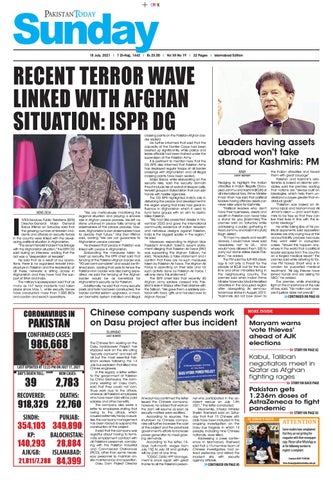
Recent teRRoR wave linked with afghan situation: isPR dg
News Desk
i
nter-Services Public relations (ISPr) Director-General Major General Babar Iftikhar on Saturday said that the growing number of terrorism incidents and attacks on security forces in the country were linked with the developing political situation in Afghanistan. “the recent terrorist incident has linkage with the Afghanistan situation,” the ISPr DG said during an interview, adding that the act was a “desperation of terrorists”. He said that as a result of our operations, there is no organised terrorist infrastructure in Pakistan and the leadership of all these networks is sitting across in Afghanistan and they have had the support of rAW and India. the military’s spokesperson said that as many as 167 terror incidents had taken place since May 1, while security forces have conducted more than 7,000 IBOs and cordon and search operations.
“We are meticulously monitoring the regional situation and playing a sincere role in Afghan peace process. We left no stone unturned in peace talks among all stakeholders of the peace process; however, Afghanistan’s own stakeholders have to decide their future,” Maj Gen Iftikhar said, adding “We are not guarantors to Afghanistan peace process.” He stressed that peace in Pakistan was linked with peace in Afghanistan. elaborating the measures taken to beef up security, the ISPr chief said that fencing of the Pakistan-Afghan border was “90 per cent complete” and would be finished soon, adding that work to fence the Pakistan-Iran border was also being expedited. He said the fencing of the Afghan border would be as beneficial for Afghanistan’s security as for Pakistan. Additionally, he said that many security posts and forts had been constructed, the border control system upgraded, a modern biometric system installed and illegal
coRonaviRus in
Pakistan
CONFIRMED CASES:
986,668
LAST UPDATED AT 12:23 PM ON JULY 17, 2021
DAY'S DEATH TOLL:
NEW CASES:
39
2,783
RECOVERED:
DEATHS:
918,329 22,760 SINDH:
PUNJAB:
354,103 349,890 KP:
BALOCHISTAN:
AJK/GB:
ISLAMABAD:
140,293
21,811/7,288
28,884
84,399
crossing points on the Pakistan-Afghan border sealed. He further informed that said that the capacity of the Frontier Corps had been beefed up significantly, while police and levies officials had been trained under the supervision of the Pakistan Army. It is pertinent to mention here that the DG ISPr also informed that Pakistan Army has deployed regular troops at all border crossings with Afghanistan and all illegal crossing points have been sealed. Major Babar, while elaborating on the security risks, said the security domain threat include risk of revival of sleeper cells, terrorist groups in Balochistan that can join hands with hostile agencies. the DG ISPr highlighted India’s role in disturbing the peace and development in the region saying that India had great influence in Afghanistan which it used to fund terror groups with an aim to destabilise Pakistan. “We had also presented dossier in november 2020 and gave the international community evidence of Indian terrorism and nefarious designs against Pakistan. India is the biggest spoiler in the region,” he said. Moreover, responding to Afghan Vice President Amrullah Saleh’s recent statement alleging that Pakistan Air Force (PAF) was supporting the Afghan taliban, he said, “Absolutely a false statement and I confirm that there are no such measures taken by Pakistan Air Force. the Afghan Air Force is operating on their side and no such activity done by Pakistan Air Force. I will only deny this statement.” the ISPr chief told that recently 40 Afghan army soldiers crossed into Pakistan’s side in Bajaur after their clashes with the taliban. “We gave them a soldierly protocol with food, gifts and handed over to Afghan forces.”
Leaders having assets abroad won’t take stand for Kashmiris: PM BAGH StAff report
Pledging to highlight the Indian atrocities in Indian Illegally Occupied Jammu and Kashmir (IIOJK) at all international fora, Prime Minister Imran Khan has said that political leaders having offshore assets can never raise voice for Kashmiris. “Political leaders who don’t have their businesses, assets and wealth in Pakistan can never take a stand for you [Kashmiris],”the premier said on Saturday while addressing a public gathering in Azad Jammu and Kashmir’s (AJK) Bagh district. “If I had my assets and wealth abroad, I could have never said ‘absolutely not’ to US… and would have allowed them [US] to carry out drone strikes inside Pakistan,” he added. the PM said the BJP-rSS ideology is not only a threat for the people of IIOJK but for the Muslims and other minorities living in the neighbouring country. the premier said when Indian Prime Minister narendra Modi intensified atrocities in the occupied region after abrogating its semi-autonomous status in August, 2019, “Kashmiris did not bow down to
Chinese company suspends work on Dasu project after bus incident IsLAMABAD Aziz Buneri
the Chinese firm working on the Dasu Hydropower Project has stopped work on the site citing “security concerns” and laid off all but the most essential Pakistani workers following the 14 July bus explosion that killed nine Chines engineers. In this regard, a letter written to the government of Pakistan by China Gezhouba, the company working on Dasu Dam, said that they could not continue work due to the attack; whereas all Pakistani employees who have been laid will be paid salaries and other benefits. the company also wrote a letter to employees stating that owing to the attack, which caused extremely heavy casualties, the company management has been forced to suspend the construction of the project. It said that the company was regretful about having to terminate employment contract with all Pakistani personnel, complying with the Pakistan Industrial and Commercial Ordinances (PICO), other than some necessary personnel to maintain onsite maintenance and operation. Dasu Dam Project Director
the Indian atrocities and faced them with great courage”. Pakistan and Kashmir’s relationship is based on Islamic principles, said the premier, adding that nations are “always built on ideologies, which help them understand a cause greater than individual goals”. “Pakistan was based on Allama Iqbal and Mohammad Ali Jinnah’s vision — and I want Kashmiris to be free so that they can live their lives in line with the Islamic ideology.” He while taking jibe at his political opponents said opposition leaders are only crying foul at the accountability process because they want relief in corruption cases. “Would this happen anywhere in the world that a political leader escapes from the country on a forged medical report,” the premier said while referring to former PM nawaz Sharif who is in London for purported medical treatment. “All big thieves have joined hands and are asking for nrO,” he added. the premier, while shedding light on the importance of the rule of law, said, “no nation can prosper if justice does not prevail.”
CONTINUED ON PAGE 05
more inside
Maryam warns ‘vote thieves’ ahead of AJK elections STORY ON PAGE 02
Kabul, taliban negotiators meet in Qatar as Afghan fighting rages STORY ON BACK PAGE
Anwarul Haq confirmed the letter issued the Chinese company; however, he added that work on the dam will resume as soon as security matters were rectified. According to sources, the shutdown by Chinese companies will further increase the cost of the project and the provincial government’s efforts to increase power generation to meet growing demands. According to the letter, 14days half-month wages from July 15′ to July 28 and gratuity will be paid at one time. “CGGC DASU HPP Management is once again with great thanks to all the Pakistani person-
nel who participated in the accident rescue on July 14th 2021,” the letter concluded. Meanwhile, Interior Minister Sheikh rasheed said on Saturday that that 15 Chinese officials have been included in the ongoing investigation on the Dasu bus tragedy in which 13 people, including nine Chinese nationals, were killed. Addressing a press conference in Islamabad, rasheed said that a 15-member team of Chinese investigators had arrived yesterday and visited the incident site with security agency officials.
CONTINUED ON PAGE 05
Pakistan gets 1.236m doses of AstraZeneca to fight pandemic STORY ON PAGE 03
in today’s issue
attention Some readers have complained that they are not getting the magazine with their newspaper copy. Please call or WhatsApp us at the following number to register a complaint. Contact: 0307-7338168 irfan.farooq@pakistantoday.com.pk
02
Sunday, 18 July, 2021
ISLAMABAD
NEWS
MAryAM wArns ‘vote thieves’ AheAd of AJK eleCtions
P
News Desk
AKISTAN Muslim LeagueNawaz (PML-N) Vice President Maryam Nawaz on Saturday warned “vote thieves” against attempting to steal the upcoming election in Azad Jammu and Kashmir (AJK) scheduled to take place on July 25. According to a report by Dawn, Maryam, while addressing a campaign rally in AJK’s Islamgarh, said: “Remember [this] vote thieves, if you steal the election, then the Kashmiris won’t let it slide. This is not 2018 […] when you stole the election and the PML-N silently accepted it. She recalled the by-election in the Daska (NA-75) constituency that was marred by violence, rigging and the disappearance of over 20 presiding officers and warned that the party will react to such a situation. “This is no longer that same PML-N. This is the PML-N from Daska, which caught vote thieves during the fog and presented them before the people.” “I warn vote thieves who are lurking, waiting for the AJK election. If you try to stop the PML-N, try to change [ballot] boxes and change the results, then
something very bad is going to happen,” Maryam said. The PML-N vice president called upon the people to protect their votes. Addressing the crowd, she told the people to wait at the polling stations until they receive authenticated results on polling day. Maryam claimed that the PML-N had already won the election and the people of AJK had made the decision in the party’s favour. “I promise you that there will be a [new] dawn of development in AJK on July 26.” She also called upon the people to refrain from voting for those who had turned their backs on the party. “Those who can’t be loyal to their political party, can’t be loyal to the nation.” Addressing the prime minister’s visit to Bagh for the PTI’s election campaign, Maryam claimed he was going there “because he has found an ATM there, a very rich person. That is why he (Prime Minister Imran Khan) is starting his election campaign from there. Just like flies gather on honey, Imran Khan goes to those with money in their pockets.” The PML-N leader also spoke about
the recent Dasu bus tragedy, saying it was a “moment of shame” that the Chinese who had come to the country for development project’s were now coming to Pakistan to investigate such an incident. “Imran Khan when you give NRO to
The Foreign Office on Saturday said that the culprits behind an incident involving the daughter of the ambassador of Afghanistan to Pakistan are being traced to be brought to justice. The daughter of Afghanistan Ambassador to Pakistan Najibullah Alikhil was “assaulted” and “manhandled” by unknown persons while riding a rented vehicle in Islamabad on Friday, said a statement issued by the FO, quoting the spokesperson, Zahid Hafeez Chaudhri. According to the statement, immediately after the disturbing incident was reported, the Islamabad Police launched a thorough investigation. “The Ministry of Foreign Affairs and relevant security authorities are closely in contact with the ambassador and his family and extending full support in the matter,” the statement added. It said the security of the ambassador and his family had been beefed up, adding that law enforcement agencies were “trying to trace and apprehend the culprits to be brought to
justice”. “It is reiterated that the safety and security of the diplomatic missions, as well as the diplomats and their families, is of utmost importance. Such incidents can and will not be tolerated.” Meanwhile, the Afghan foreign ministry said the ambassador’s daughter was “abducted and tortured” before being released. In a statement issued on Saturday,
Afghanistan demanded Pakistan “to identify and prosecute the perpetrators at the soonest possible time”. “The Ministry of the Foreign Affairs of Afghanistan states with deep regret that on July 16 the daughter of the Afghan Ambassador to Pakistan, Silsila Alikhil, was kidnapped and tortured before being released. Foreign ministry condemns the act,” the statement said.
MUZAFFARABAD AnAdolu Agency
Asim Saleem Bajwa and make him CPEC in-charge by appointing him on a salary of Rs3-4 million and keep all your attention on enmity with Nawaz Sharif, then terrorism incidents are bound to happen in Pakistan,” she said.
Afghan ambassador’s daughter ‘assaulted’ in Islamabad: FO News Desk
Caste, ethnic loyalties decide poll favourites in AJK
The Afghan foreign ministry added that it “expresses its deep concern over the safety and security of diplomats, their families, and staff members of the Afghan political and consular missions in Pakistan.” It urged the Pakistan “to take immediate necessary actions” to ensure full security of the Afghan embassy and consulates as well as immunity of the country’s diplomats and their families in accordance with international treaties and conventions. “We urge the Pakistani government to identify and prosecute the perpetrators at the soonest possible time,” the Afghan ministry said. PM orders for arrest of abductors within 48 hours: Meanwhile, Prime Minister Imran Khan directed Interior Minister Sheikh Rasheed to utilise all resources to apprehend the persons involved in the kidnapping. The premier further directed the interior minister that Islamabad police and other law enforcement agencies must investigate the incident on top priority, bring up the truth of the matter and apprehend the culprits within 48 hours.
Unlike the comparatively homogeneous nature of Indian Illegaly Occupied Jammu and Kashmir across the Line of Control (LoC), Azad Jammu and Kashmir (AJK) is vastly heterogeneous, inhabiting scores of ethnicities, locally known as biradaris. As the election fever picks up in the region, which is electing the regional assembly on July 25, the loyalties to their own biradaris reign supreme in the minds of voters. Sitting on the road just some miles away from the LoC, Khawaja Usman says that he will vote for the same candidate whom he had voted in the past two polls. His favorite candidate switching loyalties from Pakistan Peoples Party (PPP) to Pakistan Tehreek-e- Insaf (PTI) led by Prime Minister Imran Khan does not matter to him. What propels him to stick his loyalties to a particular candidate is that he belongs to his Khawaja baradari or community. Usman still has a soft corner for the PPP, but since the candidate has switched to PTI, he will also switch his vote. Six major castes or biradaris, Gujjar (Chaudhry), Sudhan, Rajput, Syed, Khawaja, and Awan have been dominating the political scene in the region. Political parties have distributed mandates among representatives of these castes depending on the concentration of their populations in the particular constituencies. “He (candidate) is not only a longtime friend but also hails from my caste. Whereas, his rival candidates, are little-known to me,” said Usman, adding that he has no emotional affiliation for the PTI as he had for the PPP. “My vote is simply for a friend and a person from my biradari (community). I can’t leave him, although I am not happy with his decision to change the political loyalty,” he said. Zameer Awan, a resident of Ghari Dupatta town located some 22 kilometers from the main city of Muzaffarabad, is also supporting a candidate belonging to his biradari. “I will vote him wherever he goes. I don’t care which political party he joins or leaves,” said Awan, while pasting a poster of his favorite candidate on the backside of his auto rickshaw. “He is easily accessible to us because he also knows that he can’t win without the support of Awans (his caste),” he added, smiling. Gujjars dominated the outgoing assembly: In the outgoing state assembly, over a dozen lawmakers are Gujjar, the largest caste in AJK. “These politicians know the power of their respective biradaris. Therefore, they don’t hesitate to join the party, which has brighter chances of coming into power,” said Sajjad Mir, a Muzaffarabad-based political analyst. Citing the example of Chaudhry Shehzad, who served as a minister in the incumbent government of the Pakistan Muslim League (Nawaz) headed by three-time Prime Minister Nawaz Sharif until last month, Mir said he left the party and within two hours got the PTI ticket. “He knows his biradari will support him in any case,” he said. According to Gulzar Usmani, another Muzaffarabadbased political analyst, since political parties have fielded candidates from the same community against each other, the votes of dominant biradari will split.
Coronavirus kills 39, infects 2,783 in a day: NCOC
News Desk Thirty-nine deaths due to the coronavirus and 2,783 positive cases of the infection were reported in the
country during the last twenty-four hours, said the National Command and Operation Centre (NCOC) on Saturday. According to the NCOC statistics, 49,247 tests
were conducted while the positivity ratio remained 5.65 percent. The death toll due to the pandemic has now reached 22,760. The total number of coronavirus cases in Pakistan since the pandemic began has risen to 986,668, while the number of active cases in the country has increased to 45,579. As far as the recoveries are concerned, 918,329 people have recovered from the infection in total, while 22,759 have succumbed to the virus so far. Sindh has reported at least 1,359 new coronavirus cases over the last 24 hours, taking the tally to 355,445. Chief Minister Murad Ali Shah said in a statement that Covid-19 death toll reached 5,702 after five more patients succumbed to the virus overnight. As many as 320,215 patients have also been recovered from the disease so far, he added. At least 415 new coronavirus cases were recorded in Punjab during the past 24 hours, taking the provincial tally to 349,890. According to the Punjab Primary and Secondary Health Care Department, at least 9 more patients succumbed to the pandemic as the total death count reached 10,865. The department added that at least 329,478 patients had recovered from the deadly virus as of yet, with 134 people recovered in the past 24 hours. At least five more patients succumbed to coronavirus during the past 24 hours, lifting the death
toll to 4,385. According to health officials, the province reported 265 new cases as the tally reached 140,560. As many as 70 patients recovered overnight in the province, taking the total to 134,044. Earlier this week, Special Assistant to the Prime Minister on Health Dr Faisal Sultan said the upcoming Eid-ul-Azha festival will be celebrated in a “limited, closed” environment, hinting at more restrictions to curb the virus spread amid fears of a fourth wave. The minister was talking about the spike in coronavirus cases and the measures being taken by the federal government. He spoke about the new Delta variant of the coronavirus, saying that the mutations in each new variant of the virus make it very easy to “jump from one person to another”. This variant is spreading at a pace of 50-60 percent, he said. On Tuesday last, Federal Parliamentary Health Secretary Dr Nausheen Hamid had revealed that the Delta variant of the coronavirus — which first emerged in India — is now making up a whopping 50 percent of the total infections in Pakistan. The lawmaker said the Covid-19 vaccines that Pakistan is administering are effective against the Delta variant. Dr Hamid highlighted that no vaccine in the world is 100 percent effective against the Delta variant, however, if a person gets the jab, the virus will not affect their health badly.
Sunday, 18 July, 2021
ISLAMABAD
PakiSTan geTS 1.236M doSeS oF aSTraZeneca To FighT PandeMic NEwS DESk Pakistan on Saturday received 1,236,000 doses of Covid19 vaccine AstraZeneca through COVAX. Sameh Elfangary, Country President for GCC and Pakistan, AstraZeneca, said: “I was delighted to see the arrival of further doses of Covid-19 vaccine AstraZeneca to Pakistan. This is wonderful news for the people of Pakistan. On behalf of AstraZeneca, I would like to thank our partners at COVAX for making this possible,” said a statement. He said that all partners are working round the
clock to ensure that as many Covid-19 vaccines can get to as many people as soon as possible. This milestone further demonstrates the value of governments, industry and others working together to fight against the pandemic, he added. He said that AstraZeneca is committed to providing the vaccine broadly and equitably across the globe, at no profit during the pandemic. He said Covid-19 vaccine AstraZeneca has helped save tens of thousands of lives and prevent thousands of hospitalisations since the start of this year. To date, nearly 700 million doses have been released for
Sindh amends police rules NEwS DESk
NEwS DESk The Sindh cabinet also gave a goahead to the appointment of Advisor to the Chief Minister on Law and Environment Murtaza Wahab as the new administrator of the Karachi Metropolitan Corporation (KMC). The provincial cabinet met in Karachi with Chief Minister Syed Murad Ali Shah in the chair to review the pace of development schemes, besides other agenda. Murtaza Wahab, who is also the Sindh government’s spokesperson, has been entrusted with
an uphill task to revamp the port city’s ill-maintained civic infrastructure. The Sindh cabinet was informed that an amount of Rs329.02 billion has been earmarked for development schemes in the province. Speaking on the occasion, the chief minister said that 603 development schemes will be completed in the first quarter of the current financial year at the cost of over Rs14 billion. He directed the cabinet members to pay attention to the timely completion of development schemes. He said 269 development schemes costing over
Rs19 billion will be completed in the second quarter of the current financial year, while 162 schemes at a cost of over Rs10 billion will be completed in the third quarter of the financial year. It is worth mentioning that two major political parties, including the Pakistan Tehreek-e-Insaf (PTI) and the Muttahida Qaumi Movement (MQM), have already expressed their opposition to the possible appointment of Murtaza Wahab as the Karachi administrator. Sindh Governor Imran Ismail said that a meeting had earlier been held at the Sindh Governor House in the presence of the prime minister and military leadership, in which it was decided that the administrator would be an apolitical person and his appointment would be made after consultations with all stakeholders. MQM-P Convener Dr Khalid Maqbool Siddiqui categorically rejected the provincial government’s decision about appointment of Murtaza Wahab on the post. He maintained that the Sindh government had not consulted his party over the matter. He maintained that the Muttahida Qaumi Movement (MQM) will not accept Murtaza Wahab as Karachi Administrator. The MQM-P leader also hinted at taking out mass rallies against the Sindh government.
Rains kill 17 in Balochistan: Langove QUETTA TLTP
The recent spell of monsoon rains has claimed at least 17 lives and uprooted hundreds of people from their hometowns in Balochistan. “The Provincial Disaster Management Authority [PDMA] in Balochistan has been working with district administrations to rescue people stranded in floods,” said Meer Zia Langove, Balochistan Minister for Forest and Wildlife, on Saturday. The PDMA is also trying to provide people with necessary relief items as quickly as possible, said Langove. “Following the monsoon prediction of the Met Office, we released Rs113 million to deputy commissioners to ensure they prepared for rescue and relief operations,” he continued. “Our heavy machinery and staff
03
supply to 170 countries worldwide, and AstraZeneca’s Covid-19 vaccine accounts for approximately 90 percent of COVAX supply to date, with more than 80 million doses released for supply to 127 countries. COVAX, co-led by the Coalition for Epidemic Preparedness Innovations (CEPI), Gavi (the Vaccines Alliance), and the World Health Organisation, is a global initiative that works with governments and manufacturers to ensure Covid-19 vaccines are available worldwide to both higher-income and lowerincome countries.
Sindh cabinet appoints Murtaza Wahab as Karachi administrator
The Sindh cabinet has approved an amendment in the Police Rules 1934 with a view to stop police officers from making arrests merely on account of the registration of a First Information Report (FIR), Geo News reported. The amendment was approved in a meeting of the cabinet chaired by Chief Minister Sindh Syed Murad Ali Shah at the Chief Minister House on Saturday. The meeting was attended by provincial ministers, advisors, chief secretary and other concerned officers. The amendment means police officers will have to collect credible evidence of involvement of the suspects in the crime and seek approval from the senior police officer before making any arrests. "This amendment will guard against the arrest of innocent people and will also reduce the burden on the courts," the police officials said. They said that a court ruling also exists which states that an arrest need not be made in every case when an initial probe is underway. With the amendment, even the police will not be able to abuse their powers, senior police officials said. The senior officers said that currently, police "sections" are being formed, after which the rule will come into effect. "A proposal has also been made to make some cases bailable," they said. Other important decisions were also made in the cabinet meeting which include the handing over of four Karachi Municipal Corporation hospitals to the health department, procurement of retro-reflective number plates for vehicles, reduction in cotton fee collected by the excise and taxation department, and a bill for the protection of medical workers. Regarding the outlay of the development budget for 2021-22, the cabinet was told that it has been pitched at Rs329.02 billion which includes Rs222.50 billion for the provincial Annual Development Programme, Rs71.16 billion for Foreign Project Assistance and Rs5.36 billion for federal PSDP grants.
NEWS
are currently engaged in the affected districts,” he added. He said that PDMA and local administration have distributed food supplies along with tents and blankets among the rainaffected people. The Met office had forecast heavy downpour and possible floods in the province on July 9, saying the seasonal rain spell is likely to continue for about two weeks. As monsoon began, it damaged hundreds of mud houses in Balochistan where several districts reported wall collapse incidents. Several districts, including Sorab, Sibi, Chaghi, Kohlu and Zhob, have been affected by heavy monsoon rains since the rough weather system entered Balochistan. Floods and heavy rains accompanied by windstorms have partially damaged the Pak-Iran international railway track while the runway at the Dalbandin Airport has also been inundated.
President joins TikTok to spread positivity, motivate youth
ISLAMABAD TLTP
President Dr Arif Alvi has created an official account on Chinese-owned popular video sharing app, TikTok, to spread the message of positivity and motivation among the youth of Pakistan. “The President of Pakistan is now on TikTok. To spread the message of positivity and motivation for the youth of Pakistan, we will keep pushing inspiring videos for the TikTok users,” read the statement posted on President of Pakistan official Twitter handle. “I am a dreamer of Pakistan who sees a ray of light in everything... take interest this is your country to build,” the president said in a video message posted on the official handle. The president joined the TikTok days after the Sindh High Court (SHC) banned the popular video sharing platform over "immoral content" and for celebrating "LGBTQ-Pride Month". Later, the SHC ordered the Pakistan Telecommunication Authority (PTA) to unblock the popular video-sharing site TikTok after the internet and telecommunication regulator assured the court that it will take a decision on the complaint of the petitioner. President Alvi has also created separate social media accounts on micro-blogging websites Twitter, Instagram and Facebook.
PM’s Tashkent visit laid foundation of economic, strategic ties: Fawad
Mountaineer Nazer Sadpara pays tribute to Shiraz Nasir NEwS DESk Mountaineer Nazer Sadpara has paid tribute to Shiraz Nasir (late) after reaching the camp three of Broad Peak, the twelfth highest mountain in the world at 8,047 metres above sea level, Pakistan Today learnt on Saturday. Shiraz, a Lahore-based paraglider, had died in Dolomos area in Chitral when turbulent weather had made his glider collapse mid-air. Local residents had said that Shiraz, 40, was flying from Moghlasht to Charira in his glider when it had fallen from high altitude due to stormy winds. Nasir’s backbone was fractured
due to the impact and was rushed to DHQ hospital but he had unfortunately succumbed to his injuries on the way. Nasir was the son of Major (r) Shahid Nasir and television actor Sumbal Shahid, and a nephew of popular TV artist Bushra Ansari. Shiraz was one of the first persons in Pakistan to introduce the idea of taking groups of people on mountainous expeditions towards the North. He was a pioneer in the tour operating industry of Pakistan and was the founder of Adventure Travel Pakistan (ATP), which is one of the most successful tour operating companies in the country.
NEwS DESk Federal Minister for Information and Broadcasting Fawad Chaudhary has said that Prime Minister Imran Khan's visit to Uzbekistan has laid a strong foundation of economic and strategic relationship with the Central Asian state. In a tweet on Saturday, the information minister said that Peshawar-Tashkent train and road network will improve connectivity and link the China-Pakistan Economic Corridor (CPEC) with Europe. The information minister said, “We are also grateful to the people and government of Uzbekistan for the affection and respect they gave to Prime Minister Imran Khan.”
Sunday, 18 July, 2021
04 newS
iSlAmABAD
CAr PriCes go down Following CuT in duTies, TAxes KARACHI
C
TLTP
AR prices go down in the country following reduction in duty and taxes, and the latest reduction in price was announced by Malaysian company Proton. Other car companies Toyota, Suzuki, Honda, Kia and Changan have already reduced car prices following the recent steps taken by the government. The Proton has reduced Saga prices by Rs50,000 and now its cheapest variant will be selling for Rs1.925 million. The X70 prices have been reduced by Rs100,000. Its standard variant will now be selling for Rs4.59 million. The highest change as the car companies reduced car prices in the country was seen in the Toyota Fortuner VVTi, which has seen a price decrease of Rs400,000. Previously the SUV was selling for Rs9.3 million. It can now be bought for Rs8.9 million. Hilux
Revo all variants saw a price decline of Rs120,000. Yaris and Corolla variants saw a price decline between Rs100,000 and Rs120,000. Suzuki’s top selling car Alto price has been reduced by Rs85,000 for its lowest variant to Rs112,000 for Alto’s top variant. Alto’s standard variant can now be bought for Rs1,113,000. Wagon-R saw the biggest price decline for the company with Rs130,000. Kia has reduced Picanto’s price by Rs118,000. The hatchback’s basic variant can now be bought for Rs1,781,000. Kia Sorento’s top variant saw a price decline of Rs196,000. The SUV can now be bought for Rs8,203,000. Honda reduced Civic’s Turbo variant price by Rs135,000. The sedan’s new price is Rs4.56 million. The other two Civic variants' prices have been reduced by Rs115,000. Civic 1.8 and Civic 1.8 Oriel will now cost Rs3.61 million and Rs3.86 million, respectively. BRV’s price has been
reduced by Rs105,000; its new price is Rs3.37 million. Changan Alsvin variants' prices have
seen a price decrease of around Rs60,000. Alsvin’s top variant Lumiere is now priced at Rs2.59 million; two basic manual and au-
tomatic models are priced at Rs2.15 million and Rs2.4 million, respectively. The minivan Kaarvan variants price has been reduced by Rs100,000. Karvaan Plus is now priced at Rs1.54 million and the basic model is priced at Rs1.4 million. The government decided to reduce the Federal Excise Duty on all vehicles even above 1,000cc by 2.5 percent. Sales tax has been reduced on vehicles below 1000cc from 17 percent to 12.5 percent. Meanwhile, 7 percent additional customs duty has been removed on cars below 1000cc and reduced on cars above 1000cc to 2 percent. A 2.5 percent FED was applied on cars below 1000cc; 5 percent was imposed on cars below 2000cc and above 1000cc; and 7.5 percent on cars above 2000cc. All these categories will now see a price decline of 2.5 percent. This means 1000cc and below cars will have no FED. Cars above 1000cc but below 2000cc will have a FED of 2.5 percent, and cars above 2000cc will have a FED of 5 percent.
LAHORE: A view of a cattle market in the provincial capital. ONLINE
ADB to promote, incentivise private sector financing for SDGs ISLAMABAD KASUR: NTDC MD Engineer Mohammad Ayub and PMLTC CFO Wang Bao plant trees at HVDC Converter Station near Balloki.PR
Pak-China FTA gives revival hope to carpet industry
TLTP
Achieving the sustainable development goals (SDGs) will require large amounts of private capital, and Asian Development Bank (ADB) will step up to the plate to promote and incentivise private sector financing for the 2030 Agenda in the Asia Pacific region. This was stated by different economists of ADB at the series of webinars on ‘SDG Dialogues: Private Investments
in the SDGs.’ The ADB’s second SDG Dialogue explored the drivers of private sector investment in the SDGs and opportunities to channel investment to SDG related sectors. The discussion focused on: how private investors are taking on the SDG financing challenge; opportunities to scale up private sector investing for the SDGs in Asia and the Pacific; and the ADB’s work in promoting and incentivising private sector financing in the SDGs in the region. The speakers said that even
though private sector interest and focus on SDG aligned investment has surged, more needs to be done to ensure it reaches the levels needed to get the region back on track to achieve the 2030 Agenda. They said the imperative to create new incentives to direct private investment to support the Sustainable Development Goals (SDGs) has never been clearer. They further said The Covid-19 pandemic has threatened progress on
ISLAMABAD TLTP
China and Pakistan have included handmade carpets to its free trade agreement (FTA) to boost exports of Pakistan’s carpet industry, which employs thousands of women. Riaz Ahmed, the vice chairperson of Pakistan’s Carpet Manufacturers and Exporters Association told a private news channel that the carpet sector had “hit rock bottom due to many trade-related challenges.” In 2015, Pakistan’s exports of handmade carpets dipped from $300 million to $68 million due to rising freight fares, soaring tax duties, customs clearance and warehouse expenses. As a result, thousands of women, who worked as daily wagers, lost their jobs. As per Ahmed, 70 percent of the labour force of the hand-knotted carpet industry are women. But now, with the inclusion of hand knotted carpets in the China-Pakistan Free Trade Agreement, 313 export items will get duty-free access to China’s $2 trillion import market. “Pakistan is a huge handmade carpet manufacturing market in the region,” Ahmed said, “Its cheap labour costs are attractive for Chinese investors.”
Pakistan's entire coastal belt to be made clean and green: Bajwa NEWS DESK The China-Pakistan Economic Corridor (CPEC) Authority Chairman Lt Gen (r) Asim Saleem Bajwa has said that the entire coastline of Pakistan – an area of over 1,000 kilometres – would be made clean and green under the vision of Prime Minister Imran Khan. In a tweet on Saturday, Bajwa said, “Investment in Green Gwadar is just the beginning, now we are working on a coastal plantation project in line with the PM’s vision of Clean
and Green Pakistan.” Sharing a video about Gwadar Green House Nursery, he said, “It’s a revolution in the making for the entire 1,000 km coastal belt”. Since coming into power in 2018, the Pakistan Tehreek-e-Insaf (PTI) government has introduced multiple campaigns and drives to combat climate change, including the Billion Tree Tsunami and Clean and Green Pakistan. Earlier this month, the premier said that the billion tree campaign was yielding incredible results as he posted a short video of the bar-
ren hills in Swat which have turned green. "Matta in Swat Barren hills turning green. Incredible results from our Billion Tree Tsunami campaign in Khyber Pakhtunkhwa," the premier said on Twitter "InshaAllah we will leave a clean and green Pakistan for future generations," he added. On June 27, the premier urged the nation to gear up for "the biggest tree planting campaign in our history". "I want all Pakistanis, especially our youth, to gear up for the biggest tree planting campaign in our history.
the SDGs across all countries, and added to existing financing gaps for the 2030 Agenda, especially in developing countries. They said that achieving the SDGs requires steering private capital towards investments that can advance progress on the goals. They said that private sector interest and focus on SDG aligned investment has surged, including new financial mechanisms in response to the Covid-19 pandemic.
Sunday, 18 July, 2021
06 COMMENT
Deserving? or not?
All eyes on Doha talks The USA retains a low-profile presence
T
he Ashraf Ghani government, which fought the Taliban with the military support of the USA and its allies, knows well that with the foreign troops leaving the country it may not survive beyond a few months . After the consecutive defeat of two superpowers in Afghanistan, no country in the region is willing to get on the wrong side of the Taliban. The Taliban however know that while they may take over Afghanistan they cannot build a war-torn country without international assistance. The powers the Taliban have to deal with are all agreed that Afghanistan has to be in peace with itself, pose no threat to its neighbours and provide no shelter to terrorist groups. This can happen only if there is an inclusive government in Afghanistan representing all major parties. The Doha talks are the last effort to reach a consensus. The Taliban insist upon the enforcement of Sharia in the country. What constitutes Sharia is to determined by the “muftis” or scholars in Islamic jurisprudence, so they contend The Taliban have to specifically explain whether they will abide by basic human rights and treat all ethnic and sectarian groups equally and allow women to study and work. Some of the reports about the areas under Taliban control indicate that the Taliban still follow a strict interpretation of Sharia as practised under Mullah Umar. The neighbouring countries also want the Taliban to ensure that they would neither interfere in their internal affairs nor attempt to export their narrow views or support terrorist activities. Making the best of a bad situation, the USA is back in the game through the recently created PakAfghan-Tajikistan-US Cooperation Group. The Group aims at regional connectivity and long-term peace and stability in Afghanistan. What the Group will achieve in coming months and years besides cooperation to expand trade, building transit links, and strengthening business-to-business ties remains unclear. As far as the Pakistan government is concerned, the Group is part of its attempts to seek a long term relationship with the USA. Pakistan’s ill-timed attempt to convene a three day Afghan Peace Conference has failed as concerned parties are rushing to Doha where vital decisions are expected. Afghanistan’s future may have little hope for peace if the negotiations do not succeed.
Fighting against the Taliban mindset
rabia ahmed
S
ex and gender are the perspectives from which most things are judged in a society like Pakistan’s. And since women are the weaker gender, they are subject to a host of compulsions, frequently against the law, no problem: they can be married against their wish, they must not work (except of course when they must, when they are grudgingly allowed), they must muffle themselves up in unnecessary garments regardless of the heat, and a whole myriad of musts; later they must not, God forbid, promote rights and independence for other women. And that is what Malala Yusufzai came up against, as did the OUP when it included Malala’s name in a book that contained a list of national luminaries, and in which her photograph was printed next to that of Major Aziz Bhatti Shaheed of the Pakistan Army. A brave man, Aziz Bhatti Shaheed, one to whom the nation owes a heavy debt of gratitude for his courage and ultimate sacrifice. May the Almighty reward him. The question most frequently asked is: what gives Malala the right to be included among that list of illustrious people? What has she done to earn it? As much as any other person who stands in the path of danger for the sake of the country and others,
Inflation rages on By removing the subsidy it makes to a wide range of consumer goods, the government in essence substantially jacked up the price of those goods in the open market. That decision was taken by the Cabinet Committee on the economy, but there seems no reason why it should not sail through the full Cabinet. The committee’s decision to restart trade with India was reversed but this time around, as only the Pakistani consumer will suffer, thew Cabinet is not likely to step in. The subsidy to Utility stores goods is how the government intervenes in the setting of prices for the ordinary man, even for the many who do not shop at utility stores. however, utility store subsidies cost money, which is something the IMF is deadly against,as the money should not go to subsidizing goods, but to servicing the debt. The rise the same day in the fuel price will have its usual inflationary effects. It will increase the price of transporting goods, and will do something for the IMF that Finance Minister Shaukat Tareen had sais would not happen: a hike in electricity tariffs. It may be argued by PTi apologists that world prices are rising, and the prices paid by the consumer have to rise accordingly. however, the PTI’s economic model, on which it had campaigned so successfully at the last election, stands disproved. The rulers are honest, while corruption is excluded. The wheat and sugar scandals showed that economic decisionmaking can still be skewed. The high turnover of Finance Ministers indicates that the PTI has still not mastered this part of governance. It could be argued that the failure to bring about accountability had caused the failure to handle the economy, but it could also be argued that the super-clean administration had made decisions favouring some, and making the Pakistani consumer suffer, just as he will after the latest round of hikes, which will not only raise the cost of living directly but also have a knock-on effect that will pu a daqmpener on eid festivities.
Practically there is no remedy for wrongful conviction
Shehryar amin
T
he strength of a strong criminal justice system is to prove the accused guilty beyond reasonable shadow of doubt and till then, he would be considered innocent. But this is not the case in most of the developing countries, including Pakistan. Wrongful convictions could be in the circumstances where individuals are detained without any charge against them, charged before trial and whose conviction has been subdued on request. Unlike other countries, In Pakistan, a wrongfully convicted person acquitted after a lengthy trial also does not have a statutory right to compensation. howeverAlthough, there are three legal documents that are worth mentioning for compensation: section 250 of the Criminal Procedure Code , the Constitution of Pakistan 1973 and filing a tortious claim against liable parties under the law of torts. These documents are relevant because each of them has recognized the importance of compensating the victims of a miscarriage of justice. Pakistan became a signatory in 2008 of a United Nations treaty called the International Covenant on Civil and Political Rights 1966 which guarantees compensation for those who are wrongfully convicted according to law. But practically, there is no such implementation of the above rules
Dedicated to the legacy of the late Hameed Nizami
Arif Nizami Editor Managing Editor
Joint Editor
Umar Aziz Executive Editor
Lahore – Ph: 042-36300938, 042-36375965
It would seem that we need more Malalas, not less. It would also seem that our PTCB needs to sort its values out, and if it must exist it should clamp down on its insecurities
A crying shame
Making price hikes worse
Yousaf Nizami Aziz-ud-Din Ahmad
the child Malala stood up to the Taliban with her demands for education for women at a time when they, the Taliban, were shutting down schools for girls in Swat. With the support of her parents, the young girl gave speeches supporting education for women, and became a blogger under a pseudonym, reporting on the condition of women under the Taliban. She was unlucky enough to be exposed and became a target for terrorists. Malala, as much as any other person who actually lost their life in the process, almost lost hers when at the age of just 14, she was shot in the face for her crimes; if the man who shot her had anything to say in the matter, she would have lost it. Clearly, the Amighty had other plans for her. That she and her family escaped to Britain was not a choice, it was a necessity when it was not possible to treat her injuries as well in her home country, and when it became clear that this was not the safest place for the family to be. She was nominated for the International Children’s Peace Prize, she won Pakistan’s National Youth Peace Prize, and 12 July (her birthday) is now officially Malala Day. She has also been awarded the Sakharov Peace Prize for Freedom of Thought in acknowledgment of her work, just before receiving the Nobel Peace Prize simultaneously with the Indian child rights activist, Kailash Satyarthi. Malala is the youngest person in the world to receive the Nobel Peace Prize for her efforts to win the right to education for every girl, particularly in societies where it is often denied. After that, in 2017 she was appointed the UN Messenger of Peace to promote female education, which is one of the UN’s highest honours. All through this time, Malala has continued to support her cause for the right to education for girls. She has spoken about it, and written about it. her support has not been an idle matter.
I
Karachi – Ph: 021-35381208-9
I
In 2013, Malala and her father launched the Malala Fund, which strives to ensure that girls around the world have access to 12 years of free, safe, quality education. The countries that have priority for the purposes of this fund include Afghanistan, Brazil, India, Lebanon, Nigeria, Pakistan and Turkey, where girls are most likely to miss out on secondary education. For those– surprisingly many– people who criticize Malala, there is this question: how many people have won as many accolades and achieved as much for her country and women in general, even before the ripe old age of 24? have you? But this fact of Malala being considered unworthy of praise is only one of the issues raised by the episode when Malala’s name was included in a book published by the OUP. When this happened a team belonging to the PTCB, the Punjab Textbook and Curriculum Board, walked into the OUP bookshop and confiscated these books, and conducted raids across the city to confiscate them wherever else they were being sold. Censorship is almost always a futile exercise, and it is definitely always based on some particular group’s version of what the public has a right to read. And clearly, it is not always run along sensible guidelines. Such censorship may be understandable if a publication is promoting violence, or murder or treason, or other dangerous activities. But for adding Malala’s photograph to a book of luminaries…? The mind boggles at the intellect of persons entrusted with policing our reading. All this takes place, please note, while the Taliban are set to stage a comeback in Afghanistan. They have already taken over the area on the Afghan side of Chaman on the border between Pakistan and Afghanistan, with a letter to the local imam that states, according to a resident of the district, that women must not go to the bazaar without a male companion, and men should not shave their beards. It would seem that we need more Malalas, not less. It would also seem that our PTCB needs to sort its values out, and if it must exist it should clamp down on its insecurities.
and treaty. A very famous case e of wrongful conviction of Rani Bibi should be enough to depict the current position of where the criminal justice system stands. it is an eye-opening case in which Rani Bibi was acquitted after spending 19 years in prison. even after the miscarriage of justice, she received no compensation and imprisonment of almost two decades ruined her teenage and youth years in jail without any crime. This is not just about Rani Bibi, but thousands of other innocents are facing the same and they are not in any record of being reported. In a recent report of Media for Transparency, there is no data available in Pakistan for the wrongful conviction cases. As far as fundamental rights of an individual under the Constitution are concerned, Article 4 of the Constitution rules the right of individuals to be dealt with by law. Article 9 further talks about the right to life and liberty and Article 10 is regarding the safeguard as to arrest and detention. A study by the Foundation for Fundamental Rights found that almost 78 percent of the death sentences overturned by the Supreme Court of Pakistan were upheld by the lower courts. According to an estimate, over one-third of Pakistan’s death row inmates might be completely innocent. But, even if they are innocent, the appeals process to overturn their sentences might take a decade to complete and that’s why it is said that delayed justice is denied justice. The question which is always raised is who will be responsible for the injury or loss (socially, emotionally and economically) suffered to an individual due to errors in the justice system. Society does not accept the person warm-heartedly even if he is proven innocent. Miscarriages of justice occur daily through negligence or malfeasance at all levels of the criminal justice system, from police to prosecutors, jail offi-
Islamabad – Ph: 051-2204545
Rabia Ahmed is a freelance columnist. Read more by her at http://rabia-ahmed.blogspot.com
cials and judges in Pakistan. Crime scene investigation is a prime tool in the investigation but the local police in Pakistan are not fully equipped and trained enough to collect evidence where the alleged incident took place, and the poor handling of evidence leads to a negative impact on the final verdict. False testimony or perjury is also a gigantic issue, causing hurdles for access to justice. Under the Pakistan Penal Code, giving wrong testimony during judicial proceedings can make one liable for imprisonment of up to seven years. Unfortunately, it does not have any effect as implementation is not there and wrongful testimonies are being heard on a daily basis in courts, leaving the life of the accused to be in the hands of the witness to decide his future. A number of accused cannot appeal against the punishment or defend themselves just because they are not financially strong enough to hire a counselor for themselves. Therefore, legal aid should be given to those persons to defend and prove themselves innocent. The attorney incentivized by the government must be experienced enough to lead his client with full capacity. Investigation-related procedures need to be upgraded with technology, and different techniques and training courses should be organized for the police to collect evidence on the crime scene efficiently. A judicial mechanism to hear the appeal of the accused against the conviction is also of paramount importance to be heard with immediate effect, steadily and in an effective manner, so the victim may be able to prove his unlawful detention swiftly. Another thing that is needed at the moment to make the system prevent these loopholes is to launch an awareness campaigns among the masses so they know their rights under the Constitution and other substantive laws to save them from these misapprehensions. Also, strong urgency and efforts are required to make the whole justice system abide by international standards substantively and procedurally.
A judicial mechanism to hear the appeal of the accused against the conviction is also of paramount importance to be heard with immediate effect, steadily and in an effective manner, so the victim may be able to prove his unlawful detention swiftly
I
Web: www.pakistantoday.com.pk
I
The writer is a Law Student, studying at the University of London.
Email: editorial@pakistantoday.com.pk
Sunday, 18 July, 2021
COMMENT 07 Editor’s mail Send your letters to: Letters to Editor, Pakistan Today, 4-Shaarey Fatima Jinnah, Lahore, Pakistan. e-mail: letters@pakistantoday.com.pk Letters should be addressed to Pakistan Today exclusively
No jobs for the poor
Afghanistan on the brink The only way forward is the Taliban way
Candid Corner raoof haSan “I am tired and sick of war. Its glory is all moonshine. It is only those who have neither fired a shot, nor heard the shrieks and groans of the wounded who cry aloud for blood, for vengeance, for desolation. War is hell.” –William Tecumseh Sherman
W
AR, they say, is hell. Imagine people who have suffered it for over 40 years as it drags on without an end in sight. They will possibly give hell a different meaning which others would neither be able to comprehend, nor associate with. Afghanistan and its people are the victims of this seemingly endless war which has raged ever since the Soviets first attacked the country. There has been no respite as this savage conflict has uprooted generations of Afghan people, a large number of whom have taken shelter in the neighbouring countries including Pakistan where over 3 million refugees are still residing with no chance of them going back to their homeland. That, by itself, is a harrowing tragedy which those who have never been refugees would not be able to understand or empathise with. Afghanistan has been on the brink for a long time. There has been war dating back to four decades ago which has left behind massive swathes of devastation, and there is war in front stretching into an immeasurable future with potential to inflict irremediable ruination and suffering. There are mountains of uncertainty to contend with as one bloody day gives way to another. For the Afghans, life has a meaning which is perpetually soaked in blood. There is virtually nothing else they can look forward to. More than the ravages of the war, it is the absence of human understanding and kindness which has contributed to enhancing their afflictions. Notwithstanding the ferocity of the conflict ever since the US invaded the country in 2001, there has been a distinct opportunity over the last couple of years for the adversaries to forge a broad understanding for the cause of peace. But none of the parties has shown the flexibility necessary to move forward in that direction. Instead, all of them have become even more hardened– one because they smell victory is in the offing while the other remains obdurately unwilling to read the writing on the wall. The situation today is that district after district is being overrun by the Taliban with the government troops having either been slaughtered, or they have fled or surrendered together with truckloads of arms and ammunition. For the USA, there was never a chance of winning a war where other equally formidable powers of their times had failed. It was only a
question of prolonging it to when it would be deemed appropriate to order retreat. Unfortunately, that came way too late after the inadequacies of the US war machine had been fully exposed and it was humbled to request the very people it had accused of being “liars and cheats” to arrange a huddle with the Taliban to negotiate a peace deal. So, on 29 February 2020, the USA signed a withdrawal agreement with its nemesis, the Taliban, in exchange for a commitment that they would not allow the Afghan soil to be used for terrorist activities. Two things should be remembered here. First, this was a deal signed by the USA exclusively with the Taliban with no representation from the Afghan government present and, two, the talk of there being secret clauses of the deal which had not been made public is untenable. The fact remains that a superpower would not agree to sit across the table to negotiate surrender with a party they had originally set out to destroy unless it believed that it had run out of all options to accomplish that. Furthermore, one would only do it with a party which had the right to rule as, otherwise, how could they furnish a guarantee without controlling the security dynamics? In simple words, the USA signed a deal with the Taliban only after they had recognised the Taliban as the future rulers of Afghanistan starting the moment ink was put to paper. This was way more than just legitimising the group which had been waging relentless war against the USA for almost two decades. It was accepting them as the bonafide masters of a country that the USA announced to exit in exchange for a commitment for not initiating any terrorist activity. It is not just that the USA had lost the war. By signing the deal in the manner it did, it had also damned the government in Kabul which, incidentally, was their own fabrication. It has been by far the most corrupt and inept administration selected to rule a country in the name of democracy. The elections, whenever held, were flawed. each time, the USA had to intervene to reconcile the claimants to victory to share power, but each time they ended up running two parallel administrations, thus adding immensely to the fathomless confusion that plagued the country. So, rather than cultivating a democratic ethos, Afghanistan ended up creating a beneficiary elite which fed itself on the billions provided by donor countries and the largesse of the war and drug economies. But the insatiable lust for power and pelf has kept blocking the way of the incumbent government from proceeding with resolving the outstanding issues with the Taliban and pave the way for the induction of a consensus interim setup. With the US and NATO forces having deserted the arena and the lightning advances which the Taliban have been making in the last few weeks with over half of the country now under their command and the rest threatening to
fall in time, there is virtually no chance for the incumbent government to survive indefinitely. It was expected that, following in the footsteps of their mentors, they, too, would call for a negotiated settlement and pull the curtain down on the brutal loot spree that they have perpetrated in Afghanistan. But it appears that they have not yet given up on their insatiable greed for more. In the process, people continue to die and Afghanistan continues to bleed. There is only one way Afghanistan can move at this juncture– the Taliban way. I have been saying this for a number of months, but there were some who possibly did not anticipate the monumental collapse to unravel with such suddenness. Now that it is happening, there is this one way forward: help the warring groups reach an understanding for peace. The proposed hosting of the Afghanistan Conference by Pakistan with the entire top Afghan leadership sitting around a table, which has now been postponed till after eid, could provide the impetus in that direction. Pakistan is keen to avert the prospect of any further prolongation of the war and is willing to extend all possible help to bring the conflict to an end. But the intransigence of the Ghani-AmrullahMohib triumvirate is blocking the way, with them hoping that they shall again be able to ignite rebellion on the lines of the former Northern Alliance. This thought-process is not owed to any sustainable strategy, but to the sheer hatred that they nurture for the Taliban on the one hand, and Pakistan on the other. Anything that is even distantly linked with Pakistan’s interest, peace in the instant case, is absent from their list of priorities. Since this threesome does not see their future in peace, they are insistent on keeping the embers of war burning. It is ernest hemingway who said of such people: “There is no hunting like the hunting of man, and those who have hunted armed men and liked it, never care for anything else thereafter”. This cruel hunter breed, using their respective arrays of weapons, is bent upon prolonging the fratricide further. They neither have sympathy for their people nor love for their country. They would only do what will help them hold on to power and the exchequer. That not being a possibility any longer, they would much rather destroy than let peace dawn upon people who desire it desperately. If Pakistan is able to win the support of a majority of the Afghan leadership, and if the Taliban show flexibility emanating from maturity rather than weakness, peace could still be secured. Otherwise, it is for the Taliban to dispense with the country and its people as they may deem fit. Afghanistan is on the brink.
If Pakistan is able to win the support of a majority of the Afghan leadership, and if the Taliban show flexibility emanating from maturity rather than weakness, peace could still be secured. Otherwise, it is for the Taliban to dispense with the country and its people as they may deem fit. Afghanistan is on the brink
The writer is a political and security strategist, and heads the Regional Peace Institute – an Islamabad-based think tank. Email: raoofhasan@hotmail.com. Twitter: @RaoofHasan
YeSTeRDAY, when I met an old age of my neighbour that showed me people’s disappointment and governments failure.he said that jobs are for the rich and the poor are born to labour only. he told me that his younger brother had done his B.e with good grades and he is still unemployed. he further told me that his brother passes written tests every time but he is dropped in interview again and again because they ask for money and we don’t have any cash to pay off, we just had been living from hand to mouth existence, that’s why my younger brother is still jobless. his words made my heart cry tears of blood. I felt shy and guilty to be part of a society where violation of merit is so common and everything is for the rich, the poor are ignored and neglected as if they don’t even exist. Our each and every institution is corrupt and buyable. It is said that hard work pays off. Nay, in Pakistan hard work doesn’t pay but wealth does. We can see many examples around ourselves, competent and hard working students are left behind while the rich and amateurs are getting jobs easily. There is no job in Pakistan which can’t be bought with wealth. What to talk of other professions even our politicians can be bought off. Indeed, they all are dishonest and venal.They deserve harsh punishments and vengeances. The question is that who is will bring them to book?—our whole system from a sweeper to the established government is corrupt. A balance in society is important without fairness, opportunities will always mean for the wealthy peoples. The penniless poor will be disregard and passed over in every walk of life. And the rich will be favoured everywhere, such a society will never stand and make progress. Muzaffar KhoSo SuKKur
Old problems SINCe inception, our country has been unfortunate that our leaders remained self-centered and short-sighted. We adopted the wrong policies and did not take the right steps to lay the foundation of a strong economy. Soon after the partition, Pakistan decided to join the America camp, isolating itself from the USSR led the communist block. The aid from the US did bring some financial benefits but it brought a plethora of problems too. The development on the back of American aid was isolated to urban centers mostly in West Pakistan. This led to a sense of deprivation among the under-developed regions, especially the east Pakistan. Another problem we have suffered the most from is the lack of continuity in policies of national interest. every party or the person, democratic or a dictator, tried to come up with his / her own holy grail for strengthening the economy and getting the country out of misery. The result was that there was no continuity of policies that would ensure continued progress. On the other hand, our neighbor India became a member of the non-aligned movement, inter-alia establishing good relations with the USSR. India drew maximum financial and military benefits from all sides. In addition, there was a continuity of policies pertaining to the national interest in successive governments. India banned imports and took steps to develop its own industrial base. Today, it manufactures everything from cars to satellite components to sophisticated electronics. India has a strong industrial and economic base and is rising as a power on the global scene. Pakistan on the other hand is still struggling, continuing with the policy of pact-work and short-sighted initiatives. Seventy-three years have gone by and we still are mostly dependent on foreign aid. Our industrial base is weak, and the economy is heavily dependent on imports. raja ShafaaTullah ISlaMabad
Drug free Pakistan IT is heartening to see that the government of Pakistan has finally decided to impose a healthy levy on cigarettes and other types of tobacco products in the country. In 2012, about one billion cigarettes were consumed in Pakistan. every year the sale of cigarettes increases across the county. The availability of cheap cigarettes allows young people to develop the injurious habit of smoking. Smoking is the single largest cause of lethal diseases. It is estimated that some 75, 000 persons using tobacco die at a young age every year in Pakistan, while the health of millions remains at great risk. Due to huge revenues earned on cigarettes and tobacco, the past government remained insensitive and indifferent to the hazards of smoking. The government’s decision to adopt policy measures to check smoking is a step in the right direction. MurWarId NazIr ahMed juSaK
PM defiant PRIMe MINISTeR Imran Khan on Saturday categorically stated that he will give up his office but will not give any NRO (National Reconciliation Ordinance) to the opposition. The premier made the comments while speaking to actor hamza Ali Abbasi during an interview on humNews that covered a myriad of topics, including his own spiritual journey and his thoughts on Western culture. Commenting on the opposition, PM Imran said that the parties have been blackmailing the government since day one to grant them amnesty. he maintained that the NRO given to the opposition by former military ruler retired Gen Pervez Musharraf had had disastrous effects on the country, leading to an increase in debt liabilities. “Our biggest problem is that we have debt and there is a deficit between what we earn and what we spend.” he added that the opposition wanted to be “forgiven”, but said that even the holy Prophet (peace be upon him) had said he would not forgive his daughter when it came to corruption. If I want to let them go, then I should open up our jails,” he said, adding that he would “give up his seat but not give [the opposition] an NRO”. Commenting on the Pakistan Democratic Movement’s (PDM) upcoming rally in Lahore on December 13, the premier said that the government has decided to not grant them permission for staging the demonstration. “Cases are increasing rapidly [...] those putting up the sound systems and chairs, FIRs will be registered against them.” however, PM Imran made it clear that the government would not stop the opposition from participating in the rally. ehTIShaM ahMad lahore
Sunday, 18 July, 2021
08 WORLD VIEW
Where have all the asian tigers gone? THERE IS NO MAGIC BULLET THAT CAN ENSURE EMERGING ASIAN ECONOMIES ACTUALLY EMERGE AND LIVE UP TO THEIR HUGE PROMISE. BUT, GIVEN THE MARKED ECONOMIC SLOWDOWN THAT HIT KEY COUNTRIES WELL BEFORE THE PANDEMIC, A RADICAL RECONSIDERATION OF CAPITAL-ACCOUNT MANAGEMENT WOULD BE A GOOD PLACE TO START
Project Syndicate
t
JaYaTi Ghosh
hiS was supposed to be the asian century, with the ascent of China being only one – albeit a major – part of the story. The rest of it was going to be about other rising regional stars: potentially huge economies like india, rapidly industrializing upper-middleincome countries such as malaysia, strategically significant exporters of minerals and other raw materials like indonesia, and some relatively new kids on the block, including Vietnam and Bangladesh. many regarded asia as the world’s most dynamic region, one with relatively favorable demographics and potential for economic diversification, while China’s increasingly gargantuan economy and evolving supply chains would inevitably pull along much of the region. China’s own external trade and foreign investment plans
strengthened this belief. The country would provide substantial foreign aid, direct investment, and loans from institutions like the China Development Bank and the Exportimport Bank of China, and then in a supposedly more structured way through the Belt and road initiative. These efforts would develop transportation and energy infrastructure and provide logistical support for enhanced region and global trade. and agreements like the 15-country regional Comprehensive Economic Partnership would later advance the rise of a formidable economic bloc. This, at least, was the widespread perception at the start of the 2010s, reinforced by the relatively rapid recovery of most of the region from the 2008 global financial crisis. But a lot changed over the past decade. The West’s obsession with China and the perceived threat of that country’s rise mean that G7 leaders (and most Western commentators) have not looked in much detail at other asian emerging markets. had they done so, they would have observed that some of them were experiencing a more troubling trajectory. Obviously, output and investment both plummeted during the COViD-19 crisis, and recovery prospects remain uncertain. But the region’s economic dynamism had
dimmed even before the pandemic disrupted everything. although a few relatively small asian economies (like Vietnam) reported strong goods exports in the pre-pandemic period, many others showed disturbing signs of slowdown and a weaker impetus to diversify. Consider four emerging-market economies that were widely touted as examples of “asian success” and had briefly become the darlings of global financial markets: india, indonesia, malaysia, and Thailand. GDP growth in each of these countries has decelerated significantly in recent years. in india, annual growth slowed from 8% in 2016 to 4% in 2019, and even these figures are widely considered to be overestimates because of changes in the calculation process. Thailand’s economy, which was expanding by more than 7% per year at the start of the last decade, grew by only 2.3% in 2019, while growth in malaysia declined from 7.4% to 4.3% over the same period. Only in indonesia, where growth slipped from 6.2% in 2010 to 5% in 2019, was the slowdown relatively minor. One obvious cause of this deceleration was the decline in investment rates. in malaysia, indonesia, and Thailand, this reflected a medium-term trend triggered by the
1997-98 East asian Crisis, after which investment rates collapsed by at least a quarter, from previous highs of close to 40% of GDP to around 30%. in malaysia, investment fell further during the 2010s, to only 19% of GDP by 2019. investment in india also declined sharply, from 40% of GDP in 2010 to 30% in 2019. and investment in all of these countries decreased again during the pandemic year of 2020. COViD-19 aside, why have investment rates come down? after all, these economies were the beneficiaries not only of positive stimuli from China, but also of active interest from global finance. They attracted capital of all kinds: foreign direct investment, portfolio flows, bond financing, and other external commercial borrowing. Why didn’t all of this generate higher investment and growth? it turns out that unrestricted capital flows were actually the problem. although inflows from non-residents were large and growing, so were residents’ outflows. as a consequence, net inflows were often small. malaysia was in fact a net exporter of capital for much of the past decade, as was Thailand in some years. Even worse, the rates of return on these countries’ financial assets held abroad (whether by central banks or private investors) were significantly lower than
those on financial assets inside the economy held by non-residents. This differential led to significant annual seigniorage losses. in Thailand, for example, these losses amounted to as much as 5.2% of GDP each year in 2010-18 according to UNCTaD – far more than the net inflow of capital. and even where net capital inflows were positive, as in india and indonesia, they did not translate into increased domestic investment or enable investment in desired sectors. instead, central banks added to their foreign-exchange reserves in order to selfinsure against possible capital flight and manage the exchange rate in the face of substantial capital movements. meanwhile, emerging-economy governments became so worried about negative financial-market responses that they limited their own capacities for fiscal stimulus during downswings, including in the current pandemic. ironically, therefore, the financial liberalization that was supposed to provide emerging markets with more resources for domestic investment has led to exactly the opposite pattern. There is no magic bullet that can ensure “emerging” asian economies actually emerge and live up to their huge promise. But a radical reconsideration of capital-account management in such countries would be a good place to start.
Jayati Ghosh, Executive Secretary of International Development Economics Associates, is Professor of Economics at the University of Massachusetts Amherst and a member of the Independent Commission for the Reform of International Corporate Taxation.
What was daily life like for royalty in the Red Fort? ‘BAZM-I AAKHIR’, TRANSLATED BY ATHER FAROUQUI AS ‘THE LAST GATHERING’, LISTS THE FOOD AND DRINK, THE CLOTHES AND CEREMONIES, THE CUSTOMS AND RITUALS
Scroll
B
MohaMMad asiM siddiqui
azm-i aakhir, translated as The Last Gathering, with an added subtitle, a Vivid Portrait of Life in the red Fort, is a short but useful book written by munshi Faizuddin who lived in Delhi’s red Fort and was able to observe the court of akbar Shah ii and Bahadur Shah zafar from close quarters. Originally written in Urdu, this book has gone through multiple editions. The difficult, somewhat awkward, Urdu prose has been ably and faithfully translated by well-known translator ather Farouqui, who also provides an interesting editing history of the book. First published in 1885, though written earlier, it has also been subsequently published in 1920, 1945 and 1986. Farouqui has used the 1885 and 1920 editions of the book in his translation. he praises the efforts of Syed Yusuf Bukhari in his 1945 edition for preparing a comprehensive glossary, and of ashraf Subuhi for writing a foreword, though he is not sure which edition was consulted by Subuhi. he is critical of kamil Quraishi’s version of 1986, which he says has hardly been edited, and of what he calls a “vague and very ordinary” 31-page Preface. The Last Gathering also includes Farouqui’s translation of a Preface to this text written by munshi agha mirza, who, Farouqui guesses, was the manager of the armughan-i Delhi Press that first published the book in 1885. Beginning with a poetic tribute to the king and his times, the book describes the everyday routine of the last two mughal emperors, akbar Shah ii (1760-1837) and Bahadur Shah zafar (1775-1862). it is not a book about the declining power of the later mughal emperors, or their politics vis-a-vis the British and other indian rulers. rather, it is a record of various protocols followed in the red Fort, the style of living of the last two emperors, the variety of dishes cooked in the royal kitchen, the clothes worn by the princes and princesses, the jewellery preferred in the royal household and sundry other everyday matters. it is the kind of book which can provide useful inputs to a filmmaker to produce a period film on the last mughal emperors, or to playwrights and novelists de-
voted to verisimilitude in their works. The book presents a world where a storyteller is busy telling stories, a physician is in attendance at the court, female soldiers of different racial groups keep guard inside the palace, the royal cannon announces the dawn of the day, and the royal carriage, an open-top palanquin used by the king, has a retinue of male and female soldiers, eunuchs, and female ushers. FOODS, FABRIC AND JEWELLERY Cooking, serving and partaking of food was a very elaborate affair in the red Fort. Various kinds of breads, rice dishes, snacks, pickles and desserts were served with elegance. maids used to spread a large piece of leather covered by a white cloth for serving food. a wooden table was then placed on it, also again covered with a white cloth, for only the king to eat. The seating arrangement at the dinner cloth also followed a protocol, with only the king being served at the table. an interesting aspect mentioned by Faizuddin is the use of a flynet to keep the flies away at the time of eating. Special cool water from the river Ganges was served by the water superintendent. Delhi is famous for its mughal cuisine, which has imparted a richness to india’s food traditions. a list of foods prepared in the royal kitchen can be used, and has often been used, to prepare cookbooks. Sample the different varieties of pulao mentioned by Faizuddin: yakhni pulao, moti pulao, Noor-mehli pulao, nukti pulao, kishmishi pulao, nargisi pulao, zumurrudi pulao, laal pulao, muzafar pulao, faalsai pulao, aabi pulao, murgh pulao, baize pulao, annannas pulao, kofta pulao, biryani pulao, chu-
laao, saare bakre ka pulao, bont pulao, shoal pulao. a similar variety is showcased when it comes to breads, snacks, and sweetmeats. The anniversary of the king’s coronation was a very important occasion, celebrated for forty days. Preparations included distribution of food, special dresses made with various fabrics, ornate embroidery on garments, the selection of jewellery and footwear, and the entertaining of guests. The types of fabric included “kareeb (a shiny silk fabric), gulshan (a net-like fabric which does not have flowers), babarlet (a net-like cloth), aab-iravan (a thin muslin cloth), zarbaft and kamkhwab (kinds of brocade), gulbadon (a striped or flowery silk fabric), mashrou, goornat (a silk and cotton mixed fabric), chevli (a thick, shiny silk fabric), and atlas (a shiny silk and cotton fabric)”. Some of the popular items of jewellery included jhoomar, nath, baalian, bale and hale (small earrings), kiran (gold or silver tassels), phool, jhumke, chaand (a crescent-shaped ornament for the neck), guluband (choker), jugni, kanthi, teep, dulhugadhugi (ornaments for neck), and paazeb. MUSLIM AND HINDU FESTIVALS Faizuddin also provides details of the observance of various rituals in the red Fort on the occasion of important muslim and hindu festivals. On Persian New Year (Nau roz) clothes of specific colours prescribed by pundits and astrologers were stitched for the king, queen, princes and princesses. There was always something or the other going on during all the 12 months of the islamic calendar. During muharram, the month of mourning, the king
paid his respects to the martyrdom of the Prophet’s (PBUh) grandsons imam hasan and imam husain in different ways by becoming their beggar, and the water carrier of hazrat abbas, who is revered for his devotion to imam husain. On ashura, the tenth day of mourning, he offered namaz in moti masjid and then distributed food to others. The other months of the calendar were also celebrated with all their elaborate rituals. During ramzan the sound of cannon fire announced the time to break fast. While islam does not give any special privilege to kings and nobles at the place of worship, the display of power and privilege is described by Faizuddin in a matter of fact manner in his description of the prayers on alvida, the last Friday of ramzan: “Look, the emperor has at last taken his place just behind the imam! To his left, on the prayer mat, is the crown prince, while to the right sit the other princes. imam sahib gets the imperial nod to begin reading his sermons.” One special occasion was the festival of Saloni, which commemorated the love and loyalty of a hindu woman to a mughal emperor who had been killed because of the conspiracy of his vazir. Emperor Shah alam adopted her as his sister and she used to fix a rakhi to his wrist. Later mughal emperors akbar Shah and Bahadur Shah zafar also followed the tradition with the woman’s progeny. Dussehra, Diwali and holi were celebrated with a lot of fanfare, with the king holding a durbar on Dussehra. LADIES’ QUARTERS AND ROYAL FUNERALS The ladies’ quarter was a place not only for the display of clothes and jewellery, but also for fun and banter. “Cuss words are common in this no-holds-barred melee, but anybody daring to cross the line will earn the wrath of the elderly.” Older women were often the target of jokes for their heavy make-up. Faizuddin mentions some of the expressions of ridicule, like “taat ki angiya munjh ka bakhiiya” (a brassiere of sack cloth stitched with grass), or “sar gala moonh baala” (talking like a child in old age), directed at them. in the same way there was a class angle to this banter. “Bondwomen bearing exotic names such as Gulbahaar, Champa, Chameli, Gulchaman and Nargis are soft targets for invectives and abuse.” The announcement of the death of the ruler was always a very delicate affair. all rituals relating to the death of the king were a secret and quiet affair. The death followed a flower ceremony on the second or the third day, prayers on the 9th and the 19th day, and a major ceremony on the 40th day. Faizuddin mentions a strange custom which is not followed in india now and would have been rare even then: “There is also the tradition of getting together the utensils and other belongings of the departed soul at the place of death. The articles of daily use are put by the side of the grave. These include a tray of eatables, clothes, a pashmina shawl, a prayer carpet, miswaak, shoes, slippers, copper utensils, saucers, drinking glass, boiler, sieve, spoons and ladle. apart from this, two red and green lamps with one and a quarter muns of fat are lit.” Mohammad Asim Siddiqui is Professor in the Department of English at Aligarh Muslim University. The Last Gathering, Munshi Faizuddin, translated from the Urdu by Ather Farouqui, Roli Books.
Sunday, 18 July, 2021
BUSINESS 09
ISLAMABAD corporate corner Indus Motor bags multiple awards at International EHS Awards
ECC ApprovES MASSIvE rISE In ESSEntIAl ItEMS’ prICES ISLAMABAD
t
KARACHI: Indus Motor Company (IMC) has been honoured by The Professionals Network (TPN) for its exceptional contribution to the Global Goals, bagging awards in four categories at the 7th International Environment, Health and Safety Summit and Awards 2021. The awards were presented by the chief guest, DG Rangers-Sindh, Major General Iftikhar Hassan Chaudhary, to the company’s CFO, Mohammad’ Ibadullah and Manager-Safety, Health and Environment, Faisal Meghani. PReSS ReleaSe
LAHORE: A group photo of Kabeer Naqvi, President & CEO of U Microfinance Bank, MsRoshaneh Zafar, MD and CEO Kashf Foundation, and other officials from both sides, after signing of an agreement between the two for digitizing the loan repayments and disbursement. PR
Staff RePoRt
HE Economic Coordination Committee (ECC) of the Cabinet on Friday gave approval to increase Ghee, Flour and Sugar prices. The meeting of the ECC was held under the chair of Federal Minister for Finance and Revenue Shaukat Tarin. The ECC on the summary of Ministry of Industries and Production approved the revision in prices of three essential commodities namely flour (20 kg bag) to Rs 950 from Rs820, Ghee (per kg) to Rs 260 from Rs170 and Sugar (per kg) to Rs 85 from Rs 68 respectively, owing to an increasing gap between the subsidized prices offered by Utility Store Cooperation and the prevailing market prices. Besides, the chair also gave approval to extend the Prime Minister’s Relief Package-2020 providing subsidies on five essential commodities from 15th July 2021 to 30th September 2021 till the Enterprise Resource Planning (ERP) system becomes fully operational. The ECC also approved a summary, presented by the M/o Commerce, regarding the elimination of Documents attestation fee for goods imported into Pakistan from Kenya as this Non-Tariff Measure (NTM) increases cost of business and transaction time. The said decision by the Committee would facilitate trade between the two countries and enhance Pakistan’s market share in the region. Sources said that Pakistan’s High Commission, Nairobi, Kenya has been charging a fee at the rate of fifty dollars per document or 0.5% of the invoice value of goods for attestation of the certificate and invoice related to such goods.
EU ambassador discusses improving bilateral trade KARACHI: The European Union and Pakistan Business Council should work together to strengthen bilateral trade and economic ties with particular focus on small and medium enterprises (SMEs), said Ambassador of European Union to Pakistan Androulla Kaminara on Friday. Speaking at a meeting during a visit to the Karachi Chamber of Commerce and Industry (KCCI), the EU ambassador discussed possibilities of further improving EU-Pakistan bilateral trade and said that the European Union was committed to working together to facilitate EU’s trade with Karachi and the rest of the country. Kaminara stressed the need for ensuring implementation of conventions on human and labour rights so that the GSP Plus status granted to Pakistan by EU countries could continue without any issue. However, she said in the 2020 review report, Pakistan had made significant improvement in certain areas but a lot more needed to be done
APPROVES PROCUREMENT OF 200,000 COTTON BALES BY TCP, IMPORT OF 200,000 TONNES OF SUGAR Pakistan’s High Commission to Kenya is collecting $0.643 million annually on account of the attestation fee, which is far less than the trade and economic benefit that Pakistan can reap by expanding its market share in the region, sources added. Meanwhile, the ECC also approved a summary tabled by the Power Division regarding non-cash settlement for Power Sector re-lent loans against subsidies payable by government of Pakistan equal to Rs.116 billion. The ECC approved the Kamyab Pakistan Program. A flagship program which shall extend micro-loans to entrepreneurs and farmers under “Kamyab Karobar” and “Kamyab Kissan” schemes, respectively. The program shall also provide low cost housing loans through NAPHDA. The Kamyab Pakistan Program also includes an ongoing skill development program for educational and vocational training under the title “Kamyab Hunarmand”. The Kamyab Pakistan Program is aimed at extending loans to 04 million households at the lowest strata, as registered with the National Socio Economic Registry (NSER) of Ehsaas. Loans worth Rs.0.5 million, Rs.0.150 million and Rs.0.2 million through Micro-Finance Providers for Kamyab Karobar and Kamyab Kissan at 0% mark up will be provided. The third component of the scheme is introduction of a new tier in Naya Pakistan Low Cost Housing Scheme wherein loans of Rs.2.7 million (for NAPHDA) and Rs.2 million (for Non-
NAPHDA) projects will be given at subsidized rates. The salient features of the Kamyab Pakistan Program include loan size of Rs.150,000 (per crop) for purchase of agricultural inputs. The commutative disbursement under the program would be Rs.1.6 billion over the period of 03 years. It shall benefit 30,00,000 families. The ECC commended all concerned for working out such a detailed program aimed at “bottom-up approach” for reducing poverty as envisaged by the Prime Minister. The Finance Minister stated that the consultative process was followed in working out modalities of the Kamyab Pakistan Program ensuring that all relevant stakeholders are on board and microloans shall be disbursed as per the given criteria. The ECC also considered and approved the Draft Policy Directives related to Auction of Next Generation Mobile Services (NGMS) in Azad Jammu & Kashmir (AJK) as submitted by the Ministry of Information Technology and Telecommunication before the Committee. This is the first time that the NGMS will be auctioned in AJK and it will improve mobile broadband services in the region. Moreover, ECC also decided that for the payment of the Auctioned licence fee, the method in-vogue in the earlier auction processes will be followed. The Ministry of Maritime Affairs presented a summary regarding award of Engineering Consultancy Service contract for up-gradation of Port Qasim Authority (PQA) amounting to
Rs.86.6 million. The ECC approved the execution of the project. ECC allowed Post Qasim Authority, Karachi Port Trust and Gwadar Port Authority Boards to transfer their Marine assets to the Pakistan Marine and Shipping Services Company Private Limited (PMSSC), a subsidiary of Pakistan National Shipping Corporation. The maximum rates to be charged by the Pakistan Marine & Shipping Services Company (PMSSC) from the Public Sector ports & harbours shall be determined from time to time by the Ministry of Maritime Affairs through a notification in official gazette. The Ministry of National Food Security and Research (M/o NFS&R) presented a summary regarding procurement of 200,000 cotton bales by TCP to promote cotton production and bring stability in the domestic market. The ECC also approved the formation of the Cotton Price Review Committee (CPRC) with a mandate to review market price and propose intervention on a fortnightly basis. The ECC also approved a summary by the M/o Industries and Production for importing 200,000 metric tons of sugar to build strategic reserves and minimize the role of speculative elements in the domestic market. In case of need, more reserves will be built through import, the ECC decided. ECC approved the amendment in its earlier decision dated 19-02-2021 regarding the “Prime Minister’s” fiscal package for Agriculture in the wake of COVID-19 Kharif”. The package offered subsidies on DAP@1500Rs/acre for cotton and rice crops, during the Kharif Season 2021. Now according to the amendment, the farmers can avail subsidy on any phosphatic fertilizer according to their choice.
KE consumers likely to be hit by Rs6.52 per unit price hike
in other sectors as well. She stated that progress on reforms and implementation of conventions was reviewed biennially and special trade incentives like the GSP status would be withdrawn if the report found that the country was not fully abiding by the obligations. Appreciating the progress on some of the conventions out of the total 27 conventions signed by Pakistan, including legislation for the protection of journalist community, she emphasised the need to expedite reforms and steps for legislation on disappearance, torture, abuse and inspection of factories to meet all EU obligations. KCCI President Shariq Vohra said, “The GSP Plus, which created abundant employment opportunities that helped in dealing with the economic crisis to an extent, should not be disturbed and the European Union must continue it for a longer period of time to enable the industry to deal with challenges in a highly competitive world.” aPP
ISLAMABAD: Karachitis are bracing for a jolt in the form of power price hike by approximately Rs6.52 per unit on account of monthly fuel charges adjustment (FCA) and quarterly adjustments, Profit was learnt on Friday. According to details, ex-Wapda distribution companies (Discos) have sought about 80 paisa per unit increase in tariff for one month while K-Electric has demanded up to Rs2.5 per unit increase for six months under monthly fuel cost adjustments (FCAs) whereas K-Electric has also sought about 37 paisa per unit increase in its normal tariff under quarterly tariff adjustment (QTA) for January-March 2021 period on account of variation in Power Purchase Price (PPP) other than fuel, impact of Transmission & Despatch
(T&D) losses on fuel charges variation, as per the mechanism provided in Multi-Year Tariff (MYT) determination. National Electric Power Regulatory Authority (NEPRA) had decided to hold public hearing on these petitions on July 28 to examine if data provided by the power companies justified such tariff increases. According to petitions, KE has demanded an additional charge of Rs1.98 per unit for electricity consumed in January, Rs2.495 for February and Rs1.497 for March and 21 paisa for June. These higher adjustments in tariff would yield about Rs7.62bn to KE. However, it has sought negative FCA of 87 paisa per unit for April and 65 paisa per unit for May with a revenue loss of Rs2.9bn. As such, the
power utility would earn net additional revenue of Rs4.5bn for the entire six month period. On the other hand, the Central Power Purchasing Agency (CPPA) has demanded an additional charge of about 80 paisa per unit from consumers of Discos on account of higher generation cost of electricity consumed in June to generate over Rs7bn in additional cash flows to power companies. The higher electricity rates, on approval by the regulator, would be recovered from consumers in the upcoming billing month (August). The CPPA said the Discos had charged consumers a reference fuel tariff of Rs5.934 per unit in June while the actual fuel cost turned out to be Rs6.74 per unit and hence 80 paisa per unit should be allowed to be recovered from consumers’ in next month bill. Staff RePoRt
Pakistan moves to bring cryptocurrency boom out of the dark ISLAMABAD agencieS
Once a week Ghulam Ahmed, 38, takes time out from his cryptocurrency consulting business to log into a WhatsApp group with hundreds of members eager to learn how to mine and trade cryptocurrency in Pakistan. From housewives looking to earn a side income to wealthy investors wanting to buy cryptomining hardware, many barely understand traditional stock markets but all are eager to cash in. “When I open the session for questions, there’s a flood of messages, and I spend hours answering them, teaching them basic things about cryptocurrency,” said Ahmed, 38, who quit his job in 2014, believing it was more profitable to mine Bitcoin. Pakistan has seen a boom in trading and mining cryptocurrency, with interest proliferating in thousands of views of related videos on social media and transactions on
online exchanges. While cryptocurrency is not illegal in Pakistan, the global money laundering watchdog, the Financial Action Task Force (FATF), has called on the government to better regulate the industry. Pakistan is on the FATF’s grey list of countries it monitors for failing to check terror financing and money laundering. In response, the federal government has set up a committee to study cryptocurrency regulation, which includes observers from the FATF, federal ministers, and heads of the country’s intelligence agencies. “Half the members had no clue what it was and didn’t even want to understand it,” said committee member Ali Farid Khwaja, a partner at Oxford Frontier Capital and chairman of KASB Securities, a stock brokerage in Karachi. “But the good thing is someone set up this committee. The relevant bodies in the government who need to get things done are supporting it, and the promising thing is nobody wants to stand in the way of techni-
cal innovation.” The head of the country’s central bank, Reza Baqir, said in April the authority was studying cryptocurrencies and their potential for bringing transactions happening off the books into a regulatory framework. “We hope to be able to make some announcement on that in the coming months,” he told CNN. Baqir declined to comment to Reuters on the topic. Even the education sector has caught on. In February, one of the country’s leading universities, the Lahore University of Management Sciences, received a grant worth $4.1 million to study the technology from Stacks, a blockchain network that connects Bitcoin to apps and smart contracts. Legalisation and Investment These moves can’t come soon enough for cryptocurrency advocates. Institutions have at times treated those involved in the trade of cryptocurrency with suspicion, worried about possible associa-
tions with money laundering. Ahmed said he has been arrested by the Federal Investigation Agency (FIA) and charged with money laundering and electronic fraud twice, though the charges have not held up in court. On one occasion, he said, the FIA seized a cryptocurrency mining farm he had set up in Shangla, in Pakistan’s northern KhyberPakhtunkhwa province, which ran on its own hydroelectric power. The FIA did not respond to Reuters’ request for comment. Waqar Zaka, a former TV host with more than a million followers on YouTube, has been lobbying officials for years to not only legalise the industry, but have the government invest in it. Zaka, like Ahmed, had set up a cryptocurrency mining farm running on hydroelectric power. Now, Khyber-Pakhtunkhwa’s provincial government has tapped Zaka and Ahmed to be on a committee studying how it can profit from such ventures. In March, the group announced
it was looking into setting up new mining farms using Zaka’s facility as a template. Despite the challenges, Pakistan’s crypto boom shows no signs of stopping. Pakistan-based social media groups explaining how to trade and mine cryptocurrency abound, some with tens of thousands of followers on Facebook. On YouTube, cryptocurrency videos in Urdu have been viewed hundreds of thousands of times. Online cryptocurrency exchanges, most based outside Pakistan, like Localbitcoins.com, have hundreds of Pakistani traders listed, some with thousands of transactions. Apps like Binance and Binomo, which track and trade cryptocurrency, have more downloads than some of the country’s largest banks’ apps, according to web analytics company SimilarWeb. “You cannot stop crypto, so the sooner Pakistan regulates things and joins the rest of the world, the better,” Ahmed said
Sunday, 18 July, 2021
10 foreIgN NewS
ISlamabad
Death toll riSeS to 157 in Germany anD BelGiUm flooDS BERLIN
r
ReuteRs
ESCuE workers searched floodravaged parts of Germany and Belgium for survivors on Saturday after burst rivers and flash floods this week collapsed houses and claimed at least 157 lives. “We mourn with those that have lost friends, acquaintances, family members,” German President Frank-Walter Steinmeier said during a visit to Erftstadt in the state of North Rhine-Westphalia, where the disaster killed at least 43 people “Their fate is ripping our hearts apart.” Some 133 people have died in the flooding in western Germany, the country’s worst natural disaster in more than half a century. That included about 90 in the Ahrweiler district south of Cologne, according to police. Hundreds of people are still missing. Around 700 residents were evacuated late on Friday after a dam broke in the town of Wassenberg near Cologne, authorities said. “Water levels have been stabilising since last night, one can say the situation is sta-
ble,” Wassenberg mayor Marcel Maurer said. “It’s too early to give the all-clear but we are cautiously optimistic.” The Steinbachtal dam in western Germany, however, remained at risk of breaching, authorities said after some 4,500 people were evacuated from homes downstream. Steinmeier called the flooding a tragedy and said it would take weeks before the full damage, expected to require several billions of euros in reconstruction funds, could be assessed. Armin Laschet, state premier of North Rhine-Westphalia and the ruling CDu party’s candidate in September’s general election, said he would speak to Finance Minister Olaf Scholz in the coming days about financial support. In Belgium, the death toll rose to 24, according to the national crisis centre, which is coordinating the rescue effort. “unfortunately, we have to assume that this figure will continue to rise in the coming hours and days,” the centre said in a statement. About 20 people are still missing. Communities Cut off: Over the past several days the floods, which have mostly hit the German states of Rhineland
UK health minister Sajid Javid tests positive for Covid-19 LONDON ReuteRs
British health minister Sajid Javid on Saturday said he had tested positive for Covid-19, but added that his symptoms were mild and he was thankful to have had two doses of vaccine against the disease. Javid, who has been health secretary for three weeks, has backed Prime Minister Boris Johnson’s plan to scrap all remaining legal coronavirus restrictions from Monday, despite a fresh surge of cases fuelled by the highly transmissible Delta variant. “This morning I tested positive for Covid,” Javid said in a tweet, adding he had taken a rapid lateral flow test, and was awaiting confirmation from a PCR test, which needs processing in a laboratory. “I’m waiting for my PCR result, but thankfully I have had my jabs and symptoms are mild.” Javid tweeted on March 17 that he had received a first shot of Oxford/AstraZeneca’s (AZN.L) Covid-19 vaccine, posting a picture of him getting a second dose on May 16. Vaccines are not 100 percent effective at preventing infection, but fully-vaccinated people are less likely to get seriously ill with Covid-19 even if they can test positive. Real-world analysis published by Public Health England has found that two doses of the AstraZeneca vaccine are 60 percent effective against symptomatic disease from the Delta variant and 92 percent effective against hospitalisation. Britain is facing a new wave of cases of Covid-19, but Johnson and Javid claim the vaccine programme has largely broken the link between Covid-19 cases and mortality, although Johnson has said that the country should reconcile itself to the prospect of more deaths from Covid. Britain has the seventh highest Covid-19 death toll in the world, and has fully vaccinated twothirds of adults, although it is not vaccinating children. Some scientists have warned that the government’s reopening plans for England are dangerous given the significant number of people who remain unvaccinated and the fact that vaccines are not 100 percent effective.
Palatinate and North Rhine-Westphalia and eastern Belgium, have cut off entire communities from power and communications. RWE (RWEG.DE), Germany’s largest power producer, said on Saturday its opencast mine in Inden and the Weisweiler coalfired power plant were massively affected, adding that the plant was running at lower capacity after the situation stabilised. The utility expects damages to be in the mid double-digit million euro range. In the southern Belgian provinces of Luxembourg and Namur, authorities rushed to supply drinking water to households without a clean supply. Water levels slowly fell in the worst hit parts of Belgium, though the crisis centre said the situation could worsen in the afternoon along the Demer river closer to Brussels, with about 10 houses under threat of destruction. Belgian rail network operator Infrabel published plans of repairs to lines, some of which would be back in service only at the very end of August. Prime Minister Alexander De Croo and European Commission President ursula von der Leyen visited some of the worst affected
areas of the country on Saturday afternoon. HigH alert in tHe netHerlands: Emergency services in the Netherlands also remained on high alert as overflowing rivers threatened towns and villages throughout the southern province of Limburg. Tens of thousands of residents in the region have been evacuated in the past two days, while soldiers, fire brigades and volunteers worked frantically throughout Friday
night to enforce dykes and prevent flooding. read more The Dutch have so far escaped disaster on the scale of its neighbours, and as of Saturday morning no casualties had been reported. Scientists have long said that climate change will lead to heavier downpours. But determining its role in these relentless downpours will take at least several weeks to research, scientists said on Friday.
India receives first 2 multi-role helicopters from US Navy NEW DELHI AnAdolu Agency
The Indian Navy has received the first two of its 24 multi-role helicopters from the uS Navy, the defence ministry said on Saturday. A statement issued by the ministry said the navy received MH-60R helicopters in a ceremony held at the uS Naval Air Station North Island in San Diego on Friday. “MH-60R helicopters manufactured by Lockheed Martin Corporation, uSA is an all-weather helicopter designed to support multiple missions with state of the art avionics/sensors,” the statement said, adding that “induction of these MRH would further enhance the Indian Navy’s three dimensional capabilities”. The Indian Navy is buying 24 of these helicopters from the uS government through foreign military sales. “The helicopters would also be modified with several India unique Equipment and weapons,” it said. The first batch of Indian personnel is currently receiving training in the uS “to exploit these potent helicopters,” the ministry said. These helicopters are a replacement for the Sea King 42/ 42A helicopters, which were decommissioned in the 1990s, and are “envisioned to operate from frontline ships and aircraft carriers, providing them the critical attributes of the flexibility of operation, enhanced surveillance, and attacking capability,” the Indian Navy had said
in an earlier press release. “The delivery of the helicopters … comes at a time when the Indian Ocean Region is witnessing increasing security threats due to the proliferation of submarines,” the navy said.
“The helicopters can be effectively employed for offensive and defensive roles including Anti-Submarine Warfare, Anti-Ship Strike, Low Intensity Maritime Operations, Search and Rescue, over the horizon Network Centric
Operations and Electronic Warfare.” The statement said the acquisition of MH-60R has provided the “Indian Navy with a key capability and effectively contributes to the make in India initiative”.
Philippines’ Pacquiao ousted as president of ruling party after row MANILA ReuteRs
Philippine senator and boxing star Emmanuel “Manny” Pacquiao was voted out as leader of the country’s ruling party on Saturday, weeks after challenging President Rodrigo Duterte over his position on China and record on fighting corruption. Pacquiao, 42, who is seen as a possible contender to succeed Duterte in next year’s presidential election, had long been among the president’s strongest supporters, backing his bloody war on drugs and bid to reintroduce the death
penalty. But ties between them soured last month after Pacquiao railed at what he called Duterte’s soft stance on Beijing’s aggressiveness in the South China Sea, and said he was probing graft in the government. A faction of the ruling democratic party led by Energy Secretary Alfonso Cusi, a close ally of Duterte, called the vote at a National Assembly meeting on Saturday. Cusi was elected party president. The vote was carried out because existing officials were already past their two-year term limit, Melvin Matibag, the party’s deputy secretary general, told reporters.
Duterte, who remains chairman, said in a speech to the assembly that the party was as “strong as ever and … united in further consolidating our ranks until the end of my term and beyond”. Pacquiao said in a statement that the party should focus on preventing the spread of the more contagious Delta coronavirus variant. “If Cusi and others think that politics is more important now, that’s up to them.” The eight-division champion is in the united States to train for a welterweight title match and has yet to announce his presidential bid. He took oath as the party’s president in December.
Sunday, 18 July, 2021
SPORTS 11
ISLAMABAD
LewIs stars as west IndIes dOwn austraLIa tO CLInCh t20I serIes ST LUCIA
IOC aware of Japan scepticism over Games: Bach TOKYO ReuteRs
The International Olympic Committee on Saturday said it was aware of scepticism within Japan about staging the Tokyo Olympics during a pandemic but it is hoping success on the field of play for the host nation could change the mood. The Games will be held without spectators and amid draconian Covid-19 safety measures, while the Japanese public remains largely opposed to the event amid a resurgence of infections and concern that an influx of international visitors could turn the Tokyo Olympics into a super-spreader event. "We are well aware of the scepticism a number of people have here in Japan. My appeal to the Japanese people is to welcome the athletes for their competitions," IOC President Thomas Bach told a news conference. "We ask and invite the Japanese people, humbly, to welcome and support the athletes from around the world. They (athletes) have the same interest as the Japanese people for a safe and secure Games," he said. Organisers on Saturday recorded their first positive case within the athletes' village, an area that the IOC had been hoping would stay clean as proof that the Games could be held in a safe environment. The Games start on July 23. Critics of the Games in Japan earlier this week submitted a petition against the event that has garnered more than 450,000 signatures this month. "The Japanese can have this confidence (of a safe and secure Games) and we will try to continue this dialogue with them, knowing we will not succeed 100%," Bach said. "But we are also confident once the Japanese people will see the Japanese athletes successfully performing in the Olympic Games then the attitude may become less emotion, for not saying less aggressive."
O
AFP
PENING batsman Evin Lewis was at his rampaging best with an innings of 79 in setting the West Indies on their way to a 16-run victory over Australia in the final T20 International of their fivematch series at the Daren Sammy Stadium in St Lucia on Friday. Lewis’ punishing innings off just 34 balls, highlighted by nine sixes and four fours, lifted the home team to 199/8 as the Caribbean team also took the series by a convincing 4-1 margin. Pacers Sheldon Cottrell and Andre Russell then claimed three wickets apiece while none of the tourists’ top-order batsmen were able to sustain the effort deep into the innings and they were restricted to 183 for nine in reply despite being well on course halfway through the chase. Mitchell Marsh, who posted three halfcenturies in his previous four innings in the series and was by a long way the visitors’ outstanding performer, looked set for another substantial contribution but fell for 30 off 15 balls to a sharp caught-andbowled dismissal off the first delivery bowled by Russell in the match. Despite being hampered by what appeared to be an ankle injury, Australian captain Aaron Finch sought to keep his team in the hunt. However when he fell for what proved a top score of 34 to Hayden Walsh via an outstanding catch by Fabian Allen at long-on in the tenth over, the innings gradually ran out of steam. “He changed the game for us with that catch,” was stand-in captain Nicholas
Pooran’s assessment of that superb bit of work by the versatile Allen. “This is a wonderful achievement for the team. I am especially happy for Hayden Walsh. He works so hard on his game and we know that leg-spinners can often be champions in T20 cricket.” Walsh, the Antiguan legspinner, was named Player of the Series for his haul of 12 wickets across the five matches, one short of the T20I series record of New Zealand spinner Ish Sodhi, also against Australia, earlier this year. While he went wicketless, veteran
player Chris Gayle made an invaluable contribution with the ball in conceding only nine runs through three overs of spin to frustrate the best efforts of the Aussie middle-order to stay in the hunt for the challenging target. “I thought we did extremely well in the second half of their innings to limit them below 200, given the start they had gotten,” said Finch of his team’s effort in the field. “Unfortunately we just haven’t backed it up with the bat. There are some guys here with not a huge amount of international experi-
ence so it can be tough for them, but I don’t want to be too critical of them.” Buoyed by this performance, which in some ways made amends for the preceding 3-2 series loss to South Africa in Grenada, West Indies can now look forward to another five-match series against Pakistan in the continuing countdown to their defence of the World T20 title in the United Arab Emirates in October-November. Before the Pakistan duel though the West Indies and Australia meet in three One-Day Internationals in Barbados starting next Tuesday.
Verstappen wins Silverstone Sprint for British GP pole SILVERSTONE ReuteRs
Max Verstappen took pole position for the British Grand Prix and made Formula One history by winning the sport's first Saturday sprint race to stretch his lead over Lewis Hamilton to 33 points. Seven times world champion Hamilton will start alongside his Dutch rival in Sunday's grand prix after finishing second for Mercedes in a 17-lap qualifying race that lasted just over half an hour. The winner took three points, with two for the runnerup and one for third place. Hamilton's team mate ValtteriBottas finished third in a race aimed at providing more thrills over the three days of track action and potentially shaking up the starting grid. "We had a good start and a good fight with Lewis on
the first lap and then we tried to do our own pace. You could see we were pushing each other hard, because at the end of the race the tyres were blistering a lot," said Verstappen. "In the end I'm happy of course to have got those three points -- it sounds a bit funny to then hear you scored a pole position. But anyway we'll take it. It should be a really exciting battle tomorrow." The top three were taken by truck for a parade lap around the circuit instead of the usual post-race podium celebrations, with no champagne spraying but the winner garlanded with an old-style laurel wreath. The pole was a fourth in a row for Verstappen, who will be chasing his sixth win of the season and fourth in succession on Sunday. Hamilton had qualified at the front of the grid on Friday, with Verstappen alongside, but lost out at the start and
it was immediately game over. The Red Bull, despite flames flickering from the front brakes, proved too quick for the Mercedes to catch with a 1.430 second gap at the finish. "Tomorrow we fight again, but they're just so strong. In the race he was pulling away," Hamilton told 2009 world champion and former McLaren team mate Jenson Button, conducting the interviews. "There was nothing I could do to hold onto him so we've really got to try and be in front somehow," added the Briton, who has won his home race a record seven times, as he waved at tens of thousands of cheering fans on a hot afternoon. The big casualty of the new format was Verstappen's Mexican team mate Sergio Perez, who spun off across the gravel on lap six and was then told by the team to retire the car before the finish.
Bolt sees only tough times in Tokyo for Jamaica’s men KINGSTON ReuteRs
Usain Bolt is disappointed with how Jamaican men's sprinting has developed since he retired and predicts his compatriots will find it tough in Tokyo after his glorious domination of the last three Olympics. With Bolt leading the way in his own inimitable style, Jamaica won all nine men's track sprint finals in Beijing, London and Rio -- although they later lost their 2008 4x100m gold medals after Nesta Carter failed a dope test. While Jamaica's women look very strong going into their Tokyo campaign, triple 100m and 200m Olympic champion Bolt thinks the men will struggle. "Well, it's really disappointing to see this," Bolt told Reuters. "I felt like we had a good crop of (male) athletes for the last couple of Olympics, so for me, it really bothers me to know that this is where we are right now, where most of the world is ahead of us. "So going into the men's, it's going to be tough ... I'm just disappointed because I think we do have the talent, it's just to harvest it and people to take the training seriously and get it done." Bolt not only inspired Jamaica's Olympic sweep but also their monopoly of the men's sprint world titles from 2009 until 2015, his training partner Yohan Blake stepping up to claim 100m gold in 2011 when Bolt was disqualified. Blake is now Jamaica's standard bearer in the men's sprints but will need to improve massively on his season-best of 9.95 seconds to even challenge for a medal in the 100m in Tokyo.
AtoBoldon, who won four sprint medals for Trinidad & Tobago at two Olympics, concurred with Bolt's analysis of Jamaica's chances. "It's going to be a little bit of famine now, I know
Blake says he's not leaving Tokyo without a medal but I don't have Blake medalling," Boldon, now a TV pundit, told Reuters. "At least Jamaica has some prospects on the horizon,
but I do not see any medals for Jamaica in the men's 100, 200 or 400 in Tokyo." US DOMINANCE: The main beneficiaries of Jamaica's slump, Boldon thinks, will be the United States, whose long dominance of the Olympic sprints was rudely interrupted when Bolt hit his long stride in Beijing. The Americans have not won the Olympic 100m title since 2004 but national champion Trayvon Brommell leads the world this year with his run of 9.77 seconds. Only South African AkaniSimbine, whose best run this season was 9.84 seconds, looks in a position to stop an American sweep with Ronnie Baker (9.85) and Fred Kerley (9.86) also in strong form. "I think the Americans are capable of taking two of the three medals in Tokyo," Boldon added. "I have (Ronnie) and Trayvon Brommell in the podium in two of those spots. It's been a while since the US has been at the top of the podium at the Olympics, quite a long time, so that's going to be a return for them for what they're used to." The American men also look set to dominate the 200m. Noah Lyles, the 2019 world champion, leads the world with the run of 19.74 seconds that won him the US trials last month. Kenny Bednarek, who has laid down a career-best 19.78, and newly minted under-20 world record holder ErriyonKnighton with 19.84, will join Lyles in the US team. Bolt had held that under-20 record since 2004 and singled out Knighton as one of the youngsters to watch in Tokyo and beyond. "The 17-year-old has really impressed me in the US trials, so let's see in the near future what he will do," Bolt said.
Sunday, 18 July, 2021
PrAyEr TimiNgS
NEWS
FAJR SUNRISE
ZUHR
ASR MAGHRIB ISHA
3:27
12:14
3:59
5:06
7:21
9:02
KAbul, TAlIbAn nEgoTIATors mEET In QATAr As AfghAn fIghTIng rAgEs
DOHA AFP
r
EPRESENTATIvES of the Afghan government and the Taliban met in Doha for talks on Saturday, AFP correspondents said, as violence rages in the country with foreign forces almost entirely withdrawn. The two sides have been meeting on and off for months in the Qatari capital, but the talks have lost momentum as the insurgents have made battlefield gains. Several high-ranking officials, including former Afghan former chief executive Abdullah Abdullah, gathered in a luxury hotel on Saturday after morning prayers. Former president Hamid Karzai had also been due to travel to Doha but remained in Kabul, according to an AFP source. They were joined by negotiators from the Taliban’s political office in Doha.
“The high level delegation is here to talk to both sides, guide them and support the (government) negotiating team in terms of speeding up the talks and have progress,” said Najia Anwari, the spokeswoman for the Afghan government negotiating team in Doha. “We expect that it (will) speed the talks and… in a short time, both sides will reach a result and we will witness a durable and dignified peace in Afghanistan,” she told AFP. ‘REaDy fOR DialOgUE’: The Taliban have capitalised on the last stages of the withdrawal of US and other foreign troops from Afghanistan to launch a series of lightning offensives across the country. “We are ready for dialogue, for talks and negotiations, and our priority is to solve the problems through dialogue,” Taliban spokesman Muhamad Naeem told the Al Jazeera broadcaster ahead of Saturday’s talks. “The other side must have a true and sincere will to end the problems.” Talks between the government and
the Taliban side led by Mullah Abdul Ghani Baradar began with recitations from the Holy Quran, Naeem tweeted on Saturday. Afghan forces clashed on Friday with Taliban fighters in Spin Boldak after launching an operation to retake the key southern border. The Taliban have also tightened their grip in the north, and battled for the stronghold of an infamous warlord. The battle at the southern border follows weeks of intensifying fighting across Afghanistan, with the Taliban pressing multiple offensives and overrunning dozens of districts at a staggering rate. Taliban OnSlaUgHT: As fighting raged over large swathes of Afghanistan, a war of words was also heating up between Kabul and Islamabad, after the Afghan vice president accused the former of providing “close air support to Taliban in certain areas”. Pakistan strongly denied the claim, with a foreign ministry statement saying the country “took necessary measures within its territory to safeguard our own troops and population”. Islamabad had touted a conference of regional leaders to address the spiralling violence. Instead it announced it would delay the summit until after the Eidul Azha, due to start next week at the end of the annual Haj pilgrimage, clearing the way for the Doha gathering. Afghanistan’s southern border has long been a flashpoint in relations with its eastern neighbour. Foreign troops have been in Afghanistan for nearly two decades following the US-led invasion launched in the aftermath of the September 11 attacks. They have appeared largely out of the picture in recent months, but fears are growing that Afghan forces will be overwhelmed without the vital air support they provide. The speed and scale of the Taliban onslaught have caught many by surprise, with analysts saying it appears aimed at forcing the government to negotiate on the insurgents’ terms or suffer complete military defeat. Russia’s foreign minister said on Friday that the US mission in Afghanistan had “failed”.
Pakistan, Afghanistan can connect Central Asia to Arabian Sea: FM ISLAMABAD TLTP
Foreign Minister Shah Mahmood Qureshi has said that Pakistan has a vital interest in a peaceful, stable, united and prosperous Afghanistan, as it would enable both countries to serve as a bridge connecting Central Asia with the Arabian Sea and beyond. The foreign minister’s remarks came whilst he was addressing the forum of Economic and Social Council (ECOSOC), the third Charter organ of the United Nations on its 75th anniversary through video-link. “There are numerous shovel-ready
projects awaiting peace in Afghanistan, such as the TAPI gas pipeline, CASA1000 electricity grid from Tajikistan and the railway connecting Uzbekistan, Afghanistan and Pakistan,” Qureshi said. He further stated that the first phase of the China-Pakistan Economic Corridor was nearly complete whereas the second phase envisaged the creation of several Special Economic Zones, which were open to the participation of third countries. “Pakistan greatly appreciates the intention of several fraternal and friendly countries, including Saudi Arabia, UAE, Turkey and others, to invest in Pakistan’s economy,” the foreign minister stated.
Imran urges international community to support rehabilitation of Afghan refugees NEWS DESK Prime Minister Imran Khan urged the international community to support Pakistan in the rehabilitation of Afghan refugees on Saturday, Express Tribune reported. The prime minister said this during a meeting with European Union’s High Representative for Foreign Affairs and Security Policy Josep Borell on the sidelines of the Tashkent conference in Uzbekistan. Imran highlighted Islamabad’s vital contributions to the Afghan peace process and intraAfghan negotiations. According to him, the conflict could only be settled through an Afghan-led and Afghan-owned political process in an effort to reach a comprehensive, negotiated political settlement. He further emphasised the importance of continued engagement of the international community following the withdrawal of foreign forces from Afghanistan to facilitate lasting peace in the war-torn country. Imran also expressed concern over the worsening situation in Afghanistan, and the negative impact it would have on Pakistan’s security. Separately, Imran termed Pakistan's relationship with Uzbekistan as an exciting beginning of a journey of cooperation, bringing the two nations closer. Talking to Uzbek media in Bukhara, Imran said this was an exciting beginning and will lead to people-to-people, trade and political relationships growing stronger. “The upcoming rail project between Pakistan, Uzbekistan and Afghanistan would connect the people of the region and boost development,” he said.
Pakistan expresses grief over destruction caused by floods in Europe Pakistan has expressed deep grief and sorrow over the death and destruction caused by floods in Western Europe, especially in Belgium, France, Germany, Luxembourg, Switzerland and the Netherlands. In a statement on Saturday, Foreign Office Spokesperson Zahid Hafeez Chaudhri said, “Our thoughts and prayers are with those affected by the floods.” The floods wreaked havoc in Germany and Belgium after burst rivers this week collapsed houses and claimed at least 157 lives till Saturday. Some 133 people have died in the flooding in western Germany, the country's worst natural disaster in more than half a century. In Belgium, the death toll rose to 24, according to the national crisis centre, which is coordinating the rescue effort. Emergency services in the Netherlands also remained on high alert as overflowing rivers threatened towns and villages throughout the southern province of Limburg. Tens of thousands of residents in the region have been evacuated in the past two days, while soldiers, fire brigades and volunteers worked frantically throughout Friday night to enforce dykes and prevent flooding. NEWS DESK
Border crossing between Pakistan and Afghanistan reopens after Taliban seizure CHAMAN AFP
A key crossing between Pakistan and Afghanistan partially reopened on Saturday, days after the Taliban took control of the Afghan border town in a rapid offensive across the country. Pakistan shut off the border when Taliban captured Spin Boldak from Afghan government forces on Wednesday, leaving thousands of people stranded on either side and trade at a standstill. A Pakistani border official, who did not want to be named, told AFP that people were being allowed to enter Pakistan in small groups, while hundreds were heading into Afghanistan. An AFP journalist witnessed people crossing in both directions. “We have decided to let them cross over to Pakistan… after checking their travel documents, enabling them to join their families on Eid (ul Azha),” the border official said, referring to the Muslim holiday which will be celebrated next week. Pakistani Noor Ali, who had been visiting Kabul, said it took him two attempts to reach Spin Boldak in recent days because of
fighting in Kandahar province, on the border. “I was scared, but the Taliban did not create any problems, they checked my documents and allowed me to go through,” he told AFP after arriving in the nearby city of Quetta. The Taliban’s seizure of the border town follows weeks of intensifying clashes across Afghanistan, with the insurgents capitalising on the last stages of the US troop withdrawal to launch a series of lightning offensives, overrunning districts at a staggering rate. The group have also taken other vital border crossings with neighbouring countries in the north and west. An Afghan returning to work in the northern Pakistani city of Peshawar said he passed government soldiers and Taliban fighters on his journey through Kandahar province to the Spin Boldak crossing. “I saw tanks and guns on my way and I was stopped yesterday by Afghan soldiers who warned me about the security problems in Spin Boldak,” Abdul Latif told AFP after getting to Quetta. “I saw the Taliban moving around but they let me go over the border.” Taliban flag flying: The Spin Boldak-Chaman border crossing is an eco-
nomic lifeline for southern Afghanistan. The landlocked country depends on the crucial commercial artery to export much of its agricultural produce, such as almonds and dried fruits. It also serves as the entry point for finished goods coming from Pakistan. Controlling the crossing will likely provide the Taliban with an economic windfall, allowing the insurgents to tax the thousands of vehicles that pass through the frontier daily. On Saturday hundreds of people were heading across the border to Afghanistan. “We have opened the Chaman border… allowing crowds of up to 4,000 Afghans including women and children to cross over to Afghanistan to celebrate Eid ul Azha with their families, purely on humanitarian grounds,” said the Pakistani border official. Muhammad Tayyab, a Pakistani paramilitary official, said the decision was taken because of “relative calm on the other side”, but said the crossing would remain closed to trade. Afghan government forces on Friday launched an operation to try and take back control of Spin Boldak. “We are effectively managing our border with Afghanistan,” Pakistan’s interior minister Sheikh Rashid told reporters on Saturday.
Published by Arif Nizami at Plot # 7, Al-Baber Centre, F/8 Markaz, Islamabad, for PT Print (Pvt) Limited. Ph: 051-2204545. Email: newsroom@pakistantoday.com.pk