Tuesday, 18 January, 2022 I 14 Jamadi-al-Sani, 1443 I Rs 15.00 I Vol XII No 201 I 12 Pages I Islamabad Edition
“... the most urgent of all challenges facing our country right now is the struggle to promulgate the rule of law. Over the last 75 years of Pakistan’s history, our country has suffered from elite capture, where powerful and crooked politicians, cartels and mafias have become accustomed to being above the law in order to protect their privileges gained through a corrupt system.” Full op-ed by Prime Minster Imran Khan published on page 6
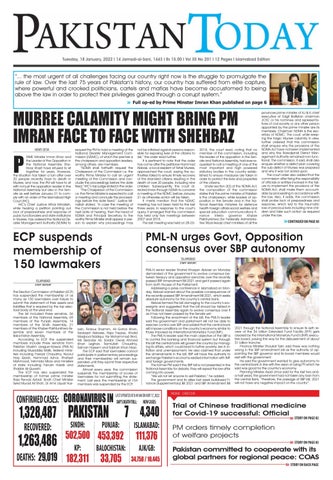
Murree calaMity Might bring PM iMran face to face with Shehbaz
P
NewS DeSk
RIME Minister Imran Khan and the Leader of the Opposition in the National Assembly Shehbaz Sharif have refused to sit together for years. However, the situation has taken a turn after over 20 people recently froze to death in Murree, and now, the PM will have to sit with not just the opposition leader in the National Assembly but also in the Senate as well before January 21 to comply with an order of the Islamabad High Court (IHC). IHC’s Chief Justice Athar Minallah, while hearing a petition pointing out lack of preparedness and response of pubic functionaries and state institutions in Murree, has ordered the National Disaster Management Authority (NDMA) to
not be initiated against persons responsible for exposing lives of the citizens to risk,” the order read further. It is pertinent to note that the order has come after the petitioner Hammad Abbasi, a local resident of Tehsil Murree, approached the court, saying the authorities failed to ensure timely recovery of the stranded citizens resulting in the death of over 20 people, including nine children. Subsequently, the court directed Imran through NDMA to convene a meeting of the NDMC before January 21 as otherwise action will be taken. It merits mention that the NDMC meeting has not been held for the last three years. In response to the court’s query, it emerged that the commission has held only five meetings between 2007 and 2018. The last meeting was held on 28-03-
request the PM to hold a meeting of the National Disaster Management Commission (NDMC), of which the premier is the chairperson and opposition leaders, among others, are members. “NDMA shall forthwith request the Chairperson of the Commission i.e. the worthy Prime Minister to call an urgent meeting of the Commission and conclude the proceedings before the date fixed,” IHC’s top judge stated in the order. “The Chairperson of the Commission i.e. the Prime Minister is expected to call a meeting and conclude the proceedings before the date fixed,” Justice Minallah stated. “In case the meeting of the Commission is not held before the next date of hearing, then the head of NDMA and Principal Secretary to the worthy Prime Minister shall appear in person to explain why proceedings may
ECP suspends membership of 150 lawmakers
ISLAMABAD Staff RepoRt
ISLAMABAD
sain, Firdous Shamim, Ali Gohar Khan, Sadaqat Abbassi, Raja Fayyaz, Khalid Maqbool Siddiqui, Yar Mohammad Rind, Mir Sikandar Ali, Sardar Owais Ahmed Khan Leghari, Samiullah Chaudhry, Salman Naeem and Sabtain Khan Niazi. The ECP said that lawmakers cannot participate in parliamentary proceedings and their membership will remain suspended until they submit their respective statements. Almost every year, the commission suspends the membership of scores of lawmakers for not submitting the statement. Last year, the membership of 154 members was suspended by the ECP.
CONFIRMED CASES: coronaviruS in DAY'S DEATH TOLL:
PML-N senior leader Shahid Khaqan Abbasi on Monday demanded of the government to evolve consensus between treasury and opposition benches over the recently passed SBP Amendment Bill 2021 and get it passed again from both Houses of the Parliament. Addressing a press conference in Islamabad on Monday, Abbasi warned about the possible consequences of the recently-passed SBP Amendment Bill 2021, which seeks absolute autonomy for the country’s central bank. Abbasi termed the bill damaging to the country’s sovereignty and suggested that the bill should be tabled in the National Assembly again to evolve consensus over it as it has not been passed by the Senate yet. Following the enactment of the bill, the PML-N leader said the government and parliament will not be able to exercise control over SBP and added that the central bank will impose conditions on the country’s economy similar to those imposed by International Monetary Fund (IMF). The PML-N leader said the main objective of the SBP is to control the banking and financial system but through this bill the central bank will govern the country by managing its affairs, which could lead to further poverty, rise in inflation and unemployment. He also claimed that under the amendments in the bill, SBP will have the authority to exchange Pakistan’s economy-related information with IMF and foreign governments. The former PM said if the SBP bill is not presented in the National Assembly for debate, they will repeal the law after coming into power. “We will not let anyone to sell Pakistan,” he added. The government and its allies last week bulldozed Finance (Supplementary) Bill 2021 and SBP Amendment Bill
LAST UPDATED AT 8:49 AM ON NOV 17, 2022
1,328,487 PakiStan RECOVERED:
1,263,486
SINDH:
DEATHS: 29,019 182,311
PUNJAB:
BALOCHISTAN:
33,705
NEW CASES:
7 4,340
502,500 453,392 KP:
CONTINUED ON PAGE 05
PML-N urges Govt, Opposition consensus over SBP autonomy
Staff RepoRt
The Election Commission of Pakistan (ECP) has suspended the membership of as many as 150 lawmakers over failure to submit the statement of their assets and liabilities that is required by the top electoral body at the year-end. The list included three senators, 36 members of the National Assembly, 69 members of the Punjab Assembly, 14 members of the Sindh Assembly, 21 members of the Khyber-Pakhtunkhwa Assembly and seven members of the Balochistan Assembly. According to ECP, the suspended members include three senators from Pakistan Muslim League-Nawaz (PML-N) including Musaddiq Malik, federal ministers including Fawad Chaudhry, Noorul Haq Qadri, Hammad Azhar, Shafqat Mahmood, Fehmida Mirza and ministers of state including Farrukh Habib and Shabbir Ali Qureshi. The ECP has also suspended the membership of former prime minister Raja Pervaiz Ashraf, Sindh Chief Minister Syed Murad Ali Shah, Dr Amir Liquat Hus-
2018, the court read, noting that no member of the commission, including the leader of the opposition in the Senate and National Assembly, had ever requested to call a meeting of one of the most important and high powered statutory bodies in the country established to ensure measures are taken in order to protect the lives and properties of the citizens. Under section 3(2) of the NDMA Act, the composition of the commission states that the prime minister of Pakistan is the chairperson, while leaders of opposition in the Senate and in the National Assembly ministers for defence health foreign affairs social welfare and special education communications finance interio governor Khyber Pakhtunkhwa (for Federally Administrative Tribal Areas) chief ministers of all the
provinces prime minister of AJ & K chief executive of Gilgit Baltistan chairman JCSC or his nominee and representatives of civil society or any other person appointed by the prime minister are its members. Chairman NDMA is the secretary of NDMC. The court, while keeping the tragic Murree calamity in view, further ordered that the commission shall enquire why the provisions of the NDMA Act have not been implemented and why the Rawalpindi District Management Authority remained non-functional. The commission, it said, shall also enquire whether a district plan covering the sub-district of Murree was prepared and why it was not acted upon. The court order also added that the commission after fixing the responsibility of officials or entities involved in the failure to implement the provisions of the NDMA Act, shall make them accountable by proceeding in accordance with the law. Also, it adds, the commission shall probe lack of preparedness and response, which led to the traumatic loss of precious lives including nine children and take such action as required under the law.
ISLAMABAD:
111,376 AJK/GB:
34,758 / 10,445
2021 through the National Assembly to ensure its sixth review of the $6 billion Extended Fund Facility (EFF) gets cleared by the International Monetary Fund’s (IMF) executive board, paving the way for the disbursement of about $1 billion tranche. Finance Minister Shaukat Tarin said there was nothing wrong in the SBP amendment bill as the authority of appointing the SBP governor and its board members would rest with the government. He said the government wanted to give autonomy to the central bank in line with the vision of ruling PTI which he said was good for the country’s economy. Planning Minister Asad Umar said for the last two-anda-half years, the government had not taken any loan from the central Bank, “therefore, the passage of SBP bill, 2021 will not have any negative impact on the country”.
MORE INSIDE
Trial of Chinese traditional medicine for Covid-19 successful: Official
STORY ON PAGE 02
PM orders timely completion of welfare projects STORY ON PAGE 03
Pakistan committed to cooperate with its global partners for regional peace: COAS STORY ON BACK PAGE
02
Tuesday, 18 January, 2022 | ISLAMABAD
NEWS
TriAl of Chinese TrADiTionAl meDiCine for CoviD-19 suCCessful: offiCiAl ISLAMABAD
l
mian abrar
oCAL health authorities on Monday announced the completion of a successful clinical trial of Chinese traditional herbal medicine for treating Covid-19, as Pakistan enters a fifth wave of the pandemic driven by the
omicron variant. The Chinese medicine, Jinhua Qinggan Granules (JHQG) manufactured by Juxiechang (Beijing) Pharmaceutical Co Ltd, is already being used in the treatment of Covid-19 patients in China. “Since it was tried on patients with different variants of Covid-19, we expect it to be effective on omicron as on other
Corrupt opposition hurdle to proposed reforms: minister
variants,” Professor Iqbal Chaudhry, director of the International Center for Chemical and Biological Science (ICCBS) in Karachi, where trials were conducted, told reporters. The trials were conducted on 300 patients who were treated at home, and would work on mild to moderate Covid-19 cases, Dr Raza Shah, principal investigator
in the trials, told reporters, adding that the efficacy rate was around 82.67 per cent. The trials were approved by the Drug Regulatory Authority of Pakistan. The country reported 4,340 Covid-19 cases on Monday, the highest recorded in a 24-hour period in three months. Karachi, the country’s largest city, recorded a positivity rate — the percentage of tests
coming back positive — of 39.39pc at the weekend, the highest so far. “In the last seven days, Covid cases in Pakistan have increased by 170pc while deaths have also increased by 62pc,” the National Command operation Centre (NCoC), which is overseeing the pandemic response, said in a statement on Monday.
WCLA entrusted with conservation projects by Auqaf department LAHORE Shahab Omer
ISLAMABAD aPP
Minister for Information and Broadcasting Fawad Chaudhry said on Monday the government was sincere in holding dialogue with the opposition to reform the electoral, judicial and accountability apparatuses of the nation. The minister in a tweet said, however, reforms were not possible without the opposition’s cooperation but the corrupt leadership of PML-N and PPP did not want to discuss any issue other than relief to their leadership in mega graft cases against them. If the PMLN, he said, “distances itself from the Sharif family, it would be a positive development.” “Political parties need to change their leadership as they (parties) are suffering from their (leaders’) moral and financial corruption,” he said. The minister said that Nawaz Sharif left the party workers alone in every difficult time and took refuge in London and such a leader had no respect in the workers’ hearts.
Govt offers incentives to oil refineries for producing eco-friendly fuels
The Walled City of Lahore Authority (WCLA) has moved on to the conservation of religious sites throughout Punjab upon the directions of Government of Punjab, Auqaf Department and Human Rights & Minorities Affairs Department, Pakistan Today learnt here on Monday. It was further learnt that the conservation of eight Muslim Shrines, one Hindu Temple and six Churches is being done by WCLA whereas the funding for the shrines is by the Auqaf Department and Human Rights & Minorities Affairs Department is providing funds to WCLA for the conservation of Temple and Churches. According to the plans of WCLA, these projects will be completed by 2023 while it is pertinent to mention here that these sites will remain with the Auqaf Department and Human Rights & Minorities Affairs Department as WCLA is only the executing agency for conservation works. According to the details provided by the official spokesperson of WCLA Tania Qureshi, Darbar Baba Farid-ud-din Ganj Shakar Pakpattan, Shrine of Hazrat Mian Meer, Shrine of Shah Husain, Shrine of Madhu Lal Hussain, Tomb of Baha-ud-din Zakriya, Tomb of Shah Rukn-e-Alam, Shrine Hazrat Shah Shamas, Shrine Hazrat Bibi Pak Daman and Shrine of Hazrat Khawaja Ghulam Fareed, Kot Mithan are being conserved by WCLA at present. “WCLA is also conserving the Churches and one
temple which are Shivala Mandir Sialkot, St.Francis Assai Sahowala Sialkot, Presbyterian Church Nicolson Road Lahore, St.Marry the Virgin Cathedral Church Multan, Christ Church Rawalpindi, Sacred Heart Cathedral Church Lahore and Cathedral Church of The Resurrection Lahore. These are being conserved by using international techniques of conservation and WCLA is putting its heart and soul in this process”, Tania said. The Director Conservation and Planning WCLA Najam Usaqib said, “60% of the work at Catholic Church St. Francis Assai Sahowala, Sialkot has been done so far whereas documentation (3d scanning), sand blasting, chemical treatment, plinth protection, surface rendering and roof treatment is completed. Façade treatment and wood work are in process and will be completed soon.” “Moreover 40% work is completed at Shivala Temple in Sialkot, 80% work is
completed in Cathedral Church of The Ressurection at Mall Road Lahore and work has started on the other Churches too. The conservation and preservation of the Churches, Shrines and Temples will be carried out for the first time, as per the international standards of conservation,” Najam explained. Najam said that work on Shrines in Lahore and other cities of Punjab had also been started and will be completed by 2023. “We are improving the existing conditions of the shrines so that the zairin and people going there get better facilities and experience. It is our religious heritage and I am honored that the Auqaf Department has engaged WCLA for this task.” “These works are being done as per the vision of Prime Minister of Pakistan to promote religious tourism and religious harmony in the country. It is great pride and honor for WCLA team that the Government of Punjab, Auqaf Department and Human Rights & Minorities Affairs Department has engaged WCLA as the executing agency for conserving these religious heritage sites in Punjab. This is need of the hour to save these religious heritage sites for the future generations”. “This project is not only to conserve the monument and sites but also to serve the people as end users. This is one way how we can contribute to the cause of promoting religious harmony among the people and I must give credit to Auqaf and Minorities Affairs Department on taking this step and funding these projects,” Director General WCLA Kamran Lashari said.
ISLAMABAD inP
The federal government has decided to offer a lucrative package of five-year tax holidays to encourage the oil refineries to upgrade their infrastructure and revert to producing fuels compatible with the international standards, WealthPK reported on Monday. Under the proposed Pakistan oil Refinery Policy, 2021 the oil refineries were given the December 2021 deadline to come up with their respective up-gradation plans to take advantage of the incentives offered in the policy. The refineries willing to revamp their plants would be given incentives, including five-year tax holidays on import of crude oil and tariff protection in their prices, which will earn them additional revenue to invest, upgrade and remain in the business. “After submitting the revival plans, the refineries will be required to fully implement the plans in five years, meaning they would have to fully upgrade their system by the years 2026-27,” the policy proposes. Currently, five refineries are operating in the country with an overall crude oil refining installed capacity of 417,400 barrels per day (BPD). Pak Arab Refinery Limited (Parco) has 100,000 BPD oil refining capacity, Attock Refinery Limited (ARL) 53,400 BPD, Cnergyico 150,000 BPD, National Refinery Limited (NRL) 64,000 BPD and Pakistan Refinery Limited 50,000 BPD, according to the Economic Survey 2019-20. As per the data, Pakistan’s total consumption of petroleum products stood at 19.68 million tonnes (MTs) during the fiscal year 2019-20, out of which 11.59 MTs were secured through local refineries and 8.09 MTs through imports. The total petrol consumption in the country is about 7.6 MTs per annum, out of which 30 per cent is catered to from local refineries and the rest is imported to meet the local demand. Similarly, the consumption of diesel is around 7.3 MTs per annum.
Chinese lunar lander discovers water on moon AgEncIES A Chinese lunar lander landed on the moon and discovered water while on the surface, confirming previous scientific predictions that water does really exist on the body, revealed a report by Science.org. In December 2020, the lander returned with more than 60 ounces of soil and rock samples. Scientists hope the moon’s water can be tapped and used for astronauts while they are on a mission in space. Last week a study led by scientists at the Institute of Geology and Geophysics of the Chinese Academy of Sciences, depicted the H20 molecule in the probe’s data. Matt Siegler, a senior scientist for the Planetary Science Institute, believes that research shows that the moon may contain more water than expected. Previously, however, missions to space had put scientists under the false assumption that the moon was bone dry, yet over the years signs of hydration on the sunlit surface have been found but not confirmed until recently. In the last two decades, scientists from NASA had examined Apollo moon samples in 2008 and found water molecules in glass beads. A month before the Chinese made their mission to the moon, NASA announced that they could confirm that the water on the moon was certainly in a sunny part of the celestial body. They used a Stratospheric observatory for Infrared Astronomy (SoFIA) to pick up confirmed
wavelength signals of water molecules which revealed that water is widespread on the moon and not just at the poles. The Chinese mission, Chang’E-5 found traces of water in the soil where it landed, which researchers believe was because of gases flowing off the sun forming water through the solar wind. When solar wind made contact with the oxygen on the moon’s soil and rocks, it formed water. Rock picked up from the same location contained a higher concentration of water than the soil around it. The Chang’E-5 was the first mission to the moon that collected and returned materials since Soviet Union’s Luna 24 in 1976. NASA last extracted moon rock samples in 1972, almost 50 years ago.
Pakistan national among three killed in Abu Dhabi drone attack DUBAI The aSSOciaTed PreSS
A possible drone attack may have sparked an explosion that struck three oil tankers in Abu Dhabi and another fire at an extension of Abu Dhabi International Airport on Monday that killed three people and wounded six, police said. Abu Dhabi police identified the dead as two Indian nationals and one Pakistani. It did not identify the wounded, who police said suffered minor or moderate wounds. Police said an investigation was underway. While Abu Dhabi police did not immediately offer any suspects for the possible assault, Yemen’s Houthi rebels claimed responsibility for an attack targeting the United Arab Emirates, without elaborating. The Iran-backed Houthis have claimed several attacks that Emirati officials later denied took place. The incident comes while Yemen’s yearslong war rages on and as an Emiratiflagged vessel found itself recently captured by the Houthis. That’s as Abu Dhabi largely has withdrawn its national forces from the conflict tearing apart the Arab world’s poorest nation while still supporting local militias there. Abu Dhabi police said preliminary investigations indicated the detection of small flying objects, possibly belonging to drones, that fell in the two areas and may have caused the explosion and fire. They said there was no significant damage from the incidents, without offering further details. Police described the airport fire as “minor” and said it took place at an extension of the international airport that is still under construction.
Investment in tech sector vital for youth employment, national economy: PM HARIPUR aPP
Prime Minister Imran Khan on Monday said that the investment in technology sector was vital to create employment for the youth as well as improve the national economy. “The future is technology. The Special Technology Zone is a complete ecosystem. The provincial government generated resources for the project which will have a positive impact on next generations,” the prime minister said while addressing the groundbreaking ceremony of Pakistan Digital City Special Technology Zone here.
The flagship project of the Khyber Pakhtunkhwa government would be established on 86 kanals of land and would cost Rs1.31 billion. A large number of IT and allied technologies including electronics, computers and mobile phones, software houses and technology incubators would largely benefit from the project that would would boost the allied industries and generate hundreds of thousands of jobs for the youths. The prime minster, who earlier kicked off work on the project, lauded Dr Attaur Rehman and former KP Chief Minister Pervaiz Khattak for taking the initiatives
which he said would have far reaching impact on the provincial development. He said after coming into power in 2013, it was the KP government that had introduced health insurance facility for the low-income people of the province despite financial constraints. Moreover, it was also the PTI government that raised the issues of climate change, forestation, institution building and tourism. The prime minister also appreciated Dr Attaur Rehman for his support to establish Pak-Austria Fachhochschule Institute of Applied Sciences and Technology in Haripur which would have
positive impact on next generations. He said in the past, England had established two top class universities which provided leadership to the world for long. The prime minister said the previous governments never focused on education sector and instead brought about three-tier education system which promoted three cultures and left negative impact on the society. He said for the first time, the incumbent government introduced core curriculum for up to class 5 which would be expanded to upper level to make the country a nation. Calling for exploitation of the potential
of young population, the prime minister reiterated that investment in technology sector would benefit the country. He said in the past, the highly educated youths remained unemployed as the institutions had no connection with the market; however, the projects like the STZs would open up new avenues for employment. He told the gathering that the government removed impediments in the technology sector which took the growth to 45 per cent and was expected to touch 75pc mark this year. He said the promotion of technology never had been a priority of the previous governments and appreciated the farsightedness of Dr Attaur Rehman for establishing a quality institute with the Austrian support.
Tuesday, 18 January, 2022 | ISLAMABAD
Pm orDers Timely ComPleTion of welfAre ProjeCTs PESHAWAR aPP
P
RIME Minister Imran Khan Monday directed for the completion of development projects in their stipulated period and other public welfare plans on a priority basis. The prime minister held a meeting with Khyber Pakhtunkhwa Governor Shah Farman and Chief Minister Mahmood Khan after his arrival here. During the meeting, the three discussed administrative affairs and political and law and order situations in the province. The uplift projects include implementation of the agriculture transformation plan, protection of forests and healthcare cards. The prime minister was apprised of the steps taken by the administration to control price hikes and progress being made through a drive against hoarders.
Schools to remain open as daily new infections remain above 4,000 for third day ISLAMABAD STaff rePOrT
Pakistan confirmed 4,340 new cases of Covid-19 over the past 24 hours, the National Command and operation Center (NCoC) said on Monday, taking the contagion rate to 8.7 percent. The daily caseload climbed above 4,000 on Wednesday for the first time since August 25 as the fifth wave driven in part by the latest omicron variant of the pandemic picked up speed. The authorities did not break down the cases by Covid-19 variant. The nation confirmed its first known case of the omicron variant in early December. Meanwhile, the number of active cases jumped past 35,000 for the first time since october 15, when Pakistan recorded 26,974 cases, NCoC data showed. The NCoC said the health authorities have conducted 24 million tests so far, confirming 1.32 million cases since March 2020. over the past 24 hours, 302 patients
recovered from Covid-19, bringing the total number of recoveries to 1.26 million, while seven more people were killed by the disease, which increased the death toll to 29,019, according to the body. Sindh is the most affected province of the country in terms of the number of cases with 502,500 infections, followed by Punjab which has reported 453,392 cases. The positivity rate in Karachi climbed down to 30.83 percent after reaching a record 39 percent a day earlier. It reported 2,356 cases on Sunday. SCHOOL CLOSURES DELAYED Meanwhile, the NCoC, which had called a meeting today to decide on the closure of educational institutions nationwide amid the soaring infections, did not announce returns to remote learning, saying it will first look at the data of positivity rate in various institutions. The meeting of the provincial health and education ministers was convened
rupee extends gains to down usD to 175.92 KARAcHI STaff rePOrT
Consolidating the previous week’s gains, Pakistani rupee strengthened by 15 paisas (+0.09 percent) against the US dollar on Monday. The State Bank of Pakistan said in a statement that the dollar opened at Rs176.07 in the interbank market and closed at Rs175.92. The rupee witnessed a dull trading range during the session, showing the intraday high bid of 176 and low offer of 175.80. Within the open market, the rupee was traded at 177/178 per dollar. overall Pakistan rupee gained 60 paisas against the US dollar last week, while it has appreciated by 59 paisas during the current year 2022. The local unit has depreciated by Rs18.49 during the ongoing fiscal year 2021-22. one of the reasons behind dollar’s low demand was a public holiday in the United States and closure of businesses there, as the third Monday of every January is observed as Martin Luther King Jr Day. According to experts, the rupee is likely to remain stable against the dollar amid positive sentiment that the government is taking serious steps for the revival of the International Monetary Fund’s (IMF) Extended Fund Facility (EFF). President Dr Arif Alvi on Saturday last signed the Finance (Supplementary) Bill 2021, generally known as the mini-budget, thus fulfilling one of the key conditions of the International Monetary Fund (IMF). Again, the approval of the State Bank of Pakistan (Amendment) Bill 2021 from the National Assembly on Thursday last was another step to pave the way for the revival of the IMF programme. If the bill is also passed from the Senate, it will ensure that Pakistan’s sixth review of the $6 billion Extended Fund Facility gets cleared by the IMF’s executive board. Moreover, support provided through inflows from exporters as well as Roshan Digital Account (RDA) and lower import payments on a monthon-month basis in December last also improved market confidence.
to take decisions on coronavirus restrictions, including schools’ closure. “Decision about education institutions will be taken on data of positive cases of various institutions for which massive testing in educational institutions is being carried out,” the body said in a brief statement issued after the meeting. Minister for Planning and Development Asad Umar, who also heads the body, and NCoC National Coordinator Maj Gen Zafar Iqbal chaired the session, while Minister of State for National Health Services Dr Faisal Sultan attended it virtually. Provincial ministers, who joined via video link, told the meeting about the steps being taken for the implementation of non-pharmaceutical interventions (NPIs), and health guidelines. PUNJAB MINISTER OPPOSES SHUTTING SCHOOLS: Meanwhile, Punjab Minister for Health Dr Yasmin Rashid, who does not favour the closure of educations institutions, said: “We don’t want the schools shut
since education has already suffered enough.” The Punjab government has vaccinated 80 percent of students in schools and colleges, the minister told Geo News over the weekend. Meanwhile, provincial Minister for Education Murad Raas asserted the main reason behind the spread of coronavirus cases were public gatherings since across the province were “rigorously following” government-devised health guidelines. Ahead of the Monday meeting of the NCoC, he said the Punjab government has recommended reducing the attendance to 50 percent in age groups under 12. A 2020 report in The Lancet, an independent, international general medical journal, said school closures are likely to have a relatively small impact on the spread of Covid-19 and should be weighed against their profound economic and social consequences, particularly for the most vulnerable children.
Veteran actor Rasheed Naz passes away ISLAMABAD STaff rePOrT
Celebrated actor Rasheed Naz passed away Monday morning at the age of 73, his daughter-in-law said. “our dearest Baba Rashid Naz has left this world peacefully this morning. Please recite Surah Fateha for the departed soul,” actor Madiha Rizvi wrote in an Instagram post. Naz had been suffering from health problems for a long time. As soon as Madiha broke the news, celebrities landed at the comments section to offer condolences. Mawra Hocane said: “Such a wonderful happy soul! May Allah bless him to be among his closest ones InshaAllah. Strength & love for all of you.” “Verily all come from Him and to Him all must return. You guys gave him loads of love and served him
till the last. May Allah ease your pain and bless you,” omair Rana wrote. Born in Peshawar in 1948, Naz began his television career in 1971 and rose to become one of the nation’s most celebrated actors.
NEWS
03
Two teens arrested in uK in connection with Texas hostage-taking LOnDOn afP
The man who held four people hostage at a Texas synagogue was identified by US authorities as a British national Sunday while United Kingdom police later arrested two teens over an attack that President Joe Biden called an “act of terror.” The captor, who died in the 10hour siege in the small town of Colleyville on Saturday, was named by the Federal Bureau of Investigation (FBI) as 44-year-old Malik Faisal Akram. Hours later, Britain’s counter-terrorism police arrested two people and were questioning them in connection with the incident. “Two teenagers were detained in South Manchester this evening. They remain in custody,” the Greater Manchester Police said in a statement. The FBI’s field office in Dallas had earlier said there was “no indication” that anyone else was involved in the attack on the Congregation Beth Israel synagogue. The four hostages — including a respected local rabbi, Charlie Cytron-Walker — were all freed unharmed Saturday night, prompting relief in the United States, where the Jewish community and Biden renewed calls to fight anti-Semitism. “There is no question that this was a traumatic experience,” Cytron-Walker said in a statement Sunday. “We are resilient and we will recover,” he added. A man identifying himself as Akram’s brother Gulbar said in a Facebook post that the suspect had suffered from mental health problems. “We would like to say that we as a family do not condone any of his actions and would like to sincerely apologise wholeheartedly to all the victims involved in the unfortunate incident,” Gulbar said in the post to a Muslim community Facebook page in Blackburn, in northwest England — where British police said Akram was from. Gulbar added that he had been in touch with law enforcement in Texas and that his family hoped to get Akram’s body back to Britain for a funeral. Biden declined to speculate on the motive but appeared to confirm reports that the hostage-taker was seeking the release of Aafia Siddiqui, the Pakistani neuroscientist who is imprisoned nearby on charges of trying to kill American service members in Afghanistan. “This was an act of terror” committed by an assailant who apparently “insisted on the release of someone who’s been in prison for over 10 years,” Biden told reporters during a visit to a hunger relief organisation in Philadelphia. Britain’s foreign minister Liz Truss likewise Sunday condemned the hostage-taking as an “act of terrorism and anti-Semitism.” Siddiqui, the first woman to be suspected by the United States of purported links to Al-Qaeda and a cause celebre in Pakistan and in South Asian conservative circles, was detained in Afghanistan in 2008. Two years later she was sentenced by a New York court to 86 years in prison for the attempted murder of US officers in Afghanistan. She is currently being held at a prison in Fort Worth, Texas — about 20 miles (32 kilometres) away from the synagogue which Akram attacked. Siddiqui’s lawyer has said she “has absolutely no involvement” in the hostage situation and condemned it. Any links she may have to Akram remained unclear. FBI special agent Matthew DeSarno told reporters in Colleyville after the standoff that the investigation would “have a global reach.” He said the suspect’s demands were “focused on one issue that was not specifically threatening to the Jewish community.” Britain’s ambassador to Washington confirmed that British authorities were “providing our full support to Texas and US law enforcement agencies.” ‘MIND-BLOWING’: Cytron-Walker in his statement credited his congregation’s previous security training from the FBI and others with their survival from a harrowing ordeal. “In the last hour of our hostage crisis, the gunman became increasingly belligerent and threatening,” the rabbi said. “Without the instruction we received, we would not have been prepared to act and flee when the situation presented itself.” other residents of Colleyville, about 25 miles northwest of Dallas, were left struggling to comprehend the incident. “Colleyville […] It’s one of the safest towns in North Texas,” said Austin Sewell, owner and founder of the North Texas Kings baseball club, whose field is across the street from the synagogue in a quiet residential neighbourhood. “It’s mind-blowing, to be honest,” he told AFP Sunday. Law enforcement vehicles sit in front of the Congregation Beth Israel synagogue on January 16, 2022, in Colleyville, Texas. on Saturday, police responded to a hostage situation after reports of a man with a gun was holding people captive.
Imran welcomes Putin’s condemnation of blasphemy ISLAMABAD STaff rePOrT
Prime Minister Imran Khan Monday appreciated Russian President Vladimir Putin for his remark asserting that disrespect of Prophet Muhammad (P.B.U.H.) did not count as an expression of freedom but was in fact a gross “violation of religious freedom”. In his annual press conference in December, Putin observed these acts give rise to extremist reprisals, citing as an example the attack on the offices of Charlie Hebdo, a French satirical weekly, in Paris after its publication of blasphemous cartoons of the prophet. In his third telephonic conversation with the Russian president in less than six months, Khan recalled he had been
regularly highlighting the steep rise in incidents involving Islamophobic sentiments and hatred towards Muslims in his addresses to the international bodies such as the UN General Assembly (UNGA), pointing to its grave ramifications, a statement from the Prime Minister’s office said. Separately, the prime minister, in a series of tweets, said he lauded Putin for his emphatic statement regarding freedom of speech which could not be used as a pretext to disrespect the prophet. “[…] He is the first Western leader to show empathy [and] sensitivity to Muslim sentiment[s] for their beloved prophet,” he tweeted. During the conversation, the two leaders agreed to enhance bilateral cooperation in different sectors, increase
high-level exchanges, and remain in close contact on matters relating to Afghanistan. Khan underscored that a peaceful and stable Afghanistan was pivotal for regional stability. Afghanistan was facing dire humanitarian and economic challenges and support of the international community to its people at this critical juncture remained vitally important, he stressed. The prime minister also underscored the importance of the release of Afghanistan’s financial assets held by the United States for addressing the dire needs of the war-ravaged nation. “The two leaders fondly recalled their conversations during last year and exchanged views on bilateral cooperation as well as regional and international issues of mutual interest,” the press statement
said. Khan underscored that Pakistan’s relationship with Russia was on an upward trajectory, with an increased focus on trade and economic ties and energy cooperation. He reiterated his government’s resolve for early realisation of the Pakistan Stream natural gas pipeline. The 1,100-kilometer-long project, formerly known as the North-South Pipeline, plans to carry 12.4 billion cubic meters of natural gas annually. The project name was changed to Pakistan Stream along with its partnership structure against the risk of US sanctions on Russian companies. Although the countries signed an intergovernmental agreement on the project in 2015, the project has been postponed for several reasons.
Tuesday, 18 January, 2022 | ISLAMABAD
04 NEWS
President Arif Alvi for Hr develoPment in Ai, cybersecurity ISLAMABAD
P
Staff RepoRt
ReSIDeNT Dr Arif Alvi has called for developing and training the human resource of the country in the field of emerging technologies, including blockchain technology, artificial intelligence, cybersecurity and big data, to meet the requirements of the 4th industrial revolution. The president, talking to an international delegation of blockchain experts, led by the Founding President of BSV Blockchain Association, James Nguyen, that called on him,
at Aiwan-e-Sadr, Monday, underlined the need for creating awareness about the importance and utility of Blockchain technology so that the public and private sectors could benefit from it. The president said that Blockchain technology could become a powerful tool for tracking transactions, reducing corruption and increasing transparency in public and private sectors. He further stated that a systemic approach was needed to fully benefit from the transformative potential of Blockchain technology as well as further its implementation in Pakistan. The president appreciated the services of
KP govt signs $10bn worth deals to fetch foreign investment: official DUBAI Staff RepoRt
The Khyber Pakhtunkhwa (KP) government has signed 44 deals, worth more than $10 billion, to bring in foreign investment, build infrastructure and promote hospitality and tourism in the province. The memorandums of understanding (MoUs) were signed at the Khyber Pakhtunkhwa Conference with the theme of “Land of Growing Opportunities” in Dubai. The investors from the UAe, Pakistani and Chinese groups pledged to invest in integrated tourism zones, special economic zones and industrial cities across the province. The projects in tourism, energy and power, solar energy, livestock, infrastructure, and water sports attracted the business community for investment, according to the Chief executive Officer of the Board of Investment, KP Dr Hassan Daud Butt. Dr Hassan Daud Butt revealed that the KP government was able to gain the trust of the business community in order to invest more than $10 billion in the tourism, energy and power sectors, and various other projects. Addressing the conference, the KP Minister for Finance, Taimur Saleem Jhagra, invited the investors to the province for better dividends and returns. He expressed hope that KP would become a potential international tourism hub. KP Minister for Culture Shoukat Yousufzai clearly stated that the government will follow these MoUs and definitely materialise the investment pledges. Yousufzai said that KP would provide a trade route to Central Asia through Afghanistan. He believed that a peaceful Afghanistan would lead to more investment opportunities in the region. Ambassador of Pakistan to the United Arab emirates, Afzal Mahmood, lauded the KP government that the province had participated in the Pakistan Pavilion during Dubai expo 2020 in an excellent manner and presented its projects which would be helpful for investment in the province. The investment conference was part of a series of events being organised by the Khyber Pakhtunkhwa government at Dubai expo 2020 to showcase the investment potential in the land of growing opportunities.
Pakistan’s technology talent that had made its mark by providing the technical backbone to some of the world’s largest companies. He highlighted the fact that during the past year, Pakistani start-ups had been able to attract valuable international investments in the IT sector. James Nguyen on the occasion talked about the potential and uses of Blockchain technology in diverse sectors of the economy such as Banking, Fin-tech, Digital Advertising, Healthcare, Big Data, environment and Governance. He also informed the President regarding certain initiatives taken by BSV Blockchain in Pakistan.
Crude oil prices tumble after hitting three-year highs ISLAMABAD Staff RepoRt
Crude oil prices edged lower on Monday, retreating from the highest levels of three years achieved during the early trade. As of 1355 hours GMT, Brent, the international benchmark for two-thirds of the world’s oil, shed $0.30 (-0.35 percent) to reach $85.76 a barrel. Brent retreated after hitting $86.71, its highest level since October 3, 2018, earlier in the session. On the other hand, the US West Texas Intermediate (WTI) price reached $83.74 a barrel, down by $0.09 (-0.11 percent), which has been its highest price since mid-November. The price for Opec Basket was recorded at $84.72 a barrel with a gain of 0.44 percent, Arab Light was available at $86.28 a barrel with an increase of 2.42 percent and the price of Russian Sokol jumped to $88.30 a barrel with an increase of 2.09 percent.
Oil prices slipped over concerns over Omicron variant, as China tightens the rule for entry into the capital city after a jump in the Covid cases. The world’s second-biggest oil consumer, China, has suspended some international flights and stepped up efforts to curb the coronavirus cases at Tianjin where cases are at peak.
Many Chinese cities have also urged people to stay put during the Lunar New Year holiday, which could cool demand for transport fuel during a peak travel season. Japan also discusses heightened virus-led restrictions for Tokyo on witnessing more than 20,000 daily infections for the third consecutive day.
Saudi Arabia on Monday said oil stability is paramount and its alliance with the super group of producers has taken measures to ensure energy security. “We believe Opec+ have done a lot in bringing about stability,” Saudi Arabia’s energy minister Prince Abdulaziz bin Salman said while speaking during Abu Dhabi Sustainability Week summit. “There is nothing more profound, more important for energy security than having to have a stable market.” Opec+ “is demonstrating a great deal of seriousness and attentiveness to what it takes to energise an economy and how much others are lagging when it comes to that”, Prince Abdulaziz said. The Opec+ group, led by Saudi Arabia and Russia executed a historic reduction of 9.7 million barrels per day between May 2020 and July last year, but has tapered the supply cuts as demand improved. The group agreed to add another 400,000 barrels of oil per day to the market from February.
Gomal Zam project to provide irrigation water round the year ISLAMABAD Staff RepoRt
The Gomal Zam irrigation project would provide a year-round supply of irrigation water in the Tank and Dera Ismail Khan (DI Khan) districts of Khyber Pakhtunkhwa (KP), besides helping in flood control. The construction of an irrigation and drainage system downstream from the Gomal Zam Dam would provide nearly 325,000 acre-feet of water annually to irrigate 191,000 acres of farm land in KP, an official source said. The project will contribute to increased crop yields, opportunities for the cultivation of high-value cash crops, and significantly higher incomes for farmers in the region.
The Gomal Zam Irrigation Project would boost business development, trade, and employment opportunities for 30,000 Wazir and Mahsud households. The project is increasing agricultural production, employment, and incomes in Tank and D.I. Khan Districts of Khyber Pakhtunkhwa through the construction of irrigation and drainage infrastructure. In the project, construction of an irrigation system including a diversion barrage, a 60.5 kilometer long main canal, and a 206 kilometres long network of distribution canals. The construction of flood protection structures including a 42-kilometer flood protection bund and a 48-kilometer flood carrier channel were also included in the project.
Special committee reviews repatriation treaty between Pakistan, UK NewS DeSk The special ministerial committee constituted by the federal cabinet held a meeting on Monday on the extradition treaty between Pakistan and the UK. It has been decided during the meeting, that an agreement between Pakistan and the UK for the repatriation of criminals will be signed in the best interest of the public.
CMYK
The deal will allow Pakistan and the UK to repatriate their convicted criminals. However, it will only allow the repatriation of citizens sentenced by relevant courts. The agreement also decided that the British authorities will be further consulted before presenting the agreement to the federal cabinet for final approval. Foreign Minister Shah Mahmood Qureshi, Human Rights Minister Shireen Mazari and Interior and Accountability Ad-
visor Shahzad Akbar attended the meeting chaired by Interior Minister Sheikh Rashid. It is pertinent to note that the first round of negotiations on a criminal repatriation treaty took place in October 2019. Later in April 2021, Interior Minister Sheikh Rashid met British High Commission Christian Turner and discussed the repatriation of former prime minister Nawaz Sharif, who is in London after his release from prison on medical grounds.
Tuesday, 18 January, 2022 | ISLAMABAD
FIA APProAcheS PeMrA to bAn ForMer DG bAShIr MeMon’S tV InterVIewS
t
News Desk
HE Federal Investigation Agency (FIA) requested the Pakistan Electronic Media Regulatory Authority (PEMRA) on Monday to ban former directorgeneral Bashir Memon from giving TV interviews. According to details, FIA La-
hore Director Dr Rizwan wrote a letter to PEMRA officials, stating that Memon had been supporting Omar Farooq Zahoor, an accused in international money laundering cases. Rizwan further added that these cases were under investigation at the agency whereas the matter was also pending before the Supreme Court.
It is pertinent to note that Zahoor is wanted by various countries including Switzerland, Norway and Turkey. He is accused of setting up bank accounts in Switzerland, Norway and robbing people off from different countries. Switzerland and Norway also reportedly revealed his links with two Foreign Office officials and Memon.
As per the FIA officials, in 2019, the former DG had removed Farooq’s name from the list of most wanted criminals of Interpol. Subsequently, Farooq wrote Memon a letter of thanks. Earlier on January 14, the Lahore High Court (LHC) restrained the FIA from taking any coercive measures against Memon. Memon accused the FIA of
levelling false allegations of helping out Farooq, again whom the Interpol had issued a red-warrant. He filed a petition in the high court seeking direction to the FIA for providing a record of all pending inquiries, FIRs against him. Memon maintained in his petition that he had been implicated in false cases which had nothing to do with him.
IHC stays non-engineers employment for engineering slots in PIA isLamaBaD TLTP
The Islamabad High Court on Monday stayed non-engineering staff employment for engineering slots in the national flag carrier till final adjudication of a plea challenging merit violation in filling the vacant posts of engineers. Earlier on November 08, 2021, the court has sought reply from the federal government in response to the plea challenging legality of non-engineering staff employment for engineering slots in Pakistan International Airlines (PIA). Advocate Umer Gilani has made the federation of Pakistan through the secretary Ministry of Aviation, Pakistan International Airlines Corporation through its chief executive officer and Pakistan Engineering Council through its registrar as respondents on behalf of his client Engr Mian Khuram Ahsan. Filing a civil miscellaneous application before the court in the matter, Advocate Gilani submitted that earlier on November 8, 2021, after hearing preliminary arguments of the petitioner, the court has issued notices
line, the comments have not been filed by the PIA till date. Substantiating his application in hand Advocate Gilani informed the bench that while on the one hand the PIA is employing dilatory tactics in court, on the other hand, it has sped up process of appointing and promoting non-engineers to the posts of chief engineer and deputy chief engineer. “This is not only a blatant violation of the law and
to the respondents and sought specifics comments from PIA within a fortnight. He apprised the single-member bench of the Justice Aamir Farooq that on the next hearing of the case on December 2, 2021, the court accepted request of the PIA for more time to file comment in the matter. Gilani further submitted that the PIA failed to furnished the reply saying almost a month after the expiry of the court’s dead-
Murree calamity might bring PM Imran face to face with Shehbaz CoNtiNeD from page 01 “NDMA shall submit a report on behalf of the Commission on the date fixed,” the order read. Justice Minallah said that the composition of the commission itself is enough to determine the responsibilities of the NDMA, saying even if the province of Punjab or Punjab Disaster Management Commission had failed to notify the Rawalpindi District Management Authority or make a district plan, the NDMA cannot absolve itself of being responsible. “The mere fact that no meeting of the Commission was held since March, 2018 establishes the dereliction of statutory duty of NDMA,” Justice Minallah stated. Prima facie, he said, failure to implement the NDMA Act is the sole factor, which had led to the loss of precious innocent lives, including nine children. “Further delay in implementation of the NDMA Act is likely to expose human lives to grave risk,” he maintained, noticing that “it is ironic that despite the failure of the statutory bodies created under the NDMA Act, the local population of Murree is being blamed.” “In a nutshell,” Justice Minallah wrote, “there was a complete collapse of the statutory mechanism mandated under the NDMA Act.”
the ruling of the courts, it shows the PIA’s scant regard for the proceedings of this honourable court,” Gilani argued. In the main petition, the petitioner’s counsel has contended that the PIA is employing a very large number of non-engineers at the posts of ‘aircraft engineer’, adding that one out of eight chief engineers, 25 out of 53 deputy chief engineers and 334 out 476 aircraft engineers, are non-engineers performing duties with PIA at the moment. “In stark violation of this law and going against the general principles of merit, the national flag carrier is appointing such persons whose only educational qualification is Matric and who, in many cases started out as “helpers” and “cleaners and eventually rose through the ranks through organisational politics,” Advocate Gilani has told the bench. After hearing arguments of the lawyer on Monday in the matter, Justice Aamir Farooq of the IHC sought reply from the PIA and held that any appointments made during proceedings will remain subject to the outcome of the case. The hearing of the matter was adjourned till date in office.
Noor murder case: Last witness records statement News Desk As the Islamabad District and Sessions Court resumed the hearing of the murder case today, the last witness in the Noor Mukadam case, Investigation Officer Abdul Sattar Khan recorded his testimony on Monday Sattar, who investigated the murder case, is the last witness in the case against prime accused Zahir Jaffer and others. During the hearing, Sat-
tar said he was working as the in-charge of City Zone police station on July 20 when he got a call at 10 pm about the murder of Noor. “When I reached there, the complainant [Shaukat Mukadam], ASI Zubair Mazhar, and Lady Constable Aqsa Rani were already at the murder scene,” he said, adding that Zahir Jaffer was arrested by the police at the spot. “I recorded the statement of Zahir at the time of the ar-
rest,” he said, adding that the fingerprints of the suspects were also taken. He said ASI Zubair recorded the statement of the complainant and sent it to the prosecution department. He futher stated that the decapitated body of Noor Mukadam was found in the southwestern room of the house. Crime Scene Expert Muhmmad Imran took samples from the body with the help of the lady constable, Aqsa Rani.
NEWS
05
AIoU offers 30 academic programs for international students isLamaBaD Press reLease
Allama Iqbal Open University is offering admissions in 30 academic programs for Overseas Pakistani as well as other international students. The University has advertised admission in Matric, FA and I.Com programs for Spring, 2022 semester for international students while admissions in other educational programs will be offered from March 1. It is pertinent to mention here that as a result of digitalization, the University is now capable to teach international students online. Students from across the world can take admission in these programs online. The University has arranged for online teaching to these students. Moreover, their examinations will also be conducted through online system. Overseas Pakistani/international students can download the admission forms and prospectuses from the University website (http://online.aiou.edu.pk), for more detail, the international students can contact at the email of International Calibration and Exchange Office overseas @ aiou for more details. .edu.pk or phone numbers 92519057165+ or 92519250175+.
canadian high commissioner wendy Gilmour garners praises after refereeing a girls’ ice hockey match in hunza News Desk An ice hockey match played by young girls has taken place in Hunza, whose pictures are making rounds on Twitter. One thing that garnered people’s attention was Canadian High Commissioner in Islamabad Wendy Gilmour refereeing the match. People have been praising the Canadian diplomat for encouraging winter sports in Pakistan while advocating for female athletes. Gilmour was quick to re-share it, calling it “an amazing match”. She congratulated Altit’s Sports Club And Rising Federation for organising the fourth Winterlude festival. Addressing the young players from Hunza and Chitral she said “my colleagues and I had a blast!” Users were particularly thrilled by the promotion of gender equality. The sport being accessible in remote areas was another plus point. Twitter users loved Gilmour’s role as referee and cheered on the girls of GilgitBaltistan. There was general praise for Gilmour having “rooted” herself in “Pakistan’s society and culture.” Someone even asked for ways Pakistani Canadians to donate or contribute to the efforts “in getting more gear and facilities set up.” Others wanted more, like a full blown match, or a team at the Winter Olympics. One user believed this even merited a documentary! Pakistani Twitter loved the pictures and flooded the tweet with praise and well wishes. People were excited about winter sports being introduced in Pakistan.
After Alipay, British Airways, Deliveroo and Air BnB, Daraz gets a new identity from Design Studio karaChi Press reLease
London based branding and digital creative agency – Design Studio aids Daraz to bring its big ideas to life with a new brand look. The leading e-Commerce platform in South Asia, originated from a small fashion retailer has now a monthly active user base of more than 15 million. The platform has now unified seller marketplace and large-scale brands under one umbrella exposing its consumers to a high volume of content. Ammar Hassan, Chief Marketing Officer at Daraz said, “¬¬¬¬Over the years, we have seen how the e-Commerce landscape has evolved in our markets. Introducing the new technology to improve our services, we established a strong connection between our consumers of all ages. In order to cater to a broader user base, we wanted to give our brand a new identity. We partnered with a world renown design agency
- Design Studio which has changed the identity of many international brands like Deliveroo, Air BnB, Alipay, British Airways and many other. We are proud of what Design Studio has accomplished, and we look forward to uplift our communities while staying true to our iconic history and relevance to consumers.” Design Studio – a renowned international branding and digital creative agency – is aiding Daraz to truly bring its new purpose to its audience. This way, the e-Commerce channel is unveiling a new brand platform, identity and strategy created by Design Studio. Having previously catered to big brands, such as Airbnb, OLX, Panasonic, Deliveroo and Tencent Games, Design Studio has immense experience of visualizing brand architecture. In line with this transformation, the new look for Daraz is more contemporary, young and dynamic. Consequently, it hopes to contribute to changing perception of the brand,
from just an online marketplace to one that provides complete, three-dimensional customer and seller experience. Moreover, Design Studio has given a voice to Daraz’s mission of uplifting communities through the power of commerce. To achieve this, the creative agency undertook thorough user research to better understand customer and seller needs – and push forward a brand identity that resonates with their expectations. Eventually, as businesses evolve over the years, their message to the audience changes accordingly. Hence, it is important that the brand aesthetic continuously shifts to embody the brand’s dynamic core values and goals. Ultimately, the consumers resonate with the brand and become loyal to it only when the brand identity is expressed through a beautiful and relatable design In turn, design principles help businesses establish an emotional relationship with their customers when used effectively. Similarly,
CmYk
inculcating a modified set of shapes and colors gives companies a creative direction when they need to rebrand. For instance, when an enterprise’s values and goals change, design teams embody this transfor-
mation by utilizing their creative flair. As a result, the ecommerce giant consistently enables digitization, helps SMEs and content creators establish themselves and encourages financial inclusion.
06-07 Comments - 18th January 2022_Layout 1 1/17/2022 9:50 PM Page 1
Tuesday, 18 January, 2022
06 COMMENT
Transforming Pakistan
Establishment and politics Vital issue of neutrality
K
eePING in view the state of Pakistan’s political culture, one can expect a junior and less responsible political official from government or the opposition to be careless while talking about serious issues that also include civil-military relations. Statements from this category however do not attract much public attention. But when it comes to a senior politician or a federal minister, an irresponsible statement can send alarm bells ringing. What Federal Information Minister Fawad Chaudhry said about PML-N’s top four seeking to replace Nawaz Sharif was interpreted by many as an attempt to divert attention from Defence Minister’s recent confrontation with PM Imran Khan and PTI MNA Noor Alam Khan’s harsh criticism of his own government. The idea was to convey that there were more challenges to Nawaz Sharif from his own party than to Imran Khan from the PTI. It was however quite alarming when Fawad Chaudhry claimed that the PML-N leaders had met “someone”, implying some high-up in the establishment. An earlier statement by Interior Minister Sheikh Rashid had roused similar feelings when he maintained that the hand that supported PM Khan would soon be on the Sharifs’ neck. Sheikh Rashid has long taken pride in being the establishment’s own man and hence his statement showing establishment’s leanings was widely debated in the media. Many had welcomed when ISPR Chief warned that politicians should stop dragging the army into politics as it had nothing to do with it. What the statement by Fawad Chaudhry implies is that the establishment still meets politicians while the remarks by Sheikh Rashid indicate it is preparing to act against the PML-N leaders. PML-N Punjab President has categorised Fawad Chaudhry’s remark regarding four PML-N leaders having allegedly met “someone” as factually wrong. According to him if “someone” means establishment or more precisely the army Chief, no one can meet him without prior information and agenda. Fawad Chaudhry and Sheikh Rashid are among the cabinet heavyweights and hold important portfolios. They have called into question the establishment’s claim of being neutral in politics. It is for those who matter to clear the doubts that are being created about their role.
Spirit of Riyasat-i-Madina
Prime minister imran Khan
T
he rise and fall of nations are different from the rise and fall of civilizations. Nations can be raided, redrawn or re-imagined exogenously but civilizations cannot be killed from the outside, they only commit suicide. The core of every civilization is its spiritual principles; when they die, the civilization dies. In Islamic civilization, the manifestation of our spiritual principles happened in the Prophet’s (saw) Madina. Besides many other important principles, there were five very important guiding principles upon which the state of Madina was built. These principles are unity, justice & rule of law leading to meritocracy, strong moral and ethical foundation, inclusion of all humans in progress and prosperity, and finally, the quest for knowledge. To help revive the spirit of the covenant of Madina, National Rahmatul Lil ‘Alamin Authority (NRA) has been formed. The first principle which laid the foundation for Riyasat-i-Madina was of unity. The idea of unity (Tawhid) comes from the Quran and in a sense, the entire religion is based on that. From unity of God to unity of mankind, it is the most fundamental principle of Islam. Remember that our Prophet, who was mercy for all mankind, unified people of diverse ethnic and religious backgrounds into a single community. Besides Muslims, there were Christians, Jews, Sabeans and other groups who were all woven into a unitary communal whole under the state of Madina. The second founding principle was Rule of Law which resulted in justice and meritocracy. The Prophet (saw) made it clear that no one was above the law. he said that nations perish when two sets of laws exist, one for the rich and another for the poor: “O people, those who came before you were destroyed because if a person of high status committed theft among them, they would spare him, but if a person of lower status committed theft, they would apply the punishment upon him. By Allah, if Fatima the daughter of Muhammad were to steal, I would have cut off her hand.” [Sahih Muslim 1688] If one looks at the world today, one can easily witness that most successful states also have the most robust application of the rule of law. Besides several Western nations, one witnesses those east Asian
Helping Afghanistan Pakistan must be mindful of its limitations
P
AKISTAN’S National Security Advisor Dr Moeed Yusuf is set to meet senior Taliban leaders in Afghanistan this week to assess the on-ground situation there amid a steadily intensifying humanitarian crisis brought on by increasing food insecurity and the crippling winter cold. The situation is precarious enough that the United Nations (UN) felt compelled to launch the biggest-ever appeal for any single country, asking the world to collectively donate of $5 billion for Afghanistan in 2022. Cognizant of the possibility of a civil war breaking out in the country and how it would severely affect its own national security, Pakistan has attempted to provide some relief as well, sending multiple consignments of essential food and medical supplies, but there are obvious limitations to how much it can realistically do. Apart from the scarcity of resources and its own ongoing economic problems, Pakistan also faces some administrative constraints as well. For example, the federal government’s request to the central bank to open an Afghan Relied Fund account to collect donations was denied on the basis that the move would be in violation of Pakistan’s commitments under international covenants and the Financial Action Task Force (FATF) action plan, which could result in sanctions against the country. That the denial comes just a few days after the SBP autonomy bill was passed in the National Assembly and still needs to be tabled and passed in the Senate is an indication of how the central bank is going to be treating such requests from the federal government, especially ones that risk irking bodies such as the FATF, going forward. From a diplomatic standpoint, the border fencing issue between the Pakistan government and its security forces and the Taliban remains unresolved. Although interior minister Sheikh Rashid has said that any further fencing will only be done with the consent of the Afghan government, it remains to be seen how maintainable that commitment really is. At the meeting of foreign ministers from the Organization of Islamic Cooperation (OIC) held in Islamabad last month Prime Minister Imran Khan highlighted the need to act fast and help Afghanistan to avert a crisis. Pakistan has therefore clearly taken the mantle to direct a collective global response in addressing the unfortunate situation Afghanistan finds itself in but the government should be mindful of its limitations and proceed in line with its national interest and security policy.
‘Juken Eigo’ And the missing ‘I’ in education
hasan aFtaB saeeD
‘J
uken’ is Japanese for ‘examination’; ‘eigo’ for ‘english’. During my years in Japan, every so often I had this exchange with the natives: By way of small talk, I would ask somebody if he knew any english. And he would reply: ‘examination english, only.’ This is a proficiency level that lets you pass some examination, but which is useless when it comes to conversing or understanding literature. ‘Juken eigo’, for the Japanese, is an exception, however, because they do everything else extremely thoroughly and productively. Stoics that the Japanese are, whether they do what they like or see to it that they like what they are stuck with is hard to tell from the results – that is the level of the commitment and honesty that they bring to whatever they do. It seems to me that in Pakistan we take the ‘Juken eigo’ approach to every field of study. We ‘learn’ many things but in a manner that does not let us be creative and add to the collective human knowledge. Leave alone discovery and research, our ideas of education do not even let us understand other people’s research or appreciate their creativity as it should be appreciated. The responsibility for this must lie partly with teachers and the education infrastructure, for something must seriously be wrong with the way the whole education project is being carried out. early on, some
Dedicated to the legacy of late Hameed Nizami
Arif Nizami (Late) Founding Editor
Yousaf Nizami M. A. Niazi
Editor Aziz-ud-Din Ahmad
Umar Aziz
Joint Editor
Joint Editor
Executive Editor
Lahore – Ph: 042-36300938, 042-36375965
economies that have recently prospered, strictly practiced this principle. Japan, China, South Korea are good examples. Whereas in those nations where rule of law was subverted, seem to be sinking into poverty and chaos. In many countries of the Muslim world, despite the prevalence of tremendous resources, there is less progress, which is attributable to lack of rule of law. Another good example is South Asia. In today’s India, the apartheid rule of law has immediately brought about poverty and countless insurgencies that threaten the union of their country. In Pakistan, not adhering to the rule of law has led to siphoning off of billions of US dollars which has imposed collective poverty on our public. The pattern of politics and development in many countries of Africa and Latin American suggest the same. The socalled banana republics are the way they are because of lack of rule of law. This cause and effect relationship between rule of law and socio-political harmony cannot be emphasized enough. The third founding principle of Riyasat-i-Madina was of an ethical and moral transformation of the people – the concept of Amr-bil-maroof-wa-nahi-an-almunkar (doing good, forbidding evil). The holy Quran declares it as the defining mission for the Ummah: You are the best community that has been raised for mankind. You enjoin good and forbid evil and you believe in Allah. [Aal-e-Imran, 3:110]. enjoining what is good and forbidding what is evil is a collective duty that leads to moral transformation of a society. Nobody would dispute this principle, but there are elements in our society that are of the opinion that ethical development of people should be left to the people, the state should remain neutral about good and evil as conceived by religion. This approach is quite outmoded and problematic because it handcuffs the state from performing its ethical and moral duties and allows adversaries of the country to come in with handfuls of money and subvert our values using our own educational systems and channels of information. NRA will endeavor to engage in amr bil maaroof by teaching seerat-al-nabi (saw) to our youth in schools and universities in the hope to raise the level the ethics and morals in our society. The fourth founding principle was of inclusive development through creation of a welfare state where society takes care of its poor and vulnerable and everyone is a stakeholder in the development of society and state. State of medina was first recorded welfare state of mankind where the state took responsibility of its weak. Since we must emulate the example of our blessed Prophet (saw), our citizens should learn to be strict with themselves and generous with others. Keep in mind, however, that in recent times the idea of welfare state has been colored by the Western european experience. Indeed, the West created impressive welfare systems from 1950s to 2010s, of which the most impressive were the Scandinavian ones. however, most of the Western welfare states were not sustainable environmentally because these were very high consumption societies that produced enormous waste. If the whole of non-West were to copy these welfare states, then our pattern of production, consumption and waste would resemble theirs, and by some estimates it would require us six more
I
Karachi – Ph: 021-35381208-9
I
teachers discourage creativity on the grounds that the basics (of Literature, say) must first be mastered before students venture into creating their own stuff. In critical analysis, the instructors believe that the student must appreciate others’ work on its own merits before venturing into opinion. There is much to say in favour of this approach, but it is often overdone. The result is that the student often thinks it a sin to ever use the personal pronoun and this habit stays with him for a long time. With the ‘I’ thus eliminated, the whole learning experience becomes passive, with no contribution from the student. The active participation of the student is similarly missing in the more technical subjects as well, where it is mostly a matter of solving problems adhering to a rigidly set pattern; and where creativity is rarely expected, still less encouraged. Some spirited individuals do manage to give vent to their creative impulses but that is an exception rather than the rule. The big elephant in the room however, which ensures that the ‘I’ remains missing in action, is the attitude of most students towards their subject of study. Way too often, when interviewed regarding the reason why a student chose to enrol in a program, it is either the desire of a parent (who could not qualify for a program and who has now made it his life’s mission that his son or daughter does) or the merit list that has decided his fate (it would be a shame not to grab with both hands an opportunity that others are so desperate to avail). hardly surprising then that in place of passion for their subjects there is indifference, sometimes outright aversion. Any wonder that they cannot bring themselves to study any more than the bare minimum required to pass the exam? It is not for no reason that academics are supposed to bring untold misery and pressure to bear on the students. It is true that hard work and competition can bring pressure on an individual, but that is not
Islamabad – Ph: 051-2204545
I
Web: www.pakistantoday.com.pk
I
planet earths to act as sinks that would absorb our waste. Such a welfare state is neither possible nor desirable. Since Islam is the middle path, only moderate prosperity and consumption would be ideal, just enough to fulfil our basic needs with dignity and honor, with universal health care and education. And finally, a knowledge-based society that doesn’t confound literacy with knowledge. Literacy may lead to illuminative knowledge that may guide us to good behavior, but some of the highest crime zones of the world also have very high literacy rates. One must not lose sight of an important historical fact that nearly all scholars of early and medieval Islam had deep roots in spirituality. hence literacy alone may not be sufficient for a happy society. Knowledge with spiritual transformation from cradle to grave is important. All sources that impact human behavior should disseminate knowledge which produces self-control, self-discipline, patience, forbearance, tolerance and a spirit of service and volunteerism. Lastly, in the light of our ideals, we have embarked on the road to the welfare state with some great initiatives. Despite tight financial means, we allocated unprecedented amount of money to our initiatives such as the Ehsaas Program which was launched back in 2019. Ehsaas Program is a social safety and poverty alleviation program necessary for the vulnerable groups in society. This was one of our key initiatives towards building a state that cares about the welfare of our citizens. By far, one of the greatest programs in history of Pakistan was the Sehat Sahulat Program which offers our citizens universal health coverage. This is not just to protect vulnerable households from sinking into poverty who often borrow money for medical treatment, but it also leads to a network of private sector hospitals all over the country, thus benefitting both the public as well as the private sectors in the field of health. Just Punjab government alone has allocated Rs. 400 billion rupees for this. The Sehat Sahulat Program is an important milestone towards our social welfare reforms. It makes sure that certain low-income groups in Pakistan may have access to their entitled medical health care quickly and honorably without accruing many financial obligations. In the wake of global economic hardship brought about in the post-COVID era, we have not neglected the fast transforming educational arena. Our Ehsaas scholarship program would ensure that talented students within the underprivileged and poor strata of society would get a chance to pursue decent education that would augment their chances of getting better livelihoods. This program combined with all our other scholarships amounts to six million scholarships worth Rs. 47 billion. This too is unprecedented in the educational history of Pakistan. In conclusion, I will reiterate that the most urgent of all challenges facing our country right now is the struggle to promulgate the rule of law. Over the last 75 years of Pakistan’s history, our country has suffered from elite capture, where powerful and crooked politicians, cartels and mafias have become accustomed to being above the law in order to protect their privileges gained through a corrupt system. While protecting their privileges they have corrupted state institutions, especially those institutions of the state that are responsible for upholding the rule of law. Such individuals, cartels and mafias are parasites who are not loyal to our country and defeating them is absolutely necessary in order to unleash the real potential of Pakistan. The writer is the Prime Minister of Pakistan
how it must be. Those who enjoy competitive sports would testify that the very same ingredients can bring a lot of joy as well. This is where encouragement in the form of early and frequent success is so important. And this is where the teacher’s role is so crucial. But no amount of hard work on the part of the teacher will suffice if the student, in his heart of hearts, would much rather be in Timbuktu instead. There is this rich tradition of young women opting for MA english to appear busy while they wait for Mr Right. Men who have no luck in finding employment after graduation choose MA Political Science for this honour, even when they know that studies were never their cup of tea. An overwhelming majority of either group continues the tradition of never reading a single book barring those made mandatory by their instructors, and those to strictly on the ‘as needed’ basis. It is therefore not the least bit surprising when somebody having studied Nutrition (say) in college, leaves in practice no doubts whatsoever regarding the fact that she cannot tell her proteins from her carbs. Nutrition, to her, was a subject that needed to be passed; she passed it, and that was the end of that. All you need to do to get more examples is look around you. A physicist in the West is not just a physicist during his office hours but is a physicist around the clock, because he lives what he studies. Unfortunately, the same is not true for us. The inimitable Shafiqur Rehman’s caricature of the desi science professor complaining that the milk yield of his buffalo had decreased owing to evil eye is not as much of an exaggeration of reality as it may at first sound. The proof of the pudding is in the eating. Studies cannot be goals in themselves. They are meaningless unless they can be applied to life. That is possible only when those learning a subject are genuinely interested in it. This can hardly ever be the case when they are in the class only to please their parents or merely to pass an exam. Without a genuine interest, a man cannot become a qualified student, leave alone an expert of any subject. The author is a connoisseur of music, literature, and food (but not drinks). He can be reached at www.facebook.com/hasanaftabsaeed
Email: editorial@pakistantoday.com.pk
06-07 Comments - 18th January 2022_Layout 1 1/17/2022 9:50 PM Page 2
Tuesday, 18 January, 2022
COMMENT 07 Editor’s mail Send your letters to: Letters to Editor, Pakistan Today, 4-Shaarey Fatima Jinnah, Lahore, Pakistan. E-mail: letters@pakistantoday.com.pk Letters should be addressed to Pakistan Today exclusively
Need for honest public servants
Humans vs microbes The ‘AMR’ era Dr Kunwar shahmir
U
NReGULATeD sale and overuse of prescription drugs is a common practice in Pakistan. Considering the weak position of our healthcare field, this might not be viewed as such a bad thing. however, this activity is causing the global healthcare sector to find itself in the midst of a dangerous phenomenon known as ‘antimicrobial resistance’ (AMR). AMR involves the process of microorganisms gaining resistance against drugs particularly antibiotics. Given the alarming rate at which AMR is spreading, if allowed to persist, we might be transported back to the era of little or no cure for numerous common diseases. If this sounds a little far-fetched then consider the United Nation’s report which states that AMR will kill more than 10 million people each year by 2050 if it is allowed to spread at its current rate. To put this into perspective, AMR will cause more deaths than cancer. The increased volume of antibiotics being administered within a population accelerates bacteria acquiring resistance. The equation is relatively straightforward: the more antibiotics we use, the more resistant the bacteria become; and, as a result of this acquired resistance, the effectiveness of the antibiotics diminishes. This could eventually result in the failure to combat common diseases such as pneumonia, tuberculosis and some food borne diseases such as typhoid. The impact of AMR is so strong that it has prompted the World health Organisation (WhO) to issue a global warning that ‘without urgent action, we are heading for a post-antibiotic era, in which common infections and minor injuries can once again kill’. As far as the framing of healthcare and specifically drugs sale policies is concerned, Pakistan is on par with many developed nations. The Drug Regulatory Authority of Pakistan Act, 2012 outlines extensive measures to implement the law with regards to the regulation of drugs. It could be argued that this is essentially where the problem lies: the law in some cases is just so stringent that it is simply not practical enough to be applied in a developing country such as ours. For example, the law is very clear on the selling of certain drugs only on prescription. however, eliminating all the prescription-only medicines from pharmacies would greatly restrict their access especially in rural areas. A large number of people would be unable to obtain the drug which could give rise to a health endemic. This would create more issues than it will solve. Furthermore, it is not that difficult to imagine it giving rise to another ‘class-divide’ in our soci-
ety; the ‘well-off’ would be able to ‘arrange’ prescriptions through their contacts leaving the lower classes to bear the brunt. The National Action Plan, devised in 2017, provides a solid framework for countering antimicrobial resistance. however, taking a pragmatic view of the situation is essential to arriving at a suitable solution. This would mean a realisation that certain stipulations in the law are simply too stringent; their enforcement is just not feasible. having said that, effective implementation of ‘suitable’ healthcare policies can not only have a profound effect on controlling the spread of disease but also strengthen our healthcare sector. For example, the presence of a suitably qualified pharmacist in a pharmacy at all times is something that could be enforced. effective enforcement of this stipulation would help reduce antibiotic consumption especially in rural areas. The underlying principle behind this is that for the majority of the rural population, pharmacies are the first point of information about antibiotics. It is common practice to ‘consult’ the person behind the counter in pharmacies regarding medication; and more often than not that person is not suitably qualified. The presence of a suitably qualified pharmacist would reduce the amount of antibiotics being consumed inappropriately. Moreover, the pharmacist would be able to advise the consumer to complete the full course of the medication. Another suitable strategy would be to classify antibiotics according to the urgency with which they need to be regulated. There are some antibiotics that require extremely urgent monitoring. For instance, carbapenems are characterised as antibiotics of ‘last resort’. They are usually given to treat complicated bacterial infections and many multidrug-resistant hospital-acquired bacteria are sensitive only to carbapenems. however, according to a study published in 2014, almost 66% of the bacterial isolates in two of the major cities (Lahore and Islamabad) showed resistance to carbapenems. This figure clearly signifies the need to act promptly to curb the spread of resistance. These ‘last-resort’ antibiotics could be a good starting point to implement effective monitoring. Since these are almost exclusively used in hospital settings, getting a prescription would
Another suitable strategy would be to classify antibiotics according to the urgency with which they need to be regulated. There are some antibiotics that require extremely urgent monitoring.
not be an issue. Similarly, their usage can also be easily registered. Additionally, given the importance of reducing resistance to these drugs, it would not be difficult to convince doctors and hospitals to consent to the enforced measures. The advantages of taking such measures would be two-fold. Firstly, it would be a step towards introducing a system of prescriptions which can then be gradually extended to more commonly used antibiotics. Secondly, surveillance of the amount of antibiotics being used can be carried out and steps can be taken to prevent overuse. All the above-mentioned strategies would require a ‘top-down’ approach to be applied. This means that the government would have to adopt a regulatory approach that would involve an administrative body ensuring effective implementation. It is worth pointing out that execution of these measures would not be without its fair share of obstacles. For example, availability of pharmacists might be an issue considering that the majority of them prefer to go into the field of marketing rather than work in pharmacies. Initially, these measures could be enforced in the cities and then worked towards the less developed areas after being fine-tuned. It goes without saying that this would require a sincere and proactive role from the respective provincial health ministries if these steps are to effectively combat the overuse of antibiotics. A second parallel approach would be a little less conventional but its successful implementation could potentially lead to some excellent results. This approach would comprise of the public itself playing a vital role in confronting the issue. Proper education that seeks to spread awareness of the hazards of antimicrobial resistance would go a long way in improving sociocultural attitudes. It is pertinent to mention here that if a society is successfully convinced that it needs to act, it would do so with urgency and strength. These ‘intrinsic motivators’ can be far more successful in enabling people to react effectively to a problem than ‘external motivators’ such as monetary incentives. effective implementation of public health policies is an essential component of a thriving economy and a prosperous nation. This requires vast administrative and financial resources but the cost of a weak healthcare system is far greater. As the current COVID-19 pandemic has showcased, healthcare is an important pillar of the economy. A high maintenance pillar that supports the entire nation. To sum it up in the words of Cicero; ‘Salus populi suprema lex’- the health of the people is the supreme law.
Effective implementation of public health policies is an essential component of a thriving economy and a prosperous nation. This requires vast administrative and financial resources but the cost of a weak healthcare system is far greater.
Kunwar Shahmir is a doctor having graduated from CMH Lahore. Prior to this, he completed his LLB from the University of Warwick (UK).
I worked in Commissioner Rawalpindi’s office as an upper-division clerk until the late sixties. During my service, I saw that an honest and hardworking officer who cares for people would always focus on discharging his/her duties at the best rather than appeasing higher-ups. One such officer that I had the honour to work with was Mr Wajihuddin who was appointed commissioner Rawalpindi at a time when the movement against the martial law of General Ayub Khan was at its peak. The public was protesting, taking out rallies, and staging sit-ins in Rawalpindi and other parts of the country on daily basis. Mr Wajhiuddin was appointed after two of his predecessors failed to control mobs and law order. When he took charge, I was working in the control room responsible for collecting the information from various sources and presenting it to the commissioner. he changed the process and himself kept close contact with the DIG and deputy commissioners asking for daily progress. he very frequently went on visits to various parts of the city to make sure everything was under control. he did not let the police use a heavy-handed approach and advised the administration to refrain from violating the rights of people. he would only allow the use of force if the red line was being crossed. The DIG at one point disagreed with the commissioner and wanted to use heavy force to thwart the protests at Committee Chowk in Rawalpindi. however, the commissioner was very firm and ordered the police to refrain from resorting to unnecessary force. The DIG tried to resist but he clearly told the DIG that being responsible for maintaining law and order in the city, he would never allow unnecessary use of force. he did not take heavy-handed action against the meat suppliers who were protesting the relocation of the slaughterhouse to Sihala. he told me that they had the right to protest as long as they remained non-violent. he discharged his duties with full honesty and served the public in a true sense unlike the civil servants of today who are more interested in keeping the higher-ups and politicians happy than performing their job. I wish we would have more honest and upright civil servants like Mr Wajihuddin. RAJA SHAFAATULLAH ISLAmAbAd
No financial crisis in Balochistan The ex-CM of Balochistan Jam Kamal Khan Alyani Balochistan has stated that Balochistan is not facing any financial crisis as around Rs50 billion are still kept in the government treasury and the financial position of Balochistan is quite stable. This remark is shocking since Balochistan is very poor in every shape despite having a big amount in the government treasury. The province of Balochistan is suffering for fundamental requirements including clean water, power supply, gases, health crisis, educational crisis and many more. According to the views of Mr Jam Kamal that the Chief Minister Mir Abdul Qudoos Bizenjo might not know the actual amounts in the government treasury as he had only recently joined the government. he said that funds were available even in the last days of his government through which disbursements were made under the heads of PSDP, salary and others. Mr Alyani said it was the right of the people to know about the available funds as his government had passed the Access to Information Act. Furthermore, it was the responsibility of the finance department and the AG’s office to inform the people of the actual financial position of the provincial government. The Chief Minister Mir Abdul Quddus Bizenjo must solve the right problems of the province and must provide the fundamental requirements of the people. AbdUL RAHmAN KHAIRAbAdI TURbAT
Currency vs Poverty The taxes are the vital sources of the government whether they are imposed on buyer or seller, accordingly economics, through which the government pays its labour or invest them on the development projects of the country. The taxes, on each material, is taken, even graves are included in some cities of Pakistan. The Prime Minister of Pakistan (Imran Khan) has been stressing the need to ramp up the great of Pakistani currency by implementing collaboration with progressed countries as well taking debt from them to build up a wealthy economy for the country. Sometimes the prime minister gets live to have a discussion with the people who are in hot water to solve their problems. however, most of the lodged complaints were about the eminent poverty of the nation. Some people have taken loans to get just a little utility, some don’t have three times food, and many more. This is caused due to the high-level taxes on each material. The essentials are too expensive that a middle-class family is ranked in the poverty, which comes in the category of fewer than two dollars per day income. If the government prints too much money, then there will be inflation, a principle of economics, however today there is no money, but still, inflation is at its peak. This is because taxes are charged for the essentials with demand. One more reason is the country is being more indebted day by day as the dollar increases, not decreases. This is wholly wrong that the taxes will build up a great economy for the country. The reason is the people don’t have money to take three times food then how they buy their essentials and invest. Technically it is right although it is just an injustice being with the nation. The only business which surely helps the country to progress rather than taking taxes from penurious people and business the people are unable due to the current taxes. everybody would like to have a developed country. however, the government itself made the people and the country limited. According to economics, the event that leads towards cost-push inflation and therefore stagflation when there is takes on an individual. That’s completely right if there is no investment and earning profits, then obviously the economy remains stagnant. The government sometimes can improve the market outcomes. The stamina is handed over to the government always in Pakistan which has made the people confused. There is no doubt that the country is in a state of poverty and getting worse. This condition for Pakistan is really serious which may cause the people to strive to change the government by voting a corrupt or better leader to lead the country. The Prime Minister need to decrease the taxes at least of essentials otherwise the people will have no option to do something right, but illicit works to survive from this worsening situation. mUdASIR KARIm TURbAT
08 WORLD VIEW 18th January 22_Layout 1 1/17/2022 10:08 PM Page 1
Tuesday, 18 Janauary, 2022
08 WORLD VIEW
Will THErE BE ‘lasTing PEacE’ BETWEEn israEl anD PalEsTinE? TO ACCEPT THE OCCUPIER’S REALITY IS TO ANNIHILATE THE DREAM OF FREEDOM AND LIBERATION, BETRAYING THE MARTYRS AND THOSE WHO FOUGHT LONG AND HARD FOR FREEDOM, SELF-DETERMINATION AND DIGNITY
middle easT moniTor Sayid MarcoS tENório
c
LASHES between Israelis and Palestinians are nothing new. These episodes have been happening since the Zionist militias started the Nakba in 1948 with the violent expulsion of more than 750,000 Palestinians and the destruction of more than 140 towns and villages. This ethnic cleansing campaign made way for the Ashkenazi, Khazar and Sephardi Jews, displaced from Europe, to settle in historical Palestine. The episodes of direct confrontations in May 2021 between Palestinian resistance forces and Israel reignited the debate on the legitimacy of each and the effectiveness of a lasting peace agreement between the two parties. As usual, the mainstream media lavishly trumpeted the chant about “Israel’s right to defend itself”, while continuing to treat resistance forces, especially the Islamic Resistance Movement Hamas, as responsible for aggression and “terrorism”. In January 2020, former US President Donald Trump, without the participation of Palestinians, announced an arrangement termed the “deal of the century”. Trump’s proposition was a unilateral initiative arising from pressure from the US Jewish lobby aimed at continuing the annexations of Palestinian territories and recognising and legalising the crimes that the Jewish state has been committing since 1948. What appeared to be an alternative to “lasting peace” was, in fact, a macabre plan to end Palestine as a nation. The colonialist plan did not end after the selfproclamation of the Jewish state nor with the mas-
sacre perpetrated during the so-called Six-Day War, or with the occupation of the Gaza Strip, Sinai (Egypt) and the Golan Heights (Syria). Israel continues to carry out the process of complete Judaisation of Palestine in all fields, adopting legislation such as the Basic Law of the Nation-State passed by the Knesset on 19 July, 2018, through which it legally became an exclusive state for Jews. As can be seen, the goal of the Israeli occupation is the complete destruction of Palestine so that there is finally the establishment of a state of Jewish supremacy in the occupied territories, without defined borders and in permanent expansion. The intention is to transform what is left of Palestine into small islands of land as if it were a mini-state – pulverised, surrounded and suffocated by the occupier on all sides. A new Hamas programme was approved in 2017 and called the General Document of Principles and Policies. It asserts that the establishment of the so-called “State of Israel” based on unilateral decisions is completely “illegal, infringes the inalienable rights of the Palestinian people, and goes against their will and the will of the Nation,” as it is a violation of human rights and the right to self-determination. Hamas has declared that it will not recognise Israel or anything that happened in Palestine in terms of occupation. This includes the construction of colonial settlements, the Judaisation of historical and sacred places and the change in characteristics or falsification of historical and cultural facts. It understands that Palestinian rights over their land and places will never lapse. The Hamas programme rejects a lasting solution other than the liberation of Palestine “from the river to the sea”, without compromising its rejection of Israel and without abandoning any rights of the Palestinians. It agrees with the establishment of a Palestinian state along the borders of 4 June, 1967, with Jerusalem as its capital and the return of refugees and displaced people from their homes, from which they have been expelled since 1948. The leadership of Hamas has declared that it is committed to the re-establishment of relations and joint actions by Palestinian organisations based on pluralism, democracy, national partnership, acceptance of the other and the adoption of dialogue. The aim is to strengthen the unity to meet the aspirational needs of the Palestinian people, as occurred in the historic meeting of 5 Sep-
tember, 2020, when the main Palestinian forces came together for a joint initiative to contest the Israeli occupation. Some insist on the thesis of the alleged attempt by Hamas to delegitimise the Palestine Liberation Organisation (PLO). However, the movement shows the recognition of the organisation in its programme, stating that it is a reference for the Palestinian people that needs to be preserved, developed and rebuilt on a democratic basis, inside and outside Palestine, to ensure the participation of all forces fighting to protect the rights of Palestinians. While Palestinians seek solutions to end the colonial apartheid of the “Jewish state”, Zionist leaders deny, by all means, the most elementary rights of Palestinians. This can be seen in the statements of the current premier, Naftali Bennett, who said in 2018 that he “wouldn’t give an inch of land to the Arabs” and told US magazine The New Yorker in 2013: “I will do everything in my power so that they never have their own state.” For these and other reasons, Palestinians do not trust the Zionists. They do not comply with agreements, such as the Oslo Accords, which have become a dead letter without recognising the right of existence of the Palestinian state. After Oslo, Israel accelerated the expansion of the occupation, the creation of Jewish colonial settlements, the confiscation of land, the creation of quotas for exports to the Israeli market and control on the import of agricultural machinery and tools, which ended up ruining Palestinian agriculture. Despite this, there are still those who advocate the recognition of Israel by the Palestinian resistance as a pre-condition for the existence of “lasting peace agreements”. There are also those who support normalisation to take effect when it is known that this arrangement is ineffective for the simple realisation that Israel will not stop the occupation at a negotiating table. Such rhetoric serves the interests of the Israeli occupation, which is aware of its inability to win new battles against the Palestinian resistance. To accept the occupier’s reality is to annihilate the dream of freedom and liberation, betraying the martyrs and those who fought long and hard for freedom, self-determination and dignity. This would betray the principles of legitimate resistance to achieve what is enshrined in international law and the charter of the United Nations.
The shadows hanging over the Middle East Relaunching nuclear deal with Iran is key to stabilising the region Financial Times Editorial Board
The most vital question for the Middle East this year is whether or not an international deal constraining Iran’s nuclear ambitions can be refloated after Donald Trump torpedoed a 2015 accord with Tehran reached by the US and five other world powers. The alternative may be an intensification of the proxy warfare between Iran and its Shia Arab allies from the Levant to the Gulf; or at worst a war — oftthreatened by Israel against Iran — that would roar uncontrollably through much of the Middle East. The region reaches this parlous juncture just as the US, the dominant outside power since the end of the second world war, is perceptibly edging away from it. Washington is now seen as unreliable by ally and adversary alike. This did not begin with the chaotic US withdrawal from Afghanistan last summer, or even Trump’s unilateral withdrawal from the Iran nuclear pact in 2018 — which American allies such as Israel and Saudi Arabia had in any case fiercely opposed. The idea took root with the shock of Trump’s casual shrug after Iran carried out a devastatingly accurate drone and missile attack on Saudi Aramco oil facilities in 2019, dismissing it as an attack on Saudis not Americans. Since then, diplomatic contacts have opened with Iran across the Gulf from the United Arab Emirates and even Saudi Arabia. Gulf Arab states’ sudden perception of their vulnerability has prompted efforts to de-escalate. With Iranian hardliners in control of all the Islamic Republic’s powercentres, this often looks and sounds little more than fumbling towards detente. Yet in light of the gridlock in the talks in Vienna, where the Iranian nuclear team is reading from a script it cannot vary one iota without Tehran’s permission, these diplomatic contacts are multiplying. The lines the UAE and its capital Abu Dhabi have to Iran and Saudi Arabia, as well as Israel and the US, are buzzing. Mohammed bin Zayed al-Nahyan, crown prince of Abu Dhabi and the UAE’s de facto ruler, recently received Naftali Bennett, Israel’s prime minister, who has said he is not opposed to a “good” deal but has urged a tougher line against Iran, in a historic visit ostensibly to crown the opening in 2020 of diplomatic relations. Sheikh Tahnoon bin Zayed al-Nahyan, the crown prince’s brother, national security chief and regional pointman, last month met Iranian leaders in Tehran. There are straws in the wind, such as Tehran’s agreeing to the UN nuclear watchdog reinstalling its monitor cameras in Iranian nuclear facilities. Yet the chances of a return to the letter of the 2015 accord are uncertain. Iran’s maximalist demands may moderate but there is no turning back from its technological advances with modern centrifuges for fast enrichment of uranium for nuclear fuel. Israel, the region’s only nuclear-armed state, continues its campaign to sabotage Iran’s nuclear facilities. Tehran brooks no challenge, moreover, to its paramilitary power in Iraq, Syria and Lebanon, or its ballistic missile programme. There is a long way to go to achieve the aim of former President Barack Obama, now pursued by President Joe Biden, for the main powers of the Middle East to learn to share the region. If they cannot reach detente — and provide their people with hope of decent lives — it is easy to see how Sunni radicals will exploit their failure. They will fan already prevalent perceptions that the US and Israel are sponsoring an alliance of Shia and Sunni strongmen, who have completed a return to dictatorial dominance after burying the hopes of the 2011 Arab uprisings. This is rich soil for a virulent jihadist comeback.
Desertions test BJP’s Hindutva agenda in UP THE MINISTERIAL DESERTIONS INDICATE THAT THE NATIONAL PARTY’S CAREFULLY WOVEN SOCIAL COALITION OF NON-YADAV OBCS IS IN DANGER OF COMING APART Tribune, india SaBa Naqvi
P
OLITIcIANS do not usually dump a winning party to join a losing force. The dramatic defections from the BJP to the SP in poll-bound Uttar Pradesh do indicate that the Opposition is gaining momentum. On January 11, important OBc face and Labour Minister Swami Prasad Maurya, along with some MLAs, resigned. More bad news for the BJP followed the next day when the Minister for Environment and Forests, Dara Singh chauhan, also quit. The seats from where Maurya and chauhan were elected fall within the region referred to as Purvanchal, the eastern part of Uttar Pradesh that extends to the border with Bihar. Maurya’s seat Padrauna is 70 km from Gorakhpur, chief Minister Yogi Adityanath’s constituency, where he remains the head priest of a religious order. Likewise, chauhan’s current seat, Madhuban, is 90-odd km from Gorakhpur. The cM himself will contest from Gorakhpur Urban, a safe seat for him, although there are intriguing reports about why the BJP top brass decided against making him contest from Ayodhya. But first, the ministerial desertions indicate that the national party’s carefully woven social coalition of nonYadav OBcs is in danger of coming apart (A third minister, Dharam Singh Saini, from Saharanpur, also quit the BJP on January 13). The BJP had managed a phenome-
nal social engineering feat, getting the support of both backward and forward castes in the nation’s most populous state that sends 80 MPs to the Lok Sabha. Leaders such as Maurya and chauhan were important OBc faces who would not have been denied tickets by the BJP. Their exit suggests they are responding to the mood of their voters. East Uttar Pradesh and Bundelkhand are far poorer than the western parts of the state bordering Delhi and Haryana. If rooted OBc leaders like Maurya and chauhan have ditched the BJP on the cusp of an election, it also means that they believe the SP-led Front could be in a position to defeat the ruling party. Between December 11, 2021, and January 13, 2022, 19 BJP members joined the SP-led front. Fourteen of them were sitting MLAs and this figure is expected to go up. According to data collected by the Association for Democratic Reforms (ADR), between 2016 and 2020, 182 MLAs from across the country joined the BJP while only 18 left the party. Defection of MLAs was a factor in the BJP forming governments in Karnataka, Madhya Pradesh, Goa and Manipur (the last two states also vote in this round of Assembly elections). But the point is that when a reverse trend begins, it suggests that something is going wrong for the ruling party in Uttar Pradesh. The BJP is not one to roll over and accept defeat in the face of setbacks. What is worrying for them, however, is that the departing ministers and legislators have framed their resignations as being due to the regime’s insensitivity to backward castes and Dalits. Since Adityanath Yogi is a Thakur, the most muscular forward caste in the state, the desertions have inevitably been positioned by SP as a
backward caste revolt against the forward castes. The BJP has already begun responding that Prime Minister Narendra Modi is “the biggest OBc leader” but this is a state election. So far, the BJP’s attempt to make this election Narendra Modi vs Akhilesh Yadav, the SP chief, has not succeeded. It is, after all, a state poll and the SP leader has calibrated it as Akhilesh vs Yogi. Still, the BJP does have an upper hand in party structures, cadre, financial resources, social media outreach and in the event of a hung mandate, a friendly Governor. And regardless of chaos in the ranks, the RSS-run ideologically motivated cadre does booth management down to the last solitary outpost. The SP is also a party rooted in the state, but works very differently from the BJP. The SP will be giving tickets, in view of many aspirants, to the candidates most likely to fight hard in each constituency. Yet, it is a challenge to accommodate so many new entrants into the front when the party itself is well established in the state. The SP Plus front is fighting the election tactically, seat by seat with multiple small caste parties. The BJP, conversely, is still going with the big narrative around Modi, Yogi, welfarism and Hindutva. Now that the tickets are being distributed, separate social media cells for each seat will also be activate but broadly the BJP social media works as a broadcaster of speeches of the PM and cM along with content used to discredit Akhilesh, keep the focus on othering Muslims and bolstering the Hindutva ideology and symbolism. There is now a touch of desperation in the push on hardline Hindutva. Besides, the cM’s statement that the election is between 80 per cent and 20 per cent (Muslims
make up 20 per cent of the electorate), is the most memorable thing he has said this poll season. Perhaps the party genuinely believes this is the push that will get it through; these are certainly the prime ideas the cM seems to have. Now, however, after the defections, he had to showcase himself having food in a Dalit household on January 14. The SP, meanwhile, is in the process of upping its social media campaign as many volunteers and professionals have now stepped in. Strategically, they will seek to dominate the news cycle and try to create the news as opposed to just responding to it. The messaging will be about economic issues along with positioning the fight as that of forward versus backward. They say they want the social media to also amplify people’s voice beyond that of Akhilesh Yadav and want a two-way conversation and a lighter touch. Akhilesh Yadav himself has done a good job in media interviews that are now being widely circulated. The state machinery, both in the state and centre, is with the BJP. With the Election commission having put curbs on rallies and roadshows, BJP leaders/workers are more likely to get away with violations in the door-todoor campaigns that candidates will depend on. It is known that the current dispensation can be vindictive against opponents. Indeed, an old case against Swami Prasad Maurya was mysteriously revived the day after he quit the BJP. Income tax raids have taken place targeting those believed to be holding the funds of the SP, although in one instance, the authorities allegedly goofed up, going after a businessman with a similar name to an SP backer. The BJP is a formidable force that began this battle with a mammoth 40 per cent of the vote in the 2017 elections. What is working best for the BJP is the support of those who got houses under government schemes and a regular supply of free rations. But the national party is still shedding some voters and leaders and if this continues, then the battle would begin to be described as a wave election against them.
Tuesday, 18 January, 2022 | ISLAMABAD
NEWS
CrUDE OIl PrICES tUMBlE AftEr hIttING thrEE-yEAr hIGhS IslAmABAd
C
sTaff rePorT
RUDE oil prices edged lower on Monday, retreating from the highest levels of three years achieved during the early trade. As of 1355 hours GMT, Brent, the international benchmark for two-thirds of the world’s oil, shed $0.30 (-0.35 percent) to reach $85.76 a barrel. Brent retreated after hitting $86.71, its highest level since October 3, 2018, earlier in the session.
On the other hand, the US West Texas Intermediate (WTI) price reached $83.74 a barrel, down by $0.09 (-0.11 percent), which has been its highest price since midNovember. The price for Opec Basket was recorded at $84.72 a barrel with a gain of 0.44 percent, Arab Light was available at $86.28 a barrel with an increase of 2.42 percent and the price of Russian Sokol jumped to $88.30 a barrel with an increase of 2.09 percent. Oil prices slipped over concerns over Omicron variant, as China tightens the rule
Askari Bank signs MoU with NOWPDP PREss RElEAsE Askari Bank has partnered with NOWPDP (Network of Organizations Working for Persons with Disabilities in Pakistan) to increase employment opportunities for differently abled individuals. The MoU signing is part of Askari Bank’s Diversity & Inclusion Plan which includes creating awareness for the rights of Persons with Disabilities (PWDs). The MoU was signed by Mr. Atif Riaz Bokhari, President & CEO, Askari Bank and Mr. Amin Hashwani, President NOWPDP. Mr. Bokhari said, “Through this engagement we aspire to build accessibility, improved attitudes and improve sensitization knowledge of management and staff to deal with persons with disabilities. The understanding and its outcomes will further assist the Bank to devise enhanced inclusive policies and employee benefits. This is in adherence to the State Bank of Pakistan’s guidelines in context of the framework for financial inclusion of persons with disabilities.”
for entry into the capital city after a jump in the Covid cases. The world’s second-biggest oil consumer, China, has suspended some international flights and stepped up efforts to curb the coronavirus cases at Tianjin where cases are at peak. Many Chinese cities have also urged people to stay put during the Lunar New Year holiday, which could cool demand for transport fuel during a peak travel season. Japan also discusses heightened virus-led restrictions for Tokyo on witnessing more than 20,000 daily infections for
the third consecutive day. Saudi Arabia on Monday said oil stability is paramount and its alliance with the super group of producers has taken measures to ensure energy security. “We believe Opec+ have done a lot in bringing about stability,” Saudi Arabia’s energy minister Prince Abdulaziz bin Salman said while speaking during Abu Dhabi Sustainability Week summit. “There is nothing more profound, more important for energy security than having to have a stable market.” Opec+
dUBAI Ministry of Poverty Alleviation and Social Safety Division in collaboration with Pakistan’s Permanent Mission in New York organized three-themed daylong activities at the Dubai Expo 2020 in Pakistan Pavilion. Senator Dr. Sania Nishtar, SAPM on Social Protection and Poverty Alleviation chaired these events. Pakistan’s Permanent Mission to the UN in New York convened an information session with Member States to garner support for the Universal Declaration on Social Protection, which Pakistan is leading. This process started with the mission hosting an event on Social Protection during the United Nations High Level Political Forum in July 2021. The event was co-hosted by Turkey, Nigeria and Costa Rica. A “Group of friends on social protection” was subsequently created in order to pursue a “Universal Declaration on Social Protection” which amongst other things, is intended to establish a knowledge platform for sharing best practices amongst member states. The platform will be hosted by the World Bank. 15 countries have already indicated interest in joining the platform and signing the Declaration. Dr. Sania keynoted the event. Participants
NAIROBI TLTP
The world’s 10 richest people more than doubled their collective fortunes to $1.5 trillion, from $700 billion, during the first two years of the Covid-19 pandemic even as the number of people living in poverty increased, charity Oxfam has said. Their wealth increased at a rate of $15,000 per second or $1.3bn a day during the pandemic while the incomes of 99 per cent of the world’s population declined and more than 160 million more people were forced into poverty, Oxfam reported, citing Forbes data.
The report was released before the World Economic Forum meeting in Davos. Inequality is contributing to the death of at least 21,000 people each day, or one person every four seconds, Oxfam said. The world’s richest people are Elon Musk, Jeff Bezos, Bernard Arnault, Bill Gates, Larry Ellison, Larry Page, Sergey Brin, Mark Zuckerberg, Steve Ballmer and Warren Buffett, the charity said, citing Forbes. “If these 10 men were to lose 99.999 per cent of their wealth tomorrow, they would still be richer than 99 per cent of all the people on this planet,” said Gabriela Bucher, executive director of
Oxfam International. “They now have six times more wealth than the poorest 3.1 billion people. It has never been so important to start righting the violent wrongs of this obscene inequality by clawing back elites’ power and extreme wealth including through taxation – getting that money back into the real economy and to save lives.” More people around the world became millionaires for the first time in 2020 despite the economic damage caused by the Covid-19 pandemic, according to a report last year by Credit Suisse. The number of millionaires grew by 5.2 million to 56.1 million in 2020, the
included Ambassador Munir Akram, Permanent Representative of Pakistan to UN; Feridun Sinirlioğlu, Permanent Representative of Turkey to UN; Tijjani Muhammad-Bande - Permanent Representative of Nigeria to UN; and Rodrigo Alberto Carazo Zeledón, Permanent Representative of Costa Rica to UN. The Permanent Representatives of Argentina, Peru and China also spoke at the event and supported the idea of platform. Ehsaas also featured a high-level panel discussion on, “Global experiences in cash transfer programmes”. Dr. Sania along with Pakistan’s Ambassador to United Arab Emirates, Afzal Mehmood co-chaired the panel. Panel comprised of global experts, relevant ministers and academics including Ugo Gentilini, Global Lead for Social Assistance, the World Bank; Michal Rutowski, Global Director for Social Protection and Jobs, the World Bank Cina Lawson, Minister of Digital Economy and Transformation Togo; Francesca Bastagali, Director Equity and Social Policy, Overseas Development Institute; Noor Rehman Khan, DG Ehsaas Unconditional Cash Transfers Ehsaas; and Naveed Akbar, DG Ehsaas Conditional Cash Transfers Ehsaas. Panelists shared their global learnings and experiences in administering and studying cash transfer programmes. Ehsaas’ programmes
first time in history that more than 1 per cent of all adults worldwide are, in nominal terms, dollar millionaires. The sharp increase in wealth accumulation was driven by a rise in stock and housing prices, according to the Swiss bank. The wealth of billionaires surged to $5tn and has increased the most since Covid-19 began than it has in the past 14 years, according to Oxfam. “Billionaires have had a terrific pandemic. Central banks pumped trillions of dollars into financial markets to save the economy, yet much of that has ended up lining the pockets of billionaires riding a stock market boom,” Ms Bucher said.
BoK hosts full-day Corporate Seminar at Dubai Expo 2020 dUBAI Press reLease
were richly commended for casting wider cash transfers. On the day, Ehsaas team hosted a “meet and greet event” to inform visitors of Pakistan Pavilion about Ehsaas and its over 288 programmes, initiatives and policy actions. Visitors took keen interest in Ehsaas and richly appreciated its myriad pro-poor programmes.
Commander Royal Navy Of Oman Visits Naval Headquarters IslAmABAd Press reLease
Commander Royal Navy of Oman Rear Admiral Saif Bin Nasser Bin Mohsin Al Rahbi called on Chief of the Naval Staff Admiral Muhammad Amjad Khan Niazi at Naval Headquarters, Islamabad. Upon arrival at Naval Headquarters, Commander Royal Navy of Oman was received by Naval Chief. A smartly turned out contingent of Pakistan Navy presented Guard of Honour to the visiting dignitary and he was then introduced to Principal Staff Officers at Naval Headquarters. Commander Royal Navy of Oman called on Chief of the Naval Staff in his office. During the meeting matters of mutual interest, regional security situation and scope of military cooperation to include defence, training and security between the two countries were discussed. The Naval Chief highlighted Pakistan Navy initiatives for ensuring maritime security and peace in the region through Regional Maritime Security Patrols. The visiting dignitary lauded Pakistan Navy’s efforts and commitments in support of collaborative maritime security in the region. Later, Commander Royal Navy of Oman was briefed regarding Pakistan Navy roles and operational
“is demonstrating a great deal of seriousness and attentiveness to what it takes to energise an economy and how much others are lagging when it comes to that”, Prince Abdulaziz said. The Opec+ group, led by Saudi Arabia and Russia executed a historic reduction of 9.7 million barrels per day between May 2020 and July last year, but has tapered the supply cuts as demand improved. The group agreed to add another 400,000 barrels of oil per day to the market from February.
Top 10 richest doubled wealth during pandemic: Oxfam
Pakistan leads declaration on global social protection platforms Press reLease
09
The Bank of Khyber (BOK) hosted a full day Corporate Seminar at Mutli-Purpose Room, Pakistan Pavilion, Expo 2020 over the weekend wherein esteemed officials/guest speakers spoke on topics of interest covering investment opportunities in KP and what it has to offer to the World. Finance & Health Minister KP, Taimur Saleem Khan Jhagra inaugurated the seminar along with Shahab Ali Shah, Additional Chief Secretary KP, Muhammad Ali Gulfaraz, MD & CEO Bank of Khyber and Hassan Duad Butt, CEO KP- BOIT & other high-ranking officials of the Government of KP. Several prominent Pakistani Business Community leaders and experts from leading international financial services including Home Remittance companies were also present at the event. The seminar served as an excellent platform for the participants in exploring potential of Khyber Pakhtunkhwa and the investment opportunities it offers along with policy level suggestions for the way forward. The event had various sessions throughout day covering key topics of interest that Included Home Remmitances to KP, Corporate Banking Session, SAAF SME Asan Finance session and with the event highlight being the launch of the new Bank of Khyber Digital Banking App.
IGP orders Police to secure, protect office equipment IslAmABAd Press reLease
capabilities. It is expected that the recent visit of Commander Royal Navy of Oman will further enhance bilat-
eral collaboration between the two countries in general and Navies in particular.
Inspector General (IG) police Muhammad Ahsan Younis ordered to take measures to secure and protect office equipment and belongings. According to the details, IG Islamabad police asked the officials to take every step to care the official vehicles and other stuff. He was pleased to know that due to the efforts of SSP traffic, 22 officials motorcycle are repaired and are in use. He announced the prize of Rs. 50000/ for the MT staff. Earlier during the visit to the police headquarters, IG police ordered to repair the 22 motorcycles. He said that to care the official equipments, vehicles and other stuff is our responsibility and being civil servants we should secure offical property. On his second visit, IG police was pleased to see the 22 motorcycle in working order. He announced the prize of Rs. 50000/ for the MT staff and praised the performance of SSP traffic.
Tuesday, 18 January, 2022 | ISLAMABAD
10 FOREIGN NEWS
FOrmer IS-K CHIeF ASIF FArOOqI KIlled durInG SHOOTOuT In AFGHAnISTAn
T
neWs DesK
HE former chief of the militant Islamic State-Khurasan, Aslam Farooqi, was killed during a clash in northern Afghanistan on Sunday. A senior IS-K official from Orakzai said the body of the militant commander will be shifted to his hometown by Tuesday. Reportedly, the militant leader, who hailed from Khyber-Pakhtunkhwa’s
Orakzai district, was killed during an investigation against organised kidnappers and criminal mafia. The investigation resulted in a clash and Farooqi, along with his aides, was killed as a result. However, sources suggest that the ISK leader was killed as a result of an internal dispute within the militant organisation also known as Daesh, Farooqi had made a deal with the Afghan forces during the government of
then president Ashraf Ghani after the fall of the IS-K in Nangarhar in 2020. He was later replaced as the head of IS-K and Dr Shahab Mahajer took over the militant faction. It is pertinent to note that this is the second high-profile militant commander killed during this month. A week earlier, Muhammad Khurassani, the operational commander and the spokesperson for the banned Tehreek-e-
Taliban Pakistan (TTP), was killed in Nangarhar province. Aged between 48 and 50, Khorasani’s real name was Khalid Balti. At the time of his killing, he was not just the TTP’s operational commander but also its spokesperson. Hailing from GilgitBaltistan, Khurassani received his initial education from his native town. In 2007, he joined the Tehreek Nifaze Shariat Muhammadi in Swat.
Taliban stage show of strength with parade after protests Agencies
Gaza TV studio produces Hamas response to Israeli hit shows WesT bAnK AFP
In a Gaza TV studio of the ruling movement Hamas, a set features Israeli flags, Hebrew documents and a portrait of Theodor Herzl, the father of modern Zionism. The make-believe office of Israel’s security service is being used to shoot a “pro-resistance” television series on the Israeli-Palestinian conflict. It is Hamas’s answer to Israeli hit shows such as the special forces drama “Fauda” that have gained millions of viewers on platforms such as Netflix, HBO and Apple TV+. “Fauda”, which in Arabic means chaos, portrays a military unit led by commander Doron Kavillio that launches raids inside Palestinian territories. Admitting to having watched “Fauda”, though, is not a good idea in Gaza, the Palestinian coastal enclave blockaded by Israel, said local director Mohammed Soraya. To watch any Israeli TV series means supporting the “normalisation” of relations with the Jewish state, argued Soraya, who is directing Hamas’s own TV series on the conflict. He charged that such shows “support the Zionist occupation” because their plots “criminalise the Palestinian people”, speaking with AFP in the Gaza City studio. “We want to flip the equation, to show the Palestinian point of view, to broadcast a drama about the spirit of our resistance.” Hamas is declared a terrorist organisation by Israel, the United States and the European Union. The group controls the Gaza Strip, an impoverished territory of 2.3 million people. It also runs the Al-Aqsa channel, and has been investing in series inspired by Hollywood, and by Turkish soap operas that are popular across the Middle East. ‘Fist oF the Free’: The series now in production, “Qabdat al-Ahrar” (Fist of the Free), revisits a 2018 Israeli operation in the Gaza Strip that resulted in the deaths of seven Hamas fighters and an Israeli officer. The protagonists are the fighters of Hamas, which has fought four wars against the Jewish state since 2008. Budgets are meagre, actors’ salaries are low, sets are basic and deadlines are tight, with the production team expected to deliver some 30 episodes by April, in time for the Muslim holy month of Ramadan. While Israeli series often feature actors from the country’s Arab-Israeli minority, productions in Gaza do not use any Israeli actors. This forces studios to recruit local actors to play Israelis — a job that, the performers say, can expose them to real-world hostility and danger. One of them is Jawad Harouda, aged in his early sixties and with a husky voice, who portrays the head of Israel’s Shin Bet domestic security service in the new TV series. To get into character, Harouda said he “soaked up the script”, but added that being too convincing can lead to trouble. “Some women look at me and pray that I die,” he said, leaning back in his boss’s chair in the fake Shin Bet office. “I’m happy when people insult me. It means I’ve succeeded … The actor is a chameleon, he must be able to act out all colours.” ‘No love’: In Gaza productions, Israeli characters speak in Arabic. And, at the request of the Hamas mufti, or Islamic jurist, women wear their headscarves even if they play Jewish characters. “In one series, I played a Jewish woman,” said one actress, Kamila Fadel, who added that she may have been just a little too convincing for her own good. “After the series was broadcast, a woman tried to strangle me,” she recounted. “She told me: ‘I hate you, you are hurting us so much’. On another day a 13-year-old boy threw a stone at my head thinking I was Jewish… This means I played my part well.” Not everyone is a fan of the Hamas productions, which are firmly focused on the conflict.
Taliban fighters paraded through a northwest Afghan city in a show of strength at the weekend, days after reinforcements were sent to quell unrest over the detention of a popular commander. Protests erupted last week in Maymana, capital of Faryab province, after an Uzbek Taliban commander was detained for alleged links to a kidnapping plot. The unrest sparked fears of tensions between Uzbek and Pashtun civilians and Taliban fighters, with unconfirmed reports that members of both ethnic groups had been killed in isolated clashes. “We deployed hundreds of forces from neighbouring provinces and the situation is under control now,” Latifullah Hakimi, a senior defence ministry official, told AFP at the weekend. Sunday’s parade included columns of masked fighters clad in matching white shalwar kameez tunics, khaki combat vests, and headscarves inscribed with the Muslim declaration of
faith. Dozens more heavily armed fighters in jungle camouflage rode on the back of pick-up trucks and armoured vehicles, seized from Afghan government and US forces during the Taliban’s
lightning-fast summer takeover. Residents of Maymana lined the route, many stony-faced as they filmed the parade with their phone cameras. “Two days ago the situation was not good because of the demonstration, but
China calls for building an open world economy to create better post-COVID world MiAn AbrAr The World Economic Forum’s (WEF) Global Risks Report warned that economic stagnation is the most serious challenge persisting from the COVID-19 pandemic. However, China is injecting confidence into the world economy with official data released on Monday showing its economy posted stable growth in 2021. How did the world’s second-largest economy realize growth despite challenges including sporadic epidemic resurgences and a complicated external environment? Building an open world economy, embracing cooperation against the pandemic and revitalizing global development – the three aspects highlighted in Chinese President Xi Jinping’s speech at the WEF virtual session on Monday – are clues to the answer, as well as the solutions to other major global challenges. To promote steady and solid progress in global economic recovery, Xi said that countries should explore new drivers of economic growth, new modes of social life and new pathways for people-to-people exchange. “We should remove barriers, not erect walls. We should open up, not close off. We should seek integration, not decoupling. This is the way to build an open world economy,” he said. Major economies should see the world as one community and increase policy transparency, major developed countries should adopt responsible economic policies and manage policy spillovers, and international economic and financial institutions should play their constructive role to prevent systemic risks, he added. Xi also underlined making generally acceptable and effective rules for artificial intelligence and digital economy, and creating an open, just and non-discriminatory environment for scientific and technological innovation. Regarding China’s role and efforts during the process, he said that the country will keep pursuing high-quality
development, stay committed to reform and opening-up, and welcome all types of capital to operate in China to play a positive role in the country’s development. “We have every confidence in the future of China’s economy,” he said, highlighting the strong resilience, enormous potential and long-term sustainability of the Chinese economy. Meanwhile, he underlined that China will not grow its economy at the cost of resource depletion and environmental degradation, and will deliver on its word to achieve carbon peak and carbon neutrality. “Strong confidence and cooperation represent the only right way to defeat the pandemic,” he said, outlining the solution. Countries need to cooperate on research and development of medicines, and “fully leverage vaccines as a powerful weapon,” he said, stressing ensuring equitable distribution of vaccines, quickening vaccination and closing the global immunization gap. China will provide another 1 billion doses to African countries, including 600 million doses as a donation, and donate 150 million doses to members of the Association of Southeast Asian Nations, he announced. The Global Development Initiative is a public good open to the whole world, and China stands ready to work with other countries to jointly put the initiative into concrete actions, Xi said, calling for efforts to bridge the development divide and revitalize global development. He proposed the initiative – which highlights steering global development toward a new stage of balanced, coordinated and inclusive growth in the face of the severe shocks of the COVID-19 pandemic – in September 2021. Protectionism, unilateralism, and the practices of hegemony and bullying “run counter to the tide of history,” he warned. “The right way forward for humanity is peaceful development and win-win cooperation,” he concluded.
now the situation is normal,” said Rohullah, a 20-year-old shopkeeper. “The only problem we have is that people don’t have jobs… but they are very happy with the security.” The show of force comes as Afghanistan’s new rulers struggle to evolve from an insurgency to a governing power in a country on the brink of economic collapse, with the United Nations estimating more than half the population is facing acute hunger. Discipline among the rank and file — particularly in remote areas — is becoming a problem, with local commanders ignoring edicts from Kabul or implementing orders to their own whim. Promising a softer rule than their 1996-2001 regime, the Taliban have launched a commission to identify members flouting regulations -– dismissing almost 3,000 people. “We had a military parade in the city to assure the people that we will not let anyone interrupt security,” said Jaweed, a Maymana commander who like many goes by only one name.
Iranian diplomats arrive in Saudi Arabia to take up OIC posts Agencies Three Iranian diplomats have arrived in Saudi Arabia to take up posts at the headquarters of the Organisation of Islamic Cooperation (OIC) in Jeddah, an Iranian foreign ministry spokesman said on Monday. Regional rivals Iran and Saudi Arabia, which severed diplomatic ties in 2016, launched direct talks last year at a time when global powers are trying to salvage a 2015 nuclear pact with Tehran, and as United Nations-led efforts to end a war in Yemen stall. “Three Iranian diplomats have arrived in Jeddah to start their work at the OIC,” foreign ministry spokesman Saeed Khatibzadeh told a televised news conference. In a further sign of a thaw in ruptured ties, Iran said in December that its regional Sunni rival Saudi Arabia had agreed to grant visas to three Iranian diplomats to be based in the kingdom. Tehran and Riyadh held four rounds of talks in Iraq, with Baghdad hoping its mediation will stop the neighbours seeking to settle scores on its territory. Saudi Arabia has described the talks as cordial but exploratory, while Tehran says they had gone a “good distance”. Khatibzadeh said Iran had submitted its “expectations” to Saudi Arabia during the previous talks in Iraq. “We hope to reach a result in the future talks … which requires Saudi officials to pay attention to their remarks and actions,” Khatibzadeh said. “Iran has always expressed its readiness to open its embassy in Saudi Arabia.” Saudi Arabia and Iran have backed opposing sides in regional conflicts and political disputes in Syria, Lebanon and Iraq for years, and Saudi Arabia has led an Arab coalition waging war against the Iran-aligned Houthi movement in Yemen since 2015.
Tuesday, 18 January, 2022 | ISLAMABAD
SPORTS 11
Ashes in the bAg, next ChAllenge for AUstrAliA is to ConqUer PAKistAn Agencies
P
AT Cummins began his tenure as Australia’s Test captain with an emphatic Ashes series triumph but the 28-year-old knows his team must succeed overseas, particularly in the subcontinent, to be counted among the best. Assuming the role after Tim Paine resigned over a ‘sexting’ scandal, Cummins not only oversaw Australia’s 4-0 romp against England but also finished as the highest wicket-taker in the five-match series. Australia will face vastly different conditions when they visit Pakistan for a full tour, their first to the South Asian country since 1998, beginning with three Tests in March. Australia will play three Tests, three one-day internationals (ODIs) and one Twenty-20 international (T20I)
Pat Cummins wins hearts by holding champagne shower for Usman Khawaja Agencies Pat Cummins’ leadership qualities were on full display even after his side sealed a 4-0 Ashes series win on Sunday as he ensured Usman Khawaja, the first Muslim cricketer to play for Australia, was not showered by champagne amid the celebrations. As his euphoric teammates started popping champagne bottles on the stage at Hobart’s Bellerive Oval, Khawaja stepped aside to avoid being sprayed with alcohol in keeping with his religious beliefs. Cummins quickly noticed and asked his teammates to put aside the bottles and gestured for Khawaja to rejoin them on the dais. Khawaja, who played the last two matches of the fivetest series, returned to the stage and kneeled beside Cummins as the victorious side let out a roar posing for the cameras. “Usman is obviously Muslim, so he doesn’t like the champagne being thrown,” Cummins, who also finished as the highest wicket-taker in the series victory over England, told reporters. “I just made sure he got up there and no champagne was thrown.” Cummins’ “classy” gesture went viral on social media and was praised by fans as wells as former England cricketer Isa Guha. “Good leader always looks after the team as a whole and respects everyone equally and @patcummins30 has shown to be that leader,” former Pakistan fast bowler Umar Gul said on Twitter. One Twitter user said Cummins, in his first series as captain, was a “fantastic role model”. “Take a bow, Captain Cummins. Inclusive, respectful, decent and humble leadership,” the user wrote. Playing his first test in 2-1/2 years, Khawaja smashed a hundred in each innings of the fourth match in Sydney batting in the middle order. Opening the innings in Hobart, the lefthander scored six and 11 but still finished as the fifth highest scorer in the five-match series. The Islamabad-born player was part of a Cricket Australia working group aimed at increasing diversity in the game.
match in a month-long series commencing from March 3 in Pakistan. The Test matches will be played in Karachi, Rawalpindi and Lahore from March 3 to 25, while all four white-ball matches will be played in Lahore from March 29 to April 5. “That’s the next big challenge,” Cummins told reporters on Monday. “I think the best teams in the past not only won at home but they were really successful overseas as well. “Pakistan next on the radar for us, it’s going to be huge. “Lots of our young players have not played a lot overseas. Even in the last couple of years, I don’t think we played a Test overseas. “(We are) excited to go and try our ways in different conditions.” While Cummins made an immediate impact as captain, coach Justin Langer’s future looks uncertain
once his contract expires after the Pakistan tour. They are also scheduled to tour Sri Lanka and India later this year. Langer appeared on sticky wicket last year amid reports that his coaching style had caused dressing room discontentment. The former Test batsman then termed it a “wake-up call” and has since taken a low-key role in guiding Australia to their maiden T20 World Cup title last year and overseeing their Ashes victory. Langer has expressed his desire to continue in the job and Cummins said after Sunday’s victory in the fifth Test in Hobart that it would be “nice to have clarity” on the situation. “He’s been really great through the World Cup and the Ashes. Honestly, it’s not been a talking point at all within the camp,” he added.
After Australia Open fiasco, ‘unvaccinated’ Djokovic risks missing French Open too Agencies Novak Djokovic could be barred from playing in the French Open as things stand now after the Sports Ministry said on Monday there would be no exemption from France’s new vaccine pass law. World number one Djokovic, who has not been vaccinated against COVID19, was deported from Australia on Sunday before the first Grand Slam tournament of the year after losing a court case to have the cancellation of his
visa overturned. France’s vaccine pass law, approved by parliament on Sunday, will require people to have a certificate of vaccination to enter public places such as restaurants, cafes, cinemas and longdistance trains. “The rule is simple. The vaccine pass will be imposed, as soon as the law is promulgated, in establishments that were already subject to the health pass,” the ministry said. “This will apply to everyone who is a spectator or a professional sportsperson.
And this until further notice. “Now, as far as Roland Garros is concerned, it’s in May. The situation may change between now and then and we hope that it will be more favourable. So we’ll see, but clearly there’s no exemption.” Serbian Djokovic, who was barred from bidding to win a record 21st Grand Slam title at the Australian Open, has refused to vaccinate and was criticised for attending public events last month after testing positive for the coronavirus.
Lahore Qalandars CEO Rana Atif and Mughal Steel CEO Khurram Mughal exchanging MoU at Mughal Steel Head-office in Lahore. Pr
Kohli will have to give up his ego, says ex-captain Kapil Dev neW DeLHi AFP
Virat Kohli needs to shed his ego to play under a new leader after giving up the Test captaincy, cricket icon Kapil Dev said as uncertainty swirled about the future of the national team. Kohli, 33, announced his surprise departure late on Saturday having already quit as T20 captain last year and been sacked as head of the one-day side soon afterwards. Dev, who led India to glory in the 1983 World Cup, welcomed Kohli’s decision, saying he was “going through a rough time” and “appeared to be under a lot of pressure”. But he said that Kohli will now have to knuckle down and bite his tongue if he is to remain in the team under a new captain. “Even Sunil Gavaskar played under me. I played under K Srikkanth and (Mohammad) Azharuddin. I had no ego,” Dev, 63, was quoted as saying to the Mid-Day newspaper, referring to other greats of the era. “Virat will have to give up his ego and play under a young cricketer. This will help
him and Indian cricket. Virat should guide the new captain, new players. We cannot lose Virat, the batsman… no way.” The race to succeed Kohli is seen as a
contest between Rohit Sharma and KL Rahul and — in distant third place — the younger Rishabh Pant, 24. TV commentator Harsha Bhogle
tweeted on Monday that Ravichandran Ashwin and Jasprit Bumrah should also be considered. Rohit, 34, is already Twenty20 and ODI captain, and has led the Mumbai Indians to five victories in the Indian Premier League (IPL). With Rohit injured, Rahul, 29, captained India in the recent second Test in South Africa and will lead the one-day side in the upcoming series beginning Wednesday. ‘Crisis’: The outspoken and sometimes combative Kohli’s resignation stoked rumours about rifts with the sport’s national governing body, the Board of Control for Cricket in India (BCCI). Kohli and BCCI chief Saurav Ganguly in December had publicly contradicted each other over his stepping down as white-ball captain. The Hindustan Times reported that Kohli had spurned an offer by the BCCI to quit with fanfare after his 100th Test in Bangalore in February when India host Sri Lanka. “I think clearly there was disenchant-
ment between Kohli and the authorities,” veteran cricket journalist Ayaz Memon told AFP. “You don’t need any statement, you can sense it from the manner he gave up the T20 captaincy and then the ODI captaincy was taken away from him,” he said. He said that it will also be a challenge for the new captain to revive the team’s batting fortunes from the current “crisis”. “It has become a challenging situation for India because you have a team that has crumbled, the batting certainly,” he said. Arun Dhumal, BCCI treasurer, said he wasn’t worried. “I am sure with the kind of bench strength we will get over with this phase as well,” Dhumal told AFP. “It’s just the change in leadership position that will happen, and when eventually somebody would take over they would take it from here and make sure the team gives its best on the field.” “Let us focus on Team India rather than thinking and bothering about what is being printed or spoken about,” he added.
Tuesday, 18 January, 2022
PRAyeR timingS
NEWS
FAJR SUNRISE
ZUHR
ASR MAGHRIB ISHA
5:44
12:18
3:47
7:12
5:25
6:52
PAkIsTAN commITTed To cooPerATe wITH ITs globAl PArTNers For regIoNAl PeAce: coAs RAwALPINDI
c
StAff RePoRt
HIEF of Army Staff (COAS) General Qamar Javed Bajwa on Monday said that Pakistan remained committed to cooperate with its international partners for peace in the region. According to InterServices Public Relations (ISPR), the army chief expressed these views during a meeting with Ambassador Extraordinary and Plenipotentiary of the Re-
public of Kazakhstan to Pakistan Yerzhan Kistafin at GHQ. ISPR said that during the meeting, matters of mutual interest, regional security situation and cooperation in various fields were discussed. The COAS hoped that the law and order situation in Kazakhstan will be restored soon. Referring to Afghanistan, General Qamar stressed upon the need for sincere international efforts to avert a humanitarian crisis there. He said that Pakistan remains committed to cooperate with its international
Textile exports increase by 26.05pc to $9.381bn in H1FY22 ISLAMABAD APP
The exports of textile commodities surged by 26.05 percent during the first half of the current fiscal year (2021-22) as compared to the corresponding period of last year, Pakistan Bureau of Statistics (PBS) reported. The textile exports were recorded at $9381.300 million in July-December (2021-22) against the exports of $7442.415 million in July- December (2020-21), showing growth of 26.05 percent, according latest PBS data. The textile commodities that contributed in trade growth included cotton yarn, the exports of which increased by 52.33 percent from $400.733 million last year to $610.427 million during the current year. Likewise, the exports of raw cotton increased by 197.30 percent, from $0.593 million to $1.763 million, cotton cloth by 21.35 percent, from $935.009 million to $1134.645 million, cotton by 100 percent to $1.605 million from zero exports last year, yarn other than cotton yarn increased by 110.07 percent, from $13.462 million to $28.279 million whereas exports of knitwear increased by 35.21 percent, from $1849.596 million to $2500.761 million. The only textile commodity that witnessed negative growth in trade was tents, canvas and tarpulin, the exports of which decreased by 9.18 percent, from $62.477 million to $56.742 million. Meanwhile, on year-on-year basis, the textile exports increased by 15.89 percent during the month of December 2021 as compared to the same month of last year. The exports during December 2021 were recorded at $1623.578 million against the exports of $1400.997 million during December 2020. On month-on-month basis, the exports textile from the country witnessed a decrease of 6.47 percent during December 2021 when compared to the exports of $1735.930 million in November 2021.
partners for peace in the region. The statement further said that the visiting dignitary appreciated Pakistan’s role and efforts for regional stability and pledged to play his role for further improvement in diplomatic cooperation with Pakistan at all levels. The army chief’s statement comes days after Prime Minister Imran Khan said that Pakistan is “committed to provide all-out support to the Afghan people to avert a humanitarian crisis” while chairing the third meeting of the Apex Com-
mittee on Afghanistan. “We welcome the United Nations (UN) appeal for aid to Afghanistan,” he added. The committee again expressed concerns over the deteriorating humanitarian situation in Afghanistan and vowed that Pakistan will not abandon Afghans in their time of need. It renewed its appeal to the international community and relief agencies to provide aid at this critical juncture to avert economic collapse and to save precious lives in Afghanistan.
Fawad says ‘distancing PML-N from Sharifs will be a positive evelopment’ NewS DeSk Information Minister Fawad Chaudhry on Monday stated that it will be a positive development if the Pakistan Muslim LeagueNawaz (PML-N) distanced itself from the Sharif family. Fawad took to his Twitter to state that “it is necessary for political parties to change a leadership which suffers from moral and financial corruption”. He went on to state that the PML-N
supreme leader Nawaz Sharif left his workers behind during a difficult time and sought refuge in London. “No one respects such a leader,” he added. On holding dialogues with opposition parties, the minister said that the Pakistan Tehreek-e-Insaf (PTI) -led government wants to hold talks with political parties on electoral and judicial reforms. “These reforms are not possible without negotiations with the opposi-
tion,” he added. “But [the] PML-N and [Pakistan Peoples Party] PPP corrupt leaderships do not want to hold talks on anything except relief [in their cases],” claimed Fawad. It is pertinent to note that the minister’s tweets came a day after he claimed that four of PML-N’s top leaders told ‘someone’ that they should be considered to replace Nawaz. While addressing a presser in Lahore,
Cabinet likely to retain KPMG for conducting First Women Bank’s audit ISLAMABAD ShAhzAd PARAchA
The Federal Cabinet is likely to retain Klynveld Peat Marwick Goerdeler (KPMG) for conducting the audit of First Women Bank Limited (FWBL) for the year 2021. Sources said that Prime Minister Imran Khan on Tuesday will chair the meeting of the Cabinet in which fourteen agenda items of different ministries would be discussed. The Ministry of Finance has requested the Cabinet to exempt First Women Bank Limited on a half-yearly review of FY2019-20 by statutory auditors. It has also requested to retain KPMG for conducting the audit of FWBL for the sixth consecutive year. Sources said that the Cabinet on the summary of the Ministry of Interior is also likely to approve an amnesty scheme for overstaying foreigners to Pakistan. Further, the Ministry of Commerce will present a summary with regard to condonation of delay for vehicles imported by oversea Pakistanis during the meeting while the Ministry of Finance has asked the Cabinet
to amend not only the rules of business 1973 but also give approval of concurrence of the name of appointment of KSSL managing director. The Cabinet will also take up summaries with regard to notification of authorised officer under section 7(3) of the Pakistan Essential services (maintenance) Act 1952, Pakistan accession to UNTOC protocol on trafficking in persons, a proposal for assigning additional charge of the post of MD Korangi Fisheries Harbour Authority Karachi to DG Ports & Shipping Ports and Shipping Wing Karachi, Ratification of the UNESCO 2005 convention on the protection and promotion of the diversity of cultural expression, as well as the reconstitution of BoD of Pakistan Railway Freight Transportation Company and Railway Constructions Pakistan Limited. In addition, the Ministry of Religious Affairs will present the policy of interfaith harmony for approval. Moreover, the Cabinet will also take up the audit of functions of regulatory authorities by the Auditor General of Pakistan (AGP) and National Electric Power Regulatory Authority’s (NEPRA) annual report 2020-21 and state of industry report 2021 in tomorrow’s meeting.
the minister criticized the opposition parties over their anti-government protests, saying the opposition was divided. Fawad claimed that except for the PTI no political party will be able to field its candidates on all seats — 1,100 in total — in the next general elections. He went on to state that PML-N’s top four leaders met ‘someone’ and said that the party supremo did wrong to the country and they should be considered instead.
PTI lawmaker Noor Alam served show-cause notice for ‘violating party discipline’ ISLAMABAD StAff RePoRt
The PTI top leadership has taken cognizance of hard-hitting statements by party lawmaker Noor Alam Khan in media and he has been issued a show-cause notice, asking him to explain why he criticised the party leadership publicly. According to PTI sources, Federal Defence Minister Pervez Khattak, who is the president of PTI Khyber Pakhtunkhwa chapter, issued a show-cause notice to Noor Alam. Speaking during the National Assembly session on Friday, the MNA had lashed out at the PTI-led government and criticised its policies — a move that led the government to take notice of his actions. Speaking during private TV talk show, Noor Alam had repeated the same, saying said that Pervez Khattak has “no right to issue a show-cause notice to him” as he is “not the chairman of the party”, adding that he has not violated party’s code of conduct. The ruling party’s MNA said that he will raise his voice against inflation and unemployment even if it is considered a “violation”. “I don’t care how many show-cause notices are issued against me,” he said. Noor further said that he is an elected representative and will highlight issues that he deems important as it is his responsibility. The sources said that the party leadership has taken notice of the outrageous remarks of Noor Alam and a show-cause notice was served on him.
2021: China’s economy registers fastest growth in 10 years AgeNcIeS China’s gross domestic product (GDP) grew by 8.1 percent last year, the largest jump since 2011, data from the National Bureau of Statistics (NBS) showed on Monday. The expansion is slightly above the IMF and World Bank’s expectations of 8 percent growth and beyond the 6 percent target set by the government. Facing challenges brought by the pandemic, China has seen its economic activities cool down after a strong rebound in the first half of 2021. From October to December, the country’s economy grew by 4 percent from a year earlier, a further deceleration from the 18.3 percent jump in the first quarter, according to NBS. Despite beating Reuters’ forecast of 3.6percent and Bloomberg’s 3.3-percent, the fourth-quarter pace was still the weakest in one and a half years, leaving room for speculation on further monetary stimulus.
To counter the slowing economic growth, China cut its reserve requirement ratio by 50 basis points in December. The cut, the second such move of the year, would release 1.2 trillion yuan ($190 billion) in long-term liquidity, said People’s Bank of China (PBOC) at the time. The country also lowered its one-year loan prime rate (LPR) in December. On Monday, the PBOC offered 700 billion yuan’s worth of one-year medium-term lending facility (MLF) loans to some financial institutions and conducted 100 billion yuan of seven-day reverse repos to maintain liquidity in the banking system. The interest rates for the MLF and the reverse repos were both lowered by 10 basis points – to 2.85 percent from 2.95 percent and to 2.10 percent from 2.20 percent, respectively. “We expect Beijing to significantly step up easing after mid-March,” Nomura’s Chief China Economist Lu Ting wrote in a note. China has pledged to safeguard macroeconomic stability and keep major economic in-
dicators within an appropriate range in 2022, according to the annual Central Economic Work Conference at the end of last year. GDP Per caPita surPasses Global averaGe: China’s GDP in 2021 topped 114.367 trillion yuan, according to data from the NBS, with its two-year average growth standing at 5.1 percent. The GDP per capita came in at $12,551, which “surpassed the world’s average,” said Ning Jizhe, head of the NBS, during a press conference on Monday. “According to preliminary estimates, the world’s GDP per capita in 2021 will be around $12,100,” said Ning, but cautioned that China is still a developing country. However, “there is still a big gap (between China’s GDP per capita) and developed countries,” he said. “China is still the largest developing country in the world.” China’s GDP per capita passed the $10,000 benchmark in 2019. However, its GDP per capita still lags behind high-income
countries like the U.S. and Japan. Industrial output picks up in December, retail sales lagged behind China’s industrial output jumped by 4.3 percent year on year in December, showing a rebound from the 3.8-percent increase in the previous month, according to the NBS. As productions benefiting from the country’s strict zero-COVID strategy, China’s value-added industrial output in 2021 grew by 9.6 percent. The country’s effective outbreak prevention and control work enabled it to maintain the stable operation of industrial chains, said Wang Dan, a chief economist at Hang Seng Bank, attributing China’s strong export growth to efficient factory output. “The global dependence on Chinese production has continued to increase. We expect the trend to continue in 2022,” she said. However, retail sales missed expectations in December, with only a 1.7-percent increase from a year earlier. Analysts polled by Reuters had expected
Published by Arif Nizami at Plot # 7, Al-Baber Centre, F/8 Markaz, Islamabad, for PT Print (Pvt) Limited. Ph: 051-2204545. Email: newsroom@pakistantoday.com.pk
China’s retail sales of consumer goods to “grow by 3.7 percent after rising 3.9 percent in November.” The retail sales in 2021 rose by 12.5 percent, according to the NBS. The two-year average growth stands at 3.9 percent. Given the high transmissibility of the Omicron variant and the incoming Winter Olympic Games, Nomura expected more cities in China to significantly step up social distancing measures before and during the upcoming Lunar New Year holidays, which may weigh on the retail sales and the services sectors. “Retail sales growth may remain quite weak on a more protracted COVID-19 resurgence this time. However, with a low base, headline retail sales growth could rebound to 3.5 percent year-on-year in January-February,” Lu forecast. “We believe markets are still optimistic, with consensus forecasts at 4.2 percent for Q1 and 5.2 percent for full-year 2022,” he said.