Friday, 14 January, 2022 I 10 Jamadi-al-sani, 1443 I rs 15.00 I Vol XII no 197 I 12 pages I lahore edition
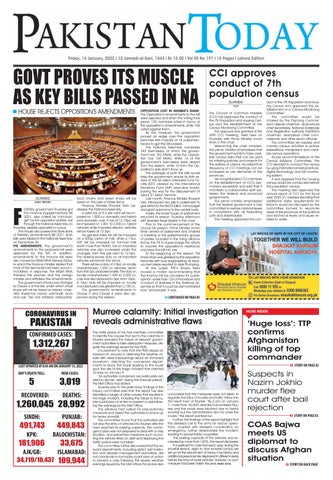
Govt proves its muscle as key bills passed in na g
House rejects opposition's amendments
ISLAMABAD staff report
F
ederal government thursday got the Finance (supplementary) Bill 2021, also called as ‘mini-budget’ by the opposition parties, sail through the national assembly on thursday despite opposition’s ruckus. the House also passed the state Bank of pakistan (amendment) Bill 2021. Both bills were tabled in the national assembly on december 30. The AMendMenTs: the government’s amendments to the proposed bill were approved by the na. in addition, amendments to the finance bill were also moved by mQm mna Kishwar Zahra, to which the finance minister replied that most of the demands had been accommodated. in response, the mQm mna thanked the premier and the foreign minister and withdrew the amendments. the government introduced changes to clause 3 of the bill, under which small shops will not be taxed on bread, chapattis, sheermal, naans, vermicelli, buns and rusk. tier one retailers, restaurants,
food chains and sweet shops will be taxed on the sale of these items. Finance minister shaukat tarin addresses the national assembly. a sales tax of 8.5 per cent will be imposed on 1,800 cc domestic and hybrid and domestic cars. a tax of 12.75pc will be imposed on 1,801 to 2,500 cc hybrid vehicles while imported electric vehicles will be taxed at 12.5pc. no general sales tax will be imposed on a 200g carton of milk, while a 17pc Gst will be imposed on formula milk worth more than rs500. tax on imported vehicles was also increased under the changes, from five per cent to 12.5pc. the federal excise duty on all imported vehicles will remain the same. there will be a duty of 2.5pc on locally manufactured 1,300 cc vehicles, down from the 5pc proposed earlier. the duty on locally manufactured 1,300 to 2,000 cc cars was also reduced to 5pc from 10pc. a 10pc duty will be imposed on locally manufactured cars greater than 2,100 cc. the government’s amendments to clause 5 and clause 6 were also approved during the session.
coronavirus in
pakistan
CONFIRMED CASES:
1,312,267
LAST UPDATED AT 8:45 AM ON JANUARY 13, 2022
DAY'S DEATH TOLL:
NEW CASES:
5
3,019
RECOVERED:
DEATHS:
1,260,045 28,992 SINDH:
PUNJAB:
491,743
449,843
KPK:
BALOCHISTAN:
181,906
33,675
AJK/GB:
ISLAMABAD:
34,719/10,437
109,944
OppOsITIOn lOsT In nuMber’s gAMe: the opposition’s amendments to the bill were rejected and when the voting took place, 150 members voted in favour of the opposition’s amendments, while 168 voted against them. By this measure, the government proved an edge over the opposition benches with majority of 18 parliamentarians to get the bill passed. the national assembly comprises 342 lawmakers, of which the government has 182 mnas, while the opposition has 160 mnas. While 14 of the government’s lawmakers were absent from the session, while 10 from the opposition’s side didn’t show up. the passage of both the bills would help the government ensure its sixth review of the $6 billion extended Fund Facility (eFF) cleared by the international monetary Fund (imF) executive board, paving the way for the disbursement of about $1 billion tranche. last month, Finance minister shaukat tarin introduced two bills in parliament to give effect to the rs375 billion mini-budget and grant autonomy to the central bank. earlier, the lower house of parliament resumed its session thursday afternoon with speaker asad Qaisar in the chair. prior to the commencement of the crucial na session, prime minister imran Khan arrived at parliament and chaired a meeting of the parliamentary groups of parties included in the ruling alliance led by the pti to supercharge the efforts to counter the opposition’s resistance and steer the bill into law. at the beginning of the session, pm imran Khan was greeted by the opposition benches with loud sloganeering as treasury lawmakers resorted to desk thumping. at the outset, ppp’s shazia marri moved a motion recommending that the finance bill be circulated for public opinion under rule 124 of procedure and conduct of Business in the national assembly so that it could be demonstrated how “anti-people” it was.
CCI approves conduct of 7th population census ISLAMABAD tLtp
the council of common interests (cci) has approved the conduct of the 7th population and Housing census and the establishment of the census monitoring committee. the approval was granted at the 49th cci meeting, held here on thursday with prime minister imran Khan in the chair. Welcoming the chief ministers, the prime minister emphasised that the government wants to have credible census data that can be used for initiating policies and projects for the welfare of citizens. He stated that frequency of cci meetings can be increased as per demands of the provinces. He congratulated cci members on the establishment of cci’s permanent secretariat and said that it manifests a collaborative spirit between the federal and provincial governments. the prime minister emphasised that the federal government is fully committed to resolve national issues in consultation with all federating units and stakeholders. the meeting approved the con-
CONTINUED ON PAGE 05
Murree calamity: Initial investigation reveals administrative flaws the initial probe of the five-member committee to identify the causes that led to the calamity in murree revealed the failure of relevant government authorities to take adequate measures, despite the warnings issued by the pmd. it is pertinent to note that the pmd issued an advisory on january 6, deeming the weather unsafe with clear forewarnings about an imminent snowstorm, directing the concerned departments to block the roads leading to the tourist spot, the site of the tragic incident that claimed 22 lives on january 9. “all authorities concerned are particularly advised to remain ‘alert’ during the forecast period,” the met office had stated. sources privy to the preliminary findings of the inquiry committee said that the report has also identified a range of other causes that resulted in the tragic incident, including the failure to formulate a joint plan of action to prevent a crisis following the warnings by the met office. the advisory had called for precautionary measures and asked the authorities to brace up for heavy snowfall. the committee found that the authorities did not stop the entry of vehicles into murree after the town reached its parking capacity. the contingency plan was not prepared to deal with a crisis situation, and preventive measures such as putting the vehicle-lifters on alert and deploying the traffic police were not taken. the committee further discovered that the relevant departments, including district administration and disaster management authorities, did not coordinate to formulate a joint plan of action to prevent a crisis following the severe weather warnings issued by the met office.the probe also
duct of the 7th population and Housing census and approved the establishment of a “census monitoring committee”. the committee would be chaired by the planning commission’s deputy chairman, all provincial chief secretaries, national database and registration authority (nadra)’s chairman, islamabad chief commissioner and other senior officials. the committee will oversee and monitor census activities to ensure expeditious, transparent and credible census operations. as per recommendations of the census advisory committee, the cci decided to conduct the census by using international best practices, digital technology and Gis monitoring system. it was apprised that the housing census would be conducted before the population census. the meeting also approved the annual report of cci for the fiscal year 2020-21, besides deciding that additional water requirements for Karachi would be discussed by the committee formed to reconcile views of the provinces at the political and technical levels and issues related to water.
more inside
‘huge loss’: TTp confirms Afghanistan killing of top commander STORY ON PAGE 02
uncovered that the measures were not taken to regulate the influx of tourists and traffic inflow into the resort town of murree. “By 6 pm on january 7, more than 30,000 vehicles had entered murree and the roads were blocked due to heavy snowfall but the administration did not close the routes,” the report pointed out. Further, the findings of the report highlight that the delayed call to the army for rescue operations, coupled with delayed coordination on emergency, further deteriorated the incident, leading to preventable causalities. the parking capacity of the vehicles was exceeded by more than 120%, the report disclosed. it is pertinent to note that each year, during the snowfall season, eight to nine snowfall camps are set up for the placement of heavy machinery and additional personnel are deployed in different areas before the entry of tourist vehicles. However, no such measure had been taken this year. News Desk
suspects in nazim jokhio murder flee court after bail rejection STORY ON PAGE 03
COAs bajwa meets us diplomat to discuss Afghan situation STORY ON BACK PAGE
02
Friday, 14 January, 2022 | LAHORe
news
‘Huge LOSS’: TTP COnFIrmS AFgHAnISTAn kILLIng OF TOP COmmAnder isLAMABAD
T
Staff RepoRt
HE Tehreek-i-Taliban Pakistan (TTP) Wednesday confirmed the death of a central commander whose killing in eastern Afghanistan was revealed earlier this week. Khalid Balti, also known by the nom de guerre Muhammad Khorasani when he served as the spokesperson of the proscribed militant group, was killed in Nangarhar province on January 9
Four sentenced to death over 2021 Johar Town explosion LAHOre
BOI implements 100 reforms to facilitate businesses stAff repOrt The Board of Investment (BOI) has completed 100 reforms out of the 168 proposed reforms under Regulatory Reforms and Guillotine Initiatives (PRMI) that aim to identify, simplify, modernize or eliminate the regulatory bottlenecks for facilitation of businesses, particularly Small and Medium Enterprises (SMEs). The data on the progress of these reforms was presented on Thursday during the sixth steering committee (SC) meeting of the PRMI, chaired by Advisor to the Prime Minister on Commerce and Investment Abdul Razak Dawood. According to official sources, a total of 168 reforms were proposed to federal and provincial departments of which 100 reforms were implemented while others were at various stages of implementation. BOI Additional Secretary Mukarram Jah Ansari, while sharing an overview of the progress of the Regulatory Guillotine mechanism, said, “The entire exercise has been carried out in close collaboration with business associations of various sectors to ensure accurate identifications of cumbersome regulations that are hampering business growth.” The secretary also appreciated the support of the World Bank, Foreign Commonwealth and Development Office (FCDO) and Office for Product Safety and Standards of the Government of UK, in capacity building and helping the Pakistan government departments regarding smart regulations. Representatives from Punjab and Khyber Pakhtunkhwa (KP) governments also briefed the meeting on the progress of initiation of provincial One Stop Shop (OSS) and Zero Time To Start-up (ZTTS) policies. Addressing the meeting, Razak Dawood expressed satisfaction with the performance of stakeholders and encouraged them to continue the momentum towards ensuring a business-friendly environment in the country. “It’s heartening to see acknowledgment of government endeavors by the private sector as it is a testament of the on-ground positive impact,” he stated. BOI Secretary Fareena Mazhar acknowledged the active involvement of the private sector in supporting the successful execution of the ongoing initiative. She expressed gratitude to the prime minister and his team for their support while also reaffirming federal and provincial governments’ commitment to improving the business climate of the country through perpetual regulatory reforms. The meeting also reviewed the implementation of decisions made in the fifth meeting of the steering committee, and the unveiling of an interactive portal showcasing the implemented reforms along with supporting evidence.
claimed he was not holding any position at the time of his killing. The spokesperson said the group “lost a religious scholar and expert of political affairs”, terming it a “huge loss” for the militants. His statement further said Balti joined the group when he migrated in 2011 and had been active since. He was arrested in 2015 and remained imprisoned until last year before being killed. Balti, a non-Pashtun Taliban leader, was freed following the Taliban takeover of Afghanistan in
Meeting on closure of schools amid soaring Covid-19 cases postponed isLAMABAD
MonitoRing RepoRt
An anti-terrorism court on Wednesday sentenced four men to death for their involvement in a car bombing last year that killed four people near the residence of Jamat ud-Dawa (JuD) chief Hafiz Saeed in Johar Town. The court also served up a five-year jail term for a woman, Ayesha Gul, convicted of facilitating the attack in Lahore, according to a statement released by the Counter-Terrorism Department of Punjab police. All five of the convicted — including the four men convicted of murder — were arrested after the June 23 attack near the residence of Saeed. The men include Peter Paul, Eid Gul, Zia Ullah and Sajjad Hussain. In 2020, an anti-terrorism court sentenced Saeed to 15 years in prison in a terror-financing case. He was serving his term under house arrest under a government order and he escaped the bombing attack unharmed. Four bystanders were killed.
(Sunday), Pakistan Today reported. In a statement issued January 10, a spokesperson for the Afghanistan-based group said it was investigating the reports. Today, the spokesperson, who also shares the Muhammad Khorasani alias with Balti, confirmed his predecessor’s death in a statement but offered no further details. A security official from Pakistan — who confirmed Balti’s killing on Monday — had said Balti, about 50, was the incumbent group spokesperson. But, TTP
August. Since then, he lived in the Nangarhar and Kunar region, where most of the TTP members are believed to be hiding. Radio Free Europe, quoting a local source in the region, reported Balti had gone missing two days before his body was found. Citing a militant source, Dawn said Balti’s funeral was held in the eastern Kunar province of Afghanistan on Tuesday and he was buried there. He had been making efforts for uniting various factions of the group and planning attacks with group chief Noor Wali Mehsud. He had recently hinted at carrying out terrorist attacks inside Pakistan. The killing came at a time when the TTP has increased its attacks in Pakistan. A month-long cease-fire with Pakistan ended on December 9 and since then the group has resumed attacks on the security forces.
Staff RepoRt
A meeting of the Inter-Provincial Education Ministers Conference (IPEMC) to decide on the closure of schools in view of rising infections of coronavirus scheduled for Thursday was postponed until next week, a notification said. The notification said a next date of the meeting will be announced later. But the ministry did not give any reason for the postponement of the meet. The development comes as authorities warned of a fifth wave of infections and made preparations to try to contain the fast-spreading Omicron variant. Only today, Pakistan reported over 3,000 new cases, the highest single-day total in the last four months, according to official data. The nation registered 3,019 infections in the past 24 hours, bringing the caseload to 1.13 million, Ministry of National Health Services data showed. “There is clear evidence now of a beginning of another Covid wave which has been expected for the last few weeks,” Asad Umar, the minister in charge of supervising anti-Covid-19 operations, wrote on Twitter in December. About 70 million people in Pakistan, or 32 percent of the population, have had two vaccine doses. The government authorised booster doses for citizens over the age of 30 from Monday. Children over the age of 12 are being offered vaccinations at their schools. The government of Sindh is working on a strategy to contain the variant, which has included a partial lockdown of a Karachi neighbourhood after about a dozen Omicron cases were detected in a family.
Diplomat lauds Pakistan-US scientist on first pig-to-human heart transplant wAsHiNGtON Staff RepoRt
Asad Majeed Khan, Pakistan’s ambassador to the United States, congratulated Dr Muhammad Mohiuddin, a professor of surgery at the University of Maryland School of Medicine, on achieving “a path-breaking achievement” in medical history after doctors in the Mid-Atlantic state transplanted a genetically modified pig’s heart into a human patient in a groundbreaking procedure to save his life. Last week, a 57-year-old man in the Baltimore city with life-threatening heart disease received a heart from a genetically modified pig, a groundbreaking procedure that offers hope to hundreds of thousands of patients with failing organs. It is the first successful transplant of a pig’s heart into a human being. The eight-hour operation took place on Friday, and the patient, David Bennett, 57, was doing well on Monday, according to surgeons at the facility. Pig hearts have previously been transplanted successfully into baboons by Dr Mohiuddin, who established the cardiac xenotransplantation programme
and is its scientific director. But safety concerns and fear of setting off a dangerous immune response that can be life-threatening precluded their use in humans until recently. The team of doctors also used a new experimental drug developed in part by Dr Mohiuddin to suppress the immune system and prevent rejection. “In a virtual meeting earlier today, I congratulated Dr Mohammad Mohiuddin on his path-breaking transplant surgery in the field of Xenotransplantation,” said Ambassador Khan in a tweet. “I told him how proud all Pakistani Americans were on this remarkable achievement by a fellow community member.” Bennett, a handyman, knew there was no guarantee the experiment would work but he was dying, ineligible for a human heart transplant and had no other option, his son said. “It was either die or do this transplant. I want to live. I know it’s a shot in the dark, but it’s my last choice,” he said a day before the surgery, according to a statement provided by the School of Medicine. “If this works, there will be an endless supply of these organs for patients who are suffering,” said Dr Mohiuddin.
Shafqat Mehmood tests positive for Covid-19 again News Desk Federal Minister for Education and Professional Training Shafqat Mahmood on Thursday said that he has tested positive for Covid-19 again. In a tweet, Shafqat said he is feeling mild symptoms at the moment. “I have unfortunately tested positive for coronavirus. My symptoms are mild so far and I feel fine. Hopefully with some rest will recover soon,” he wrote in his tweet. He also urged people to continue to take all precautions, especially wearing a mask at all times. He had earlier tested positive for the virus in May last year. A few days ago, President Dr Arif Alvi had also tested positive for Covid-19 for the second time. Pakistan is seeing an upward trend in Covid-19 cases as the country recorded 3,019 new cases of coronavirus during the last 24 hours.
The death toll from the pandemic climbed to 28,992 after five more patients succumbed to the viral disease in the past 24 hours.
Comprehensive roadmap to be devised to strengthen Pakistan-Sri Lanka ties Aziz BuNeri The Pak-Sri Lanka Business Council Khyber Pakhtunkhwa (KP) chapter has decided to devise a comprehensive roadmap to boost mutual trade between Pakistan and Sri Lanka. The decision was made during a meeting of the council, chaired by its provincial chairman, Zulfiqar Ali Khan, on Thursday. The council decided to expedite efforts that would encourage Sri Lankan investors to invest in potential sectors especially, in the tourism and hospitality sectors in Khyber Pakhtunkhwa as well as elsewhere in the country. Council members unanimously agreed to take the federal government and other relevant departments onboard in formulating an action plan and a concrete mechanism for the promotion of bilateral trade between Pakistan and Sri Lanka. The chair of the council, Zulfiqar Ali Khan, said that KP is a lucrative destination for foreign investment. It was noted that tourism, hospitality, hydel power generation, minerals, and honey are among the many potential sectors in KP that offer vast investment opportunities. Council members invited Sri Lankan companies to make the most of these opportunities and further economic and trade ties between the two countries. It was announced at the session that further meetings will be arranged with the KP Governor and Chief Minister, where the future plan of action to strengthen Pak-Sri Lanka trade relations will be shared. The chair of the council promised that the council will play a pivotal role in further cementing the countries’ mutual economic ties.
Friday, 14 January, 2022 | LAHORe
SuSPeCTS In nAzIm JOkHIO murder FLee COurT AFTer BAIL reJeCTIOn kArACHi
F
Staff RepoRt
IvE suspects in the murder of a young journalist escaped from a district and sessions court in Malir on Thursday after their request for interim bail was rejected. The body of Nazim Jokhio was found inside a Malir farmhouse in November. The victim had died apparently after being thrashed with sticks and punches in a scuffle. Jokhio had stopped and filmed some foreigners while hunting rare houbara bustards in his native
village in Thatta, according to the first information report (FIR) of the incident registered on the complaint of his brother Afzal Jokhio. “MPA Jam Awais alias Gohram, along with Niaz Salar, Ahmed Shoro, Haider Ali and Mehr Ali, killed my brother by kicking and punching, and beating him with batons close to the gate of Jam House,” the report quoted Afzal as telling the police. Jam Awais Khan Jokhio, a Pakistan Peoples Party (PPP) lawmaker, surrendered to the police days later after Jokhio’s relatives staged a sit-in on a highway. The suspects who escaped included Saleem
Salar, Dodo Khan, Muhammad Soomar, Muhammad Ishaq and Muhammad Khan Jokhio. The court reserved its verdict on their petitions on January 8 in the light of the investigation report and said to announce its decision on January 13. In a previous hearing, the court expressed annoyance over the police investigator for failing to complete the investigation in the murder. The investigation officer (IO) sought time to submit a final charge sheet, maintaining he was yet to receive reports of a forensic analysis of digital video recorder (DvR) footage recovered from cameras at the farmhouse and portable storage.
supply of furnace oil to power plants still plugged as refineries offer different prices AHMAD AHMADANi All five local refineries have offered different prices for the sale of furnace oil (FO) to power plants, and the petroleum division’s directorate-general (oil) has requested the power division to take appropriate action in this regard. The director-general (DG) of oil, through a letter on January 11, forwarded the responses of refineries on a proposal to reduce the furnace oil price, and also communicated the prices offered by different refineries for supply to power plants. According to the DG of oil, National Refinery Limited (NRL) offered a price of Rs 81,000 per metric tonne (/MT), Pakistan Refinery Limited (PRL) Rs80,000/MT, CNERGYICO – Rs86,000/MT and Pak Arab Refinery Limited (PARCO) at Rs83,000/MT price for sale to power plants. “Foregoing in view, power division is requested to look into the matter for appropriate action with regard to merit order for supply of FO to the power plants keeping in view the severe ullage issues faced by local refineries, especially PARCO,” according to the letter. All five refineries were earlier informed by the government that a meeting of the Ministry of Energy held under Minister Hammad Azhar discussed the state of supply to power plants and the ullage issues of refineries. Due to the ample ullage available with the power plants and unfavourable position of FO in the merit order, it was directed that the refineries may be approached to consider the possibility of rationalising the price of furnace oil by reducing
SeCP consolidates circulars to facilitate insurance sector
their margins or through appropriate discounts. The move may facilitate FO prices to become viable, match the merit order and enable increased consumption for a limited period, eventually easing the ullage issues at refineries. “The refineries are therefore requested to examine the matter and furnish their views/feedback on the matter by January 10,” said a letter from the DG of oil. In its response, CNERGYICO highlighted that the refining sector was already under severe cash flow stress and further discount in FO price was economically unsustainable. The petroleum division had also been asked by the refineries to convene a meeting of all relevant stakeholders including local oil refineries and the power division in order to agree upon a comprehensive and sustainable solution to the ongoing issue. CNERGYICO also suggested that the Ministry of Energy should assist National Electric Power Regulatory Authority (NEPRA) in amending the merit list of FO fired power plants which will enable independent power producers (IPPs) to pursue furnace oil stock build up as per their agreements with the government. Similarly, Pakistan Refinery Limited, National Refinery Limited and Attock Refinery Limited in their response also rebuked the suggestion of reducing furnace oil prices saying it was not viable. According to PRL, its ex-refinery price of furnace oil for the first two weeks of January 2022 was Rs86,000/MT against an import parity price of Rs92,434/MT and monthly average FOB price of
Pakistan records highest one-day tally in coronavirus cases since September
isLAMABAD newS DeSk
In order to facilitate the insurance sector in complying with the applicable regulatory requirements, the Securities and Exchange Commission of Pakistan (SECP) has issued a master circular, consolidating all existing applicable circulars, directives and guidelines issued up to December 31, 2021. According to a statement issued on Thursday, the master circular has been categorised into twelve key chapters i.e. licensing and authorisation, product approvals and disclosure, reinsurance and retakaful, corporate governance, financial and regulatory reporting, management expense limits, related party assets, information sharing, training and certifications, complaints handling, cybersecurity and miscellaneous. The circulars, either obsolete or repealed, have been excluded from the Master Circular. The SECP said that it is actively working for simplification and consolidation of its regulatory framework with a view towards promoting ease of doing business, reducing costs, and ensuring transparent and effective enforcement; and this master circular is part of that effort. It said the master circular has been uploaded for information of all stakeholders on SECP’s website.
reference crude (Arab Light for December 2021) of approximately Rs101,000/MT. “The above price comparison clearly shows refineries’ loss, and any further reduction in the price of furnace oil will further compound sustainability challenges,” the PRL had said in its response to the petroleum division. PRL stated that, “the proposed refinery policy, if approved, will comprehensively address refineries’ sustainability challenges and will also support the government’s endeavours of consumption of environment-friendly fuels”. Further adding “It is imperative that the draft refinery policy be approved without any further loss of time by the concerned authorities,” in its letter to DG oil. Similarly, NRL mentioned in their letter that it was extremely difficult to consider any further reduction in the ex-refinery price of furnace oil, elaborating that the proposed suggestion of discount on furnace oil price will deteriorate the companies’ financial position and ultimately lead to suspension of operations. “It is, therefore, requested that an economically viable and appropriate way forward shall be arrived at after discussion with the industry so that furnace oil offtake can be ensured on a regular basis,” summarised NRL in its letter. Attock Refinery Limited, in tune with PRL and NRL, also said that considering any further discount in furnace oil pricing would further aggravate the already precarious situation, and the proposal of pricing adjustments was not a financially viable option.
isLAMABAD Staff RepoRt
Pakistan reported over 3,000 new cases of Covid-19 on Thursday, the highest single-day total in the last four months, as the fifth wave of the coronavirus intensified, according to official data. The country registered 3,019 infections in the past 24 hours, bringing the caseload to 1.13 million, Ministry of National Health Services data showed. Five fatalities were also reported, taking the death toll to 28,992. On September 11, Pakistan registered 3,153 cases, which gradually decreased to 291 on December 29. However, infections again spiked earlier this month after the country reported cases of the latest Omicron variant in some cities. Since the outbreak in March 2020, 491,743 cases have been confirmed in Sindh, 449,843 in Punjab,
181,906 in Khyber Pakhtunkhwa, 109,944 in Islamabad, 34,719 in Azad Jammu and Kashmir, 33,675 in Balochistan and 10,437 in GilgitBaltistan. The government has so far performed 23,984,502 tests with 49,270 in the last 24 hours. 1,260,045 patients have recovered whereas 651 patients are reported to be in critical condition. The positivity ratio was recorded at 6.12 per cent. Over 100 million people have received their first dose of a coronavirus vaccine, including 386,788 in the last 24 hours. 75 million people have been fully vaccinated while 461,167 received their second dose in the last 24 hours. Asad Umar, the minister in charge of Covid-19 response, warned earlier this month that authorities have “clear evidence” of a new virus wave. He said a surge “has been expected for the last few weeks” and that genome sequencing shows a “rising proportion of omicron cases,” particularly in Karachi, the country’s largest city and a commercial hub of nearly 17 million people. The government has administered the first dose of a Covid-19 jab to over 100 million to date, while over 75.68 million people have been fully vaccinated, according to official data. “Achieved another major milestone in the vaccination campaign yesterday, crossing 100 million people who have received at least one dose […] Work not complete yet. Need to keep the momentum going,” Umar tweeted Tuesday. — With additional input from Anadolu Agency
news
03
SBP declared best central bank in world for promoting Islamic finance kArACHi newS DeSk
The Islamic Finance News (IFN), an arm of REDmoney Group, Malaysia, has announced State Bank of Pakistan as the best central bank of 2021 across the world in promoting Islamic finance. According to statement issued by the SBP, the results of global voting were disclosed on Thursday. IFN Best Banks Poll is regarded as one of the prestigious accolades in the global Islamic finance space. Bank Negara Malaysia stood second while the Saudi Central Bank secured third position, it said. The category of the best central bank in promoting Islamic finance is one of the closely fought contests among regulators competing for supremacy through exceptional advances made during the year. The SBP is honoured to have won this award for the 5th time during last seven years. Previously, SBP was bestowed with this coveted award for the year 2015, 2017, 2018, and 2020. IFN in its cover story while congratulating the State Bank of Pakistan for yet another win as the best central bank in promoting Islamic finance stated that they welcome back a leading light of the industry. In a closely fought contest, 2020’s victor came roaring back to take the crown, said the IFN. IFN while announcing the poll result also stated that with its Governor Dr Reza Baqir, recently promoted to be the new chairman of the Council of the IFSB, from his role as the deputy chairman in 2021, they can hopefully look forward to even stronger support and leadership from the central bank over the coming year. The IFN Award to SBP as the best central bank is the global endorsement of its initiatives for promotion of Islamic banking in the country. The award reflects an international recognition of the strategic measures undertaken by SBP to put in place a robust policy environment for Islamic banking to prosper. The statement said that the SBP has consistently promoted and encouraged Islamic finance within Pakistan, and has taken several significant steps. These include launch of 3rd five year Strategic Plan for Islamic banking 2021-25, Shariah compliant standing ceiling facility and open market operations, strengthening of Shariah governance mechanism, Shariah compliant regulations for the lender of the last resort (LOLR) facility and licensing regime for digital banking covering the Islamic segment; besides taking initiatives for promoting better awareness amongst the masses, and strengthening international linkages. The Strategic plan 2021-25 envisages to take Islamic banking share of 30% in terms of assets and 35% in terms of deposits in the overall banking system.
Friday, 14 January, 2022 | LAHORE
04 NEWS
Karachi central Jail inmate bags rs1m scholarship to pursue degree in chartered accountancy
a
NEWS DESK
Karachi Central Jail inmate, imprisoned for the past 11 years, has won a scholarship worth Rs1 million to pursue a degree in chartered accountancy for his exceptional academic performance. The Institute of Chartered Accountants of Pakistan (ICAP) has awarded the scholarship to prisoner Naeem Shah.
As per the details revealed by the Senior Superintendent of Central Jail Muhammad Hassan Sehto, Shah was sentenced to life imprisonment for murder and was behind bars for the last 11 years, stated. “While in prison, he resumed his studies,” the superintendent said. “He gave his matriculation exams and then undertook intermediate examination, in which he secured excellent marks, and attained a
position in the top 20 students.” Sehto added that after his Intermediate results, Shah approached ICAP, requesting them to be given a chance to become a Chartered Accountant for higher studies. He was offered a scholarship because of his outstanding academic performance. Letters were exchanged in this regard in which ICAP stated that Shah was eligible for their scholarship programme, and has been given a scholarship of Rs1 million, the
superintendent added. It is due to Shah’s own dedication along with the support of the prison authorities, he was able to achieve this position today, the superintendent stated. “Naeem Shah showed good manners whilst in jail and spent most of his time studying instead of talking to fellow prisoners. The jail authorities also him encouraged fully and provided him with all possible help in his studies,” Sehto concluded.
India ‘not averse’ to demilitarisation of Siachen glacier: military boss NEW DELHI anadolu agency
The threat China poses to India has by no means diminished despite partial disengagement along the two countries’ de facto border, the Indian army chief said. “War or conflict is always an instrument of last resort. But if resorted to, we will come out victorious,” asserted Gen. Manoj Mukund Naravane at a virtual press conference ahead of India’s Army Day on Saturday. Underlining that the Indian Army would deal with the People’s Liberation Army (PLA) of China in a firm manner as it maintains maximum operational preparedness along its northern borders, Naravane said New Delhi would at the same time engage with the neighbouring military through dialogue. He noted the Indian military had increased its force levels in the region since a military standoff in 2020 and that this would continue this year, as well. The two countries were engaged in a face-off along the Line of Actual Control (LAC) — the de facto border between China and India in the disputed territory of Ladakh in the disputed Himalayan region of Jammu and Kashmir. Tensions soared in June 2020 after at least 20 Indian and four Chinese soldiers were killed in a border clash in the region. Though the situation calmed after several rounds of talks, the two sides are yet to reach a resolution and have increased mili-
tary deployment along the border. However, there have been positive developments along the country’s northern and western borders since January last year as Indian forces have engaged with Chinese troops through dialogue, he said. When asked about the 14th round of military dialogue with China, which began on Wednesday, he expressed optimism on the resolution of difficulties at Patrolling Point 15 in eastern Ladakh, from where Chinese troops moved out in 2020 as part of disengagement efforts at the border. However, China urged the Indian army chief to “refrain from unconstructive re-
marks.” “China and India are working through diplomatic and military channels to ease border tension. We hope individual personnel from India will refrain from making unconstructive remarks,” Wang Wenbin, spokesperson of China’s Foreign Ministry, told a news conference in Beijing on Thursday. Speaking on tensions with long-time rival Pakistan, Naravane said there had been an increase in the concentration of “terrorists” in various areas, from which he said they have launched “repeated infiltration attempts which have once again ex-
posed the nefarious designs of our western neighbour.” “We have resolved to show ‘zero tolerance’ on terror,” he said. The army chief added that India was not “averse to the demilitarisation of the Siachen Glacier”, the world’s highest battlefield in the Himalayan region, that has claimed the lives of hundreds of soldiers. “We are not averse to the demilitarisation of the Siachen Glacier, but the precondition for that is Pakistan’s acceptance of the Actual Ground Position Line (AGPL),” said Naravane, claiming the dispute on Siachen “occurred because of Pakistan’s unilateral attempts.” Troops from Pakistan and India militaries have been stationed at Siachen since 1984. Successive talks on de-militarisation have so far failed to defuse the stalemate. India wants the current position of the two countries’ troops be accepted for demilitarisation to occur, though Pakistan has rejected this. DisputeD region: The Himalayan region of Kashmir is held by Pakistan and India in parts and claimed by both in full. A small sliver of Kashmir is also held by China. Since they were partitioned in 1947, Pakistan and India have fought three wars – in 1948, 1965 and 1971 — two of them over Kashmir. Their troops have also fought intermittently in the northern Siachen region since 1984. A cease-fire took effect in 2003.
Pakistan welcomes P5 statement on prevention of nuclear war, arms race ISLAMABAD Staff RepoRt
Pakistan said that a joint statement by the five permanent members of the United Nations on the avoidance of war between the nuclear-weapon nations and the reduction of strategic risks was a positive development. According to the statement published by the Kremlin on January 3, China, Russia, Britain, the United States and France agreed that a further spread of nuclear arms and a nuclear war should be avoided. France also released the statement, underscoring that the five powers reiterated their determination for nuclear arms control and disarmament. They would continue bilateral and multilateral approaches to nuclear arms control, it said. “This understanding among the permanent members of the UN Security Council can pave the way for concrete measures for strategic stability at the global and regional levels,” the Foreign Office said Thursday. The spokesperson said that as a responsible nuclear weapons state, Pakistan supported the objectives of global and non-discriminatory nuclear disarmament and non-proliferation, in line with the
CMYK
stipulations of the First Special Session on Disarmament of the UN General Assembly (SSOD-I) — with equal and undiminished security being the defining consideration. He said the statement from the so-called P5 group rightly acknowledged the imperative of creating a conducive security environment for meaningful progress on nuclear disarmament. This will include addressing the underlying security concerns of states, pacific settlement of outstanding disputes, and cessation of destabilizing arms buildups that accentuated asymmetries, he added. In the context of South Asia, Pakistan’s proposal for a Strategic Restraint Regime, encompassing nuclear and missile restraint, conventional balance and settlement of disputes, could contribute significantly towards maintaining strategic stability and avoiding military conflict, the spokesperson noted. This will also entail eschewing misplaced notions of space for war in a nuclearised environment. “Pakistan fully agrees with the need for effective measures by all nuclear powers to guard against any unauthorised or unintended use of nuclear weapons,” the spokesperson reiterated.
sindh govt directed to respond to objections on controversial lg law KARACHI Staff RepoRt
The Sindh High Court (SHC) on Thursday served notice on the Sindh government on a petition moved by Jamaat-i-Islami to challenge the Sindh Local Government (Amendment) Act, 2021. The petition was moved by the party’s Karachi president Hafiz Naeem ur-Rehman, maintaining the Pakistan Peoples Party (PPP) has concentrated virtually all municipal powers with the provincial government, leaving the elected local bodies largely toothless and the cities, particularly Karachi, in an utter mess. The high court ordered the provincial government to submit its response in the next hearing of the case before adjourning further proceedings for an indefinite period of time. The petitioner requested that the bill — passed on December 11 — was “illegal and in blatant violation of Article 140A of the Constitution”. Rehman in the petition requested the SHC to declare the new amendments in the bill as unconstitutional and void. It merits a mention here the JI has been protesting against the local government bill in front of the Sindh Assembly in Karachi for the last two weeks. The House had passed the amendment bill aimed at setting up a new local government regime with a majority amid the strong protest from the opposition. The bill also sought to give powers to the mayor to head Solid Waste Management Board. It is important to mention here Governor Imran Ismail had rejected the bill over apparent disempowerment of urban provincial towns.
money laundering case against tiktok star after viral foreign currency stunt ISLAMABAD Staff RepoRt
The cybercrime wing of the Federal Intelligence Agency (FIA) launched a money laundering probe against famous TikTok actor Hareem Shah after a video showing her admitting to bringing wads of British currency from Karachi to the United Kingdom went viral on the internet. Shah, whose real name is Fizza Hussain, posted the video on January 11 at 2:45 pm but deleted it after it went viral, prompting the agency to take legal action against her. Shah traveled to the UK via Doha by Qatar Airways from the Jinnah International Airport in Karachi on January 10, Amir Farooqui, Sindh director for the agency, told Arab News. “We have registered a case against her and started investigating the alleged money laundering after watching the confessional video,” the publication quoted Farooqui as saying. Imran Riaz, head of the Sindh chapter of authority’s cybercrime wing, tweeted that “a [legal] notice is being issued to her to explain her position [on the matter]”. A communiqué issued by the agency said it had also decided to write to the National Crime Agency (NCA) of the UK to initiate action against Shah. “The illegal transfer of money comes under the orbit of money laundering,” the handout read, observing that a stash of money could also be seen in the video. In the video, the actor appears to be “acknowledging the offence of money laundering and denying it later on and terming it as a ‘fun video'”, Riaz said. He said the video was an “act of ridiculing, disrupting and defaming […] Pakistan as well as state institutions using cyberspace” and, therefore, “comes under the preview of glorification of the offence of money laundering”. An often controversial figure, Shah rose to fame in 2019 when she shared a video of herself in the Foreign Office on TikTok. Her name has since been making headlines, with millions of followers and views on her videos.
Friday, 14 January, 2022 | LAHORE
NEWS BORIS JOHNSON APPOINTS BRITISH-PAkISTANI AAMER SARFRAz AS TRADE ENVOY TO SINgAPORE
T
HE British Government has appointed Lord Aamer Sarfraz as Prime Minister Boris Johnson’s Trade envoy to Singapore to promote British interests and trade ties between the two countries. The UK Government’s Department for International Trade announced the appointment of a British Pakistani House of Lords member’s appointment at the important position. The UK exports minister said in a tweet: “We’ve ap-
pointed two new PM trade envoys to strengthen trade and investment relationships and promote British business interests. Graham Stuart to Vietnam, Cambodia & Laos and Lord Sarfraz to Singapore.” The Department For International Trade said: “Congratulations to Graham Stuart and Lord Sarfraz who have been appointed as two new PM trade envoys. They will engage with their overseas markets to identify trade and investment opportunities for British businesses.” News Desk
Climate change is most significant challenge to achieve sustainable development goals: Fakhar Imam ISLAMABAD: Federal Minister of National Food Security and Research Syed Fakhar Imam addressed the seventh D-8 Agricultural Ministerial Meeting on “Agriculture and Food Security: Promoting Climate Smart Agriculture” on 13th January, 2022. It was attended Ministers of Agriculture/Live Stocks/ Rural Development and Heads of Delegation of the People's Republic of Bangladesh, Arab Republic of Egypt, Republic of Indonesia, Islamic Republic of Iran, Malaysia, Federal Republic of Nigeria, Islamic Republic of Pakistan, and the Republic of Turkey. Federal Minister for National Food and Security Syed Fakhar Imam said that this conference has provided us a platform, where we can make commitment to eradicate poverty, end hunger, combat climate change, and address the challenge of reducing food loss and waste. I would like to appreciate the organizers for raising global awareness on the issue of food loss and waste. Fakhar said that climate change has become the most significant challenge to achieve sustainable development goals and it threatens to drag millions of people into neverending poverty food insecurity. He continued and said that Agriculture is the foundation of food security in the developing World. It not only provides essential food for human consumption and feed for livestock but also provides raw materials for industry and value-added products for both domestic consumption and international markets. Minister said that There is a need to transform agriculture sector to such a vibrant and resilient scale where it can withstand the impacts of climate change and protect the livelihoods of dependent farming communities and agroindustries and its contributions to the global greenhouse gas emissions are at the minimum possible levels. Imam said that MNFS&R through Pakistan Agricultural Research Council (PARC) has done some pioneer work regarding research and development of Climate Smart Agriculture (CSA). I would therefore urge that PARC along with suitable organizations from other countries should be made part of this initiative right from the planning stage. Pr
INVESTITURE CEREMONY HELD AT AIR HEADQUARTERS
ISLAMABAD: The meetings under the chairmanship of SAPM on Establishment, Mr Mohammad Shehzad Arbab, in order to review the performance of ministries, have started. During these meetings, which will continue for two weeks, performance of ministries during the second quarter of FY2021-22 will be reviewed. The Review Committee includes Deputy Chairman Planning, Mr. Jehanzeb Khan and senior officials of Establishment Division, Cabinet Division, Finance Division and Planning Division. On the occasion, Mr Shehzad Arbab stated that performance agreements as governance tool, are making a transformational shift to an outcomebased, time-bound delivery mechanism. Through these agreements, all the ministries are working in unison to achieve the diverse targets necessary for the development of the country. Out of the total 1090 initiatives to be achieved by the ministries during two financial years, 426 initiatives will be completed in FY 2021-22, 488 initiatives will be completed in FY 2022-23 while 176 are running initiatives. Mr Arbab also said that special attention has been paid to the inter- ministerial dependencies and to remove any hurdles in this regard. He further said that based on their performance, ministries will be ranked and the review reports of the ministries will be presented to the Prime Minister. The ministries whose performance was reviewed today included SAFRON, Board of Investment, Industries & Production, Planning & Development, Foreign Affairs and Commerce Division. Pr
Govt proves its muscle as key bills passed in NA continued from page 01 Voting also took place on several amendments moved by the opposition to the finance bill that were subsequently rejected through a voice vote. The opposition lawmakers also called for the House to debate the recommendations put forth by the Senate. PML-N’s Ahsan Iqbal said that the recommendations put forth by the Senate regarding the minibudget had not been discussed and called it an insult to the upper house of Parliament. The opposition further demanded that a physical count be conducted for some of the amendments tabled by the opposition, including those by Mohsin Dawar and PMLN’s Shahid Khaqan Abbasi. However, the NA speaker refused under Rule 29 of Procedure and Conduct of Business in the National Assembly. A physical count was later conducted on the amendments moved by PPP’s Shazia Marri, with 168 lawmakers in favour of it and 150 against it. Abbasi then questioned why it was necessary for the government to introduce a mini-budget and said that such a massive tax burden had never before been presented in the country’s history. “It has been six months since you passed the finance bill. Have your revenues declines or expenses increased since then?” he asked. He also questioned why the people were being burdened with additional taxes of Rs350 billion. Shaukat tarin reSpondS: Responding to the opposition’s queries, the finance minister said the finance bill was not aimed at imposing new taxes but documentation of the economy to broaden the tax net. Train said that the government has decided not to withdraw tax exemptions on basic essential items such as milk, bread, laptop and solar panels. Tarin stated that the IMF had called for imposing a value-added tax when he had previously served as the finance minister. He also emphasised the need for documenting the economy, stating that people’s incomes were not being taxed because they didn’t fall under the tax net. He went on to add that some of the taxes in the mini-budget had been removed, informing the opposition that this was about “documentation not taxes”. Bilawal’S take on tarin: PPP Chairman Bilawal Bhutto-Zardari said that the amendment he introduced concerned taxes on crude oil and imported items. “My question to the finance minister is whether they have accepted this. He himself said that they are withdrawing some of the taxes.” He questioned whether the finance minister had an issue with the fact that it mentioned his name and those of Shazia Marri and Raja Pervaiz Ashraf. “What was the harm in it being accepted?” Referring to the finance minister, Bilawal said that Tarin stated that past governments had made matters worse even though he had previously served as the country’s finance minster. “Tarin said he did not know why there was hue and cry [over the mini-budget]. We request him to visit the streets of Karachi and ask the people about their economic situation.” The PPP chairman said that some Karachi lawmakers had moved amendments and had also expressed their reservations regarding the mini-budget. He called on them to reject the finance bill and work with the opposition to steer the country out of the economic situation. Responding to the PPP chairman, the finance minister said the opposition had claimed that the government was sacrificing the country’s economic sovereignty and national security. “But they went to the IMF approximately 13 times. Did they forfeit our economic sovereignty each time?” he asked. Taking the floor once again, Bilawal said that the finance minister had claimed that he did not renege on the promises he had made. “But neither the finance minister nor the prime minister stick to their promises.” He said that this was the time to show the people the government’s success in running the country before the next elections. “But what is your success? The Economist says that Pakistan is the fourth most expensive country in the world, the most expensive in the region.” He said that the inflation had risen to double digits and while the debt to GDP ratio had also soared. This is the what Naya Pakistan has delivered, he said. oppoSition up in armS over ‘Bulldozing’ of SBp Bill: Shortly after the NA passed the mini-budget, the op-
cmYK
position benches were up in arms against the “bulldozing” of the SBP bill and called for holding a detailed discussion after the speaker suspended the rules for debate. Addressing the speaker, PML-N’s Ahsan Iqbal called on him to not suspend the rules of the House. “If you suspend the rules and bulldoze the bill in the darkness of the night, then your name will go down in history among those who conspired to sell the country’s economic sovereignty.” He urged the speaker to let lawmakers discuss the bill for two days. Shahid Khaqan Abbasi said that the SBP bill was not in the country’s interest. He said that the opposition was ready to debate the bill today and tomorrow. Taking a dig at the government, PPP Chairman Bilawal Bhutto-Zardari said that it was very rare to have the premier and the entire front row of the treasury benches in attendance. He reiterated calls for a detailed debate. “This bill says that Pakistan’s defence expenditure will have just one bank account and all expenditures will be made through that account,” he said, adding that this would make it easier for “international forces” to scrutinise the country’s defence and nuclear expenditure. The opposition began to chant slogans and surrounded the speaker’s dais, who then initiated voting on all the amendments by the opposition which were subsequently rejected. The opposition’s amendments were presented by the speaker after lawmakers resorted to chanting slogans against the government. Following this, a clause by clause vote was initiated on the bill, all of which were approved by the House. khattak’S outBurSt: Prior to the commencement of the crucial NA session, Prime Minister Imran Khan arrived at the Parliament and held a meeting of the parliamentary groups of parties included in the ruling alliance led by the PTI to supercharge the efforts to counter the opposition’s resistance and steer the bill into law. As per sources, there was a heated exchange between Defence Minister Pervez Khattak and Energy Minister Hammad Azhar over refusal of natural gas supply to the consumers in Kyber Pakhtunkhwa. Khattak expressed his displeasure over the current situation and reportedly later left the meeting. He, however, later came back to the meeting and said he had stepped outside to “smoke a cigarette”. It is pertinent to note that the opposition also held a protest outside the Parliament, which was led by opposition leader and PML-N President Shehbaz Sharif. Shehbaz stated that the opposition has “rejected the mini-budget” as it would further burden the common man under a slew of new taxes and would increase inflationary pressure. On the contrary, Information Minister Fawad Chaudhry said the mini-budget will bring betterment to the country’s economy. Pakistan People’s Party (PPP) Chairperson Bilawal Bhutto-Zardari censured the Pakistan Tehreek-e-Insaf government on Wednesday over the mini-budget that proposed ending tax exemptions on various goods to generate over Rs350 billion in taxes. Bilawal went on to blame the Imran Khan-led government for pressing on the contentious bill due to an “egotistical” attitude which, he said, would come at the cost of the common man’s well-being. “But because of your stubbornness and ego, you took decisions that are a robbery of the common man’s pockets.” The PTI government created hardships for people by initially saying that it wouldn’t go to the International Monetary Fund (IMF), Bilawal said, adding that when they were forced to seek IMF’s help they struck a poor deal. “We said it then that the ‘PTIIMF’ budget would create difficulties for the poor segments of the society,” he added. Article 73 of the Constitution deals with the “procedure with respect to money bills”, which are only required to be passed by the National Assembly, the lower house of parliament. However, Article 73(1) states: “Notwithstanding anything contained in Article 70, a money bill shall originate in the National Assembly, provided that simultaneously when a money bill, including the finance bill containing the annual budget statement, is presented in the National Assembly, a copy thereof shall be transmitted to the Senate which may, within fourteen days, make recommendations thereon to the National Assembly.” These recommendations, however, are not binding for the National Assembly and it can approve a money bill even without considering it.
05
corporate corner PAkISTAN NAVY OPERATIONAL COMMANDS SEMINAR HELD AT kARACHI
KARACHI: Pakistan Navy Operational Commands Seminar was held at Bahria Auditorium Karachi. Chief of the Naval Staff, Admiral Muhammad Amjad Khan Niazi graced the occasion as Chief Guest. While addressing the seminar, Naval Chief emphasized upon multifarious traditional and non-traditional challenges being faced in maritime realm by Naval forces throughout the globe. The Admiral urged to strengthen inter-agencies cooperation at national level and enhance collaboration at regional as well as global level to suitably counter and quell transnational threats in maritime domain. The Chief Guest while appreciating quality of the papers commended panel members for presenting well researched papers and organizers for conducting the seminar in a professional manner. Pakistan Navy Operational Commands Seminar is prominent event held annually under the auspices of Operational Commands i.e Fleet and Coastal Command during which selected panels of officers from relevant Commands present papers on contemporary naval professional issues. Pr
Alternate Measures Taken for Internet Connectivity Affected by Fault in International Submarine Cable ISLAMABAD: A fault has been reported in the international submarine cable, SMW4, operated by PTCL, in the Indian ocean due to which some internet users may experience downgraded speeds during peak hours. However, alternate measures to provide uninterrupted internet services to the users have been taken on priority basis to meet capacity requirements including additional adhoc bandwidth in the system. Work is underway to fully restore internet services at the earliest. Pakistan Telecommunication Authority (PTA) is monitoring the situation and will continue to update on it. Pr
INVESTITURE CEREMONY HELD AT AIR HEADQUARTERS
Non-Operational Military awards were conferred upon Officers, JCOs, Airmen and Civilians of Pakistan Air Force in recognition of their distinguished services during an Investiture Ceremony held at Air Headquarters, Islamabad today. Air Marshal Syed Noman Ali, Vice Chief of the Air Staff, Pakistan Air Force was the Chief Guest at the occasion. During the Ceremony, Chief of the Air Staff Commendation Certificates were conferred upon 126 PAF personnel including Officers, JCOs, Airmen and Civilians. 27 Professional Excellence Badges to PAF Officers, 20 Tamgha-i-Khidmat (Military) Class-II & Class-III were conferred upon JCOs and Airmen. The decorations were awarded in recognition of acts of extraordinary devotion to duty and outstanding contributions towards service. A number of PAF high ranking officers and personnel were also present at the occasion. Pr
POWER SHUTDOWN NOTICE ISLAMABAD: According to an IESCO spokesperson, administration is expansion IJP Principal Road and as is also in plan a constructing flyovers at Stadium Road Kataria and Faqirapi (Mandi Morr). As a result, IESCO installations such as power lines, poles, transformers and other installations are being shifted to alternative locations. In this regard, IESCO Construction Directorate along with the local administration is fulfilling its professional responsibilities to the fullest. Due to shifting of IESCO installations the I-10, I9, Khayaban-e-Sir Syed, Satellite Town, Kataria, Pir Wadhai, Dhok Najo, Eid Gah, Holy Family, Bani feeders and surrounding areas connected to the respective grid stations H-11, I-10 and I-8 Facing limited load management at different times, and schedule is also uploaded on the IESCO website www.iesco.com.pk. IESCO Construction Directorate teams are working fast on these projects. So that these projects can be completed on time and before summer. Some elements in various forums are calling it load shedding which is absolutely baseless propaganda because IESCO is getting electricity quota according to demand. Shifting to alternative locations of IESCO installations is essential for completion of ongoing development works within due course of time and before summer. Pr
06-07 Comments - 14th January 2022_Layout 1 1/13/2022 11:23 PM Page 1
Friday, 14 January, 2022
06 COMMENT
Taking off the lid
Government under pressure And a divided Opposition
T
he PML(N) which had earlier rejected the suggestion of bringing a no-confidence move against the PM, has now agreed to discuss it in the PDM. The reason advanced for rejecting the proposal was that the move wasn’t feasible in a situation where the establishment stood firmly behind the PTI government, ready to provide it the required numerical support to remain in power. The recent defeat of the PTI in by elections and its rout in the KP LB polls were interpreted as a sign of the establishment having become neutral. The opposition was further encouraged by the criticism of the mini budget in the National Assembly by some coalition allies. The denial of support in by-elections or the KP LB polls might have come as a bolt from the blue for the PTI, but these in no way posed a threat to the PTI government. There is a perception that the establishment would hesitate to bring down the present set up unless it has mended fences with opposition parties or evolved a dependable alternative. Till then the allies provided to the PTI might protest, but would vote for the government whenever required. Demoralisation has already set in the PTI’s rank and file. The highly unusual and angry exchange of words between the PM and Defence Minister Pervez Khatak in the PTI’s parliamentary committee meeting is an expression of the state of affairs in the ruling party. Desertions too have started to take place, which shows a decreasing faith in the ability of the top leadership to fulfil the promises made to the people. The economic situation continues to worsen, belying Imran Khan’s claims of bringing down prices soon and improving the livelihood of the common people. Some of the deserters have confirmed that the top leadership is involved in corruption and lacks competence. In case the mini-budget is passed with the support of the coalition allies this would indicate that any attempt to get a no confidence motion passed is not likely to succeed at present. This leaves the option of street protests to pile pressure on government parliamentarians and allies that leads to the breakup of the alliance and a collapse the govt. The PPP and PDM have issued calls for protests on different dates. This would confuse the common people who look towards the opposition for a united response.
The Hindutva supporters cannot escape a tinge of sexuality in their fulminations at Penpoint M a NiaZi
T
he Bulli Bai app, which gave the names and phone numbers, with photos, of over 100 Muslim women, was wrong on so many levels. The first was that it was anti-Muslim. The second was that it was on the Internet, and was thus a cybercrime. It was also cyber bullying. Finally, it was sexual, not because vulgar language had been used or vulgar photos posted, but by its very nature. The first and last aspects encapsulated what has become a trend in the BJP’s India, of giving a sexual tinge to the hindu-Muslim problem. The first approach was that a cybercrime was committed, and that women were harassed. It was also significant that they were not targeted for being women, but for being Muslims. Indian Muslim women already have more of an issue with purdah, and for the women who have achieved public prominence to be thus shamed, indicates that Muslim girls will be more restricted. Underlying the app is the daily reality of cyber bullying that Muslims, men and women, must face in today’s India. Not just Muslims are under attack, but other minority religious communities. The recent clampdown on the Missionaries of Charity, the organization founded by Mother Teresa, which started on Christmas Day, is only the latest example. That shows that the main concern is with conversion of hindus, for the principal accusation is that hindus admitted to their orphanages are made to convert to Christianity. One of the charges by the Sangh Parivar against Muslims is that they engage in something called the ‘love jihad’, whereby Muslim men marry hindu women, and then make them convert to Islam. The other, that the Muslim convert to hinduism, is not possible, because hinduism does not accept conversion, mainly because of difficulties of adjusting the convert in the caste structure. The recent conversion of Waseem Naqvi, a former Chairman of the UP Shia Wakf Board, to Jitendra Narayan Tyagi was only possible because the priest carrying out the conversion adopted him into his own family. The real test will be whether he is accepted as a Tyagi by others. Many Indian and Pakistani Muslims have retained their original hindu castes, with the result that the Parivar wants them to return to hinduism. That too would be problematic. When Shivaji, the great Marathi hero and posterboy of the BJP, who had grown up an untouchable, claimed Rajput origins (which would be more suited to someone to be crowned), he underwent about a week of purification ceremonies, which cost (including lavish gifts to the Brahmins performing the ceremonies) Rs 1.5 million,
Governance collapsing The Usman Mirza and Hareem Shah episodes show up a deeper malaise
T
he case against Usman Mirza was not some obscure backwoods prosecution, but was a highprofile case which the police pursued only after it went viral on social media last September. Usman Mirza was accused of having forced a couple to perform intercourse before him and his accomplices after he surprised them at an Islamabad house. Four months down the road, the woman in the case has refused to identify Mirza. The most common reason for this is because she has been induced by bribes or coerced by threats, to resile from her testimony. Information Minister Fawad Chaudhry and Law Parliamentary Secretary Maleeka Bokhari have both vowed to go ahead with the prosecution, but both being lawyers would realize that with the victims not providing testimony, the chances of a conviction are practically nil. It is clear that no one in the government bothered to think of how to prevent the witness tampering over which there is so much official breast-beating now. Then there is the case of hareem Shah, who came into the spotlight because she posted a video of herself in the Foreign Office conference room in 2019, has now posted a video of herself holding a considerable amount of pounds sterling, which she said she had brought out of Pakistan. The amount appeared to exceed the $10,000 or equivalent a Pakistani can take out of the country at any given time. She said in the video that the law only applied to poor people. The FIA Karachi is registering a money laundering case involving the ASF and Customs officials involved, but that would seem to be slamming the stable door after the horse has bolted. It may not be a coincidence that both lapses occurred in departments of the Interior Ministry, whose Minister is the egregious Sheikh Rashid Ahmed, who has still not explained why his Ministry let the Murree tragedy occur. Providing witnesses security was an Islamabad Police responsibility, while money laundering is handled by the FIA. however, the problem is not just in one ministry, but of governance as a whole. Someone somewhere is taking governance too casually.
Syed Fawad ali Shah
T
he International drug traffickers have stepped up the use of social media to trigger demand for drugs in many countries including Pakistan, India and Thailand. According to an investigative report, the ringleaders of this trade are operating their networks from Afghanistan, Pakistan and Thailand. The benefit of drug use is explained on social media to the younger generation and techniques are used to attract the younger generation towards it. A senior officer of the FIA Cyber Crime Wing Islamabad said on condition of anonymity that it has received reports of cybercriminals whose IP addresses have been traced which show that some notable ringleaders of the deadly network are from Afghanistan and Arab countries. Meanwhile, the anti-narcotics force in Pakistan is also searching for people involved in online drug supply. Online drug sales run into the millions of dollars each month but the name of the mastermind is not yet known. haji Naik Amal Shinwari, a resident of Pak-
Founding Editor
Yousaf Nizami Umar Aziz
Joint Editor
Joint Editor
Executive Editor
Lahore – Ph: 042-36300938, 042-36375965
The writer is a member of staff.
Another worry for parents
Arif Nizami (Late)
M. A. Niazi
It is almost as if the Indian people are now convinced that they are Hindus, and that the only solution for Muslims is the Final Solution
Drug pedlars targeting youth through social media
Dedicated to the legacy of late Hameed Nizami
Editor Aziz-ud-Din Ahmad
back in 1674. even if inclined to convert back, similar purification ceremonies would not be possible today. however, this should fool no one into thinking that the BJP is virulently anti-Muslim, and the Congress is not. Congress may have been apparently less anti-Muslim, for it has claimed Muslim support even before Partition, and got it from the Deobandi ulema. Congress was led by Jawahar Lal Nehru to Partition. he was not so much secular as Fabian socialist, the result of his years in the UK, where he attended not just college nut also school. his commitment to secularism was based on a rejection of all religions. he may not have curried favour with hindu fundamentalists, but his father Motilal’s cultivation of the hindu Mahasabha in the 1920s and 1930s, in connection with local UP politics, is mentioned in some detail by Ch Khaleeq Uz Zaman in his autobiography. Jawaharlal’s daughter Indira might have established secular credentials by an interreligious marriage, but she did not object to her conflation with the hindu goddess Durga after the 1971 War with Pakistan, which resulted in the secession of east Pakistan, as well as electoral victory. her son Rajiv promised ‘Rasm Rajya’ in 1985, when he had weighed in on the Ayodhya Ram Mandir controversy. even though he was the son of a Parsi father, and had married a Roman Catholic Italian, when he was cremated in 1991 after his assassination, it was according to Vedic rites, as for a Brahmin, which his mother had been. he had sanctioned the immensely popular broadcast of the Ramayana teledrama in1985, and opened the Ayodhya mosque in 1986 so that the Ramjanmabhoomi could be seen. Castes are basically endogamous groupings. The prime identifier of a caste is that people marry others of the same caste. (Biradaris are also endogamous, but part of the same caste. Both Virks are Chatthas are Jats, and thus of the same caste, they are two separate biradaris.) however, their centrality to hinduism cannot be overemphasized. This makes marriage of central importance, and intra-religious, and even inter-caste marriages of particular horror. By implication, sexual innuendo becmes a weapon in an inter-religious war. This is to be added to the use of the weapon of rape in conflicts. The horrors of war for civilians is what invading armies burn all the houses, kill all the men, violate the women and lead off the children into slavery. There has got to be something wrong about the desire to carry out war on one’s fellow-citizens.
however, there are signs of moving beyond violating womenfolk, to direct talk of ethnic cleansing, of treating Muslims in India the way Rohingya have been treated in Myanmar, by the majority Bumar. That has been demanded at a religious gathering in haridwar. It fits in with the BJP philosophy, which it shares with the RSS, and which permeates the Sangh Parivar as a whole. As hinduism is a non-proselytizing religion, it cannot very well convert people from other religions (as Christianity, Islam, Sikhism and Buddhism do), but it has todeal with them.So why not kill them off? As hinduism is essential to being Indian,caste purity also is. That might help explain the excessively scurrility of the BJP. There is little else to explain the threat to assault Indian cricket team captain Virat Kohli’s daughter in November, when she was 10 months old, because Kohli had defended a Muslim team-mmate, Muhammad Shami, for his performance in the T20 World Cip match against Pakistan (Shami had not been heroic, but he had no disgracedh himself any worse than his hindu team-mates). Or was there a deeper resentment at work, because Kohli, a Khatri by caste, had married a Brahmin girl, the actress Anushka Sharma, and thus carried out an inter-caste marriage? Indian cricket captains have made inter-religious marriages when marrying film actresses; Azharuddin married Sangeeta Bijlani and Mansoor Pataudi Sharmila Tagore. however, in today’s India, even inter-caste marriages are a problem. The violation of a hindu woman by a Muslim man may be a problem, as shown in the violent reacgion to the movie Padmaavat, which had to change its name from Padmavati. It was not even a historical, for it was based on 16th-century epic poem about the siege of Chitor by Alauddin Khilji. The poem (and film) did not depict Khilji as capturing Padmavati, but showed committing ritual suicide, or jauhar. It is perhaps salutary that all of this is not happening because of the machinations of some fringe element, but with the backing of a party that has been elected in a free vote. Like Germany in the 1930s, in today’s India, extremism is the mainstream, not some aberration. It is worth remembering that Germany was part of the Western tradition, which India is not. It almost seems as if Partition did not solve the communal issue. Are there going to be hindu religious processions outside mosques again? Will pigs’ heads be flung in mosques again? The ghar wapsi movement has started, resembling the shuddhi movement of the early 20th century, which was started by the Arya Samaj for dalit communities which had converted in hope of escasping the stigma of untouchability. It is almost as if the Indian people are now convinced that they are hindus, and that the only solution for Muslims is the Final Solution.
I
Karachi – Ph: 021-35381208-9
I
istan’s Khyber District who has helped to apprehend many drug smugglers for local and foreign security agencies, says it is a modern and secure way to sell drugs. For this, drug traffickers have to hire IT experts at huge salaries. It is not necessary that the IT expert must operate from Pakistan. Such people are running these affairs while sitting in Dubai, Saudi Arabia, Thailand and european countries. haji Naik Amal Shinwari says that an enormous amount of drugs are sold online in Pakistan and drug traffickers are inventing new ways to supply drugs. Apart from other means, drugs are also sent to Pakistan through drones from Afghanistan and it is easy to catch them. In Pakistan, those caught in drug trafficking are often new players while it is almost impossible to catch experienced smugglers. he also said that the biggest source of income for the Afghan Taliban at the moment is money coming from drug trafficking which is transferred to Pakistan through hundi hawala (money laundering) and then from Pakistan to Afghanistan. he adds that the number of informants reporting against drug traffickers is very low because of the non-cooperation of anti-narcotics agencies. he says that in the past he provided information to Pakistani and foreign agencies about the top drug smugglers who in turn tried to assassinate him and bribed government officials to implicate him in false cases against. Recently the iron fence is being removed by the Afghan Taliban from some parts of the Pak-Afghan border to facilitate drug trafficking. ANF and Customs officials have been targeted by the Afghan Taliban in Balochistan and Khyber Pakhtunkhwa due to the seizure of their narcotics consignments.
Islamabad – Ph: 051-2204545
I
Web: www.pakistantoday.com.pk
I
There are fears that the government offices could be attacked as the Afghan Taliban have demanded the release of three of their men, who were arrested by the ANF with a sizable quantity of drugs. The price of drugs in the Pakistani market is decreasing day by day and this price will come down further in March-April. The Taliban know that the Pakistani government is supporting them, but the Taliban’s habit of smuggling drugs could damage relations between Pakistan and Afghanistan. Western countries’ 6rgan5sat56nd, including the US Drug enforcement Administration, the UK’s National Crime Agency, Canada’s the Royal Canadian Mounted Police and the Australian Federal Police, have also provided large sums of money and equipment to the Pakistani ANF and Customs to curb drug trafficking. So far billions of dollars have been given by all these countries to eradicate the menace of smuggling in Pakistan with little success. Presently there is a need to encourage parents to talk to their children about drugs and monitor their activities to prevent usage of contraband while the government should not only take the problem seriously, but also take strict action against smuggling and launch an awareness campaign. There is a need for a systematic evaluation during such mass media campaigns to know that they are leading to changes in drug use attitudes and behaviours and what is the ratio of effectiveness. Social media is the most powerful tool to bring change in the society but at the same time it can play the role of a weapon in the hands of criminals. The writer is a senior Journalist He can be reached at pmpk55@hotmail.com
Email: editorial@pakistantoday.com.pk
06-07 Comments - 14th January 2022_Layout 1 1/13/2022 11:23 PM Page 2
Friday, 14 January, 2022
COMMENT 07 Editor’s mail Send your letters to: Letters to Editor, Pakistan Today, 4-Shaarey Fatima Jinnah, Lahore, Pakistan. E-mail: letters@pakistantoday.com.pk Letters should be addressed to Pakistan Today exclusively
Bride trafficking The religious minorities of Pakistan have always been left forsaken by the administration of Pakistan at the times of their predicaments. The minorities especially the young non-muslim girls became the prey of influential and mighty thugs and are coerced to spent their entire lives with their predators so-called their husbands. Concerning the conversions, it is estimated by human Rights Commission Of Pakistan that every year there is ratio of “one thousand” of newly converted Muslim girls. Most of the times the girls are minor and belong to the religion of hinduism and Christianity. There are a number of incidents that quote the heart-sinking occurrence encountered by the discriminated group. In a recent conversation with the parents of an abducted girl named Simran Kumari, who lived in the city of Mirpur Matheli in Sindh’s Northern Ghotki district, during the interview the parents of the captured girl expressed their despairing regards on reclaiming their daughter. They expressed that they are not able to retrieve their daughter as the girl herself threatened to file a FIR against them if they tried to interfere in any matter regarding her conversion. There is not just a single case of Simran. however, it is the concern of thousands of girls who are left at the hands of the callous justice system of Pakistan. MEHAK HAMMAD QASiMAbAD
Will US sanctions on RAB affect the zerotolerance policy against counter-terrorism? An over-reaction? haFeeZur Talukdar
O
N December 10, 2021, the United States imposed sanctions on seven former and current RAB officers for alleged human rights abuses in Bangladesh. It is a burning issue in Bangladesh now. The Bangladesh government is continuing its efforts to lift the ban. At the same time, it is being seen as a major diplomatic pressure from the USA. It is pertinent to say that the Rapid Action Battalion (RAB) is a specialized police unit in Bangladesh. RAB was formed in 2004 to maintain peace, harmony, and law in the country. RAB was formed mainly to suppress militancy and terrorism in the country and to improve law and order. After the inauguration, RAB officers were sent to the USA for training. Several have received training at the FBI. The US Ambassador visited the RAB headquarters in Dhaka. The USA has trained RAB to fight militants and provided it some weapons. Apart from suppressing terrorism and extremism, the success of RAB in suppressing militancy is also enviable. earlier, on 26 July 2004, hannan, one of the country’s iconic terrorists and one of the 23 top terrorists, was killed in a RAB crossfire in Uttara. The latest RAB has been praised for cracking down on bandits in coastal areas of the country, especially in the Sundarbans. RAB has been playing an important role in preventing all kinds of drugs, including the dangerous drug Yaba. Bangladesh has declared a ‘zero-tolerance’ policy against terrorism and violent extremism. The RAB is implementing that policy. The role of RAB in controlling terrorism in Bangladesh is positive, and it has reduced terrorism in Bangladesh. This was stated in a report released by US Secretary of State Anthony Blinken from the US State Department almost a week after the imposition of sanctions on RAB and its seven former and current top officials. Regarding Bangladesh, the report said, “Investigations and arrests of terrorism-related incidents in Bangladesh have increased in 2020, while terrorist activities have decreased.” Another report states that “throughout 2020, the RAB and the Counter Terrorism and Transnational Crime Unit (CTTCU) launched community policing activities and arrests of suspected foreign terrorist fighters, as well as counter-terrorism and rehabilitation programs.” According to the report, there were three specific terrorist attacks in Bangladesh in 2020. No one was killed in those attacks. In recent years, the Bangladeshi government has denied reports of significant links between local terrorists and international terrorist groups such as IS. According to the report, Bangladesh has cooperated with the USA in tightening controls at borders and entrances. It further said that the international community is concerned about the security process at hazrat Shahjalal International Airport in Dhaka. A US-trained explosives detector K9 team is ready for security at Dhaka International Airport. The report mentions Bangladesh’s close cooperation with the International Police Organization. however, it is mentioned that there is no
precautionary measure against terrorism in Bangladesh. After the formation of RAB, the role of this force is huge in suppressing various crimes including terrorism, militancy, piracy and drug eradication. This reliable force has brought one success after another. Not only the suppression of terrorism but also the protection of human rights, including the reorganization of these forces from the path of terrorism has an important role to play. According to the media reports, in January this year, nine militant members surrendered at a ceremony at the RAB headquarters in Kurmitola, entitled “On the Path to the New horizons.” Through de-radicalization and rehabilitation, RAB brought the nine surrender/ng militants back to the path of peace and light by giving up the life of terror and extremism. This groundbreaking initiative was implemented after nine months under the leadership of the DG RAB. Through this initiative, RAB wants to change the mentality of the militants. Therefore, the RAB headquarters thinks that it is not possible to eradicate militancy just by bringing it under the law. That is why RAB is applying the theory of ‘deradicalization’ and ‘rehabilitation’. Concerned people say that RAB’s DG took this initiative to build Bangladesh as a peaceful state. This is a groundbreaking initiative. Meanwhile, in the last 18 years since its establishment, the overall capacity of RAB has increased a lot. Apart from suppressing extremist militancy, this police agency has become essential in maintaining law and order in the country. RAB is also conducting effective operations to curb the activities of unscrupulous traders, smuggling, preparation of counterfeit currency and passports and illegal VoIP business. RAB is also successful in suppressing extremists and bandits who destroy peace and order. Following the success of the de-escalation of the Sundarbans, the process of surrendering pirates has been extended to other coastal areas. Following this, 94 bandits surrendered in the Chittagong coastal region on 12 November last year at Banshkhali, Maheshkhali and Kutubdia in Chittagong with 94 weapons and more than two thousand rounds of ammunition. RAB has also become a symbol of confidence of the common man in playing its role in the prevention of human trafficking, terrorism and drugs. Assessing the expectations and confidence of the common people, RAB is moving forward at a breakneck pace. More than a thousand members have been maimed in maintaining law and order and protecting human rights. At different times, more than 2000 members were injured while trying to maintain law and order. The sacrifices made by the RAB to maintain law and order or to protect human rights were in doubt whether any other forces were involved. RAB has been established as an elite force in the light of some mandates. RAB has been established to suppress militancy, drugs and terrorism. Today, due to the success of RAB’s campaign, militancy and terrorism have come down to zero in the whole country including the North or the South. The Sundarbans has been freed from piracy due to the RAB’s campaign. Bangladesh has celebrated the third anniversary of the Sundarbans free of pirates this time. No other country in the world has been free of such pirates. 327 members of the 32 gangs had surrendered in the Sundarbans. RAB has also played a humanitarian role in their rehabilitation. In ad-
dition to government grants, RAB has provided houses and cows and goats to bring them back to normal life. The pirates of Banshkhali have also been brought back to normal life. During the restriction period in the covid-19 pandemic, this force worked successfully providing food and medical aid from door-to-door, facial masks, increasing public awareness and so on. RAB was working to bring the surrendered militants back to normalcy. In very few countries in the world, law enforcement agencies like RAB have shown humanity. RAB has not violated or looted human rights but has been defending them. There are some issues. There might have been some separate incidents. But having despite various challenges and criticism, the force has been working successfully in countering terrorism, illegal drug smuggling, human trafficking, suppressing traditional crimes, etc. But RAB has to do their duty more carefully. They have to remember that any allegations against them can harm their prestige at the international level. RAB is the first force in the country to conduct dope tests for its members. Dope tests have now been made mandatory in government jobs. In recent times, RAB has been conducting successful activities on various issues including stopping the violence of teenage gangs. In the Corona epidemic the child left his father, the father left his child. In such a situation, the RAB used helicopters to treat the victims and admitted them to the hospital. According to media reports and RAB officials, regarding the role of RAB in the crossfire issue, in various operations, people have been killed in RAB firing. When they go on a drug or anti-militant campaign, when they are resisted or after the shooting, the RAB also fires in selfdefense. As a result, more than 1000 members of RAB have been maimed. The RAB exchanged fire in self-defense. An executive investigation was launched after the exchange of fire. After proper investigation, it was checked whether the exchange of fire was proper or not. As a human being, you can make mistakes. Strict legal action is taken if not appropriate. The USA has banned seven former and current RAB officials for alleged human rights abuses. The ban was imposed separately by the US Treasury Department and the State Department on December 10, International human Rights Day. Former RAB director general Benazir Ahmed is among the officials who came under the ban. he is currently the Inspector General of Police (IGP) of Bangladesh. The USA also aims to curb terrorism, illegal human trafficking and criminal activity. In fact, RAB is implementing the US policy in Bangladesh. RAB is working professionally to fight militancy and the decision by the US will encourage militancy and terrorism in Bangladesh. When Bangladesh is working to ensure the security for the region from terrorism, extremism, separatism and so on, the recent inappropriate decision by the USA can hamper the situation. When Bangladesh’s law enforcement and security agencies are working to curb extremism, terrorism and separatism to bring peace in the region, the USA has imposed sanctions on high officials of security and law enforcement agencies in Bangladesh at this time which is very inappropriate. Thus, we can say that US Sanctions on Bangladesh’s RAB will impact Bangladesh’s zero-tolerance policy against terrorism. The writer is freelance columnist
Water crisis WATeR is an element of crucial value for all the creation of the world and for its populace. It is a vital element of life, part and parcel of the core of every civilization that ever existed but the water resources are running out due to unbridle usage of this natural factor at all levels. Water the stimulus to the blue planet has been wasting at large unwittingly at the domestic level. Statistics show a layman wastes up to 30 gallons of water daily while somewheres masses even do not have access to clean water for basic needs. Commonly, people waste water while brushing their teeth, shaving, washing the utensils keeping the tap running and drinking water directly from the tap. One of the major causes of wasting water is leaked nozzles and toilets, one may believe it is of minor significance but the little drips can add up and incessant leakage causes 8000 gallons of water to be wasted per year. household wastage of water includes excessive and blind usage of water in the kitchen. Climate change is exaggerating everything happening in relation to water, the proliferating imbalance is being felt globally. Water crisis to the country is more dangerous than terrorism as per PCRWR reports Pakistan has crossed the “water scarcity line” in 2005. Pakistan has formulated its first-ever National Water Policy (NPC). We are in dire need to implement the policy in letter and spirit instead to pay lip service only. Water scarcity has become a major hurdle to socio-economic development and a threat to livelihood. One may rethink before wasting water, it ensures life flourish economy, therefore, the scope of crisis includes many actors, we should pay heed to conserve it at all level without it there is no life. SYEDA HADiA bAKHTAWAR NANKANA SAHib
Withholding tax SAVINGS are the backbone of every economy that form the foundation of growth and investment in the country. They are the main source of credit for businesses, industry and agriculture on which the whole banking industry is based. In Pakistan, the significance of savings is higher and indispensable because of the high cost of living, which has led to a dismal savings rate. however, instead of encouraging the culture of savings by providing incentives to depositors, the successive governments have since forever levied an exorbitant fixed withholding tax of 10% on total profit from savings irrespective of the amount. To make matters worse for bigger depositors, the former government, of the PML-N, imposed an outrageous withholding tax of 17.5% on total profit for non-filers if its amount exceeded Rs500,000 per annum. Instead of rectifying this situation, the current PTI government has jacked up this withholding tax even for compliant tax-filers from 10% to 15%. The outrageous withholding tax of 17.5% imposed by the PML-N government has also been jacked up to an unbelievable 30% irrespective of profit exceeding Rs500,000 per annum or not. This punitive action on profit from savings of depositors, even if they are non-filers, is beyond comprehension considering that savings are imperative for the economy and needs to be promoted under all circumstances. Otherwise, people will start withdrawals from banks and invest in other non-revenue generating commodities, triggering runaway inflation. Instead, profit on deposits should be treated as just another form of income for the public that is currently subject to an unjust minimum tax of 15%. even comparative taxes on capital gains in the stock market and real estate transactions are much lower than 15%. FuAD ENvER iSlAMAbAD
Protecting criminals TheRe is a perception based on ground realities that in the Islamic Republic of Pakistan the state is often seen protecting those criminals who are influential and wealthy, irrespective of the gruesome charges they face or the gravity of crimes committed by them. In Georgia USA, while there is a trial in progress by a jury of three white men for the murder of Ahmaud Arbery, a 25-year-old unarmed Black man, who was suspected by them for a series of break-ins in their neighbourhood. The video showing the gruesome slaying of Mr Arbery was captured on a CCTV videotape and was widely telecast by all TV channels and viewed by the public. Neither the State Prosecutor nor the regulators have objected, nor have there been any complaints by the defendant’s lawyers entertained to stop the media from showing it. In Pakistan, PeMRA has prohibited on 14 November TV channels from airing the CCTV video of Noor Muqaddam murder accused Zahir Jaffer. The CCTV footage reveals the ordeal suffered by Noor hours before her brutal murder. Why should PeMRA be seen protecting this criminal. It is an unfortunate reality that influential and rich criminals involved in gruesome deeds have often got away because of friendly prosecution. MAliK TARiQ Ali lAHoRE
08 WORLD VIEW 14th January 22_Layout 1 1/13/2022 10:43 PM Page 1
Friday, 14 Janauary, 2022
08 WORLD VIEW
why The glObal middle class is in revOlT RISING PRICES, FALLING INCOMES AND PANDEMIC STRESSES HAVE SPARKED SOCIAL UNREST AND AUTHORITARIAN CRACKDOWNS IN MIDDLE-INCOME COUNTRIES ACROSS THE WORLD new StateSman JErEmy CliffE
i
mAGINe that you are just turning 30 in a city in a part of the world defined as middle-income, so neither rich nor poor by global standards. Perhaps you live in a sprawling metropolis such as Istanbul, Sao Paulo or Bangkok, or perhaps in a regional centre: Khabarovsk or Durban, Oran or Chennai, Chongqing or Tijuana. Your grandparents were farmers but your parents did well, moving to the city and earning enough to secure a mortgage on a flat, obtain health insurance, go to the cinema or restaurants, support you through further education. Yet today your parents are ageing and struggling to meet their debt payments. Your father was off work for months with Covid-19 so lost his income. And although you graduated almost a decade ago and earn what before the boom years would have been an excellent wage, you still live with your parents – a strain, especially during lockdowns. Prices have gone up and your job as an office clerk, industrial mechanic or teacher does not pay enough for you to move out. Your parents went up in the world, but you seem to be standing still or going backwards. Plenty of people in your city have got rich in recent years (as the luxury cars on the streets and the gated communities on the outskirts evince) but they always seem to be those with links to the government. You resent the corruption and mismanagement. In the evenings you scroll social media, following others who share your frustration and even anger. A relatively small event serves as a final straw: perhaps a hike in the heating bill that threatens to push your parents’ fragile finances over the brink, or a friend falling foul of a local official and losing his job, or an increase in the cost of taking a cramped bus to work. But you snap. enough. You join protest groups on a messaging app, perhaps WhatsApp or Telegram. You take part in a demonstration. You vote for an outsider or maverick politician who is promising change. This, or at least the events leading up to that final moment, is a condensed, generalised account of the experience of millions of members of what might be called the new global middle class. And as recent years have shown, a growing minority is losing patience with the systems that no longer deliver the fast- improving living standards and expanding freedoms that they expect from them. They are taking to the streets to protest. Consider the events of recent years. In 2019 there were demonstrations in Algeria, Chile, ecuador, Georgia, Lebanon and Russia, usually over some combination of economic mismanagement, stagnant living standards, and corruption or other abuses of power. It was considered an exceptional “year of protests”. Then 2020 brought major protests in Belarus and Thailand against autocratic regimes, in Lebanon following the devastating Beirut port explosion on 4 August, and in countries such as Brazil, Iran and mexico where the Covid pandemic was handled particularly poorly. In 2021 protests in Colombia, Nigeria, South Africa, Turkey and Russia caught the spotlight. Now, a few weeks into 2022, a wave of demonstrations has taken place in Kazakhstan. The closer one looks, the more it seems as if this wave of middle income anger could continue throughout the decade. The Global Squeezed middle is in revolt. The World Bank divides “middle-income” countries into two brackets. In its figures for 2021, lowermiddle-income countries are those with a gross national income (GNI) per capita of between $1,036 and $4,045
while higher-middle-income countries have a GNI per capita of between $4,046 and $12,535. This is a broad definition, taking in countries such as Nicaragua and Nigeria at its lower end and the poorer parts of the eU (Romania and Bulgaria) at its upper one. It encompasses most of Latin America, North Africa, parts of the middle east and eastern europe and southern and eastern Asia, including India and China. Yet as big a grouping as it is, one can talk about certain common experiences applying to many or most middle-income countries. most had a good 2000s, at least until the global financial crash in 2008. marketdriven globalisation, the growth in trade, and the commodities boom drove prosperity. The “global middle class” (often defined as those earning between $10 and $100 per person per day) grew rapidly. A study by the Brookings Institution found this group had grown from one billion in 1985 to two billion in 2006 and 3.2 billion by 2017. This was accompanied by a growth in further education, and in mobile phone and internet use. Take Brazil for example, where between 2002 and 2012 the country’s middle class grew by 35 million and the proportion of school leavers who went on to university rose from 20.7 to 45.2 per cent. That shift changed the social make-ups of countries (for example, Brazil went from being 38 to 53 per cent middle class in that period) but also that of the entire global population. A much-quoted study for the World Bank in 2013 found that most income gains between 1988 and 2008 had been around the middle (the 20th to 60th percentiles) and the very top (95th to 100th percentiles) of the global income distribution. Dubbed the “elephant curve” for its broad and high centre and trunk-like peak at one extreme, this chart told the story of globalisation: major gains for the new global middle class in mid-income countries and the educated, mobile upper class at the top, but stagnation for the poorest countries and the rich-world working class. Life was not just good, high on the elephant’s back, but it looked to be getting better as once-poor citizens rapidly accrued the trappings of rich-world lifestyles, from shopping malls to modern healthcare and pension provisions. most parts of the middle-income world were growing much faster than the rich world (such as the US, europe, Japan) and so the story was one of catch-up, of convergence. Yet as the conservative theorist Samuel huntington had argued long before in his 1968 book Political Order in Changing Societies, history suggests that rapid growths in prosperity and education are often followed by periods of unrest as expectations outpace the expansion of institutions (such as in politics, welfare and infrastructure). “The primary problem of politics,” he wrote, “is the lag in the development of political institutions behind social-economic change.” The risk of this anticipatory overshoot was already present. But then came the global financial crash, which hit parts of the new global middle class hard. Consider egypt, a lower-middle-income economy whose growth had exceeded 7 per cent in both 2007 and 2008; when foreign investment and tourism dried up, it fell to 1.8 per cent in 2011. The unemployment and low wages that resulted after that fall were a major force in the Tahrir Square protests of 2011. At the time, many international news reports expressed surprise at how many of the protesters in Cairo and other egyptian cities were middle-class. It would be a sign of things to come. The angry new middle class was a significant feature of the wider Arab Spring in 2011, of movements such as the Chilean student uprising of that year, as well as Istanbul’s Gezi Park protest in 2013. Throughout the 2010s the global middle class continued to grow, but it would prove to be a more fraught decade. many middle-income countries recovered but
at a lower growth rate than they had before the 2008 crash. Some countries – such as Brazil and egypt – experienced something similar to an economic hangover: a nagging dependency on certain sources of prosperity (commodities, foreign investment) and a large debt carried over from the good times. There was much talk of the “middle-income trap” that was claiming many countries no longer poor enough to be competitive as low-cost manufacturing destinations, but not yet rich enough to possess the productivity-driving infrastructure and innovation of a high-income country. The risk, as the term suggests, was of such countries getting stuck at around the $10,000 GNI per capita mark. Not only did growth slow in many mid-income economies in the 2010s, but some experienced democratic backsliding. The two phenomena are not unrelated. Democratically dubious regimes with access to the carrot of public spending increases may choose that over the stick of curbing freedoms (oil-producing Algeria, for example, largely avoided the Arab Spring by making welfare more generous). Yet when growth slows and coffers are bare, authoritarians have fewer options and crackdowns on freedoms ensue (consider Turkey, where President Recep Tayyip erdoğan has used nationalist theatrics at home and abroad to distract from the country’s worsening economy). Then Covid-19 hit middle-income countries especially hard. Unlike the world’s poorest, agrarian economies, they are urban and wired into the global economy. The virus spread fast in India, Brazil and mexico. Unlike the poorest countries, they were broadly not eligible for debt relief. Yet unlike the highincome world, these states lacked deep fiscal resources to keep businesses afloat, workers paid and school pupils educated remotely throughout lockdowns (schools in Latin America were closed for an average of 231 days to October 2021, more than in any other region of the globe). Unlike in much the rich world, welfare systems in the middle-income countries were too patchy to prevent many from falling through the gaps and stop inequality from soaring. The long boom experienced by the global middle class, having faltered during the 2010s, has now gone into reverse. This is true in countries from Chile (technically high income since 2012) and Kazakhstan (previously expected to become a high-income country by 2029, where now only stagnation awaits) to Pakistan (just above the lower threshold for being a middle-income state). It is also true on an individual level. According to the Pew Research group, the global middle class lost 54 million members in 2020 alone. According to the World Bank: “The new poor are much more likely to reside in middle-income countries compared to the existing global poor.” Survey the landscape. Stagnant growth, recent and now disappointed memories of an economic golden age, rising inequality and authoritarian crackdowns. New urban, university-educated and technology-savvy populations. And a pandemic that has accelerated many prior trends. It all adds up to a recipe for protests. In many cases, a relatively specific and sometimes small event triggered the unrest and demonstrations. In Lebanon in 2019, it was a 2-percentage-point increase in VAT and a proposed charge on internet phone calls. In Chile that same year, it was a 30 peso (2p) rise in metro fares. In the Thai protests of 2020, the grievances raised by the pro-democracy movement included mistreatment in the country’s militarist schools. In South Africa in 2021 the spark was the imprisonment of the former president Jacob Zuma. In Kazakhstan in January this year it was an increase in energy prices. In almost every case, the cited grievance is a proxy for much broader anger rooted in a combination of democratic abuse and a cost of living crisis.
Will these dynamics come to the most significant middle-income country of all – China? The rising superpower will probably pass the World Bank’s threshold between middle-income and high-income status ($12,535 GNI/per capita) next year. China’s middle class is half-a-billion strong and its behaviour and consumption have been the biggest contributor to the growth of the Global middle. Yet even in China, there are signs of a squeeze. Like other middle-income countries, it has a debt problem: about one third of its GDP is tied up in an extremely indebted property sector now in a severe crisis. Also like other middle-income countries, China risks “getting old before it gets rich”; its working-age population is shrinking and its death rate may exceed its birth rate this year for the first time. The middle-income trap terrifies Chinese leaders, and rightly so. China has not yet experienced mass protests – its hyper-paranoid digital surveillance networks have made sure of that – but its latest Covid lockdowns have already sparked rare expressions of dissent on social media. There are strong reasons to believe that this crisis of the Global Squeezed middle, this crisis of the middle-income world, will continue. “[T]he recovery prospects for the global middle class are not good,” says an analysis from Spain’s Real Instituto elcano think tank (an authority on Latin America). Oil and gas prices are in long-term decline. Rich-world firms spooked by the vulnerability of long supply chains are seeking to “reshore” or “near-shore” production that they have long “offshored” to distant low-cost economies. most major international bodies predict continued lower growth for middle-income countries for the foreseeable future. Should we get used to the protests? Lower growth in mid-income countries will mean lower growth in the rich countries (especially Britain) that provide them with services. It will cause further political upheavals: both Peru and Chile elected outsider left-wing leaders in 2021, both products of protest movements. Colombia and Brazil may both tip to the left this year after widespread protests against right-of-centre or populist incumbents. Lebanon’s protest movements are putting up candidates in the election due this spring – its first since the protests began in 2019. elsewhere, the question is how far strongmen leaders will go to quash unrest, and what economic and geopolitical changes that will entail. Will President erdoğan’s propensity to use foreign adventurism to distract from domestic trouble in Turkey become more extreme as economic protests grow? Will India’s Narendra modi seek to shore up support among struggling middle-class hindus by further stirring up antimuslim feeling? Will Iran’s new government under the hardliner ebrahim Raisi compromise its nuclear talks with the US and eU in the face of new protests? And will the protests in Belarus and Kazakhstan prompt Vladimir Putin to tighten his grip yet further on Russia’s near abroad? And then there is China. here the chances of protests swaying politics are low. But it is also here that any such turbulence would have the greatest global implications. The Chinese Communist Party (CCP) has recognised its vulnerabilities with a “Common Prosperity” agenda aimed at reducing inequalities and reining in the excesses of the country’s boom years. But with China’s property sector in crisis (many Chinese people paid for their new flats upfront) and the CCP’s crucial 20th congress looming in the autumn, it is hard to avoid the question: what if China too is susceptible to the struggles of the Global Squeezed middle? Should the squeeze really take hold in China, and should people there react as other disaffected members of the global new middle class have, then we will enter a new era of crisis indeed.
TrusT deficiT: On Tech plaTfOrms and news publishers Hindu Editorial
T
he decision of India’s competition watchdog to order investigations into Google, following allegations by the country’s digital news publishers that it has broken antitrust laws, marks a significant moment in a country where the fortunes of the news media industry have been on a downward path. The development is not a total surprise. For, governments in many countries such as Australia and France have used their political capital in recent years to try and correct the enormous imbalance that exists between big technology companies that control news in the digital sphere today and the traditional journalism
THE IMBALANCE OF POWER IN RELATIONS BETWEEN TECH PLATFORMS AND NEWS PUBLISHERS IS WORRYING industry that keeps the wheels of news running, thereby also creating the basis for the conversations that are so important in a democracy. The investigations have been ordered on the basis of a complaint by India’s Digital News Publishers Association, which has alleged that Google not only dominates the market for information but also abuses this dominance. It does so, the association has alleged, by not providing a fair share of the advertising monies and by not providing adequate information. It has also complained that it does not get paid for the news snippets that appear in
search. The association’s broader point is that the terms of engagement are “unilaterally and arbitrarily” dictated by the tech platform, and there is nothing its members can do about it. The imbalance of power and the denial of a fair share of revenue will be questions that the watchdog will be interested in exploring. What was recognised by lawmakers in Australia, for instance, when they last year came up with a law that sought to level the playing field between big tech platforms and news publishers, is a condition that is true around the world. In India
too, the power imbalance exists and has only gotten worse in recent years. The news media industry, which invests in journalists, has struggled to stay afloat while the big tech platforms have become more and more powerful. But the Australian case is one of a rare intervention by a government in publisher-platform relationships. The current investigations in India is more a case of the publishers finding an appropriate existing forum in search of relief. The sustainability of journalism in the digital era has far-reaching implications, especially in a democracy. It has been quite evident in recent years that the industry has ended up sacrificing quality in its quest for more eyeballs, and nuance in the quest for more emotional engagement. The cost of not being able to get a fair value for journalistic effort can never be overemphasised enough.
Friday, 14 January, 2022 | LAHORE
NEWS
corporate corner PTCL, SCO to explore collaborative opportunities for upscaling services nationwide, especially AJK, GB
CPEC IS ALL ABOUT rEGIOnAL COnnECTIvITy: KHALID MAnSOOr KARACHI
T
ISLAMABAD: Pakistan Telecommunication Company Limited (PTCL) has signed a Memorandum of Understanding (MoU) with Special Communication Organization (SCO) at PTCL Headquarter Islamabad to explore potential collaborative opportunities for growth of telecom services across Pakistan, with special focus on AJK and GB. The signing ceremony was attended by Hatem Bamatraf, President & GCEO, PTCL & Ufone and Major Gen Muhammad Shahid Siddeeq, DG SCO, along with senior officials from both organizations. The MoU will facilitate multi-level cooperation between the leading telecom players to foster resource efficiency and growth of telecom services nationwide, especially in the remote mountainous regions of AJK and GB. The arrangement will facilitate passive network sharing and SCO’s backhaul support for the launch of PTCL’s Fixed Wireless Access (FWA) service in AJK & GB through its 3500 MHz spectrum. The telecom operators will offer their respective fiber assets for backup/redundancy to ensure uninterrupted high-quality services on a reciprocal basis and jointly build access networks in cantonments and other similar locations. In addition, the companies will undertake multiple collaborative ventures including MultiOperator Radio Access Network (MORAN), active elements sharing of cellular network, data national roaming and a range of other ICT solutions to increase their incremental revenues as well as deliver high-quality telecom services to their customers round the clock. pr
pr
HE fifth edition of Pakistan’s largest corporate event ‘The Future Summit’ organized by the Nutshell Group in collaboration with the Martin Dow Group concluded at a local hotel today in Karachi. Special Assistant to Prime Minister on CPEC Affairs, Khalid Mansoor while addressing The Future Summit said "During the initial stage of CPEC, power was too expensive because of the furnace fuel cost which could directly hit country's Balance of Payment." SAPM Khalid Mansoor also emphasized that CPEC is not China-centric. From their view point, it is all about regional connectivity. Apart from China, Special Economic Zones open to entire world. We will soon hold international conference on CPEC significance. PM aide on CPEC Affairs Khalid Mansoor further said that by 2030, China Pakistan Economic Corridor project will open countless doors of foreign investment in Pakistan that will benefit the country's economy. As already, not only China but also other countries and business leaders across the globe are giving enormous attention to this multi- faceted and magnanimous project of mega development.
Addressing on the second day of The Future Summit, Mr Douglas Corley, Founder DHB Global and CEO, Alaunius Technologies and Global Panel Member, MIT Technology Review said that during the severe wave of coronavirus pandemic, three pillars have gained excessive importance which are government vs governance, rebuilding trust and adapt to drive business with continuity. He also said that the role of technology is indispensable to mitigate the impact of covid whereas it is the primary responsibility of the leadership to ensure safe products. In line with what’s coming next, Douglas also highlighted merger of healthcare with climate change innovation, date rush and the influence of
crypto currency in the future.” Senator Dr Musadik Malik while expressing his views during the second day of The Future Summit said "there was a time when television created a magic around all the nook and corners in the world, then the emergence of the mobile phones grasped the market." Senator also said that the role of policy makers is predominant for decisive decision making and anticipation of future in the most systematic manner Senator Malik also highlighted the significance of electronic chips which are being used in healthcare to monitor and closely check the patient’s condition from time to time. This shows the extent to which technology has impacted the lives of the humans. Malik also said that "one must
GO Commissions: Another Mobile Quality Testing Unit
Unilever Pakistan and Tufail Chemicals setup Pakistan’s largest shampoo raw material plant
KARACHI: Unilever Pakistan and Tufail Chemicals have launched Pakistan’s largest production plant for key raw materials used in the production of shampoo. This plant makes Pakistan self-sufficient for this raw material, reducing the country’s dependency on imports and opens avenues for global exports. This plantwas installed with a total investment of PKR 1 billion by Tufail Chemicals and will produce a key shampoo raw material reducing Unilever Pakistan’s annual import bill by Euro 20 million. This joint initiativeis part of a larger localization agenda started by Unilever Pakistan which aims to procure over 70% of the company’s total raw material from within Pakistan as a means of reducing the country’s imports. Mr. Abdul Razak Dawood, Adviser to PM on Commerce and Investment stated, ‘’It is heartening to note that our companies are now coming forward and helping in reducing the reliance on imports. We need to start local manufacturing to create more job and support the local businesses. Make-in-Pakistan should be our utmost priority, which is Ministry of Commerce’s initiative for import substitution. This is playing an important role in revival of local manufacturing and what Unilever is doing right now is the prime example. Many congratulations to Unilever Pakistan and Tufail Chemicals for achieving this milestone.’’ Amir Paracha, Chairman & CEO, Unilever Pakistan highlighted, “Unilever Pakistan is the country’s largest manufacturer of shampoo and hair care products, manufacturing 53,000 tons of hair care products in 2021. One of our key raw materials for shampoos earlier used to be imported from China, Thailand or Egypt. This partnership will make Pakistan self-sufficient in this key raw material, reducing our dependency on imports and opening up new avenues for exports.” Zubair Farid Tufail, CEO, Tufail Chemicals, added, “Our new plant is capable of manufacturing international quality LABSA and SLES, which will open up additional avenues for Pakistani exports to American, European and Asian markets. pr
09
Gas & Oil Pakistan Ltd. (GO), Pakistan’s fastest growing Oil Marketing Company has commissioned another Mobile Quality Testing Unit (MQTU) in Lahore. Speaking at the occasion at GO’s Company Owned Company Operated (COCO) Retail Outlet in Shadman, Lahore, Mr. Zeeshan Tayyeb, Chief Operating Officer, GO stated, “We are proud to have
the highest Mobile Quality Testing Units to Retail Outlets ratio in the industry. Our Mobile Quality Testing Units not only ensure quality and quantity of fuel but also ensure that our Retail Outlets comply with HSSE, Housekeeping and Service Standards set by GO. We are committed to adding further Mobile Quality Testing Units to our network during 2022 and continue to
provide excellent quality fuel to our customers.” Mr. Hassan Zaidi, Chief Commercial Officer, GO commented “With the commissioning of this Mobile Quality Testing Unit, we will ensure that we continue to be at the forefront of customer service and provide highquality customer experience throughout our network.” Mr. Shaukat Mahmood Ghumman, General Manager - Corporate, Mr. Abdul Kashif Latif Khan, General Manager - Business Support, Mr. Nasir Ahmed, Deputy General Manager and other members of the team were also present on this occasion. The Mobile Quality Testing Units conduct regular tests at Retail Outlets to ensure that RON Analysis, Flash Point, Quantity, HSSE and service standards comply with GO’s strict standards as part of its strategy to achieve its ambitious plan of becoming a major player in the industry. pr
Cnergyicoto become Pakistan's Largest Private-Sector Fuel Retailer after acquiring Puma Energy Cnergyico Pk Limited (formerly Byco Petroleum Pakistan Limited), one of Pakistan’s leading petroleum companies and largest refinery is set to acquire majority stake in Puma Energy Pakistan Private Limited (‘Puma’). Cnergyico having one of the largest refining capacity in the country, after this acquisition would have the second largest retail fuel network based on the current number shared by OMCs in Pakistan. In a meeting held today, Cnergyico Pk Limited’s Board of Directors haveapproved the acquisition of 57.37% shares of Puma Energy.Puma Energy runs 542 petrol pumps and owns two storage terminals in Machike, Punjab and Daulatpur, Sindh that can together store up to 10,500 MT of petroleum products.Cnergyico would
be the supply backbone of the second largest amassed retail network of fuel stations in Pakistan. “The acquisition of the majority stake in Puma Energy demonstrates our continued interest to further strengthen and diversify our business,” said Mr. Amir Abbassciy, Chief Executive Officer - Cnergyico Pk Limited,“We have made a commitment to grow, modernize, and diversify our business and the takeover of Puma Energy will help support this strategic plan.” Cnergyico is the owner of Pakistan’s biggest oil refineries with an installed total capacity of 156,000 barrels per day located in Hub, Balochistan. Furthermore, the company owns a dedicated deep-sea oil terminal that is used to import oil for the refineries. pr
imagine future in a different way and then devise strategies accordingly, keeping into consideration your vision and mission and by means of innovation you drive your life towards future. Trends are visible to everyone, what trends we see in healthcare discusses that the burden of illness is increasing as people are living longer and countering several diseases. Minister of State and Chairman Board of Investment Muhammad Azfar Ahsan in his remarks at the concluding session of The Future Summit said " I utter this with due responsibility that Pakistan's economy is reinvigorating at fast pace." Azfar said that the incumbent government is taking all possible measures for improving and boosting the country's economy by increasing the level of the exports and added that it is highly significant to refine the entire process of corporate governance. Chairman BOI also said that the business community's role is decisive in the economic growth of Pakistan and the doors of BOI are always open for them. The incumbent government has paid immense attention to ensure business friendly policies at all the levels without any discrimination. Investors’ friendly policy of the incumbent government resulted in the economic development in the recent years.
Anwar Haider lauds Kelectric for improving its performance
KARACHI: CEO K-electric Syed Moonis Abdullah met today with Senior Advisor, Regional Incharge Wafaqi Mohtasib Syed Anwar Haider in Regional Mohtasib Office, Karachi. Syed Anwar Haider, while appreciating the role of K-electric said that K-Electric improved their performance and it is good gesture that no death resulted from electrocution reported during recent rainfall. The Regional Incharge hoped the co-operation and mutual understanding in their bilateral relations while providing relief to public. He said that it is the utmost priority to solve the problems of Public and to provide relief to them and K-electric is cooperating in this cause. He further informed that 7000 to 8000 complaints are received in a year averagely and K-electric implements to address the complaints within 30 days. The CEO K-electric, Syed Moonis Abdullah thanked Regional Incharge Mohtasib Karachi for providing opportunity for meeting in office and said that K-electric didn't challenge Mohtasib's decisions as the decisions were judicious. He further appealed public to knock the doors of Mohtasib for speedy justice. I feel gratitude to inform the public that we have reduced load shedding from 7-8hours to zero. Syed Moonis Abdullah hoped such meetings be arranged on regular basis to provide relief to public. pr
BIDE, Searle ink agreement to inaugurate foot clinics for diabetes’ patients
BIDE and Searle company ltd has signed an agreement to inaugurate foot clinics for diabetes patients in Pakistan. Dr. Zahid Mian, project director "Fast track path way"and Mr. Tahir Ahmed, CEO Searle company Ltd has signed this agreement. pr
Friday, 14 January, 2022 | LAHORE
10 FOREIGN NEWS
Syria joinS Bri to Be part of Broader economic cooperation
S
MiAn ABrAr
yrIA has announced to join the China-proposed Belt and road Initiative (BrI), which will help the Middle Eastern nation create new opportunities for cooperation with China and other countries. Syria’s admission ceremony took place during the signing of a Memorandum of
Understanding (MoU) at the Planning and International Cooperation Commission in the Syrian capital Damascus on Wednesday. It was attended by Fadi Khalil, head of the commission, and Chinese Ambassador Feng Biao. Khalil said the admission revives the old role of Syria on the ancient Silk road and will help boost bilateral cooperation with China and multilateral cooperation with
other countries that are desirous of cooperating with Syria. He noted that Syria had been one of the main countries on the ancient Silk road, with connections to the cities of Aleppo and Palmyra in particular. The entry also reflects an ancient and long history of friendship and cooperation between Syria and China, Khalil said. Feng said that the cooperation between
the two countries is a great contribution to the economic reconstruction and social development in Syria. It also enhances harmonization between the BrI and the eastward strategy proposed by Syria, he added. The ambassador pointed out that the initiative is in line with the strong desire of the world’s countries for broad economic participation, calling it the widest international cooperation platform in the world. The BrI, proposed by China in 2013, comprises the Silk road Economic Belt and the 21st-Century Maritime Silk road and aims to build a trade, investment and infrastructure network connecting Asia with other parts of the world along the ancient Silk road trade routes and beyond. The development comes following Chinese President Xi Jinping’s phone conversa-
US imposes new sanctions on North Korea over latest missile tests WASHinGTOn ReuteRs
The Biden administration on Wednesday imposed its first sanctions over North Korea’s weapons programs following a series of North Korean missile launches, including two since last week. The sanctions targeted six North Koreans, one russian and a russian firm Washington said were responsible for procuring goods for the programs from russia and China. The US Treasury said the steps aimed both to prevent the advancement of North Korea’s programs and to impede its attempts to proliferate weapons technologies. The United States also proposed that five of those individuals also be blacklisted by the United Nations
Security Council, which would need consensus agreement by the body’s 15-member North Korea sanctions committee. The administration of US President Joe Biden has sought unsuccessfully to engage Pyongyang in dialogue to persuade it to give up its nuclear bombs and missiles since taking office in January last year. US State Department spokesman Ned Price said the United States remained committed to pursuing diplomacy with North Korea. “What we have seen in recent days […] only underscores our belief that if we are going to make progress, that we will need to engage in that dialogue,” he told a regular news briefing. The Treasury Department said the sanctions followed six North Korean ballistic missile launches since
September, each of which violated UN Security Council resolutions. Under Secretary of the Treasury for Terrorism and Financial Intelligence Brian Nelson said the moves targeted North Korea’s “continued use of overseas representatives to illegally procure goods for weapons.” North Korea’s latest launches were “further evidence that it continues to advance prohibited programs despite the international community’s calls for diplomacy and denuclearisation,” Nelson said in a statement. It said the State Department had designated russiabased North Korean Choe Myong Hyon, russian national roman Anatolyevich Alar and the russian firm Parsek LLC for “activities or transactions that have materially contributed to the proliferation of weapons of mass destruction or their means of delivery.”
tion with Syrian President Bashar al-Assad in November 2021 and Chinese State Councilor and Foreign Minister Wang yi’s visit to Syria in July, last year. It also comes amid intensive visits of six other Middle East countries’ foreign ministers to China. The deal will help Syria open broad horizons of cooperation with China and other countries and rebuild itself amid wars and economic sanctions from the West, like how China has helped Iraq, experts noted. Besides Syria, Nicaragua also signed an MOU to jointly push the Silk road Economic Belt and the 21st Century Maritime Silk road on Wednesday as China and the Central American country moved closer to strengthen bilateral relations and economic cooperation.
Taliban seeking greater role in distribution of foreign aid KABUL ReuteRs
The Taliban administration that seized control of Afghanistan proposed a joint body on Wednesday of its officials and international representatives to coordinate billions of dollars in planned aid. It was not clear whether the United Nations and foreign governments would back any such agreement as it would con-
stitute a stark increase in access to international funding by the Taliban, whose officials have been sidelined due to sanctions. An abrupt withdrawal of foreign aid last year following the hasty US exit and Taliban victory in August left Afghanistan’s fragile economy on the brink of collapse, with food prices rising rapidly and causing widespread hunger. Western sanctions aimed at the Taliban also prevented the passage of basic supplies of food and medicine, although this has since eased after exemptions were passed by the UN Security Council and Washington in December. On Tuesday, the United Nations asked donors for $4.4 billion in humanitarian aid for Afghanistan in 2022 and the White House announced it would donate an extra $308 million.
PID (I) 4790/21
Friday, 14 January, 2022 | LAHorE
IT’S OFFICIAL: PM KhAn TO ATTenD OPenIng CereMOnY OF BeIjIng WInTer OLYMPICS IsLAMABAD
M
MiAn AbrAr
INISTRY of Foreign Affairs has confirmed that Prime Minister Imran Khan will attend the opening ceremony of the Beijing Winter Olympics and he would conduct an official visit to China from February 3-5. Ministry of Foreign Affairs Spokesperson Asim Iftikhar Ahmed told the weekly media briefing on Thursday that during the prime minister’s visit, officials of Islamabad and Beijing would discuss the second phase of China-Pakistan Economic Corridor (CPEC), among other matters. The Pakistani prime minister’s presence will be of great significance as some major
western countries have decided on the diplomatic boycott of the mega event, set to begin on February 4. The United States and its western allies including United Kingdom, Australia and Canada have announced a diplomatic boycott of the event, while North Korea was the latest country to pull out, citing the pandemic. Beijing promises to host green anD sustainaBle Winter games: China has meanwhile announced that Winter Olympic Games will feature a green and sustainable management system and boost regional development of Beijing and its co-host city Zhangjiakou, said Beijing 2022 organizers at a press conference on Thursday. CarBon-neutral games: The
Beijing 2022 Games has strictly implemented low-carbon management, with all venues meeting green building standards, said Li Sen, director general of the Beijing Organizing Committee for the Games (BOCOG) General Planning Department. A low-carbon transportation system has been built to carry out carbon offsets, Li said, adding that Beijing 2022 will be carbon neutral. sustainaBility on snoWmaking, venues anD railWays: “Beijing 2022 Winter Olympics is the first Games to fully implement Olympic Agenda 2020 with focus on sustainability,” said Yan Jiarong, BOCOG spokesperson. Snowmaking is common for major winter events, and Beijing 2022 follows the best environmental practices, the organizers said.
All venues are powered by renewable energy, and Beijing has built a railway network between the Olympic zones, boosting the regional service sector, they said. Beijing 2022 pre-games sustainaBility report: BOCOG released the Beijing 2022 Pre-Games Sustainability Report at the conference. It echoes the latest statistics released by the General Administration of Sport of China showing 346 million people have now participated in winter sports. The goal of “engaging 300 million people on the snow and ice” has become a reality, said BOCOG, adding that China’s winter sports have been growing rapidly in recent years and relevant policies to promote winter sports will continue after the Games. Both the International Olympic Com-
sporTs 11 mittee (IOC) President Thomas Bach and International Paralympic Committee (IPC) President Andrew Parsons spoke highly of the report via videos showed at the conference. message from ioC presiDent thomas BaCh: “Dear Olympic friends, congratulations to the Beijing 2022 Organizing Committee for the publication of the Beijing 2022 Pre-Games Sustainability Report. As the world faces increasing sustainability challenges, everyone should play their part in addressing them”. “This report shows that the Beijing 2022 Organizing Committee recognizes the responsibility to integrate sustainability principles throughout all stages of Games preparations. The Beijing 2022 Winter Olympic Games will be the start of a new era for global winter sport, engaging 300 million Chinese people with sport on snow and ice”. “Already now, these Winter Olympic Games are providing tangible social and economic benefits to the people in Zhangjiakou and Yanqing. As this report outlines, Beijing 2022 is helping accelerate sustainable development in China, showcasing solutions for a more sustainable future.”
Khawaja to open for Australia in fifth Ashes Test as Harris dropped HOBART AFP
The Bank of Punjab and Lahore Qalandars Team Up for PSL Seven PR The signing ceremony of the partnership agreement between The Bank of Punjab and Lahore Qalandars for PSL Seven was held in Lahore. The agreement was signed by President & CEO The Bank of Punjab Mr. ZafarMasood and CEO Lahore Qalandars Mr. AtifRana. Speaking on the occasion, President & CEO The Bank of Punjab Mr. ZafarMasood said that cricket has now acquired the status of culture in Pakistan and holds immense sentiments for the people. He said that Lahore Qalandars is not just his favorite team but also of majority of the cricket lovers. He also expressed that to further infuse the interest in the league, a new product will also be launched that will be beneficial for both the organizations. He said that the purpose of this partnership is to promote healthy activities. He also announced that in case of winning the league, apart from sponsorship a special prize of Rs. 10 million will also be awarded to the players. Speaking on the occasion, CEO Lahore Qalandars, Mr. AtifRana said that this partnership is not short termed but it is the beginning of a long lasting partnership. He said that luck did not favor Lahore Qalandars in previous seasons but miraculous persona of CEO and President BOP Mr. ZafarMasood will definitely bring good fortune for Lahore Qalandars and his vision will take PSL 7 to new heights. While expressing his gratitude he expressed that today is the big day of his life as he had also started his professional career as a banker and today sitting with the top most banker of Pakistan makes him really feel proud. Speaking on the occasion, Muhammad Hafeez, former captain of Pakistan cricket team and senior player of Lahore Qalandars, expressed that this collaboration between the two organizations will bring excellent results and will create new opportunities for the youth of this country.
Friendly match between Lahore Qalandar , Yorkshire Country Club delayed due to Covid-19 NEws DEsk A friendly match between Lahore Qalandar and Yorkshire County Cricket Club (YCCC) scheduled to be held on January 16, has been delayed due to the ongoing COVID19 developments globally. The statement issued by the club read: “For the safety and wellness of all players, it has been decided that it is appropriate to reschedule the match to a later date, which will be confirmed in due course,” It said: “In summer 2022, aspiring players over 18-years-old will be invited to demonstrate their cricketing potential during trials across the four regions of North, East, South and West Yorkshire in front of a selection panel led by the interim YCCC Managing Director Darren Gough, alongside representatives from the Qalandars coaching team.” It further announced the first step on its search for undiscovered cricketing talent following the recently agreed partnership between the two clubs. The club mentioned that time and dates for the trials are currently being finalised and will be announced in due course. As per the details, the most talented players will be divided into four teams to play in a final. From these games, the best two females and best two male cricketers will be chosen for scholarships with Yorkshire County Cricket Club, including the opportunity to travel to Lahore and train at the Qalandars’ elite high-performance centre, as well as a full kit bag provided for all the winners to keep.
Double Sydney centurion Usman Khawaja will move up to open the batting for Australia in the final Test beginning in Hobart on Friday, captain Pat Cummins confirmed Thursday. Cummins announced Khawaja would replace Marcus Harris as David Warner’s opening partner with Travis Head slotting back in at number five for the day-night pink-ball match after sitting out the fourth Test in Sydney with Covid. With Head cleared to play, Australia opted to retain Khawaja — who scored 137 and 101 not out in Sydney — and omit Harris, who has struggled to make an impact with a top score of 76 in the series. Cummins said a final decision on whether to play bower Scott Boland will be made later Thursday, with the Victorian seamer being given a final chance to prove he has recovered from sore ribs he suffered when he fell in the Sydney Test. If he is out injured, then Jhye Richardson is the likely replacement. Harris has been given a number of chances over his career, but in 14 matches he has not scored a century and is averaging just over 25. The 35-year-old Khawaja has been in and out of the Australian team, but his twin centuries in Sydney made it impossible to drop him for the fifth Test, especially considering his form and experience at the top of the order. He has opened the batting in five Tests, scoring two centuries and averaging 96.80. “The message to Harry (Harris) is that he is going really well, it’s just that it’s not too often that someone comes in and scores two centuries in the same game,” Cummins said. There had been some talk of elevating Marnus Labuschagne to open, but Cummins said that was never a possibility. ‘Class player’: “We’re really happy with Ussie opening,” he said. “He’s a class player and can bat anywhere. From the selectors’ point of view, and my point of view, I felt he can bat anywhere from one to six.”
The Hobart wicket was looking very green 24 hours before the match and Cummins said he was unsure as to how it would play. “I think especially the first few days there will hopefully be a bit of seam, a bit of swing,” he said. “Sometimes when it’s really cold at night it doesn’t do as much, but I don’t know if that will be the case. “Every pink ball Test, it feels like there are a lot of unknowns, but probably more so now because it’s a new venue.” Cummins said one of the most pleasing aspects of the series, which Australia lead 3-0, was that the team wasn’t relying on one or two players, and that the newcomers had stepped up when selected. “It’s been great to have these other guys come in and not only feel comfortable, but to dominate straight away,” he said.
Abid Ali continues steady return to cricket LAHORE APP
Test cricketer Abid Ali this week began his rehabilitation programme here at the National High Performance Centre under the supervision of the Pakistan Cricket Board’s medical team. The 34-year-old was diagnosed with a case of acute coronary syndrome after he complained of chest pain while batting for Central Punjab against Khyber Pakhtunkhwa in the last round of Quaid-eAzam Trophy. The team doctor had rushed him to a local hospital where he underwent angioplasty. “[just like] cricket has a second innings, Allah Almighty has given me a second life,” Abid said on Wednesday. “I cannot thank Allah Almighty enough that I am sitting here today.” Recalling the incident, Abid, who holds a distinguishing record of being the only men cricketer to score century in his ODI and Test debuts,
said: “I started to feel uneasiness and pain while batting which worried me. When the pain intensified, I did some running and also consulted my batting partner Azhar Ali.” “Subsequently and with the permission of the umpires, I left the field. But as I reached the rope, I started to vomit and got dizzy. The team physio and doctor Asad [Central Punjab’s team doctor] ran towards me, took off my pads and rushed me to a hospital,” the player added. As he was on his way to the hospital, Abid was unaware of what was unfolding. He had taken the pain that he felt in his chest as a usual muscular one, but it was after the doctors put him under tests, the gravity of the situation unveiled. “I was not aware that I was having a heart issue. The doctors conducted ECG (electrocardiogram), which did not come out fine,” he said. He also gave a message to his fans that “health is wealth”. “My request to all the fans is to get yourself screened regularly. This incident helped me to realise its important,” the player expressed.
Australia poised to decide on Djokovic deportation MELBOURNE AFP
Australia was poised Thursday to decide if it will deport Novak Djokovic following a sensational legal battle over the tennis superstar’s arrival in the country without a Covid-19 vaccine. The 34-year-old world number one’s hopes of a record 21st Grand Slam were in peril after he admitted breaking isolation rules in Serbia and to an incorrect statement in his Australian travel declaration. As Djokovic was set to discover who he would play in the first round of the Australian Open, which opens Monday, the government was pondering tearing up his visa for a second time, after a first cancellation was dramatically overturned in court. Immigration minister Alex Hawke is considering using his powers to annul the visa, his spokesman has said, although “lengthy further submissions” from Djokovic’s legal team have delayed a decision. Australian media reports said a decision was now imminent. Hawke is likely to decide today, said a report in the Sydney Morning Herald, which did not cite a source and could not be confirmed. Melbourne’s Herald Sun newspaper quoted an unnamed government source as saying that allowing Djokovic to stay in Australia without a Covid-19 vaccine would set a dangerous precedent. The source was quoted as saying Prime Minister Scott Morrison’s government was expected to act despite any international “backlash” because cancelling the visa would be in line with Australia’s efforts to control the fast-spreading virus. The government’s legal battle with Djokovic is politically charged in a country that has endured nearly two years of some of the toughest Covid-19 restrictions in the world, and in the run-up to May general elections. ‘Drift on anD on’: “Australia has a policy of not allowing unvaccinated people into Australia. It is beyond my comprehension how we have got to this point,” Labor Party opposition leader Anthony Albanese said in an interview Thursday. “How is it that Novak Djokovic was able to come here?” As Covid-related hospitalisations rise in Melbourne, the Victorian state government said Thursday it would cap capacity at the Australian Open at 50 percent. Spectators must be vaccinated or have a medical exemption.
Friday, 14 January, 2022
pRAyeR timings
NEWS
FAJR SUNRISE
ZUHR
ASR MAGHRIB ISHA
5:37
12:11
2:59
7:02
5:18
6:44
COAS BAJwA mEEtS US dIPlOmAt tO dISCUSS AFghAN SItUAtION
t
HE Chief of Army Staff (COAS) General Qamar Javed Bajwa on Thursday met US Charge d’ Affairs to Pakistan Angela Aggeler at the General Head Quarters (GHQ) to discuss the current situation in Afghanistan, a statement by the Inter-Services Public Relations (ISPR) revealed. According to the military’s media wing, the meeting discussed “matters of mutual interest, regional security situation including Afghanistan and bilateral cooperation in various fields”.The COAS while highlighting the issue of the humanitarian crisis in Afghanistan, reiterated the need for global convergence to address the evolving situation in the country. The visiting dignitary appreciated Pakistan’s role and efforts in the Afghan situation to maintain regional peace and stability. news desk
NEPRA jacks up power prices by Rs4.3 per unit
World Bank predicts surprising progress in Pakistan
ISLAMABAD AhmAd AhmAdAni
The National Electric Power Regulatory Authority (NEPRA) announced on Thursday that it has allowed a Rs4.3 per unit increase in power prices on account of Fuel Price Adjustment (FPA) for the month of November 2021. As per the decision, NEPRA had assessed the increase beforehand in the applicable tariff for power distribution companies (DISCOs) except for K-Electric and lifeline consumers. Actual fuel charges in November, 2021 stood at Rs8.0401 kWh whereby the reference charge was fixed at Rs3.7381/kWh and a fuel price variation of Rs4.3020/kWh was recorded. According to sources, an estimated Rs40 billion is to be collected by the DISCOs from the public who consume a minimum of 50 units per month excluding K-electric and lifeline consumers. Moreover, the power tariff hike of Rs4.30 per unit will be applicable on all customers except for lifeline consumers. This increase would be highlighted separately in the customers bill based on the number of units billed in the month of November, 2021. In accordance with this, DISCOs are required to adjust the fuel charges from November, 2021 to the billing month of January, 2022 in compliance with the orders of the courts. Earlier, in a tariff petition filed by the Central Power Purchasing Agency (CPPA) with NEPRA, the CPPA had requested to increase the electricity price by Rs4.33 per unit on account of fuel price adjustment for November 2021 highlighting the fact that 8.24 billion units of electricity were generated at an aggregate production cost of Rs66.52 billion. The CPPA claimed that there has been a 14 per cent increase in electricity generation Year on Year (YoY) in the month of November and that the Rs4.33 per unit increase in power prices is due to an increase in international fuel prices amounting to Rs26 billion in total.
The World Bank’s Global Economic Prospects report 2022, released on Wednesday projects that growth in the South Asian region (SAR) will accelerate to 7.6 percent in 2022, as pandemic-related disruptions fade, before slowing to 6.0 percent in 2023. Growth in Pakistan surprised on the upside last year, supported by improving domestic demand, record-high remittance inflows, a narrow targeting of lockdowns, and accommodative monetary policy, says the bank’s report. The report projects that Pakistan’s economy will grow by 3.4 percent in the current fiscal and at 4 percent in 2022-23, benefiting from structural reforms enhancing export competitiveness and improving the financial viability of the power sector. The World Bank has revised growth projections for the region since June 2021, because of “better prospects in Bangladesh, India and Pakistan.” It also estimates India’s economic growth to be 8.3 percent in the current fiscal year and 8.7 percent in 2022-23. The 8.3 percent GDP growth for the current fiscal year is the same as what the bank projected in October 2021. The report notes that India’s growth rate in the current and next fiscal years will be stronger than those of its immediate neighbors. The bank predicts Bangladesh’s growth at 6.4 and 6.9 percent in
2021-22 and 2022-23, respectively, while Nepal’s is to grow at 3.9 percent this fiscal and at 4.7 percent in the next. Monetary policy became more accommodative in SAR as real interest rates went further negative on rising inflation expectations, but still low policy rates. The trend only reversed in Pakistan following a rapid policy rate increase. Global economic growth, however, will slow down to 4.1 percent this year from an estimated 5.5 percent in 2021, the report adds, warning that “Omicron-related economic disruptions could substantially reduce growth” to as low as 3.4 percent. The report points out that real interest rates in Pakistan dropped precipitously during 2020 and remained negative through 2021. The report notes that both Bangladesh and Pakistan saw their goods trade deficit widen to record levels on strong domestic demand and rising energy prices. In Pakistan, however, facing fiscal pressures caused real expenditure to contract in 2021. In Pakistan and Sri Lanka, long-term bond yields have rebounded rapidly in late 2021 reversing the lows reached during the pandemic. High inflation in Pakistan led to the removal of monetary accommodation. The report expects the region’s monetary policy to tighten but continue to be moderately accommodative in 2022, except in
Pakistan where high inflation led to the removal of monetary accommodation. Although SAR may continue making progress in catching up with advanced-economy per capita incomes, the pace will be slower in the forecast period than in the decade before the pandemic. Fiscal challenges in Pakistan and Sri Lanka are also having a negative impact on SAR’s growth. Per capita incomes may fall further behind advanced economies in 2021 -23 in Bhutan, Nepal, Pakistan and Sri Lanka. In the subregion excluding India, output in 2023 could remain around 4 percent below pre-pandemic projections. The report also reviews the Taliban takeover of Afghanistan in August, noting that it led to a rapid cessation of international grant support, and loss of access to overseas assets and the international financial system, driving a humanitarian and economic crisis. The crisis also disrupted food and energy imports to Afghanistan by causing a shortage of foreign exchange and dysfunction of the financial sector. “Prices for basic household goods, including food, are rising rapidly, while private sector activity has collapsed,” the report notes. “The humanitarian response is being curtailed by the collapse of the banking sector and an inability to transfer funds internationally.” news desk
Justice Bandial appointed as next CJP ISLAMABAD stAff RepoRt
President Dr Arif Alvi Thursday appointed Justice Umar Ata Bandial as the next chief justice of Pakistan (CJP). The president made the appointment under the article 175 of the constitution. The appointment of Justice Umar Atta Bandial will be effective from February 2, 2022. Justice Bandial will continue as the chief justice till his retirement on September 18, 2023, and will hold the position for some 19 months. The Ministry of Law and Justice sent the summary to President Arif Alvi to appoint Justice Bandial as the next CJP on Wednesday. In his law practice at Lahore, Justice Bandial dealt mostly with commercial, banking, tax, and property matters. From 1993 until his elevation, he also handled international commercial disputes, according to the details on the Supreme Court’s website. He appeared in arbitration matters before the Supreme Court and also before international arbitrary tribunals in London and Paris. Justice Bandial was elevated as an LHC Judge on December 4, 2004. He had declined oath under PCO [provisional constitutional order of Pervez Musharraf] in November 2007 but was restored as an LHC judge as a result of the lawyers’ movement for the revival of the judiciary and constitutional rule in the country. Later, he served for two years as the LHC chief justice until his elevation as a judge of the Supreme Court in June 2014. During his career as a judge of the LHC and the Supreme Court, he has rendered judgements on a number of important public law and private law issues.
India might stage ‘another false flag operation’: FO The Foreign Office (FO) revealed on Thursday that it is most likely that India might stage “another false flag operation”. During the weekly media briefing, FO spokesperson Asim Iftikhar Ahmad touched upon several topics, including Indian human rights violations in Indian Illegally Occupied Jammu and Kashmir (IIOJK). The FO spokesperson began with stating that Kashmir’s Right to Self-Determination Day was observed earlier this month on Jan 5. “On this day in 1949, the United Nations Commission for India and Pakistan in its resolution guaranteed the Kashmiri people the right to selfdetermination through a free and impartial plebiscite under the auspices of the United Nations,” he stated. “Pakistan reaffirmed its steadfast support for the Kashmiris till the realisation of their inalienable right to self-determination,” he said, adding that it was “reprehensible” that Indian occupation forces were continuing the killing spree in IIOJK. “Since the start of this year, at least 15 Kashmiris have fallen victim to extrajudicial killings in fake encounters and so-called cordon-and-search operations. At least 210 Kashmiris were martyred in 2021. India is also shamelessly targeting journalists and human rights defenders,” the spokesperson said. “We are also concerned and we are continuing to alert the international community about India’s track record. There is a real possibility that India might stage another false flag operation to complicate the current situation. So we continue to alert our friends in the international community about this prospect,” he added. He noted that in messages marking the occasion, President Dr Arif Alvi, Prime Minister Imran Khan and Foreign Minister Shah Mahmood Qureshi highlighted the grave human rights violations in IIOJK and urged the international community to ensure accountability for the crimes against humanity and to play their role in resolving the Jammu and Kashmir dispute in accordance with UNSC resolutions and the wishes of the Kashmiri people. He also called on the international community to take immediate notice of Indian state-terrorism in IIOJK and to hold New Delhi accountable for the egregious violations of human rights and international humanitarian law. “India must allow unhindered access to international human rights and humanitarian organisations and UN Special Mandate Holders to conduct independent investigations in IIOJK,” he stated. He went on to add that Pakistan remained committed to peaceful relations with all its neighbours, including India. “However, the onus is on India to create an enabling environment for dialogue,” he said while responding to question from a reporter. The FO spokesperson regretted that there was no visible change in India’s “hostile attitude and negative behaviour,” the state broadcaster quoted him as saying. He further stated that the “despicable harassment and insult of Muslim women in India through purpose-built online application” was rightly and widely condemned. “This obnoxious and repugnant act is the newest low in the violent streak of hate attacks and targeting of minorities with impunity overseen by the BJP-RSS extremist dispensation under which space for minorities is continuously shrinking in India,” he said. He added that the “deafening silence” of the BJP leadership and the absence of discernible action against Hindutva proponents openly calling for genocide of Muslims should “send alarm bells across the international community”. As the PM has said, it is high time the global community takes note and acts to stop this dangerous slide and ensure the safety, security and well being of minorities in India, he added. The FO spokesperson further revealed that PM Imran Khan would embark on a three-day visit to China on February 3 to attend the opening ceremony of the 2022 Winter Olympics at the invitation of Chinese leadership. During his visit, the premier will also interact with the Chinese leadership to further strengthen the all-weather strategic cooperative partnership between the two countries and to exchange views on regional and international issues, he concluded. news desk
IHC comes down hard on NDMA over Murree tragedy ISLAMABAD inp
Islamabad High Court (IHC), in a hearing Thursday on a petition seeking to fix the responsibility for the two dozen deaths on snow-covered roads of Murree, censured the National Disaster Management Authority (NDMA), saying the tragedy could have been avoided if the agency was “prepared and had taken prior measures”. At least 23 people died over the weekend after heavy snow trapped them in their vehicles in the hill station. A policeman, his wife and their six children, as well as another family of five, were among the dead.
Over 20,000 vehicles became stranded as would-be tourists rushed to view the winter snowfall. During the hearing, Chief Justice Athar Minallah wondered if NDMA even held a meeting to discuss the weather forecasts issued by the Met Office and the subsequent influx of tourists. “There must have been a mechanism to avoid an incident like this,” he added. Justice Minallah said those responsible for the tragedy deserved to be hanged, declaring there wasn’t any need for an inquiry. The petitioner, Hamad Abbasi, a resident of Murree, appeared along with his counsel during the hearing. The counsel
requested the court to take action against those responsible for the deaths for their criminal negligence. He said the family of the deceased policeman had informed the higher authorities about the situation, but the “prime minister, interior minister and the police” did not take any action in spite of receiving the information. He further said why more than 100,000 tourists were allowed to come to a town that could barely accommodate 20,000? The failure of all senior officials to take action on the incident shows their criminal negligence, he maintained. The court then summoned Deputy Attorney General (DAG) Tayyab Shah to
Published by Arif Nizami at Qandeel Printing Press, 4 Queens Road, Lahore, for PT Print (Pvt) Limited. Ph: 042-36300938, 042-36375965. Email: newsroom@pakistantoday.com.pk
the rostrum. After being summoned by the bench, the NDMA officials appeared in the court. The judge summoned them to the rostrum and rebuked them over their failure in protecting the precious lives of the tourists. He expressed outrage over the negligence of NDMA officials and questioned them as to who was responsible for the 22 deaths in the tragedy? The performance of NDMA should have been visible to all. Later, the hearing was adjourned until Friday. An interim investigation report into the tragedy exposed the administrative flaws during the influx of tourists to the scenic hill station during snowfall.