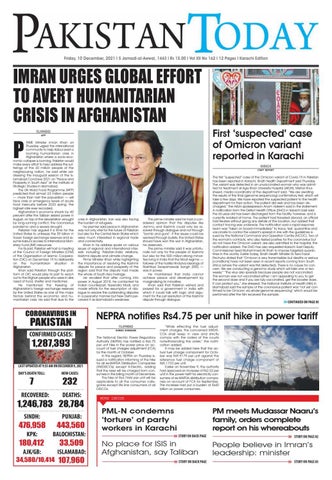
Friday, 10 December, 2021 I 5 Jamadi-al-Awwal, 1443 I Rs 15.00 I Vol XII No 162 I 12 Pages I Karachi Edition
Imran urges global effort to avert humanItarIan crIsIs In afghanIstan First ‘suspected’ case of Omicron variant reported in Karachi
ISLAMABAD app
P
RIME Minister Imran Khan on Thursday urged the international community to help Kabul avert a looming humanitarian crisis in Afghanistan where a socio-economic collapse is looming. Pakistan would make every effort to help address the sufferings of the 40 million people of the neighbouring nation, he said while addressing the inaugural session of the Islamabad Conclave 2021 on “Peace and Prosperity in South Asia” at the Institute of Strategic Studies in Islamabad. The UN World Food Programme (WFP) predicted that almost 23 million people — more than half the population — will face crisis or emergency levels of acute food insecurity before 2022 spring: the highest rate ever recorded. Afghanistan’s economy shrank by 40 percent after the Taliban seized power in August, on top of the devastation wrought by long-running conflict, the coronavirus pandemic and a severe drought. Pakistan has argued it is time for the United States to unfreeze the $9 billion in frozen foreign exchange reserves and resume Kabul’s access to International Monetary Fund (IMF) resources. For its part, Pakistan will host a meeting of the Council of Foreign Ministers (CFM) of the Organisation of Islamic Cooperation (OIC) on December 19 to deliberate on the humanitarian situation in Afghanistan. Khan said Pakistan through the platform of OIC would play its part to reach out to the Afghan people who were in dire need of food, shelter and medicines. He mentioned the freezing of Afghanistan’s foreign exchange reserves by the United States as one of the major factors behind the economic and humanitarian crisis. He said that due to the
KARACHI Staff RepoRt
crisis in Afghanistan, Iran was also facing the burden of refugees. he premier said peace in Afghanistan was not only vital for the future of Pakistan but also for the Central Asian States which were much interested in regional trade and connectivity. Khan in his address spoke on various issues of regional and international interests including Pakistan-India relations, Kashmir dispute and climate change. Prime Minister Khan while highlighting the importance of resolving the Kashmir dispute for peace and prosperity of the region said that the dispute had made the whole of South Asia hostage. He recalled that after coming into power in August 2018, he contacted his Indian counterpart, Narendra Modi, and made efforts for the resumption of dialogue to resolve the outstanding disputes in a peaceful manner but New Delhi perceived it as Islamabad’s weakness.
coronavIrus In
PakIstan
CONFIRMED CASES:
1,287,393
LAST UPDATED AT 9:35 AM ON DECEMBER 9, 2021
DAY'S DEATH TOLL:
NEW CASES:
7
232
RECOVERED:
DEATHS:
1,246,783 28,784 SINDH:
PUNJAB:
476,958
443,560
KPK:
BALOCHISTAN:
180,412
33,509
AJK/GB:
ISLAMABAD:
34,580/10,414
107,960
The prime minister said he had a considered opinion that the disputes like Jammu and Kashmir could only be resolved through dialogue and not through “bomb and guns”. If the issues could be resolved through bullets, the United States should have won the war in Afghanistan, he observed. The prime minister said it was unfortunate not only for the people of Kashmir but also for the 500 million-strong minorities living in India that the Modi regime — follower of the hostile Hindutva ideology of Rashtriya Swayamsevak Sangh (RSS) — was in power. He maintained that India cannot achieve peace and development by marginalizing its minorities. Khan said that Pakistan wished and prayed for a government in India with which it could talk with logic and argument for the just resolution of the Kashmir dispute through dialogue.
The first “suspected” case of the Omicron variant of Covid-19 in Pakistan has been reported in Karachi, Sindh Health Department said Thursday. The variant was detected in an unvaccinated woman who was admitted for treatment at Aga Khan University Hospital (AKUH), Mehar Khursheed, media coordinator at the department said. “We are awaiting the results of the final (genome sequencing) confirmatory test, which will take a few days. We have reported the suspected patient to the health department for their action. The patient did well and has been discharged,” the AKUH spokesperson Anam Haleem said in the statement. A notification from the District Health Office (DHO) in Karachi East said the 65-year-old has been discharged from the facility, however, and is currently isolated at home. The patient had travelled abroad, an official told Reuters without giving any details of the location, but added that contact tracing was underway. The notification said a rapid response team was “taken on board immediately” to trace, test, quarantine and vaccinate to control the variant’s spread in line with the guidelines issued by the National Command and Operation Centre (NCOC). Two of the woman’s contacts, who also tested positive for the coronavirus but do not have the Omicron variant, are also admitted to the hospital, the notification added. The DHO has also requested Karachi East Deputy Commissioner Syed Muhammed Ali Shah to impose targeted quarantines in the vicinity. Earlier today, Sindh Health Minister Dr Azra Fazal Pechuho stated that “Omicron is very transmissible but deaths or serious [conditions] have not been seen in recent reports coming from South Africa (where the variant was first detected). There is no cause for concern. We are conducting a genomic study which will take one or two weeks.” “The virus also spreads because people are not vaccinated. This woman was not vaccinated either. I am appealing to you to get the second dose and if you are fully vaccinated, get the booster dose. It can protect you,” she stressed. The National Institute of Health (NIH) in Islamabad said the sample of the coronavirus patient was “not yet confirmed to be Omicron via whole-genome sequencing” which would be perfomed after the NIH received the sample.
CONTINUED ON PAGE 05
NEPRA notifies Rs4.75 per unit hike in power tariff ISLAMABAD ahmad ahmadani
The National Electric Power Regulatory Authority (NEPRA) has notified a Rs4.75 per unit hike in the power price on account of fuel charges adjustment (FCA) for the month of October. In this regard, NEPRA on Thursday issued a notification informing of the hike for all ex-WAPDA Distribution Companies (XWDISCOs) except K-Electric, adding that the raise will be charged from consumers in the billing month of December. The hike of Rs4.7446 per unit will be applicable to all the consumer categories except life line consumers of all DISCOs.
“While effecting the fuel adjustment charges, the concerned XWDISCOs shall keep in view and strictly comply with the orders of the courts notwithstanding this order,” the notification added. It may be added here that the actual fuel charge component for October was Rs9.9179 per unit against the reference fuel charge component of Rs5.1733 per unit. Earlier on November 9, the authority had approved an increase of Rs2.52 per unit in the power tariff for electricity consumers of ex-WAPDA distribution companies on account of FCA for September. The increase had put a burden of Rs40 billion on power consumers.
MORE INSIDE
PML-N condemns ‘torture’ of party workers in Karachi
PM meets Mudassar Naaru’s family, orders complete report on his whereabouts STORY ON BACK PAGE
No place for ISIS in Afghanistan, say Taliban STORY ON BACK PAGE
STORY ON PAGE 02
People believe in Imran’s leadership: minister STORY ON PAGE 03
02
Friday, 10 December, 2021 | KARACHI
NEWS
PM Meets Mudassar Naaru’s faMily, orders CoMPlete rePort oN his whereabouts
P
NewS DeSk
RIME Minister Imran Khan met the family of missing journalist Mudassar Naaru on Thursday, and sought report on his whereabouts, while providing them reassurances of the government’s support to find him. It is pertinent to note that Minister for Human Rights Shireen Mazari, Interior Secretary Yousuf Nadeem Khokhar, and Attorney-General for Pakistan Khalid Jawed Khan were also in attendance of the meeting. It merits mention that the meeting was scheduled as per the directives of the Islamabad High Court given to Mazari to take arrange meeting of Naaru’s family with the PM and the cabinet. Mazari took to her Twitter, along with a photo of the family meeting the PM. “PM met with Mudassar Naaru’s parents and son this afternoon. Parents gave details of what they had been going through,” she wrote. Mazari further stated that the PM “reassured them” and ordered a “complete report” on Naaru’s whereabouts and on what happened to him. “The family expressed their confidence in the PM’s commitment,” she added. Earlier on December 1, the Islamabad High Court (IHC) on Monday summoned Human Rights Minister Shireen Mazari and the interior secretary in person. The high court’s orders came while hearing a plea seeking recovery of the missing journalist. Additional
aPs attack: Govt seeks time from sC to submit progress report NewS DeSk The federal government has sought time from the Supreme Court to submit progress report in the case of the Army Public School attack in Peshawar. As per reports, a cabinet committee has been constituted to meet with the martyrs’ parents. It is pertinent to note that earlier, Prime Minister Imran Khan had been directed by the Supreme Court to hear the views of the martyrs’ parents, after which he directed the officials to form a Cabinet committee. The court had asked for a signed response from the PM within four weeks, which ends on December 10. As per the government’s petition in the SC, the government has formed a committee to meet with the parents of the martyrs on the same day of the attack to commemorate the anniversary of the APS Peshawar attack which falls on December 16. The petition’s text requested that the conclusion of the meeting between the parents and the committee be brought to light, as well as given a time so that a comprehensive implementation report could be filed with the court. The Cabinet committee, on the other hand, was formed on the Prime Minister’s orders. It includes Shireen Mazari, Omar Ayub, Fehmida Mirza, and Sahibzada Mehboob Sultan. In November, Prime Minister Imran Khan appeared before Pakistan’s Supreme Court on the issue of the Army Public School (APS) tragic case. Justice Ijazul Ahsan said at the case hearing that it is necessary to satisfy the parents of the APS martyrs, while adding that action must be taken against the then authorities.
Attorney General Qasim Wadud, Deputy Attorney General Syed Tayyab Shah and counsel Iman Mazari appeared before the court on behalf of the petitioner. IHC Chief Justice Athar Minallah expressed annoyance after the additional attorney general could not confirm to the court the date the prime minister and his cabinet would meet the affected family. “If the son of an influential person had gone missing, the reaction of the state would have been different,” the judge remarked. The court only ordered the prime minister and the cabinet to meet with the affected family, the court added. “If a citizen goes missing, it is a very serious crime,” the judge said. “It is unfair that the affected families have to go to the commission.” The IHC ruled that the state and its functionaries have to discharge an onerous burden to satisfy the loved ones, particularly the dependents of the victim that it is not a case of “enforced disappearance”. The court also held that the phenomenon of “enforced disappearances” definitely constitutes a grave crime against humanity. “The track record of the state and its functionaries regarding enforced disappearances has not been flattering nor encouraging. It is on account of such a track record that the state and its functionaries have to discharge an onerous burden to satisfy the loved ones, particularly the dependents of the victim that it is not a case of ‘enforced disappearance’,” read a five-page order authored by Justice Minallah.
The Islamabad High Court (IHC) stated that the responsibility for the disappearance of citizens in Pakistan rests with PM Imran Khan and his government. IHC Chief Justice Athar Minallah stated that it’s state’s responsibility to protect the lives of citizens. Justice Athar Minallah further stated that the families of the missing persons were protesting on roads for years, but state’s response in this regard was unfortunate, while adding that “Like a mother, the state should treat the family of the missing persons.” Justice Minallah while addressing Mazari said that the state showed no concern for the recovery of the missing journalist. As a response, Mazari stated that the government considered enforced disappearances a serious crime and nobody was allowed to indulge in this heinous practice. She went on to add that she was in touch with various authorities for the recovery of Naaru. Mazari further stated that the PM along with human rights activist Amna Janjua had protested against enforced disappearances in the past, while adding that the government was working on compensation for the family of the missing person on a monthly basis. “The PM will definitely listen to Naaru’s family, but first we want to process the payment of expenses for them which will be done by next week,” stated Mazari while revealing that the affidavit had not been received yet, according to which the payment needed to be processed.
Justice Minallah stated that “if someone went missing in 2002 then why not impose fines on those responsible then, the then chief executive,” he said, adding that someone should be held responsible for the practice of enforced disappearances. “Half of our lives have been spent in undemocratic regimes and this is their doing,” he added. At present, everyone, including the police and ministries, has gotten a free hand,” he said, adding that he was also talking about the state and the non-state actors. Justice Minallah further said that the matter must be taken to the Prime Minister and a meeting with the cabinet members should be arranged, while adding that the PM along with the cabinet members should pay the compensation to the missing person’s family instead of the state so that the issue could be concluded once and for all. Justice Minallah concluded by stating that “It doesn’t matter if allegations [against the state] are true or false, the family has been going door-to-door for three years now and this should stop right away.” It is pertinent to note that the court has given directive to the government to satisfy Mudassar Naaru’s family by the next hearing and ordered Mazari to submit a reply at the next hearing, which is scheduled to be held on December 13. Missing since aug 2018 and counting: Hailing from Lahore, Mudassar Naaru has been missing since August 20, 2018, when he went to the northern areas with his wife and child. His artist and activist wife Saddaf Chughtai passed away on May 8 this year due to a sudden cardiac arrest, leaving behind the four-year-old son, Sachal. The Pakistan Federal Union of Journalists (PFUJ) has shown serious concern over the situation and demanded a probe. They have called upon PM Imran Khan and Mazari to look into the case.
12 TTP militants freed as part of peace deal ISLAMABAD Staff RepoRt
The government has released 12 low-key members of the proscribed Tehreek-i-Taliban Pakistan (TTP) from custody, Radio Free Europe and The News reported, citing sources. Formed in 2007 as an umbrella organisation of various militant groups, the Afghanistan-based TTP is a separate movement from the Afghan Taliban and has fought the state for years until 2014 when a major army offensive drove the group across the porous border into Afghanistan. However, the group has gradually staged a comeback in the mountainous, tribal regions since late 2019 and considerably increased the frequency of their attacks this year. In November, following the August victory of the Taliban in Afghanistan, the government and TTP agreed to a one-month ceasefire which may be extended if both sides agree, opening the possibility of a fuller peace
accord. The release of 100 jailed TTP members was one of the group’s preconditions for reaching a permanent cease-fire agreement. RFE said the 12 inmates — held in the Jandola area of South Waziristan and released Tuesday — had been transferred to the neighbouring Afghanistan province
of Paktika where they were handed over to the group. The group did not include prominent TTP members, the report said, but added that more prisoners are expected to be released in the next few days. The move came on the eve of the expected end of the month-long truce. There have been numerous failed attempts to reach peace agreements in the past. The latest talks were opened following the victory of the Afghan Taliban and the two sides have been meeting across the border in Afghanistan, with the aid of Afghan Taliban leaders. Best known in the West for attempting to kill Malala Yousafzai, the schoolgirl who went on to win the Nobel Prize for her work promoting girls’ education, the TTP has killed thousands of military personnel and civilians over the years in bombings and suicide attacks. Among its attacks was a 2014 assault on Army Public School in Peshawar, near the border with Afghanistan, which killed 149 people, including 132 children.
Learning from past to further strengthen ties with Turkey: Sarwar ISTANBUL anadolu agency
Learning from our past will help further strengthen historical ties with Turkey, Punjab Governor Chaudhry Sarwar has said. Sarwar spoke to Anadolu Agency on the sidelines of the Bosphorus Summit in Istanbul, a two-day event held under the theme of “Challenges for a Better World,” with top officials, experts, academics in attendance. Referring to the support of South Asian Muslims to the Ottoman Empire in the early 20th century, he said: “It is important that whatever has happened in the past, we remember that, and we educate our next generation.” “There should be some kind of memorial on the contribution of South Asian Muslims during Turkey’s War of Independence,” he said, offering to build one in Lahore. The governor added: “Our support for Turkey continues to this day … When you were fighting for democracy in Turkey [during the failed 2016 coup], the people of Pakistan supported Turkey’s democratic institutions and the democratic government.” Possible collaboration with turkish aid agencies: Praising the efforts of Turkish aid agencies such as TIKA and Humanitarian Relief Foundation (IHH) in Pakistan, Sarwar said “it is a great idea” to collaborate for joint projects. He said he pooled together a network of nongovernmental organizations (NGOs) in Punjab, which proved helpful during the Covid-19 pandemic. “I brought them together, who then launched an umbrella organization, the Punjab Development Network (PDN),” he said. The PDN currently has 191 members, working in different sectors including health, education, providing clean drinking water and sports. “During the pandemic, we distributed two million ration packs to people who lost their jobs, who are on daily wages, so they could continue to survive during this difficult time,” he said. “During the [2005] earthquake and during the 2010 floods [in Pakistan], I know there were a lot of NGOs from Turkey” which contributed to the relief efforts. About preserving heritage in Pakistan, Sarwar said his office is preparing a list of all minority religious places
in Punjab for possible renovation. Sarwar said city-to-city collaborations from different countries have helped Pakistan. Such collaborations bring expertise, experience, technology, and know-how, he explained, referring to his efforts to twin the city of Glasgow, where he has served as an MP, with Lahore. He said such initiatives with the administration in Istanbul would also be helpful and “we will support it.” education and clean water focus in Punjab: As the chancellor of all public and private sector universities in Punjab, Sarwar said his priority is “to bring meritocracy and get the best vice-chancellors appointed.” “I wanted to change the practice of ad hocism, but it was a hard, difficult job … I’m glad that now in all the universities in Punjab we have permanent vice-chancellors and I have appointed every vicechancellor on merit,” he said. Sarwar claimed the move produced results and universities from his province “are among the top 500” in international rankings. “My number two challenge was providing clean drinking water,” he said. “We established the Punjab Aabe-Pak Authority, and hopefully, with the cooperation of NGOs and generous people, we will provide 15 million people with clean drinking water in the next three months.” Besides, he said the provincial government is working to issue health cards to all citizens. Pakistan wants peace, good relations with all neighbours Sarwar said Pakistan “wants to have good relations with all neighbours.” “When Imran Khan was elected as the prime minister, he made it clear that if they [the neighbours] come one step towards us, we will move two steps for the friendship,” he said. “But unfortunately, [India Prime Minister] Narendra Modi did not respond positively.” On Pakistan’s hope that relations could improve during Modi’s second tenure, he said many thought that Modi’s anti-Pakistan rhetoric will wither away, but “unfortunately, we were proved wrong.” “What they did is unilaterally change the special status of Kashmir, abolishing Article 35A and Article 370, which was not acceptable to the people of Kashmir, and there have been gross violations of human rights, fake encounters, people being tortured,” he said.
China gifts 7,000 saplings to support environment protection efforts ISLAMABAD Xinhua
China gave 7,000 saplings to support the prime minister’s Billion Tree Tsunami programme and help Pakistan in its fight against climate change. In a ceremony held at the Chinese embassy here, Ambassador Nong Rong and Minister for Climate Change Malik Amin Aslam jointly planted a tree in the mission’s premises to mark the event. Talking to Xinhua on the sidelines of the event, Aslam said the donation is very significant for Pakistan, and the trees will be planted along major highways in the country and will be tagged to show the gift of the Chinese government and the Chinese people to commuters travelling along the roads. Commenting on the relationship between Pakistan and China in the past 70 years, Aslam said: “These are 70 years of friendship, brotherhood, and one of the strongest brotherhoods that Pakistan has with any country. We share not only our past but also our future. I am very thankful to China for becoming a part of Pakistan’s green vision.” Speaking with Xinhua, the ambassador said they gifted the trees on the occasion of the 70th anniversary of the establishment of diplomatic relations between China and Pakistan. The Chinese and Pakistani governments have been supporting each other in nature conservation, and the two sides are practising the idea of a green Belt and Road to promote the high-quality development of the China-Pakistan Economic Corridor (CPEC), he added.
Friday, 10 December, 2021 | KARACHI
PeoPLe BeLIeve In ImrAn’S LeAderShIP: mInISter ISLAMABAD
m
inP
INISTER for Information and Broadcasting Fawad Chaudhry on Thursday said the people of Pakistan have full confidence in the leadership of Prime Minister Imran Khan that he won’t work for personal gains. In a statement, the minister said after so long, the nation expressed satisfaction over the performance of a government. Whether it is a transparency survey or any other, it was proved the incumbent government does not have any corrupt elements, he added.
The minister said 89 percent of people support the government’s measures against Covid-19, which is a great achievement for us. Earlier, Chaudhry lashed out at Pakistan Democratic Movement (PDM) chief Fazlur Rehman for giving a call to hold a march on Islamabad on Pakistan Day. “March 23 is the most important day for the people of Pakistan. The day is meant for uniting the nation, not to divide [them],” the minister said while talking to the media after the multi-party opposition alliance announced the march. He believed the date and policy for the march were not final. Rehman had a track record of retracting his statements in the past, he added.
Record number of journalists jailed in 2021: CPJ NEW YORK aFP
The number of journalists jailed around the world hit a new record in 2021, the New York-based Committee to Protect Journalists (CPJ) said Thursday, with China and Myanmar having put a quarter of the 293 media workers behind bars. In its annual report, the CPJ listed 50 journalists imprisoned in China, 26 in Burma, 25 in Egypt, 23 in Vietnam and 19 in Belarus. Adding those jailed in Saudi Arabia, Iran, Turkey, Russia, Ethiopia and Eritrea, the CPJ said a total of 293 journalists were in prison worldwide as of December 1 — up from 280 the year before. “This is the sixth year in a row that CPJ has documented record numbers of journalists imprisoned around the world,” said Joel Simon, executive director of the group. “Imprisoning journalists for reporting the news is the hallmark of an authoritarian regime,” he said in a statement. For 40 years, the CPJ has denounced journalists being murdered, imprisoned, censored, physically hurt and threatened. “It’s distressing to see many countries on the list year after year, but it is especially horrifying that Myanmar and Ethiopia have so brutally slammed the door on press freedom.” The association also counted 24 journalists killed around the world this year. Mexico “remained the Western hemisphere’s
deadliest country for journalists, with three murdered for their reporting and the motives for six other killings under investigation,” the CPJ said. India was also high on the list, with four journalists killed this year. The CPJ said the number of journalists behind bars
Pakistan, China work hand in hand for green CPEC ISLAMABAD Xinhua
Pakistan and China are keeping their commitment to making the China-Pakistan Economic Corridor (CPEC) a green project, and enable future generations to have a green environment. Besides the green CPEC initiative, the Chinese government and companies are also supporting Pakistan in the Billion Tree Tsunami program of Prime Minister Imran Khan by vigorously participating and gifting in the drive. Chinese companies working on CPEC projects in Pakistan have planted a large number of trees in their premises to support the drive. The Chinese embassy on Wednesday also donated 7,000 saplings for the program to support the efforts in environmental protection. In a conversation with Xinhua at the donation ceremony, Minister for Climate Change Malik Amin Aslam lauded the Chinese government for supporting Pakistan’s green vision, adding that the gesture of the Chinese government and people shows that both countries not only share the past but also the future. Speaking with Xinhua, Chinese Ambassador Nong Rong said they gifted the trees on the occasion of the 70th anniversary of the establishment of diplomatic relations between China and Pakistan. The two governments have been supporting each other in nature conservation and practising the idea of a green Belt and Road to promote the high-quality development of CPEC, he added. Phase-I of CPEC was mainly about road infrastructure and energy projects to meet the urgent need of Pakistan by laying a solid foundation for the economic development of the South Asian country. Shabir Ahmad Khan, director of Area Study Center (Russia, China and Central Asia) in the University of Peshawar, told Xinhua in a recent interview that
Pakistan was facing hours-long power outage every day, its “worst” security situation as well as poor investment into the country. “At such a critical time, CPEC came to Pakistan’s rescue and Chinese companies built power plants in Pakistan at the request of the then government of the country as it was the urgent solution to the electricity woes of the country,” he said. The officials and experts laud CPEC’s coal-fired power plants for not only overcoming the energy crisis of Pakistan but also keeping emissions under control. “The coal-fired power plants including Sahiwal and Port Qasim even got certifications for being eco-friendly and controlling emissions well under control to meet the world and local standards,” Khan said. Lauding China’s decision to stop building new coalfired power projects abroad, Aslam said the decision shows that actions speak louder than words because when all countries are talking about protecting the climate, China came forward with a concrete and significant decision. He added that China has also been investing in clean energy initiatives in Pakistan, as the current Pakistani government is focusing on hydel, solar, and other clean energy initiatives, which will not only be a step forward to the commitment of green CPEC, but also fulfil the promise of prime minister to save environment for future generations. Talking about green CPEC, Nong said all CPEC projects embody the green concept and are setting a strong base for industrialization in the country. “Our coal-fired power projects are highly efficient, using advanced environment-friendly technologies to ensure low pollution and low emission. Furthermore, we also focus on clean technologies like hydel, wind and photovoltaic, providing Pakistan with green electricity, laying a good foundation for Pakistan’s industrialization and urbanisation,” he added.
reflects “increasing intolerance for independent reporting around the world.” The report noted restrictive environments for journalists around the world, including the coup in Myanmar, the war in northern Ethiopia and the crackdown on the opposition in Belarus.
NEWS
03
Sri Lankan man buried in native village COLOMBO: The body of a Sri Lankan factory manager who was killed by a mob in Sialkot for alleged blasphemy was buried in his native village with state honours on Wednesday. Buddhist clergy performed religious rites at the home of Priyantha Kumara before police led a procession in which family and friends carried the casket with his charred remains to the cemetery. The road was decorated with condolence banners and white flags symbolizing mourning. Kumara was assaulted by a mob of hundreds of people and was dragged into the street and set on fire last Friday in the city where he helped run a sports equipment factory. Workers at the factory accused him of desecrating posters bearing the name of Prophet Muhammad (P.B.U.H.). The victim’s brother, Arunasiri Wasantha Kumara Diyawadana, who also works as a technical director at a garment factory in Pakistan, said factories should have a secure environment. “That was not happening in this particular case,” he said. He called for an improvement in management practices so any dispute can be resolved before it is too late. He said the two governments should determine “the actual root cause for this, either if it’s a religious matter or an industrial dispute, and accordingly they have to find a solution.” In Pakistan, mere allegations of blasphemy can trigger mob attacks. The blasphemy law carries a possible death penalty. The associaTed Press
Islamabad Police’s Amna Baig nominated by US embassy for ‘International Women of Courage’ award United States embassy has nominated a female officer of Islamabad Police for ‘International Women of Courage’ award which recognizes women around the world for demonstrating exceptional courage and leadership in advocating for peace, justice, human rights, gender equality, and women empowerment. It is pertinent to note that US Embassy Charge d’affaires Angela P Aggeler announced the nomination of Assistant Superintendent of Police (ASP) Amna Baig’s on Thursday, at an event marking the 30th anniversary of the “16 Days of Activism Against Gender-Based Violence” campaign. The “16 Days of Activism Against Gender-Based Violence” campaign began in 1991. Today, over 6,000 organisations in approximately 187 countries have participated in the campaign, reaching over 300 million people, according to a press release issued by the embassy. “Even though gender-based violence is pervasive, it is not inevitable,” Charge d’affaires Aggeler said at the event. “It can and must be prevented. This is why we take this time each year to reinvigorate our efforts against gender-based violence and to call for greater collective and individual action to prevent and respond to all forms of violence against women.” The spirit of the original campaign remains as relevant today as it did in 1991, as gender-based violence remains a threat to peace, stability, and economic growth worldwide. Charge d’affaires Aggeler stated that it was in this spirit that the embassy nominated ASP Baig for the award. news desk
Friday, 10 December, 2021 | KARACHI
04 NEWS
PUnjAB GOvt tO BUIld COUntry’s lArGest exPO Centre In FAIsAlABAd Lahore
Minister Ali Zaidi, UK counterpart discuss maritime matters Pr Federal Minister for Maritime Affairs Ali Haider Zaidi along with members of the Pakistan delegation to the International Maritime Organization Assembly met MP Robert Courts, the UK Minister for Aviation, Maritime and Security and Civil Contingencies in London on 08 December 2021. Matters of mutual interest pertaining to maritime affairs including development and maintenance of port infrastructure, processing of visas for seafarers, capacity building in maritime matters and collaboration among maritime academies of the two countries came under discussion. The two sides also discussed cooperation within the framework of IMO. International Maritime Organization is a specialized agency of the United Nations responsible for harmonizing rules and advancing cooperation among Member States on maritime issues. Pakistan has been an active member of the Organization since 1958. Minister Ali Zaidi is leading the Pakistan delegation at the 32nd Session of the IMO Assembly, the Organization’s highest decision-making body being held in London from 6 – 15 December 2021.
Gerry’s dnata wins award for services in Pakistan KaraChI PR
Gerry’s dnata, Pakistan’s leading ground services provider, has been recognised for consistently delivering quality, safe and innovative services at its Islamabad hub and received the ‘Best Station’ accolade at the 2021 Pride of Ground Handling Awards. Gerry’s dnata was also shortlisted for four additional awards. Syed Haris Raza, Vice President of Gerry's dnata, said: “We are delighted to receive one of the industry’s most coveted global awards as a recognition of our world-class services. “Islamabad is an extremely important and strategic location for the aviation industry. As the leading ground handler we are proud to have supported one of the largest repatriation missions of the year by ensuring safe and seamless operations of the flights. “I thank each member of our team for their relentless commitment to provide service excellence across our network.” Over the past year, Gerry’s dnata has continued to enhance its operations and services to deliver the highest level of quality and safety and help airline customers safely transport passengers and precious cargo to and from Pakistan. Gerry’s dnata also made significant investments in infrastructure, technology and equipment. This included the opening of a new, state-of- the-art cargo facility in Lahore which doubled the company’s cargo handling capacity at the airport. Gerry’s dnata’s quality of service helped it win or retain over 20 contracts with key accounts across its network. The company also achieved prestigious industry certifications, including GDP and IATA’s ISAGO accreditation, which validate its capabilities and place the business in a market leading position. Gerry’s Group and dnata, a global leading air and travel services provider, joined hands in 1993 to provide ground handling services at Karachi Airport. Since then, the joint venture has continually expanded its operations in the country and today serves more than 20 airline customers at seven Pakistani airports. Gerry’s dnata’s dedicated employees serve more than seven million passengers and handle 150,000 tons of cargo annually.
TLTP
P
UNJAB Chief Minister Sardar Usman Buzdar has given the approval in principle for building Pakistan’s largest expo centre in Faisalabad. The decisions were taken in a high-level session chaired by CM Usman Buzdar to review the progress on special economic zones in Punjab. The chief minister said that the work on economic zones is continuing in Chunian, Bahawalpur and
Muzaffargarh. He issued directives to make the special economic zones functional at the earliest. The state-of-art expo centre of Pakistan will be built in Faisalabad to facilitate the industrialists and foreign investors following the approval of the Punjab chief minister. Buzdar announced that an expo centre will also be constructed in Sialkot city. He said that a surgical city will be established in Sialkot for increasing exports. The chief minister revealed further plans that the provincial government will start work on the Aqua Park project in Chunian soon. The government’s facilitation centres are playing a key role in
Air chief, Azerbaijan ambassador discuss matters of mutual interest Pr
MCB Islamic Bank launches UnionPay debit card Lahore
Ambassador of Azerbaijan H.E. Mr. Khazar Farhadov called on Air Chief Marshal Zaheer Ahmed Baber Sidhu, Chief of the Air Staff, Pakistan Air Force in his office today. During the meeting, both the dignitaries discussed matters of professional and mutual interest. H.E. Mr. Khazar Farhadov commended the professionalism of PAF and acknowledged its rising indigenous capacity in aviation industry. The Air Chief said that Pakistan and Azerbaijan had longstanding religious, cultural and historical bonds which were manifested through strong ties between the Air Forces
PRESS RELEASE
of two countries. The Air Chief highlighted that both the countries enjoy cordial relations and reiter-
ated his resolve to further enhance the existing bilateral cooperation between the two brotherly countries.
Indus Motor joins hands with International Road Federation Pr Coordinated by the International Road Federation (IRF) and supported by TotalEnergies Foundation, Indus Motor (IMC) together with a group of leading private sector companies in Pakistan, have entered into a partnership to use their combined knowledge and expertise to reduce road fatalities and injuries in the country. This initiative is rooted in the belief that one road crash victim is one too many. The founding members of this coalition which besides IMC, include TOTAL PARCO Pakistan, Shell Pakistan, Unilever Pakistan Limited, PARCO Pearl Gas Limited, Coca Cola Pakistan, Engro Fertilizers Limited and Niaz Malik Consultants, signed the Coalition Charter at a virtual ceremony, hosted by the IRF in Geneva, Switzerland. IMC Chief Executive, Ali Asghar Jamali, signed the Charter along with other CEOs/MDs of these organisations. The project aims to mobilise and federate private sector stakeholders to support road safety efforts in Pakistan and to substantially improve road safety via handson, impact-oriented and scalable activities. According to WHO, most road crashes occur in developing countries where road transport constitutes one of the leading causes of death. In recognition of this global crisis, the United Nations has declared the years
2021 to 2030 as the new Decade of Action for Road Safety, setting the ambitious target of reducing road traffic deaths and injuries by at least 50%. The United Nations have urged all stakeholders, including business leaders, to support the implementation thereof. Expressing his views at the ceremony, Chief Executive IMC, expressed, “Road safety is taking a serious turn in Pakistan and addressing it is not any one person’s job. As a shared responsibility, this coalition – a first for Pakistan – is a great step forward and coupled with IRFs experience and expertise will bring great value to the table, which on our own, we would be unable to do by ourselves. However, at the end of the day, the impact has to be created by us, the stakeholders, for whom there is greater value and create a real difference in the society. As Safety Leaders, Toyota values safety, be it the Company’s products or safety on roads.” “IRF strongly believes that partnerships are the key driver of success and long-term impact in the reduction of road crashes. We are delighted to coordinate this work and to pro-actively engage private sector into collaborative and coordinated initiatives. This will help us step-up efforts to reach the targets set by the new Decade of Action” commented Susanna Zammataro, IRF Director General, at the launch of the coalition.
NMC participants visit FBR office Pr The faculty and officers of 115th National Management Course, National School of Public Policy (NSPP) visited Federal Board of Revenue (HQs) on 9th December, 2021. The participants comprised 7 faculty member and 37 trainee officers of NMC. The Senior officers of FBR from the Administration Wing received the visiting guests. The delegation was briefed by Dr. Nasir Khan, Chief (Admn), FBR at Yadgar-e-Shohada of FBR about the sacrifices rendered by the officers of IRS and Pakistan Customs, who laid down their lives in the line of duty. Later, the delegates were led to the Auditorium where they were formally welcomed by the Spokesperson/Director Media, FBR. After the introduction by the participants, Dr. Nasir Khan, DG (SPR & S), FBR gave a detailed presentation about the working of FBR, which was followed by an interactive Question and Answer Session. The participants asked very pertinent questions about the taxation system in Pakistan, which were comprehensively answered by the Chairman FBR himself.
assisting the investors. He welcomed the investors for showing interest in making investments in the special economic zones. Earlier in September 2020, Advisor to the Prime Minister on Commerce and Investment Abdul Razak Dawood had said that common expo centres would be established in four cities of Punjab to boost the industry sector. The ‘common expo centre’ will be established for Sialkot, Gujrat, Wazirabad and Gujranwala cities, for which the Punjab government will be approached for the allocation of land, announced Razak Dawood.
After the Q & A Session, Dr. Muhammad Ashfaq Ahmed, Chairman FBR/Secretary Revenue Division addressed to the participants and shared his strategic vision about maximizing tax compliance through various innovative interventions being made both at policy and operational level. The Chairman thanked the participants for showing keen interest in knowing about the working of
CMYK
FBR and appreciated their questions. He highlighted the achievements of FBR in the last one and a half year. He particularly mentioned about the increased revenue generation by FBR in the last Financial Year 2020-21 and as well as the growth trajectory in the first five months of current Financial Year 2021-22. The Chairman reaffirmed his commitment to ensure transparency, efficiency and taxpayers facilitation. He highlighted the introduction of Track and Trace System, establishment of Single Sales Tax Portal and formulation of Single Revenue Code as game changer initiatives. “The use of digitization and technology will maximize the revenue potential in the long run and contribute significantly to the credibility of tax system,” he added. Representing the faculty and participants of 115th NMC, Dr. Muhammad Jameel Afaqi, Dean NSPP conveyed vote of thanks to Chairman and Team FBR for hosting them at FBR (HQs). The two organizations exchanged souvenirs as a gesture of goodwill. In the end, Chairman FBR thanked the faculty and participants of NMC for visiting FBR and wished them success in their professional career ahead.
MCB Islamic Bank Ltd. in collaboration with UnionPay International launched Pakistan’s first Platinum Debit card at an exclusive ceremony held in Lahore on 10th November, 2021. The ceremony was attended by UnionPay International team and the management team of the MCB Islamic Bank Limited. The product is aimed at enhancing digitization and providing convenience to the high net-worth customers. MCB Islamic Platinum Debit Card will enable customers to make payments with enhanced limits, it also aims to offer unmatched privileges to its customers with utmost convenience and help satisfy banking needs instantly and also provides round the clock access to funds globally. Speaking at the launch ceremony, Mr. Zahid Hussain, Group Head Retail Banking, MCB Islamic Bank said, “In this world of digitalization customers require quick, easy to use, convenient solutions for their banking needs. MCB Islamic UnionPay Platinum Debit card would help them benefit from higher limits and is designed around the needs and priorities of customers”. Mr. Azfar Alam Nomani, President MCB Islamic Bank added, “Owing to COVID’19 a lot of people have been forcibly converted towards digital banking solutions as a result of which the trend of online shopping is on the rise too. We have launched the Platinum Debit Card keeping in mind the emerging needs of customers”. Mr. James Yang, General Manager of UnionPay International Middle East branch said, “UnionPay aims to provide safe, convenient and reliable payment experiences. As a customer-centric organization, we prioritize product features that best meet our cardholders’ needs and bring additional benefits that MCB Islamic UnionPay Platinum users can not only avail in Pakistan, but also at merchants worldwide.”
AIOU completes construction of campus in Mithi IsLamabad PR
Allama Iqbal Open University (AIOU) has completed construction of its regional campus at a central location in Mithi, district head quarter of Tharparkar (Sindh) which will be inaugurated soon. According to Director General Regional Services, AIOU, Inaam Ullah Sheikh, university has started constructing 15 regional campuses buildings within the past three years and five of them have been completed so far while remaining 10 are under construction. Expansion in university’s educational network is being carried out with the cooperation of various provincial governments as well as well of individuals. He said that Prof Dr Zia Ul -Qayyum is personally coordinating with various district authorities for acquiring land and meeting other expenditures. He is, exclusively, focusing on shifting AIOU regional campuses from rented buildings to university owned uniquely constructed ones to meet the digital learning requirement of ever-changing dynamic world. “the land for regional campus Mithi was acquired from Revenue Department, Sindh” he added. This campus is equipped with latest facilities of information and communication technology. Exclusive classrooms and examination halls have been built for male and female students. Latest and modern computer system as well as high speed internet facilities have been provided in the computer laboratory established in the campus, Inam Ullah Sheikh said A facilitation desk will also be constructed to facilitate the students. Prof Dr Zia Ul -Qayyum has instructed all regional directors to support the students and resolve their issues on the priority basis.
Friday, 10 December, 2021 | KARACHI
Ending corruption ‘collEctivE rEsponsibility of statE and sociEty’: prEsidEnt isLamabad
p
Press release
RESIDENT Dr Arif Alvi on Thursday, terming corruption an impediment to the country’s growth, said it was the collective responsibility of all tiers of the State and society to ensure its eradication. “Strict laws, effective prosecution, and prompt dispensation of justice besides societal pressure are the important factors in checking corruption,” he said in his address at the seminar on ‘Corruption Free Pakistan: Pride of Nation’, held here at the Aiwan-e-Sadr. The event organized by National Accountability Bureau (NAB) was held in connection with the International AntiCorruption Day aimed at creating awareness among the masses to fight corruption in society. President Alvi said allowing greed to take over morality results in the adoption of corrupt practices and put a detrimental
impact on society. He condemned the abuse of entrusted power for private gains and emphasized self-accountability to eliminate corruption. The president lauded NAB for taking action against corruption, however, pointed out that the efforts of the anticorruption watchdog alone could not prove effective unless supported by all segments of society. He stressed the respective roles of
parliament and executive in making strict laws and their implementation to check corruption. A combined action can eradicate the menace of corruption from the country, he added. He also laid emphasis on prompt decisions by the judiciary on the cases of corruption because delays caused dispensation of justice. Dr Alvi said the pressure of society, and religious and spiritual beliefs also
helped a person not get deviated from the righteous path. He said media, through whistleblowing about corruption, could play a positive role, however stressed that it should be about the actual exposure of fraud rather than pursuing out-of-context journalism. The president said Pakistan was taking effective steps against corruption and appreciated NAB for making a huge recovery of Rs 821 billion. Chairman NAB Justice (retd) Javed Iqbal said NAB was committed to ending corruption in the country and had carried out 1,194 convictions with a total recovery Rs 821 billion, including the Rs 538 billion in the last four years. He said NAB also took action against its 200 officials on charges of corruption in four years. He mentioned that foreign anti-corruption organizations had acknowledged the efficiency of NAB and had sought training on its ‘factum of deterrence’ methodology.
Promotion of foreign investment govt's top priority: Zafar Iqbal Lahore: Press release
Various delegations of Chinese industrialists visited FIEDMC and met Chairman FIEDMC Zafar Iqbal Sarwar and Board Director FIEDMC Asif Ali Tipu. On this occasion, Chairman FIEDMC briefed the delegations of Chinese industrialists regarding the functioning of FIEDMC. While talking to the representatives of Chinese companies, Chairman FIEDMC asserted that promoting foreign investment in Pakistan is our top priority, and the government's efforts to maintain an atmosphere of trust and safety among foreign investors are proving fruitful. The concerns of all foreign companies about Allama Iqbal Industrial City, Value Added City and M3 Industrial City will be fully addressed. Chairman FIEDMC Zafar Iqbal Sarwar apprised about the progress being made in the ongoing development and construction activities in Allama Iqbal Industrial City, M3 Industrial City, and Value Added City and
said that the Federal and Punjab government are taking drastic steps to provide basic facilities, such as electricity, Sui Gas and others to yield positive results. While speaking to the representatives, Board Director Asif Ali Tipu affirmed that all the grievances and concerns of Chinese companies investing in Allama Iqbal Industrial City would be addressed, and no effort would be spared for providing security and
other facilities in this regard. In the meeting, the delegation belonging to Chinese companies discussed the issues they are facing, on which Chairman FIEDMC Zafar Iqbal Sarwar assured them of resolving these issues on a priority basis. The foreign delegation lauded the excellent performance of FIEDMC and the efforts made to promote foreign investment.
First ‘suspected’ case of Omicron variant reported in Karachi Continued from Page 01 First detected in November, the Omicron variant has now been reported in 57 countries and continues to spread rapidly in South Africa, the World Health Organisation (WHO) said. But the latest epidemiological report from WHO said given the Delta variant remains dominant, particularly in Europe and the United States, it is still too early to draw any conclusions about the global impact of Omicron. Data is still too limited to know with certainty whether Omicron changes the severity of the illness. As of December 6, all 212 confirmed Omicron cases across 18 European Union nations were classed as asymptomatic or mild. But WHO said: “Even if the severity is equal or potentially even lower than for Delta variant, it is expected that hospitalisations will increase if more people become infected”. “Further information is needed to fully understand the clinical picture of those infected with the Omicron variant,” the report said. OMICRON ‘INEVITABLE’ IN PAKISTAN: In November, Minister for Planning and Development Asad Umar, who also heads the NCOC, warned the Omicron variant will “inevitably” find its way to Pakistan, adding the nation had “only a few weeks” to contain the latest threat. “The emergence of new variant makes it even more urgent to vaccinate all eligible citizens 12 years and older,” he said. “It is my appeal to people, particu-
larly those who’ve gotten one dose to get the second dose because this is one effective thing we have to protect ourselves from the danger of this variant,” the minister added. The alert followed a WHO communiqué warning its 194 member states the variant is likely to spread internationally, posing a “very high” global risk where Covid-19 surges could have “severe consequences” in some areas. The UN agency urged them to accelerate vaccination of high-priority groups and to “ensure mitigation plans are in place” to maintain essential health services. “Omicron has an unprecedented number of spike mutations, some of which are concerning for their potential impact on the trajectory of the pandemic,” the WHO said. “The overall global risk related to the new variant of concern Omicron is assessed as very high.” Earlier on December 6, 2021 Pakistan placed travel ban on nine countries, adding them to a list of Category C countries in order to try to contain the spread of the Omicron variant of Covid-19. According to the National Command and Operation Centre (NCOC), the new entrants to the Category C list include Croatia, Hungary, Netherlands, Ukraine, Ireland, Slovenia, Vietnam, Poland and Zimbabwe. While South Africa, Lesotho, Eswatini, Mozambique, Botswana, Namibia and Hong Kong were already placed in the list. The NCOC took this decision in light of emergence of Omicron variant in several countries, prompting nervous gov-
ernments to impose tough travel restrictions to try to keep it at bay while scientists race to establish how dangerous it might be. Earlier in December, Hong Kong widened its ban on non-residents entering the city to include visitors who have been to Australia, Canada, Israel or six European countries in the past 21 days. While Japan, which although has not yet detected any Omicron infections, said it was reimposing border controls. According to an NCOC update, the health and testing protocols for inbound travel from Category C nations include a complete ban on inbound travel from Category C countries. It said “essential” travel from these countries would require an exemption certificate from a dedicated exemption committee with health protocols in place. The protocols would entail one to be fully vaccinated, with all passengers, sixyear and above, to have a negative PCR (polymerase chain reaction) test report — maximum 48 hours prior to departure. In addition, passengers who have the required exemption would undergo a rapid antigen test (RAT) on arrival and only negative RAT passengers would be allowed to proceed. For countries in Category B — Germany, Trinidad and Tobago, Azerbaijan, Mexico, Sri Lanka, Russia, the USA, the UK, Thailand, France, Austria, Afghanistan and Turkey — all inbound passengers are required to be fully vaccinated. Furthermore, passengers from these nations are also required to have a negative PCR test (maximum 48 hours
CmYK
old). The NCOC said health authorities will also conduct random RAT testing of passengers coming from Category B countries. “RAT negative cases will be allowed to proceed. RAT positive cases will be quarantined for 10 days,” the body said. “RT-PCR test of all RAT positive quarantined passengers will be undertaken on the eight day of quarantine. In case of a negative result, pax will be allowed to proceed home. However, in case of a positive result, the passenger will either undergo additional quarantine period or will be shifted to hospital as per the advice of health authorities.” For countries in Category A, all visitors should be fully vaccinated with the same PCR requirements as their counterparts in the B and C categories. The forum also approved a number of guidelines to “facilitate the return” of Pakistanis stranded abroad. According to the statement, all Pakistanis can travel from category C countries till December 15. However, the health protocols will be applicable to them. Pakistanis who were unable to get themselves vaccinated abroad because of certain conditions, including expired visa or illegal immigration, pending court cases, medical conditions, pregnancy or partial vaccination from Pakistan, have been exempted from the requirement to be fully vaccinated, provided they provide proof to airline and immigration authorities prior to boarding, the government body said.
NEWS
05
Hammad Amjad, Haseeb Anwar, Qaiser Tufail, Farhan Immad gather for a group photo along with employees at the launch ceremony of ABB Electrification. PR
Message Communications and Digital Message CEO Sohail Aziz and others pose for a photograph at a seminar. PR
Mazari's special message on Human rights day Pr Today, we mark Human Rights Day and celebrate the United Nations General Assembly’s adoption of the Universal Declaration of Human Rights. Pakistan was one of the earliest signatories to the Declaration in 1948. Our constitution, too, embodies this principles: All human beings are born equal in rights and dignity. This Government has moved beyond rhetoric and proactively removed the barriers marginalized groups face – placing legal reform at the top of its priorities. Over the past year, the Ministry of Human Rights has strengthened human rights legislation in Pakistan by introducing landmark laws on child labor, harassment and domestic violence, the protection of journalists, transgender persons, senior citizens, and persons with disabilities. Just last week, our long-awaited Protection of Journalists and Media Professionals Act was signed by the President and made into law. The Act’s various articles safeguard the rights of every journalist and media professional, including the rights of security, privacy, and the right of journalists to carry out journalistic work independently and free from abuse, harassment, and violence. This year alone, the Ministry has also established two new protection centers: one for at-risk children and another for transgender persons. Our shelters for victims of gender-based violence are operational at all times. Our nationwide awareness campaigns have reached every province of Pakistan to inform citizens, especially the most vulnerable groups, of their rights and available support services. These campaigns have focused on women’s inheritance rights, violence against women, child abuse, child labor via radio, television, and even truck art.
06-07 Comments - 10th December 2021_Layout 1 12/10/2021 12:45 AM Page 1
Friday, 10 December, 2021
06 COMMENT
Machinery Breakdown
Enforcing election laws When high-ups are involved in violations
I
GNORING the directive from the eCP to skip his Peshawar visit because the schedule of the local government elections in KP had been announced, Prime Minister Imran Khan addressed the gathering at Governor’s house Peshawar and said things which many consider were in violation of the Code of Conduct. The PM recounted in detail the pro-poor measures enforced by both the KP and federal governments. he told the audience that a significant reduction in poverty was witnessed in KP during 201318 owing to the PTI government’s “prudent policies.” he congratulated the KP government for extending free health insurance to 100 per cent of the population. There were further promises including free medical services worth Rs1 million annually to 7.5 million families in the province. The voters were told that the government was providing 6.3 million scholarships with an allocation of Rs47 billion to students on merit basis. It was promised to provide essential food items to about 20 million families at 30 percent discount. The PM distributed cheques among Imams of Jamia mosques under the KP government’s financial assistance programme, among students under the ehsaas education Programme and poor women under the Kafalat Programme. The PM could have said and done all this before the announcement of the LG election schedule. he could have even postponed the publicity of his achievements in poverty reduction till after the KP polls. Publicising them in Peshawar 10 days before the LG election could be interpreted as influencing the electorate. That the violation of election rules has been committed by the head of the government is highly serious. If a PM violates rules and defies a constitutional body, his ministers are likely to go far beyond him. This is bound to encourage lawlessness in the country. The situation poses a challenge to the eCP. Then Indian CeC T.N. Seshan, known as the man who cleaned up the Indian electoral system, once refused to take phone call from PM Narasimha Rao during a crucial election which could lead to Rao’s losing office. Many will wait to see how the eCP deals with the violation of Code of the Conduct by Mr Khan.
The Sialkot outrage raised too many questions for comfort at Penpoint M a NIaZI
T
he killing of a Sri Lankan, Priantha Kumar Diyawadanage, for alleged blasphemy has raised a number of demons, some old, some new, which have made the incident more of an emotive event than it seems to be. There has been a lot of emphasis on the fanaticism implicit in the lynching, but there has not been enough of a look at the class dimension. The murdered man was a manager, and thus of a different social and economic class from the mob that killed him. The class divide is further stressed by the information that emerged, that the mob wanted to go after the factory owner. economic times are hard. Not only do the workers find it difficult to get by on their salaries, but the fact that the government has failed to create the jobs it promised means that worker’s children do not find jobs as they grow up. That knowledge is enough to cancel out any relief afforded by their still having a job themselves. This knowledge is made more painful by any sacrifices that might have been made to ensure that those kids got an education better than their father’s. While there is a definite class dimension visible, trade unionism or Marxism has not taken advantage it seems, but religious sentiment. This does make a certain sense, for it means that workers finding it difficult to go on making ends meet, and seeing no improvement in the long-term future, are turning to a higher Power, the Almighty, to solve their problems. This is where the connection between the religious parties and ordinary people becomes visible. People’s problems are mundane, like making a living, a child’s wedding. even an apparently abstruse problem, such as what happens after one dies, is immediate for someone who faces the prospect of dying in the next few years. Religious parties generally do not have any solutions. Be that as it may, there was another development in Sialkot, which took religious parties to a new level. The murdered man is accused to having taken down posters of the Tehrik-e-Labaik Pakistan. Blasphemy has generally been a nonpartisan offence so far. This is the first time it has been associated with a particular party. This creates a dangerous precedent for all parties. Religio-political parties have a reputation for street power, based on the seminary students it can bring to rallies, but they have never used this street
Mainstreaming in action Saad Rizvi indicates the shape of things to come
T
Today is Human Rights Day
Sajjad Shaukat
E
ACh year, human Rights Day is observed all over the world, especially by the oppressed nations on December 10, as on this very day in 1948, the United Nations General Assembly adopted the Universal Declaration of human Rights. It reflected the conviction that human dignity is at the heart of our societies and that respect for human rights is essential for the prevention of conflict and the promotion of human development. Sadly, the international community has often fallen short of its commitment to human rights. Several crises have shaken humanity in the last 72 years. Conflicts, inequality, violence, discrimination and exclusion continuously wreak havoc on individuals and societies throughout the world. Too often human rights are ignored, addressing these crises. December 10 is also celebrated in the disputed territory of the Indian Occupied Kashmir (IOK) where protests, demonstrations, seminars and conferences mark the international human Rights Day, as gross human rights violations have continued unabated by the Indian security forces. This time, this very day has come at a time when more than two years and three months have passed
Dedicated to the legacy of late Hameed Nizami
Arif Nizami (Late) Founding Editor
Yousaf Nizami M. A. Niazi
Umar Aziz
Joint Editor
Joint Editor
Executive Editor
Lahore – Ph: 042-36300938, 042-36375965
The writer is a member of staff.
Human Rights Day: Kashmir is Bleeding
ehRIK Labaik Pakistan (TLP) chief hafiz Saad Rizvi chose to give an interview to a foreign news magazine after his recent release from jail, and indicated the role his party is supposed to play in the next election: that of a kingmaker, such that no party could form a government without its help. Considering how its first sit-in at Faizabad was used to destabilise the PML-N government, its 2018 election outing served to reduce the PML(N) votes. It appears that it is now to serve as the next PML(J) or the next PML(Q). The former was used to prop up the PPP in the Centre, but to deny it the Punjab. The latter is presently being used as a prop for the PTI especially in Punjab. The TLP chief is prepared to talk to other political parties about electoral alliances. The forming of such alliances has a long history, going back to the PNA’s formation in 1977. The overt inducement would be the votes the TLP could command. Religio-political parties have not polled very well, and the TLP represents yet another attempt to consolidate the Brelvi vote, which last was previously appealed to by the Tehrik Minhajul Quran of Prof. Tahirul Qadri. The TLP has been something of a one-issue party, first protesting against an allegedly Ahmadi member of the Cabinet, and then against the French President for supporting blasphemy against the holy Prophet (PBUh). Whether this is enough to give the TLP enough traction among voters to win any seats is to be seen, but with the right forces in its corner, it is preparing to play a kingmaker’s role. Will the mainstream parties curry favour with the TLP by adopting similar stances on the closure of the French embassy or the embargo on French products, so as to accuse the PTI of being a blasphemous party worthy only to be turfed out? Past precedent shows that the TLP can expect eager visitors.
Editor Aziz-ud-Din Ahmad
power for violence. The same cannot be said about the Jamaat Islami’s student wing, the IJT. The example of the IJT might serve to illustrate the lack of tolerance of opposing views that such parties might show. The IJT, if strong enough, does not tolerate opposing parties’ posters or programmes. It does not object to campaign material, only organisational material. The election laws prevent any person using religious sanctions against anyone opposing them, such as a candidate threatening anyone voting against him, or for some other candidate, with hellfire. This is a restriction dating back to the British era, and to the 19th century, when electorates might have been limited, but were joint, and the hurling of anathemas would not just have been inter-sectarian but inter-communal. There may have been a communal undertone, with good Muslims resenting being ordered around by a foreigner who was also a Buddhist, but the Muslims showed their superficial knowledge of their own religion by burning the body. Burning is not part of the permitted methods of execution. Burning is perhaps the only method of punishment specifically forbidden by the Shariah. There are certain hud punishments, which have been specified. Stoning to death is prescribed for the adulterer, but ordinary execution for the murderer. The murder may not be burnt, because that is a punishment reserved by the Almighty for himself, when he casts sinners into hellfire on the Day of Judgment. Blasphemers are to be executed, and the Qazi is left to decide the method, but burning is not one of them. Nor is beating to death. While not forbidden, that does not sound like something a state would do. Such means as beheading, hanging, electrocution, lethal injection would be possible. The purpose is execution, not to precede the dread event by any form of torture. Who was the bright spark who thought of burning the body? After execution, the body is supposed to be handed over to the heirs, who may deal with it according to their religion. Only in the event of an armed robber, who is to be crucified after execution, does the Sharia deal with the disposal of the corpse. There is one story doing the rounds which may well be even more disturbing if true. That is, the dead man was actually placed in the factory as a foreign lender, and there was a conspiracy to scare him. Unfortunately, it went wrong. If the stories about the TLP being backed by certain quarters are true, recent events should indicate
that religious sentiments cannot be played with to achieve limited ends. Things can go wrong. Actions motivated by religious sentiments can go wrong. The reason is the difference in intention. The manipulator may simply want a party to have its vote split, while the person or group manipulated wants to stop blasphemy. At a certain level, playing with such sentiments is inviting trouble. Sialkot shows that people do not have confidence in the justice system, or the government. It is supposed to punish offences, in order to prevent the law being taken into private hands. Blasphemy is to be punished by the state, because private persons are likely to take the law into their own hands. It should be noted the incidents justifying the death sentences for blasphemers were cases where Muslims heard of the blasphemy, went off and killed the blasphemer, and then presented themselves before the holy Prophet (PBUh). Much later than Prophetic times, there was a major blasphemy crisis in Cordoba, where over the course of nine years between April 850 and May 859, 48 Christians committed very public blasphemy and were executed. The authorities did not like what was happening, but had to act, not just because they were outraged, but because Muslim sentiment was inflamed. The spate of blasphemy, which was motivated by the desire to attain martyrdom, only came to an end when the Bishop of Cordoba, who was behind this movement, himself committed blasphemy and was executed. Pakistan has to face up to the reality that people do not trust the state to punish blasphemy. The authorities of ninth-century Cordoba may have been under pressure, but they were able to get the Muslims to go along with them because they took action. Unfortunately, accusation is assumed to prove guilty because the justice system is seen as bowing to foreign pressure. The justice system is not trusted overall, and blasphemy is another example of this. Apart from the law and order issues, there are foreign entanglements. Sri Lanka has been wavering between India and China, which considers it crucial to the maritime portion of its One Belt One Road initiative. One result was its growing closer to Pakistan, one sign of which was the increase in the number of Sri Lankans working in Pakistan’s textile sector. China will be very interested in how Pakistan handles this case, as its own citizens were killed while working on the Dasu hydroelectric project, with arrests still to be made. The danger is not that Pakistan might be seen as soft or hard on blasphemy, as that it might be seen as inefficient, unable to protect foreign nationals.
I
Karachi – Ph: 021-35381208-9
I
since the unilateral change in status. But, Indian forces have continued the lockdown in IOK. More restrictions have been imposed on people in the wake of shortage of foods and even medicines for the patients, including those one, affected by the coronavirus pandemic. In order to hide human rights violations, communication services have been cut off from the world and foreign journalists are not allowed to enter that region. In fact, Indian forces have broken all previous records of gross human rights abuses since 5 August 2019 when Indian extremist Prime Minister Narendra Modi’s government revoked Articles 35A and 370 of the Constitution, which gave a special status to IOK. In order to turn the Muslim majority into a minority, the Indian government bifurcated Jammu and Kashmir into two union territories, Jammu and Kashmir and Ladakh, to be ruled by the federal government, and also issued domicile certificates to two million non-Kashmiris to change the ethno-demographic structure of IOK. Since 1947, India has continued its repressive measures in IOK, while since 1989, the Indian Army and paramilitary forces have been committing gross human rights abuses by continuing various forms of state terrorism. New Delhi also deployed more than 900,000 troops in IOK. and Indian security forces have martyred tens of thousands of Kashmiris, including women and children through ruthless tactics like firing of pellets and extrajudicial killings. Besides, closure of mosques and curtailment of fundamental religious freedom of millions of Kashmiri Muslims constitute serious violations of international law and human rights law to which India is a party. Notably, Indian forces have been also availing various draconian laws like the Armed Forces Special Powers Act (AFSPA), the Public Safety Act (PSA) and so on. in martyring the Kashmiri people, and for the arbitrariy arrest of any individual for an indefinite period. It is mentionable that various world leaders, particularly those of the Western countries, their lawmakers, media and human rights groups such as human Rights Watch, Amnesty International etc. and UNO have repeatedly condemned Indian illegal measures and human rights violations in IOK. In this respect, UN human rights experts on 4 August 2020 called on India and the international community to take urgent action to address the
Islamabad – Ph: 051-2204545
I
Web: www.pakistantoday.com.pk
I
“alarming” human rights situation in Jammu and Kashmir— to investigate all cases of human rights violations, including extrajudicial killings, enforced disappearances, torture and arbitrary detentions.” Amnesty International said last year that it is “stopping its work in India because the government has frozen its bank accounts for highlighting rights violations in Jammu and Kashmir… the government had sought to punish it for that”. Amnesty International has also stated that it is “deeply concerned about the disregard for the lives of people in Jammu and Kashmir…The right to life is laid down in major international human rights treaties, including the International Covenant on Civil and Political Rights which India has ratified… the language publicly used by state officials in Jammu and Kashmir betrays and strengthens disregard for the most fundamental of all rights”. In the recent past, the UN Security Council in its meeting has reiterated for the fourth time that the Kashmir dispute requires to be settled according to the related Security Council resolutions. Pakistan’s Prime Minister Imran Khan and Foreign Minister Shah Mahmood Quereshi have repeatedly stated that inaction by the international community, particularly the West’s major powers, against New Delhi, who have financial interests in India could lead to conventional war which could culminate into nuclear war between the two countries. Moreover, Indian forces had also accelerated shelling inside the Pakistani side of Kashmir by violating the ceasefire agreement across the Line of Control (LoC) and compelled the Pakistan Army to give a matching reply. In the recent past, the Director Generals of Military Operations of Pakistan and India had agreed to strictly observe the 2003 ceasefire agreement at the LoC. But its violations by India keep going on. Regrettably, the Modi-led regime’s extremist moves have completely ended any sort of dialogue with Islamabad to settle the Kashmir issue. Nonetheless, while world is celebrating human Rights Day Kashmir is bleeding due to Indian state terrorism. Sajjad Shaukat writes on international affairs and is author of the book: US vs Islamic Militants, Invisible Balance of Power: Dangerous Shift in International Relations and can be reached at sajjad_logic@yahoo.com
Email: editorial@pakistantoday.com.pk
06-07 Comments - 10th December 2021_Layout 1 12/10/2021 12:45 AM Page 2
Friday, 10 December, 2021
COMMENT 07 Editor’s mail Send your letters to: Letters to Editor, Pakistan Today, 4-Shaarey Fatima Jinnah, Lahore, Pakistan. E-mail: letters@pakistantoday.com.pk Letters should be addressed to Pakistan Today exclusively
Future of crowdfunding in Pakistan
CHT in Bangladesh towards peace and prosperity 1997 Peace Accord Paves The Way hafIZur talukdar
T
he Chittagong hill Tracts Peace Accord was signed 24 years ago with the aim of ending the bloody clashes between the government forces and the tribes and hills men of the Chittagong hill Tracts. After the agreement, it was hoped that if implemented, the economy would gain momentum. In the last 24 years, this hope has been fulfilled. The way of life of the locals has changed. Various development projects undertaken by the government have changed the economic condition of millions in the area. Before the agreement, tourists were afraid to go to the hill districts. Tourists are now coming to the mountains without any hesitation as the security situation has improved. In the past, due to the underdeveloped communication system, there was not much speed in trade and commerce, but now that speed has increased several times. Before that, the wheel of normal life was closed for two decades. With the signing of the peace treaty, the hill country returned to its normal rhythm; In the contemporary regional and international arena, the successful political end of the ChT problem is considered a rare achievement for our country. For this reason, Sheikh hasina’s UNeSCO award was a recognition of Bangladesh’s unique contribution to peace. The then Awami League government tried to establish lasting peace in the hill areas. This was followed by the surrender of arms in 1997, which later became known as the Chittagong hill Tracts Agreement or the Peace Accord. The government claims that most of the clauses of the agreement have been implemented. And the unrealized clauses will be implemented quickly and it needs a conducive environment. On the other hand, in the two decades after the peace agreement, several schools and colleges have been established, including Rangamati University of Science and Technology and Rangamati Medical College. There has been improvement in the communication sector. Sajeke in Baghaichari has been built for tourists with two-star quality hotels and a three-star quality tourist complex. earlier, fishermen could not fish in Kaptai Lake but now fishermen can fish as they wish. Fishing on Kaptai Lake has multiplied since the peace agreement. Kaptai Lake is playing an important role in the economy. Prior to the agreement, the government did not receive any revenue from this lake. Now the government is collecting revenue of around Tk 100 million every year. Thousands of families in Rangamati now depend on Kaptai Lake. Jhum (slash and burn) crop production has increased in the hills. Although it was difficult to get the jhum crop to the market earlier, it has been alleviated a lot now. In the past, most of the jhum crops would have been ruined on the way, but now there is not much of a search on the road, so hill farmers can easily sell jhum crops in the market. The sector that has improved the most since the agreement was the timber business. The timber trade in the region has multiplied since the agreement. Although they did not buy tree gardens in the hills before, now traders are buying gardens. The gardeners are benefiting economically. With the improvement in every aspect in-
cluding education, communication and security, overall economic development has taken place in all the districts of the Chittagong hill Tracts including Rangamati. Laxmidhan Chakma, a resident of Rangamati, said government jobs once seemed like golden deer to us. But as a result of the hill Tracts Peace Accord, now the educated and meritorious children of the hill Tracts are easily getting government jobs. It would never have been possible without the agreement. After the peace agreement, some incidents centered on conflict and hegemony among the regional parties did not stop the wheel of the mountain economy. economic prosperity has been achieved in the same way that the living standards of the people have improved due to various steps taken by the government after the peace agreement. We can understand this by analyzing the times before and after the peace agreement. After the hill Tracts Peace Accord, the hill people were able to trade easily. The general public was intimidated by the obstruction of some regional organizations. But as a result of the peace agreement, the people of the hills are now breathing a sigh of relief. The people here are doing business independently with the incomparable cooperation of the administration. There was a stagnation in trade and commerce in the hill country before the hill Accords. Ordinary people could not move freely. But now that day is no more. Now people are doing business freely. The increase in communication has also given impetus to trade and commerce. The police administration is ready so that the people here can perform all their duties independently. Meanwhile, 10 new development projects have been undertaken for the development of Chittagong hill Tracts. The Ministry of Chittagong hill Tracts has sent a proposal to the Planning Commission for inclusion in the Green Leaf in the Annual Development Program (ADP) for the next 2021-22 Fiscal Year. At the same time, the allocation has been sought for 19 ongoing projects. The duration of the Rural Road Development Project constructed by Chittagong hill Tracts Development Board in Rangamati hill District, is till 2021-2024. The construction period of rural infrastructure in Rangamati hill District has been fixed till 2024. Construction of Master Drain in the development of the water system in Bandarban Municipality and Lama Municipality of Bandarban hill District to remove water blockage, is aimed to be implemented by 2023. Besides, the development of various rural roads constructed by the Board in Bandarban hill District has been fixed till 2023. Construction of a bridge with the connecting road from Upazila Sadar to remote areas of Khagrachhari district for the purpose of socio-economic development of the backward people of Chittagong hill Tracts has been fixed till 2025. Construction of road from Laxichhari Upazila Sadar to Barmachhari Bazar of Khagrachhari district has been fixed till 2025. Construction of rural road infrastructure in Khagrachhari hill District with the aim of building a communication network of Upazila Sadar with remote villages of different Upazilas. A rural road from Roangchhari Upazila Sadar to Ruma Upazila of Bandarban hill District is being constructed. high-value spice cultivation project is being carried out in remote areas of Chittagong hill Tracts.
Construction of a Chittagong hill Tracts Regional Council Complex is being completed, as are two bridges over Sangu river and one over Sonakhali canal in Bandarban hill District, and a master drain for development of drainage system of Khagrachhari district headquarters and removal of water blockage. There is also an Increase of cotton cultivation in Chittagong hill Tracts area and alleviation of poverty of farmers, power supply through installation of solar panels in remote areas of Chittagong hill Tracts (Phase II), safe water supply and development in all Upazilas including Rangamati municipality,,.cConstruction of irrigation drains in different Upazilas of Bandarban hill District., irrigation drains in different Upazilas of Khagrachhari district of Chittagong hill Tracts, supply of potable drinking water through GFS and deep Tube Well in all areas in rocky areas in different Upazilas of Bandarban district. Apart from this, poverty alleviation projects through coffee and cashew nut cultivation in the ChT region and water supply and sanitation management projects in markets and adjoining areas of the Khagrachari district are also in progress. establishing and implementing the network, which is currently the main hub for access to basic social services to the people of the three hill districts of Rangamati, Bandarban and Khagrachari. The Chittagong hill Tracts Peace Accord recognized the special status and dignity of the hill people. Under the peace agreement, a regional council comprising local government councils of the three hill districts has been formed. The structure of the Regional Council is as follows: Chairman 1, Member (Indigenous) 12, Member (Indigenous) Female 2, Member (Non-Indigenous) Male 6, Member (Non-Indigenous) Female 1. The agreement calls for the formation of a Ministry of Tribal Affairs to oversee activities related to the Chittagong hill Tracts, headed by one tribe. If the land ownership rights of the tribes are determined then their land will be returned. For this purpose, a land survey system will be conducted in the Chittagong hill Tracts to determine the ownership of land. Today there are educated young people in every house of the tribal people. At least one employee per household, Chakmas has an average literacy rate of 96 percent. The quota system in all jobs including BCS, priority system, a quota system for tribal students in all universities, medical colleges, scholarships in europe, America, Australia- all together the development of tribal people in the Chittagong hill Tracts is much better than any remote region of Bangladesh. Incumbent Prime Minister Sheikh hasina is always striving to fulfill the hopes and aspirations of the people of Chittagong hill Tracts. The present government has not taken any undemocratic and anti-people initiatives in the hilly areas. After the Awami League government came to power, the chairman of the Chittagong hill Tracts Development Board was appointed. The formation of the Land Commission and the Minority Cultural Institutions Bill 2010 has been passed in the National Assembly. In the meantime, everyone has accepted the idea of tribes, minorities, ethnic groups and communities to protect the integrity of the country. We think that supporting and supporting Sheikh hasina’s efforts to establish peace is essential for development there. The necessity of implementation of the hill Tracts Peace Agreement can be seen from the significant examples of successful conduct of various ongoing socio-economic development activities. however, the joint efforts of the hillBengalis are needed to implement the conviction to uphold the rights of all citizens as enshrined in the peace agreement. The writer is a teacher at a local school in Dhaka. He can be reached at sbarkatbarkatss@gmail.com
The increasing sale and purchase of cryptocurrency and NFTs in Pakistan and worldwide clearly indicate that people are looking to invest small amounts in business ventures that can payout big In a few years with minimum work. If Pakistan properly utilizes this desire of young investors to invest small amounts in new ventures, then Pakistan can rapidly industrialize using private investment only. A similar idea was established by Kickstarter and other crowdfunding websites. An entrepreneur creates his project on their site, defines the share price and total investment needed. Other users can invest as much as they like. The best part is that they would only need to invest when the whole project fund target is reached. If Pakistan’s government can set a similar system for a cooperative company, an entrepreneur would present a business plan, stating investment needed, payback time and profitability. The business plan would be checked by relevant government experts and if found correct would be posted on investment board. Pakistani citizens and ex-pats would be able to go online and find projects they would like to fund. The funds would be kept with the government until the full fund target is met and will be released according to the budget submitted by entrepreneur to the newly established company. If the government of Pakistan creates new regulations for cooperative companies then the investments can be safeguarded with insurance or company assets. In case the company is successful than the original investors would have option to sell their shares at new valuation or continue their investment for 2 more years, during which time the company would be listed on stock exchange and investors can sell shares after company is listed. This way the government would regulate and check the new cooperate crowd-sourced companies. While investors would trust the data checked by Government organization. And new companies would be listed on PSX. With this method, the government can also crowdfund large public sector projects like hydro dams as well, while many entrepreneurs will be able to find funding for their projects. SHAHRYAR KHAN BASEER PESHAwAR
Instilling hypocrisy through education ALMOST all of us have gone through a stage where we were taught about reproduction in biology textbooks. Although the books do not contain the required data, it is enough to explain to the child the basic knowledge of reproduction. At large, we have hardly seen any serious teachings on the subject. The majority of teachers are reluctant to teach this subject. Maybe they think it’s not real or necessary. The majority of teachers ignore reproductive questions. I attended a private education school where our female teacher skipped the whole chapter of reproduction and advised us to memorize the chapter without teaching the concepts of the reproduction chapter. Later, my parents changed my school and I went to an All-Boys high School where surprisingly even the male teachers neglected to teach this subject and the questions were stuck in the minds of the students. Recently, my sister, who also attends an only-girls school, asked me to teach her the reproductive health chapter. She told me that her teacher had skipped the whole chapter. I asked many of my friends, including classmates and female friends, and they told me the same story. Only two of my friends told me that they have been taught and explained this chapter in its entirety and their questions have been answered but the important thing is that they were studying in a very expensive school. Therefore, many questions arise as to why most teachers are reluctant to teach this subject. Aren’t they trained for that? Don’t they think it’s important to teach? Don’t they think that the students sitting in front of them will one day grow up with vague questions? Why is there a chapter on re-creation in textbooks if they are not ready to teach it? A textbook for a particular grade is designed to teach students a lesson that will make them aware of these things. Teachers should be trained in this and they should not feel hesitant while teaching it. SYED IRFAN HAIDER SHERAZI GujRANwAlA
Ghost of Lord Macaulay The Ghost of Lord Thomas Babington Macaulay continues to haunt the corridors of power in their pursuit of autocratic rule and this was once evidenced in Islamabad high Court when FIA resorted to a colonial law which continues to be part of our rules even after his death on December 28, 1859. The Chief Justice of Islamabad high Court questioned the state for resorting to such black laws. how can any government justify that even after our independence on 14 August 1947, we should retain repressive laws enacted to govern an occupied colony by the British Raj? Such black laws have no place in Jinnah’s Pakistan, just like the authoritarian regimes that have ruled and under whose watch we suffered in 1971 and again in the 80s when our sovereignty was compromised to fight a proxy war which has left a legacy of terrorism, extremism and ethnic strife that haunts lives of 220 million citizens with the shattered economy. Macaulay studied law and served as Secretary of the Board of Control which supervised the administration of India by the east India Company. In 1839 he served as Secretary of War. Macaulay’s children are referred to as people born of Indian ancestry who adopt Western culture as a lifestyle and display attitudes influenced by colonialism, with implications of disloyalty to their own country, for which locals were recruited in Indian Bureaucracy to serve the Raj. his final years in India were devoted to the creation of a Penal Code in 1860, to counter the Indian Mutiny of 1857, which laid the basis of the Criminal Procedure Code in 1872 and the Civil Procedure Code 1908. Macaulay advocated the right of Britain to administer its colonies in an autocratic fashion. he was instrumental in creating Indian Bureaucracy to help the Raj prolong their rule in India. MAlIK TARIQ AlI lAHoRE
08 WORLD VIEW 10th December 21_Layout 1 12/9/2021 10:04 PM Page 1
Friday, 10 December, 2021
08 WORLD VIEW
Biden’s hypocriTical democracy summiT WITH HIS “SUMMIT FOR DEMOCRACY,” JOE BIDEN ENTHRONES HIMSELF ON THE COLLAPSED STAGE OF AMERICAN EXCEPTIONALISM
ConSortium newS scott RitteR
s
OMe campaign promises, it turns out, should not be kept. In a major foreign policy address delivered on July 11, 2020, then-candidate Joe Biden declared that, if elected, “I will ensure that democracy is once more the watchword of U.S. foreign policy — not to launch some moral crusade, but because it is in our enlightened self-interest. We must restore our ability to rally the Free World — so we can once more make our stand upon new fields of action and together face new challenges.” To this end, Biden promised that “We will organize and host in the United States, during the first year of my administration, a global Summit for Democracy to renew the spirit and shared purpose of the nations of the Free World.” This summit, Biden noted, would build off “the successful model we instituted during the Obama-Biden administration with the Nuclear Security Summit,” adding that those who attend this Summit for Democracy “must come prepared with concrete commitments to take on corruption, counter authoritarianism, and advance human rights in their own nations.” Joe Biden will make good on this promise, convening a two-day virtual “Summit for Democracy” “which will bring together leaders from government, civil society, and the private sector to set forth an affirmative agenda for democratic renewal and to tackle the greatest threats faced by democracies today through collective action.” Many progressive voices otherwise sympathetic to Biden’s candidacy thought the idea of a Summit for Democracy was a bad idea. David Adler and Stephen Wertheim, for example, went so far as to write an Oped for The Guardian in December 2020 criticizing the summit as “at once too blunt and too thin an instrument,” noting that “although the summit might serve as a useful forum for coordinating policy on such areas as financial oversight and election security, it is liable to drive U.S. foreign policy even further down a failed course that divides the world into hostile camps, prioritizing confrontation over cooperation.” On this point, Adler and Werthheim have proved to be prescient. In March, Biden took the unusual step of publishing an Interim National Security Strategic Guidance “to convey my vision for how America will engage with the world.” This document was intended to be a policy placeholder while Biden’s national security and foreign pol-
icy team finished the bureaucratic processes associated with promulgating a new, coordinated National Security Strategy to replace the one published by former President Donald Trump back in 2018. Biden latched on to “democracy” as a tool of American exceptionalism, the promotion of which would serve to rally like-minded nations into the American camp to oppose the forces of autocracy. The rejuvenation of the United States under Biden’s leadership, the interim strategy guidance stated, “begins with the revitalization of our most fundamental advantage: our democracy. I believe we are in the midst of an historic and fundamental debate about the future direction of our world. There are those who argue that, given all the challenges we face, autocracy is the best way forward. And there are those who understand that democracy is essential to meeting all the challenges of our changing world.” Democracy, Biden claimed, “holds the key to freedom, prosperity, peace, and dignity. We must now demonstrate — with a clarity that dispels any doubt — that democracy can still deliver for our people and for people around the world. We must prove that our model isn’t a relic of history; it’s the single best way to realize the promise of our future. And, if we work together with our democratic partners, with strength and confidence, we will meet every challenge and outpace every challenger.” Stirring words, for sure, which, to an untrained ear, might very well inspire one to actually believe such lofty goals and objectives were both genuine and achievable. Sadly, on both counts, Biden and his Summit for Democracy fail. The reasons for this are many, but for the sake of brevity, will be encapsulated in the “golden rules” which should never be broken if a project like the Summit for Democracy is going to be undertaken. Golden rule No. 1: Pick a model of success that actually succeeded. Biden and his team of advisers have modeled the Summit for Democracy on President Obama’s Nuclear Security Summit (NSS), the first of which was convened in 2010, and the last in 2016. Like the Summit for Democracy, the NSS was an exclusive event, limited to 53 nations. Critics have pointed out that, regardless of the limited advances made regarding the issues surrounding nuclear security, when it came to the larger (and far more important) issue of nuclear non-proliferation, the exclusivity of the invitation process politicized what was otherwise a technical discussion, breaking the world down into “haves” and “have nots” when it comes to matters pertaining to peaceful nuclear activity. This exclusivity proved to be the undoing of the NSS, with the narrow focus of the topic, combined with the limited invitation list, serving to kill the momentum generated during the first summit in just four years’ time. The lack of a true multi-lateral composition resulted in the NSS failing to be able to extend its reach beyond 2016, the year of the last summit. Despite the limited
gains made during the four summits, the fact remains that the world was a far more dangerous place in terms of nuclear proliferation in 2016 than it was in 2011, underscoring the reality that exclusive, ideologically aligned summits are not conducive to achieving broadbased global change. Given the scope and scale of Biden’s ambitions for democracy, perhaps a different organizational model should have been embraced. But that could only happen if Biden were truly interested in change. The fact is, Biden is seeking to replicate the atmosphere of optimism and hope that defined the Obama administration in its first years. The mirror imaging of the NSS model by the Summit for Democracy only underscores the importance of process over substance in the Biden administration. Perception, not reality, is the name of the game. Golden rule No.2: Be consistent about what’s being promoted. In his July 2020 address on foreign policy, then-candidate Biden highlighted what he termed one of the great successes of the Obama administration when it came to promoting democracy abroad. “Take, for example, the nations of el Salvador, Guatemala and honduras. As vice president, I secured commitments from the leaders of el Salvador, Guatemala and honduras to take on the corruption, violence, and endemic poverty in their countries that are driving people to leave their homes. Then I worked with a republican Congress to approve a $750 million aid package to help support those reforms. And guess what — it worked.” It worked so well that neither el Salvador, Guatemala nor honduras are being invited to the Summit for Democracy. As Juan Gonzalez, the White house lead for U.S. policy towards Latin America, explained in a recent interview, “we would have loved to have the countries of Guatemala, honduras and el Salvador at the democracy summit.” however, Gozalez explained, “we don’t think that el Salvador is — is perhaps either ready or will contribute productively to the conversation that we’re going to have.” Gonzalez then proceeded to provide a laundry list of reasons, including el Salvador’s “refusing to take action on corruption,” to justify its exclusion. The same argument was made regarding Guatemala. “[W]e are very concerned about widespread corruption in Guatemala and one where judicial institutions are facilitating or even protecting it,” Gonzalez said. Likewise on honduras, which Gonzales recognized “as a democracy and a longstanding partner,” before declaring that “we had some serious concerns about matters that have been unaddressed on corruption.” In short, the nations that Biden singled out as representing foreign policy success under the Obama-Biden administration are now being excluded from the very forum in which such successes should be highlighted. The problem, however, is that the Obama-Biden policies failed to achieve the results Biden claimed had been accomplished. And the price these three Latin American countries are paying is to be excluded from a summit which ostensibly promotes the very democratic
Weaponising trade IN RECENT YEARS, HOWEVER, THERE HAVE BEEN TWO TRENDS THAT HAVE IN THE FIRST CASE SIGNIFICANTLY CHANGED THE TRADE LANDSCAPE AND IN THE SECOND THREATEN TO DO SO Centre for StrategiC and international StudieS William Reinsch
T
here is a new term (for an old idea) making its way through trade circles these days: “weaponisation” of trade. It means using trade as a tool of foreign policy rather than as an economic goal in and of itself. This is not a new idea. embargoes and trade restrictions of various kinds go back centuries. Sometimes they have simply amounted to statements of principle, particularly when the affected trade was minimal anyway. Other times they have had an impact. Some historians, for example, argue that the U.S. oil embargo of Japan in the 1930s led directly to the attack on Pearl harbor. Civil society organizations have claimed that economic sanctions on South Africa were instrumental in ending apartheid, although many South Africans would have a different view on that. In recent years, however, there have been two trends
that have in the first case significantly changed the trade landscape and in the second threaten to do so. The first is the evolution of economic sanctions away from the traditional broad-brush approach of total or selective embargoes and toward “particularization”—sanctioning specific individuals or companies for their misdeeds, often with financial sanctions rather than trade restrictions. This began in the George W. Bush administration but has escalated rapidly since then. This development has had several effects: n It has lowered the bar for taking these actions. It is much easier to target an individual or a company than an entire country. n It requires (or should require) more research into specific targets to make sure action is warranted. With broad-brush sanctions, collateral damage is assumed and taken into account. n It increases the compliance burden on companies doing business in complicated locations. The Bureau of Industry and Security entity List, for example, is over 400 pages, and that is just one of a number of U.S. government lists of companies and individuals facing restrictions.
The second trend is exemplified by China, which has taken weaponisation to new heights. After Liu Xiaobo was awarded the Nobel Peace Prize in 2010, Chinese trade with Norway was severely reduced and did not begin to recover until after the king of Norway visited China in October 2018, more than a year after Liu’s death. More recently, China has taken similar actions against Australia after the latter called for an investigation into the origins of Covid-19. Following the U.S. example, China also severely limited access to National Basketball Association games after a team official spoke out in support of hong Kong. In the same vein, the United States has announced a diplomatic boycott of the Winter Olympics—not exactly trade, but the same idea. Sadly, the United States bears a good share of responsibility for these developments, having expanded and refined the concept and employed it with increasing enthusiasm. We now see it coming back to bite us as U.S. companies are called out by China for saying or doing things the Chinese find objectionable or declining to do what the Chinese ask them to do. Most recently, China has threatened to retaliate if the China bill now being considered by Congress is enacted. We are also seeing
values the U.S. is trying to facilitate in these nations. One thing is for certain — by denying el Salvador, Guatemala and honduras a seat at the table of democracy, Biden will only further entrench the very forces he is seeking to address by holding the summit in the first place. And, as a corollary to this rule, don’t invite C.I.A.sponsored opposition figures whose most recent contribution to governance is a series of failed coup attempts. By extending an invitation to Juan Guido to attend the Summit for Democracy, Joe Biden is making a mockery of the very principles he claims to be promoting. Golden rule No. 3: When selling democracy, get your own house in order first. This one is basic. In selling democracy as a concept worthy of emulation, Biden, in his interim national security guidance, declared that “we will demonstrate not only that democracies can still deliver for our people, but that democracy is essential to meeting the challenges of our time.” This was going to be an uphill struggle, Biden noted. “[D]emocracies across the globe, including our own, are increasingly under siege. Free societies have been challenged from within by corruption, inequality, polarization, populism, and illiberal threats to the rule of law.” Biden declared that under his leadership, the United States would “lead by the power of our example,” adding that this would require “hard work at home — to fortify the founding pillars of our democracy, to truly address systemic racism and to live up to our promise as a nation of immigrants. Our success will be a beacon to other democracies, whose freedom is intertwined with our own security, prosperity, and way of life.” rare, however, is the successful salesman who seeks to peddle a product still under development. This task is made even more difficult if the product being pitched has undergone recent catastrophic failure which has yet to be repaired. American democracy is broken, and it remains to be seen as to whether it can be fixed. The events of Jan. 6, 2021, cannot be viewed as a one-off anomaly, but rather as a symptom of a larger disease of partisan divide that has caused many Americans to lose faith in the very institutions which serve as the foundation of what passes for democracy today. By convening the Summit for Democracy, Biden is engaging in a very public theatrical event, a show which has him seated at the head of the table, like King Arthur, inviting lesser democratic partners to join him so that he can begin the process of confronting the forces of autocracy which have taken root in the world today. A king, however, should be believable when he opines on issues, especially those that define his kingdom and the nature of his rule. Biden is not believable when it comes to matters pertaining to democracy. The American model of democratic rule is no longer worthy of emulation, and America has long lost the ability to export this failed model from the tip of a bayonet. Simply convening a gathering, and placing yourself at its head, does not in and of itself imbue one with legitimacy or authority. In the immortal words of Tywin Lannister, “Any man who must say, ‘I am the king,’ is no true king.” Joe Biden is no true king, especially when it comes to the issue of democracy. Scott Ritter is a former Marine Corps intelligence officer who served in the former Soviet Union implementing arms control treaties, in the Persian Gulf during Operation Desert Storm, and in Iraq overseeing the disarmament of WMD.
countries beginning to engage in non-dollar transactions in order to avoid entanglement with the U.S. Treasury Department. From the U.S. point of view, the latest actions by China are concerning. The Chinese seem to be taking things to a different level in the case of Australia by cutting off normal trade among parties not directly involved in a dispute, but it appears that many countries would argue that such actions are okay if they do them but not if someone else does. The result is that actions that may be politically popular at home and may not be of great economic consequence if viewed one by one take on greater significance when there are many of them and when nations get away with them. Collectively, they erode the disciplines in the trading system we have built up over 70 years. The fact that the WTO dispute resolution system is not fully operational contributes to the problem by allowing the sinners to keep on sinning with impunity. Up until the Trump administration, nations could count on the United States to stand for systemic discipline by setting an example of both using the system and respecting its outcomes—win or lose. We lost that credibility in the past four years, but it is more discouraging to see that the current administration does not seem particularly interested in restoring it. It is not trying to resolve the WTO Appellate Body issues that have prevented the body from operating, and it has felt free to advance domestic proposals, like the eV tax credit and various domestic procurement rules, that clearly violate our multilateral obligations. Most of the conversations I have had this year with people from other countries have begun with them asking if the United States was really “back” and if it was here to stay. They were concerned about our next election, but it appears that they should also be concerned about the last one, at least with respect to trade policy. William Reinsch holds the Scholl Chair in International Business at the Center for Strategic and International Studies in Washington, D.C.
Friday, 10 December, 2021 | KARACHI
NEWS
09
PROfit RateS On SavingS SchemeS incReaSed ISLAMABAD
f
ghulAm AbbAS
OLLOWING the hike in the policy rate, the government has increased profits rates on all national savings schemes by up to 2.4 per cent, which would be effective from December 10. According to a notification issued by the Ministry of Finance on Thursday, the return on pension, bahbood savings cer-
Oil adds to gains as worries over Omicron ease MeLBoURne/BeIJIng
tificate, regular income certificate, saving accounts, special saving account and defence certificate have been increased with effect from December 10. The notification states that the rate of profit on a pension certificate has been increased from 11.04pc to 12.95pc, with an increase of 1.92 per cent. The profit payable on bahbood savings certificates has also been increased from 11.04pc to 12.96pc while return on special savings certifi-
cates has been increased from 8.2pc to 10.60pc with an increase of 2.40pc. Likewise, the return on defence savings certificates has been increased from 9.37pc to 10.98pc with an increase of 1.61pc while the return on a special saving account has also been increased to 2.40pc with the new profit at 10.60pc instead of 8.20pc. Moreover, the return on a regular income certificate would now be 10.86pc instead of 8.76pc with an increase of 2.04pc.
AgencieS
Oil prices rose on Thursday, extending gains into a fourth session on positive comments from vaccine makers about the Omicron variant, even as some governments stepped up curbs to stop its rapid spread. US West Texas Intermediate (WTI) crude futures rose 52 cents, or 0.7%, to $72.88 a barrel at 0455 GMT, adding to a 0.4% gain in the previous session. Brent crude futures rose 40 cents, or 0.5%, to $76.22 a barrel, adding to a similar gain on Wednesday. Markets were buoyed by comments from BioNTech and Pfizer that a three-shot course of their COVID-19 vaccine may protect against infection from the Omicron variant. “Early indications of the Omicron variant suggest that it may be less severe than initially feared given hospitalisation rates have not surged,” Commonwealth Bank commodities analyst Vivek Dhar said in a note. “A third vaccine dose is also showing promising signs of protection against the new variant,” he said. However market gains were muted as governments reimposed restrictions to limit the spread of Omicron, including Britain ordering people to work from home again, Denmark closing restaurants, bars and schools and China halting group tourist trips from Guangdong. South Korea is seeing record infections while cases remain elevated in Singapore and Australia. “The risks to demand have not entirely diminished,” ANZ analysts said in a note. The Omicron outbreak sparked a 16% slump in Brent prices from Nov. 25 to Dec. 1. More than half of the drop has been recouped this week, but analysts say a further recovery may be limited until Omicron’s impact is clearer. “The stalling of market prices suggests that investors are struggling to find a direction,” said Wang Xiao, a lead researcher at Guotai Junan Futures, pointing also to uncertainty about supply increases by producer group OPEC+, which groups OPEC and allies including Russia. Elsewhere, US and Israeli defence chiefs are expected on Thursday to discuss possible military exercises that would prepare for a worst-case scenario to destroy Iran’s nuclear facilities should diplomacy fail and if their nations’ leaders request it. Early winter storms in southern Russia were hampering oil operations in Black Sea ports, delaying cargoes and increasing costs. OANDA analyst Craig Erlam said Brent is likely to face resistance around the lower end of the $76.50-77.50 range, which was a key support level in late September and late November.
PSX sheds 328 points on Omicron case, upcoming monetary policy KARACHI mAriAm ZerminA
The Pakistan Stock Exchange (PSX) turned bearish on Thursday amid reports of the first case of Omicron variant of the coronavirus in the country, with the benchmark KSE-100 Index shedding 328.03 points (-0.75 percent) to close at 43,518.84 points. The market opened on a positive note but remained in the green zone only for the first 25 minutes of the session, and succumbed to selling pressure. The market remained in the negative zone till end of the session as the nervousness was prevailing across the board on the first case of Omicron variant of the coronavirus as well as lack of positive triggers. The KSE-100 Index moved in a range of 722.9 points, showing an intraday high of 43,996.6 points and a low of 43,273.7 points. A total of 347 companies traded shares in the stock exchange, out of them shares of 79 closed up, shares of 244 closed down while shares of 24 companies remained unchanged. Out of 94 traded companies in the KSE-100 Index, 17 closed up, 73 closed down and four remained unchanged. Article continues after this advertisement he overall market volumes decreased by 32.68 million to 200.49 million shares. Total volumes traded for the KSE-100 Index increased by 23.91 million shares to 97.40 million shares. The number of total trades increased by 3,947 to 105,609, while the value traded increased by Rs1.74 billion to Rs8.75 billion. Overall market capitalisation decreased by Rs44.90 billion. Among scrips, TRG topped the volumes with 25.73 million shares, followed by TELE
SBP awards contract to Supernet for tech services KARACHI AribA ShAhid
The State Bank of Pakistan (SBP) has awarded a Rs100 million contract to Supernet, a subsidary of Telecard for IT and Cyber Security, consisting of supply, installation, maintenance and technical support
of Next Generation Intrusion Detection and Protection Systems (IDPS) to secure SBP Infrastructure from Advance Persistent Threats (“APT”). What is the SBP doing to make its data more secure? In a notice to the PSX on Wednesday, Telecard, the parent company, wrote, “This IDPS solution
(13.28 million) and HASCOL (12.54 million). Stocks that contributed significantly to the volumes include TRG, TELE, HASCOL, PPL, and WTL, which formed around 35 percent of total volumes. The major sectors taking the index toward south were cement with 125 points, commercial banks with 119 points, pharmaceuticals with 28 points, textile composite with 25 points and power generation & distribution with 18 points. The most points taken off the index were by LUCK which stripped the index of
will provide SBP with state-of-the-art deduction of vulnerable exploits and unidentified threats originating against any targeted system, applications or hardware.” “In addition, the IDPS will provide remedial measures, as and when any malicious behavior is detected. This solution will operate by scanning all network traffic on SBP’s gateways, detecting and protecting against threats like DoS, DDoS, Worms and viruses, additionally, creating a 2nd layer of defense to SBP’s security framework,” the notice said. The IDPS consists of a detection system and prevention system. The detection system is used to analyse and monitor network traffic for signs that indicate attackers are using a known cyberthreat to infiltrate or steal data from your network. IDS systems compare the current network activity to a known threat database to detect several kinds of behaviors like security policy violations, malware, and port scanners. The prevention system proactively denies network traffic based on a security profile if that packet represents a known security threat. An APT is a broad term used to describe an attack campaign in which an intruder, or team of intruders, establishes an illicit, long-term presence on a network in order to mine highly sensitive data. Telecard and Supernet Telecard was launched in the 1990s as a payphone operator. Over the years, as technology has changed, Telecard evolved its product line with subsidiaries like Supernet and Super Secure. It works with global partners like Genesys to provide services to its customers. The customer portfolio generally consists of corporations and enterprises. Supernet, its subsidiary that is looking to be listed on the PSX, is currently a public unlisted company that is solely owned by Telecard. Supernet has been up and running for the past 25 years. It is in the business of providing connectivity services and IT and communication solutions to its clients.
53 points followed by HBL with 33 points, MEBL with 24 points, DGKC with 19 points and CHCC with 15 points. The major sectors taking the index toward north were oil & gas exploration companies with 75 points, tobacco with 6 points, chemical with 6 points, fertilizer with 3 points and insurance with 2 points. The most points added to the index were by PPL which contributed 53 points followed by OGDC with 22 points, TRG with 15 points, FFC with 15 points and EPCL with 13 points.
Steel bar prices rise to Rs197,500 per tonne MonItoRIng RepoRt Steel bar makers have further increased the prices by Rs2,000 per tonne citing persistent rupee devaluation, rising costs of energy and inputs and supply chain disruptions. As per letters issued by various steel bar makers to the construction sector that were seen by Dawn, Amreli Steels Ltd said effective Dec 7 the new ex-factory booking rates of (9.5/10mm and 12mm) are Rs197,500 per tonne and 16mm and above sizes at Rs195,000 per tonne (deform and extreme rebars). Naveena Steel Mills has quoted Rs194,500 for 16-32mm and Rs196,500 per tonne for 1012mm sizes respectively for the deformed grade-60. The new rates of Faizan Steel are Rs196,500 for 10-12mm per tonne and Rs194,500 per tonne for 16-25mm sizes. There has been a massive rise in the construction cost from Nov 2020 when steel bar was available at Rs110,000-113,000 per tonne as compared to current Rs197,500 per tonne. Industrial unit effective price in Pakistan ranges between 12.28¢/kWh-16.14¢/kWh, whereas in Vietnam (7.3¢/kWh), India (6.1¢/kWh and 6.8¢/kWh in Maharashtra and Punjab) and at 6.1¢/kWh in China.
Friday, 10 December, 2021 | KARACHI
10 FOREIGN NEWS
PeOPle wiTh healTh issues Or inacTivaTed vaccine shOuld geT cOvid BOOsTer: whO GENEVA
T
ReuteRs
he World health Organisation (WhO) recommended on Thursday that people who are immunocompromised or received an inactivated Covid-19 vaccine should receive a booster dose to protect against waning immunity. Many countries have been rolling out booster shots, targeting the elderly and people with underlying health issues, but worries about the new, more transmissible Omicron variant have prompted some to expand their use to larger portions of their populations. With vaccination rates worryingly low in much of the developing world, the WhO has said in recent months that administering primary doses – rather than boosters – should be a priority. The recommendation comes after the Strategic Advisory Group of experts (SAGe) on immunisation held a meeting on Tuesday to evaluate the need for Covid-19 boosters and was largely in line with guidance given in October. Speaking in a briefing, SAGe chair Alejandro Cravioto said vaccines provide a robust level of protection against severe disease for at least six months, although data
shows immunity wanes against severe disease in older adults and those with underlying health conditions. “For the time being we continue to sup-
port the need for equity in distribution (of vaccines) and the use of a third dose only in those” with health problems or people who have received an inactivated vaccine, he
said. Covid-19 vaccines protect “very well” through six months after the last dose with some “minor, modest reduction” in protection, Kate O’Brien, director of the WhO’s immunisation department, said. Inactivated vaccines which take the SARS-CoV-2 virus and inactivate or kill it using chemicals, heat or radiation, are made by Chinese manufacturers Sinovac Biotech, state-owned Sinopharm and India’s Bharat Biotech. They have been granted emergency use approval by the WhO. The WhO executives did not name the vaccines in Thursday’s briefing. In October, the United Nations agency recommended that people over 60 who received the Sinopharm and Sinovac shots should get an extra dose. A single dose of the Johnson & Johnson vaccine is still effective, but data from the company’s clinical trials using two doses clearly show the benefit of having further vaccination, Cravioto said on Thursday. Some countries including Turkey, the United Arab emirates and Thailand have been giving a booster shot to those inoculated with Chinese vaccines amid concerns that they may not be as effective against more transmissible coronavirus variants.
With flowers and salutes, last respects paid to India’s defence chief NEW DELHI ReuteRs
The bodies of India’s defence chief and 12 others who died in a helicopter crash laid draped in the Indian flag at a defence cantonment on Thursday, before being flown to New Delhi, where the general will be laid to rest with full military honours.
General Bipin Rawat, his wife and 12 defence personnel were en route to a military staff college in southern India when the air force helicopter they were travelling in came down near the town of Coonoor on Wednesday. Only one of the 14 on board survived the crash. The cause of the crash is being investigated.
In a brief statement in parliament, India’s Defence Minister Rajnath Singh said the remains of all the deceased would be brought to New Delhi and Rawat would be cremated with full military honours. Rawat, 63, was appointed as India’s first chief of defence staff by Prime Minister Narendra Modi’s
government in late 2019. The position was set up with the aim of integrating the army, navy and air force. Singh said the Mi-17 V5 helicopter took off at 11.48 a.m. (06:18 GMT) on Wednesday from the Sulur Air Base. The base lost contact with the aircraft seven minutes before it was scheduled to land at a hillside military area at 12.15 p.m.
Trial over 2016 Brussels bombings to open in October 2022 BRUSSELS AFP
The trial of 10 men accused of involvement in bombing attacks in Brussels that killed 32 people in 2016 will begin in October next year, a Belgian court said Wednesday. Six of the suspects, including French-Moroccan Salah Abdeslam, are already on trial in France over the November 2015 Paris attacks. The Brussels appeals court judge Laurence Massart announced the trial would start at 9:00 am on October 10, 2022, but did not specify its duration. The federal prosecutor’s office has previously indicated it could run until the summer of 2023. Around 1,000 civil parties, relatives of victims, or people affected by the attacks are expected to claim compensation. The defendants will face charges of “murders committed in a terrorist context”. On March 22, 2016, two suicide bombers blew themselves up at Brussels international airport and a third in a crowded Metro station in Brussels. Investigators linked the cell that carried out the attacks in Belgium to the earlier attacks in Paris in November 2015, which killed 130 people. Abdeslam is the best known of the suspects, allegedly the only surviving member of the group directly involved in the Paris attacks, arrested after a shootout in Brussels. The so-called Islamic State group claimed responsibility for both the Brussels and Paris attacks. Only four of the 10 defendants in Brussels were not charged over the attacks in Paris. They are suspected of providing logistical support to the main suspected attackers in Brussels. The criminal trial in Brussels will be the largest in Belgian history, held in a specially built high-security court in the former NATO headquarters. Massart said that the trial could not be held in the regular Brussels court because of “material contingencies due to the unusual nature of the trial”. A preliminary hearing has been scheduled for September 12 next year devoted to compiling the witness list.
PID (I) 3841/21
Friday, 10 December, 2021 | KARACHI
SPORTS 11
HeAvy Security AS WeSt indieS Give PAkiStAn cricket booSt kArAChI
t
AFP
HE West Indies cricket team arrived in Pakistan on Thursday for a visit which local officials hope will scotch bitter memories of a New Zealand tour abandoned on security grounds. The Windies will play three T20 and three One-Day Internationals — all in Karachi — starting Monday, their first visit since 2018. A Pakistan official said a 26-member party had flown to Karachi early Thursday before being escorted by security to the team hotel. The series comes three months after New Zealand quit their first tour to the country in 18 years hours before the opening match was due to start citing an undisclosed security alert.
Shahid Afridi to play for Quetta Gladiators in PSL 7
That was followed by England’s decision to withdraw visits by their men’s and women’s teams scheduled for October. Pakistan officials were furious with the cancellations, arguing security measures were lock-tight. The cricket-mad nation endured a long spell without a visit from an international team following an attack on a bus carrying the Sri Lankan team in Lahore in 2009. Pakistan were forced to play their home international matches abroad — mostly in the United Arab Emirates (UAE) — until 2015, when normal service tentatively resumed. This West Indian squad is somewhat understrength, with regulars Evin Lewis, Shimron Hetmyer, Andre Russell and Lendl Simmons all opting out for personal reasons. Former skipper Jason Holder is being rested, while Fabian Allen and Obed McCoy are out because of injuries. Last week captain Kieron Pollard also withdrew
through a hamstring injury, leaving the T20 leadership to Nicholas Pooran and ODIs to Shai Hope. Four players — Akeal Hosein, Sheldon Cottrell, Dominic Drakes and Odean Smith — will join the team later Thursday. The three T20Is are on December 13, 14 and 16, while the ODIs will be on December 18, 20 and 22. T20 squad: Nicholas Pooran (captain), Shai Hope, Darren Bravo, Roston Chase, Sheldon Cottrell, Dominic Drakes, Akeal Hosein, Brandon King, Kyle Mayers, Gudakesh Motie, Romario Shepherd, Odean Smith, Oshane Thomas, Hayden Walsh Jr, Rovman Powell OdI squad: Shai Hope (captain), Nicholas Pooran, Darren Bravo, Shamarh Brooks, Roston Chase, Justin Greaves, Akeal Hosein, Alzarri Joseph, Gudakesh Motie, Anderson Phillip, Raymon Reifer, Romario Shepherd, Odean Smith, Hayden Walsh Jr, Devon Thomas
News Desk Former Pakistan captain Shahid Afridi will represent Quetta Gladiators in what will be his farewell HBL Pakistan Super League (PSL) edition, according to a news outlet. Shahid had represented Multan Sultans last year. England’s James Vince will also move from Sultans to Gladiators. As part of the trade, Sultans will take Quetta’s diamond and silver round picks, respectively. Iftikhar Ahmed will also join Gladiators after being part of Islamabad United for the 2021 season. He will swap teams with wicketkeeper Azam Khan, who will move to Islamabad United from Quetta Gladiators. “I am excited to join Quetta Gladiators, a side that has had a roller-coaster ride in the past few events despite winning the title in 2019. In my final PSL event, it will my dream and wish to sign off with another PSL trophy after tasting success with Peshawar Zalmi in 2017,” Afridi said. “PSL is an event that encourages and inspires a player to give his very best. I will use the same motivation to help my team and put up performances that can help us achieve our event objectives,” he added. The PSL draft 2022 will be held at the High Performance Centre in Lahore on December 12.
Sloppy England left to rue Leach selection at Gabba BrIsBANe ReuteRs
England were left to regret their decision to pick spinner Jack Leach ahead of seamer Stuart Broad as Australia tightened their grip on the opening Ashes test on Thursday. The hosts had taken the upper hand after routing England for 147 and they dominated day two, which they finished on 343-7 for a burgeoning first-innings lead of 196 at the Gabba. Left-arm spinner Leach could not justify his selection and gave up 95 runs in his 11 overs for the wicket of Marnus Labuschagne before being taken off the attack. The decision to drop veteran Broad to accommodate Leach had surprised many but bowling coach Jon Lewis would not say they got their bowling combination wrong. “We felt it was the right decision at that time,” he said. “If we’d bowled to the best of our ability, we’d have put Australia under a bit more pressure than they were today.” “We’re definitely not defeated yet. Expect Jack to come back strong tomorrow and show the character I know he has.” England’s frontline seamers, especially Ollie
Robinson and Mark Wood, bowled with lot of heart but all-rounder Ben Stokes sent down only nine overs having hurt his knee. Playing his first competitive match since July, Stokes
struggled for rhythm and over-stepped more than a dozen times even though it went undetected by the on-field umpires. Lewis could not confirm if Stokes would bowl his full allocation of overs in the remainder of the match. “Obviously Ben has hurt himself on the field today so didn’t bowl full pace at the back end of the day,” Lewis said. “We’ll assess him overnight and see how he pulls up in the morning.” Australia scored at above four-an-over and even when the England seamers created opportunities, their sloppy fielding let them down. David Warner, who scored 94, was the beneficiary on three occasions. Warner was on 17 when Stokes bowled him with what turned out to be a no ball. Robinson created another opportunity when Warner was on 60 but Rory Burns spilled the ball in the slip. The batsman could also have been run out but Haseeb Hameed’s hurried throw from short leg was wide off the mark. “There were periods when Australia got on top of us and we are frustrated to have missed some opportunities,” Lewis said.
Virat Kohli’s ODI ‘sacking’ was inevitable, say Indian media AFP The Indian cricket board’s removal of Virat Kohli as the One-day International (ODI) captain was inevitable when he refused to step down after a dismal T20 World Cup, local media said on Thursday. The star batsman had relinquished his leadership of a T20 side who were eliminated in the group stage of the World Cup — anathema to fans in a country obsessed by cricket. But Kohli sought to hold on to the ODI captaincy — a plan that came to an unceremonious end when the Board of Control for Cricket in India (BCCI) said late on Wednesday that Rohit Sharma would captain the oneday team on its South Africa tour. “Virat Kohli refuses to step down, BCCI cracks whip,” the Press Trust of India said in a headline. The BCCI had waited for the 33-year-old to leave voluntarily as ODI captain, but when he failed to, losing the position was “simply fait accompli”, it said. Kohli was not informed about his “sacking” beforehand, the Indian Express said. India went to the T20 World Cup as one of the favourites but crashed out after big losses to New Zealand and arch-rivals Pakistan. India’s top-order failures in the two defeats — the loss to Pakistan was their first in a World Cup — raised questions about their preparation and leadership.
A terse line at the end of a BCCI statement announcing the Test squad for the upcoming tour confirmed that Sharma, 34, will now lead India in both white-ball formats. “However great a player Virat Kohli is […] it is inevitable he will feel a sense of loss,” tweeted cricket commentator Harsha Bhogle. Sports writer Ayaz Memon said that Sharma “thoroughly deserved” his promotion. He will also be Kohli’s deputy in Tests. But Memon warned that coach Rahul Dravid would need to be “buffer, bridge and big brother” between Kohli and Sharma because “dressing-room dynamics change” during a transition. Indian sports author Boria Majumdar praised Sharma’s elevation but said that it was important to take Kohli “into confidence” and ensure there was “clear communication”. “For Indian cricket, it’s needed,” he added. Fans online lamented the manner of Kohli’s exit. “A captain who maintained win percentage of 68 per cent in ODIs is surely not supposed to be bidden farewell via a press release with two sentences without even mentioning his name, no,” wrote one. Kohli has the best winning percentage for an Indian ODI skipper but has faced criticism over the team’s inability to win major tournaments. He has also come under scrutiny as his form has dipped over the last two years. He will still lead India for a three-Test series in South Africa starting December 26.
DFA Mardan, Waziristan Combined reach Ufone 4G Football Cup semis PeshAwAr PR
DFA Mardan and Waziristan Combined have registered decisive victories against their opponents DFA Karak and DFA Bannu respectively to complete the semi finals line up of the ongoing Ufone 4G Football Cup Khyber Pakhtunkhwa at Peshawar’s Tehmas Khan Stadium. DFA Charsadda and DFA Chitral have already made it to the Semi Final round of the tournament. On Thursday, DFA Karak faced DFA Mardan while DFA Bannu played Waziristan Combined for the coveted Semi-Final slots. The match between DFA Mardan and DFA Karak remained a sensational spectacle for football enthusiasts present at the venue to catch the action live. The contest witnessed a shift of equilibrium in the 15th minute when Zahoor Khan from
DFA Mardan scored the first goal. DFA Karak failed to shake Mardan’s strong defensive line up which continued to dominate the contest thereon. DFA Mardan’s Mahab scored the second and decisive goal in the 70th minute to put his team through to Semi Finals by 2-0. The next match between DFA Bannu and Waziristan Combined proved to be a thorough entertainer. The match started slower however, Waziristan Combined’s Hamid’s sensational goal in the 35th minute had the match pick up the pace. DFA Bannu took its time to respond. Rashid scored an equalizer 62 minutes into the match. Bannu’s Wajid put his team in command of the match by scoring a beautiful goal in the 75th minute but the dominance lasted only a minute. Waziristan Combined player Rehmanullah equalized the scores by scoring in the 76th minute, taking the
match to penalties. Waziristan Combined proved to be a better side at this stage and took the match away by 3 against 1 to make it to the Semi Finals. The Semi-Finals will be played on 10th December at Tehmas Khan Football Stadium Peshawar, where DFA Charsadda will fight it out against DFA Mardan at 03PM while DFA Chitral will face off against Waziristan Combined at 5:30PM under floodlights. The winner will meet at the Final match will be played on 11th December to decide the winner of the Ufone 4G Football Cup Khyber Pakhtunkhwa. The winner of the Ufone 4G Football Cup Khyber Pakhtunkhwa will then face Muslim Club Chaman, the winners of the Balochistan leg of the cup in a Super Final match, the grand finale being played on 12th December at Tehmas Khan Football Stadium Peshawar under floodlights. The winner will be the ultimate Champion of Ufone 4G Foot-
ball Cup 2021. The Semi Finals, Final and Super Final matches will be broadcasted live
on PTV Sports and the official social media channels of Ufone 4G.
Friday, 10 December, 2021
PrAyer tiMings
NEWS
FAJR SUNRISE
ZUHR
ASR MAGHRIB ISHA
5:45
12:25
4:08
7:06
5:44
7:05
PML-N cONdEMNs ‘tOrtUrE’ Of Party wOrKErs IN KarachI
P
NEwS DESk
ML-N Secretary General Ahsan Iqbal stated on Thursday that his party workers had been subjected to “state-sponsored violence” at the symbolic inauguration of the Karachi Green Line Bus Rapid Transit project. As per the details, Iqbal, along with other party leaders had reached the site of the project for a symbolic inauguration, where the situation escalated after Iqbal was stopped from entering the site. A video of the incident surfaced which showed Rangers personnel stopping the PML-N leaders from moving forward towards the pedestrian bridge built as part of the project. It has been further revealed by PML-N Karachi chapter general secretary Nasiruddin Mehmood that PML-N workers also faced hindrances when they had tried to visit the project’s site earlier on Wednesday night, where private guards did not allow them to enter. “When they [PML-N workers] were pushed back, they went and stood at some distance,” Mehmood said, adding that after Iqbal reached the site in the afternoon, he was also stopped by paramilitary personnel. Mehmood further stated that when they told law enforcers that they were there only for the symbolic inauguration of the project, security personnel said they had been asked by the federal government to stop them. “Ahsan Iqbal was beaten with sticks twice and a leader from the party’s women wing, Perveen Bashir, suffered bruises on her finger when she was hit,” he said, adding that party leader Sorath Thebo also fell down amid the ruckus and suffered injuries. “We were peacefully demonstrating and did not want to challenge the writ of the state and yet, we were subjected to [authorities’] high-handedness,” he said.
Mehmood stated that around 200 to 250 PML-N workers were present on the occasion and they were “pushed back and baton-charged”. Later, Iqbal while addressing the media stated that “A security institution tortured [our] political workers,” adding that one of his party’s workers had been injured in the incident. He further revealed that he had been hit on his arms with sticks, while PML-N workers had been subjected to “state-sponsored violence” Iqbal went on to criticise the government for “using force against unarmed political workers but appearing helpless when dealing with terrorists”. He further alleged that the incumbent government had been using a law enforcement agency for political purposes the same way it had been using police.
The PML-N leader said the way his party was treated on the occasion was “condemnable”. “We are glad that [we] spilled our blood for this inauguration,” he remarked. “I have been shot before and I take pride in the fact that my blood has been spilled once again in Karachi.” PML-N President Shehbaz Sharif also condemned the incident and demanded an investigation into the matter and action against those responsible. “Ahsan Iqbal and PML-N workers being subjected to baton-charge, torture and ill-treatment is condemnable and unfortunate,” he said. “Political workers being tortured is unacceptable.” He further alleged that “Rangers used force against PML-N leaders and workers on the directives of Prime
Unstable Afghanistan will become a terror safe haven once again: Yusuf ISLAMABAD Monitoring rePort
National Security Adviser (NSA) Moeed Yusuf Wednesday warned an unstable Afghanistan will give birth to a refugee crisis that may provide space to global terrorist organisations. Yusuf appeared on BBC Hard Talk, which aired early Thursday, where he talked with host Stephen Sackur about Pakistan’s updating security policies, its position on Afghanistan and objectives for the much-hyped China-Pakistan Economic Corridor (CPEC). Objecting to the host’s opening remarks, Yusuf said: “There was a policy employed by the United States and others who were there in Afghanistan and it was a failing policy.” He reminded Sackur that Pakistan was the only country that had repeatedly stated that there was no military solution to the issue. “Our advice was not heeded. We kept saying to negotiate from a position of strength and we weren’t listened to. We are blamed and scapegoated. The results are in front of you. The facts should be for what they are,” he added. He then clarified he was not defending the government of the Taliban rather stressing the world must hold a conversation with them. “Our message to the Afghan Taliban is identi-
cal to what the world is saying more inclusivity, no terrorism from Afghan soil, human rights for all and this what we want,” he added. He quoted the United Nations Development Programme (UNDP) boss in Afghanistan as saying: “It is the worst economic crisis and humanitarian disaster we have ever witnessed.” “There are 22.8 million people facing an acute food shortage, 70 percent apportioning food, one million children acutely malnourished. That’s the reality I have to face in Pakistan,” he told Sackur, emphasising the seriousness of the crisis. “Pakistan is a country that helped more than any other nation and evacuated 49,000 people of 75 countries and created a land and air bridge to Afghanistan asking the world to channel whatever they want from us free of cost,” Yusuf recalled. He regretted that the donor agencies like the UN and International Committee of the Red Cross (ICRC) were worried since the money couldn’t be brought into Afghanistan due to embargoes on banking channels. He said Pakistan shared a 1,600-mile-long porous border with Afghanistan and its experience of four decades depicted that four million refugees were still in Pakistan after 40 years. “Compare this to the EU, UK and US reactions towards refugees shown up to your shores,” he asked the anchorperson.
“The moment Afghanistan is unstable my country goes unstable as we have a centuries-old porous border which will cause refugee, terrorism, drugs flow over into Pakistan,” he cautioned. Prime Minister Imran Khan says Pakistan would accept “any government in Afghanistan” but with a stable state, as any instability or collapse of Afghanistan, Pakistan will be hurt the very next day, he said. “As NSA of Pakistan, it’s my duty to tell the world and as Prime Minister, it’s his [Khan’s] right to tell the world that the way the international community is approaching Afghanistan its heading for collapse and we are going to get hurt by it,” he noted. He further added that Pakistan was not the one that brought war to Afghanistan rather was the principal victim of this war. “We didn’t have suicide bombings in our country before 9/11. Since 9/11, over 80,000 causalities of Pakistanis which the West just likes to wish away. Over a $150 billion loss in the economy, 3.5 million internally displaced persons and faced millions of Afghan refugees. Are we mad […] we would be abetting something which would bring such disaster to my country,” he said. Yusuf said Pakistan was recognised by the UK and the US and others for facilitating the Doha peace process whose endpoint should have been a genuinely inclusive government.
Minister Imran Khan”. It is pertinent to note that the Green Line project has suffered several hiccups over the years since its groundbreaking in February 2016. The project was originally estimated to get completed within a year with an estimated cost of Rs16.85 billion funded by the federal government. However, it took more than five years and Rs35bn to finish and years of frustration, stress and painful experiences of hundreds of thousands of Karachiites who had to trudge through main Shershah Suri Road every day during the painfully slow construction of the project. Iqbal while speaking about the Green Line project stated that it was launched by the PML-N government in 2016 and its foundation was laid by then prime minister Nawaz Sharif. He added that the project was supposed to reach completion in 2018, alleging that its execution was delayed because it was initiated by his party. Referring to Planning and Development Minister Asad Umar’s announcement of Prime Minister Imran inaugurating the Green Line project on December 10 (tomorrow), he commented: “Those who have been unfairly claiming a right to the project will come tomorrow.” Iqbal further commented that Karachiites were facing troubles due to the city’s poor transport infrastructure. The Green Line project, he said, could not even be completed in three years. “But we are glad that this government has been taking credit for projects launched by the PML-N,” he added. Earlier, Iqbal also criticized the PTI-led government for “ruining the progress of Karachi started by the PML-N government in the past”. Iqbal said the PML-N had worked for the betterment of Karachi even after it did not get many votes from the metropolis, highlighting that Pakistan’s progress was linked to Karachi’s progress.
EU closely monitoring IIOJK’s human rights situation: VP BRUSSELS APP
European Commission Vice President Josep Borrell has said that European Union (EU) is closely following the human rights situation in Jammu and Kashmir and stressed resolution of the dispute through dialogue. Borrell underscored the need for restraint, de-escalation of tensions and called for constructive political and diplomatic engagement. This was stated as Borrell co-chaired the sixth round of EUPak Strategic Dialogue along with Foreign Minister Shah Mahmood Qureshi in Brussels on Tuesday. Foreign Minister Qureshi reiterated Pakistan’s deep concerns about human rights violations by India in Jammu and Kashmir, and efforts to change the demography of the disputed territory in violation of UNSC resolutions. Borrell welcomed as an important step, in the interest of regional peace and stability, the agreement of February 2021 between India and Pakistan for observance of ceasefire understanding at the Line of Control in Jammu and Kashmir and to engage through the established mechanisms. Meanwhile, Qureshi exchanged views with the parliamentarians on a broad range of issues, including Pakistan-Belgium and Pakistan-EU relations, and regional and international developments. The FM briefed the Parliamentarians on Pakistan’s cordial and friendly relationship with the EU and all its member states, which were manifest in close and frequent engagements. He underscored that Pakistan-EU Strategic Engagement Plan (SEP), signed in June 2019, had become the blueprint and roadmap for bilateral cooperation. He noted that Pakistan and the EU had multiple mechanisms and dialogue frameworks, where all issues of mutual interest were discussed in an open and candid manner, says a press release. Qureshi stated that trade and investment ties were a major component of Pakistan’s multifaceted relationship with the EU and Belgium. GSP Plus had been a mutually beneficial undertaking that played an important part in the growth of Pakistan’s bilateral trade with the EU countries.
No place for ISIS in Afghanistan, say Taliban kABUL AnAdolu Agency
The Afghan interim government has arrested over 670 militants of Daesh/ISIS, also known as the Islamic State in Khorasan province (ISKP or ISIS-K), during the last three months, the Taliban spokesperson said, adding that there is no place for these terrorists in Afghanistan. During an exclusive interview with Anadolu Agency, the interim government spokesperson Zabihullah Mujahid said that 25 hideouts of the terrorist group have also been destroyed in Kabul and Jalalabad, the capital of eastern Nangarhar province. “Daesh is no longer a big threat in Afghanistan. It was a small group that has now been dismantled in Kabul and Jalalabad,” Mujahid claimed. He accused the former government of Ashraf Ghani of strengthening Daesh/ISIS
in Kabul and Nangarhar province in order to use them against the Taliban. Mujahid is also the acting deputy minister of culture and information of the Taliban’s interim government in Afghanistan. Daesh/ISIS carried out several attacks after the Taliban took over Kabul in mid-August, including two deadly bombings at mosques in the northern Kunduz and southern Kandahar provinces that killed nearly 100 people and wounded dozens of others in October this year. “Initially, when we entered Kabul (in mid-August this year), there was no security and communication system, and that helped Daesh to carry out attacks and target mosques, and public places to spread fear among the civilians,” the Taliban spokesperson said, adding that the vacuum provided them an opportunity to target civilians. Mujahid was referring to the deadly bombing carried out by Daesh/ISIS in Au-
gust near the Hamid Karzai Airport in the capital Kabul. At least 170 Afghans, including women and children, were killed and over 150 others wounded in the attack targeting a crowd of people who wanted to leave the country after the Taliban takeover. “Earlier, Daesh had the support of former government forces but now we have destroyed their hideouts as these terrorists have no place in Afghanistan because the Afghan people have rejected their ideology,” Mujahid said, adding the arrested people are in jail and the government will deal with them under the Sharia law. US to release Afghan funds: Responding to a question regarding the ongoing economic crisis in Afghanistan, Mujahid said the US had blocked their assets in August causing the economic crisis. “The US move to freeze our assets was an act against international law,” he said. However, he hoped that after the recent
meeting of Afghan acting Foreign Minister Amir Khan Muttaqi with the US officials in Doha, Qatar, Washington will release their funds soon. “Recently, our leaders met with the US officials in Doha and they assured us of releasing our funds,” he said, hoping the Taliban government will overcome the current economic crisis soon. The US government has blocked over $9 billion of the Afghan Central Bank’s reserves, and many donors and organisations, including the World Bank and the International Monetary Fund, have halted payments since the Taliban swept to power on Aug. 15. Several countries, including China, Russia, Pakistan, and Qatar, have called on the US to allow Afghanistan to access its foreign reserves, but there have been no positive indications so far. Taliban recover $20M: Mujahid accused the former government officials of shifting millions of dollars from the country and said
the Taliban recovered millions of dollars from the houses of former officials who fled the country. “Our Mujahideen (fighters) recovered over $20 million from the presidential palace and houses of former top officials of the Ashraf Ghani government and deposited that money in the central bank,” Mujahid said. In August, the Afghan Central Bank said it has received more than $12 million in cash and gold bricks found from the residences of former government officials, including former Vice President Amrullah Saleh. Foreign interference: The Taliban government once again rejected the demand to form an inclusive government with the participation of former officials and called it “an interference in their country’s internal affairs”. Responding to a question on if some Western countries demanded the Taliban adjust some representatives of the previous government in their Cabinet in order to be recognised, Mujahid said some countries are talking about an inclusive government but such demands are an interference in the internal affairs of Afghanistan.
Published by Arif Nizami at Plot No 66-C, 1st Floor, 21st Commercial Street, Phase-II (Extension), DHA Karachi and printed at Ibn-e-Hassan Printing Press, Hockey Stadium, Karachi, for PT Print (Pvt) Limited. Ph: 021-35381208-9. Email: newsroom@pakistantoday.com.pk