Monday, 9 August, 2021 I 29 Zil-Hajj, 1442 I Rs 40.00 I Vol XII No 40 I 48 Pages I Islamabad Edition
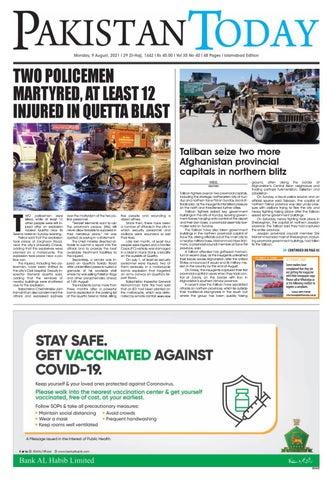
Two policemen marTyred, aT leasT 12 injured in QueTTa blasT Taliban seize two more Afghanistan provincial capitals in northern blitz KABUL ReuteRs
T
wo policemen were killed, while at least 12 other people were left injured after an explosion rocked Quetta near its Serena Hotel on Sunday evening. Police said that the explosion took place at Zarghoon Road, near the city’s University Chowk, adding that the explosives were planted on a motorcycle. The explosion took place near a police van. The injured, including two policemen, have been shifted to the city’s Civil Hospital, Deputy Inspector General Quetta said, adding that the windows of nearby buildings were shattered due to the explosion. Balochistan Chief Minister Jam Kamal Khan also condemned the attack and expressed sadness
over the martyrdom of the two police personnel. “Terrorist elements want to ruin the province’s peace. [we] will never allow terrorists to succeed in their nefarious plans,” he was quoted as saying in a statement. The chief minister directed officials to submit a report into the attack and to provide the best available treatment facilities to the injured. Separately, a vendor was injured on Quetta’s Sariab Road after unidentified persons hurled a grenade at his roadside stall where he was selling Pakistan flags and other paraphernalia ahead of 14th August. The incidents come more than three months after a powerful bomb exploded in the parking lot of the Quetta Serena Hotel, killing
five people and wounding a dozen others. Since then, there have been a number of attacks in the city in which security personnel and civilians were wounded or lost their lives. Late last month, at least four people were injured and a Frontier Corps (FC) vehicle was damaged in a blast in Hazar Ganji, a locality on the outskirts of Quetta. on July 1, at least six security personnel were injured, two of them seriously, in a motorcycle bomb explosion that targeted an army convoy on Quetta’s Airport Road. Balochistan Inspector General Mohammad Tahir Rai had said that an IED had been planted on the motorcycle, which was detonated by remote control. News Desk
Taliban fighters overran two provincial capitals, including the strategic northeastern city of Kunduz and northern Sar-e Pol on Sunday, local officials said, as the insurgents intensified pressure on the north and threatened further cities. Taliban fighters seized key government buildings in the city of Kunduz, leaving government forces hanging onto control of the airport and their own base, a provincial assembly lawmaker said on Sunday. The Taliban have also taken government buildings in the northern provincial capital of Sar-e Pol, driving officials out of the main city to a nearby military base, Mohammad Noor Rahmani, a provincial council member of Sar-e Pol province, said. A Taliban offensive has gathered momentum in recent days, as the insurgents unleashed their forces across Afghanistan after the United States announced it would end its military mission in the country by the end of August. on Friday, the insurgents captured their first provincial capital in years when they took control of Zaranj, on the border with Iran in Afghanistan’s southern Nimroz province. In recent days the Taliban have escalated attacks on northern provinces, which lie outside their traditional strongholds in the south but where the group has been quickly taking
ground, often along the border of Afghanistan’s Central Asian neighbours and trading partners Turkmenistan, Tajikistan and Uzbekistan. on Sunday, a local police source and an official source said Taloqan, the capital of northern Takhar province was also under pressure with civilians trying to flee the city and heavy fighting taking place after the Taliban seized some government buildings. on Saturday, heavy fighting took place in Sheberghan, the capital of northern Jawzjan province. The Taliban said they had captured the entire province. Jawzjan provincial council member Shir Mohammad said most of Sheberghan, including provincial government buildings, had fallen to the Taliban.
CONTINUED ON PAGE 05 IN TODAY S ISSUE
ATTENTION Some readers have complained that they are not getting the magazine with their newspaper copy. Please call or WhatsApp us at the following number to register a complaint. Contact: 0307-7338168 irfan.farooq@pakistantoday.com.pk
02
Monday, 9 August, 2021
ISLAMABAD
NEWS
New 5-year ProGraMMe for PakiStaN to foCUS StrUCtUral reforMS, HealtH, eDUCatioN: wB
t
NEwS DESk
HE World Bank Group is preparing its new 5-year program of support for Pakistan, the Country Partnership Framework (CPF) for 2022-2026 with special focus on structural reforms, health, education, promoting climate friendly future, inclusive growth, and good governance. During a week-long visit of the World Bank Vice President for South Asia, Hartwig Schafer to Pakistan concluded on Sunday, he discussed with the government authorities, the Pakistan government’s priorities for the next few years. The CPF framework has been informed by broad-based stakeholder consultations to help ensure alignment with country priorities, according to a statement issued by the World Bank on Sunday. It said during the visit consultations have been held with federal and provincial
governments, parliamentarians, private sector, civil society organizations including women and youth groups, media and academia, as well as development partners. “I am pleased to see broad support for the direction of the new Country Partnership Framework, which is structured around human capital development – particularly ensuring health and education for girls and boys to give them the best possible start; promoting a cleaner and more climateresilient future; fostering more equitable and inclusive growth; and strengthening governance,” Schafer said. Schafer was joined in his meetings by the Country Director for Pakistan, Najy Benhassine, and the Pakistan Alternate Executive Director for the World Bank, Naveed Baloch. During his visit Schafer met with Prime Minister Imran Khan to discuss the key reforms. The Government’s ambitious plans for investing in human capital, social protection and job creation
Govt defers plan to use PM House for commercial purposes ISLAMABAD shAhzAD PArAchA
The federal government has deferred the plan to use the Prime Minister House for commercial purposes. Sources said that the Ministry of Housing and works had proposed to utilise the auditorium, two guest wings and lawn of the Prime Minister’s House on yearly basis for commercial use through a competitive bidding process. However the cabinet in the last meeting deferred the plan to generate revenue for the public sector. Sources said that the ministry had a plan to use premises for international as well as local food and cultural events, international style high-end exhibitions including vintage cars, international as well as local corporate receptions, corporate high-end products launch ceremonies/Inaugural exhibitions and high-end diplomatic and other receptions. Sources said that the,Ministry had also proposed a seven member approval committee under the chairmanship of Shafqaat Mahmood which would evaluate and approve the bids and would provide strategic guidance to the central management committee. Sources said that the present government has taken a number of initiatives under the prime minister’s guidance to discourage the traditional protocols besides necessary instructions have already been issued for reducing protocols of the ministers and other dignitaries. The government now intends to utilise highly valuable and prestigious official buildings for commercial and business activities that would on one hand dispel the general perception of exuberant expenditure on the maintenance and upkeep of these assets whereas on the other hand it would generate sizable revenue for the public sector.
were also discussed. The Bank offered its support to ensure that new initiatives like ‘Kamyab Pakistan’ benefit from international experience, global knowledge and are implemented in a targeted, impactful and fiscally sustainable way. In meetings with Minister for Finance and Revenue, Shaukat Tarin, Minister of Economic Affairs Omar Ayub Khan, and Minister of Energy Hammad Azhar, Schafer emphasized the importance of staying the course on the structural reform program launched by the Government, particularly in the power sector and with respect to fiscal sustainability. “We urge the government to accelerate the pace of power sector reforms as these are critical for Pakistan to achieve higher economic growth and resilient recovery from the COVID-19 pandemic,” said Hartwig Schafer, “The key issue for the power sector is to be on a financially viable footing to support the country’s green, resilient, and
more inclusive development.” The meetings also focused on the importance of building fiscal resilience through harmonizing the General Sales Tax nationwide, establishing an integrated debt management office, and ensuring a sustainable macroeconomic framework that encourages private investment and growth. Schafer also met Minister for Planning, Development, Reforms and Special Initiatives Asad Umar and Special Assistant to the Prime Minister on National Health Services Faisal Sultan. He reassured them of the Bank’s continued support to finance the procurement of WHO-approved vaccines for Pakistan. The Bank had earlier restructured the Pandemic Response Effectiveness Project (PREP) to provide $153 million for vaccine financing. He also assured Minister Umar of the Bank’s support to strengthen the planning function and statistical apparatus of Pakistan. During his visit, Schafer also met with
Bilawal sees PPP jiyala to lead next Balochistan govt QUETTA PPI
Pakistan People’s Party Chairman Bilawal BhuttoZardari said Sunday that the PPP would form government across Pakistan after sweeping the next general elections. “It is certain that a PPP jiyala will lead the next Balochistan government as the chief minister,” he said while addressing an exclusive party function which pertained to the induction of leading politicians from different political parties in the PPP. Those who joined the PPP included Balochistan former chief minister Nawab Sanaullah Khan Zehri and former federal minister General (r) Abdul Qadir Balouch, at Jattak House on Sariab Road. He added that that the people of Balochistan are an energetic and brave people, and that the relationship between the PPP and the people of Balochistan was three generations old. The people here supported the people’s leader Shaheed Zulfikar Ali Bhutto and made a history, added the PPP chairman. “The historic bond was further cemented when the people of Balochistan stood shoulder to shoulder with Shaheed Mohtarma Benazir Bhutto. After the martyrdom of Shaheed Mohtarma Benazir Bhutto, they once again sided with President Asif Ali Zardari and now the people of Balochistan would be his strength,” he said. He said that a new generation was entering into the political fray, adding: “I want to make history with
the youth of Balochistan, Sindh, Punjab and Khyber Pakhtunkhwa”. The PPP chairman said that the PPP by passing the NFC award to the provinces had ensured the historical injustices could begin to be repaired. He added that the PPP also passed the 18th amendment to realise the dream of Shaheed Zulfikar Ali Bhutto to devolve power and give the right to self govern to all provinces. He said that one of the basic rights enshrined in the constitution guaranteed that the people of that province from where the wells of natural reserves have been discovered would be the first to benefit. He said that former president Asif Ali Zardari had provided Benazir Income Support Programme for financial assistance to impoverished women, launched programmes for the increase of salaries and pensions, and also increased the salaries of the armed forces. PPP Chairman Bilawal said that while the puppet and ineligible Prime Minister Imran Khan’s government had been established after Nawaz Sharifs, but both usurped the will of the people. He added that both these parties were further trying to undermine the people’s rights. They are jointly conniving to undermine the 18th Amendment and do away with the NFC Award, Bilawal maintained. They only see our islands, our coasts, and our resources, but they don’t see the people. There is only one party, the PPP, that knows how to defend your rights, he stressed. He said that the PPP will bring a people’s
government in Pakistan that can resolve the problems of the people. The common man has recognised that they have been robbed in the name of tabdeeli and in reality there is record inflation, poverty, lawlessness and unemployment. Bilawal Bhutto said that his ideology is the ideology of Shaheed Zulfikar Ali Bhutto, who said that it is not written in the destiny of the poor that he will always be poor. He said that Shaheed Mohtarma Benazir’s dream was that every Pakistani child should be brought up in a better environment where everyone should have freedom of expression. Chairman Bilawal Bhutto Zardari, while referring to the Quetta tragedy, said that the people of Balochistan have faced many difficulties. Lawyers were martyred here five years ago, but so far these martyrs have not received justice, he stressed. He felicitated the leaders, dignitaries and workers who joined the party and reiterated his commitment to the rights of the people of Balochistan, and he vowed he would keep visiting the province. Before the welcoming address of the party Chairman, leaders and dignitaries hailing fro different political parties announced their joining the PPP. They are chief of Jhalawan and former chief minister of Balochistan and MPA Nawab Sanaullah Zehri and former governor of Balochistan and former federal minister General (r) Abdul Qadir Balouch.
UNSC calls for bringing Dasu attack perpetrators to justice ISLAMABAD APP
Pakistan, China for early completion of Dasu bus blast probe ISLAMABAD INP
Pakistan and China have decided to wrap up the probe into the Dasu bus blast as soon as possible. The decision was taken in a meeting between Sheikh Rasheed Ahmed and Chinese Ambassador in Pakistan Nong Rong when the envoy visited the minister’s residence here on Sunday. During the meeting, both the minister and the envoy deliberated upon a string of issues including the Dasu bomb explosion. On the occasion, Sheikh Rasheed assured the envoy that the Pakistani government will ensure foolproof security arrangements for the Chinese workers and companies working on a number of development projects in Pakistan. “We will not let the CPEC being sabotaged by any foreign conspiracy,” the minister said and added “No power can create hurdles in the way of Pakistan-China friendship.” The Chinese ambassador said a number of companies have been working on different projects in Pakistan. “We thank the Pakistani government for the facilities it provided to the Chinese workers,” he added.
Minister/Special Assistant to the Prime Minister on Climate Change Malik Amin, Advisor to the Prime Minister on Commerce and Investment Abdul Razak Dawood, and Governor of the State Bank of Pakistan Dr. Reza Baqir. He acknowledged the Government’s commitment to green, sustainable growth, decarbonization and clean energy, nature-based solutions, and climate-friendly development. Recent macroeconomic, industrial and trade developments were also discussed. During his meeting with Dr. Sania Nishtar, Special Assistant to the Prime Minister of Pakistan on Poverty Alleviation and Social Protection, Schafer was updated on the foundational progress made in developing the social protection system of Pakistan and reiterated the Bank’s continued support to the Ehsaas program, which is crucial to help citizens in need to cope with impact of the Covid-19 pandemic and other socioeconomic shocks.
MUZAFFARABAD: A striking view of the city after rain. ONLINE
Tufail remembered on 63rd martyrdom anniversary LAHORE WEb DEsk
Major Tufail Muhammad was born in Hoshiarpur, India, in 1914. In 1943, he was commissioned in the 16th Punjab Regiment. In 1958, he was appointed as Company Commander of East Pakistan Rifles, a paramilitary force created to guard the border region. On August 7, 1958, he launched an offensive against Indian forces that captured a village in the area of Lakshmipur. Despite facing heavy resistance from the invaders, Muhammad and his men carried on with their
mission and were able to force the enemy to withdraw their hold over the village. He received multiple bullets on his chest and embraced martyrdom the same day. He was awarded Nishan-i-Haider, the country’s highest military award, for his courage and valour. He was buried in Burewala city in the Vehari district. “Nation salutes Major Tufail Muhammad Shaheed; second recipient of Nishan-e-Haider, on his 63rd martyrdom anniversary,” the Inter-Services Public Relations said in a tweet. “His fortitude, determination and valour remain hallmarks of a soldier who dares to fulfil his mission at all costs.”
The United Nations Security Council has urged its member countries to cooperate with Islamabad in bringing to justice the perpetrators of an attack on China and Pakistan nationals in the Dasu district of Khyber Pakhtunkhwa. In a press statement issued late on Saturday, the UN body “strongly condemned” the July 14 attack in which nine Chinese workers and three Pakistan nationals were killed and several others injured. The members of the Security Council expressed their “deepest sympathy” and condolences to the families of the victims and to Islamabad and Beijing. They also wished a speedy recovery to those who were injured. The countries reaffirmed that terrorism in all its forms constitutes one of the most serious threats to international peace. The governments stressed the need for holding perpetrators, organisers, financiers, and sponsors of such acts of terrorism accountable and bring them to justice. They urged all the states to “cooperate actively” with the governments of Pakistan and China, as well as all other relevant authorities in this regard in accordance with their obligations under international law and relevant Security Council resolutions. They reiterated that “any acts of terrorism are criminal and unjustifiable, regardless of their motivation, wherever, whenever and by whomsoever committed.” The body reaffirmed the need for all States to combat by all means, in accordance with the Charter of the United Nations and other obligations under international law — including international human rights law, international refugee law, and international humanitarian law, threats to international peace and security caused by terrorist acts.
Monday, 9 August, 2021
ISLAMABAD
PM, COAS lAud NCOC’S teAM fOR theIR dedICAtION ISLAMABAD
P
Staff RepoRt
RIME Minister Imran Khan on Sunday lauded the dedicated work of National Command and Operation Center (NCOC) team, saying it proved as linchpin in the country’s Covid 19 response strategy. On his twitter handle, the premier posted that the government’s strategy to contain coronavirus had been appreciated by the world. With the blessing of Allah Almighty, Pakistan was protected from the worst effects of the deadly
infection, he further added. The prime minister reflected his thoughts on the NCOC as the body had completed its 500 days of formation. “Our Covid 19 response strategy has been appreciated by the world and with the blessings of Allah, the NCOC has protected Pakistan from the worst effects of Covid. I want to pay tribute to the NCOC’s team which through its dedicated work, has been the linchpin of our Covid response strategy,” he posted. Separately, Chief of Army Staff General Qamar Javed Bajwa Sunday paid tribute to the team of the NCOC for its
Kashmir Committee urges OIC to move Kashmir case in ICJ on Rohingya model
continuous struggle and quick calculated response against the deadly pandemic of Covid-19 that enhanced national response in the time of crisis and protected the nation. The ISPR DG took to Twitter to share the message of the Army Chief praising the NCOC’s efforts for ensuring successful management of disease across the country. He wrote the COAS message on his official handle, “The NCOC has remained pivotal to Pakistan’s riposte against Covid-19. It symbolizes optimized national response in adversity, saving precious lives. Accolades for the NCOC team on completing 500 days of
continuous struggle and delivery”. He also tweeted an over 38minute long documentary highlighting the national response articulated through the NCOC combining all federating units under the ambit of the forum to deliver efficiently against the challenge of Covid-19. It also projects the views of Prime
Minister Imran Khan, President Dr Arif Alvi, Chairman NCOC Asad Umar, National Coordinator Lieutenant General Hamood Uz Zaman Khan, chief ministers of federating units, former Prime Minister AJK Raja Farooq Haider Khan and others praising the role of the NCOC.
On-ground findings differ with complaint of envoy’s daughter, Pakistan tells Afghanistan ISLAMABAD
ISLAMABAD Mian abRaR
Mian abRaR
Kashmir Committee Chairman Shehryar Khan Afridi on Sunday urged the OIC-IPHRC to act immediately to help save the suffering humanity in the Indian Occupied Kashmir (IOK) before its too late as Indian genocide against Kashmiri people is touching new highs. “I fear there would be no Kashmir to save in two year’s time if Indian demographic terrorism is not stopped as the Illegally Occupied regime in Jammu and Kashmir is fast changing the demography of the Indian Illegally Occupied Jammu and Kashmir,” said Afridi while addressing a special meeting of the Committee held to brief the visiting IPHRC delegation. Welcoming the delegates of the OIC, the Kashmir Committee chairman expressed gratitude to the delegation for heeding to the wails of Kashmiri mothers and daughters mourning their martyrs. He said that the United Nations was formed after failure the League of the Nations, had been unable to resolve the issues faced by the humanity. He deplored the fact that the United Nations is also failing to resolve the issues like Kashmir and Palestine. He also said that the humanity is bleeding in occupied Kashmir but the prosperous world is a silent spectator. He further said demographic changes are taking place in the IOK and 4.1 million new domiciles have been issued to non Kashmiris brought from mainland India which is a violation of the Indian constitution. He added that the Indian regime is implementing genocide tools and is not providing medical facilities to the freedom loving Kashmiris jailed.
Pakistan has conveyed a visiting Afghan team a comprehensive witness account led to the conclusion that the findings on the ground did not corroborate the complaint filed by the daughter of Afghan Ambassador as the the technical evidence further substantiated the conclusion. The delegation from Afghanistan visited Islamabad in connection with the reported complaint of daughter of the Ambassador of Afghanistan to Pakistan of 16 July 2021. During the visit, the delegation met with the officials of law-enforcement agencies and the Ministry of Foreign Affairs. Official sources told Pakistan Today that the Afghan delegation was
also briefed on the measures and findings of the law-enforcement agencies after thorough investigation in the complaint made by daughter of Afghan ambassador of an alleged harassment. On certain aspects of the case, the relevant Pakistani authorities reiterated the earlier request for provision of additional information, and access to evidence and the complainant. The delegation was given a comprehensive briefing on all aspects of investigation conducted by the relevant Pakistani authorities in the reported incident. They were also taken to the Safe City Office, Islamabad, where they were shown several videos from various locations of different timings in which the complainant was clearly identifiable moving around the places
independently. An on-site visit of all the locations visited by the complainant was arranged for the delegation, followed by presentation of technical data (findings of mobile forensic/geo fencing) as well. The delegation was also informed of the measures taken for enhanced security of the Embassy of Afghanistan in Islamabad and its Consulates. “Pakistan attaches high importance to its relations with Afghanistan. At this critical juncture in the Afghan peace process, it is extremely important to work jointly for the shared objective of a peaceful, stable and prosperous Afghanistan. Pakistan hopes that the Embassy of Afghanistan in Islamabad would soon resume its normal operations,” an official statement later said.
NCOC daily update: 4,455 new cases, 68 deaths Covid-19 ISLAMABAD Staff RepoRt
Pakistan on Saturday reported 4,455 new Covid-19 cases, the National Command and Operation Centre said on Sunday. The NCOC, a department leading campaign against the pandemic, said the number of overall confirmed cases had risen to 1,067,580, including 961,639 recoveries.
Another consignment of Sinopharm vaccine arrive ISLAMABAD Staff RepoRt
A special Pakistan International Airlines flight on Sunday brought another consignment of the Covid-19 vaccine from Beijing. The plane carrying 680,000 shots of Sinopharm vaccine landed in Islamabad early morning. The drug was later shifted to the central warehouse of the Expanded Programme on Immunisation in Islamabad. Pakistan has so far purchased two million doses of the drug from China. On Saturday, 1.32 million doses
of Sinopharm had arrived in the capital. The previous day, a batch of 64,000 jabs of Pfizer-BioNTech vaccine had arrived on board a flight of a foreign airline. Pakistan has signed an agreement with Pfizer Inc. for the procurement of 13 million doses of its Covid-19 vaccine. 100,000 doses of the vaccine had arrived in Islamabad in July. The shots will be administered to people with chronic diseases and fragile immunity and those travelling abroad. The government aims to vaccinate 80 million people against the disease by year-end. The arrival of more doses will help the country ramp up the drive.
With e-voting all contestants will accept the results, PM Imran Khan says ISLAMABAD inp
With Pakistani-made electronic voting machines in place, Prime Minister Imran Khan said Sunday finally there will be an election whose results will be accepted across the board. Congratulating the federal science minister Shibli Faraz on Pakistani-made electronic voting machine, he said, “Looks like finally we will have elections in Pakistan where all contestants will accept the results.” The PM said it while inspecting the voting machine presented to him by the science ministry.
Yesterday, PM Imran Khan witnessed a detailed demonstration of a new locally-made electronic voting machine. Federal minister Faraz, along with the officials of his ministry, gave a detailed briefing to the premier about the working of this locally produced EVM. Shibli Faraz said there is no need for internet connectivity for the EVMs, and the software used is in the machine is of international standard, he added. On the occasion, PM Imran Khan witnessed a detailed demonstration of the EVM and also cast his vote. The premier also congratulated Shibli Faraz and his team for producing such EVMs.
The number of active cases has risen to 82,076 who are under treatment across the country, including 4,282 in critical condition. According to the NCOC, the pandemic killed 68 people on Saturday, increasing the overall death toll to 23,865. Sindh is the most affected province of the country in terms of the number of confirmed cases with 398,745 infections, followed by Punjab which has reported 363,644 cases.
NEWS
03
Muharram moon panel meeting ISLAMABAD app
Central Ruet-i-Hilal Committee is to meet in Quetta on Monday (August 9) for the sighting of the Muharram moon. Syed Abdul Khabir Azad, the committee chairman, will preside over the meeting to be held at the Office of the Deputy Commissioner in the provincial capital. The zonal and district Ruet committees will also meet at their respective headquarters the same day to gather information about the sighting of the moon. The information regarding the sighting of the moon will be passed on to Azad and other officials through a call.
Soldier injured amid terrorists’ attack from Afghanistan on Pakistan military post: ISPR NewS DeSk A soldier of Pakistan Army on Sunday got injured while thwarting terrorists’ attack from inside Afghanistan on Pakistan military post in Dewagar, North Waziristan District. “Terrorists from inside Afghanistan across the international border, opened fire on a Pakistan military post in Dewagar, North Waziristan District,” said an ISPR news release. Pakistan Army troops responded in a befitting manner, it added. The ISPR statement said that Pakistan has consistently been requesting Afghanistan to ensure effective border management. “Pakistan strongly condemns the use of Afghan soil by terrorists for activities against Pakistan,” it said.
Police kill three ttP militants in raid LAHORe the aSSociated pReSS
Counter-Terrorism Department said they killed three militants in a gun battle early Sunday during a raid on their hideout near Lahore. The raid took place after police received information that the militants belonged to the proscribed Afghanistan-based group Tehreek-i-Taliban Pakistan, according to a brief statement issued by the agency. The three men were hiding in a rented house in Ferozewala, a Lahore suburb. The statement said the militants killed Sunday were planning attacks on security forces and Shi’ite mourning processions. It said there was an exchange of gunfire during the raid in which three militants were killed and officers seized weapons from the hideout including an explosives-filled vest, two assault rifles, three hand grenades and two pistols. The militants were identified as Afghanistan nationals.
Monday, 9 August, 2021
04 NEWS
ISLAMABAD
Umrah operators seek pakistan’s exClUsion from saUdi red list ISLAMABAD
t
TLTP
HE Kingdom of Saudi Arabia will begin receiving Umrah pilgrimage applications from abroad for vaccinated pilgrims from Monday (today) and Umrah operators in Pakistan are urging the government to take up the issue of travel restrictions with the Saudi authorities as the South Asian country is in Saudi red list. An official of the Saudi Hajj and Umrah Ministry said on Sunday that vaccinated pilgrims from countries that Saudi Arabia in-
cludes on its entry-ban list will have to be institutionally quarantined upon arrival. He said the Saudi government will also increase the overall capacity of the pilgrims to two million per month with certain conditions, state-run Saudi Press Agency reported. To curb the spread of the coronavirus and its new variants, Saudi Arabia has banned transit at, or travel to, a “red list” of 13 countries, which includes Pakistan, Afghanistan, Argentina, Brazil, Egypt, Ethiopia, India, Indonesia, Lebanon, South Africa, Turkey, Vietnam and the United Arab Emirates. Last week, the Saudi Ministry of Hajj and Umrah said starting August 9 it would
begin receiving Umrah requests from vaccinated foreign pilgrims from countries that are not on the red list. “We are ready and waiting for the goahead signal from the Saudi authorities to resume operations,” Rao Muhammad Ali, a Hajj and Umrah operator from Multan, said while talking to TLTP. He said that Hajj and Umrah operators are the worst victims of Covid-19 travel curbs, as literally their businesses have come to zero. He termed the decision to resume Umrah a very encouraging step for the Pakistani travel and tourism sector. The decision has revived the hope of the sector’s revival, he further said.
Hassan Ali, an Umrah operator from Bahawalpur district, while talking to TLTP requested the government to take up the issue of the country’s inclusion in the red list with Saudi authorities and get the country unhooked from the list so that the business revives in the country. Ali said that before the start of the pandemic last year, Pakistan’s Hajj and Umrah operators facilitated travel packages for nearly two million pilgrims every year, out of which up to 1.8 million were Umrah pilgrims. Saudi Arabia suspended the Umrah pilgrimage following the Covid-19 outbreak last year but reopened it to a limited number
of vaccinated residents in October. Estimates show that in 2019, Pakistan’s religious tourism market, excluding travel to Iran and Iraq, stood at Rs245 billion.In 20182019, 1.8 million Pakistanis performed Umrah, spending an average of Rs80,000 per head, which mobilised Rs144 billion in revenue, according to operators. According to Pakistani tour operators, 75 percent of their services had previously included pilgrimage packages, which had reduced to 10 percent due to the pandemic. The travel industry and airlines are correlated and are operating at around 10 percent of their capacity, they said.
Gold recovery to $1,779/ounce likely despite bearish outlook
LAHORE: Clouds hover over River Ravi. Zubair MehfooZ
PSX likely to maintain positive momentum this week KARACHI TLTP
The Pakistan Stock Exchange (PSX) is likely to maintain positive momentum in the week starting today (Monday) due to end to Sindh lockdown, expected corporate profitability, improvement in the macroeconomic fundamentals, and accommodative monetary policy stance. However, the ongoing fourth wave of Covid-19 may add some risk to investors’ confidence, albeit new cases and positivity rate inched down in the end of the last week. Again, instability in oil prices could keep market performance in check, as crude prices declined on a week-on-week basis and recorded their worst week since March. This decline was despite the fact that crude prices recovered some losses in the last two sessions. Any further downtrend in rupee against the US dollar may rail investors’ confidence and fuel profit taking. However, with the $2.8 billion SDR allocation expected from the International Monetary Fund (IMF) in August, the reserves position will consolidate further which is significantly positive given uncertainty over the external account outlook.
On the regional front, the conflict in Afghanistan continues to be a major concern, especially for foreign investors, that may restrain the market from posting exorbitant gains. According to analysts at Arif Habib Limited, the stock market is likely to stay in green during this time owing to a lower interest rate regime. They said that the low interest rate regime and progrowth stance of the State Bank of Pakistan (SBP) should keep equities attractive. Moreover, the result season should keep cyclical in limelight while reduced provisioning, and healthy fee income/capital gains should help fuel banking earnings. They said that Covid-19 fourth wave is a concern which may keep sentiment jittery. Taking a view of the last week performance of PSX, the benchmark KSE-100 Index managed to close the week with a gain of 435 points (+0.92 percent) at 47,489.95 points. Trading remained volatile throughout the week with the index finishing three out of five sessions in the green. The KSE-100 index is currently trading at a PER of 6.7x (2021) compared to Asia Pac regional average of 16.1x while offering a dividend yield of 6.6 percent versus 2.4 percent offered by the region. Sector-wise positive contributions came from
commercial banks (193 points), oil & gas marketing companies (52 points), and chemicals (52 points). Meanwhile, the sectors that contributed negatively included food & personal care (21 points) and tobacco (7 points). Scrip-wise positive contributors were MEBL (84 points), MCB (43 points), and HBL (41 points), while negative contributions came from LUCK (41 points), PSEL (36 points), and UNITY (19 points). Foreign buying of $3.1 million was witnessed last week against a net sale of $5.4 million in the preceding week. Buying was witnessed in Technology (USD 1.8 million), Cements (USD 1.3 million) and OMCs (USD 0.2 million). On the domestic front, major selling was reported by funds, insurance and individuals, while buyers remained banks and companies, which shows that market is likely to gain this week. Average volumes clocked in at 455 million shares (+12 percent week on week) while average value traded settled at $85 million (down by 5 percent week). Meanwhile, the KSE All Share Market Cap increased by Rs98 billion or 1.19% over the week, being recorded at Rs8.34 trillion as compared to a Market Cap of Rs8.24tn recorded last week.
Despite the bearish shift witnessed in the technical outlook after gold price touched its lowest level in more than a month, experts expect gold to stage a recovery in the near-term and point to an average price target of $1,779 per ounce for the week starting today (Monday). Following Friday’s drop, the Relative Strength Index (RSI) indicator on the daily chart fell below 40 for the first time in more than a month, suggesting that the bearish pressure is picking up steam. The RSI also stays slightly above 30, showing that there is more room on the downside before gold becomes technically oversold and sellers look to book their profits. $1,760 (static level) aligns as the initial support ahead of $1,750 (June 29 low). According to the experts, a daily close below the latter could attract sellers and cause gold to extend its slide toward the next static level at $1,730. On the upside, strong resistance seems to have formed at $1,800 (psychological level, 100-day SMA). In case buyers manage to reclaim that level, $1,810 (20-day SMA) could be seen as an interim hurdle ahead of $1,820 (200-day SMA), according to experts. Gold started the last week under modest selling pressure but struggled to gather bearish momentum in the absence of significant fundamental drivers. After closing flat on Monday and Tuesday, gold climbed above $1,830 on Wednesday. Nonetheless, the renewed US dollar’s strength in the second half of the week forced gold, once again, to turn towards south. With the US labour market report showing impressive job gains in July, gold declined sharply and touched its lowest level in more than a month at $1,758 on Friday before closing the week at $1,763.90. In the present week, ZEW Survey results for the euro area and Germany will be featured in the European economic docket on Tuesday ahead of Nonfarm Productivity and Unit Labour Costs data from the US for the second quarter. More importantly, the US Bureau of Labour Statistics will release the July Consumer Price Index (CPI) data on Wednesday. The annual CPI climbed to 5.4% in June and a similar reading in July is likely to help the US dollar continue to outperform its rivals. Later in the week, the weekly Initial Jobless Claims data and the University of Michigan’s Consumer Sentiment Survey will be looked upon for fresh impetus. NeWS DeSK
Cryptos remain mixed with Bitcoin slips to $44,378 The cryptocurrency market remained mixed amid profit taking on Sunday, with the market cap increasing 1.5 percent to $1.87 trillion as of 1435 hours GMT. The price of Bitcoin (BTC), the largest cryptocurrency, inched down to $44,378 by shedding 0.02 percent. With this minor decrease in price, the market capitalisation of the BTC has reached $833.3 billion. Likewise, ethereum (ETH) price turned towards south and shed 2.04 percent to reach $3,068. With this decrease in price, the market capitalisation of ETH has reached $358.9 billion. On the other hand, XRP shed 0.10 percent to reach $0.796. The market capitalisation of XRP stands at $79.5 billion after this decrease. Similarly, Cardano (ADA) price reached $1.46 with a 1.64 percent decrease in its price. Its market capitalisation has reached $47 billion after this decrease. However, Dogecoin (Doge) price appreciated by 10.51 percent to reach $0.253. With this increase in price, the market capitalisation of Doge reached $23 billion. According to analysts, Bitcoin price has witnessed an exponential growth after weeks of downtrend. NeWS DeSK
Pakistani exports to China surged 85pc in first half of 2021: envoy NEWS DESK Pakistan’s exports to China increased by 85 percent during the first half of the year 2021 as compared to the same period of the year 2020. This was stated by the Commercial Counsellor of Pakistan Embassy in China, Badar uz Zaman, in a statement on Sunday. According to the official data from the General Administration of Customs of the People’s Republic of China (GACC), Pakistan’s export to China crossed $1.735 billion in January-to-June in the first half of 2021 registering an increase of 70.3% during the
first half of the current fiscal year (20202021). The bilateral trade between Pakistan and China witnessed a significant increase despite the COVID-19 pandemic. Pakistan’s exports stood at $1.735 billion in the first half of FY2021, up 70.3 percent from $1.019 billion in the same period of the previous year. Zaman said that this increase was due to many concessions offered to Pakistani exports by China, while many exhibitors and exporters are also working to market their products into the Chinese market after signing of the Free Trade Agreement (FTA) between Pakistan and China. Zaman said that Pakistani exporters need
to establish good brands to attract Chinese customers and further increase exports to China. “If we are able to market our good brands in China by setting up export offices and by engaging the big importers, then we will definitely see the growth in exports,” he added. He said that the per capita income is increasing in China, and now consumer products are gaining a lot of attention from all over the world. “As Pakistan is also good in the consumer products, especially in the textile, leather, sports goods, surgical and food related industries and agriculture. So, in these areas there will be a strong Chinese demand,” he added.
CMYK
Earlier on Friday, Pakistan Businesses Forum (PBF) said that establishment of brands in the textile industry will fetch better export volumes, regretting the exporters, unfortunately, didn’t focus on these lines earlier. Speaking to a delegation of Pakistan Readymade Garments Manufacturers and Exporters Association (PRGMEA), PBF President Mian Usman Zulfiqar said that Pakistan’s fashion designing and textile industry have emerged as important components of national trade because of their export potential, said a statement. He was of the view that the two segments have tremendous potential to secure a
mammoth share in the international fashion market. “Pakistan can grab a significant share in fashion industry exports if it succeeds in attracting the attention of foreign buyers,” he added. He suggested the government announce the setting up of five mega textiles parks to make the industry globally competitive. The government may also make it compulsory for the large spinning units having more than 30,000 spindles to grow their own cotton to manufacture cotton yarn and extend full support to them because the country’s textile exports cannot be enhanced without increasing the area under cotton cultivation and yield.
Monday, 9 August, 2021
ISLAMABAD
NEWS
MujAhid-i-SAni iS nOT MujAhid-i-AwwAL CIty NotES M A NIAzI
P
ERHAPS the new prime minister of AJK will be the man under whom the Kashmir issue will be solved, for he seems of an unusual prescience. You see, he chose the name Niazi, because when he was a member of Poonch Disrict Council back in the day, his name was the same as Sardar Abdul Qayyum, the leader of the party he was then in. Now why he chose Niazi to distinguish himself I don’t know, but he did. Did he know that he would one day join a party led by a Niazi? Whatever the reason, he made the choice, and it was under that name that he served in Sardar Qayyum’s son Atique’s Cabinet. Sardar Qayyum was Dhund Abbasi, to be distinguished from the Kalhoro Abbassis of Sindh and Bahawalpur. Dhund Abbasis are an extensive biradari, spreading over
part of KP into Potohar sand reaching Bagh district in AJK. Mehtab Abbasi was both Governor and CM in KP, while Shahid Khaqan was PM of Pakistan. Sardar Qayyum was both President and PM of AJK. This Sardar Qayyum is neither Dhund nor Niazi, but a Dulli Mughal. Speaking at an election rally, Imran, who doesn’t normally stress his tribe, was moved to wonder what a Niazi was doing so far afield. The main place we come from, which might even be referred to as the Niazi homeland, is Mianwali district. Apart from that, they were in East Punjab’s Hoshiarpur district, but after that, I’ve come to hear of Niazi’s from Faisalabad, Sahiwal, and Khanewal, and I’m sure they’re settled in other colony districts. You see, Mianwali is an arid and thus relatively infertile land, while that was the whole point of colony districts: they were made fertile by water. Because there were large tracts of fertile land in colony districts, East Punjabi refugees also got allotted those lands. And that included all those East
Punjabi Niazis. Anyhow, the late Sardar Abdul Qyyum is known as Mujahid-i-Awwal, because he was the one, back in 1947, who raised the standard of revolt against the Dogras. If this one plays a role in freeing Kashmir, will he be known as Mujahid-i-Sani? Imran also was probably also relieved that Arshaf Nadem did so badly at the Olympics. Imagine the embarrassment of riches that we would have had for future PMs in Shaheen Shah Afridi, a personable fast bowler, and an Olympic gold medallist. What seems to have proved that Nadeem Arshad is a traitor and a corrupt element (which is the same thing) is that he failed to get a medal in an event won by an Indian, India’s only gold medal so far these Olympics. Of course, there have also been developments in the cricket world, on which Imran is concentrating as hard as on developments in Afghanistan. Australia has lost the T20 series to Bangladesh, having lost to the West Indies over there. So Pakistan should get
them over while they think that losing on tour is OK. But then, Ireland and Afghanistan are already inviting them to tour, just to see how far the Aussies can sink. I wonder if Dr Firdous Ashiq Awan has resigned as SACM, as CM’s spokesperson. Because of what happened to a Kabul government spokesman who was assassinated, because of the recent Sialkot by-election, or in support of Oun Chaudhry, who resigned as CM’s coordinator in support of Jahangir Tarin. She did not resign in support of those who killed PTI MPA Asad Khokhar’s brother Mubashir at Asad’s son’s walima. CM Usman Buzdar was there, after telling Asad he was being taken back in the cabinet. Asad had been sacked last year because he wasn’t doing well. The killers proved it was an old enmity by leaving Buzdar alone. Still, that made it worse for the CM’s security staff. Buzdar was just a witness, you see, not the target. That is probably not where you want the CM to be.
Taliban seize two more Afghanistan provincial capitals in northern blitz continued from page 01 An Afghan security forces spokesman on Saturday had denied the Taliban had taken the city, saying forces were working to defend Sheberghan without causing civilian casualties. On Sunday, he did not immediately respond to a request for comment for an update on the situation. In Kunduz, the Afghan security forces spokesman said that “extremely (heavy) fighting is going on”. The city is regarded as a strategic prize as it lies at the gateway to mineral-rich northern provinces and Central Asia. But a provincial lawmaker in Kunduz told Reuters the insurgents had taken key buildings in the city of 270,000 people, raising fears that it could be the latest to fall to the Taliban. “Heavy clashes started yesterday afternoon. All government headquarters are in control of the Taliban, only the army base and the airport is with ANDSF (Afghan security forces) from where they are resisting the Taliban,” Amruddin Wali said. Taliban spokesman Zabihullah Mujahid said the group had largely captured the province and were close to the airport. Health officials in Kunduz said that 14 bodies, including those of women and children, and more than 30 injured people had been taken to hospital. In Sar-e Pol, Rahmani said: “Government headquarters, including the governor’s house, police command, and the National Directorate of Security compound, are captured by the Taliban.”
ISLAMABAD: A beautiful vieew of Srinagar Highway in the federal capital. I NP
US oil consumption hit 25-year low in 2020: EIA WaSHington AGENCIES
The US petroleum consumption declined to 18.1 million barrels per day (bpd) last year, the lowest level in 25 years, the Energy Information Administration (EIA) has said. Petroleum consumption in the transportation sector plunged by a record-breaking 15% in 2020 compared to a year earlier. Oil consumption declined in every single energy-consuming sector, the EIA said in new estimates of US petroleum products consumption by source and sector for last year. Lockdowns and other measures to contain Covid across the United States in 2020 were the key reason for lower petroleum consumption, espe-
cially in the transportation sector where consumption of gasoline, diesel, and jet fuel plunged. Consumption of the most consumed petroleum product in the US, motor gasoline, slumped by 14% to 8 million bpd last year, which was the lowest level of gasoline consumption in the country since 1997, EIA data showed. Gasoline accounted for as much as 44% of total US petroleum consumption last year. The transportation sector makes up 96% of the motor gasoline consumption, while the industrial and commercial sectors consume the rest. Diesel fuel consumption also fell, by 8% in 2020 compared to 2019. Diesel accounted for 21% of US petroleum consumption last year. Typically, over three-quarters of all diesel
fuel is used by trucks, ships, and trains in the transportation sector. Jet fuel consumption saw the steepest decline, by 62%, to levels last seen in 1983. Jet fuel and aviation gasoline accounted for 6% of total US petroleum consumption last year. Overall, EIA estimates showed last month that US consumption of petroleum, natural gas, and coal slumped by 9% in 2020, reaching the lowest level since 1991 and marking the largest annual decrease in US fossil fuel consumption in both absolute and percentage terms since at least 1949. Demand for petroleum products, which accounted for 44% of fossil fuel consumption in the United States, plunged by 13% last year compared to 2019.
05
Mari Petroleum Organizes Light and Sound Show Mari petroleum hosted an impressive light and sound show, projecting the struggles and contributions of our founders for creation of an independent state, Pakistan’s rich history, progression over the years, vibrant culture and a tribute to the heroes of Pakistan. Pride of performance award holder, Sahir Ali Bagga paid tribute to our forefathers, with his melodious songs. MD/CEO Mari Petroleum Faheem Haider, in his speech, welcomed the guests to the enthralling light and sound and said that this initiative is aimed at invigorating our national spirit through innovative tools of storytelling. He added that the show will be demonstrating an immersive 3D Light and Sound Show, projecting the story of Pakistan’s independence and a tribute to the heroes of Pakistan. This is one-of-a-kind three-dimensional projection mapping experience – a modern technology/tool for storytelling, which is cutting edge and unique. Mr. Faheem Haider also highlighted that, in addition to being the leading Oil & Gas company of the Country, Mari Petroleum is playing its role as a responsible corporate citizen by investing in social welfare projects throughout Pakistan. Chief Guest, Managing Director Fauji Foundation Mr. Waqar Ahmed Malik lauded the achievements of Mari Petroleum in the field of Oil & Gas and the company’s CSR initiatives. He specially emphasized MPCL’s pivotal role in ensuring food and energy security in Pakistan. He also highlighted that, in the last 5 years MPCL contributed PKR 350 billion to the national exchequer in the forms of taxes, levies & royalties and annually saves PKR 270 billion in foreign exchange for the Government of Pakistan. Mr. Waqar Malik paid rich tribute to the founding fathers of Pakistan struggle and reiterated the resolve of the Fauji Foundation group towards building a vibrant prosperous Pakistan. He added that Fauji Foundation, a trust established in 1954, is dedicated to the welfare of ex-servicemen and their families. The Foundation provides welfare services to its 8 million beneficiaries, who are our heroes having contributed zealously for the safety of our homeland. The Foundation’s state of the art facilities including 140 Health facilities and 180 Educational facilities are open for all citizens of Pakistan. It was highlighted that the Foundation operates on a complete self-sustaining basis and receive no grants or assistance from any Government or Non-Governmental Organisations. The Foundation generates funds through its various investments in Fertilizer, Cement, Power Generation, Renewable Energy, Oil & Gas exploration, Marine Terminal, Food and Banking sectors of the country. The funds generated from these investments are exclusively dedicated for the Foundation’s welfare activities. PR
Aramco quarterly profit triples to $25.5bn, highest in 3 years: CEO RIYADH: Saudi Arabia’s state-run energy giant, Saudi Aramco, posted net profits of $25.5 billion in the second quarter, the highest since the end of 2018, as the reopening of economies prompted a surge in commodity prices. The bumper quarterly earnings are reportedly nearly 300 percent higher than they were in the same period a year ago. “Our second-quarter results reflect a strong rebound in worldwide energy demand, and we are heading into the second half of 2021 more resilient and more flexible, as the global recovery gains momentum,” Aramco Chief Executive Officer (CEO) Amin Nasser said in a statement. Earlier this year, the world’s biggest energy company said it had managed to raise $6 billion from its first dollardenominated Islamic bond sale. It also posted a 30% increase in first-quarter profits. Saudi Aramco reported a 44.4% slump in net profits in pandemic-hit 2020, when low prices and sharp cuts in production significantly increased its debt. AGENCIES
China’s industrial sector may decline in second half of 2021 BeiJing AGENCIES
Slowed growth of Chinese exports in July, along with lagging imports, is expected to herald a slowdown in the nation’s industrial sector in the second half of 2021 – even amid a trade recovery triggered by easing global lockdowns. Last month, Chinese exports recorded year-over-year growth of 19.3% following a 32.2% gain in June. The increase was expected to total 20.8 percent. Meanwhile, imports rose by a more modest 28.1% from a year ago, falling short of a 33% increase forecast in the poll, and 36.7% growth during the previous month. Demand for iron ore, vital for steelmaking, has declined in recent months.
The rapid containment of the pandemic, as well as the successful rollout of nationwide vaccination, helped the world’s biggest exporter to quickly revive its economy after the Covid-related decline in the first few months of 2020. However, seasonal floods and climatic factors in July, along with new infections mostly caused by the highly transmissible Delta variant, forced local governments to shut down production lines in locked-down areas, temporarily suspending the operations of some businesses. “The pandemic worsened in other Asian developing countries, which may have led to a relocation of trade toward China. But leading indicators suggest exports may weaken in coming months,” said Zhiwei Zhang,
chief economist at Pinpoint Asset Management, as cited by Reuters. Moreover, Chinese exporters still have to struggle with the higher cost of raw materials and freight, logistics bottlenecks, and global semiconductor shortages that have led to cutbacks for various industries. “Although orders are recovering, there are too many uncertainties in the second half of the year, like how the domestic epidemic develops and the cost of raw materials. And at the same time, foreign production capacity is slowly picking up,” an exports sales manager based in Suzhou named Ye told the agency. Last month, China reported a trade surplus of $56.58 billion versus the poll’s projection of $51.54 billion, and a $51.53 billion surplus in the previous month.
cmYK
Monday, 9 August, 2021
06 COMMENT
Relationships and Conflict
Property power Deputy Speaker’s video
O
N the face of it, someone merely followed the tacky script of the celebrity endorsement of a real estate firm, scheme or other property venture. Only it was the deputy speaker of the National assembly recording this video, but he was doing it in his office, before the national flag, almost as if it was an official endorsement. True, there seems no reason why anyone should trust mr Suri’s judgment on real estate, but it also constituted the very sort of conflict of interest that mr Suri’s party, the PTI, and party chief, Prime minister Imran Khan, condemned so roundly before coming to office, and which he promised so positively to end if elected. It is unfortunate that mr Suri is not an isolated example. One real estate tycoon gained NaB clearance, while he was so strong a contender for the Punjab Chief minister that he was appointed Senior minister. There is an assumption in the government that real estate has taken employment on its shoulders in the covid-19 pandemic. No doubt this has been spread by the real-estate lobby which has obtained so many tax benefits and immunities for itself. Like other mafias, it seems this too has nested itself in the highest echelons of the party that had promised to oust it. When a real-estate mogul gifts an exPresident a house in Lahore in one of his housing schemes, he is looking forward to benefiting from the relationship thus developed. There have already been signs of real-estate moguls being likely to cause a major scandal to explode, with a Pm’s adviser (since resigned) involved in the Rawalpindi Ring Road acquisitions. mr Khan also must realise that expertise may have developed only because of interests, and thus divesting themselves of all interests should be essential. The government must act strongly to prevent conflicts of interest, not to prevent decision-makers being influenced by their commercial interests, but to save the public from the revolting sight of a minister in action at his favourite restaurant, or some adviser doing an inane ad for a brand of washing powder. The government has been letting too many business interests dominate its politics for much too long.
China, Tibet and India have a long history
Dr rajkumar Singh
D
eSPITe the fact that internationally Tibet is recognised as an integral part of China, there also continues to be a conflict of its sovereignty, right to self-determination, and legality with the existence of a zone called Tibet autonomous Region of the People’s Republic of China. Unlike other portions of China, this part of China has become the subject of political debate because there are five points in the context that require historical search of facts: a. The People’s Republic of China asserts that Tibet has been a part of China since the period of the mongol-led Yuan dynasty, b. The Republic of China (ROC) says that Tibet was placed under the Sovereignty of China under the Qing dynasty (1636-1912), c. The Tibetan Government in exile claims that Tibet was an independent state until the PRC invaded it in 1949/1950, d. Western scholars contradict the Chinese view and contend that Tibet was independent during the Han-led ming dynasty (1368-1644) and it was ruled by China during the manchu-led Qing dynasty but with least subordination, e. Some scholars also maintain that Tibet was independent from 1912 to 1950 but it had little international recognition. In all these claims and counterclaims researchers have taken help of history which have varied periods/ phases and methods of calculations. So far as the matter about the claims of China and Tibet are concerned, while Beijing wants to prove
Winning hearts, not medals Nadeem Arshad was not at fault, sports organizers are
N
Dialogue is inevitable
atitya munawer
T
He echoes of the Grand National dialogue are sometimes loud and sometimes faint, although, in today’s political frenzy, there seems to be no prospect of dialogue. However, no one can deny the fact that matters have been resolved through dialogue even in the past, this has been happening and will continue to happen, if not today, then tomorrow the government and the opposition will have to sit at the same table for talks. PmL(N) President Shahbaz Sharif has even offered reconciliation. mian Shahbaz Sharif says that “I always want national reconciliation, forget the past and move forward and cure the sufferings of the people, we are not angels, many mistakes have been made in the past, and we have to learn from our mistakes and move forward.’’ Federal Information minister Fawad Chaudhry says the government has never closed the door to talks with the opposition, but will only talk to the opposition leadership in Parliament. There is no doubt that mian Shahbaz Sharif believes in a conciliatory policy, but mian Nawaz Sharif and maryam Nawaz have taken the path of resistance politics, so Fawad Chaudhry is right to say that what should be discussed with those who are not part of the Parliament, and those who are in Parliament are under the influence of these unelected people. The
Dedicated to the legacy of late Hameed Nizami
Arif Nizami (Late) Founding Editor
Yousaf Nizami M. A. Niazi
Umar Aziz
Joint Editor
Joint Editor
Executive Editor
Lahore – Ph: 042-36300938, 042-36375965
thus the existing relationship between China and Tibet had been that of patron and priest and was not based on the subordination of one to the other. However, between 1912 and 1950 Tibet enjoyed independence and sovereignty in the real sense of the term, and also issued passports to Tibetans and visas to citizens of foreign countries. Its government permitted the first-ever mount everest expedition in 1921 followed by British everest expedition in 1924 and 1936. The passports and visas issued by the government of Tibet found wide acceptance and stamps across the world including India, the USa, the UK, France, Italy, Switzerland, Pakistan, Hong Kong, except China, which remained adamant on its claim that Tibet had been an integral part of Beijing since long. The current history of the sufferings of the Tibetan people began with the end of the civil war in China followed by the commencement of Communist rule in China under the leadership of mao Zedong on 1 October 1949, and by the time the 14th dalai Lama, born in 1935 in a small village in Tibet, became 15 years old and officially fit to be head of state. It made China both- worried and active to work for the takeover of Tibet. Under the strategy, the Tibetan leaders were forced to sign a treaty dictated by China known as the ‘27-Point agreement’ which on the one hand professed to guarantee Tibetan autonomy and to respect the Buddhist religion but also allowed the establishment of the Chinese civil and military headquarters at Lhasa, the capital of Tibet. Between them there was a sharp difference on the validity of this agreement because while the Chinese Government regards the 17-Point agreement as a legal document, welcomed by the people of Tibet, the Tibetan people, especially Tibet’s religious leader dalai Lama, consider it invalid and as having been signed under duress. The resentment of the Tibetan people against the Chinese policy of occupation by force erupted in a revolt in 1959 and the dalai Lama with most of his ministers and around 80,000 Tibetan followers fled to India and took shelter where they established a government in exile at dharamsala in northern India and claimed sovereignty over various areas now governed by the People’s Republic of China. It has not only strained relations between them but also cast a long dark shadow on India-China relations till date. The writer is head of the political science department and dean of the Social Sciences faculty of the B.N.Mandal University, Madhepura, Bihar, India. He can be reached at rajkumarsinghpg@gmail.com
Echoes of the Grand National dialogue
adeem arshad may not have the medal he had gone to Tokyo for, but the javelin thrower’s presence in the final of the event was in itself an achievement, which was acknowledged by his countrymen with such fervour, that it is mind-boggling to think of the adulation that might have been had he actually placed. at the same time, his story shows the problem with sport in our country. It is a comedown from the past, when the country’s medal hopes centred around the hockey team, but the decline of hockey should reveal why there is this wilderness for Pakistan in Tokyo. One of the factors for the decline of hockey is the lack of grounds, of astroturfs, of equipment. The hockey organizers were mostly old players who had started with a stick and a ball, with stars in their eyes, and expected modern players to achieve in the same absence of facilities. athletics, and other sports, suffer the same problem, and there is no history of world-beating to justify such optimism. a change of attitude is needed at the grassroots level. The purpose should not be to win an Olympic medal, but to run fast, or throw a javelin as far as possible. If enough children are doing this, the medals will come automatically. But proper facilities must be provided, and not just one in the country, but one in every college, indeed school, not so that medal hopefuls can be trained, but so that young people can enjoy themselves, and so that youthful energy can find a socially acceptable outlet. (It beats petty crime or experimenting with banned substances.) This means making investments in an area where the government has tried to turn a blind eye in the past. There are multiple benefits of having a wide distribution of sporting facilities, but of particular importance to a country with increasing urbanization, it would mean a fitter populace in the cities, where the natural physical workouts of rural life are absent. also, as mr ashraf’s own example showed, there are sports other than hockey or cricket.
Editor Aziz-ud-Din Ahmad
that Tibet had all along been under its control and subjugation, Tibet rules out the long historical claim of China and accepts only after 1949/1950 by occupation and force. The present Government of China claims Tibet on the basis of historical and legal facts, and contends that it remained under the Control of China since the Yuan dynasty (1271-1368) onwards and concluded several treaties as the government of Tibet and China in 1876, 1886, 1890 and 1893 with the British government regarding the status, boundaries, and access to Tibet, and it was only in 1904 when China became weak, that the British Government invaded Tibet and forced it to sign a separate treaty in Lhasa. But further treaties China signed with the British in 1906, and the 1907 treaty of British and Russia, went in favour of China as both powers accepted China’s principle of suzerainty over Tibet and article 2 of the treaty prohibited both from contacting Tibet directly but only doing so through China. Its claim on Tibet is based on while referring to legality on international law and the succession of states theory and it has clarified further that the Chinese governments from days of Yuan have been succeeded in exercising de jure sovereignty over Tibet, including the Republic of China as the legal government of all China. at times even, the Tibetans are of two minds- sometimes they fiercely claim their independence and at other times indicate willingness to accept subordinate status as part of China if Beijing left untouched its internal system and relinquished the control over a number of important ethnic Tibetan groups in Kham and amdo. If one leaves apart the issue of sovereignty, Tibet and the present People’s Republic of China remained in close contact since the days of Chinese Tang dynasty (618-907) which began with frequent wars between the two short intervals and in about 650 the Chinese captured Lhasa, while for a while in 763 Tibet took the control of China’s then capital, Chang’ an, when a civil war was going on in the country. Further, in the period of the ming dynasty (1368-1644) Tibet was fully independent and there was no control of ming emperors but during the reign of the last emperor of China, of the Qing dynasty which was established in 1636 and to 1912, the relationship between Tibet and China took a U-turn to be one of the patron and priest. The Tibetans quote a historical document in their favour issued by the 13th dalai Lama in 1913 which mentions that during the time of the mongols, the ming dynasty and the Qing dynasty both Tibet and China co-operated on the basis of benefactor and priest relationship, and
I
Karachi – Ph: 021-35381208-9
I
While the government and the opposition talk of PmL(N) in the National assembly is led by mian Shahbaz Sharif, but the party’s election campaign has dialogue on the one hand and make statements against been led by maryam Nawaz. When the political par- each other on the other, the political parties will have ties themselves create ambiguity, then the govern- to change their attitudes. Better relations between the government and the opposition are essential for the ment’s position will be the same. It is no secret that mian Nawaz Sharif preferred his legislation of reform in Pakistan. The leadership of the government and the opdaughter to his brother and position need to play a resent her to lead the azad sponsible role in the national Kashmir election campaign. There are, of course, On this, Shahbaz Sharif A grand national dialogue is not interest. some comedians on both wanted to resign from the possible without creating a sides who want a fighting atparty post, but his son Hamza mosphere at all times but reShahbaz, engineer amir conducive political environment. alizing the urgency of the muqam and other party leaders stopped him from doing At present, the country is facing times, the government and the opposition will have to so. Shahbaz Sharif continued extreme problems both take the path of grand nato offer as many explanations tional dialogue, without as he wanted, but he could not internally and externally. which it will not be possible deny the fact that the PmL(N) Consensus and tolerance are to move forward. was divided into two different PTI leaders are welcomideologies, one conciliatory urgently needed to face these ing the statement of opposiand the other dissenting. In this situation, the government problems. Politics does not take tion leader Shahbaz Sharif to forget the past and move forwould like to talk to the peoprecedence over the country. If ward. PmL(N) leaders have ple in Parliament who have also supported the position conciliatory thinking. the aim of politicians is the of mian Shahbaz Sharif. It is a fact that mian betterment of the country and However, grand national diNawaz Sharif and maryam alogue is not possible withNawaz along with a few of the nation, then they should out creating a conducive their followers have sacripolitical environment. at ficed a good political party dedicate themselves to the present, the country is facing for their aspirations. Those country and the nation. The extreme problems both interwho have ruled this country nally and externally. Consenthree times have understood political leadership should sus and tolerance are that only they have the right forget personal differences and urgently needed to face these to power. No one can ask problems. Politics does not them what they want and find a way for political stability take precedence over the keep saying, which is why country. If the aim of politithe campaign is being waged in the country through a grand cians is the betterment of the against the state institutions. national dialogue country and the nation, then There has been a public they should dedicate themreaction to this, the people selves to the country and the have responded to the new nation. The political leaderleadership of the muslim League in the azad Kashmir and Sialkot elections. ship should forget personal differences and find a way after this public reaction, mian Shahbaz Sharif has for political stability in the country through a grand spoken of forgetting the mistakes of the past and national dialogue, which is for the good of the country moving forward. In response to this, once again and the nation. Nawaz Sharif has used a language in his tweet that The writer tweets @AttiyaMunawer the PmL(N) leadership will find disturbing.
Islamabad – Ph: 051-2204545
I
Web: www.pakistantoday.com.pk
I
Email: editorial@pakistantoday.com.pk
Monday, 9 August, 2021
COMMENT 07 Editor’s mail Send your letters to: Letters to Editor, Pakistan Today, 4-Shaarey Fatima Jinnah, Lahore, Pakistan. e-mail: letters@pakistantoday.com.pk Letters should be addressed to Pakistan Today exclusively
Remembering Jinnah
Hindu extremism and Muslims in India Dr muhammaD akram Zaheer
I
NdIa is the largest democracy in the world and it is also considered as a secular state with the most religiously diverse society. Hinduism is the majority religion. Indian National Congress and Bharatiya Janta Party (BJP) are the two major political parties, the latter ruling since 2014. It is also a rightwing party and its policy historically reflected a Hindu nationalist position. It is ideologically close to the RSS and the VHP, whose main objective is to organize Hindu society to serve Hindutva. Hindutva is a political ideology to protect and serve Hindu rights. moreover, The BJP advocates social conservatism and a foreign policy centered on nationalist principles. Hindu nationalism is in India since Narendra modi has been in power, as Gujarat Cm, and now Prime minister. Peter Gottschalk in his book Beyond Hindu and Muslim: Multiple identity in Narrative from Village India” has underlined the disturbing evolution of the Indian political scene. He was also concerned by the increasing public rhetoric and violence of communal hatred against Indian muslims. He also noted the assassination of Indira Gandhi and the destruction of Babari mosque and other painful incidents associated with the ascent of the Hindu chauvinist parties (BJP and Shiv Sena) to political power. It seemed a reinvigoration of democracy and India was entering into an era of tyranny. Other political parties have been facing difficulties to give their members a real sense of belonging. In its quest for dominance, Hindu Nationalists picked the Hindu identity card and relY on politics rather than ideology. Hindu nationalism is beyond ethnic or cultural nationalism because the Hindu word represents religion, and that’s why Hindu nationalism is a religious nationalism which excludes other religions. The world has observed that the establishment of a Hindu nationalist radicalized movement is based on religious identity. a combination of nationalist rhetoric, subtle religious polarization, and a slew of welfare programmes helped Hindu nationalists to coast to victory. although minorities, particularly muslims, always remained uncomfortable during BJP regimes, the Narendra modi regime brought the most oppressed era for non-Hindu citizens of India. He created binaries: nationalist (his fans) versus anti-nationals (his political rivals and critics). Today, the modi regime is unable to offer any solution for India’s internal and external issues or a real economic programme which may overcome the poverty and unemployment of Indian. It is said that the Indian federation is made up a mixture of different communities and religions, but the muslim community could not earn the of favour of the government for its development as it is shown in the report “Social economic and educational Status of the muslim Community of India”. Today, the Indian population is 1.35 billion of 80 percent Hindu, 14 percent muslim, 2.3 percent Christian, 1.7 percent Sikh, and two percent the rest. Since before Partition, Hindu individuals and organizations had been making violence and calling for a Hindu India, ignoring other communities. One of these organizations, the Sangh Parivar, is part of the Rashtriya Swayamasevek Sangh family and is a more notorious organization with the ideology of extremism. It consists
of the Vishva Hindu Parishad, a religious wing, and the BJP, a political wing. The extreme Rashtriya Swayamasevek Sangh is following the philosophy of Nazi Germany. Through this ideology, the Hindus of India want non-Hindus to adopt Hindu culture, Hindi language, and Hindu religion or stay as their subordinates. The BJP follows such thoughts and has a history of violence, rape, and murder of non-Hindus all over India and the perpetrators were not charged with genocide. The destruction of Babri mosque and murder of innocent muslims in Gujarat province under the command of the RSS and BJP reveal the extremist mindset of some Hindus of India. Such a situation was observed in India when 700 incidents of communal violence were reported in 2016 alone. The situation of disputed Jammu and Kashmir is more prejudiced and oppressed than the other parts of India. Indian history is full of intense anti-muslim discourse and maximum violation of human rights. The United Progressive alliances (UPa) and Congress established a pre-matriculation minority scholarship in November 2013 but the modi administration in Gujarat opposed it and appealed to the Supreme Court with the arguments that the Sachar Committee was unconstitutional and only intended to help muslims. In 2014, 31 percent of Indians decided to vote for Hindu nationalists and Narendra modi became Prime minister of India. On that occasion, Kachan Chandra, a professor of political science in New York University, stated that the Hindus of India not only participated in the Indian election but they also participated in the birth of a Hindu Nation with a state to match. In the present scenario of instability and uncertainty in India, you can say that Narendra modi is an extremist Hindu nationalist leader who supports Hindu radicalized ideology to defend Hindustan. Since the beginning of the modi regime, the ideology of Hindutva started to spread with the support of the government. The BJP leadership made anti-muslim remarks in their interviews and speeches to encourage non-muslims. Hindu extremists have beaten, injured, and killed muslims and other minorities of the country. The suspicion of muslims selling beef took place amid an aggressive push by the Hindu militant groups and BJP leaders to create an antimuslim sentiment. The violent acts by the militant Hindu groups marginalized the religious minorities in India under the modi regime. This ferocious phenomenon has spread all over the country now. Nida Kermani (a researcher of gender and violence) has noted that “although muslims of India have some important positions in the state and society but their marginalization is hard to deny since the 2014”. She further noted that the BJP government and their partner organizations have started a campaign against religious minorities. The United States Commission on International Religious Freedom reported the continued harassment, violence, accusation, forceful change of religion, and targeted hate campaign against minorities, which is a bone of contention that the community has faced in India. muslims all over India have been increasingly at risk since Narendra modi was elected Prime minister in 2014. The leadership of BJP also has been making anti-muslims remarks in speeches and interviews. This situation has encouraged the Hindu nationalists to violate the law and attack minority groups because they believed that they have political approval and pro-
tection. BJP- and RSS-affiliated mobs killed and injured muslims with the accusation that the muslims have killed cows for beef. Kashmiri muslim students and businessmen have been beaten to apparently avenge militant attacks on security forces in Kashmir. In april 2018, an infamous and horrific incident occurred where an eight-year-old Kashmiri girl, asifa Banu, was abducted, gangraped, and murdered in Khatua. In February 2019, BJP supporters threatened and beat Kashmiri muslim students, traders, and innocent people. Since the very beginning of the second term of the modi regime in 2019, the government revoked the constitutional autonomy of the Indian muslim-majority state of Jammu and Kashmir and then the government deployed military troops against the protesters to arrest them and also cut off internet and telephone connections. In many cases, supporters of the BJP attacked muslims and police failed to intervene. Police used unnecessary and excessive lethal force against the protesters and 30 innocent people were killed. On February 2020, a video of the brutal murder of five men was captured and of police captured beating innocent people and also forcing them to sing the Indian National anthem. Two days after, a muslim young man died due to injuries. Very soon after, at least 52 died in communal violence in delhi over three days. Over 200 were injured, properties of many were destroyed, and communities were displaced in the targeted attacks by the Hindu extremists who had the support of the ruling party. On 19 december 2019, modi had passed the discriminatory Citizenship act. Under this act, India grants citizenship on the basis of religion. The law specifically fast-tracks asylum claims of non-muslim irregular immigrants from the muslim states of Pakistan, Bangladesh, and afghanistan. The amended citizenship law, tied with the governmental push for a countrywide citizenship verification through the NPR (National Population Register) and proposed NRC (National Register of Citizens) intended to identify “illegal immigrants”, has led to fears that millions of Indian muslims including many families who have been living in the country for generations could be stripped of their citizenship rights and disenfranchised. The Indian people of all faiths protested against this discriminatory law throughout India. The iconic image of these protests and the response from the law enforcement agencies has been observed by international community and human rights organizations but they failed to force India to review its policy against the minorities, particularly Kashmiri muslims and muslims of other parts of India. The muslims in India have been empirically recognized as a minority facing economic and social apprehensions since 1947. With the rise of the BJP and its slogan of Hindutva, muslim discourse has deteriorated significantly. Since the advent of the modi regime in 2014, the minorities of India, particularly muslims, faced persecution and troubles. Violation and discrimination have increased as has the rhetoric from Hindu nationalists and mainstream BJP politicians. The BJP have emboldened an extremist mindset and embedded it into Indian society. Sometimes secular politicians and agents of the Congress party also have resorted to Hindu domination in this environment to achieve their interests. The writer has a PhD in Political Science and can be reached at akramzaheer86@yahoo.com
“IF the muslim League had 100 Gandhis and 200 azads and Congress had only one Jinnah, then India would not have been divided!” These words were stated by Vijay Lakshmi Pandit, a prominent figure of undivided India and Sister of Nehru. That statement had made the fact clear that how much Jinnah was important for the muslims of the Subcontinent. He fought the case of muslims and won it. Jinnah was probably the first leader who told the world that a country can be founded without waging war. as a young politician he took some time to grasp the importance of two nation theory but later on he became a firm believer of it. Being a man of his own principles Jinnah always believed that one day Pakistan would be a reality and his commitment, firm determination and visionary slant led the muslims to glory. He was so attached to his vision that he urged his doctor not to disclose the secret of his ailment otherwise it would be almost impossible for the muslims of the Subcontinent to acquire a separate homeland for themselves and coming generations. all his adversaries were illustrious and influencial personalities of Subcontinent but in spite of that he followed his own path, initially few muslim leaders also opposed his ideology but by the passage of time he became their leader he became “Quaid-e_azam. Surrounded by leaders like allama Iqbal, Sir aga Khan,Liaqat ali Khan, molana mohammad ali and molana Shaukat ali he was always comfortable at executing his strategies and candidly arguing for the Right of the muslims of the Subcontinent. He was a bitter opponent of violence and class discrimination and his speech of 11 august speaks volumes about his vision for Pakistan. Today we as a nation can only flourish and thrive by acting upon the guidance of our Leader. Renowned Historian Stanly Wolpert penned in his book Jinnah of Pakistan.“Few individuals significantly alter the course of history. Fewer still modify the map of the world. Hardly anyone can be credited with creating a nation-state. mohammad ali Jinnah did all three.” may our Country Progress and Prosper.. Pakistan Zindabad KaMraN KHaMISo KHowaja SUjawal
Emerging Pakistan PaKISTaN has become “a must go to place for the leaders around the world”, it is an emerging power and also has a reflection of activist foreign policy that Prime minister Imran Khan has pursued. It still is lacking in Pakistani system that we don’t not follow-up, there is a substance to the relationship that we are trying to establish with our partners and those structural weaknesses are what we need to focus on. The kind of network of relationship that we are developing around the world is appraisable but the focus has to remain on the neighborhood because if Pakistan doesn’t manage its periphery well then it is difficult to think in terms of credible, regional and global affairs. However the attention for the next few years needs to be to maintain the relations in our sub-continent in a manner that freezes us to really focus the larger region of asia and the world. We are in a sense at a moment of geo-politics opportunity because when the world order is settled then there are very few spaces left for us to expand. Today the great advantage for Pakistan is a great deal of transaction of dynamic change which is taking place in the geo-politics landscape that itself is creating opportunities for emerging countries like Pakistan and this is a moment for us to seize and ensure that our foreign policy is really geared to. SHafI aHMed KHowaja jaTI SUjawal
Need of positive curriculum maINSTReam education grabs the same degree of importance in modernization and progress of a nation as somatotropin (growth hormones) for a human body, the curriculum also deserves the same magnitude of significance because, without positive literature, education is not just futile, in fact, it is too much harmful owing to the noxious fumes it produces. These fumes composed of chemicals like false history and imperialist national interests upset the health of geographical history and civilization. When students are introduced to the schooling system at juvenile age, their minds are not competent enough to choose between “right and wrong” so they fell short in ascertaining the facts. at this stage of immature mentality, students should be asked to think critically and question as much as they can but they are forcefully directed towards a single route without glancing at other directions. This non-questioning culture goes in favor of boosting the life of an ancestral standard school of thought. There are a million dogmas and doubts in different articles of faith and for the observation of diverse grounds of ideologies, one should be provided with a satellite view not only for consideration of different beliefs but also for scrutinizing his/her own. discerning the potentiality of students on account of their grades adds impetus to facilitate a rote learning system, this is how creative thinking is murdered, innovative ideas are slaughtered and thoughtful ideas are muted. The void of ideological control in the curriculum should be filled with a productive intellect rather than xeroxing the same feeble dumbness. Some sheets of paper can never decide one’s future, but the way he/she thinks and struggles and behaves is all the fruit of the seed that curriculum had sown in the soil of education system. education is not all about having expertise and knowledge but having proper etiquettes and moral character makes you a well off for education, so ethics and character-building should also be made an important part of the curriculum. another crucial thing that is more or less lacking in our curriculum is awareness of human rights and how to elevate the spirits of students to fight for the rights of fellow people, as education is not limited to differentiate between employed and unemployed. education, in real means, is a perpetual journey from “Learn to Lead”. and leaders are made by the magnitude of leading aspirations, not by the heavyweights of satchels. Therefore, the education system should accentuate students to participate in social work too and engage in such activities. There are no noticeable borders of knowledge. It starts from nowhere and keeps flowing like a stream, this stream must keep going in our curriculum as well, implanting different of its kinds like World & geographical history, ethnic heroes, local politics, mental health, interfaith studies, self-defense, stage performing arts and logical reasoning. HaSNaIN BHUTTo daHarKI
Monday, 9 August, 2021
08 WORLD VIEW
Iran: The rIddle Of raIsI
Why switching to electric vehicles is fiscally imprudent
IRAN HAS A NEW PRESIDENT, CONSOLIDATING THE HARDLINERS’ CONTROL OVER THE CENTRES OF POWER. WHAT WILL HE DO ABOUT THE COUNTRY’S NUMEROUS CRISES? ONE ANSWER IS CLEAR: THE 2015 NUCLEAR DEAL’S FATE REMAINS THE MOST PRESSING ISSUE FOR TEHRAN AND ITS FOREIGN INTERLOCUTORS
IT WOULD MEAN SUBSIDISING A SMALL AFFLUENT SECTION OF THE CAR-OWNING POPULATION, WHEN THERE ARE BETTER ALTERNATIVES TO FOSSIL FUELS AVAILABLE
IntErnatIonal CrIsIs Group executive Summary
W
hAT’S new? Ebrahim Raisi has assumed Iran’s presidency after an election marked by mass disqualification of potential rivals and historically low voter turnout. Conservatives and hardliners now control all the Islamic Republic’s power centres. Why does it matter? Raisi takes office at a moment of growing, intersecting crises for Iran, with the supreme leader’s succession looming. Domestic challenges, including political disillusionment, economic stagnation and the COVID-19 epidemic, are particularly acute. The fate of the 2015 nuclear pact and Gulf geopolitics also hang in the balance. What should be done? The nuclear deal’s future overshadows all else, given its implications for Iran’s economy and foreign relations. Restoring the deal in full remains the best option for Tehran, Washington and other parties. Failing that, freezing the escalatory cycle to buy time to negotiate a more-for-more arrangement would be the best alternative. Ebrahim Raisi had no serious rival in Iran’s June 2021 presidential election, but his tenure in office will not be so easy. With Raisi’s inauguration on 5 August, Iran’s hardliners have consolidated their control of every centre of authority, elected and unelected, in the Islamic Republic. But they face myriad crises, ranging from economic stagnation and social unrest to the raging COVID-19 pandemic. Meanwhile, Supreme Leader Ali Khamenei is ageing and his successor as yet unchosen. Looming over it all are the negotiations over reviving the 2015 nuclear deal, the Joint Comprehensive Plan of Action (JCPOA). The hardliners should have the institutional support they need to restore the agreement, from which the U.S. withdrew in 2018. But they could be tempted to overreach, thus precipitating the deal’s collapse. If the JCPOA falls apart, the new Iranian administration –
like the U.S. – should eschew escalation so that the two sides can instead negotiate a better-for-better successor accord. Though every Iranian presidential election is closed to all but a handpicked few, the 2021 race was exceptionally uncompetitive, with a degree of voter alienation to match. Less than half of Iran’s electorate cast their votes – an unprecedented low – and those who did submitted more spoiled ballots than endorsements of any candidate save the winner. For the country’s leadership, it was seemingly imperative to preordain the outcome, even at the cost of undermining whatever faith Iranians have in the Islamic Republic’s already limited participatory processes. The supreme leader’s office and the military-cum-security apparatus clearly want a likeminded president in place for the next four years, as they expect pressing questions regarding Ayatollah Khamenei’s succession and the ruling system’s long-term viability to come to the fore. After the JCPOA talks, Raisi’s major challenge will be Iran’s economy, embattled by U.S. sanctions as well as corruption, mismanagement and, lately, the coronavirus. The economy may survive even when trade is curtailed, which sanctions have certainly done, but it cannot thrive. Even substantial sanctions relief pursuant to progress in the JCPOA talks will not rehabilitate the economy as long as the government fails to institute long-overdue reforms. Yet Raisi, a product of Iran’s judicial system, comes into the job with little executive experience, and his vision for domestic and external affairs is vague. If the hardliners have plans to address the deep-seated economic maladies, their tightened grip on power should make it easier to carry them out. If they do not, trouble lies ahead. Relying on coercion and catering exclusively to the 30 per cent of Iranians who voted for Raisi – the system’s core constituency – rather than considering the needs of the 70 per cent who did not could lead to growing domestic turmoil. Foreign policy did not feature prominently in the election, and Raisi’s direct in-
fluence on national security decisions will be checked by power centres outside the presidency, as in the past. Yet the president and his appointees play a key role in conducting negotiations and representing Iran on the world stage. In 2013, it was the transition from President Mahmoud Ahmadinejad to the more pragmatic hassan Rouhani that put in place the conditions yielding the JCPOA. Since April, six rounds of talks in Vienna have put the deal’s revival within reach. But it is an open question as to whether the new government can push those negotiations to fruition or will squander the opportunity it has been handed. The U.S. and the deal’s remaining parties (the UK, France, Germany, Russia and China) have signalled their willingness to see these discussions through to conclusion, even as Raisi’s human rights record makes him a less than ideal interlocutor from Western perspectives. Restoring the nuclear deal should remain the objective. But if negotiations falter, a less-for-less arrangement, or JCPOA-minus, capping Iran’s continued nuclear progress in return for limited sanctions relief, may be a necessary interim solution. Settling for a JCPOA-minus could prevent an escalatory spiral and create time and diplomatic space to move toward a JCPOA-plus arrangement, expanding the original agreement’s nuclear and verification provisions in return for more significant U.S. sanctions relief – a better-for-better agreement that both sides seek. If negotiations fail, precedent teaches that reciprocal escalatory steps are likely and that renegotiating a deal or negotiating a new one will last a long time. With the Middle East still in tumult, that outcome would spell serious problems and must be avoided. As he takes office, Raisi faces a stark choice: banking on repression to maintain control in the face of rising domestic challenges, or addressing the roots of Iran’s problems through reform and de-escalation with the West. That choice will likely have monumental repercussions for Iran and the region.
IndIan ExprEss
O
Prem Shankar Jha
n July 28, it was reported that 650 of the 8,033 nexons — Tata Motors’ popular mini-SUV — sold in June were EVs, that is, had electricity-driven engines. This breakthrough has been ascribed to the fact that thanks to a spate of central and state government subsidies, the e-variant now costs only Rs 2 lakh more than the diesel and Rs 3 lakh more than the petrol variant. Since the running cost of the E-nexon is only a sixth of the diesel variant, even buyers who drive as little as 40 km a day can now recover the extra capital cost of the car in just over two years in comparison with the diesel, and three years in comparison with the petrol variant. This sounds wonderful. So has India found the way out of fossil fuels in the transport sector? not exactly. For, a year ago, the showroom price of the basic E-nexon was Rs 14.3 lakh and that of the diesel variant Rs 8.3 lakh. The price difference between the two was therefore not Rs 2 lakh but Rs 6 lakh. So what has enabled the Tatas to bring it down to just Rs 2-3 lakh? The answer is the hefty subsidies being offered by the central government, and the state governments of Delhi, Maharashtra, Gujarat. Together, these subsidies add up to Rs 5 lakh per car. They are presently time-bound and are being offered only by five states — Delhi, Maharashtra, Gujarat, Karnataka and
Meghalaya. But the “Keeping Up With The Joneses” effect is bound to extend these subsidies, sooner or later, to the whole of India. The moral blindness behind this offer is breathtaking. For only one in 50 of the 2.77 million cars sold in 2020-21 cost more than Rs 10 lakh. That is the affluent fraction of the car-owning population upon which the central and state governments intend to shower these subsidies on. A complete shift to EVs will therefore transfer Rs 2,770 crore from taxpayers to this fraction every year till the government terminates these incentives. Such a “start up” subsidy would have been justified if there had been no alternative to electricity for replacing fossil fuels in the transport sector. But there are alternatives — ethanol and methanol — whose superior quality and greater safety has made them the preferred, often the only permitted, fuels in major motor races since the 1960s. The limitations of ethanol as the sole alternative to gasoline are now well understood, but there is no such limit for methanol, which can be produced from any biomass waste from crop residues to municipal solid waste, both of which are available in abundance. The first commercial plant to convert 1,75,000 tons of refuse-derived fuel into 45 million litres of aviation turbine fuel is being commissioned outside Reno, nevada even as I write. It is expected to start commercial production before the end of this year. A three times larger plant is coming up at Gary, Indiana, and six more sites have been identified in other medium-sized cities. For India, gasification holds even greater promise because simple, air-blown gasifiers are already in use in food processing that can convert rice and wheat straw into a lean fuel gas that can generate electricity and provide guaranteed 24-hour power to cold storage in every village. A by-product, biochar, is no less valuable because it can replace imported coking coal in blast furnaces or be used as a feedstock for producing transport fuels even more easily than municipal solid waste. Jha is a senior journalist and author.
Global food prices spike in response to the pandemic THE CORONAVIRUS PANDEMIC HAS RESULTED IN RISING FOOD PRICES AROUND THE WORLD. DEVELOPING COUNTRIES ARE PARTICULARLY AT RISK - AND PROGRESS MADE ON GLOBAL MALNOURISHMENT HAS BEEN REVERSED
dEr spIEGEl nicola abé und SonJa Peteranderl
M
IChELLE Davids has largely cut vegetables from her family’s diet. She doesn’t buy any fruit anymore either, it’s too expensive. “Meat is completely out of the question,” she says. She used to splurge on a barbecue for her family twice a month. “now, that’s a possibility maybe once every three months,” says Davids, a 32year-old police officer from Cape Town, South Africa. Instead of “normal chicken,” she now buys reconstituted meat. “I know vegetables would be healthier,” Davids says. But if she has to choose between an avocado and a loaf of bread, she’ll take the latter, plus some cheap peanut butter. “At least that fills us up for a few days,” she says. Powdered milk for her two-year-old daughter is also no longer affordable. The pandemic has radically changed the family’s life. Davids’ husband lost his well-paid job guiding tourists through Cape Town, and with only one source of income remaining, the family had no choice but to move back in with Davids’ parents, along with their two daughters, Kenya, 2, and Cassidy, 14. now the four of them live in single room in the low-income suburb of Sea Winds. Still, says Davids, a sturdy woman with kind eyes, she’s grateful that her police job is secure. The story of the Davids family could be retold millions of times around the world. The beginning of the pandemic translated into the end of income for huge numbers of people, especially in emerging and developing countries. At the same time, food prices have risen dramatically. It is a worrying combination, and one that experts are keeping an eye on. One of the United nations’ most important development goals is that of elim-
inating hunger in the world by 2030, but the pandemic has pushed that goal further into the future. The situation “is setting us back a full decade,” says Ervin Prifti, an economic analyst at the International Monetary Fund (IMF). Together with two colleagues, Prifti has analyzed past data and determined that economic growth is the key factor for reducing malnutrition and real income losses lead to hunger. According to their analysis, over 60 million additional people worldwide could potentially have slipped into a state of malnutrition or hunger in 2020 alone. Other estimates put the number as high as 130 million. Prifti’s team warns that food insecurity is “one of the most dramatic collateral damages of the current pandemic.” Even before the COVID-19 crisis, 680 million people were suffering from inadequate nutrition. Seven African countries – including South Sudan, nigeria, the Democratic Republic of Congo and Ethiopia – in addition to Syria and Yemen in the Middle East – have been especially hard hit, as have haiti and Afghanistan. A new report from the aid agency Oxfam shows that the number of people facing severe hunger around the world has increased sixfold from the end of 2019 to June 2021. “Conflict regions continue to be at the highest risk of a hunger crisis,” according to Moniko Tothova, an economist with the Food and Agriculture Organization of the United nations (FAO). But now the problem threatens to spread massively, with dramatic consequences. Malnutrition can lead to social unrest in the short term, Prifti says. And on the long-term, reduced productivity is a potential consequence, as are limitations on development for people and countries. The FAO’s Food Price Index increased by 31 percentage points between March 2020 and June 2021. Although this represents the average price importers have to pay – and not retail prices – the increase for staple foods is reflected in the world’s supermarkets and market stalls. South Africans, for example, now have to spend 30 percent more for tomatoes, vegetable oils and beans than they did a year ago. In Brazil, people are complaining about the rising price of beef, chicken and rice, and
in India, the traditional dal soup is now considerably more expensive. Various global and local factors play a role in the rise in consumer prices. As South African agricultural scientist Wandile Shilobo puts it: “Pandemic meets climate change.” The rise in food prices began before the COVID-19 crisis, as IMF analysts point out in a blog post. But at the beginning of the pandemic, lockdowns, food hoarding and export stops for rice and wheat disrupted supply chains and led to price increases. And then there are the increased prices for transportation, which also impact consumer prices. The cost of transporting freight by ship has more than doubled in the last 12 months and many passenger flights, which were also used to carry food, have been eliminated. A rise in gasoline prices and the emergence of regional shortages of truck drivers has also made road transport pricier. Meanwhile, demand for agricultural commodities has remained high, partly because China decided to fill up its stores and, for instance, buy up large quantities of soybeans. An increased demand for biodiesel has also pushed up the price for vegetable oils. At the same time, extreme weather disrupted palm oil production in Indonesia, for example, and other climate phenomena have produced droughts and poorer harvests in many export-heavy countries, like Brazil and Argentina, as well as in Russia, Ukraine and the United States. The latter factors have so far mainly affected the price producers can charge for their goods, which has risen by over 40 percent. “however, this development is only trickles down to consumers in part, and only gradually, and so far has barely become apparent,” says Prifti. “So we expect further food price increases in the coming months.” Food inflation is not the same in all areas of the world. Developing and threshold countries tend to be hit much harder, particularly when they are heavily dependent on imports. Whereas local production remained relatively constant, since agricultural workers tended to be excepted from quarantine rules, according to FAO economist Tothova, the lockdowns did have a significant effect on
supply chains and local transportation. That led to shortages, which resulted in price increases for fruit, vegetables and cereals. Many street vendors were unable to work for extended periods, markets closed down and people had to do their shopping in expensive supermarkets. As a result, prices in sub-Saharan Africa rose up to 200 percent in some areas. Famine is now looming “because incomes have collapsed at the same time,” Tothova says. The continent is also experiencing a third wave of COVID-19. The situation is especially critical in several countries in the Global South and the Middle East, such as nigeria and Lebanon, where economic crises are colliding with hyperinflation and currency devaluations, which make food imports more expensive. This is likely to cause further problems in the coming months, especially in sub-Saharan Africa, the Middle East and north Africa, which heavily rely on these imports. To cushion the food shock and its consequences, Prifti’s team of IMF researchers believes that increased government spending in the form of financial support for the poorest would be appropriate. It’s generally not the case that food is in short supply, it’s just that people cannot afford it, Prifti says. Many countries implemented a form of unconditional basic income in the crisis. Brazil, for example, paid out emergency aid to people in need during 2020. South Africa had a similar program, in which the poorest residents received 350 rand ($25), but that has since been discontinued. “What pains me the most is that many countries here simply don’t have the financial means to set up programs like these,” says Shilobo, the South African agricultural economist. Despite her own hardships, Davids, the police officer in Cape Town, has started a small aid program for needy children in the neighborhood. Every Monday, Wednesday and Thursday, she gives out food in front of her house to up to 150 hungry children lining up with Tupperware they’ve brought from home. Davids solicits donations on Facebook, and from that she buys chicken, bread, whatever is cheap. “I do what I can,” she says, “but sometimes it just gets to be too much.”
Monday, 9 August, 2021
BUSINESS 09
ISLAMABAD CORPORATE CORNER Meezan Bank, Sindh govt launch Pakistan’s largest Covid-19 drive through vaccination centre
‘InveStoR fACIlItAtIon wIll BooSt PRoDUCtIon’ LAHORE APP
t
KARACHI: Meezan Bank in collaboration with the Government of Sindh has launched Pakistan’s largest COVID-19 drive-through vaccination centre for the general public in the country’s largest metropolis city Karachi. The facility is situated at central location of Karachi in Gulberg Town at Afghan Ground, Block 19, F.B. Area, opposite Afroze Textile and adjacent Happy Palace School. The vaccination centre was inaugurated by Barrister MurtazaWahab – spokesperson government of Sindh & Administrator Karachi which was personally overseen by the bank’s Founding President & CEO IrfanSiddiqui. With a total of twenty-four booths operating from 4pm to 12am, the facility will operate seven days a week, providing thousands of adults a safer way of getting vaccinated while observing social distancing rules. PRESS RElEASE
Careem partners with Government to conduct vaccination drive
HE government is fully committed to providing best possible package of incentives to the foreign and local investors in Pakistan, said Adviser to Prime Minister on Commerce Abdul RazakDawood. During his visit to the Faisalabad Industrial Estate Development and Management Company (FIEDMC) on Saturday, he hoped that facilitation of investors would boost industrial production, strengthen the national economy and improve living conditions of the lower segment. Dawood also reviewed progress on the AllamaIqbal Industrial City, the first mega project of Punjab under the China-Pakistan Economic Corridor (CPEC). Briefing the adviser on the occasion, FIEDMC Chairman MianKashifAshfaq said that work on the AllamaIqbal Industrial City was being executed on a fasttrack basis on directives of Prime Minister Imran Khan. “The prerequisites for new industrial units such as gas, power and water facilities and basic infrastructure have been fulfilled,” he said. He informed the adviser that nearly 20 industrial units have started production at the AllamaIqbal Industrial City and they cover one-third land of the first
italy, Pakistan agree to negotiate for finalising pact on labour import ISLAMABAD APP
KARACHI: Careemin collaboration with the Islamabad Capital Territory (ICT) administration and the government of Sindh (GoS), arranged a Covid-19 vaccination camp for its colleagues, captains, their families and other residents of the workplace at its Karachi and Islamabad offices. ZeeshanHasibBaig, Country General Manager, Careem Pakistan, stated”, “We are extremely grateful to the respective government offices for collaborating with us in setting up vaccination drives. I encourage all Careem Captains, Colleagues and Customers, to get vaccinated as soon as possible and play their part in defeating the virus. Only together, we can beat the spread of this deadly virus”. Careem is looking forward to ensuring that all its captains and colleagues are not only completely vaccinated but are also following the recommended guidelines and will continue to urge its customers to follow the same at all times. Careem also introduced a “Get Vaccinated” tool in its Super App earlier this year, allowing customers to call the nearest vaccination centre and book a hassle-free ride, avoiding all traffic and parking issues. The tool includes detailed information from official government sources on the vaccines being offered in the country, their eligibility, and the timings and locations of all vaccination centres across the country. PRESS RElEASE
Pakistani exports to UK up 33pc Pakistan’s exports to the United Kingdom posted a 33 per cent growth when it reached $2.025 billion in the fiscal year 2021 (FY21) against $1.522bn over FY20, mainly led by textile products. It is pertinent to mention here that the UK has emerged Pakistan’s third largest export destination, second largest source of foreign direct investment (FDI) and third largest source of remittances after Saudi Arabia and United Arab Emirates (UAE). MONITORING REPORT
phase of the project. The remaining units would go into operation by the end of year, he said. “Prime Minister Imran Khan has ordered to minimise the time taken for allotment of industrial plots for foreign and local investors,” Ashfaq recalled. “Besides, he also asked to facilitate all investors through the one window operation.” He said that the AllamaIqbal Industrial City spreads over an area of 3,300 acres and work was being fast tracked. The CEO highlighted that the project includes furniture city, an apparel park, modern business centre and a large expo centre for displaying made in Pakistan products to attract local and foreign buyers. Citing figures, Ashfaq remarked that Rs7.5 billion have been spent so far on the completion of first phase of the industrial city. “In line with the transparent policy of Punjab Chief Minister UsmanBuzdar, industrial plots are being allotted to the export-oriented and imports substitution industries and for relocation of local industries,” he said. In a separate meeting with Punjab Industries and Commerce Minister MianAslamIqbal, Dawoodemphasised to expedite colonisation of industrial zones and initiate action against those who were delaying
Ambassador of Pakistan to Italy JauharSaleem on Sunday signaled the start of talks on a labour and labour force import agreement between Italy and Pakistan for providing more opportunities to local skilled youth to get employment in the Italian job market. “The agreement is need of the hour for the exchange of legal workforce and legal migration between the two countries” he said. The current strong economic and trade ties between the two countries will help to foster such a potential agreement, which will bring the two countries closer together, the ambassador said while talking to the media through the third phase of a series of digital zoom link media talks organised by the embassy of Pakistan in Rome. The ambassador said that Pakistani embassy in Rome is currently working to provide legal assistance to Pakistani migrants, and the ‘Workforce Export Agreement’ between Italy and Pakistan is one such link for creating opportunities for local skilled labor in Italian potential market. JauharSaleem said that Italy and Pakistan have agreed in principle to negotiate a labour agreement that will give Pakistan comprehensive market access to Italian labour market. He said that this agreement could also help to stop the process of sending workforce illegally in Italy as well as other
SayS deciSion on PakiStani baSmati rice exPected by SePt 5 European countries. JauharSaleem said that “our youth in Pakistan is very talented and now through this agreement, we will be able to export skilled labor in the EU, which will enable them to do well in the competitive market here and also increase the remittance in the foreign exchange reserves of the country.” He said that the agreement would also address the labour internship programme and the training of the tourism labor force, which would further enhance the capacity of our skilled labour. Asked about the popularity of Pakistani rice in the Italian market, he said that at present India has taken its case regarding the branding of Pakistani Basmati rice to the EU Agriculture and Trade Committee, for which “we have fully prepared.” Adding that India’s claim is unrealistic and illegal, “We have completed our defense and the decision will be expected by September 5, which can be challenged.” The ambassador said that despite the Indian false claim over Basmati`s exclusive Geographical Indication (GI) rights in the EU and Italian market, Pakistan maintained its position as market
leader in rice with 37.4 per cent share whereas India supplied only 12 percent of the total imported rice in Italy. He said that India is worried about the current situation as Pakistani rice has emerged as a top brand in the Italian market, where India had a monopoly. Replying to a question on bilateral trade, he said that Pakistan and Italy have agreed to enhance cooperation in the fields of trade, labour market, tourism, agriculture, energy, investment, innovation and skills and media sectors are in the final stages. He informed me that Italian firms are investing in energy, food processing, leather, textile, construction and furnishing. He added that the mission is promoting Joint Venture (JV) mode for Italian investment in Pakistan that will help in technology and skill transfer to our businesses. He informed that Pakistan has been included in Italian Seasonal Work Visa for 2022 which would offer an immense opportunity for our labor force working in the agriculture and services sector to come and work in Italy with legal entry mode. JauharSaleem said that once the travel restrictions are eased there will be an increased number of Italian investor delegations to Pakistan. He also highlighted the initiatives that have been taken to promote tourism, especially capacity building of Pakistan`s tourism sector stakeholders through Italian experts.
installation of units in their plots situated in the industrial zones. The meeting discussed issues related to establishment of the industrial estate and expo centre in Sialkot and construction of interchange on M-2 Motorway to link Quaid-e-Azam Business Park Sheikhupura. Moreover problems associated to income tax refund of Punjab Industrial Estate Development and Management Company (PIEDMC) and gas and power supply to the industrial zones were also discussed. Dawood said the federal government would extend all possible facilities to expedite colonisation process in the industrial estates. He stressed that the Board of Investment and the Punjab Board of Investment and Trade should jointly draft a plan to provide one-window service facility to industrialists. The adviser further appreciated efforts of Punjab government in steering the ease of doing business in the province. Speaking on the occasion, Iqbal underlined the need for joint efforts of provincial and federal governments to achieve targets set by Prime Minister Imran Khan. He considered it necessary to establish expo centres at every divisional headquarters.
Razak Dawood, Mian Aslam discuss industrialisation in Punjab LAHORE APP
Prime Minister’s Advisor on Commerce and Investment, Abdul RazakDawoodm and Provincial Minister for Industries and Commerce, MianAslamIqbal, Saturday co-chaired a meeting to discuss industrialization in the province. Held here at Punjab Board of Investment and Trade (PBIT), the meeting discussed the issues regarding colonisation of industrial estates, establishment of industrial estate and expo center in Sialkot, construction of interchange on motorway to link Quaid-e-Azam Business Park Sheikhupura, income tax refund of Punjab Industrial Estates Development and Management Company (PIEDMC), gas and power supply to industrial zones. PBIT Chief Executive Officer (CEO) DrArfaIqbal briefed the meeting about Punjab’s participation in Dubai Expo. The meeting also decided to expedite the process of colonization in industrial zones and take action against those who had not yet established industrial units on their respective plots. Addressing the meeting, Dawood said that the federal government would extend all possible cooperation to expedite the process of colonisation of industrial estates. “The Federal Board of Investment (FBI) and Punjab Board of Investment (PBI) should jointly work out a plan to provide one-window service facility for industrialists,” he added. The PM’s advisor also appreciated the Punjab government taking best possible steps in connection with ease of doing business. On this occasion, Provincial Minister for Industries and Commerce MianAslamIqbal said, “We have to work together to achieve the targets set by the prime minister.” He added that it was necessary to set up an expo center at every divisional headquarters. He was of the view that new employment opportunities can be created only by speeding up the process of industrialisation. “The Punjab government was pursuing the policy of 100 per cent colonisation of industrial estates,” he mentioned. Giving her input, DrArfaIqbal said that there should be focal persons in federal institutions to solve the problems of industrialists in special economic zones (SEZs) and industrial estates.
USAID provides $338m humanitarian assistance to 2.2m TDPs ISLAMABAD STAFF REPORT
The United States Agency for International Development (USAID) has provided more than $338 million in humanitarian assistance to Pakistan since 2014 to support more than 2.2 million temporarily displaced persons in areas such as agriculture, health, livelihoods, food, nutrition, protection, shelter, and water, sanitation, and hygiene. This was stated by USAID-KP Director AltafAfridi while briefing the press on Sunday.
He said that USAID is supporting the government of Khyber Pakhtunkhwa (KP) in expanding governance, improving services delivery, creating economic opportunities and developing infrastructure in KP, especially the merged areas. Afridi said that stability and development in KP, particularly in the merged districts along the border with Afghanistan, are critical to global and regional security. Article continues after this advertisement USAID is partnering with the government of Pakistan to expand the presence of
government entities in the newly merged areas, provide basic services, and facilitate economic opportunities. These jointly prioritised objectives are in line with Pakistan’s Tribal Decade Strategy 2020-2030 with the mutual goal to increase stability by delivering development to the former Federally Administered Tribal Areas (FATA). He added that successful merger proved helpful in getting access of state institutions to the areas, making developments in the under privileged zone, economic revival, job cre-
ation, making better livelihood, reconstruction of infrastructure, women empowerment and convening superior services to the inhabitants. USAID did plenty of work in Peshawar city, including development of the water sanitation system. The agency supported the construction of 600km of road network in merged areas of KP including, three major cross-border trade routes that created business opportunities for people. The busiest of these is the Peshawar-Torkham highway that caters to 16,000 vehicles every day. Further, USAID in FATA was still en-
gaged in building schools devastated in terrorism and floods, constructing other infrastructure and upgrading electricity system. In the area solar panels were being installed for regular water systems. For example, USAID has constructed and rehabilitated more than 967 schools & educational institutions including the Girls’ schools which were destroyed during the 2009 conflict and 2010 floods. Solid waste management machinery, sanitation and water pipes reintegration in the different areas are at the final stages.
Monday, 9 August, 2021
10 ForeIgn news
IslAMAbAD
Top HoUTHi NEgoTiaTor says No poiNT iN mEETiNg NEw UN ENvoy Now DUBAI
T
REUTERS
HE chief negotiator for Yemen's allegedly Iranaligned Houthi movement said on Sunday it would be futile to hold talks with the United Nations new special envoy for Yemen without movement on the group's key conditions under stalled peace efforts. The appointment of Swedish diplomat Hans Grundberg on Friday as the new U.N. envoy comes as the United Nations and United States
struggle to secure a breakthrough to end more than six years of war between the Houthis and the Saudi-led coalition that backs Yemen's recognised government. read more A U.N.-led initiative for a ceasefire and the lifting of sea and air restrictions imposed by the coalition on Houthi-held areas has stalled, with the coalition seeking a simultaneous deal and the Houthis insisting on an end to the blockade first. "There is no use in having any dialogue before airports and ports are opened as a humanitarian necessity and priority," Houthi negotiator
UN condemns Zimbabwe child marriages as girl dies after giving birth HARARE REUTERS
The United Nations has condemned the practise of child marriage in Zimbabwe following the death of a 14-yearold girl after she gave birth at a church shrine, an incident that caused outrage among citizens and rights activists. The case has brought to the fore the practice of child marriage within Zimbabwe's apostolic churches, which also allow polygamy. The government has traditionally turned a blind eye to the practice of child marriage. Zimbabwe has two sets of marriage laws, the Marriage Act and Customary Marriages Act. Neither law gives a minimum age for marriage consent, while the customary law allows polygamy. A new marriages bill that is before parliament for debate seeks to synchronise the laws, ban marriage of anyone below 18 years and prosecute anyone involved in the marriage of a minor. The U.N. in Zimbabwe said in a statement that it "notes with deep concern and condemns strongly" the circumstances leading to the death of Memory Machaya, the 14-year-old girl from rural Marange in the east of the country. "Sadly, disturbing reports of the sexual violation of under-age girls, including forced child marriages continue to surface and indeed this is another sad case," the U.N. said in its statement, dated Aug. 7. One in three girls in Zimbabwe was likely to be married before turning 18 years, said the U.N., whose office in Zimbabwe groups all 25 U.N. agencies operating in the country. Police and the country's state gender commission said they were investigating the circumstances that led to the girl's death and burial. Local media have reported that the girl died last month but the case came to light only last week after angry relatives, who were barred by the church's security from attending her burial, told their story to the state-owned press. Reuters could not reach Johanne Marange church for comment.
Eight missing as massive Dixie fire rages in northern California QUINCY REUTERS
At least eight people were missing Saturday as one of the worst wildfires in the nation scorched through Northern California communities, forest and tinder dry scrub in the Sierra Nevada mountains, destroying a historic gold rush town. Even as the calmer, less windy weather gave firefighters a break overnight with the Dixie fire, the third largest fire in California's history, the Pulmas County Sheriff's Office released the somber news. "We have received reports of eight unaccounted for individuals," the sheriff's office said in a statement, asking for the public's help in finding them. Five of the missing belong to the old mining town of Greenville where blazes leveled most of its downtown, about 160 miles north of Sacramento. Greenville, with a population 800, was founded more than 150 years ago when nearby gold mines attracted settlers and merchants to the picturesque town in the Indian Valley. Most of its downtown was left in ashes. More than 184 structures were destroyed in the town and across the area. Nearly 447,000 acres have already burned in the Dixie fire and it was 21 percent contained by midafternoon, said Edwin Zuniga, a firefighter and spokesman for Cal Fire, the combined firefighting agencies battling the blaze. "We're hoping to gain ground," Zuniga said. "There are favorable weather conditions, with less wind and a blanket of smoke that blocks direct sunlight. It allows a higher humidity which helps us." Earlier in the week the fire was reported as 35 percent contained, but better mapping clarified the area, officials said. The cause of the fire is listed as unknown but remains under investigation.
Mohammed Abdulsalam, who is based in Oman, tweeted in response to Grundberg's appointment. When contacted by Reuters, Abdulsalam said in a text message a meeting would be pointless as Grundberg "has nothing in his hands" and that there was no progress following last month's visit to Riyadh by the U.S. envoy for Yemen, Tim Lenderking. Lenderking's latest trip to the region came as ground battles spread beyond Yemen's gas-rich Marib, the government's last northern stronghold that the Houthis are trying to
seize. read more The conflict, widely seen in the region as a proxy war between Saudi Arabia and Iran, has killed tens of thousands of people and pushed Yemen to the brink of famine. The coalition intervened in Yemen in March 2015 after the Houthis ousted the Saudi-backed government from the capital Sanaa, but the war has been in military stalemate for years with the group controlling most big urban centres. The Houthis say they are fighting a corrupt system and foreign aggression.
Anti-military protests in Myanmar on anniversary of 1988 uprising REUTERS Protests against Myanmar's military government broke out across the nation on Sunday, the anniversary of the bloody suppression of a 1988 uprising against a previous army junta. At least six separate protests were documented on Facebook pages of opponents of the military, which seized power from the elected government six months ago and detained its leader, Nobel laureate Aung San Suu Kyi, and several other key officials. The Feb. 1 coup ended a brief, decade-long experiment in democracy in the Southeast Asian nation of 53 million, shattering hopes that it would emerge from more than half a century of military rule. The new government led by Min Aung Hlaing, the military's most senior general who assumed the post of interim prime minister a week ago, says it acted within the constitution to remove Suu Kyi's government after disputing the election her party won, though the election commission said the vote was fair. Many of Sunday's protests made reference to the “8-8-88” democracy uprising on August, 8, 1988, which the then-military regime crushed. Opponents of
the military say an estimated 3,000 people were killed during that crackdown. "The old debt from 88, we must get it all in this 21," chanted protesters in Wundwin township in Mandalay region, recorded on Facebook videos. Another anti-protest in Myaing township featured placards reading: "Let's struggle together toward the unfinished 8.8.88 people's liberation." A military government spokesman could not be reached on Sunday for comment on the protests. The 1988 uprising was at the time the biggest challenge to army rule that had last since 1962. Min Aung Hlaing on Sunday released a statement praising another anniversary - the founding of the Association of Southeast Asian Nations (ASEAN) 54 years ago. The statement did not mention the special ASEAN envoy ton Myanmar that the 10-member regional bloc appointed in recent days, who has been tasked with ending post-coup violence and fostering talks between the military and its opponents. The new envoy, Brunei diplomat Erywan Yusof, said on Saturday he should be given full access to all parties when he visits Myanmar, a trip that has not yet been scheduled.
BLAZE RAVAGES EVIA ISLAND ON SIXTH DAY OF GREEK WILDFIRES PSAROPOULI: Thousands of people have fled their homes on the Greek island of Evia as wildfires burned uncontrolled for a sixth day on Sunday, and ferries were on standby for more evacuations after taking many to safety by sea. Fires that had threatened northern suburbs of Athens in recent days died back. But the blaze on Evia, a large island east of the capital, quickly burgeoned into several fronts, ripping through thousands of hectares (acres) of pristine forest across its northern part, and forcing the evacuation of dozens of villages. "I feel angry. I lost my home ... nothing will be the same the next day," said one resident who gave her name as Vasilikia after boarding a rescue ferry at the village of Psaropouli. "It's a disaster. It's huge. Our villages are destroyed, there is nothing left from our homes, our properties, nothing, nothing," she said. Wildfires have erupted in many parts of the country during a week long heatwave, Greece's worst in three decades, with searing temperatures and hot winds creating tinder-box conditions. Across the country, forest land has burned and dozens of homes and businesses have been destroyed. "Fiery destruction," newspaper To Vima said on its front page on Sunday. The coastguard has evacuated more than 2,000 people, including many elderly residents, from different parts of the island since Tuesday, in dramatic sea rescues as the night sky turned an apocalyptic red. REUTERS
Decades after independence, French influence still lingers in Ivory Coast DOUALA ANADOLU AGENCY
Ivory Coast, a former French colony, is celebrating the 61st anniversary of its independence on Saturday, but it does so under the lingering shadow of French colonialist influence. Since Aug. 7, 1960, the date the country won its independence, the achievements of this West African country include the presence of Ivoirians in the management of state structures (something unthinkable during colonization), local elections of presidents, the end of appointments by France, and a Constitution, parliament, and ambassadors, according to Simi Deroux, a historian, politician, and specialist in ethnopolitical conflicts. Nevertheless, it is "premature and hasty" to say that the country is "really independent," Deroux told Anadolu Agency. "Certain questionable attitudes" of France, the former colonizer, raise doubts about decolonization in Ivory Coast, he said. Relations between the two countries are such that “political debate is idealized" and "it seems almost impossible for a leader to reach the supreme magistracy or to stay in power if he is not endorsed by France," he added. "France builds or deconstructs” by using the media to deal with the leaders “it intends to praise or demonize. So having France’s support is like a blank check for Ivorian politicians in their steps, however iniquitous they may be," he added. He cited some incidents to illustrate his point. In 1995, the adoption of a tailor-made electoral code prevented Alassane Ouattara, a former prime minister and the country’s current president, from seeking office. “The Rally for the Republic, the political party of then-French President Jacques Chirac, gave its full support to Henri Konan Bedie, leader of the Democratic Party of Ivory Coast-African Democratic Rally and former president, whose party refused to allow transparent ballot boxes on the grounds that Ivory Coast is a wood producer,” said Deroux. In 2004, France, which refused to intervene mili-
tarily alongside legally elected President Laurent Gbagbo when he was attacked in 2002, arguing through the voice of Michele Alliot Marie that it was an internal Ivorian conflict, destroyed the Ivorian army's military air fleet. They allowed the rebellion to continue to thrive. The issue has yet to be settled, despite “an interminable trial," the historian said. He also cited the intervention of the French military under "cover of UN mandate" in the bombing of the residence of Laurent Gbagbo and his arrest during an electoral dispute in 2010. "France is striving to maintain its hegemony in its former colonies," argued Deroux. Local responsibility However, local leaders also bear some responsibility, which has opened the door to certain conflicts, according to Deroux. For example, "it was not the French state that in December 1994 enacted Articles 49 and 50 of the electoral code. In addition, in 2000, nothing prevented Laurent Gbagbo after his election from making the security of
his country a priority by equipping himself accordingly to deal with any eventuality," he said. Deroux insisted that he does not dispute "the reality of France's suffocating interference in Ivorian political life," but added that it is "unquestionably" fertilized by "the carelessness and myopia of local leaders.” "I have the impression that these leaders are stuck in deals with France, and then they want to brandish the slogan of sovereignty,” he said. In 2010, Ouattara was officially declared winner in the presidential race by the head electoral authority “under French escort” and was “happy with this strong support,” said Deroux. But a few years later, when “these same powers invited themselves into the debate” over him taking another term,” then he remembered that the country is sovereign, he added. Nevertheless, “if Ivorian politicians, while respecting their political adversities, put the national interest first, France's room for maneuvering, without fading, can drop considerably,” he said.
Monday, 9 August, 2021
SPORTS 11
ISLAMABAD
TearfuL MessI confIrMs he Is LeavIng BarceLona, In TaLKs wITh Psg BARCELONA
L
REUTERS
ionel Messi wept on Sunday as he bade farewell to his boyhood team FC Barcelona and confirmed he was talking with French club Paris St Germain over a possible move. The 34-year-old Argentine's emotional news conference followed Barca's announcement last week that it could no longer afford him after a glittering two decades. French newspaper L'Equipe reported on Sunday that he will travel to Paris either Sunday or Monday to undertake a medical and finalise a deal with the Qatar Sports Investment-owned club. While Messi did not confirm he would definitely join the Parisians, he said his plans were to carry on playing as long as possible, adding he still harbours ambitions to win another Champions League trophy. "As long as I go on being competitive and as long as my body responds (I'll carry on playing)," he told a news conference. "As long as I can, I will carry on competing." PSG declined to comment on the report that Messi would be arriving in Paris later on Sunday. "We are not in a position to confirm anything," a club spokesman said.
HUMILITY AND RESPECT: "I tried to behave with humility and respect and I hope that is what remains of me when I leave the club," said an emotional Messi as hundreds of fans, many wearing his No. 10 jersey, massed outside Barca's Camp Nou stadium to bid farewell to the player. Messi broke down as he walked onto the stage before conducting his news conference and was handed a tissue by his wife Antonella Roccuzzo as he fought back the tears. "This is the toughest moment of my career. When the club told me, I just froze. This is all like a bucket of cold water has been poured over me and we are still coming to terms with it," he sobbed. "When I get home, I'm sure it'll be even worse. But I'll be surrounded by my loved ones and I'll carry on playing football, and when I do so, I'm sure it'll become a bit easier." FINANCIAL ISSUES: It had been widely reported by local media that Messi was set to stay at Camp Nou, with the player admitting he had agreed to a five-year deal involving a 50% pay-cut. Barca, whose debts total way over 1 billion euros ($1.18 billion), were unable to make the deal work within the frameworks of La Liga's financial fair play regulations prompting their surprise U-turn announce-
ment last Thursday. "Honestly, when the elections happened (in March), I spoke with (Barca president Joan) Laporta, we had dinner and after that I was convinced I would be staying," Messi said. "My contract was never the issue ... What I know is that I did everything I could. The club say it could not happen because of La Liga. I can guarantee you that I did everything I could to stay. Last year I didn't want to and I said that, but this year it was different."
La Liga announced last Wednesday that it had secured a private equity injection of 2.7 billion euros from firm CVC, with the funds to be shared amongst the clubs in return for a 10% of the league's revenue. It had been believed this would allow Barcelona to get the Messi deal over the line, however after Real Madrid rejected the proposal and said they would take legal action against La Liga, Barca also came out against it. Laporta told a news conference on Friday
Stars who failed to shine at Tokyo Olympics TOKYO AFP
Tokyo wasn't a great Olympics for some of the big names who failed to live up to their billing. Here are a few of the stars who didn't shine on sport's biggest stage: Japanese gymnast Uchimura came into the Games hoping to add a fairytale final chapter to his Olympic career. Instead, his Tokyo campaign became a horror story when the hometown favourite slipped off the horizontal bar on day one, failing to qualify for the final. The 32-year-old had chosen not to defend the backto-back all-around titles he won in 2012 and 2016 due to persistent shoulder problems, preferring to focusing on a single apparatus. "In the last three Olympic Games I've been able to match the level of performance I'd reached in training -but not this time," he said after the gamble backfired. But a dejected Uchimura hinted he may delay retirement until after the world championships in Japan in October, giving him a chance to go out on a high. The US sprinter arrived in Japan heavily favoured to
add an Olympic gold medal to his 2019 world championship 200m crown and lead a new generation of US speedsters tipped to dominate in the post-Usain Bolt era. But the 24-year-old from Florida struggled to rediscover his best form during the 200m, narrowly avoiding a shock elimination in the semi-finals before being comprehensively defeated by Canada's Andre de Grasse in the final. Lyles' teammate Bromell was the overwhelming favourite in the 100m heading into the Games after clocked the fastest time in the world this year with a blistering 9.77sec at a meeting in Florida in July. But the 26-year-old looked off the pace from the outset in Tokyo, finishing fourth in his opening heat with a sluggish 10.05sec before being eliminated in the semi-finals after only managing 10.00. Osaka lit the Olympic cauldron to mark the opening of the Games but bid for glory failed to ignite on her return to tennis after a break for mental health reasons. She crashed out in the third round after losing in straight sets to eventual silver medallist Marketa Vondrousova, saying the pressure of trying to win Japan's first tennis gold on her Olympic debut was "a bit much".
Hometown expectations weighed heavily on badminton star Momota, a two-time world champion who entered the Tokyo Games as top seed after winning a record 11 titles in 2019. The 26-year-old crashed out in the first round to an unseeded opponent, admitting he felt overwhelmed in the Olympic spotlight. Swim star Daiya Seto hoped to defend his 400m and 200m medley titles in Tokyo but failed to make the final in the former and finished fourth in the latter. With the Australian Open, Roland Garros and Wimbledon titles already in the bag, Djokovic came up short in his quest to become the first man to win a Golden Slam -- all four majors and Olympic gold in the same year. Djokovic powered into the semi-finals and led Alexander Zverev by a set and a break before collapsing. He then self-destructed in a racquet-smashing bronzemedal defeat to Pablo Carreno Busta, before pulling out of the mixed doubles match for third place. Driven by bitter memories of a 2016 quarter-final exit, the United States again arrived in Tokyo as gold medal favourites seeking to become the first women's team to achieve the World Cup and Olympic double.
Kenya's Kipchoge cements legacy as greatest marathon runner TOKYO REUTERS
About 30 kilometres into the men's marathon in Sapporo on Sunday, Kenya's Eliud Kipchoge pulled away from the pack and began running his own race, chasing immortality. Kipchoge looked like a man determined to run towards his legacy of greatness. He took a peek behind him at one point and there was no one there. He was all alone - the greatest marathon runner in history and one of the greatest Olympians. "I wanted to create a space to show the world that this is a beautiful race," Kipchoge said after winning gold. He began to smile as marathon-mad Japanese fans, who
defied Olympic organisers' request to stay away due to Covid-19, lined up the streets of Sapporo and cheered him on to the finish line. Kipchoge was about to become only the third person ever to retain their Olympic marathon title, and cement his legacy. Smiling was his way of enjoying the race, he said later. "That smile is the happiness," he said. He waved at the fans as he came through the tape, slapped his chest and pumped his fist into the air. "I have fulfilled the legacy by winning the marathon for the second time, back-to-back. I hope now to help inspire the next generation," he said. Doubts crept in about his ability to retain the Olympic title he won five years ago in Rio de Janeiro, after he suffered a rare defeat in October's London marathon.
The 36-year old had previously won 10 straight races and his eighth place finish sparked rumblings that he may have started to fade. He allayed those concerns after a win in the Netherlands in April. And after his victory on Sunday, in what could be his last Olympic Games, any questions about his abilities were put to rest. He clocked 2:08:38 to win the race, and now holds two of the top five fastest times ever posted in Olympic marathons. Kipchoge said last month that winning this gold medal would be his greatest achievement - a big statement for an athlete who already has an Olympic gold, holds the world record and is the only man to have ever run the marathon in under two hours.
The long goodbye: Barca say adios to Messi, the boy who signed on a napkin BARCELONA AFP
When Lionel Messi won an unprecedented sixth Ballon d'Or in December last year, the speculation had already begun over his career at Barcelona after he sought to trigger an exit clause and leave as a free agent. An April consolation prize of a Spanish Cup success -- his 35th club trophy -- was scant reward. The 34-year-old Argentine footballing genius has countless times over 17 years with the Catalan club been able to propel the side to glory. But the club has been imploding off the pitch amid a soaring debt mountain. Now there are fears for the future on the
pitch after the club said Thursday that agreement on a new deal could not be reached "due to economic and structural obstacles" under Spanish League rules, scotching plans for him to remain with his only club for another five years, until 2026, when he would be 39. The 34-year-old signed his first contract with Barcelona in 2000 on a napkin when he was just 13 but his contract expired on June 30, meaning he could look once again further afield. In truth, he has been eyeing different horizons for at least two years, however. Barcelona, despite lifting the La Liga title, collapsed at the end of the 2018-19 season, losing a 3-0 semi-final lead, including two Messi goals, to Liverpool in the Champions League. They then lost the domestic
cup final to Valencia. If that was bad, worse was to follow in a barren 2020, capped by a shocking Champions League quarter-final humiliation, 8-2 to Bayern Munch in Lisbon. That abject showing meant a first trophyless season since 2007 and also marked the first time Barca had conceded eight goals in a game since losing to Sevilla 8-0 in the 1946 Spanish Cup. More significantly, the loss convinced the twinkle-toed talisman his final footballing years lay elsewhere. The fallout was immediate. Coach Quique Setien was sacked after barely six months in charge and former Camp Nou fan favourite Ronald Koeman came in -- only
that Barca's finances were in worse shape than he had thought after conducting an audit. He added the league informed him that accepting this injection was the only way they would approve a new contract for Messi, but rejected that saying he had to put the long-term interests of the club above any player. RECORD BREAKER: Messi, Barca's alltime goalscorer with 682 in 21 years, broke down in tears before giving a speech and was greeted by a lengthy standing ovation from the media, current and former team mates and coaches in attendance. It was noticeable that he was not accompanied by Laporta or any of the other Barcelona directors during the act. All 35 trophies he won during his time at the club were laid out for what the club described would be a private photo session after the news conference. ICONIC SHIRT: Barcelona face Juventus in a pre-season friendly on Sunday, with nobody given Messi's No.10 shirt for the game. The club have not confirmed if they plan on leaving it vacant for the upcoming season or assigning it to a squad member. La Liga rules only allow 25 senior players to be registered in the squad, so should Barca decide to retire the number in his honour, they will be reducing the squad size. ($1 = 0.8503 euros)
'Lack of opportunities but not talent': Inzamam on cricket in Kashmir SPORTS DESK Former Pakistan captain Inzamamul Haq believes that lack of opportunities have been a major roadblock in cricket taking off in Kashmir. While speaking to Cricwick, Inzamam said that there is a lot of talent in the region and its local players has the potential to represent Pakistan in future. “Lots of Kashmir players are already playing under-19 cricket for Pakistan. There is no dearth of talent in the players of this region. The prime issue is that they have not been getting proper opportunities and platforms so far,” Inzamam said. “PCB has always tried to support them until now, but the latest step taken will give these guys good facilities, and resultantly more opportunities will arise for the players. You will see youngsters from Kashmir playing for Pakistan soon,” he added. Inzamam added that the Kashmir Premier League (KPL) will act as a catalyst for the introduction of local Kashmiri players in other leagues around the world. “In two to three years, I feel Kashmir players could be seen playing in leagues around the world. I think after the conclusion of this year’s KPL, within a year, we could witness a major change in the state of cricket in Kashmir and also the attitude of the people there,” he concluded.
for Messi to inform the club he wanted "unilaterally" to terminate his contract by triggering a release clause. Now once again, he is headed for the exit door even if few clubs are likely to have the financial firepower to pay his wages although he is at least available on a free transfer. The suitors with the deepest pockets are Manchester City, led by Messi's former Barcelona mentor Pep Guardiola -- or Paris Saint Germain, where he would link up once again with former teammate Neymar. City were agonisingly close to European glory last season -- as were PSG the year before -- and the addition of Messi could give Guardiola or Mauricio Pochettino the X-factor as both pursue the one trophy missing from the cabinet. The growing turmoil enveloping Barcelona has been reflected in Messi's diminishing statistics. Though he managed 31 goals in all games during the virus-interrupted campaign just ended, it was his lowest return since 2007-08. Although he hit 30 last year to top the charts to take his club record to 474 it was well off his peak year of 50 league strikes in 2012.
That season he set a European all-time record season tally of 73, breaking Gerd Mueller's 67 goals scored in the 1972-73 German season. Barcelona have insisted in the past they had plans for coping with Messi's retirement, whenever it came, but the truth is their number 10 is irreplaceable -- on the field as well as off. According to Catalan financial firm Diagonal Inversiones Messi is worth more than his salary -- by a distance. The father of three -- married to childhood sweetheart Antonella -- may have earned some 385 million euros ($430 million) in the past four years at Barca. But a study by the firm indicates he generated income of 619 million euros in that time for a 235.6 million profit. He is also reportedly responsible for 30 percent of club income and eight in ten shirt sales. Take that out of the equation and Barca will be losing more than just a man who led them to 10 La Liga crowns, four UEFA Champions Leagues, three Club World Cups and six Spanish Cups and who has scored the most goals and most hat-tricks in La Liga while netting more than 700 senior goals for club and country.
Monday, 9 August, 2021
prayer timings
NEWS
PAKiSTAn rUbbiSheS indiAn infilTrATion clAim ISLAMABAD
P
staff report
AKISTAN has rejected as baseless Indian claims accusing Islamabad of attempting to infiltrate militants into occupied Kashmir via the Line of Control. In a report earlier this week, the Press Trust of India, citing an unnamed security official, claimed that 140 fighters were waiting at launch pads to infiltrate into the disputed region. “We categorically reject the baseless allegations that Pakistan wanted to infiltrate so-called ‘terrorists’ via the Line of Control (LoC),” Foreign Office spokesperson Zahid Hafeez Chaudhri said in a statement. The spokesperson observed New Delhi’s “smear campaign against Pakistan is well-known and was fully exposed” by EU DisinfoLab last year in its investigation titled Indian Chronicles. In December, the Brussels-based NGO unearthed a 15-year-old operation run by an Indian entity that used hundreds of fake media outlets and the identity of a dead professor to target Pakistan. The agency, in its report, deep dived into a 15-year operation targeting
the body and United Nations to “discredit Pakistan internationally”, termed this as the “largest network” of disinformation they have exposed so far. Today, Chaudhri said, the occupied Kashmir remained “one of the most militarised zones in the world with over 900,000 Indian security personnel”. “India has erected [a] multi-tiered fence, installed electronic surveillance equipment and set up multiple layers of security, making it impossible for anything to cross the LoC to enter IIOJK,” he said. “Therefore, such alle-
gations recycled from time to time have no basis to stand on.” On the other hand, he said, New Delhi has been involved in sponsoring terrorism in the region against Pakistan and in other areas of the country, including the June blast in Johar Town neighbourhood in Lahore. The spokesperson also recalled Pakistan in November last made public a dossier containing “irrefutable proofs” of the Indian sponsorship of terrorism in Pakistan. In the dossier, the claims of Indian
sponsorship of terrorism were backed by specific evidence of financing, training, harbouring, and weapons supply in the shape of copies of correspondence, bank transactions and communication intercepts. Referring to the agreement between Pakistan and India in February, Chaudhri said it was done “in the interest of regional peace and security and to save Kashmiri lives”. The nuclear-armed neighbours signed a ceasefire agreement along the Line of Control in 2003, but the truce has frayed in recent years, and there have been mounting casualties among villagers living close to the de facto border. But in February, the two militaries agreed to observe the ceasefire, having exchanged fire hundreds of times in recent months. “India must not use baseless and misleading allegations of so-called ‘infiltration’ attempts as a handy ploy to find excuses to scuttle the ceasefire understanding,” Chaudhri said. “India must also refrain from peddling falsehoods and creating pretexts for false flag operations. Such irresponsible conduct would only result in further undermining peace and security in the region.”
Sindh government announces new restrictions till end of August KARACHI staff report
The Sindh government on Sunday announced an end to the nine-day long lockdown as well as the new restrictions which would be applied in order to curb the spread of the virus during Pakistan’s fourth wave. These new restrictions will apply from Monday, August 9, and shall carry through to the end of the month. According to the update, all market and business related activities – – including standalone grocery stores, fish and meat shops, vegetable and fruit vendors, e-commerce, and bakeries – – will be allowed to continue till 8 pm. Essential services will be allowed to remain open for longer. These include pharmacies, medical facilities, vaccination centres, petrol pumps, milk shops, and tandoors. Indoor dining will not be allowed, while outdoor dining will be limited to a maximum of 300 people till 10 pm and must strictly follow the Covid prevention guidelines. However, takeaway and home delivery are allowed 24/7, subject to strict adherence to safety measures with staff and delivery personnel fully vaccinated. Indoor weddings have been banned, but outdoor weddings are allowed with a maximum of 300 guests till 10 pm with enforcement of the SOPs. Shrines will remain closed and indoor social gatherings are prohibited.
On the other hand, outdoor gatherings will be allowed for a maximum of 300 guests with strict enforcement of safety protocols. Contact sports banned, and gyms are only allowed to cater to vaccinated individuals. Offices, according to the new restrictions, may only call 50 percent of its staff to work. Similarly, public transport will run on sanctioned routes with 50 percent occupancy and staff fully vaccinated. Snacks are not allowed onboard the vehicles. In the same vein, railway services may continue to operate under a 50 percent occupancy, subject to enforcement of strict safety protocols and vaccination of all staff. The restrictions also ordered the closure of all amusement parks, swimming pools and water sports facilities. However, public parks may remain open, subject to the following of safety measures. Tourism activities to only be allowed for vaccinated individuals. Domestic airlines to no longer serve meals or snacks. Finally, the wearing of masks is compulsory at all public places. Earlier, Sindh Education Minister Syed Sardar Ali Shah announced Sunday that schools will reopen after 10 days, on August 19. Speaking at a press conference alongside MPA Ismail Rahu, the provincial minister said: “Students will not be allowed to carry their mobile phones inside the exam centres”. He added that teachers and exam staff will also not be allowed to bring cellphones inside the centre.
Rahu said that intermediate exams that had been postponed due to the lockdown will be taken from August 10, reiterating that the government will not allow cheating at any cost. Announcing that schools will remain closed till August 19, Sardar Ali Shah said the decision had been taken to facilitate students. He said that while the provincial government will monitor the coronavirus situation in the 10 days till August 19, schools will remain closed. In response to a question, Shah said that it was important for the provincial government to review its syllabus. “We are still teaching children the miracles of the radio,” he said. “Does anyone even have radio in their homes in this day and age?” Shah said if public schools undergo reform and improve for the better, parents will never send their children to private schools. “No parent wants to send his/her children to private schools for additional fees,” he said. In response to a question, Shah said the Sindh government will try to ensure that there aren’t major differences between the decisions taken by the provincial government and the centre. He said the Sindh government will also minotor and check whether school staff members and teachers get themselves vaccinated or not. The national tally of total active Covid-19 cases was recorded 82,076, the highest during fourth wave of pandemic on Sunday with 4,455 more people testing positive for the deadly virus and 2,148 people recovering from the disease during the last 24 hours.
FAJR SUNRISE
ZUHR
ASR MAGHRIB ISHA
3:48
12:15
3:58
5:21
7:07
8:41
Saudi opens Umrah pilgrimage to vaccinated worshipers from abroad: SPA CAIRO reuters
Saudi Arabia will gradually begin receiving Umrah pilgrimage requests from abroad for vaccinated pilgrims starting August 9 after about a year and a half of not receiving overseas worshippers due to the Covid-19 pandemic, state news agency SPA reported early on Sunday. With a capacity that would rise to 2 million pilgrims from 60,000 pilgrims per month, Mecca and Medina will start welcoming visitors from abroad to their mosques while maintaining Covid-19 precautionary measures. An official in the Hajj and Umrah Ministry said domestic and overseas pilgrims will have to include authorised Covid-19 vaccination certificates along with their Umrah request. Vaccinated pilgrims from countries that Saudi Arabia includes on its entry-ban list will have to be institutionally quarantined upon arrival, the report added. Umrah, a pilgrimage to Islam’s two holiest sites that is undertaken at any time of the year, was reopened in October for domestic worshippers after it was totally upon the outbreak of the pandemic. Islam’s holiest sites’ home for the second year in a row had hosted a limited-numbered, domestic Haj pilgrimage in July.
Afghanistan air force pilot killed in Kabul bombing, attack claimed by Taliban KABUL reuters
An Afghanistan Air Force pilot was killed by a bomb in Kabul late on Saturday, officials said, in an attack claimed by the Taliban. The pilot, Hamidullah Azimi, died when a sticky bomb attached to his vehicle detonated, officials said, adding that five civilians were wounded in the explosion. Azimi was trained to fly US-made UH60 Black Hawk helicopters and had served with the Afghan Air Force for almost four years, the force’s commander, Abdul Fatah Eshaqzai, told Reuters. He had moved to Kabul with his family a year ago due to security threats, Eshaqzai added. Taliban spokesman Zabihullah Mujahid said in a statement that the Taliban carried out the attack. Reuters was first to detail a Taliban campaign to assassinate pilots off-base that Afghan officials say claimed the lives of at least seven Afghan pilots before Saturday’s killing. The Taliban has confirmed a program that would see US-trained Afghan pilots “targeted and eliminated.” US and Afghan officials believe it is a deliberate effort to destroy Afghanistan’s corps of US- and NATO-trained military pilots as fighting escalates across the country. The Taliban – who have no air force – want to level the playing field as they press major ground offensives that have seen them swiftly seize territory since May. Emboldened by Washington’s announcement that it was ending its military mission by the end of August, the Taliban has launched a military blitz across the country which has gained momentum in recent days. On Friday the insurgents captured their first provincial capital in years when they took control of Zaranj, on the border with Iran in Afghanistan’s southern Nimroz province. As the Taliban eye other cities, the Afghan Air Force has played a crucial role in holding them back. Azimi’s death came just days after the Special Inspector General for Afghan Reconstruction, in a report to the US Congress, said the targeting of pilots detailed by Reuters was another “worrisome development” for the Afghan Air Force as it reels from a surge in fighting. In its quarterly report covering the three-month period through June, SIGAR described an air force increasingly under strain and becoming less ready to fight. Its fleet of UH-60 Black Hawk helicopters had a 39% readiness rate in June, about half the level of April and May. “All aircraft platforms are overtaxed due to increased requests for close air support, intelligence, surveillance, reconnaissance missions and aerial resupply now that the (Afghan military) largely lacks US air support,” the report said.
Japan to douse Olympic flame of Games transformed by pandemic and drama TOKYO reuters
Japan will douse its more than year-old Olympic flame on Sunday (today), closing out a Tokyo Games that were upended by the pandemic and transformed by the drama of politics, dazzling sport and deeply personal turmoil. For the host nation, the Olympics fell short of the global triumph and financial blockbuster it once sought. Still, organisers appear to have prevented the Games from spiralling into a Covid-19 superspreader event, a remarkable achievement given that some 50,000 people came together amid the pandemic. While the bubble — the set of venues and hotels to which Olympic visitors were largely confined — appeared to hold, elsewhere some things fell apart. Fuelled by the Delta variant of the virus, daily infections spiked to more than 5,000 for the
first time in Tokyo, threatening to overwhelm its hospitals. Normally one of the world’s most electric cities, Tokyo is under a state of emergency, depriving it of the manic buzz of an Olympic host or the fervent crowds of its last Olympics in 1964. “We can already now say with confidence that we have experienced a very successful Olympic Games considering all the uncertainties we had the last two years,” International Olympic Committee President Thomas Bach told committee members hours before the ceremony. While opinion polls showed most Japanese opposed the Games, would-be spectators still came out in force, defying authorities and blistering heat to peek in from overpasses as they tried to catch a glimpse of outdoor events such as the triathlon or new sports such as skateboarding. Their numbers appeared to be bolstered by enthusiasm over Japan’s medal haul.
China and the United States were tied for the top of the tally with 38 golds as of midday on Sunday, with Japan at 27. Thirteen golds were up for grabs on Sunday before the closing ceremony, including in the men’s marathon, won by Kenya’s Eliud Kipchoge, and women’s basketball, which went to the United States. Japan is due to hand over the Olympic baton to the next host city, Paris, at a ceremony that starts at 8:00 pm JST (1100 GMT). COLD WAR AND ‘TWISTIES’: After a year’s delay and often against the backdrop of cavernous, nearly empty venues, the Games themselves provided plenty of high drama. That culminated with the defection of Belarusian sprinter Krystsina Tsimanouskaya who, in a moment more reminiscent of the Cold War, refused to board a flight home after she was taken to the airport against her wishes. She has since sought refugee status in Poland.
US superstar gymnast Simone Biles shocked the world when she pulled out of five of her six events, including abruptly abandoning the women’s team final after attempting just one vault, citing concerns for her mental and physical health. The 24-year-old spoke with candour about struggling to deal with the weight of expectation placed on her and made the world aware of the “twisties”, a type of mental block that prevents gymnasts from performing their gravity-defying skills. Biles ultimately came back to win the bronze on the balance beam in the final event of the women’s gymnastics programme, a moment of triumph that crystallised her transformation from Olympic champion to advocate for mental health. In athletics, Italy provided a different kind of shock with their amazing run. Their victories included a stunning gold in the men’s sprint relay, taking their athletics gold tally to five.
Published by Arif Nizami at Plot # 7, Al-Baber Centre, F/8 Markaz, Islamabad, for PT Print (Pvt) Limited. Ph: 051-2204545. Email: newsroom@pakistantoday.com.pk
In swimming, the United States were without 23-time Olympic gold medallist Michael Phelps for the first time since the Atlanta Games in 1996, and while their gold count slipped, they still ended the meet on top of the medal table with 30 in total. But they were pushed close by the Australian team who achieved their best ever haul of nine golds and 21 medals overall, eight of their titles won by their astonishing women’s team. As the Games wind up, Japan will now be left to count the cost. The bill for the Olympics and Paralympics is expected to be 1.64 trillion yen ($15 billion), 22 percent higher than it was before the Games were delayed in 2020, and twice as much as the 800 billion yen estimate Tokyo submitted in its host bid. The bill, which will have to be fully paid after the Games end, is most likely to be settled by the Tokyo government and the central government.