CMYk in today’s issue
attention Some readers have complained that they are not getting the magazine with their newspaper copy. Please call or WhatsApp us at the following number to register a complaint. Contact: 0307-7338168
8 August, 2021 I 28 Zil-Hajj, 1442 I Rs 25.00 I Vol XII No 39 I 32 Pages I Lahore Edition
irfan.farooq@pakistantoday.com.pk
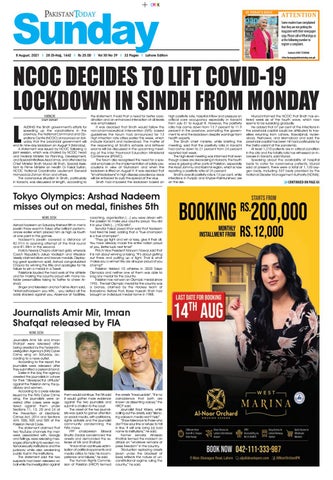
NCOC deCides tO lift COvid-19 lOCkdOwN iN siNdh frOm mONday kARACHI
l
staff report
AUDINg the Sindh government’s efforts for speeding up the vaccinations in the province, the National Command and Operations Centre (NCOC) announced on Saturday that the provincial government will end its nine-day lockdown on August 9 (Monday). A statement was issued by NCOC following a joint session, which was chaired by NCOC head and Federal Minister for Planning, Development, and Special Initiatives Asad Umar, and attended by Chief Minister Sindh Murad Ali Shah, Special Assistant to Prime Minister on Health Dr Faisal Sultan, NCOC National Coordinator Lieutenant general Hamood-Uz-Zaman Khan and others. The coronavirus situation in Sindh, particularly in Karachi, was discussed at length, according to
the statement. It said that a need for better coordination and an enhanced interaction at all levels was emphasised. It was decided that Sindh would follow the non-pharmaceutical intervention (NPI)- based guidelines the forum had announced for 13 high infection rate cities earlier this week, which include Karachi and Hyderabad. The matter of the reopening of Sindh’s schools and leftover exams will be discussed in the upcoming meeting of the Inter Provincial Education Ministerial Conference (IPEMC). The forum also recognised the need for a special emphasis on the implementation of safety precautions in view of Muharram and when the lockdown is lifted on August 9. It was decided that “smart lockdowns” in high disease prevalence areas will be enforced to curb the spread of the virus. Sindh had imposed the lockdown based on
Tokyo Olympics: Arshad Nadeem misses out on medal, finishes 5th news desk Arshad Nadeem on Saturday finished fifth in men’s javelin throw event in Tokyo after brilliant performances earlier which placed him as high as fourth at one point in the games. Nadeem’s javelin covered a distance of 82.91m in opening attempt of the final round and 81.98m in the second. India’s Neeraj Chopra claimed gold, whereas Czech Republic’s Jakub Vadlejch and Vitezslav Vesely claimed silver and bronze medals. Displaying great sportsman spirit, Arshad congratulated Chopra for winning the title and apologise for his failure to win a medal in a Tweet. Pakistanis lauded the hard work of the athlete and for making the country proud with many notable personalities taking to Twitter to cheer Arshad. Singer and television anchor Fakhre Alam said, “#ArshadNadeem you WIN… you defied all the odds stacked against you. Absence of facilities,
coaching, organisation […] you were driven with the passion to make your country proud. You did it in your OWN […] YOU WIN”. Senator Faisal Javed Khan said that Nadeem had tried his best, adding that a “true champion is a true champion”. “They go fight and win or lose, give it their all. You have already made the entire nation proud of you. Better luck next time!” PML-N Vice President Maryam Nawaz said that it is not about winning or losing. “It’s about getting out there and putting up a fight. That is what makes you a winner! We are all super proud of you champ!” Pakistan fielded 10 athletes in 2020 Tokyo Olympics and neither one of them was able to bag any medal for the country. Pakistan has not won an Olympic medal since 1992. The last Olympic medal for the country was a bronze, claimed by the Hockey team at Barcelona. Before that, Boxer Hussain Shah had brought an individual medal home in 1988.
Journalists Amir Mir, Imran Shafqat released by FIA news desk Journalists Amir Mir and Imran Shafqat were released after being arrested by the Federal Investigation Agency’s (FIA) Cyber Crime wing on Saturday, according to a news outlet. According to the report, the journalists were released after they submitted a personal bond. Earlier in the day, the agency arrested the journalists in Lahore for their “disrespectful attitude” against the Pakistan Army, the judiciary and women. According to a press release issued by the FIA’s Cyber Crime wing, the journalists were arrested after cases were registered against them under Sections 11, 13, 20 and 24 of the Prevention of Electronic Crimes Act, 2016 and Sections 469, 500, 505 and 509 of the Pakistan Penal Code. The statement claimed that two YouTube channels the men were associated with, googly and Tellings, were releasing messages attempting to weaken national security institutions and the judiciary while also weakening public trust in the institutions. The statement said the two suspects had been released on bail while the investigation against
them would continue. The FIA said it would gather more evidence against the two journalists and submit a challan to the court. The arrest of the two journalists was quick to garner attention on social media, with politicians, rights activists and the journalist community condemning the FIA’s move. PPP chairperson Bilawal Bhutto Zardari condemned the arrests and demanded the release of Mir and Shafqat. “Imran Khan continues victimisation of political opponents and media critics to hide his incompetence and failures,” he said. The Human Rights Commission of Pakistan (HRCP) termed
the arrests “inexcusable”. “It is no coincidence that both are known as dissenting voices,” the HRCP said. Journalist Rauf Klasra, while calling out the arrests, said “silencing voices in media won’t help”. “Show tolerance to those who don’t toe your line or refuse to fall in line. It will only bring [a] bad name to institutions,” he said. Former senator Afrasiab Khattak termed the incident an attack on “whatever remains of press freedom” in the country. “Abduction replacing arrests (even under the blackest of laws) reflects the nature of unconstitutional regime ruling the country,” he said.
high positivity rate, hospital inflow and pressure on critical care occupancy especially in Karachi from July 31 to August 8. However, the positivity ratio has come down from 13.7 percent to 11.9 percent in the province, prompting the government to end the lockdown despite warnings from health experts. The Sindh chief minister, while briefing the meeting, said that the positivity ratio in Karachi had come down to 21 percent from 24 percent reported last week. The high-level meeting was informed that even though cases are decreasing in Karachi, the fourth wave is gripping other parts of Pakistan, especially the Azad Jammu and Kashmir region, which is now reporting a positivity ratio of 26 percent. Sindh’s overall positivity rate is 13 per cent, while infections in Punjab and Khyber-Pakhtunkhwa are on the rise.
Murad informed the NCOC that Sindh has entered week six of the fourth wave, which now seems to be subsiding gradually. He added that 67 per cent of the infections in the provincial capital could be attributed to travellers returning from Lahore, Rawalpindi, Hyderabad, Peshawar, and Islamabad and said the provincial capital has been hit hard particularly by the Delta variant of the pandemic. At least 1,210 patients are in critical condition in the city and the fatality rate has witnessed an increase in Karachi, said Murad. Speaking about the availability of hospital beds to cater for coronavirus patients, Murad said at present, there were a total of 1,120 oxygen beds, including 537 beds provided by the National Disaster Management Authority (NDMA).
CONTINUED ON PAGE 05
02
Sunday, 8 August, 2021
LAHORE
NEWS
PAKiStAN WelcoMeS ‘tiMely’ StAteMeNt froM UNSc reAffirMiNg StANce oN KAShMir diSPUte ISLAMABAD
P
APP
AKISTAN on Saturday welcomed the UN’s reiteration that its position on Indian occupied Kashmir remained unchanged and it continued to see the valley as disputed territory, according to a statement issued by the Foreign Office (FO). “The statement reaffirms that UN position on the Jammu and Kashmir dispute is “well-established” and has not changed,” Foreign Office Spokesperson Zahid Hafeez Chaudhri said in response to the statement by the UN secretary general’s spokesperson. He said Pakistan appreciated the timeliness of the statement as it coincided with the completion of two years of India’s illegal and unilateral actions of 5 August 2019 in the Indian Illegally Occupied Jammu and Kashmir (IIOJK), that were in violation of the UN charter, UNSC resolutions and international law including
the Fourth Geneva Convention. “The statement denies the self-serving remarks by India’s Permanent Representative to the United Nations claiming that Jammu and Kashmir is an integral part of India,” he said. “India would do well to remind itself that Jammu and Kashmir remains an internationally recognised dispute and one of the longest outstanding items on the UNSC’s agenda. It never was and never will be a part of India,” the FO asserted, adding that “regurgitation of false and fabricated claims does not change the reality.” He also pointed out that numerous UNSC resolutions had established that the final disposition of Jammu and Kashmir would be made in accordance with the wishes of the people of the valley, expressed through the democratic method of a free and impartial plebiscite held under UN auspices. “It [Kashmir] never was and never will be a part of India. Regurgitation of false and fabricated claims does not change the
Suspect confesses to killing MPA Asad Khokhar’s brother in ‘revenge’: police
reality,” he said. He mentioned that numerous United Nations Security Council (UNSC) resolutions had established that the final disposition of the State of Jammu and Kashmir would be made in accordance with the wishes of the Kashmiri people expressed through the democratic method of a free and impartial plebiscite held under the UN auspices. “Ultimately, India will have to give in to the will of the Kashmiris and the commitment of international community as enshrined in numerous UNSC Resolutions,” he said. On August 5, 2019, India’s ruling Bharatiya Janata Party (BJP) had revoke occupied Kashmir’s special status by repealing Article 370 of the constitution. The move allowed people from the rest of India to have the right to acquire property in occupied Kashmir and settle there permanently. Earlier on Friday, Foreign Minister Shah Mahmood Qureshi had written letters to the UNSC and the UN secretary general,
drawing their attention to “unlawful steps” being taken by India after the annexation of
the disputed region of Kashmir to strengthen its “colonial hold” on the territory.
PIA airlifts 2m Sinopharm doses from Beijing
MoNItorINg report One of the suspects arrested after the murder of MPA Asad Khokhar’s brother has confessed to killing him in “revenge”, police said Saturday. According to details reported by a local media outlet, the suspect Nazim, under initial interrogation, told the police that Malik Mubashar, the lawmaker’s brother, was allegedly involved in the murders of his brother and uncle. The suspect’s confession has raised questions at the quality of Chief Minister Usman Buzdar’s security protocols who was one of the guests at the wedding where the killing took place as the alleged killer told police of entering the venue while armed with a pistol despite guards stationed at the gate. He said that had bought the weapon for Rs4,000 and reached the valima ceremony at around 8:15 am, however, none of the guards stopped him at the gate for a body search. MPA Asad Khokhar and his brother Mudassar passed by him twice when he was sitting with other guests at the ceremony, he added. The suspect said that he came out of the marquee by walking behind the Punjab’s chief minister. A statement issued by the Chief Minister’s Office said that Buzdar had ordered an inquiry into security arrangements for the wedding, directing that further action be taken after those responsible for the attack were determined. “Action should be taken against the arrested suspect in accordance with the law,” the statement quoted Buzdar as saying. However, the Punjab police, its special branch, and the CM Office were blaming each other for the incident. According to SP Security Lahore Sardar Mavarhan khan, the CM House had informed the police about the participation of the chief minister just an hour before the event started. He maintained that they did not get time to install walk-through gates at the site for security clearance of the guests. The police officer was of the view that over 1500 guests were invited to the event and it was not possible for them to check each person. On August 6, the brother of Punjab MPA Asad Khokhar had been gunned down by two men at a farmhouse in Defence C on Friday evening. The deceased, Mubashir Khokhar, alias Malik Goga, died on the spot while another man who was injured in the shooting is currently being treated at a hospital.
Soldier martyred as terrorists attack North Waziristan checkpost NewS DeSk Terrorists on Saturday fired on a military checkpost in Khyber-Pakhtunkhwa’s North Waziristan district, resulting in the martyrdom of a soldier, a statement issued by the Inter Services Public Relations (ISPR) said. The military’s media wing said that the incident occurred in the Ghariom area of the tribal district, adding that the troops responded to the aggression in a “befitting manner”. “During the exchange of fire, Sepoy Shahid, age 29 years, resident of Bahawalnagar embraced shahadat,” the statement added. “Pakistan Army is determined to eliminate the menace of terrorism and such sacrifices of our brave soldiers further strengthen our resolve,” ISPR further said.
NewS DeSk Three aircraft of Pakistan International Airlines (PIA) airlifted a fresh batch of two million doses of Sinopharm Covid19 vaccine from Beijing, China to Pakistan, said the airline’s Country Manager for China Qadir Bux Sangi on Saturday. Three special PIA planes have airlifted a fresh batch of two million doses of Sinopharm vaccines from Beijing to Pakistan, PIA Country
Manager for China Qadir Bux Sangi while talking to Pakistani media in Beijing. He said another batch of 1.5 million vaccines purchased by Pakistan from Chinese company CanSino will be brought to Pakistan in the next few days. Earlier on Friday, the Asian Development Bank approved a $500 million loan for Pakistan for the purchase of Covid-19 vaccine. ADB President Masatsugu Asakawa, in a statement, said the loan for Pakistan
was sanctioned under the ADB’s $9 billion Asia Pacific Vaccine Access Facility launched in December 2020. He said the project will support Pakistan’s national vaccination plan by enabling it to purchase an estimated 39.8m doses of Covid-19 vaccines, safety boxes, and syringes. The ADB chief added that the programme was aimed at offering rapid and equitable vaccine-related support to its developing member countries. “Vaccines help to reduce the spread
and mortality of Covid-19, restore confidence among citizens, and are vital to the economic recovery,” he said. He underlined that the project would help protect vulnerable groups in Pakistan, adding that it was an integral part of the development partner package, helping the government to mitigate the health, social and economic impacts of the pandemic. He said the ADB reaffirmed its full commitment to support Pakistan. Asakawa underlined that the government was aiming to vaccinate the entire eligible population — around 119 million people comprising all those aged 18 years and above — while prioritising frontline health care workers, the elderly, marginalised groups including refugees and internally displaced persons, and people with comorbidities. “ADB’s Covid-19 vaccine support project will provide financing to vaccinate over 18m people from priority groups.” The Health Ministry forwarded a summary to the federal cabinet for the approval of Rs63.5 billion supplementary budget to procure vaccines for the months of August and September. But the Finance Ministry refused to provide funds citing pressure on exchange rate and wanting transparency in deals. It also advised the Health Ministry to arrange foreign loans for this purpose.
PM Imran tests electronic voting machine ISLAMABAD INP
Prime Minister Imran Khan on Saturday witnessed a detailed demonstration of a new locally-made electronic voting machine (EVM). Federal Minister for Science and Technology Shibli Faraz along with the officials of his ministry gave a detailed briefing to PM Imran Khan about the working of the electronic voting machine (EVM). Shibli Faraz said there is no need for internet connectivity for the EVMs. The software used in the machine is of international standard, he added. On the occasion, PM Imran Khan witnessed a detailed demonstration of the EVM and also cast his vote. The premier also congratulated Shibli Faraz and his team for producing such EVMs. EVM to be presented in NA on Monday: The electronic voting machine will be presented in the National Assembly on Monday before its session begins. In a statement, Shibli Faraz cordially invited the assembly members to share their observations and constructive remarks on the EVM. Subsequently, after the National Assembly session, the EVM will be presented to all the four provincial assemblies and members will be requested to vote using the EVM in order to understand the process better. Furthermore, the EVM will be presented to the Senate chairman on Tuesday followed by its
EVM TO BE PRESENTED IN NA ON MONDAY presentation to the National Assembly speaker on Wednesday. Earlier in the month of June, Prime Minister Imran Khan had reiterated the incumbent government’s resolve to ensure transparency in the electoral process in the country. Chairing a meeting in Islamabad. Prime Minister Imran Khan had issued
directives for making the process of use of electronic voting machines (EVMs) in elections transparent and fulfilling all legal requirements in this regard. The premier had also instructed that the process of electoral reforms, electronic voting and voting rights for overseas Pakistanis be completed at the earliest.
Sunday, 8 August, 2021
LAHORE
PreSideNt for bUildiNg NArrAtive to coUNter iSlAMoPhobiA, Project KAShMir iSSUe ISLAMABAD
U
APP
NDERLINING the importance of media in technology savvy world, President Dr Arif Alvi on Saturday stressed upon collective efforts for effectively building of narrative to counter Islamophobia and forcefully project the issue of Indian Illegally Occupied Jammu and Kashmir (IIOJK). The president said through effective utilisation of latest media platforms, Kashmir issue should be raised in more effective manner throughout the world whereas the Muslim Ummah must present its narrative over Islamophobia. He was addressing a ceremony regarding digitalisation of the state media organisations, including the Associated Press of Pakistan (APP), Pakistan Television, Radio Pakistan and Digital Media Wing (DMW), held at Pakistan-China Friendship Centre. The president expressed the optimism that with this transformation process, outreach of country’s state media would be enhanced. He said the era of digitalisation of state media outlets would help build ‘a real image and true culture
of Pakistan’. The ceremony was attended by Begum Samina Alvi, Minister for Information and Broadcasting Chaudhry Fawad Hussain, Minister of State for Information and Broadcasting Farrukh Habib, Speaker of the National Assembly Asad Qaisar, Minister for Human Rights Dr Shireen Mazari, Senator Faisal Javed, parliamentarians, media persons, and officials of the information ministry and state media outlets. Dilating upon the history of PTV, the president observed that it had undergone huge changes from a black and white screen to now being converted into high definition (HD). He said the PTV had introduced great artists and legends to the world including great late comedian Moeen Akhtar. Congratulating the Minister for Information Chaudhry Fawad Hussain for his endeavours to introduce these much-needed changes, the president also emphasised upon busting of fake news being circulated by enemies of Pakistan. He said most recently, India had propagated and churned out fake news against Pakistan. The president also noted that in the past, fake news had created chaos in different parts of the world,
leading to huge destruction and human casualties. He said on the basis of intellect, Pakistan was equal to all other countries, rather, it would gain an edge soon. The president referred to the effective strategy adopted by the incumbent government during the Covid 19 pandemic and the country’s past success to develop nuclear deterrent. He said all the steps taken by the incumbent government and the nation were leading the country to its real destination. He observed that TV industry in the world had progressed by leaps and bounds and channels were converted on HD. Dr Arif Alvi also stressed upon exploring the commercialisation prospects of different genres of sports including hockey and kabbadi. The president further that the PTV would now take a leadership role by screening programmes and dramas with real depiction of life and culture of the country. Minister for Information and Broadcasting Chaudhry Fawad Hussain also gave an overview of the Digital Transformation of State Media (DTSM) project under which different state media organisations were digitalised.
NEWS
03
Keep CPEC out of politics, Asad asks Shehbaz NewS DeSk Minister for Planning, Development and Special Initiatives Asad Umar has asked opposition leader Shehbaz Sharif to keep the national project of ChinaPakistan Economic Corridor (CPEC) away from his politics. In a tweet on Saturday, the minister said that Prime Minister Imran Khan’s government is committed to taking the mega project to new heights. He asked the Pakistan Muslim League-Nawaz (PML-N) president not to drag the CPEC into politics. He said that building industrial zones, establishing new working groups for agriculture, science & technology and information technology, accelerating work on western alignment significantly, and expanding the scope of Gwadar show Prime Minister Imran Khan and his government’s commitment to CPEC.
UAE's Etihad to resume Pakistan flights from Tuesday DUBAI TLTP
Abu Dhabi's Etihad Airways will resume flights from Karachi, Lahore and Islamabad from Tuesday. Etihad Airways on Saturday launched flights from five Indian cities including Chenna, Kochi, Bengaluru, Trivandrum and New Delhi. From August 10, the airline will begin flights from three additional Indian cities, and include flights from Ahmedabad (for transit only), Hyderabad and Mumbai. Etihad also plans to resume flights for Bangladesh and Sri Lanka for transit passengers to access its global network of destinations. Etihad will operate flights from Dhaka and Colombo.
Sunday, 8 August, 2021
04 NEWS
LAHORE
PakiStan to bEcomE manufacturing hub in rEgion: DaWooD
P
NEWS DESK
AKISTAN-China industrial cooperation is destined to make Pakistan a manufacturing hub in the region while the establishment of industrial zones would create vast investment opportunities for local industrialists and absorb huge manpower. This was stated by Advisor to Prime Minister on Commerce and Investment Abdul Razak Dawood during his visit to the office of Faisalabad Industrial Estate Development and Management Company (FIEDMC) on Saturday. The advisor said that the government is fully committed to provide the best possible package of incentives to foreign and local investors. He added
that investors’ facilitation would boost industrial production that will in turn strengthen the national economy and ensure better living conditions for the poor strata of the society. The advisor also reviewed progress on the Allama Iqbal Industrial City (AIIC), the first mega project of Punjab under the China-Pakistan Economic Corridor (CPEC). He expressed satisfaction over the pace of development and progress of this project achieved so far. Briefing the advisor, FIEDMC Chairman Mian Kashif Ashfaq said the AIIC project is being executed on a fast track basis on the directive of Prime Minister Imran Khan. He said that facilities of gas, power, water and basic infrastructure, civic centre, etc, required for new industrial units have been provided.
He informed the advisor that nearly 20 industrial units have started their production which cover one-third of land of the first phase of Allama Iqbal Industrial city while remaining would go into operation by the end of year. He said the prime minister had directed to minimise the time of allotment of industrial plots to foreign and local investors, besides all investors must also be facilitated through one-window operation. He said the AIIC project spread over 3,300 acres of land is being completed on fast track which included a furniture city, apparel park, modern business centre and the largest expo centre for displaying Made in Pakistan products to attract local and foreign buyers. An amount of Rs7.5 billion had so far been spent on the completion of the first AIIC phase, he added.
Dar urges youth to come up with practicable business plans NEWS DESK Special Assistant to the Prime Minister on Youth Affairs Muhammad Usman Dar has urged the entrepreneurs to come up with realistic business ideas for availing soft loans under the Youth Entrepreneurship Scheme of Kamyab Jawan Programme. In a statement, Usman Dar said that young people can easily get big loans through successful business plans and the government will give them a loan if they come up with practicable business plans. He said that the government would extend all possible support to
the youth for entering the country’s job market. He said the initiatives under the Kamyab Jawan Programme, such as Youth Entrepreneurship Scheme (YES) and Hunarmand Pakistan Programme, would be used to promote e-commerce businesses and improve access to digital skills training. It is pertinent to mention that the Kamyab Jawan Programme was launched by Prime Minister Imran Khan in October 2019 with the aim to leverage the digital economy for the empowerment of youth. The National E Commerce Policy under its pillar “Empowering Youth and SMEs through E-Commerce” aims to collaborate with government-
run special initiatives such as the Kamyab Jawan Programme to achieve its policy goal of extending access to finance and digital skills to Pakistani youth, startups and SMEs. It is pertinent to note that currently 64 percent of Pakistanis are younger than 30 while 29 percent are between 15 to 29 years of age. Therefore, the government's focus on promoting e-commerce for job creation in the country not only offers inestimable economic opportunities, but it is also timely in view of the current national as well as global economic situation hit adversely by the Covid-19 pandemic spread.
Pakistani carpet businessmen weave success in China SHANGHAI TLTP
Recalling their first experience in China more than 10 years ago, Pakistani brothers Mian Muhammad Zubair and Habib Ur Rehman said they only knew one thing -- future. "China is the future. That was what our father told us. So here we are," the two, now in their 30s, said with a beaming smile while talking to Xinhua. Zubair, the elder brother, is 33 years old and graduated from Shanghai Jiao-
tong University majoring in aerospace. The younger, 31-year-old Rehman, is a graduate of Shanghai University of Finance and Economics with a degree in economics and trade. The two are the second generation of a family that has been engaged in the carpet business. Their father, Shahid Sohail, used to run a store selling traditional handmade carpets in Pakistan and was seeking opportunities overseas. Around 2000, a European diplomat suggested that Shahid Sohail come to China to explore business prospects.
Three years later he was in Guangzhou, a coastal city in south China that had already drawn many foreign business persons. Soon Shahid Sohail, a person with strong business acumen, put his eyes on Shanghai, which was at the forefront of China's sweeping opening-up efforts. In August 2006, the Pakistani businessman decided to move the family business to Shanghai. Though back then he only knew three Chinese words -"Hi, thank you and bye," it didn't deter his spirits. "To us, China is more than just Pakistan's good friend," said Mian Muhammad Zubair, adding that they believe in the famous Pakistani motto --"Even though knowledge is far away in China, we should seek it." The brothers came to study in Shanghai in 2008 and 2009, respectively, and soon found that China was developing at a speed far beyond their imagination. "Shanghai is a very safe and inclusive city, and the infrastructure changes so fast," said Habib Ur Rehman. Now their father, 66, has officially retired, and the brothers have taken over the store. "For us, the carpets are works of art. The delicate patterns on the beautiful hand-
made carpets are the inheritance of thousands of years of culture and a witness of cultural integration between China and Pakistan," Zubair said, pointing to an exquisite carpet on the wall. "This pattern is a replica of a work by ancient Chinese artists, which contains jasmine flowers, Chinese porcelain and other unique elements." Their store has also witnessed China's transformation over the past decades. "At first, 99 percent of the customers were foreigners, now Chinese customers account for about 30 to 40 percent," Zubair said. "China doesn't impose a tariff on handmade carpets from Pakistan, so the price in China is almost the same as in Pakistan, while in other countries, the price may double or triple," he added. The two, who now speak fluent mandarin, are preparing to participate in the 4th China International Import Expo this year. "The expo is a good platform to bring more business opportunities and let more people know about handmade carpets from Pakistan," Habib Ur Rehman said, adding that they also plan to explore China's e-commerce market. "We are optimistic about the Chinese market and we are bullish on Shanghai," he added.
ISLAMABAD: A vendor sells national flags and badges ahead of Independence Day. INP
CMYK
Ehsaas Survey nears completion: Sania NEWS DESK Special Assistant to the Prime Minister (SAPM) on Poverty Alleviation and Social Safety Dr Sania Nishtar has said that Ehsaas Survey in the country is 98.14 percent complete. Talking to the media during her visit to Ehsaas Registration Desk on Saturday, Dr Sania said that Ehsaas registration desks would be set up across the country during this month. Dr Sania said that the households, who could not participate in the survey for some reasons, would also be able to get themselves registered by contacting the Ehsaas registration desks. Earlier, she talked to the registration staff and also asked about Ehsaas initiatives from deserving women, who had come to Ehsaas desks for registration. She inspected the process of registration of a deserving woman. She also reviewed the ongoing activities of Ehsaas survey in the area of Tezaab Ehata, and inspected the Ehsaas survey registration of a local family and talked to the residents of the area about the usefulness and method of Ehsaas survey. She also reviewed the registration of children hailing from deserving families for educational scholarships.
Samsung to launch two smartphones, smartwatch on Wednesday SEOUL TLTP
Samsung is set to host its second big product launch of the year on Wednesday and the South Korean technology giant is expected to unveil two new foldable smartphones and a new smartwatch. New products will help the company to diversify its current portfolio and attract more customers while strengthening its premium line-up of electronic devices. Samsung launched its premium Galaxy S21 phone series in February. Here's what to expect from the Galaxy Unpacked event on Wednesday that is being held virtually because of the Covid-19 pandemic. Samsung, which was first to introduce foldable technologies in smartphones in 2019, will launch two new devices in the category – Galaxy Z Fold3 and Galaxy Z Flip3, according to industry insiders. The company is also expected to introduce the S Pen stylus, the signature feature of the premium Note series phones, to the new foldable devices to attract more niche professional users. Samsung, which holds nearly 75 per cent of the foldable smartphone industry, currently offers three foldable models. The IT and mobile communications arm at Samsung reported a 22.4 per cent quarterly decline in sales in the April-June period to 22.7 trillion Korean won ($20 billion), influenced by a “component supply shortage” in the industry as well as “production disruptions in its Vietnam factory”. The company said it plans to achieve “solid revenue and profit by boosting the competitiveness of the product line-up with the launch of new foldable models and the expansion of mass market 5G phones”. Samsung is unlikely to release its Galaxy Note series smartphones at the upcoming event to reduce production pressure on the company. Samsung usually issues its Note series, one of its bestselling models known for its stylus S Pen, in August every year. The company is expected to launch its new smartwatch Galaxy Watch 4 that will come with a combined operating system from Google and Samsung. To challenge the dominance of Apple Watch, which has been the best-selling smartwatch for many years, Samsung has merged its Tizen OS with Wear OS. Samsung will launch new Galaxy Buds 2 to compete with the likes of Apple’s AirPods and AirPods Pro. Being developed under the codename ‘berry’, the new buds will be able to connect to multiple devices at the same time, according to a report by TechRadar. They will be priced about $175, according to MySmartPrice.
Sunday, 8 August, 2021
LAHORE
NEWS
NCOC deCIdes tO LIft COvId-19 LOCkdOwN IN sINdh fROm mONdAy
t
cONtINuED fROM pAgE 01
HE Sindh government installed 583 more oxygen beds in hospitals from its own resources, he added. According to the CM, 100 beds are available at the Jinnah Postgraduate Medical Centre, 75 beds at Abbasi Shaheed Hospital, 100 beds at Eidgah Maternity, 150 beds at Expo, and 158 beds at specialised hospitals for Covid.
Meanwhile, Pakistan recorded 95 deaths due to coronavirus over the past 24 hours, the highest single-day toll since June, the NCOC said on Saturday. The fresh fatalities – just over the 92 deaths reported on June 2 – pushed the death toll to 23,797. Another 4,720 new infections were also logged over the past 24 hours, bringing the country’s overall count to 1.06 million, with 959,491 recoveries. The total number of active cases in the South Asian country
is currently 79,837. Despite an expedited nationwide vaccination drive, Pakistan is reeling from a deadly fourth wave of coronavirus, seeing cases in the range of 4,0005,000 for 11 days straight. Over 33 million vaccine doses have been administered in the country to date, and anyone 18 or over is eligible for vaccination. However, only a little more than 8 million people are fully vaccinated in the country of over 220 million.
05
Gold extends losses to reach Rs93,000 per 10gm NEWS DESK Gold price has dropped around two-and-a-half percent in the international market as Nonfarm Payrolls in the US rose more than expected in July. At the end of market timings on Friday, gold in the international market was available at $1,763.90 per ounce after shedding $41.20 as compared to its closing value on Thursday last. As the market in Pakistan is closed earlier as compared to the international market due to time difference, the price of 10 grams of yellow metal in Pakistan decreased to Rs93,000 after shedding Rs2,500. The closing prices of the yellow metal in the country remained Rs95,500 on Thursday last. According to experts, additional losses are likely with a daily close below 100-day SMA. With this recent decline, the Relative Strength Index (RSI) indicator on the daily chart dropped below 40 but continues to stay above 30, suggesting that there is more room on the downside before gold becomes technically oversold. Furthermore, the gold prices remain on track to close below the 100-day SMA for the first time since mid-June, reaffirming the bearish shift in the near-term technical outlook. On the downside, the initial resistance is located at $1,760 (static level). Below that level, the next target could be seen at $1,750 (June 29 low), they said. The US Bureau of Labour Statistics announced that Nonfarm Payrolls (NFP) in the US rose by 943,000 in July, compared to analysts' estimate of 870,000. Moreover, June's increase got revised up to 938,000 from 850,000 and the Unemployment Rate declined to 5.4% from 5.9% in June. Reflecting the positive impact of the NFP data on the greenback, the US Dollar Index advanced to its highest level in more than a week.
Air Link plans to raise Rs5.85bn through IPO LAHORE
LAHORE: An aerial view of Wazir Khan Mosque. s O NL IN E
Cryptos witness exponential growth as Bitcoin hits $44,351 ISLAMABAD TLTP
The cryptocurrency market turned bullish on Saturday, witnessing an exponential growth with the market cap increasing 6.7 percent to $1.85 trillion as of 1415 hours GMT. The price of Bitcoin (BTC), the largest cryptocurrency, increased to $44,351 by gaining 8.64 percent. With this increase in price, the market capitalisation of the BTC has reached $832.8 billion. Likewise, ethereum (ETH) price turned towards north and gained 13.05 percent to reach $3,130. With this increase in price, the market capitalisation of ETH has reached $366.2 billion. On the other hand, XRP gained 9.09 percent to reach $0.796. The market capitalisation of XRP stands at $79.6 billion after this increase. Similarly, Cardano (ADA) price reached $1.48 with a 13.84 percent increase in its price. Its market capitalisation has reached $47.7 billion after this increase. Likewise, Dogecoin (Doge) price appreciated by 13.84 percent to reach $0.228. With this increase in price, the market capitalisation of Doge reached $29.8 billion. According to experts, Bitcoin price witnessed an exponential growth after weeks of downtrend or con-
solidation. This move retested the range high and retraced momentarily. However, the recent upswing is most likely to push through the said resistance level and tag a crucial supply zone resting above it, they said Bitcoin price rallied 46 percent from July 20 to August 1 and tagged $42,451 to set up a swing high
at $42,599. Since this upswing, BTC would open up the path to retesting the supply zone that extends to $45,321, they said. They said that investors can expect the run-up from the current position to $44,750, which would represent a 10 percent climb from the $40,550 support level.
TLTP
Air Link Communication Ltd plans to raise at least Rs5.85 billion through an initial public offering (IPO) by this month-end, which would be the largest from a non-state firm in the country. The Lahore-based company plans to sell new and existing shares at a price between Rs65-91 each, Chief Executive Officer Muzzaffar Hayat Piracha said. It will take investor orders on August 30 and 31 and then price the offering. Pakistan has seen a record streak of IPOs this year. Air Link, which started operations about a decade ago and has since become one of the largest distributors of phones in the country, saw sales rise 50% to 3.6 million units in the year ended June. The company plans to issue 60 million new shares and Piracha will sell 30 million from his holdings, said Kamran Nasir, CEO at JS Global Capital Ltd, consultant and bookrunner to the transaction. The IPO will be the largest since Interloop Ltd raised about Rs5 billion in 2019. Air Link, which has also recently expanded into mobile assembling, plans to use the funds to expand its distribution network. It aims to have 150 outlets by 2026 from 14 currently, which will boost margins together with the assembly business, said Nasir. The company expects its revenue to triple to Rs129 billion and net income surging 500 percent to 9.2 billion rupees by fiscal 2025 from 2020, according to Nasir. It may be mentioned that the company has recently expanded into the mobile manufacturing facility, which was inaugurated in March by Federal Minister Hammad Azhar. Air Link has been in the distribution business for a decade working with top smartphone brands like Samsung, iPhone, Huawei, Xiaomi, Alcatel, TCL, Tecno & iTel. The production plant has the capacity to produce 6 million units per year.
China's foreign trade hits $3.3tr in 7 months BEIJINg TLTP
China's total imports and exports expanded 24.5 percent on a year-on-year basis to $3.3 trillion in the first seven months of the year, while foreign reserves rose to $3.2359 trillion by the end of July, official data showed Saturday. The trade volume marked a 22.3 percent increase compared with the level during the same period in 2019, data from the General Administration of Customs showed. Both exports and imports logged double-digit growth in the Jan.-July period, jumping 24.5 percent and 24.4 percent from a year earlier, respectively. Trade surplus increased 24.8 percent year
on year in the first seven months to 1.98 trillion yuan. In July alone, the country's imports and exports rose 11.5 percent year on year to 3.27 trillion yuan, customs data showed. On the other hand, China's foreign exchange reserves rose to $3.2359 trillion at the end of July, up 21.9 billion dollars from a month earlier. The volume went up 0.68 percent from the end of June, according to the State Administration of Foreign Exchange (SAFE). China's foreign exchange market saw basically balanced supply and demand in July, with the market expectations remaining stable, said Wang Chunying, deputy director and spokesperson of the SAFE. Wang attributed the increase in foreign
exchange reserves in July to the combined impact of currency translation and changes in asset prices. Last month, non-dollar currencies strengthened slightly and the prices of global financial assets went up as a result of factors such as the resurgence of the COVID-19 pandemic and the monetary policy expectations and macroeconomic data of major economies, Wang noted. Despite uncertainty and instability in the global economic and financial situation triggered by the evolving pandemic, the Chinese economy continued stable recovery and high-quality development, which will shore up the overall stability of foreign exchange reserves, Wang said.
cMYK
Sunday, 8 August, 2021
06 COMMENT
Is this how it should be?
After Washington and Kabul’s displeasure Afghan Taliban too show their teeth
When the poor suffer, it’s par for the course; when the rich suffer, it’s a tragedy
T
heRe is a need to seriously ponder over the situation arising in Afghanistan where the Taliban continue to advance. As things stand none of the major players in Afghanistan sees eye to eye with Pakistan. The Afghan governments have all along blamed Pakistan for the Taliban’s success. President Ashraf Ghani and some of his close aides have crossed all limits in making wild accusations against Pakistan. National Security Adviser Moeed Yusuf, who returned empty-handed after spending 10 days in Washington says the US officials, lawmakers and scholars he met talked about the past, saying that had Pakistan cooperated with the USA, they could have defeated the Taliban. While Dr Yusuf was still in Washington, the State Department asked Pakistan to keep the Afghan border open for displaced persons, which is highly detrimental to Pakistan’s interests. The way Afghan Taliban are behaving now should raise concerns in Islamabad. Pakistan hosted, feted and looked after the needs of the Taliban leaders, as a high ranking government official told the Council of Foreign Affairs (CFR) in March 2016. The treatment continued during later years also. This was the time when Pakistan should have demanded that the Afghan Taliban stop the Tehrik Taliban Pakistan leadership which operated from safe havens in Afghanistan from conducting terrorist attacks inside Pakistan. The Afghan Taliban should have also been persuaded to accept the Durand Line as the international border between the two countries. It is a failure of the government’s Afghan policy that the attacks lion by the TTP from Afghanistan continue unabated. The Afghan Taliban which have still to occupy Kabul have already started putting up demands that can harm Pakistan. On Friday the Taliban closed their side of the border crossing at Chaman, saying no one would be allowed through it until Islamabad dropped or relaxed its visa requirements for Afghans. The Talban demand that the PakAfghan border should be “open, morning to evening, for Afghans holding [Pakistani issued] migration cards or [Afghan] ID cards." Visa free entry to all Afghans would allow millions of refugees as well as numerous terrorists to enter Pakistan. The very idea negates the need for the thousand-kilometerplus-long fence being built by Pakistan costing at least $532 million. Several Pakistani soldiers have laid down their lives while safeguarding the fence.
rabia ahmeD
I
F you are a woman living in Pakistan, it might be an idea to brush up on a spot of self-defense. We are all familiar with the reasons, which are borne out by a survey conducted about three years ago by the Thomson Reuters Foundation. That survey concluded that Pakistan is the sixth most dangerous country in the world for women, with India the first, and the USA the tenth. These results should not come as a surprise for a country with a regional history of ‘honour killings’ (it is high time that phrase was changed) dating back thousands of years, a practice that thrives to this day. These ‘honour killings,’ as a result of which women, who are accused of adultery, are killed by the men of the family to maintain the family’s ‘honour’, are just one among the many forms of violence committed against women in Pakistan. In other forms, women are routinely abused, injured and killed, following domestic violence and rape. The clerics seem to be making the situation worse in every way. There’s little point in enlarging on that theme. As for the Prime Minister of the country, he has had this to say regarding the prevalent attitude against women in this country: “If a woman is wearing very few clothes it will have an impact, it will have an impact on the men, unless they’re robots.” The prime minister said, “I mean it’s common sense.” It is not just the Prime Minister who holds such views although not everyone has such a penchant for speaking without first weighing their words; he also has liberal access to air-conditioned environments where he lives with his walking tent. No, this mindset is easily available across society where people believe that despite the heat, and despite the amount of work they must do, women must cover themselves from head to foot at all times– leaving men to go ex-
Influence peddling Zahir Jaffer only deserves a fair legal defence, nothing more
W
hILe the country continues to try and digest one of the most horrific and gruesome murder cases in the country’s history, the main accused, Zahir Jaffer, who has been in police custody for the past three weeks, has apparently been getting preferential treatment despite the nature of his crimes. That fresh clothes and home-cooked food has been made available to Jaffer, who carried out an elaborate premeditated murder with a clear intent to dispose of the body and flee the country, smacks of influence peddling by his influential family that is reportedly well-connected in high-up places. Additionally, he was also transported without much formality to a public hospital in the capital for a checkup after complaining of a headache. It is perhaps ironic that due to the case being so high-profile, in that the perpetrator, victim and their respective families are prominent affluent members of Islamabad’s upper class, that the concessions being afforded to Jaffer in jail, as a result of his social status, became public knowledge through social media and resultantly were discontinued, and he has since been moved to solitary confinement. Apart from severe overcrowding, one of the primary and more serious issues faced by the prison population of Pakistan is the lack of access to basic medical attention available to prisoners. Conditions are such that even garden variety infections can’t be treated because basic antibiotics aren’t administered on time, while the more serious chronic ailments are simply ignored. A majority of the detainees in the correctional system are not convicted but are in some phase of an excruciatingly slow judicial process, and they are not on trial for the killing and mutilation of a corpse as brutally as the killer in the Noor Mukadam case is. During the past few years, politicians and bureaucrats have spent varying amounts of time, often many months, incarcerated under some of the worst conditions imaginable for white collar crimes that remain unproven. While the prison system of Pakistan requires much needed reform, it is understandable that any such process, whenever it is formally and properly started, will take time. In the meantime, no undue leniency should be shown to a prisoner on the basis of influence, especially in a case that is a matter of such immense public interest where speedy justice is not only expected but imperative.
U.K. Dar
T
he USA is withdrawing from Afghanistan without achieving its major strategic aims; one of which was the containment of China. The operation in Afghanistan has cost the USA trillions of dollars and the loss of thousands of soldiers, yet it is withdrawing and leaving behind a trail of destruction in its wake. The stakes of the USA in Afghanistan were very high; nothing short of ruling the world in the next century. The main other contender for the top slot, China, was observing very closely every step the USA was taking in Afghanistan. While the USA was busy spending trillions of dollars in the pothole of ‘graveyards of empires’, China was steadily making headway in every field from economy to technology and emerging as a new superpower. Some economists are predicting that China has already become the global powerhouse economically, and is expected to surpass the USA as the worldly d’s biggest economy by 2025. Militarily, China is still lagging but with increased spending on weapons technology, especially in its naval power, it is ona matter of time before China can project its military might as well. The development of military bases in the South China Sea and the standoff between India and China in the himalayan region proved that China is ready to flex its muscles at any time to safeguard its strategic interests. The USA is in no mood to take this lying down and give up the superpower status without a fight. Though it has to leave Afghanistan in sheer humiliation, it is trying to achieve its strategic aim of containment of China through other means. The Philippines has provided the urgently needed space to the USA and has shocked the world by restoring the Visiting Forces Agreement (VFA) with the USA. Philippine Defense Secretary Delfin Lorenzana, in the presence of USA Defense Secretary Lloyd Austin,
Founding Editor
Yousaf Nizami Umar Aziz
Joint Editor
Joint Editor
Executive Editor
Lahore – Ph: 042-36300938, 042-36375965
Justice is meant to be blind. The law should apply across the board. But does it? People are concerned that when a person from a well-to-do family commits a crime, he or she gets away with it. They’re trying to prevent that from happening in this case. But how about when the victim is poor, destitute and friendless, perhaps old, or belonging to some other religion…and once again, poor.?
CPEC is globally crucial,not just regionally
Arif Nizami (Late)
M. A. Niazi
sponsible for her murder should face justice. The point of this column is that nothing speaks of the massive gulf that exists in this country as this tragic case does. There is that huge segment of society, where hundreds if not more, every single year, women lose their lives to murderers, rapists and other predators such as male members of the family. A fraction of these cases make the news as pointed out above. The rest not only do not make the news they go unreported because of that sickening sentiment ‘Log kiya kahen gay’ (what will people say). For the very, very small number of cases such as Noor’s, her awful fate made the news like only the cases of our ‘elite’ manage to do. Why do other victims never get as much coverage? Why do they never produce as much outrage as this crime did, when in terms of tragedy they are all on a par with each other? Where are the processions, petitions and outrage on social media for them? This outrage stems from a fraction of the literate segment of society, and you wish that this segment was equally outraged across the board. One can live with one person getting away with affording a better sofa than the other, or getting a better higher education than another, but we are talking about a person’s life here. The life of a mother, a daughter or a sister. A human being who lived and breathed and loved and worked. One of God’s Creations. Justice is meant to be blind. The law should apply across the board. But does it? People are concerned that when a person from a well-to-do family commits a crime, he or she gets away with it. They’re trying to prevent that from happening in this case. But how about when the victim is poor, destitute and friendless, perhaps old, or belonging to some other religion…and once again, poor.? We need justice for such people in Pakistan too, but there doesn’t seem to be any…what is being done to change this? Rabia Ahmed is a freelance columnist. Read more by her at http://rabia-ahmed.blogspot.com
CPEC and Containment of China
Dedicated to the legacy of late Hameed Nizami
Editor Aziz-ud-Din Ahmad
actly where their lecherous minds take them. There are thousands of such incidents against women that never make the news, and only a fraction that are prosecuted, and action is taken in another fraction of those. It all starts pretty early in a woman’s life. To speak of a handful of recent cases, there was the case of a six-year-old girl who was kidnapped, sexually assaulted and killed in Karachi last month. her body was later found dumped in the garbage. Also last month was the case of a little girl, a student of Class 8, who was abducted and sexually assaulted by a group of men in Rawalpindi. She, mercifully, was rescued. And last month, a 14-year-old girl was kidnapped and assaulted for about three days, but she too was rescued. There was also a 15year-old girl raped in Toba Tek Singh in June, and in May there was the case of a bride being gangraped by four men in Multan. Again, last month, a Filipina, who had come to Pakistan to earn some money, was raped in Lahore. A young couple was stripped and assaulted by a man, with other men present in the room. A video was recorded showing this. These are only some of the cases that made the news, and they took place within a period of two months. It is the tip of an iceberg that goes way down. Some activists stand up on behalf of these abused women, prominent among them Asma Jehangir who is now no longer with us. The rest of society, much of it, condemns it, but it has become a way of life, something that a large segment of the country takes for granted: women are property and can be dealt with as the male segment of society wishes. There are however some cases that catch the limelight. Such as the recent tragic, and terrible murder of Noor Mukadam, which hit the news and social media like a meteorite on fire. As it should. May God help her family in this time of extreme need. There is no need to go into the details. The victim lost her life in circumstances which will never be forgotten. The thought of what her family must go through is painful beyond endurance. The person re-
I
Karachi – Ph: 021-35381208-9
I
had formally announced the decision of restoration of the VFA in a joint press conference held on July 30. The VFA is an agreement that allows the USA military aircraft and vessels free entry into the Philippines and operates from the Philippines. The rRestoration of the VFA is being considered a big move in the region and a signal to China of a renewed commitment of the USA for denying the dominance of the South China Sea to China, through which as much as $3.3 trillion in global trade passes annually. China’s claim to the South China Sea within its famous Nine Dash Lines saw a blowback when China lost a landmark arbitration case at the International Tribunal at the hague where the court ruled it as invalid. Besides, the USA has time and again made it clear that it does not accept China's hegemony over the South China Sea and has offered all kinds of help to countries that have maritime territorial disputes with China. This is a clear and dangerous threat to China as the majority of its oil and gas supplies pass through the South China Sea that is crucial for China to run its industrial base. As a result, the Chinese see the South China Sea as essential to their survival; the thing is it is important to other neighbouring countries including the USA as well. That’s why this whole dispute is not going away in the foreseeable future. Rather its militarization and the escalating war games between two of the world’s largest militaries is making experts believe that chances of confrontation are more likely than ever. In addition to the maritime frontiers dispute, China also has land border disputes with powerful and competing neighbouring countries like Russia and India thus making China vulnerable from that side as well. Another problem China is facing is that the major areas that are generating wealth for China are the handful of eastern and southern provinces, whereas the central and western provinces have lagged far behind in progress. Average annual incomes in the western region remain much below the national average. Therefore, China has ramped up in-
Islamabad – Ph: 051-2204545
I
Web: www.pakistantoday.com.pk
I
centives to develop central and western China. however, feeding these areas through the South China Sea becomes a logistical nightmare. Faced with these challenges, China started planning to expand its strategic space by heading West. here comes the importance of the Pak-China relationship. Pakistan can serve as a crucial bridge, as well as an alternate supply route, between China and Central Asia, South Asia, and the Middle east, from where China buys the bulk of its energy needs. This is why China is willing to pour vast resources into the China Pakistan economic Corridor (CPeC). Likewise, Pakistan has realized that the USA has always been a fair-weather friend and has always dumped her at crucial junctures; whereas China has always given high strategic importance to Pakistan in its economic and military development. Military relations between China and Pakistan date back to the early 1960s and remain strong, as both countries view India as a regional rival. In recent years China has emerged as the main supplier of military hardware to Pakistan and the two countries have cooperated in the development of several weapon systems, such as the JF-17 Thunder fighter jet. A recent Pew Research Centre surveying the public opinion shows that 84 percent of the Pakistani people held a positive view about China, compared to 16 percent for the USA. Lastly, the development of Gawadar port, as a part of the CPeC project, along with the development of Special economic Zones and Gwadar Oil Terminal City is a step in the same direction where China can ensure that it can counter the containment policy of the USA. In addition to the alternative energy supply route, Gawadar can also provide China with a crucial naval presence in the Indian Ocean and the Persian Gulf, if and when China decides to project military power in this region so that uninterrupted energy supply for its industrial base is ensured. CPeC thus can safeguard China’s regional, as well as global, interests by providing a land route that can guarantee China's energy and trading needs are met, even if the access to the South China Sea is blocked by rival powers. The writer is freelance columnist
Email: editorial@pakistantoday.com.pk
Sunday, 8 August, 2021
COMMENT 07 Editor’s mail send your letters to: Letters to Editor, Pakistan Today, 4-Shaarey Fatima Jinnah, Lahore, Pakistan. E-mail: letters@pakistantoday.com.pk Letters should be addressed to Pakistan Today exclusively
Functions of student societies
In the midst of raging strife, an undying hope for peace It is Afghanistan which should take precedence over power and positions
Candid Corner raoof hasan “There is an immutable conflict at work in life and in business, a constant battle between peace and chaos. Neither can be mastered, but both can be influenced. How you go about that is the key to success.” –Phil Knight
T
he flames of war are raging, but the hope for peace to return to a conflictriddled Afghanistan has not died either. The issue is not that there is no resolution of the conflict. The issue is that the bloated egos which do not allow relinquishing the seats of power for a compromise have so far had the better of reason and logic. The key question is whether there is a possibility at all of breaking this stalemate? The conflict is Afghanistan’s own where two parties, the rulers in Kabul and their adversary, the Taliban, are both claimants to the seat of power. The latter were deposed when the Americans attacked Afghanistan after the tragedy of 9/11 while the former are reckoned the product of an excessively rigged election process. Sadly, it appears that neither is acceptable to the other. The conflict continued raging even during the time the US war machine was operating in Afghanistan. It intensified when, through an agreement with the Taliban, the Americans started withdrawing their troops, which is likely to be completed by the end of August later this year. Making full use of the depleting US presence and the security vacuum thus created, the Taliban went into an offensive mould and, after combing off much of the countryside, they took the fight to some major cities including Qandahar, Lashkar Gah and herat. While the Taliban have made some territorial gains, the towns have not yet fallen to them. They are since reported to have taken over Nimroze, a province near the Iranian border which is also a major trade route. In the meanwhile, the war of attrition between Afghanistan and Pakistan has intensified with the former blaming the latter for just about every problem it faces. The abnormally malicious intent is patently visible as Pakistan is accused of being the architect of Afghanistan’s woes, ranging from not helping in the peace process to exporting terror and supporting a mil-
itary take-over to redirecting jihadis into Afghanistan. All these wild accusations appear to be the product of a fictional mind, much removed from the reality obtaining on ground. Let’s do some quick fact checking. Pakistan, they say, is not helping in the peace process. Not true. It is Pakistan which persuaded the Taliban to sit across the table with the USA. This led to the ultimate signing of an agreement between them which paved the way for the withdrawal of the US troops in return for a commitment by the Taliban not to allow the use of Afghan soil for launching any terrorist attacks. It is Pakistan again which persuaded the Taliban to initiate the intra-Afghan dialogue in Doha which was expected to lead to an agreement between the stakeholders regarding the changes to be incorporated in the constitution and devising a way to proceed further in Afghanistan. The possibility of forming an interim government comprising representation from all stakeholders including the Taliban was also on the cards so that parties could work together to build understanding and consensus. Unfortunately, once again, because of these bloated egos, the process has remained stalled for over 6 months with little possibility that either party is interested to kick-start it again. In spite of these setbacks, Pakistan continues to reach out to all parties in Afghanistan to work for a negotiated settlement of the simmering crisis. It has no favourites. Pakistan is accused of exporting terror. The facts are far removed from this fallacious accusation. Pakistan has been a victim of terror for a number of years. It has had to fight a prolonged war with the Tehrik Taliban Pakistan to eliminate this spectre which cost Pakistan more than 75,000 dead and material losses running into billions of dollars. The further reality is that, even now, Pakistan is subjected to terror attacks from inside Afghanistan, across its Western border. This spree is the product of complicity between the Afghan leadership and India with the common motive of destabilising Pakistan. how can a country which has suffered enormously at the hands of terror outfits can be an exporter of terror? This accusation is beyond reckoning. It is only a ploy used by the Afghan government to divert the world attention from its own failures with regard to loss of writ and inability to extend its control beyond the confines of the capital. Pakistan is also accused of supporting a military take-over of Afghanistan (by the Taliban). This is plain grotesque. Like I said earlier, Pakistan is the architect of initiating negotiations between the USA and the Taliban on the one hand, and the Taliban and the government in Kabul on the other hand. how can the facilitator of these negotiations, which is also eager for peace to return to Afghanistan and the larger region for economic connectivity to take off, wish that these not be successful? having changed its pitch from geo-strategic to geo-economic, Pakistan is rooting for expanding the network of connectivity to Afghanistan and beyond to the Central Asian Republics. This is the futuristic vision where it wants to work in partnership with
Afghanistan in realising the dream of an economically stable region. The return of peace to Afghanistan is a cardinal pre-requisite which cannot be secured through a military take-over by any of the warring groups. One other accusation against Pakistan is that it is redirecting jihadis into Afghanistan. having been a victim of a mass terrorist upsurge over a number of years, the bulk of which was exported from Afghanistan on the behest of India, this is hardly the recipe that it would think of for the cause of peace to prevail, which has been and remains Pakistan’s fundamental objective. It is in this context that, in the last few years, Pakistan has made major amendments to its laws to ensure the stoppage of money-laundering and such other actions which terrorist networks exploit for their sustenance. Pakistan is also accused of housing the Taliban on its soil. The fact is that, at one time, Pakistan was home to over six million Afghan refugees with half of them still residing here. Neither are they willing to go back home, nor is the Afghan government, despite numerous pleadings by Pakistan, agreeable to taking them back. There are some Taliban families which are also residing in Pakistan, but they are not their fighters. The Taliban military commanders are all based inside Afghanistan from where they are directing the fight. Pakistan has neither housed them in the past, nor is it willing to do so now. The Afghan government should look for them in the vast swathes of land which they control now, or around the cities of Qandahar, Lashkar Gah and herat which they are threatening to run over. here is a piece of advice. What the Afghan government needs to do is to take off its apparel of hatred which has been woven by the GhaniAmrullah Saleh-hamdullah Mohib triumvirate and their close associates in connivance with the Indian terrorists. They need to put on glasses which would help them see the reality as it actually exists on ground. It is only then that they would be able to knit together their best option for negotiating for peace which remains a preferred option of the Afghan people, Pakistan and every country of the region. It is time for the Afghan government to listen to voices of reason and rise beyond an infatuation with positions of power alone. It is Afghanistan which should take preference over individuals. Pakistan’s narrative was never clearer than it is today. Pakistan is desirous for an Afghanled and Afghan-owned peace and is eager to play a constructive and facilitating role to make that happen. But it is not willing to take blame for false and fictional stories which are orchestrated by wicked minds to drive a wedge between the people of the two countries. In spite of the spoilers and their machinations, I still believe peace can be achieved to the betterment of all, most importantly Afghanistan. The writer is a political and security strategist, and heads the Regional Peace Institute – an Islamabad-based think tank. Email: raoofhasan@hotmail.com. Twitter: @RaoofHasan
SOCIeTY is a group of folks that commonly proportion values, requirements and pastimes. scholar is an important pillar in building and educated society as schooling is the idea for dwelling in a world network as change, industry, financial or political. For the prosperity and betterment of a society, the foremost position of pupil is to acquire expertise and wisdom and should now not waste his/her treasured time carelessly. he ought to put up himself to the regulations of discipline to construct a civilized society. They have to understand their roles and duties in the direction of a elegant society. They must expand conduct of self-reliance and attempt no longer to apply unfair approach in each thing. A scholar can recognize and help common humans to understand their rights. he is expected to be properly informed as well as balanced in his perspectives. he have to recognise that he is ready to offer his co-operation and services for the well being of the society. As he's conscious of right and wrong, top and awful; he will no longer comply with any other guy dictates blindly. scholar must contribute himself for improvement, choose and act for a civilized society. they will stand for the strength of will, truthfulness, high sense of obligation and honor, spirit of provider and sacrifice. A pupil have to recognise his skills and put it to use in a proper manner. fabric attention and getting reputation ought to not pass him from the right direction. If we had a look on records, we see that students played essential function in the course of struggle for independence. but sadly, now-a-days students waste their time and attention in pastimes, as education is most effective away to get academic stages. these days the conduct of college students is very casual, which if no longer diverted right into a healthy channel could take form of destruction. college students of today are leaders of the next day so they have to perform their duties for the goodness of their society and in the long run for his or her cherished native land. The university and college college students are just like the sinews of society. they are matured, extra responsible and aware socially and politically. accordingly, they could carry out their responsibilities and help in developing a healthful tone of the society, sadly, they have got evolved bad, as a substitute unfavorable altitudes. They take pride in bunking faraway from the lessons, in jogging truant and in sowing wild oats. They overlook their studies; use unfair way in the examinations and try and skip with the aid of hooks or crooks. They overlook that they're the future hopes of the us of a.simplest patriotic, law-abiding and disciplined youths (college students) can uplift the society and construct the state. they could make a contribution to social work in diverse ways. in preference to wasting energy in regional and political rivalries, they can assist in positive programmes. they are able to educate the illiterate and take person training inside the night. they can assist in preventing against social evils. they are able to do lots in maintaining the city easy, in producing site visitors feel most of the humans. they can render helping hand to the sick, old and terrible. they could play the position of second for the police. Kashif ali Khosso DaDu
Karachi’s sewage
ThROUGh the column of your well-known newspaper, I would like to draw attention towards the bad condition of the sewage system in our city . I’m a citizen of Karachi .Majority of the city’s roads and streets are filled with sewage water. It has damaged the infrastructure and continues to cause a traffic gridlock on almost all the main arteries of the city. There are two main reasons for accumulation of sewerage water on the roads: a deteriorated sewerage infrastructure and blockage of sewerage lines by cloth, bags of sand and solid bricks placed by some “unidentified” elements. The blockage of the sewerage system is becoming a sensitive issue with every passing day with the responsible parties – Karachi Water and Sewerage Board, DMCs and KMC – doing little over nothing to remedy the problem. MiR MEhaRullah MENGal KaRaChi
Freedom is a basic right IT’S been a year now since Kashmir is under a strict lockdown, making it unbearable for them to live peacefully and a lot of them wish that they could just die instead of living in this cruel world where their basic right of freedom is not given to them. every day we hear unfortunate news of Kashmiris being killed because of raising their voice for freedom and peaceful life. We live in such a cruel world where UAe despite being a Muslim country awarded Narendra Modi with ‘highest civilian award’ right after he put a curfew on Kashmir where a majority of individuals are Muslims and there was no one to raise their voice against it, not a single country condemned this act of UAe. Corona attacked the world and left everyone helpless even the most powerful countries of the world couldn’t save themselves from this virus. every single individual was locked in their homes, unable to leave their houses or roam freely and after some time everyone started getting depressed and frustrated on how long this will go and how long they’ve to suffer. KhizRaN zEhRa BaloCh KaRaChi
Digital currency ThROUGh the platform of your newspaper, I want to focus on an emerging social change in the world which is cash currency is going away. It can have positive as well as negative impact on our societies. Plus point is that it can cause a noticeable decrease in street crimes like snatching money from people at gunpoint. A lot of people today are afraid of carrying cash, particularly large amounts due to the fear of being robbed. But if paper currency is replaced by digital currency or debit card system it’ll cause ease to people. Like if someone steals your debit card, it can be canceled and replaced easily. While in case of cash if it is stolen then it is gone forever. In Pakistan street crimes are increasing rapidly while digital currency use is less. Converting to digital currency will be technological as well as economic revolution. If you see the other side of the picture then, converting to digital currency must be accompanied by high cyber security as chances of hacking will increase. In America cash is the second most payment method after debit cards. In the world of the internet Bitcoin is becoming more and more popular. World is moving to digital currency, so should we, it is the need of the time. laiBa fatiMa BahawalPuR
Sunday, 8 August, 2021
08 WORLD VIEW
RAIsI ReAdy To suppoRT ‘Any dIplomATIc plAn’ ThAT lIfTs sAncTIons on IRAn
I
al-MonItor
raN’S new president, ebrahim raisi, offered some mixed messages to those looking for clues as to how he will conduct his foreign policy. To those hoping for a hint of pragmatism, raisi, speaking at his swearing-in ceremony at the Islamic Consultative assembly (or parliament) aug. 5, said the "crises of the region must be resolved through real intra-regional dialogue and on the basis of ensuring the rights of nations," adding, "I extend a hand of friendship and brotherhood to all countries in the region, especially neighbors, and I warmly shake their hands." For those looking for signs of the hardline revolutionary, raisi lauded Iran’s model of "religious democracy" and committed his country to resisting "the extravagance of the arrogant and oppressive powers," including in Syria, Yemen and Palestine, adding, "The people want the Islamic revolution to be realized in the true sense of the word, and all the features of the Islamic revolution to be visible in the structures, processes and beliefs of the statesmen." "listening to those words were delegates from the Palestinian movements Hamas and the Islamic Jihad as well as lebanon's Hezbollah, groups Iran backs and funds for what it calls legitimate causes," our correspondent reports. The presence of a european Union representative at the inaugural ceremony sparked condemnation from Israel, human
MEANWHILE, ISRAELI PRIME MINISTER IS READY TO "SEND A MESSAGE" TO IRAN IN RESPONSE TO DRONE ATTACK ON ISRAELI-MANAGED SHIP THAT KILLED TWO rights groups and others. With regard to the Iran nuclear talks, raisi sent a flare to Washington and the eU that a deal may still be possible. raisi repeated the fatwa of Supreme leader ayatollah ali khamenei that nuclear "weapons have no place in the defense strategy of the Islamic republic," adding, "Sanctions against Iran must be lifted and we will support any diplomatic plan that achieves this goal." The biden administration responded aug. 5 by urging Iran to return to the talks on the Joint Comprehensive Plan of action (JCPOa) that were suspended in June. State Department spokesman Ned Price told reporters that the nuclear talks are an "urgent priority" and that "this process cannot go on indefinitely." “If President raisi is genuine in his determination to see the sanctions lifted, well, that is precisely what’s on the table in Vienna,” Price added. as we have written here and here, there are four reasons why raisi may consider closing on the nuclear deal negotiations: The Iranian economy needs relief from US oil and financial sanctions, especially because of the COVID-19 pandemic; the JCPOa was popular, and raisi’s victory as president was
The media yawns at the Israeli army's death squads THEY KILL BECAUSE THEY CAN. THEY KILL BECAUSE THEY’RE CONVINCED THAT THIS IS HOW THEY’RE EXPECTED TO ACT. THEY KILL BECAUSE THEY KNOW THAT NOTHING IS CHEAPER THAN THE LIFE OF A PALESTINIAN
HaarEtz
I
Gideon levy
SraelI terror is at it again. The Israel Defense Forces’ death squads chalked up another successful week: four bodies of innocent Palestinians piled up between the two Fridays. There doesn’t seem to be a connection between the four incidents in which four sons were killed, but the link cannot be broken. In all these cases, soldiers chose shooting to kill as the preferred option. In all four cases another way could have been chosen: arrest them, aim for the legs, don’t do anything or simply don’t be there at all. but the soldiers chose to kill. It’s probably easier for them that way. They come from different branches of the army with different backgrounds, but they share the incredible ease with which they kill, whether they have to or not. They kill because they can. They kill because they’re convinced that this is how they’re expected to act. They kill because they know that nothing is cheaper than the life of a Palestinian. They kill because they know that the Israeli media will yawn and not report a thing. They kill because they know that no harm will come to them, so why not? Why not kill a Palestinian when possible? They killed a 12-year-old boy and a 41year-old plumber. They killed a 17-year-old
youth and a 20-year-old young man attending a funeral, all in one week. an Israeli slogan during the 1948 war went “To arms, every good man,” leading later to the concept of the IDF’s “purity of arms.” Four in one week, for no reason, with no hesitation, with no terrorist facing them. Four executions of young men with dreams, families, plans and loves. None of the four endangered the soldiers, certainly not in a way that justified lethal fire. Thirteen bullets at a car driving by innocently, carrying a father and his three small children. Shooting a plumber holding a wrench and claiming that he was “moving rapidly toward the soldiers.” Three bullets at the stomach of a 17-year-old who was on his way to take his brother home. all this can be called terror; there is no other definition. all this can be called the actions of death squads; there is no other description. It sounds horrible, but it really is horrific. It could be less horrific if the Israeli media bothered to report on it, possibly shocking Israelis. It could be much less horrific if IDF commanders took the necessary steps given their army’s murderous recklessness. but most of the media believed that the killing of a child interests no one or is unimportant, or both, so this shocking incident wasn’t reported on. If the soldiers had shot a dog – also a shocking act, of course – it would have attracted more attention. but a dead Palestinian child? What happened? Why should it interest anyone, why is it important? “are you working for the arabs?” journalist Yinon magal maliciously tweeted, addressing Haaretz’s Hagar Shezaf, virtually the only journalist who covered the boy’s funeral. This is the new journalistic ethos: reporting the truth is tantamount to working for the arabs. Gideon levy is an Israeli journalist and author. levy writes on the Israeli occupation of the Palestinian territories. He has won prizes for his articles on human rights in the Israeli-occupied territories.
marked by voter apathy and the lowest turnout ever for an Iranian presidential election; raisi did not oppose the JCPOa during his presidential campaign; Iranian Foreign minister mohammad Javad Zarif, in his "final report" on the JCPOa, wrote that he leaves with a "framework for a possible deal" in place. Closing the deal is not simply about showing up in Vienna for the seventh round of the talks. Differences remain, as we report here, over "Iran’s willingness to come back into compliance, the sanctions relief offered by the United States and the sequencing of a mutual return to the deal." and Iran has no interest in expanding the talks beyond the nuclear file to address regional issues and Iran’s missile programs, as the biden administration has proposed. In Israel, Prime minister Naftali bennett has put down his marker on Iran, after claiming that his predecessor, benjamin Netanyahu, was more talk than action. The United States, Israel and the eU have blamed Iran for a drone attack on an Israelilinked tanker in the Gulf of Oman on July 29 that killed two — a romanian and a british citizen. Iran denies the charge. The Pentagon has not ruled out a role in a “collective re-
sponse” to the attack promised by the biden administration, Jared Szuba reports. bennett, addressing the Cabinet on aug. 1, said, "We expect the international community will make it clear to the Iranian regime that they have made a serious mistake." "In any case," he added, "we know how to send a message to Iran in our own way." "expectations of an Israeli response are high," writes mazal mualem. "bennett knows that the eyes of the world, especially regional leaders and the United States, are looking to him and his policy now. He understands that he faces a test not just before the Israeli public, but before Israel’s enemies, foremost among them Iran, Hamas and Hezbollah, who are now testing the limits of the new government he heads." bennett is also being tested on its northern border, where rockets fired into Israel from lebanon in recent days has led to retaliatory airstrikes, as we report here. although some Israeli military and security sources blamed Palestinian groups for the attacks this week, Hezbollah took credit for the rockets launched into Israel on aug. 6. "Israel is trying to formulate a coherent policy on its complex northern front that addresses not only Hezbollah and other pro-
Iran militias operating out of Syria, but also Iran’s nuclear weapons ambitions, Iran’s entrenchment in Syria and the Iran-sponsored project to upgrade Hezbollah’s rockets into a precision missile arsenal of hundreds of rockets. Such an arsenal would be a tiebreaker," writes ben Caspit. "bennett is also hearing from voices calling for strikes against Hezbollah precision rockets, given the recent attacks," said micky aharonson, who served on Israel’s National Security Council and is now an international relations expert at the Jerusalem Institute for Strategy and Security. "In doing so, bennett will have to consider timing and proportionality," she added, as any military response would only be a temporary fix and not solve the problem of Hezbollah. Israel’s response, if not carefully considered, could also play to Iran’s public relations advantage, and the motivation would remain for further action. "Israel is trying to have its cake and eat it, too — to retaliate aggressively without escalating things just weeks ahead of bennett’s visit to Washington, before it has fully exploited the global diplomatic campaign it is waging against Iran, Hezbollah’s patron, funder and operator," writes Caspit.
How do Indian Muslims and Hindus compare in their attitudes towards identity and politics? THERE ARE MANY SIMILARITIES AS FAR AS THE FAITH AND TRADITION ARE CONCERNED, BUT COMPLETE DIVERGENCE WHEN IT COMES TO ATTITUDES TOWARDS POLITICAL CULTURE
IndIan ExprEss
A
Christophe Jaffrelot
remarkable finding of the Pew survey pertains to the manner in which minorities identify with the Indian nation. lately, it has been argued that if one goes by the recent Pew research Center survey, “religion in India: Tolerance and Segregation”, muslims do not behave differently from the Hindus. This is true to some extent, with differences of degree. but in many domains, muslims are not as willing as Hindus to “live separately”, and their attitudes are more similar to those of other minorities. In an earlier article, ‘The lines that divide’ (Ie, July 22), I had emphasised that the Pew survey suggests Hindus appear as unwilling to mix with others. muslims are no different from certain standpoints: 78 per cent of them consider that “stopping intermarriage is a high priority” (against 66 per cent on the Hindu side) and 89 per cent of them say that all or most of their friends come from their own community (against 86 per cent on the Hindu side). but only 16 per cent of them would not be willing to accept a Hindu as a neighbour, whereas 36 per cent of Hindus would not be willing to accept a muslim as a neighbour. Similarly, muslims are imbued with
Hindu religious notions: 77 per cent of them believe in karma, 27 per cent in reincarnation and 26 per cent in the Ganga’s power to purify. This is a clear legacy of what “unity in diversity” used to mean in India — a concept that was encapsulated in the old formula of “composite culture” or, in Hindustani, “mili juli/mushtarka/GangaJamuni-tehzib”. The resilience of this approach is not unrelated to the fact that in northern India, 37 per cent of Indian muslims identify with Sufism. Incidentally, many muslims do not identify to any “sect” — 36 per cent do not even know whether they are Sunni, or Shia or any other sect. This erosion of sectarian identification has probably something to do with the sentiment that muslims form a minority. This sentiment is fostered by discriminations: One fifth of muslims say that they have “personally faced religious discrimination recently” (40 per cent in North India) and 24 per cent – 35 per cent in North India — say “there is a lot of discrimination against muslims in India today”. Sixty-five per cent of them — like among Hindus — consider that communal violence is “a major issue”. a remarkable finding of the Pew survey pertains to the manner in which minorities — including muslims — identify with the Indian nation. asked whether to be a member of their community is only a question of religion or only a matter of ancestry and culture or whether both things matter, muslims’ responses are 38, 22 and 38 per cent respectively, and those of Christians 29, 34 and 27 per cent. These figures show that though historical roots of their religion is often emphasised — Islam and Christianity were not born in the country — their followers in India see themselves as Indian muslims and Indian Christians. This is partly because of historical roots and the “Indianness” of their culture. Similarly, 91 per cent of muslims and 89 per cent of Christians consider that “respecting India is very important to what being a member of their religious group means to them”.
It was found that 49 per cent of Hindus think that one can be a part of their community without believing in God whereas 64 per cent and 59 per cent think that being Hindu and Hindi-speaking are very important for being “truly” Indian. This ethnoreligious definition of the nation is making progress among the minorities as well: 27 per cent of muslims, 20 per cent of Christians, 31 per cent of Sikhs and 30 per cent of buddhists think that “being Hindu is important to be ‘truly’ Indian”, and 47, 28, 27 and 43 per cent respectively think that “to be able to speak Hindi is important to be ‘truly’ Indian”. These percentages suggest that languages like Urdu and Punjabi are not seen as good Indian language as Hindi and that some minorities are internalising the majoritarian view of the nation and its implications — the creation of second class citizens. However, minorities are completely different from the Hindus in matters related to political culture. While the percentage of Hindus who consider that “the country should rely on a leader with a strong hand to solve the country’s problem” is higher than those who think the country should rely on a “democratic form of government” (50 per cent against 45 per cent), among the minorities those believing in democracy outnumber those believing in the strong man theory. last but not least, muslims are equally attached to some traditions as Hindus: 72 per cent of them say that “it is crucial to stop inter-caste marriages” (against 63.5 per cent on the Hindu side) and 74 per cent of them are eager “to go to their own religious courts to solve family disputes”. but 56 per cent of them consider that “muslim men should not be able to divorce their wives by saying ‘talaq’ three times”, an indication of socio-religious reformism that used to prevail in all communities but has now receded to the background. The writer is senior research fellow at CERI-Sciences Po/CNRS, Paris, professor of Indian politics and sociology at King’s India Institute, London.
Sunday, 8 August, 2021
BUSINESS 09
LAHORE PTA begins additional spectrum sale process The Pakistan Telecommunication Authority (PTA) has started the process for the sale of additional spectrum to mobile phone companies — an exercise expected to bring the government around $1 billion from the auction. According to a local media report, the new spectrum will be applicable for enhancing telephony and broadband services in Pakistan only as these frequencies will be applicable for the Azad Jammu & Kashmir (AJK) and Gilgit Baltistan (GB). The PTA has issued the Information Memorandum (IM) to all the four mobile operators in country, offering each megahertz (MHz) in the 1,800 MHz band at $31 million and one mega hertz in 2,100 MHz band at $29m and is offering 12.8 MHz spectrum in the 1,800 MHz band and 15 MHz in 2,100 MHz band. The IM issued by the PTA has given the timelines for the Spectrum Auction, with all the interested parties having to submit their proposals to the authority within 21 days starting from August 5. This will be followed by negotiations and discussions for one week between the applicant mobile operators and the authorities which include the PTA, consultant and other authorised officials. The mobile operators will have to submit sealed bids within 35 days i.e. mid-September. The whole process is expected to be completed in three months. The government has also offered new investors to participate in the auction process in a bid to invite potential “New Entrant” in the cellular mobile market of the country. MONITORING REPORT
KP govt to start repaying BRT loan from 2023 PESHAWAR: The Khyber Pakhtunkhwa (KP) Assembly has been informed that the provincial government borrowed Rs53, 320 million for the Bus Rapid Transit (BRT) project, which the provincial government will start repaying from 2023. According to the amended PC-1, a total of $8.384 million has been borrowed from Asia Development Bank (ADB) while the Agence Française de Développement (AFD) has provided 75 million euros for one of KP’s major public transport projects. KP Government Spokesperson, Kamran Khan Bangash, providing details of the BRT loans in response to the question raised by Jamaate-Islami (JI) senior member, Inayatullah Khan, said that the project is not under the Peshawar Development Authority (PDA) but under the supervision of provincial transport department. He added that the project was started with the aim to improve the city’s decades’ old public transport and has successfully being launched. “Besides the main route, five out of seven feeder routs have also been made functional,” he added. However, the JI lawmaker claimed that the project was started in hurry and was not discussed in provincial cabinet. “The Cabinet was given a presentation on the BRT after construction activities were launched,” he said. The CM’s adviser said that there is scope of improvement in the system; however, the transport system of Peshawar faces a major challenge in the form of encroachments in the inner city. He claimed that the BRT system will be helpful in eliminating encroachments on the congested Kohat Road, Charsadda Road, Hayatabad Road and Hayatabad. “Only PTI government has carried out such a mega transport project in Peshawar. And in the next two year, Rs100 billion will be spend on the development of the city itself,” he concluded. AZIZ BUNERI
FBR suspends sales tax on retail price of sugar till November 30 ISLAMABAD: The Federal Board of Revenue (FBR) has suspended the sales tax on the retail price of sugar till November 30, 2021. In this regard, officials said that sugar manufacturers will pay sales tax on ex-mill prices rather than retail prices till November 30 while there is no change in rates or liability while just the point of collection has been changed. It is pertinent to note that the government in the federal budget (FY22) made amendments in the sales tax act and applied sales tax where sugar is supplied as an industrial raw material to pharmaceutical, beverage and confectionery industries. Recently, the government has notified the retail price of sugar due to the increasing prices of sugar in the domestic market whereas the Pakistan Sugar Mills Association (PSMA) had rejected this. STAFF REPORT
UPcomiNg Ecc mEETiNg liKEly To REviEw NEw oil REFiNERy Policy dRAFT ISLAMABAD
T
STAFF REPORT
HE Petroleum Division has prepared a final draft of Pakistan Oil Refinery Policy, 2021 which is expected be tabled in next meeting of the Economic Coordination Committee (ECC) of the Cabinet for approval. According to sources, a final draft of the policy will be laid before upcoming ECC meeting which is likely to be held during next week. After getting ECC’s nod, the same draft policy will be presented in the federal cabinet to get its final approval prior to its promulgation in the country. The new policy would attract huge investment in the oil refining sector by offering tax rebate to the local and foreign investors for up-gradation and establishment of new deep-conversion refineries. Similarly, import duty on motor gasoline from 5 per cent to 10pc, and diesel from 13pc to 10pc would be applicable as tariff protection for refineries, effective from January 1, 2022 to December 31, 2026. Likewise, there would be a 10-year income tax holiday for up-gradation, modernisation and expansion of the existing refinery projects, besides a 20-year income tax holiday for all new deep-conversion refinery projects of a minimum capacity of 100,000 barrels per day (bpd). As per the policy, the product pricing formula of refineries would be based on “True Import Parity Price”, while there would be zero duty on import of crude oil from fiscal year 2023-24 (FY24). The policy would also offer exemption from customs duties and other levies on the import of any equipment and machinery for up-gradation and establishment of new oil facilities whereas there will be no restriction on the selection of equipment, technology or process other than the fact that it must be deep conversion refinery. However, no new hydro-skimming refinery will be allowed to be installed in the country. Infrastructure such as Single Point Mooring (SPM), Single Bouy Mooring (SBM), jetties, subsea/land pipelines, oil terminals, and tank farms will be treated as separate Projects and the incentives shall also be ap-
E&P FIRMS WARN OF HALT IN INVESTMENT plicable to these projects. Wherever applicable, separate licenses will be obtained for the above mentioned Infrastructure from the relevant Authorities The government will not provide any product offtake guarantees. Refineries will be allowed to sell products to any marketing company including their own affiliates in marketing and distribution. However, import of finished products by OMCs will be limited to only projected deficit in accordance with provisions of Rule 35(g) of the Pakistan Oil Rules 2016, ensuring uplifting of local refined products first. Locally produced crude will be allocated to the closest refinery that can handle crude with such specifications. Once allocated, the same may not be cancelled if a new refinery comes up closer to the crude source, unless mutually agreed amongst the existing user, new proposed user and the Petroleum Division, Ministry of Energy. After upliftment of local crude oil, if so allocated, the refineries will be free to import crude oil from any source except from prohibited countries, with no obligation or guarantee on the part of the Government of Pakistan. Refineries will be allowed export of surplus petroleum products, or products with specifications that do not have local demand under the intimation to OGRA and MEPD. All existing refineries are encouraged to upgrade and modernize their refineries to produce environmental friendly fuels as per specifications notified by Petroleum Division. OGRA will monitor modernisation projects and submit quarterly work assessment report to Petroleum Division based on refinery’s work plan. Currently, there are five players operating in the oil refining sector in Pakistan including, Pak-Arab Refinery Limited (PARCO), Attock Petroleum Limited (ARL), National refinery Limited (NRL), Pakistan Refinery Limited (PRL) and Byco Petroleum Pakistan Limited (BPPL). All of the refineries are hyrdoskimming refineries, except for PARCO which is a mildconversion refinery.
Four out of the five refineries operating in Pakistan are using old technology and even the fifth one, PARCO, is now more than 20 years old. Despite being integral to the growth of the economy, no new refinery could materialise for more than a decade and only two refineries have been added in last 40 years, including PARCO, 60pc of which is owned by the government. Pakistan's local refineries are the backbone of heavy industrial development and are intrinsically connected to defense and energy security needs of the country. They have a pivotal role in the energy supply chain and economic development of Pakistan. The product slate typically comprises of Naphtha, Motor Gasoline (MS), High Speed Diesel (HSD), Furnace Oil (FO), Kerosene, Jet fuel (JP-1&JP-8), HighOctane Blending Component (HOBC), Liquefied Petroleum Gas(LPG) and Light Diesel Oil (LDO). Pakistan’s oil refining capacity is about 450,000 barrels per day (bpd), equivalent to 20 million tons per annum. Historically, local refineries have supplied about 60pc of country’s requirements of diesel, 30pc of motor gasoline and 100pc of jet fuel for defense. The rest is imported as refined products. Meanwhile, state run-oil and gas exploration companies have warned the government that investment in liquefied petroleum gas (LPG) extract plants would come to halt due to anti-local and pro-importers polices, which offer tax concessions to LPG importers. According to local media reports, during a meeting on the new proposed LPG Policy 2021, state-run companies; Oil and Gas Development Company (OGDC), Pakistan Petroleum Limited (PPL) and Pak Arab Refinery Limited (Parco), said that they had set up LPG extraction plant at a cost of $20-30 million. However, disparity in taxes in favour of LPG importers had resulted in a loss for them. They said that they had to cut prices of LPG several time due to monopoly of LPG importers. The meeting was informed that there would be no new LPG extraction plant in future if pro-importers policies continue and that LPG importers were bringing cheaper and low quality LPG from Iran while there is no mechanism to check quality.
KE to charge additional Rs3.64 per unit in three months ISLAMABAD AHMAD AHMADANI
The National Electric Power Regulatory Authority (NEPRA) has notified a Rs3.64 per unit hike in power price for K-Electric on account of fuel charges adjustment (FCA) in three months (Aug-Oct) to add almost Rs5 billion to its revenue. As per details, NEPRA has notified hike in power price by Rs1.25 per unit additional charge for electricity consumed in January, Rs2.1 per unit for February and Rs1.94 per unit for March. On the other hand, the authority decreased the power price by 55 paisa per unit for April, 95 paisa per unit for May and 15 paisa per unit for June on account of the FCA. According to the notification, the applicability of the FCAs pertaining to January 2021 and June 2021 would be in the billing month of August 2021, while FCAs of February 2021 and April 2021 would be in the billing month of September 2021 and FCAs for March 2021 and May 2021 would be in October 2021. Similarly, positive FCAs will be applicable to all the consumer categories except lifeline consumers while they (FCAs) will be shown separately in the consumers’ bills on the basis of units billed to the consumers in the respective month to which the adjustment pertains. In case of negative FCAs, the same will be applicable to all the consumer categories except lifeline consumers, domestic consumers consuming up-to 300 units and agriculture consumers of K-Electric. Negative adjustment on account of monthly FCA will also be applicable to the domestic consumers having Time of Use (ToU) meters irrespective of their consumption level while industrial consumers availing ISP (industrial
support package) will not get the benefit of negative FCA on incremental sales only and they will however, get the benefit of negative FCA on base tariff billed units. It is pertinent to mention that NEPRA’s hearing on FCA for January 2021 to June 2021 regarding K-Electric was held on August 3 whereas the authority issued
its decision on August 6, regarding KE’s fuel charges adjustment for the said months. NEPRA has approved total Rs5.29/unit hike in power price under the head FCAs of January, February and March 2021 and approved total Rs1.65/unit cut for the months of April, May and June 2021.
Real estate industry predicts challenging year, demands govt support ISLAMABAD STAFF REPORT
The Federation of Realtor Association Pakistan (FRAP) has expressed concerns over upcoming challenges for the real estate industry in terms of FATF conditionality and rise of construction material cost. In this regard, FRAP Chairman Ejaz Mussarat Khan, said that after Prime Minister Imran Khan announced a concessional construction package and amnesty scheme for the real estate industry, billions of rupees investment was injected in this sector and a growth of around 150 to
200 per cent was seen; however, the government also announced strict policies to meet FATF criteria. Recently, the government unilaterally registered all tax returns-filing real estate dealers as Designated Non-Financial Business and Professions (DNFBPs) and directed them to provide full details of clients and property transactions after completing customer due diligence. All tax-filing real estate dealers are required to submit an online four-page questionnaire in seven days. In case of non-compliance or partial compliance, action as per law will be initiated. “The second challenge the industry is
facing is the high cost of construction material. As the industry is experiencing substantial growth, demand of steel bars has surpassed the local production capacity and resulted in hitting the record level of Rs161, 000 per tonne in the open market,” he explained. He said that an increase in input cost will ultimately bring a surge in construction cost whereas under this circumstance, it is difficult for the builders to control the price of construction and deliver the project within the budget, adversely affecting the purchasing power of a common man. Ejaz Khan demanded the government to intervene and suggested that a practical way
to meet the FATF requirements could be to register all the brokers and dealers with land transferring agencies like CDA, LDA, KDA, DHA, etc., under minimum criteria being a filer and having a bank account, which would increase the number of filers and tax collection at the same time. “This would help the professional agencies report all transactions and best brokers can report cash transactions above Rs2 million,” he said, adding that the government must introduce a strict price control mechanism to control construction cost. “They can allow imports of steel bars to meet local demand and offer tax concessions to local producers to put a halt to price in-
crease,” he further added. The real estate industry has warned that if the government fails to address these challenges, Naya Pakistan Housing and amnesty scheme won’t be able to create its impact on the industry as being projected. Further, industry professionals have said that government policies are forcing dealers and real estate professionals for comprehensive customer due diligence and at the same time promising that sources of investments and incomes would not be asked until June 30, which was not only contradictory but will also discourage investments in the construction sector under the prime minister’s amnesty scheme.
Sunday, 8 August, 2021
10 fOREign nEwS
LAHORE
Mass evacuatIons as Greek fIres raGe, but turkey saved by tHe raIn ATHENS
t
AFP
HOUSANDS of tourists and residents were evacuated and a thick cloud of smoke and ash hung over Athens as "nightmarish" forest fires raged in Greece on Saturday, while heavy rains brought some relief to neighbouring Turkey. At least 1,450 Greek firefighters along with 15 aircraft were battling the infernos, with reinforcements arriving from other countries, the fire service said. The blazes in Greece are set to continue, with strong winds and temperatures of up to 38 degrees C (100 F) forecast in some regions on Saturday. As of August 5, the areas burnt were 180 per cent more than the average for the period 2008-2020, according to the European Forest Fire Information System.
"When this nightmarish summer ends we will reverse the damage as soon as possible," Prime Minister Kyriakos Mitsotakis pledged on Saturday. Greece and Turkey have been fighting devastating fires for more than a week as the region suffers its worst heatwave in decades. Officials
Israel strikes Hamas sites in Gaza in response to fire balloons
and experts have linked such intense weather events to climate change. A UN draft report seen by AFP labelled the Mediterranean region a "climate change hotspot", warning that heatwaves, droughts and fires would become more fierce in the future, supercharged by rising temperatures.
The fires have killed two people in Greece, including Konstantinos Michalos, the president of the Athens Chamber of Commerce and Industry. He was found unconscious in a factory in Krioneri near Athens and was later confirmed dead in hospital. In Turkey, eight people have been killed and dozens more hospitalised during 10 days of fires. RAIN IN TURKEY: But officials in the Turkish coastal city of Antalya said the blazes were under control in the south western province, where it was raining on Saturday. Heavy rainfall was expected to continue until the afternoon in areas including Manavgat, one of the most affected by the fires. However, the situation appears to be serious still around the tourist hotspot of Mugla, where firefighting efforts continue and at least three neighbourhoods have been ordered to evacuate. There have been over 200
fires in 47 of Turkey's 81 provinces, Agriculture and Forestry Minister BekirPakdemirli tweeted early on Saturday. Thirteen fires continue in five provinces. The Greek fire service said Saturday blazes were raging in the Attica peninsula that includes Athens, in Evia, the country's second largest island and located east of the capital, and the Peloponnese region in the southwest. North of Athens, a fierce blaze tore through vast areas of pine forest, forcing yet more evacuations of villages overnight and blowing thick, choking smoke and ash all over the Greek capital. Part of a motorway linking Athens to the north of the country has been shut down as a precaution and migrant camps were evacuated. ARSON SUSPECTS HELD: In the Evia village of Limni, more than 1,300 people fled the fires on ferry boats. Another 23 were evacuated Sat-
urday morning from the beach at Rovies. Local authorities on the island called for more air support in the firefighting efforts. Around 5,000 tourists and residents were also forced to flee another fire in the Peloponnese region. EleniDrakoulakou, the mayor of East Mani, told ERT TV on Saturday that 50 percent of the Peloponnese town has been burnt, blaming a lack of water-dropping air support during the critical first hours of the wildfire. Meanwhile, the ANA news agency said two people were being held on suspicion of arson. In Athens, police arrested a woman in a park on Friday as she was carrying two lighters, petrol and flammable materials, a few minutes after a fire broke out there. A 43-year-old man was arrested in the area of Krioneri and charged with arson, according to ANA.
Iran rejects G7 and US allegations over drone attack on ship TEHRAN AFP
TEL AVIV REUTERS
Israeli aircraft bombed Hamas sites in the Gaza Strip on Saturday in response to incendiary balloons launched from the Palestinian enclave, Israel's military said. There were no immediate reports of casualties or damage from the strike that targeted what the military claimed was a rocket launching site and a compound belonging to Hamas. Hamas had no immediate comment. Since a May 21 ceasefire ended 11 days of Israel-Hamas fighting, Palestinians in Gaza have sporadically launched balloons laden with incendiary material across the border, causing fires that have burned fields in Israel. Palestinians say the balloons aim to pressure Israel to ease restrictions on the coastal enclave that were tightened during the May fighting. Balloon launches had mostly ebbed after Israel eased some restrictions on Gaza. But on Friday, balloons were again launched from Gaza, causing at least four brush fires in areas near the IsraelGaza frontier. The Israeli military said its air strikes were in "response to continual launches of incendiary balloons from Gaza into Israel throughout the day." The blazes along the Gaza frontier broke out on Friday as Israel separately traded fire over its northern border with Lebanon's Hezbollah, in a third day of cross-border salvoes amid wider regional tensions with Iran.
Iran on Saturday rejected Western allegations its drones were used in a deadly tanker attack, while accusing Israel of concocting the "scenario" in a bid to undermine the Islamic republic. The MT Mercer Street, an oil products tanker operated by Israeli-controlled Zodiac maritime, was struck last week off Oman's coast, killing two crew members -- a Briton and a Romanian. The incident on July 29 upped the stakes in what analysts have called a "shadow war" that has seen a spate of attacks on vessels linked to Iran and Israel. G7 foreign ministers on Friday pointed the finger of blame for the latest attack at Iran, as the US military released the findings of an investigation alleging the drones were made in the Islamic republic. Iran dismissed the allegations. "We strongly condemn the baseless statement by the foreign ministers of the G7 and the European Union's high representative for foreign affairs in which they have directed baseless accusations at the Islamic Republic of Iran," foreign ministry spokesman Saeed Khatibzadeh said. The tanker attack and the accusations against Iran were a "scenario" concocted with "notable" timing, he said, as they came days before Iran's new ultraconservative President EbrahimRaisi took the oath of office. Raisi was inaugurated on August 3 by Iran's supreme leader Ayatollah Ali Khamenei, and sworn in by parliament two days later, taking over from moderate president Hassan Rouhani.
"For experts and those who know the history of this region, it is not a new thing that the Zionist regime (Israel) would design such conspiracies," Khatibzadeh said. Citing the results of a probe, the US Central Command said on Friday that remnants from one of three explosives-laden drones that targeted the Mercer Street indicated it was produced in Iran. "This was a deliberate and targeted attack, and a clear violation of international law... There is no justification for this attack," the foreign ministers of the world's seven most developed nations (G7) said in a statement. Iran's military spokesman denied the US allegations. "The Americans say they have found parts of Iran's drones in the water, and this is their evidence. But what laboratory has determined (the drones) belong to Iran?," Brigadier General AbolfazlShekarchi was quoted by IRNA news agency as saying. "This is the Americans' method, to weave stories
and use it to accuse Iran... this is the method they have chosen to pressure Iran," he added. Shekarchi also said the accusations were a "psychological operation" launched against Iran by its enemies. "If we are supposed to confront our enemies, like what we did at Ain al-Assad, we would clearly announce it," he noted, referring to an Iraqi military base housing American troops. The base was hit by a barrage of Iranian missiles in January 2020 to avenge the assassination of the Revolutionary Guards' top commander QasemSoleimani, killed in an American air strike days before in Baghdad. "Creating fake evidence is not very difficult (and) since the Zionists have a record of creating fake evidence, causing an explosion on a ship is not very difficult," Shekarchi added. On Tuesday, Israeli Prime Minister Naftali Bennett said his government was "working on enlisting the world" in response to the attack but warned "we also know how to act alone". Iran on Thursday warned its arch-foe not to take military action against it. "We state this clearly: ANY foolish act against Iran will be met with a DECISIVE response," Khatibzadeh said. "Don't test us," added the foreign ministry spokesman. There have been several reported attacks on Israeli and Iranian ships in recent months that the two have blamed each for. Iran has also accused Israel of sabotaging its nuclear sites and killing a number of its scientists.
Australia suffers worst Covid day this year with millions in lockdown MELBOURNE REUTERS
Australia saw a record daily number of new coronavirus cases this year on Saturday, with the country's most populous states of New South Wales, Victoria and Queensland recording a total of 361 cases of the highly infectious Delta variant. With about 15 million people in the three states, or 60 percent of Australia's population, under a strict lockdown, the country also reported five coronavirus-related deaths, one of the highest this year. NSW suffered its worst pandemic day, reporting 319 new locally acquired Covid19 cases, with Sydney and neighbouring regional centres spanning 200 km (120 miles) of coastline under a stay-at-home order for six weeks already. There are 345 people admitted to hospital in NSW, with 56 in intensive care and 23 under ventilation. NSW authorities, who had been reluctant to put Sydney into a lockdown, said lack of observance of rules has been a problem. "What we have happening right now is some people are not complying," NSW Health Minister Brad Hazzard said. "Just stay at home - that is the circuit
breaker. Stay at home and get vaccinated." Neighbouring Victoria saw the highest daily jump in cases this year, with 29 new infections, as the state remains under a snap seven-day lockdown imposed earlier this week, the state's sixth since the start of the pandemic. Victoria Premier Dan Andrews urged people to follow the public health rules that allow residents to leave their house only for essential work, shopping, care, vaccination or two hours of outdoor exercise. "This Delta variant spreads so fast," Andrews said. "We don't have enough of people vaccinated, we will finish up with younger people in the hospital, otherwise fit and healthy people. Our system will be overrun if we don't bring this under control." Queensland recorded 13 new cases, with all but one isolating while infectious, bringing hopes that the eight-day lockdown in parts of the state will be lifted as planned on Sunday afternoon. With just over 36,000 Covid-19 cases and 937 deaths, Australia has avoided the high caseloads of other developed countries, but its vaccination figures are among the lowest, with only 20 percent of people aged over 16 fully vaccinated.
Sunday, 8 August, 2021
SPORTS 11
LAHORE
US, IndIa FInaLLy get athLetIcS goLd, Japan wIn baSebaLL tItLe TOKYO
t
REUTERS
HE United States ended a drought and India seized their first ever gold medal in athletics at the Olympics on Saturday, while baseball-mad Japan won their maiden gold in the sport. India's Neeraj Chopra hurled the men's javelin 87.58 metres and launched himself into the history books as his overjoyed team mates and coaches watched from the stands devoid of fans because of Covid-19 restrictions. "It feels unbelievable," Chopra said. "This is our first Olympic medal for a very long time, and in athletics it is the first time we have gold, so it's a proud moment for me and my country." Team USA, thirsting for gold, claimed the 4x400 metres relay title with a decisive win, sparing them the ignominy of failing to get a title on the track for the first time in any Olympics they have entered in the Games' 125-year history. The Americans won their 16th Olympic gold medal in men's basketball, but the Olympic hosts foiled their attempt to bring the title home to baseball's birthplace. Japan's 2-0 win deprived the Americans of what would have been only their second gold in their national pastime. Muneteka Murakami broke open a pitching duel with a homer to put the hosts ahead, and a US throwing error enabled Tetsuto Yamada to score the second run. In another first, karate's Olympic debut ended in uproar as Saudi Arabian TaregHamedi was disqualified for a highkick to SajadGanjzadeh's neck, judged an illegal unchecked attack that gave the unconscious Iranian the gold. Ganjzadeh and Hamedi hugged and posed for photographs at the medals ceremony. The winner said he was "happy about the gold medal but I'm sad that I had to win it like this," while Hamedi was unhappy with the decision but satisfied with how he fought. FamILY DYNasTIes: A late burst in the women's marathon propelled Peres
Jepchirchir past compatriot and world record holder Brigid Kosgei as she secured Kenya's second consecutive gold medal in the event. Nelly Korda maintained a family sporting dynasty to take the women's golf gold for Team USA, while New Zealand's most-decorated Olympian, Lisa Carrington, had to settle for fourth in the women's kayak four 500m. In another famous family, Jessica Springsteen, daughter of rock star Bruce Springsteen, enjoyed the glory days with a silver medal in equestrian team show jumping. "It was wild," she said. The American called her family, who were "all screaming. I don't think we understood a word that anyone was saying, lots of yelling. All smiles, I just saw their Team USA gear. There was lots of shouting." A flurry of boxing finals on the second-to-last day of the Tokyo Games featured unheralded Brazilian Hebert Sousa taking the middleweight gold with a stunning third-round knockout. The American basketball victory over France, their fourth consecutive gold, was a comeback from two straight exhibition game losses and a shock defeat in the preliminary round. Kevin Durant led Team USA with 29 points before the biggest crowd of the Games, which are bereft of fans at almost all events because of a Covid-19 surge that is prompting widening states of emergency in Japan. Athletes, officials, media and volunteers, in place of fans, filled half of the bottom bowl of seats. Initial numbers suggest strict coronavirus curbs in the Olympic "bubble" have kept the virus largely contained, preventing a feared spread out into Tokyo. 'WOW, I'm GOING TO maKe IT': In Sapporo in Japan's far north, where the heat was only slightly less oppressive than in Tokyo, Jepchirchir broke away from Kosgei, one of the favourites, at around 40km to win in 2:27:20. "I said, wow, I'm going to make it. So I pushed the pace because I knew I was going to win," Jepchirchir said. "I'm happy for my family, happy for my country Kenya for sup-
porting us." In golf, Korda's tense, one-stroke victory completed a US sweep after XanderSchauffele won the men's event, and secured another glittering prize for a royal family of sport. Korda's sister Jessica, who tied for 15th, gave the winner a hug on the green. The gold adds to father Petr's Australian Open tennis trophy, while younger brother Sebastian is a title-winner on the ATP tennis tour at the age of 21.
KPL: Bagh Stallions defeat Kotli Lions by five wickets NEWS DESK Bagh Stallions beatKotli Lions by five wickets in the second match of the Kashmir Premier League (KPL) at the Muzaffarabad Cricket Stadiumon Saturday, Geo reported. Stallions' AsadShafiq remained not out for 43 while Iftikhar Ahmed made 29 runs, AamerYamin 27 and Zeeshan Malik and skipper Shan Masood scored 18 runs each. Mohammad Imran and Umaid Asif were able to pick up three wickets each whileAamerYamintook two, and Mohammad Ilyasgot one wicket for the Stallions. Earlier, Kamran Akmal-led Kotli Lions were able to hit 169 runs and they were all out at the last ball of their innings. Ahsan Ali played a great knock as he scored 51, SaifBadar and Asif Ali hit 39. However, the rest of the line-up, including the skipper, could not produce runs. Earlier in the day, South African cricketer Herschelle
Gibbs reached Azad Jammu and Kashmir (AJK), where he joined his KPL team. He arrived in the capital of AJK and was given his number 4 jersey of the Overseas Warriors by the team owner. The participation of Herschelle Gibbs holds significance as the player ignored the threats by the Board of Control for Cricket in India (BCCI) and agreed to participate in the inaugural season of the KPL. Teams: Kotli Lions: Kamran Akmal (captain), Syed Abdullah, Ahsan Ali, Hassan Raza, Asif Ali, Khalid Usman, SaifBadar, KhurramShahzad, Imran Khan snr, Irfanulah Shah, AkifJaved. Bagh stallions: Shan Masood (captain),Zeeshan Malik,RohailNazir,AsadShafiq, Iftikhar Ahmed, Amir Yamin,Umaid Asif, MohammadIllyas, Mohammad Junaid,SufyanMoqim, Mohammad Imran Jr.
Japan's MoneInami took silver in a playoff against New Zealander Lydia Ko at Kasumigaseki Country Club northwest of Tokyo. Ko's countrywoman Carrington could not add to her six medals over the past two Games or become the first athlete to win four canoe sprint medals at a single Olympics. In boxing, Brazilian Sousa burst into wild celebration after knocking out Ukraine's OleksandrKhyzhniak with a
fierce left, turning around a fight he had all but lost to win Brazil's second-ever Games gold in the sport. Sousa fell to his knees, screaming, and his team rejoiced as Khyzhniak staggered to his feet and demanded the fight continue. Britain's GalalYafai and Bulgaria's StoykaZhelyazkovaKrasteva won the first boxing golds at the Tokyo Games for their countries after dominant displays in their flyweight finals.
Monaco held as French Ligue 1 season kicks off PARIS AFP
Champions League hopefuls Monaco threw away a lead to draw 1-1 with Nantes in the opening game of the French Ligue 1 season on Friday. Gelson Martins gave the principality side the perfect start in the 14th minute at the Stade Louis II when he turned in a cross by Caio Henrique. Niko Kovac's side, who finished third last season, were looking to build on their 2-0 win away to Sparta Prague in the first leg of their Champions League third qualifying round tie in midweek. However they were pegged back shortly before half-time as defender Jean-Charles Castelletto headed in the equaliser for a Nantes side who only avoided relegation at the end of last season in a two-legged play-off. After most of the last campaign in France was played out behind closed doors, fans made their return for this game but all spectators aged over 16 needed to show a valid Covid health pass to prove they were fully vaccinated or had tested negative for the virus. The crowd of 7,000 at the Stade Louis II, which included Prince Albert of Monaco, saw a trio of new signings in Monaco's starting line-up. Bayern Munich loanee Alexander Nuebel was selected in goal and Brazilian midfielder Jean Lucas featured along with Dutch under-21 international striker Myron Boadu, who was signed from AZ Alkmaar for a reported 17 million euros ($20.1 million) on Wednesday. Monaco play the second leg of their Champions League tie against Sparta on Tuesday. If they progress they will face a two-legged play-off against either Genk or Shakhtar Donetsk for a place in the group stage. Last season's Ligue 1 runners-up Paris Saint-Germain will kick off their campaign away to newlypromoted Troyes. Champions Lille are in action on Sunday away to Metz.
Australia bounce back to win fourth T20 against Bangladesh DHAKA AP
Legspinner Mitchell Swepson claimed a career-best 3-12 as Australia ended its losing run in Bangladesh with a hard-fought threewicket victory in the fourth Twenty20 on Saturday. Swepson, one of the two changes by Australia, used his googly and quicker deliveries to perfection to limit Bangladesh to 104-9. Bangladesh, which had already clinched the five-match series, created a chance to make it 4-0 by reducing Australia to 65-6 in the 11th over but Ashton Agar and Ashton Turner batted sensibly to help the side overhaul the target with six balls remaining.
Agar was key in the 105-7 winning total, making a run-a-ball-27 with two fours and one six. After combining for a match-changing 34 runs with Turner, Agar was dismissed by fast bowler Shoriful Islam when the side was six runs from victory. Australia won with Turner on 9 and Andrew Tye on 4. OffspinnerMahedi Hasan broke through in the first over, dismissing captain Matthew Wade for 2. But Dan Christian appeared set to win the match on his own when he struck Shakib Al Hasan for five sixes in his one over. The arrival of fast bowler Mustafizur Rahman shifted the momentum when he removed Christian after his 39 off 15 balls. Australia, for the fourth consecutive
AUSTRALIA 105 FOR 7 match, failed to deal with Mustafizur’s cutter and (CHRISTIAN 39) BEAT slower deliveries. BANGLADESH 104 FOR 9 Mustafizur baffled (SWEPSON 3-12, TYE 3Alex Carey (1) with a slower cutter, then Mahedi 18) BY THREE (2-17) and left-arm spinner WICKETS Nasum Ahmed (1-17) made
further inroads. Mustafizur finished with more remarkable figures of 4-1-9-2. Bangladesh also had no answer to Swepson's disciplined bowling after captain Mahmudullah decided to bat first. Opener Mohammad Naim top-scored with 28 before falling to Swepson's quicker delivery. Fast bowler Josh Hazlewood (2-24) continued his good form, giving the side
early success by dismissing Soumya Sarkar on 8 and Shakib on 15. Swepson then dismissed Mahmudullah and Nurul Hasan — both for ducks — in
consecutive deliveries. Bangladesh managed to get past 100 thanks to Afif Hossain's 20 and Mahedi Hasan's 23. The fifth and final T20 is on Monday.
Sunday, 8 August, 2021
prayer Timings
NEWS
Pakistan calls out indialed unsc for exclusion from afghan debate
P
news desK
AKISTAN on Saturday regretted over not being allowed to attend the United Nations Security Council (UNSC) session on Afghanistan as the Indian permanent representative to the UN, currently president of the council for the month of August, did not accept Islamabad’s request. The UNSC met on Friday to discuss the deteriorating situation in Afghanistan and concluded the session with a joint call urging all parties including Afghan Taliban to reduce violence and seek a political settlement. The meeting was called after Afghan Foreign Minister Haneef Atmar spoke to India’s External Affairs Minister S Jaishankar in the wake of Taliban’s assault on major cities and an attack on the residence of Defence Minister Bismillah Mohammadi in Kabul. On the other hand, Afghanistan’s representative spread disinformation
and levelled baseless allegations against Pakistan with a view to mislead the international community. “It is a matter of deep regret that, as the closest neighbour of Afghanistan, whose contribution in the ongoing peace process has been recognised by the international community, Pakistan’s request to the President of the Security Council to address the Council’s session and present its perspective on the Afghan peace process and the way forward was not acceded to,” said a foreign office statement a day after the UNSC session. “On the other hand, the council’s platform was made available to enable the peddling of a false narrative against Pakistan,” the statement added. Regarding the Afghan representative’s statement’s, the FO said that Pakistan categorically rejects these accusations. Pakistan’s position on the issue has been shared with Security Council members. Meanwhile, UN Munir Akram told a press conference in New York hours
after the UNSC discussed the situation in the war-torn country that Pakistan had made a formal request for participation but it was denied. “Obviously, we do not expect fairness from the Indian presidency for Pakistan.” Rejecting allegations about safe havens and sanctuaries as well as cross-border movement of Taliban fighters as “mere fantasies”, the Pakistani envoy said: “Pakistan has eliminated terrorist groups from its soil. There are no safe havens in Pakistan.” “We would never allow our soil to be used to destabilise Afghanistan and expect the same from Afghanistan,” Akram said. “Terrorism possesses a huge challenge to Afghanistan, to its neighbouring countries, particularly Pakistan,” Akram said, urging the international community to prevent Afghanistan from being used by Al Qaeda, Daesh and other international terrorist groups. “Pakistan is especially concerned at the support being provided to the
Tehreek-e-Taliban Pakistan and the Jamaat-ul-Ahrar (JuA) by a third country,” he said. “So, the shoe is now is on the other foot.” The ambassador said Pakistan looked forward to the upcoming troika meeting in Doha on Aug 11 and expressed the hope that the meeting would contribute towards peace and stability in Afghanistan. It is pertinent to mention here that the FO has called upon all warring sides in Afghanistan to engage constructively in negotiations, and work together to secure an inclusive, broadbased and comprehensive political settlement. “We emphatically reiterate that there is no military solution to the conflict in Afghanistan and that a negotiated political settlement is the only way forward for durable peace and security in the country. Towards that end, Pakistan’s constructive efforts with support of the international community led to achieving important milestones in Doha peace process including the USTaliban peace agreement and the subsequent commencement of intra-Afghan negotiations,” the FO said in its statement. “As the US and NATO forces are near completion of their withdrawal from Afghanistan, we are seriously concerned at the growing violence in Afghanistan and lack of substantive progress in the Intra-Afghan Negotiations. Expressing deep concern at the reports of human rights violations, we urge all sides to ensure full respect for human rights and international humanitarian law,” the statement added. “We also urge the Government of Afghanistan, once again, to refrain from the blame-game and engage with Pakistan in a meaningful manner to address the challenges to peace, security and progress in the region. In this regard, we reiterate the need for effective use of bilateral institutional arrangements such as the Afghanistan Pakistan Action Plan for Peace and Solidarity (APAPPS),” the statement concluded.
FAJR SUNRISE
ZUHR
ASR MAGHRIB ISHA
3:50
12:09
3:49
5:20
6:57
8:28
US eases travel restrictions for Pakistan
The US State Department has revised its travel advisory for Pakistan, revising it from level four to level three, an upgrade which means the country has been shifted from the “no travel” to “avoid unnecessary travels” list. “Pakistan’s security environment has improved since 2014 when Pakistani security forces undertook concerted counter terrorist and counter militant operations,” the latest travel advisory noted. “There are greater security resources and infrastructure in major cities, particularly Islamabad, and security forces in these areas may be more readily able to respond to an emergency compared to other areas of the country.” The advisory pointed out that “while threats still exist, terrorist attacks are rare in Islamabad.” The notification, however, urged US citizens to “reconsider travel to Pakistan due to terrorism and sectarian violence” and suggested additional caution due to Covid-19, as “some areas have increased risk.” “Your risk of contracting Covid-19 and developing severe symptoms may be lower if you are fully vaccinated with a US-authorised vaccine,” it added. Furthermore, the US has urged its citizens to avoid certain areas, reiterating that the US government had limited ability to provide emergency services in Pakistan due to the security environment. Travel by US government personnel within Pakistan remained restricted, and the US Consulate General in Peshawar does not provide consular services to US citizens. Meanwhile, Pakistan welcomed the revision of the US travel advisory for the country which has been upgraded to level-3 from level-4. “We have noted the recent revision which has upgraded Pakistan to Level-3," Foreign Office Spokesperson Zahid Hafeez Chaudhri said in a statement. He termed the US decision a step in the right direction, adding that it acknowledges the improvement of the security environment in Pakistan and the effective handling of the Covid-19 pandemic by the government. "We will continue to work with the US government on this issue to ensure further rationalisation and improvement of travel advisory on Pakistan," he further said. news desk
Taliban capture second Afghan provincial capital, says deputy governor KABUL afp
The Taliban seized the stronghold of a notorious Afghan warlord Saturday, officials said, the second provincial capital to fall to the insurgents in less than 24 hours. The deputy governor of Sheberghan city in Jawzjan said government forces and officials had retreated to the airport on the outskirts of the northern Afghan city, where they were preparing to defend themselves. “The city has unfortunately fallen completely,” Jawzjan deputy governor Qader Malia told AFP. The city is home to notorious warlord Abdul Rashid Dostum, who only returned to Afghanistan this week from medical treatment in Turkey but is believed to be in Kabul. The Taliban have gained vast parts of rural Afghanistan since launching a series of offensives in May to coincide with the start of the final withdrawal of foreign troops. On Friday, Zaranj city in Nimroz fell to the Taliban “without a fight”, according to its deputy governor, becoming the first provincial capital to be taken by the insurgents. There was more resistance in Sheberghan, several sources told AFP, but an aide to Dostum confirmed the city had been taken. Dostum has overseen one of the largest militias in the north, which garnered a fearsome reputation in its fight against the Taliban in the 1990s—along with accusations that his forces massacred thousands of insurgent prisoners of war. A rout or retreat of his fighters would dent the Kabul government’s recent hopes that militia groups could help bolster the country’s overstretched military. Roh Gul Khairzad, the deputy governor of Nimroz, told AFP Friday that Zaranj had fallen “without a fight”. Social media posts suggested the Taliban were wel-
comed by some residents of the desert city, which has long had a reputation for lawlessness. They showed captured military Humvees, luxury SUVs, and pickups speeding through the streets, flying white Taliban flags as local residents—mostly youths and young men—cheered them on. One of the first things the insurgents did on entering Zaranj was to open the gates of a local jail, officials said, freeing Taliban prisoners along with common criminals. Videos on Twitter showed mobs looting government offices, stealing desks, office chairs, cabinets, and televisions. The veracity of the clips could not immediately be confirmed. “The Afghan security forces lost their morale due to intense propaganda by the Taliban,” a senior official
from the city, who asked not to be named, told AFP. “Even before the Taliban attacks… most of the security forces put their weapons on the ground, took off their uniforms, and left their units and fled,” he said. The government has made no official comment yet on the fall of either city. The capture of Sheberghan comes a day after the head of the Afghan government’s media information department was shot dead in Kabul in an attack claimed by the Taliban. After a failed assassination attempt on the country defence minister Tuesday, the Taliban warned they were now targeting senior administration officials in retaliation for increased air strikes. The Taliban already control large portions of the countryside and are now challenging government forces
US, UK tell nationals to leave Afghanistan immediately LONDON: United States and Britain have urged their nationals in Afghanistan to leave the country immediately due to the “worsening security situation” as fighting intensifies. The Foreign, Commonwealth and Development Office on Friday updated its website to advise against all travel to Afghanistan. “All British nationals in Afghanistan are advised to leave now by commercial means. If you are still in Afghanistan, you are advised to leave now by commercial means because of the worsening security situation,” it said. The foreign office warned Britons not to rely on it for emergency evacuation, saying the assistance it could provide was “extremely limited”. The warning comes after the Taliban launched a major offensive to coincide with the withdrawal of US-led foreign forces after nearly two decades of conflict. “Terrorists are very likely to try to carry out attacks in Afghanistan. Specific methods of attack are evolving and increasing in sophistication,” the foreign office said. A statement released by the US embassy in Afghanistan asked citizens to ‘immediately use available commercial flight options’ for their departure, adding that ‘security conditions and reduced staffing’ have limited their ability to assist US citizens in Afghanistan. “The US Embassy can provide a repatriation loan for US citizens who cannot afford at this time to purchase a commercial ticket to the United States”, the embassy stated. The Taliban now control vast swathes of rural Afghanistan and are challenging government forces in several cities, including Herat, near the western border with Iran, and Lashkar Gah and Kandahar in the south. With additional input from AFP. news desk
in other provincial capitals including Herat, near the western border with Iran, and Lashkar Gah and Kandahar in the south. From Kunduz, activist Rasikh Maroof told AFP by phone Saturday that fighting raged overnight on the outskirts of several parts of the city, with the Taliban apparently unable to gain significant inroads. Government forces were “defending seriously”, he said, using airstrikes against Taliban mortars and heavy weapons. Despite the deteriorating situation, White House spokeswoman Jen Psaki said Friday that President Joe Biden still believed it was right to pull US troops out after 20 years of war. The withdrawal of foreign forces is due to be complete at the end of this month, ahead of the 20th anniversary of the September 11 attacks on the United States that sparked the invasion which toppled the Taliban.
Published by Arif Nizami at Qandeel Printing Press, 4 Queens Road, Lahore, for PT Print (Pvt) Limited. Ph: 042-36300938, 042-36375965. Email: newsroom@pakistantoday.com.pk