Tuesday, 17 August, 2021 I 8 Muharram, 1443 I Rs 15.00 I Vol XII No 48 I 12 Pages I Lahore Edition
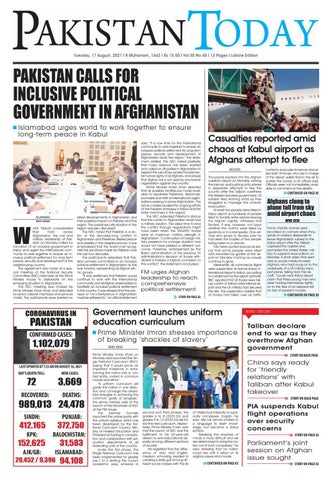
PAkistAn cAlls for inclusive PoliticAl government in AfghAnistAn g
Islamabad urges world to work together to ensure long-term peace in Kabul
IsLAMABAD
W
Mian abrar
hILe Taliban consolidated their hold across Afghanistan, the civil and military leadership of Pakistan on Monday called for formation of an inclusive government in Kabul and urged the international community to work together to ensure an inclusive political settlement for long term peace, security and development of the neighbouring country. The agreement was made at a special meeting of the National Security Committee (NSC) held here at the Prime Minister house to deliberate on the emerging situation in Afghanistan. The NSC meeting was chaired by Prime Minister Imran Khan and attended by senior cabinet members and services chiefs. The participants were briefed on
latest developments in Afghanistan and their possible impact on Pakistan and the region. The overall security situation in the region was also discussed. The NSC noted that Pakistan is a victim of the decades-long conflict in Afghanistan and therefore desires peace and stability in the neighbourhood. It was emphasised that the world must recognise the sacrifices made by Pakistan over the last four decades. The participants reiterated that Pakistan remains committed to an inclusive political settlement in Afghanistan as the way forward, representing all Afghan ethnic groups. “It was reaffirmed that Pakistan would continue to work with the international community and all Afghan stakeholders to facilitate an inclusive political settlement in the country. It was stressed that the principle of non-interference in Afghanistan must be adhered to,” an official statement
coronAvirus in
PAkistAn
CONFIRMED CASES:
1,102,079
LAST UPDATED AT 7:23 AM ON AUGUST 16, 2021
DAY'S DEATH TOLL:
NEW CASES:
72
3,669
RECOVERED:
DEATHS:
989,013 24,478 SINDH:
PUNJAB:
412,165
372,750
KPK:
BALOCHISTAN:
152,625 AJK/GB:
31,583 ISLAMABAD:
29,452 / 9,396
94,108
said. “It is now time for the international community to work together to ensure an inclusive political settlement for long term peace, security and development of Afghanistan (and) the region,” the statement added. The NSC noted positively that major violence has been averted and called on all parties in Afghanistan to respect the rule of law, protect fundamental human rights of all Afghans, and ensure that Afghan soil is not used by any terrorist organisation against any country. Prime Minister Imran Khan directed that all possible facilities be made available to repatriate Pakistanis, diplomats, journalists and staff of international organisations seeking to leave Afghanistan. The prime minister lauded the ongoing efforts of the Pakistan embassy in Kabul and the state machinery in this regard. The NSC reiterated Pakistan’s stance that the conflict in Afghanistan never had a military solution. The ideal time to end the conflict through negotiations might have been when the US/NATO troops were at maximum military strength in Afghanistan. “Continuation of foreign military presence for a longer duration now would not have yielded a different outcome. Therefore, endorsement by the Biden administration of the previous US administration’s decision of troops withdrawal is indeed a logical conclusion to this conflict,” the statement concluded.
FM urges Afghan leadership to reach comprehensive political settlement STORY ON PAGE 03
Casualties reported amid chaos at Kabul airport as Afghans attempt to flee ReuteRs Thousands packed into the Afghan capital’s airport on Monday, rushing the tarmac and pushing onto planes in desperate attempts to flee the country after the Taliban overthrew the Western-backed government. US soldiers fired warning shots as they struggled to manage the chaotic evacuation. At least five people were killed in Kabul airport as hundreds of people tried to forcibly enter planes leaving the Afghan capital, witnesses told Reuters. It was, however, not clear whether the victims were killed by gunshots or in a stampede. One witness who spoke to Reuters said he had seen the bodies of five people being taken to a vehicle. Tolo News quoted sources as saying that some people were killed and wounded by gunfire at the airport on Monday morning as crowds continue to grow. Meanwhile, all commercial flights were suspended at hamid Karzai International Airport in Kabul, according to a statement by the airport authority. BBC reported that US troops were taking control of Kabul’s international airport and the US military had secured the site. The publication added that US troops had taken over air traffic
Government launches uniform education curriculum g
Prime Minister Imran stresses importance of breaking ‘shackles of slaver y ’ News Desk
Prime Minister Imran Khan on Monday said launched the Single National Curriculum (SNC), saying that it would prove an important milestone in transforming the nation into a “unified entity, rooted in common morals and ethos”. “A uniform curriculum will guide the nation in one direction and converge the diversified energies in achieving the common goals of progress,” the prime minister said at the launch of the first phase of SNC at the PM house. The premier formally launched the online portal with the uniform syllabus, which has been developed by the National Curriculum Council, Ministry of Federal education and Professional Training in consultation and collaboration with education departments of all federating units of the country. Under the first phase, the Single National Curriculum has been implemented for grades pre-1 to 5 starting the current academic year, whereas in
control to evacuate American and allied staff. US troops, who are in charge of the airport, earlier fired in the air to scatter the crowd, a US official said. Officials were not immediately available to comment on the deaths.
CONTINUED ON PAGE 05
Afghans clung to plane fall from sky amid airport chaos News Desk Some chaotic scenes were recorded on camera when thousands of civilians desperate to leave Afghanistan rushed to the Kabul airport after the Taliban captured the capital and prompted the United States’ military to suspend evacuations on Monday. A short video that went viral on social media showed Afghans, who had clung on to the underbelly of a US military transport plane, falling from the aircraft. “Locals near Kabul airport claim that three young men who were holding themselves tightly on to the tires of an airplane fell on top of people’s houses.
CONTINUED ON PAGE 05
MORE INSIDE
Taliban declare end to war as they overthrow Afghan government STORY ON BACK PAGE
China says ready for ‘ friendly relations’ with Taliban after Kabul takeover STORY ON BACK PAGE second and third phases, the grades 6 to 8 (2022-23) and grades 9 to 12 (2023-24) will follow the new curriculum, respectively. Prime Minister Imran said that the launch of SNC was the fulfillment of his 25-year-old dream to end educational disparity among different sections of society. he regretted that the difference of Urdu and englishmedium schooling resulted in creating a wide gulf among different social classes with the ills
of intellectual inferiority or superiority complexes. english, he said, did not remain limited to a language to learn knowledge, but became a status symbol. “Breaking the shackles of minds is more difficult and we are determined to bring the nation out of such complexes,” he said, stressing that no nation could rise until it relied on its original values and morals.
CONTINUED ON PAGE 05
PIA suspends Kabul flight operations over security concerns STORY ON PAGE 02
Parliament ’s joint session on Afghan issue sought STORY ON PAGE 02
02
Tuesday, 17 August, 2021
LAHORE
NEWS
PIA susPends KAbul flIght oPerAtIons over securIty concerns
t
NewS DeSk HE Pakistan International Airlines on Monday halted evacuation operation from Kabul as panicked mobs try to flee the besieged Afghan capital following the Taliban
takeover. Reports quoting spokesperson of the national flag carrier, Abdullah Khan, cited that the Kabul operation has been suspended at Hamid Karzai International Airport in wake of the uncertain security situation. Officials said the decision was taken
Pakistan will continue efforts to encourage women education in Afghanistan: fawad Federal Minister for Information and Broadcasting Chaudhary Fawad Hussain on Monday said that Pakistan will continue its efforts to encourage women education in Afghanistan. In a telephonic conversation with Malala Yousafzai, he said that Pakistan is also providing educational facilities to children of Afghan refugees as about six thousand Afghan children are studying in Pakistan. Malala informed the minister about international concerns on women rights in Afghanistan and said that Pakistan should play an active role to promote women education in Afghanistan. She said that she has also written a letter to the prime minister of Pakistan in this regard. News Desk
Pakistan consistently plays constructive role in Afghanistan, leads humanitarian efforts: fM ISLAMABAD: Foreign Minister Makhdoom Shah Mahmood Qureshi Monday said that Pakistan always demonstrated a constructive role in Afghanistan which included its efforts in facilitating an Afghan-led and Afghan-owned peace process besides, many other economic and humanitarian efforts. “Our mission in Kabul is working tirelessly to issue visas, to evacuate diplomats, NGO workers, media personnel etc.;” the foreign minister on his twitter handle posted while regarding the latest situation in Afghanistan as the foreigners and locals scrambled to leave Kabul airport. The foreign minister, in a related tweet said, it was unfortunate that Pakistan was, once again, denied the opportunity to speak at the United Nations Security Council meeting held on Monday over Afghanistan. “After Afghanistan, it is undeniably Pakistan that has been a victim of decades of this conflict,” he further posted. APP
Pcr test facility starts at Islamabad airport ISLAMABAD: The Civil Aviation Authority (CAA) Monday said that the facility of rapid PCR tests has been started at the Islamabad International Airport for UAEbound flights. The passengers, carrying passport and ticket of UAE-bound flights, could avail the PCR test facility at the airport within in less than two hours. The airport with the cooperation of some authentic laboratories is providing state-of-the-art services to the passengers to avoid any hassle. “As many as 2050 passengers have so far been provided the facility of PCR test. The test will be available at the airport till the next policy,” the CAA spokesman told Pakistan Today. “The passengers have expressed satisfaction over the PCR test facility. The passengers flying from Pakistan to Abu Dhabi and Sharjah are carrying results of rapid PCR tests conducted within the airport’s premises,” he added. “This facility is also available at airports in Lahore, Islamabad, Peshawar, Multan and Sialkot. All the labs are located within the premises of these airports,” said Dr Irtaza. MiAN AbrAr
after consultation with the Ministry of Foreign Affairs and Afghan Civil Aviation. The flights have been postponed indefinitely to protect passengers, crew, and assets, the statement said. On Sunday, Pakistan International Airlines started three special flights to lift
stranded nationals and foreigners from Kabul airport but the situation changed swiftly as thousands fled to get out of Kabul at the earliest. Commercial flights from the Afghan capital were canceled till further notice earlier today as Afghanistan’s Civil Aviation
Authority announced Kabul airspace had been released to the military. Furthermore, civilian aircraft were advised to reroute as any transit through Kabul-controlled airspace, which includes all of Afghanistan, was likely to be uncontrolled.
Parliament’s joint session on Afghan issue sought ISLAMABAD TLTP
A day after Kabul fell to the Taliban, the Senate Defence Committee while asking the government to convene a joint session of parliament urged the United States and the NATO countries to learn lessons from the experience of Afghanistan. While passing a resolution on Afghanistan, the committee chairman, Senator Mushahid Hussain Sayed, observed that Pakistan’s long-standing stance that there is no military solution to the situation in Afghanistan has been vindicated. He said the principle of “might is right” is unacceptable and contrary to international law and the United Nations (UN) Charter. While asking to learn lessons, the committee urged the international community, particularly the United Nations, as well as the OIC, European Union and other international organisations to remain actively engaged in Afghanistan for the promotion of peace and reconciliation as well as the reconstruction of the warravaged country.
Given the rapidly changing scenario in Afghanistan and the region, the committee urged the government to take parliament into confidence through immediately convening a joint session to discuss the situation and propose a way forward so that Pakistan and Afghanistan can be partners in peace and progress. “The government should take effective measures to prevent regional spoilers, like India, from taking advantage of the situation to the detriment of peace in the region and the security of Pakistan,” the statement quoted Sayed as saying. In the resolution on Afghanistan, the committee took note of the evolving situation in the neighbouring country and expressed full solidarity and support to the people of Afghanistan in their quest for lasting peace. “Peace, security and stability are inextricably intertwined between Pakistan and Afghanistan and no other country has higher stakes for peace in Afghanistan than Pakistan,” the resolution read. As an “expression of Muslim brotherhood”, it added, Pakistan continues to be a “model host”, having hosted the largest number of refugees for the longest duration in history. During the meeting, the committee outlined Pakistan’s interests in Afghanistan
and made them a part of the resolution. The resolution read that Pakistan’s interests are consistent and clear, adding that Pakistan has been supporting the unity, territorial integrity and sovereignty of Afghanistan. Secondly, it said, Pakistan has been promoting a peaceful political transition in Afghanistan through an inclusive broad-based consensus so that a new civil war can be prevented. Thirdly, it continued by stating that Pakistan maintains that the territory of Afghanistan should not be used to destabilise any neighbouring country or used as a base for cross-border terrorism against Pakistan. Referring to India’s role in Afghanistan, the committee noted that government-prepared dossier on “India State Terrorism” in November 2020 clearly stated that the Indian intelligence, RAW, has been operating 87 training camps against Pakistan, 66 on Afghan territory and 21 on Indian territory. “The Senate Defence Committee urges the international community to take note of these facts,” the members said, adding Pakistan has been a peace facilitator and a source of regional stability and would continue to play its role.
Timeline: Key dates in Afghanistan war since 2001 AFP With the Taliban back in control of Afghanistan, here is a recap of landmark events in the war-torn country since the group’s first regime was toppled in the 2001 US-led invasion: 2001: 9/11 and ‘war on terror’ President George W. Bush launches his “war on terror” in response to the September 11 attacks that killed around 3,000 people, with airstrikes on Afghanistan on October 7, 2001. The Taliban government had sheltered Osama bin Laden and his Al Qaeda movement, which masterminded 9/11. In power since 1996, the Taliban are soon defeated and flee the Afghan capital, Kabul, on December 6. Hamid Karzai is appointed to lead an interim government and the North Atlantic Treaty Organisation (Nato) begins to deploy its International Security Assistance Force. 2004: First presidential election Afghanistan’s first election under a new system is held on October 9, 2004, with an enthusiastic turnout of 70 per cent. Karzai wins 55 percent of the vote. The Taliban regroup in the south and east and launch an insurgency. 2008-2011: US reinforcements As attacks multiply, the US command in 2008 asks for more troops and the first reinforcements are sent. Karzai is re-elected on August 20, 2009 in elections
that are marred by massive fraud, low turnout and Taliban attacks. In 2009, President Barack Obama, who had campaigned on a pledge to end the Afghanistan war, doubles the number of US troops to 68,000. In 2010, it reaches around 100,000. Osama bin Laden is killed on May 2, 2011 in a US special forces operation in Pakistan. On June 22, Obama announces the beginning of a troop withdrawal, with the departure by mid-2012 of 33,000 soldiers. 2014: Nato exit In June 2014, Ashraf Ghani is elected president, but voting is marred by violence and a bitter dispute over claims of fraud. In December, Nato ends its 13-year combat mission but a number of troops remain to train the Afghan military. The following year, the Taliban make their greatest military advances since being ousted. The Islamic State, a militant group, also becomes active in the region. Bloody attacks multiply, notably in Kabul. 2020: US-Taliban deal, disputed election Ghani is declared victorious for a second term on February 18, 2020, an announcement rejected by his rival and former minister Abdullah Abdullah, who vows to form his own parallel government. On February 29, the US and the Taliban sign a historic deal in Doha under which all foreign forces
New vistas in Urdu poetry SyeD AFSAr SAjID Nusrat Siddiqui and Qamar Raza Shahzad belong to the late 20th century generation of Urdu poets who still hold their ground because of the richness and versatility of their poetic genius. There are many points of commonality between the two alongside an equal measure of diversity. Their popularity in literary and non-literary circles owes a great deal to their originality in expression and content backed by a strong commitment to their vocation as a poet. In the line of Eliot, perhaps they too deem ‘the proper fusion of meaning in language’ as the prime function of poetry, far from being self-revelatory. Their poetic works also seem to reiterate their belief in the medium of art as ‘exploration of experience’. MATA-E-DARD: It is Nusrat Siddiqui’s fifth verse collection (2020) in a series after Lamha-e-Maujud (1986, 1992), Tray Tulu Ka Lamha (2004), Roop Ghazal Kay (2008), and Taqazay (2015). He is a popular poet deeply concerned with the worries and woes of the common man. His imagery expatiates on the age-old dialectics of class struggle. But he does not feign to be an ideologue. In a soft but studied accent, he vents his grief, resentment, and protest against social injustice, oppression, exploitation, and evils of sorts with utmost conviction and commitment. His ghazal is immersed in a melodic strain reminiscent of the
classical aura of Meer and Momin. (Roo’ey ghazal say rang-e-taghazzul mita’ey ja/Is ahd-e nau mein kuch to naya hona chahiyey). Nusrat Siddiqui’s style is aphoristic. His diction seems to thrive on a concise terseness rather than an ambiguous prolixity. He firmly believes in art’s subservience to life but without any semblance of propaganda or didacticism. In his view, poetry seeks truth which is couched in the aesthetics of rhythm, sensation, and imagery. The socio-political undertones of his poetics tend to place him above the common lot of many of his contemporaries. Nostalgia, an egalitarian concern for the common man, an adroit usage of paradox, a ratiocinative expatiation of the vibes of love, a seething note of discontent about the socio-moral incongruities rampant in his surroundings, and a (Habib) Jalibian proneness to protest (but in a mild tone) are the distinctive features of Nusrat’s poetics whence the raison d’etre of his art as a versifier. Reproduction of a few verses from his present collection —- which comprises his divine poetry, ghazal, and nazm —- might enable the reader to have a fairer idea of the form and content of his verse. Yeh zindagi hai sulagti rahey to achcha hai Kisi ka dard sahi apni aankh tar rakhna Maey nay chalna jinhain sikhaya tha Ab who mujh say bhi tayz chaltay hain Shaoor-e-fun bhi day logon ko aey mray Khaliq
would leave Afghanistan by May 2021, provided the insurgents start talks with Kabul and adhere to other security guarantees. A power-sharing deal ends the bitter GhaniAbdullah feud in May. Abdullah takes the role of leading the peace negotiations. Talks begin in September but violence surges and the Taliban are blamed for a wave of targeted killings. May 2021: Foreign troops withdrawal On May 1, 2021 the US and Nato start withdrawing their 9,500 soldiers, of which 2,500 are American. In May, the Americans withdraw from the Kandahar airbase. On July 2, Bagram airbase — Afghanistan’s biggest, and the nerve centre of the US-led coalition’s operations — is handed over to Afghan forces. President Joe Biden says that the US troop withdrawal will be completed by August 31, before the 20th anniversary of the 9/11 attacks. May-August 2021: Taliban blitz The insurgents launch lightning attacks across Afghanistan, capturing vast stretches of the hinterland as the final foreign troops begin their withdrawal. The Taliban capture their first provincial capital, Zaranj in the southwest, on August 6. Other major cities fall within days, including Kandahar and Herat — Afghanistan’s second- and third-biggest cities, respectively. Most of the north, west and south is under Taliban control by August 13.
Jo yeh nahin to mujhay taysha-e hunar bhi na day Kaundti hain bijliyan charon taraf Ho Khuda haifz mray gulzar ka Laga kay jan ki bazi sar-e saleeb-e sitam Sikha raha hun jahan ko jasaratein karna Waqt kay badalnay mein Hath say nikalnay mein Talnay ya na talnay mein Kafi dayr lagti hai Ya phir aisa hota hai Dayr hi nahin lagti (‘Dayr Savayr’ – nazm) ITMAM-E-HUJJAT: Qamar Raza Shahzad is a veteran poet now. His emergence as a young, innovative poet dates back to 1980s when he frequently participated in ‘mushairas’ in Multan and its adjoining areas besides appearing in various literary journals and magazines across the country. Within the span of a decade or so he was able to establish his credentials as a young Urdu poet with a fresh diction and accent, voicing his poetic perceptions and concerns in the context of the Zeitgeist. Itmam-e-Hujjat, a compilation of Qamar’s nazm (70), is his seventh verse collection in a row after Piyas Bhara Mushkeeza (68), Haara Hua Ishq (72), Yad Dihani (76), Kamhushi (72), Bargah (75), and Shash Jihaat (75) —- all six collections of ghazal. Unlike the introversive subjectivity of ghazal, nazm is basically rooted in objectivity —- its subjects are men, matters and materials. Qamar Raza Shahzad as a humanist voices the pain and penury of the deprived and down-trodden.
Tuesday, 17 August, 2021
LAHORE
fM urges AfghAn leAdershIP to reAch coMPrehensIve PolItIcAl settleMent
f
NewS DeSk
OREIGN Minister Shah Mahmood Qureshi has urged Afghan leadership to use this historic opportunity for reaching a broad-based and comprehensive political settlement of Afghan issue. Talking to a delegation of Afghan leaders in Islamabad on Monday, he said that all stakeholders must work together for a better future of Afghanistan and the
region as well. The foreign minister said that “our ultimate goal is a peaceful, united, democratic, stable and prosperous neighbour”. He said that a comprehensive dialogue is the only political way for resolution to the Afghan issue, and Pakistan is committed to play a constructive and reconciliatory role in this regard. Foreign Minister Qureshi said that Pakistan hopes that the entire Afghan leadership will undertake efforts for
Judicial remand of Zahir Jaffer extended till Aug 30 in noor Mukadam case ISLAMABAD TLTP
A magistrate of Islamabad Saqib Jawad on Monday extended judicial remand of Zahir Zakir Jaffer, the principal accused in last month’s gruesome murder of Noor Mukadam till August 30 as the investigation officer failed to submit a charge-sheet (challan) against him and others involved in the case. The court also sent the owner of counseling center Therapy Works Tahir Zahoor and his five employees to Adiala Jail in Rawalpindi on 14-day judicial remand. Mukadam was found beheaded at a residence in Islamabad’s upscale F-7/4 sector on July 20 in a case that has sparked public outrage and grabbed media attention unlike any other recent crime against women. The victim was the daughter of Shaukat Mukadam, Pakistan’s former ambassador to South Korea and Kazakhstan. The key suspect Zahir Jaffer, who is on judicial remand in Adiala Jail in Islamabad’s twin city of Rawalpindi, was apprehended from the crime scene, his home, on the day of the murder. He had reportedly been practicing as a psychotherapist after enrolling in a certification course with Therapy Works. Police say a team from the counselling center was already at the crime scene when they arrived on July 20, having been summoned by Jaffer’s parents, who are also under arrest. Islamabad police on Monday brought Jaffer to the Islamabad district courts where judicial magistrate Saqib Jawad marked his attendance through a court order. The accused was kept in judicial lockup in the court and not presented before the judge. Later, the court extended his judicial remand till August 30. The police did not submit a detailed charge-sheet in the court today, Monday, saying the investigation of at least nine suspects in the case was still underway. However, the judicial magistrate allowed police to conduct a DNA test of Zahir Jaffer’s two employees, a security guard and cook, who were present in the house on the day of the murder. Meanwhile, the court rejected post arrest bail application of Therapy Works owner Zahoor, saying they were involved in offences which falls under prohibitory clause. “Accused Tahir Zahoor was in contact with the parents of the accused and as a result of that contact a team was sent to the crime scene,” the court said in its order on Sunday, referring to the Therapy Works’ employees.
durable peace in the larger national interest. He said that all segments of the Afghan society are equally important in achieving the ultimate goal of peace. He also said that “we also need to continuously monitor the anti-peace elements, who are trying to mislead the world about Pakistan’s reconciliatory role, which has been acknowledged internationally”. The foreign minister also urged the international community to come forward and provide cooperation and
economic assistance for the reconstruction and rehabilitation of Afghanistan. Later briefing media, he said that Pakistan will continue its efforts for safe evacuation of foreign missions, media workers and NGOs’ staff working in Afghanistan. He said that 380 citizens of Denmark have so far been evacuated from Afghanistan and shifted to Pakistan, who will leave for their country after completion of due process.
Increase in technology sector’s export top priority of govt: PM NewS DeSk Prime Minister Imran Khan on Monday said that increase in exports in technology sector is one of the priorities of the government. Talking to Special Technology Zones Authority Chairman Aamir Hashmi in Islamabad on Monday, he said that the government is providing facilities to the manpower associated with information technology. The progress in Islamabad Technopolis project was discussed in the meeting. The Special Technology Zones Authority chairman informed the premier that local and foreign companies are taking keen interest to invest in technology zones. He said that technology zones will be established in the federal capital as well as in all provincial capitals. Separately, Prime Minister Imran directed formulation of a systematic plan to check encroachments in the federal capital, including the use of drone technology. Chairing a meeting on civic problems of Islamabad, the prime minister stressed the need for utilising modern technology to put in place in-time measures to stop encroachment.
PM SUGGESTS USE OF DRONES TO CHECK CAPITAL’S ENCROACHMENTS The prime minister emphasised the need of a single regulatory body to ensure effective implementation of all rules and building bylaws in the federal capital. On clean and green environment, he urged massive tree planting campaign and asked the city administration to incentivise the exercise to ensure full participation of local people in protection of green areas. The meeting was attended by Planning Minister Asad Umar, Special Assistant for Capital Development Authority’s Affairs Ali Nawaz Awan, CDA Chairman Aamer Ali Ahmed, MNA Raja Khurram Nawaz and senior officials. The CDA chairman in a briefing on encroachments said the main reason was lack of a unified regulatory framework, which was divided among the CDA, the registrar of Societies and the Securities & Exchange Commission of Pakistan.
CM Buzdar announces to launch air ambulance service LAHOre iNP
Punjab Chief Minister Sardar Usman Buzdar has announced to start rescue air ambulance service adding that Punjab is the first province to start this service. He was chairing the passing out ceremony of 393 rescuers of Khyber Pakhtunkhwa and 73 rescue workers of Koh-e-Suleman area of DG Khan at emergency services academy Thokhar Niaz Beg on Monday. Addressing the participants, Buzdar said that budget has been allocated for air ambulance in the current fiscal year and assured to sympathetically review the approval of risk allowance for rescuers on the pattern of Punjab police and added that work will be started for restoration of frozen allowance since 2017. Meanwhile, the government has also expanded the scope of rescue service to 86 tehsils while motorbike ambulance service is extended to 27 districts, he continued. It is sanguine that rescue 1122 has rescued
myriad people in more than 96 lakh emergencies which are a unique honour for the institution, he added. The chief minister appreciated that more than 20 thousand rescuers of Punjab and other federating units have completed their training from the academy which enjoys the honour of being the first certified search and rescuers team by the United Nations. He, however, regretted the board meeting was not held for 10 long years, adding that the PTI government took several initiatives for the betterment of the organization while holding regular board meetings. Meanwhile, rescuers’ service structure has been created to generate promotion opportunities, the CM affirmed. The government has given the status of an administrative department to rescue 1122 while giving the powers of a Secretary to DG, he said. Buzdar appreciated that the rescuers have shifted thousands of coronavirus patients to hospitals and quarantine centres during the pandemic. The government will continue to provide resources for giving the best emergency services to the people, the CM concluded.
Why didn’t they fight? Speed of Afghan collapse surprised even the Taliban AFP The Taliban’s rapid takeover of Afghanistan was the result of not only their strength on the battlefield and a strategy that began in the rural provinces but of a collapse of morale among an underserved Afghan military. WHY DIDN’T THE AFGHAN ARMY FIGHT? Despite the $83 billion and two decades the US spent equipping and training the Afghan army, in many provinces the military appeared to evaporate in the face of Taliban insurgents. With more than 300,000 personnel and equipment that was more advanced than the Taliban arsenal, Afghan army forces were formidable – on paper. In reality, they had been plagued by corruption, payoffs, poor leadership, lack of training and plummeting morale for years. Desertions were common and US government inspectors had long warned that the situation was unsustainable. The government outpost in Imam Sahib, a district of Kunduz province, held out for two months against the Taliban. But resources and supply runs soon dwindled. “In the last days, there was no food, no water and no weapons,” trooper Taj Mohammad, 38, told the
Wall Street Journal. The remaining troops eventually fled for the provincial capital, which itself collapsed weeks later. Troops on the front line in Afghanistan’s secondlargest city Kandahar were given “one cardboard box full of slimy potatoes” for an entire police unit’s daily rations last week, the New York Times reported. Kandahar police said before the city fell they hadn’t been paid in six to nine months, according to the Washington Post, making Taliban offers more tempting. Taliban insurgents mixed threats and bribery, along with propaganda and psychological warfare, as they took city after city – some with barely a shot fired – eventually capturing the capital. Beginning last year, Taliban leaders started offering desperate troops money in exchange for weapons, according to the Washington Post, in meetings and deals dubbed “ceasefires” by Afghan officials. “Over the next year and a half, the meetings advanced to the district level and then rapidly on to provincial capitals, culminating in a breathtaking series of negotiated surrenders by government forces,” the Post wrote. And yet as foreign troops began their final withdrawal based on a Trump administration deadline set for May 1, Washington and Kabul were confident the Afghan military would put up a fight against the
Taliban. Afghan forces did put up strong resistance in some areas such as Lashkar Gah in the south, but they were facing the Taliban without US air strikes or military support. Confronted with smaller but highly motivated groups of Taliban insurgents, many soldiers and even entire units simply deserted or surrendered, leaving the Islamists to capture city after city. Meanwhile, US intelligence assessments were woefully optimistic. The Taliban could take over Kabul within 90 days, US officials estimated last week. Some 72 hours later, Kabul had fallen. Even the Taliban were reportedly surprised at how quickly they were able to take control of some provinces. HOW DID THE US FUEL A TALIBAN VICTORY? For some, Afghanistan’s collapse was 20 years in the making, as mistake after mistake was made in the Western nation-building project. But the final nail in the coffin of the Afghan government came last year when former US president Donald Trump signed a deal with the insurgents to withdraw US troops by May 1. For the Taliban, it was a sign that their victory was imminent after nearly two decades of war. For Afghans, it was a betrayal and meant their abandonment by the international community.
NEWS
03
Pakistan committed to sovereignty of saudi Arabia: PM ISLAMABAD APP
Prime Minister Imran Khan on Monday expressed Pakistan’s commitment and support for the sovereignty and territorial integrity of Saudi Arabia. Talking to Chief of General Staff of the Saudi Armed Forces General Fayyadh bin Hameed Al-Rowailly, the prime minister underlined the importance Pakistan attached to Saudi Arabia in broadening mutual cooperation and strengthening the people-to-people contacts. During the meeting, views were exchanged on a range of important issues of common interest. PM Imran expressed confidence that the recently established Saudi-Pakistan Supreme Coordination Council (SPSCC) would play a catalytic role in fostering enhanced bilateral cooperation in all fields. He welcomed the Saudi delegation and conveyed his warm regards to King Salman Bin Abdulaziz Al Saud and Crown Prince Mohammed bin Salman. He added that the people of Pakistan always accorded special reverence to the Saudi leadership. The prime minister expressed satisfaction over the robust defence relationship between the two countries, and hoped that bilateral defence cooperation would grow further in the years ahead. He also expressed Pakistan’s support for resolving the conflict in Yemen through dialogue and diplomacy, and appreciated Saudi efforts in this regard. General Al-Rowailly acknowledged the excellent collaboration and appreciated the professionalism of Pakistan armed forces. Pakistan and Saudi Arabia have long-standing and historic fraternal relations, rooted deep in common faith, shared history and mutual support. Regular and highlevel exchange of visits is a reflection of excellent relations between the two countries.
saudi cgs extends full support to Pakistan’s efforts for regional peace rAwALPINDI APP
A high-level military delegation led by Kingdom of Saudi Arabia’s Chief of General Staff (CGS) General Fayyadh Bin Hamed Al-Ruwaili Monday called on Chief of Army Staff (COAS) General Qamar Javed Bajwa at the General Headquarters. During the meeting, geo-strategic environment, security situation in Afghanistan and matters of mutual interest were discussed, including bilateral defence cooperation and Training Exchange Programme, said an Inter-Services Public Relations press release. In view of the evolving regional security situation, the Saudi CGS expressed full support for Pakistan’s efforts for peace in the region. The dignitary acknowledged Pakistan Army’s achievements in war against terrorism and contributions for regional peace and stability. Saudi CGS thanked Pakistan Army for its sustained assistance in training of Saudi Armed Forces and expressed his desire to enhance bilateral defence collaboration.
Tuesday, 17 August, 2021
04 NEWS
LAHORE
PSX ShEdS 257 POintS dUE tO AFghAn SitUAtiOn KARACHI
t
TLTP
HE Pakistan Stock Exchange (PSX) continued with bearish and low volume trend for the third straight day on Monday, with the benchmark KSE-100 Index shedding 257.05 points (-0.54 percent) to close at 46,912.79 points. The market opened on a negative note by shedding 35 points and remained negative for almost the whole session. The KSE100 Index moved in a range of 500.9 points, showing an intraday high of 47,173 points and an intraday low of 46,672.1 points. Among other indices, the KSE All Share Index shed 217.13 points (-0.67 percent) to close at 32,052.33 points, while All Share Islamic Index shed 137.21 points (-0.59 percent) to close at 22,947.2 points. A total of 379 companies traded shares in the stock exchange, out of them shares of 100 closed up, shares of 262 closed down while shares of 17 companies remained unchanged. Of the 97 traded companies in the
KSE-100 Index, 24 closed up 72 closed down, while 1 remained unchanged. The overall market volumes increased by 38.45 million to 251.81 million shares. Total volume traded for the KSE-100 Index was 88.22 million shares. The number of total trades increased by 14,455 to 103,266; and the value traded increased by Rs0.87 billion to Rs10.15 billion. Likewise, the market capitalisation decreased to Rs19.19 billion. Among scrips, WTL realised total volumes of 22.21 million shares, followed by TELE (19.38 million) and TRG (13.72 million). Stocks that contributed significantly to the volumes include WTL, TELE, TRG, ANL and TREET, which formed 32 percent of total volumes. Sector wise, the index was let down by cement with 66 points, power generation & distribution with 28 points, textile composite with 28 points, commercial banks with 19 points and oil & gas exploration companies with 19 points. The most points taken off the index were by LUCK which stripped the index of 28 points followed by HUBC with 17 points, PPL with 15 points, CHCC with
POS customers to pay Rs1 for each invoice: FBR
14 points and ANL with 13 points. The sectors propping up the index were fertilizer with 7 points, paper & board with 3 points, engineering with 2 points, glass & ceramics with one point and real estate investment trust with one point. The most points added to the index was by EFERT which contributed 12 points followed by BAHL with 8 points, ENGRO with 5 points, POL with 5 points and UNITY with 5 points. According to experts, the local bourse retreated as investors closely watched geopolitical implications of Afghan Taliban’s taking over their control in Afghanistan. This situation has pushed the investors’ interest into panic selling, they added. However, recovery was seen in the last hours where the index found support from the major technical levels. On the news front, LSM marked a growth of 14.85 percent in FY 2020-21 (16-year high) and APG has improved Pakistan’s rating after fulfilling 35 out of 40 recommendations of FATF against money laundering, terror financing and others, said a market closing note by Pearl Securities.
Gold slips to Rs93,800 per 10gm amid dollar’s rebound
KARACHI TLTP
The tax authorities have made it mandatory to pay Rs1 on each invoice obtained against the purchase through the point of sale (POS) machines installed by the tier-1 retailers. Obtaining a POS invoice and getting verified is necessary for a customer to qualify a prize scheme announced by the Federal Board of Revenue (FBR). “The POS service fee of Re1/invoice shall be collected by the Tier-1 retailers from the customers and shall be deposited along with the monthly sales tax return,” the FBR said. The POS service fee collected each month would be deposited by the Tier-1 retailers in a separate head of account, it added. The FBR issued instructions to operationalise the guidelines issued through SRO 1006(I)/2001, dated August 9, 2021. Through another SRO 1005(I)/2021, the revenue board issued a procedure for the prize scheme. Under this, the customers of integrated Tier-1 retailers, whose names and computerised national identity cards (CNICs), notified through a random computerised draw, would be entitled to prize in respect of their purchases from the tier-1 retailers. As per the Sales Tax Act, 1990, the tier-1 retailers are those operating as a unit of a national or international chain of stores; a retailer operating in an air-conditioned shopping mall, plaza or centre, excluding kiosks; a retailer whose cumulative electricity bill during the immediately preceding 12 consecutive months exceeds Rs1.2 million; a wholesaler-cumretailer, engaged in bulk import and supply of consumer goods on wholesale basis to the retailers, as well as on the retail basis to the general body of the consumers; a retailer, whose shop measures 1,000 square-feet in area or more or 2,000 square-feet in area or more in the case of retailer of furniture; and a retailer who has acquired point of sale for accepting payment through debit or credit cards from the banking companies or any other digital payment service provider authorised by the State Bank of Pakistan.
SECP asks firms to file UBO declarations NEWS DESK The Securities and Exchange Commission of Pakistan (SECP) has, once again, advised companies to submit Declarations of their Ultimate Beneficial Owners (UBOs), through filing of Form 45, as required under Section 123A of the Companies Act, 2017. The procedure for companies to obtain, maintain and update information about their ultimate beneficial owners is specified in the Companies (General Provision & Forms) Regulations, 2018, said a press release. To ensure standards of transparency in the ownership and control structure of corporate entities, the government had introduced amendments to the Companies Act 2017. These amendments made it mandatory for every company to obtain information of its UBOs, and file a declaration to this effect with the SECP on the prescribed format i.e. Form 45. To facilitate companies, SECP also introduced an online mechanism for submission of Form 45 and issued detailed guidelines, including FAQs. A video tutorial, explaining the process of online filing of Form 45, can also be accessed at the SECP website. Companies that have not yet been able to comply with the requirements of Section 123, are encouraged to file the Declaration at the earliest.
NEWS DESK Gold prices snapped four-day uptrend in the international market on Monday amid the US dollar’s rebound. At 1130 hours GMT, gold in the international market was available at $1,773.50 per ounce after shedding $7.20 as compared to its closing value on Friday last. Meanwhile, the price of 10 grams of yellow metal in Pakistan decreased to Rs93,800 after shedding Rs200. The closing prices of the yellow metal in the country remained Rs94,000 on Friday last.
According to experts, gold took a U-turn from 21-day EMA while portraying the latest pullback amid bearish MACD. However, a four-month-old horizontal area surrounding $1,755 should restrict the immediate downside ahead of dragging gold prices to $1,738 and the $1,700 threshold. They said in a case where oscillators keep favouring the downtrend past $1,700, the latest low near $1,687 and the yearly bottom surrounding $1,676 will be the key to watch. Alternatively, 21day EMA and a two-month-long horizontal line, respectively around $1,784 and $1,790, guard the commodity’s short-term upside, they added. They said that the dollar’s latest recovery could be linked to the worsening coronavirus conditions that, in turn, challenge the global economic rebound from the pandemic. It’s worth observing that the Taliban’s takeover of Afghanistan and the global ire over the same joins the US-China tussles to weigh on the risk appetite. They said that given the lack of major data/events, coupled with the riskaversion-backed USD rebound, gold is likely to remain pressured.
Bitcoin jumps to $47,521 as crypto market turns bullish NEWS DESK The cryptocurrency market remained bullish on Monday, with the market capitalisation increasing by 4.8 percent to $2.12 trillion as of 1145 hours GMT. The price of Bitcoin (BTC), the largest cryptocurrency, reached $47,521 after gaining 3.07 percent. With this increase in price, the market capitalisation of the BTC has reached $892.8 billion. Likewise, ethereum (ETH) price gained 4.04 percent to reach $3,293. With this increase in price, the market capitalisation of ETH has reached $385.5 billion. Similarly, the price of Cardano (ADA) – now the third-ranked cryptocurrency after Bitcoin and Ether – reached $2.17 with 1.89 percent increase in its price. Its market capitalisation has reached $70.2 billion after this increase. On the other hand, XRP gained 0.08 percent to reach $1.28. The market capitalisation of XRP stands at $128.1 billion after this increase. Similarly, Dogecoin (Doge) price jumped by 16.51 percent to reach $0.351. With this increase in price, the market capitalisation of Doge reached $45.8 billion. A recent survey by cryptocurrency exchange Gemini revealed that Ethereum is the most popular cryptocurrency in Singapore. Nearly
78% of crypto investors in Singapore hold Ethereum, and 69% have Bitcoin. Ethereum’s rising popularity can be attributed to the increase in the number of deflationary blocks being produced since EIP-1559 went live with the London hard fork. Around $165 million worth of ETH has been burned in the past ten days. As more Ethereum is pulled out of circulation, analysts note a rise in total value locked (TVL) on DeFi and a spike in volume of Ethereum staked in the ETH 2 contract. Ethereum has outperformed Bitcoin in terms of transaction volume, daily trade volume and return on investment, according to data from the Blockchain Centre. Further, as the Ethereum network heads toward the “merge,” the upgrade that swaps the current proof-of-work (PoW) consensus mechanism with energy-efficient and secure proofof-stake (PoS), Ether’s inflation is expected to drop, leading to deflation. Traders expect “deflation” to positively impact Ethereum’s price, which makes it more attractive than Bitcoin. According to analysts, Ethereum’s next price target is $4,000, and this is a significant psychological level for the altcoin’s price rally. There is a surge in Bitcoin reserves on exchanges; however, in the case of Ethereum, the opposite is true.
Crude prices fall over 1pc due to demand concerns NEWS DESK Global crude prices remained on downward slide for the third straight session and dropped over one percent on Monday due to demand concerns over spread of the delta variant of the coronavirus in China, the world’s biggest oil importer. At 1050 hours GMT, Brent, the international benchmark for two-thirds of the world’s oil, shed $0.85 (-1.20 percent) to reach $69.74 a barrel. Similarly, the US West Texas Intermediate (WTI) reached $67.52, down by $0.92 (-1.34 percent). The price for Opec Basket was recorded at $71.32 a barrel with 1.13 percent increase, Arab Light was available at $71.88 a barrel with 0.72 percent decrease, while the price of Russian Sokol slipped to $70.77 after shedding 1.10 percent. According to experts, Chinese factory output and retail sales growth slowed sharply in July, as flooding and fresh outbreaks of Covid-19 disrupted business activity. China’s crude oil processing last month also fell to the lowest level on a daily basis since May 2020 as independent refiners cut production in the face of tighter quotas, elevated inventories and falling profits, they said. Doubts about the speed of economic recovery were also heightened after U.S. consumer sentiment dropped sharply in early August to its lowest in a decade, a University of Michigan survey showed late last week. The International Energy Agency (IEA) last week said that rising demand for crude oil reversed course in July and was expected to increase at a slower rate over the rest of 2021 because of surging Covid-19 infections from the Delta variant.
Unisame hails SME business loan scheme NEWS DESK The Union of Small and Medium Enterprises (Unisame) has felicitated State Bank of Pakistan Governor Reza Baqir on the proposed launch of the SME Aasan Business Loan Scheme. According to a statement issued on Monday, Unisame President Zulfikar Thaver said that it is reported that the central bank will launch the SME Aasan Business Loan Scheme for up to Rs10 million loan without collateral and eight banks will be selected for the purpose. He said it is learnt that the markup rate will be 9 percent per annum inclusive of the handsome bank spread of 8 percent for the banks coming forward to offer services under the scheme. Thaver said that this is indeed a big step to facilitate the sector and Unisame is proud of the SBP’s positive initiative. The State Bank of Pakistan has played a positive role during the pandemic and rescheduled loans and influenced commercial banks to facilitate the sector beyond expectations, he added. Now, this step will facilitate the SMEs and enable the banks to offer SME Aasan Business loans will go a long way in the development of the sector, he further added.
SRB extends dates for sales tax payment, returns filing NEWS DESK The Sindh Revenue Board (SRB) has extended the last date for the payment and sales tax returns filing for July 2021. In a circular issued on Monday, the SRB said that taxpayers can make payment of sales tax on services for the period of July 2021 up to August 24, 2021. Further, the taxpayers can file their monthly sales tax re-
CMYK
turns for July 2021 up to August 27, 2021. The provincial tax authority extended the date, considering holidays on account of the Independence Day and Ashura. Earlier last week, the Federal Board of Revenue (FBR) extended the last date for payment and filing return for the month of July 2021. According to a circular, in exercise of the powers conferred under Section 74 of the Sales Tax Act, 1990 and Section 43 of the Federal Excise Act 2005, the
Federal Board of Revenue has extended the date of payment and submission of sales tax & federal excise return for the tax period of July 2121. The FBR said the date of payment of sales tax and federal excise return, which is due on August 15, 2021 has been extended up to August 23, 2021. Furthermore, the date of submission of sales tax and federal excise return, which is due on August 18, 2021 has been extended up to August 24, 2021, added the FBR.
Tuesday, 17 August, 2021
LAHORE
NEWS
05
ECC approvEs subsidisEd ElECtriCity, rlNG for Export sECtors
t
neWS deSK
HE Economic Coordination Committee (ECC) of the federal cabinet has approved the continuation of electricity and gas subsidy for export-oriented sectors to support the momentum of growth in exports during the fiscal year 2021-22. Finance Minister Shaukat Tarin presided over the ECC meeting on Monday. The Ministry of Commerce presented a summary regarding continuation of concessional rates of electricity and RLNG to export-oriented sectors. The secretary commerce briefed the committee that extension of concessional rates of electricity and RLNG is important for sustained increase in exports by providing energy at regionally competitive rates.
After due deliberations, the ECC approved the continuation of electricity and gas subsidies for export-oriented sectors to support the momentum of growth in exports during the fiscal year 2021-22. Speaking on the occasion, the finance minister emphasised the need to incentivise export-oriented sectors in order to take national exports to the next level. At the same time, the finance minister stressed the need to rationalise usage of energy inputs. For this purpose, the ECC constituted a sub-committee comprising minister for energy, minister for industries & production, advisor on commerce, deputy chairman Planning Commission, additional secretary (CF) finance and other relevant officials for presenting a plan to resolve the issue of continued use of gas by some units for power generation and non-cooperation in audit of
such use. The sub-committee was directed to present its recommendations before ECC within 30 days for further deliberation. The ECC considered and approved a summary presented by the Power Division for extension of incremental consumption package for K-Electric industrial consumers of X-WAPDA DISCOs & K-Electric and application of incremental consumption package for BI(Non ToU) consumers of XWAPDA DISCOs and K-Electric at the rate of Rs.12.96/kwh from 1st July 2021 to 31st December 2021. The ECC also approved another summary by the Petroleum Division regarding NOC for issuance of the parent company guarantees/corporate guarantees by each of the consortium companies, on a joint and several basis, in favour of ADNOC and SCFEA to pur-
sue international exploration and production opportunity in Abu-Dhabi, United Arab Emirates. Minister for Privatisation Muhammad Mian Soomro, Minister for National Food Security & Research Syed Fakhar Imam, Minister for Industries and Production Makhdoom Khusro Bakhtiar, Minister for Energy Muhammad Hammad Azhar, Minister for Economic Affairs Division Omar Ayub Khan, Adviser to the PM on Commerce Abdul Razak Dawood, Adviser to the PM on Institutional Reforms and Austerity Dr Ishrat Hussain, SAPM on Finance and Revenue Dr Waqar Masood, SAPM on Power & Petroleum Tabish Gauhar, and other senior officers participated in the meeting, while Governor State Bank of Pakistan (SBP) Dr Reza Baqir also participated through video link.
efforts on to discover new oil, gas reserves to meet demand: Hammad Govt Gives nod to oGdCL to expLore oiL, Gas in 5 bLoCks neWS deSK Minister for Energy Hammad Azhar has said that natural gas resources are depleting by 10 percent every year and efforts are underway to discover new reserves of oil and gas in the country to meet the increasing demand. The minister said this while addressing a ceremony on Monday, wherein the government executed five petroleum concession agreements and exploration licences with the Oil and Gas Development Company Limited (OGDCL). Hammad said that these efforts will bear fruits for the country in the form of additional hydrocarbon reserves during the next few years. The minister said the execution of the exploration licences and the petroleum concession agreements will not only enhance investment in the petroleum sector but will also contribute in bridging the energy demand and supply gap.
The exploration licences and petroleum concession agreements were signed by Dr Arshad Mahmood, secretary of the Petroleum Division, Abdul Jabbar Memon, director general of the Petroleum Concessions, on behalf of the government of Pakistan, and Shahid Saleem Khan, managing director of the OGDCL. The government executed the petroleum concession agreements at Elsover Block No 3372-26 (Hazro); Block No 2972-7 (Vehari); Block No 29728 (Sutlej); Block No 2668-23 (Khewari East); and Block No 3471-1 (Nowshera). Hazro Block, covering an area of 653.74 sq-km is located in Attock district, Swabi, Haripur while Vehari Block, covering an area of 2,487.28 sq-km is located in Bahawalpur district, Vehari and Lodhran and Sutlej Block, covering an area of 2,312.56 sq-km is located in Bahawalpur, Bahawalnagar, Vehari and Khanewal. Khewari East, covering an area of 1,451.53 sq-km
Ferozsons Laboratories celebrates Independence Day by lighting Frere Hall emerald green. PR
is located in Khairpur district. Nowshera Block, covering an area of 1,711.06 sq-km is located in Charsadda, Mardan, Swabi and Nowshera. The minimum firm work commitment for these blocks is $13.32 million for the period of three years. The companies are obligated to spend a minimum of $30,000/annum in each block on social welfare schemes. The annual social welfare obligation in respect of these five blocks is $150,000. The OGDCL is a public limited company engaged in exploration and production activities in the country for the last five decades. It holds the largest share of oil, 41 per cent and gas, 36 percent of the total reserves in the country. Its percentage share of total oil and gas production in Pakistan is 47 per cent and 29 per cent, respectively. The OGDCL is the operator of 46 exploration licences and working interest owner in seven other exploration blocks operated by various E&P companies. It is currently producing 36,058bpd of oil, 1,023 mmscfd of gas, 778 tonnes of LPG and 51 tonnes of sulphur per day.
Casualties reported amid chaos at Kabul airport as Afghans attempt to flee Continued from page 01 The Taliban swept into Kabul on Sunday after President Ashraf Ghani fled the country, bringing a stunning end to a two-decade campaign in which the US and its allies had tried to transform Afghanistan. The country’s Western-trained security forces collapsed or fled in the face of an insurgent offensive that tore through the country in just over a week, ahead of the planned withdrawal of the last US troops at the end of the month. Massouma Tajik, a 22-year-old data analyst, described scenes of panic at the airport, where she was hoping to board an evacuation flight.
Afghans clung to plane fall from sky amid airport chaos Continued from page 01 One of the locals confirmed this and said that the fall of these people made a loud and terrifying noise,” a local news agency, Asvaka, tweeted. Reportedly, at least five people were killed after gunfire at the airport. According to Reuters, a US official said that the US troops fired in the air to deter people trying to enter in a military flight evacuating US diplomats and embassy staff. Two gunmen were killed by the US forces there over the past 24 hours. A witness told Reuters that it was unclear if they had been shot or killed in a stampede while a Pentagon spokesperson said there were indications that one US soldier was wounded.
After waiting six hours, she heard shots from outside, where a crowd of men and women were trying to climb aboard a plane. She said US troops sprayed gas and fired into the air to disperse the crowds after people scaled the walls and swarmed onto the tarmac. Gunfire could be heard in the voice messages she sent to The Associated Press. The US Embassy has been evacuated and the American flag lowered, with diplomats relocating to the airport to aid with the evacuation. Other Western countries have also closed their missions and are flying out staff and nationals. By morning, Afghanistan’s Civil Aviation Authority issued an advisory saying the civilian side of the airport had been closed until further notice and that
the military controlled the airspace. The speed of the Taliban offensive through the country appears to have stunned US officials. Just days before the insurgents entered Kabul with little if any resistance, a US military assessment predicted it could take months for the capital to fall. Suhail Shaheen, a Taliban spokesperson, tweeted that fighters had been instructed not to enter any home without permission and to protect life, property and honour. The Taliban have also said they will stay out of the upscale diplomatic quarter housing the US Embassy complex and the posh villas of US — allied former warlords who have fled the country or gone into hiding..
KE ready to facilitate customers during 9th and 10th of Muharram KaraCHi PRESS RELEASE
As part of its plan to facilitate its valued consumers on the occasion of Muharram-ul- Haram, K-Electric has announced that it will undertake all efforts to maintain an uninterrupted supply of power at major locations on the 9th and 10th of Muharram. The utility has established Regional Command and Control Centers and positioned resources at the Commissioner of Karachi’s Control Room and at the Chief Minister’s Complaint Cell for constant vigilance and monitoring of the electricity situation around-the-clock. Furthermore, the utility has deployed specialized staff at procession routes for rapid response against any emergency situation. KE’s field teams have also been placed on high alert and will be available to rectify any localised fault. The utility also clarified that such power interruptions should not be construed as load-shed. With respect to preparation, spokesperson KE said, “We have been making our best efforts to exempt areas where Majalis and processions are taking place since the beginning of Muharram and we intend to continue that over the next 2 days as well.” Cognizant of the presence of Covid-19 and potential forecasts for rain, KE Spokesperson also cautioned consumers to continue taking safety measures to protect themselves and loved ones, stating, “In addition to wearing masks and maintaining social distancing, we remind consumers to keep a safe distance from electric infrastructure including poles and substations, especially during processions. In the event of rain, please take shelter indoors and reach out to our customer care channels for any queries or complaints.” KE’s customer care platforms are available 24/7 and include the call centre 118, 8119 SMS service, and social media channels.
Government launches uniform education curriculum Continued from page 01 His comments about how how cultural imposition is tantamount to “mental slavery” and how Afghans had “broken the shackles of slavery” came as the Taliban effectively took control of Afghanistan after days of rapid advances in the country. He expressed satisfaction that in the new curriculum, special emphasis had been laid on the teachings of Holy Prophet (Peace be upon Him) as an inspiration of ethics and morality. He mentioned that the minorities would also be taught about their religions. The lauded the strenuous hard work of Education Minister Shafqat Mahmood and his team in materialising the vision of a single national curriculum. However, he directed to reduce the time frame for implementation of second and third phases and make efforts to get them implemented in six months. Education Minister Shafqat
said that for the first time in the country’s history, the national curriculum had been launched in Punjab, Khyber Pukhtunkhwa, Balochistan, Gilgit Baltistan and Azad Jammu and Kashmir. He said consultations would be made with the Sindh government as well for its implementation. He said that several developed countries including the United Kingdom, China, Germany and Japan followed their own national curriculum, adding that a uniform framework would help the Pakistani students a level-playing field in academics. National Curriculum Council Director Dr Mariam Chughtai said that the new syllabus would act as a ‘living document’ with always room for improvement and would be made accessible for all students across the country through technology. The SN will focus on Pakistan’s constitutional framework, national policies with their aspirations and standards, align-
CmYK
ment with Sustainable Development Goals, the Quaid and Iqbal’s vision, a focus on values, respect for diversity in cultures and religions, and the development of 21st century skills including analytical, critical, and creative thinking. The process for developing the SNC entailed both a comparative review with curricula from other countries and consensus building within Pakistan following a consultative process. As a first step, multiple comparative studies were conducted to align an SNC draft with international standards. These standards were taken from curricula followed in Singapore, United Kingdom, Malaysia and Indonesia, and findings incorporated in the SNC draft. A consultative process with stakeholders across Pakistan followed, including representation from the public sector, private sector, madaris, and the cantonment
and Garrison boards. The provincial and area workshops were subsequently held in all federating units. Finally, a National Conference was held in Islamabad where consensus on the final draft of the curriculum was secured. The model textbooks based on the SNC besides the teacher training modules have also been developed for grades Pre-1 to 5. These have been shared with all federating units to support timely implementation of the SNC on the ground. Under SNC, English will be taught as a language with a focus on skills. In Islamiat, new themes of “Muamilaat” and “Islam aur daur-e-hazir ke taqazay” have been added. The experts from all factions of Ittehad Tanzimat Ul Madaris Pakistan were part of the consultation. To ensure intra-faith harmony, the SNC focuses on what is common between schools of thought and avoids promoting religious differences.
Tuesday, 17 August, 2021
06 COMMENT
On being thankful
To recognize or not to recognize Need for Taliban to neutralise terrorists
The foundation of religion
T
HE Taliban have taken over most of Afghanistan in a little more than a week and have entered Kabul without facing resistance. This has stunned the world and raised questions as to how things went so bad so fast in Afghanistan under the US watch. The Taliban’s control over Afghanistan after twenty years will have both short term and long term implications for its neigbouring countries, particularly Pakistan. Pakistan will be required soon to take a decision regarding the recognition of the new government in Kabul. With terrorist groups operating from Afghanistan increasingly targeting minorities, law enforcement personnel and those working on CPEC projects in Pakistan, many would question the Taliban’s policy regarding these terrorist networks. Pakistan’s concerns are shared by many other countries that include the US, Russia, China and Afghanistan’s several other neigbours. Statements from the Taliban that they would not allow anyone to use Afghan territory against other countries would satisfy few. As new Zealand PM Jacinda Arden put it, ‘it’s going to be all about actions, not the words’. The Taliban have to satisfy Pakistan and other concerned countries how they intend to deal with the terrorists operating from their soil. While the Taliban’s victory has been less bloodstained than was being expected, fears remain that they might reimpose policies that in the past alienated Afghan ethnic groups and minority sects, denied jobs to women and education to girls while stifling media freedom. Ruthless treatment of a major section of population led in the past to international boycott of the white dominated South Africa. Countries can also be denied recognition if they continue to host terrorists who pose danger to neighboiurs. The Taliban may claim that for the last twenty years they had been fighting the US supported government that ruled Kabul and were not in a position to open another front against the terrorists operating from Afghanistan. now that they are in power, it is their duty to ensure that their territory is not used to launch attacks inside any other country. Unlike Afghanistan, Pakistan was created to become a modern federal democracy with Islamic concept of people’s welfare high on its agenda. It is for the PTI government to ensure that extremist tendencies that endanger democracy and pluralist values are brought under control by urgently implementing the national Action Plan.
HASAN AFTAB SAEED
A
PPRECIATIOn of Almighty’s favours is the basis of Islam. Without this foundation there is no question of the superstructure. So it is that the very first chapter of the Quran (the Faatiha or the opening) starts by expressing gratitude to God. A Muslim is supposed to recite this short chapter at least seventeen times every day as an integral part of his mandatory prayers. In another place, the Quran explicitly states that God’s favours will only increase if one is appreciative of the blessings he already enjoys. As per the Quran, the opposite of being thankful for God’s mercies is kufr, which is the word the book employs for rejecting (or not acknowledging) the truth. The Quran makes it clear that while we cannot wrap our heads around the nature or essence of God or how He acts, we can have an idea about some of His qualities or attributes, albeit strictly from our point of view and within the constraints of our limited understanding. The Quran mentions many of these attributes. Two of them, which occur frequently in the text proper, are also part of the Bismillah verse, which is included at the start of every chapter of the Quran
Single National Curriculum
from such a grave tribulation; but in yet another manifestation of God being Ar-Raheem, those who persevere under such trials are promised recompense in the next life. According to the Quran, it is a consequence of God’s mercy that He will bring all souls to the Day of Resurrection. As for the here and now, the barring one. These attributes are Ar-Rahman and Ar- very fact of feeling a sense of injustice when encounRaheem. (The Faatiha, for example, despite consist- tering a blind man means one takes God’s universal ing of only a handful of verses, starts with Bismillah mercy for granted (even if one is not conscious of it) and includes a verse mentioning both the attributes.) and is therefore shocked to find an exception. On a related note, there is Both Ar-Rahman and a popular narrative that seeks Ar-Raheem are derived from to explain God away. It goes the same root which means something like this: God is a mercy or beneficence, with figment of man’s imaginathe definite article ‘Al’ Armchair philosophers The primitive man did (which becomes ‘Ar’ here) often take issue with this. They tion. not understand the science meaning ‘The’ – anybody behind thunder, lightning, can be Rahman or Raheem point out (correctly) floods, fire, hurricanes, earthbut only God is Ar-Rahman that there are any number of quakes, and the like. This and Ar-Raheem. Ar-Rahman lack of understanding caused refers to God’s universal misfortunes suffered by people, him to be afraid of all these mercy for everybody while things. It was this fear that reAr-Raheem refers to His and they argue that sulted in his inventing the mercy for those interested in it is therefore not correct to say concept of a deity (or deities) a special relationship with who, he hoped, would protect Him; the former comes with that God is universally him from the threat of these the flavour of the intensity of Beneficent. The problem with phenomena. Leaving the His beneficence and the latlarger debate of ‘God creatter of its permanence. this line of reasoning is that ing man’ vs ‘Man inventing Armchair philosophers God’ for another day, let us often take issue with this. any statement that is true of examine the above argument They point out (correctly) each member of a group on its own merits. If one is that there are any number of afraid of losing one’s life, misfortunes suffered by loses its significance family, health, or peace of people, and they argue that altogether. Individual mind, then it is obvious that it is therefore not correct to he not only is blessed with all say that God is universally misfortunes, far from these things to start with but Beneficent. The problem also appreciates their value with this line of reasoning is invalidating any thesis, help wants them to continue. that any statement that is make the case in the first place. and That he fears for something true of each member of a to be taken away from him group loses its significance means that there is already altogether. Individual missomething for him to be fortunes, far from invalidating any thesis, help make the case in the first place. thankful for. Therefore, the ‘fear’ argument breaks In other words, exceptions prove the rule. Take blind- down as soon as it is subjected to a little scrutiny. This ness, for example. Eyesight is a blessing precisely be- is because gratefulness always precedes fear; there is cause it is possible, and indeed it happens to be the no possibility of fear without being blessed first. case, that some do not have it. As a wise man once The author is a connoisseur of music, literature, remarked, God took away the eyesight of some so that those with eyes do not remain blind to Him. This and food (but not drinks). He can be reached at is not to trivialize the hardship of somebody suffering www.facebook.com/hasanaftabsaeed
Gender gap in voting persists in Pakistan
Not implementable in its current state
I
MEHMil KHAliD KuNwAr
W
OMEn in Pakistan gained the right to vote in 1956, almost a decade after the country’s creation. Historians maintain that gaining the right to vote in a newly established state was a big achievement for women, that too in a patriarchal society. Since then, successive governments have strived to bring about various reforms to create an inclusive political environment for women. But observers say issues persist in granting women electoral rights. According to nadra chairman, Tariq Malik, it has been discovered over 10 per cent gender gap is found in 80 districts of Pakistan. In Khyber Pakhtunkhwa’s Bannu district alone, the gender gap was reported as high as 52 per cent. Activists say that in a democratic country such a massive difference in political participation of both genders sends alarming signals, calling for the authorities to address the issue on war-footing. Experts have noticed that until recently the incumbent government has taken a few measures to ensure the equality of women in voting. Since 2017, 10.7 million women had been registered with nadra, providing them the platform to participate in policymaking. Sharing the details of the reforms exclusively made for women Tariq Malik said that “258 nadra registration centres have become operational, 10 megacentres are working 24/7 and 53 centres are operating with double shifts.” Arrangements have been made by nadra to ensure women get registered at a fast pace to narrow the existing gender gap as soon as possible. The government says it is taking stringent measures to bring about reforms in the country in order to provide an enabling environment for women to vote. However, critics argue that it has yet to deal with the religious and social constraint placed around women
Dedicated to the legacy of late Hameed Nizami
Arif Nizami (Late) Founding Editor
Yousaf Nizami M. A. Niazi
Editor Aziz-ud-Din Ahmad
Umar Aziz
Joint Editor
Joint Editor
Executive Editor
Lahore – Ph: 042-36300938, 042-36375965
will not bring forth any change, so it is useless to come forward and show their presence. They have failed to understand that the problems of females are to step out with confidence and partake in political best understood by their own self rather than the male counterparts. Activists say that only women can betactivities. It has been found through a survey that some ter put an end to their own issues and hence they women do not participate in elections as they lack should get themselves eligible to vote in decisionnational ID cards and find it difficult to move to dis- making forums. The recent Global Gender Gap Index Report tant places to get them registered as citizens and on electoral rolls. Observers have revealed that often the 2021 by World Economic Forum ranked Pakistan at husbands do not have an understanding of the im- 153rd out of 156th position. These and other stats are portance of vote and its future impact, therefore highlighted by activists to urge women participawomen do not feel encouraged about their presence tion, especially given that gender equality is one of in the elections. Those who own ID cards have been the prime purposes of Sustainable Development observed to note vote owing to an array of reasons, Goals (SDGs). According to SDG 5, ensuring “equality is not only a funincluding a lack of awaredamental human right, but a ness on political change or necessary foundation for a even their male guardians peaceful, prosperous and not allowing them to vote. Analysts say that another fact sustainable world.” The electoral disparity Experts say that women is yet another offshoot of that contributes towards low can be encouraged to particPakistan being an extremely voting turnout of women is the ipate in national elections patriarchal society where regularly through rigorous women often do not have hidden agreements that are state policy. A relevant step their personal choices or taken by the state in this diopinions and their husbands made between the elders of a rection was introducing a or guardians own their lives. village and political parties in clause in Election Act 2017, According to a survey, 30.4 according to which in the percent of men in the councertain constituencies. This constituencies where try maintained that it was practice is widely present in women voters comprise less not appropriate for women 10 percent turnout, the to express their thoughts on former FATA region where the than election commission can depolitics while 64 percent clare the results of the elecsaid it was not appropriate elder chief takes the most tion null and void and call for women to appear as poimportant decisions. for a reelection. Through the litical party workers. clause was lauded by rights Analysts say that angroups, yet observers say its other fact that contributes implementation has retowards low voting turnout of women is the hidden agreements that are made be- mained quite unsatisfactory. “The ECP’s gender-specific policies must go totween the elders of a village and political parties in certain constituencies. This practice is widely present gether with initiatives to develop a political culture in former FATA region where the elder chief takes the that encourages the participation of women,” notes most important decisions. Activists maintain that re- analyst Sara Mahmood. “The government should also urge mainstream striction of women to the boundaries of the house has prevented them from acting as strong “agents of political parties to make women’s involvement a key aspect of campaigns.” change” in the country. Activists say nadra should enlist all the areas of Former federal secretary Rukhsana Shah expressed her disappointment on the lack of political will the country where women lack national ID cards and in the government to propose the solutions. “[The gov- send them text messages to get registered. They say ernment] did not appear to have the capacity to develop that there should a general drive or campaign an alternative narrative to the rampant obscurantism launched by nadra, stressing upon the “rapid registration of women” and issuing their ID cards. proliferating throughout the country,” she said. Many women in Pakistan believe that their situThe writer is a polymer engineer with a profound ation cannot be improved, and they are bound to live around problems forever. Observers say that due to interest in politics. She works on social issues and illiteracy and lack of awareness they have convinced gender bias. She can be reached on Twitter themselves that their participation in the elections @mehmilkhalid
Women attendance at the polls still worryingly low
n an effort to end disparity within the education system, the PTI government has launched a Single national Curriculum (SnC), aimed at bringing uniformity among the syllabi of private schools, public schools and madrasahs. As a concept, this is a step in the right direction as it would help introduce a more modern and mainstream standard of education to a section of society that currently has to settle for something much inferior and obsolete for the modern world. However, the manner in which the SnC has been developed and the methodology driving its implementation is simply not going to garner the results that are being envisaged. The clubbing together of social studies and science under the common head of ‘general knowledge’, to be taught from grade one through three, is in itself problematic as the significance of both subjects in early learning years will be undermined if they are not taught separately. To add insult to injury, it will be taught in Urdu, making the understanding of crucial scientific concepts such as gravity and photosynthesis for example much harder to grasp for young kids who do not possess the requisite linguistic skills early on to make sense of what is being said in classrooms. Additionally, it seems a lot of liberty has been taken by those preparing the course material of compulsory subjects, who have peppered books with unnecessary religiosity. One only needs to glance over the content of an SnC grade-four English workbook to spot how the crucial components of composition, comprehension and creative writing have been layered over by Islamic history content. While private schools will somehow navigate around these changes, taking advantage from the fact that there is not much disruption in the way of their teaching protocols, it is the public schools with their lack of resources and the madrasahs that will have a much tougher time grasping what has been introduced and made compulsory so rapidly and abruptly. neither has the capacity nor the infrastructure to effectively teach the SnC at their respective schools and establishments. The very fact that there are enough stringent structural deficiencies prevalent in the national education system in the way of satisfactorily absorbing the changes that will be brought about by the SnC should be reason enough for a rethink of the entire exercise. How can there be any ‘singularity’ if the adoption of this new system is not sufficiently implementable in madrasahs and public schools?
I
Karachi – Ph: 021-35381208-9
I
Islamabad – Ph: 051-2204545
I
Web: www.pakistantoday.com.pk
I
Email: editorial@pakistantoday.com.pk
Tuesday, 17 August, 2021
COMMENT 07 Editor’s mail Send your letters to: Letters to Editor, Pakistan Today, 4-Shaarey Fatima Jinnah, Lahore, Pakistan. e-mail: letters@pakistantoday.com.pk Letters should be addressed to Pakistan Today exclusively
Pakistan and Bangladesh Economic ties
The Kashmir Premier League KPL is boosting the local economy through the creation and circulation of money. The business of the hotels, restaurants, sports industry multiplied with zero and his dreams have dashed and dozens of others are earning profits with the out. Bottom line is that BCCI was playing a zero- start of the league. Kashmir is known for its culsum game based on propaganda and has been ex- tural foods such as Wazwan, Gushtaba, Kulcha, posed to the cricket fraternity. tandoori baqerkhani, Kashmir yakhni, etc. Indeed it is a big achievement for Pakistan and Therefore Kashmiri foods is attracting players Azad Kashmir to start KPL in the beautiful and and other tourists. The textile industry is earning enchanting city of Muzaffarabad, and all credit revenue by making shirts, caps, and other acgoes to the government of Pakistan and Azad cessories for cricket lovers. Many local vendors Kashmir. The state institutions have ascertained are increasing their earnings by selling these that Kashmiri people have the freedom to partici- items. Furthermore, the government is earning pate in games and millions of rupees sports. This is the reason through ticket selling. that slogan opted for It is worth emphaKPL is Kha lo Azadi se sizing that any type of Indeed it is a big achievement (Play with freedom). the sport where both Moreover, international for Pakistan and Azad Kashmir rich and poor participlayers such as Herpates together leads to to start KPL in the beautiful and shared prosperity in schelle Gibbs, Matt Prior, Tillakaratne Dilterm of employment enchanting city of shan, Owais Shah, and creation and redistribuPhil Mustard and interMuzaffarabad, and all credit tion of income in socinational commentators ety. KPL type events goes to the government of are actively promoting have a positive transiKPL. People across the tory impact on the inPakistan and Azad Kashmir. globe can watch and come of daily wage The state institutions have enjoy matches through earners, vendors, microthe eyes of cameras on enterprises, and rickascertained that Kashmiri PTV Sports and Geo shaw and taxi drivers super. Moreover launchpeople have the freedom to respectively. Further, ing of KPL in Azad we are expecting that participate in games and Kashmir has referred a the successful launching favorable memorandum of KPL would have ensports. This is the reason that to the world community couraging and spillover slogan opted for KPL is Kha lo impacts on other sports including diaspora based on Pakistan and activities, for instance, Azadi se (Play with freedom). Azad Kashmir that Azad hockey, football, volleyKashmir is a safe and ball, etc. peaceful territory. Such Above all, KPL authorizations lead to provides a podium to the promotion of tourism in Azad Kashmir that the local talent bursting into the world stage. would be a great source of generation of revenue PSL has hunted the many unknown players, recfor the government and promotion of local cultural ognized them, and provided the opportunity to and archeological activities. Economists coined it play at the national and international level for as sports tourism that has ripple effects on the Pakistan. They are enjoying the fame, recognieconomy through the creation of employment op- tion, and rising the name of Pakistan. KPL will portunities. Moreover, KPL would have a long- also provide the platform to the local players to term effect on the spirits of those desiring to invest seek opportunities to publish their talent and and do business in AJK. Many of the residents of play for Pakistan. Kashmir are settled in Europe, America, Australia, Canada, and many other states, and KPL has atThe writer is an Assistant Professor of tracted the next generations to visit their home Economics at the University of Azad Jammu and country to enjoy its culture. Kashmir
Challenges and Economic Opportunities
Dr. SAMiNA SABir
K
ASHMIR Premier League (KPL) is a professional T20 league founded in 2020 and it consists of six franchises namely Mirpur Royals, Kotli Lions, Rawalakot Hawks, Bagh Stallions, Muzaffarabad Tigers, and Overseers Warriors respectively. CEO of KPL is Ch. Shahzad Akhtar, and Arif Malik is the founding president, Excricketer and legend Wasim Akram is the Vice President of KPL. India tried to politicize the game of cricket by provoking international players to not playing for KPL 2021. For instance, veteran cricketer Herschelle Gibbs blustered the news that the Board of Control for Cricket in India (BCCI) was involved in desisting him from playing for the KPL. Moreover, English player Monty Panesar has dropped the decision from playing in KPL at the request of BCCI as he was threatened to cancel his visa for India and he won’t be able to see his grandparents. However, Gibbs is playing in KPL without succumbing to the pressure of BCCI and a big round of applause for him. Despite the politicization of the game of cricket, the league is going on as per the schedule and it has delivered the message of peace and harmony to the world community. India could not tell the international community that it has held people in the complete siege in Indian Occupied Kashmir after the abrogation of article 370 on August 5, 2019. However, all confusions and anecdotes created and spread by BCCI have
TWO south Asian counties with Muslim majority are trying to reduce gap that other countries has taken advantage of. Pakistan and Bangladesh are making a push to build diplomatic, economic, cultural ties that could upend decades of historic arrangements in the region. number of developments have been made for diplomatic ties. For instance, as Bangladesh PM Haseena sent Haribhanga mangoes as a gift to Imran khan which is a sign of development in terms of relations. Almost half of the population of South Asia is under poverty. It is sad that many South Asian countries are seen to prefer distant countries as trade partners instead of their closest neighboring economies. A 2018 study by the World Bank strongly argues that regional cooperation in South Asia can power the entire region to grow faster and improve Standards of living. It has been estimated that in 2015, the trade between Bangladesh and Pakistan has a potential to be valued at $1,376M. but instead of it only $837M. was recorded. It is because of the gap between trade potential and actual trade which is attributed to the gap in bilateral trade between Pakistan and Bangladesh. Hence it is stated that a stronger regional cooperation for sustainable peace and prosperity can be achieved through the improvement of bilateral ties and people to people exchange. The reason for enhancing bilateral trade with neighboring countries can be explained by the price hike of onion in Bangladesh in 2019 which reached at TK 300(USD 3.54). Onion prices were hiked at a hike because of Indian government banned export of onions to Bangladesh. To bring down the price of Onion, Bangladesh started to import onions from other countries like China, Pakistan, Turkey and Uzbekistan. It was an important lesson for Bangladesh from the price hike of onions, that not depending solely on one country for any essential item, and enhancing bilateral relations with neighboring countries is a must to curb the price of essentials. Currently, Bangladesh’s volume of exports to Pakistan is very small. It is as small as $72 million which is just 0.2% of her total export. And import from Pakistan is small as well which is $784 million and it is just 1.3% of Bangladesh’s overall imports. And from Pakistan’s side it is 3.3%. Trade between both countries are on only a few things like Textile fiber, paper yarn and woven fabrics. Other major exports are Tobacco, Cotton, apparel and clothing accessories which constitutes nearly 90% of Bangladesh’s imports from Pakistan. Bangladesh and Pakistan should sign a bilateral free trade Agreement. The reconciliation process between two countries, indubitably, is a welcome step. There is dire need for policy shifts by both governments to resolve the old issues in an expeditious manner to meet new challenges posed by the emerging world order. Mujeeb-ur-rahMan Lahore
A closer look at Jinnah’s vision of Pakistan THIS year we are celebrating 75th birthday anniversary of Pakistan, but what Jinnah envisioned for Pakistan as a state remains a distant dream. The debate about the nature and character of the Pakistani state has never been more intense than it is today. Some still voice the demand for a theocratic state while others argue that religion has nothing to do with the business of state. Since Jinnah did not write a book or monograph, the main clues to his thinking are to be found in his speeches. Let us clear some fog about Jinnah’s vision of Pakistan through his speeches. The first speech was delivered on 11th August 1947 when the first Constituent Assembly elected him as their first President and the second on 14th August, which is now celebrated as Independence Day in Pakistan. If we put together these two of Jinnah’s speeches in crucial month of August 1947 we can glimpse his vision for the state he had created. The most significant and most moving speech was the one given on 11th August as it was outpouring of ideas on the state and the nature of society. On 11th August Jinnah said to his people “you are free: you are free to go to your temples, you are free to go to your mosques or to any other places of worship in this state of Pakistan. You may belong to any religion or caste or creed, that has nothing to do with the fundamental principle that we are all citizens and equal citizens of one state; now I think we should keep that in front of us as our ideal and you will find that in course of time, Hindus would cease to be Hindus, and Muslims would cease to be Muslims, not in religious sense because that is the personal faith of each individual but in the political sense as the citizen of the state”. From this powerful passage comes a vision of a brave new world. The words were Jinnah’s: the thought and belief were an inheritance from the Prophet (SAW) who said thirteen centuries before that “all men are equal in the eyes of God and your lives and properties are all scared and in case you should attack each other’s life and property. Today I trample under my feet all distinctions of caste, color and nationality”. This is the vision of an Islamic society which would be equitable, compassionate, and tolerant, and from which the poison of corruption, nepotism, mismanagement and inefficiency would be eradicated. If Pakistanis could follow these ideals, Jinnah would be confident of the future. Jinnah specifically did not want a theocratic state run by mullahs. Jinnah made his position clear in a broadcast to the people of the United States of America recorded in February, 1948 : In any case Pakistan is not going to be a theocratic state to be ruled by priest with a divine mission. We have non- Muslims- Hindus, Christians and Parsee- but they are all Pakistanis. They will enjoy the same rights and privileges as any other citizen and will play their rightful part in the affairs of Pakistan. Acceptance of minorities in the statements of Jinnah is also very significant as he had regularly reminded his Muslim audience of what Islam maintains. He said, ‘our own history and our Prophet have given the clearest proof that non- Muslims have been treated not only justly and fairly but generously’. Unfortunately, in today’s Pakistan there is an extreme discrimination on the basis of religion and there are certain laws which are instrumentalised by the religious lot and by sectarian and violent groups. There are centers of intolerance against minorities. Therefore, we need to keep our Quaid’s legacy alive and endeavor to achieve a state of affairs consistent with his ideals, principles and vision that constitutes Jinnah’s Pakistan. Mian rauf Lahore
Tuesday, 17 August, 2021
08 WORLD VIEW
Where Are the tAlIbAn And AfghAnIstAn heAded After the fAll of KAbul?
t
Stratfor WorldvieW
HE Taliban is now in Kabul, and negotiating for the peaceful transfer of power from a collapsing Afghan government to the reinstated Islamic Emirate of Afghanistan. Afghan President Ashraf Ghani has fled to Uzbekistan, while former President Hamid Karzai, former Chief Executive Abdullah Abdullah and former Prime Minister Gulbuddin Hekmatyar are reportedly in talks with the Taliban to facilitate the transition. Taliban officials have reportedly told their forces to take up security positions inside Kabul, but not to enter people’s houses or engage in revenge attacks, and have offered an amnesty for those who worked with the Afghan government or even with foreign forces. Reports of looting have emerged, and shots fired near the airport reportedly stopped commercial flights. Several Western embassies have closed or evacuated staff, and earlier reports noted that the United States was calling on any remaining citizens in Kabul to shelter in place given the status of the airport. nonetheless, the Taliban is seeking to shape the narrative that their accession to power is legitimate — a message for both inside Afghanistan and beyond its borders. The speed of the Taliban’s final advance suggests less military dominance than effective political insurgency coupled with an incohesive Afghan political system and security force struggling with flagging morale. In many cases, local officials and forces simply melted away or directly handed power to the Taliban, a pattern that largely seemed to be repeated in the final move on Kabul. As the Taliban looks to formalize its control over Afghanistan and seeks legitimacy domestically and internationally, we will be considering several questions
over the next several days and weeks — the answers to which will shape the next phase of the Afghan situation. Is Ghani planning to set up some sort of anti-Taliban political or military force in Uzbekistan, and will he be able to gain any international support? Ghani has come under criticism from several officials who have stayed in Kabul for fleeing, but he refused to step down as president. It is possible that as several Western nations have asserted that they will not recognize Taliban rule, Ghani is positioning himself as the nucleus of an Afghan government in exile. His declining support in Afghanistan may make this moot, but we will also watch the Uzbek government to see if it will allow an opposition force to be established within its borders. Any reconstitution of a northern Alliance opposition to the Taliban would need to include Uzbek and Tajik militia. With the collapse of the Afghan police and security forces, where are the former soldiers and police going, and where are their weapons? Are they fleeing Afghanistan, shifting sides, or just reverting to their ethnic and tribal affiliations, and thus becoming the nuclei of numerous localized militia? The Taliban has taken control of most of Afghanistan, at least nominally. But much of that has been due to the collapse of the Afghan security forces, not necessarily their defeat. Afghanistan remains a complex ethnic and tribal society with local interests, and long-term control requires authority over the use of force. If soldiers and police have retained their weapons and shifted allegiance from the nation to their locality, then this presents a lingering civil war challenge for the Taliban. Such local militia forces may also provide levers for foreign powers to exploit to keep the Taliban off balance. What sort of negotiated settlement are Karzai, Ab-
dullah Abdullah and former Prime Minister Gulbuddin Hekmatyar likely to forge with the Taliban? In their attempts to gain domestic and international legitimacy, will the Taliban seek to keep aspects of the current bureaucracy or offer political concessions to powerful local leaders to avoid a prolonged civil war? Insurgency and governance are not necessarily the same skill sets, and the Taliban may find itself struggling to maintain its internal cohesion and manage the complex human landscape of Afghanistan. If the Taliban wants international recognition and engages in at least limited commerce with its neighbors, it will need to set up a functioning bureaucracy. Forging selective power sharing arrangements may give it access to a trained workforce and reduce the likelihood of anti-Taliban insurgency, but it will also require additional political compromises by the Taliban. Will the Taliban facilitate the peaceful evacuation of foreign personnel from Kabul after they complete the transfer of power? If they are seeking legitimacy, then they may well do so. It is unclear, however, if the Taliban have complete control over all of their forces and fighters, and there may be some seeking to exploit foreigners caught behind the lines in Afghanistan. Which countries are likely to recognize the Talibanled government? Has Taliban outreach to Beijing, Moscow, Tehran and the Gulf paved the way for formal, or even unofficial, recognition? Pakistan has sent mixed messages, but the apparent inevitability of Taliban control may leave Islamabad and Afghanistan’s other neighbors little option but to deal with the Taliban, even if they don’t grant formal diplomatic recognition. If China or Russia were to recognize the Taliban, that would be a major victory for the group, as no permanent member of the U.n. Secu-
rity Council recognized their first government in the late 1990s. China is particularly important to watch in this regard. Beijing has engaged with the Taliban and laid out its expectations of any future government — deny sanctuary for Uyghur militants, protect Chinese business and infrastructure interests, limit the spread of cross-border militancy from spilling into Central or South Asia and compromising China’s Belt and Road Initiative. Beijing may well recognize the reality of the Taliban over the preferences of Western powers, just as recently we have seen China reengaging with the new military leadership of Myanmar, effectively accepting the military as the legitimate government. But while Chinese diplomatic recognition would be a major breakthrough for the group, it would require the Taliban to exert more influence or control over foreign militant elements inside Afghanistan, something it may not be fully capable of doing. What are the implications for other militant groups in Afghanistan, namely, al Qaeda and the Islamic State Khorasan Province? Unverified reports indicate that the Taliban have freed dozens of prisoners, including some ISKP members. The Taliban have used foreign fighters in its cause, and in the past have sheltered transnational militants. It has also, however, fought the rise of the Islamic State in Afghanistan, seeing it as a competing power center. numerous prisons have been overrun and emptied, or have seen prison breaks, so the Taliban will not only see its own fighters freed, but potentially competing militants. If the Taliban are serious about gaining some aspect of international recognition, even regionally, it will be forced to act quickly to rein in other militants. This will add to the likely simmering unrest that is likely to plague Afghanistan as the Taliban transitions from insurgency to rule.
Why Afghan forces so quickly laid down their arms OPPOSING AFGHAN FACTIONS HAVE LONG NEGOTIATED ARRANGEMENTS TO STOP FIGHTING — SOMETHING THE US EITHER FAILED TO UNDERSTAND OR CHOSE TO IGNORE
Politico Magazine
I
ANATOL LIEVEN
n the winter of 1989, as a journalist for the Times of London, I accompanied a group of mujahedeen fighters in Afghanistan’s Ghazni province. At one point, a fortified military post became visible on the other side of a valley. As we got closer, the flag flying above it also became visible — the flag of the Afghan Communist state, which the mujahedeen were fighting to overthrow. “Isn’t that a government post?” I asked my interpreter. “Yes,” he replied. “Can’t they see us?” I asked. “Yes,” he replied. “Shouldn’t we hide?” I squeaked. “no, no, don’t worry,” he replied reassuringly. “We have an arrangement.” I remembered this episode three years later, when the Communist state eventually fell to the mujahedeen; six years later, as the Taliban swept across much of Afghanistan; and again this week, as the country collapses in the face of another Taliban assault. Such “arrangements” — in which opposing factions agree not to fight, or even to trade soldiers in exchange for safe passage — are critical to understanding why the Afghan army today has collapsed so quickly (and, for the most part, without violence). The same was true when the Communist state collapsed in 1992, and the practice persisted in many places as the Taliban advanced later in the 1990s. This dense web of relationships and negotiated arrangements between forces on opposite sides is often opaque to outsiders. Over the past 20 years, U.S. military and intelligence services have generally either not understood or chosen to ignore this dynamic as they sought to paint an optimistic picture of American efforts to build a strong, loyal Afghan army. Hence the Biden administration’s expectation that there would be what during the Vietnam War was called a “decent interval” between U.S. departure and the state’s collapse.
While the coming months and years will reveal what the U.S. government did and didn’t know about the state of Afghan security forces prior to U.S. withdrawal, the speed of the collapse was predictable. That the U.S. government could not foresee — or, perhaps, refused to admit — that beleaguered Afghan forces would continue a long-standing practice of cutting deals with the Taliban illustrates precisely the same naivete with which America has prosecuted the Afghanistan war for years. The central feature of the past several weeks in Afghanistan has not been fighting. It has been negotiations between the Taliban and Afghan forces, sometimes brokered by local elders. On Sunday, the Washington Post reported “a breathtaking series of negotiated surrenders by government forces” that resulted from more than a year of deal-making between the Taliban and rural leaders. In Afghanistan, kinship and tribal connections often take precedence over formal political loyalties, or at least create neutral spaces where people from opposite sides can meet and talk. Over the years, I have spoken with tribal leaders from the AfghanistanPakistan border region who have regularly presided over meetings of tribal notables, including commanders on opposite sides. One of the key things discussed at such meetings is business, and the business very often involves heroin. When I was traveling in Afghanistan in the late 1980s, it was an open secret that local mujahedeen groups and government units had deals to share the local heroin trade. By all accounts, the same has held between Taliban and government forces since 2001. The power of kinship led to a common arrangement whereby extended families have protected themselves by sending one son to fight with the government army or police (for pay) and another son to fight with the Taliban. This has been a strategy in many civil wars, for example, among English noble families in the 15th-century Wars of the Roses. It means that at a given point, one of the sons can desert and return home without fearing persecution by the winning side. These arrangements also serve practical purposes. It is often not possible for guerrilla forces to hold any significant number of prisoners of war. Small numbers might be held for ransom, but most ordinary soldiers are let go, enlisted in the guerrillas’ own ranks or killed. Thus, as in medieval Europe,
Afghanistan has a tradition to which the Taliban have adhered closely — and which helps explain the speed of their success. The Taliban will summon an enemy garrison to surrender, either at once or after the first assaults. If it does so, the men can either join the besiegers or return home with their personal weapons. To kill them would be seen as shameful. On the other hand, a garrison that fought it out could expect no quarter, a very strong incentive to surrender in good time. The Soviet-backed Afghan state survived for three years after the Soviet withdrawal, and in fact outlasted the USSR itself — a telling commentary on the comparative decrepitude of the “state” that the United States and its partners have attempted to create since 2001. During my travels with the mujahedeen, I was present at a hard-fought battle at Jalalabad in March 1989, in the immediate wake of the Soviet withdrawal, when Afghan government forces beat off a massive mujahedeen assault. But after the USSR collapsed and Soviet aid ended in December 1991, there was very little fighting. Government commanders, starting with Gen. Abdul Rashid Dostum (who since 2001 has been on the American side, illustrating the fluidity of Afghan alle-
giances), either took their men over to the mujahedeen, fled or went home — and were allowed to do so by the victors. Kabul was captured intact by the mujahedeen in 1992, as it is being captured by the Taliban now. In the later 1990s, while in some areas the Taliban faced strong resistance, elsewhere enemy garrisons also surrendered without a fight and in many cases joined the Taliban. Deals between Afghan and Taliban forces during the U.S. war have been detailed in works like War Comes to Garmser by Carter Malkasian and An Intimate War by British soldier Mike Martin. A report by the Afghanistan Analysts network describes such an agreement in Pakhtia province in 2018: “Haji Ali Baz, a local tribal elder, told AAn that it was agreed that the government’s presence would be limited to the district centre, and neither side would venture into the areas controlled by the other. This agreement resulted in all of the government security posts outside the district centre being dismantled. In the words of Haji Ali Baz, this led to the end of the fighting, which had ‘caused a lot of trouble for the people.’” Most recently, as described in the Washington Post Sunday, after the Biden administration declared in April that U.S. forces were withdrawing, “the capitulations began
to snowball.” Afghan society has been described to me as a “permanent conversation.” Alliances shift, and people, families and tribes make rational calculations based on the risk they face. This is not to suggest that Afghans who made such decisions are to blame for doing what they felt to be in their self-interest. The point is that America’s commanders and officials either completely failed to understand these aspects of Afghan reality or failed to report them honestly to U.S. administrations, Congress and the general public. We can draw a clear line between this lack of understanding and the horrible degree of surprise at the events of the past several days. America didn’t predict this sudden collapse, but it could have and should have — an unfortunately fitting coda to a war effort that has been undermined from the start by a failure to study Afghan realities. Anatol Lieven is a senior fellow at the Quincy Institute for Responsible Statecraft and author of Pakistan: A Hard Country. From 1985 to 1998, he worked as a journalist in South Asia, the former Soviet Union and Eastern Europe and covered the wars in Afghanistan, Chechnya and the southern Caucasus.
Tuesday, 17 August, 2021
BUSINESS 09
LAHORE
SBP LAUnchES SME FinAncE SchEME SAnS coLLAtERAL KARACHI
lending, i.e., without collateral to the SMEs. SAAF is a refinance and credit guarantee facility, which has been developed through a wide-ranging consultative process and is aimed at assisting the SMEs that are creditworthy but are still unable to access finance, as they cannot offer the security required as collateral by the banks. The SBP will provide refinance to the banks, while the government of Pakistan will support via partial credit guarantees to the participating banks. This support is being provided initially for three years to facilitate investments by the banks in technology, infrastructure and team building specialised
TLTP
The State Bank of Pakistan (SBP) on Monday introduced an innovative initiative to improve access to finance for the Small and Medium Enterprises (SMEs) in collaboration with the federal government with the aim of enabling businesses who cannot offer security/collateral to access bank finance, a statement said on Monday. The central bank said this initiative has been brand named, “SME Asaan Finance” or SAAF to emphasise the SME facilitation feature of this scheme and to provide clean
finance models, low usage of appropriate technology needed for the SME finance and the lack of acceptable security. The SMEs; therefore, often turn to exorbitantly expensive informal credit and face impediments to growth. The majority of the SMEs in the informal sector that do not have collaterals are currently borrowing in cash or kind at the rates of at least 25 per cent. This scheme is primarily targeted to such SMEs. To overcome these challenges, the State Bank has adopted a fresh and innovative approach to address both the SMEs and the bank issues. The central bank will provide refinancing only to those banks that desire to
in the SME lending, after which the SME financing by the banks is expected to be sustainable without the central bank or the government support. The SME sector plays a pivotal role in Pakistan’s economy and is estimated by the Small and Medium Enterprises Development Authority (Smeda) to contribute 40 per cent to GDP and 25 per cent in export earnings. However, despite this the SMEs find it difficult to access formal bank finance, as the SME financing stood at Rs444 billion as of March 31, 2021, which is only 6.6 per cent of the total private sector credit. This is due to several reasons, including relatively higher loan losses, high costs bank
Torkham border reopened for commercial activities PESHAWAR AZIZ BUNERI
The Torkham border which was closed for several hours by the Pakistani authorities after the Taliban took control of Nangarhar province on Sunday was reopened for trade vehicles on Monday. According to sources in Customs, after the reopening Torkham Gate, stranded export and transit vehicles were cleared and sent to Afghanistan. Similarly, vehicles with import goods from Afghanistan such as fresh fruit, vegetable and dry fruits were also allowed to
Sale, purchase of Afghan currency banned in Pakistan
enter Pakistan. Mohammadullah, a truck driver said that delivering goods in Afghanistan has become very a challenging task during the transition of power in the war torn country. Khyber Khan, another driver who transports fresh fruit from Afghanistan, said that there are hundreds of freight vehicles on the road from Kabul to Torkham at present. He said most of the vehicles are facing problems due to customs clearance as there is no staff on the Afghan side of the border to clear goods due to Taliban's take over.
Niaz Mohammad, an exporter, said that the current situation has dealt a severe blow to the PakAfghan trade as Pakistani traders aren't taking the risk of supplying goods to Afghan markets. He said that Kabul will order goods from other countries in these circumstances. It is pertinent to mention here that after the Taliban captured Nangarhar, the Pak-Afghan border, Torkham, was completely closed for all kinds of traffic and pedestrians and a heavy contingent of Pakistan security forces has been deployed at the gate, including Pakistan Army troops, FC, police personnel, who are on high alert.
Tarin for strengthening Pak-Canada business, economic linkages
MONITORING REPORT
ISLAMABAD APP
number of Pakistani diaspora and people to people contacts contribute an important component of the bilateral relations. He briefed her about the recent economic developments and initiatives, saying that enhancing revenue collection, boosting exports, increasing remittances and making the energy sector sustainable were the foremost priorities of the current government. "In addition to these, the government would promote agriculture, housing and SME sector while Kamyab Pakistan Programme would be its signature project," he added. The minister added that for inclusive and sustainable growth, the government was preparing various short,
medium and long term plans in 14 priority areas and it was his firm belief that these plans would bring about a turnaround of the economy and establish it on a more sound footing. On the occasion, the Canadian high commissioner thanked the minister for his time and informed him that the business community in Canada saw great investment potential in wind power generation, power transmission systems as well as mining sector in Pakistan. She stated that government’s support in these areas would attract Canadian investors to bring their businesses to Pakistan. Shaukat Tarin assured the wendy Gilmour of his support for attracting investment in Pakistan.
A ban has been imposed on the sale and purchase of Afghan currency in Pakistan after the developing situation in Afghanistan that saw the Taliban taking over the capital city of Kabul, local media outlets reported on Monday. There will be a complete ban on the sale and purchase of Afghan currency in the wake of the ongoing developing situation. The Taliban declared the war in Afghanistan was over after they took control of the presidential palace in Kabul as US-led forces departed and Western nations scrambled on Monday to evacuate their citizens. Hundreds of Afghans invaded the airport’s runways in the dark, pulling luggage and jostling for a place on one of the last commercial flights to leave the country before US forces took over air traffic control on Sunday.
Federal Minister for Finance and Revenue Shaukat Tarin on Monday said that Canada was one of the major development partners of Pakistan, stressing the need to further strengthening business and economic linkages between the two countries. During a meeting with High Commissioner of Canada for Pakistan, Wendy Gilmour, who called on him here, the minister stated that Pakistan had long-standing and multi-dimensional ties with Canada. Extending a warm welcome to the Canadian high commissioner, the finance minister said Canada has a large
UAE's flydubai suspends Kabul flights
Brent oil may fall to $69.07 SINGAPORE
DUBAI AGENCIES
AGENCIES
United Arab Emirates (UAE) airline flydubai suspended flights to Afghanistan's capital Kabul on Monday, a spokesperson told Reuters, after the Taliban entered the city. A last return flight from Kabul to Dubai was operated on Sunday after which services have been suspended until further notice.
Brent oil may fall to $69.07 per barrel, as suggested by its wave pattern. The bounce from the Aug. 9 low of $67.60 adopted a three-wave mode. The wave c is much shorter than the wave a. This relation, along with the deep fall from the Aug. 12 high of $71.90,
suggests a completion of the bounce. The wave b ended at $69.07, which works as an immediate target. The bounce may extend, if the oil manages to stabilize around $69.07. Otherwise, the contract may soon revisit the low of $67.60. Resistance is at $70.46, a break above which could lead to a gain into $70.89-$71.32 range. On the daily
chart, oil may retest a support at $68.43. A break will not only cause a fall into $64.15-$66.29 range, but also confirm a reversal of the uptrend from the March 23 low of $60.27. Each reader should consult his or her own professional or other advisers for business, financial or legal advice regarding the products mentioned in the analyses.
Stocks mostly down as China recovery weakens, on Afghan fallout LONDON AGENCIES
Stock markets mostly retreated on Monday as weak Chinese economic data, fears of a resurgent coronavirus and the Taliban's victory in Afghanistan gnawed at investor sentiment. Europe's main equity indices were lower after widespread falls across Asia. Oil prices were down more than 1.0 percent, while the dollar mostly firmed against its main rivals. "Weaker economic data emanating from China has spoiled the mood, with lower readings on retail sales and industrial production raising questions on whether the recovery momentum can be maintained," noted Richard Hunter, head of markets at Interactive Investor. "In addition, there remain some health
issues in Asia generally, while geopolitical concerns have also surfaced following the developments in Afghanistan and the implications for the future of the region." Growth in China's retail sales and industrial production slowed in July, official data showed Monday, with a rebound of Covid-19 dragging on demand in the world's second biggest economy after the US. In Japan, the third largest, the economy rebounded slightly during April-June. Market watchers were also closely following developments in Afghanistan. US troops fired shots into the air and all commercial flights were cancelled at Kabul airport Monday as thousands of Afghans crowded onto the tarmac in the hope of catching any flight out after the weekend Taliban takeover. European stocks log best winning streak since 2006
On the economic front, retail sales in China expanded 8.5 percent in July yearon-year and industrial output was up 6.4 percent, according to figures released by Beijing's statistics bureau, with both figures below analyst estimates. Lockdowns and other movement restrictions brought in to combat the country's recent coronavirus outbreaks have been blamed for hampering economic performance along with a series of deadly floods. "The spread of domestic outbreaks and natural disasters have affected the economy of some regions, and economic recovery remains unstable and uneven," National Bureau of Statistics spokesman Fu Linghui told a press briefing. But he added that "the national economy continues to stabilise and recover" overall.
Raymond Yeung, chief economist for Greater China at ANZ Banking Group, said the figures "suggest the economy is losing steam very fast". Surging infections linked to the Delta variant of the coronavirus "also adds extra risk to August's activities", he added. The resurgence of the virus in China was "weighing on investors' nerves now, especially when one looks at the evolution of outbreaks in the region from Australia to Singapore to Japan and everywhere in between", said Jeffrey Halley, senior market analyst for Asia Pacific with OANDA. "If anyone can break the trend, it is China," he added. "But widespread outbreaks and restrictions would be a game-changer for the Asia recovery, and one could argue, the global one as well when one considers the implications to supply chains."
specialise in lending to the SME sector. Interested banks will be selected through a transparent bidding process to offer concessionary refinance facilities, which would also carry partial risk coverage from the government of Pakistan. The banks winning through this bidding process will need to invest in human resources, technology and processes to successfully develop expertise and capability to attract the SME finance market. To participate in SAAF, interested banks will submit expressions of interest (EoIs) to the SBP to build their SME loan portfolio during the three-year validity period of the scheme.
Prices of petrol, diesel stay unchanged NEWS DESK The government has kept prices of petrol and diesel unchanged with effective form August 16 for next fortnight. According to a notification issued by finance ministry, the ex-depot price of petrol was kept unchanged at Rs119.80 per litre and that of high speed diesel (HSD) at Rs116.53. However, the price of kerosene was increased by 81 paisa to Rs88.30 from Rs87.49 per litre and that of light diesel oil (LDO) by Rs1.10 to Rs85.77 from Rs84.67 per litre. Under a revised mechanism, oil prices are revised by the government on a fortnightly basis to pass on international prices published in Platt’s Oilgram instead of previous mechanism of monthly calculation on the basis of import cost of Pakistan State Oil (PSO).
LSM sector grew at 16-year high in FY21: Dawood ISLAMABAD APP
Prime Minister, Adviser on Commerce and Investment, Abdul Razak Dawood on Monday said the Large Scale Manufacturing (LSM) sector grew at a 16 year high level of 14.85 per cent in FY21. The de-industrialisation that was taking place in Pakistan has now been reversed and this has been made possible government’s pro-industry policies, the adviser said this on his official twitter account here. “I am glad to share that the LSM sector grew at 16 years high level of 14.85 per cent in FY 21. The de-industrialisation that was taking place in Pakistan has now been reversed and this has been made possible by the government’s proindustry policies.” Dawood said the growth was led by textiles, food, beverages, tobacco, petroleum, and pharmaceutical, chemical, mineral, automobile, fertilizers and iron and steel products. Earlier this month it was reported that Pakistan’s exports grew by 17.3 per cent to $2.35 billion in the first month of the fiscal year 2021-22 (1MFY22) i.e. July as compared to the same period last fiscal year (1MFY21).
Rupee continues slide against US dollar in interbank market MONITORING REPORT The United States (US) dollar Monday witnessed a spike in interbank against Pakistani rupee at the start of the day. According to details, the US dollar surged by 20 paisa, reaching Rs164.20 in the interbank. On Friday, the last trading day of the previous week, the Pakistani rupee appreciated by just one paisa against the US dollar. According to the State Bank of Pakistan (SBP), the local currency closed at Rs164 against the greenback, registering appreciation of one paisa over the previous close of Rs164.01. The Pakistani rupee had touched an all-time low of 168.43 against the greenback last year in August before recouping some losses to hit a 22-month high of Rs152.95 in April, 2021. The local unit rose by 6.2 per cent or Rs10.51 against the US dollar in the currency market during the fiscal year 2020-21 that ended on June 30.
Tuesday, 17 August, 2021
10 FOREIGN NEWS
LAHORE
Malaysian PM MuhyiDDin resigns as PoliTical crisis escalaTes KUALA LUMPUR
M
ReuteRs
ALAySIA'S Muhyiddin yassin stepped down as prime minister on Monday after months of political turmoil culminated in the loss of his majority, but his resignation is likely to open another chapter of instability in the absence of any obvious successor. Muhyiddin's resignation ends a tumultuous 17 months in office, the shortest stint of a Malaysian leader, but hampers efforts to reboot a pandemic-stricken economy and curb a resurgence of Covid-19 infections. The Southeast Asian nation's king appointed Muhyiddin as the caretaker prime minister until a new one is found, but did not set a timeline. King Al-Sultan Abdullah ruled out elections because of the pandemic, saying he would invoke his constitutional power to appoint a prime minister he believes is likely
to command a majority. Malaysia's ringgit currency fell to a oneyear low on the news and the stock market (.KLSE) slipped. Muhyiddin said he resigned along with his cabinet after losing majority support in parliament. As caretaker, he added, he will have no cabinet, but will perform executive
functions and advise the king until a new prime minister is appointed. "I hope a new government can be formed immediately so that the administration of this country is not disrupted," he said in a televised speech. "The next two months is crucial, as we expect to achieve herd immunity in October," Muhyiddin added. Malaysia's infections and deaths per million rank as the region's highest in the pandemic. It was not immediately clear who could form the next government, as no lawmaker has a clear majority in parliament. The opposition bloc and the biggest party are split on support for their prime ministerial candidates. "There is no clear replacement, which raises uncertainty further, and that means more economic stagnation," said Trinh Nguyen, a senior economist at Natixis in Hong Kong, adding that political uncertainty had become the new normal in Malaysia. The central bank slashed its 2021 outlook last week because of the disease resur-
gence and extended lockdowns. Muhyiddin's resignation is likely to return the post to the United Malays National Organisation (UMNO), Malaysia's 'grand old party', which was voted out in a 2018 election after being tarnished by graft accusations, though it remained influential. TOP CONTENDERS: It was unclear if a new prime minister can be picked soon, said Nik Ahmad Kamal Nik Mahmod, a law expert at International Islamic University of Malaysia. "There is no one currently who could command a majority, so they are now coercing each other to support the candidate that they are putting forward," he said. The top contenders to be prime minister include Muhyiddin's deputy Ismail Sabri yaakob, veteran lawmaker Tengku Razaleigh Hamzah and former foreign minister Hishammuddin Hussein, all from UMNO. Opposition leader Anwar Ibrahim could also stake a claim. Muhyiddin's grip on power had been
precarious since he took office with a slim majority in March 2020, appointed by the king after joining hands with parties defeated in the 2018 polls, including UMNO. But he has been beset by coalition infighting due to tension with UMNO, which balked at playing second fiddle, and recently withdrew its support for him. A last-ditch effort to gain opposition support fell through. Muhyiddin had said the recent crisis was brought on by his refusal of demands such as dropping graft charges against some individuals. "I will never conspire with the kleptocrat group, interfere with the independence of the judiciary and turn my back on the federal constitution merely to remain in power," he said in Monday's speech. UMNO politicians faced with corruption charges include former premier Najib Razak and party president Ahmad Zahid Hamidi. They have denied wrongdoing and were among those who withdrew support for Muhyiddin this month.
Death toll rises to 70 from Turkey floods, 47 reported missing ISTANBUL ReuteRs
Aiden Joel, 7, stands at the names of victims at the National September 11 Memorial & Museum, on the day Taliban insurgents entered Afghanistan's capital Kabul, in New York City. ReuteRs
Flash floods that swept through towns in Turkish Black Sea provinces have killed 70 people and emergency workers continue to search for 47 missing people, authorities said on Monday. The floods last week brought chaos as torrents of water tossed dozens of cars and heaps of debris along streets, destroyed buildings and bridges, closed roads and damaged electricity infrastructure. Sixty people died as a result of floods in Kastamonu province. Another nine people died in Sinop and one in Bartin, the Disaster and Emergency Management Directorate (AFAD) said. Forty-seven people were reported missing in Kastamonu and Sinop, it said. Drone footage showed massive damage in the town of Bozkurt in Kastamonu province, where rescue teams searched demolished buildings at the weekend. More than 2,000 people were evacuated from affected areas, some with the help of helicopters and boats, AFAD said. Weather forecasters warned of further flooding due to expected heavy rainfall on Monday in Black Sea provinces to the east of the regions affected last week.
Haiti hospitals overwhelmed by quake victims as death toll hits 1,297 PORT-AU-PRINCE ReuteRs
Haiti's hospitals were swamped on Sunday by thousands of injured residents after a devastating earthquake the day before killed at least 1,297 people as authorities raced to bring doctors to the worst-hit areas before a major storm hits. The 7.2 magnitude quake on Saturday destroyed thousands of homes and buildings in a Caribbean nation which is still clawing its way back from another major temblor 11 years ago and is reeling from the assassination of its president last month. Southwestern Haiti bore the brunt of the blow, especially in the region in and around the town of Les Cayes. Haiti's Civil Protection Agency said the toll from the disaster had climbed to 1,297 and the hospitals that were still functioning were struggling to cope as some 5,700 people were injured. In the northwestern city of Jeremie, another badly hit area, doctors treated injured patients on hospital stretchers underneath trees and on mattresses by the side of the road, as healthcare centers have run out of space. "We do have a serious issue," Jerry Chandler, the head of Haiti's Civil Protection Agency, told Reuters. "There are very important facilities that are dysfunctional as we speak and those that are functional are receiving an overflow of patients," he said. The challenge facing Haiti has been exacerbated by the coronavirus pandemic, a severe
economic downturn aggravated by fierce gang violence, and a political crisis that has engulfed the troubled nation after the assassination of President Jovenel Moise on July 7. Churches, hotels, hospitals and schools were badly damaged or destroyed, while the walls of a prison were rent open by the violent shudders that convulsed Haiti. Some 13,694 houses were destroyed, the civil protection agency said, suggesting the toll could rise further. In Les Cayes, a seafront town of some 90,000 people, rescuers in red hard hats and blue overalls pulled bodies from the tangled wreckage of one building, as a yellow mechanical excavator nearby helped to shift the rubble. Haiti's Prime Minister Ariel Henry, who flew to visit Les Cayes, praised the dignity shown by people there even in the midst of their suffering. "They are affected but resilient. They fight to survive," he said, thanking international agencies and foreign governments for their support. Nearby countries, including the Dominican Republic and Mexico, rushed to send desperately needed food and medicines by air and across Haiti's land border. Colombia sent search and rescue personnel. The United States dispatched vital supplies and deployed a 65-person urban searchand-rescue team with specialized equipment, said Samantha Power, the administrator of the United States Agency for International Development (USAID). From the Vatican, Pope Francis urged the international community to show support
swiftly. "May solidarity from everyone lighten the consequences of the tragedy," he told pilgrims and tourists at his Sunday blessing in St. Peter's Square. However, Haiti's government appealed to aid organizations against setting up makeshift camps and urged them to work through the planning ministry, an apparent attempt to avoid the mistakes made following the devastating 2010 earthquake that killed tens of thousands of people. Many Haitians prepared on Sunday to spend a second night sleeping in the open, traumatized by memories of that magnitude 7 quake 11 years ago that struck far closer to the sprawling capital, Port-au-Prince. At Port-au-Prince airport, international aid workers, doctors and rescue workers boarded flights to Les Cayes. A US Coast Guard helicopter ferried the wounded. The rescue and aid efforts will be complicated by Tropical Depression Grace, which is expected to lash Haiti with heavy rainfall on Monday. Some 75 to 100 milliliters of rainfall was expected, which may trigger landslides and cause some rivers to flood, Haiti's Civil Protection Agency said. "We ask the population to remain vigilant," the agency added. Thousands of people sleeping in the streets would be exposed to the torrential rains amid a rising risk of water-borne diseases, said Chandler, the head of the agency. The death toll is expected to rise as telephone network has been down in more re-
mote areas. In difficult-to-reach villages many houses were fragile and built on slopes vulnerable to landslides, said Alix Percinthe, from the ActionAid charity. He said one local leader had informed him there were 47 deaths in his area not yet reported to regional authorities. HUMANITARIAN CORRIDOR: Footage of Saturday's aftermath posted on social media showed residents reaching into narrow openings in piles of fallen masonry to pull shocked and distraught people from the debris of walls and roofs that had crumbled around them. Access to the worst-hit areas was complicated by a deterioration in law and order that has left key access roads in parts of Haiti in the hands of gangs. In a
video posted on social media, one gang leader said the armed groups had declared a truce along the route to Les Cayes. Chandler said boats and helicopters were being used to bring in aid but the government was working to establish safe access by road. A first convoy of aid had made it through by land to the region of Les Cayes. The United Nations called for a "humanitarian corridor" to be established so that aid can pass through gang-held territories. Following Moise's assassination, which authorities have alleged was carried out by a group of largely Colombian mercenaries and Haitian accomplices, Prime Minister Henry said officials would aim to hold elections for a new president as soon as possible.
Tuesday, 17 August, 2021
LAHORE
RoaCh steeRs West IndIes to dRamatIC WIn oveR PaKIstan kINgsToN
W
ReuteRs
EST Indies held their nerve as tailenders Kemar Roach and Jayden Seales guided them to a thrilling one-wicket win over Pakistan in the first Test in Jamaica on Sunday. Roach scored 30 and Seales two in an unbeaten 17-run partnership as the home side reached their target of 168 for the loss of nine wickets after the West Indies had bowled Pakistan out for 203 in their second innings, with Seales taking 5-55. Fortunes ebbed and flowed dramatically throughout the fourth day with 14 wickets falling before Roach stroked the winning runs through the covers. The West Indies looked to have little chance when they lost their last recognised batsman Joshua da Silva with 26 runs still required and two wickets left, but Roach took up the challenge with a confident batting display. It was never going to be an easy chase after Shaheen Shah Afridi removed the Windies' top three batsmen cheaply to leave the home side reeling at 16-3 before a 68-run fourth wicket partnership between Roston Chase and Jermaine Blackwood offered them hope. Imran Butt, however, began a series of stunning slip catches to turn the tide back Pakistan's way as Chase went for 22 off Fa-
heem Ashraf, Kyle WEST Mayers fell to the same combination INDIES 253 four balls later 97, HOLDER 58, (BRATHWAITE and a spectacuAFRIDI 4-59) AND 168 FOR 9 lar diving catch saw (BLACKWOOD 55, ROACH 30 NOT Blackwood OUT, AFRIDI 4-50) BEAT PAKISTAN out for 55 off Hasan Ali. 217 (FAWAD 56, HOLDER 3-26, W h e n SEALES 3-70) AND 203 (AZAM 55, Jason Holder SEALES 5-55, ROACH 3-30) was bowled by Hasan, tea was BY ONE WICKET taken with the Windies needing 54 to win and Pakistan requiring three wickets. The match continued to fluctuate in the evening session with three dropped catches contributing to Pakistan's failure to wrap up the tail. Earlier, the 19-year-old Seales became the youngest West Indian to get a Test match five-wicket haul, beating Alf Valentine's 71year-old record, as he rolled over Pakistan's lower order after they resumed at 160-5. Roach took the first wicket of the morning, then Mayers snagged that of captain Babar Azam, who top-scored with 55, before Seales wrapped up the remaining three wickets. The second and final Test is also behind closed doors at Sabina Park, Kingston starting on Friday.
Medvedev dominates Opelka to win ATP Toronto Masters ToroNTo AFP
Daniil Medvedev neutralized the attack of American serving giant Reilly Opelka on Sunday, dominating 6-4, 6-3 to win the ATP Toronto Masters. The world number two Russian needed just 87 minutes, limiting his 2.11m opponent to just eight aces and breaking him three times while saving all four break points he faced. Medvedev, aided by 34 unforced errors from Opelka, became the first Russian to win a Canadian trophy since Marat Safin 21 years ago. The winner was playing a fifth career final at the Masters 1000 level. “When I was starting I could barely have dreamed of a Masters final,” he said. Now I’ve played five of them and won four. “I’m just happy,” he added. “I want to achieve more, I want to play better.” Medvedev, who will be the top seed at next week’s Cincinnati Masters, the final major tuneup for the US Open that starts August 30, had praise for Opelka, the US number one who is ranked 32nd
SPORTS 11
in the world. “It was a great week for him, he fought to the end,” Medvedev said. Playing a first Masters final is never easy. My first was in Canada (Montreal,
2019) and I won just three games,” he recalled of a title tilt against Rafael Nadal. Opelka said he was outplayed from the start by the top seed.
“Daniil played great, as expected. He was flawless. I had one chance to break early and I don’t think that would have changed much. “It was a little windy and a little bit swirlier out there, so it was really tough to be consistently powerful. Even when I hit some big shots, he countered well. “It was very tough to disrupt him at all.” Medvedev said he went into the match with a plan to combat Opelka’s big delivery. “The goal was to get as many balls back as possible, not go for crazy shots, make him move and make him doubt,” Medvedev said. “The more balls you put back the more pressure you put on the opponent.” Medvedev, Opelka and their teams were due to take a private plane laid on by organizers in order to reach next week’s Cincinnati Masters, 660 kilometers away, later in the evening. Medvedev said that if offered the chance, he would not turn down a glass of celebratory champagne in flight.
Kusal Perera tests positive for Covid-19 News Desk Sri Lanka batter Kusal Perera has tested positive for Covid19 and will now have to isolate for at least ten days, ESPNcricinfo reported. The development should not, at this stage, rule him out of the limited-overs series against South Africa at home in the first half of September. Perera had also missed the home series against India in July with a shoulder injury, and was just preparing to make a comeback to competitive cricket when a test on Sunday showed him to be positive for the virus. "The protocol when someone tests positive is that we keep them isolated for ten to 14 days, and then we'll do a cardiac assessment," Dr Daminda Attanayake, the Sri Lanka team's chief medical officer, told ESPNcricinfo. "If he comes back okay from the cardiac assessments and other tests, that I don't see why we should keep him away from the South Africa series." The Sri Lanka squad is expected to enter a biosecure bubble around August 25 in preparation for the South Africa series. As Perera will already be in isolation, he will be allowed to enter the bubble once his isolation period is concluded. Although the virus is not expected to keep Perera out of the series, Attanayake did suggest that it was not yet clear whether his shoulder injury had healed sufficiently for him to return to international cricket. South Africa are scheduled to play three ODIs and three T20s, all in Colombo. The first of those games is set for September 2 and the last for September 14. Originally published on ESPNcricinfo
Federer to undergo more knee surgery, will be out 'for many months' PArIs AFP
Roger Federer said on Sunday he will undergo further knee surgery and admitted he "will be out for many months", a decision which casts further doubt on his future in tennis at the age of 40. "I will be on crutches for many weeks and out of the game for many months," 20-time Grand Slam title winner Federer said in a video posted on his Instagram account. The decision immediately rules him out of the US Open, where he has been champion five times and which starts in two weeks' time. "I want to give myself a glimmer of hope to return to the tour in some shape or form," added Federer. "I am realistic, don't get me wrong. I know how difficult it is at my age to go through another surgery. I will try it. I want to be healthy, I want to be running around." Federer, who has played just 13 matches in 2021, underwent two knee surgeries in 2020 when he played only six times. He had already pulled out of the Tokyo Olympics to rest his knee. Federer withdrew from this year's French Open after reaching the fourth round and was knocked out in the quarter-finals of Wimbledon, a tame 6-3, 7-6 (7/4), 6-0 loss to Poland's Hubert Hurkacz.
That defeat was only his 14th at the All England Club in 119 matches, and the first time he had been beaten in the tournament in straight sets since a firstround exit at the hands of Mario Ancic in 2002. It was also the first time he had lost a set 6-0 at Wimbledon and just the third time at a Slam. "I've been doing a lot of checks with the doctors on my knee," he added on Sunday. "I hurt myself further during the grass-court season and it's just not the way to go forward. "They told me to feel better I'll need surgery. I decided to do it." After turning 40 last weekend, Federer said he was learning to adjust to the fact that recovering from niggles takes two weeks rather than two days. "It was different before. The questions were simple: what is my place in the ranking? What will my next tournament be?", he told Blick newspaper. "Today, it's more difficult: how do I feel when I start training again? What are my goals? How to reconcile all this with the family? What does the rest of the team say? "I am much more enthusiastic than before, the attitude is different. It's really completely different from 10 years ago." Federer captured his most recent major at the 2018 Australian Open.
He was already well past 36 and the second oldest man to clinch a Slam title. Since then, Novak Djokovic has claimed eight more majors and old rival Rafael Nadal has picked up four. Both now stand level on 20 Slams with Federer. Should Federer be preparing to bow out after 23
years on tour, he will leave behind a career decorated by 103 titles -- only Jimmy Connors with 109 has more -- a combined 310 weeks at number one and more than $130 million in prize money alone. Later Sunday, the US Open confirmed Federer's withdrawal from the final Grand Slam event of the year with his spot in the draw taken by Tallon Griekspoor of the Netherlands. Nadal remains a doubt for the US Open where he is a four-time champion. The 35-year-old Spaniard suffered a foot injury in his semi-final loss to Djokovic at the French Open in June. The Spaniard skipped Wimbledon and the Olympics and played just one match in Washington earlier this month before withdrawing from the Toronto and Cincinnati Masters events. Djokovic is also skipping Cincinnati after his disappointing Olympics campaign. The field, headed by Russian Daniil Medvedev, is without resting world number one Novak Djokovic plus injured Rafael Nadal and Roger Federer. "Things are changing. Bodies are breaking down instead of top players being overtaken by tennis (progress)," said three-time major winner Andy Murray in Cincinnati on Sunday.
Tuesday, 17 August, 2021
Prayer Timings
NEWS
FAJR SUNRISE
ZUHR
ASR MAGHRIB ISHA
4:01
12:07
4:50
TAlibAn declAre end To WAr As They overThroW AfghAn governmenT
T
reuTers
HE Taliban declared the war in Afghanistan over after taking control of the presidential palace in Kabul while Western nations scrambled on Monday to evacuate their citizens amid chaos at the airport even as a tense calm gripped the capital. President Ashraf Ghani fled the country on Sunday as the militants entered the capital virtually unopposed, saying he wanted to avoid bloodshed, while hundreds of Afghans desperate to leave flooded Kabul airport. “Today is a great day for the Afghan people and the mujahideen. They have witnessed the fruits of their efforts and their sacrifices for 20 years,” Mohammad Naeem, the spokesman for the Taliban’s political office, told Al Jazeera TV. “Thanks to God, the war is over in the country.” In a video posted to social media, Taliban co-founder Abdul Ghani Baradar also announced his movement’s victory. “Now it’s time to test and prove, now we have to show that we can serve our nation and ensure security and comfort of life,” he said.
On Monday, most people hid in their homes as the Taliban deployed fighters at major intersections. There were scattered reports of looting and armed men knocking on doors and gates, and there was less traffic than usual on eerily quiet streets. Fighters could be seen searching vehicles at one of the city’s main squares. Taliban fighters ride on a police vehicle outside Hamid Karzai International Airport in Kabul, Afghanistan on August 16. — Reuters The fighters also went around the city, collecting weapons from civilians “because people no longer need them for personal protection”, a Taliban official said. “We understand people kept weapons for personal safety. They can now feel safe. We are not here to harm innocent civilians,” the official told Reuters. City resident Saad Mohseni, director of the MOBY group media company, said on Twitter that Taliban soldiers had come to his company compound to enquire about the weapons kept by his security team. It took the Taliban just over a week to seize control of the country after a lightning sweep that ended in Kabul as government forces, trained for years and equipped by the
Pakistan says political solution to Afghan conflict ‘indispensable’ FOREIGN OFFICE SAYS ENDING DECADES-LONG CONFLICT IS SHARED RESPONSIBILITY OF INTERNATIONAL COMMUNITY News desk A day after Kabul fell to the Taliban and Afghanistan President Ashraf Ghani fled the capital, the Pakistan Foreign Office said that it was imperative for Afghan leaders to work together to address the evolving situation “and craft a way forward for sustainable peace and stability in Afghanistan”. In a press statement on Monday, the FO spokesperson said Islamabad continued to “closely follow the developments in the rap-
idly evolving situation in Afghanistan”. The FO further said that Pakistan has consistently emphasised that a political solution is “indispensable” to resolve the situation, adding that Islamabad will continue to play its constructive role in promoting this goal. According to the statement, achieving lasting peace and stability in Afghanistan and bringing an end to the four-decade-long conflict was a shared responsibility of the international community.
United States and others at a cost of trillions of dollars, melted away. Al Jazeera broadcast footage of what it said were Taliban commanders in the presidential palace with dozens of armed fighters. Naeem said the form of the new regime in Afghanistan would be made clear soon, adding the Taliban did not want to live in isolation and calling for peaceful international relations. “We have reached what we were seeking, which is the freedom of our country and the independence of our people,” he said. “We will not allow anyone to use our lands to target anyone, and we do not want to harm others.” A Taliban leader told Reuters the insurgents were regrouping from different provinces, and would wait until foreign forces had left before creating a new governance structure. The leader, who requested anonymity, said Taliban fighters had been “ordered to allow Afghans to resume daily activities and do nothing to scare civilians”. “Normal life will continue in a much better way, that’s all I can say for now,” he told Reuters in a message. Central Kabul streets were largely de“We hope that our collective efforts will help bring lasting peace, progress and prosperity to Afghanistan,” it added. On Sunday, FO said it has no plans to shut down its embassy in Kabul and added that Islamabad was monitoring the situation in the Afghan capital as the situation deteriorated rapidly in the country. The spokesperson said the Pakistani nationals in the war-torn country were being assisted and there were no plans to close the embassy as of yet. The Taliban declared the war in Afghanistan over after taking control of the presidential palace in Kabul while Western nations scrambled on Monday to evacuate their citizens amid chaos at the airport as frantic Afghans searched for a way out. President Ashraf Ghani fled the country on Sunday as fighters from the group entered the capital virtually unopposed, saying he wanted to avoid bloodshed, while hundreds of Afghans desperate to leave flooded Kabul airport.
serted early on a sunny Monday as waking residents pondered their future. “I’m in a complete state of shock,” said Sherzad Karim Stanekzai, who spent the night in his carpet shop to guard it. “I know there will be no foreigners, no international people who will now come to Kabul.” For the tens of thousands who have sought refuge in Kabul in recent weeks, the overwhelming mood was one of apprehension and fear. “I am worried there will be a lot of fighting here,” one doctor who arrived with his 35-strong family from Kunduz told AFP, asking not to be named. “I would rather return home, where I know it has stopped.” The militants sought to project a more moderate face, promising to respect women’s rights and protect both foreigners and Afghans. New Zealand Prime Minister Jacinda Ardern called for the Taliban to uphold human rights and said the world was watching: “It’s going to be all about the actions, not the words.” Many Afghans fear the Taliban will return to past harsh practices in their imposition of Sharia law. During their 1996-2001 rule, women could not work and punish-
5:28
6:45
8:12
ments such as stoning, whipping and hanging were administered. UN Secretary General Antonio Guterres urged all parties to exercise the utmost restraint, and expressed particular concern about the future of women and girls. The UN also said the Security Council would meet over Afghanistan on Monday. In Washington, opponents of US President Joe Biden’s decision to end America’s longest war, launched after the Sept 11, 2001 attacks, said the chaos was caused by a failure of leadership. Biden has faced rising domestic criticism after sticking to a plan, initiated by his Republican predecessor, Donald Trump, to end the US military mission by Aug 31. Senate Republican leader Mitch McConnell blamed Biden for what he called a “shameful failure of American leadership”. “Terrorists and major competitors like China are watching the embarrassment of a superpower laid low,” McConnell said. Naeem said the Taliban would adopt an international policy of two-way non-interference. “We do not think that foreign forces will repeat their failed experience.” A US State Department spokesperson said early on Monday that all embassy personnel, including Ambassador Ross Wilson, had been transferred to Kabul airport, mostly by helicopter, to await evacuation and the American flag had been lowered and removed from the embassy compound. Hundreds of Afghans invaded the airport’s runways in the dark, pulling luggage and jostling for a place on one of the last commercial flights to leave before US forces took over air traffic control on Sunday.
China says ready for ‘friendly relations’ with Taliban after Kabul takeover AFP China is ready to deepen “friendly and cooperative” relations with Afghanistan, a government spokeswoman said on Monday, after the Taliban seized control of the country. Beijing has sought to maintain unofficial ties with the Taliban throughout the US’ withdrawal from Afghanistan, which spurred an advance by the hardliners across the country that saw them capture the capital Kabul on Sunday. China shares a rugged 76-kilometre border with Afghanistan. Beijing has long feared Afghanistan could become a staging point for minority Uyghur separatists in the sensitive border
region of Xinjiang. But a top-level Taliban delegation met with Chinese Foreign Minister Wang Yi in Tianjin last month, promising that Afghanistan would not be used as a base for militants. In exchange, China offered economic support and investment for Afghanistan’s reconstruction. On Monday, China said it “welcomed” the chance to deepen ties with Afghanistan, a country that has for generations been coveted for its geo-strategic importance by bigger powers. “The Taliban have repeatedly expressed their hope to develop good relations with China, and that they look forward to China’s participation in the reconstruction and development of Afghanistan,” foreign ministry spokeswoman Hua Chunying told reporters.
‘Unfinished problem’: World leaders react to Taliban’s reclaiming of Afghanistan The AssociATed Press The Taliban’s takeover of Afghanistan has raised alarm at the global level, with world leaders clamouring for the protection of human rights and bringing an end to armed aggression in the war-torn country. Some sought introspection, terming it a collective failure, while others implored the Taliban to uphold human rights. Yet others held out an olive branch, looking to establish relations with the new regime, whose leaders were ousted from the seat of power around two decades ago. ‘It’s failure of the world’: UK The Taliban’s takeover of Afghanistan is a “failure of the international community”, Britain’s Defence Secretary Ben Wallace said on Monday, assessing that the West’s intervention was a job only half-done. “All of us know that Afghanistan is not finished. It’s an unfinished problem for the world and the world needs to help it,” he told BBC television. He maintained the 20-year intervention by US-led forces in Afghanistan “wasn’t a waste, it wasn’t for nothing” but accused Western powers of being short-sighted in policy matters. “If it’s a failure, it’s a failure of the international community to not realise that you don’t fix things overnight,” Reuters quoted him as saying. “I’m afraid when you deal with a country like Afghanistan, that is 1,000 years of history effectively and civil war, you manage its problems and you might have to manage it for 100 years.” US ‘defeat’ in Afghanistan a chance for lasting peace: Iran Iran’s new President Ebrahim Raisi on Monday said that the “defeat” of the United States in Afghanistan must usher in durable peace in the neighbouring, war-wracked country. “The military defeat and the US withdrawal from Afghanistan should offer an opportunity to restore life, security and lasting peace in that country,” Raisi said, quoted by his office. The president’s statement, quoted by Reuters, came after the Taliban seized control of Kabul, but it did not mention the Taliban nor the fall of the Afghan capital. Published by Arif Nizami at Qandeel Printing Press, 4 Queens Road, Lahore, for PT Print (Pvt) Limited. Ph: 042-36300938, 042-36375965. Email: newsroom@pakistantoday.com.pk