Monday, 4 April, 2022 I 2 Ramzan, 1443 I Rs 40.00 I Vol XII No 276 I 52 Pages I Karachi Edition
‘TRUMP CARD’
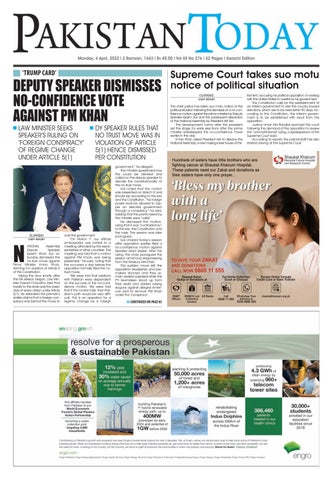
Deputy Speaker DiSmiSSeS no-confiDence vote againSt pm khan g
law MiNiSter SeekS Speaker’S ruliNg oN ‘foreigN coNSpiracy’ of regiMe chaNge uNDer article 5(1)
ISLAMABAD
n
staff report
atioNal assembly Deputy Speaker Qasim khan Suri on Sunday dismissed the no-trust move against prime Minister imran khan, terming it in violation of article 5 of the constitution. taking the floor shortly after the Na session began, law Minister fawad chaudhry said that loyalty to the state was the basic duty of every citizen under article 5(1). he reiterated the premier’s earlier claims that a foreign conspiracy was behind the move to
g
Dy Speaker ruleS that No truSt Move waS iN violatioN of article 5(1) heNce DiSMiSSeD per coNStitutioN
oust the government. “on March 7, our official ambassador was invited to a meeting attended by the representatives of other countries. the meeting was told that a motion against pM imran was being presented,” he said, noting that this occurred a day before the opposition formally filed the notrust move. “we were told that relations with pakistan were dependent on the success of the no-confidence motion. we were told that if the motion fails, then pakistan’s path would be very difficult. this is an operation for a regime change by a foreign
government,” he alleged. the minister questioned how this could be allowed and called on the deputy speaker to decide the constitutionality of the no-trust move. Suri noted that the motion was presented on March 8 and should be according to the law and the constitution. “No foreign power shall be allowed to topple an elected government through a conspiracy,” he said, adding that the points raised by the minister were “valid”. he dismissed the motion, ruling that it was “contradictory” to the law, the constitution and the rules. the session was later prorogued. Suri chaired today’s session after opposition parties filed a no-confidence motion against Speaker asad Qaiser. after the ruling, the chair prorogued the session amid loud sloganeering from the treasury benches. this sudden move left the opposition leadership and lawmakers stunned and they remain seated surprised while the pti lawmakers stood up from their seats and started raising slogans against alleged american plot to remove pM khan under the ‘conspiracy’.
CONTINUED ON PAGE 05
Supreme Court takes suo motu notice of political situation ISLAMABAD staff report
the chief justice has taken suo motu notice of the political situation following the dismissal of a no-confidence motion against the prime minister by Deputy Speaker Qasim Suri and the subsequent dissolution of the National assembly by president arif alvi. the development came after the president set the stage for early elections after the prime minister sidestepped the no-confidence move earlier in the day. imran khan asked president alvi to dissolve the National assembly, or law-making lower house of par-
liament, accusing his political opposition of working with the united States to overthrow his government. the constitution calls for the establishment of an interim government to see the country toward elections, which are to be held within 90 days. according to the constitution, the interim government is to be established with input from the opposition. Justice umar ata Bandial reached the court following the demand of the opposition to review the “unconstitutional” ruling, a spokesperson of the Supreme court said. according to reports, the judicial staff has also started arriving at the Supreme court.
02
Monday, 4 April, 2022 | KARACHI
NEWS
No plAN to dISSolvE pA, EvERythINg to bE ClEAR IN CM’S ElECtIoN oN ApRIl 06: pARvEz ElAhI LAHORE
S
StAff RepoRt
PEAKER Punjab Assembly Chaudhry Parvez Elahi has said that there is no plan of dissolving the provincial assembly and everything will be clear in Chief Minister’s election on April 06. While talking to media persons along
with Muhammad Basharat Raja, Hafiz Ammar Yasir and other members of the provincial assembly outside the Punjab Assembly on Sunday, he said we were fully prepared and our numbers were higher than the opposition. Earlier, after the uproar and commotion of PML-N in the Punjab Assembly, the Deputy Speaker had no option but to adjourn the session till April 6. When the election
Economy can’t bear brunt of political instability: SAARC CCI ISLAMABAD tLtp
SAARC Chamber of Commerce and Industry has said that political stability is of paramount significance for sustained economic growth to confront the impending multiple challenges. Taking to a delegation of trade leaders led by President United Business Group Zubair Tufail on Sunday, President SAARC CCI Iftikhar Ali Malik said that Pakistan’s bleak economy cannot bear the brunt of political instability and go with politics of confrontation at this crucial juncture of time of Covid-19 aftermath. He said that political instability casts a negative impact on economic growth and especially it further weakens the shattered economy of underdeveloped countries. It is vividly evident from the facts that mostly international players create such types of sorry state of affairs to achieve their nefarious designs for their vested interests, he said adding, it is indeed important to bolster exports to maximum extent coupled with ease of doing business so that our products can remain competitive in the global markets. He said that Allah has blessed Pakistan with abundant natural resources and rich mineral deposits which must be fully exploited for prosperity, progress and development. He said consistency in the government policies always mattered a lot and another key factor is a clear roadmap to move forward. He was of the view that entire private sector including the industrial sector should discharge their national obligations and play their role in strengthening the economy while on the other hand, he urged the government to introduce afresh reforms and control the smuggling of raw material and finished goods besides clamping complete ban on imports of unnecessary items devouring hard earned foreign exchange. Other eminent members of the delegation included Zafar Bakhtawari, Dr Mirza Ikhtiar Baig, Khalid Tawab,Gulzar Feroz,Shaikh Riaz and Dr Nouman etc.
Incompetent opposition made Imran even more popular: Rasheed
process started, those who were elected on PTI tickets, our people went and told them that this is not your place. When they started coming towards us, the opposition members attacked them and then everyone saw what happened. Ch Parvez Elahi said that he has a very old and friendly relationship with Chaudhry Sarwar. Whatever he says, I will not say anything against him. Allah knows what the
Oil futures dip 13pc on weekly basis as wild ride continues ISLAMABAD tLtp
Crude oil futures dipped up to 13 percent on a week-on-week (WoW) basis, with prices posting their largest one-week percentage loss in nearly two years and continuing their wild ride amid the Russia-Ukraine conflict. Prices declined on the back of the largest-ever release from US crude reserves and news of a coordinated release by other International Energy Agency (IEA) members from emergency stockpiles. Brent, the international benchmark for two-thirds of the world’s oil, edged lower by $16.26 (-13.48 percent) to $104.39 from $120.65 on a week-onweek (WoW) basis. The West Texas Intermediate (WTI), the main oil benchmark for North America, went down by $14.63 a barrel (-12.84 percent) to $99.27 from $113.90 on a weekly basis. The price for Opec Basket slipped marginally from $118.72 to $107.74 on
ISLAMABAD StAff RepoRt
The Federal Board of Revenue (FBR) has decided to allow tax exemption to industries located in erstwhile FATA/PATA on the basis of quota determined against installed capacity. According to a media report, an important meeting was held at FBR headquarters on Friday last wherein Chairman FBR Dr Muhammad Ashfaq Ahmed reviewed progress regarding determination of quota for import of raw material on the basis of installed capacity for the industrial units located in erstwhile FATA/PATA. The participants of meeting were informed that out of total 140 units of steel , oil and ghee, plastics and textile etc. in erstwhile FATA/ PATA identified for joint survey for determination of manufacturing
Minister for Interior Sheikh Rasheed Ahmed maintained Sunday that Prime Minister Imran Khan had become very popular due to the incompetence of the opposition. “When Imran Khan comes out [of Parliament], they [the opposition] will arrest him. His arrest will trigger new protests in the country. How will 172 people [parliamentarians] compete with 220 million people?” said Ahmed. “Democracy is in danger; ‘system’ can also be wrapped up; there may be new elections; there may be 155 resignations,” he added. The interior minister’s statement comes in a scenario when the opposition appears quite confident to remove Prime Minister Imran Khan through a vote of no-confidence in the Parliament. On the other hand, the opposition in Punjab Assembly also seems poised to gain a victory in the election of the new leader of the House after the resignation of former chief minister Usman Buzdar.
by $11.47 (-10.98 percent) to $92.97 from $104.44 on WoW basis. Similarly, Arab Light prices witnessed a decrease of $14.28 (+12.15 percent) to reach $103.22 from $117.50 a barrel on a weekly basis. The oil prices extended their loss from Thursday when US President Joe Biden authorised the release of 1 million
capacity, reports about 58 units have been sent to the FBR, while reports of 20 more units were in the pipeline. The director general IOCO stated that the survey and reports on the remaining units will be completed in a couple of weeks. Chairman FBR directed that exercise/survey to determine the installed capacity needed to be completed by April 15, 2022 positively. It was also decided that exemptions under Sixth Schedule of Sales Tax Act, 1990 and Income Tax Ordinance, 2001 will not be available to industrial units beyond their quota determined on the basis of their installed capacity after April 15, 2022. It was reported that some industrial units were delaying the exercise on frivolous grounds. However, such units will not be allotted any quota to import raw materials after completion of the exercise.
The chairman FBR reiterated that the business community should play its positive role to complete this survey so that misuse of exemption of taxes in these areas could be discouraged and thus a level playing field may be ensured to industries located in all parts of the country. It is pertinent to mention that at the time of merger of erstwhile Federally Administered Tribal Areas/Provincially Administered Tribal Areas in Khyber Pakhtunkhwa in 2018, tax exemptions had been granted to these areas for 5 years up to June 30, 2023. Currently several industrial units located in these areas are manufacturing different goods including Iron & Steel, Plastic, Ghee, Textile, Plastic etc. These units import raw material through sea port at Karachi without payment of Sales Tax
and Income Tax. However, these units are required to sell the finished goods only in the newly merged Districts of erstwhile FATA/PATA and not in the tariff areas/other Districts of the Province or in other Provinces. To frustrate and prevent the misuse of the facility of exemption of taxes on the import of raw materials by these units, different measures are being taken by FBR including escort of containers from Azakhail Dryport to the location of the concerned unit. The meeting was attended by Member IR Operations, Member IR Policy, Member Customs Policy, Director General Input Output Coefficient Organization (IOCO), Chief Commissioner Peshawar, Chief Collector Khyber Pakhtunkhwa, concerned Collector Customs, Commissioner IR, Director IOCO and other senior officers of FBR.
A day to remember M A NIAZI
ISLAMABAD
a week-on-week basis, showing a decrease of $10.98 (-9.25 percent). The OPEC Reference Basket of Crudes (ORB) is made up of Saharan Blend, Girassol, Djeno, Zafiro, Rabi Light, Iran Heavy, Basra Light, Kuwait Export, Es Sider, Bonny Light, Arab Light, Murban and Merey. The price of Russian Sokol slipped
barrels of oil per day for the next six months from the US Strategic Petroleum Reserve. The move could keep a lid on prices in the near term, analysts said, but they see it as only a temporary fix for tight global supplies, especially as the war in Ukraine grinds on. Members of the International Energy Agency, which includes the US, most of Europe, Canada, Mexico, Japan and South Korea, said that they’ve also agreed to release oil from their emergency reserves, to join the US move. The IEA plans to release details on the release early next week. The last week also saw an Opec+ meeting that rubber-stamped a previously agreed plan that will lift its production target by 432,000 barrels a day in May. The Opec+, which includes the Organisation of the Petroleum Exporting Countries and allies including Russia, continues to snub calls from the US and other western powers to raise output to quell the tight market conditions and remains disciplined in this high price environment.
FBR decides exemption for merged districts industries on quota basis
CITY NOTES
StAff RepoRt
future of Chaudhry Sarwar will be. The Prime Minister did me a favor six days ago. You have been enjoying the governorship for three and a half years. Think about it. Responding to a question, Speaker Ch Parvez Elahi said that both Abdul Aleem Khan and Jahangir Tareen have been disengaged. Aleem Khan should quit this job and work for the societies. The whole scenario will be cleared on April 6.
The conspiracy gainst Usman Buzdar has succeeded. Imran Khan was being a little sparing with the truth when he said that the conspiracy was meant to get him removed from office. That was merely a sort of distraction. The real purpose was to end one of the most successful periods in office of any Chief Minister. Imran tried to foil the conspiracy by substituting Ch Parvez Elahi, but he would be the first to notice that, having many fine qualities as he does, Ch Parvez lacks two essential qualities which made him such a fine chief executive of the province. First, Ch Parvez has done nothing for the art of writing with his feet. Sardar Usman had more or less single-handedly revived this art, comparable to Imran’s own great contribution to human civilisation, the art of reverse spin. To this, I don’t
know if Ch Parvez can oppose to either, even the art of balancing a pencil on his nose. Another thing about Sardar Usman that Ch Pervez lacks is intellectual brilliance. The feasts of reason and flows of soul which happened wherever Imran came to Lahore, and whenever Buzdar went to Islamabad, were tremendous. To hear these two speculate on the implications of string theory for quantum physics, or discuss the ramifications of game theory when applied to macroeconomics, was an education in itself. Ch Parvez is no slouch, having attended FC College in his salad days, but he is also a typical Jat. Jats are a little suspicious about intellectual brilliance, even in themselves, let alone others. Generally, Jats don’t rule in Punjab. I wonder if the break up of Indian Punjab, with Himachal Pradesh and Haryana hived off, was done because Jat rule was inevitable there. Here, we’ve had only Sardar Arif Nakai. Before that, we have to go all the way
back to Maharaja Duleep Singh. Once a Jat, Ch Charan Singh, did become Prime Minister of India, but he dissolved before getting a vote of confidence. Still, neither Sardar Usman, nor his hero, have made the kind of plaintive speech that Riachard Nixon made in 1962, when he lost the California gubernatorial election, after losing the 1960 presidential election: “You won’t have any Nixon to kick around any more.” Nixon made a comeback, becoming President in 1968, but then he resigned in 1974, just ahead of the impeachment that loomed so certainly. Imran is not going to go quietly into the night. And nor will Buzdar. Imran is a cricketer, so he won’t go. In cricket, only one Test has been ever conceded. Normally, even if the result is writ clear, the losing side bats on doggedly, and the winning team has to score those runs, or take those wickets. That has developed the trope of the ‘glorious draw’, when somehow, the predicted doesn’t happen, and the losing team manages to obtain a draw.
However, Sunday’s events showed that he worked for neutral umpires in his cricketing days not because he wanted more fairness, but to make sure that all of those close catches and LBWs he appealed for, were not turned down. Fast bowlers are not just big fit guys, but they also have a streak of aggression in them. The motion of no-confidence clause in the Constitution has been shown to be just a useless decoration. If a PM loses his majority, he needn’t fear it. In fact, I don’t see why we need to have elections. Maybe the next step would be to find out how to circumvent death. Maybe Imran can still get the yout vote 1000 years from now. Well, not ote. In 3022, the 2018 election will look a long way away. Anyway, April 3 will go down in history as the day Pakistan was saved. Imran made a big mistake by dissolving, for it was a violation of the mandate given to him, which was an expression of the gratitude the country felt for him after the 1992 World Cup.
Monday, 4 April, 2022 | KARACHI
NEWS
ExpoRt-oRIENtEd StRAtEgIES Sought to AChIEvE $30bN tARgEt ISLAMABAD
b
StAff RepoRt
USINESS community has stressed the urgent need for evolving more export-oriented strategies to achieve the $30 billion export target by the end of the current fiscal year 2021-22. They said this while addressing a round table conference on “Pakistan Export Strategic” organised under the aegis of intellectuals council of Pakistan on Sunday.
Addressing the round table, former senior vice president of Lahore Chamber of Commerce and Industry (LCCI) Meher Kashif Younis said that export strategy must involve better integration with regional and global markets and it is also imperative to make domestic business globally competitive. He said export growth must accompany improvement in productivity levels of domestic manufacturers as they capture a greater share in the world market. He said the lack of capabilities of Pakistani
manufacturing firms is reflected in productivity growth rates. He said the textile sector forms the backbone of Pakistani exports and generates much-needed inflows,the lack of diversification in exports has often prevented sustainable growth in total exports, he added. He said local producers must adhere to innovations to ensure that the input mix involving foreign inputs help boost exports, government policy makers often link free trade agreements with export potential not realising that FTA can
SCBA, PBC find dismissal of no-trust motion suspicious NEwS DESk As the National Assembly goes to vote on Prime Minister Imran Khan’s fate on Sunday (today) amid rising political temperatures, premier lawyers’ bodies have smelled a rat in the “sleight of hand” strategies the ruling party reportedly plans to deploy. The Pakistan Bar Council (PBC) — the regulatory body of lawyers — and the Supreme Court Bar Association (SCBA) — the prestigious lawyers’ body — have expressed serious apprehensions over the government’s tapping into the legislative ambiguities and underdefined provisions to turn tables on the opposition. The PBC, in a statement, warned that the political volatility may well serve as an opportunity for the ‘non-political’ forces to derail the democratic setup of the country. PBC Vice-Chairman Hafeez-urRehman Chaudhry noted that prevailing political tensions can pave a way for democratic irritants to take advantage of the already fragile democracy of the country. Referring to the ruling party’s attempts to prolong the matter, Hafeez said that delaying the constitutional process of noconfidence motion on “flimsy pretexts, most likely on the behest of democratic irritants, can put the country in an irrecoverable situation”. The vicechairman called upon the Chief Justice of Pakistan (CJP) to take notice so as to ensure that the no-confidence motion takes place as per the democratic tradition, irrespective of its result. He urged the CJP to make sure the
process takes place smoothly in order to ensure the supremacy of the Constitution, rule of law and in the best interest of democratic and constitutional norms. Meanwhile, Supreme Court Bar Association (SCBA) has urged the NA speaker to hold the election of a new prime minister immediately after the completion of the no-confidence motion process on Sunday (today). In this regard, the President SCBA Ahsan Bhoon said that the president should not misuse Article 94 of the Constitution which says that the president is entitled to ask the PM to continue to hold office until his successor is sworn in. Earlier, Interior Minister Sheikh Rashid Ahmad had indicated that the president would invoke Article 94 of the Constitution, enabling PM Imran to continue occupying the office. The SCBA president, citing Article 91 (3) of the Constitution, emphasised that the NA speaker was bound by the law to hold elections for the next prime minister immediately after the completion of the no-confidence motion process. He also said that PM could not do official work in case Article 94 of the Constitution is invoked. Bhoon went on to say that PM Khan was apparently seeding grounds for an anarchic situation and extra-constitutional steps. Lawyer Hafiz Ahsaan Ahmad Khokhar said that Article 94 of the Constitution provides a mechanism and gives discretion to the president to ask the outgoing prime minister to continue occupying the office.
However, he added, this discretion was subject to a limited period, adding that it could not be stretched to a longer period or invoked on personal whims. “The president is constitutionally bound to call NA session as soon he receives the results declaring that the current premier has lost the majority by receding information through secretary National Assembly under rule 38 of conduct and business National Assembly.” Khokhar also said that if the prime minister fails to survive the vote of confidence and loses the majority then his cabinet would also be dissolved immediately. The senior lawyer, however, said that in case of disqualification by a court, he cannot be asked to carry on. But in all other cases he can be asked to continue till a successor is appointed, he added. Renowned legal expert Reema Omer in her tweets said that Article 94, which allows the president to request the prime minister to continue to hold office until a successor is appointed, is applicable only when PM resigns – not ouster after voting of no confidence. She highlighted that in case the premier loses the majority, he ceases to hold office and NA has to elect a new PM. She further said that when PM resigns, the president has a role to play as the resignation is made to the president under Art 91(8), adding that if a vote of noconfidence is successful, the prime minister immediately “ceases to hold office” under Article 95(4) – the president has no role or authority to ask him to continue.
03
the economy must address the lack of capabilities, innovation and low productivity to achieve economic turnaround. She said more interestingly Vietnam made significant strides in improving its exports in the last 35 years and its exports as a percentage of GDP was at 3.95 percent in 1988 that’s much below 13.9 percent of Pakistan in the same year, she concluded. Other speakers who shared their life long practical experiences included Dr Ehsan Malik, Dr Nosheena Saleem, Dr Waqar Chaudhry and Ms Saba Aalam Butt.
help businesses achieve a better mix of foreign inputs and help improve productivity levels. Meher Kashif Younis said even the Pakistani textile sector has a lower share in global trade; however, since the recovery phase of the pandemic, Pakistani exports are hitting new highs with $23 billion exports in the last three quarters of the current fiscal year . The host Rameen summing up the conference in the light of recommendations of experts said in essence a policy paper on
Nawaz says ‘Imran is guilty of ‘high treason’, should be tried under Article 6 NEwS DESk Former prime minister Nawaz Sharif on Sunday said that Prime Minister Imran Khan and all characters involved in the “conspiracy” against the nation are guilty of high treason and should be tried under Article 6 of the Constitution. The former premier’s remarks came after President Arif Alvi approved the advice of Prime Minister Imran Khan to dissolve the National Assembly after a summary was sent by the premier in the wake of a no-trust move against him. “The President of Pakistan, Dr Arif Alvi, has approved the advice of the Prime Minister of Pakistan to dissolve the National Assembly under the Article 58 (1) read with Article 48(1) of the Constitution of the Islamic Republic of Pakistan,” according to the short statement issued by the President’s Secretariat. “Today, a man obsessed with power trampled the Constitution,” Nawaz wrote on his official Twitter handle. Nawaz, who is also the supreme leader of the Pakistan Muslim League- Nawaz (PMLN), said that Imran Khan and all characters involved in the “conspiracy” against the nation are guilty of high treason and should
be tried under Article 6 of the Constitution. He warned that anyone involved in any wrongdoing with the country and desecration of the Constitution will be taken to task. National Assembly Deputy Speaker Qasim Suri had earlier dismissed the noconfidence motion submitted by the joint opposition, terming it “unconstitutional” under Article 5. In a talk with the media, PPP Chairman Bilawal Bhutto-Zardari said the deputy speaker committed an ‘unconstitutional act’ by dismissing the no-trust motion against the premier. Pakistan Muslim League-Nawaz (PMLN) President and Leader of Opposition in the National Assembly Shehbaz Sharif termed Imran Khan a traitor to the Constitution and democracy. Shehbaz said that Article 6 is now applicable to “Imran Niazi and his followers for openly violating the Constitution”. He referred to the PM’s actions as anarchic and urged the chief justice of Pakistan to save the country from the crisis. “It is hoped that the Supreme Court will ensure the supremacy of the Constitution and fulfil its duty to protect the country from this violation of the Constitution,” the leader added.
‘Surprise’: PM says opposition taken aback by his no-trust move APP
top pakistan, turkish diplomats discuss no-confidence developments ISLAMABAD ANAdoLu AgeNcy
The Pakistan and Turkish foreign ministers discussed the latest developments in Pakistan, the Turkish Foreign Ministry said on Sunday. Shah Mahmood Qureshi and Mevlut Cavusoglu talked over the phone ahead of a scheduled voting on a no-confidence motion against Pakistan’s prime minister. The deputy speaker of parliament on Sunday, however, “rejected” the motion, terming it “unconstitutional.” Following the deputy speaker’s ruling, Prime Minister Imran Khan said he has sent an advice to the president to dissolve the country’s parliament and to call fresh elections. The combined opposition, led by the Pakistan Peoples Party (PPP) and Pakistan Muslim League-Nawaz (PML-N), had submitted the noconfidence motion against Khan on March 8, contending that the prime minister has lost the trust of the majority of lawmakers.
Prime Minister Imran Khan has said that opposition parties seemed ‘taken aback’ after the National Assembly deputy speaker blocked their move to overthrow his government through a no-confidence vote. “I want to remind you all that I told you yesterday evening that don’t panic… the opposition still wondering as to what happened to them,” the premier remarked while addressing the PTI leaders in Islamabad on Sunday. The premier told the party members if he had disclosed his strategy to foil the opposition’s no-trust motion last night, the opposition would not be as shocked by his counter move as they appear now. PM Imran said the assembly’s proceedings on the matter of no-trust motion and his party’s strength in the lower house of parliament became “irrelevant” after it was established that opposition’s move to overthrow him was part of a “foreign conspiracy”. PM Imran said National Security Committee (NSC) meeting, the country’s highest security body, also noted that a foreign interference was made into the internal politics of the country through a no-confidence motion. He said minutes of the communiqué regarding a meeting between the ambassador of Pakistan in the US and the US officials were shared in the NSC
meeting. The prime minister said a plan was perpetrated outside Pakistan to interfere into internal politics of the country. The embassy officials of the foreign country were also in contact with the PTI members who had defected, he claimed. PM Imran suggested on the eve of
crucial NA session that he might not accept the result of no-trust vote to oust him. “How can I accept the result when the entire process is discredited?” he told a select group of foreign journalists at his office. “Democracy functions on moral authority – what moral authority is left
after this connivance?” “The move to oust me is blatant interference in domestic politics by the United States,” the premier said, terming it an attempt at “regime change”. PTI Senator Faisal Javed Khan also shared a photo of the prime minister after the ‘surprise’ move.
Monday, 4 April, 2022 | KARACHI
04
NEWS
IMRan aCtED LIkE a DICtatOR tO wRaP UP DEMOCRaCy: FazL
Orange Line Metrodriver rewarded for outstanding CPEC performance ISLAMABAD Staff RepoRt
Orange Line Metro-driver Muhammad Shah Zareen Khan who received prize as an outstanding CPEC staff member says he is proud of his work. The year 2016 was the darkest period for him. The aggravating illness of his mother and mounting medical expenses put him under considerable pressure. “I had lost my father, and I couldn’t imagine what life would be like without my mother”, Muhammad recalled when talking to media. In dire need of a well-paid job, Muhammad Shah Zareen Khan, hailing from Sharaq pur, a small city of Punjab, joined the Orange Line Metro Train project which was launched in September 2015. His main job was to drive the Chinese officials to and from the meeting venues and the airports. Focus, control, and speed, Muhammad Shah Zareen Khan shuttles in the Lahore city, with views outside the window flashing by. He is no stranger to the fleeting scenery. As a veteran driver and a travelling enthusiast, he had driven around the northern area of the province numerous times. From twisting mountain roads to deep valleys, he feasted his eyes on the splendid scenery in nature. When asked about the most difficult part of driving, he said, “to make the right at every crossroad”. “My interest in driving was developed in college, when I drove the school van for three to four years. That was the point I learned to manage difficulties in life responsibly because I had to pick or drop children from school or home at any cost”, Muhammad told media. Having learned how to drive 25 years ago, Muhammad didn’t go into this profession right after graduation. In an agriculture-based country, Muhammad tried different professions, from farmer, to pesticide seller, to shop keeper. “For me, it is an inspiring experience to get exposed to various landscape and people through working and travelling. It also helps with my driving, because to be a driver is not all about manipulating a car. It’s also about getting in touch with different people from different backgrounds and feeling the impulses of the city”, Muhammad said. He became a regular visitor of meeting venues and airports, and kept updated about the Orange Line project in an usual way. In his connection with the Chinese officials of the project, he has a chance to feel in person the “Pakistan-China friendship” that he had only seen in textbook. “I was treated as an equal, a brother. I feel respected on the driver’s seat, and honored to receive the prize as an outstanding CPEC staff member”. Muhammad drove 400 to 500 km per day, with Special Protection Squad (SPU) alongside to ensure their safety. As the milage of his car accrued, the tracks of Orange Line became longer and longer. Never been a speaker on one of those meetings he drove to or a worker laying the tracks, Muhammad was involved in the project in a unique way. “I’m part of this historical project, and luckily, I can also adopt a standby’s view, watching it evolve day by day, year by year. I was amazed by the ‘Chinese efficiency’. I have never seen a mass transit system under construction, and every day, I was surprised to see its rapid progress”. Six years ago, he was driving with the rumbles of construction machinery working on the Orange Line, and now, around his ears is the roaring of metros. “I’m glad I made the right choice at the crossroad of my life”, Muhammad said.
ISLAMABAD
C
Staff RepoRt
HIEF of Jamiat Ulema-eIslam (JUI-F) and head of alliance of the opposition parties, Pakistan Democratic Movement (PDM), Maulana Fazl ur Rehman has said that Imran Khan has acted like a dictator to wrap up the democratic system in the country. Talking to a private TV channel on Sunday, the PDM chief said that the selffabricated letter with claims of dispatched by a foreign country containing threats was an attempt to flee of being held accountable. Fazlur Rehman said that Balochistan Assembly was dissolved in 1988 and we moved High Court very next day after which court restored the assembly. He termed the National Assembly scenario unconstitutional, saying Deputy Speaker was not authorized to give the said ruling. Whether it was the said rule, Imran Khan was telling the nation about,
he questioned. The PDM Chief declared rejecting of the No-Trust Motion as unconstitutional. They came into power via unconstitutional means and no using unconstitutional tactics instead of facing the defeat, he added. Fazlur Rehman said that after PTI’s
defeat during first step of local government elections in Khyber Pakhtunkhwa (KP), the government utilized all public resources. Free and fair election was our demand and goal from day first and democracy can’t be run by creating crisis, he added.
Food prices rise in KP as Ramazan begins
Imran Khan following Pervez Musharraf’s footsteps: Musadiq Malik Meanwhile, leader of Pakistan Muslim League-Nawaz (PML-N), Musadiq Malik has said that Imran Khan is following the footsteps of military dictator General (Retd) Pervez Musharraf. In a statement issued on Sunday, he said that both Imran Khan and Pervez Musharraf violated the constitution of the country. Musadiq Malik said that Governor Punjab was asked to dissolve assemblies and was removed over refusal. Today the national assembly removed PM Imran Khan and Speaker NA alleged the assembly members, he added. The PML-N leader further stated that Imran Khan was trying to create constitutional crisis in the country. Commenting over the letter which the government claimed to an international conspiracy against PTI, Musadiq Malik said that letter was not made public till No-Trust move against government was planned.
Rupee depreciates 1.27pc against USD for 8th straight week KARACHI Staff RepoRt
PESHAWAR aziz BuneRi
With the start of Ramazan, food prices across khyber Pakhtunkhwa (KP) have increased by 50%, making it difficult for consumers even to buy groceries. Fruits and vegetables dealers are charging exorbitant prices as the administration has failed to implement the official price-list. Hashim Khan, a resident of Peshawar, said that the government and the district administration had failed to control the prices of food items in the holy
month of Ramazan. According Khan, tomatoes has gone up from Rs100 per kg to Rs200 whileonion, garlic, lemon have also witnessed 100 percent hike on the very first day of Ramazan. The districts administration have issued price-list but unable to keep check on the market and stop the artificial shortage and price-hike. Thus, banana was available at Rs180 per dozen apples Rs400, strawberry Rs300 and watermelon was available at Rs100 per kilogram. Despite repeated measures and announcements by the
provincial government to control inflation during Ramazan, food items, common men are unable to get essential food items at affordable rates. The government claims to have established hundreds of subsidised markets in the province to provide essential items on affordable rates. But the consumers were not satisfied with government efforts. According to Shakeel Khan, a daily wage laborer, He barely earned Rs700 per day but it is not enough to purchase the basic food items for one day consumption of his family.
Rupee slipped 1.27 percent (-Rs2.31) against the US dollar for the eighth straight week due to political uncertainty in the country and surging oil and commodity prices globally amid Russia-Ukraine war. The rupee slipped from 181.72 to Rs184.09 against the American currency in the interbank market last week. The rupee set two all-time lowest levels of 178.63 and 178.61 against the US dollar during the week. The rupee has set 15 all-time lowest levels in the interbank market against the greenback during the last 17 sessions. Overall, the rupee shed Rs2.31 during the last five days of this week, while the local unit devalued by Rs26.66 during the ongoing fiscal year 2021-22 and Rs7.64 during the current year 2022. Within the open market, the rupee fell from 182/183 to 184.50/185.50 per dollar during the week. The rupee remained on the back foot throughout the week, depreciating by 41 paisas (-0.23 percent) on Monday, 15 paisas (-0.08 percent) on Tuesday, 30 paisas (-0.16 percent) on Wednesday, 84 paisas (+0.46 percent) on Thursday and 61 paisas (-0.33 percent) on Friday. According to currency dealers, political instability in the country, lingering talks with the International Monetary Fund (IMF) and higher commodity prices in the global market have badly hit the stability of the rupee in the interbank. They said that political uncertainty has created a negative sentiment overall for the economy and this has been negatively impacting the rupee value against the dollar. They also attributed import payments as a factor contributing to fall of the rupee. They said the pressure on the country’s foreign exchange reserves pushed by draining of dollars from stocks and government securities has also played havoc with the rupee value. The SBP reported a day earlier that foreign exchange reserves of the country dropped by $2.9 billion (13.48 percent) on a week-on-week basis to reach $18.55 billion.
PSX may feel political turmoil heat after best week in 20 months KARACHI tLtp
Pakistan Stock Exchange (PSX) is likely to feel the heat of political turmoil in the week starting today (Monday) after having the best week of the last 20 months. The benchmark KSE-100 Index gained 1,601 points (+3.7 percent) last week to settle at 45,152.11 points, as investors cheered the decline in international oil and coal prices, which fuelled a rally at the bourse. President Dr Arif Alvi on Sunday approved the advice of Prime Minister Imran Khan to dissolve the National Assembly under the Article 58 (1) read with Article 48(1) of the Constitution of the Islamic Republic of Pakistan. Earlier, the incumbent PTI government and the opposition tried to gather allies amid a vote of a no-confidence motion against the prime minister in the National Assembly. The KSE-100 is currently trading at a PER of 4.9x (2022) compared to the Asia-Pacific regional average of 12.3x while offering
a dividend yield of 8.4% versus 2.5% offered by the region. The market largely digested the political developments last week, coupled with a decline in international oil and coal prices (which garnered interest in the cement sector) bringing back the bulls, as concerns over inflation ceded. Although some shuffling in support by minority parties in the midweek added pressure, the market witnessed a noteworthy jump of over 1,000 points. Market players ignored all negative cues, including historic low rupee value against the US dollar, inconclusive talks with the International Monetary Fund (IMF), depleting foreign exchange reserves and rising inflation which jumped to 12.7% in March. Other major developments during the week were: Lucky Cement unveiled a solar project, Economic Coordination Committee approved local gas supply to two urea plants, Oil and Gas Regulatory Authority (OGRA) took up issues relating to Price Differential Claims (PDC), international freight equalisation margin (IFEM) with stakeholders, Mari Petroleum Company commenced production
at Sachal gas processing complex, banks and DFIs approved Rs435 billion loans under Temporary Economic Refinance Facility (TERF), revealed SBP governor, Asian Development Bank signed $300 million loan deal for Pakistan’s market development programme, and Ghandhara commenced booking for newly-launched SUVs. Meanwhile, foreign selling continued this week, clocking in at $15.55 million against a net sell of $4.12 million recorded last week. Selling was witnessed in commercial banks ($13.7 million), and fertiliser ($0.6 million). On the domestic front, major buying was reported by banks/DFIs ($15.7 million), followed by individuals ($7.5 million). During the week under review, average volumes clocked in at 310 million shares (up by 116% week-on-week), while average value trade settled at $44 million (up by 72% week-on-week). Sector-wise positive contributions came from cement (+266 points), commercial banks (+241 points), technology and commu-
CMYK
nication (+182 points), fertiliser (+152 points), and power generation and distribution (+111 points). On the flip side, negative contributions came from leather and tanneries (9 points), and leasing companies (-1 point). Scrip-wise major gainers were Systems
Limited (+129 points), Lucky Cement (+129 points), Millat Tractors (+69 points), Hubco (+68 points) and Engro Corporation (+6 points). Meanwhile, major losers were Colgate-Palmolive (-16 points), Services Pakistan (-9 points), and Engro Fertilizer (-6 points).
Monday, 4 April, 2022 | KARACHI
NEWS Usman Buzdar holds farewell meeting with staff members of CMO LAHORE
‘TrUMp CArd’: depUTy SpeAker dISMISSeS nO-COnfIdenCe vOTe AgAInST pM khAn cOntinuEd fROm pAgE 01
staff report
Punjab Chief Minister Sardar Usman Buzdar held a farewell meeting with the staff members of CM Office on Sunday and thanked them for their cooperation. The chief minister acknowledged their services and appreciated them for performing their duties vigilantly day and night. He also praised them for nicely fulfilling their responsibilities with dedication. While talking with the staff members, Usman Buzdar remarked that he would never forget their love adding that he is departing from CM Office by carrying along pleasant and fond memories. He stated that his doors were open for them in the past and would remain so in future as well. Staff members expressed their good wishes for CM and prayed for his future wellbeing as he always gave them love and respect. Principal Secretary to CM and Secretary Coordination were also present on this occasion.
Bilawal says ‘Imran will be dealt with according to Article 6’ Pakistan Peoples Party (PPP) Chairperson Bilawal BhuttoZardari on Sunday said that Prime Minister Imran Khan will be dealt with according to Article 6 of the Constitution as “the prime minister, speaker, deputy speaker, president, and anybody involved in this act today have committed high treason”. “There is no space in our Constitution for them to dissolve the assembly, issue a notification to dissolve the assembly while we bringing a vote of no-confidence against the PM,” Bilawal said while speaking to a private media outlet. “There is no space in the Constitution for them to not hold the vote of no-confidence today. There is no space in the constitution, rules of the National Assembly, democracy and law that allows them to run from the session today.” “We are recording our protest in the Parliament. We have demanded of the Supreme Court of Pakistan and all those institutions responsible for the protection and implementation of the Constitution to do so and accept our no-confidence that is legal,” said the PPP chief. Referring to Ayaz Sadiq taking the chair of the speaker, the PPP chairperson said, “It was their own decision to have Ayaz Sadiq on the panel of the Chair. Following the policy of the House, Ayaz Sadiq has chaired the session of the National Assembly. When the Speaker is not present, neither is the deputy Speaker, it is the responsibility of the one nominated on the panel to conduct the session. The vote of no-confidence took place and we secured 195 votes.” Bilawal hoped that the judiciary will not let any unconstitutional act take place and added that the opposition hoped the Supreme Court would “correct” the attack on the Constitution. “The PM has committed treason to run from the no-confidence. We have proved that the majority is with us. We will not let Pakistan be run on the rule of the jungle.” “The prime minister and the speaker are not even aware of how grave the act they have committed is,” he said, adding that Raza Rabbani, Farooq Naek, Nayyer Hussain Bukhari along with others were preparing a petition. “It is not possible for the Supreme Court to not stand with us. It is bound to stand with and defend the Constitution,” he added. “We submitted a noconfidence motion against the speaker too after which he cannot even prorogue the session,” the PPP chief said referring to the no-trust motion against the speaker submitted earlier in the day. “Imran Khan is trying to become a carbon copy of Shaheed Zulfikar Ali Bhutto. It is ridiculous. Shaheed Zulfikar Ali Bhutto never abrogated the Constitution,” he said, adding, “We were the ones who drafted it. He did not abrogate the Constitution even to save his life. He said that he would not expose national secrets even if it meant that he would lose his life. This is nationalism and patriotism.” Bialwal said, “Do the Pakistani people want for things to take place according to the constitution or a person’s ego? Pakistan has become a banana republic before the world today. We will not let Imran succeed in this conspiracy.” “It is Imran’s disillusion just like that of Musharraf that he would succeed after creating a law and order situation. Justice Waqar Seth clearly wrote in his order what the punishment of traitors is.” Speaking about the foreign conspiracy, Bilawal said, “As far as the foreign conspiracy is concerned, all are witness to how our efforts have always been to remove this undemocratic man. Long before the PM went to Russia, I and my father went to Shehbaz Sharif to form a consensus. Even before that, we had our CEC meeting where it was decided to proceed with the long march and no-confidence.” He said that even in September 2020, when the PDM was being formed, the no-confidence vote against the premier was one of the points. “Are we psychic? Would we have known in September 2020 that there would be a conflict in Ukraine? Had this conspiracy claim been true, why did he wait till the last minute to reveal it? He should have demarched that diplomat on the very same day,” he added. staff report
05
AccorDIng to the ArtIcLe 5: Loyalty to the State is the basic duty of every citizen Obedience to the Constitution and law is the [inviolable] obligation of every citizen wherever he may be and of every other person for the time being within Pakistan However, that was not the only surprise of the day for the opposition. Shortly after the no-trust motion was dismissed, the prime minister in a brief address to the nation, announced that he had advised the president to dissolve the NA under Article 58 and asked the nation to prepare for fresh elections. The military distanced itself with the political developments in the country. “Army has nothing to do with the political process,” Major General Babar Iftikhar, the head of the military’s public relations wing, told Reuters in response to a question about the institution’s involvement in Sunday’s developments. Opposition parties, angered by the NA proceedings, decided to hold their own mock session in the lower house of parliament with PML-N’s Ayaz Sadiq sitting on the speaker’s seat. During the mock proceedings, 195 lawmakers voted in favour of the no-confidence motion, according to PPP’s Sherry Rehman. oPPoSItIon reFUSeS to LeAVe nA, cALLS rULIng ‘ILLegAL’: Leader of the Opposition in the National Assembly Shehbaz Sharif termed Sunday’s developments as “nothing short of high treason”. “Imran Khan has pushed the country into anarchy. Niazi and his cohort will not be allowed to go scot-free. There will be consequences for [the] blatant and brazen violation of the Constitution. Hope the Supreme Court will play its role to uphold the Constitution,” he said. Speaking to the media in parliament after the NA session, PPP co-chairperson Asif Ali Zardari said the ruling by the deputy speaker was “totally illegal” and that the Constitution did not allow the dissolution of assemblies at this stage. With regards to the dismissal of the no-confidence motion, he said, “The court has sat down. Let’s see what it says.” He added that “we are prepared for everything … even for elections”. To a question whether the opposition the deputy speaker’s ruling coming, Zardari replied, “Yes … but one has to go along with what their friends have thought of.” PPP Chairman Bilawal-Bhutto Zardari said that the government had violated the Constitution by not allowing voting to take place on the no-confidence motion. “The united opposition is not leaving Parliament. Our lawyers are on their way to Supreme Court. We call on ALL institutions to protect, uphold, defend and implement the Constitution of Pakistan.” PPP’s Mustafa Nawaz Khokhar termed the government’s move a “blatant violation” of the Constitution and the rules. “The Supreme Court cannot and should not sit by as a mere spectator. The chief justice should immediately take to the bench and save the country from a constitutional crisis!” In another tweet, he said that a petition was being prepared by party leaders Farooq Naek and Raza Rabbani. “We should be at the Supreme Court registrar’s office no later than 3:30pm,” he said. PML-N Vice President Maryam Nawaz said that no one could be allowed to “distort” the Constitution for the sake of saving their seat. “If this crazy fanatic is not punished for this crime, then the law of the jungle will prevail in the country after today!” PML-N’s Ahsan Iqbal said PM Imran had proven to the world that he did not possess even an “iota” of decency, grace and honour. “Having lost the majority in National Assembly, [he] chooses to bulldoze constitution. He will be defeated with unprecedented humiliation in history,” he said. Meanwhile, Amir Liaquat announced his decision to quit the PTI and called on Chief Justice of Pakistan Umar Ata Bandial to restore the National Assembly and ensure voting on the no-trust motion.
DePUtY AttorneY generAL AnnoUnceS reSIgnAtIon: Separately, Deputy Attorney General of Pakistan Raja Khalid Mahmood Khan announced his resignation over Sunday’s NA proceedings. Lashing out at the government, he said that it was a “clear abrogation of the Constitution” and fell under Article 6, which deals with treason. Speaking to Geo News, he said that it was a blatant violation of the Constitution when rules and the law were superseded. He claimed that the apex court would take action and declare the NA proceedings null and void. He predicted that the apex court would rule that the no-trust motion was still pending. oPPoSItIon getS SUPPort oF 174 MnAs: The joint opposition — primarily the Pakistan Democratic Movement (PDM) and the PPP — had submitted the no-confidence motion for the premier’s ouster with the NA Secretariat on March 8. In the days to follow, the country’s political landscape was abuzz with political activity as parties and individuals changed alliances and the PTI and opposition were seen trading barbs and allegations alongside intensifying efforts to ensure their success in the no-confidence contest. Eventually, major allies of the ruling PTI — Balochistan Awami Party and Muttahida Qaumi Movement-Pakistan — deserted the government and joined the opposition ranks which led to PM Imran losing his majority in the lower house of parliament. It was expected that if the voting went ahead, PM Imran would have lost the confidence of the house while the joint opposition had nominated Shehbaz as their candidate for the top post. Opposition lawmakers on Sunday had appeared confident of the success of the no-trust move as they made their way to Parliament House. The opposition needed the support of at least 172 lawmakers from a total of 342 to oust the premier through the no-trust move. Opposition parties had managed to cross the magical figure of 172 on Sunday, claiming to enjoy the support of 174 NA members, according to a list shared by PML-N’s Marriyum Aurangzeb. The number did not include over a dozen dissidents of the ruling PTI, who had publicly declared the withdrawal of their support to the prime minister. no-conFIDence MotIon SUBMItteD AgAInSt QAISer: Prior to today’s session, the opposition also submitted a no-confidence motion against NA Speaker Asad Qaiser. The resolution, addressed to the secretary of the National Assembly Secretariat, was submitted by Murtaza Javed Abbasi of the PML-N. The resolution carried the signatures of more than a hundred lawmakers. Bilawal, who shared an image of the resolution on Twitter, tagged the official handles of PM Imran and Qaiser, with a simple “surprise”. SecUrItY ArrAngeMentS, PtI WorKerS DetAIneD: On Sunday, giant metal containers blocked roads and entrances to the capital’s diplomatic enclave and to Parliament and other sensitive government installations in the capital. Islamabad police also detained three female workers of the PTI who were protesting and chanting slogans outside Parliament House before the start of the NA session. A day earlier. the capital administration had imposed a ban on pillion riding and suspended the metro bus service ahead of the National Assembly meeting. Officials of the capital administration said a twoday ban had been imposed on pillion riding while the metro bus service would remain suspended for one day. SUrPrISe: The opposition arrived in Parliament ready to vote Khan out of power. They needed a simple majority of 172 votes in the 342-seat House to unseat Khan. Khan’s small but key coalition partners along with a dozen of his own party members joined the opposition to oust him. An embattled Khan, who time and again, has refused to step down and vowed to contest the no-confidence motion, insisted until the last minute to have a “surprise” in store for a confident multi-party opposition alliance, which asserts that it has “more than enough” votes to oust the prime minister.
The prime minister had been facing mounting criticism of his performance, including charges of his management of an economy beset by high inflation and rising deficits, and he lost his majority in the Lower House on Wednesday when the Muttahida Qaumi Movement-Pakistan (MQM-P) quit the ruling coalition. The pro-establishment party — which threw its lot in with the opposition seeking to oust the prime minister — has seven seats in the Lower House. Khan required 172 votes to hold power with a simple majority in the 342-member Lower House. His Pakistan Tehreek-e-Insaf (PTI), which has 155 MPs in the National Assembly, had formed a coalition government with the support of five allied parties in 2018. The prime minister effectively lost the majority in parliament after three of the five allies — MQMP, Balochistan Awami Party (BAP), and Jamhoori Wattan Party (JWP) — joined the opposition ranks. According to the current tally, the PTI and its allied party, the Pakistan Muslim League-Quaid (PMLQ), and Grand Democratic Alliance (GDA), have 162 members in the Lower House, whereas the opposition claims to have the support of 199 lawmakers. ‘DIScreDIteD ProceSS’: On Saturday, Khan indicated that he would not accept an unfavourable vote. “How can I accept the result when the entire process is discredited?” he told foreign journalists at his office on Saturday. “Democracy functions on moral authority — what moral authority is left after this connivance?” “The move to oust me is blatant interference in domestic politics by the United States,” he said, terming it an attempt at “regime change”. reD Zone SeALeD oFF: Meanwhile, footage showed law enforcement personnel sealing off Islamabad’s Red Zone neighbourhood with containers and barb wires to prevent any protests during the notrust vote. The sensitive neighbourhood houses the parliament house, the supreme court, the prime minister and president offices, and other important government installations. The PTI has threatened that it would not let its dissidents vote on the no-trust motion. The Ministry of Interior has called additional 1,500 paramilitary troops to maintain law and order on the day. On the streets of Islamabad, there was a heavy police and paramilitary presence, with shipping containers used to block off roads, according to a Reuters witness. KhAn cALLS For ProteSt: Khan said that if he wins the no-confidence motion in parliament, he may call a new election. Speaking to ARY News on Friday, Khan said opposition parties sent him three options through the military establishment: resign, face a no-confidence motion, or announce a fresh election. “I will not resign,” Khan declared, adding if he wins the no-confidence vote, he may call a new election. Accusing the US, Pakistan’s longtime ally, of hatching a conspiracy to oust him for his “independent foreign policy,” he blamed the opposition parties for being “stooges of the foreign power.” Khan on Saturday asked his supporters to take to the streets across the country ahead of the no-confidence vote. “Come out of your homes today and on Sunday to protest against this big conspiracy. Protest is your right but it should be peaceful and without any violence,” he said. Responding to live questions from citizens by telephone, he said he has plans to get treason cases lodged against “perpetrators” of the conspiracy, and the party dissidents, who would vote in favour of the no-trust motion. In a related development, the government on Saturday filed a petition in a court in Lahore, seeking cancellation of a bail the court had granted to Shehbaz, who is the opposition’s candidate for the premiership, and Hamza last year in a money laundering case. The court has summoned the father and son on April 4.
Military distances itself from no-confidence motion ISLAMABAD: The institution of the military has nothing to do with the vote of no-confidence against the prime minister and how Deputy Speaker Qasim Suri declined to hear the motion into his rule, observing there had been unacceptable interference in Pakistan’s democratic institutions. When asked by Geo News if the military was on board with the government in its move to block the motion, Inter-Services Public Relations (ISPR) Director-General Maj. Gen. Babar Iftikhar “denied any sort of involvement” in the process. staff report
PM Imran urges opposition to accept early elections offer instead of supporting ‘foreign plot’ Prime Minister Imran Khan has said that he was “astonished” by the reaction of joint opposition including Pakistan Democratic Movement (PDM) leadership over his decision to call early elections. “Astonished by reaction of PDM to our calling for general elections. They have been crying hoarse about how our govt has failed & lost support of the people,” he wrote on his official Twitter handle on Tuesday.
His statement comes as opposition cryied foul after the government dissolved assemblies and called early elections as no-confidence motion to oust the PM was dismissed by the National Assembly deputy speaker. “So why the fear of elections now? Democrats go to the people for support,” the premier added. In a follow-up tweet, the PM asked the opposition parties to accept
of his decision of snap elections “rather than being part of a foreign conspiracy for regime change; and indulging in blatant purchasing of loyalties thereby destroying our nation’s moral fibre?”. Responding to PM Imran’ statement, PPP Chairman Bilawal Bhutto Zardari said, “Your coup attempt will not succeed. Early elections was our demand not yours. No confidence,
cmYK
electoral reforms, early free and fair elections is our long stated goal.” He added that the assemblies cannot be dissolved if there is a noconfidence motion pending against the prime minister or custodian of the house. “Can’t end the session without voting on the NCM [no-confidence motion]. Today you proved you are nothing but a tiny little dictator who’s ego is more important than
our Constitution. We proved we are ready to vote you out of parliament & will vote you out in elections,” he added. The PPP leader asked the premier that if opposition’s NCM was part of a ‘global conspiracy’ “then why did you implement this supposed conspiracy by unconstitutionally trying to dissolve parliament and call early elections”. staff report
06-07 Comments - 4th April 2022_Layout 1 4/4/2022 12:54 AM Page 1
Monday, 4 April, 2022
06 COMMENT
As Africa faces a ‘perfect storm’ of security challenges…
A bold step, but into the darkness Imran Khan’s ‘surprise’ might have put off his ouster, but at what cost?
T
HE national Assembly met unusually on Sunday, to vote on the motion of no-confidence in the Prime Minister. not only were opposition members not stopped on the way, as threatened, but Treasury members were also present, with the conspicuous absence of the PM himself. The motion was put for voting, but the Law Minister intervened and asked that the motion be dismissed because it had been brought as a result of an attempt by a foreign power. This aspect was not raised at the time that the motion was admitted some days ago, for voting there was no hearing of the opposition, and the deputy Speaker, who was presiding, ruled that the motion was disposed of as not valid, and then read out the prorogation order signed by the Speaker. The Prime Minister, who had not been able to dissolve the House while the motion was pending, then proceeded to announce the dissolution, though announcing no date for the poll. The President asked him to continue in office until a successor, a caretaker PM, entered upon his office. There was no sign of the constitutionally mandated consultative process with the Leader of the opposition, that would yield a caretaker PM. The dissolution hinges on the disposal of the noconfidence vote. The opposition proceeded to hold its own session of the national Assembly, and in the absence of the Speaker and deputy Speaker, got Sardar Ayaz Sadiq, one of the session’s panel of chairmen, to preside. That would be usual, but under the present circumstances, implies taking the view that the Speaker’s prorogation was illegal. True, there had been no vote on the motion, which was a prerequisite to prorogation, and there is the further question of whether the prorogation could be ordered by a Speaker under notice of no-confidence, as Speaker Asad Qaisar had been since the morning. The vote was carried out, and succeeded, as 193 members voted in its favour. The Supreme court took suo motu notice of these events, just before it was petitioned by the opposition. The chief Justice of Pakistan has constituted a five-member bench which will hear the case even as it considers the earlier petition of the Supreme court Bar Association and the federal government’s reference on the anti-floorcrossing clause. The Supreme court has constituted a five-member bench to hear the case, and notices have been issued to all concerned, which indicates that the government has achieved at least getting the matter thrown into court, where it may use lawyerly devices to prolong proceedings, and thus prolong the government’s survival. While the Supreme court may decide, as the government’s legal eagles can be heard arguing, that the courts cannot interfere in parliamentary proceedings, it is possible that the Supreme court may find itself obliged to intervene, as the President, Prime Minister, Speaker and deputy Speaker have been accused of subverting the constitution. What is the remedy for proceedings conducted unconstitutionally? That is the point at which the judiciary becomes involved. otherwise, a judicial refusal to examine parliamentary proceedings means that the PM need only have the Speaker on his side, and he would no longer be answerable to the national Assembly, because it would have no means of removing him. While judicial jurisdiction has been ousted from parliamentary proceedings to prevent every ruling on a point of order being referred to the courts, and thus creating hold-ups in proceedings, any clear violation of the constitution cannot but attract judicial notice. one of problems has been that events in Punjab have become a sideshow, though they deserve more attention. The dismissal of Punjab governor Muhammad Sarawar, and the postponement of the vote in the election of the cM on Sunday morning, and its postponement to Tueday, would have riveted attention on Lahore, had events in islamabad not been so absorbing. At the moment, it may suit Mr Khan to hold national elections without having the PTi governments in KP or Punjab dissolved. However, it would seem to provide him too much of an advantage not to be resisted. Mr Khan might find that any celebrations are premature. The political crisis so far has caused the national economy direct losses, in terms of rupee depreciation and stock market declines. The judiciary is now saddled with the can of worms, and it must decide the matter swiftly, because of the economic losses. The consequences of dragging foreign relations into domestic politics may not be reversible, and is a real loss of Sunday’s proceedings, though perhaps not the worst.
…tackling terrorism is the key to enhanced stability Gen JeJe OdOnGO
A
ccording to the latest global Terrorism index released earlier this month, sub-Saharan Africa is facing a “perfect storm” of challenges to security and stability. With the world’s attention focused on atrocities in Syria and Afghanistan, islamic State and its affiliates have deeply entrenched their operations in Africa’s volatile Sahel region, exacerbating longstanding threats from terrorist organisations like Boko Haram and Al-Qaeda. Staggeringly, over the past year some 48 per cent of all terrorism deaths globally took place in sub-Saharan Africa, with four of the ten countries recording the largest increases in fatalities based in the region. This dramatic increase in terrorist activity – adding to the combined impacts of climate change, drought, desertification and political instability – has further plunged dozens of countries and their millions of inhabitants into peril across the 3,300mile belt. Meanwhile, experts fear that military coups in the region are reaching “epidemic proportions”, raising concerns that Africa is sliding back towards levels of instability not seen since the 1960s when an overthrow attempt was made every 55 days on average. it is against this bleak backdrop that the organization of islamic co-operation’s council of Foreign Ministers convened for its latest session in the Pakistani capital of islamabad last week. At the top of the agenda were issues of international terrorism and conflict resolution, placing a sharp focus on the recent coup in the republic of Mali, the humanitarian crisis in Lake chad and the fragility of central Africa at a time when countries like the republic of guinea are facing constitutional crises. A brainstorming session on the sidelines of the meeting brought together senior ministers to discuss how the islamic world can promote peace, justice and harmony. in close partnership with our allies on the council and beyond, this is an area where Uganda– seen as a relative hub of peace and security in an otherwise tumultuous region– has much to offer. Uganda is widely recognised as a regional powerhouse which contributes to the development of Africa through international co-operation with organisations like the United nations, African Union and East Africa Standby Force.
No one knows what the previous or present agreements are
AttiyA MunAwer
S
oME multinational companies around the world have come up with a new and unique way of looting in underdeveloped countries: first drawing up an agreement that is not immediately understood by the local people and then brib5ng the corrupt political elite and officials to sign the agreement. if the agreement is ever understood and rescinded, then a lawsuit could be filed against it in the World Bank’s “conciliation tribunal” seeking multiple times more compensation than the amount spent. All this was done on the rekodiq project with Pakistan. Pakistan canceled the rekodiq project and the Tethyancopper company took the case to the international center for Settlement of investment disputes (icSid), where an international arbitration tribunal imposed not only a $5.97 billion fine on Pakistan; in addition to the $4 billion in damages, it also ordered the payment of 1.7 billion in interest for a total amount of $11 billion.Pakistan fought a 10-year legal battle and not only managed to get rid of the
Arif Nizami (Late) Founding Editor
Yousaf Nizami M. A. Niazi
Umar Aziz
Joint Editor
Joint Editor
Executive Editor
Lahore – Ph: 042-36300938, 042-36375965
It provided a crucial, global platform for the critical discussion of the continued disruption of terrorism and threats to security across the African continent – threats that threaten to extend well beyond the borders of Africa. But through those discussions facilitated by the OIC, we can continue to find new common ground in ensuring and protecting regional and global security
The writer is Uganda’s Minister of Foreign Affairs
Success claims on RekoDiq project
Dedicated to the legacy of late Hameed Nizami
Editor Aziz-ud-Din Ahmad
The Ugandan People’s defense Forces (UPdF) have a well-established reputation across the region, most notably for their important role in the removal of Al-Shabaab from Mogadishu and providing escort for humanitarian relief vehicles. Uganda was also the first nation to send forces into Somalia under AMiSoM and remains the largest troop contributor in the regional force, resulting in the UPdF being praised by outgoing US Ambassador to Uganda deborah Malac for “its commitment and sacrifice towards creating peace and stability not only in Uganda but also in the whole region”. The US-Uganda African Peacekeeping rapid response Partnership goals continue to build, sustain, and institutionalize UPdF rapid crisis response capabilities for Un and regional peace operations on the African continent– fostering burden sharing and self-reliance across the region. Meanwhile, under a Standby Agreement with the United nations, Uganda has reserved a portion of its armed forces for deployment at short notice by the Un Secretary-general. other efforts to support African peace-building include supporting the Un Mission in congo (MonUc), the Un Mission in the Sudan (UnMiS) and the African Union-United nations Hybrid operation in darfur (UnAMid). Yet as the wider continent contends with a sharp increase in terrorist violence, Uganda has faced islamist threats of its own. on a dark day for our country last november, islamic State attackers detonated two suicide bombs near a police station and the parliament building in the capital Kampala, killing three innocent victims and injuring more than 30 others. our response to these atrocities has been swift and decisive. A planned third attack was quickly
foiled by police, with suspects confronted and arrested across the country during a series of coordinated raids by counter-terror officers. Within weeks, under the command of President Museveni, Ugandan troops launched a joint crossborder operation in the neighbouring democratic republic of congo targeting islamic State affiliate AdF, which has killed thousands of civilians in the country in recent decades. Following a series of tactical strikes, arrests and raids, the UPdF has been hailed by locals for returning peace to towns that were previously held in the brutal grip of islamist terror organisations. While we are most proud of our long-term work partnering with global allies to secure regional stability, last year’s attacks in Uganda and the regional rise in extremist activity across sub-Saharan Africa nations show terrorists can strike anywhere at any time. There is simply no room for complacency. Speaking recently to an assembly of Uganda’s international envoys, President Museveni highlighted that our joint deployment of troops in the democratic republic of the congo serves to show the “oneness” of Africa, and how the continent “cannot be secure if we cannot work together”. That is why this year’s oic Summit – Pakistan’s oic summit – was of such significance for Africa and indeed the world. it provided a crucial, global platform for the critical discussion of the continued disruption of terrorism and threats to security across the African continent – threats that threaten to extend well beyond the borders of Africa. But through those discussions facilitated by the oic, we can continue to find new common ground in ensuring and protecting regional and global security.
I
Karachi – Ph: 021-35381208-9
I
fines but also an agreement has been reached between the Toronto-based Barrick gold company and Pakistani government which will invest $8 billion in the rekodiq project. rekodiq is one of the world’s largest undeveloped copper and gold deposits, capable of producing 200,000 tons of copper and 250,000 ounces of gold per year for more than a half-century. The project was halted in 2011 after Pakistan refused to grant Barrick and Antofagasta Plc a license to develop rekodiq, resulting in a dispute. now, a mining lease with an exploration license and surface rights will be granted to Barrick gold company. There is no doubt that the successful resumption of the rekodiq project in the rekodiq case is encouraging, but it is imperative that all figures be accurately estimated at the time of any contract, so as not to face such problems that have been encountered with regard to the first rekodiq agreement. The government claims that under the new agreement, in which a canadian company called Barrick gold will revive the rekodiq project in partnership with Pakistani institutions, and under which the share of the company and Pakistani departments will be halved, while 25 percent of Pakistan’s remaining half will be given to Balochistan. on this project, the Finance Minister said that it would not only create 8,000 new jobs, but also to free Pakistan from debt. The Prime Minister claims that this project will connect Balochistan with the rest of the world and will lead to its construction and development. There is no denying the fact that whenever the Pakistani rulers make a new agreement, the announcements seem worth welcoming. From the construction of the motorway in this country to the cPEc and from the previous agreement of rekodiq to the new agreement, all the same things are being said, but like in the past, the people are still deprived of knowing the factual details of the first agreement of the rekodiq project. According to the new agreement, canadian companies and Pakistani companies will be entitled to a half-share, but who will determine the value of these reserves? At what rate will
Islamabad – Ph: 051-2204545
I
Web: www.pakistantoday.com.pk
I
the shares be determined, on what basis will the half be distributed and who will be given 8,000 jobs in which sectors? no explanation has been provided in this regard. The real problem in this country is that everyone is ready to make claims and credit here, but no one is ready to take responsibility for everything from the monkey distribution of jobs to the disappearance of income. The way the nation has been kept unaware of the terms of the cPEc agreement in this country, the public has been kept unaware of rekodiq’s new treaty. These claimants of a democratic government do not know why they like to keep the people ignorant in government affairs. From cPEc to the rekodiq project, it is not a matter of jobs and income but awareness of national resources and its income. How cruel it is that those who have the resources are unaware of its deal. it is the weakness of the people themselves that they are unaware of the valuable resources and do not know at what price their gold, copper and natural resources are being sold abroad. The rulers in every era of power never tire of exclaiming that the decisions of the people will not be made without the will of the people, but all decisions are made in the interest of their own will instead of the people. The public remained ignorant yesterday and even today. While receiving congratulations on new agreements, they are unaware of how such big deals are done without the consent of the people. it is useless to say that matters should be brought before Parliament, where the situation is so miserable that the so-called representatives of the country are selling their conscience for a few bucks. How will they know how much resources this country has and where and how they are being sold? When all the gold and copper will be extracted from this country then Pakistan will have a few cents, even 25 percent of it would have been embezzled in the name of the people of Balochistan and the rest would have been settled in the name of development. Where is Pakistan heading? The sensible countries of the world are currently trying to save their resources while we are proudly claiming success by selling our national resources. The writer tweets @AttiyaMunawer
Email: editorial@pakistantoday.com.pk
06-07 Comments - 4th April 2022_Layout 1 4/4/2022 12:54 AM Page 2
Monday, 4 April, 2022
COMMENT 07 Editor’s mail Send your letters to: Letters to Editor, Pakistan Today, 4-Shaarey Fatima Jinnah, Lahore, Pakistan. E-mail: letters@pakistantoday.com.pk Letters should be addressed to Pakistan Today exclusively
Afghanistan crisis AFTEr Taliban’s takeover, Afghanistan is suffering through numerous crises including poor health care system, brutally devastated educational system, lack of source of income for natives and people due to unavailability of proper clean and nutritious food are compelled starvation. Before Taliban’s invasion, Afghanistan’s 90% institutions and country organizations were supported by foreign aid, mainly America. The fundings allocated in regions of Afghanistan were synergetic in terms of disseminating income related consequences. According to a report from World Food organisation, only 2% of Afghan citizens have management for proper food resources and is estimated that, their ratio will decrease up to this coming winter. Mainly, foreign aid and loans were blessings for poor suffering Afghan people but since decrement in foreign aid, public servants as teachers and clerks have not been paid for months. The main issue is now to find out a renewable and reliable source for money cave. People are forced to carry begging bowl to meet future circumstances. incumbent Afghan government can be accused for missing of foreign aid. citizens have left their homes and arrived in the capital city Kabul, where, they stay with their relative or rent some cheaper rooms. Afghanistan crises is not a limited till its boundaries but it effects rest of humanity, number of victims is growing at rampant pace, rule of law has been transformed into law of jungle. SAJID ALI NAICH KHAIRPUR
Human security
Daughters are blessings
How developed countries can meet the challenges of new developments BurhAn AhMed LOdhi
F
Ar from the realist and hard-power maximization concept in the security paradigm, the world is ongoing with another major threat; human security. Ensuring human security in the coming era can be the key role for a state in ensuring its survival. The importance of the topic ‘Human Security’ is of vital importance for today’s world due to the movement from industrialization to robotics, and due to globalization. The world without any human welfare policies or systems put in place by the states will certainly have a destructive socio-economic structure. The economic warfare and any kind of internal instability in the state affects the individual’s life so the referents’ object in bringing about the reforms should be individual ones and not the state’s. The first revolution of agriculture came into existence at the neolithic times and remained for thousands of years which were followed by the industrialization of the eighteenth century. The coming third digital revolution is expected to remain for only a few hundred years. The phase in between the end of one era and the start of the new revolution brings great economic and moral loss to the society and state. The industrial revolution is the historic evidence of this phenomenon.As revolutions are becoming shorter in the time they last, therefore, more and more hectic times can be easily forecast. Alvin Toffler in his book The Third Wave summarized this phenomenon in a very comprehensive way. on the other hand, the world is moving towards globalization. The culture, powers, business, marketing, financial resources, and trade are all linked together. Any person or society which shows negligence in comparing these technical influences in the daily market lives will be making a call to his end. The concept of old marketing and business without any academic skills or technical expertise is nearly going to end. Therefore, such a revolutionary change, if not managed properly, can cause more destruction in the social world than was caused by industrialization. darwin’s theory of “Survival of the fittest” has accounted for these aspects almost two centuries ago. Afterward, the fourth revolution of robotics is going to cause historic unemployment. only technical and academic skills will be of vital importance in the growing paradigm. The
concpta of the efficacy of hard work and daily wages are not going to last in the robotics era. The major threat to this advancement is for the underdeveloped countries. in developed countries, the advancement originates in a slow gradual way and with a controlled procedure. The society there has got enough time to get familiar with the new concept. on the other hand, in underdeveloped countries, technology is directly obtained from the developed countries and that change takes place so suddenly that citizens do not get enough time to get familiar with it. As a result, that brings a reaction by the status quo and unemployment. The Android phone is one of the finest examples of this phenomenon. But how can human security be achieved? The nongovernment organization (ngos), volunteering organizations and institutions are all providing shortterm or irrelevant solutions for the securitization of humans. The states have to consider this topic as of immense importance and must utilize their power and capacity for an effective solution. Some authoritarian steps from the state are necessary to overcome this challenge. As for solutions, it should be remembered that population is one of a major factor for the ongoing world economic and resources crises.in the underdeveloped regions. citizens conceptualize the child as a source of income and that is why child labour is so common in such regions, and families of eight to ten children are so common among their people. This mismanagement implies economic crises for such families and, thus, a burden to the state. These eight to ten children will produce further hundred children and those hundred children will then produce further ten thousand children in two more generations, hence, this brings about a dysjunction in ratios between the increase in population and developmental or employment rates. The command economy and control of gov-
The phase in between the end of one era and the start of the new revolution brings great economic and moral loss to the society and state. The industrial revolution is the historic evidence of this phenomenon. As revolutions are becoming shorter in the time they last, therefore, more and more hectic times can be easily forecast.
ernment should be emphasized. Hence, there will have to be emphasis on the socialism structure especially in the academics sector, somehow similar to that of Scandinavian socialism.The stat’se full control over the education system can resolve the population and as well as the human security, economic and moral issue, faced by the state. What should the system be like? The state will take a specific amount of money from the parent at the time of a child’s birth. The state will determine that amount in proportion to the parent’s income and other economic determinants. The state will only spend that calculated amount on the child’s education and not anywhere else. That means the state, acting as an intermediary, will provide the child education expenditures by taking them from the parents. This will emphasize two propositions, one that education becomes a must for every child and the concept of a child as a source of income will be diminished. in this every child is not bound to do engineering or medical or social sciences, and they can select diplomas for technical expertise in their respective skills. Secondly, the parents are bound to bear only such children as they can easily afford. How will the parents of the poor ones pay the government the educational expenses of their child? That will be determined by the economic determinants which will calculate the amount that the parents have to give to the state. The extra amount that is needed will be taken from the parents that are above the wealth line and will be spent on those that are below the poverty line. Then there are schemes like scholarship grants and loans. There are a number of creative ideas which cannot be covered in a single article. This kind of system can be like an authoritarian one, but it can be a key player for removing poverty as well as population, food, technological and other crises which arise due to technology and population over-burden forever. Thus, a decrease in population growth, with an increasing literacy rate, will resuls in such a good and healthy future. Therefore, through developing skills in education, the underdeveloped countries can avail the chances to become a part of the modern world and protect themselves from the excessive technical burdens imposed by globalization, the robotics era, the fifth industrial revolution or any other challenge whatsoever.
Through developing skills in education, the underdeveloped countries can avail the chances to become a part of the modern world and protect themselves from the excessive technical burdens imposed by globalization, the robotics era, the fifth industrial revolution or any other challenge whatsoever.
The writer can be reached burhanahmedlodhi1@gmail.com
at
WE live in a society where a female child is despised and the male child is liked. This partial attitude defines the psyche of ignorant people. The robust reason behind this practice is the lack of proper knowledge and the islamic dignity of girls. girls are angels and blessings for their parents. They help their parents in everything, extending from domestic chores to running agriculture. Furthermore, they help parents augment their progeny. Similarly, a girl is considered an unparalleled endowment from Allah. Plus, it is often the case that a girl child enormously loves her parents more than a boy child. A boy child becomes easily irritable with parents if his request is not approved. However, a girl is more sympathetic to her parents. Killing a newborn baby is not a sole murder, but a butchery of humanity. We live in a society where this incident takes place more frequently. The recent occurrence clearly shows the cruel nature of a man against her a girl child. in the province of Punjab, a father killed her sevenyear newly born babies. Such inhumane occasions are swelling each passing day due to utter ignorance. Proper steps should be taken to check them otherwise upcoming situation will serious be worsened. resultantly, An serene world will be converted into hell. it is our responsibility of us, but most importantly, feminists should take special attention to the matter. MUHAMMAD AFZAL SHAIKH GAMBAT
Fragile economy and solutions An economic problem generally means the problem of making a choice that occurs because of the scarcity of resources. it arises because people have unlimited desires but the means to satisfy that desire are limited at a greater level. Therefore, satisfying all human needs seems nearly impossible with limited resources. Pakistan is one of those developing countries that is facing economic problems which are delaying the success and the growth of the country. There are consequently many economic problems in Pakistan which are getting hostile and overwhelming day by day and if they remain unattended then the conditions might even may be propelled towards the worst situation. Through durandline Pakistan is connected with Afghanistan geographically and was an ally of America in the war on terror, therefore facing great threats and terrorism. A huge part of the budget is spent on this war. War against terrorism is a very important reason behind the economic problem. Another major issue of our country includes a poor academic set-up, the Energy crisis is also a critical economic problem that has affected the growth of the state unfavourably, the load shedding of electricity, petroleum, cng and natural gas has produced various problems. resultantly, the mediocre stakeholders have left the country in the lurch. Unemployment is a nightmare for the youth who share a major percentage of the population and are said to be the backbone of any nation. despite having natural resources in the form of land, manpower, water, oil and minerals, we are still at the starting point. Bad governance is still a major issue within the state. our leaders have bank accounts in foreign countries. They have invested in other countries. This is the kind of insincerity towards the nation. The basic problems of an economy can be solved either by the decisions of the government or by the market through interactions of buyers and sellers. There is a need for good leaders to develop the best infrastructure and system for the people. KOMAL SAMO KARACHI
Salute to nurses nUrSing is a noble profession which requires strong commitment, sense of immolation, for humanity and a great deal of tolerance. A nurse is a person whose job is to care the sick and injured people in a hospital. it is observed that both male and female work as professional nurses but females are in the majority. The profession is more suitability for females since they are more sensitive, caring and tolerance. nursing is an old sacred profession. its history is as ancient as that human civilization. The role of a nurse has always been prominent, sometimes as a great nurse”Florence nightingale” who was known as a lady with the lamp and sometimes as Mother Teresa who devoted her whole life in this holy profession and got the nobel Prize for her services. Today a nurse gets proper education and taining before entering into this profession. during her training, she has taught how to give medicines and food to patients; how to know about their problems and how to serve them in the best possible ways. She has to be very punctual and active in her work. A nurse is a link between a doctor and a patient. She tells the condition of the patients to doctors and take adivces from them and serve medicines to patients. in this manner, her role becomes central in hospital. FATIMA FAZAL TURBAT
08 WORLD VIEW 4th April 22_Layout 1 4/3/2022 10:33 PM Page 1
Monday, 4 April, 2022
08 WORLD VIEW
UkrainE’s ‘agEncy’ tHE cia kind WHERE WAS THE RESPECT FOR UKRAINE’S ‘AGENCY’ IN 2014, WHEN A LEAKED PHONE CALL BETWEEN VICTORIA NULAND (NOW WORKING ON UKRAINE UNDER THE BIDEN ADMINISTRATION) AND U.S. AMBASSADOR TO UKRAINE GEOFFREY PYATT EXPOSED U.S. OFFICIALS CASUALLY DISCUSSING WHO THEY WERE GOING TO SELECT AS UKRAINE’S NEXT PRIME MINISTER FOLLOWING A U.S.-BACKED COUP IN KIEV?
caiTlinJohnsTone.com Caitlin JohnStone
“y
oU’RE denying the agency of Ukrainians!” This is a line you’ve probably had bleated at you by propagandized empire livestock if you’ve engaged in online debate about the role western powers have played in paving the way to this war. one of the many, many tricks that imperial spinmeisters have pulled out of their hats in their shockingly frenetic campaign to manage the narrative about what’s happening in Ukraine is to insist that it’s outrageous and disgusting to suggest that Ukraine is being used as a sacrificial pawn in the grand chessboard maneuverings of the U.S.-centralized empire, because it is denying the “agency” of that nation. The argument is that Ukraine freely chose to enter into the situation in which it now finds itself, with no outside pressure or influence of any kind whatsoever. Seemingly overnight it became not just wrong to say that the U.S. hegemon has played a role in giving rise to this war, but actually monstrous and evil. My online notifications are currently flooded with furious empire apologists screaming at me for assigning any degree of responsibility in this conflict to western power structures with the kind of vitriol people normally reserve for Holocaust deniers or pedophelia advocates. Imperial narrative managers have even been working overtime to make the word “westsplaining” happen, which is their progressive-sounding term for when one makes the self-evident observation that western powers influence world events. Mainstream westerners are actively trained to regurgitate lines like “Stop westsplaining to Ukrainians about coups and proxy conflicts! You’re denying their agency!” Calling this a “proxy war” between Russia and the United States or calling Kyiv a “puppet regime” of washington is strictly taboo now. That Ukraine has lacked in-
Vandalism on display
dependent agency in this war and the events leading up to it is something you are simply not allowed to say. well, I’m saying it. This is a proxy war. Kyiv is a puppet regime. Ukraine does not have independent agency in any meaningful way. This is not the fault of the Ukrainian people, who are obviously far and away the greatest victims of the Russian invasion, but of the giant western power structure which deliberately worked to take away the nation’s agency many years before the invasion took place. I mean, my god. The U.S. and its allies are pouring billions of dollars’ worth of weapons into Ukraine from around the world, the C.I.A. has been training Ukrainians to kill Russians, the U.S. intelligence cartel is directly sharing military intelligence with Kiev as we speak, and this follows U.S.-backed coups in Ukraine in 2014 and in 2004 before that. This is a proxy war. This is exactly the thing that a proxy war is. The only “agency” Ukraine has is the Central Intelligence kind. In an excellent article for Multipolarista titled “Ukrainian leftist criticizes western war drive with Russia: US is using Ukraine as ‘cannon fodder’ ‘’, Ukrainian-American Yuliy Dubovyk writes the following: “Like any other US puppet regime, Ukraine doesn’t have any real independence. Kiev has been actively pushed to confront Russia by every US administration, against the will of the majority of Ukrainian people. The support for Ukraine that fills the western media now is not out of real solidarity with the people of Ukraine. If that were the case, the US wouldn’t have overthrown our government twice in a decade; it wouldn’t have supported the policies that made us the poorest country in Europe; it wouldn’t have fueled a brutal civil war for the past eight years. The reason US media outlets and politicians are all backing Ukraine now is because they want to use the Ukrainian military and civilian population as cannon fodder in a proxy war with a political adversary.” Yes, indeed. Amid all the phony profile pic activism and concern trolling about denial of Ukraine’s “agency,” no concern whatsoever has been shown for actual,
matter has been stolen from us. As in Ukraine, there have been U.S.-backed coups in Australia not once but twice. This nation is now functionally little more than a U.S. military and intelligence base with a smattering of suburbs and kangaroos, which is why the puppet regime in our capital Canberra has done nothing whatsoever to end washington’s brutal persecution of Australian journalist Julian Assange. John Mearsheimer, now the subject of great controversy for his completely accurate predictions years ago that U.S. and NATo actions would lead to this exact war in Ukraine, told an Australian think tank in 2019 that the U.S. will destroy Australia if Canberra doesn’t align with imperial agendas against Beijing. And he was right. And yes, just as there are Ukrainians supporting the imperial line against Moscow, when the time comes for Australia to make great sacrifices for U.S. unipolarist agendas against the Chinese government there will absolutely be Australians supporting it. Because of a massive propaganda campaign in this nation facilitated by our Murdoch-dominated press and imperial narrative management operations like the empire-funded Australian Strategic Policy Institute, there are many Australians who intensely despise China right now. I know. I’ve met them. But that won’t mean our sovereignty wasn’t robbed from us, by mass-scale oligarchic psyops, by C.I.A. coups, by secret deals, by the threat of knowing we’d be immediately attacked by a murderous empire if we tried to pivot to Beijing or even to simply espouse a neutral posture. what’s true of Ukraine is also true of Australia: we have no meaningful agency in the most important decisions made by this nation. Denying the western role in subverting Ukrainian sovereignty doesn’t benefit ordinary Ukrainians, it hurts them. You can’t fix a problem you don’t understand, and until there’s widespread understanding of the way the U.S. empire uses proxies to advance its agendas of global domination, nothing can be done to stop these ugly proxy wars from happening.
Why africa prints money in Europe perhaps surprising that almost all African countries import their currencies. The practice could even raise questions of national pride and national security. For richer countries, like Angola and Ghana, there’s also the issue of real autonomy and economic sufficiency. Most countries are tight-lipped about their currencyprinting processes — likely for security reasons. The printing firms are even less transparent. None of the firms Dw contacted responded to requests for a list of African countries that print with them.
Scenes outside Delhi CM’s house are indefensible Tribune, india
H
ow the protesters managed to breach the security arrangements outside the Delhi Chief Minister’s residence is a law and order aspect that the police will surely look into, but what is reprehensible and deserves condemnation is the form of protest chosen by the BJP’s youth wing. whatever the provocation, resorting to vandalism is indefensible; violence cannot be condoned. If the farmers in Punjab were wrong in physically attacking a BJP legislator to vent their ire last year, so are the BJYM supporters. The law should take its course and eyes would be fixed on Delhi Police, but of more importance is the line that the BJP top brass decides to take on the issue. The one expected of it is to talk down to the excited cadre on what is not allowed. The new-found acceptability for crudeness and vulgarity in the political discourse, deplorable as it is, cannot be allowed to manifest itself in violence. If what Arvind Kejriwal said about the film The Kashmir Files did not go down well with some sections, falling back upon criminal activity is the worst form of reaction. Such dramatic scenes are not uncommon for political parties, but for the BJP, as dominant if not more than what the Congress was at one point of time, any endorsement would go against all that it proclaims itself to be. Getting arrested for protesting is considered an essential resume upgrade for any political wannabe; violence and its celebration are sad additions. The Kashmir Files has been running to packed halls, despite contestations over portrayal of the bitter truth versus presenting a one-sided narrative of events. opinionated views stand on the pedestal of free speech, but there is always the primacy of facts. It is everybody’s right to disagree, dissent, speak for or against a narrative. Picking violence as the answer amounts to disrespecting democracy. Fast-track trial, and not mere registration of a case against political activists, could be a more effective deterrent.
known assaults on Ukrainian independence by the UScentralized empire. where was all this reverence for Ukraine’s “agency” in 2004, when The Guardian was reporting that “while the gains of the orange-bedecked ‘chestnut revolution’ are Ukraine’s, the campaign is an American creation, a sophisticated and brilliantly conceived exercise in western branding and mass marketing that, in four countries in four years, has been used to try to salvage rigged elections and topple unsavoury regimes?” where was the respect for Ukraine’s “agency” in 2014, when a leaked phone call between Victoria Nuland (now working on Ukraine under the Biden administration) and U.S. Ambassador to Ukraine Geoffrey Pyatt exposed U.S. officials casually discussing who they were going to select as Ukraine’s next prime minister following a U.S.-backed coup in Kiev? where was all this respect for Ukraine’s “agency” in 2018, when Joe Biden openly boasted before the Council on Foreign Relations that he had used his power as obama’s vice president to brazenly interfere in Ukraine’s judicial system? The U.S. power alliance does not care about Ukraine’s sovereignty beyond the measures it thinks needs to be taken to actively subvert it. when people object to criticisms of the way the empire has actively robbed Ukrainians of any real agency, what they are actually doing is defending the most powerful empire that has ever existed from attempts to highlight its malfeasance. I’m not just spouting off about a far-away nation from my safe home here in Australia, for the record. This is a dynamic which affects my country directly, and is very likely to affect it a lot more as the empire’s “great power competition” with China heats up. It is very likely that in the not-too-distant future, Australia will end up playing a crucial role in the empire’s grand chessboard maneuverings to stop the rise of China. when that occurs, I will most certainly be saying that we are being used as pawns in a proxy conflict, and I will most certainly be saying that our agency in this
deuTsche Welle Shola lawal
l
AST July, a delegation from The Gambia visiting the Nigerian Central Bank asked if the Gambian dalasi could be ordered from its west African neighbor. The Gambia’s central bank governor, Buah Saidy, said the country was running low on its national currency. The tiny west African country had to redesign its currency after the defeat of former President Yahya Jammeh, who ruled The Gambia from 1994 until he was forced into exile after refusing to accept defeat in the 2016 elections. Jammeh, who is accused of human rights violations and killings of political opponents during his 22-year reign, had images of himself on the nation’s banknotes. After his ouster, the Gambian Central Bank set about destroying those images. Now, the dalasi notes have images of a fisherman pushing his canoe out to sea, a farmer tending to his rice paddy, and a spattering of colorful, indigenous birds. OUTSOURCING THE CASH: one issue remains, however: The Gambia doesn’t print its own currency. It places orders with UK companies, resulting in a shortage of liquid money. And The Gambia is not alone in having its money printed in another country. More than two-thirds of Africa’s 54 countries print their money overseas, mostly in Europe and in North America. It comes at a time when the African Union is trying to usher in a golden, made-in-Africa age that should see Africa beef up production and enjoy greater profits. Among the top firms that African central banks partner with are British banknote printing giant De La Rue, Sweden-based Crane, and Germany’s Giesecke+Devrient. HOW TRANSPARENT IS THE PROCESS?: It is
COUNTING THE COST: Ethiopia, Libya and Angola — along with 14 other countries — place orders from De La Rue, writes Ilyes Zouari, who studies African countries. Six or seven other nations including South Sudan, Tanzania and Mauritania are said to print theirs in Germany, while most French-speaking African countries are known to print their money with France’s central bank and with the French printing company oberthur Fiduciaire. It’s not clear how much it costs to print African currencies like the dalasi, although the US dollar costs between 6 and 14 cents. But it is likely that the cost of printing for over 40 African currencies is significant. In 2018, a central bank official in Ghana complained to local journalists that the country spends huge amounts for its UK orders of the Ghanaian cedi. And since countries usually order millions of notes to be carted in containers, they usually have to pay hefty shipping fees. In The Gambia’s case, officials say shipping costs rack up a bill of £70,000 (€84,000, $92,000). HIGH DEMAND: Still, while it may sound odd, analysts say that African countries printing much of their currency abroad is not unusual. Many countries around the world do it. For example, Finland and Denmark outsource their money-making, as do hundreds of central banks around the world. Just a handful of countries, like the US and India, produce their own currencies. Mma Amara Ekeruche from the African Center for Economics Research told Dw that when a country’s currency is not in high demand — and not used globally like the US dollar or the British pound — it makes little financial sense to print it at home due to the high cost involved. Money printing machines usually churn out millions of notes at a time. Countries with smaller populations, like The Gambia or Somaliland, would have more money than they needed if they printed their own. “If a country prints one banknote for €10 at home and sees that it can print it for about €8 abroad, then why would they incur more costs to do that? It won’t make sense,” Ekeruche explained. Some countries — like Liberia — don’t attempt to
print their own money because they don’t even have a printing press — it is costly to set up and requires special technical capabilities. only a handful of African countries, like Nigeria, Morocco, and Kenya have enough resources to print their own currencies or mint their own coins, and even they sometimes supplement production with imports. IS THIRD-PARTY PRINTING SECURE? Ekeruche said some individual countries attempting to produce their own currencies could fall victim to corrupt officials or hackers who might attempt to forge or manipulate them. In many cases, outsourcing is more secure. Even with importing, there can be challenges. Containers of Liberian dollars shipped from Sweden disappeared in 2018, although the government later accounted for it. Meanwhile, firms like De La Rue have existed for hundreds of years, mass-producing for central banks across the world. They have the tools and experience to keep up to date with currency innovations, such as polymer which is considered cleaner, more durable and more secure than paper, with the plastic material allowing the inclusion of more sophisticated features to protect against counterfeits. But outsourcing is not without disadvantages. Some countries could find themselves on the receiving end of economic sanctions. In 2011, for example, the UK withheld orders for Libya’s dinar from De La Rue, after the UN sanctioned the late leader, Moammar Gaddafi. WHY NOT PRINT THE NOTES IN AFRICA? African countries have been formulating plans to boost intra-African trade. There is currently more trade with western and Eastern countries than there is within the continent. Printing banknotes in Africa would boost profits on the continent and, at least theoretically, African countries could choose those with printing capabilities since there’s likely some idle capacity. But that is not happening in practice. “That’s due to trust issues between the countries,” said Emmanuel Asiedu-Mante, a former deputy chief with the Ghanian central bank, and because many have been printing with overseas firms for years. And there’s the complicated case of Francophone Africa — the countries using the Central African CFA franc and the west African CFA franc. The currencies are tightly pegged to the euro because of colonial relations and are produced in France. Still, there’s hope that change could be on the horizon. with The Gambia’s central bank, officials proposing a possible partnership with Nigeria, countries could start to look inwards for their currency orders. If that happens at scale, it could cut shipping costs drastically.
Monday, 4 April, 2022 | KARACHI
NEWS
corporate corner business community stands with the state: Irfan Iqbal sheikh, President fPccI KARACHI: Mr. Irfan Iqbal Sheikh, President FPCCI, has said that Pakistan's largest trading partners are EU & UK with our exports at approximately $15.8 billion dollars per year and U.S. at $6.5 bn. We greatly value these partners; however, in order to increase our total exports in particular and total trade in general, it is absolutely a necessity to explore new markets. Mr. Irfan Iqbal Sheikh has expressed his full support to General Qamar Javed Bajwa's statement that U.S. and Europe are Pakistan's main economic & trading partners. pr
special squads to curb onewheeling and road stunt activities in Islamabad ISLAMABAD: Islamabad Traffic Police (ITP) has erected constituted special squads to curb one-wheeling and road stunt activities in the city. Following the directions of Inspector General of Police Islamabad Muhammad Ahsan Younis, these special squads have been erected to check practices of one wheeling, car racing and rash driving which not only put the lives of violators in danger but also of other road users. Various teams and special squads of ITP would continuously patrol in various areas of the city especially in 7th avenue, 9th avenue, Margallah Road, Kashmir Highway, Expressway, Murree Road to take action against speedsters who play stunt on roads. The policemen of these teams and squad performing in these areas would ensure special vigilance and stopping youngsters to get involved in these stunts putting their lives on risk. SSP (Traffic) Mazhar Iqbal said that strict action would be taken against one-wheelers and rash drivers. He appealed the parents to ensure strict vigilance of their children and do not allow them to play stunt on the roads and risk their lives. "Such steps by the ITP have the only purpose to ensure safe road environment for the citizens of Islamabad," he said but termed the cooperation of the parents vital to stop such life-threatening stunts. The SSP (Traffic) said that bikes of one-wheelers would be impounded and heavy fine tickets will be delivered to them. No laxity will be tolerated in this regard, he added. pr
Aamir Liaquat quits PTI — again KARACHI: Former Aamir Liaquat Hussain on Sunday announced his decision to leave the Pakistan Tehreek-e-Insaf (PTI) party, for a third time in less than a year. “Now that the drama [of the no-confidence vote] has ended, I want to say that whatever the prime minister did today proved that the actions taken by the opposition were right,” he wrote in a series of profanity-laden tweets. Keeping the situation in view, Hussain said he has decided to quit the party. However, the added that decision regarding who is against the Constitution or who is in favour of it will only be taken by the Supreme Court. staff report
09
PLoTTIng from The wIngs: Key PLAyers behInd PoLITIcAL sAgA ISLAMABAD afp
T
HE nation will go to the polls within 90 days after Prime Minister Imran Khan on Sunday avoided being thrown out of office when the president dissolved the national assembly just hours after the deputy speaker declined to accept a no-confidence motion in the government. The drama caps weeks of machinations by the opposition to unravel a tenuous coalition Khan had built around his Pakistan Tehreek-i-Insaf (PTI) party to become prime minister in 2018. followIng ARe bRIef pRofIles of tHe Key plAyeRs In tHe sAgA: sHeHbAz sHARIf: The brother of three-time prime minister Nawaz Sharif — who has been disqualified from ever again running for office and is currently in exile in Britain — Shehbaz emerged as the main candidate to replace Khan as premier, had the no-confidence motion succeeded. The 70-year-old is a political heavyweight in his own right, however, having served as chief minister of Punjab, the family’s power base, and now president of the Pakistan Muslim League-N (PML-N). A tough administrator with a reputation for passionate outbursts, he is known for quoting revolutionary poetry in speeches and is considered a workaholic. He remains popular despite lurid tabloid headlines about multiple marriages and a property portfolio that includes luxury apartments in London and Dubai. AsIf AlI zARdARI: Hailing from a wealthy Sindh family, Zardari was known more for his playboy lifestyle until an arranged marriage saw him wed Benazir Bhutto shortly before she became prime minister for the first time. He took to politics with gusto, earning himself the nickname “Mr Ten Percent” for the cut he allegedly took from government contracts, and was
twice jailed on charges related to corruption, drug smuggling and murder — although never faced trial. The 67-year-old became co-chairman of the Pakistan Peoples Party (PPP) after the assassination of Benazir in 2007, and became president of the country a year later in a power-sharing deal with the PML-N. bIlAwAl zAdARI-bHutto: The son of Benazir Bhutto and Asif Zardari is political royalty and became chairman of the PPP aged just 19 following his mother’s assassination. The Oxford-educated 33-year-old is considered a progressive, in his mother’s image, and has frequently spoken out on the rights of women and minorities. With more than half of Pakistan’s population aged 22 or below, Bhutto’s social media savvy is a hit with the young, although he is frequently mocked
for a poor command of Urdu, the national language. MAulAnA fAzluR ReHMAn: After starting political life as a firebrand Islamist hardliner, the Muslim cleric has softened his public image over the years with a flexibility that has seen him forge alliances with secular parties on the left and right of the spectrum. With the ability to mobilise tens of thousands of madrassa students, his Jamiatul Ulema-e-Islam (F) party never musters enough support for power on its own, but is usually a key player in any government. His enmity with Khan runs deep, calling him “a Jew” in reference to his former marriage to Briton Jemima Goldsmith. Khan, in return, calls him “Mullah Diesel” for his participation in graft involving fuel licenses.
Pakistani peacekeepers martyred in Congo chopper crash 'valiant heroes': Akram UNITED NATIONS staff report
Pakistan’s permanent representative to the United Nations, Munir Akram, paid high tributes to the six “valiant” peacekeepers from Pakistan who made the ultimate sacrifice for the cause of peace in Congo as their bodies were repatriated from Goma, the capital of North Kivu province, on Saturday. “I salute the commitment of our brave sons — the fallen peacekeepers from Pakistan in DR Congo,” he tweeted.
“They made the supreme sacrifice in the service of peace and to support the Congolese people. They are Pakistan’s valiant heroes and will stay forever in the nation’s thoughts and prayers,” Akram added. Two Russian and Serbian peacekeepers also died in the crash, which took place on Tuesday. The UN helicopter was on a reconnaissance mission in an area where there have been clashes between the M23 rebel group and the Congo military in recent days. “An investigation is underway,” the UN said.
Analysts, legal experts weigh in on dismissal of no-trust motion National Assembly Deputy Speaker Qasim Shah Suri dismissed on Sunday the no-confidence motion submitted against Prime Minister Imran Khan, terming it a violation of Article 5 of the Constitution. The ruling came in response to a question raised by Information Minister Fawad Chaudhry, who took the floor shortly after the session commenced and said that loyalty to the state was the basic duty of every citizen under Article 5 of the Constitution. He reiterated the premier’s earlier claims that a foreign conspiracy to oust the government was behind the move. The minister asked how this could be allowed and called on the deputy speaker to decide the constitutionality of the no-trust move. Suri noted that the motion was presented on March 8 and should be according to the law and the Constitution. “No foreign power shall be allowed to topple an elected government through a conspiracy,” he said, adding that the points raised by the minister were “valid”. Subsequently, he dismissed the motion, ruling that it was “contradictory” to the law, the Constitution and the rules. The session was later prorogued. Here’s what lawyers and analysts have to say about the development. JIbRAn nAsIR: If any act or order is a nullity in law, it is considered void ab initio and any proceedings flowing from it are also void. A nullity can’t be perpetuated. The prime minster’s right to seek dissolution of assemblies
via the President ceases to exist till a motion of vote of confidence is pending vote. Dismissing the motion under Article 5 was unconstitutional and through that, the premier assuming the right to ask the President to dissolve the Assembly is also void. Furthermore, the Deputy Speaker dismissing the motion under Article 5 is also a charge sheet against the 86 parliamentarians, who had presented the motion, that they are acting against the interest of Pakistan. If the Supreme Court accepts that the Assembly stands dissolved and elections should take place, it would in effect be validating today’s unconstitutional proceedings. The SC will most likely reverse all proceedings and direct for the no-trust motion to be put to vote in line with Constitution. Fortunately, all rulings of a Speaker or Deputy Speaker aren’t protected. It was in Imran Khan’s petition for disqualification of Mian Nawaz Sharif in which the Supreme Court held that certain rulings by Speaker can be justiciable, that if “the decision of Speaker was legally or factually incorrect it could set aside such decision.” A similar controversy regarding the vote of no confidence occurred back in 1989 in the Anwar Durrani case, where the Balochistan High Court held that courts can intervene in any matter requiring the interpretation of the Constitution and held that it was mandatory to put the motion to vote before any dissolution. Democracy can only work if all political
parties, leaders and institutions submit themselves to a mutually agreed higher value or code, which in our case is our Constitution. The PTI, through its repeated actions, has clearly demonstrated it’s willing to sacrifice democracy to save itself. But they don’t realise that if democracy doesn’t survive, they won’t either. Abdul MoIz JAfeRII: Make the lie big, make it simple, keep saying it and eventually you can tear up the Constitution. What the deputy speaker did today was not simply an absurd misapplication of a Constitutional Article. It was the culmination of several attempts by members of the PTI to similarly misapply and publicly misinterpret and misrepresent the Constitution to their own designs. The current season of customising the Constitution began with the plain misreading of Article 63-A to threaten their own members with lifetime disqualification, with such seriousness that the Supreme Court was asked to weigh in. It then turned to how an Article in the Constitution, designed to protect processes from defects just because of delays beyond Constitutional deadlines, was twisted into some form of allowance to the Speaker to violate his Constitutional mandate. And now it has come to this. Even if there were anything to this lie about foreign interference, the process through which it was to be adjudicated was a court of law. Before evidence can be put for-
ward of such an event taking place, and with the opposition’s numbers now clear, this is basically a minority government calling the majority representatives of the people traitors. It is accusing the majority of the representation of Pakistan of betraying the nation on the premise that it wants the government out through a Constitutional process. The Speaker has no business interpreting the Constitution in this manner. The Constitution has no allowance within it for generalised Articles, asking for allegiance to the state to be read with specific Articles governing the conduct of the Speaker and the process of no-confidence which have repeatedly and fatally been flouted. First by violation of timelines and now by the fatal disregard of what the Constitution mandates: that the vote of no-confidence must be proceeded with to the exclusion of all other business once tabled, and that a prime minister facing a vote of no-confidence cannot ask the president to dissolve assemblies. The manner in which this government has used the Constitution to give cover to such clear malice — to such a blatant and desperate grab at holding onto power which no longer belongs with it — is reminiscent of the past actions of its once hybrid better half. It is wolfish desire in the attempted innocence of sheep’s clothing. It fits perfectly with Shakespeare — the devil can cite scripture for his cause. sAlAHuddIn AHMed: Lawyer
Salahuddin Ahmed was of the opinion that the deputy speaker’s action were not only blatantly illegal, they were also clearly mala fide. “The entire proceedings smacked of mala fide intent, with the information minister speaking for two minutes, before the Speaker summarily declared the motion illegal and prorogued the session,” he said. According to Ahmed, the Speaker did not have the jurisdiction to issue a verdict on the legality of a motion or legislation. “The Speaker’s job is to perform a head count and then declare a motion passed or otherwise, accordingly,” said Ahmed, adding that in today’s proceedings, the Speaker’s actions were completely illegal. “The court not only can, but must intervene,” he said, adding that the SC will likely declare the Speaker’s ruling illegal, which in turn, would strike down the President’s action to dissolve the assembly. AHsAn bHoon: Supreme Court Bar Association President Ahsan Bhoon called upon all segments of society, including the lawyers’ guild, to take a stand against “an act of a dictator donning a civilian garb” to protect “the future of the country”. He said he was filing a petition with the apex court in this regard. “When a Constitution is stopping a man from working, then he has no power or authority to call for the dissolution of the Assembly.”
Monday, 4 April, 2022 | KARACHI
10 FOREIGN NEWS
ChinA is rEAdy to boost ALL-round CoopErAtion With thAiLAnd: WAng yi
C
MiaN abRaR
HINA stands ready to advance an all-round cooperation with Thailand and make it lead regional cooperation, Chinese State Councilor and Foreign Minister Wang Yi on Saturday told visiting Thai Deputy Prime Minister and Foreign Minister Don Pramudwinai in Tunxi in east China’s Anhui Province. Both sides should speed up cooperation over the Belt and Road Initiative, railway, industrial parks, vaccines, and drugs research and development, Wang said. China and Thailand should take their implementation of the Regional Comprehensive Economic Partnership (RCEP) agreement as an opportunity to tap the potentials of bilateral economic and trade cooperation, and expand cooperation in
electronic technology, digital economy and new energy, Wang added. The RCEP, which took effect on January 1, includes Thailand and the other 9 members of the Association of Southeast Asian Nations (ASEAN), as well as China, Australia, Japan, New Zealand, and South Korea. Noting that this year marks the 10th anniversary of China-Thailand comprehensive strategic cooperative partnership, Wang called on the two countries to work together to write a new chapter in bilateral relations. Don recalled his first trip to China in 1975 when the two countries established diplomatic relations and said his country values its traditional friendship with China. Thailand is ready to work with the Chinese side to build the Belt and Road and participate in the Global Development Initiative, he said, and hopes to expand co-
us defense contractors see longer term benefits from war in ukraine WaSHiNGtON AFP
US arms manufacturers are not cashing in directly from the thousands of missiles, drones and other weapons being sent to Ukraine, but they do stand to profit bigtime over the long run by supplying countries eager to boost their defenses against Russia. Like other Western countries, the United States has turned to its own stocks to furnish Ukraine with shoulder-fired Stinger and Javelin missiles, for instance. These weapons from Lockheed-Martin and Raytheon Technologies were paid for some time ago. So these companies’ first-quarter results, due to be released in the coming weeks, should not be especially fatter because of the rush to arm Ukraine as it fights off the Russian invasion. But those US military weapons stockpiles being tapped for Kyiv will need to be replenished. The Pentagon plans to use $3.5 billion earmarked for this purpose in a spending bill approved in mid-March, a Defense Department spokesman told AFP. The Javelin anti-tank missile is made by a joint venture between Lockheed and Raytheon. The latter’s Stinger anti-aircraft missile had ceased to be produced until the Pentagon ordered $340 million of them last summer. “We are exploring options to more quickly replenish US inventories and backfill depleted stocks of allies and partners,” the spokesman said. “It will take time to revive the industrial base — at the prime and at sub-tier suppliers — to enable production to resume,” he added. The profits that the companies make from these missiles, known for being simple to use, will not exactly be staggering, defense industry experts told AFP. “If 1,000 Stingers and 1,000 Javelins get shipped to Eastern Europe each month for the next year, which is not unlikely given the current pace, in our view, we think it would equate to $1 billion to $2 billion in revenue for both program manufacturers, which is material,” said Colin Scarola of CFRA, an investment research firm. Raytheon’s and Lockheed’s revenue figures last year dwarf that amount, however: $64 billion and $67 billion, respectively. “Raytheon probably made more money off selling a Patriot missile system to Saudi Arabia than they will from making Stinger missiles,” said Jordan Cohen, an arms sales specialist at the Cato Institute. “They’re only going to put so much effort into producing those weapons that are not that valuable,” Cohen told AFP. Lockheed, Raytheon and another arms manufacturer, Northrop Grumman, did not respond to AFP requests for comment. General Dynamics said it has not raised its financial outlook since January, while Boeing just said it is up to governments to decide how to spend money earmarked for defense. competition amonG major powers: Some weapons manufacturing executives hinted when they last released quarterly results in late January that the situation around the world would benefit them. Greg Hayes, Raytheon’s CEO, said that rising tensions in Asia, the Middle East and Eastern Europe would lead to higher international sales — not right away but later in 2022 and beyond. His counterpart at Lockheed-Martin, James Taiclet, said he observed “renewed great power competition” that could trigger higher US military spending. “The war in Ukraine reshuffles the geopolitical order, in a way that hasn’t really been seen in the past 30 years,” said Burkett Huey of Morningstar, a financial services company. “People are starting to realize that the world is a lot less safe and there’s probably going to need to be increased investment in defense products, which would benefit the contractors,” Huey said. Eric Heginbotham, a researcher at the MIT Center for International Studies, said that for Western governments — as has been the case for years in Asia — “there will be much less appetite for decreases” in military spending. In the United States, President Joe Biden has proposed a four percent increase in the Pentagon budget. Inflation in America is running much higher, but Biden at least did not propose spending cuts.
operation on agricultural products and interconnectivity between Thailand and China, and ensure the security of industrial chain
and supply chain. China and Thailand also agreed to promote China-ASEAN comprehensive strate-
gic partnership, and deepen practical Lancang-Mekong cooperation. Noting that China, Thailand and Indonesia will host the meetings among BRICS, APEC and G20 members this year respectively, the Chinese foreign minister said China is ready to work with the two countries to inject more positive energy and stability into the world and send the message of Asian countries’ commitment to peaceful development. On Ukraine, Wang stressed the importance for Asia to maintain peace and stability in the region, resist unilateral sanctions and long-arm jurisdiction that have no basis in international law, and prevent tensions and crises from happening in the region. Don said he appreciated and understood China’s objective and fair position on the issue. The two sides also exchanged views on the Myanmar issue.
Taliban chief orders ban on poppy cultivation in Afghanistan KabUL AFP
The Taliban’s supreme leader on Sunday ordered a ban on poppy cultivation in Afghanistan, warning that the hardline Islamist government would crack down on farmers planting the crop. Afghanistan is the world’s biggest producer of poppies, the source of sap that is refined into heroin, and in recent years its production and exports have only boomed. “All Afghans are informed that from now on cultivation of poppy has been strictly prohibited across the country,” said a decree issued by Supreme Leader Hibatullah Akhundzada. The decree was read out by government spokesman Zabihullah Mujahid at a gathering of reporters, foreign diplomats and Taliban officials. “If anyone violates the decree the crop will be destroyed immediately and the violator will be treated according to the sharia law,” it added. It is not the first time the fundamentalist group has vowed to outlaw the trade. Production was banned in 2000, just before the group was overthrown by US-led
forces in the wake of the September 11 attacks. During their 20-year insurgency against foreign forces, the Taliban heavily taxed farmers cultivating the crop in areas under their control. It became a key resource for the group to generate funds. The United States and NATO forces tried to curb poppy cultivation during their two decades in Afghanistan by paying farmers to grow alternative crops such as wheat or saffron. But their attempts were thwarted by the Taliban who controlled the main poppy-growing regions and derived hundreds of millions of dollars from the trade, experts say. Deputy Prime Minister Abdul Salam Hanafi rejected claims the Taliban helped fuel poppy cultivation during their insurgency. “How come it was exported all over the world when they (US-led forces) had full control over Afghanistan,” Hanafi said Sunday. Afghan media reports say production has increased in two southern provinces, Kandahar and Helmand, since the Taliban seized power in August, although data is not available.
Afghanistan has a near-monopoly on opium and heroin, accounting for 80 to 90 percent of global output, according to the United Nations Office on Drugs and Crime. The amount of land planted with poppies hit a record high in 2017 and has averaged around 250,000 hectares in recent years, roughly four times the level of the mid-1990s, UN figures show.
China calls for resuming meaningful dialogue on Korean Peninsula issue Staff RepORt China has called on relevant parties to stay calm, exercise restraint and resume meaningful dialogue on the Korean Peninsula issue as soon as possible to explore effective solutions that address all sides’ concerns in a balanced manner, said the Special Representative of the Chinese Government on Korean Peninsula Affairs Liu Xiaoming. He made the remarks during his visit to the UN Headquarters in New York from March 29 to April 2. Exchanging views on the situation on the Korean Peninsula topped the agenda during Liu’s meetings with UN Undersecretary-General for Political and Peacebuilding Affairs Rosemary DiCarlo, Assistant Secretary-General for Humanitarian Affairs Joyce Msuya and permanent representatives of Security Council member states, including the U.S., Russia, the UK, France, the United Arab Emirates, Ghana, India, Kenya and Mexico. The UN Security Council bears the important responsibility of safeguarding international peace and security. Hence, it should further build consensus for the political settlement of the Korean Peninsula issue to prevent the peninsula from sliding back into tense confrontation, he said. DiCarlo and Msuya recognized China’s role in dealing with the Korean Peninsula issue and expressed readiness to strengthen cooperation with China to provide humanitarian assistance to the Democratic People’s Republic of Korea (DPRK). During his visit to New York, Liu also had separate meetings with the permanent representative of the DPRK and the permanent representative of the Republic of Korea to exchange views on the situation on the peninsula and issues of mutual concern. Pyongyang slams S. Korea for defense minister’s ‘preemptive strike’ remarks Kim Yo Jong, a senior official of the Democratic People’s Republic of Korea (DPRK), said on Saturday the South Korean defense minister’s reckless rhetoric would worsen bilateral relations, the Korean Central News Agency (KCNA) reported Sunday. “His reckless and intemperate rhetoric about the ‘preemptive strike’ has further worsened the inter-Korean re-
lations and the military tension on the Korean Peninsula,” said Kim, vice department director of the Central Committee of the Workers’ Party of Korea and younger sister of the DPRK’s top leader Kim Jong Un. South Korean Defense Minister Suh Wook on Friday publicly said that his troops have the capabilities to “accurately and swiftly” strike the origin of the DPRK’s missile firing as well as command and support facilities upon clear signs of a launch toward South Korea. “South Korea may face a serious threat owing to the reckless remarks made by its defense minister,” Kim said. She also said Pyongyang would reconsider many things concerning Seoul, and South Korea should discipline itself to stave off disaster. Pak Jong Chon, secretary of the Central Committee of the Workers’ Party of Korea, was quoted by KCNA in a separate report on Sunday in which he warned strong retaliation if South Korea dares to conduct a “preemptive strike” against the DPRK. “If the South Korean army engages in a dangerous military action as a preemptive strike against the DPRK, being guided by misjudgment, our army will mercilessly direct all its military force into destroying major targets in Seoul and the South Korean army,” Pak said. “The South Korean military must not ramp up the tension with its confrontational acts,” he said.
‘About time’: Law set to end child marriage in England and Wales LONDON AFP
At 16, Payzee Mahmod was coerced by her IraqiKurdish family in London into marrying a man around twice her age. Two years later her elder sister Banaz, who had left a marriage she was forced into aged 17, was murdered by members of her family in a so-called honour killing. Laws in England and Wales, which allow 16- and 17year-olds to get married as long as they have parental consent, offered the teenage girls little redress at the time. But nearly two decades on, a renewed legislative bid to change the minimum age for marriage to 18, and criminalise those organising underage unions, looks set to succeed. “I’m absolutely ecstatic that this is happening — it’s about time,” Mahmod told AFP outside the UK parliament in London, where the bill is poised to pass in the coming weeks. “This is something that could have really protected me and my sister and all the children that have been going through this harmful practice.” ‘Global issue’: Campaigners hope it could help spur changes in other countries where under-18s are still allowed to marry — from Scotland, which has a separate legal system to England and Wales, to the majority of US states. “This is a global issue,” said Mahmod, who has been publicly advocating for reform for several years. Britain has committed to the United Nations’ sustainable development goals, which include outlawing child marriage by 2030. “I’m hoping it will have a bit of a domino effect,” said Conservative lawmaker Pauline Latham, who is behind the bill. Latham launched the proposal after learning the UK was asking countries receiving aid to stop child marriage, even though it had not done so itself. “It had never really occurred to me before that we did have child marriage,” she said. “But we do… and once this bill goes through it’ll stop.” ‘life chances’: The UK outlawed forced marriage in 2014 but that is seen as insufficient to protect teenagers because it requires victims to testify against the perpetrators — who are typically their parents.
Monday, 4 April, 2022 | KARACHI
AusTRAlIA, led BY HeAlY’s 170, BeAT eNglANd To WIN WoRld Cup
A
AFP
uSTRALIA amassed a daunting 356 for five but the defending champions England, faced with a record target, kept up the run rate but ran out of wickets to be dismissed for 285 in the 44th over, with Nat Sciver unbeaten on 148 Australia, led by a sublime 170 from Alyssa Healy, rewrote the record books to beat a valiant England by 71 runs in the Women’s World Cup final in Christchurch on Sunday. Australia amassed a daunting 356 for five but the defending champions England, faced with a record target, kept up the run rate but ran
out of wickets to be dismissed for 285 in the 44th over, with Nat Sciver unbeaten on 148. The victory continued Australia’s dominance of the 50-over format with their seventh title from 12 World Cups and extended their one-day international record to 38 wins from 39 matches over the past four years. Against England, they lost the toss but nothing else. England captain Heather Knight put Australia into bat, noting her side had bowled “outstandingly well” at Hagley Oval, but Australian openers Perry and Rachael Haynes were not listening. They showed patience, scoring a sedate 26 off the first eight overs be-
fore Healey went on the rampage, paying the bowlers no respect as she pounded all points of the boundary with 26 fours.
Her 170, off just 138 deliveries, was the highest score in a women’s or men’s World Cup final, the highest score in this tournament and con-
SPORTS 11
tributed to her tournament record of 509 runs, eclipsing the 497, set by Haynes earlier in the same innings. The Healy and Haynes 160-run opening stand was a record partnership for any wicket in a World Cup final. England could have claimed both wickets in the 21st over, with Australia still in the 90s, when Healy and Haynes were dropped off the bowling of Kate Cross. It took Australia 22.2 overs to bring up their first 100, 13 more overs for the second hundred but just nine overs for the third, helped by England returning to the poor fielding which had plagued their start to the World Cup when they lost their first three games. When Haynes went for 68, Beth
Mooney joined Healy in a 156-run partnership before Healy’s extraordinary innings ended in the 46th over when she missed an Anya Shrubsole delivery outside off stump and was stumped. Mooney quickly followed for 62 as Australia lost four wickets in a push for runs over the last four overs, with Elysse Perry finishing not out 17 after coming in at number seven on her return from injury. Anya Shrubsole was the one England bowler to perform with credit with three for 46 off her 10 overs — the figures inflated by the final over which cost 15 runs. England made a determined effort to stay within reach of the required run rate, but were hampered by wickets falling at regular intervals. Sciver’s 148 was the second highest score in a Women’s World Cup final, but the next best for England was 27 by opener Tammy Beaumont. For Australia, Jess Jonassen took three for 57 and Alana King finished with three for 64.
Any BBL team would love to have Babar: Finch News Desk Aaron Finch must have had the hearts of Melbourne Renegades fans all a flutter when he appeared to signal a fantastic signing coup for his BBL team. “I just asked Babar (Azam) if he’s interested in coming and playing for the Melbourne Renegades and he certainly is – and, hopefully, we can announce that signing tomorrow!” declared Finch in Lahore on Saturday. Following deep breaths all round, the Australian captain and long-time Renegade then grinned: “Only joking… ” It may have been just a bit of mischief but Finch was deadly earnest in expressing his hope that Babar and some of the other outstanding talents in the ODI side which had just hammered his team might grace the Australian T20 scene next summer. “It would be great to have more world-class players in our domestic competition,” said Finch. “Babar is obviously as good as any-
one for a long time in this format of the game and T20 cricket,” he added, after suffering the Pakistan captain’s second successive matchwinning century – a series-clinching 105 not out – in the space of three days. “We also talked about Shaheen’s strength … he’s a fantastic bowler,”
added Finch, referring to Pakistan’s devastating left-arm paceman. “The talent of Pakistan cricket is extraordinary. I think world cricket is better when Pakistan are playing well and world cricket is better when they have the opportunity to play in our domestic league.”
Haris Rauf, who trapped Finch lbw for a duck on Saturday, has already become a Big Bash fan favourite with the Melbourne Stars but Babar, the world’s top-ranked batter in both ODIs and T20Is, would be the real big catch. “If Babar Azam is available to play Big Bash, any team would love to have him,” enthused Finch, after his captain counterpart sealed the player of the series award. “Any of the Pakistan guys, we love having them as part of our competition. “Any opportunity that they can fit into out comp is fantastic and they’ll always be welcome in the Big Bash.” Finch himself sounded as if he wouldn’t be averse to going in the other direction and playing in the Pakistan Super League T20 competition. “It all comes down to waiting until the schedules are released and seeing where there’s gaps in the schedule. I’ve loved my time here in Pakistan and I’ve loved the tour,” said the 35year-old.
Real, Atletico get set for Champions League tests AFP Karim Benzema and Joao Felix ensured Real Madrid and Atletico Madrid claimed morale-boosting victories in La Liga on Saturday before facing the Premier League’s heavyweights next week in the Champions League quarter-finals. Benzema missed one penalty but scored two as Real Madrid defeated Celta Vigo 2-1 to get back to winning ways ahead of Wednesday’s crunch meeting with Chelsea. And Atletico Madrid sailed past Alaves 4-1 before their trip to Pep Guardiola’s Manchester City on Tuesday, the in-form Felix scoring twice, with Luis Suarez adding a brace of his own after coming on as a substitute. Felix now has seven goals in his last eight games for Atletico and the 22-year-old is likely to be key if Diego Simeone’s men are to spring a surprise against City and reach the semi-finals. “We go with confidence but with our feet on the ground as well because we know it will be very tough game,” said Felix. Madrid’s victory at Balaidos will calm any nerves in La Liga’s title race too, allowing the leaders to draw a line under their thrashing at the hands of a resurgent Barcelona before the international break. And, despite an imperfect performance, the win should restore confidence ahead of the first leg away at Chelsea, with Thomas Tuchel’s side now recovering from a humiliation of their own, after they were earlier thumped 4-1 at home by Brentford. Chelsea, who outplayed Real Madrid over two semi-final legs last year, will be a much sterner test than Celta and Carlo Ancelotti’s side will almost certainly not have the benefit of being awarded three penalties at Stamford Bridge. “I don’t know if we deserved to win, I had to make two big saves in the first half,” said Real ‘keeper Thibaut Courtois. “But winning is important. Chelsea lost today at home so they will want to come back strong on Wednesday. We have to give more. We lacked a bit of intensity today and we can’t do that because that’s one of Chelsea’s strengths. We have to be aggressive.” Real Madrid’s chances against Chelsea are improved immeasurably by the recovery of Benzema, and also Ferland Mendy, who offers so much more solidity
at left back than either Nacho Fernandez or Marcelo. Benzema marked his return from injury with a brace that takes his goal tally for the season to 39. Any hopes Barcelona had of causing a collapse may already have been dashed, with Real Madrid now 12 points ahead of Sevilla and 15 in front of the Catalans, who have two games in hand. Barca and Sevilla are most likely now fighting it out for second. Atletico climb to third. Ancelotti’s positive test for Covid-19 last week meant he was unable to take his place on the sideline and it remains to be seen if the Italian is able to make the trip to London. Madrid found the breakthrough in the 19th minute when Eder Militao had his right foot taken away from him by Nolito. Benzema rolled it right. Matias Dituro dived left. But Celta were undeterred and shorty after halftime, they pulled level. Toni Kroos and Casemiro were bypassed too easily in midfield and Aspas spread left to Javier Galan, whose pass into the box allowed Nolito an easy finish.
Madrid were awarded a second penalty after Rodrygo made sure he tumbled over the planted left leg of Jeison Murillo. Benzema stepped up again but this time shot left, Dituro jumping the same way and making the block with his right elbow. The contest was in the balance, with Madrid straining to reassert their advantage. Celta could barely believe it when, in the 70th minute, Gonzalez blew again for a third spot-kick, penalising Kevin Vazquez for obstructing Mendy, despite the Celta defender doing his best to get out of the way. If Dituro had dived left for a third time he might have saved but he went right, Benzema left, and Madrid held on for the win. Felix headed Atletico into an early lead at the Wanda Metropolitano and while Alaves equalised through Gonzalo Escalante just after the hour, three late goals sealed a comfortable home win. Suarez converted a penalty won by Matheus Cunha before Felix added his second, smashing in the rebound after setting up Cunha. Suarez prodded in a fourth in injury-time.
Mudassar Nazar thinks Rizwan should be T20I captain instead of Babar News Desk Mudassar Nazar, former Pakistan Test cricketer, has claimed that Babar Azam should not be leading the Pakistan side. In an exclusive interview with Cricket Pakistan, Mudassar explained that Pakistan’s entire batting line-up revolves around Babar Azam and he should be protected at all costs to maximise the benefit. “If the conditions are not suited then our biggest concern is whether Pakistan will be able to complete 50 overs or not and then you need a player who can play long innings. If Babar gets out, we do not have enough a similar substance batsman like him,” said Mudassar. Voicing his opinion, Mudassar Nazar said that Mohammad Rizwan should replace Babar Azam as T20I captain to relieve pressure from the marquee batsman. “If it was up to me, I would replace Babar with Rizwan for T20Is. Definitely,” he stated. While talking about Pakistan’s bowling woes, Mudassar Nazar said that lack of reverse swing bowling from pacers was quite a concern for him. “You see Australian bowlers come to Pakistan and they use reverse swing to win the Test match, that is not the case with us,” he said. “Hasan Ali is out of form and Haris Rauf is very sharp but he has become one-dimensional. Our main pacer, Shaheen Afridi, has the ability to work with the old ball but his main contribution only ever comes with the new ball,” Nazar spoke his heart out. Commenting on Saqlain Mushtaq’s role as Pakistan head coach, Nazar said that he possesses all the traits to become a successful coach but he will need time. “He has worked extensively with England and he has been in and around Pakistan’s coaching as a spin consultant but taking on as a head coach is a different ball game. He has played so much cricket and has enough experience under his belt but he needs time to fully implement his ideas,” he concluded.
Waqar Younis, Mohammad Hafeez respond to political crisis News Desk While Prime Minister Imran Khan’s “surprise” to dissolve National Assembly on Sunday irked the members of the Opposition benches, it was lauded by many. Among these were former captain Waqar Younis and allrounder Mohammad Hafeez, who lauded the “masterstroke” player by the premier today. Taking to his official Twitter handle, all-rounder Hafeez called Imran Khan a “true legend.” Calling the move a “masterstroke”, Younis wrote: “As always proud of you skipper […] #noconfidencemotion crushed.” Earlier, President Arif Alvi approved the dissolution of the National Assembly on the advice of PM Imran Khan. Before this, the NA deputy speaker ruled to adjourn the session held for voting on the no-confidence motion against PM Imran Khan, terming it “unconstitutional.”
Monday, 4 April, 2022
prayer timings
NEWS
OMAr SArfrAz CheeMA New PuNjAb GOverNOr AS SArwAr SeNt PACkiNG ISLAMABAD/LAHORE
t
staff report
HE federal government Sunday appointed a Pakistan Tehreek-e-Insaf (PTI) stalwart as governor of Punjab hours after it removed Chaudhry Mohammad Sarwar from the post. Omar Sarfraz Cheema is one of the pioneer members of the PTI as he had joined the party in April 1996 and served as the party’s central information secretary for five years as well as chairman’s spokesperson for a brief
stint in 2015. The decision to remove Sarwar was announced by Minister for Information Fawad Chaudhry who did not offer any reason as to why he was removed hours before the crucial vote of no-confidence against the prime minister. Chaudhry said a new governor would be announced later. In the meantime, “the deputy speaker [of the Punjab Assembly] will be the acting governor according to the Constitution,” he tweeted. A two-term Labour MP in the United Kingdom, Sarwar ditched his
British passport in 2013 to become governor of Punjab after joining Pakistan Muslim League-Nawaz (PMLN) but left the job in 2015 to join the Pakistan Tehreek-e-Insaf (PTI) party. He returned to the office for a second time in 2018 after the ruling party won the general elections. sarWar censures oWn parTY: Meanwhile, addressing a press conference after his sacking, Sarwar lambasted the leadership of his own party. He said if there is an international conspiracy against the government then it was electing Usman Buzdar as
the chief minister of Punjab. Despite having several prominent candidates, including Fawad Chaudhry, Imran Khan decided to pick Buzdar to lead the province, as if only he could move Punjab towards the goal of Naya Pakistan, he said. Sarwar said keeping aside everyone’s reservations, he vowed to stand behind the prime minister. “On the one hand, there was the prime minister and on the other, it was the entire PTI.” “Bribery has reached the grassroots levels, but we vowed to stand with Imran Khan.”
FAJR SUNRISE
ZUHR
ASR MAGHRIB ISHA
5:05
12:36
4:04
6:22
6:49
8:06
fiqah-e-hanfia lahore sehr: 4:26 aM iftar: 6:24 PM
islaMabad sehr: 4:27 aM iftar: 6:30 PM
karachi sehr: 5:04 aM iftar: 6:50 PM
fiqah-e-jafaria islaMabad sehr: 4:37 aM iftar: 6:40 PM
lahore sehr: 3:36 aM iftar: 6:34 PM
in today’s issue
karachi sehr: 5:14 aM iftar: 7:00 PM
attention Some readers have complained that they are not getting the magazine with their newspaper copy. Please call or WhatsApp us at the following number to register a complaint. Contact: 0307-7338168 irfan.farooq@pakistantoday.com.pk
National Assembly dissolved as PM calls snap election ISLAMABAD
Punjab Assembly session to elect new chief minister adjourned LAHORE
staff report
staff report
The president on Sunday signed a summary sent by the prime minister for the dissolution of the National Assembly under Article 58 of the Constitution and called an early election. “The president of Pakistan, Dr Arif Alvi, has approved the advice of the prime minister of Pakistan to dissolve the National Assembly under Article 58 (1) read with Article 48(1) of the Constitution of the Islamic Republic of Pakistan,” according to a statement issued by the President’s Secretariat. Article 58 says “the president shall dissolve the National Assembly if so advised by the prime minister, and the National Assembly shall, unless sooner dissolved, stand dissolved at the expiration of 48 hours after the prime minister has so advised.” In a tweet, Minister of State for Information and Broadcast Farrukh Habib announced the elections “will be held in 90 days”. Imran Khan announced his decision of sending the advice to Arif Alvi in a brief televised address after the no-confidence motion against him was dismissed by the deputy speaker of the National Assembly. Khan had been set to lose the no-confidence motion with the opposition having secured enough votes. But in a dramatic reprieve for the embattled leader, the vote was blocked as “unconstitutional” by Qasim Khan Suri, citing Articles 5 of the Constitution. In his address delivered to the nation, Khan congratulated the nation for the motion being dismissed and said Suri had “rejected the attempt of changing the government [and] the foreign conspiracy” against Pakistan. The prime minister said democrats should go to the public and fresh polls should be held so the people could decide who they wanted to see in power. “Prepare for elections. No corrupt forces will decide what the future of the country will be. When the assemblies will be dissolved, the procedure for the next elections and the caretaker government will begin.” “Under article 224 of the constitution, prime minister will continue his responsibilities, the Cabinet has been dissolved,” Minister for Information and Broadcast Fawad Chaudhry said in a tweet. According to Article 224, after the dissolution of the House, the president, in consultation with the prime minister and the leader of the opposition in the National Assembly, would appoint a caretaker prime minister.
Punjab Assembly had a brief session on Sunday and after a scuffle between women lawmakers of Pakistan Tehreek-iInsaf (PTI) and Pakistan Muslim League-Nawaz (PMLN), the session was adjourned till April 6 (Wednesday) without carrying out any business. The Opposition was hopeful to get PML-N leader Hamza Shahbaz elected as new chief minister of the province but following Prime Minister Imran Khan’s ‘surprise’ regarding the National Assembly dissolution, the announcement regarding the postponement of election of CM Punjab was made. The Punjab Assembly session lasted for nearly six minutes following which the decision was made; however, the party members got into a heated argument. Commenting on the development PTI leader Fayyaz ul Hassan Chauhan said that members of the Jahangir Tareen Group will also be available by April 6. It is worth mentioning that the prized slot fell vacant after the resignation of Sardar Usman Buzdar following a deal between the ruling PTI and PML-Q few days back. Both candidates need at least 186 votes in the House of 371 to win the poll for the slot of CM Punjab. With the full House comprising 371 MPAs, PML-N seems highly optimistic of regaining the crown of Punjab that it lost in 2018. The Opposition claims that its joint strength comprising its own 160 MPAs (PML-N total
strength is 165 out of which five MPAs are siding with the government), seven MPAs of PPP and rest from the rebel groups of PTI headed by Jehnagir Khan Tareen (JKT) and Abdul Aleem Khan and four out of five independents, stands above 188. On the other hand, the ruling coalition candidate has also used his experience and influence in winning the support of JKT group MPAs and publicly, MPA Rafaqat Gilani, a part of JKT group has claimed that he was “siding with Imran and cannot leave him in crucial time”. Rafaqat claims that nearly five to six MPAs of JKT group, who are PTI MPAs would vote for Parvez Elahi. Rafaqat Gilani had reached PA along with Chaudhry Moonis Elahi, son of Chaudhry Parvez Elahi. On the other hand, Malik Nauman Langrial, Saeed Niwani, Tahir Randhawa and many other MPAs of PTI have openly announced to support Hamza in the CM contest. Malik Nauman Langrial also held a press conference with Hamza in which he announced support to PMLN. Earlier, the nomination papers of Parvez Elahi and Hamza Shehbaz were accepted. The polling will take place on Sunday and Deputy Speaker Mir Dost Muhammad Mazari will preside over the PA session. The PA session on Saturday started with a delay of nearly three hours and continued for a brief period in which the schedule for the poll and procedure was announced. Nevertheless, the PA remained full of political activity and senior leaders like Rana Sana Ullah Khan,
Chaudhry Moonis Elahi, Atta Ullah Tarar, Raja Basharat were seen in the PA Secretariat. Addressing the joint parliamentary meeting of the PTI and PML-Q, Parvez Elahi, meanwhile, had said the first Ramazan will bring the good news of victory for us. He had said that “we are a unit and will remain united”. Acting Chief Minister Punjab Sardar Usman Buzdar on the occasion said that Elahi would be successful with joint efforts and stated his victory was the victory of the coalition. The PMLN, meanwhile, announced the formation of a new government in Punjab after Jahangir Tareen and Aleem Khan groups expressed support for Hamza Shehbaz in the Punjab Assembly. It was announced by the Opposition Leader in the Punjab Assembly Hamza Shehbaz. He said his party, the PPP and the Tareen group would form a government in Punjab together with independent members. “People have been deceived during the last four years. Today, there is hunger in people’s homes and the PMLN will end their miseries,” he maintained. Tareen group announces supporT for Hamza sHeHbaz: Earlier, the Tareen group announced its support for Hamza Shehbaz in the Punjab Assembly. Noman Langarial, a senior member of the group, was present in the media talk with Hamza and said that the group’s decision was for the betterment of the country and the province. Langarial said the whole opposition was working for the betterment of the country.
Opposition smell a rat in no-trust vote handling Members of the joint opposition strongly protested the dismissal of the no-confidence vote against Prime Minister Imran by National Assembly Deputy Speaker Qasim Suri, as well as the premier’s suggestion to dissolve legislative assemblies. Following the session of the lower house, Pakistan Muslim League-Nawaz (PML-N) leader Maryam Nawaz took to her official Twitter handle to state that no one should be allowed to “distort” the Constitution to save their seat. Dubbing the premier “crazy and obsessive”, the PML-N leader said that it will be the “law of the jungle” in the country if Imran was not punished for his today’s actions. Talking to media personnel outside the NA, PML-N Spokesperson Marriyum Aurangzeb said that the prime minister was a traitor who had lost the support of the majority and therefore, could not dissolve assemblies nor could he dismiss the no-trust move through Suri. Calling Imran’s move “unconstitutional”, she said the premier’s actions will be taken to the Supreme Court. Marriyum also told the nation to be ready for a “surprise” from the opposition. Pakistan People’s Party leader Sherry Rehman also said that a prime minister who had lost his majority could not dissolve the assembly. “All actions today are unconstitutional, illegal and will take the country straight into a dangerous constitutional crisis,” she tweeted. She stated that the opposition did not accept a “minority” prime minister’s decision or the speaker’s ruling. PPP’s Mustafa Nawaz Khokhar took to Twitter to condemn the ruling party’s action, terming it a “blatant violation” of the Constitution and the rules. The opposition member added that the apex court cannot and should not sit by as a mere spectator. “The chief justice should immediately take to the bench and save the country from a constitutional crisis!” he added. PPP member Aseef Bhutto Zardari said that “the selected PM just ran away from Parliament, a Parliament he has lost his majority in”. “The speaker of the National Assembly’s unconstitutional and undemocratic holding of proceedings today will be taken up in court,” she stated, adding that the opposition’s next stop was the Supreme Court. Chairperson of the National Democratic Movement Mohsin Dawar called the move a “historical low in” parliamentary history, which showed the “fragility” of parliamentary democracy. “The Deputy Speaker and the Prime Minister along with his team should be tried under Article 6,” he said, urging the apex court to step in and resolve the “constitutional crisis”. PML-N member and MNA Ahsan Iqbal hoped for the “unprecedented humiliation” of PM Imran, claiming that Imran did not “possess even an iota” of grace or honour. staff report
Former governor Sarwar accuses PM Khan for ordering ‘unconstitutional acts’ Former Punjab governor and PTI leader Chaudhry Sarwar on Sunday heavily criticised the PTI leadership and former chief minister Usman Buzdar, saying he begged the party leadership to not make him do “unconstitutional acts”. Addressing a press conference in Lahore hours after he was sacked, Sarwar termed the appointment of Buzdar, who recently resigned from his position as chief minister, as the “biggest conspiracy”. The former governor began his presser by recalling how he had visited constituencies and organised rallies ahead of the 2018 general elections. Following Imran Khan’s election as prime minister, there were several options for the office of chief minister of Punjab, including Aleem Khan, Shah Mahmood Qureshi and himself, he said. But the prime minister believed that only Usman Buzdar could build the Naya Pakistan and other party leaders compromised, he said. “We said that we want to build Naya
Pakistan and if Imran Khan thinks Usman Buzdar can do that, we are with him. But the entire country saw that chaos [subsequently] ensued in Punjab. Workers across Pakistan, federal [cabinet] members, [people] from Europe to the United Kingdom questioned if this was the Pakistan we voted for.” Sarwar also criticised the appointments of inspector generals of police and deputy commissioners, saying that party leaders had tolerated it all because of PM Imran. “Imran Khan was on one side and the PTI on the other,” he said. Referring to the party’s claims that the no-confidence resolution against PM Imran was a “foreign conspiracy”, Sarwar said: “If there is an international conspiracy … the biggest conspiracy was making Usman Buzdar chief minister.” Earlier today, the federal government removed Chaudhry Sarwar from his post as Punjab governor, appointing Omer Sarfraz Cheema as his replacement. The announcement also came hours before a crucial session of the National Assem-
bly on the no-confidence motion against PM Imran as well as a sitting of the Punjab Assembly to elect a new leader of the house following Buzdar’s resignation. It was not immediately clear why the federal government decided to remove Sarwar and former information minister Fawad Chaudhry, who announced the development on Twitter, did not provide a reason. During his press conference today, Sarwar claimed that he was “forced to leave” because of his resistance to the government’s attempts to summon the Punjab Assembly session on a specific date. Re-iterating his criticism of the former chief minister, Sarwar said people wanted Buzdar’s removal but PM Imran “only focused” on his choice while ignoring people who were elected on the PTI’s ticket. He termed the situation “shameful”, claiming that Buzdar had “blackmailed and disrespected” PM Imran. “They (the PTI) are alleging that I was deliberately delaying the Punjab Assembly
[session] and was double-dealing on the opposition’s orders,” he said. The former governor said he had met PM Imran twice who told him to call the session after April 3 (today). However, I did not inform PML-Q’s PTI-backed Chaudhry Parvez Elahi because the talk with the premier was an “amanat (secret)” with me, he added. As a result, the PML-Q’s Chaudhrys were “unhappy” with him, he said. Sarwar said that subsequently, he was instructed to accept Buzdar’s resignation and call an urgent session of the Punjab Assembly on April 2. He then went to the prime minister, he said, adding that other PTI members were also present during the meeting where he was told that he would have to accept the resignation. “Pervez Khattak came to me with a piece of paper that said an assembly session should be called on April 2. I begged them not to make me do this sin in the dark of the night. I was ready to resign but I could not [do] these unconstitutional things.”
Sarwar claimed that Elahi also visited him later to tell him it was important to hold elections before April 2 or he would not win. He added that he again went to the premier to express his reservations about Buzdar. “I did the signatures in the dark of the night and they sacked me immediately,” he said, adding, “Pakistan is in a difficult phase right now.” He also shared that he had tried to resign at least 10 times in the last three years, saying he wanted to leave in peace as he “could not do the politics of ‘foul language'”. “Even for a day PTI workers did not feel like they were in power. We were stronger in the opposition. I received a call last night and they (PTI members) told me to dissolve the assembly if Elahi does not win. But I said that I will do anything the PM says except for things that are unconstitutional.” Addressing the government’s claim of a “foreign conspiracy” once again, Sarwar said, “For God’s sake, don’t bring international politics into domestic politics.” staff report
Published by Arif Nizami at Plot No 66-C, 1st Floor, 21st Commercial Street, Phase-II (Extension), DHA Karachi and printed at Ibn-e-Hassan Printing Press, Hockey Stadium, Karachi, for PT Print (Pvt) Limited. Ph: 021-35381208-9. Email: newsroom@pakistantoday.com.pk