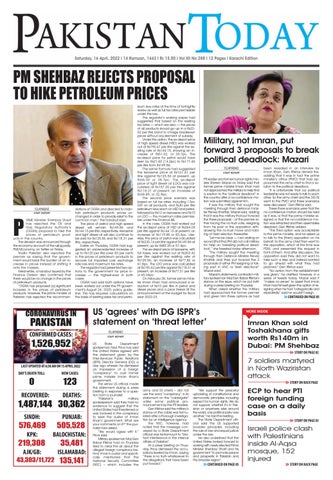
Saturday, 16 April, 2022 I 14 Ramzan, 1443 I Rs 15.00 I Vol XII No 288 I 12 Pages I Karachi Edition
PM Shehbaz rejectS ProPoSal to hike PetroleuM PriceS
ISLAMABAD
P
staff report
rime minister Shehbaz Sharif has rejected the Oil and Gas regulator y Authority ’s (OGrA) proposal to hike the prices of petroleum products in the country. The decision was announced through the economy account of the ruling party, PmLNeconomy, on Twitter on Friday. radio Pakistan also reported the premier as saying that the government would bear the burden of an increase in prices instead of shifting it onto the masses. meanwhile, a handout issued by the Finance Division also confirmed that there would be no change in the prices of petroleum products. “OGrA has proposed [a] significant increase in the prices of petroleum products. However, the prime minister of Pakistan has rejected the recommen-
dations of OGrA and directed to maintain petroleum products’ prices unchanged in order to provide relief to the common man,” the handout said. The price of petrol and high speed diesel will remain rs149.86 and rs144.15 per litre, respectively. Kerosene and light diesel oil will also continue to be sold for rs125.56 and rs118.31 per litre, respectively. earlier on Thursday, OGrA had suggested an unprecedented increase of up to rs120 per litre (over 83 per cent) in the prices of petroleum products to recover full imported cost, exchange rate loss and maximum tax rates. The regulator had presented two options to the government for price increase — the highest-ever in both cases. OGrA had said both options have been worked out under the PTi government’s August 24, 2020, policy guideline. This has required calculations on the basis of existing sales tax and petro-
coronaviruS in
PakiStan
CONFIRMED CASES:
1,526,952
LAST UPDATED AT 6:50 AM ON 15 APRIL 2022
DAY'S DEATH TOLL:
NEW CASES:
0
123
RECOVERED:
DEATHS:
1,487,144 30,362 SINDH:
PUNJAB:
576,469
505,528
KPK:
BALOCHISTAN:
219,308
35,481
AJK/GB:
ISLAMABAD:
43,303/11,722
135,141
leum levy rates at the time of fortnightly review as well as full tax rates permissible under the law. The regulator’s working paper had suggested that based on the existing tax rates — which are zero — the prices of all products should go up in a rs2252 per litre band to charge breakeven prices without any element of subsidy. Under this option, the ex-depot price of high speed diesel (HSD) was worked out at rs195.67 per litre against the existing rate of rs144.15, showing an increase of rs51.52, or 35.7pc. The ex-depot price for petrol would have risen by rs21.60 (14.2pc) to rs171.46 per litre from rs149.86. The same formula had suggested the kerosene price at rs161.61 per litre against rs125.56 at present, up rs36.03 or 28.7pc. The ex-depot price of light diesel oil (LDO) was calculated at rs157.20 per litre against rs118.31 at present, an increase of rs38.89, or 32.9pc. The second price scenario was based on full tax rates, including 17pc GST on all products, and rs30 per litre petroleum levy each on HSD and petrol, followed by rs12 on kerosene and rs10 on LDO — the maximum rates permissible under the Finance Bill. in this case, OGrA had worked out the ex-depot price of HSD at rs264.03 per litre against rs144.15 at present, an increase of rs119.88 or 83.2pc. Likewise, the price of petrol was calculated at rs235.16 per litre against rs149.86 at present, up by rs85.30 or 57.4pc. The ex-depot price of kerosene, with full taxes, was worked out at rs203.42 per litre against the existing rate of rs125.56, an increase of rs77.86 or 61.8pc. The LDO price was calculated at rs195.62 per litre against rs118.31 at present, an increase of rs77.31 per litre or 65.34pc. On February 28, former prime minister imran Khan had announced a reduction of rs10 per litre in petrol and diesel prices and a price freeze till the announcement of the budget for fiscal year 2022-23.
Military, not Imran, put forward 3 proposals to break political deadlock: Mazari ISLAMABAD staff report
PTi leader and former human rights minister Shireen mazari on Friday said that former prime minister imran Khan had not approached the military to help find a solution to the “political deadlock” in the country after a no-confidence motion was submitted against him. it was the military that sought the meeting through then defence minister Pervez Khattak, mazari said, adding that it was the military that put forward the three proposals – of the premier either facing the no-trust vote, resigning from his post or the opposition withdrawing the no-trust move and holding of fresh election thereafter. “Let me be clear — i am stating on record [that the] Pm did not call military for help on ‘breaking political deadlock’,” she tweeted today afternoon. “The military sought the meeting through then Defence minister Pervez Khattak and they put forward the 3 proposals of either Pm resigning or taking part in VNC or fresh elections!” mazari said. mazari’s statements contradict military spokesman maj Gen Babar iftikhar’s stance on the issue, which he put forth during a press briefing on Thursday. When asked whether the military had approached the former premier and given him three options as had
US ‘agrees’ with DG ISPR’s statement on ‘threat letter’
CONTINUED ON PAGE 05
more inside
Imran Khan sold Toshakhana gifts worth Rs140m in Dubai: PM Shehbaz
ISLAMABAD staff report
US State Department spokesman Ned Price has said the United States agreed with the statement given by the inter-Services Public relations (iSPr) Director General (DG) a day ago wherein he dismissed an impression of a foreign “conspiracy” to oust former prime minister imran Khan’s government. The senior US official made this statement during a press briefing in response to a question from a journalist. “Pakistan’s military spokesperson said they had no evidence to suggest that the United States had threatened or was involved in the conspiracy to seek the ouster of imran Khan’s government. What are your comments on it?” the journalist had asked. “We would agree with it,” Price said. military spokesman maj Gen Babar iftikhar had on Thursday tried to clear the air about the alleged foreign conspiracy behind imran’s ouster and specifically mentioned that the National Security Committee (NSC) – which includes the
been revealed in an interview by imran Khan, Gen iftikhar denied this, adding that it was in fact the prime minister’s office (PmO) that had approached the army chief to find a solution to the political deadlock. “it is unfortunate that our political leadership was not ready to talk to each other. So the army chief and the DG iSi went to the PmO and three scenarios were discussed,” Gen iftikhar said. These three scenarios were that the no-confidence motion should be held as it was, or that the prime minister resigned or that the no-confidence motion was retracted and then assemblies dissolved, Gen iftikhar added. “This third option was acceptable to the prime minister, and he asked us to talk to the [then] opposition on his behalf. So the army chief then went to the opposition, which at the time was PDm, and presented this request in front of them. And after discussion, the opposition said they did not want to take such a step and instead wanted to go ahead with what they had planned,” Gen iftikhar said. “No option from the establishment was given,” he clarified. However, in a series of tweets today, mazari said it “makes no sense” to assert that imran Khan had himself given the option of resigning when he had “categorically and repeatedly” said he wouldn’t resign.
STORY ON PAGE 02
7 soldiers martyred in North Waziristan attack STORY ON BACK PAGE army and iSi chiefs – did not use the word “conspiracy” in its statement on the “cablegate” unlike some political pronouncement by the PTi leaders. Gen iftikhar said the military’s stance on the cable was formulated after a thorough investigation by an intelligence agency. The NSC, however, had noted that the message conveyed by a State Department official was tantamount to “blatant interference in the internal affairs of Pakistan”. At a press briefing on Thursday, Price dismissed the accusations leveled by imran, saying “there is no truth whatsoever to the allegations that have been put forward.”
“We support the peaceful upholding of constitutional and democratic principles, including respect for human rights. We do not support, whether it’s in Pakistan or anywhere else around the world, one political party over another,” he told the briefing. The State Department official said the US supported broader principles, including the rule of law and equal justice under the law. He also underlined that the United States looked forward to working with newly elected Prime minister Shehbaz Sharif and his government “to promote peace and prosperity in Pakistan and the broader region”.
CONTINUED ON PAGE 05
ECP to hear PTI foreign funding case on a daily basis STORY ON PAGE 03
israeli police clash with Palestinians inside Al-Aqsa mosque, 152 injured STORY ON BACK PAGE
02
Saturday, 16 April, 2022 | KARACHI
NEWS
ImRAN KhAN SoLD ToShAKhANA GIfTS woRTh RS140m IN DuBAI: Pm ShehBAz
P
NewS DeSk
RIME Minister Shehbaz Sharif reportedly said Thursday he can confirm that his predecessor, PTI Chairman Imran Khan, took gifts from the Toshakhana and sold them in Dubai. “Imran Khan sold these gifts for Rs140 million in Dubai,” PM Shehbaz was reported as telling journalists during an iftar he hosted a day earlier in the federal capital. The premier was said to have shared that the expensive gifts that former prime minister Imran Khan traded for money included diamond jewellery sets, bracelets
and wrist watches. PM Shehbaz said that he also received a watch once, but deposited it to the Toshakhana, adding that he “does not need to hide anything”. The premier’s revelation came in response to a question regarding a petition seeking the details of the Toshakhana that had been filed in the Islamabad High Court on which then PM Imran Khan had commented that the details cannot be revealed as per the Official Secrets Act, 1923. According to the law, whenever a head of state receives a gift from another state or country, they have to give it in to the
Toshakhana. If they wish to keep the gift, they have to pay an amount equal to its value which is decided through an auction. These gifts either remain deposited in the Toshakhana or can be auctioned and the money acquired through it is to be deposited to the national treasury. Former federal minister and PTI leader Fawad Chaudhry, however, refuted PM Shehbaz Sharif’s statement, saying that the new premier is “throwing dirt on Imran Khan”. Fawad claimed that Khan bought a watch — that he received from a foreign country — from the government of Pakistan and sold it.
“What is the offence if the [then] prime minister sold the watch he bought from the government?” Fawad asked. “It doesn’t matter if the watch is worth Rs50 million or 100 milllion […] if it is mine and I sold it, there shouldn’t be any objection.” He went on to say that he is unable to understand what exactly PM Shehbaz’s allegation is. “Shehbaz Sharif is confused and he can’t decide how to level allegations against Imran Khan”. Fawad advised PM Shehbaz to avoid superficial gossip and focus on national issues.
Jemima criticises PML-N for planning protest outside her London residence NewS DeSk
Raja Pervez Ashraf elected NA speaker unopposed NewS DeSk Pakistan Peoples Party (PPP) leader and former prime minister Raja Pervez Ashraf on Friday was elected unopposed as speaker of the National Assembly. The seat fell vacant on April 3 after the resignation of Asad Qaiser who, hours before the Supreme Court’s deadline for the vote of no-confidence motion was to expire, addressed the assembly to announce the decision. “I am liable to the Constitution and the most important demand of the oath is to protect the sovereignty and integrity of Pakistan,” he said. The former speaker said that the then-cabinet had shared the alleged “threat letter” with him and asked the lawmakers to stand for the country’s sovereignty. “I can no longer remain on the seat of the speaker and I resign,” Qaiser had said. He also said that he accepts the Supreme Court’s decision and asked former speaker Ayaz Sadiq to run the session. Raja had submitted his nomination papers in the afternoon and no other candidate submitted their nomination papers resulting in the election of the PPP leader unopposed. Meanwhile, a National Assembly session has been summoned which would be held at 12 noon tomorrow (Saturday). The agenda of the day includes voting on the motion for the removal of Deputy Speaker Qasim Khan Suri. Oath taking of Speaker-elect is also included in the agenda.
Shahzad Saleem appointed as NAB Lahore DG
Jemima Goldsmith, the ex-wife of former prime minister Imran Khan, on Friday hit back at the PML-N after the party announced it would stage a protest outside her London residence in the aftermath of the PTI government’s ouster. On Thursday, PML-N leader Abid Sher Ali had said on Twitter that a protest would be held outside Jemima’s London home. He had also shared an image bearing her full address and used derogatory language against the former premier. “Protests outside my house, targeting my children, anti-Semitic abuse on social media … It’s almost like I’m back in 90s Lahore,” Jemima said in response to Ali. She also tweeted the hashtag #PuranaPakistan (old Pakistan). Ali responded to Jemima, holding the former prime minister responsible for the protest. “He (Imran) has ordered attacks and protests outside [the] homes of his political opponents. He incites hate, homophobia and terrorism on [a] daily basis,” he said. The PML-N leader added that the protest would be “peaceful and nonviolent”. Journalist Hamid Mir also got involved, with words of advice for both the PTI and the PML-N. “PTI must stop protesting outside the house of (Nawaz Sharif) in London and PML-N should not do the same outside the house of (Jemima). Those
TLTP
National Accountability Bureau (NAB) officer Shahzad Saleem has been appointed as the anti-graft watchdog’s director-general for Lahore, a notification said Friday. The notification from the anti-corruption watchdog said that since Saleem has been posted to the office, ex-DG NAB Lahore Jamil Ahmed has been asked to report to NAB Headquarters. The role of the DG NAB Lahore is not new to Saleem as he was posted here from 2017 to 2021, and during his four years in office, according to sources, he made record recoveries. In NAB Lahore’s four-year performance report, according to sources, Saleem made direct recoveries worth Rs7billion and Rs77billion indirectly, while under him, NAB Lahore filed recovery references worth Rs60 billion. In 2021, when Saleem was transferred to the NAB HQ, he was posted as the director awareness and prevention division.
who are not even on social media,” she said. Earlier this week, supporters of the PML-N and the PTI faced off outside Nawaz’s London residence, as one group celebrated and the other protested Imran’s ouster. A heavy police contingent stood in a chain between the two groups as they chanted slogans against each other’s leaders.
Imran Khan sold foreign gifts in market: Marriyum ISLAMABAD
NewS DeSk
who live in glass houses should not throw stones on others,” Mir said. However, Jemima was not here for the journalist’s justification and clarified that she and her children were not involved in Pakistani politics. “With respect, the difference is that I have got nothing to do with Pakistani politics and neither have my children. They are low- key private individuals
The morning started with a few PML-N supporters gathering outside Nawaz’s Avenfield House residence to celebrate. A stone’s throw away in the green expanses of Hyde Park, hundreds of PTI supporters demonstrated against Imran’s ouster. Imran’s UK spokesperson Sahibzada Jahangir had in a video message called on the party’s supporters to gather at the park and then march to the US embassy to register their protest against alleged “foreign interference by America in Pakistan”. A message circulating in PTI WhatsApp groups said the purpose of the demonstration was to raise their voice against “regime change” and the Supreme Court’s decision; and to demand free and fair elections through electronic voting as well as the right of overseas Pakistanis to vote. At the PTI protest, both speakers and members of the crowd condemned the alleged US role in Imran’s removal, with many saying they believed the letter and conspiracy the PTI chairman spoke of was a reality. Several of Imran’s supporters were also critical of the military establishment, and blamed it for his exit. Although the plan for the PTI crowd was to march to the US embassy at 2pm, hundreds of people instead turned towards Park Lane and decided to take their protest to Avenfield House. Police raced ahead of the PTI demonstrators to create a divide between PML-N workers who were already outside Nawaz’s residence.
Pakistan Muslim League-Nawaz (PMLN) Spokesperson Marriyum Aurangzeb on Friday accused former prime minister Imran Khan of selling gifts worth millions of rupees received from foreign governments. “He [Imran Khan] bought cufflinks, a ring and a watch for Rs20 million from Toshakhana (gift depository) and sold these for Rs180 million in the market,” she said. “Gold-plated Kalashankof is also missing and it will be recovered from Bani Gala [residence of former PM Imran].” She said the former PTI-led government under the guise of national security refused to reveal the details of Toshakhana because “they sold gifts” received from the foreign dignitaries in the market. She also denied the reports that the government has suspended public welfare initiatives taken by the Imran Khan-led government for the poor in the country. She said that, in his first address to the National Assembly after being elected, Prime Minister Shehbaz Sharif
had made it clear that public service projects would continue. “Lies are being spread by those who are accustomed to lying from the prime minister’s chair. The media is also requested to refrain from giving space to such baseless reports,” she said. She added that the Benazir Income Support Programme (BISP) will be further expanded as the premier has decided to make BISP a source of education for children. “No programme has been stopped and every project for the welfare of the people will be further improved”, she said. The PML-N spokesperson further said that the health card would continue to function and efforts are being made to improve upon its service. “Today there is an elected prime minister in the country who is generous to the people and has a passion to serve them”. The spokesperson said the premier would not be one to “use public and national security issues for personal politics”. Speaking about other issues, the spokesperson said the chief military spokesperson Major General Babar
Iftikhar has exposed the “lies” of PTI chief Imran that the US had orchestrated his ouster from power. “For the first time in country’s
history the corrupt rulers were removed from power through constitutional means and today all institutions are working independently,” she added.
Saturday, 16 April, 2022 | KARACHI
eCP To heAR PTI foReIGN fuNDING CASe oN A DAILy BASIS
T
NewS DeSk
HE Election Commission of Pakistan (ECP) announced on Friday that it will hear the Pakistan Tehreek-eInsaaf (PTI) foreign funding case every day, so as to decide it within 30 days as per the Islamabad High Court’s (IHC) directives. The ECP’s spokesperson said in a statement that in line with the IHC’s decision, the commission has decided to hear the foreign funding case on a daily basis. On April 14, a single-judge bench headed by Justice Mohsin Akhtar Kayani issued a judgment upholding the ECP’s decision to give access of the case’s record to the PTI’s
founding member Akbar S Babar and not remove him from the proceedings. The PTI had filed petitions on January 25 and 31 on the aforementioned two requests that were rejected by the ECP on March 15. The party had then moved the top court against the ECP decisions. “The claim submitted by the petitioner [PTI] is not maintainable as petitioner itself is not able to demonstrate any of his legitimate rights when [it] itself is in agreement that respondent No 2 [Babar] can participate in the proceedings to the extent of information which he has provided to the scrutiny committee or the ECP,” the order read. “Therefore, this petition is not based
upon bona fide, rather filed with specific motive, just to stop respondent No 2 Akbar Sher Babar to participate in the proceedings, which has already been settled by this court in the previous proceedings,” it added. On March 2, the PTI lawyer completed arguments in the foreign funding case, while the bench directed the counsel for the petitioner Akbar S Babar to conclude his arguments on the next hearing of the case. During the hearing, the PTI lawyer, Anwar Mansoor, requested the bench to dismiss the complaint of Babar, saying that once the scrutiny was done, the matter would be between the ECP and the political party and that no third party could be a party to the case.
IHC moved to stop govt from issuing diplomatic passport to Nawaz NewS DeSk The Islamabad High Court (IHC) was moved on Friday to prevent the expected issuance of a diplomatic passport to PML-N supremo and former prime minister Nawaz Sharif and direct the relevant authorities to immediately arrest him upon his return to Pakistan from London. Nawaz, who is convicted in a corruption case, has been living in London on the pretext of ill health since November 2019, when the Lahore High Court had allowed him to leave the country for four weeks for medical treatment after Shehbaz Sharif, his younger brother and the incumbent prime minister, gave an undertaking that the senior Sharif would return within the stipulated time. Later, Nawaz sought extensions to prolong his stay in London on medical grounds. A lawyer, Advocate Naeem Haider Panjutha, filed a petition in the IHC on Thursday, referring to media reports that said Nawaz was being issued a diplomatic passport on the instructions of newly elected PM Shehbaz. He specified that the instructions for the issuance of the diplomatic passport were given to the interior and foreign affairs secretaries. The petitioner contended that as Nawaz was “a court absconder who was convicted by learned NAB (National Accountability Bureau) Court for corruption … it is violative of law, a mockery of the justice system and disgrace to the nation if a diplomatic passport is issued to a convict”. The “issuance of a diplomatic passport to a convict is tantamount to bestowing respect, state protocols and dignity to a convict and if the convict is a court absconder it becomes a disgrace to the entire judicial system of the country,” he said, adding the act was also “against the spirit of the Constitution and against the fundamental rights whereby it has been guaranteed to every citizen that they will be treated equally”. Moreover, the petition stated, the country’s courts had held that a fugitive
would lose all rights a normal person was entitled to, adding that Article 25 of the Constitution had set clear standards against discrimination against citizens. “And all the ordinary citizens will be discriminated if a convict is issued a diplomatic passport which has so many privileges and immunities, far more than the ordinary passport.” The petitioner further argued that the “illegal and unlawful” act of the interior and foreign affairs secretaries of issuing a diplomatic passport to a convict and court absconder “is not sustainable in the eyes of law”. “The honorable superior courts have held in a number of cases that public servants are not duty-bound to implement or obey the illegal directions of the superiors and whoever acts illegal just to please a superior will solely be responsible for that illegal act.” Advocate Panjutha highlighted that diplomatic passports were issued to the heads of states, highest officials and dignitaries, and that the holders of these passports enjoyed certain immunities and priviliges outlined in the Vienna Convention on Diplomatic Relations 1961. In this connection, he also cited Passport Rules 2021, which, he said, limit the issuance of diplomatic passports to a certain class of state officials so long as they held office. Moreover, he said, according to the rules, persons entitled to get the passport are to
apply for the same with the relevant authority and furnish three copies of their photographs. “No authority other than the Ministry of Foreign Affairs will, in any circumstances, issue authorisation for diplomatic passports,” the petitioner said, adding that the process for the issuance of the passport had not been followed in Nawaz’s case. The process, he said, “cannot be exempted or bypassed and ignored merely on the ground that the applicant is a brother of the prime minister”. He also pointed out that Nawaz had passed “derogatory remarks against the serving military and judicial officials” at public rallies, which caused “disgrace, disrespect, injury and insult” to the Pakistan Army and judiciary. “It is also pertinent to mention that action is yet to be taken by the law enforcement agencies for the remarks mentioned above,” he added. Advocate Panjutha underlined that it was mandatory for all convicts to surrender before the law. Nawaz, on the other hand, had “yet to surrender before the law”, while “the federal government is hurriedly trying to issue [a] diplomatic passport to him”, he claimed. He prayed the court to prevent the issuance of a diplomatic passport to Nawaz, direct the Establishment Division secretary to arrest him immediately upon his arrival in Pakistan and produce him before a court. “During the pendency of this petition, [a] diplomatic passport shall not be issued to” Nawaz, the petitioner requested. IHC Chief Justice Athar Minallah will hear the petition on April 18. In August last year, Nawaz had filed an appeal with the British Immigration Tribunal after the Home Department refused to extend his stay in the country on “medical grounds” any further. Nawaz can legally remain in the UK till the tribunal issues its decision on his plea for his stay in the country. His passport had expired in February 2021.
Gold jumps to Rs116,000 per 10gm ISLAMABAD TLTP
Gold prices remained on the defensive on Friday after going up for seven successive sessions amid the stronger US dollar and treasury bond yields. As of 1300 hours GMT, gold in the international market was available at $1,974.80 per ounce, shedding $2.50 (-0.13 percent). Out of the $2.50 per ounce decrease, -$3.15 was due to strengthening of the US dollar and +$0.65 was due to predominant buyers, according to Kitco Gold Index. The price of 10 grams of 24-carat yellow metal in Pakistan, meanwhile, increased to Rs116,000 after gaining Rs1,000. Gold price in the local market settled at Rs115,000 on Thursday last. An increase in local gold prices was due to overnight change in the international prices when the local market was closed. Gold witnessed a strong rebound last night following a minor correction in the US dollar Index. Investors preferred the precious metal for parking their funds amid a long weekend due to the Easter holiday.
The US Treasury yields have recovered from their losses recorded in the last two trading sessions on the optimism of an
aggressive tight policy by the Federal Reserve (Fed) in May. The 10-year US Treasury yields have reclaimed their threeyear high at 2.83 percent after global banks hiked their critical policy rates by 50 basis points (bps). Elevation in policy rates by worldwide central banks raised hopes of mean reversion to neutral rates sooner rather than later. From a technical perspective, the price continues to trade above all of its moving averages, with the 20 SMA slowly grinding higher above the longer ones. The bulls need a decisive close above $1,982 to kick start a fresh uptrend. Sustained strength beyond this resistance might trigger a short-covering move and push gold prices to an intermediate hurdle at $1,994, and if it is cleared, it should pave the way to break the psychological barrier of $2,000. On the flip side, the gold price enjoys strong support at $1,966, which is Tuesday’s closing point. Next support level lies around $1,961. A daily closing below $1,948 could negate prospects for any further near-term appreciating move.
NEWS
03
Saturday, 16 April, 2022 | KARACHI
04 NEWS
ElECTioN for PuNjAb CM To TAkE PlACE TodAy
T
NewS DeSk
HE election for the new chief minister of Punjab will take place on Saturday (today) at the provincial assembly at 11:30am, Radio Pakistan reported on Friday. The session, where the members of the Punjab Assembly will vote to elect the new provincial chief, will be chaired by Deputy Speaker Sardar Dost Muhammad Mazari. A tough competition is expected between the two
NAVTTC conducts skill training programme PR TAKAMOL Skill Verification Program (SVP) was conducted at DESCON Training Institute, Lahore. A total of 11 aspirants with required skill set of electrician trade appeared in the skill verification program. All 11 participants successfully qualified the SVP Test. Pakistan and Saudi Arabia signed a landmark agreement for certification and employment of Pakistani skilled workforce through Takamol and NAVTTC in December last year. Ministry of Human Resource and Social Development of the Kingdom of Saudi Arabia (KSA) has introduced Skill Verification Program (SVP) implemented from July 2021 in order to regulate its labor market. After the implementation of SVP in KSA, skill verification has become necessary for the Pakistani skilled workers, who intend to have employment in Saudi Arabia. Under this partnership, NAVTTC, National Vocational, and Technical Training Commission Pakistan and Takamol, a subsidiary of the Government of Saudi Arabia is establishing the testing regime under the Skills Verification Program, by exchanging the National Occupational Standards (NOS) and facilitating skill verification of candidates through competency-based assessment- theory & practical at exam Centers in Pakistan for candidates desirous of working in the Kingdom of Saudi Arabia. This program will enable the Pakistani skill workforce to have authentic and internationally recognized joint certification by both Takamol Saudi Arabia and NAVTTC Pakistan, through Recognition of Prior Learning (RPL) assessment. It is expected that millions of Pakistani skilled workers will get gainful employment opportunities with higher earning through this skill verification program.
Shanghai lockdowns threaten China auto production BeIjINg Agencies
Chinese auto makers warned they may have to put the brakes on production if strict Covid-19 curbs in Shanghai persist, with a top Huawei executive also sounding the alarm Friday about snarled supply chains. The restrictions have kept Shanghai’s 25 million residents mostly at home for weeks, forcing manufacturers to halt operations and making China’s GDP growth target of around 5.5 percent look increasingly difficult to achieve. Covid outbreaks across the country and the associated reductions in economic activity have already hit the auto industry hard, with car sales dropping 10.5 percent in March. “If supply chain companies in Shanghai and its surrounding areas cannot find a way to dynamically resume work and production, all original equipment manufacturers may have to stop production in May,” XPeng chief He Xiaopeng said Thursday on social media. XPeng has been touted as a Chinese challenger to US electric car giant Tesla, and its chief said that businesses were hoping for more support from the authorities to navigate the Covid closures. A top executive at Chinese tech giant Huawei — which has started to work with domestic auto manufacturers in the intelligent vehicle sector — echoed the comments on Friday and warned the clock was ticking. “If Shanghai continues being unable to resume work and production, from May, all tech and industrial players involving the Shanghai supply chain will completely shut down, especially the auto industry!” Richard Yu, head of Huawei’s consumer and auto segment, said on the social media platform WeChat. Huawei sold its first 3,000 electric vehicles with the company’s HarmonyOS operating system in March. The group has been working with automakers to provide intelligent auto components, but does not make cars on its own. The Covid curbs have affected global brands as well, with Volkswagen saying it has been “severely hit by Covid-19 outbreaks in Changchun and Shanghai”, where the German titan’s Chinese joint ventures are located. The firm is “temporarily unable to meet high customer demand”, said Volkswagen Group China CEO Stephan Wollenstein on Thursday, adding that he hoped the production delays could be made up in the coming months. China’s zeroCovid policy has been increasingly strained as the country battles its highest number of infections since the start of the pandemic. Volkswagen said around 20 percent of its dealers were forced to temporarily close in March alone as a result of lockdowns. Tesla’s multi-billion-dollar “gigafactory” in Shanghai — which the company calls its main export hub — has also been reportedly shut.
candidates — Hamza Shehbaz and Pervaiz Elahi. Hamza is the candidate of PML-N and other coalition parties while PML-Q’s Elahi is being backed by PTI. The April 16 session will be held in line with the Lahore High Court’s (LHC) Wednesday order, wherein it had rejected Hamza’s plea to hold the elections early and restored the powers of the deputy speaker. The deputy speaker — whose powers were withdrawn last week — was asked by the court to hold
the polls on April 16. The CM’s office has been vacant for nearly two weeks since ex-governor Chaudhry Muhammad Sarwar — who was removed from his position last week — accepted Usman Buzdar’s resignation on April 1. In a symbolic session of the provincial assembly, the opposition had elected PML-N leader Hamza as the chief minister after Speaker Elahi sealed off the Punjab Assembly on April 6.
Pakistan Navy takes over command of CTF-151 ISLAMABAD PR
Pakistan Navy has taken over Command of Multinational Combined Task Force 151 (CTF-151) from Royal Jordanian Navy at the Change of Command ceremony held at HQ US NAVCENT, Bahrain. Commodore Ahmed Hussain of Pakistan Navy took over the Command from Colonel Mohammad Ismail AlTarawneh of Royal Jordanian Navy. Speaking on the Occasion, PN Commander Combined Task Force-151 (CCTF-151) Commodore Ahmed Hussain assured that his team is fully prepared to efficiently shoulder this challenging responsibility. He reaffirmed his resolve to continue operations with zeal and zest. The mission of CTF-151 is to deter, disrupt, suppress piracy and armed
robbery at sea. The Task Force engages with regional and other partners to strengthen relevant capabilities in order to protect global maritime commerce. Pakistan Navy has the distinction of commanding CTF-151 nine times prior to present Command. Earlier, this year Pakistan Navy took over the Command of CTF-150 for the 12th time. Pakistan Navy is the first one amongst CMF partner nations to Command the two Task Forces concurrently. The historic achievement speaks of not only PN dedication and commitment to maritime peace and stability in the region but also of the trust reposed by world navies. The change of Command ceremony was attended by Military and civilian dignitaries, Ambassadors of Pakistan and Kingdom of Jordan and senior officers from other navies forming the maritime coalitions.
Voting on no-trust motion against NA deputy speaker to take place today NewS DeSk A session of the National Assembly related to the no-confidence motion against Deputy Speaker Qasim Suri has been scheduled to take place on Saturday (today) at 12pm. According to a notification issued by the National Assembly Secretariat, the voting on the no-confidence motion against the deputy speaker will take place on Saturday, while the election and oathtaking ceremony of the new speaker will also be held on the same day. Vote of no-confidence against NA deputy speaker to be held tomorrow On Wednesday, in a bid to delay the election of the speaker, Suri had used his special powers under the rules and had changed the date of the NA session from April 16 to April 22.
According to the official handout issued by the NA Secretariat: “The National Assembly session, which was scheduled to be held at 4pm on April 16, will now be held at 3pm on April 22. The change in the schedule has been made by the acting speaker under Rule 49(2) of the Rules and Procedure for the Conduct of the Business in the National Assembly 2007″. The seat for the NA speaker fell vacant following the resignation of Asad Qaiser, who decided to step down from his post on April 9, minutes before the Supreme Court’s deadline for the voting on the no-confidence motion against Imran Khan. On the other hand, PPP leader and former prime minister Raja Pervaiz Ashraf’s nomination papers for the NA speaker’s slot have been submitted as he
seeks to assume the office. Since no other NA member has submitted their nomination papers and
the deadline has ended, NA Secretariat sources said the PPP leader has a high chance of getting elected to the office.
Weekly inflation dips 0.68pc after three weeks ISLAMABAD TLTP
The Sensitive Price Indicator (SPI) based inflation decreased by 0.68 percent for the week ended on April 14 after surging 1.53 percent, 0.53 percent and 1.10 percent in the previous three weeks. According to the data released by Pakistan Bureau of Statistics (PBS) on Friday, inflation on a year-on-year basis decreased to 16.44 percent from 17.87 percent recorded a week earlier. The weekly inflation for the lowest income group (Q1) witnessed a decrease of 1.01 percent, while it went 14.33 percent up on a year-on-year (YoY) basis for the same group. Overall for the other four income groups, the weekly inflation decreased from 0.56 percent (Q5) to 0.95 percent (Q2), while it went up from 15.46 percent (Q2) to 17.15 percent (Q5) on a year-on-year (YoY) basis. According to the PBS, the combined index was at 173.27 on April 14, 2022 as compared to 174.45 on April 07, 2022 while the index was recorded at 148.80 a
year ago on April 15, 2021. The SPI is computed on a weekly basis to assess the price movements of essential commodities at a shorter interval of time so as to review the price situation in the country. The SPI with base 2015-16=100 comprises 51 essential items and the prices are being collected from 50 markets in 17 cities of
CMYK
the country for all expenditure groups/quintiles and combined. During the week under review, out of 51 items, prices of 17 (33.33%) items increased, prices of 10 (19.61%) items decreased, and prices of 24 (47.06%) items remained stable. The SPI for the current week recorded a decrease in the prices of food
items including tomatoes (34.14%), onions (8.46%), potatoes (3.73%), garlic (3.68%), bananas (2.61%), mustard oil (0.34%), wheat flour (0.33%) and sugar (0.25%), and non-food items, including LPG (1.25%) and firewood (0.80%), with joint impact of -0.77 percent into the overall SPI for combined group of 0.68 percent. On the other hand, an increase was observed in the prices of cigarettes (5.46%), eggs (2.12%) and pulse Masoor (1.15%). According to the PBS data, the yearon-year trend depicts an increase of 16.44%, with tomatoes (85.04%), LPG (79.12%), garlic (77.00%), onions (67.68%), cooking oil 5-litre (58.14%), vegetable ghee 2.5-kg (57.31%), mustard oil (56.76%), vegetable ghee 1-kg (56.45%), pulse Masoor (42.51%), washing soap (38.83%), petrol (35.25%) and diesel (27.00%), while a major decrease was observed in the prices of chillies powdered (39.50%), pulse Moong (26.95%), potatoes (22.36%), eggs (20.13%) and sugar (11.02%).
Saturday, 16 April, 2022 | KARACHI
NEWS
05
MIlItARy, not IMRAn, Put foRwARD 3 PRoPosAls to bReAk PolItICAl DeADloCk: MAzARI Dollar slips to Rs181.58 KARACHI TLTP
Pakistani rupee maintained its winning streak against the US dollar for the sixth straight session and appreciated to 181.58 on Friday. The State Bank of Pakistan said in a statement that the rupee opened at 181.69 against the US dollar in the interbank market and closed at 181.58 after gaining 11 paisas (+0.06 percent). Within the open market, the rupee was traded at 181/182 per dollar against 181/182.25 a day earlier. The rupee has recovered Rs6.60 (+3.45 percent) against the dollar during the last six sessions. Overall, the rupee devalued by Rs24.15 against the US dollar during the ongoing fiscal year 2021-22 and Rs5.13 during the current year 2022. According to the currency experts, the rupee is undervalued while the dollar is overvalued due to its demand. Former finance minister Shaukat Tarin said recently that the rupee is undervalued. Tarin’s statement was later supported by former finance minister Ishaq Dar, who also said that the rupee can strengthen to 160 a dollar if the economy is steered in the right direction. The currency analysts said that with the formation of the new government, the current political crisis has come to an end and the rupee may recover further in the coming days. They said the rupee appreciated against the greenback after much clarity on the domestic political landscape. Meanwhile, the workers’ remittances received by Pakistan hit an all-time high of $2.8 billion in March, extending support to foreign exchange reserves and rupee against the US dollar. Cumulatively, the remittances have risen to $23 billion in the first nine months of the current fiscal year 2021-22, up by 7.1 percent over the same period of previous year. However, the foreign exchange reserves of the country dropped for the ninth straight week by $0.45 billion (2.57 percent) on a week-on-week basis to reach $17.03 billion. The foreign exchange reserves held by the central bank decreased to $10,849.6 million, while reserves held by commercial banks increased to $6,178.5 million.
Amnesty urges Pakistan to release those arrested over 'critical tweets' Amnesty International has urged Pakistani authorities to immediately release eight people arrested by the Federal Investigation Agency (FIA) for "criticising the state" on Twitter, a news outlet reported on Friday. "The Pakistani authorities must stop using the draconian Pakistan Electronic Crimes Act (Peca) to punish people who are simply exercising their right to freedom of expression online," Dinushika Dissanayake, the human rights organisation's director for South Asia, demanded. She pointed out that for the longest period of time successive governments had used the law as a tool to crush peaceful dissent and intimidate supporters of political opposition. Dissanayake called for the government to immediately and unconditionally release the eight people arrested across Punjab, adding that instead of quashing dissenting voices, the authorities should end their "repressive crackdown" on the right to freedom of expression. NEWS DESK
ContInued fRom pAge 01
“w
Hy would Imran Khan give the option of resigning when he had already stated categorically and repeatedly he would never resign?” the PTI leader asked. “Also, Imran Khan had categorically rejected vote of no-confidence as foreign regime change conspiracy. So
why would he suggest these options. Absurd!” she wrote. A week before he was ousted, Imran Khan had revealed that the “establishment” had given him three options: “resignation, no-confidence [vote] or elections”, following the filing of a no-confidence motion against him in the National Assembly. The former premier said that when he was presented with the three options, “We said elections is the best option, I
cannot even think about resigning and as far as the no-confidence vote is concerned, I believe in fighting till the end.” The political crisis in the country emerged after the joint opposition — primarily the Pakistan Democratic Movement (PDM) and the PPP — submitted the no-confidence motion against the premier with the NA Secretariat on March 8. In the days to follow, the country’s political landscape was abuzz with ac-
US ‘agrees’ with DG ISPR’s statement on ‘threat letter’ ContInued fRom pAge 01 Price said the relationship between the United States and Pakistan had been a vital one for the last 75 years. “you probably saw a statement that we released from the Secretary last night regarding the selection of Prime Minister Shehbaz Sharif,” he added. A day ago, US Secretary of State Antony J. Blinken had also congratulated Shehbaz Sharif and vowed to continue its long-standing cooperation with Pakistan’s government. Likewise, earlier this week, Pentagon spokesperson John Kirby had insisted that the US had a “healthy military-to-military relationship with Pakistani armed forces”, hoping that “we have every expectation that will be able to continue to be the case”. The controversy surrounding the no-confidence motion against the former premier Imran Khan took a dramatic turn when the embattled PM brandished a letter at a rally on March 27 — days before his ouster, claiming it contained evidence of a “foreign conspiracy” hatched to topple his government. Imran had kept a mum about the contents of the letter when he first unveiled it, however, he spilled the beans days later by naming the United
States when the exit of the government appeared imminent. Imran’s allegation that the US spearheaded his exit from power was based on a cable received from Pakistan’s Ambassador to the US, Asad Majeed, in which he had reported about a meeting with Assistant Secretary of State for South and Central Asia Affairs Donald Lu. Majeed had reportedly said that Donald Lu warned that Imran Khan’s continuation in office, who was set to face a vote of no confidence, would have repercussions on bilateral relations. The US was said to be annoyed with Imran over his “independent foreign policy” and visit to Moscow. The Pentagon and the State Department have rejected the accusations, saying there was no veracity to it. The National Security Committee (NSC), which includes all services chiefs as well as the head of Pakistan’s top intelligence agency, took up the matter on March 31 and decided to issue a “strong demarche” to a country that it did not name over what was termed “blatant interference in the internal affairs of Pakistan”. It had also termed the interference “unacceptable under any circumstances” and said the language used in the communique was undiplomatic.
PPP nominates Makhdoom Ahmed Mehmood for Punjab governor's post The PPP has nominated Makhdoom Ahmed Mehmood for the post of Punjab governor, a news outlet reported on Friday. According to the report, the PPP leadership has informed Mehmood — who has experience being Punjab's governor previously — of the decision. Mehmood, who was earlier a member of PML-F, had decided to part ways with the party after former president Asif Ali Zardari had appointed him as Punjab governor in December 2012. Mehmood had served as Punjab governor till June 2013. Newly-elected Prime Minister Shehbaz Sharif — who was sworn in on April 11 — is yet to form his federal cabinet and appoint governors in the four provinces — Punjab, Khyber Pakhtunkhwa, Sindh, and Balochistan. The report said that MQM-P will get the governorship of Sindh, PPP Punjab, JUI-F Khyber Pakhtunkhwa, and BNP-M Balochistan. NEWS DESK
tivity as parties and individuals changed alliances and the PTI and opposition were seen trading barbs and allegations alongside intensifying efforts to ensure their success in the no-confidence contest. Eventually, major allies of the ruling PTI — Balochistan Awami Party and Muttahida Qaumi Movement-Pakistan — deserted the government and joined the opposition ranks which led to PM Imran losing his majority in the lower house of parliament.
PIA offers discounted fares to ICCI members Pakistan International Airlines (PIA) has offered 15 percent discount on domestic flights and 10 percent discount on international flights to the members of Islamabad Chamber of Commerce & Industry (ICCI). For this purpose, a memorandum of understanding (MoU) was signed between PIA and ICCI. Muhammad Shakeel Munir President ICCI and Junaid Khan, District Manager, PIA Islamabad signed the MoU during a ceremony held at ICCI. According to the MoU, PIA will offer 15 percent discount on domestic sectors and 10% discount on international sectors on economy & executive economy classes on applicable base fare along with the waiver of service charges, if applicable to ICCI members and their immediate family, on request from ICCI secretariat letterhead with production of valid ICCI membership card by the members. The ICCI will extend support and will facilitate promotion of PIA products and services from all its platforms including electronic, print and social media. ICCI will declare PIA as official travel partner and PIA will be preferred travel airline for all of their members' visits on both international and domestic sectors. Speaking at the occasion, Muhammad Shakeel Munir appreciated the initiatives of PIA for offering discounts to ICCI members in domestic and international flights. He said that airlines play an important role in business and economic development of a country, therefore, improving the performance of PIA is vital to promote Pakistan’s trade and exports to international markets. He hoped that the PIA discounted offer would help the business community in exploring new markets for improving trade and exports of the country. He assured that the business community would cooperate in promoting PIA’s branding. PIA District Manager Junaid Khan said that PIA is now focusing on corporate customers for business generation and signing MoU with ICCI is a part of such efforts. He said that the business community should facilitate PIA in improving its cargo business. He said that PIA is ready to dedicate aircrafts for cargo flights if the private sector supports it with more business volume. He said that PIA is making efforts to expand its foreign destination that would help the business community in tapping new markets for business opportunities. NEWS DESK
E-banking transactions surge 23pc to Rs33.38tr in July-Dec: SBP KARACHI TLTP
The e-banking based transactions have increased by 23 percent to Rs33.38 trillion during the second quarter of October-December 2021 as compared to Rs27.19 trillion in the previous quarter (July-September 2021), the State Bank of Pakistan (SBP) said on Friday. The SBP issued a quarterly report stating that the volume of e-banking recorded 10.7 percent to 400 million transactions as compared with the previous quarter of 361.6 million. E-banking includes transactions conducted via electronic channels including real-time online Branches, ATMs, mobile banking, internet banking, call centre banking, POS and e-commerce. It would be pertinent to note that the growth in e-banking transactions is much steeper relative to paper based transactions, albeit the value of transactions is higher in the case of later. The volume and value of paper based transactions increased by 3.4 percent and 12.2 percent respectively.
While the volume of e-banking transactions is almost four times higher at 400 million than paper based transactions at 101.4 million, the value of transactions of the former stands at Rs33.4 trillion compared with Rs41.6 trillion paper based transactions. All around growth in e-banking included expansion in both mobile and internet banking with a double-digit increase in value and volume of transactions during the second quarter. The number of mobile banking transactions amounted to 94 million, while the value reached Rs2.2 trillion, which comes to 18.8 percent and 35.4 per cent growth respectively on QoQ basis. Meanwhile, the number of mobile banking users grew by 5 per cent on a QoQ basis, reaching a total of 11.9 million users. The internet banking users reached 6.9 million, conducting 33.8 million transactions, amounting to Rs2.4 trillion, which translated to a strong 13.9 percent progress in terms of volume and 28 per cent increase in the value of these transactions compared to preceding quarter. Retail sector also continued its upswing
in adoption of digital payments. During the quarter, a total of 31.4 million transactions amounting to Rs178.1 billion were processed via 92,153 Point-of-Sale (POS) terminals. This shows an impressive double-digit QoQ growth of 11.8 percent by volume and 32.1 percent by value. Similarly, the number of e-commerce merchants also increased by 32.6 percent reaching a total of 3,968. Onboarding of QR merchants largely added to this growth. These merchants processed 13.6 million transactions worth Rs26.7 billion, showing QoQ growth of 7.2 percent by volume and 19.8 percent by value. As of end-December 2022, there were 5.4% more cards than in the preceding quarter, reaching 48.6 million cards in circulation which mainly comprised of debit cards (63.5%), social welfare cards (22.8%), ATM only cards (9.9%), credit cards (3.6%), and prepaid cards (0.3%). During this quarter, paper-based transactions showed relatively slower growth of 3.4% in volume and 12.2% in value on a QoQ basis. In Large-value (wholesale) pay-
CmYK
ments segment, SBP’s Real-time Inter-Bank Settlement Mechanism (PRISM) processed a total of 1.1 million transactions amounting
to Rs161.3 trillion, showing QoQ growth of 5.9% in volume and 1.4% in value, said the central bank.
06-07 Comments - 16th April 2022_Layout 1 4/16/2022 12:06 AM Page 1
Saturday, 16 April, 2022
06 COMMENT
The prisoner van
Imran Khan’s concept of democracy My way or the highway
The challenges ahead
R
eALISINg that he had lost his majority in the National Assembly, Imran Khan tried to forestall the no-confidence vote with a series of deceptive moves. his first attempt was to try to launch a civilian coup by dissolving the National Assembly. The Supreme Court foiled this attempt by restoring the Assembly and ordering a fresh no-confidence vote. As the Deputy Speaker continued to delay the vote, the CJP ordered the opening of the Supreme Court before midnight to ensure that its directives were implemented. This led Mr Khan to question the motives behind the apex court’s opening at an unusual time in his Peshawar speech, thus creating uncalled=for doubts and suspicions about the Court’s action. Simultaneously, making use of a diplomatic cable sent by Pakistan’s former ambassador to USA, Imran Khan maintained that this amounted to a US conspiracy to overthrow his government. Then Information Minister Fawad Chaudhry called it a “threatening” cable, purportedly containing evidence of a foreign plot against the government. Mr Khan claimed that the USA wanted to get him removed because of his independent foreign policy and because he had responded with “absolutely not” to US demands for military bases in Pakistan. The ISPR chief however denied the USA had sought bases. he also clarified that the National Security Committee did not find any evidence of conspiracy. Mr Khan has thus indulged in a highly damaging politicisation of diplomacy and the working of the Foreign Office. The former PM hopes to win the next elections on an anti-US platform to cover up the shortcomings of his four year long tenure. The en masse resignations of the PTI MNAs from the National Assembly was another attempt to weaken the system from inside. As the PTI’s objections to Shahbaz Sharif’s nomination papers were set aside, the PTI announced resignations by its MNAs. As Sheikh Rashid put it, “It has been decided that we can’t be involved with these thieves and dacoits in the Assembly.” The stand is as undemocratic as it untenable. Will the PTI refuse to sit in the house once again if it did not win a majority of seats in the next elections?
Dr QaiSar raShiD
W
ITh the stationing of a prisoner van outside the parliament in Islamabad, the Constitution got consecrated. Parliamentarians of the Pakistan Tehreke Insaf (PTI) fell in line with political realities: they had to open space for the opposition to rule over the country. Command changed hands and April 10 saw a smooth transition of power. The PTI was voted out.es ahead are many One positive with the turn of events was that the Supreme Court (SC) avoided seeking refuge in the Doctrine of Necessity, which had vitiated the political atmosphere in Pakistan. The PTI did not expect that the Supreme Court would opt for reversing the tide of unconstitutional dissolution of the National Assembly. The PTI thought that the Supreme Courtwould adopt the recourse to holding fresh elections soon. To the consternation of the PTI, the the Supreme Court did not seek retreat in Haji Saifullah’s case (PLD 1989 SC 166) which said that though the dissolution under Article 58(2b) was illegal, there was no need to restore the National Assembly. At that time, the excuse givn was that since the country was geared up for elections, provision be made for fresh elections. The PTI lawyers repeated the same excuse to bypass the constitutional allowance to resort to the no-confidence motion. however, through a short order, the Supreme Court refused to offer any face saving to the PTI’s parliamentarians. After assuming office, new Prime Minister
Too late the hero? Imran’s regrets over Mr Justice Qazi Faez Isa’s reference are disingenuous
An anti-China tool for the USA Sabina babar
T
he world is witnessing the geopolitical transition from unilateralism to multilateralism with bloc politics at its centre. The Ukraine crisis has transformed the strategic stability of Asia by not only questioning major partnerships in the region but by instigating the political divide. In contemporary times, Quad is one such partnership that has put a barricade on regional cohesion. In a recent meeting of the Quad on March 3, the narrative of “like-minded democracies” highlighted the solidification of the Quad as a strategic and political coalition and its narrative to counter the regional powers. Certainly, the Quad partnership is based on the Asia Pacific’s most protruding democracies working under a subsequent geopolitical and geostrategic agenda in the Indian Ocean. The idea of Quad is linked with China’s rise in a broader domain and regional dominance in the narrow domain where India’s and Pakistan’s roles come in. One cannot deny that being a member of the Quad, India has the substantial potential to influence regional security and stability. On the other hand, Pakistan’s interest in the Indian Ocean due to its strategic location cannot be ignored. Pakistan has a role to play in the geopolitical shift of this region. Therefore, it is important to see whether the Quad’s role is as a force for retaining peace in the region or is working as a destabilizer for South Asia. Recently, a top US administrative official has said that India is a key player in the Quad and important for the USA’s Indo-Pacific presence. The backdrop for this statement is to counter China’s rise and strategic presence in the Indo-Pacific region, specifically China’s economic projects. It is important as it portrays the changing power equation and alliance between China, the USA, India, and Pakistan. The USA’s clear alliance with India has intensified the security situation in South Asia as there is a regional shift between Pakistan and China in one bloc and
Dedicated to the legacy of late Hameed Nizami
Arif Nizami (Late) Founding Editor
Yousaf Nizami M. A. Niazi
Umar Aziz
Joint Editor
Joint Editor
Executive Editor
Lahore – Ph: 042-36300938, 042-36375965
It is not only the money laundering issue for terror financing Pakistan is faced with, but it is also the issue of Islamic fanaticism that is ravaging streets of Pakistan.
The writer can qaisarrashid@yahoo.com
be
reached
at
Quad: Force of peace, or destabilizer for South Asia?
O
USTeD Prime Minister Imran Khan’s regrets over the attempt to sack Mr Justice Qazi Faez Isa over tax matters, expressed in a meeting with members of the Insaf Lawyers Forum, on Thursday, seems more of a move on the political chessboard, rather than a genuine attempt to shape the judgement of history. Not only is he himself still in the political field, but Mr Justice Faez Isa is likely to be the next Chief Justice of Pakistan, and is likely to be holding that office when Mr Khan’s election litigation, whatever it may be, reaches the Supreme Court. Perhaps because it was a sympathetic audience, he got away with saying that he was badly advised in the case, but he will have to realise that the reference was filed after his go-ahead, and while he was Prime Minister. he cannot now try to fob off the responsponsibility for this, or any other, action on to anyone else. It is noticeable that the realization that it was a mistake has come after his ouster. If it had come earlier, he should have taken some action, at least getting rid of those bad advisers. One consequence of following this bad advice, which came after Mr Justice Isa’s strictures on certain state institutions during the Faizabad sit-in, was the hounding of his wife and children. Mr Khan should realize that the airy-fairy dismissal of this affair will not wash. his attitude that admission is absolution, is not likely to compensate for the human suffering that resulted from the bad advice he was given. Mr Khan has been consistent only in this: he will act to gain advantage for himself. he has a strong tendency to hear only what he wants to. One result is that he has not received the best advice, but that which he wants to hear. This is a case in point. he will have to be more empathetic about what he has done, both good and bad, and not expect disingeuous excuses to be accepted.
Editor Aziz-ud-Din Ahmad
Shahbaz Sharif showed the way how to run the country. Instead of 10am, he reached his office at 8 am and worked throughout the day. Opposed to the past practice, he declared to make Saturday a working day. The working on day one was not so usual as used to happen before. The PM is not an employee who works from 9am to 5am. For a developing country like Pakistan, a PM has to work more hours to give relief to the masses. Sharif did that. The other day, Sharif uttered a famous adage, beggars are not choosers. The detractors took the idiom in its literal sense. Unfortunately, Sharif’s statement was blown out of proportion and context just to malign him politically.By saying so, Sharif meant that Pakistan was a developing country which could not afford the annoyance of big powers of the world. Being at the receiving end, Pakistan was not in a position to dictate its terms to the world. This is a reality. Major challenges before Sharif are to keep the coalition of parties appeased, check soaring inflation, and rectify the foreign policy. On April 12, another major challenge surfaced. On the conclusion of the Fourth Annual US-India 2+2 Ministerial Dialogue in 2022, the Ministers condemned any use of terrorist proxies and crossborder terrorism in all its forms and,through a joint statement, aired three demands for Pakistan. First, Pakistan should bring to justice the perpetrators of the 26/11 Mumbai attacks and the Pathankot attack. Second, Pakistan should make concerted efforts against all terrorist groups, including groups proscribed by the UNSC 1267 Sanctions Committee, such as al-Qaeda, the Islamic State, Lashkar-e Tayyiba, Jaish-e Mohammad and hizb-ulMujahideen. Third, Pakistan should take immediate, sustained, and irreversible action to ensure that no territory under its control could be used for terrorist attacks. Anxieties are not new. The Kerry-Lugar-Berman Act of 2009 had made similar demands from Pakistan before issuing $1.5 billion per year as non-military aid for five years (from 2010 to 2014). The Act had also demanded that Pakistan took action against the haqqani network and the Quetta Shura. Both demands are now missing from the statement probably for their being redundant. The Islamic State (ISIS) is perceived as the new threat. The Financial Action Task Force (FATF) is al-
ready squeezing Pakistan to the limit. Since August 2018, Pakistan has been in the throes of the FATF which is imposing conditions for Pakistan’s financial survival. Pakistan is still on the FATF’s grey list. On April 8, in Lahore, an anti-terrorism court awarded a collective sentence of 33 years incarceration to the Chief of the banned Jamaat-udDawa (JuD) hafiz Muhammad Saeed in two cases of terror financing. In 2019, the Counter Terrorism Department (CTD) had registered the cases invoking several sections of the Anti-Terrorism Act (ATA) of 1997. Interestingly, the US-India 2+2 Ministerial Dialogue also laid emphasis on the importance of upholding international standards on anti-money laundering and combating the financing of terrorism by all countries including Pakistan consistent with FATF recommendations. For Pakistan, this clearly means that the FATF is bound to stay and dictate its terms. Pakistan has to comply with its recommendations. On 6 October 2016, a leading newspaper published the details of a civilmilitary huddle. The civil side called for “putting our house in order” whereas the military side dithered and disapproved. The accounts got divulged to the public and the expose was called the DAWN leaks, which invited the indignation of the military that demanded an inquiry into the matter. Nawaz Sharif, the former Prime Minister, was called a traitor. Now, a challenge has been thrown to the incumbent government to deal with the jihadists on its own land. It is not only the money laundering issue for terror financing Pakistan is faced with, but it is also the issue of Islamic fanaticism that is ravaging streets of Pakistan. The general elections of 2018 saw the misuse of the religion card especially by the PTI to woo religion-inspired young voters. The PTI remained victorious but later on the PTI’s government had to suppress the voice of the same supporters during its stint in power. On the allegation of blasphemy, December 2021 also saw a Sri Lankan manager, Priyantha Kumara, lynched and set on fire in Sialkot. The police remained bystanders. It is yet to be seen if Shahbaz Sharif’s government can offer relief to the masses by striking a balance between the challenge of economic recession to revive the economy and the dictate of the FATF reinforced by the US-India Ministerial Dialogue to curb money laundering and combat terrorism financing.
I
Karachi – Ph: 021-35381208-9
I
India and the USA in the other. Under these changing dynamics and policy implications, Quad will affect the stability of the region. As the USA wants India to serve as a strategic partner in the Indo-Pacific, the immediate step for Pakistan and China is to counterbalance by investing in a fusion of infrastructure projects. Pakistan has also been in close proximity with Russia and focuses on the emerging de-facto strategic partnership with China-Russia-Pakistan (CRP) as a counterforce to the Quad. Pakistan has been trying to play its role in the Indian Ocean Region (IOR) and China is clear with its economic investment in Pakistan by considering the significance of Pakistan in South Asia as an important economic partner. China fears that the Quad alliance is posing a threat to the stability of the region by dividing it into blocs, as recently, China’s vice foreign minister has said that the Quad alliance in the Indo-Pacific is dangerous as it is taking the region toward fragmentation and bloc-based division. The Quad alliance, if allowed to expand, will push the AsiaPacific region into an abyss where major regional powers have to face the consequences. The Indian Foreign Minister responded by urging not to slip in an analogy of comparing Quad to security alliances. however, one cannot deny that the USA wants India to work as a bulwark against China in the Indo-Pacific region. So far, the idea that Quad can work as a peaceful force seems as far-fetched as the narrative of the Quad is opposite to its peaceful coexistence specifically in South Asia. Pakistan is trying to promote peace in the Indian Ocean; however, India is not ready to accept Pakistan’s presence in the IOR. A
Islamabad – Ph: 051-2204545
clear indication of this non-acceptance is the non-inclusion of Pakistan in the Indian Ocean Rim Association (IORA) and Bay of Bengal Multi-sectoral Technical and economic Cooperation (BIMSTeC). Pakistan is focusing on increasing its maritime capabilities by participating in joint naval exercises with Russia and China. In opposition, India has recently focused on growing its strategic foothold in the Indian Ocean by organizing Milan 2022 exercises based on both Quad and AUKUS members, a strategic counter to Pakistan and China. The Milan exercises included all the South Asian states except Pakistan, which shows the divergence in bringing peace to the region. Up to this point, Quad as a partnership has reinvigorated its security dimension, however, it is not open to other stakeholders of the region, especially Pakistan and China, making it subject to debate and questioning its ability to work as a stabilizer in the region. The recent meeting of Quad can be interpreted as the beginning of the creation of an Asian NATO. The Quad’s narrative is more tilted toward strategic balancing against China in the IOR by not only keeping its allies at bay but by continuously increasing its global profile through security and defense cooperation in the region. India’s presence in the Indo-Pacific has provided New Delhiwith a push toward rising above semi-periphery status.
The recent meeting of Quad can be interpreted as the beginning of the creation of an Asian NATO. The Quad’s narrative is more tilted toward strategic balancing against China in the IOR by not only keeping its allies at bay but by continuously increasing its global profile through security and defense cooperation in the region.
I
Web: www.pakistantoday.com.pk
I
The writer is working as a Research Officer at the Strategic Vision Institute (SVI), a non-partisan think-tank based in Islamabad.
Email: editorial@pakistantoday.com.pk
06-07 Comments - 16th April 2022_Layout 1 4/16/2022 12:06 AM Page 2
Saturday, 16 April, 2022
COMMENT 07 Editor’s mail Send your letters to: Letters to Editor, Pakistan Today, 4-Shaarey Fatima Jinnah, Lahore, Pakistan. E-mail: letters@pakistantoday.com.pk Letters should be addressed to Pakistan Today exclusively
Cultural diversity in the workplace
China’s strategic approach towards the Middle East China’s approach to the region is through Iran
Dr MuhaMMaD akraM Zaheer
F
ROM 2016, China began to pay special attention to the Middle east. With the immense production capacity of its industries, China is primarily the world’s largest buyer of Middle eastern fuel. Therefore, establishing closer ties with oil-rich Middle eastern countries, most of which are allies of the USA, shaped the foundation of Chinese foreign policy towards the Middle east. China issued an Arab policy document in 2016, showing that it would strengthen its ties with the countries of the region with the “Declaration on the Implementation of Sino-Arab Cooperation”. China has signed Belt and Road Initiative agreements with countries such as Saudi Arabia, Sudan, Iraq, the United Arab emirates, Qatar, Kuwait, egypt and Morocco, and some of them are members of the Asian Infrastructure Investment Bank which was also initiated in the fields of renewable energy, oil, electricity and civil nuclear energy. In response, China has increased its oil purchases from oil-rich gulf States, deepening its commitment to the region by increasing its oil purchases. By signing cooperation agreements with these Arab states, China did not form its Arab policy on the political structure, but on the economic, with these countries or their relations with the USA, nor did it intend to replace the USA, which is a military power in the Middle east. This is due to the fact that the survival of Chinese investment and infrastructure projects in the Middle east, as well as the security of oil purchases in the gulf, depended on the US military presence, which it maintained. Chinese entry into the Middle east meant an economic confrontation with the USA, but in doing so, it was careful not to turn its engagement into a struggle for military and political power. Furthermore, it is not an Arab state, but another Middle eastern country with which China cooperates fully and through which it will eventually compete with the USA in the international arena. While Iran’s relations with other countries in the region are marked by greater consistency as long as its ideological and strategic interests are aligned, its relations with world powers are more indecisive and duplicitous. In this regard, it can be seen that Iran pursues a multilateral foreign policy rather than supporting a superpower, and that it seeks to maximize its benefits by
maintaining balanced and equitable relations. In fact, at a time when the pragmatic spiritual government signed a landmark nuclear deal with the european Union and the USA in 2015, it was also holding intense talks with China. The West was offering Iran a package with direct and indirect political terms to lift sanctions and sign a nuclear deal. As a result, it was expected that Iran would undergo gradual social, economic and political change as a result of its integration and stagnation in the international economic system. Lifting sanctions would further boost Iran’s investment and trade cooperation with China, as well as strengthen its ties with the West. In fact, with the easing of sanctions in 2015, China allowed a large number of personnel to go to Iran, paving the way for many mediumsized Chinese companies to explore cooperation opportunities, and to study the Iranian economy. Although violations of the nuclear deal during Trump’s presidency have boosted China’s economic relations with Iran, it can be seen that between 2015 and 2021, China became Iran’s largest direct or indirect trading partner and oil importer. Despite the sanctions, China’s oil purchases from Iran reached record highs in 2021.Therefore, the 25year agreement between China and Iran in March 2021 was not a political agreement that Iran has signed with the P5+ 1 as an alternative to the nuclear deal, but this agreement of China has the potential for economic growth. The content of the agreement between China and Iran is similar to the strategic agreements in the region. On the other hand, when it is considered the US-Iran nuclear talks, which are still stuck under President Biden, the Sino-Iranian agreement is considered a threat by the USA. In the past, China was demonstrating its ability to tolerate sanctions, using alternative methods such as oil trade and the use of the national currency in joint banking, as one of the most important disciplinary mechanisms in the international system. China has joined Iran with an alternative approach to the system and its own alternative modern model, aimed at resolving the political recommendations offered by the West. This situation highlights in the case of Iran that the United States is feeling that China is moving towards becoming a global economic power. In some of Biden’s most recent statements, the threat posed by the prospect of global animosity between the Chinese and liberal development models can be clearly seen as an attempt to strengthen liberal-democratic principles, which the Biden Administration recently strengthened. In short, the Sino-Iranian agreement seems a turning point in the impending shift of power between China and the USA. According to current indications, even if a
nuclear deal had been struck with the USA, Iran would have reached a strategic agreement with China and pursued a multilateral foreign policy with the major powers in the international arena. On the other hand, given its current stalemate with the United States, China’s agreement could have far-reaching consequences in the long run. For Iran, which is struggling to maintain oil exports despite sanctions, the agreement may improved oil sales from China and the development of energy infrastructure. Particularly, the terms of the agreement are expected to introduce new regulations in the Iranian banking sector, as well as the use of its national currency instead of the US dollar in oil sales, and thus to some extent weaken the Iranian economy. Therefore,these economic measures have the potential to reduce Iran’s isolation as a result of international sanctions. The infrastructure development partnership with China will support Iran’s plans to become a commercial corridor hub, opening it up to neighbouring countries through new road, rail and port projects. Iran’s influence in Lebanon, Syria and Iraq can strengthen its post-war economic and reconstruction power in the region, while, on the other hand, China can strengthen its economic activities and presence in the Middle east. The USA’s most powerful trump card of sanctions to return to the nuclear deal has potential to damage the China-Iran Comprehensive Strategic Partnership. In this context, two scenarios emerge for the future of the nuclear deal. The implementation of the nuclear deal between the two parties has accelerated the first scenario, in which the sole purpose of the Biden Administration is to return Iran to international nuclear status. In the second scenario, Iran’s ballistic missiles, military activities in the region and relations with the regional countries, the world should not expect a positive response in return to the nuclear deal. The reason for this is that Iran will not make reassurances to the USA on these issues, particularly after the deal with China, which has the potential to ease sanctions. The Sino-Iranian deal will not replace Iran’s negotiations with the West, like the nuclear deal and other major deals like the FATF, but it will serve as a trump card to tip the balance in Iran’s favour on these deals. Iran’s global strategy is not to side with the parties, but to use all the agreements it has made with major powers such as the USA, the european Union and China, and will do so in the future. This is the strategic implication of the principle of “multilateralism in international relations”, which Persian diplomacy constantly emphasizes.
The Sino-Iranian deal will not replace Iran’s negotiations with the West, like the nuclear deal and other major deals like the FATF, but it will serve as a trump card to tip the balance in Iran’s favour on these deals.
The writer has a PhD in Political Science and can be reached at akramzaheer86@yahoo.com
WITh the rise of globalization, cultural diversity in the workplace has become more of a trend. In the workplace, cultural diversity the subject of how to successfully collaborate with people from diverse cultural backgrounds is still a matter that requires training and awareness, and it is not something that should be taken for granted. In today’s modern workplace, the people who make up each workplace are as varied as the job that is being done. People who worked together in the past were frequently from the same culture, and having a workforce made up of people from many cultures was uncommon. however, just as the work has changed over time, so has the concept of bringing together people from all backgrounds to complete the task. everything has its pros and cons. It depends upon whether it is viewed positively or negatively. every single person is different. We are designed that way. We are also given the ability to choose virtue or evil. Seeking virtue instead of evil in the choices we make is beneficial to us as an individual as well as to society. The same is in the case of cultural diversity. If it is viewed positively, it can benefit the workplace as well as the economy of the country. For diversity to bring strength, it should be valued in the corporate philosophy. Most importantly, it must be integrated into the company’s practices. This takes time and commitment to celebrating diversity. Workers must be willing to be open-minded and non-judgmental about the value of differences. . Our economy will grow and benefit from these changing demographics if businesses commit to meeting the needs of diverse communities as workers and consumers. By bringing together individuals with diverse backgrounds and experiences, businesses can more effectively market to consumers from different racial and ethnic backgrounds. It is no surprise, then, those studies show diversifying the workplace helps businesses increase their market share. Companies are more likely to hire the finest and brightest in the labour market when they recruit from a diverse pool of candidates. Workers that are talented and innovative will assist in improving the company’s profit on the micro-level and when more companies hire such bright workers from a variety of backgrounds, profits will rise on a macro level, resulting in economic prosperity. In an increasingly competitive economy where talent is crucial to improving the bottom line, it is becoming increasingly necessary to draw from the largest and most diverse pool of candidates to succeed in the market. effective problem-solving on the job requires bringing together people with a variety of qualifications, skills, and experiences. In the same way, diversity encourages creativity and innovation. In a Forbes poll conducted in 2011, 85 percent of 321 big worldwide organizations (those with at least $500 million in annual revenue) strongly agreed that diversity is crucial to encouraging workplace creativity. Diversity in the workplace is necessary to create a competitive economy in a globalized world. As communities continue to grow, it’s important to harness the talent of all cultures. Businesses should continue to capitalize on the growth of women, people from different religions and races and transgender people in the labour force. Our increasing diversity is a great opportunity for Pakistan to become more competitive in the global economy by capitalizing on the unique talents and contributions that diverse communities bring to the table. So, given that our country is a melting pot of cultures, I wonder how prosperous our country’s economy can grow if more and more businesses hire a multicultural workforce. BUSHRA TAHIR LAHORE
Surging cases of domestic violence MANy women are victims of harassment and domestic violence, it’s increasing day by day, these are common issues in our society. Domestic violence can be verbal, physical and psychological. Parents feel that their fighting and violence don’t affect their children. Alas! The fact is their fights affect children’s minds badly; it causes their physical and psychological growth as well. Domestic violence and family fighting can be a huge cause of a child’s fury, gloom and sadness. Domestic violence is not only harmful to a growing child, but it’s also harmful to a mother who is carrying a baby inside the womb. Meanwhile, the children always have a negative impact of parents fighting and violence, where a male child learns how to fight and beat the opposite gender, and the female child learns how it could be expected. This causes the children to repeat the same cycles with their own children. It’s a huge responsibility of parents to take care of their children. Parents can be huge supporters of their children. Then the children will learn how to become problem solvers rather than problem creators— if children only face violence then he/she may become aggressive. Domestic violence is never justified- it is time to stand up against the violence. Teach children to compromise on small things, but never with self-respect, values, rules and dignity. This is the time to educate your children, no matter what gender, to be independent and selfcentred. It’s time to bring peace and happiness in your home where children can grow the potential. Being a parent it’s your role to support and encourage your children emotionally and financially, and not to crush their little dreams. MARAI KHUSHK SINDH
Life's struggles MOST times life sucks, and can get really annoying that you get frustrated, most times it is beautiful that you wish to keep living forever. There are plethora of people on earth each person with its own hurdles to take and its beautiful moment to experience. The most important thing is to make each moment count...the good and the bad times. Life is like a roller coaster with passage leading to different route. Life has its ups and down but it is your decision to make each moment worthwhile, get out of your self and observe the existence .There is happiness. Joy and there is also sadness,sorrow.yet humans always look for a way to cope and deal with life's Issues. you shouldn't feel dejected when life does not go according to your plans because there is a time for everything and a season for every activities under the heavens. So brave yourselves and enjoy the moment. HAMzA SIDDIqUI KARAcHI
08 WORLD VIEW 16th April 22_Layout 1 4/15/2022 10:04 PM Page 1
Saturday, 16 April, 2022
08 WORLD VIEW
are we wItnessIng the BegInnIng of de-dollarIzatIon? Hill AKHIL RAMESH
2
022 started with a surging omicron variant. A few weeks in, providing a respite, the variant subsided around the globe. However, as if the world was deprived of tragedy and was rejoicing for too long, weeks later, Russia invaded Ukraine, leading to death and destruction in Ukraine and economic turmoil around the globe. Russia’s invasion of Ukraine is not comparable to any other invasion in history due to its geoeconomic significance. Both Ukraine and Russia are leading exporters of commodities such as crude, natural gas, iron and steel, wheat, and edible oils that have a direct impact on the inflation levels in major world economies. While economists were concerned about a significant drop in consumption levels arising from COVID19-related lockdowns and suppression of demand sending crude prices to $0 per barrel two years ago, now they are concerned about the exact opposite — skyrocketing crude prices touching more than $130 per barrel and natural gas hitting $5.7 per metric million British thermal units (MMBtu). There were also price increases on wheat, edible oils and other commodities with the potential to directly impact the average Joe not just in the U.S. and Western world but in the global south, where inflation shocks are even more acute. Adding fuel to fire, the U.S. chose the worst possible weapon to deter Russia — economic sanctions. By sanctioning Russia, the world’s third-largest producer of crude and largest supplier of wheat, the U.S. has set off
IT IS A MATTER OF WHEN THE U.S. DOLLAR LOSES ITS DOMINANCE AMONG GLOBAL CURRENCIES — NOT WILL. THE ECONOMIC SANCTIONS FOLLOWING THE RUSSIAN INVASION COULD HAVE JUST ACCELERATED THAT DOWNFALL dynamite that could burst into a recession in the next six months, as several economists have predicted. However, the long-term challenge for the U.S. will be to keep the crown on the U.S. dollar’s head as the leading global reserve/fiat currency. The unilateral sanctions of the West against Russia had the unintended consequence of raising inflation levels in Europe, East Africa and South Asia, which were the largest importers of Russian wheat and energy. given that seeking alternatives and establishing substitute supply chains takes time and capital, most economies are establishing different mechanisms to circumvent the sanctions. These range from using barter trade to trading in their own currencies over the dollar. The latter is igniting a debate on the use of the dollar for global trade. Not necessarily among America’s steadfast allies but more so with countries that are on the fence about America’s global interventions. Countries such as Brazil, China, South Africa and India that are part of the BRICS grouping make up more than 24 percent of world gross domestic product (gDP) and 16 percent of world trade. Similarly, in Africa, which makes up 3 percent of global gDP and is predicted to
grow six times in size by 2050, many countries will likely reconsider dollar trade. Developing nations and emerging markets economies cannot easily absorb inflation shocks. In a few of these economies, rising inflation levels could lead to a balance of payment crisis and even the toppling of their respective governments. Hence, it is natural for these economies to seek ways to circumvent America’s sanctions. Even Europe, one that is part of the Western alliance, has sought ruble-euro trade arrangements to prevent any disruptions in Russian gas supply. From Europe’s standpoint, in particular from Italy’s and germany’s, Russian gas keeps factories running and homes lit. Without Russian gas, their economies would come to a standstill. Therefore, it is with an urgency that they establish alternative mechanisms. Moreover, this experience could place Europe at a crossroads — prioritize the transatlantic alliance and blindly bandwagon the U.S., even if it were to cost it economically, or put European economic interests first over relations with its transatlantic partner. The impacts of these sanctions are even more profound in the global south. For example, India imports
Imran Khan may remaIn a polItIcal dIsrupter
Akhil Ramesh is a fellow with the Pacific Forum. He has worked with governments, risk consulting firms and think tanks in the United States and India.
Bumbling Joe Biden is a threat to world peace
EX-CRICKETER FAILED TO BREAK THE GRIP OF DYNASTIES ON PAKISTAN’S SYSTEM spiked
Financial Times
BREnDAn O’nEILL
EDITORIAL BOARD
The former Pakistan cricket captain Imran Khan wanted to become the first prime minister in his country’s history to bat through to the close of his five-year term. Instead, his innings has been cut short after less than four years by a no-confidence vote, after a political crisis over economic troubles and simmering inflation. Khan proved a less able head of government than he was a cricketer or, indeed, opposition leader. Yet his skills as the latter mean he could continue to be a political disrupter. Best known as a sports star and socialite and later for his philanthropy, Khan came to power pledging to fight corruption, reform the political system and build an Islamic welfare state. Embracing a conservative brand of Islam, he promised a move away from a politics dominated by dynasties such as the Bhutto and Sharif families. In that, he failed. He will be succeeded by Shehbaz Sharif, brother of the three-term former prime minister, Nawaz. Khan did deliver some of what he promised, issuing cards that allowed many Pakistanis to obtain health insurance for the first time. But, after leveraging his sporting popularity to move into politics, he struggled to satisfy expectations he had aroused, lacking the management skills to run a poor country of 220m people. As premier, he adopted a confrontational approach and was too ready to use his proclaimed anti-corruption drive, including the threat of arrest, to subdue opponents. Another error was reportedly to fall out with the powerful military that has either ruled Pakistan directly or pulled the political strings during its 75-year independence — and which his rivals long claimed helped to bring Khan to power. Khan is said to have clashed with the chief of the army staff last October over who should head the Inter-Services Intelligence agency. But his real undoing was poor stewardship of an economy long dogged by low productivity and an import dependency that tend to cause weak job creation and regular balance-of-payments problems. Khan was unable to break out of those cycles, and flip-flopped on IMF support programmes. With commodity price rises exacerbated by surging energy and food inflation after Russia’s invasion of Ukraine, Pakistan now faces one of Asia’s worst cost of living crises, with annual inflation on a basket of key goods last week hitting 15 per cent. Such pressures are not unique to Pakistan; they have provoked political ructions, too, in Sri Lanka and are being felt across developing markets. But Khan has struggled to deal with them, reintroducing fuel subsidies in February to help hard-hit citizens, but at the risk of undermining a $6bn IMF programme weeks after it restarted. Shehbaz Sharif, former chief minister of the most populous province of Punjab, will inherit the same intractable challenges, and may seek early elections rather than wait for next year. Khan has signalled he will not go quietly, insisting he was the victim of a US-led conspiracy to oust him. Though his sympathies for Vladimir Putin — who he visited on the day Russia invaded Ukraine — and defence of the Taliban takeover of Afghanistan have not played well in Washington, Khan has produced no convincing evidence of a US plot. But he has tapped into anti-American sentiment at home and large numbers of supporters rallied in his support in large cities on Sunday night, even during Ramadan. Some are none too happy at the return of dynastic politics and the prospect of Sharif — who has faced corruption accusations in the past — as premier. Khan’s prime ministerial innings, for now, is over; Pakistan’s political upheavals are not.
more than 80 percent of its crude demand and the rise in prices will convert to inflation and even a balance of payment crisis if it buys at current market levels. Understandably, when Russia offered to sell its crude at around a 30 percent discount to the market price, it was rational for the government to consider that proposal. Earlier this month, in his speech, Putin spoke of diversifying reserve currencies to national currencies, gold and other commodities. It may not be just Russia that would consider diversifying reserves. Countries in East Africa and South Asia that have been indirectly impacted by the sanctions and could very well be facing secondary sanctions will look toward other assets. While American international relations scholars and economists may fail to see America beyond the chimera of the city on the shining hill, countries of the global south might be less in love with American exceptionalism and could seek alternatives to the dollar. The hegemony of the U.S. dollar was reliant on America’s hegemonic status in the world. With the world moving toward multipolarity and with the U.S. no longer the world’s largest trading nation (it is China) the power and status of the dollar could be waning as well. given the increasing role played by China, the European Union and other countries of the global south, the dollar might just be witnessing its descent. It is a matter of when the U.S. dollar loses its dominance among global currencies — not will. The economic sanctions following the Russian invasion could have just accelerated that downfall.
B
UMBLINg Joe Biden isn’t funny anymore. It might be amusing when your crazy uncle blurts out something unexpected at a family dinner. But when the most powerful man on Earth does it? Not so much. ‘In passing’, as the guardian put it, President Biden referred to Russia’s war in Ukraine as a ‘genocide’. This might just be the dumbest, most ill-advised and lethally consequential thing Biden has said since taking office. The circumstances in which he uttered the gword, in which he made the most serious accusation you can make against a nation state, were bizarre. He was in Iowa, at a public discussion on the use of ethanol in petrol, of all things. Then – ‘in passing’ – he said: ‘Your family budget, your ability to fill up your tank, none of it should hinge on whether a dictator declares war and commits genocide half a world away.’ And so did an announcement about the lifting of restrictions on ethanol use in order to reduce the price of fuel turn – ‘in passing’ – into the United States of America accusing the Russian Federation of committing the most heinous crime known to man. It is unclear whether accusing Putin of genocide is White House policy now, or if Biden was just running his mumbling mouth, as is his wont. Pressed by reporters as to whether he really meant to say ‘genocide’, Biden said: ‘Yes, I called it genocide because it’s become clearer and clearer that Putin is just trying to wipe out the idea of even being Ukrainian.’ Not surprisingly, other world leaders were a tad alarmed. French president Emmanuel Macron rebuked Biden for his ‘verbal escalations’. We need to be ‘careful’ with our terminology, he said, rightly. It remains to be seen whether this is the White House consciously upping the ante or just Biden having another senior moment. He has form, after all. At the end of March – again in passing – he called for regime change in Russia. ‘This man cannot remain in power’, he said about Putin in an ‘off the cuff’ remark at the end of March. Most of us make jokes off the cuff or express exasperation off the cuff – Biden expands America’s war aims off the cuff. The White House swiftly walked back this unscripted declaration of regime-change hostilities. Before that, Biden made a blunder that suggested US troops had been deployed to Ukraine. The White House walked that back, too. ‘[We] are not sending US troops to Ukraine’, a spokesman clarified. Maybe the White House will walk back the ‘genocide’ thing as well. Though it might be too late. The word’s out there now. And not just from the mouths of those irritating liberal commentators and laptop bombardiers who think every war is a genocide (except the ones they
‘IN PASSING’, AS THE GUARDIAN PUT IT, PRESIDENT BIDEN REFERRED TO RUSSIA’S WAR IN UKRAINE AS A ‘GENOCIDE’. THIS MIGHT JUST BE THE DUMBEST, MOST ILL-ADVISED AND LETHALLY CONSEQUENTIAL THING BIDEN HAS SAID SINCE TAKING OFFICE support, of course, like Iraq, Afghanistan, Libya), but from the mouth of the American president himself. Make no mistake – this is incredibly dangerous war talk. It transforms Ukraine from an undoubtedly bloody conflict that has global implications into a possible site of further external intervention and fighting. Indeed, the United Nations’ policy on ‘The Responsibility to Protect’ expressly obliges the Security Council to take action – ideally diplomatic action, but if that fails, then military action – in order to ‘protect populations from genocide’. If Russia is committing genocide, then the US and its allies have a responsibility to stop it somehow. This is the dire, destabilising situation Biden has either blunderingly or consciously pushed the world towards. It is wrong and dangerous to fling the word ‘genocide’ around. Russia is unquestionably committing atrocities in Ukraine. In Spiked’s view, its unprovoked war of aggression against the sovereign Ukrainian people is itself an atrocity, an abomination, that must come to an end immediately. But genocide? That is a very specific term. It doesn’t just mean ‘bloody war in which many people are dying’. If it does, then the Western invasion of Iraq was a genocide. So was NATO’s bombing of Libya. So is Saudi Arabia’s grotesque crusade against Yemen. Biden and his political acolytes back or backed all those wars. It would make as much sense for Putin to call Biden a genocidaire as it does for Biden to say that of Putin. No, a genocide is the conscious mass murder of a significant number of people from an ethnic or national group with the broader aim of destroying that ethnic or national group. There’s no evidence Russia is doing that in Ukraine. Making baseless accusations of genocide is a very serious thing. First, as already outlined, because it intensifies conflict. It transforms what are usually horrible civil wars or, as in this case, wars of aggression by one nation against another into existential battles; into epoch-shaking showdowns between good and Evil in which ‘we’ – the heavily armed outsiders – have a responsibility to intervene. The truth and the realpolitik of the war at hand – and, by extension, the possibility of resolving it through talks or deals or terms of surrender – get buried under all the hysterical talk of modern-day Holocausts. Pontificating about ‘genocide’ might make Biden and other Western liberals feel puffed-up and selfimportant, but it frequently has escalating and disastrous consequences for the people caught
up in the war that these people are giddily exploiting for virtue and retweets. Secondly, genocide talk can have an unwittingly weakening impact on the resistance movement in a war, on those who are standing up to their aggressors. The international community’s promise to step in when a genocide is supposedly being committed creates a warped dynamic that actively incites communities to present themselves as victims, to play up their existential frailty. Tragically, we can see this happening in Ukraine. President Zelensky has welcomed Biden’s genocide comments. Following the exposure of Russia’s vile attacks on citizens in Bucha, numerous Western commentators have said ‘This is genocide’. This subtly encourages Ukraine to play the victim card rather than the resistance card; to consider emphasising its smallness in the face of a genocidal aggressor rather than its strength as a resistor of Russian imperialism. The more that Western leaders and observers talk about genocide in relation to Ukraine, the more we are likely to see Ukraine advertise its vulnerability rather than its valiance, all in the name of securing further external assistance. This would be a disaster for a people who have proven themselves so courageous in the face of Putin’s reckless crusade. And thirdly there’s the not insignificant matter of historical memory. Throwing the word ‘genocide’ around makes it seem as though such a horrendous crime is a common occurrence, when in truth it is mercifully rare. When we hear the word genocide we tend to think of the attempted destruction of the Armenian people in the Ottoman Empire, and, of course, the conscious, industrialised campaign by the Nazis to vaporise every Jew on Earth. To refer to relatively normal if horrific wars like the one in Ukraine as ‘genocides’ relativises true genocides. In flattening everything bad into a ‘genocide’, it demeans our ability to understand the enormity of the crimes of history and our ability to appreciate the political complexities of contemporary conflicts. It is self-aggrandising moralism that discourages critical and careful thinking in preference for scoring some moral brownie points from someone else’s suffering. This is what Biden has done: escalated global tensions, encouraged a cult of victimhood among Ukrainians, and driven another nail into the coffin of historical truth. White House, walk this back, quickly and fully. Brendan O’Neill is spiked’s chief political
Saturday, 16 April, 2022 | KARAchi
NEWS
09
PM dIrECts FBr to aChIEvE rEvENuE CoLLECtIoN targEt oF rs6.1tr islamabad
NEC constitution to help deal with financial crisis: LCCI Lahore Chamber of Commerce & Industry has welcomed Prime Minister Shahbaz Sharif’s decision to constitute the National Economic Council (NEC) in a bid to deal with the financial crisis. In a letter to Prime Minister Shahbaz Sharif, LCCI President Mian Nauman Kabir said that the constitution of National Economic Council, is a step in the right direction but the Lahore Chamber of Commerce & Industry should also be taken on board in NEC. Kabir said that Lahore Chamber of Commerce & Industry highly appreciates the formation of the National Economic Council envisioned by the Prime Minister. He said that this would be a great platform and certainly play a pivotal role in uplifting the trajectory of national economic development. The LCCI president suggested that the National Economic Council should make long term policies / plans for at least 10 years, be given legal cover and an implementation mechanism should also be developed. He said that an international trade framework should be established to monitor the imports and exports of the country and ensure that they complement each other. Kabir said that there is a dire need to revisit Pakistan’s energy mix by generating a major part of electricity from coal and renewable energy sources so that the reliance on costly imported fuel may be minimized. He said that the business / trade policies should be chalked out in such a manner that they provide an enabling environment for the local industry to become part of the global value chain. Kabir further stated that Prime Minister Shahbaz Sharif took the charge at a critical time along with a bundle of economic challenges. He said that a team of experts consisting of leading businessmen and experienced economic experts’ inevitable. He said that only economically strong Pakistan can handle all sorts of international pressures therefore “war against economic ills” should be started instantly and the business community should be given representation in the economic teams. The LCCI president said that Pakistan is a resource-rich country and does not need any external financial help. He said that the economic weaknesses of any country give the opportunity of criticism to others and the same is happening in our case. Kabir said that political instability, below the mark foreign direct investment, high cost of doing business, politics on mega projects like Kalabagh dam and huge trade deficit have led to stagnant growth in Pakistan. He said that Pakistan must have to address these issues through good economic reforms. He said that Pakistan has all the resources to become an economic giant but the only need is to set directions with zeal, courage and sincerity. He said that Pakistan’s huge mineral resources can help get rid of the economic ills. He said that country has one of the largest reserves of gold & copper and coal in the world. He added that according to a rough estimate, the value of coal reserves in Pakistan is 187 times more than the GDP of Pakistan and only 2% of Pakistani coal reserves can generate 20,000 MW of electricity for almost 50 years. In addition to gold, copper and coal, the country has vast reserves of precious stones, gypsum, salt and marble but instead of taking full advantage of these God-gifted resources most of the share is being exported in raw form. He said that these resources must be used by the state instead of giving contracts to the foreign companies for extraction. He also called for new technologies and training of human resources for the mining sectors. TLTP
P
Shahzad Paracha
RIME Minister Shahbaz Sharif on Friday directed Federal Board of Revenue (FBR) to ensure on achieving the revised revenue collection target of Rs6.1 trillion for 2021-22. FBR Chairman on the queries related to his meeting with PM after the conclusion of the 4th “Computerised Ballot” of POS prize scheme held at the FBR Headquarters said that the “PM has asked FBR to ensure that the International Monetary Fund (IMF) program should remain on track”. In addition he said that FBR will
give another briefing to the Prime Minister on the targets of the IMF program next week. FBR Chairman further stated that we are engaged with the fund for completion of the 7th review under IMF’s Extended Fund Facility (EFF). To a query on the amnesty scheme, FBR Chairman said that there are general reservations over the industrial package and we will brief the Prime Minister next week on the said industrial incentives. FBR Chairman added that the revenue collection position is satisfactory and FBR would be able to achieve the assigned revenue collection target of Rs6.1 trillion by the end of current fiscal year.
NEPRA notifies Rs4.85 per unit hike islamabad ahmad ahmadani
National Electric Power Regulatory Authority (NEPRA) has raised the electricity rate by Rs4.85 per unit on account of fuel charges adjustment for the month of February 2022 and issued a notification to this effect. As per details, NEPRA’s decision to increase the power price by Rs4.85 per unit will not be applicable to all the consumer categories except lifeline consumers of all the power distribution companies (DISCOs) and the consumers of K-Electric. Earlier, reference fuel charges for the month of February 2022 was set at Rs4.2516 per unit while actual fuel charges registered at Rs9.1046 per unit and fuel price variation recorded at Rs4.8530 per unit for the month of February 2022. According to NEPRA notification, the fuel price variation will be shown separately in the consumers’ bills on the basis of units billed to the consumers in the month of February 2022 and the DISCOs will reflect the fuel
charges adjustment in respect of February 2022 in the billing month of April 2022, While effecting the fuel adjustment charges, the concerned DISCOs shall keep in view and strictly comply with the orders of the courts notwithstanding this order, said
NEPRA notification. According to sources, this hike in power tariff will add an additional burden of approximately more than Rs37 billion on the power consumers except K-Electric consumers. According to NEPRA decision, in order to make adjustments in the ap-
LSM grows 4.6pc in 8 months Large Scale Manufacturing Industries (LSMI) production grew by 4.6 percent during the first eight months of the current fiscal year (2021-22) as com-
pared to the corresponding period of last year, Pakistan Bureau of Statistics (PBS) reported Friday. The LSMI Quantum Index Number
(QIM) was recorded at 156.9 points during July-February (2021-22) against 150.0 points during July-February (2020-21), showing growth of 4.6 percent, according to latest PBS data. The highest increase of 3.8 percent during July-February (2021-22) was witnessed in the indices monitored by the Ministry of Industries, followed by 0.8 percent increase in indices monitored by Provincial Board of Statistics (BOS) and however no increase witnessed in the products monitored by the Oil Companies Advisory Committee (OCAC). On year-on-year basis (YoY), the industry rose by 8.4 percent during the month of February 2022 compared to the growth of February 2021, according to PBS latest data.
Work on roads to KP tourist sites underway islamabad aziz Buneri
The Khyber Pakhtunkhwa tourism department said that under the Integrated Tourism Development project progress has been made on construction and rehabilitation of access roads to six tourism destinations in Hazara division and 11 roads to tourism sites in Malakand division. During a review meeting, different roads projects including Khyber Pakhtunkhwa Provincial Roads Improvement Project, Integrated Tourism Development Project and Rural Roads Development Project were discussed. Besides Chief Minister Mahmood Khan, Secretary Tourism Aamir Tareen, Secretary Environment and Forestry Abid Majeed, Secretary Communications and works
proved tariff of the DISCOs due to variations in the fuel charges for the month of February 2022, necessary information as to the details of the actual fuel charges etc. was obtained from Central Power Purchasing Agency Guarantee Limited (CPPA-G). And, the authority conducted the hearing in the matter on March 31, 2022. On the date fixed for hearing, representatives from CPPA-G, National Power Control Center (NPCC), NTDC, media and general public were present. However, no representation was made from WAPDA, Power Privatization Organization (WPPO), Sui Southern Gas Company Limited (SSGCL), Sui Northern Gas Pipelines Limited (SNGPL) and the Ministry of Finance despite serving the hearing notice. Pursuant to the provisions of Section 31(7) of the Regulation of Generation, Transmission and Distribution of Electric Power Act 1997, (NEPRA Act), the authority has to make adjustments in the approved tariff on account of any variations in the fuel charges on a monthly basis.
Ijaz Ansari and other relevant senior officials attended the meeting. The meeting was informed that work on access road to historic tourist site Sheikh Badin in Dera Ismail Khan was also underway. Moreover, financial opening of 24km Thandiyani road and 22km Mankiyal road will be completed by the end of April. It was added that 34Km Kalam to Mataltan and Mahodand road had also been included in provincial roads project. Besides, 65 per cent civil work had been completed on dualization of Swabi-Mardan road at the cost Rs4.4 billion and the project would be completed by December 2022. The meeting was told that, under the Provincial Roads Improvement Project, rehabilitation and construction of 214km of 9 different roads is almost complete at the cost
of Rs14.4 billion. These roads include Shah Alam to Sardaryab road, Umerzai to Harichand road, Risalpur to Jehangira road, Khairabad to Nizampur road, Aadina to Yar Hussain road, Sang e Mar eastern and western bypass roads, Maqsooda to Kohala road and Haripur- Hattar Taxila road. The meeting was informed that, under the Khyber Pakhtunkhwa Rural Roads Development project rehabilitation of 1,337 km district roads will be carried out besides the construction of 62 bridges. The chief minister on the occasion termed the timely completion of those projects as one of the priority areas and directed the quarters concerned to take concrete steps for early completion of those projects without compromising the quality of work.
The major sectors that showed positive growth during July-February (2021-22) included textile (1.5%), food, beverages and tobacco (6.6%), leather products (4.8%), wood products (174.0%), paper and board (8.0%), coke and petroleum products (0.3%), chemicals (7.9), automobiles (32.5%), iron and steel products (22.5%), fertilizer (1.5%). The commodities that witnessed negative growth included non metallic mineral products (2.5%), electronics (8.1%), engineering products (2.5%) and rubber products (22.8%). It is pertinent to mention here that the provisional QIM is being computed on the basis of the latest production data received from sources, including OCAC, Ministry of Industries and Production (MoIP), and PBS. aPP
Saturday, 16 April, 2022 | KARACHI
10 FOREIGN NEWS
Russia pledGes moRe sTRikes on kyiv afTeR missile aTTack
R
REUtERS
USSIA’S defence ministry said on Friday it had struck a military target on the edge of Kyiv overnight with cruise missiles and promised more strikes against the Ukrainian capital in response to Ukrainian attacks on Russian targets. The ministry said its forces had also taken full control of the Ilyich Steel Plant in the besieged port city of Mariupol, which has been encircled by Russian troops for weeks. Powerful explosions were heard in
Kyiv on Friday which appeared to be among the most significant there since Russian troops pulled back from the area earlier this month in preparation for battles in the south and east. The explosions were reported to have been heard after the Russian defence ministry announced that the Moskva, the flagship of Russia’s Black Sea Fleet, had sunk while being towed after being badly damaged. Ukraine claimed the Moskva’s damage was the result of one of its missile strikes. Russia’s defence ministry spoke only of a fire breaking out and of exploding ammunition.
The defence ministry said in its statement that its overnight missile strikes on Kyiv had struck the ‘Vizar’ factory on the edge of the Ukrainian capital which it said made and repaired missiles, including antiship missiles. It pledged more strikes on Kyiv. “The number and scale of missile strikes on targets in Kyiv will increase in response to any terrorist attacks or acts of sabotage on Russian territory committed by the Kyiv nationalist regime,” the ministry said in a statement. It said its forces had shot down a Ukrainian Mi-8 helicopter which it said had attacked the village of Klimovo in Bryansk
region on April 14 and had also shot down a Ukrainian Sukhoi-27 jet. A group of up to 30 Polish mercenaries had also been destroyed, it said.
Russia launched what it calls its “special military operation” on February 24. Ukraine has put up fierce resistance and the West has imposed sweeping sanctions on Russia.
China holds drills around Taiwan as US lawmakers visit BEIJING ReuteRs
Girls’ education ban reveals deep rifts within Taliban AFP The Taliban prohibition on girls’ education shows the movement’s conservatives retain tight control of the group, and exposes a power struggle that puts at risk crucial aid for Afghanistan’s desperate population, experts say. The ban has triggered international outrage and even left many in the Taliban movement baffled by the decision. “The order was devastating,” a senior Taliban member told AFP. “The supreme leader himself interfered.” All Taliban officials who spoke to AFP on the subject did so on condition of anonymity, due to the sensitivity of the topic. Secondary schools for girls were ordered to shut last month, just hours after being reopened for the first time since the Taliban’s return to power in August. The shocking U-turn came after a secret meeting of the group’s leadership in the city of Kandahar, the Taliban’s de facto power centre. But one senior Taliban official told AFP that Supreme Leader Hibatullah Akhundzada and some other senior figures were “ultra-conservative on this issue” and dominated the discussion. Two groups — the urban and the conservatives — have emerged in the movement, he said. “The conservatives have won this round,” he added, referring to a group of clerics including Chief Justice Abdul Hakim Sharai, Minister for Religious Affairs Noor Mohammad Saqeb and Minister for Promotion of Virtue and Prevention of Vice Mohammad Khalid Hanafi. The clerics feel excluded from government decisions and voicing their opposition to girls’ education is one way to restore their influence, said Ashley Jackson, a London-based researcher who has worked extensively on Afghanistan. She told AFP the “outsized influence of this out-of-touch minority” has prevented the country from moving ahead with something the vast majority of Afghans favour — including much of the leadership. “It shows that Kandahar remains the centre of gravity for Taliban politics,” said International Crisis Group analyst Graeme Smith. A senior Taliban member said the hardliners were trying to appease thousands of fighters who hail from the conservative countryside. “For them, even if a woman steps out of her home it is immoral. So, imagine what it means to educate her,” he said. The Taliban member said Akhundzada was against “modern, secular education” as he associated it with life under former Western-backed presidents Hamid Karzai and Ashraf Ghani. “ThaT’s his worldview:” The Taliban returned to power last year as US-led forces ended an occupation in place since an invasion ousted the hardliners in 2001. In the 20 years between the Taliban’s two reigns, girls were allowed to go to school and women were able to seek employment in all sectors, though the country remained socially conservative. Activist and Islamic scholar Tafsir Siyaposh noted girls in Afghanistan have always studied in single-sex classes and followed an Islamic curriculum, so the ban shows the Taliban just wanted to “oppress the rights of women by giving excuses”. A Taliban source in Pakistan confirmed differences at the leadership level on the issue, but said the movement was in no danger of fragmenting. “There is a debate on this issue … but we are trying to overcome our shortcomings,” he said. Still, analysts say the ban was a blow to Taliban efforts to gain international recognition and to raise aid to address Afghanistan’s humanitarian crisis. Jackson said neither Akhundzada nor those closest to him “fully understood or appreciated” the consequences of their edict for an international community that has linked official recognition to the group’s respect for women’s rights.
China said it conducted military drills around Taiwan on Friday as a US Congressional delegation visited the island in a show of support to a fellow democracy, with Beijing blaming the lawmakers for raising tensions with their “provocative” trip. China’s military sent frigates, bombers and fighter planes to the East China Sea and the area around Taiwan, the People’s Liberation Army Eastern Theatre Command said, in a statement released as the lawmakers were holding a news conference in Taipei. “This operation is in response to the recent frequent release of wrong signals by the United States on the Taiwan issue,” it said, without mentioning the visiting US delegation. “The US bad actions and tricks are completely futile and very dangerous. Those who play with fire will burn themselves,” it said. China’s Defence Ministry, in a separate statement, said the US visit was “deliberately provocative” and had “led to further escalation of tension in the Taiwan Strait”. Taiwan is a frequent source of tension between Beijing and Washington. Republican US Senator Lindsey Graham told Taiwan President Tsai Ing-wen during the delegation’s meeting
with her that the war in Ukraine and provocative behaviour by China have united US opinion in a way not seen before. “To abandon Taiwan would be to abandon democracy and freedom,” he said. “There’s a backlash growing in the world to thuggery – to the bad guys.” Senator Bob Menendez, chairman of the Senate Foreign Relations Committee, said the technology hub is a “country of global significance” and its security has implications for the world. The bipartisan group of six lawmakers arrived for their two-day visit on Thursday, in a previously unannounced trip. Such visits, and a reference to Taiwan as a “country”, always anger Beijing, which dismisses any
suggestion that Taiwan is a country. China regards the island as one of its provinces. The United States has no formal relations with Chinese-claimed Taiwan but is its most important international backer and arms supplier. Menendez acknowledged the Chinese government was “very unhappy” with the delegation’s visit but said that would not dissuade the group from supporting Taiwan. “With Taiwan producing 90% of the world’s highend semiconductor products, it is a country of global significance, consequence and impact, and therefore it should be understood the security of Taiwan has a global impact,” Menendez told Tsai. Taiwan has been heartened by the US support offered by the Biden administration, which has repeatedly talked of its “rock-solid” commitment to the democratically governed island. That has added to strains in Sino-US relations. Russia’s invasion of Ukraine has also put Taipei on alert for any possible moves by Beijing to use the Ukraine crisis to make a move on the island. The government though has reported no sign that China is about to invade. Taiwan has complained for the past two years or so of stepped-up Chinese military activity, including almost daily air force flights into Taiwan’s air defence zone, but not close to the island itself.
Penthouses in North Korea are mainly for the unfortunate few SEOUL ReuteRs
For people in many countries, living in a penthouse is the dream. In North Korea? Not so much. Leader Kim Jong Un keeps building outwardly glamorous high-rise apartment buildings in the capital, Pyongyang, with the latest being an 80-storey skyscraper completed this week. But defectors and other North Koreans say that unreliable elevators and electricity, poor water supply, and concerns about workmanship mean that historically few people have wanted to live near the top of such structures. “In North Korea, the poor live in penthouses rather than the rich, because lifts are often not working properly, and they cannot pump up water due to the low pressure,” said Jung Si-woo, a 31-yearold who defected to neighbouring South Korea in 2017. In the North, he lived on the third floor of a 13-storey building that lacked an elevator, while a friend who lived on the 28th floor of a 40-storey block had never used the elevator because it was not working, Jung said. Asked about the new 80-floor skyscraper opened this week, Jung said he thought Kim was just showing off. “It’s to show how much their construction skills have improved, rather than considering residents’ preferences,” said the university student. North Korea assigns housing, with buying and selling of homes or apartments technically illegal in the socialist state. But experts say the practice has become common, dabbled in mostly by those who benefited from the spread of private markets under Kim. He has vowed to improve construction quality and build tens of thousands of new apartments. Its economy has been hammered by self-imposed border closures against Covid-19, natural disasters, and interna-
tional sanctions for its nuclear weapons and ballistic missile programmes, which the United States says draw limited resources away from meeting people’s needs. On Wednesday, state media said the first 10,000 new apartments had been completed in Pyongyang, from a target of 50,000, and touted the speed of their completion, including the 80-floor skyscraper. Workers “guaranteed the quality of construction” and the new apartments and other buildings meant for use in educa-
tion, public health and welfare services would further help make the capital a “people first” city, state news agency KCNA said. On Thursday state media showed Kim inaugurating another housing cluster, this time for members of the elite, including a famous TV anchor. They were low-rise buildings, each only a few floors tall. Progress To be made: The power supply improved significantly under Kim, spawning some new night
life opportunities, but North Korea still grapples with shortages and sometimes shoddy infrastructure. Many have turned to individual solar panels for the spells without power. That has brought a rash of small items of consumer electronics, but cannot power amenities such as elevators and water supply. Lee Sang-yong, the editor in chief of Daily NK, a Seoul-based website that reports on North Korea, said his sources reported that the apartments for regular people were not ready to live in. Windows had only frames and water taps, though installed, were not working, but the recently completed luxury homes come complete with furniture and utensils. To ensure the new highrise apartments are popular, North Korea will have to further improve electricity and water supplies, and overcome worries about the quality of construction, he added. Jung said when he lived in Pyongyang, most elevators worked just twice a day, during peak commuting hours from 6 am to 8 am, and the same timing in the evening. Low water pressure often forced those living on higher floors to carry water upstairs from the ground level, or install their own special pump machines, he added. During the last major international media tour arranged by the government, in 2018, the elevators operated at the 47floor Yanggakdo International Hotel, but there was no electricity on dozens of floors where North Korean staff stayed. At the time, two North Korean officials acknowledged to Reuters that the upper levels of the highrises in one of Kim’s recently opened pet construction projects, on Mirae Scientists Street, had few takers, because of the worries over elevators. “No one wants to risk having to climb for an hour,” one said.
Saturday, 16 April, 2022 | KARACHI
SPORTS 11
Barcelona eliminated, West Ham advance in europa league
B
The AssociATeD PRess
ARCELoNA’S European campaign has gone from bad to worse in its first season post Lionel Messi. First the Spanish powerhouse was eliminated from the lucrative Champions League, and now it has been knocked out of the second-tier Europa League by Eintracht Frankfurt. The German team stunned Barcelona 3-2 at the Camp Nou to advance to the semifinals on a 4-3 aggregate score. Barcelona was the title favorite, looking to win the one trophy not in its collection. It was playing for the first time in the Europa League and had never won its predecessor, the UEFA Cup, reaching the semifinals on four occasions but not getting to a final. Frankfurt won the UEFA Cup in 1980. Frankfurt will next face West Ham after the Premier League club advanced to a European competition semifinals for first time since 1976 by eliminating Lyon 4-1 on aggregate. Earlier, Christopher Nkunku scored
twice to help Leipzig reach its first semifinals in a European competition with a 2-0 victory at Atalanta. Kemar Roofe scored in extra time for Rangers to prevail 3-1 over nine-man Braga for a 3-2 aggregate victory to face Leipzig next. Leicester became the first team to advance to the semifinals of the inaugural Europa Conference League after coming from a goal down to beat PSV Eindhoven 2-1 in the Netherlands. The Premier League team will next play Roma. With José Mourinho in charge, Roma is one of the favorites to win UEFA’s new third-tier competition. The Italian club got its revenge with a 4-0 victory over Norway’s Bodø/Glimt to make the semifinals 5-2 on aggregate. Europa LEaguE: Barcelona had possession, but Frankfurt scored. They had entered tied 1-1 after the first leg. In a dream start for the visitors, Filip Kostić put them ahead 1-0 from the penalty spot four minutes into the game, sending goalkeeper MarcAndré ter Stegen the wrong way. Rafael Borre doubled the advantage still in the first half with a drive into the roof of
the net from 25 meters (yards), giving Ter Stegen no chance. Kostić scored again in the 67th minute.Barcelona threatened late when Sergio Busquets scored in the 91st minute. The visitors were reduced to 10 after Evan N’Dicka received the second yellow ahead of substitute Memphis Depay’s penalty 11 minutes into stoppage time. American defender Sergiño Dest entered for Barcelona in the 61st, his first appearance since straining his left thigh at Galatasaray on March 17. In Lyon, West Ham survived early pressure and Craig Dawson netted the opening goal from Pablo Fornals’ corner kick in the 38th. Declan Rice doubled the lead with a deflected shot six minutes later. Jarrod Bowen stretched the lead to 3-0 three minutes into the second half with a low shot from the edge of the area. At the Ibrox Stadium in Glasgow, James Tavernier erased a 1-0 deficit from the first leg in Braga with an angled shot in the second minute. The Rangers defender scored his second from a penalty just before halftime. David Carmo’s header for Braga the 83rd minute forced extra time, and Roofe’s
effort in the 101st propelled Rangers. Nkunku scored after 18 minutes on a feed from Konrad Laimer and doubled the lead on a penalty late in the second half to seal Leipzig’s 3-1 aggregate win. Atalanta goalkeeper Juan Musso had fouled Nkunku in the area to set up the Frenchman’s 30th goal of the season in all competitions. Europa ConfErEnCE LEaguE: Leicester became the first team to advance to the semifinals of the inaugural Europa Conference League after coming from a goal down to beat PSV Eindhoven 2-1 in the Netherlands. Leicester’s 2-1 aggregate victory after a 0-0 draw in the first leg sets up a semifinal match against Roma. Ricardo Pereira scored the winner two minutes from time to earn the first European
semifinals for Leicester after goalkeeper Yvon Mvogo saved substitute Patson Daka’s attempt. Eindhoven opened the scoring when former Germany international Mario Götze set up Eran Zahavi to net his eighth European goal this season and fourth in the last four Europa Conference League games. James Maddison canceled that out for Leicester in the 77th minute. At Stadio olympic in Rome, striker Tammy Abraham opened the scoring for Roma in the fifth minute before Nicolò Zaniolo stole the show. He increased the lead to 3-0 with two goals — the first one between the legs of goalkeeper Nikita Haikin — in the span of six minutes later in the first half and completed his hat trick early in the second.
Joe Root resigns as England Test captain
Agencies Joe Root is stepping down as England’s Test captain, the England and Wales Cricket Board (ECB) an-
nounced on Friday. Root’s decision comes after the 1-0 Test series defeat to West Indies last month, and a 4-0 Ashes loss to Australia.
“After returning from the Caribbean tour and having time to reflect, I have decided to step down as England men’s Test captain,” Root said. “It has been the most challenging decision I have had to make in my career but having discussed this with my family and those closest to me, I know the timing is right. “I am immensely proud to have captained my country and will look back on the past five years with enormous pride. It has been an honour to have done the job and to have been a custodian of what is the pinnacle of English cricket.” Root, 31, holds the record for the highest number of wins as England’s Test captain, his 27 putting him one ahead of Michael Vaughan and three ahead of Alastair Cook and Andrew Strauss. But the past 12 months have been dismal. After winning their opening three Tests of 2021, England have won just one since, losing 11 and drawing five of their past 17. ECB chief executive officer Tom Harrison said: “Joe has been an exceptional role model during his tenure, balancing the demands of Test captaincy whilst continuing to shine brilliantly through his own personal performances. “He has led by example, and that has resulted in more Test wins than any other England captain, alongside a number of famous series home and away victories.”
‘thai messi’ making name in Japan ToKYo AFP
Sevilla to fight for top four in Real clash MADRiD AFP
Real Madrid against Sevilla on Sunday (tomorrow) could have been a key game in La Liga's title race but instead it will decide the extent of Madrid's lead and how worried Sevilla should be about finishing in the top four. A Real Madrid win at the Ramon Sanchez Pizjuan would send them 15 points clear of Sevilla, who at the end of January were only five points behind the leaders, with a game in hand. But a disappointing run of three wins from 11 league games has seen Sevilla fade away from the fight for the title and drift into the scrap for the Champions League places as local rivals Real Betis and Atletico Madrid look to take advantage. A 4-2 victory over struggling Granada last weekend was much-needed for Julen Lopetegui's side, even if it required two dramatic late goals in injury-time, Rafa Mir and Papu Gomez leaving it late to snatch the win. Sevilla will be hoping to build on that result but they have a difficult runin, with the game against Real Madrid coming before visits to Villarreal and Atletico Madrid ahead of a final game at home to Athletic Bilbao. Real Madrid will be flying high on the back of their sensational victory over Chelsea in the Champions League quarter-finals, although being taken to extra time at the Santiago Bernabeu may also take its toll. Ferland Mendy and Marcelo are both struggling with injuries while Carlo An-
celotti could rest the likes of Luka Modric and Karim Benzema, who played the whole 120 minutes on Tuesday. Madrid's progress in the Champions League, combined with their considerable advantage in La Liga, means Ancelotti has the option to rotate in domestic games until the end of the season, which could give Sevilla a boost. "We're in good form," said Ancelotti last weekend. "We have an advantage in La Liga and we have to keep going."
Atletico Madrid and Barcelona are also coming off the back of strenuous outings in Europe after Atletico were knocked out by Manchester City in the Champions League before Barca suffered a surprise defeat in the Europa League at home to Eintracht Frankfurt. Atletico are at home to Espanyol on Saturday, looking to bounce back from their 1-0 loss at Mallorca last weekend, a result that has dragged Diego Simeone's side back into the race for fourth.
Real Betis, a point behind in fifth, visit Real Sociedad on Friday. La Real will jump above their opponents with a win. Barcelona's place in the top four has appeared more secure due to their form under Xavi Hernandez and their game in hand to be played against RayoVallecano. But the defeat by Frankfurt at Camp Nou could check their rhythm, especially after Pedri was forced off injured at half-time. Barca play at home to Cadiz on Monday.
He is known as the “Thai Messi” and grew up idolising Diego Maradona – now Chanathip Songkrasin is making his own name after joining one of Asia’s top clubs. The 159-centimetre (five foot two) attacking midfielder is a hero in Thailand, where he captains the national team and advertises everything from credit cards to energy drinks. Now the 28-year-old is breaking new ground after a January move to Japanese champions Kawasaki Frontale, which have won the J-League four times in the last five years. Chanathip, also known as “Jay” in his home country, is keen to show football-mad Thai fans that he can live up to their expectations. “Football is a sport that’s popular all over the world and it’s very popular in Thailand too,” he told AFP. “The fans gave me the nickname ‘Messi’ and that’s a big honour, but Messi is a world-famous player, the best in the world. “I can’t be like Messi, but I’m happy to be called that.” Chanathip was born in central Thailand and first learned football from his father, a huge fan of Argentine legend Maradona. His father showed him videos of the midfield great and encouraged his son to copy his bamboozling tricks and dynamic dribbles. Chanathip made his Thai league debut in 2012 and had a trial with German side Hamburg, before earning himself a move to Japanese team Consadole Sapporo in 2017. He spent four and a half years with the northern outfit, scoring 15 goals in 123 games, before joining Frontale this year for a reported J-League record transfer fee thought to be just under $4 million. Now he is pulling the midfield strings for Japan’s leading club and has helped Frontale top the J-League table 10 games into the new season. “I’ve been able to get some games under my belt since I joined Frontale and to be honest I’ve had some good moments and some bad moments,” he said. “I’m still getting used to my teammates and my link-up play with them could be better. I have to keep adapting and show what I can do.”
Saturday, 16 April, 2022
PrAyer Timings
NEWS
PM ExPrEssEs rEsolvE to cEMEnt tiEs with saudi araBia, Qatar, GErMany ISLAMABAD
P
TLTP
RIME Minister Shehbaz Sharif has expressed the resolve to work closely with Saudi Arabia to realise the shared vision of strategic partnership. In a tweet on Friday, the prime minister said that Pakistan-Saudi relations are special and marked by exceptional trust. Sharif also thanked the Custodian of Two Holy Mosques King Salman Bin Abdulaziz and Saudi Crown Prince Mohammed Bin Salman for their felicitation messages on his becoming the prime minister of Pakistan. “I resolve to work closely to realise our shared vision of strategic partnership,” Sharif further said. Separately, Prime Minister Sharif expressed gratitude to the Emir of Qatar for always standing by Pakistan and referred to the help extended by his country in overcoming the energy crisis in Pakistan. In a tweet, he said Pakistan concluded an agreement for the procurement of LNG from Qatar in 2016 at a reasonable and competitive price compared to the market. He said this agreement was helpful in overcoming the energy crisis.
ZUHR
ASR MAGHRIB ISHA
12:33
4:02
6:13
6:53
8:11
fiqah-e-hanfia lahore sehr: 4:09 am iftar: 6:32 Pm
islamabad sehr: 4:09 am iftar: 6:39 Pm
karachi sehr: 4:50 am iftar: 6:55 Pm
fiqah-e-jafaria lahore sehr: 3:19 am iftar: 6:42 Pm
islamabad sehr: 4:19 am iftar: 6:49 Pm
karachi sehr: 5:00 am iftar: 7:05 Pm
Bilquis Edhi passes away in Karachi
Meanwhile, Prime Minister Sharif expressed hope to work closely with Germany to further strengthen and deepen the long-standing and multifaceted relations.
In a tweet on Friday, he thanked German Chancellor Olaf Scholz for felicitating him. He said that Pakistan-German partnership for regional peace and development remains crucial.
7 soldiers martyred in North Waziristan attack Seven soldiers of the Pakistan Army embraced martyrdom as terrorists ambushed a military convoy near the PakAfghan border area in Khyber-Pakhtunkhwa’s North Waziristan district, the military said in a statement on Friday. According to the Inter-Services Public Relations (ISPR), security forces initiated a prompt response, effectively engaged and killed four terrorists The martyred included 36-yearold resident of Faisalabad Havaldar Tariq Yousaf, 34-year-old resident of Layyah Sepoy Suleman Waqas, 26year-old resident of Layyah Sepoy Junaid Ali, 27-year-old resident of Khairpur Sepoy Ijaz Hussain, 25-yearold resident of Mirpur Khas Sepoy Waqar Ahmed, 24-year-old resident of Chakwal Sepoy Muhammad Jawad Ameer and 23-year-old resident of Sohbatpur Sepoy Arshad Ali. The ISPR said that a clearance operation in the Isham area of North Waziristan is underway to eliminate any terrorists. “The Pakistan Army is determined to eliminate the menace of terrorism and such sacrifices of our brave soldiers further strengthen our resolve,” the statement further said. On Thursday, a soldier of the Pakistan Army embraced martyrdom during an exchange of fire with terrorists in the district. According to the ISPR, troops effectively engaged the terrorists’ location. “However, during an intense exchange of fire, Sepoy Asmatullah Khan (age 28 years, resident of Mian-
FAJR SUNRISE 4:55
wali), having fought gallantly, embraced shahadat,” the statement added. On Tuesday, a Pakistan Army officer and a soldier embraced martyrdom during an exchange of fire between security forces and terrorists in South Waziristan district. “On night 11/12 April 2022, fire exchange took place between security forces and terrorists in general area Angoor Adda, South Waziristan District,” the military’s media wing said.
Last week, two soldiers were martyred and an officer injured during an intelligence-based operation (IBO) conducted by the security forces in Singi, near Mashkai in Balochistan. According to the ISPR, the security forces conducted an operation in the area between the night of April 7 and 8 on the information of the presence of terrorists. “During the operation, two valiant sons of the soil, Naik Tajwali and Sepoy Osama embraced Shahadat
while one officer got injured,” the military’s media wing said. Prime Minister Shehbaz Sharif, while condemning the incident, said that the martyrdom of soldiers will not be in vain. “Make no mistake about it, we will hunt down those responsible,” the premier warned. He said that the brave martyrs will continue to inspire us and we will continue to defeat terrorism and protect our soil. news desk
Philanthropist and humanitarian Bilquis Bano Edhi passed away at a Karachi hospital at the age of 74 on Friday. Her death was confirmed by her son Faisal Edhi, who also said that the funeral would be announced shortly. A spokesperson for the Edhi Foundation stated that Bilquis was suffering from “multiple ailments”. “She had heart problems in addition to lung issues,” he said. Earlier this week, Bilquis — the wife of renowned humanitarian and philanthropist Abdul Sattar Edhi — was rushed to a private hospital in Karachi after her blood pressure suddenly dropped. At the time, Edhi Foundation spokesperson Muhammad Bilal said she would remain at the hospital for a couple more days even though her condition was not serious. He had added that Bilquis had congestive heart failure and she has already undergone bypass procedure twice. Bilquis was a professional nurse and headed the Bilquis Edhi Foundation. She spent more than six decades of her life serving humanity. Her charity saved over thousands of unwanted babies by placing jhoolas (cradles) at Edhi Homes and centres across the country. Called the Mother of Pakistan, she was awarded various national and foreign awards including the Hilal-i-Imtiaz, the Lenin Peace Prize, Mother Teresa Memorial International Award for Social Justice (2015), and the Ramon Magsaysay Award for Public Service, which she received along with her husband in 1986. Last year, she was also declared the ‘Person of the Decade’, along with UN rapporteur on human rights Prof Yanghee Lee and the US ethicist Stephen Soldz by an international organisation. Prime Minister Shehbaz Sharif termed Bilquis’ death “a huge loss for the nation”. “An incredible woman in her own right, she stood by Edhi sahab like a rock and together they set up an example of human compassion and ran one of the largest philanthropic organisations of the world. May her soul rest in peace!” he said. “Sad to learn about the passing of Bilquis Edhi sahiba. She had always been shoulder to shoulder with Abdul Sattar Edhi in his philanthropic efforts and continued his work even after his death,” said President Arif Alvi. PTI Chairman Imran Khan said he was “deeply saddened”. “Her quiet, selfless work for the poor, the homeless, especially the orphans and abandoned children, made her a role model and a symbol of hope,” he said. Cricketer Shadab Khan said her “services to humanity will forever be remembered”. Dawn columnist Nadeem Farooq Paracha simply said: “A real messiah passes away. Rest in peace Bilquis Edhi.” Cricketer Shahid Afridi called her a mother to countless orphans, a sister to grieving hearts and the kindest face of humanity. “#BilquisEdhi had always been shoulder to shoulder with Abdul Sattar Edhi in his philanthropic efforts and continued his mission even after him,” he said. PPP leader Aseefa Bhutto-Zardari termed it a “monumental loss to Pakistan”. “She tirelessly served the people and leaves behind a legacy of compassion, kindness, and care,” she said. “She voluntarily endured discomfort only to comfort the most neglected, marginalised and vulnerable. The likes of her and her illustrious husband are born once in generations,” said PPP Secretary General Farhatullah Babar. “You have been an inspiration and a standard unmatched. You and Edhi sahab taught us humanity and what it’s like to be selfless,” said singer Quratulain Balouch. PPP Senator Sherry Rehman said she was “grieved to hear of a ministering angel’s passing from our midst”, adding that Bilquis’ kindness and generosity would not be forgotten. news desk
Israeli police clash with Palestinians inside Al-Aqsa mosque, 152 injured At least 152 Palestinians were injured in clashes with Israeli riot police inside Jerusalem’s Al-Aqsa mosque compound on Friday, extending a recent resurgence of violence that has raised fears of a slide back to wider conflict. Most of the Palestinian injuries were incurred by rubber bullets, stun grenades and beatings with police batons, the Palestine Red Crescent said, at the most sensitive site in the generations-old Israeli-Palestinian conflict. Israeli security forces have been on high alert after a series of deadly Arab street attacks throughout the country over the past two weeks. Confrontations at the Al-Aqsa compound in Jerusalem’s walled Old City pose the risk of sparking a slide back into a broader conflagration like last year’s Gaza war. The Al-Aqsa compound sits atop the Old City plateau of East Jerusalem, which was captured by Israel in the 1967 Middle East war, and is known to Muslims as al-Haram al-Sharif, or The Noble Sanctuary, and to Jews as Temple Mount. In a statement, Israeli police said hundreds of Palestinians hurled firecrackers and stones at their forces and toward the nearby
Jewish prayer area of the Western Wall in the Old City after Ramadan morning prayers. It said police then entered the Al-Aqsa compound to “disperse and push back (the crowd and) enable the rest of the worshippers to leave the place safely”, adding that three officers were injured in the clashes. Police detained hundreds of Palestinians, a spokesman for Israeli Prime Minister Naftali Bennett said in a tweet. “We are working to restore calm, on the Temple Mount and across Israel. Alongside that, we are preparing for any scenario and the security forces are ready for any task,” Bennett said. The Palestinian Foreign Ministry, referring to the Al-Aqsa violence, said it “holds Israel fully and directly responsible for this crime and its consequences”. ‘Flagrant violation’: “Immediate intervention by the international community is needed to stop Israeli aggression against Al-Aqsa mosque and prevent things from going out of control,” said Nabil Abu Rudeineh, spokesperson for Palestinian President Mahmoud Abbas who governs self-ruled areas of the Israeli-occupied West Bank. Hamas, the Palestinian group that con-
trols the Gaza Strip, said Israel “bears responsibility for the consequences”. Jordan condemned the Israeli police raid into the compound as “a flagrant violation”. Jordan’s Hashemite ruling family is the custodian of the Muslim and Christian holy sites in East Jerusalem. Israel recognised the Hashemite role as custodian of Al-Aqsa as part of the two countries’ 1994 peace treaty, and maintains overall security control over the site. Tensions this year have been heightened in part by Ramadan coinciding with the Jewish celebration of Passover. Last year saw nightly clashes between Palestinians and Israeli police during the Muslim fasting month. Threats of Palestinian displacement in East Jerusalem and police raids at Al-Aqsa helped ignited an 11-day Israel-Gaza war that killed more than 250 Palestinians in Gaza and 13 people in Israel. Since March, Israeli forces have killed 29 Palestinians in the course of carrying out raids in the West Bank after Palestinian assailants killed 14 Israelis in a string of attacks in Israeli cities. Al-Aqsa is the third holiest site in Islam and is also revered by Jews as the location
of two ancient temples. Israel claims all of Jerusalem as its eternal, indivisible capital. Palestinians seek to
make East Jerusalem, including its Muslim, Christian and Jewish holy sites, the capital of a future state. Agencies
Published by Arif Nizami at Plot No 66-C, 1st Floor, 21st Commercial Street, Phase-II (Extension), DHA Karachi and printed at Ibn-e-Hassan Printing Press, Hockey Stadium, Karachi, for PT Print (Pvt) Limited. Ph: 021-35381208-9. Email: newsroom@pakistantoday.com.pk