sunday, 10 april, 2022 I 8 ramzan, 1443 I rs 15.00 I Vol XII no 282 I 12 Pages I Karachi edition
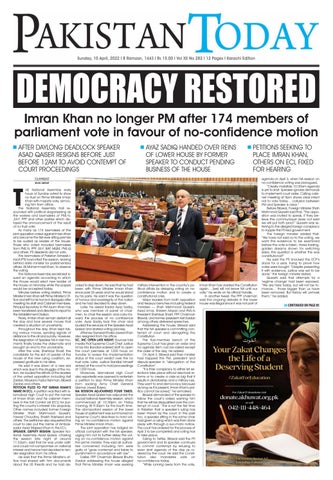
Democracy restoreD Imran Khan no longer PM after 174 members of parliament vote in favour of no-confidence motion g
after daylong deadlock sPeaker asad qaiser resigns before just before 12am to avoid contemPt of court Proceedings
g
ayaz sadiq handed over reins of lower house by former sPeaker to conduct Pending business of the house
g
Petitions seeking to Place imran khan, others on ecl fixed for hearing
ISLAMABAD
t
Mian abrar
he national assembly early hours of sunday voted to show no trust on Prime minister imran khan with majority vote, removing him from office. the national assembly hall resounded with political sloganeering as the workers and lawmakers of Pml-n, jui-f, PPP and other parties which delayed the announcement of the result of no trust vote. as many as 174 lawmakers of the joint opposition voted against imran khan who became the first-ever sitting premier to be ousted as leader of the house. those who voted included lawmakers from Pml-n, PPP, jui-f, baP, mqm, Pml-q and others. Pti dissidents did not vote. the lawmakers of Pakistan tehreek-iinsaf (Pti) boycotted the session, leaving behind state minister for parliamentary affairs, ali mohammad khan, to observe the voting. the national assembly secretariat issued an agenda according to which the house would elect new leader of the house on monday while the papers would be accepted today. minutes before voting started, Prime minister imran khan left Prime minister’s office and left for his home in banigala after meeting his staff and cabinet members. Principal secretary to Pm azam khan has been transferred and directed to report to the establishment division. Priorly, imtran khan remain defiant all the day and took several moves that created a situation of uncertainty. throughout the day, khan kept taking various moves, sending signals of defiance to the all and sundry. however, the resignation of speaker na in last moments finally broke the stalemate and brought an end to the uncertainty. after the vote, shehbaz sharif, the candidate for the slot of leader of the house of the new ruling coalition, expressed gratitude to his allies. he said it was dawn of a new era which was due to the struggle of the nation. he lauded the efforts of the leaders of the united opposition including asif zardari, maulana fazlur rehman, bilawal zardari and others. PetItIon fIled to Put IMran Khan’s naMe In eCl: a petition was filed with islamabad high court to put the names of imran khan and his cabinet members in the exit control list (ecl) for putting the country’s interest into jeopardy. other names included former foreign minister shah mahmood qureshi, fawad chaudhry, sheikh rasheed and others. the petitioner also requested the court to also put the name of ambassador asad majeed khan in the ecl. sPeaKer, dePuty resIgn: speaker national assembly asad qaisar, chairing the session late night at around 11:52pm, said that he was under oath and could not compromise on national interest and hence had decided to tender resignation from his office. he said that the Prime minister’s office had shared with him documents about the us threats and he had de-
cided to step down. he said that he had been with Prime minister imran khan since past 26 years and he would stand by his party. he said it was the question of honour and sovereignty of the nation and he had decided to step down. later, he asked sardar ayaz sadiq, who was member of panel of chairmen, to chair the session and carry forward the process of no confidence vote. ayaz sadiq took the chair and lauded the services of the speaker asad qaisar and started voting process. attorney general khalid jawed khan also resigned from his office. sC, IhC oPen late nIght: sources told media that supreme court chief justice umar ata bandial ordered staff to open the court premises at 1200 hours on sunday to review the implementation status of the court verdict over the no trust vote. later, justice bandial himself arrived at the court to hold proceedings at 1200 hours. moreover, islamabad high court also reportedly was opened to entertain a petition to stop Prime minister khan from sacking army chief general qamar javed bajwa. na sessIon adjourned four tIMes: speaker asad qaiser has adjourned the crucial national assembly session, which commenced at 10.30pm on friday morning, till 9:30pm for the fourth time. the all-important session of the lower house of parliament was summoned on supreme court’s directives to hold voting on no-confidence motion against Prime minister imran khan. the joint opposition has lodged an official complaint with the na speaker, urging him not to further delay the voting on no-confidence motion against the prime minister. they said all authorities concerned including him were guilty of “gross contempt and liable to punishment in accordance with law”. earlier, PPP chairman bilawal bhutto zardari addressing the house alleged that Prime minister imran was seeking
military intervention in the country’s political affairs by delaying voting on noconfidence motion and to create a constitutional crisis. major leaders from both opposition and treasury benches including federal ministers — shah mehmood qureshi, asad umar, shireen mazari and Pml-n President shehbaz sharif, PPP chairman bilawal, and former president asif zardari among others delivered speeches. addressing the house, bilawal said that the na speaker is committing contempt of court and abrogating the constitution. the five-member bench of the supreme court has given an order and no agenda item can be raised except the order of the day, he added. on april 3, bilawal said their minister had trapped the Pm, president and deputy-speaker in “abrogation of the constitution”. “it is their conspiracy to either let selections take place without electoral reforms or to create a crisis so big that it results in dictatorship and a military rule. they want to end democracy because as long as it is present, imran khan’s politics cannot be saved,” he remarked. bilawal demanded of the speaker to follow the court’s orders warning him that he will be disqualified over the contempt of court. “this is not the first time in Pakistan that a speaker’s ruling has been thrown by the court. in the past too, a speaker sitting in the same chair had given a ruling which was then done away with through a suo-moto notice. the court has ordered for the process of april 3 to be completed and voting has to take place. taking to twitter, bilawal said the Pti government and its speaker continues to commit contempt by refusing to even start agenda of the day as ordered by the court. he said the constitution also mandates vote on no-confidence today. “while running away from the vote,
imran khan has violated the constitution again… [we] will not leave na until our vote,” he wrote on his official handle. in another tweet, the PPP chairman said the ongoing debate in the lower house was illegal since it was not part of
agenda on april 3, when na session on no-confidence voting was prorogued. “clearly malafide 10:30am agenda is yet to start. speaker ignores demands to implement court order. calling cabinet meeting at 9pm shows clear intent not to vote today… collusion between Pm and speaker is clear.” before bilawal, foreign minister shah mahmood qureshi said that, “the opposition was invited to speak, if they believe the communiqué does not exist we will put forth proof.” qureshi was referring to the alleged foreign conspiracy to topple the Pti-led government. the foreign minister added that, “we have not said no to the voting, we want the evidence to be examined before the vote is taken. horse trading, golden dreams shown for switching sides, the question is whether this was constitutional?” he said the Pti knocked the ecP’s doors for a year, trying to prove how votes were bought. “despite presenting it with evidence, justice was yet to be done,” the foreign minister stated. qureshi said that attempts for a ‘regime change’ had been exposed. “we are here today, but will not be tomorrow… those bigger than us have been removed. but history will unmask them,” he added.
CONTINUED ON PAGE 05
02
Sunday, 10 April, 2022 | KARACHI
NEWS
SC oRDeR oN NA DePuty SPeAkeR’S RuliNg ShoulD Be imPlemeNteD iN ‘letteR AND SPiRit’: AgP
A
NewS DeSk
TTORNEY General for Pakistan (AGP) Khalid Jawed Khan has said that the Supreme Court’s order, directing the National Assembly speaker to hold the voting onconfidence motion against Prime Minister
Imran Khan, should be implemented in letter and spirit, a news outlet reported on Saturday. According to the report, the AGP, while talking to media persons in Islamabad, said: “I always fight in court but once the court passes order, it has to be implemented in letter and spirit and it shall be done.” On Thursday, the SC had set aside
Cabinet approves Samina Rizwan as Director on NBP Board ShAhzAD PARAchA The Federal Cabinet has approved Samina Rizwan as Independent Director on the vacant slot of the National Bank of Pakistan Board for a term of three years. Sources said that the finance division had forwarded the summary with regard to the appointment of an independent director as the NBP board. As per the appointment of directors on the board of directors of NBP in terms of Section 11(1) & (2) of Bank’s (Nationalization) Act, 1974, a bank shall have a Board consisting of a President who shall be the Chief Executive; not less than five and not more than seven other members and a Chairman of the Board. Section 11(3)(a) of the Act authorizes the Federal Government to appoint the Chairman, the President and other members of the Board of the Bank in consultation with the State Bank of Pakistan (SBP) for a term of three years. Presently, Zubyr Soomro is Chairman while President NBP is Arif Usmani, Directors include Asif Jooma, Tawfiq Asghar Hussain, Sadaffe Abid, Imam Bakhsh Baloch and Ahsan Ali Chughtai. To fill the vacant position on the board of NBP, a summary for the Cabinet was moved on September 10, 2021. It is pertinent to note that the Federal Cabinet in its meeting held on September 21, 2021, in case No. 895/31/2021 approved the appointment of Sarwar Iqbal as Independent Director on the Board of NBP. During FPT clearance, NBP forwarded an email of Sarwar Iqbal dated October 05, 2021 informing therein that due to personal reasons, he would not be able to take up the position and had accordingly withdrawn his name from consideration resultantly, the slot is still vacant on NBP’s Board. A committee was constituted vide Finance Division’s notification dated September 23, 2021, to give recommendations to the Finance Minister regarding suitable professionals for filling up vacant positions on the Board of Directors (BoDs) of Public Sectors Companies and DFIs under the Finance Division. The committee, in its meeting held on November 26, 2021, has recommended the name of Samina Rizwan to fill the vacant slot on NBP’s Board. The statutory requirement of initial consultation with SBP has also been met and SBP has stated that the nominee apparently meets fit and proper test criteria.
National Assembly Deputy Speaker Qasim Suri’s ruling to dismiss the no-trust resolution against PM Imran and the subsequent dissolution of the lower house of parliament by President Arif Alvi on the premier’s advice. “The ruling of the deputy speaker of the National Assembly in relation to the
resolution for a vote of no-confidence against the prime minister under Article 95 of the Constitution are declared to be contrary to the Constitution and the law and of no legal effect, and the same are hereby set aside,” the top court had said in its short order. The 5-0 ruling ordered parliament to
reconvene on Saturday, no later than 10:30am, saying that the session could not be prorogued without the conclusion of the no-trust motion against PM Imran. “It is declared that the resolution was pending and subsisting at all times and continues to so remain pending and subsisting.”
Debt to GDP ratio falls to 72pc in FY21, 67pc till Dec FY22 APP Public debt, as a percentage of Gross Domestic Product (GDP), decreased to 72 per cent during the fiscal year 2021, from 76.6 per cent in FY 2020, finance ministry said here Friday while rebutting an article published in a section of press. According to the latest published data, public debt to GDP is estimated to have declined further to 67 per cent of GDP as of December 2021, said a press statement issued by the finance ministry. In real terms, the increase in public debt during the 2018-2022 period is around 3.3 per cent of GDP, which is less than the debt accumulated during 2013 to 2018 period of 8.2 per cent of GDP, it said. The article on ‘Public debt soars by Rs18 trillion’ “published by Express Tribune in its edition on April 6, 2022 is misleading and the author’s comparison of the 2008 to 2022 period fails to take into account the
significant changes in the size of the economy,” the statement added. It said, the economy’s capacity to take loans today was higher than compared to previous years due to the significant increase in the size of the GDP. A better analysis would have focused on the public debt as a percentage of GDP, the standard indicator used by all international publications. According to the statement, Pakistan was one of the few countries that managed to reduce its debt despite the significant impact of Covid on public finances. Secondly, it added, the author needs to understand that the increase in outstanding public debt does not necessary mean new borrowing by the government. The change in stock of outstanding public debt is primarily on account of interest payments on debt accumulated over the last 10 years, exchange rate revaluation of external debt, and cash balances maintained by the government with the central bank.
These do not represent new borrowings as the author suggests in the published article. New borrowing by the government during July 2018 to Feb 2022 is only Rs5 trillion – which is equivalent to the primary deficits run during this period. The article wrongly attributes new borrowing at Rs18 trillion. The interest payments on debt accumulated over the last 10 years is estimated to be Rs9 trillion during the last three and a half years. The impact of the exchange rate and the revaluation of the external debt is estimated around Rs4.4 trillion. Whereas the government currently maintains cash balances of around Rs0.6 trillion with the central bank to meet emergency cash requirements. The new borrowing undertaken by the PTI led government of Rs5 trillion over the last three and a half years has been used primarily for scaling up spending on the poorest households and welfare of the masses.
Making Pakistan an Islamic welfare state is top objective: PM Khan ISLAMABAD Staff RepoRt
Prime Minister Imran Khan Saturday said his objective was to make Pakistan an Islamic welfare state on the model of Riyasat e Madina. Speaking at the fund raiser for Shaukat Khanum hospital here, he said the best welfare states were the Scandinavian states which were now prosperous and peaceful because of the policies for the benefit of humanity. He said cancer was a different disease due to two reasons; one was that patient of the cancer had fear of death and other was that the treatment of
cancer was expensive. He said cancer disease had a long treatment and the patient had to undergo regular check ups. Imran Khan said more hospitals were needed in Pakistan to treat patients of cancer. “About 40 years back, I thought of establishing the cancer hospital and despite difficulties accomplished the task.” He said now if cancer was detected early, the disease could be treated. He appreciated Pakistani nation for coming together to build and run the Shaukat Khanum hospital. He said Pakistani nation was ahead of other nations when it came to giving charity. It was mandatory for the
WHO Country Head Dr Palitha calls on AJK PM MIRPUR Staff RepoRt
Dr Palitha Gunarathna Mahipala, Country Head of World Health Organization on Saturday called on the Prime Minister Sardar Abdul Qayyum Niazi and discussed various issues relating to mutual cooperation and wideranging reforms being introduced in the health sector of Azad Jammu Kashmir. Speaking on the occasion, PM Niazi said that the reforms in the region’s health sector was his government’s top priority. He said that besides legislation, equitable distribution of resources amongst the masses was his government’s first and foremost priority. He said that the incumbent government had allocated enough budget to enhance the capability of both the sectors. The PM said that the government had ensured provision of free medicines and free of cost
Muslims to give Zakat and the practice gave an opportunity to help poor people, he noted. He said Pakistani nation had given Rs 63 billion as charity for treatment of cancer patients in the Shaukat Khanum hospital. “We will fulfill our promise to the nation that 70 percent of the patients in the hospital will be treated freely.” The Prime Minister said cancer of many patients was treatable but they could not be treated at the cancer hospital because of lack of space. He said his government introduced health insurance and now every family could avail health facility of Rs one million every year. Under the health insurance
programme, the family members could get treatment
from any hospital including private hospitals.
Sunday, 10 April, 2022 | KARACHI
imPoRt of uSeD CARS gAiNiNg momeNtum AS oveR 20000 uNitS imPoRteD iN eight moNthS ISLAMABAD
D
Ghulam abbaS
ESPITE various initiatives taken by the government to discourage the import of used cars, the import of old cars is gaining momentum. As per available private data, Pakistan has imported over 20,000 units during the past eight months of this financial year. The import of used cars in the whole financial year of 2021 was around 21,000 units. The imports of used cars had reached the highest figures in 2019 when over 36,000 units of used cars were imported in the country through various schemes or illegal payment channels. In order to discourage the import of used cars the government had later issued an SRO restricting and channelizing the mode of imports and payments. It was in the backdrop of pressure from FATF to eliminate undocumented payment channels and the imports of used cars was the main culprit in this regard. Following the restriction under the SRO, the imports were declined to around 10,000 units in the year 2020. However, the imports picked up
pace again after a short while as over 21,000 units were imported in the FY 2021. Interestingly the imports of used cars seems to continue the momentum as from July 2021 to February 2022, over 20,000 units have been imported showing a jump of further thousands of imports in the remaining four months of this financial year. Considering this huge import of used cars, it is projected that more than 30,000 cars will be imported by the end of this financial year. If the trend continues, the financial year 2022 will end up with the highest post-SRO numbers of the used car imports in Pakistan. As per the data around 80% increase has been witnessed in the import of used cars in the past two months. In January this year, at least 2,083 units of used cars were imported and in February 2,778 units were imported. The analysis of the data of used car imports show that over 4,000 units of economy segment, which included Mira, Dayz, Alto etc. have been imported till date with around 21% share in the total imports. Around 7,000 units of the small segment (including Vitz, Passu, Aqua etc) with 35% share have been imported till date while 502
aGencieS
In Pakistan, maize-soybean strip intercropping technology demonstrative area has surged to over 400 acres, about 2.67 times that of last autumn, said Muhammad Ali Raza, Director of National Research Center for Intercropping, post-doc of Sichuan Agricultural University. “More types of crops are being included in the intercropping system. This season, the demonstration of wheat-soybean strip intercropping also has started,” he said. “We have more than 20 demonstrations of 400 acres in Pakistan now, and over 20 farmers have adopted our technology as we know it,” Dr. Ali told CEN. Notably, 22 acres of the demonstrative plots were sowed with the newly invented intercropping-specific
NewS DeSk vans (15%), 2874 SUVs (14%), 82 small buses, and 2863 others (14%) were also imported. On the other hand, a total 150 units of various models of BMW, Mercedes Benz, Audi, Suzuki and other CBUs were also imported in February. According to a dealer of used cars imports, the overseas Pakistanis were importing the used vehicles under personal baggage/gift systems/transfer of residence while paying the duty/taxes out of foreign exchange arranged by the Pakistani national themselves or local recipient supported by bank encashment certificate showing conversion of foreign remittance to local currency. “This double import of both CBUs
and used cars in huge quantities is proving very damaging to the local auto industry,” said S.M. Ishtiaq, CEO S.M Engineering. He added that these imports are in complete violation of the government’s policy regarding the imports of vehicles in Pakistan. “This situation needs immediate attention of the policy makers as this would be a double blow to the local auto industry and the national exchequer as well,” reasoned Ishtiaq. It may be added like the historic jump in locally assembled vehicles, the prices of used cars are also quite expensive making it really difficult for the customer to afford them in the current recessionary time.
planter. “Sowing two crops with intercropping technology is always a problem, but now it’s not. It is the first-ever intercropping-specific planter in Pakistan, which can adjust or change row distance between intercrops as well as fertilizer application rate,” Dr. Ali said. Dr. Ali said, “Farmers have been asking for this planter from me since 2018. Luckily, I designed the intercropping-specific sowing planter this year. Prof. Yang Wenyu, Prof. Yang Feng and Prof. Athar Mahboob helped me at all steps for the development of this planter.” It’s learned that a national patent is being applied for this planter. With the planter, people can sow two crops at one time, which will save a lot of time and labor cost in the near future. Under the National Research Center for Intercropping jointly established by Sichuan
Agricultural Universities and the Islamia University of Bahawalpur, spring sowing in the demonstrative plots of maize-soybean strip intercropping technology was completed. This season, besides the skyrocketing demonstration area of 400 acres, there’s a breakthrough in machinery as well. Planters specifically for intercropping were used and tested for the first time in Pakistan, which will greatly relieve sowing burden faced by local farmers in the future. This is the fourth year since China’s maize-soybean strip intercropping technology was introduced in Pakistan in 2018. This technology makes better use of available space to increase the amount of crops that can be harvested on the same area of land as soybean production is like an added, which is helping Pakistan ease soybean shortage and cut soybean imports.
Possible outcome of current crisis in parliament hASSAN YoUSAf ShAh What is the outcome of the current political turmoil? There are numerous possibilities in the current political crisis!. How will the things unwind in the coming days and who (either present PTI government or combined opposition) going to pull out a political or legal card? Some of the events that are being witnessed was preempted in a legal column that was shared on floor crossing, formation of a forward block, vote of confidence and arrests of political leaders in December 2018 on Pakistan Today. It still holds. The most important medium is the constitutional law to politically maneuver in the current game set. Lets see what are some of the legal and constitutional options or maneuverability available with the possible outcome in the near future. The below are speculative or assume that these are foreseeable possible outcomes and does not relate to any bearings to judicial, political proceedings in any contemptuous way or related biasedness towards any one party. PARLIAMENTARY SESSIONS: 1) Session is prolonged without end:- As per the rules of business governing the National Assembly speaker has the power to raise, probe and entertain any point of order, questions or comments from treasury or bench on a given agenda in the assembly. The endless debate is going to lead to frustration and another series of contempt petitions in the Supreme Court is expected. The rules of business allows loop hole or indiscrete powers to speaker or deputy speaker when it comes managing the house or agenda in the house even if its vote of confidence. However not more than one agenda can be admitted at a time. The speaker has the power to allow as many questions and answer or comments. There are limits to the quality, time and words of a question or comments
03
Pti submits reference against 20 dissident party members to NA speaker
Maiz-soybean strip intercropping demonstrative area surges to over 400 acre in Pakistan BeIJING
NEWS
however the power to allow member to speak at a stretch till he seats down is also within the power of the speaker. 2) A reference is sent to the election commission against those members of the PTI members who have switched to the opposition side. The speaker has the power to send the reference to election commission within 30 day receiving such a reference. If its PTI appointed speaker he will do so before the vote is counted. Process will be initiated beforehand. The outcome of the reference again is subject to series of proceedings which will delay and magnify further legal lacunas in the elections laws. 3) The session may witness disruption which may offer reason/ excuse to the speaker to suspend the session for a day or more. As per the rules of business the speaker has indiscrete powers to manage and control any “disruptions” either in the house or galleries and may take appropriate steps which may include postponing a particular session. ELECTION COMMISSION AND DEFECTIONS: 4) The disqualification of the “defected” PTI member in case of floor crossing will be delayed to the maximum by first, the Election commission and later by the “newly elected” speaker of the national assembly. This is assuming that the newly elected speaker by the opposition members decides to postpone the reference that is sent to the election commission. Lets assume that the reference is finally sent then the “long drawn” process in the election commission may delay the outcome of the reference further. Just in case the recommendation of the Election Commission is send to the newly-elected speaker, it gives indiscrete powers to the speaker who may again delay the procedure to deseat the “defected” member. 5) There may be a penal penalty lodged against the speaker and deputy speaker by the Honorable Supreme Court as a result of the contempt petitions to be filed next
week in court. Supreme Court will then resume the hearing and pass on an administrative order which will then put the treasury benches and courts at a confrontation path. 6) The Supreme Court may allow stay order or interim relief filed by the so called “defected” PTI members and this relief may even allow them to vote or contest next elections. 7) The courts may find many multiple petitions asking to give suggestions on the way to conduct the current session of the parliament. 8) There is a possibility that the court may also find the prime minister or another head of the party in contempt. 9) The contempt of court may actually also infuse a small penalty on speaker or even leader of the house which may qualify them for disqualification. 10) There may be petition moved for disqualification of the leader of the house or speaker of the house. 11) Crisis may prolong and this may lead to the scuffle or scene created in the National Assembly and this can lead to the proceeding of the assembly to be challenged yet again. 12) The PTI defected members who number somewhere 15-20 may decide to vote for PTI after all and this will create an interesting scenario which will again may be challenged in the Supreme Courts. 13) There may be even a petition in the Supreme Court to appoint chairperson instead of the speaker for the ongoing session. It is not farfetched to assume that the future of politics in Pakistan may witness above such possibilities and perhaps see much worst. Hence the below is not dwelling on the thoughts if such a scenario is about to take place or to judge its morality, rather it is meant to share if such a scenario may hold a legal bar. The worst for some is yet to come.
The PTI — on behalf of the party chairman Imran Khan — on Saturday submitted a reference against 20 dissident party members to National Assembly Speaker Asad Qaiser. The reference against the members — filed under Article 63(A) — was handed over to the speaker by PTI’s chief whip Amir Dogar. The development comes as the NA speaker is yet to allow members to cast their votes on the opposition’s no-confidence motion against Prime Minister Imran Khan despite the passage of several hours. According to reports, the NA session will likely continue till 12am, while the premier has summoned a meeting of the federal cabinet at 9pm. It is pertinent to mention that even without the support of the dissident members, the joint opposition has the support of required number of lawmakers to oust the prime minister.
Pm khan’s stand on Palestine commendable; says Al-Aqsa mosque imam ISLAMABAD app
Al-Aqsa Mosque Imam Sheikh Ikrama Sabri termed Prime Minister Imran Khan leader of the Muslim Ummah and said his unwavering stand on the issue of Palestine was commendable. He, in a video call with Religious Affairs Minister Pir Noor ul Haq Qadri the other day, said no one supported Palestine issue in the clear and unambiguous words like him, said a press release. He said Prime Minister Imran Khan raised an effective voice on the Palestine issue both in the Organization of Islamic Cooperation (OIC) and United Nations Security Council’s meetings. He said his vigorous diplomacy and OIC foreign minister’s actions on the Gaza tension had won the hearts of the Palestinians. Imam Sabri said the children of Palestine were paying back the debt of Prime Minister Imran Khan’s support in the shape of prayers. He said every morning, he himself prayed for Prime Minister Imran Khan. Meanwhile, Noor Qadri said Pakistan had never retreated from its position on the Palestine issue since the time of Quaid-e Azam Muhammad Ali Jinnah, father of the nation. He said Pakistan would not recognize Israel as long as the present government was in power. He said Israel was an illegitimate state which had robbed the peace of the region. Noor Qadri said Palestine was not a political issue but it was connected with the independence of first Qibla and human tragedy. He said it was the desire of the Pakistani nation to restore the sanctity of Jerusalem and freedom. He said Prime Minister Imran Khan would not back down an inch from the position of Palestine issue. He said the prime minister was paying the political price of the support of Palestine.
Court sentences hafiz Saeed to 33 years in jail NewS DeSk An anti-terrorism court on Friday awarded a combined sentence of 33 years imprisonment to Jamaatud Dawa (JuD) chief Hafiz Muhammad Saeed in two cases of terror financing. The Counter Terrorism Department (CTD) had registered two cases against the JuD leader. In one of the cases, the court awarded five-year imprisonment each under sections 11-H (2), 11-I, 11J(2), and 18 months jail under section 11-F(2) of the ATA. In the other case, the court awarded a five-year sentence each under sections 11-N, 11-I, 11-J(2) and an 18-month jail term under section 11-F(6) of the ATA. The court imposed a collective fine of Rs340,000 on Hafiz Saeed in both cases. All the sentences will run concurrently. Several leaders of the JuD, including Hafiz Saeed, are already under detention since July 2019. They had been convicted on the basis of FIRs registered by the CTD on charges of terror financing. Trial proceedings in several others are pending.
Sunday, 10 April, 2022 | KARACHI
04 NEWS
UN wrITes To INdIA over INAcTIoN oN deATh ThreATs To dAlIT joUrNAlIsT NEw DELHI
A
AgencieS
GROUP of United Nations rights experts has written to the Indian government expressing concerns regarding the death threats received by Dalit journalist, Meena Kotwal, and the failure of the police to take cognizance of the same. The UN Special Rapporteur on Human Rights Defenders and other UN experts said that they wrote to the Government of India
on 3 February this year regarding this and the communication remained confidential for 60 days before being made public, during which time the Indian government was expected to respond. However, the government did not respond during this period, they alleged. The undersigned include the UN Special Rapporteur on the situation of human rights defenders, Mary Lawlor; Special Rapporteur on the promotion and protection of the right to freedom of opinion and expression, David Kaye; Special Rappor-
teur on minority issues, Fernand de Varennes; and the Working Group on the discrimination against women and girls, the members of which include Melissa Upreti (chair), Dorothy Estrada-Tanck (vice-chair), Elizabeth Broderick, Ivana Rada?i? and Meskerem Geset Techane. In the communication to India, the UN rights experts expressed their serious concerns regarding what appears to be a deliberate and sustained campaign of threats and abuse towards Meena Kotwal.
“We are deeply concerned by the numerous threats against her life and physical integrity, and at the coordinated attempts by unknown individuals to further intimidate and threaten her. The intimidation of and threats against Ms Kotwal is particularly concerning, as it appears to be in direct retaliation for her exercising of her right to freedom of opinion and expression online, which in this instance involves a protest against the oppression of women, among whom Dalit women are dispropor-
tionally subjected to multiple forms of discrimination and violence and extremely marginalized, constituting a violation of international human rights law and standards,” they said. Meena Kotwal is a Dalit woman human rights defender, journalist, and the founder of ‘The Mooknayak’, an online news channel and website that covers issues related to the persecution of the Dalit minority and marginalised people. It also advocates for social justice and democracy for the marginalised.
PM Imran Khan is pride of the nation: Usman Buzdar LAHORE StAFF RePoRt
Media a partner of PTI in the struggle for change: Governor Punjab LAHORE StAFF RePoRt
Punjab Governor Omer Sarfraz Cheema has said that media has been a partner of Pakistan Tehreek-e-Insaf (PTI) in ongoing struggle for change. He stated this while talking to journalists from print and electronic media who called on his at Governor House on Saturday. Omer Sarfraz Cheema said that Prime Minister Imran Khan is sincere, fearless and patriotic leader who has been fighting against the mafia not for his own self, but for the future of the country and the nation. He said that the prime minister’s struggle is for a strong and independent Pakistan. PTI is the party which has constantly strived for independence of institutions, sovereignty and rule of law, he added. The Governor Punjab said that media is important pillar of the state and the PTI government believes in freedom of speech. Media has a very important role in the continuity of democracy and political stability, he added.
Time to recognise Afghan Taliban government
Punjab Chief Minister Sardar Usman Buzdar has said that Prime Minister Imran Khan is the pride of the whole nation and no one can bow down Pakistan in his presence. In a statement issued here on Saturday, he said that Prime Minister Imran khan is fighting for the survival of Pakistan. The PM’s address with the nation is reflective of the sentiments of every patriot Pakistani, he added. Usman Buzdar said that the Captain share his inner feelings with the nation with sincerity. Every single word of Imran Khan was for the sovereign and independent Pakistan. Prime Minister Imran Khan gave a message to the nation to live with dignity. The chief minister further maintained that PM has represented self-respecting and honourable Pakistan in true sense. He said that PM Imran Khan is standing
firmly for materializing the dream of “New Pakistan” and the whole nation is backing him up. He termed Prime Minister Imran Khan a brave, honest and true politician. cM Buzdar fElicitatEs nation for succEssful flight tEst of shahEEn-iii: Meanwhile, Punjab Chief Minister Sardar Usman Buzdar has felicitated the nation for the successful flight test of Shaheen-III surface to surface ballistic missile. The chief minister paid tribute to the Pakistanis scientist and engineers for conducting a successful flight test and termed it the open proof of their professional expertise. Usman Buzdar said that with the successful Shaheen III Ballistic missile Pakistan has crossed another milestone in defence capabilities. The successful Shaheen III Ballistic Missile test flight will further strengthen the defence of Pakistan, CM concluded.
Saudi Arabia to allow one million Hajj pilgrims this year
NEws DEsk
RIYADH
After the sudden departure of the gurus, the pandits, the astrologers, the US troops and the NATO forces from Afghanistan, the Taliban forces took over the country’s affairs in August, 2021. The protracted Afghanistan conflict abruptly gave way to an accelerating human rights and humanitarian crisis. The Taliban immediately rolled back women’s rights and media freedom amongst the foremost advancements of the post-2001 reconstruction effort. Most secondary schools for girls were closed, and women were prohibited from working in most public and private sectors and many other fields. The Taliban assaulted and detained journalists therefore many media houses and TV channels shut down or drastically scaled back their operations, mainly because many journalists had fled the country. The new Taliban cabinet included no women, no minorities and no ministers from outside the Taliban’s own ranks and files. In many cities, the Taliban searched for, threatened, and sometimes detained or executed former members of the Afghan National Security Forces (ANSF), officials of the former government, and at times their family members. As the Taliban entered Kabul on August 15, thousands of people tried to flee the country, but chaos and violence at the airport impeded the evacuation of many at-risk Afghans. The United Nations reported that Taliban forces were responsible for nearly forty percent of civilian deaths and injuries in the first six months of 2021. Although, many incidents were not claimed by the Talib’s or other forces, nearly half the civilian casualties comprised of innocent women and children. Another factor was the attacks carried out by the “ISKP” which included assassinations of important personnel and a number of deadly bombings in Kabul, Jalalabad, Herat and other cities across Afgahnistan creating a further mess. Taliban forces in several provinces carried out retaliatory killings of dozens of former officials and security force’s personnel. The circumstances remain the same for the Afghans but the focus has shifted to the “RussoUkraine” war. The war has taken over the media, social media, as well as the newspapers globally and left the Afghan people to rot.
Saudi Arabia said Saturday it will permit one million Muslims from inside and outside the country to participate in this year’s Hajj, a sharp uptick after pandemic restrictions forced two years of drastically pared-down pilgrimages. The Hajj ministry “has authorised one million pilgrims, both foreign and domestic, to perform the Hajj this year,” it said in a statement. One of the five pillars of Islam, the Hajj must be undertaken by all Muslims with the means at least once in their lives. Usually, one of the world’s largest religious gatherings, about 2.5 million people took part in 2019. But after the onset of the coronavirus pandemic in 2020, Saudi authorities allowed only 1,000 pilgrims to participate. The following year, they upped the total to 60,000 fully vaccinated citizens and residents chosen through a lottery. This year’s Hajj, which will take place in July, will be limited to vaccinated pilgrims under age 65, Saturday’s announcement said. Those coming from outside Saudi Arabia will be required to submit a negative Covid-19 PCR result from a test taken within 72 hours of travel. The government wants to promote pilgrims’ safety “while ensuring that the maximum number of Muslims worldwide can perform the Hajj”, Saturday’s statement said. Easing rEstrictions: The Hajj consists of a series of religious rites that are completed over five days in Islam’s holiest city, Mecca, and surrounding areas of western Saudi Arabia. Hosting the Hajj is a matter of prestige for Saudi rulers, as the custodianship of Islam’s holiest sites is the most pow-
AFP
erful source of their political legitimacy. Before the pandemic, Muslim pilgrimages were key revenue earners for the kingdom, bringing in some $12 billion annually. The restrictions in 2020 and 2021 stoked resentment among Muslims abroad who were barred.
CMYK
The kingdom of approximately 34 million people has so far recorded more than 751,000 coronavirus cases, including 9,055 deaths, according to health ministry data. In early March it announced the lifting of most Covid restrictions including social distancing in public spaces and
quarantine for vaccinated arrivals, moves that were expected to facilitate the arrival of Muslim pilgrims. The decision included suspending “social distancing measures in all open and closed places” including mosques, while masks are now only required in closed spaces.
Sunday, 10 April, 2022 | KARACHI
NEWS
05
Democracy resToreD: Imran KHan no longer Pm afTer 174 memBers of ParlIamenT voTe In favoUr of no-confIDence moTIon contInueD froM pAge 01
“m
y prime minister told the nation that it has to now decide whether it wishes to live freely or enslaved,” he said. Speaking of PM Imran’s visit to Russia, Qureshi said the visit came on the latter’s invitation and all institutions decided that it would be for the betterment of Pakistan. “Pakistan is a sovereign state, but they [opposition] want it to be a slave,” the foreign minister said, further claiming that the US national security adviser called on Pakistan’s NSA and told him not to visit Russia. “Where does one sovereign state tell another to not go on foreign visit,” he asked. “We wanted to go and give our own perspective on the Ukraine crisis and advocate diplomacy because we do not want lives to be lost. Pakistan is a country that believes in diplomacy, in self-determination; we have never believed in the threat of force,” the foreign minister added. The foreign minister went on to insinuate that there was more to India’s missile ‘malfunction’, asking if the nation did not want answers regarding the incident. Earlier in the day, as the session began, the speaker announced to start the question hour session but had to stop when Leader of the Opposition in the National Assembly Shehbaz Sharif took the floor on point of order and made a small speech reminding the speaker that he was bound to go ahead as per the top court’s order. Shehbaz said that the chair’s unconstitutional steps were set aside and the doctrine of necessity was buried by the top court. During his speech, the government side kept interrupting by constantly speaking and kept calling to him a “beggar” — a tacit reference to his recent statement where he said “beggars can’t be choosers”. Speaker NA briefly interrupted him by saying that he will proceed as per the SC directions but discuss the foreign conspiracy as well. To this, Shehbaz again reminded the speaker that the SC order has bound him to take up the agenda item pertaining to voting on the no-confidence motion. “you cannot deviate from this.” Speaker Qaiser responded that the court’s decision will be implemented in true spirit before giving floor to Foreign Minister Shah Mehmood Qureshi. ‘HIStORy fuLL Of cOnStItutIOnAL vIOLAtIOnS’: Taking the floor after the opposition leader, Qureshi said Prime Minister Imran Khan has accepted the decision of the Supreme Court but was ‘disappointed’. Qureshi admitted that the no-trust motion was constitutional but argued that it was as much the opposition’s right to present the
motion as the treasury benches’ right to defend it. “I want to say from my party that the opposition has a right to present the no-trust motion and it is my right to contest it. We should debate this constitutionally.” Disappointed but accept the decision, Qureshi quoted PM Imran as saying during his speech last night, adding the speaker was proceeding ahead with the SC order. The foreign minister recalled that the Constitution was violated on October 12, 1999, saying that history is a witness that a prayer that was not even sought was granted and even the Constitution was allowed to be amended. On the current situation, he recalled that the opposition gave a statement that they would not accept any decision reviving the ‘doctrine of necessity’ when the matter was sub-judice. Qureshi said that he wanted to give background to what has brought the house to this point. As per SC’s decision, he said, it’s April 3 today as the apex court said so in its Suo Moto case. “For the last four years, the opposition has been calling for elections and that’s what the PM said last night. We admit the court’s decision but it’s important to give background to what happened last Sunday.” Qureshi said that it was imperative to probe the allegation of foreign conspiracy as the NSC — the highest security forum — has seen evidence pertaining to a foreign conspiracy and concluded that the matter was sensitive and needs attention. “They acknowledged that there was political interference and a démarche should be issued.” Accordingly, he said, the Foreign Office issued the same. “The NSC also decided to convene a parliamentary committee session but the opposition had boycotted the meeting.” At this point, Shehbaz stood up and asked the speaker that the floor be given to him but before anyone could say a word more, the speaker adjourned the session till 12:30; leaving the house guessing what happened in the spur of the moment. In the six-point agenda issued by the National Assembly Secretariat on Friday, voting on the no-confidence motion is on the fourth position. In addition, the agenda includes two calling attention notices, one of which draws the defence minister’s attention to the nonpayment of salaries to councillors in the country’s cantonment boards and the other invites the energy minister’s attention regarding the increase in petroleum prices. During the proceedings of the house, Senator Faisal Javed was expelled from the hall. He entered the hall and security personnel present pulled him out. ‘JuDIcIAL cOup’: Taking to floor PTI’s Shireen Mazari called the Supreme Court’s
verdict a ‘judicial coup’. She asked the chief election commissioner to resign if he was unable to perform his constitutional duties. The PTI lawmaker also objected on apex court’s decision of calling in the CEC in the suo motu case and asking about elections when that wasn’t the matter pending before the top court. Opp MEEtS SpEAkER In cHAMBER: Following the adjournment of the NA session, a delegation of the joint opposition met with Speaker National Assembly Asad Qaiser in his chamber to again urge him to carry out his constitutional responsibility towards the house. The opposition demanded the voting on the no-confidence resolution take place today, as per the SC’s orders. The delegation maintained that the house should be run as per the apex court’s ruling, adding that the lawmakers from the treasury benches were intentionally creating a ruckus in the parliament. The joint opposition’s delegation consisted of Bilawal Bhutto, Maulana Asad Mehmood, Rana Sanaullah, Ayaz Sadiq and Naveed Qamar, whereas Shah Mahmood Qureshi and Amir Dogar among other ministers represented the government. Earlier, senior opposition leaders, including PML-N President Shehbaz Sharif and PPP co-chairperson Asif Ali Zardari reached the parliament. Shehbaz, speaking briefly to media personnel, said that Imran Khan was more upset about Shehbaz coming into power than he was by getting ousted himself. Qureshi, talking to reporters, said the PTI would present its position in the NA session while remaining within the ambit of the Constitution. The minister claimed that they were ready for any situation, and had taken these steps to be an independent nation and raise the flag of the country. “We believe that the people of Pakistan are with us,” he said. He informed media personnel that he would present the position of Imran Khan and PTI in the NA and the decision regarding the Foreign Secretary’s briefing would be taken in the lower house session today. When asked if there would be a vote of no-confidence, Qureshi said it depended on the environment of the National Assembly. Babar Awan said three words, “Pakistan, Constitution and nation” Deputy Speaker Qasim Sure said he had accepted the decision by the the apex court. “I believe that it is a foreign conspiracy and the NSC and parliamentary defence committee has endorsed this,” he stated, adding that the people of Pakistan should think about how the current events are playing out. The deputy speaker added that the conspiracy was in fact true and that they wanted to prove it before the nation. “I think the nation also knows this and they stand with Imran Khan.”
He further stated that the session would proceed as ordered, and the rest depended on the speaker and the agenda of the Assembly. PTI MNA Ali Muhammad Khan said that the truth would emerge victorious and that Imran Khan was fighting for Pakistan. “Pakistan’s decisions will be taken in Pakistan, not Washington”. Muttahida Qaumi Movement-Pakistan (MQM-P) leader Aminul Haque stated that obedience to the Constitution and law was a duty, and the Constitution stated that a vote must take place after the no-trust motion. He added that the PTI’s surprise was revealed in the past and resulted in nothing. “Protest is the right of every democratic party,” he maintained. Last Sunday, NA Deputy Speaker Qasim Khan Suri had rejected the united opposition’s no-trust motion against the prime minister on the grounds that it was backed by a “foreign country” and thus, the opposition parties had violated Article 5 – loyalty to the state and obedience to the Constitution and law. However, the ‘constitutional crisis’ was remedied at the Supreme Court which set aside Suri’s ruling and the subsequent dissolution of the lower house of parliament by President Arif Alvi on the premier’s advice in its landmark unanimous ruling on Thursday night after taking a suo moto notice last Sunday. The 5-0 ruling ordered parliament to reconvene on Saturday (today), no later than 10:30am, saying that the session could not be prorogued without the conclusion of the no-trust motion against PM Imran. “It is declared that the resolution was pending and subsisting at all times and continues to so remain pending and subsisting,” the short order read. AnOtHER ‘SuRpRISE’ In StORE?: The PM Imran-led cabinet, which was brought back to life on SC’s order, also decided to form a commission to probe the alleged “foreign conspiracy” behind the no-confidence motion filed against the prime minister by the opposition and reveal the contents of the “threatening letter” to the lawmakers before they begin voting. It may be mentioned that the previous ‘sleight of hand’ manoeuvring to throw the no-confidence motion by declaring the opposition as “traitors” landed the premier and his party in hot waters as the country’s top court not only declared it unconstitutional but also ruled that it was the government that had blatantly violated the Constitution. Currently, the joint opposition parties have more lawmakers on their side than the government, especially, after the government allies parted ways with the government. In addition, the opposition parties enjoy the support of roughly two-dozen PTI dissidents. Soon after Suri had prorogued the session and the treasury members left the assembly hall, the opposition parties had held
Lal Chowk massacre – a scar at the world’s conscience ISLAMABAD app
Lal Chowk massacre of 1993 is still considered as one of the grisliest incidents of brutality and gross human rights violations committed by the Indian occupational forces in the Indian Illegally Occupied Jammu and Kashmir, exposing the repugnant masquerade of the Indian government. On 10th April 1993, a large section of downtown Srinagar known as Lal Chowk was burned to the ground by Indian paramilitary troops. More than 60 houses, five commercial buildings, 150 shops, two official buildings, shrines, schools were completely burnt to ashes. A total of 47 innocent civilians were burnt alive and over 125 were killed by Indian Border Security Forces (BSF). This massacre was consistent with the policy of repression and subjugation by the government of India and its collaborators to silence the people’s resistance against the illegal occupation, according to experts. They were of the view that India had purposefully adopted laws and policies that systematically discriminated against Muslims, turning India into an unsafe place for the Muslims. Besides, Indian Judicial system was saffronised that failed to provide justice to the Muslims and due to this, convicted criminals of Lal Chowk massacre were still freely moving in India. India has been the largest violator of the human rights. From Kashmir to mainland India, minorities rights had been violated under the patronage of Indian state. “Indian army doesn’t regard international humanitarian laws and violates human rights with
sheer impunity. India disrespects international laws and international norms and has become a threat to regional peace. Excessive chauvinism and pseudo-pride have engulfed the whole state; thus, India acts irrationally on the global stage and uses disinformation to hide its heinous crimes,” the experts opined. They demanded of the international community to take notice of dire situation in IIOJK. The resolution of this lingering dispute was important for regional peace and security. The world community must come forward to stop genocide of Kashmiri people and conduct investigations into all massacres carried out by Indian troops in the IIOJK, they added. Since 2017, there had been a series of reports released by different forums. The Organization of Islamic Cooperation released report of its factfinding mission to assess the human rights situation in Kashmir in March 2017. The Office of the United Nations High Commissioner for Human Rights released its report on the human rights situation in June 2018, and again on July 8, 2019. Similarly, All-Party Parliamentary Kashmir Group in the UK also released its report in November 2018. Taking advantage of laws like the Armed Forces Special Powers Act and Public Safety Act that gave immunity to security forces, the Indian security forces had been on a killing spree. Since 2016, the Indian army has launched a military operation named “Operation All Out”. According to reports, 2021 again saw bloodshed of Kashmiris and silencing of Kashmir’s civil society, arbitrarily arresting of human rights defenders, journalists, and members of the civil society.
Besides Human Right Watch, Amnesty International had also highlighted massive human rights violation in IIOJK with the comments that “The Muslim majority population in Kashmir valley suffers from the repressive tactics of the security forces”. A report by Asia Watch and Physicians for Human Rights had documented rape cases that occurred since 1990 in Kashmir. One the earliest cases was the mass rape in Chanapora Srinagar committed by Indian security forces. The report also said that Indian soldiers committed rapes frequently after January 1990, and used it as a weapon of war, but, disproportionately, most of them targeted Kashmiri Muslim women. On 5th Aug 2019, Modi’s Hindu nationalist Bhartiya Janata Party (BJP) abrogated Article 370 and revoked Article 35A over IIOJK. The changes were welcomed by Indians who saw Kashmir as an integral part of India but the Kashmiris rejected it as a threat to change the demographics of the valley from Muslim-majority to non-Kashmiri and non-Muslim. Expecting a severe reaction from the people of Kashmir, the experts said, the Modi government rushed 180,000 fresh troops to Kashmir. These troops were in addition to 700,000 troops already stationed there. Curfew was imposed and complete blackout of all sorts of communication was enforced which continued after the lapse of 6 months and later continued on the pretext of COVID-19. The entire Kashmiri leadership, including pro-India leaders, were arrested. Since August 5, some 4000 people that included minors had been taken into custody and were being kept in jails outside the state.
cMYK
a symbolic session of the assembly with a total of 197 members sitting on the opposition benches. Out of the 342-member house, a party or different parties together can form the government if it has the support of 172 or more members on its side. The premier would continue if the opposition fails to produce 172 or more lawmakers in the assembly for any reason. Seeing the clear majority of the other side last time, the government had disrupted the session, which plunged the country into a political and constitutional crisis. The crisis gripped the country for almost a week after the deputy speaker had blocked the way of voting on the motion. It, however, has now been cleared by the top court. If PM Khan loses the vote, parliament would continue to function and the lawmakers in the National Assembly will elect a new prime minister to serve until August 2023, after which a general election is due within 60 days. However, the new premier can go for early elections before August 2023. vOtIng pROcEDuRE: The Second Schedule of the NA rules defines the procedure for recording votes. Before voting commences, it states, that the NA speaker shall direct that the bells be rung for five minutes to enable members not present in the chamber to be present. Immediately after the bells stop ringing, all the entrances to the lobby shall be locked and the assembly staff posted at each entrance shall not allow any entry or exit through those entrances until the voting has concluded. It adds that the Speaker shall then read out the resolution before the Assembly and ask the members who wish to vote in favour of the resolution to pass in single file through the entrance where tellers shall be posted to record the votes. On reaching the desk of the tellers, each member shall, in turn, call out the division number allotted to him under the rules. The tellers shall then mark off his number on the division list simultaneously calling out the name of the member. In order to ensure that his vote has been properly recorded, the member shall not move off until he has clearly heard the teller call out his name. After a member has recorded his vote, he shall not return to the Chamber until bells are rung under paragraph 3. When the Speaker finds that all the members who wished to vote have recorded their votes, he shall announce that the voting has concluded. Thereupon the secretary shall cause the division list to be collected, count the recorded votes and present the result of the count to the speaker. The speaker shall then direct that the bells be rung for two minutes to enable the members to return to the chamber. After the bells stop ringing, the speaker shall announce the result to the assembly.
Hammad regrets over regime change attempts under international conspiracy ISLAMABAD: Minister for Energy Hammad Azhar on Saturday expressed serious concerns over the attempts being made to topple the democratically elected government under an international conspiracy. Speaking on a point of order in the National Assembly, he said there were proofs of foreign elements’ involvement in the regime change plot. He said the government wanted to share the evidences and contents of the “Threat Letter” with the leadership of opposition parties, but unfortunately they refused to attend the in-camera meeting of the Parliamentary Committee on National Security convened by the Speaker National Assembly. The minister said the public had given the mandate to the Pakistan Tehreek-e-Insaf (PTI) in 2018 general elections as the party had won 156 seats. Now in the prevailing political scenario and fail the international conspiracy, he said the government was of the view to go for the early election to get afresh mandate, but the opposition parties were avoiding facing the masses. staff report
Undemocratic, rude attitude of PTI becomes disgrace for politicians: Baloch LAHORE: Deputy Chief of Jamaat-e-Islami (JI), former parliamentary leader Liaqat Baloch has said that undemocratic, mischievous and rude attitude of Pakistan Tehreek-e-Insaf (PTI) has become a disease of politics. While addressing the central officials on Saturday, he said that the PTI turned into the minority because of its incompetence, arrogance, mischief, advisers and spokespersons. After losing the majority, the dignified democratic attitude would have to be that Imran Khan himself should leave power. The nation is seeing the wonderful color of lust for power. Liaqat Baloch said that Imran Khan during his tenure trapped the people in inflation, unemployment, unbearable price hike, street crimes, corruption, rampant bribery and the status quo of government institutions. Fake election rhetoric is being fabricated using a global US conspiracy to cover up government failures. staff report
Sunday, 10 April, 2022
06 COMMENT
Inclusive quality education and Autism
Imran Khan and the Supreme Court
Autism is a growing problem
Foot dragging after Friday address
T
HOuGH Prime minister Imran Khan was bent upon remaining in power as long as he could by bending the system to the extreme irrespective of consequences for the country, he was still voted out on Saturday, right at the end of the Supreme Court’s deadline. Knowing that he had lost his majority after the allies abandoned him, he used the Deputy Speaker to foil the no-confidence vote in violation of constitutional provisions. In his Friday TV address he promised to abide by the Supreme Court’s ruling. This however turned out to be a subterfuge. In the same address mr Khan appealed to his supporters to come out after night prayers on Sunday to protest against the "imported government". Besides taking recourse to threats of street power, mr Khan directed Speaker asad Qaiser to delay voting on the no confidence motion despite the Supreme Court’s clear order for the session of the national assembly to reconvene on Saturday along with the directive that the session could not be prorogued without the conclusion of the no-trust motion against Prime minister Imran Khan. Senior members of the national assembly staff too tried to persuade the Speaker that any delay would lead to punishment. The Speaker however acted as a PTI member than an independent custodian of the House and continued to postpone voting on the no-confidence move on different pretexts, and finally resigned rather than conduct the vote. mr Khan’s decision to prolong his tenure for whatever it costs has led to surmises that he wants time to cover up illegalities committed during his tenure for fear of accountability. Instead of directly refusing to accept the Supreme Court verdict Khan wants the Speaker to do this and face the consequences. He has also decided to go into appeal against the verdict. mr Khan’s obduracy and the appeal to the mobs to come out into the streets has given birth to concerns about the possible derailment of the system. Hopes generated by the Supreme Court’s judgment regarding political normalcy returning to the country have been belied. mr Khan has not only polarized the society but is also creating a situation where his followers could indulge in violence. This is bad for the economy as well as for social harmony. The way out is to realise that the PTI government has lost its majority after its allies abandoned it and to let the voting on no-trust move take place. mr Khan could have exited honourably by resigning before the move. Instead he chose to have Spea|ker Qaisar resign.
Nabila Chaudhry “The flowers of late winter and early spring occupy places in our hearts well out of proportion to their size.” –Gertrude S. Wister
S
PRInG brings hope, colour and life after a sad and dull winter. It is a symbol of rebirth, renewal and joy. according to the meteorological calendar spring season is spread over three months; march, april and may. april, one of the spring months, symbolizes the blooming of flowers and rejuvenation. It also represents acceptance for persons with autism Spectrum Disorder as members of a diverse and heterogeneous society. Every year 2nd april is celebrated as World autism aawareness Day. Worldwide different activities are organized around the theme of autism acceptance. according to the diagnostic and statistical manual of mental disorders, autism is characterized by deficits in social emotional reciprocity, nonverbal social communication and in developing, maintaining and sustaining relationships. They also exhibit stereotyped repetitive behaviour, insistence on sameness, restricted interests and hyper or hyposensitivity to sensory inputs. The prevalence of autism has phenomenally increased in past decades. according to the Centers of disease control, 1 in every 44 children has autism spectrum disorder. autism is another colour of diversity that the almighty has created. Persons with autism have a different social operating system in-
Buying time
The Human-Wildlife conflict can no longer be neglected
Fear of tasting one’s own medicine
P
RImE minister Imran Khan hadtaken a risk to avoid the vote of no-confidence brought against him in the national assembly by the joint opposition by violating the constitution. The Supreme Court intervened and made the Speaker of the Lower House conduct a vote but even then, at the risk of committing contempt of court, the process was unnecessarily delayed, adding to the anger and annoyance of the opposition. The primary motivation behind this move was to cling on to power till the last possible minute, even if that involved breaking the law, so as to not admit the defeat that has been staring the former Pm in the face for over two weeks now. However, if developments over the last few days parallel to the SC-na drama are any indication, it seems this reluctance to step aside stems from a very real fear of having to face legal cases, initiated through naB and the FIa by the incoming government, leading to persecution and incarcerations similar to what opposition parties went through in the past three and a half years. PTI insiders such as Punjab Governor muhammad Sarwar and former Punjab Senior minister aleem Khan held explosive press conferences claiming massive corruption was committed by Chief minister usman Buzdar personally and through the shadowy figure of one ms Farah Khan, a close friend of the First Lady. apart from eroding the image of a knight in shining armour, clad with claims of honesty, the allegations implicate mr Khan as well and therefore he would be a respondent in cases that are bound to be filed against ms Khan and mr Buzdar. It is no wonder that the Punjab Cm election was blocked by the PTI as well, by locking up the assembly doors to the opposition no less, which had a clear majority to defeat the government’s candidate, the PmL(Q)’s Ch Pervez Elahi. The transfers of Punjab’s IGP and chief secretary, initiated by the practically defunct Punjab government, a move to influence the Cm election in the province scheduled to be held next week, have been restricted by the LHC as well. now that the no-confidence motion has been passed in na, with Imran voted out, it seems the PTI will have to taste at least some of its own medicine in the coming days.
Occupied Kashmir is a case study Peer MohaMMad aMir Qureshi
H
uman-wildlife conflict (HWC) occurs when animals pose a direct and recurring threat to the livelihood or safety of people, leading to the persecution of that species. Retaliation against the species blamed often ensues, leading to conflict about what should be done to remedy the situation. although this is not a new scenario— people and wildlife have coexisted for millennia— it is one that is becoming much more frequent, serious and widespread and a global concern for conservation and development alike. There are immense challenges in addressing HWC around the world, in particular because underlying cultural, political and economic aspects that shape these conflicts are often very complex and poorly understood. Therefore, conservation strategies for conflictprone species need to consider not only on current scenarios but also anticipate emerging conflicts in order to ensure sustainable coexistence. much research and collective experience across the world has shown that each case of conflict is different from the next, making it difficult to devise easily transferable solutions. Therefore, interdisciplinary approaches are essential to understanding what a given conflict is about, knowing what is needed for mitigation of a given conflict, and ensuring access to the necessary skills and resources. as countries increasingly grapple with this multifaceted challenge, HWC is beginning to appear in national policies and strategies for wildlife, development and poverty alleviation. almost every country in the world hosts some form of HWC, and highly biodiverse developing countries particularly struggle with this issue. Efforts to address the obvious problems without fully considering the underlying socio-political conflicts fuelling the situation often result in only temporary fixes or, worse, exacerbating pre-existing tensions. Coordinated and collaborative conservation actions are therefore required to deliver meaningful results and allow communities to shift from conflict to coexis-
Dedicated to the legacy of late Hameed Nizami
Arif Nizami (Late) Founding Editor
Yousaf Nizami M. A. Niazi
Editor Aziz-ud-Din Ahmad
Umar Aziz
Joint Editor
Joint Editor
Executive Editor
Lahore – Ph: 042-36300938, 042-36375965
stalled in them. They might seem to avoid social interaction or communication, but they have their own ways of making sense of the world around them. In time detection, intervention and parental empowerment programmes do make a whole lot of difference. We lack reliable data on the prevalence of autism in Pakistan but we as professionals do get to see more and more children with autism on a daily basis. With the passage of time autism awareness is gradually increasing in our country but it is still limited to urban and educated segments of society. Even in the urban areas, symptoms of autism are at times interpreted as introverted personalities, stubbornness, poor parenting or possession by an evil spirit. Things become more difficult when we move away from the cities. Last month my organization set up a screening camp in a village. It is not far away from the provincial capital of Lahore and also quite near Sheikhupura. I came across a child who exhibited clear symptoms of autism. according to the mother he came under the influence of an evil spirit when he was around three years old and ever since he has stopped talking to people around him. I tried my best to convince her that along with Dum Darood she should also try to take help from the inclusive education services of the school (where we had set up our camp). This inclusive school was the most accessible and relevant resource I could recommend for that child with autism. Over the last two decades I have observed that in cities, people might still have opportunities to reach trained professionals or institutes and get therapeutic, training and academic support for their child with autism. For parents living in rural and far off places it is not that easy. In rural areas, inclusive schools and trained teachers can be a valuable resource. In a village the teacher (master) is considered one of the most wise men. If we can get teachers trained in early identification of children having or suspected of having special needs, and get them connected to nearby therapeutic resources, an inclusive school can also become a guidance and screening resource for that specific village. Since 2009, at Rising Sun Education & Welfare Society, I have coordinated various teacher training programmes on inclusive education. I have seen how teachers, when equipped with ample information and practical strategies, can support children with diverse needs not only in their schools but also in their community. apart from the benefits of getting the children to
I
Karachi – Ph: 021-35381208-9
I
tence with wildlife. The Kashmir Valley witnessed a surge in the Human-Wildlife conflict cases for the last decade due to many reasons which include competition for food, space, deforestation and encroachments. most of the Human-wild animal conflict takes place outside protected area networks like orchards, human settlements, and forest areas where deforestation and encroachments have taken place. Two minor girls were mauled to death in Budgam and Ganderbal which wracked people of these districts with agony and who even protested against the Wildlife Department. The Jammu and Kashmir Wildlife (Protection) act was enacted in 1978 to meet the objectives contained therein. Since the creation of a full-fledged department of Wildlife Protection, in 1982 the state government has taken a series of major actions for conservation of forest/ protected areas and the wildlife therein. The government has now notified about 16000 sq. kms as the protected area network (Pan) which is being managed through anti poaching/anti-grazing activities, habitat management, plantation, soil and water conservation, fire protection, development of infrastructure, providing supplemental feed and such measures. Prior to this J&K Game Preservation Department has been created under the Game Preservation act, 1942 to protect and preserve the Game “In the state” which include the few species of wild animals and birds considered to be important from a hunting point of view as a sport. The state has amended the J&K wildlife protection act 1978 on the lines of Indian wildlife protection act 1972. The schedule has been revised and now there is complete ban on hunting and a number of endangered species of wild animals and plants have been brought to the Schedule-I and Schedule-IV of the act to afford them utmost protection. apart from this wild plants have also been brought within the purview of this act., Since from the last decade there has been a dramatic spike in cases official figures reveal that nearly 200 people lost their lives and over 2,000 were injured in the human-wild animal conflict across Jammu and Kashmir since 2011. Out of the total figures of deaths and injuries, Kashmir reported 118 deaths and 1877 injuries while the Jammu region reported 78 deaths and 448 injuries. according to data, in 2011-12, at least 32 people were killed and 365 were injured, the follow-
Islamabad – Ph: 051-2204545
I
Web: www.pakistantoday.com.pk
I
interact, grow and study along with their typically growing peers, in rural areas especially, many other benefits can be gained through inclusive schools. a diversity-friendly school with a trained team can become a resource centre where parents can get guidance. They can be connected with relevant professionals in the vicinity. most important of all, it can become a place where parents can vent their depression, anxiety, stress and get emotional support. Inclusive schools can make them feel accepted, understood and supported. I think in the current scenario, when the school education department of Punjab did develop an inclusive education strategy under PESP II, the need of the hour is to open the doors of mainstream schools for children with special needs. Having a well-educated and trained force of teachers in inclusive schools, can become a great source of support and hope for children with autism spectrum disorder and their families. When it comes to creating inclusive school communities it is the trained human machine that matters the most. Concentrated efforts are required to ensure that preservice teacher training programmes include orientation visits to special education and inclusive education facilities. It will enable the future teachers to assimilate the theoretical concepts with practical observations. Similarly, although an introductory session on inclusive education and special needs is a part of in-service teachers training at Quaid e azam academy for educational development (QaED), its duration should be increased and it should also include practical observation cum interaction aspects. after the teachers training, which also includes training of the heads of schools, supporting content and videos can be developed in collaboration with Punjab Information Technology Board (PITB). PITB is providing support in real time monitoring of public schools and online registration of private schools. This platform can very successfully be used to disseminate easy to use screening tools, awareness videos and even to upload virtual refresher courses for the teachers. The united nations has conducted a virtual event on april 8 to celebrate the World autism awareness Day. The theme of this event is inclusive quality education for all. Let us get together and contribute towards this theme of togetherness, inclusivity and quality education for all. The writer is a freelance columnist
ing year (2012-13) recorded 16 deaths and 305 injuries while in 2013-14, 32 deaths and 369 injuries were reported. The role of J&K Wildlife Department remained undistinguished or inadequate in one way or the other from the sufferings of their own employees to the ex-gratia provided to people who got wounded by these wild animals and has to wait for years for ex-gratia in paper work etc. Knowing all these consequences of humanwildlife conflict, it is imperative to implement strict mitigation strategies for resolving humanwildlife conflicts. Different hitherto strategies utilized include lethal control, translocation of problematic wild animals, population size regulation, and endangered species preservation. Translocation of problematic wild animal species from a site of conflict to a new place is a mitigation technique used in the past, although recent research has shown that this approach can have detrimental impacts on species and is largely ineffective since it can decrease survival rates and lead to their extreme dispersal movements. Recent methodology to resolve the humanwildlife conflict must utilize comprehensive and cross-sectoral collaborative processes between forestry, wildlife, agriculture, livestock, and other relevant sectors that will surely help in alleviating this issue on a larger scale. additionally, it is the duty of all stakeholders, and experts of the concerned sectors to improve the imparting of community education and improve the perception of the general public regarding animals. not only this, government authorities must offer monetary compensation for losses sustained due to human-wildlife conflict, since such actions will deter the need for retaliatory killings of animals, and financially encourage the coexistence of humans and wildlife. The use of guard dogs is also one of the effective strategies in mitigating human-carnivore conflict around the globe and it can lower the loss of livestock by 60 percent. Lastly, it must be kept in mind that mitigation strategies for managing human-wildlife conflict vary significantly depending on location and type of conflict. Regardless of approach, the most successful solutions are those that will include local communities in the planning, implementation, and maintenance. Therefore, it is time we all stand together in combating human wildlife conflict through proper scientific methodologies that will surely help humans and wild animal species to live in peace and harmony. (The author is pursuing an MSc in zoology in Indian occupied kashmir.He can be reached at ehsaanamy133@gmail.com.)
Email: editorial@pakistantoday.com.pk
Sunday, 10 April, 2022
COMMENT 07 Editor’s mail Send your letters to: Letters to Editor, Pakistan Today, 4-Shaarey Fatima Jinnah, Lahore, Pakistan. E-mail: letters@pakistantoday.com.pk Letters should be addressed to Pakistan Today exclusively
Let’s embrace humanity!
China's policy towards Middle East Iran is central
dr MuhaMMad akraM Zaheer
F
ROm 2016, China began to pay special attention to the middle East. With its immense production capacity, China was primarily the world's largest exporter of middle Eastern fuel depots. Therefore, establishing closer ties with oil-rich middle Eastern countries, most of which are allies of the uSa, shaped the foundation of Chinese foreign policy towards the middle East. China issued an arab policy document in 2016, which shows that it would strengthen its ties with the countries of the region with the "Declaration on the Implementation of Sino-arab Cooperation". China has signed Belt and Road Initiative agreements with countries such as Saudi arabia, Sudan, Iraq, the united arab Emirates, Qatar, Kuwait, Egypt and morocco, and some of them are members of the asian Infrastructure Investment Bank which was also initiated in the fields of renewable energy, oil, electricity and civil nuclear energy. In response, China has increased its oil purchases from oil-rich Gulf States, thus deepening its commitment to the region. By signing cooperation agreements with these arab states, China did not form its arab policy on the political structure but economic with these countries or its relations with the uSa, nor did it intend to replace the uSa, which is a military power in the middle East. This is due to the fact that the survival of Chinese investment and infrastructure projects in the middle East, as well as the security of oil purchases in the Gulf, depended on the uS military presence, which it maintained. Chinese entry into the middle East meant an economic confrontation with the uSa, but in doing so, it was careful not to turn its engagement into a struggle for military and political power. Furthermore, it is not an arab state, it is another middle Eastern country with which China cooperates fully and with which it eventually competes with the uSa in the international arena. While Iran's relations with other countries in the region are marked by greater consistency as long as its ideological and strategic interests are aligned, its relations with world powers are more indecisive and duplicitous. In this regard, it can be seen that Iran pursues a multilateral foreign policy rather than supporting a superpower, and that it seeks to maximize its benefits by maintaining balanced and equitable relations. In fact, at a time when the pragmatic spiritual government signed a landmark nuclear deal with the European union and the uSa in 2015, it was also holding intense talks with China. The West was offering Iran a package with direct and indirect political terms to lift sanctions
and sign a nuclear deal. as a result, it was expected that Iran would undergo gradual social, economic and political change as a result of its integration and stagnation in the international economic system. Lifting sanctions would further boost Iran's investment and trade cooperation with China, as well as strengthen its ties with the West. In fact, with the easing of sanctions in 2015, China allowed a large number of manpower to Iran, paving the way for many medium-sized Chinese companies to explore cooperation opportunities, and to study the Iranian economy. although violations of the nuclear deal during Trump's presidency have boosted China's economic relations with Iran, it can see that between 2015 and 2021, China became Iran's largest direct or indirect trading partner and oil importer. Despite the sanctions, China's oil purchases from Iran reached record highs in 2021.Therefore, the 25-year agreement between China and Iran in march 2021 was not a political agreement that Iran has signed with the P5+ 1 as an alternative to the nuclear deal, but this agreement of China has the potential for economic growth. The content of the agreement between China and Iran is similar to the strategic agreements in the region. On the other hand, when it is considered the uS-Iran nuclear talks, which are still stuck under Biden, the Sino-Iranian agreement is considered a threat by the uSa. In the past, China was demonstrating its ability to tolerate sanctions, using alternative methods such as oil trade and the use of the national currency in joint banking, as one of the most important disciplinary mechanisms in the international system. China has joined Iran with an alternative approach to the system and its own alternative modern model, aimed at resolving the political recommendations offered by the West. This situation highlights in the case of Iran that the uSa is feeling that China is moving towards becoming a global economic power. In some of uS President Joe Biden's most recent statements, the threat posed by the prospect of global animosity between the Chinese and liberal development models can be clearly seen as an attempt to strengthen liberal-democratic principles, which the Biden administration recently strengthened. In short, the Sino-Iranian agreement is seen as a turning point in the impending shift of power between China and the uSa. according to current indications, even if a nuclear deal had been struck with the uSa, Iran would have reached a strategic agreement with China and pursued a multilateral foreign policy
with the major powers in the international arena. On the other hand, given its current stalemate with the uSa, China's agreement could have far-reaching consequences in the long run. For Iran, which is struggling to maintain oil exports despite sanctions, the agreement may improved oil sales from China and the development of energy infrastructure. Particularly, the terms of the agreement are expected to introduce new regulations in the Iranian banking sector, as well as the use of its national currency instead of the uS dollar in oil sales, to some extent weaken the Iranian economy. Therefore,these economic measures have the potential to reduce Iran's isolation as a result of international sanctions. The infrastructure development partnership with China will support Iran's plans to become a commercial corridor hub, opening it up to neighboring countries through new road, rail and port projects. Iran’s influence in Lebanon, Syria and Iraq can strengthen its post-war economic and reconstruction power in the region, while, on the other hand, China can strengthen its economic activities and presence in the middle East. america's most powerful trump card of sanctions to return to the nuclear deal has the potential to damage the China-Iran Comprehensive Strategic Partnership. In this context, two scenarios emerge for the future of the nuclear deal. The implementation of the nuclear deal between the two parties has accelerated the first scenario, in which the sole purpose of the Biden administration is to return Iran to international nuclear status. In the second scenario, Iran's ballistic missiles, military activities in the region and relations with the regional countries, the world should not expect a positive response in return to the nuclear deal. The reason for this is that Iran will not reassure the uSa on these issues, particularly after the deal with China, which has the potential to ease sanctions. The Sino-Iranian deal will not replace Iran's negotiations with the West, like the nuclear deal and other major deals like the FaTF, but it will serve as a trump card to tip the balance in Iran's favour on these deals. Iran's global strategy is not to side with the parties, but to use all the agreements it has made with major powers such as the uSa, the European union and China, and will do so in the future. This is the strategic implication of the principle of "multilateralism in international relations", which Persian diplomacy constantly emphasizes.
The Sino-Iranian deal will not replace Iran's negotiations with the West, like the nuclear deal and other major deals like the FATF, but it will serve as a trump card to tip the balance in Iran's favour on these deals. Iran's global strategy is not to side with the parties, but to use all the agreements it has made with major powers such as the USA, the European Union and China, and will do so in the future. This is the strategic implication of the principle of "multilateralism in international relations", which Persian diplomacy constantly emphasizes.
The writer has a PhD in Political Science and can be reached at akramzaheer86@yahoo.com
WE live in a society with variant degrees of concepts and ideologies, public and private empires, unequal distribution of wealth, and a cultural potpourri with diverse beliefs and practices bound by sentimentality or sensibility. Whenever our beloved country faces some outer dilemma, be it a cricket game with our pugnacious neighbours, or natural disasters like earthquakes, we all come together and become one. The most hospitable nation is also a quintessential philanthropist. 98 percent of Pakistanis contribute to charitable causes despite 39 percent of them living in poverty. The urban population has its list of problems; housing, sewerage, pollution, traffic, safety, etc., and villages have their issues; where people are still questioning polio drops, accessibility to resources is limited, hospitals and schools are also miles away. Women’s education is still grilled by some quarters of our society and working women’s lives are more like mini battles each day, juggling between house and work, judgments and appreciations. Caught in a vicious cycle of socio-economic problems, we need to make ‘helping others’ more systematic and collaborative. aaa associates, through its Yusaeid Foundation, reinforces the vision that to add optimism and productivity to our community, we need to take along the underprivileged and grow with them. Being a socially responsible business, it consciously integrates into the segments that work for the prosperity of our society, endeavours from arranging Free medical Camp at Khaplu, Skardu, or launching First Free mobile Restaurant in the twin cities to feed the starving, and starting Ramadan Ration Drive to take charge and lead its way. aaa associates, by helping visually impaired persons to raise their voices for a productive space in society or distributing wheelchairs among people with disabilities, likes to take everyone along in the journey of success. The government has a lot on its plate and a huge responsibility to sort internal issues while tackling the pressure of the ‘economy in debt’, and challenging foreign relations. It navigates through and has established welfare services to eradicate social inequalities. The government alone is unable to fully employ the massive welfare measures required for the populace even with the remarkable Ehsaas Programme and Sehat Insaf Cards. many renowned non-governmental organisations (nGOs) therefore, also work to sort these issues by providing welfare humanitarian aid, setting up educational resources, enabling health facilities, etc. Given the limited capacity of the government, it is significant for not-for-profit nGOs to influence change in our country’s growth and advancement. Living our self-driven lives sometimes, we forget to see through the blinkers and show kindness and empathy for the lives around us. The philanthropic initiatives by the nGOs, businesses and individuals are bound to uplift the downtrodden strata of society and change the social fabric while sharing the burden of government. Let our sentiments drive us to dive into responsibility, rather than sentimentality and lead our country on the road to social change and development. MARYAM NAWAZ KAYANI ISLAMABAD
A brave woman THROuGH your esteemed columns, I wish to pay tribute to Begum Ra’ana Liaquat ali Khan on her birth anniversary. Indeed, world history is the biography of great men. The people who achieve eminence in their life are the role models for generations. Ra’ana Liaquat ali Khan is one among them. She was born on February 13, 1905, and died on June 13, 1990. She was a muslim by choice and commitment. She was 46 when her husband was assassinated in 1951. neither Ra’ana nor Liaquat ali Khan had any movable or immovable property in Pakistan or anywhere else. unlike others, they did not claim compensation for their valuable property left in India on the eve of partition of the subcontinent but gifted their huge estate to the government of Pakistan for opening a diplomatic mission in new Delhi. The salary of her husband as the Prime minister was the only source of income for their livelihood which was discontinued on his sad demise. In such circumstances, one could understand her financial difficulties to survive. Ra’ana Liaquat ali Khan was the symbol of courage, determination, and dedication. She preferred to join government service instead of relying on a family pension. This unique quality of Ra’ana Liaquat is most inspiring. She was the second lady in the muslim world who had founded and organised a women association ‘aPWa’ which had played a significant role in the empowerment of women in Pakistan. as a visionary, she initiated several projects to empower the womenfolk in the country like the Women national Guard, cottage industry and colleges of Home Economics. The Women naval Reserve was also established in the Pakistan navy at her suggestion. She successfully undertook diplomatic assignments in Europe and africa. She firmly believed in decolonization and as such, she supported the Egyptian claim of the right to the Swiss Canal. During the Swiss crisis in 1956, in her diplomatic dispatch to Pakistan’s foreign office from Hague, she opposed Pakistan’s role of siding the British, French and Israeli forces of aggression on Egypt and urged her government to support the nationalization of the Swiss Canal. She played a memorable role in promoting democratic norms as the first-ever female governor of a province in the country. Her contribution to patronizing academic and extracurricular activities in public sector universities of the province as the Chancellor is also historic. The un Human Rights award was also conferred on her in recognition of her contribution to human rights and civil liberties in 1978. She can rightly be described as ‘The Pioneer of Women movement’ in the third world. MAHFOOZ UN NABI KHAN KARACHI
Another World War? Russia has deployed over 130,000 troops to the ukrainian border. as a result, security fears in ukraine and the rest of the Western world have grown. ukraine is joining naTO, and Russia will be unable to accept this development. as a result, they’ve dispatched troops to the region in order to exert pressure on Europe to prevent ukraine from joining the Eu. This has spurred the united States and other European countries to support ukraine by giving weaponry, soldiers, and supplies, either because they are truly concerned, as seen by the fact that Russia annexed Crimea in ukraine in 2014, or because they are just opposed to Russia. Is Russia truly concerned about ukraine joining naTO, or is this just another ruse to attract support at home? Let us see how things turn out. MAKHDOOM MOHAMMAD SHOZAB HASANABDAL
Sunday, 10 April, 2022
08 WORLD VIEW
How Modi governMenT Misuses look-ouT circulars To TargeT criTics like rana ayyub and aakar PaTel TWO SUCH NOTICES HAVE BEEN SET ASIDE BY COURTS THIS WEEK FOR BEING ILLEGAL AND INFRINGING ON FUNDAMENTAL RIGHTS
ScrOll
i
uMang Poddar
N the past week, courts have struck down travel restrictions placed on human rights organisation Amnesty International India chair Aakar Patel and journalist Rana Ayyub. Patel and Ayyub, both vocal critics of the government, were scheduled to travel outside India to speak at various events. however, just before boarding their flights they were informed that they could not leave the country as look-out circulars had been issued in cases pending against them. Look-out circulars are issued by the government and law enforcement agencies to stop a person accused of a crime from evading trial or arrest by leaving the country. however, the statutory backing for such notices is shaky. The device is often misused to target political dissidents even as it is often unsuccessful against powerful industrialists who actually want to flee India. STRUCK DOWN Patel, who faces allegations of Amnesty receiving foreign contributions illegally, was stopped at the Bengaluru airport on Wednesday. Ayyub, who is accused of money laundering, was stopped at Mumbai airport on March 29. Both challenged the look-out circulars against them in court. On Monday, the Delhi high Court set aside Ayyub’s look-out circular issued by enforcement Directorate, saying that it was issued in “haste” and infringed Ayyub’s human right to “travel abroad and to exercise her freedom of speech and expression”.
Three days later, on Thursday, a district court in Delhi asked the Central Bureau of Investigation to set aside the circular against Patel. It said that the circular was in violation of the court’s orders and home ministry office memorandums. Not just that, it asked the director of the Central Bureau of Investigation to issue an apology to Patel. “It is further expected that accountability of the concerned officials, in this case, be fixed,” the court said. LOOK-OUT CIRCULARS: A look-out circular can be issued if a person accused of a cognisable offence is deliberately evading arrest or has failed to appear in court despite a warrant and is likely to leave India to avoid arrest or trial. A cognisable offence is one for which the police has the power to arrest without an arrest warrant. Apart from this, a look-out circular can be issued “in exceptional cases” if, based on inputs, it appears to the authorities that a person’s departure is detrimental to India’s sovereignty, security, integrity, bilateral relations or strategic or economic interests and other similar reasons. Both Ayyub and Patel did not fall into any of the above categories, since courts noted that they had been cooperating with the investigating agencies. PATEL’S ORDER: Patel has been accused of violating terms of the Foreign Contributions Regulation Act, 2010 – the law regulating foreign donations to non-governmental organisations – by allegedly allowing Rs 36 crore to be remitted to Amnesty India without government approval. The organisation has denied any wrongdoing. Noting that Patel has cooperated with the authorities, the court said that “it is very much clear that the accused joined the investigation as and when notice was issued”. It added that the chargesheet had already been filed without Patel being arrested. If Patel was considered to be a flight risk during the investigation or trial, he would have been arrested during the investigation itself. Therefore, the Central Bureau of Investigation’s apprehension that Patel will flee the country has “no basis and appears to be mere apprehension without any sufficient grounds”, the court said.
Further, the court noted that the timing of the lookout circular – moved on the same day as the charge sheet was filed, on December 31 – “shows that it is not the case of oversight or ignorance rather it is a deliberate act of the investigating agency to put restriction on the valuable rights of the accused”. AYYUB’S ORDER: Journalist Rana Ayyub has been alleged to have misappropriated funds she collected from the public for Covid-19. In February, the enforcement Directorate also attached bank deposits worth Rs 1.77 crore. The Delhi high Court noted that Ayyub had “appeared on each and every date before the Investigating Agency when summoned”, a point that the Union government was unable to contradict. “There is no cogent reason for presuming that the Petitioner [Ayyub] would not appear before the Investigation Agency,” the court noted. however, it asked her to inform the agencies where she was staying and deposit some money with it. MISUSE OF CIRCULARS: Look-out circulars are often challenged and struck down by courts. Such circulars have shaky statutory backing. All such circulars are issued based on office memorandums of the Union home ministry. Since these memorandums were not comprehensive, courts have also filled in the gaps. In Patel’s order, the court noted, “It is repeatedly observed by various high Courts that such measure should be taken cautiously and in exceptional circumstances.” Look-out circulars can be issued by several authori-
ties including the Union home ministry, external affairs ministry, customs department, income tax department, the Central Bureau of Investigation, and state police forces. Only officers above a certain rank can issue look-out circulars. An investigating officer has to mandatorily provide a written request along with reasons when asking the competent officer to pass a look-out circular. however, there have been cases where these conditions have not been followed. “It is correct that the discretion for moving the application of LOC lies with the investigating agency,” the court said in Patel’s case, “but the discretion can not be exercised arbitrarily without any justifiable reasons or grounds”. FAILS AGAINST FLEEING INDUSTRIALISTS At times, agencies have been unable to stop alleged offenders from leaving the country in spite of issuing look-out circulars. In 2015, the Centre Bureau of Investigation diluted its look-out circular against liqour baron Vijay Mallya. Mallya has a pending loan default case of over Rs 9,000 crore. earlier, the Central Bureau of Investigation had asked authorities to detain Mallya if he went abroad but later they asked the authorities to only inform the bureau. In 2016, Mallya left India and has not returned since. The Central Bureau of Investigation later said that this dilution was an error in judgment. Since Mallya had no warrant and was cooperating the agency allowed him to travel abroad. Another industrialist, Nirav Modi, alleged to be involved in a Rs 13,000-crore bank fraud case, had a lookout notice issued against him, but only after he fled India. CHALLENGING LOOK-OUT CIRCULARS: To set aside a look-out circular, an accused person can either approach the issuing officer or go to a competent court. however, as in the present two cases, the accused people often do not know about the existence of such circulars against them until they are stopped from travelling. In 2019, the Union home ministry refused to answer a right to information petition that requested copies of some of the office memorandums under which look-out circulars are issued. It said the memorandum was a secret and classified document. however, the chief information commissioner directed the ministry to disclose this information.
Memories of a different country ARUN SHOURIE’S MEMOIR REVISITS THE BIGGEST STORIES OF THE 1980S FROM THE VANTAGE POINT OF A NEWSROOM
Open Magazine
T
Madhavankutty Pillai
he question that poses itself as you make your way through Arun Shourie’s memoir, The Commissioner For Lost Causes, of his days as a journalist—and the decided superstar he was in the 1980s, face of the fantastic stories of The Indian express ranging from purchasing a girl and exposing slavery to bringing down a chief minister for corruption—is how come he has missed the social media revolution altogether? Why isn’t he part of an arena that makes old media irrelevant every time the hand moves on a clock? It is not for Shourie not being suited for it. his humour is as sharp as any pen he has ever held—a late example, the coinage of BJP as “Congress plus cow”—and in the hands of someone with public standing that is a weapon of amplification. The stock of anecdotes he carries of the wielders of power in India is extensive, and when has a good storyteller ever wanted for an audience even on Twitter? What explains the disinterest? From the present book, even if not a sole factor, you can make one hypothesis and that is his fixation with making a case as detailed as possible. even for newspapers that was onerous, and, much against prevailing norms, it was something he brought into journalism here in the late 1970s, after returning from the US where he worked at the World Bank, and being coopted on top into The Indian express by its maverick owner Ramnath Goenka. Shourie writes in the book: “There were several things about the paper that were crying out to be changed, and as my new colleagues and I attempted to change them, Ramnathji was the one person who supported us…There must be no limit to the length of the stories.” Social media abhors length. The narrative of public discourse happens at the surface now because the technology’s primary objective
is attention grabbing. Shourie’s route, page after page of copious references for each argument, is as much an anachronism as traditional journalism itself is becoming. everyone is a journalist now because opinions, millions of common little bits joined through by hashtags, retweets and likes, shape the fact. If the book did what most memoirs do, limiting it to human encounters and observations, it would be a page turner. As when he is telling the story of how The Indian express bought Kamla, a woman, for ₹ 2,300 after investigative reporter Ashwini Sarin spent months building contacts in Madhya Pradesh border where the trade was happening. It is a disturbing story because while the public good is evident, it is an ethical quagmire, not conscionable from Kamla’s point of view. “So widespread must the trade in women have been that, at times, Kamla thought her fate to be the normal one: Ashwini’s wife told reporters that Kamla asked her how much Ashwini had paid for her, Uma; that as Ashwini had already paid for her, Kamla, why could the two of them not stay together with him,” writes Shourie. She eventually disappeared from the shelter home that had become her residence after being thrust involuntarily into the national limelight. There are many riveting portraits, especially of Ramnath Goenka, who made The Indian express what it became and then got jealous after Shourie began to be identified more with the paper. he runs through the book like a shadow, a newspaper proprietor who couldn’t help think that he must also decide how the country was run, an itch that would often be for the good and sometimes for the bad. As when he led a resistance against Indira Gandhi during the emergency, and at the weakest moment, marshalled an opposition, one which saw Shourie becoming acquainted with him. Or, for an example of his overreach, there is the story of Goenka joining hands with Giani Zail Singh, the then president, to plot the sacking of Prime Minister Rajiv Gandhi, that Shourie opposed and did his best to scuttle. In personal relations, Goenka brought the same cunning and chaos. When Shourie couldn’t get along with editor S Mulgaokar, Goenka told him: “Tum ussey ladtey kyon ho? Mujhey dekho. Mulgaokar meraa mulazim hai. Par jab main uskey ghar pahunchtaa hoon, pehley main Mulgaokar ko salaam kartaa hoon. Phir main uskey kuttey ko salaam kartaa hoon— ‘Kuttaaji, meraa salaam.’ Poocho kyon? Kyon ki mujhey Mulgaokar se kaam karvaanaa hai, aur kutta Mulgaokar ko pyaaraa hai …(Why do you quarrel with him?
Look at me. Mulgaokar is my employee. But when I reach his house, first I salute Mulgaokar. Then I salute his dog—‘Mr Dog, my salutations.’ Ask me why. Because I have to get Mulgaokar to do some work, and the dog is dear to him . . .)” If the emergency made Arun Shourie, then it also left him permanently allied against the Congress, and in a country where there was mostly one-party rule, that was not the most comfortable of corners. he clearly relished it and found his calling there If the emergency made Shourie, then it also left him permanently allied against the Congress, and in a country where there was mostly one-party rule, that was not the most comfortable of corners. he clearly relished it and found his calling there. It also meant that he ventured into areas that others shied away from, like criticising the judiciary. In the book, there is a scathing deconstruction of one of India’s most venerated Supreme Court judges, PN Bhagwati, using a judgment where he deliberately allowed for more control of the executive over transfer of judges. Shourie methodically takes the judge’s earlier judgments to show how Bhagwati, whenever he felt like, was a strict Constitutionalist who went by the exact meaning of its word, and at other times a liberal interpreter who decided what the word of the Constitution meant. his readiness to reduce the power of the judiciary in the case is hinted at him not getting along with the chief justice of the time. And that is topped by the reproduction in its entirety of a flattering letter by Bhagwati to Indira Gandhi after she returns to power that includes lines like these—“I am sure that with your iron will and firm determination, uncanny insight and dynamic vision, great administrative capacity and vast experience, overwhelming love and affection of the people and above all a heart which is identified with the misery of the poor and the weak, you will be able to steer the ship of the nation safely to its cherished goal and the glorious vision of the founding fathers of the Constitution will become a living reality.” It wasn’t the government alone that Shourie maneuvered against, sometimes it was his superiors, as when editor BG Verghese, in keeping with Goenka’s wishes, refused to publish a story about a missing government file that Shourie had traced. he leaked it to Parliament forcing its publication. In between, he writes a letter to Verghese saying why he should not be listening to Goenka for Goenka’s good and copies that letter to Goenka himself. It would be an invitation to be sacked, which is what happened eventually but a few years later Goenka brought him
back into the saddle. There is a section in the book in which Shourie sets the ethics and tactics for journalists. It is an idealist position, some of which his own career shows the difficulty of adhering to, like not getting too close to the people you might have to write about. But the vanishing of norms is not the storm that revised the landscape he was such a figurehead of. It is in how the reader metamorphosed. Crores of Indians now think of news anchors presenting one-sided news/opinion as the word of final truth. earlier, politicians needed media to interface with the public, now they talk directly to people who in an earlier age might not even have been consumers of media or politically opinionated. It is the aftermath of a lost world, not just lost causes. Madhavankutty Pillai has no specialisations whatsoever. he is among the last of the generalists. And also Open chief of bureau, Mumbai. The Commissioner for Lost Causes by Arun Shourie, Viking, 616 pages.
Sunday, 10 April, 2022 | KARACHI
NEWS
corporate corner standard Chartered, tPL Insurance Collaborate to offer Customized, digital solutions
FestIvItIes oF RAmAdAn RetuRn As CovId-19 ContInues to ebb ISLAMABAD
A
KARACHI: Standard Chartered Bank (Pakistan) Limited is a leading global bank which has partnered with TPL Insurance Limited (TPLI), the leading Insurtech in Pakistan. Using Standard Chartered Bank’s digitally integrated platform, the bank’s customers can now purchase TPLI’s tailored insurance solutions, including health and travel products, promising end-to-end convenience and transparency. This resourceful alliance will create a one window solution catering to the customers’ evolving needs, including features like instant Policy issuance. This revolutionary solution promises to lodge instant claims through TPLI’s mobile app. It has disrupted the traditional concepts of insurance, to achieve growth, by digitally enabling TPLI’s business partners and customers. The signing ceremony for this Memorandum of Understanding (MoU) was recently held at the Standard Chartered Head Office in Karachi. The event was chaired by the CEO of Standard Chartered Bank, Rehan Shaikh and the CEO of TPL insurance, Muhammad Aminuddin. Others representing the bank included Faheem Elahi, GM Affluent Segment, Kailash Kumar, Head of Wealth Management and Mohammad Ali, Head of Wealth Management Products. The guests representing TPL Insurance included Syed Ali Hassan Zaidi, Chief Strategy & Transformation Officer and Aurangzeb Javed Siddiqui, Head of Financial Institutions Group (FIG). pr
ssGC outlays basic reasons for low gas pressure issues during pre sehar, Iftaar timings in some localities ISLAMABAD: Some of our esteemed customers have complained for receiving low gas pressure in the holy month of Ramzan especially during pre Sehri and Iftaar hours, says a handout issued here by the Sui Southern Gas Company (SSGC). “It is important to mention that customers who are generally located at the tail end of Company’s distribution lines are faced with low pressure issues due to sudden and manifold increase in gas usage for cooking purposes in millions of homes and commercial outlet at similar timing,” the statement said. “Moreover, the constantly depleting gas reserves and occasional operational issues of some gas fields have also compounded the issue, resulting in widening of demandsupply gap. SSGC's management under gas load management is constantly taking actions to facilitate it's domestic customers during Ramzan and closure of 3-days gas supplies to CNG sector in a week is one of such steps”. “The gas pressure issue can easily be checked by using gas during non pre iftaar and sehri hours as it would be found normal due to rare use of gas appliances during these hours. However, if the issue of low gas pressure is faced by our customers in those areas that are not situated at the tail end, then they are requested to promptly call SSGC’s 24/7 operational Call Centre 1199 and also notify on Company's social media platforms. SSGC's representatives will consequently ensure the quickest possible redressal”. SSGC being a customer centric organisation fully realizes its responsibilities for providing uninterrupted gas supplies to its customers and is well aware of this annually happening low gas pressure issue during pre sehar and iftaar timings for which it is constantly taking counter steps to facilitate its customers. pr
Xinhua
S the Covid-19 pandemic has been losing its grip on Pakistan, traditional festivities and cheerfulness of the holy month of Ramadan are back on track after almost two years, with people celebrating with sumptuous meals, special prayers as well as keeping the spirit of helping others and spreading happiness. Ramadan, the ninth month in the Islamic lunar calendar, is the holiest month for Muslims around the world, in which adult Muslims fast from dawn till dusk, refraining from drinking, eating and smoking. Citing the continuous decline in the number of fresh cases, the government has scrapped all the Covid-19 restrictions for the fully-vaccinated people across the country, including protocols for mosques, markets, indoor dining at restaurants, mass events, and sports and cultural activities. The hustle and bustle returned to markets, shopping centres, restaurants and public places, said Ali Hafeez, a restaurant owner in Islamabad. “Pandemic and ensuing restrictions have severely affected our family business as the government banned indoor dining, while only allowing us to carry on with our take-away and home delivery services, in which customers were not that interested due to the deadly
virus,” Hafeez told Xinhua. However, he said the sales have been seeing a positive growth recently, especially since the advent of Ramadan as more and more people are indulging in a variety of lavish food being offered at the restaurant to celebrate the holy month. “This Ramadan proved to be a real blessing and happiness for me,” Hafeez said with a smile on his face. The changes in timings of offices, businesses and schools during Ramadan in Pakistan change everything as they open and close early so that people can have enough time to go home and prepare for the Iftar dinner to break the fast, said Umar Fayaz, a 40-year-old government employee
based in Lahore. “On normal days, I would have little to no time to spend with my friends and relatives due to my professional obligations, but during the month of Ramadan, I have an opportunity to see them more and share the happiness by having special Iftar feasts and prayers together as well as fun-filled conversations,” Fayaz told Xinhua. He said the religious month feels so normal this time unlike the past two years as he can go out and socialize now without being much worried about the coronavirus as the government was able to control the spread of the infectious disease, while vaccinating the majority of the population.
“Pandemic was hard for everyone. We would hardly go outside unless it was very urgent … But now we can mingle with people […] We can go to mosques for congregation prayers this Ramadan by following standard operating procedures, which is truly a source of utmost pleasure for all of us,” Fayaz said. As Ramadan is a month of sharing and caring, many affluent people and charity organizations across the country remained busy in distributing food, medicines and clothes to the underprivileged community. Hamid Athar Malik, president of the Alkhidmat Foundation, one of the country’s leading charity organizations, said many poor people are not able to recover from the adverse economic impacts posed by the coronavirus. “Covid-19 hit hard the lower strata of our society, especially labourers and daily wagers as they are even now coping with the loss of employment and lack of food. As responsible citizens, it is our moral duty to help people in need […] This Ramadan we are distributing ration bags among the deserving families and making sure no needy person is left out,” Malik said. The collective efforts and generosity can reduce the fallout of the virus-induced economic instability and lessen the miseries of poor people, he said, adding that Ramadan is the month of the year when “our shared commitment to humanity outweighed everything else.”
‘Fake’ US federal agent claimed ties to Pakistan intelligence, prosecutors say WASHINGTON afp
One of two American men arrested in Washington for posing as US federal security officials and cultivating access to the Secret Service, which protects Joe Biden, claimed ties to Pakistan intelligence, a federal prosecutor told a judge. Justice Department assistant attorney Joshua Rothstein asked a judge not to release Arian Taherzadeh, 40, and Haider Ali, 35, the men arrested on Wednesday for posing as Department of Homeland Security investigators. The men also stand accused of providing lucrative favours to members of the Secret Service, including one agent on the security detail of the first lady, Jill Biden. Rothstein told the court that in 2019, just months before the two began cultivating security professionals in their Washington apartment building, Ali had travelled to Pakistan, Turkey, Iran and Qatar, and transited Doha multiple times. In addition, Rothstein said, Ali “made claims to witnesses that he had connections to the ISI, which is the Pakistani intelligence service”. The Department of Justice (DoJ) is treating the case as a criminal matter and not a national security issue. But the Secret Service suspended four agents over their involvement with the suspects. “All personnel involved in this matter are on administrative leave and are restricted from accessing
Secret Service facilities, equipment, and systems,” the Secret Service said in a statement. According to an affidavit filed with the court, Taherzadeh and Ali, both US citizens, lived in an apartment building in Washington where numerous federal security-related employees live. They convinced some of those agents that they themselves were special homeland security investigators, displaying uniforms and documents in support of those claims. Both were initially charged with one count of false impersonation of an officer of the US, which could bring up to three years in prison. But Rothstein told the court that the charge could be expanded to conspiracy, which carries a maximum of five years in prison. The motives of the two men were unclear, but at one point they recruited a third person to work for them, assigning him “to conduct research on an individual that provided support to the Department of Defense and intelligence community”. Taherzadeh meanwhile provided several Secret Service and homeland security employees with rentfree units costing as much as $4,000 a month, according to the affidavit. He also gave them iPhones, surveillance systems, a television, and law enforcement paraphernalia, according to the affidavit. Taherzadeh offered a $2,000 assault rifle to the Secret Service agent who worked on Jill Biden’s team, and did favours for the agent’s wife, including lending her his car.
PIA flight escapes disaster after windscreen cracks KARACHI staff report
A Pakistan International Airline (PIA) aircraft made an emergency landing at the Jinnah International Airport in Karachi minutes after its departure from Allama Iqbal International Airport in Lahore following a crack that appeared in the plane’s windscreen. The Jeddah-bound flight, flight PK759, was carrying 300 passengers. The captain contacted the Karachi Control Tower and asked for permission for an emergency landing at the Karachi airport. Moreover, PIA announced plans to launch flights from Faisalabad to Skardu, Gilgit Baltistan after Eid ul-Fitr. The economy class ticket from Faisalabad to Skardu flight will cost Rs11,680 to Rs18,430 while executive economy base ticket fare will be from Rs20,810 to Rs23,200.
SHC expresses displeasure at money laundering case against Baig KARACHI inp
On the registration of the money laundering case against analyst Mohsin Baig, the Federal Investigation Agency (FIA) investigating officer could not answer the judicial questions on which the Sindh High Court (SHC) expressed its indignation. The hearing of journalist Baig’s petition against money laundering allegations and freezing of bank accounts started in a standing bench headed by Justice Muhammad Iqbal Kalhoro. Baig was present in the court along with his counsel Latif Khosa. The investigating officer took a stand in the court that we have been sending notices to Baig since 2021 but they have not appeared anywhere to date, we have not
09
closed the inquiry. Justice Kalhoro reprimanded the FIR officer and said that they should not try to be too smart. When you are asked to speak, the court asked that when Mohsin Baig was not arrested in this FIR. “Suppose they were arrested in another FIR, the court asked the investigating officer if he had seen the documents.” The FIA lawyer said that we have to look at the documents now, we should be given time for that, on which the lawyer Safi Latif Khosa said that the documents were given to us by the FIA, then what kind of documents are they asking for respite? The court asked the investigating officer, “What evidence do you have of money laundering?” Don’t try to mislead the court, you ex-
plain how all this happened or else action will be taken against you. However, the court adjourned the hearing till April 22 and ordered the FIA to appear with the documents. The court also ordered that the records of the accounts of Mohsin Baig and his company be produced in the court. Speaking after the trial, Baig said the prime minister did not care about his honour, the constitution or the dignity of Pakistan. “Imran Khan is not fit for politics. If he is removed from the post even 10 times, he will not be affected. He should have faced the situation democratically with grace.” Baig said that Khan has completed his innings, his role in Pakistani politics is gone forever, whatever he does now he cannot get that honour and fame again.
Sunday, 10 April, 2022 | KARACHI
10 FOREIGN NEWS
Ex-US gEnEral among 24 SanctionEd by iran tEHRaN
t
AFP
EHRAN on Saturday said it sanctioned a retired US general and 23 other American nationals involved in what the Islamic republic described as terrorism and human rights violations. The announcement came days after Washington imposed new sanctions on Iran, and amid crucial talks in Vienna to salvage the 2015 Iran nuclear deal. Retired US General Joseph Votel, who headed US Central Command which covers the Middle East, is among the 24 sanctioned Americans. Other US former treasury and military officials, ambassadors and company managers are also on the list.
They are targeted for “their involvement in terrorist acts, glorification and supporting terrorism and gross violations of human rights,” a statement by Iran’s foreign ministry said. The nuclear deal between Tehran and world powers, known as the Joint Comprehensive Plan of Action (JCPOA), gave Iran sanctions relief in exchange for curbs on its nuclear programme. It aimed to prevent Tehran from developing a nuclear weapon, something it has always denied wanting to do. The US unilaterally withdrew from the accord in 2018 and reimposed biting economic sanctions, prompting Iran to begin rolling back on its own commitments the following year. US sanctions “including by deprivation
of access to medicine and medical equipment and services, especially, in the situation caused by the Covid-19 pandemic… has endangered lives of millions of Iranians,” the foreign ministry statement said. “Such unlawful measures constitute flagrant violations of the fundamental principles of international law and fundamental human rights and are a clear example of crime against humanity.” The Vienna negotiations that started about a year ago involve Iran as well as France, Germany, Britain, Russia and China directly, and the United States indirectly. Talks had progressed most of the way toward reviving the deal. They were halted on March 11 after Russia demanded guarantees that Western sanctions imposed following its invasion of Ukraine would
not damage its trade with Iran. Days later, Moscow said it had received the necessary guarantees, but the impasse continued as Tehran and Washington traded accusations over the causes of the delay. In late March, the US Treasury an-
nounced sanctions targeting several entities it accused of involvement in procuring supplies for Iran’s ballistic missile programme. A day later, Iran’s foreign ministry spokesman said Washington’s latest sanctions showed its “ill will” towards the country.
Chinese Premier Li stresses stabilizing the economy amid greater challenges agENciES
one Palestinian killed in israel army raid on refugee camp: officials afp Israeli security forces shot dead a Palestinian on Saturday in the West Bank refugee camp of Jenin, home of the alleged gunman behind a recent deadly Tel Aviv attack, the Palestinian health ministry said. The Israeli army told AFP a military operation was ongoing in the Jenin camp, a stronghold of Palestinian armed factions in the north of the occupied West Bank. The Palestinian health ministry said five others were wounded in Jenin by Israeli gunfire. Saturday’s raid comes a day after Israel said it had killed Raad Hazem, 28, the alleged gunman who went on a shooting spree on Thursday in a popular nightlife district of Tel Aviv, killing three Israelis and wounding more than a dozen others. After the attack in Tel Aviv, Israeli Prime Minister Naftali Bennett said he had given security agencies “full freedom” to curb a surge in violence since March 22. “There are not and will not be limits for this war,” Bennett said on Friday, speaking hours after a gunman opened fire on a street of crowded bars and restaurants. “We are granting full freedom of action to the army, the Shin Bet (the domestic security agency) and all security forces in order to defeat the terror,” he said. A total of 14 people have been killed in attacks in Israel since March 22, including some carried out by assailants linked to or inspired by the militant Islamic State group. Over the same period, at least 10 Palestinians have been killed. Palestinian movement Hamas, which controls the Gaza Strip, and the Islamic Jihad group praised the Tel Aviv attack — drawing criticism from the UN — but did not claim responsibility. Thursday’s deadly attack came amid heightened tensions during the holy month of Ramazan. Last year during Ramazan, clashes that flared between Israeli forces and Palestinians visiting Al Aqsa mosque in annexed east Jerusalem led to 11 days of devastating conflict between Israel and Hamas. Jenin has been a flashpoint through the longrunning Israeli-Palestinian conflict. Earlier this month, Israeli security forces killed three Islamic Jihad members when they came under fire during an operation to arrest them in Jenin. The raid, in which four Israeli soldiers were wounded, followed another deadly attack on March 29 in Bnei Brak, an Orthodox Jewish city near Tel Aviv. In that attack, two Israeli civilians, two Ukrainian nationals and an Arab-Israeli policeman were reportedly killed.
Chinese Premier Li Keqiang has called for efforts to balance epidemic response and economic and social development, noting that the complicated global situation and domestic COVID-19 resurgences have brought about greater uncertainties and challenges to economic stability. Li, also a member of the Standing Committee of the Political Bureau of the Communist Party of China Central Committee, made the remarks while presiding over a symposium on the economic situation attended by economists and entrepreneurs on Thursday. Attendees offered suggestions on macro policies, promotion of logistics and transport, ensuring farming supplies, and boosting enterprise innovation. The premier said that market entities serve as an important foundation in stabilizing the fundamentals of the economy. The key to keeping the country’s economy running within an appropriate range, he said, is by stabilizing employment and price levels. Noting that some market entities are facing mount-
ing pressures, Li said that measures such as facilitating value-added tax (VAT) credit refunds should be taken to help smaller enterprises especially tide over the difficulties. China announced in March that it would implement VAT credit refunds worth 1.5 trillion yuan ($235.56 billion) to support market entities. On boosting employment, the premier spoke of the
importance of improving employment services for university and college graduates and encouraging business startups. On stabilizing prices, he said China should ramp up efforts in key fields such as grain production, energy supply and logistics operations. He urged more targeted measures, including promoting spring farming, supporting coal companies and power plants to generate more electricity, and guaranteeing the orderly operation of major transport networks. When formulating and implementing policies, all types of enterprises should be treated equally, with their voices heard and market expectations anchored, Li said. The premier said efforts should be made to promote the sound and sustainable development of the platform economy, and more support should be given to consumption-related sectors such as retail, catering and tourism to help ease difficulties. To effectively address external uncertainties, Li called for the expansion of high-level opening-up, stabilizing foreign trade and foreign investment, and maintaining a generally stable renminbi exchange rate.
China slams U.S. for prisoner abuse at ‘black sites’ Staff REpORt China has lashed out at the United States for prisoner abuse at “black sites,” calling its “enhanced interrogation techniques” brutal and horrifying. The U.S. Central Intelligence Agency (CIA) has set up these black sites in many countries under the pretext of its “War on Terror.” Alleged terrorists are secretly placed in arbitrary detention and confessions are extorted by torture, which has drawn widespread criticism from the international community, Chinese Foreign Ministry spokesperson Zhao Lijian told a regular press briefing Beijing. The Guardian reported that, according to a newly declassified U.S. government report, a 44-year-old Kuwaiti man, named Ammar al-Baluchi, at a secret CIA detention site in Afghanistan, was “used as a living prop to teach trainee interrogators, who lined up to take turns at knocking his head against a plywood wall” and dousing him with ice-cold water. The torture has left him devastated both physically and mentally. “The notorious Guantanamo Bay, the Bagram prison in Afghanistan and the Abu Ghraib prison in Iraq are caught up in prisoner abuse scandals, with the use of brutal and horrifying ‘enhanced interrogation techniques,’ including waterboarding and sleep deprivation,” Zhao said. Zhao called the black sites “typical examples of the U.S. trampling on the rule of law and violating human rights.” He said the report from the Costs of War Project of the Watson Institute for International and Public Affairs at Brown University released at the beginning of 2022 noted that, fol-
Will Smith banned from attending Oscars for 10 years after slapping Chris Rock NEW YORK ReuteRs
lowing the 9/11 attacks, the U.S. orchestrated a system of black sites in at least 54 countries and regions across the world. Over 100,000 people were detained at these sites, including many Muslims, and women and children. U.S. taxpayers are spending 540 million U.S. dollars a year just to detain prisoners at Guantanamo. “However, not a single U.S. official has so far been held to account for devising, authorizing or implementing the secret detention and torture program,” Zhao said. He said the U.S. government has gone even further to cover up and deny its crimes against and violations of human rights. In 2020, after the chief prosecutor of the International Criminal Court (ICC) noted that the U.S. forces and the CIA may have committed war crimes with prisoner abuse in
Afghanistan, the U.S. leveled sanctions and imposed visa restrictions on several officials, including the chief prosecutor of the ICC. In 2021, after the UN Committee Against Torture said that the CIA black sites are rife with torture, the U.S. government refused to disclose relevant information, citing confidentiality. “Facts speak louder than words,” Zhao said, noting that the U.S. black sites around the world fully indicate that the U.S. has no right to point a finger at any other country in the name of democracy and human rights. “What the U.S. should do is immediately abolish its black sites all over the world, earnestly reflect on its crimes, apologize to and compensate for the victims, and hold those who authorized and carried out torture accountable,” Zhao said.
Hollywood’s film academy on Friday said its board of governors banned Will Smith from any of its events, including the Oscars, for 10 years after the best actor winner slapped presenter Chris Rock on stage at the Academy Awards ceremony. “The 94th Oscars were meant to be a celebration of the many individuals in our community who did incredible work this past year,” Academy of Motion Picture Arts and Sciences President David Rubin and Chief Executive Dawn Hudson said in a statement. “However, those moments were overshadowed by the unacceptable and harmful behaviour we saw Mr. Smith exhibit on stage.” In a statement, Smith said, “I accept and respect the Academy’s decision.” The actor had resigned from the academy on April 1 and has issued statements apologizing to Rock, the Oscars producers, nominees and viewers. At the March 27 televised ceremony, Smith strode up to the stage after comedian Rock made a joke about the appearance of the actor’s wife, Jada Pinkett Smith, then smacked Rock across the face. Less than an hour later, Smith gave a tearful speech on stage as he accepted the best actor award for his role in “King Richard.” After the ceremony, he was seen dancing at Vanity Fair’s annual post-Oscars party. Rock’s joke about Pinkett Smith made a reference to the 1997 film “G.I. Jane” in which actress Demi Moore shaved her head. It was unclear whether Rock was aware that she has a condition that causes hair loss.
Sunday, 10 April, 2022 | KARACHI
SPORTS 11
BECkER COulD fACE jAIl AfTER BAnkRuPTCy vERDICT LONDON
f
StAFF RePoRt
ORMER Wimbledon champion Boris Becker could be jailed for up to seven years after being found guilty of charges relating to his 2017 bankruptcy by a London court on Friday. The 54-year-old German was accused of hiding millions of pounds worth of assets, including two Wimbledon trophies, to avoid paying his debts. Becker, who has lived in Britain since 2012, said he had co-operated with trustees trying to secure his assets, even offering his wedding ring, and relied on the advisers who managed his life away from tennis. Becker told the court he earned a “vast amount” during his career, with the court hearing he won some $50 million in prize money and sponsorship deals. But Becker, who went on to coach current men’s world number one Novak
Djokovic for a spell, said his earnings “reduced dramatically” following his retirement in 1999. He told Southwark Crown Court he was involved in an “expensive divorce” from exwife Barbara Becker in 2001, which included high maintenance payments to their two sons. But a jury found him guilty of four charges, including removal of property, two counts of failing to disclose estate and concealing debt. It also acquitted him of a further 20 charges. Judge Deborah Taylor released the six-time Grand Slam singles champion on conditional bail ahead of sentencing on April 29, when he could face a jail sentence of up to seven years. Becker did not respond to reporters’ questions as he left the court. Former world number one Becker, who was supported in court by his partner Lilian de Carvalho Monteiro and eldest son Noah,
said he was “shocked” and “embarrassed” when declared bankrupt on June 21, 2017 over an unpaid loan of more than £3 million ($3.9 million) on his estate in Mallorca, Spain. The court was told Becker received 1.13 million euros (about £950,000) from the sale of a Mercedes car dealership he owned in Germany, which was paid into a business account used as his “piggy bank” for personal expenses. He was found guilty of transferring hundreds of thousands of pounds to other accounts, including those of his ex-wife Barbara and estranged wife Sharlely “Lilly” Becker, the mother of his fourth child. Becker was also convicted of failing to declare a property in Germany, and hiding an 825,000-euro bank loan and shares in a tech firm. A resident in Monte Carlo and Switzerland before moving to Britain, Becker said he had “expensive lifestyle commitments,” including his £22,000-a-month
rented house in Wimbledon, south-west London. He also owed just under one million euros (more than £800,000) in liabilities over a conviction for tax evasion and attempted tax evasion in Germany in 2002. Becker was acquitted Friday of nine counts of failing to hand over trophies and medals from a glittering tennis career that yielded 49 singles titles in total. He told jurors he did not know the whereabouts of several pieces of silverware, including his first Wimbledon trophy, when Becker became the youngest winner of the men’s singles title at the grass-court Grand Slam aged just 17 in 1985. That success, built on a powerful serve and volley game, proved the launchpad for a career where Becker won two more Wimbledon titles in 1986 and 1989, two Australian Opens (1991 and 1996) and the 1989 US Open. He also won the 1992 Olympic men’s doubles gold medal with Michael Stich.
Ravi Shastri urges life ban if repeat of 2013 incident with Chahal MiaN aBRaR Former India coach Ravi Shastri said a life ban would be appropriate for behaviour like that of a Mumbai Indians player who allegedly dangled teammate Yuzvendra Chahal from a 15th floor hotel balcony during the 2013 Indian Premier League. India leg-spinner Chahal, who now plays for Rajasthan Royals in the world’s richest annual Twenty20 tournament, said in a video published on Thursday that he fainted after the physical harassment by his unnamed, “drunk” teammate. Former India all-rounder Shastri, who was in charge of the men’s national team from mid-2017 until last year’s T20 World Cup, said the incident was “not acceptable”. “Someone’s life at risk. People might think it is funny but for me it’s not funny at all,” Shastri told the ESPNcricinfo website on Friday. “It shows the person who is trying to do it is in a state … which is not appropriate. “If it happens today, life ban for that person involved … send him to a rehab centre as quickly as
Combating doping issue and the role of PSB PR Pakistan Sports Board (PSB) has vowed to ensure all the athletes have proper guidance and awareness about doping and its consequences. "The coaches have been guided properly on this issue. Even the National Sports Federations (NSFs) have also been taken on board during the anti-doping programs and campaigns launched by PSB for the awareness of sports persons," says a statement issued by the PSB. This was stated by Col (Retd) Muhammad Asif Zaman, the Director General, PSB in a statement issued by PSB. While commenting on the press reports published last day, the DG, said, "PSB is well aware of its role, how to save athletes from the prevailing menace of doping. That is why we continuously arrange awareness programs on this issue and PSB has conducted a number of seminars & conferences on Anti-Doping awareness. Recently PSB has organized a one-day seminar on "Doping & its Physiology, Doping & Psychological effects on an athlete, WADA & its governance system and samples collecting methods". The players, coaches, managers, office bearers of NSFs, medical practioners, pharmacists and sports academia attended the seminar. Nutrition, drugs and prohibited substances were mainly focused during the proceeding of this full day activity. Moreover, anti-doping awareness has also been made an integral part of all national training camps. A day before, on April 8, 2022 PSB came up as a trend setter on social media while observing “TRUE PLAY DAY FOR PEACE”. Our staff, camp trainers (Athletes & Coaches) uploaded dozens of videos messages on social media, WADA web-address apart from PSB website etc. The activity reflects our commitment toward WADA anti-doping programs” the DG said. He added that Pakistan has been regularly paying a hefty amount to WADA as annual contribution as its due share. Clarifying the issue of NADO & ADOP Mr. Asif Zaman said, “We tried to setup a special body (NADO PAKISTAN) for the implementation of WADA Code in its true spirit across the country”. Referring to the case of a positive tested case, DG, PSB said, “The federation and the coach are solely responsible for this unfortunate episode.
possible. Let him not come near a cricket field again.” The IPL and the Mumbai Indians franchise did not respond to requests for comment. Former India opening batter Virender Sehwag asked Chahal to reveal the name of the player, saying in a tweet that it was “important to know what happened and what action was taken considering the seriousness of this”. The 31-year-old Chahal, who has represented India in 115 white-ball matches, was bought by the Rajasthan team ahead of this year’s IPL. He was with Mumbai for three seasons from 2011 be-
fore joining the Royal Challengers Bangalore in 2014. Speaking to fellow spinner Ravichandran Ashwin in a Rajasthan Royals video, Chahal spoke about the 2013 incident. “We had a match in Bengaluru and there was a gettogether after that,” he said. “So there was a player who was very drunk – and I won’t take his name – he just called me aside, and he took me outside and he hung me out from the balcony. “I was holding on to him, with my arms around his neck. If I had lost my grip, we were on the 15th floor … suddenly many people who were there came and handled the situation. I kind of fainted, and they gave me water. “So that was one incident where I made a narrow escape. Had there been a small mistake there, I would have fallen down.” Earlier this year in a podcast published by his former team Bangalore, Chahal spoke about an incident from 2011 when two of his Mumbai teammates tied him up, taped his mouth, forgot about him and left him in a room for an entire night after a party.
Norris tops scrappy final Melbourne practice ahead of Leclerc MELBOURNE AFP
McLaren’s Lando Norris upstaged Ferrari and Red Bull to clock the fastest time in a scrappy third and final practice on Saturday for the Australian Formula One Grand Prix. In a session in which Sebastian Vettel slammed into a wall, the Briton Norris posted a blistering one minute 19.117 seconds around Melbourne’s Albert Park, 0.132 ahead of Ferrari’s Charles Leclerc. It was a huge improvement from McLaren, with team-mate and home hope Daniel Ricciardo sixth. Red Bull’s Sergio Perez was third, ahead of a rejuvenated Fernando Alonso in his Alpine, with Ferrari’s Carlos Sainz fifth. World champion Max Verstappen, in the other Red Bull, was seventh, 0.692 off the pace. He spun at Turn 13. “It’s really hard to get the balance at the moment,” he said, later complaining of understeer. On an overcast day, seven-time world champion Lewis Hamilton came eighth in his struggling Mercedes, an improvement from Friday’s 13th. But he was still having handling troubles, sliding through the gravel at one point and brushing the barriers. His teammate George Russell also detoured off the track, complaining his car was “all over the place”. He finished 11th.
Ahead of qualifying later Saturday, there was more disaster for four-time world champion Vettel. After missing the opening two races of the year with Covid he suffered engine failure on Friday and was fined 5,000 euros (US$5,500) after riding a moped on the track. He lost control on Saturday without posting a time after just five laps, hitting the wall hard at Turn 9. “Sorry, I lost the car,” he apologised on the radio, heading back to the paddock — this time on the back of a moped and off the track. His teammate Lance Stroll also mangled his car late in the session. Norris was one of the first out in the 60-minute practice and an early pace-setter. But with just over 10 minutes left, Sainz was in front ahead of Perez and looked set to top the times, until the McLaren ace stunned the field.
In a country where Anglo-German relations were still dominated by memories of the Second World War, Becker’s Wimbledon triumphs established him as a hugely popular figure with British sports fans – a position he cemented after his retirement when he became a BBC television commentator.
Babar Azam overtakes Sachin Tendulkar in all-time ODI batting ratings Staff REPORt Pakistan all-format captain Babar Azam showcased his newfound hunger to remain among the elite batters across the globe with a super series against Australia, especially in the ODIs. Babar, who was already ranked as one of the best in ODI rakings, delivered mesmerizing performances as he accumulated 276 runs at an average of 136.0 including two centuries and a fifty against Australia in a three-match series. His performances not only saw him walk away with the player of the series award but more importantly surpass Sachin Tendulkar in alltime International Cricket Council (ICC) ODI batting ratings. Babar, who achieved his career-highest ODI batting ratings of 891 at the conclusion of the home series against Australia, has surpassed India’s Tendulkar to claim the 15th position in the list. Led by the West Indian legend Sir Vivian Richards, the list also comprises two Pakistani batters Zaheer Abbas, who is second on the list and Javed Miandad, who is ranked seventh with 910 rating points. India’s top batter Virat Kohli is in sixth place with rating points of 911. Apart from Kohli, the only modern-era batters in the top ten are South African batters AB de Villiers and Hashim Amla who are ranked 9th and 10th respectively. Here is the complete list of highest-ever ICC ODI ratings achieved by batsmen: 1. Sir Vivian Richards — 935 2. Zaheer Abbas — 931 3. Greg Chappell — 921 4. David Gower — 919 5. Dean Jones — 918 6. Virat Kohli — 911 7. Javed Miandad — 910 8. Brian Lara — 908 9. AB de Villiers — 902 10. Hashim Amla — 901 11. Desmond Haynes — 900 12. Gary Kirsten — 900 13. Allan Lamb — 897 14. Gordon Greenidge — 895 15. Babar Azam — 891 16. Sachin Tendulkar — 887
England, West Indies backs Ramiz Raja’s plan of four-nation series Staff REPORt Pakistan Cricket Board (PCB) Chairman Ramiz Raja’s plan of introducing a four-nation tournament received a further boost after the England and Wales Cricket Board (ECB) made a pitch for these competitions. According to Cricbuzz, ECB’s Cheif Executive Tom Harrison said at the Chief Executives Committee (CEC) meeting of the International Cricket Council (ICC) in Dubai on Friday (April 8) that that the members be allowed to organize four-nation championships at convenient windows It is understood that the ECB was supported by a few other boards, including Cricket West Indies (CWI) and obviously by the PCB too. Meanwhile, the Board of Control for Cricket in India (BCCI) remained neutral over the proposal. The reservation came from the members of Finance and Commercial Affairs Committee (F&CA), who are believed to be of the view that too many multilateral tournaments could dilute the value of the World Cup. The current ICC rules restrict the multi-lateral engagements to only triangular events. On the other hand, Ramiz Raja will present his proposal tomorrow with emphasis on extra revenue share of which can be distributed among the Associate members too.
Sunday, 10 April, 2022
prayer timings
newS
PakiStan teSt-fiReS nUCLeaRCaPabLe miSSiLe: iSPR ISLAMABAD
t
staff report
HE military successfully tested Shaheen-III, a new nuclear-capable surface-to-surface missile, on Saturday that is able to deliver multiple warheads and evade radar detection, the Inter-Services Public Relations (ISPR) said. “The test flight was aimed at the revalidating various design and technical parameters of the weapon system,” the ISPR said through a tweet. Pakistan had conducted a test of the same missile last year in January
LAHORE staff report
Pakistan Muslim League-Nawaz (PML-N) vice president Hamza Shehbaz challenged in the Lahore High Court (LHC) the “unlawful” transfer of Punjab Chief Secretary Kamran Ali Afzal and police chief Rao Sardar Ali Khan. Afzal and Khan were transferred out on Friday reportedly over refusal to “sort out” the Pakistan Tehreek-i-Insaf (PTI) floor crossers to stop them from voting for Shehbaz in the Punjab Assembly. In his petition submitted Saturday, Shehbaz nominated the provincial government, the chief secretary, and the police chief as respondents. It stated that Buzdar’s resignation was accepted on April 1 and, since then, the powers he assumed are that of the caretaker chief minister. “The postings and transfers of the officers such as Chief Secretary and Inspector General of Police of the province can only be made in consultation with the provincial government. “It is also an admitted position that the provincial cabinet does not exist, therefore, essentially no provincial government exists. Hence such appointments/postings/transfers are without lawful authority,” Hamza argued. He also said that as the process of the chief minister’s elections had begun, the matter of transfers and postings had to be halted since such moves had all the trappings of “unfair, partial and arbitrary interference in the election process”. The courts too had deprecated and set aside transfers and postings during the election process, it added. “The impugned transfers at such level, during the pending process of the election of the Chief Minister, and in particular, subsequent to the issuance of notices by this Hon’ble Court, clearly exhibits unholy designs and audacious conduct of the respondents.” Consequently, the petitioner requested the transfers be stayed and the respondents should be restrained from taking illegal action during the process of elections.
inp
Chairman Pakistan Peoples Party (PPP) Bilawal Bhutto Zardari has claimed that the “debate” over the alleged “threat letter” in the National Assembly is “illegal”. “The move is illegal as the debate was “not part
ASR MAGHRIB ISHA 4:04
6:49
8:06
fiqah-e-hanfia lahore sehr: 4:17 am iftar: 6:28 Pm
islamabad sehr: 4:18 am iftar: 6:35 Pm
karachi sehr: 4:57 am iftar: 6:52 Pm
fiqah-e-jafaria lahore sehr: 3:27 am iftar: 6:38 Pm
islamabad sehr: 4:28 am iftar: 6:45 Pm
karachi sehr: 5:07 am iftar: 7:02 Pm
ISLAMABAD staff report
Govt intends to tackle notrust motion against PM democratically: Qureshi ISLAMABAD app
Foreign Minister Shah Mehmood Qureshi on Saturday said that the PTI government intends to tackle the resolution of no-confidence against Prime Minister Imran Khan, jointly moved by the opposition parties, in a constitutional, political and democratic way. Speaking in the National Assembly, the minister said that the government admits that the motion against the prime minister is in line with the Constitution of Pakistan, which the opposition has the right to move and the government has the duty to defend. He put on the record that the PTI government never intended to violate the constitution. “Respecting the Constitution is binding on all of us.” The minister said the government has accepted the verdict of the Supreme Court on the April 3 ruling of NA Deputy Speaker Qasim Khan Suri. Qureshi also informed the House about an international conspiracy to change the democratically elected government and a ‘threat letter’ discussed in the National Security Committee meeting. He said the government also wanted to hold an in-camera session of the Parliamentary Committee on National Security for briefing on the letter. The minister said that it is unfortunate that with the support of the foreign powers, the majority of the PTI in Lower House of the Parliament is being converted into a minority. Qureshi expressed the confidence that history would expose the elements that hatched the conspiracy against the democratically elected government. He said that it is the right time for the nation to decide whether they want to live with dignity
and pride or otherwise. The minister also informed the parliamentarians that the prime minister had undertaken the bilateral visit to Russia in consultation with all stakeholders. Pakistan always believed in true implementation of international laws and United Nations charter, he added. He said Prime Minister Imran Khan time and again said that Pakistan would be partner in the peace not in the conflict. The minister said all Pakistani nationals and students stranded in Ukraine had been brought back under a safe and successful evacuation operation. He also informed the House about the efforts being made by Pakistan on the diplomatic front to solve the Russia-Ukraine crisis through dialogue and diplomacy. Qureshi also dispelled the impression created by the opposition parties that the ‘threatening letter’ had been prepared in the Foreign Office and said: “This is an authentic letter written by a senior and seasoned diplomat posted there.” Qureshi also shared some contents of the letter with the parliamentarians that contained clear threat that if the no-confidence motion fails, Pakistan would have to face the consequences, and if succeeds, “we will pardon Pakistan.” He said it is the fundamental principle of the PTI government’s foreign policy to have cordial ties with all the countries. He said that Election Commission of Pakistan (ECP) is constitutionally bound to conduct free, fair and transparent election within 90 days after the task is given to it. He said fresh elections and mandate would protect the country from any constitutional crisis. The foreign minister said that the opposition parties have nothing common in their agenda, but to avoid corruption cases.
Bilawal claims debate over alleged threat letter in NA illegal ISLAMABAD
ZUHR 12:36
6:22
State institutions cannot remain ‘neutral’ for too long: Rasheed
as well. Shaheen-III is a surface-tosurface ballistic missile with a range of 2,750 kilometres, which makes it capable of reaching the farthest point in India’s northeast and Andaman and Nicobar Islands. It is solid-fuelled and equipped with Post-Separation Altitude Correction (PSAC) system. Solid fuel is suited for rapid response capabilities, while the PSAC feature provides it with the ability to adjust the warhead trajectory for greater accuracy and evading anti-ballistic missile defence systems. The missile was first test-fired in March 2015.
Hamza challenges transfer of top Punjab civil servants in LHC
FAJR SUNRISE 5:05
of the agenda” shared on the April 3 no-confidence session,” he wrote on his twitter handle. Bilawal tweeted, “Clearly malafide 10:30am agenda is yet to start. Speaker ignores demands to implement a court order. Calling cabinet meeting at 9pm shows clear intent not to vote today. Collusion between PM and speaker is clear.” Earlier, speaking in the assembly, he reminded
the speaker that the voting on the no-confidence motion must be carried out. Holding the NA’s order of the day in his hands, he said: “You are not only committing contempt of the court but also violating the Constitution as you cannot allow debate on any other topic except for what is on the agenda today in line with the order of the Supreme Court.”
Minister for Interior Sheikh Rasheed Ahmed Saturday said he is seeing political incidents in the county while the institutions are “neutral” but added they cannot remain so for too long. Speaking to the press, Ahmed said the ongoing situation is “alarming and disturbing”, adding that outcome of this “war” cannot be predicted. “All those who have turned a blind eye towards the situation should open their eyes as this fight is about to come to an end and the outcome could be anything,” he maintained. The minister further added that Prime Minister Imran Khan is “mentally and politically ready” for all sorts of outcomes; however, the decision to hold voting is the lookout of the National Assembly speaker and other legal experts. Ahmed lamented that people are speaking ill about the institutions of Pakistan, adding that the political temperature in the country is very high at the moment. Reiterating his stance to hold early elections, he said fresh elections are the “need of the hour” and the Opposition should also move toward transparent elections as this is the “ultimate solution”. The interior minister further mentioned that PML-N leaders Shahbaz Sharif and Hamza Shahbaz were to be indicted in their ongoing proceeding in the Islamabad High Court (IHC), however, the former is gearing to become the prime minister of the country while the latter is eyeing the chief minister’s position in Punjab. “If two candidates who are to be indicted become the PM and CM then, as a nation, we can only wait and see what happens” he maintained. Regarding institutions’ “neutral” stance in the country’s political affairs, Rasheed said that institutions are neutral but they cannot remain neutral for long. “The ongoing situation questions the integrity of Pakistan and the institutions and while institutes are neutral and they should remain neutral but nothing is above the integrity of the country,” he said.
US again rejects charge it’s behind no-confidence vote as untrue WASHINGTON staff report
The US State Department once again rejected the accusations of any involvement by Washington made by Prime Minister Imran Khan fearing potential departure through a vote of noconfidence. State Department Deputy Spokesperson Jalina Porter was asked by a reporter that Khan had reiterated the allegations and told his nation the US supported the vote, saying that he has a cable to prove it. Porter responded: “Let me just say very bluntly there is absolutely no truth to these allegations. Of course, we continue to follow these developments, and we respect and support Pakistan’s constitutional process and rule of law. But again, these allegations are absolutely not true.” Khan in his last night address to the public reiterated he had first shared the letter in the March 27 rally that purportedly contained details of a foreign conspiracy to oust his government. He said he wanted the public to see it but could not share it as it would “expose Pakistan’s secret code” that was used for conveying messages by missions abroad. Detailing the contents of the cyphered letter, he said Pakistan’s ambassador to the US had met an American official who said that the prime minister should not have gone to Russia. “The ambassador tried to tell us that [the trip] was already planned and there was a consensus. He (the US official) knew a no-confidence [motion] was coming. He said if Imran Khan is saved from it, then Pakistan will have to face consequences. See the arrogance [in his saying that] if the sitting prime minister is not removed, Pakistan will be damaged,” he added.
PTI files review petition in SC on deputy speaker verdict The Pakistan Tehreek-i-Insaf (PTI) on Saturday filed a review petition in the Supreme Court against its verdict that declared the National Assembly Deputy Speaker Qasim Suri’s ruling regarding dismissal of opposition’s no-confidence motion against Prime Minister Imran Khan unconstitutional and illegal, according to a news outlet. On Thursday night, the apex court had set aside the deputy speaker’s ruling in a unanimous 5-0 verdict and had also restored the NA, which had been dissolved by the president on the PM’s advice immediately after Suri’s rul-
ing. The apex court had also restored the prime minister and his cabinet in their position and directed the speaker to reconvene a session of the NA on Saturday no later than 10:30am, ordering that the session could not be prorogued without the conclusion of the no-trust motion against the premier. The review petition, filed by Dr Babar Awan and Advocate Muhammad Azhar Advocate, requested the SC to “kindly review, recall and set aside the impugned order dated April 7 … which is based on errors floating on the surface,” as well as suspend the operation of the impugned order.
It argued that the apex court’s order in the absence of detailed reasons was not a judicial determination according to Article 184(3) of the Constitution which states that an issue needs to be of public importance if the court has to have jurisdiction on it. Referring to the court’s detailed orders of how today’s NA proceedings should be conducted, the petition said the apex court’s bench could not forcefully “direct discharge of constitutional obligations, by office holders of constitutional posts under the Constitution”. It said that giving a timetable for how the
NA session should proceed and dictating the speaker to act in a particular manner amounted to interfering in the affairs of the lower house and violating the Constitution. The petition also argued that the apex court had “erred” by not announcing any verdict in the presidential reference seeking the court’s opinion on Article 63-A of the Constitution. It added that in the absence of any determination, the court had “prejudiced” the reference’s proceedings and “blemished the entire proceedings” of Saturday’s NA session. Furthermore, the petition said that the
bench had “erred” to appreciate the Constitution’s provisions that barred the apex court from interfering in the proceedings of parliament or holding officials such as the president, prime minister, speaker and deputy speaker answerable to the court, including in the exercise of their discretionary powers. “The apex court has erred to appreciate that within the proceedings of the house, the Parliament is sovereign, independent and not amenable to the jurisdiction of the Supreme Court or any other court,” the petition stated. staff report
Published by Arif Nizami at Plot No 66-C, 1st Floor, 21st Commercial Street, Phase-II (Extension), DHA Karachi and printed at Ibn-e-Hassan Printing Press, Hockey Stadium, Karachi, for PT Print (Pvt) Limited. Ph: 021-35381208-9. Email: newsroom@pakistantoday.com.pk