Tuesday, 9 March, 2021 I 24 Rajab, 1442 I Rs 15.00 I Vol XI No 250 I 12 Pages I Lahore Edition
NCOC tO review sChOOls OpeNiNg deCisiON after surge iN COvid pOsitivity rate IsLAMABAD
i
Staff RepoRt
n view of the alarming surge in coronavirus cases in the past week, the national command and operation centre (ncoc) on monday decided to review its “school opening modalities”. the decision was taken in a meeting chaired by minister for Planning and Development asad umar who also heads the forum. While the widespread reopening of schools after lockdowns and vacations is generally not linked to rising covid-19 rates, the government had shut schools in november and postponed exams to try to curb new infections and a rise in the number of people in hospitals with covid-19 before opening them in phases in February.
the government portal keeping track of the outbreak in Pakistan on monday reported 1,592 new infections of the coronavirus after conducting 34,347 tests, receiving back a positivity ratio of 4.63 per cent. seperately, Punjab school education Department imposed restrictions in schools on extracurricular sports activities until the “resumption of the normalcy of educational activities”. “restrictions on co-curricular activities in the 7 Districts stated in the notification due to coviD 19. no gala, sports activities or public gatherings,” Punjab school education minister Dr murad raas said in a tweet. monday’s ncoc meeting also discussed updates from the provinces on rising transmission rates and corresponding actions, vaccination progress, and national vaccine strategy.
the participants also considered deferring the opening up of cinemas, indoor weddings, and dine-in restaurants, which were expected to reopen from march 15. however, a decision on the matter has not been announced as yet. the meeting also reviewed the rising positivity trend prevailing across the country and expressed its concerns over public complacency in following non-pharmaceutical interventions (nPis or alternate measures to treat the disease other than medical treatment). the forum directed the provincial administrations to ensure strict enforcement of nPis at the grassroots level to contain the disease spread as slackness in adhering to safety guidelines would trigger another outbreak.
CONTINUED ON PAGE 05
PM lambasts Opp for bribing senators before upcoming election g
Premier asks his Party members to Push back against the oPPosition's narrative
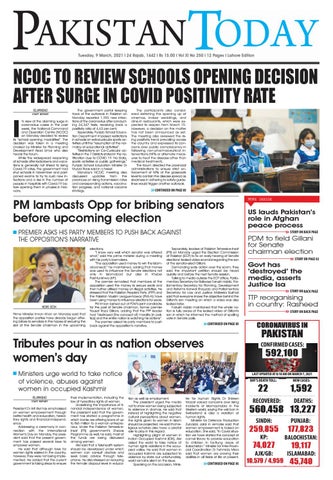
News Desk Prime minister imran khan on monday said that the opposition parties have already begun offering bribes to senators in the hopes of securing the slot of the senate chairman in the upcoming
elections. “i know very well which senator was offered what,” said the prime minister during a meeting with his party’s lawmakers. “the opposition used money to win the islamabad seat,” he maintained, adding that money was used to influence the senate elections not only in islamabad but also in khyber Pakhtunkhwa (kP). the premier remarked that members of the opposition used the money to secure seats and then further utilised money on illegal activities. he stressed that the Pakistan People’s Party (PPP) and the Pakistan muslim League-nawaz (PmL-n) have been using money to influence elections for years. Pm imran lashed out at PDm’s joint candidate for the post of senate chairman, former premier yousaf raza gillani, adding that the PPP leader had “destroyed [the concept of] morality [in politics] and the entire nation is watching his actions”. the premier asked his party members to push back against the opposition’s narrative.
separately, leaders of Pakistan tehreek-e-insaf (Pti) on monday urged the election commission of Pakistan (ecP) to fix an early hearing of senate elections’ leaked video scandal regarding the son of the senator-elect gillani. Demanding early action over the scam, they said the important petition should be heard quickly and before the next senate session. talking to media outside the ecP office, Parliamentary secretary for railways Farrukh habib, Parliamentary secretary for Planning, Development and reforms kanwal shauzab and Parliamentary secretary for Law and Justice maleeka bukhari said that everyone knows the objective behind the gillani’s son meeting on which a video was also leaked later. Farrukh habib maintianed that the whole nation is fully aware of the leaked video of gillani’s son in which he informed the method of spoiling vote in senate polls.
CONTINUED ON PAGE 05
IsLAMABAD President Dr arif alvi has emphasised on women empowerment through better health and education, hereditary rights and financial independence. addressing a ceremony in connection with the international Women’s Day on monday, the president said that the present government has passed several laws to empower women. he said that although laws for women rights existed in the country, however, they were not being implemented. he added that the current government is taking steps to ensure
their implementation, including the law of hereditary rights of women. underlining the importance of financial independence of women, the president said that the government has started a programme in which banks are offering loans of up to rs5 million to a woman entrepreneur. under the Pakistan tehreek-einsaf (Pti) government’s ehsaas Programme as well, he said, most of the funds are being disbursed among women. alvi said that a telehealth system should be developed under which women can consult doctors and seek basic advice through telephone. he also stressed on reducing the female dropout level in educa-
PDm to field gillani for senate chairman election STORY ON PAGE 02
Govt has ‘destroyed’ the media, asserts Justice Isa
STORY ON BACK PAGE
ttP reorganising in country: rasheed STORY ON BACK PAGE
COrONavirus iN
pakistaN
CONFIRMED CASES:
592,100
ministers urge world to take notice of violence, abuses against women in occupied kashmir Staff RepoRt
US lauds Pakistan’s role in Afghan peace process STORY ON BACK PAGE
Tributes pour in as nation observes women’s day g
MORE INSIDE
LAST UPDATED AT 8:18 AM ON MARCH 7, 2021
DAY'S DEATH TOLL:
22
tion as well as employment. the president urged the media not to show women being subjected to violence in dramas. he said that instead of highlighting the negative cultural perceptions about women, the rights given to women in islam should be projected. he said that religious scholars also have a pivotal role to play in this regard. highlighting plight of women in indian occupied kashmir (iok), alvi asked the world to take notice of human rights violations in the occupied valley. he said that women in occupied kashmir are subjected to violence by state but unfortunately, world remains silent on the issue. speaking on the occasion, minis-
ter for human rights Dr shireen mazari voiced concerns over rising incidents of islamophobia in the Western world, saying the veil ban in switzerland is also a violation of human rights. minister for Defence Production Zubaida Jalal in remarks said that women empowerment is based on education. she said, “in covid situation we have started the concept of camel library to provide education to children in far-flung areas of balochistan.” minister for inter-Provincial coordination Dr Fehmida mirza said that women are proving their abilities in all fields of life at present.
CONTINUED ON PAGE 05
RECOVERED:
NEW CASES:
1,592 DEATHS:
560,458 13,227 SINDH:
PUNJAB:
259,855
177,823
KP:
BALOCHISTAN:
AJK/GB:
ISLAMABAD:
74,027 10,579 / 4,959
19,117
45,740
02
Tuesday, 9 March, 2021
LAHORE
NEWS
PdM to field gillani for Senate ChairMan eleCtion ISLAMABAD
P
Staff RePoRt
AKISTAN Democratic Movement (PDM) President Maulana Fazlur Rehman announced on Monday that the anti-government coalition has unanimously agreed to nominate Pakistan People’s Party (PPP) senior leader Yousaf Raza Gilani as their candidate for the upcoming Senate chairman election. Speaking at the press conference, Rehman said that the candidates for the posts of Senate deputy chairperson and leader of the opposition would be decided by a committee, headed by former premier and PML-N leader Shahid Khaqan Abbasi. The committee will hold its first meeting tomorrow to deliberate on possible candidates. The PDM chief also spoke about the incidents of violence outside Parliament House on Saturday, where PML-N leaders alleged they were manhandled by PTI
workers. “PTI goons attacked them,” said Rehman, adding that not only were PML-N leaders insulted and harassed, the “goons even disrespected Marriyum Aurangzeb”. “This is the culture the PTI is inculcating among its workers,” he lamented. Rehman said the meeting reaffirmed the PDM plan to stage a long march against the government, adding that caravans will set out for the capital “from all corners of the country on March 26”. The announcement came hours after the PDM chief convened a meeting of the opposition alliance in Islamabad later today to discuss the future course of action. Reports citing sources suggest that the meeting, presided over by Fazl, was to decide the future strategy to oust the PTI government. PPP Chairman Bilawal Bhutto Zardari, Pakistan Muslim League-Nawaz (PML-N) Vice President Maryam Nawaz, Mahmood Khan Achakzai, Aftab Sherpao, Gilani, Shahid Khaqan Abbasi and Raja Pervez
SeSSionS judge, aCadeMiC die of CoronaviruS LAHORE: A district and sessions judge, Zafar Iqbal Naeem, and a teacher, Fehmida Bano, passed away of coronavirus on Monday. Naeem, who was posted at a banking court in Lahore, was admitted to Mayo Hospital on January 22. While Bano, 58, was an elementary school teacher in the Hussainabad neighbourhood. She was 58. She was undergoing treatment at Fauji Foundation Hospital. Her death spread fear and panic in the school. Taking notice of the incident, the health department decided to conduct coronavirus tests on the teachers and students of the school. The nation on Monday reported 1,592 new infections of the coronavirus after conducting 34,347 tests, receiving back a positivity ratio of 4.63 per cent. With healthcare workers warning of a potential third wave of Covid-19 amidst a new surge in daily infections, Planning Minister Asad Umar announced that the vaccination drive for people over 60 would begin from March 10. In a tweet, he said the vaccinations would be administered in reverse order, with the oldest registered individuals getting inoculated first, and the youngest last. Staff RePoRt
Police arrest MQM-affiliated suspected target killer KARACHI: The counter-terrorism department (CTD) of Karachi police on Monday arrested a suspect target killer belonging to Muttahida Qaumi MovementLondon (MQM-L) who was wanted in several cases including the murder of Assistant Sub-Inspector Syed Ali Mohsin. Shakeel alias Hakla is wanted in eight cases of terrorism, murder, dacoity, police encounter and others, police said. He is an active member of MQM-L and allegedly involved in target killing on the orders of the Lines Area Sector of the party since 2009. According to a CTD spokesperson, Shakeel was arrested during a raid in Lines Area. ASI Mohsin was murdered by the accused and his accomplices in Khudadad Colony within the remit of the Brigade police station in 2012. The police also recovered a 30-bore pistol and ammunition from his possession. The weapon was sent for forensic analysis. More revelations are likely to be made as interrogation is underway, the spokesperson said. The CTD teams are conducting raids to arrest the other suspects. INP
Ashraf were also in attendance. In addition to reviewing the trust vote which Prime Minister Imran Khan won, the meeting discussed the proposed long march to
Islamabad and the election of the Senate chairman planned for March 12. “We want to win this election as well and add another victory to our credit,” Bilawal
said while addressing the meeting and added that PPP is committed to PDM’s roadmap. The meeting comes a day after reports emerged that Pakistan Muslim League-Quaid (PML-Q), an ally of Pakistan Tehreek-e-Insaf (PTI), expressed its inability to vote for the PDM candidate for Senate chairman Yousaf Raza Gillani. The reports were however dismissed by PML-Q leader Chaudhry Moonis Elahi on Monday. The party could not go against the PTI, Minister for Housing Tariq Bashir Cheema told PPP Chairperson Bilawal Bhutto-Zardari on Sunday. In the meeting, Bilawal also discussed possible options for replacing the government of Chief Minister Usman Buzdar in Punjab and cooperation in the election for Senate chairman. During the meeting, a special committee set up for the long march presented its recommendations for the grand antigovernment demonstration. It said that long march should commence from Karachi on March 26 with a rally and all processions should reach Islamabad by 3 pm on March 30.
LHC stops NAB from arresting Safdar in assets case LAHORE Staff RePoRt
The Lahore High Court (LHC) on Monday restrained the National Accountability Bureau (NAB) from arresting Pakistan Muslim League-Nawaz (PML-N) leader Captain (r) Safdar Awan in an assets probe against him. A two-judge bench, headed by Justice Sardar Sarfraz Dogar, served a notice on the agency, directing it to submit its response in a petition filed by
Awan which sought to challenge a callup notice by the dirty money watchdog. Subsequently, the bench barred NAB from arresting Awan until March 29. In a related development, the bureau decided to nominate Awan’s wife and PML-N Vice President Maryam Nawaz in the probe. The inquiry against Awan has been in progress since early 2018 over the possession of assets allegedly disproportionate to declared sources of his income, which is a crime under the
National Accountability Ordinance (NAO), 1999. A complainant had alleged that Awan owned 300 kanals of land, a 30 kanals plot, a one kanal house, a flour production unit and other properties in the Mansehra district. The Lahore chapter of NAB made the decision after finding “important leads” in the case. Maryam has been found to be the beneficial owner of the frontmen properties acquired by Awan, it said.
Sindh Covid-19 PoSitivity SurgeS after over a Month
Vawda moves SHC to stop ECP from hearing disqualification case NEWS DESK Admitting Pakistan Tehreek-e-Insaf’s (PTI) Faisal Vawda’s petition against the Election Commission of Pakistan’s (ECP) February 24 decision for immediate hearing, the Sindh High Court (SHC) on Monday said it would take up the petition on Tuesday. Vawda has also sought a stay order from the court in the case. Arguing that the ECP was not authorised to hear his disqualification case, the PTI leader has requested the court to restrain the Election Commission from going ahead with the hearing of the case. He has contended that the Election Commission did not take into account the facts while rejecting his application, in which he had objected
PTI LEADER SAYS ECP DIDN’T CONSIDER FACTS WHILE OBJECTING TO HIS APPLICATION
KARACHI Staff RePoRt
to the commission’s taking up of complaints against him. It is worth mentioning here that three complaints of having dual citizenship are registered with the ECP against the ruling party leader. Qadir Khan Mandokhel, Mian Muhammad Asif and Khalid Javed Ran are the complainants against Vawda.
Govt to present money bill in Senate tomorrow SHAHzAD PARACHA The federal government will present the money bill in the Upper House of the Parliament on Tuesday. According to documents available with this scribe, Finance Minister Abdul Hafeez Shaikh will present the money bill, including the Income Tax Amendment Bill, 2021, in Senate as required under article 73 of the Constitution. Dr Hafeez Shaikh may also ask the Senate to make recommendations, if any, to the National Assembly on the money bill as per the constitution. The PM had last week approved the presentation of the money bill in the parliament. Article continues after this advertisement Reportedly, the government might withdraw
The agency further said Maryam owns hundreds of acres of land in her name in Raiwind and other neighbourhoods and cities of Punjab. The documents suggest that details have also been sought regarding Awan’s sources of earning. The agency said that its KhyberPakhtunkhwa (KP) office received information about the properties in 2020, but the cases were moved to Lahore as the majority of the said assets were found to be in the Punjab capital.
GOVT MAY WITHDRAW TAX EXEMPTIONS GIVEN TO THE CORPORATE SECTOR billions of rupees exemptions given to the corporate sector. “The IMF has asked Pakistan to withdraw tax exemptions given to the corporate sector. Initially, the government had introduced a targeted subsidy in BISP as well as energy sector,” an insider informed. Recently, FBR had also extended the super tax on banking companies for an indefinite period of time.
Less than a week after the government relaxed Covid-19 restrictions in view of the declining trend of positive cases, the virus transmission rate in Sindh has seen a surge in the first week of March for the first time since January. According to the provincial health department, Hyderabad reported the highest positivity rate which jacked up from 2.47 per cent to 8.26 per cent in a week. Whereas, Karachi’s positivity rate increased from 3.27 per cent to 5.66 per cent. The transmission rate in other districts of the province has risen from an average of 1.20 per cent to 1.80 per cent. In the last 24 hours, the health department said, the average province-wide positivity rate stood at the two-month high of 4.58 per cent. On January 18, the provincial positivity rate was 4.78 per cent. Between January 19 and March 7, it had dropped to below 4 per cent. The nation on Monday reported 1,592 new infections of the novel coronavirus after conducting 34,347 tests, receiving back a positivity ratio of 4.63 per cent. With healthcare workers warning of a potential third wave of Covid-19 amidst a new surge in daily infections, Planning Minister Asad Umar on Sunday announced that the vaccination drive for people over 60 would commence from March 10. Despite passing through two waves of Covid-19, Pakistan has yet to fully utilise its testing capacity of 60,977, with daily testing significantly below numbers proposed by global health experts.
Every conspiracy against Punjab govt to be foiled: Firdous NEWS DESK Special Assistant to Chief Minister on Information Dr Firdous Ashiq Awan has said the “jackals” of Pakistan Democratic Movement (PDM) are united to deceive one another. In a statement on Monday, Firdous said that the troika of Maryam Nawaz, Bilawal Bhutto-Zardari and Maulana Fazlur Rehman are biting their wounds of
defeat in the National Assembly, adding that they will eat a humble pie in Punjab as well. She asserted that Pakistan Muslim League-Quaid (PML-Q) is an allied party having the best working relationship while CM Usman Buzdar enjoys a clear majority in the assembly. On the other side, the Zardari's scion is moving from pillar to post in Punjab as a political beggar. She said, “The so-called son of the notorious Mr 10 per cent will not get anything in the
province. Meanwhile, the cabal which is daydreaming about a no-confidence move is going to evade a long march.” The PDM will also backtrack from long march the way it has avoided the resignation threat, she added. The SACM emphasised that the nation is fully aware of hollow claims of the PDM as it has no concern with the public problems. They could only loot, she added and emphasised that every conspiracy against PM and CM Buzdar will be foiled.
Tuesday, 9 March, 2021
LAHORE
NEWS
Medical panel to investigate spread of coronavirus in PSl ISLAMABAD ageNcIeS
The Pakistan Cricket Board (PCB) has formed a twomember fact-finding panel to investigate how players were infected with coronavirus in the bio-secure bubble, leading to the postponement of the HBL Pakistan Super League (PSL). The PSL was indefinitely postponed on Thursday after six players and a support staff member — including Australian legspinner Fawad Ahmed — tested positive for Covid-19. The two-member panel is made up of the country’s infectious disease experts Dr. Syed Faisal Mahmood and Dr. Salman Mohammad Abbas, who will review the bio-secure bubble protocols put in place for the PSL. They will submit a report to PCB chairman Ehsan Mani by March 31. The PCB said in a statement on Sunday that the independent panel has also been tasked with identifying shortcomings of the bio-secure bubble and “advise as to the reasons why the bio-secure environment did not remain Covid-19 free.” Mani said that both doctors will also speak with all the relevant PSL stakeholders, including players, event and hotel staff as well as medical and compliance officers attached to all six teams. “The independent panel of two distinguished experts has been appointed with the sole purpose of an honest, constructive and objective review,” Mani said.
‘Solid evidenCe’ of horSe-trading in Senate eleCtionS: MiniSter FARAZ SAYS VOTE OF CONFIDENCE OBTAINED BY PM EMBARRASSED OPPOSITION ISLAMABAD
M
Staff RePoRt
INISTER for Information Senator Shibli Faraz on Monday said that the government will present “solid evidence” to support its claim of horse-trading during the recent Senate elections before the courts and the Election Commission Pakistan (ECP) “at an appropriate time”. Speaking to a news channel, Faraz claimed that the
LAHORE Punjab Chief Minister Sardar Usman Buzdar has said that the government is making all-out efforts to provide maximum facilities to investors in the province. Talking to Italian Ambassador Andreas Ferrarese on Monday, the chief minister invited the Italian investors to invest in special economic zones where facilities are provided to the investors. Seven special economic zones have been notified and the establishment of 13 SEZs has been planned by the government, he added and assured to provide maximum facilities to Italian investors in special economic zones. The chief minister said that new tourist spots are being developed, adding that the scope of the Walled City of Lahore Authority has been expanded to the whole of the province. Similarly, the walled city is being restored to its original shape, he added. Pakistan and Italy enjoy the best relations and there is a need to further expand the friendly relations by enhancing the exchange of trade delegations, he further said. The Italian Ambassador said that a conducive atmosphere has been provided to investors, adding that a lot of work has been done for the protection of historical places. The Italian investors are interested to benefit from the opportunities of investment to further expand cooperation with the Punjab government, he added. The Italian ambassador invited the CM to visit Italy and both agreed to promote bilateral cooperation for the
NEWS DESK Member of the National Assembly (MNA) and Pakistan Muslim League-Quaid (PML-Q) leader Chaudhry Moonis Elahi on Monday rejected media reports suggesting that Chaudhry brothers had refused to support Syed Yousaf Raza Gillani, Pakistan Democratic
SUSPENDS 12 OFFICIALS IN SOUTH PUNJAB OVER NEGLIGENCE protection of historical places as well as the promotion of tourism. CEO PBIT, secretaries of P&D and tourism departments and others also attended the meeting. Separately, CM Buzdar on Monday suspended 12 officials and removed four others from their post over negligence in their duties and delaying redressal complaints. The chief minister swung into action against the officials after he paid surprise visits to Multan, Taunsa, Dera Ghazi Khan and Muzaffargarh and found the officials neglecting their duties. Besides taking action against officials, the chief minister also issued show-cause notices to various other officials and expressed his resentment on their non-satisfactory performance. The officials who have been removed from their posts included Capital Police Officer (CPO) Multan, and deputy commissioner Multan. Other cops from Multan who were suspended included the deputy superintendent of police (DSP), SHO and circle incharge special branch. A district official of Rescue 1122 Dera Ghazi Khan was also removed from his post. Responding to the actions, the chief minister said he would take stern action against those found of negligence in performing their duties. “Action was taken against those who failed to perform their duties in a better manner,” Buzdar said.
CAA to allow new airlines to begin international operations KARACHI INP
The Civil Aviation Authority (PCAA) has decided to help new airlines under an aviation policy start international operations after completing a mandatory six-month probationary period operating domestic flights. In this regard, the aviation body has prepared recommendations which it said will be sent to the higher authorities for approval. However, permission will be given to the new airlines on the condition of its performance, regulations, and punctuality. The performance review will include timely departures and arrivals. Moreover, it is declared
Pakistan People’s Party (PPP) spent billions to ensure the victory of its leader Yousaf Raza Gillani from the Islamabad seat. The minister said that the entire nation watched Gillani’s son, Ali Haider Gillani, “buying” votes for his father. He said that the vote of confidence obtained by Prime Minister Imran Khan from the National Assembly (NA) has embarrassed the opposition. “More members of the National Assembly have now reposed confidence in the leadership of Imran than in 2018,” he said.
Moonis rejects reports of Bilawal seeking Chaudhry brothers’ help for Gillani
Buzdar seeks Italian investment in SEZs Staff RePoRt
03
mandatory for the new entrants to run domestic flights on social-economic routes, including Sukkur and Bahawalpur. The development came after the regulatory body completed the preparations for implementing the Aviation Policy, 2021 in the light of Prime Minister Imran Khan’s directives. The policy is projected to help spur the growth of the domestic aviation industry, attract private investment for the management and development of new airports, and help revive the struggling national carrier. It hopes to accomplish its aim through a reversal of the Open Sky policy, a significant decrease in an assortment of taxes and capital requirements of, and airport charges for, local companies.
Movement (PDM) candidate for the seat of Senate chairman, when Pakistan People’s Party (PPP) Chairman Bilawal Bhutto-Zardari visited their place on Sunday to see them. In his tweet, Moonis said that Bilawal had come to inquire after Chaudhry Shujat Hussain only. “No such thing happened. @BBhuttoZardari did not ask for support in Senate and nor did we offer. He came to inquire about
Shujat Sb’s health for which we are grateful.” Senior journalist and anchorperson Hamid Mir also retweeted Moonis tweet and said Shujaat also denied having such a development in the meeting “Ch Shujaat sahib called me last night and said that his meeting with @BBhuttoZardari was very good unfortunately some newspapers made headlines which were not discussed in that meeting.”
04
Tuesday, 9 March, 2021
LAHORE
NEWS
Women In oCCuPIed KAshmIr Immensely tormented by oCCuPAtIon forCes: AJK PresIdent MIRPUR
A
STAFF REPORT
zAD Jammu and Kashmir (AJK) President Sardar Masood Khan has said that as the world is celebrating international Women's Day, thousands of women in Indian Occupied Kashmir (IOK) are immensely tormented by Indian occupation forces. “Thousands of women in Kashmir suffer
immensely due to the illegal occupation of their motherland. Sisters have died while saving their siblings, young wives have suffered defending their husbands and mothers have taken their last breath longing for their missing sons,” the state president said while addressing a 70-member delegation of Air War College of Pakistan Air Force in the federal metropolis on Monday, AJK President Office said. The delegation which called on the state president under the leadership of Air Com-
Two MPAs of Punjab contract Covid-19 LAHORE: Two lawmakers of Punjab Assembly, one each from Pakistan Muslim League-Nawaz (PML-N) and Pakistan Tehreek-e-Insaf, quarantined themselves after testing positive for novel coronavirus on Monday. According to details, PML-N MPA Samiullah Khan and PTI MPA Mian Shafi have contracted the coronavirus. Shafi has also been among the panel of chairmen in the present session of the house. He has quarantined himself after testing positive for the coronavirus. Samiullah Khan said that he underwent the Covid-19 test after having symptoms of the virus. TLTP
modore Kashif Jamal Khan also included officers from Jordan, Saudi Arabia, Bangladesh, Sri Lanka, Niger and Egypt. Khan said that Kashmiri women, children, youth and the elderly are burning in the flames of a war, which they had not chosen but was imposed upon them. They are molested and objectified to collectively punish them for their defiance to illegal Indian rule, he said. He called upon the world forums and global human rights organisations to help secure the basic rights to Kashmiri women
guaranteed under the Universal Declaration of Human Rights (UDHR) and promised under the Convention on the Elimination of All Forms of Discrimination against Women (CEDAW). Responding to various questions asked by the members of the delegation, the AJK president said that the actions of August 2019 have exposed India's false narrative on Kashmir as the international community, members of the UK and the European parliaments, as well as the US Congress,
SHC issues notices to prosecutor general on Haleem’s bail pleas KARACHI TLTP
The Sindh High Court (SHC) issued on Monday notices to the prosecutor general Sindh and others to file their comments on bail petitions of Opposition Leader in the Sindh Assembly Haleem Adil Shaikh in two cases. A two-judge bench of the SHC directed the respondents to furnish their comments until March 16. The Pakistan Tehreek-e-Insaf (PTI) leader instituted the petitions seeking bail in the two cases. During the hearing, his lawyer alleged that his client was booked in the cases on the directives of Chief Minister Murad Ali Shah, adding that he was subjected to vengeful action on being appointed as the opposition leader. He pleaded with the bench to order the PTI leader’s release on bail. Sheikh said that terrorism provisions incorporated in the FIRs showed mala fide intentions of the PPP government. “Murad Ali Shah and the PPP leadership is involved,” he said. The opposition leader approached the SHC after an anti-terrorism court rejected his bail pleas. One of the two cases pertained to attempted murder, interference in government duties and disruption during an anti-encroachment drive while the other related to violence, firing and causing terror during the by-polls in Karachi’s PS-88. Meanwhile, a bench of the SHC on Monday ordered police to constitute a joint investigation team (JIT) for recovery of the missing children. A two-judge bench headed by Justice Naimatullah Phulpoto hearing the missing children case. The court asked about progress in recovery of the missing children from the CIA AIG, who appeared in the court’s hearing. “What happened about the recovery of Nida,” Justice
ORDERS FORMATION OF JIT FOR RECOVERY OF MISSING CHILDREN Naimatullah Phulpoto asked the police official. “A suspect has been arrested near the Karachi University and two girls of five and seven years of age, have been recovered,” CIA AIG Arif Hanif told the bench. “DNA test of the recovered girls being conducted. Hopefully, we will reach Nida with these girls,” CIA official said. “Our child has been kidnapped for the last threeand-half years,” parents of Nida lamented in the court. “These girls are not being kidnapped without reason, definitely an organised gang working behind it,” the court remarked. “What happened about recovery of other girls and what steps were taken to halt such incidents,” Justice Phulpoto further questioned. “A man was arrested but nothing was found from him,” the judge angrily said. “The photos of missing children were published in newspapers,” the official said. The court ordered the AIG CIA for formation of a JIT for recovery of the missing children, adding that all resources should be utilized for recovery of the untraced kids. The bench ordered the police to submit its comprehensive report over the issue by April 13. The petition was filed by a non-governmental organisation seeking court directives to the provincial police for considering the cases of those children who went missing from different parts of Karachi and registering FIRs in this regard as well as proper investigation. The NGO alleged that cases of missing children were not properly investigated by the police, which resulted in many avoidable deaths.
CTD kills five terrorists in Mastung MASTUNG INP
At least five terrorists were killed in encounter with Counter Terrorism Department (CTD) in Isplinji area of Mastung on Sunday night. CTD personnel conducted an operation in Isplinji area of Mastung in Balochistan on an intelligence report. During the operation, terrorists hiding in a house opened fire at the secu-
rity personnel. The CTD personnel returned fire and killed five terrorists while their accomplices managed to escape the scene taking advantage of the darkness. According to CTD spokesperson, the dead terrorists have been identified as Samiullah, Jamil Ahmed, Shah Nazar, Arif Marri and Yusuf Marri and were involved in several cases of terrorism. The spokesperson further informed that three kalashnikovs, 10kg of explosive material and other weapons were also recovered from the hideout of the errorists.
Pakistan Navy conducts bilateral exercises with Japan, Oman, Russia, US navies ISLAMABAD STAFF REPORT
Pakistan Navy on Monday conducted bilateral naval exercises with the naval forces of Japan, Oman, Russia and the United States to enhance interoperability and augment collaborative efforts for ensuring regional maritime security. Pakistan Navy Ship (PNS) ALAMGIR with embarked helicopter participated in bilateral exercises with Japanese Maritime Self Defence Force Ship ARIAKE, Royal Oman Navy Ship KHASSAB, Russian Federation Navy Ships STOIKY and KOLA and United States Navy Ship JOHN PAUL JONES in Gulf of Aden and North Arabian Sea. Exercises were aimed to enhance interoperability and augment collaborative efforts to ensuring maritime security in the region, said a Pakistan Navy press release. PNS ALAMGIR is presently de-
have publicly condemned India for its hegemonic designs. While apprising the delegation about the history of the liberation of the AJK, the state president said that AJK, with its own constitution, president, prime minister and the legislative assembly as well as the independent judiciary, is quite distinct from that of occupied Kashmir. The people in AJK enjoy all basic rights civil liberties and they are independently struggling to improve their future ahead, he added.
tWo fAll Prey to ‘honour’ KIllIng In KArAChI KARACHI: What appears to be a case of honour killing, the charred bodies of a boy and a woman were found near Karachi’s Gulshan-eHadeed link road within the jurisdiction of Steel Town police station on Monday. On getting information, the police and Rangers reached the spot and shifted the bodies to a nearby hospital for an autopsy. The police said that unidentified suspects kidnapped and tortured the two before setting them afire. As per initial investigations, they said, the incident appears to be an honour crime. Further investigation into the incident is underway with evidence being collected from the scene. SSP Malir Irfan Bahadur said that the deceased boy is about 12 to 14 years old while the woman’s age could not be determined. The bodies’ fingerprints and other parts had been torched, he added. DNA samples of both the deceased will be collected for their identification, the SSP said, adding that a special team is being constituted to investigate the incident. Earlier on Friday last, a woman and a man were executed in the name of honour by unknown assailants in Jalkot area of Kohistan district. Police confirmed the duo was killed for honour. However, the identities of both the deceased and the assailants have not yet been made public. Earlier on February 23, a man in Swat killed two people including his wife, said police. According to police, the incident of twin murder took place in Madeen area of Swat where a man killed his wife and a man for ‘honour’. Police arrested the accused, while the bodies were moved to a nearby hospital for legal formalities. TLTP
brIde, groom looted WhIle returnIng from mArrIAge hAll A bridegroom and his bride were robbed of their valuables in Lahore on Sunday night. According to reports, dacoits who struck the couple at Usman Chowk, Badami Bagh, as they were returning home from their wedding ceremony, looted ornaments, cash and other valuables from them.The groom told the media that as soon as they left the wedding hall, some people on a motorbike started chasing them. “They stopped my car at Usman Chowk and fled after looting valuables from me and my wife,” he told reporters. Meanwhile, Malik Waqar, the groom’s brother, lodged a complaint with the police. The police have started investigations into the matter. NEWS DESK
PIA resumes flights between Islamabad, Chitral after 1.5 years
ployed to undertake Regional Maritime Security Patrol (RMSP) in Gulf of Aden and North Arabian Sea. These patrols were conducted as Pakistan Navy initiative to contribute towards regional maritime security and to support international efforts against the menace of maritime terrorism, piracy and narco-arms smuggling.
Pakistan Navy remains committed to play its role in ensuring maritime safety and security in the region. The ongoing RMSP deployment and participation in bilateral exercises by PNS ALAMGIR are a testimony of Pakistan Navy’s resolve to ensure peace and order at sea while maintaining close relations with friendly navies.
The Pakistan International Airlines (PIA) on Monday resumed flight operation between Islamabad and Chitral that had been suspended for 1.5 years due to the coronavirus pandemic. The national flag carrier resumed flight service between Islamabad and Chitral after 1.5 years and announced that Rs5,920 will be charged for oneside trip. For Chitral, two flights will be operated from Islamabad twice in one week, said the PIA spokesperson, adding that the resumption of the flight operations to Chitral will promote tourism. Moreover, it was also announced that two more flights will be operated from Karachi to Sialkot by the PIA in order to facilitate passengers and businesspersons. The national airline will now operate four flights in a week to Sialkot and Rs7,500 will be charged for one-side trip. NEWS DESK
Tuesday, 9 March, 2021
LAHORE
NEWS
05
FiNaNCe MiNister FOr sPeedy iMPleMeNtatiON OF agriCulture traNsFOrMatiON PlaN ISLAMABAD
F
STAFF REPORT
INANCE Minister Dr Abdul Hafeez Shaikh has reiterated the government's firm commitment to uplift the agriculture sector through effective and speedy implementation of the Agriculture Transformation Plan.
The finance minister said this while chairing a meeting on the Agriculture Transformation Plan at the Finance Division on Monday. The meeting reviewed the progress on the directions of the prime minister to enhance agriculture credit for the farming sector. The finance minister urged all concerned to come up with a clear action plan along with timelines and a responsibility
CDWP approves six development projects worth Rs52bn ISLAMABAD
matrix to finalise different proposals presented in the meeting. He constituted a 5member committee comprising law secretary, food secretary and SBP governor to complete the task. The deputy governor State Bank of Pakistan (SBP) made a presentation on the consultative process followed with key stakeholders and detailed proposals to enhance the agriculture credit.
It was recommended to make the Loan for Agriculture, Commercial & Industrial Purposes (LACIP) Act, 1973, effective by bringing amendments in areas of foreclosure and simultaneously streamlining procedures for swift processing of agriculture loans. It was also emphasised that judges against vacant positions in banking courts need to be appointed on priority.
Pakistan, Uzbekistan discuss transit, preferential trade agreements
STAFF REPORT
The Central Development Working Party (CDWP) on Monday approved six development projects at an estimated cost of Rs52 billion. According to details, two projects related to transport & communications sector and four related to the water resources sector were approved during the meeting, which was chaired by Planning Commission Deputy Chairman Mohammad Jehanzeb Khan. Projects related to the transport & communications sector included 'Construction of Black Top Road from Duki to Chamalang (105km) with Link Road (55km)' worth Rs6.51 billion; and 'Widening, Improvement and Reconstruction of Road from Khani Cross to Ziarat (70km) and Ziarat to Sanjani (64km)' worth Rs9.75 billion. Similarly, approved projects in the water resources sector included 'Restoration & Revamping of Mehmoodabad Nullah and its Tributaries' worth Rs8.65 billion; 'Restoration & Revamping of Gujjar Nullah' worth Rs9.98 billion; 'Restoration & Revamping of Orangi Nullah' worth Rs9.05 billion; and 'Restoration & Revamping of Lyari & Malir Rivers with Associated Tributaries' worth Rs8.003 billion. The projects were presented by the National Disaster Management Authority (NDMA).
ISLAMABAD STAFF REPORT
Pakistan and Uzbekistan have agreed to enhance trade relations while discussing the progress made on bilateral transit trade agreement, Preferential Trade Agreement (PTA), banking and visa issues, and aviation and customs cooperation. The discussions came during video call between Adviser to Prime Minister on Commerce and Investment Abdul Razak Dawood and Uzbek Deputy Prime Minister Sardor Umurzakov on Monday. During the virtual meeting, both sides expressed the desire to cooperate with each other to implement decisions made during the adviser’s visit to Tashkent from February
1-3 , 2021, as per the agreed timelines. In order to further deepen the trade ties, both sides also agreed to hold a business conference in Tashkent in July this year. The Uzbek deputy prime minister informed the adviser about the upcoming visit of the Uzbek delegation to Pakistan on 12th March for talks on the above-mentioned matters. Pakistan’s side welcomed the incoming Uzbek delegation and offered cooperation for holding meetings with different stakeholders including customs, maritime affairs, railways and aviation sectors. The two sides resolved to implement decisions made during the meetings held at Tashkent in February 2021 in letter and spirit.
Tributes pour in as nation observes women’s day ContInueD froM pAge 01 Ambassador of the European Union to Pakistan Androulla Kaminara, in her remarks on the occasion, appreciated the steps taken by Pakistani government for women empowerment. She especially mentioned Ehsaas Programme and improvement in inheritance laws of the country. Separately, in his message pertaining to Women’s Day, Foreign Minister Shah Mahmood Qureshi has said that during the testing times of the Covid-19 pandemic, women in Pakistan demonstrated remarkable resilience and leadership, effectively contributing to our nation’s response and recovery. Qureshi said that women stood at the front lines, as healthcare workers, primary caregivers, innovators, human rights defenders and community organisers. Under the guidance of Prime Minister Imran Khan, Pakistan’s landmark Ehsaas emergency cash programme to counter the negative socio-economic impacts of the pandemic is being ably led by a woman, he added. The foreign minister said, “We cannot forget the plight of women in Indian Occupied Kashmir and over the last seven decades, they have endured the worst forms of human rights abuse and oppression at the hands of Indian occupation forces including sexual violence, rape and molestation.” Kashmir Committee Chairman Shehryar Khan Afridi has said in today’s modern world, suffering of women in occupied Kashmir continues unabated.
In a tweet on Monday, he said that Indian forces are using rape as tool of genocide in Kashmir to break resolve of Kashmiris for freedom from Indian Illegal occupation as women teach their kids to fight oppression. Separately, Chief of Army Staff (COAS) General Qamar Javed Bajwa lauded the contribution of women in different professions, observing they had contributed “immensely” for the “honour of our nation.” “Women in uniform have proved their mettle by contributing copiously in diverse fields serving the nation & humanity. They deserve our immense respect & gratitude,” the Inter-Services Public Relations (ISPR) quoted Gen Bajwa as saying. “They are also [at the] forefront against COVID[-19].” The theme of this year’s Women’s Day is “Women in Leadership: Achieving an Equal Future in a Covid-19 World,” and various events and marches are planned to raise awareness about gender parity and the significance of the roles played by women in society, Radio Pakistan reported. The United Nations designated March 8 as International Women’s Day in 1977. It annually calls for greater rights for women and celebrates their achievements. AURAT MARCH: Women, men, and transgender persons across Pakistan marched against patriarchy in Karachi, Lahore, Islamabad, Hyderabad, Quetta, and Multan.Aurat March originated in the port city in 2018 and has since expanded to other cities across the country. People from all walks of life have arrived at different ven-
ues to mark the much-awaited event of this year.In Karachi, the march was held at Frere Hall, while in Lahore, the protesters gathered at the Lahore Press Club and marched towards the front of the PIA building in the city. In the federal capital, the march began at the National Press Club from where the set towards the city's D Chowk.Each chapter of the Aurat March has its own manifesto with the Karachi chapter focusing on patriarchal violence; Lahore on addressing healthcare workers and women’s health; and the Islamabad march is dedicated to the crisis of care. “The Covid-19 pandemic laid bare the stark inequalities in our society,” said the Feminist Manifesto on Health released by Lahore Aurat March. “Globally, we found the heart of society to be diseased. Diseased with injustice and inequality, with patriarchy and violence on gendered bodies, with vast inequalities and capitalism, and with the dehumanisation of races and ethnicities. Our collective body was in pain.”The Karachi chapter's demands include an "end to genderbased violence by patriarchal forces as well as statebacked violence targeting activists, religious groups and communities and effective and transparent investigation of gender-based crimes and fair and expeditious trials".Other issues raised during the march include criminalisation of virginity tests for rape victims, the establishment of gender-based violence reporting cells in police stations across Sindh and Pakistan, and an end to sexual harassment.
DGPR Saman Rai being presented a shield. PRESS RELEASE
NCOC to review schools opening decision after surge in Covid positivity rate ContInueD froM pAe 01 The meeting was attended by National Coordinator Lt Gen Hamood Uz Zaman Khan. Provincial representatives participated in the meeting through video-link. The government launched a nationwide vaccination campaign on February 3, with more than 400,000 doctors and frontline healthcare workers, teachers, and social workers being covered in the first phase because they run the highest risk of exposure to the contagious disease. As per the roll-out plan, the second phase, due to start from March 10, will focus exclusively on citizens over the age of 60, who generally face a higher mortality risk from the virus, and all remaining healthcare workers, while the general public would be accommodated in the third phase. Pakistan received its first tranche of the Sinopharm jabs, given by China as a “gift”, earlier this month. The shipment marked the first shots to be imported into the country where more than 592,100 cases of the disease have been reported since the outbreak in February last
PM lambasts Opp for bribing senators before upcoming election ContInueD froM pAe 01 He asked the Election Commission to fix the petition for an early hearing. He stated that the leaked video went viral on social media on March 2, and despite the passage of six days, the matter is still pending. The ECP had fixed March 11 for hearing the case, which would be too late, he added. He said that legal action should be taken against Pakistan Muslim League-Nawaz (PML-N) Vice President Maryam Nawaz for buying loyalties of PTI MNAs by promising them the award of PMLN tickets for the next elections. He added that the Senate election was stolen adding that it was an attempt to derail the democratic process. He said that it was the responsibility of the Election Commission to stop corrupt practices. Parliamentary Secretary for Law and Justice Maleeka said that a lot of money was spent in Senate elections for horse-trading. She urged the electoral body to not issue a notification of Gillani’s victory, adding that legal action should also be taken against Gillani’s son. Parliamentary Secretary for Planning, Development and Reforms Kanwal Shauzab urged ECP to take prompt action as it was a historic election of the country as the whole nation is looking towards ECP.
How Trump administration left indelible mark on US immigration courts AgenCIeS On a rainy September day in 2018, Jeff Sessions, then U.S. attorney general, addressed one of the largest classes of newly hired immigration judges in American history. “The vast majority of asylum claims are not valid,” he said during a swearing-in ceremony in Falls Church, Virginia, according to his prepared remarks. If judges do their job, he said, “the number of illegal aliens and the number of baseless claims will fall.” It was a clear message to the incoming class: Most of the immigrants who appear in court do not deserve to remain in the United States. As U.S. President Joe Biden works to undo many of the restrictive immigration policies enacted by former President Donald Trump, he will confront one of his predecessor’s indelible legacies: the legion of immigration judges Trump’s administration hired. The administration filled two-thirds of the immigration courts’ 520 lifetime positions with judges who, as a whole, have dis-
proportionately ordered deportation, according to a Reuters analysis of more than 800,000 immigration cases decided over the past 20 years. Judges hired under Trump ordered immigrants deported in 69% of cases, compared to 58% for judges hired as far back as the administration of President Ronald Reagan. Because hundreds of thousands of immigrants have cases before the court each year, that 11 percentage-point difference translates to tens of thousands more people ordered deported each year. Appeals are rarely successful. Biden has promised to dramatically expand the courts by doubling the number of immigration judges and other staff. That’s a worthwhile effort, said Stephen Legomsky, a former chief counsel of the U.S. Citizenship and Immigration Services who is now a professor emeritus at Washington University School of Law in St. Louis. “But the challenge is going to be tremendous.” Although there are no statutory limits on the number of judges who can be hired, ex-
panding the court would be costly and could take years, immigration law experts said. “The fact that these (Trump-era) judges are already in place inhibits him a great deal,” Legomsky said of Biden. Stephen Miller, the key architect of Trump’s immigration agenda, told Reuters that the administration had aimed to hire more immigration judges as part of an effort to “create more integrity in the asylum process” and quickly resolve what he termed meritless claims to cut down on a massive backlog. “Most of the people that are coming unlawfully between ports of entry on the southwest border are not eligible for any recognized form of asylum,” Miller said in an interview. “There should be a very high rejection rate.” Under U.S. law, immigrants are eligible for asylum only if they can prove they were being persecuted in their home countries on the basis of race, religion, nationality, membership in a particular social group or their political opinions. Miller said many migrants
arriving at the border are coming for economic reasons and present fraudulent asylum claims. Sessions, who as attorney general had the final say in hiring immigration judges, told Reuters that “the problem is not with the Trump judges. The problem was with some of the other judges that seemed to not be able to manage their dockets, or, in many cases, rendered rulings that were not consistent with the law.” The Trump administration’s successors to Sessions, who was forced out in 2018, did not respond to requests for comment. Unlike the federal judiciary, which is its own branch of government, immigration judges fall under the executive branch as part of the U.S. Department of Justice, which runs the courts through the Executive Office for Immigration Review (EOIR). All judges must be active members of the bar and have seven years’ litigation experience. The Trump administration revised hiring for immigration judges to allow temporary appointments before background investigations
were completed and gave the EOIR director more control over the process. The administration hired judges so quickly that the American Bar Association (ABA) in a 2019 report warned that the process may have allowed “underqualified or potentially biased judges to be hired due to lack of thorough vetting.” The backgrounds of the judges hired under Trump differed significantly from those named under past presidents. For example, 42% had no immigration experience - double the proportion hired previously. Judges hired under Trump were twice as likely to have military experience, which Reuters found was linked to a higher rate of deportation orders. “There has been a significant lack of basic understanding of immigration law and policy with many - not all but many of the new hires under the Trump administration,” said Susan Roy, an attorney and former immigration judge appointed during the administration of President George W. Bush who has represented immigrants before some new judges.
Tuesday, 9 March, 2021
06 COMMENT
On books and readers
Don’t violate rules of the game Politics and violence
T
he way PM Imran managed to get 178 votes from NA on Saturday and the scene created outside Parliament house the same day give rise to disturbing questions. Only days earlier Finance Minister hafeez Sheikh had lost Senate elections getting only 164 votes despite PTI claiming to possess 180. A day after the shell shocked PM held a meeting with COAS and DG ISI raising questions about the signals the meeting was likely to send. Claims have been made regarding two dissenting MNAs being kept in custody by agencies without producing any solid proof. But such proofs normally take years to come, and that too when insiders spill the beans. The perception however is as important in political affair as proofs. Secret agencies have been accused of getting the PTI elected and if these are required to keep the party in power also, they really have a heavy cross to bear. In case the opposition alliance loses the race for the offices of the Chairman and Deputy Chairman of Senate despite possessing majority, agencies would have to face a lot of public criticism. If one was to go by the PM’s logic that a candidate losing elections despite commanding majority proves that his voters have been bribed, the defeat of PDM’s candidates would imply that PTI has used money to win the Senate offices. Outside Parliament house, a group of PTI supporters pushed and kicked PM-N Spokesperson Marriyum Aurangzeb, and attacked some of the top leaders of the PML-N. Incidents of the sort are reminiscent of Fascist Italy. No immediate action was taken by the government; Sheikh rashid wanted the PML-N to lodge a complaint first. NA Speaker promised to ‘probe’ the incident without specifying the body that would conduct the inquiry or when the investigation would start. PML-N vice president Maryam Nawaz has meanwhile condemned the hooliganism in strong terms warning the PTI that the PML-N will not take such behavior lying down and the PTI would have to pay a heavy price for it. Unless the PTI leadership stops the multi-pronged and centrally controlled hate campaign against political opponents calling them thieves, dacoits and traitors, there is likelihood of political rivalries turning into personal enmities in the country. Stop it before it’s too late.
And benefitting from reading
HASAn AFTAB SAeeD
T
here are those who never do any reading unless at gunpoint or on the eve of an exam, and as little as possible at that. This way of life has become so widespread that where it was once considered embarrassing to own up to it, people now take pride in staying clear of books under the pretext of being ‘practical’ (as opposed to ‘bookish’). From university campuses – where diligent students are awarded the derogatory epithet of ‘theta’ – to life in general, book readers are dismissed as impractical fools. The impression given is that bookworms are not good at anything except reading, with the happy conclusion that reading is no good. Of course, this is nothing other than intellectual lethargy masquerading as wisdom. We all know people with this attitude, and they need not detain us any longer. reading is without doubt an excellent habit, but a qualification is in order: it is very easy to go overboard. Becoming a compulsive reader is not necessarily an improvement on not reading at all. With such readers it often becomes a matter of ticking off one title after the other on a never-ending reading list. This is when what ought to be a process becomes the goal itself – clearly a mistake unless it is purely recreational reading.
International Women’s Day State must do more for women’s rights
L
IP service to women’s rights was routinely paid yesterday by various political leaders from both the government and opposition yesterday on the occasion of International Women’s Day. The past year has been particularly hard for women in underdeveloped countries like Pakistan due the pandemic. More female workers lost their jobs as businesses made layoffs and those who were lucky enough to survive the axe had to juggle work and household duties from home. When Covid-19 first hit and lockdowns were placed, rates of domestic violence increased as expected. Pakistan’s ruling parties continue to allow acts of grievous injustice against women like Karo kari, watta satta, honour killings and forced marriages to settle blood feuds continue to flourish. Women are gang raped at the orders of jirgas, raped to settle old scores with rivals, disfigured through acid attacks for rejecting a suitor and killed by in-laws through contrived accidents for bringing less than the demanded dowry. harassment in workplaces is not unusual. Under pressure from backward elements in certain constituencies, political parties sign secret pacts to deprive women from casting votes. The Council of Islamic Ideology (CII) continues to oppose the bill against domestic violence while it has allowed husbands to ‘lightly beat’ wives who defy them, recommended abolition of co-education, endorsed under-age marriage and ruled out DNA as primary evidence in rape cases. It was a duty of the lawmakers during the democratic spells and of military rulers who had usurped power to make laws and ensure their application to abolish primitive customs, traditions and practices that have turned women not only into unequal citizens but also victims of heinous crimes. Major politicians have themselves been involved in misogynist remarks. Sheikh rasheed, Khawaja Asif, Fazl-ur- rehman and Amir Liaquat are just a handful of the lot. Women in modern history have got equal rights only through a resolute display of power. They got the right to vote through a painful and protracted struggle by the brave suffragettes in the developed democracies — 1918 in Britain, as late as 1945 in France. The ‘Aurat March’, which began in Karachi in 2018 on International Women’s Day continues to be held each year despite opposition from the typical misogynistic regressive mindset that has been allowed to exist and grow by an unjust system. New laws need to be passed while some old ones need to be amended to make the country a safer place for women where they have equal rights. Passing legislation however is only part of the battle, its implementation is also crucial.
Dr Alon Ben meir
T
he ten-year old civil war in Syria has gone far beyond tragic mass devastation. The body and soul of two Syrian generations have been crushed. Their hopes and dreams have been shattered. Their dignity and pride were robbed. Millions of refugees and internally displaced persons were left in utter despair, hoping to wake up each morning from a nightmare only to realize that a nightmarish life is their lot. The world has grown to be contentedly numb and mercilessly apathetic, making a mockery of the “never again” dictum coined in the wake of World War II, which certainly applies to the carnage in Syria. It was meant to remind the community of nations to stand fast and united to prevent such an unfathomable horror like the one that swept Syria during the past ten years from ever happening again. There is a score of different entities whose inimitable interests in the country do not align with one another. This includes seven ethnic groups—Sunnis Muslims (the largest at 74 percent), Ismailis, Shiites, Alawites, Druze, Christians, and Kurds—who are all at each other’s throats, and more than a half a dozen jihadist groups, among them hay’at Tahrir al-Sham,
Editor Joint Editor
Umar Aziz Executive Editor
Lahore – Ph: 042-36300938, 042-36375965
So how much reading is too much? And how much is enough? Like most things in life, the ideal must be somewhere in between the extremes. But where exactly? The proof of the pudding is in the eating, so this probably is not the right question to ask. For what is important is not how much one reads but what one does with whatever one reads.
Hasan Aftab Saeed is a connoisseur of music, literature, and food (but not drinks). He can be reached at hasanas@live.jp.
Tragically, the entire international community has failed miserably to muster the moral courage to end the slaughter of hundreds of thousands of men, women and children in Syria’s civil war.
Arif Nizami
Managing Editor
hard work when the brain becomes an active participant, but it is precisely then that real benefit is obtained from reading, for then it is no longer one-way traffic but a creative process. education has a lot to do with sifting the wheat from the chaff, and with ordering things according to their worth. This is where ‘modern’ education leaves so much to be desired. Under the so-called ‘tolerance’ movement, it encourages collecting every idea about a subject that anybody ever thought of putting to paper. Making one’s mind a compendium of all those ideas is hardly the best use of one’s intellectual capital. We have numerous encyclopaedias for that purpose. The difference between an encyclopaedia and a man is that the latter has a life to live. What good is knowledge if it does not translate into a way of life? What good is learning if it is not reflected in action? What good is reading if one remains a study in contradictions and doublethink? While it is true that there are good books and others that are not so good, a reader can benefit from almost any book provided he actively interacts with it and seeks to place everything he reads in the appropriate boxes in his mind. That is when his reading becomes part of his believing and doing. If reading the best books does not reinforce or modify a man’s worldview – one that can be explained, defended, and lived – and if it does not spur him on to creativity, then his learning is like the ‘learning’ of a library when more philosophy tomes are added to its shelves.
Syria’s humanitarian crisis is a stigma on the world’s conscience
Dedicated to the legacy of the late Hameed Nizami
Yousaf Nizami Aziz-ud-Din Ahmad
Too much of reading can easily confuse a man, especially when there is no active participation from the reader. The mind needs time to assess what it reads; and if it is not allowed ample time to digest what is ceaselessly fed to it, it happily gives up the task of critical analysis. As soon as one book is finished there is the next one waiting to be read. There is no closing of the book at intervals to think about what has just been read, what it means, and whether it makes any sense. There are no flashes of inspiration, no sparks of creativity triggered. It becomes a mechanical process, adding with each new title to the hotchpotch of random ideas already there in the mind. Some of the most confused men on the planet are not those who are allergic to books; they are men who have read too much, too quickly without any sort of processing or coordination. So how much reading is too much? And how much is enough? Like most things in life, the ideal must be somewhere in between the extremes. But where exactly? The proof of the pudding is in the eating, so this probably is not the right question to ask. For what is important is not how much one reads but what one does with whatever one reads. education is not the same thing as information. One could have a lot of information about something without knowing what it means or where it all fits in the grander scheme of things. It is very easy, for example, for a man to be informed of all sorts of events and titbits from history without having any idea about the philosophy of history. It is just another variant of mental laziness when the reader reads voraciously but does it with a passive mind – very much like one would watch blockbusters. It is
I
Karachi – Ph: 021-35381208-9
I
Al-Qaeda, and ISIS. On top of that, Syria is virtually occupied by Iran, Turkey and russia, the latter which wants to assert total control. Other countries have their own unique interests in Syria: Saudi Arabia supports the Sunnis; Israel is battling Iran on Syrian territory; the US has a nominal military presence; and of course, Assad himself has his own political agenda. Thus, to suggest that a political solution can still be fashioned at this juncture is illusionary at best. But to work toward that end, we must begin by urgently addressing the nightmarish humanitarian crises the country is experiencing and gradually pave the way for a political settlement that most of the players can accept. To understand the magnitude of the crisis, perhaps a few statistics about the unspeakable loss of life and destruction would rattle our conscience, give us pause, and awaken us to the horrific reality. Maybe, just maybe, we can then rise and, at a minimum, attend to the outcry of the Syrian people and save not only millions of Syrian lives, but also what’s left of our moral responsibility. Just imagine, nearly 600,000 men, women, and children have been killed, and half the population of 22 million have become refugees or internally displaced. The World Food Program (WFP) reported that since the civil war started in 2011, the number of Syrians who lack access to sufficient food has reached a record of 12.4 million. The WFP further estimates that the number of those who are food insecure and cannot survive without assistance has doubled in the past year to 1.3 million, and another 1.8 are at risk unless urgent action is taken. Women are selling their hair and bodies to earn some money to feed their ravenous children. The healthcare system has virtually collapsed. Unemployment is staggering, the educational infrastructure is largely in shambles, ethnic groups are at each other’s throats, the corruption in the government and the private sector is beyond control, the police forces are on the take, the domestic intelligence terrifies the public, petty crimes such as theft, extortion, blackmailing, and exploitation are pervasive, and the judiciary is anything but fair and just. Assad may have technically won the war with the support of russia and Iran, which helped him wage a merciless war by indiscriminately bombing and gassing
Islamabad – Ph: 051-2204545
I
Web: www.pakistantoday.com.pk
I
his own people, for which he should be indicted for crimes against humanity. however, recovering from the war’s horrifying consequences will prove to be exceedingly more difficult. The Syrian regime needs tens of billions of dollars in financial support to rebuild half the country that lies in ruin, repatriate the refugees, rehabilitate the internally displaced persons, rebuild the country’s infrastructure, and reconstruct the modest industry that existed before the war. Neither russia nor Iran, the dominant powers in the country, and as of late Turkey, have the financial resources to assist Assad in coping with the financial crisis he faces. In fact, all three countries are financially struggling and unable to meet even their own budgetary needs. The US, the eU, and the oil-rich Arab countries are not prepared to come to Assad’s rescue and fix what russia, Iran, and Assad’s military have destroyed. The WFP is in dire need of immediate financial assistance to the tune of $375 million in order to provide food for many of those who are on the verge of starvation. For the next twelve months, they need to raise at least one billion dollars to prevent mass starvation and minimize the spread of the coronavirus, especially in the province of Idlib which remains the hub of resistance to the Assad regime. Providing this amount of financial aid will go a long way to save the lives of these innocent people. Addressing the humanitarian crisis is the one area where potentially all the conflicting parties may agree. The countries that have the financial means, especially Western and some Arab states, must not shirk their moral responsibility to act, and act now. After all, as Gandhi observed, “The greatness of humanity is not in being human, but in being humane.” Indeed, regardless of who the perpetrators are that rained havoc on Syria, nothing should stop or inhibit any country that can assist to alleviate the massive humanitarian crisis of the Syrian people. Innocent children, women, and men should not die from starvation when their only crime is, they were born in the wrong place at the wrong time. Dr Alon Ben-Meir is a professor of international relations at the Centre for Global Affairs at NYU. He teaches courses on international negotiation and Middle Eastern studies. alon@alonben-meir.com
Email: editorial@pakistantoday.com.pk
Tuesday, 9 March, 2021
COMMENT 07 Editor’s mail Send your letters to: Letters to Editor, Pakistan Today, 4-Shaarey Fatima Jinnah, Lahore, Pakistan. E-mail: letters@pakistantoday.com.pk Letters should be addressed to Pakistan Today exclusively
Women’s day
Inoculation conundrum The government is yet to develop a workable Covid-19 vaccination strategy
Dr. AHmeD KiAni
T
he anti-Christ to the ominous Covid-19 Coronavirus has arrived as the Abrahamic Messiah to the Jews in the realm of the Pharaoh, to pariah the Mephistopheles. The coming of the miracle gospel vaccine by angelic saviors brings a syncretistic annunciation, part empowering monolithic credence, part providing psychological confirmation. In this kingdom of the monotheistic God, the disciples’ agony from loss of life and the mental purgatory for the living has brought humanity to kneel at the hassock in the sacrament. In retribution, the Samaritans have recited the Lord’s prayer for the virus to go away by following divine commandments, shunning the spirits, controlling their linguistic xylophones, resisting temptations of the Garden of eden, and visualizing humankind synoptically. The façade of class, color, caste, creed, religion, nationality, social standing, and financial stature became irrelevant, and we all stood under the consecrated Trinity of one God, heaven, and Gethsemane. The covenant breaks and builds to a crescendo with passing time as the faith swings from frugality to extravagance in proportion to the virus mutation. The mere subjugation comes from the fact that everyone wishes for nirvana, but no one wants to make the crossing to the afterlife due to the fear of the unknown. The current Pope at the Vaccine Vatican is the neatly cassocked Dr. Anthony Stephen Fauci I, the American physician-scientist at the helm of the US medical theology. he is a proclaimed authority on infectious diseases and a director at the National Institute of Allergy and Infectious Diseases (NIAID) vestry, while also serving the old man Biden in his Papal regalia of the pectoral cross stethoscope, thermometric vestments, and the ring of the Fisherman ornaments. The Father Fauci virology sermons from the electronic pulpit meet the attention of the global mass in attendance in their casual Sunday best. So much so, the US national vaccine policy has become the immunization standard for other nations. The global combative response postChina’s virus disclosure to the WhO led to vaccine laboratory formulations, supercomputer
simulations, and fast-paced testing all around the globe. The pharmaceutical industry competition to the golden ticket of worldwide cure supply to 7+ billion people has resulted in exceptional scientific innovation, the leap more significant than that in WWII. In the western world, the systematic inoculation programs have targeted over 65-year believers, the sickly seeking repentance, and the front-line relief clergy as the first to pass into biblical medicinal paradise. The rest of the populous follow suit or whomever survives until the hospice beeper’s chime. To date, 75+ million people have already been vaccinated with the first dose in the USA (rate: 2+ million per day), 50+ million in China (600K+ per day), 20+ million in the UK (300K+ per day), 14+ million in India (500K+ per day), 6+ million in Germany (150K+`per day), 4+ million in France (100K+ per day). In Pakistan, the vaccination strategy has yet to spring into action, even for the elderly, the sick, and the forgotten general public. For a start, there is total confusion as to who is running the immunization program, is the National Command Operation Center (NCOC) the Archbishop? Or is it screen time thirsty and Aramaic speaking political priests of Asad Umar, Shafqat Mehmood, or Dr. Faisal Sultan or his Lordship PM Khan? The satirical comedy in Bethlehem is that the NCOC inoculation declaration for the 65+ aging demographic is expressly followed by Ministerial tweets of the opening of schools / colleges, wedding halls, and small businesses, which cater mostly to young and unvaccinated souls. Therefore, it seems that the governing elite is playing Deity and have decided that a particular portion of the populous has to depart to the hereafter for the economy to survive. The injection availability, immunization centers, vaccination quality, and manufacturing sources are kept in secrecy, as choosing the new Pope by the conclave, from a behemoth population. Out of the 220+ million citizens, only 270K+ have administered first doses, at a rate of 6K+ per day. At this haste, it will take 99+ years and cost US$ 3+ billion (CanSino: US$ 13 per individual) for 100% inhabitant coverage at zero percent population growth and fixed pricing alone. The mid-Covid-19 financial losses, not by businesses but government incompetence through wheat and sugar pricing scandals, criminally cost US$ 4+ billion to the national exchequer. The government’s natural retort of running inquiries and sanctioning commissions
brought no one to justice, but instead, the henchmen squashed the news altogether. It begs belief that had the ignominies not taken place, how long could the lockdown have been extended? how many deaths could have been prevented? how many more vaccines could have been purchased? Will there be accountability by punishment for this negligence? Will compensations be given to the affected? Will future policies be tightened to disallow such illegal practices by the supposed mafia? Apart from government procurement and reliance on friendly donations from friendly nations (Chinese contributions of 2 million vaccines for civil and Armed Forces), the approval of inoculation imports and sale by the private sector in the open market is a measure to facilitate the wealthy classes, but what about the impoverished inhabitants of Pakistan of whom PM Khan so eloquently presents himself as a Khalifa-e-Waqt? Will price control and regularity standards be levied on these incoming vaccines for the wealthy? Are countermeasures in place to stop theft and illegal sale of government imported vaccines or even fake vaccines? What are the timelines for vaccinating the entire denomination? Or reprimand for out-of-turn cases? Why has indigenous manufacturing of vaccines not taken place as yet to save the public from this lifethreatening virus? how will the target of 70 million vaccinations be achieved in 2021? A lot remains unclear! With the current strategy is as crucified as Jesus himself, what Armageddon should the nation be looking forward to in the advent of the much anticipated third wave of the virus with one of the lowest numbers of vaccinated citizens in the 6th largest populated country of Pakistan. In actuality, PM Khan, the health SAPM, and the taskforce should design a roadmap strategy keeping in view the best practices, even replicating models of China, UK, and India, and enforce a national emergency to procure, vaccinate and tag a minimum of 300K per day. At this rate, it will take 2+ years to cover the entire population of this nation of today. Otherwise, the inevitable is upon us, and this PTI government should start preparing mass dumping grounds to bury the dead along with their dreams of a Naya Pakistan.
With the current strategy is as crucified as Jesus himself, what Armageddon should the nation be looking forward to in the advent of the much anticipated third wave of the virus with one of the lowest numbers of vaccinated citizens in the 6th largest populated country of Pakistan.
The writer is a Ph.D. in Engineering from the University of Cambridge, United Kingdom. He is an expert in emerging technologies and currently serves as Vice President of Core Group in Pakistan.
PreSIDeNT Dr Arif Alvi on Monday said empowerment of women in Pakistan was linked to their economic independence and awareness about rights particularly related to inheritance, education and healthcare. Addressing a ceremony to mark the International Women’s Day, the president called upon the women to be well-aware of their rights as guaranteed by the Constitution. First Lady Begum Samina Alvi and women trailblazers with major accomplishments in different fields of life attended the event here at the Aiwan-e-Sadr, organized by the Ministry of human rights in collaboration with UN Women, european Union and haqooq-e-Pakistan. President Alvi said the country’s laws reiterated the teachings of Islam that focused on ensuring rights of women in all spheres of life. he emphasized on economic empowerment of women to help them thrive in the society with dignity. Without financial independence, there was hardly an independence, he added. he said the country’s laws ensured right of inheritance to women as taught by the religion, however, stressed the need for social reformation to promote the trend. Dr Alvi mentioned that under the socio-welfare ehsaas programme, women were the direct beneficiaries of the government’s stipend aimed at their uplifting. In terms of ensuring return of loans, he said, the women worldwide had been proved more responsible and reliable compared to the men. he said the government of Prime Minister Imran Khan had approved loan disbursement of rs 5 million for women to launch their businesses and urged those intending for entrepreneurship to avail the facility. In the healthcare sector, the president emphasized on launch of Tele health services for women to provide them prompt and free medical advice on telephone. he pointed out that frequent pregnancies resulted in malnutrition of women and newborns, and stressed that breastfeeding for continuous two years could ensure birth spacing. President Alvi said the Muslim traditions were enriched with examples of a balanced society and quoted historian Ibn-e-Khuldun’s book ‘Muqadimah’ that mentioned the golden culture of equality of men and women. Similar traditions, he said, needed to be incorporated in the present day society by providing women an equitable platform to showcase their abilities and professionalism. The president acknowledged the services rendered by the country’s women during the COVID-19 pandemic, particularly doctors and paramedics. however, he expressed concern that a large number of professional women doctors left the profession after marriage compared with their 70 percent ratio of enrollment in medical colleges. he stressed the need for a change in the country’s employment structure to accommodate the educated women and help them cope with the needs of both profession and family side by side. he also favoured the women’s more effective electoral representation, decision-making opportunities and safer environment at workplaces sans harassment. Sohail anjum Khan iSlamabad
Languishing power sector IT is saddening that the national power sector is deteriorating with passage of time instead of any noticeable improvement in its governance , administration or professionalism . The result is that circular debt keeps on ballooning , tariffs are ever escalating , thefts go unchecked with revenue leakage , high transmission & distribution losses adding to the cost of delivered power , inefficient & incompetent handling of problems and poor operation & maintenace of powerplants and grid system network are all going unaddressed. Lack of industrialisation and commercialisation has resulted in surplus power which remains unutilised though you need to pay for this to the investors . The recent countrywide total black out exposed the grave weaknesses in the operation & maintenace of the power system and the lack of professionalism in running it . Billions of rupees losses have incurred as a result thereof as the system restoration took over twenty hours . It points out that all is not well in the power sector which is supposed to be the backbone of the national economy . Future blackouts can not be ruled out . The power sector is seized with multitude problems of our own making and one wonders what our advisors and administrators have been doing to address these problems . rest assured that raising of power tariffs now & then is not going to solve the problems . Nor vesting of powers to the government to levy surcharges in the consumers bills , at their sweet will , will prove fruitful . It may , however , please the IMF and other lending agencies at the expense of the cosumers and the government ultimately . In short , the whole power sector is in shambles and is highly messed up , and it is beyond the capacity and capability of the present masters governing this sector of vital national importance . In view of the gravity of the state of affairs confronting the power sector , there appears to be no quick fix as the challenges have been made highly complex to resolve . People with proper expertise and a clear mind are required to thrash out the teething multifarious challenges & problems. The first thing is to draw a transparent comprhensive road map of initiatives in the right direction . One should remember that it is easier to make a new system than to straighten out a bad one that has been grossly mishandled and governed over the years. It is high time that the existing inefficient and incompetent gurus managing the affairs of the power sector are replaced with more qualified , experienced and sound professionals possessing a clear vision to set the house in order . Needless to say that Pakistan can not take off economically without ensuring a reliable , dependable and affordable power system , which , however , is not in sight at present . Engr riaz bhutta lahorE
Third wave comes knocking The third wave of Covid-19 has arrived in the country Pakistan, because of the careless attitude of the people. The number of cases has been continuously increasing, which is also why the Pakistan Super League (PSL) match was postponed. According to the news, most people are ignoring SOPs which are a source of our own safety and can decrease the causes of deadly virus. Now it is very tough to fight against the deadly virus, Covid-19. People actually think that the Covid-19 has gone away, but despite our negative thoughts, it has still been seen rampaging through the country. Now the time has come to not ignore SOPs, rather we should follow them everywhere, especially in public places, we need to be more careful. The government should ensure strict rules of SOPs by the public. Now it is our own responsibility to follow the SOPs for saving ourselves. imran Sattar turbat
Tuesday, 9 March, 2021
08 WORLD VIEW
ReInventIng Islam DUNN’S DESCRIPTION OF IBN BATTUTA AS A CITIZEN OF THE ABODE OF ISLAM IS PROBABLY OVERSTATED. HE MUST HAVE SEEN HIMSELF AS A MEMBER OF A NUMBER OF COMMUNITIES RATHER THAN JUST ONE
London rEvIEw of Books
I
Elias Muhanna
n the summer of 1325, abu ʿabdullah Muhammad al-Lawati alTanji, known to posterity as ibn Battuta, left his home in Tangier to perform the pilgrimage to Mecca. He returned 29 years later, having travelled through north africa, the arabian Peninsula, india, Malaysia, China, afghanistan, the Caucasus, anatolia, Somalia, Tanzania and Mali. When he set off on his journey, Morocco was ruled by abu Saʿid Uthman, the tenth sultan of the Marinid dynasty, which had its origins in the Berber tribe Banu Marin. By the time ibn Battuta returned home in 1354, abu Saʿid’s grandson, abu ʿinan, was on the throne and, for the first time in his family’s history, he had included the title of the caliphate in its regnal style. as a Marinid subject, ibn Battuta accepted abu ʿinan’s political claim, referring to him as ‘Commander of the Faithful and defender of the Faith, the refuge of the poor and needy, Caliph of God upon earth, whose zeal in the Holy War transcends its obligations’. But people living beyond the Marinid territories had little reason to accept the new caliph’s legitimacy. Tlemcen, the first entrepôt to be mentioned in ibn Battuta’s travelogue and just a few weeks’ journey from Tangier, was ruled by Sultan abu Tashufin of the ʿabd al-Wadid dynasty, a rival of the Marinids. ibn Battuta continued on to Tunis – whose Hafsid rulers also styled themselves as caliphs – and then to Cairo, seat of the Mamluk Empire and home to yet another caliph, al-Mustakfi. Reflecting on this jagged tilework of petty and grand sultanates, the historian ibn Khaldun (a contemporary of ibn Battuta) described the wellspring of dynastic rule as ʿasabiyya, or ‘group feeling’. States rose and fell like living organisms: the vigour of the founding generation gave way to the indolence of its children. ‘Under the influence of royal authority and a life of ease,’ ibn Khaldun wrote in the Muqaddima, ‘the second generation changes from the desert attitude to sedentary culture, from privation to luxury and plenty, from a state in which everybody shared in the glory to one in which a single man claims all the glory for himself.’ By the third generation, ‘group feeling disappears completely,’ making the dynasty vulnerable to the predations of new claimants. The largest states – such as the great empires of the Umayyads and abbasids – began life with a deeper reservoir of group feeling, and so could exert their dominion across continents. But even these behemoths would not endure. as time passed, an office as glorious as the caliphate could inspire only the narrowest loyalties, as in the pop-up sultanates of ibn Khaldun’s day. The rise and fall of political authority
was a recurring cycle of consolidation and fragmentation. Five hundred years after ibn Khaldun’s death, the idea of the caliphate returned – briefly – as a symbol of group feeling among Muslims. Cemil aydin’s book explores this moment in the late 19th century, when Muslim revivalists and political activists began rallying around the faded office of the caliphate as part of a groundswell of pan-islamic solidarity. The significance of that moment was enormous: it not only planted the seeds of modern islamist movements but, aydin argues, created the very idea of the Muslim world. a standard view of islamic political history holds that the Muslim world was most vivid as an imagined community during the age of its great medieval empires: afterwards, it gradually weakened until European colonialism shattered it for ever. aydin thinks this has it ‘precisely backwards’: ‘in fact, Muslims did not imagine belonging to a global political unity until the peak of European hegemony in the late 19th century, when poor colonial conditions, European discourses of Muslim racial inferiority, and Muslims’ theories of their own apparent decline nurtured the first arguments for pan-islamic solidarity.’ it was the imperial encounter and the reactions it inspired from colonised subjects that created the idea of the Muslim world. This is a story of the racialisation of religion. during the first half of the 19th century, the main players on the world’s political stage were large, multiconfessional, multiethnic, multilingual empires. despite their differences, the Ottomans, British, Russians and French were similarly committed to a view of empires as agents of universalist values, engaging with one another as equal partners. although the 19th century witnessed dozens of wars between these powers, they worked together to maintain the imperial balance and even to legitimise one another through lavish state visits and strategic alliances. The logic of imperial cosmopolitanism trumped ethnic and religious solidarities. Between the 1820s and 1880s, according to aydin, something changed. a new ‘consciousness of racial and geopolitical unity and difference’ began to challenge the imperial consensus. Before the 1800s, he suggests, it would have been natural for a French colonial official to regard Muslim subjects within the French Empire as importantly different from the Muslim subjects of the Ottoman Empire: the fact that they shared a faith wouldn’t have led him to assume they belonged to a single racial group or political community. But during the second half of the 19th century, a new political order began to obscure the differences between Muslims from as far apart as Montenegro and Malaysia, india and Egypt, and the idea of a unified global islam started to coalesce. in the first half of the century, ‘there were no hegemonic and monolithic narratives of islam versus the West’; by the 1880s, they were everywhere. The precipitants of this shift are complicated. Perhaps most important was the clamour for independence from Ottoman rule by Greek, Serbian, Romanian and Bulgarian communities. The Balkans had been part of the Ottoman Empire since the
mid-16th century, but with the First Serbian Uprising of 1804-13 they began to slip from istanbul’s grasp. Greece got its independence in 1830; Romania and Bulgaria in 1878. aydin suggests that Christian liberation movements like these, in the heart of Ottoman Europe, were an inspiration to anti-colonial struggles among Muslim communities elsewhere. The imperial framework would reassert itself – first in the Crimean War, and again during the indian Rebellion of 1857 – but the OttomanRussian War of 1877-78 marked a point of no return. it was the first war to exhibit ‘a full mobilisation of Muslim and Christian identities globally, with the racialised distinction between Muslims and Christians overshadowing imperial logic’. By the early 1880s, aydin argues, Europeans increasingly saw Muslims as a racial rather than religious group: the descendants of an inferior ‘Semitic’ race. Rather than contesting this racial claim, however, thinkers such as the Syrian scholar and editor Rashid Rida and the indian jurist Syed ameer ali ‘thickened the racial discourse by proudly talking back to an imagined European imperial centre’, adding to a growing literature on medieval islam’s contributions to science, philosophy and art. in combating the theories of Ernest Renan and other Europeans who held that islam was fundamentally fanatical and opposed to rational thought, 19th-century Muslim thinkers ‘essentialised islam and Muslim identity on their own terms’ by conjuring an image of a glorious civilisation that had simply fallen on hard times. as a political project, pan-islamism would fail: the solidarity that had developed between Muslims in india, Turkey and indonesia as a result of the common experience of colonial racism retreated in the years following the First World War. in time, it would be replaced by ideologies such as Third Worldism and panafricanism, and of course the rise of nationalism during the period of independence. But its legacy endures, aydin suggests, and not only in the language of islamist groups like the Muslim Brotherhood. Even today’s well-meaning efforts by liberals to resist islamophobia through the promotion of islam as a tolerant, progressive religion run the risk of essentialising what has never been, historically speaking, a unitary phenomenon. ‘More than Wahhabi and other fundamentalist interpretations of islam,’ aydin writes, ‘it was the Muslim-ness constructed in the conversation between European Orientalists and Muslim modernists that created current obsessions with islamic texts, cut off from a millennium of diverse Muslim religious and political experience.’ in other words, it’s not just the idea of islam as menace that is problematic: it is the idea of Muslimness as such. There are limitations to aydin’s helpful reframing of the history of pan-islamism, however, particularly his premise that the Muslim world is a 19th-century invention. This is a puzzling and demonstrably false assertion. Why insist, gratuitously, that the idea of the Muslim world was ‘invented’ in the 1880s? Why not ‘reinvented’ or ‘reconfigured’? This isn’t just a matter of rhetoric: it’s a problem of method. Severing the connection between a vision of islam that emerged in
Partly free IndIan ExprEss
I
Editorial
ndia has been demoted in the latest annual rankings by global democracy watchdog, the Washington-based Freedom House, and let no one please say “sinister foreign hand” or brush it under the PR carpet. it’s a report, not a conspiracy. The fall in india’s status, from “free” to “partly free”, comes from an as-
sessment that takes into account performance on 25 parameters and indices, measured and measurable, and concludes that “rather than serving as a champion of democratic practice and a counterweight to authoritarian influence from countries such as China, Modi and his party are tragically driving india itself towards authoritarianism”. There can be disagreement over that assessment and conclusion. it can be argued that the dots
are being connected in dire ways — from the “dangerous and unplanned” displacement of migrants due to the COVid-19 lockdown to the “scapegoating” of Muslims in the wake of the Tablighi Jamaat episode; from “love jihad” laws against religious conversion in BJP-ruled states to the use of the sedition law to “deter free speech, including discussion of a discriminatory citizenship law and the COVid-19 pandemic”; from a
the 19th century and its premodern beginnings places a burden on the author to explain away a vast intellectual tradition that meditated for centuries on the idea of the Muslim world – a strange lapse in an otherwise fine book. a reasonable candidate for the premodern idea of the Muslim world is the term ummah, which aydin discusses in his first chapter. ‘Contrary to widespread assumption,’ he writes, ‘the term “Muslim world” does not derive from ummah, a concept as old as islam, which refers to the Muslim religious community.’ Unlike the 19th-century understanding of the Muslim world, the classical idea of the ummah was ‘deterritorialised’ and did not carry with it a requirement for Muslims to submit to a single political authority with jurisdiction over a defined geographical space. While Muslims around the premodern world were connected by trade, education, the rite of the hajj and so on, aydin argues that they didn’t see themselves as belonging to a common ‘global religious and civilisational bloc’. Rather, they ‘followed multiple spiritual paths, subscribed to various legal schools, spoke many languages and hailed from diverse backgrounds’. The ummah was a faith community, not a political body. in fact, the meaning of the term ummah is difficult to pin down. in the Quran, it appears dozens of times with different referents, from the idea of a generation of contemporaries with similar beliefs, to a longstanding religious community like the Jews or Christians, to the vision of mankind as a united body. Following Prophet Muhammad’s (PBUH) death and the establishment of the caliphate, the concept of the ummah developed an overtly political connotation. it was understood by most thinkers and jurists as the community that conferred political authority on the caliph, whose leadership, in turn, was seen as necessary to maintain the unity of the ummah. Throughout the history of islam, the political salience of the ummah was variously emphasised. Under the Umayyad caliphate, which based its claims to legitimacy primarily on genealogical and ethnic grounds, the relevance of the ummah – as a super-ethnic, multilingual community of believers – was less important than it would become under the abbasid caliphate, which ruled over an increasingly decentralised empire. in ibn Khaldun’s view, the group feeling that sustained the early caliphate was replaced by royal authority as it matured, before it eventually succumbed to the vulnerabilities that beset all types of dynastic rule. nonetheless, the abbasid caliphs remained symbols of the ummah’s unity, at least for some Muslims, long after they ceased to be politically significant. The relationship between the caliphate and the ummah – the question of powers, responsibilities and sources of authority – was one of the most widely debated subjects in medieval islamic political philosophy. Muslims didn’t wait until the 1880s to begin reflecting on these matters: later writers picked up the threads of some of the oldest ideas in the islamic intellectual tradition. This was just as true for ideas about the relationship between Muslims and non-Muslims.
“pattern of more pro-government decisions by the Supreme Court”, to an increasing number of internet shutdowns. But the fact is that each of these dots plots a curve that has raised anxieties with regard to citizens’ freedoms, particularly the freedom of expression, especially of minorities and vulnerable groups. as a mature democracy, india must be able to talk about them, and address the charge of democratic backsliding. as a surefooted player on the world stage, it can ill afford to swat away concerns, or attribute motives and spectres to them. at the heart of the “foreign
aydin argues that it was only in the 19th century that a binary opposition was imagined between the Muslim and nonMuslim world. Oddly, this statement occurs alongside his introduction of just such a binary: that of the abode of islam (dar al-islam) and the abode of War (dar al-harb), a pair of medieval categories that divided the world into two zones – one where the principles of islamic law were in force, and one where they weren’t. aydin acknowledges the existence of these categories but suggests they were ‘theoretical distinctions, far removed from practice’. He is partly right: the categories may sometimes be found in late medieval histories of the early islamic conquests, describing a world when the boundaries between islamic and nonislamic territories were relatively clearcut. But the terms are also widespread in taxation manuals and collections of juristic opinion, and were clearly seen as useful principles in tax and treaty law. Just like the term ummah, the practical salience of the concept of dar al-islam waxed and waned throughout history. aydin wants to remind us that Muslims have always lived in discrete empires, spoken diverse languages and had vastly different cultural traditions. But this doesn’t mean there was no idea of the Muslim world in the premodern era. Here, it may be helpful to return to ibn Battuta. in a well-known study from 1986, Ross dunn argued that ibn Battuta ‘regarded himself as a citizen not of a country called Morocco, but of the dar al-islam, to whose universalist spiritual, moral and social values he was loyal above any other allegiance’. Everywhere he went, he seemed to find himself among people with cosmopolitan attitudes and backgrounds similar to his own. He passed from one territory to the next as though strolling along a broad road that stretched from Tangier to Mecca, lined with Sufi convents, hostels and colleges where he made the acquaintance of a confraternity of scholars, judges, pilgrims and other travellers. Similar curriculums at madrasas across many of the lands he visited – along with the use of classical arabic as a lingua franca – helped to propagate a shared patrimony of authoritative texts in various literary genres. Scholars imagined themselves as members of a community far more durable and extensive than the political dynasties rising and falling all around them. dunn’s description of ibn Battuta as a citizen of the abode of islam is probably overstated. He must have seen himself as a member of a number of communities rather than just one: a man from Tangier, a descendant of the Lawata tribe, a Marinid subject, a follower of the Maliki legal rite, a ‘Westerner’ (which is to say, someone from the islamic West) – and, yes, a Muslim. it would be odd to argue that this last community wasn’t as vivid to him as the others, or that membership in the Marinid political community was somehow more important to him than his identity as a Muslim. nor was the Muslim community an abstract collective with no connection to politics. ibn Battuta’s recognition of the Marinid sultans as caliphs went hand in hand with their having ‘notched the blade of polytheism and ... wrought havoc among the worshippers of the Cross’. The fact that some of these sultans were guarded by a personal troop of Christian mercenaries didn’t trouble him. aydin is in a sense right: a very specific understanding of the Muslim world did appear in the 19th century. But it certainly wasn’t the first, and as a basis for solidarity it was rather less compelling – narrower, more attenuated – than the living legacy of islamic thought and ritual that was evident in ibn Battuta’s travels. The Idea of the Muslim World: A Global Intellectual History by Cemil Aydin, Harvard, 293 pp., £16.95.
hand” narrative, which is, more and more, the reflexive riposte to any criticism from abroad, lies insecurity and an obvious double standard. after all, other certificates from foreign monitors or watchdogs are welcomed and celebrated. This is true of the QS World University Rankings 2021, in which 25 courses offered by indian universities have figured in the top 100 globally, and earlier, india’s move up by 14 spots in the World Bank’s annual report on ease of doing business in 2020. These are applauded — as they should be. Yet, the bedrock beneath top-notch campuses and a
vibrant market are the nation’s democratic credentials and the work of maintaining them is the most stellar achievement of all. They are what separate india from its neighbours in the region, and what distinguish it from its opponent in the face-off with China. The combination of an open market and an open democracy is what attracts private players and investors factor into their economic calculations. There must be no erosion or backsliding here — and in an increasingly interconnected world, perceptions of erosion and backsliding need to be addressed, not dismissed.
Tuesday, 9 March, 2021
BUSINESS 09
LAHORE CORPORATE CORNER
KARACHI: Jubilee Life Insurance has collaborated with Sehat Kahani to provide healthcare services free of charge to all Jubilee Life customers and employees. Javed Ahmed, MD & CEO, Jubilee Life Insurance, and Dr Sara Saeed, CEO & Co-founder, Sehat Kahani, attended the signing ceremony along with senior representatives from both the organisations.
APEx CommIttEE REvIEwS PRogRESS on gB uPlIFt PACkAgE ASAD UMAR STRESSES REGIONAL POWER GRID IN GILGIT-BALTISTAN; DIRECTS IT MINISTRY TO FINALISE THE AUCTION OF 3G AND 4G LICENCES ISLAMABAD
t
GHULAM ABBAS
HE third meeting of the apex committee, constituted by the government to introduce a historic development package for Gilgit-Baltistan, reviewed the progress on proposed projects/schemes on Monday. During the meeting, chaired by Planning Development & Special Initiatives Minister Asad Umar, projects related to public sector, non-PSDP initiatives, as well as public-private part-
nership (PPP) were discussed in detail. GB Chief Minister Khalid Khurshid, secretaries of Kashmir Affairs and GB ministry, planning ministry and water & power ministry, National Highway Authority chairman, PPP Authority CEO and GB additional chief secretary were also present on the occasion. As per details, the GB additional chief secretary briefed the minister on projects in priority sectors such as clean/hydropower energy, health, education & skill development, tourism, private sector development, agriculture, women development, social welfare
and youth. The meeting was informed that all provincial departments are in contact with relevant federal ministries/divisions, and that PC-Is of the shortlisted schemes are being prepared by the respective departments. Asad Umar stated that the GB power sector should have a regional grid of its own, as connection to the grid posed a challenge due to the distance involved. He said that the aim of GB development package on the energy side is not only to produce electricity but also to build the right institutional and regulatory framework that could
SECP asks listed companies to implement gender diversity policies KARACHI: I am Karachi in collaboration with Berger Paints held an event at the Karachi Press Club to inaugurate wall paintings showcased by skilled artists. The event was inaugurated by Bilquis Bano Edhi.
FAISALABAD: In honour of the hard work and dedication showcased by the JS Family over the last one year and the level of success reached, JS Bank threw a grand event to celebrate its Retail & Product teams at Circle Club, Faisalabad. JS Bank President & CEO Basir Shamsie addressed the audience on the occasion.
LAHORE: Concordia Colleges’ initiated a tree plantation campaign titled ‘‘One Tree One Life’’ at E-Library Gaddafi Stadium. Academics Dean Tahir Abbas inaugurated this campaign by planting a tree along with school staff and teachers.
k-Electric committed to enabling greater gender diversity in power sector KARACHI: International Women’s Day 2021 is an opportunity to recognize the contribution of today’s growing female workforce and the key role that women play in our lives. At K-Electric, it is yet another opportunity for the power utility to reinforce its mission of driving a narrative of gender empowerment by employing more women in technical roles, focusing on developing a gender balanced workplace and increasing female representation. This is in line with its commitment to support greater inclusion across hierarchies and functions. KElectric has developed several initiatives that promote training and professional development for not just the male workforce but also women as part of its commitment to meeting the UN’s 5th Sustainability Development Goal (SDG 5) that aims to achieve gender equality and women empowerment by the year 2030. KE recently launched the “Roshni Baji” program wherein 40 women have been on-boarded and trained as safety ambassadors.
Pak-Qatar takaful awards scholarships to IBA-CEIF students KARACHI: Pak-Qatar Takaful Group (PQTG) at a recent ceremony awarded two more scholarships to MS IBF students Muhammad Adil and Hamza Younis – highest meritorious students at the Institute of Business Administration - Centre of Excellence in Islamic Finance (IBA-CEIF). The Scholarship cheques were awarded by PQFTL CEO Azeem I. Pirani. Dr. Ishrat Hussain, Advisor to PM on Institutional Reforms and Austerity and other senior management team were also present at the occasion. Azeem I. Pirani, CEO of PQFTL said, “We are extremely honored to be associated with IBA-CEIF and our company’s values are fully aligned Dr. Ishrat Husain’s vision of promoting Islamic Finance across Pakistan.
ISLAMABAD STAFF REPORT
In order to foster a beneficial and comfortable working environment for Pakistani women, the Securities and Exchange Commission of Pakistan (SECP) has asked listed companies to formulate and implement gender diversity policies to attract and retain talented women. Pakistan figures fairly low in the Global Gender Gap report index, prepared by the World Economic Forum, and there is a strong need to encourage women participation in the workforce, developing in-demand skills and creating opportunities for women to advance into leadership roles within the corporate sector. "The SECP has always been a strong advocate for gender equality, internally and in its regulated sectors and firmly believes that gender diversity in decision making has a proven correlation with the enhanced financial performance of the corporate sector and the overall growth of the economy," a circular issued by the commission on Monday read. "Promotion of gender di-
versity has also been addressed in the Companies Act, 2017, and the Listed Companies (Code of Corporate Governance) Regulations, 2019, which necessitates all listed companies to have at least one female director on their boards." According to the circular, the boards of listed companies have been advised to oversee the implementation of gender diversity policies in their respected companies. Boards have also been asked to conduct a gender pay gap analysis within the organizations and formulate policies for the development of skills of their women employees. The measures for a conducive work environment include, but are not limited to, provision of daycare facilities, better maternity leaves, robust anti-harassment and speak-up policies. Boards are also required to form diverse committees overseeing the complaints pertaining to harassment etc. Companies are expected to comply with the above provisions within six months of the date of this circular and accordingly place it on the company’s website. In case of any practical difficulties, the necessary reasons may be provided in the statement of compliance under the code of corporate governance.
ensure better transmission and distribution capacity. He directed the Ministry of IT and PTA to finalise the auction of 3G and 4G licences in GB on priority basis, as importance of IT in remote areas is much bigger than large cities of Pakistan. "Economic activities in remote areas will only be possible through strong IT infrastructure in the future," he opined. Asad Umar directed the PPP Authority to assist the GB government in strengthening the GB PPP Unit and help in the identification of private sector partners. He also called on the Board of Investment to hold roadshows in two or three different cities of Pakistan where the federal and provincial governments could jointly market available public-private opportunities to potential investors.
Pakistan to contribute $3m to SAARC Covid-I9 Emergency Fund ISLAMABAD SHAHZAD PARACHA
Pakistan has decided to contribute $3 million towards the SAARC Covid-I9 Emergency Fund. According to sources, the Ministry of Foreign Affairs has requested the federal cabinet, meeting of which will be chaired by the prime minister on Tuesday, to approve a contribution of $3 million towards the SAARC Covid-I9 Emergency Fund. Pakistan had earlier pledged $3 million towards the said emergency fund. At the time of the announcement, it was proposed that contributions pledged by the member states may be disbursed through the SAARC Secretariat after finalization of necessary modalities its consultation with the member states.
PIA resumes Islamabad-Chitral flights after 18 months NEWS DESK Pakistan International Airlines (PIA) has resumed flight operations between Islamabad and Chitral that had been suspended for one-and-a-half years due to the spread of coronavirus pandemic. “An amount of Rs5,920 will be charged for the one-side trip,” the PIA
spokesperson announced on Monday. For Chitral, two flights will be operated from Islamabad per week, said the spokesperson, adding that resumption of flights on Chitral route will promote tourism. Moreover, it was also announced that two more flights have been added to the Karachi-Sialkot route by the PIA
in order to facilitate passengers and businesspersons. The national airline will now run four flights in a week to Sialkot, with Rs7,500 to be charged for a one-way trip. On March 5, PIA had resumed its flight services between Lahore and Islamabad. The first flight in this regard flew from the Punjab capital towards
the federal capital on Monday. The airline will operate three flights between Lahore and Islamabad in a week. Earlier in the week, PIA had announced discounted fares for domestic flights with an aim to promote tourism in the spring season. The national carrier unveiled discounted fares for flights to Karachi, Islamabad and Lahore.
MARKET DAILY
Stocks plunge 786 points on political uncertainty KARACHI SAFF REPORT
Failing to sustain early gains, the Pakistan Stock Exchange (PSX) closed the first session of the week in red, with the benchmark KSE-100 Index plunging below the 45,000-mark intraday. Global equity markets showed a mixed performance, whereas crude oil prices headed south from the previous close; WTI crude price declining 0.06pc to $66.06 while Brent crude oil price falling 0.07pc to $69.31 (as at 4:00pm PST).
“Political uncertainty emanating from the possible change in Punjab’s political setup perturbed investors today. Besides, the recent upsurge in inflation (primarily due to international crude oil prices) also caused investors to think twice about upcoming monetary policy and impact thereof on cyclicals. As a result, cement, steel and oil & gas marketing sectors saw major attrition,” a report issued by Arif Habib Ltd read. SUMMARY: The benchmark KSE-100 Index endured a highly volatile session on Monday, recording its intraday high
at 46,432.39 (+595.04 points) and low at 44,849.07 (-988.28 points). It ended lower by 786.30 points at 45,051.05. Among other indices, the KMI-30 Index plunged 1,503.59 points to close at 74,909.30, while the KSE All Share Index declined 437.11 points, settling at 30,964.91. The overall market volumes appreciated from 317.23 million shares on Friday to 459.80 million shares (+45pc). Average traded value also increased by 55pc, from $101.5 million to $157.5 million. Azgard Nine Ltd (ANL +2.59pc), Unity Foods Ltd (UNITY
+2.96pc) and TRG Pakistan Ltd (TRG 0.02pc) led the volume chart, exchanging 48.20 million, 45.36 million and 35.36 million shares, respectively. Sectors that painted the benchmark index red included cement (-204.47 points), banking (-103.46 points) and power generation & distribution (-66.59 points). Among the companies, Lucky Cement Ltd (LUCK -84.48 points), Hub Power Company Ltd (HUBC 48.22 points) and Habib Bank Ltd (HBL -38.89 points) dented the index the most.
ADB issues data to guide sustainable transport development in Asia ISLAMABAD TLTP
The Asian Development Bank (ADB) has released a first batch of data as part of a new regional knowledge platform to guide sustainable transport development in Asia and the Pacific. The Asian Transport Outlook (ATO) will support the planning and delivery of transport sector assistance by ADB, as well as transport policy and initiatives by Asian governments, in line with the Sustain-
able Development Goals (SDGs), Paris Agreement, and other international agreements, a press statement issued on Monday read. “This first batch of information reminds us of the challenges faced by economies in Asia and the Pacific in developing the transport sector as they start to look at the period beyond Covid-19,” said ADB Vice-President for Knowledge Management and Sustainable Development Bambang Susantono. “We are now getting data that detail the short-
ages in transport infrastructure and transport services experienced by ADB members. This will help ADB, its member governments, and other stakeholders to build back the transport sector in Asia and the Pacific in a more sustainable manner in the coming years,” he added. The ATO collects, organises and shares data on the transport sector in economies using more than 400 indicators. The first batch of information includes data for 234 indicators on the status of
transport infrastructure, transport activity, access and connectivity, road safety, climate change, air pollution, and health, as well as socioeconomic conditions. The ATO will also document the institutional frameworks, policies, and financing of transport in these economies. More batches of data on the transport sector will be released in the coming months. The ATO is developed on behalf of ADB by the Partnership on Sustainable Low Carbon
Transport (SLOCAT), the leading global multi-stakeholder partnership on sustainable, low carbon transport. “The ATO will help ADB and SLOCAT in mobilising the transport community in support of evidence-based action on transport in Asia,” said SLOCAT Secretary General Maruxa Cardema. “The coming years will be decisive in determining whether we are meeting the objectives of the SDGs and the Paris Agreement.
Tuesday, 9 March, 2021
10 FOREIGN NEWS
LAHORE
SwitzErland agrEE to oUtlaw facial covEringS in ‘bUrqa ban’ votE ZURICH
a
AGENCIES
FAR-RIGHT proposal to ban facial coverings in Switzerland won a narrow victory in a binding referendum on Sunday instigated by the same group that organised a 2009 ban on new minarets. The measure to amend the Swiss constitution passed by a 51.2-48.8 percent margin, provisional official results showed.
MUSLIM GROUPS CONDEMN THE VOTE, SAY THEY WILL CHALLENGE IT The proposal under the Swiss system of direct democracy does not mention Islam directly and also aims to stop violent street protesters from wearing masks, yet local politicians, media and campaigners have dubbed it the “burqa ban”.
Yemen’s Houthis attack Saudi oil heartland with drones, missiles SANAA: Yemen’s Houthi forces fired drones and missiles at the heart of Saudi Arabia’s oil industry on Sunday, including a Saudi Aramco facility at Ras Tanura vital to petroleum exports, in what Riyadh called a failed assault on global energy security. Announcing the attacks, the Houthis, who have been battling a Saudi-led coalition for six years, also said they attacked military targets in the Saudi cities of Dammam, Asir and Jazan. The Saudi energy ministry said an oil storage yard at Ras Tanura, the site of an oil refinery and the world’s biggest offshore oil loading facility, was attacked with a drone coming from the sea. The defence ministry said the armed drone was intercepted and destroyed prior to reaching its target. Shrapnel from a ballistic missile fell near a residential compound in Dhahran used by state-controlled Saudi Aramco, the world’s biggest oil company, the ministry said, adding that neither attack resulted in casualties or loss of property. The attacks drove Brent crude prices above $70 a barrel to their highest since January 2020, while US crude futures touched their loftiest since October 2018. “Such acts of sabotage do not only target the Kingdom of Saudi Arabia, but also the security and stability of energy supplies to the world, and therefore, the global economy,” a ministry spokesman said in a statement on state media. AGENCIES
EU preparing sanctions on Myanmar military businesses, documents show BRUSSELS: The European Union is preparing to widen its sanctions on Myanmar’s armed forces to target businesses they run, in protest at the Feb. 1 military coup, according to diplomats and two internal documents seen by Reuters. The measures, which diplomats said could be agreed by EU foreign ministers on March 22, would target companies “generating revenue for, or providing financial support to, the Myanmar Armed Forces”, said one of the documents dated March 5. While the bloc has an arms embargo on Myanmar, and has targeted some senior military officials since 2018, the measures would be its most significant response so far since the coup. EU diplomats told Reuters that parts of the military’s conglomerates, Myanmar Economic Holdings Limited (MEHL) and Myanmar Economic Corporation (MEC), were likely to be targeted, barring EU investors and banks from doing business with them. The conglomerates are spread throughout the economy from mining and manufacturing to food and beverages to hotels, telecoms and banking. They rank among the country’s biggest taxpayers and sought partnerships with foreign companies as Myanmar opened up during the democratic liberalization. AGENCIES
“In Switzerland, our tradition is that you show your face. That is a sign of our basic freedoms,” Walter Wobmann, chairman of the referendum committee and a member of parliament for the Swiss People’s Party, had said before the vote.
The facial covering is “a symbol for this extreme, political Islam which has become increasingly prominent in Europe and which has no place in Switzerland,” he said. Muslim groups condemned the vote and said they would challenge it. “Today’s decision opens old wounds, further expands the principle of legal inequality, and sends a clear signal of exclusion to the Muslim minority,” the Central Council of Muslims in Switzerland said. It promised legal challenges to laws im-
plementing the ban and a fundraising drive to help women who are fined. “Anchoring dress codes in the constitution is not a liberation struggle for women but a step back into the past,” the Federation of Islamic Organisations in Switzerland said, adding Swiss values of neutrality, tolerance and peacemaking had suffered in the debate. France banned wearing a full-face veil in public in 2011 and Denmark, Austria, the Netherlands, and Bulgaria have full or partial bans on wearing face coverings in public. Two Swiss cantons already have local bans on face coverings, although almost no one in Switzerland wears a burqa and only around 30 women wear the niqab, the University of Lucerne estimates. Muslims make up 5 per cent of the Swiss population of 8.6 million people, most with roots in Turkey, Bosnia and Kosovo. The government had urged people to vote against a ban.
Why protests are shaking one of Africa's most stable democracies? DAKAR AGENCIES
Clashes between police and thousands of demonstrators protesting at the detention of Senegal’s most prominent opposition leader have killed at least five people since last week. Ousmane Sonko was indicted and released on bail under judicial supervision on Monday but an opposition coalition has called for three days of protests from Monday. The unrest is the worst in a decade in Senegal, widely seen as one of West Africa’s most stable democracies. Following is a look at what is driving the unrest. ACCUSATIONS OF POLITICAL INTERFERENCE: The demonstrations were ignited by Sonko’s arrest last week, after an employee of a beauty salon accused him of raping her. Sonko denies the allegation. Many protesters see Sonko’s arrest as an attempt by Sall to torpedo the career of a prominent rival, not as a legitimate reaction to a credible rape charge. Sall has been accused of targeting other political rivals in recent years, prompting accusations of political interference. The charismatic former mayor of Dakar, Khalifa Sall (no relation to the president), was sentenced to five
years in jail in 2018 for embezzlement, ruling him out of the 2019 presidential race. The president pardoned Sall after the election, raising suspicions that the charges were deliberately timed for the vote. Karim Wade, the son of former president Abdoulaye Wade and a presidential hopeful himself, was jailed in 2015 for
corruption, ending his political ambitions. He was also subsequently pardoned and now lives in Qatar. COVID-19 AND THE ECONOMY: Sonko’s arrest has served as a lightning rod for other frustrations. Many Senegalese resent what they see as the corruption, injustice and economic imbalance caused by rapid modernisation.
The West African economy is expected to be transformed this decade by new oil and gas production. Major construction projects, including a new city outside the capital Dakar, are attracting global investment and enriching a small elite. Most Senegalese see little benefit. Allegations of corruption surrounding the award of a petroleum license to a company run by the president’s brother triggered street protests in 2016. Many Senegalese see international corporations as the only winners. The arrival of Covid-19 in 2020 widened the gap between rich and poor. Restrictions on gatherings and a nightly curfew have done little to stem infections, critics say, but they have strangled the informal economy that provides cashin-hand wages to millions of people. The curfew provoked clashes between the youth and police last year. A second wave of infections this year has prolonged restrictions and threatens to derail an economic rebound. THIRD TERM FEARS: Macky Sall was swept to power in 2012 on a wave of popular support. His predecessor Abdoulaye Wade’s third-term bid triggered mass protests and Sall’s election win was seen as a victory for regional democracy. Now, many protesters worry that Sall will use a change in the constitution in 2016 to extend his rule into a third term. Leaders in Guinea and Ivory Coast have used constitutional changes to act as a reset button on their rule, allowing them to run again. Sall, 59, has not ruled out this option, stoking fears - and anger that he might jeopardise Senegal’s once bright democratic uture.
Thousands of women join Indian farmers' protests against new laws NEW DELHI AGENCIES
Thousands of women joined protests by farmers on the outskirts of Delhi on Monday to mark International Women’s Day, demanding the scrapping of new laws that open up agriculture produce markets to private buyers. Since December, many farmers accompanied by their families have camped at three sites on the outskirts of the Indian capital to oppose the biggest farm reforms in decades, which they say hurt them. Wearing bright yellow scarves representing the colour of mustard fields, the women took centrestage at one key site,
chanting slogans, holding small marches, and making speeches through loudspeakers to target the laws. Read: Indian climate activist granted bail in sedition case over farm protests “This is an important day as it represents women’s strength,” said Veena, a 37-year-old from a farming family, who gave only one name in order to protect her identity. “I believe if us women are united, then we can achieve our target much quicker,” added Veena, who travelled from the northern state of Punjab to the sprawling Tikri protest spot. More than 20,000 women gathered at the site near Delhi’s border with the state
of Haryana, police and event organisers said. “This is a day that will be managed and controlled by women, the speakers will be women, there will be a lot of feminist perspectives brought in, and discussions on what these laws mean for women farmers,” said farm activist Kavitha Kuruganti. “It is one more occasion to showcase and highlight the contribution of women farmers both in agriculture in India as well as to this movement.” India says the reforms will bring private investment into a vast and antiquated farm sector, improve supply chains and cut colossal waste. Read more: Rihanna weighs in on
major India farm protests, creates flutter Faced with the protests, Prime Minister Narendra Modi’s government offered to suspend the laws for 18 months, but the farmers have refused to back down, demanding their repeal. Agriculture accounts for nearly 15% of India’s $2.9 trillion economy and employs about half its workforce. Women farmers have as much at stake as men from the new laws, Kuruganti added. “Markets that are distant as well as exploitative make single women farmers more vulnerable, and in any case a patriarchal society has discriminated and made them vulnerable.”
Meghan says British royals worried about her son’s dark skin LONDON AGENCIES
Meghan, the wife of Prince Harry, said there were concerns about how dark her son Archie’s skin would be before his birth and that such worries explained why he was not given the title of prince. Meghan, whose mother is Black and father is white, said she was naive before she married into the royal family in 2018, but that she ended up having suicidal thoughts and considering self-harm after asking for help but getting none. “They didn’t want him to be a prince or princess, not knowing what the gender would be, which would be different from protocol and that he wasn’t going to receive security,” Meghan said in an interview with Oprah Winfrey aired on CBS late on Sunday.
“In those months when I was pregnant, all around this same time, so we have in tandem the conversation of, ‘you won’t be given security, not gonna be given a title’ and also concerns and conversations about how dark his skin might be when he’s born.” She declined to say who had aired such concerns. Asked if she was silent or had been silenced, she replied: “The latter.” The highly anticipated interview is set to intensify an already acrimonious row between Meghan and Harry on one side and the British monarchy on the other. The couple have stepped down from their royal duties and are starting a new life in the United States. Harry said he left because of a lack of understanding and because he was worried about history repeating itself – a reference to the 1997 death of his mother Diana. He said he had not blindsided his grand-
mother, the queen, as he had too much respect for her, although his father, Prince Charles, had stopped taking his calls. “I had three conversations with my grandmother, and two conversations with my father before he stopped taking my calls. And then he said, can you put this all in writing?” Harry said. Their detractors say the couple want the glamour of their positions without the dedication it requires or scrutiny it brings. To their supporters, their treatment shows how an outdated British institution has lashed out against a modern, biracial woman, with undertones of racism. ‘QUEEN HAS BEEN WONDERFUL’: There have also been allegations of bullying against Meghan which first appeared in The Times newspaper in the buildup to the couple’s appearance. Buckingham Palace, which has made no
comment so far on the interview, said it would investigate the claims, adding it was “very concerned.” In response to the report, a spokeswoman for Meghan said she was “saddened by this latest attack on her character, particularly as someone who has been the target of bullying herself.” Meghan told Winfrey that people within the royal institution not only failed to protect her against malicious claims but lied to protect others. “It was only once we were married and everything started to really worsen that I came to understand that not only was I not being protected but that they were willing to lie to protect other members of the family,” Meghan said. “There’s the family, and then there’s the people that are running the institution, those are two separate things and it’s important to be able to compartmentalise that because the queen, for example, has always been wonderful to
me.” Meghan denied a newspaper story that she had made Kate, Duchess of Cambridge, cry before the wedding and said it was a turning point in her relations with the media. “That was a turning point,” Meghan said. Asked if she made Kate cry, Meghan replied: “The reverse happened.” “A few days before the wedding she (Kate) was upset about something, pertaining to yes the issue was correct about the flower girl dresses, and it made me cry. And it really hurt my feelings.” Meghan said she had been naive before her wedding and did not realise what she was marrying into when she joined the British royal family. “I will say I went into it naively, because I didn’t grow up knowing much about the royal family,” Meghan said. Meghan explained that she was not being paid for the interview.
Tuesday, 9 March, 2021
SPORTS 11
LAHORE
Klopp needS ‘MaSterpiece’ to fix liverpool LIVERPOOL
l
DEFENDING CHAMPIONS SUFFERED A SIXTH CONSECUTIVE HOME DEFEAT AS RELEGATION-THREATENED FULHAM WON 1-0 AT ANFIELD
AGENCIES
IVERPOOL manager Jurgen Klopp said it would take a “masterpiece” for him to figure out how to solve his side’s crisis after a sixth consecutive home defeat as relegation-threatened Fulham won 1-0 at Anfield on Sunday. The English champions have collapsed from leading the Premier League at Christmas to looking increasingly likely to miss out on next season’s Champions League. Liverpool are seventh in the table, four points adrift of the top four, and having played more games than all of their rivals for a Champions League place. An injury crisis has played a major part, particularly in central defence with the talismanic Virgil van Dijk, Joe Gomez and Joel Matip ruled out for the season. However, Klopp is also now under the spotlight as his decision to make seven changes from Thursday’s 1-0 defeat to Chelsea did little to aid his side’s confidence. “We never had a momentum in the season,” said Klopp. “You can see it’s still in the boys. They
still have it all but at the moment can’t show it. It would be a masterpiece to find out how we change that overnight.” Liverpool’s best chance of a return to
Solskjaer hails Martial and Shaw after Man United derby win MANCHESTER AGENCIES
the Champions League may now be by winning that competition for a seventh time. Klopp’s men travel to Budapest for the second leg of their last 16 tie against
Laporta elected Barcelona’s president, sends message to Messi BARCELONA AGENCIES
Manchester United manager Ole Gunnar Solskjaer hailed the performances of Anthony Martial and Luke Shaw after his team’s impressive 2-0 win at Manchester City in Sunday’s derby. French forward Martial has struggled for large parts of this season and dropped down the pecking order behind Edinson Cavani but with the Uruguayan ruled out, Solskjaer asked the 25-year-old to lead the line, even though he too had faced a fitness test. “Anthony Martial was man of the match. That was the Anthony we know, strong positive and taking players on. Delighted for him,” said Solskjaer. “That was the Anthony of old. Until two hours before warmup I wasn’t sure if he’d play. Today he rediscovered himself. He was really strong on the ball and very positive,” he said. It was Martial who was brought down after 34 seconds to earn United a penalty and he caused City problems throughout with his strong running and sharp movement. Shaw, who has put his troubled time under previous manager Jose Mourinho behind him this season, contributed to a solid defensive unit but also got forward down the left flank. It was his surging run and then precise finish that made it 2-0 in the 50th minute. “The second goal was magnificent. Luke just showed what he is about. He was a massive doubt this morning and had to go through a fitness test to play. What a performance,” said Solskjaer. “When you come away with a 2-0 win and another clean sheet and a performance like this then you are delighted. “We had to defend well. No team in the world of football has a chance against Manchester City without being collective.”
Leipzig on Wednesday, leading 2-0 from the first leg. Liverpool will need a major improvement to triumph in Europe’s elite club competition, with Jamie Carragher, who played in their 2005 Champions League winning side, claiming the current crop are “mentality midgets”. Referencing Klopp’s tag of “mentality monsters” to describe last term’s champions, Carragher told Sky Sports: “Jurgen Klopp previously called this team mentality monsters and that was absolutely right at the times. “But right now they are like mentality midgets. This team is just not dealing well with adversity at any point in the last four months. That’s just not acceptable at Liverpool.” Pressed on Liverpool’s lack of fight, Klopp conceded their mentality could be questioned. “The reaction football-wise was kind of OK. There are a lot of players who are not on the pitch who can’t be a leader in this moment. That is clear,” Klopp said. “We don’t have the mentality we are used to but the boys want to win games and I saw that today. We still made mistakes and that’s the problem. “We have to make sure the mistakes we make are not accountable. We have to make sure we win a game again. If it is 10 that is fine.” Admitting their top four bid is no longer his main focus, Klopp added: “It (the top four) is really not my concern at the moment. I cannot think about that. We have to win a football game. “We have to win one football game, that would be helpful already.”
Barcelona members elected Joan Laporta as club president on Sunday, turning to the man who oversaw one of their most successful periods to lead them out of an institutional and financial crisis. Laporta, who was Barca president between 2003 and 2010, won a resounding 54.28% of total votes, while Victor Font came second with 29.99% and Toni Freixa was third with 8.58%. Laporta, 58, succeeds Josep Maria Bartomeu, who resigned as president in October to avoid facing a vote of no confidence from members who turned on him after Lionel Messi tried to leave the club last August and the team were beaten 8-2 by Bayern Munich in the Champions League. Messi was among several Barca players to vote in the election a day after winning 2-0 at Osasuna to go second in La Liga.
Barca said 51,765 out of 109,531 eligible members had voted in the election, which was postponed from January due to coronavirus restrictions in Catalonia. A total of 30,184 people voted for Laporta. Laporta celebrated his victory by singing the club’s anthem with his campaign team and sipping champagne before giving his victory speech, in which he gave a special mention to captain and all-time top scorer Messi, who has less than four months left on his contract with Barca. “Twenty years ago a little boy called Leo Messi made his debut with Barca’s youth team. Seeing the best player in the world come out to vote today is a clear sign of what we keep saying. Leo loves Barca,” Laporta said. “The best player in the world loves Barca and I hope that is a sign that he will stay at Barcelona, which is what we all want.” HUGE FINANCIAL PROBLEMS: Laporta takes over a club with huge fi-
nancial problems due to the Covid-19 pandemic eliminating ticket revenue and badly hitting merchandising income. Barca’s last accounts showed a gross debt of more than 1.4 billion euros ($1.67 billion) with a net debt of 488 million euros. The club agreed a temporary player pay-cut last year while it had to delay payments to players in December. Yet things are looking up on the pitch, with Ronald Koeman’s side winning 13 of their last 16 league games and reaching the Copa del Rey final. Laporta’s first match in his second spell as president is Wednesday’s Champions League last-16 second leg away to Paris St Germain, with Barca trailing 4-1 in the tie. He added: “We’re off to Paris to stage a comeback.” Laporta was first elected in 2003 and presided over a golden period in the club’s history which witnessed four La Liga titles and two Champions League triumphs.
KARACHI: The Jazz Business Golf Outing 2021 was organized at the Airmen Golf Club on Monday. The one-day event saw participation from distinguished customers of Jazz, business partners, and stakeholders. PR
Mourinho praises Spurs after reaching 100 goals this season North Londoners have hit 18 goals in their last six matches in all competitions after a 4-1 thrashing of Palace LONDON AGENCIES
Jose Mourinho took a swipe at the critics who label him defensive after Tottenham reached 100 goals this season with a 4-1 thrashing of Crystal Palace on Sunday. Gareth Bale and Harry Kane scored two each as Mourinho’s side climbed to sixth place in the Premier League with their third successive victory. Despite the perception that Mourinho has made Tottenham a boring team with his conservative tactics, the north Londoners have hit 18 goals in their last six matches in all competitions. They are only the second club after Bayern Munich in Europe’s big-five leagues to reach that a century of goals in all competitions this term. The opposition for Tottenham’s recent goal spree might not have been of the highest quality, but that didn’t stop Mourinho making a point of bringing up the milestone. “I was happy with the attitude, the feeling and naughty smile of scoring 100 goals in the season and we are a defensive team,” Mourinho said. After Bale’s opener, Tottenham were pegged back by Christian Benteke’s equaliser in first half stoppage-time. But Mourinho felt that blow would add fuel to Tottenham’s fire and he was proved right as Bale restored their lead before Kane’s brace put the result beyond doubt. “It looks a silly to say but I’m happy with the goal we conceded. My feeling in the 10 minutes of the first half was that if we finished 1-0 then maybe we would start the second half the same way,” he said. “We lost a little bit of the hunger and desire to attack. Gareth and Harry scored some incredible goals.
KARACHI: Platinum Sponsor KFC hosted the 6th Annual Charity Golf Tournament in support of Deaf Reach Schools with all Covid-19 SOP’s in place. The women’s team teed off in the tournament to celebrate the women’s day. The 18-hole tournament, held at DHA Golf & Country Club on 7th March, saw the largest number of participants yet, and was planned in the Texas Scramble format with teams of 2 players to maintain social distancing. PR
Can Borussia Dortmund keep hold of Erling Braut Haaland? THERE IS REPORTEDLY A RELEASE CLAUSE IN HIS CONTRACT WHICH APPLIES FROM THE 2022 SUMMER FOR AROUND 105 MILLION EUROS BERLIN AGENCIES
Borussia Dortmund do not expect “crazy things to happen” this summer despite a host of Europe’s biggest clubs reported to be queueing up to try and sign striker Erling Braut Haaland. The Norwegian became the first player to reach 10 Champions League goals in just seven games for a single club when he netted twice in Dortmund’s 3-2 win at Sevilla in the last 16, first leg. The German side, who host Sevilla on Tuesday in the return game, have often relied this season on the 20-year-old Haaland.
There is reportedly a release clause in his contract which applies from the summer of 2022 for around 105 million euros ($125 million). But Dortmund CEO Hans-Joachim Watzke told Sky this weekend he does not expect “crazy things to happen” in the transfer market after this season. But if and when Haaland leaves, Dortmund stand to make at least five times the 20 million euros they paid Salzburg for his services in January 2020. And Watzke did not rule out losing either Haaland or England winger Jadon Sancho if “extraordinary things happen”. Haaland has scored eight goals in just five Champions League appearances this season
to take his career tally in the competition to 18 in 13 games for Dortmund and Salzburg. He netted two early goals at Bayern Munich on Saturday before the club world champions fought back to claim a 4-2 win as Robert Lewandowski scored a hat-trick. Despite coming off with a cut ankle at the Allianz Arena, Haaland is expected to be fit to face Sevilla. His record of 29 goals in 28 games this season has unsurprisingly attracted the attention of Europe’s top teams. “Only a maximum of 10 clubs can afford to buy him and give him the platform he wants after his time in Dortmund,” Haaland’s agent Mino Raiola said recently. Real Madrid and Chelsea are reportedly at the head of the queue, eager to buy Haaland out of his contract, which expires in June 2024. According to German magazine Sport Bild, Haaland admires Real, who are seeking a replacement for Karim Benzema, 33,
CMYK
whose contract expires next year, although the La Liga champions have long been linked with France star Kylian Mbappe. Manchester City, owned by Sheikh Mansour, have the financial clout to sign Haaland, with their first-choice striker Sergio Aguero out of contract in June, and plagued by injuries this season. A move to the Etihad Stadium would see the Leeds-born striker follow in the footsteps of his father Alf-Inge Haaland, who played for City from 2000-03. Even Bayern have expressed interest in Haaland as a potential replacement for Lewandowski. “Lots and lots of things are possible, you can’t rule anything out,” Bayern coach Hansi Flick said Saturday when asked about signing Haaland. “But that is something for the future. He has a long-term contract at Dortmund and a lot of clubs come into play.”
German daily Bild echoed Dortmund fans on Sunday by insisting: “Under no circumstances should Haaland be sold this summer, even if a sheikh is waving 100 or 200 million euros. “Haaland is Dortmund’s life insurance policy.” It could be that Haaland is not the only star to leave Dortmund this year, as Sancho has been targeted by Manchester United in previous transfer windows. Like Haaland, fleet-footed Sancho has a market value of around 100 million euros. According to Sport1, Chelsea manager Thomas Tuchel wants to buy both Haaland and Sancho, having been given a transfer budget of 260 million euros by Blues owner Roman Abramovich. Clubs are counting the cost of the coronavirus pandemic, but as Watzke points out, the biggest teams have wealthy owners who “find ways and means to pump money into them”.
Tuesday, 9 March, 2021
PRAyeR Timings
NEWS
US laUDS PaKiSTan’S Role in afghan Peace PRoceSS COAS, US SPECIAL ENVOY DISCUSS MATTERS OF MUTUAL INTEREST, REGIONAL SECURITY SITUATION RAWALPINDI
U
sTAff RePoRT
S Special Representative for Afghanistan Zalmay Khalilzad and Commander Resolute Support Mission in Afghanistan General Austin Scott Miller called on Chief of Army Staff General Qamar Javed Bajwa at General Headquarters (GHQ) on Monday. According to the Inter-Services Public Relations (ISPR), the US delegation greatly appreciated Pakistan’s role in the Afghan peace process. The military’s media wing said that matters of mutual interest, regional security and ongoing Afghan reconciliation process were discussed in the meeting. Inter-Services Intelligence (ISI) Di-
rector General Lt Gen Faiz Hameed, Pakistan Special Envoy on Afghanistan Muhammad Sadiq and PM Special Assistant on National Security Dr Moeed Yusuf were also present in the meeting. Khalilzad’s visit, first under the Biden administration, came against the backdrop of desperate attempts by the US to seek a political end to the war in Afghanistan. Khalilzad flew from Doha where he held talks with the Afghan Taliban. Earlier, he was in Kabul where he shared the roadmap developed by the Biden administration to advance the peace process. Similarly, US Secretary of State Anthony Blinkin wrote a letter to Afghan President Ashraf Ghani, outlining a fourpoint plan for the Afghan endgame. The
plan includes a UN sponsored meeting of foreign ministers of Pakistan, Iran, Russia, US, China and India to adopt a ‘unified approach” on Afghanistan. The Afghan government was given specific proposals envisaging a new inclusive government leading to comprehensive ceasefire. In Rawalpindi, Khalilzad, as per reports, briefed the Pakistani side about the new proposals. The statement issued by the military’s media wing, however, provided little insight into the meeting. The reports, meanwhile, stated that Ambassador Khalilzad sought Pakistan’s help in advancing the peace process under the new strategy developed by the Biden administration. The new US plan is aimed at breaking the deadlock in the slow moving peace negotiations with a roadmap for a future Afghan government with Taliban representation, a revised Afghan constitution using the current one as an “initial template” and terms for a permanent and comprehensive ceasefire.
The New York Times, which obtained the copy of the proposals, reported that the Biden administration called for national elections after the establishment of a “transitional peace government of Afghanistan”. The Taliban reportedly rejected the idea of fresh elections, calling them as western interference. Khalilzad is believed to have requested Pakistan to use its leverage over the Taliban to get the process move forward. The new US government after taking charge decided to review the Doha deal the Trump administration had signed with the Taliban in February 2020. The deal provides a road map for the US troops’ withdrawal in return for the Taliban not allowing Afghan soil to be used again by the terrorists as well as entering into the intra-Afghan talks. Under the agreement, all US and other international forces are to leave Afghanistan by May 1. The Biden administration and the NATO countries, which also have troops presence in Afghanistan, indicated that they might not stick to the plan. The Taliban have been accused of violating the terms of agreement and the US and NATO insisted that troops drawdown is conditioned based. But the letter written by the US secretary of state suggested that the Biden administration has not ruled out the possibility of leaving Afghanistan by May 1.
Govt has ‘destroyed’ the media, asserts Justice Isa SC JUDGE SAYS HE'S BEING PUBLICLY MALIGNED NEWS DESK Justice Qazi Faez Isa argued before the Supreme Court (SC) that the federal government has “destroyed” the media and is controlling it in an attempt to shape the public narrative, insinuating that he was one of the targets of this brand of federal propaganda. A 10-member larger bench headed by Justice Umar Ata Bandial was hearing the case on Monday, wherein Justice Isa had moved an application seeking live telecast of court proceedings of the review petition in his case. “I am being publicly maligned. Propaganda is being spread against me through controlled media,” said Justice Isa. He claimed that the government had “destroyed” the media and would now set its sights on social media platforms such as YouTube. Justice Bandial stated that the application itself was not limited to judicial matters, but related to those of policy, and a live TV broadcast of the proceeding could only be possible after consultation with the administration of the court. To this, Justice Isa remarked that his life has been under a microscope for the last two years. While the government did not hesitate to go through his personal matters with a fine-tooth comb, he maintained, they refuse to allow his proceedings to be public. He said that if live coverage was allowed in his case then it would be clear for all to see what is “just and true”. Additional Attorney General (AAG) Amir Rehman prayed before the court that the federal government de-
clared Justice Faiz Isa’s petition inadmissible “Review requests cannot be pleased to be broadcasted live,” the AAG added. “[Section] 184/3 cannot be applied in the review case.” He added that no new position can be taken in the review case whereas the law mentions open court hearings and not media coverage. He stressed that while the court may uphold the freedom of the press, they have not been given the right to be allowed live coverage of any court case. Live broadcast, the AAG added, was the right of the media and not any individual’s, adding that no media house had requested permission to broadcast live from the court. On the other hand, bench member Justice Mansoor Ali Shah said that technology has helped the court in many matters Hearing on the video link was also by the virtue of technology. “The federal government should not tell us what to do,” the apex court judge said, adding that live broadcasts are the prerogative of the court, not the federal government. The AAG retorted that the government’s position was not that the matter of judicial, but that the management of the SC should make the decision. To this, Justice Muneeb Akhtar remarked that the government is therein not telling the court what to do, adding that the hearing is still being held in open court. “There is a difference between live coverage of court proceedings and parliamentary proceedings,” Rehman
TTP reorganising in country: Rasheed ASAD SAYS CULPRITS OF ATTACKS ON COPS TO BE TAKEN TO TASK SOON ISLAMABAD TLTP
Interior Minister Sheikh Rasheed Ahmed has said that security forces, including police, have rendered great sacrifices to restore peace in the country. The interior minister was talking to the media at Pakistan Institute of Medical Sciences (PIMS) on Monday after inquiring about the health of the police officials injured in a firing incident in the federal capital on Sunday night. “Yesterday, two police officials were martyred in Lahore and Islamabad,” Rasheed said, adding the terrorists have been defeated and their remnants will also be eliminated. The minister further said that the Tehreek-e-Taliban Pakistan (TTP) is reorganising in Pakistan, adding, “There are threats in Rawalpindi, Islamabad, Lahore, Peshawar, and Karachi.” Referring to the four terrorists killed in Waziristan on Sunday, he added that the police and armed forces have been battling terrorism. “These measures will help restore peace,” he maintained. The interior minister also announced a compensation of Rs27.5 million for the heirs of the martyred cops. Meanwhile, Minister for Planning, Development and Special Initiatives Asad Umar also reached PIMS and inquired after the health of the injured police personnel. Speaking to media persons on the occasion, Asad said, “The personnel were martyred while two other officials were injured in yesterday’s unfortunate incident.” He added that both the injured personnel are in a better condition at the moment. “Police are probing the incident from different angles and those responsible will be taken to task soon.” The minister further said that the police will be provided with all the resources to nab the culprits. On Sunday evening, Race Course Police Station Station House Officer (SHO) Imran Abbas was shot dead by unidentified assailants.
pleaded and added that debate in Parliament is general and in courts, it is technical whereas the language used in court proceedings is not common. Justice Shah stated that SC is the court of the people and that they need to keep up with the times as they live in a global village. The apex court adjourned the hearing till March 17. Last week, the apex court had allowed Justice Isa to argue his case regarding a review petition against the June 19 order in which the apex court quashed a presidential reference filed against him. Justice Isa had argued his application for live coverage of his case proceedings asked the apex bench why the court is not using the technology if it is available. “If we do it for you then we should do it for everyone,” Justice Umar Ata Bandial had told the SC judge. Justice Bandial had also said that there are logistic and practical concerns about the live telecast of court proceedings. “It is a policy and an administrative matter rather than a judicial matter,” the apex judge had added. Justice Isa had tried to establish how he was defamed by leaking selective information related to the presidential reference. He had further maintained that he was here not for himself but also for the future of Pakistan. Justice Isa had also highlighted how independent media men are facing harassment in the recent past. However, Justice Bandial had said that the court does not commit to issues that are not before it. “If anyone has grievances then he should approach the court which will surely adjudicate,” Justice Bandial had said. Justice Manzoor Ahmad Malik had also told Justice Isa that he should not be emotional; otherwise, his attention may be diverted from his case.
FAJR SUNRISE
ZUHR
ASR MAGHRIB ISHA
5:01
12:13
4:25
6:21
6:06
7:26
PDM long march to commence from Karachi on March 26 NEWS DESK Pakistan Democratic Movement (PDM) President and Jamiat Ulema-e-Islam-Fazl (JUI-F) Chief Maulana Fazlur Rehman said the alliance planned to stage a long march against the government, adding that caravans will set out for the capital "from all corners of the country on March 26". The above was said after the anti-government alliance had huddled for a high-profile meeting after Prime Minister Imran Khan won the confidence vote in the Senate on Saturday. During the meeting, a special committee set up for the long march presented its recommendations for the grand anti-government demonstration. It said that long march should commence from Karachi on March 26 with a rally and all processions should reach Islamabad by 3 pm on March 30. A week prior, Pakistan People's Party (PPP) Chairman Bilawal Bhutto-Zardari, while talking to the media about the PDM’s long march scheduled for the end of this month, had said, “Protest is a democratic right bestowed to us by the constitution and implementing it is also democratic.” “Every elected government should complete its five-year term. But when a government is selected and chosen by non-democratic elements, then it should be removed as soon as possible,” the PPP chairman had maintained. “Our short-term goal is to remove this puppet government from power and our long-term goal is to establish democracy and rule of law in Pakistan,” Bilawal had to media persons in Lahore. Last month, the PDM had convened an exclusive meeting of the steering committee to finalise the preparations for the long march. The meeting, which was held in the federal capital and chaired by Pakistan Muslim League-Nawaz (PML-N) leader Ahsan Iqbal, had discussed the Senate elections and the strategy of the long march. It had also discussed the strategy and expenditure of the opposition for the success of the march. The central leadership of the PDM, in a separate meeting chaired by the coalition president on the same day, had decided to name the long march as the Inflation March. On behalf of the PML-N, Vice President Maryam Nawaz, PPP Chairman Bilawal Bhutto Zardari, Ameer Haider Hoti from Awami National Party (ANP), Aftab Sherpao of Qaumi Watan Party (QWP), Mahmood Khan Achakzai of Pakhtunkhwa Milli Awami Party (PkMAP) and other leaders had also attended the meeting. The incumbent government has not taken any steps to create hinderances in the PDM’s plans for a long march. After the opposition protest outside the Election Commission of Pakistan (ECP) during the time of the foreign funding case against the ruling Pakistan Tehreeke-Insaf (PTI), Interior Minister Sheikh Rasheed Ahmed had commended the PDM for protesting peacefully. He had encouraged them to maintain the same decorum in their future protests, including the long march. Similarly, Foreign Minister Shah Mehmood Qureshi, while addressing a press conference on February 7, had said that a protest is the Opposition’s democratic right, but had added “we request them not to spread chaos and not to take the law into their own hands”. “They must protest in a democratic manner,” the foreign minister had said on the occasion.
US says all options on table for Afghanistan, decision unclear on force posture after May 1 BLINKEN, IN A LETTER TO AFGHAN PRESIDENT ASHRAF GHANI, SAID THE US IS 'CONSIDERING THE FULL WITHDRAWAL OF FORCES BY MAY 1ST AS WE CONSIDER OTHER OPTIONS' WASHINGTON Agencies
The United States government said Sunday that all options remain on the table for its remaining 2,500 troops in Afghanistan, saying it has made no decisions about its military commitment after May 1. The State Department comments came after reports emerged that US Secretary of State Antony Blinken had made a new urgent push for a United Nations-led peace effort that included a warning that the US military was considering exiting Afghanistan by May 1. Blinken in a letter to Afghan President Ashraf Ghani published by TOLOnews, an Afghan news outlet, and confirmed in a published report by the New York
Times, said the United States is “considering the full withdrawal of forces by May 1st as we consider other options.” A State Department spokeswoman declined to confirm the letter’s veracity, but said Sunday the United States has “not made any decisions about our force posture in Afghanistan after May 1. All options remain on the table.” According to the letter, the United States is pursuing highlevel diplomatic efforts “to move matters more fundamentally and quickly toward a settlement and a permanent and comprehensive cease-fire.” The letter said the United States would ask the United Nations to convene foreign ministers and envoys from Russia, China, Pakistan, Iran, India and the
United States “to discuss a unified approach to supporting peace in Afghanistan.” It added the United States will ask Turkey to host a senior-level meeting of “both sides in the coming weeks to finalize a peace agreement.” Blinken’s letter said the 90day reduction violence proposal is “intended to prevent a spring offensive by the Taliban.” Blinken said in the event of a US military withdrawal that he was concerned “the security situation will worsen and that the Taliban could make rapid territorial gains,” adding he hoped Ghani would “understand the urgency of my tone.” Ghani said on Saturday, in a bid to push forward peace talks with the Taliban, that his govern-
Published by Arif Nizami at Qandeel Printing Press, 4 Queens Road, Lahore, for PT Print (Pvt) Limited. Ph: 042-36300938, 042-36375965. Email: newsroom@pakistantoday.com.pk
ment was ready to discuss holding fresh elections, insisting that any new government should emerge through the democratic process. Ghani met US special envoy to Afghanistan Zalmay Khalilzad in Kabul during the past week to discuss ways to inject momentum in the stalled peace negotiations with Taliban representatives being held in Qatar. The State Department said Sunday “Khalilzad’s trip represents a continuation of American diplomacy in the region.” Violence and targeted killings have surged since the Afghan government began US-backed negotiations with the Taliban last September, and western security officials say the insurgents, already holding large swathes of rural areas, have begun to gain ground around towns and cities.