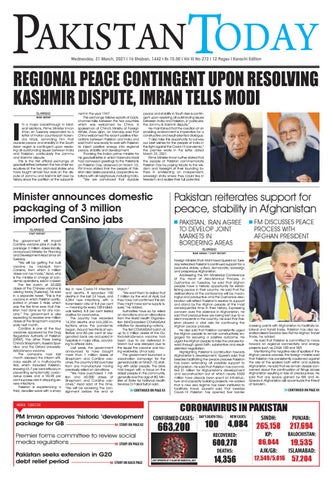
Wednesday, 31 March, 2021 I 16 Shaban, 1442 I Rs 15.00 I Vol XI No 272 I 12 Pages I Karachi Edition
Regional peace contingent upon Resolving KashmiR dispute, imRan tells modi ISLAMABAD
i
Mian abrar
n a major breakthrough in bilateral relations, Prime minister imran khan on tuesday responded to a letter of indian counterpart narendra modi, reminding him that durable peace and stability in the south asian region is contingent upon resolving all outstanding issues between india and Pakistan, particularly the jammu and kashmir dispute. this is the first official exchange of goodwill letters between the two chief executives of the two arch-rival states who have fought almost four wars on the dispute of jammu and kashmir left over by history since the partition of the subconti-
nent in the year 1947. this exchange follows reports of backchannel talks between the two countries which was welcomed by china. a spokesman of china’s ministry of Foreign affairs, Zhao lijian, on monday said that china welcomed the recent positive interactions between Pakistan and india and said that it was ready to work with Pakistan to inject positive energy into regional peace, stability and development. thanking the indian prime minister for his goodwill letter in which narendra modi had conveyed greetings to the Pakistanis on Pakistan day, observed on march 23, Pm imran stated that the people of Pakistan also desire peaceful, cooperative relations with all neighbours, including india. “we are convinced that durable
peace and stability in south asia is contingent upon resolving all outstanding issues between india and Pakistan, in particular, the jammu & kashmir dispute.” he maintained that the creation of an enabling environment is imperative for a constructive and result-oriented dialogue. “i also take this opportunity to convey our best wishes for the people of india in the fight against the covid-19 pandemic,” the premier wrote in the letter dated march 29, 2021. Prime minister imran further stated that the people of Pakistan commemorate Pakistan day by paying tribute to the wisdom and foresight of their founding fathers in envisioning an independent, sovereign state where they could live in freedom and realise their full potential.
Pakistan reiterates support for peace, stability in afghanistan
Minister announces domestic packaging of 3 million imported CanSino jabs
g
ISLAMABAD Staff report
the government will import cansino vaccine jabs in bulk to package 3 million doses locally, announced minister for Planning and development asad umar on tuesday. “we will be getting the bulk vaccine by mid-april from cansino, from which 3 million doses can be made,” asad, who is the minister in charge of pandemic operations, said in a tweet. the first batch of 60,000 doses of the chinese vaccine is arriving today [tuesday], he said in a separate tweet. “this is the vaccine in which Pakistan participated in phase 3 trials, which was the first time ever that Pakistan had done so for any vaccine.” the government is also expecting to receive one million doses of the sinopharm vaccine early next month. cansino is one of the four vaccines approved by the drug regulatory authority of Pakistan (draP), the other three being china’s sinopharm, russia’s sputnik-v, and the oxford universityastraZeneca vaccine. the company had last month released the interim efficacy results of a multi-country trial, which included Pakistan, showing 65.7 per cent efficacy in preventing symptomatic coronavirus cases and a 90.98 per cent success rate in stopping severe infections. Pakistan is experiencing a third, deadlier wave with a sharp
Pakistan, iran agree to develoP joint markets in bordering areas
g
Fm discusses Peace Process with aFghan President
ISLAMABAD Mian abrar / Staff report
rise in new covid-19 infections and deaths. it recorded 100 deaths in the last 24 hours, and 4,084 new infections, with a transmission rate of 8.8 per cent — meaning for every 100 individuals tested, 8.8 per cent tested positive for coronavirus. the country has recorded 14,356 deaths and 663,200 infections since the pandemic began. around two-thirds of ventilators and 80 per cent of oxygenated beds are occupied in hospitals in major cities, according to official data. last week, the government announced to have bought more than 1 million doses of sinopharm and cansino vaccines, the country’s first purchase from any manufacturer having previously relied on donations. “we have purchased 1 million and 60,000 doses of sinopharm and cansino vaccines,” asad said at the time. “we will be receiving the consignment before the end of
march.” “we want them to deliver that 7 million by the end of april, but they have not confirmed this yet. they might have some supply issues,” he added. authorities have so far relied on donations and on allocations from the world health organisation (who)-backed covaX/gavi initiative for developing nations. the first covaX/gavi batch of up to 4 million doses of the oxford-astraZeneca vaccine had been due to be delivered in march but was delayed due to the issues the vaccine was facing worldwide, umar said. the government launched a vaccination campaign for the general public on march 10, starting with older people. the drive had begun with a focus on the oldest people in the community, generally over the age of 80, minister of state for national health services dr Faisal sultan said.
CONTINUED ON PAGE 05
MORE INSIDE
PM Imran approves ‘historic ‘development package for GB STORY ON PAGE 02 Premier forms committee to review social media regulations STORY ON PAGE 03 Pakistan seeks extension in G20 debt relief period
STORY ON BACK PAGE
Foreign minister shah mahmood Qureshi on tuesday reiterated Pakistan’s continued support for a peaceful, stable, united, democratic, sovereign and prosperous afghanistan. addressing the 9th ministerial conference of the heart of asia-istanbul Process, in dushanbe on tuesday, he said that afghan people have a historic opportunity for establishing peace in their country. he said that the deliberations at the conference will be meaningful and productive and the dushanbe declaration will reflect Pakistan’s resolve to support and stand by the afghan people at this most consequential time in their history. expressing concern over the violence in afghanistan, he said that precious lives are being lost due to violent incidents in the country. he said that Pakistan played a vital role for continuing the afghan peace process. he also said that Pakistan consistently urged the afghan people to remain constructively engaged for securing a positive outcome. he urged the afghan people to take the process forward through good faith, substantive and resultoriented negotiation. highlighting Pakistan’s contribution towards afghanistan’s development, Qureshi said that besides facilitating the peace process Pakistan has been extending all possible support to afghanistan. he said that Pakistan has committed $1 billion for afghanistan’s development and reconstruction out of which nearly $500 million have already been spent on infrastructure and capacity building projects. he added that a new visa regime has been instituted to facilitate travel. Qureshi said that besides covid-19 Pakistan has opened five border
crossing points with afghanistan to facilitate bilateral and transit trade. Pakistan has also operationalised gwadar sea Port for afghan transit trade, he added. he said that Pakistan is committed to move forward on regional connectivity and energy projects such as casa 100 and taPi. mentioning the negative role of spoilers in the afghan peace process, the foreign minister said that Pakistan has consistently cautioned against the role of the spoilers both within and outside afghanistan. he said that we remain deeply concerned about the continuation of firings across afghanistan resulting in loss of precious lives. he said that any space gained by isis and alQaeda in afghanistan will accentuate the threat of terrorism.
CONTINUED ON PAGE 05
coRonaviRus in paKistan CONFIRMED CASES:
663,200
DAY'S DEATH TOLL:
100
NEW CASES:
4,084 265,158
PUNJAB:
217,694 BALOCHISTAN:
600,278
KP:
86,044
19,535
DEATHS:
AJK/GB:
ISLAMABAD:
RECOVERED:
LAST UPDATED AT 7:16 AM ON MARCH 30, 2021
SINDH:
14,356
12,549/5,016
57,204
02
Wednesday, 31 March, 2021
KARACHI
NEWS
PM IMran aPProves ‘hIsTorIc ‘develoPMenT PacKage for gB IsLAMABAD
P
Ghulam abbaS
RIME Minister Imran Khan on Tuesday approved a major economic package for the uplift of Gilgit-Baltistan (GB), fulfilling the promise made before elections in November last year. The premier gave go-ahead while chairing a meeting on the Gilgit-Baltistan Integrated Development Plan, which is being dubbed as historic. The projects related to clean energy, transport and communication, health, infrastructure, water sanitation and tourism are part of the package. A hint about the package worth billions of rupees was dropped in January this year after Federal Minister for Planning, Development & Special Initiatives Asad Umar and GB Chief Minister Khalid Khurshid jointly chaired the inaugural meeting for the preparation of an integrated
plan for the development of the region. Following the meeting, technical working groups comprising relevant chiefs of the ministry of planning and development and officers of GB were constituted. An apex committee under the GB chief minister and an inter-ministerial committee under the deputy chairman of the Planning Commission were also set to monitor the preparation and implementation of the development plan. Later, the plan was
Provinces directed to ensure compliance with coronavirus guidelines ISLAMABAD: The National Command and Operation Centre (NCOC) on Tuesday directed chief ministers of all four provinces to ensure adherence to the directions of the authority to deal with a third wave of Covid-19. In a letter, Minister for Planning and Development Adad Umar, who also heads the NCOC, said: “Violations of NCOC instructions, specifically in political and social gatherings have been observed. “These violations have been obstructing effective enforcement of SOPs in other sectors too and sending wrong signals to the general public,” the letter read. “In view of the surge in cases and corresponding pressure on the healthcare system, may I request you to ensure employment of all administrative tools for across-the-board implementation of NCOC’s instructions, especially those related to public gatherings.” The letter expressed hope the nation by adopting precautions “will be able to thwart further spread of this contagion with our collective efforts.” Coronavirus cases are rising quickly in the country. The authorities on Tuesday recorded 663,200 infections and 14,356 coronavirus-related deaths, with 4,084 infections and 100 deaths. On Monday, President Arif Alvi tested positive for Covid-19. Soon after, Defense Minister Pervez Khattak also said he had tested positive. Meanwhile, the government is in the process of introducing stricter restrictions including bans on wedding ceremonies and large gatherings. Pakistan launched its vaccine drive earlier this month, inoculating healthcare workers and high-risk age groups. Staff RepoRt
Three Karachi neighbourhoods under smart quarantine KARACHI: Sindh government on Tuesday imposed targeted lockdowns in three sub-divisions of Karachi in view of an uptick in Covid-19 cases there. A notification said that restrictions have been imposed in the several union councils and residential areas of North Karachi, North Nazimabad, and Gulberg. The quarantine would remain in force till April 12. The decision was taken as the areas had been identified as Covid-19 hotspots by the district health officer (DHO). The notification further stated that everyone travelling from the affected areas must wear face masks whereas pillion riding was banned. Furthermore, all business and industrial activities, along with family gatherings have been banned in the neighbourhoods with instructions to Covid-positive patients to quarantine at home. The government further said that it would take all possible steps to distribute rations to deserving people living in the affected areas, the notification added. With 269 new cases, the confirmed cases of the coronavirus in Sindh climbed to 265,158. Authorities received back a transmission rate of 2.98 percent after conducting 9,030 tests. The province also reported four new deaths, raising the toll to 4,495, while its recoveries rose by 183 to 255,952. Overall, the province now has 4,711 active cases of the coronavirus. Staff RepoRt
chalked out in the light of the recommendations sent by the working groups and it was sent to the premier for approval. Earlier it was reported by Pakistan Today that as the apex committee constituted by the federal government had completed its proposals for GB development plan, Prime Minister Imran was expected to announce a historic GB development package, worth over Rs250
billion, soon. According to an official source, the apex committee has proposed at least 57 development projects in the five-year development plan (2021-26), which included earlier approved projects, some ongoing projects and some new projects — to be funded by the Centre as well as through public-private partnership (PPP). As per the sources the PM on Tuesday approved the ‘Socio-Economic Development Plan (2021-26)’ for GB. As per documents, the development plan included potential projects in the public sector, non-PSDP initiatives, as well as PPP projects, which had been conceived through consultations between GB authorities and federal ministries/divisions. Priority sectors such as clean energy/hydropower, health, education & skill development, tourism, private sector development, agriculture, women’s development, social welfare, and youth have also been included in the plan. The purpose of formulating the package
was to accelerate socio-economic development in GB by increasing the livelihood opportunities for the people and realising the economic potential of the region. As per the documents, projects worth Rs104.6 billion have been proposed in the transport and communication sector, while projects worth Rs86.3 billion have been recommended for clean energy and off-grid solutions. Similarly, projects worth Rs9.8 billion have been proposed in gems, mineral, trade and commerce sectors. For the development of human resources, which included health, education and skill development, a sum of Rs29.4 billion has been proposed. Besides, Rs5.4 billion would be spent on tourism and allied facilities, Rs13 billion on climate change/ environment, and Rs1.3 billion on agri business development. Out of the Rs250 billion development plan, projects worth Rs47.7 billion would be funded through GB annual development plan; projects worth Rs91.7 billion would be financed through PSDP, while those worth Rs110.5 billion would be funded by the federal government through the Ministry of Kashmir Affairs and Gilgit-Baltistan (federal PSDP). However, an insider claimed that many of the projects included in the development package were those already approved by various forums and waiting for funding.
Pakistan to get 7 million Covid-19 vaccine jabs in April: minister LAHORE
condition. ISLAMABAD’S CONTAGION RATE SURGES PAST 12PC: Minister of State for National Health Services Dr Faisal Sultan said that the transmission rate in Islamabad has doubled in the past few days, reaching 12.31 percent. Speaking to reporters, he said that the overall case positivity rate in the country was 8.83 per cent while 10.43 per cent in Punjab, 8.55 percent in Khyber Pakhtunkhwa (KP), 2.98 per cent in Sindh, 2.15 per cent in Balochistan, 8.98 per cent in Azad Jammu and Kashmir (AJK), and 2.33 per cent in Gilgit-Baltistan (GB), APP reported. He said that positive cases were climbing up for the past two weeks and urged the people to strictly follow standard operating procedures (SoPs) to prevent the spread. “We regularly monitor positivity ratio at national, provincial, and city levels and when it increases, it puts an additional burden on the healthcare sector. Pressure is mounting in Islamabad, Peshawar, Karachi, and major urban centers of Punjab.” He said that keeping in view the risk, targetted restrictions were imposed focusing on high-risk sectors with mass gathering, however, poor compliance with
guidelines was observed. He further requested provincial administrations to take serious note of the situation. The minister said that there are certain variants of the disease originating from the African states where travel restrictions are being imposed to contain its spread. He said that a walk-in vaccination facility for senior citizens, aged 70 and above, was introduced and they can visit the nearest vaccination centre after registering themselves on 1166 for jabs. He also said that this is not the time for complacency but for strict compliance with guidelines. “Covid-19 is a deadly virus but we can control it just as we did by following the guidelines during the first wave.” Dr Faisal said that the government is seeking full cooperation of the people in adhering to the guidelines. “We can save precious lives including those of our near and dear ones by taking preventive measures.” He asked the people to wear a face mask, maintain social distance, wash hands frequently and avoid going to crowded places. Dr Faisal said that better services are being ensured at vaccination centers to facilitate senior citizens. He further said that keeping in view the positive response received from senior people for vaccination, the staffers and number of centers are also being increased.
LHC sets aside orders of declaring Nusrat Shehbaz absconder
KP bans public events, imposes section 144 to arrest third wave
Staff RepoRt
Punjab Health Minister Dr Yasmin Rashid on Tuesday said that Pakistan will receive seven million doses of the Chinese coronavirus vaccine in April. Speaking to a news channel, the minister recalled the federal government has purchased about three million and four million doses of the Sinopharm and Cansino vaccines, respectively. “They [China] have also committed to giving us a certain amount of doses each month. So we will have an adequate number of vaccines available,” she said. Her statement comes as the government portal on Tuesday registered 4,084 fresh infections of the coronavirus. In the last 24 hours, the authorities tested 46,269 samples — receiving back a scaled-down positivity rate of 8.83 per cent. With new cases, the country’s confirmed cases climbed to 663,200. Meanwhile, the daily death toll reached a three-month high of 100 to stand at 14,356. The recoveries increased by 2,081 to 600,278, or 90.5 percent of total infections. Currently, there are 48,566 active cases in the country, with 3,170 of them in critical
LAHORE app
The Lahore High Court (LHC) on Tuesday set aside orders of declaring Nusrat Shehbaz, wife of Opposition Leader in National Assembly (NA) Shehbaz Sharif, as an absconder by an accountability court in assets beyond means and money laundering case. The court directed Nusrat to appoint a pleader to represent her in the trial court while asking her to join the proceedings after recovery from her illness. The division bench comprising Justice Sardar Muhammad Sarfraz Dogar and Justice Asjad Javaid Ghural passed the orders while allowing a petition, filed by Nusrat against the accountability court orders of declaring her an absconder. Prosecutor Syed Faisal Bukhari argued on behalf of the National Accountability Bureau (NAB) that the bureau did not have any objection on allowing the plea if three conditions were accepted. He submitted that Nusrat’s representative should
appear before the trial court on every hearing and apprise her about the development in the case. The accused would be bound to attend the proceedings after recovery from illness, he added. At this, Nusrat’s counsel submitted that he did not have any objection to the conditions. Subsequently, the bench set aside the orders of declaring Nusrat as an absconder. An accountability court had declared Nusrat as an absconder on December 8, 2020, over her persistent nonappearance in the assets beyond means and money laundering case. Nusrat submitted in the LHC that she was residing in a foreign country for medical treatment and she had approached the accountability court for permanent exemption from personal appearance. However, the court turned down her application and issued arrest warrants for her while declaring her an absconder. She stated that she was suffering from different diseases and currently receiving medical treatment abroad.
Pakistan signs two contracts with Turkish shipbuilder NEws DEsk Pakistan and a Turkish shipbuilder signed two contracts Monday worth $33.46 million for the procurement of four azimuth stern drive (ASD) tugboats (LNG compatible) and two pilot boats, Anadolu Agency reported. The contracts were signed between Port Qasim Authority (PQA) and Sanmar Shipyards, according to a statement from the Ministry of Maritime Affairs. Sanmar, Turkey’s leading tugboat manufacturer, will deliver the vessels within 12 months. The signing ceremony was witnessed by Minister for
Maritime Affairs Ali Haider Zaidi and Turkish Ambassador to Pakistan Mustafa Yurdakul at the Maritime Ministry’s office in Islamabad. This will be a significant step forward in the brotherly relations between both the countries, the statement said. Zaidi also invited Sanmar to build a shipyard in Pakistan, share their expertise, transfer their technology and benefit from the local skilled workforce and low wages in Pakistan. An official from Sanmar said they will take up the invitation seriously and praised the due diligence done by the PQA’s management and promised to deliver the vessels ahead of schedule while ensuring their quality.
PESHAWAR: Khyber Pakhtunkhwa (KP) on Tuesday suspended all indoor and outdoor events due to a surge in fresh coronavirus cases. According to a statement, the government imposed section 144, banning gatherings and all kinds of cultural, sports, social and religious gatherings in the province. It is also considering a complete lockdown in 16 hotspot districts, the statement said. Special Assistant to the Chief Minister on Information Kamran Bangash said that a ban has been imposed on functions in marriage halls and inperson visits in the Civil Secretariat. In a press conference, Bangash, who was flanked by Health Minister Taimur Jhagra, said several important decisions were taken to prevent the spread of the pandemic in the province. He said that a ban on entry of visitors in the offices of the provincial cabinet was also imposed. Directives were also issued for 50 percent work from home policy for the government offices. Bangash said that public transport would remain close for two days a week until the holy month of Ramzan. Transport and Local Government wings were directed to consult with stakeholders including transporters for implementation of the anti-coronavirus guidelines. Educational institutions in all those districts where the positivity rate was 5 per cent or above would be closed. So far, schools in 16 hotspot districts were closed. He said that the third wave of coronavirus was intensifying and strict measures were required ahead of Ramzan to prevent its spread. He also said that Provincial Task Force has hinted relief for supporting economic activities during Ramzan, adding that Taraveeh prayer and others activities would continue under guidelines. Bangash said that the vaccination campaign against polio would continue in the province under SOPs and urged masses to follow them at public places, adding that strict decisions would be taken in case the coronavirus situation worsen in the province. Staff RepoRt
Wednesday, 31 March, 2021
KARACHI
NEWS
PRemIeR FoRmS CommITTee To RevIew SoCIal medIa RegulaTIonS
P
News Desk
RIME Minister Imran Khan has formed a committee comprising high-ranking officials to review the social media regulations within the country it emerged on Tuesday. “This is with reference to the consultations undertaken by the AttorneyGeneral for Pakistan with the petitioners who had filed petitions in Islamabad High Court (IHC) and some other parties who expressed interests in deliberations of social media rules namely ‘the Removal and Blocking of Unlawful Online Content (Procedure, Oversight and Safeguards), Rules, 2020’,” a statement from Attorney General of Pakistan (AGP) Khalid Jawed Khan’s office said. The AGP’s office said that Federal Minister for Human Rights Shireen Mazari would be the committee’s chairperson, with MNA Barrister Maleeka Bokhari, Senator Barrister Ali Zafar, IT secretary, and the
‘Feeling better today after so many well-wishers’ prayers’ says president IsLAMABAD
Pakistan Telecommunication Authority (PTA) chairman as its members. The committee will furnish its findings and report back to the PM after one month’s time. It would also hold consultations with the petitioner, Usama Khawar — who filed the case in the IHC — and relevant stakeholders. It is pertinent to mention here that the AGP had recommended to PM Imran that broad-based consultations were needed to properly frame comprehensive rules for the regulation of social media within the country. The framework would aim to protect the fundamental rights of freedom of speech and right to information as envisaged under the Constitution of Pakistan, while also ensuring that the platforms are not abused and material is not disseminated in violation of laws. In February, the IHC had directed the federation to prepare a report within one month time period on social media rules after consulting all stakeholders.
The court had asked the attorney general of Pakistan to submit its report by April 2, in this regard. “A verdict on the petitions challenging the policy will be announced once we have seen the report,” the court had maintained. Chief Justice Athar Minallah had heard the case pertaining to social media rules. At the outset of the hearing, Deputy Attorney General Tayyab Shah had said that the government wanted to take the opinion of all stakeholders, adding that some had been consulted in it. The court had directed the AGP to presents his report within one-month and stated that the court would issue a judgment on petitions regarding social media rules after viewing the report. Prior to the IHC hearing, India had announced its own new rules to regulate big social media firms, such as Facebook and Twitter, in the latest effort by Prime Minister Narendra Modi’s government to tighten control over Big Tech firms.
Imran ‘fully recovered’ from coronavirus, says aide IsLAMABAD
app
Staff RepoRt
President Dr Arif Alvi, who tested positive for Covid-19 yesterday, on Tuesday said that he was overwhelmed and humbled by wellwishers’ prayers pouring in for his early recovery. “I am overwhelmed & humbled by good wishes & prayers, that I believe create a palpable aura of healing. Of course with so many praying for me I feel better today,” the president said on Twitter. He said that Prime Minister Imran Khan also called him and shared his experience. He also advised rest, sleep and soups. Moreover, the president said that he would try to thank everyone from his another Twitter handle @ArifAlviUpdates. Meanwhile, the president’s son, Awab Alvi, said that his father had been “super busy” last week, and might have been exposed amid all the activity, despite wearing a mask diligently. Sharing an update on the president’s health on Twitter, Awab said: “Good to share that @ArifAlvi is doing well — upbeat and enjoying a few days off.” Awab urged the people to continue wearing masks and protect themselves from the deadly disease. A day earlier, President Alvi and Minister for Defence Pervaiz Khattak tested positive for Covid-19. “I have tested positive for Covid19. May Allah have mercy on all Covid affectees. Had 1st dose of vaccine but antibodies start developing after 2nd dose that was due in a week. Please continue to be careful,” the president had said in a tweet posted on his social media account. Begum Samina Alvi, wife of President Alvi, had said she had her test done too, but was negative and quarantining. About President Alvi, she had said that he had mild symptoms but was in good spirit. “Alhamdulillah President @ArifAlvi has mild symptoms but is in good spirits,” Begum Samina Alvi had said on twitter. “I had my test done too & am negative & quarantining. We had our vaccine 1st dose done but it takes time to build immunity & I request everyone to please continue to get vaccinations done & practice SOPs [Standards Operating Procedures],” she had added. Meanwhile, Sindh Governor Imran Ismail in a tweet on Monday had said that Defence Minister Pevaiz Khattak had been diagnosed with Covid-19.
Prime Minister Imran Khan has “fully recovered” from the coronavirus, Pakistan Tehreek-e-Insaf (PTI) leader Faisal Javed Khan said on Tuesday. “On the advice of doctors and in accordance with national and international guidelines, he [Imran] has temporarily resumed official work,” Khan tweeted, urging the public to take precautions to prevent the spread of the virus. The prime minister and his spouse had tested positive for the contagious disease on March 20, two days after the former had received his first vaccine dose. When news of him testing positive for the contagious disease came out, the rumour mills went abuzz with speculation that the prime minister contracted the disease after vaccination. But health experts said that it was likely Imran was infected prior to being vaccinated. The Centers for Disease Control and Prevention (CDC), national health agency of the United States, says that the vaccine does not infect patients with the disease, but those who may have contracted the virus before they are vaccinated can become ill after a shot because it takes a few weeks for the body to build immunity. However, the Ministry of National Health Services (NHS), soon after the news broke out, clarified that Imran had not been “fully vaccinated” when he was diagnosed
with the coronavirus. It said that the prime minister had only received the first dose of the vaccine and that too merely two days ago, further explaining that the time frame was too soon for any vaccine to become effective. Antibodies develop two to three weeks after the second dose of two-dose Covid vaccines. A number of high-profile politicians, including ministers, have tested positive for the contagious disease since it was first detected in the country in February last. President Arif Alvi, Minister for Planning Asad Umar, Punjab Chief Minister Usman Buzdar, Foreign Minister Shah Mahmood Qureshi, National Assembly Speaker Asad Qaiser, PML-N President Shahbaz Sharif and PPP Chairperson Bilawal Bhutto-Zardari are among the politicians who contracted the disease. The nation on Tuesday registered 4,084 new infections of the coronavirus after conducting 46,269 tests, receiving a transmission rate of 8.83 per cent. Reports suggest Pakistan is yet to fully utilise its testing capacity of 57,531, with daily testing significantly below numbers proposed by global health experts. World Health Organisation (WHO) claims the country’s testing policies only record the most symptomatic patients while ignoring the spread among asymptomatic carriers, which studies suggest comprise the majority of infections nationwide.
Federal minister responds to social media backlash over son’s driving News Desk Federal Minister for Kashmir and Gilgit-Baltistan (GB) Affairs Ali Amin Gandapur spoke out against the people who were lambasting him on social media after a video of his son driving went viral. Gandapur’s underage son was seen in the video louting traffic regulations by driving while the federal minister himself sat in the passenger seat of the cry.
The minister took to Twitter defended himself by saying traffic laws apply on roads, motorways and highways, while his son was driving the car on fields owned by him. “Firstly traffic law applies on roads, highways or motorways so no law is violated, upgrade your knowledge. Secondly, it’s my own land, my own vehicle, and my own son. Thirdly, grow up Mr Mansoor Ali Khan and others who negatively commented and mind your own business,” said the minister.
COAS meets four foreign envoys News Desk Chief of Army Staff (COAS) General Qamar Javed Bajwa met envoys from China, European Union, Denmark, and Canada on Tuesday, reported the InterServices Public Relations (ISPR). Ambassador of China to Pakistan, Nong Rong called on General Bajwa at GHQ on Tuesday. According to ISPR, the army chief
The rules had come after Twitter ignored orders to drop content on farmers’ protests, fuelling the government’s zeal, dating from 2018, to clamp down on material it regards as disinformation or unlawful. Pakistan has had its own troubles with misinformation being spread, or cultural niceties being usurped, purportedly due to the lack of regulation on social media platforms. Last month, a Taliban terrorist, who nine years ago wounded Nobel Laureate Malala Yousafzai had threatened a second attempt on her life, tweeting that next time, “there would be no mistake”. In this case, the prime minister’s focal person on digital media, Arslan Khalid, had said that the account was “fake”. He had also informed her that Twitter and telecommunication authorities had been notified “as such miscreants using fake accounts and spreading hate shouldn’t be allowed on any social media platform”. On February 16, the Parliamentary
and Chinese envoy discussed matters of mutual interest, progress on CPEC and regional security during the meeting. The visiting dignitary appreciated Pakistan’s sincere efforts for bringing peace and stability in the region, especially the Afghan peace process. The COAS thanked the dignitary for China’s contribution towards the fight against Covid-19 in Pakistan and said that Pakistan Army greatly values its
friendly relations with China. Inter-Services Intelligence (ISI) Director-General Lieutenant-General Faiz Hamid was also present in the meeting. Moreover, the army chief also met the EU Ambassador to Pakistan Androulla Kaminara, Canadian High Commissioner Wendy Gilmour, and Ambassador of Denmark Lis Rosenholm. Matters of mutual interest, regional security, and enhanced bilateral
cooperation with the EU and Canada came under discussion. “[Gen Bajwa] said that Pakistan values its relations with EU countries and Canada and earnestly looks forward to enhancing mutually beneficial multidomain relations based on common interests,” the ISPR added. The visiting dignitaries appreciated Pakistan’s role in regional stability, especially the Afghan peace process. “All sides pledged to play their role for further improvement in diplomatic cooperation at all levels,” the military’s media wing said.
03
Committee on Kashmir had grilled the regional head of social media platform, Twitter, for silencing voices of thousands of Kashmiri and Pakistani activists projecting the plight of people of Indian Occupied Kashmir (IOK). In a special hearing held at the Parliament House, Committee Chairman Shehryar Khan Afridi had led the questioning of George Salama, who heads the Twitter regional office in the United Arab Emirates (UAE). Afridi had questioned Salama about the Twitter policy regarding human rights and freedom of speech and whether Twitter regulations did not conform to the United Nations charter on freedom of speech and freedom of expression. Salama, who attended the meeting through Zoom, had said that Twitter has a specific policy and discourages hate speech and upholds freedom of expression. He had said that Twitter authorities would ensure freedom of speech to all and voices of minorities would never be silenced. Afridi had raised the misuse of Unlawful Activities (Prevention) Act (UAPA) black law by Indian occupational authorities and silencing of voices of Kashmiris. Responding to Afridi, the Twitter representative had said that Twitter’s official position would remain equal for all parties of the conflict zone. “We are working closely with PTA to ensure equal opportunities to social media users,” Salama said.
Hafeez Sheikh contracts Covid-19 IsLAMABAD Staff RepoRt
Abdul Hafeez Shaikh, who was removed from the post of Minister for Finance yesterday, tested positive for coronavirus, his successor Hammad Azhar confirmed on Tuesday. In a tweet, Azhar said he is praying “for his swift recovery and good health”. Prime Minister Imran Khan removed Shaikh as part of a government shake-up aimed at bringing in policies to control “rising inflation”, Senator Shibli Faraz said. The removal — the second of a finance minister in the two-and-a-half years of PTI’s tenure — came amidst the restart of a $6 billion IMF bailout programme that had been suspended for one year over questions about fiscal and revenue reforms. A number of high-profile politicians, including ministers, have tested positive for the contagious disease since it was first detected in the country in February last. Prime Minister Imran, President Arif Alvi, Minister for Planning Asad Umar, Punjab Chief Minister Usman Buzdar, Foreign Minister Shah Mahmood Qureshi, National Assembly Speaker Asad Qaiser, PML-N President Shahbaz Sharif and PPP Chairperson Bilawal Bhutto-Zardari are among the politicians who contracted the disease. The nation on Tuesday registered 4,084 new infections of the coronavirus after conducting 46,269 tests, receiving a transmission rate of 8.83 per cent. Reports suggest Pakistan is yet to fully utilise its testing capacity of 57,531, with daily testing significantly below numbers proposed by global health experts. World Health Organisation (WHO) claims the country’s testing policies only record the most symptomatic patients while ignoring the spread among asymptomatic carriers, which studies suggest comprise the majority of infections nationwide.
Rasheed grateful to Tableeghi Jamaat for postponing Islamabad congregation IsLAMABAD app
Minister for Interior Sheikh Rasheed Ahmed on Tuesday extended his gratitude to the management of Tableeghi Jamaat for postponing their annual congregation, scheduled to be held in Islamabad from April 1 to 4. In a tweet, Rasheed said that the management of Tableeghi Jamaat postponed its congregation on his request which was made in view of the recent spike in the coronavirus cases under its third wave. “I am very grateful to the management of “Tableeghi Jamaat” that on my request, they have postponed their annual ‘IJTEMA’ in Islamabad, scheduled from 1st to 4th April. The request was made in view of the increasing cases of Covid-19 in the city,” the minister tweeted. Islamabad has seen a rise in coronavirus cases as the third wave of the virus intensifies across the country. As per the latest data from the National Command and Operation Centre (NCOC), Islamabad has 6,126 active coronavirus cases while the number of dead from the infection has risen to 563.
04
Wednesday, 31 March, 2021
KARACHI
NEWS
ConstruCtion of Gor-Vi on the land of sos VillaGe reVealed LAHORe
t
Shahab Omer
He management of SOS Village has revealed that the Services and General Administration Department (S&GAD) has started constructing government residences (GOR VI) on the land allotted to the SOS Village by the government for setting up youth homes. The lawyer of SOS Village, Akbar Ali, informed Pakistan Today that S&GAD was
allotted an area of land comprising of 118 KanaIs 11 Marla bearing Khasra No 6 & 7 of Mauza Rakh Kot Lakhpat, Ferozepur Road, along with land measuring 46 KanaIs 1 Marla bearing Khasra No 70 of Mauza Rakh Kot Lakhpat, Ferozepur Road, Lahore, free of cost for the construction of low paid employees colony from the Colony Department, bor vide dated 02 04.1995. Ali further informed that Khasra No 6 &7 of Mauza Rakh Kot Lakhpat consists of 158 Kanal, 19 marla as per the record. Met-
ropolitan Corporation Lahore (MCL) was also the owner of the land measuring 37 Kanal, 16 marla in the Khasra No. 6& 7 of Mauza Rakh Kot Lakhpat which was being used for the parking of trucks of Lahore Waste Management Company (LWMC). Ali said that the SOS village was allotted the land of 4 Kanal 5 marlas in the year of 2005 on the direction of the then Punjab chief minister for the establishment of youth homes and the Mutation No 39 of the same was entered into the record of rights vide
dated Aug 29, 2005, and the same was intact vide register haqdaran 2007-08. He said that at that time the in-charge of the SOS Homes denied taking possession of said land due to the fact that the property was away from the school besides other security reasons. Later, the in-charge of the SOS homes again requested to BOR for alternate land adjacent to the SOS, wherein the same was admitted through a summary to the Punjab CM and, after approval, the land measuring
4 Kanal was allotted to SOS vide letter no. SO eSTATe (LG)2-30/2009 dated March 11, 2014, out of the land owned by MCL. He informed that the state land measuring 52 Kanal Khasra No.7 Rakh Kot Lakhpat, Lahore owned by the MCL, Lahore, adjacent to SOS premises on its eastern side, was available and being used for parking of trucks of LWMC. Furthermore, the Lahore commissioner, in their report dated April 10, 2015, clearly indicated that the land allocated to SOS measuring 4 Kanal out of land owned by MCL, not from the land allotted to S&GAD. Moreover, Ali continued, while entering the Sahat Andraj of Mutation No 39, Naib, the tehsildar submitted its report, dated Dec 08, 2015, in which he stated that the allotted land measuring 4 Kanal to SOS vide letter dated 11.03.2014 was entered into the revenue record vide mutation No. 62 dated March 28, 2014.
LAHORE: A beautiful view of Azadi Chowk in the provincial capital. ZUbaIr mehFOOZ
Procurement of wheat to begin from April 1: minister LAHORe INP
Senior Minister Abdul Aleem Khan said the wheat procurement campaign in Punjab will start from April 1 with a target of 3.5 to 5 million metric tonnes. He said that gunny bags were being distributed to farmers and growers would be provided maximum facilities at wheat purchase
centers, reports quoting him said. He directed the relevant authorities to ensure the implementation of Covid-19 standard operating procedures (SOPs) during the procurement process to stay safe from the virus. Khan said that wheat would be procured at a price of Rs1,800 per maund and added there should be sufficient provision of gunny bags to the farmers in accordance with their needs. At wheat purchase centers “no queue, no
Pakistan’s rising housing crunch devours fertile land FAIsALABAD aNadOlU ageNcy
A mounting housing crunch is fast devouring Pakistan’s agricultural lands, which may have cascading effects on the country’s food security in years to come. The increasing population and housing needs have already turned large swathes of green lands, not only in big cities but in small districts, into concrete jungles in recent years in northeastern Punjab and southern Sindh provinces, which are considered the country’s two main bread-baskets. Standing outside a gated housing scheme in a northern village 10 kilometers (6 miles) from the downtown of northeast Faisalabad, it is hard to imagine that the modern villas have been built on agriculture fields, which produced wheat, sugarcane, and other seasonal crops and vegetables, apart from being fodder for animals until just a few years ago. Guarded by smartly-turned security guards, it is one of the hundreds of similar schemes that have recently sprung up in and around the country’s textile hub on farmlands and orchards for more than a decade. “Hundreds of farmers sold out their farmlands to the real estate developers in recent years, which has resulted in the form of these posh villas in and around the city,” Nadeem Shahid, a resident of the village told Anadolu Agency. Real estate developers, he said, are offering farmers triple the market price, a temptation hard to ignore. “Now [after selling farmlands], not only people like us but farmers themselves buy
wheat, flour, and vegetables from the market,” he said. “I don’t know how long the remaining farmers would resist?” said Shahid, pointing to a nearby field where a group of farmers was plowing for the next crop. The situation is no different in the nation’s capital Islamabad, the commercial capital in Karachi, the cultural hub of Lahore, and other cities, where large sections of once lush green fields and jungles have been turned into housing schemes. According to Shaukat Ali Chadhar, secretary-general of the Kisan (farmer) Board of Pakistan, a non-governmental agricultural advisory and research organization, around 20% to 30% of fertile land in Punjab province, which makes up 65% of the country’s total food requirement, have been converted to industrial units and housing schemes. In Lahore alone, he said 70% of agricultural land has been converted to housing and industrial units, followed by Gujrat where the ratio is 60%. “In Lahore, the remaining 30% of fertile lands are safe just because of security reasons as they are located near the border with India,” he said. In other agriculture districts in central Punjab-also known as mercantile Punjab, like Faisalabad, Gujranwala, Sheikhupura, and Kasur, 30% to 40% of fertile land have been sold to real estate developers and industrialist, he added. The land-holding ratio, he observed, is still satisfactory in southern Punjab and the northern district of Sindh, which together is currently producing more than 50% of the country’s wheat, sugarcane, and cotton.
wait policy” would be adopted and gunny bags would be provided on a first come first served basis, he added. He said that Prime Minister Imran Khan had made a prominent increase in wheat support price and this year, the wheat purchase would bring prosperity for farmers. The minister said that he himself would visit wheat purchase centers and strict action would be taken in case of any negligence.
Federal minister in hot water after jumping queue to get vaccine News Desk Federal Minister for Housing and Pakistan Muslim League–Quaid (PML-Q) senior leader Tariq Bashir Cheema has landed himself in hot water after videos emerged showing the minister getting himself and his family vaccinated for the vaccine. The clips showed a nurse giving vaccine jabs to family members of Cheema, which seems to be a clear violation of government policy regarding Covid-19 vaccination. Moreover, people in the video can be seen flashing the thumbs-up sign after being administered the jab. Former model and television host Iffat Omar was also tagged in one of the Instagram videos. Cheema belongs to the PMLQ, which is an ally of the ruling Pakistan Tehreek-e-Insaf (PTI). So far, the government has started issuing vaccines for frontline healthcare workers and those over the age of 60. However, neither the federal minister nor the television personality fit into this category. However, the minister — in a statement reported by TV channels — denied using his political influence to have members of his family vaccinated. He claimed that teams from the University of Health Sciences came to his home to administer a booster shot of a trial vaccine, adding that it had done the same before. Twitter has also been pointing out the risk that those getting the vaccine out of turn are posing to the ones who are eligible to get it at the moment. Iffat has also been called out for her hypocrisy since she has spoken against an inefficient legal system and government earlier but has now allegedly broken the law herself.
Wednesday, 31 March, 2021
KARACHI
BuzdAr AnnounCES rS17.6Bn uplift pACkAgE for SArgodhA, Chiniot LAHore
A
sTAFF REPORT
nnOunCIng new projects worth Rs17.6 billion for Chiniot and Sargodha, Punjab Chief Minister Sardar usman Buzdar inaugurated various development schemes and also laid foundation stones of public welfare projects during his visit to these two cities.
The chief minister also announced to early complete the FaisalabadChiniot-Sargodha road project with an amount of Rs12.7 billion. He inaugurated four road sector projects in Chiniot costing Rs430.71 million, besides laying the foundation stones of two projects of Rs850.31 million. He inaugurated projects worth Rs620.3 million in Sargodha and laid the foundation stones of four projects of
Rs1.216 billion. The CM announced new development projects of Rs5.60 billion for Chiniot. He inaugurated four projects of Rs430.71 million and laid the foundation of two other projects of Rs850.31 million. He announced the construction of the Chiniot section of Faisalabad-Chiniot-Sargodha road with a cost of Rs4.50 billion. He inaugurated four projects of
construction of 45-kilometre-long farmto-market roads costing Rs430.71 million in Chiniot. The foundation stones of two other projects of the road sector were also laid. These roads will be completed with an amount of around Rs850 million. Five projects of construction of 43.5 km long roads will be completed under RAP phase-II. The foundation stone of THQ hospital Bhawana was also laid.
NEWS
05
Xiaomi announces smart EV business, to invest $10bn over ten years SHANGHAI AgEncIEs
Chinese smartphone maker Xiaomi Corp has formally entered the automotive industry with a new smart electric vehicle (EV) business, the company announced on Tuesday in a filing. The firm will initially invest 10 billion yuan ($1.52 billion) in the wholly-owned subsidiary, with a total investment goal of $10 billion over the next ten years. Xiaomi CEO Lei Jun will also serve as CEO of the smart electric vehicle unit, the company added.
Minister announces domestic packaging of 3 million imported CanSino jabs CoNtINued from pAGe 01 The government is aiming to vaccinate around 70 million people out of the 220 million population to reach sufficient community immunity. 100 million people under 18 years of age not yet required to be vaccinated, it says. Meanwhile, one of the first countries in the world to allow private imports of Covid-19 vaccines for sale on the open market, Pakistan has already received a batch of the Sputnik-V vaccine. Authorities expect richer people will buy their own vaccination shots through this route, but the commercial administration of vaccines is yet to begin as the government settles pricing issues. However, in a letter to Prime Minister Imran Khan, Transparency International has raised concerns about the private sale of vaccines, saying it will cause inequality and open the door to corruption. Authorities have proposed a price of 8,449 rupees ($54.30) per pack of two injections of Sputnik V and 4,225 ($27.15) per injection for Convidecia, which will be CanSino’s trade name. According to a mechanism approved by the government, the trade price for an imported vaccine will add a 40 per cent mark up to the landed cost, with another 15 per cent for retailers or hospitals. LAHORE: A striking view of Minar-e-Pakistan on a sunny day. ZUBAIR MEHFOOZ
Pakistan reiterates support for peace, stability in Afghanistan CoNtINued from pAGe 01 Expressing concern over the risk posed by the damaged infrastructure in the war-torn country and lack of the economic opportunities, he said that these factors will undermine the gains made in the peace process. He also said that the signing of the Doha Agreement was a moment of hope and optimism and it must be our collective endeavor to ensure that this hope is not lost. For this, everyone will have to show every bit of patience, commitment and perseverance, adding that the constructive engagement and consultation on all key aspects is imperative. The foreign minister said that flexibility and spirit of compromise would be indispensible. He suggested that the progress made on the Doha Process should be consolidated preserving the international community’s adjustment and the development gains made over the years, ensuring an orderly and responsible withdrawal making sure that reduction in violence and ceasefire is achieved at the earliest, culminating the Afghan-led and Afghan-owned process into a political solution, securing the international community’s financial engagement to support Afghanistan in its post-conflict path to progress. He also said that the process should also include the long-term reconstruction and economic development for Afghanistan creating pull factors for the Afghan refugees to return to their homeland with dignity and honour through a time bound and well-resourced plan. Expressing pleasure over participation in the conference, foreign minister felicitated the Tajik government for convening the conference amid the Covid-19 pandemic. QURESHI, GHANI DISCUSS PEACE EFFORTS: Foreign Minister Qureshi and Afghan President ghani discussed relations between Pakistan and Afghanistan and efforts for lasting peace and stability in the war-torn country. The meeting between the two occurred
on the sidelines of the conference, said a press statement issued by the Ministry of Foreign Affairs on Tuesday. “Pakistan believes there is no military solution to the conflict in Afghanistan and that an inclusive, broad-based and comprehensive political settlement was essential for durable peace and stability in Afghanistan,” Qureshi reiterated, adding that peaceful and stable Afghanistan is in the interest of Pakistan. He further remarked that Pakistan is a partner for peace in Afghanistan and towards that end, Pakistan is constructively engaged with the international community to reinforce the efforts for peace. He further underlined that intra-Afghan negotiations in Doha achieved progress which should lay the foundation to take the process forward. He expressed hope that as the peace efforts moved forward, the Afghans would make important decisions for reaching the negotiated political settlement. “Durable process in Afghanistan would enhance opportunities for working together on infrastructure and energy connectivity between Central Asia and West Asia through Afghanistan,” FM Qureshi said while highlighting the importance of regional connectivity. He also had a separate meeting with Foreign Minister Haneef Atmar to discuss bilateral relations and the Afghan peace process. The meeting comes on the heel of a proposal from Afghan President Ashraf ghani who is expected to announce a new presidential election within six months under a peace plan he will put forward as a counteroffer to the Pakistan-brokered uS proposal that he rejects. ghani will unveil his proposal at an international gathering in Turkey in April, signalling his refusal to accept Washington’s plan for his elected government to be replaced by an interim administration. But he will participate only if Taliban leader Haibatullah Akhunzada, or Mullah Yaqub — the son of the militants’ late founder, Mullah Omar — attends, Reuters
reported. Washington, which agreed last year to withdraw its troops from Afghanistan by May 1 after nearly two decades of war, is pressing for a peace deal to end fighting between the government and the Taliban. Talks between the Afghan sides in Qatar have stalled. The Taliban, who ruled Afghanistan with an iron fist from 1996 to 2001, are seeking to topple the Western-backed government in Kabul and reimpose their brand of rule. uS Special Envoy Zalmay Khalilzad has been circulating a proposal which would replace the Kabul government with an interim administration. But ghani has voiced vehement opposition to any solution that requires his government to step aside for unelected successors. “The counterproposal which we are going to present at the Istanbul meeting would be to call for early presidential elections if the Taliban agree on a ceasefire,” one senior government official told Reuters on condition of anonymity. Another Afghan government official said: “The president would never agree to step aside and any future government should be formed through a democratic process, not a political deal.” A third senior official also said that ghani’s proposal would include possible early elections, although he did not specify the time frame. The third official said ghani had already shared his road map with Khalilzad. MARKETS ON BORDERING AREAS WITH IRAN: Pakistan and Iran on Tuesday agreed to implement Prime Minister Imran’s initiative to develop joint border markets in Pak, Iran bordering areas and the need to expeditiously finalise the arrangement to facilitate legal trade and improve livelihood in the border region. The agreement was reached during a meeting between Foreign Minister Qureshi and Iranian Foreign Minister Dr Javad Zarif on the sidelines of the 9th Ministerial Con-
ference of the Heart of Asia–Istanbul Process in Dushanbe, Tajikistan. The meeting was held on the heels of a landmark agreement between Iran and China as the former joined the Belt and Road Initiative (BRI) of China while Pakistan is also a principal signatory of the cooperation agreement. During the meeting, the two foreign ministers reviewed bilateral relations and exchanged views on regional issues, particularly the Afghan peace process. “Foreign Minister Qureshi emphasised the importance of enhanced bilateral economic cooperation. Referring to the prime minister’s initiative to develop joint border markets, the two foreign ministers agreed on the need to expeditiously finalise the arrangement to facilitate legal trade and improve livelihood in the border region. The two foreign ministers also reviewed progress on the opening of new border crossing point,” an official, statement said. Foreign Minister Qureshi expressed the hope that the Afghan parties would seize the historic opportunity to work out an Afghanled and Afghan-owned political settlement. He underlined the need to consolidate progress achieved in Doha process and take the process forward. Expressing concern on high level of violence, he underscored the importance of reduction in violence leading to ceasefire. Foreign Minister Qureshi also underlined the need to be cognisant of ‘spoilers’, who did not wish to see return of peace and stability in the region. He added that a peaceful and stable Afghanistan would help in improving connectivity and promote infrastructure development in the region. The Pakistani foreign minister thanked for Iran’s steadfast support on the Jammu and Kashmir dispute and Prime Minister Imran’s efforts to counter Islamophobia and promote inter-faith harmony. The two foreign ministers agreed to remain in close contact and maintain bilateral political exchanges.
PAKISTAN, INDIA FOREIGN MINISTERS MAY MEET: The conference, among others, is also being attended by India’s External Affairs Minister S Jaishankar. The participation of both the ministers at the conference has sparked speculation of a possible meeting between the two leaders amidst recent peace overtures between the two neighbours. But Qureshi on Monday said that no meeting has been “finalised or requested” so far with Jaishankar. Last week, Jaishankar also did not give a specific reply to questions on whether he will meet Qureshi on the sidelines of the event, The Hindu reported. The meeting, if takes place, represents a thawing in bilateral ties, which have been frozen since a 2019 suicide bombing in Indian Occupied Kashmir (IOK) blamed on Pakistan and India’s decision later that year to strip the disputed region’s autonomous status in order to bind it closer to India. But over the past few weeks, the two governments have made tentative efforts to re-engage and calm the borders as they struggle to extricate their countries from the worst economic downturn ever amid the Covid-19 pandemic. bout a month after the armies of Pakistan and India agreed to observe a ceasefire along the Line of Control (LoC), Bloomberg revealed the months-long talks that preceded the landmark announcement were brokered by the united Arab Emirates (uAE). The cease-fire, the report which cited sources said, is only the beginning of a larger roadmap to forge a lasting peace between the arch-rival neighbours. The next step in the process involves both sides reinstating high commissioners in new Delhi and Islamabad, who were pulled in August 2019 after Pakistan protested India’s move to revoke the semi-autonomous status of occupied Kashmir. The reinstatement of the envoys will be followed by the hard part: Talks on resuming trade and a lasting resolution on Kashmir.
Wednesday, 31 March, 2021
06 COMMENT
How can we be silent?
Off with his head! And now the third Finance Minister
I
N less than three years of his tenure Prime Minister Imran Khan has appointed his third Finance Minister. Mr Khan had no consistent policy to turn round the national economy when he assumed office. However, he had whims which he tried to sell to the Finance Ministers he appointed. Further, running a coalition with a waferthin majority, he was hesitant to annoy any powerful section of society for fear that it might further impair his political standing. Mr Asad Umar, having corporate experience, was considered the PtI’s financial wizard. Forgetting whatever he had learnt about running a country’s economy, the loyalist appointed Finance Minister delayed taking timely recourse to the IMF because the PM was deadly opposed to the idea. Mr Umar pandered to Mr Khan’s fanciful plans, like providing hens and buffalos to help the poor set up small businesses, thus bringing themselves and the country out of poverty. Eight months of floundering deepened uncertainty in the country leading to Mr Umar’s replacement with Dr Abdul Hafeez Sheikh. Dr Shaikh and new SBP Governor Mr Raza Baqir consigned the country to the full embrace of the IMF. the IMF programme was aimed at bringing government finances into a primary surplus, reducing the overall fiscal deficit, introducing currency flexibility, and restoring some sense of sustainability to the economy. Within months the adjustment package led to the economy contracting 30 percent, causing large-scale shutdowns followed by layoffs. the FBR was required to raise taxes but was discouraged by the PM from confronting the large trading community which opposed all attempts to document its economic transactions. Dr Shaikh was removed by the PM reluctantly. After losing the Senate election the Finance Minister could not head any government department, as ruled by the Islamabad High Court a few month back. the policies dictated by the IMF will now continue to be pursued by Industries Minister Hammad Azhar, who has replaced Dr Shaikh. Mr Azhar has meanwhile promised to further consolidate what he calls the gains made since 2018 and strengthen the growth momentum. His claims that the sharp rise in prices of goods of daily consumption is due to disruption of supply chains because of the covid-19 pandemic would lead many to wonder if this is really true about the hike in prices of wheat, sugar and vegetables.
All Israel’s election did was empower terrorists
Washington Watch dr jAmes j Zogby
A
t the conclusion of Israel’s fourth election in two years, the picture that emerges is as clear as mud. Here’s what we have learned from the outcome: Benjamin Netanyahu, though despised by many voters, remains the most potent force in the country; the political situation remains so fractious that forming a government will require that leaders of one or more small parties will need to join a coalition with groups they had pledged to shun; and Israeli politics have moved so decidedly to the hardline right that peace with Palestinians wasn’t an issue for the overwhelming majority of politicians and those who voted for them. None of this, of course, is new. What is new and portends danger ahead is the fact that a grouping of racist extremists, including “Jewish Power,” a party created by the disciples of the late Meir Kahane, won seats in the Knesset. During the campaign, Netanyahu courted them and promised one of their leaders, Itamar Ben-Gvir, a ministerial post in his government. the prospect of this fills me with fear and disgust, since I’ve had a long history with the violent anti-Arab racism of Kahane and Kahanists.
Myanmar bleeds
I
t was perhaps inevitable that when Myanmar’s military abruptly took over the country two months back, detaining its civilian leader Aung San Suu Kyi and other democratically elected leaders, the peaceful protests against the move that ensued would soon turn violent. According to sources, around 400 people have so far died in clashes with military forces, with incidents of soldiers firing directly into crowds. It is ironic that on one hand the country’s commander-in-chief Min Aung Hlaing said that the military would ‘protect the people and strive for democracy’, while on the other his men are shooting unarmed people dead in the streets. Pakistan has so far remained restricted in its response, not outrightly condemning the coup. It is unfortunate that on the deadliest day of violence that occurred on Myanmar’s Armed Forces Day with a death toll of over 100, Pakistan was among other countries like India, China and Russia that sent representatives to attend the event who rubbed shoulders with the generals responsible for the massacre. Myanmar, which remained under military rule from 1962 to 2011, had finally gained a government led by a popular, democratically elected civilian, albeit with significant military involvement still present. Nevertheless, the trajectory was correct, moving towards a better functioning democracy. However, a sense of insecurity soon set in when Suu Kyi’s NLD emerged victorious in the country’s first openly contested election in 25 years, held in 2015. that nationwide protests erupted at such a scale within a relatively short period of time since the coup reveals how the people of Myanmar support civilian-led democracy. this is not to say that the civilian setup does not have problems of its own, ranging from bad governance to corruption, but those are not good enough excuses for the military to do away with a system that gives citizens the right to choose its leader. the US has already placed sanctions on the country that will hurt it more economically. In the absence of any checks on its unbridled power the military has started engaging soft targets, such as Karen State, an area controlled by an armed ethnic group that had signed a ceasefire agreement in 2015, dropping bombs causing three deaths and making villagers take refuge in a jungle. the human and economic cost of a military taking over its own country by force rather than keeping to the barracks where it belongs, is a real and heavy one. One hopes Myanmar finds a way out of this tyranny. Sadly, it does not seem that will happen anytime soon.
From demanding Pakistan to the creation of Bangladesh
Amjed jAAved
S
HEIKH Mujibur Rehman declared Bangladesh to be independent on 26 March 1971. there is a long trajectory of events that culminated in this cataclysmic event. the All-India Muslim League was born in Dacca in 1906 after partition of the Bengal Province. Lord Curzon partitioned Bengal for a number of reasons, including a swollen population of 85 million. the Muslim population was happy at the partition but Hindus started agitation against English raj. they alleged that the partition was the outcome of the British divide-and-rule policy. Hindus’ reaction made Muslims realize that Hindus did not care a fig for the Muslim interests. the Lahore Resolution was passed on March 23, 1940. At that time, the idea was to unite predominantly Muslim provinces. No one realized that someday a unified Islamic republic of Pakistan would come into being. Lord Curzon partitioned Bengal in 1905 to split the population, then 85 million, into smaller administrative units. the population was broadly divided into Hindus and Muslims. the British recognized that Bengal (with 85 million people) was too large for a province. the Congress initiated mass agitation that brought the province to the brink of a rebellion. the All-India National Congress believed that the dividing line cut right through the heart of the Bengalispeaking “nation”. It deprived Western Bengal’s “respectable people” (bhadralok) of their intellectual leadership. the partition resulted in the creation of a row
Dedicated to the legacy of the late Hameed Nizami
Arif Nizami Editor Managing Editor
Joint Editor
To some, it may seem like threats by Ben-Gvir and other Kahanists to expel Palestinians are nothing more than sick fantasies. But he is now in the Knesset and has been promised a role in a Netanyahu government.
The writer is President, Arab American Institute.
From 23 March 1940 to 26 March 1971
Military coup sets off wave of resistance and violence
Yousaf Nizami Aziz-ud-Din Ahmad
On 30 April 1971, my wife’s birthday, I received my first death threat from Meir Kahane’s followers. that morning we found an envelope under our door. Eileen opened it to find a threatening note with the letters cut out from magazines and pasted on plain white paper. It read: “Arab dog you will die if you set foot on campus again.” A few days later, a group of Kahanists attacked the classroom where I was teaching a course in Introduction to Religion. they were driven away by a group of Black students, but continued their threats and harassment for months thereafter. In the years that followed, I would become more familiar with Kahane, a Brooklynborn rabbi who preached a virulently racist, violent ideology, and his adherents in the Jewish Defense League. they would firebomb my office, murder my friend and colleague Alex Odeh, and injure hundreds more, in a decadeslong campaign of violence targeting Arab-Americans, Palestinians, and Jews who disagreed with them. On one occasion, Kahane himself led a group of his followers to my office, pounding on my door and chanting that he knew who I was, where he could find and take care of me. In the late 1980s, Kach, the political party Kahane founded in Israel, was barred because of its extreme racism and incitement to violence. A few years later, a former JDL and Kach member also from Brooklyn, Baruch Goldstein, massacred 29 Palestinians as they prayed in the historic Ibrahimi Mosque in Hebron in the occupied West Bank. Another follower assassinated then-Prime Minister Yitzhak Rabin. this resulted in the two groups being declared terrorist organizations by the US and Israel. Not long ago, Kahanists were pariahs on the margins of Israeli society. Now they will be in the Knes-
set and possibly in the government. What’s shocking is that this fact has barely been noticed by Israel’s supporters in the USA or by the US government. to understand just how virulently racist Netanyahu’s ally Ben-Gvir is, just look at his record. He’s a lawyer who represents right-wing Jews charged with violent crimes against Palestinians and liberal Jews. He joined Kach in the 1980s and quickly became a devoted student of Kahane and his racist ideas. those ideas were spelled out in a set of proposed laws Kahane introduced to the Knesset after he won a seat in 1984. One of the laws stipulated, “Non-Jews will be obliged to assume duties, taxes and slavery. If he does not agree to slavery and taxes, he will be forcibly deported.” Another declared, “A non-Jew will not live within the jurisdiction of the city of Jerusalem.” He also called for strict separation between Jews and Palestinians, with draconian penalties including 50 years imprisonment for gentiles who have sexual relations with Jews. Just a few weeks ago, Ben-Gvir spoke of Kahane as his “hero” and called for the expulsion of “disloyal” Palestinian citizens of Israel. He has been indicted for incitement more than 50 times and was convicted of supporting a terrorist organization in 2007. He’s also called Baruch Goldstein, whose framed photo hangs in his office, a “hero.” this is who Netanyahu and his Likud party are doing business with and legitimizing. to some, it may seem like threats by Ben-Gvir and other Kahanists to expel Palestinians are nothing more than sick fantasies. But he is now in the Knesset and has been promised a role in a Netanyahu government. this should set off screaming alarm bells and red flags for Israel’s supporters in the USA and a wakeup call to the Biden administration and to all Americans. It is unacceptable to remain silent and pledge continued aid and diplomatic support in the face of this dangerous Israeli drift toward extremism. to do so makes us complicit because, while we rightly object to terrorist groups being in other countries’ governments, we have so far been silent about this one.
Umar Aziz Executive Editor
Lahore – Ph: 042-36300938, 042-36375965
I
Karachi – Ph: 021-35381208-9
I
of a Muslim-majority province of Eastern Bengal and Assam with its Capital at Decca. the Congress accused the British raj of acting upon the “divide and rule” policy. Congress termed the division “Vivisection of Mother province”. ‘Hail to mother’ (Bande Mataram) became the Congress’s national anthem. the Hindus (Congress) began to boycott British goods. Lancashiremade cloth was burnt in bonfires. Lancashire imports began to be shunned. Besides re-unification of Bengal, the Congress raised many other demand’s like self-rule, and the native system of education. None of the demands cared for Muslims’ sentiments. the partition was abrogated in 1912 by Lord Linlithgow. the Muslim League of West Bengal (19121947) came into being in response to the Hindu nationalists’ violent agitation. the agitation exclusively focused on Hindu identity heritage, education and economic interests. the Muslims of East Bengal vehemently supported the Bengal partition. Muslims were unhappy at being dominated by affluent Hindus. the Bengal Provincial Muslim League was created on 2 March 1912 at the Muhammadan Educational Conference. Its avowed objective was to promote liberal education among Indian Muslims. the Bengal Provincial Muslim League was a dynamic branch of the All-India Muslim League. the party played an important role in the Bengal Legislative Council and also in the Bengal Legislative Assembly. In subsequent years, the Bengal Muslim League played a vital role in the creation of Pakistan; particularly in Muslim League’s victory in East Bengal that later became East Pakistan in 1947. Pakistan lost its Eastern wing because of failure in addressing its grievances. the turn of events following the Bengal partition (1905-1912) indicated that the Congress was not justified in opposing partition. Unless the Bengal province was partitioned, the Hindu domination of all realms of life would have continued. the partition strengthened Muslims’ identity. It gave them confidence that they could stand up and fight for their rights. the ugly anti-Muslim face of Congress was unmasked in elections held in the 11 provinces of British India ib 1937. the Congress won a majority of seats in eight of the 11 provinces. Congress began to shout that Muslim League had no grounds to claim that it was the sole spokesman of the Muslims. the Muslim league was however able to form a government in Bengal province in coalition with AK Fazlul Haq’s Krishak Sramik Party. Later when Muslim League withdrew its support to KSP; AK Fazlul Haq formed a new government in coalition with Congress. the Congress ministries resigned from provinces
Islamabad – Ph: 051-2204545
I
Web: www.pakistantoday.com.pk
I
after 28-months on the plea that Lord Linlithgow had declared India at war with Germany without consulting Congress ministries. Muslim League observed ‘Deliverance Day’ as during its 28-month rule, Congress did not care a fig for Muslim’s rights. A Hindu way of life and education systems was imposed on Muslims. the partition of Bengal laid the foundation for the creation of Pakistan. the conduct of Congress ministries (post-1937) compelled Muslims to realize that Hindus and Muslims are poles apart. the Quaid-e-Azam did not lose heart at the poor electoral performance in 1937. the subsequent 1946 elections confirmed that Muslim League was in fact the sole spokesman of Muslims. In a way, the Bengal partition was a prelude to partition of India. Bengalis were in the forefront of the Pakistan movement. Yet they developed the impression that West Pakistan treated them just as the British raj did. Urdu was imposed on them. their due share in economic resources was denied. Mujibur Rehman was treated as a traitor. Even when East Pakistan had practically slipped out of West Pakistan control, he tried to maintain a semblance of union in the form of a confederation (Rao Farman Ali, How Pakistan was divided). Even after becoming independent, Bangladesh has retained its Muslim complexion constitutionally. Indian Bengal is at loggerheads with Bangladesh on the issue of sharing river waters. Bangldesh never called for reunification with West Bengal. India welcomed refugees from East Pakistan but now BJP President and Home Minister, Amit Shah, calls them “termites”. BJP stalwarts openly threaten if Bengali refugees do not go back they would be shot dead. India refused to supply vaccines to BD notwithstanding a written accord. It blocked onion exports in Bangladesh. Bangladesh is home to a million Rohingya refugees. But, India refused to accept even 81 refugees stranded in a boat in Andaman waters. India hides its hostility against Muslim Bangladesh. Even after independence, BD has retained its Muslim identity. there is a need for thaw in Pakistan-Bangladesh relations. the recent protests because of the invitation to Narendra Modi led to the killing of 10 protesters by police firing. that shows both the sentiments of the Bangldeshi people and the extent to which the AwamiLeague government is ready to go, to please India. It must not be forgotten that Modi has been invited to take part in the 50th anniversary celebrations of the creation of Bangladesh. The writer is a freelance journalist, has served in the Pakistan government for 39 years and holds degrees in economics, business administration, and law. He can be reached at amjedjaaved@gmail.com
Email: editorial@pakistantoday.com.pk
Wednesday, 31 March, 2021
COMMENT 07 Editor’s mail Send your letters to: Letters to Editor, Pakistan Today, 4-Shaarey Fatima Jinnah, Lahore, Pakistan. E-mail: letters@pakistantoday.com.pk Letters should be addressed to Pakistan Today exclusively
Depression and other mental issues dePRessION and other mental issues are existent and are enlarging day by day in our country. People who suffer from mental illness are often told that they are just overthinking, or trying to grab attention. We need to understand that disturbed mind is an actual problem and people who go through this have no command on it. We need to start undertaking such trouble minded people and try to be the source of aid and assistant to them. One more important and serious nuisance that people who are having such disorders go through is extremely overpriced and immoderate counselling in Pakistan. Mental illness does not discern any rich or poor and so should our therapists and psychologists do. Mentoring should be free or at least should be affordable enough for every class of our society. This will surely help in overcoming and conquering the mental illness and utilize the talents of people for the well-being of our country. Healthy Pakistan will surely be the prosperous Pakistan. MARIA EJAZ KARAcHI
Problems faced by the Karachiites
Questionable exclusion from climate summit It just doesn’t make sense
Malik MuhaMMad ashraf
N
eedless to say, climate change is arguably the biggest threat that the dwellers of the earth are faced with in the 21st century and the failure of the international community to check the continued rise in temperature caused by the emission of greenhouse gases, can lead to catastrophic consequences. UN secretary General Antonio Guterres was right on money when, in his address at Columbia University two months ago, he observed that making peace with nature was the defining task of the 21st century. later speaking to the Climate Ambition summit held online to mark five years since the signing of the Paris Agreement, he urged the world leaders to declare a state of climate emergency and focus on greener growth, observing “Commitments made in the Paris Agreement were far from enough to limit temperature rises to 1.5⁰C and if we do not change course we may be headed for a catastrophic temperature rise of more than 3⁰ this century”. It may be pointed out that under the Paris climate accord, signatories committed to limit temperature rises to “well below” 2.0⁰C above pre-industrial levels, and to try to restrain them to 1.5⁰C. The remarks of the UN secretary General indicate the severity of the problem and the concern about the consequences of not abiding by agreed measures to check the rise in temperature. The first ever international Agreement on restricting emissions of green, known as the Kyoto Protocol, was adopted on 11 december 1997. However owing to a complex ratification process, it entered into force on 16 February 2005. Currently, there are 192 Parties to the Kyoto Protocol. The Kyoto Protocol operationalized the United Nations Framework Convention on Climate Change by committing industrialized countries and economies in transition to limit and reduce greenhouse gases (GHG) emissions in accordance with agreed individual targets. Those targets were stipulated to be met in two phases. But regrettably the re-
quired cooperation from the participating countries did not come forth. New Zealand, and Russia did participate in Kyoto’s first round but did not take on new targets in the second commitment period. Canada withdrew from the Protocol in 2012 and the UsA did not ratify it at all. President Bush, while repudiating Kyoto in February 2001, said “I oppose the Kyoto Protocol because it exempts 80 percent of the world, including major population centers such as China . The Kyoto protocol is an unfair and ineffective means of addressing global climate change concerns”. The second international agreement, known as the Paris Agreement, was signed on 12 december 2015 during the United Nations Framework Convention on Climate Change’s (UNFCCC) 21st Conference of the Parties. The Paris Agreement marked a historic turning point for global climate action, as the world leaders were able to evolve a consensus on its framework and goals. But regrettably President donald Trump pulled out of the Agreement like he did in case of other international commitments by the UsA. However it is gratifying to note that his successor Joe Biden, on the very first day of his Presidency, signed the instrument to bring the UsA back into the Paris Agreement, realizing its significance. A statement issued on the occasion by the state department said, “ The Paris Agreement is an unprecedented framework for global action. We know because we helped design it and make it a reality. Its purpose is both simple and expansive: to help us all avoid catastrophic planetary warming and to build resilience around the world to the impacts from climate change we already see. Now, as momentous as our joining the Agreement was in 2016— and as momentous as our rejoining is today— what we do in the coming weeks, months, and years is even more important.” The major contributors to the GHG emissions are China 30 percent, the UsA 15 percent, the eU 9 percent, India 7 percent, the Russian Federation 5 percent, Japan 4 percent, while 30 percent is the share of the rest of the world. As is evident the major responsibility lies on these countries to take effective measures to keep the temperatures below 1.5⁰C, while the rest of the countries also need to abide by the commitments under the Agreement. In view of the urgency involved, President
Biden has convened a leaders summit on Climate on 22-23 April. Forty countries have been invited to participate in this virtual interaction including India, Bangladesh, Antigua and Barbuda, Bhutan, democratic Republic of the Congo, Jamaica, Kenya, Nigeria and Vietnam. surprisingly Pakistan which is among the countries worst hit by the climate change, is contributing to shape global climate change discourse as the Vice President of the UN Framework Convention on Climate Change and member of the Intergovernmental Panel on Climate Change, has not been invited. Responding to the criticism for not having been invited to the summit, Pakistan has rightly come out with a strong statement asking for ‘inclusive cooperation’. The Foreign Office emphasized, “Climate change is one of the defining challenges of our times that can only be countered through inclusive, cooperative and forward-looking policies. Pakistan remains fully committed to play its due role in this fight. The government’s landmark initiatives like the Billion Tree Tsunami have won international acclaim, including from the World economic Forum. Pakistan also co-chaired the multibillion-dollar Green Climate Fund, established to support climate actions in developing countries, last year.” In view of the foregoing facts, the exclusion of Pakistan from the summit is quite questionable. The global community, particularly the UsA, needed to be reminded about the commitment and sincerity of purpose with which Pakistan was pursuing the objective of the international protocols on climate change. While one cannot but welcome the initiative taken by President Biden to convene the much needed climate summit to firm up a collective global response to this formidable challenge, one also feels bewildered by the unjustifiable omission of Pakistan from the moot. There are still more than three weeks before the summit takes place and it would be appropriate for the UsA to add Pakistan to the list of the participants. Pakistan surely can make a positive contribution to the deliberations of the summit by sharing its experience as an affected country as well as to the crystallization of a future approach in regards to tackling the challenge of climate change.
There are still more than three weeks before the summit takes place and it would be appropriate for the USA to add Pakistan to the list of the participants. Pakistan surely can make a positive contribution to the deliberations of the summit by sharing its experience as an affected country as well as to the crystallization of a future approach in regards to tackling the challenge of climate change
Malik Muhammad Ashraf is an academic. He can be contacted at: ashpak10@gmail.com.
I am a student of the University of Karachi doing my Bs in Mass Communication. I am sending you a letter on “Problems faced by the Karachiites” which is obliged to be published in your paper. Karachi, the largest city of Pakistan both in area and population. Once, it was the province of Pakistan but now it is the province of sindh. The city has economical as well as geographical importance having two largest seaports and its location on Arabian sea. Generating the most of the revenue (70%) for the country and paying the highest tax to the Government of Pakistan. Karachi is one of the world’s fastest growing cities but its problems are also growing with the same manner. Pollution, traffic, water, electricity are the major issues faced by the Karachites. The bad conditions of the roads cause a lot of inconvenience to the people, causing traffic jams and frequent accidents. In the recent times of 2020, Karachi faced huge destruction due to the heavy monsoon rains. There was no proper system of sewerage, roads were flooded terribly. The authorities proved to be a total failure for the residents of Karachi. The awful conditions of public transport make the journey more exhausting. They are often operated by the reckless drivers who don’t even follow the traffic rules of the roads. With such a big population there is no proper means of transportation. Garbage and rubbish can be seen everywhere, making the environment polluted. The massive electricity crisis has crippled life in Karachi. The power breakdown of 10-12 hours is faced mostly without being announced to the residents. especially in summers and in the month of Ramzan Kareem load shedding is to be considered as a habitual issue. Water is also not provided properly to every citizen. There are a lot of water mafias, who charge so much money for the water which is directed to be supplied to the citizens without payment. The concerned authorities are therefore requested to look into these matters without any further delay and take suitable steps to solve these problems. NuMAIRA MIR KARAcHI
Green and safe Pakitan I just want to draw the attention of public and the health authorities towards the problem of pollution in our country. Pakistan has been ranked as the second most polluted county by global air quality report. last year, the PM 2.5 concentration in Pakistan was over five times more than the WHO recommended air quality level. The cleanest city in the country is Islamabad, as it is the capital city of Pakistan and so because of it's greenery and plantation it is the cleanest city. The most polluted city is lahore, also the world's 18th most polluted city. Vehicle emissions, road dust, industrial activity, agricultural burning, garbage burning are the sources of pollution in the country. They should be monitored and modernized to make the air quality better and to decrease the pollution. And all should at least plant more and more trees to make the country green and safe and happy. Madiha Zubair KaraChi
Helping hand needed THe recent unfortunate incidents like a bigger container ship running aground in the suez Canal and a deadly train accident in egypt are all great reminders of our necessity and responsibility towards strengthening the maritime and railway sectors. As for the first case, there have been great engineering efforts to clear the container ship from the canal. Regarding the egypt train collision, many a precious life has been lost. As an important point, egypt has long been experiencing fatal train accidents making it crucial to pull the plug on the frequent train accidents. In fact my first-ever job involving export and import activities was in the port city of Tuticorin, Tamil Nadu. Besides, the Tuticorin Port has long been handling huge volumes of cargo shipment across the board. such maritime activities have been key to the world economic boom. so it is time to tweak the feasibility of the maritime routes like the suez Canal in the best interests of all. As far as I know, the Asian region has been a big hub of the railway networks. I always remember my beautiful 1998 college train tour to Mumbai from Tiruchendur in Tamil Nadu. Professionally, I have travelled a lot by local and metro services in Mumbai. On the other side, numerous travels across my native areas like Tiruchendur, Korkai, Tuticorin,Tirunelveli and Kanyakumari in Tamil Nadu have totally shaped the landscape of my career and life. such has been the magic of travel. This is true of any human in the world. Finally, all we need is a strong helping hand to strengthen the railway and maritime sectors for example through hard work, great engineering efforts and technological advances available. P SEnthil Saravana durai MuMbai
Wednesday, 31 March, 2021
08 WORLD VIEW
Social murder in Pandemic india IF HINDU NATIONALISM IS TO BE OPPOSED, IT WILL DEPEND ON SOLIDARITIES BETWEEN AGRICULTURAL LABORERS, FARMERS, THE WORKING POOR, MUSLIMS, AND OTHER SUBALTERN CITIZENS. ALL ARE IN THE LINE OF FIRE IN MODI’S WAR ON DISSENT, BUT ARE NOT ACCUSTOMED TO SEEING ONE ANOTHER AS ALLIES THE MODI REGIME’S UNWILLINGNESS TO INVEST IN PANDEMIC RELIEF FOR THE WORKING POOR CONTRASTS SHARPLY WITH ITS EAGERNESS TO USE THE CHAOS OF COVID-19—CHAOS CAUSED IN NO SMALL PART BY ITS OWN LOCKDOWN POLICIES—TO JAM THROUGH FURTHER NEOLIBERAL REFORMS Boston Review
“F
ALF GUNVALD NILSEN
rom midnight tonight onwards, the entire country, please listen carefully, the entire country shall go under complete lockdown.” This was how India’s prime minister, Narendra modi of the rightwing Hindu nationalist Bharatiya Janata Party (BJP), announced on march 24, 2020, the imposition of one of the world’s strictest lockdown policies. A population of 1.4 billion was given four hours to prepare for an unprecedented disruption of life, involving, among other things, a sudden and comprehensive cessation of economic activities and a complete ban on leaving one’s house. India’s lockdown was never intended to mitigate a public health crisis. Instead its purpose was to advertise a certain idea about modi’s government, and to take advantage of the state of emergency to oppress India’s prodemocracy activists. Writing for Boston review in July 2020, Debraj ray and S. Subramanian strongly criticized India’s lockdown. National lockdowns, they pointed out, are not supposed to be punitive—but that was precisely what the Indian lockdown turned out to be, both in terms of socioeconomic dislocations and how adherence to the policy was policed. India had failed to strike a balance between lives lost directly to the pandemic and lives lost as a result of the social suffering wrought by the lockdown itself. moreover, the lockdown failed because it represented the near totality of the government’s response: there was no accompanying effort to boost the country’s medical infrastructure, or to put in place relief measures for those who were hit the hardest when the economy ground to a halt. And, of course, it failed to curb the spread of CoVID-19. Indeed, along with the United States and Brazil, India quickly became a pandemic epicenter. ray and Subramanian’s critique is both helpful and astute. However, it can be extended and linked to a wider critical analysis of the country’s politics by questioning whether the actions modi’s administration took were ever aimed at curbing the pandemic in the first place. Indeed, I would suggest that the national lockdown was never intended to mitigate a public health crisis. Instead its purpose was, first, a cynical public relations move to advertise a certain idea about modi’s government; and, second, to take advantage of the state of emergency to oppress and terrorize India’s pro-democracy activists. These maneuvers have not escaped the notice of international watchdogs. In recent weeks Freedom House, the V-Dem Institute, and the Economist’s Democracy Index have all downgraded their ranking of the state of India’s democracy. But to fully understand why modi’s regime undertook these actions, surely knowing full well how they would be perceived globally, we need to look more deeply at the political modus operandi of modi and the BJP. The modi regime is one of many avatars of the authoritarian populism that has become a global political force in the past decade. And, as is typical of authoritarian populism, the hegemonic project of the BJP hinges, to a considerable degree, on the figure of Narendra modi as a strongman, linked directly to the people, opposed to both corrupt elites and threatening others, and, crucially, capable of decisive action and leadership in the national interest. This image has been carefully crafted over a long period of time—arguably since modi was chief minister of the western Indian state of Gujarat (2001–14)—and cultivated through multiple channels, including radio broadcasts, television, and social media. In particular, to truly understand the national lockdown policy and the purpose it served, it is necessary to grasp the significance of spectacle in producing this public image of modi as a strongman leader of the Indian people. As ravinder Kaur argues in Brand New Nation (2020), modi’s strongman “brand”—she uses this designation very deliberately—has been built, in no small part, through a series of “attention-grabbing spectacles” that have become a core feature of the BJP’s style of governance. modi’s “signature quality,” she proposes, “is the capacity to make swift decisions—unilateral and almost entirely conducted in secrecy but released in the public domain as a thrill-inducing series of spectacles.” These spectacular policy decisions demonstrate to the public that modi is indeed an undaunted man of action—someone who will intervene resolutely in the best interest of the people. The act of demonetization—the sudden withdrawal, in November 2016, of 86 percent of the cash circulating in India, supposedly to combat corruption—is one example of such spectacles and how they work. While demonetization did nothing to combat corruption and caused immense hardship to ordi-
nary Indians, it nevertheless succeeded in building up modi’s image as a valiant warrior who would wield every weapon in the battle against corruption. Similarly, the sudden imposition of a national lockdown was intended to project an image of modi as a bold protector of the Indian nation in the face of the coming onslaught of CoVID-19. As Kaur puts it, these spectacles work to “bolster Brand modi’s strongman credentials and promote public celebration of muscular Hindu majoritarianism.” There’s an obvious sense in which these workings defy the laws of political gravity—after all, in another parallel to the spectacle of demonetization, modi’s lockdown policy did substantial damage to the country’s working poor, who make up the majority of the electorate in India. However, despite this, modi’s approval ratings actually improved during the lockdown months. Ultimately, this reveals one of the most important strengths of modi’s authoritarian populism—namely that it is animated by what political scientist Neelanjan Sircar calls the politics of trust and belief. The politics of trust and belief, he argues, is a form of personal politics, in which the people are asked to trust in the ability of a strong leader to make sound decisions for the nation. The politics of trust and belief contrasts, of course, with a more conventional politics of democratic accountability, in which citizens judge political leaders based on what they actually deliver. But it fits hand in glove with the designs of modi’s authoritarian populism, which peddles empty neoliberal promises of prosperity to India’s citizens—some 60 percent of whom live on less than $3.10 a day—at the same time as it seeks to rally those citizens behind majoritarian designs for the making of a Hindu nation. The hour of reckoning, it seems, is forever postponed for modi—even in a context where the devastation caused by the national lockdown added to the already considerable burden of a stagnant economy, record levels of unemployment, and deepening inequality. If the failure of the promise of neoliberalism is, in part, what the dam of modi’s charisma is meant to keep from crashing down, we can go further and say that we cannot fully grasp the pandemic’s trajectory in India unless we consider how it was shaped by two preexisting crises in India’s economy and polity. These crises have different temporalities: one is a crisis of social reproduction and subsistence for the country’s working poor, rooted in the long-term contradictions of India’s neoliberal accumulation strategies; the other is a more immediate crisis of India’s secular and constitutional democracy, brought about by modi’s authoritarian populism. one of the most immediate and dramatic impacts of the national lockdown was the sudden halt of economic life. This caused extreme distress among the working poor in India’s vast informal sector, many of whom belong to a migrant workforce of more than 120 million that circulates between rural and urban areas. Their jobs were decimated overnight, as unemployment in urban areas went up by more than 22 percentage points—from 8.66 to 30.93 percent—between late march and the first week of April 2020. rather than abiding by modi’s exhortation “to continue staying wherever you are right now in the country,” some 10 million people took to national highways to walk home after their livelihoods disappeared. They did so in the hope that they would be able to access poverty relief programs available to Indians via their home territories. many embarked on their journey without sufficient food or money, and found themselves at the receiving end of harsh and humiliating treatment by authorities as they crossed state borders. Close to a thousand migrant workers are reported to have died during their trek home, in road accidents and from exhaustion, malnutrition, and suicide. The suffering produced by India’s lockdown set in deep relief what was already clear before: namely, that India’s economy is a machinery for what Friedrich Engels, in his study of the working poor in nineteenth-century England, called social murder. Engels coined this term to explain how the emerging industrial working class suffered premature death as a result of capitalist exploitation that subjected workers to conditions in which they could neither, as he put it, “retain health nor live long.” Such dynamics are clearly also foundational to the workings of India’s informal economy. The modi regime’s unwillingness to invest in pandemic relief measures for the working poor contrasts sharply with its eagerness to use the chaos of CoVID19—chaos caused in no small part by its own lockdown policies—to jam through further neoliberal reforms. In September 2020 the Indian parliament passed new legislation for the agricultural sector and introduced new labor laws. Both sets of laws were passed in a rush, without much parliamentary discussion, and both favor
NARENDRA MODI’S GOVERNMENT HAS USED LOCKDOWN TO FORCE FURTHER NEOLIBERALIZATION AND CONTINUE ITS ASSAULT ON PRODEMOCRACY ACTIVISTS. the interests of capital. In introducing these laws, modi’s government is evidently looking after the interests of Indian big business, which, as a class, has stood more or less uniformly behind modi since 2014. And Indian capital, mirroring global trends, has done well during the crisis wrought by the pandemic and the lockdown. India, of course, was already a “billionaire raj” prior to the pandemic: in 2019, the top 10 percent of the population earned 55 percent of all income and held 74.3 percent of all wealth. And it has become even more so during the pandemic. In fact, between April and July, the combined net worth of When the BJP came to power in the 2014 general election, it was at the helm of a hegemonic project in which modi was positioned as a “man of development” who could bring “good times” to the Indian people— and especially to those whose aspirations were frustrated by jobless growth. He opposed the dynastic elitism of the ruling Congress Party, and advocated individual entrepreneurialism as the panacea for the country’s economic woes. Hindu nationalist messages were pushed to the background, and conveyed by dog whistle rather than clarion calls. But this has changed since the electoral victory in 2014. The politics of the BJP under modi has become explicitly centred on a majoritarian cultural nationalism that draws a line between true Indians and their enemies, and seeks to rally popular support for a crackdown on those enemies. This line is defined, to a large extent, in religious terms: the ominous other that authoritarian populism depends on in order to frame a unitary conception of the nation and national culture is embodied by India’s muslim minority. Hate speech and vigilante violence against muslims have escalated dramatically under the current government, and more recently, the precepts of Hindu nationalism have also come to be increasingly enshrined in law. However, it is not only India’s vulnerable muslim citizens who constitute the ominous other in modi’s authoritarian populism. The political dissident who dares to question and challenge a government that claims to be acting in the interest of the people is also an enemy within. In fact, the BJP government has waged a steadily escalating war on dissent in India since 2016, when student activists at Jawaharlal Nehru University in Delhi were arrested on charges of sedition. The sedition case against the student activists has rolled through Indian courts since then, and has helped spawn the idea that India confronts a threat in the form of “anti-national” forces that are undermining the country from within. modi’s government began scaling up its war on dissent in late August 2018, when the homes of several human rights activists were raided as part of what has come to be known as the Bhima Koregaon case. Since then, altogether sixteen arrests have been carried out in connection with the case. Among those imprisoned are Sudhir Dhawale, Sudha Bharadwaj, Anand Teltumbde, and octogenarian poet Varavara rao. Due to the grave nature of the charges, which have been framed in terms of terrorist activities and sedition, the accused have been persistently refused bail and remain in police custody. In fact, rao was, until recently, repeatedly refused bail despite being in extremely frail health—including being infected with CoVID-19. And, significantly, the strategy of charging dissenters with violation of especially draconian sections of the Indian Penal Code has come to be applied more widely—particularly to quell mass protests against the anti-muslim citizenship laws that the modi regime introduced in late 2019. It’s important to recall that, just as the world began to learn about CoVID-19 in early 2020, hundreds of thousands of Indians were out on the streets, from Punjab in the north to Tamil Nadu in the south, protesting the Citizenship Amendment Act (CAA) which, in combination with a proposed National registry of Citizens (NrC), threatens to make Indian muslims second-class citizens in their own country. By late February of last
year, BJP leaders in Delhi incited mobs to attack muslim neighborhoods in northeastern parts of the city as part of their campaign against anti-CAA protesters. In the riots that ensued, fifty-three people—thirty-nine of whom were muslims—were killed, and hundreds of families were displaced from their homes. Despite the repression and violence, the protests continued until late march, when the national lockdown made it impossible to organize and mobilize on the country’s streets and public spaces. As protesters retreated, the Delhi police, who report directly to the central government and the ministry of Home Affairs under BJP supremo Amit Shah, swung into action, operating under cover of the national lockdown to persecute leading anti-CAA activists. At the heart of this persecution lies the claim, by Delhi police, that riots in Northeast Delhi were the result of a conspiracy carefully planned and executed by anti-CAA activists, rather than by politicians from the governing party. The conspiracy, the police narrative goes, revolved around spreading misinformation about the CAA and the NrC, and then encouraging young muslims to join in street protests. The legal crackdown on anti-CAA activists began soon after the street protests had been cleared. The police started by detaining and arresting junior activists from the anti-CAA protests and young muslim men from the communities affected by rioting. Their interrogations were then used to build evidence that was used to arrest and bring charges against more senior activists. The charge sheets that have accompanied the arrests of more senior activists tend to make very grave allegations without much substantial evidence. Indeed, there is much to suggest that what passes for evidence in these cases has been fabricated by the police to prop up the claim that anti-CAA activists were involved in a conspiracy to provoke violent riots. The climax, so far, in this witch-hunt came in mid-September 2020, in the form of a 17,000page charge sheet filed by Delhi police under draconian anti-terrorism legislation and various other serious provisions of the Indian Penal Code against 15 prominent anti-CAA activists. It is evident that these arrests are intended to criminalize dissent in an acutely turbulent moment. moreover, throughout the pandemic, the war on dissent has remained joined at the hip with the majoritarian cultural politics of the modi regime, as muslims have been consistently scapegoated as super-spreaders of CoVID-19. The criminalization of dissent, then, converges with Hindu nationalism to erode the constitutional foundations of the world’s largest democracy. So where is modi’s India at, one year after the national lockdown was first imposed? Has the spectacle worked its magic? Does the politics of trust and belief still work to ward off the reckoning that one would be justified to expect, given the disjuncture between, on the one hand, modi’s public image as a man of development and a protector of the nation, and, on the other hand, the realities of deep social suffering and intensified authoritarianism? If we are to believe a recent survey by U.S. firm morning Consult, the answer to those questions is a resounding “yes,” as modi’s approval rating is reported at a whopping 75 percent, higher than that of any other world leader tracked by the firm. But a different story emerges if we turn from surveys of approval ratings to what is happening on the outskirts of the capital city of Delhi. There, protesting farmers have been camped since November last year to vindicate demands that the new farm laws, which further opens India’s agricultural sector to corporate market forces, should be rescinded. The farmers’ movement has been sustained by a commendable resilience and steadfastness—even in the face of escalating state coercion and vilification by a modi-friendly media. There is no guarantee, of course, that the protests against the farm laws will be the rock against which the wave of neoliberal Hindu nationalism finally breaks. It remains to be seen if the demand for the repeal of the farm laws can be won, and if, on the back of such a victory, it might be possible to build a wider counterhegemonic movement to challenge both neoliberalism and Hindu nationalist authoritarianism. If such a movement is to be built, it will depend on the extension and consolidation of solidarities across many boundaries that are deeply entrenched in India’s social and political landscape—between agricultural laborers, small and marginal farmers, and the urban working poor, but also between these groups, muslims, and other subaltern citizens who find themselves at the receiving end of an aggressive Hindu nationalism. All are, in one way or another, in the line of fire in modi’s war on dissent, but are not accustomed to seeing one another as allies.
Wednesday, 31 March, 2021
BUSINESS 09
KARACHI
ADB APProves $300M for hyDroPower PlAnT neAr BAlAkoT
CORPORATE CORNER 30th Annual General Meeting of The Bank of Punjab
MANILA
T
Lahore: In view of prevailing COVID-19 situation, the 30th Annual General Meeting of the members of The Bank of Punjab was held on Tuesday, 30th March 2021 at 12:30 p.m. virtually through Zoom Webinar / Video Link to protect well-being of shareholders. The meeting was attended by Board members, Bank’s senior management and shareholders. A brief synopsis of the Bank’s financial performance was presented before the shareholders. It was apprised that during the year 2020, Balance Sheet grew by 26% and the Bank now stood among the banks with total assets of over Rs. 1.0 Trillion. During the year 2020, the Bank opted to capitalize on substantial capital gains. Consequently, NonMarkup/ Interest Income increased to Rs. 13.0 billion as against Rs. 3.9 billion showing a substantial increase of 233%. Whereas, Net Interest Margin (NIM) remained a little subdued and was recorded at Rs. 23.3 billion. During the year 2020, pre-provision & tax profit improved to Rs. 18.9 billion as against Rs. 15.8 billion during last year thereby registering a rise of 20%. However, in view of risks of shocks in the COVID-19 aftermath, in addition to subjective assessment, the Bank also opted to create general provision against loans and advances on prudent basis. During the year, provision against advances amounting to Rs. 1.7 Billion has been recorded on account of subjective classification on self-assessment basis for the first time in the history of the Bank. Further, general provision of Rs. 3.3 Billion has also been made. Despite above mentioned provisioning, the Bank posted After Tax Profit of Rs. 6.9 Billion as against Rs. 8.2 Billion during year 2019. Earnings per Share (EPS) for year 2020 remained at the level of Rs. 2.63 per share. On Deposits side, the Bank registered a growth of 21% and reached the level of Rs. 835.1 Billion as against Rs. 691.0 Billion as on December 31, 2019. Investments and Gross Advances were recorded at Rs. 567.8 billion and Rs. 442.8 billion, respectively. Book Value per share (excluding surplus on assets) improved to Rs. 17.52 as against Rs. 15.63 as on December 31, 2019. As on December 31, 2020, the Equity remained at Rs. 52.3 billion and Bank’s Capital Adequacy Ratio improved to 16.23% as against 14.80% as on December 31, 2019. Current level of CAR is 41% higher than the required level of 11.50% as prescribed by SBP. President/CEO also briefed the shareholders about the future business strategy of the Bank. The key goals of business strategy are to substantially grow balance sheet with minimum risk while ensuring compliance with governing regulatory regime. The Shareholders were also apprised that the Bank would enhance its footprint in the areas of SME, Agri, low cost housing, consumer, cash management, trade and investment banking. Further, strategy of aggressive expansion in Islamic Banking shall be pursued to enhance Bank’s market share. Besides aggressive branch expansion in southern/ Karachi region is also on the cards. Thereafter, a question answer session was held and all queries of the shareholders were duly responded by the Board and the Management. The shareholders appreciated the efforts of Bank’s Board and Management for posting good financial results in a very tough operating environment. The shareholders approved financial statements of the Bank for the year 2020 along with a Cash Dividend of 10.00% for Shareholders.
STAFF REPORT
HE Asian Development Bank announced on Tuesday that it will be extending Pakistan a $300 million loan to finance the construction of a 300megawatt hydropower plant near Balakot. The plant, which will incorporate seismic strengthening and climateproofing measures, will be built on the Kunhar river near Balakot City in Khyber Pakhtunkhwa Province and commissioned by 2027. “The Asian Development Bank (ADB) has approved a $300 million loan to finance the construction of a 300-megawatt hydropower plant that will increase the share of clean energy
PAKISTAN'S GOVT WILL INVEST $175M IN PROJECT in Pakistan and improve the country’s energy security,” said the lender in a statement. The lender said that Pakistan is highly vulnerable to climate change, with water resources and energy particularly at risk from floods, droughts, high temperatures, and other extreme weather events and the plant will add 1,143 gigawatt-hours of clean energy annually to the country’s energy mix, enhancing the energy sector’s reliability and sustainability. The project will also generate economic activity and improve the skills of local communities. During construction, the project will generate
more than 1,200 jobs, about 40 per cent of which will be sourced locally, and provide livelihood skills development for women. It is pertinent to mention here that Pakistan is rich in hydropower resources but only around 16pc of its identified hydropower potential has been harnessed. Earlier on Monday, the bank and Pakistan had agreed to expand cooperation in various sectors during a virtual meeting between Minister for Economic Affairs Makhdoom Khusro Bakhtyar and ADB Central and West Asia Department Director General Yevgeniy Zhukov.
Khunjerab Pass to reopen for trade on April 1
LONDON PayPal Holdings Inc will announce later on Tuesday that it has started allowing U.S. consumers to use their cryptocurrency holdings to pay at millions of its online merchants globally, a move that could significantly boost use of digital assets in everyday commerce. Customers who hold bitcoin, ether, bitcoin cash and litecoin in PayPal digital wallets will now be able to convert their holdings into fiat currencies at checkouts to make purchases, the company said. The service, which PayPal revealed it was working on late last year, will be available at all of its 29 million merchants in the coming months, the company said. “This is the first time you can seamlessly use cryptocurrencies in the same way as a credit card or a
Tabish Gauhar given additional charge of petroleum ministry LAHORE STAFF REPORT
CPEC LAND ROUTE CLOSED FOR OVER A YEAR DUE TO COVID OUTBREAK ISLAMABAD GHULAM ABBAS
After keeping the border remaining closed for over a year, Pakistan and China have agreed to reopen the Khunjerab Pass route for trade activities by April 1. According to a source privy to developments in this regard, concerned authorities on both sides of the border have been ordered to ensure strict implementation of the SOPs and screening of all those who cross the border. “We have deputed health officers and staff at the Khunjerab border to implement health related to SOPs from March 31,” an official of the Gilgit Baltistan (GB) government confirmed. Earlier this month, Islamabad had asked China to reopen the border to facilitate cross-border trade and people-to-people exchanges. In a letter sent to the Embassy of China in Pakistan, the Ministry of Foreign Affairs had stated that informed that the border was closed on December 1, 2019 as per schedule due to the winter season, while the scheduled opening of the border on April 1, 2020 was postponed due to the outbreak of the
Covid-19 pandemic. “To support the lives and livelihood of the local population on both sides of the border, it is imperative that regular cross-border trade and P2P exchanges may be resumed. Therefore, the border may be opened from April 1, 2021,” the ministry stated. “The esteemed embassy is requested to take up the matter with relevant quarters to open the border on the said date for smooth and regular crossborder movement.” China-Pakistan border remains closed from December 1 till March 31 every year due to severe weather conditions, as per the bilateral agreement. For the rest of the year, however, the border remains open for two-way movement of passengers as well as transportation of goods and cargo. The border was opened for a few weeks in July last year to facilitate the release of stranded containers, and again in September, to shift medical material gifted by the Chinese government to GB to deal with Covid-19. Two containers carrying medical equipment donated by the Xinjiang province to GB police department had arrived at the Khunjerab pass following its temporary reopening.
Apple supplier Foxconn’s profit slips, warns on ‘materials shortages’ TAIPEI AGENCIES
Major Apple Inc supplier Foxconn on Tuesday posted a lower fourth-quarter profit that lagged expectations as the pandemic hit margins, and warned of the impact of “materials shortages” amid tight global chip supplies. The Taiwanese firm, the world’s largest contract electronics maker booked an October-December net profit of T$45.97 billion ($1.61 billion), a 4% decline from a year earlier, and compared with the T$50.89 billion average of 11 analyst estimates compiled by Refinitiv. Chief Financial Officer David Huang said the company’s gross margin was hit by the COVID-19 pandemic but strong smartphone sales still con-
tributed to stronger-than-expected performance in the fourth quarter, though he did not elaborate. Formally called Hon Hai Precision Industry Co Ltd, Foxconn’s fourth-quarter revenue rose 15% on the year. That was mainly driven by a more than 15% revenue increase on the year from consumer electronics including smartphones, which accounted for 63% of its business in the quarter, Foxconn said. The company had previously forecast fourthquarter revenue to be in a range of a decline of 3% and gain of 3% from a year earlier. Chairman Liu Young-way said he expected first-quarter revenue to be “better than normal” for the season thanks to strong sales of smartphones and telecommuting devices amid a coronavirus-induced work-from-home trend.
PayPal launches crypto checkout service AGENCIES
Both sides discussed and agreed to expand cooperation in the areas of trade and competitiveness, social protection, public-private partnership, operationalisation of the EXIM Bank, and domestic resource mobilisation. Bakhtyar appreciated ADB’s role as a trusted development partner of Pakistan especially in terms of the quality of the portfolio and support keeping in view the emerging needs of the country that includes ADB’s timely support to fight the Covid-19 pandemic. He highlighted that despite challenges posed by the pandemic and worldwide contraction, the country’s key economic indicators are showing encouraging results owing to the government’s strong commitment to structural reforms.
debit card inside your PayPal wallet,” President and CEO Dan Schulman told Reuters ahead of a formal announcement. Checkout with Crypto builds on the ability for PayPal users to buy, sell and hold cryptocurrencies, which the San Jose, California-based payments company launched in October. The offering made PayPal one of the largest mainstream financial companies to open its network to cryptocurrencies and helped fuel a rally in virtual coin prices. Bitcoin has nearly doubled in value since the start of this year, boosted by increased interest from larger financial firms that are betting on greater adoption and see it as a hedge against inflation. PayPal’s launch comes less than a week after Tesla Inc said it would start accepting bitcoin payments for its cars. Unlike PayPal transactions where merchants will
be receiving fiat currency, Tesla said it will hold the bitcoin used as payment. Still, while the nascent asset is gaining traction among mainstream investors, it has yet to become a widespread form of payment, due in part to its continued volatility. PayPal hopes its service can change that, as by settling the transaction in fiat currency, merchants will not take on the volatility risk. “We think it is a transitional point where cryptocurrencies move from being predominantly an asset class that you buy, hold and or sell to now becoming a legitimate funding source to make transactions in the real world at millions of merchants,” Schulman said. The company will charge no transaction fee to checkout with crypto and only one type of coin can be used for each purchase, it said.
Prime Minister (PM) Imran Khan Tuesday gave the additional portfolio of petroleum ministry to his special assistant on power Tabish Gauhar, in yet another cabinet reshuffle. In a notification, the Cabinet Division said the prime minister “has been pleased to redesignate Mr Tabish Gauhar, Special Assistant to the Prime Minister on Power as Special Assistant to the Prime Minister on Power and Petroleum, on an honorary basis, with immediate effect”. The development follows on the heels of former SAPM on petroleum, Nadeem Babar, being was asked to step down from his position over last year’s fuel crisis until the Federal Investigation Agency (FIA) conducts a forensic investigation into the “criminal acts” that led to the fuel crisis. Yesterday, the prime minister had removed Finance Minister Dr Abdul Hafeez Shaikh and gave the portfolio to Minister for Industries Hammad Azhar as an additional charge.
Govt postpones fiscal board meeting MONITORING REPORT The government has postponed a scheduled meeting of the Monetary and Fiscal Policies Coordination Board due to the unavailability of State Bank of Pakistan (SBP) Governor Dr Reza Baqir. According to local media reports, the statutory meeting had been called to review the impact of monetary policy on investment, economic growth, balance of payments and the country’s international trade. It may be mentioned here that the government has proposed sweeping changes to the central bank law, which has invited criticism from all sections of society. The draft of the proposed SBP Amendment Bill 2021 shows that the government will abolish the Monetary and Fiscal Policies Coordination Board, which will end a 27year-old institutional arrangement to align monetary policies with the country’s economic and fiscal policies. The coordination board shall coordinate fiscal, monetary and exchange rate policies and ensure consistency in the macroeconomic targets for growth, inflation, fiscal, monetary and external accounts, reads Section 9B(2), which is now proposed to be omitted from the law. On March 27, Pakistan Peoples Party (PPP) Chairman Bilawal Bhutto Zardari maintained that the PPP also wants SBP to be independent and to make decisions that are in the interest of Pakistan and the people of Pakistan independently.
Textile ministry seeks resumption of cotton, yarn imports from India MONITORING REPORT The Ministry of Textile Industry has sought the Economic Coordination Committee (ECC) of the cabinet’s permission to lift the ban on the import of cotton and cotton yarn from India in a bid to make up for raw material shortfall for the value-added textile sector. According to local media reports, a summary was submited to the ECC in this regard more than a week ago, whereas the decision of the coordination committee will be placed before the federal cabinet for formal approval. Prime Minister Imran Khan, as incharge of the commerce and textile ministry, has already approved the summary to be placed before the ECC.
Wednesday, 31 March, 2021
10 FOREIGN NEWS
KARACHI
myanmar insurgents warn of growing ConfliCt as neighbours press junta
o
AGENCIES
NE of Myanmar’s main ethnic minority rebel groups warned of a growing threat of major conflict on Tuesday and called for international intervention against a military crackdown on opponents of last month’s coup. Myanmar has been in turmoil since the army ousted an elected government led by Nobel laureate Aung San Suu Kyi on Feb. 1, detaining her and reimposing military rule after a decade of tentative steps towards democracy. While cities and towns across the country have been consumed by protests against
the military, fighting has also flared between the army and insurgents in frontier regions and refugees are spilling over borders. The Karen National Union rebel group, which operates in the east along the border with Thailand, said it was bracing for a major government offensive. “Now, thousands of Burma military ground troops are advancing into our territories from all fronts,” the group said in a statement. “We have no other options left but to confront these serious threats posed by the illegitimate military junta’s army in order to defend our territory.” The group urged the international com-
Data withhelD from who team probing CoviD-19 origins in China: teDros Data was withheld from World Health Organization investigators who travelled to China to research the origins of the coronavirus epidemic, WHO Director-General Tedros Adhanom Ghebreyesus said on Tuesday. He made the comments to the agency’s member states as a WHO-led team that spent four weeks in and around Wuhan, China, in January and February released its final report to the public. China refused to give raw data on early Covid-19 cases to the WHO-led team, one of the team’s investigators has already said, potentially complicating efforts to understand how the global pandemic began. “In my discussions with the team, they expressed the difficulties they encountered in accessing raw data,” Tedros said. “I expect future collaborative studies to include more timely and comprehensive data sharing.” The conclusions that the virus origins remains incomplete likely means that tensions over how the pandemic started - and whether China has helped or hinder efforts to find out, as the United States has alleged - will continue. Although the team concluded a leak from a Wuhan-area laboratory was the least likely hypothesis for the virus that causes Covid-19, Tedros said, the matter requires further investigation, potentially with additional missions back to China. “I do not believe that this assessment was extensive enough,” Tedros said. “Further data and studies will be needed to reach more robust conclusions.” The WHO team’s leader, Peter Ben Embarek, told a separate virtual press briefing on Tuesday that it was “perfectly possible” Covid-19 cases were circulating in November or October 2019 around Wuhan, potentially leading to the disease spreading abroad earlier than documented so far. He said the team felt political pressure, including from outside China, but that he never was pressed to remove anything from its final report. AGENCIES
prison holding Kremlin critic navalny boosts surveillance MOSCOW: The Russian prison camp holding Kremlin critic Alexei Navalny has placed an order for 32 new CCTV cameras and other surveillance equipment, a state procurement website showed on Tuesday. Navalny, one of President Vladimir Putin’s most prominent critics, is serving a twoand-half-year sentence at the IK-2 corrective penal colony 100 km (60 miles) east of Moscow after he was jailed for parole violations he called trumped up. Conditions at the facility have been thrust into the spotlight as Navalny has accused its guards of waking him every hour during the night as a flight risk, and of denying him proper treatment for acute back and leg pain. In an earlier blog post, Navalny said there were video cameras “everywhere” and that IK-2 looked as though it had been inspired by George Orwell’s dystopian 1984 novel. His lawyers who visit him almost daily to check on his wellbeing have helped him to publish messages from jail. According to an entry published on the state procurement website on Monday, the facility has placed an order to buy 32 new CCTV cameras, network cards, hard disks, cabling and other equipment worth a total of 500,000 roubles ($6,580). The contract to supply the equipment is due to be awarded to a vendor on April 9. State agencies are required to publish such information under legislation aimed at curbing graft. The prison did not immediately reply to a written request from Reuters to comment on the order. Navalny was jailed last month on charges he called politically motivated. He was arrested as he returned to Russia from Germany in January, where he had been recovering from what doctors said was a nerve agent poisoning. His lawyers said last week that his health was deteriorating in custody and that he was experiencing numbness and pain in his leg. His allies have voiced fears of potentially irreversible damage if he does not receive treatment. Prison authorities, after examining Navalny last week, declared his condition to be stable and satisfactory. More than 500 medical professionals have signed an open letter demanding the 44-year-old opposition politician get proper care, the letter’s author, Andrey Bilzho, was quoted as saying by Moscowbased TV Rain late on Monday. AGENCIES
munity, Thailand in particular, to help Karen people fleeing the “onslaught” and for countries to cut ties with the junta to stop the violence against civilians. A spokesman for the Myanmar junta did not answer calls seeking comment. Opponents of the coup have called for a united front with insurgent groups to help those standing up to the military. Rebels have battled the government for decades for greater autonomy in remote border regions. The military has justified its long grip on power by saying it is the only institution capable of ensuring national unity. Military aircraft bombed KNU fighters on the weekend, sending some 3,000 vil-
lagers fleeing to neighbouring Thailand. Thailand denied accusations from activists that refugees were being forced back but a Thai official on the border said the army was sending most people back because it was deemed safe on the Myanmar side. A spokesman for the U.N. refugee agency said it was concerned about reports people were being sent back and it was seeking information from Thailand. Fighting has also flared in the north where ethnic Kachin insurgents battle government forces. A border state in India withdrew an order to refuse refugees food and shelter after the measure drew fierce public criticism.
‘UNACCEPTABLE’: The military seized power saying that November elections won by Suu Kyi’s party were fraudulent, an assertion dismissed by the election commission. At least 512 civilians had been killed in nearly two months of protests against the coup, 141 of them on Saturday, the bloodiest day of the unrest, according to the Assistance Association for Political Prisoners (AAPP) advocacy group. Despite the surge in violence, thousands of protesters came out to march in several towns on Tuesday, according to media and photos on social media. Security forces shot and killed one man in the southernmost town of Kawthaung, the Mizzima news portal reported, and one person was killed in Myitkyina in the north, a relative of the 23-year-old victim told Reuters. A civil disobedience campaign of strikes has paralysed parts of the economy and protesters stepped it up by asking residents to leave rubbish at intersections in the main city of Yangon.
UN seeks $10 billion for Syrians as humanitarian needs soar BRUSSELS AGENCIES
The United Nations urged international donors to pledge up to $10 billion on Tuesday to help Syrians fleeing a decade of civil war in the midst of the Covid-19 pandemic, saying that the need for humanitarian support has never been so great. In the fifth annual conference to keep Syrians from starvation, the event hosted by the European Union is seeking $4.2 billion for people inside Syria and $5.8 billion for refugees and their hosts in the Middle East. Some 24 million people need basic aid, a rise of 4 million over the past year and the highest number yet since a crackdown on pro-democracy protesters by Syrian President Bashar alAssad in 2011 led to civil war. “I call on you to help us address rising needs and to step up your financial and humanitarian commitments,” United Nations Secretary-General Antonio Guterres said in a video message. “Syria’s economy has been ravaged and now the impacts of Covid-19 have made things worse. Almost half of all families lost their source of income. Nine in 10 Syrians is living in
poverty,” he said. Germany pledged 1.738 billion euros ($2.04 billion), its amount largest in four years. The EU’s support, which comes from its common budget and is separate from its members, was steady at 560 million euros. Other pledges came in throughout the day, including
$100 million from Qatar and almost $600 million from the United States. Britain pledged 205 million pounds ($281.16 million), although David Miliband, president of the International Rescue Committee, said the amount was lower than the 300 million pounds pledged last year, urging Lon-
don to provide more. The total was expected to be announced later on Tuesday. U.S. Secretary of State Antony Blinken late on Monday called for Syria’s borders to be kept open to allow unhindered access and the free flow of aid, a call echoed by the EU’s top diplomat Josep Borrell. “It’s vital that assistance can reach those in need ... It’s of vital importance for humanitarian help being able to be brought to these people,” Borrell said. Fighting between Syrian army forces and rebels has subsided since a deal a year ago ended a Russian-led bombing campaign that had displaced over a million people, but Russian air strikes, along with Iranian and Syrianbacked militaries, continue to attack rebel outposts. The Red Cross Red Crescent Movement urged international donors to help rebuild Syria, particularly to repair critical health, water and electricity services. International Committee of the Red Cross head Peter Maurer urged world powers to reach a peace deal or face many more annual donor conferences for Syria. “The ultimate responsibility lies with parties to the conflict,” he said.
China formalises sweeping electoral shake-up for Hong Kong, demands loyalty BEIJING/HONG KONG AGENCIES
China finalised a sweeping overhaul of Hong Kong’s electoral system on Tuesday, drastically curbing democratic representation in the city as authorities seek to ensure “patriots” rule the global financial hub. The measures are part of Beijing’s efforts to consolidate its increasingly authoritarian grip over its freest city following the imposition of a national security law in June, which critics see as a tool to crush dissent. The changes would see the number of directly elected representatives fall and the number of Beijing-approved officials rise in an expanded legislature, Xinhua news agency reported. As part of the shake-up, a powerful new vetting committee will monitor candidates for public office and work with national security authorities to ensure they are loyal to Beijing. Maria Tam, a senior Hong Kong politician who works with China’s parliament on matters relating to Hong Kong’s mini-constitution told Reuters the Committee for Safeguarding National Security would help the new vetting committee to “understand the background of all of the candidates, specifically whether they had complied with the national security law.” Beijing imposed the contentious security legislation on Hong Kong in June, punishing what it broadly defines as subversion, secession, collusion with foreign forces and terrorism with up to life in jail. Chinese authorities have said the electoral shakeup is aimed at getting rid of “loopholes and deficiencies” that threatened national security during anti-government unrest in 2019 and to ensure only
“patriots” run the city. The measures are the most significant overhaul of Hong Kong’s political structure since it returned to Chinese rule in 1997 and alter the size and composition of the legislature and electoral committee in favour of pro-Beijing figures. Hong Kong Chief Executive Carrie Lam and several city officials, including the Secretary for Justice, all issued separate statements praising China’s move. “I firmly believe that by improving the electoral system and implementing ‘patriots administering Hong Kong’, the excessive politicisation in society and the internal rift that has torn Hong Kong apart can be effectively mitigated,” Lam said. Speaking at a press conference later, Lam said the changes would be submitted to the Legislative Council by mid-April and expected to see them passed by the end of May. Legislative Council elections, which were postponed in September with the government citing coronavirus, would be held in December, she added, while the city’s leadership election would be held in March, as planned. UNOPPOSED: The number of directly elected representatives will drop to 20 from 35 and the size of the legislature increase to 90 seats from 70 currently, Xinhua said, while an election committee responsible for selecting the chief executive will increase from 1,200 members to 1,500. The representation of 117 community-level district councillors in the election committee would be scrapped and the six district council seats in the Legislative Council will also go, according to Xinhua. District councils are the city’s only fully democratic institution, and almost 90% of the 452 district seats are controlled by the democratic camp after a
2019 vote. They mostly deal with grassroots issues such as public transport links and garbage collection. The electoral restructuring was endorsed unopposed by the National People’s Congress Standing Committee, at the apex of China’s legislature, Xinhua reported. Beijing had promised universal suffrage as an ultimate goal for Hong Kong in its mini-constitution, the Basic Law, which also guarantees the city wideranging autonomy not seen in mainland China, including freedom of speech. Critics say the changes move Hong Kong in the opposite direction, leaving the democratic opposition with the most limited space it has ever had since the handover, if any at all. Since the security law was imposed, most prodemocracy activists and politicians have found themselves ensnared by it, or arrested for other reasons. Some elected legislators have been disqualified, with authorities calling their oaths insincere, while scores of democracy activists have been driven into exile. All legislature candidates, including direct elected seats, will also need nominations from each of the five subsectors in the election committee, according to Xinhua, making it more difficult for prodemocracy candidates to take part in the election. “They want to increase the safety factor so that in the future, the democrats will not only get very limited seats, if they are not liked by Beijing, they won’t even be able to run in the election,” said Ivan Choy, a senior lecturer at Chinese University of Hong Kong’s department of government and public administration. He expects the democratic candidates to get at most one-sixth, or around 16 seats, in LegCo after the reforms.
Wednesday, 31 March, 2021
SPORTS 11
KARACHI
BuoyeD By liMiteD-oveRS ReCoRD, MiSBAh quietly ConfiDent of PAkiStAn’S ChAnCeS in South AfRiCA
i
AGENCIES
N the shadow of their Test record 0-6 since 2010 and 1-10 since the turn of the century - Pakistan’s competitive white-ball performances in South Africa can often go by unnoticed. Under Misbah-ul-Haq’s captaincy, they were the first subcontinent side to win a bilateral ODI series in the country in 2013-14, and either side of that lost two five-match series only in the deciding game. Since 2010, Pakistan have a 6-7 winloss ODI record in South Africa and have won three of six T20Is. As they have often come after the main, disheartening course of a Test series, though, those performances have felt consolatory in nature. But as on that 2013-14 tour, white-ball cricket is the only game in town, and so Pakistan have arrived no doubt with less baggage than on previous visits. Not having to quarantine the way they did on their last tour, to New Zealand, will help lighten the mood as well: at Centurion’s Irene Country Club, where the team is staying in their biosecure bubble, they were able to enjoy some fishing, led by keen angler and batting coach Younis Khan. Misbah is here as coach now, having experienced both the lows of Test losses and
highs of white-ball wins in the country. He’s not just hoping to win both the ODI and T20I series, but also to kickstart Pakistan’s ODI Super League and push deep with their preparation for the T20 World Cup. “I think especially with white-ball cricket, the pitches are very good, they’re true pitches, with good bounce and pace and for batters,” he said on Monday. “In white-ball cricket, it is easier to adjust to these conditions and you get good value for shots. Obviously Pakistan has also always had the luxury of good fast bowlers. That is the reason Pakistan has done well here. “In 2013-14, when we were here, we had Junaid [Khan], [Mohammad] Irfan, then we had youngsters like Bilawal Bhatti and a couple of others. That is the reason why Pakistan like playing here. No doubt South Africa are very good, they know their conditions well. But I think these conditions help Pakistan as a whole, the batsmen especially. And obviously, there’s something psychological as well, when a team has done well here before, it helps moving forward as well to perform.” Pakistan start with the first ODI on Friday in Centurion, and all seven games will be played there or at the Wanderers in Johannesburg. Their record at those two grounds isn’t great - they’ve lost eight out
of 12 white-ball games there since the start of 2005 - but Misbah feels the true nature of surfaces there will help his batsmen. ‘If I look back when I used to play, these two wickets at Centurion and Wanderers, I really enjoyed batting on them, the bounce and the pace is very true,’ he said. “As a batsman you enjoy that, you get full value for your shots. Previously, in this team, some of the players have played here and performed - Imam [ul-Haq], Babar [Azam], Fakhar [Zaman] was here. These players love that pace and bounce, now [Mohammad] Rizwan is in form, a very
Reaction to announcement that Aguero will leave Manchester City LONDON: Argentine striker Sergio Aguero will leave Manchester City when his contract expires at the end of the season, the Premier League club announced on Monday. Following are some reactions to the news: FORMER MANCHESTER CITY DEFENDER MICAH RICHARDS: “I’m devastated, it’s devastating news. He’s arguably the best ever striker to grace the Premier League. I think him, Alan Shearer and Thierry Henry would be my top three. “I could see grumbles of this happening at the start of the season. I know he’s had his problems with his knee and what-not, but even when he’s been fit, he’s not been starting.” FORMER MANCHESTER CITY STRIKER PAUL DICKOV: “He’s up there with the very best, the club’s record goalscorer. From the minute he came in in 2011 and scored two goals against Swansea, we knew he was a very special talent. “You’ve got to give him credit, like David Silva and Vincent Kompany, to stay at the club for as long as they have done and be successful. He’ll go down not just as a Manchester City great but as one of the all-time Premier League greats, he’s that good.” MANCHESTER CITY CHAIRMAN KHALDOON AL MUBARAK: “Sergio’s contribution to Manchester City over the last 10 years cannot be overstated. His legend will be indelibly etched into the memories of everyone who loves the club and maybe even in those who simply love football. “This is not yet the moment for farewell words and speeches. There is still much to achieve in the remainder of the time we have with Sergio, and we look forward to his contributions to the challenges which lay ahead.” MUSICIAN AND MANCHESTER CITY FAN LIAM GALLAGHER: “To the one and only SERGIO AGUERO thank you for all the good times you brought to our club you absolute LEGEND good luck in the future.” FORMER LIVERPOOL AND ENGLAND STRIKER ROBBIE FOWLER: “Some player ... deserves every accolade he’ll get, will miss watching this legend in the Premier League.” FORMER ENGLAND STRIKER GARY LINEKER: “You have given football fans in this country so much to remember: goals, guile and the greatest Premier League moment of them all. Well played and good wishes for whatever comes next. Gracias por todo. Espero que tengas mucha suerte. (Thank you for everything. I hope you have much luck)”. FORMER LIVERPOOL AND ENGLAND STRIKER MICHAEL OWEN: “One of the Premier League all-time greats, Sergio Aguero set to leave Man City at the end of the season. What a player. He’s been an absolute joy to watch.” AGENCIES
good backfoot player. Those previous series and experiences definitely count, they play a role in your confidence as a player and team. When I was playing, suddenly, you just went to a ground where you’ve performed and your confidence level was always different.” Pakistan have already had a couple of days of training, a bonus given how difficult it had been when they toured New Zealand and had to be in strict isolation with no training for 14 days. South Africa had their own issues this season with the mid-tour cancellation of England’s series earlier, and then Australia pulling out of a visit because of concerns over the pandemic in the country. Misbah was confident, however, of no mishaps this time. “Both the boards are working very hard especially to keep this series going,” he said. “Players and all coaching staff are keen to just play and move forward. Obviously some measures been taken keeping in view previous series but we are hopeful that if we just look after protocols, especially the players while practising, and take responsibility, I’m pretty sure series will go on. Already we’ve been to England and New Zealand, completed series there and obviously we’d like to do the same here. We’ll do our best to complete this series.”
Brathwaite, Cornwall carry West Indies to 354 SURANGA LAKMAL TOOK 4/94 BUT THE CAPTAIN’S CENTURY AND THE ALLROUNDER’S 73 KEPT THE HOME TEAM STRONG
AGENCIES Sri Lanka removed the three remaining West Indies wickets, but it took them all of the morning session, and cost them 67 further runs, as Kraigg Brathwaite moved to 126, and Rahkeem Cornwall also strode to his second half-century of the series, making 73 off 92. Although Sri Lanka had a ball that was only six overs old when they began the day, West Indies still saw out the first hour unscathed, and it was Cornwall that did most of the damage during this period, flicking, punching, driving and sometimes edging fortuitously - Sri Lanka now visibly frustrated that the eighth wicket had taken them so long. Shortly before Cornwall got out, soon after drinks, he and Brathwaite
celebrated their century partnership - played out 35 deliveries safely before he the first of the innings. The stand had edged Dushmantha Chameera to the lifted West Indies from what seemed wicketkeeper. In Chameera’s next over, Brathwaite himself was dislike it could be a modest score, to missed finally - after 514 a very good one, even on a minutes of resistance track as flat as this. when he dragged a Brathwaite’s contriLUNCH: WEST seaming Chameera bution, typically, was INDIES 354 delivery into his pads, 26 off 96 (while Corn(BRATHWAITE 126, MAYERS with the ball then ricwall made 73). He had kept himself on 49, CORNWALL 73, LAKMAL ocheting into the stumps. This was off the backburner of 4-94, CHAMEERA 3-69) V the 310th ball that every partnership he Brathwaite had faced. was part of in this inSRI LANKA He had only been dropped nings, and in doing so, once, on 37, but that had been preserved himself to make the an exceedingly difficult chance. most substantial contribution to the Lakmal’s 4 for 94 stood out as the innings. Here was a batsman who batted to a plan, and stuck unshakably best performance for Sri Lanka’s bowlers, through it, even when West Indies ap- but Chameera’s two late wickets also brought his figures to a respectable 3 for peared to be in crisis. Eventually Cornwall tried one shot 69. Vishwa Fernando picked up only the too many and holed out to mid-on to wicket of Kyle Mayers soon after lunch give Suranga Lakmal his fourth wicket, on day one, but he was Sri Lanka’s most before Brathwaite was joined at the economical bowler, conceding runs at crease by Kemar Roach, who gamely 2.62 over his 27 overs.
Dzeko in autumn of career that began in rubble of Sarajevo At 35, striker is both the star and old man of a Bosnia team he will lead against France in World Cup qualifying match SARAJEVO: At 35, Edin Dzeko is both the star and old man of a Bosnia team he will lead against France in 2022 World Cup qualifying on Wednesday, but he owes his long career to the time his mother would not let him play football. One day, during the bloody siege of Sarajevo, the young Dzeko asked his mother if he could go outside to play football. She said no. A bomb exploded on the pitch, killing several children. Dzeko is in the autumn of a career in which he has won league titles in Germany and England. He has scored just seven league goals in 20 Serie A matches for Roma this season and none since he hit the winner against Sampdoria in early January. The future Wolfsburg, Manchester City and Roma forward was only six years old in 1992 when the war broke out. Dzeko spent most of his childhood in Otoka, a soulless neighbourhood on the outskirts of Sarajevo, whose 30-storey brutalist skyscrapers offered some shelter from Serbian snipers lurking in the hills above. His father, who was in the Bosnian army, recalls that local children waited for the gunfire to die down before heading downstairs to hit the ball around. “It was risky, but the children had to play somewhere,” Dzeko’s father Midhad, 66, told AFP. The skinny blonde-haired lad quickly outgrew the concrete football pitch nested between the skyscrapers, and enrolled in the academy of Zeljeznicar, one of two major Bosnian clubs. Since its stadium was on the frontline and ploughed with trenches, children trained in a school gym. His coach Jusuf Sehovic, who died of coronavirus last year, told AFP in 2018 that he remembered a kid who “was only interested in advancing towards the goal”. Iso Ahmetovic, who is still a coach in Zeljeznicar, recalls a passing drill involving seven boys including Dzeko. Some pensioners were gawking at the exercise from behind a fence. “At that time, Andriy Shevchenko was the best player in the world. I turned around and said, ‘Look at him, he’s the new Shevchenko’’” Ahmetovic told AFP. When Dzeko broke into the Zeljeznicar senior team, he was “the same height he is now (1.93m), with probably 25 kilos less”, Amar Osim, the manager who guided Zeljeznicar to five national titles told AFP. “But he had exceptional qualities” and “an incredible ability to score goals”, he explained. He was “obsessed” and “wanted to become a real player”, Osim recalled. Osim was one of the few to spot his potential. Dzeko, who often played as a midfielder, scored only five goals in some 40 appearances for “Zeljo”, and was criticised for being too slow and having poor technique. Jiri Plisek, a coach who had worked briefly in Zeljeznicar, persuaded the towering youngster to follow him to Czech side Teplice. After shipping Dzeko out for peanuts, former Zeljeznicar chairman was quoted saying he thought the club had “won the lottery” by selling Dzeko. But the lanky youngster was determined. His teammate at Teplice, Samir Merzic, recalls a player of “incredible self-confidence”. “He was 19 years old when we played against Sparta Prague. He was facing Tomas Repka, who had just returned from England, a gladiator. But Edin faced him without fear”, Merzic told AFP. AGENCIES
Steven Smith on Australia captaincy: ‘If the opportunity did come up again, I would be keen’ AGENCIES Three years after his ignominious exit as Australia’s captain in the wake of the balltampering scandal, Steven Smith has said he is keen and ready to lead the national side again if an opportunity came his way. Smith was suspended from international cricket for 12 months and banned from leadership roles for two years for his role in the scandal during the Cape Town Test in March 2018. After Smith’s ban Tim Paine took over the reins of Australia’s Test side while Aaron Finch was handed the captaincy of the white-ball formats. “I’ve certainly had a lot of time to think about it and I guess now I’ve got to a point where if the opportunity did come up again, I would be keen,” Smith told News Corp.
“If it was what Cricket Australia wanted and it was what was best for the team at the time, it’s certainly something I would be interested in now, that’s for sure.” The scandal centred around Smith, his deputy David Warner and Cameron Bancroft, who was caught on camera attempting to change the condition of the ball using sandpaper, and it plunged Australian cricket into crisis. Paine has since led Australia’s Test side with distinction, but with the wicketkeeper-batsman turning 37 by the time he captains in the Ashes series against England at the end of 2021, a clear succession plan would be required. Few players have better credentials to succeed Paine than the 31-year-old Smith but it has been fast bowler Pat Cummins who has been nurtured in the past as Australia’s vice-captain and he has been
CMYK
handed the one-day captaincy of New South Wales this season “I’m always going to have to live with Cape Town regardless of whether I lead again or not. It’s always there,” Smith said. “I’ve been through all that now. “Time keeps moving forward, and I’ve learnt so much the last few years about myself and grown as a human being. I feel as though I’d be in a better place if the opportunity did come up. “If it doesn’t, that’s fine as well and I’d support whoever is in charge the same way I’ve supported Tim and Finchy. I haven’t always felt like I wanted to do it again. That’s only come in the last little bit.” The topic of Smith captaining Australia again came up during the visit by India this season when Finch missed the second T20I with injury and Cummins was not part of the squad. Matthew Wade was
handed the role with coach Justin Langer there is a “process” to go through before Smith can captain again. Speaking to ESPNcricinfo late last year, CA chairman Earl Eddings said that there had not yet been discussions about Smith. “We’ve got some great young leaders coming through,” he said. “So it’s not just about should Steve take over, it’s about what’s best overall. Steve’s a great young man and he was a good captain when he was there. Like any succession there’s planning in place. Have we sat down as a board specifically to discuss the next captain? No we haven’t. “We’ll be guided by the recommendations of the selection panel, they always come back to our board at the right time with their recommendation, and we’ll go through it in detail when they do that.”
Wednesday, 31 March, 2021
PrAyer Timings
NEWS
PAkIstAn seeks eXtensIOn In G20 deBt relIeF PerIOd NEW YORK APP
Pakistan Ambassador at the United Nations Munir Akram called for an extension in the freeze in official debt service payments by the developing countries beyond June to help those nations recover from the economic impacts of the pandemic. Speaking at a virtual meeting on International Debt Architecture and Liquidity, Akram, who also heads the UN Economic and Social Council (ECOSOC), recommended expansion of the move to include the most vulnerable nations, including some of the island states. The G20 debt relief initiative — launched shortly after the start of the pandemic in the spring of last year — has helped 46 of 73 eligible countries defer $5.7 billion in 2020 debt service payments, freeing up funds for countries to fight the pandemic and shore up their
economies. But lack of private-sector participation and countries’ concerns about marring future access to capital markets have limited the success of the debt freeze, which was initially projected to generate some $12 billion in extra liquidity. The meeting was convened jointly by UN Secretary General Antonio Guterres and Jamaica and Canada prime ministers Andrew Holness and Justin Trudeau, respectively. The meeting followed-up on a series of meetings taking place since last year to mobilise action to assist the economic recovery from the pandemic. In April last, Prime Minister Imran Khan became the first leader to call for urgent debt relief for poorer nations. The suspension, extensively covered in international media, brought some “breathing space” to the developing countries. In his remarks, Akram stressed that several possible mechanisms for debt relief and restructuring including debt deferral, debt buyout, and debt swaps —
which have been identified — should be implemented, with the participation of private creditors. “To ensure sustainable management of developing country debt, it is also essential to review and update the global debt architecture, and various proposals have been put forward including the possibility of creation of a public global rating agency,” he said. The ambassador also welcomed a suggestion by the International Monetary Fund (IMF) chief Kristalina Georgieva to present a formal proposal by June for a new SDR (Special Drawing Rights) allocation of $650 billion and to also examine the options to reallocate SDRs to support vulnerable and low-income countries. “The IMF now has ample ‘firepower’ to expand its emergency and recovery support to the developing countries,” Akram said, adding the multilateral development banks, especially the World Bank, were also in a position to expand their emergency lending. The creation of a Liquidity and Sus-
tainability Facility (LSF) — that would lower governments’ borrowing costs by increasing the demand for their sovereign bonds — to lower interest rates on loans, as proposed by the UN Economic Commission for Africa (UNECA), would be an important instrument to expand developing countries’ access to market capital. To ensure the transition to a sustainable growth model, Akram called on developed countries to fulfill their promise to mobilise $100 billion on annual basis in climate finance. “It is also vital to find ways to access the $378 trillion held in private capital to mobilise at least $1 trillion annually in sustainable infrastructure investment. Without sustainable infrastructure, we will not be able to achieve either the SDGs or the climate goals.” Pointing out that an estimated $178 billion flowed out of the developing countries last year to the developed ones, the ambassador called for specific steps to halt and reverse this bleeding of resources from developing countries.
3rd Covid-19 wave takes toll on Asia-Pacific KARACHI Agencies
Amid ramped up vaccinations across the world to fight the coronavirus pandemic, a third wave of the virus has already taken a toll on the Asia-Pacific region. Countries including India, Pakistan, Bangladesh, Indonesia and the Philippines, which had reported a significant drop in infections over the past few months, are currently grappling with the fresh wave of Covid-19. Hundreds of thousands of new infections have been reported in the five populous nations over the last week, with India alone recording well over 500,000 new cases during the period. The sharp rise in infections has forced the governments to reimpose restrictions, including mini lockdowns, night curfews and bans on large gatherings as overwhelmed hospitals are put on high alert. India — the world’s second most populous country after China — reported over 68,000 new infections Monday, its highest daily figure since October, taking its overall tally to over 12 million. The death toll rose to over 162,000. The western state of Maharashtra, mainly its capital Mumbai, has been the hardest hit by the third wave, forcing the state government to impose a night curfew from Sunday in a bid to contain the pandemic. India’s Health Ministry announced on
March 24 that it had detected a new “double mutant variant” of the coronavirus, adding to the concerns of health authorities, who have appealed to citizens to “strictly” follow safety precautions in order to reduce the burden on already overwhelmed hospitals. In neighboring Pakistan, whose total caseload has reached around 660,000 with over 14,000 deaths, the government has hinted at further tightening restrictions as the South Asian state has been recording over 4,000 daily cases over the past five days. Being one of Asia’s hardest-hit nations by the pandemic, Indonesia has so far reported more than 1.5 million cases and over 40,500 deaths. The situation in Bangladesh and the Philippines is no different, where authorities have re-imposed restrictions including bans on large gatherings and the closure of schools to curb the growing number of infections. “The situation this time is more dangerous as the ongoing incline in the number of infections has taken less time compared to during the first and second waves,” Dr. Rana Jawad Asghar, an adjunct professor of Epidemiology at the University of Nebraska, told Anadolu Agency. Citing the current trajectories of India, Pakistan and Bangladesh, Asghar warned that if the ongoing trend continues, the three countries are likely to “soon” reach the peak where they were
during the first wave. Dr. Md. Shahed Rafi Pavel, a Dhakabased medical expert, said the third wave of the global pandemic is more dangerous in terms of infections and other effects. Underlining the current rising trend of the virus across the globe, especially in South Asia, he said “new lockdowns [bans]” in both national and international routes are very important. “At least, I urge the concerned authorities of all states to immediately impose a 21-day lockdown to stem the catastrophe of the lethal virus currently passing through its third wave,” said Pavel, who is also chairman of the Bangladesh Doctors’ Foundation. He claimed that after a partial easing of bans on international flights, Covid-19 strains similar to those in the UK and Africa have been reported in Bangladesh, home to over 165 million people. VACCINATIONS PROVIDE NO IMMEDIATE RELIEF: Health experts do not view immunization as an immediate solution against the surging pandemic. “These five countries combined make up over 2 billion of the world’s population. It will take a long time to vaccinate such a huge population, especially when their local health infrastructure is way less developed than that of Europe and America,” Asghar noted. Citing the vaccination situation in Pakistan, he said that “during the last week, Pakistan averaged 13,196 vaccine doses administered each day. At
Iran rejects ending 20pc enrichment before US lifts sanctions: state TV DUBAI Agencies
Iran will not stop its 20 percent uranium enrichment before the United States lifts all sanctions, Iranian state TV quoted an unnamed official as saying on Tuesday in reaction to a US media report that Washington would offer a new proposal to jump-start talks. The Biden administration has been seeking to engage Iran in talks about both sides resuming compliance with the deal, under which economic sanctions on Tehran were removed in return for curbs on Iran’s nuclear programme to make it harder to develop a nuclear weapon — an ambition Tehran denies. “A senior Iranian official tells Press TV that Tehran will stop its 20-percent uranium enrichment only if the US lifts ALL its sanctions on Iran first,” state-run Press TV said on its website. “The official said Tehran will further re-
duce its commitments under the 2015 nuclear deal if the US does not lift all sanctions, warning that Washington is rapidly running out of time,” it added. Politico said a US proposal, the details of which it said are still being worked out, would ask Iran to halt some of its nuclear activities, such as work on advanced centrifuges and the enrichment of uranium to 20 percent purity, in exchange for some relief from US economic sanctions. US President Joe Biden’s predecessor, Donald Trump, withdrew from the deal in 2018 and reimposed US sanctions, prompting Iran, after waiting more than a year, to violate some of the pact’s nuclear restrictions in retaliation. The odds of any progress to revive the deal before Iran holds a presidential election in June have dwindled after Tehran opted to take a tougher stance before returning to talks, officials have said.
that rate, it will take a further 3,283 days to administer enough doses for another 10% of the population.” “That is 9 years to vaccinate 10% of population.” Pakistan’s already sluggish vaccination campaign is likely to take a further hit following a delay in the supply of 17 million doses of the Oxford-AstraZeneca vaccine being provided by the World Health Organization-led COVAX program for developing countries. The promised vaccines were scheduled to be received by the end of March. But India’s Serum Institute, which is supplying the doses to the world health body, has diverted supplies to meet domestic requirements. Pakistan is currently vaccinating frontline health care workers and senior citizens using doses of the Sinopharm vaccine donated by China. The immunization situation, according to Asghar, is relatively better in India, which has developed its own vaccine, and Indonesia. New Delhi, according to local media, has administered 60 million coronavirus vaccine doses so far, becoming the second country after the US to reach the milestone. Indonesia, the world’s fourth most populous nation, aims to vaccinate 181.5 million people within a year. “To achieve herd immunity through vaccinations will take a long time, whereas the idea of herd immunity through the natural virus has already fizzled out,” Asghar noted.
FAJR SUNRISE
ZUHR
ASR MAGHRIB ISHA
5:08
12:36
5:03
6:25
6:48
8:05
Pakistan receives third tranche of IMF loan NEWS DESK The State Bank of Pakistan (SBP) on Tuesday announced that it had received the third tranche of International Monetary Fund’s (IMF) $6 billion dollar loan. In a tweet, the central bank said, “#SBP has received IMF tranche of US$ 498.7 million (equivalent to SDR 350 million) under the Extended Fund Facility.” Following stringent measures on Pakistan’s end, the International Monetary Fund (IMF) on March 25 agreed to release the third loan tranche of around $500 million for Pakistan while approving four pending reviews of the country’s economy. Reportedly, the decision to revive the $6 billion programme came following government’s decisions to jack up electricity prices, impose additional taxes and to grant significant autonomy to the central bank. According to a report, last month’s staff level agreement was endorsed by the international creditor’s Executive Board, which paved the way for the release of the next loan tranche. It is worth mentioning here that IMF has already given $1.45 billion in the previous two tranches out of the $6 billion agreed between the international creditor and Pakistan. Citing sources, a report stated that Pakistan would be in difficult position this year as it would impose taxes amounting to Rs700 billion and reduce expenditures in the budget for the next fiscal year. Last month, as both sides reached the staff level agreement, a joint statement was issued to mark the occasion, wherein the Fund said that “the package strikes an appropriate balance between supporting the economy, ensuring debt sustainability and advancing structural reform”. “Pending approval of the Executive Board, the reviews’ completion would release around $500 million,” it added. According to financial analysts, the hold-up was due to questions around fiscal and revenue reforms.
Biggest share of Indianmade vaccines for COVAX stays in India NEW DELHI Agencies
India itself has received more than a third of the nearly 28 million Indian-made AstraZeneca Covid-19 vaccine doses delivered so far by the global programme for poor countries, according to data from UNICEF and a source. The revelation that the largest allocation of doses India has supplied to the COVAX programme never actually left the country could add to criticism of India and COVAX, after New Delhi decided this month to delay big exports of vaccines that poor countries around the world had been counting on. Data on UNICEF’s website shows that India had received 10 million doses of vaccine from COVAX, the most of any country. Nigeria is second with about 4 million doses. Many poor nations entirely reliant on the programme have so far received little or no vaccine. Hundreds of millions of AstraZeneca doses made under license by the Serum Institute of India form the vast bulk of the initial order for COVAX, the global system set up to vaccinate people mainly in poor countries.
Oil prices slip as focus switches from Suez Canal blockage to OPEC+ supply policy TOKYO Agencies
Oil prices fell on Tuesday as shipping traffic resumed through the Suez Canal after days on hold and attention switched to an OPEC+ meeting this week where the extension of supply curbs may be on the table amid new coronavirus pandemic lockdowns. Brent crude was down 15 cents, or 0.2%, at $64.83 a barrel by 0115 GMT, after gaining 0.6% on Monday. U.S. oil was down 1 cent at $61.55 a barrel, having fallen 1% in the previous session. Ships were moving through the Suez Canal again on Tuesday after tugs refloated the giant Ever Given con-
tainer carrier, which had been blocking a narrow section of the passage for almost a week, causing a huge build-up of vessels around the waterway. With the likelihood that the disruption will prove minimal, the market is turning its focus to Thursday’s meeting of the Organization of the Petroleum Exporting Countries (OPEC) and allies including Russia in Vienna, collectively known as OPEC+. Article continues after this advertisement They will discuss whether to keep in place curbs on output that have kept millions of barrels a day off the market to support prices, a strategy that has largely worked in recent months. Saudi Arabia is prepared to accept an extension of the production cuts through June, and is also ready to pro-
long voluntary unilateral curbs amid the latest wave of coronavirus lockdowns, a source briefed on the matter said on Monday. “Market expectations for no change to output are largely priced in,” said Howie Lee, economist at OCBC Bank in Singapore. The revival of heavy coronavirus caseloads in Europe “has put a brake on oil’s resurgence”. More than 127.43 million people have been reported to be infected by the novel coronavirus globally, and the death toll is approaching 3 million, according to a Reuters tally. In Europe, rising numbers in a third wave of infections are alarming authorities, with France’s Finance Minister Bruno Le Maire saying “all options are on the table” to protect the public.
Published by Arif Nizami at Plot No 66-C, 1st Floor, 21st Commercial Street, Phase-II (Extension), DHA Karachi and printed at Ibn-e-Hassan Printing Press, Hockey Stadium, Karachi, for PT Print (Pvt) Limited. Ph: 021-35381208-9. Email: newsroom@pakistantoday.com.pk