Friday, 26 March, 2021 I 11 Shaban, 1442 I Rs 15.00 I Vol XI No 267 I 12 Pages I Karachi Edition
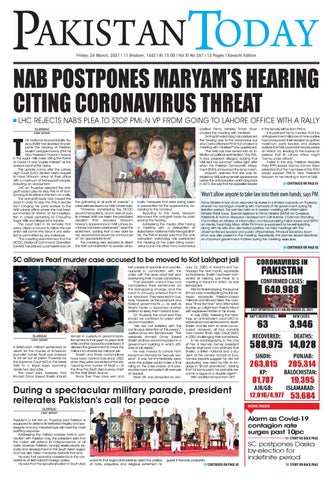
NAB postpoNes MAryAM’s heAriNg citiNg coroNAvirus threAt g
LHC rejeCTS NAB'S PLeA To SToP PML-N VP froM goINg To LAHore offICe wITH A rALLy positive Prime Minister Imran Khan chaired the meeting with ministers. “Anti-graft watchdog has postponed the hearing due to the coronavirus but why Covid-affected PM Imran chaired a meeting with ministers?” she questioned. “The NAB has now turned into an institution of political victimisation,” the PMLN vice president alleged, adding that NAB sent her summon notice right after when the Pakistan Democratic Movement (PDM) announced the long march. Maryam claimed that she was attacked by NAB during her last appearance before the anti-corruption watchdog back in 2019. She said that the opposition leader
ISLAMABAD
t
staff report
He National Accountability Bureau (NAB) has decided to postpone the hearing of Pakistan Muslim League-Nawaz (PML-N) Vice President Maryam Nawaz in the sugar mills case, citing the threat of Covid-19 and “public interest” as the reasons behind the delay. This update came after the Lahore High Court (LHC) denied NAB’s request to have Maryam arrive at their office with a maximum of two support people, including an accountant. LHC on Thursday rejected the antigraft body’s plea to stop PML-N VP from coming to its office in the form of a rally. The anti-graft body had moved the court in order to stop the PML-N leader from bringing her party workers to the NAB Lahore office where she has been summoned on March 26 for investigation in cases pertaining to Chaudhry Sugar Mills and illegal land transfer. The court said in its remarks that every citizen is bound to follow the law which will come into force if any violation is committed by any individual. “The meeting was informed that the NCoC [National Command operation Center] has placed a complete ban on
ISLAMABAD A British-born militant sentenced to death for the murder of American journalist Daniel Pearl was ordered to be let out of prison Thursday by the Supreme Court (SC) in the latest twist to a legal saga spanning nearly two decades. The court said, however, that Ahmed omar Saeed Sheikh should
CONTINUED ON PAGE 05
Won’t allow anyone to take law into their own hands, says PM the gathering of all sorts of crowds,” a press release issued by NAB Lahore said. “However, considering the NCoC recommendations, and in view of public interest, NAB has taken the principled decision that accused Maryam Nawaz’s appearance in NAB Lahore tomorrow has been postponed,” read the statement, adding that a new date for her appearance would be announced at “an appropriate time”. The meeting also decided to direct the NAB administration to reverse all se-
curity measures that were being taken in preparation for the appearance, according to the handout. reacting to the news, Maryam slammed the anti-graft body for postponing the hearing. Addressing the media after having a meeting with a delegation of Balochistan National Party-Mengal (BNPM), the PML-N leader said that the anticorruption watchdog has postponed the hearing of her case citing coronavirus but on the other hand coronavirus
Prime Minister Imran Khan resumed his duties in a limited capacity on Thursday, wherein he has begun meeting with members of his government during his isolation period. The premier held an in-person meeting with Information Minister Shibli faraz, Special Assistant to Prime Minister (SAPM) for overseas Pakistanis & Human resource Development Zulfi Bukhari, Chairman Standing Committee on Ministry of Information and Broadcasting faisal javed and SAPM on Media yusuf Baig Mirza. while PM Imran is supposed to be self-isolating, along with his wife who also tested positive, he held meetings with the aforementioned leaders and public officeholders. Principal Secretary Azam Khan was also present in the meeting. reportedly, the premier issued directives on important government matters during the meeting. news desk
CONTINUED ON PAGE 05
SC allows Pearl murder case accused to be moved to Kot Lakhpat jail
staff report
in the Senate will be from PML-N. It is pertinent her to mention that the anti-government alliance of nine parties had announced their decision to gather maximum party leaders and workers outside the NAB provincial headquarters on March 26, leading to the bureau to believe that its Lahore office might “come under attack”. earlier in the day, Pakistan Peoples Party (PPP) leader Qamar Zaman Kaira reiterated that the members of the PDM would support PML-N Vice President Maryam to her hearing in front of NAB.
remain in custody in accommodation similar to that given to prison staff while another appeal is considered. It allowed the government to move the militant to Lahore's Kot Lakhpat jail. Sheikh and three accomplices have been behind bars since 2002 when they were convicted of the kidnapping and murder of Pearl — at the time the South Asia bureau chief for the wall Street journal. Since then they have won and
lost a series of appeals and counterappeals in connection with the case, with the apex court last year overturning their murder convictions. That decision meant they had completed their sentences on the kidnapping charge, and the court in januar y ordered them to be released. They were kept in custody, however, as the provincial and federal governments — as well as Pearl’s family — launched another petition to keep them behind bars. on Thursday the court said they should be confined to prison staff accommodation. “we are not satisfied with the continuous detention of this person,” justice Umar Ata Bandial said. “The detainee Ahmed omar Saeed Sheikh shall be accommodated in a government building in which officers of jail reside.” He was moved to Lahore from Karachi on Monday for “security reasons”. It was not immediately clear when the judges would make a final ruling on the case proper, or if prosecutors have exhausted all avenues of appeal. Pearl, 38, was abducted on jan-
uary 23, 2002, in Karachi and beheaded the next month, reportedly by Al-Qaeda. Sheikh had been convicted of helping lure Pearl to a meeting in Karachi in which he was kidnapped. Prior to his kidnapping, the journalist had been investigating the link between reportedly Pakistan-based militants and richard reid, the notorious “Shoe Bomber” who attempted to blow up a flight from Paris to Miami with explosives hidden in his shoes. In july 2002, following the hearings, an anti-terrorism court (ATC) in Hyderabad had sentenced to death Sheikh and life term to other co-accused. However, all four convicts had moved Sindh High Court (SHC) in 2002 challenging their convictions. In his autobiography, In the Line of fire: A Memoir, former president Pervaiz Musharraf had claimed that Sheikh, a British national and a student at the London School of economics (reports suggest he did not graduate), was hired by MI6 to engage in “jihadi operations”, adding that “at some point, he probably became a rogue or a double agent”. with additional input from AfP
During a spectacular military parade, president reiterates Pakistan's call for peace ISLAMABAD
coroNAvirus iN
pAkistAN
CONFIRMED CASES:
640,988
LAST UPDATED AT 8:51 AM ON MARCH 25, 2021
DAY'S DEATH TOLL:
63
RECOVERED:
NEW CASES:
3,946 DEATHS:
588,975 14,028 SINDH:
PUNJAB:
263,815
205,314
KP:
BALOCHISTAN:
AJK/GB:
ISLAMABAD:
81,787 12,016/4,977
19,395
53,684
more inside
staff report
President Dr Arif Alvi on Thursday said Pakistan is equipped to defend its territorial integrity and sovereignty and any misadventure will meet the most befitting response. Addressing the military parade held in connection with Pakistan Day, the president said that the nation will defend its independence at all costs. However, Pakistan, he said, seeks peace, security and development in the South Asian region and has also taken measures towards that end. He said that peaceful coexistence is the cornerstone of Islamabad’s foreign policy. He said that the security situation in South Asia
Alarm as Covid-19 contagion rate surges past 10pc STORY ON BACK PAGE
warrants that regional leadership reject the politics of hate, prejudice and religious extremism to
SC postpones Daska by-election for indefinite period
guide it towards prosperity.
CONTINUED ON PAGE 05
STORY ON BACK PAGE
02
Friday, 26 March, 2021
KARACHI
NEWS
SeCurITy red aLerT ISSued In GILGIT aS SeCTarIan CLaSHeS feared ISLAMABAD
a
GhuLaM abbaS
FTER the killing of at least five people in a firing incident on Thursday evening in Gilgit, the government of Gilgit-Baltistan (GB) has issued a red alert across the region amidst fear of sectarian violence. In the security alert issued by the home department, the law enforcement agencies (LEAs) are directed to take necessary steps to maintain law and order and to untoward incidents any further. The LEAs are further directed to stay alert across GB and maintain an emergency readiness state until further notice. The LEAs have also been directed to ensure the
5 PEOPLE SHOT DEAD, 7 INJURED AS GUNMEN ATTACK PASSENGER VAN IN GILGIT safety of public buildings and sensitive installations. According to sources, the situation in the headquarters of GB was tense following the incident and protest of the bereaved families and their supporters. Since the protestors have also joined sectarian groups, a sectarian rift is feared in the highly sensitive city. In the past, Gilgit has been hit by sectarian clashes. On Thursday evening at least five people were killed and seven were injured when a passenger coach came under fire.
Punjab tightens noose around sugar cartel LAHORE
SC restores local bodies in Punjab ISLAMABAD INP
TLTP
The provincial government on Thursday promulgated the Punjab Sugar Supply Chain Management Order, 2021, and the Prevention of Speculation in Essential Commodities Ordinance, 2021, to control price hike. Punjab Chief Minister Sardar Usman Buzdar announced this on Thursday while addressing a press conference along with Adviser to Prime Minister Barrister Shehzad Akbar. The chief secretary, principal secretary to CM and secretary information were also present on this occasion. Buzdar said that the Pakistan Tehreek-e-Insaf (PTI) government has taken a number of measures for providing relief to the people of the province in true sense. Price hike is a major issue which affects the life of common man, he said and added this sector remains unregulated which caused an unchecked increase in prices of commodities. He said that the Punjab cabinet has decided to regulate the whole system of production of sugar, its supply and sale and purchase. He said that under Punjab Sugar Supply Chain Management Order, 2021, sugar mills and warehouse of dealers would be registered, and only registered dealers could sell and purchase sugar. The Supply and Chain Management Order would help cope with the sugar mafia, besides ensuring the supply of sugar to the people at affordable rates, he said and added that no factory, dealers, wholesale dealers can now store more than 2.5 metric tons of sugar. An NOC from the concerned deputy commissioner would be required in case of storing more than the fixed limit. Unregistered dealers and wholesale dealers cannot sell or purchase the sugar, he added. He said that no sugar mill can now sell its sugar to unregistered dealers as cane commissioner and deputy commissioner have been empowered under this order to take legal action in case of any irregularity.
Police said the passenger vehicle was on its way from Gilgit to Niltar Bala (Upper Naltar) when it was fired upon at the RC bridge by unidentified suspects. The injured were shifted to the Gilgit Hospital for treatment, said police. The five deceased all hailed from Niltar Bala, where the passenger vehicle was travelling to. Officials have arrived at the scene and have started gathering evidence for an investigation into the crime. Though the causes of this incident are
yet to be known, residents of the area doubt that this incident could be a retaliatory attack of an earlier incident in which two young men died after coming under attack from a group in Naltar Valley of Gilgit district. The aforementioned incident had taken place in the upper reaches of Naltar valley after a group of picnickers from Lower Naltar were attacked. As a result of the armed attack two youths, Muzamil and Farjad Hussain sustained injuries. Moreover, a person named Farjad Hussain died while being evacuated. Later, Saleem Abbas had also succumbed to the injuries at Provincial Headquarter Hospital, Gilgit. Locals had also reported that the two groups clashed because the picnickers from Lower Naltar were playing music in front of a mosque.
The Supreme Court (SC) on Thursday restored the local government system in Punjab which the provincial government had dissolved in May 2019 before its maturity. The top court also declared section 3 of the Punjab Local Government Act, 2019 — promulgated in May 2019 — unconstitutional. A three-member bench presided over by Chief Justice of Pakistan (CJP) Gulzar Ahmad took up the case. The top judge said people have elected local bodies representatives for five years. “We cannot allow to send them to home on the basis of one notification.” “How can the government clarify that people should be kept from their elected representatives?” he questioned. “Under Article-140, a new law can be enacted but the institution cannot be abolished. Someone has given wrong advice to the government,” the CJP said. “The government has a status, whether it is federal or provincial or local government. Powers can be changed and the basic structure can be improved. Is there any precedence that law be abolished and it should be said that a new law should be brought tomorrow?” The chief justice asked if the local bodies’ polls would be taking place in other provinces. He also questioned as to why the statement of the attorney general had not been recorded. He once more questioned as to the reason due to which the local government was dissolved and under
what law. The attorney general (AG) earlier took the plea before the court wherein he stated that there were objections on the Population Census (2017) in other provinces. The meeting of the Council of Common Interests (CII) was to take place on March 24 and now the meeting will be held on April 7 as Prime Minister Imran Khan had tested positive for the coronavirus, he argued. “This is not only the issue of federation but also issue of the provinces.” Justice Ijazul Ahsan remarked the term of the local government of Punjab may have expired. Earlier, the local governments were dissolved for six months and then elections were announced. Then the matter had been extended for 21 months. “Now they are linking it to the meeting of council for common interests. Federal, provincial and local governments can be dissolved for a limited period. But you have deprived the people of their elected representatives. Were the election not held in GilgitBaltistan?” the justice asked. “Is it not a contradiction that, on one hand, the government wants to devolve the powers to the grassroots level and now it has abolished this power on its own. Punjab additional advocate general (AAG) told the court the province is ready to hold local bodies’ polls. “The Punjab government wants powers devolved to the grassroots level. The matter is pending with the council of common interests.” “A new political party came into power in federation and province after the 2018 general election.
NAB’s postponing of Maryam’s hearing brings PDM parties together ISLAMABAD MIaN abrar
The joint endeavour of the Pakistan Democratic Movement (PDM) allies to force National Accountability Bureau (NAB) to postpone Maryam Nawaz’s Friday’s hearing reinforced the need for the opposition parties to stand united and fight for their cause. An informed source in the PDM divulged to Pakistan Today that the unity among the opposition alliance was possible due to the efforts of the PDM chief Maulana Fazlur Rehman and Balochistan National Party-Mengal (BNP-M). Moreover, the source said that the PDM parties have also accepted the stance of the Pakistan People’s Party (PPP) not to resign from assemblies immediately. The PPP believes that the 10-day sit-in after the long march could be turned into a long-term protest. The ice has reportedly melted after the PDM’s major parties – PPP and Pakistan Muslim League-Nawaz (PML-N) – verbally criticised each other but things are supposedly
returning to a more cooperative state after today’s show of unity. The source said that the PDM President Maulana Fazlur Rehman contacted former premier Nawaz Sharif and former president Asif Ali Zardari several times, during which the grievances between the two parties were resolved. As a result, all the parties of PDM have come together on one platform. PML-N, Jamiat Ulema-e-Islam-Fazl (JUI-F) and other parties have acknowledged the PPP’s stance of not resigning before the sit-in, the source added. Furthermore, the PDM has also devised a strategy to turn the long march and Islamabad sit-in into long-term protests. The source said that the PDM parties including the PPP and JUI-F had made preparations for full participation in a march outside NAB headquarters in Lahore to express solidarity with Maryam. “This is what made the NAB cancel the hearing of Maryam Nawaz. The NAB was informed that it won’t be easy to handle the crowd of PDM parties outside NAB,” the source added.
Court orders govt to inoculate Shehbaz against Covid-19 LAHORE: An accountability court in Lahore on Thursday directed the Punjab government to administer the coronavirus vaccine jabs to Pakistan PML-N President and National Assembly Opposition Leader Shehbaz Sharif within two days. Judge Jawadul Hassan resumed hearing in the Ramzan Sugar Mill case with Shehbaz and his son Punjab Assembly Opposition Leader Hamza Shahbaz in attendance. During the proceedings, Shehbaz said that he would be 70 this year. He inquired about the health of the accountability judge and said: “A medical Board was constituted on the orders of the respected judge. One month ago, tests were conducted but I did not get the results to this day.” At this, the court ordered Punjab Chief Secretary Jawad Rafique Malik and the medical board to provide the report to Shehbaz. The PML-N president was brought from prison as the court heard witnesses and the cross-examination of the defence counsel. The accountability judge also reprimanded Inland Revenue Deputy Commissioner Tanveer Hussain for going offline while testifying in the case. The judge told him to leave his office knowledge at home since he was just a witness in the court. The hearing was subsequently adjourned until Friday. A number of PML-N supporters came to the court premises to show solidarity with Shehbaz and Hamza. INP
Passenger with fake documents nabbed at Lahore airport LAHORE: A passenger was taken into custody from Allama Iqbal International Airport by Federal Investigation Agency (FIA) officials on Thursday over possessing fake travel documents. The passenger, Kaleem, was set to fly to Spain from Lahore via Qatar Airway flight QR-621 but was caught at the immigration counter. He was reported to be is a resident of Gujrat. FIA officials shifted the suspect to an anti-human smuggling cell for further investigation. Earlier on January 28, five individuals were caught by the Civil Aviation Authority (CAA) for trying to board a flight with fake passports and documents in Islamabad. INP
SHC grants bail to PTI leader in two cases KARACHI: The Sindh High Court (SHC) on Thursday granted bail to Pakistan Tehreek-eInsaf (PTI) leader and Sindh Assembly Opposition Leader Haleem Adil Sheikh in two cases related to violence, firing, attempt to murder, and causing terror during a byelection. The court ordered him to deposit surety bonds worth Rs.0.2 million in each case. The high court on March 13 issued notices to the Sindh prosecutor general and others to file their responses on the petition. During the hearing, the defense claimed his client was booked in the cases on the directives of Sindh Chief Minister Murad Ali Shah, adding that he was subjected to vengeful action on being nominated as opposition leader. Sheikh approached the SHC after an anti-terrorism court had rejected his bail requests. The first case pertains to attempted murder, interference in government duties, and disruption during an anti-encroachment drive while the other is related to violence, firing, and causing terror during the by-polls in Karachi’s PS-88 constituency. INP
‘Project Reconnect’ platform launched to promote ‘nation building’ film, TV, digital content LAHORE STaff rePorT
“Project Reconnect” is an emerging platform launched to create a network between film and media professionals. It aims to produce and facilitate audio visual content that includes TV, film and digital media. More so to tell inspirational stories that can reconnect the nation with the forgotten wisdom. A legacy that lead to produce humans who achieved refined brains and minds. The main objective of the platform is to identify positive universally connected themes, networking with film professionals and to create as well as facilitate film productions for the nation building.
This platform is a brain child of Majid Rafiq and Syed Kashif Mohsin who are film enthusiast with over 20 years of experience in filmmaking and many branches of creative work. Majid said: We feel that TV and film are powerful tools which if used properly can outlay message in an engaging way which not only reconnects us to our roots but also builds a character in sync with the universe. We want to network with passionate film makers to produce meaningful content. He added that we were also inspired by Prime minister Imran Khan’s statements on this subject as he encouraged film makers to produce content that can highlight glorious achievements of Muslims and to
encounter Islamophobia. Syed Kashif Mohsin added: “We feel that the over all audio visual medium, including the entertainment industry, is being under utilised in producing a content that can give a purposeful direction to our youth as we notice a constant decline in both TV and film as far as meaningful content is concerned. Now we are in the age of digital era. A time that has proven that powerful story telling can change the hearts, minds, fate and the future of humanity.” Prominent personalities have also endorsed the platform by becoming Project Reconnect’s patrons. The names include Dr Yasmin Rashid, Andleeb Abbas, Prof Dr Javed Iqbal, Rizwan
Mumtaz Ali, Tahir Yusuf, Afaq Tiwana and Hamid Mirza. Project Reconnect has also joined hands with two honourable international personalities such as Turgay Evren from Turkey and Muhannad Abu Ghazaleh from Qatar as patrons of the platform since the Founders have plans to take this endeavor international. Project Reconnect is holding its first short film festival in month of May. It is to identify, screen and promote a nation building content from the upcoming film makers. This is the first event lead by a series of events in lined with the objectives of the platform. Visitors at Reconnect.pk can get more information and details about the thought process of the platform.
Friday, 26 March, 2021
KARACHI
NEWS
03
PAKISTAn’S wATer COMMISSIOn PrOTeSTS IndIA’S ILLegAL PrOjeCTS On ChenAb rIver ISLAMABAD
T
INDIA, PAKISTAN WATER COMMISSIONS MEET AFTER TWO YEARS
News Desk
HE 116th meeting of the IndiaPakistan Permanent Indus Commission (PIC) concluded in New Delhi without making any tangible headway. This was for the first time in over two years that the two sides sat down to resolve a host of outstanding issues under the Indus Waters Treaty as Pakistan raised objections to the design of Indian hydropower projects on the Chenab river. Though the meeting ended without any significant headway, the sitting itself is being seen as a ‘positive step’ after both countries agreed to the Line of Control (LoC) ceasefire last month and the claims of back-channel dialogue to help initiate talks between the arch-rival states on the Kashmir dispute. Under the relevant provisions of the Indus Waters Treaty (IWT), the meeting is held annually alternately in Pakistan and India. The Pakistan side was led by Syed Muhammad Mehar Ali Shah, Pakistan commissioner for Indus waters, while Pradeep Kumar Saxena,
commissioner (Indus), led the Indian delegation. India is building the 1,000 MW Pakal Dul Hydro Electric Project on river Marusudar, a tributary of the Chenab. The project is located in Kishtwar district of Indian Occupied Kashmir (IOK). The second project, Lower Kalnai, is being developed on the Chenab river. According to an official handout issued, the Pakistani side reiterated its objections to the Indian projects, including Pakal Dul, Lower Kulnai, Durbuk Shyok and Nimu Chilling. “Pakistani side also urged the Indian side to share data of water flows as per the provisions of the IWT following the practice in vogue since 1989. Pakistani side emphasised the importance of early resolution of the outstanding issues in accordance with the provisions of the IWT,” the official statement said. Both sides agreed to make endeavours to resolve the issues, conduct tours of inspection and hold the next meeting of the commission in Pakistan at
Ordinance with 75 amendments to tax laws promulgated
an early date. An official told Pakistan Today that on the first day of the meeting, discussions on Pakistan’s objections to the Indian projects were held while the both sides raised counter arguments on Wednesday. “The Pakistan side expressed its concern regarding these projects. Both sides stated their position on the issue,” the official added. The last meeting of the Permanent Indus Commission was held in Lahore on August 29-30, 2018. Since then, relations between the two neighbours have witnessed a series of setbacks. This year’s meeting is the first official sitting between the two commissioners after Pakistan Air Force shot down two intruding Indian Air Force jet fighters on February 27, 2019 and the subsequent abrogation of Article 370 in IOK by India. India has since cleared several hydropower projects for the region. At the last meeting too, the Pakal Dul and Lower Kalnai projects had come up
Yusuf denies report tipping him as new envoy to India
ISLAMABAD
ISLAMABAD
TLTP
sTaff RePoRT
The federal government introduced on Thursday over 75 amendments to the country’s tax laws, which will be applicable immediately. The amendments were introduced through the Tax Laws Amendment Ordinance (2021) issued by President Dr Arif Alvi. According to the ordinance, the people hiding their income will face fines worth 50 per cent of their due tax. Shop owners will be fined Rs5,000 for not displaying tax numbers. There will be Rs5,000 fine for those not filing tax returns or wealth statements, according to the ordinance. Businesses will have to display their national taxation numbers or business cards, or face fines. The government has withdrawn tax exemption for fresh graduates and investment companies. It has imposed income tax on textbook boards and private power companies too. The federal government has promulgated the ordinance to implement the withdrawal of corporate tax exemptions and rationalise taxes to comply with the conditionality of the International Monetary Fund (IMF). The promulgation of the ordinance is one of the actions for the approval of the $500 million IMF tranche. The corporate income tax reforms are in line with recommendations of the IMF, which estimates it will generate revenue of Rs140 billion annually. Under the proposed ordinance, the government has withdrawn around 36 tax exemptions and streamlined other corporate tax exemptions. There will be no blanket exemption for the non-profit organisations (NPOs). The tax credit will be given to NPOs based on compliance level. Tax exemptions are replaced with tax credit for coal mining projects and IT exports. There will be no turnover tax for the IT sector anymore. The availing of tax credit is linked with mandatory filing of income tax and sales tax returns as well as submission of withholding statements.
for discussion. It was after this meeting that the Pakistan’s commissioner of Indus waters led a team to inspect Pakal Dul, Lower Kalnai, Ratle and other hydropower projects in the Chenab Basin on January 28-31, 2019. Discussions on these projects have been going on since 2013, without any headway. Under the provisions of the Indus Waters Treaty, signed between India and Pakistan in 1960, the commission is to meet “regularly at least once a year, alternately in India and Pakistan”. The commission was scheduled to meet in March last year but had to cancel the meeting in view of the coronavirus pandemic. Later, India proposed to hold the meeting virtually but the Pakistan side insisted on holding the talks at the Attari check post. However, the Indian side conveyed to them that it was not conducive in view of the pandemic. According to provisions of the Indus Waters Treaty, Pakistan has the right to raise concerns on the design of Indian hydroelectric projects on western rivers.
National Security Adviser Dr Moeed Yusuf on Thursday refuted reports of him being considered for the office of high commissioner to India. Citing sources, a report by The News had claimed a “non-career” diplomat was expected to be posted and added Dr Yusuf is likely to be posted in New Delhi. In a tweet, the NSA said the news was “totally made up and baseless”. “I know it’s too much to ask for a news story to be fact checked before publication these days, but at least the story shouldn’t defy all logic.” The story was deleted soon after the NSA sent his tweet. Earlier this week, Bloomberg reported Pakistan and India, as part of a peace deal brokered by the United Arab Emirates (UAE), to be in process of reinstating envoys in Islamabad and New Delhi, who were pulled in 2019 after India revoked semi-autonomous status for occupied Jammu and Kashmir. Dr Yusuf was appointed as the special assistant to the
prime minister on national security and strategic planning in December 2019. A notification issued by the Cabinet Division said the appointment was made by Prime Minister Imran Khan. The author of “Brokering Peace in Nuclear Environments: US Crisis Management in South Asia”, Dr Yusuf has taught at Boston University, George Washington University, and Quaid-e-Azam University, Islamabad. Dr Yusuf holds a Masters in International Relations and a Ph.D. in political science from Boston University. According to his LinkedIn profile, before joining the United States Institute of Peace (USIP), an American institution tasked with promoting conflict resolution and prevention worldwide, he was a fellow at the Frederick S Pardee Centre at the Pardee School of Global Studies at Boston University, and concurrently a research fellow at the MossavarRahmani Centre at Harvard Kennedy School. He has also worked at the Brookings Institution, a Washington-based think tank.
Saudi commander, COAS Bajwa discuss regional security RAWALPINDI INP
Royal Saudi Land Forces Commander Lieutenant General Fahd Bin Abdullah Al-Mutair called on Chief of Army Staff (COAS) General Qamar Javed Bajwa on Thursday. According to Inter-Services Public Relations (ISPR), during the meeting of the Royal Saudi Land Forces commander with the army chief, regional security situation and issues of mutual interest including cooperation in the fields of defence, security and military training
between both the armies came under discussion. The visiting dignitary acknowledged and appreciated Pakistan Army’s sincere efforts in bringing peace to the region
especially the Afghan Peace Process. General Bajwa thanked the dignitary and said that Pakistan Army greatly values its close brotherly ties with the Kingdom of Saudi Arabia.
Pakistan deeply values its relations with Hungary: FM Qureshi ISLAMABAD INP
Pakistan and Hungary have launched a trade and economic window to boost their commercial and economic linkages. Foreign Minister Shah Mahmood Qureshi and his Hungarian counterpart Péter Szijjártó virtually launched the online platform on Thursday. Speaking on the occasion, the Pakistan foreign minister expressed confidence that the window will further enrich their bilateral relations. He said that this will serve as the round the clock online platform to provide credible information and guidance for respective businesses and entrepreneurs. The FM said that Pakistan deeply values its
relations with Hungary both bilaterally and within the European Union (EU). Qureshi said that it is a matter of satisfaction that despite the ongoing pandemic, the two sides have been working together to further cement their economic partnership. Emphasising the need for further consolidating partnership through high level and private sector exchanges, he said that Pakistan looks forward to the second session of the Pakistan-Hungary Joint Commission on economic cooperation in Islamabad this year. Alluding to the investment opportunities in Pakistan, Foreign Minister Qureshi said that all the economic sectors are open for investment. He added that Hungarian companies are welcomed to explore joint ventures with Pakistani counterparts.
He underscored the Hungarian companies can invest in special economic zones as well as renewable energy, information technology, electric vehicles and tourism. He pointed out that there is also a great scope of cooperation in the agriculture sector. The foreign minister maintained that Pakistan has also eased visa requirements and the businessmen, including those from Hungary, can avail the visa-onarrival facility. The tourists are also being facilitated through online visa, he added. Qureshi said that several European countries have revised their travel advisory for Pakistan after improvement in the security situation and the economic and structural reforms undertaken by the present government. He hoped that Hungary will also revise its travel advisory for Pakistan in order to improve the linkages.
ISLAMABAD: Pakistan Air Force jets perform aerobatic manoeuvres during Pakistan Day parade. oNLINe
Cambridge O Level exams delayed, A Level exams to follow schedule: Shafqat Federal Minister for Education Shafqat Mehmood late on Thursday informed that Cambridge International Examinations (CIE) has agreed to reschedule ‘O’ level exams to after May 15, adding that A level exams "will take place as per the original timetable". The announcement was made on Twitter, wherein the education minister stated that the decision was taken after detailed discussion and due deliberations. Earlier, he had assured students that he is "in constant contact with Cambridge authorities" regarding the schedule of the upcoming examinations. Sharing details about the O/A Levels exams slated to be held in their May/June session, the education minister said that he is aware of the worried students that are "constantly calling, sending messages or writing emails". He said that discussions to reschedule the exams are underway. The minister added that most if not all of the exams would likely be held after May 15, but more details would be available tomorrow. Previously, O and A levels examinations were scheduled from April 26, but earlier this week Shafqat had said that "we are going to hold a meeting with Cambridge authorities for postponing the examinations due to upward trend in the pandemic and the decision in that regard will be made afterwards." News Desk
Motorway rape convicts challenge death sentence LAHORE: The two men sentenced to death for gangraping a woman on the side of a motorway in September challenged their convictions in the Lahore High Court (LHC) on Thursday. The men — Abid Malhi and Shafqat Ali — were convicted of gang rape, kidnapping, robbery and terrorism offences, according to a written order released by anti-terrorism judge Arshad Hussain Bhutta in Lahore. The petitions requested the court to set aside the verdict and order their release. On September 9, the victim was driving with her two children late at night on the Lahore-Sialkot motorway (M-11) within the limits of the Gujjarpura police station when her vehicle ran out of fuel. She phoned the police for help, but before they arrived two men took her and her children out of the vehicle at gunpoint and raped her. They also stole her purse, which contained Rs100,000 in cash, a bracelet, the car registration papers, and three ATM cards. Protesters took to the streets saying the government needed to bring in legal reforms and do more to protect women and children after a series of high-profile cases. sTaff RePoRT
Killing of 4 boys: Tribesmen mull Islamabad sit-in if demands not met PESHAWAR: Members of Pakistan’s Janikhel tribal community said on Thursday they would move their protest demonstration over the killing of four teenage boys from a northwestern town to the federal capital. The four boys, aged between 13 and 17, had gone out bird hunting when they went missing about three weeks ago. Their bodies were found last Sunday buried in a field by a shepherd grazing his cattle. Tribal elder Latif Wazir told the media the killings had sparked public outrage in the area, prompting people to stage a sit-in near a military check post in the Janikhel area of Bannu Subdivision in Pakistan’s Khyber Pakhtunkhwa (KP) province. Provincial authorities on Wednesday sent Transport Minister Malik Shah Mohammad Khan along with local administration officials to negotiate with the tribesmen and request them to end the sit-in which has now gone on for five days. The clan has refused. Wazir said that thousands of Janikhel tribesmen had collected cash donations to arrange about 400 vehicles to move the sit-in to Islamabad on Friday if their main demands were not met by Thursday evening. The demands include action against an official in the Janikhel area in whose jurisdiction the murders took place, a “ban on a display of arms and compensation for the bereaved families of the slain boys,” Wazir said. TLTP
04
Friday, 26 March, 2021
KARACHI
NEWS
SinDH given RS80bn leSS in TeRMS Of nfC AWARD: MURTAzA WAHAb KARACHI
S
PPi
INDH Government Spokesman Barrister Murtaza Wahab on Thursday said that the federal government has not given full amount to the province in terms of the NFC Award and as a result of which, the development projects in the province are suffering. Talking to media, Wahab, who is also the adviser to Sindh Chief Minister on Law, Environment and Coastal Development, said that the Sindh government is planting trees across the province, especially on the coastal strip, to reduce air pollution, adding that the provincial government was provided Rs80 billion less in terms of the NFC Award. "The federal government has not given
SPOKESMAN SAYS FEDERAL GOVERNMENT HAS NOT GIVEN A SINGLE DEVELOPMENT PLAN TO SINDH a single development plan to Sindh. The Pakistan Tehreek-e-Insaf (PTI) leaders do not fulfil any promise, but our industrialists are our assets. The Sindh chief minister has approved 11 new roads for site industrial area. The provincial government will continue development work despite all conspiracies," he said. Replying to questions, he said that Shahriar Shar had also met with the Sindh chief minister and PPP leader Faryal Talpur, adding that even when the PTI government came up with a plan against the islands, Shahriar stood by the people of Sindh. “It is our sincerity that people are coming to the Pakistan People’s Party (PPP). In
current situation, the PPP and Pakistan Muslim League-Nawaz (PML-N) stand together in principle,” he said. "Governments around the world are vaccinating their people against coronavirus. Our federal government is not providing coronavirus vaccines to citizens. I pray to Allah Almighty to grant recovery to our prime minister but the premier has to show his feelings in words and deeds. Now, a common man has also realised that the PTI is an anti-people government that only makes claims and does not work." Earlier, addressing the inaugural ceremony of SN West Incineration Plant at Landhi Industrial Area, Wahab said the au-
tomatic plant is unique and capable of burning 12,000 kilogram of industrial and medical waste per day. Sindh Environmental Protection Agency (SEPA) Director General Naeem Mughal, Deputy Director Munir Abbasi and some other officials were also present on the occasion. Wahab said that some precautionary and special measures were taken at the plant to protect it from environmental pollution, in which black smoke was disinfected and converted into white smoke through modern scrubber towers installed in the plant. He added that a network of industries is being set up in the province along with measures to reduce environmental pollution
Two sisters abducted, gang-raped in Pakpattan
WHO donates ambulances, bikes to Punjab govt as support in war against Covid-19
PAKPATTAN inP
Unidentified culprits abducted and gang-raped two sisters before escaping the scene here on Thursday. According to details, four girls, hailing from Sabzazar area of Lahore, were on their way to Arifwala in their private car when they were intercepted by unknown armed men near Dalwala Bridge at Sahiwal Road. The culprits took the girls to a vacant place in Chak 153-EB, gang-raped two girls, Jiya Asghar and Nida Asghar, and escaped the scene. The police, after registering a case against unidentified culprits, started an investigation into the incident.
LAHORE inP
The World Health Organisation (WHO) has donated eight ambulances and 12 motorbikes to the Punjab government to support it in its ongoing war against coronavirus pandemic. The WHO's Country Head Dr Palitha Gunarathna Mahipala handed over the ambulances and motorbikes to Chief Minister Sardar Usman Buzdar during a ceremony held in Lahore on Thursday. Addressing the ceremony, the chief minister stressed the need for unity among all sections to fight and win the war against coronavirus. Thanking the WHO for its donation, Buzdar said that the new ambulances will be used for shifting corona patients and vaccinating old citizens.
Tortured body of youth found in canal SHEIKHUPURA inP
Two children attacked by stray dogs in Karachi NEWS DESK Two children were attacked and bitten by stray dogs in the Dhoraji area of Karachi on Thursday. The residents of the area reached to the Ferozabad police station to register a case against the Karachi administrator and other relevant authorities. Dhoraji's former UC chairman Junaid akati said the children suffered from the incident owing to the city administration's negligence towards its duties. The local police said it will take further action, when details of the incident are revealed by the hospital, where the two children are admitted.
PMDU asks departments to drop complaints against judiciary, judicial process ISLAMABAD SHAHZAD PARACHA
The Prime Minister Delivery Unit (PMDU) has directed all the state departments to drop complaints against the judiciary and judicial process. The PMDU issued the directions on the Pakistan Citizen’s Portal. “Pakistan Citizen's Portal provides an interface to the public, whereby they can connect with government offices for redressal of their issues. The system primarily aims to deal with issues of public service delivery and identification of gaps for improvement through policy interventions. However, in certain instances, complaints have been lodged against judiciary and/or judicial process,” the PMDU wrote.
in factories, which would result in the proper disposal of hazardous waste. He further said that they had raided the Karachi Metropolitan Corporation (KMC) plant a year and a half ago and found that the plant was not functioning properly, but now due to efforts for a better future regarding environment, many private companies are also turning to this sector. The inaugurated plant will burn industrial and medical waste in a conducive environment, he said and added that the Sindh government, on the request of the industrialists, has constructed strong and magnificent roads in Landhi Industrial Area with its own treasury. He appealed to the industrialists to come to private sector because the SEPA is doing its best in this regard.
KARACHI: Fishermen pull a fishing net along the Arabian Sea near Clifton area of the provincial capital. Online
A tortured body of an unidentified youth was recovered from a canal in Sheikhupura on Thursday. After being spotted by some passers-by, the body was pulled out by the divers of Rescue 1122 from Bhakki Canal at Faisalabad Road. The body was later handed over to the local police. The police said that the deceased, aged between 30 to 35 years, was tortured to death and the body was dumped into the canal. The police, after registering a case against unknown murderers, started search for the heirs of deceased.
India is a graveyard of minorities ZAHEER AHMAD India claims to be the biggest democracy, a secular and pluralistic society, which aspires to be a global player on the strength of its huge population and market. However, underneath this glittering and shining Indian image is a cancer of extremism in the form of Hindu supremacy, which does not leave a breathing space for its persecuted minorities. As things stand, Modi-led Indian Hindu chauvinist government desires to build a gigantic structure of Indian neo liberal capitalist democracy upon the graveyard of minorities. Not surprisingly, in present day India, a Muslim boy is beaten only for drinking water in a temple, a Muslim family is killed brutally for slaughtering a cow and a Dalit couple is burnt alive without provoking action from the Hinduvta inspired state against the perpetrators of these heinous crimes. In this backdrop, Kashmiris standing up to Indian aggression, ostracised protesters registering their protests against the infamous India Citizenship Act and the Sikh farmers demanding a repeal of newly passed exploitative farm laws can hardly expect justice from a state, which shows its scorn against the hapless minorities in almost every policy. Narendra Modi has, since his rise to power, put up an aggressive rhetoric to bolster his image as a tough politician, a de-
fender of national security and a trusted ally of entrenched businesses who does not shy away from using hard handed tactics to achieve his economic objectives. To make matters worse for those who try to see Modi government’s discriminatory and aggressive policies as they are, state-owned media organisations sell Modi's image as a humble and self-made man in comparison to the privileged Gandhi family. Jingoist and hatred spewing journalists of the Anrab Gouswami’s kind portray Modi in a better light only to hide his government’s persecution and extermination of minorities. BJP’s anti-people (people other than the Hindu majority) and its acolytes in the media industry continue
with their policy of persecution of religious minorities and peddling lies because with an added flavour of anti-Pakistan rhetoric, it has twice turned out as a winning strategy in polls. Since the BJP has been in power, the episodes of violence against the many minorities of the country have increased exponentially, especially against Muslims (which represent the 14.2 per cent on a population of 1.3 billion), Dalits (formerly known as “untouchables”, the lowest section of India’s rigid social stratification), and Adivasi (indigenous) communities. They seem to represent the “other” compared to the uniform idea of “Hinduness” (the doctrine that sees Hinduism as the
only religion of the subcontinent) advocated by Hinduvta. Reports reveal that as many as 2,920 communal or caste-based incidents were reported in India between 2013 and 2017, in which 389 people were killed and 8,890 injured, according to the Home Ministry’s data, whose figures are often lower than those collected by the National Crime Records Bureau (NCRB). All the above-mentioned atrocities committed under Modi's watch beg a description of who Modi really is. He has been an active member of RSS (a militant Hindu organisation which promotes Hindus to the exclusion of all other religious groups in India) since a very young age and was the chief minister of Gujarat, when religious riots resulting in the assassination of more than one thousand Muslims, took place. Unfortunately, India has become a land of Hindus, where minorities seems to have been completely cornered and ghettoised. Intellectuals around the globe would be guilty of letting Indian minorities suffer in the BJP's created hell, if they continue to buy Indian nationalist media’s narrative of a rising and shining India. It is, therefore, a high time to show the world the hell Modiled BJP has transformed India into. The writer is a political activist and a research analyst based in Lahore. He can be contacted at Zaheersumra@gmail.com.
Friday, 26 March, 2021
KARACHI
NEWS
Won’t allow anyone to take law into their own hands, says PM contInueD froM pAge 01 On the occasion, PM Imran said that the third wave of coronavirus is dangerous. He noted that although the vaccination process is underway across the country, coronavirus safety precautions must continue to be implemented. He also directed the government to issue health cards as soon as possible. During the meeting, Prime Minister Imran said that he will “not allow anyone to take the law into their own hands” during Pakistan Muslim League-Nawaz (PML-N) Vice President Maryam Nawaz’s appearance at the National Accountability Bureau’s (NAB) Lahore chapter. Earlier this week, PM Imran had thanked the people for their good wishes for early recovery from the Covid-19 infection. In a tweet on Sunday, the prime minister had also thanked the people for prayers. “I want to thank everyone in Pakistan & abroad for their good wishes and prayers for the quick recovery of the first lady and I from Covid 19,” he had said in a tweet from his official handle. Late Saturday night, SAPM on National Health Services Dr Faisal Sultan had said that Prime Minister Imran was in “good health” after contracting Covid-19 and was self-isolating. “We are monitoring parameters of his health, and at present, he did not need a direct intervention,” Arab News had quoted him as saying. After him, Senator Faisal Javed Khan said that he had met the premier, who is “fit and doing well”. “The best advice that we could give him was to stay at home, isolate, and rest,” he had said in view of the fact that the prime minister only experienced “mild symptoms”. “We are monitoring his clinical parameters and medical treatment will be given to him if required. Right now, there is no need for any treatment as such.” The premier’s tweet on Sunday came after Indian PM Modi, Sri Lankan PM Rajapaksa and other foreign officials wished him a fast recovery. SAPM on Political Communication Dr Shahbaz Gill in a tweet on Sunday had said: “The prime minister and Bushra Bibi are thankful to you all for your good wishes”. On Saturday, Prime Minister Imran, along with First Lady Bushra Bibi, tested positive for coronavirus. The news comes two days after the premier was vaccinated against the virus. However, the premier had received his first dose and not the second jab for the vaccine. PM Imran, 68, received his first of the two prescribed shots of a coronavirus vaccine on Thursday. When news of him testing positive for the contagious disease came out, the rumour mills went abuzz with speculation that the prime minister contracted the disease after vaccination. But health experts say it is likely PM Imran was infected prior to being vaccinated. The Centers for Disease Control and Prevention (CDC), national health agency of the United States, says the vaccine does not infect patients with the disease, but those who may have contracted the virus before they are vaccinated can become ill after a shot because it takes a few weeks for the body to build immunity. However, the NHS, soon after the news broke out, clarified that Khan had not been “fully vaccinated” when he was diagnosed with the coronavirus. It said that the prime minister had only received the first dose of the vaccine and that too merely two days ago, further explaining that the time frame was too soon for any vaccine to become effective. Antibodies develop 2-3 weeks after the second dose of 2-dose Covid vaccines.
RCCI, Chinese enterprise ink MoU to promote trade cooperation The Rawalpindi Chamber of Commerce and Industry (RCCI) on Thursday inked a memorandum of understanding (MoU) with Beijing Huahe International Business Consulting Co Ltd to promote trade and investment cooperation. RCCI President Muhammad Nasir Mirza and President Beijing Huahe International Business Consulting Co, Liu Chuanwu, signed the document virtually to strengthen mutual understanding between the trade and investment circles of China and Pakistan and further expand cooperation between Chinese and Pakistani entrepreneurs. NEWS DESK
05
QUReSHI HoPefUl of BIden adMIn’S effeCtIve Role foR KaSHMIR ReSolUtIon ISLAMABAD
f
STAFF REPORT
OREIGN Minister Shah Mahmood Qureshi Thursday hoped that the incumbent United States administration would play an effective role for a peaceful resolution of the Kashmir dispute as well as for peace in the region. The foreign minister, in a meeting with US Democratic Party leader Tahir Javed, said that the people holding key
positions in the Joe Biden’s administration had acquaintance about Pakistan and regional matters, according to a Foreign Ministry press release. The Democratic Party leader also said the incumbent US administration was concerned about the human rights abuses in the Indian Occupied Kashmir (IOK). The meeting focused on the PakistanUS bilateral relations, economic diplomacy and other matters of mutual interest. Foreign Minister Qureshi congratulated Javed for being conferred Tamgha-
e-Imtiaz by the Government of Pakistan in recognition of his services for strengthening the Pak-US ties. He said that Pakistan greatly valued its relations with the United States as both the countries were allies in the efforts for regional peace, including the Afghan peace process. He told the Democratic Party leader that the incumbent Pakistan government was specially focused on the geo-economic priorities. Qureshi said that Pakistan’s govern-
SBP reserves jump 275m to 13.3bn The foreign exchange reserves held by the State Bank of Pakistan rose 2.11pc on a weekly basis, according to data released by the central bank on Thursday. On March 19, forex reserves held
by the SBP were recorded at $13,295 million, up $275 million compared with $13,019.7 million in the previous week. The central bank gave no reason for the increase in reserves. Overall, liquid foreign currency
reserves held by the country, including net reserves held by banks other than the SBP, stood at $20,434.6 million. Net reserves held by banks amounted to $7,139.6 million. NEWS DESK
Rupee appreciates 38 paisas against dollar Pakistani Rupee continued with its winning streak against the US Dollar, appreciating another 38 paisas (+0.25oc) in the interbank on Thursday. Pakistani Rupee continued with its winning streak against the US Dollar, appreciating another 38 paisas (+0.25oc) in the interbank on Thursday. According to the State Bank of Pakistan, the USD opened at Rs155.39 and closed at Rs155.01 on Thursday. The rupee traded within a very narrow range, showing an intraday high bid of Rs155.13 and an intraday low offer of Rs155.01. Within the open market, rupee traded at 155/155.80 per dollar. PKR has gained Rs0.96 against the
greenback this week, while it has gained Rs4.07 against the dollar since February 19. As per currency experts, the market remained positive due to IMF's approval for release of funds for Pakistan. A day earlier, the IMF approved $500 million for Pakistan under the EFF loan programme. They also attributed the rise in PKR to lack of new import orders amid rising cases of coronavirus in the country. Importers expect that the government may take harsh measures, including strict lockdown, in the wake of the third wave of coronavirus, they opined. NEWS DESK
ment was extending e-visa and other facilities to attract the foreign investors. The US companies should also take advantage of the incentives being offered by the government and invest in Pakistan’s multiple sectors, he added. The meeting also encompassed the matters related to the Pakistani diaspora in the US. Javed thanked the foreign minister and assured him of his continuous efforts for strengthening the Pakistan-US economic cooperation.
SHC stops crackdown against sugar mills ISLAMABAD SHAHZAD PARACHA
The Sindh High Court (SHC) has granted relief to three sugar mills in suspected benami transaction inquiries. As per details, Deharki, Al Abbass and Habib sugar mills had approached the court for relief in ongoing cases pertaining to benami transactions. Subsequently, the court has asked FBR to stop inquiries against these mills. The FBR anti-Benami Zone III Karachi had detected benami transactions worth billions of rupee in a number of sugar mills when they checked their sales record. As a result, notices were served to suspected benamidars in whose names transactions were carried out. The antibenami zone had also asked the mills to give an authentic sales record of transactions.
During a spectacular military parade, president reiterates Pakistan's call for peace contInueD froM pAge 01 The president said that Pakistan wants to move forward with good intent and peace but warned that Islamabad’s desire for peace should not be misconstrued as a weakness. Alvi also paid tribute to the country’s armed forces, stating the entire country stood shoulder to shoulder with them in the face of foreign aggression and on national issues. “Our martyrs and our ghazis are our pride,” he said. He also addressed the situation in Indian Occupied Kashmir (IOK). “The entire nation stands by their Kashmiri brothers and sisters in this hour of trial. The president also urged the international community to take notice of the grim situation in the occupied region. He said that military operation, Raddul Fassad, destroyed the terrorism networks across the country. “The world also appreciates Pakistan’s successes in the war on terrorism.” He also paid rich tribute to the leaders of the Pakistan Movement. President Alvi further said that Pakistan seeks peace in Afghanistan and the world commends the efforts made by it for durable peace in the war-torn country. He also stressed the need for harmonising with the latest technologies, including cyberspace and artificial intelligence to achieve the goal of development. He expressed satisfaction that the country’s armed forces are not lagging behind to lace themselves with these technologies. Alvi said that the way the Muslims of the subcontinent achieved independence, the goal of development can also be achieved by renewing the pledge of Aik Qaum, Aik Manzil (one nation, one goal). Turning to Covid-19, the president said that despite limited resources, the nation handled the situation with responsibility and discipline. He expressed confidence that Pakistan will also overcome this challenge but stressed that we need to adopt precautions.
He said that Pakistan-China cooperation and collaboration is getting stronger with the passage of time. He also expressed gratitude to China over the provision of the coronavirus vaccine to Pakistan. President Alvi stressed the need for strengthening the Organisation of Islamic Cooperation (OIC) to fight the rising trend of Islamophobia in the world. He said that Pakistan has made every possible effort in this regard and will continue to play its proactive role in the future as well. MILITARY EXHIBITS MIGHT: The parade, which is held on March 23 but was postponed due to “inclement weather”, was held at Parade Avenue in Islamabad. President Alvi attended the event as the chief guest. Prime Minister Imran Khan was unable to attend as he is self-isolating after contracting coronavirus last week. Top civil and military leadership, as well as foreign dignitaries, also attended the event. The parade began with a flypast of fighter aircraft of Pakistan Air Force (PAF) and Pakistan Navy (PN) — led by Air Chief Zaheer Ahmad Babar — who presented a salute to President Alvi, Radio Pakistan reported. Formations of F-16, JF-17, Mirage, Airborne Warning and Control System (AWACS), P-3C Orion, and ATR-72 Maritime Patrol Aircraft (MPA) participated in the flypast. The contingents of the three armed forces and other security forces conducted a march past while fighter jets presented aerobatic manoeuvres, Radio Pakistan said. The parade also showcased the local cultures of the four provinces. Cultural delegates and floats from Sindh, Punjab, Balochistan, Khyber Pakhtunkhwa (KP), Gilgit-Baltistan (GB), and Azad Jammu and Kashmir (AJK) were also featured. The annual parade was postponed to today due to the forecast of “inclement weather and rain” on March 23 and 24, the Inter-Services Public Relations (ISPR) had announced Monday.
“The Joint Services Pakistan Day Parade will now be held on 25th March, 2021 as per program and timings already specified,” the statement had said. According to notifications issued from the offices of Islamabad and Rawalpindi deputy commissioners, the twin cities are observing a local holiday in connection with the parade. To facilitate the parade, Islamabad Traffic Police will restrict traffic on the Islamabad Expressway from Khanna Bridge to Zero Point between 5:00 am to 2:00 pm. The traffic police have specified alternate routes to facilitate traffic flow. Due to coronavirus restrictions, a limited number of spectators were allowed to attend the event. In separate messages, President Alvi and Prime Minister Imran paid tribute to the country’s founding fathers, vowing to follow in their footsteps to make Pakistan a cradle of peace, progress, and stability. The two leaders ceased the opportunity to reiterate Islamabad’s support to the struggle of the people of Jammu and Kashmir. Between 2008 and 2014, no parades were held due to an escalation in a conflict between the military and the Afghanistan-based Tehreek-e-Taliban Pakistan (TTP). In 2015, the military resumed the parade, declaring the militants were on the run since it launched Operation Zarb-e-Azb in 2014 to dislodge militants from the restive border regions. Last week, Minister for Planning and Development Asad Umar said there was no plan to cancel or limit the parade. “We have already discussed all arrangements and SOPs during the parade and it will be held with the usual zeal,” he told a local publication. “However, we have observed that the provincial administrative units and Islamabad are not enforcing the SOPs strictly, therefore, they have all been directed to ensure their implementation.”
NAB postpones Maryam’s hearing citing coronavirus threat contInueD froM pAge 01 Addressing a presser alongside PML-N Punjab President Rana Sanaullah and Jamiat Ulema-e-Islam-Fazl (JUI-F) senior leader Abdul Ghafoor Hyderi, he said: “The government thinks that the leaders can be stopped from their campaign with such notices, but we won’t let it happen. We won’t let victimisation rule the roost and we are united against it.” He added that the responsibility of impeding her arrival before the bureau will be upon the government. The PML-N Punjab president warned the government not to create any hurdles in the way of the PDM’s workers accompanying Maryam. Sanaullah further said that Maryam will leave for NAB with PDM leaders from Model Town.
JUI-F’s Haideri asked, “Are your [the government’s] efforts aimed only at humiliating the opposition leaders?” He said it was the PDM leaders decision to appear before NAB however, “appearing before an institution like NAB is a humiliation unto oneself.” The PPP leader also reiterated that no attack would be launched against the NAB office. Separately, PML-N VP once again hurled criticism at the PTI government, saying that the ballot paper is a death knell for the selected Pakistan Tehreek-e-Insaf (PTI) government, which is afraid of facing the public after exploiting them for three years. In a tweet on Thursday, Maryam said that those who are celebrating the postponement of the Daska by-election know that at some point, the election will be held and the people will cast their votes. The PML-N VP said that PTI was avoid-
ing accountability through vote because the public has had it with their government. “Sometimes these people go to court to stop the public from voting, sometimes to stop them from rallying with Maryam”, she added. The PML-N leader said that national institutions belong to the people, they cannot save PM Imran from the public’s wrath. This is why the selected government is trying to avoid elections at all cost, said Maryam. Earlier, PML-N Vice President Maryam on Wednesday said that she has had enough of political revenge and has shown enough endurance but it is time to vie now. After getting interim bail from the LHC till April 12, Maryam had talked to the media and said that NAB was being run by everyone except the institution itself. The PML-N leader had further said that Prime Minister Imran’s government was in trouble and the
cMYK
anti-graft body will not be allowed to save his sinking ship. Maryam said that there were no differences with the PPP and such ups and downs are a part of politics. PML-N and PPP had individual strategies and some common goals under PDM, she added. The PML-N vice-president asserted that she had a good relationship with PPP Chairman Bilawal Bhutto-Zardari. “I am Nawaz Sharif’s daughter, I am aware of the politics of tolerance, and know how to follow it,” she commented. A day earlier, the high court had approved Maryam’s interim bail till April 12 and barred the NAB from arresting her. A two-member bench had heard the PML-N VP’s plea as she moved the court, requesting an interim bail ahead of her NAB hearing on March 26. The court had directed
Maryam to appear before the NAB investigation officer. The court issued notice to the NAB chairman and summoned a reply in the next hearing. PML-N’s Muhammad Safdar, Sanaullah and Pervaiz Rasheed were present in the courtroom along with Maryam who had been summoned by the anti-corruption watchdog in the Chaudhry Sugar Mills and illegal land transfer cases. She had challenged the NAB notices afterwards. Earlier, the Punjab government had approved the NAB request to declare its Lahore office as a red zone on March 25 and 26 due to Maryam’s hearing. The provincial regime approved to appoint Rangers and police around the accountability bureau office, and a letter had been written to the Ministry of Interior seeking the Rangers’ services in this regard.
Friday, 26 March, 2021
06 COMMENT
Reaching out across the divide
Imran Khan and his poisoned chalice
Is Kashmir to be finally solved?
In the embrace of the IMF
T
he PTI government took a number of tough decisions to get the IMF programme back on track. Among the more significant ones are the amendments in the Nepra Act and the full autonomy given to the State Bank of Pakistan. The reforms have encouraged the Fund to okay the four pending reviews of Pakistan’s economy and release the next loan tranche of around $500m. Revival of the programme would facilitate the government, that is heavily dependent on external borrowings, in accessing the international financial institutions. The amendments in the Nepra Act would take key powers out of the hands of the government by introducing the element of automaticity in the rise of power charges. The aim is to get rid of the circular debt which has accumulated due to several factors, the cost of power being just one. The government has thus surrendered its power to the regulating authority. The amendments to the State Bank Act take the government out from the processes that decide the price of money, like interest rates and the exchange rate. What is more, the State Bank will be debarred from lending directly to government. The burden of taxes has started to increase. Tax exemptions of Rs140 billion given to various sectors of the economy have already been withdrawn. The extraordinary increase in power tariff has led the opposition call it a Rs 884 billion electricity bomb dropped on the common man. Keeping in view the recent statements from the SNGPL and SSGPL, a big increase in gas rates is expected any time. There is much more in the pipeline. The IMF programme framework has now been extended closer to the completion of the PTI’s five-year term in August 2023 instead of the originally planned September 2022. Thus during its entire tenure the PTI administration would be facing the ire of various sections of population on account of its own multifarious shortcomings along with the stringent policies of the IMF. By the time a modicum of financial discipline starts producing dividends, the PTI will face elections. It would be galling for the PTI leadership to relinquish power at that juncture. When elections are held in a situation of the type, moral considerations tend to take the back seat and ends start justifying means. In case this happens, this would cause a confrontation with the opposition never seen before.
At Penpoint M A NIAZI
T
he recent declaration by Chief of Army Staff Gen Qamar Javed Bajwa at the Security Dialogue recently that Pakistan and India needed to solve the Kashmir issue, forget the past and move forward was interesting for a number of reasons, the foremost being the timing. Two of the components of the timing have been in place for some time, so General Bajwa’s declaration must be ascribed to some other aspect. It has been two years now that the government in Islamabad has no problems with the military. The PML(N) government had seen its leader deposed by the Supreme Court disqualifying him, and the PPP government had also had a PM removed, and the President was found accusing the military of bypassing it. While the PDM launched a campaign against the government, accusing it of being “selected’’ despite being incompetent, the COAS made his declaration both after the PDM had suffered a major setback in the Senate Chairmanship election. On the other side of the equation, the Indian government had been in the hands of the BJP since 2014. Narendra Modi had won because of the Gujarat antiMuslim riots, when he had shown his readiness to go the extra mile. The BJP’s previous measures, like demolishing the Babri Mosque and going nuclear, had been anti-Muslim, but Modi did three things internally to put his stamp on the country. First was the preparation of the National Citizenship Register for Assam, and the exclusion of Muslims and designating them Bangladeshi citizens. Then was the end of Kashmir’s special status, and the end of the restriction of ownership there to Kashmiri domiciles. Finally, there was the Citizenship Amendment Act, which allowed for the granting of fast-track citizenship to those fleeing religious persecution, but excluding Muslims. One of the components of Modi’s politics has been to posture against Pakistan, which he did from the time of the Pulwama attack, on the basis of which he campaigned as a ‘pair of safe hands’, winning a landslide re-election. It is difficult to see what changed that prompted General Bajwa to make his declaration, unless it was the change of guard in the USA, where a Democrat President is expected to continue having China as the primary enemy, for which it will need India as a regional land ally. The Indian tilt towards the USA has resulted in a
CM’s promises
N
O one should have any objection to Punjab Chief Minister Usman Buzdar’s sudden flurry of activity, one symptom of which is his sudden darts from his capital to the hinterland of the province has been selected by Prime Minister Imran Khan to lead. however, his recent jaunt to Gujranwala, Sheikhupura and hafizabad districts has raised a conundrum. When he goes somewhere, he distributes largesse. Or rather he promises to do so. he has promised a total of Rs 25 billion in all three districts. he has promised universities to each, but has not stopped there: there have been promises of infrastructure development. This new activism may have been prompted by the rumours which spread like wildfire recently, that he was being replaced. he seems to be working hard to rebut the main charge made against him, that he was ineffective and was not doing as much as he was supposed to when he was selected as the PM’s ‘Waseem Akram-plus’. That might explain his promise to visit all the province’s districts. At that rate, what with 36 districts, Mr Buzdar could find he has let himself in for projects worth Rs 300 billion. One problem is where the money is going to come from. Such spending depends on the provincial government having access to federal funding. The federal government not only does not have that kind of money, it also has to keep an eye on provincial deficits. It has to be particularly careful now that it has to obey IMF orders. Another problem is that when in opposition, the PTI expressed resentment, even anger, at how chief ministers announced projects with public money as if they were doing the spending. Now that its own CM is doing so, there is a deafening silence. Mr Buzdar should be careful about announcing new projects. he should realise that previous CMs could announce large projects because they could rely on federal funding. he does not have that advantage, and so should just enjoy his jaunts to the mofussil while he can.
The new policy may not maintain quality PreetA HINdujA
T
he heC’s new PhD policy has introduced significant amendments in the admission criteria of PhD programmes with the intention of improving the quality of research and enhancing the market value of teaching. however, achieving policy effectiveness with improved research quality is one the challenging tasks. The proposed need to introduce the new policy was to address the disparity between the country’s higher education system and industry where an average graduate has few marketable skills. According to the policy, the minimum requirement of admission is reduced from 18 to 16 years in terms of years of study. The MPhil degree was a prerequisite to pursue the PhD programme earlier, but the current policy discontinues the requirement. Now the students, after completion of a BS program (Bachelor of Studies) over four years can directly obtain admission in a PhD programme. The policy added that students pursuing PhD directly after BS would have to complete more credit hours than those who had qualified an MPhil degree. Despite this, the students are also allowed to complete MPhil if studied courses meet the standard of doctoral degree. Furthermore, students who directly pursue a PhD need to work 48 credit hours, but for the students who have completed MPhil in the same discipline, the required credit hours for PhD could be reduced up to 50 percent by the universities. Moreover, regardless of subjects studied in BS, the students can pursue PhD in another discipline. Also the policy discontinues the requirement of sending the PhD dissertation to foreign experts for review, rather it can be sent to local experts now as well. The maximum duration of PhD degree completion is eight years and the minimum time to earn the degree is three years. The students are required to spend the first two-years of PhD studies in their home country. The minimum cumulative Grade Point Average (CGPA) required is 3.0 on a 4-point scale in each semester. It was also added that the MPhil leading to PhD program would be no longer continued.
Dedicated to the legacy of the late Hameed Nizami
Arif Nizami Editor Managing Editor
Joint Editor
Umar Aziz Executive Editor
Lahore – Ph: 042-36300938, 042-36375965
Nixon gesture towards China. Ziaul haq was instrumental in helping defeat the USSR in Afghanistan. Pervez Musharraf was instrumental in the War on Terror’s Afghanistan portion. It is also equally clear that apart from the Baghdad Pact (later CeNTO), none of the precipitating events occurred before the military takeover. It may cause some speculation that Imran Khan has come to power in what the opposition seems to consider a kind of hybrid military rule. This has not preceded either of the two precipitating events, one of which was the Indian move Kashmir’s status, and the other the arrival of a new US President. The logic is inexorable from the US point of view. Pakistan must accept the logic of the situation. India and Pakistan must not be allowed to plunge the entire world into a nuclear winter. Therefore, there must be a settlement of the issues dividing them, primarily the Kashmir issue. Pakistan is home to two distinct streams of thought. One sees the similarities with India, which are considerable. Another sees the differences. Both exaggerate their respective positions. The primary divider is religion. One of the primary symbols of religion is Kashmir. India’s refusal to accept that it should be allowed to join India is not just legalistic, or because the Nehrus originated from Kashmir, but because it was the only Muslim-majority state in the Union. The assumption is that the solution of the Kashmir issue would lead to not just a peace dividend, but the diminution of the influence of the Pakistan Army. This is certainly possible, but by no means certain. Two things need to be remembered. First, the Pakistan Movement received overwhelming support because there were certain inherent contradictions between hindu and Muslim. Second, the creation of Bangladesh did not break the power of the Army there, and not only were there military takeovers, but even now, the Sh hasina government relies on its control of the Army through a COAS with criminal connections being given a free hand. A Kashmir settlement would not remove those contradictions, and the only way to prevent them from damaging those relations would be for a pro-Indian Pakistani government to hold office. Is the USA going to press for that? Is Pakistan’s establishment willing to go that route to help it? There are many hurdles to cross, before the two countries make a settlement. The biggest issue is how far governments on either side can be trusted. Is Pakistan making offers it knows the Indian government will reject?
The writer is a member of staff.
The new PhD policy a great challenge
Where is the money going to come from?
Yousaf Nizami Aziz-ud-Din Ahmad
problem for the Pakistani establishment, which had been used to an alliance with USA dating back to the Cold War. Pakistan had allied with China as well, because of its differences with India. however, as the USA grew distant from China, it made the alliance with China problematic. Making up with India makes sense if there is indeed the peace dividend that was mentioned at the Security Dialogue. The Cold War does not provide an instructive example, as the USA did not have much of a peace dividend. The US defence budget did not decline, and the USSR saw an almost precipitate decline. That decline may be the manifestation of the reason why the USSR lost the Cold War: it could no longer afford it. The USA has seen something of a slowing down of increase, but the long-term plans of the various services, especially for weapons acquisitions, and for manning levels, are continuing. however, there has been a change in the mission, from opposing the USSR to projecting US power worldwide. Is that result of the Cold War to be replicated on the Subcontinent? In this case, with India to be cast as the winner, and Pakistan as the loser? It is ironic that this is happening at a time when the USA’s own Freedom house has downgraded India’s ranking, mainly because the BJP government has encroached on freedoms. It should also be noted that the USSR’s military, while it never took over, loomed larger in the state than in the USA. Similarly, while the Indian military has certainly had importance, it has never taken over. The Pakistan military has carried out four takeovers. And now it is Pakistan that is unable to afford the needed expenditure, with one economist predicting that 2025 will be when debt servicing will take up all CBR collection, meaning that defence expenditure will only be met by borrowing. The most concrete measure of the differences between India and Pakistan is the Kashmir dispute. There are other points of contention, but if the Kashmir issue is solved, their cold war would be over. however, a solution is easier said than done. however, the recent Indian ending of the status of Kashmir as a state, and the splitting of it into two union territories, is in line with the solution that did the rounds about two decades ago, which saw an independent Kashmir, with India keeping the northern Ladakh area. That particular arrangement is very far, but one of the obstacles, the Pakistan Army (according to India), has to be brought on board. The USA has used Army rule to achieve regional aims before. Ayub Khan entered both SeATO and CeNTO. Yahya Khan played a quiet but key role in the
I
Karachi – Ph: 021-35381208-9
I
Researchers report that the new policy has been launched unilaterally and experts of academia have reservations about policy execution. While framing and launching the policy, the actual stakeholders, such as expert academics and administrations of public and private sector universities, were not taken on board. Furthermore, the big challenge lies in the maintenance of the quality of BS degrees awarded by the affiliated colleges. According to the policy “The overall goal of the policy framework is that PhD graduates from Pakistani universities should possess expertise in his or her field of study, should be able to conduct high quality research”. But it is argued by universities that they are not provided sufficient support, the grant provided by heC to run the university expenses is typically inadequate and most of the universities lack laboratories, research facilities and adequate grants. Thus attaining quality in most of the universities is not expected. And, the students who change disciplines in a PhD programme, understanding theoretical foundations of the new discipline along with gaining mastery in the research skills required for a PhD candidate would be rather doubtful and it would lead to compromise the quality of PhDs. While endorsing the above facts, Punjab University Vice Chancellor Prof Dr Niaz Ahmed added that the academics from higher education Institutions were not invited for consultancy over planning and drafting the policy, and it would create confusions to execute this American model in the existing political structure of Pakistan. Pakistan since its birth has immersed into the deep-rooted political system. The current policy highlighted that “Since the PhD is a highly specialized degree, it is intended that only those higher education Institutions (“heIs”) that possess resources to offer
Islamabad – Ph: 051-2204545
quality education at the highest level should offer PhD degree programs.” Under such political pressure, it is unlikely to stop the sub-standard politicized universities from terminating their PhD programmes. Shahid Siddiqui (2016) in his book “Education policies in Pakistan: Politics, projections, and practices” emphasized that one of the reasons of the failure of the prior policies is the lack of ‘political will’ to uplift the education sector. Such influences are shown by political recruitment of man\y teachers, pay disbursement among ghost teachers, uncontrolled cheating culture in the examination centres, very low investment of GDP on education, discontinuing ‘Iqra fund’ declared for education etc. In this regard, the genuine implementation of the policy requires favorable socio-political conditions. With failure in the socio-political reforms, the expansion of sub-standard universities would go higher; which would increase quantitative expansion in the number of PhDs, and again the quality will be compromised. In addition to this, it needs to be pondering over the Covid-19 effects on our education system. For more than one year many higher educational institutions have been struggling with technological issues, and still could not report progresss towards blended or online learning culture. Rather than bridging the teacher-pupil gap on the advanced learning platform, the noticed gap has widened. The aftermaths of not attaining quality in the highest degree, the PhD, are quite disastrous. This would degrade the PhD qualified candidates’ market value and subsequently lead to the frustration among youths. The successful outcomes of policy programmes would require critical awareness of one’s history, socio-economic and above all political structure and their influences in the existing scenario.
The aftermaths of not attaining quality in the highest degree, the PhD, are quite disastrous. This would degrade the PhD qualified candidates’ market value and subsequently lead to the frustration among youths.
I
Web: www.pakistantoday.com.pk
I
The writer is a PhD scholar and teacher at the CMS Government Higher Secondary School
Email: editorial@pakistantoday.com.pk
Friday, 26 March, 2021
COMMENT 07 Editor’s mail Send your letters to: Letters to Editor, Pakistan Today, 4-Shaarey Fatima Jinnah, Lahore, Pakistan. E-mail: letters@pakistantoday.com.pk Letters should be addressed to Pakistan Today exclusively
Let us make it possible
Broadsheet- the ultimate cost of corruption
Mahroo arshad
S
ince the Broadsheet scandal surfaced a few weeks ago, it has been wrongly perceived from a narrow skewed lens. Broadsheet ceO Kaveh Moussavi capitalised on the opportunity provided by the lack of comprehension to command the media airwaves and set a narrative that presented everyone involved from the Pakistani side in a bad light. The government did the right thing by making the arbitration award documents public. However, this is just the beginning; the whole broadsheet episode calls for accountability and for fixing responsibility of this fiasco. Historically, the Broadsheet dispute is tied up with Pakistani politics and its battle with corruption. The national Accountability Bureau, formed in 1999, hired Broadsheet in 2000 to trace and recover assets allegedly stolen by influential figures, including former Prime Minister nawaz Sharif. in late 1999s, nAB began negotiations with Trouvons (a colorado-based company) for recovery of assets and plundered money outside of Pakistan. At that time, Jimmy James represented and was part-owner of Trouvons, whose business included the kind of investigations and recovery assets that nAB would require to be carried out. He had some previous business experience in Pakistan. His business associates included a colorado lawyer Ronald Rudman and an english barrister William Pepper. James represented to nAB that Trouvons had the necessary expertise and experience to undertake the work of investigation and recovery of assets on behalf of nAB internationally, outside Pakistan. contrary, nAB ended up signing an agreement with Broadsheet whose ultimate beneficiary was also Jimmy James but it was a shell company, registered in the isle of Man (ioM) just a month before signing of the agreement. it is interesting to note that the agreement was signed on the basis of qualification of Trouvons as it is near to impossible that Broadsheet, having been formed a month earlier, could have any kind of the experience which was expected of it. The point to note is that nAB totally failed to take into account why Jimmy James (also main beneficiary of Trouvons) established a new company just one month before the agreement with nAB.
Had it been attentive, the agreement with Broadsheet may have not been signed. The suggested and unchallenged reason for the change from Trouvons to Broadsheet as a contracting party under the ARA (Asset Recovery Agreement) was that Ronald Rudman had been suspended from his membership of the colorado Bar on grounds of dishonesty. James knew that if nAB became aware of it, there would be no further negotiation. Therefore, he caused Broadsheet to be incorporated so that it rather than Trouvons could enter into the proposed agreement with nAB, as it did on 20th June 2000. Moreover, a parallel and separate agreement was signed between nAB and international Assets Recovery firm (iAR), represented by William Pepper on 15 July 2000. The agreement signed between Broadsheet was intended is to be limited to investigations and recovery of assets in USA, europe and Asia, and iAR was to cover other parts of the world. With the nRO underway between Gen Pervez Musharraf and the Sharif family, nAB terminated the agreement unilaterally with Broadsheet in October 2003 without going through the proper termination procedure. nAB had terminated the ARA accusing Broadsheet of misrepresentations made during pre-contractual negotiations and commitment of repudiatory breaches. To which, Broadsheet contended that any shortfall in its performance of the ARA was caused by nAB’s breaches of its own obligations and it claimed damages in respect of those. To the misrepresentation plea taken by nAB, the arbitrator noted that the alleged representations were made on behalf of Trouvons, not Broadsheet. Another key issue in this whole saga was the correct interpretation of clause 4 of the ARA, which gave Broadsheet the right to claim compensation. The scope of the ARA was intended to be limited to investigations and recovery of assets in the USA, europe and Asia, not worldwide. But that was achieved not by express provision, but by limiting its scope to specific registered persons or entities or targets. its scope was defined as reference to the target list and there were no geographical limits. The arbitrator noted that neither party has raised the question of possible rectification of the written agreement (a remedy that might be available under english law if the document mistakenly failed to record what was in fact agreed). Therefore, the advantage of this misrepresentation went in favour of Broadsheet’s claim. in April 2007, Broadsheet was dissolved by the court. Unaware of the fact, nAB entered into settlement agreements with international Assets Recovery firm (iAR) and Broadsheet in 2008. Under these agreements, nAB undertook to pay $1.5 million to Broadsheet and $2.25 million to iAR. James signed the agreement as chairman of Broadsheet LLc Gibraltar (a misnomer) , as a manager of Steeplechase and also on his own behalf describing himself as shareholder and beneficiary of Broadsheet LLc, without giving any regard to the fact that the Broadsheet (isle of Man) had already been dissolved in April 2007. During this period, nAB totally failed to find out that Broadsheet ioM was under liquidation and Jimmy James was not entitled to sign any agreement on behalf of Broadsheet ioM. The fact that the settlement worth $1.5 million
was paid in two instalments to Broadsheet colorado instead of Broadsheet ioM displays the height of negligence. At the time, when the poor taxpayers of Pakistan were paying the price of elite corruption and the incompetence of its institutions, Moussavi was gearing up to milk this sad state of affairs. During his meeting with Ahmer Bilal Soofi in April 2007, Moussavi learned that the latter was meeting Jimmy James to settle the Broadsheet claims in his personal capacity without involving Moussavi, who thought himself to be 50 percent claimant of the settlement proceeds. The backdrop to this 50 percent claim was his meeting with Jimmy James back in the early 2000s, where he offered James that in return for funding Broadsheet’s costs of bringing a claim against nAB , they would share the proceeds 50/50 . Knowing that Jimmy James’ settlement with nAB had no legal standing, as Broadsheet was under liquidation, he created his financial stakes in Broadsheet by contacting an unpaid creditor of Broadsheet, Oakfield corporate Services, whose claim was for a modest sum of £4000 pounds. iAR, funded by Moussavi, acquired the debt from Oakfield on terms which included paying the balance from the proceeds of any recovery from nAB. in a further transaction, iAR acquired the beneficial interest in Broadsheet from two Panamanian companies that were its original members and moved court to declare the liquidation null and void. From november 2009 onwards, Broadsheet has been controlled by Moussavi. Having Moussavi in control, Broadsheet went into arbitration against nAB. The hearing on the Liability Award was held in August 2016 by the London court of international Arbitration. Owing to lack of interest shown by the then government, a liability award was issued in favour of Broadsheet. Subsequently the Quantum Award hearing took place in July 2018 and the court awarded Broadsheet $21.59 million plus interest as damages for the breach and repudiation of the agreement. The appeal against the Quantum award was dismissed in July 2019. The incumbent government tried its level best to use all available legal remedies to salvage the situation, until the UK High court seized the account of the Pakistan High commission in London. Left with no choice and to save the national honour and dignity, the government finally approved $28.7 million payments to Broadsheet. in a nutshell, the Pakistani taxpayer has paid the price of elites’ corruption and malafide intention on the part of negligent individuals. now, the best the government can do is to uphold its manifesto of accountability and fix responsibility. The key areas of inquiry may revolve around the process of selection and appointment of Broadsheet and iAR, the officials responsible for drafting a flawed contract (article 4 of ARA), reasons and effect of cancellation of agreements with Broadsheet and iAR in 2003, justification of settlements agreements, wrong payment and interest of successive governments in arbitration proceedings. The moral of the story is simple– there needs to be no compromise on corruption, otherwise Pakistani nation will keep paying for elites’ corruption and tyranny, as in the case of Broadsheet. The writer is a freelance columnist
RiGHT now all the media reports have confirmed Pakistan Prime Minister imran Khan testing positive for cOViD-19. Khan has been receiving warm wishes for a quick recovery from Asian countries and the world community at once. indian counterpart narendra Modi sending his wishes for Khan’s recovery has been confirmed by certain indian media outlets. The very fact that the people and politicos together can never be exceptions to the nagging virus disease must be understood and taken seriously by everyone. even after the vaccine rollout, the fact of countries still fighting with the pandemic has a strong message made for all out there. Apart from strengthening the entire vaccine process, still, the people have to stick to serious yet basic healthcare guidelines like hygienic food, healthy lifestyle and other cOViD procedures like wearing masks. in my native areas like Tiruchendur, Tuticorin, Korkai, Tirunelveli, nagercoil, Marthandam and Kanyakumari in Tamil nadu, the people like labourers have been usually going together as a group to work in the fields under various crops and greenery activities and have been winding up accordingly in tandem. Put aside that, it is time to join together and fight together against the coronavirus. Seriously speaking, there have been heavy tasks up ahead like creating jobs, strengthening economy and supporting much more greenery and agricultural activities. Yes, we can start and do it all over again. Let us make it possible to win over this bloody pandemic soon through more disciplined healthcare protocols and by properly and scientifically identifying the most curable vaccines. P SEnthil Saravana Durai MuMbai
Excessive use of polythene bags POLLUTiOn is a growing environmental problem in Pakistan, and an item which is most commonly used in urban areas, with it's drawbacks, overlooked are polythene bags, which has contributed in it. Unfortunately there has been multiple failed attempts to terminate the use of polythene bags. But because of the incompetent government organizations and disloyal individuals, the use of Polythene bags has exceeded than normal, put up to pollution throughout the country. YaMEEna JavED Karachi
Sugar mafia THe Federal investigation Agency (FiA) has exposed the sugar mafia involved in monetary fraud, speculative trade and money laundering as it got evidences of persistent increase in sugar prices through creating artificial shortage of the commodity. The sugar mafia earned Rs 110 billion in a year by increasing the sugar prices from Rs 70 to 90 by practicing ‘Satta’ gambling and stashed the illegally gotten amount in fake and secret accounts, FiA sources said on Wednesday. Almost all the major sugar producing groups, including Sharif Group, Tareen Group, Alliance Group, Almoiz Thal Group and Hamza Group were found involved in the gambling. The FiA got evidences about their corrupt practices from 32 cell phones and laptops. it was also revealed that the sugar mafia would also conspire to further increase sugar prices through gambling in the month of Ramazan. The FiA has decided to investigate and scrutinize the accounts of prominent members of sugar gambling mafia, and then arrest them after registration of cases under Anti-Money Laundering Act. For the purpose, the FiA Lahore had formed 20 teams, which would launch a crackdown against the sugar mafia under the supervision of the Director FiA Lahore, the sources said. raza FaiSal lahorE
Gender inequality in Pakistan BY percentage, men form 51 percent women 48.76 percent and transgender 0.24 percent of the total population in Pakistan. The sex ratio of Pakistan is 105.07 that means there are about 105 men for 100 women in Pakistan. The gender issues which mostly women faced in Pakistan are domestic violence, honour killing, rape and abduction, marital rape forced marriages and induced abortions but over years. Subsequently ,the world has gotten closer to achieving gender equality. Likely, there is better representation of women in Pakistan, more economic opportunities, and better healthcare in many places of the world. Yet it is not completely accepted by everyone to treat men and women equally. Actually, it will take another century before true gender equality becomes a reality. Around the world, women still have less access to education than men. Further, only six countries in the world had given women the some legal work rights as men. Another true reality of life is many women around the world don’t have authority over their own bodies. in addition to limited aaccess to contraception women overall receive lower quality medical care than men. it would be impossible to talk about gender inequality without talking about racism. it affects what jobs women of color are able to get and how much they are paid, as well as how they are viewed by legal and healthcare systems. Gender inequality and racism have been closely linked for a long time. Finally , equal opportunities should be provided ,education must be promoted, profession and training should be developed for women. equal treatment of women with men at work legislation against domestic violence and in the name of honour killings. These measures should be taken to stop gender inequality. EMan baShir ahMED KEch
Pandemic and ongoing weddings i want to draw your attention towards the issue that is very crucial now a days which is pandemic and the ongoing weddings. covid-19 is increasing day by day fluently but our people are still not taking it seriously and not following the SOPs.in this deadly pandemic,usually every day we say crowds of people attending a wedding with zero SOPs,no mask,no sanitizer.People still think that this is the perfect time for a wedding however it is not.Authorities should take control of it otherwise pandemic may exceed. hiba ShazaD Karachi
Friday, 26 March, 2021
08 WORLD VIEW
US intelligence iS increaSingly involving itSelf in domeStic politicS A LETTER FROM HOUSE INTELLIGENCE COMMITTEE MEMBERS DEMANDS ANSWERS FROM THE DNI ABOUT ILLEGAL BREACHES OF THE WALL GUARDING AGAINST CIA AND NSA DOMESTIC ACTIVITY GrEEnwalD.SubStacK.com
a
Glenn Greenwald
report declassified last Wednesday by the department of Homeland Security is raising serious concerns about the possibly illegal involvement by the intelligence community in U.S. domestic political affairs. entitled “domestic Violent extremism Poses Heightened Threat in 2021,” the March 1 report from the director of national Intelligence states that it was prepared “in consultation with the attorney General and Secretary of Homeland Security—and was drafted by the national Counterterrorism Center (nCTC), Federal Bureau of Investigation (FBI), and department of Homeland Security (dHS), with contributions from the Central Intelligence agency (CIa) and the defense Intelligence agency (dIa).” Its primary point is this: “The IC [intelligence community] assesses that domestic violent extremists (dVes) who are motivated by a range of ideologies and galvanized by recent political and societal events in the United States pose an elevated threat to the Homeland in 2021.” While asserting that “the most lethal” of these threats is posed by “racially or ethnically motivated violent extremists (rMVes) and militia violent extremists (MVes),” it makes clear that its target encompasses a wide range of groups from the left (antifa, animal rights and environmental activists, pro-choice extremists and anarchists: “those who oppose capitalism and all forms of globalization”) to the right (sovereign citizen movements, anti-abortion activists and those deemed motivated by racial or ethnic hatreds). The U.S. security state apparatus regards the agenda of “domestic violent extremists” as “derived from anti-government or anti-authority sentiment,” which includes “opposition to perceived economic, racial or social hierarchies.” In sum, to the department of Homeland Security, an “extremist” is anyone who opposes the current prevailing ruling class and system for distributing power. anyone they believe is prepared to use violence, intimidation or coercion in pursuit of
these causes then becomes a “domestic violent extremist,” subject to a vast array of surveillance, monitoring and other forms of legal restrictions: It goes without saying that violence of any kind — including that which is politically motivated — is a serious crime under U.S. law, and it is the proper role of the U.S. Government to investigate and prevent it. But there are real and important legal and institutional limits on the authority of the intelligence community to involve itself in domestic law enforcement, or other forms of domestic political activity, that seem threatened here, if not outright violated. In particular, the report’s acknowledgement that it was compiled by institutions including “the department of Homeland Security (dHS), with contributions from the Central Intelligence agency (CIa) and the defense Intelligence agency (dIa)” has alarmed numerous members of the House Intelligence Committee. On Thursday, all ten minority members of that Committee wrote a previously unreported letter to director of national Intelligence avril Haines “to raise serious concerns about the production of this document by the Intelligence Community (IC) and to seek clarification of the facts related to its production.” among the issues raised was that the dHS report was not subject to the standard rigors of an intelligence community finding, yet continually makes sweeping claims that it prefixes with the authoritative phrase “the IC assesses.” The Committee members found this “to be misleading,” adding: we “urge you to clarify which elements in the IC concurred with this judgement and the intelligence basis, if any, for that concurrence.” In other words, Haines claims that these dubious assertions about various threats faced by americans are the findings of the intelligence community when that is not true: just like the originally false claim widely spread by the media that “all seventeen intelligence agencies” endorsed the 2016 election findings about russian interference when, in fact, it was only a few which had done so. Haines’ claims have support only from a few agencies as well. But the more substantive danger is the role played by the CIa and other intelligence agencies in the domestic politics of the U.S., all in the name of fighting “domestic terrorism” (similar dangers were previously cre-
ated by the Bush and Obama administrations in the name of fighting “international terrorism”). as the committee members’ letter details: The Intelligence Committee members, citing the fact that the intelligence community is “subject to longstanding prohibitions against domestic activities,” then demanded answers to a series of questions based on this substantive concern: Involvement of the intelligence community in the domestic activities of U.S. citizens is one of the most dangerous breaches of civil liberties and democratic order the U.S. Government can perpetrate. It was after World War II when the CIa, the nSa and other security state agencies that wield immense and unlimited powers in the dark were created in the name of fighting the Cold War. Legal and institutional prohibitions on wielding that massive machinery against the american public were central to the always-dubious claim that this security behemoth that operates completely in the dark was compatible with democracy. as the aCLU noted, “in its 1947 charter, the CIa was prohibited from spying against americans, in part because President Truman was afraid that the agency would engage in political abuse.” Since then, Truman’s fear has been realized over and over. Some of the worst postWW2 civil liberties abuses have been the result of breaches by the CIa and other agencies of this prohibition. as the aCLU documents, the CIa in the 1960s was caught infiltrating and manipulating numerous domestic political activist groups. Under the auspices of the War on Terror, entire new bureaucracies (such as the department of Homeland Security) and new legal regimes (such as the Patriot act and the FISa amendments act) were designed to erode these long-standing limitations by dramatically increasing surveillance powers aimed at U.S. citizens. and by design, the infiltration of these security state agencies in U.S. domestic politics has dramatically escalated. as the first War on Terror was escalating, The Washington Post — under the headline “CIa Is expanding domestic Operations” — reported in October, 2002, that “The Central Intelligence agency is expanding its domestic presence, placing agents with nearly all of the FBI's 56 terrorism task forces in U.S. cities.” The Post added that in the name of
that War on Terror: FBI director robert S. Mueller III recently described the new arrangement as his answer to MI5, Britain's internal security service. Unlike the CIa, MI5 is empowered to collect intelligence within Britain and to act to disrupt domestic threats to British national security. "It goes some distance to accomplishing what the MI5 does," Mueller told a House-Senate intelligence panel last week in describing the new CIa role in the FBI task forces. In the years following, two nSa whistleblowers — William Binney and edward Snowden — both cited their horror over the turning of the surveillance machinery against american citizens as the reason for their decision to denounce their agency. One of the aspects that most disturbed me about the russiagate conspiracy theory from the start was that it was created and disseminated by the CIa and related agencies with the intent, first, to alter the outcome of the 2016 election, and then to undermine the elected president with whom they were at war. Shortly before Trump’s inauguration, Sen. Chuck Schumer (d-nY) went on The rachel Maddow Show to warn — or more accurately: threaten — Trump that the CIa would destroy his presidency if he continued to criticize or otherwise oppose them: It is encouraging to see republican members of the House Intelligence Committee starting to express serious concerns over the dangers of intelligence community involvement in domestic politics. That is underscored by their approving citation to the mild mid-1970s reforms of the intelligence community ushered in by the Senate’s Church Committee, once primarily a liberal cause. Indeed, many of the same House republicans who wrote this important letter to the dnI have in the past supported laws that allow greater involvement of the CIa, nSa and other agencies in activities on U.S. soil — including the Patriot act. The head of the Church Committee, Sen. Frank Church (d-Id), made clear in his iconic quote on Meet the Press in 1975 that those reforms were primarily motivated by fears that the U.S. Government would one day turn its vast intelligence powers onto the american people, rendering core civil liberties an illusion: In the need to develop a capacity to know what potential enemies are doing, the United States government has per-
The terrifying rise of the tech aristocracy
B
SPIKED
rendan O’neill: I want to focus on your new book. You write about the emergence of a new aristocracy in the US and elsewhere, and how economic wealth is being concentrated in fewer and fewer hands. You highlight how culture and ideas are also being concentrated within a narrow stratum of society. Could you tell us how you see this new aristocracy and the key forms it takes? Joel Kotkin: To me, the aristocracy is made up of a handful of very, very large tech companies. In terms of their power, the only thing you could compare it to would be the railroad tycoons, who could destroy a whole economy by raising rates. But this new aristocracy is probably the most frightening of all, because of its power over the means of communication and its ability, and now open willingness, to pursue its agenda quite brazenly. You see this in who is deplatformed and who is demonetised. a handful of people – literally five to 10 people – can decide to shut off huge swathes of opinion. eventually this will extend not just to conservatives, but to moderates, too. Look at how the Great Barrington declaration was deplatformed. It’s scary, because we are not talking about alex Jones and Qanon – the certifiably insane elements in the US or UK – we are talking about people who just have a difference of opinion. I have been covering Silicon Valley since 1975, and it’s always the same people in power over and over again. It’s the same private-equity people, the same venture-capital people, the same elite, serial entrepreneurs. It’s a very small group which controls huge parts of the economy. What’s interesting is that so many parts of the Wall Street community have now just become Silicon Valley’s running dogs. They are completely dependent on a handful of tech stocks for their gains. O’neill: How new is this development? Obviously, there have been periods in history when wealth has been concentrated in few hands, and those people have had an
ALDOUS HUXLEY SAID THAT A TECHNOLOGICALLY BASED DICTATORSHIP WILL NEVER BE OVERTHROWN
Joel Kotkin is a writer and fellow in urban studies at Chapman College in California. His latest book is The Coming of Neo-Feudalism: A Warning to the Global Middle Class. He joined spiked editor Brendan O’Neill for the latest episode of The Brendan O’Neill Show. What follows is an edited extract from their conversation
extraordinary and terrifying amount of economic power. But how new is this unholy marriage, where we have a small group of people with not only an extraordinary amount of economic power, but also the desire and the ability to control what may or may not be said in public life? Is that an entirely new phenomenon that these two things have come together in such a graphic way? Kotkin: That’s why we call it neo-feudalism. These things are what the regime in the Middle ages, particularly the early part of the Middle ages, was about. The aristocracy lined up with the Catholic Church – or, in russia, the Orthodox Church – and was able to define what were acceptable thoughts. The road to respectability
and access to education were controlled by a small group of people who had a specific ideology. That is where we are headed. Look at the Gilded age, when a small group of industrialists in Germany, the US and russia were able to dominate their economies. Back then, because the means of communication were different and because we had the printing press, you didn’t need enormous amounts of money to be able to have and share an alternative point of view. now, the aristocracy not only has control over the news, but increasingly has control over culture. Where do most people get their entertainment today? From netflix, amazon and apple. I’m astounded at how uniform many of today’s films are from a cultural point of view.
fected a technological capability that enables us to monitor the messages that go through the air. (...) We must know, at the same time, that capability at any time could be turned around on the american people, and no american would have any privacy left: such is the capability to monitor everything—telephone conversations, telegrams, it doesn't matter. There would be no place to hide. (That quote from Sen. Church was the first one that appeared in my 2014 book on the nSa reporting I did with edward Snowden, and the title of that book, no Place to Hide, was a nod toward Church’s chilling warning, now come true). as I have been repeatedly noting over the last two months, the Biden administration, along with leading democrats such as rep. adam Schiff (d-Ca), have been stating explicitly that one of their top priorities is the adoption of new laws designed to import the Bush/Cheney/Obama War on Terror onto U.S. soil for domestic purposes. as recently as February 14, The Washington Post — under the headline: “The agency founded because of 9/11 is shifting to face the threat of domestic terrorism” — noted that rep. Bennie Thompson (d-Miss.), chairman of the House Homeland Security Committee, is now demanding that homeland security resources be re-directed toward domestic extremists, and “lawmakers of both parties spoke favorably of new legislation to specifically address domestic terrorism.” nobody from the Biden administration or Congressional members demanding enactment of Schiff’s proposed new “domestic terrorism” law can identify any activities that are not now criminal that they believe ought to be. Unless it is to permit intelligence agencies to start policing constitutionally protected speech and associational activities among U.S. citizens, why are any new laws needed? Unless it is to empower them to escalate their already-aggressive use of War on Terror tactics against U.S. citizens, what do they want security state agencies to be able to do on U.S. soil that they cannot now do? But just as the fear of international terrorism was constantly inflated to place such questions off limits when it came to the War on Terror, and just as critics of the excesses of the first War on Terror were constantly accused of downplaying the threat of Islamic extremism if not harboring outright sympathy for it, the same tactics are being used now. anyone raising civil liberties concerns about what is being done in the name of combating “domestic extremism” is vilified as ignoring and even supporting such domestic extremism. no matter: there are few dangers more acute than the weaponization of these security state instruments against U.S. citizens for political ends. The dnI should provide full, complete and truthful answers to the important questions posed by these Intelligence Committee members, and should do so promptly. The evidence of growing incursions by the intelligence community in U.S. domestic politics is already strong and ample, and further incursions would be both dangerous and illegal.
aldous Huxley said that a technologically based dictatorship will never be overthrown. and it’s really a Brave new World scenario that we are moving into. O’neill: The way you describe these people in your book is fascinating, and so are the comparisons you make between the feudal era and the current era. But one thing that will strike many readers is that the kinds of people you are talking about, who have an extraordinary amount of control over culture, opinion and the contemporary public square, will conceive of themselves as progressive. I’m sure that if you were to suggest to any of these people that they are actually reminiscent of a more feudalistic era, that they are engaged in one of the most extraordinary concentrations of wealth and power in human history, they would look at you agog. How much of a disparity do you think there is between how they see themselves and how they really are? Kotkin: These are not fundamentally bad people. The problem comes when you have people who are essentially engineers and nerds making judgments about issues that require a more historically rooted intelligence. They just don’t know about that. That’s why the conspiracy theories are wrong, in the sense that these guys don’t get together to ask how they can screw the conservatives. That’s not how it happens. It happens because, for example, somebody in the company pushes a particular algorithm which eliminates certain kinds of views. Jim Wunderman, who runs the Bay area Council, the biggest business group in the Bay area, said that the people who run these companies are scared of their own employees. Is it most of the employees? no – most of them are probably just regular people doing their jobs, trying to make money. But there’s a group that’s organised and active and monitors everything. and that group is able to drive the agenda. The mainstream media seem to have gotten on board with this process, too. They have become little more than an american version of Pravda. not that everything they say is wrong – sometimes they say good things and sometimes they do great reporting. But you end up with a group of people who have no knowledge of any contrary information or viewpoint, and who just follow the party line.
Friday, 26 March, 2021
BUSINESS 09
KARACHI
PSMA ASkS FBR to diScARd ‘ExPEnSivE’ tRAck & tRAcE SyStEM
corporate corner
ISLAMABAD
LAHORE: Ferozsons Laboratories and American Business Forum have donated 35 portable Umbulizer ventilators to Rescue 1122. Chief guest Dr Yasmeen Rashid -- Health Minister Punjab, and Guest of Honour Barrister Nabeel Ahmad Awan --Secretary Health, handed over the Umbulizers to the Rescue 1122 team. PR
KARACHI: The prestigious Magna Carta College at Oxford, UK and Extreme Commerce Pakistan have established Pakistan’s first higher education institute for entrepreneurship focusing on digital skills and ecommerce. The institute, Extreme Commerce Magna Carta College, was inaugurated by British Deputy High Commissioner in Karachi and UK Trade Director Mike Nithavrianakis. PR
P
GHUlAM ABBAS
AKISTAN Sugar Mills Association (PSMA) has asked the Federal Board of Revenue (FBR) to discard the Track & Trace System and instead adopt cheaper and localised options. In a letter to the FBR, PSMA Chairman Iskander Khan said, “We suggest FBR to replace imported stamps with a QR-Code based system to save foreign exchange incurred on digital stamps.” It may be noted that FBR had demanded the sugar mills to procure tax stamps and unique identification num-
bers, and install necessary equipment to implement the track and trace system at production facilities. The board had issued S.R.O. 250(I)/2019 on February 26, 2019, to amend Sales Tax Rules, 2006, to lay down the procedure for electronic monitoring, tracking and tracing of production, import and supply-chain of tobacco products, beverages, sugar, fertilizer and cement to contain tax evasion in these sectors. According to the PSMA letter, the association had signed an MoU with the FBR in October 2020 to facilitate the documentation of sugar, but it could not be implemented as shortlisted vendors
KP govt proposes 40 development schemes under PSDP 2021-22 PESHAWAR AZIZ BUNERI
KARACHI: A memorandum of understanding (MoU) has been signed between the Association of Chartered Certified Accountants (ACCA) and the Institute of Financial Markets of Pakistan (IFMP) under which both organisations will work together to promote investor awareness and financial literacy among students, professionals and small businesses. PR
KARACHI: State Life Insurance Corporation of Pakistan, the country’s largest life insurance company, has announced the appointment of Shoaib Javed Hussain as its Chairman, with effect from 17th March 2021. PR
KARACHI: EFU Life has further strengthened its partnership with UBL by launching “EFU-You Protect Plan,” a complete protection plan with both conventional and Takaful variants designed for UBL customers. An agreement in this regard was signed by Taher G. Sachak, Managing Director & CEO – EFU Life, and Zia Ijaz, Group Executive Branch Banking & International – UBL. PR
were not equipped to install the desired track and trace system. “Now, the RTOs and LTUs across Pakistan are issuing huge penalty notices to sugar mills for non-implementation of the supposed video analytics system. Industries, as directed by the FBR, cooperated with the vendors throughout the crushing season, even paid them advances,” it added. The letter stated that implementation was stopped due to the incapacity of vendors and the non-availability of the final version of the Video Analytics System. The association has requested that FBR advise relevant RTO’s or LTU’s
Khyber Pakhtunkhwa Chief Minister Mahmood Khan on Thursday directed the departments concerned to expedite work on ongoing development projects under the Public Sector Development Programme 2020-21. The CM issued these directives during a meeting held to discuss progress on ongoing development projects under PSDP as well as proposed projects to be included in next year's development programme. According to sources, the KP government has proposed 40 projects in the development budget under PSDP 2021-22, including 360km PeshawarDI Khan Motorway, Dir Motorway, Chashma Right Bank Canal, Panjkora River Lift Right Bank Canal, and Malkoh, Kusht and Kaghlusht irrigation schemes.
The meeting was informed that a total of 139 projects worth billions of rupees were included in the ongoing development programme, for which more than Rs76 billion had been released so far. Officials said that work on these development projects was in full swing and it was hoped that 100pc of funds would be released and spent in this regard by the end of the financial year. The CM directed that concerned authorities to prepare PCs of all proposed projects as soon as possible to ensure their inclusion in forthcoming PSDP. He also called for identification of priority projects. Regarding the proposed projects of KP Communications Department, the meeting was informed that PCs of the 10km Swabi Bypass Road and 149km Mastuj-Brughal Road were being finalized. In addition, PCVs of irrigation projects including construction of Rahwari Dam had also been approved by the Provincial Development Working Party.
SBP issues revised markup subsidy for low-cost house financing KARACHI STAFF REPORT
The State Bank of Pakistan (SBP) on Thursday issued instructions to the banks for implementation of the revised mark-up subsidy approved by the government for low-cost housing scheme. In view of the feedback received from various stakeholders, the government of Pakistan (GoP) has decided to revise features of the GMSS to align it with market dynamics. These revisions aim at significantly enhancing outreach of the scheme to the individuals and households who currently do not own a house. The maximum loan size has been from Rs2 million to Rs10 million for a minimum 5 years and maximum 20 years loan tenor, depending upon choice of customers. As per the bank's credit policy and prudential regulations for housing finance, the
housing unit financed will be mortgaged in favour of financing the bank. The Finance Division shall give authority to SBP to debit GOP account on quarterly basis for the subsidy payment to banks. The payment will be made to the banks on submission of quarterlyconsolidated subsidy statements as per the format prescribed by the State Bank. The revised features are applicable with immediate effect. Accordingly, IH&SMEFD Circular No. 11 of 2020 is hereby superseded. However, instructions notified vide IH&SMEFD Circular No. 01 of 2021 will continue to remain applicable. The SBP directed the banks to ensure successful implementation of revised G-MSS through dissemination of necessary instructions to branches/ regions, capacity building of field staff, alignment of housing finance products and active marketing campaigns, etc.
market daily
Stocks extend rally with 181-point gain KARACHI STAFF REPORT
Pakistan Stock Exchange (PSX) continued to head north on Thursday, with the benchmark index managing to touch 46,000 level intraday amid positive sentiments. Global equity markets displayed a mixed pattern, whereas crude oil prices slipped lower from the previous close; WTI crude price declining 1.60pc to $60.19, while Brent crude price falling 1.37pc to $63.53 (as at 4:14pm PST). "The market reacted positively to the IMF's nod for disbursement of 3rd loan tranche to Pakistan, with buying activity
mainly observed in tech, refinery and cement sectors," a report issued by Arif Habib Ltd read. "Telecom sector had PTC as the leading stock following the sale of Dhabi Group’s stake in Pakistan Mobile Communication Limited, while power sector saw KAPCO performing on the expectation of release of funds related to circular debt. Similarly, chemical sector saw active trades in EPCL mainly due to healthy product margins." SUMMARY: The benchmark KSE-100 Index remained in the green throughout the session, registering its intraday high at 46,000.11 after gaining 455.91 points. It settled higher by 181.96 points at 45,726.16. Among other indices, the
KMI-30 Index fell 48.53 points to close at 74,866.44, while the KSE All Share Index dropped 92.32 points, ending at 31,184.60. The overall market volumes appreciated from 409.67 million shares in the previous session to 470.38 million shares (+15pc). Average traded value also inched up 1pc, from $165.2 million to $166.6 million. Pakistan Telecommunication Company Ltd (PTC +6.20pc), TRG Pakistan Ltd (TRG +6.31pc) and Byco Petroleum Pakistan Ltd (BYCO +1.01pc) led the volume chart, exchanging 61.35 million, 39.01 million and 38.40 million shares, respectively. Sectors that kept the benchmark
CMYK
index afloat included tech and communication (118.06 points), cement (30.02 points) and automobile assembling (24.55 points). Among the companies, TRG Pakistan Ltd (TRG 107.27 points), Azgard Nine Ltd (ANL 20.91 points) and Lucky Cement Ltd (LUCK 17.14 points) remained the top contributors. Adding 1.55pc to its cumulative market capitalisation, the automobile assembling sector ended as the session's top performer, with Indus Motor Company Ltd (INDU 2.58pc), Honda Atlas Cars (Pakistan) Ltd (HCAR 4.13pc) and Pakistan Suzuki Motors Company Ltd (PSMC 4.44pc) posting decent gains.
to “stop harassment and withdraw penalty notices”. “Further, as the sugar mills paid advances to the vendors, we request FBR to direct the vendors to refund these advances immediately,” the letter said. Earlier on March 16, Prime Minister Imran Khan had stressed the need to introduce a Track & Trace System to avoid massive tax evasion in major sectors such as sugar, cement, fertilizers and tobacco. He pointed out that the FBR for the last 15 years has been striving to introduce this system “but every time their efforts are sabotaged for one reason or another”.
Pakistan, Hungary launch online platform to boost trade links ISLMAMABAD STAFF REPORT
Pakistan and Hungary have launched a trade and economic window to boost their commercial and economic linkages. Foreign Minister Shah Mahmood Qureshi and his Hungarian counterpart Péter Szijjártó virtually launched the online platform ‘Hungary-Pakistan Trade and Economic Window’ on Thursday. Speaking on the occasion, the foreign minister expressed confidence that the window would further enhance their bilateral relations. “This round-the-clock online platform will provide credible information and guidance to respective businesses and entrepreneurs,” he added. FM Qureshi said that Pakistan deeply values its relations with Hungary both bilaterally and within the European Union. “It is a matter of satisfaction that despite ongoing pandemic, the two sides have been working together to further cement their economic partnership.” Stressing further consolidation in partnership through government-to-government and private sector exchanges, he said that Pakistan “looks forward to the second session of Pakistan-Hungary Joint Commission on Economic Cooperation in Islamabad this year”. Alluding to the investment opportunities in Pakistan, the foreign minister said that all economic sectors are open for investment. He said the Hungarian companies can invest in special economic zones as well as renewable energy, information technology, electric vehicles and tourism. He also highlighted the scope for cooperation in the agriculture sector. The foreign minister said that Pakistan has eased visa requirements and that businessmen, including those from Hungary, can avail the facility of visa on arrival. Tourists are also being facilitated through online visas, he added. Qureshi recalled that several European countries had revised their travel advisory for Pakistan after improvement in security situation through economic and structural reforms undertaken by the present government.
Bank Alfalah, GoldFin collaborate to introduce ‘gold financing’ in SME sector KARACHI: In an industry first, Bank Alfalah has partnered with Goldfin to introduce a new financing option for its small and medium enterprise (SME) sector consumers. Bank Alfalah recognized the growing demand for financing opportunities in the market in the post-covid environment, especially within the SME space. This partnership establishes a channel for SMEs to avail market-competitive rates and secure their liquidity. It also aligns with the bank’s vision to be a market leader and introduce innovative and efficient services for the benefit of its customers. The agreement was signed at Bank Alfalah’s Head Office between Bank Alfalah President and CEO Atif Bajwa and Goldfin CEO and Founder Nadeem Hussain. This partnership will allow the Bank to support its customers in raising finances and growing their business. PRESS RElEASE
Mobile money accounts grow to 1.2bn in 2020: GSMA LONDON: The GSMA has published its annual ‘State of the Industry Report’ on Mobile Money. It reveals a dramatic acceleration in mobile transactions during the Covid-19 pandemic as lockdown restrictions limited access to cash and financial institutions. The report found that the number of registered accounts grew by 13pc globally in 2020 to more than 1.2 billion – double the forecast. The fastest growth was in markets where governments provided significant pandemic relief to their citizens. “We see that mobile money is a powerful tool for expanding the financial inclusion of women in lowand middle-income countries,” said John Giusti, the Chief Regulatory Officer. This year’s report, however, found that across markets women are still 33pc less likely than men to have a mobile money account. PRESS RElEASE
Friday, 26 March, 2021
10 FOREIGN NEWS
KARACHI
NorTh Korea mIssIle lauNCh TesTs BIdeN, alarms JapaN ahead of olympICs TOKYO
N
AGENCIES
ORTH Korea launched two suspected ballistic missiles into the sea near Japan on Thursday, underscoring the country’s weapons advancements, fuelling tension ahead of the Tokyo Olympics and ramping up pressure on the new Biden administration. The apparent tests were reported by authorities in the United States, South Korea, and Japan, and coincided with the start of the Olympic torch relay in Japan. They would be the first ballistic missile tests by North Korea in nearly a year and the first reported under US President Joe Biden, who took office in January. Analysts said the latest missile tests do not mean denuclearisation diplomacy is dead, but they highlight an inconvenient truth for the new US administration: Pyongyang’s arsenal is advancing every day, posing new threats and increasing its potential bargaining power should talks resume. “Every day that passes without a deal that tries to reduce the risks posed by North Korea’s nuclear and missile arsenal is a day that it gets bigger and badder,” said VipinNarang, a nuclear affairs expert at the Massachusetts Institute of Technology in the United States. Thursday’s launches came just days after North Korea fired several cruise missiles in a move that Biden said was not provocative and “business as usual”. The Biden administration is in the final stages of its North Korea policy review, officials have said, and has been simultaneously signalling a hard line on human rights, denuclearisation and sanctions, while making
diplomatic overtures that have so far been rebuffed by Pyongyang. "It would be a mistake for Washington to ignore the advances in North Korea’s short-range missiles, especially after leader Kim Jong Un declared in January that his military had the technology to miniaturise nuclear warheads and place them on tactical missiles," said Markus Garlauskas, a senior fellow with the Atlantic Council and former US national intelligence officer for North Korea. “Downplaying North Korean ballistic missile tests will not help US diplomacy with North Korea in any way, and would only encourage North Korea to further test the bounds of what the new administration can accept,” he said. The missile launches highlight the threat North Korea’s illicit weapons programme poses to its neighbours and the international community, the United States military’s Indo-Pacific Command said in a statement. The command said it was monitoring the situation and consulting allies. There was no official comment from the White House or State Department on the test. North Korea typically confirms such missile tests — which it says are part of its sovereign right to self-defence — in state media a day later. PAIR OF MISSILES LAUNCHED: Japan’s coastguard said the first missile was detected soon after 7am and flew about 420 kilometres, followed by a second 20 minutes later that flew about 430km. South Korea’s Joint Chiefs of Staff reported that two “short-range missiles” were fired into the sea between the Korean peninsula and Japan from North Korea’s east coast. South Korean and US intelligence agencies were
Taiwan says has begun mass production of long-range missile TAIPEI
analysing the data of the launch for additional information, the JCS said in a statement. Narang said even short-range ballistic missile tests would be a “step up” from the weekend cruise-missile test, and allow North Korea to improve its technology while sending a proportionate response to recent USSouth Korea military drills. REGIONAL REACTION: The launches overshadowed the start of the Olympic torch relay in Japan, beginning a four-month countdown to the summer Games in Tokyo. “The first launch in just less than a year represents a threat to peace and stability in Japan and the region and violates UN resolutions,” Japanese Prime Minister YoshihideSuga said in comments aired by public broadcaster NHK. Suga said he would ensure a safe and secure Olympics and discuss the launches with Biden during his visit to Washington next month. Japan lodged a formal protest through its embassy in China, while South Korea’s National Security Council expressed deep concern. After a meeting with South Korean Foreign Minister Chung Eui-yong in Seoul, Russian Foreign Minister Sergei Lavrov said the talks had emphasised the need to establish peace and stability of Northeast Asia, including the Korean peninsula. “This means all related countries need to abandon arms race and escalation of military activities of any form,” he said in a news conference. US POLICY CHALLENGE: Leif-Eric Easley, a professor at Ewha University in Seoul, said Biden’s North Korea policy review would come within the context of
the administration’s strategy on China, North Korea’s only major ally. “North Korea’s military activities after reaffirming ties with Beijing raise questions about how China is complicit in sanctions evasion and may be enabling the Kim regime’s threats to the region. This will increase calls in the US and elsewhere to sanction Chinese firms involved in illicit trade,” he said. North Korea has not tested a nuclear weapon or its longest-range intercontinental ballistic missiles (ICBMs) since 2017, ahead of an historic meeting between leader Kim Jong Un and former US President Donald Trump in 2018. In early 2018, North Korea announced a moratorium on testing nuclear weapons and ICBMs, though it says it no longer feels bound by that after negotiations with the Trump administration faltered. Biden’s diplomatic overtures to North Korea have similarly gone unanswered, and it said it would not engage until the United States ceased hostile policies and military exercises with South Korea. Analysts have noted a change in wording from previous US administrations, emphasising the “denuclearisation of North Korea” rather than the whole peninsula — a position likely to be anathema to Pyongyang. North Korea has continued to develop its nuclear and missile programmes throughout 2020 in violation of UN sanctions dating back to 2006, helping fund them with about $300 million stolen through cyber hacks, according to UN sanctions monitors. It has tested a number of new short-range missiles that can threaten South Korea and the 28,500 US troops stationed there, most recently in March 2020.
Saudi official denies death threat made to UN investigator
AGENCIES
Taiwan has begun mass production of a long-range missile and is developing three other models, a senior official said on Thursday, in a rare admission of efforts to develop strike capacity amid growing Chinese pressure. China, which claims democratic Taiwan as its own territory, has stepped up military activity near the island, as it tries to force the government in Taipei to accept Beijing’s claims of sovereignty. Taiwan’s armed forces, dwarfed by China’s, are in the midst of a modernisation programme to offer a more effective deterrent, including the ability to hit back at bases deep within China in the event of a conflict. Taking lawmaker questions in parliament, Taiwan Defence Minister Chiu Kuo-cheng said developing a long-range attack capability was a priority. “We hope it is long-range, accurate and mobile,” he said, adding research on such weapons by the state-owned National Chung-Shan Institute of Science and Technology had “never stopped”. Standing next to Chiu, the institute’s deputy director Leng Chin-hsu said one long-range, land-based missile had already entered production, with three other longrange missiles in development. Leng said it was “not convenient” for him to provide details on how far the missile could fly. The institute, which is leading Taiwan’s weapon development efforts, has in recent months carried out a series of missile tests off its southeastern coast. Media in Taiwan have carried images of missiles launching and instructions have been given to aircraft to stay clear of the test area, but the tests have otherwise been shrouded in secrecy. Taiwan’s armed forces have traditionally concentrated on defending the island from a Chinese attack. But President Tsai Ing-wen has stressed the importance of developing an “asymmetrical” deterrent, using mobile equipment that is hard to find and destroy, and capable of hitting targets far from Taiwan’s coast. Washington, Taipei’s main foreign arms supplier, has been eager to create a military counterbalance to Chinese forces, building on an effort known within the Pentagon as “Fortress Taiwan”.
Covax vaccines for poor countries delayed by India: Gavi spokesperson GENEVA AGENCIES
India is holding up export licences for Covid-19 vaccines destined for poor countries due to increased domestic demand as its own cases rise, Covax facility co-leader Gavi has said. The AstraZeneca-Oxford vaccine is being produced under licence in India for the Covax scheme, also led by the World Health Organisation (WHO), which is meant to ensure that low-income countries can access Covid-19 jabs. “Delays in granting further export licenses for Serum Institute (SII) of India-produced Covid-19 vaccine doses are due to the increased demand of Covid-19 vaccines in India,” a Gavi spokesman told AFP. SII is manufacturing vaccines for 64 lower-income countries via Covax, and for India's domestic vaccination campaign.
RIYADH AGENCIES
A senior Saudi official said on Thursday he rejected claims that he issued a death threat against UN investigator Agnes Callamard following her probe into journalist Jamal Khashoggi's 2018 murder. At a meeting with UN officials in Geneva in January 2020, a senior Saudi official had twice threatened to have Callamard "taken care of" if she was not restrained by the United Nations, the Guardian newspaper reported this week. Without naming the Saudi official, Callamard — the UN's special rapporteur on extrajudicial, summary and arbitrary executions — told the British newspaper that the comment was perceived by her Geneva-based colleagues as a "death threat". AwwadAlawwad, the head of Saudi Arabia's Human Rights Commission, said on Thursday that Callamard
and UN officials believed he had made the threat. "I reject this suggestion in the strongest terms," Alawwad, who is the kingdom’s former media minister, wrote on Twitter. "While I cannot recall the exact conversations, I never would have desired or threatened any harm upon a UN-appointed individual, or anyone for that matter. "I am disheartened that anything I have said could be interpreted as a threat." There was no immediate comment from Callamard or the UN. Khashoggi, a Saudi insider-turnedcritic who wrote for The Washington Post, was killed and dismembered inside the Saudi consulate in Istanbul. The gruesome murder by Saudi agents tarnished the reputation of de facto ruler Crown Prince Mohammed bin Salman and plunged the kingdom into its biggest diplomatic crisis in years. Callamard's report, published in June 2019, concluded that there was
"credible evidence" that top Saudi officials, including Prince Mohammed, were liable for the killing. Late last month, Washington released a long-delayed intelligence report that accused Prince Mohammed of approving Khashoggi's murder. The report drew a rebuke from Riyadh, which strongly rejected the assessment.
But Washington stopped short of sanctioning the crown prince. Callamard called US inaction against Prince Mohammed "extremely worrisome". "It is extremely, in my view, problematic if not dangerous to acknowledge someone's culpability and then to tell that someone that we won't do anything," Callamard said.
Bangladesh at 50: Booming economy, shrinking rights DHAKA AGENCIES
Bangladesh turns 50 this week as an economic success story but also an increasingly repressive de facto oneparty state where a cartoon or Facebook post can land you in jail, or worse. ABM Shamsuddin has been a major beneficiary of the boom. He launched his sweater factory in 1998 with 110 machines and 250 workers. Now Hannan Group's five factories supply two dozen European brands and employ more than 10,000 people. “My annual turnover is $100 million,” Shamsuddin, 66, told AFP as his workers stitched clothes for German high-street outlet Esprit. “I became a hero from zero.” Praising the government for building decent infrastructure such as roads, ports, and energy facilities, he predicts “a new era of prosperity” for the country of 168 million people. One of his employees is Ruma, part of a three-million-strong army of garment workers who have turned Bangladesh into the world's second-
largest clothing exporter behind China. When Ruma's mother died from diarrhoea in the 1980s, she was sent to live with relatives where an uncle tore up her books because “education isn't for girls”. She now earns $420 in some months. During the Muslim festival of Eid, she and her husband take home more than $1,000 and are able to spend $120 a month educating their two children. “I am determined that my children will not be deprived of education,” she told AFP in her two-room concrete home in the dusty industrial town of Gazipur. 'BASKET CASE': When Bangladesh came into being in 1971 after a brutal war that killed three million people, it was written off as a “basket case” by then US national security advisor Henry Kissinger. More than 80 per cent of people lived below the poverty line. Famines and military coups were frequent and most industries including the huge jute sector were owned by Pakistani businesspeople. Now, according to Norwegian researcher Eirik G. Jansen, who has closely studied Bangladesh over
the last four decades, a little over 10 per cent of people live in extreme poverty. Production of rice, the main staple, has more than trebled, while life expectancy has risen to 73 from 41 in 1971, according to his latest book “Seeing the End of Poverty: Bhaimara Revisited”. For the last decade, the economy has grown more than seven per cent annually and per capita GDP has more than quadrupled since 2000. Prime Minister Sheikh Hasina's government aims to make Bangladesh a “developed country” by 2041. AT WHAT PRICE?: But campaigners say democracy is being eroded under Hasina, premier since 2009 and the daughter of Bangladesh's murdered “Father of the Nation” Sheikh Mujibur Rahman. Both are the subject of what critics call a growing cult of personality, with murals of their faces springing up around the country. The main opposition Bangladesh Nationalist Party (BNP) is in tatters, with its chief, Hasina's arch-rival Khaleda Zia, in jail for corruption and ailing. The party says
at least 3.5m of its activists and supporters have been charged since 2012 under trumped-up charges, with many of them now behind bars. Hundreds of others are missing after being picked up by security forces, the BNP says. Authorities are clamping down on criticism, particularly online, with “digital security” legislation that rights groups say is used to arrest hundreds of journalists, activists and others. One was writer Mushtaq Ahmed after he published an article and shared Facebook posts critical of Hasina's handling of the coronavirus pandemic. Ahmed, 53, collapsed in a high-security prison and died in February, sparking days of protests and clashes with security forces. Arrested with him and now on bail after 10 months behind bars is cartoonist Ahmed Kabir Kishore, 45. He says he was tortured — allegations the authorities have denied. He believes his crime was a cartoon mocking a businessman with close ties to the government. On the advice of his lawyer and rights activists, he is now at a secret location.
Friday, 26 March, 2021
SPORTS 11
KARACHI Pakistan-India likely to play cricket series: report NEWS DESK
Bonner dIgS In AS WeSt IndIeS BAttle for drAW In fIrSt teSt ANtIgUA
Pakistan and India could play a short T20 bilateral cricket series this year, Times of India reported. The report comes on the heels of unilateral ceasefire by both countries along the Line of Control (LoC) last month. If this series takes place, it would be the first bilateral exchange between the two countries in over eight years. The last bilateral series was played in 2012-13 when the Pakistan team visited India for an ODI and T20 series. The report quoted a Pakistan Cricket Board (PCB) official as saying that their cricket board had been asked to “be ready” for a series with India, though no one from India has made any comment on the news. “A PCB official said that while there has been no direct discussion with anyone from India, indications are there and we have been told to be ready for such a series,” said the report. Interestingly, India captain Virat Kohli during the recent T20I series against England had said that he has been told by the Board of Control for Cricket in India (BCCI) there were going to be a few more T20 series this year. However, the Indian and Pakistan boards have said they have no knowledge of any development on the resumption of the bilateral cricket. A top Indian cricket official on Wednesday told IANS: “No, we have no information on India playing a series with Pakistan.” Geo television quoted PCB chairman Ehsan Mani as saying they have not been contacted by anyone for a possible India-Pakistan series and neither has he been part of any discussion with his Indian counterpart on the issue. A source in Pakistan told IANS the series could e held before the T20 World Cup that is scheduled to be held in India in October-November. If it happens, a window will have to be created for it, he said. The international cricket schedule is indeed tight. Indian players will get busy with the Indian Premier League (IPL), which begins on April 9 and ends on May 30.
A
AGENCIES
DOGGED half-century from Nkrumah Bonner kept alive the West Indies' hopes of at least forcing a draw in the first Test against Sri Lanka as the home side reached 91 for two at lunch on the fifth day in Antigua. Bonner reached his third Test fifty in the last over of the session as the West Indies crawled towards the target of 375 to win the match at the Sir Vivian Richards Stadium. He was at the crease for almost three hours and hit five boundaries during his 127-ball vigil. Bonner will resume in the afternoon session alongside Kyle Mayers who came in 20 minutes before lunch after the Sri Lankans struck for the only time in the morning session with the wicket of Kraigg Brathwaite. Having batted with exaggerated care in getting to 23 off 124 balls, the West Indies captain charged down the pitch at left-arm spinner Lasith Embuldeniya to be bowled, ending a stubborn secondwicket partnership of 66. Sri Lankan captain Dimuth Karunaratne deployed all of his frontline bowlers in short spells on another sweltering morning, made only slightly less oppressive by light showers which delayed the start of play by 15 minutes. Mayers and Bonner were famously involved on debut in a fourth-wicket partnership of 216 which set the West Indies on their way to a successful chase of a victory target of 395 in the
first Test against Bangladesh in Chattogram six weeks ago. While the state of the match and the quality of the Sri Lankan bowling suggest a repetition of such a feat will be extremely difficult, the tourists will be wary
of the already proven ability of this relatively inexperienced pair. Of the eight successful run chases in the history of Test cricket higher than the 375 that the West Indies require, two came in the Caribbean.
Pakistan players tested negative for Covid-19, depart for SA today
One year late, virus-delayed Tokyo Olympic torch relay begins FUKUSHIMA AGENCIES
The Tokyo Olympics torch relay kicked off Thursday, a year late and without spectators, heralding a major step towards the start of the coronavirus-delayed Games on July 23. The rose-gold, cherry blossom-shaped Olympic torch was lit at the J-Village sports complex in Fukushima, which served as a base for operations responding to the 2011 nuclear disaster. Speaking at the launch ceremony, Tokyo 2020 chief Seiko Hashimoto said she hoped the Olympic flame would serve as "a ray of light at the end of the darkness". "This little flame never lost hope and it waited for this day like a cherry blossom bud just about to bloom," she added. The nationwide relay, like the Olympics themselves, will be vastly different from previous editions, with spectators banned from cheering and kept away from the launch and first leg over coronavirus concerns. Fans will be able to line the route and clap as the flame traverses the country, borne by 10,000 runners and passing through all 47 prefectures before arriving at Tokyo's National Stadium for the July 23 opening ceremony. But parts of the relay could be suspended if too many spectators gather in one place, and masks are mandatory for onlookers. Organisers were making final preparations for the relay last year when the coronavirus
prompted the historic decision to postpone the Games, as sport around the world ground to a halt. A year on, the pandemic is still in full swing despite vaccine rollouts, and organisers are battling public scepticism in Japan about holding the Olympics. With overseas spectators barred from the Games and limits likely on domestic fans, the relay is seen as a vital opportunity to build enthusiasm. "The torch relay is intended to communicate that the Olympic Games will take place," Tokyo 2020 CEO Toshiro Muto told reporters this week. "It makes people feel that the Games are about to start -- that's the nature of the torch relay." 'RECOVERY OLYMPICS': The relay launch will put the spotlight back on the region affected by the 2011 quake, tsunami and nuclear disaster. The Games were initially billed as the "Recovery Olympics", showcasing reconstruction in the northeastern region of Tohoku that was devastated by the quake, tsunami and nuclear meltdown a decade ago. The pandemic has overshadowed that message, but Fukushima's torchbearers hope the relay will still shine a positive light on the area. "From afar, Fukushima might look like a place where time has stood still," Hanae Nojiri, a TV reporter who will be one of the torchbearers, told AFP before the relay. "But when people see the spectators lining the roads and the passion of the runners, I think they'll update
LONDON AGENCIES
English cricket chiefs responded on Wednesday to West Indies’ decision to play in England last year at the height of the coronavirus pandemic by announcing an expanded 2022 tour of the Caribbean. In a joint statement, the two boards said a third Test had been added to a previously agreed twomatch series, with a preceding Twenty20 campaign increased to five internationals from the original three. The West Indies played a key role in reviving the international game last year following a Covid19 shutdown by touring England for cricket’s inaugural ‘bio-secure’ series. Their women’s team later followed suit to spare
NEWS DESK
their image of the place." The relay will pass through some towns that remain only partially open to the public, as decontamination continues in radiation-affected areas. And some residents are ambivalent about the Olympics. "It's annoying if we're going to be used for some kind of propaganda" for the Games, Yoshiaki Suda, mayor of Onagawa town in Miyagi region, said recently. Others are more keen, with Fukushima governor Masao Uchibori saying Thursday the torch would "connect people all over Japan". "The reconstruction Games are very special to people living in Fukushima. We want to show the energy of today's Fukushima to the world." The relay will take a circuitous route, first heading south to the islands of Okinawa before reversing course for the northern region of Hokkaido and finally back to Tokyo. The flame will pass landmarks including Mount Fuji and the Hiroshima City Peace Memorial Park. However, there are still challenges ahead for organisers. Several dozen torchbearers have dropped out, citing issues including scheduling conflicts and concerns about the coronavirus. Officials from one region have warned they might cancel the relay there if virus countermeasures are not improved. But organisers are hopeful the event will offer respite after a difficult year. "People are feeling cut off from each other at this time," Hashimoto said Wednesday.
England repay Windies for playing during pandemic with expanded Caribbean tour their England counterparts a home season without any international cricket. The men’s series helped the England and Wales Cricket Board avoid potentially crippling losses. There has long been an acknowledgement that English cricket ‘owes’ the West Indies, one of the global game’s financially poorer leading teams. Cricket West Indies estimate each Test is worth up to $25 million (£18 million) to a host island or territory, with T20 valued at almost $4 million apiece and the complete tour worth $100 million to the region as a whole. Those forecasts would be reduced if travel restrictions remain in place and England fans cannot follow their team to the Caribbean. Even if there is no economic boost from visiting fans, CWI can still expect an increase in broadcast income.
In 1976, India made 406 to beat the West Indies in Port of Spain while Antigua's other ground in St John's was the venue in 2003 for the home side's remarkable victory chase of 418 -- the Test record -- to beat Australia.
The Pakistan Cricket Board (PCB) on Thursday announced that all the 35 members of the national squad named for the Africa tour have tested negative for coronavirus and they will depart for South Africa on Friday (today). "All the 35 members of the Africa-bound side, including 22 players and 13 officials, have tested negative and as such, the side will depart for Johannesburg, South Africa on a chartered flight on Friday morning," the cricketing board said in a statement. Earlier, one member of the squad had tested positive for coronavirus days before the team was supposed to enter the bio-secure bubble for the tour.
SquadS: T20I: Babar Azam (captain), Shadab Khan (vice-captain), Arshad Iqbal, Asif Ali, Danish Aziz, Faheem Ashraf, Haider Ali, Haris Rauf, Hasan Ali, Mohammad Hafeez, Mohammad Hasnain, Mohammad Nawaz, Mohammad Rizwan, Mohammad Wasim Jnr, Sarfaraz Ahmed, Shaheen Shah Afridi, Sharjeel Khan and Usman Qadir. ODI: Babar Azam (captain), Shadab Khan (vice-captain), Abdullah Shafique, Danish Aziz, Faheem Ashraf, Fakhar Zaman, Haider Ali, Haris Rauf, Hasan Ali, Imam-ul-Haq, Mohammad Hasnain, Mohammad Nawaz, Mohammad Rizwan, Mohammad Wasim Jnr, Sarfaraz Ahmed, Saud Shakeel, Shaheen Shah Afridi and Usman Qadir.
Karachi: Winning team members pose with the Leisure Leagues Kashmir Cup 2021 trophy. PR
Premier League to trial mouthguard tech for brain injury study: BBC LONDON AGENCIES
Players from two Premier League clubs will wear mouthguards embedded with microchips in training sessions to help monitor the impact of headers as part of research into brain injuries, the BBC reported. The mouthguards, which are already used in rugby union and rugby league, will collect and send data to coaching and medical staff in real time to show how heading the ball affects the brain. The report did not identify
the clubs involved but said the Premier League wanted the research to be completed in a matter of months as the issue of dementia in the professional game gathers steam following the death of England's Nobby Stiles. Stiles, who along with many of his 1966 World Cup-winning team mates including Jack and Bobby Charlton, had been diagnosed with dementia. Premier League managers have called for a ban on heading in training if research shows it can lead to dementia, while the Professional Footballers' Association (PFA) has urged clubs,
leagues and the FA to come up with techniques to monitor training and protect players. The FA's chief medical officer Charlotte Cowie said the governing body had recommended changes to heading in training at youth level which would help inform possible guidelines for professional players. "There is no argument about decreasing the exposure to the amount of heading in the game," Cowie told a Department for Digital, Culture, Media and Sport Select Committee hearing.
Friday, 26 March, 2021
prayer timings
NEWS
AlArM AS CovId-19 ContAgIon rAte SUrgeS PASt 10PC ISLAMABAD/LAHORE
P
staff report
AKISTAN on Thursday recorded an alarming transmission rate of 10.15 per cent as it reported 3,946 new infections of the coronavirus after conducting 38,858 tests — the highest since July 2. The country is experiencing a sharp rise in Covid-19 infections. With new cases, the total caseload for Pakistan has increased to 640,998 cases in the last 24 hours. Meanwhile, deaths increased by 63 to 14,028. Recoveries increased by 2,747 to 588,975, or 91.9 per cent of total infections, the government portal showed. There are currently 37,985 active cases of Covid-19 in the country, with 2,587 of them are in critical condition, the National Command and Operation Centre (NCOC) said. Meanwhile, Punjab reported 2,571 new infections after testing 17,153 samples, receiving back a positivity ratio of 14.9 per cent — the highest since June 12. The densely populated province now has 205,314 confirmed cases of contagious disease. The province also reported 51 deaths due to coronavirus-related complications, raising total casualties to 6,099.
There were 953 new recoveries recorded, leaving 179,895 fully recovered, and 19,320 active cases of the disease. Lahore, one of the coronavirus hotspots identified by the provincial government, reported a positivity rate of 18.14 per cent after 1,366 of 7,532 tests conducted in the last 24 hours returned positive. GOVT PURCHASES CHINESE JABS: Earlier this week, the government announced it has purchased more than 1 million doses of Chinese Sinopharm and CanSino Biologics vaccines, the country’s first purchase from any manufacturer hav-
ing previously relied on donations. The shots are due to be delivered this month, with talks underway for another 7 million doses from the same companies. “We have purchased 1 million and 60,000 doses of Sinopharm and CanSino vaccines,” Minister for Planning and Development Asad Umar said at the time. “We will be receiving the consignment before the end of March.” “We want them to deliver that 7 million by the end of April, but they have not confirmed this yet. They might have some supply issues.”
The government is currently vaccinating frontline healthcare workers and citizens over the age of 60 free of charge using over 1 million Sinopharm doses donated by China in February. Pakistan has so far relied on such donations and on allocations from the World Health Organisation-backed COVAX/GAVI scheme for poorer nations. The first COVAX/GAVI batch of up to 4 million doses of the Oxford-AstraZeneca vaccine had been due to be delivered to Pakistan this month, Umar said, adding it was delayed due to the issues the vaccine was facing worldwide. PRIVATE-SECTOR VACCINE IMPORTS: Pakistan, one of the first countries in the world to allow private imports of Covid-19 vaccines for sale on the open market, has already received a batch of the Russian Sputnik V vaccine, and also expects to get a separate batch of CanSino this week for commercial sale. The government expects richer individuals will buy their own vaccination shots through this route, but the commercial administration of vaccines is yet to begin as the government settles pricing issues. Transparency International has raised concerns about the private sale of vaccines in a letter to the prime minister, saying it will cause inequality and open the door to corruption.
SC postpones Daska by-election for indefinite period ISLAMABAD staff report
The Supreme Court on Thursday postponed for an indefinite period the by-election in NA-75 – a seat in Daska Tehsil of Sialkot city – which was scheduled to be held on April 10. Suspecting irregularities, the Election Commission of Pakistan (ECP) in February, while hearing the request of Pakistan Muslim League-Nawaz (PML-N) hopeful Nosheen Iftikhar, ordered re-election in the entire constituency – a decision challenged in the apex court by Pakistan Tehreek-e-Insaf (PTI) candidate Ali Asjad Malhi. “The ECP has no jurisdiction to pass a short order as this jurisdiction vests only with the Supreme Court, which already held in the 1993 Nawaz Sharif versus President of Pakistan [Ghulam Ishaq Khan] and the 1998 Benazir Bhutto versus President of Pakistan cases that merely because several illegalities had taken place in certain polling stations, no justification existed in annulling elections of all polling stations,” the petition had said. In a short order, a three-judge bench – headed by Justice Umar Ata Bandial and consisting of Justice Sajjad Ali Shah and Justice Yahya Afridi – said it needed more time to decide the case. “The court will hear the arguments of both sides before issuing a final judgment.” During the hearing, Advocate Salman Akram Raja, the counsel for the PML-N, informed the court that of the 76 polling stations in Daska, complaints had been received from 34 of those stations. He stressed that 20 presiding officers (PO) had also been made to “disappear”. “The question is who created these problems on the day of polling and why. Was one candidate strong so the other one had these actions taken?” Justice Bandial asked, referring to the fact that the apex court had previously been informed that polling at 10 stations had been suspended for an extended amount of time. Advocate Raja argued that PML-N candidate Iftikhar’s father had been elected in the constituency five
FAJR SUNRISE
ZUHR
ASR MAGHRIB ISHA
5:36
12:14
3:07
7:01
5:27
6:52
PM felicitates armed forces, organisers on successful parade ISLAMABAD staff report
Prime Minister Imran Khan has felicitated all three wings of the armed forces and organisers for holding a successful parade event in connection with Pakistan Day on Thursday. In a message, the prime minister said that all troops of armed forces and friendly countries have presented wonderful performances at the event. He said that culture of all provinces as well as Azad Jammu and Kashmir (AJK) and Gilgit-Baltistan (GB) was presented in the form of a bouquet.
Biden says unlikely that US troops will remain in Afghanistan next year WASHINGTON: United States President Joe Biden on Thursday said it will be hard for the US to meet the May 1 deadline to withdraw US troops from Afghanistan but said he did not think the US soldiers would still be in the country next year. Speaking at his first formal press conference in the White House as the President, Biden was asked if it was possible there would be US troops in Afghanistan next year. He said: “I can’t picture, that being the case.” His comments come amid a push by the US to build international pressure to kickstart stalled peace talks between the Taliban and a delegation that includes officials of Afghan President Ashraf Ghani’s government before the May 1 deadline. The deadline was set in a February 2020 deal struck with the Taliban under former president Donald Trump for a phased withdrawal of US troops from America’s longest war. Biden noted that Secretary of State Antony Blinken has been in Europe meeting with US allies that have troops in Afghanistan and “if we leave, we are going to do so in a safe and orderly way.” “The question is how and in what circumstances do we meet that agreement that was made by President Trump to leave under a deal that looks like it’s not being able to be worked out to begin with,” Biden said. agencies
US senators push for broader Iran deal, not return to nuclear pact
times and her family is influential in the area. “Nosheen Iftikhar got 46,000 votes while the PTI candidate got 11,000 votes. [The perpetrators’] purpose was to affect the polling process,” he said. Upon this, Justice Bandial remarked that it was the PML-N workers who had started the unrest and questioned why they would need to do so if the party held sway in the area. He added that the PML-N seemed to be happy with the election results since it had not raised any objections to which Raja replied that the party had filed a petition with the ECP in connection with the NA-75 by-polls. The judge questioned why polling in the entire NA75 consistency was deemed necessary when the issues seemed only to relate to 23 polling stations. He also asked the PML-N counsel whether the POs had left the polling stations as per procedure, to which the counsel replied that they had left along with police officials.
However, Raja added, their return was “unusual as they came back together and were afraid”. Justice Muneeb Akhtar questioned the process through which the ECP had taken the decision of holding re-elections in the entire constituency. Raja replied that the ECP had taken the decision after “complete action according to its code of conduct”. “The Election Commission gave everyone the opportunity. No one raised any objections to re-polling in the entire constituency. The effect of what happened in Daska on the day of polling is important,” he further said. The bench observed that Raja’s arguments had not yet finished while the other respondents also had to be heard. “[For now] the decision of the election commission to hold re-election stands,” said Justice Umar Ata Bandial. “But the court is postponing its holding on April 10.” The court adjourned further proceedings for an indefinite period.
WASHINGTON: 43 United States senators, many of whom opposed the 2015 nuclear agreement with Iran, appealed to President Joe Biden on Thursday to work toward an international agreement that addresses issues beyond just Tehran’s nuclear program. The letter was released as the Democrat Biden’s administration explores ways to restore the nuclear pact that Iran signed with the United States and other world powers, but was abandoned in 2018 by then-President Donald Trump, a Republican who reimposed sanctions. Iran retaliated by breaching the terms of the accord in a step-by-step response. “Democrats and Republicans may have tactical differences, but we are united on preventing an Iranian nuclear weapon and addressing the wide range of Iranian behavior,” the senators wrote in a letter to Biden, dated Thursday. The letter was led by Democratic Senator Bob Menendez and Republican Senator Lindsey Graham and signed by 41 other Democrats and Republicans. agencies
Oil falls as demand concerns trump Suez Canal disruptions SINGAPORE agencies
Oil prices fell more than 1pc as fresh coronavirus lockdowns revived worries about demand for oil products, even as tug boats struggled to move a stranded container ship blocking crude oil carriers in the Suez Canal. Brent crude futures slid 77 cents, or 1.2pc, to $63.64 a barrel at 0736 GMT, after jumping 6pc overnight. US West Texas Intermediate (WTI) crude futures dropped by 87 cents, or 1.4pc, to $60.31 a barrel, after climbing 5.9pc overnight. Both benchmarks fell over 2pc earlier in the session. “Oil is shifting lower, and in addition to lockdown woes, the slow uptake in Chinese buying, evidence of rising
Iranian exports and clear signals that the physical market was not reflecting the futures market continues to cloud the near term viewfinder,” said Stephen Innes, chief markets strategist at Axi. Prices, which tumbled earlier in the week on worries about tighter pandemic curbs in Europe and vaccine delays stalling fuel demand growth, sharply reversed on Wednesday on news of the grounding in the Suez Canal, potentially blocking 10 tankers carrying 13 million barrels of oil. Dozens of ships were in the five waiting zones for passage through the nearly 200 km (120 mile) canal, with more approaching the area. “The longer this disruption lasts the more likely we see refiners (and) buyers having to turn to the spot market to ensure sup-
ply from elsewhere,” ING Economics said, adding that shipping companies faced a decision on whether to travel via the Cape of Good Hope in South Africa, causing delays. Shoei Kisen, the Japanese owner of a container ship stuck in the Suez Canal that is holding up potentially billions of dollars of traded goods, apologized on Thursday and added that it was working towards a resolution of the situation. It said getting the ship moving was “extremely difficult”. It said there were 25 crew on board, all of them of Indian nationality. The ship was fully laden with consumer goods bound for European markets in 20,000 standard shipping containers. Shoei Kisen and insurers of the ship, one of the world’s largest ever stuck in the Suez Canal, face claims totalling millions of dol-
lars, even if it is refloated quickly, industry sources have said. Meanwhile, the market was also helped on Wednesday by data showing U.S. gasoline demand improved and refinery run rates were picking up as well as data pointing to strong Euro zone economic activity this month. However, analysts said such supportive factors were likely to be overshadowed by growing concerns about global demand. “As much as those factors were there, it doesn’t really erase the demand concerns questions that were asked earlier this week,” said Commonwealth Bank commodities analyst Vivek Dhar. “And while the focus was on Europe, we also have rising COVID-19 cases in places like India and Brazil, developing economies which are really critical to
the story for sustainable oil demand growth.” India on Wednesday reported its highest one-day tally of new infections and deaths and said a new “double mutant” variant of the coronavirus had been found. Given the persistent demand worries and falling prices, expectations are growing that the Organization of the Petroleum Exporting Countries and allies, together called OPEC+, will roll over their current supply curbs into May at a meeting scheduled for April 1, four OPEC+ sources told Reuters. “Oil markets are unlikely to renew their upward momentum aggressively until OPEC+’s next meeting in early April, which should leave production cuts unchanged,” said Jeffrey Halley, senior market analyst at OANDA.
Published by Arif Nizami at Plot No 66-C, 1st Floor, 21st Commercial Street, Phase-II (Extension), DHA Karachi and printed at Ibn-e-Hassan Printing Press, Hockey Stadium, Karachi, for PT Print (Pvt) Limited. Ph: 021-35381208-9. Email: newsroom@pakistantoday.com.pk