Tuesday, 23 March, 2021 I 8 Shaban, 1442 I Rs `15.00 I Vol XI No 264 I 12 Pages I Islamabad Edition
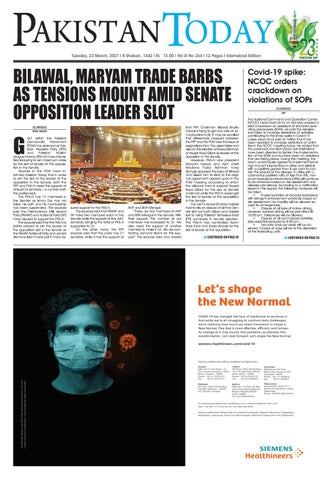
Bilawal, MaryaM trade BarBs as tensions Mount aMid senate opposition leader slot ISLAMABAD
G
Mian abrar
ulf within the Pakistan Democratic Movement (PDM) has widened as Pakistan People’s Party (PPP) and Pakistan Muslim league-Nawaz (PMl-N) have intensified lobbying to win maximum votes for the slot of leader of the opposition in the Senate. Sources in the PDM have informed Pakistan Today that in order to win the slot of the leader of the opposition in the Senate, both the PPP and PMl-N need the support of at least 26 senators – a number both the parties lack. The PMl-N has 17 members in the Senate as Ishaq Dar has not taken his oath and his membership has been suspended. The sources said the Pakhtunkhwa Milli Awami Party (PkMAP) and National Party (NP) have assured to support the PMl-N. The sources said that the PMl-N is better placed to win the leader of the opposition slot in the Senate as the PkMAP, National Party and Jamiat ulema-e-Islam-fazal (JuI-f) have as-
sured support to the PMl-N. The sources said that PkMAP and NP have two members each in the Senate while the support of five JuI-f senators, bringing the total of PMl-N supporters to 26. On the other hand, the PPP sources said that the party has 21 senators, while it has the support of
ANP and BNP–Mengal. “There are two members of ANP and BNP–Mengal in the Senate. With their support, the number of our members has increased to 25. We also need the support of another member to make it 26. We are contacting Jama’at Islami for this support,” the sources said and added
Covid-19 spike: NCOC orders crackdown on violations of SOPs ISLAMABAD inP
that PPP Chairman Bilawal Bhutto Zardari is trying to get one vote of Jamaat-e-Islami (JI). It may be recalled that differences cropped between the PPP and the PDM over the issue of resignations from the assemblies and also on the election of Sherry Rehman or Yousaf Raza Gilani as leader of the opposition in the Senate. However, PMl-N vice president Maryam Nawaz and JuI-f chief Maulana fazlur Rehman have strongly opposed the idea of Bilawal and asked him to stick to the original agreement agreed upon in the PDM meeting according to which the alliance had to support Yousaf Raza Gilani for the slot of Senate chairman while the PMl-N would get the slot of leader of the opposition in the Senate. The JuI-f’s Abdul Ghafoor Haideri had to rely on deputy chairman Senate slot but both Gilani and Haideri lost to ruling Pakistan Tehreek-e-Insaf (PTI) nominees in Senate election. The PMl-N has nominated Azam Nazir Tarar and Sadia Abbasi for the slot of leader of the opposition.
The National Command and Operation Centre (NCOC) head Asad umar on Monday ordered a strict crackdown on violations of standard operating procedures (SOPs). He said the decision was taken to increase restrictions of activities contributing to the sharp spike in Covid-19 cases. Asad umar said on Twitter that it has been decided to increase restrictions of activities in the NCOC meeting today. He added that the provincial and Islamabad administrations have been directed to tighten the implementation of the SOPs and to crack down on violations that are taking place. During the meeting, the forum unanimously agreed to implement some high impact interventions in cities and districts with a positivity greater than 8 per cent to contain the spread of the disease. In cities with a coronavirus positivity ratio of less than 8%, nonpharmaceutical interventions (NPIs) will continue to be enforced based on risk assessment and disease prevalence. According to a notification issued in this regard, the following measures will be taken: • Implementation of broader lockdowns with stringent enforcement protocols based on risk assessment. No mobility will be allowed except for emergencies. • Closure of all type of indoor dining. However, outdoor dining will be permitted till 10:00 pm. Takeaways will be allowed. • Closure of all commercial activities (less essential services) by 8:00 pm. • Two safe days per week will be observed. Choice of days will be at the discretion of the federating units.
CONTINUED ON PAGE 05
CONTINUED ON PAGE 05
02
Tuesday, 23 March, 2021
ISLAMABAD
PPP challenges senate chaIrman electIon In Ihc ISLAMABAD
P
INP
AKISTAN People’s Party (PPP) challenged the recently held election of Senate chairman in the Islamabad High Court (IHC) on Monday. The petition, filed by Farooq H. Naek on behalf of Syed Yousaf Raza Gilani, Pakistan Democratic Movement (PDM) candidate for chairman of the upper house, prays to the court to stop Sadiq Sanjrani from working as a new Senate chairman by declaring the election null and void since the PDM members have a majority in the house. The petition further reads that the decision to reject the votes cast in favour of Gilani was unconstitutional. “We were deprived of our Senate chairman seat unfairly. And that the notification, issued on March 12, declaring Sadiq Sanjrani as chairman was unconstitutional,” the petitioner adds. Later, speaking to the media outside the IHC, PPP leader Nayyer Bukhari said the rejection of seven votes cast in favour of PDM candidate Syed Yousaf Raza Gilani proved to be a game-changer. He was of the view that the presiding officer (PO) had wrongly rejected the votes. He further said that when PDM leaders asked for the ballot papers’ record, the request was not accepted. Bukhari said that the PPP had challenged the presiding officer’s decision under Article 199. He pointed out that there was the same column for stamping on the candidate’s name. “Actually it is
voter’s intention that needs to be looked into,” he argued. On March 12, a controversy was witnessed during the Senate chairman elections, when the PTIbacked candidate Sadiq Sanjrani once again defied the odds to become Senate chairman yet again after a knife-edge poll. It is pertinent here to mention that Sanjrani received 48 votes while his opponent and PDM joint candidate Yosuf Raza Gilani received 42 votes; however, there was a controversy in the votecounting as seven of Gilani’s votes have been rejected as the voters failed to stamp in the box correctly. Farooq H Naek, the representative of Gilani, challenged the decision, however, the presiding officer rejected his objection and said the grieved party can challenge his decision in the Election Tribunal. The presiding officer said the rules were clearly mentioned to stamp the vote in front of the candidate’s box and the voters who stamped on the name of the candidate have been rejected. Meanwhile, Pakistan Tehreek-i-Insaf (PTI) on Monday submitted fresh applications to the Election Commission of Pakistan (ECP) in the PDM candidate for the seat of Senate chairman, Syed Yousaf Raza Gilani’s disqualification case. A four-member bench of the ECP, headed by Member Punjab Altaf Ibrahim Qureshi, is hearing the PTI’s petitions, seeking Gilani’s disqualification on the basis of the video in which his son Ali Haider Gilani was seen telling two PTIA MNAs the way to waste votes.
Pakistan, India set New PTI petitions urge ECP to disqualify Gillani directives of the election ISLAMABAD for Indus waters commission have not been implemented in letter and spirit. talks today When the ECP asked Bokhari Ruling Pakistan Tehreek-e-Insaf as to which PTI’s petition should INP
NEW DELHI: India and Pakistan will hold the first meeting in three years of a commission that deals with water rights on the Indus River on Tuesday, the two sides said on Monday, illustrating a broader resumption of diplomatic ties. The Permanent Indus Commission, set up under the Indus Waters Treaty of 1960, is set to meet in New Delhi on March 23 to 24, said two Indian officials that deal in bilateral water issues. An eight-member Pakistani delegation, headed by Pakistan Commissioner for Indus Waters Meher Ali Shah has departed for New Delhi to hold talks with the Indian side led by P. K. Saxena, according to a report. Ministry of Foreign Affairs (MoFA) spokesman Zahid Hafeez Chaudhri confirmed the talks will take place. He noted that the Commission is supposed to meet at least once a year under the treaty that governs water usage on the Indus and its tributaries that flow through the two countries. At the forthcoming talks, Pakistan will raise its objections on the technical designs of India’s Pakal Dul and Lower Kalnai hydroelectric plants, he said. The talks represent a thawing in bilateral ties, which have been frozen since a 2019 suicide bombing in Indian-occupied Kashmir blamed on Pakistan and India’s decision later that year to strip the disputed region’s autonomous status in order to bind it closer to India. AgeNcIes
(PTI) on Monday submitted fresh applications to the Election Commission of Pakistan (ECP) seeking the disqualification of recently-elected Senator Yousaf Raza Gillani. A four-member bench of the commission, headed by its member from Punjab Altaf Ibrahim Qureshi, is hearing the set of petitions, seeking the former prime minister’s disqualification on the basis of a video wherein his son Ali Haider Gillani was seen telling two ruling MPs technique to get their votes rejected. The party has named the two MPs — Faheem Khan and Jamil Ahmed — as respondents in the case. “In our view, Faheem Khan and Jamil Ahmed are both witnesses in the case,” said PTI leader Maleeka Bokhari, adding: “It was on ECP’s directives that the witnesses have been nominated as respondents.” She further said if the commission believed any PTI MP has committed a wrong, it should proceed against it. Irshad Qaiser, ECP’s member from Khyber Pakhtunkhwa, said
be heard: the first one or the fresh one, she the commission’s job is to ensure transparency however it deems fit. Later, speaking to the reporters outside the ECP offices, Bukhari and Farrukh Habib, another PTI MP, said today the party had raised the issue of public interest in the election commission. Maleeka said mockery of law and the constitution was made on March 3. She called on the party workers and supporters to always stand by the truth. “If you show perseverance, then none could defeat you,” she said and warned if the ECP did not announce a verdict in the case soon, then eyebrows would be raised. She said the nation had witnessed the sale and purchase of votes during Senate elections just because those indulging in this practice are rich and affluent. She regretted despite the fact that Ali Gillani had confessed to having told PTI MPs the technique to waste their votes ahead of elections, the election commission did not take any action.
Tuesday, 23 March, 2021
03
ISLAMABAD
BRoadSheeT PRoBe RePoRT RecoMMeNdS To de-SeaL SwISS caSeS RecoRd IsLAMABAD
T
TLTP
HE Justice (r) Azmat Saeed Sheikh-led commission of inquiry has completed its probe into the Broadsheet LLC case and it transpired on Monday that the record of $1.5 million paid “inadvertently” in 2008 was missing. According to sources, a 100-page inquiry report has been prepared and the commission has recommended to de-seal Swiss cases record of the former president Asif Ali Zardari. In January, during a debate on the issue, Adviser to the PM on Accountability Shahzad Akbar had told the Senate that the PPP government in 2008 made a payment of $1.5 million to a “wrong firm”. The commission formed to probe the payments to the UK-based firm completed the investigation and submitted its report to the Prime
FINDS RECORD OF $1.5M PAID 'INADVERTENTLY' IN 2008 MISSING Minister’s Office (PMO). The report and the relevant record comprise 500 pages, revealing who made the agreement with the firm and under what circumstances. Terming the payment to the “wrong firm” suspicious, the commission termed it an act of deceit with the state. Broadsheet company was wrongly paid Rs1.5 million, the report said, adding that wrong payment is counted as fraud with the state of Pakistan. Payment alone cannot be termed as negligence, the Broadsheet commission report said. It added that files were stolen from the ministries of finance and law and the attorney-general’s office. Moreover, the documentation in the Pakistan High Commission in London pertaining to the case was also found to be missing. The authority found all details of the
PM quotes Rumi’s advice for youth IsLAMABAD TLTP
Prime Minister Imran Khan, who is selfisolating after being diagnosed with the coronavirus, took to Twitter on Monday to send out a piece of advice to the country’s youth. Quoting Jalaluddin Rumi, the premier wrote on his official Twitter handle, “A truly free, liberated & rich human being is one who’s soul is priceless – beyond any material price. Dedicated to the youth of Pakistan.” The PM and his wife Bushra Bibi had tested positive for the coronavirus on Saturday last.
Saudi king, crown prince wish speedy recovery to Imran RIYADH/IsLAMABAD sTaff RePoRT
Saudi King Salman bin Abdulaziz Al Saud and crown prince Mohammed bin Salman on Monday wished a speedy recovery to Prime Minister Imran Khan who is suffering from coronavirus. In their messages, the two leaders wished the prime minister “permanent health and wellness, and a speedy recovery,” Saudi Press Agency (SPA) reported. Late Saturday night, Minister of State for Health Dr Faisal Sultan said Khan was in “good health” and was self-isolating. “We are monitoring parameters of his health, and at present, he did not need a direct intervention,” he said in a video message. After him, Pakistan Tehreek-e-Insaf (PTI) leader and Senator Faisal Javed Khan said he has met the prime minister, who is “fit and doing well”. “The best advice that we could give him was to stay at home, isolate, and rest,” he said, observing the prime minister experienced only “mild symptoms”. In a tweet sent Sunday night, the prime minister thanked “everyone in Pakistan [and] abroad for their good wishes and prayers” for his and the first lady’s – Bushra Bibi – recovery from the disease. His tweet came in response to get well messages from Indian Prime Minister Narendra Modi, Sri Lankan Prime Minister Mahinda Rajapaksa, and foreign missions in Islamabad. Responding to the tweets, Khan’s adviser on political communication Shahbaz Gill said: “The prime minister and Bushra Bibi are thankful to you all for your good wishes”. The prime minister and his spouse had tested positive for the contagious disease on Saturday, two days after the former received his first vaccine dose. When news of him testing positive for the contagious disease came out, the rumour mills went abuzz with speculation that the prime minister contracted the disease after vaccination.
case through the documents submitted by the National Accountability Bureau (NAB). The commission recorded the statements of 24 witnesses, completing the investigation in a span of six weeks. Sources said that statements and documents of several people have been attached to the 100-page report separately. The commission in its report has unearthed the Swiss cases record kept in the record room of the anti-graft body. The inquiry commission has proposed the de-sealing the record of the cases. The record should be reviewed as to what has to be done with it, the Broadsheet committee has recommended. Earlier in the day, the inquiry report of the Broadsheet scandal was received
in the Prime Minister’s House, reported TLTP. It further said that the inquiry report was received by Joint Secretary Zahid Maqsood. The federal government had appointed Justice (r) Azmat Saeed Shaikh to head the inquiry committee after the revelations made by the Broadsheet LLC chief Kaveh Mousavi. The commission was set up on January 29 this year to probe the Broadsheet case. It had formally launched its investigation on February 9, 2021, while the opposition parties had refused to accept the commission headed by Justice (r) Saeed. The UK-based asset recovery firm Broadsheet LLC had been hired in 2000 by General Pervez Musharraf’s government to help recover assets stashed by past Pakistani rulers abroad.
Sarina Isa moves contempt proceedings against science minister News Desk Sarina Isa, wife of Supreme Court (SC) Justice Qazi Faez Isa, has requested the SC to initiate contempt proceedings against Minister for Science and Technology Fawad Chaudhry over his offensive tweet. On Friday, the minister in a tweet had said that he had been listening to the speeches of SC’s undertrial judge Justice Isa for a week. He further said that if he answers, then lectures will start from ‘we are saddened’ to ‘we have been insulted’. “Sir, if you too are fond of politics like your godfather Iftikhar Chaudhry (former chief justice of Pakistan), then resign and contest elections for the councillor. You will get to know about both [your] popularity and acceptance,” Hussain had further said. She said that the science minister had all but admitted to the installation of secret cameras in the courtroom, as he claimed to have been listening to the speeches that took place within the court without once having been present during the proceedings. Furthermore, she pointed out that Justice Isa was a sitting judge of the SC, and not an “under-trial prisoner”
as Fawad had attempted to paint him out to be. In her petition she also referred to Chaudhry’s use of the word ‘godfather’, saying that it was a term used for criminal syndicates and mafia bosses. “Ch Fawad Hussain has violated his ministerial oath of office, the Constitution of Pakistan, mocked and ridiculed this honourable court’s former chief justice, a sitting judge of the Supreme Court and committed contempt of this honourable court,” the petition stated. “If judges of the highest court of Pakistan are humiliated, disrespected and abused in this manner by a federal minister, then the Twitter brigade at their command and the combatants of the 5th generation warfare do much worse,” it added. She requested the top court to initiate contempt of court proceedings against the minister, remove him from office and also direct him to shut down his Twitter account. Earlier this month, Justice Qazi Faez Isa had argued before the SC that the federal government “destroyed” the media and was controlling it in an attempt to shape the public narrative, insinuating that he was one of the targets of this brand of federal propaganda.
Prime suspect in Pearl murder shifted to Lahore LAHORe sTaff RePoRT
Ahmed Omar Saeed Sheikh, prime suspect in 2002 murder of Wall Street Journal journalist Daniel Pearl, was shifted to Lahore from Karachi for security reasons on Monday. Sindh police handed over Sheikh to Punjab police’s counter-terrorism department (CTD). In January, the Supreme Court ordered his release, while also dismissing an appeal against Sheikh’s acquittal by Pearl’s family. “The court has come out to say that there is no offence that he has committed in this case,” Mahmood A Sheikh (no relation with the suspect), who represented Omar Sheikh, said at the time. He added the court had ordered that three others, who had been sentenced to life in prison for their part in the kidnapping and death, also be freed. Later that month, the government appealed to the apex court to review its decision after the United States has expressed concern over the ruling and Secretary of State Antony Blinken repeated a call for accountability in his first phone call with Foreign Minister Shah Mahmood Qureshi. Seperately, the Sindh government also filed a review
petition against the verdict. The top court is scheduled to resume the hearing on its petition on March 25. A threejudge bench will take up the request. Pearl, 38, was abducted on January 23, 2002, in Karachi and beheaded the next month, reportedly by AlQaeda. Omar Sheikh had been convicted of helping lure Pearl to a meeting in Karachi in which he was kidnapped. Prior to his kidnapping, the journalist had been investigating the link between reportedly Pakistan-based militants and Richard Reid, the notorious “Shoe Bomber” who attempted to blow up a flight from Paris to Miami with explosives hidden in his shoes. In July 2002, following the hearings, an antiterrorism court (ATC) in Hyderabad had sentenced to death Omar Sheikh and life term to other co-accused. However, all four convicts had moved the Sindh High Court (SHC) in 2002 challenging their convictions. In his autobiography, In the Line of Fire: A Memoir, former president Pervaiz Musharraf had claimed that Sheikh, a British national and a student at the London School of Economics (reports suggest he did not graduate), was hired by MI6 to engage in “jihadi operations”, adding that “at some point, he probably became a rogue or a double agent”.
Covid-19 vaccine allowed under Sharia: Ashrafi IsLAMABAD TLTP
The religious scholars have consensus over getting a coronavirus vaccine, Prime Minister’s Special Aide on Religious Harmony Hafiz Tahir Ashrafi said on Monday. Getting Covid-19 vaccine shot is allowed under the religious law and it is a responsibility according to Sharia teachings, Ashrafi said while talking to the media. There is nothing wrong with the Covid-19 vaccine as all renowned religious scholars have decreed that each and every person should get him or herself vaccinated
against the coronavirus,” the PM’s aide further said. He also said that even a fasting person could get the vaccine shot. Philanthropists should also purchase the vaccine to get their employees and other entitled persons vaccinated, he said. Ashrafi said that rumours are being spread about closure of the mosques. The mosques were not closed even in the worst situation of coronavirus pandemic in the country, he said. “There was no proposal under consideration for closure of the mosques in Ramazan”, he said. “The mosques will not be closed,” he categorically stated.
President confers Nishan-e-Imtiaz upon air chief ISLAMABAD: President Dr Arif Alvi conferred Nishan-e-Imtiaz award upon Chief of Air Staff Air Chief Marshal Zaheer Ahmad Baber at a special investiture ceremony on Monday. The President conferred the prestigious award as a tribute to his professional services and achievements while serving the Pakistan Air Force (PAF). Born on 16 April, 1965, Baber was commissioned in GD (P) Branch of PAF in April, 1986. During his dazzling career, he has commanded a Fighter Squadron, a Flying Wing, an Operational Air Base and Regional Air Command. TLTP
Sanaullah reveals former president admitted he cannot ‘battle the establishment’ Pakistan Muslim League-Nawaz (PML-N) Punjab President Rana Sanaullah revealed that the Pakistan People’s Party (PPP) Co-Chairman Asif Ali Zardari had said during the recent meeting of the opposition alliance that he “cannot battle the establishment”. During a local TV programme, the PML-N leader said that the former president admitted to being weak. Sanaullah added that he was not sure what Zardari meant by the statement. Referring to the meeting that took place last week, wherein the matter of the long march and resignations were discussed and the PPP was the only opposing vote to the latter, it had been decided that the PML-N would hold the position of leader of the opposition in the Senate. However, Sanaullah said that Zardari changed his stance after someone came into the room and told the PPP cochairman that “there was chaos outside”. Sana said PML-N Vice-President Maryam Nawaz was upset over some words of the former president’s speech, adding that the PPP co-chairman even apologised to Maryam Nawaz for it. Speaking on the National Accountability Bureau (NAB) summoning Maryam, he said it was a tactic of the “NAB-Nizai nexus”. “NAB should avoid issuing political press releases,” he said. News Desk
Teachers protesting for regularisation detained by baton-charging police Two dozen teachers protesting outside Chief Minister House in Karachi were detained by baton-charging police officers in the port city. Headteachers had come to the CM House to stage sit-in wherein they were demanding the provincial government to regularise their services. According to reports, over two dozen male and female were injured in the incident due to the torturous tactics of the police. “Around 15 male and 10 female teachers with bleeding head and nose have been taken away in police mobile,” Siddique Dal, one of the protesters said. The 958 protesters, who were appointed as government school principals after sitting an exam conducted by the Institute of Business Administration (IBA) have been protesting for the last four years demanding the provincial authorities to regularise them. Soon after their exam in 2017, the Sindh government had announced to induct them as permanent employees based on their performance. “Instead of making us permanent employees, the government has now advertised to appoint fresh headmasters. We have already served four years in the department and still continue the job,” Saleem Ahmed, a teacher said. The recent protest was started by the teacher from March 1 by setting up camp in front of the Karachi Press Club and later changed the venue and staged a sit-in in front of the Sindh Assembly from March 15 before proceeding to the CM House today. News Desk
Javed Latif granted bail till 30th LAHORE: A district and sessions court of Lahore on Monday granted pre-arrest bail to Pakistan Muslim League-Nawaz (PML-N) MNA Javed Latif in a case pertaining to allegedly defaming the state institutions. The MNA was earlier quoted as saying in a talk show: "If anything happens to PML-N Vice President Maryam Nawaz, the PML-N will not say Pakistan Khappay.” The sessions judge granted bail to the PML-N leader till March 30, and also summoned police record in the case by the said date. Earlier in the day, the MNA appeared in court wherein his counsel Syed Farhad Ali Shah implored that his client was implicated in a forged case aimed at humiliating and embarrassing him, saying he had nothing to do with the allegations On the contrary, the law officer argued that the accused defamed state institutions through his remarks. The prosecution argued that the bail plea of the accused be dismissed. TLTP
04
Tuesday, 23 March, 2021
ISLAMABAD
NEWS
Punjab imPosed micro lockdowns in several cities: minister ISLAMABAD
P
INP
unjab Health Minister Dr Yasmin Rashid on Monday said that the government has imposed micro lockdowns in several cities as the positivity rate has surged to 12 per cent, which she said is a “concerning extent”. Punjab now has 199,040 confirmed cases after registering 1,863 new infections
with an alarming positivity ratio of 10.77 per cent in the last 24 hours. The province on Monday reported 8 deaths due to coronavirus-related complications, raising the fatalities to 5,982. There were 999 new recoveries recorded, leaving 177,698 fully recovered, and 15,360 active cases of the virus. “Punjab government has issued new health guidelines for public places, markets and other activities that involved gather-
ings”, she said while speaking to a news channel. She said the government has done satisfactory arrangements to deal with a third wave of coronavirus and added the district administration had started a crackdown on violations of SOPs (standard operating procedures). She also said Lahore was becoming an epicenter of the coronavirus, as 1,824 new cases have been reported from there. Dr Rashid said there’s no need to panic
because the government has enough facilities to manage the increasing number of infections. She said nCOC’s daily meetings have been called to cope with the spike in cases to place more beds in hospitals. If people make wearing masks their habit, we can reduce the spread by up to 50 per cent to 70 per cent”. While all the provinces are under pressure, but Punjab is under a constraint be-
cause of its dense population, and increased testing, she added. She also urged the people to follow the SOPs in letter and spirit, warning the government would be forced to place stronger restrictions if the situation continued to deteriorate. She asked the people over 70 to vaccinate themselves without any delay and those between the ages of 60 and 70 should receive their pin code and come to their nearest vaccination centre. She said the public should be more vigilant and take care of their elders in their homes. Replying to a question, she said the Covid-19 vaccination will start at private hospitals within a day or two. She asked the public to get their family members, who are above 60, vaccinated against the deadly virus, adding the public must ensure wearing face masks while going outside.
a transgender seminary in islamabad breaks barriers ISLAMABAD: a long white shawl on her head, Rani Khan gives daily Quran lessons at the country’s first transgender-only madrasa, or Islamic religious school, which she set up herself using her life savings. The madrasa is an important milestone for the transgender community in the Muslim country, where transgender people face ostracism, even though there is no official restriction on them attending religious schools or praying at mosques. “Most families do not accept transgender people. They throw them out of their homes. Transgender people turn to wrongdoing,” Khan, 34, said, as other transgender people, their heads similarly covered, swayed back and forth behind her, reciting Quran verses. “at one time, I was also one of them.” Holding back tears, Khan recalled how she was disowned by her family at 13 and forced into begging. at 17, she joined a transgender group, dancing at weddings and other functions, but quit it to connect with her religion after a dream in which a deceased transgender friend and fellow dancer pleaded with her to do something for the community. Khan studied the Quran at home, and attended religious schools, before opening the two-room madrasa in October. “I’m teaching the Quran to please God, to make my life here and in the hereafter,” Khan said, explaining how the madrasa offered a place for transgender people to worship, learn about Islam and repent for past actions. She says the school has not received aid from the government, although some officials promised to help students find jobs. along with some donations, Khan is teaching her students how to sew and embroider, in hopes of raising funds for the school by selling clothing. Pakistan’s parliament recognised the third gender in 2018, giving such individuals fundamental rights such as the ability to vote and choose their gender on official documents. nonetheless, the transgender remain on the margins in the country, and often have to resort to begging, dancing and prostitution to make a living. The madrasa could help trans people assimilate into mainstream society, Islamabad Deputy Commissioner Hamza Shafqaat told Reuters. “I’m hopeful that if you replicate this model in other cities, things will improve,” he said. AgeNcIes
LAHORE: Owners and employees of restaurants stage a protest against closure of their shops near Liberty Chowk in the provincial capital. ZubAIr MehfooZ
Biographies of a versatile showman and an historian SyeD AfSAr SAjID biographies are personal histories rendered either in a literary form or in a purely objective but statistical formulation of facts and figures. Lytton Strachey (18801932), a diarist and biographer par excellence, thought that ‘the basis of all good biography must be the humanistic respect for human beings in their separateness as distinct from lower creatures and even as distinct from one another’. In fact, individual human beings, however simple they may appear, are enigmatical, being a compact embodiment of contending elements. The biographer is therefore obliged to discern these individual differences. In the process, the ordinary human being becomes highly important and interesting for him but usually, he deals with extraordinary men and women which an immense discerning skill in him (the biographer). In this way, the art of biography is deemed to be ‘the most delicate and humane of all the branches of the art of writing.’ ‘AZEEZ-E-PAKISTAN, TARIQ AZIZ’: Tariq aziz (1938-2020) was an outstanding broadcaster first and foremost though literature, acting and politics were also his favourite diversions at different points of time. ‘neelam Ghar’, his compering extravaganza on PTV starting in 1975, brought him name, fame and affluence too. The programme which was re-named as ‘Tariq aziz Show’ in 1997, and ‘bazme Tariq aziz’ in 2002, continued to be on air for a record time of more than four long decades. Tariq aziz also earned the unique distinction of being the host of PTV’s maiden transmission from Lahore, in 1964. Haroon Rashid Tabassum is a known litterateur, academic, and socio-cultural activist from Sargodha. He seems to have taken considerable pains to the author and compile this book as a compendium of biographical detail, critical opinion, and expository narration on the person and art of the biographee together with an assortment of facts, figures, and photos bearing on his illustrious career. apart from the author, some other contributors to the book are Mamoon Rashid, javed Chaudhry, Sa’adullah
Shah, Zulfiqar ahsan, Dr ashfaq ahmad Virk, ali ahmad Dhilon, Tahir ashraf, atiya Iftikhar, Ibrahim jaleels, Salim jafri, Hussain Shah, Gohar Sultana uzma, Prof. Tafakhur Mehmood Gondal, and Shahbaz anwar Khan. nearly one-third of the book has been allocated to the reproduction of some important but informative questions that were asked by the learned compere in all of the three shows conducted by him, as aforementioned. The book is thus a souvenir of Tariq aziz’s meritorious career as a compere, poet, politician, and film and stage actor: verily a man of notable endowments! Readers will surely like it for its substance and soul. ‘SUBH-E-DAWAM, PROF. SAHIBZADA ABDUR RASUL’: Late Prof. Sahibzada abdur Raul (1930-2019) was a noted historian, scholar, intellectual, educationist, researcher, translator, and orator besides being a man of noble character. Haroon Rashid Tabassum, in his own distinctive style, has attempted to focus on the life and achievements of the late scholar, in this biography. Coming from a religious family of Lillah Sharif (Pind Dadan Khan), the late Sahibzada Sahib started his career as a teacher of History at Government College Sargodha, his alma mater too, in november 1952, after completing a brilliant academic career at Punjab university, Lahore. Later he served as Professor and head of department (History) at Islamia university, bahawalpur, Principal, Govt. ambala Muslim College, and Govt. College, Sargodha, Director Education (Colleges), Rawalpindi and Sargodha, and Chairman, bISE, Sargodha besides working on the boards and committees of a host of autonomous academic, literary, and religious bodies. He authored several text books on history, Is-
lamiyat, and Pakistan Studies. His numerous publications on religion, mysticism, history, and culture have been neatly indexed in the book. Sargodha and its adjoining valley have always had a rich literary clime. Intellectuals, writers and poets of the cast and calibre of ahmad nadim Qasmi, Shakeb jalali, Dr Wazir agha, Prof. Ghulam jilani asghar, Raja abdul Ghafoor jauhar nizami, Prof. Mirza Muhammad Munawar, Sahibzada abdur Rasul, Dr Salim agha Qizilbash, Dr Khurshid Rizvi, abdul Qadir Hassan, Mufti Muhammad Tufail Goendi, Prof. Muhammad afzal Malik, Raja Hasan akhtar jalil, Raja Safdar Hassan Safdar, Khalid Iqbal Yasir, Prof. Dr Muhammad Iqbal, Dr Haroon Rashid Tabassum, najma Mansoor, Zulfiqar ahsan, Prof. Yusuf Khalid, Mehmood aseer, Dr Zahid Munir aamir, Prof. Riaz ahmad Shad, Mumtaz arif, Dr abid Khurshid et al have added lustre to the cultural milieu of the Chenab-Khushab riverine-cum-hilly tract, at one point of time or the other, stretching from Sargodha onwards to Shahpur, Khushab-jauharabad and the SoonSakesar Valley. The instant book seeks to highlight the biographical data of Sahibzada abdur Rasul in the larger context of his professional, academic and spiritual accomplishments. The compiler happens to be his ex-student also, hence his deep personal involvement in the venture. apart from the complier, some contributors to the biography are Mian Muhammad asif (‘Foreword’), Salimur Rasul, Dr Sahibzada Sajidur Rahman, Dr Sahibzada Moeen nizami, Rabia abid, Mufti Muhammad Tufail Goendi, Dr. abid Khurshid, Zahida abid Hina, Dr S. M. Zaman, Prof. Dr Riazul Haq Tariq, Dr Zafarullah beg, Prof. Riaz ahmad Shad, Dr Khurshid Rizvi, Muhammad Tufail Saqib, Mehmood aseer, Mumtaz arif, Prof. Dr Zahid Munir aamir, Malik ashraf Zaki awan, Zulfiqar ahsan, Kh. awais ahmad Shibli Panipati, and Shibzada Shamshad Hussain Shahid. Dr Haroon Rashid Tabassum has done yeoman’s service to the memory of his great teacher by authoring and compiling the present biography. This scribe had also had the privilege to be his (Sahibzada Sahib’s) colleague, though for upwards of a year, at Govt. College Faisalabad (then Lyallpur) in the early 1970s. He was a popular teacher, a learned scholar, a caring co-worker, and a reticent but well-meaning gentleman.
Tuesday, 23 March, 2021
ISLAMABAD
NEWS
PetrO DiviSiON DireCteD tO tAke ACtiON AgAiNSt OMCS iNvOlveD iN JuNe 2020 CriSiS ISLAmABAD
t
AHMAD AHMADANI
HE government has directed the Petroleum Division to take serious action against oil marketing companies (OMCs) and others involved in the petrol crisis of June 2020, which caused billions of rupees loss to the national exchequer. According to sources, the government has directed the Petroleum Division to make all necessary arrangements, including legal and administrative, to bring the culprits to task and to avoid such incidents in the future. "The government has tasked the division to take necessary action against OMCs and fuel stations, besides introducing legal reforms/amendments in laws/rules/procedures and its placement before the Cabinet Committee for Disposal of Legislative Cases (CCLC)," an insider said. "The government's directives came in light of recommendations of an inquiry conducted by the Federal Investigation Agency (FIA) on petrol crisis of June 2020." Although the FIA's Inquiry Commission had recom-
Current account deficit shrinks 75pc to $50m in February NEWS DESK Pakistan's current account deficit – the difference between the county's higher foreign expenditures compared to income – was recorded at a nominal $50 million in February 2021. According to the State Bank of Pakistan, “The deficit is almost 75pc lower in February compared to the same month of the last year. It fell by slightly over 76pc compared to the previous month of January.” This marks the third consecutive month the current account has recorded a deficit, after registering a surplus for five months in a row. Overall, during the first eight months of FY21, the current account showed a surplus of $881m compared to a deficit of $2.74 billion in the corresponding period last year.
Saudi Aramco’s debt-to-equity ratio more than doubles in 2020 DUBAI: Saudi Arabian oil giant Aramco’s net debtto-equity ratio more than doubled to 55pc in 2020 from 26pc a year earlier, the company said in a financial results report. Net debt rose to 605.9 billion riyals ($161.56 billion) last year from 270.2 billion riyals in 2019, the results showed. The world's largest oil exporter said on Sunday net profit fell 44.4pc to 183.76 billion riyals ($49 billion) for the year ended Dec 31, from 330.69 billion riyals a year earlier, as the Covid-19 pandemic depressed global demand for crude. But despite the sharp decline in profits, it maintained its pledge to declare a $75 billion dividend for 2020, most of which goes to the Saudi government. AGENCIES
mended action against officials of the Petroleum Division, including petroleum secretary Mian Asad Hayaudin, for the petrol crisis, the government has so far kept a mum on the matter. According to sources, the country-wide petrol crisis in June last year had caused more than Rs15 billion loss to the national exchequer, whereas "OMCs made huge profits during the said crisis". The FIA had held some OMCs responsible for fuel shortages through illegally halting supplies of stocks to petrol pumps following the government’s announcement of a large cut in retail prices to pass on the benefits of plunging global oil prices to the people. All those firms which were involved in this unlawful act had made between Rs6bn and Rs8bn (in profits) by holding back stocks while those which were not involved in crisis accrued losses of between Rs7bn and Rs8bn each as they continued their supplies to pumps during the said month. The FIA had further recommended departmental proceedings against top hierarchy of the Petroleum Division, dissolution of the Oil and Gas Regulatory Authority (OGRA) and a halt to the operations of refinery and oil marketing company Byco.
In addition, the inquiry commission's report also estimated over Rs250 billion worth of oil smuggling from Iran and noted that a wide range of operations in the oil sector were against law, operating in vacuum and without any check and balance. The FIA inquiry commission, headed by Abubakar Khudabakhsh, the additional director general of FIA, was constituted by the prime minister last year. It originally comprised seven members, including those from investigating agencies, former members of OGRA and attorney general, but later co-opted eight other experts to complete the task. The report stated the petro division’s decision to impose a ban on petrol import in March 2020 was wrong in the first place from strategic and policy perspective, but OMCs violated it. It said that when the ban was imposed, petrol prices were at the lowest ebb in the international market and Pakistan and its consumers were denied its benefit. "The division and DG-oil failed to ensure lifting of stocks by the OMCs from February to April 2020. The OMCs simply refused to lift quotas from local refineries," the commission noted.
HBL creates history, becomes first Pakistani bank to open branch in Beijing KARACHI PRESS RELEASE
HBL has become the first Pakistani bank to open a branch and serve clients in Beijing, China’s capital city. The inauguration ceremony for HBL Beijing was attended by clients, regulators and senior executives of the Bank from across HBL’s international network. From Pakistan, State Bank of Pakistan (SBP) Deputy Governor Jameel Ahmad, HBL Chairman Sultan Ali Allana, HBL President and CEO Muhammad Aurangzeb, along with senior executives and HBL’s customers, virtually joined the ceremony. HBL Beijing offers a full range of products and services for the bank’s esteemed clients. HBL remains grateful to the governments of Pakistan and China and the regulators for the trust and confidence they have reposed in the bank, through the opening of the branch. HBL has created history by being the first and only bank from Pakistan to have a branch in Beijing and one of the three banks from South Asia and the MENA region to offer end-to-end RMB intermediation in China. Upon commencement of business, HBL Beijing has become HBL’s second branch and its managing branch in China; both branches in Beijing and Urumqi are equipped with foreign exchange and RMB license to better facilitate customers’ requirements in multiple currencies. HBL’s presence in China will allow the bank to interact with State-Owned Enterprises (SOEs) and leading
financial institutions involved in CPEC and across Belt and Road Initiative (BRI) corridors. China is a very important market for HBL not only in terms of the business in China and CPEC but also for Chinese companies working on projects in countries across the HBL network. “HBL’s journey in China began in 2005 when we established our Representative Office in Beijing. This was followed by the establishment of branch operations in Urumqi in 2017 and today we mark the commencement of our branch operations in Beijing. It is an extremely proud moment for us as we enhance our China franchise, and we look forward to playing a leading role in facilitating regional trade and serving our valued customers throughout HBL’s international network,” Chairman Sultan Ali Allana said. Commenting on the branch opening, HBL President and CEO Muhammad Aurangzeb said, “China is the second home market for HBL and we will grow our business in the country. China remains the lynchpin of HBL’s international strategy. We are grateful to the regulators for having granted us the branch license. They are very supportive of developing market-based capabilities and encouraging financial institutions like HBL to provide clients with best-inclass product and services. HBL is the largest executor of CPEC related financing in Pakistan, and the Bank’s presence in China has put us in a unique position to connect our clients across the HBL network directly with the businesses in China.”
Bilawal, Maryam trade barbs as tensions mount amid Senate opposition leader slot CoNtINuED fRom pAgE 01 If the PDM falls apart, there would be an interesting contest between the PPP and PML-N nominees for the slot of leader of the opposition in the Senate as both sides almost are relying on PDM Senators for support. With the gulf between PPP and its allies in the PDM growing, party Chairman Bilawal Bhutto-Zardari has intensified contacts with like-minded opposition parties hinting at an independent opposition alliance in the making. Well informed sources in the PPP say that the young chairman was contacting opposition parties to explore the possibility of an independent opposition alliance. However, another party leader said that Bilawal was trying to win as much support for the election of the leader of the opposition in the Senate. The PPP chairman on Sunday telephoned Baloch nationalist and National Party (NP) Chief Dr Abdul Malik and discussed with him the ongoing political situation. Later in the day, Bilawal also visited the headquarters of Jamaat-e-Islami (JI), known as Mansura, in Lahore and met with JI’s Amir Siraj-ul-Haq. “The chairman discussed the formation of an effective opposition alliance of like-minded political parties. He was accompanied by former prime ministers
Yousaf Raza Gilani and Raja Pervez Ashraf among others,” the PPP sources said. The sources said that after differences cropping up between the PDM, the PPP chairman believes that it is about time to look for new allies as it seems difficult to move forward with PDM’s major parties – Pakistan Muslim League-Nawaz (PML-N) and Jamiat Ulema-e-Islam-Fazal (JUI-F).“Once he identifies the potential partners, the PPP chairman would share the idea for a new alternative political alliance,” the sources claimed. The sources alleged that the PPP chairman is also expected to meet with more political party heads in the next few days. Reportedly, the PPP chairman has summoned Qamar-uz-Zaman Kaira, Chaudhry Manzoor Ahmed and Hassan Murtaza to Bilawal House Lahore today (Tuesday) for an emergent meeting to further crystalise the idea. It may be recalled that differences cropped between the PPP and the PDM over the issue of resignations from the assemblies as well as on the election of Sherry Rehman or Yousaf Raza Gilani as leader of the opposition in the Senate. However, PML-N Vice President Maryam Nawaz and JUI-F chief Maulana Fazlur Rehman have strongly opposed the idea and have asked Bilawal to stick to
the original agreement, according to which the alliance had to support Yousaf Raza Gilani for the slot of Senate Chairman while the PML-N would get the slot of leader of the opposition in the Senate. The JUI-F’s Abdul Ghafoor Haideri had to rely on the deputy chairman Senate slot but both Gilani and Haideri lost to ruling Pakistan Tehreek-e-Insaf (PTI) nominees in the Senate election. The PML-N has nominated Azam Nazir Tarar and Sadia Abbasi for the slot of leader of the opposition. If the PDM falls apart, there would be an interesting contest between the PPP and PML-N nominees for the slot of leader of the opposition in the Senate as both sides almost are relying on PDM Senators for support. BILAWAL DENIES ALLEGATIONS OF BEING ‘SELECTED’: After his meeting with JI’s Siraj-ul-Haq, the PPP chairman addressed a press conference in Lahore where he denied any rumours of him being “selected”. These rumours arose after Maryam Nawaz had said that another selected was “being prepared.” Bilawal maintained that the idea of being selected was not a part of his pedigree, but that another family in Lahore had a history of such acts. “I have arrived here at the Jamaat-eIslami’s headquarters today and am speaking to you with Siraj-ul-Haq Sahab.
If I wanted to comment on the PML-N’s vice-president, I would have asked my [party’s] vice-president to comment on it,” he said. Regarding the long march, he said that his party was ready to take part in the march, but questioned who had decided to link the long march with the resignations ten days prior to the march itself. Bilawal added that the PPP had already booked rooms in Islamabad, but the matter of the resignations being tied to the march should have been brought up with the discussions were first taking place. In response to a question, Bilawal said people whose decisions proved wrong should review them. “It was the PPP’s position that [the PDM] should contest the Senate polls and by-elections. By doing this, we gave the government setbacks,” he said. Speaking to the press, JI Chief Sirajul-Haq called for a single institution that would hold everyone accountable. “This is the first government which is asking for the chief election commissioner to resign,” he said. Siraj voiced the need for electoral reforms, saying that without them, episodes like the Daska by-polls would happen again. The two leaders, during their meeting, agreed on working together on the issues of occupied Kashmir and electoral reforms.
05
Covid-19 spike: NCOC orders crackdown on violations of SOPs CoNtINuED fRom pAgE 01 • Gatherings with an upper limit of 300 persons will be allowed with strict adherence to SOPs. However, all types of indoor gatherings involving cultural, musical/religious or miscellaneous events will be banned. • Complete closure of cinemas and shrines will continue to be enforced. • A complete ban on contact sports, festivals, cultural and other events. • Outdoor wedding functions till 10:00 pm with an upper limit of 300 guests will be allowed with strict adherence to SOPs (event duration two hours only). No indoor functions will be allowed. • Complete closure of amusement parks, however, walking/jogging tracks will remain open with strict adherence to SOPs. • 50 per cent work-from-home policy will continue (including all public/private offices and courts). • Intercity public transport to operate at 50 per cent of capacity. • Rail service to operate at 70 per cent of capacity • Compulsory mask-wearing will be ensured by all federating units while incorporating innovative measures for enforcement. • Reduced presence at courts (City, District, High Courts and SC). • Stringent protocols for tourism in GB, KP, AJK and touristic places elsewhere. Sentinel testing sites at entry points / selected locations will be established. • Mass media coverage highlighting punitive actions. These new guidelines will be enforced until April 11, while the NCOC will reconvene to review the situation on April 7. The positivity rate of coronavirus cases in Lahore has reached 12 per cent, Punjab Health Minister Dr Yasmin Rashid confirmed earlier in the day. The masses should strictly follow the standard operating procedures (SOPs) designed to contain the spread of the Covid-19 as the number of cases is rapidly increasing in Punjab, the minister warned. Showing stratification over the arrangements made at Lahore and hospitals of other cities of the province, the health minister said that soon the Covid vaccine would be provided to the private hospitals. “Covid-19 vaccination will start at private hospitals from today or tomorrow,” Dr Yasmin Rashid said. She asked the masses to get their loved ones aged above 60 years vaccinated against the deadly virus and added to wear face masks while going into public. Separately, Special Assistant to Punjab Chief Minister on Information Firdous Ashiq Awan said that the provincial government is considering placing a complete ban on wedding halls and sports activities in the province for two weeks. “A proposal for a complete ban on wedding halls and sports for two weeks is under consideration,” Awan told a local news outlet. She stressed that they were considering such a decision as people’s lives are more important than such events. The special assistant said that the government will limit activities that will not affect the economy. She added that she was diagnosed with coronavirus so she understands the problems associated with it. Moreover, the Punjab government has revised schedule of lockdown in markets of several cities in the province. According to the Primary and Secondary Healthcare department spokesperson, markets in districts Rawalpindi, Jehlum, Sheikhupura, Chineot, Khanewal and Dera Ghazi Khan will remain closed on Fridays instead of Sundays. The spokesperson said lockdown in markets of these cities would be implemented on Fridays and Saturdays while traders and shopkeepers of these cities could open their businesses on Sundays. However, lockdown timings would remain same and all markets across the province would be closed at 6 pm, the Punjab government has urged people to follow the Standard SOPs as these SOPs are to their benefit. The country is currently under the third wave of coronavirus which is said to be more lethal and dangerous by the health authorities. Prime Minister Imran Khan had tested Covid-19 positive on Saturday. Dr Faisal Sultan in his tweet had said that the premier had tested positive for Covid-19 and is self-isolating at home. As many as 20 more patients died of coronavirus in Pakistan during the last 24 hours while 3,669 new virus cases emerged. The country-wide death toll from the virus has surged to 13,863 so far since the outbreak of the disease in February. According to a Ministry of National Health Services, Regulation, and Coordination report issued on Monday, a total of 630,471 people have been tested positive for the coronavirus disease in the country since its outbreak in February 2020, out of which 263,290 were in Sindh, 199,040 in Punjab, 19,342 in Balochistan, 80,037 in Khyber Pakhtunkhwa, 52,086 in Islamabad, 4,972 in Gilgit-Baltistan, and 11,704 in Azad Kashmir.
Tuesday, 23 March, 2021
06 COMMENT
Idols of the mind
Need for a consistent security policy Also for national reconciliation
A partial survey
I
t is quite common for administrations in Pakistan to share information about vital changes in government policies with foreign media while denying it to domestic reporters. Bloomberg has reported of a “secret India-Pakistan Peace roadmap brokered by top UAE royals”. this explains a number of sudden developments like the message to India by COAS Bajwa to bury the past and move forward. Earlier, many eyebrows were raised when PM Imran Khan was allowed to fly to Sri Lanka over Indian territory. the Bloomberg story predicts that Pakistan will send back its envoy to New Delhi who was recalled as protest after India revoked Article 370, illegally changing Kashmir’s disputed status. the paper also predicts a resumption of mutual trade through the Punjab land border. It is also being suggested that foreign ministers of Pakistan and India are likely to meet on the sidelines of the ‘Heart of Asia’ conference in Dushanbe later this month and if things go well with them the two countries would meet at the much delayed SAArC Conference later in Islamabad with the possibility of the two PMs having a tête-à-tête During 2008-18 period both the PPP and PML-N governments tried to stabilise Pak-India relations that according to the COAS are the key to unlocking the potential of South and Central Asia. the two governments also tried to set the house in order by trying to restrain networks like Let, JuD, JeM and LeJ from undertaking terrorist acts abroad. the PML-N claims that cases against its leadership were initiated and elections were stolen for suggesting to those who matter to help put ‘our house in order’ in 2016. A security policy can succeed only if it is consistent. In case extremists threatening the state with violent protests if it doesn’t break diplomatic ties with France are mollycoddled, they can tomorrow call for breaking ties with China or India. What’s more, the policy needs widespread domestic support. It needs to be explained why the previous governments were discouraged from supporting the policy or their leaders persecuted for trying to implement it. the best way out is to confess that a blunder was committed in the past and work for national reconciliation.
HASAN AFTAB SAEED
I
t is a shame no energetic soul in all these years has compiled and published Zia ul Haq jokes for the benefit of posterity. In one such story, Zia’s parachute fails to open but he manages to cling to a tree branch. On looking down he is terrified to see that there is still a fair distance to hard ground. Anxiously, he looks around and shouts: ‘Koi hai?’ Suddenly a voice from the heavens answers: ‘Zia, let go of the branch.’ Horrified at the suggestion, he shouts again: ‘Koi aur hai?’ Human beings tend to ask many questions. It is also very human not to like answers to those questions – answers that do not conform to one’s notions of ‘correctness’. Especially on religion, there are any number of issues that bother men, which forces them to look for solutions. But when one such solution is provided, they invariably want something else – something convenient, preferably pleasurable, and that involves no hard work whatsoever. A frequent observation: Somebody quotes a verse of the Quran and demands to know the rationale behind it. In nine cases out of ten, to know the rationale he probably did not need to read farther than three or four verses from the verse he is quoting, but he never read the Quran in the first place. When you give him the Quranic perspective (and he
does not like it), you might as well be talking Swahili as far as he is concerned. He may also give the impression that you are making the whole thing up, which is not worth his consideration. He not only has no clue about the contents of the Quran, but he has no intention of changing that either. He has heard the ‘Quranic position’ on the issue somewhere (he does not recall where and does no care) and the fragmented information is good enough for him. Multiple copies of the Quran, with translations, can be found in his home, but he is not interested. Challenging the interpretation or even looking up the relevant verses apparently involves way too much hard work. Add to it the unfortunate fact that any time somebody hears something he has not heard before, he feels it is too strange to even deserve an honest hearing. It does not matter if it makes all the sense in the world. On the other hand, extremely silly ideas which somebody has heard since childhood seem to him very sensible. Familiarity, then, not soundness becomes the test of things. Any wonder any conflicting view is not only rejected out of hand but often ridiculed as well? then there is the reverence for or allergy to certain scholars and schools of thought. Some years ago, there was a confusion in a friend’s extended family regarding whether irrevocable divorce had occurred between a man and wife. He was concerned about saving the marriage and I gave him a book with a relevant opinion by a certain scholar. He later told me that he could not even discuss the merit of the opinion, because the majority there was quite antagonis-
tic to the scholar – in fact, as soon as he took the book out, one of the participants observed that its writer was wajib-ul-qatl! It is not only the case with jurisprudence matters, but the very foundations of religion are decided based on such biases. Consideration of views different to one’s own is hard as it is; it is impossible when it is an opinion of somebody one loves to hate. the Quran talks repeatedly about the idol worshiping Quraish and how a potent motive for their insistence on their old ways was their reluctance to even contemplate that their forefathers could have been wrong. this latter attitude has survived in Muslims to this day. Fairy tales heard from parents in childhood continue to have a hold on a man when he is old and has children of his own. Many of the younger generation confuse respecting their elders with considering them their ideals in thought and conduct. Intelligence is a tricky thing in this respect, for intelligent men keep falling for the various isms on offer one after the other. Also, no amount of intelligence makes one immune from perennial human weaknesses like mental and physical laziness, intellectual dishonesty, prejudice, narcissism, self-righteousness, and arrogance. If anything, intelligence is likely to make a man more prone to some of these. It is no surprise then if a man goes astray; it is a miracle if he manages to keep on the straight and narrow.
Intelligence is a tricky thing in this respect, for intelligent men keep falling for the various isms on offer one after the other. Also, no amount of intelligence makes one immune from perennial human weaknesses like mental and physical laziness, intellectual dishonesty, prejudice, narcissism, selfrighteousness, and arrogance. If anything, intelligence is likely to make a man more prone to some of these.
Hasan Aftab Saeed is a connoisseur of music, literature, and food (but not drinks). He can be reached at hasanas@live.jp.
Impending gas price bomb
Unfinished agenda of Jinnah’s Pakistan
Propose price hike is sheer madness
t
HErE has been a relentless and consistent hike in energy prices for the past few months with both electricity and gas becoming increasingly unaffordable for consumers and businesses alike. the latest proposal by the country’s two gas firms, SNGPL and SSGC, for a 220% increase in the prescribed gas prices to meet expected revenue targets will deal a crippling blow not only to the common man, already unable to make ends meet at current price levels, but also lower middle class gas consumers with relatively higher disposable incomes. Although it is unlikely that such an exorbitant increase in gas prices will be approved by the regulator Ogra, per unit price of gas will still surely go up, as it has for consecutive months. Both SNGPL and SSGC are severely inefficient publically owned and run companies, which is why they face a perpetual revenue shortfall problem. No meaningful tangible changes have been introduced in the structure and running of these units for decades, which results in targets being missed leading to consumers being charged obscene gas prices to make up the difference. Last week while chairing a meeting to discuss the prices of essential food items that have been steadily rising, Prime Minister Imran Khan had directed relevant officials not to increase gas prices for the next few months. this has now become an unrealistic and near impossible policy to implement and maintain owing to the pressure of the IMF. After being stalled for almost a year pending fulfillment of around half a dozen conditions by the PtI government, it seems that the fund is satisfied with the progress made and the EFF will resume this month. Jacking up energy prices is one of those key conditions that the PtI has met, something that it had avoided until it could no longer put it off. Simultaneously, the IMF also wants subsidies to state-owned enterprises to be rationalized, which is why the only way to supplement revenue target shortfalls is by getting the consumer to pay more for gas and electricity. With ramzan around the corner and food prices already on the rise, another energy price shock is the last thing an already financially burdened population needs.
81 years ago today, the foundation of the country was laid MALIK TARIQ ALI
M
ArCH 23 has been a date of great significance in the struggle for freedom from British Colonial raj and the creation of Pakistan under the dynamic leadership of Quaid-e-Azam MAJ and the pioneers of the political struggle waged by politicians of All India Muslim. Earlier on 23 March 1931 Bhagat Singh, a freedom fighter was executed in Lahore after a sham trial by a British judge. It was again in Lahore on 23 March 1940 that a resolution was adopted at Lahore’s Manto Park, adjacent to Lahore Fort, in an open session under the presidentship Of Quaid-e- Azam, which laid the foundations for creation of Pakistan on 14 August 1947. It is unfortunate that even after a lapse of over seven decades MAJ’s vision of a modern democratic welfare state has not been realized. Jinnah understood the diversity of various units that formed Pakistan and the importance of a constitution to be adopted in his address to the First Constituent Assembly on 11 August 1947. Unfortunately, after his tragic demise the remnants of the British raj in connivance with paid bureaucracy took over this country, ignoring his advice to paid servants of the state given on 14 June 1948 at Quetta, where he told them about the importance of oath to the constitution and that they had no political role in running affairs of the country. It is a brutal reality that the All India Muslim was alone in the political struggle for the creation of a separate homeland where Muslim majority could live in peace with members of other faiths and ethnicities. the only formidable political group which supported Quaid was led by Jogendra Nath Mandal, a leader of Hindu Dalits from Bengal and his group of legislators in Bengal Legislature which voted to join Pakistan, when many other Muslims voted against. In 1940 Mandal became a minister in the cabinet of Huseyn Shaheed Suhrawardy. When rioting broke out in 1946 in East Bengal, he urged the Dalits not to participate in violence against Muslims, whom he perceived to be victims, like his own community, of hatred by upper caste Hindu. MAJ appointed him as Pakistan’s First Law Minister and he was also nominated by the Quaid as one of five representatives in the Interim Government of India in October 1946. It is also a bitter fact that even after
Dedicated to the legacy of the late Hameed Nizami
Arif Nizami Editor Yousaf Nizami Aziz-ud-Din Ahmad Managing Editor
Joint Editor
Umar Aziz Executive Editor
Lahore – Ph: 042-36300938, 042-36375965
I
Karachi – Ph: 021-35381208-9
I
1946 elections, when Muslims had a numerical majority in Punjab, the Unionist Party led by Khizr Hayat tried to form a coalition with Congress and Akali in March, which did not materialize because Akalis pulled out. this was the final nail in the coffin of the Unionist Party in Punjab. MAJ arrived in Lahore on 21 March 1940 and a grand reception was planned for him. Unfortunately, without any warning, Allama Mashriqi’s Khaksar tehreek, which had never supported Quaid, had a violent confrontation with Unionist Party Premier Punjab Sikandar Hayat led government on 19 March, which resulted in many casualties and fatalities. there was a violent clash with police at Bhatti Gate and a British police officer was killed and many injured. Later on, hundreds of police enforcement arrived and the Khaksars were mercilessly brutalized with scores of fatalities. this evoked anger amongst Muslims living in the walled city, who vented their anger against Sikandar Hayat. the situation became so critical that Sikandar phoned MAJ to postpone the planned session of AIML at Lahore. However, Quaid was adamant that the historic meeting would go ahead as planned. Sceptics have doubts that this could be a conspiracy to delay this meeting. On 22 March, an Open Session of AIML was held at Lahore where Quaid delivered a presidential address highlighting political developments in preceding two years viz-a-viz activities of Congress and British government and League’s policy about the war in Europe. While elaborating about tWO NAtION theory, he made a reference to a letter written by Lala Lajpat rai to Bengal’s C r Das in 1924, where the former stated that Hindus and Muslims are two separate nations and they can never form part of one united nation. Events in India under Modi’s government where Hindu su-
Islamabad – Ph: 051-2204545
premacist have gone on a rampage killing Muslims, raping their women and taking over their lands are testimony to the vision of MAJ and other pioneers of freedom struggle waged by AIML. Earlier Allama Iqbal had elaborated that the destiny of Muslims lies in creation of a separate homeland. A draft resolution was prepared by 21 members of Working Committee comprising Liaquat Ali Khan, Nawab Ismail, Malik Barkat Ali, Haji Abdullah Haroon, Maulana Zafar Ali, Nawab Mamdot, etc, which proposed that “ Geographically contiguous units are demarcated into regions which should be so constituted with such territorial readjustments as may be necessary that the areas in which the Muslims are numerically in a majority as in NW and NE zones should be grouped to constitute independent states in which the constituent units should be autonomous and sovereign”. Allama Iqbal had in 1929 unambiguously declared the units which today comprise Pakistan by name Sind, Balochistan, Frontier, Punjab etc in NW India. Ashiq Hussain Batalvi, Joint Secretary Punjab ML did raise an objection to unambiguously specify names of units, but he was overruled by Liaquat Ali Khan. It was decided by Quaid that resolution would be presented on 23 March by Maulana Fazal l Haq, supported by Ch Khaliquz Zaman and seconded by one person from each federating unit of India with a Muslim population namely Ibrahim Ismail Chundrigar from Bombay, Abdul rauf from CP, Abdul Hameed Khan from Madras, Aurangzeb Khan from Frontier, Qazi Essa from Baluchistan, Abdul Mateen Chaudhry from Assam, Nawab Ismail from Bihar and Maulana Zafar Ali Khan from Punjab.
It is unfortunate that even after a lapse of over seven decades MAJ’s vision of a modern democratic welfare state has not been realized. Jinnah understood the diversity of various units that formed Pakistan and the importance of a constitution to be adopted in his address to the First Constituent Assembly on 11 August 1947.
I
Web: www.pakistantoday.com.pk
I
The writer is a freelance columnist
Email: editorial@pakistantoday.com.pk
Tuesday, 23 March, 2021
COMMENT 07 Editor’s mail Send your letters to: Letters to Editor, Pakistan today, 4-Shaarey Fatima Jinnah, Lahore, Pakistan. E-mail: letters@pakistantoday.com.pk Letters should be addressed to Pakistan today exclusively
23rd March 1940 - The Day of hope and struggle 23rD March 1940 was the day of hope and determination of thousands of Muslims of the subcontinent. On this day, the head of All India Muslim League (AIML) Muhammad Ali Jinnah passed a resolution for the creation of a separate federation based on Muslim-majority regions in British India. He successfully won the debate by speaking to the party members in Lahore, he explained that Hindus and Muslims are two separate entities, as they are entirely different in cultural and religious aspects. Pakistan celebrates 23rd March every year with great spirit and enthusiasm. Every year on this day, the government arranges a special event to give respect to this day. the Lahore resolution Day parade by the armed forces of Pakistan is the main celebration of the event. this day is celebrated in the memory of a lot of struggles put together by our leaders and most importantly, our mentor QUAID E AZAM in the creation of our beloved homeland Pakistan. So the nation must mark this 23rd March not only as Pakistan Day, but as the day for revitalizing and reawakening national resolve to stand firm, strong, and united against all the challenges with courage, enthusiasm, and determination. JavEria arShad KaraChi
Serbia’s illusion of reversing Kosovo’s Independence Serbia seems to enjoy the illusion that Kosovo is still a Serbian province, despite the fact that Kosovo’s independence is an unshakable reality
DR ALoN BEN MEIR
N
OW may be the opportune time for Serbia to reconcile its past unspeakable atrocities against the Albanian Kosovars. the sooner Belgrade comes to terms with its past, the sooner it can begin its moral self-salvation, without which it will continue to be shackled with no redemption in sight. Serbian leaders should ask themselves one simple question: under what circumstances would Kosovo’s independence be reversed? they know the answer, but do not have the moral courage to admit that it is beyond their ability to undo Kosovo’s independence now or ever. Here is why. First, Kosovo’s independence came about through streams of Albanian blood that were shed in a war of not their choosing. the blood of innocent men, women, and children has and continues to stain and haut Serbia as long as it refuses to acknowledge the horror it inflicted on the Kosovars. Serbia’s act of savagery provides a constant reminder to every citizen of Kosovo that their independence is more than political— it is personal; they cannot forgive or forget unless Serbia repents. Second, over 100 countries have recognized Kosovo, including the US and the vast majority of EU member states. Belgrade’s relentless campaign to persuade other countries to withdraw their recognition has failed. Indeed, Serbia does not have the influence or the means to reverse the position of scores of countries who do not want to alienate the Western states that support Kosovo, only to accommodate a misguided country that refuses to acknowledge its moral failing. third, Kosovo is slated at one point to become an EU member state. If the EU concludes that Serbia will not come to terms with Kosovo’s independence, they have not ruled out the possibility of beginning the integration process with Kosovo regardless. the EU may
also grant visa liberalization as long as the new Kurti government begins to implement in earnest the socio-economic reforms he has promised and weed out corruption both in government and in the private sector. Fourth, President Biden has a special affinity toward Kosovo, and his administration will support Pristina’s effort to revitalize the country’s economy, not only by providing financial assistance but also by encouraging American investment in the private sector. Moreover, the US has guaranteed Kosovo’s national security and Serbia is no longer in a position to intimidate Kosovo—not now and not at any time in the future. regardless of how desirable normalization of relations between the two countries is, Serbia’s unfathomable slaughter of Kosovars during the war makes it impossible to truly normalize relations unless Serbia publicly and unambiguously admits to the war crimes it committed. Serbians conducted the incontrovertible, summary execution of thousands of men and boys during the war, embodied by the mass graves that were discovered immediately after the war, and four more that were recently uncovered. Serbia’s leaders have been put on trial and were found guilty for crimes against humanity. the raping of Albanian women became a pastime for Serbian soldiers, and looting and destruction of properties and businesses were treated as acts of patriotism. the record of Serbia’s heinous crimes against humanity during the war cannot be made any clearer. to be sure, the Serbs’ conduct fits precisely what thomas Mann once observed; “… [the] generality of mankind are only waiting for the chance, only waiting for outward circumstance to sanction brutality and allow them to be cruel and brutal to their heart’s content.” Serbia must follow the German example. Germany did not try to deny its horrendous war crimes during World War II. the Germans assumed the responsibility, provided compensation, and contributed massively to the reconstruction of much of what they destroyed during the war in many European cities. today, Germany is the leading power in Europe. It was
forgiven because it has paid its dues and continues to make tremendous strides to walk the high moral ground, by not tolerating and prosecuting white supremacists and neo-Nazi groups in Germany when necessary. Kosovo’s independence must never be subject to negotiation. Every conflicting issue between Serbia and Kosovo, including the degree to which autonomy is granted to Serbian-majority municipalities in Kosovo, water disputes, energy distribution, tariffs on imported goods, and final borders should be negotiated only in the context of Kosovo’s independence. By accepting these rules of engagement, Serbia will basically concede to a reality that, in any event, it cannot change but can greatly benefit from. to begin with, Serbia will be in a position to accelerate the process of its integration into the EU and pave the way for visa liberalization. It will further be able to attract foreign investments, as many investors will feel that their investment is more secure. Serbia will also be freed from russia’s grip, as Moscow’s interest is to sow discord within the EU rather than help Serbia. It is in the hands of Prime Minister Kurti to change the dynamic of the conflict with Serbia by calling on Belgrade to negotiate in good faith their differences with the spirit of good, neighborly relations. He should make it clear that every conflicting issue will be at the negotiating table except Kosovo’s independence. Should Belgrade refuse, it will send a clear message to the EU and the US that it is unwilling to come to terms with Kosovo’s reality and chooses to remain outside the Western orbit. Serbia knows that its future wellbeing rests with the European community. It will be hard pressed to turn down Kurti’s call to settle their conflicting issues and lose substantial ground in its relations with the West. Serbia will be wise to muster the moral courage to right the historic wrong, however rare that might be.
Serbia must follow the German example. Germany did not try to deny its horrendous war crimes during World War II. The Germans assumed the responsibility, provided compensation, and contributed massively to the reconstruction of much of what they destroyed during the war in many European cities.
Dr Alon Ben-Meir is a professor of international relations at the Centre for Global Affairs at NYU. He teaches courses on international negotiation and Middle Eastern studies. alon@alonben-meir.com
Boundary walls of sewerages tHIS is to draw the attention of higher authorities to the issue of broken boundary walls of sewerages. this is not only a threat for bike or car riders but also dangerous for people and children who pass by. Most of the residents complained against this but the authorities are not paying attention to it. this is the time for authorities to take necessary action because it is not a trivial matter but involves people’s life. aSma Zulfiqar KaraChi
Covid vaccine in Pakistan WHILE it is expected that at least two Covid-19 vaccines will be registered globally by next month, the National Command and Operation Centre (NCOC) on Monday finalised its recommendations for the procurement of the vaccine against the deadly disease. the recommendations will be presented before the federal cabinet during its meeting scheduled for tuesday (tomorrow), and approval will be sought to avail the opportunity to get the vaccine at the earliest. this was disclosed by federal Minister for Planning, Development and Special Initiatives Asad Umar. “NCOC today finalised its recommendations for procurement of Covid vaccine. these will be presented to the cabinet tomorrow for approval. the task force of experts headed by SAPM health Dr Faisal Sultan had developed the recommendations which were discussed and finalised today,” he said in a tweet on Monday. A senior official of the Ministry of National Health Services (NHS), requesting not to be named, said that different options were being discussed for the last four months. “However, unfortunately, the process was derailed every time due to different reasons such as [possible] side effects of the vaccines, which vaccine would be available earlier etc., so different options were being considered and reviewed at the same time,” he said. “As we speak, it is expected that at least two vaccines will be registered, somewhere in the world, in December 2020. We have to make arrangements to get the vaccine at the earliest. EhtiSham ahmad lahorE
Closed schools It is an accepted and established fact that the state schooling sector in Sindh has failed miserably. However, that same failed state regulator is now responsible for regulating private schools which have had an impeccable track-record spanning nearly 50 years, and is the sole reason a literacy rate in Pakistan has existed. When the state operates in such an illogical fashion, do we really have any faith in the merits of their decision making? the Directorate of Private Schools is now on the verge of forcing private school closures which will leave hundreds of thousands of children without schools in the province. the directorates only purpose seems to be withholding registrations and renewals in exchange for guaranteed admissions for their cronies, and making decisions about fees without any understanding of the operating costs of a school. If they really possess the know how of operating successful schools, why don’t they use this to fix the government schools that need fixing and make education free and accessible to everyone in the province? maaZ abbaSi KaraChi
Suffering children YOU know that how COVID-19 will affect the mental health and psychological well-being of vast swathes of society.For many children, there’s no school, no meet-ups, no sports activities.Many even have to live through the severe distress of parents losing jobs, getting sick and feeling helpless.Even without an epidemic, 10-20% of youngsters and adolescents worldwide experience psychological disorders, with half beginning by the age of 14. We know that this pandemic will have a long-lasting, though dangerously invisible, negative impact on children and their families. the longer this outbreak lasts, and therefore the more restrictive response measures are, the deeper the effect is going to be on children’s learning, behaviour and emotional and social development. Now, quite ever, UNICEF is looking for collective action among governments, donors, and practitioners to deal with the complex and ranging mental-health and psychosocial needs of youngsters and families. this starts with taking note of children’s concerns and prioritising their needs both within the short and future. uSama SarfraZ rawalpindi
Tuesday, 23 March, 2021
08 WORLD VIEW
Is there AnythIng ActuAlly wrong wIth ‘chrIstIAn nAtIonAlIsm?’
NewSweek
w
rUss voUGhT
HITTAkER Chambers once longed for height in the modern world. “Height, then, from which to measure...those forces...that impersonally shape each of our lives each of our days.” Why? Because height provides perspective to understand reality with some “chance to rise above it.” With the turbulence of our current politics, it should come as no surprise that many Christians are looking for such height when it comes to political issues. Unfortunately, many are finding themselves in cul-de-sacs of confusion. The most recent evidence is the debate sparked over so-called “Christian nationalism,” which, from the perspective of evangelical elites, is the bane of all Christian witness in the public square. A pattern has emerged. An academic, often from a theologically liberal persuasion, paints a caricature of “Christian nationalism” that is clearly outside the lines of orthodox Christianity. Celebrity pastors and writers then point to that distorted definition, label any related viewpoints as heresy and call for all evangelicals to practice discernment or repent of compromising political idolatry. They point to inappropriate, but mostly anomalous, displays of Christian symbolism in political settings. Few pause long enough to consider what millions of Christians might actually mean when we say that America is a “Christian nation,” or champion viewpoints that accord with traditional nationalist principles. Consider Tim keller’s review of samuel Perry and Andrew Whitehead’s Taking Back America for God: Christian Nationalism in the United states. keller’s review assumes the book’s definitions are correct with no
further investigation. The writers define “Christian nationalism” as the “fusion of American civic life with a particular type of Christian identity and culture...blurr[ing] and conflat[ing] religious identity (Christian, preferably Protestant) with race (white), nativity (born in the United states), citizenship (American) and political ideology (social and fiscal conservative).” keller adds that “it includes assumptions of nativism, white supremacy, patriarchy and heteronormativity, along with divine sanction for authoritarian control and militarism.” As such, keller intones that “we must recognize that Christian Nationalism in its most pure form is indeed idolatrous. It looks to political power as the thing that will truly save us.” But if the above definitions or assumptions were actually true, the overwhelming majority of the individuals described as “Christian nationalists” and interviewed in the book would agree! To build their case, Perry and Whitehead draw cynical conclusions based on their own worldview to explain the policy positions of many conservatives and Christians alike—and then paint an ideologically charged and unrecognizable picture of “Christian nationalism.” For instance, they ask why so many Christians support “xenophobic policies, such as a border wall with Mexico.” A border wall is necessarily xenophobic? Later, they equate the desire for religious liberty as “protecting ‘religious freedom’ to discriminate against sexual and gender minorities.” That is laughable. This debate is important, though—once stripped of its superimposed liberal scar tissue, “Christian nationalism” is actually a rather benign and useful description for those who believe in both preserving our country’s Judeo-Christian heritage and making public policy decisions that are best for this country. The term need not be subjected to such intense scorn due to misunderstand-
ing or slander. Let’s take the nationalism part first. Nationalism is a political philosophy that says independent nation-states are the best way to organize governments that both (1) avoid the chaos and insecurity of tribes and clans and (2) preserve the freedom and self-determination that globalism or imperialism precludes. Nationalism is not just a patriotic love for one’s country, but a commitment to prioritize the needs and interests of one’s own country over others—not unlike parents who prioritize their family over others, or pastors who prioritize their local church over others. It concerns itself with maintaining the cohesiveness of a particular people and a cultural inheritance—drawn from the past, preserved in the present and passed on to future generations—on which a state rests, to avoid both dissolution and external attacks. Yoram Hazony’s 2018 book, The Virtue of Nationalism, is an indispensable read on this subject. In his book, Hazony explores a biblical foundation for nationalism as far back as the Old Testament. He argues: “Moses sets boundaries for Israel, instructing his people to keep their hands off the lands of neighboring kingdoms like Moa[b], Edom and Ammon, which deserve their own independence,” citing Deuteronomy 2:5, 9 and 19. Furthermore, he reminds us that the nation was not based on race—outsiders could join Israel so long as they, “accept[ed] Israel’s God, laws and understanding of history.” Applied to our context in America, nationalists care greatly about maintaining control over our borders, strengthening our ability to protect ourselves from adversaries, avoiding foreign entanglements that both sap our strength and encroach on the prerogatives of other nations, and preserving a shared consensus as a people with a collective will to survive. We welcome the banner of “America First,” and we welcome other countries to prioritize their countries first, as well.
As for the Christian part of “Christian nationalism,” part of being a nation is a shared religious heritage. And in America, that historical heritage is, of course, Christianity. This is where the distinction between the nation and the state comes into play. The state is a government that rests on and includes much of a nation. According to Hazony, “A nation can exist independently of the state, and does not have to include every individual within the state.” When our Founders formed the United states of America, they instituted a state to govern a nation and provided a Constitution that protects religious liberty and every individual’s right of conscience. But they were not intending to create a secular society divorced of all religion. Accordingly, George Washington was not odd for stating in his First Inaugural Address, “The propitious smiles of Heaven can never be expected on a nation that disregards the eternal rules of order and right which Heaven itself as ordained.” Or take one of our early supreme Court justices, Joseph story, who said, “I verily believe that Christianity is necessary to support a civil society and shall ever attend to its institutions and acknowledge its precepts as the pure and natural sources of private and social happiness.” These were not uncommon viewpoints at the time. And their posture was consistent with scripture. Psalm 2 asks, “Why do the nations rage and the people plot in vain? The kings of the earth set themselves and the rulers take counsel together, against the Lord? ...Now therefore O kings, be wise; be warned O rulers of the earth. serve the Lord with fear and rejoice with trembling” (emphasis added). If Psalm 2 is taken seriously, what is the political manifestation of that corrective? Is it not to recognize the healthiness of a people, including public officials, consciously and publicly positioning themselves for the Lord or under God? Abraham kuyper, former prime minister of the Netherlands, defended his party’s plat-
form proclaiming that his country was a Christian nation—”that is, a nation not without God”—by explaining: “The foundation, the very terrain on which our nobler, conscious moral life flourishes is the belief that God is there and that he is active everywhere. ...Does our national life rest on the metaphysical presuppositions that deny Almighty God; or does it rest...on fundamental beliefs that honor God as God?” Christians say yes. And there is nothing at all wrong with that. My own definition of “Christian nationalism” would be this: An orientation for engaging in the public square that recognizes America as a Christian nation, where our rights and duties are understood to come from God and where our primary responsibilities as citizens are for building and preserving the strength, prosperity and health of our own country. It is a commitment to an institutional separation between church and state, but not the separation of Christianity from its influence on government and society. It is a belief that our participation in the political system can lead to beneficial outcomes for our own communities, as well as individuals of all faiths. Critics like samuel Perry and Andrew Whitehead know the reality that we are a historically Christian nation. The issue is they don’t want us advancing public policy based on a “specific vision for the country” because it conflicts with their own vision. They have their own agenda: progressive, secular globalism. That’s Ok. It’s their right, under our system, to have that view and to participate themselves. But let’s not pretend—and I say this with great respect to pastors and writers like Tim keller—that their agenda is about anything other than power. Russ Vought is president of the Center for American Restoration and former director of the Office of Management and Budget.
Facebook has found a new way to ruin media Why suicide was a sin in New Republic Jacob siLverman
For a company that says it’s not a publisher, Facebook just can’t stay away from the news industry. According to Axios, Facebook is testing a tool for journalists to build websites and newsletters that can host text, video, status updates, and other content. The company plans to pay some writers while eventually opening the program more widely. The social media giant, says Axios, is “trying to help find ways individual journalists can thrive as creators.” LinkedIn and Twitter, which earlier this year purchased a newsletter platform called Revue, have similar plans in development to pay writers or allow them to monetize their work. Axios’s use of “creators” is the tell. Independent journalists and writers are now much like any other digital influencer or content producer, following the money from platform to platform. It risks becoming an endless hustle, the constant accumulation of followers and efforts at self-monetization, the core product being almost as important as all the other trappings of being a digital personality. Under these terms, any tech company can start to seem like a welcoming partner, if not a beneficent institution. In recent months, the beleaguered media world’s collective fascination has centered around substack, a venture capital–backed newsletter platform that has attracted some big name journalists, sometimes with big cash offers. For some journalists, it’s become a career lifeline. As New Republic contributor Clio Chang wrote in the Columbia Journalism Review, substack offers a tantalizing possibility of empowerment: “a wandering journalist, disenchanted by an industry that was never all that equitable to begin with and is now in financial free fall, could, perhaps, claim control of her work.” Backed by more than $15 million in venture capital funding, substack has grown quickly, but like many platforms that aspire toward what they call editorial neutrality, it’s found itself charged with favoring certain types of writers—largely white, male contrarians with a talent for Twitter theatrics— and with perpetuating some of the industry inequities it claims to solve. Even with its accumulating baggage, substack still qualifies as a success. It does so while picking favorites. The company has paid a number of writers—through fellowships, grants, and its substack Pro program—but the deal terms are often unknown. (The writer Rick Paulas has put together a list of people who he believes are part of the substack Pro program.) The site is very much a long-tail operation, where perhaps a few dozen lucky ones will make a good living and the rest will shake their cups for meager rewards. (Which, again, sounds a lot like the conventional media system these companies claim to disrupt.) None of this is to exalt the role of traditional newsrooms, lately experiencing their own existential crack-up over issues ranging from austerity budgets to racism in the newsroom. The
story of twenty-first-century digital media woe hardly needs recapitulation. Owners have killed thousands of jobs, never to return, as Facebook and Google gobbled up advertising revenue while luring media companies to chase search engine optimization, video views, and various illusory traffic metrics. Although a wave of unionization among digital outlets has led to considerable gains in industry standards, cyclical layoffs feed overall instability. Even within some legacy publications, resources and standards can vary significantly, with underpaid young journalists expected to chase the viral news of the day while established stars leisurely file their latest beat-sweetener. At The New York Times, David Brooks continues to write a numbingly boring column while pulling down a second salary from Facebook; the once vaunted terrorism reporter Rukmini Callimachi remains on staff, despite many reporting failures. There are no easy choices. For some independent writers, a substack-like newsletter platform represents the future of media—or at least the next viable thing until we are all once again “disrupted” into joblessness. But Facebook represents a concern of a different order than even substack. Imagine Facebook—with its data-driven, amoral attitude toward publishing, where everything truly is just “content” coming down the production line—deciding to give deals to some of its most popular media personalities. If Facebook’s building out a content operation, it would only be logical to cement business ties with right-wing personalities Ben shapiro and Dan Bongino, whose posts—chock-full of hateful disinformation—are often among the most shared on Facebook. The company could at once fight off accusations of anti-conservative bias while establishing itself as a platform open to a “diversity” of views. And the scale and promotional opportunities it can offer media personalities would be unprecedented, far beyond anything available to substackers. Rather than a newsletter company, Facebook would be operating more like cable news or YouTube, minting the next generation of multiplatform stars. Circled by private equity firms and vulture capitalists; riven by technological disruption, labor strife, and culture wars; buffeted by a loss in credibility and the rise of conspiracies; and thoroughly dominated by, and dependent on the distribution systems of, tech monopolies—the media business remains in serious trouble. The promised democratization of “citizen journalism” has opened doors for some, but like many digital-era prophecies, it hasn’t been as liberating as hoped. In the coming years, we are likely to see a further fracturing of journalism, both as an industry and in terms of what it means to be a journalist. A political pundit posting on substack or Facebook may end up having more in common with a Twitch streamer than a New York magazine reporter. But all of them will have to eat, and in our dim journalistic future, it may not matter who’s writing the checks. Jacob Silverman is the author of Terms of Service: Social Media and the Price of Constant Connection.
medieval Europe ALTHOUGH THERE WERE HISTORICAL AND SCRIPTURAL PRECEDENTS FOR HONOURABLE SUICIDE, CHRISTIAN THEOLOGY SAW IT MUCH DIFFERENTLY
Daily JSTOR
A
Livia Gershon
s we see a light at the end of the pandemic tunnel, one lingering question is whether the disruptions of the past year—the isolation, unemployment, fear, and uncertainty—have fueled a rise in suicides. Today, we typically think of the problem of suicide as a psychological and sometimes public health issue. But as religion scholar Carole M. Cusack writes, for medieval Europeans it was largely a matter of sin and criminality. some ancient Roman philosophers and statesmen had preached (and sometimes practiced) suicide as a noble course of action under certain impossible circumstances. There are also biblical examples of apparently honourable suicide, including the Israeli king saul, who falls on his sword rather than be killed by enemy forces but still receives an honourable burial. But, Cusack writes, medieval Christian theologians were heavily influenced by Augustine of Hippo’s writings on suicide, which he viewed as a form of murder, forbidden by the sixth Commandment. From the sixth century on, the Catholic Church denied formal funeral rites to people who died by suicide. One touchstone for medieval Christian understandings of suicide was
the story of Judas, who, at least according to the Gospel of Matthew, hanged himself after feeling remorse for betraying Jesus. In medieval Christian thought, this narrative connected the act of killing oneself with the sin of despair—the loss of faith in God and divine forgiveness. Between 1000 and 1200, the secular justice system began to condemn suicide more harshly as well. In the twelfth century, many parts of Europe began defining self-murder as a felony, in part because it deprived an individual’s feudal lord of his possession. Depending on the specific time and place, the possessions of someone who had died by suicide could be seized by a lord or by the monarchy. In early fifteenth-century France, the law called for the house of a suicide victim to be pulled down, his fields burned, and his woods felled. Not only did laws demand that the wealth of someone who died by suicide be seized, but they often called for the “torture” of their bodies. “These post-mortem tortures were in part inspired by folkloric beliefs about the restless dead but were also intended to instill intense fear and disgust around suicide in the medieval laity, and to convince them of the utter monstrosity of the self-murder,” Cusack writes. The body of a person who had died by suicide might be treated like a living murderer and hanged (or, in the case of women, burned), or they might be dragged by a horse, or buried at a crossroads with a stake through their heart. Folk beliefs held that the failure to do this could cause big problems. In one case in switzerland, for example, bad weather was blamed on the burial in consecrated ground of a woman who had died by suicide. The local city council determined that her body should “be dug up and thrown into the Rhine.” Self-Murder, Sin, and Crime By Carole M. Cusack, Journal of Religion and Violence, Vol. 6, No. 2 (2018), pp. 206-224, Philosophy Documentation Center.
Tuesday, 23 March, 2021
BUSINESS 09
ISLAMABAD CORPORATE CORNER
KARAchi GReen Line BRT To Become oPeRATionAL By AuGusT ISLAMABAD
KARACHI: Meezan Bank has been recognized with the ‘Employer of the Year’ Diamond Award in the category of ‘Large National Companies’ by Employers’ Federation of Pakistan (EFP). Meezan Bank Human Resources, Learning & Development Group Head Khalid Zaman Khan received the award from President Dr Arif Alvi
ISLAMABAD: Khushhali Microfinance Bank has partnered up with 1LINK 1TIP (Cyber Threat Intelligence Platform) to implement a robust cyber security posture for the bank and to further strengthen their payments ecosystem against ever increasing cyber threats.
A
GHULAM ABBAS
S the Sindh government had deferred the timeline for operationalisation of the muchawaited Green Line Bus Rapid Transport System in Karachi, Planning Minister Asad Umar on Monday asked authorities concerned to make the transport system operational by August 2021. During a meeting to deliberate upon Karachi development projects, the minister asked the Sindh Infrastructure Development Co Ltd (SIDCL) to review all activities to achieve specific timelines on development projects, particularly with regard to the implementation of the Integrated Intelligent Transport System (IITS) in Karachi. The meeting was also attended by SIDCL chief executive officer, board chairman, chief operation officer, a representative from the Ministry of Railways, and senior officers from other ministries/institutions concerned. According to officials, SIDCL CEO Bilal Memon briefed the minister about progress as well as procure-
ment update on the Green Line infrastructure. Speaking on the occasion, Planning Minister Asad Umar stated that the Center was taking all measures to expedite the BRT project so as to facilitate Karachiites, who were currently exposed to the severe situations due to the absence of adequate public transport. He said that the federal government was working beyond its responsibility to give Karachi its due rights, adding that Green Line BRT should be operational by August 2021. As per the officials, the meeting was informed that the prototype buses would be ready for testing and commissioning by April 25. Besides, the IITS contract Package-A would be signed on March 26; Package-B on April 2; whereas the award of Operation and Maintenance (O&M) would be announced by May 2021. Reviewing the Karachi Circular Railway (KCR) Freight Corridor Project, Asad Umar directed the Ministry of Railways, SIDCL and Public Private Partnership Authority (P3A) to finalise the tripartite agreement to determine the scope of work in all projects to be initiated on PPP/BOT modes. Meanwhile, Sindh Transport Minister Awais
Qadir Shah has claimed that the Green and Orange Line BRT would become operational by October 2021. According to him, the tender for buses has been issued and 100 buses for Green and Orange lines would arrive by the end of September or October 2021. Rejecting the planning minister's statement regarding the operationisation of Green Line BRT by August, Qadir said that the federal minister knew nothing about the project and that the buses would not arrive before October 2021. While the federal government initiated the Green Line project, the Orange Line was supposed to be a Sindh government scheme. Under the original arrangement, the Centre was only responsible for developing the route for Green Line, while the Sindh government was to procure buses and run operations for both the Green and Orange lines. The BRT Green Line project, with intersections, has a 24km long route, which includes 12.7km elevated, 10.9km at grade, and 422 meters underground route, besides 25 stations.
Land automation helps PLRA collect Rs7.4bn in eight months LAHORE SHAHAB OMER
KARACHI: Master Changan Motors Company Ltd (MCML) has signed a contract with Orient Power System for installing a 2.5MW solar power project at its Changan production facility at Port Qasim. Bank Al Habib has been nominated as the lead banking arranger for this project.
Pepsico expands ‘Access to safe Water’ programme under clean & Green Pakistan ISLAMABAD: Special Assistant to Prime Minister on CDA Affairs Ali Nawaz Awan inaugurated a rehabilitated water filtration facility in the federal capital. The refurbishment was facilitated by the international non-governmental organization, WaterAid, with support from global food and beverage company, PepsiCo. It is expected that approximately 9,000 people from and around Saidpur Village will directly benefit from the new facility. Speaking at the inauguration, SAPM Ali Nawaz Awan said, “There is nothing more essential than access to safe water. I appreciate this important collaboration between PepsiCo and WaterAid in supporting the government in ensuring access to safe water to marginalized communities in the capital.”
Visa announces ‘2021 small Business Recovery’ study for Pakistan LAHORE: Nearly eight in ten merchants (79pc) of small businesses in Pakistan believe digital payments is an important investment in their business recovery, according to a new study by Visa (NYSE: V), the world leader in digital payments. Two in three small businesses (63pc) surveyed say they feel optimistic about business recovery in 2021. The ‘2021 Small Business Recovery’ study surveyed small and medium businesses (SMBs) in Pakistan, UAE, KSA and Egypt to understand how they have evolved the way they do business to manage the impact of the coronavirus on their bottom line. The study also revealed the key spending trends that merchants believe define the Covid-19 business environment - these include increased use of contactless payments (58pc of merchants), takeaways (81pc) and home delivery (40pc).
sKmch Lahore gets re-accreditation from Joint commission int’l LAHORE: The Shaukat Khanum Memorial Cancer Hospital and Research Centre, Lahore, has once again been accredited by the Joint Commission International (JCI). The JCI is recognised as a global leader in developing the most rigorous standards for healthcare quality and patient safety in the world. SKMCH&RC Lahore first achieved JCI accreditation in 2018, while SKMCH&RC Peshawar was so accredited in 2019. The Shaukat Khanum Memorial Trust is proud of the fact that of the four JCI-accredited hospitals in Pakistan, two are hospitals of the Shaukat Khanum healthcare system, a feat that is all the more remarkable since these are the only charitable hospitals in the country to achieve such recognition.
PESHAWAR: A vendor sells vegetables on his pushcart amid rain in the provincial capital. INP
The Punjab Land Record Authority (PLRA) has added a revenue of Rs7,456 million to public exchequer under the head 'land transfer and management'. Talking to this scribe, PLRA spokesperson Nadia Ahmed attributed the increase in revenue to use of technology in land records system. "The authority had started computerisation of land records at tehsil level two years ago, with facilities initially provided to 152 land record centers. Now the scope of these facilities has been expanded to more than 5,000 centers. These include 60 qanoongoi satellite centers, more than 2800 NADRA e-facilitation centers, 10 e-service centers and 28 commercial banks. Similarly, services are being provided in remote areas of Punjab through 10 mobile land record centers. In the next few days, 10 more mobile land record centers will be launched," she said. The spokesperson said innovative steps were also being taken to bring the automated system at par with international standards.
Chinese agrichemical giant to set up Rs700m plant in Allama Iqbal SEZ BEIJING APP
Zhengbang Agriculture Pakistan Private Limited (ZHENGBANG) has planned an investment of Rs700 million to establish an agrichemical plant in the Allama Iqbal Special Economic Zone (SEZ), Faisalabad. According to a China media report, Zhangbang had started preparing for the agrichemical plant project in October 2020 keeping in view the focus on agriculture sector under the second phase of China-Pakistan Economic Corridor (CPEC), friendly business environment
as well as huge market potential in Pakistan. The company’s plans were approved by the Board of Investment in March 2021. With an area of 10.93 acres, the plant would be put into operation by June 2022. Once established, it would manufacture 100 agrichemical solutions, including insecticides, fungicides, herbicides, plant growth regulators, water-soluble fertilizers, emulsifiable concentrate, suspension concentrate, powder, water dispersible granule etc., to protect major crops -- wheat, rice, cotton, maize, sugarcane, mango etc. "A fertilizer production base will be set up in the plant, specializing in func-
tional water-soluble fertilizers such as amino acids, humic acids, NPK, zinc fertilizers," said Zhang Shilu, General Manager of ZHENGBANG. "The fertilizers will help alleviate chronic problems of hardening and saline-alkali soils in Pakistan." To achieve long-term operations of the plant, ZHENGBANG would also establish a research & development team in collaboration with Pakistani agricultural institutes and universities to provide customised crop solutions to better combat diseases, pests and weeds in Pakistan, Shilu stated. "The plant is expected to create
more than 500 job opportunities for local people and contribute an annual tax of Rs50 million to the local government." Starting its business in Lahore in January 2020, ZHENGBANG has been dedicated to importing and selling pesticides and fertilizers in Punjab. ZHENGBANG is a wholly-owned subsidiary of Zhengbang Crop Protection Co Ltd, a leading crop protection body of China's agrichemical giant Zhangbang Group. With its economic and research prowess, Zhangbang Group has set up 20 overseas companies along the Belt and Road countries including Pakistan.
MARKET DAILY
Stocks surge 502 points on back of energy sector KARACHI STAFF REPORT
Pakistan Stock Exchange (PSX) remained on an upward trajectory on Monday, with the benchmark index accumulating over 500 points to breach 45,000 level. Global equity markets, on the other hand, displayed a negative trend, whereas crude oil prices inched lower from the previous close; WTI crude price by 0.28pc to $61.22 while Brent crude price falling 0.23pc to $64.38 (as at 2:21pm PST). "The market went down during the initial trading hours but managed to change its direction thanks to a reversal
in energy chain stocks (E&P, refinery, O&GMCs, power), which was primarily due to the anticipation of resolution of gas-related circular debt," a report issued by Arif Habib Ltd read. SUMMARY: Starting the day on a negative note, the benchmark KSE-100 Index recorded its intraday low at 44,735.59 (-165.72 points). The index, however, quickly recovered all losses and posted its intraday high at 45,465.13 after gaining 563.82 points. It settled higher by 506.02 points at 45,407.33. Among other indices, the KMI-30 Index accumulated 1,295.15 points to close at 75,111.70, while the KSE All Share Index gathered 331.12 points, ending day at 31,081.32. The overall
market volumes fell from 484.63 million shares on Friday to 440.33 million shares (-9pc). Average traded value, however, inched up 1pc, from $140 million to $141.7 million. Byco Petroleum Pakistan Ltd (BYCO +0.91pc), Pakistan Refinery Ltd (PRL +4.98pc) and Hascol Petroleum Ltd (HASCOL +9.54pc) led the volume chart, exchanging 68.65 million, 40.83 million and 38.58 million shares, respectively. Sectors that painted the benchmark index green included oil & gas exploration (+239.72 points), oil & gas marketing (+92.85 points) and technology & communication (+77.94 points). Among the companies, Oil and Gas Development Company Ltd (OGDC
+112.45 points), Pak Petroleum Ltd (PPL +102.05 points) and Pakistan State Oil Company Ltd (PSO +47.66 points) remained the top contributors. Adding 5.35pc to its cumulative market capitalisation, the oil & gas exploration sector ended as the session’s top performer, with OGDC (7.49pc), PPL (7.49pc) and MARI (1.79pc) posting decent gains. On the financial side, Packages Limited (PKGS +7.50pc) declared earnings per share of Rs31.55 for FY20 as compared to Rs15.06 in FY19, whereas Pakistan Suzuki Motors Company Ltd (PSMC +3.91pc) reported a loss per share of Rs19.31 for FY20 as compared to Rs35.49 in FY19.
Tuesday, 23 march, 2021
10 foreign newS saudi-led coalition intensifies Yemen air strikes, hits grains port DUBAI AGENCIES
The Saudi-led coalition fighting in Yemen unleashed dozens of air strikes against what it called Houthi military targets in the country’s north, including the capital Sanaa and the port of Salif on the Red Sea coast. The military alliance, which has been at war since 2015 against the Houthi group that controls northern Yemen, said it struck a missile and drone assembly plant in Sanaa. The United Nations said air strikes also hit the Houthi-controlled Salif grains port, north of Hodeidah, and two projectiles hit a warehouse and the living quarters of a food production company. “Local authorities and company management stated that six injured workers were transferred to local medical facilities for treatment,” the UN mission in Hodeidah, UNMHA, said in a statement on Monday. The port of Salif is part of a UN-brokered neutral zone on the Red Sea, according to the Stockholm agreement signed in 2018 between Yemen’s warring parties. The Houthicontrolled ministry of commerce and industry said attacks on the port were part of the “economic warfare against the Yemeni people”. The Sanaa-based alMasirah television channel also reported other air strikes in Marib, where heavy fighting has raged over the last few months amid a Houthi offensive to take the gas-producing region. It added that other strikes hit Hajjah province overnight. The Saudi-led coalition intervened in Yemen’s civil war in 2015 to try to restore the government of President Abd-Rabbu Mansour Hadi that was ousted by the Houthis in 2014. The war, which has been a military stalemate for years, has killed tens of thousands of people and left millions on the brink of famine.
niger's top court confirms bazoum as next president NIAMEY AGENCIES
Niger’s top court on Sunday confirmed Mohamed Bazoum’s victory in last month’s presidential run-off, allowing the ruling party candidate to be sworn into office next month. Bazoum’s inauguration on April 2 will mark the West African country’s first transfer of power from one democratically-elected leader to another. President Mahamadou Issoufou is stepping down after two five-year terms. The constitutional court credited Bazoum, a former interior minister, with 55.66 per cent of votes, ahead of former president Mahamane Ousmane, who had 44.34 per cent. The court said in a statement it had cancelled the results from 73 polling stations, without saying why. That very slightly reduced Bazoum’s margin of victory. The statement did not directly respond to Ousmane’s allegations that the vote was marred by fraud. The dispute sparked deadly protests in the capital Niamey last month. At least two people died and hundreds were arrested. DEATH TOLL FROM ATTACKS RISES TO AT LEAST 60: Armed men killed at least 60 people in southwestern Niger, local government officials said, revising the toll up a previous estimate of about 22. The attackers raided three villages in the Tahoua region, which borders Mali. Alfouzazi Issintag, mayor of Tillia, the rural commune to which the villages belong, told Reuters there were about 60 deaths but that he did not yet have a final toll. A village leader in the region who requested anonymity put the number of people killed at around 70. The violence is part of a wider security crisis across West Africa’s Sahel region. The attacks on Sunday might have been revenge for the recent arrests of people suspected of belonging to armed groups in the area, said a report by the cluster of humanitarian organisations led by the UN Refugee Agency (UNHCR). Unidentified assailants killed at least 58 villagers in the nearby region of Tillabery last Monday.
man detonates explosives near Chinese city, killing four GUANGZHOU AGENCIES
A man detonated explosives in the outskirts of China’s southern Guangzhou city on Monday, killing himself and four others, police said. Five more people were injured by the blast at a building in the Mingjing area at 10 a.m. (0200 GMT), local police said in a statement on their official Weibo account. “All the injured have been sent to hospital for treatment and the case is under further investigation,” police said, adding that preliminary findings showed the suspect was a 59-year-old local man surnamed Hu, who died at the scene. Local media reports described the building as housing a community committee. Official news agency Xinhua described the explosion as an act of sabotage.
iSlAmABAd
EU imposEs China sanCtions ovEr Xinjiang abUsEs; first in thrEE dECadEs BRUSSELS
t
AGENCIES
HE European Union imposed sanctions on Monday on four Chinese officials, including a top security director, for human rights abuses in Xinjiang, the first sanctions against Beijing since an arms embargo in 1989 following the Tiananmen Square crackdown. Accused of mass detentions of Muslim Uighurs in northwestern China, those targeted with sanctions included Chen Mingguo, the director of the Xinjiang Public Security Bureau. The EU said Chen was responsible for “serious human rights violations.” In its Official Journal, the EU accused Chen of “arbitrary detentions and degrading treatment inflicted upon Uighurs and people from other Muslim ethnic minorities, as well as systematic violations of their freedom of religion or belief”. Others hit with travel bans and asset freezes were: senior Chinese officials Wang Mingshan and Wang Junzheng, the former head of China’s Xinjiang region, Zhu Hailun, and the Xinjiang Production and Construction Corps Public Security Bureau. China denies any human rights abuses in Xinjiang and says its camps provide vocational training and are needed to fight extremism. While mainly symbolic, the sanctions mark a significant hardening in the EU’s policy towards China, which
China hits baCk at EU with sanCtions on 10 pEoplE, foUr EntitiEs BEIJING AGENCIES China on Monday blacklisted 10 EU individuals and four entities in response to Brussels’ sanctions against Chinese officials over alleged human rights abuses in the Xinjiang region. The Chinese foreign ministry said members of the European Parliament Reinhard Butikofer, Michael Gahler, Raphael Glucksmann, Ilhan Kyuchyuk and Miriam Lexmann were among those who “severely harm China’s sovereignty and interests and maliciously spread lies and disinformation.” The other individuals sanctioned by China were Dutch politician Sjoerd Wiemer Sjoerdsma, Belgian parliamentarian Samuel Cogolati, Lithuanian member of parliament Dovile Sakaliene and two scholars - Adrian Zenz of Germany and Bjorn Jerden of Sweden. “The individuals concerned and their families are prohibited from entering the mainland, Hong Kong and Macao of China,” the Ministry of Foreign Affairs said. “They and companies and institutions associated with them are also restricted from doing business with China.” The entities sanctioned are the Political and Security Committee of the Council of the European Union; the Subcommittee on Human Rights of the European Parliament; the Mercator Institute for China Studies in Germany, and the Alliance of Democracies Foundation in Denmark.
Brussels long regarded as a benign trading partner but now views as a systematic abuser of basic rights and freedoms. They are also likely to inflame tensions between Brussels and Beijing. The EU had not sanctioned China since it imposed an arms embargo in 1989
following the Tiananmen Square prodemocracy crackdown. The arms embargo is still in place. All 27 EU governments agreed to the punitive measures, but Hungary’s foreign minister, Peter Szijjarto, called them “harmful” and “pointless”, reflecting the bloc’s divisions on how to
deal with China’s rise and to protect business interests. China is the EU’s second-largest trading partner after the United States and Beijing is both a big market and a major investor which has courted poorer and central European states. POSSIBLE RETALIATION: But the EU, which sees itself as a champion of human rights, is deeply worried about the fate of the Uighurs. Britain, Canada and the United States have also expressed serious concerns. Activists and UN rights experts say at least 1 million Muslims are being detained in camps in the remote western region of Xinjiang. The activists and some Western politicians accuse China of using torture, forced labour and sterilisations. The EU’s sanctions take aim at officials who are seen to have designed and enforced the detentions in Xinjiang and come after the Dutch parliament followed Canada and the United States in labelling China’s treatment of the Uighurs as genocide, which China rejects. Last week, China’s ambassador to the bloc, Zhang Ming, said that sanctions would not change Beijing’s policies, decrying the measures as confrontational and warning of retaliation. The EU has also called for the release of jailed ethnic Uighur economics professor Ilham Tohti, who was jailed for life in 2014. He was awarded the European Parliament’s human rights prize in 2019.
Police officers hurt, vehicles set on fire in violent protest in Bristol BRISTOL AGENCIES
Two police officers were seriously injured and at least two police vehicles were set on fire in the city of Bristol in southwest England during violent scenes after a peaceful protest, police said. Thousands of demonstrators had converged on the city centre, ignoring Covid-19 restrictions, to protest against a government bill going through parliament that would give police new powers to restrict street protests. The local force, Avon and Somerset Police, said the demonstration began peacefully but was later turned into a violent disorder by a small minority. Home Secretary Priti Patel, the interior minister, said on Twitter that the scenes in Bristol were unacceptable. “Thuggery and disorder by a minority will never be tolerated,” she said. “Our police officers put themselves in harm’s way to protect us all. My thoughts this evening are with those police officers injured.” Two officers were taken to hospital, one with a broken arm and another with broken ribs, while others were subjected to violence and verbal abuse. The outside of a police station in the city centre was vandalized. Avon and Somerset Police said it had requested help from neighbouring forces to bring the situation under control. “All those involved in this criminal behaviour will be identified and brought to justice. There will be significant consequences for behaviour such as this,” Avon and Somerset’s chief superintendent, Will White, said in a statement. A Reuters photographer at the scene saw some
demonstrators launch fireworks towards police officers, try to knock over a police van, scale the outside wall of a police station and spray graffiti on it. He also saw police, some in full riot gear, using batons and shields to try to repel protesters. Some demonstrators carried placards with slogans such as “Kill the Bill”, “The Day Democracy Became Dictatorship” and “We Can’t Be Silenced That Easy”. The government’s Police, Crime, Sentencing and Courts bill would give police new powers to impose time and noise limits on street protests. That has angered activists, particularly since a
heavy-handed police response to a London vigil for murder victim Sarah Everard on March 13 caused widespread outrage and criticism of the police. A serving police officer has been charged with Everard’s kidnap and murder, and the case has unleashed an outpouring of grief and rage over the issue of violence against women and girls. The government bill pre-dated the Everard case and covers a wide range of policy areas as well as the policing of protests. However, the two became connected in many people’s minds because, by coincidence, the bill was up for debate in parliament two days after the London vigil.
Australia to evacuate thousands as Sydney faces worst floods in 60 years SYDNEY AGENCIES
Australian authorities are planning to evacuate thousands of more people on Monday from flood-affected suburbs in Sydney’s west, which is set for its worst flooding in 60 years with drenching rain expected to continue for the next few days. Unrelenting rains over the past three days swelled rivers in Australia’s most populous state of New South Wales (NSW), causing widespread damage and triggering calls for mass
evacuations. “We need to brace ourselves, it will be a very difficult week,” NSW state Premier Gladys Berejiklian told reporters. The torrential rain which has submerged large swathes of NSW is in stark contrast to the weather conditions in the same regions a year ago, when authorities were battling drought and catastrophic bushfires. “I don’t know any time in a state history where we have had these extreme weather conditions in such quick succession in the middle of a pan-
demic,” Berejiklian said. Sydney on Sunday recorded the wettest day of the year with almost 111 millimeters (4.4 inches) of rain, while some regions on NSW’s north coast received nearly 900 mm of rain in the last six days, more than three times the March average, government data showed. Authorities said around 18,000 people have been evacuated from lowlying areas of the state. Large parts of the country’s east coast will get hit by more heavy rains due to the combination of a tropical low over northern Western Australia
and a coastal trough off NSW, the Bureau of Meteorology (BoM) official Jane Golding said. “We expect this heavy rain to fall on areas that haven’t seen as much rain over the last few days, we expect the flood risk to develop in those areas as well,” Golding told reporters. Some places in Sydney’s western regions have seen the worst flooding since 1961, authorities said, as they expect the wild weather to continue until Wednesday. A severe flood warning has been issued for large parts of NSW as well as neighbouring Queensland.
Tuesday, 23 March, 2021
ISLAMABAD
PAKISTAN DAY 2021 IMtIaZ RafI butt
T
HE year 2021 is special as it comes with a ray of hope after the chaos of 2020 tested the world to its limits. Pakistan was able to deal with the storm in a much better way as compared to other countries. i feel glad to write that the economic activity is picking up every day, CPEC has started paying dividends, COViD-19 cases are on a downward trajectory, political stability is in place and institutions are abiding by their legal framework to deliver to the masses. 23rd March this year marks the time when we should commit ourselves as a nation to continue with this trend and make Pakistan the nation as was envisioned by Father of the nation. 2020 was also especially eventful for the situation in kashmir. the status of
kashmir and its identity of over 6 decades, stripped with the stroke of a single bill. the supreme Court of india could not interpret the law in favor of such violations and the situation is getting worse by the day. the masked hatred towards Muslims by the state and army of Bharat has come out of the shadows. the BJP has done the unthinkable but it is not new. Beginning of 2020 saw the rise of anti-Muslim sentiment spread to the whole of india. the Citizen act obliterated any chances of communal of reconciliation. Protests and violence has now spread to all parts of india and Muslims are being systematically targeted by the Police, Rss hooligans and the indian army. Point to note, that the restrictions and regulations of the Citizen act target over 201 Million Muslims across Bharat. Just in Delhi, a peaceful city for many decades, has seen over 60 deaths and many mosques burned to the ground. its like walls of the country are closing in on Muslims in every part. Mr. shashi tharoor stood up in the indian Parliament and was brutally criticized for his speech when he said, “Jinnah has won and Gandhi has lost, as of today”. this statement and the actions mentioned above should jolt every Pakistani man and woman from their slumber. it should remind us of the iron and secure umbrella above our heads. Pakistan Day, also called Pakistan Resolution Day, was the point in
history when our able leadership of the 1940s saw the decades go by and realized, without a shadow of doubt, that Muslims cannot live under a Hindu dominated state. Linguistic, cultural and class barriers could have been bridged but the ingrained bias and prejudice could not be overcome. On Pakistan day, the nation should pay tribute to the minds and hearts that were able to assess the scenario correctly over 7 decades ago. they took action based on their sound judgment and struggled to an extent that many of them even laid down their lives. the architect of the idea was none other than allama Muhammad iqbal and the dream was given practical shape under the guidance of Muhammad ali Jinnah. there is no telling how many generations were saved from the tyranny and brutality from the likes of narendra Modi in the making of Pakistan. there have been a plethora of dire circumstances for Pakistan in the previous years. internal and external challenges have been equally formidable. as the nation deals with old complications, new ones emerge but we have endured the test of time. We have struggled between ideals of dictatorship and democracy, we have fought internal and external terror organizations and insurgencies, we have managed to survive hostile neighbors, we have managed to stabilize our economy while avoiding bankruptcy, we have recovered from 1971 and have gone on to become the only Muslim nuclear power, verily, it is time to
PAEC takes a giant leap to revolutionize energy sector
MuhaMMad aftab alaM
P
akistan atomic Energy Commission (PaEC) has gifted the nation with 1100 megawatts (MWs) of clean, reliable and costeffective electricity on the auspicious occasion of Pakistan Day by connecting the much-awaited karachi nuclear Power Plant Unit-2 (k-2) to the national grid. Pakistan atomic Energy Commission Chairman Muhammad naeem (Hi, si) has congratulated Member Power PaEC, saeed ur Rehman and his team of diligent scientists, engineers and technicians for taking this giant leap to revolutionize the energy sector of the country. k-2 is the first nPP in Pakistan with generation capacity of 1100 MWs and its addition to the national grid will surely help reduce load-shedding especially during summers. the k-2 nuclear Power Plant (nPP) achieved criticality at the end of February this year and was undergoing certain safety tests and procedures before it could finally be connected to the grid. Whereas the loading of nuclear fuel onto the plant had started on 1st December 2020 after getting clearance from the Pakistan nuclear Regulatory authority (PnRa). k-2 is one of the two similar under-construction nPPs located near karachi and will be inaugurated for commercial operation by the end of May this year. the other one, named k-3, is also in completion phase and is expected to be operational in 2022. PaEC is making a steady progress to meet the target set by the government of producing 8,800 MWs of nuclear power by 2030 and 40,000 MWs by the year 2050 for the county. Pakistan’s nuclear power plants, including k-2 and under-construction k-3, are under international atomic Energy agency (iaEa) safeguards.
PaEC is now running six nPPs in the country. two of them are located in karachi and are named karachi nuclear Power Plant (kanUPP) and k-2, while four sited at Chashma, in District Mianwali are named Chashma nuclear Power Plant Unit 1-4. Earlier, the collective generation capacity of all PaEC-operated nPPs was around 1,400MWs. the coming online of k-2 will nearly double the generation capacity of nuclear power plants in the country, substantially improving the overall share of nuclear power in the energy mix. if we have a look on the use of nuclear option by leading nation states of the world, France is currently having nuclear share of electricity generation of above 70 percent. World nuclear industry status Report, shows, no country is as reliant on nuclear energy as France. it operated 58 reactors in 2019, second only to the United states’ 97, and they accounted for 71.7 percent of total electricity generation. the U.s. reactors had a 19.3 percent share of total electricity generation. after France, the countries that are most reliant on nuclear power are concentrated in Eastern Europe. Reactors generate between 50 and 55 percent of all electricity in slovakia, Ukraine and Hungary. sweden is also high up on the list with just over 40 percent, with Belgium (39 percent) and switzerland (37.7 percent) close behind. as far as Pakistan is concerned, its nuclear power program is still at a nascent stage despite having demonstrated an unblemished record of smoothly running its nuclear power plants for over four decades. Pakistan’s Chashma nuclear Power Plant Unit2 made a national record in the country’s history in 2020 by running for a year continuously, becoming the second electricity generation plant of the country to achieve this milestone. Previously, Chashma nuclear Power Plant Unit-4, had made the record of running for continuous 365 days, on July 1, 2020. the record of efficient and safe operations of Chashma-2 along with earlier record of Chashma4 speaks volumes of the acumen and hard work of PaEC’s teams of technicians, scientists and engineers. Currently, Chashma Power Plants (C-1 to C4) are producing electricity at an average tariff of Rs. 11.16/kWh, while operating at above 95% of Capacity Factor. nuclear Power is the future of Pakistan for being cheapest baseload energy source. it is environmentally less harmful for nearly zero emission levels and most importantly the nuclear fuel is strategically viable for long-term storage as fuel for over one-year operation of nuclear power plants can be stored at the site, unlike furnace oil. it is high time we embrace nuclear power with open arms because in Pakistan’s energy mix, it deserves a far better and prominent place than it currently occupies. PaEC management also deserves nation’s tribute for its untiring efforts to bring about socio-economic development of the country.
CMYK
count our blessings when observing our woes. the current Government has put in a lot of effort to put the affairs of the state in the right direction, but there is a learning curve to it. Follies have been made, mistakes have been committed, but they are acceptable as long as the will to be fair and to never give up is there. the previous year brought a grave new challenge to the Country and to the world across in the form of Corona Virus. Every Pakistani has been effected in one way or the other. it is the need of the hour that the Public and the Government join hands in tackling this menace. it will be a test of our mettle once again. it should not dampen our spirits but it should fuel the very idea of nationhood and the commitment to prevail in the face of adversities. Owing to Covid-19, Pakistanis should not gather and come out on 23rd March but we must remember this day and recall the great Lahore Resolution and share this piece of History with our younger generation. Let us all remember these words of the Resolution by heart, “no constitutional plan would be workable or acceptable to the Muslims unless geographical contiguous units are demarcated into regions which should be so constituted with such territorial readjustments as may be necessary. that the areas in which the Muslims are numerically in majority as in the north-Western and Eastern Zones of india should be grouped to constitute independent states in which the constituent units shall be
autonomous and sovereign”. Pakistan and its position in the countries of the world is of immense important. the United states looks towards us for stability in afghanistan and the Middle East, China views Pakistan and Gwadar as the key to trade of the future, the United nations mentions Pakistan and its Governance as a messenger of Peace and Harmony. Muslim countries like turkey, saudi arabia, iran and Malaysia refer to Pakistan as one of the most reliable allies. Yet, there is still a long way to go. it is high time that the people of this Country join hands with the vision that was given to this nation by the great Quaid and proceed with vigor and commitment, an unwavering passion for prosperity and meeting all challenges of the new year. For the first time in history, Pakistan is in state of harmony, a harmony between Military and Civil institutions. the efforts of Federation and Provinces is also in a phase of coordinated efforts. the Government has simultaneously embarked on ambitious programs to reduce poverty and instigating growth through development programs. the presence of a healthy opposition and PDM initiative is a sign that democracy and inclusive governance still has a place in Pakistan after decades of Martial Law. after trump’s exit and ceasefire offered by the Modi Government, Pakistan has acquired a strong position in the regional and global governance structure. 23rd March, should help us commit to the progress and prosperity of the nation and ensuring all sectors of the population to play their part in the grand design, “together Everyone achieves More”. The writer is a Chairman of Jinnah Rafi Foundation
Tuesday, 23 March, 2021
pRAyER tImINGS
NEWS
FAJR SUNRISE
ZUHR
ASR MAGHRIB ISHA
4:46
12:15
4:36
6:09
6:21
7:44
LoC peace between Pakistan, NAB heightens security for India brokered by UAE: report Maryam’s hearing ISLAMABAD
A
StAff REpoRt
BOUT a month after the armies of Pakistan and India agreed to observe a ceasefire along the Line of Control (LoC), Bloomberg revealed the monthslong talks that preceded the landmark announcement were brokered by the United Arab Emirates (UAE). The cease-fire, the report which cited sources said, is only the beginning of a larger roadmap to forge a lasting peace between the arch-rival neighbours. The next step in the process involves both sides reinstating high commissioners in New Delhi and Islamabad, who were pulled in August 2019 after Pakistan protested India’s move to revoke the semi-autonomous status of occupied Kashmir. The reinstatement of the envoys will be followed by the hard part: Talks on resuming trade and a lasting resolution on Kashmir. Last Thursday, addressing a gathering of scholars and experts discussing national security at the Islamabad Security Dialogue, Army Chief Gen Qamar Javed Bajwa, in a
rare conciliatory call, urged for a peaceful resolution in Kashmir and for peace talks with India. He had also called for burying the past and moving forward, saying that Kashmir holds the key to peace in all of South Asia, a region that is home to a quarter of the world’s population.“It is important to understand that without the resolution of the Kashmir dispute through peaceful means, the process of sub-continental rapprochement will always remain susceptible to a derailment,” the army chief had observed. While over the years, the United States has taken measures to limit escalation between the two neighbours, this may not be the case any more, believes Cameron Munter, who remained United States ambassador in Pakistan between 2010 and 2012, a period marked by worsened relationship between Washington and Islamabad in the wake of Salala check post attack. “I think the famous line that the American government gave to Pakistan […] to [then chief executive] Gen Musharraf after the 9/11 attacks […] this ‘with you or against you’ kind of approach, I don’t think that’s
likely to happen again,” Munter said in response to a question. “The point here is though […] that it also means that America may not be there to engage on issues […] for example like Kashmir or Central Asia when you want them,” he said. “So there’s a downside and an upside.” When asked if the US play “some kind of positive, constructive role” in bringing together India and Pakistan without which “South Asia doesn’t really have much of a future”, Munter observed changing geopolitical alignments in the IndoPacific region makes such an eventuality “even less likely”. “I certainly would like to see the good efforts of the United States applied to […] Kashmir and yet this has not been something the Americans had wanted to do for decades. […] I’m sorry to say that the point I made about the line being drawn on Indo-Pacific thinking […] on India’s western border [which it shares with Pakistan] makes this even less likely,” he said. “So, in plain English, I’d not be terribly optimistic that the Americans will engage in India, Pakistan relations.”
EDITORIAL ON PAGE 06
RANA SANAULLAH ASKS NAB NOT TO PUT OBSTACLES IN THE WAY OF PML-N WORKERS ISLAMABAD NEwS DESk
The National Accountability Bureau (NAB) Lahore office and surrounding areas have been declared as a ‘Red Zone’ besides deploying police and rangers to protect it from the planned attack of the opposition parties’ goons during the hearing of two inquiries of Maryam Nawaz on March 26. Quoting media reports that the workers of opposition parties and some corruption suspects were planning vandalism at the NAB Lahore office during the hearing of Pakistan Muslim League-Nawaz (PML-N) Vice President Maryam Nawaz in connection with her two inquiries in NAB, a NAB spokesman said effective steps were being taken to provide foolproof security to NAB Lahore building. NAB would continue playing its due role for the recovery of looted amount sans caring about browbeating, intimidation or duress by some suspects, the spokesperson added. Earlier, PML-N Punjab President Rana Sanaullah has asked the National Accountability Bureau (NAB) not to “put obstacles” in the way of PML-N workers who plan to accompany the party Vice President Maryam Nawaz during her hearing on March 26. “Our workers should not be stopped. When they (NAB) have summoned PML-N leader Maryam Nawaz then they should show courage [and] allow people to gather there to express solidarity with her and not put any obstacles in the way,” he said while addressing the
media in Lahore. He pointed out that the last time the PML-N VP had gone to the anti-graft body, the office had been sealed up to a kilometre from all sides, and stressed that this mistake should not be repeated. Furthermore, he stressed that the notice issued to Maryam was “illegal” and “unconstitutional” and should be withdrawn. The PML-N Punjab president maintained that the workers reserve the right to protest if Maryam was arrested in the illegal inquiry. On the other hand, he added: “I take responsibility that none of our workers will resort to any sort of violence […] We will gather there to express solidarity with our leader in a peaceful manner.” A day earlier, Jamiat Ulema-e-Islam-Fazl (JUI-F) chief and head of the opposition alliance Fazlur Rehman had said that the Pakistan Democratic Movement (PDM) would be present during Maryam Nawaz’s hearing on March 26 with the NAB in a show of solidarity. “The apparent reasons cited by NAB have exposed the bureau for the puppet institution it is. It has approached the court for cancellation of [Maryam’s] bail on the basis that she speaks against institutions. “So the institution has been formed not to combat corruption but to serve other institutions,” he had said. Fazl had maintained that the workers of the PDM will number in the thousands. Furthermore, he shot down any rumours of a rift within the alliance after the appointment of Yousaf Raza Gillani was appointed as the leader of the opposition in the Senate.
Pakistan Day parade postponed to March 25: ISPR RAWALPINDI StAff REpoRt
The annual Pakistan Day parade scheduled to be held on Tuesday (tomorrow) has been postponed to March 25 due to the forecast of “inclement weather and rain” over the next two days, the Inter-Services Public Relations (ISPR) announced Monday. “The Joint Services Pakistan Day Parade will now be held on 25th March, 2021 as per program and timings already specified,” the military’s media wing said in a
statement. The day commemorates March 23, 1940, when the All-India Muslim League demanded the establishment of separate nations to protect Muslims in the then British colony of India. The event, held at Parade Ground near the Shakarparian hills in Islamabad and attended by civil and military leadership as well as foreign dignitaries, begins with a 31-gun salute in the federal capital while provincial capitals mark it with 21-gun salutes. The parade also showcases the
CoronAvIruS In
Car bomb, corruption and Covid: 'Sordid' drama rocks India's finance capital
PAkIStAn
CONFIRMED CASES:
NEW DELHI
630,471
AGENCIES
LAST UPDATED AT 7:26 AM ON MARCH 22, 2021
DAY'S DEATH TOLL:
NEW CASES:
20
3,669
RECOVERED:
DEATHS:
583,538 13,863 SINDH:
PUNJAB:
263,290
199,040
KP:
BALOCHISTAN:
AJK/GB:
ISLAMABAD:
80,037
11,704 / 4,972
local cultures of the four provinces. Cultural delegates and floats from Sindh, Punjab, Balochistan, Khyber Pakhtunkhwa, Gilgit Baltistan, and Azad Kashmir are featured during the ceremony. Between 2008 and 2014, no parades were held due to an escalation in military’s conflict with the Afghanistan-based Tehreek-e-Taliban Pakistan (TTP). In 2015, the military resumed the parade, declaring the militants were on the run since it launched an operation in 2014 to dislodge militants from the restive border regions.
19,342
52,086
A senior Mumbai police officer filed a complaint in the Supreme Court on Monday, accusing a state government minister of corruption — the latest development in a bizarre case that has transfixed the media for weeks. “Each sordid revelation [...] has chipped away at public confidence in the functioning of a vital arm of government in the country’s financial capital,” said an editorial in The Indian Express, one of the country’s leading English-language newspapers. Param Bir Singh, the former head of police in Mumbai, filed a petition seeking an “unbiased, uninfluenced, impartial and fair investigation” into corruption allegations against Anil Deshmukh, interior minister of Maharashtra state that is home to the city. Deshmukh has denied impropriety. With claims of graft, a suspicious death and a bomb threat against India’s richest man, the case has the hallmarks of a thriller made by the country’s Bollywood film industry, dominating TV networks and newspaper front pages and trending on social media for almost a month. On February 25, a car laden with explosives was found near the Mumbai home of Mukesh Ambani, who heads Reliance Industries and is India’s richest man. The purported owner of the vehicle was later found dead, with police treating his death as suspicious. Sachin Vaze, a senior Mumbai police officer, was arrested on March 13 by India’s federal National Investigation Agency (NIA) in connection with the bomb threat. He denies wrongdoing. In a statement, Reliance said it was confident police in Mumbai “will complete their thorough investigation quickly”. Last week, Singh was transferred from his role as Mumbai’s police commissioner for his handling of the case. In Monday’s petition, Singh said his transfer was illegal, and that Deshmukh interfered in police investigations and worked with Vaze and other officers to extort money from local businesses.
Published by Arif Nizami at Plot # 7, Al-Baber Centre, F/8 Markaz, Islamabad, for PT Print (Pvt) Limited. Ph: 051-2204545. Email: newsroom@pakistantoday.com.pk