Friday, 12 March, 2021 I 27 Rajab, 1442 I Rs 15.00 I Vol XI No 253 I 12 Pages I Lahore Edition
Sanjrani or Gillani – Senate to decide today g
Can Sanjrani pull up a SurpriSe for Gillani? ISLAMABAD
P
miAn AbRAR
akiStan muslim leaguenawaz (pml-n) supreme leader nawaz Sharif on thursday contacted pakistan democratic movement (pdm) president and jamiat ulema-e-islamfazl (jui-f) chief maulana fazlur rehman and said that the victory of pdm candidates in the Senate elections is certain. talking from london, nawaz told fazl that the pdm has a numerical majority over the ruling coalition in the Sen-
ate and all pml-n senators will vote for the alliance’s joint candidate, Gillani, and abdul Ghafoor haideri, as pdm’s candidates for Senate chairman and his deputy respectively. according to sources in the pml-n, nawaz and fazl also discussed a strategy for the long march due in the last week of march. Sources said that the pml-n supremo assured the jui-f chief that the pml-n will fully support the pdm candidates and the opposition alliance would be victorious is certain. polling for the election will be held on friday in the Senate and the mem-
bers of the upper house would elect the future chairman and deputy chairman of the upper house. Gilani and haideri are backed by pdm parties, including pakistan people’s party (ppp), pml-n, jui-f, awami national party (anp) and others. while the ruling coalition is supporting the incumbent Senate Chairman Sadiq Sanjrani, is being supported by ruling pakistan tehreek-e-insaf (pti), pakistan muslim league-Quaid (pml-Q), muttahida Qaumi movement-pakistan (mQm-p), balochistan awami party (bap) and others.
CONTINUED ON PAGE 05
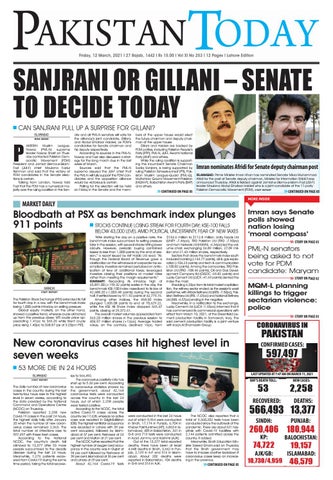
Imran nominates Afridi for Senate deputy chairman post ISLAMABAD: prime minister imran khan has nominated Senator mirza muhammad afridi for the post of Senate deputy chairman, minister for information Shibli faraz announced thursday. afridi is fielded against jamiat-e-ulema-e-islam-fazl (jui-f) leader maulana abdul Ghafoor haideri who is a joint candidate of the 11-party pakistan democratic movement (pdm). STAFF REPORT
CONTINUED ON PAGE 05
more inside
MARKET DAILY
Bloodbath at PSX as benchmark index plunges StoCkS Continue loSinG Streak for fourth day; kSe-100 fallS 911 points below 43,000 level amid politiCal unCertainty, fear of new taxeS g
KARACHI STAFF REPORT
the pakistan Stock exchange (pSx) extended its fall for fourth day in a row, with the benchmark index losing 1,000 points intraday on selling pressure. Global equity markets, on the other hand, showed a positive trend, whereas crude oil inched up from the previous close; wti crude price appreciating 1.41pc to $65.35 while brent crude price rising 1.40pc to $68.87 (as at 3:20pm pSt).
“after starting the day on a positive note, the benchmark index succumbed to selling pressure later in the session, with several stocks hitting lower circuits. however, periodic buying contained losses to less than 1,000 points by the end of session,” a report issued by arif habib ltd read. “although the federal board of revenue gave a clarification on the withdrawal of corporate tax exemptions, investors remained perturbed on anticipation of levy of additional taxes; leveraged investors closing their positions at market rates rather than meeting the margin requirements.” SUMMARY: recording its intraday high at 43,891.00 (+199.32 points) earlier in the day, the benchmark kSe-100 index nosedived to its low at 42,688.20 (-1,003.48 points) during the second half. it settled lower by 911.92 points at 42,779.76. among other indices, the kmi-30 index plunged 1,605.08 points to end at 70,629.22, while the kSe all Share index dropped 665.47 points, closing at 29,372.61. the overall market volumes appreciated from 363.20 million shares in the previous session to 404.97 million shares (+12pc). average traded value, on the contrary, declined 16pc, from
$134.6 million to $112.8 million. unity foods ltd (unity -7.46pc), trG pakistan ltd (trG -7.50pc) and hum network ltd (humnl -6.34pc) led the volume chart, exchanging 34.89 million, 27.09 million and 21.43 million shares, respectively. Sectors that drove the benchmark index south included banking (-144.77 points), oil & gas exploration (-104.23 points) and tech & communication (-100.82 points). among the companies, trG pakistan ltd (trG -108.46 points), oil and Gas development Company ltd (oGdC -69.82 points) and lucky Cement ltd (luCk -41.69 points) dented the index the most. Shedding 6.33pc from its total market capitalisation, the refinery sector ended as the session’s worst performer, with attock refinery ltd (atrl -7.50pc), pakistan refinery ltd (prl -7.47pc) and national refinery ltd (nrl -6.57pc) ending in the negative. meanwhile, in a notification to the exchange, lucky Cement ltd (luCk -1.65pc) informed that it has commenced its commercial operations with effect from march 10, 2021, at the Greenfield cement production facility in Samawah, iraq. the said cement production facility is a joint venture with iraq’s al Shamookh Group.
New coronavirus cases hit highest level in seven weeks g
Imran says Senate polls showed nation losing ‘moral compass’ STORY ON PAGE 03
pml-n senators being asked to not vote for pdm candidate: maryam STORY ON PAGE 02
MQM-L planning killings to trigger sectarian violence: police STORY ON PAGE 03
coronaviruS in
PakiStan
CONFIRMED CASES:
597,497
53 more die in 24 hourS ISLAMABAD STAFF REPORT
the daily number of new coronavirus cases in the country during the last twenty-four hours rose to the highest level in seven weeks, according to the data provided by the national Command and operations Centre (nCoC) on thursday. pakistan reported 2,258 new Covid-19 cases in the past 24 hours, the highest daily tally after january 20 when the number of new coronavirus cases remained 2,363. the total number of infections rose to 597,497 with these fresh cases. according to the national nCoC, the country’s death toll climbed to 13,377 after 53 more people succumbed to the deadly disease during the last 24 hours. meanwhile, 1,276 patients recovered from Covid-19 during the same time period, taking the total recover-
ies to 566,492. the coronavirus positivity rate has shot up to 5.36 per cent. according to coronavirus statistics shared by the government, about 42,164 coronavirus tests were conducted across the country in the last 24 hours, out of which 2,258 people were tested positive. according to the nCoC, the total active Covid-19 cases across the country are 17,628, whereas no active case was reported in Gilgit-baltistan (Gb). the highest ventilator occupancy was recorded in lahore with 39 per cent occupied, followed by islamabad at 37 per cent, peshawar at 24 per cent and multan at 21 per cent. the nCoC further reported that the highest number of oxygen bed occupancy in the country was in Gujrat at 94 per cent followed by peshawar at 39 per cent, islamabad at 36 per cent and lahore at 29 per cent. about 42,164 Covid-19 tests
LAST UPDATED AT 7:47 AM ON MARCH 11, 2021
DAY'S DEATH TOLL:
53
RECOVERED:
were conducted in the last 24 hours out of which 9,964 were conducted in Sindh, 17,174 in punjab, 6,704 in khyber pakhtunkhwa (kp), 6,863 in islamabad, 405 in balochistan, 341 in G-b and 713 tests were conducted in azad jammu and kashmir (ajk). out of the 13,377 total reported deaths, there have been at least 4,448 deaths in Sindh, 5,662 in punjab, 2,129 in k-p and 516 in islamabad. about 202 deaths were reported in balochistan, 104 deaths in G-b and 316 in ajk.
the nCoC also reported that a total of 9,360,202 tests have been conducted since the outbreak of the pandemic. there are about 631 hospitals with Covid-19 facilities with 2,144 patients admitted across the country, it added. meanwhile, Sindh education minister Saeed Ghani said on thursday that the Sindh government may have to impose another lockdown if coronavirus cases keep on increasing in the province.
CONTINUED ON PAGE 05
NEW CASES:
2,258 DEATHS:
566,493 13,377 SINDH:
PUNJAB:
KP:
BALOCHISTAN:
AJK/GB:
ISLAMABAD:
260,406 180,944 74,722 10,730/4,959
19,157
46,579
02
Friday, 12 March, 2021
LAHORE
NEWS
PML-N sENATors bEINg AsKEd To NoT voTE for PdM CANdIdATE: MAryAM ISLAMABAD
P
INP
AKISTAN Muslim LeagueNawaz (PML-N) Vice President Maryam Nawaz has claimed that the party senators are being called and asked not to vote for the Pakistan Democratic Movement’s (PDM) candidate in the Senate chairman election. In a tweet on Thursday, she claimed that the senators also have “recorded the evidence”. “Our senators are being called and asked
not to vote for PDM candidate,” Maryam said in a Twitter post this afternoon. However, the PML-N VP did not specify who was holding such conversations with the party’s members. Separately, former prime minister and PML-N Senior Vice President Shahid Khaqan Abbasi, while addressing a press conference along with other party leaders in Islamabad, said: “I want to believe DG ISPR [when he says the army has nothing to do with politics] but our senators have been complaining that they are receiving phone calls.”
ECP response sought in Murad disqualification case KARACHI: The Sindh High Court (SHC) on Thursday directed the Election Commission of Pakistan (ECP) to file by March 20 its response in a petition seeking to suspend the legislative assembly membership of provincial Chief Minister Syed Murad Ali Shah. A twojudge bench of the high court expressed displeasure over the election commission for failing to respond to the petition in time, observing: “It appears that the ECP doesn’t want to submit its response.” The ECP counsel asked the court for additional time to file its response. Sindh Advocate General Salman Talibuddin argued that the Supreme Court (SC) has already handed a verdict on the point raised in the petition which, he said, is not maintainable. He said that the petitioner is in habit of instituting such petitions and requested the court to rejects it. The petition against the Sindh chief minister said that Shah had been disqualified by the apex court on May 2, 2013, but he contested a by-election in 2014 from Jamshoro. The petitioner pleaded with the high court to disqualify him for a lifetime. INP
ECP announces by-election schedule of NA-249 Karachi West-II ISLAMABAD: The Election Commission of Pakistan (ECP) on Thursday announced the schedule of the byelection on constituency NA-249 Karachi West-II, to elect a member to fill the seat, which has become vacant due to the resignation of Muhammad Fesal Vawda. According to ECP notification, the polling will be held on April 29 and called upon the electors of the said constituency to elect a member to fill the vacant seat. The public notice will be issued by the returning officer (RO) on March 12 while the dates for filing of nomination papers with the RO by the candidates will be March 13 to March 17. The date of publication of names of the nominated candidates will be March 18 while the last scrutiny of nomination papers by the Returning Officer will be March 25. Similarly, the last date for filing of appeals against decisions of the Returning Officer for rejecting or accepting the nomination papers will be March 29 while the last date for deciding of appeals by the Appellate Tribunal April 5. APP
Other PML-N leaders present on the occasion were party spokesperson Marriyum Aurangzeb, and Senator Hafiz Abdul Kareem. “Once again, an attempt is being made today to make the election of the Senate chairman controversial,” he said. “There is still time to hold the Senate chairman election tomorrow in accordance with the Constitution.” “It is unfortunate that people whose party did not have any representation in that province were elected in the Senate elections 2018 and a person whose party di not even exist was made the Senate chairman,”
“I spoke on the last call I received wherein I was told to support the government’s candidate and not Gillani,” he said. The election for Senate chairman and deputy chairman will be held on March 12. Pakistan Tehreek-e-Insaf (PTI) has nominated Sadiq Sanjrani, the current chairman, as their candidate, while the opposition parties have expressed their support for former prime minister Gillani. PDM’s candidate for deputy chairman is Maulana Abdul Ghafoor Haideri, while PTI has named Senator Mirza Muhammad Afridi for the post.
Abbasi said. Speaking on the occasion, PML-N Senator Hafiz Abdul Kareem corroborated Maryam’s statements and claimed that he received multiple calls on WhatsApp from “unknown callers”. “I got the first call on March 6, the second on March 7 and the third one on March 9… I picked up the last one. The person who was calling requested that I should not vote for Yousaf Raza Gillani [the PDM’s joint candidate for the Senate chairman post] and instead vote for their candidate,” he said.
PTI to win top Senate slots with allies’ support: Faraz ISLAMABAD APP
Federal Minister for Information and Broadcasting Senator Shibli Faraz Thursday said that the Pakistan Tehreeke-Insaf (PTI) would win the election for the top slots of the Senate with the support of its allies. “We are fully prepared for tomorrow’s (Friday) polling for the Senate chairman and deputy chairman to the disappointment of the Pakistan Democratic Movement (PDM), which will again face defeat,” the minister added. He was briefing the media, flanked by Punjab Chief Minister’s Special Assistant Dr Firdous Ashiq Awan about the decisions taken by the PTI’s Core Committee meeting, chaired by Prime
Firdous condemns allegations levelled against na speaker and kp cm Minister Imran Khan. Faraz said that by not supporting the corrupt PDM leadership, the people had made it clear that they always backed movements to end corruption and not to the ones aimed at saving the corrupt leaders. He said that the party’s core committee expressed full confidence in Prime Minister Imran and his policies. It lauded the achievements made by the government, he added. Besides political matters, he said, the committee discussed ways and means to
strengthen the party’s structure. “The PM directed the leaders to activate the party at the grassroots level and hold regular interactions with the workers,” he added. Referring to PDM President Maulana Fazlur Rehman’s political manoeuvrings, he said that Fazl had held the so-called ‘Azadi March’ and returned empty-handed from Islamabad without achieving his motives. The government, he said, would not create any hurdle in the way of PDM as its upcoming march was deemed to fail. However, in case of any law and order
Court adjourns hearing of Ramzan Sugar Mills case till 25th LAHORE APP
An accountability court on Thursday adjourned the hearing of Ramzan Sugar Mills case against Opposition Leader in National Assembly Shehbaz Sharif and his son, Hamza Shehbaz, till March 25. Accountability Court Judge Amjad Nazir Chaudhry conducted the case proceedings. The jail authorities produced Shehbaz during the proceedings, whereas Hamza also appeared and got his attendance marked. The court questioned Hamza on whether the jail authorities got his thumb impression on bail documents at the time of release from jail. To this, the Pakistan Muslim League-Nawaz (PML-N) vice president confirmed that he did put thumb impressions on documents. At this, the court asked Hamza to verify his thumb impression on bail documents. However, Hamza stated he could not confirm whether these were his thumb impressions. Later, the court got a thumb impression of Hamza on
plain paper as well as getting his signatures on bail documents. The court observed that there was a difference in thumb impressions while reviewing both. The court observed that both impressions would be scrutinised. On this, Kot Lakhpat Jail Deputy Superintendent Usama Salamat asked the court to get the thumb impressions verified. However, Advocate Amjad Pervaiz intervened at this stage and remarked that it was inappropriate to ask the court for forensic analysis of both thumb impressions and sought unconditional apology from the deputy superintendent. At this, the court directed the deputy jail superintendent to be careful in future. Subsequently, the court recorded the statement of prosecution witness Naimat Ali whereas the defence counsel completed cross-examination from witnesses, Ghulam Mustafa and Saeed Ahmad. The court adjourned further hearing till March 25 and summoned witness Naimat Ali for cross-examination, besides directing the prosecution for producing more witnesses on the next date of hearing.
PTA directs service providers to immediately block TikTok Complying with the Peshawar High Court’s (PHC) orders, the Pakistan Telecommunication Authority (PTA) on Thursday directed the service providers to immediately block access to TikTok. In a tweet, the authority said, “In respectful compliance to the orders of the Peshawar High Court, Pakistan Telecommunication Authority has issued directions to the service providers to immediately block access to the TikTok App.” In an official statement, TikTok said that maintaining a safe and positive in-app environment is essential to the TikTok experience. “We use a combination of technologies and moderation strategies to detect and review content that violates our Terms of Service and Community Guidelines (https://support.tiktok.com/ur/privacysafety/community-policy-ur), and we implement penalties including removing videos and banning accounts when there are violations” it said. News Desk
Pakistan pushes nature protection during Covid as over 20 countries found weakening environment RIO DE JANEIRO AgeNcIes
While Pakistan and New Zealand have included nature protection in stimulus packages offered during the coronavirus pandemic, at least 22 countries enacted or proposed changes during the coronavirus pandemic that weaken environmental regulation, endangering protected areas around the globe, according to a research paper published on Thursday. Brazil, India and the United States are the hotspots of Covid-era rollbacks, said the paper, part of a wider report published by the International Union for Conservation of Nature (IUCN) on how protected areas were affected by the pandemic.
“During a time when all eyes were obviously on Covid […] you had governments reducing budgets or weakening environmental protection,” said Mariana Napolitano Ferreira, head of science at WWF Brazil and one of 150 researchers who wrote the report. The report showed that the pandemic significantly impacted protected areas around the globe beyond just rollbacks, with the crisis leading to job losses among protected area rangers, reduced anti-poaching patrols, and deaths among indigenous communities living in those lands. Ferreira said it was expected that President Joe Biden’s administration would stop rollbacks enacted by the previous administration during the pandemic, but in Brazil and India, the situation was not as clear.
situation, the law would take its due course, he warned. The minister said that a total of 99 members would cast their votes for the top slots of the Senate on Friday. The PTI and its allied parties had 47 senators, while the PDM’s claim of having the support of 52 members, including nine independents, was false, he added. The PDM leadership, he said, had psychologically accepted their defeat in the election for the two Senate seats. Firdous said that the core committee discussed the party’s reorganisation process. It also deliberated on the governance matters in Punjab and expressed its confidence in the leadership of CM Usman Buzdar. She said that the committee also discussed inflation and price hike, besides the public welfare initiatives being taken by the federal government in collaboration with the provinces. The SACM condemned the allegations levelled against the National Assembly (NA) speaker and Khyber Pakhtunkhwa (KP) chief minister for alleged horse-trading in the Senate polls.
The paper cited a proposal sent by Brazilian President Jair Bolsonaro to Congress that would allow mining and oil and gas extraction within indigenous reserves. In a video made public last May, Brazilian Environment Minister Ricardo Salles argued for deregulation of environmental protection while Brazilians were distracted by the pandemic. Regarding India, the paper cited at least 31 proposals to open up national parks and sanctuaries for infrastructure, extraction and development projects, including coal mining. A survey of more than 60 countries found that more than one in four rangers saw their salary reduced or delayed, while 20 per cent reported losing jobs due to budget cuts related to the
pandemic. Rangers in Central America and the Caribbean, South America, Africa and Asia were the most badly affected, said the report. Eight countries in the European Union have earmarked funding to expand or strengthen protected areas in the past year, the report said. Pakistan and New Zealand have also included nature protection in stimulus packages. Seventeen countries have maintained or increased their support to protected areas despite the crisis. Researchers argued that to diminish the risk of a new pandemic, countries should create new protected areas and make existing ones economically sustainable as new diseases can arise when forests and other wild areas are converted for human use. “In this moment of the economic and humanitarian crisis, we have a unique opportunity to stop and think on how to rebuild,” said Ferreira. “We have to look at (protected areas) differently.”
Friday, 12 March, 2021
LAHORE
NEWS
03
IMrAN sAys sENATE PoLLs shoWEd NATIoN LosINg ‘MorAL CoMPAss’ ISLAMABAD
P
stAff RePoRt
RIME Minister Imran Khan on Thursday regretted the loss of “moral authority” which he said was evident in recent Senate elections. In a series of tweets, the prime minister observed that states lacking a rule of law “resort to deal-making […] with the powerful criminals.” “Throughout history moral decay & corruption have destroyed states because without moral authority states cannot deliver justice,” he said. Attached with the tweets were quotes from former US army chief Gen Douglas
MacArthur, British statesman Edmund Burke, and judge Patrick Devlin explaining the relationship between government and morality. Imran said that Holy Prophet (Peace Be Upon Him) said that “many nations before you were destroyed when there was one law for the powerful and another for the weak”. His comments come a day before the election for the Senate chairman and deputy chairman seats. The government has nominated incumbent Senate Chairman Sadiq Sanjrani for a second term, while former PM Yousaf Raza Gillani is contesting from the Opposition for the chairman’s post. Separately, Prime Minister Imran on Thursday warned the opposition parties that he is not among those who “would leave the
battleground” as the Pakistan Democratic Movement (PDM) amasses support for its intended long march later this month. He said this while chairing a meeting of the PTI’s core committee where senior ministers and party leaders discussed the Senate elections and the upcoming antigovernment long march. “The objective of PDM’s long march is not to provide any relief to the masses but to seek an NRO,” said the Premier. “Neither did I ever respond to pressure before nor will I respond to it now,” he vowed. The PM stressed that the PTI was elected to power to “change the system” hence compromising with those who had looted the country is out of the question. “We have to keep all options in mind, including the
MQM-L planning killings to trigger sectarian violence: police KARACHI
texas-based activist receiving assistance From raW
stAff RePoRt
A US-based female member of the London faction of Muttahida Qaumi Movement (MQM) is planning assassinations on religious leaders to trigger sectarian violence in Pakistan, authorities said on Thursday. In a press conference in Karachi, Counter-Terrorism Department (CTD) Deputy Inspector General (DIG) Umar Shahid Hamid and a Rangers official played a video showing a woman giving instructions to an unidentified hitman and promising payment on successful completion of the killing. The woman, identified as one Kehkashan Haider, has been residing in Texas since the 1990s and is a close aide of London-based MQM founder Altaf Hussain, the officials said. An audio recording of a telephonic
conversation between Haider and a hitman was also played during the press conference wherein she tells the individual to “send his love” to the target and demanded confirmation of the attempt, adding “our life depends on it.” In a separate video, she further provided details of the payments to be made to the killer and arrangements for his security and transport while adding that he would be flown abroad after the successful assassination. Revealing Haider’s background, DIG Hamid said that she is a member of the party’s London faction (which is still loyal to Hussain) and has established target killer groups in collaboration with India’s Research and Analysis Wing (RAW) and domestic ethnic-turned-
terrorist groups, including Baloch separatist groups, to target law enforcement agencies, police and political and religious leaders in Pakistan, particularly in Karachi. He revealed that an intelligencebased operation (IBO) began in 2017 when the Sindh Rangers arrested a team of target killers with links to MQM-L. The details of the plot were uncovered jointly by the CTD and the Pakistan Rangers during the interrogation of recently arrested alleged hitmen from Karachi and other parts of Sindh. The information collected during the course of interrogations revealed that assassination teams had been reestablished under the directions of the MQM-L chief Hussain, DIG Hamid said.
possibility of fresh elections,” said the prime minister. “We have the support of the masses, hence will not back down on any forum.” Speaking about his government’s efforts to stabilise the economy, the premier said that he has, through tremendous difficulty and hard work, steered the country out of the economic crisis that it was facing. Sources revealed that the prime minister reviewed the performances of the federal and provincial governments during the party’s core committee meeting. Saifullah Niazi and Amir Kiyani briefed the Premier on the PTI’s organisational matters A week earlier, Gillani, the joint candidate of the 11-party PDM, defeated Finance Minister Abdul Hafeez Sheikh in a major setback to the government. Gillani
“These new targeted killing teams were being patronised by Kehkashan Haider,” he added. On the occasion, the Rangers official, Col Shabbir, said that the murder of the target identified by Haider possessed the potential to cause sectarian rifts. “We wanted to bring it to your [media’s] notice how these people are attempting to spread chaos in the country from abroad,” he said. The CTD has registered a case against Haider under Sections 11-H and 11-N of the Anti-Terrorism Act, 1997 pertaining to terror financing, DIG Hamid said. He observed it was “alarming” that a woman based in the United States was coordinating such illicit activities in Karachi “like a mafia don”. He announced the Foreign Ministry will “take up this matter with the law enforcement institutions of the US government”. “A clear line of financial transactions is appearing when we traced bank accounts and transactions,” he said, adding that the evidence of financial transactions for terror financing made Islamabad’s case stronger. “If there is any aspect of money laundering in this, [then] it will be investigated according to the AntiMoney Laundering Act and looked at by the FIA [Federal Investigation Agency].”
received 169 votes to Sheikh’s 164. The former prime minister’s success suggested some Pakistan Tehreek-e-Insaf (PTI) MPs revolted and did not vote for Sheikh for the key seat reserved for Islamabad. In a televised address to the nation, Imran claimed some MPs from his party had been bribed by the opposition to vote for Gillani. Two days after the contentious election, he announced electoral reforms after winning a crucial confidence vote in the National Assembly. In a charged speech following the trust motion on Saturday, the premier said his government was “doing things” to bring about substantial improvements in the country’s electoral system.
PM felicitates Muslims on shab-e-Miraj ISLAMABAD APP
Prime Minister Imran Khan on Thursday felicitated the Muslims from all over the world on the occasion of Shab-e-Miraj. “Shab-e-Miraj Mubarik to Muslims all over the world,” Imran said in a tweet posted on his social media account. Muslims across the world observe the miraculous Shab-e-Miraj (the Night of Ascent) with great devotion and zeal. Shab-e-Miraj is the holy night of the 27th day of the month of Rajab, the seventh month of the Islamic calendar.
PM directs secretaries to visit balochistan on monthly basis to resolve issues
PTI expels two Sindh MPAs over party discipline breach ISLAMABAD INP
Pakistan Tehreek-e-Insaf (PTI) on Thursday expelled its two members of the Sindh Assembly over violating party discipline by voting against the party in the Senate elections. As per details, PTI MPA elected from PS-1 Jacoababad-1 Aslam Abro and Shehryar Khan Shar, elected from PS-18 Ghotki-1 have been expelled from the party while their basic membership has also been revoked. The decision was made by the Standing Committee on Accountability and Discipline (SCAD) South Sindh. According to the committee, both the lawmakers violated party lines during the Senate polls and failed to clarify their position despite being summoned. Aslam Abro and Shaharyar Shar violated party guidelines during the Senate elections. Both the members were given the opportunity to defend themselves. After [going through] clear and concrete evidence and not having received any clarification, this matter is being wrapped,” the PTI statement said. It added that the two lawmakers’ “basic
membership should be ended and they should be expelled from the party with immediate effect”. The higher authorities have been recommended to contact the Election Commission of Pakistan for action against both the MPAs. It may be recalled that during the Senate elections, Aslam Abro and Shehryar Shar had opposed voting for Saifullah Abro in the Senate elections held on March 3, saying that the decision to give him tickets was taken by Sindh Governor Imran Ismail A week earlier, the lawmakers from the ruling PTI and the Pakistan People’s Party (PPP) had gotten into a clash after three PTI lawmakers Karim Gabol, Shehryar Shar and Aslam Abro, who raised reservations over the distribution of Senate tickets in Sindh, entered the house. Gabol had claimed prior to the elections that his party has given Senate tickets to candidates in exchange for money, adding that the Constitution of the country allows him to vote for any candidate. Abro and Shar were seen to have exited the assembly with the PPP lawmakers, and Abro had reportedly stated that it was the PTI that had kidnapped Gabol. Abro, while talking to media persons, had said
that they contested elections on their own and freedom of expression is everyone’s right. The lawmaker had said that he is and will remain a member of PTI but will cast vote for Senate elections according to his conscience. He further had said that he repeatedly asked the provincial governor to do development work in Sindh but no federal minister ever visited rural areas of the province and they do not even know the names of their MPAs. He had also claimed that the Sindh chapter of the party keeps Prime Minister Imran Khan in the dark. PTI members have raised concerns over the way the party distributed the tickets, PPP leader Nasir Hussain Shah had said after the incident. “PTI’s disgruntled members approached us and said that they won’t vote for their party,” he had claimed. “We don’t know if Gabol’s issue was planted or not,” he had remarked on the occasion. What happened in the assembly is condemnable and this should not have happened. “Gabol said that he wanted to go with his party members and no one stopped him,” Shah had added. “We believe in democracy and no one is being pressured in anyone.”
ISLAMABAD APP
Prime Minister Imran Khan on Thursday directed all federal secretaries to pay monthly visits to Balochistan to monitor and resolve the problems of the people on a priority basis. The prime minister took the decision to address the sense of deprivation in the people of Balochistan. He asked the federal secretaries to resolve issues related to their ministries, divisions, and departments. The secretaries in consultation with the Balochistan chief secretary will chalk out a programme and keep the Prime Minister’s Office (PMO) informed in this regard. Following their visits, the secretaries will send a detailed report regularly to the PMO.
no bilateral procurement agreement with india on covid-19 vaccine, clarifies Fo ISLAMABAD INP
The Foreign Office (FO) on Thursday clarified that Pakistan had not entered into any bilateral procurement agreement with India on the purchase of any Covid-19 vaccine and the supply of doses was being carried out through GAVI, the international vaccine alliance. Speaking at a weekly press briefing here, FO spokesperson Zahid Hafeez Chaudhry said, “The procurement and supply mechanism of vaccine doses is undertaken by GAVi and not the respective countries.”
Responding to a question on reports that Pakistan would receive 45 million ‘Made in India’ doses of Covid-19 vaccine, Zahid said that GAVI had offered doses to several countries including Pakistan under COVAX, the Covid-19 Vaccine Global Access as an initiative launched by the World Health Organisation (WHO) to ensure vaccine access to the world’s most vulnerable. To a question regarding an update on missing Pakistani retired army office Habib Zahir in Nepal, he said that on request of the government, Nepal had constituted a special team to look into the incident, but there was no progress in the matter so far.
The FO spokesperson mentioned that there was strong evidence pointing towards the involvement of Indian hostile agencies in the abduction of Habib Zahir, including involvement of Indian nationals who reportedly received him at Lumbini, made his hotel reservations and booked his tickets. “The abduction of Habib Zahir is a serious transnational crime which is in sharp contravention to international law, especially human rights and humanitarian law,” he said. Zahid said that the UN Working Group on Enforced or Involuntary Disappearances had also registered the case of Habib Zahir, at the request of his family.
He urged upon the relevant authorities in India to respect the United Nations and constructively engage with the UN Working Group and take necessary steps to enable the immediate release of Habib Zahir. The FO spokesperson said the resolution adopted by the Gilgit-Baltistan (GB) Assembly demanding interim provincial status was “an expression of needs and demands of the local people”. He strongly rejected the impression that the situation of GB was in any way comparable to that of Indian Occupied Kashmir (IOK), where extrajudicial killings and illegal disappearances were a norm
known to international community. Zahid said that India’s international scrutiny continued to grow as world watchdogs and foreign media spotlighted its non-compliance with human rights laws. On the Afghanistan situation, the spokesperson said that Pakistan had consistently supported the Afghan peace process including facilitation to the United States Taliban Peace agreement and subsequent intra-Afghan negotiations. “Pakistan has continued to emphasize that there is no military solution to the Afghan conflict and the only way forward is through a political process,” he said. He said that it was important for Afghan parties to continue negotiations and pursue an Afghan-led and Afghan-owned peace process.
04
Friday, 12 March, 2021
LAHORE
NEWS
PreSidenT for PreParedneSS To counTer modern warfare KARACHI
P
APP
RESIDENT Dr Arif Alvi on Thursday called for full national preparedness, based on quick information and intelligence, to effectively counter modern warfare, including cyber and intellectual, besides enhancing defence capability of the Muslim Ummah. Citing the United States' invasion of Iraq and India’s recent communication blockade of the Occupied Jammu and Kashmir, the president said the Muslims should also boost their moral values, which are important for maintaining security and glory in the world. He was addressing the upgradation ceremony of Pakistan Air Force (PAF) Air War College Institute, Faisal Base, which had begun its journey as Staff College in January, 1959 after its inauguration by former president Mohammad Ayub Khan. Alvi, who is the first chancellor of this defence institute, emphasised the importance of morality along with quality professional trainings and education.
Talking about steps to ensure strong defence system of the country, he said that the Pakistan armed forces would have to pursue each and every development in the field of defence in the world and they would have to equip themselves with modern education and technologies, besides capacity building of the defence education and training institutes, which would help them in adopting best defence strategies. Nowadays, he said, a powerful prevails in the world and Indian-Occupied Jammu and Kashmir and Palestine are its examples. The powerful nations' hypocrisy and inhuman attitude with the capacity of distant use of weaponry is a serious challenge, he added. “Pakistan always believed in peace and harmony but we must maintain our defence edge and that will only be possible by having modern weaponry. The country could not afford wars as it had to focus on social and economic issues of its people. All that could be achieved through provision of quality and modern education, and health,” Alvi said. “The Muslims have a bright history
of having advantages over the non-Muslims in the wars despite being short in number. And today is the same situation, however, similarity of weaponry is necessary.” The president said that there are many Hadiths [sayings] of the Holy Prophet Mohammad [Peace Be Upon Him], stressing on high moral values and human compassion for a better society. The Prophet [Peace Be Upon Him] had also emphasised on acquiring knowledge and education from any part of the world. Alvi said that for the respectful living, survival and progressing in today's world, the Pakistani nation needs high
patriotism with strong and sustained economy, adding that in next ten years, Pakistan would be a strong and fast progressing Muslim state on the world map. He condemned the aggressive attitude of India towards its neighbours. “India had unleashed a reign of terror and cruelties on the Muslims in the IIOJK. It always befooled the world while building its defence power,” he added. He appreciated the efforts of the PAF leadership for professional grooming of the air force. It is a matter of pleasure that the AWC Institute has become a defence degree awarding institute, he said, expressing the confidence that it would emerge as a leading international defence institute. Earlier on his arrival, Alvi was received by Deputy Chief of Staff (Training) Vice Air Marshal Aamir Masood, AWC Institute President Vice Air Marshal Zulfiqar Ahmed Qureshi and some other senior officers of the air force. Masood presented a memento to the president while Qureshi briefed him on the institute’s history, its role in defence training and future plans.
KP names first-ever climbing wall after Sadpara PESHAWAR TLTP
The Khyber Pakhtunkhwa (KP) government has named the first-ever climbing wall, built in the province, after Mohammad Ali Sadpara, Pakistan’s iconic climber who had lost his life during an attempt to climb K2. Chief Secretary Dr Kazim Niaz inaugurated the 52-foot high wall, built at Qayyum Sports Complex with a cost of Rs10 million within a period of three months. Speaking on the occasion, the chief secretary said that the government decided to name the climbing wall after Ali Sadpara to pay a rich tribute to him. He added that such facilities will also be developed at other sports complexes in the province. Earlier in the first week of February, Ali Sadpara, John Snorri from Iceland and Jaun Pablo Mohr from Chile were on the mission to scale K2 in winter but they lost contact after they started their push for the K2 summit from camp 3. There has been no clue to their whereabouts since then. Multiple rescue operations were carried out with the help of the Pakistan army’s helicopters and PAF C-130 aircraft but to no avail. On February 18, Sajid, the son of the missing Pakistani mountaineer, had declared his father dead. “Pakistan has lost a great mountaineer. My father and two other climbers are no more with us,” Sajid had said while speaking to the media in Skardu.
Third wave of Covid-19 has taken hold in Punjab: Yasmin LAHORE SHAHAB OMER
Punjab Health Minister Dr Yasmin Rashid on Thursday said that the third wave of Covid-19 has taken hold in the province as 2190 new cases of coronavirus were emerged during the past 24 hours. Addressing a press conference at the Primary and Secondary Healthcare Department (P&SHD) on Thursday, the minister informed that around 180,944 people have contracted the virus since the onset of the pandemic across the province. She talked about the current situation and said that 33 people have lost their lives due to the virus in the past 24 hours and a total of 5662 people have died so far due to Covid-19 in the province. Referring to the testing situation, the minister added that 17,174 diagnostic tests for coronavirus have been carried out in the past 24 hours while a total of 3,464,989 tests have been conducted so far. “The NCOC yesterday (Wednesday) announced new restrictions due to the alarming rise in the rate of positive cases of Covid19 across the country. According to which, all educational institutions in
the province will be closed for the next two weeks from March 15. Overall, the rate of positive cases of coronavirus in the province has reached to 6 per cent with 9 per cent in Gujranwala, 8 per cent in Lahore, 4 per cent in Rawalpindi, 8 per cent in Multan and 6 per cent in Faisalabad. The orders have been issued to close educational institutions in these districts due to increasing cases of coronavirus," she said. "The wave of new Covid-19 variants, coming from the UK, was also discussed at the NCOC meeting. The government has started vaccinating frontline healthcare workers as well as people over the age of 60 from March 10. The expo centre in Lahore has been made the largest vaccination center. Another place will be declared as a vaccination centre soon.” The minister added that during the second wave of Covid-19, contact tracings were performed on as many as 1045485 people in the province. “Since January 18 of this year, a total of 137,987 diagnostic tests have been conducted in the educational institutions of the province and out of these tests, 658 students have been confirmed positive for coronavirus so
far. Smart lockdowns have been implemented at 41 places across the province while micro-smart lockdowns have been implemented in 4331 locations. The government hospitals in Lahore are currently treating 503 patients of coronavirus and out of which, 17 patients are on ventilators. A total of 1150 patients are currently undergoing treatment across the province and out of which, 136 patients are on ventilators,” she added Meanwhile, the P&SHD secretary informed that more than 96,000 frontline healthcare workers have been vaccinated with coronavirus vaccine across the province so far. “During the past 24 hours, 4219 people over the age of 60 have been vaccinated across the province. The government considered it more appropriate to vaccinate people over the age of 60 by setting up special vaccination centres instead of sending them to government hospitals. In Punjab, 114 vaccination centres have been set up for the convenience of the people above 60 years of age, in which the staff members are performing their duties in double shifts. All persons above 60 years of age should register themselves immediately,” the secretary added.
Three bodies found near railway tracks in Lodhran LODHRAN TLTP
Local police recovered three bodies of youth near railway tracks in Lodhran on Thursday. The bodies of youth aged between 22 and 25 years were retrieved by the police near railway tracks in Shahnal area of Lodhran. After receiving the information, the police summoned forensic teams to the crime scene for the collection of evidence and probe. The police have suspected that the youth were murdered and their bodies were thrown near the railway tracks. However, the investigation will reveal the truth, they added.
ISLAMABAD: Governor Punjab Chaudhry Mohammad Sarwar and politician Munir Ahmad Khan exchange views during a meeting in the federal capital. PR
Friday, 12 March, 2021
LAHORE New coronavirus cases hit highest level in seven weeks
NEWS
PIA cUtS tArIff to fAcIlItAtE frUIt & vEgEtAblE ExPortS to MIddlE EASt
continued from page 01 For now, however, the minister said only a handful of cities have seen a rise in the coronavirus positivity ratio. “We may go towards a lockdown if the situation worsens,” Ghani said. Speaking about the closure of schools, the minister noted that vacations have been announced for educational institutes in Peshawar and some cities of Punjab on account of a spring break. He added that Sindh did not announce the vacation as there is no concept of a spring break in the province. Furthermore, Sindh’s Health Minister Dr Azra Pechuho received a coronavirus vaccine shot at a public sector hospital on Thursday. The first dose of the Sinopham coronavirus vaccine was administered to the health minister at Karachi’s Jinnah Hospital. Dr Pechuho had earlier got herself registered at 1166 helpline for coronavirus vaccination. In this regard, Punjab Health Minister Dr Yasmin Rashid has ruled out rumours of side-effects of the Sinopham Covid vaccine. Addressing a press conference on Thursday, the minister asked the private sector to import the Covid-19 vaccine if they want to. She said that the recent surge in Covid-19 cases in the province was recorded after the arrival of citizens from the United Kingdom. Dr Yasmin said that as many as 126 patients across the province are currently on ventilators due to Covid-19. Commenting on the Covid-19 vaccination drive, the minister said that the biggest vaccination centre has been established at the Expo Centre in Lahore, while so far more than 100,000 health professionals and above 4,000 senior citizens have been vaccinated against the deadly virus. “We have vaccination stock in large numbers, no need to worry,” she said. She made it clear that parks will remain closed after 6:00 pm across the province and added that the situation has compelled them to slap restrictions in the wake of Covid-19 spread. Meanwhile, Pakistan received 23 ultracold chain (UCC) refrigerators for Covid-19 vaccines storage on Thursday. The 23 UCC freezers donated by the United Nations’ International Children’s Emergency Fund (UNICEF) for Covid-19 vaccine storage reached Karachi via sea. The containers were donated by UNICEF to Pakistan following a grant from the Asian Development Bank (ADB). The modern storage containers will be used for storing the Pfizer vaccines which need ultra-low temperatures up to -80 degrees centigrade. The cold chain system in Pakistan has a capacity of -20 degrees to store temperature-sensitive commodities. The modern storage containers will be given to the Centre and provinces in most affected areas. It emerged that the containers will initially be given to the 15 most-affected cities of the country, sources said. It is pertinent to mention here that Pfizer coronavirus vaccines are likely to arrive in Pakistan during the next three months in Pakistan.
Imran nominates Afridi for Senate deputy chairman post continued from page 01 Last week, Prime Minister Imran had endorsed Sadiq Sanjrani, incumbent Senate chairman, for a second term at the top Senate post. In 2018, Sanjrani, then a little-known politician from Balochistan and backed by Pakistan Peoples Party (PPP) and Pakistan Tehreek-e-Insaf (PTI), beat Pakistan Muslim LeagueNawaz (PML-N) leader Raja Zafarul Haq to become chairman of the upper house. In 2019, he survived an unexpected no-confidence vote proposed by the joint opposition alliance, Pakistan Democratic Movement (PDM), which holds a majority in the 104-member House. Political analysts claim that many party members did not wish to see Sanjrani again as Senate chairman and wanted the party leadership to nominate an ideological party activist or member for the slot. Many also believe if the PTI did not back Sanjrani, it would have run the risk of annoying the Balochistan Awami Party (BAP), which is now the fourth largest party in the Senate and second-largest party after the PTI in the ruling coalition.
iSLamaBad
I
GHUlAM ABBAS
N order to facilitate horticulture exports, Pakistan International Airline (PIA) on Thursday slashed its freight charges for the export of fruit and vegetables to the Middle East. The airline made this decision after a detailed meet-
ing between PIA CEO Air Marshal (r) Arshad Malik, Pakistan Fruit and Vegetable Exporters, Importers and Merchant Association (PFVA) chief Waheed Ahmed and officials of Ministry of Commerce (MoC). As per official sources, PIA has revised air freight charges downward to 24 cents ($0.04 per kg -- equivalent to Rs40 per kg) for
vegetable and fruit exports to the Middle East sector (Jeddah, Riyadh, Dammam and Dubai). The airline also assured PFVA of low freight charges in the future, along with the provision of stateof-the-art ground handling facilities. The PIA CEO informed the officials that the airline has already installed a big scanning machine at Islam-
abad Airport where 100 boxes can be scanned in a single go. Same scanners would now be installed at Karachi and Lahore airports, he added. Arshad Malik also showed a keen interest in meeting with mango exporter before the start of the mango season so that close coordination could be maintained with all stakeholders.
Sanjrani or Gillani – Senate to decide today continued from page 01 Moreover, the ruling coalition has named Mirza Afridi for the post of deputy chairman. Out of six senators who were from PML-N but were elected as independents, Mirza Afridi, who was elected as independent after Nawaz Sharif was disqualified, has formally parted ways from PML-N and become a candidate of the ruling coalition. Another PML-N Senator who was elected as independent is also campaigning for Sanjrani and Mirza Afridi. The opposition parties still have a numerical majority in the Senate, while the ruling coalition is trying its best to win the election by uniting independents. According to the new updates, the opposition and the ruling coalition have almost equal numbers as Jamaate-Islami (JI) has decided to abstain from the polling being held on Friday for Senate chairman and his deputy. Out of six senators who were from PML-N but were elected as independents, Mirza Afridi, who was elected as independent after Nawaz was disqual-
ified, has formally parted ways from PML-N and become candidate of ruling coalition for the slot of deputy chairman Senate. Another PML-N senator who was elected as independent, is also campaigning for Sanjrani and Afridi. PARTY POSITION: The ruling coalition has mustered support of around 48 members of the Senate but the sources in the ruling coalition claim that one ANP senator from Balochistan, who won due to support of the PTI and BAP, would also vote for Sanjrani. This may take the total tally of the ruling coalition to 49. The PDM has the edge in numeric strength as compared to the ruling coalition as it has 52 members in the Senate. However, Senator Ishaq Dar will not be able to vote as he is in selfexile in London. The source said that few PDM senators also had assured Sanjrani who would pull a surprise for Gillani on Friday. With 19 new successful candidates, the PTI has become the largest political party in the Senate and its number has increased to 26. With Abdul Qadir, an independent member
elected from Balochistan, joining the PTI, the number has increased to 27. The number of senators of the BAP is 12. The number of independent members in the Senate was earlier eight out of which four have retired. One independent senator, Shamim Afridi, has joined the PPP, bringing the total number of independent senators to three who are supporting the government coalition. Nasima Ihsan, another independent member from Balochistan, has yet to decide. The number of senators from the MQM-P in the Senate is three. The PML-Q has one member in the Senate and so does the Grand Democratic Alliance (GDA). With the joining of an independent, the number of former senators of PPP has risen to 21. The number of PML-N Senators is now 18 while the JUI-F has five members. The ANP has two new successful senators but one of its members has won with help of the government’s votes. The National Party (NP) has two seats while Pakhtunkhwa Milli Awami Party (PkMAP), Balochistan National Party-Mengal (BNP-M) and JI have one member each.
05
corporate corner NESPAK wins 24MW hydropower project in Uzbekistan LAHORE: NESPAK, in a joint venture with DOLSAR, Turkey, has won Sustainable Hydropower Project in Uzbekistan. Dr Tahir Masood, Managing Director NESPAK, told media on Wednesday that the project will install three hydropower plants with the total capacity of 24MW in the Aksu river, Kashkadarya Region, Uzbekistan, namely Rabat Hydropower Project, Chappasuy Hydropower Project, Tamshush Hydropower Project with associated 22km 35-110 kV transmission lines, and mini-hydro units of total 1MW in aggregate capacity. Total cost of the project will be $75 million. The Joint-Stock Company “Uzbekhydroenergo” is the project executing agency. They have received financing from Asian Development Bank (ADB) for the subject project for an EPC “turnkey lump-sum” contract and for the project supervision consulting services to implement the project. The NESPAKDOLSAR Joint Venture will provide services in the role of consultants for project management, project performance monitoring, design review of technical documents and construction supervision. PReSS ReleASe
KARACHI: A high powered delegation of Etisalat Group, led by Group CEO Hatem Dowidar, meets with Federal IT & Telecommunication Minister Syed Aminul Haque. online
China eliminated extreme poverty: Governance for the people By H.E. Nong Rong, Ambassador of the People's Republic of China to the Islamic Republic of Pakistan
It is universally acknowledged that one of the huge challenges the world faces is the eradication of poverty, which has become a common goal for all humanity. As the largest developing country in the world, China, through its own persistence and struggle, has won a complete victory in the fight against poverty on the occasion of marking the first centenary of the founding of the Communist Party of China (CPC) by accomplishing the arduous task of eliminating extreme poverty, thus working another miracle in the annals of history! Over 40 years since China’s reform and opening-up, more than 700 million Chinese people have successfully shaken off poverty. Especially in the past eight years, the number of people in China lifted out of poverty has reached averagely more than 10 million per year, equal to the population of a mediumsized country. So curious as to what has dramatically elevated the livelihood of the formerly poverty-stricken Chinese people, the world community wishes to decipher the very code behind China’s success in poverty alleviation. Unarguably, it is the strong leadership of the CPC that has played the most fundamental role in achieving China's success in poverty alleviation. Since its founding in 1921, while sticking to its original mission of seeking happiness for Chinese people and achieving national rejuvenation, the CPC has strived to serve the people and rely on the people at every stage of development. Generations of top leaders of the CPC have deeply cared about its people. As President Xi Jinping once said, “During my work of more than 40 years at various levels of Chinese governments, successively from that of the county, to the municipal, the provincial and finally the central, poverty alleviation has always been my focus which consumed most of my energy.” After the 18th National Congress of the CPC in 2012, President Xi Jinping called on the whole CPC and people throughout the country
to participate in the cause of eradicating poverty under his leadership, and led the battles against poverty most largest and most fierce in human history, trying with the spirit of hammering nails to get the work concerning poverty eradication thoroughly implemented. In the process, millions of cadres and ordinary CPC members responded to the call actively, and worked in the front line for the projects of poverty alleviation, among whom more than 1800 comrades sacrificed their lives for this great cause! In view of its national conditions, China insists on eliminating the root of poverty by abiding to the law of poverty reduction and by means of sustainable development. The development since the founding of New China, especially the rapid development since the reform and opening up, has laid a solid material foundation for poverty reduction. For more than 40 years, China has made unremitting efforts to promote industrialization, urbanization and agricultural modernization. In the last mile of poverty alleviation, China adheres to the ideas of targeted poverty alleviation and development-oriented poverty reduction, in order to achieve a transfer in strategies from resorting to others to relying on itself. In addition, such attempts of empowering the people by building up their determination, helping them acquire knowledge, along with efforts of highlighting input in education are made to block intergen-
cmYK
erational transmission of poverty. China has benefited from the political advantages of the socialist system that can coordinate all resources to complete key national undertakings. It also advanced the initiative that those who get rich first should help others lagging behind. China has pooled a lot of financial, human and material resources on the main battlefields of poverty alleviation, established a top-down working mechanism from the central to the very grassroots level, the big system of collecting assistance from different regions, sectors, industries, enterprises or other sources in the society for this noble cause. In the past eight years, the financial and social assistance from nine developed provinces and cities of eastern China to less developed regions alone have reached over 100.5 billion yuan. So far no other country in the modern world can lift hundreds of millions of people out of poverty in such a short time like China, nor ever one did in history. This achievement belongs to China, and to the world as well. With these efforts, China has contributed much to the accelerated process of poverty reduction in the world, accounting for more than 70% of the global poverty reduction population, achieving 10 years ahead of schedule the poverty reduction goal of the 2030 Agenda for Sustainable Development adopted by all United Nations Member States. Under the new context, China will effectively combine its efforts of consolidating and expanding the achievements of poverty alleviation with its new policy of rural revitalization to cement the outcome of poverty alleviation and contribute more sustainable development of the rural areas. Eliminating poverty is the common mission of mankind. President Xi Jinping has repeatedly called on the international community to pay active attention to people’s rights of subsistence and development in developing countries, and make joint and unremitting efforts to build a poverty-free community with a shared future for mankind with common development. While promoting its own poverty reduction process, China has provided much assistance to devel-
oping countries within its capacity. For instance, by setting up “China-UN Peace and Development Fund” and “SouthSouth Cooperation Assistance Fund”, China have actively used multilateral and bilateral channels to help international cooperation in poverty reduction. China has carried forward the “Belt and Road Initiative”, making new contribution to the realization of the 2030 Agenda for Sustainable Development. According to the estimation in a report of the World Bank, thanks to the “Belt and Road Initiative”, 7.6 million people would get rid of extreme poverty, and 32 million would walk out of the shade of moderate poverty. China will continue its unswerving support to developing countries in eradicating poverty through economic development and improvement of people’s livelihood, to inject new impetus into the implementation of the 2030 Agenda for Sustainable Development. China and Pakistan are all-weather strategic cooperative partner. China takes Pakistan as a priority in its foreign relations. Both countries pay high attention to poverty alleviation. Prime Minister Imran Khan himself has repeatedly emphasized learning from China's experience. He said that with determination and commitment Pakistan can do the same for its people. This year marks the 70th anniversary of the establishment of diplomatic relations between China and Pakistan. China will further promote practical cooperation in various fields between the two countries, actively share experience in poverty reduction, adhere to high-quality development of the CPEC, and focus on supporting Pakistan’s industrialization and urbanization. China will also continue to deepen cooperation in education, vocational training and agricultural cooperation. During President Xi Jinping's visit to Pakistan, he said, "When brothers work together, their sharpness cuts through gold." I believe that with the joint efforts of two sides, China-Pakistan cooperation will achieve greater success for betterment of the well-being of the people of the two countries, and help build a closer China-Pakistan Community of Shared Future in the New Era.
Friday, 12 March, 2021
06 COMMENT
Focus on the Upper House
In politics nothing remains secret
The whole PPP bears watching, not just Gilani
Will the system be allowed to run freely?
t
Hat yousaf raza Gilani defeated Dr Hafeez Sheikh for the Senate had come as a shock to the ptI leadership. Subsequent petitions to challenge the victory were rejected by both the eCp and Islamabad High Court. left red-faced, prime Minister Imran Khan blamed the voters for electing Mr Gilani, whom he considered a corrupt politician. the country is losing its moral compass, the pM lamented. the Information Minister was blunter about what the ruling party would do now. Without mincing words he declared, “It can’t happen that we play Sharif Sharif and do everything according to law. We would do everything necessary for winning.” the loss of face continues to rankle the ruling party and it seems determined to do whatever it takes to regain its prestige. presiding over a meeting of his spokespersons on Monday, Mr Khan said the Chairman’s post would be won by his party despite the opposition’s majority in the Upper House. the Opposition enjoys a majority in the Senate. If everybody was to vote for their alliance’s candidate, Mr Gilani would win the Senate Chairman’s race fair and square. But since the Chairman Senate is authorised to act as the president of pakistan in the latter’s absence the post is considered to be crucial. there is widespread perception that Mr Sadiq Sanjrani, who was little known in 2018, managed to occupy the seat with the help of those who matter. a year later a joint pMl(n)–ppp assault failed to de-seat him as 14 defectors saved Mr Sanjrani in an anticlimactic Senate vote. Mr Sanjrani is a Baloch and a leading light of the Bap which has never made a secret of its being a pro-establishment party. Mr Sanjrani has all along stayed the course charted out for him. the way ptI failed to stop Mr Gilani’s victory despite hectic lobbying by the pM himself indicates its incompetence in managing electoral politics. Few would believe Mr Khan could have won the vote of confidence on his own. Mr Gilani’s victory would signal that those who matter remained neutral. to many this would come as a happy surprise. In case one saw a repeat of 2019, it would sadden those who want the country to be run according to the rules of the game.
At Penpoint M A NIAZI
A
pparently, the Opposition has read too much into the victory of yousaf raza Gilani for the Islamabad Senate seat, for apparently it wants not just to make him Senate Chairman but also wishes to bring a no-confidence motion against punjab Chief Minister Usman Buzdar. One result is that the ppp is spreading itself too thin, as its Chairman, Bilawal Bhutto Zardari, has suddenly become the pointman in the negotiations with the pMl(Q), which is finding itself in the position of being the key to both opposition efforts. While Gilani is undergoing a personal revival, the ppp hopes that his personal weight as not just a former prime Minister, but also as a former Speaker of the national assembly, will translate into his being elected Senate Chairman. the ptI is not just the largest single party in the Upper House, but it is the ruling party, and should have a majority, if all its allies are counted in. It almost seems as if the Gilani win has created a sense within the ranks of all civilian politicians, especially the opposition, that anything is possible. If the pDM members feel that Gilani can win, it indicates that the ptI might feel the same way; at least to the extent of it being a possibility that needs to be combatted, if not necessarily a certainty that must be accommodated. If the opposition manages to dislodge the ptI and precipitate a general election, in which it achieves power, it will have to deal with a Senate in which the ptI is the largest single party at least until March 2024. the opposition may need a Senate majority less than the government, for it will not be committed to change, and will have less need to legislate. the ptI came to office as a government of change, and it found that it was hampered by its not having a majority in the Senate, and thus being unable to legislate. that in turn means that any government wishing to reverse the ptI’s actions does not have any legislation to reverse. this means that a Senate majority is meant to legislate, while a national assembly majority is meant primarily to obtain power, and by retaining it through the ability to obtain a vote of confidence. One of the major problems with the present system illustrated is the difference between popular sentiment and what happens in parliament. the theory is that public sentiment is to be tested only at fixed intervals, varying from the two-year term of the US House of
Sustainable schemes? Impulses are not enough, no matter how good
p
rIMe Minister Imran Khan expressed sentiments which do him credit, while inaugurating the ‘Meals on Wheels’ scheme, which would not only convey food to anyone who needed to eat, but would also ensure that no one had to go to bed hungry, in Islamabad on Wednesday. another view of the event would be that it merely provided Mr Khan a phot-op, as well as being an opportunity for him to express sympathy with the poor. It certainly allowed him to make a ringing commitment that no one would be allowed to go to bed hungry, something which he said was all too common in the country. He also said that the scheme would be extended to other cities, after its inauguration in Islamabad. that would be a welcome commitment, had previous such poverty alleviation programmes, both by this as well as previous governments, not been unsuccessful. the present governments’ Panagah scheme, of providing shelter to the shelterless, has run into difficulties, mainly arising out of the embezzlement it has allowed, while the previous government’s Sasti roti scheme has collapsed because no one wants to follow it up. Mr Khan’s failure to announce a timeline for the extension of the scheme to other cities raises worries about its future, a worry further fuelled by a reticence about its funding. this government has been vocal about the need to sacrifice because of the shenanigans of its predecessors, but it has not spoken about the sources of funding for its welfare schemes, especially since there are massive demands on government resources, with the government not having made any resources available for such schemes. Mr Khan did point out that private donors had come forward, but no private person, even if richer than anyone in pakistan, could sustain such a welfare scheme. It should be noted too that Mr Khan has not developed trust in government, and donors are still unwilling to donate to the government. the government should stop trying to disguise its failures with such evanescent schemes. It should remember that a well-run economy, which creates jobs, is far more effective at alleviating poverty than harebrained schemes like ‘Meals on Wheels’ which shows every sign of not being thought through.
AsAd MohIb
“No one truly knows a nation unless one has been inside its jails. A nation should not be judged by how it treats its highest citizen but its lowest ones” — Nelson Mandela. (note: this is the fourth writing focusing on the three sub-systems of the criminal justice system; namely the police, the courts and the prisons. this newspaper has already carried my thoughts on the police, and the courts. this piece will be followed by my take on the role of the media as a major player in l&O.)
I
F ever it was to be decided to format a ‘civilization index’ to evaluate the quality of decency, empathy, and fair-play in national society, one of the key tests would be to evaluate how that nation treats its mental defectives, its physically-handicapped, and its prisoners. these three groups have no power to create lobbies for a better deal. they are at the mercy of the government, institutions, and the civil society. look at it anyways; the treatment meted out to the above-cited groups in pakistan is one of callous indifference. regrettably, we are a third-rate society. Do you have any argument to the contrary? I don’t think so. Because this article focuses on the state of the prison system in pakistan, a deeper analysis is as follows: Historically, the institution of the prison has its roots in the Middle ages in europe, where penitentiaries were established by certain Christian sects to ‘cleanse’ sinners. the transgressors of the ten Commandments were forced to live, usually in segregated areas of cathedrals, and were administered physical and spiritual ‘corrections’ to atone for their ‘sins’. this system continued till the 18th Century, when the state decided to implement secular philosophies of governance, and adopted imprisonment as a distinct sanction of the law. But the religious and moral undertone in corrections still echoes. In the USa, many states call their prisons ‘penitentiaries’ to this day.
Arif Nizami Editor Managing Editor
Joint Editor
Umar Aziz Executive Editor
Lahore – Ph: 042-36300938, 042-36375965
economy, but it has been careful not to commit itself to any solutions. Its components do not necessarily have a much better record than the ptI of providing better government. therefore, the pDM is relying not so much on trust as on hope. However, that is not necessarily a bad strategy. after all, that is what the ptI itself relied on in its 2018 campaign. the pDM relies on the ptI being perceived as ‘no different’. From whom? that question causes some embarrassed footshuffling and indistinct mumbles. One of the effects of Gilani’s in is that the Senate can no longer be depended on to find a seat for ‘men of business’ who wish to avoid the hurly-burly of national assembly elections. Imran has been criticised for having a large number of unelected advisers. But the attempt to have Dr Sheikh elected, as well as the successful one to get Dr Sania nishtar elected, showed that part of the reason was not being able to find seats in parliament for them. the Senate has traditionally provided a place where the ruling party could bring in ‘men of business’, and Dr Sheikh himself had been inducted in the Cabinet, ironically headed by Gilani, but had been already a member of the Senate, to which he had been elected, so that he could be brought into the Cabinet as privatization Minister. Gilani’s election is a little late, for one Indian prime Minister (Dr Manmohan Singh) chose to be in the Upper House. Of British pMs, Benjamin Disraeli was only two years into his term when he accepted elevation to the lords as earl of Beaconsfield. He was the second-last last British pM to have been a member of the lords rather than the Commons. In India, the Constitution has room for a pM from the Upper House; in pakistan, it does not. Gilani is thus entering the House as an end to his career. In that sense, the ppp needs him to win more than he does himself. Whether he wins or not, there is talk of a rupture being created within the pDM by the ptI taking the ppp into its government. this is not impossible, for it would preserve the ppp’s Sindh government. It would force the ptI into contortions about corruption, but that party has proved flexible in the past. the pDM did not oust the ptI by electing Gilani Senator, but if it gets him elected Chairman, it might persuade the powers that be that it might be time to go back to the drawing-board. and that would lose Imran all the ground he gained by obtaining a vote of confidence.
The writer is a member of staff.
Towards better law and order: — the prison system
Dedicated to the legacy of the late Hameed Nizami
Yousaf Nizami Aziz-ud-Din Ahmad
representatives to three years for the new Zealand and australian legislatures to four years for US presidents to five years for most Westminster-style parliaments (including pakistan, India and the UK). In Westminster-style systems, there is a provision for an earlier dissolution, if sentiment is to be tested earlier. However, there seems no way of changing a national assembly which has grown so exceedingly unpopular as to have exceeded its mandate, in the middle of its tenure. there may be votes of confidence or noconfidence, to change the government, but not to hold a re-election. One solution was the old article 58(2b), which allowed the president to dissolve when he felt an ‘appeal to the electorate was necessary’. Of course, that meant he disagreed with the pM on that point. and since he appointed the service chiefs in his discretion, that made him a powerful figure indeed. Do we need to go back to those days? to take an example, while fuel prices are revised fortnightly, if there is a sudden spike in fuel prices, the government can always hike prices ahead of schedule. there is no parallel arrangement for the assembly. that assembly is actually a snapshot of the opinion of the electorate on election Day; if that opinion changes rapidly before the end of the tenure of that assembly, there is no method of getting a fresh election prematurely. perhaps the reason is that there is no way of judging whether an election is needed, short of no individual can be trusted, as the experiment with the president showed. the prime Minister is trusted, because his advice to dissolve means the end of his government, and possibly the end of his political career. But he is not likely to dissolve because he is unpopular. like Mr Micawber, he is ever hopeful that something may turn up. If he had his way, there would never be an end to the tenure. the opposition, like the present one, is always certain that the government has failed and there should be a fresh election. the government disagrees: if it didn’t, the pM would advise dissolution. the underlying problem is that the ptI has lost popularity because it has not provided the answers to the problem which it was elected to solve: the economy continues to slide downhill. the ptI won the 2018 election because it had propounded the thesis that the pMl(n) and the ppp were robbing the treasury, which led to economic progress being stalled. If there was proper accountability, the economy would improve. plus the looted money would brought back. either the ptI has not carried out enough accountability, or its thesis was wrong. However, the pDM might lash out at the ptI for mismanaging the
I
Karachi – Ph: 021-35381208-9
I
although in the Holy Quran prisons are mentioned as state institutions (Sura yusuf) the Islamic system of criminal justice does not enjoin imprisonment as a punishment for criminal offences. In Islam, an offender is to be punished by a one-time physical visitation. there is great emphasis in the Quran on forgiveness, and on fines to be paid to the victims of offences. In this country there has not been much research in this area which needs to be done. the Islamic code has high regard for the human rights of both the victim, and the offender too, and orders a fair disposal of each matter; the offender pays, and thus the victim is compensated. let’s fast forward to the present. We inherited a complex system of criminal law from the British in 1947, of which the prison was an integral part. they also left behind hundreds of jails full of ‘natives’. present-day pakistan inherited 90 prisons to which we have added nine or ten. their total bed capacity is 45,000 beds. In these are housed 80,000 criminals, ranging from petty thieves to serial rapists and target killers. the cramped conditions are easy to imagine. Of these, only ten percent are convicted and serving their sentence. the other 90 percent are under trial or awaiting decisions on their appeals. nearly all, with a countable exception, belong to the fifth economic class, born into and wallowing in poverty. there are a large number of prisoners who are mentally ill, and need specialized medical attention. With the near collapse of the medical care system in this country, the psychiatrically disturbed are in any case at the back of the queue. Many poor families just dump their mentally sick members in the prisons. Drug addiction is another major evil. During the frequent time-to-time inspections, large quantities of hard drugs have been recovered which gives credence to the public perception that the drug trade is a wellorganized business within the prison system. needles to say, this cannot happen without the active participation of the jail staff. the plight of women and juvenile prisoners is probably even more heart-rending. Because there are no formal studies and research papers available to this author, one can only surmise that these are bound to be inhuman, cruel, and unjust vis-à-vis their consti-
Islamabad – Ph: 051-2204545
I
Web: www.pakistantoday.com.pk
I
tutional rights. this understanding is borne out by our lawyer fraternity which is willy-nilly involved in criminal law practice. politically and socially there is no great interest in prison reform. Our broken court system, where the district judiciary needs to keep an eagle eye on the local jail, only wakes up when there is jail riot, where again, a lot of rioting prisoners get the short end of the stick, irrespective of the reasons why they revolted in the first place. the prime Minister, as one of the cardinal objectives of governances, wishes to use the model of the prophets’ (pBUH) Medina for pakistan. So, one of the most practiced Sunnah, the pM must take a compassionate view of the weakest rung in society, which are the blighted prisoners of this unjust nation. He needs to create a national commission made up of administrators, ulema, and criminal law lawyers, headed by the pM himself. the tOrs should broadly be: a study of the demography of our prisons; under-trials who need legal assistance to pursue their case; prisoners illegally detained; social evils in the system, with particular focus on criminal behavior among staff; basic facilities needed and shortfall make-up; devising a foolproof system of prison inspections, preferably by senior media anchors, etc.etc, Criminologists of the left have averred for generations that the world-wide prison system is used, not for dispensation of justice, but by the elite of that society, to lock up and keep away the most despised class of that society based on race, creed, and economic class. Based on empirical research these experts are fixed that there are only five classes of criminals who need to be jailed for they are a threat to society at large in a compulsive-obsessive mindset. the terrorist, the violent offender, the sexual psychopath, organized property thieves, and the arsonist must be locked up and the key thrown away. all others should be under varying degrees of official control, ranging from open prisons to parole and probation. at test is the quality of our civilization as per the great nelson Mandela, quoted above. The writer is a freelance columnist
Email: editorial@pakistantoday.com.pk
Friday, 12 March, 2021
COMMENT 07 Editor’s mail Send your letters to: Letters to Editor, pakistan today, 4-Shaarey Fatima Jinnah, Lahore, Pakistan. E-mail: letters@pakistantoday.com.pk Letters should be addressed to pakistan today exclusively
Social media effects aS we know that we live in an advanced society and day by day we are becoming addicted to social media and spending most of our time on different media apps like tiktok, Instagram, youtube etc and most users are teenagers. If social media have positive aspects then it also has negative aspects as excess of everything is bad, due to covid-19 the rate of social media users have increased to about 46 million. It mainly affects students as they divert their attention from their studies and this results to their failure apart from this it has been studied that it increases the mental health issues like depression, anxiety, self- harm, suicidal thoughts. this is just because of its misuse people harm others by commenting bad, sexual abuse is most common also the crime rates are increasing like cyber bullying. people should be aware of phishing scam, be wary of oversharing and should have to spend the spare time with family and should think. We all have to be careful in using media apps and the authorities should also take better steps regarding this. Urfa Shafqat LahorE
Registering Madrassas
The 1962 Constitution and provincial diversity A look at the Constitution that split Pakistan dr rAjkuMAr sINgh
T
He constitution of Gen ayub Khan came into effect in early 1962. It had a preamble wherein it was stated that sovereignty over the entire universe belonged to almighty. the territories included in pakistan formed a Federation, in which the provinces enjoyed as much autonomy as was insisted with the unity and interest of pakistan as a whole. In the constitution an attempt was made to reconcile the regional demands of the people of east pakistan who resented their domination by West pakistan. the constitution provided for the establishment of the seat of the national assembly at Dacca and the Headquarters of the Government of pakistan at Islamabad in West pakistan. Dacca was made the second capital of pakistan. Both Urdu and Bengali were made the national languages of pakistan in order to give satisfaction to the people of east paksitan. apart from this the principles of democracy, freedom, equality, tolerance and social justice, as enunciated by Islam, were to be fully observed in pakistan. But the most important aspect of the Constitution were the powers of the president. Under ayub Khan’s Constitution the president was the sole repository of all executive powers. the president ruled the centre through a Council of Ministers and the provinces through two Governors who were selected by him. the national and provincial legislatures had no power; they could not even vote on the budget; all public expenditures were the responsibility of the president and the Governors. article 8 of the Constitution had given “the responsibility of deciding whether any action of an organ or authority of the state, or of a person performing functions on behalf of an organ or authority of the State was in accordance with the principles of policy was that of the organ or authority of the State, or of the person concerned.” the Government of pakistan, as one author put it, has emerged as a result of the ayub constitution as ‘a government of the president, for the president and by the president. though a constitutional parity between the two wings of pakistan was provided in the new structure and attempts were made to fulfil the demands of east pakistan, the latter claimed more grievances. In West pakistan, the Karachibased newspapers, Dawn, Jang and Anjam, generally supported the document in a tone which lacked enthusiasm, others launched a campaign through editorials requesting the president not to establish such unhealthy democratic conventions using, at all, such a vast power. the newspapers of the eastern wing expressed a critical tone and commented on the changeover in other countries, not naming pakistan directly. Several public figures. including Jamaat-e-Islami founder Maulana Maududi, described the Constitution as disappointing from the democratic point of view and unsatisfactory from the standpoint of Islam. But after all the new set-up gained the impression that with all its shortcomings, it had opened the only avenue for an ultimate return to democracy and should therefore be worked. they were well aware of the fate of 1956 constitution, which was wrecked, despite
all its liberal provisions. the Constitution was put into operation and in its pursuance elections were held in March 1962. the result reflected the fact that the bulk of the government supporters in the national assembly came from the West Wing while the majority of opposition members belonged to east pakistan. However, Sardar Bahadur Khan was two-in-one, leader of the opposition and brother of president ayub Khan. General ayub’s hope that the electoral college of 80,000 basic democrats would supplant the old political leadership was belied in this election, which was fought largely on partybasis affiliations. almost all the elected candidates had previous party affiliations and were either inspired or sponsored by the old politicians who were disqualified from taking an active part in politics. In the changed circumstances, political parties became an integral part of the politics of pakistan. ayub Khan himself realised it impossible to keep party politics out of the national assembly and began to think of cultivating a section of politicians and evolving a new kind of party system. He gave his pains a voice in course of addressing the first session of the national assembly on 8 June 1962, when he said the new system did not mean that he did not require in the legislature a group of determined patriotic men, inspired by his aims and ideas and willing to help him. He cleverly exploited the division in the opposition ranks and struck a bargain with those elements who were prepared to work with some changes in the system. as a result of this compromise the political parties were legalised through the political parties act of 1962. Ultimately he reconciled himself to the party system and on 22 May 1963 formally announced his decision to join the party, though he was less than happy and said that unfortunately his system has broken down at the pyramid level. In answer to the question why he has joined the party, he responded quickly, ‘I have failed to play this game in accordance with my rules and I have to play it in accordance with their rules and the rules demand that I belong to somebody.’ the experiment of limited democracy as implemented by General ayub was condemned on the ground that the electoral College was no substitute for adult franchise. It was no guarantee that
the members of the electoral College would always make sober and independent decisions. there was always a possibility of influencing them or buying them. as to the social conditions and changes, ayub’s regime had widened the gap between east Bengal and West pakistan. two Five-year plans for economic development were implemented but the eastern part gained little from these. Seventy percent of the nation’s wealth was concentrated in the hands of about 20 capitalist families of West pakistan. During the period east Bengal lagged behind in comparison to West pakistan in almost all walks of life. the constitution of 1956 was better in the sense that it established the principle of equality of opportunity for all pakistanis by prohibiting discrimination on the ground only of race, religion, caste, sex, residence, or place of birth, to the service of pakistan. though like the earlier one, the 1962 Constitution accepted the principle of parity between the two wings, its operative side had been watered down by saying that parity should as nearly as practicable be achieved. east Bengal was far behind and remained so, during General ayub’s period, especially in the import-export balance, industrialisation, banking system, employment, education, proportion in defence and civil services, etc. according to the economic Survey of asia and the Far east prepared by the eCaFe in 1966, the east pakistan Farmers, beleaguered as they are by the uncertainty of farming operations, could not derive adequate incomes from farming and the majority of them were forced to borrow at exorbitant rates of interest from money lenders and traders’. ayub himself realised the enormity of the problem of poverty in the eastern Wing and allotted rs. 5,760 million for the economic development of the province during the Second plan period. Some progress in industrialisation was also achieved but it failed to make any significant impact as a whole. thus, while West pakistan’s economy reached the take-off stage in the late 1960s, the eastern Wing remained poor and under-developed.
The constitution of 1956 was better in the sense that it established the principle of equality of opportunity for all Pakistanis by prohibiting discrimination on the ground only of race, religion, caste, sex, residence, or place of birth, to the service of Pakistan. Though like the earlier one, the 1962 Constitution accepted the principle of parity between the two wings, its operative side had been watered down by saying that Parity should as nearly as practicable be achieved
The writer is head of the political science department of the B.N.Mandal University, Madhepura, Bihar, India. He can be reached at rajkumarsinghpg@gmail.com
reGIStratIOn of seminaries and mosques is being made easier and the registration process for Madaris wil be completed ahead of new academic year, said Hafiz Muhammad tahir Mehmood ashrafi, Chairman pakistan Ulema Council, Special representative to prime Minister on religious Harmony and Middle east. talking to visiting delegates of UlemasMashaykh and minorities here on tuesday in raza Hall, Hafiz Muhammad tahir Mehmood ashrafi said rights of minorities living in pakistan have been categorically enshrined in the Constitution adding that minorities’ rights will be protected at every respective forum in accordance of the constitution. Hafiz tahir ashrafi also stated that the government is dedicated to address the issues of Masajid-o-Madaris, Ulemas-Mashaykh and religious community and endeavours are being made to address their respective issues by approaching them. He said that the new examination boards of Masajid-o-Madaris will not weaken the seminaries. registration process of Masajid-o-Madaris is being made easier and the registration process will be completed ahead of the new academic year. the government does not want to make any change in the curriculum of Madaris and negotiations are underway with the Ulemas-Mashaykh on the evacuee trust property act. the rights of minorities will be protected at every level in accordance with the constitution, said Hafiz tahir ashrafi adding that Masajid-o-Madaris are more safe comparitively to erstwhile regimes. leading Ulemas and representatives present on this occasion include Mohammad ashfaq patafi, Maulana Mohammad aslam Qadri, Maulana Mohammad aslam Siddiqui, allama anwar-ul-Haq Mujahid, Mehr abdul Khaliq Marali, Maulana abdul Malik asif, abdul Majid Wattoo, Qari abdul rashid, Maulana yaqub Sheikh, Qari Omar Usman Madani, Maulana Mohammad ahmad Maki, Maulana Qari Qasim Sangi, Mufti Muhammad Imran Muawiyah, Qari Muhammad Ijaz Malik, Maulana Bilal Saqib, Maulana ashraf, Maulana azam Shehzad, Maulana azam Farooqi. Hafiz tahir ashrafi said that conspiracies are being hatched to make anarchy and chaos in the country. He said no individual, group or organisation will be allowed to insult and excommunicate believers of other religions and religious sects. Believers in all schools of thought and religions must respect the sanctity of others believers and faithfuls. He said that the present government is the guardian of Masajid-o-Madaris and the belief in the Finality of prophethood and namoos-e-risalat. the people have confidence in Imran Khan and we invite the opposition to work together to eradicate usury, extremism, terrorism and corruption from the country. talking to media, following the meeting, Hafiz Muhammad tahir Mahmood ashrafi said that Imran Khan has proved by taking a vote of confidence that those who voted for yousuf raza Gilani have no conscience alive. He added that if the members of national assembly have opposite views then how Imran Khan secure confidence vote. SohaiL aLi Khan iSLamabad
Air pollution aIr pollution is the presence of substances in the atmosphere that are harmful to the death of human and other living beings. there are many sources that cause air pollution including smokes of vehicles, burning materials, facilities’ smokes and so on. It surprises when to listen that air pollution is a major public health problem across the world. a recent report by World Health Organization (WHO) says that air pollution was responsible for almost 10 million deaths in 2018. Overall, up to 35 percent of total deaths occur due to lung related diseases caused directly or indirectly by air pollution. However, it shocks more than that does to listen that in some undeveloped countries like pakistan, where an estimation shows about 128,000 people die annually from air pollution. pakistan with some most popular cities for air pollution is known in the world like lahore, Karachi and more, where everyday air gets worse then previous moments and a lot of people get different diseases from air pollution. SamEEr aSLam awaran
Corona trap aS everyone knows Corona virus is hunting people’s lives all over the world. But as Corona’s spread increases day by day, It also Hunts world economies.and the crude oil market crash is a live example of this economy hunt by COVID-19.pakistan’s economy is also in Corona virus trap. the trap which is created by coronavirus lock down. and due to this trap, poverty in pakistan is increasing day by day. Country is going in loss, in a great loss. Which is affecting growth rate directly. people are losing their jobs and the unemployment rate is increasing. poverty as compared to the past is much more and unemployment as well. the Government should take some serious actions to take control of this hunt otherwise we will pay for it. and our country in this situation is not ready for this. So please consider this issue. the issue about which we have to think and make suitable solutions for it. Sincerely SyEd KaShifULLah Shah iSLamabad
Friday, 12 March, 2021
08 WORLD VIEW
The hypocrisy oF india’s secular poliTy THE CENTRIST SECULAR SPACE THAT REJECTS RELIGION AS A MARKER OF POLITICAL IDENTITY IS BEING HOLLOWED OUT
HindusTan Times
a
rajdeeP SardeSai
T a media conclave in 2018, Sonia Gandhi made a candid confession. The Bharatiya Janata Party (BJP), she claimed, had managed to convince many people that the Congress is a “Muslim party”. Her remarks, in a sense, were an admission that Nehruvian secularism had failed to combat the rising tide of political Hindutva. Gandhi’s words also echoed the party’s AK Antony committee report, drafted in the aftermath of the 2014 poll debacle but never made public, that the Congress was seen as “pro-Muslim” and “anti-Hindu”. Three years later, the party’s predicament is even starker, with its secular identity once again being questioned for aligning with Muslim parties. In Kerala, the Congress’s long-standing alliance with the Indian Union Muslim League (IUML) is under the scanner with
both the ruling Left Front and the BJP targeting the party for being partial to the League’s interests. In Assam, the Congress has tied up with businessman-politician Badruddin Ajmal’s All India United Democratic Front (AIUDF), a party representing the concerns of the state’s Bengali-speaking Muslim immigrant population. And in West Bengal, the Congress is part of a Left-led alliance that includes the Indian Secular Front (ISF), a party started by Abbas Siddiqui, a cleric, whose public utterances are contentious. In each instance, the BJP has unsurprisingly been flagging these alliances to consolidate its Hindu vote bank. The nature of these alliances and the reaction to them reflect the deepening crisis within the Congress and, indeed, within mainstream secular politics. For the Congress, this is a crisis that has been building up for decades, ever since Indira Gandhi inserted “secularism” in the Preamble in 1976. Her move was driven by realpolitik, designed to consolidate her hold among the minorities while cornering her political rivals. Unlike Jawaharlal Nehru, for whom secularism was an article of faith, Indira Gandhi was guilty of practicing lip-service secular-
ism, especially after returning to power in 1980. Then be it in Punjab, Assam or Indian occupied Jammu and Kashmir, she appeared to shun the pretence of secularism in the race for votes by aligning with religious forces of all hues. Rajiv Gandhi, as prime minister (PM), put further strain on secular values by appeasing both Hindu and Muslim fundamentalists. The politics of running with the secular hare and hunting with the communal hound through the turbulent 1980s would culminate in the demolition of the Babri Masjid in 1992 and propel the BJP into a position of power. Since then, while the saffron brotherhood has gone from strength-tostrength, the Congress has struggled to find a consistent ideological and organisational response to the challenge posed by strident Hindutva nationalism. The party has oscillated between a Manmohan Singh as PM affirming that minorities, particularly Muslims, have the “first claim” on government resources to a Rahul Gandhi going temple-hopping ahead of a Gujarat election and the party asserting that he is a “janeudhari” Hindu. As a result, the centrist secular space that rejects religion as a marker of po-
B-52s in the Middle East IRAN IS NOW IN THE BUSINESS OF REFUSING TO BE SEDUCED OR INTIMIDATED. IT IS MAINTAINING, EVEN INCREASING, ITS TEMPO OF OPERATIONS IN CONFLICT AREAS
Geo PoliTical FuTures
F
GeorGe Friedman
oR all the world’s vastness and complexity, my attention is constantly drawn back to the Middle East, where there is much to think about. Last week, for example, two B-52 bombers flew over the Middle East, the fourth time since Joe Biden became president of the United States. Washington said the flybys were due to instability in the region, but the subtext was very clearly about Iran. What was more unusual about these flights than the previous was that U.S. Central Command announced that the B-52s were accompanied by supporting aircraft from Israel, Saudi Arabia and Qatar. There has been much talk about the emerging political coalition in the region, but this represents a more remarkable grouping. Israel is a U.S. ally. Saudi Arabia has been under attack by the Biden administration for human rights violations, and has been cooperating with Israel for years but has still not recognized Israel. Qatar sits across the Persian Gulf from Iran, has perhaps the closest relationship with Tehran of any Persian Gulf country, and is a key intermediary between Iran and the United States. If the purpose of these flights is to warn Iran of what it could expect in a confrontation with the United States, it likely landed flat; warnings like this wear thin the fourth time they are issued. It is hard to make the routine appear threatening. If the U.S. intends to lull Iran into a sense of complacency, then multiple missions might help, but there is very little about the United States that makes Iran feel complacent. So over time these overflights leave the status quo ante. The Iranians have become somewhat more hostile. They have launched attacks, or their proxies have, at U.S. bases in Iraq. They have also damaged an Israeli merchant vessel off the Lebanese coast while continuing to provide significant support to the Houthi rebels in the Yemen civil war. In other words, there is
no evidence that the Iranians plan to change their regional policy. The Biden administration’s pledge to revive the nuclear treaty with Iran that former President Donald Trump discarded has been rejected by Iran, which is first demanding concessions from the United States before considering returning to the treaty. Iran is now in the business of refusing to be seduced or intimidated. It is maintaining, even increasing, its tempo of operations in conflict areas. It has refused what the Biden administration seemed to assume would be a welcome concession to Iran, and it has shown (or at least feigned) indifference to the Abraham coalition that has emerged to its west. From a negotiating point of view, it seems that Iran doesn’t want to renew the treaty because it would renew inspections and perhaps reveal the advanced state of Iran’s nuclear program. or, more likely, it does not want to appear over-eager for these talks to restart. If it did, its bargaining position would evaporate. Since Biden made restoring the agreement an important objective of his presidency, the Iranians may feel that it is Biden who is desperate for a deal. Iran walking away would both confirm Trump’s view of Iran and disprove Biden’s. Appearing inflexible while hiding its program that it had agreed to allow monitoring of could create political problems for Biden, or so the Iranians calculate. Given the political and military reality Iran is trying to create, and given that the Iranians didn’t blink at the B52 flights that were seen as mere shows, the Biden administration had to shift its approach by strengthening its bargaining position without taking decisive military action. The flight of the B-52s didn’t matter. Including two of Iran’s greatest enemies – Israel and Saudi Arabia – added some to the threat, but not very much. Israel appears eager to strike Iran but sees itself as restrained by the United States. I am not sure how eager Israel is to strike because military actions can fail, and failure would undermine the credibility of Israel’s threat. Accompanying U.S. bombers would seem to increase the possibility that Israel will be unleashed. The presence of the Saudis drives home to Iran its isolation west of the Persian Gulf and the fact that it stands alone – unless Russia has an appetite for risk. But the most important component of the mission was Qatar.
Qatar is much friendlier with Iran, and it is the interlocutor in U.S.-Iranian negotiations. The willingness of Qatar to join the flight signals Qatar’s displeasure at the Iranian inflexibility, and the possibility of a break. If geopolitics ran on signals, all of this might shift Iran’s position and herald the restoration of the nuclear treaty. But geopolitics is both more simple and complex. Iran’s primary goals are to restore its economy and prevent an attack from the West. It must make certain that Iraq remains incapable of posing a threat, and therefore must do what it can to maintain instability there, or at least deny the U.S. a secure base from which to act in the region as it chooses. It can’t leave Iraq alone, nor can it abandon its allies in Yemen and elsewhere. Demonstrating real regional power is a foundation of its security. It can’t afford to appear weak to its people, yet it can’t afford to continue suffering Western sanctions. From the U.S. geopolitical point of view, Iran is a minor player, unable to affect its interests in places such as China. From a political point of view, this minor geopolitical issue has been elevated to a major issue through Biden’s attack on Trump’s policy. Iran knows its relative importance to the United States, and that gives it a sense of security. Politically, it knows that Biden, having attacked Trump for an excessively aggressive policy toward Iran, can’t follow up with a B-52 campaign, marshaling others in the Middle East – including human rights violators– to join in. That means Iran is in a good position, save for the sanctions, which it has to have removed, and which are the main American lever. Trump’s position was to impose sanctions and let Iran stew in its own juices. Unless the flybys force Iran to rapidly become flexible – which I think they will not – Biden’s options are the same as Trump’s: increase sanctions to see if Iran buckles. For Washington, it’s low risk. For Tehran, it’s existential. And so the odd flight leaves me with the sense of the power of geopolitical reality, and the difficulty of moving against it. Many political leaders encounter this moment. Breaking countries without waging war is difficult, and Iran is not worth a war to either Trump or Biden. George Friedman is an internationally recognized geopolitical forecaster and strategist on international affairs and the founder and chairman of Geopolitical Futures.
litical identity has over time been hollowed out. The Congress now finds itself caught between a rock and a hard place. Appealing to any kind of Hindu sentiment only leaves it looking like a “B team” of the BJP, an unconvincing copy of the original party of majoritarianism. The shortlived Kamal Nath-led government in Madhya Pradesh attempted this with its version of cow politics but with little resonance on the ground. on the other hand, forging alliances with smaller, Muslim-centric parties also appears like a temporary fix for uncertain electoral gains. For example, in Assam’s surcharged post-Citizenship (Amendment) Act politics, the Congress-AIUDF alliance may sweep the Muslim-dominated seats of lower Assam but will inevitably spark off a counter-polarisation in the rest of the state. In a sharply divided Bengal, a tie-up with the ISF is not only ideologically incompatible but will only further split the Muslim vote between Mamata Banerjee and the LeftCongress-ISF alliance, thereby improving the BJP’s chances. Ironically, the Left, which attacks the Congress in Kerala for its IUML partnership, has had few compunctions in
pushing for an alliance with an Islamist party in Bengal — it is these underlying hypocrisies in the secular project that have weakened it morally and politically. Sadly, the worst sufferers in the credibility crisis facing mainstream secularism have been the minorities. Isolated and demonised by the Hindutva brigade, their patriotism routinely called into question, the Rightward lurch in Indian politics has only made Muslims feel fearful and resentful. Their anxieties and grievances with secular politics have seen many younger Muslims turn to the likes of Asaduddin owaisi as potential protectors and defenders of the faith. In the recent Gujarat local body polls, for example, owaisi’s party, the All India Majlise-Ittehadul Muslimeen (AIMIM) won seven of the eight seats it contested in Godhra and emerged as the main opposition party in Modasa town. Most of these seats were previously won by the Congress. Clearly, even Muslim voters are looking for alternatives that go beyond clichéd and bogus definitions of secularism. Post-script: The BJP has attacked the Congress’s secular vision for aligning with an Islamic cleric in Bengal. However, the party happily advertises the fact that India’s most-populous state is run by a saffron-robed Hindu head priest affiliated to a religious monastery. or are the rules in vote bank politics different for different people? Rajdeep Sardesai is a senior journalist and author.
The man who knew Sahir inside out HIS WAY OF NOT LIKING A TUNE WAS TO EXHALE RINGS OF SMOKE AT THE COMPOSER’S FACE Tribune, india
T
Sumit Paul
o know a person, one has to swallow the whole world,’ wrote the ever-polemic writer Salman Rushdie. But to know a man like Sahir Ludhianvi, whose 100th birth anniversary was on March 8, even the world is not enough. one has to swallow the whole universe! Sahir remained an enigma till he breathed his last in 1980. ‘Ik muamma hoon main khud ke liye bhi/Mujhe samjhegi duniya mere jaane ke baad hi,’ (I’m a conundrum even to my own self/The world will understand me once I bid adieu to it), Sahir sent this couplet to his Jalandhar-born friend and composer Muhammad Zahoor Khayyam ‘Hashmi’. Though temperamental, Sahir interacted with all, but was taciturn. He treated most people in the film industry as acquaintances and only a couple of them as friends. Rafi, Khayyam and composer Ravishankar Sharma (popularly known as Ravi) were his friends. While pursuing a doctorate on Mohammad Rafi, I needed to interview Ravi because he had composed fabulous songs for Rafi. Since Ravi and Sahir teamed up to create music for 17-odd films, they were extremely close. Ravi told me during an interview that the day Rafi breathed his last (July 31, 1980), Sahir cried and phoned him, ‘Pheeko chala gaya.’ Sahir was perhaps the only man in the film industry who called Rafi by his sobriquet ‘Pheeko’ as both the greats were originally from Punjab. Rafi was from Kotla Sultan Singh in Amritsar. So shaken was Sahir by his younger friend’s death that he lost zeal for life and followed suit after three months. A chain-smoker, Sahir smoked even while eating. His way of not liking a tune was to exhale rings of smoke at the composer’s face because he insisted that the film score should be composed for his lyrics and not the other way around. Sahir was almost a misanthrope who disliked directors and producers, narrating the background for the songs he was supposed to write. He’d say rather tersely, ‘15 minute se zyada nahin’. Throughout the sessions, he smoked and looked bored. But that bored genius would write, ‘Man re, tu kaahe na dheer dhare’ (Chitralekha, 1964) or ‘Sansaar ki har shai ka itna hi fasana hai’ (Dhund, 1973). Sahir would tell Ravi, ‘Filmon ke liye gaane likhna doyam darje ka kaam hai’ (writing songs for films is a mediocre task). He hated the ‘condescending’ label of a lyricist because he considered himself a poet and nearly left Bombay in 1965 at the zenith of his career, when he got to know that despite including his immortal creation, ‘Man re, tu kaahe na dheer dhare’ in the syllabus of MA Urdu at Calcutta University, the Senate decided to remove it because it was a film song! His finest creation was included as a part of South Asian literature by the University of Reading in South England in 1980. Alas, the poet-lyricist had already left the world. Though over four decades have elapsed, Sahir’s poetry still stirs the hearts and minds of listeners.
Friday, 12 March, 2021
BUSINESS 09
LAHORE corporate corner
RemittanCeS Remain above $2bn foR ninth ConSeCutive month ISLAMABAD
LAHORE: The Bank of Punjab has signed memorandum of understanding with EXIM Bank of Pakistan Limited in order to support the development of business structure in EXIM Bank. Pr
W
StAff rEPort
ORKERS' remittances remained above $2 billion for the ninth consecutive month in February, according to data released by the State Bank of Pakistan (SBP) on Thursday. Remittances received in February amounted to $2.266 billion, which was almost at the same level as the previous month and 24.2 per cent higher than the corresponding period of the last fiscal. Workers' remittances were recorded
at $1.82 billion in Feb 2020. On a cumulative basis, workers' remittances clocked in at $18.7 billion during the first eight months (July-February) of the current fiscal year (FY21), up 24.1pc from the corresponding period of last year. A large part of this inflow was sourced from Saudi Arabia ($5 billion), followed by United Arab Emirates ($3.9 billion), United Kingdom ($2.5 billion), United States ($1.6 billion) and Saudi Arabia ($532.6 million). Remittences from Dubai, Abu Dhabi, Sharjah, Bahrain, Kuwait, Qatar, and Oman were recorded at $429 million, $51.7 million, $5.2 million, $38.2
million, $71.8 million and $82.3 million, respectively. It may be noted that remittances from Pakistani workers employed abroad amounted to $2.3 billion in January 2021. Sustained increase in remittances largely reflects the growing use of banking channels that is attributed to continued efforts by the government and the central bank to attract inflows through official channels, the SBP had said at the time. Limited cross-border travel due to a second wave of coronavirus pandemic, and a flexible exchange rate regime also
boosted remittances, it added. “Travel restrictions and introduction of digital apps for transferring money are the main reasons behind higher remittances among others,” Samiullah Tariq, head of research and development at Pakistan Kuwait Investment Company, told Reuters. Pakistan had received record $23 billion in remittances in 2019-20. “On a cumulative basis, workers’ remittances increased to a historic high level of $23.120 billion during FY20, witnessing a growth of 6.4pc over $21.739 billion during FY19,” the SBP had said.
ECNEC approves 12 projects worth Rs267 billion ISLAMABAD SHAHZAD PArACHA ISLAMABAD: Etisalat Group CEO Hatem Dowidar on Thursday visited Pakistan Telecommunication Authority (PTA) headquarters, where he met PTA Chairman Maj General (r) Amir Azeem Bajwa to discuss investment opportunities in ICT sector of Pakistan as well as future plans of Etisalat Group, PTCL and Ufone. Pr
LAHORE: FrieslandCampina Engro Pakistan Ltd (FCEPL) participated in the International Women’s Day celebration at the University of Education. FCEPL Scientific & Regulatory Affairs General Manager Dr Muhammad Nasir addressed the audience on the occasion. Pr
KARACHI: Special Assistant to PM on Petroleum Nadeem Babar and Petroleum Secretary Mian Asad Hayaud Din recently visited the PSO head office in Karachi. PSO CEO & MD Syed Muhammad Taha and the company's senior management welcomed the honorable guests. Pr
The Executive Committee of the National Economic Council (ECNEC) has approved approves 12 projects worth Rs267 billion. The ECNEC meeting was held under the chair of Finance and Revenue Minister Dr Abdul Hafeez Shaikh on Thursday to delibarte upon projects related to health, communications, irrigation, disaster management, livelihood support, locust control and water supply. According to a press statement, the cabinet forum approved the Locust Emergency and Food Security (LEAFS) Project at an estimated cost of Rs31.6 billion ($200 million). The LEAFS Project will respond to food security threats caused by locust across all provinces. World Bank will be the sponsor of this project. The project will strengthen the Department of Plant Protection (DPP) and also enhance the capacity of Provincial Plant Protection Departments. LEAFS is expected to be completed in three years. Meanwhile, a summary was presented before ECNEC regarding 'Khyber Pakhtunkhwa Human Capital Investment Project (Health Component)', to be sponsored and executed by the KP Department of Health and funded by the World Bank - IDA (Rs13.26 billion). The project envisages to improve the availability, utilisation and quality of primary healthcare facilities in four districts of KP and would cover the local population of about 8.4 million and 500,000 refugee population. After due deliberation, the committee approved the project with the direction that the KP government would be responsible for the smooth implementation and working of the project after its completion. The forum also approved a summary regarding the construction of additional two lanes and widening/rehabilitation of the existing two-lane carriageway of the Shikarpur-Rajanpur section of Indus Highway N-55, to be executed by the National Highway Authority (NHA). The project would be sponsored by the Ministry of Communications and Asian Development Bank with a total cost of Rs44.7 billion (GoP: Rs4,470.390; ADB: Rs40,233.50). Moreover, a summary was placed before the
ECNEC regarding the construction of a 69km-long (four-lane) Sambrial-Kharian Motorway. It will be a high-speed toll road facility which will start from Sambrial city and end on Lahore-Sialkot Motorway. The motorway will be constructed on a BOT basis at a cost of Rs43.38 billion. The project shall be sponsored by the Ministry of Communications and executed by NHA. ECNEC also approved a summary regarding '10,000 Kanal land acquisition for Swat Motorway (phase-II)', to be sponsored by the KP government and executed by Pakhtunkhwa Highway Authority (PKHA) through federal PSDP equal to Rs20 billion for construction of about 80km four-lane motorway from Chakdara to Fatehpur. The committee strongly recommended the KP government to complete such projects on public-private partnership (PPP) modes. Furthermore, the chair approved the Sindh Resilience Project (Irrigation Component) for construction of small dams to address drought-prone areas of Sindh, including Malir (Karachi), Jamshoro, Thatta, Shaheed Benazirabad, Sukkur, Khairpur, QambarShahdadkot and Tharparkar. The project shall be sponsored and executed by the Sindh Irrigation Department. The source of funding includes Sindh's share of $11.50 million (7.5pc) and a WB loan of $141.51 million (92.5pc) with the total cost of the project amounting to $153.01 million (Rs24.49 billion). Likewise, the forum approved the ‘Balochistan Integrated Water Resources Management and Development Project (BIWRMDP)’, to be sponsored and executed by the Balochistan Irrigation Department. The project will increase agricultural production, generate employment opportunities and develop the agrobased industry through Integrated Water Resource Management across 11 districts of Balochistan. The proposed project is funded by the World Bank – IDA (up to 96pc) and the Balochistan government (up to 4pc), amounting to Rs14.74 billion in total. The project is expected to be completed in six years. ECNEC approved another project in the water sector in Balochistan province titled 'Basol Dam Project' on the Basol River. The project would be sponsored by the Ministry of Water Resources and executed by the provincial irrigation department at a
cost of Rs18.67 billion. The committee also considered and approved the 'Nai Gaj Dam Project (2nd revised PC-I) for Dadu, Sindh' at a cost of Rs46.98 billion. WAPDA and Sindh Irrigation Department will be the executing agencies for the proposed project. The main objective of the project is the conservation of the available flood flows up to a gross storage capacity of 0.30MAF and power generation of 4.2MW. It will also help in the irrigation of 56,739 acres, besides controlling soil erosion on the downstream side of the dam. Among other agenda itms, the establishment of 48MW Jagran Hydropower Station (Phase-II) in district Neelum, AJK, was approved by ECNEC at (a 2nd revised cost of) Rs11.37 billion. The project will be sponsored by the Ministry of Kashmir Affairs and Gilgit-Baltistan and executed by Power Development Organization, AJK. The project is being constructed on the intermediate stretch of Jagran River and will generate annual energy of 212.43GWh. The 'Sindh Resilience Project (PDMA Component)' was approved at a revised cost of Rs15.3 billion. Provincial Disaster Management Authority-Sindh will be the executing agency for the project, which has been designed to cover 29 districts of the province and is expected to be completed by 2024-25. In addition, ECNEC approved the 'Gwadar–Lasbela Livelihood Support Project, Phase-II (GLLSP-II)' to cover all 45 union councils in Gwadar and Lasbella districts of Balochistan for community development and fisheries value chain development. The total cost of the project will be Rs12,328.549 million. The Project will be executed by the Communications & Works Department, Fisheries Department, Planning and Development Department, Government of Balochistan through a dedicated Project Management Unit (PMU). It is expected to be completed in 06 years. Lastly, the committee okayed the 'Greater Karachi Water Supply Scheme (K-IV) 260 MGD (Phase-I)' to provide an additional 650MGD water to meet the demand of the port city. Karachi Water and Sewerage Board and WAPDA shall be the executing agencies for the project. The total cost of the project will be Rs25,551.77 million which will be shared on a 50:50 per cent basis by the Centre and Sindh, respectively.
Punjab eyes wheat output of over 20m tonnes SBP reserves rise $37.7m to $13bn
ISLAMABAD: The second edition of HUM Women Leaders Award concluded recently at the Aiwan-e-Sadar. The awards ceremony was graced by chief guest, President Dr Arif Alvi, dignitaries and crème de la crème of the entertainment industry of Pakistan. Pr
The Punjab Agriculture Department has claimed that Punjab is likely to achieve its wheat production target of 20.62 million tonnes this season. According to a local media report, an official of the Punjab Crop Reporting expressed confidence in the aim even though climate change deprived the province of rains for two months — January and February. The official explained that the situation is under control as the temperature remained lower retaining enough moisture for the growth of grain, while the area under the crop increased as compared with the last year. Similarly, there were no reports of yellow rust attacks on a crop from
anywhere in the province. Furthermore, an increase in minimum wheat support price from Rs1,400 to Rs1,650 and then to Rs1,800 per 40kg, when the sowing season had set in served as an added incentive to the growers to focus on the grain. It may be noted here that the private sector will not be allowed to enter the market until the department achieves its procurement target. Moreover, the government has already allowed the import of wheat both by the public and private sector for meeting any eventuality like heavy rains or high temperature before harvesting which may shrivel the grain. NEWS DESK
Car sales up 55pc YoY in February
KARACHI: IGI Life Vitality has recently won the ‘MAXIS Global Benefits Network Underwriting Champion Award 2020’ from MAXIS GBN at the MAXIS Member Awards 2021 for Asia Pacific Region. Pr
The sale of passenger cars, including KIA vehicles, increased 55pc year-on-year in February 2021. According to data released by the Pakistan Automotive Manufacturers Association (PAMA), Pak Suzuki Motor Company Ltd (PSMC) once again took the lead with a massive 66pc YoY increase in sales. PAMA attributed this growth to a 162pc surge in Alto and 106pc increase in Ravi sales, with Alto sales clocking in at
4,245 and Ravi at 1,268. Among other industry leaders, Honda Atlas Cars (Pakistan) Ltd (HCAR) registered a 13pc YoY increase in sales, whereas Indus Motor Company (INDU) reported a 3pc YoY drop. New entrants into the country's auto space, Hyundai Nishat and Lucky Motor (KIA), sold 651 units and 2,500 units in Februray 2021, respectively. Meanwhile, on a month-on-
CMYK
month basis, sales of passenger cars declined 6pc in February 2021 as compared to January 2021. "The decrease came on the back of decline in INDU sales (-20pc MoM), which was largely due to seasonally high January sales and some supplyside disruptions," PAMA stated. In the motorbike category, Atlas Honda Ltd (ATLH) sold 104,005 units in Feb 2021, up 16pc YoY. NEWS DESK
ISLAMABAD: The foreign exchange reserves held by the central bank increased by $37.7 million on weekly basis, according to data released by the State Bank of Pakistan (SBP) on Thursday. On March 5, the foreign currency reserves held by the SBP were recorded at $13,016.1 million compared with $12,978.4 million in the previous week. According to the central bank, the increase came on the back of official inflows. APP
Standard Chartered launches agri-entrepreneur programme in Pakistan KARACHI: Standard Chartered Bank is launching an agrientrepreneur programme in Pakistan to support young people recover from the economic impact of the Covid-19. The programme is part of ‘Futuremakers by Standard Chartered’, the bank’s global initiative to tackle inequality by promoting economic inclusion for young people, including those affected by Covid-19. Delivered by the British Asian Trust with funding from the Standard Chartered Foundation, the 18-month programme will provide specialised skills training, mentoring and networking support to 1,000 young people between 1935 years in rural and peri-urban areas of Punjab and Sindh. British Asian Trust will work with these young people – of whom nearly 90pc are women – to grow profitable and sustainable agricultural enterprises by developing and selling products in agriculture value chains with strong local potential. PrESS rElEASE
Friday, 12 March, 2021
10 FOREIGN NEWS
LAHORE
MyanMar junta accuses suu KyI of taKIng brIbes as eIght KIlled In antI-coup protests YANGON
M
AGENCIES
yANMAR’S military government on Thursday alleged that deposed leader Aung San Suu Kyi had accepted illegal payments, while eight people were killed when security forces opened fire on protests against the coup, witnesses said. Rights group Amnesty International accused the military of adopting battle tactics against demonstrators. Six people were killed in the central town of Myaing when security forces fired on a protest, a demonstrator who helped carry bodies to hospital told Reuters by telephone. A health worker there confirmed all six deaths. “We protested peacefully,” the 31-yearold man said. “I couldn’t believe they did it.” One person was killed in the North Dagon district of the biggest city of yangon, witnesses said. Photographs posted on Facebook showed a man prone on the street, bleeding from a head wound. One death was reported in Mandalay.
Before Thursday’s deaths, an advocacy group, the Assistance Association for Political Prisoners, had said more than 60 protesters were killed and about 2,000 people detained by security forces since the February 1 coup against Suu Kyi’s elected government. Amnesty International accused the army of using lethal force against protesters and said many killings it had documented amounted to extra-judicial executions. “These are not the actions of overwhelmed, individual officers making poor decisions,” said Joanne Mariner, Amnesty’s director of crisis response. “These are unrepentant commanders already implicated in crimes against humanity, deploying their troops and murderous methods in the open.” Junta spokesman Brigadier General Zaw Min Tun told a news conference the security forces were disciplined and used force only when necessary. The unrest was not a situation that should be of concern to the international community and the West was making assumptions that were incorrect, he said. The military has previously said it is acting with utmost restraint in handling what it
Indonesia bus carrying school children plunges into ravine, killing 27
describes as demonstrations by “riotous protesters” whom it accuses of attacking police and harming national security and stability. Zaw Min Tun also said Suu Kyi had accepted illegal payments worth $600,000 as well as gold while in government, according to a complaint by Phyo Mien Thein, a former chief minister of yangon. “He strongly said that,” the spokesman said. “We have verified those facts several
Shock and uncertainty after death of Ivory Coast PM Bakayoko ABIDJAN AGENCIES
JAKARTA AGENCIES
A bus carrying school children and some parents returning from an excursion plunged into a ravine on the Indonesian island of Java on Wednesday night, killing 27 people, the country’s transportation ministry said. The search and rescue agency said in a statement on Thursday that the driver of the bus lost control shortly before the crash in an area near the city of Sumedang in West Java province. The transportation ministry said the bus was carrying junior high school students and some parents and that 39 people had survived. Photographs from the scene showed the bus had ended up on its side with rescue workers trying to search for any more victims. Supriono, a local search and rescue agency official, said later evacuation efforts had been completed and survivors taken to a nearby hospital. The exact cause of the crash was not immediately clear, though the ministry said there were initial indications that the vehicle’s road worthiness tests were not up to date.
times. Now the anti-corruption committee is continuing the investigation.” Aye Ma MaMyo, a member of the dissolved parliament belonging to Suu Kyi’s National League for Democracy, rejected the claim. “It is no longer uncommon to see slander against politicians and efforts to crush the party while innocent young people are killed in public,” she told Reuters in a message. UN FAILS TO CALL TAKEOVER A
COUP: The army has justified taking power by saying that a November election, overwhelmingly won by Suu Kyi’s party, was marred by fraud - an assertion rejected by the electoral commission. Zaw Min Tun also reiterated that the military would only be in charge for a certain period before holding an election. “We are on the road to authentic democracy,” he said. The junta has previously promised a new election within a year, but has not set a date. The UN Security Council on Wednesday condemned violence against protesters and urged the army to show restraint. But language that would have denounced the military takeover as a coup or threatened possible further action was removed from the British-drafted text, due to opposition by China, India, Russia and Vietnam. UN Secretary-General Antonio Guterres said he hoped the Security Council statement would push the military to realise it “is absolutely essential” that all prisoners are released and the results of the November election are respected. In Myanmar, state media said the junta had removed Arakan Army (AA) insurgents from its list of terrorist groups because the faction had stopped attacks in order to help establish peace across the country. The move comes as the army struggles to restrain daily protests against the coup. The AA, which is fighting for greater autonomy in the western state of Rakhine, had become one of the most formidable forces in challenging an army that has been fighting various ethnic wars for seven decades.
Ivory Coast faced shock and uncertainty on Thursday following the death of Prime Minister HamedBakayoko, the West African nation’s second premier to die in office in less than eight months. A close ally of President AlassaneOuattara, Bakayoko, who died of cancer a few days after his 56th birthday, was appointed prime minister in July 2020 after the death of his predecessor AmadouGonCoulibaly, Ouattara’s handpicked successor. Although Ouattara named his chief of staff Patrick Achi as interim prime minister on Monday while Bakayoko was in hospital, Bakayoko’s passing leaves a vacuum for Ouattara to fill as he continues his search for a potential successor. “It will be difficult to replace him because of his standing, his way of doing things,” Abdijan resident Maturin Bamouni said. “Even when they are not from his political side, he still managed to sort things out.” A central figure in Ivorian politics over the past two decades as the country was plunged into a prolonged conflict and a partition, Bakayoko, a jovial character with roots in media and showbiz, emerged as a conciliatory figure, able to talk to all sides of the conflict. “Bakayoko meant everything for Ivorians, a minister who listened to the whole population, even the opposition,” Abdijan resident Kevin Bigore told Reuters. His capacity to gain the trust of all sides including former rebel soldiers who staged a series of mutinies in 2017, threatening a fragile peace in the world’s top cocoa producing nation, saw him appointed as defence minister in 2017, and kept the portfolio when he became prime minister. He ended the mutinies and carried out reforms that
helped keep soldiers away from the political scene during the October 2020 presidential election, said Abidjan-based historian and military analyst Arthur Banga. “He succeeded in building trust between the soldiers, the chain of command and the regime, which contributed a lot to the stability observed from 2017 until now,” Banga said. Guillaume Soro, a former rebel leader who later
led a government with Bakayoko as a minister before falling out with the current government, said he had lost a friend and a brother. “The circumstances of life have unfortunately led us to take different political paths, opposed and sometimes conflicting, but we have known, above all, to keep and preserve our brotherhood and our mutual affection,” Soro said.
'We're not racist', says Prince William after Meghan and Harry interview LONDON AGENCIES
Prince William denied on Thursday that Britain’s royals were racist after Meghan, wife of his younger brother Harry, said one unnamed member of the family had asked how dark their son Archie’s skin might be. Meghan, 39, made the allegation during an explosive tell-all interview that she and Harry, 36, gave to Oprah Winfrey and which was aired on Sunday, plunging the British monarchy into its biggest crisis since the 1997 death of Princess Diana, William and Harry’s mother. On a visit to a school in east London, William said he had not talked to Harry since the interview was broadcast just over three days ago. “I haven’t spoken to him yet but I will do,” William, 38, said. Asked by a reporter if the royal family was racist, William said: “We’re very much not a racist family.” In the two-hour show, nearly three years after their star-studded wedding in Windsor
Castle, Meghan said the royals had ignored her pleas for help while she felt suicidal. Harry said his father, heir-to-the-throne Prince Charles, had let him down and that he had felt trapped. On Tuesday, Buckingham Palace issued a statement on behalf of 94year-old Queen Elizabeth, the princes’ grandmother, in which she said the family were saddened by how challenging the couple had found the last few years. But it was the couple’s accusation that one of the royals had made a racist comment which has dominated coverage and has the potential to cause lasting damage to the 1,000-year-old monarchy. WHO SAID IT? Meghan, whose mother is Black and father is white, said while she was pregnant with Archie there were “concerns and conversations about how dark his skin might be when he’s born.” Neither she nor Harry said who had made the remark, although Winfrey later clarified that Harry had said it was not the queen or her 99-year-old husband Philip, who has been in hospital for three weeks
while the crisis unfolds. “That conversation, I’m never going to share,” Harry said during the interview. “But at the time, it was awkward. I was a bit shocked.” In the statement from the queen, the palace said issues of race were concerning and would be treated very seriously, but pointedly stated “some recollections may vary”. The Palace has said that it was a family matter that should be dealt with privately. The interview, watched by 12.4 million viewers in Britain and 17.1 million in the United States, has proved divisive among the British public. For some, Meghan’s accusations confirmed their belief that the monarchy is an outdated and intolerant institution, while others decried it as a selfserving assault that neither Elizabeth nor her family deserved. The crisis over Meghan and Harry comes a year after his uncle Prince Andrew was forced to quit royal duties following a disastrous TV interview to explain his friendship with late US financier Jeffrey Epstein, who killed himself in a US prison while awaiting
trial on sex trafficking charges. Polls show the division has fallen mainly down generational lines, with those aged over 65 backing the queen and the senior royals, while younger people supported Harry and Meghan. The divided response - part of what commentators say is a wider “culture war” waging on social and traditional media - was exemplified by reactions to pugnacious presenter Piers Morgan losing his high-profile breakfast TV slot after saying he did not believe Meghan. His remarks had attracted 41,000 complaints to Britain’s media regulator. MEDIA BACKLASH: The couple, who quit their royal roles to move to California last year, have also spoken out about what they say is press reporting tainted by racism, and Harry said his family had failed to call out “colonial undertones” in articles. “That hurts, but I also am acutely aware of where my family stand and how scared they are of the tabloids turning on them,” Harry, who said the tabloids’ behaviour was
a major reasons why he had left Britain, told Winfrey. The couple’s criticism of the media prompted a rebuttal from the Society of Editors, which represents many of the tabloids, saying it was “not acceptable” for the couple to make claims of racism in the press “without supporting evidence”. However, its head, Ian Murray, stepped down over those comments after being accused of trying to defend racism, which he denied. Also worryingly for the monarchy in the long term, surveys have indicated that the popularity of the Elizabeth’s heir Charles, 72, has also fallen amid the crisis. During the interview, Harry also laid bare how distant he had become from the other members of his family, saying his father had stopped taking his calls at one point, and that there was “space” in his relationship with William. “Much will continue to be said about that ... as I said before, you know, I love William to bits, he’s my brother, we’ve been through hell together and we have a shared experience,” he said. “But we’re on different paths.”
Friday, 12 March, 2021
SPORTS 11
LAHORE
AfgHAniStAn BAtSmen SHine in SeCond ZimBABwe teSt ABU DHABI
H
AGENCIES
ASHMATuLLAH Shahidi became the first Afghanistan batsman to score a double-hundred, and joined his captain Asghar Afghan and Rahmat Shah as the only three players from the country to reach triple figures in Tests, as Afghanistan piled on the fifth-highest total in Abu Dhabi. On a flat pitch, Afghanistan breached 500 and set several other batting records including the Shahidi's feat came in his comeback series, after he was dropped for Afghanistan's Test against West Indies in November Zimbabwe 2019 amid criticism that 50 for 0 (masvaure 29 he scored too slowly and not out, KasuZa 14 not was susceptible to the short ball. He showed out) trail afghanistan 545 none of those tenden4 dec (shahidi 200 not out, for cies in this match, with a perfectly paced inafghan 164, Zadran 72 nings that compleseamers and spinners , Jamal 55 not out) by 495 and mented Afghan's Zimbabwe were reruns wicKets aggressive approach, and duced to spectators for navigated Zimbabwe's most of the day. They started three-pronged pace attack well and squeezed Afghanistan (which includes the more than twoin the first hour, with just 23 runs metre tall Blessing Muzarabani whose de- coming off the first 12 overs. fault length is shorter than most) with ease. Muzarabani adjusted his length to bowl There was little to work with for both fuller than usual and Victor Nyauchi found
some early movement but once Afghan and Shahidi had seen them off, runs flowed and milestones were ticked off. Shahidi, who had been on 86 overnight, reached his hundred with a drive through point and after getting there, took boundaries off Donald Tiripano and Sean Williams. Zimbabwe had the opportunity to get rid of him shortly after that when, on 112, Shahidi
drove a ball back to Williams that he could have taken at shoulder height but he got fingertips to it before the ball tumbled out. Williams created another chance in his next over, when Afghan on 124, sliced a drive to point. Kevin Kasuza should have taken a simple grab but could not hold on. Instead, Afghan went to reach 150 with a single to deep backward square and
seemed set for many more. With Afghan scoring largely on the on-side and Shahidi dominant on the off-side, Zimbabwe struggled to plug the gaps. Their only other success came when Sikandar Raza trapped Afghan lbw with a delivery that pitched on middle and would have gone on to at least clip leg stump. At that point, he held Afghan was in possession of Afghanistan's highest individual score, 164. Shahidi's 150 followed soon after and he drew level with Afghan when he sent a Williams' full toss to long-on before overtaking his captain with a single in the same area. He and Nasir Jamal took Afghanistan into the third session and accelerated their scoring slightly as thoughts of a declaration loomed. Shahidi took Afghanistan to 500 by belting Ryan Burl through the covers and Jamal brought up his first Test fifty off 86 balls before Shahidi's magic moment came. He reached 200 off the 443rd ball he faced, with a nudge behind square. Jamal was celebrating even as he completed the run and Shahidi joined in soon after. Though the match is being played behind closed doors, he received a standing ovation from his team-mates and the support staff. Afghan called his batsmen in immediately after, leaving Zimbabwe with 17 overs to navigate to the close of play. They survived unscathed and their opening pair put on 50 to keep the run-fest going. But, their time in the middle was not without its nerves. Kevin Kasuza survived two chances, first when he was on 1 and he pulled Afghanistan's lone seamer Sayed Shirzad to midwicket. Amir Hamza spilled the chance and had to leave the field with an injury. Hamza returned in the next over with strapping on the middle finger of his right hand and had a convincing lbw appeal against Kasuza but Aleem Dar was not convinced.
manchester city bounce back to overpower southampton with five goals LONDON AGENCIES
Manchester City coach Pep Guardiola praised his players’ powers of recovery to beat Southampton 5-2 despite being denied a blatant penalty when the game was delicately poised at 1-1. City are now 14 points clear at the top of the Premier League as they close in on a third title in four years. A 21-game winning run for Guardiola’s men came to an end against Manchester united on Sunday. But City offered the second-placed Red Devils little extra encouragement that there was a route back into the title race as Riyad Mahrez and Kevin De Bruyne both struck twice. Guardiola, though, was still furious after VAR did not intervene when Alex McCarthy wiped out Phil Foden after overrunning the ball. The England midfielder tried to stay on his feet to tap into an empty net, but, after the chance slipped away, VAR did not tell referee Jon Moss to review the incident. “Jon cannot see it but that the VAR is there and don’t whistle the penalty is incredible,” said Guardiola. “You know after four years I don’t talk about the ref-
erees, but this action is incredible. “Maybe one day they will explain us really the rule for all the players, managers. “That’s why I am proud because in this club, I don’t know in others, what we have done in these past years we won it ourselves that’s for sure.” City’s winning run had started against Southampton back in December when the Saints were flying high and above the now champions-elect in the table. However, Ralph Hasenhuttl’s men have taken just nine points from their last 15 games to tumble down to 14th. The visitors made a bright start before their leaky defence began to creak when faced with City’s array of attacking talent. De Bruyne smashed home the opener off the underside of the bar after McCarthy had parried Foden’s shot on 15 minutes. The lead only lasted 10 minutes, though, as Jannik Vestegaard was hauled down by Aymeric Laporte after his initial header had been parried by Ederson. James Ward-Prowse coolly converted the penalty straight down the middle. Moments later came City’s penalty appeal, but to their credit the home side turned their anger from that in-
justice into goals before the break. The brilliant Mahrez pounced on a stray Che Adams pass before curling into the bottom corner on his favoured left foot. ‘QUALITY OF PLAYERS’: The Algerian was also the creator for City’s third as his right-footed effort came back off the post and Ilkay Gundogan was in the right place to stroke home his 14th goal of the season. “We won because of the quality of the players we had on the pitch,” added Guardiola. “It’s important for Kevin and Riyad to score goals. We need them.” Goals continued to flow at both ends after the break as Mahrez wriggled clear in the box again to fire in City’s fourth. A miserly defensive record had been key to the run that allowed Guardiola’s side to streak clear at the top of the table. But they have now conceded six goals in their last four games. With John Stones rested, Laporte did little to further his chances of starting the big upcoming Champions League games. The Frenchman was again at fault as Adams drilled a loose ball home from close range. Again City responded almost immediately as Foden teed up De Bruyne to score his second of the evening.
PCB aims to hold remaining HBL PSL matches in June NEWS DESK The Pakistan Cricket Board (PCB) has decided to aim for holding the remaining HBL Pakistan Super League (PSL) matches in Karachi in June this year.
The cricketing body, in a statement issued on Thursday, said the franchises have unanimously agreed and the decision is being taken after considering all factors relating to event organisation. It said as the national team have commitments in March, April and late August, the month of June is the most preferred and practical window for holding the remaining PSL matches. The event was postponed earlier this month due to confirmation of coronavirus cases among some players.
champions league: messi misses penalty as barcelona fail in latest Psg comeback attempt PARIS AGENCIES
Lionel Messi scored one stunning goal but then had a penalty saved as Barcelona failed in their attempt to produce a second Champions League comeback for the ages against Paris Saint-Germain on Wednesday, a 1-1 draw taking the French side through to the quarter-finals 5-2 on aggregate. Kylian Mbappe netted a hat-trick as PSG stunned Barca 4-1 in the first leg last month, and he extended their advantage in this last-16 tie by netting a first-half penalty in the second leg to put last season’s runners-up ahead on the night. But Messi made it 1-1 with a ferocious strike from 30 metres and the Argentine had the chance to put the visitors ahead after Antoine Griezmann was fouled in the area, only for the outstanding Keylor Navas to tip his spot-kick onto the bar. Barcelona certainly went for it, but there was to be no repeat of their infamous recovery against the same opponents four years ago, when they lost the first leg 40 but triumphed 6-1 in the return. It is the first time they have gone out before the quarter-finals since 2007 and, after Juventus were knocked
out on Tuesday, neither Messi nor Cristiano Ronaldo will feature in the last eight for the first time since 2005. Barcelona coach Ronald Koeman can nevertheless be encouraged by the way his team played on a cold, wet and windy night at an empty Parc des Princes. “We are out, and that is what counts in our sport, but we can feel good about it because we had chances to make life difficult for our opponents,” Koeman told Movistar Plus. “We deserved more, and things could have been different had it been 2-1 at half-time.” Barcelona have been a club in crisis for some time but they have a new president in Joan Laporta, who will hope to restore calm at boardroom level, and they can still hope to finish the season strongly domestically. Meanwhile PSG are safely through to the quarter-finals as they look to go one better than last season and win the Champions League for the first time. They will feel this tie marks another step forward in their quest to become Europe’s dominant force, after three defeats at Barcelona’s hands in knockout ties since the Qatar Sports Investments takeover of a decade ago. MBAPPE’S TIE, NAVAS’ NIGHT: Victory was achieved despite Neymar missing both legs due to injury, with Mbappe providing enough stardust on his own.
Yet after lighting up the first leg, the French World Cup winner found the going tougher in the return, and coach Mauricio Pochettino will face some questions about his side’s approach. “We are in the quarter-finals and we are very happy,” he told RMC Sport, adding: “Sometimes in football you need to be prepared to suffer.” There were jitters, with Barcelona dominating almost from the first minute and squandering chance after chance in the opening half-hour. Poor decision-making from Ousmane Dembele did not help the away side, although he also saw one ball across the face of goal just escape the outstretched leg of Messi. As an impromptu fireworks display broke out just outside the stadium, Navas then produced his first superb save midway through the first half when he turned Sergino Dest’s shot onto the woodwork, and it was against the run of play that PSG went ahead. Clement Lenglet caught the heel of Mauro Icardi in the area in the 28th minute, a foul that was almost invisible on first viewing but was confirmed by English referee Anthony Taylor after a VAR review. Mbappe scored from the spot for his fourth goal in the tie and his 26th of the season. Barcelona kept coming though, and Messi equalised
with a shot from range that was like a tracer bullet that whistled into the top corner, not the kind of goal he scores often. It was his 25th this season, and he could have scored again in first-half stoppage time as Layvin Kurzawa was penalised for catching Griezmann in the box. However, Messi was denied by Navas, the former Real Madrid goalkeeper dousing Barcelona’s hopes as he continued to do in the second half. “Navas had a brilliant game. He is a world-class goalkeeper and you saw that tonight,” said Pochettino. LIVERPOOL EASE INTO LAST EIGHT: Liverpool eased past RB Leipzig into the quarter-finals with a 2-0 win in Budapest that coach Jurgen Klopp said helps his side put their Premier League woes to one side. Repeating their rapid-fire double act from the first leg, Mohamed Salah and Sadio Mane again struck within four second-half minutes to give the Reds a 4-0 aggregate win and keep alive Liverpool’s hopes of rescuing their miserable domestic season with European glory. After six successive defeats at Anfield and dropping to eighth place in the Premier League, Klopp’s men looked relieved to be away from home, with the second leg also played in the Hungarian capital due to Covid19 travel restrictions.
Friday, 12 March, 2021
Prayer Timings
NEWS
FAJR SUNRISE
ZUHR
ASR MAGHRIB ISHA
5:36
12:14
3:07
7:01
5:27
6:52
'Digital PakistaN': govt to gRaNt iNDustRy status to it sectoR ISLAMABAD
i
sTaFF rePOrT
N a move to provide much-needed impetus to its 'Digital Pakistan' initiative, the government has decided to incentivise the IT & telecom sector by granting it the status of "industry", besides lowering the rates of taxes and duties. Addressing a news conference on Thursday, Federal Information Technology & Telecommunication Minister Syed Aminul Haq stated that the federal cabinet had last week approved the status of "industry" for the telecom sector, to be applicable from the next fiscal year. He said taxes on the sector would also be reduced in a phased manner. "Advance income tax on mobile phone users will be reduced from 12.5pc to 10pc in FY22," the minister stated. "The same
will be gradually lowered to 8pc in FY23." He said all amendments in taxes and duties would be applicable from July 2021, including abolishment of Rs250 fee on the issuance of new SIM. Similarly, he added,
Bahrain police beat, threaten detained children with rape: rights groups DUBAI agencies
Bahraini security forces have beaten children and threatened them with rape and electric shocks after detaining them in protest-related cases last month on the anniversary of a 2011 pro-democracy uprising, rights groups said on Wednesday. A government representative did not comment on the specifics of the accusations in response to a Reuters query, saying in a statement that Bahrain took the protection of human rights “extremely seriously” and had a “zero-tolerance policy” of mistreatment in the justice system. In a joint statement, Human Rights Watch (HRW) and the London-based Bahrain Institute for Rights and Democracy (BIRD) said that about 13 children aged between 11 and 17 were held in early to mid-February as authorities tried to dissuade protesters from gathering to mark the 10th anniversary of the uprising. “Five children, arrested on February 14-15, said that police from the station beat, insulted, and threatened them with electric shocks from a car battery,” the two groups said, quoting the children and their families. “An officer hit a 13-year-old on his head and threatened to rape him, give him electric shocks, and beat his genitals.” In some cases, the rights groups said, Bahraini police arrested children accused of burning tires or blocking a road on the day of their arrest. Police also accused children of vandalism, planting a fake bomb and throwing petrol bombs in November 2020, they added in the statement. Four of the children remain in detention, including a 16-year-old with a serious medical condition, New Yorkbased HRW and BIRD said. In a statement on Wednesday, Bahrain’s attorney general directed the public prosecution to adopt the aims of a law on corrective justice for children and their protection issued on February 18 and intended to take effect six months later. The government representative added that when dealing with those younger than 18, the decisions of the criminal justice system in the Gulf Arab nation weigh “each individual child’s best interests, as well as their rehabilitation and place in society”. Bahrain’s US-backed, Sunni Muslim monarchy used force to suppress the 2011 uprising, led mostly by members of the Shia Muslim majority and cracked down hard on sporadic unrest and dissent later. It was the only Gulf state to experience one of the “Arab Spring” uprisings a decade ago.
the cabinet has approved the reduction of federal excise duty (FED) on telecommunication services from 17pc to 16pc. "The cabinet has given a go-ahead to the introduction of a simple and easy tax
system and exemption of the telecom sector from all withholding taxes and complex collections. Besides, the cabinet has also okayed tax reduction on telecommunication services from 8pc to 3pc for all companies with PTA licence. Customs duty and regulatory duty on import of telecom equipment have been also been slashed by 4pc and 9pc, respectively." The minister said these steps would speed up the implementation of Prime Minister Imran Khan's vision of Digital Pakistan. He noted that the Universal Service Fund of the IT ministry launched 32 projects worth Rs22 billion during the 31month period of the icumebent government, connecting 10,132 villages in 50 unserved and underserved areas. On the other hand, he added, Pakistan Software Export Board (PSEB) had received 40pc additional export remittances in the first six months of the current fiscal year.
IMF likely to revive Pakistan’s stalled loan programme on 24th
The International Monetary Fund (IMF) may revive Pakistan’s stalled loan programme on March 24 as the fund’s executive board is likely to meet at the end of the month. According to a local media report that quoted sources in the Ministry of Finance, the fund will meet to approve Pakistan’s request for completion of second to fourth reviews and modify many performance criteria and structural benchmarks that have been agreed at the staff level, which could pave the way for the release of the third loan tranche of $500 million. Total disbursements by the IMF after approval of the next loan
tranche will be close to $2 billion out of the $6 billion programme. The IMF had also imposed a condition to increase gas prices, which the government did late last year. Ogra has already notified a hike in gas prices for sectors like compressed natural gas (CNG) outlets, power producers, general industry and export-oriented industry. The increase in electricity prices, both on annual and quarterly basis was part of the IMF conditions. The government has already done that. Similarly, the government has also approved a new budget to meet another IMF prior action.
Some of the other important conditions of the IMF, which the government will be implementing in the coming weeks, are the resolution of outstanding tax issues including timely payments of tax refunds to power distribution companies, circular debt management plan, increasing BISP expenditures, ensuring compliance with the electricity consumers service manual to improve service delivery, implementation of track and trace system by the Federal Board of Revenue, processing of refunds of the exporters and improving terror-financing related regulations. news desk
Buzdar, Nong Rong discuss social sector development Punjab Chief Minister Sardar Usman Buzdar has invited Chinese companies to invest in special economic zones (SEZs), saying every facility will be provided to them. The chief minister said this while talking to Chinese Ambassador Nong Rong who called on him on Thursday and discussed matters of mutual interest. The chief minister thanked the Chinese government for its cooperation during the corona pandemic and provision of vaccine, terming China the most trustworthy friend of Pakistan. “We appreciate the valuable Chinese cooperation in the development of our country and it is sanguine that Pakistan-China economic relations are touching new heights during the tenure of Prime Minister Imran Khan,” he added. The multi-billion dollar China-Pakistan Economic Corridor (CPEC) project is of valuable importance for Pakistan, he said and added that a conducive atmosphere has been provided to investors in the Punjab where special economic zones (SEZs) are being established. He said that the social sector is the priority of the PTI government. He said that the government is interested to benefit from Chinese cooperation in industry, agriculture and technical and vocational training sectors as valuable work has been done by the Chinese government to overcome corruption and poverty. This Chinese success has been acknowledged by the global community and this model will benefit the Punjab government, he affirmed. The Chinese ambassador assured to benefit from investment opportunities in SEZs, saying that China wants to enhance cooperation with the Punjab government for the development of the social sector. He assured that China is siding with Pakistan in the journey of development and prosperity and every possible step will be taken to enhance cooperation in different sectors. He invited the chief minister to visit China and appreciated the steps taken by the Punjab government to control coronavirus. The speedy industrial process will create job opportunities along with poverty alleviation, he further said. Acting Chinese Consul General in Lahore Peng Zhengwu, Army Attache Jiang Qingshi, Economic and Commercial Minister Consular Xia Guoxiang, Punjab Finance Minister Hashim Jawan Bakht, and others were also present during the meeting. news desk
Chinese Premier Li Keqiang shares vision on future challenges ISLAMABAD mian abrar
Premier of the State Council of the People’s Republic of China Li Keqiang met the press on Thursday after the closing of the fourth session of the 13th National People’s Congress. The premier took questions from Chinese and foreign reporters via video link. Pakistan Today specially covered the event. EMPLOYMENT: – Potential surge in unemployment a major government concern during the height of the pandemic – Government policies to support business help avert massive unemployment – Government economic planning in 2020 focused on jobs – China created more than 11.8 million urban jobs in 2020, GDP grew by 2.3 per cent – Jobs continue to be a government priority this year – China aims to add over 11 million urban jobs this year – 260 million Chinese seniors represent
a huge market On novel coronavirus source tracing – China open and cooperative about tracing the origin of coronavirus, willing to continue work with WHO – Global cooperation needed to end a pandemic MACROECONMY: – China aims for 2021 GDP growth of more than 6 per cent – 2021 GDP target reflects uncertainties but allows the possibility of robust recovery – China implemented targeted fiscal policies to help businesses, local governments last year – China will continue support for small businesses – Government to continue cutting expenditures while expanding support for businesses On medical insurance – Li addresses the question on interprovincial medical reimbursements HONG KONG: – The central government will continue
to act in accordance with the constitution and Basic Law over Hong Kong – Decision on improving Hong Kong electoral system adheres to ‘one country, two systems’ SCI-TECH INNOVATION: – China will continue boosting science, technology innovation – Scientists will be given greater autonomy in utilising funds for research – China will introduce tax incentives on research and development projects – China continues to encourage business startups in line with innovation drive – China needs cooperation among scientists to achieve goals in tech innovation – China will increase spending on basic research, which is key to enhancing the country’s innovation capacity CHINA-US RELATIONS: – China hopes to continue to see a dialogue with the US in several areas – International community expects stable China-US ties – China and the US have common in-
terests – China, US need to focus energy on cooperation REFORMS ON MARKET ENTITIES: – An important part of China’s reforms is energising market entities – China will keep policies aligned with the needs of market entities – Success of market entities is vital to China’s economy – China will improve regulations for market fairness – China aims to combat business malpractices – The government will provide better services to foster a business environment TAIWAN: – Our policy toward Taiwan has been clear-cut, consistent – We will continue to promote the peaceful development of cross-Straits relations – Taiwan political parties, groups welcomed exchanges with the mainland under the one-China principle – Taiwan compatriots welcome to share
development opportunities of the mainland PEOPLE’S LIVELIHOODS: – 2021 fiscal spending will be higher than in 2020 – Our government is people-centred and must respond to people’s needs – Education, healthcare are a nation’s top concerns – We aim to scale up training for teachers this year – Improving access to healthcare a key task this year – Social benefits to be gradually improved DUAL CIRCULATION: – China implements the economic strategy of dual circulation of domestic and foreign markets – RCEP trade deal shows respect and cooperation can overcome differences to promote the common interest – China will continue to reduce the negative list for foreign investment – China will continue to promote opening up in services
Published by Arif Nizami at Qandeel Printing Press, 4 Queens Road, Lahore, for PT Print (Pvt) Limited. Ph: 042-36300938, 042-36375965. Email: newsroom@pakistantoday.com.pk