Wednesday, 27 January, 2021 I 13 Jamadi-ul-Sani, 1442 I Rs 15.00 I Vol XI No 209 I 12 Pages I Karachi Edition
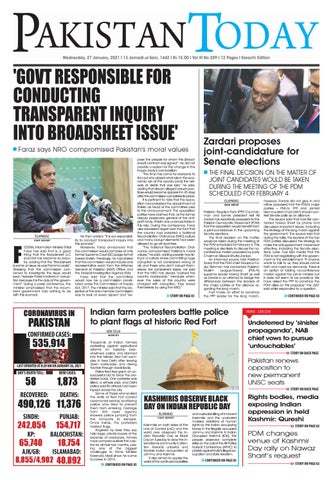
'Govt responsible for conductinG transparent inquiry into broadsheet issue' g
faraz says nRO compromised Pakistan's moral values
ISLAMABAD
f
Staff RepoRt
eDeRAL Information minister shibli faraz has said that is a good thing that the Broadsheet LLC scandal has become so popular, adding that the “Broadsheet is same an issue as was Panama Leaks”. stressing that the commission convened to investigate the issue would soon “expose those involved in corruption because it is the duty of the government” during a press conference, the minister emphasised that the incumbent government had nothing to do with this scandal.
He then added: “It is our responsibility to conduct transparent inquiry into this scandal.” moreover, faraz announced that the commission would comprise of only former supreme Court (sC) judge Azmat saeed sheikh. Previously, he had stated that the commission would include one representative each from the Attorney general of Pakistan (AgP) Office and the federal Investigation Agency (fIA). faraz said that the committee would now be a commission constituted under the Commission of Inquiry Act, 2017. The minister said that the objective of the one-member commission was to look at every aspect and “ex-
coronavirus in
paKistan
CONFIRMED CASES:
535,914
LAST UPDATED AT 8:29 AM ON JANUARY 26, 2021
DAY'S DEATH TOLL:
58
RECOVERED:
NEW CASES:
1,873 DEATHS:
490,126 11,376 SINDH:
PUNJAB:
242,054
154,717
KP:
BALOCHISTAN:
AJK/GB:
ISLAMABAD:
65,740
18,754
8,855/4,902 40,892
pose the people for whom this [Broadsheet] contract was signed”. He did not provide a reason for the change in the inquiry body’s composition. “The time has come for everyone to find out who played what role in the economic ruin of the country [and] the network of debts that was laid,” he said, adding that all such alleged corrupt practices would become apparent in 45 days after the commission completes its probe. It is pertinent to note that the opposition had protested the appointment of shiekh as head of the committee prior to this announcement. The opposition parties have claimed that, as the former deputy prosecutor general of the antigraft body, shiekh was unacceptable in this role. During the conference, faraz also expressed regret over the fact that the country had adopted a national Reconciliation Ordinance (nRO) culture and many corrupt elements had been allowed to go off scot-free. “The national Reconciliation Ordinance compromised Pakistan’s moral values,” he said, adding people now living in a culture where committing huge corruption is not considered wrong at all, and those who don’t corrupt themselves are considered losers. He said that the nRO has always “pushed the country backwards,” because whenever the rulers of this country were charged with corruption, they saved themselves by using the nRO.”
STORY ON PAGE 03
Zardari proposes joint-candidature for Senate elections g
THe fInAL DeCIsIOn On THe mATTeR Of JOInT CAnDIDATes wOuLD Be TAKen DuRIng THe meeTIng Of THe PDm sCHeDuLeD fOR feBRuARy 4 ISLAMABAD Mian abRaR
Pakistan People’s Party (PPP) Co-chairman and former president Asif Ali Zardari has reportedly proposed to the Pakistan Democratic movement (PDm) that the opposition would benefit from a joint-candidature in the upcoming senate elections. The final decision on this matter would be taken during the meeting of the PDm scheduled for february 4. This meeting is also likely to discuss the noconfidence motion proposed by party Chairman Bilawal Bhutto-Zardari. An informed source told Pakistan Today that the PDm chief maulana fazlur Rehman has contacted Pakistan muslim League-nawaz (PmL-n) supreme leader nawaz sharif as well as Zardari in an attempt to bridge the differences between the leaders of the major parties of the alliance regarding the long march. fazl made an effort to convince the PPP leader for the long march,
Indian farm protesters battle police to plant flags at historic Red Fort NEW DELHI agencieS
Thousands of Indian farmers protesting against agricultural reforms on Tuesday overwhelmed police and stormed into the historic Red fort complex in new Delhi after tearing down barricades and driving tractors through roadblocks. Police fired tear gas in an unsuccessful bid to force the protesters back. One protester was killed, a witness said, and Delhi police said 86 officers had been injured across the city. some of those who scaled the walls of Red fort carried ceremonial swords, scattering police who tried to prevent them from entering. footage from AnI news agency showed police jumping from the ramparts to escape. Once inside, the protesters hoisted flags. Angered by laws they say help large, private buyers at the expense of producers, famers have camped outside the capital for almost two months, posing one of the biggest challenges to Prime minister narendra modi since he came to power in 2014.
CONTINUED ON PAGE 05
however, Zardari did not give in and rather proposed that the PDm’s major parties – PmL-n, PPP and Jamiat ulema-e-Islam-fazl (JuI-f) should contest senate polls as an alliance. The source said that fazl first contacted nawaz sharif by phone and discussed important issues, including the strategy of the long march against the government. The source said that during the talks, the leaders of the top PDm parties discussed the strategy to make the anti-government movement effective, including the senate elections. Later, fazl told media that the PDm is not negotiating with the government or the establishment. “If anyone wants to talk to us, they should come forth and meet our demands. There is an option of tabling no-confidence motion against the prime minister but it does not seem to be practical. we have asked the PPP to convince the PDm allies on this proposal,” the JuI-f said while responded to a question.
CONTINUED ON PAGE 03
MORE INSIDE
Undeterred by ‘sinister propaganda’, NAB chief vows to pursue ‘untouchables’ STORY ON BACK PAGE
Pakistan renews opposition to new permanent unsC seats STORY ON BACK PAGE
Kashmiris observe blacK day on indian republic day ISLAMABAD Staff RepoRt
Kashmiris on both sides of the Line of Control (LoC) and the world over observed the Indian Republic Day as Black Day on Tuesday to draw the international community’s attention towards unlawful and forcible Indian occupation of Jammu and Kashmir. It also aimed to apprise the world of the continued brutalities
and custodial killing of innocent Kashmiris and the unabated massive violations of human rights by the Indian occupying forces in the illegally occupied Jammu and Kashmir. In Indian Occupied Kashmir (IOK), the people observed complete strike on the call of the All Parties Hurriyat Conference (APHC) to protest against India’s illegal occupation and state terrorism.
CONTINUED ON PAGE 05
Rights bodies, media exposing Indian oppression in held Kashmir: Qureshi STORY ON PAGE 02
PDm changes venue of Kashmir Day rally on nawaz sharif’s request STORY ON PAGE 02
02
Wednesday, 27 January, 2021
NEWS
RightS boDieS, MeDiA exPoSing inDiAn oPPReSSion in helD KAShMiR: QuReShi
F
STAFF REPORT
oREIGN Minister Shah Mahmood Qureshi said on Tuesday international human rights organisations and the media were exposing Indian oppression in occupied Jammu and Kashmir, Radio Pakistan reported. In a statement, the foreign minister said that India's Republic Day — being celebrated today to commemorate the day the Indian constitution came into effect — is being observed as a "Black Day" by
Kashmiris on both sides of the Line of Control (LoC) across the world. Through the observance of Black Day, the people of occupied Kashmir aim to apprise the international community of the continued brutalities, custodial killing of innocent people and the gross violations of human rights by the Indian security forces. In occupied Jammu and Kashmir, the All Parties Hurriyat Conference (APHC) has asked the people to observe a complete strike to protest the Indian occupation of the region and its state-
PM summons details of under-trial cases in international courts NEWS DESK Prime Minister Imran Khan on Tuesday took notice of under-trial pending cases in international courts and summoned details of cases from authorities concerned. According to details, the issue of under-trial cases in international courts was raised in the cabinet meeting. Some cabinet members expressed concerns over Pakistan losing cases in international courts. Federal ministers Fawad Chaudhry and Shireen Mazari told the cabinet that Pakistan has spent billions of rupees on under-trial cases and lost several cases despite paying huge amounts to lawyers. Taking notice of the pending cases in international courts, the premier summoned details of under-trial cases and lawyers looking over those cases in international courts. Earlier, Prime Minister Imran opposed the mortgaging of Islamabad’s biggest park, F9 Park, for launching the Islamic-denominated Ijara Sukuk bonds at domestic and international markets. The cabinet decided to mortgage Islamabad Club instead of the F-9 Park named after Fatimah Jinnah.
Suspect in woman corpse case reveals more details NEWS DESK The police have revealed that more details regarding the dumped woman corpse case have come to light after one of the suspects was arrested on Monday. The suspect, Usama, revealed that the deceased woman had been his friend and that she had developed complications after getting an abortion. They had been in the process of shifting her to the hospital, but the woman had died as soon as they reached, he said, so they left the body there and fled the scene. Police said that the other suspect involved in the incident is still missing, and a search for him is underway. A first information report (FIR) related to murder has also been registered against the two men while an investigation is currently underway. Earlier, a body of a 20-year-old girl had been recovered outside the emergency ward of Jinnah Hospital in Lahore on Sunday. Since then, the woman has been identified as Maryam Fatima, who was about 17 or 18 years of age and belonged to Gujrat. Her body was later handed over to the relatives after conducting a post-mortem.
sponsored terrorism. "The people are protesting as their rights have been usurped," Qureshi said. The foreign minister said that minorities feel unsafe in India, adding that instead of democracy "black laws are being imposed in the neighbouring country". Qureshi said that the negative policies of the BJP government were also affecting the Indian economy. He added that all countries neighbouring India, including Bangladesh, Nepal and China, were annoyed over
Renowned poet Dr Rehan Azmi passes away
Delhi's posturing. He asked India to explain why it has been fearful of dialogue if it has a strong stance on the dispute. "India did not pay heed to Prime Minister Imran Khan's offer of peace talks," he said and added: "The country instead took measures that further escalated the situation in Indian occupied Kashmir." Qureshi further said Pakistan, through its actions, demonstrated to the global community that it desires peace and stability in the region.
PDM changes venue of Kashmir Day rally on Nawaz Sharif’s request NEWS DESK The Pakistan Democratic Movement (PDM) has changed the venue of its Kashmir Day rally from Rawalpindi to Kashmir after a telephonic conversation took place between Jamiat Ulema-e-Islam-Fazl (JUI-F) chief Maulana Fazlur Rehman and Pakistan Muslim LeagueNawaz (PML-N) supremo Nawaz Sharif on Tuesday. Reportedly, a delegation of senior PML-N leaders including Azad Jammu and Kashmir (AJK) premier Raja Farooq Haider and former prime minister Shahid Khaqan Abbasi had called on the PDM chief following Nawaz's call. Earlier this month, the Maulana had announced that the PDM would hold a February 5 Kashmir Day rally at Rawalpindi's Liaquat Bagh to show solidarity
with the Kashmiri people. A day earlier, Interior Minister Sheikh Rasheed Ahmed had said that Prime Minister Imran Khan had fought the cases of Kashmir, Islam and Khatm-eNabuwwat in international forums effectively while adding that the PDM president had done nothing regarding the Kashmir issue during his chairmanship of Kashmir Committee. Moreover, Special Assistant to the Punjab Chief Minister on Information Dr Firdous Ashiq Awan had last week accused Fazl of making properties through frontmen off the religious funds. Calling him a corrupt wizard of the modern era, Awan had, in a series of tweets, said Fazl always misled people and his politics revolves around personal interests and creating turmoil.
PTI counsel to appear before ECP panel in foreign funding case today ISLAMABAD STAFF REPORT
The scrutiny committee of the Election Commission of Pakistan (ECP) will resume hearing in the longpending foreign funding case against the Pakistan Tehreek-e-Insaf (PTI) wherein complainant Akbar S Babar, a founding member of the party, will appear. The committee will review the objections raised by Babar over the documents submitted by the party. The commission is pursuing the 2014 claim
accusing the PTI of receiving foreign funding during years leading to and after the 2013 election. The trial gained fame and momentum earlier this week following a protest of opposition parties outside the offices of the ECP in Islamabad to “question” the delay in the probe that has dragged on throughout the tenure of deposed prime minister Nawaz Sharif and the two-and-a-half years of the incumbent setup without a verdict. The PTI has sought to distance itself from the case, saying its funds were gathered by “agents” who were working at odds with the instructions of then
NEWS DESK Renowned poet Dr Rehan Azmi passed away on Tuesday at the age of 63 after a long illness. Dr Azmi had been ill for a long time and was shifted to a private hospital in Karachi after his condition deteriorated. He breathed his last on Tuesday. Born on July 7, 1958 in Karachi, Dr Azmi started writing poetry regularly from 1974 and worked with the Pakistan Television (PTV). Dr Azmi also wrote religious poems and wrote more than 25 books.
Asif seeks better facilities in jail LAHORE INP
Detained Pakistan Muslim League-Nawaz (PML-N) leader Khawaja Asif on Tuesday filed an application in the accountability court of Lahore, seeking better facilities for him in Adiala Jail. The application says Asif is a sitting member of the National Assembly from Sialkot, former senator and minister, holds an LLB degree, a senior citizen. It argues since he is an under trial suspect, therefore, should be kept separate from other inmates. The petition further calls on authorities to provided him with a heater and medical facilities. Asif has also requested the court to allow homemade food for him. In December, the National Accountability Bureau (NAB) arrested Asif from outside the Islamabad residence of another PML-N leader Ahsan Iqbal where he had come to attend a party meeting. He has been accused of accumulating assets beyond known sources of income.
chairman Imran Khan, and as such, the party was not liable for their sources. Following the protest of the Pakistan Democratic Movement (PDM) outside the ECP offices, the scrutiny committee summoned both the Pakistan Peoples Party (PPP) and the Pakistan Muslim League-Nawaz (PML-N), directing them to submit their respective records of funds collected through foreign sources. In a statement, a spokesperson for the commission said the trial is taking place in the presence of the representatives of the concerned political parties, adding an open trial will be held to forward the recommendations of the committee after it submits its report. Last week, Prime Minister Imran called for a public trial in the case as he sought to “challenge” opposition parties to likewise submit to proceedings to prove they had not received any “illegal” funds. However, the ECP ruled out the suggestion.
PTI files foreign funding case against JUI-F NEWS DESK The Pakistan Tehreek-e-Insaf (PTI) has filed a foreign funding case against the Jamiat Ulema-e-Islam-Fazl (JUI-F) in the Election Commission of Pakistan (ECP) on Tuesday, wherein it claimed the JUI-F took funds from Libya and Iran. The PTI had previously filed similar cases against Pakistan Muslim League-Nawaz (PML-N) and Pakistan People's Party (PPP). The application, filed by Member of National Assembly (MNA) Farukh Habib, includes the transcript of an interview wherein JUI-F senior leader Hafiz Hussain Ahmed allegedly admits that party chief Fazlur Rehman and other party leaders frequently visited Libya and Iraq and received funding from there. Maulana Khan Muhammad Sherani should be
called, Habib said, adding that Fazl has to reveal where he got funding from. “The sources through which Fazlur Rehman made his properties will be revealed,” the MNA said. “It will also reveal the source from where the anti-government campaign in the country was funded,” he further maintained. Habib stated that now the foreign-funded parties have come together, but maintained that the ECP has the power to summon Fazlur Rehman and make him answerable. He also said on the occasion that if the Pakistan Tehreek-e-Insaf (PTI) took action against the JUI-F itself, the party would be accused of exacting political revenge, which is why it is better for the ECP to handle the matter first. "The rest of the institutions will then do their job,” Habib added.
He further said that Fazl does not care about Islam, he only cares about Islamabad. “Nawaz Sharif took [funding] from osama bin Laden in the name of the Islamic system and ending a woman's rule,” Habib claimed. “Maryam Safdar should also come to the ECP with her receipts”. Earlier, Prime Minister Imran Khan had given directions for government spokespersons to expose the opposition's propaganda and said that those trying to trap the PTI in a foreign funding case are now trapped themselves. The prime minister said the government’s position in the ECP proved to be correct. The foreign funding case has now become a key agenda of the Pakistan Democratic Movement’s (PDM) anti-government campaign, which they believe will help them dethrone PM Imran.
Wednesday, 27 January, 2021
NEWS
MiniSteR lAMbAStS PMl-n FoR SKiPPing govt-oPP Meet FoR 'uneleCteD PeRSon'
M
NEWS DESK
INISTER of State for Parliamentary Affairs Ali Muhammad Khan spoke against the Pakistan Muslim League-Nawaz's (PML-N) decision to attend the meeting of an "unelected person" instead of coming to the scheduled meeting between the government delegation and the members of the opposition. Speaking in the National Assembly (NA) on Tuesday, he said, "We waited for you. We did not know where you were ... maybe at a place where an unelected person was chairing [a meeting] of some 100 MNAs." He stated that the PML-N often cites
'vote ki izzat do' (respect the vote), but in this case they attended a meeting chaired by an unelected person, referring to the party vice president. "Yesterday you gave a lot of respect to the vote when you went in front of an unelected person [instead] of this sacred Parliament House," he said. Khan stated that the PML-N seems to "remember the Constitution in front of the mic but forget everything outside of parliament", adding that the meeting had hoped to reduce the tensions between the ruling party and the opposition, but this action has made the gap wider. "You said last week you would come and [cooperate in running] the parliament more smoothly [and] discussion would take place in the office of the NA speaker.
'govt responsible for conducting transparent inquiry into broadsheet issue' CONTINuED FROM PAgE 01 Separately, the federal cabinet approved the formation of an investigative commission to probe the relationship between a UK-based asset recovery firm and the successive governments of Pakistan today. In 2000, Broadsheet LLC — a company registered in the Isle of Man, tax heaven in the UK, and engaged by the National Accountability Bureau (NAB) — helped the government and the newly-established accountability agency track down foreign assets of some 150 Pakistan nationals, including members of the Sharif family, acquired through ill-gotten wealth. The agreement was terminated by the bureau in 2003, after which Broadsheet filed a claim with the High Court of Justice, London against Pakistan, seeking the award of $28.7 million. The federal government subsequently paid the amount on December 31. on January 20, the federal cabinet formed a three-member committee to investigate within 45 days the “revelations” of the scandal and fix responsibility on those who purportedly benefited themselves and laundered money to offshore bank accounts.
heC to consult varsities on online exams: minister ISLAMABAD STAFF REPORT
Facing nationwide protest rallies of students seeking to replace exams with online assessments due to coronavirus pandemic, the government on Monday asked universities to consult with the Higher Education Commission (HEC) to see if holding online examinations was possible given the “special circumstances”. In a series of late-night tweets, the minister while taking note of the students' demands said: "This is a decision for the universities to make but I have asked HEC to consult VCs and see if it is possible given special circumstances this year." Some university students are demanding that their exams should be online as they have been studying online. This is a decision for the universities to make but I have asked HEC to consult VCs and see if it is possible given special circumstances this year. 1/2 — Shafqat Mahmood (@Shafqat_Mahmood) January 25, 2021 "Universities should also asses[s] whether they have the technical ability to conduct exam for ALL students. No one can be left behind," he added in a subsequent tweet. 2/2 Universities should also asses whether they have the technical ability to conduct exam for ALL students. No one can be left behind. It is also necessary to ensure that online exam system is not misused to get easy grades. Preparing good question papers/ assessment is imp — Shafqat Mahmood (@Shafqat_Mahmood) January 25, 2021 "It is also necessary to ensure that [the] online exam system is not misused to get easy grades. Preparing good question papers/ assessment is imp[ortant]." His tweets come as students protesting for a week now say they attended online classes throughout the last year due to the pandemic and wanted to be examined under virtual conditions also. They also claim universities had not completed the syllabi of different courses but now the institute’s administrations were pressing for exams.
We went to the NA speaker's office, PPP [Pakistan People's Party] also came, other people from the opposition came. If [any party did not come], it was the PML-N." "It was decided in our (governmentopposition) Friday’s meeting that we will meet again on Monday but the opposition did not meet its commitment," he added. The government and opposition were scheduled to resume the second round of talks for the smooth sailing of the current session of the NA, however, the party reportedly gave a cold response to the government by refusing to attend the meeting. Reportedly, the meeting had been denied after the NA speaker tried to block the entry of Maryam Nawaz to the parliament.
PPP’s Syed Naveed Qamar went to the chamber of the speaker but when the PML-N did not appear he also came back. When contacted, Syed Naveed Qamar said the meeting could not take place as the parliamentary party meeting of the PMLN was going on. "We cannot meet the government without PML-N," he told a local news outlet. Ali Muhammad Khan, while speaking with a local news outlet, hinted that the ruling party would extend another invitation to the PML-N in the coming days. However, it is pertinent to mention here that Maryam, during the meeting at the Parliament House, said that that the government was "pleading with the opposition" for dialogue and that the latter had decided not to talk to them.
Zardari proposes joint-candidature for Senate elections CONTINuED FROM PAgE 01 He also confirmed that the PPP has proposed to the other major parties of the PDM to contest the Senate election jointly and this matter is being discussed. He maintained that while the PDM allies may come up with their own proposals, the decisions are taken unanimously. He added that both Nawaz and Zardari fully agree on the need to oust the Pakistan Tehreek-e-Insaf (PTI) government. “Nawaz Sharif and Asif Zardari may have different approaches but the goal is the same. We did not take a U-turn on submitting [en-mass] resignations from assemblies and taking out long march against the government. But we have changed our strategy. The government would have benefited if we had resigned from assemblies before the Senate elections. The resignations and the long march will take place after the Senate election,” he added. Fazl said that he had lodged a protest to Zardari for floating his proposal of no-confidence motion on the PDM platform. “Such statements should be avoided after all decisions have been made in consultation. It would have been better if the PPP had brought a proposal in the PDM meeting on February 4 and the decision would
have been taken by consensus,” he asserted. “We have already suffered due to no-confidence motion tabled against Senate chairman,” he added, expressing his disagreement with the idea. The PDM chief took another summersault over his previous threat of taking out a long march towards Rawalpindi, saying that the PDM was not interested in marching towards the garrison city of Rawalpindi. “If [the military is] neutral then their neutrality should be visible. The people know better what happened in the Gilgit-Baltistan elections,” argued Fazl. A day earlier, Zardari had insisted that there was no division within the ranks of the 11party anti-government coalition. Speaking to the secretary-general of the PPP’s Punjab chapter, Chaudhry Manzoor, during a phone call, Zardari had said that the opposition parties’ coalition under the PDM banner “is united and will strike the government from all directions”. “The PDM will use all options, in turn, to get rid of the PTI government,” he had said. “The country is in grave danger and the [incumbent] rulers are likely to make a huge blunder,” the former president had maintained, adding that it is “crucial to send the government packing”.
“The incompetence of these inept rulers may lead to a major accident in the country [and therefore] the next few months are crucial for the future of national politics.” Speaking of the ongoing pandemic, the PPP leader had stressed that the Imran administration would “no longer be allowed to hide behind coronavirus”. “They [government] could neither purchase the coronavirus vaccine nor could they help people during the coronavirus pandemic,” he stated. Comparing the PTI regime to his own government, Zardari had cited the Great Recession and said: “We increased exports from $19 billion to $26 billion despite the 2008 global financial crisis.” “We doubled the country’s revenue, increased the salaries of employees by 125 per cent. We bumped up government employees’ pensions by 100 per cent,” he had added. Slamming the “incompetent” PTI government, he had said that the rulers had “turned all indicators negative”. “I said in the past that these elected rulers will fall under their own weight. Now that they have crashed, only one last shove is needed. “Together with the PDM, the PPP will send this failed and incompetent lot home,” he had vowed. It is pertinent to mention here that PML-N, the largest opposition party, on Monday had decided to contest the Senate elections.
03
Pti's Adil appointed new opposition leader in Sindh Assembly KARACHI STAFF REPORT
Pakistan Tehreek-e-Insaf (PTI) leader Haleem Adil Sheikh was appointed leader of the opposition in the Sindh Assembly on Tuesday. The assembly secretary issued a notification in this regard after Speaker Agha Siraj Durrani okayed the appointment. Earlier this month, Firdous Shamim Naqvi, also a PTI leader, resigned from the post of the opposition leader in the assembly for undisclosed reasons. “I am an ordinary worker of the PTI and will continue to serve the party,” he had said adding the PTI was his "first and last political party" and he was not joining any other party. According to informed sources, Naqvi's resignation was sought by the party leadership. Earlier in September, the PTI leadership had also sought his resignation as leader of the opposition. However, he managed to somehow retain the position by convincing the party leadership. According to them, Naqvi's performance and his “controversial statements” had led the party to seek his resignation.
two arrested from islamabad airport, weapon recovered ISLAMABAD INP
The Airport Security Force (ASF) on Tuesday arrested two suspects from inside the Islamabad International Airport and recovered arms from their possession. During a search operation, the ASF personnel searched a suspected vehicle parked in the parking lot of the airport and recovered a revolver, five magazines, 57 bullets, and six rounds from it. The officials impounded the vehicle and the ammunition and arrested two people later identified as Hamza Iftikhar and Shafqat Ali. The suspects claimed the arms were licensed but failed to produce the license papers.
PM to address public rally in Kotli on Feb 5 NEWS DESK Prime Minister Imran Khan is set to address a public rally in Kotli on the occasion of Kashmir Solidarity Day (February 5). According to a statement issued from the Pakistan Tehreek-e-Insaf (PTI) Azad Jammu and Kashmir (AJK) chapter, PM Imran met his party's chief organiser Saifullah Niazi and former premier of AJK, Barrister Sultan Mahmood Chaudhry. The PTI's statement said that Barrister Chaudhry, who is also the president of the party's AJK chapter, and Niazi called on the premier in Islamabad for a detailed meeting wherein the premier announced to visit Kotli, a town near Line of Control (LoC) on February 5 and will address a gathering.
Sindh pins big hopes on small dams to help farmers beat drought ISLAMABAD AGENCIES
For years, Nangji Mal struggled to scrape together a living growing pulses and pearl millet on his farm in Nagarparkar, a desert area in Sindh. But these days his land is lush and fertile, after the government constructed new water-harvesting dams nearby. Using irrigation water from one of the small dams, Mal is growing onions, wheat and other crops on his 40-acre (16-ha) plot and says he has seen his income increase more than 60 percent. “It had never occurred to me that I might be able, in my lifetime, to earn a handsome amount from my fields, but this reservoir has made it all possible,” Mal, 59, told the Thomson Reuters Foundation. Pakistan faces increasing water scarcity driven by worsening climaterelated drought and the agriculture industry that is pushing itself to meet the demands of a growing population, say water experts. Less than 20 percent of the water the country’s farmers use for irrigation is captured rainwater, with most coming from ground and surface water, according to a paper published in 2020 by a group of agricultural and environmental researchers. The Sindh provincial government hopes the new rainwater harvesting dams will not only provide farmers with a
reliable water supply but also help recharge groundwater levels, as some of the water from the dams sinks into the earth, said Barrister Murtaza Wahab, environment adviser to Sindh chief minister. Since construction started six years ago, the provincial government has built 60 small rainwater-fed dams -- each with an average storage capacity of 100,000 gallons -- in the remote drought-hit areas of Nagarparkar and Kohistan, Wahab added. The plan is to build at least 23 more in the next two or three years, he said. Wahab noted that because those areas have such scattered populations, there are no reliable figures on how many people are benefiting from the new dams. Mal said the dam in his area has transformed his farm, as he can now use water from it year-round to irrigate his crops. In Tharparkar, the district where Mal’s farm is located, the average annual rainfall can be as low as 9mm (0.35 inches) and the area frequently experiences drought, according to international charity WaterAid. “[Before] my farming was on a very small scale, really not enough to meet my expenses, as it was all dependent on only rainwater throughout the year,” the farmer said. BETTER LIVELIHOODS: The State Bank of Pakistan (SBP) noted in its annual
report for 2016-17 that the country’s water supply was both limited and erratic, while demand was rising rapidly due to a growing population and increasing urbanisation. “The resulting imbalance is pushing the country towards severe water shortage,” the report stated. According to its latest economic survey, Pakistan had about 94 million acre feet of surface water available for agriculture during the financial year 201920 -- a nearly 10 percent shortfall compared to how much the sector uses on average every year. Wahab, the government adviser, said the small dams had been a boon to the farmers using them, noting that last year Nagarparkar’s onion farmers reported a total yield worth Rs600 million ($3.75 million), a record for Sindh. “The dams have a long-term benefit for the local population because when abundant water is available in these waterscarce areas, people will bring more barren land under cultivation and the number of their livestock will start increasing,” he said. Besides the Sindh government’s project, the federal government has also allocated Rs20.4 billion to build more than 500 small dams across the country, said Ghazala Channar, deputy chief of water resources in the Ministry of Planning and Development. The new reservoirs will help mitigate
floods, ease poverty and develop agriculture, as well as increasing the water table and providing clean drinking water, she added. “Access to more water will boost the agricultural economy [...] and thus provide more jobs to people, not only in the sector but also in all areas that are directly or indirectly linked with farming,” she told the Thomson Reuters Foundation. CAREFUL USE: Water experts warn, however, that small dams are not a silver bullet for arid parts of the country. Daanish Mustafa, professor of critical geography at King’s College London, said using small dams to recharge groundwater supplies only works in freshwater zones. The rainwater caught by the dams is not much use in topping up the water table in areas like Sindh, where 80 percent of the underground water supply is saline, he explained. Instead, Mustafa said, the provincial and federal governments should stop subsidising the electricity commercial farms use to run large tube-wells, which are a major cause of depleting underground water levels. The authorities also need to help farmers adapt to the water supply they have now, he said, adding that those in drought-prone areas should learn to grow less thirsty crops. The cultivation of rice and sugarcane, which need more water, should be discouraged in Sindh, he added.
Wednesday, 27 January, 2021
04 NEWS Sindh approves Rs4bn for rain affectees NEWS DESK The Sindh cabinet on Tuesday approved over Rs4 billion grant for the affectees of rains. The cabinet meeting was chaired by Chief Minister Syed Murad Ali Shah and attended by the provincial ministers, advisors, chief secretary and other concerned officials. The CM constituted a three-member committee, comprising representatives of board of revenue, finance and administration department, and directed the committee to ensure smooth distribution of money to rain affectees within 15 days. The amount approved for the rain affectees would be transferred to the deserving people through mobile banking. Meanwhile, the cabinet also approved the construction of an anti-encroachment police station in Tharparkar. An amount of Rs3.2 million was allocated for the establishment of the police station, from which a pickup, motorcycles and furniture would be purchased.
Fazl’s brother appears before NAB PESHAWAR TLTP
The younger brother of Jamiat Ulema-e-IslamFazl (JUI-F) supremo Maulana Fazlur Rehman, Ziaur Rehman appeared before the National Accountability Bureau (NAB) on Tuesday. Zia was summoned by the bureau for the second time. he is facing allegations of assets beyond income, illegal appointments and misuse of power. earlier, the anti-corruption watchdog had issued a call-up notice to Zia to appear before its investigators on January 26. Moreover, former KP chief secretary Sahibzada Riaz Noor, former secretary establishment Sahib Jaan, former secretary governor Ahmed hanif Orakzai had also been issued callup notices by the bureau. The bureau is probing into the illegal inclusion of Zia in KP Provincial Management Service (PMS) in 2007. The exchief secretary and former secretary establishment have been summoned on Wednesday (today) and Thursday respectively. It is pertinent to mention that NAB had launched two separate inquiries against JUI-F supremo Fazl. The son-in-law of Fazl has also been summoned by the bureau, whereas, a close aide of Fazl, Moosa Khan, had already been arrested by the NAB.
SHC orders for early decision on census results by CCI KARACHI TLTP
The Sindh high Court on Tuesday issued orders for decision over the results of Census 2017 by the Council of Common Interests (CCI) in its next session. A bench of the high court heard a petition with regard to finalisation of the results of sixth population census and delimitation of constituencies in Karachi for local councils’ elections. The assistant attorney general (AAG) submitted a report from the federal government in the court. he informed the court that the federal cabinet has approved the population census and the matter has been sent to the CCI for its endorsement. “When the matter has been approved by the federal cabinet, why is there an inordinate delay in the CCI?” the bench questioned the federal lawyer and later adjourned further hearing of the case until February 24. earlier, the lawyers for petitioners had argued that unless the results of the census are officially declared and notified, the delimitation exercise for local government elections would be useless. It is pertinent to mention that the upcoming meeting of the CCI is scheduled be held on Wednesday (today) with Prime Minister Imran Khan in the chair.
LAHORE: A view of confiscated alcoholic drinks being burned near Wagah border in the provincial capital. ZUBAIR MEHFOOZ
NAYA PAKISTAN APARTMENTS PROJECT: LDA TO SEEK APPROVAL OF RULES FROM PUNJAB CABINET LAHORE
T
SHAHAB OMER
he governing body of Lahore Development Authority (LDA) has decided that all the terms and conditions for the 4,000 residential apartments to be constructed in the first phase under the LDA City Naya Pakistan Apartments project will be approved by the Punjab cabinet. According to details, the procedure, price, eligibility criteria and conditions for allotment of apartments will be sought from the Punjab cabinet and a summary will be sent to Punjab Chief Minister Sardar Usman Buzdar. Under the project, 125 blocks of four-storey apartments will be constructed on 563-kanal land with the estimated cost of Rs10 billion. One block will consist of 32 residential units and each apartment will consist of two bedrooms and have an area of 650 square feet. The price of one apartment has been fixed by the LDA at Rs276,500, which will be received in easy monthly installments, and tenders have been called for
the construction of apartments, which is targeted to be completed in one and a half year. The applications for allotments will be received through Bank of Punjab and for this purpose, advertisements will be given through newspapers, television channels and digital media. The governing body’s first meeting of 2021 was held under the chair of LDA Vice Chairman Imran on Tuesday, where LDA Director General Ahmed Aziz Tarar briefed the participants about the agenda. In the meeting, a draft of agreement between LDA and Bank of Punjab was approved regarding issuance of letters of comfort and loans for allotment of apartments to applicants, and transfer of money to the special account set up for the project. The meeting approved regulations for opening and operating a special account to keep the funds provided by the bank. The funds would not be used for any purpose other than the construction of apartments. The meeting also decided to reorganise the LDA housing Wing to streamline the ownership and trans-
fer of plots in LDA housing schemes in the shortest possible time, and merge Land Development Directorate and State Management Directorate to form the housing Directorate, which would serve as both types of directorates. The meeting, in the light of LDA Private housing Scheme Rules 2014, gave permission to process the case of land sub-division in the pre-existing settlement area of Mouza Mohalnawal. During the meeting, some amendments in rules were made to change the use of land in exchange for collection of commercialization fee for launching area development projects at two locations in Lahore under Land Use Regulations 2020 to create employment and investment opportunities. One area development project will be started on 88-kanal land at Defence Road while the other on 101-kanal land at Raiwind Road. The meeting agreed to reduce the amount of fines, imposed on an educational institution in Faisal Town for non-compliance with the construction rules, by 50 per cent to encourage non-profit organisations working for the promotion of education.
AJK president terms India a fascist, undemocratic state ISLAMABAD STAFF REPORT
Azad Jammu and Kashmir (AJK) President Sardar Masood Khan has asserted that India is neither secular nor democratic but a fascist state, saying India’s hegemonic designs are serious threats to peace and security of not only neighbouring countries but the whole of South Asian region. "India's illegal occupation of Jammu and Kashmir and its recent actions are not acceptable to the people of Kashmir and they are determined to continue their
struggle till the return of the last Indian soldier," he said while addressing a meeting at a university in AJK on Tuesday, which the Kashmiri people observed as the Black Day. he said that the Kashmiri people on both sides of the Line of Control, Pakistan and across the world observed Black Day because the carnage of Kashmiri people, which India had started immediately after its independence, still continues. The AJK president added that all Indian actions, including the occupation of Jammu and Kashmir and depriving the Kashmiri people of
their freedom, are a clear proof of India's being a fascist and settler-colonial state. "India, which falsely claims to be the biggest democracy of the world, is busy in massacring the Kashmiri people in the occupied territory for their democratic demands of freedom, right to self-determination, fundamental human rights and civil liberties," he added. Masood called upon the international community, particularly the United Nations and other human rights organisations, to take immediate notice of the unlawful and im-
moral acts in occupied Jammu and Kashmir, and play their role for a solution to the long-standing Kashmir issue and cessation of the genocide of the Kashmiri Muslims. Declaring the university as an asset of knowledge for Jammu and Kashmir, he expressed the hope that Vice Chancellor Professor Dr Abdul hameed will soon achieve the target of building a permanent campus of the university, get financial resources, and hire qualified faculty for the university in order to put it on the track of development.
LHC seeks report about action against illegal housing societies ACCEPTS PETITION SEEKING BAN ON TIKTOK, BIGO, LIKEE LAHORE TLTP
The Lahore high Court (LhC) on Tuesday sought a report from the Lahore Development Authority (LDA) about the actions taken against illegal housing societies in the city. A bench of the high court, headed by Chief Justice Muhammad Qasim Khan, was hearing a petition against construction of housing schemes on green land areas and greenbelts.
A counsel of the LDA told the court that notices have been issued to the housing societies constructed on green land areas and the societies have been prevented from the power, water and gas connections as well as a ban has been imposed on the sale of land in these societies. he said at least 241 societies had been found involved in violation of greenbelts. The chief justice said that housing societies could not be developed over the green land area but due to inefficiency of the LDA, now millions
of people live in these housing societies. he noted that the illegal societies had been allowed to continue their construction work despite the stay orders. “how could they continue work despite restraining orders against it?” the chief justice questioned. The chief justice remarked that the budget of the LDA was in billions of rupees but its performance was zero. The bench summoned the relevant record and ordered the LDA to submit a report about its operation for vacating green land areas. The bench adjourned further hearing of the case until Thursday. Meanwhile, the LhC overruled its regis-
trar office’s objections to a writ petition seeking ban on a number of social media applications, including TikTok, Bigo Live and Likee. Justice Abid Aziz Sheikh admitted the petition and ordered that the case be fixed before a bench for hearing. Advocate Waqas Anwar Gujjar had moved the petition, stating that the applications like TikTok, Bigo Live, Likee and others are becoming a source of waste of time for youngsters. Naming the Pakistan Telecommunication Authority (PTA), the Federal Investigation Agency (FIA) and others as respondents in the case, he had mentioned that TikTok has claimed many lives of youngsters.
Wednesday, 27 January, 2021
KP CM announCes Rs2bn PaCKage FoR DIstRICt KaRaK iSLamaBad
K
STAFF REPORT
HyBeR Pakhtunkhwa (KP) Chief Minister (CM) Mahmood Khan has announced a package of Rs2.00 billion for gasification of the entire population of District Karak a package worth Rs2 billion for gasification of the entire population of Karak. He was addressing the public after the ground breaking ceremonies of Makh Banda Dam project and the rehabilitation of a 38km long road from Banda Daud Shah to Gurguri during a one day visit to District Karak on Tuesday. The Makh Banda Dam project would be completed with an estimated cost of Rs814 million in a period of three years and will bring 725 acres of land under cultivation on completeion whereas the road project would be completed in two years at estimated cost of Rs587 million. The chief minister said that oil and
MahMood Khan says govt will spend oil & gas royalty funds on districts contributing to production gas royalty funds were the right of people of Karak and other oil producing districts, adding that the incumbent government, as per the vision of Prime Minister (PM) Imran Khan has launched the Karak Area Development Project to ensure that the royalty funds are spent the people of Karak. “Various developmental schemes worth billions are being spent in education, health, public health engineering, communication and other social sectors for the sustainable development of the district”, he said. The chief minister said that more than Rs9 billion would be spent on various developmental projects during the next four years and added that each and
every penny of oil and gas royalty funds would be spent on districts contributing to the production. Terming the unavailability of clean drinking water as a major problem of Karak, the chief minister stated that his government was very serious in resolving the issue, adding that a project worth Rs720 million has been planned to provide clean drinking water from Lawaghar Dam to Karak city which on completion, would provide clean drinking water to 90,000 people. Similarly, he said that work on the dualisation of Bannu road has also started, which would be completed at an estimated cost of Rs4 billion out of which Rs2 billion had already been
released. Highlighting other developmental projects for district Karak, the KP chief minister said that work on upgrading existing healthcare facilities in the district was underway whereas a major teaching hospital was also being established in the southern region. He said that Rs405 million have been allocated for the execution of various road projects in the district in the current financial year whereas Rs550 million were allocated for the construction of sports complex in Karak. Terming the Peshawar to D.I. Khan motorway project of vital importance for the country’s southern districts, the CM said that the project would be completed with the estimated cost of Rs260 billion The KP CM concluded by saying that the extension of Sehat Card Plus would also be launched for the area by the end of January, after which the people of southern districts would get free healthcare facilities upto Rs1 million per house hold per annum.
foreign investors repatriate $892.3m profit in 1hfy21 neWS deSK Foreign companies operating in Pakistan have repatriated around $892.3 million as profits and dividends during first half (July–December) of the fiscal year 2020/2021 (1HFy21), according to data released by State Bank of Pakistan (SBP) on Tuesday. The repatriation of profits and dividends was 6.7pc higher when compared with $836 million in the first half of the last fiscal year. An amount of $840 million was repatriated during the first half of Fy21 against foreign direct investment (FDI), as compared with $743 million in 1HFy20, showing an increase of 13pc. The repatriation of funds against portfolio investment, however, fell to $52.2 million during the half under review as compared with $93 million in 1HFy20. The food sector repatriated highest profits of $171.5 million during 1HFy21, against $53.4 million in the cor-
turkey-Pakistan cargo train service to be launched soon: envoy KaraCHi TLTP
Consul General of Turkey Tolga Ucak on Tuesday held meetings with members of leading trade bodies of Pakistan to discuss possibilities of enhancing trade and commercial ties between the two countries. During his visit to Federation of Pakistan Chambers of Commerce and Industry (FPCCI), the consul general stated that a cargo train service between Istanbul and Islamabad would soon be inaugurated. "This initiative, with a transit time of 9-10 days, will go a long way in the promotion of bilateral trade," he added. The envoy also offered to organise a road show of Turkish products in Pakistan, expressing optimism that the volume of bilateral trade would enhance further in the post-coronavirus world. He assured the FPCCI of his support to the initiative undertaken by FPCCI and Turkey's JBC for the joint activities between both countries. Meanwhile, during his visit to Karachi Chamber of Commerce and Industry (KCCI), Tolga Ucak stressed the need to encourage joint ventures in different sectors of the economy. "Turkey can assist in setting up a tram service system in Karachi, particularly at the coastal line of sea view, which would change the face of Karachi and become a tourist attraction," he stated. Keen on strengthening trade and investment ties between the business communities of the two countries, the Turkish CG assured that the commercial section of Turkish Consulate in Karachi is ready to fully assist the city's business & industrial community intending to improve trade and investment ties with their Turkish counterparts. To deal with trade-related conflicts and protect the interest of customers, he suggested forming a private-to-private sector committee between the two countries.
responding period of last fiscal year, showing a growth of 221pc yoy. On the other hand, profits outflow from financial businesses dipped 2pc yoy to $122.5 million, as against $125.5 million in July-Dec Fy20. Similarly, the transport sector repatriated $74.1 million in July-December Fy2021, which was 47pc lower when compared with $139.2 million in the corresponding period of Fy20. Outflows from the communication sector, however, jumped to $119.3 million from $33 million. Among other sectors, tobacco & cigarettes segment repatriated $76.5 million in 1HFy21, compared with $35.1 million in the same period of Fy20; oil & gas exploration sector repatriated $69.2 million, 38pc lower than $111.8 million in July-Dec Fy20; whereas chemical sector repatriated 32pc lower profits, amounting to $46.8 million compared with $69.1 million in the corresponding period last year. A country-wise break-up of data revealed that firms and individual investors belonging to the United King-
dom dispatched the largest profits of $303.8 million during 6MFy21 compared to $155.7 million in the same period the prior year. The United States witnessed the repatriation of the second-highest profits as the country repatriated $133.6 million abroad during the period under review, compared with $100.1 million in the corresponding period the previous year. Third in line was Malta, which repatriated $91.7 million from Pakistan during the period. In the corresponding period last year, the country did not remit any profits or dividend income from Pakistan. Switzerland stood fourth with profit repatriation of $53.4 million, 12pc lower when compared with last year, whereas Hong Kong repatriated $44 million in 6MFy21 compared to $98.9 million in July-Dec Fy20; and Chinese firms repatriated $35.9 million abroad during the period under review, compared with $92.1 million in 6MFy20, depicting a fall of 61pc yoy.
Razak Dawood-led delegation to depart for Uzbekistan on 31st iSLamaBad STAFF REPORT
Advisor to PM on Commerce Abdul Razak Dawood and Ambassador of Uzbekistan to Pakistan Aybek Arif Usmanov on Tuesday discussed the upcoming visit of Pakistani trade delegation to Uzbekistan. A Pakistani delegation, led by Abdul Razak Dawood, will visit Uzbekistan from 31st January 2021 to 4th February 2021. The visit is a follow-up to the visit of Uzbekistan Deputy Prime Minister Dr Sardor Umurzakov on 10th September 2020. During that visit, a memorandum of understanding to establish a Joint Working Group on Trade and economic Affairs was signed and it was decided that the first meeting of the Joint Working Group will be held in Tashkent at a mutually agreed time. It was also agreed that possibilities of starting negotiations on a Pakistan-Uzbekistan Preferential Trade
Agreement (PTA) would be explored. Apart from Dawood, the delegation will include commerce secretary along with senior officials from other related ministries and departments. During the upcoming visit, matters pertaining to trade, especially the Pakistan-Uzbekistan PTA, would be discussed in detail. Uzbekistan shares borders with Turkmenistan, Kazakhstan, Tajikistan, Kyrgyzstan and Afghanistan. Improved connectivity and trade relations can open the doors for enhancing Pakistan’s exports to Uzbekistan and beyond which has a market of $ 90 billion. In addition to trade, the establishment of rail links, banking relations, economic cooperation, maritime cooperation and investment would be discussed. The possibilities of cooperation in the fields of textile and pharmaceuticals would also be explored. It is expected that a delegation from Afghanistan may also join Pakistan and Uzbekistan at Tashkent to culminate into a trilateral conference on trade and connectivity.
NEWS
05
Indian farm protesters battle police to plant flags at historic Red Fort Continued from page 01 “Modi will hear us now, he will have to hear us now,” said Sukhdev Singh, 55, a farmer from the northern state of Punjab. The body of one protester draped in an Indian tricolour lay in the street after the tractor he rode overturned in one clash, said a witness, Vishu Arora. “He died right there,” Arora said. A witness saw several police and protesters with head injuries following clashes at the Red Fort, from whose ramparts Modi delivers an annual speech. The government ordered internet services in some parts of the capital to be blocked, according to mobile carrier Vodafone Idea, in an attempt to prevent further unrest. LOST CONTROL: Tens of thousands of farmers began the day in a convoy of tractors festooned with Indian and union flags along the city’s fringes. But hundreds of protesters – some on horseback – broke away from approved routes, heading for government buildings in the city centre where the annual Republic Day parade of troops and military hardware was taking place. They commandeered cranes and used ropes to tear down roadblocks, forcing constables in riot gear to give way, witnesses said. A second group rode tractors to a traffic junction, also breaching barricades after clashes with police. Police accused those who diverged from the agreed routes of “violence and destruction”. “They have caused great damage to public property and many police personnel have also been injured,” a police statement said. Protest organiserSamyuktKisanMorcha said the groups deviating from set routes did not represent the majority of farmers. “We also condemn and regret the undesirable and unacceptable events that have taken place today and dissociate ourselves from those indulging in such acts,” the group of farm unions said in a statement. Amarinder Singh, chief minister of Punjab state, where many of the protesters came from, called the clashes “shocking”. “The violence by some elements is unacceptable,” he said in a tweet. “It’ll negate goodwill generated by peacefully protesting farmers.” FARMER PRESSURE: Agriculture employs about half of India’s population of 1.3 billion, and unrest among an estimated 150 million landowning farmers worries the government. Nine rounds of talks with farmers’ unions have failed to end the protests, as farm leaders rejected the government’s offer to delay the laws for 18 months, making a push for repeal instead. “The farm organisations have a very strong hold,” said Ambar Kumar Ghosh, an analyst at New Delhi think tank the Observer Research Foundation. “They have the resources to mobilise support, and to continue the protest for a long time. They have also been very successful in keeping the protest really focused.”
Kashmiris observe black day on Indian Republic Day Continued from page 01 In Azad Jammu and Kashmir (AJK), protest rallies and demonstrations were held in all ten districts to mark the Indian Republic Day as a black day. The APHC staged a protest in front of the Indian High Commission in Islamabad. The protesters were carrying banners and placards inscribed with slogans against the Indian oppression. On the occasion, the speakers said that India is perpetrating gross human rights violations in IOK and also involved in the genocide of the innocent Kashmiri people. The APHC leaders said that India will not succeed to suppress the freedom movement of Kashmiri people by the use of force and cowardly tactics. They said that peace is not possible in the region without resolution of Kashmir dispute. They also urged the international community to stop India from committing brutalities in the IOK. On the occasion, the protesters also burnt the Indian flag.
Oil prices tick up with European shares amid Saudi blast reports agenCieS LONDON
Oil prices ticked up on Tuesday alongside rising european shares and amid reports of a blast in Saudi Arabia, trading near 11month highs. Brent crude was up 32 cents, or 0.6pc, at $56.20 by 1433 GMT, while US crude rose 22 cents, or 0.4pc, to $52.99. Both contracts rose nearly 1pc on Monday and are set to post the third monthly rise in a row. Prices edged up after reports of a blast
in the Saudi Arabian capital Riyadh, although the cause remains unclear. In europe, gains in financial services and chemical sectors helped stocks rise. Risk assets such a equities and oil often move in tandem. Raising the prospect of higher oil demand later in the year, the International Monetary Fund predicted global growth of 5.5pc in 2021, an increase of 0.3 percentage points from the October forecast, citing expectations of a vaccine-powered uptick. On the supply side, the Organization
CMYK
of the Petroleum exporting Countries and its allies’ compliance with pledged oil output curbs is averaging 85pc in January, tanker tracker Petro-Logistics said on Monday, suggesting the group has improved compliance with supply curb commitments. Also, output from the giant Tengiz field in Kazakhstan, disrupted by a power cut on Jan 17, will be restored over the next few days, according to Tengizchevroil. “It appears that market players are cautiously sanguine about the producer
group’s market management strategy and therefore about the imminent depletion in global oil inventories,” PVM analysts said. Dampening bullish sentiment, US Democrats are still trying to convince Republican lawmakers of the need for more stimulus, raising questions over when and in what form a package will be approved. China is reporting rising Covid-19 cases, casting a pall over demand prospects in the world’s largest energy consumer. elsewhere, Indian crude oil imports in December rose to their highest in more than two years.
Wednesday, 27 January, 2021
06 COMMENT
Cost of the Afghan War
Untimely and unrealistic PTI’s offer of talks
F
Some Perspective for Joe Biden
Or over two years the PTI government rejected every effort made by the opposition to run the parliament by improving mutual working relations. The PTI leadership instead tasked its MNAs to ridicule the opposition lawmakers, call opposition leaders thieves and dacoits and shoot down all offers for talks on vital national issues, calling these attempts to seek the NrO. To top it all the NA speaker who is supposed to act as a neutral guardian of the house continued to act in a partisan way. Trampling upon age old parliamentary traditions, he refused to use his discretionary powers to order the production of opposition’s detained lawmakers and on an occasion refused to give mike to the Leader of the Opposition. Now that the opposition is in the middle of its agitation aimed at removing the government, the PTI leadership wants to initiate talks to bring down the prevailing political temperature. Coming as it does at this juncture the move is bound to be construed as a diversionary tactic. As things stand the government has done little to create a conducive environment for the talks to be possible. Instead, a few weeks back senior PMLN leader Khwaja Asif was arrested in an assets beyond means case while a fresh case of corruption has been filed against CM Sindh. It is quite understandable that the PMLN has ruled out the possibility of holding talks with the government on any issue. While the opposition has withstood persecution under the PTI government, it remains to be seen if it can manage its internal divisions. All components of the PTI had agreed to offer resignations when required, hold rallies and launch a countrywide long march towards Islamabad as the final assault on the government. The PPP is now less than enthusiastic about resignations while Mr Bilawal Bhutto Zardari has called upon the opposition parties to table a no-confidence motion against Prime Minister Imran Khan. As if downgrading the long march he says even 10 rallies will not yield the kind of results. Couldn’t he take his proposals to the PDM meeting instead of going public on them. Outbursts of the sort could create a perception that the PPP is conducting some sort of backdoor diplomacy and weaken the PDM.
MuhaMMad Sohail ahMed
W
here does the money come from for waging war? It comes from the public exchequer. In the old days, those who were defeated in the wars were required to pay the winning side as compensation. In the case of Afghanistan, there will be no compensation. So far, the USA has spent more than $ 1.5 trillion on fighting a war. how will the US. government get compensated, is the real question. It was believed that once the occupation of Afghanistan is materialized, the natural resources will be exported to encash the war expenditure. That is why the U.S. government allocated a hefty sum of $ 24 billion for establishing projects such as mineral extraction and infrastructure construction but no investors participated, and no labour was willing to work despite the provision of funds. Without establishing law and order and the writ of the government, no such project materialized successfully. how was the Taliban getting funds to fight the war? The US policymakers found out that the Taliban’s funds also came through the contractors in Afghanistan, mostly european firms, who paid protection money to the Taliban to ensure that their supplies reached their destinations safely. That is why
Increasing revenue only way forward
What the Arnab Goswami leaks show
T
he State Bank of Pakistan (SBP) in its Monetary Policy Information Compendium for January has reported that domestic debt servicing has increased by an alarming 38% in the first five months of the ongoing fiscal year. A substantial increase has been seen in the stock of permanent debt which mostly comprises Pakistan Investment Bonds (PIB), which is a high interest paying long term paper that is preferred by banks and corporates to park their excess liquidity. This will also need to be serviced, which will in turn jack up interest and principal payments in the coming months. As a result, the government is unable to divert sufficient funds towards development, which adversely affects economic growth that is already sluggish due to the pandemic; over 50% of federal expenditure is debt servicing. Another more serious and immediate problem posed by this excessive debt burden is the use of FBr tax revenue to finance interest payments; over 73% of the FBr’s tax collection was eaten up by debt servicing. It is quite a vicious fiscal spiral that the government is stuck in as it struggles to positively influence macroeconomic variables by efficiently and effectively managing its revenue and expenditure. For decades, multiple civilian governments and military setups did not make any meaningful attempts to reform the FBr. One had hoped that the PTI, with its promise of change and rebuilding institutions would have fared relatively better but it has not panned out quite that way. Strict but necessary measures taken to expand the tax net were reversed on the first sign of protest from lobbies that would take a financial hit as a result. A new chairman was brought in from the private sector with the expectation that he would bring about a cultural change within the FBr, but instead he developed health problems, reportedly a nervous breakdown due to the targets he was given, and quit the job within eight months. The government can cut down on its expenditures all it wants but the fixed cost of debt servicing will remain as the country cannot default on its domestic debt obligations. Increasing its revenue is therefore the only way out of this debt trap.
aMjed jaaved
T
he leaks of the WhatsApp messages of Arnab Goswami (republic TV) have brought into limelight some bitter truths. One bitter truth is that the general public is a ‘bewildered herd’ (to quote Noam Chomsky) who could easily be made a fool of. Abraham Lincoln was wrong in saying “You can fool some of the people all of the time, and all of the people some of the time, but you cannot fool all of the people all of the time.” history tells that the people, even the Americans, are gullible. Propaganda deeply influenced even independent-minded Americans who laid down a constitution, beginning with the words ‘we the people’. Chomsky says even the American masses are like a “bewildered herd” who have stopped thinking. he asserts that, in a “properly functioning democracy”, there are a “small percentage of the people”, a “specialised class of citizens” who … “analyse, execute, make decisions and run things in the political, economic, and ideological systems”. Chomsky reminds, ‘Woodrow Wilson was elected President in 1916 on the platform “Peace without Victory”, right in the middle of the World War I. The American population was extremely pacifistic and saw no reason to become involved in a european War. The Wilson Administration established a government propaganda commission, called the Creel Committee, which succeeded, within six months, in turning a pacifist population into a hysterical, war mongering population which wanted to destroy everything German, tear the Germans limb from limb, go to war and save the world…. After the war the same techniques were used to whip up a hysterical red Scare…’ The leaked WhatsApp chats revealed that the Balakot ‘surgical strikes’ were conducted to shore up
Dedicated to the legacy of the late Hameed Nizami
Arif Nizami Editor Umar Aziz
Asher John
Joint Editor
Executive Editor
Deputy Editor
Lahore – Ph: 042-36300938, 042-36375965
The author is a freelance writer and a retired commodore of the Pakistan Navy, and can be reached at msohailyz@gmail.com
The spectacular power of propaganda
Ballooning domestic debt
Aziz-ud-Din Ahmad
many such companies are being sued by the next kin of deceased US soldiers. Their contention is that these firms funded those terrorists fighting against the US Army and ultimately killed their beloved ones. Any mobilization cost, supplies of food, weapons and so on, will have to be paid to the locals for protection to reach the bases in Afghanistan. Therefore, without the Afghan territory’s control, the suppliers were bound to pay to those controlling the territory. Another requirement to continue war is the provision of trained manpower. The US government spent $87 billion for providing training and equipment for the Afghan army’s capacity building. It included their salaries: outfitting and salaries. The outcome remained dismal as at least 33 percent of the recruits used to get trained, earn a salary for some time, and run after some time. These would turn out to be Taliban. Therefore, about $29 billion (33 percent) were used to train the Taliban without government control. Therefore, the Obama Administration announced a withdrawal from Afghanistan in 2014. President Joe Biden was Vice-President at that time. While addressing the US Military Academy, at West Point, on 1st December 2009, President Barack Obama said, “The days of providing blank cheques are over…. It must be clear that Afghans will have to take responsibility for their security and that America has no interest in fighting an endless war in Afghanistan.” Moreover, the casualties in Afghan security continued to rise, which stands at 45,000 so far. This caused demoralization and a lack of confidence in their capabilities and the abilities of their rulers. The challenges were more pressing when absconders used to join the opposing side, thereby at the same time strengthening them, reporting sensitive information and exposing the US forces’ weaknesses. Several incidents occurred where US soldiers were killed by ‘friendly fire’ from afghan security forces. The cost of an American casualty is exorbitant. The pension and post-casualty expenses of 2500 killed, including one major general, are not clear. however, the amount of money already spent for the care, medicines and pay etc., for those soldiers who became war wounded or invalid is $350 billion. The total expenditure forecast for them till 2059 has been estimated to be $ 1.4 trillion. Therefore, the affordability of further fighting war in Afghanistan raises serious apprehensions among US citizens.
A sum of 30 billion was allocated for the reconstruction of hospitals, schools and bases. In 2008, a review on this programme was conducted by te Chief Inspector General for Afghan reconstruction (CIGAr). It was analyzed that the objective of this programme was not clear. Today, there are bases constructed, but they are not effective; there are hospitals, but no patients, and schools’ buildings but no students. The rate of child mortality has increased in the international standing. Although the American authorities blamed the Afghan government for lack of willingness, capacity, and rampant corruption, the fact remained that the money spent came from the American public exchequer and raised concerns. Several parameters were analyzed to access success in the Afghan war. These included personnel trained, number of violent accidents or even area under control. All parameters indicated disappointing figures indicating loss of the war. Investigations held by the government agencies for the inability to achieve success in Afghanistan were demanded public consumption. Some extracts were provided on the courts’ direction, which brought out the amazing facts indicating a failure in Afghanistan. US authorities were indeed aware of these pitfalls before they walked into Afghanistan. While addressing at the Virginia Military Institute on 17 April 2002, President George w. Bush said, “The history of military conflict in Afghanistan (has) been one of initial success, followed by long years of floundering and ultimate failure. We are not going to repeat that mistake.” The new President wants to delay the US pullout. It will increase the defense budget for regular army, navy and air forces. War funds will be consumed for mere deployments and demoralize an army with personnel some of whom have completed three tenures in the war zones, indicating a saturation of human resource. It is up to the US government to continue to take responsibility for Afghans’ security, for which they were never invited. reimbursement of war expenditures will remain a far cry for the new administration, not to think of success. An effort to establish a compliant Afghan government after abrogating peace agreement with the Taliban would be painful for the military and economies besides Afghanistan’s. The Taliban’s reaction would be obvious, to go for the continuation of a war which they have apparently won. The policy of rapprochement is better than the policy of conflict.
I
Karachi – Ph: 021-35381208-9
I
Narendra Modi’s image as a `strong man’, a Brobdignagian among the selfcentred Lilliputian Indian politicians. The ‘strike’ helped Modi win elections with a thumping majority. Though Modi is educated only up to high school, he understands the power of propaganda. he has done a three-month course in the USA on Image Management and Public relations. his campaign blitz cost about $700 million. Modi is considered the most techno-savvy leader of India as he is very active on various social media platforms including Twitter, Facebook and Instagram. The WhatsApp chats between republic TV editor-in-Chief Arnab Goswami and former Broadcast Audience research Council (BArC) CeO Partho Dasgupta run into 500 long pages. They revealed the nexus between the media and politicians to hoodwink the masses. Several Congress leaders, including former Finance Minister P Chidambaram and former Chief Minister of Maharashtra Prithviraj Chavan, have raised alarming questions. Chidambaram has questioned how the journalist and his friend knew about the Balakot strike three days before it took place. Meanwhile, senior journalist Madhavan Narayanan raised pertinent questions about the clearly transparent violations of media ethics, professionalism and business malpractices, as are evident from the purported chats between the republic TV CeO and the former BArC head. In the transcripts, Arnab purportedly referred to the Pulwama attack on 14 February 2019. Three days before the Balakot air strike on 26 February 2019, Goswami purportedly wrote India’s response would be: “Bigger than a normal air strike. And on the same time something major on Kashmir (abrogation of Special Status). Dasgupta was arrested in the fake Television rating Point (TrP) case. The Mumbai police had earlier told the court that Goswami had allegedly bribed Dasgupta with lakhs of rupees to ramp up republic TV’s viewership. Like the Indian Air Force, the Indian Army also knows the value of propaganda. It occasionally stages fake encounters in which innocent Kashmiris are kidnapped and killed in ‘encounters’. Afzal Guru was hanged for the Indian Parliament attack, but subsequent revelations by police officer Davinder Singh revealed that he was in fact innocent. In elections, Congress lost even in Karnataka, rajasthan, Chhattisgarh and Madhya Pradesh, where it ruled. even rahul Gandhi lost its citadel, Amethi. In the gory West-Bengal contest, the formidable Mamta Bannerjee lost many seats to the BJP. Modi’s self-image and brand prevailed. The rSS held many conclaves to reach out to intellectuals. The Muslim Manch, distributed rSS leaflets. even after winning the elections, BJP stalwarts visited Madrassa Deoband. Modi captivated popular imagination as a
Islamabad – Ph: 051-2204545
I
Web: www.pakistantoday.com.pk
I
strong leader: ‘Modi hai to mumkin hai (If Modi is there, then it’s possible). Through power of propaganda, Modi brazenly bagged credit for all achievements of previous Congress governments. It was Jawaharlal Nehru who abolished the zamindari system. It is Nehru, not Modi, who set up the space centre that catapulted India’s ASAT Shakti. Modi 1.0’s economic- progress figures were plain cookery. The Goswami Leaks further weaken India’s accusation that the Pulwama attack was masterminded by Pakistan. Several questions, come to mind about India’s ‘chargesheet’: (a) Why did India bank on the FBI when it already possessed all communications from Pakistan? For instance, it intercepted the whole talk between military dictator Yahya Khan and his coterie during the east Pakistan/Bangladesh crisis. It intercepted Musharraf’s conversation with his generals while he was flying back from China to Pakistan. Isn’t there collusion between the FBI and India? (b) Why did India blame Pakistan even before the forensic lab and National Investigation Agency investigation reports? (c) Why are there differing reports about weight of the rDX used? One estimate is of about 80 kg of high-grade rDX explosive being used, another of 100150 kg. (d) Why was a private vehicle allowed to approach the scene of the incident in violation of the CrPF Standing Operating Procedures? The CrPF’s Standing Operating Procedures required movement of up to 100 persons in a convoy. Why has the CrPF been moving such convoys, comprising more than 2,500 personnel each, on the Srinagar-Jammu highway. In the past fortnight, two such convoys had moved from Jammu to Srinagar. The latest was on February 4, with a convoy of 91 vehicles and 2,871 personnel. (e) Why could the convoy not spot the lonely suicide vehicle trailing behind? (f) how did the terrorists know the convoy movement was delayed by two days? (g) how did they remain undetected while loading the vehicle with explosives the whole day? (h) Not only WhatsApp but also landlines have never been accessible even in hindu-majority Jammu (occupied Kashmir). Then how come the FBI has told the NIA about the WhatsApp group operated by a member of the terrorist outfit Jaish-e-Mohammad who was in contact with the people who carried out the attack of Pulwama? (i) According to the FBI, a man called Mohammed hussain was operating the WhatsApp group, from Muzaffarabad. But the number was however registered under the name of Jameela from Budgam. Modi owed his electoral victory to the power of propaganda. he is making a fool of not only the Indian masses but also the world around. The writer is a freelance journalist, has served in the Pakistan government for 39 years and holds degrees in economics, business administration, and law. He can be reached at amjedjaaved@gmail.com
Email: editorial@pakistantoday.com.pk
Wednesday, 27 January, 2021
COMMENT 07 Editor’s mail Send your letters to: Letters to Editor, Pakistan Today, 4-Shaarey Fatima Jinnah, Lahore, Pakistan. E-mail: letters@pakistantoday.com.pk Letters should be addressed to Pakistan Today exclusively
Ehsas in full swing
Modi confirms his fascist credentials His actions in Indian Held Kashmir show him up
Malik MuhaMMad aShraf
T
here can be no two opinions about the fact India is an irreconcilable enemy of Pakistan, and it has been and continues to unfurls steps to harm Pakistan through overt and covert actions. This is very much expected from a treacherous enemy like India. Almost all the Indian governments since partition of the sub-continent have been vigorously pursuing an anti-Pakistan agenda. The Indian web of deception uncovered by eU Disinfo Lab which was used by India to malign and portray Pakistan in dismal colours before the international community, particularly rubbing in the notion of Pakistan being the hub of terrorism and responsible for cross-border terrorism, provides clear proof of Indian designs against her. The acts of terrorism within Pakistan and support to Baloch insurgency by Indian rAW as confessed by Kalbhushan Jhadav, the Indian naval officer who was caught in Balochistan , leaves no doubt about India doing her utmost to foment instability in Pakistan. But what the BJP government headed by Narendra Modi, inebriated by the supremacist ideology of hindutva, has done to accentuate and aggravate the ambience of enmity between the two countries has all the trappings of fascism bereft of all shades of humanity which only aspires to decimate the enemy by all means. The reported leak of the WhatsApp conversation between journalist Arnab Goswani– who is very close to Modi government– and the CeO of a rating agency wherein Goswani reveals that the Pulwama incident was enacted by the Modi government to appease his voters and use it as an excuse to take action against Pakistan, was the ugliest manifestation of fascism. An Indian Professor Ashok Swain had already declared Pulwama a drama. According to him, Modi did the same in Pulwama as he did in Gujarat in 2000 to garner votes. enacted before the ensuing elections, it did help Modi to register a landslide victory. So the biggest beneficiary of this inhuman and dastardly act was the BJP. By taking the lives of his own soldiers and citizens through an orchestrated act of terrorism to reap political advantage by blaming it on Pakistan, Modi has confirmed his fascist credentials. he lost no time in blaming Pakistan for the incident. Pakistan vehemently rejected the Indian allegations, advising India to refrain from the blame game and come up with the evidence
to prove its claims about her involvement in the incident, which was never provided because none was available. The revelations made in the conversation between Goswani and the CeO of the rating agency have not only vindicated Pakistan but have also unmasked the treachery of the Modi government in mislead its own masses as well as hoodwinking the global community. The Pulwama incident was used to win elections and to commit aggression against Pakistan, which showed its ugly face on 26 February 2019 when India sent its planes to attack an imaginary terrorist camp at Balakot. It nearly brought the two nuclear powers to the brink of an armed clash but the restraint shown by Pakistan and the intervention by some friendly countries defused the situation. Nevertheless India continues to maintain her hostile posture towards Pakistan manifested through daily violation of the ceasefire agreement along the Line of Control. The ultimate objective of hindutva is to make India a purely hindu state and establish Indian hegemony in the region. The Modi government unraveled its anti-Muslim credentials through the enactment of National register of Citizens that deprived 1.9 million Muslims of Asaam of their Indian citizenship followed by the enactment of the Citizenship Act Amendment Bill, that ignited countrywide protests during which the goons of BJP killed 50 Muslims in Delhi on the nod of the law enforcement agencies, which did not act to stop the killing. The move earned scathing criticism from the international human rights organizations and from the global community. But undeterred by the ensuing criticism, Modi made another anti-Muslim move by ending the special status of Indian Occupied Jummu and Kashmir (IOJ&K) and its annexation to the Indian Union, followed by enacting laws designed to change the demographic features of the state by allowing the Indian citizens to settle there and buy property. Modi on the eve of Independence Day of India boasted that his government had achieved in 70 days what the previous governments could do in the last 70 years, fulfilling the dream of Vallabhai Patel of ‘Akhand Bharat’. Since 5 August 2019, eight million people of Indian-Occupied Kashmir are under siege and the Indian security forces continue with their
killing spree and abuse of human rights with impunity. reportedly 300 Kashmiris have been killed since then and there seems no end to the ordeal of the hapless people of the state. The redeeming aspect of this whole episode is that India has failed to sell her narrative that what it did in Indian-Occupied Kashmir was her internal matter. The UNSC in its three informal meetings held in the backdrop of the Indian actions in Indian-Occupied Kashmir has reiterated that the solution to the Kashmir dispute needed to be found in conformity with the principles of the UN Charter and the relevant UN resolutions. The latest rebuke to the Indian stance has come from a debate at Westminster in which ten UK parliamentarians belonging to different political parties and a minister participated. They were all unanimous in their opinion about brazen violation of human rights in the Valley and about the need for resolution of the conflict through self-determination. The actions of the BJP regime have imperiled the peace and security of the region. Pakistan has been warning the world community and the UN about the likely consequences of India pursuing the supremacist rSS ideology of ‘hindutva’, which as been likened to the Nazism which spelt disaster in the world by pushing it into World War II. But regrettably the powers that can put pressure on India and dissuade her from pursuing the disastrous course, remain criminally oblivious to the developing situation and are rather responsible for encouraging the Modi government to persist with its agenda. even the UN remains helpless in view of their indifference to initiate any move to implement its resolution on the Kashmir dispute. It is indeed a worrying situation requiring immediate intervention of the UN, the global community and more so the strategic partners of India before it is too late. They must understand that the confrontation between the two nuclear powers would also harm their strategic and commercial interests in the region. India also needs to understand that it would not emerge unscathed in case of an armed clash with Pakistan. India by her actions is jeopardizing peace and security of the region and the chances of a shared economic prosperity. It also desperately needs course correction in its own interest.
It is indeed a worrying situation requiring immediate intervention of the UN, the global community and more so the strategic partners of India before it is too late. They must understand that the confrontation between the two nuclear powers would also harm their strategic and commercial interests in the region. India also needs to understand that it would not emerge unscathed in case of an armed clash with Pakistan. India by her actions is jeopardizing peace and security of the region and the chances of a shared economic prosperity. It also desperately needs course correction in its own interest
Malik Muhammad Ashraf is an academic. He can be contacted at: ashpak10@gmail.com.
SPeCIAL Assistant to the Prime Minister on Social Safety and Poverty Alleviation Dr Sania Nishtar here Monday said over 70 percent ehsaas Kifalat Programme survey has been completed to enroll about seven million poor people by bringing them under social safety net. Addressing a press conference here, Dr Sania Nishtar said ehsaas Kifalat Programme survey was underway in Khyber Pakthunkhwa being completed with assistance of teachers, police, district administration and officials of social welfare department. Currently, she said, about four million poor people including orphans, widows, special children and women were being provided financial assistance under ehsaas Programme and this assistance would be increased up to seven million poor people after completion of this survey in the country. She said new lists of eligible beneficiaries were being prepared under transparent mechanism and maintained that more poor and vulnerable persons would also be included in the ehsaas Kifalat Programme. She clarified that no deserving person would be expelled from this programme. She said all survey data was being digitalized and information of beneficiaries would be available on a single click. To a question, she dispelled the impression that the funds were being received from foreign donors, adding all funds for ehsaas Progamme were being provided from Ministry of Finance, Government of Pakistan. The PM aide said poor schools, colleges and universities students were also being provided scholarship so that they could continue their studies without facing financial problems and contribute in the process of national development. Dr Sania said she had visited Mardan Women University today where 140 poor students were being provided scholarship under ehsaas Kifalat Programme and was pleased to see increased number of girls students in the university. She said free of cost registration of all eligible poor persons for ehsaas Programme was underway and no amount was being charged from anyone in this regard. Dr Nishtar said a comprehensive mechanism was put in place for quick resolution of people’s complaints. She said initiative of shelter homes was a unique facility where shelterless people were provided free accommodation, food and others services during harsh cold weather conditions. The network of shelter homes was expanded in KP and services were further improved in the wake of cold harsh weather conditions in the province. She said thousands of poor persons and shelterless were facilitated from shelter homes during last two months in the country. She said shelter homes and Langar Khana were key initiatives of PTI Government besides ehsaas Kifalat Programme to help bring people out of poverty line and improve their socioeconomic conditions. Dr Sania said creation of employment opportunities and alleviation of poverty were directly linked with economic growth and industrial development and the government was focusing on construction sector to generate employment opportunities for youth. She appreciated district administration, police, teachers and social welfare department for their positive role during ehsaas Kifalat survey and expressed the hope that they would continue with more spirit in future. Sohail ali Khan iSlamabad
Lack of gas supply WINTer has become colder for Pakistanis as people are not able to use heaters or stoves because of gas load shedding. The government failed to fulfill its promise as the petroleum minister announced that there will be none this winters. People in Islamabad and rawalpindi complained of a shortage of gas, especially in areas such as Shamsabad and Sadiqabad. “We can’t even cook as there is no gas. What can we do?” remarked a resident of rawalpindi. There has been a shortage of gas in Karachi for the last four to five days too. Two gas fields of SSGC—Tando Jam and Gambat gas field—have been suffering from a gas shortage. The factories and industries are feeling the pressure too. Workers come to factories but cannot do anything as there is no gas. SITe Association President Saleem Parekh remarked that the situation of gas is quite bad. “It seems like a conspiracy of SSGC and bureaucracy to hamper our exports.” he remarked that exporters will pay the heavy cost of lack of production. On Monday, the Sui Southern Gas Company asked for a 14% increase in the price of gas. The company asked the Oil and Gas regulatory Authority to increase the price by rs84, taking it to rs671 per MMBtu. On November 27, the economic Coordination Committee approved the decision to not disturb the supply of gas in winters. Petroleum secretary said that gas will be in limited supply in December, January, and February. It was decided that the supply of re-gasified liquefied natural gas will be increased to overcome the shortage. Moreover, LNG will also be imported. alina bux Karachi
Importance of climate policy The climate crisis has been crying for attention for longer time than expected even as the world community has been fighting with the crisis, most frequently in vain-so far. right now the American media outlets have confirmed that US President Joe Biden has formally reentered the Paris Climate Change report just a few days into office. The UN has welcomed this good climate policy now. It is not just about the regimes and legacy when it comes to the climate crisis. In fact, there have been plenty of practical things to be executed on the ground. As for America, the Biden team has a lot more tough tasks ahead as the whole climate policy execution process involves many heavy industries like oil sectors based in the US. For instance, the Keystone Pipeline Project has been on various stages so far, transporting fossil fuel from Canada to the US. Such industries have come under policy attack amid urgent climate strategies needed to stop the global warming. Despite such conundrums at home and other global challenges up ahead, Joe Biden seems to be seriousminded about tackling the climate crisis as promised before. A welcome step indeed! To simply put, under no circumstances should evolving industrial activities pose threats to Mother earth and in general related activities over there like human life and agriculture to name a few. In my native areas like Tiruchendur, Korkai, Tuticorin, Tirunelveli and Kanyakumari in Tamil Nadu, the agricultural activities have been thriving on factors like huge tracts of fertile land, plenty of water sources like the Thamirabarani river and vast greenery areas around. Frankly speaking, countries worldwide from the West and the east should evaluate their immediate needs as against the ongoing crisis and let there not be even a bit of hesitation on their part to save Nature over sedentary lifestyles. P SEnthil Saravana durai mumbai
Wednesday, 27 January, 2021
08 WORLD VIEW
IndIa’s protestIng farmers aren’t goIng anywhere PRIME MINISTER NARENDRA MODI IS NOT A LEADER GIVEN TO COMPROMISE. HAS HE FINALLY MET HIS MATCH IN INDIA’S FARMERS?
diPloMaT
o
Sudha ramachandran
n January 26, even as india celebrates its 72nd republic day with a grand parade in new delhi, showcasing its military might and plural culture, tens of thousands of farmers will simultaneously be participating in a 50 kilometer-long tractor rally in the indian capital to press for the repeal of agricultural laws enacted by the government of Prime Minister narendra Modi Tens of thousands of farmers have been camping outside new delhi for two months now, braving winter and rain to protest the laws. Police have put up barriers and dug up roads to prevent them from blocking access roads to the capital. But such efforts have failed to halt the mass mobilization. Police have used water cannons and tear gas on the protesting farmers, but they have refused to back down. nine rounds of talks between the government and farmers leaders have taken place so far. They have made little headway in defusing the crisis. Last week, the Supreme Court ordered an indefinite stay on the implementation of the farm laws. it appointed a four-member committee to end the impasse. But the farmers’ groups have said they will not appear before the panel as its members are allegedly biased: all of them have publicly supported the farm laws in the past.
in the crosshairs of the protesting farmers are three farm laws: The Farmers’ Produce Trade and Commerce (Promotion and Facilitation) act, The Farmers (empowerment and Protection) agreement of Price assurance and Farm Services act, and The essential Commodities (amendment) act, all of which were recently enacted by the Modi government. The new laws permit, for the first time, trade in agricultural produce outside the government-regulated mandi (market) system. it allows farmers to sell their produce outside the government mandis to any licensed trader at mutually agreed prices. it also allows farmers to stockpile grain for future sales and lays down rules for contract farming. The government has presented these laws as reforms that will open up the agricultural sector to greater private investment, new technology, and larger markets. Farmers will be able “to sell their crops in mandis as well as to outside parties,” Modi has said. according to the indian prime minister, with private investment pouring into the agriculture sector, storage and warehousing facilities will improve. The legislation will also open up new opportunities for farmers and make them more prosperous, he said, claiming that it would be small and marginal farmers who would draw “maximum benefit” from the new laws. economists are not convinced. “With capital investments flowing in without any regulation and in the absence of any rights-based safety net enshrined for farmers,” the new laws will provide “a free run for large companies,” says devinder Sharma, an agricultural economist and food policy analyst. Farmers fear that under the new laws they will have to do business with powerful corporations rather than the small private traders they have dealt with so far. They are apprehensive that their capacity to negotiate prices on equal terms will be diminished, leaving them vulnerable to exploitation by the big corporations. The fate of the minimum support price (MSP) is the key question in the contentious debate. Hitherto, the gov-
India’s farming revolt: a bitter harvest THERE’S A GROWING BACKLASH AGAINST NARENDRA MODI’S AUTOCRATIC TENDENCIES AND THE PLUTOCRAT DONORS WHO FUND HIS PARTY Guardian Editorial
n
arendra Modi, india’s Hindu nationalist prime minister, has probably never read Lord Hailsham. But maybe he should. The former lord chancellor’s 1976 BBC lecture contains perhaps the most penetrating assessment of parliamentary democracy, of which india is its largest version. Lord Hailsham’s argument carries a constitutional lesson at an opportune moment for Mr Modi. The Conservative peer warned that Britain risked becoming an “elective dictatorship”. a government’s parliamentary majority is merely tempered by political realities and MPs’ consciences. “only a revolution, bloody or peacefully contrived, can put an end to the situation,” he said. Mr Modi swept to victory in elections in 2019. The once‑mighty Congress party almost disappeared. no rival party gained enough seats to have its chief named leader of the opposition. The judiciary has been cowed by Mr Modi. it is no laughing matter when indian Muslim comedians are jailed for jokes that they have not made. Mr Modi has an autocratic style. He takes decisions without forewarning and expects them to be rubber‑stamped by a pliant legislature. Last summer, Mr Modi enacted major farm laws that threaten the livelihoods of two-thirds of india’s 1.3 billion people without discussion, during the Covid lockdown of parliament. What followed was arguably the largest general strike in history and weeks of unrest. india’s prime minister says that the reforms will benefit farmers. agriculture needs updating not least because it is fast-depleting the country’s water tables. But Mr Modi blocked parliamentary scrutiny and prevented farmers from raising objections via lawmakers. The supreme court has
stepped in, but judges were no honest brokers, setting up a committee to investigate the issue that was dominated by pro-Modi voices. Unlike the west, democracy came to india before capitalism. Mr Modi appears to think that this was a mistake and that Lord Hailsham’s “elective dictatorship” is needed for india to industrialise. if so, he is sadly mistaken. The new laws aim to regulate the trade of 200 million rural households, and farmers worry that these powers will be exercised on behalf of plutocrats. Who can blame them? Two decades ago, the bottom 50% of the country accounted for 20% of india’s income and the top 1% had 14%. Today, the positions are reversed. india’s gilded age is shrouded in ironies. about 200 million indians sleep on an empty stomach while state granaries bulge with cereals, because the government subsidises the procurement of rice and wheat. Yet the poor do not have enough money to buy healthy meals and there is no state-guaranteed food security. india needs politicians who can argue that the country should diversify its agricultural base and mitigate the effects by expanding welfare and creating industries to offer jobs to those displaced from land. This requires a government interested in ordinary people, not just corporate profits that disproportionately fund Mr Modi’s party. if those left behind by economic change conclude that those in power are not bothered about their plight – or have rigged the system in favour of the better-off – there will be trouble. Under pressure from his ideological svengalis, Mr Modi offered to defer his reforms. This is not enough. He should return, in less peremptory fashion, with fresh proposals to parliament that can be properly scrutinised. Sceptics need convincing with words not threats. if he wants to succeed, Mr Modi must show he can be more democrat than autocrat.
ernment would announce MSPs for many crops. it would purchase some of them in large quantities from the mandis at the MSP. The MSP system assured farmers a minimum income. agriculture Minister narender Tomar has repeatedly said that the mandis will continue to function and the MSP will continue. Farmers are unconvinced. They believe that in the new system government agencies will buy less from them in the mandis, rendering the MSP guarantee irrelevant. Past experience shows that removal of the MSP system devastates farmers. in 2006, laws similar to the ones enacted by the Modi government were put in place in the eastern indian state of Bihar. The market was opened up in agriculture but it failed to draw private investment. The government mandi system collapsed. With the markets not offering higher prices for their produce, farmers were impoverished. Millions were forced out of agriculture and became migrant laborers. The much anticipated prosperity of Bihar’s farmers as a result of its market-driven reforms in agriculture has not materialized as yet. india is a country of farmers; agriculture employed 59 percent of the country’s workforce in 2016. although the contribution of agriculture to india’s GdP has declined over the decades, its importance as a sustainer of lives and livelihoods remains strong. around 70 percent of rural households depend primarily on agriculture for their livelihood. The impact of the farm laws will therefore be immense. importantly, 82 percent of those engaged in farming are small and marginal farmers. Critics fear that under the new laws they will be at the mercy of corporations – and thus the new laws will ruin them. as contentious as the content of the new laws is the manner in which the Modi government went about enacting them. in June of last year, the government promulgated the proposed legislation as ordinances under the pretext of the pandemic-prompted lockdown of parliament. it was introduced in parliament in mid-September
and was signed into law a fortnight later. although the laws have far-reaching implications for the lives and livelihoods of millions of indian farmers, the government rushed the bills through parliament without discussion or appraisal. Farmers groups were not consulted. The timing of the enactment of the laws is significant. The CoVid-19 pandemic has been raging across the country. it is likely that the Modi government was hoping that by enacting the controversial laws when people were preoccupied with the pandemic and the economic problems the lockdowns generated, it would not have to deal with mass protests. Clearly, the government miscalculated. not only have mass protests raged for months; the protesting farmers are also camping at the gates of delhi. The protests erupted in Punjab, but they have spread to other states as well. The government’s strategy so far has been to divide and discredit the protestors. it has labelled the farmers as anti-nationals, secessionists, Maoists, and terrorists. The government has accused them of obstinacy. it has tried to tire them out by engaging them in talks that are leading nowhere. The farmers have repeatedly asserted that only a repeal of all three laws is acceptable to them. They seem to be prepared for the long haul, to protest for as long as it takes to get the government to rethink the farm laws. The problem is that Modi is not one to rethink or revise his moves, as such a course of action for him would be a defeat, a loss of face. The only way out of the impasse is for the government to allay the anxieties of the farmers on the MSP. Sharma suggest bringing in a fourth law making MSP “a legal right for farmers, ensuring that no trading happens below it.” The Modi government would need to reach out meaningfully to the protestors, to listen to them and engage with them. But it has little experience in this regard. its standard response to those who disagree with its views or criticize its decisions and actions has been to diminish and malign them. its approach to protests has been to crush them through use of force. That does not bode well for the protesting farmers or their demands. Sudha Ramachandran is an independent journalist based in Bengaluru, India.
why fuel prices are rising despite low global rates THEPrinT TEaM
p
eTroL and diesel prices touched an all-time high this week. For instance, in delhi, the petrol price rose to rs 85/litre and the diesel price rs 78/litre. Meanwhile, as ThePrint’s editor-in-Chief Shekhar Gupta noted prices of crude oil worldwide had fallen to an all-time low. “and yet our petrol and diesel prices are going higher and higher and higher and many are complaining that the Modi government doesn’t seem bothered,” he remarked.
HOW IS FUEL TAXED? revenue from the sales of petrol and diesel is among the highest sources of revenues for both the central and the states governments. “So, you find many opposition parties make noises about fuel prices going up, but beyond that, they don’t escalate it too much, because they also benefit because they also keep upping their VaT or value added tax, accordingly,” Gupta noted. in fact, fuel along with liquor has been kept out of the purview of the Goods and Services Tax. But while liquor is taxed by the state government, fuel is taxed by the central government in the form of indirect taxes. during the Congress-led UPa government, prices of crude oil had gone up to $142 per barrel — today, it stands at just $52 per barrel. PRICES IN OTHER COUNTRIES: Gupta also listed out the price of fuel in other countries. in Qatar, the price of petrol is rs 27, a third of what is charged in india. in the US, it is rs 52 — 60 per cent of what it is in india. China’s rate at rs 75/litre is comparable to india’s. in Pakistan, however, the price is rs 50/litre, in Sri Lanka it’s rs 61/litre, in nepal it’s rs 68/litre and in afghanistan it’s rs 37.50/litre.
EXCISE DUTIES & ROBIN HOOD POLITICS “now it is not as if india has the most expensive fuel in the world. Look at some other countries — Poland rs 90, Japan rs 94, South Korea rs 96, UK rs 118, Germany rs 119, France rs 126, Syria rs 150 … and Hong Kong looks like the most expensive fuel in the world that is equivalent to rs 173,” Gupta said. explaining what goes behind the pricing structure, he said that crude oil is brought globally at the same price following which, there is refinery costs to render it into different products including petrol. “But then governments tax this fuel. They tax it for revenues, which are very important for the government, and many like those in europe, tax it — a carbon tax by way of discouraging people from using private vehicles,” he said. The carbon tax, however, is a practise seen in richer countries. So how come india has prices that are comparable to these countries, asked Gupta. To answer the question of why india’s prices are comparable to those of richer countries, Gupta used the example of China that also has higher prices. The first reason is that China and india import most of their hydrocarbons. “So it is important for them to keep prices on the higher side, so the consumption doesn’t go up too much because if it does, their import will go up,” said Gupta. Secondly, the Modi government has figured that an easy way for earning more for the exchequer is to keep raising taxes on fuel. The government had in fact managed to raise the total excise collection from rs 99,000 crore per year to rs 2.4 lakh crore per year within two
years of the UPa government losing power at the Centre. “So, as the price went down, the increased excise… on your petrol price did not come down,” Gupta said and added, “and later when crude prices started going up, the price at which your petrol pump gets the fuel from the refinery also went up — the Modi government did not reduce the excise.” “…it is not wrong to say that Modi government has not passed on the benefit of low crude prices to the consumers. if anything, they have further taken money out of the consumers’ pocket by continuing to raise these excise taxes,” Gupta said. WHAT FUEL TAXES MEAN FOR INDIA: Breaking down the excise tax on fuel Gupta said that if you buy a litre of petrol or a litre of diesel, 63 per cent of what you pay on your petrol, i.e. rs 52.50 and 58% or rs 42.70 on what you pay for diesel goes towards taxes. nineteen per cent of these taxes, on an average, go to the states and the rest to the Centre. in the financial year, 2019-2020, the Modi government collected a total of rs 3.39 lakh crore in the form of excise duty — about twice as much as what had been collected by the UPa government six years ago. in 2014-2015, states had collected rs 1.6 lakh crore in excise collections, which is at rs 2.21 lakh crore now — a 100 per cent increase. “When, under the UPa, fuel prices went up a little bit, there will be people out on the streets, TV channels going berserk… today you see none of that,” commented Gupta. He concluded by saying “What the Modi government is doing is a robin Hood act i.e., rob the rich and distribute it to the poor.”
Wednesday, 27 January, 2021
BUSINESS 09
ECC May aPProVE uPWarD rEViSioN iN oMCS’ MarGiN oN PETrol, HSD
CORPORATE CORNER Pak-Qatar Family Takaful inaugurates new branch in Gulshan-e-Jamal
PETROLEUM DIVISION HAS PROPOSED 45-PAISA PER LITRE HIKE IN OMCS' MARGIN ON PETROL AND DIESEL ISLAMABAD
KARACHI: Pak-Qatar Family Takaful Ltd (PQFTL) recently opened its new branch in Gulshan-e-Jamal, Karachi. The new branch was inaugurated by senior members of the regional team. Azeem Pirani, CEO PQFTL, said he is very pleased to commence operations at the new branch and appreciated the regional team’s commitment and dedication to the long-term cause of promoting Takaful across Pakistan. “Pak-Qatar Family Takaful is committed to the long-term prosperity of Pakistan and Takaful industry as a whole,” he said. “The new branch aims to deliver a complete suite of services to its participants. It will be a one-stop shop to meet Takaful needs of its members.”
Nestlé Pakistan steps-up efforts for waste-free Hunza ISLAMABAD: In line with its global vision for a wastefree future, Nestlé Pakistan recently stepped up efforts under the Clean Hunza Project by installing a machine for bailing and compressing packaging waste in Hunza. Launched in 2019, Clean Hunza Project is part of District Council Hunza’s initiative on waste management, in partnership with Nestlé Pakistan, Gilgit Baltistan Waste Management Company (GBWMC) and KADO. Inaugurating the bailing and compressing machine unit, Faiz Ahmed, Deputy Commissioner Hunza, said, “I am thankful to Nestlé Pakistan for promoting sustainable tourism in the region and fulfilling our dream of clean green Hunza. The first truck load of compressed plastic bails to be transported downstream will complete the cycle of waste minimization and promote circular economy.”
T
AHMAD AHMADANI
HE Petroleum Division has asked the federal cabinet's Economic Coordination Committee (ECC) to approve an upward revision in margins on motor spirit (MS) and high-speed diesel (HSD) for oil marketing companies (OMCs) and dealers, it was learnt on Tuesday. According to sources, the ECC meeting, scheduled to be held on Wednesday, is likely to give a go-ahead to the proposed increase in OMCs/dealers' margins on petrol and diesel, as the division has sought the approval "without further delay". They informed that the Petroleum Division has proposed a Rs0.45 per litre hike in OMCs' margin on MS and HSD. For dealers, a revision of Rs0.58 per litre has been sought on MS and Rs0.50 per litre on HSD. The revision in the margins of OMCs and dealers
IMF lifts global growth forecast for 2021, still sees ‘exceptional uncertainty’ IMF PREDICTS GLOBAL GROWTH OF 5.5PC IN 2021, CITING EXPECTATIONS OF A VACCINE-POWERED UPTICK LATER IN THE YEAR WASHINGTON AGENCIES
KARACHI: Naheed.pk, the commerce initiative of Naheed Supermarket, has announced its association with the cricket legend Wasim Akram and welcomed him as their official brand ambassador.
KARACHI: K-Electric, Pakistan’s only vertically integrated power utility, has joined hands with Avanza Solutions, one of the leading Fintech organizations across the globe, to implement Real Time Payment System (RTPS).
has been worked out based on the Consumer Price Index (CPI) – from June 2019 to October 2020 -- duly published by the Pakistan Bureau of Statistics. The ECC may also instruct the Pakistan Institute of Development Economics (PIDE) to initiate a study, to be funded through the Petroleum Division's training fund, so as to evolve an effective policy on OMCs' margins. According to documents available with this scribe, the existing margin on MS and HSD for OMCs is Rs2.81 per litre, while dealers' margins on the same are Rs3.70 per litre and Rs3.12 per litre, respectively. If the ECC grants approval to the proposed increase, the margin of OMCs on MS/HSD would be Rs3.26 per litre, while that of dealers would be Rs4.28 per litre on MS and Rs3.62 per litre on HSD. On 6th November 2019, the ECC had approved a revision in margins of OMCs and dealers on the basis of average inflation, as recommended by Planning Division for the period from April 2018 to May 2019,
The International Monetary Fund on Tuesday raised its forecast for global economic growth in 2021 and said the coronavirus-triggered downturn in 2020 would be nearly a full percentage point less severe than expected. It said multiple vaccine approvals and the launch of vaccinations in some countries in December had boosted hopes of an eventual end to the pandemic that has now infected nearly 100 million people and claimed the lives of over 2.1 million globally. But it warned that the world economy continued to face “exceptional uncertainty” and new waves of Covid-19 infections and variants posed risks, and global activity would remain well below pre-Covid projections made one year ago. Close to 90 million people are likely to fall below the extreme poverty threshold during 2020-2021, with the pandemic wiping out progress made in reducing poverty over the past two decades. Large numbers of people remained unemployed and underemployed in many countries, including the United States. In its latest World Economic Outlook, the IMF forecast a 2020 global contraction of 3.5pc, an improvement of 0.9 percentage points from the 4.4pc slump predicted in October, reflecting stronger-than-expected momentum in
the second half of 2020. It predicted global growth of 5.5pc in 2021, an increase of 0.3 percentage points from the October forecast, citing expectations of a vaccinepowered uptick later in the year and added policy support in the United States, Japan and a few other large economies. It said the US economy – the largest in the world – was expected to grow by 5.1pc in 2021, an upward revision of 2 percentage points attributed to carryover from strong momentum in the second half of 2020 and the benefit accruing from $900 billion in additional fiscal support approved in December. The forecast would likely rise further if the US Congress passes a $1.9 trillion relief package proposed by newly inaugurated President Joe Biden, economists say. China’s economy is expected to expand by 8.1pc in 2021 and 5.6pc in 2022, compared with its October forecasts of 8.2pc and 5.8pc, respectively, while India’s economy is seen growing 11.5pc in 2021, up 2.7 percentage points from the October forecast after a stronger-than-expected recovering in 2020. The Fund said countries should continue to support their economies until activity normalized to limit persistent damage from the deep recession of the past year. Low-income countries would need continued support through grants, low-interest loans and debt relief, and some countries may require debt restructuring, the IMF said.
MARKET DAILY
Stocks extend rally with 199-point gain KARACHI STAFF REPORT
The Pakistan Stock Exchange (PSX) continued to head north on Tuesday, with the indices accumulating gains all day long amid significant rise in investors’ interest ahead of the results season. “The stock market momentum remained buoyant today, mainly led by the cement sector, which performed well on the back of expected increase in cement prices. Similarly, exploration & production and oil & gas marketing sectors did well due to an uptick in international crude price as well as the pending decision over revision of OMCs dealer margins — expected to be taken in tomorrow’s ECC meeting. Fertilizer sector also performed due to the recent price hike in DAP prices,” a report issued by Arif Habib Ltd read. SUMMARY: Reminiscent of the previous session, the benchmark KSE-100 Index remained in the green throughout the day, registering its intraday high at
46,398.01 after gaining 310.37 points. It settled higher by 199.74 points at 46,287.38. Among other indices, the KMI-30 Index surged 561.95 points to end at 73,608.36, while the KSE All Share Index inched up 75.01 points, closing at 32,025.47. The overall market volumes increased from 470.02 million shares in the previous session to 603.23 million shares (+28pc). Average traded value also went up 27pc, from $131 million to $166.8 million. JS Bank Ltd (JSBL -3.33pc), TRG Pakistan Ltd (TRG +3.01pc) and Fauji Fertilizer Bin Qasim Ltd (FFBL -3.13pc) led the volume chart, exchanging 65.35 million, 36.20 million and 36.02 million shares, respectively. Sectors that kept the benchmark index in the green zone included cement (+92.87 points), technology & communication (+42.97 points) and oil & gas marketing (+34.35 points). Among the companies, TRG Pakistan Ltd (TRG +36.70 points), Pakistan State Oil Company Ltd (PSO +25.66 points)
and Pioneer Cement Ltd (PIOC +21.46 pts) remained the top contributors. Adding 1.81pc to its cumulative market capitalization, the cement sector ended as the session’s top performer, with Lucky Cement Ltd (LUCK +1.00pc), DG Khan Cement Company Ltd (DGKC +1.22pc) and Bestway Cement Ltd (BWCL +1.14pc) posting decent gains. On the financial side, Fauji Fertilizer Bin Qasim Ltd (FFBL -3.13pc) announced earnings per share of Rs2.12 for FY20 as compared to Rs5.72 last year, whereas National Refinery Ltd(NRL +0.84pc) posted an EPS of Rs6.11 for 2QFY20 as compared to Rs28.84 in 2QFY19. Meanwhile, in a notification to the exchange, Hi-Tech Lubricants Ltd (HTL +1.84pc) informed that its management has “initiated expansions at the plant of its wholly-owned subsidiary, Hi-tech Blending (Pvt) Ltd, considering high volume of sales and increase in locally blended products in the future”.
i.e. 6.58pc effective from 1st December 2109. The committee, in its decision, had also constituted a committee under the chairmanship of Special Assistant to Prime Minister on Petroleum Nadeem Babar, to revisit the existing mechanism for determination of margins for OMCs and dealers on MS/HSD in a holistic manner, and to devise a revised mechanism for purpose ensuring interests of all stakeholders, particularly the consumers. Meanwhile, sources said the OMCs, during a meeting on 17th Sept 2020, had informed the SAPM that their margins were required to be revised, as per ECC’s mandate, in July of each fiscal year, but the same was still pending due to lack of a study on margins to be carried out by PIDE. In addition, the Petrol Dealers Association, in a letter, had also requested the Petroleum Division that instead of delaying or denying the increase, it should continue with the inflation-based method until the PIDE study is completed.
Word Bank to spend $2bn on Punjab uplift: Dr Firdous LAHORE INP
Special Assistant to Punjab Chief Minister on Information Dr Firdous Ashiq Awan has said that the World Bank’s Country Director for Pakistan Najy Benhassine, during his meeting with CM Usman Buzdar, discussed about investing $2 billion in five important areas, including girls’ education, clean & green Pakistan and governance standards. She expressed these views while addressing a press conference flanked by Provincial Livestock Minister Sardar Husnain Bahadar Dreshak at the DGPR Office on Tuesday. Dr Firdous said that the World Bank would assist the provincial government in overcoming problems related to tourism, education and health sectors. “Elimination of corruption is only possible through e-governance and the government is effectively pursuing the Digital Punjab vision, he added. On Senate elections, the special assistant said that the miserable condition of opposition members clearly showed that the PTI would win the Senate poll with a big margin, adding that PM Imran Khan does not want to repeat the past practice of floor-crossing in Senate election, which is why the use of ‘show of hand’ has been demanded by him. Dr Firdous maintained that the PML-N politics is filled with the practice of corruption and that the corrupt are facing the consequences of their past misdeeds. She said that Shehbaz Sharif is in jail not for patriotism but for corruption.
Valuation of PSM’s core assets likely to be completed by 31st ISLAMABAD: The valuation of core assets of Pakistan Steel Mills (PSM), which will be transferred to a new subsidiary, is underway and the exercise is likely to be completed by January 31. This came to light on Tuesday during a meeting, co-chaired by Privatisation Minister Mohammedmian Soomro and Industries & Production Minister Hammad Azhar. The meeting reviewed and discussed the revival of PSM, which would be undertaken as per the cabinet’s decision, wherein core assets of PSM would be transferred to a subsidiary owned wholly by the mills, followed by the sale of the majority shares of the subsidiary thus formed without transfer of full ownership. The meeting was briefed about the current status and progress and probable timeline for the completion of said transaction. Moreover, other matters related to the use of jetty and registration of a new subsidiary were also deliberated upon in detail. The forum was informed that meetings are being held with various investment parties for PSM; companies of China, Russia and Korea have shown interest. STAFF REPORT
PEW for balanced tax regime to facilitate industrial sector ISLAMABAD: The Pakistan Economy Watch (PEW) on Tuesday said that the country’s industrial sector was going down due to the burden of heavy tax, which was obstructing national development, revenue and employment. According to the watchdog, government continues to announce packages for the industry but avoids balancing the tax regime, which was tilted towards non-productive sectors. PEW President Dr Murtaza Mughal said that the industrial sector’s share in the country’s GDP was 17 per cent yet it was made to pay taxes up to 73pc, while the combined share of trade and transport in the GDP was also 17pc, however, it was paying only 1.2pc tax. INP
Wednesday, 27 January, 2021
10 ForEign nEWs
ITalY PM qUITS In bId TO FOrM neW gOvT aMId PandeMIC and POlITICal TUrMOIl ROME
I
AGENCIES
TALIAN Prime Minister Giuseppe Conte on Tuesday announced he was resigning in a bid to form a new coalition government to tackle the coronavirus pandemic, which has killed more than 85,000 people in Italy and crippled the economy. Conte’s resignation was accepted by President Sergio Mattarella who “reserves the right to decide (what to do next) and invited the government to stay in office in a caretaker capacity”, an Italian presidency statement said. Conte survived a confidence vote last week after a coalition partner pulled out but has been left severely weakened and his res-
ignation bid is seen as an attempt to avert a humiliating defeat in the Senate later this week. Conte has called a cabinet meeting, where he "will inform the ministers of his desire... to resign", his office said late Monday. Media reports suggest Conte will seek a mandate to form a new government to replace a ruling coalition that has been on the edge of collapse since former premier Matteo Renzi withdrew his small Italia Viva party on January 13. Italy was the first European country to face the full force of the pandemic early in 2020 and has the sixth-highest death toll worldwide. Three regions have been ordered back into near-lockdown as new cases spike and a national vaccination programme was dealt a blow when pharma giant Pfizer said on January 15 it would delay shipments of jabs. Conte survived the parliamentary vote of
confidence but failed to secure a majority in the Senate, the upper house, leaving his government severely hampered. His resignation comes ahead of a key vote on judicial reforms later this week, which commentators suggest the government was on course to lose. "Conte's calculation is that by moving early, and thereby avoiding a humiliating defeat in the Senate later this week, he would increase his chances of securing a mandate from Mattarella to form a new government," noted WolfangoPiccoli of the Teneo consultancy. He will likely then seek to widen support beyond his coalition, currently comprising mainly of the populist Five Star Movement (M5S) and the centre-left Democratic Party (PD). "However, it is currently unclear whether Conte can succeed in such an effort," Piccoli said. He added that if he fails, the M5S and
PD could "ditch Conte and look for another candidate" to head a new coalition government. PARTIES' SUPPORT: The ruling parties are keen to avoid snap elections, which opinion polls suggest would lead to victory for the centre-right coalition comprising Silvio Berlusconi's Forza Italia and Matteo Salvini's far-right League party. Shortly before the resignation announcement, key figures in both M5S and the PD offered their support to a new Conte government. "We remain at Conte's side," said a statement from M5S's leaders in both parliamentary houses, DavideCrippa and Ettore Licheri. "The country is going through one of its worst ever periods due to the pandemic," said foreign minister Luigi Di Maio on Twitter.
"We all have to gather around Giuseppe Conte." Conte, a once obscure law professor, has been at the helm of two governments of different political shades since he took office following elections in 2018. The first was a fractious coalition between M5S and Salvini's League, which ended when the latter pulled out in August 2019. Conte went on to preside over another unlikely coalition between M5S and the PD, two former sworn enemies. PD leader Nicola Zingaretti tweeted that he was "with Conte for a new government that is clearly pro-European and supported by a broad parliamentary base". It has been allocated a large share of a 750-billion-euro ($910 billion) European Union rescue fund, but Conte's 220-billion-euro spending plan served as a trigger for the current turmoil.
'At WEF, Xi leads the way to help world fight pandemic, recession' ISLAMABAD MIAN AbrAr
WHO issues new clinical advice on treating Covid-19 patients GENEVA AGENCIES
The World Health Organization (WHO) issued fresh clinical advice on Tuesday for treating Covid-19 patients, including those displaying persistent symptoms after recovery, and also said it advised using low-dose anti-coagulants to prevent blood clots. “The other things in the guidance that are new are that Covid-19 patients at home should have the use of pulse oximetry, that’s measuring the oxygen levels, so you can identify whether somewhat at home is deteriorating and would be better off having hospital care,” WHO spokeswoman Margaret Harris told a UN briefing in Geneva. The WHO advised clinicians to put patients into the awake prone position, on their front, shown to improve the oxygen flow, she said. “Also we recommend, we suggest the use, of low-dose anti-coagulants to prevent blood clots forming in blood vessels. We suggest the use of lower doses rather than higher doses because higher doses may lead to other problems,” Harris said. She added that a WHOled team of independent experts, currently in the central Chinese city of Wuhan where the first human cases were detected in December 2019, is due to leave quarantine in the next two days to pursue its work with Chinese researchers on the virus origins. She declined to comment on reports of delays in roll-out of vaccines in the European Union. She said she had no specific data and the WHO’s priority was for health workers in all countries to be vaccinated in the first 100 days of the year. AstraZeneca , which developed its shot with Oxford University, told the EU on Friday it could not meet agreed supply targets up to the end of March.
US Senate confirms former Fed chair Yellen as first woman to head US Treasury WASHINGTON AGENCIES
The US Senate on Monday voted by a wide margin to confirm Janet Yellen as the first woman to lead the Treasury Department. Yellen is not new to the role of trailblazer as she also was the first woman to lead the Federal Reserve, from 2014 to 2018, and previously the White House Council of Economic Advisors. Her role will be critical in the first weeks of the new administration as she will serve as the key negotiator with Congress in the bid to win approval for President Joe Biden's $1.9 trillion rescue package to help the US economy recover from the Covid-19 crisis. That will entail convincing sceptical lawmakers that the benefit of more spending outweighs concerns about the country's soaring debt level. "Neither the President-elect, nor I, propose this relief package without an appreciation for the country's debt burden," Yellen told the Senate Finance Committee at her confirmation hearing last week. "But right now, with interest rates at historic lows, the smartest thing we can do is act big."
Chinese President Xi Jinping has expounded on China's stance over how to improve multilateralism against the backdrop of the COVID-19 pandemic and world economic recession, when attending his first international virtual gathering in 2021. "Every choice and move we make today will shape the world of the future," said Xi in his special address at the World Economic Forum (WEF) Virtual Event of the Davos Agenda in Chinese capital, Beijing, on Monday. Rejecting selective multilateralism: Noting that the problems facing the world are intricate and complex, Xi said that the way out of them is "through upholding multilateralism and building a community with a shared future for mankind." "Multilateralism is about having international affairs addressed through consultation and the future of the world decided by everyone working together," Xi said. The Chinese president called on the international community to say no to narrow-minded, selfish beggar-thy-neighbour policies, and stop unilateral practice of keeping advantages in development all to oneself. "Multilateralism should not be used as pretext for acts of unilateralism. Principles should be preserved and rules, once made, should be followed by all," Xi said. "Decision should not be made by simply showing off strong muscles or waving a big fist," he said, adding that "selective multilateralism should not be our option." Each country is unique with its own history, culture and social system, and none is superior to the other, he said, reiterating that "no two leaves in the world are identical, and no histories, cultures or social systems are the same." "State-to-state relations should be coordinated and regulated through proper institutions and rules. The strong should not bully the weak," he said. Moreover, he said scientific and technological advances should benefit all humanity rather
than be used to curb and contain other countries' development. Xi urged abandoning arrogance and isolation mindsets, saying that "we have been shown time and again that to beggar thy neighbour, to go it alone, and to slip into arrogant isolation will always fail." Looking to future to uphold multilateralism: Xi noted that multilateral institutions provide the platforms for putting multilateralism into action and are the basic architecture underpinning multilateralism, saying that their authority and effectiveness should be safeguarded. He called on the international community to stay committed to openness and inclusiveness, to international law and international rules, to consultation and cooperation, and to keeping up with the times instead of rejecting change. "History and reality have made it clear, time and again, that the misguided approach of antagonism and confrontation, be it in the form of cold war, hot war, trade war or tech war, would eventually hurt all countries' interests and undermine everyone's well-being," he said. "To uphold multilateralism in the 21st century, we should promote its fine tradition, take on new perspectives and look to the future. We need to stand by the core values and basic principles of multilateralism. We also need to adapt to the changing international landscape and respond to global challenges as they arise. We need to reform and improve the global governance system on the basis of extensive consultation and consensus-building," he said. Xi urged to give full play to the role of the World Health Organization in building a global community of health for all, and to advance reform of the World Trade Organization and the international financial and monetary system in a way that boosts global economic growth and protects the development rights, interests and opportunities of developing countries. Adriano Lucatelli, co-founder and managing director of Descartes Finance, which is a leading Swiss digital wealth management company, told Xinhua that he expected China to continue to push for multilateralism to find global solutions for an after-pandemic
world and wished China to take a leading role in fostering global cooperation. China's concrete acts in promoting multilateralism: More than 2,000 business, government and civil society leaders and over 20 heads of state or government are set to meet virtually for the WEF Davos Agenda to tackle the fallout from the COVID-19 pandemic and address the urgent need for global cooperation. The Davos Agenda 2021 was scheduled to convene from Jan. 25 to 29 under the theme "A Crucial Year to Rebuild Trust." In his speech, Xi elaborated China's pledge in five aspects to promote multilateralism and common prosperity, including taking an active part in international cooperation on the fight against COVID-19, implementing a win-win strategy of opening-up, promoting sustainable development, advancing science, technology and innovation, and promoting a new type of international relations. Statistics showed that China's GDP exceeded the 100-trillion-yuan (15.42 trillion U.S. dollars) threshold in 2020 and is expected to be the only major economy to post growth in the pandemic-ravaged year. "As China enters a new development stage, we will follow a new development philosophy and foster a new development paradigm with domestic circulation as the mainstay and domestic and international circulations reinforcing each other," Xi said. "Zero-sum game or winner-takes-all is not the guiding philosophy of the Chinese people. As a staunch follower of an independent foreign policy of peace, China is working hard to pursue friendly and cooperative relations with other countries," he said. Xi said China will get more actively engaged in global economic governance and push for an economic globalization that is more open, inclusive, balanced and beneficial to all. As people in the world now cope with the current crisis and endeavor to make a better day for everyone, Xi said the international community needs to "stand united and work together," stressing that people should "let multilateralism light our way toward a community with a shared future for mankind."
Drug firms ‘must deliver’ on Covid-19 vaccine obligations: EU chief BRUSSELS AGENCIES
The European Union on Tuesday warned pharmaceutical giants that develop coronavirus vaccines to honour their contractual obligations after slow deliveries of shots from two companies hampered the bloc’s vaunted vaccine rollout in several nations. The bloc already lashed out Monday at pharmaceutical company AstraZeneca, accusing it of failing to guarantee the delivery of coronavirus vaccines without a valid explanation. It also had expressed displeasure over vaccine delivery delays from PfizerBioNTech last week. “Europe invested billions to help develop the world‘s first Covid-19 vaccines. To create a truly global common good,” EU Commission President Ursula von der Leyen told the World Economic Forum’s virtual event in Switzerland. “And now, the companies must deliver. They must honour their obligations.” The statement Tuesday highlighted the level of distrust that has grown between the 27-nation bloc and pharmaceutical companies over the past week. On Monday, the EU threatened to impose strict ex-
port controls on all coronavirus vaccines produced in the bloc to make sure that companies honour their commitments to the EU. The EU said it provided 2.7 billion euros to speed up vaccine research and production capacity and was determined to get some value for that money with hundreds of millions of vaccine shots according to a schedule the companies had committed to. “Europe is determined to contribute to this global common good, but it also means business,” von der Leyen said Tuesday via videolink. And Germany was firmly behind von der Leyen’s view. “With a complex process such as vaccine production, I can understand if there are production problems—but then it must affect everyone fairly and equally,” German Health Minister Jens Spahn told ZDF television. “This is not about EU first, it’s about Europe’s fair share.” The EU, which has 450 million citizens and the economic and political clout of the world’s biggest trading bloc, is lagging badly behind countries like Israel and Britain in rolling out coronavirus vaccine shots for its health care workers and most vulnerable people. That’s despite having over 400,000 confirmed virus deaths since the pandemic began.
The EU has committed to buying 300 million AstraZeneca doses with option on 100 million extra shots. Late last week, the company said it was planning to reduce a first contingent of 80 million to 31 million. The shortfall of planned deliveries of the AstraZeneca vaccine, which is expected to get medical approval by the bloc on Friday, combined with hiccups in the distribution of Pfizer-BioNTech shots is putting EU nations under heavy pressure. Pfizer says it was delaying deliveries to Europe and Canada while it upgrades its plant in Belgium to increase production capacity. The European Medicines Agency is scheduled to review the Oxford-AstraZeneca coronavirus vaccine Friday and its approval is hotly anticipated. The AstraZeneca vaccine is already being used in Britain and has been approved for emergency use by half a dozen countries, including India, Pakistan, Argentina and Mexico. The delays in getting vaccines will be make it harder to meet early targets in the EU’s goal of vaccinating 70 per cent of its adults by late summer. The EU has signed six vaccine contracts for more than 2 billion doses, but only the Pfizer-BioNTech and Moderna vaccines have been approved for use so far.
Wednesday, 27 January, 2021
SPORTS 11
RaBada’S late BuRSt oN day oNe putS South afRica iN coNtRol agaiNSt pakiStaN
KARACHI
f
AGENCIES
AST bowler Kagiso Rabada took two wickets for just eight runs as he led a South African fightback against Pakistan in their first Test in Karachi on Tuesday. Pakistan were in trouble at 33 for four at the close of play, having bowled out the visitors for 220 – their second-lowest total in the country.
the hosts back with interest, bowling Abid Ali (four) in his third over and then getting debutant Imran Butt (nine) caught at leg-slip off a rising delivery. He now has 199 wickets from 44 Tests. Babar Azam, leading Pakistan for the first time in a Test, fell lbw to spinner Keshav Maharaj for seven before night watchman Shaheen was bowled by Anrich Nortje without scoring. At the close, Azhar Ali and Fawad Alam were unbeaten on five each–with Pakistan trailing by 187 runs with six wickets intact. Earlier, opener Dean Elgar top-scored for South Africa with 58, while George Linde (35) and Rabada (21 not out) were other notable contributors. Elgar struck his 16th Test half-century – laced with PakIStan 33 for nine boundaries – before he edged 4 (rabada 2-8) traIl Nauman into the hands of Azam at South afrICa 220 (Elgar slip. Elgar and Faf du Plessis (23) had steadied the innings during 58, lIndE 35, YaSIr 3-54, their 45-run stand for the third nauman 2-38, afrIdI wicket after Aiden Markram (13) Fourteen wickets fell and Rassie van der Dussen (17) 2-49) bY 187 runS on the brownish National were dismissed in the first session. Stadium pitch, which had been Both Pakistan and South Africa enexpected to take spin from day one. tered the Test with two spinners and three South Africa were well placed at 108-2 pace bowlers. soon after lunch, but lost their last eight wickThe two-match series marks the first tour ets for just 112 runs – barely managing to over- by South Africa to Pakistan in 14 years, a poshaul their lowest total in Pakistan, the 214 itive step for the revival of international cricket made at Faisalabad in 1997. in the host country. A deadly attack on Sri Spinners Yasir Shah (3-54), debutant Nau- Lanka’s team in 2009 froze international tours man Ali (2-38) and pacer Shaheen Shah Afridi to Pakistan before their gradual resumption in (2-49) did the damage. But then Rabada paid recent years.
Spurs score three goals in last four minutes, beat Wycombe to reach fifth round LONDON AGENCIES
Tottenham Hotspur left it late to see off Championship strugglers Wycombe 4-1 with three goals in the final four minutes to reach the FA Cup fifth round on Monday. Jose Mourinho took the chance to leave Harry Kane, Son Heung-min and Tanguy Ndombele on the bench with Spurs facing a brutal schedule across four competitions in the coming months. But all three were needed in the second-half to get past a Wycombe side that have won just three times in 23 games in the second-tier Championship this season. “The attitude was very good. The players I brought from the bench come with the intention of bringing something to the team, so overall I think it was a good squad performance and a good result,” Mourinho told BT Sport. Gareth Bale was given a rare start in his second spell at Spurs by Mourinho, but the onloan Real Madrid winger missed three big chances early on to give the visitors the lead.
Instead, Tottenham were forced to come from behind when Fred Onyedinma swept home at the far post on 25 minutes. Japhet Tanganga and Moussa Sissoko struck the crossbar as chances continued to come and go for Mourinho’s men until Bale made amends for his earlier misses by equalising in first-half stoppage time. Tottenham host Liverpool in the Premier League on Thursday, but Mourinho held nothing in reserve as he tries to end the club’s 13-year wait for a trophy by sending on Kane, Son and Ndombele after the break. An extra 30 minutes were the last thing Spurs needed and they finally made the breakthrough when Harry Winks curled home from the edge of the area after Kane had been denied by Ryan Allsop. Ndombele has been a player transformed in recent weeks after a difficult first season in England following his move from Lyon for Tottenham’s club record fee. The Frenchman tapped home Son’s pass to make it 3-1 and then showed stunning footwork to bamboozle the Wycombe defence and fire in at the near post in stoppage time.
Bangladesh all-rounder Shakib in doubt for New Zealand tour DHAKA: Star all-rounder Shakib Al Hasan is a major doubt for Bangladesh’s tour of New Zealand next month because of injury and personal reasons. Shakib returned to international cricket, after a one-year ban for failing to report corruption approaches, with the one-day series against West Indies that ended Monday. He scored 113 runs and claimed six wickets to win the player of the series award. But Shakib limped off the field during Monday’s 120-run win with a groin problem. He was unable to complete his bowling spell. Shakib said he would wait at least a day before making an assessment but admitted “it doesn’t look very good at the moment”. Media reported that he might also skip the New Zealand series to be with his wife, who is expecting a child, in the United States. Bangladesh had been counting on Shakib for the tour in February and March as they have never beaten the Kiwis in New Zealand. They will play three one-day internationals and three Twenty20 internationals during the series. Shakib said he would make an announcement after Bangladesh’s two Tests against the West Indies. The first starts in Chittagong on February 3. AGENCIES
2nd Int’l Snowboarding Championship concludes MORE THAN 80 ATHLETES, INCLUDING FOREIGN DELEGATES FROM EUROPE AND AFGHANISTAN, PARTICIPATED IN THE EVENT SWAT PRESS RElEASE
The Malam Jabba ski resort has successfully hosted the 2nd International Snowboarding Championship from January 18 to 24, welcoming more than 80 participants from all over the globe. The event was organised in collaboration with Pearl Continental (PC) Hotel, Malam Jabba. Four games of parallel giant slalom and giant slalom for male and female participants were held in the championship. With participation from over 80 foreign and local athletes, the event saw great anticipation from a large audience gathered to witness the talent on Pakistani mountains. Apart from competing in the championship, foreign athletes also imparted training to all the local snowboarders. For the female giant slalom and parallel giant slalom games, nine athletes from Pakistan and Afghanistan showed their exceptional skills while men giant slalom and parallel giant slalom games were held in the second half of the day. In addition to the sports activities, the ski resort organised a food festival with franchises from Lahore, Islamabad, and Swat, offering scrumptious food to the tourists. Yoga classes were held at the PC Hotel as Mahgul Kabir, from soulmat.pk, gave two sessions to the participants to help them relax and rejuvenate. Drum circles were also
arranged at the hotel to help athletes mingle up and entertain themselves through music. The closing ceremony of the mega event was attended by Senator Faisal Javaid and TV anchor Waseem Badami as chief guests in front of a large audience. Samsons Group CEO Waseem Ur Rehman distributed awards amongst the winners and encouraged participants to join bigger events in future. Speaking about the event, Senator Faisal said, “Malam Jabba ski resort welcomes all the tourists and athletes to experience adventure and luxury at the same time. Finally the vision of Prime Minister Imran khan is becoming true.” Faisal and Badami also sang the iconic song–Dil Dil Pakistan–which added more flavours to the ceremony. In women’s giant slalom game, Fatima Nadeem stood first while Sara Nadeem and Aisha Akmal grabbed second and third position respectively. In women’s parallel giant slalom game, Sara Nadeem bagged first position while Fatima Nadeem and Aisha Akmal secured second and third place respectively. In men’s giant slalom game, Victor (Swiss) clinched first spot while Julein Harry (French) and Harry (French) grabbed second and third spot respectively. In men’s parallel giant slalom game, Razaullah stood first while Ahmed Seraph (Afghanistan) and Waleed Ahmed took second and third position respectively.
ISLAMABAD: Nepalese climbers and Marriott Hotel staff members cut a cake to celebrate the historic winter ascent of K2, a second-highest mountain in the world. PR
In a big year for sports, organisers and athletes face vaccine dilemma LONDON AGENCIES
As Olympic organisers deny reports that the Tokyo Games this summer will be postponed again, they, and other sports bodies, are wrestling with the issue of vaccinating participants for Covid-19 at international events. On Monday, Denis Masseglia, the president of the French National Olympic Committee, said there was no choice but to vaccinate and that “holding the Games is at stake”. The International Olympic Committee (IOC) officially has been more cautious ahead of the Tokyo Games, scheduled for July 23 to August 8. It encourages the vaccination of athletes but says it cannot impose inoculation. IOC president Thomas Bach has said there would be “neither a vaccine obligation nor a priority to athletes” for this summer’s Olympics. Bach cannot impose tests “for legal reasons”, said Masseglia. The Games will be on agenda of the IOC Executive Board on Wednesday (today). “For those who do not wish to be vaccinated, it is important to know that the precautions for participation will be extremely tough,” said Masseglia in a video
press conference, warning of “quarantine of a fortnight” and “tests in the mornings and evenings.” While vaccination programmes are kicking into gear around the globe, they are still focusing on those facing the highest risk, so the question of whether elite athletes should be a priority is, for now, awkward. “This is not an issue about the Olympics, it is about an issue of how we use a scarce resource to try and combat what has obviously been one of the most devastating health crises of our time,” said World Health Organization senior advisor Bruce Aylward. There is also the question of the impact of international visitors. In Japan, which reportedly plans to start mass vaccinations in May, a quarter of the population is over 65 and 12.5 percent are over 75. ‘CompreHensive meAsures’ The Olympics are not the only event facing these dilemmas in an international sports calendar filled with rescheduled events. After a handful of people on three chartered flights taking tennis players to Melbourne ahead of next month’s Australian Open returned positive Covid-19 tests, the local authorities ordered everyone on board into 14-day quarantine. Some 72 players remain in lockdown.
CMYK
Turkmenistan, which claims to have no Covid-19 cases, said last week it plans to vaccinate foreign athletes competing in Davis Cup qualifying and at the Track Cycling World Championships in October. The Central Asian state said it would provide the vaccines for free and give athletes the choice of which type they want. Japan is trying to balance safety against compulsory vaccination. “We are considering comprehensive measures to hold a safe and secure games, even without making vaccines a condition,” Katsunobu Kato, the Chief Cabinet Secretary, told a press conference last week. Tokyo organisers say their Games has cost 1.64 trillion yen ($15.9 billion). Bach has called the Games a “light at the end of the tunnel” for humanity and some in the industry argue they should go ahead. Football’s European championships, which like the Olympics were due to take place last year, are scheduled in June and July. No decision has yet been made about vaccinations and there is debate about whether to stick to the plan to play matches in 12 countries. “It’s too soon to take a decision,” a UEFA spokesman said, adding that the subject would come under “consideration for the medical protocol of the Euro”.
‘not HigH risK’ Athletes and sports administrators have offered contrasting opinions. “We’re fairly young, fit people who would not be considered high risk for Covid,” British Paralympic cyclist Neil Fachie told the BBC. “The last thing you want to do is take a vaccine away from someone who needs it far more. Should we get offered the vaccine then I imagine I would take it, but there’s definitely a question mark of am I really deserving or not?” That view is shared by fencer Max Hartung who doubles up as chairman of the German Olympic Committee’s Athletes’ Commission. “No athlete will tell someone who has a higher health risk that their sport is more important than someone else’s life,” said Hartung. Steve Solomon, a 400-metre runner who is captain of Australia’s Olympic team, summed up the dilemmas. “My preference would be to get vaccinated before I go to Japan, certainly,” Solomon told The Guardian. “If I am not vaccinated by then, I will still go... I firmly believe that the vaccine needs to be given first to those parts of the population that are most vulnerable to the coronavirus. Athletes are not part of that population.”
Wednesday, 27 January, 2021
PRAyeR Timings
NEWS
UndeTerred by ‘SiniSTer ProPAgAndA’, nAb chief vowS To PUrSUe ‘UnToUchAbleS’ JUSTICE (R) IQBAL SAYS ANTI-GRAFT BODY'S WORK WON'T BE AFFECTED BY INTIMIDATION, THREATS OR BLACKMAIL ISLAMABAD sTAff RePoRT
National Accountability Bureau (NAB) chief retired Justice Javed Iqbal on Tuesday rejected malicious claims and “sinister propaganda” against the graft buster who he said will continue to pursue the “untouchables”. Addressing a gathering of members of the Islamabad chamber of commerce, Justice Iqbal, without naming anyone, said those who owned plazas in Dubai were not able to justify their income. In a thinly veiled reference to former finance minister and Pakistan Muslim League-Nawaz (PML-N) leader Ishaq Dar,
he said: “When NAB asked them you owned a Honda motorcycle a few years ago and today [all of a sudden] you have plazas in Dubai, where did all of this [money] come from? They had no answer.” “They thought that it was better to leave the country [than being interrogated by NAB],” he said. “NAB,” he said, “took the first step and went after people who were untouchable until a few years ago.” “People whom you couldn’t look in the eye, whom you couldn’t touch, whom you couldn’t summon even in your dreams, NAB summoned them,” he added. “Intimidation, threats or blackmailing
Pakistan reduces vulnerability to climate change by three points
[the agency] will not affect its work.” He said since 2017, when he assumed charge, the agency had recovered Rs487 billion. Iqbal insisted the agency was not working against the interests of the corporate sector and rejected claims of businessmen being “forced” to flee the country because of NAB. Businessmen who left the country, he said, had done so “for a better future [and on] their own accord.” In several cases, he said, accused in corruption references had sought out of court settlements with the complainants and the watchdog never objected to it. He clarified the agency was not pursuing taxation cases against the business
community anymore. Justice Iqbal further said the country’s exports were lesser than Bangladesh’s because of expensive electricity and gas, the law and order situation which he said was now improving, and weak policies. Regretting the “sinister propaganda” being carried out against the agency, he said: “The only thing that is left to be said is that corona was brought about by NAB.” He insisted the agency had never humiliated any suspect, denying the accusations that suspects dying in its custody. The investigation had revealed the deaths were caused by heart attacks, he said. Any suspect who is suffering from medical conditions, Iqbal said, is immediately taken to a hospital. The NAB chief said that currently, 1,235 corruption references were pending in courts but not even one percent of them was against members of the business community.
Pakistan renews opposition to new permanent UNSC seats NEW YORK CITY APP
ISLAMABAD TLTP
The efforts of the government to protect the environment seem to have borne fruit as Pakistan has succeeded to reduce its vulnerability to climate change by three points. A report titled “Global Climate Risk Index 2021,” released by Germanwatch, has shown that Pakistan dropped from fith most vulnerable country to climate change to the eighth position. The thinktank said that it took into account most data from 2000 to 2019 to analyse and rank “to what extent the countries and regions have been affected by impacts of climate-related extreme weather events” such as storms, floods, and heatwaves. In 2019, Pakistan was listed eighth most vulnerable country but it climbed three spots to attain the fifth position in 2020. Despite the improvement in its standing this year, Pakistan is still ranked amongst the top ten countries most at risk of climate change. The report has warned that “countries like Haiti, the Philippines, and Pakistan are …continuously ranked among the most affected countries both in the long-term index and in the index for the respective year.” Its Long-Term Climate Risk Index highlighted that Pakistan lost 0.52 per cent per unit of its GDP due to climate change and 173 climate-related events from 2000 to 2019.
Pakistan has warned that attempts by the aspirants of permanent seats on the UN Security Council (UNSC) — India, Brazil, Germany and Japan — to railroad efforts to reform the 15-member body would kill the consensus-based process to make it more effective, representative and accountable. “Inter-governmental negotiations (IGN) remain the only credible platform for a comprehensive reform of the council,” Islamabad’s permanent representative in UN Ambassador Munir Akram said while reaffirming the government’s strong opposition to including new permanent members. “Any attempts to undermine or derail the IGN process will prove counterproductive,” the Pakistani envoy said when the long-running IGN process resumed in New York on Monday. Having failed to evoke support for their bid for permanent membership of the council, he said that G-4 members were trying to create the “fear” that the opportunity for reform may soon be lost unless their procedural moves to short circuit the process were endorsed. “We are prepared to breathe new life in IGN but some states are bent upon killing the process,” Ambassador Akram said. Full-scale negotiations to reform
the UNSC began in the General Assembly in February 2009 on five key areas: the categories of membership, the question of veto, regional representation, size of an enlarged Security Council, and working methods of the council and its relationship with the General Assembly. Despite a general agreement on enlarging the council, as part of the UN reform process, member states remain sharply divided over the details. The G-4 have shown no flexibility in their push for expanding the UNSC by 10 seats, with six additional permanent and four non-permanent members. On the other hand, the Italy/Pakistan-led Uniting for Consensus (UfC) group opposes any additional permanent members, saying it would make it less representative, less effective and more divided, and will diminish the right of the vast majority of the UN membership to serve on the body. The UfC has proposed a new category of members that are not permanent with longer terms and with a possibility of getting re-elected. The Security Council is currently composed of five permanent members which include Britain, China, France, Russia and the United States, and 10 non-permanent members elected to serve for two years. In his remarks, Ambassador Akram said that the UfC proposal to add 11 new non-permanent seats would re-
dress the “deficit” of equitable representation in the UNSC as it accommodates the interests of all groups. “In 1945, the council represented 20 percent of the membership of the United Nations. Today, it represents 8pc of the membership. In 1945, there was one non-permanent seat for eight member states. Today, there is one nonpermanent seat for 19 member states.” He also pointed out that a third of UN members have never served on the council while Saint Vincent and the Grenadines is only the second small island developing state to ever serve on the UNSC. The envoy said UfC’s proposal can accommodate the aspirations of the African Group, small island developing states, the Arab Group and the Organisation of Islamic Cooperation (OIC). “The G-4 is unlikely to apply Africa’s regional approach to their own regions,” he said. The consensus-based African model is anchored in the twin imperatives of “representation” and “accountability”, he pointed out. “Pakistan and the UfC are keen to build on the progress made during IGN’s previous sessions,” Akram said, adding that it was only through dialogue and consensus that a solution could be achieved. “We are ready and willing to work with you to promote this objective,” he said.
FAJR SUNRISE
ZUHR
ASR MAGHRIB ISHA
5:57
12:45
4:37
7:16
6:13
7:32
Article of impeachment against Trump formally delivered to US Senate WASHINGTON Agencies
The US House of Representatives on Monday delivered to the Senate a charge accusing former President Donald Trump with inciting insurrection in a speech to his supporters before the deadly attack on the Capitol, setting in motion his second impeachment trial. Nine House Democrats who will serve as prosecutors in the trial, following the clerk of the House and the acting sergeant at arms, carried the written accusation through the Capitol Rotunda and to the Senate chamber, following the same path that a mob of Trump supporters took on January 6 as they clashed with police. The Senate is expected to start a trial on February 9 on the article of impeachment against Trump. The 100 senators are due to serve as jurors in proceedings that could result in Trump’s disqualification from ever again serving as president. Ten House Republicans joined Democrats in voting to impeach Trump on January 13. Senate Democrats will need the support of 17 Republicans to convict him in the Senate, a steep climb given the continued allegiance to Trump among the Republican Party’s conservative base of voters. Democrat Patrick Leahy, the Senate’s longest-serving member, said on Monday he will preside over the trial. Although the Constitution calls upon the US chief justice to preside over presidential impeachments, a senator presides when the impeached is not the current president, a Senate source said. First elected to the chamber in 1974, Leahy, 80, holds the title of Senate president pro tempore. Chief Justice John Roberts presided over the impeachment trial when the Senate, the controlled by Trump’s fellow Republicans, acquitted Trump in February 2020 on charges of abuse of power and obstruction of Congress arising from his request that Ukraine investigate President Joe Biden and his son. Leahy will still be able to vote in the trial, an aide said, noting that senators still vote on all matters when presiding over the chamber. Some Republicans questioned the arrangement. “How does a Senator preside, like a judge, and serve as juror too?” Republican Senator John Cornyn asked on Twitter. A number of Republican lawmakers have objected to the impeachment, some arguing that it would be a violation of the Constitution to hold a trial now because Trump no longer serves as president. Senate Majority Leader Chuck Schumer, a Democrat, rejected that argument on Monday. “The theory that the Senate can’t try former officials would amount to a constitutional get-out-of-jail-free card for any president,” Schumer told the Senate. Trump is the only US president to have been impeached by the House twice and is set to become the first to face trial after leaving office. He left office on January 20. A DIVIDED SENATE: The Senate is divided 50-50, with Democrats holding a majority because of the tie-breaking vote of Vice President Kamala Harris. Senate leaders on Friday agreed to put off the trial for two weeks to give Trump more time to prepare a defence and let the chamber focus on Biden’s early priorities, including Cabinet appointments. The impeachment focuses on Trump’s speech to supporters on a grassy expanse near the White House shortly before a mob stormed the Capitol, disrupted the formal certification of Biden’s victory over Trump in the November 3 election, sent lawmakers into hiding and left five people dead, including a police officer.
High time: Nepali climbers step out of the shadows for K2 triumph KATHMANDU Agencies
Nepali mountaineers have for decades toiled in the shadows as foreign climbers win accolades for conquering the world’s most treacherous peaks, but now a team has carved the Himalayan nation a place in history by achieving the first-ever winter summit of K2. Their ascent in mid-January of the world’s second-highest mountain — the notoriously challenging 8,611-meter (28,251feet) “savage mountain” of Pakistan — shone a much-deserved spotlight on their own climbing prowess. “This is not just our success — it is for all Nepalis, so that our future generations can look back and be proud about achievements of Nepali climbers,” one of the 10 summiteers, Mingma Gyalje Sherpa, told AFP. Kami Rita Sherpa, who has climbed Everest a record 24 times, said the recognition was long overdue.
“The Western climbers did not set the records without the help of Sherpas,” he told AFP in Katmandu. “All the routes are set by us, the food is cooked by us, their loads are carried by our brothers — they haven’t done it alone.” To reflect their immense pride in making the achievement in their country’s name, the team sang the Nepali anthem, with their distinctive national flag fluttering in one of their hands, as they neared K2’s savage summit. Since the first British teams set their sights on summiting Everest in the 1920s, Nepali climbers — mostly from the Sherpa ethnic group — have been by their side. But they did not aspire to reach for the heavens — among Nepal’s poorest communities, they risked life and limb to help foreign climbers achieve their life-long ambitions because they needed to feed their families. Ang Tharkay, who was part of the successful 1950 French expedition to Annapurna — the first recorded ascent of a peak
above 8,000 meters — refused to be part of the summit team. For him, being part of the record books was less important than running the risk of losing his fingers and toes to frostbite, which would jeopardize his livelihood. The industry has since grown into a lucrative sector, attracting hundreds of foreign climbers each year and bringing in millions of dollars in revenue for the government. An experienced guide can make up to $10,000 — many times the country’s average annual income — for several months of hazardous work. The risks remain high despite the commercialization of the sector, with Nepalis hired by foreign climbers making up a quarter of deaths on Himalayan mountains, according to the authoritative Himalayan Database. In 2014, an avalanche killed 16 Nepalis who were hauling gear up Everest, triggering an unprecedented shutdown of the season and demands for better compensation and
benefits. The exploits of the K2 team, which included Nirmal Purja, who last year smashed the speed record for summiting the world’s 14 highest peaks, reflect the changing approach of modern-day Nepali climbers. In 1953, Tenzing Norgay Sherpa achieved international recognition when he completed the first summit of Everest with New Zealand mountaineer Edmund Hillary. But in the following decades, only four other Nepalis have claimed first summits of the 14 peaks above 8,000 meters, compared to nearly 70 mostly European mountaineers. In recent years, however, climbers like Purja have set record after record, and are hopeful their feats will inspire the next generation of Nepali mountaineers. Meanwhile, local expedition groups — instead of playing second fiddle to foreign climbing agencies — now bring the bulk of paying clients into Nepal. Italy’s legendary Reinhold Messner has seen the transformation first-hand.
“When I heard the K2 news I thought ‘finally!’,” Messner told AFP, recalling that in his first ascent of Everest without supplemental oxygen in 1978, the Sherpas would follow him as he navigated upwards. In contrast, today’s Sherpas are in front of the climbers, setting routes and guiding them. “It is an evolution […] and this is also important for the future economy of the country.” Alpine journalist Ed Douglas, who has called for better protections for the high-altitude workers, said the climbers deserve credit for “taking control of their own industry.” The K2 winter summit showed that Nepalis “are now mountaineers in their right,” added Dawa Steven Sherpa, who runs Asian Trekking, an expedition company. “There is no question about whether they deserve to have that place on the podium with all the other celebrated mountaineers that have come before us.”
Published by Arif Nizami at Plot No 66-C, 1st Floor, 21st Commercial Street, Phase-II (Extension), DHA Karachi and printed at Ibn-e-Hassan Printing Press, Hockey Stadium, Karachi, for PT Print (Pvt) Limited. Ph: 021-35381208-9. Email: newsroom@pakistantoday.com.pk