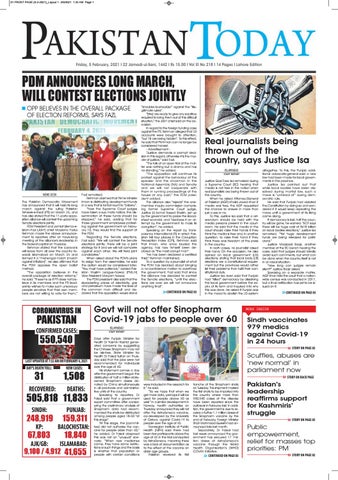
01 FRONT PAGE (5-2-2021)_Layout 1 2/5/2021 1:33 AM Page 1
Friday, 5 February, 2021 I 22 Jamadi-ul-Sani, 1442 I Rs 15.00 I Vol XI No 218 I 14 Pages I Lahore Edition
PDM announces long March, will contest elections jointly g
Opp believes in the Overall package Of electiOn refOrms, says fazl
NewS DeSk the pakistan Democratic movement has announced that it will hold its long march against the ruling pakistan tehreek-e-insaf (pti) on march 26, and has also stated that the 11-party opposition alliance will contest the upcoming senate elections jointly. pDm president and Jamiat Ulema-eislam-fazl (JUi-f) chief maulana fazlur rehman made the above announcement to reporters after an hours-long meeting of the alliance’s leadership in the federal capital on thursday. rehman stated that the caravans will leave from all over the country towards islamabad on march 26 and termed it a “mehengai march (march against inflation)”. he also affirmed that the pDm opposes the open ballot method. “the opposition believes in the overall package of election reforms,” he said. “it seems as if pti does not believe in its members and the pti leadership wishes to make such unsavoury people senators that their own members are not willing to vote for them,”
fazl remarked. rehman claimed that prime minister imran is distributing development funds in a way that is tantamount to “bribery”. “now the supreme court judges have taken a suo moto notice, the dissemination of these funds should be stopped,” he said, adding that for those government employees protesting against the government on february 10, they would find the support of the pDm. regarding the senate elections, fazl said: “We will contest the senate elections jointly; there will be a joint strategy for it and we will not compete against each other. We will field joint candidates.” When asked about the pDm’s plans to resign from the assemblies, he said the option would be considered later. “you must have patience,” added pakistan muslim league-nawaz (pml-n) vice president maryam nawaz the pDm president also said that the skyrocketing prices of electricity, gas and petroleum have made the lives of the common man difficult and declared that the opposition would stand
coronavirus in
Pakistan
CONFIRMED CASES:
550,540
LAST UPDATED AT 7:32 AM ON FEBRUARY 4, 2021
DAY'S DEATH TOLL:
31
RECOVERED:
NEW CASES:
1,508 DEATHS:
505,818 11,833 SINDH:
PUNJAB:
248,919
159,311
KP:
BALOCHISTAN:
AJK/GB:
ISLAMABAD:
67,803
18,840
9,100 / 4,912 41,655
“shoulder-to-shoulder” against the “illegitimate rulers”. “[We] are ready to give any sacrifice required to bring them out of this difficult situation,” the JUi-f chief said on the occasion. in regard to the foreign funding case against the pti, rehman alleged that 23 accounts were brought to attention, “but 18 are being hidden”. to this effect, he said that pm imran can no longer be considered honest. - advertisement “Justice demands a prompt decision in this regard, otherwise it is the murder of justice,” said fazl. “the talk of an open trial of the matter was nothing but a drama and has no standing,” he added. “the opposition will continue its protest against the behaviour of the speaker and the chairman in the national assembly (na) and senate and we will not cooperate with them in running proceedings of the house at any cost,” the pDm president added. the alliance also “rejects” the onemember inquiry commission comprising former supreme court judge, Justice (r) azmat saeed sheikh, set up by the government to probe the broadsheet scandal, and “declares it an attempt by the government to mask its corruption”, he added. speaking on the report by transparency international (ti) in which pakistan fell four places in the corruption perception index (cpi), rehman said that imran, who once lauded the agency, has now himself been declared as “the most corrupt man”. “he has been declared a certified thief,” rehman maintained. to a question by a journalist of what the pDm has decided about bringing a no-confidence motion to overthrow the government, fazl said that since the alliance has decided to contest the senate elections, “until the elections are over we will not announce anything final”.
CONTINUED ON PAGE 05
Real journalists being thrown out of the country, says Justice Isa ISLAMABAD Staff RepoRt
Justice Qazi faez isa remarked during a supreme court (sc) hearing that media is not free in the nation when real journalists are being thrown out of the country. When he asked attorney-general of pakistan (agp) khalid Javed khan if media was free, the agp requested the chance to answer in more than just a yes or no. to this, Justice isa said that a referendum should be held with the media persons present in the courtroom. he said that the media in the court should raise their hands if they think the media is free and, in another question, to raise their hand if they think there was freedom of the press in the country. in both cases, no journalist raised their hand. On the occasion, he also opined on local government (lg) elections, stating that local body (lb) elections are a constitutional requirement but the provinces would rather list their problems than fulfil their constitutional duty. Justice isa even said that punjab had “killed” democracy by dissolving the local government before the expiry of its term and inquired into why this was done. he asked if punjab was in the mood to abolish the lg system
Govt will not offer Sinopharm Covid-19 jabs to people over 60 ISLAMABAD Staff RepoRt
Days after punjab minister for health Dr yasmin rashid generated concerns by suggesting the chinese sinopharm may not be risk-free, state minister for health Dr faisal sultan on thursday said that the jabs were not recommended for individuals over the age of 60. his statement comes a day after the government began the distribution of half a million stateowned sinopharm doses donated by china simultaneously in all provinces and administrative units of the country. speaking to reporters, Dr faisal said that a government expert committee after considering the preliminary analysis of sinopharm data had recommended the shots be distributed among people aged 18-60 “at this stage”. “at this stage, the [committee] did not authorise the vaccine for people older than 60,” he added. Dr faisal observed this was not an “unusual” scenario. “When new medicines come, they have some restrictions or such things and the basis is whether that population or people with certain conditions
altogether. to this, the punjab additional advocate-general said a new law had been made for local governments in the province. Justice isa pointed out that while local bodies have been dissolved during martial law, such a move is “unheard of ” during democratic rule. he said that punjab had violated the constitution by doing so and wondered if it would keep repeating the move until a government of its liking came along. if democracy is lost, half the country will be gone, he warned. “ecp says there will be huge cost of rs18 billion on local bodies elections,” Justice isa remarked. “yet huge development funds are being released for politicians.” Justice maqbool baqir, another member of the sc bench hearing the case, said that judges should ideally avoid such comments, but what can be done when the country itself is not in an ideal situation. “how long can judges remain silent?” Justice baqir asked. speaking on a separate matter, agp khan told the court that a nationwide census was conducted in 2017, but a final notification has yet to be issued on it.
CONTINUED ON PAGE 05
MORE INSIDE
Sindh vaccinates 979 medics against Covid-19 in 24 hours STORY ON PAGE 02
scuffles, abuses are ‘new normal’ in parliament now STORY ON BACK PAGE were included in the research for it,” he said. “so we hope that when we get more data, perhaps it will be used for people above 60 as well.” in a similar development in norway, health authorities on thursday announced they will not offer the astrazeneca vaccine, co-developed by the University of Oxford, against covid-19 to people over the age of 65. norwegian institute of public health (niph) said there had been few participants above the age of 65 in the trial conducted by astrazeneca, meaning there was a lack of documentation as to the effect of the vaccine on older age groups. pakistan received its first
tranche of the sinopharm shots on tuesday. the shipment marked the first shots to be imported into the country where more than 550,540 cases of the disease have been reported since the outbreak in february last. in addition, the government is due to receive a further 1.1 million doses of the sinopharm vaccine by the end of february, foreign minister shah mahmood Qureshi had announced late last month. separately, Dr faisal had last week announced the government has secured 17 million doses of astrazeneca’s vaccine through the World health Organisation’s (WhO) cOvaX initiative.
CONTINUED ON PAGE 03
Pakistan’s leadership reaffirms support for Kashmiris’ struggle STORY ON PAGE 03
public empowerment, relief for masses top priorities: pm STORY ON PAGE 02
02
Friday, 5 February, 2021
LAHORE
NEWS
PuBlIC eMPowerMeNt, relIef for MASSeS toP PrIorItIeS: PM ISLAMABAD
P
STAFF REPORT
RIME Minister Imran Khan has said that the present government prioritises empowering the general public, and it is working to strengthen the relationship between the people and the government. Addressing a briefing on Thursday on the steps taken for good governance, the prime minister said that the incumbent government is working on providing justice to the common man, improvements in the police system, an increase in Pakistani workforce abroad among other measures. He added that the main objective of these reforms is to create ease in the system and ensure the provision of justice in all spheres.
The premier further directed that attention should be paid to deriving solutions to the problem the common man faced and an effective system of punishment and retribution should be introduced. Chief secretaries from Punjab, Khyber Pakhtunkhwa (KP), and Islamabad chief commissioner gave detailed briefings to the prime minister on all steps being taken to improve governance. Islamabad IGP also briefed the meeting on steps being taken to improve policing. The progress made in amending the Civil Procedure Code at the provincial level, and especially in amending inheritance laws to facilitate the process of giving women their legal right to property, was also briefed upon. Special Assistant for Overseas
Shehbaz shifted to hospital after health deteriorates LAHORE STAFF REPORT
Pakistanis Syed Zulfiqar Abbas Bukhari briefed the meeting on the steps being taken to increase the Pakistani workforce and remittances abroad. Regarding the increase in the Pakistani workforce abroad, the PM Imran was informed that a three-year strategy and action plan has been formulated that sets out the responsibilities of all the concerned agencies, along with timelines. Expressing satisfaction over these steps, the premier directed to ensure implementation of timelines to achieve set targets and to keep all relevant parties informed. Meanwhile, PM Imran said the entire focus of the government is to provide relief to the common man. He said this while chairing a meeting
IHC denies Veena Malik’s ex-husband’s notice against transfer of children ASAD KHATTAK CLAIMS THAT HIS FORMER WIFE ABDUCTED THEIR TWO KIDS FROM THE UNITED ARAB EMIRATES NEWS DESK Asad Khattak, the former husband of Pakistani actor Veena Malik, filed a notice in the Islamabad High Court (IHC) on Thursday against the transfer of his two minor children to Pakistan. In this regard, IHC Chief Justice (CJ) Athar Minallah has directed that he pay the court processing fee as he failed to do so after the last hearing, leading to his lawyer requesting more time. The court has issued notices to the Interior Ministry and Foreign Affairs Ministry that the registered office will only issue Khattak’s notice after the due payments have been made. Khattak currently claims Malik took their two children, 5-year-old Amal and 6-year-old Ibrahim, to Pakistan illegally and in turn, served a Rs500 million legal notice. He also claims that his former wife abducted their two kids from the United Arab Emirates (UAE) after the Dubai court ruled the kids’ custody in his favour. Malik, in response to Khattak’s claims, sent a legal notice of Rs500 million claiming that she lawfully brought her children to Pakistan.
on Thursday which reviewed the steps taken to bring down the prices of essential commodities. The premier noted that the price of wheat flour affects the poor people the most, therefore, all administrative measures must be ensured in this regard. The meeting was informed that the business community is appreciative of the government's economic policies. Various proposals were furnished in the meeting to bring down the prices of essential commodities. Apart from the administrative measures, the proposals envisaged use of technology to ensure transparency and discourage exploitation of the growers. The premier directed that the proposals be given final shape in order to ensure their implementation.
LAHORE An accountability court in Lahore on Thursday extended till February 18 the judicial remand of Pakistan Muslim League-Nawaz (PML-N) leader Khawaja Asif in the assets beyond means case against him. In December, the National Accountability Bureau (NAB) arrested Asif after he during successive quizzes failed to explain the source of his income and assets. The hearing on Thursday was presided over by Admin Judge Jawadul Hassan during which the former minister appeared before the court amid strict security measures. A NAB prosecutor presented the progress report in the reference against Asif before the court. Subsequently, the judge adjourned the hearing, extending the judicial remand of the suspect. According to the charge sheet against Asif, NAB says he was first elected senator in 1991 with assets to the tune of Rs5 million. However, it adds his assets swelled to Rs221 million by 2018, which were beyond known sources of his income.
KARACHI: The National Accountability Bureau (NAB) on Thursday decided to file a reference against former Sindh minister Pakistan People’s Party (PPP) leader Jam Khan Shoro for his alleged involvement in corrupt practices. Shoro is facing allegations of illegally allotting 19 plots of the Karachi Development Authority (KDA) worth Rs1 billion. In addition, he is accused of occupying state land in the Qasimabad area of Hyderabad district through misuse of authority, causing a loss of about Rs5 billion to the national exchequer. During a hearing on Thursday, a NAB prosecutor informed the Sindh High Court (SHC) that the reference sent to NAB Chairman Justice (r) Javed Iqbal has been approved. At this, the court asked how much more time the NAB required to file the case? “The reference would be filed within three weeks”, the lawyer replied. Subsequently, the court extended the pre-arrest bail of Shoro and others accused in the case until March 10. STAFF REPORT
Police to grill ombudswoman, son in Islamabad accident
Court extends Asif’s remand in NAB case STAFF REPORT
Pakistan Muslim LeagueNawaz (PML-N) President and National Assembly Opposition Leader Shehbaz Sharif was moved to a hospital Thursday morning after his health deteriorated. Strict security measures have been taken outside the hospital premises. A special medical board is expected to treat Sharif. Sharif has been imprisoned at the Kot Lakhpat Jail in several corruption cases including money laundering and assets beyond known sources of income case. The reference mainly accused Sharif of being a beneficiary of assets held in the name of his family members and benamidars, who had no sources to acquire such assets. It said that the family members and benamidars of the Sharif family received fake foreign remittances of billions in their personal bank accounts. In addition to these remittances, the bureau said, billions of rupees were laundered by way of foreign pay orders, which were deposited in the personal bank accounts of Hamza and Suleman. The reference further said that the family of Sharif failed to justify the sources of funds used for the acquisition of assets. It said that the suspects committed offenses of corruption and corrupt practices as envisaged under the provisions of National Accountability Ordinance, 1999, and money laundering as delineated in the Anti-Money Laundering Act, 2010. It asked the trial court to try the suspects and punish them under the law.
NAB chief okays reference against PPP leader
IN DECEMBER, THE NAB ARRESTED ASIF AFTER HE DURING SUCCESSIVE QUIZZES FAILED TO EXPLAIN THE SOURCE OF HIS INCOME AND ASSETS Responding to the news of his arrest, a spokesperson said Asif held an iqama (a work permit used in Saudi Arabia) between 2004 to 2008, adding he claimed to have earned a total of Rs136 million for his services as a consultant legal adviser. The PML-N leader was directed to submit details of the salary he received and other information. He was also asked to provide the job application he had submitted to a foreign company as well as his iqama agreement. “However, Khawaja Asif continuously failed to cooperate [with the agency] during the inquiry stage,” the spokesperson said.
ISLAMABAD: Days after four people died and two others injured when one of the five vehicles in the protocol convoy of Federal Ombudswoman Kashmala Tariq rammed into a car while jumping a traffic light in Islamabad, the police decided to go after Tariq and her son. In a statement, the police said that they will question the former MP and Azlan Khan, her son who was reported to be behind the wheel at the moment, and sent her a message in this regard. Following the accident, Azlan applied for pre-arrest bail from the court of Additional Sessions Judge Mohammad Sohail who granted the same against surety bonds of Rs50,000 till February 16. Earlier, the police confirmed Tariq’s protocol vehicles violated the sector G-11 traffic signal and collided with two vehicles, killing four people and injuring two others. One of the vehicles had a government number plate bolted on it, the police said. Kashmala’s husband, Waqas Khan, and Azlan were also in one of the vehicles. Per police, Waqas received wounds on his face in the accident. They shifted him to the Ramna police station. A police spokesperson said that action will be taken against those responsible in accordance with the law. STAFF REPORT
Sindh vaccinates 979 medics against Covid-19 in 24 hours KARACHI STAFF REPORT
As many as 979 frontline healthcare workers in Sindh were administered Covid-19 shots during the past 24 hours, the provincial health department said on Thursday. After receiving half a million jabs of China’s Sinopharm Covid-19 vaccine, the authorities began the distribution of the vaccine simultaneously in all provinces and administrative units of the country Wednesday. Of the total, 108 medics were vaccinated at Khaliq Dina Hall vaccination centre, 102 at Dow University of Health Sciences, 34 at Jinnah
Postgraduate Medical Centre (JPMC), 75 at Qatar Hospital, 14 at Sindh Government Hospital in New Karachi, 113 at Liaqatabad Hospital, 36 at Children Hospital, 37 at Sindh Government Hospital in Korangi and 145 at a private hospital in Malir. Outside Karachi, 129 workers were inoculated against the disease at Liaquat University of Medical and Health Sciences, Jamshoro and 186 at Regional Blood Center (RCB), Shaheed Benazirabad (former Nawabshah). As per the roll-out plan, the vaccine will first be made available to more than 400,000 doctors and frontline healthcare workers, teachers and social workers because they run the highest risk of
exposure to the contagious disease. After that, the shots will be provided to citizens over the age of 65, who generally face a higher mortality risk from the virus. Pakistan received its first tranche of the Sinopharm jabs, given by China as a “gift”, on Tuesday. The shipment marked the first shots to be imported into the country where more than 549,032 cases of the disease have been reported since the outbreak in February last. In addition, the government is due to receive a further 1.1 million doses of the Sinopharm vaccine by the end of this month, Foreign Minister Shah Mahmood Qureshi had announced late last month.
Court hears illegal land allotment case against Mandviwalla ISLAMABAD TLTP
An accountability court on Thursday heard a corruption reference filed by the National Accountability Bureau (NAB) against Senate Deputy Chairman Saleem Mandviwalla and others over alleged illegal allotment of government land for plots in Overseas Cooperative Housing Society, Kidney Hills, Karachi. Saleem Mandviwalla appeared before the accountability court during the hearing. Barrister Qasim Abbasi submitted power of attorney in the court to represent Mandviwalla and former managing director (MD) of Pakistan International Airlines (PIA) Aijaz Haroon. Barrister Abbasi apprised the court that the accused Aijaz Haroon had been granted bail by the high court in the case. The judge questioned NAB prosecutor whether it is a full reference or a supplementary reference would also be filed. To this, the prosecutor responded that it is the central reference; however, a supplementary
SENATE DEPUTY CHIEF SAYS SUCH REFERENCES TO AFFECT BUSINESSES reference will be filed if needed. The judge remarked that the court will provide a timeframe of two weeks for concluding the investigation and filing the supplementary reference on the next hearing. The accountability court also directed the provision of the copies of the corruption reference among the accused. Later, the hearing was adjourned till February 18. While talking to the media outside the court, Mandviwalla said that he appeared before the accountability court after being summoned. He claimed that it was a private transaction with the agreement of both parties. Such references would affect businesses in the country, he added. Mandviwalla further said that the high court had also declared it a private transaction in its ruling for granting bail to Aijaz Haroon.
To a question, he said that the final decision for the upcoming Senate elections through open ballot will be made in the Parliament. The NAB filed a reference against Senate deputy chairman in an illegal land allotments case on January 13. The anti-graft watchdog in its reference stated the accused sold government plots to Abdul Ghani Majeed – son of Omni Group chief Anwar Majeed. According to NAB, Senate deputy chairman had purchased fake shares in the name of his frontman by selling the plots. The national graft buster had also submitted a report to the court which stated that former PIA managing director Aijaz Haroon had also played a key role in selling illegal plots to Abdul Ghani Majeed. The NAB had nominated Saleem Mandviwalla, Aijaz Haroon, Abdul Ghani Majeed and Tariq Mehmood as offenders in the reference.
Friday, 5 February, 2021
LAHORE
PAkIStAN’S leAderSHIP reAffIrMS SuPPort for kASHMIrIS’ Struggle ISLAMABAD
P
STAFF REPORT
RESIDENT Dr Arif Alvi has said that Pakistan will continue to extend its support to the Kashmiris in their just struggle for the right to selfdetermination. Addressing a ceremony in connection with Kashmir Solidarity Day in Islamabad on Thursday, the president urged the United Nations and international community to play its due role in resolving the longstanding dispute. The president said that here are numerous UN resolutions demanding plebiscite in Indian Occupied Kashmir (IOK). President Alvi said that over eight million people have been besieged in the occupied territory by nine hundred thousand Indian troops. Separately, in a statement, Prime Minister Imran Khan called upon the world community to hold India accountable for its crimes against humanity in the IOK, reiterating Pakistan’s “unshakable” solidarity with the Kashmiri people. “For its part, Pakistan will remain unshakable in its solidarity with the Kashmiri people until they realize their legitimate and inalienable right to selfdetermination, in accordance with the United Nations Charter and relevant UN Security Council resolutions. This is indispensable for durable peace and security in South Asia,” he said in his message to the nation on Kashmir Solidarity Day (February 5). PM Imran reaffirmed Pakistan’s resolute support for the Kashmiri brothers and sisters, who continued to be subjected to an inhuman military siege and communications blockade since August 5, 2019. He said the tragedy of the Kashmiris, however, went back more than seven
PM ASKS WORLD COMMUNITY TO HOLD INDIA ACCOUNTABLE FOR HR ABUSES IN IOK
decades as they had faced unabated repression and consistent denial of their fundamental rights by India. “India must stop its brutal suppression of the Kashmiris, adhere to its international human rights obligations, and honour the commitment to Kashmiris to grant their inalienable right to self-determination through a free and impartial plebiscite under the UN auspices,” the prime minister demanded. He said that while observing the
Solidarity Day, Pakistan saluted the unflinching resolve of Kashmiris in their valiant struggle for the right to self-determination, which was pledged to them by India, Pakistan and the international community. PM Imran said that ever since India reneged on this commitment, it had sought to brutally suppress the Kashmiris’ quest for freedom. The latest Indian attempts to further colonize the occupied Kashmir by altering its demography and
obliterating the distinct Kashmiri identity were reflective of a sinister design to convert the Muslim majority into a minority, he added. The said changes, he stated, were being carried out through promulgation of illegal domicile rules, changes in property laws, and downgrading the status of Urdu language. Incentives were being offered to outsiders to settle on the occupied land of the Kashmiris in violation of international law, particularly the 4th Geneva Convention. The prime minister said that over eight million Kashmiris had been turned into prisoners in their own homes, with more than 900,000 occupation troops holding them hostage. “History has few examples of such violation of fundamental rights. Thousands of Kashmiris have been arbitrarily detained. The Kashmiri youth are being particularly targeted through abductions, incarceration at undisclosed locations, indiscriminate use of pellet guns, and extra-judicial killings in fake encounters," he remarked. Calling it a “manifestation of Indian state-terrorism against innocent Kashmiris”, the prime minister called for immediate lifting of the military siege and communications blockade as well as rescinding of India’s illegal and unilateral actions in the IOK. Moreover, he said, all those arbitrarily arrested and illegally incarcerated should be released and draconian laws providing impunity to the Indian occupation forces immediately repealed. The prime minister demanded India to give access to the international human rights and humanitarian organisations, as well as the international media to investigate the grave human rights situation in the occupied territory.
NEWS
03
CoAS for greater vigilance against hybrid warfare challenges LAHORE STAFF REPORT
Chief of Army Staff (COAS) General Qamar Javed Bajwa has reiterated greater vigilance and state of preparedness amid new challenges of hybrid war. The army chief visited Lahore Garrison on Thursday and discussed matters related to hybrid warfare, Kashmir dispute and overall security situation of the country while addressing officers. “The COAS address focused on professional matters, internal and external security situation of the country and his vision of an enduring peace within Pakistan and the region, the Inter-Services Public Relations (ISPR) said in a statement. Gen Qamar also apprised the officers of the latest developments on the country's eastern border, situation in Indian Occupied Kashmir (IOK) and firm commitment for a just resolution of Kashmir issue in line with the aspirations of people of Kashmir, the military’s media wing said. “People of Kashmir and this region deserve peace,” ISPR quoted the COAS as saying. He also stressed on greater vigilance amid new challenges of hybrid war. Earlier, upon arrival in Lahore, the army chief was received by Corps Commander Lieutenant General Muhammad Abdul Aziz. Earlier this week, while addressing a graduation ceremony held at Pakistan Air Force (PAF) Academy Asghar Khan, General Bajwa said that Pakistan stands firmly committed to the ideals of mutual respect and peaceful coexistence. "It is time to extend a hand of peace in all directions," he had remarked. The army chief also highlighted the need to resolve the long-standing issue of Jammu and Kashmir in a dignified and peaceful manner as per the aspirations of people of Jammu and Kashmir and bring this human tragedy to its logical conclusion, the army chief emphasised. "However, we will not allow anybody or any entity to misinterpret our desire for peace as a sign of weakness," he added.
eCP to announce Senate polls schedule on february 11 ISLAMABAD STAFF REPORT
Federal ministers summoned by SC over Steel Mills case NEWS DESK The Supreme Court (SC) on Thursday said that the mismanagement of Pakistan Steel Mills (PSM) was the reason behind its downfall and in this regard summoned summoned federal ministers Asad Umar, Hammad Azhar and Muhammad Mian Soomro in connection with PSM employees promotion case on February 9. The apex court had initially summoned the ministers immediately, but after a recess had learned that the ministers were not in the city, and had therein directed them to appear before the court on February 9. Chief Justice of Pakistan (CJP) Gulzar Ahmad, while heading the twomember bench constituted to hear the case, remarked that in practical terms the Steel Mills did not exist and the court will order for closure of the mills. The chief justice said that the court will close down the mills if the management refuses to improve their performance. Chief Justice Gulzar Ahmed said that mills that have been closed do not need a managing director or CEO. These offices are nothing but a
PSM LAWYER SAYS THAT DAILY EXPENDITURE HAS BEEN REDUCED FROM RS200 MILLION TO RS100 MILLION burden on the national treasury, he said. The CJP questioned the federal secretaries appointed by the government, who, he remarked, did not work and merely wrote letters like clerics. “The closed mills does not need any MD or chief executive. The management and officers of the institution are a burden on the national exchequer. They should be removed from the mills before the employees,” the CJP said. The counsel for PSM, Shahid Bajwa, apprised the court that the entire administration of the organisation has been replaced, adding that only 439 of the 1,800 employees remain. To this, CJP Gulzar asked if the replacements would make the organisation functional, and asked what the retained 439 employees had been doing when the mills were closed. The CJP remarked the steel mills are profit-making entities in other parts of the world. “There will still be more staffers than needed at the PSM,
tHree of fAMIly INjured IN CylINder BlASt PESHAWAR: At least three members of a family received serious burn injuries in a gas explosion in here on Thursday morning. Rescue officials said the injured — identified as Mudassar Shah,36, his wife Aysha Bibi 32, and his son Musa Khan — were rushed to Lady Reading Hospital. It further said the condition of the injured was stated to be stable at the hospital. Gas accumulated in the house due to leakage from the heater and when in the morning the mother of the children lit the match a powerful explosion occurred. A major portion of the house was badly damaged in the blast. APP
including those working at its hospital and schools.” To this, the PSM lawyer replied that daily expenditure has been reduced from Rs200 million to Rs100 million. After a recess, the top court was informed that the process of the steel mills’ privatisation will be completed by August. Continuing to take the officers to task, the chief justice remarked that every institution of the country was functioning in similar conditions as the PSM. “Whether its the railways or the PIA, every institutions has a similar story to tell,” he said. A week earlier, the government had reviewed and discussed the revival of Pakistan Steel Mills, which would be undertaken as per the cabinet’s decision wherein core assets of PSM would be transferred to a subsidiary owned wholly by the mills, followed by the sale of the majority shares of the subsidiary thus formed without transfer of full
ownership. In this regard, Federal Minister for Privatisation Soomro and Federal Minister for Industries and Production Azhar had co-chaired a meeting to review and discuss the progress made in the revival of PSM on Tuesday last. Federal secretary privatisation, additional secretary industries, and other senior officials of the ministry had attended the meeting. PSM chairman and CFO participated via video-link. According to a press release, the Ministry of Privatisation has been actively following the scheme of the arrangement, whereas the transaction structure had already been approved. In the meeting, ministers had been briefed about the current status and progress and probable timeline for the completion of said transaction. Moreover, the other matters relating to the use of jetty, registration of a new subsidiary and others were deliberated upon in detail. Soomro had said on the occasion that they must strictly follow the timeline and complete the task in the defined period. He along with Azhar resolved to extend their support to the maximum extent to solve the issues which may have arisen.
The Election Commission of Pakistan (ECP) will announce the schedule for the forthcoming Senate elections on February 11 as it started issuing nomination papers for the candidates on Thursday. According to a press statement issued by the ECP, nomination papers for the two Senate seats of Islamabad can be obtained from Election Commission’s Secretariat in the capital. For provincial seats, the papers can be received from the offices of the respective provincial election commissions. The candidates have been asked to attach party tickets while submitting the nomination papers. Independent candidates do not need to do so. In addition, candidates were reminded to set up a special account for this purpose at any branch of any scheduled bank for their election expenses as their account number should be mentioned in the nomination papers. The ECP further added it is important to prepare in advance. According to the rules, a candidate is not allowed to make his election expenses from any bank account other than this particular bank account. The candidates were also directed to open an account in their name with cash not exceeding the fixed amount of Rs1.5 million. The move comes a day after the government introduced the 26th Constitutional Amendment Bill in the National Assembly (NA) seeking an open Senate vote and giving the right to dual nationals to contest the general elections for a discussion and vote amid ruckus by the opposition parties. Last month, the government had moved the Supreme Court (SC) seeking its opinion about the mechanism of voting for the elections of the upper house of the parliament.
Opp won’t resign from assemblies: Rasheed RAWALPINDI STAFF REPORT
Minister for Interior Sheikh Rasheed Ahmed has expressed the confidence that the opposition alliance will not cross the political limit beyond the proposed long march to Islamabad and the noconfidence vote against Prime Minister Imran Khan. “The rage [of Pakistan Democratic Movement],” he said, “has subsided.” “No protest movements can topple elected governments,” he said, citing
'THE RAGE [OF PAKISTAN DEMOCRATIC MOVEMENT] HAS SUBSIDED,' HE SAYS the 2014 Pakistan Tehreek-e-Insaf (PTI) sit-in, during a press conference in Rawalpindi on Thursday. “We are not giving a tough time to the opposition, we will respond according to their plan.” In politics, he said, it is not wise to approach a dead end as dialogue is the
best option to sort out differences. “Those who are talking about resigning from the assemblies may revisit their decisions as it won’t bring any change,” the minister said. He added: “The government has already completed three years in office, with just one year left.
Electoral activities begin in the fourth year.” Rashid further said that Senate elections planned for March will strengthen the democracy, recalling both opposition parties — Pakistan Muslim League-Nawaz (PML-N) and Pakistan People’s Party (PPP) — agreed on an open vote in the 2006 Charter of Democracy, but have now backtracked on it. “Prime Minister Imran wishes for the Senate election to be transparent,” he further said.
04
Friday, 5 February, 2021
LAHORE
NEWS
Buzdar Pays trIBute to struggles of IoK PeoPle LAHORE
P
PPI
uNJAb Chief Minister Sardar usman buzdar on Thursday paid rich tribute to the just struggles of unarmed people of Indian-occupied Kashmir (IOK) and said that the whole nation is standing side by side with the IOK people. The chief minister said that Pakistan and Kashmir are identical twins and the both are incomplete without each other.
CM SAYS WHOLE NATION IS STANDING SIDE BY SIDE WITH KASHMIRIS The chief minister added, “Pakistan strongly condemns human rights violations in the IOK. The sun of freedom will rise with the blood of martyrs because India cannot deprive the Kashmiris of their inalienable right of self-determination through a state-sponsored policy of
cruelty and violence.” Pakistan enjoys a strong relation of love and affection with the Kashmiris, who have written a new history of the freedom struggle with their precious blood, he said. The CM reiterated that no power on earth can break the immortal
PIC declares answer sheet a public document LAHORE SHAHAB OMER
relationship between Pakistan and Kashmir. “In fact, Kashmiris are not alone in their justified freedom struggle and the whole Pakistani nation is standing with them,” he added. The CM asserted that there is no justification of global silence on the martyrdom of innocent Kashmiris in the IOK and maintained the global community will have to be awoken from this slumber. India will have to be answerable for its every barbarity, he stressed.
LAHORE: Director General Public Relations Saman Rai and staff members pose for a group photo.
LHC orders steps to curb drug abuse in schools LAHORE TLTP
The Lahore High Court (LHC) has directed relevant authorities to take concrete steps on an urgent basis to curb drug abuse in educational institutions and sought an implementation report. The LHC issued the directives on Thursday while hearing a petition
filed by the Judicial Activism Panel for seeking a ban on smoking and narcotics consumption in educational institutions. During the hearing, a consultant on the anti-narcotics campaign submitted the health profile report regarding the educational institutions. The report stated that 17 educational institutions were visited and most of the centres failed to prepare health profile reports.
Despite reluctance from the Punjab Public Service Commission (PPSC), the Punjab Information Commission (PIC) has declared answer sheets of the commission’s exams a public document, saying that the sheets will remain confidential until the result is announced, Pakistan Today learnt on Thursday. The PIC, while giving its findings in the case of Noman-ul-Haq, said, “The answer sheet of a candidate is not a privilege document and it is a classified document until announcement of results.” The PIC referred Article 19-A and stated that according to the article, every citizen shall have the right to access information in all matters of public importance. “Any public body, having its own regulations, does not become immune from the legal and constitutional norms,” it added. The commission, after accepting the appeal of Haq, ordered to the PPSC’s public information officer to issue a certified copy of requisite information to the candidate within three days. Speaking to Pakistan Today, PIC Chief Commissioner Mehboob Qadir Shah said that access to information has always been a difficult task but the commission is trying its best to make all kinds of information available to the general public.
05-NEWS 5 February 2021_Layout 1 2/5/2021 1:37 AM Page 1
Friday, 5 February, 2021
lahore
NEPRA REsERvEs DECIsIoN ovER Rs1.95 PER uNIt PoWER tARIFF hIkE ISLAMABAD
t
AHMAD AHMADANI
HE National Electric Power Regulatory Authority (NEPRA) has reserved its judgment over the tariff hike of Rs1.95 per unit and will take a final decision after detailed verification of facts and figures. In this regard, NEPRA on Thursday conducted a hearing on the government's request to approve the increase in electricity rate. The government has sought an increase in tariff for all categories of electricity consumers, including
Lucky Cement awarded corporate social responsibility award for business transformation LAHORE PRESS RELEASE
Lucky Cement Limited has won the Int'l Corporate Social Responsibility Award in the category of "Business Transformation" organised by The Professionals Network (TPN), at the 10th CSR Summit & Awards held at a local hotel in Karachi. The award is in recognition of its efforts towards a sustainable business transformation through the successful integration of a customised logistics fleet operations.
lifeline consumers. The increase, if approved, will put an additional burden of approximately Rs200 billion on consumers. Earlier, the regulator had decided to hike the power tariff by Rs3.34 per unit for the year 2019-20. The average tariff stood at Rs13.35 per unit last year, jumped up to Rs16.69 per unit with effect to NEPRA's last tariff determination. It may be noted here that the federal cabinet has already approved a hike in tariff through the circulation of a summary. During the course of Thursday’s hearing, officials from the Power Division informed that the increase in tariff would not be applicable to consumers of K-
Electric (KE). However, the regulator said it will hold a separate hearing relating to the tariff for K-Electric consumers. Present on the occasion, NEPRA Member Rafique Shaikh pointed out that Section 31 of the NEPRA Act that ensures the uniform tariff across the country was not implemented. He also sought legal justification of the Rs1.95/unit increase in the electricity rates. Upon which officials of the Power Division said that uniform tariff was in accordance with revenue requirements of power distribution companies (DISCOs) and will not be applicable to KE consumers.
Power sector’s circular debt likely to swell to Rs2, 587 billion till June 2021 ISLAMABAD AHMAD AHMADANI
The power sector's circular debt has been increasing is likely to increase to Rs2,587 billion till June. Sharing the projected figures, sources told Profit that circular debt would increase to Rs2,587 bn by June this year as payable to Independent Power Producers (IPPs) would increase to Rs1,510 bn, while payable by power generation companies (GENCOs) to fuel suppliers is estimated to be around Rs100 bn, and the amount parked in Power Holding Private Limited (PHPL) would increase to Rs77 bn. "The power sector’s circular debt has been increasing with each passing day, which is contrary to the claim of the incumbent government." As per details, total circular debt was Rs1,612 bn in 2018, Rs2,150 bn in 2019, while it was Rs2,303 bn in 2020. Sources said that poor governance — low recovery
of monthly bills and high power theft — gave birth to the complicated ‘circular debt’, forcing the government to compromise on working capital at power production, transmission, distribution as well as oil and gas supplying firms. Earlier, the Cabinet Committee on Energy (CCoE) had directed the Power Division to present figures of billing, collections and circular debt of power sector. The Power Division has submitted verified figures of circular debt and projected figures of circular debt of the power sector on the new format before CCoE. It is pertinent to mention that the government had been claiming that it had brought down the monthly build-up in circular debt from Rs38 bn during the tenure of the Pakistan Muslim League-Nawaz (PML-N) to Rs12 bn and aimed to further reduce it to Rs8 bn per month by December last year. However, all claims made so far by the government have proved wrong as the circular debt continues going up with each passing day.
Govt will not offer Sinopharm Covid-19 jabs to people over 60 COntInuED fORM pAgE 01 Of these, he had said, about seven million doses will be available in the first quarter of the year and the rest by the end of 2021. Advertisement: As per the roll-out plan, the vaccine will first be made available to more than 400,000 doctors and frontline healthcare workers, teachers and social workers because they run the highest risk of exposure to the contagious disease. After that, the shots will be provided to citizens over the age of 65, who generally face a higher mortality risk from the virus. In place of Sinopharm, the government will offer AstraZeneca vaccine to people over the age of 60, Dr Faisal confirmed to a publication. “When our Pakistani experts looked at the data they were reasonably satisfied
with the AstraZeneca data but felt that [based] on the presently available numbers for Sinopharm, the data did not justify its usage for those aged over 60,” he said. “The Chinese have also reiterated this restriction.” He said, however, that these were “complex matters”, and it was unlikely that a homogeneous perspective would be seen regarding vaccine administration around the world. On Wednesday, a pulmonologist and Covid-19 expert, Shazli Manzoor, told AFP that the Chinese vaccine suited Pakistan because it could be stored at between 2C and 8C (36 and 46 Fahrenheit), compared to -70C for other vaccines. He said the government would set up special clinics to monitor how the population was responding to the vaccinations. Some doctors have questioned the
effectiveness of the vaccine. “It [Sinopharm vaccine] lacks transparency and data compared to other vaccines,” another health expert told AFP. NATIONAL INSTITUTE TO DEAL WITH EPIDEMICS: During his presser, Dr Faisal suggested building a national institute to deal with future threats and challenges from epidemics and diseases like Covid-19. He shared that the government had also made amendments to the law governing the National Institute of Health (NIH) in Islamabad so it could be upgraded. According to him, “good work” was being done at NIH but the government wanted to take it to “expert level”. “We believe NIH can be a [combined platform] where six to seven institutes are working on their own expert areas but are cooperating with the [Ministry of National Health Services, Regulation
and Coordination] and with its cooperation, new research [can be conducted].” Listing some of the institutes that would come under “one umbrella”, he said they would include a national health laboratory, data centre, centre for disease control and a centre for biologics and biomedical technology. “There [should] be one national institution to diagnose viral and bacterial infections so other labs can contact [it] and a proper system can be set up. A national health data centre has been created,” he said while recalling that the National Command and Operation Centre (NCOC) had to “collect data haphazardly” but now a system had been developed for it instead. He also highlighted the need for separate institutes to deal with biological technology, production of anti-venom and nutrition.
Real journalists being thrown out of the country, says Justice Isa COntInuED fORM pAgE 01 In reply, Justice Isa asked if the country had gone to sleep after 2017. The AGP explained that the provincial government in Sindh and the Muttahida Qaumi Movement (MQM) party held objections against the results of the 2017 census, and so the federal government had formed a committee to review the matter. Justice Isa told the AGP not to name any political party, reminding him that this was a constitutional matter. The AGP said that the census will be conducted again on 5 per cent of the population blocks in Sindh. The SC judge asked why no objection had been raised between 2017 and 2021 when this was a routine matter. “Is Pakistan generally being run like this?” he asked. Who is the chairman of the
Council of Common Interests (CCI), Justice Isa asked, to which the attorney-general responded that the prime minister is the CCI chairman. He then asked if the premier had convened a meeting of the CCI, on which the attorney-general informed the judge that a CCI meeting had been called but could not take place for some reason. The Election Commission of Pakistan (ECP) on Thursday informed the apex court that LB elections in Punjab, Khyber Pakhtunkhwa (KP), and cantonment boards will be held in phases starting April. Last week, the apex court had directed the commission to furnish a comprehensive response within a week on holding the LB polls across the country. According to the dates provided by the commission, in KP, the election will be held in two phases: the first phase on
April 8 and the second on May 29. The schedule of the first phase will be announced on February 12, while for the second phase, on March 25. Similarly, it said, the elections in Punjab will be held in three phases, where polling in the first phase will be held on June 20, followed by the second phase on July 16, and the third on August 8. The schedule for the elections will also be announced in phases, the commission said. In a similar way, the nationwide elections for the cantonment boards will also be held on April 8 and May 29, it added. “The election commission held two sessions over the instructions of the Supreme Court to deliberate on the local government elections in the provinces, Islamabad and the cantonment boards,” the ECP said. “The minutes of the meet-
ings have also been attached.” “The matter of local council elections in Sindh and Balochistan have been postponed till February 11 meeting,” it said. In November, Justice Isa, while hearing a case pertaining to the holding of LB elections in KP, had described the absence of a grassroots government in the province as a brazen disregard of the law, observing that neither the chief minister nor the provincial cabinet members were abiding by the Local Government Act, 2013, and the Constitution by not holding the elections. The term of the elected local government representatives in the province expired on August 28, 2019. Thus the people continue to be deprived of democracy, the court had regretted, adding the violation of the Constitution must be brought to an end.
newS
05
KE committed to keeping industries powered up.
IPC minister felicitates PBF Chairman Gen (r) Muzammil over election
LAHORE PRESS RELEASE
Inter Provincial Coordination (IPC) Federal Minister Dr Fehmida Mirza on Thursday congratulated Lt Gen Muzammil Hussain (r) on becoming PBF chairman during a meeting to discuss with matters relating to promotion of boxing in the country. The PBF chairman apprised the federal minister of the plans to hunt and groom the local talent for elevating standards of boxing in Pakistan. Lt Gen Muzammil Hussain (r) was elected PBF Chairman unopposed last month.
GB CM, WAPDA chairman discuss Rs78.5bn CBMs for Diamer Basha Dam
ISLAMABAD PRESS RELEASE
Gilgit Baltistan (GB) Chief Minister Muhammad Khalid Khursheed on Thursday called on the Pakistan Water and Power Development Authority (WAPDA) Chairman Lt Gen Muzammil Hussain (r) to discuss matters relating to hydro development in the region, particularly Diamer Basha Dam Project and the Confidence Building Measures (CBMs) undertaken by WAPDA in the Project area for socio-economic development of the locals.
PDM announces long march, will contest elections jointly COntInuED fORM pAgE 01 The PDM chief also announced that the alliance will hold a rally in Muzaffarabad on Kashmir Day in solidarity with the people of the region. “The situation right now is that Kashmir has been sold off and where there is so much oppression against Kashmiris and its special status has been abolished, we will continue to stand with them in this protest,” said Fazl. Upon being asked by a journalist of what PML-N supreme leader Nawaz Sharif’s message to the PDM today was, Fazl replied by saying: “He said ‘all is well, Insha’Allah’.” The meeting of the anti-government coalition lasted over five hours and also discussed the no-confidence motion proposed by Pakistan People’s Party (PPP) Chairman Bilawal Bhutto-Zardari. PPP’s delegation also included former premier Yousaf Raza Gilani, Raja Pervez Ashraf, Sherry Rehman, Qamar Zaman Kaira, and Farhatullah Babar. From the PML-N, the party Vice President Maryam, Ahsan Iqbal, Marriyum Aurangzeb, and Rana Sanaullah were present. Former PM Nawaz and former president Asif Ali Zardari also attended via-video link. A day earlier, PPP leader Yousaf Raza Gillani had insisted that the anti-government drive was far from over and en masse resignations from the legislative assemblies are the “final option”. Speaking to media in Islamabad following the hearing in Trade Development Authority of Pakistan (TDAP) corruption case, Gillani had taken a cue from his party’s position on the matter and said there is no use of tendering resignations at this stage when the Senate elections are less than a month away. The member parties of PDM take decisions [on all the issues] unanimously, he had said. Gillani further had said: “The incumbent government’s [members] had also resigned when it [PTI] was in opposition but then National Assembly speaker [Ayaz Sadiq] did not accept their resignations.” PPP is an expert in forming coalition governments, he had said.
Friday, 5 February, 2021
06 COMMENT
Secret ballots and term limits
Kashmir Solidarity Day Much more needed than to observe it
Y
eT another Kashmir Solidarity Day to commemorate the Kashmiris’ sacrifices. As usual a public holiday, the Prime minister to address a public gathering in AJK , one-minute silence at 10 am across the country, and solidarity walks in islamabad, muzaffarabad, Gilgit and four provincial headquarters. is one a day in a year sufficient to help the Kashmir cause? meanwhile barbarities continue in the indian occupied Kashmir. The lockdown enforced in the Valley after the revocation of Article 370 shut off entire communities as well as their communication to the outside world. Kashmiris in the Valley were deprived of political rights, and of that modern means of communications, the internet. Thousands of political workers were arrested and packed off to jails in far-off indian states The numbers of army and the paramilitary forces were boosted. The condition of the people worsened during the covid-19 pandemic. Health workers going to attend cases were frequently harassed, even thrashed. Staged encounters still continue. Several militant leaders have also been killed and their mortal remains interred in far-off areas because the indian government fears large public participation and anti-india slogans at funerals. Protest has been contained but could not be throttled despite the free use of the indian state’s coercive power. Sparks continue to fly off from what look like ashes. in June, killings of nine militants led to protests and clashes as hundreds of residents tried to march to the site of the encounter. Chanting slogans demanding an end to india’s occupation of Kashmir, demonstrators threw stones at police and paramilitary soldiers, who fired shotgun pellets and tear gas. The revocation of Article 370, the lockdown of the valley and subsequent indian atrocities received ample coverage in international media, putting india on the defensive. This also led a number of US Senators and British mPs to show concern over rights abuses in Occupied Kashmir. This was the time for the PTi government to launch a worldwide diplomatic offensive to expose india and seek the support of the international community for the Kashmir cause. As in other spheres, here too the government’s performance was marked by incompetence. There is a need now for the Pm to heed to the recommendations made at the National Kashmir Conference on Tuesday.
Attacking fundamental concepts, but inconvenient At Penpoint M A NIAZI
P
rime minister imran Khan’s commitment to democracy itself seems to be in doubt, for he has announced the taking of action against it in its name, by proposing to end corruption in Senate elections by sacrificing the secrecy of the ballot, just after he spoke of the limiting effects of term limits, by saying that term limits are too short. This appears a contradiction of the ideas of the last martial Law on tenures. Pervez musharraf’s eighteenth Amendment introduced the idea of placing a term limit, as in the USA, on chief executives, restricting them to two terms. it went a step further, by placing limits on a combination of provincial and federal offices. in the USA, gubernatorial terms are not counted towards term limits. One of the ideas prevalent in the parliamentary model is that there can be no restriction on any member who might enjoy the confidence of the House. The tenure of the House is fixed, not of the individual. Also, the tenure of the House is a maximum, not an absolute, for the House might be dissolved. Only the Senate cannot be dissolved. The need to have Senators vote by open ballot is solely a problem with the KP Assembly, perhaps because a smaller number of mPAs are needed to elect one Senator. it is interesting that this problem has not arisen in Balochistan, where even fewer mPAs are needed. However, there has been some speculation that the PTi’s expected Senate choices are not going to be popular, as they will accommodate some of the presently unelected Pm’s advisers and special assistants. elected to the Senate, they will be able to take their place as full-fledged ministers, and be able to take charge of ministries. One glaring example is that of Dr Hafeez Sheikh, who was first inducted as Pm’s Adviser on Finance in April 2019, but who was inducted as Finance minister in December last year. Under the Constitution, he has six months to find a seat in Parliament, failing which he will cease to hold office. Dr Sheikh has been in that position before, and the PPP had to get him elected to the Senate. The Senate route had been used before to get a seat for the Finance minister, for without a seat in Parliament, and thus not in Cabinet, the Finance minister cannot present the Budget, head the National Finance Commission, or either the Cabinet Committee
Exports surge to be short-lived? Without home grown cotton, problems are mounting
T
He cotton crop collapse has merely added to Pakistan’s export woes. it is problematic in itself that Pakistan is so dependent on textiles for its exports. Be that as it may, there is a certain logic in this, because instead of exporting raw cotton, it makes more sense to convert it into textiles, and then export them. However, it has meant that if cotton growth has been insufficient, textile manufacturers have imported the amount shortage. However, this year, the shortage might just be too great to overcome. The production this year is only 5.571 million vales, a 34 percent drop from last year, and the lowest production in 34 years. The shortfall is 2.4 million bales. The first reason is insufficient planting, as farmers have turned to sugar, because of the pricing incentives that have been offered by the government under pressure by the politically strong sugar lobby. The problem with sugar is that attempts to export it have led to local shortages, and people suffering immensely from food inflation. Sugar, after all, is a vital food item, while textiles are not. Apart from that, acreage and seed quality are also posing a problem. it must be remembered that cotton seed is highly developed, and thus artificial, and requires constant scientific research to be maintained. That research has not been undertaken of late, nor has the required investment been made, with the virtually inevitable result that seed quality, and thus productivity, has suffered. Another problem seems to the result of the ongoing US-China trade conflict. Pakistani textile exporters made up these shortages from imports of Chinese cotton. However, the USA has begun to object to any cotton originating from Xinjiang, as it may involve labour by Uighur prisoners. As there are other difficulties, importing from india is not really an option. The government must pay attention to the cotton crop collapse, which is all the more worrisome because it has not been caused by any pest attack. it must not only fund research, but reverse the way it favours sugarcane, which it may have started to ensure food security, but which it expanded because of the sugar lobby.
Pakistanis mark Solidarity Day while Kashmiris freeze
RAYEES AHMAD KUMAR
S
iNCe schooldays, we have been hearing that due to earth’s revolution, seasons are formed and further whenever we used to write an essay on any of the four seasons in Kashmir, it always started with “Saal mein chaar mosam hotei hain (Thee are four seasons in the year)” . indeed there are four seasons in Kashmir and every season lasts for three months. every season is unique in its features , colour and characteristics. Winter in Kashmir is particularly important because for this season not only do people make themselves physically and mentally prepared but also they make tremendous arrangements to survive in this harshest period of the year. Traditionally the winter is primarily divided into three stages in Kashmir. The first phase starts with a period of 40 days starting from December 21, it is a harsh period and is known as Chillai Kalan. This is followed by another phase of 20 days which usually is considered to be less intense in terms of the cold, this phase is known as Chillai Khurd. Finally the last phase is of 10 days, which is even less harsh and is
Arif Nizami Editor Umar Aziz
Asher John
Joint Editor
Executive Editor
Deputy Editor
Lahore – Ph: 042-36300938, 042-36375965
served seats, independents have to join a party, but can they make their votes be counted as having been cast for a particular party? it is almost as if the problem is not the corruption entailed, so much as the fact that someone else is making money. This is consistent with the PTi stance against corruption, which seems more based on envy rather than honesty of purpose. imran is also chafing at the term limit. One is reminded of the British example, when its first (and longest serving) Prime minister (1720-41), Sir robert Walpole, proposed that the tenure of Parliament become infinite, and only by-elections were to be held in future. He was stopped by a backbench rebellion, and no British Pm has expressed such a wish again. Pakistani Pms have, though, even though they should count themselves fortunate that they are not trammeled by term limits. Though they do not have term limits, they do have to have their mandates renewed. Perhaps the longest current tenure is the single six-year term of the mexican President. The French President had a seven-year term, but only François mitterrand won two. The term limit has been reduced to five years. However, imran seems a little over-anxious, for the dread of an election, which is very real for politicians, is setting in a little early, unless imran knows something no one else does. And there is going to be an early dissolution. imran seems too desperate even to conceal his thoughts, which he shares with most politicians, and which are undemocratic. imran might keep in mind that the only office which do not require renewal of the mandate is that of the Pope. The election even to that is by secret ballot. The Pope’s term is limited either by death, or by his own retirement, as Pope Benedict XiV did when he abdicated at the age of 85. He is still alive at 93. imran is not yet 70, being only 68. However, having no limit on a term is something of a deception with voters. it means not knowing how long a tenure may last. Like Pope John Paul i, who became Pope in 1978, only to die after 33 days in office. No British Pm yet has died in office, and the last US President to do so was Franklin roosevelt at the beginning of his fourth term in office. imran regards Hitler as someone who carried out a successful U-turn. However, it seems that he sees something else to emulate: Hitler came to power in 1933 by democratic means, and then proceeded to demolish democracy.
The writer is a member of staff.
Winter in Kashmir - blessing or a curse?
Dedicated to the legacy of the late Hameed Nizami
Aziz-ud-Din Ahmad
on the economy or the executive Committee of the National economic Council. However, the Senate is not merely a place for the government to get seats for ‘men of business’, but also the House where the federating units (the provinces plus the Federal Capital Territory) have representation. That is why not only do the provinces elect an equal number of Senators, but the voters are the mPAs. The single transferable vote ensures that parties are able to get seats according to their strength. it might be something of a criticism of democracy of some kind that KP Senators have monetized this, but then, voters in general election have demanded and obtained bribes. This does not seem to be a Subcontinental problem, but the UK experienced it when it still had rotten boroughs, where typically the ownership of certain properties carried the vote, and a constituency might thus have only a few votes, to be cast by certain property owners. These voters charged a fee for voting for someone, and thus it was possible to buy a seat in Parliament until 1832, when the rotten boroughs were abolished. This was also a time when it was possible for certain grandees to be the property owners, and thus have seats in Parliament in their pockets. These seats were not sold, but used to accommodate ‘men of business’, who actually ran the government, because the grandee could not be expected to soil his hands with the actual business of government. Thus Pitt the elder sat for the ‘pocket borough’ of Old Sarum, which had been given to him by the Whig grandee the Duke of Portland, who was always a prominent member of Pitt’s Cabinets, but never held a portfolio which made him do any work. There is the argument that since mPAs are elected on a party ticket, they should vote for the party’s nominees. But ensuring this by ending the secrecy of the ballot seems like the thin edge of the wedge. elections are not free if it is known how voters voted. Where voters have sold their votes in india, but then voted otherwise, terrible vengeance has been extracted, including burning the offending locality, thus punishing the innocent along with the guilty. it might be possible to bypass the mPAs by having seats allocated not according to party mPAs, but party vote; but then the problem of independents arises. independents usually join the Treasury, because that is what they have been elected to do, or because they ran because their party had made an awful ticket award. independents do not have a common purpose. For the election of women on re-
I
Karachi – Ph: 021-35381208-9
I
locally known as Chille Bache. Though the harsh winter period in Kashmir commences from December 21, the preparations are made in autumn months of September and October because people are aware about the miseries winter brings with its onset. making of charcoal, drying of vegetables to make Alla heache (dried bottle gourd) , Wangan heache (dried brinjal) , Reantwangan heache (dried tomatoes) , Hoch palak (dried spinach), Hokh hakh (dried collard greens) ,Heand ( dried dandelion leaves) and so, have been the centuries-old traditional practice of Kashmiris. Though the drying of vegetables has now been declining among the masses, still a large proportion of the Kashmiri population makes these delicious dishes in this period. The coming of tourists from other states and countries to enjoy skiing and other winter games at world-famous tourist resorts like Gulmarg, Sonamarg and Pahalgam is viewed as a blessing and a source to improve the economy of Jammu and Kashmir. Further, a good seasonal snowfall is also regarded as a blessing in terms of maintaining the water table, bringing life to dying Himalayan glaciers and for irritating our crops to have a good yield. There will be enough water for irrigation, hydropower generation and drinking for the coming summer. For children, it is play time and for tourists, vacation time. Additionally, heavy snow is a boost to tourism as it attracts tourists to the Gulmarg ski slopes. But this winter in Kashmir is bringing more miseries and worries which almost every individual is facing without getting a triumph over its hardships. Closure of the sole vital road link of Kashmir with rest of world for weeks together , scarcity of essentials, freezing of water pipes and hide and seek of electricity are among the common experiences in Kashmir. This not only makes the life of every Kashmiri cumbersome during these winter months but they feel it necessary to leave this Valley which has been regarded as the only paradise on earth by Firdousi who has compiled a famous couplet “Agar firdous bar roi zameen ast, hamein asto hamei asto, hamei asto” perhaps while staying here during peak summer, because during summers it is the best place to enjoy the extremely hot days. Had he ever visited here during winters per-
Islamabad – Ph: 051-2204545
I
Web: www.pakistantoday.com.pk
I
haps he would have described it differently. The fear of the harsh winter forces the common people to stay in Jammu or other places during these months. This year the winter weather has been extremely frightening because the mercury has gone deeply below to the extent of -12, a temperature experienced after a period of 30 years. Freezing of water pipes has forced people at many places to melt snow to get water for drinking and other purposes. Delay in restoration of electricity for days and weeks together has increased miseries manifold. Accumulation of four to five feet of snow on the roads has further kept people indoors for days together thereby making them psychologically ill. A poor man from Wuranhaal area of Anantnag district had to hire a JCB machine to clear the road because he had to take his wife to SKimS Srinagar who was suffering from a life-consuming disease of malignancy. A large number of pregnant ladies were carried on shoulders to have a safe delivery in hospitals, and many of them delivered before reaching hospital. Damaging of rooftops of houses, and sometimes destruction of the whole house, due to heavy snowfall and snowstorm is also making people fearful about winters. The memories of the calamity which struck at Wulteng, Nard Kund area of Kulgam district, a decade ago is still fresh in our minds in which hundreds of people lost their lives, property worth crores was lost in the form of livestock and other essential items. Since then Wulteng Nard has got a special recognition and it finds mention in the prescribed textbooks of our public schools. The only place where people feel pleasure or comfort and protect themselves from the harshest chill is the masjid Hamaam. Children, youths and old men, every individual enjoys the hot stone floors of the masjid Hamaam besides spending these tough days in making discussions with diverse groups of people on the social, religious and day-to-day political issues confronting them. People from all parts of the Valley are of the view that they will never forget this year’s winter because it has broken all the previous records of 30 years in terms of chill, snowfall and the intolerable miseries which they were forced to combat already. Author is a columnist and teaches at Govt Secondary School Anderwan Ganderbal
Email: editorial@pakistantoday.com.pk
Friday, 5 February, 2021
COMMENT 07 Editor’s mail send your letters to: Letters to Editor, Pakistan Today, 4-Shaarey Fatima Jinnah, Lahore, Pakistan. e-mail: letters@pakistantoday.com.pk Letters should be addressed to Pakistan Today exclusively
Aljazeera investigative report on Bangladesh
Changing Global Perceptions on Kashmir How India has manoeuvred in the world
DR RAjKUMAR SINgH
N
OT only the internal situation of the State of Jammu and Kashmir but the US approach on the issue underwent a significant change over the decades as direct and indirect mediator between the concerned parties of the dispute. in the context there are two key points that are vital in understanding the US approach to the Kashmir dispute. First, the USA does recognise that it is an international issue, and the final closure will require the endorsement of the United Nations Security Council (UNSC) leading to the removal of the UN military Observer Group in india and Pakistan (UNmOGiP) from both sides of the Ceasefire line. This fact has not changed and i do not know why anyone would scour world media daily to catch snippets on Kashmir in order to reassure their psyche that the Kashmir issue is still an international issue, when in fact that status has neither changed nor has been disputed by the major powers. The second point, though, is even more important. The US position on resolving the Kashmir issue has changed over the years. This change is neither dramatic nor topsy-turvy; it is merely a slow evolution that was inevitable given the knowledge and depth of comprehension within the US national security apparatus that existed about the dispute in 1947-48 as compared to today, as well as by the growing stature of the bilateral relationship between the USA and india. As such, Barak Obama, on becoming US President repeated what has been a long standing bipartisan view of both Democrat and republican governments, that the Kashmir issue should be resolved bilaterally by india and Pakistan. Today all major powers echo the statement made by President Obama that the Kashmir dispute can only be resolved by the two countries themselves. Although President Obama expressed his intention to try to work with india and Pakistan
on Kashmir, in view of several criticisms which appeared in the media, later he became reluctant on the issue. in an editorial in The Washington Times, Selig S. Harrison, Director of the Asia Programme at the Centre for international Policy and a senior scholar of the Woodrow Wilson international Centre for Scholars called it Obama’s first foreign policy mistake. Another newspaper The Australian called Obama’s idea to appoint a presidential negotiator ‘a very stupid and dangerous move indeed.’ Likewise, reihan Salam, in an editorial in Forbes, noted, ‘The smartest thing President Obama could do on Kashmir is probably nothing. We have to hope that india and Pakistan can work out their differences on Kashmir on their own.’ even according to The Financial Times, ‘india has warned Obama that he risks ‘barking up the wrong tree’ if he seeks to broker a settlement between india and Pakistan over Kashmir. Undisputedly, the problem of Jammu and Kashmir has been recognised by the big powers of the world as a bilateral one between india and Pakistan to solve on their own.’ in a recent attempt during the period of United Progressive Alliance (UPA) government, a new term ‘quiet diplomacy’ was discovered and propagated as a possible solution to the Kashmir problem. Speaking to journalists on the sidelines of an All-india newspaper editors’ conference, then home minister P. Chidambaram disclosed, “We are working on quiet diplomacy and such efforts are essential to take the process forward.” earlier in April 2006 too, india and Pakistan agreed on quiet diplomacy to further the solution of the Kashmir issue. Under it, major initiatives will be taken up at the top level, rather than being discussed in the media. According to Dawn, ‘Back-channel diplomacy will be used to debate proposals like self-government demilitarisation and independence. in the process some intellectuals and former bureaucrats and general of the two countries will meet and discuss various solutions. They would later brief their government about the outcome of their meetings and various proposals for resolving the dispute.’ However even at the beginning the initiative was criticised by pro-freedom leader and Hurriyat Conference chairman Sayed Ali Geelani who said that the offer was aimed at forcing a compromise solution on the people of Jammu and Kashmir against their aspirations, sacrifices and over six-decades long struggle. “Quiet diplomacy is secret diplomacy where people will decide things and force a solution on Kashmir.” He urged the people to be cautious and remain firm on their resolve and added that “if we compromised at this juncture we will always have to move backwards.” in the context the separatists’ bullet that killed the moderate Hurriyat leader, Fazl Haque Qureshi, had also, to a great extent, wounded the prospect of quiet diplomacy for settling the Kashmir problem. The european economic Community (later
the european Union) affirmed in its preamble that signatory states were determined to lay the foundations of an ever closer union among the peoples of europe. They specifically affirmed its political and economic integration creating a customs union, colloquially known as the ‘Common market.’ The establishment of South Asian Association for regional Cooperation (SAArC) in 1985 also contained several characteristics and used ideas of the eeC. With its formation it was hoped that the organisation would encourage india and Pakistan to cooperate like Germany and France to overcome their enmity after decades of devastating wars. The Heads of State and Government of the region including india, maldives, Sri Lanka and others felt the need of a common currency like the euro that would boost South Asia’s economic and political stability. Through the efforts and effectiveness of SAArC the South Asians expected to fabricate a secular umbrella to isolate the communal forces of the region as in europe where the Basques in Spain, the italian Catalans, and the irish irA terrorists have been reduced to nonentities. The first step in this direction would be the introduction of a common currency that, like the euro, would accelerate trade and commerce and, more importantly, unleash the centripetal force to help consolidate economic, political and cultural cooperation among South Asian countries. The concept of peace suggests not only the absence of conflict, violence and hostility but it also signifies an ambience of prosperity, be that economic, social or cultural. Without delving and getting stuck into the ruins of history, Kashmir, in the most recent times, has been showing some semblance of peace. But, the million dollar question is, is this really an era of peace or just another short-lived phase of calm before it could once again return to the storm of conflict that we got to witness on several occasions in past? in Kashmir, the psycho-social fallout of the lingering conflict situation has not been diagnosed appropriately, nor has it been tested with keen interest. in the context india’s key failure has been to eradicate its culture of exclusion, which privileges religious identity over citizenship. each bomb represents an idea and each idea, in turn, is rooted in a larger political and cultural context. Policing can arrest perpetrators, not the historical processes which create them. even though te ideological sources and material resources of the indian Jihad are global, the specific conditions in which it grew are local. india in the decade since 9/11, has failed to engage with, and address, those conditions. india’s key failure has been its inability to hold an honest national conversation about communal violence, and the ways in which it is embeded in our cultures: a key cause of the persistence of the Jihadist movement. The writer is head of the political science department of the B.N.Mandal University, Madhepura, Bihar, India and can be reached at rajkumarsinghpg@gmail.com
THere is a shocking investigative report by Al Jazeera TV, titled “All The Pm’s men”, which allegedly exposes the nexus between Bangladesh Pm, her COAS and his brothers who are involved in organized crime within the country and abroad. This is the cancer that infects most countries of the Third World, where institutionalized corruption is bleeding their economies. meagre resources and finances are funneled to off-shore locations and foreign countries which facilitate such irregularities, as long as these people don’t violate laws of their new adopted countries. This is what happens when paid public office holders of state institutions get involved in dirty power politics in violation of their constitutions and the oath they have taken. if only Bangladesh Pm or COAS had chosen to uphold rule of law and the constitution, this ignobility could have been avoided. it reminds us of the criminal role of mQm thugs with patronage of musharraf, who held hostage people of Karachi. Compare this to countries in the First World where rule of Law and the constitution reigns supreme. We have recently witnessed that the President of the USA, the sole superpower, could not succeed, in getting his military generals to intervene and overturn the mandate of the American people. General Willey, Chairman Joint Chief of Staff and 7 other senior generals issued a signed “memorandum For The Joint Force” on 13 January stating “The American people have trusted the Armed Forces of the US to protect them and the Constitution for almost 250 years”. They also reaffirmed that “US military will obey lawful orders from civilian leadership, support civil authorities to protect lives and property, ensure public safety in accordance with the law, and remain fully committed to protecting and defending the Constitution of the US against all enemies, foreign and domestic.” Ali MAlik TAriq lAhore
Terror in Sujawal A newly married woman Samina munaro 20, was subjected to sexual abuse and brutal torture in the village Yaqoob munaro of Union council mureed Khoso a few kilometers away from Jati. An Accused mir mohammad munaro allegedly abducted the woman and subjected her to sexual abuse and physical torture. The rape victim was later moved to Civil hospital Sujawal in a precarious condition for treatment and medical examination. in the aftermath of the incident, Jati police sprung into action and apprehended the accused who was trying to escape after committing the heinous offence. it is the fifth incident of sexual abuse in the area during the period of four months that has sparked fear and unrest across the area. Heirs of Samina monaro and the general public called for justice and dispensation of peace and public order in the area. On the other hand, robbers robbed a milkman of cash and a motorcycle after subjecting him to sound thrash within the periphery of maro Bola Khan police station. The milkman was on his way back when robbers intercepted him and robbed him of cash, a motorcycle, and a milk-filled drum. The robbers escaped from the scene after striking heavy blows on his head. The milkman was found in an unconscious state and was shifted to a nearby hospital. No, any case was registered till the filing of this report. This is the second incident of its kind during the past two days. kAMrAn khAMiso khAwAjA sujAwAl
Benefits of yoga YOGA is a very safe, easy and healthy way to get fit your whole life without any problems. it just needs regular practice in the right way of body movements and breathing. it regularizes the connection between three components of our body such as body, mind and soul. it regularizes the functioning of the all body organs and prevents the body and mind to get disturbed because of some bad situations and unhealthy lifestyle. it helps in maintaining the health, knowledge and inner peace. By providing a good health it fulfills our physical needs, through knowledge it fulfills our psychological needs and through inner peace is fulfills the spiritual need thus it helps in maintaining the harmony among all. regular practice of the yoga in the morning provides outer and inner relief by keeping away from the countless ailments at the physical and mental level. Practicing postures or asanas strengthens the body and mind as well as creates the feeling of well being. it sharpens the human mind, improves intelligence and help in high level of concentration by steadying the emotions and feelings. The feeling of well being creates helping nature within us and thus enhances the social well being. improved concentration level helps in meditating and provides calming effect and inner peace to the mind. Yoga is like a practical philosophy which develops self-discipline and self awareness within us through regular practice. Yoga can be practiced by anyone as it is irrespective of age, religion, or health circumstances. it improves the discipline and sense of power as well as provides a chance to life healthy life without physical and mental problems. To enhance its awareness about all benefits all over the world, the indian Prime minister, Narendra modi has suggested to the United Nations General Assembly to declare the 21st of June as an international Day of Yoga so that each and every may know about yoga and can been benefited. Yoga is an ancient indian tradition which was originated in india and practiced regularly by the yogis to get fit and meditate. By seeing the benefits of implementing the yoga in daily life, United Nations General Assembly has declared the international Day of Yoga to be celebrated every year on 21st of June. We cannot count the benefits of yoga, we can understand it only a miracle which has been gifted to the human fraternity by the God. it maintains physical fitness, reduces stress, control on emotions, feelings, controls negative thoughts, feeling of general well being, improves mental clarity, enhances self-understanding, connects to the nature and many more. M irfAn hub
Friday, 5 February, 2021
08 WORLD VIEW
The end of The IndIan Idea A CRACKDOWN ON THE COUNTRY’S PRESS IS THE LATEST IN A PATTERN OF INTIMIDATION AGAINST NEWS OUTLETS
AtlAntiC
f
VIDYA KRISHNAN
oR the past several years, warnings have been sounded about democracy in India—whether they be about the fate of the country’s minorities, its courts, its intellectuals. These worries steadily build, before erupting into some major protest, taking over the popular consciousness, both domestically and abroad. For the past several years, India’s government has steadily chipped away at the edifice of its free press and, over the past week, once again gone too far. This was the week my government attacked my home. Home for me is in a multistory building in the center of New Delhi, on the edge of a sprawling park, a short walk from the markets of Karol Bagh and the upscale shops of Connaught Place. I have not visited in some time, but it is where my heart is. This is where you can find the offices of The Caravan. The Caravan is a small magazine—it has a staff of just a few dozen people—and its readership pales in comparison with other members of India’s English-language printed press. Yet its diminutive size masks its power: The publication is read by government ministers and opposition leaders, and larger outlets regularly follow up on its stories. Its team of talented staff writers is supported by a glittering list of contributors, all of whom see the magazine’s strengths as standing apart from India’s larger mainstream publications. These people are my family. For the past seven years, I have contributed stories to The Caravan as a freelance journalist, typically on health and science with a particular focus over the past year on the coronavirus pandemic. It is a place where reporters and editors uniformly believe in the power of the written word, where speaking truth to power is a minimum expectation. over the past week, multiple state police forces have opened investigations into the editors of The Caravan, as well as a host of other journalists and writers, for covering protests by farmers opposed to agricultural reforms being promoted by Prime Minister Narendra Modi’s government. Twitter’s India office suspended the magazine’s account, as well as those of hundreds of other
users, after a “legal demand” from the government. (The Caravan’s account has since been restored, but the government is reportedly threatening legal action over Twitter’s apparent noncompliance.) Press-freedom groups have voiced outrage, but it is unclear how much impact they will have. These latest attacks, part of a pattern of legal cases, personal threats, and intimidation against news outlets and individual journalists, make certain what was becoming evident: The freedom of the press, a constitutional right, is endangered in Modi’s India. The brazen use of social-media networks to censor journalists, the use of the police and courts to silence them, and, more fundamentally, the belief that those who report on protests are somehow undermining the state illustrate how much has changed in India, and how far the country has strayed from its founding ideals. The authorities claim that The Caravan and other outlets, by reporting on a particular hashtag, sparked or fueled unrest that began on January 26, India’s Republic Day, during which New Delhi police tear-gassed protesting farmers—among them elderly men—as a parade was under way to showcase India’s military might and rich cultural heritage. The dueling images—a celebration of India’s democracy on the one hand, the crushing of dissent on the other—were carried on a split screen by many news channels, inadvertently offering the perfect visual metaphor for modern India. To outsiders, the idea of India is centered on spirituality and mysticism, Gandhi and nonviolence, backpackers and yogis. Though these are stereotypical beliefs, they stem from truth: The country’s founding idea was a union of states, diverse in religion, and liberal in acceptance of that diversity. Republic Day marks the enshrining of our constitution, debated and agreed on in the years following independence. The preamble of that document notes India’s “resolve to constitute” a nation with “Justice in social, economic and political life; Liberty of thought, expression, belief, faith and worship; Equality of status and of opportunity, and to promote among them all, Fraternity.” This was the central ethos of India once. Now we are a very different country. Today, that a majority of Indians are Hindu is not a demographic fact, but a governing premise; whereas liberty of thought was once prized, journalists are now arrested; and what was once a union of states, united in their diversity, is a society divided, where Muslims are not welcome, where farmers are beaten for defending their rights. To blame all of this on Modi would be overly simplistic. It is true that since his reelection less than two years ago, the prime minister has revoked the constitutional autonomy of Indian occupied Kashmir, the sole Muslim-majority state; established a religious test for citizenship that excludes Muslims; and promoted reforms that triggered civil unrest from farmers’ groups. This is to say nothing of the doctors who protest his govern-
ment’s decision to allow Ayurveda practitioners to perform medical surgeries, the students who protest attacks on intellectuals, the women who speak up against India’s rape culture, and the Dalits who fight caste oppression. The erosion of democracy in India did not happen in a single moment, or because of a single man. It came as a court directive to moviegoers, making it mandatory to stand for the national anthem. It came in the form of police officers forcing wounded Muslim men to sing that anthem while filming it, without fear of being punished. It came as Bollywood championed police brutality and vigilante justice. Yet Modi is central to all this. Much as India has a founding myth, so too does Modi: He was a tea seller who managed to work his way up to the most powerful position in the land. This story, which the prime minister repeats often, forms a sharp contrast with the familial privilege of the opposition Congress Party, their current leader a descendent of former prime ministers, and gives Modi the power to demand sacrifices of Indians. It is what allowed him to impose a brutal lockdown in the early stages of the pandemic, to demonetize huge amounts of India’s currency overnight, to remove Kashmir’s special autonomous status. And each time Modi has done so, his support has remained buoyant, even as the promised benefits have not come. India’s recorded coronavirus cases are the second-highest in the world, and its reported deaths are fourth-highest; taking large amounts of cash out of the system in an apparent bid to fight corruption did little of the sort and instead introduced significant economic hardship; and ending Kashmir’s autonomy has not brought peace to the region. This is in large part thanks to his government’s standard playbook, which involves denying facts, spreading lies, and telling half-truths that turn catastrophic failures into celebrated triumphs.
This is precisely why the actions against The Caravan and other journalists and media outlets are so troubling. Many news organizations have picked away at the government’s narratives, as a free press must do in a democracy, not because they are opposed to Modi, but because they are committed to truth. The Caravan, for example, profiled Modi’s predecessor, Manmohan Singh, with the same rigor and journalistic scrutiny that they currently bring to bear upon the current government. The war on truth in India is very much like the war on truth in the United States, where I am currently spending a year as a Nieman Fellow at Harvard; the scale of devastation may never be fully understood. It has jolted the foundation of the common realities we Indians presuppose as a nation, much as it has here in America. A country as enormous and complex as India is more than its flags, anthems, and monuments. It is made up of things that are at once powerful and fragile: ideas of equality, justice, liberty, fraternity. In its outright assault on the press, on truth, Modi’s government has hollowed out these ideas, and thus the soul of the nation. Like Americans, Indians do not share a common set of facts any longer, or attribute the same meaning to words. Citizens must be “obedient faithfuls,” or bhakts, as Modi’s supporters are known. India’s inherent complexity—stemming from its religious and cultural diversity—has been weaponized. With each sacrifice, we will chip away at the founding ethos, outlined in our constitution and heralded on Republic Day, until those words have no meaning. VIDYA KRISHNAN is a writer and journalist, and currently a Nieman Fellow at Harvard University. Her first book, Phantom Plague: The Untold Story of How Tuberculosis Shaped our History will be published by PublicAffairs in 2021.
How Washington rules the world US HAS JUSTIFIED ITS ASSASSINATIONS, COUPS, AND MASSACRES AS “THE FIGHT AGAINST COMMUNISM, FOLLOWED BY THE FIGHT AGAINST DRUG TRAFFICKING AND NOW, THE FIGHT AGAINST TERRORISM.” WHAT WILL THE NEXT FIGHT BE?
CounterPunCh
S
EVE OTTENBERG
o far, Biden’s foreign policy does not differ seismically from Trump’s. Indeed Biden’s first move – recognizing the unelected pretender to the Venezuelan presidency, Juan Guaido – was as lousy as anything Trump did. It raises the specter of CIA coups, assassinations, regime changes and Washington-orchestrated color revolutions, which Biden’s two dreadful foreign policy appointees, Victoria Nuland and Samantha Power, embraced ardently in the past. of course, those coups the U.S. sponsors are the antithesis of democracy and have the utterly predictable result of destroying entire countries – but this has been how the U.S. has exercised power in the world (mostly the Global South) since at least the dawn of the twentieth century. Vijay Prashad documents this shameful U.S. history in his new book, Washington Bullets, whose litany of CIA depredations is enough to cause outright despair. The opportunities lost. Human history thwarted. Virtuous leaders cut down precisely because they were virtuous. Heroes murdered. Plans to improve millions of lives just shattered. The cumulative portrait is beyond distressing. This portrait, this book is about how the U.S. rules the world, about raw power and how amoral, bloody and criminal such power is. As Evo Morales writes in the introduction, the U.S. has justified its assassinations, coups, and massacres as “the fight against communism, followed by the fight against drug trafficking and now, the fight against terrorism.” What will the next fight be? Doubtless something to do with Great Power Competition, something needless and nuclear.
An abbreviated list of U.S. coups and assassinations against assorted socialists and democrats includes the overthrow of Prime Minister Mohammad Mosaddegh in Iran in 1953, that of President Jacobo Arbenz in Guatemala in 1954 – for daring to threaten the profits of a company, United Fruit, in which state department officials held shares; the ouster and subsequent execution of heroic Prime Minister Patrice Lumumba of the Congo in 1961; the overthrow of Prime Minister Abd al-Karim Qasim in Iraq in 1963; the 1964 removal of President Joao Goulart in Brazil and of President Kusno Sukarno of Indonesia in 1965; the ouster of President Juan Jose Torres of Bolivia in 1971; the 1973 overthrow of President Salvador Allende in Chile; and other violent and brutal regime changes. There were also the murders of leftist leaders such as Mehdi Ben Barka of Morocco in 1965, Che Guevara in Bolivia in 1967 and President Thomas Sankara in Burkina Faso in 1987; and this isn’t counting the string of coups instigated by the U.S. in Central and Latin America in the early part of the twentieth century. Much later toward the century’s end, came the U.S. overthrow of the socialist governments in Grenada and Haiti, the kidnapping of authoritarian Panamanian ruler Manuel Noriega, the invasion of Iraq and dissolution of its government, the destruction of Libya, the invasion of Afghanistan and more. This is merely a portion of U.S. and specifically CIA crimes against foreign governments and people. “So in this prison house of psychological warfare,” Prashad writes, “it is perfectly acceptable for the Free World to claim resources from the colonized world, which should be forced to surrender its wealth for the sake of someone else’s freedom.” That sums up Western colonialism. And when Western profits are threatened, the CIA and US state department have regime change down to a science, whose nine steps Prashad lists: 1) lobby public opinion; 2) appoint the right man on the ground in country;
3) make sure the generals are ready; 4) make the economy scream; 5) diplomatic isolation; 6) organize mass protests; 7) greenlight the overthrow; 8) assassinate opponents; 9) deny U.S. involvement. Sound familiar? That’s because the U.S. currently engages in several of these activities vis a vis Russia, China, Venezuela, Cuba, Iran, Syria, North Korea and other countries. “The great decolonization process – whose highpoint was in the 1960s and 1970s – became the prelude to poverty and war that now wracks the Third World. Beneath the paving stones in these colonized lands…[lie] the corpses of freedom fighters,” writes Prashad. How many corpses? one estimate is seven to ten million dead worldwide from Washington’s aggressions since World War II. That includes millions in Southeast Asia, millions in Korea, the million leftists slaughtered with CIA assistance in Indonesia in the 1960s, a million in Iraq and many, many in Latin America and Africa. one CIA effort alone, operation Condor in Latin America, killed 100,000 people. In this, the U.S. “worked within the archipelago of military juntas from Argentina to Paraguay to abduct, torture and murder Communists in the continent.” The program ran from 1975 to 1989 and also imprisoned half a million people. The U.S. relied on men who can only be described as fascists. “A ruthlessness was let loose upon the earth,” Prashad writes, “as the most toxic political ideologies were given full license to kill.” Those toxic ideologies were well summed up in Trump. So while Biden breaks with all things Trump, he has an opportunity to remake foreign policy as well. Wouldn’t it be terrific if Biden did not intervene militarily anywhere in the world? If he ended the sanctions that starve ordinary people in countries the U.S. has designated “adversaries,” but which really, in most cases, are just trying to remain independent of Washington? If he cut off weapons to Saudi Arabia, so it cannot continue
to crush Yemen? If he left countries like Cuba, Nicaragua and Venezuela alone, instead of continuing to try to destabilize them for useless ideological reasons? A new presidency is a great time for a new beginning. But many of Biden’s foreign policy appointments are inauspicious to say the least, and again, his first move on Venezuela is awful. Also, he has been ominously silent on Yemen, not uttering a peep about his campaign promise to end U.S. support for the morally disgusting assault on the poorest country in the Middle East. Still, it’s just the start of Biden’s presidency. He could yet mark out a different course, if he cared to. For the old ways are a failure, as the CIA and government officials who are Prashad’s sources readily admit. Those sources, Prashad writes, are men “who did nasty things, hated talking about them but were honest enough to say toward the end of their lives that they had helped make a mess of the world.” Indeed they did. And there is little evidence that those who follow them have learned any lessons from their misbegotten crimes. Whole countries have been pulverized by the U.S., from Iraq to Haiti, whose liberation theologian president JeanBertrand Aristide, the U.S. helped depose TWICE. The second time, Aristide says he was kidnapped by the U.S. and shipped out of the country by plane. If he or someone else from his political party, which actually represents the interests of Haitians, came to power again, who’s to say the U.S. would now behave any differently, with any humanity or morality? For those are the two things lacking, for generations, in how the U.S. rules the world. It’s past time for a change. The whole world knows it. The gory U. S. assault on justice in the Global South is the scandal of the century – of two centuries. When will Washington stop it? Eve Ottenberg is a novelist and journalist. Her latest book is Birdbrain.
09 Business 5 FEBRUARY 2021_Layout 1 2/5/2021 12:03 AM Page 1
Friday, 5 February, 2021
LAHORE
CCP ConFiSCaTeS Two majoR PoulTRy Feed millS’ ReCoRd SHAHZAD PARACHA
T
ISLAMABAD
HE Competition Commission of Pakistan (CCP) on Thursday carried out a search and inspection operation in two major poultry feed mills in a bid to confiscate proof of their suspected involvement in collusive activities, as well as fixing of poultry feed rates. Sources said that two authorised teams of CCP conducted the successful inspection of National Feed Mill and SB Feed Mill and impounded the relevant records, including computer-stored information. Both companies fully cooperated with the CCP teams during inspections and handed over the required information. The CCP initiated the enquiry of the suspected collusive activities in the poultry feed
FEED MILLS CLAIM INCREASE IN PRICES WAS DUE TO RISE IN PRODUCTION COST, CURRENCY DEVALUATION, INFLATION sector after taking notice of a concurrent increase in feed prices, sources added. Data gathered from market sources showed that there was indeed a simultaneous increase in price by poultry feed mills and the average quantum of increase in prices also appeared to be similar, which raised suspicion of collusive decision making and a violation of Section 4 of the Competition Act. Sources said that the prices of broiler feed witnessed an increase of over Rs550 per 50kg bag during the last 18 months or so, whereas, the average increase in prices of layer feed was over Rs530 per 50kg bag
during the same period. It was observed that the prices of Chicken Farm Broiler increased by more than 100 per cent (from Rs103/kg to Rs225/kg – figures obtained from PBS website) during the same period, which can be linked with the increase in prices of broiler feed, officials added. The poultry feed mills’ claim that the increase in prices was due to a rise in the cost of production including input cost, currency devaluation and general inflation could not be substantiated. Moreover, information was also received
IMF warns of ‘uneven’ Mideast recovery with lopsided vaccine rollout DUBAI AGENCIES
Economic recovery in the Middle East and North Africa is expected to accelerate this year following a double whammy shock, but growth will be uneven due to unbalanced access to the coronavirus vaccine, the IMF said. The region — which includes all Arab countries and Iran — suffered one of its worst economic performances last year due to lower oil prices and sweeping lockdowns to prevent the spread of the coronavirus.
Govt taking steps to make PTV financially viable: Senate told ISLAMABAD APP
Minister for Information and Broadcasting Syed Shibli Faraz on Thursday informed the Senate that the government has prepared a comprehensive plan to revive Pakistan Television (PTV) and make it a financially viable institution. The minister said that the state television channel had been witnessing decline for the last many years due to political inductions which had seriously damaged the running of affairs. However, he said the government was soon going to turn things around. Speaking of some of the planned changes, he informed that studio equipment had not been replaced since 1974, due to financial constraints. “Purchased programmes were being telecast for many years rather than using the studios at different centres of PTV. But in-house production is being launched again to help the organisation to stand on its feet,” added. Currently, there are three studios at different centres of PTV Corporation including, PTV News Centre Islamabad, PTV Home Peshawar and PTV Home Centre Quetta are nonfunctional due to shortage of equipment. “Still, PTV studios are not producing only news; studios at Islamabad, Lahore, Karachi, Quetta and Peshawar are able to produce entertainment programmes for PTV Home, PTV National and PTV Bolan Channels,” he added. Shibli added that PTV was in serious financial crunch since last few years due to which the payment of commutation had not been made to retired employees since March 2018, before which pensions were never delayed even for a day. However, he said that now, utmost efforts were being made to arrange funds to clear the remaining outstanding commutations. He said with the extensive efforts of management, the PTV Pension Fund Trust had been registered, new bank accounts had been opened and registration with FBR was under process after which the trust would become fully operational.
But while the region’s economy shrank by 3.8 per cent in 2020, the International Monetary Fund expects growth of 3.1 per cent this year and 4.2 per cent next year amid a rebound in oil prices and the roll out of vaccines. “This year we expect a recovery after the year 2020 that was a year like no other where the region faced one of the most severe dual shocks,” Jihad Azour, director of the Middle East and Central Asia Department at the IMF, told AFP. “Of course, we are in a period of high uncertainty and the race between the virus and the vaccine will define the recovery pace. And this recovery pace will
vary between countries depending on access to the vaccine.” Many countries in the region haven’t launched vaccination campaigns yet due to worldwide shortages, internal conflicts and weak finances. Wealthy Gulf states were among the first to start turbocharged programs. The UAE and Bahrain have administered two of the fastest per capita deliveries in the world. “Currently, we are seeing a great divergence between countries. Those who are among the front runners worldwide in terms of vaccination, like UAE and Bahrain, will have a faster recovery than those who are lagging,” said Azour.
Saudi Arabia, UAE retain $2b loans MONITORING REPORT Saudi Arabia and the United Arab Emirates (UAE) have not withdrawn loans worth $2 billion that matured last month, signalling that relations between Pakistan and the two key Gulf nations are getting better. According to a report by the Express Tribune that quoted a senior government official, Saudi Arabia has retained the remaining $1 billion cash deposit. The kingdom had earlier withdrawn $2 billion out of $3 billion loans that it had extended in late 2018 to help Islamabad avoid default on international debt repayments. Pakistan’s foreign minister had said in December that the loans were withdrawn due to a slump in crude oil prices.
The local media outlet also stated that the UAE has rolled over $1 billion deposit for another year. Both the loans matured in the fourth week of January. Prime Minister (PM) Imran Khan had obtained $6.2 billion financial support package from Riyadh in October 2018 and another $6.2 billion had been agreed by the UAE. However, the UAE subsequently disbursed only $2 billion. The club of the world’s richest economies, G-20, had asked the applicant countries to conclude debt suspension agreements by December 31, 2020, for phase1 (May to Dec 2020). Pakistan has not been making regular debt repayments to Saudi Arabia after the kingdom confirmed in July last year to suspend the bilateral official credit under the G-20 initiative.
BUSINESS 09
from multiple sources that some of the top poultry feed mills were involved in collectively fixing poultry feed rates through their meetings at various locations. The CCP has warned companies and industry associations against indulging in anti-competitive and collusive activities through its various enforcement orders, sources further said that the rule of thumb is that the associations are not allowed to discuss, deliberate, or share sensitive commercial information and take collective business decisions that may allow its members, who are competitors, to co-ordinate business policy or discussion on economic aspects, officials stated. The CCP, as part of its statutory mandate under the Competition Act, strives to eradicate anti-competitive practices in all sectors of the economy.
SBP reserves surge $33m to $13bn BUSINESS DESK The foreign exchange reserves held by the State Bank of Pakistan (SBP) increased by $33 million compared with $12,998 million in the previous week with net reserves at $13,031 million, according to the data released by the central bank on Thursday. Overall, liquid foreign currency reserves held by the country, including net reserves held by banks other than the SBP, stood at $20,163 billion. Net reserves held by banks amounted to $7,131.9 million. The foreign exchange reserves held by the SBP fell by $15 million. Meanwhile, the Pakistani rupee continued to strengthen against the United States (US) dollar as it appreciated by 20 paisa against the greenback in the interbank on Thursday. According to the SBP, the dollar closed at Rs159.99 against the local currency as compared to yesterday’s closing rate of Rs160.19.
FBR directs action against corporate tax defaulters MONITORING REPORT The Federal Board of Revenue (FBR) has ordered for penalties to be imposed on the corporate sector over non-filing of returns and recovery of undeclared income for the tax year 2020. In this regard, the FBR has issued orders for all of its offices to collect fines from corporate taxpayers that failed to submit income tax returns. It may be noted here that a large number of corporate taxpayers had failed to discharge their liability in the filing of income tax returns and payment of the due amount of duty and taxes in 2020.
US Treasury says wants to “understand deeply” GameStop frenzy before taking action WASHINGTON AGENCIES
US Treasury Secretary Janet Yellen said on Thursday that before she and financial market regulators took any action, they needed to “understand deeply” what happened in the trading frenzy involving GameStop Corp and other retail stocks in recent days. Yellen, who is convening a meeting of top market regulators on Thursday, told
ABC’s Good Morning America: “We really need to make sure that our financial markets are functioning properly, efficiently and that investors are protected.” In her first media interview since taking office last week as the first female U.S. Treasury secretary, Yellen also argued that a massive federal stimulus plan was needed to overcome the economic pain caused by the coronavirus pandemic. “We never had anything so large even during the great recession. We need to
make sure people have jobs, if they don’t have jobs, that they’re supported.” Yellen is convening a meeting with the heads of the Securities and Exchange Commission, the Federal Reserve Board, the Federal Reserve Bank of New York and the Commodity Futures Trading Commission later on Thursday. She told ABC that the regulators would “discuss whether or not the recent events warrant further action,” and added: “we need to understand deeply what hap-
Searle not installing Reckitt Benckiser manufacturing unit in Pakistan MONITORING REPORT The Searle Company (Pvt) Limited, one of the leading pharmaceutical companies in the country, has rejected reports stating that it has installed a manufacturing unit of British multinational Reckitt Benckiser in Pakistan, according to a report by the Business Recorder. “We would like to inform that the news/rumour spread via social media regarding the likelihood of the Searl Company Limited to install manufacturing unit of Reckitt Benckiser locally,” the company said in a statement on
Thursday. It added that currently, the company has not entered into any kind of contractual arrangement with Reckitt Benckiser. Searle Company Limited was established in 1965 as a private limited company. It was converted into a public limited company in 1993. International Brands Limited holds 56.6 per cent of Searle Company, making former the holding company. The company has three manufacturing plants located in Karachi and Lahore apart from several other warehouses and storage facilities.
pened before we go to action but certainly we’re looking carefully at these events.” Yellen did not specify what potential actions could be taken by regulators to respond to the situation. The meeting comes after days of gyrations in the shares of video-game retailer GameStop, headphone maker Koss Corp, cinema chain AMC Entertainment and other stocks and commodities favored on the Reddit social media site’s Wall Street Bets forum.
Friday, 5 February, 2021
10 FOREIGN NEWS
LAHORE
US callS For dialogUe to reSolve india'S FarMerS' proteStS NEW DELHI
W
AGENCIES
ADING into a sensitive issue for Indian Prime Minister Narendra Modi, the US embassy in New Delhi on Thursday urged his government to resume talks with farmers angry over agricultural reforms that sparked a months-long protest campaign. Largely restricted to the outskirts of New Delhi, the mostly peaceful protests were marred by violence on January 26, when some protesters entered the heart of the capital city after the Republic Day military parade and clashed with police. Television images broadcast internationally of protesters occupying the ramparts of New Delhi’s historic Red Fort and later clashing with police raised awareness of the confrontation between Modi’s government and the farmers. “We encourage that any differences between the parties be resolved through dialogue,” a US embassy spokesperson said in a statement that also proffered general support to government measures to “improve
the efficiency of India’s markets and attract greater private sector investment.” Modi’s government has held multiple rounds of talks with representatives of farmers who have camped in their thousands on the outskirts of the capital since late 2020, but there has been no word on when talks would resume following the Republic Day violence. The farmers, who enjoy most support in northern India’s breadbasket states, argue that three new farm laws will hurt their interests while benefiting large firms. But the government says the reforms will bring much-needed investment to a farm sector that accounts for nearly 15 per cent of India’s $2.9 trillion economy but employs about half its workforce. The farmers’ cause has also drawn support from the Indian diaspora in Australia, Britain, Canada and the United States. In late November, Canadian Prime Minister Justin Trudeau raised India hackles by speaking about the protests in a video message, saying he was concerned for the farmers. New Delhi said such comments were “an unacceptable interference in our internal affairs.”
BARRICADES UP, INTERNET DOWN: Police remain on guard against further attempts by farmers to bring their mass protest into the capital, and have bolstered barricades at three main sites.
Earlier this week internet services were temporarily suspended in some areas, drawing widespread criticism, including from international activists and celebrities. “We recognise that unhindered access to
information, including the internet, is fundamental to the freedom of expression and a hallmark of a thriving democracy,” the US embassy spokesperson said. In response to social media posts on the internet shutdowns, India’s Foreign Ministry on Wednesday said vested interest groups were mobilising international support against the country. There was no immediate response from the ministry to the US comments on Thursday. Farm union leaders have been calling for a repeal of the new laws and to make the government’s crop price guarantee scheme legally binding, and for the withdrawal of legal cases against protesters. But, some farmer groups have expanded their list of demands. At a rally in northern Haryana state on Wednesday, thousands of farmers from the politically influential Jat community backed a call to waive farm loans and increase crop prices paid by the government. “If the government doesn’t concede to our demands, thousands more farmers will march towards Delhi,” Kek Ram Kandela, a leader among the Jat farmers, told the rally attended by more than 50,000 people.
In first for Europe, Iran envoy sentenced to 20-year prison term over bomb plot ANTWERP AGENCIES
An Iranian diplomat accused of planning to bomb a meeting of an exiled opposition group was sentenced to 20 years in prison on Thursday in the first trial of an Iranian official for suspected terrorism in Europe since Iran’s
1979 revolution. AssadolahAssadi was found guilty of attempted terrorism after a foiled plot to bomb a rally of the National Council of Resistance of Iran (NCRI) near Paris in June 2018, Belgian prosecution lawyers and civil parties to the prosecution said. The third counsellor at
Iran’s embassy in Vienna, he was arrested in Germany before being transferred to Belgium for trial. French officials have said he was running an Iranian state intelligence network and was acting on orders from Tehran. He did not attend his hearings, which were held behind closed doors amid
high security, and neither he, nor his lawyer, have commented. In March, he warned authorities of possible retaliation by unidentified groups if he is found guilty, according to a police document obtained by Reuters. The courtroom was heavily guarded, with armoured vehicles outside and police helicopters overhead. A spokesman for Iran’s Foreign Ministry told the semi-official Iranian Students News Agency on January 24 that Assadi’s diplomatic immunity from prosecution had been violated and that he was a victim of a Western trap.
Prosecution lawyer Georges-Henri said outside the court in Antwerp: “The ruling shows two things: A diplomat doesn’t have immunity for criminal acts […] and the responsibility of the Iranian state in what could have been carnage.” COMMERCIAL FLIGHT: Investigators assessed that Assadi brought the explosives for the plot with him on a commercial flight to Austria from Iran, according to Belgium’s federal prosecutor. Former US president Donald Trump’s lawyer Rudy Giuliani gave the keynote address at the rally, which was attended
Myanmar junta blocks Facebook to shut down dissent as West increases pressure NAYPYITAW AGENCIES
Myanmar’s junta blocked Facebook and other messaging services in the name of ensuring stability on Thursday as they consolidate power following a coup and the detention of elected leader Aung San Suu Kyi. The move to silence online activists came after Myanmar police filed charges against Nobel Peace laureate Suu Kyi for illegally importing communications equipment, and as international pressure grew on the junta to accept the results of November elections won by her party in a landslide. Inside Myanmar, opposition to the junta had emerged very strongly on Facebook, which is the main internet platform for much of the country and underpins communications for business and government. People in Yangon and other cities banged on pots and pans and honked car horns for a second night on Wednesday in protest against Monday’s coup. Images of the protests had circulated widely on Facebook. The social network has also been used to share images of a campaign of disobedience by staff at government hospitals across the country, who accuse the army of putting its interests above a coronavirus outbreak that has killed more than 3,100 people, one of the highest tolls in Southeast Asia. The Ministry of Communications and Information said Facebook, used by half of Myanmar’s 53 million people, would be blocked until February 7. “Currently the people who are troubling the country’s stability […] are spreading fake news and misinformation and causing misunderstanding among people by using Facebook,” the ministry said in a letter. Disruptions were patchy, however. Some people found they could still access Facebook even if connections were slow. Some used VPNs to evade the blockage.
by diplomats from many countries. The ruling comes at a sensitive time for Western relations with Iran. New US President Joe Biden is considering whether to lift economic sanctions on Iran reimposed by Trump and rejoin fellow world powers in the historic 2015 nuclear accord with the country. While the European Union has imposed human rights sanctions on Iranian individuals, Brussels has sought closer diplomatic and business ties with Tehran. But it says it cannot turn a blind eye to terror-
ism, including the two killings in the Netherlands and a failed assassination attempt in Denmark, blamed on Iran. “It’s a historic day, it’s a day of justice,” said RikVanreusel, a lawyer for one of the civil parties. “We can be proud of brave little Belgium, who decided not to just expel diplomats but to prosecute, imprison and condemn heinous international acts of terrorism,” he told reporters. Three other Iranians were sentenced in the trial for their role as accomplices, with 15-, 17- and 18-year sentences handed down respectively by three
judges who did not comment on Thursday. One of their lawyers said he would recommend an appeal, although it was not clear if Assadi would do so. “It was established that the Iranian regime uses terrorism as statecraft and the highest levels of the Iranian regime are involved,” ShahinGobadi, a Paris-based spokesman for the opposition People’s Mojahedin Organization of Iran, which is part of the NCRI, said outside the court. Iran has repeatedly dismissed the charges, calling the attack allegations a “false flag” stunt by the NCRI, which it considers a terrorist group.
Friday, 5 February, 2021
SPORTS 11
LAHORE
BaBar, Fawad HeLP PakISTan FIgHT BaCk agaInST SouTH aFrICa on raIn-HIT day RAWALPINDI
S
kipper Babar Azam hit an attractive half-century and in-form Fawad Alam batted solidly to help Pakistan fight back as the opening day of the second Test was cut short by rain in Rawalpindi on Thursday. Azam was batting on 77 and Alam on a solid 42 as Pakistan recovered from a precarious 22-3 to 145-3 in 58 overs, but play could not be started after the tea break. Heavy rain lashed the stadium and covers were placed on the pitch before play was called off due to rain and a wet outfield at 4:38 pm local time. The home team had won the toss and batted on a flat, brownish Rawalpindi Stadium pitch, which helped spinners from the outset, but Pakistan recovered from the early loss of three wickets. Spinner Keshav Maharaj (251) and pacer Anrich Nortje (1-30) had left Pakistan struggling on 63-3 at lunch but Azam and Alam added 123 for the unbroken fourth wicket stand to steady the innings. Maharaj praised Azam and Alam for their resolute batting. “With the newish ball and moisture the ball sort of sticks in the
PakIstan 145 for 3 (BaBar azam 77 not out, faWad alam 42 not out) vs south afrIca
HBL PSL allowed 20 per cent of crowd capacity ISLAMABAD AGENCIES
Spectators will be allowed inside cricket stadiums in Pakistan this month for the first time in the coronavirus pandemic. The Pakistan Cricket Board (PCB) on Thursday said it has received permission from the government to allow 20 per cent of crowd capacity at HBL Pakistan Super League (PSL) games. “The decision means around 7,500 ticketed spectators will be allowed access inside the National Stadium (in Karachi) per match day, while around 5,500 will be able to attend each match day at the Gaddafi Stadium (in Lahore),” the PCB said in a statement. Last March, when the pandemic was shutting down global sports, four PSL matches were held in closed stadiums and the playoffs in Lahore postponed to November in an empty National Stadium in Karachi. The sixth HBL PSL will begin from February 20. The first 20 games will be played in Karachi while Lahore will host the remaining 14 matches, including the final on March 22. “These are baby steps and, considering that most sports events are being played in empty stadiums, this is a positive achievement,” PCB Chairman Ehsan Mani said. Pakistan is currently hosting a two-Test and three T20-match series against South Africa without spectators.
Crawley ruled out of first two Tests against India NEW DELHI AGENCIES
England batsman Zak Crawley has been ruled out of the first two Tests in India with a wrist injury, his country’s cricket board said on Thursday. Crawley, 23, slipped on a marble floor outside the dressing room during training ahead of the four-Test series starting in Chennai on Friday (today). “Scan results have confirmed that Crawley has jarred his right wrist, which has sprained the joint and led to local inflammation,” the England and Wales Cricket Board said in a statement. The England medical team will assess his progress over the next few weeks, it added. “It’s really frustrating and frustrating for Zak in particular,” Joe Root, the England captain, told reporters. “It was a freak accident and hope it’s the last one,” he said. Root did not say who would replace the Kent batsman, who hit 267 for his maiden Test century against Pakistan at Southampton in August.
AGENCIES
CHITTAGONG AGENCIES
Mustafizur Rahman claimed two early wickets after Mehidy Hasan struck his maiden Test hundred to put Bangladesh on top in the first Test against the West Indies in Chittagong on Thursday. Mehidy hit 103 off 168 balls to guide the hosts to 430 in their first innings before Mustafizur's 2-18 helped them reduce the tourists to 75-2 at stumps on the second day. Captain Kraigg Brathwaite and Nkrumah Bonner put 51 runs in an unbroken third-wicket stand to stave off further damage after Mustafizur rattled the visitors by dismissing John Campbell and Shayne Moseley early. Both the batsmen were judged leg-before, making three and two runs respectively. Brathwaite closed in on a 50 to remain unbeaten on 49 alongside debutant Bonner, 17 not out, at the close. Mehidy was earlier the last man dismissed in Bangladesh's innings when he holed out a catch to substitute Kavem Hodge at long on off off-spinner Rahkeem Cornwall. Shakib Al Hasan also struck 68 as Bangladesh dominated the West Indies' bowlers to add 188 runs in two sessions after resuming the day's play at 242-5. Left-arm spinner Jomel Warrican was the top West Indies bowler, claiming four wickets for 133 runs. Warrican struck early in the second day when he bowled overnight batsman Liton Das (38) in the third over of the day. Liton could add just four runs to his overnight score but Shakib and Mehidy seized back the momentum with a 67-run partnership for the seventh wicket. The partnership ended when Shakib cut a loose shot to Brathwaite at point after hitting five fours in his patient 150-ball knock. The visitors dropped Mehidy at 24 as Moseley put down a simple catch at silly point off, which would have given Warrican a maiden five-wicket Test haul.
wicket a little bit but the turn was minimised substantially after lunch and Babar and Fawad absorbed the pressure well,” said Maharaj. Azam, who managed just seven and 30 in the first Test, returned to his stylish best, having so far punched 12 boundaries in his 16th Test half-century. Alam, who scored a fighting hundred in the first Test, was steady with five hits to the fence. When it looked like Azam would hit another hundred – his third in the last three Tests at this venue – rain played spoilsport as umpires Aleem Dar and Ahsan Raza – both from Pakistan – called off the day’s play after an inspection of the ground. Play will resume 15 minutes early at 9:45 am on Friday (today) to compensate for the lost time. Earlier, Pakistan reached 21 without loss before throwing away three wickets for one run in the space of 23 balls. Maharaj, brought into the attack in just the ninth over, had opener Imran Butt caught behind for 15 and then trapped senior batsman Azhar Ali leg-before for nought in his next over. Nortje then produced a sharp rising delivery to Abid Ali, whose fended push was caught smartly at short-leg by Aiden Markram. Pakistan lead the two-match series 1-0 after winning the first Test in Karachi by seven wickets.
mehidy hasan , mustafizur give Bangladesh edge over Windies West IndIes 75 for 2 (BrathWaIte 49 not out, rahman 2-18) traIl Bangladesh 430 (mIraz 103, shakIB 68, shadman 59, WarrIcan 4-133) By 355 runs The all-rounder made the most of it, forging two other sizable partnerships of 44 and 57 runs, with Taijul Islam and Nayeem Hasan respectively. Taijul made 18 before being dismissed by Shannon Gabriel as Joshua Da Silva took a catch behind the stumps. Nayeem made 24 off 46 balls with four boundaries,
including three in a single over, before he was bowled by debutant Bonner for his maiden Test wicket. Mehidy swept Warrican to bring his hundred off 160 balls but soon lost his wicket to Cornwall to bring an end to Bangladesh's innings. Cornwall finished with 2-114 and Mustafizur was unbeaten on three runs.
liverpool stunned by Brighton; man city beat Burnley to move clear at the top LIVERPOOL AGENCIES
Liverpool’s Premier League title defence suffered a damaging blow as Brighton earned a shock 1-0 win at Anfield, while Manchester City moved three points clear at the top with a 2-0 victory against Burnley on Wednesday. Jurgen Klopp’s side paid the price for a sloppy display as Steven Alzate’s second half strike gave struggling Brighton a memorable success at the expense of the injury-hit champions. Brighton’s first away league win against Liverpool since 1982 was secured in the 56th minute when Dan Burn headed a cross towards Alzate and the Colombia midfielder flicked his shot inside the far post. Liverpool are languishing in fourth place and trail Manchester City by seven points, with the leaders holding a game in hand. The Reds’ dismal defeat leaves them in desperate need of three points when in-form City visit Anfield for a crucial clash on Sunday. Klopp’s men had looked back on track after wins at Tottenham and West Ham last
week. But Liverpool have now lost successive home league games for the first time since 2012 and have not won a top-flight match at Anfield in four attempts. Their sudden collapse on home turf is remarkable given they hadn’t lost a home league game since 2017 before Burnley won at Anfield on January 21. “A really tough week, two away games, two very intense games and tonight we looked like we weren’t fresh enough mentally and physically,” Klopp said. “A lot of moments where we gave the ball away too easily. In moments the boys looked tired mentally. We didn’t look convincing. We make more changes and then we have no rhythm so it’s a problem.” Pep Guardiola’s side had watched Manchester United draw level on points with them on Tuesday after their bitter rivals crushed Southampton 9-0. But City underlined their determination to hold onto top spot with a composed, mature display at Turf Moor. Gabriel Jesus opened the scoring after a mistake from Burnley keeper Nick Pope and Raheem Sterling grabbed the second before half-time.
CMYK
After a spluttering start to the season that threatened to derail their title hopes, City, who have a game in hand on second placed United, are in pole position to dethrone Liverpool. So bleak was City’s position at one stage that Guardiola expected to be thinking about qualifying for the Europa League rather than winning the title. “We have to do our job. It’s a big mistake to think about other sides,” Guardiola said of the title race. “When we were 12th we were thinking forget about the Premier League, if we can achieve being in Europa League next season.” SLICK CITY: City head into the Liverpool showdown on a club record run of 13 successive victories in all competitions, including nine in the league. With Sergio Aguero and Kevin De Bruyne still sidelined by injuries, City’s surge to the top is even more remarkable. Last crowned champions in 2019, they are unbeaten in 20 matches in all competitions stretching back to November and have conceded just four goals during that run. Their latest rock-solid effort at the
back equalled the club league record of six consecutive clean-sheets. Leicester beat struggling Fulham 2-0 to improve their superb away league record. Despite the absence of injured leading scorer Jamie Vardy, Kelechi Iheanacho opened the scoring for Brendan Rodgers’ men and James Justin doubled their lead on the stroke of half-time. Leicester now have eight wins out of 11 on the road. Jesse Lingard scored twice on his West Ham debut to clinch a 3-1 victory at Aston Villa. Tomas Soucek opened the scoring after 51 minutes when he latched into Said Benrahma’s pass and drilled into the corner. Lingard, who signed on loan from Manchester United last week, struck in the 56th minute. Villa’s Ollie Watkins scored in the 81st minute, but Lingard bagged his second two minutes later as fifth placed West Ham won for the fifth time in their last six league games. Dominic CalvertLewin and Gylfi Sigurdsson scored in Everton’s 2-1 victory at Leeds, the first time the Toffees have won four successive away league games since 1985.
BACK PAGE 5 February 2021_Layout 1 2/5/2021 1:41 AM Page 1
Friday, 5 February, 2021
PrAyer timings
NEWS
ScuffleS, abuSeS are ‘new normal’ in parliament now GOVT ISN'T AFRAID OF OPPOSITION’S LONG MARCH OR ANY OTHER PROTEST, SAYS QURESHI MiAn ABrAr
f
Advertisement
OREIgN Minister Shah Mahmood Qureshi hit out against the opposition for not allowing Law Minister Barrister Forough Naseem to introduce the 26th Amendment Bill during the National Assembly (NA) session, stating that the opposition had moved away from its own stance. Speaking on the floor of the parliament, the foreign minister pointed out that the opposition itself had once called for “open balloting”, but had moved away from that stance. “The nation can now see how they’ve changed colours like a chameleon,” he declared. “They don’t want [this bill to pass] because they are used to buying and selling [their] conscience.” Qureshi pointed out that the government had tabled the bill despite not having twothird majority because “flagbearers of the Charter of Democracy” had been demanding fair and transparent elections. He admonished opposition members for being “twofaced” and stated that “this house cannot function” if their behaviour and refusal to listen to the government continued. During his speech, which was interrupted with desk thumping and sloganchanting, the foreign minister said that the opposing parties had been “defiling the sanctity of the parliament”. He further stated that while the ruling party had been showing patience and respect to the opposition, the government would not allow them to bulldoze the bill. The foreign minister made it clear that the Pakistan Tehreek-e-Insaf (PTI) will stand committed with its principled stand of ensuring transparency in Senate elections, irrespective of approval or rejection of the amendment in the lower house. He added that the government is not afraid of opposition’s long march or any other protest. The FM on Thursday said that Prime Minister Imran Khan had promised the introduction of reforms and that is why the government had moved a bill for amendments in Articles 59, 63 and 226 of the Constitution. He further said that the bill was aimed
at unveiling the motive of the candidate who wanted to indulge in “horse-trading” during the polls. In this regard, he declared that the Paksitan People’s Party (PPP) did not have a majority in Punjab and the only way they could win was through horse-trading. He rejected the notion that the PTI was trying to use open balloting as a means of manipulating the election results in their favour, and further said that the opposition parties were trying to uphold “corrupt practices” and “fill up their treasury boxes.” Moreover, Qureshi said that he has “heard that they want to bring a former prime minister in Senate,” in an apparent reference to the PPP. The party, he added, has “also decided they want to make someone Senate chairman.” Advertisement: He pointed out that the government had tabled the bill despite not having two-third majority because “flagbearers of the Charter of Democracy” had been demanding fair and transparent elections. The minister asked the house whether such members could be trusted for defending the interest of the nation. “People can see that the opposition is in a pinch, history will witness that they are still part of corrupt practices, we are trying to build a wall in front of corrupt practices but they are still trying to stop that. “Today the nation has to decide, the elected representatives of the people have to decide if they want to stand by the group of thieves,” Qureshi concluded. Similarly, Minister for Science and Technology Fawad Chaudhry stated during today’s session that “PPP and PML-N [Pakistan Muslim League-Nawaz] do not want this bill to pass because they want to keep the Senate a millionaires club”. Referring to the party members who had voted in support of the Senate chairman when a no-confidence motion was brought against him in August 2019, he asked: “How will they take action against MNAs and senators when [the] PPP [and] PML-N leadership knows that they themselves are bought and sold every day?” The minister further said that the PMLN had taken $10 million from Osama bin Laden to move a no-confidence motion against former prime minister Benazir Bhutto. “They even ate up that money,”
Fawad said. He added that the PPP had also turned against its former, slain leader who had herself signed the Charter of Democracy by speaking against the amendment bill. Minister for Planning, Development and Special Initiatives Asad Umar also echoed Qureshi and Fawad’s sentiments about the reasons for bringing the bill. Separately, Asad Umar in a tweet said: “A system of Senate elections in which the people see that the consciences of the elected representatives are being auctioned will weaken the democratic system”. The minster said that the power of democracy comes from the parliament and from the elected representatives’ moral strength, and not from any of the armed force. Meanwhile, the speech of Federal Minister for Energy Omar Ayub was also marred by protests as the opposition lawmakers who stood from their desks and thumped them. PPP’s Shaiza Marri asked the minister to respond to the questions being asked, saying, “you are not here to address a rally, rather to respond to concerns.” PPP’s Naveed Qamar and Agha Rafiullah and PTI’s Faheem Khan and Attaullah were seen attacking each other during the session. Ataullah reportedly fell down after being pushed by Rafiullah. The lawmakers on both the sides called each other turncoats and engaged in verbal sparring during the session and consequently, security was brought inside to tackle the melee and restore normalcy to the session. The session was prorogued. BiLL tO BrinG trAnsPArenCY: Leader of the House in Senate Shahzad Waseem on Thursday said that the government presented the bill in the parliament to bring transparency in the Senate elections and end the unfair practices of the past regimes. Speaking in the upper house, he said that it was a reality that elections in the Senate in the past had not been transparent and there had been incidents of horse-trading as well as the buying and selling of votes. The government and the opposition had to decide to end these unfair practices, he said adding after the previous election of senate chairman, the opposition should have identified those who changed their loyalties.
FAJR SUNRISE
ZUHR
ASR MAGHRIB ISHA
5:32
12:16
4:00
6:55
5:37
7:01
Crime, conict, chaos crushing Afghan hopes for tomorrow KABUL Agencies
Every morning when Khan Wali Kamran left for work, he was afraid his children might be killed in Kabul’s streets before he got home in the evening. Finally, he couldn’t take it anymore, and a month ago he sent his four children to live with his parents in his home village. He’s not the only one afraid. Afghanistan is supposed to be moving toward peace after decades of war, but to the people of the capital Kabul, turmoil only seems to be getting worse. Frequent bombings have everyone on edge. It’s not just dramatic attacks like one that killed dozens at a university last year. There’s also been a string of targeted killings, like the bomb planted on the car of a prominent cleric that detonated Tuesday in the middle of busy morning traffic, killing him and his driver — one of four such bombings that day. The tensions are increased because it’s not clear who is behind the attacks. Some are claimed by the Islamic State group, who took responsibility for the cleric’s killing and the killing of a judge Wednesday in eastern Nangarhar province. But many go unclaimed, blamed by the government on the Taliban who have denied responsibility for most attacks, raising suspicions that militias run by prominent warlords both allied with and opposed to the government are creating chaos. Then there’s the surge in crime. Armed robbers brazenly rob shops or even mug people in broad daylight in public parks crowded with people, stripping them of money and phones at gunpoint. Cars stuck in traffic can be ransacked by thieves. In one case, organized thieves robbed three branches of the same supermarket in different parts of the capital at almost the same time on the same day. Kidnappers are known to snatch children and adult men from the streets, demanding ransoms from their families, anywhere from $50 to $5,000. Residents of Kabul have stopped going out after dark. “We are afraid when we get in our car, go to the office, when we are near our home, in the mosque,” Kamran said. “Life has become hell.” Fear so dominates Kamran’s world that he asked that The Associated Press not identify the village where he sent his four children, including his youngest, a 2year-old son. Others who spoke to AP asked to be identified only by one name, afraid of drawing the attention of crimi-
Published by Arif Nizami at Qandeel Printing Press, 4 Queens Road, Lahore, for PT Print (Pvt) Limited. Ph: 042-36300938, 042-36375965. Email: newsroom@pakistantoday.com.pk
nals or armed factions. Last year, hope was high that a peace deal reached by the Taliban and US government would lead to an end to more than four decades of relentless war and finally bring peace to Afghanistan. But subsequent talks between the Taliban and the Afghan government have been excruciatingly slow. Many Afghans fear that the deteriorating security is a sign that, rather than peace, what is coming is yet another phase in the war, reminiscent of the chaos of the 1990s when warlords’ armed factions battled for power. That fighting came after the Soviets withdrew and before the Taliban took power. Now the Americans, who helped oust the Taliban nearly 20 years ago, are pulling out, their numbers down to 2,500 troops after former President Donald Trump accelerated the withdrawal. Analysts say there are participants on both sides of the conflict who have more to gain from war than peace. “The war is about power, not even about religion,” said Torek Farhadi, a former Afghan government adviser. “Some of the killings are by the Taliban, some by circles in Kabul who stand to lose wealth, power and status should peace come to Afghanistan.” Advertisement: Ferdaws Faramarz, Kabul police spokesman, accused the Taliban of carrying out attacks in order to “create a gap between the people and government.” Afghans say the deep corruption that permeates the government and security agencies has crippled their capacity and made them incapable of keeping Afghans safe. Despite the billions of dollars spent in Afghanistan since the 2001 ouster of the Taliban, more than 72% of the country’s 32 million people live below the poverty level, which is a daily wage of less than $1.90. Lawlessness has accelerated in the past few years as gangs and militias grow bolder and poverty worsens. Local TV reported recently that in the past 100 days, more than 177 people in Kabul were killed and 360 wounded in suicide attacks, bomb blasts and crimes, a figure police officials confirmed to the AP was accurate. Malik, 22, runs a small barbershop in Kabul’s posh Wazir Akbar Khan neighborhood, where diplomats and powerful government officials live. He used to stay open until 10 p.m., but now he shuts down by 7 most nights, ever since he was robbed last year.