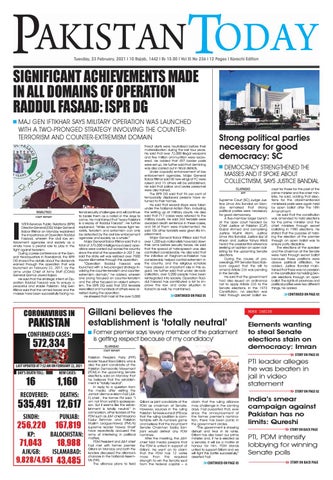
Tuesday, 23 February, 2021 I 10 Rajab, 1442 I Rs 15.00 I Vol XI No 236 I 12 Pages I Karachi Edition
Significant achievementS made in all domainS of operation raddul faSaad: iSpr dg g
MaJ gen IFTIkhar SayS MIlITary oPeraTIon waS launcheD wITh a Two-ProngeD STraTegy InvolvIng The counTerTerrorISM anD counTer-exTreMISM DoMaIn
rawalpindi Staff report
i
nTer-Services Public relations (ISPr) Director-general (Dg) Major general babar Iftikhar on Monday explained the importance of operation raddul Fasaad, wherein the civil law enforcement agencies and society as a whole have a pivotal role to play in the fight against terrorism. During a press conference at the general headquarters in rawalpindi, the ISPr Dg shared the details about the dividends earned through the operation that was launched on February 22, 2017, by the army under chief of army Staff (coaS) general Qamar Javed bajwa. he said that the strategic intent of operation raddul Fasaad was to ensure a peaceful and stable Pakistan. Maj gen Iftikhar said that the armed forces and the masses have been successfully facing na-
tional security challenges and will continue to tackle them as a nation in the days to come. he maintained that “every Pakistani is a sepoy of raddul Fasaad”. he further explained: “while armed forces fight terrorists, terrorism and extremism can only be defeated by the civil law enforcement agencies and society as a whole.” Major general babar Iftikhar said that a total of 375,000 intelligence-based operations were carried out across the country since the start of the operation in 2017. he said the state writ was restored over 7500 square kilometres through this operation. “operation raddul Fasaad was launched with a two-pronged strategy involving the counter-terrorism and counterextremism domain,” he added, wherein one prong focused on counter-terrorism and the other focused on violent extremism. The ISPr Dg said that 353 terrorists were killed and hundreds of others were arrested during the operation. he stressed that most of the over 5,000
coronaviruS in
pakiStan
CONFIRMED CASES:
572,334
LAST UPDATED AT 7:52 AM ON FEBRUARY 22, 2021
DAY'S DEATH TOLL:
16
RECOVERED:
NEW CASES:
1,160 DEATHS:
535,491 12,617 SINDH:
PUNJAB:
256,220
167,819
KP:
BALOCHISTAN:
AJK/GB:
ISLAMABAD:
71,043
18,988
9,828/4,951 43,485
threat alerts were neutralized before their materialization during the last four years. he said that over 72,000 illegal weapons and five million ammunition were recovered. he added that 497 border posts were set up. he further said that demining was also carried out in tribal districts. under capacity enhancement of law enforcement agencies, Major general babar Iftikhar said 58 new wings of Fc were raised and 15 others will be established. he said that police and levies personnel were also trained. The ISPr Dg said that 96 per cent of temporarily displaced persons have returned to their homes. he said that several steps were taken under the national action Plan, including the setting up of military courts. he also said that 717 cases were referred to the military courts. he said 344 terrorists were awarded death sentence in these cases, and 58 of them were implemented. he said 106 other terrorists were given life imprisonment. Major general babar Iftikkar said that over 1,200 sub-nationalists have laid down their arms before security forces. he said that the spread of hate-speech was also controlled considerably. he also said that the initiative of Paigham-e-Pakistan has considerably helped control extremism in the country, and the religious scholars have played an important role in this regard. he further said that under de-radicalisation, over 5,000 people have been reintegrated into society. operation raddul Fasaad has contributed a lot to improve the law and order situation in karachi as well, he maintained.
CONTINUED ON PAGE 05
Strong political parties necessary for good democracy: SC g
DeMocracy STrengTheneD The MaSSeS anD IT SPoke abouT collecTIvISM, SayS JuSTIce banDIal iSlaMaBad app
Supreme court (Sc) Judge Justice umar ata bandial on Monday remarked that strong political parties were necessary for good democracy. a five-member larger bench of the apex court headed by chief Justice of Pakistan (cJP) gulzar ahmed and comprising Justice Mushir alam, Justice umar ata bandial, Justice Ijaz ul ahsan and Justice yahya afridi heard the presidential reference seeking an opinion on open balloting for the upcoming Senate elections. During the course of proceedings, PPP Senator raza rabbani argued that the bill to amend article 226 was pending in the Senate. he said that the government had also issued an ordinance not to apply article 226 to the Senate elections. In the 1973 constitution, no election was held through secret ballot ex-
Gillani believes the establishment is ‘totally neutral’ g
Former premier says 'every member of the parliament is getting respect because of my candidacy' iSlaMaBad Staff report
Pakistan People’s Party (PPP) leader yousuf raza gillani, who is also the joint candidate of the Pakistan Democratic Movement (PDM) in the upcoming Senate elections, said on Monday that he believes that the establishment is “totally neutral”. In reply to a question from the media after visiting the Jamiat ulema-e-Islam-Fazl (JuIF) chief , the former PM said: “I am not khan sahib’s spokesperson. but it seems like the establishment is totally neutral.” In comparison, other leaders of the PDM such as JuI-F chief Maulana Fazlur rehman and Pakistan Muslim league-nawaz (PMl-n) supreme leader nawaz Sharif have repeatedly accused the army of interfering in political matters. PDM President and JuI-F chief Fazl met with former premier gillani on Monday and both the leaders discussed the alliance’s chances in the national assembly (na). The alliance plans to field
cept for those for the post of the prime minister and the chief minister, he said, adding that elections for the aforementioned ministerial posts were again held by open ballot after the 18th amendment. he said that the constitution was amended to hold elections for the prime minister and the chief ministers through secret balloting in 1985 elections. he stated that the purpose of holding the election of the premier through an open ballot was to ensure party discipline. The elections of the speaker and the chairman of the Senate were held through secret ballot because these positions were above political affiliation, he added. Justice bandial maintained that there was no provision in the constitution for holding Senate elections through an open ballot. The rights of provinces and political parties were two different things, he added.
CONTINUED ON PAGE 05
MORE INSIDE
Elements wanting to steal Senate elections stain on democracy: Imran STORY ON PAGE 03
PTI leader alleges he was beaten in jail in video statement STORY ON PAGE 02 gillani as joint candidate of the PDM as chairman of Senate. however, sources in the ruling Pakistan Tehreek-e-Insaf (PTI) say that the ruling coalition is comfortable with its numbers game and believe that the incumbent Senate chairman Sadiq Sanjrani would defeat any PDM nominee. after the meeting, the JuI-F chief told media persons that the PDM is united in support of gillani. he went on to claim that the PDM has 12 votes more than the required strength to win the Senate seat from the federal capital – a
claim that the ruling alliance may challenge in the coming days. Fazl purported that, ever since the announcement of the former premier ’s nomination, there has been panic in the government circles. “The government is showing distrust and fear in its ranks. gillani has also been our prime minister and, if he is elected as a senator, it will be a matter of honour for him. PDM stands united to support gillani and we will fight this battle successfully,” asserted Fazl.
CONTINUED ON PAGE 05
India’s smear campaign against Pakistan has no limits: Qureshi STORY ON BACK PAGE
PTI, PDM intensify lobbying for winning Senate polls STORY ON BACK PAGE
02
Tuesday, 23 February, 2021
KARACHI
NEWS
PTi leader allegeS he waS beaTen in jail in video STaTemenT
P
NEWS DESk
AKISTAN Tehreek-e-Insaf (PTI) Leader of the Opposition in the Sindh Assembly Haleem Adil Sheikh on Monday has said that he was assaulted whilst in jail and had to be taken to the National Institute of Cardiovascular Diseases (NICVD) in Karachi. In a video shared by the PTI Karachi chapter on Twitter, he claimed that 50-60 thugs had tortured and attacked him and other PTI workers. Sheikh was imprisoned after he was brought up on terrorism charges for allegedly inciting violence during the bypolls in the PS-88 constituency of Malir. It is pertinent here to mention that an anti-terrorism court (ATC) in Karachi had sent the PTI leader to jail on judicial remand till February 25 on Friday. The ATC had heard a case related to aerial firing and creating a disturbance in byelections in Karachi’s PS-88 constituency on February 16. The counsels representing the accused had apprised the ATC judge regarding the recovery of a poisonous snake from the room of Sheikh, which had purportedly been planted by the Sindh
ATTACK ON PTI OPPOSITION LEADER BY GOONS IS HIGHLY CONDEMNABLE: SINDH GOVERNOR government in an act of political revenge. The PTI leader’s spokesperson Muhammad Ali Baloch had said on the occasion that the Sindh government will be responsible if anything happened to the PTI leader. During the hearing, the judge had said: We are sending you to jail and you will be safe there”. According to the details, Jinnah Hospital Orthopaedics Director AR Jamali arrived at the NICVD and completely examined the Sindh Assembly opposition leader. Undergoing the examination, torture marks were found on the shoulder, neck, hand and other parts of his body. He will now be treated at Jinnah Hospital. “I was told yesterday that Samir Mir Shaikh is being kept in a phansi gath (hanging cell) like me and they are treating him inhumanely,” Sheikh explained in the video. “Five senior colleagues of mine in the Malir [District] Jail since Feb 7, workers of
School cloSed in ThaTTa afTer nine STudenTS conTracT coronaviruS SUJAWAL INP
A public school in Thatta was closed down on Monday for a week after nine students were diagnosed with coronavirus. The samples of the students and the teachers were collected last week, out of which nine came back positive. The school closure is a precautionary measure for disinfection, said the District Health Officer (DHO). Pakistan shut its schools and postponed exams in November to try to curb new coronavirus infections and a rise in the number of people in hospitals with Covid-19 before reopening them in phases in January. The decision to close schools, officials had said, was based on an increase in the rate of positive test results in the country. Throughout the Covid-19 period, Prime Minister Imran Khan ruled out a wide-ranging lockdown, opting to close down nonessential public gatherings in a bid to keep the economy afloat through the pandemic. On January 30, two public schools in Lahore were sealed after the detection of four new cases of coronavirus in students and teachers.
hearing in Thatta water supply reference adjourned ISLAMABAD Staff RePoRt
An accountability court in Islamabad on Monday adjourned the hearing in Thatta water supply scheme reference involving former president and Pakistan People’s Party (PPP) Co-chairperson Asif Ali Zardari following a strike of lawyers. The court of accountability judge Azam Khan was due to resume hearing in the case but it was adjourned due to the lawyers’ strike in Islamabad. The next hearing will be held on March 8. The water supply reference, an offshoot of the fake bank accounts case, pertains to alleged illegal award of a contract by the special initiative department for water supply scheme, Thatta, to private contractor Harish and Company. The court had indicted Zardari and 15 others in the reference in October. He has so far been indicted in four references related to the fake accounts case, including Toshakhana, money laundering, and Park Lane references.
the PTI and my constituency — Iqbal Shah, Usman Bugti, Aziz Bhatti, Rao Yousuf, Khalil Mehsud’s son Nauroze Mehsud — are being tortured in jail.” The PTI leader said that Samir was being treated in such a way only because “he knows the PPP’s thieves and looters from within”. After meeting Sheikh in the hospital, PTI lawmaker Khurram Sher Zaman feared that the PTI leader’s life is in danger and said that Prime minister Imran Khan has been informed about the situation. He went on to add: “The rulers of Sindh have become selfish. A snake was found in the opposition leader’s cell, whereas, goons tortured the PTI lawmaker in jail.” Similarly, Federal Minister for Science and Technology Fawad Chaudhry on Monday demanded the immediate release of Sheikh in a tweet, wherein the minister said that arrest was a political case. The attack on the PTI opposition leader
by goons in highly condemnable, he added. As these accusations of corruption fly from the members of the ruling party, Sindh Governor Imran Ismail said that PTI MPA and leader Sheikh had been tortured in jail, and alleged that the jailor had released edited CCTV footage. He said that the current lawlessness in the province had reminded him of Altaf Hussain’s era and ruled out any possibility of imposition of governor rule in the province. Addressing a news conference at the Governor House, Imran Ismail said that he wrote a letter to Prime Minister regarding lawlessness in the province and recommended to change the provincial Inspector General of Police (IGP). “IGP Sindh Mushtaq Ahmed Mahar has failed to perform his duties and is a biased officer”, the governor said. He said that Sindh IGP and police have begun working as a party. Senior superintendents (SSPs) were taking instructions directly and the police officers were taking illegal actions against members and workers of opposition parties, he maintained. The officers must remember they were
the servants of state not of any political party, he added. To a question, the Sindh governor replied that Sindh IGP was following the instructions of the provincial government and was not doing justice with his position. “Sindh Police nominates hundreds of unidentified people in a single FIR [first information report] to take advantage and arrest innocents”, he said. The governor said that the Sindh chief secretary and IGP were the representatives of the federal government and both the officers were bound to coordinate with the federal government. They must play the role of a bridge between both the governments, Ismail stressed. Taking shots at the dominant party in the province, Federal Minister for Communications and Postal Services Murad Saeed on Monday said that the PPP, under the guise of democracy, has claimed Sindh province as their private property. Talking to media outside Parliament House, while flanked by Parliamentary Secretary Religious Affairs Aftab Jahangir, MNA Aamir Liaqaut Hussain, MNA Captain Jameel Ahmed Khan, MNA Alamgir Khan and MNA Faheem Khan, he said that the Sindh government is victimizing the opposition. He said that key figurehead of Karachi underworld Uzair Baloch reveals on whose orders extortion and murders were committed, adding that according to the Uzair Baloch report, the gangster had confessed that he had beheaded the people and burnt the bodies by using a police mobile, adding that criminal was inducted in Sindh Police.
Imran to leave for maiden Sri Lanka visit tomorrow ISLAMABAD Staff RePoRt
Prime Minister Imran Khan will leave for a two-day official visit to Sri Lanka on Tuesday. This will be Khan’s first visit to Sri Lanka after assuming the office of prime minister in August 2018. He will be accompanied by a high-level delegation, including members of the cabinet. The premier is visiting the country on the invitation of his Sri Lankan counterpart Mahinda Rajapaksa, Radio Pakistan reported. During the visit, Khan will hold talks with President Gotabaya Rajapaksa, Prime Minister Rajapaksa, and Foreign Minister Dinesh Gunawardena, officials familiar with the situation said. Bilateral talks would cover issues of trade and investment, health and education, agriculture and science and technology, defence and security, and culture and tourism. Key regional and international issues would also be discussed, a Foreign Office (FO)
statement said. “During the visit, the reconstitution of the Sri Lanka-Pakistan Parliamentary Friendship Association will be announced to further promote parliamentary exchanges between the two countries,” the statement added. Khan will also participate in a joint “Trade and Investment Conference”. As Sri Lanka prepares to welcome Khan, several members of the country’s Muslim minority expressed hope for him to take up their concerns during talks with government officials. Muslims make up nearly 10 per cent of the country’s population of 22 million, which is predominantly Buddhist. The Indian Ocean island was torn for decades by a civil war between separatists from the mostly Hindu Tamil minority and the Sinhala Buddhist-dominated government. The government stamped out the rebellion some 11 years ago. However, in recent years, Buddhist hardliners, led by the Bodu Bala Sena (BBS) or “Buddhist Power Force” — a Sinhalese Buddhist
LHC tribunal admits Rashid’s appeal against Senate nomination rejection ISLAMABAD Staff RePoRt
The election tribunal of Lahore High Court (LHC) on Monday approved for hearing a petition of Pakistan Muslim League-Nawaz (PML-N) leader and Senate hopeful Pervaiz Rashid against the rejection of his papers. On Thursday, the Election Commission of Pakistan (ECP) rejected Rashid’s nomination for the Upper House for being a defaulter of the Punjab government. During the proceedings on Monday, the counsel for Rashid, Azam Nazir Tarar, informed the court that the returning officer (RO) had rejected his client’s papers for Senate elections. The ECP had told Rashid that he was a defaulter of the Punjab House in Islamabad and his nomination would be accepted only after he cleared the dues. Tarar said Rashid was issued a notice from Punjab House to clear
the amount. However, when he tried to pay the money, the authorities refused to take it. At this, Justice Shahid Waheed questioned why the dues were not paid earlier. As per Supreme Court’s decisions, the dues can be cleared at any time, Tarar replied. Subsequently, the tribunal issued notice to the ECP and directed the Punjab House management to attend Tuesday’s hearing and bring along the relevant record. In December 2018, the Punjab government had released a list of 76 politicians, bureaucrats and others for defaulting on the payment for their stay and meals at Punjab House during the tenure of the PML-N government. Per the list, Rashid owed Rs7.05 million, including Rs0.69 million charges for his stay between January and August 2011 and Rs6.4 million from June 2013 to May 2018. His daughter, Poonam Rashid, also owed Rs2.7 million.
nationalist group — have stoked hostility against Muslims, saying influences from the Middle East had made Sri Lanka’s Muslims more conservative and isolated. In 2018, scores of mosques, Muslim homes and businesses were destroyed as Buddhist mobs ran amok for three days in Kandy, the central highlands district. Representatives of the nation’s Muslims said that they were banking on the “great Muslim leader” to “speak on our behalf.” “The community wishes to welcome a great Muslim leader who is coming as his country’s prime minister for the first time. He is in a vantage position to speak on behalf of the Sri Lankan Muslims,” NM Ameen, president of the Sri Lanka Muslim Council, told Arab News. “Prime Minister Khan must use his visit to assist in our struggles for human rights, justice and accountability for all in Sri Lanka,” Shreen Saroor, women’s rights activist and co-founder of the Women’s Action Network, said.
Hamza received Rs181m through 23 ‘suspicious’ transactions: NAB LAHORE tLtP
Pakistan Muslim League-Nawaz (PML-N) leader and opposition leader in Punjab Assembly Hamza Shahbaz received more than Rs181 million through 23 “suspicious transactions”, revealed a National Accountability Bureau (NAB) report on Monday. It said that he could not account for these transactions nor could he present any evidence in this regard. The report further disclosed that the Shehbaz Sharif family set up 14 big companies between 2005 and 2016 using the money received through suspicious transactions, adding Hamza, being a shareholder in these firms, kept receiving huge monetary benefits from the companies. The bureau said that the opposition leader amassed more assets than his sources of income justify and was found involved in corrupt practices. Earlier on Thursday, the anti-graft watchdog submitted its reply with the Lahore High Court (LHC) regarding Hamza’s bail petition. In its reply, the NAB requested the
high court to dismiss the PML-N leader’s petition seeking bail in the assets beyond means and money laundering case. The bureau stated that the high court had already dismissed the bail plea of the accused. He filed the fresh bail petition on the same grounds that were given in his previous plea, it added. Hamza amassed more assets than his sources of income justified, besides being involved in money laundering, NAB said, adding that his case was not an ordinary case. Earlier on Wednesday, the LHC deferred the hearing of the bail petition filed by Hamza in the money laundering case. The high court conducted the hearing of Hamza’s bail plea in the money laundering case. However, the hearing was deferred till February 23 without any proceedings on the plea. The high court had sought a response from the NAB chairman. In its petition, Hamza stated that 16 persons were nominated in the case; however, 11 accused are facing trial. It added that there is no hope of early conclusion of the trial as all accused have their own counsels.
Tuesday, 23 February, 2021
KARACHI
NEWS
03
ElEmEnts wanting to stEal sEnatE ElEctions stain on dEmocracy: imran ISLAMABAD
P
Staff RepoRt
RIMe Minister Imran Khan on Monday said that elements who want to “hijack” the forthcoming Senate elections were a stain on the fabric of democracy. Imran and his adviser on Parliamentary Affairs Barrister Babar Awan held a telephonic conversation during which parliamentary sessions and the Senate elections were discussed. “Open voting [during Senate election] is the only way to stop the culture of horse trading,” Imran asserted. The two also discussed the arrest of Sindh Assembly Opposition Leader Haleem Adil Sheikh. Last week, Karachi police arrested Sheikh after the election Commission of Pakistan (eCP) ordered his expulsion from a constituency of PS-88 in Malir, where bypolls for a Sindh Assembly seat was taking place. On Friday, an administrative judge of the antiterrorism courts sent him to prison on remand till February 25. expressing his concerns on Sheikh’s arrest, Babar claimed he was subjected to custodial torture, inhuman and degrading treatment. CORRUPTION MONEY USED TO BUY VOTES: Separately, Minister for Information and Broadcasting Senator Shibli Faraz said that the ill-gotten wealth amassed by the Pakistan Muslim League-Nawaz (PML-N) and the Pakistan People’s Party (PPP) through corrupt practices is being used
FARAZ SAYS THE 'ILL-GOTTEN WEALTH' AMASSED BY THE PML-N AND THE PPP THROUGH CORRUPT PRACTICES IS BEING USED TO PURCHASE MPS to purchase MPs for the Senate elections on March 3. Speaking to the reporters in Islamabad, the minister said that both the parties wanted to continue the politics of horse trading. He further said that PPP leader and former Senate chairman Raza Rabbani submitted his arguments before the Supreme Court (SC) in support of secret balloting during the Senate elections, which he observed is contrary to the Charter of Democracy (CoD) signed between slain prime minister Benazir Bhutto and PML-N supreme leader Nawaz Sharif in 2006. Faraz said that the PTI “laid the foundation of clean politics”. He said that the party was striving to end corruption in the country. He also said that any person, who comes to parliament through money power, cannot be a real representative of the public. Later, in a tweet, the minister said that the two political parties – the PPP and the PML- N were responsible for earning bad name for the politics and politicians. Senator Faraz said that they signed the Charter of Democracy but backtracked from the agreement and promoted horsetrading. He said that, despite having no majority in the National Assembly, Asif Zardari’s claim of victory of Yousuf Raza Gilani has proved the opposition’s involvement in dirty politics of sale and
purchase of loyalties. ELECTRONIC VOTING TO STOP FRAUD: Federal Minister for Science and
Technology Chaudhry Fawad Hussain on Monday said that the electronic voting machines developed by the National Institute
Justice Isa’s request for larger bench referred to top judge
of electronics would help in getting rid of elections rigging. Briefing media persons about the electronic voting machine in Islamabad, he said that the machine had two parts. The first part will have election symbols while the second will be with the presiding officer. Fawad said that only the presiding officer would be able to turn on the machine and voters would be able to cast their vote by clicking on any symbol through the machine. He added that clicking on the election symbol would be an electric vote cast. “Not only electric vote casting can be done through the machine but also ballot paper can be printed,” he said. The minister said that the machine is also electric and can be used for casting votes on ballot papers. He announced that the work on the electronic voting machine was in the final stages and this machine would be shared with the National Database Registration Authority (NDRA), National University of Science and Technology and COMSATS soon. He said that the Ministry of Science and Technology and the National Institute of electronics had done a great job by developing such a machine. The machine has been developed as per directives of Prime Minister Imran Khan to ensure fair and transparent elections, he added. It is necessary to convert to the electronic voting system to avoid what happened in Daska and other places in the recent by-elections, he further said.
200 booked for attacking Jang offices in Karachi KARACHI
ISLAMABAD Staff RepoRt
Announcing its verdict on petitions seeking a larger bench to review a majority judgement in Justice Qazi Faez Isa case, the Supreme Court (SC) on Monday decided to send the matter to Chief Justice Gulzar Ahmed. Justice Umar Ata Bandial, who was presiding the six-judge bench, announced the 5-1 majority judgement. Justice Manzoor Ahmad Malik disagreed and will write a dissenting note. The ruling, reserved in December, was announced on a set of petitions moved by Justice Isa, his wife Sarina Isa and different bar councils, calling for formation of a larger bench instead of a six-member bench to hear the case. In June, the Supreme Court (SC) had dismissed the presidential reference filed against Justice Isa for nondisclosure of family members’ properties in his wealth statement. The reference filed against Justice Isa by the government in May 2019 alleged that he acquired three properties in London on lease in the name of his wife and children between 2011 and
Staff RepoRt
LAST YEAR, JUSTICE ISA HAD APPROACHED SC, SEEKING A REVIEW OF THE DECISION IN PRESIDENTIAL REFERENCE AGAINST HIM FOR NON-DISCLOSURE OF FAMILY MEMBERS’ PROPERTIES
2015, but did not disclose them in his wealth returns. Justice Isa contested the allegation, saying he is not a beneficial owner of
the flats — neither directly nor indirectly. However, seven of the 10 judges on the bench hearing the case ordered the Inland Revenue Department (IRS) and the Federal Board of Revenue (FBR) to seek explanations from the judge’s wife and children on the nature and source of funding for three properties in their names in the United Kingdom and submit a report to the SC registrar. Justice Isa then approached the apex court, seeking a review of the decision. Bar associations, including the Sindh High Court Bar Association (SHCBA), also filed similar petitions. The petitioners had contended that the three judges — Justice Maqbool Baqar, Justice Syed Mansoor Ali Shah and Justice Yahya Afridi — who wrote dissenting notes in the detailed reasons should not be excluded from the bench hearing the review petitions.
“The chief justice can form a larger bench on review petitions if he wants,” said the court order issues Monday, adding that normally the bench which delivers the judgement also hears the review petitions. It also noted that review jurisdiction could only be invoked in relation to the unanimous and majority judgements passed by the apex court. Justice Bandial said that it was mandatory to include the judge who wrote the decision in the review bench and if they were not available, then “the judge who agreed with the [court] order is part of the bench”. “As a matter of law and settled practice it is for the [honourable chief justice], as master of the roster, to determine the composition of the bench and he may, for like reason, constitute a larger bench for hearing the review petition,” the order stated.
Baloch protesters end Islamabad sit-in after PM Imran's pledge to meet them AgenCIeS Nasrullah Baluch, centre bottom, leader of the Voice of Baloch Missing Persons, speaks while people hold placards and portraits of their missing family members during a press conference in Islamabad, Saturday, Feb. 20, 2021. — AP Protesters calling for an end to enforced disappearances in Balochistan ended a week-long sitin in the capital on Monday, after an assurance that Prime Minister Imran Khan will meet them next month. “We don’t have any big hopes from this government, but the way they have reassured us, we also have decided to give them a chance,” Sammi Baloch, who has been searching for her father Deen Muhammad since 2009, told Reuters.
She and other families have protested across the country for years to little avail. The Islamabad protesters — 10 families of missing men and around a hundred supporters — said they will return if assurances are not met. Security officials say many of Balochistan’s socalled disappeared have links to separatists. But actual court punishments have been rare. The Pakistan Army and human rights ministry did not respond to Reuters' requests for comment for this story, including questions about specific family members sought by the protesters. For one week, protesters held up photos of missing relatives under the watchful eyes of police surrounding them. Among them was 60-year-old Baz Khatoon, who clutched a stack of news reports and court filings about
her son, Rashid Hussain Brohi. She believes he was detained in Dubai in December 2018, was flown to Pakistan six months later, and then vanished without a trace. Khatoon said her son moved to Dubai to be safe in 2017 after three male relatives, including his father, had turned up dead after being taken away by security forces over the years. After Brohi was detained, Amnesty International and UN bodies looking into disappearances called on the emirati authorities not to deport him to Pakistan for fear he would be killed. Brohi’s mother has obtained a copy of an emirati travel document showing Brohi’s emirati visa was cancelled in June 2019, and that he left two days later on a flight to a small airport in Balochistan. The UAe government media office did not immediately respond to a Reuters request for comment.
Karachi police have registered a case against over 200 people for attacking the offices of the Jang media group in the metropolis on Sunday. Dozens of protesters, venting out their anger against inflammatory words used by anchorperson Irshad Bhatti against Sindhis, tore down a walk-through gate and broke through a main gate of the building. The FIR — registered at Mithadar police station on the complaint of the group’s security director Muhammad Kabir — included sections of terrorism, attempt to murder, and damage to property. The police have also arrested 13 people in connection with the episode. Separately, Karachi Press Club (JPC) President Fazil Jamili said that the words of an individual should not be taken as the opinion of the organisation. He pointed out that even “if any anchor’s words hurt someone”, the group itself had issued an apology on the matter and that the “issue should have been laid to rest”.
PPP wins tharparkar by-election KARACHI Staff RepoRt
The Pakistan People’s Party (PPP) defeated the Pakistan Tehreek-e-Insaf (PTI) in a by-poll for a National Assembly seat in Tharparkar, unofficial results announced by the election Commission of Pakistan (eCP) on Monday showed. NA-221 (Tharparkar-I) had fallen vacant after the death of PPP MP Noor Mohammad Shah due to Covid-19 in December. Ameer Ali Shah Jeelani of the PPP received 102,232 votes against PTI’s Nizamuddin Rahimoon who secured 52,522 votes, District Returning Officer (DRO) Mian Mohammad Shahid. Voting was disrupted on Sunday after some unknown miscreants set ablaze a polling station, reducing ballot papers and other polling material to ashes. Tharparkar Senior Superintendent of Police (SSP) Hassan Sardar Niazi said the “accidental” fire had erupted and “caused damage to some ballot papers and other material”. Commenting on the incident, Rahimoon had alleged that the blast took place “under police supervision”. “My agents have been arrested and my voters are being chased away, but the people of Tharparkar will ensure that the truth wins,” he said, claiming that the police were aiding his opponents. However, SSP Niazi had refuted the claims.
04
Tuesday, 23 February, 2021
KARACHI
NEWS
Buzdar launCHeS raHmatul-lIl-aalameen (PBuH) SCHolarSHIP Programme LAHORE
P
APP
UNJAB Chief Minister Sardar Usman Buzdar has said that launching of Rahmatul-Lil Aalameen (Peace Be Upon Him) scholarships programme for bright and deserving students of province is a matter of great honour and pride for him. He said this while addressing the launching ceremony of the programme at Chief Minister's Office on Monday. He inaugurated website of Rahmatul-LilAalameen (Peace Be Upon Him) scholarships. He said that Darood Sharif is a great blessing of Allah Almighty, adding that no one is able to elaborate the greatness of the Holy Prophet Muhammad (Peace Be Upon Him). The CM said that it was regrettable that in some foreign countries sentiments of Muslims had been badly
Speedo Bus Service employees protest non-payment of dues LAHORE: The employees of Speedo Bus Service protested the non-payment of four months’ dues near Kalma chowk on Monday, after which Model Town Assistant Commissioner Zeeshan Ranjha and some police officers intervened and dispersed the protesters. An employee told Pakistan Today that they were protesting because their contract was breached. “We are dependent on our salaries, we are not begging from anymore but are only demanding our rights,” said Muhammad Ahmad, a protesting worker. “We have provided our services with honestly but have been deceived by officials in matter of salaries.” An official of In-Box said that they were service contractors for Punjab Masstransit Authority (PMA). “We hire and provide service but PMA is not releasing funds and subsidies to the company due to which the company is unable to pay salaries,” he said. When asked why the issue was not resolved proactively, the official said that they did not have any assurance from the government, therefore, they were unable to settle it. Model Town AC said that the contract of Speedo Bus Service employees is given to a company named In-Box, which is responsible for paying the workers. “I have listened to all the problems of the protesters and have assured them of a solution,” he said. Later, the company officials assured the protesters that they would be paid two months’ salary within two days. SHAHAB OMER
Judicial remand of four lawyers extended in IHC attack case ISLAMABAD: An anti-terrorism court (ATC) on Monday extended judicial remand of four arrested lawyers in the Islamabad High Court (IHC) attack case until Feb 24. Four accused of the attack were produced before the ATC for hearing of the case. Earlier, the counsel of Liaquat Manzoor Kamboh, Mohammad Umar and Asadullah, sought more time from the court for preparation of the case. The court granted the plea and adjourned hearing of the bail petitions of three lawyers till February 24. Earlier, an anti-terrorism court had issued orders to release two lawyers, Zafar Ali Waraich and Shoaib Shaikh, in the high court attack case on the basis of a report presented by the police department. Police said that no evidence was found against Zafar Ali Waraich and Advocate Shoaib Shaikh. The protesting lawyers, who were furious over the demolition of illegal chambers in district and sessions court in Islamabad, on February 08, stormed the IHC building and manhandled police officials, staff and journalists. A large number of protesting lawyers outside the building had hurled stones while raising slogans against the district administration and IHC chief justice. The lawyers had also tortured media persons to stop the coverage of the incident. The outrageous crowd had also tortured the deputy registrar of the high court after entering his chamber by breaking the door. TLTP
2 students killed, another injured in Chiniot road mishap CHINIOT: Two matric students were killed and another injured after an over speeding tractor trolley hit a motorcycle on Monday morning. Three matric students hailing from Mithorama who were on their way to school riding a motorcycle were hit by a reckless driven tractor trolley near Adda Vensan Wala at Chiniot road. Two SSC students identified as Safdar Ali and Aliyan were killed on the spot in the accident while Muhammad Bilal was critically injured. The bodies and injured were shifted to District Headquarter (DHQ) Hospital and the police after registering a case against driver of the tractor trolley started an investigation. INP
hurt in the name of freedom of expression. Buzdar said, "It has been decided that the Rahmatul-
Lil -Aalameen (Peace Be Upon Him) week will be celebrated at official level every year in the month of Rabiul-Awal." The CM said, "Holy Prophet Hazrat Muhammad (Peace Be Upon Him) always stressed seeking knowledge." He said that keeping in view the emphasis of the Holy Prophet (Peace Be Upon Him) for seeking knowledge, the government has made promotion of education its top priorities. He said that students were being given scholarships across the province while nine new universities, colleges and schools were also being established. He said that the initiative of shelter homes (Panagahs) was started keeping in mind the concept of Riasat-e-Medina. Usman Buzdar said that horizon of Rahmatul-LilAalameen (Peace Be Upon Him) scholarships would be expanded up to professional degree holders. He said that 50 per cent of the scholarships would
be given to brilliant students on merit while remaining 50 per cent to the deserving students. He said that steps had been taken to ensure transparency in the programme, adding that scholarship funds would be increased gradually for brilliant and deserving students. The government colleges and 30 public universities would benefit from Rahmatul-Lil-Alameen (Peace Be Upon Him) scholarships. In Rahmatul-Lil-Aalameen (Peace Be Upon Him) scholarship programme quota for the children of Punjab government employees of cadre 1 to 4 had been allocated, he maintained. He said that Rahmatul-Lil-Aalameen (Peace Be Upon Him) chair would also be set up in each university of every district to highlight the glorious aspects of the sacred life of the beloved Holy Prophet Muhammad (Peace Be Upon Him).
Indian forces targeting Kashmiri women as world fails to punish culprits, says Afridi ISLAMABAD MIAN ABRAR
Parliamentary Committee on Kashmir Chairman Shehryar Khan Afridi has said that Indian occupational forces are waging a “rape war” using rape as tool of genocide against the freedom loving Kashmiris in Indian Occupied Kashmir (IOK) and the failure of world community in punishing the culprits of Kupwara mass rapes may lead to eruption of a new war between two nucleararmed neighbours. He expressed these views while addressing the participants of a seminar titled on mass rapes by occupational forces of India in Kunan Poshpora, Kupwara, IOK on February 23, 1991. The event was held under the auspices of Islamabad Institute of Conflict Resolution (ISCR) in laision with Embassy of Azerbaijan. Afridi said that until recently, there existed no punishment for 'war rape' in international law. "War crimes or humanitarian law specifically focuses on the treatment of the civilian population and ‘any devastation not justified by military necessity'. Therefore, war rape has rarely been prosecuted as a war crime. Since 1949, Article 27 of the Fourth Geneva Convention explicitly prohibits wartime rape and enforced prostitution,” he said. He also said that the United Nations and the prosperous world needs to take steps to protect the weak and unprotected segments of society. He further said that repeated incidents of massacres and genocide reflect that the world has failed to protect the oppressed people living in conflict zones as might is right prevails. Afridi said that the mass rapes of women in IOK and Khojaly, Nagorno-Karabakh have been used by occupational forces as tool of genocide. Kunan Poshpora in Kupwara is the most scenic area
of occupied Kashmir but the mass rapes of 1991 have left scars in the minds of the people of Kashmir. He said that the international community has done nothing to punish the culprits of Kupwara, the genocide in Khojaly may not have happened. He said that expansionist designs of India are a threat to world peace and if the world fails to bring resolution to conflict zones like Jammu and Kashmir, no one can rule out the possibility of a new war erupting between Pakistan and India. "Any new war may suck in other nuclear powers of the region. Hence, this conflict may not remain limited," warned the Kashmir Committee chairman. He said that India is being ruled by a fascist regime of Narendra Modi who believes in Hindu supremacist ideology and all minorities in India are under a threat of genocide. He said that unfortunately, rape is also used a tool of punishment in conflict zones and history suggests that this one element of violence is used as an effective
weapon and strategy for disarming psychological war. "This weapon of rape was used by many combatants and this global issue has no national boundaries of ideology or religion". He said that it is more of associated with masculine identity commonly but in war times there is often violation of men and children too through different means of torture and distress. "Therefore, it often does not remain gender bound but women being soft target are more of victim of rape in war precincts. There are many examples of such mass rapes during conflicts and war times during Rawanda genocide, Bosnia & Kosovo conflicts, Khojaly massacre by Armenian forces in Azerbaijan and not to forget Kashmir where such incidents occur frequently to suppress freedom movement," he added. Afridi said that in Kashmiri history, mass rape incident ensued in area of Kunan Poshpora in February 1991 and social stigma generated out of this incident is that women still face difficulties in getting married. He said that the South Asian subcontinent is the least gender sensitive region in the world. It is the only region in the world where men outnumber women. Azerbaijan Ambassador Ali Alizade highlighted the genocide perpetrated by the Armenian army in NagornoKarabakh area of Khojaly and said that the occupational forces committed massive killings to suppress the voices against freedom of Nagorno-Karabakh. He said that despite United Nations Security Council resolutions, the world community failed to help the oppressed people of Nagorno-Karabakh. He also urged the United Nations to hold plebiscite in occupied Kashmir as enshrined in the UNSC resolutions. Defence analyst Lt General (r) Amjad Shoaib and Assistant Professor Dr Salma Malik also addressed the seminar.
UNICEF offers cooperation for child protection in Punjab LAHORE INP
UNICEF has extended an offer of enhanced cooperation to the province of Punjab in the field of child protection. The offer was extended in a meeting between Minister for Social Welfare Syed Yawar Abbas Bukhari and UNICEF'S deputy representative to Pakistan Dr Tajudeen Oyewale here on Monday. Secretary Social Welfare & Baitul Mal Hassan Iqbal, Director Irfan Gondal and chief of field (UNICEF) Punjab Will Broad Ngembi were also present.
The participants took stock of proposed reforms relating to legislation about child protection in Punjab, social support in the wake of Covid-19, early marriages and issues related to birth registration. Yawar Bukhari emphasised improvements in child protection laws and maintained that it will be better if one department deals with the child protection issue and the social welfare department should lead in this matter. He urged that early marriages should be discouraged as it could lead to some sort of social complications, with certain pros and cons.
Secretary Social Welfare Hassan Iqbal recommended that all stakeholders should be taken in the loop before the final decision. The birth registration issue needs more focus in the current situation, he added. Dr Tajudeen Oyewale expressed the satisfaction over initiatives regarding child protection adding that UNICEF was determined to expand collaboration with the Punjab government. Will Broad urged that the menace of child labour should be discouraged more broadly and added that more steps are required to achieve the target.
Naval chief seeks PMSA’s active role to develop blue economy KARACHI TLTP
Chief of the Naval Staff Admiral Muhammad Amjad Khan Niazi has stressed that Pakistan Maritime Security Agency (PMSA) has to play an active role in government’s initiatives related to development of blue economy. The naval chief said this during his visit to Pakistan Maritime Security Agency headquarters, said a statement issued on Monday. Interacting with the officers and staff members of PMSA, Niazi lauded the commitment and efforts of the agency in the maritime domain. He emphasised that being
the only maritime law enforcement agency, PMSA has responsibility to safeguard national maritime interests. The naval chief also appreciated the agency’s efforts in facilitating fishermen community and ensuring their safety and security at sea. He expressed satisfaction over operational capabilities tasks performed by PMSA. He also assured that Pakistan Navy will continue to provide all out support to PMSA. Earlier upon arrival, the naval chief was received by Director General PMSA, Rear Admiral Muhammad Shuaib. He was presented a guard of honour by a smartly turned out contingent. Thereafter, the chief of the naval staff was given a
briefing on roles and tasks of PMSA. He visited Maritime Rescue Coordination Centre (MRCC) where he was apprised regarding operational readiness of PMSA to enforce laws in the maritime zone of Pakistan. Separately, the passing out parade of the 57th batch of Pakistan Marine Academy (PMA) was held at PMA Karachi on Monday. 143 cadets completed two-year training on ships. Addressing as the chief guest of the ceremony, Karachi Port Trust Chairman Nadir Mumtaz, said that KPT would extend all possible cooperation to the PMA in the sectors of education and training. Cadets were awarded medals and cash prizes for outstanding performance.
Tuesday, 23 February, 2021
KARACHI
NEWS
05
Political Parties across world oPPose interference in other countries’ internal affairs under human rights Pretext
i
ISLAMABAD Mian abrar
n a major show of defiance, over 310 leaders and prominent personages representing more than 190 political parties and organisations from 80 plus countries on Monday expressed their resolve to oppose the western interference into the affairs of sovereign countries in the name of ‘human rights’. The pledge was made by the leaders of 190 political parties and organisations from 80 plus countries, among which over 100 are from Islamic countries, at an online conclave held under the aegis of the International Department of the CPC Central Committee (IDCPC) and the Communist Party of China (CPC) Xinjiang Uygur Autonomous Regional Committee who co-hosted the event titled ‘Stories of CPC’ Thematic Briefing on Xinjiang in Urumqi. As the event took place, the parties who have been involved in an in-depth discussion on the theme of “A Better Life for All” reached broader consensus. All parties were
of the view that it is the common goal and responsibility of political parties of all countries to work towards a better life for the overwhelming majority of the people. Political parties of all countries vowed to take the improvement of people’s wellbeing as their mission and strive to uplift the sense of fulfilment, happiness, and security thereof. They also noted that Covid-19 has hit over 200 countries and regions, affected more than seven billion people around the world and claimed over two million lives. They called on all countries to continue to put the lives, safety and health of the people above everything else by deploying medical expertise and critical supplies to places where they are needed the most, saving lives with all might and main, and further promoting global joint epidemic response so that the pandemic is brought under control at an earliest possible date and the vision of building a global community of health for all appears on the horizon. They also stressed that Covid-19 has plunged over 200 million people globally
into extreme poverty and inflicted serious impact on the economic and social development of most countries, casting a dark shadow on the prospects of the United nations 2030 Agenda for Sustainable Development. They called on all countries to continue to strengthen coordination on macroeconomic policies, remain steadfast in maintaining the stability of the global financial market as well as that of industrial and supply chains, and to take measures to reduce debts and boost the flow of trade, so that the world economy could soon recover and grow, which will help bring global poverty reduction back on the right track as speedily as possible. While subscribing to the protection and development of human rights, the meeting pointed out that the right to subsistence and the right to development are principal and fundamental. “Poverty constitutes the chief obstacle to the realisation of human rights. The interests of the people should be placed in the paramount position and development should de-
liver greater benefit to the entire population in a more equitable manner,” said the joint communique. They also emphasised that as there is no one-size-fits-all model to advance and protect human rights, the diversity in the path of human rights development should be respected and any attempt to politicise human rights, apply double standards thereof, or to interfere in the internal affairs of other countries under the pretext of human rights should be opposed. They called for the concerted efforts of all countries to promote the establishment of a global governance architecture on human rights that is more equitable, just and inclusive. They also acknowledged that the Thematic Briefing has enabled them to acquire a comprehensive and in-depth understanding of China’s system of regional ethnic autonomy and the development of areas with large ethnic minority populations, including the actual situation in Xinjiang, where social stability as well as equality and unity among various ethnic groups prevail, people’s liveli-
hood keeps improving and the economy develops constantly. They also expressed appreciation of what the Chinese government has done to promote economic and social development of areas with large ethnic minority populations, and to respect and protect the right of people of all ethnic groups to freedom of religious belief and to use their own spoken and written languages. They expressed opposition to the odious behaviour of a crumb of individuals from certain countries in misleading the international perception and smearing other countries with distorted and fabricated facts and disinformation of cooked-up rumours of socalled China’s “ethnic cleansing” in Xinjiang. Extending their best wishes to the CPC and the Chinese people on the eve of the centenary of the CPC, they applauded the CPC for its commitment to the original aspiration and founding mission of seeking happiness for the people and rejuvenation for the nation, for its leadership under which the Chinese people have created the miracle.
Gillani believes the establishment is ‘totally neutral’ ContInueD froM pAge 01 Gillani told the media that he was indebted to the PDM leadership for putting its trust in him and that he would try to meet their expectations. The ex-PM recalled that he had been elected unopposed in 2008 to the nA, adding that even today he had kicked off his campaign with the same unanimous support from the PDM. He said that his win would be a victory of the democratic forces. He said that he had amassed 264 votes while his opponent received 42, following which the opposition agreed to cast a vote of confidence in Gillani’s favour. “I want to say that every member of the parliament is getting respect because of my candidacy. I would go to each and every PDM leader who are supporting me more than myself,” he said on the occasion. PTI last week challenged the nomination of the former premier for Senate. Fareed Rehman, a PTI Senate hopeful from Islamabad, had accused Gillani of concealing the
facts in the papers. Gillani, he had said, failed to mention his conviction in a contempt of court case back in 2012. His petition had noted that Gillani doesn’t fulfill the requirements of Article62 of the Constitution. The Election Commission of Pakistan (ECP) on Thursday last had rejected the objection raised by the ruling PTI on the nomination of the former prime minister and had accepted his papers for the March 3 elections. Returning Officer (RO) Zafar Iqbal had announced the verdict reserved earlier after both sides completed their arguments. The verdict had observed while Gillani was convicted — in 2012 — under Article 63(1)(g) of the Constitution and “a period of five years has elapsed since his conviction”, he “stands qualified” for contesting election to the Senate from Islamabad. “All the cases against the candidate are pending adjudication and in the absence of conviction, the candidate cannot be barred from contesting the election,” it had read. “Keeping these facts in view, the nomination
papers Gillani are hereby accepted,” it had added. Embroiled in controversy over the presidential ordinance on open voting, the ECP is set to hold elections on March 3. A total of 52 senators in the House of 104 are set to retire on March 11 on completion of their six-year term. The number includes four of the eight senators from the erstwhile Federally Adminis¬tered Tribal Areas (FATA). As the seats representing FATA will not be filled due to the merger of the tribal areas with Khyber Pakhtunkhwa (KP) in May 2018, the Senate strength will shrink to 100. Polling will, therefore, be held to elect 48 members: 12 each from KP and Balochistan, 11 each from Punjab and Sindh, and two from Islamabad. The legislators will also vote to elect seven members on general seats including two women and two technocrats in the four provinces. Besides, the election on one minority seat each in KP and Balochistan will also be conducted. More than 65 per cent of the senators due to retire belong to the opposition parties.
RAWALPINDI: Chief of Army Staff General Qamar Javed Bajwa and Qatar’s Minister for Foreign Afairs Dr Mutlaq Bin Majed Al Qahtani met during the latter’s visit to the General Headquarters in Rawalpindi. Both sides discussed matters of mutual interest, including the Afghan. peace process
LAHORE: PSO CEO and Managing Director Syed Muhammad Taha presents a cheque sponsoring the higher education of five students to Karachi IBA Corporate Relations and Communications Director Alumni Malahat Awan. The agreement was signed by PSO CSR Trust Chairperson Babar H. Chaudhry and IBA Executive Director Dr Syed Akbar Zaidi. press release
significant achievements made in all domains of operation raddul fasaad: isPr dg ContInueD froM pAge 01 The military’s spokesperson said that the city’s position on Crime Index has dropped from sixth in 2014 to 106 today. He said that socio-economic dividends of the operation have been witnessed in the tribal districts of Khyber Pakhtunkhwa (KP). “In these four years, more than 5,000 threat alerts were issued and the majority of them were neutralised before they materialised. During Raddul Fasaad, the Khyber-IV operation was also carried out, which was aimed at clearing the Rajgal valley and making the Afghan border safe,” he stressed on the occasion. He said that 831 development projects worth over Rs31 billion are being carried out there. He said several development projects are also being implemented in Balochistan. He added sports activities have also been restored across the country. The ISPR DG said that 23rd March will be celebrated with zeal and zest. He said that a national parade will be organized on the day to disseminate the message of “one nation, one destination”. To a question, he said that the country’s peace is directly linked with peace in Afghanistan. He also said that Pakistan wishes to see peace beyond borders especially in Afghanistan. He further said that Pakistan will continue its support in this regard. He added that Pakistan’s “grand strategy” in its war against terrorism was based on four concepts: “Clear, hold, build and transfer.” “One thing is clear that an ideology can be countered can only be countered by a superior ideology or superior argument as we say.” The ISPR DG said that “our enemy is engaged in a massive campaign of fifth-generation warfare to obstruct Pakistan’s road to prosperity”. Expressing satisfaction over the governmental measure to deal with new hybrid warfare, he called for national unity and cohesion in defeating the enemy’s designs in this regard.
Strong political parties necessary for good democracy: SC ContInueD froM pAge 01 Pakistan People’s Party (PPP) Senator Raza Rabbani, in reply, said that the Senate was for the protection of federal units, not for political parties. If the right to a secret ballot was taken away, the members of the assembly would be in trouble at the hands of the deep state, he maintained. The CJP remarked that Article 63-A also applied to the election of the prime minister and chief ministers. The Constitution of Pakistan was similar to the Constitution of Ireland and according to the Irish court, the state owned the cast votes, he added. Justice Bandial said that individualistic dislikes did not dominate the majority opinion in a democracy. Addressing Raza Rabbani, he asked how could he say that a system that strengthened individuality should work in a democratic sense. He inquired if the system that violated discipline should be allowed to run. Rabbani replied that Article 226 had discussed at three different forums as the bill was called for amendment in the assembly. He said that examples of Indian law were given in the Pakistani Supreme Court. The Constitution and law of India could not determine the limits of Article 226 of the Constitution of Pakistan, he stressed.
The PPP Senator said that the office of the prime minister and the chief ministers was considered as the leaders of the relevant houses. He said that secret elections were a different matter. Votes were cast beyond party policy in Senate elections, therefore, the Constitution provided protection under Article 226. He added that the Senate was the house of the federation and it protected federal units. The Senate represented the federation, not the political parties, he stressed. The national Assembly (nA) and the provincial assemblies were direct forums for political parties, he further said. Rabbani maintained that the Senate’s concept was radically different. The nA represented the majority of the population, while federal units were proportionally represented in the Senate, he explained. There was no provision in Article 63 for disqualification of a member of the assembly in a Senate election, he added. He further stated that Hafeez Pirzada’s speech on proportional representation in the Senate was actually related to the nA. The late minister of law Abdul Hafeez Pirzada spoke about the representation of political parties in the national Assembly, not of proportional representation in the Senate, he
added. Addressing Rabbani, CJP Gulzar said that, according to his argument, proportional representation was only about counting votes. In this regard, he asked that if political parties were divided, how would the seats of the provincial assembly be represented in the Senate. Justice Ijaz, citing the example of how Party A, which could get six seats but only got two, asked how the law would deal with the matter of proportional representation. He inquired into what was the given wisdom of the framers of the Constitution about proportional representation. Rabbani replied that this was not a math question, nor was it a matter of A, B or C parties. It was a matter of Senate and federation, he said. Justice Bandial remarked that the attorney general of Pakistan (AGP) in his arguments said that the law did not have a complete election code. He reiterated that democracy strengthened the masses and it spoke about collectivism. The hearing of the case was adjourned till Tuesday wherein Raza Rabbani would continue his arguments. Speaking on the matter, Minister for Information and Broadcasting Senator Shibli Faraz said that emphasis on secret vote balloting in Senate elections by PPP counsel
Raza Rabbani was incompatible with the Charter of Democracy (CoD) and ideology of former Prime Ministers Zulfikar Ali Bhutto and Mohtarma Benazir Bhutto. Talking to media outside the SC, he said Senator Raza Rabbani, representing the PPP, took the plea which was repugnant to the CoD clauses that had been inked by Shaheed Benazir Bhutto, adding it tantamount to throwing the agreement in a dustbin. He maintained it was evident that both parties were opposing people-friendly legislation and had now retracted the CoD. He took leadership of Pakistan Muslim League-nawaz (PML-n) and the PPP to task for their inclination to continue past dirty practice of sale and purchase of votes in Senate elections. He said the PPP leadership had already initiated the bidding process for vote purchase by making open offers of money despite lacking requisite numbers to sail through their candidates in Senate elections. The federal minister added that the PPP had even claimed a preemptive victory of former premier Yousaf Raza Gilani in the Senate despite not having the required numbers. He said the public money plundered by both parties during their respective tenures was being utilized in purchasing loyalties of other parties. The sale and purchase of votes
had an adverse effect on national politics, he added. He stated that specific people, who have gained entry to parliament with the influence of money, could not be considered as the real representatives of the people. Accusing public representatives in the sale and purchase of votes don’t augur well for future generations, he added. The minister said Pakistan Tehreek-eInsaf (PTI) had laid foundations of clean politics in the country and was still making efforts to rid the country of the menace of corruption. He said the Election Commission of Pakistan (ECP) was independent in real terms for the first time in the country’s history. Responding to a question, he said the PPP and PML-n had retained their seats in by-elections. Prime Minister Imran Khan and his cabinet members had no link to any business, he said, adding cabinet members were not allowed to involve any business activity. He reiterated that PTI, in an unprecedented move, had expelled its 20 MPs in 2018 on allegations of vote sale and purchase. He said the corrupt system could not be rectified with a magic wand in a short span of time, adding PTI firmly stood for its stance.
Tuesday, 23 February, 2021
06 COMMENT
Teaching Arabic in schools
President Alvi and French laws Is there nothing nearer home to speak about?
Essentially a good idea, but…
T
he domestic pressure from a section of the powerful religious lobby requires PM Imran Khan to increasingly cater to religiosity to prove his commitment to Islam. his claim to turn Pakistan into riaste Madina, the decision to make Arabic language a compulsory subject in schools of Islamabad, banning 100 books in Punjab for profane and anti-Pakistan content, the announcement of Punjab Tahaffuz-e-Bunyad-e-Islam Bill 2020 and sanctioning a stipend of rs 10,000 per month to 20,000 prayer leaders in KP are all aimed at negating the damaging charges leveled against the PM by some of the religious parties. Meanwhile the measures introduced by PM Khan are contributing to the spread of religiosity and extremism. Of late, Imran Khan’s mixing of politics and religion to gain support from religious quarters has taken a dangerous direction. Posing himself as the standardbearer of Islam against the wave of Islamophobia the PM is taking positions that could create problems for the country. In a number of Western countries malcontents have attacked religious personalities held in high esteem by the Muslim community by making derogatory films or sketches which is highly condemnable. The FO has rightly censured such actions in the strongest terms. Foreign policies are devised by countries keeping in view their long term interests and not on the basis of the political needs of a ruling party or an interest group. This is the reason why Pakistan has not allowed its relations to be affected by China’s policies concerning the Muslim community in Sinkiang, and rightly so. Why shouldn’t Pakistan adopt the same policy towards its Western friends and allies with whom it has close trade and investment ties and needs their help in dealing with international financial bodies and the FATF? Pakistan is already facing problems due to Omar Saeed Sheikh’s acquittal. The PM needs to consider if his appeasement of the TLP would not add to the difficulties the country is facing. Malala Yousufzai, the country’ symbol of struggle against terrorism, enjoys considerable prestige in the West. What was the need on the part PM’s spokesman to claim that ehsanullah ehsan’s threatening tweet to Malala Yousuzai was fake instead of letting the terrorist speak for himself? France’s Islamist separatism bill might be discriminatory but how many Muslim heads of state have come out against it publicly?
HASAN AFTAB SAEED
T
here is this rich tradition in Pakistan that young women who know that studies are not their strong suit go for MA english. For this honour, young men choose MA Political Science. Unfortunately, schoolgirls and boys do not have this sort of luxury – their plates are already full, what with many subjects genuinely competing for their time and attention. The Senate has just passed a bill making teaching of Arabic compulsory in schools in Islamabad as well as the schools controlled by the Federal Government nationwide. Of course, it is great to learn a new language – in fact, the more the merrier. But it requires time and effort, and there are only 24 hours in a day. As things stand, students must learn english because Urdu is not suitable for science and mathematics. Neither is Arabic, so if the bill passes the National Assembly it would mean that children from grade I on will be required to learn three languages. That could be a handful. And yet, it would be wonderful if the citizens could start understanding the Quran instead of merely revering it and reading it for blessings. One does not doubt the good intentions of our worthy lawmakers, but one also knows where good intentions lead to if the methodology and implementation are not properly thought through. Arabic has of course been a compulsory subject in schools in the past. Now that the experiment is likely to be redone, it is imperative that old mistakes are not repeated.
Daska bypoll fiasco Confidence in elections must be restored by ECP action
T
SHAIKH ABDUL RASHEED
O
N August, 30, 2018, while hearing a case related to forced marriage of minor girls to settle murder and tribal disputes, the Supreme Court of Pakistan had declared jirga and panchayat (tribal councils) unconstitutional and illegal as they were against fundamental human rights. regrettably, in the blatant violation of the apex court’s orders, the tribal councils continued to occur in several regions of the country infringing human rights with apparent impunity. On February 06, a jirga of tribal elders at Wara region of Mamond tehsil of Bajaur district banned women from calling the local FM radio station and visiting Sada-e-Aman Center, a place where cash grant is given to women after they give birth under the government policy. The jirga announced that if any tribesman allowed his female to telephone the radio station or to visit the said center, he would be fined rs.10,000. Similarly, on the behest of jirga, a couple hailing from Kohistan who had married of their own freewill in Karachi in September, 2020, were allegedly killed after two months in November. In another incident, a 15-year-old girl and a boy 17 were reportedly electrocuted by their families in compliance with the orders of a jirga in September last year in Karachi. These are the latest episode in the ongoing saga of such heinous decrees of the unconstitutional parallel judicial system across the country. Moreover, vani, a tradition of giving girls in marriage by force to compensate for a crime committed by their male relatives, is the most ubiquitous tradition in rural Pakistan. In 2012, 13 girls between the ages of 4 and 16 were ordered to be married off to resolve a murder dispute between two clans in Balochistan. The shocking fact is that members of jirgas and panchayats are authorized to use unrestricted powers to award death and other stringent sentences, and they are not accountable and answerable to anyone. The matter of great concern is that the members have no or little knowledge of laws concerning the criminal and civil matters. Despite this fact, the bodies have yet been existing and functioning effectively. Amidst many other factors, the substantial factor responsible for the continued existence of the jirgas and panchay-
Arif Nizami Editor Joint Editor
Umar Aziz Executive Editor
Lahore – Ph: 042-36300938, 042-36375965
The process should start with grade VI. Pakistanis are in a uniquely fortunate position when it comes to the capacity to understand the Quran. Despite the spectacular decline in Urdu prowess on the part of the average student, it is still the case that by the time he reaches grade VI, he has mastered the script, which, of course, is Arabic script.
Hasan Aftab Saeed is a connoisseur of music, literature, and food (but not drinks). He can be reached at hasanas@live.jp.
Only formal courts should be allowed to hand down judgments
Dedicated to the legacy of the late Hameed Nizami
Managing Editor
The process should start with grade VI. Pakistanis are in a uniquely fortunate position when it comes to the capacity to understand the Quran. Despite the spectacular decline in Urdu prowess on the part of the average student, it is still the case that by the time he reaches grade VI, he has mastered the script, which, of course, is Arabic script. The Arabic alphabet is a subset of the Urdu alphabet, and many of the words are also common. As for the rest, the vocabulary lists should also come from the Quran, so that the more he learns Arabic words, the more he knows the Quran. Arabic grammar is derived mainly from the Quran, so the important grammatical points can be made using the Quran itself, as and when required. But the emphasis must always be on understanding, not memorization. This subject should make the traditional Islamic Studies redundant after grade V. (The nonMuslims can opt for ethics instead.) It should go a long way toward making Quran the foundation of thinking as far as the students are concerned. Being the last Word of God, surely it should suffice for all student needs up to high school and beyond. Instead of having to endure a seemingly interminable series of grammar lessons with no goal in sight, pupils must at all times know what they are working hard for. Students are notorious for giving up, especially when they see that their efforts are not translating into frequent and concrete gains. What better motivation to keep learning Arabic than being able to understand the Quran itself, not in some distant future but here and now, with their grasp becoming broader and deeper as they strive further? It is when the process and the purpose become one (or as close to one as possible) that we make the most progress.
Jirga system and women rights
O say that the NA-75 Daska bypoll, fiercely contested by the PTI and PML-N, was mired with irregularities would be an understatement given the events that unfolded on voting day. Although this was not the first time in the country that an attempt to alter the outcome of a crucial election was made, the fact that it was done in such a blatant and shameless manner, during the daytime with the media keeping a close watch is a new low for an electoral system that did not inspire much confidence to begin with. An intentionally slow pace of voter processing, police seizing empty ballots and missing presiding officers, upon whose reemergence the PTI candidate’s votes miraculously increased by 21%, were just some of the many irregularities and fraud that were reported. While the election Commission of Pakistan (eCP) has halted the release of results pending an inquiry, the PML-N is calling for a reelection and the PTI is claiming victory. The statement issued by the eCP stating that the results in 20 polling stations had been falsified and that during voting the Punjab IG of police and chief secretary were simply unreachable when the eCP was seeking their help to get the situation under control, is a testament to the level of rigging that took place. Just like the Supreme Court, the eCP too is a constitutional body and therefore it cannot simply be ignored, especially since its mandate to ensure free and fair elections is the bedrock of our democracy. It is unfortunate that over the past many decades the eCP has failed to discharge its duties effectively, which is why it is often perceived as a toothless institution that rarely follows through with inquiries into electoral illegalities committed by political parties and candidates. The PTI foreign funding case is nowhere near to reaching any logical conclusion after dragging on for over six years and uncountable hearings. A federal cabinet minister who concealed his dual nationality when contesting the 2018 elections now faces a disqualification case but refuses to appear before the eCP. Unless the eCP conducts a thorough and meaningful investigation into the Daska episode that identifies the culprits who are charged and sentenced in a court of law, confidence in elections will remain shaken.
Yousaf Nizami Aziz-ud-Din Ahmad
With due respect to the authors of the bill, Arabic proficiency is not going to open floodgates of employment opportunities in the Middle east for anybody. If students are to be taught Arabic, it can only be for the purpose of understanding the Quran. There must be no doubt here because clarity on this point has bearing on how it is best taught. I studied compulsory Arabic in grades VI, VII and VIII. The Arabic I had managed to retain by the time I finished high school was limited to ‘addarsul haadia ashara’ (which means ‘Lesson 11’). A friend reports that ‘hadeeqatul burtuqal’ (meaning ‘a garden of oranges’) was the extent of Arabic he knew only a few months down the line. It is not that grammar was not taught, or the students were dunces. To the contrary, there were extensive conjugation drills, which many students worked very hard at. But the ordeal was endured in the spirit in which one resolves not to make a scene in the dentist’s chair no matter how much it hurts. Whereas english and Urdu basics were reinforced when we read novels and the like with increasing difficulty levels; when it came to Arabic it was considered enough to merely memorize certain formulas along with a lot of irrelevant vocabulary. Most of which we duly forgot as soon as the examinations were over. how could it have been any other way? Much later in life, I returned to Arabic. I was not particularly interested in communicating with the Arabs or (worse) in a job in the Middle east. My motivation was solely to understand the Quran. I can say from experience that one does not require mastering the whole of grammar before graduating to the Quran. The skillset required for that can be imparted to the students in months, given devoted teachers equipped with a carefully prepared syllabus. The key is to make the Quran itself the reader; with verses, and later sections, chosen according to the levels and needs of the students. But Grade I is too early for that.
I
Karachi – Ph: 021-35381208-9
I
ats is that many of the bodies are represented by feudal lords, Sardars and Maliks who have been powerful and dominant parliamentarians in successive governments and controlling decision-making and policy formulation processes in Pakistan’s parliament. Although many of the matters referred to the jirgas and panchayats, the tribal judicial system, are related to women and girls, yet the tribal councils are fully represented by men and women have no say in them. Complete absence of women representation is one of the principal reasons that decrees issued by this patriarchal structure badly affect and tyrannize females. These illegal non-state justice institutions are wholly and evidently opponents of the fundamental rights of women to free-will life, education and health. They prevent girls from achieving schooling, restrained women within their houses and develop the destructive traditions of child marriage and honour killing. Not only this, but women have been made victims of many other oppressive, barbaric and criminal acts. It shows that abhorrence for women’s liberty and the misogynist attitude in Pakistan’s patriarchal society are deep-seated and entrenched. These are the significant reasons that, according to the Global Gender Gap 2017 report, Pakistan was placed at second worst country for women with the rank of 143 out of 144 countries. Some believe that jirgas and panchayats making speedy decrees offer a swift settlement of disputes, while courts of law take too long to give out justice. The fact is that rapidly made rulings by the bodies do not bring about remedies for injustice, violence and exploitation. Instead, the verdicts persecute women,
Islamabad – Ph: 051-2204545
minorities and the economically feebler people. The faulty and wrong rulings of jirgas have resulted in initiating and resurfacing of the fatal tribal conflicts in Sindh. Started on insignificant issues, the tribal disputes ultimately culminate in the deadly wars which result in killings of a gigantic number of lives and huge financial losses. A colossal number of such tribal clashes have taken place in the province so far. Many of the bloody disputes continued for long years, some of them lasted for two decades. Traditionally, the jirgas compensate murder with murder and remaining amount of money goes into pockets of chieftains of the disputing tribes. The fatality and prolonged continuity of the clashes finally badly affect women of the conflicting tribes. In tribal feuds, mostly men are killed. And during the fighting taking place between tribes, no male member of the disputing clan can look-after his crops or continue his job in any other village, town or city because of the terror of being killed by the rivals. In these both situations, their women have to shoulder lifelong responsibility to support families working in the fields or begging for money. Although women are entitled the fundamental rights to life, liberty, security and dignity by the constitution of Pakistan and the international laws, yet jirgas and panchayats have been a massive source of serious violations of these women rights. The government of Pakistan should shoulder the responsibility to protect women rights, and to this end the government has to obliterate jirga and panchayat systems.
Amidst many other factors, the substantial factor responsible for the continued existence of the jirgas and panchayats is that many of the bodies are represented by feudal lords, Sardars and Maliks who have been powerful and dominant parliamentarians in successive governments and controlling decisionmaking and policy formulation processes in Pakistan’s parliament.
I
Web: www.pakistantoday.com.pk
I
The writer is a freelance columnist
Email: editorial@pakistantoday.com.pk
Tuesday, 23 February, 2021
COMMENT 07 Editor’s mail Send your letters to: Letters to Editor, Pakistan Today, 4-Shaarey Fatima Jinnah, Lahore, Pakistan. E-mail: letters@pakistantoday.com.pk Letters should be addressed to Pakistan Today exclusively
Innovative Family Planning Program
Turkish prisons are beyond the pale of inhumanity The US and the EU will make a mockery out of the virtues of morality and human rights they preach unless they stop Erdogan’s outrageous criminal treatment of his own people
Dr Alon- Ben Meir
H
uman rights abuses under Erdogan are beyond the pale of inhumanity and moral decadence. The list of Erdogan’s violations and cruelty is too long to numerate. The detention and horrifying torture of thousands of innocent people for months and at times for years, without being charged, is hard to fathom. many prisoners are left languishing in dark cells, often in solitary confinement. The detention of tens of thousands of men and hundreds of women, many with their children, especially following the 2016 failed coup, has become common. It is calculated to inflict horrendous pain and suffering to bring the prisoners to the breaking point, so that they confess to crimes they have never committed. nelson mandela, who spent 26 years in prison, eloquently but painfully described the real purpose of unlawful detentions under a despotic regime: “Prison is designed to break one’s spirit and destroy one’s resolve. To do this, the authorities attempt to exploit every weakness, demolish every initiative, negate all signs of individuality—all with the idea of stamping out that spark that makes each of us human and each of us who we are.” Recently I was told a story about one prisoner who had been incarcerated for nearly three years. Regardless of the unspeakable torture that he was subjected to, he kept refusing to confess to crimes he never committed. Like many other prisoners, it is not difficult to picture the sleepless nights he spent thinking of his wife and son. We can only imagine the unbearable pain and anguish he felt over what they were enduring, uncontrollably weeping night and day over
being deprived of seeing his family. In the hope of seeing their loved ones, many prisoners try initially to endure the torture but eventually succumb and confess. By that time, they have become nothing but a shell of themselves. This prisoner was determined not to confess. after months of torture, he was threatened with the imprisonment of his wife and son if he did not confess. For some weeks he was torn between confessing to a crime he did not commit and the fear that his family would soon be apprehended and faces a similar fate. One morning as a prison guard was making his daily inspection, he was stunned to see this prisoner, whom he befriended, hanging by his neck from the ceiling. Like others before him, the prisoner found more meaning in his death than in living as a broken man. From the letter he wrote to his wife, smuggled out by that same guard, we know that he decided to commit suicide to prevent the authorities from apprehending his family, preserve what’s left of his dignity, and deny the authorities the satisfaction of him confessing. This case is not an aberration. The specially-trained interrogators first try without much intimidation to convince the prisoners to confess to crimes they are accused off by promising leniency and a lighter sentence. The longer they resist confessing, the more intense torture and excruciatingly daily abuse they face. Over a period of a few months, thousands of prisoners reach the point of hopelessness and despair, not knowing what to expect next, what day of the week it is or what hour of the day. many of them are brought daily in shackles for interrogation, largely about their alleged affiliation with the Gülen movement and/or as conspirators behind the 2016 failed military coup. Initially, the vast majority refuse to confess, beseeching their interrogators to believe in their innocence. Sadly, their repeated pleas are simply dismissed as they were already deemed guilty—innocent or not did not matter. Erdogan has incarcerated over 80,000 individuals, including judges, teachers, police officers, and 150 journalists. many are suspected of being affiliated with the Gülen movement, including fathers who are persecuted because of their sons’ alleged association with the move-
ment. Turkish prisons under Erdogan house torture chambers—27,493 people were victims of torture and maltreatment; 86 more died from severe physical abuse. Incarcerating pregnant women and children in Turkey has become common. Over 700 children are in Turkish prisons with their mothers. many women are sexually assaulted by police officers during their arrest. Political prisoners in Turkey are deliberately put in cells with suspected members of ISIS as part of an intimidation tactic to pressure them into signing false confessions. The Turkish people deserve a leader who is responsive to their needs and aspirations. Instead, they are cursed to be governed by a despot who robs them of their basic human rights. He makes a mockery of the rule of law, cynically proclaiming that Turkey is a democracy when in fact Erdogan’s despotism is the law of the land. It about time for the uS and the Eu to warn Erdogan that he must cease his gross human rights violations. They must threaten Erdogan with unspecified sanctions that will cripple his economy, while taking the unprecedented step of kicking Turkey out of naTO. He must begin by releasing the thousands of detainees, including journalists, who have been incarcerated on bogus charges or no charges at all. This may well be wishful thinking on my part. But if the West fails to insist that any naTO member state fully adhere to human rights, and restore the basic pillars of democracy as enshrined in its own charter, naTO becomes shamefully complicit in Erdogan’s crimes against humanity, which he has been perpetrating against his own people with impunity. Hopefully, Biden will not allow undue political consideration to prevent him from warning Erdogan that his witch hunt and trail of torture must end. “The world won’t be destroyed by those who do evil,” said albert Einstein “but by those who watch them without doing anything.”
The Turkish people deserve a leader who is responsive to their needs and aspirations. Instead, they are cursed to be governed by a despot who robs them of their basic human rights.
Dr Alon Ben-Meir is a professor of international relations at the Centre for Global Affairs at NYU. He teaches courses on international negotiation and Middle Eastern studies. alon@alonben-meir.com
THE growing population is one of the persistent challenges of Pakistan & it is rising in an unchecked and uncontrolled manner. When muchanticipated census 2017 results were announced we realized that Pakistan got promoted as the 5th most populous country with 217 million at the highest regional growth rate of 2.82%. It is estimated that the population of Pakistan can cross 300million by 2050 & it will be a disaster as the looming threat of a drought-like situation by 2025. unICEF shared the report about Pakistan that 14000 babies born on the 1st day of the new year 2021. It’s an alarming situation. The population explosion has its adverse impacts. Pakistan is facing a formidable challenge of economic development in addition to a sophisticated healthcare system, low literacy rate, poverty, unemployment, low per capita income, food crises & scarcity of water. major factors are involved behind this wildly growing population such as hi-tech advancement in fertility treatments, less use of contraceptive methods, decreasing mortality rate, low literacy rate, lack of family planning, strong religious beliefs, son preference, traditions, lack of female education & empowerment. Families often give birth to seven girls just to have one boy or to complete a pair. Forced pregnancies by the in-laws are one aspect that is drastically increasing stillbirths (dead babies). In Pakistan, 260,000 stillbirths are happening every year. Women expire at the time of six or seven babies which also has increased the mortality rate of 186 deaths per 100k live births. motherhood is considered a blessing, but if a woman dies during pregnancy there is no blessing to celebrate. These remarks show a deep misunderstanding. most people think that sex education is telling them how to have sex. In truth, it is about health, hygiene & family planning. It’s an unfortunate dilemma that we can’t talk about our reproductive health that is associated with the survival of upcoming progenies. Even during mBBS, professors didn’t give lectures on reproductive health saying that read yourself (“ghar per parh lena”). In the storm of misleading and fake information and sex “shaped” by internet pornography, teenagers can’t be left alone. They don’t understand how their body functions. The truth is that sex education is more important today than in past. It’s about preparing teenagers for responsible, safe, and satisfying adulthood. Females in particular need good and effective sex education. Pakistan is a rich human resource country. These 60% energetic & motivated youth is our oil. By exporting professionals we can fulfill the world’s deficiency in diverse professional sectors and also the life of low-income bracket families can be improved. It’s the state’s responsibility to transform these young generations into human capital so that the current population proves to be a blessing for Pakistan. Engr. M. USMan JavEd Sial BahawalpUr
Street Crime SIR! as we know that in a country like Pakistan, street crime is very common. Street crime is a loose term for any criminal offense in a public place. The other examples of street crime include pickpocketing, carjacking, armed robberies, the open illegal drug trade, vandalism of public property, and assaults. The majority of street crimes are initiated by criminals seeking quick financial gains. almost everyone has a story to tell about having a purse or a wallet stolen. Street crimes are often amplified by the expansion and creation of gangs that propagate and reinforce these types of street culture behaviors. Poverty, unemployment, and parental neglect may also lead to street crimes. Due to street crimes, people face a lot of difficulties in their daily life. They feel unsafe while going out. We can reduce street crimes by monitoring public surveillance cameras, making use of Dna evidence, use and expand drug courts. also, there should be high police alert in the streets especially at night to avoid street crimes. dUa Malik lahorE
By-election confusion mInISTER for Information and Broadcasting Senator Shibli Faraz Sunday urged the Election Commission of Pakistan to notify the victory of PTI candidate ali asjad malhi in by elections of na 75 as the people of Daska have mandated the ruling party candidate during election. He expressed these views while addressing journalists, flanked by minister for Science and Technology Chaudhry Fawad Hussain, usman Dar, Special assistant to Chief minister Punjab, Firdous ashiq awan and candidate of na 75 ali asjad malhi. He said PmL-n leadership has gone wild and frustrated as the anti-state narrative of muhammad nawaz Sharif was gradually losing the support due to the mass acceptance of Prime minister Imran Khan. Shibli Faraz said that the PmL-n was badly scared from the narrative of Prime minister Iman Khan, who wanted to bring transparency in elections by ending rigging in the elections and politics of intimidation. In some constituencies their politics has already met fag end of the day. He said the PmL-n was in the habit of doing politics of intimidation, hooliganism and money and they repeated their practice by sending vandalism specialists Rana Sanaullah,Javed Latif and others to pollute the atmosphere of electioneering. The leadership of PmL-n was shedding crocodile tears which had refreshed the memories of model Town massacre in which innocent women and children were brutally killed sans any remorse, he said. He said that assassination of workers on the polling day was under the patronage of Rana Sanaullah, the man responsible for model Town killings. PmL-n leaders during their election campaign in Daska used to say that they will win the elections with the power of gun. He said due to mass acceptance of Prime minister Imran Khan’s narrative, the PTI had got more votes in Daska and Wazirabad constituencies in recent by elections as compared to elections 2018. The difference between the votes polled to PTI and PmL-n in Wazirabad has narrowed from 33,000 to only 4,000. The lead of PmL-n was 40,000 in 2018 but they were being defeated in Daska the last day by-elections. Castigating the opposition, he said they had already been exposed owing to hypocrisy shown in their non-interest in making the Senate elections transparent and stopping vote buying or purchasing. In the past Senate elections, the opposition parties had indulged in vote buying and purchasing to bring elite class in the upper house of the parliament. He said that the government was working hard to introduce electronic voting system to ensure transparency. Sohail ali khan lahorE
Tuesday, 23 February, 2021
08 WORLD VIEW
The ArAb world: Time for A reseT? WE NEED A FAR-REACHING PUBLIC CONVERSATION ABOUT AN URGENT OVERHAUL OF NATIONAL GOVERNANCE AND REGIONAL RELATIONS
Al JAzeerA
i
MohaMed elBaradei
n the Arab world today, there is a treacherous tendency to pigeonhole people into a one-dimensional identity, whether it is religion, sect, ethnicity or nationality. We often hear voices claiming that there is no such thing as the Arab world and that the Palestinian peoples’ persecution is not our concern or that our Muslim faith is our sole identity. This troubling uncertainty regarding our identity is a reaction to and a result of decades of botched management of our fortunes by inept authoritarian rulers who often engaged in power struggles, holding the public hostage to their personal aggrandisement. This degenerative and lethal trend has
contributed to the fraying of societal cohesion and the fragmentation of the Arab world. It has also plunged many parts of the region into violence and misery. Ironically, this trend runs contrary to the reality of our world today, characterised by the constant movement of people, goods and ideas and by a vibrant cross-cultural interface. Today, identity is becoming increasingly more complex and multilayered and there is also a conscious effort to highlight commonalities and downplay differences to nurture peaceful coexistence among people and nations. Perceiving our identity through this prism means that what an Egyptian Copt, a Lebanese Shia, an Iraqi Kurd or a Moroccan Amazigh has in common with his compatriots and neighbours in terms of language, roots, culture, history and geography transcends differences that may exist. This way of thinking is critical to the present we share and the future we must build together. While the world is in a process of soul searching due to the pandemic, it is important, at this low point in our history, to embark on a reset of our present trajectory. The choices we make today will be
fundamental to our future. Are we better off in terms of security, economic and social development, cultural advancement, etc when we are divided, easily fall prey to foreign interests and have little political and economic leverage? Or should we look to models, such as the European Union and other emerging entities around the world, whose members rightly recognise that most of the threats they face know no borders and that most of their challenges and opportunities require collective action? If, as I hope, we conclude that it is in our best interest to close ranks, we must first shed the habit of papering over our shortcomings or apportioning blame to someone else. We then need to have a thoughtful conversation among our intellectual elite in the Arab world, an elite that has been largely marginalised. For this conversation to be meaningful, it must include the civil society, long suppressed and sidelined, as well as the general public. We should focus on who we are, what constitutes our national security, what we want to achieve and how best to go about it. In many parts of the Arab world, we have not even agreed on the requisite social
contract that prescribes the basic values and principles needed to safeguard our social cohesion. The often ambiguous and sometimes controversial relationship between religion, morality and the law giving rise to many conflicts and disputes is just one glaring example. This public conversation would make it painfully clear that the Arab League, long considered an embodiment of our common identity, is clinically dead. It would also make it evident that our system of regional security has been upended and outsourced. It would also highlight what the Arab Spring made abundantly clear – that there is an urgent need for reform in governance that guarantees the rule of law, political participation and human rights. It would also make it obvious that we are trailing behind in the basic tools for progress – science, technology, research and education – despite the financial and human resources at our disposal. We urgently need a democratic system of governance with transparency and accountability undergirded by a vibrant civil society. We definitely need to learn to live together, both within and across borders, as one nation accepting diversity and respecting
What explains Modi government’s volatile authoritarianism, swinging from paranoia to paralysis?
Scroll
f
ShoaiB daniyal
Or much of its history as an independent country, India was an outlier. While most postcolonial nations failed to develop into democracies, India was often cited as a model. It was one of the few societies in the world to become a functioning democracy even before it was fully industrialised. However, with the election of narendra Modi in 2014, this remarkable record has come under severe strain. Experts across the world have started to express concern about India’s democratic backsliding. DEMOCRATIC BACKSLIDING: In October, analytical research by the Sweden-based Varieties of Democracy Institute showed that the Bharatiya Janata Party and its policies score highly on its “party illiberalism index” – so much so that it is “close to the typical governing party in autocracies in terms of illiberalism”. In the 2020 Democracy Index’s global ranking, published by the Economist Intelligence Unit, India dropped two places. Major “crackdowns on civil liberties” and the fact that the Modi government had “introduced a religious element to the conceptualisation of Indian citizenship” were the major reasons for the weakening of Indian democracy, the Economist Intelligence Unit said. It went on to clearly single out “democratic backsliding under the current regime”. As if to validate these findings, in a speech on February 7, Modi warned of an international conspiracy against India, including what the prime minister inexplicably believed was an attempt to tarnish the country’s tea. Modi’s speech came after India’s farm protests attracted international support – including a tweet by American pop singer rihanna and Swedish environmental activist Greta Thunberg. The government reacted quickly: the Delhi Police moved to arrest a young Indian environment activist working with Thunberg, charging her with the colonial provision of sedition. In the view of Suhas Palshikar, political scientist and chief editor of Studies in Indian Politics, the Bharatiya Janata Party is a “populist authoritarian” party that wants to remain popular through populist policies but also ruthlessly uses
not be in charge of the narrative.” CEnTrALISED ALBATrOSS Tariq Tachil, a political scientist at the University of Pennsylvania, argued that the BJP’s nature as a “populist party” drives it to “enact big policy decisions, including the farm laws, without efforts at consensus-building and negotiation at the formulation stage”. He explained: “Populist governments see their moral authority as rooted in their direct connection with voters and their electoral victories. However, this approach often puts the government in a position of having to counter an unanticipated reaction, either through ex-post negotiations and policy shifts, or crackdowns.” Thachil argued that it is “premature to conclude the farmer protests will necessarily hurt the BJP electorally” but surmised that the party’s centralised nature might be driving its aggressive actions. “Even if protests and dissent don’t have an immediate electoral impact, they might open the door for a more gradual erosion of popularity,” he said. “The double-edged sword of reliance on a top leader’s popularity is that such erosion can be ill-afforded. Perhaps this threat helps explain the government’s often heavy-handed responses to domestic protestors, and hair-trigger sensitivities to international celebrity tweets.” EXTREMIST FEEDBACK LOOP: Milan Vaishnav from the Carnegie Endowment for International Peace and host of the politics podcast Grand Tamasha sees the BJP’s actions as fairly standard for illiberal parties across the world. “In these sorts of regimes, there is always a period of oscillation between escalation and de-escalation, since remember, you are still confined to the boundaries of electoral politics,” he said. “You can do something that charges up your base but that creates liabilities in other places – the Citizenship Amendment Act is a classic example,” he said. “It’s then that you might have to beat a strategic retreat and wait till the next time you have an advantage.” The citizenship law, despite being passed by Parliament last December, has still not been brought into operation. Vaishnav did not see any significant downsides for the BJP when it makes these compromises. “In the short term there are probably not many repercussions for the BJP,” said Vaishnav. “There are really no viable exit options for hardcore members of the base. none of the other parties appeal to you.” However, over time this might serve to make the BJP even more illiberal. “This dynamic can then create an internal constituency for an even more extreme figure – which is what maybe results in the popularity of a Yogi Adithyanath today,” he said. “In fact, this might also explain the gradual move to the extremes by the BJP leadership over time. We look back at Vajpayee as this epitome of moderation today – and that’s not what most people thought at the time.”
Mohamed ElBaradei is a Nobel Peace Laureate.
resist facebook bullying THE COMPANY THAT WANTS EVERYONE TO SHARE EVERYTHING IS ITSELF REFUSING TO SHARE SeAttle timeS
THE FARM PROTESTS DO NOT THREATEN THE BJP ELECTORALLY. WHY IS IT SO ALARMED BY THEM? the state apparatus to control dissent. “Such a ruthless use of the state apparatus is happening [in India] for the first time,” Palshikar said. “Indira Gandhi knew the power of the state but I suspect she didn’t use it as professionally or systematically as Modi is doing today.” However, even as the Modi government unleashed its full might against a young environment activist, displaying ruthless power, it took a rather different approach with the actual leaders of the massive protests against the new farm laws. The Modi government has held extensive talks with these leaders even as lakhs of farmers from Punjab, Haryana and Uttar Pradesh have blocked major highways leading up to the capital, Delhi. Unlike with many other protests, the BJP has been wary of using force against these farmers. In Haryana, protesters ransacked venues set up for events that Haryana Chief Minister Manohar Lal Khattar was due to address, presenting the odd spectre of a chief executive unable to travel freely in his own state. Despite this, the Modi government signaled its willingness to suspend the farm laws – an unprecedented offer. On republic Day, after a small section of protestors entered the red Fort in Delhi, the BJP government in Uttar Pradesh issued an ultimatum for the demonstrators to clear a protest site in Ghazipur, on its side of the order. It was simply ignored. What explains the Modi government’s volatile authoritarianism, which alternates between paranoia and paralysis? CONTROLLING THE NARRATIVE: neelanjan Sircar, a political scientist at Ashoka University, explains that while India has free and fair elections, they are undermined by the fact that the opposition cannot compete fairly with the incumbent BJP. “In such a scenario, it is not only about winning elections, it is about demonstrating control over all facets of space,” said Sircar. “The fact that farmers can still sit there [in Ghazipur] in spite of, say, [Uttar Pradesh Chief Minister] Adityanath’s efforts is a huge problem for the BJP,” he said. “The perception of effectiveness on one side of the coin and fear on the other are dependent on the idea that this party controls every facet of social life.” Before the farmer protests, the demonstrations against the Citizenship Amendment Act last winter had become “a huge thorn” in the BJP’s side too, said Sircar, “since it showed that despite bringing everything that the state had, they could still survive and persist”. Given that the BJP’s electoral control depends on cultivating an aura of invincibility, this sort of challenge is a huge problem for the party. “Once the aura gets pierced, it doesn’t take time for a slide to start much like CPI(M) in West Bengal,” he said. “This is why it might seem puzzling that the BJP cares so much about rihanna or Greta Thunberg tweeting when they can’t influence elections, but this creates the fear that the BJP will
minorities. A credible stand-alone system of regional security that protects us and safeguards our interests is of paramount importance – a system that can help address the complex relations with our neighbours. In this context, a dialogue with Iran and Turkey, with whom we have many disagreements, but also much in common, is long overdue. A clear, unified strategy on how to cope with Israel’s blatant violation of Palestinian rights is a high priority. We need to catch up with the modern world by investing in cutting-edge centres of technology, top tier universities and think tanks. We need to become an active contributor to civilisation and not just a passive bystander. And above all, we must put an end to the futile wars and horrific bloodshed that continue to devastate our people and seek to resolve our differences through dialogue and mutual accommodation. These wars have been a blot on our collective conscience for far too long. Undoubtedly, this is a tall order, but I hope that we have the courage and the wisdom to start taking the first steps. A gradual and inclusive reform process is imperative and time-sensitive if we are to avoid further decline and the risk of uncontrolled turmoil.
A
editorial Board
MErICAnS — including President Joe Biden, members of Congress and everyone sharing news online — should heed what Facebook is doing in Australia. On Wednesday, Facebook abruptly blocked everyone in Australia from sharing and posting legitimate news stories on its site. It did this to avoid compensating news organizations, as required by a forthcoming Australian law. In other words, the company that wants everyone to share everything is itself refusing to share. Facing the prospect of having to play nice, it threw a fit and degraded its site across an entire nation. America should prepare to resist such bullying. Australia is previewing what’s to come as the U.S. and other countries pursue antitrust enforcement and reforms to rein in digital platforms, and preserve free press systems essential to their democracies. The bullying apparently won’t work in Australia. Government officials are furious and proceeding with plans to pass a law requiring Facebook and Google to negotiate compensation with news organizations or face arbitration. Tech giants must accept that this is happening and adjust. Facebook’s reaction could ultimately help the news industry. If people can no longer get free snippets delivering the essence of the news on social media, they’ll have to subscribe to newspapers or visit websites of media companies that invest in reporting to remain informed. People used to get and share music online for free, which hurt artists and that industry. Government intervened, platforms evolved and paid subscriptions now account for most music sales. Facebook and Google can’t continue to be the circa 1999 napsters of news. Google also threw a fit and threatened to withdraw its search service from Australia. But it relented after Microsoft offered to replace it with Bing, and comply with the law, in an extraordinary gesture of support for sustaining the free press. Don’t overlook the context. Facebook and Google are widely used because they offer great services. But both have been found to be abusing their dominant positions in ways that harm other companies, industries and consumers. Those findings prompted Australia’s proposal, to require the sites to compensate news organizations. The Australian Competition & Consumer Commission in 2019 produced an extensive study documenting anti-competitive behavior and calling for multiple policy changes, including new rules for mergers. It sums up the situation well: “The benefits that digital platforms have brought to consumers and businesses have not come without costs and consequences. It is these costs and consequences that governments must now grapple with, both in Australia and in other countries.” U.S. regulators and policymakers are just a step or two behind, and recently concluded their own investigations. That includes an October report by the House Judiciary Committee’s antitrust subcommittee. “The Subcommittee’s series of hearings produced significant evidence that these firms wield their dominance in ways that erode entrepreneurship, degrade Americans’ privacy online, and undermine the vibrancy of the free and diverse press,” the House report states. “The result is less innovation, fewer choices for consumers, and a weakened democracy.” That was followed by state and federal antitrust cases filed against Google and Facebook. The Australia flap should help the U.S. prepare for what’s likely to happen next. As investigations lead to antitrust enforcement and policy reforms, forcing tech giants to change their behavior, threats and service disruptions may ensue. To avoid shocks, elected officials should be sure to communicate early and often what’s really happening: Platforms are exploiting their dominance and hurting competition, so enforcement, regulation and policy reforms are required. Of course the companies will push back. That’s disconcerting because their services are valued and have an extraordinary influence on daily life. But dominant digital platforms must play by the rules and stop harming competitors, the free press and democracy. Bullying and threatening nations only show how much this is needed.
Tuesday, 23 February, 2021
BUSINESS 09
KARACHI
ForeIGn dIrecT InveSTmenTS dropS 12pc To $192m In JAnuAry
CORPORATE CORNER
LAHORE: Bank of Punjab President & CEO Zafar Masud on Monday inaugurated an Economy Housing Scheme – Garden Squares, in Eminabad. BOP has taken lead in financing such projects of public value and this is first of its kind private sector collaboration for providing state-of-the art housing to low-income segment through financing. "I have instructed my team to provide all kinds of facilities and guidance to applicants, who want to avail loan facility from BOP, at their doorstep," Zafar Masud remarked.
BankIslami join hands with Bahria Town to make housing finance accessible LAHORE: BankIslami has introduced financing in Bahria Town starting with constructed, ready-to-live flats, and houses. In the first phase, customers will be facilitated in availing the best residential options that they dream to call home in the city of Islamabad, Rawalpindi and Lahore. Commenting on the occasion, Group Head Consumer Banking, BankIslami, Bilal Fiaz said, “BankIslami is making sure that Shariah Compliant home financing is easily attainable to all our customers in a smoother and faster way. Our product offerings are extensive and through the newly introduced financing options in Bahria Town, we aim to provide the convenience, security and peace of mind that comes with the combined synergy of BankIslami and Bahria Town.”
Jazz initiates 4G rollout in South Waziristan
F
NEWS DESK
OREIGN Direct Investment (FDI) into the country declined 12.27 per cent or $27 million in January 2021 as compared to the same month of 2020. According to data released b the latest State Bank of Pakistan (SBP), Pakistan fetched FDI amounting to $192.7 million in January 2021 as compared to net inflow of $219.6 million investment in Jan 2020. On a cumulative basis, FDI dropped by 27.4 per cent during the first seven months (July-Jan) of the cur-
rent fiscal year when compared with the corresponding period of last year. FDI clocked in at $1,145.3 million during July-Jan FY21 compared to $1,577 million in Julty-Jan FY20, depicting a decline of $431.7 million. The major chunk of the recent foreign investment was contributed by China, which remained the largest investor with over 35pc share in overall FDI. China’s net FDI stood $402.8 million during Jul- Jan 2021 of this fiscal. Netherlands is the second largest investing country with a net FDI of $122 million while Hong Kong is ranked third with an investment of
$105.2 million into Pakistan during July-Jan FY21. Majority of investments were poured in the power sector amounted to $450.4 million followed by financial business sector $181.3 million and Oil & Gas Explorations Sector $136.7 million. During the period under review, total foreign investment in Pakistan, comprising foreign direct investment, portfolio investment and foreign public investment, declined 78pc or $2.68 billion to $755 million in Jul-Jan 2021. It may be noted that Pakistan in
CDWP approves four projects worth Rs25bn ISLAMABAD STAFF REPORT
The Central Development Working Party (CDWP) on Monday cleared four development projects at a cumulative estimated cost of Rs25 billion and recommended two projects worth Rs44.3 billion to the Executive Committee of the National Economic Council (ECNEC) for further consideration. The CDWP meeting, which was chaired by Deputy Chairman Planning Commission Mohammad Jehanzeb Khan, also had senior officials from the Planning Commission, federal ministries/divi-
sions, and representatives from provincial governments in attendance. Projects related to health and transport & communications were presented in the meeting. According to officials, three health-related projects worth Rs17 billion were approved in the meeting. These included 'Khyber Institute of Child Health & Children Hospital District Peshawar' worth Rs7.99 billion; 'Strengthening of DHQ Hospital (building capacity to respond Covid-19 and future pandemics) in Khyber Pakhtunkhwa' worth Rs3.34 billion; and 'Establishment of 200-bedded Mother &
Child Hospital and Nursing College in Bahawalnagar' worth Rs5.62 billion. Similarly, three projects related to transport & communications worth Rs52.29 billion were presented in the meeting. These included 'Procurement 600 Flat Container Bogies Wagon' worth Rs11.8 billion; 'Construction of Awaran–Naal Section of M-8 Project, Length 168km' worth Rs32.5 billion; and 'Dualization & Improvement of Sohawa – Chakwal Road project – 3rd Revised' worth Rs7.98 billion. The third project was approved by the forum, while the first two were recommended to ECNEC for further deliberations.
KARACHI: Jazz has initiated the rollout of 4G in South Waziristan to empower the region with highspeed mobile broadband. The 4G rollout has been initiated in record time following Prime Minister Imran Khan's recent promise to the people of South Waziristan to provide high-speed internet services in the tribal region. Aamir Ibrahim, CEO, Jazz said, “The rollout of 4G services in South Waziristan is in line with our commitment to bridge the digital divide and connect our fellow countrymen with fast and reliable mobile broadband. Our ambition to digitally empower Pakistan is fueled through enhanced connectivity and by creating equal opportunities for all. We will continue to empower the people in remote areas to ensure that every Pakistani has access to high-speed internet, and no one is left behind.”
Honda Atlas offers free replacement of Takata front airbag inflators LAHORE: Honda Atlas Cars Pakistan Ltd (HACPL) strongly encourages its customers for immediate replacement of front airbag inflator at its authorized dealerships as a precautionary measure to ensure safety for its customers. The Takata front airbag inflator (in specified models) may have a probability of malfunctioning if deployed, which can result in a safety risk to vehicle occupants. Customers can visit nearest Honda authorized dealerships for free replacement/checkup of airbag inflators. The affected car models are as follows: 2006-2012 Honda Civic Oriel (Reborn); 2008-2011 Honda CR-V; and 2004-2012 Honda Accord. The replacement of the affected airbag inflator under this campaign will be done free of charge and will require approximately an hour.
LAHORE: Vendors display bangles, wristwatches and other accessories at their stalls outside Badshahi Mosque. Zubair Mehfooz
FX operations to be fully automated by June: SBP KARACHI STAFF REPORT
Digitalisation of foreign exchange has been expanded from 8 to 13 banks and majority of the banks will be managing 100pc FX operations digitally by June 2021. This was stated by State Bank of Pakistan's Banking Services Corporation Managing Director Muhammad Ashraf Khan during his meeting with the Karachi
Chamber of Commerce & Industry (KCCI) officials on Monday. He said the initiative to digitise foreign exchange operations was taken to create ease for the business community, as it would completely eradicate paperwork and expedite the overall process. He noted that everything now has been transferred from manual to digital processing and customers have the freedom to get online any time either from their home or office to apply for delivery
of remittances without any paperwork. Assuring complete support and cooperation, he stressed that the business and industrial community must come forward to adopt digital mode for foreign exchange, wherein the customers can get registered themselves and track progress of case while relevant bank staff is also intimated about the progress and history of all the transactions is maintained in a paperless environment.
FY20 had managed to improve its track record as it received $2.561 billion FDI compared to $1.362 billion in the preceding year. However, the pandemic drastically impacted global economies suppressing any chance for Pakistan to attract huge amounts of foreign investment. The impact of heavy outflow from portfolio also played a key role in making the balance sheet poorer in the first half of FY21. The data shows that the outflow during July-December was $244 millio compared to a net inflow of $18.8 million in the same period last year.
MARKET DAILY
Stocks tumble 337 points as rollover week begins KARACHI STAFF REPORT
The Pakistan Stock Exchange (PSX) witnessed all-round selling on first day of the trading week, with the benchmark index after registering early gains fell over 450 points intraday. Equity markets around the world also showed a negative trend, whereas crude oil prices inched up from the previous close; WTI crude oil price appreciating 0.54pc to $59.56 while Brent crude price rising 0.58pc to $62.50 (as at 3:53pm). "The market came down on the first day of the rollover week, contributed mostly by banking stocks, where disappointment reigned due to poor dividend distribution and anticipation of subdued results from UBL, scheduled to be announced on Wednesday," a report issued by Arif Habib Ltd read. "FATF plenary session started today with the anticipation of status quo, which caused concerns among investors holding on to positions in hope of positive conclusion." SUMMARY The benchmark KSE-100 Index witnessed a volatile start to the week, registering its intraday high at 46,402.73 (+175.08 points) and low at 45,763.05 (-464.60 points). It settled lower by 337.61 points at 45,890.04. Among other indices, the KMI-30 Index plunged 722.68 points to end at 75,900.32while the KSE All Share Index fell 203.61 points, closing at 31,647.57. The overall market volumes appreciated from 694.80 million shares on Friday to 721.21 million shares (+4pc). Average traded value also increased by 4pc, from $156.4 million to $162.1 million. Hum Network Ltd (HUMNL +6.83pc), Byco Petroleum Pakistan Ltd (BYCO +6.50pc) and TRG Pakistan Ltd (TRG +7.13pc) led the volume chart, exchanging 114.32 million, 109.08 million and 46.40 million shares, respectively. Sectors that drove the benchmark index south included banking (-211.40 points), oil & gas exploration (-80.22 points) and cement (-43.22 pts). Among the companies, Habib Bank Ltd (HBL -72.78 points), United Bank Ltd (UBL -58.64 points) and Oil and Gas Development Company Ltd (OGDC -33.85 points) dented the index the most. Shedding 1.92pc from its cumulative market capitalization, the banking sector ended as the session's worst performer, with Standard Chartered Bank (Pakistan) Ltd (SCBPL -1.42pc), MCB Bank Ltd (MCB 0.91pc) and United Bank Ltd (UBL -4.10pc) closing in the negative.
Survey finds spending of 53pc businesses dropped during Covid-19 ACCORDING TO GALLUP PAKISTAN, ABOUT 56PC OF RESPODENTS IN MANUFACTURING SECTOR SAW DECLINE IN SALES DURING 4Q2020 NEWS DESK Around 53pc of the country's businesses experienced a decline in sales due to the coronavirus pandemic, according to a Gallup Pakistan fourth quarter report on the country's Business Confidence Index. In the Gallup survey, which recorded the views of people belonging to over 400 business sectors during Oct-Dec 2020, around 53pc of traders said sales were down due to
the ongoing pandemic, whereas 22pc said there was actually an increase. Meanwhile, 25pc said there was no difference in their business operations during the coronavirus period. About 56pc of businesspersons surveyed complained of declining sales in the manufacturing sector. In the services sector, the rate was 53pc, whereas in trading businesses, the rate was reported at 39pc. According to Gallup Pakistan, the
biggest decline in sales was faced by traders in spare parts and electronics sectors. Commenting on this question, 33pc of the businesspersons said that there was a decrease of 41pc to 60pc in buying and selling. About 18pc said the decline was recorded from 61pc to 80pc, while 16pc reported less than a 20pc decrease in buying and selling during the said period. One out of every 10 merchants in the manufacturing business said there was an
80pc reduction in sales, while 43pc traders reported a 40pc to 60pc decline in business. Gallup Pakistan also asked the business sector to estimate the percentage of people who lost their jobs due to coronavirus. In response to this query, 39pc of businesspersons surveyed said they had fewer employees than 12 months ago. About 16pc said more employees work with them than before, while 45pc said they still work with as many employees as they used to. As per the survey, 50pc of traders involved in most industrial machine parts reported having fewer employees than before. After that, 45pc of the food and beverage
business sector employers said that the number of employees has reduced. At least 40pc of the country's businesses surveyed in the poll said that they gave bribes to government officials to get their legitimate work done. A sector-wise breakdown of the businesses showed that 56pc businessmen in the manufacturing sector said they paid bribes, as compared to 40pc in the services sector and 39pc in the trading sector. In provinces, 50pc of businessmen from Khyber Pakhtunkhwa and Balochistan said they gave bribes even for legitimate work, as compared to 43pc businesses in Punjab and 31pc in Sindh.
Tuesday, 23 February, 2021
10 FOREIGN NEWS
KARACHI
ChiNA CAlls foR REsEt iN siNo-Us RElAtioNs BEIJING
s
AGENCIES
ENIOR Chinese diplomat Wang Yi said on Monday the United States and China could work together on issues like climate change and the coronavirus pandemic if they repaired their damaged bilateral relationship. Wang, a Chinese state councillor and foreign minister, said Beijing stood ready to reopen constructive dialogue with Washington after relations between the two countries sank to their lowest in decades under former president Donald Trump. Wang called on Washington to remove tariffs on Chinese goods and abandon what he said was an irrational suppression of the Chinese tech sector, steps he said would create the “necessary conditions” for coopera-
Chinese President Xi Jinping and U.S. President Joe Biden as a positive step. Washington and Beijing have clashed on multiple fronts including trade, accusations of human rights crimes against the Uighur Muslim minorities in the Xinjiang region and Beijing’s territorial claims in the resources-rich South China Sea. The Biden administration has, however, signalled it will maintain pressure on Beijing. Biden has voiced concern about Beijing’s “coercive and unfair” trade practices and endorsed of a Trump administration determination that China has committed genocide in Xinjiang. However, Biden has also pledged to take a more multilateral approach and is keen to cooperate with Beijing on issues like climate change and persuading North Korea to give up its nuclear weapons.
tion. Before Wang spoke at a forum sponsored by the foreign ministry, officials played footage of the “ping-pong diplomacy” of 1972 when an exchange of table tennis players cleared the way for then U.S. President Richard Nixon to visit China. Wang urged Washington to respect China’s core interests, stop “smearing” the ruling Communist Party, stop interfering in Beijing’s internal affairs and stop “conniving” with separatist forces for Taiwan’s independence. “Over the past few years, the United States basically cut off bilateral dialogue at all levels,” Wang said in prepared remarks translated into English. “We stand ready to have candid communication with the U.S. side, and engage in dialogues aimed at solving problems.” Wang pointed to a recent call between
Armenia seeks bigger Russian military presence on its territory YEREVAN AGENCIES
Armenia would welcome the expansion of a Russian military base on its territory and the redeployment of some Russian forces closer to its border with Azerbaijan after a conflict with its neighbour last year, its defence minister said on Monday. Ethnic Armenian troops in the NagornoKarabakh region ceded swathes of territory in and around the enclave to Azerbaijan in a six-week conflict in 2020 that claimed thousands of lives. Russian peacekeeping troops are deployed in the enclave and, under a formal defence pact with Armenia, Russia has a fully-fledged military base in the city of Gyumri near the Turkish border with an estimated 3,000 troops. Russia said in November it was deploying almost 2,000 servicemen as part of the peacekeeping mission. “The question of expanding and bolstering the Russian military base on the territory of Armenia has always been on the agenda,” Armenian Defence Minister Vagharshak Harutyunyan told Russia’s RIA news agency in an interview published on Monday. “The Armenian side has always been interested in this.” Harutyunyan did not say whether there were any concrete plans for a potential expansion. Armenian opposition politicians have called for the creation of a second Russian base in Armenia’s southern Syunik region, wedged between Azerbaijan and the Azeri exclave of Nakhchivan. Harutyunyan said he saw no need for Russia to formally open a second military base, but said the two countries were considering deploying a military unit from the existing base to eastern Armenia, near the border with Azerbaijan. Harutyunyan did not disclose the purpose of the potential redeployment nor its exact location. Russia’s Defence Ministry did not immediately respond to a request for comment. Armenia’s opposition, which has called on Prime Minister Nikol Pashinyan to resign over the outcome of the conflict, planned to stage a fresh street protest on Monday.
Germany urges EU to prepare sanctions on Russia over Navalny BRUSSELS AGENCIES
German Foreign Minister Heiko Maas on Monday urged his EU counterparts to give the green light to sanctions against Russian officials responsible for jailing Kremlin critic Alexei Navalny and cracking down on pro-democracy activists. Berlin’s call paves the way for sanctions to be imposed next month in what the 27-member bloc says should be seen as a message to President Vladimir Putin that debate and protest must be allowed in Russia. “I am in favour of ordering the preparation of additional sanctions, of listings of specific persons,” Maas said as he arrived in Brussels. He said sanctions were pressing because Navalny had not only been sentenced to a prison term earlier this month, but also to serve this term in a labour camp. Diplomats expect the EU to impose travel bans and asset freezes on allies of Putin next month, once experts have gathered evidence to withstand any legal challenges. A group of EU foreign ministers met Navalny’s chief of staff Leonid Volkov in Brussels on Sunday to build their case for punitive steps against Russia, which is already under Western economic sanctions after its 2014 annexation of Crimea. EU foreign ministers will also hold a video call with U.S. Secretary of State Antony Blinken later on Monday. “We cannot turn a blind eye to blatant breaches of human rights violations in Russia,” Lithuanian Foreign Minister Gabrielius Landsbergis said after Sunday’s meeting. Slovak Foreign Minister Ivan Korcok echoed the mood of many EU diplomats, saying on arrival in Brussels on Monday: “I do not see that the European Union is responsible for the confrontational course that Russia has taken.” Navalny was detained after returning to Russia from Germany last month and jailed on Feb. 2 for violating the terms of parole on what he says was a politically motivated conviction. Moscow denies wrongdoing and accuses the EU of meddling in its affairs.
Strike shuts Myanmar, anti-coup protesters defy junta warning AGENCIES A general strike against military rule shut businesses in Myanmar on Monday and huge crowds gathered peacefully despite fears of violence after authorities warned that confrontation could be deadly. Three weeks after seizing power, the junta has failed to stop the daily protests and a civil disobedience movement calling for the reversal of the Feb. 1 coup and release of elected leader Aung San Suu Kyi. Hundreds of thousands gathered in cities and towns across the country, from the northern hills on the border with China to the central plains, the Irrawaddy river delta and the southern tip of the panhandle, social media images showed. For protester Kyaw Kyaw in the main city of Yangon, losing pay to join the strike was a small price to pay. “Nothing’s going to happen if my salary is cut but if we stay under a military dictatorship we’ll be slaves,” he said. In the capital, Naypyitaw, where the military is headquartered, a police water cannon truck and a fleet of other vehicles closed in to break up a procession of chanting protesters who scattered when police on foot rushed in, wrestling several to the ground. The response of security forces this month has been less deadly than in earlier bouts of turmoil in almost half a century of direct military rule but three protesters have been killed - two shot dead in Mandalay on Saturday,
and a woman who died on Friday after being shot more than a week earlier in Naypyitaw. The army has said one policeman died of injuries sustained during the protests. Many civil servants have been staying away from work as part of the civil disobedience campaign and government services have been crippled. The military has accused protesters of intimidation and provoking violence. U.S.'s Blinken vows 'firm action' against Myanmar militaryLate on Sunday, state-owned media MRTV warned that confrontation could cost lives. “Protesters are now inciting the people, especially emotional teenagers and youths, to a confrontation path where they will suffer loss of life,” the broadcaster said. Facebook said on Monday it had removed MRTV’s pages for violations
of its standards, including its violence and incitement policy. On Sunday, it deleted the military’s main page for the same reason. ‘WE’RE GOING’: In a country where dates are seen as auspicious, protesters noted the significance of the date 22.2.2021, comparing it with demonstrations on Aug. 8, 1988, when a previous generation staged anti-military protests that were bloodily suppressed. But that and the government warning did not put people off. “We need to come out,” said San San Maw, 46, at a main rallying point in Yangon. Later, riot police lined up, apparently preparing to disperse protesters from outside a U.N. office, but the crowd broke up after singing a festive song that features the line: “Goodbye, we’re going”. Crowds elsewhere in Yangon
melted away by late afternoon. As well as local stores, international chains announced closures on Monday, including Yum Brands Inc.’s KFC and delivery service Food Panda, owned by Delivery Hero. Southeast Asian company Grab stopped delivery services too, but left its taxis running. Authorities were “exercising utmost restraint”, the foreign ministry said. It rebuked some countries for remarks it described as interference in Myanmar’s internal affairs. Several Western countries have condemned the coup and decried violence against protesters. U.S. Secretary of State Antony Blinken said on Twitter the United States would continue to “take firm action” against authorities violently cracking down on opponents of the coup. Britain, Germany and Japan have condemned the violence and U.N. Secretary-General Antonio Guterres urged the military to stop repression. The generals put up with years of sanctions after crushing the 1988 protests and are likely to shrug off pressure again. The army seized power after alleging fraud in Nov. 8 elections in which Suu Kyi’s party trounced a pro-military party, detaining her and much of the party leadership. The electoral commission dismissed the fraud complaints. Myanmar’s Assistance Association for Political Prisoners said 640 people have been arrested, charged or sentenced since the coup - including former members of government and opponents of the coup.
'No other option': Deadly India floods bare conflicts from hydropower boom RAINI AGENCIES
Growing up in a remote tribal village high in the Indian Himalayas, Kundan Singh loved to play on a field by the sparkling Rishiganga river. The 48-year-old recalls afternoons there competing in sports tournaments, surrounded by forests of pine. Fifteen years ago, bulldozers descended on Raini village to build a dam, part of a push by India to increase hydroelectric power. The field was lost, and villagers have been in conflict with the Rishiganga Hydropower Project ever since. The dam was swept away two weeks ago in a flash flood that also smashed bridges and another hydroelectric power station in the Dhauliganga river valley of Uttarakhand state, leaving over 200 feared dead. Whatever the role of climate change, which is rapidly heating the world’s highest mountains, experts say rampant construction is adding to the burden weighing on rural communities across the Himalayas. This building boom is creating conflict across the region, as shown by interviews with nearly two dozen Raini villagers, legal and technical documents, satellite imagery and photographs, and correspondence with local officials, some of it not previously reported. “We wrote letters, we protested, we went to court, we did everything,” Singh said. “But no one heard us.” JOBS DIDN’T COME: The 150 villagers are members of the Bhutia tribe of historically nomadic shepherds from Tibet, some of whom settled in India after
a 1962 war with China closed the border. Granted protected status with government quotas for jobs and education, many nonetheless live in poverty in the mountainous state, labouring on roads and construction sites, weaving woollen rugs and growing potatoes and pulses on small plots around a bend in the river. Villagers were initially enthusiastic at the prospect of a power plant that promised jobs, according to court documents, the project’s impact assessment and minutes of a 2006 meeting between village leaders and representatives of the dam. But the jobs did not come, Singh and other locals said. Those who managed to find work on the dam clashed with the owners over unpaid wages and alleged construction violations, according to court documents. A paint company from Punjab controlled the dam during initial construction. It has not filed accounts since 2015, and its current directors could not be reached for comment. The project entered bankruptcy before being bought by the Kundan Group in 2018, and finally started operations last year. Executives at the conglomerate did not respond to calls and emails seeking comment. As India seeks to nearly double its hydropower capacity by 2030, construction of dams in the region is increasingly leading to disagreements between plant owners and locals, said Himanshu Thakkar, coordinator of the South Asia Network on Dams, Rivers and People, which has studied the conflicts. “It happens with many projects,” he said. “People want to resist and oppose, but project developers… will always make promises of employment and de-
velopment.” In the Alaknanda basin, a cluster of streams that feeds the Ganges river – worshipped as a god by many Hindus – six hydroelectric dams have been constructed, according to Thakkar’s nonprofit. Eight more, including the Tapovan dam that was severely damaged in the Feb. 7 floods, are under construction, while a further 24 have been proposed. A spokeswoman for India’s power ministry said the country has strict measures in place regarding the planning of hydropower projects and the rights of local people are always considered. MUDDY BANKNOTES, RUBBLE: During the dam’s construction, blasts from explosives were frequent, according to interviews with about 20 residents and court documents. The use of explosives in construction in the region was criticised after devastating floods in Uttarakhand in 2013, dubbed a “Himalayan tsunami” that claimed some 6,000 lives. In 2019, Singh and his brother took a two-day bus journey to meet with lawyer Abhijay Negi, who recalled them arriving with a bundle of muddy banknotes collected from other residents as payment. “Please help us save our village,” Singh told him. Negi helped the men file a case against the Kundan Group unit operating the dam, alleging construction had left behind loose rubble and rocks, according to photographs and diagrams submitted as evidence. Uttarakhand’s top court ruled there was evidence of “substantial damage” to the area that suggested explosives were being used for illegal mining, though it did not rule on when the damage occurred.
Tuesday, 23 February, 2021
SPORTS 11
KARACHI
Masterful Hafeez leads laHore Qalandars to 9wiCket win over Quetta Gladiators in Psl MatCH KARACHI
t
Agencies
HIS might only have been a T20 game, but it felt like an epic by the time Fakhar Zaman and Mohammad Hafeez chased Quetta Gladiators out of the contest. Ages ago, or so it seemed, Chris Gayle struck his highest PSL score, 68 off 40 balls - aided by several dropped catches along the way - to help Quetta post 178, the highest first innings score this tournament. It looked a match-winning total then, but a stunning onslaught from Hafeez and Zaman helped Lahore Qalandars make short work of the target, and they got there with more than an over to spare. Hafeez was particularly destructive, grabbing a game that had looked like drifting by the scruff, forcing an asking rate that had soared above 11 back below a run-a-ball within the space of three overs. It was like stick cricket by the end; the sixes and fours Hafeez was striking appeared to come as easily as buttons being pushed on a keyboard, with Quetta skipper Sarfaraz Ahmed's apoplectic rage visible to the world's cameras. The unbeaten 115-run second wicket partnership came off just 58 balls, with Hafeez responsible for scoring 73 off them in the 33 deliveries he faced. After being put in to bat, Quetta rejigged
the batting line-up even if they didn't make any changes. Banton and Saim Ayub fell early once more, with Lahore Qalandars permitting them just 38 runs in the Powerplay, but Gayle and Sarfaraz would accumulate a 101-run partnership that put Quetta back on track. Sarfaraz appeared to be timing the ball more sweetly than has been in evidence for quite some time, and while Gayle wasn't at his fluent best, it didn't stop him from bludgeoning five fours and as many sixes on his way to top-scoring for his side. Mohammad Nawaz put in a cameo at the end and Quetta had all the momentum then, but Hafeez and Fakhar had other ideas. There was some spice in the contest after a terse recent exchange between Hafeez and Sarfaraz on social media. When Hafeez was called upon to bowl with the Quetta captain at the crease, there was added jeopardy in the game. While Sarfaraz got him away for a couple of boundaries off his second over, the 40-year-old would more than get him back with the bat. Hafeez would later tell Gayle he didn't have the muscles to bat like him, but what Hafeez does possess in his repertoire most could only lust after. With barely a shot looked like it was played in anger, he caressed - that word is used advisedly - his way to his fastest PSL half-century, off just 24 balls, capitalising on some wayward bowling
atletico show Chelsea virtue of stability under simeone Madrid’s rise over the past decade has been built around one talismanic leader in the Argentine manager LONDON: Thomas Tuchel knew from his first day in charge at Chelsea the hire-and-fire culture that managers face when working under Roman Abramovich. “What does it change?” Tuchel responded when asked in his first press conference if he was concerned at being handed just an 18-month contract. “If they gave me four-and-a half years and they are not happy, they will sack me anyway.” Despite seeing the fate of prestigious predecessors like Jose Mourinho, Carlo Ancelotti and Antonio Conte, who were all sacked after winning Premier League titles at Stamford Bridge, and a club legend in Frank Lampard, who was dismissed last month, Tuchel has embraced the challenge he now faces. In stark contrast to the Chelsea model, Atletico Madrid’s rise over the past decade has been built around one talismanic leader in Diego Simeone. Since Simeone took over a sleeping giant in 2011, Chelsea have had nine permanent managers. The two sides meet for the first leg of their Champions League last 16 tie on Tuesday in Bucharest on the back of contrasting seasons so far. Despite splashing out £220 million ($308 million) on new players in a deflated transfer market due to the economic impact of coronavirus, Chelsea find themselves fifth in the Premier League. Another change of manager deemed necessary by Abramovich just to salvage a top-four finish and Champions League football next season. Atletico’s form has dipped in recent weeks, but they still enjoy a three-point lead at the top of La Liga with a game in hand over Real Madrid to spare. Abramovich can claim that his refusal to accept any decline in standards has been rewarded. No English club has won as many trophies as Chelsea in the Russian’s 18-year reign. That includes the only Champions League ever won by a London club in 2012. But for a club of Chelsea’s resources, the lack of progress in Europe’s premier club competition suggests there have been consequences for constant regime change. Since losing to Atletico in the semi-finals of the 2013-14 season, Chelsea have not won a single knockout Champions League tie. The Spanish side may have missed out in agonising fashion twice in Champions League finals to local rivals Real in extratime in 2014 and on penalties two years later. But the stability brought about by Simeone has allowed Los Rojiblancos to establish themselves as consistent contenders in the latter stages of European competition. On top of two runs to the final, Atletico have reached a semi-final, two quarter-finals and won the Europa League in the two seasons they did not make the Champions League knockout stages under Simeone. That is all the more impressive given Atletico do not enjoy the wealth of their La Liga competitors Madrid and Barcelona. Even Chelsea with the backing of an oligarch in Abramovich have struggled to compete for the best talent since the emergence of state-funded projects backing Manchester City and Paris SaintGermain. Time and again Simeone has seen sides dismantled and had to rebuild given Atletico’s place in European football’s food chain. Agencies
and a fairly straightforward drop on the boundary by the young Saim Ayub. With the asking rate coming down so quickly it might have needed a parachute, he sped up even further, finishing with another 23 off just nine deliveries, the winning sot a disdainful drive over extra cover off the young Mohammad Hasnain. It goes on to illustrate why Hafeez LAHORE keeps backing himself to be a part of 179 FOR 1 QALANDARS Pakistan's World (ZAMAN 82*, HAFEEZ 73*) T20 plans, and if he's in this sort of BEAT QUETTA GLADIATORS 178 touch, he'll be FOR 6 (GAYLE 68, SARFARAZ pivotal to his 40, RAUF 3-38) BY NINE franchise's hopes of finally landing a WICKETS PSL title. turned as Quetta capitulated in spectacular In a game that was fashion. perhaps defined as much by erSarfaraz, perhaps fuelled by the personal rors as individual brilliance, there were several who vied for this role. Agha Salman was ambition to get one over Hafeez, would go the early frontrunner, dropping Gayle twice on to rebuke Shinwari publicly after that at cow corner in what looked like decisive over, and as the fours and sixes rained down, moments, while Tom Banton and Saim Ayub his mood would only grow fouler. The negfell early once more and each put Fakhar and ativity around the fielding side appeared to Hafeez down once. But Usman Shinwari's have doomed them well before the winning third over, which leaked 19 at a time Lahore runs were struck, and it already seems like needed in excess of 11 an over to seal the Quetta might have an uphill task if they are win, marked the moment the game finally to turn this campaign around.
Solskjaer not giving up hope of catching Man City CITIZENS HAVE SOARED 10 POINTS CLEAR OF THEIR LOCAL RIVALS THANKS TO AN 18-GAME WINNING STREAK IN ALL COMPETITIONS LONDON Agencies
Ole Gunnar Solskjaer is not giving up hope that Manchester United can challenge Manchester City for the Premier League title, despite the scintillating form of the league leaders. City have soared 10 points clear of their local rivals thanks to an 18-game winning streak in all competitions. United’s own inconsistent form has helped open up the gap, but the Red Devils beat Newcastle 3-1 on Sunday to win for just the second time in six league games. “We’ve got to be there just in case,” said Solskjaer. “Every time we get three points we’ve done our job and that’s what we’ve got to do and see what other teams do.” Bruno Fernandes and Marcus Rashford were again on target on a night United needed their star men to paper over the cracks of another unconvincing performance. Solskjaer made five changes to the side that impressively thrashed
Real Sociedad 4-0 in the Europa League on Thursday and was lucky not to be punished for a disjointed start from the hosts. “We had to find a way to win it in the second-half. The first-half wasn’t up to the standard that we wanted,” added Solskjaer. “Maybe because of Newcastle, maybe because of what we did in the week. We asked them to go again after a high-intensity game and it took us to half time to get our legs and energy.” A run of two wins in 14 games has left Newcastle just three points clear of the drop zone, but Steve Bruce remains confident his side will survive. “Fulham have had a good week and won a couple of games, which at the bottom end of the table is big, but there are a few of us: Brighton, Burnley and maybe Crystal Palace looking over their shoulders,” said Bruce. “My message to the supporters is that I’m convinced we’ll be ok.” Poor goalkeeping cost Bruce’s men the opening goal on the half hour
mark as Rashford wriggled free inside the area, but his shot should have been kept out by Karl Darlow. United’s sloppy defending from set-pieces was punished six minutes later, though, when SaintMaximin swept the ball into the top corner after Harry Maguire only half-cleared a cross into the box. After a blistering start to his United career last season, Dan James has struggled for game time, but the Welshman has now scored in his last three appearances as he blasted past Darlow from close range just before the hour mark. More good footwork from Rashford then drew Joe Willock into an ill-advised challenge inside the box and the on-loan Arsenal midfielder conceded a penalty. Darlow had saved the only spotkick Fernandes has missed as a United player when the sides met earlier in the season. But he was wrong-footed this time as the Portuguese playmaker coolly converted to give United the two-goal cushion they craved.
Zaman was Man of the Match, by the way, and with 82 off 52, it's an innings that deserves more than to be overshadowed by Hafeez's brilliance. He would relieve the pressure superbly as Sohail Akhtar at the other end struggled to get going, ensuring the required rate wouldn't get out of hand early on. And when Hafeez joined him, he wasn't second fiddle by any means, continuing to showcase why, even as his international form remains patchy, he remains one of the most sought-after players in the PSL.
Man City’s unbeaten record will be broken one day: Guardiola Citizens are on an 18-match unbeaten run in all competitions following their 1-0 win at Arsenal with a 10-point lead NDON: Manchester City manager Pep Guardiola said he is surprised with his side’s stellar form while other Premier League teams are dropping points but believes their unbeaten streak will be broken one day. City are on an 18-match unbeaten run in all competitions following Sunday’s 1-0 win at Arsenal and have taken control of the title race with a 10-point lead at the top of the table. Guardiola’s side, who suffered their last defeat in November, have 59 points from 25 games after Raheem Sterling’s early goal handed them their 13th successive league victory. “The record will be broken one day, we will lose games,” Guardiola said after the win at the Emirates Stadium. “I’m surprised and impressed and so when everyone is suffering in this world, all the teams in the league are dropping points, we were consistent over the past two months. “People talk and talk about the record and the victories but to do this you have to win these types of games many, many times.” Guardiola said City’s record goalscorer Sergio Aguero, who has not played since Jan. 3 due to a combination of injuries and Covid-19, was edging closer to a return. “I’m looking forward to putting him in the side,” the Spaniard said. “We cannot forget that he was a long time injured and you only get rhythm when you play minutes.” Agencies
Jaded Bayern struggling to shore up porous defence BERLIN Agencies
Bayern Munich are showing chinks in their armour ahead of Tuesday’s Champions League last-16 first leg at Lazio after dropping points and leaking goals in the Bundesliga. The reigning European champions crashed to a 21 league defeat at Eintracht Frankfurt on Saturday, having already been held to a 3-3 home draw by strugglers Arminia Bielefeld last Monday. Bayern’s commanding lead in the Bundesliga has been slashed from seven points in early February to just two after second-placed Leipzig’s 3-0 win at Hertha Berlin on Sunday. Their defence remains a cause for concern having conceded 31 goals after 22 league games — their worst record at the back for 29 years. The Bavarians have looked fatigued since winning the Club World Cup in Qatar 11 days ago. Over the weekend, chairman Karl-Heinz Rummenigge took a swipe at the team’s poor form. “We’re too inconsistent,” Rummenigge told broadcaster ZDF. “We sometimes only put in the effort over the last
CMYK
few metres,” he added after Bayern had found themselves 2-0 down against both Frankfurt and Bielefeld. “That (dropping five points) is unusual for FC Bayern and not what we had in mind.” The strength in depth of Bayern’s bumper squad has been severely tested since their Qatar sojourn. Defender Benjamin Pavard and Thomas Mueller have been sidelined after testing positive for Covid-19. Midfielder Corentin Tolisso is expected to be out for months after surgery on an injured thigh, while winger Serge Gnabry is struggling to recover in time to face Lazio after also suffering a thigh problem. Mueller’s understudy Eric Maxim Choupo-Moting has struggled to provide Lewandowski with the sort of service Bayern’s top-scorer is used to. “We have had a few turbulent days, you must not forget that,” said coach Hansi Flick. Bayern are struggling to cope with their condensed fixture list, having played 12 matches already in 2021. “The whole season is exhausting,” Rummenigge admitted. “The team plays every third day and, of course, the players are stressed.” A shock German Cup defeat in a penalty shoot-out at second-tier Holstein
Kiel in January means Bayern can not repeat last season’s treble. To defend their Bundesliga and Champions League titles, Bayern need to get their season back on track, starting with Lazio. “We have to play a bit more concentrated, a bit more committed,” said Rummenigge. Leroy Sane has so far failed to tighten the defensive side of his game to complement his undeniable flair in attack, which Bayern bosses have noticed, since joining from Manchester City. Rummenigge singled out Sane and centre-back Niklas Suele for criticism for recent defensive lapses, saying: “These are mistakes that must not happen.” Flick has suffered just six defeats since taking charge in November 2019, to match the amount of titles he has won. There was some good news in Saturday’s defeat as Leon Goretzka came on for his first appearance since testing negative for Covid-19 in January. The midfielder is likely to rekindle his partnership with Joshua Kimmich. “It’s usually the great quality of FC Bayern that we are there when it counts — that wasn’t the case (in Frankfurt),” said Goretzka. “We have to see that we give the right answers on the pitch in the coming games.”
Tuesday, 23 February, 2021
PrAyer TiMings
NEWS
FAJR SUNRISE
ZUHR
ASR MAGHRIB ISHA
5:45
12:46
4:53
7:01
6:30
7:47
PTI, PDM InTensIfy lobbyIng for wInnIng senaTe Polls ISLAMABAD
w
MiAn AbrAr
ITH the Senate elections due in two week’s time, Pakistan Democratic Movement (PDM) has intensified its preparations for the big challenge on March 3, wherein top leaders of three major parties of the alliance – Pakistan Muslim League-Nawaz (PML-N), Pakistan People’s Party (PPP) and Jamiat Ulema-eIslam-Fazl (JUI-F) – are huddled up in the federal capital. On the side of the board, the ruling Pakistan Tehreek-e-Insaf (PTI) also has reached out to its allied parties and the sources in the government alliance say that almost all conflicts have been resolved, adding that the government coalition is ready to face the challenge from the PDM. Sources in the PDM say that the first major challenge is the win of PDM joint candidate and former premier Syed Yousaf Raza Gillani, who is the candidate of the alliance for the general seat from the federal capital. ZARDARI, MARYAM, FAZL DECIDE TO STAY IN FEDERAL CAPITAL: PPP Co-Chairperson Asif Ali Zardari, PML-N Vice President Maryam Nawaz and PDM President Fazl have decided to stay in the federal capital for the next two weeks and spearhead the campaign for Senate elections, as well as give the final touches to the up-
ZARDARI, MARYAM, FAZL HOLD IN TO GET GILLANI SAIL THROUGH; PM KHAN SCRAMBLES TO PESHAWAR, RESOLVES INTRA-PARTY RIFTS coming long march scheduled for March 26. Sources in the PML-N have told Pakistan Today that Maryam will stay in Islamabad from February 26 to March 3, during which she will monitor the Senate elections and consult with party leaders at all levels on preparations for the long march. On this occasion, the PML-N, the largest opposition party, has convened a meeting of its Central General Council (CGC) on February 27 in the federal capital. Around a thousand members, including the PML-N members of the parliament (MPs), party officials and CGC members, would attend. The council meeting will also be attended by officials of sub-organizations of PML-N and officials of provincial organisations. Central and provincial organisations, MPs and ticket holders will be given the responsibility of funding during the meeting. The party’s strategy on the long march and Senate elections will be discussed at the meeting and opinions and suggestions will be sought from the leadership at all levels. Responsibilities for making arrangements for long march and sit-in will be handed over to party officials and members of parliament,
sources say. During the next week, there will be meetings on a daily basis regarding the long march and the Senate elections. Maryam will keep a close eye on her members of the assemblies regarding the Senate elections and suspicious members will be specially monitored. The PML-N VP will also meet PDM leaders, including senior party leaders and Gilani, in the federal capital regarding Senate elections. PM SCRAMBLES TO PESHAWAR: Prime Minister Imran Khan on Monday travelled to Peshawar and met with the party’s lawmakers to hash out a strategy to deal with the challenge coming from the PDM. Soon after arrival, the PM met with Khyber Pakhtunkhwa (KP) Governor Shah Farman and KP Chief Minister Mahmood Khan. The two leaders briefed the prime minister on the issues and internal differences between the party lawmakers. The meeting discussed progress on ongoing development projects in KP besides political issues. Later, while talking to KP cabinet and lawmakers, PM Imran said that the real purpose of politics is to serve the people at
large. He added that, unfortunately, people here used politics only to make money. “They used money everywhere and their condition is a warning sign. When morality is destroyed, the nation goes to ruin. We think of the future and the betterment of our generations. God has blessed Pakistan with everything. We are left behind because power was taken here to steal money instead of public service. We want transparency in every system,” he said. All the PTI members fully supported the prime minister’s vision. Later, Prime Minister Imran chaired a high-level meeting in Peshawar and said that special attention should be paid to the development of tribal districts. The meeting was informed that Rs50 billion has been spent on development projects including health, education, infrastructure and other projects so far. PM Imran directed the provincial government to give top priority to the development of the tribal districts and to complete the development projects as soon as possible. He said that the zealous citizens of the tribal districts have made tremendous sacri-
fices for the country. That is why the development of their areas is a priority of our government. CM PUNJAB MEETS PERVAIZ ELAHI, VOWS LANDSLIDE WIN: Punjab Chief Minister Sardar Usman Bazdar also called on Pakistan Muslim League (PML-Q) Punjab President and Speaker Punjab Assembly Chaudhry Pervaiz Elahi. Law Minister Raja Basharat and MNA Moonis Elahi also attended the meeting on the Senate election campaign. On this occasion, Moonis briefed the participants on the contacts with the members and claimed to have completed the number game regarding the Senate elections. He said that the number game has been completed and the ruling coalition will win. More contacts will continue to be used regarding the Senate elections, he added. During the meeting, the coalition leadership consulted on the Senate elections and reviewed a number of proposals. Bazdar, Parvaiz and Moonis finalised the action plan for the Senate. Bazdar said that the ruling coalition would win the Senate in consultation with the allies and would approach the PTI and PML leaders. Pervez said that the candidates nominated on the Senate front will be successful, the allies are on the same page in the Senate elections.
India’s smear campaign against Pakistan has no limits: Qureshi QURESHI SAYS HE HAD WRITTEN TO THE EU HIGH REPRESENTATIVE, ASKING HIM TO MAKE INDIA ACCOUNTABLE FOR ITS MISDEEDS ISLAMABAD APP
Foreign Minister Shah Mahmood Qureshi on Monday said that India’s smear campaign against Pakistan had no limits as the neighbouring country had even misused prestigious international institutions, including the United Nations, for its nefarious designs. “Members of European Parliament were duped, disinformed and unabashedly manipulated” and “thinktanks, researchers and even students were used as pawns to peddle Indian fallacies,” the foreign minister said addressing the concluding session of a seminar on ‘Disinformation as a Tool of Strategic Warfare’ organised here by the Institute of Regional Studies (IRS). Referring to the recent report of EU Disinfo Lab titled ‘Indian Chronicles’, he shared that the government of Pakistan had called upon the international community to take due cognizance of India’s systematic designs to damage Pakistan’s image and international standing. Qureshi said that he had written to the EU High Representative, asking him to make India accountable for its misdeeds that had been unearthed by an independent
not-for-profit organization funded by the EU itself. Qureshi said that Pakistan’s Permanent Representative to the UN in New York had written to the chair of the NGO committee in ECOSOC to de-register the 10 fake NGOs (non-governmental organisations) identified in the Indian Chronicles. He viewed that the Indian Chronicles had revealed the real face of India and its hate for Pakistan, and termed maligning Pakistan an article of faith for the Bharatiya Janata Party- Rashtriya Swayamsevak Sangh (BJP-RSS) dispensation in New Delhi. Parliamentary Secretary for Foreign Affairs Andleeb Abbas enumerated three challenges of countering disinformation in the 21st century as follows: 1. The use and abuse of information technology; 2. The reality of the post-truth world where facts were constructed and misconstrued; 3. The inability of international institutions to adapt to this new reality of fake news. Senator Mushahid Hussain Syed called for busting of myths about propaganda, stating that such misinformation and fear-mongering tactics were only linked to dictatorships.
Four female aid workers gunned down in North Waziristan AgencIeS Four women aid workers among five people were gunned down while ten others were abducted in two separate incidents in Mir Ali district of North Waziristan on Monday. In the first incident, four women aid workers were ambushed by two gunmen as they were driving through a village in North Waziristan district, according to local police chief Shafiullah Gandapur, who said just one passenger survived the assault. “No one has claimed responsibility for the attack so far but it was surely an act of terrorism,” he said. Gandapur said that the aid workers were affiliated with a programme run by Sabawon Non-Governmental Organization (NGO) to develop household skills for women. The driver was injured in the attack. The incident occurred around 9:30 am
when the women were coming from Bannu and adjoining areas to teach sewing and embroidery to women of a local village when armed masked men on a motorcycle
opened fire on the NGO’s vehicle killing the workers on spot. The driver was rushed to Mir Ali Hospital where his condition was said to be out of danger.
Published by Arif Nizami at Plot No 66-C, 1st Floor, 21st Commercial Street, Phase-II (Extension), DHA Karachi and printed at Ibn-e-Hassan Printing Press, Hockey Stadium, Karachi, for PT Print (Pvt) Limited. Ph: 021-35381208-9. Email: newsroom@pakistantoday.com.pk