Friday, 9 April, 2021 I 25 Shaban, 1442 I Rs 15.00 I Vol XI No 281 I 12 Pages I Lahore Edition
IMF asks PakIstan to accelerate Much-needed structural reForMs g
INT’l lENDER ObSERVES GROWTH, INVESTMENT, JOb CREATION DEPENDENT ON RESOlVING lONGSTANDING STRUCTURAl WEAKNESSES ISLAMABAD
W
Ghulam abbas
HIlE appreciating some recent achievements regarding reforms in government institutions, the International Monetary Fund (IMF) has asked Pakistan to accelerate much-needed structural reforms in the country. In its second, third, fourth, and fifth reviews under the Extended Fund Facility to Pakistan, the Fund has said that the higher growth, investment, and job creation will crucially depend on addressing long standing structural weaknesses. An uneven playing field for state owned enterprises (SOEs) and private companies, corruption, and red tape (especially excessive regulations and licensing requirements, obstacles to paying taxes, and difficulties trading across borders and registering property) remain a drag on productivity, investment, and the de-
velopment of a vibrant private sector that can create high-quality jobs for a growing labor force. According to the staff report of IMF prepared for the Executive board’s consideration on March 24, 2021, following discussions that ended on February 15, 2021, with the officials of Pakistan on economic developments and policies under the programme, the international lending agency has appreciated recent achievements of the government which offer a good basis to accelerate much-needed structural reforms. The staff welcomed recent steps, encouraged continued reliance on extensive technical assistance (TA) from development partners to mitigate capacity constraints, and identified followup measures with the authorities in three areas which included enhancing SOEs’ governance, transparency, and efficiency, boosting the business environment, job creation, and green development and fostering gover-
nance and the control of corruption. As per the report, the authorities have submitted a new SOE law to parliament in March 2021 (end-September 2020), aiming to (i) define a rationale for state ownership; (ii) ensure commercially sound SOE operations; and (iii) regulate oversight and ownership arrangements. The preparation of the law benefited the IMF, which now also helps advance the authorities’ ongoing efforts to define a new ownership policy, amend several SOEs’ Acts, and operationalises a central monitoring unit within
the Ministry of Finance (all by the end of summer 2021). In March 2021, the authorities published a classification of all federal SOEs into those remaining under state ownership and those for sale/liquidation (endSeptember 2020). On that basis, the authorities are now gradually planning to reduce the footprint of the state in the economy to foster efficiency and reduce fiscal risks. The divestment of two lNG power plants and two small public banks is already at an advanced stage. besides, as per commitment of pub-
Imran urges D8 states to mobilise resources for tackling Covid effects ISLAMABAD staff report
Prime Minister Imran Khan on Thursday urged the D8 countries to mobilise resources to tackle the economic and health costs of the coronavirus pandemic. While virtually addressing the 10th D8 summit in Dhaka, he said that harnessing technology, promoting innovation and investing in youth education, skills and training was an urgent imperative. This year’s theme of the conference was “Partnership for a Transformative World: Harnessing the Power of Youth and Technology.” He told the summit that Pakistan was pursuing initiatives and programmes such as Kamyab Naujawan, Hunarmand Pakistan, youth entrepreneurship scheme and Digi-
tal Pakistan. The prime minister said that because of the inter-connectedness of the countries and economic, social and environmental vulnerabili-
ties created by this interconnectedness, the coronavirus pandemic had caused death of over 2.9 million people and more than 250 million people had become
ISLAMABAD staff report
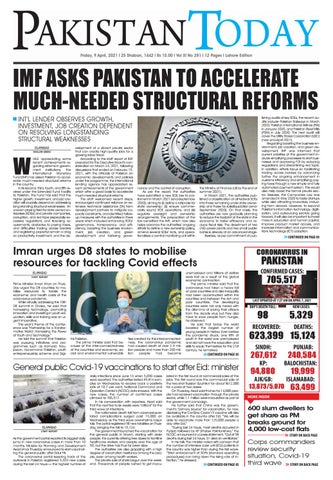
As the government portal reported its biggest daily jump in new coronavirus cases in more than 10 months, Minister for Planning and Development Asad Umar Thursday announced to start vaccinating the general public after Eidul Fitr. The coronavirus portal keeping track of the outbreak in Pakistan registered 5,329 new cases during the last 24 hours — the highest number of
CONTINUED ON PAGE 05
coronavIrus In
PakIstan
unemployed and trillions of dollars were lost as a result of the global economic contraction. The prime minister said that the coronavirus had taken a heavy toll on poor countries and also inequality had been accentuated within the countries and between the rich and poor countries. The developing countries were not only faced with the dilemma of saving their citizens from the deadly virus but they also have to save people from hunger, he observed. He said that today the world boasted the largest number of young people in history. Even before the pandemic struck, one fifth of youth in the world was unemployed and did not have the education and skills to equip themselves for the 21st century, he remarked.
CONTINUED ON PAGE 05
General public Covid-19 vaccinations to start after Eid: minister daily infections since June 16 when 5,090 cases were reported. The authorities tested 49,816 samples on Wednesday to receive back a positivity rate of 10.7 per cent, National Command and Operation Center’s (NCOC) data showed. With the new cases, the number of confirmed cases climbed to 705,517. In his conversation with reporters, Asad said that the next five to six weeks were “critical” for the third wave of infections. The nationwide death toll from coronavirus-related complications surged past 15,000 on Wednesday as the third wave overwhelms hospitals. The portal registered 98 new fatalities on Thursday, bringing the toll to 15,124. The government launched the vaccination for the general public in March, starting with older people. It is currently offering free doses to frontline healthcare workers and people over the age of 50, but the drive has thus far been slow. The authorities are also grappling with a high degree of vaccination hesitancy among the people, even among health workers. The private sale of shots begun over the weekend. Thousands of people rushed to get inocu-
lishing audits of key SOEs, the recent audits include Pakistan Railways in March 2020, Pakistan International Airlines (PIA) in January 2020, and Pakistan Steel Mills (PSM) in July 2020. The next audit will cover the Utility Stores Corporation (USC) (new end-April 2021). Regarding boosting the business environment, job creation, and green development, IMF was informed that current priorities of the government include simplifying processes to start businesses and approving FDI by reducing regulations and streamlining red tape. In addition, efforts focus on facilitating trading across borders by advancing further the ongoing enhancement in customs efficiency and simplifying paying taxes through a new simple and fully automated payment system. This would also help boost the formal private sector. besides, the Companies law was amended in May 2020 to foster startups while also attracting innovators, including from abroad. However, to expand Pakistan’s information technology, digitisation, and outsourcing sectors going forward, it will also be important to invest more in education and human capital, improve product market access, and increase information and communications technology (ICT) adoption.
lated in the first round of commercial sales of the jabs. The first round saw the commercial sale of the two-shot Russian Sputnik-V for about Rs12,000 for a pack of two doses. On Thursday, Asad said that so far 14,000 people had received vaccination through the private sector, while 1.1 million were inoculated as part of the government campaign. He further said that China was the government’s “primary source” for vaccination, for now, disclosing the CanSino Covid-19 vaccine will also be available in the country after Eid. “We will be able to vaccinate more than 125,000 people a day after Eid.” “During last 24 hours, most deaths occurred in Punjab followed by KP [Khyber Pakhtunkhwa,” the NCOC announced in a press statement. “Out of 98 deaths during last 24 hours, 31 died on ventilators.” In his talk, the minister noted with concern that the number of intensive care unit (ICU) patients in the country was higher than during the first wave. “Strict enforcement of SOPs [standard operating procedures] can bring down the rising rate of infection,” he stressed.
CONTINUED ON PAGE 05
CONFIRMED CASES:
705,517
LAST UPDATED AT 7:27 AM ON APRIL 7, 2021
DAY'S DEATH TOLL:
NEW CASES:
98
5,329
RECOVERED:
DEATHS:
623,399 15,124 SINDH:
PUNJAB:
267,612
240,584
KP:
BALOCHISTAN:
AJK/GB:
ISLAMABAD:
94,880
13,873/5,070
19,999
63,499
more inside
600 slum dwellers to get share as PM breaks ground for 4,000 low-cost flats STORY ON BACK PAGE
Corps commanders review security situation, Covid-19 third wave STORY ON BACK PAGE
02
Friday, 9 April, 2021
LAHORE
NEWS
PIA StArtS dIreCt flIghtS froM lAhore to SkArdu GILGIT
N
StAff RePoRt
ATIONAL flag carrier, Pakistan International Airlines (PIA), on Wednesday started direct flights from Lahore to Skardu for the first time. On the occasion, a cake-cutting ceremony was held which was attended by Baltistan Division Commissioner Shuja Alam, other important administrative officers including Civil Aviation, Airport Security Force and the crew. Talking to media on the launch of Lahore-Skardu flight operations, the spokesperson of government of Gilgit-Baltistan (GB), Imtiaz Ali Taj, said that it would promote tourism in the region. He said that the first flight of PIA carrying more than 150 passengers
GB GOVT SPOKESPERSON SAYS THIS MOVE WILL BOOST TOURISM IN GB reached Skardu from Lahore in which most of them were tourists. He said that development of tourism in GB was the top priority of Khyber Pakhtunkhwa (KP) Chief Minister Khalid Khurshid Khan as he was committed to promote winter tourism in GB. Taj said that with the promotion of winter tourism, the duration of tourism activities in the GB would increase from three months to 10 months. He said that due to its vast glaciers, high and lofty mountains, the GB would soon become a global centre of winter tourism and sports. Separately, PIA on Thursday announced
Court extends judicial remand of Asif in NAB case LAHORE: Pakistan Muslim League-Nawaz (PML-N) leader and former minister Khawaja Asif on Thursday appeared before an accountability court in the wealth case. During the hearing headed by an accountability judge, the court extended the judicial remand until April 22. The National Accountability Bureau (NAB) had arrested Asif in December from outside the Islamabad residence of another PML-N leader, Ahsan Iqbal, on charges of being in possession of wealth beyond his declared sources of income. In a bail request filed with Lahore High Court (LHC) on March 27, Asif contended during his physical remand with the NAB that he was not confronted with any “direct or circumstantial evidence that would construct the case”. “The application, under section 24(d) of National Accountability Ordinance, 1999, filed by respondent Assistant Director NAB Mohammad Ikram, for seeking physical remand of the petitioner did not disclose any incriminating material supporting the alleged commission of the crime under section 9(a)(v) of NAO,” the petition read. “Mere ownership of property/assets did not constitute an offense under section 9(a)(v). It is the failure to explain the source of funds that points towards the commission of the offense. The inquiry is being conducted on conjectures and surmises with a view to rope the petitioner into baseless and unfounded allegations. “In the absence of any plausible reason to reject the detailed explanation offered by the petitioner regarding his ownership of assets and source of income, this case is one of further inquiry and post-arrest bail should be granted.” Asif said that he had provided the agency with an explanation of the various sources of wealth, explaining the acquisition of the assets he owns. “Rejection of the explanation, without any reasonable ground, is itself evidence of the arbitrary exercise of power on part of respondents hence justifying interference by the court and grant of post-arrest bail,” he said. INP
Pakistan issues visas to Sikh pilgrims to attend Baisakhi celebrations ISLAMABAD: Pakistan has issued more than 1,100 visas to Sikh pilgrims from India to participate in annual Baisakhi celebrations, said a statement from the Pakistan High Commission in New Delhi. “These visas have been issued as a ‘special gesture’ by the Government of Pakistan in view of the importance of Baisakhi for Punjabis and Sikhs marking the start of their new year,” according to the statement that said the high commission extended special felicitations to all those celebrating the occasion and wished visiting pilgrims a fulfilling pilgrimage. ‘Baisakhi’ commemorates the day when the tenth Sikh guru, Gobind Singh, founded the ‘Khalsa Panth’, an army of warrior Sikhs, in 1699 to fight the Mughal Empire. It also marks the onset of the harvesting season for the farmers in Punjab and is observed as a thanksgiving day. After the celebrations, the farmers start cutting the Rabi (winter) crop and hope for a better yield with each passing year. The celebrations are planned to last from April 12 to April 22. “The issuance of pilgrimage visas is a part of the Government of Pakistan’s efforts for facilitating visits to religious shrines. This also reflects the commitment of the Government of Pakistan to faithfully implement the bilateral Protocol on Visits to Religious Shrines,” it added. Under the framework of the Pakistan-India Protocol on Visits to Religious Shrines of 1974, a large number of pilgrims from India visit Pakistan to observe various religious festivals and occasions each year. The managing body of the Sikh place of worship in India, the Shiromani Gurdwara Parbandhak Committee (SGPC), welcomed the decision by Pakistan. “We believe that those who want to visit religious shrines in Pakistan should be given visas,” said President Gobind Singh Longowal. He told Anadolu Agency: “The Indian government must allow the pilgrims to visit Pakistan.” ANAdolu AgeNcy
the resumption of direct flights between Bahrain and Pakistan. In a statement, the national flag carrier said that initially, it will operate two flights a week between Manama and Lahore, starting May 5. The development comes weeks after the airline — struggling to contain losses through restructuring or by bringing on board private partners — announced to increase the number of its international operations. According to a spokesperson, the flights would be increased for Afghanistan and the Central Asian states of Azerbaijan and Uzbekistan.
The spokesperson had further said that the national flag carrier would operate five flights a week between Pakistan and
Gillani challenges IHC decision in Senate chairman election case ISLAMABAD INP
Leader of the Opposition in the Senate Yousaf Raza Gillani on Thursday filed an intra-court appeal against an Islamabad High Court (IHC) decision concerning the election for the post of Senate chairman. In the election held March 12, the government-backed candidates grabbed the top slots of chairman and deputy chairman in a contest marred by the claims of securing votes of opposition Senators and the discovery of cameras in the polling booths. The former premier moved the IHC against the rejection of seven votes – he claims were cast in his favour – by a presiding officer. However, on March 24, the high court had dismissed the petition, maintaining Senate proceedings are immune to judicial interference. The appeal, filed by Gillani’s counsel, said the bench did not take into account facts and figures during the proceedings. Gillani’s appeal added that illegal activities can be interpreted by the courts whereas it was the job of the court to provide compensation for illegality and in such cases, the court has to check the intention of the voter. “The court is requested to accept the intra-court
appeal and single bench decision be rejected,” it added. The IHC had said in its verdict that “the grievance of the petitioner in the matter in hand exclusively pertains to questioning the validity of proceedings of the upper house of the parliament and thus it is immune from interference by this Court under Article 69 of the Constitution”. The 13-page order was authored by IHC Chief Justice Athar Minallah, who took up Gillani’s plea. A joint candidate of an 11-party opposition alliance – the Pakistan Democratic Movement (PDM) – for the position of Senate chairman, Gillani had requested the court to declare the polls void. 98 senators had exercised their right to vote, out of which seven votes were rejected. Sanjrani who had received 48 votes as opposed to 42 votes of Gillani was later declared the winner by the presiding officer, Senator Muzaffar Hussain Shah. Gillani had later moved the IHC. Dismissing the petition, the IHC noted that the parliament is the supreme legislative organ of the state, which represents the people of Pakistan and maintaining its dignity, respect and independence is of paramount importance and constitutional duty of other branches of the state.
SC expresses anger at Karachi commissioner’s report NewS DeSK Angered by the report of the Karachi commissioner, the Supreme Court (SC) on Thursday said that it would remove the commissioner over the unresolved matter of the city’s encroachments and lack of development. Chief Justice of Pakistan (CJP) Justice Gulzar Ahmed resumed a hearing on the petitions against the encroachments in the city at Karachi Registry. “You think we will take the deputy commissioner’s report seriously? What type of a report is this?” he asked the chief secretary. “It’s written everywhere that the report is awaited. Chief Secretary sahab remove such officers.” Barrister Salahuddin, whilst speaking on behalf of the Kidney Hill residents, requested the court to direct the builder to compensate them for selling them encroachments, pointed out that the”maps for them were approved by the Sindh government”. However, the CJP responded by saying the residents were not children and that one is fully aware of the details of land while buying houses. After the apex court dismissed the request to grant Kidney Hill residents time before their encroachments are razed to the ground, it was presented a report by the city commissioner related to the YMCA Ground during the hearing. The Karachi commissioner said that all pending work has been completed except for the installation of lights at the ground. He also presented a report on Shahrah-e-Faisal and Shahrah-e-Quaideen to the apex court. The bench expressed dissatisfaction over the report compiled by the Sindh Building Control Authority (SBCA). Holding the SBCA is responsible for all illegal constructions in Karachi, CJP Gulzar remarked there is no vacant land in PECHS. “Where did this land come from?” the chief justice asked. The SBCA director general (DG) said that this land was spotted after the re-allotment of the road. To this, the top judge remarked: “So does this mean that you would sell this land? What have you been doing? You will even allot Supreme Court building and CM House if you could.” The building has not been constructed on any nullah as per Sindh Building Control Authority, the commissioner remarked. The advocate general said that one side of the
APEX COURT ORDERS DEMOLITION OF NASLA TOWER building is illegal and that would be demolished. The SC therein ordered the demolition of residential building Nasla Tower on Karachi’s Shara-e-Quaideen. Nasla Tower is located at the intersection of Sharae-Faisal and Shara-e-Quaideen. AC TO INDICT MANDVIWALLA: An accountability court in Islamabad on Thursday decided to indict former Senate deputy chairman Saleem Mandviwalla and others in Kidney Hills reference on April 14 as two co-accused did not appear in the hearing. The accountability court’s judge Muhammad Bashir resumed the hearing of Kidney Hills reference of fake bank accounts case where Saleem Mandviwalla and other accused are likely to be indicted today. A co-accused Nadeem Hakim submitted his plea through the counsel to the accountability court to seek exemption from personal appearance in the hearing. Judge Muhammad Bashir remarked that the copies of the reference were provided to the accused. Mandviwalla’s lawyer Barrister Qasim Abbasi told the court that two co-accused Nadeem Hakim and Abdul Ghani Majeed were not present in the hearing. The judge asked the lawyer to proceed with the arguments in the case. The defence lawyer replied that he will continue with the arguments in the next hearing. Later, the court adjourned the hearing till April 14. The National Accountability Bureau (NAB) had filed a reference against ex-Senate Deputy Chairman Saleem Mandviwalla in an illegal land allotments case on January 13. The anti-graft watchdog in its reference stated the accused sold government plots to Abdul Ghani Majeed – son of Omni Group chief Anwar Majeed. According to NAB, Mandviwalla had purchased fake shares in the name of his frontman by selling the plots. The national graft buster had also submitted a report to the court which stated that former PIA managing director Aijaz Haroon had also played a key role in selling illegal plots to Abdul Ghani Majeed. The NAB had nominated Saleem Mandviwalla, Aijaz Haroon, Abdul Ghani Majeed and Tariq Mehmood as offenders in the reference.
Afghanistan in the first phase, whereas, in the second phase, the number would be increased to seven flights a day.
Sindh to administer Covid-19 vaccine jabs to police KARACHI INP
The Sindh government on Thursday announced to administer Covid-19 vaccination shots to all police officers aged 50 and above, directing the health department to begin the registration process. The district health officers (DHOs) have been directed to establish special desks in the vaccination centers. The jabs will be administered to the field force as well as the office staffers. In this regard, the Sindh Welfare Programme chief has penned a letter to all district and Rangers officials. To date, 6,366 officials of the Sindh police have contracted coronavirus. Meanwhile, the Sindh government has also started a drive to vaccinate prisoners aged 50 and above across provincial prisons, aiming to inoculate 1,882 inmates and 641 jail staff. The province has an overcrowding ratio of 32.23 percent, with 17,239 inmates lodged in 24 prisons meant for 13,038 inmates, according to data from jail authorities.
Court to indict Mandviwalla, others in NAB case on April 14 ISLAMABAD INP
An accountability court in Islamabad on Thursday announced to indict Pakistan People’s Party (PPP) leader and former Senate deputy chairman Saleem Mandviwalla and other suspects in Kidney Hills reference on April 14 as two coaccused did not appear in the hearing. Accountability Judge Muhammad Bashir resumed the hearing in reference — an offshoot of the fake bank accounts case. Another suspect Nadeem Hakim submitted his request through the counsel to the court to seek exemption from personal appearance. Judge Muhammad Bashir ordered the copies of the reference be provided to the accused. Mandviwalla’s counsel Barrister Qasim Abbasi told the court that two suspects — Nadeem Hakim and Abdul Ghani Majeed — were not present during the hearing. The judge asked the lawyer to proceed with the arguments in the case. The defence lawyer replied that he will continue with the arguments in the next hearing. Later, the court adjourned the hearing till April 14. The National Accountability Bureau (NAB) filed a reference against Mandviwalla in an illegal land allotments case on January 13. The antigraft watchdog, in its reference, maintained the accused sold government land to Majeed, son of Omni Group chief Anwar Majeed. According to NAB, Mandviwalla had purchased fake shares in the name of his frontmen by selling these plots. The agency had also submitted a report to the court which said that former PIA managing director (MD) Aijaz Haroon had also played a key role in selling plots to Abdul Ghani. The NAB had nominated Mandviwalla, Haroon, Abdul Ghani and Tariq Mehmood as accused in the reference.
Friday, 9 April, 2021
LAHORE
NEWS
03
600 SluM dwellerS to get ShAre AS PM BreAkS grouNd for 4,000 low-CoSt flAtS ISLAMABAD
f
APP
OR the first time in the country’s history, 600 out of 4,000 apartments will be given to slum dwellers as Prime Minister Imran Khan performed the ground-breaking of the low-cost housing units in the capital’s Farash Town on Thursday. Another 2,000 flats will be allotted to those who had registered themselves under the Naya Pakistan Housing Programme, while 1,600 flats will be sold out on an open market basis by Capital Development Authority (CDA). Prime Minister Imran Khan witnessed the Memorandum of Understanding (MoU) signed among the Naya Pakistan Housing Development Authority (NPHDA), Capital Development Authority (CDA) and Frontier Works Organization (FWO), which will jointly carry out the project. Speaking on the occasion, Prime Minister Imran said that the project aimed at
IMRAN SAYS PEOPLE WOULD BE ABLE TO MOVE INTO HOUSES WITH OWNERSHIP RIGHTS WITHIN TWO YEARS providing shelter to the underprivileged segment of society, particularly the working class and labourers. He said that within a time frame of two years, people would be able to move into the houses with ownership rights. He expressed satisfaction that regular negotiations of the government with private banks, the Federal Bureau of Revenue (FBR) and relevant bodies resulted in an agreement on mortgage financing as the key factor in the materialisation of the project. He said that existing impediments in acquiring bank loans would be sorted out and the procedure would be simplified in consultation with banks. The prime minister said that in near future, CDA would be working on a plan for the development of all slum areas in the
ChIld ABuSINg guN teACher ArreSted IN lAhore NewS DeSK A man who used to allegedly lure children in under the ruse of teaching them how to use a gun and would then abuse them has been arrested from Lahore, the police reported on Thursday. The Sanda police stated that there was video-graphic proof of the man teaching the children to use a gun, only to them molest them. A citizen of the Rajgarh neighbourhood in the provincial capital petitioned the police to register a first information report (FIR) against the man, who was caught by residents of the area and handed over to the authorities. Reportedly, the suspect had attempted to forcibly take the plaintiff’s brother with him, but had been stopped. Moreover, it is estimated that the man has abused some 10 children in this manner. The police have reported that they have registered the case and are currently interrogating the suspect.
official refutes reports of Covid-19 vaccine shortage
capital with the provision of modern amenities. Prime Minister Imran Khan said that the government was focusing on projects with a target of wealth creation to pay off heavy debt borrowed by the previous rulers. He mentioned that the government’s incentives for the construction industry would not only ensure economic activity with the running of 30 affiliated industries but also generate employment opportunities. He expressed confidence that the development of Lahore’s Ravi Urban Project and Central Business District (CBD) and Sindh’s Bundal Island would attract foreign investment. Also, the textile industry witnessed a boom with the operationalization of power
looms, leading to an increase in demand for workers, he added. He said that the construction of two big dams after five decades would ensure cheap electricity and contribute to enhanced productivity of industries. PM Imran said that completion of Main Line-1 rail track would reduce the Lahore to Karachi travel time to eight hours, and also benefit the freight movement as a factor of ease of business. Interior Minister Sheikh Rasheed Ahmed said that the occasion was food for thought for the ‘inhabitants of Surrey Palace and Park Lane Apartments’, who never considered the fact that poor people also needed shelter. He announced that in the upcoming Media City, 600 flats would be provided to the journalists of Islamabad and Rawalpindi, for which he said, he had convinced Islamabad Chief Commissioner Amer Ahmed Ali and Deputy Commissioner Hamza Shafqat. However, he made it clear that the flats
for journalists “would not be free-of-cost and the required instalments would have to be paid”. Under the Safe City project, he said, 1,822 surveillance cameras had made operational compared to the 500 during the tenure of the previous government. Also, 1,200 more CCTV cameras will be purchased to make the city secure. Naya Pakistan Housing Development Authority Chairman General (r) Anwar Ali Hyder said that 2,000 persons already registered with the project would be allotted flats through ballot after proper verification of NADRA. He said that mortgage financing on the lowest markup through banks and Rs300,000 subsidy by the government would enable the low-income groups to have their own homes. Later, the premier also planted a sapling at the construction site of Farash Town Apartments. PM’s Special Assistant for Overseas Pakistanis Syed Zulfikar Bukhari and Senator Faisal Javed were present.
Ties between PM and Jahangir Tareen turned sour recently, claims Raja Riaz NewS DeSK Pakistan Tehreek-e-Insaf (PTI) Member of National Assembly (MNA) Raja Riaz has claimed on Thursday that the ties between the former secretary-general for the party, Jahangir Tareen, and Prime Minister Imran had soured recently, adding that the two had been in contact until the trust vote. Speaking on a local TV programme, the MNA claimed that Tareen had assured PM Imran victory in the vote of confidence in the NA that took place after PTI’s candidate lost the general seat in the federal capital to the Pakistan People’s Party (PPP). Riaz said that it was after the vote of confidence that communication between the two ended abruptly. He added that after this, action against the PTI stalwart was launched and three first information reports (FIRs) were registered against him. “This raised the question that if Jahangir Tareen is not getting justice then how is the accountability of the opposition being done correctly?” said the MNA from Faisalabad. On the other hand, Tareen on
Thursday asserted he could not even think about “causing harm to Prime Minister Imran Khan”. Tareen also denied reports that the PPP stalwart and leader of the opposition in the Senate Yousuf Raza Gillani had travelled on his plane. “If Yousaf Raza Gillani used Makhdoom Ahmed Mahmood’s plane, how is it my fault?” the estranged PTI leader asked. His statements come one day after he had denied a claim made PPP leader Shehla Raza regarding his inclusion in the PPP and meeting with Asif Ali Zardari. “An ongoing propaganda is being launched against me,” he had said while denying a Twitter message from PPP lawmaker Shehla. The PTI leader had maintained that there was no truth in reports regarding his meeting with the PPP leadership and inclusion in the party. “Those running fake news against me will be disappointed,” he had said at the time. On Thursday, the PTI leader alleged that the PM’s advisers, Azam Khan and
Shahzad Akbar, were behind the misinformation regarding the plane, adding he had been supporting the premier with honesty and sincerity. “My record is clean and I can’t even think about causing harm to the prime minister,” he maintained. Separately, Lahore police on Thursday registered an FIR against Sajjad Ali, guard of PTI leader Jahangir Khan Tareen, for bringing unlicensed weapons to the banking court during the hearing of Tareen’s case on Wednesday. The case was lodged in the Islampura Police Station. The security personnel deputed outside the Sessions Court had recovered arms from Sajjad outside the banking court. Earlier this week, Tareen had asserted that future sales are a part of business everywhere and had asked the people to put an end to the smear campaign. On Twitter, he had said, “Future sales are a normal part of business activity all over the world. It is used to secure future cash flow for normal business activity. It has nothing to do with Satta. All such sales are declared in JDW accounts in
their entirety.” The PTI leader had also posted screenshots of the London Sugar Future sales figures to help explain his point. Furthermore, he had said: “Stop the smear campaign”. Last week, the banking court in Lahore had granted one-week interim bail to PTI leader Jahangir Tareen and his son Ali Tareen in two cases of corporate fraud and money laundering. Additional District And Sessions Judge Hamid Hussain, while accepting the request, had granted bails until April 10 against surety bonds of Rs0.5million apiece. He had also directed Federal Investigation Agency (FIA) to present its record against the accused in the next hearing. The agency has booked Tareen and members of his family on charges of corporate fraud and money laundering. The cases, filed on March 22, were registered under sections 406 (criminal breach of trust), 420 (cheating of public shareholders), and 109 of the Pakistan Penal Code (PPC), read with sections 3 and 4 of the Anti-Money Laundering Act, 2010.
ISLAMABAD APP
Parliamentary Secretary of National Health Services (NHS) Dr Nausheen Hamid on Thursday said that the government was closely monitoring the availability of coronavirus vaccine shots, assuring that there’s no truth in reports of vaccine shortage. “There was ample stock of vaccine [available] and vaccination was continuing at centers as per schedule. But in some areas, due to rush of people, we faced a temporary shortage […] but addressed on priority basis,” she said. Hamid said that the federal government was in the process to procure Sinopharm and CanSino jabs from China. Two batches of the vaccines, including 3 million doses of CanSino and 4 million of Sinopharm will arrive by the end of April. She said that the bulk of the vaccine will be formulated, sterilised and packaged in Pakistan. In response to a question, Nausheen made it clear that there will be no “middleman deals” with regard to the purchase of Covid-19 vaccines, as the government was purchasing the drug on the basis of government-to-government deals. She further said that the private sector and provinces have also been granted permission by the government to cater to the needs of people who could afford to purchase the vaccine. She said that the Sindh government was involving the middlemen while purchasing the vaccine when Minister for Development and Planning Asad Umer advised them not to go that route as it would affect the price of the vaccine. Hamid said that the federal government would not hold a monopoly on the import of vaccines, adding that provinces and the private sector were free to import vaccines subject to the approval of the Drug Regulatory Authority of Pakistan (DRAP). She further said that the provincial government was using their own funds and purchasing their vaccines. Hamid further asked the people to encourage those over 50 to register for the inoculation drive and reminded the people that the drive is ongoing for those who are 60 years or older. Covid-19 vaccines are available free of cost to the people in government facilities, she added.
Qaiser’s Afghanistan visit postponed for security reasons ISLAMABAD StAff RePoRt
The anticipated visit of National Assembly (NA) Speaker Asad Qaiser to Afghanistan was postponed on Thursday due to security reasons, Special Representative of Pakistan to Afghanistan Mohammad Sadiq announced. The visit was postponed after the authorities received information that the Kabul “airport was closed due to [a] security threat,” Sadiq said on Twitter. “The plane was about to descent when the control tower informed of the closure of [the] airport. New
dates for the visit will be decided after mutual consultations.” The three-day visit was aimed at focusing on ways to enhance ties between the parliaments of both countries. In a statement issued prior to the cancellation, the NA Secretariat said that Qaiser will head a ninemember delegation including Sadiq. The statement had further said that the delegation will hold meetings with the Speaker of Wolesi Jirga — or the lower house of the Afghan parliament — Mir Rahman Rahmani and others. “The visit also aims at exploring the opportunity for a peaceful Afghanistan to ensure regional prosperity.”
Govt to abolish hundreds of posts in BPS 1-16 ISLAMABAD AhmAd AhmAdANI
Contrary to the much-touted claim of creating 10 million new jobs, the Pakistan Tehreek-e-Insaf (PTI) government is set to abolish hundreds of posts in BPS 1-16 lying vacant for almost over a year. According to sources, the Cabinet Committee on Institutional Reforms (CCIR) has considered a summary submitted by the finance division regarding “ReOrganising the Federal Government Proposal Regarding Abolition of Posts” and took important decisions in this regard. As per details, all ministries/divisions will abolish posts in BPS-1 to 16 that have remained vacant for more than one year. However, the posts to be abolished will not include posts that are vacant due to transfer/posting and positions meant for promotion. Similarly, the posts where the recruitment process is
already under process will also be exempted till the finalisation of the process. Moreover, the posts in BPS 1 to 16 belonging to health, education, and police departments in the federal government will be exempted from abolition being the operational nature of such departments. The CCIR, in its decision, has also advised all Principal Accounting Officers (PAOs) of all federal ministries/divisions to carry out an exercise to identify the posts for abolition and intimate within four (04) weeks to CCIR. The total employment in Pakistan is 64 million, out of which 24 million is in the agriculture sector, 4 million in the public sector, and the remaining 36 million employment is being provided by the urban sector. To implement the government’s austerity drive and bring reforms in government departments, Prime Minister Imran Khan had earlier constituted a task force on austerity and government restructuring, led by Adviser to the Prime Minister on Institutional Reforms Dr Ishrat Hussain.
47 polling stations in daska by-election declared sensitive ISLAMABAD INP
The Election Commission of Pakistan (ECP) has declared 47 polling stations as sensitive out of 360 as all is set for polling in the Daska by-election on April 10. The ECP directed the authorities to install over 100 CCTV cameras at sensitive polling stations to monitor the situation on polling day due on April 10 in NA-75 Daska. Rangers and police have been deployed in the constituency with Pakistan Army soldiers on standby. a. Under section 13(2) of the Elections Act, 2017, the Presiding Officer / Assistant Presiding Officer shall have a smartphone to be used for maintaining communication with the District Returning Officer / Returning Officer /District Monitoring Officer and take a snapshot of Form-45 (result) at the premises of Polling Station at the time of declaration of result and send it to the ECP and the Returning Officer; b. In case, if the Presiding Officer does not possess/have a smartphone, in such cases the Assistant Presiding Officer will be deputed for compliance with section 13(2) of the Elections Act, 2017: c. The Presiding Officer / Assistant Presiding Officer shall ensure to activate location feature of the mobile phone on the polling day and for taking a snapshot of Form-45; d He/she shall take a snapshot of Form-45 using his/her mobile in the presence of polling agents at the premises of the polling station: e. He/she shall transmit the Form-45 to the Returning Officer and ECP on a dedicated Whatsapp channel immediately in the presence of polling agents from the polling station. f. In case of poor network connectivity, he/she shall not wait at the Polling Station and proceed to the Office of the Returning Officer immediately for submission of polling records including Form-45 under Section-90 of the Elections Act, 2017.
04
Friday, 9 April, 2021
LAHORE
NEWS
FIA ISSueS notICe to FederAL MInISter’S brother over InvoLveMent In SugAr SCAndAL
t
NEWS DESK
HE Federal Investigation Agency (FIA) on Thursday issued a notice to Makhdoom Shehryar, the brother of Federal Minister for Economic Affairs Khusro Bakhtiar, for allegedly selling sugar through the practice of satta (price-fixing through collusion), according to a news outlet. The agency summoned
Makhdoom Shehryar at its office on April 15 and ordered him to show documents related to the selling of sugar through satta and to submit details of the procedure adopted by his mill to book and sell sugar through the process of satta. According to the notice, the administration and shareholders have been accused of being involved with the satta mafia, adding that the latter is minting illegal money with the help of sugar mill owners.
Commenting on the matter, Federal Minister Khusro Bakhtiar said that he previously had shares in the company but does not have them anymore. Last month, the FIA had arrested seven people allegedly involved with the sugar satta mafia. All seven accused, arrested by the agency, were brokers and were involved in the creation of artificial shortage and price hike of sugar with the connivance of mills’ owners.
They were operating through electronic means to dishonestly and fraudulently manoeuvre, manipulate and artificially hike sugar prices amidst hoaxes of impending sugar stock shortages. Furthermore, the arrested were also indulged in opening and operating fake third-party accounts to conceal the illegitimate crime proceedings. The agency had also recovered mobile phones, registers, laptops and some other items from their possession.
Six killed, 12 injured in dispute on Karo Kari incident NEWS DESK Six people were killed and 12 got injured in a violent clash in Shikarpur district on Thursday in what police described was a dispute arising over a Karo Kari incident. The clash took place among two groups of the Jatoi clan in the limits of the Rustam police station. As tensions flared, the two groups traded fire, leaving six people dead and a dozen injured. The gunfire continued for a long time, causing fear and panic in the area. After a while, police intervened to put an end to the violence. SSP Shikarpur Kamran Nawaz said the situation is now under control and that police have arrived in the area. He said the injured have been shifted to Khanpur and Shikarpur hospitals for treatment.
Junagarh under Indian occupation ZahEEr ahmaD Junagarh, a lurking political crisis, a territorial dispute between two neighbours, and a princely state under Indian occupation, as Pakistan has a rightful claim on the territory of 4,000 square miles and a 100-mile coastline along the Arabian Sea with many ports. Junagarh is a district in the Indian state of Gujarat; located on the Kathiawar Peninsula. Junagadh’s accession to Pakistan on September 15, 1947 was the first test of the Indian Independence Act of July 1947, which allowed the princely states to accede to either of the two dominions. The Muslims of Junagarh still observes November 9, 1974 as a black day of Indian occupation on their homeland. Ever since the Indian occupation, royal family legal heir of the princely state has never let their lawful claim of Junagarh being part of Pakistan, as people of Junagarh acceded to Pakistan after partition, but Indian forcibly entered army to occupy the land. The mobilisation of Indian defence forces in the lead up to the accession of Junagadh in November 1947 and the management of violence directed at Junagadh’s Muslims afterwards are yet another instance of the forcible incorporation of Indian princely states and Indian Muslims into the reconstructed post-colonial state. Present in this matrix were also the ‘sub-states’ within Junagarh and the attendant questions of their autonomy, an instrumentalist alarmism about popular will and unrest and a hastily conducted referendum. These aspects of this contested accession have remained overshadowed in the historical record. The notification of this accession in the newspapers outraged New Delhi. The government of India on September 17, 1947 dispersed troops around Junagarh. As a result, the government of India resorted to two other tactics in order to bring Junagarh into line. The first was an economic blockade of the state, which choked the state of food and materials by the end of October, 1947. The second tactic was the Arzi Hukumat (provisional government), which was set up under the leadership of Samaldas Gandhi, a nephew of Mahatma Gandhi, under the auspices of the government of India in Bombay. Along with this, India also placed huge contingents of state and dominion troops along the border with Junagarh, Thus, the issue had reached stalemate with neither side willing to compromise with a looming Indian attack on the virtually defenceless Junagarh. The deteriorating security, food and economic situation of Junagarh made it easier for India to take over the state. The
Nawab, together with his household, left the state by the end of October to Karachi, leaving the state administration in the hands of the Dewan. Thereafter, the government of India took over the administration of the state on November 9, 1947. The government of Pakistan reacted strongly to this action. Later on the plebiscite on February 20, 1948 under the control of Indian army manipulated in favour of India, that Pakistan never accepted these results and to date considers Junagarh a legal part of Pakistan. Recently, Nawab of Junagarh Mohammad Jahangir Khanji appealed to Prime Minister Imran Khan to become an ambassador of Junagarh as he did in the case of Kashmir and highlight the issue of liberation of the state from Indian occupation at all international forums. He recalled that in October, 1947, during his visit to Pakistan, his grandfather Nawab Mahabat Khan signed an agreement of accession to Pakistan. During the visit, his grandfather held a meeting with Quaid-i-Azam Mohammad Ali Jinnah and decided to accede the state to Pakistan. The treaty of accession was ratified by the Constituent Assembly of Pakistan. In the absence of his grandfather, India landed its troops and occupied the territory of Junagarh on November 9, 1947. He said that Pakistan took the case of occupation of Junagarh to the United Nations Security Council. “The occupation was against the international law and norms,” he said, adding that a living nation should remember its history and act accordingly. The Nawab said that Junagarh was part of Pakistan and it would remain so. “The occupation of Junagarh by India violated Article 26 of the Vienna Convention on Law of Treaties and the state should be merged with Pakistan”, he said. On August 5, 2020, Pakistan had approved and released the new political map of Pakistan, which includes territories of Jammu and Kashmir and a part of Ladakh. The map also included Junagarh, Manavadar and Sir Creek in Indian Gujarat as part of Pakistan. The geo strategic importance of Junagarh and access to Arabian Sea give it a unique importance for regional trade route. Pakistan’s claim has a legal standing in the eye of international law and the UN must act accordingly to ensure protection of Muslim citizens of the state and peaceful resolution of this long standing territorial disputes between two states. Meanwhile Pakistan must continue diplomatic efforts to keep highlighting this on global level and to remain hopeful with diplomatic efforts to resolve 73-year-old dispute by UN intervention in favour of Pakistan.
WCLA completes restoration of Makatib Khana, Moti Masjid in Lahore Fort LahOrE SHAHAB OMER
Walled City of Lahore Authority (WCLA) has completed the conservation and restoration of Moti Masjid and Makatib Khana located inside the Lahore Fort with an amount of Rs19 million allocated by the Punjab government for both the monuments, Pakistan Today learnt on Thursday. It is pertinent to mention here that both the historic monuments are located on the western side of the Lahore Fort near the canteen area and make a complex of buildings. The officer on duty for the conservation and restoration works informed that the works and repairs of the mosque included lime plaster, marble flooring, restoration of the discovered old drainage system, investigation and study of Moti Masjid hujras, restoration of newly discovered treasury place inside the masjid, Ghalib Kari, Pakka Kali, fresco lining in hujras, removal of debris and drainage waterproofing of roofs. “The restoration works of Makatib Khana included the structural consolidation of the entire building, brick on edge flooring, main gate, preservation of historic fresco work, Pakka Kali and fresco work and Ghalib Kari in hujras,” the officer informed. WCLA Director Conservation Najamus Saqib said that it was an 18 months project, which had started in 2019. “The work is now completed by WCLA and it was an uphill task because of the intricacies. All the graffiti from Makatib Khana and Moti Masjid has also been removed during these works. We have illuminated the monuments and these will be soon opened for the public. The draining system of the Mughal era has also been restored and the treasury of the Sikh era found inside the Moti Masjid is also restored. We will be putting up informational plaques for the tourist so that they can get the relevant information,” Saqib said. On inquiring about the controlling of graffiti inside the restored monuments, he said, “There was a lot of wall chalking and graffiti in both Makatib Khana and Moti Masjid which was removed by our specialized team during work. We will be imposing fines on such acts and these will be heavy fines. Moreover, we are installing CCTV cameras as well inside the fort through which our team would monitor such activities. Site in charge and guards will also be deputed there to control these matters.”
Friday, 9 april, 2021
lahorE
nEws
IMF asks Pakistan to accelerate much-needed structural reforms contInueD froM pAge 01 The IMF has also been informed the approved national tariff policy was being implemented. Tariff rationalisation aims to reduce the level of protection while also reducing input costs to promote competition, exports, and domestic production (“Made in Pakistan”) for import substitution purposes. Besides, a National Electric Vehicle Policy was also being implemented. It provides a framework to achieve ambitious targets for the sale of electric cars until 2030, with the aim to (i) reduce Pakistan’s GHG emissions and fuel import bill; and (ii) promote industrial growth and job creation through new investments and the introduction of new technologies. For strengthening the effectiveness of anti-corruption institutions, the priority measures of government include the establishment of an asset declaration system with a focus on high-level public officials by end-June 2021 (new end-June 2021), publication of the second review cycle report under the UN Convention against Corruption (UNCAC), and review of the institutional framework for Pakistan’s anti-corruption institutions by international experts. Efforts to enhance international anti-corruption cooperation and recover stolen assets abroad are encouraged. Another major commitment of Pakistan regarding the loan programme was to enhance the use of anti-money laundering tools to support anticorruption efforts. The IMF has said that financial institutions should be effectively supervised to comply with due diligence obligations for politically exposed persons and suspicious transaction reporting. The effectiveness of Pakistan’s financial intelligence unit should be enhanced, and its membership to the Egmont Group be pursued.
IHC seeks report from registrar office in references against Nawaz ISLAMABAD APP
The Islamabad High Court (IHC) Thursday sought report from its registrar office regarding fixation of criminal appeals during Covid-19 while hearing a miscellaneous application filed by National Accountability Bureau (NAB). The NAB plea was seeking early hearing in Flagship Investment, Al-Azizia Steel Mills and Avenfield references related to former prime minister and Pakistan Muslim League-Nawaz (PML-N) supreme leader Nawaz Sharif. A division bench comprising Justice Aamer Farooq and Justice Mohsin Akhter Kiyani heard the miscellaneous application. NAB Prosecutor Sardar Muzafar Abbasi appeared before the court and requested the bench to fix the appeals in above references for early hearing. The bench remarked that the top court had given order for early conclusion of NAB references. This order was not for the appeals in references, the bench observed. It, however, said that the bench would decide the case after viewing the report of registrar office. It may be mentioned here that Maryam Nawaz and her husband Captain (r) Safdar Awan had filed appeals against their sentences in Avenfiled reference while Nawaz had challenged his imprisonment sentences in Al-Azizia Steel Mills and Avenfiled property cases. However, NAB had challenged the acquittal of Nawaz in Flagship Investment reference and also pleaded to extend the imprisonment sentence of the PML-N supremo in AlAzizia Steel Mills case. NAB had requested the IHC to conduct early hearing of the above appeals as the former prime minister had already been declared absconder due to continuous disappearance.
05
CoMMIttee oN GB reForM revIews oPtIoNs oF CoNstItutIoNal aMeNdMeNt ISLAMABAD
t
GHULAM ABBAs
HE high-level committee constituted to propose constitutional reforms for Gilgit-Baltistan (GB) has discussed and reviewed various options of constitutional amendments to grant provincial status to GB. According to sources, the committee, which for the first time met on Thursday, discussed a proposed constitutional bill for amendment in the constitution to pave way for mainstreaming GB. Insiders informed Pakistan Today that the proposals made by concerned authorities were aimed at granting all powers to GB like other provinces of the country. “The meeting has deliberated the proposed amendments in various articles of the constitution. However, it is yet to be clear which article will be amended to grant the provisional constitutional status to GB,” said the source, adding that further deliberation would be made in the next meeting which was expected within the next 15 days. “One thing is clear that all the members of the committee representing various stakeholders were on board to make the constitutional amendment to grant the provincial status to GB as per the unanimous resolution passed by legislative assembly of GB,” the source added. While replying to a query, an insider said that the committee has so far not discussed the number of seats in parliament
for GB in case of amendment in the constitution. “Such proposals would be discussed in next meetings,” he said. The meeting on Thursday was chaired by Minister for Kashmir Affairs & Gilgit Baltistan Ali Amin Khan Gandapur. Federal minister for law & justice, GB chief minister, the attorney general for Pakistan (AGP), Ministry of Foreign Affairs secretary, Ministry of Defence secretary, Ministry of Finance secretary, secretary Ministry of Parliamentary Affairs, Ministry of Kashmir Affairs member, GB chief secretary, co-opted members from national security Institutions, and GB Council joint secretary had also attended the meeting. During the meeting, Gandapur underlined the need for political consensus and national cohesion to change the status of the region. He said that a unanimous resolution, passed by the GB assembly recently, for changing its status was a true reflection of its people’s aspirations, adding the federal government was making all out efforts in that regard. The meeting discussed in detail various models for changing the status of GB and stressed the need to make progress over the issue of national interest. The 12-member committee, constituted by Prime Minister Imran Khan for making recommendations regarding granting provisional provincial status to GB had met for the first time as it could not meet within the stipulated time of 60 days, an official source said.
INP
The Pakistan People’s Party (PPP) on Thursday said that it rejects any attempts to further gag the fundamental right of freedom of expression in the name of preventing defamation and disrespect of the armed forces. In a statement, secretary general of the Pakistan Peoples Patty Parliamentarians (PPPP), Senator Farhatullah Babar, expressed grave concern over a bill moved by a PTI MNA and approved by the National Assembly Standing Committee on Interior seeking to amend the Pakistan Penal Code (PPC) to send anyone to jail for two years with fine Rs 500,000 or both for what has been described as ‘defamation of the army”. He said that Section 500 of the PPC already provides punishment for the defamation of anyone, and the addition of Section 500-A is aimed only at gagging freedom of expression guaranteed
provincial status to GB in light of United Nations resolutions on Kashmir. The committee would also keep in view the country’s principled stance on Kashmir and the Supreme Court (SC) of Pakistan’s decision on GB reforms while giving its recommendation. According to sources, the committee would also consider the historic documents and findings of previous committees and forums on matters. PM Imran, during his last visit to Gilgit, had also said that it was the government’s top priority to grant the provisional provincial status to GB as promised earlier. It is noteworthy that a high-powered committee formed by the previous government had already worked on the subject for two years, the opposition pointed out.
PM to unveil Rs275bn uplift package for GB on April 12 Prime Minister Imran Khan will pay a day-long visit to Gilgit-Baltistan on April 12 where he will announce an Rs275 billion development package for the mountainous region. Prime Minister Imran was scheduled to visit GB on April 5, but his his-day visit for GB Integrated Development Plan was postponed due to bad weather. As per the new schedule, the prime minister will now visit the region on Monday. Projects related to clean energy, transport and communication, health, infrastructure, water sanitation, women development programme, construction of new grid stations and tourism are part of the GB uplift package. PM Imran will also make an important statement regarding granting GB the status of a provisional province of Pakistan. News desk
General public Covid-19 vaccinations to start after Eid: minister
PPP to oppose legislation in name of disrespect of armed forces ISLAMABAD
Earlier it was scheduled to meet on March 11, 2021 but it could not for unknown reasons. The prime minister, following his announcement in Gilgit last year, had constituted a high-powered 12- member committee to discuss the legal, historic and political aspects of granting provincial status to GB. As per an official source, the sitting of the committee was delayed for approval of a resolution in the GilgitBaltistan Legislative Assembly (GBLA) demanding an early granting of provisional provincial status, a longstanding demand of the people of the area. As per the notification, Terms of Reference (ToRs) have also been set for the committee, under which it would prepare a report regarding giving provisional
under Article 19 of the constitution in name of national security. It is not acceptable and will be opposed at every platform he said. The nation has witnessed enough of how behind the façade of ‘national security’ citizens have disappeared mysteriously, national resources diverted, internment centres set up, ex tribal areas made a no go area, foreign and security policies hijacked and security establishment’s business and commercial empire expanded exponentially. Section 500-A is liable to be grossly misused in the name of national security as Section 295-C has been misused in the name of religion, he said. “Defence forces working within their constitutional limits are universally admired and do not need any legislation to protect their honor and respect. Similarly, no legislation can stop people from questioning those who transgress their limits with impunity,” he said.
contInueD froM pAge 01 His conversation comes as recoveries from coronavirus increased by 2,610 to 623,399, or 88.4 percent of total cases. There are currently 66,994 active cases of Covid-19 in the country, with 3,942 of them in critical condition, NCOC said. The government is struggling to contain the third wave of Covid-19 with authorities continuing to tighten social distancing and movement restrictions, implementing the ban on all gatherings in hotspots. Sindh has been the worst hit with 267,612 cases followed by Punjab where 240,584 people have been tested positive, the NCOC said in a statement. Meanwhile, Punjab Health Minister Dr. Yasmin Rashid said that the province would soon, after cabinet approval, purchase one million doses of the Covid-19 vaccine. “Local preparation of vaccine may take 6 to 10 months’ time,” she was
quoted by media as saying. Asad, who also heads the NCOC, said on Tuesday that increased restrictions, broader lockdowns, and strong enforcement of health guidelines have started to show give dividends. The rising trend of positivity rate has been flattened, but the number of critical patients and mortality will stay at high levels for some time due to the momentum of the last two weeks, he had said. Urging the people to strictly follow SOPs to stop the spread of the virus, Prime Minister Imran Khan on Sunday said that the third wave is extremely dangerous in comparison to the previous two waves. “We have so far been protecting our people. We are not imposing a complete lockdown or closing our factories. We are only imposing minor restrictions so that this wave does not spread rapidly,” he said in a recent telethon. “But if this spreads, it will have a very negative impact and we will be forced to take steps.”
Imran urges D8 states to mobilise resources for tackling Covid effects contInueD froM pAge 01 “We have 550 million youth population in the D8 countries. Our youth not only has the potential to optimize opportunities, but they can also help overcome the present challenges.” He said that the developing countries had young entrepreneurs, business innovators, technology pioneers, educators, artists and journalists and “we must create opportunities for this predominant component of the population”. PM Imran said that the pace of change in the world had intensified and the rate of change had become exponential. Innovation and breakthroughs in technology, he said, were transforming the science fiction of yesterday into reality of today. Only five years ago, the World Economic Forum (WEF) had predicted that the Fourth Industrial Revolution “will fundamentally alter the way we live, work, and relate to one another”. The prime minister noted that contemporary global challenges of a changing world were a moving target. “No single country can address these complexities in isolation. Partnerships are essential.” He expressed happiness that the D8
countries had a platform to work together for mutual benefit and win-win solutions. “The D8 will do well to pay special attention by following specific areas while dealing with the rapidly transforming world.” First, as the net producer of global commodities, the D8 must conceive projects that harness technology for supply side improvements with special emphasis on efficiency and productivity, he said. He said that with cost of transportation and communications improving due to innovations, the D8 must partner to keep pace with logistics and global supply chains. Secondly, the D8 should brainstorm ideas to insulate its members from disruptions in the labour markets due to technology and innovations, he continued. PM Imran said that as the automation substituted for labour across the world, the labour intensive economies of D8 faced challenges of unemployment and social disruption. He said that the D8 countries should ask that the coronavirus vaccine should be treated as a global public good to ensure equity, affordability, enhanced production and timely supply to save lives. “We must push back against vaccine na-
tionalism and undue export restrictions. The global vaccine manufacturing companies must speed up production and share their technology and expertise with the developing countries for adequate vaccine supply.” He said that 23 years ago, a shared vision motivated “our countries to establish D8 to improve their position in the global economy, diversify and create new opportunities in trade relations, enhance participation in decision making at international level, and improve living standards”. Today, he said, D8 was a grouping of over one billion people with a combined GDP of four trillion dollars. “We possess two essential pre-requisites for growth, including resources and enterprising people.” He proposed five steps to supplement efforts of D8 during the present testing times. “We must mobilise finances and resources to recover robustly from the economic and health crises induced by coronavirus pandemic,” he added. He said that in order to address the unique financial and economic crises faced by developing countries as a result of the pandemic, he had suggested a five-point plan, including debt relief, creation and re-
cMYK
distribution of special drawing rights, mobilisation of climate finance, elimination of illicit financial flows and return of stolen assets to the developing countries. He had called for a global initiative on debt relief last April, he added. The prime minister invited the leadership of D8 countries to consider his five points and join in advocacy for the Covid-19 related relief measures. He said that the D8 must take concrete actions for expanding intra D8 trade from currently around $100 billion to $500 billion by the year 2030. It should include measures like simplification of border procedures, enhancing of institutional linkages and operationalising new initiatives, he added. PM Imran welcomed ideas like D8 payment card, which would enable transactions in local currency. He urged the D-8 to develop a “Youth Engagement Strategy” focused on promoting cultural, educational, and scientific and business exchanges. “Linkages should be established between educational institutions through scholarships, skills development, trainings, fellowships, joint research, and exchange programmes for the youth, particularly in the
field of science, technology and innovation.” He said that the technological development was a gateway to economic prosperity, particularly in the post-pandemic period when reliance on technology would be greater than ever before in human history. “To remain competitive, we must promote knowledge-based economies, increase expenditure on research and development, and focus on rapid digitalization. Pakistan has recently hosted the inaugural meeting of the D-8 Network of Pioneers for Research and Innovation (NPRI).” He underlined the need for making D-8 more relevant to the lives of its citizens by promoting food security, enhancing cooperation in health, holding joint sports events and helping each other during natural disasters. “To achieve these goals, we need high level of commitment and mobilisation of financial resources by both developed and developing economies.” “Partnerships between governments, international financial institutions, businesses and civil society are essential to leverage technology, innovation and skills to enable every young person to have all opportunities to realise their full potential,” he concluded.
Friday, 9 April, 2021
06 COMMENT
New kid on Q Block
An attempt to suppress dissent
‘Men of business’ must have seats found for them
Fair criticism is not ridicule
O
NE fails to understand what motivated the National assembly Standing Committee on Interior to hastily approve a bill to take action against those who supposedly ridicule the armed forces. Even the British rulers who imposed the first martial Law in Punjab did not feel the need to amend the country’s Penal Code and Code of Criminal Procedure, legislated in 1898, to suppress the critics. Nor did the successive military rulers in Pakistan. What was the urgency that led the government to propose the legislation? Pakistan being a federation, and criminal law a provincial subject, the opinion of the federating units was presumably sought. The KP government is reported to have opposed the provision. The committee should have waited for the advice of the other three provinces on the issue. article 19 of the Constitution enshrines the citizens’ right to the freedom of speech, freedom of expression and freedom of the Press. The article simultaneously makes the freedoms subject to any ‘reasonable restriction’, imposed by law in the interest of the glory of Islam or the integrity, security or defence of Pakistan or any part thereof, friendly relations with foreign states, public order, or in relation to contempt of court or incitement to offence. What was the need to have an extra law specifically for the armed forces in the presence of a comprehensive constitutional provision? The rationale given by the ministry of Interior which sponsored the move is questionable. It has been maintained that the incidents of defaming the armed Forces have increased in the country which is demoralizing for them. The people of Pakistan have great regard for the armed forces, as they guard the country’s borders round the clock throughout the year to provide the citizens security against foreign threats. Who can think of defaming those who sacrifice their lives to safeguard the country’s integrity and freedom? The problem arises when armed forces take up tasks outside the sphere defined for them in the Constitution. any institution, be it the judiciary, the civil administration or the army, that transcends its constitutional mandate, is bound to invite criticism. The term ‘defaming’ is subjective. What is fair criticism to one can be termed defaming by another. There is therefore a genuine concern that the change in the law is in fact aimed at victimizing the critics.
At Penpoint M A NIAZI
H
amad azhar did not get the Finance portfolio under the best of circumstances, and the stopgap nature of his assignment at the Finance ministry, which is in Q Block, Pak Secretariat, was only emphasized by the refusal of Shaukat Tarin to take on the job. His unsuitability for the portfolio could be seen in the way his first major initiative, importing cotton and sugar from India, was reversed, even though it had been made because of a summary recommending it from Prime minister Imran Khan. However, Hammad shouldn’t have been surprised at the alacrity with which Imran threw him under the bus. after all, he had got the job after his predecessor was himself thrown under the bus, being made to take the blame for the inflation that was raging. There is something wrong somewhere, because he can be held responsible for the inflation because he successfully negotiated the ImF programme which started off that inflation, and the inflation continuing after the renewal of the programme which he negotiated. It should be remembered that he was brought in because his predecessor, asad Umar, had not succeeded in getting a deal out of the ImF. It is interesting that asad Umar had a seat in the National assembly, and was a committed party man, unlike dr Sheikh, who did not have a seat in Parliament, and had to be found one. It seems that the effort of finding him a seat proved his undoing, not inflation, for at the beginning of the month, he was so well thought of by the Prime minister that he was made the PTI candidate for the Islamabad Senate seat. Earlier, last december, he had taken oath as a federal minister, thus meaning he had six months to find a seat in Parliament. That is why he was nominated for the Senate seat. There was heartburning within the party because of this, because dr Sheikh got the portfolio and not a party stalwart. In fact, he had served as Finance minister in a PPP Cabinet, and before that had been in the Jamali and Shaukat aziz Cabinets, and before that in the musharraf-era Sindh Cabinet. He lost, and thus in may would have been turfed out of the Cabinet. It almost seems as if the PTI made the best of a bad job by announcing his departure due to inflation. The tacit, almost secretive, acknowledgement that inflation is bothersome is a step forward. However, while dr Sheikh was made to carry the can for it, his boss, the person with whom the buck is supposed to stop, Imran himself, clearly does not accept
Moving surrender to Parliament Expelling French envoy to go before House
T
HE government’s decision to table a resolution before Parliament about the expulsion of the French ambassador reflects a strange sort of surrender to the Tehrik Labbaik Pakistan, which had demanded this as a sign of protest against the French defence of the blasphemous cartoons published in Charlie Hebdo. The finding of parliamentary time to discuss a foreign-policy issue contrasts with the government’s reluctance to bring the ImF agreement before Parliament. It is a separate issue of how France reacts, but the whole story of the TLP sit-in and the agreements that ended it indicate either that the government has a sneaking sympathy for its hard line, or that it has some degree of support among powerful background forces. While there can be no doubt that blasphemy against the Holy Prophet (PBUH) is anathema to the overwhelming muslim majority of Pakistan, the question arises who exactly has appointed the TLP responsible for such blasphemy, and how its members, who have no representation in Parliament despite a major effort in the 2018 election, have licence to indulge in generalized violence, as they have threatened to do, or to block vital arteries, as they have actually done. The government must consider the impact not just on France, but on all international observers, of appearing to conduct foreign relations under the supervision of such groups. To take one example, what does the government intend to do if some group was to take exception to the treatment of co-religionists in Xinjiang by the Chinese government? This latitude is all the more worrisome as there are signs that the TLP enjoys support of the powers that be. The hounding of mr Justice Faez Isa of the Supreme Court began after his judgment in the case of the TLP’s Faizabad sit-in, party workers were given money openly at its end. The government must act to prevent the impression that it is taking action against blasphemy not because it is wrong, but because it wants to pacify the TLP. It must dispel the impression that it is not concerned with a cause’s rightness, as with its supporters’ nuisance value.
No one wants the sun sighted for prayers, do they?
AsAd IqbAl
T
HE approaching Holy month of Ramzan will once again bring back the conundrum of moon sighting in Pakistan, which has recently become controversial. Whereas the Ruet-i-Hilal Committee, headed earlier by mufti muneeb ur Rehman (now by maulana abdul Khabeer azad), asserts on the early Islamic practice of actually sighting the moon, the ministry of Science and Technology announces the entire Islamic calendar beforehand based on scientific calculations. This got me thinking and I wondered why we, as followers of Islam in general and as a nation, in particular, haven’t switched to scientific-based lunar calendars that can easily be prepared by astronomers in this day and age. In this regard, I found a very well-written piece by dr Zulfiqar ali Shah of Islamic Research Foundation International Inc. wherein he argues by using Islamic verses and ahadith, how actual moon sighting is not a requirement. Four main arguments of the proponents of moonsighting are refuted in this piece after an in-depth analysis and anyone interested in the
Arif Nizami Editor Managing Editor
Joint Editor
Umar Aziz Executive Editor
Lahore – Ph: 042-36300938, 042-36375965
While Hanif Khan’s boss, Bhutto, could do his share of the work, it is moot whether Imran wants to. He wants to chair neither the NFC nor the ECC, both of which require someone with a seat in Parliament. The assumption that either needs anyone with more than a modicum of economic training is one instilled by Martial Law regimes.
Debating moon sighting
Dedicated to the legacy of the late Hameed Nizami
Yousaf Nizami Aziz-ud-Din Ahmad
responsibility, even when he himself is to blame, as in the current import imbroglio. The problem is the overlapping of economics and foreign policy. That is one reason why the Finance ministry should receive orders from someone with some political awareness, not a pure technocrat. On purely economic grounds, it makes sense to import cotton from India, because the local cotton crop has failed, and the textile industry needs to import if it is to meet export orders. Sugar needs to be imported to bring down the price, which went up because of a local shortage created by the over-enthusiastic export of sugar. Who approved that export? The Pm. Imran is tangling himself whenever he takes economic decisions, which probably inclines him to the view that the Finance ministry requires a ‘man of business.’ The Cabinet system of government does not require the minister to be an expert, but the secretary. It seems that the government is not properly served by its bureaucracy, and thus tries to import talent in the shape of ministers. Imran has extended the practice of naming Pm’s advisers and Special assistants to the Pm, so that he can pick the best talent. Presumably like Nadeem Babar, who had to resign as Petroleum SaPm because of his involvement in the fuel shortage last summer. One problem that dr Sheikh showed was that it is not so easy to find seats in Parliament for the ‘men of business’. In Pakistan, expertise is expected in Finance ministers, probably a tradition dating back to the very first Cabinet of Pakistan, when malik Ghulam muhammad, basically an ICS officer from what is now the audit and accounts Group, was appointed Finance minister. When he became Governor General, he was succeeded as Finance minister by Ch muhammad ali, who later became Pm. Ghulam Ishaq Khan maintained that tradition of the finance bureaucrat becoming minister, and he too later became head of state. muhammad Khan Junejo initially maintained that tradition, having dr mehbubul Haq as his first Finance minister. However, he then appointed Yasin Wattoo, the first Finance minister since abdul Hafeez
I
Karachi – Ph: 021-35381208-9
I
Pirzada to sit in the National assembly. However, when Benazir came to office in 1988, she appointed an expert, V.a. Jafery, a former State Bank Governor, as Pm’s adviser. In 1990 Nawaz Sharif appointed Sartaj aziz, a Senator, Finance minister. Sartaj was basically an agricultural economist. In his second term, he was made Foreign minister, letting the Finance portfolio go to Ishaq dar, who then held it as an mNa. But when he was given it in the 2013-18 period, he was in the Senate. He is an expert in the sense that he is an accountant by profession. Under musharraf, Shaukat aziz as a banker got the job, which he retained when he became Pm. When the PPP formed a national government, its Pm, Yousuf Raza Gilani, inducted Ishaq dar, and gave the portfolio to Naveed Qamar when the PmL(N) pulled out. Naveed Qamar was apparently not good enough, and Shaukat Tarin was brought in as Pm’s adviser. However, when it was realised that he could not chair the National Finance Commission without being the minister, he had to be made one, and found a seat in the Senate. The Senate is meant to find a place for ‘men of business’. The British manage things better. a long time ago, there used to be ‘rotten boroughs’, but for the last two centuries, the Pm just creates anyone he wants a peer, with a seat in the House of Lords. Pakistani Pms cannot name anyone to Parliament. Normally, there is no seat to be found in the National assembly (those who remember Shaukat aziz’s becoming Pm might recall the effort needed to get him in the National assembly), but usually the ruling party controls one provincial assembly so thoroughly that it can not only make a Senator from the province resign, but ensure that its nominee wins. Though the PTI controls two provincial assemblies, it is not sure that it can ensure a win in either for Tarin. That leaves Hammad, who already is an mNa. Though Hammad qualified as a barrister, he graduated in development economics, which makes him better qualified academically than a lot of Finance ministers. He is like Hanif Khan, Bhutto’s second Finance minister, who was also a barrister. However, while Hanif Khan’s boss, Bhutto, could do his share of the work, it is moot whether Imran wants to. He wants to chair neither the NFC nor the ECC, both of which require someone with a seat in Parliament. The assumption that either needs anyone with more than a modicum of economic training is one instilled by martial Law regimes.
deep religious debate should give it a read. However, I will discuss some basic arguments that might convince a rational mind for the adoption of the scientific method in determining the start of a new lunar month. Proponents of moon sighting base their argument on Hadith of Rasulullah (PBUH) in Sahih Bukhari (Hadith 1900) where he says: “When you see the crescent (of the month of Ramadan), start fasting, and when you see the crescent (of the month of Shawwal), stop fasting; and if the sky is overcast (and you can't see it) then regard the month of Ramadan as of 30 days.” Consequently, they argue that there are specific instructions for sighting the crescent before starting a new month. However, many modern scholars have tried to put this Hadith in its context. They opine that as the only method available at that time to ascertain whether the new moon had been born or not was to see it through the naked eye, the Prophet (PBUH) asked for it. Similarly, they argue, that to ascertain prayer timings at that time, a stick was affixed in the ground and its shadow was used to determine the time of prayers. That was the available technology that was adopted accordingly. Furthermore, the people of arabia were not so knowledgeable about the art of astronomy. The prophet gave these orders in the above-quoted Hadith keeping the situation in mind. So the main objective was to ascertain whether the new moon had been born (that is, the. new month had begun) and the method to achieve that objective may vary over time. Now the same objective can be achieved through a more authentic method of astronomical calculations which should be utilized. Today, modern science is capable of predicting the new moon extremely accurately. Therefore, it is natural to utilize this new technology. Furthermore, this notion that sighting of the moon was prescribed for the certainty of the start of the new month and not as a requirement, is strengthened by the fact that it is not required on the 30th day of a month. as the Islamic month cannot be more than 30 days (which we know because we have observed it throughout human history), the cer-
Islamabad – Ph: 051-2204545
I
Web: www.pakistantoday.com.pk
I
The writer is a member of staff.
tainty of the start of a new month is achieved on the 30th day. Therefore, if this same certainty can be achieved through a modern scientific method on the 29tH day, then sighting of the new moon won’t be a requirement. The religious leaders, however, are adamant about the need to witness the new crescent. On the one hand, they advocate this old practice of moon sighting while on the other they adopt scientific calculations where they find it convenient. There is a need to highlight this contradiction in the practice of these religious leaders. For instance, the daily prayer timings were determined by the position of the sun and the length of shadows. The time of breaking and opening of fast was also required to be determined by observing threads of light and darkness (2:187). But do we see these leaders observing shadows and light to ascertain prayer timings? Rather, they rely on watches and clocks created through science. They rely on the annual prayer timing calendar created by scientists by observing the movement of the sun over time. If such a calendar is adopted by the religious clergy, why can’t the same be done in the case of a lunar calendar? another situation also raises the question of the need to look at the moon to ascertain the start of a new month. For instance, some islands in the Caribbean face long spells of rain, which may sometimes extend up to 6 months. In such a scenario, the cloud cover makes it impossible to spot the moon for that entire time. If the people go with the assumption of a 30 day month for 3 to 4 months, they may sight the moon on the 27th or 28th day when the sky clears. Therefore, the Shariah for all times and for all places did not intend sighting as a requirement but as a method to achieve the objective of Shariah, a method which was available at that time. muslim religious leaders have always been on the wrong side of history whenever it comes to the adoption of scientific inventions. Be it loudspeaker or television, religious leaders always opposed these inventions, only later on adopting them. It has been way too long for this scientific knowledge to exist and not being utilized by muslims. Its adoption will provide so much certainty and will hand over the duty of ascertaining the birth of the moon to scientists who actually possess the requisite skills. may we soon get out of this timewasting debate and spend our energies in more productive pursuits. The writer is a freelance columnist
Email: editorial@pakistantoday.com.pk
Friday, 9 April, 2021
COMMENT 07 Editor’s mail Send your letters to: Letters to Editor, Pakistan Today, 4-Shaarey Fatima Jinnah, Lahore, Pakistan. E-mail: letters@pakistantoday.com.pk Letters should be addressed to Pakistan Today exclusively
Haseena Mohsin - A lost gem WE lost one of the finest dramatists, playwrights,and a great human being Hassena moin who had written several plays for all three mediums-TV, Stage, and Radio taking Pakistan,s entertainment industry to new heights. The eminent writer was born in Uttar Pradesh India on 20 November 1941 after independence her family migrated to Pakistan and settled in Karachi. Haseena had craved writing since childhood that made her one of the prominent literary figures of the country. at a very young age, she started writing for a Children,s monthly “Bhaijan” and later wrote skits for one of the famous radio programs of that era “Number Nau”. Haseena who had a master’s in History from Karachi University was also fond of exploring social issues and depicting those through her writings. The first play she wrote for the National television was “Eid mubarak ‘’ starring Neelofer aleem and Shakeel that became a huge success followed by Shezori in which Neelofer played the title role. The story of Shezori seemed very much inspired by the novel of azeem Chugtai. In the early days PTV administration was very strict with its writers, despite that Haseena had a distinct stature and she was always backed by the editors to write plays based on real stories. In an interview, she said, “it is always hard to write by conceiving a story but it becomes easier when I explore my surroundings”. She was so deeply connected to her plays that she used to advise directors for opting for the caste suited to the story. For instance, when she was doing Parchhaiyan, which was based on Henry James’ immortal novel The Portrait of a Lady, she insisted that Sahira and Rahat Kazmi be harnessed to play the leading roles. aslam azhar, the big boss at the PTV head office, and agha Nasir in charge of programs gave their approvals. The serial, directed by mohsin ali and Shoaib mansoor attracted a huge viewership. Her plays Zer Zabar Pesh, Bandish, ankahi, Uncle Urfi, and dund earned her peerless fame across the country, however, Tanhaiyan and doop Kinare are considered among the most successful TV plays of Pakistan’s history. Veteran Bollywood actor Raj Kapoor impulsed her to write dialogues for his movie Heena that turned into a blockbuster but following the Babri mosque incident she refused to take credit for that movie and her name was not displayed. Earlier she had written scripts for the Pakistani movies Yahan Se Wahan Tak-1978 and Nazdikiyan directed by Syed Kamal. Kamran KhamiSo Khowaja Sujawal
Looking for Vaccine! The coronavirus vaccine does not mean the pandemic has vanished
dr ZeeshAN KhAN
A
FTER the arrival of the third wave of the coronavirus pandemic in Pakistan, things have worsened to a larger extent. Even the vaccines for covid-19 have started to be administered but the severity of the pandemic is not decreaseing and the bad impacts of the coronavirus are rampantly multiplying. The positivity rate has become immense and even surpassed 11 percent. The biggest problem is the non-availability of anti-coronavirus vaccine. Firstly, the vaccine bought by the state is just one million doses and initially, Pakistan was using only those vaccine doses which were provided as donation, which were only 1.5 million doses. moreover, there is no indigenously produced vaccine, unlike that made by Serum Institute of India(SII,) and Pakistan, with more than 700 pharmaceutical companies, is still lagging behind in the race. The facilities are not there for the process of production of any type of vaccine at all. The issue of capacity building is there. Things have not been attended in this regard from the beginning. The process of vaccine preparation is very complex, requiring research worth millions of dollars. The Health budget Of 2020-2021 is only Rs 25.50 billion which is actually nothing at all. However, the education budget of 2020-2021 is Rs 83.36 billion and for research and other modern fields no extra money which has been allocated. So, how things can work in such conditions! When a glance is made at global statistics on vaccinating people, so figures are totally opposite to Pakistan’s. The USa has vaccinated more than 15 percent of her total population and more than 30 percent of its population has received its first dose. The USa does have the benefit of self-sufficiency. Only six countries are producing anti-
corona vaccines in the whole world. China is producing 17 types of vaccine. India is producing 14 types of vaccines and is also exporting these vaccines. Pakistan had created National Institute of Health in 1965 even before India for the research for different types of diseases and production of vaccines, but till today not a single vaccine has been produced by this institute. Even Polio vaccine is imported from outside of Pakistan. This is the tragedy which is not being addressed from the beginning. additionally, a federal minister allegedly vaccinated his whole family neglecting and violating the protocols and rules of vaccination for age-specific persons and such trends are common in the financially strong strata of society. The British mutant variant of the coronavirus entered Pakistan a few months ago, which is the actual cause of the third wave. It is most dangerous and it also showed its best tricks regarding the severity of the pandemic. The positivity rate is also astonishing. However, the efforts for getting sufficient vaccine for vaccination of the whole population seemed very low in the context of Pakistan. Only one agreement with China was made until now pragmatically, which actually became fruitful with the advent of one million vaccine doses other than donations. Whereas in our neighbours, there are many agreements on the government level, especially in Bangladesh and Sri Lanka. a private firm bought Russian Sputnik V covid-19 Vaccine in Pakistan but that also stuck initially, although the Sindh High Court had allowed its commercial sale, but dRaP (drug Regulatory authority Of Pakistan) which is one of the most inefficient and criminally negligent institutions, firstly did nothing to lower the price of the vaccine and become silent on high-priced commercial sale of the vaccine which is more than 160 percent even more than the international price, which is only $10, but the mentioned Russian vaccine is too expensive on the proposed rate for commercial sale. additionally, dRaP tried to facilitate its sale but due to some uproar dRaP was fearing from NaB (National accountability Bureau) because NaB cast its eye upon dRaP regarding the issue.
Furthermore, Transparency International had also objected to the high price of the vaccine in Pakistan and wrote a letter to Pakistan about the cause of this high price, linking it with massive corruption. Even the Sindh High Court was displeased by the procrastination in the release of this consignment of vaccine doses. during all this mess, only the people of Pakistan are suffering severely from the pandemic. according to the 2018 Pharma law, which was passed during the era of former Chief Justice mian Saqib Nisar, whenever a new medicine or vaccine comes to Pakistan, which has no determined price, the importer can take 45 percent of the landing price. People are dying of the pandemic but release of vaccine doses was stuck despite Sindh High Court intervention. moreover, dRaP cannot allow a medicine or vaccine to sell at a price more than 30 percent that prevailing in the neighbouring countries of Pakistan. Sixty in Nepal, 40 in Sri Lanka, 35 in India, 30 in Bangladesh and 1 in Pakistan out of every thousand people have been vaccinated. The total vaccinated people in Pakistan until now is not even one million. However, India has vaccinated 55 million of its people. Recently, Pakistan reported the highest number of covid-19 cases since June. according to the NCOC, people between 20 to 40 and 60 to 70 years of age are most vulnerable to the pandemic. But, people in Pakistan are still not paying heed to how dangerous the pandemic can be. People are unable to follow coronavirus SOPs and the elite sections of society are no different in this respect. Corona Virus is spreading like wildfire and the red line has also been crossed. The good news is that Pakistan, for the very first time, participated in phase-3 clinical trials of a vaccine. The mask is the real protector and all myths against its being worn must be shattered now. The important thing is that the vaccine does not produce its effects immediately but it takes time to be effective. The pandemic can be controlled only by opting the important precautionary measures until the vaccination.
The mask is the real protector and all myths against its being worn must be shattered now. The important thing is that the vaccine does not produce its effects immediately but it takes time to be effective. The pandemic can be controlled only by opting the important precautionary measures until the vaccination
Dr. Zeeshan Khan is a doctor. He tweets @DrZeeshanKhanA1 and can be reached at dr.zeeshan.alias.ghazikhan@gmail.com
Water security SIR, Pakistan, in its early days, was a water rich country with plentiful resources of water , which of course is the fundamental requirement of every living being throughout the whole globe. But unfortunately, nowadays it is water scare country, because only 1000 cubic metres of water is available per day per person. Experts fear it will reach acute water scarcity by 2025 when 500 cubic metres may be all that is available. In many major cities of pakistan people have no access to safe water and are in a worsen condition. However, due to unsafe water waterborne diseases are a common feature and the biggest cause of death, notably for children aged under five years. The country is drastically facing an acute of water shortage, because water is increasingly being polluted due to sewage dumpling, factory effluence entering supplies, and a rapidly growing population which requires more and more water . Climate change is also effecting rain and weather patterns in Pakistan. To sum up my letter I would like to suggest to the government to take dire actions on this major problem. Hence, without water it is improbable to survive on the earth. imtaiz javid awaran
Intolerance in our society PEOPLE nowadays are so intolerant, that nobody is here to listen to anybody. Everyone in our society just want themselves to be heard. The people in our surroundings are always ready to impose whether it is freedom of speech, religion, culture or political differences. Intolerance also may lead towards psychological issues, negativity and hate. most of the time intolerant people consider themselves superior and don't even hear to the point of view of others. We, as a believers of Prophet muhammad(P.B.U.H) should view the best example of his life towards tolerance. He set the magnificent sample of tolerance in his whole life for the entire world. Even tolerance and patience is considered to be the best, among all the deeds in Islam. Every adherent of the religion is supposed to follow the exemplary life of our Prophet muhammad(P.B.U.H) towards tolerance in every part of life. numaira mir Karachi
Tiktok and Youth SIR through the column of your esteemed newspaper, i just want to draw the attention of the Pakistan Telecommunications authority (PTa) on the rising controversy on the ban of tiktok. Tiktok popularity is increasing day by day. But as someone says, with great popularity comes great criticism. The app in the laat few months is facing massive criticism from the public. The app is widely used by the underage children which have sparked outrage from parents, privacy and security. It is just a wastage of time, people are spending hours on just scrolling and seeing videos on tiktok and the Youth which is known to be the assets of the country they are wasting their precious time and destroying their developmental period of age in making foolish videos just for the sake of fame. although i am not in favor of banning the tiktok as it is a great source of entertainment and a provide broader platform for the people to openly show their talent like acting, dancing, painting, sketching , singing and more but but it totally depends on us that how we are using it. beside, some of the content on tiktok is creating social unrest. PTa should have to ask the owner’s of the app for taking some actions on the policy as there should be certain restrictions such as age restriction, tiktok has a vibrant community of users so there should be content limitations in order to minimize the vulgarity and also the parents should filter and monitor the content their children are watching and posting. I hope the authorities should look into this issue and come up with a better solution than banning it. Ban of tiktok is not a solution. madiha zubair Karachi
Friday, 9 April, 2021
08 WORLD VIEW
MIllIons fall out of the global MIddle class BloomBerg
Shawn Donnan, VRiShti Beniwal, MaRiSa wanzelleR, Shannon SiMS, PRineSha naiDoo, RanDy thanthong-Knight, Suttinee yuVejwattana, Phil Kuntz anD Michelle jaMRiSKo
o
ne of the most economically significant trends of the past few decades has been the emergence of a global middle class. The expectation that this cohort of consumers would continue to grow relentlessly, as rising incomes in developing countries lifted millions out of poverty each year, has been a central assumption in multinationals’ business plans and the portfolio strategies of professional investors. You can now add that to the list of economic truths that have been upended by this pandemic. For the first time since the 1990s, the global middle class shrank last year, according to a recent Pew Research Center estimate. About 150 million people—a number equal to the populations of the U.K. and Germany combined—tumbled down the socioeconomic ladder in 2020, with South Asia and sub-Saharan Africa seeing the biggest declines. Defining the parameters of this global middle class has long been a contentious exercise. Pew, which has been researching the topic for more than a decade, labels as middle income those making from $10.01 to $20 a day, using data that smooth out differences in purchasing power across countries. In Pew’s analysis, there’s a separate upper-middle-income band made up of those earning $20.01 to $50 a day. (note that $50 per day falls shy of what a minimum wage worker in the U.S. takes home pretax for an eight-hour day.) Others, such as the Brookings Institution, have opted for a more expansive $10 to $100 a day definition. Taken together, Pew’s middle-income and uppermiddle-income brackets encompass roughly 2.5 billion people—or a third of the world’s population. Buried inside these big numbers are many personal stories. Here we bring you four, from India, Brazil, South Africa, and Thailand. They’re tales of hard-won successes that evaporated overnight, along with well-paying jobs. Of once-accessible luxuries, like steak for dinner or home internet access, now out of reach. Of dreams deferred, whether an automobile or an apartment. Strivers face a far more uncertain future than in years past. China, which by Pew’s definition is home to one-third of the world’s middle class, appears to be recovering quickly, but many other developing countries face diminished economic prospects. In its latest World economic Outlook, released in full on April 6, the International Monetary Fund predicts the global economy in 2024 will be 3% smaller than it would have been without the pandemic, largely because developing world governments have less room to spend their way to recovery, as the U.S. and europe are doing. The divergences are stark. India will end 2021 with a gross domestic product that’s 5.2% smaller than it would have been otherwise, according to forecasts by Bloomberg economics. Indonesia’s output will be 9.2% smaller than its pre-crisis trend foretold. The U.S.? Just 1.6% smaller. Carmen Reinhart, the World Bank’s chief economist, worries we’re just starting to get our heads around the second-order economic effects of the pandemic and that a rebound in growth rates is being mistaken for a lasting recovery. Immunizations are proceeding far more slowly in poorer countries that have yet to gain the same access to vaccines as the rich world has. But
AN ESTIMATED 150 MILLION SLIPPED DOWN THE ECONOMIC LADDER IN 2020, THE FIRST PULLBACK IN ALMOST THREE DECADES it goes further than that. In many emerging economies, Reinhart says, banks are wondering whether a surge in lending to consumers and small businesses in years before the pandemic will come back to bite them. She’s worried that lenders will curtail credit, which could delay the economic healing. Reinhart is also concerned that in some countries governments may be forced to switch into austerity mode prematurely because they can’t shoulder their expanded debt loads. And while inflation is muted in the U.S. and europe, in places such as Brazil food prices are soaring, which is leading central banks to tighten monetary policy prematurely. The global economy is “bifurcating,” she says. “This has been a very long year, and I think the damage has been underestimated.” Ravi Kant Sharma spent more than a decade saving up to buy a $6,000 Maruti Suzuki Alto, the first car many Indians purchase when they make the leap from motorcycles to four-wheelers. He started 2020 with enough for a down payment and a plan to celebrate his upcoming wedding anniversary with the purchase. The pandemic changed all that. When the Indian economy froze, Sharma, 37, lost his job as an automotive engineer. He managed to find a new one but in another city and at lower pay. The move ate into his savings and put his dream of car ownership on hold. His family of four will be relying on their old motorcycle for some time to come. “I have exhausted all my savings. We are finding it difficult to pay installments of existing loans,” Sharma says from his new home in Bahadurgarh near new Delhi. Sharma is part of an Indian middle class that, by some estimates, makes up one-third of the country’s 1.3 billion population. Its growth has lured multinationals making everything from cars to mobile phones, as well as giants in retail and e-commerce, to set up operations in the country. So a hit to middle-class incomes has consequences for the global economy. The pandemic has exposed what political scientist Leela Fernandes calls “the socioeconomic fragility” of India’s middle class, which she likens to “a stock market bubble waiting to burst.” As in other countries, India’s poorest have borne the largest share of the economic pain from the coronavirus crisis, Fernandes says. But the downturn has also wiped out scores of white-collar jobs such as engineers and teachers. About 21 million salaried workers lost their jobs between April and August of last year, according to the Centre for Monitoring the Indian economy. The upshot is that India’s middle class shrank by 32 million people in 2020, accounting for 60% of the worldwide drop in the number of people earning $10-$20 a day, according to Pew Research Center estimates. The reversal looks like the largest India has seen since it began liberalizing its economy in 1991. The ripple effects have been particularly visible in India’s automobile sector, which is the world’s fourthlargest and accounts for half of the country’s entire manufacturing output. It saw a fall in vehicle sales of more than 18% in the 12 months through February. Sharma grew up in the central Indian state of Madhya Pradesh and is the third generation in his family to attend university. He’s worked hard to shield his two
school-age daughters and wife from the economic impact of the pandemic. Still, it’s hard to ignore how much his well-laid plans have been disrupted. Kidney, tongue, liver. Francinete Alves doesn’t love organ meat, but that’s what she’s mulling bringing home from the discount butcher shop in a suburb of Brasilia. At least dinner won’t be another omelet. For Alves and her 24-year-old daughter, Meatless Mondays have become Meatless Tuesdays, too. Brazil, the country renowned globally for its churrascaria steaks, is battling a vicious Covid-19 outbreak that shows no sign of peaking, and its economic consequences are visible in the diet of middle-class Brazilians. Data from Conab, the national agricultural agency, shows that residents of the world’s no. 1 exporter of beef are eating less of it. Per capita, beef consumption fell 5%, to 29.3 kilograms (64.6 pounds) in 2020, its lowest level since 1996. At the same time, consumption of eggs rose 3.8%, hitting a new high, according to official data. Alves, 58, is lucky in that she’s still employed as an office assistant. Her monthly salary of 5,000 reais ($881) is too high to qualify her for emergency cash transfers the government introduced at the start of the pandemic. But her paycheck doesn’t go as far as it used to, because food prices have soared on a combination of rising commodity prices and a weaker currency. Ironically, the government’s largesse has played a role in raising prices, since in boosting the incomes of some 67 million poor Brazilians, it’s also boosted demand for basic staples. In what has become a pandemic ritual, Alves scours the sales circulars and butchers’ social media posts for discounts before she goes grocery shopping, trying to find a way to justify buying the steak she’s come to miss so badly. It’s not just beef. At the outdoor vegetable market where she tries to stretch the 30 reais in her pocket, the price of everything from apples to tomatoes has skyrocketed. “In the past, 20 reais was enough for you to leave here with a lot of things,” she says as her eyes wander over corn she can’t afford. Despite her own tribulations, Alves can still spare a thought for those less fortunate. It was January 2020, and Mosima Kganyane was exulting in her newfound financial independence. The 26year-old business administration graduate had landed a full-time job in Johannesburg and leased an apartment for 3,600 rand ($244) a month a few blocks from work so she could save on transportation costs. Then, in early March, the country recorded its first Covid-19 infection and imposed a strict lockdown that would contribute to South Africa’s biggest economic contraction in a century. By July, Kganyane’s employer, one of the country’s largest clothing retailers, was facing bankruptcy. She was laid off, joining the 1.4 million South Africans who lost their jobs last year, pushing the official unemployment rate to a record 32.5%. With no income to cover rent and utility bills and unwilling to dip into her savings, Kganyane paid a $271 penalty to break her lease and moved back into her family home. Many other South Africans found themselves in similar straits. nationwide, the vacancy rate rose to a record 13.3% in the first quarter of 2021 from 7.5% a year earlier, according to TPn Credit Bureau. Most of the pressure has
been on units that rent for about $475 a month or less, which account for two-thirds of the formal market. The legacy of apartheid remains apparent almost three decades since its 1994 end in the persistent vulnerability to economic shocks for many in South Africa’s Black majority. A 2018 study by the World Institute for Development economics, which is part of United nations University, found only 1 in 4 South Africans could be considered part of a stable middle class or elite. The rest were more accurately classified as chronic or transient poor, or among what the report dubbed a vulnerable middle class. Having lost her own precarious hold on the ladder of success, Kganyane has been working tirelessly to climb back up, despite having been diagnosed with Covid-19. She now works at a financial-services company on a temporary contract. But she’s staking her future on the other income she gets from side hustles such as selling carpets, furniture, and eggs. Kganyane also spent $1,000 of her savings to build an extra room at the back of the family home so she could take in a boarder. So in less than a year, she’s gone from being a renter in the formal property market to a landlord in the country’s large informal rental market. It’s early Friday afternoon on Khaosan Road, in the heart of what’s normally a busy thoroughfare for foreign backpackers, and Yada Pornpetrumpa is running through the new routine catering to a modest crowd of late-night partyers. Yada, 52, as well as the other food vendors along Khaosan Road, immediately felt the effects of the pandemic’s near-total halt in international travel, losing more than three-quarters of their customers. “Before all of this, when I started setting up my shop, there would already be a line for fruit juice,” she says. “I had a 50% profit on everything I sold.” now she’s scraping together a living on government assistance and the meatball skewers and juice she can sell in a night. She figures her daily income has plunged more than 90% since Covid‑19 hit, to 700 baht ($22.42) a day. Yada’s middle-class life began to unwind last year when she defaulted on the mortgage on a house in a Bangkok suburb, along with her car loan. She now lives with her 31-year-old daughter, five dogs, and 12 cats in a home she rents from a landlord who’s agreed to extend her a discount until business improves. She decided to give up one of her two mobile phones and to cancel internet service at home. Tourism generated one-fifth of Thailand’s gross domestic product before the pandemic, meaning there’s a giant hole in the economy that will likely take years to fill. Government-supported efforts to lure wealthy visitors through Covid-safe resort packages and quarantine centers at golf courses have fallen flat so far. The Bank of Thailand expects about 3 million visitors this year, half of what the country saw in 2020 and fewer than a tenth of the 39.9 million arrivals in 2019. To feed herself and her daughter, Yada grows her own vegetables. As the leader of a group that lobbies the government on behalf of shopkeepers on Khaosan Road, she sometimes receives free meals from other vendors. Yada, whose first endeavors on the strip involved selling fake Rolexes to tourists and the occasional brush with the police, says she has a new attitude about what’s important in life. She prizes her newfound freedom from debt she incurred to buy material comforts. “Having a car or a house is just what society tells us we should value, but it doesn’t define the middle class,” she says. “I have no assets now. But I have peace of mind.”
What campaign slogans, speeches and songs reveal about Bengal’s polls Hindustan times
I
Ronojoy Sen
n recent years, election campaigns in India have tended to be high-pitched, but the one in Bengal seems to be shriller than usual. That has partly to do with the high stakes involved. For the ruling Trinamool Congress (TMC), it is an existential battle. For the Bharatiya Janata Party (BJP), Bengal is a prize that it has long eyed for both ideological and electoral reasons. Many analysts have dismissed election campaigns in India, particularly the current one in Bengal, as hitting the lowest registers and missing the real issues. But that does not take away from the importance of campaigning and its impact on voters, particularly the undecided ones. The BJP has picked on the theme of poriborton or change that the TMC so successfully used in 2011 against the Left
SOCIAL MEDIA HAS BECOME INTEGRAL TO CAMPAIGNING AND MIMICS SOME CHARACTERISTICS OF PHYSICAL CAMPAIGNING, INCLUDING SPREADING MISINFORMATION. IT TAKES THE GOOD, BAD, UGLY AND SILLY TO MAKE A CAMPAIGN. THE BATTLE FOR BENGAL IS NO DIFFERENT Front’s 34-year rule with the memorable slogan, Hoy ebar noy never, (this time or never). To make a distinction, the BJP has added ashol (real) before poriborton. The BJP’s election manifesto also promises a return to Sonar Bangla, or Golden Bengal, borrowed from Rabindranath Tagore’s classic song. This has been supplemented with the rhetoric of the Jai Shri Ram slogan, which was alien to West Bengal, and is now being used for both communal and caste mobilisation. The TMC has pushed back against the BJP’s Hindu nationalist rhetoric by resorting to Bengali nationalism and labelling the BJP as bohiragato or outsiders. It has also encouraged the use of the slogan Joy Bangla to counter Jai Shri Ram. During campaigning, the TMC unveiled its slogan, Bangla nijer meyekei chaay (Bengal wants its own daughter), which combines the centrality of Mamata Banerjee in the party’s campaign
even while emphasising the outsider tag for the BJP. The other TMC slogan — khela hobe (game is on), which hints that elections are a playground but also a battlefield, has become wildly popular, with Banerjee almost always referring to it in her speeches. The BJP has responded by saying the game is over. The Left, in a sign of its attenuated state, has tried to revive its fortunes by using a remix of a Bengali song from a B-grade film. The campaign has, at times, become vitriolic and personal, but this can also be seen as part of the carnivalesque nature, albeit with violent undertones, of Indian elections. The BJP has referred to Banerjee not just as didi (elder sister) but pishi (aunt) for allegedly patronising her nephew, Abhishek Banerjee. The chief minister (CM) has, in turn, consistently alleged that Amit Shah’s son is a top cricket honcho because of nepo-
tism. And she has not spared Modi or Shah and their physical appearances either, referring to the duo as hodolkoothkoot and kumro potash, Bengali words that are difficult to translate and play on body weight. In a recent speech, she also noted that the growth of Modi’s beard was inversely proportional to the state of India’s economy. The BJP has countered by mocking Banerjee’s foot injury sustained during campaigning. The party’s state president, known for making incendiary comments, criticised the CM for campaigning with one leg in plaster, advising her to wear Bermuda shorts instead of a sari. While some of the physical jibes are in poor taste, the symbolism of the body and dress in politics goes back a long way. Anthropologist Mukulika Banerjee has noted that while oratory and wordplay are essential in campaigns, voters also pay close attention
to the clothes, expressions and body language of politicians. The CM, for instance, has always been identified with simple handloom saris and slippers. Modi, in contrast, chooses different clothes, depending on the setting. Social media has become integral to campaigning and mimics some characteristics of physical campaigning, including spreading misinformation. While it has lessened the importance of election rallies, it has not supplanted them. It has also popularised political songs, WhatsApp messages and memes which are not always linked to political parties. One example is a song by prominent Bengali actors against religious intolerance that has gone viral. It takes the good, bad, ugly and silly to make a campaign. The battle for Bengal is no different. Ronojoy Sen is senior research fellow, ISAS & SASP, National University of Singapore.
Friday, 9 April, 2021
BUSINESS 09
LAHORE
HBL EyES SiLKBAnK AFtER FAUji FoUnDAtion LoSES intERESt KARACHI ARIBA SHAHID AND MEIRYUM ALI
SBP forex reserves fall $146m The foreign exchange reserves held by the central bank fell 1.06 per cent on a weekly basis, according to data released by the State Bank of Pakistan (SBP) on Thursday. On April 2, the foreign currency reserves held by the SBP were recorded at $13,527.2 million, down $146 million compared with $13,673 million in the previous week. According to the central bank, the fall came on the back of external debt repayments. Overall liquid foreign currency reserves held by the country, including net reserves held by banks other than the SBP, stood at $20,679.4 million. Net reserves held by banks amounted to $7,152.2 million. MONITORING REPORT
Global chip shortage hits iPad and MacBook production BEIJING
F
AUJI Foundation, owner of Askari bank wanted to buy Silkbank. Well, they do not want to anymore. In a notice to the PSX, Silkbank states that Fauji Foundation is no longer proceeding with the due diligence of Silkbank. However, there is a new buyer on the block, Habib Bank Limited (HBL), which has requested Silkbank Limited to apply to the State Bank of Pakistan to proceed with the due diligence of the Consumer Portfolio of the bank comprising of credit cards, running finance, and personal installment loans. The Board of Directors of Silkbank Limited have approved this on April 7, 2021. Fauji FOunDatiOn says nO tO silkbank: Previously, on January 28, Fauji Foundation expressed interest in acquiring the majority stake of Silkbank. “Silkbank hereby notifies the Pakistan Stock Exchange that the Board of Directors of Silkbank Ltd in its meeting held on January 28, 2021, has subject to
the approval of the State Bank of Pakistan, given its in-principle approval to allow Fauji Foundation to conduct the required due diligence,” the notice to the PSX read. Had this gone through, it would be an indirect merger attempt considering that Fauji Foundation has a controlling stake in Askari Bank. However, as per the recent notice to the PSX issued on April 8, 2021, “Fauji Foundation will not be proceeding with the due diligence process of Silkbank Limited in pursuance of its application in this regard.” DOes it make sense tO buy silkbank? To keep it simple, Silkbank is an ailing bank. The bank’s market share has been low, hovering around 1pc of the total banking industry’s deposits for the last decade. Still, the bank ended up at Rs148 billion in 2019. The compounded annual growth rate (CAGR) for deposits for Silkbank for the period between 2014 and 2019 is 16.7pc, which is higher than the industry CAGR for the same period, at 11.9pc. Silk bank witnessed significant
stress in its lending assets during the pandemic year which jumped its infection to 32pc in 9MCY20. Recently, it announced that HBL is interested in acquiring its consumer portfolio which currently has assets up to Rs121bn, the sector alone contributed Rs1.09bn to the bank’s profitability in 9MCY20; its sale to HBL would enhance HBL overall consumer segment exposure and its profitability eventually. “It’s interesting to notice that SILK’s management in 9MCY20 accounts shared its plan to dispose Other Real Estate Owned (OREO) assets and use the proceeds to further grow its consumer banking segment,” Aba Ali Habib Equity Analyst Zubair Jatoi said. Another cause of concern for the bank is the return on equity numbers for the last decade. Usually, an ROE above 10pc is just about alright. But between 2009 and 2018, the ROE was only above 10pc in 2013 (at 13.3pc). For every other year, it was either below (in 2014, 2016, 2017, and 2018) or worse, the ratio somehow managed to be negative (in 2009, 2010, 2012, and 2015). This means that the net income was negative in those years.
“If the acquisition does go ahead, fundamentally I think it may be at a discount to its book value. The bank is in losses since the last few quarters,” says Faizan Khan, senior equity analyst at Arif Habib Limited. Khan adds, “Silk’s Capital Adequacy ratio is also below the minimum required levels so the bank is not in very good health.” WhO OWns silkbank? And who owns Silkbank? According to Silkbank’s latest annual report for the year ending December 2019, around 62.39pc of the bank’s shares are held by associated companies and related parties. This can be further categorised as: the Arif Habib Corporation holds 28.23pc, former finance minister Shaukat Tarin holds 11.5pc, the International Finance Corporation holds 7.74pc, Zulqurnain Nawaz Chattha (one of the owners of Gourmet Foods) holds 7.47pc, Nomura European Investment Ltd 3.93pc and Bank Muscat holds 3.48pc. For most of the last decade, the bank was headed by Azmat Tarin, the younger brother of Shaukat Tarin (a key investor in the bank).
AGENCIES
Production of some of Apple’s MacBooks and iPads has been postponed due to a global component shortage, the Nikkei reported on Thursday. Chip shortages have caused delays in a key step in MacBook production, the report said, adding that some iPad assembly was postponed because of a shortage of displays and display components. As a result of the delay, Apple has pushed back a portion of component orders for the two devices from the first half of this year to the second half, the report said, citing sources briefed on the matter. Apple did not immediately respond to a Reuters request for comment. According to the report, Apple’s production plans for iPhones have not been affected by the supply shortage, however, the supply of some components for the devices is “quite tight”. The shortage of components remains a supply chain issue for Apple, but has not yet impacted any product availability for consumers, Nikkei added. Apple’s major supplier Foxconn has also warned of the chip shortage affecting supply chains to clients, with businesses and consumers across the globe facing the brunt of an unprecedented shortage in semiconductor microchips.
Gwadar Free Zone becomes operational ISLAMABAD: APP
The Pakistan Customs cleared the first import-cum-export consignment for Gwadar Free Zone, consisting of metal scrap, the Federal Board of Revenue (FBR) announced in a statement issued here on Wednesday. The consignment which is by the HK Sun Corporation Ltd. would be further processed in the Gwadar Free Zone, established under China-Pakistan Economic Corridor (CPEC) and later on items would be exported from Pakistan, the statement said. The HK Sun Corporation is the first enterprise that has started manufacturing and processing activity in the free zone. More shipments of raw material of the same company are underway to Pakistan which will be further used in the manufacturing of goods, which would be exported. Other investors will also contribute to the development of the country’s first ever free zone. “With the import of the current consignment, the Gwadar Free Zone has practically become operational, leading to the development of other economic zones under CPEC in Pakistan,” the FBR statement said. “The free zone would integrate and strengthen the linkage of industries between China and Pakistan. The free zone is positioned as economic development engine of Gwadar aiming to transform international trade logistics hub under CPEC.”
Citi pharma set to be Pakistan’s biggest pharma IPO What is Citi pharma? Citi Pharma Limited (CPL) was incorporated in 2012. The current sponsors of the company acquired the operations of Askari Pharmaceuticals Private Limited from Army Welfare Trust in 2013. What does Citi Pharma make? The business manufactures and sells pharmaceuticals, medical chemicals, and botanical products. It is in the business of manufacturing Active Pharmaceutical Ingredients and sells them to big players such as Glaxo SmithKline Limited (GSK), The Searle Company Limited, Barret Hodgson Pakistan (Private) limited, Martin Dow, and Sami Pharmaceuticals (Private) limited. APIs are used to manufacture finished pharmaceutical products. Chemical compounds are mixed together in several different stages to develop an API which are then mixed with further chemical compounds to develop formulations, such as the widely known Paracetemol. As per the JCR VIS Sector update on pharmaceuticals, the production of APIs in Pakistan is limited considering the fact that nearly 95 per cent of the domestic API. However, to encourage greater production of APIs in Pakistan, the import of chemical molecules used in manufacturing APIs run between 0 to 5pc, whereas importing APIs face a duty of 5 to 25pc. In addition to making APIs, the business also has a pharmaceutical formulation segment that develops consumable medicines. For this purpose, APIs are mixed with inactive ingredients (salts). As per its audited accounts, a significant majority of revenue comes from the API segment, with the pharmaceutical formulation segment slowly gaining importance internally. ipO Details: The company plans on issuing 72,692,000 ordinary shares which make up 35pc of the total post IPO paid up capital having a face value of Rs10/ share. The entire issue will be offered through book building at a floor price of Rs28/ share. For those of you that do not know, book building is the process by which an underwriter attempts to determine the price at which an initial public offering (IPO) will be offered. The process of price discovery involves generating and recording investor demand for shares before arriving at an issue
price. The issue price is the price at which ordinary shares of the company are issued to the general public. This issue price will be the strike price. 75pc of the shares, or 54,519 shares will be allotted to successful bidders. The remaining 25pc or 18,173,000 ordinary shares will be offered to retail investors at the strike price. If there are any unsubscribed shares during the retail portion, those shares will end up being allocated to successful bidders on pro-rate basis. The lead manager and book runner for the IPO is Topline Securities. What DOes Citi pharma plan tO DO With the Capital? The company plans to expand its API segment and the formulation segment. The prospectus mentions that due to Covid-19, there has been a surge in demand for Paracetamol, which is manufactured through APIS. Therefore, it plans on propping up production from 3600 tonnes per anum to 6000 tonnes per anum. In addition, CPL plans on adding new APIs such as ascorbic acid, Chloroquine Phosphate, and Hydroxyl Chloroquine Sulfate to its existing product line. Moreover, the company also plans on building three manufacturing facilities for the formulation segment. As a result, it will be able to produce 200,000 vials per day, dry powder/suspension 60,000 bottles per day, 4,200,000 capsules per day, and 4,500,000 tablets per day. These will include dedicated lines for penicillin 10, Cephalosporin and, Psychotropic & Narcotics drugs. In addition to this, CPL is making a move towards forwards integration. For this purpose, the company intends on building a 50-bed healthcare facility at Gulberg, Lahore. The land for this purpose has already been acquired. The hospital will have an outpatient department, general operations, and diagnostic services. The pharmaceutical industry in Pakistan As per IQVIA, the pharmaceutical industry in Pakistan was worth approximately PKR 501 billion during 2020 after witnessing a growth of 10.05pc. The industry meets approximately 70pc of the domestic demand. As per Pacra, 31pc of the pharmaceuticals in Pakistan are multinationals. MONITORING
KP PAC for reinvestigating financial irregularities in SMEDA PESHAWAR STAFF REPORT
The Public Accounts Committee (PAC) of the KP Assembly Thursday expressed its concern over poor financial monitoring of public sector organisations and asked the Industries Department to re-investigate loaning irregularities in certain projects floated by Small and Medium Enterprise Development Authority (SMEDA). The observations were made during a meeting regarding disposing audit paras on fiscal anomalies in the projects of Small and Medium Enterprises Development Authority (SMEDA) under the Industries Department during the militancy period. The meeting was chaired by MPA Muhammad Idrees at the KP Assembly Secretariat and was attended by MPAs Inayatullah, Salahuddin and Babar Saleem Swati as well as high ups of the Industries, Commerce, Technical Education, Law, Finance, Accounts & Audit departments. Criticising the “poor” financial monitoring of public sector organisations, the committee directed the officials concerned to fix responsibility and ensure recoveries of losses caused to the public exchequer. It also underlined the need for evolving foolproof mechanism of joint departmental scrutiny of the loaning support to the SME so that deserving youth could be benefited from its fruits. The committee, however, asked the departments for expediting the process of recoveries in respect of damages caused to public funds during the under Pera periods including loss due to delay of recoveries from defaulters.
Rupee hits 22-month high against US dollar The Pakistan rupee strengthened by 23 paisas against the United States (US) dollar at the start of Thursday’s trading, hitting a 22-month high. According to forex dealers, the local currency is currently trading at Rs152.95 against the greenback. The rupee has recovered more than Rs15 during the last seven months since it touched an all-time low of Rs168.43 last year in August. MONITORING REPORT
Approval accorded for forensic audit of PIA, subsidiaries ISLAMABAD STAFF REPORT
The Cabinet Committee on State-Owned Enterprises (CCoSOEs) has given its approval for conducting the forensic audit of Pakistan International Airlines (PIA) and its subsidiaries. The development came during a meeting of the Economic Coordination Committee (ECC) chaired by Federal Minister for Finance, Muhammad Hammad Azhar, here on Wednesday. During the meeting, Secretary Finance presented revised Terms of Reference (TORs) for the forensic audit of the
GOVT APPROVES RESTRUCTURING PLAN WITHOUT BUSINESS PLAN State-Owned Enterprises (SOEs) by the AGP Office and private Audit firms to identify gaps and suggest improved procedures for quality assurance and cost minimisation. It may be mentioned here that the Pakistan International Airlines Corporation Limited (PIACL) had informed the Ministry of Finance of already have undergone a forensic audit by the AGP; therefore, it was decided that the latest audit would be carried out with the help of a well-reputed private
sector firm after following Public Procurement Regulatory Authority (PPRA) rules. The forensic audit will also identify circumstances leading to losses incurred by SOEs, besides identifying suspicious and fraudulent transactions, if any, for fixing responsibility. Meanwhile, the national carrier was able to pass the IATA Operational Safety Audit (IOSA) for the resumption of flights to the European Union, the UK and the US. However, the European Union Aviation
CMYK
Safety Agency (EASA) has extended travel restrictions imposed on the national carrier for an indefinite period and has directed the Pakistan Civil Aviation Authority (PCAA) to get its safety audit done by the International Civil Aviation Organisation (ICAO) in July. Responding to the PCAA and PIA’s request to lift the ban on flights, the EASA maintained that their offer to use services of flight crew and engineers that do not hold Pakistani licences does not fully mitigate all concerns regarding oversight capabilities of the authority. Moreover, the federal government has approved a restructuring plan for
PIA worth Rs457 billion worth for making it financially viable. The government has decided to lay off about 25 per cent of the existing workforce or 3,500 employees of the national flag carrier, shut its non-profitable routes and share international routes with other airlines. It is pertinent to mention here that the plan has been approved without a business plan, which would not be ready in the next six months. “The IATA Consulting firm has also started working on a business plan for the airline, which is expected to be finalised by September this year,” the ECC was informed.
Friday, 9 April, 2021
10 FOREIGN NEWS
LAHORE
11 kIlled aS MyanMar proteSterS fIght troopS wIth handMade gUnS, fIreboMbS: report YANGON
a
PaingTakhon, a model and actor who had spoken out against the coup, his sister told Reuters. In Yangon, the country’s biggest city, activists placed shoes filled with flowers to commemorate dead protesters. AAPP has said 2,847 people were currently being held in detention. In addition, arrest warrants have been issued for hundreds of people, with the junta this week going after scores of influencers, entertainers, artists and musicians. ‘LOCKED OUT OF EMBASSY’: PaingTakhon, 24, well-known in Myanmar and Thailand, was one of the latest celebrities to be detained. He had condemned the military takeover and pledged support for Suu Kyi. His sister, ThiThiLwin, told Reuters that the military detained her brother at 4.30 am at their parents’ home in Yangon, where he had been staying for several days while unwell, suffering from malaria and a heart condition. The security forces came with eight military trucks and about 50 soldiers and it was unclear where he had been taken, she said. The country’s most famous comedian, Zarganar, was arrested on Tuesday, media reported. Overseas, tussles for control of Myanmar’s diplomatic missions emerged again on Wednesday. Myanmar’s ambassador to London KyawZwarMinn said he was locked out of
Agencies
NTI-COUP demonstrators in Myanmar fought back with handmade guns and firebombs against a crackdown by security forces in a town in the northwest but at least 11 of the protesters were killed, domestic media reported on Thursday. Initially, six truckloads of troops were deployed to quell protesters in the town of Taze, the Myanmar Now and Irrawaddy news outlets said. When the protesters fought back with handmade guns, knives and firebombs, five more truckloads of troops were brought in. Fighting continued into Thursday morning and at least 11 protesters were killed and about 20 wounded, the media said. There was no word of any casualties among the soldiers. That would take the toll of civilians killed by security forces to over 600 since the junta seized power from the elected government of Aung San Suu Kyi on Feb. 1, according to the Assistance Association for Political Prisoners (AAPP). It had a toll of 598 dead as of Wednesday evening. Taze is near the town of Kale, where at least 12 people were killed in a similar clash
between troops and protesters on Wednesday, according to news media and witnesses. Security forces fired live rounds, grenades, and machine-guns on protesters who were demanding the restoration of Suu Kyi’s government, AAPP said. “Taze, Kale have many hunters in the jungle,” said Hein Min Hteik, a resident of the region and a youth activist. “They have handmade firearms. And now they came out with their weapons in order to protect the locals, while the people were under attack by
the junta.” A spokesman for the junta could not be reached for comment. “People will try to defend their own lives and their rights,” said a former government minister who is part of the CRPH, a group of lawmakers representing the ousted civilian government. “People will not wait for CRPH to act,” the minister said in a video call with Reuters. “The CRPH cannot stop the possible armed resistance by the people, from the people.”The junta on Thursday arrested
UK PM urges calm as Belfast protesters hijack bus, attack police BELFAST Agencies
Crowds of youths in a pro-British area of Belfast set a hijacked bus on fire and attacked police with stones in the latest of a series of nightly outbreaks of violence that began last week. British Prime Minister Boris Johnson said he was “deeply concerned” by the violence, which has injured dozens of police officers in recent days as protesters burned cars and hurled petrol bombs at police. The violence comes amid growing frustration among many in the pro-British unionist community at new trade barriers between Northern Ireland and the rest of the United Kingdom that resulted from Britain’s exit from the European
Union. The pro-British Democratic Unionist Party (DUP) have also pointed to a decision by police not to prosecute Irish nationalists Sinn Fein for a large funeral last year that broke Covid-19 regulations. Sinn Fein in turn have blamed the DUP for stoking tensions with their staunch opposition to the new trading arrangements and their call in recent days for the region’s police chief to step down. The Police Service of Northern Ireland has said some of the violence was influenced by “criminal elements” who helped to orchestrate the attacks. The violence on Wednesday took place near the Shankill Road in west Belfast near a so-called “peace wall” that divides the community from the Irish nationalist stronghold of the Falls Road, where groups of youths also gathered.
The walls and fences were built between the two communities to prevent clashes during three decades of sectarian violence in Northern Ireland that largely ended with a 1998 peace deal. “I am deeply concerned by the scenes of violence in Northern Ireland,” Johnson wrote in a Twitter post. “The way to resolve differences is through dialogue, not violence or criminality.” The leaders of Northern Ireland’s largest political parties Sinn Fein and the DUP both condemned the violence, pointing in particular to the bus hijacking and an attack on a photojournalist from the Belfast Telegraph newspaper. “These actions do not represent unionism or loyalism. They are an embarrassment to Northern Ireland,” DUP leader Arlene Foster wrote in a Twitter post that went on to describe rivals Sinn Fein as “the real law breakers.”
the embassy, with sources saying his deputy had shut him out and taken charge on behalf of the military. KyawZwarMinn has broken ranks with the ruling junta in recent weeks, calling for the release of detained civilian leader Suu Kyi. “It’s a kind of coup, in the middle of London... you can see that they occupy my building,” he told Reuters. There have also been similar counter claims in embassies in other global centres and at the United Nations. Meanwhile, Senior General Min Aung Hlaing, the junta’s leader, said in a statement on Wednesday that the civil disobedience movement, or CDM, had halted the working of hospitals, schools, roads, offices and factories. “CDM is an activity to destroy the country,” he said. Fitch Solutions said in a report that Western sanctions targeting the military were unlikely to succeed in restoring democracy, but said the army was losing control. It predicted a violent revolution pitting the military against an armed opposition comprised of members of the anti-coup movement and ethnic militias. “The escalating violence on civilians and ethnic militias show that the Tatmadaw (military) is increasingly losing control of the country,” it said. The vast majority of people back Suu Kyi’s ousted government, it added.
US prepared to lift sanctions inconsistent with Iran nuclear deal WASHINGTON: The United States is prepared to remove sanctions on Iran to resume compliance with the Iran nuclear deal, including those that are inconsistent with the 2015 pact, the US State Department said on Wednesday, without providing details. “We are prepared to take the steps necessary to return to compliance with the JCPOA, including by lifting sanctions that are inconsistent with the JCPOA. I am not in a position here to give you chapter and verse on what those might be,” State Department spokesman Ned Price told reporters. He was referring to the pact formally called the Joint Comprehensive Plan of Action (JCPOA). Agencies
Climate change, rich-poor gap, conflict likely to grow: US intelligence report WASHINGTON Agencies
Disease, the rich-poor gap, climate change and conflicts within and among nations will pose greater challenges in coming decades, with the Covid-19 pandemic already worsening some of those problems, a US intelligence report said on Thursday. The rivalry between China and a US-led coalition of Western nations likely will intensify, fuelled by military power shifts, demographics, technology and “hardening divisions over governance models,” said Global Trends 2040, produced by the US National Intelligence Council (NIC). Regional powers and non-state actors
may exert greater influence, with the likely result “a more conflict-prone and volatile geopolitical environment” and weakened international cooperation, it said. The report by top US intelligence analysts, which is produced every four years, assessed the political, economic, societal and other trends that likely will shape the national security environment in the next 20 years. “Our intent is to help policymakers and citizens ... prepare for an array of possible futures,” the authors wrote, noting they make no specific predictions and included input from diverse groups, from American students to African civil society activists. Challenges like climate change, disease,
New Zealand suspends entry for travellers from India due to high Covid-19 cases WELLINGTON: New Zealand on Thursday temporarily suspended entry for all travellers from India, including its own citizens, for about two weeks following a high number of positive coronavirus cases arriving from the South Asian country. The move comes after New Zealand recorded 23 new positive coronavirus cases at its border on Thursday, of which 17 were from India. “We are temporarily suspending entry into New Zealand for travellers from India,” Prime Minister JacindaArdern said in a news conference in Auckland. India has recorded 12.8 million Covid-19 cases, the most after the United States and Brazil. It is now battling a deadly second wave of infections, and this week the number of daily new cases passed the peak of the first wave seen last September. The suspension will start from 1600 local time on April 11 and will be in place until April 28. During this time the government will look at risk management measures to resume travel. The suspension applies to anyone who has been in India during the past 14 days. Agencies
financial crises and technological disruption “are likely to manifest more frequently and intensely in almost every region and country,” producing “widespread strains on states and societies as well as shocks that could be catastrophic,” the report said. It said the coronavirus pandemic that has killed more than 3 million people marked the greatest “global disruption” since World War Two, with the consequences likely to last for years. Covid-19, it said, exposed – and sometimes widened – disparities in healthcare, raised national debts, accelerated nationalism and political polarization, deepened inequality, fuelled distrust in government and highlighted failed international cooperation.
Friday, 9 April, 2021
SPORTS 11
LAHORE
Mount, Chilwell on target as Chelsea beat Porto to Put one foot in seMis SEVIllE
a
AGENCIES
classy goal from Mason Mount on Wednesday helped Chelsea to a 20 first-leg win over Porto, whose wasteful finishing could have scuppered their hopes of springing another Champions League upset in the quarter-finals. Mount’s slick turn and shot in the first half would have been painful enough for Porto, who were the better side for large spells in Seville but repeatedly lacked the precision to take advantage. Instead, their misery was compounded by Ben Chilwell capitalising on a mistake at the back to score a late second that gave Chelsea another away goal and leaves them on the brink of the semi-finals. They were away goals only in name given both these teams were playing in the unfamiliar Ramon Sanchez Pizjuan, where they will meet again next week, just with the home and away roles reversed. Porto were in the home dug-out, wore their home kit, had a large club banner in the empty stand and their anthem was the one that played out before kick-off. Chelsea played the part too, delivering a classic away performance of soaking up the pressure and hitting their opponents on the counter-attack, their quality in the final third
proving decisive. Real Madrid could lie in wait for the victors, after they beat Liverpool 3-1 on Tuesday. “There is a good atmosphere in the dressing room, we are happy but not too happy, excited but not too excited,” said Chelsea’s coach Thomas Tuchel. “We have to have a top mentality and a top performance next Tuesday.” Mount’s goal makes him Chelsea’s youngest ever scorer in the Champions League at 22 years and 87 days old while Chilwell’s second meant the club boasted two English scorers in a Champions League game for the first time since 2012. Chelsea’s win also goes some way to easing the shock of Saturday’s 5-2 loss at home to West Brom in the Premier League, which ended Tuchel’s 14-match unbeaten start as coach. “After losing such a strange game we said the best situation would be to produce a clean sheet straight away and this makes it very precious, this result,” Tuchel said. CHILWELL’S SUCKER-PUNCH: Tuchel decided Thiago Silva’s 29 minutes before being sent off in that game were not enough to hone his sharpness, meaning Andreas Christensen was picked in the back three. And Antonio Rudiger also returned, despite his training ground scuffle with Kepa Arrizabalaga on Sunday, which Tuchel de-
scribed as a “serious situation”. Porto were regarded as the plum draw, despite seeing off Cristiano Ronaldo and Juventus in the last 16, their task made harder this time by the suspensions of Mehdi Taremi and top scorer Sergio Oliveira. But they were the aggressors from the outset, with Chelsea surrendering the ball and the chances. Porto had six shots to Chelsea’s one before half-time, with Mateus Uribe grazing the top of the net with an early volley and the excellent Otavio almost catching Edouard Mendy out with a corner, Zaidu Sanusi smashing over the rebound. Chelsea, though, showed them what ruthlessness looked like when Jorginho fired a pass into Mount on the edge of the area inside the right channel. Mount took it on his back foot and twisted away from the sliding Zaidu, before firing a cool finish into the far corner. Porto kept coming in the second half and kept missing too. Moussa Marega snuck in but his shot was saved by the feet of Mendy before Jesus Corona feathered Luis Diaz through but he took too long. Diaz curled wide after a good run by Wilson Manafa. Chelsea absorbed them and then hit them with a final sucker-punch, Mateo Kovacic’s ball over the top miscontrolled by Corona, allowing Chilwell to steam clear, round the goalkeeper and finish.
AGENCIES
World No 1 Ashleigh Barty eased into the third round of the WTA clay court tournament in Charleston on Wednesday, winning the last six games in a 6-2, 6-1 victory over Misaki Doi. Australia’s Barty arrived in Charleston fresh off a victory in the prestigious Miami Open, where she successfully defended a WTA title for the first time. After a first-round bye she made a quick adjustment to the green clay of Charleston, needing just 61 minutes to dispatch Japan’s 77th-ranked Doi. “It was a quick turnaround from Miami, just had a couple of hours of practice,” said Barty, who hadn’t played on any type of clay since her 2019 French Open triumph. “I was just honestly hoping that I didn’t trip and fall over trying to slide. But it came back quite naturally,” she said. It was another setback, however, for sec-
MUNICh AGENCIES
Kylian Mbappe insisted Paris Saint-Germain still have it all to do after he scored twice in a thrilling 3-2 win at holders Bayern Munich in Wednesday’s Champions League quarter-final first leg. Bayern had their 19-match unbeaten run in the Champions League ended in a repeat of last year’s final, as the German giants suffered their first European defeat since March 2019. PSG raced into a 2-0 lead after just 28 minutes behind closed doors at the Allianz Arena as Neymar created goals for Mbappe and Marquinhos. Bayern, whose top scorer Robert Lewandowski is sidelined by a knee injury, drew level courtesy of headers by Eric Maxim Choupo-Moting and Thomas Mueller. However, Mbappe showed his class with a superb second goal to give the visitors an advantage for the return leg in Paris. PSG goalkeeper Keylor Navas played a key role with a string of saves as Bayern peppered his goal with 31 shots compared to the French club’s six. “We have to score a lot more goals,” said Mueller. “If it had ended 5-3 or 6-3 for us, no one could have complained based on the chances.” This was a record 19th appearance in the Champions League quarter-finals for Bayern, but there was little for them to celebrate at the final whistle. “Kylian Mbappe made the difference. It’s a very positive result for us, but everything is still open,” said PSG coach Maurico Pochettino. MARQUINHOS SCORES AND LIMPS OFF: Covid-19 cast its shadow over both teams with Bayern winger Serge Gnabry, plus PSG pair Alessandro Florenzi and Marco Verratti quarantined after testing positive. Heavy snow fell in the first half in Munich as the visitors put the heat on the holders. The opening goal came after Neymar sprinted through a gaping hole in the defence and laid the ball off for Mbappe, whose shot flew into the net through Manuel Neuer’s legs.
NZ name squad for England tour, Test C’ship final
Barty rolls on, Kenin, Bencic knocked out at Charleston ChArlEStoN
Mbappe nets brace in PSG’s thrilling win over Bayern Munich
ond-seeded American Sofia Kenin, who fell in three sets to 79th-ranked Lauren Davis. Davis used a crafty blend of shots to rally for a 4-6, 6-3, 6-4 victory over fourth-ranked Kenin, posting her third career win over a topfive player. “I was struggling there a bit in the first set and a half with my serve, kind of just hitting the ball too flat,” Davis said. “Then I started thinking a bit. I found that she wasn’t too much a fan of high balls, so I really took advantage of that.” Kenin won the 2020 Australian Open and was runner-up at the rescheduled 2020 French Open in October, but she has struggled in 2021. She crashed out of her Australian Open title defence in the second round, then exited early in the Phillip Island Trophy before undergoing an appendectomy while still in Australia. She was bundled out of Miami in the third round.
AGENCIES New Zealand named a squad of 20 players on Thursday for their upcoming tour of England including three uncapped players but with a question mark over the talismanic Kane Williamson and Trent Boult. The pair are expected to again be involved in the Indian Premier League play-offs – Williamson with the Sunrisers Hyderabad and Boult with the Mumbai Indians – in the last week of May with the first Test against England starting at Lord’s on June 2. But they will be back with the Black Caps squad by the time it is pared down to 15 for the World Test Championship final at Southampton on June 18. Williamson said it was a frustrating situation but if he missed the first Test he hoped to rejoin the Blacks Caps before the second Test. “As soon as your team is no longer in (the IPL), whenever that is, it will be a quick trip across and prepare for the Test match that as soon as possible you can be available for,” he told the Stuff website. The newcomers to the New Zealand squad are 21-year-old all-rounder Rachin Ravindra, swing bowler Jacob Duffy and inform batsman Devon Conway. Conway has tasted international experience in recent
months, averaging 75 from three one-day internationals and 59.12 in 14 Twenty20 matches and coach Gary Stead sees a big future for the South African-born batsman. “He’s got all the skills of being an amazing player,” the coach said. “We’re really fortunate, at the moment, that we’ve had people in our squad like your Ross Taylors and your Kane Williamsons, then you see someone like Devon Conway come along, and you think this is another guy that could also be in that class.” Duffy took four for 33 in his one appearance for New Zealand, a Twenty20 match against Pakistan, while Ravindra hit a century for New Zealand A against the West Indies, is a handy left-arm spinner and was in New Zealand’s Under-19 World Cup team in 2018. “Rachin’s been earmarked as a star of the future since his Under-19 days and we’ve been really encouraged by the advancement in his game this season, with both bat and ball,” Stead said. “He’s obviously an opening option, but also has the ability to bat in the middle order which combined with his left-arm finger spin make him a great asset to our squad. “Jacob’s been a consistent performer on the domestic circuit and his ability to swing the ball made him a particularly compelling option with a Dukes ball in English conditions.”
French Open postponed to May 30 amid Covid-19 crisis PArIS AGENCIES
This year’s French Open has been postponed by a week due to the Covid-19 pandemic and will begin on May 30, the French Tennis Federation (FFT) said on Thursday. The claycourt Grand Slam, which was postponed by four months last year and took place in front of limited crowds, will finish on June 13, two weeks before the expected start of Wimbledon. The grasscourt Grand Slam said it would not change its dates following the French Open’s decision, which it supported. “This decision has been discussed with the Grand Slam Board, and, given the exceptional circumstances, is fully supported by the Australian Open, Wimbledon and the U.S. Open,” Wimbledon said in a statement. The postponement means grasscourt events scheduled to start on June 7 in s’Hertogenbosch (WTA and ATP), Stuttgart (ATP) and Nottingham (WTA) are set to clash with the second week of the claycourt major.
FFT President Gilles Moreton said it had made the decision after consulting with public authorities, the governing bodies of international tennis, and its partners and broadcasters. It hoped the delay would let them welcome more fans on the grounds than last year, when only 1,000 were allowed at Roland Garros every day. “It will give the health situation more time to improve and should optimise our chances of welcoming spectators at RolandGarros ...,” he added. “For the fans, the players and the atmosphere, the presence of spectators is vital for our tournament, the spring’s most important international sporting event.” The FFT had been heavily criticised for postponing last year’s tournament until the end of September without consulting the elite men’s and women’s tours, who this time have been kept in the loop. “Both the ATP and WTA are working in consultation with all parties impacted by the postponement to optimise the calendar for players, tournaments,
and fans, in the lead up to and following Roland-Garros,” the WTA and ATP said in a joint statement.
France last Saturday entered a third nationwide lockdown to contain the spread of the novel coronavirus, with
President Emmanuel Macron saying he was hoping to “re-open” the country around mid-May.
Friday, 9 April, 2021
prAyer timings
NEWS
MInISter SayS ‘rIdIcUloUS’ after na body okayS bIll crIMInalISIng crItIcISM of MIlItary ISLAMABAD
a
stAff report
day after a National Assembly committee approved a proposal to amend the Pakistan Penal Code (PPC) and Code of Criminal Procedure (CrPC) to take action on complaints of ridiculing of the military, Minister for Science and Technology Fawad Chaudhry termed the move “absolutely ridiculous”. The bill, passed by the National Assembly Standing Committee on Interior, proposes that anyone found guilty of such an offence be handed up to two years of imprisonment and a fine of up to Rs500,000, or both. “Respect is earned [it] cannot be imposed on people,” Chaudhry said in a tweet. “I strongly feel instead of new such laws, Contempt of Court laws should be repealed.” While the Pakistan Tehreek-e-Insaf (PTI) stalwart did not directly point to the bill in the tweet, his remarks came in reaction to a tweet by a journalist who had taken a thinly-veiled dig at the development.
Criminal Law (Amendment) Bill, 2020 was introduced in the House by PTI MP Amjad Ali Khan, standing committee on defence chairman, in September and was approved by the committee on the interior on Wednesday. “Whosoever intentionally ridicules, brings into disrepute or defames the Armed Forces of Pakistan or a member thereof, he
shall be guilty of an offence punishable with imprisonment for a term which may extend to two years, or with fine which may extend to five hundred thousand rupees, or with both,” the bill said. The purpose of this amendment is “to prevent hatred and disrespectful behaviour against the armed forces”. The bill proposes an amendment to
Section 500 of the PPC. The law states: “Whoever defames another shall be punished with simple imprisonment for a term which may extend to two years, or with fine, or with both.” The amendment, called Section 500A, states: “Punishment for intentional ridiculing of the Armed Forces etc. Whosoever intentionally ridicules, brings into disrepute or defames the Armed Forces of Pakistan or a member thereof, he shall be guilty of an offence punishable with imprisonment for a term which may extend to two years, or fine which may extend to five hundred thousand rupees, or with both.” The bill to combat dissent comes at a time when criminal cases are being filed against journalists and activists by the day and state-sanctioned censorship is rampant. Before approval of the bill, the committee saw strong opposition from Agha Rafiullah and Marriyum Aurangzeb — MPs from Pakistan People’s Party (PPP) and Pakistan Muslim League-Nawaz (PML-N) respectively — but the bill was passed with five against four votes when the committee chairman voted in favour.
Corps commanders review security situation, Covid-19 third wave CONFERENCE REAFFIRMS COMPLETE SOLIDARITY WITH KASHMIRIS IN THEIR STRUGGLE FOR RIGHT TO SELF-DETERMINATION
RAWALPINDI stAff report
The Corps Commanders Conference (CCC) on Thursday reviewed internal security situation, including ongoing
third wave of Covid-19, and reaffirmed resolve of the armed forces to extend full support to civil administration in controlling the pandemic. The CCC was chaired by Chief of Army Staff (COAS) General Qamar Javed Bajwa held at the General Head-
quarters (GHQ). The participants undertook a comprehensive review of global, regional and domestic security environment, said the Inter-Services Public Relations (ISPR) director general in a tweet. He added that the forum expressed confidence in operational preparedness of the army displayed during recently held formation exercises. The forum also held a detailed discussion on situation along the eastern border and the Line of Control (LoC) especially the environment post ceasefire understanding 2021 between the director generals of military operations (DGsMO) of India and Pakistan. The forum reaffirmed complete solidarity with Kashmiri brethren in their struggle for right to self-determination. The forum undertook a detailed review of security situation in newly merged districts of Khyber Paktunkhwa (KP). The conference reiterated the importance of energising early induction of civil administration and other law enforcement agencies (LEAs) along with speedy implementation of development plan within these districts for their ultimate transition to civil administration in an earlier timeframe. The forum expressed satisfaction over positive developments in Afghan peace process and efforts made so far. The forum was also apprised about military engagements with friendly countries.
FAJR SUNRISE
ZUHR
ASR MAGHRIB ISHA
4:19
12:05
4:38
5:43
6:27
7:50
Pakistani among 13 sentenced to death in Indonesia in drug case ISLAMABAD: Indonesia has handed death sentences to a gang of more than a dozen drug traffickers, including a Pakistan-national man, the prosecutor’s office said. A total of 13 suspects — three Iranians, a Pakistani, and nine Indonesians — were ordered to be executed by firing squad for the gang’s role in smuggling about 400 kilograms of methamphetamine, according to authorities. The ruling was delivered by video link in West Java’s Sukabumi city, where members of the ring were caught last June, due to Covid-19 restrictions. Iranian Hossein Salari Rashid led the smuggling plot, said Bambang Yunianto, head of the Sukabumi prosecutor’s office. “There are four foreigners in the group with (Rashid) the mastermind of the crime. He was sentenced together with his wife,” Yunianto said. Tuesday’s ruling was a record for the number of drug traffickers sentenced to death at one time in Indonesia, Amnesty International said. It brought to 30 the number of people given the death penalty in the Southeast Asian nation this year, including several foreigners, the rights group said. Most were drug trafficking cases, it added. Indonesia has some of the world’s toughest anti-drug laws, but it has held off conducting executions for several years. In 2019, a French drug trafficker briefly on death row saw his sentence reduced to a long prison term on appeal. A year earlier, eight Taiwanese smugglers were sentenced to death by an Indonesian court after being caught with around a ton of crystal methamphetamine. Several foreign traffickers have been executed by firing squad, including Australians Andrew Chan and Myuran Sukumaran in 2015, a case that sparked diplomatic outrage and a call to abolish the death penalty. Agencies
US blacklists group on human smuggling charges WASHINGTON: Washington imposed sanctions on an alleged Pakistan-based organisation, accusing it of being involved in smuggling migrants to the United States, including foreign nationals that may pose a national security risk. The move comes as a sharp increase in apprehensions on the USMexico border has posed one of the biggest political challenges to the new administration of US President Joe Biden. The US Treasury Department in a statement said it blacklisted Pakistan national Abid Ali Khan and what it dubbed the Abid Ali Khan Transnational Criminal Organisation, which the Treasury accused of being “a prolific human smuggling organisation,” as well as three people and one entity associated with the organisation. Agencies
As US economy roars back, life in many poor countries gets worse Powered by the U.S. and China, the global economy is set to make a stunning comeback this year from its deepest contraction since the Great Depression, economists say. For many developing countries, though, 2021 is shaping up to look a lot like 2020, with the pandemic still raging and poverty deepening. “Here in Washington, D.C., people are literally talking about the Roaring 20s and, you know, letting the doors fly off the U.S. economy,” said Geoffrey Okamoto, the International Monetary Fund’s first deputy managing director. “But the harsh reality is for the poorest countries, they’re not looking at vaccines being delivered to them until well into next year,” which means slower economic recoveries and more pain for the poor. José Luís Rosas, a guide at Peru’s Machu Picchu ruins, survived 2020 by drawing down his pension and transferring his two young daughters from private to public school. Now, with foreign tourists unlikely to return this year, a slow vaccination drive and surging Covid-19 infections, Mr. Rosas said he may have no choice but to move his family to his parents’ remote village to farm avocados, mangos and limes. “I work only to eat, to buy cooking gas, a little bit of meat,” he said. “There isn’t anything to save—the only thing I’m working for is to survive.” The IMF on Tuesday raised its global gross domestic product growth forecast to 6% this year, citing unprecedented government fiscal stimulus and an accelerating vaccination drive in the U.S. Some investment banks are forecasting 7% global growth for
2021, while the Federal Reserve expects the U.S. economy to expand by 6.5%, its highest rate since 1984. Most developing countries are also seeing growth resume. But in many places, it isn’t nearly enough to make up for the economic damage caused last year. Many people who managed to hang on in 2020 by depleting savings or with limited government help have nothing to fall back on now. Emerging markets are on track to vaccinate just 28% of their populations by yearend, versus 72% for developed nations, according to UBS. And while advanced economies were able to increase government spending by more than 13% of their GDPs in 2020, unleashing billions of stimulus dollars, low-income countries mustered increases worth less than 2% of GDP, according to the IMF, and now have little left to spend. As a result, the IMF expects Covid-19 to leave longer-lasting economic scars in developing countries than in advanced economies, which were more deeply affected by the 2008 financial crisis. The number of people living in extreme poverty, or on less than $1.90 a day, is expected to rise by as many as 39 million individuals this year after climbing by 124 million in 2020—which was the first increase since the 1990s and by far the biggest on record, the World Bank says. By the end of the decade, the United Nations warns, the number of people in extreme poverty could rise above one billion, an increase of around 250 million, due to the pandemic. Mr. Rosas, the Peruvian guide, said a move to his parents’ village in one of the
country’s poorest provinces would deprive his daughters not only of the private-school education they enjoyed, but also of the security, local library and educational workshops provided by the tourist town of Aguas Calientes. “People have been compelled to take steps that are going to hurt their prospective recovery,” said Ambar Narayan, the World Bank’s lead economist researching poverty. “They’re cutting down their food consumption. In some cases they’re late in paying back loans or selling assets.” Because people in poor countries traded down from higher-priced meals, the pandemic increased demand and prices for staples such as corn, dairy products and sugar. The cost of vegetable oil, a key source of calories in many poor countries, rose 89% between May and February, according to the Food and Agriculture Organization of the United Nations, even though its supply largely held up. Azmat Ali, a government clerk and father of four in eastern Pakistan, said his household’s monthly food bill has increased 40%, with staples such as lentils, rice and cooking oil shooting up. Even with a second job making shoes in a local workshop after-hours he said he no longer is making ends meet. “When I get home in the evenings and I hear my children crying, all I can think of is how can I get more for them?” said Mr. Ali. “I pray a lot.” By the end of 2022, the IMF projects that per-capita income in emerging and developing countries, excluding China, will be
20% lower than it would have been had the pandemic never happened. For advanced economies, per-capita GDP loss is projected to be about 11%. Developing-world governments are also facing a debt reckoning. An international program that gives low-income governments a break on some debt payments was extended Wednesday until the end of 2021, but it postponed just $5.7 billion last year. The 72 developing countries considered most vulnerable on the debt front are due to repay $598 billion between now and the end of 2025, the U.N. said. More than half of low-income and more than a third of emerging-market economies are at risk of fiscal crises, according to the IMF and World Bank. The public debt accumulated last year— totaling 9.7% of GDP for emerging markets and 5.2% of GDP for low-income countries— also makes them more vulnerable to rising interest rates in the West. Servicing debt, taken out at much higher interest rates than those enjoyed by advanced economies, will eat up revenue that then can’t be spent on health, education and other essential services. To be sure, emerging economies are recovering at different speeds. The World Bank expects GDP in India, which has its own vaccine production but is now seeing record Covid-19 infections, to grow 10% in the fiscal year that started this month, following an 8.5% contraction in the previous 12 months. South Africa’s economy, which shrank 7% last year, is forecast to grow just 3%. Small, tourism-dependent island states, such as St. Lucia, whose GDP collapsed by 20% last year and is expected to grow just
1.1% in 2021, will face some of the toughest recoveries. Tourism directly and indirectly contributes more than one-third of GDP in some islands in the Caribbean and off Africa, and between 7% and 20% for larger countries like South Africa, Kenya and Thailand, with few signs of a recovery this year. While higher commodity prices are helping lift GDP projections for some developing countries that produce oil, copper or other natural resources, those gains often don’t trickle down to the general population as much as would a revival of more labor-intensive sectors, such as tourism. In Nigeria, where the World Bank expects economic growth of just 1.4% this year following a 1.8% contraction in 2020, government coffers will benefit from higher oil prices. But an impending phaseout of fuel subsidies is compounding the impact on consumers of a local currency that has plunged against the dollar on the black market. Doyin Adeyeme used to fly to China, Vietnam and Turkey at least five times a year to source clothes and accessories for her boutique in Nigeria’s capital of Abuja. Travel bans have made these trips impossible, raising her costs, while many of her customers frown at price increases caused by the weakening naira currency. “I’m still earning far less than what I used to make before the pandemic,” said Ms. Adeyeme, a single mother of two who is also supporting two of her sisters. “I don’t see a recovery before the end of the year.” Originally published in Wall Street Journal. Agencies
Published by Arif Nizami at Qandeel Printing Press, 4 Queens Road, Lahore, for PT Print (Pvt) Limited. Ph: 042-36300938, 042-36375965. Email: newsroom@pakistantoday.com.pk