Tuesday, 6 April, 2021 I 22 Shaban, 1442 I Rs 15.00 I Vol XI No 278 I 12 Pages I Lahore Edition
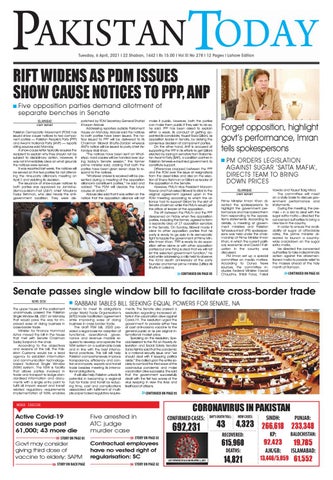
Rift widens as PdM issues show cause notices to PPP, anP g
five opposition parties demand allotment of separate benches in senate IsLAMABAd Staff RepoRt
Pakistan democratic Movement (PdM) has issued show cause notices to two component parties — Pakistan People’s Party (PPP) and awami national Party (anP) — reports citing sources said Monday. a show-cause letter typically requires the recipient to explain why they should not be subject to disciplinary action. However, it was not immediately clear on what grounds the notices were served. it was reported last week, the notices will be served on the two parties for not attending the nine-party alliance’s meeting on april 2 and violating its decision. the issuance of show-cause notices to both parties was approved by Jamiat-eulema-e-islam-fazl (Jui-f) chief Maulana fazlur rehman, who also heads the antigovernment coalition. they were dis-
patched by PdM secretary general shahid khaqan abbasi. addressing reporters outside Parliament House on Monday, abbasi said the notices to both parties have been issued. the notice issued to PPP will be delivered to its chairman bilawal bhutto-Zardari whereas anP’s notice will be issued to party chief asfandyar wali khan. “the notices have been sent on whatsapp. Hard copies will be handed over during today’s senate session,” the former prime minister said, adding that both the parties have been given seven days to respond to the notices. “whatever answer is received will be presented during a meeting of the opposition alliance’s constituent parties,” he said and added: “the PdM will decide the future course of action.” abbasi also said that it was written on the notice that the opposition alliance will not
make it public. However, both the parties can make them public if they wish to do so, he said. PPP has been asked to explain within a week, its conduct of getting appointed its candidate, Yousaf raza gillani, as opposition leader in senate, by defying the consensus decision of component parties. on the other hand, anP is accused of supporting the PPP in its efforts to get gillani elected by roping in senators from balochistan awami Party (baP), a coalition partner in Pakistan tehreek-e-insaf-led government, to constitute support. differences cropped between the PPP and the PdM over the issue of resignations from the assemblies and also on the election of sherry rehman or gillani as leader of the opposition in the senate. However, PMl-n Vice President Maryam nawaz and fazl asked bilawal to stick to the original agreement agreed upon in the PdM meeting according to which the alliance had to support gilani for the slot of senate chairman while the PMl-n would get the office of leader of the opposition. the rift between the PMl-n and the PPP deepened on friday when five opposition parties, including the former, agreed to form a separate bloc of 27 opposition senators in the senate. on sunday, bilawal made it clear to other opposition parties that his party is ready to go solo in its democratic fight to topple the government of Prime Minister imran khan. “PPP is ready to do opposition either alone or with other opposition parties but one thing is clear that we will not let this selected government function,” he said while addressing a rally held to observe the 42nd death anniversary of the party founder and former prime minister Zulfikar ali bhutto in larkana.
CONTINUED ON PAGE 05
forget opposition, highlight govt’s performance, imran tells spokespersons g
PM orders legislation against sugar ‘satta Mafia’, directs teaM to bring down Prices IsLAMABAd Staff RepoRt
Prime Minister imran khan directed the spokespersons to highlight the government performance and has barred them from responding to the opposition’s statements. according to details, a meeting of government ministers and Pakistan tehreek-e-insaf (Pti) spokespersons was held under the chairmanship of Prime Minister imran khan, in which the current political, economic and covid-19 situation in the country was discussed. PM imran set up a special committee on media matters. according to dunya news sources, the committee includes federal Minister fawad chaudhry, shibli faraz, faisal
Vawda and Yousuf baig Mirza. the committee will meet on a daily basis to discuss government performance and statements. during the meeting, the premier – in a bid to deal with the sugar satta mafia – directed the concerned authorities to bring a new law in the country. in order to ensure the availability of sugar at affordable rates, the prime minister directed to launch a countrywide crackdown on the sugar satta mafia. He directed the concerned authorities to take indiscriminate action against the aforementioned mafia to provide relief to the masses ahead of the holy month of ramzan.
CONTINUED ON PAGE 05
Senate passes single window bill to facilitate cross-border trade news desk
g
the upper house of the parliament unanimously passed the Pakistan single window bill, 2021 on Monday that would pave the way for improved ease of doing business in cross-border trade. Minister for finance Hammad azhar moved the bill in the house that met with senate chairman sadiq sanjrani in the chair. according to the objectives and reasons of the bill, the Pakistan customs would be a lead agency to establish information and communication technologybased national single window (nsw) system. the nsw is facility that allows parties involved in trade and transport to lodge standardised information and documents with a single entry point to fulfil all import, export and transit related regulatory requirements implementation of nsw, enables
rabbani tables bill seeking equal Powers for senate, na
Pakistan to meet its obligations under world trade organisation’s (wto) trade facilitation agreement while improving ease of doing business in cross border trade. the draft Psw bill, 2020 provided a legal basis for adoption of functional, operational, governance and revenue models required to develop and operate the nsw system on a sustainable basis and in line with the best international practices. this bill will help Pakistan comprehensively improve transparency, efficiency and control and imports, exports and transit trade besides meeting its international obligations. it will also help Pakistan unlock its potential in becoming a regional hub for trade and transit by reducing time, cost and complications associated with fulfilment of multiple paper based regulatory require-
ments. the senate also passed a resolution regarding increased efforts in the vaccination drive against covid-19. the resolution urged the government to provide either free of cost anti-corona vaccine to the general public or as per original international market price. speaking on the resolution, special assistant to the PM on Poverty alleviation and social safety senator sania nishtar said that the pandemic is a national security issue and “we should deal with it keeping politics aside.” she called upon the entire society to combat the third wave of the coronavirus pandemic and make vaccination drive successful. she said that the government successfully dealt with the first two waves of the virus keeping in view the lives and livelihood of citizens.
CONTINUED ON PAGE 05
MORE INSIDE
Active Covid-19 cases surge past 61,000; 43 more die STORY ON PAGE 03
govt may consider giving third dose of vaccine to elderly: saPM
STORY ON BACK PAGE
five arrested in atc judge murder case
coRonaviRus in Pakistan CONFIRMED CASES:
692,231
STORY ON PAGE 03
Contractual employees have no vested right of regularisation: SC
STORY ON PAGE 02
LAST UPDATED AT 8:32 AM ON APRIL 5, 2021
DAY'S DEATH TOLL:
NEW CASES:
SINDH:
PUNJAB:
BALOCHISTAN:
615,960
KP:
92,423
19,785
DEATHS:
AJK/GB:
ISLAMABAD:
43
4,323 266,618 233,348
RECOVERED:
14,821
13,446/5,059 61,552
02
Tuesday, 6 April, 2021
LAHORE
NEWS
CoNtRACtuAl EMPloyEES HAvE No vEStEd RIgHt oF REgulARISAtIoN: SC
Hearing of NAB pleas against Nawaz on April 8 ISLAMABAD INP
ISLAMABAD
S
TLTP
ETTING a precedent in service matter, on Monday, the Supreme Court (SC) ruled that regularisation of a contract employee means a fresh appointment into the stream of regular appointment, which does not apply retrospectively under the Punjab Regularization Policy, 2010. A three-member bench, under the chairmanship of Justice Manzoor Ahmad Malik, has adjudicated over a question of law whether the date of regularisation of contract employees is the date of their initial appointment on a contract basis or the date of their regularisation under the Regularisation Policy, 2010. Authorising a six-page verdict being part of the bench in the matter, Justice Syed
Mansoor Ali Shah ruled, “Regularisation of a contract employee is … a fresh appointment into the stream of regular appointments. A contractual employee for the first time becomes a civil servant”. It has been stated in the judgment that contractual employees enjoy no vested right to regularisation, much less to be regularised from any particular date. It said that the benefit of regularisation under the Regularisation Policy, 2010, is prospective in nature and there is no legal justification to give it a retrospective application. “Any such step would totally negate the purpose and significance of Contract Appointment Policy and leave no distinction between a contractual and a regular employee,” the verdict said. The bench ruled that persons appointed on a contract basis are not civil servants, therefore, their service matters are not governed by the rules framed under the
Civil Servants Act, 1974 as their appointment is strictly regulated by the terms and conditions of the contract. It has also been settled through the verdict that the Contract Appointment Policy was conceived after the government realised that a regular mode of appointment is not suitable for most of the government sector assignments due to administrative and financial factors. “The rationale behind the contractual mode of appointment is based on financial and economic reasons, as well as, administrative reasons.” The court said, according to the policy, the financial constraints of salary and pension under regular appointment had become unsustainable. According to the judgment, the contract appointment is strictly regulated by the terms and conditions of the contract. It said the period of contract is between
three to five years whereas extension is generally granted for a period of three to five years and not for an indefinite period. It is pertinent to mention here that as many as three dozen respondents were appointed on a contract basis as veterinary officers in Grade-17 in Punjab Livestock and Dairy Development Department from 2004 to 2009. Their services were subsequently regularised with immediate effect via order dated 15.2.2011. The grievance of the respondents was that they ought to have been regularised from the date of their initial appointment on a contractual basis rather than on February 15, 2011. Punjab Service Tribunal allowed regularisation of the services with effect from the date of their initial appointment on a contract basis during October 2020. Hearing the Punjab government appeal in the matter, the bench has turned down the Punjab Service Tribunal order.
Maryam Nawaz’s health deteriorates again, awaits Covid report
Iqbal says Imran ‘attacked’ judiciary during telethon ISLAMABAD
LAHORE
INP
INP
Pakistan Muslim League-Nawaz (PML-N) Vice President Maryam Nawaz’s health has deteriorated once again and she has undergone the corona test again. According to the reports, Maryam is awaiting her coronavirus test report, however, she is undergoing treatment and will take part in political activities once her health improved. It is pertinent here to mention that Maryam had cancelled all kinds of political activities in view of her deteriorating health condition after contracting a high fever. The PML-N spokesperson said that the party’s vice president had been suffering from high fever and throat ache. She added that the doctors advised her to take complete rest. “The vice president has been unwell for a while now but she still went to the Lahore High Court for her hearing,” she stated. On Sunday, Maryam had been tested negative for Covid-19, party’s spokesperson Marriyum Aurangzeb confirmed.
SC directs KP to formulate criteria for appointment of Edwardes College principal
LAHORE: Protest points out technological disadvantage faced by certain students. ZUBAIR MEHFOOZ
Gillani requests ECP to dismiss disqualification claims against him ISLAMABAD INP
ISLAMABAD INP
The Supreme Court (SC) on Monday directed the Khyber Pakhtukhwa (KP) government to formulate criteria for the appointment of principal in Edwardes College Peshawar. A three-member bench comprising Justice Mushir Alam, Justice Yahya Afridi and Justice Qazi Muhammad Amin Ahmed took up the case filed by Bishop Humphrey Sarfaraz Peters regarding the appointment of a principal and the status of Edward College Peshawar. At the outset of the proceeding, the court directed the Diocese of Peshawar of the Church of Pakistan to provide a list of five candidates for appointment against the post of principal. The court also directed the provincial government to consult the institute’s Board of Governors (BoG) and appoint the principal on merit. KP advocate general said that the provincial government had submitted all the details in writing to the court. Justice Ahmed said that Pakistan belonged to all people living in this country and they were, regardless of their faith, were the asset of the country. The advocate general said that Edwardes College was nationalised in 1974 and KP governor KP acts as the chairman of BoG. Barrister Hamid Khan, counsel for the petitioner, said that the government had stated it wanted to run the college according to other public colleges. Khan further said that his client wanted the principal to be from the Christian community. Since the forming of the BoG in 1974, Christians have retained the office of the principal, he added. Justice Afridi said that this was not a matter for the court or the government but for the students of KP. Hamid Khan said, per the ritual, the bishop had nominated the principal for 47 years. Justice Afridi said that the government would formulate the criteria for the appointment of a principal while the bishop would forward the names of the candidates. Justice Ahmed said that the bishop would propose five names for the principal while the government would finalise one name according to merit.
The Islamabad High Court (IHC) on Monday announced to take up on April 8 miscellaneous petitions filed by the National Accountability Bureau (NAB) against deposed prime minister and PML-N supreme leader Nawaz Sharif. A division bench of the IHC comprising Justice Amir Farooq and Justice Mohsin Akhtar Kayani fixed the hearing. The anti-corruption watchdog requested the high court to increase to double the seven-year imprisonment of the former premier in the Al-Azizia Steel Mills case in addition to challenging Sharif’s acquittal in Flagship Investments reference. Filed under Article-151 by the anti-graft watchdog, the petitions stated that Nawaz is a convicted criminal in corruption cases and urged the court to summon the former prime minister to take action in accordance with the law. The last hearing on the petition was conducted in December. Nawaz was granted bail in two corruption references, Al-Azizia and Avenfield House apartments, by the IHC in 2019 and he proceeded to the United Kingdom on the pretext of medical treatment. IHC, however, declared him proclaimed offender after he refused to come back.
Pakistan Peoples Party (PPP) leader and Senate Opposition Leader Yousaf Raza Gillani on Monday requested the Election Commission of Pakistan (ECP) to dismiss disqualification claims filed against him. He asked the commission to declare the petitions as inadmissible as the allegations leveled by Pakistan Tehreek-e-Insaf (PTI) government against him are baseless and non-serious. He also called PTI leaders Farrukh Habib and Maleeka Bokhari “habitual claimants”. The case was filed
on the basis of “unauthentic videos”, he maintained. In the previous proceedings, notices were issued to Gillani, his son Ali Haider Gillani and other parties regarding the leaked video. ECP had rejected the request of PTI leaders to stop the notification of Gillani’s victory in the Senate elections. Bukhari read the transcript of Ali Gillani’s video and claimed that the techniques for wasting the vote were being taught in the clip. The ECP member from Punjab asked why the MPs met Ali Gillani when they clearly knew about the horse-trading trend in the elections over which, PTI counsel, Ali Zafar, told that the video was recorded to expose the corrupt elements.
Pakistan Muslim League-Nawaz (PML-N) leader Ahsan Iqbal on Monday accused Prime Minister Imran Khan of “attacking” the judiciary during the telethon on Sunday. Speaking outside the accountability court in Islamabad, he claimed that the prime minister was unable to carry out his mission because the judiciary was not cooperating with him. “He wants the courts to put the opposition leaders into jails despite the fact that no corruption reference has so far been filed in the courts with concrete evidence,” he declared. He appealed to the media houses to broadcast hearing of corruption cases live to the people so that truth could be separated from falsehood. Iqbal regretted that the country had sunk deep into the mire of loans. “Imran borrowed more loans in the past two years than what we had borrowed in our entire tenure,” he said and added: “He borrowed loans to bridge the deficit. Since then our financial autonomy is at stake. This was the trap our enemies had laid for us. And now in lieu of these loans, we have put the autonomy of our institutions at stake.” The former minister further questioned as to which were the projects, which the Pakistan Tehreek-eInsaf (PTI) government had initiated in its tenure. “These are the projects launched when PML-N was in power, which are being completed now.
Punjab to spend Rs1.5bn on Covid-19 vaccine procurement: Firdous RAWALPINDI
People rush to purchase Russian vaccine as private sales open KARACHI AgENcIES
Thousands of people rushed to get inoculated in the first round of commercial sales of Covid-19 vaccines that began over the weekend, with vaccination sites in Karachi saying late on Sunday they had already sold out. The government is currently offering free vaccines to frontline healthcare workers and people over the age of 50, but the drive has thus far been slow, and last month the country allowed commercial imports by the private sector for the general public. The first round saw the commercial sale of the two-shot Russian Sputnik-V to the general public for about Rs12,000 ($80) for a pack of two doses. Despite the cost, a number of centres offering the shot reported long queues, with some in Karachi waiting in line for close to three hours. Most in the queue were young people still not eligible for the government’s free vaccination. “I am very happy to get it, since now it is required for travelling,” Saad Ahmed, 34, told Reuters after he got his shot at an upscale private sector hospital in Karachi. While the private sale of vaccines has begun, the
government and importers are still locked in a pricing dispute. The authorities initially agreed to exempt imported vaccines from price caps, but later rescinded the exemption and said it would set maximum prices. One pharmaceutical company, which had already imported 50,000 doses of Sputnik-V, took the government to court, where it won an interim order allowing it to sell it until pricing is decided. As soon as vaccination was opened for walk-in customers, there were long lines of people, Dr Nashwa Ahmed, who runs vaccination at Karachi’s South City Hospital, told Reuters. Pictures of queues outside the hospital late into the night were shared on social media. The hospital procured 5,000 doses of Sputnik-V and in just over two days all its stock had been administered or pre-booked, said a hospital official who asked not to be identified. Companies, including one of Pakistan’s largest banks, have also purchased large quantities to have staff inoculated, the official said. The private sales start as the country deals with a fresh wave of Covid-19 infections and healthcare facilities are fast filling to capacity. Pakistan has thus far reported 692,231 infections and 14,821 deaths.
STAFF REPORT
Punjab Chief Minister's Special Assistant on Information Dr Firdous Ashiq Awan has said that 127 Covid-19 vaccination centres are providing vaccines to people in the province. Addressing the media persons on Monday, she said that so far over 500,000 people have been vaccinated in Punjab. The special assistant said that to ensure the transparency and efficiency in vaccination drive, Chief Minister Usman Buzdar himself is monitoring the vaccination centers. She said that Punjab will procure vaccines worth Rs1.5 billion from its own budget. She said that in the first phase people above 60 years and paramedics are being vaccinated. She urged the people to observe standard operating procedures (SOPs) against the virus as it is the only way to contain the pandemic. Urging the opposition not to politicise the coronavirus issue, she said that Pakistan Democratic Movement’s (PDM) fake narrative has died. She expressed hope that under the leadership of Prime Minister Imran Khan, Pakistan will successfully deal with the third spike of the coronavirus. She said that efforts are being made across the province to provide standardised and low-cost essential commodities during Ramzan.
Tuesday, 6 April, 2021
LAHORE
NEWS
03
ACtIvE CovId-19 CASES SuRgE PASt 61,000; 43 MoRE dIE
P
NEWS DESK
AKISTAN recorded 4,323 new coronavirus cases during the last 24 hours, taking the country’s Covid19 tally to 692,231, said the National Command and Operation Centre (NCOC) on Monday. According to the NCOC, the country’s death toll climbed to 14,821 after 43 people succumbed to the deadly disease during the last 24 hours. The NCOC said that total active Covid-19 cases across the country are 61,450. During the period of a day, the total count of active cases was recorded at 61,450 and the positivity rate stood at 9.96 per cent. The health facilities across the country conducted 43,362 coronavirus detection tests, taking the total number of Covid-19 tests to 10,446,697 since the first case was reported. Out of 43,362 Covid-19 tests,
ANOTHER DOCTOR DIES OF CORONAVIRUS IN KP 8,797 were conducted in Sindh, 17,994 in Punjab, 8,687 in Khyber Pakhtunkhwa (KP), 5,654 in Islamabad, 885 in Balochistan, 355 in Gilgit-Baltistan (GB) and 990 tests were conducted in Azad Jammu and Kashmir (AJK). Out of the total 14,821 reported deaths, there had been about 4,509 deaths in Sindh, 6587 in Punjab, 2,457 in KP, 583 in Islamabad, 211 in Balochistan, 103 in GB and 371 deaths have been reported from AJK. The NCOC also reported that a total of 10,446,697 tests had been conducted since the outbreak of the virus. There are about 631 hospitals with Covid-19 facilities with more than 4,000 patients admitted across the country, it added.
Imran’s gB visit postponed due to bad weather ISLAMABAD: A scheduled visit of Prime Minister Imran Khan to Gilgit-Baltistan was postponed on Monday due to bad weather. The prime minister was to pay a day-long visit to the mountainous region to announce the development package and address a public meeting at Chief Minister’s Secretariat. Projects related to clean energy, transport, communication, health, infrastructure, water sanitation, and tourism are part of the uplift package. INP
Five arrested in AtC judge murder case ISLAMABAD: Police arrested five suspects on Monday in connection with the murder of an antiterrorism court (ATC) judge and his family a day earlier. Judge Aftab Ahmed Afridi, his wife, daughter-in-law and a two-year-old child were killed on Sunday evening when his car came under fire while travelling from Swat Valley to Islamabad. No one claimed responsibility for the shooting, which also seriously injured two of his bodyguards. Reports citing police sources called the attack a “targeted” one. According to a police statement issued on Monday, a joint operation team carried out an operation in Peshawar and Khyber and arrested the suspects. The statement added that Afridi’s son, Majid Afridi, will identify the suspects. Police added that two vehicles mentioned in the first information report (FIR) have also been taken into police custody. The FIR, registered on the complaint of Majid, said his father was returning to Islamabad after attending a wedding in Peshawar. It further said the judge’s daughter-in-law was also six months pregnant. “The suspects opened fire on the vehicle near the Swabi interchange,” it said. The case also named six suspects including Supreme Court Bar Association (SCBA) President Abdul Latif Afridi. The case was registered under sections 302 (murder or Qatl-e-Amd), 324 (attempted murder), 148 (armed with a deadly weapon), 149, 109 (abetment), 427 (damage to property), 353 (assault or criminal force to deter a public servant from discharging their duty) and 34 (common intention) of the Pakistan Penal Code (PPC), read with Section 7 of the AntiTerrorism Act (ATA). The ATCs were established to hear cases ranging from terrorist financing to the prosecution of perpetrators of insurgent attacks. Afridi had been assigned to these courts in Swat two months earlier. STAFF REPORT
According to the statistics, 19 patients were declared critical, adding to the total number of patients suffering from sensitive health conditions up to 3,587. Meanwhile, 2,902 patients recovered from the deadly disease in a day taking total recoveries to 615,960. The highest number of ventilators occupied in the country was found to be in Multan with 70.4 per cent occupancy, followed by Lahore at 67.2 per cent, Gujranwala at 60 per cent and Islamabad at 57.7 per cent. The NCOC further reported that the highest number of oxygen bed occupancy in the country was in Swat at 100 per cent followed by Gujranwala at 85 per cent, Peshawar at 84 per cent and Gujrat at
74 per cent. Keeping in view the recent spike in Covid-19 cases amid the third wave of the disease, the National Command and Operation Centre (NCOC) suspended interprovincial transport for two days a week (Saturday and Sunday). The NCOC had restricted inter-provincial public transport only on weekends. However, cargo trucks, containers, medical and emergency services will be exempted from the restrictions. The new restrictions will come into force from April 10 and will continue to remain effective till 25th of April. NCOC further said that Pakistan Railways will continue to operate passenger trains seven days a week with 70 per cent occupancy. ANOTHER DOCTOR DIES OF COVID: Another doctor in KP succumbed to coronavirus on Monday, raising the death toll of doctors to have died in the province
PIA seeks additional flights to UK ahead of Covid-19 travel ban ISLAMABAD STAFF REPORT
The Pakistan International Airlines (PIA) has asked the United Kingdom to allow four additional flights to the country until April 9 after which it will ban entry to people from four countries, including Pakistan, as part of measures to combat the new, deadlier Covid-19 variant it exported to the world. London on Friday banned international arrivals from four more countries — Pakistan, Bangladesh, Kenya, and the Philippines — unless they hold dual nationality of Britain or Ireland in view of concerns over new virus variants but opted against including European nations that are facing a resurgence of the virus. “People are desperately trying to go back to England before April 9, we have requested four additional flights to the United Kingdom and we sincerely hope that we will get permission by today [Monday] or tomorrow [Tuesday],” PIA spokesperson Abdullah Hafeez Niazi told Arab News. “By now, we have operated three flights and we have transported nearly 900 passengers [to the UK],” he said. The airline, he added, had planned to operate
four more flights to Britain until April 7 through which “we are hopeful to accommodate 1,000 more passengers”. PIA would be able to accommodate another 1,000 passengers if London allowed the four additional flights, Niazi further said. While London claims the decision to suspend travel from the aforementioned nations was based on advice from public health experts and scientific data, no European nations are placed on the red list, even though much of Europe is witnessing a resurgence of the virus that has prompted many countries to reimpose lockdown restrictions. Health experts say that the surge is being driven by virus variants, including Britain one, that are sweeping the continent. Minister for Planning and Development Asad Umar on Saturday questioned the decision to place Pakistan on the so-called red list of countries. “Every country has a right to take decisions to safeguard the health of their citizens,” he said in a tweet. “However, the recent decision by the UK government to add some countries, including Pakistan, on the ‘red list’ raises a legitimate question whether the choice of countries is based on science or foreign policy.”
South Punjab to witness record development in PTI tenure: Buzdar LAHORE STAFF REPORT
Foreign Minister Shah Mahmood Qureshi discussed matters pertaining to the South Punjab Secretariat with Punjab Chief Minister Sardar Usman Buzdar on Monday. Qureshi called on Buzdar at his office to discuss various issues related to Punjab. Buzdar, on the occasion, reiterated that the Pakistan Tehreek-e-Insaf (PTI) government will remove the sense of deprivation of all backward areas of the province. The CM apprised the foreign minister of the matters pertaining to the south Punjab secretariat and steps taken in this regard. He reiterated that south Punjab will witness record development in the tenure of the PTI government and pointed out that the share of south Punjab in schools' up-gradation is 38 per cent. Meanwhile, the people have given a thumping majority to the PTI in south Punjab while the defeated elements are spreading the propaganda of scrapping the south Punjab secretariat. The PTI will remove deprivations of all the backward
areas including south Punjab, he added and vowed that PTI will be credited for carving out south Punjab province. Similarly, the south Punjab secretaries are being empowered so that the people may not have to travel to Lahore, the CM further said and announced that he will regularly visit Multan, every month, to review progress on development work and to deal with other issues. The cabinet meeting will also be held in Multan and provincial ministers will also remain available in south Punjab for two days, he said. The government is committed to resolving the deprivations of south Punjab and legislation is also being done to reserve employment quota for the youth of south Punjab, he further said. Qureshi said that the immediate action of CM over the issue of the south Punjab secretariat is commendable as this has eliminated propaganda and rumours. The era of ameliorating a lot of the common man in Multan and other south Punjab areas has started and no one will be allowed to spread rumours about south Punjab, he said.
‘Future sales are a normal part’, Tareen urges stop to smear campaign NEWS DESK Former secretary-general of the ruling Pakistan Tehreek-e-Insaf (PTI), Jahangir Tareen, has asserted that future sales are a part of business everywhere and has asked the people to put an end to the smear campaign. On Twitter, he said, “Future sales are a normal part of business activity all over the world. It is used to secure future cash flow for normal business activity. It has nothing to do with Satta. All such sales are declared in JDW accounts in their entirety.” The PTI leader also posted screenshots of the London Sugar Future sales figures to help explain his point. Furthermore, he said: “Stop the smear campaign”. Last week, the banking court in Lahore had granted one-week interim bail to PTI leader Jahangir Tareen and his son Ali Tareen in two cases of corporate fraud and money laundering.
Additional District And Sessions Judge Hamid Hussain, while accepting the request, had granted bails until April 10 against surety bonds of Rs0.5million apiece. He had also directed Federal Investigation Agency (FIA) to present its record against the accused in the next hearing. The agency has booked Tareen and members of his family on charges of corporate fraud and money laundering. The cases, filed on March 22, were registered under sections 406 (criminal breach of trust), 420 (cheating of public shareholders), and 109 of the Pakistan Penal Code (PPC), read with sections 3 and 4 of the AntiMoney Laundering Act, 2010. In his response, Tareen had termed the charge sheet as “totally fabricated”. “I have already submitted a detailed reply along with concrete evidence in response to FIA notice. Unfortunate to see them go on another smear campaign against me & my family without establishing anything
illegal,” he had tweeted earlier. Tareen had returned to Pakistan in November after ending his seven-month-long self-imposed exile after falling out with Prime Minister Imran Khan following an inquiry into the last year’s sugar scandal that accused several sugar producers — including him — of “underreported sales and fraud”. At the time, Special Assistant to Prime Minister on Accountability Mirza Shahzad Akbar had declared sugar-producing units under Tareen’s JDW-Group were found guilty of “double billing” and “over-invoicing” as well as “corporate fraud”. Tareen had rejected the findings of the Sugar Inquiry Commission. “I am shocked at the kind of false allegations levelled against me. I have always run a clean business. All Pakistan knows I always pay full price to my growers,” he had said in a tweet. “I DO NOT maintain 2 sets of Books. I pay all my taxes diligently. I will answer every allegation and be vindicated IA.”
from the virus to 51. According to the Provincial Doctors Association, Dr Muhammad Taufiq contracted coronavirus while performing his duties at the Police Hospital and was self-isolating at home. He breathed his last on Monday. The association further revealed that so far, the deadly virus has claimed the lives of at least 51 doctors in the province, while seven doctors have died since February last. Following his death, doctors in the province called upon the government to take emergency measures to ensure that the lives of these frontline workers were protected. Earlier, Dr Anila Naseer died at the MH Hospital several days after being placed on a ventilator. She was a specialised gynaecologist and worked for several years in a government hospital until 2007, when she left her government job to start her own clinic.
PM Imran back in office after recovering from Covid NEWS DESK Prime Minister Imran Khan has returned to the office after having purportedly recovered from the deadly coronavirus, it emerged on Monday. The premier shared a photograph of his return from his official Instagram account. Furthermore, Special Assistant to Prime Minister (SAPM) on National Health Services, Regulations & Coordination, Dr Faisal Sultan confirmed the news. However, he started his official duties last week without getting a second test, with PM’s aide Shahbaz Gill saying a coronavirus patient “does not need to get tested three days after their symptoms subside”. The prime minister keeps an active social media presence and often shares photos — relating to his political and personal life. After returning to the office, Federal Interior Minister Sheikh Rashed Ahmed called upon the prime minister to discuss the overall political situation. During the meeting, PM Imran and Rasheed discussed political situation of the country and other matters related to the Interior Ministry. Prime Minister Imran was also given a briefing on the up-gradation of Korangi Fish Harbor, which was carried out with the financial grant given by the government of Japan. Minister for Maritime Affairs Syed Ali Haider Zaidi briefed Prime Minister Imran as he called on him at his office.
04
Tuesday, 6 April, 2021
LAHORE
NEWS
PL&DD DeCiDes to oRgAnise hoRse AnD CAttLe shoW AmiD sPiKe in CoviD-19 LAHORE
t
SHAHAB OMER
HE Punjab Livestock and Dairy Development (PL&DD) has decided to organise a horse and cattle show from April 8 to 10 despite the ongoing third wave of coronavirus, Pakistan Today learnt on Monday. According to sources, PL&DD Secretary Captain (r) Saqib Zafar has given approval to hold the show while ignoring the government’s smart lockdown policy, which is in effect till April 14. Sources said that the PL&DD secretary has instructed his staff members to start preparations for the show on war footing as
there is less time and the show has to be organised, adding that a notification for the arrangements of the show has also been issued by the secretary. They said that the notification issued by the secretary contains the details regarding duties of officers and preparations that need to be made in order to hold the horse and cattle show, adding that however, after receiving the notification, the employees of the PL&DD have agitated against the orders due to the ongoing situation of coronavirus. “The employees of PL&DD, who have been assigned with different duties for the show, have demanded that the show should be postponed till the Covid-19 situation gets
men shave off woman’s head over matrimonial dispute in Chakwal CHAKWAL: In an unfortunate incident, some unidentified men tortured an aged woman and also shaved off her head over a matrimonial dispute in Chakwal on Monday. According to details, the son of the tortured woman wanted to contract free-will marriage with a girl. This got the family of the girl furious, who stormed to the boy’s house and subjected his mother to vicious torture. The hairs of the woman were trimmed by the attackers. The woman lodged her complaint with the police, but they have not taken any action so far, the woman said. In a separate incident that was reported last year in Rawalpindi, a mother was subjected to torture by her son. The woman had narrated the unfortunate incident and claimed that her daughter-in-law had intoxicated her son. In a video message, Gulnaz Bibi had said that it was for the fifth time, when she was attacked by her son, identified as Arsalan. “I was tortured by my son on the encouragement of his wife and he later threw me out of the home last time,” the pained mother had said in her statement as she had claimed that around 30 people had entered their home in the last attack, including relatives of her daughter-in-law, who were also behind all this fuss. TLTP
Woman strangulated to death by husband, in-laws in Lahore LAHORE: In yet another case of domestic abuse, a woman was strangulated to death by her husband and in-laws in Shalimar area of Lahore on Monday. According to police, the tortured body of a 35-year-old woman was found from her in-laws’ home and later it emerged that she was strangulated to death. She was allegedly strangulated by her husband Asif, sister-inlaw Asiya and brother-in-law Sheeraz. The police shifted her body to a morgue for post-mortem in order to ascertain the cause of death. The father of the victim said that she was married to Asif six years back and she was being tortured routinely by her husband, sister-in-law, and brother-in-law. Domestic abuse is rampant in the country and incidents have been reported on frequent basis from separate parts of the country. Earlier a week ago, a woman had lost her life after she was allegedly set on fire by her husband in Sukkur. According to details, the incident had occurred at Shikarpur crossing, where her husband allegedly set her on fire. She was treated for her wounds for a week at a local hospital. INP
An honour for Rahim Yar Khan: Punjab College student takes first position globally LAHORE: Dr Muhammad Uzman Tariq, a brilliant student of Punjab College Rahim Yar Khan, has brought laurels for Pakistan as well as his alma mater. He scored highest marks (93 per cent) in MRCS examination all around the globe among all four royal colleges of England and Ireland. He is the first Pakistani ever to have achieved this landmark. Dr Uzman Tariq is currently doing FCPS training in general surgery from Sheikh Zayed Hospital, Rahim Yar Khan. The Punjab Group of Colleges is proud of its student and congratulates him on this outstanding achievement. PR
under control. But the management is persistent to hold it on the scheduled dates and there is a huge argument among the officers of the PL&DD regarding the organising and holding of the horse and cattle show. The seniors have rejected the proposal of postponing the show, which has become a bone of contention among the employees and seniors,” sources further said. “The secretary has made an organising committee for arrangements of the horse and cattle show, besides nominating purchase and finance, breeders welfare, transport, stall management, prize, animal, information, accommodation, feed and food, entertainment, veterinary aid, ring, appellate and security committees, who
would be working on different aspects of the show.” An officer on condition of anonymity said that it is a pointless move by the department to organise a horse and cattle show when coronavirus is at its peak. “There will be different types of competitions in the show, like milk and beauty contests, and these are dangerous to have at the time when the third wave of Covid19 is at its peak and hundreds of people are getting infected on a daily basis. We will be calling in people from all over the province. At one side, the government is announcing lockdowns on a daily basis and on the other hand, it is planning for such mega shows. People will come from differ-
ent areas and interact with each other, which is another source of spreading the pandemic. We all have suggested the secretary to hold the show when the situation will get under control, but all arguments are in vain,” the officer said. PL&DD Director Communications Asif Rafique informed that no decision has been taken yet regarding the horse and cattle show. “Due to the Covid-19 lockdown, we could not hold the horse and cattle show last year. We have completed our preparations for this year's show, but it has not yet been decided whether the show will take place or not. However, any decision will be made keeping in view the situation of Covid-19,” he maintained.
Ghani demands travel ban from Punjab, KP to Sindh KARACHI TLTP
Sindh Education Minister Saeed Ghani has demanded a ban on inter-provincial transport, including air and rail, from Punjab and Khyber Pakhtunkhwa (KP) amid a sharp increase in Covid-19 cases. Coronavirus can rapidly increase in Sindh, if people continue to commute from Punjab and KP, Ghani said while addressing a press conference on Monday. He said the situation in Sindh is under control in terms of Covid-19 cases, but it can go worse if the interprovincial transport continues to run. On the closure of primary to middle
classes in the province, Ghani said that the classes have been closed temporarily as a precautionary measure to save children from the pandemic. He made it clear that students will not be promoted to the next classes in Sindh this year without appearing in the examinations. On Sunday, the National Command and Operation Centre (NCOC) had suspended inter-provincial transport for two days a week (Saturday and Sunday) after a sharp rise in coronavirus cases. The NCOC had restricted inter-provincial public transport only on weekends. However, cargo trucks, containers, medical and emergency services would be exempted from the restrictions.
SHC moved to ban 5G over ‘health risks’ KARACHI STAFF REPORT
The Sindh High Court (SHC) on Monday issued a notice to the Pakistan Telecommunication Authority (PTA), directing it to file its response in a petition against the rollout of fifth-generation (5G) mobile technology in the country. A two-member bench, headed by Justice Mohammad Ali Mazhar and comprising Justice Amjad Ali Sahito, heard the petition. During the hearing, Justice Sahito questioned if the government has issued a 5G licence. To this, the petitioner answered in the negative. Issuing a notice to the authority, the bench said that it will proceed with the case after the telecommunication regulator files its response. Citing the potential health impact of
Japanese embassy says considering cultural grant for Taxila Museum ISLAMABAD STAFF REPORT
On a request from the Tourism Development Corporation of Punjab (TDCP), Japan is considering to provide cultural grant assistance to the Taxila Museum, the country’s embassy said on Monday. The assistance will be provided for the improvement of equipment for exhibition and conservation in the museum, which stores the rich cultural heritage of ancient Gandhara civilisation. For this purpose, Japanese development consultants had visited Pakistan between March 15 and April 3 to conduct onsite research and hearings despite the challenges of Covid-19 pandemic, a statement issued from the embassy said. Based on series of discussions and onsite surveys, the consultants had iden-
tified necessary equipment for better exhibition and conservation of excavated items from the Gandhara archaeological sites. While admiring the rich cultural heritage of ancient Gandhara civilisation in Taxila, Ambassador Kuninori Matsuda said the visit of the Japanese onsite research team was very important to pave the way for seeking approval of cultural grant assistance from Tokyo. “With the post-corona[virus] world in sight, Japan supports Pakistan in promoting the exhibition and conservation of the Gandhara Buddhist heritage and attract more tourists to Pakistan in the future”, said the ambassador. He further added that Pakistan has a great potential for tourism and the ancient Gandhara civilisation is very close to the heart of the Japanese people.
5G mobile frequency emissions, the petition said that it also affects the ecosystem. It said that 4G technology too poses health risks but is less dangerous than its successor. In September, a spokesman for the PTA had said that the process to hire a consultant for “Spectrum Auction 202021” has been initiated but declined to give further details. Pakistan has some 85 million 3G/4G subscribers and the upcoming auction is seen as a precursor to any 5G launch. The telecommunication market is dominated by Jazz, backed by Netherlands-based Veon Ltd; Telenor Pakistan, backed by Norway’s state-controlled Telenor; Zong, owned by China Mobile and Ufone, which is controlled by stateowned Pakistan Telecommunication Company Ltd (PTCL).
Tuesday, 6 April, 2021
LAHORE
ITAly MullING oveR seTTING uP GeMsToNes TRAINING INsTITuTe IN GB iSLamaBaD
T
STAFF REPORT
HE government of Italy is considering establishing a training institute to promote the gems and jewellery and gemstone industry in Gilgit Baltistan (GB). A meeting in this regard was held between Federation Pakistan Chamber of Commerce and Industry (FPCCI) Chairman, Qurban Ali, and Ambassador of Italy to Pakistan, Andreas Ferrarese, here on Sunday. “We are considering establishing a training institute to promote the gems, jewellery and gemstone industry in Gilgit
Baltistan,” Ferrarese said. It may be noted here that Pakistan has an export potential worth $32 billion annually in the latent gemstones industry, while Precious stones are explored from almost inaccessible territories of the mountainous regions. The most extensive ruby deposits in Pakistan are located in the Hunza valley. Speaking on the occasion, the FPCCI chairman said that the move would be a milestone in the development of the gems and jewellery industry in GB and also help achieve the objective of employment generation in the region. Qurban Ali urged local exporters of gemstones to adopt innovation and mod-
ern technology to enhance the value of precious and semi-precious stones for the international market and attractimg foreign investors from the European Union (EU) and United States (US) to earn more profits. He informed that after Burma, Hunza is the only other region in the world that produces blood-red rubies; some of the finest emeralds in the world are mined in the picturesque valley of Swat, while high-quality aquamarine can be found in Shigar, Chitral, Kaghan and also Neelam Valley of Azad Kashmir. Similarly, fluorite is found in Chitral, Dir, Hunza, and Balochistan, with the largest deposits occurring in the Northern part of the Koh-e-Mardan range of Kalat.
The senior business leader said that CPEC related GB Special Economic Zones (SEZ) would increase business and industrial cooperation between the business sectors of Italy and Pakistan. He also suggested that Italian investors and businessmen start Joint Ventures (JVs) on mining with local industrialists. Italy is currently providing Pakistan with technical assistance in agriculture and textiles up-gradation through modern machinery, value addition in agriculture, leather and marble sectors as Pakistan expands its exports including dairy and livestock, olive products, plastics, processed food and construction in the Italian market.
Oil drops below $64 as rising OPEC+, Iranian output weighs LoNDoN AGENCIES
Oil fell to below $64 a barrel on Monday as rising supply from OPEC+ and higher Iranian output countered signs of a strong economic rebound in the United States and expectations of a wider demand recovery in 2021. The Organization of the Petroleum Exporting Countries and allies, known as OPEC+, agreed on Thursday to monthly production hikes from May to July. OPEC
member Iran, exempt from making voluntary cuts, is also boosting supply. Brent crude for June fell $1.36, or 2.1%, to $63.50 a barrel by 1120 GMT. U.S. West Texas Intermediate crude for May dropped $1.29, or 2.1%, to $60.16. “The OPEC+ decision, perhaps nudged along by increasing Iranian production heading to China, probably means we have seen the best of the oil rally now for the next few months,” Jeffrey Halley of brokerage OANDA said. Oil has recovered from historic lows
Rift widens as PDM issues show cause notices to PPP, ANP CoNtiNuED form pagE 01 FIVE OPPOSITION PARTIES DEMAND SEPARATE BENCHES: Five opposition parties in the Senate, which had earlier decided to constitute an independent group in the house consisting of 27 members, have demanded the Senate Chairman Sadiq Sanjrani that they be allotted separate opposition benches in the house. Taking the floor, PML-N Senator Azam Nazir Tarar stated that 27 senators represented an independent opposition, and so they should be allotted separated seats. According to Tarar, the opposition members will continue their “constructive politics from separate benches”. These parties are PML-N, JUI-F, Pakhtunkhwa Milli Awami Party (PkMAP), National Party (NP) and Balochistan National PartyMengal (BNP-M). The group is being led by the PML-N designated opposition leader Senator Tarar. “We should be allotted separate opposition benches and the hidden cameras [in the Senate elections] should be investigated,” Senator Tarar said. Senators supporting Gillani protested Tarrar’s remarks. Government members, too, protested when senators from the BAP were presented with gifts and a commotion broke out in the House. On the other hand, the Dilawar Khan group, which supports Gillani, also demanded separate seats in the Senate. The House met today after the election of new senators on March 3, the Senate chairman and deputy chairman on March 12 and notification of Leader of the Opposition in the Senate Gillani on March 26.
last year with the support of record OPEC+ cuts, most of which will remain after July, and some oil demand recovery that is expected to gather pace in the second half of the year. While a slow vaccine rollout and return to lockdown in parts of Europe have weighed on the rebound, figures on Friday showed the U.S. economy created the most jobs in seven months in March, with all industries adding jobs. “The seemingly invincible accelerating U.S. recovery has offset OPEC+’s announcement on Thursday,” Halley said.
Sania said the government has fixed prices of the vaccine under Drug pricing policy in a transparent manner and as per worldwide norm, elderly people and frontline health workers are being given the vaccine on priority basis. Leader of the House in the Senate Shahzad Waseem has urged the opposition parties in the House to work for a unanimous stance on electoral reforms. Speaking on the floor at the beginning of the new parliamentary year of the Senate, he said that electoral reforms are the only way forward in resolving issues about elections. He also said that the opposition should play its constructive role for betterment in the country. He added constructive criticism is the essence of real democracy and “we welcome it at every forum.” He expressed hope that opposition in the House will play a positive role in making the parliament more functional. Taking the floor, Opposition Leader in the Senate Yousaf Raza Gillani said he will work with all opposition parties and will also speak on behalf of the government if ever needed. The PPP chief said that he contested the Senate elections with the cooperation of PDM and will accompany the opposition in the Senate session. “The PDM has become the voice of constitutional rights for women, minorities and others. We have come for the public interest and it is our duty to represent the people. The country faces many challenges for which we
05
Japan’s central bank kicks off experiments on issuing digital currency toKYo AGENCIES
The Bank of Japan (BOJ) began experiments on Monday to study the feasibility of issuing its own digital currency, joining efforts by other central banks that are aiming to match the innovation in the field achieved by the private sector. The first phase of experiments, to be carried out until March 2022, will focus on testing the technical feasibility of issuing, distributing and redeeming a central bank digital currency (CBDC), the BOJ said in a statement. The BOJ will thereafter move to the second phase of experiments that will scrutinise more detailed functions, such as whether to set limits on the amount of CBDC each entity can hold. If necessary, the central bank will launch a pilot programme that involves payment service providers and end users, BOJ Executive Director Shinichi Uchida said last month. “While there is no change in the BOJ’s stance it currently has no plan to issue CBDC, we believe initiating experiments at this stage is a necessary step,” Uchida told a committee of policymakers and bank lobbies looking into CBDC.
Bilawal decided to seek BAP’s votes, reveals Gillani In another development that could eventually lead to more supply, investors are focused on indirect talks between Iran and the United States as part of negotiations to revive the 2015 nuclear deal between Tehran and global powers. Eurasia analyst Henry Rome said he expected U.S. sanctions, including restrictions on Iranian oil sales, to be lifted only after these talks are completed and Iran returns to compliance. Iran has already boosted exports to China despite the sanctions.
Senate passes single window bill to facilitate cross-border trade CoNtiNuED form pagE 01
NEWS
have to work together,” he said. The opposition leader advised newly elected members in the upper house to learn from the experiences of the old senators. Taking the floor, PPP Senator Raza Rabbani tabled a constitutional amendment bill, seeking to bring the powers of the Senate at par with the National Assembly (NA). “We talk about powers of the upper and lower houses of the parliament. The Senate does not have the same powers as the National Assembly. Both houses should have the same powers,” he added. Putting forth his demand, the senator called for an amendment in the Articles 57, 62, 72, 73, 86, 89, 126, 159, 160, 162, 166 of the Constitution. He also asked for “allowing the chief minister of the province to speak in the house and barring senators from having their votes moved to another constituency”. Subsequently, Chairman Sanjrani handed over the bill to the committee concerned. During the session, Sanjrani also assured a forensic investigation of the spycam fiasco. Four bills were also introduced in the House. These include; [The Constitution (Amendment) Bill, 2021] (Amendment of Articles 57, 62, 72, 73, 86, 89, 126, 159, 160, 162 and 166), [The Constitution (Amendment) Bill, 2021], [The Islamabad Capital Territory Food Safety Bill, 2020], [The Public Private Partnership Authority (Amendment) Bill, 2021]. The chair referred the bills to the standing committees concerned.
NEWS DESK Pakistan People’s Party (PPP) leader and former prime minister Syed Yousaf Raza Gillani on Monday said that party Chairman Bilawal Bhutto-Zardari had decided to seek Balochistan Awami Party’s (BAP) support to get him elected to the post of leader of the opposition in the Senate. In an interview with a private television channel, the PPP stalwart said that while he did not wanted the slot for himself, the party chief made the decision in this regard. Gillani questioned the objections to this move, saying, “What is wrong in taking their support?” While he said that the opposition alliance, the Pakistan Democratic Movement (PDM), should remain intact, he revealed that the decision to resign from the assemblies had come abruptly. He questioned the merits of this decision, especially with regard to the next move of the opposition.
Forget opposition, highlight govt performance, PM tells spokespersons CoNtiNuED form pagE 01 In this regard, the session of all federal spokespersons and senior government huddle, chaired by Prime Minister Imran, decided on an agenda to bring down essential commodity prices ahead of the holy month. Speaking to the media after the session, Federal Minister for Interior Sheikh Rasheed Ahmad said that the PM has directed utmost relief to the people as the holy month inches closer. All edible and essential items must be made cheaper for the consumers and thus a direction has been made to Finance Minister Hammad Azhar to make it happen, Rasheed said. He added that the PM has instructed the government huddle not to be bothered in the least by the opposition as it poses no threat at all. The PM has instead ordered steps taken for cuts in the prices of sugar, flour, and lentil instead, he confirmed. We shall duly project all the steps taken by the government in this regard and the performance thereof, the minister vowed. Earlier on March 28, the Federal Investigation Agency (FIA) in a crackdown against the sugar satta mafia in Karachi had arrested seven brokers involved in sugar heist. The FIA commercial banking circle had arrested four more persons after the earlier arrest of three sugar brokers in Karachi.
Malik Barkat Ali’s role in freedom struggle NEWS DESK Malik Barkat Ali was a close associate of Allama Iqbal, who played a leading role from Punjab, in the political struggle waged from the platform of the All India Muslim League under the dynamic leadership of Quaid-e-Azam. He died on 5th April 1946. At a special session of All India Muslim League held in 1946 attended by 470 elected Muslim members of provincial assemblies, Quaid-e-Azam paid glowing tribute to him: “I am deeply grieved to hear the very depressing and sad news of the sudden death of Malik Barkat Ali. He was from the very
beginning a true and loyal member of the Muslim League, and on all occasions, he rendered the greatest service to Muslim India. His advice and staunch support on all occasions was of greatest value to the League and myself. Muslim India has lost in him a great man, and I have lost in him not only a colleague, a collaborator but also a great friend. My deepest sympathies go out to his family in their bereavement for their irreparable loss.”. Malik Barkat Ali was elected to Punjab Legislature on the Muslim League ticket in 1937 and 1946. He alone represented Muslim League in Punjab Legislature from 1937
to 1944 and participated in the annual sessions held at Bombay, Aligarh and Delhi in 1924, 1925 and 1926. He was elected as Vice President Punjab Muslim League on 12 May 1936 with Allama Iqbal as President. This close association with Allama Iqbal started in the late 20s and continued until Allama’s death in 1938. On 19 June 1930 Malik Barkat Ali and Allama Iqbal, jointly sponsored a resolution with Gokal Chand and Nanak in Lahore High Court Bar, condemning the unfair trial of Bhagat Singh. He was amongst four members nominated by Quaid e Azam to prepare the draft of the Lahore Resolution on 21 March 1940, which was
adopted by the Executive Committee on 22 March and passed on 23 March 1940. He also served as patron of the Muslim Students Federation. After a distinguished academic career, he started teaching at FC College. He briefly joined government service only to resign in 1914. He became editor of English weekly, “The Observer”. While there in 1916 he completed his legal studies gaining top position in the LLB examination of Punjab University. In an editorial written on June 8, 1916, he wrote: “At the present time, when clouds are thickening over the horizon of Indian Muslims, it is essential
that the President of the Muslim League, at the gathering at Lucknow must be possessed of the rare quality of courage. As we look around in search of Muslim leaders, we must confess that the personality of Mr Jinnah emerges as the most appropriate”. Malik Barkat Ali was very critical of Sir Michael O.Dwyer, Lt. Governor, of Punjab from 1913, who imposed censorship asking proprietors to sack him, but they chose to suspend publication. It is unfortunate that Malik Barkat did not live to see the emergence of Pakistan as a sovereign independent democratic welfare state for which he had struggled all his life.
Tuesday, 6 April, 2021
06 COMMENT
Misinterpretation of Pakistan’s Stance on Kashmir
Imran Khan in his labyrinths Accusing others for his own shortcomings
F
inallY, PM imran Khan has realised that he cannot fight corruption, inflation, the pandemic and crimes against women alone. instead of helping those in distress, a promise he made during the elections, he wants others to take responsibility for his government’s failures. among the tasks that were closest to his heart during the election campaign was to bring back the money looted by corrupt politicians and award them exemplary punishment. Failing to retrieve a single paisa, the frustrated PM has held the courts and the naB responsible for his lack of performance. “Here the judiciary protects a person who looted public money and naB protects a person who stashed away $60 million national wealth to the swiss bank.”, he decried during a telethon on sunday. While contesting elections, imran Khan, like other crafty politicians, made tall promises to the voters like five million houses, 10 million jobs, ending corruption within months, and bringing down inflation. His opponents accused him of telling fairytales. now he accuses the people of expecting too much from him maintaining that the things of the sort only happen in fairytales. after finding that continuous accusations against former governments are bringing diminishing returns, the PM now points to “mafia” for being responsible for the rise in prices little remembering that his cabinet allowed the export of sugar and Punjab government provided subsidies to exporters, thus benefiting those he now calls mafia. the PM has consistently sent wrong messages to the people thus underrating the corona threat. in March last year he opined that Pakistan’s hot and dry weather will help to mitigate the coronavirus outbreak. For weeks he failed to use a mask in public appearances. recently after being found corona positive he got himself photographed addressing a meeting which was publicized officially sending the false signal that a person who has tested positive for Covid-19 can start socializing. How can he accuse the people then of being careless and not taking precautions while going out in public? the PM had no strong words to condemn the rapists or propose a deterrent to curb the crime. instead, he held the victims responsible for not wearing the veil. “We have to promote a culture of pardah to avoid temptation,” he said. this was a typical male chauvinist response unexpected from anyone claiming to be an enlightened person.
No normalization of ties until special status reinstated Sajjad Shaukat
C
ontroversial debate accelerated on electronic and print media when the federal cabinet recently deferred the proposal of economic Coordination Committee (eCC) for import of cotton and sugar from india. Foreign Minister shah Mahmood Qureshi said that a cabinet meeting chaired by Prime Minister imran Khan decided that the trade with india will remain suspended and normalisation of Pakistan-india ties was impossible unless india reverses its unilateral steps of august 5, 2019 in indian illegally occupied Jammu and Kashmir (iioJK), under which Kashmir was stripped of its statehood and special constitutional status. Qureshi added that the lifting of the ban on trade had given the misguided impression of normalising all ties with india. Federal Finance Minister Hammad azhar had announced on March 31, this year that the government would allow the import of cotton and sugar from india. special assistant to Prime Minister on national security Moeed Yousaf stated that the eCC forwards its recommendations to the cabinet for approval, in every decision and the cabinet is the final decisionmaking forum. However, without taking cognizance of reality, various leaders of the Pakistan’s opposition parties denounced lifting of ban on the import of cotton and sugar from india, saying that islamabad has moved to normalise relations with new Delhi without resolving the Kashmir issue. although endless rift has been created in the Pakistan Democratic Movement (PDM)an anti-government alliance, after serious differences emerged between the PMl-n and the PPP parties on a number of matters, yet they continued criticising the Pti government. some of them misconceived that it was in knowledge of the PM imran Khan, some called it a U-turn of the government, while some allegedly stated that the present regime has bargained the Kashmir dispute in exchange of trade with india. some article writers, analysts and anchors of Pakistan’s print and electronic media also misinterpreted the actual facts. in this regard, indian Prime Minister narendra Modi sent a letter to his Pakistani counterpart on
PTI’s ‘agriculture revolution’ Unlikely considering progress of dam construction
s
inCe coming to power, Prime Minister imran Khan has mentioned several times how his government will formulate and execute initiatives that would uplift the agriculture sector in Pakistan, ranging from investment in infrastructure and research to fair pricing. a growth rate of 2.67% in the fiscal year 2019-20 compared to a poor 0.58% growth in FY19 is encouraging but hardly enough to bring about the ‘agriculture revolution’ that has been envisioned by the government. one key area that is crucial in ensuring the sustainable growth of the agriculture industry is the uninterrupted supply of water for irrigation, which requires the construction of dams. a major portion of the water stored behind dams is withdrawn to meet the needs of evapotranspiration (et) of irrigated crops and plantations. there are of course opportunities for seasonal irrigation as well, but irrigation is the largest user of the water stored in dams. although Pakistan still receives ample rainfall each year, there are not enough dams to store that water, leading to massive wastage. Unfortunately, no major dam has been built in the country for at least the past three decades, if not more. over the years, successive civilian and military governments have shown little interest beyond placing of foundation stones at construction sites for the purposes of photo ops. the current regime is no different as work on Diamer Bhasha Dam, a humungous undertaking projected to cost $13 billion and generate 4500 MW of hydel power, has been painfully slow, forcing the supreme Court to take notice and demand answers. During a hearing last week, the Water and Power Development authority (Wapda) told the sC that the government, despite giving guarantees, had yet not released rs240 billion for equity injection on part of the authority for construction of Diamer Basha and Mohmand dams, which it would now have to raise itself. While the sC does not enjoy a great track record of contributing positively to the building of dams, considering the monumental failure that was the controversial fundraising drive started by former Chief Justice saquib nisar, by keeping the government on its toes about timely release of funds to Wapda, it can perhaps perform a much-needed service to the future of water security and agriculture growth in the country.
While a peace accord was reached in February 2020 to end civil war in South Sudan, the agreement remains extremely fragile and needs international support to hold together alon Ben Meir
I
n July 2011, south sudan became independent from sudan following six years of autonomy and 20 years of brutal war. only two years later, a mostly ethnic divide in the sudan People’s liberation Movement, which led the independence movement for the country, pitted President salva Kiir against his vice President, riek Machar. their rival militias clashed, fueled by longstanding tension between the Dinka and nuer, the country’s largest and second largest ethnic groups respectively. now, however, that the two sides have once again agreed on a peace accord based on power sharing, the question is how to solidify an accord that remains extremely fragile, especially following a merciless civil war that left deep scars and a powerful urge for revenge and retribution. a brief review of the horrifying toll the war has exacted will point to the herculean task that lies ahead to alleviate the incomprehensible suffering the south sudanese have experienced. south sudan descended into one of the most brutal civil wars in modern times. Currently, only syria is suffering greater casualties and destruction than south sudan. nearly 400,000 lost their lives, and roughly 8.5 million are in need of humanitarian assistance. in addition, close to 1.5 million are internally displaced and 2.2 million are refugees; more than 1.9 million people, largely women and children, are acutely malnourished, while a significant part of the country plunged into famine. indeed, children have suffered the most. as many as 13,000 children were recruited by both sides as child soldiers, and girls as young as seven have been raped and burned alive in front of their parents. rape is employed as a weapon of war and as an incentive for recruitment, with women abducted specifically to be used for this purpose. Pillaging washes the streets with blood, starvation and disease are rampant, and corruption has reached epic proportions.
Arif Nizami Editor Managing Editor
Joint Editor
Umar Aziz Executive Editor
Lahore – Ph: 042-36300938, 042-36375965
Sajjad Shaukat writes on international affairs and is author of the book: US vs Islamic Militants, Invisible Balance of Power: Dangerous Shift in International Relations and can be reached at: sajjad_logic@yahoo.com
“Never again” seems to never apply anymore
Dedicated to the legacy of the late Hameed Nizami
Yousaf Nizami Aziz-ud-Din Ahmad
March 23 to congratulate him on the Pakistan Day, saying india desires of cordial relations with Pakistan. But an atmosphere of trust, devoid of terror and hostility, is “imperative” for it. Media reports suggest that in response, PM imran Khan wrote a letter to Modi, saying that creation of an “enabling environment” is imperative for a constructive and result-oriented dialogue to resolve all outstanding issues between Pakistan and india, in particular the Jammu and Kashmir issue. Pakistan’s foreign office did not confirm that Khan wrote any such a letter to Modi. While, following stereotypes, these internal and external entities of the country misinterpreted Modi’s letter and some other moves—statements of civil and military leadership. in this connection, addressing the two-day conference-islamabad security Dialogue, PM imran Khan stated that good relations with states and regional neighbours were also paramount for national security and called upon india to give the people of occupied Kashmir their right to self-determination in line with the United nations security Council resolutions. recounting august 5, 2019 when india revoked the special status of the indian occupied Kashmir, he explained that for an enabling environment for meaningful dialogue, “india must take the first step forward”. next day, in his speech on the occasion, Chief of army staff General Qamar Javed Bajwa said that it was time for india and Pakistan to “bury the past and move forward…lasting peace in the sub-continent will remain elusive until the resolution of the Kashmir issue”. in fact, both the statements of PM Khan and army chief Gen. Bajwa were misapprehended by the internal entities, who did not read their statements with reference to the context. in the recent past, the Director Generals of Military operations of Pakistan and india had agreed to strictly observe the 2003 ceasefire agreement at the line of Control (loC) and other sectors, including Working Boundary from the midnight of February 24 and 25, this year. in this backdrop, leaders of the opposition parties, including media analysts presumed that islamabad and new Delhi are in contact through back channel diplomacy to start dialogue, while Pti government has ignored its stance on Kashmir. in their misconceptions, these entities forgot that present regime has raised the issue of the iioJK, indian military lockdown and state terrorism there and abro-
gation of the special status of the Kashmir on various international forums, including oiC and the Uno, while stressing on the settlement of the Kashmir dispute in accordance with the Uno-related resolutions. in response, besides human rights groups, in the recent past, the Un security Council in its meetings has thrice reiterated that the Kashmir issue requires to be settled according to the related security Council resolutions. recently, several British parliamentarians strongly agreed with Pakistan’s positions on the Modi government’s brutal treatment of the residents of the indian occupied territory and gross human rights violations. the european Parliament has repeatedly indicated that the people of indian occupied Jammu and Kashmir had been subject to intolerable suppression of their freedom and fundamental rights. in a latest statement, Un secretary-General antonio Guterres who urged the resolution of Kashmir dispute in accordance with the Un resolutions, warned that “any military confrontation between two nuclear powers-Pakistan and india would be a disaster for both countries and the whole world. He added: “his good offices are always available for mediation.” and on the special instructions of the Premier Khan, 5th of august, 2020 was especially observed as the Black Day by the Kashmiris on both side of loC and worldwide, as on this very day, indian Parliament revoked articles 35a and 370 of the Constitution, which gave a special status to the iioJK. the act split the iioJK into two territories to be ruled directly by new Delhi. similarly, the 5th of February, 2020 and 2021 were also commemorated as the black days to pay homage to Kahsmiri martyrs and to show solidarity with the freedom fighters who are demanding their legitimate right of self-determination, as recognized by the Un resolutions. notably, as part of islamabad’s diplomatic efforts, new York state assembly had passed a resolution on February 3, this year to observe February 5, 2021Kashmir solidarity Day as “Kashmir-american Day”. But, it is regrettable that by misinterpreting Pakistan’s stance on Kashmir, country’s some politicians and media analysts have even misguided the Kashmiris and some leaders of Kashmir who have shown skepticism about the solution of Kashmir dispute, while criticising the Pti government.
I
Karachi – Ph: 021-35381208-9
I
the failure to stop these atrocities from recurring in many different countries points to how morally bankrupt these and other countries are, and how apathetic the international institutions have become, especially the United nations security Council. in addition, alliances such as the arab league and the african Union have long since forfeited their commitment to ensuring peace, security, and economic progress for their member states, thereby surrendering their moral obligations to human rights to the corrupt realpolitik of the day. several agreements between the rival factions in south sudan have been signed over the past few years, but fail to address the central issues of leadership and distribution of resources. the country still faces a plethora of national crises, including persistent lowlevel violence, poor governance, weak institutions, and a lack of law enforcement. thus, it is critically important for the government to fully adhere to all the provisions of the accord with the support of the international community to hold the peace agreement together. there are several critical measures that the south sudanese government and the international community should undertake to ensure the country does not descend back to violence, which will leave no winners but only losers in its wake. the new south sudan government must first invest in healthcare, education, clean water, and agriculture rather than overspending on security. Moreover, the government should embark on real social and political reforms, including ethnic equality, freedom of religion, the right to vote, adherence to the rule of law, and freedom of the press and assembly. additionally, the government must prevent any human rights violations while weeding out corruption, which is central to the country’s future prosperity and growth. this can happen only by addressing ethnic conflicts through political discourse instead of reverting to violence. other critical measures include reconstituting the parliament, reforming the abusive national security service and intelligence, uniting the tens of thousands in rival militias into a single army, and preventing local violence from festering. in addition, south su-
Islamabad – Ph: 051-2204545
I
Web: www.pakistantoday.com.pk
I
danese elite, civil society, and religious leaders ought to be working together to buttress the government. and given that south sudan is home to over 60 different ethnic groups, they must find a new bond, and create a nation based on a shared identity. Finally, south sudan needs to establish a legally binding and internationally monitored succession of power, which remains critical to prevent deadly rivalries. the country’s leaders should broaden power sharing and under no circumstances settle on a winner-take-all approach in the upcoming 2022 election, to ensure continuity and a promising future for the country. the international community has a critical role to play to prevent such calamities by not remaining silent and instead helping the south sudanese government to build a sustainable peace. as Hannah arendt wisely observed, “evil thrives on apathy and cannot survive without it.” However, given years of conflict, economic insecurity, repeated flooding, the impact of CoviD-19, and concern with conflicts over natural resources while the dry season rapidly approaches, every effort should be made to prevent renewed violence. Given that south sudan is lucrative in oil resources, nevertheless the oil industry is in disarray. Western oil companies should work with the south sudanese government to export crude oil and refine oil for internal consumption. Where foreign aid is provided, it must be granted for specific projects, with monitoring and accountability enacted by international donors. the Us in particular, which helped broker the independence of south sudan, should play a direct role. President Biden, who is extremely in tune and sensitive to human right issues, will certainly be more disposed to helping south sudan. More important however, is for the international community to wake up and quickly intercede to prevent this horrifying conflict from spinning once again out of control and not allow south sudan to fall back into the abyss of human frailty. Dr Alon Ben-Meir is a professor of international relations at the Centre for Global Affairs at NYU. He teaches courses on international negotiation and Middle Eastern studies. alon@alonben-meir.com
Email: editorial@pakistantoday.com.pk
Tuesday, 6 April, 2021
COMMENT 07 Editor’s mail Send your letters to: Letters to Editor, Pakistan today, 4-Shaarey Fatima Jinnah, Lahore, Pakistan. E-mail: letters@pakistantoday.com.pk Letters should be addressed to Pakistan today exclusively
Problems faced by the Karachiites
The Imbroglio at the HEC Interent weaknesses in the system restrict growth of higher education in Pakistan
Zafar aZiZ Chaudhry
A
few days ago, Dr. tariq Banauri, Chairman Higher education Commission was sacked in rather mysterious circumstances. to cut down his tenure from four years to two years (which he had already completed) the relevant law had to be amended for which Cabinet meeting was fixed in the first week of april 2021, but for reasons not known, the Cabinet’s approval was obtained by circulation and on the evening of March 30, 2021, the President’s assent made it an amended law which came into force at once, and the notification declared that Dr. Banauri had ceased to be the Chairman of HeC. no notice of show cause was considered necessary, and the game was over. in these circumstances Dr. Banauri moved the sind High Court for his summary dismissal, where the matter is so far pending. the HeC came into existence in 2002 during Musharraf’s reign. at that time Dr. atta ur rehman became its first Chairman. its purpose is to regulate over 220 public and private universities across Pakistan, each established under its own act with its own policies and procedures. in addition, the HeC has to coordinate its activities with the Planning Commission, the ministries of finance, education, science & technology, and the Prime Minister’s office, in addition to the governors, chief ministers, provincial HeCs, provincial education ministers and foreign funding agencies. so far 4 Chairmen had completed their stint as head of this leading body to oversee the state of education. the matters were running as per status quo, but lately due to a vast difference between the visions of Dr. atta ur rehman and Dr. tariq Banauri, the matters came to head. Dr.atta ur rehman in his tenure being initiator of HeC enjoyed the blessings of Gen. Musharraf and thought that Pakistan’s standard of education could only be raised by establishing more universities, giving educational scholarships to a large number of post-graduates for doing Ph.Ds in foreign reputed universities to compete with scholars of other developing nations, and establishing more research centers, whereas Dr. Banauri who had spent a long time on the subject of sustainable development, had a diametrically opposed view and believed that the system of college education should first be made so sound that our graduates should be amply capable of competing with students of foreign universities to successfully meet their standards to do their Ph.Ds and return back with quality education. For this he had plans to make make B.a and M.a degrees from two years to three years.
similarly, he had devised an austere system of testing the quality of research centres by holding their exams to see if their research is really productive for the country. thus, he stopped the funding of fake centres of research. His approach was directed to improve the quality of education from the grass root level to prepare them at par with the world. this was no doubt an uphill task and also could take several years to mature. a large sections of academia were not in favour of these reforms, as the reforms did not promise quick changes, and there were also uncertainties and unforeseen obstacles whether Dr. Banauri’s programme will ever see the light of the day. Whereas the progress of education in the rest of the developing nations was going very fast and it feared that Pakistan may never catch up with the world the way Dr. Banauri wanted to implement his programme. at present india is at no.4 on the graph of countries having most Ph.Ds, while Pakistan does not figure in that list at all. Banauri’s main difficulty was also the paucity of Budget allocation on education, which as an economist, he could only ill-afford to spend huge funds on making new universities and sending thousands of students on foreign scholarships. Moreover, he did not like the interference of the government in his work, which were presumably the grounds of his removal. it is noteworthy that Pakistan’s public expenditure on education as a percentage to GDP is estimated at 2.3% in the fiscal year 2019-20, which is the lowest in the region. secondly there was a world of difference in geo-political situation of Pakistan in the tenures of these Chairmen. in the wake of 9/11 after 2002, Pakistan was flushed with huge grants and loans for education by america to fight against taliban in afghanistan which they believed was due to lack of their education. it was a kind of nature’s gift which was handed to Dr. rehman to spend on education as luxuriantly as he had dreamed about it. thus, the huge inflow of funding in the aftermath of 9/11 proved to be a bonanza in the hands of Dr. rehman and thus he was able to put into operation his vision to raise its educational standard, not only by proposing to build six more universities, but also sending thousands of students to prestigious foreign universities without judging their merits to match their standards. the HeC budget thereafter zoomed by 12 times (1,200 per cent!) over just three years — a record that no country has ever beaten. it was Dr. rehman’s good luck that these huge funding enabled him to pursue his dreams as he wished, but it is another story whether he in fact proved himself to be able to achieve his objectives as best as
he had wished them to be. the inherent weaknesses of the system were there and its sugar coating by pumping more funds did not work. later due to the award of too many scholarships without merit and a fool-proof system of its screening left much to be desired. Due to improper implementation and utilizing of huge funds the objectives of the programme could not be accomplished without proper planning and devising infrastructure to monitor its progress on day-to-day basis. Hence much of the funds either remained unutilized or misappropriated. to top it all, after a couple of years, the grants of already awarded scholarship were mercilessly stopped and their recepients were forced to return home, leaving their studies half-finished. this was the worst debacle which generated a lot of criticism against Dr attaur rehman’s hasty award of scholarships to unmerited students. to set this fiasco on even lines, Dr. rehman demanded more grants which were rejected, at which he serenely resigned leaving his work half finished. His management in spending huge funding and his inability to keep tight controls was the reason of his failure for not delivering the intended results. it was like squandering money recklessly and in post-haste which led to this fiasco. it was a sorry chapter in the field of education that this country despite having adequate funding, but without proper checks and balancing did not achieve the desired results. But despite that, since Dr. atta ur rehman was quite a known figure and had good connections with several foreign universities, he made the world believe that his work had been excellent, and that he gave huge incentives, produced several Ph.Ds and gave a boost to education in Pakistan. on the other hand, since Banuri’s views are strongly influenced by his Us education wherein higher education is meant for those only who had got a strong Bachelor’s level foundational base. in one of his recent tv interviews he stated that his purpose was to concentrate the bulk of HeC’s resources into widening and strengthening undergraduate teaching across Pakistan. every eligible student, he says, should be able to obtain a four-year Bs degree irrespective of income or region. He said three years B.a. programme may be treated as a terminal degree not necessarily a step for going up for a Ph.D degree. now it is for the rulers to see how they can compete with the world in education within their meager resources.
Hence much of the funds either remained unutilized or misappropriated. To top it all, after a couple of years, the grants of already awarded scholarship were mercilessly stopped and their recepients were forced to return home, leaving their studies half-finished. This was the worst debacle which generated a lot of criticism against Dr Attaur Rehman’s hasty award of scholarships to unmerited students
The writer is a former member of the provincial civil service and can be contacted at zafar.aziz.ch@gmail.com.
KaraCHi, the largest city of Pakistan both in area and population. once, it was the province of Pakistan but now it is the province of sindh. the city has economical as well as geographical importance having two largest seaports and its location on arabian sea. Generating the most of the revenue (70%) for the country and paying the highest tax to the Government of Pakistan. Karachi is one of the world’s fastest growing cities but its problems are also growing with the same manner. Pollution, traffic, water, electricity are the major issues faced by the Karachites. the bad conditions of the roads cause a lot of inconvenience to the people, causing traffic jams and frequent accidents. in the recent times of 2020, Karachi faced huge destruction due to the heavy monsoon rains. there was no proper system of sewerage, roads were flooded terribly. the authorities proved to be a total failure for the residents of Karachi. the awful conditions of public transport make the journey more exhausting. they are often operated by the reckless drivers who don’t even follow the traffic rules of the roads. With such a big population there is no proper means of transportation. Garbage and rubbish can be seen everywhere, making the environment polluted. the massive electricity crisis has crippled life in Karachi. the power breakdown of 10-12 hours is faced mostly without being announced to the residents. especially in summers and in the month of ramzan Kareem load shedding is to be considered as a habitual issue. Water is also not provided properly to every citizen. there are a lot of water mafias, who charge so much money for the water which is directed to be supplied to the citizens without payment. the concerned authorities are therefore requested to look into these matters without any further delay and take suitable steps to solve these problems. Numaira mir Karachi
Stray dogs as we all know stray dogs are one of the major issues in the city of Karachi. the increase in the number of dogs is now becoming a problem as they start to terrorize locals and sometimes even bite them. i am a resident of a posh area behind saifee hospital and the whole street is ledden with stray dogs which bark at passer bys. our government doesn’t have enough vaccination to treat the patients, which endangers the life of innocent citizens. this problem should be solved as it could lead to emergence of different other problems in future too. SYEDA EMAN FATIMA KARACHI
Different kinds of racism tHroUGH the column of your esteemed newspaper, i would like to talk about racism in Pakistan. even in islamic countries like Pakistan, racism has become commonplace. there are many levels of racism in Pakistan, including racial, religious, sectarian, tribal, provincial and ethnic prejudices. every year in Moharram, shia-sunni contradictions are seen. Christians, who make up only 2% of the Pakistani population, are mostly seen working as sweepers or maids. Facial skin whitening creams and seeing them promoted in the media also demonstrates racism. this is a very disturbing mentality in Pakistan, but many people do not consider it racism. why not? racism is a historical issue as well as a current issue not just in Pakistan but around the world. We cannot turn a blind eye to the fact that racism exists in mild, subtle forms that play with people’s mental health and make them unacceptable through society. We can only hope that this will end in the future and that one day we will finally find peace with other people’s skins, races and religions. hafSa KhaN Karachi
Fashion revolution in Pakistan i want to draw your attention towards fashion revolution in pakistan. in Pakistan, fashion has a profound impact on social, cultural and political factors. let me take you back on history where fashion actually started. Before seperation of Pakistan,ghagra and lucknow kurta pajama suit continued from 1947-1960. leading roles like Quaid-e-azam and Fatima jinah used it as a matter of proud. in late 60's; after years of seperation, london and american culture popped up in Pakistan. in 80's era, political stability provides codes with aimed to cover all body like kurta, shalwar and dupatta. During 90-2000, because of tv commercials and movies the period was again stormed with indian style which include chunri, saris and maxis. and 2000, was all about stylish indian-american outfits. With passage of time, Pakistan adopt many fashions. still, you can see the reflection of ethnicity of Pakistan culture in every era until now. YamEENa JavEd Karachi
Heat stroke KaraCHi may suffer the heat strokes again as it is bearing from the last few years. Heat strokes may cause severe health issues and sometimes it takes life. symptoms of heat stroke include high body temperature, altered behaviour, excess sweating, nausea and vomiting, flushed skin, rapid breathing, racing heartbeat and headache. in these conditions proper precautions are to be taken such as drinking a lot of water to keep the body hydrated, not to sit in a car when it is parked, avoid involvement in the crowd, wear loose fit and light clothes, avoid exposure to sun and consult a doctor if necessary. Talbia SYEd Karachi
Tuesday, 6 April, 2021
08 WORLD VIEW
The hollowness of a $5-Trillion economy WiThouT a CounTerparT sTraTegy, spurring jusT groWTh Will mean a painful realisaTion for us, The one ThaT many CounTries had in The 1970s and 1980s To Their dismay. WiTh a $5Trillion eConomy, The per CapiTa gnp Will remain a liTTle more Than $3,000 WhiCh Will mean ThaT india Will remain a loWer middle Class CounTry WiTh exTreme inequaliTy and disTress Tribune, indiA
i
Satya Mohanty
T took the world a while to realise that the growth of Gross National Product (GNP) is not development. At best, the GNP per capita as a measure of the country’s output and well-being is growth in an extremely narrow sense. If the GNP per capita is growing at 6 per cent but the inflation is 7 per cent, there cannot be any improvement in the economic well-being of the country. here lies the rub — differentiating the real nominal growth. If growth dividends are majorly going to a minority group at the top, development of the bottom half of the population could be a distant dream. When the Finance Minister announced in the 2019 Budget session that India was already a $2.7trillion economy and it would try to reach $5 trillion by 2024-25, she was erroneously referring to the nominal GDP. The real GDP at that time was close to $2 trillion and has now further contracted because of the pandemic. In essence, there is consensus that development is a concept broader than just economic growth. By larger mobilisation of
resources and raising their productivity, output levels can be raised in a relatively straightforward manner. Though it may be a necessary requirement, it is not a sufficient condition for development which requires a reduction in inequality, an improvement in employment and a drastic reduction in poverty. It will appear strange that even though the growth doubles, it will be foolhardy to call it development if the central problems remain unaddressed and unmitigated. If there is no improvement or there is an actual decline in employment, equality and in the real income of the bottom 40 per cent of the population, the growth will bring in egregious consequences. At least the following components will have to be there for equity and inclusiveness: distribution and access to food, shelter, health and protection; provision of more jobs; better education; and availability of economic and social choices. The achievement of an aspirational goal of $5 trillion in a limited timeframe, with an initial position of below $2-trillion real GDP post-pandemic looks difficult. even if we come back to the pre-pandemic pathway by 2025, we may reach this target by 2035. That the destination has receded is not the point
here. The point is what it means to the quality of life of the people at large. economist Jagdish Bhagwati has found that it is not growth per se, but the type of growth that matters. Whether the growth dividends go to a minority or are more distributed, whether they create employment and basic quality of life for the majority or get spent on what the elite want will define their impact on the population. During the pandemic, nearly 31 million families have moved down from the middle class and nearly 100 million people have lost jobs. On the contrary, the industry is happy reducing the wage bills, doing mechanisation and raising its profits. The industries that are most likely to create employment, i.e. the medium and small industries, are going down under and the large ones which do not create employment are the poster boys. They are the ones that will get the 6 per cent productivity-linked incentive from the tax paid by the average taxpayers, with unknown consequences. Where does India stand now? Our health system is broken and our education system finds it difficult to fly out of the morass. India stands at the 102nd spot on the global hunger index, 102nd on the human develop-
ment index, 4th from the bottom on the world happiness index, 141st on the gender equality index, 142nd on the poverty index and is slipping on every index where human life matters. Will this growth envisaged help improve the quality of life of the majority of the population? The GDP can jump to $5 trillion if the GNP per capita increases by $2,000. But how this $2,000 per capita goes and to whom it goes matters. If it majorly goes to the eight lakh dollar millionaires and the 5,000 ultrarich billionaires, it hardly means anything for the improvement in the quality of life for the bottom 50 per cent of the population. Until now, wealth and income distribution is so skewed that 75 per cent of the wealth belongs to the top 10 per cent of the people and the wealth of only nine billionaires is more than the combined wealth of the bottom 50 per cent of the population. The top 1 per cent holds 45 per cent of the country’s wealth. Without a counterpart strategy, spurring just growth will mean a painful and inevitable realisation for us, the one that many countries had in the 1970s and 1980s to their dismay. With a $5-trillion economy, the per capita GNP will remain a little more than $3,000 which will mean that India will con-
I fear for Asian communities in Brazil AS ANTI-ASIAN HATE CRIMES RISE IN THE WESTERN WORLD, CAN BRAZIL AVOID JOINING THE TREND?
Al JAzeerA
T
Gabriel leão
he March 16 Atlanta spa shootings, in which eight people including six Asian women were killed by a white assailant, brought renewed attention to the rise in anti-Asian sentiment and hate crimes in the United States and beyond. Indeed, since the emergence of COVID-19, east and Southeast Asian communities in the US, United Kingdom and continental europe have been facing a new wave of hate, discrimination and abuse. Former US President Donald Trump tried to blame the pandemic on China, not only to gain leverage against a powerful rival but also to avoid being criticised for his failure to respond to this global public health emergency efficiently. As he repeatedly referred to COVID-19 as the “Chinese virus” and “Kung-flu”, politicians and influential public figures in other countries swiftly adopted his inflammatory anti-China rhetoric. This coupled with existing antiAsian prejudices, resulted in Asians becoming a primary target of white supremacist and racist violence in many countries. For example, in the first year of the pandemic, nearly 3,800 anti-Asian hate crimes have been recorded in the US, and Britain’s east and Southeast Asian communities have seen a 300 percent increase in hate crimes. As I watch the deadly virus of racism devastate Asian communities across the Western world, I cannot help but fear Asians in my country, Brazil, may soon face the same fate. Brazil is home to a large Asian community, including the world’s largest community of Japanese descendants outside of Japan, numbering about 1.9 million people. Asian communities in Brazil are economically better off than other racial groups on average, but this does
not protect them fully from racism. Anti-Asian bias has a long history in Brazil. First Japanese immigrants arrived in Brazil in 1908 to work in coffee plantations. As their numbers slowly increased over the years, they faced abuse and discrimination not only from the landowners they worked for, but also the Brazilian state itself. In 1934, the government of Getulio Vargas passed an Immigration Quota Law, limiting the number of new immigrants from each country to two percent of the number of their citizens who had already settled in Brazil in the previous 50 years. While the law appeared to be an attempt to limit all migration on paper, it was actually aimed at curtailing Japanese migration, in particular. As there was only a small number of Japanese nationals settled in Brazil before the passing of this law, the two percent quota ensured that only a handful of new Japanese migrants could enter the country each year. According to historians, the Vargas administration’s anti-Japanese policies were rooted in its concerns about Japan’s “imperial ambitions” – Brazilian leaders feared that the Japanese community in Brazil could act as an outpost of Japan and pose a threat to Brazil’s sovereignty. These fears, and the consequent rise in anti-Japanese sentiment in the country, only heightened after Brazil declared war against Japan in 1942. During the war, the Brazilian government severely restricted the movement of Japanese nationals within the country and banned Japanese language education in schools. Japanese language newspapers were also banned and thousands of Japanese nationals were arrested or expelled from Brazil on suspicion of espionage. After the war, the Brazilian state’s perception of Japanese migrants gradually changed. As Japanese migrants in the country achieved great economic success despite many obstacles, and as Japan emerged as a peaceful economic powerhouse in the international arena, the Brazilian state started to see the Japanese as good migrants who added value to the country. While this significant change in perception helped people of Japanese descent gain some prestige and respect in Brazil, it did not save
them from racism that remained entrenched in Brazilian society. Despite joining the Brazilian middle classes and obtaining some of the privileges that came with that status, Japanese Brazilians, like other Asian migrants, have never been fully accepted as equal members of Brazilian society. They continued to face racist “jokes” about their appearance and culture as well as racebased discrimination in their daily lives. In my teenage years, I attended a predominantly white Catholic private school and witnessed first-hand the bullying of a pupil of Japanese descent because of his ethnicity. I was bullied and ostracised for being Black, while he faced similar abuse for being Asian. Students who pestered me to “sing and dance Samba” repeatedly asked him whether he knew “martial arts”, or told him he should be a “math wiz”. Over the following decades, most Brazilians’ opinion of Asians continued to be shaped by racial stereotypes and simplifications. It is, for example, still common for Brazilians to refer to all Asians, regardless of country of origin, as “Japanese”. And things got significantly worse after the start of the COVID-19 pandemic. Brazil’s far-right President Jair Bolsonaro, following in Trump’s footsteps, treated the emergence of the novel coronavirus as an opportunity to attack China. According to renowned Brazilian journalist Tales Faria, Bolsonaro became convinced that COVID-19 is “part of a Chinese government scheme to expand its global power” in early 2020, and started feeding his staff conspiracy theories about China. On March 18, 2020, Congressman eduardo Bolsonaro, son of President Bolsonaro, publicly blamed China’s governing Communist party for the coronavirus crisis sweeping the world. “It’s China’s fault,” he claimed on Twitter, retweeting a message that said: “The blame for the global coronavirus pandemic has a name and surname: the Chinese Communist party.” After facing a major backlash, he tried to walk back on his words and tweeted that he has “never wanted to offend Chinese people”. The damage, of course, was al-
ready done. A month later, Bolsonaro’s theneducation Minister Abraham Weintraub insinuated that the coronavirus pandemic was part of a Chinese “plan for world domination”. “Geopolitically, who will come out stronger from this global crisis?” he wrote on Twitter. “Who in Brazil is allied with this infallible plan for world domination?” In the original Portuguese, his tweet substituted the letter “r” with a capital “L” – “BLazil” – in a style commonly used to mock a Chinese accent. Brazil’s former Foreign Minister, ernesto Araujo – who resigned from his role on March 29 – meanwhile, repeatedly assailed China’s Communist Party leaders and called coronavirus the “communa-virus”. Bolsonaro also initially refused China’s offers of help during the coronavirus pandemic and questioned the efficacy and safety of China’s vaccines. Bolsonaro and his supporters’ efforts to blame the pandemic on the Chinese government irreparably damaged Brazil’s relations with China, put the economic future of the country at risk and left it unable to control the spread of the virus. Moreover, just like it has been the case in the US, the government’s anti-China rhetoric led to a rise in anti-Chinese, and consequently anti-Asian, sentiment in the country. We have already seen reports of people of Asian descent facing pandemic-related harassment and shunning in Brazil. Many Asian-Brazilians and Asians living in Brazil said that they have been told to “go back to their country” or accused of “spreading the virus” by aggressive strangers on Brazilian streets. I myself heard acquaintances casually curse the “Chinese virus”. Luckily, anti-Asian hate crimes do not appear to be as widespread in Brazil as they are in the Northern hemisphere, at least for now. But there is a volatile and lawless side to Brazil, and as the country continues to be devastated by COVID-19, things can escalate quickly. Today the world is fighting not only the coronavirus pandemic, but also a pandemic of racism. And if Bolsonaro’s government does not immediately change course and start working to repair the damage it has caused, I fear that Brazil may soon end up being the new epicentre of both. Gabriel Leão is a journalist based in São Paulo, Brazil.
tinue to be a lower middle class country with extreme inequality and distress. Governments typically allow themselves to believe that if the wealth pie increases, they can do the redistribution. Often, they fail to do the redistribution as they are aligned against powerful interests who are difficult to take on. even here, tax marksmanship can be substantially off, as India’s tax-to-GDP ratio consistently demonstrates. But their ability to take up vanity projects goes up and leaders strut around on the world stage without much core strength. Instead of the governments either trying to do distribution (if at all they do, they do it poorly) or waiting for trickle-down — which has mostly proved to be a myth — it is better they strategise growth and development where all three essential objectives of development are met. In this convoluted world, a word like ‘vikas’, which is a loose translation in hindi of ‘development’, has come to mean more flyovers and expressways, some freebies, vanity projects and more contractor-driven projects. It will be a pity to stay prisoner to such decrepit ideas. Satya Mohanty is a Former Secretary to Govt of India.
oligarch of the month: rupert murdoch The media mogul has been encouraging people to get the Covid vaccine—even as his networks push skepticism about its efficacy new republic
T
alex Shephard
eN days after the United Kingdom began doling out Covid-19 vaccine, Rupert Murdoch received his first dose. At that point, fewer than half a million people had been vaccinated worldwide. In a statement released the same day, Murdoch “strongly” encouraged “people around the world to get the vaccine.” The 90-year-old Murdoch’s media empire, spanning three continents, is built around persuasion. In Australia, where he got his start 69 years ago, he is a kingmaker—his outlets killed a carbon tax in 2014. In Britain, his power has only grown since the 2011 phone-hacking scandal that brought down his repulsive tabloid News of the World. Later, his Sun led the Brexit campaign. And in America, his cable news network, Fox News, has acted as the principal distributor of propaganda for the American right for the last 25 years. A 2017 study found that Fox single-handedly boosted George W. Bush’s 2004 campaign by almost 4 points. Without it, he would not have been reelected. And between 2017 and 2021, the network served as de facto state television for Donald Trump, treating him as a magisterial Dear Leader figure, and a kind of political messiah. even though Murdoch personally endorsed the vaccine, Fox News has been arguably the most powerful media outlet pushing vaccine skepticism in the United States. On December 17, the day before Murdoch was jabbed, Tucker Carlson told his viewers to be suspicious of the “too slick” rollout of the vaccine. For the last five months, he has pushed baseless skepticism, all under the guise of just asking questions. “It turns out there are things we don’t know about the effects of this vaccine (and all vaccines, by the way...),” he wrote in March. Sean hannity has also expressed “doubts” about taking the vaccine, and both Carlson and Laura Ingraham have hosted uncredentialed vaccine truthers like the thriller writer Alex Berenson and dynastic failson Robert Kennedy Jr. Fox News’ audience is old—the median age of a prime-time viewer in 2015 was 68—and particularly vulnerable to the virus. But that doesn’t matter. The other lynchpins of Murdoch’s media empire—newspapers and books—aren’t raking in cash the way they used to; Fox, meanwhile, is facing competition from the right, in the form of even loonier networks like Newsmax and One America News. Acknowledging basic science, it seems, doesn’t pay the bills. Alex Shephard is a staff writer at The New Republic.
Tuesday, 6 April, 2021
BUSINESS 09
LAHORE CORPORATE CORNER EFU Life holds Annual Sales Conference
ECC to ApprovE FIrSt InStALmEnt oF pAymEnt For IppS ISLAMABAD
LAHORE PRESS RELEASE
EFU Life recently held their Annual Sales Conference in Lahore. It is the flagship event of the year, recognising the performance and achievements of the distribution channels. In spite of a difficult year for most businesses locally and worldwide due to the pandemic, the company further strengthened both its top line and bottom line. This year’s conference was a tribute to the hard work and commitment of sales teams that stood the test of time. Today, the company has over 10,000 consultants and managers, with the largest sales force in the private life insurance industry. In 2020 the Company maintained the top ranking with 168 sales consultants qualifying for the Million Dollar Round Table (MDRT). MDRT membership is recognised internationally as the standard of excellence in the life insurance and financial services business.
HBL, Hysab Kytab launch finance management tool for app users
t
AHMAD AHMADANI
HE federal cabinet’s economic coordination committee (ECC), during its meeting next week, is likely to approve the payment of Rs85 billion to Independent Power Plants (IPPs). According to sources, the Ministry of Energy sent a summary to the committee in this regard after receiving a clearance letter from the National Accountability Bureau (NAB). “Tariff of these power companies, which will be reduced after the government clears 40 per cent of their dues in the first instalment, will benefit the country with approximately Rs60 billion per annum,” said sources.
ISLAMABAD
KARACHI HBL has joined forces with Hysab Kytab to launch the first comprehensive Personal Finance Manager (PFM) solution, offered for the first time by any bank in Pakistan. Hysab Kytab’s PFM (budgeting) tool is integrated into HBL Mobile and will enable all app users to take control of their financial wellbeing. “Going live with HBL is a major milestone. Hysab Kytab is a PFM born in Pakistan and I thank HBL for trusting and selecting it for their own digital platform. This is the kind of support that our local banks can offer to help Pakistan’s FinTech industry to grow and provide solutions for the local requirements,” Hysab Kytab Founder and Director of Jaffer Group of Companies, Veqar Ul Islam stated. Commenting on this partnership HBL Chief Digital, Innovation & Financial Inclusion Officer Abrar Mir said, “This partnership with Hysab Kytab is a pivotal step in providing our mobile banking users with a holistic view of their finances, and will empower them to make sound financial decisions. HBL continues to deliver innovative banking solutions, and this PFM will act as a key differentiator in the internet and mobile banking services.” In the first phase of the launch, HBL mobile app users will be able to record and track expenses, create budgets in various categories, plan and track saving goals, and view all accounts in one place, amongst other features. The next phase includes auto-categorisation and data integration that will further enhance the customer experience. Reinforcing its passion for customer-centric digital banking under the slogan of ‘more than just banking’, HBL Mobile is tirelessly working towards developing a deeper understanding of customer needs to serve them better by offering them intuitive banking solutions. We encourage our customers to log in to the HBL Mobile app, click on the ‘budget’ section and make use of this facility.
Shan Foods termed ‘Successful Company 2021-22’ in Kotler Impact Inc.’s upcoming book
The Ministry of Finance is mulling over reappointing Shauzab Ali as Securities and Exchange Commission of Pakistan (SECP) commissioner for a term of another three years. Sources said that the commission itself recommended the Ministry of Finance to extend the official’s tenure for another term in this regard. It may be recalled that Ali, along
with Shaukat Hussain, had also been appointed to the same post by the Pakistan Muslim League-Nawaz (PML-N) government on March 27, 2018. Sources said that Shaukat Hussain, at the end of his three-year term as commissioner took along his official laptop carrying sensitive information, data, reports, investigations and draft of various policy documents. SECP is an apex regulator of capital markets and Hussain, by virtue of his position had access to important official
internal and private data as well as sensitive information. Sources said that Hussain breached policies by not returning the official laptop which all employees are required to return along with other equipment, to the organisation’s information technology (IT) department on the expiration of tenure. It is pertinent to mention here that Shaukat Hussain had been promoted from the post of director to the post of executive director on January 10, 2018;
however, Shahid Khaqan Abbasi had appointed him as commissioner and then SECP chairman before the completion of his probation. It was due to these allegations that Prime Minister (PM) Imran Khan on October 3 the same year ordered the removal of Hussain. However, although Hussain tendered his resignation from the post of chairman, he continued to work as commissioner in SECP at a monthly remuneration of over Rs2.5 million.
NTDC begins construction work on HVDC Convertor Station Nowshera under CASA-1000 project ISLAMABAD PRESS RELEASE
The National Transmission and Despatch Company Limited (NTDC) started construction work on HVDC Convertor Station for CASA-1000 Power Project at Azakhel Bala Nowshera in KP, on Monday. A signing ceremony was held at the site, wherein the project was taken over by the EPC contractor M/s. ABB/Cobra (Joint Venture) to start site construction activities. The ceremony was attended by senior officers of Power Division, CASA-1000 Secretariat team, Consultant, Contractor and NTDC CASA -1000 team. Under CASA-1000 Power Project, 1300MW clean power will be transmitted from Tajikistan to Pakistan during summer season and will be helpful to maintain the required voltage level and to meet the increasing load demand of the country, for the purpose 1270 km long transmission is also under construction. Whereas, NTDC is constructing 113 km long HVDC transmission line from Torkham border to Nowshera Converter Station. The transmission line will be completed by 2023. As per the contractual completion period, the project will be completed by 2024. Both the projects, the transmission line and converter station will be completed with the cost of $205 million.
LG shutting down worldwide mobile phone business SEOUL
KARACHI
AGENCIES
PRESS RELEASE
South Korea’s LG Electronics Inc will wind down its loss-making mobile division after failing to find a buyer, a move that is set to make it the first major smartphone brand to completely withdraw from the market. Its decision to pull out will leave its 10% share in North America, where it is the No. 3 brand, to be gobbled up by Samsung Electronics and Apple Inc with its domestic rival expected to have the edge. “In the United States, LG has targeted mid-priced – if not ultra-low – models and that means Samsung, which
Shan Foods Private Limited (SFPL) has been identified as a “Successful Company 2021-2022” for Pakistan by Kotler Impact Incorporation and World Marketing Summit Group and has been picked up to include its success story in the first edition of “Essentials of Modern Marketing”, an upcoming bestseller on 21st century marketing strategies authored by Kotler and Partners along with 50 local contributors. The book will be published and distributed online and offline across all countries and will also be made available to students from top business and management schools.
nies a clean chit otherwise the ministry itself would be investigated. Sources said that the payments had become complex for both the power division and finance division as NAB was
Govt likely to reappoint Shauzab Ali as SECP commissioner SHAHZAD PARACHA
PRESS RELEASE
However, payments will not be made to power producers under investigation by NAB Lahore. The power division will only make the promised payments after NAB gives the compa-
not allowing them to begin implementing the agreements while the deadline for the payment under the new agreement was March 29 as the federal government had promised to clear payments within 30 business days from February 11. It is pertinent to mention here that the power division believes that any step taken in haste may create problems for the concerned officials dealing with the payments and are ensuring that all possible legal requirements are fulfilled. On the other hand, it is estimated that if the pending dues are not given, IPPs which were established under the power generation policy of 1994, will not be able to ensure fuel storage for their plants.
has more mid-priced product lines than Apple, will be better able to attract LG users,” said Ko Eui-young, an analyst at Hi Investment & Securities. LG’s smartphone division has logged nearly six years of losses totalling some $4.5 billion. Dropping out of the fiercely competitive sector would allow LG to focus on growth areas such as electric vehicle components, connected devices and smart homes, it said in a statement. In better times, LG was early to market with a number of cell phone innovations including ultra-wide angle cameras and at its peak in 2013, it was the world’s third-largest smartphone manufacturer behind Samsung and Apple. But later,
its flagship models suffered from both software and hardware mishaps which combined with slower software updates saw the brand steadily slip in favour. Analysts have also criticised the company for lack of expertise in marketing compared to Chinese rivals. While other well-known mobile brands such as Nokia, HTC and Blackberry have also fallen from lofty heights, they have yet to disappear completely. LG’s current global share is only about 2%. It shipped 23 million phones last year which compares with 256 million for Samsung, according to research provider Counterpoint. In addition to North America, it does have a sizeable presence in Latin
America, where it ranks as the No. 5 brand. While rival Chinese brands such as Oppo, Vivo and Xiaomi do not have much of a presence in the United States, in part due to frosty bilateral relations, their and Samsung’s low to mid-range product offerings are set to benefit from LG’s absence in Latin America, analysts said. LG’s smartphone division, the smallest of its five divisions accounting for about 7% of revenue, is expected to be wound down by July 31. In South Korea, the division’s employees will be moved to other LG Electronics businesses and affiliates, while elsewhere decisions on employment will be made at the local level. Analysts said they were told in a conference call that LG plans to retain its 4G and 5G core technology patents as well as core R&D personnel, and will continue to develop communication technologies for 6G. It has yet to decide whether to license out such intellectual property in the future, they added.
Tuesday, 6 April, 2021
10 FOREIGN NEWS
LAHORE
Tropical cyclone kills aT leasT 113 in indonesia, easT Timor
F
MALAKA
lOODS and landslides triggered by tropical cyclone Seroja in a cluster of islands in southeast Indonesia and East Timor have killed 113 people, with many still unaccounted for and thousands displaced, officials said on Monday. At least 86 deaths were reported on several islands in Indonesia’s West and East Nusa Tenggara provinces, while 71 others were missing, after the cyclone brought flash floods, landslides and strong winds amid heavy rain over the weekend, disaster agency BNPB said. In East Timor, which shares the Timor island with Indonesia, at least 27 people were killed by landslides, flash floods and a
falling tree, while 7,000 were displaced, its government said. On lembata island, authorities feared bodies had been washed away. “We are using rubber boats to find bodies at sea. In several villages, flash floods hit while people were sleeping,” Thomas Ola langoday, deputy head of lembata district government, told Reuters by phone. About 30,000 people have been impacted by floods in Indonesia, some already taking shelter in evacuation centres, but rescue operations have been made difficult after five bridges collapsed and falling trees blocked some roads, BNPB spokesman Raditya Jati said. A continuing storm had also halted evacuations in some places, local authorities said. Hundreds of houses and other facilities
Bangladesh ferry accident kills at least 26 DHAKA: A Bangladesh ferry carrying around 50 passengers collided with a cargo vessel and sank on Sunday in the Shitalakhsya River south of the capital Dhaka, leaving at least 26 people dead and a few still missing, officials said. Twenty one bodies had been recovered on Monday. The ferry sank just after it departed from the industrial Narayanganj district about 20 kms (12 mies) from Dhaka, to Munshiganj, said Mustain Billah, Narayanganj district administrator. “Most of the bodies were found inside the sunken boat after it was dragged to the bank,” he said, adding a few still could be missing. Police and officials said some of the passengers managed to swim ashore. Relatives gathered at the river bank to search for their loved ones. Rescuers, including divers from the fire brigade, were searching for survivors on Monday while salvage operations were hampered by a storm last night. The boat was packed with people rushing to leave the city after the government announced a week-long nationwide lockdown from Monday to tackle a spike in Covid-19 cases. Bangladesh reported a record daily jump of 7,087 coronavirus infections on Sunday, taking its total number of cases to 637,364 with 9,266 deaths. Hundreds of people die each year in ferry accidents in Bangladesh, a low-lying country that has extensive inland waterways but lax safety standards. AGENCIES
such as a solar power plant were damaged, BNPB said. Ships and motor boats sank as the cyclone set off waves as high as 6 metres. Powerful currents continued to flow through villages in the Malaka district on Timor island on Monday, even though the rain had stopped. Some residents there hauled themselves to their roofs to escape flood water rising to 3-4 metres. “We had to dismantle the zinc roof. We went out through the back door and pulled ourselves out with a rope,” Agustina luruk, 36, told Reuters as she and her three daughters waited to be evacuated by the side of a muddy road. President Joko Widodo offered his condolences and ordered speedy disaster relief
efforts. The Seroja cyclone hit the Savu sea southwest of Timor island in the early hours of Monday, Indonesia’s weather agency said. Within 24 hours, the cyclone’s intensity could strengthen, bringing yet more rain,
waves and winds, although it was moving away from Indonesia, the agency said. Dwikorita Karnawati, the agency’s head, said that the cyclone would be weakening in the next two days.
India grapples with rising Maoist violence, fuelled by pandemic BHUBANESWAR AGENCIES
Indian security forces have stepped up operations against ultra left-wing guerrillas deep in the forests of a mineral-rich central state after they killed 22 police in an ambush at the weekend, a top police officer said on Monday. At least 30 other members of the security forces were wounded in a four-hour gun battle with Maoist rebels that erupted in Chhattisgarh state on Saturday, the deadliest ambush of its kind in four years. “The operation will be intensified,” said Om Prakash Pal, deputy inspector general of police who is leading the fight against the rebels in Chhattisgarh. The Maoists, also known as Naxals, have waged an armed struggle against government forces for decades. They say they are fighting for the poor who have been left behind in India’s economic boom. Chhattisgarh, one of the fastest-developing states in India, has 28 varieties of major minerals, including diamonds and gold, a government website said. It has 16 per cent of India’s coal deposits and large reserves
Malaysian ex-PM Najib appeals graft conviction in 1MDB saga PUTRAJAYA: A Malaysian court Monday began hearing an appeal by ex-Prime Minister Najib Razak to overturn his conviction and 12-year jail sentence linked to the massive looting of the 1MDB state investment fund that brought down his government in 2018. The appeal came more than eight months after a high court found Najib guilty of abuse of power, criminal breach of trust and money laundering, making him the first Malaysian leader to be convicted. He has said he was misled by rogue bankers and that the case against him is political. The ruling was part of the first of several corruption trials against Najib that are linked to the 1MDB scandal, which sparked investigations in the US and several other countries. US investigators alleged that over $4.5 billion was stolen from 1MDB and laundered by Najib’s associates. Najib, 67, arrived at the Court of Appeal early Monday but didn’t speak to reporters. AGENCIES
of iron ore and bauxite. The Maoists, considered India’s biggest internal security threat, operate in mineral-rich territory in the east and south of the country known as the “red corridor,” which has shrunk in recent years because of heavy operations against them. But last week some 400 guerrillas armed with grenades and automatic rifles attacked a police raiding party in the Bijapur district of Chattisgarh. Pal said the rebels also suffered losses and local media reported that drone surveillance showed them taking away bodies. “They are definitely trying to strengthen themselves but the forces put a lot of pressure on them. Now they are confined only to very few pockets. In their core area they are shrinking very fast,” Pal told Reuters. WELL-ARMED ‘MAOIST MENACE’: Security experts say police forces need to be better equipped to deal with the guerrillas who are often as wellarmed as they are. In the latest encounter, they carried rocket launchers, AK-47 assault rifles and under barrel grenade launchers. India’s Home Minister Amit Shah on Monday
vowed to end the “Maoist menace” after paying homage to the dead security personnel and visiting a hospital to meet the injured. “The government will not tolerate such bloodshed and a befitting response will be given. We will put an end to the ongoing battle with Maoists,” Shah told reporters. He also held a meeting with top security officials in the state to “realign strategy” to dismantle the nexus run by Maoist leaders, a close aide to Shah told Reuters on condition of anonymity. Uddipan Mukherjee, a joint director for government agency, the Ordnance Factory Board who has been tracking war strategy deployed by the Maoists for more than a decade said the pandemic had allowed the insurgency to recruit more members. Others with expert knowledge agreed. “We have intelligence reports that the Maoist leaders during the pandemic have managed to recruit hundreds of new foot soldiers, including women, living in the forests who leak details about security force patrols,” a New Delhi-based bureaucrat who oversees country’s internal security said.
India's daily virus cases breach 100,000; mutants, behaviour blamed NEW DELHI AGENCIES
India reported a record rise in Covid-19 infections on Monday, becoming the second country after the United States to post more than 100,000 new cases in a day, as politicians stage massive election rallies raising fears of further spreading the virus. Hospitals in the worst affected state, Maharashtra, are being overrun by patients. India's richest state, home to its commercial capital Mumbai and numerous industries, reported a record 57,074 new cases overnight. The country's daily infections have risen about 12 fold since hitting a multi-month low in early February, when authorities eased most restrictions and people largely stopped wearing masks and following social distancing. With 103,558 new infections, India has now reported 12.6 million cases, the highest after the United States and Brazil, data from the health ministry showed. Deaths jumped by 478, still one of the lowest fatality rates in the world, raising the total to 165,101. India has recorded the most number of infections in the past week anywhere in the world. More infectious variants of the virus may have played a role in the second surge, some epidemiologists say. "The new variant, or variants of concern, probably explains a lot of it, rather than simplistic explanation of behaviour," said Rajib Dasgupta, head of the Centre of Social Medicine & Community Health in New Delhi's Jawaharlal Nehru University. India has found hundreds of cases of the virus variants first detected in the United Kingdom, South Africa and Brazil. Subhash Salunke, a former WHO official
who advises Maharashtra on its Covid-19 strategy, said cases in the state would continue to rise for another couple of weeks. He said a way out was vaccinating all adults in its hardest-hit cities such as Mumbai, Pune and Nashik. "If we start doing this, by the end of April we will see a downward trend," he said. VACCINE RAMP-UP: India, the world's biggest maker of vaccines, has injected 77 million doses at home since starting its campaign in the middle of January - the third highest after the United States and China. India's per capita Covid-19 vaccinations, however, are lower than many other countries, including that of more populated China that started giving shots to its citizens much earlier. India is currently vaccinating only people above the age of 45, having covered health and front-line workers first with the AstraZeneca shot and a government-backed one.
In a meeting held by Indian Prime Minister Narendra Modi on Sunday, officials discussed raising the country's vaccine output further. The government has in recent weeks slowed vaccine exports, after shipping more than 65 million doses. "It was highlighted that all efforts are underway to secure adequate quantities of vaccines to meet the rising domestic requirements as well as to meet the genuine needs of other countries," his office said in a statement. Though cases have risen exponentially in nearly a dozen states, politicians and ministers are still addressing election rallies attended by tens of thousands of mask-less people jostling for space. The health minister in the northeastern state of Assam, currently voting to elect a new government, was ridiculed on social media on the weekend after saying there was no need for masks in his state and that wearing one hurts businesses like beauty parlours.
Tuesday, 6 April, 2021
SPORTS 11
LAHORE
MAn UniTed coMe froM behind To beAT brighTon; SpUrS held by newcASTle LONDON
M
AGENCIES
ANCHESTER United came from behind to beat Brighton 2-1 on Sunday to cut Manchester City’s lead at the top of the Premier League to 14 points, while Tottenham’s top-four challenge suffered a setback as Joe Willock’s late strike rescued a 2-2 draw for lowly Newcastle. Not for the first time this season, United needed a second-half fightback after a dismal first 45 minutes to take all three points thanks to goals from Marcus Rashford and Mason Greenwood. Danny Welbeck deservedly opened the scoring for the Seagulls against his old club before Lewis Dunk hit the crossbar for the visitors. However, Brighton also repeated the story of their season as they failed to make the most of their dominance before the break. Rashford slotted home an equaliser on 62 minutes from Bruno Fernandes’s pass to reward United’s marked improvement. Fernandes was involved again for the winner as his cross was volleyed back across goal by Paul Pogba and into the path of Greenwood to head home just his second league goal of the season. United’s chances of chasing down City look forlorn with the runaway league leaders needing just 11 points from their remaining seven games to seal a third title in four years. But victory opened up an 11-point cushion for the Red Devils over fifth-placed Tottenham and Liverpool in their quest to qualify for next season’s Champions League. “It’s a long way up (to City), but we
Toe injury rules out Shadab from South Africa tour
want to consolidate second place,” said Solskjaer. ‘SAME COACH, DIFFERENT PLAYERS’: Spurs were left to rue letting another lead slip away at St. James’ Park. Jose Mourinho’s side were just five minutes away from moving into fourth place thanks to Harry Kane’s first-half double.
Joelinton had put Newcastle ahead and Steve Bruce’s men were rewarded for a much-improved performance when on-loan Arsenal midfielder Willock smashed in off the underside of the bar five minutes from time. Tottenham edge ahead of Liverpool on goal difference but are still two points behind fourth-placed Chelsea with eight
games left. “I’m frustrated. We needed to win the match. We created some instability with so many individual defensive mistakes that we made,” Mourinho said. Asked why Tottenham have struggled to hold onto leads when his teams have been so solid defensively in the past, Mourinho replied: “Same coach, different players.
“The Premier League is hard and is highlevel football, and when in some actions you don’t show that you belong to that high level of football, it’s difficult.” Willock’s goal could prove invaluable for fourth-bottom Newcastle as they moved three points clear of Fulham, who were beaten 3-1 at Aston Villa. Fulham looked set to move out of the drop zone when Aleksandar Mitrovic pounced on a loose pass by Tyrone Mings to score his first league goal since September. Villa had looked devoid of ideas without talisman Jack Grealish due to injury. But Dean Smith’s men suddenly sparked into life to score three times in the final 12 minutes. Egyptian winger Trezeguet came off the bench to score twice in three minutes to turn the game around. Ollie Watkins then tapped home from Bertrand Traore’s cross to round off the scoring. SAINTS ALIVE: Earlier on Sunday, Southampton took a huge step towards survival by coming from 2-0 down to beat Burnley 3-2. Chris Wood’s penalty and Matej Vydra’s strike gave the visitors a dream start inside 28 minutes. But Ralph Hasenhuttl’s side hit back impressively as Stuart Armstrong and Danny Ings scored before half-time. Nathan Redmond bagged the 66thminute winner when he volleyed home from Theo Walcott’s cross. “These points were important,” Hasenhuttl said. “When you see five goals it’s always good for TV, but not so good for the hearts of the managers.” After only their second league win in 13 games, FA Cup semi-finalists Southampton are three points above Burnley, who sit seven points ahead of Fulham.
Poland's Hurkacz savours breakthrough victory at Miami Open
ISLAMABAD AGENCIES
MIAMI
All-rounder Shadab Khan has been ruled out from further participation on the tour of South Africa and will also miss out on the tour of Zimbabwe due to a toe injury. Khan injured his left toe while batting in the second one-day international against South Africa on Sunday. The Pakistan Cricket Board (PCB) said in a statement on Monday that Khan has been sidelined for up to four weeks. Khan, who is vice-captain in white-ball cricket, didn’t take a wicket in the two ODIs against South Africa and scored only 33 and 13 runs in two games.The ODI series is level at 1-1 with the final game on Wednesday. Pakistan will also play four T20s against South Africa before travelling to Zimbabwe for two test matches and three T20s.
AGENCIES
Poland’s Hubert Hurkacz was vaulted into the top 20 for the first time in his career on Sunday after clinching his maiden Masters 1000 title at the Miami Open, a win he said provided added “motivation” to succeed. The 24-year-old downed Jannik Sinner 7-6(4), 6-4 in the men’s final as a handful of double-faults in the match proved costly for his 19-year-old Italian opponent. “Obviously I was trying to stay as solid as I can, because he can hit the balls so hard ... if you let him do that, like, he’s just gonna run around,” he told reporters after the match. “So I was just trying to keep his pace and be able to fight for each ball.” Hurkacz outlasted fierce competitors including fifth-ranked Greek Stefanos Tsitsipas and eighth-ranked Russian An-
drey Rublev in the quarter- and semi-finals, respectively, en route to the biggest victory of his career, a triumph he was sure to savour. “I had a big belief in myself ... Winning the tournament like this like gives you extra, I think, like motivation and self-confidence,” said Hurkacz, now 16th in the world. “You’re able to do it, like you came through like some really hard moments.” Hurkacz was well-suited to the attimes hot and balmy conditions in Miami after spending nearly half of last year in Florida. He won the Delray Beach Open in January, as well. “I was solid throughout the whole tournament, and I was able to get through each round, was even more pumped for the next round. So I think that’s something special for me,” he said. “My tennis is getting better.”
Regret losing game, not missing out on double-ton: Zaman NewS DeSk Opening batsman Fakhar Zaman said he does not regret missing the double ton in
the second ODI against South Africa, but he does regret not being able to make Pakistan win. Zaman’s valiant 193-run knock was
ended on the first ball of the final over in the game as a direct hit from Aiden Markram from long-off caught him short of his crease. With this, Pakistan stumbled to a 17-run loss in the second and the last ODI. “I don’t regret not getting double, I regret losing the match. If we had won this it would’ve been amazing so my regret is about that. The situation was such that I was only focusing on getting the win, not the double. I couldn’t finish it but I’d take scoring fewer runs than this and winning the game,” ESPNcricinfo quoted him as saying. “Yes, to be honest, I thought we could win it even then, I think around the 25th over I just called Sarfraz Ahmed, he knows my game, I talked to him and said ask Babar can I start playing my natural game because [Tabraiz] Shamsi was bowling with small boundaries. At that time I was feeling that if I start hitting then I could
win the game for Pakistan.” Pakistan was at 120/5 at one stage, but Zaman kept on fighting from one end, and took the score past the 300-run mark as well. In the final overs of the game, he did provide a scare for the hosts. “When wickets were falling and we were 200 for 7, I was just telling the others coming in to stick around. Don’t get out. Don’t worry about the runs, don’t get out. The wickets here, you can’t stop runs on so I was just telling them to stick around with me, don’t get out,” said Zaman. “If you’re the first batsman, or the number 11, the first 10-15 runs are very difficult on these pitches. On Asian wickets, it isn’t like that but here it is. Unluckily not many of our top-order batsmen got through 20-25 balls. Until you get through that start here, you don’t get runs. Babar got a little set but others didn’t so people got out quickly. Had anyone gotten set, it
would’ve become easier but unfortunately, it just didn’t happen.” In all, Zaman hit 18 fours and ten sixes in a 155-ball innings before being run out in the last over by a direct hit from long-off as he was trying for a second run. With wicketkeeper Quinton De Kock deceptively gesturing for Aiden Markram to throw to the bowler’s end, he slowed down and was surprised when the ball hit the stumps at the batsman’s end when he was a metre or more short, ending his bold counter-attack. Later on, Marylebone Cricket Club (MCC) posted on Twitter the law related to the dismissal — about a fielder wilfully attempting to distract, deceive or obstruct either batsman — but without really saying if de Kock was guilty or not. With the win in the second ODI, South Africa has levelled the three-match series at 1-1 with the decider slated to be played on Wednesday.
Tuesday, 6 April, 2021
pRayeR timingS
NEWS
Govt May consIder GIvInG thIrd dose oF vaccIne to elderly: saPM
s
NEwS DESk
DR FAISAL SULTAN BRIEFS WHO PAKISTAN HEAD ABOUT COVID VACCINATION
PECIAL Assistant to Prime Minister (SAPM) on National Health Services, Regulations & Coordination Dr Faisal Sultan on Monday said that the country may administer a third dose of the Sinopharm coronavirus vaccine to some of its elderly population. While referring to the practice within the United Arab Emirates (UAE), wherein a select portion of their population was being offered a third dose to boost immunity, the SAPM said that it was a good method to approach the pandemic. “This is an important fine-tuning to their [UAE] programme that they are
doing,” Dr Faisal Sultan said. “It will be reasonable to sample similarly for us, but at a later stage.” He remarked that Pakistan’s vaccination campaign, which had started on February 2, was still in the early stages of its rollout, and stressed it was crucial for the elderly population to get its first and second dose right now. Separately, the SAPM briefed World Health Organisation (WHO) Pakistan head Dr Palitha Gunarathna Mahipala
about the ongoing vaccination campaign in the country. Dr Faisal, along with Dr Palitha, visited the Covid vaccination centre located at Tarlai, Islamabad, to inaugurate a special vaccination counter for senior citizens and persons with disabilities. The SAPM inspected the services available at the centre. Briefing the WHO Pakistan head, he said that the government is taking stern steps to contain virus spread and added that provision of Covid
vaccine is also being made available for the citizens. He said that the Pakistan Tehreek-eInsaf (PTI) government is buying the vaccine for citizens of Pakistan. On the occasion, he urged the people to strictly adopt coronavirus standard operating procedures (SOPs). Earlier in the day, the Senate passed a resolution with a majority for the provision of a free-of-cost Covid-19 vaccine or at its original price. A resolution was passed in Senate with a majority which was presented by Jamiat Ulema-e-Islam (JUI) lawmaker Kamran Murtaza regarding the provision of the vaccine at its original price or freeof-cost to the nationals.
Restrictions bearing fruit as Lahore positivity rate inches down: minister LAHORE Staff RepoRt
Punjab Health Minister Dr Yasmin Rashid said on Monday that smart lockdowns and targeted restrictions were bearing fruit, with the coronavirus transmission rate in Lahore was registering a decrease. “The [complete] impact of the measures will become evident in the next two to three days,” she said during a television programme. Improvement has already been noticed in the positivity rate, as it has inched down in Lahore, she
said. The minister hoped people will continue to follow health guidelines even as the infection rate declines. She endorsed Prime Minister Imran Khan’s position on lockdown as well. “He [Imran] is right in that if we impose another [blanket] lockdown, our economy will suffer and people will be in even more losses,” said the minister. She added that if people wear face masks, wash hands and adopt precautionary measures, the country can both run the economy and battle the pandemic at the same time. The minister also spoke about
the load on hospitals, telling the hosts of the show that capacity was at 30 per cent to 40 per cent in Lahore hospitals. She urged the people to contact Rescue 1122 if they want to admit a patient, as the service has up-todate data on the coronavirus-related situation in hospitals. Meanwhile, the coronavirus positivity rate in Punjab stood at 12.6 per cent, with the province testing 17,994 samples, of which 2,275 returned positive. In Lahore, the authorities administered 6,511 tests, of which 1,362 came back positive, putting the positivity ratio at 20.92 per cent.
24 believes we all must recognise our common humanity and work together to defeat this pandemic,” Hemmati said. The G-24 members commended swift international economic and health support for the crisis so far but noted intensified action is needed to end the pandemic and prevent long-term economic damage in vulnerable nations. Members noted that Covid-19 severely disrupted economic activity in many developing nations and intensified their fiscal and debt problems. Recovery to pre-pandemic levels could be protracted where countries lack the revenues or borrowing capacity needed to stimulate their economies. International assistance for developing countries has fallen short of their estimated $2.5 trillion in additional
Covid-19 destruction is global and will only be overcome with a strong global response that ensures fair distribution of vaccines and sustained support to vulnerable developing countries Abdolnasser Hemmati, governor of the central bank of Iran and Chair of the Group of Twenty-Four (G-24) nations, said this while addressing a virtual gathering G-24 held to coordinate response efforts on Monday, said a press statement. He said that economic recovery from the Covid-19 pandemic has begun in some parts of the world but many vulnerable nations remain in recession with rising infection rates and affordable vaccines in short supply, he said. “The G-
financing needs. The G-24 communique called for international financial institutions, “especially the IMF and World Bank, in coordination with the international community to ensure the availability, to the fullest extent possible, of the necessary liquidity and fiscal support for all developing countries.” The G-24 welcomed stronger support for a proposal for new allocation of IMF Special Drawing Rights (SDRs), which could help support country liquidity needs. Since advanced countries will receive a major share of the new allocation, the IMF should put in place mechanisms so that countries that do not need the SDRs could use them for the benefit of others. G-24 nations also called for increased
ZUHR
ASR MAGHRIB ISHA
12:05
4:37
5:46
6:25
7:48
Pakistan condoles loss of lives in Bangladesh ferry accident ISLAMABAD Staff RepoRt
Pakistan has expressed deep sorrow over the loss of precious lives in a launch capsized in Shitalakkhya River, Bangladesh. In a tweet on Monday, Foreign Office (FO) Spokesperson Zahid Hafeez Chaudhri expressed heartfelt condolences to the government and brotherly people of Bangladesh and the bereaved families. “Deeply saddened by the loss of precious lives in a launch capsize in Shitalakkhya River, Bangladesh,” the FO said in a tweet. “Heartfelt condolences to the government and brotherly people of Bangladesh and the bereaved families,” the FO said. Earlier, a Bangladesh ferry carrying around 50 passengers collided with a cargo vessel and sank on Sunday in the Shitalakhsya River south of the capital Dhaka, leaving at least 26 people dead and a few still missing, officials said. 21 bodies had been recovered on Monday. The ferry sank just after it departed from the industrial Narayanganj district, about 20 kilometres from Dhaka, to Munshiganj, said Mustain Billah, Narayanganj district administrator.
IMF extends debt relief for 28 low-income countries AGENCIES
G-24 calls for deeper cooperation to end Covid-19, economic scarring AGENCIES
FAJR SUNRISE 4:24
concessional financing and ensuring sustained positive net transfers from the World Bank and other multilateral development banks (MDBs) to avoid prolonged damage to development prospects of vulnerable developing countries. Fast access to affordable vaccines will be crucial for recovery in developing countries. Access now is heavily constrained by existing supply, which has mostly been purchased by advanced economies. G-24 members called on the World Trade Organization and MDBs to seek solutions to scale up the production of vaccines, including addressing intellectual property rules to expand the manufacturing of vaccines and other medical products needed to treat those infected by Covid-19.
The Executive Board of the International Monetary Fund (IMF) approved a third tranche of grants for debt service relief for 28 member countries under the Catastrophe Containment and Relief Trust (CCRT). According to a press statement issued on Monday, this approval follows two prior tranches approved on April 13, 2020 and October 2, 2020, respectively. It enables the disbursement of grants from the CCRT for payment of all eligible debt service falling due to the IMF from its poorest and most vulnerable members from April 14, 2021 to October 15, 2021, estimated at US$238 million. This tranche of grants for debt service relief will continue to help free up scarce financial resources for vital emergency health, social, and economic support to mitigate the impact of the Covid-19 pandemic. Subject to the availability of sufficient resources in the CCRT, debt service relief could be provided for the remaining period from October 16, 2021 to April 13, 2022 amounting to a total of about US$964 million. In March 2020, IMF Managing Director Kristalina Georgieva launched an urgent fundraising effort to raise SDR 1 billion (US$1.4 billion) in grants for the CCRT. This would enable the CCRT to provide financial assistance for relief on debt service for up to a maximum of two years, while leaving the CCRT adequately funded for future needs. Thus far, donors have pledged contributions totalling about SDR 545 million (US$774 million), including from the European Union, the UK, Japan, Germany, France, the Netherlands, Switzerland, Norway, Singapore, China, Mexico, Philippines, Sweden, Bulgaria, Luxembourg, and Malta, said the statement.
Palace intrigue harms Jordan’s stable image AMMAN agencieS
Unprecedented public criticism of Jordan’s monarchy by a senior royal who has been placed under house arrest has shaken the country’s image as an island of stability in the Middle East. On Saturday, Jordan’s military told King Abdullah’s half-brother Prince Hamza bin Hussein to halt actions targeting “security and stability” in the key US ally. In unusually tough language recorded on a video passed by his lawyer to the BBC, Prince Hamza, 41, said he had been placed under house arrest and criticised Jordan’s leaders as a corrupt few who have placed their interests above those of the public. “Damage has happened. For the first time we have someone rocking the image of that peaceful, stable kingdom,” said a former
minister. King Abdullah, 59, removed Hamza from his position as crown prince in 2004, thwarting the ambitions of his stepmother Queen Noor who had groomed her eldest son for the throne since childhood. Stripped of any power, Hamza was subsequently sidelined. King Abdullah consolidated his power by making his son Hussein the heir apparent and in the past year has appeared to be preparing him intensively for his future role as king. Meanwhile, Hamza has been building ties with disgruntled tribal leaders at the head of a loose anti-government protest movement called the Herak, which in recent weeks resumed its calls for protests against corruption. The Covid-19 pandemic has dealt a severe blow to Jordan’s economy, pushing unemployment to record levels and deepening
poverty. “The king is a red line […] we will confront firmly any trembling hand that seeks to tamper with the country’s security,” former prime minister Faisal al Fayez told parliament in an indirect reference to Hamza. It is unclear why the kingdom decided to crack down on Prince Hamza at this moment, but political sources say he put himself at risk with frequent visits to tribal gatherings where people openly criticise the king. Hamza is not seen to have any real clout and those detained as part of what the military said was an ongoing security investigation mostly number his close aides. “He is allowing himself to be part of a critical machine against the ruling system when he was going to tribal gatherings who were criticising the ruling establishment even when he was not saying anything,” said a senior politician. “When he talked about deteriorating
governance and silencing of critics, this was very confrontational,” he added, referring to the video. Although unprecedented, Hamza’s open dissent is unlikely to pose a serious threat to the monarchy, especially without the support of Jordan’s powerful military where the king enjoys widespread loyalty, analysts and political sources said. “You can’t carry out a coup in a country like Jordan without the involvement of the military. As of now, there is no such indication,” Oded Eran — a former Israeli ambassador to Jordan and now a senior research fellow at Tel Aviv University’s Institute for National Security Studies (INSS) — told Israel’s Army Radio. “This is the only force with any kind of significance, with the ability to take over government ministries, over power centres. With all due respect to the prince – he does not have this ability.”
A former US official with knowledge of events in Jordan said these did not involve a coup. Rather, he said, those taking part were planning to push for protests that would appear to be a “popular uprising with masses on the street” with tribal support. Any attempt to seize power would most probably have failed without the support of the United States and regional powers, who expressed support for King Abdullah and any measures needed to ensure Jordan’s security. Nevertheless, Jordanians are trying to make sense of the palace intrigue. “There is nothing local I can see that triggered this so there could be the foreign element,” said the former minister. The senior politician said Prince Hamza was out of his league. “A foolish, troublesome prince who has not weighed matters well, seeking comfort in this little flirtation with angry tribal elements,” he said.
Published by Arif Nizami at Qandeel Printing Press, 4 Queens Road, Lahore, for PT Print (Pvt) Limited. Ph: 042-36300938, 042-36375965. Email: newsroom@pakistantoday.com.pk