Friday, 2 April, 2021 I 18 Shaban, 1442 I Rs 15.00 I Vol XI No 274 I 12 Pages I Islamabad Edition
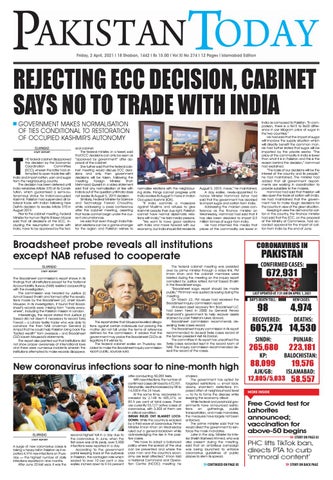
Rejecting ecc decision, cabinet says no to tRade with india g
GOveRNMeNT MAKeS NORMALISATION Of TIeS CONdITIONAL TO ReSTORATION Of OCCuPIed KAShMIR'S AuTONOMy islamabad
t
staff report
he federal cabinet disapproved the decision by the economic Coordination Committee (eCC), wherein the latter had attempted to open trade ties with India and import cotton, yarn and sugar from the neighbouring country. The decision has been deferred until India reinstates Article 370 of its Constitution, which guaranteed a semi-autonomous status for Indian-occupied Kashmir. Pakistan had suspended all bilateral trade with Indian following New delhi’s decision to revoke Article 370 in August 2019. Prior to the cabinet meeting, federal Minister for human Rights Shireen Mazari said that all decisions of the eCC, including the resumption of trade with India, have to be approved by the fed-
eral cabinet. The federal minister, in a tweet, said that eCC decisions can only be seen as “approved by government” after approval of the cabinet. She further said that the federal cabinet meeting would discuss eCC decisions and only then government decisions will be taken. following the meeting, foreign Minister Shah Mehmood Qureshi in a video statement said that any normalisation of ties with India is out of the question until India does not revoke its August 5, 2019 decision. Similarly, federal Minister for Science and Technology fawad Chaudhry, while addressing a press conference after the cabinet meeting, asserting that trade cannot begin under the current circumstances. he said that even though India-Pakistan relations can be a game-changer for the region and Pakistan wishes to
normalise relations with the neighbouring state, things cannot progress until India revokes its August 5 move in Indian Occupied Kashmir (IOK). “If India commits a massacre against Muslims and refuses to give Kashmiri people their due right, Pakistan cannot have normal diplomatic relations with India,” he told media persons. “We want to have good relations with India and move forward with our economy, but India should first revoke its
August 5, 2019, move,” he maintained. A day earlier, newly-appointed finance Minister hammad Azhar had said that the government has decided to import sugar and cotton from India. Addressing the maiden press conference as the finance minister on Wednesday, hammad had said that it has also been decided to import 0.5 million tonnes of sugar from India. he had informed the media that prices of the commodity are lower in
Broadsheet probe reveals all institutions except NAB refused to cooperate islamabad staff report
The Broadsheet commission’s report shows in its findings that all institutions except for the National Accountability Bureau (NAB) resisted cooperating with the investigation. The commission was headed by Justice (r) Azmat Saeed Shaikh and formed after the revelations made by the Broadsheet LLC chief Kaveh Mousavi. In its investigation, it found that Broadsheet’s records were missing from “nearly everywhere”, including the Pakistan mission in London. Interestingly, the report stated that Justice (r) Saeed did not deem it necessary to record Tariq fawad – a Lahore textile trader who was able to convince the then NAB chairman General (r) Amjad that he could help Pakistan bring back the “looted wealth” from overseas – and Broadsheet CeO Kaveh Moussavi’s statements. The report also pointed out that institutions did not show proper awareness of international laws and there were numerous incidents wherein the institutions attempted to make records disappear.
The report states that Moussavi levelled allegations against certain individuals but probing this matter did not fall under the terms of reference defined for the commission. It added that the government may probe the Broadsheet CeO’s allegations if it wishes to. The federal cabinet earlier on Thursday decided to make the Broadsheet inquiry commission report public, sources said.
The federal cabinet meeting was presided over by prime minister through a video link. PM Imran khan and the cabinet members were briefed during the meeting on the inquiry report complied by Justice retired Azmat Saeed Shaikh in the Broadsheet saga. “Broadsheet saga report should be made public,” PM Imran was quoted as saying during the meeting. On March 22, PM house had received the Broadsheet inquiry commission report. uK-based asset recovery firm Broadsheet LLC had been hired in 2000 by General Pervez Musharraf’s government to help recover assets stashed by past Pakistani rulers abroad. Broadsheet commission recommends desealing Swiss cases record The Broadsheet inquiry commission in its report recommended to de-seal Swiss cases record of the former president Asif Ali Zardari. The committee in its report has unearthed the Swiss cases recorded kept in the record room of NAB. The inquiry commission recommended deseal the record of the cases.
New coronavirus infections soar to nine-month high
islamabad staff report
A surge of new coronavirus cases is taking a heavy toll in Pakistan as it reported 4,974 new infections on Thursday — the highest number of daily infections reported in nine months. After June 20 last year, it was the
second-highest toll in a day due to the coronavirus. In June, when the first wave was at its peak, over 5,900 infections were reported in a day. According to the government portal keeping track of the outbreak in Pakistan, the contagion rate which soared to over 10 per cent a day earlier, inched down to 9.94 percent
after conducting 50,055 tests. With new infections, the number of confirmed cases climbed to 672,931. Meanwhile, deaths increased by 98 to 14,530 in the 24 hours. At the same time, recoveries increased by 2,148 to 605,274, or 89.9 per cent of total cases. There are currently 53,127 active cases of coronavirus, with 3,303 of them are in critical condition. IMRAN RULES OUT BLANKET LOCKDOWN: While the country is wracked by a third wave of coronavirus, Prime Minister Imran Khan on Wednesday ruled out a general lockdown while acknowledging the rise in the positive cases. “We have to adopt a balanced policy where the spread of the virus can be prevented and where the poor man and the country’s economy are least affected,” Imran told a National Command and Operation Centre (NCOC) meeting he
chaired. The government has opted for targeted restrictions — smart lockdowns, short-term restrictions imposed often at neighbourhood level — to try to tame the disease while keeping the economy afloat. While federal and provincial governments have announced restrictions on gatherings, public transportation, and mask mandates, the measures have largely not been enforced. The prime minister said that he would direct the government to reinforce the mask mandates. Later in the day, Minister for Interior Sheikh Rasheed Ahmed, who was also present during the meeting, said that an ambitious campaign was being launched to enforce coronavirus guidelines at public places to stem its spread.
CONTINUED ON PAGE 05
India as compared to Pakistan. “In comparison, there is a Rs15 to Rs20 difference in per kilogram price of sugar in the two countries.” he had said that the import of sugar will improve the supply situation which will directly benefit the common man. he had further stated that sugar will be imported by the private sector. “The price of the commodity in India is lower than what it is in Pakistan and this is the reason behind the decision,” hammad had explained. “The basis of our decisions will be the interest of the country and its people,” he had maintained. The minister had added that all government departments are working in coordination to provide subsidies to the masses. hammad had said that Pakistan will also open the trade of cotton with India. he had maintained that the government has to make tough decisions for the country in view of the given situation. Keeping in view the demand for cotton in the country, the finance minister had said that the eCC, on the proposal of the Ministry of Commerce, had accorded approval for the import of cotton from India by the end of June.
coRonaviRus in
Pakistan
CONFIRMED CASES:
672,931
LAST UPDATED AT 7:31 AM ON APRIL 1, 2021
DAY'S DEATH TOLL:
NEW CASES:
98
4,974
RECOVERED:
DEATHS:
605,274 14,530 SINDH:
PUNJAB:
265,680
223,181
KP:
BALOCHISTAN:
AJK/GB:
ISLAMABAD:
88,099
12,805/5,033
19,576
58,557
more inside
Free Covid test for Lahorites announced; vaccination for above-50 begins STORY ON PAGE 03
PhC lifts TikTok ban, directs PTA to curb ‘immoral content’
STORY ON BACK PAGE
02
Friday, 2 April, 2021
ISLAMABAD
NEWS
murad SayS SindH wiLL taKE own dECiSionS if nCoC faiLS to impoSE rEStriCtionS
S
NewS DeSK
INDH Chief Minister Syed Murad Ali Shah has demanded that the National Command and Operation Centre (NCOC) impose tighter restrictions to curb the spread of the deadly coronavirus, adding that the provincial government would take its own steps to do so if necessary. “I reminded him (Prime Minister Imran) that one year ago, the Sindh government had taken the initiative for which we had to listen to a lot [of criticism]. If it was such a bad idea, why did the other three provinces and Centre follow it?” he asked during the inauguration ceremony of the Institute of Animal Health in Korangi, Karachi. The provincial minister pointed out that while Pakistan was “saved” from a Covid-
19 wave as bad as India’s wave last year as it had restricted domestic travel through airplanes and trains. In this regard, Murad demanded the NCOC impose a two-week ban on inter-city transport, otherwise “we will take decisions ourselves”. He pointed out that India had not imposed a curfew in time and had told everyone to return to their home villages, and as a result, the people “infected each other and their villages”. However, Pakistan was saved from a similar situation because it shut down domestic travel, he maintained. The chief minister said that he gave the same recommendation to the NCOC this time as well, clarifying that his suggestion was not rejected. “The NCOC said it will consider it.”
SC adjourns hearing on re-election in na-75 constituency ISLAMABAD: The Supreme Court (SC) on Thursday adjourned hearing of a case filed by Pakistan Tehreek-eInsaf (PTI) candidate Ali Asjad Malhi against the Election Commission of Pakistan’s (ECP) decision over re-election in NA-75 Sialkot-IV (Daska) constituency till Friday. A three-member bench, headed by Justice Umar Ata Bandial and comprising Justice Munib Akhtar and Justice Sajjad Ali Shah, heard the petition. During the course of proceedings, Advocate Salman Akram Raja, counsel for Pakistan Muslim League-Nawaz (PML-N) candidate Nausheen Iftikhar, said the commotion was seen in at least 40 polling stations. However, the impression was that there was a commotion in the whole constituency, he added. Addressing the counsel, Justice Bandial said that he (Salman) had informed the court that polling staff remained missing for many hours. He said that 20 presiding officers (POs) were missing. He further stated the court had defined lawlessness in Waheeda Shah case. Salman Akram Raja, while reading the judgment in Waheeda Shah case, said that if a PO was harassed or pressurised, it was illegal. He said that he wanted to draw the attention of the court to the media reports and press release of the Election Commission. Media reports and Election Commission confirmed such incidents, he added. Raja said that in such situations, the standard of investigation for the election tribunal would be different from that of the Election Commission. aPP
He also stated that the vaccination campaign needs to be made more aggressive, as Pakistan ” is among the bottom-most in terms of vaccination in the region”. “Bangladesh, India, even Afghanistan — all are ahead of us,” he said on the occasion. Murad said that there were areas in the country that had a positivity rate of 25 per cent while in other areas, the positivity rate was lower than 1 per cent. “If people gather [in areas with low positivity rates], it will not spread as much,” he added. Separately, a decision was taken in the cabinet meeting held here under the chairmanship of Murad at CM House wherein the Sindh government, under propoor economic revival package, has decided to launch Chief Minister Self-employment Scheme to advance interest-free small loans to the people in an attempt to combat the
economic downturn incurred by coronavirus. The chief minister – during a meeting attended by all the provincial ministers, advisors, Chief Secretary Mumtaz Shah and concerned secretaries – said that the Covid19 situation had turned a large number of people either unemployed or underemployed. “This is the time to introduce a pro-poor economic package under which interest-free small loans may be offered to the people to start their small business or strengthen their ongoing business activities,” he said and added he could spare Rs2 billion during the current financial year to start with. The cabinet members after thorough discussions and deliberations approved the proposal and named it “Chief Minister Self-employment Scheme”. They unanimously voiced to enhance its budgetary allocations so that a
Mosques to remain open for taraweeh during Ramzan: ministry NewS DeSK The government on Thursday announced that mosques will remain open for taraweeh prayers during the holy month of Razman. Earlier, Minister for Religious Affairs and Interfaith Harmony Noorul Haq Qadri had said that mosques across Pakistan will stay open during the holy month with strict adherence to standard operating procedures (SOPs) at a time when the nation is grappling with a surge in Covid19 cases across the country. The ministry pointed out that the mosques would follow the same 20-point agenda as last year. 1. No carpets or dariyaan (mats) to be laid down in mosques because the virus is airborne. Clean floors for prayers must be ensured. 2. If people want to bring prayer mats from home they may do so. 3. No gatherings after namaz/taraweeh will be permitted. 4. If a mosque has an open area/garden it is preferable to conduct prayers there. 5. People over 50 years of age, children should not be allowed in mosques. 6. Everyone must follow the instructions of social distancing by WHO and other health experts. 7. Taraweeh should not be conducted on roads,
footpaths and anywhere else than the mosque premises. 8. People should continue to keep observing regular prayers at home. 9. Masjid, Imambargah’s floors should be washed with chlorinated water regularly. 10. There should be a six-feet distance during congregational prayers. 11. The mosque should form committees to ensure that people are abiding by the rules and decided SOPs. 12. Markers should be made on the floors of mosques and Imambargahs to guide people about the distance they should keep from others. 13. People should do ablution at home. 14. People must wear face masks when coming to mosques and maintain physical distance. 15. People must avoid handshakes. 16. Itikaf must be observed at home. 17. No one must prepare or hold Sehri and Iftaar in mosques. 18. Mosque committees should be in constant contact with the provincial government. 19. Mosques committees are allowed to conduct taraweeh under these SOPs. 20. If during Ramzan, government authorities feel that the situation has got out of control and the number of cases surge, the authorities can review the decisions taken.
New twist to PTI foreign funding case ISLAMABAD Mian abrar
In a new twist to the tale of the foreign funding case against the ruling Pakistan Tehreek-e-Insaf (PTI), the scrutiny committee of the Election Commission of Pakistan (ECP) has accused Akbar S Babar, the petitioner against the PTI, of using delaying tactics in the case. Sources informed Pakistan Today that Babar was caught in the alleged foreign funding case after the scrutiny committee had asked Babar to provide evidence against the ruling party for wrongdoing. The committee had stated that as the petition, the burden of proof falls on his shoulders. “Why are you saying that the Election Commission should provide PTI documents for you to examine? If
Akbar S Babar keeps making new applications again and again, the scrutiny will never be complete,” the source quoted the scrutiny committee as telling Babar. The source said that the scrutiny committee also told Babar in its last hearing, that while the petitioner had accused the PTI of trying to end the case too soon, that the whole matter was being delayed because of Babar. It has come to light that Babar himself is now in hot waters as he has to prove accusations against the PTI. Sources said that Babar’s request to interrogate a PTI employee from Dubai was also rejected by the scrutiny committee and it was said that the case was related to party funding in which the party’s affairs would be looked into in this way. A person’s private accounts cannot be verified by personally blocking them, the committee observed.
Nawaz snubbed Zardari on Senate opposition leader election: Sherry ISLAMABAD inP
Pakistan People’s Party (PPP) leader Sherry Rehman revealed her party’s chairman Asif Ali Zardari had telephoned Pakistan Muslim League-Nawaz (PML-N) supreme leader Nawaz Sharif to discuss the election of Senate opposition leader but instead was informed by the deposed prime minister’s co-in-law Ishaq Dar that Sharif is not available for a conversation. Sherry made the revelation in an interview with a private television channel. She said that Dar, when told about the matter, bluntly responded the matter could not be discussed. On the other hand, the PPP had never walked away from discussing anything with its opposition allies, she said. “Look at the recent PML-N move where it had approached the PPP to discuss the NA-249 by-election in Karachi. We openly welcomed them and talked and conveyed them that we could talk to our committee.” Sherry said that the PPP was in favour of civilised politics because of its history. “Zardari said in the PDM meeting to Sharif that he has a son and Sharif has a
daughter, implying they should go to jail collectively.” She also maintained the PPP’s record was in front of all of the people who were speaking on inflation and other issues in the Senate for the last three years. “Looking at the record, you will know which party’s speeches were prominent as opposition,” she said. Sherry said that it was up to the party whether it wanted to “empower the selected and hybrid government or oppose them”. “Our targets are to criticise this government’s policies, transparency, and make them accountable in front of people and want to make better policies. People will look at those elements who are dividing the opposition,” she said. She also downplayed a question about party Chairman Bilawal Bhutto-Zardari’s former spokesperson Mustafa Nawaz Khokhar’s statement about receiving votes from Balochistan Awami Party (BAP). “Mustafa is a young and first-time senator from Sindh. He may have not known the facts that the PPP did not get votes from registered BAP senators. An independent group of four senators was formed and voted for the PPP leader,” she said.
large number of populations could take benefit from it. The chief minister said that a mechanism entitlement of loan, method of disbursement, mode of recovery was needed to be evolved. He constituted a committee under P&D Chairman Mohammad Waseem, with the finance secretary and the law secretary as its members to work out details for the programme. The meeting was told that an NGO Akhwat Islamic Microfinance (AIM) was advancing interest-free loans to poor people so that they could start their small businesses. Their recovery rate was 100 per cent. The NGO was called, and its representative gave a detailed briefing to the cabinet and they tasked the P&D chairman to meet with them and share their model with the cabinet in its next meeting to be held before the holy month of Ramzan.
98 Covid-poSitivE intErnationaL travELLErS arrivEd in KaraCHi in 4 montHS: rEport KARACHI Staff rePort
As many as 98 passengers, who arrived in Karachi from various countries over the last four months, tested positive for Covid-19, said a report compiled by Sindh Health Department. According to the report — which featured data from December 22 to March 30 — the passengers who landed at the Jinnah International Airport belonged to the United Kingdom and South Africa among other nations. 11 of them were diagnosed with a UK variant of the disease. In March, the Civil Aviation Authority (CAA) imposed a complete ban on travel from 12 countries in a bid to curb the spike of coronavirus cases. The aviation regulator notified a fresh list of countries categorised into A, B and C after the emergence of the South African and Brazilian strains of the disease and imposed a complete ban on travel from 12 countries, categorised as C. Botswana, Brazil, Columbia, Comoros, Ghana, Kenya, Mozambique, Peru, Rwanda, South Africa, Tanzania, and Zambia were placed in category C. The travel restrictions and a ban on inbound passengers from countries in the C category will remain effective until April 5.
SHC orders to remove Khuhro’s name from ECL KARACHI inP
The Sindh High Court (SHC) on Thursday ordered the federal government to remove Pakistan Peoples Party (PPP) leader Nisar Khuhro’s name from the Exit Control List (ECL). A two-judge bench of the high court permitted him to travel abroad between April 9 and May 19. During the hearing, a National Accountability Bureau (NAB) prosecutor said the dirty money watchdog is conducting a series of inquiries against Khuhro and expressed fears the former minister might not return. The prosecutor, therefore, pleaded with the court to not permit him to fly out of the country. In his petition, Khuhro had said he wanted to travel to the United States to meet his family living there. “The federal government has placed my name on the ECL on malicious grounds,” he argued, requesting the court to remove his name from the no-fly list. Khuhro is facing a number of cases including irregularities in wheat procurement, assets beyond income, and misuse of power.
Friday, 2 April, 2021
ISLAMABAD
NEWS
03
TAreen will noT be given An nro, SAyS AKbAr
A
NEwS DESK
DVISER to Prime Minister on Interior and Accountability Shahzad Akbar maintained that former Pakistan Tehreek-e-Insaf (PTI) general secretary Jahangir Tareen and his son, Ali Tareen, will not be given an NRO. Talking to media persons in Lahore, the adviser said that the two would be prosecuted in accordance with the law, adding: “The attempts for NROs are no secret, but we are not going to give them to anyone.” “There will be no favouritism in this and Tareen will be prosecuted as per the law.” Referring to the inquiry commission’s report on the sugar scandal, Akbar stressed that the government “made public despite the involvement of our own member.” In this regard, he added, an amount of more than Rs300 million was frozen. An expeditious investigation on the sugar
scandal is underway, the PM’s aide claimed. The forces in the market are involved in illegal profiteering, the adviser said. He added that the Federal Investigation Agency (FIA) and the National Accountability Bureau (NAB) have “been provided with evidences with respect to action against such illegal market elements”. Earlier in the day, a banking court approved the interim bail of JDW Sugar Mills official Rana Naseem in the case pertaining to money laundering through Tareen’s company. The court granted bail to Naseem against two surety bonds worth Rs50,000 each. Judge Ameer Muhammad Khan barred FIA from arresting the suspect. Naseem maintained in his petition that the money laundering inquiry against him is unjustified. A day earlier, FIA had booked PTI leader Tareen, his son Ali, son-in-law and other members of the family in two cases for alleged financial embezzlement and sugar scandal. The FIA investigation team had
Punjab, KP CMs restrict activities after staffers test positive LAHORE/PESHAWAR: Chief ministers of Punjab and Khyber Pakhtunkhwa (KP) restricted their schedules after several cases of coronavirus were reported from their offices, it emerged Thursday. Reports citing sources suggest two staffers — a protocol officer and a waiter — at Usman Buzdar’s office had tested positive for the contagious disease and one of them lost his life recently. As many as 16 officials of the CM House have contracted coronavirus disease, it said. A spokesperson said that Buzdar will only hold important meetings inperson and will attend the rest virtually. He added that there was also a ban imposed on normal visits due to coronavirus. Meanwhile, Special Assistant to KP Chief Minister Kamran Bangash confirmed that six officials of the CM House have contracted coronavirus. He said that the chief minister’s schedule has been restricted, adding the meetings will now be held via video-link. Coronavirus tests for all the staffers of the CM House were termed compulsory and a ban was also imposed on casual visits to the secretariat. It was further decided that strict implementation of guidelines, including social distancing, would be maintained during meetings held at CM House. Mahmood Khan has appealed to the public to adopt all precautionary measures against the virus and ensure strict adherence to the guidelines. He said that cases of coronavirus were on the rise again and people must ensure the wearing of face masks. Staff RepoRt
US, Saudi forces participate in PAF drill ISLAMABAD: The air forces of the United States and Saudi Arabia are participating in a two-week drill organised by the Pakistan Air Force (PAF). The commencement of Aces Meet 2021-1 — a multinational air force exercise aimed at maximising combat readiness of participating troops through air-to-air combat training — at an undisclosed operational airbase was announced earlier this week. While the two armies are “actively participating” in the exercise, the air forces of Bahrain, Egypt and Jordan are invited as observers. In a video, Saudi Wing Commander Hamad bin Muhammad AlHajjri said the kingdom was participating in the drill with its Panavia Tornado jets. “The activities of ACES 2021 have kicked off at Mushaf Air Base in the Islamic Republic of Pakistan, with the participation of the Saudi Royal Air Forces, the US Air Force and the Pakistan Air Forces,” AlHajjri said in a video shared on Twitter by the Saudi ministry of defence. “We have participated in these exercises also with a number of our Tornado aircraft. The excuses will be in several stages: including planning and executing air operations against air defense and based on different war scenarios.” PAF Deputy Chief of Air Staff (Operations), Air Vice Marshal Waqas Ahmed Sulehri, was the chief guest at the opening ceremony held on Monday. Staff RepoRt
registered the first case of alleged fraud of Rs3.14 billion on March 22 against them. The first information report (FIR) had stated that Jahangir Tareen allegedly transferred illegal shares worth billions of rupees to Farooqi Pulp Mills Limited (FPML), which is owned by his son and close relatives. It had said that the transfers, especially after 2011-12, were “patently fraudulent investments which ultimately translated into personal gains” for Jahangir’s family. Some Rs3 billion were invested and laundered through the same factory. The FIR had outlined when and how FPML was made back in 1991. It includes sections 406, 420 and 109 of the Pakistan Penal Code with Section 3/4 of Anti-Money Laundering Act, 2010. The investigation agency had also charged Tareen and others for illegal hoarding of sugar, misappropriation and cheating in the FIR. The FIA in another FIR had charged that Amir Waris, a confidante of
Tareen, made illegal transactions from the company accounts and withdrew over Rs2 billion. Waris had illegally deposited the amount in the personal accounts of Jahangir Tareen and his family members. “During the inquiry a fake account was also found, which was used for around six billion rupees illegal transactions,” the FIR had read. “The fake account was used for transactions in accounts of various companies of Jahangir Tareen.” “The probe found that the company’s chief Rana Naseem acted as main aide and made over Rs600 million transactions from JWD’s accounts.” Naseem had claimed that the transactions were made for payment of salaries and bonuses, while the company had been in deficit for the last five years, according to the FIR. The FIA had charged in the FIR that Tareen, Amir Waris and Naseem have been involved in money laundering.
Free Covid test for Lahorites announced; vaccination for people over 50 begins LAHORE/ISLAMABAD INp
The authorities have announced a free coronavirus test for the people of Lahore. The announcement was made by Lahore Commissioner Captain (r) Muhammad Usman on Thursday. All the citizens have to do is to call on 1133 for the free coronavirus test. The urgency reflected the gravity of the situation after the third Covid-19 wave intensified in Punjab. According to the data shared by the spokesperson of Punjab Primary and Secondary Healthcare Department (P&SHD), the number of coronavirus cases in the province has reached 223,181. The P&SHD confirmed that 1,768 new cases of Covid-19 were reported in Lahore, nine in Kasur, 31 in Sheikhupura, seven in Nankana Sahib, 150 in Rawalpindi, 14 in Attock, six in Jehlum, two in Chakwal, 56 in Gujranwala, 48 in Mandi Bahauddin, eight in Narowal, two in Hafizabad, 83 in Sialkot, 47 in Gujrat, 180 in Faisalabad, and 19 in Toba Tek Singh. 21 cases were reported in Chiniot, 11 in Jhang, 44 in Sargodha, one in Mianwali, 17 in Khushab, two in Bhakkar, 105 in Multan, 14 in Vehari, 16 in Khanewal, nine in Lodharan, two in Muzaffargarh, and seven in Dera Ghazi Khan. Moreover, there were four new cases in Rajanpur, one in Layyah, 28 in Rahimyar Khan, 52 in Bahawalpur, 28 in Bahawalnagar, 30 in Okara, 13 in Pakpattan and 32 new cases of Covid-19 were reported in Sahiwal district during the last 24 hours. The Punjab health department conducted 3,838,133 tests for Covid-19 so far while 189,856 confirmed cases recovered altogether in the province. The Punjab health department urged the masses to follow the standard operating procedures (SOPs) for their protection and cover their faces with masks. People should wash their hands with soap several times a day to protect themselves from Covid-19. Contact 1033 immediately on symptoms of coronavirus, the healthcare department urged the citizens. It is pertinent to mention here that more than 110 doctors of Lahore’s Services Hospital have contracted the virus. Some of the affected medics are isolating themselves at their homes while the others at the hospital’s hostel. Over 10 of the victims are said to be in critical condition. “In last 07 days almost above 100 doctors of SHL (Services Hospital Lahore) have been infected with Covid-19 fighting on the frontline, leading to acute shortage of working doctors,” the Young Doctors Association (YDA) president said in a letter. In light of the third wave of the pandemic and shortage of doctors, the YDA demanded that the
government recruit medical officers and Covid-19 consultants, ensure vaccination of all doctors of the hospital, and reduce out-patient department (OPD) visits. Meanwhile, the government of Pakistan has opened registration for vaccination against the novel coronavirus for people of 50 years and above on Thursday. The people belong to the above-50 age group can now get themselves be registered at 1166 to receive the code for vaccination. The person will be informed about the vaccination centre after he will get the registration code at 1166. Dr Faisal Sultan, prime minister’s aide on health, on Wednesday said that Pakistan has so far administered over 800,000 doses of the coronavirus vaccine. Federal Minister Asad Umar, who also heads the National Command and Operation Centre (NCOC), recently announced the opening of registration for the nationals aged 50 years and above to get registered for Covid-19 vaccination from March 30. In a Twitter message, Asad reiterated that the registration for people aged 60 and above has already been open. He asked nationals to encourage everybody who is 50 plus to go for registration for the vaccination. The federal government continues the coronavirus vaccination drive in phases as the stocks of vaccines are arriving in Pakistan. Moreover, in a bid to control rising cases of coronavirus in the federal capital, authorities have decided to observe ‘safe days’ for businesses. Notification issued by the Office of District Magistrate in this regard states that as per guidelines of NCOC and after detailed discussions with traders of Islamabad, different safe days will be observed in the first parts of the Islamabad Capital Territory (ICT). Safe days of different areas are mentioned below: Friday and Saturday: G-9, G-13, Sitara Market, G15, G-10, Furniture market Golra Road, DHA GT Road Barakahu, PWD, Pakistan Town, G-8, I&T Center, G-7, I-9, Ghori Town, Khanna Pull, Lehtrar Road, G-11, Aabpara Market, Tramri market, I-10 Thursday and Friday: Safa Mall, Centaurus Mall, Giga Mall and Amazon Mall. Saturday and Sunday: Blue Area, F-10, Melody Market, E-11, F-8, I-8, F-11, F-6 and F-7 Saturday and Sunday: All areas/ market not mentioned earlier. The notification, which will remain enforced till April 11, 2021, directs assistant commissioners (ACs)/sub-divisional magistrates and local police to enforce restriction order accordingly. Pakistan has logged a sharp rise in coronavirus cases as another 98 patients have died of the novel virus during the past 24 hours while 4,974 new cases were recorded, showed the data released by the NCOC on Thursday morning.
Top Pakistani general receives Turkish military award ANKARA aNadolu ageNcy
The Turkish Armed Forces has awarded a top Pakistani military general the Legion of Merit award for his services in promoting defence relations between the two countries. Gen Yasar Guler, chief of Turkish General Staff, awarded Gen Nadeem Raza, chairman joint chiefs of staff committee, at a ceremony held in the capital Ankara, a statement by the Pakistan embassy said on Thursday. Raza, who is currently on an official visit to Turkey, was given the award in “recognition of his outstanding services for promotion of Pakistan-Turkey defence ties.” “Both the commanders held extensive talks. Matters of bilateral interest with an emphasis on geostrategic situation and security challenges came under discussion. Both sides reaffirmed the resolve to further enhance cooperation between the armed forces of the
two brotherly countries,” the statement added. During his trip, Raza called on Turkey’s Minister for National Defense Hulusi Akar, Commander of the Turkish Land Forces General Umit Dundar, Commander of the Turkish Naval Forces Admiral Adnan Ozbal, and Commander of Turkish Air Forces General Hasan Kucukakyuz, and Head of Presidency of Turkish Defense Industries Ismail Demir. The statement said that the Pakistan military delegation also visited various facilities of the Turkish defence industries, including Baykar, which is known for its high-end drone technology. The Pakistan military delegation also visited APS Martyrs Park in Kecioren, Ankara, and paid tribute to the martyrs of the heinous terrorist attack on Pakistani school students in Peshawar in December 2014. To commemorate the martyrs of the Army Public School terrorist attack, APS Memorial Park was established by the Kecioren municipality and 144 trees were planted as a token of remembrance.
Talking to a private news channel a day earlier, Tareen had said that the allegations by FIA are “baseless”. He had said that a private audit firm has already validated the accounts of his companies. The PTI leader had taken the position that all the shares were transferred in accordance with the law and accounts law. Last year, Prime Minister Imran Khan had tasked the FIA to investigate the sugar crisis throughout the country and find out who benefited from it. A report by the FIA released last year had claimed that top PTI members were among those who gained from the recent sugar crisis in the country. It is to mention here that the FIA Lahore office had summoned the representatives of sugar mills’ managements from March 31 and directed them to bring relevant records of sugar stocks sold through the betting mafia from November 2020. The agency had also issued a call-up notice to JWD Sugar Mills of Tareen for April 2.
CanSino says Covid-19 shot may be less effective over time BEIJING/ISLAMABAD: A day after the first batch of CanSino Covid-19 vaccines that the government purchased from China arrived in Islamabad, the manufacturer said the efficacy rate for its single-dose drug may fall over time although it should still have a rate of 50 per cent or more five to six months after inoculation. CanSino is one of the four vaccines approved by the Drug Regulatory Authority of Pakistan (DRAP), the other three being China’s state-owned Sinopharm, Russia’s Sputnik-V, and the Oxford University-AstraZeneca vaccine. The disclosure comes days after the government announced to import CanSino vaccine jabs in bulk to package 3 million doses locally. “We will be getting the bulk vaccine by mid-April from Cansino, from which 3 million doses can be made,” Minister for Planning and Development Asad Umar said Tuesday. A second shot given to trial participants six months after their first injection could offer substantial protection, Zhu Tao, CanSinoBIO’s chief scientific officer, said in an online presentation late on Wednesday. “A booster shot six months later led to a seven times to 10-times increase in neutralising antibody levels, so we expect in this case efficacy could reach over 90 percent,” Zhu said, though he cautioned more clinical trial data was needed for more precise estimates. The company in February reported interim data that showed the shot was 68.83 per cent effective at preventing symptomatic Covid-19 disease two weeks after vaccination but the rate fell to 65.28 per cent after four weeks. The February data reflected a shorter time span after the inoculation, Zhu said. CanSinoBIO is also planning a clinical trial in China for an inhaled version of the vaccine. Staff RepoRt
Friday, 2 April, 2021
04 NEWS
ISLAMABAD
SHC allowS firm to Sell 50,000 doSeS of Sputnik-V VaCCine KARACHI
t
TLTP
he Sindh high Court (ShC) on Thursday allowed a private pharmaceutical company to sell 50,000 doses of Russia’s Sputnik V vaccine that the pharmaceutical firm had imported last month. Justice Nadeem Akhter of the high court dismissed the government’s plea to restrict AGP Limited from selling the vaccine for a week until the government fixed its maximum price.
At the onset of Thursday’s hearing, a lawyer representing the Drug Regulatory Authority of Pakistan (DRAP) told the court that AGP had imported the vaccine before the government could determine the price, saying the management of the company would have to return the extra amount if it sold Sputnik V for a rate higher than the one determined by the government. In response, the opposing counsel said that the firm wanted to sell the vaccine for Rs12,226 in the local market and it was up to the people if they wanted to pay that price or not.
Justice Akhter questioned why the government had failed to fix the price until now, despite the vaccine having been privately imported more than two weeks ago. “The third wave of the coronavirus pandemic is here, and we cannot stop the sale of vaccines,” he observed. “It should be administered to people at the earliest.” earlier on Wednesday, another bench of the same court instructed the federal government to fix the price of the Russian vaccine within a week without issuing any directives about its sale. The Russian vaccine is the first to be im-
ported by a private firm in Pakistan. Last week, the government allowed AGP to sell the vaccine for a maximum price of Rs8,449 ($54), but the company rejected the decision and claimed it had imported the product at a much higher rate. In February, Pakistan said that it would allow private companies to import coronavirus vaccines and agreed to exempt such imports from price caps. however, the country’s health chief reversed the decision earlier this month, asking DRAP to recommend a price that would be approved by the cabinet. During Wednesday’s ShC proceedings,
AGP accused the government of “deception” by first allowing private import of the Covid19 vaccine and then making it impossible for the company to bring it to the local market. Transparency International Pakistan also wrote a letter to Prime Minister Imran Khan last week, saying that the global price for Sputnik V was $10 per dose and the one recommended in Pakistan was 160 per cent higher than the international rate. The watchdog urged the prime minister to “cancel” the private import of the vaccine, citing concerns over price and its potential for corruption in the health sector.
Govt suspends mS for damaging vaccine doses NEWS DESK The Punjab government has suspended Mozang Teaching hospital Medical Superintendent (MS) Dr Munir Ahmad Ghouri on account of inefficiency and misconduct, according to a news outlet. According to a notification of the Punjab Specialised healthcare and Medical education Department, issued on Monday, the MS was suspended with immediate effect under Section 6 of PeeDA Act, 2006. As per the report, the development came after around 350 coronavirus vaccine doses, stored in the refrigerator at the MS’s office, were spoiled. A health official told the news outlet that the MS had proceeded on leave after storing the doses in the refrigerator in his office. Talking about the matter, Punjab health Minister Dr Yasmin Rashid said that the action was taken against the health officer due to his extreme inefficiency, adding that an inquiry committee has been formed. She further said that after receipt of the inquiry report, strict action will be initiated against the responsible officials.
road mishap leaves seven dead in Burewala BUREWALA TLTP
Seven people died in a road mishap in Burewala, an area in Punjab’s Vehari district, on Thursday. According to details, a truck and car met a deadly road crash near Kachi Paki Road, Chak 463. The deceased included children and women. Upon getting the information, the rescue teams reached the spot and moved the bodies to a nearby medical facility. Last month, six members of a family had died in a car crash after a speeding vehicle ran into a roadside tree in the Mohsinwal area. The car speeding on the Jindiali Road crashed into the tree and caused deaths of six people of a family, including two women and two minors.
LAHORE: A view of empty track as the authorities suspended the Orange Line Metro Train operations in view of the worsening coronavirus situation. ZUBAIR MEHFOOZ
No ban on Maryam to go abroad: Sanaullah LAHORE TLTP
Pakistan Muslim League-Nawaz (PML-N) Punjab President Rana Sanaullah has said that the party’s Vice President Maryam Nawaz has not been forbidden from travelling abroad, if she wishes to meet a family relative or for any reason whatsoever. Talking to the media on Thursday, Sanaullah said the PML-N vice president "has special expertise" in dealing with those who are "imposed" on the people–an indirect shot at the government.
Commenting on rising speculation of the PML-N leader going abroad, Sanaullah said, "everyone goes abroad and then comes back to the country. If Maryam Nawaz has to go abroad to meet relatives or for any other matter, it is not like she is forbidden to do so," he said. he said Maryam will remain associated with the Pakistan Democratic Movement (PDM) for as long as its struggle continues to "dethrone" the current government. Reacting to Sanaullah's comments, Pakistan Tehreeke-Insaf (PTI) leader and Punjab Minister Fayyaz Chohan said a drama has begun through which Maryam Nawaz is aiming to seek medical treatment abroad. "Maryam
Nawaz's drama to seek medical treatment abroad has begun with the arrival of Dr Adnan [to Pakistan]," he said. Commenting on Sanaullah's remarks regarding people going abroad to meet relatives, Chohan said "Maryam's tweets and Dr Adnan's syringes" had deteriorated Nawaz Sharif's health. "Now the same Dr Adnan will treat Maryam Nawaz for her low platelets count," he said, mocking the PML-N vice president. he claimed the PML-N leader is looking to flee to London after the PDM's defeat in the Senate. Chohan said no one will be allowed to avail an NRO till Pakistan's looted wealth is brought back to the country.
Two died, seven injured in road mishaps in Karachi KARACHI INP
RAWALPINDI: Firefighters in action to extinguish a fire that engulfed over 20 shops in Urdu Bazar. PPI
At least two people died and seven others, including women, injured in various road mishaps in different localities of the metropolis on Thursday. The local police said that a man identified Sadiq, son of Mohammad Zaman, died and two women Amraizan Bibi, wife of Zaman, and Naheed, daughter of Iftikhar, got injured in a collision between an overspeeding vehicle and a motorcycle in Saddar area. Another person habibullah, son of Bari Dad, died in a road mishap near Ghousi hotel in Gulshan-e-hadid. Five people were injured when an overspeeding passenger coach turned turtle near Saudi Consulate. The bodies and injured were shifted to different hospitals of respective areas and the police, after registering separate cases at concerned police stations, started investigations into the incidents.
eight died, 40 injured in bus crash in larkana LARKANA INP
At least eight people, including children, died and 40 others injured when a bus carrying a wedding party turned turtle due to overspeeding in Larkana on Thursday. The local police said that the driver of the bus lost control over steering due to reckless driving and the vehicle over turned near Mashori bypass. As a result of the accident, eight people, including children, lost their lives while 40 others were injured. The injured were shifted to a nearby hospital, where conditions of 20 people were stated to be critical. The authorities declared an emergency at the Chandka hospital to tackle the situation.
Friday, 2 April, 2021
ISLAMABAD corporate corner
NEWS
FBR collecTion hiTS RS475Bn in MaRch ISLAMABAD
T
KARACHI: HABIBMETRO and Central Depository Company (CDC) have signed an agreement to facilitate Non-Resident Pakistanis (NRPs) to invest in Pakistan’s stock market through the HABIBMETRO Roshan Digital Account (RDA). PR
al Karam Textile collaborates with TcF to empower women lAHoRe: Al Karam Textile Mills Pvt Ltd. has contributed 10,800 double bed sheets’ fabric pieces towards the Vocational Program of The Citizens Foundation (TCF) managed by its Community Development Unit. This collaboration will help 150 apprentices to practice their stitching skills and generate additional household income. Moreover, the income from this project will be used to support skills training of more community women. The objective of this vocational program is to enable community women around TCF schools to attain technical skills, earn a livelihood and support their family income. Currently, the programme has 12 centers across Karachi, Lahore, Kasur, Gujrat, Sargodha, Sheikhupura, Faisalabad, Jhang, Khushab and Muzaffarabad, catering to around 400 trainees a year. PRESS RELEASE
SHAHZAD PARACHA
HE Federal Board of Revenue (FBR) surpassed its collection target by Rs36 billion to reach Rs475 billion in March 2021, the highest monthly collection in the current fiscal year (FY21), according to provisional data released by the tax authorities. The data shows that the authority collected Rs3,396 billion revenue against the target of Rs3,287 billion during the first nine months (Jul-March) of the current fiscal year (9MFY21), exceeding the target by more than Rs100 billion. This represents a growth of about 10 per cent over the collection of Rs3,076 billion during the same period last fiscal year. Similarly, the net collection for the month of March against a required increase of Rs367 billion represents an increase of 46pc from March 2020. Officials said that year-on-year (YoY) growth figures would further improve before the close of the day and after book adjustments have been taken into account. The income tax collection during the July-March period stood at Rs1.25tr as against the target of Rs1.29bn, showing a shortfall of Rs39bn. The income tax collection, however, showed a growth of 6pc when
PM LAUDS HISTORIC REVENUE COLLECTION IN MARCH compared with Rs1.18bn collected during the same period last year. The tax deposited with returns was Rs51bn compared to only Rs33bn, up 54pc. Meanwhile, the sales tax collection jumped 19pc to Rs1.57tr in the nine months of FY21 from Rs1.32tr in the same period last year. However, the target was projected at Rs1.32tr which was surpassed by Rs250bn. The growth came as a result of a rise in fuel prices, increase in imports and revival of economic activities during the period under review. Federal excise duty (FED) collections were up 4pc to Rs196bn as against Rs188bn last year. The FED target for July-March was set at Rs221bn, which was missed by Rs25bn. Furthermore, Customs collection stood at Rs546bn during the July-March period this year as against Rs492bn over the last year, indicating a growth of 11pc. The target projected under Customs was Rs448bn for the period under review. The FBR, in a press release on Wednesday, stated that the improved revenue performance is a reflection of growing economic activities in the country despite
nestlé Pakistan awarded 1st prize at living the Global compact Best Practice Sustainability awards KARACHI: Nestlé Pakistan won the first prize at Living the Global Compact Best Practice Sustainability Awards 2020, for the fifth consecutive time, announced by local chapter of UN Global Compact Network Pakistan, for its continuous commitment towards UN SDGs and the ten principles of the UNGC embedded in the way it conducts business. PRESS RELEASE
allied Bank Wins Pakistan’s Best Bank for cSR 2021 lAHoRe: Allied Bank has won the award for Pakistan’s Best Bank for CSR 2021 by the Asiamoney, a leader in global publication, for a second time for its commitment to socially uplift the community through various initiatives; especially in the light of the ongoing Covid pandemic. Allied Bank, led by the Chief Executive Officer (CEO) Aizid Razzaq Gill, spent about Rs23 billion in various social projects spanning over health, education and general community welfare, including donations and sponsorships. For social welfare, the bank spent five times more in 2020 than in 2019. PRESS RELEASE
Project Reconnect to hold nation Building Film Festival lAHoRe: Recently launched platform, Project Reconnect, has announced to hold their maiden Nation Building Film Festival with ‘rebirth’ as the main thought provoking theme. The objective of this first of its kind film festival is to identify, screen and promote a nation building content from the upcoming film makers. The core team of Project Reconnect which consists of Majid Rafiq and Syed Kashif Mohsin who have been coming together since last 15 years to create thought provoking audiovisual content for Pakistan. A panel of renowned and top experts of their craft have endorsed the cause by joining panel of jurors. The panel includes R. M. Naeem, Sheherazad Alam, Senator Faisal Javed Khan, Shahid Zaidi, Naveed Kazi and Syed Kashif Mohsin while Nazaria-ePakistan Trust has nominated Chief Justice (r) Mian Mehmoob Ahmed and Saif Ullah Chaudhry as jurists. PRESS RELEASE
facing the challenge of the third wave of Covid-19. It is expected that this revenue performance would be improved substantially during April-June 2021 as compared to 2020 when economic activities were disrupted due to the pandemic. Meanwhile, Prime Minister (PM) Imran Khan appreciated the FBR for achieving historic growth. Taking to Twitter, the PM said, “I commend FBR efforts, achieving historic growth of 41pc in March-21 with collections recorded at Rs460 billion.” “During July ’20-Mar ’21 our collections reached Rs3,380 billion which is 10% higher than the same period last year.” He maintained that it reflects broad-based economy revival led by the government’s policies. Earlier on February 28, the Federal Board of Revenue (FBR) had announced that it had achieved the tax target for the first eight months of the fiscal year, 202021, collecting Rs2,916 billion. However, later it transpired that the FBR collected net revenue of Rs3,394 billion during the July-March period against the target of Rs3,287 billion. This represents a growth of about 10 percent over the collection of Rs3,076 billion during the same period last year. The net collection for the month of March was Rs475 billion, against a target of Rs367 billion, representing an increase of 46 per cent over Rs325 billion collected in March 2020 and 129 per cent of the target.
Bitcoin jumps to $58,912 as Goldman Sachs embraces cryptos
iGloo celebrating 50 years and counting lAHoRe: This year marks IGLOO’s 50th anniversary. For the past five decades, IGLOO has been the choice for every Pakistani’s celebrations and life events and has always maintained its quality and with time introduced new, innovative and scrumptious flavors. This is the very reason why, even after so many years, IGLOO is still very popular amongst the masses and adds joy to their festivities. IGLOO- King Cone has always been popular across Pakistan, along with a vast range of IGLOO products available for people from all walks of society. PRESS RELEASE
05
Chief of Army Staff General Qamar Javed Bajwa held a meeting with Polish Ambassador Piotr A Opalinski at the General Headquarters, wherein he said that Pakistan and Poland have convergence of strategic interests on a range of security issues including fight against terrorism.
New coronavirus infections soar to nine-month high contInuED fRoM PAgE 01 MINORS FELL VICTIM TO THIRD WAVE: Children and teens have also fallen prey to the third wave of coronavirus, it has emerged. On Wednesday, 121 children tested positive for coronavirus in Islamabad. Most of the coronavirus-positive children are reported to be under 10 years of age. Meanwhile, of two children, who were admitted to Islamabad’s Pakistan Institute of Medical Sciences (PIMS) a few days ago, one has been declared coronavirus-free. The virus was transmitted to
the nine-day-old from his mother. He was kept in the intensive care unit (ICU) for a few days, resulting in his recovery, the doctors said. So far, 15 children have tested positive for the disease at the hospital so far. VACCINATION CAMPAIGN: Some 800,000 doses of vaccine have been administered across the country so far, all of them Sinopharm donated by China, Minister of State for National Health Services (NHS) Dr Faisal Sultan said. He confirmed that half of another million doses bought from Sinopharm had arrived on Thursday. The government is scrambling
to get more vaccine as it awaits WHO/COVAX/GAVI allocations of AstraZeneca’s vaccine, which have been delayed. The authorities are planning to acquire enough of a concentrated form of the Chinese CanSino Biologics vaccine next month to locally produce 3 million doses. “We are speeding up this process and want to take it to the next stage,” Dr Sultan said. Pakistan has allowed the private sector to import and sell vaccine, but a legal dispute between the importer and the Drug Regulatory Authority of Pakistan (DRAP) over the price has delayed that mechanism.
KP govt to launch interest free microfinance scheme in merged areas PESHAWAR AZIZ BUNERI
The Khyber Pakhtunkhwa (KP) government has signed an agreement with Akhuwat Foundation to launch the Interest Free Microfinance Scheme (IFMS) for promoting entrepreneurship as well as the cottage industry in newly merged districts. The scheme will provide small scale loans up to Rs75,000 to small and medium entrepreneurs of merged areas. The interest free loan scheme will consist of a revolving fund of Rs1 billion. Under the said scheme, a 25 per cent quota has been allocated for females, 5pc for special persons and 2pc for transgenders. A ceremony to this effect was held here at Chief Minister House on Thursday with KP Chief Minister
Mahmood Khan as chief guest. Special Assistant to CM on Industries Abdul Kareem, Secretary Industries Javed Marwat, Akhuwat Foundation Chief Executive Officer (CEO) Dr Amjad Saqib and other concerned high ups also attended the ceremony. According to details, more than 219,000 people of merged areas would be facilitated on merit over the next 13 years. Touching upon the government’s strategy for the development of merged districts, the KP chief minister that the provincial government would also launch an interest free loan scheme for settle districts in phases, starting from backward areas. He said that the incumbent government was taking result oriented steps to make the youth of tribal districts financially empowered.
Hammad urges timely completion of CPEC projects ISLAMABAD: Federal Minister for Finance and Revenue, Industries and Production Muhammad Hammad Azhar has stressed the need for the early completion of projects falling under of China Pakistan Economic Cooperation (CPEC). “Time is of the essence in meeting project deadlines so that the economic benefits could reach the people of both the countries and contribute towards overall economic growth and development,” he remarked while chairing a meeting regarding economic and industrial cooperation under (CPEC) at the Finance Division on Thursday. STAFF REPORT
cMYK
ISLAMABAD: The major cryptocurrencies continued upward trend on Thursday as PayPal, Visa and some banking powerhouse have started embracing cryptocurrencies. Bitcoin (BTC), the world's biggest cryptocurrency, gained 1.11 percent to reach $58,912. With this increase in price, the market capitalisation of the BTC has reached $1.1 trillion. Likewise, Ethereum (ETH) gained 6.34 percent to reach $1,928. With this increase in price, the market capitalisation of ETH reached $222 billion. Similarly, Binance Coin (BNB) price gained 5.53 percent to reach $315. The market capitalisation of BNB stands at $48.8 billion after this increase. However, the price of Tether (USDT) shed 0.02 percent to reach $1. The market capitalisation of the USTD stands at $40.8 billion after this decrease. It is pertinent to mention that banking powerhouse Goldman Sachs is close to offering its first investment vehicles for bitcoin and other digital assets to clients of its private wealth management group. According to a report, the bank aims to begin offering investments in the emerging asset class in the second quarter of the year. “We are working closely with teams across the firm to explore ways to offer thoughtful and appropriate access to the ecosystem for private wealth clients, and that is something we expect to offer in the near term,” Mary Rich, who was recently named global head of digital assets for Goldman’s private wealth management division, told the media this week. This means that Goldman will become the second big bank to offer bitcoin exposure after Morgan Stanley started offering clients opportunities to invest in the emerging asset class less than two weeks ago. TLTP
Friday, 2 April, 2021
06 COMMENT
Nurseries or grassroots organizations?
The PM is trying to sit between two stools
Why ‘electables’ don’t like local councils
At stake, the government’s credibility
T
he government’s populist slogans are not in consonance with its international pledges. While Prime Minister Imran Khan’s economic team was working hard to broker a deal with the IMF, Mr Khan announced 2021 to be year of growth for Pakistan. What this is bound to lead to, is exposure at home and loss of face abroad. Just when Dr hafeez Sheikh was celebrating his success in brokering an agreement with IMF and holding conference calls with bond investors, he was unceremoniously shown the door, with some close to the government holding him responsible for the rise in prices. It is widely understood that the IMF’s contradictionary fiscal policy leads to cutting jobs while the policy of reducing the subsidy bill and raising sales and income tax hit the low-middle-income segments, which are already shaken by the increase in electricity prices, food inflation, job losses and pay cuts. Businesses are also feeling the impact. With 1.3 percent GDP growth rate projected for the financial year by the World Bank, there would be more suffering in store for the common man. Dr Sheikh’s removal is bound to raise eyebrows in international financial circles and among investors. The hints thrown by stopgap Finance Minister hamad Azhar concerning a possible review of the IMF programme and the State Bank of Pakistan amendment bill are not likely to go well with international financial and rating institutions. The government has declined to share the draft of the IMF programme with the National Assembly. There is a perception supported by media reports that some of the drastic amendments that were not proposed by the IMF were also introduced to favour the entrenched vested interests. That explains why Mr Azhar refused to commit himself when asked whether the government would make the IMF technical mission’s report public. Mr Azhar’s own credibility got a hit a day after he got the additional portfolio. On Wednesday, after presiding over the eCC meeting, he announced that it was decided to import cotton and sugar from India. The next day the decision was reversed by the cabinet. This was the outcome of the interplay of countervailing pressures on the government which wants to run with the hare and hunt with the hounds.
At Penpoint M A NIAZI
T
he restoration of the local bodies in the Punjab brought into focus one of the basic differences between the military and the politicians, and the one point of divergence between the PTI and previous military regimes. Military regimes have viewed local bodies as an ally, and under Zia as a sort of substitute for national and provincial politicians. however, political regimes have regarded them as a sort of rival. The assembly members providing the regimes have disliked local bodies as absorbing development funds they would have preferred to spend, with the result that government found them adding to the complexity of managing the members. The Ayub Martial Law introduced the concept of Basic Democrats, making the local body representatives the electoral College for the provincial and national assemblies, as well as the Presidency. This meant making the system an indirect democracy, but it also meant that it was easier to manage electoral results. The Yahya Martial Law saw no local body elections. The national and provincial elections led to the creation of Bangladesh, and the handover of power to the PPP. The PPP did not hold local body elections, and used the positions of administrators of various local bodies as patronage for party stalwarts. The reluctance of the PPP to have elected local bodies is instructive, for starting with the party leader Zulfikar Ali Bhutto, many of its leading lights had gained political experience in the Ayub era. however, they do not seem to have learnt any affection for local bodies from that experience. The Zia Martial Law saw the local bodies first made to substitute for some time for national provincial assemblies, and then substitute as a grassroots party organisation for the party Zia made for himself. Zia had promised ‘elections in 90 days’ when he took over back in 1977, but did not fulfill his promise, and then he announced elections in October 1979, and then reneged on that. Well, his supporters said he did not renege, for his held local body elections, and tried to use them instead; being greeted by the local Mayor on arrival at a provincial capital, instead of the CM protocol mandated. These elections were partyless. elections were held again in 1983, and only then were provincial and national assemblies held, on partyless basis. The parties in the Movement to Re-
PDM woes Bickering will tear it apart
T
he latest statement by PPP leader Naveed Qamar, that the PPP will refuse to follow Leader of the Opposition in the National Assembly, PML(N) President Shehbaz Sharif, was perhaps inevitable after the PML(N) said huffily that its Senate Parliamentary Party would not follow Yusuf Raza Gilani as Leader of the Opposition, as the PPP had reneged on its commitment to let the PML(N) nominate the Leader of the Opposition. It seems as if the election of Mr Gilani as a Senator was the high point of the PDM alliance between the PPP and the PML(N), and it all went downhill from the failure to elect him as Senate Chairman. Now it seems that the PPP is preparing to go a step behind the pre-PDM stage, when the PPP had accepted Mr Sharif as the Leader of the Opposition in the National Assembly. The main PDM components have got internal differences over strategy, and until they resolve those, they will not find themselves able to convince the other components that they are to be trusted. The PML(N) finds itself not knowing whether to accept the Nawaz narrative, which insists on a confrontation with the establishment, or the Shahbaz narrative, which wants a cooperative relationship with the establishment. The PPP has its own problems, with former Chairman Reza Rabbani expressing doubts about the wisdom of dickering with the government’s allies, as it did to get Mr Gilani elected. There is also the need to settle his doubts about the PPP efforts in the Punjab, an example of how one party’s internal cohesion affects the entire alliance. Amidst all this, Mr Qamar’s statement that the PPP wanted all decisions to be made on the PDM platform, and the PDM should not be reduced to a PML(N)-JUI(F) show, may seem an indication that the PPP is not willing to jettison the alliance just yet. The PML(N) and the other PDM components should take this to heart. True, at the end of the day parties will decide on making their participation in the alliance serve their own advantage, but at the moment, opposition to the government would seem to require unity. This is especially true as the PDM has to organize the parliamentary opposition, which would seem to require acknowledging one person per house as Leader.
Leaving the poor uninoculated may allow new strains to spread ANAM MurAd KhAN
M
ORALITY for the famous Realist Machiavelli was the power product of haves that are blindfolded with self-interest and hypocrisy. even at the woeful plight of this pandemic– a “global” virus crisis – the “state” has been regarded as the referent object that eventually led to the hoarding and discriminatory dispense of Covid vaccines– the Vaccine Nationalism. This Vaccine Nationalism has demonstrated the states upholding Realism through self-centric decision-making that has moral imperatives too, and hence careening into catastrophe in the contemporary globalized era. Vaccine Nationalism has descended into another form of world divide and eventually manifested the Realist prognosis of relative goods. Realist ideology made states devoid of collective interests – absolute goods– and brought forth the hobbesian nature where humans are pursuing interests at the expense of others. Such a human life endangering hobbesian nature has been realized when Asian cubs got covid-jabbed, whereas the widespread inoculation has been queued for a minimum of five years in their neighboring underdeveloped states such as Cambodia, Laos, and Myanmar. Parallel to the survivalist theory of Charles Darwin, the fittest, most powerful, and richest countries are leading to amass this lifesaving technology and leaving the weak, unfit, and poor countries waiting for years. The upsurge of the vaccine prices because of economic giants-suppliers sideline deals knocked out equitable vaccine distribution programs such as Covax and denied weak economies access to the vaccine as a result. Subsequently, as per the latest report of Amnesty International, 16 percent haves are hoarding 60 percent of the Covid vaccines thereby foreshadowing the tragic developments among the have-nots. Thucydides’ naturalistic character of inequality is evident in W.h Davies’ nation also, where the poor leave, and the have-nots are persistently falling prey to vaccine apartheid and the digital divide. For in-
Arif Nizami Editor Managing Editor
Joint Editor
Umar Aziz Executive Editor
Lahore – Ph: 042-36300938, 042-36375965
were empowered, so that a number of departments were devolved, and Deputy Commissioners were redesignated District Coordination Officers. Many of the powers of DCs were given to District Nazims, who were elected, as were Tehsil Nazims. The idea was that there would be no reversal, because the public would want to keep it. This proved over-optimistic, not least because the provincial finance commissions were not operationalised, which were supposed to fix the shares of the various districts much as the shares of the provinces were fixed by the National Finance Commission. The provinces reverted back to the traditional commmissionerate system. Apart from the ability of the chief ministers to transfer provincial officials, it also enabled him to control the heads of district administrations, who were not elected, but selected by him. It is noticeable that there was no partisan division on the issue. The PTI government in KP was as careful to return to the old system as the PML(N) in Punjab or the PPP in Sindh. The election Commission of Pakistan conducted local body elections in 2015, and provinces are now having polls falling due. The problem is that of delimitations, which have to be according to the latest census..That was conducted in 2017, but its results have not been published yet in the official Gazette. That means the delimitations cannot be carried out. The 2018 elections, held on the basis of fresh delimitations based on the provisional census results were a one-time exception, and the next national elections cannot be held on that basis. The main hurdle to census results publication is the claim by some, including the MQM that is a government coalition partner wants a recount in a proportion of polling blocks, because the original census undercounted the Muhajir population. There has been a long-standing military commitment to local bodies as a nursery for democracy, the commitment to a written Constitution is not as strong. however, while the first two military rulers abrogated the Constitution, the next two did not. Apart from the belief that the regime’s political purposes can be served, the local bodies are seen as serving the purposes of that Constitution. The PTI upheld that narrative out of power, by saying that it wanted stronger local bodies. however, in office, it has resisted this, because it realises that local bodies are now controlled by the PML(N), and its ability to use them as a feeder for itself is thereby limited.
The writer is a member of staff.
Vaccine Nationalism, Virus Globalism, and Realism
Dedicated to the legacy of the late Hameed Nizami
Yousaf Nizami Aziz-ud-Din Ahmad
store Democracy boycotted the election, something which many regret even now, because it opened the road for carpetbaggers. One group which benefited was local councillors. More than 100 made it to the Punjab Assembly, for example, and though Mian Nawaz Sharif had never been one, Ghulam haider Wyne, the Punjab General Secretary of the PML and a member of his Cabinet, was vice-chairman of his municipal council, while Speaker Manzoor Wattoo was chairman of his Okara district council. The Punjab Chief Ministry has only once been filled, by the late Arif Nakai, by someone without a local body connection. Wyne and Wattoo were Nawaz’s successors. Then came Shahbaz Sharif, whose introduction to politics was as President of the Lahore Metropolitan PML. More closely connected was Ch Pervez elahi, who had been Chairman of his Gujrat district council, as well as Local Government Minister from 1985 to 1993. even Dost Mohammad Khosa, who was Chief Minister for a few weeks while Shahbaz Sharif found a seat in 2008, became Local Government Minister afterwards. he had previously been Naib District Nazim of Dera Ghazi Khan. The present incumbent, Usman Buzdar, took office after having been tehsil nazim of Taunsa Tehsil of the same Dera Ghazi Khan district. It was in the first Nawaz tenure that the ruling party took over the local bodies, converting them into a kind of grassroots organisation. There had been a local body election just a year before the 1988 election, and ticket aspirants made it a practise of taking long councillors of all tiers from their constituency to show their support. It is significant that the ruling party had no ideology. Thus it did not matter who was chosen, so long as he had local support. This is the ‘electable’ strategy which the PTI has followed, and which has also ensured that it is devoid of ideological content, and which ended the PPP continuing to be an ideological party. The strength of ideology is such that the PPP is still given credit for being one. however, the PTI has never aspired to being one, perhaps reflecting the difference between the founder of the PPP and that of the PTI. It has been noticeable that the PML(N) has been the only party to conduct local elections. When the Wattoo government took office in 1993, it had to deal with local bodies that had been elected in 1992. It dissolved them, only for them to be restored, and then dissolved again. The Musharraf Martial Law showed not just an enthusiasm for local bodies,but also worked extensively on devolution. The local bodies it established
I
Karachi – Ph: 021-35381208-9
I
stance, many US states are using complicated online registration procedures that the underprivileged, and minorities cannot afford. According to the latest report of human Right Watch, 28 percent old-aged Native Americans, 21 percent Latinos, and 25 percent black will be unable to get their shots. In addition, Machiavellian morality has successfully subdued the Victorian morality in Southwark and South London, too; as the far-flung areas of the UK were passed over to protect a few rich lives. This major level manifestation of realism explicates the significance of its fundamental 3S: Statism, Survival, and the Self-help. The children of lesser gods are dissipated in this haves and have-nots dialogue because they lack statism. The occupiers were busy in protecting their homelands and tightening blockades on their occupied lands, but no one cared about the besieged people of Kashmir and Palestine. And the stark reality of inequality is obvious by the statement given by Médecins Sans Frontières’ advisor in Palestine, Matthias Kennes: “The chances of Israelis to get Covid shots are 60 percen% higher than the Palestinians.” Secondly, Survival is linked to the realization of any state’s interests, so it is directly linked to the third S, self-help. The poor states are at the disposal of stronger ones because they cannot do it on their own. This dependence reveals the harsh and unalterable truth of international politics where only national interests matter. National interests made Serbia one of the key recipients of the Chinese vaccine. Geopolitics whetted the hunger of hegemony contestant China to aid Serbia, because Serbia is the crucial state connecting the former’s new Silk Road project. This project will connect China to the biggest markets of europe. Moral imperatives of this Vaccine Nationalism have given rise to different disorders that are intensi-
Islamabad – Ph: 051-2204545
fying the global health crisis. Whiteman noblesse are expected to get jabbed by the end of this year at the expense of sub-Saharan heroes-in-white-overalls. Similar to the other privileged countries, the UK angled for vaccinating each adult by the end of this year. The UK government’s good decision with bad timing can worsen the situation in the poor sub-Saharan countries. Those countries are losing health specialists to covid19 because of the unavailability of the vaccines. In the long-run, this vaccine jingoism is going to be fatal for those espousing it– the have–states. The dirty interests of the haves may also get infected since they highly depend upon the haves-not for their interests. In the words of the World health Organization’s Director General, “equitable vaccine distribution is not only a moral but also strategic and economic imperative for the rich countries.” Their interest in the globalism of cheap resources and labour may export them new covid19 variants from the uninoculated haves-not that will eventually become the breeding grounds for the new and more deadly variants. Subsequently, the hoarded stock of vaccines will become unusable. Vaccine Nationalism has aggravated the global privileged and underprivileged divide between haves and have-nots. Consequently, the eternity of Realists’ espoused self-centric decision-making of the states has dramatized this. This development is not a good omen for the destitute people in this world, as no matter whether they are inside the borders or ownerless, for unequal and selfish decisions will hound them in every facet of their lives. Such a jeopardy of human lives, especially in this life-saving aspect, has serious moral imperatives. Furthermore, owing to the interconnectedness of today’s era, jingoistic decisions will have a menacing shadow on the haves too.
This development is not a good omen for the destitute people in this world, as no matter whether they are inside the borders or ownerless, for unequal and selfish decisions will hound them in every facet of their lives.
I
Web: www.pakistantoday.com.pk
I
The writer is a freelance columnist
Email: editorial@pakistantoday.com.pk
Friday, 2 April, 2021
COMMENT 07 Editor’s mail Send your letters to: Letters to Editor, Pakistan Today, 4-Shaarey Fatima Jinnah, Lahore, Pakistan. E-mail: letters@pakistantoday.com.pk Letters should be addressed to Pakistan Today exclusively
Debt trap
Emerging ties of South Asian giants The peace dividend will come through trade
Abdul MANAN
“Economics has gained the title Queen of the Social Sciences by choosing solved political problems as its domain.” ― Daron Acemoglu, Why Nations Fail: The Origins of Power, Prosperity, and Poverty
S
OUTh Asia has always remained the centre of conflicts and political agitation, and the jewel of world politics. There are multiple reasons for it occupying centrestage, such as exquisite geographical location, vast economic opportunities, and cultural diversity. Angus Madison, world famous economist, mentioned in his book Monitoring the World economy that only India produced 24 percent of world food around 1600, and then depletion of economic opportunities started in South Asia caught in a spiral of chaos, especially after the arrival of British. Shashi Tharogr in An Era of Darkness has stated that “In short, British rule suffered several man-made famines, wars, racism, maladministration, deportation of its people to distant lands and economic exploitation on an unprecedented scale. After the economic genocide, and use of social, cultural, and political opportunities by Britain in South Asia, two new nations ere allowed to emerge on world map, India and Pakistan. Since Independence, both nations have been in a scuffle, despite having cultural, geographical, and linguistic commonalties. Three major wars have so far been fought between two South Asian Giants and only poverty, hunger, and chaos have won in this region. Things became more tense after India repealed Article 370 in its Constitution, but latest developments have raised new hopes of peace and prosperity. In the last week of February, the Director Generals of Military Operations (DGMOs) of both sides came into contact and agreed to strictly follow the ceasefire agreement of 2003, and meanwhile the USA welcomed this peace gesture. General Bajwa’s recent encouraging statement to bury the past and move forward with neighbors indicated that a new era of peace is knocking at our door. Indian Prime Minister
Narendra Modi showed sympathies with his Pakistani counterpart after his Covid-19 test came out positive. These recent developments are showing that the ice is going to melt soon and both nations should not spoil this imperative opportunity. Covid-19 has badly damaged the economy of both countries. Pakistan’s annual economic growth rate has shrunk from 5.8 percent in 2018 (when Imran Khan took over as prime minister) to 0.98 percent in 2020 and could decline further. Additionally, it remained on the Financial Action Task Force’s “grey list” for terror financing. India’s GDP on the other hand, contracted by an astounding 23.9 percent in the first quarter of 2020 and only now seems to be on the mend. Both countries have been facing immense difficulties since Independence, but their governments are more rapidly spending on defense than human development. The Stockholm International Peace Research Institute (SIPRI) said in its annual report last year, India had the world’s third biggest military budget last year, behind the USA and China. India’s military spending of $71 billion was 6.8 percent higher than its 2018 expenditure. It grew by 259 percent over a 30-year period stretching from 1990 to 2019 and by 37 percent over the 2010-19 decade. About Pakistan, the SIPRI report said its military expenditure had gone up by 70 per cent during the 2010-19 decade to reach $10.3 bllion. In terms of GDP, the military budget rose from 3.4 percent in 2010 to four percent last year. But the dismal picture of human development on both sides is actually a challenge to improve bilateral ties and work on human betterment. The two have massive potential to create trade and economic opportunities. According to a 2018 World Bank report, India-Pakistan trade has the potential to increase from $2 billion to $37 billion, if both countries become willing to take steps towards removing tariff and non-tariff barriers such as: sensitive lists, strict visa policies, strict quality standards and lengthy procedures and waiting periods at the border. Prior to August 2019, when Pakistan formally suspended trade ties with India after India revoked Kashmir’s special status, formal trade between the two was estimated at $2 billion— with bilateral trade through formal channels. Pakistan’s exports to India include vegetable products, textiles, dry dates, rock salt, cement, leather, surgical instruments, carpets, and gypsum. India’s to Pakistan consist of cotton, organic chemicals, dyes and pigments, machinery, pharmaceutical items, teas and spices, iron and steel and plastic goods. Informal trade between the two also takes place through smuggling via land borders or third countries, such as Thailand, the UAe, and Singapore. From 2012-2013 informal trade between was reported at $3.9 billion— almost double formal trade. Informal trade further increases when formal trade is suspended. Obstacles to India and Pakistan trade consist of both tariff and non-tariff barriers, including but not limited to strict quality standards, sensitive lists (goods on which no tariff concessions are granted), lengthy procedures, waiting periods at the border, strict visa policies, and lack of proper infrastructure such as roads, dry ports, and rail cargo stations to facilitate trade. These factors combined increase both the absolute and
relative costs of trade. For example, goods often must wait several days at the border checkposts before they are cleared. If the goods are perishables, this means they are essentially destroyed before getting to the market. These barriers are also aggravated by the trust deficit on both sides. For example, some in the Pakistan business community oppose free trade with India, arguing that India’s larger economy would negatively impact the demand for Pakistani goods in the domestic market compared with cheaper Indian products (considering that trade with India has historically been in favor of India). however, this argument overlooks the broader advantages of improving trade. For instance, Pakistan can import automobile parts from India at a comparatively cheaper price than from the eU, Japan, or the UAe. This would make Pakistani automobiles cheaper for domestic consumers, hence increasing their sales. Beyond the economic impact, trade has the potential to act as a confidence building measure between the two countries by forming established channels of communication. As asserted by a few international relations theorists, as countries build economic cooperation and interdependence, they also significantly reduce their chances of going to war as the cost of going to war means forgoing economic benefits. The eU in the aftermath of the First and Second World Wars is a compelling example of trade liberalization and regional cooperation that has stabilized a continent after years of conflict. enhancing economic cooperation and regional trade would leave both India and Pakistan with an opportunity to divert their enormous defense budgets towards pressing issues, such as: access to health services, free education, and reduction of food security, which are important for the poor populations within each country. Opening formal channels of trade would further streamline informal trade and reduce smuggling, which has the potential to lead to increased government revenue through customs duties. Similarly, Pakistan can charge transit fees by providing access to Indian goods to Afghanistan through Pakistan. Furthermore, regional trade also has the potential to create jobs and promotes economic growth and development. At a time where each country’s economy is shrinking due to covid-19, enhancing bilateral trade can help in creating demand for exports and help reinvigorate economic growth. The populations of India and Pakistan share culture, language, and history, which can significantly help in enhancing trade, tourism, and investment between the two countries if people-to-people contact is encouraged to foster trust and greater economic interdependence. The opening of Kartarpur corridor in 2019 was a positive step in this direction, and many other opportunities are available, opening the door for potential economic integration by enhancing people-to-people contact. Although just a first step, the Kartarpur corridor is a positive development in minimizing the trust deficit between the two countries and could further contribute to other confidence building measures such as enhancing cooperation in trade. Considering that any escalation in tensions between India and Pakistan can threaten regional peace and stability, it is imperative both countries find ways to peacefully resolve their disputes and establish new channels of communication. The writer is a freelance columnist
OUR leadership has largely ignored to focus on issues of national importance. With exception of building arms and ammunition, we have ignored every other aspect of national importance. Since inception, we have built only two dams namely Mangla and Tarbela, which are not even close to fulfilling our need for irrigation and energy. The Kalabagh dam was announced decades ago, but it never saw the light of the day because of the petty interests of our politicians. We kept borrowing from international lenders but never adopted the ways of austerity. Our leaders kept their royal ways and wasted money due to poor governance and corruption. Without developing capacity and generating resources, the system could not bear the burden of the growing population and we kept falling into the debt trap. heavy spending on defense and inefficient government set up led to the country becoming hostage to international lenders. We are now in a quagmire where we find it impossible to get out of it. On the one hand, we need money direly to keep our economy moving. On the other hand, we severely lack the capacity to return the loans and become self-sufficient. I am sure there can be a way out of this horrific situation if our leadership shuns personal differences and sits together to set the country in the right direction. If people see that the politicians are working selflessly for the betterment of the country, they will cooperate and will even be willing to accept tough measures. however, when people see our politicians constantly bickering and fighting for power, they lose hope and themselves become self-focused. I hope and pray that our leaders realize the kind of dire situation we are in and start working for the betterment of the country. Raja Shafatullah ISlamabad
Coming together The recent unfortunate incidents like a bigger container ship running aground in the Suez Canal and a deadly train accident in egypt are all great reminders of our necessity and responsibility towards strengthening the maritime and railway sectors. As for the first case, there have been great engineering efforts to clear the container ship from the canal. Regarding the egypt train collision, many a precious life has been lost. As an important point, egypt has long been experiencing fatal train accidents making it crucial to pull the plug on the frequent train accidents. In fact my first-ever job involving export and import activities was in the port city of Tuticorin, Tamil Nadu. Besides, the Tuticorin Port has long been handling huge volumes of cargo shipment across the board. Such maritime activities have been key to the world economic boom. So it is time to tweak the feasibility of the maritime routes like the Suez Canal in the best interests of all. As far as I know, the Asian region has been a big hub of the railway networks. I always remember my beautiful 1998 college train tour to Mumbai from Tiruchendur in Tamil Nadu. Professionally, I have travelled a lot by local and metro services in Mumbai. On the other side, numerous travels across my native areas like Tiruchendur, Korkai, Tuticorin,Tirunelveli and Kanyakumari in Tamil Nadu have totally shaped the landscape of my career and life. Such has been the magic of travel. This is true of any human in the world. Finally, all we need is a strong helping hand to strengthen the railway and maritime sectors for example through hard work, great engineering efforts and technological advances available. P SEnthIl SaRavana duRaI mumbaI
Salute to nurses NURSING is a noble profession which requires strong commitment, sense of immolation, for humanity and a great deal of tolerance. A nurse is a person whose job is to care the sick and injured people in a hospital. It is observed that both male and female work as professional nurses but females are in the majority. The profession is more suitability for females since they are more sensitive, caring and tolerance. Nursing is an old sacred profession. Its history is as ancient as that human civilization. The role of a nurse has always been prominent, sometimes as a great nurse”Florence Nightingale” who was known as a lady with the lamp and sometimes as Mother Teresa who devoted her whole life in this holy profession and got the Nobel Prize for her services. Today a nurse gets proper education and taining before entering into this profession. During her training, she has taught how to give medicines and food to patients; how to know about their problems and how to serve them in the best possible ways. She has to be very punctual and active in her work. A nurse is a link between a doctor and a patient. She tells the condition of the patients to doctors and take adivces from them and serve medicines to patients. In this manner, her role becomes central in hospital. Nurses playba vital role in time of war. They not only serve the wounder soldiers but also look after the wounded civilians during wars. They look after and provide aids to the injures. Sometimes they ought to perform their duties in extreme hot and cold seasons. A nurse earns her living in a respectable manner. As the population is increasing rapidly, we do need nurses in larger number. For this, better and more nursing educational institutions need to be set up. They should be taught the best ways and techniques to our nurses for looking after patients and the suffering population. fatIma fazal tuRbat
Broken roads The roads of Karachi have deteriorated over time. The area where I live Buffer Zone; the streets here are the worst. One cannot travel in a rickshaw without getting back pain. The material used to make roads is of low quality, so after a few months, the roads get broken, or potholes are made throughout the street. It has been years since I had a smooth ride on the road. having even roads is a fundamental necessity because it makes your commuting partly easy. The concerned authorities should look into this matter because fragmented roads damage the vehicle’s suspensions. Moreover, many accidents happen because of this. There are no proper footpaths for people to walk in Buffer Zone, so many walks on the sides of roads, but the condition of dilapidated roads makes it difficult for the people to walk comfortably, and there are chances of tripping over easily. vanIa alI KaRachI
Friday, 2 April, 2021
08 WORLD VIEW
Iran–ChIna sTraTegIC agreemenT Could be a game-Changer AMERICA’S CONSTANT HAMMERING TO PRESSURE AND ISOLATE THE ISLAMIC REGIME, ESPECIALLY UNDER TRUMP, HAS STEADILY DRIVEN TEHRAN TO LOOK TO THE EAST
auStralian StrateGic Policy inStitute
T
amin SaiKal
HE signing of a 25-year cooperation agreement between the oil-rich and regionally influential, but US sanctioned, Islamic republic of Iran and the globally powerful, but US pressured, People’s republic of China inserts a new strategic pincer in the Middle East for the United States and its allies. Former US President Donald Trump must bear most of the responsibility for this development, which President Joe Biden now has to handle. The agreement is the culmination of growing economic, trade and military ties between the two countries since the advent of the Iranian Islamic regime following the
revolutionary overthrow of the Shah’s proWestern monarchy 41 years ago. Although the contents of the deal haven’t been fully disclosed, it will certainly involve massive Chinese investment in Iran’s infrastructural, industrial, economic and petrochemical sectors. It will also strengthen military, intelligence and counterterrorism cooperation, and links Iran substantially to China’s Belt and road Initiative as an instrument of global influence. China–Iran trade amounted to some US$31 billion in 2016 following the conclusion of the landmark multilateral Iran nuclear agreement known as the Joint Comprehensive Plan of Action, or JCPoA. However, it declined after Trump withdrew from the deal in May 2018 despite opposition from the other signatories (Britain, France, Germany, russia and China) and imposed harsh sanctions on Iran. The trade volume is now nonetheless set to reach new heights. Underpinning this exponential elevation of relations is the two sides’ mutual
interest in countering the US and its allies. Deeper and wider cooperation between China and Iran, especially when considered in the context of their close ties with russia and the trio’s adversarial relations with the US, carries a strong potential for changing the regional strategic landscape. So far, China has been careful not to partner with Iran to an extent that could jeopardise its lucrative relations with the oil-rich Kingdom of Saudi Arabia (Iran’s regional archrival) and its Arab allies. In 2019, China imported some 17% of its oil needs from Saudi Arabia alone, not to mention 10% from Iraq, smaller amounts from Kuwait, the United Arab Emirates and oman, and only 3% from US-sanctioned Iran. China also enjoys reasonable military and intelligence cooperation with Israel, another main regional adversary of Iran. However, Beijing’s conclusion of the deal with Tehran, which has been in the making since 2016, is bound to deeply concern the Gulf Arab states, Israel and indeed the
US. These countries are already troubled by a perceived Iranian threat, given Tehran’s expanding influence across the Levant (Iraq, Syria and Lebanon) and Yemen as well as its support for the Palestinian cause against Israeli occupation. The US is also concerned by Iranian leverage in Afghanistan, where American and allied forces have been fighting the Taliban-led insurgency for two decades without much success, and from which Washington wants to extricate itself with some face-saving measures as soon as possible. When combined with Iran’s close ties with russia, the China–Iran deal potentially generates a strong axis that can only boost Tehran’s regional position and bargaining power in any negotiations with the Biden administration regarding the JCPoA. Biden has favoured a return of the US to the JCPoA, but on the condition that Iran restore some of the commitments it withdrew in retaliation for Trump’s withdrawal from the agreement. But Tehran has rejected this
condition and demanded that the US first lift all of its sanctions. Although the two sides have been posturing so far, it will come as no surprise if Tehran holds out until Washington blinks. The Iranians have traditionally been wary of an alliance with any world power, although during the Shah’s rule their country drifted into the US’s orbit—something that substantially contributed to the consolidation of a situation that caused the revolution and demise of the Shah, bringing to power the anti-US Islamic regime. However, America’s constant hammering to pressure and isolate the Islamic regime, especially under Trump, has steadily driven Tehran to look to the East and to reach the point of concluding the agreement with China. With Turkey also tilting away from the US towards China and Iran, despite Ankara’s and Tehran’s differences in Syria, the de facto alliances emerging in a strategically and economically vital region of the world poses a greater challenge to the Biden administration than may have been anticipated. If Biden had thought that his main foreign policy targets were going to be russia and China, the Middle East may prove to be just as difficult to handle. Amin Saikal is adjunct professor of social sciences at the Centre for Muslim States at the University of Western Australia.
Who needs a digital dollar? The verdict on the Sewell report
Project Syndicate
T
Barry eiCHengreen
HE idea of a digital dollar has been in the air for some time now. recently, it descended from the ether to the lips of U.S. Treasury Secretary Janet Yellen and Federal reserve Chair Jay Powell. At an event in February, Yellen flagged the idea as “absolutely worth looking at,” adding that the Federal reserve Bank of Boston, in conjunction with academics at MIT, was already doing so. In Congressional testimony the following day, Powell called a digital dollar “a high priority project for us.” Some see this as another front in the technological Cold War between the United States and China. The People’s Bank of China (PBoC) will almost certainly be the first major central bank to roll out a digital currency, in 2022 at the latest. If the U.S. doesn’t move quickly, it will fall behind. America’s financial system will remain stuck in the 20th century, damaging U.S. competitiveness. The dollar’s position as the dominant international currency will be eroded by the ease of using China’s digital unit in cross-border transactions, and the U.S. will squander a singular source of monetary and financial leverage. In fact, such concerns are either overblown or flat-out wrong. The PBoC’s main motivation for issuing a digital yuan is to create a government-controlled alternative to two very large and loosely regulated digital payment platforms, Alipay and WeChat Pay. The ubiquity of Alipay and WeChat Pay raises the specter of the Chinese authorities losing control of payment flows through the economy. And because they use information on payments to inform their lending activities, their pervasiveness points to the possibility of the authorities losing control of financial flows and credit allocation more generally. Thus, the PBoC’s determination to issue a digital currency is part and parcel of the Chinese government’s decision last November to quash the initial public offering of Ant Group, Alipay’s corporate parent. The American government has no analogous worries. In the U.S., scores of different platforms, such as PayPal, Stripe and Square carry out digital payments, which are ultimately settled by banks, and hence through Fedwire, the Federal reserve’s inhouse system for clearing interbank transac-
tions. Visa, Mastercard, Discover and American Express process the lion’s share of card-based payments, but their actual cards are issued by banks, which are regulated, limiting risks to the payments and financial system. Here, too, settlement occurs through Fedwire. Similarly, it is important to bear in mind how far the yuan lags behind the greenback as an international currency. Currently, China’s currency accounts for a mere 2% of global cross-border payments, a negligible share compared to the dollar’s 38%. To be sure, the convenience of a digital yuan would hasten its uptake in cross-border transactions. But that digital currency might also have a hidden backdoor, enabling Chinese authorities to track transactions and identify those undertaking them, discouraging use by third parties. Given this, it’s hard to see China’s digital currency as a game changer internationally. So, the decision to create a digital dollar would have to be justified on other grounds. The soundest justification is financial inclusion. Americans without credit cards and bank accounts, who rely entirely on cash, are denied not just financial services but other services as well. rideshare companies ask you to link your app to your credit or debit card; no card, no pick-up. And no bank account, no card. In this context, recall the difficulty the U.S. Treasury Department had in getting pandemic relief checks to the unbanked. If everyone had a Federal reserve-issued electronic wallet into which digital dollars could be deposited, this problem would be solved. Digital dollars could also address the exorbitant cost of cross-border money transfers. But foreign governments might be reluctant to permit their nationals to install the Fed’s digital wallet, because that would leave them and their central banks unable to enforce their capital controls, which they value as macroprudential tools. Alternatively, the Fed’s digital wallet could be made interoperable with foreign digital wallets. But interoperability would require close cooperation between central banks on the details of technology and security. While there are efforts in this direction, making it work would be a daunting task, to say the least. Ultimately, such advantages should be weighed against the costs and risks of digitizing the dollar. If people shift their savings from banks to digital wallets, banks’ ability to lend will be hamstrung. Some banks will close, and small businesses that rely on banks for credit will have to look elsewhere. Moreover, a Fed-run network of retail payments would be a rich target for hackers and digital terrorists. Security and financial stability are of the essence, and it is not obvious that they can be guaranteed. All this is to say that while the case for a digital dollar may be worthy of examination by Yellen and Powell, it is hardly a slam-dunk. Barry Eichengreen is professor of economics at the University of California, Berkeley.
into racial disparity Guardian Halima Begum, Sam PHan, KatHarine BirBalSingH and remi JoSePH-SaliSBury
HALIMA BEGUM: THIS REPORT IS NOTHING SHORT OF AN INSULT
F
or Tony Sewell to argue that there is no evidence of institutional racism in the UK is delusional. It is deeply disturbing to see this government-commissioned report riddled with so many distortions. Neither the existence nor the extent of institutionalised racism can be denied. Take the government’s anti-extremism Prevent strategy, which embeds Islamophobia into our school system by ordering teachers to report “suspicious” Muslim children. Children doing innocent childish things have become suspects. We see young Black men far more likely to be stopped and searched by the Metropolitan Police, and twice as likely to die in custody. British Pakistanis are paid 15% less than their white British peers. And how can we forget the entire Windrush generation who were degraded, denied hospital treatment and benefits, and many deported by a Home office that saw British people as foreign because of their race. If the prime minister and Tony Sewell genuinely believe in their whitewash of a report, then perhaps they could sit down and explain their point of view to the Black women who are four times more likely to die in childbirth than white mothers-to-be, or the NHS healthworkers, from consultants to hospital porters, so much more likely to die during the pandemic. It is inequality that makes these people vulnerable. Structural, institutional, entrenched racial inequality. Sewell ascribes the relative success of some ethnic minority students not to government policy, but to some kind of aspirational work ethic. What his report fails to acknowledge or explain is that this aspiration is born of the knowledge among ethnic minority parents that our children will have to work so much harder than their white British peers to be given the same opportunities. Simply put, the Sewell commission demonstrates the extent to which the government that sponsored it and shaped its findings is utterly lacking in any empathy or understanding of the lived realities faced by Britain’s ethnic-minority communities today. No doubt the prime minister feels this will play well among his new northern white working-class voters. Ultimately though, this report is nothing short of an insult. It is governmentsponsored gaslighting, and a clear repudiation of any intent to achieve genuine racial equality in our country. Halima Begum is chief executive of the runnymede Trust. SAM PHAN: WELL-WORN TROPES
ABOUT EAST ASIAN ‘SUCCESS’ DOWNPLAY THE DISCRIMINATION WE FACE: For my entire life, my ethnic group has been labelled “successful”, even a “model minority”. Yet this idea only serves to downplay the very real discrimination and racism that East Asians face. According to the report, institutional racism isn’t a problem. Chinese people, along with Black African, Bangladeshi and Indian people, experience a high level of educational success. The report further states that Indian and Chinese ethnic groups comfortably outperform the white average in education and income and are seen to “benefit from positive stereotypes”. The well-worn tropes about East Asians being hard-working, law-abiding and financially prosperous may seem positive, but they erase the many issues that East Asian communities face in terms of racism, poverty and labour exploitation. Furthermore, they encourage the idea that issues of racism and discrimination are not institutional problems, but rather a question of individual behaviour that can be easily overcome by studying and working hard. Yet there are many other ways in which racism still plays a role in my everyday life. The past year has been particularly difficult for East Asians. Since the start of the pandemic we’ve had to endure racial slurs such as “Kung Flu”, and headlines such as “Made in China”. on streets or in supermarkets, we are now viewed with suspicion. These casual acts of racism have sometimes escalated into violence, and even led to deaths. These kinds of microaggressions and stereotypes are a daily reality, and they don’t disappear simply because you perform well academically. Sam Phan is a freelance journalist. KATHARINE BIRBALSINGH: THIS IS A STEP FORWARD IN OUR NATIONAL DISCUSSIONS ON RACE: I welcome the recommendations in the Commission on race and Ethnic Disparities report. I think they are a step forward in our national discussions on race. As someone of Indo-Black Caribbean heritage who has spent a lifetime working in schools in the inner city, trying to enable social mobility for so many children, I am thrilled when a government report understands the power of culture and how crucial it is for us to resist the temptation to jump to the conclusions that discrimination is responsible whenever we are presented with disparities. I do however believe in institutionalised racism: meaning, for example, that when a CV is sent out with a Black name, the same CV with a white name will be more likely to get shortlisted for a job. I also know from my own personal experiences in various ways that racism is not dead. But I believe that since the Macpherson report 22 years ago, Britain has made huge strides in creating a multicultural country
that works. In general, we are not a racist nation, and many countries around the world would do well to follow our example. To those who think differently, I would say: it is important when making arguments and suggesting solutions to consider whether the solutions will actually help children reach their potential and live a successful life. or do these solutions instead simply make the people who are suggesting them feel better about themselves? Always look at the outcomes. Katharine Birbalsingh is the founder and headteacher of the Michaela school in London. REMI JOSEPH-SALISBURY: IT’S A CALLOUS, CYNICAL MOVE TO DOWNPLAY THE PROBLEM: Following their high-profile criticisms of Black Lives Matter, critical race theory, and the concept of institutional racism, the Sewell report is the latest in a series of Conservative attacks on anti-racism. We’re witnessing a government, propelled by fear of the mass mobilisations of last summer, doing everything possible to undermine the efforts of those seeking racial justice. The report is highly selective in its coverage and framing, and seems to adopt a skewed reading of the evidence in order to deny the persistence of institutional racism in British society. Given what we know about the views of Tony Sewell, and influential Conservatives such as Munira Mirza, who had a role in setting up the commission, it’s hard to escape the impression that it was written to fit a predetermined worldview. The state’s own data shows Black people are on average nine times more likely to be stopped and searched than white people, and this does not even begin to account for a vast range of police encounters that go unrecorded. racially minoritised communities are more likely to be subject to use of force, including Tasers, and are massively over-represented on discriminatory gangs’ databases. racial disparities have been evident in the policing of the pandemic too, with racially minoritised people more likely to be fined, and the Metropolitan police having stopped and searched 20,000 young Black men (the equivalent of a quarter of all the city’s Black 15- to 24-year-olds) in London during the first lockdown period. These issues also persist in the prison population with the UK incarcerating a higher proportion of its Black population than the United States. With these communities at the sharp end of the impact of the pandemic, not only in terms of death rates, but the policing response and the effects of the economic downturn too, this report feels like a callous, cynical move to downplay the problems – and will do little to address the challenges we face. Dr Remi Joseph-Salisbury is presidential fellow in sociology at the University of Manchester.
Friday, 2 April, 2021
BUSINESS 09
ISLAMABAD corporate corner Learning Resource Network launches UK education qualifications with ECMCC
PaK-afGHaN TRaNSIT TRaDE aCCORD ExTENDED fOR THREE MONTHS ISLAMABAD
P
KARACHI: Learning Resource Network (LRN) has signed an agreement with Extreme Commerce Magna Carta College (ECMCC) for UK qualifications on to UK universities to pursue UK’s quality higher education from Pakistan. PrESS rElEASE
Bank Islami join hands with Pirani Group for bike financing
KARACHI: Pakistan’s leading Islamic bank, BankIslami Pakistan Limited (BIPL) has joined hands with Pirani Group of Companies, the manufacturer of Super Power Bikes, for its new consumer product of bike financing to their corporate, commercial, and SME customer employees under Employees Banking Services. Bike Financing is a Shariah-compliant financing facility through which one can own its own dream bike on easy and affordable monthly payments in a Riba free manner. PrESS rElEASE
Indus Motor awarded 1st prize by Global Compact Network Pakistan
KARACHI:Indus Motor Company (IMC) won the top position at ‘Living the Global Compact Best Practices Sustainability Awards 2020’ hosted by the UN Global Compact Network Pakistan. This is the sixth year in a row that IMC has won this award in recognition of its integrating the 10 principles of United Nations Global Compact and for embracing the UN SDGs in its business operations. PrESS rElEASE
SNGPL clarifies position regarding forensic audit of SOEs LAHORE: The Sui Northern Gas Pipelines Limited (SNGPL) is not a loss making entity and has not been included for forensic audit by the government of Pakistan. PrESS rElEASE
Hi-Tech Lubricants Ltd. (HTL) has achieved another landmark by signing an exclusive contract of ZIC Lubricant Supply Agreement with Regal Automobiles Industries Ltd (RAIL). The signing ceremony was held recently in Lahore and HTL will now be exclusively supplying its complete lubricant product range under the brand ZIC to DFSK Regal Automobiles Industries Ltd. Pr
GHUlAM ABBAS
AKISTAN and Afghanistan have extended the Afghanistan-Pakistan Transit Trade Agreement (APTTA) for three months, after failing to complete discussion and deliberation on the agreement despite its expiry last month. In this regard, an additional protocol to the agreement was signed by Advisor to the Prime Minister on Commerce & Investment, Abdul Razak Dawood, and Minister of Industry and Commerce of Afghanistan in a ceremony held over a video link on Thursday. The agreement which had been signed by two neighbouring countries for improving trade in 2010 had expired in February this year. According to officials privy to the development, the decision to extend the agreement is aimed at preventing any disruption in trade and transit affairs between the two countries whereas the extension would buy time for the two countries to further discuss the proposed amendments in the agreement. According to Dawood, his vision for trade and economic relations with
TECHNICAL TEAMS OF BOTH COUNTRIES TO CONCLUDE REVISED AGREEMENT
Afghanistan and Central Asian Republics (CARs) is to make Pakistan a hub for trade, transit and transhipment. “Our trade must be based on the secure, open, consistent, reliable and legal movement of goods at the Afghan border along with enhanced connectivity with Afghanistan and CARs”, he said. He said that this will ensure that Pakistan leverages its geo-economic location in the region to enhance its international trade. “Our discussions with
Afghanistan and Uzbekistan are a step in this direction,” he added. Both sides expressed satisfaction with the extension of the agreement and decided that technical teams of the two countries will conclude the revised agreement soon. According to sources, the work on technical issues of the agreement was already underway and would be signed in compliance with World Trade Organisation’s (WTO) principles.
Zafar Masud elected as chairman OGDCL
Pakistan exports grow to $2.3bn in March Pakistan exports have registered a growth of $2.3 billion in March this year, an increase of 13.4 per cent over February, a monthly highest in the last decade. This was announced by Adviser to the Prime Minister on Commerce and Investment, Abdul Razak Dawood, on Twitter Thursday. “Ministry of Commerce is glad to share that according to provisional figures, in March 2021 our exports increased to $2.345 billion. This is an increase of 13.4 per cent over Feb-2021. It is the monthly highest in last ten years,” he said in a series of tweets. Razak pointed out this is also the first time since 2011 that exports have crossed the $2 billion mark for six consecutive months. “The export growth of 29.3pc over March 2020 should not be considered as it is misleading since there was a lockdown last year”. The imports in March 2021 grew to $5.313 billion and this increase was mainly due to increased imports of petroleum, wheat, soy bean, machinery, raw material, chemicals, mobile phones, fertilizers, tyres and an-
tibiotics and vaccines in March 2021, he further said. He said that cumulatively, during the first nine months (July-March) of the current fiscal year, Pakistan’s exports increased by 7pc to $18.669 billion as compared to $17.451 billion in the corresponding period last year. During the same period, the import grew by 12 percent to $39.210 billion as compared to $34.817 billion in the last fiscal year. “This growth has come from an increase in the import of raw material as well as the import of wheat, sugar and cotton,” he further said. The trade deficit in March 2021 was recorded at $2.968 billion with imports of $5.313 billion and exports of $2.345 billion. According to the provisional figures provided by the advisor on commerce, the trade deficit during 9MFY21 has gone up by 18.28 percent on a year-onyear basis. The trade deficit during the first nine months of the current year remained $20.541 billion against $17.366 billion recorded in the same period of the last financial year. NEWS DESK
Global garment makers unite to demand better terms from retailers DHAKA/LISBON AGENCIES
Garment makers in nine countries spanning Asia, the Middle East and North Africa have banded together to demand better contract terms from global clothing retailers, according to a draft document seen by Reuters. The suppliers hope their united front will prevent retailers from playing them off against each other in search of more lenient terms after suffering from widespread cancellations and payment delays at the start of the coronavirus pandemic. Global retailers including Arcadia, Gap, Kohl’s, and Primark cancelled or paused orders with garment-making factories in Bangladesh worth almost $3.7 billion in March and April last year, the results of a local survey of factories seen by Reuters showed. While some, including Primark, H&M, Inditex and Gap, later committed to paying the cancelled orders in full, campaigning coalition PayUp estimates $18 billion out of $40 billion worth of payments are still outstanding globally.
Arcadia and Kohl’s did not respond to a Reuters request for comment. Thirteen associations representing garment suppliers in China, Bangladesh, Myanmar, Cambodia, Vietnam, Pakistan, Turkey, Morocco and Indonesia have drafted minimum terms they hope to present to clients, including a maximum 90-day payment term and an end to discounts after orders are placed. The draft document, due to be finalised and released in late April, is a joint initiative of the Star Network, funded by Germany’s international development agency GIZ, and the International Apparel Federation. “It has become very clear to manufacturers that their vulnerability has increased and that they must play a stronger role in setting standards for purchasing practices,” a statement announcing the initiative published on Thursday said. Though the document will not be legally enforceable, the aim is to foster purchasing practices which “do not cross the boundary of misuse of buying power to the obvious and avoidable detriment of the manufac-
CMYK
turer,” according to the release. A later phase of the initiative would also aim to build ways of enforcing the terms, including an international arbitration mechanism for manufacturers to raise grievances with buyers. “We tended to blindly trust our customers,” said Miran Ali, spokesman for the Star Network. “If they said they want to buy 100,000 yards of fabric from us and they’ll send the purchase order in three weeks, we’d just go ahead and do it. That faith has been lost.” Global retailers lost $1.2 trillion in sales in 2020, a 3.9% drop, according to research firm Forrester, as global lockdowns decimated demand and shut stores for months on end. Though some sales were recuperated online, many clothing retailers were forced to impose steep discounts in an attempt to get rid of unsold stock. The Penn State Center for Global Workers’ Rights said in a report that U.S. and European Union trade data showed a $16.2 billion drop in apparel imports in April through June 2020.
It is pertinent to mention here that Afghanistan’s free trade to India via Pakistan and Pakistan’s cargo transit to Central Asia through Afghanistan was one of the five major issues that need to be revised in the APTTA; however, neither of the two countries have come up with an agreement on the amended issues after months of discussions. On the other hand, Afghanistan’s private sector continues to raise its concerns about the closure of trade and transit routes by Pakistan in the last 10 years. Officials at the Ministry of Commerce said that two meetings had been held last year for the revision of APTTA. During the meetings, it was discussed that the agreement’s text would be revised and updated by incorporating proposed amendments, additions and suggestions and by deleting redundant articles if any. Over the last decade, a total of 832,819 containers of Afghan transit trade carrying goods worth $33 billion have passed through Pakistan, as per data compiled by the Federal Board of Revenue (FBR) Directorate General of Transit Trade, which totals 30pc of Afghan transit trade cargo, whereas the remaining passed through Iran, Uzbekistan and Tajikistan.
ISLAMABAD STAFF rEPOrT
The Oil and Gas Development Company Limited (OGDCL) Board of Directors (BoD) has elected Zafar Masud as chairman Board for a term of three years. As per details, OGDCL, in a letter dated March 31 informed the Pakistan Stock Exchange (PSX), and London Stock Exchange Plc about the appointment. Earlier, 11 directors of the company namely Syed Khalid Siraj Subhani, Mian Asad Hayaud Din, Mather Niaz Rana, Kamran Ali Afzal, Mumtaz Ali Shah, Muhammad Haroon ur Rafique, Zafar Masud, Akbar Ayub Khan, Muhammad Riaz Khan, Shamama Tul Amber Arbab and Jahanzaib Durrani were elected for a term of three years at the 11th Extraordinary General Meeting held on March 17.
Human Rights Training Programme launched for over 750 Sindh judges, prosecutors
KARACHI: 15 Judicial Magistrates along with 10 prosecutors participated in a 3-day interactive training workshop on Human Rights Safeguards in the Administration of Justice in Sindh. The training was organised by the Sindh Judicial Academy in collaboration with EU-funded Huqooq-e-Pakistan project. The program aims at a province-wide intervention by building the capacity of 300 trial court judges and 360 public prosecutors from all districts of Sindh through a total of 22 trainings that will run at SJA through 2021. The trainings will be delivered by senior judges from the Sindh High Court, senior lawyers, prominent experts in the criminal justice sectors and experts from HeP and SJA. The objective of the training program is to enhance the capacity of judges and prosecutors in applying human rights standards in the administration of justice and incorporating the same in judgment writing. The training modules and manual were developed jointly by experts from HeP and SJA under the supervision of HeP Executive Director Ali Dayan Hasan. Judicial Magistrates and Public Prosecutors from Sindh will be trained on a range of areas including the application of human rights within Pakistan’s criminal justice system and the role of trial courts in upholding human rights standards, witness protection and incorporating human rights principles in judgment writing. PrESS rElEASE
Friday, 2 April, 2021
10 FOREIGN NEWS
ISLAMABAD
Suu KyI FAcES NEw chArgE uNdEr MyANMAr'S SEcrEtS Act; wIrELESS INtErNEt SuSpENdEd YANGON
M
Agencies
yANMAR’S deposed leader, Aung San Suu Kyi, has been charged with breaking a colonial-era official secrets law, her lawyer said on Thursday, the most serious charge against the veteran opponent of military rule. Myanmar has been rocked by protests since the army overthrew Suu Kyi’s elected government on February 1 citing unsubstantiated claims of fraud in a November election that her party swept. In a new measure to stifle communication about the turmoil, the junta ordered internet service providers to shut down wireless broadband services until further notice, several telecoms sources said. Suu Kyi and other members of her National League for Democracy (NLD) have been detained since the coup and the junta had earlier accused her of several minor of-
fences including illegally importing six handheld radios and breaching coronavirus protocols. Her chief lawyer, KhinMaungZaw, told Reuters by telephone that Suu Kyi, three of her deposed cabinet ministers and a detained Australian economic adviser, Sean Turnell, were charged a week ago in a yangon court under the official secrets law, adding he learned of the new charge two days ago. A conviction under the law can carry a prison sentence of up to 14 years. A spokesman for the junta did not answer telephone calls seeking comment. Suu Kyi, who is 75 and won the Nobel Peace Prize in 1991 for her efforts to bring democracy to Myanmar, appeared via video link for a hearing in connection with the earlier charges on Thursday. Another of her lawyers, Min MinSoe, said she appeared to be in good health. “Amay Su and President U Win Myint are in good health,” the lawyer said, referring to Suu Kyi by an affectionate term for
Four dead, 2 including suspect wounded, in shooting near Los Angeles Los AngeLes: Four people were killed, one of them a child, in a shooting on Wednesday at an office building in suburban Los Angeles before the suspect, wounded in an exchange of gunfire with police, was taken into custody, police reported. The bloodshed in the city of Orange, about 30 miles southeast of downtown Los Angeles, marked the third deadly mass shooting in the United States in less than a month. Authorities offered no explanation as to a possible motive. Orange Police Department Lieutenant Jennifer Amat told reporters that police officers arrived on the scene at about 5:30pm local time as shots were being fired and “engaged with the suspect”. She said three adults and a child were found shot dead, and two other people struck by gunfire, including the shooter, were transported to hospitals. Audio of Amat’s onscene briefing with reporters was played for Reuters afterward by the video news service OnScene.TV. The police department said in a message posted to its Facebook page that the situation had since been “stabilised” with no further threat to the public. The shooting erupted in a two-storey office building that opens onto an inner courtyard ringed by several businesses. The larger neighbourhood consists of homes, apartments, and other commercial properties. Officials had no further details of the incident immediately available. The shooting came a little more than two weeks after eight people were shot to death by a gunman who went on a rampage at three Atlanta-area day spas on March 16. Ten people were killed on March 22 when a man opened fire at a supermarket in Boulder, Colorado. The lone suspects in both those shootings were arrested. Reacting on Twitter to Wednesday’s events in Orange, California Governor Gavin Newsom called the latest bloodshed “horrifying and heartbreaking”. Agencies
Iran adds advanced machines enriching underground at Natanz: IAEA VIennA: Iran has begun enriching uranium with a fourth cascade, or cluster, of advanced IR-2m machines at its underground Natanz plant, a report by the UN atomic watchdog showed, in a further breach of its 2015 nuclear deal with world powers. It was the latest of many steps by Iran raising pressure on US President Joe Biden with the two sides in a standoff over who should move first to salvage a deal that was meant to curb Iran’s ability to develop a nuclear bomb, if it so intended. The deal imposed limits on Iran’s nuclear activities that it started breaching in 2019 in response to a US withdrawal from the accord under Biden’s predecessor Donald Trump, as well as the reimposition of US sanctions against the Islamic Republic that had been lifted under the agreement. The deal only lets Iran enrich with relatively antiquated first-generation IR-1 centrifuges at the underground Fuel Enrichment Plant (FEP) at Natanz, a commercial-scale enrichment facility. Last year Tehran began adding more advanced centrifuges there able to enrich much faster than the IR-1. “On 31 March 2021, the Agency verified at FEP that: Iran had begun feeding natural UF6 into a fourth cascade of 174 IR-2m centrifuges,” the International Atomic Energy Agency said in its confidential report dated Wednesday and obtained by Reuters on Thursday. By UF6, it was referring to uranium hexafluoride, the form in which uranium is fed into centrifuges for enrichment. Iran has informed the IAEA that it plans to use six cascades of IR-2m machines at the FEP to refine uranium up to 5 per cent fissile purity. The report said the remaining two cascades were installed but not yet enriching. Installation of a planned second cascade of IR-4 machines had not yet begun, it added. “In summary, as of 31 March 2021, the Agency verified that Iran was using 5,060 IR-1 centrifuges installed in 30 cascades, 696 IR-2m centrifuges installed in four cascades and 174 IR-4 centrifuges installed in one cascade to enrich natural UF6 up to 5 per cent U-235 at FEP,” said the report, sent to IAEA member states. Agencies
mother. The president, a Suu Kyi ally, was also deposed and detained in the coup. He too faces various charges. Their lawyers have said the charges against both of them were trumped up. At least 538 civilians have been killed in protests against the coup, 141 of them on Saturday, the bloodiest day of the unrest, according to the Assistance Association for Political Prisoners (AAPP) activist group. Protesters were back out in several places on Thursday and two more people were killed, according to media reports, as activists burned copies of a military-framed constitution and called for unity among all those opposed to army rule. One person was killed and five wounded when the security forces fired in the central town of Monywa, the Monywa Gazette reported. Security forces also opened fire in the second largest city of Mandalay killing one person, media reported. Shots rang out and black smoke drifted over Myanmar’s ancient royal capital.
Police and a spokesman for the military did not answer calls seeking comment. The suspension of wireless internet connections is likely to cripple communications about the protests in a country where very people few have access to fixed line connections. ‘neW DAY’: The coup has also triggered new clashes in Myanmar’s old wars. At least 20 soldiers were killed and four military trucks destroyed in clashes with the Kachin Independence Army (KIA), one of Myanmar’s most powerful rebel groups, DVB news reported. Reuters could not immediately verify the reports and a junta spokesman did not answers calls seeking comment on the clash. Myanmar military aircraft have started bombing positions of another group, the Karen National Union (KNU), for the first time in more than 20 years and thousands of villagers have fled from their homes, many into Thailand. The army takeover has led to calls for a united opposition among city-based democ-
racy campaigners and ethnic minority forces battling in frontier regions. Ousted members of parliament, mostly from Suu Kyi’s party, have vowed to set up a federal democracy in a bid to address a long-standing demand from minority groups for autonomy. They also announced the scrapping of the 2008 constitution drawn up by the military that enshrines its control over politics. The military has long rejected federalism, seeing itself as the central power holding the fractious country together. Social media posts showed copies of the constitution, real and symbolic, being burned at rallies and in homes. “The new day begin here!” Dr Sasa, the international envoy for the ousted parliamentarians said on Twitter, referring to what for now is not a change that proponents can make. Britain’s Next on Thursday joined a growing list of European clothing retailers suspending new production orders with factories in Myanmar in the wake of the coup.
UK police officer convicted of belonging to neo-Nazi group LONDON Agencies
A British police officer has been found guilty of being a member of a banned neo-Nazi group and possessing extremist material including the manifesto of Norwegian mass killer Anders Behring Breivik, the BBC said. Benjamin Hannam, 22, a probationary police constable with the London Metropolitan Police, is believed to be the first serving British officer to be convicted of a terrorism offence. He was found guilty of being a member of National Action, a far-right organisation that was banned in 2016 after it praised the murder of Jo Cox, a female member of parliament who was killed in a frenzied street attack by a Nazi-obsessed loner. It was the first far-right group to be outlawed in Britain since World War Two. In 2018 one of its members pleaded guilty to planning to murder another female lawmaker with a sword and making threats to kill a police officer. Following a trial at London’s Old Bailey court, Hannam was also convicted of lying on his police application forms, and possessing terrorism documents. Legal restrictions on the case were lifted on Thursday after he pleaded guilty to separate charges of possessing indecent images of a child, the BBC said.
Hannam, who faces a prison sentence and being dismissed from the police, will be sentenced on April 23. Hannam’s first known dealings with National Action came in early 2016 six months before it was out-
lawed, but he continued with his involvement in the group and its offshoot NS131 after the ban, Richard Smith, head of London’s Counter Terrorism Command, told reporters. Hannam lied about having any involvement with a far-right group on his application to join the Metropolitan Police, which he did in 2018. Detectives discovered his involvement in February 2020 following the leak of a database of members of a far-right online forum, Iron March, in which he had posted under the name “Anglisc”. Hannam was arrested the following month at his home, where officers found a notebook referring to the far-right group, a guide on how to use knives and weapons, and the manifesto of Breivik, who killed 77 people in 2011 in Norway’s worst peacetime atrocity. Smith said the public would be concerned that someone who was a member of a banned group had managed to become a police officer, but the force acted quickly once his background was known. He said checks of cases Hannam had worked on had revealed nothing of concern, nor had his colleagues or any member of the public raised issues about his behaviour. Police said a review of the vetting process was currently underway with changes expected to be published soon.
India opens up immunisation to more people, vaccine exports to dwindle NEW DELHI Agencies
India opened up its coronavirus inoculation programme to people above 45 on Thursday as infections surge, which will delay vaccine exports from the world’s biggest maker of the drug. The country, with the most number of reported Covid-19 cases after the United States and Brazil, has so far injected 64 million doses and exported nearly as many. This has raised criticism at home as India’s per-capita vaccination figure is much lower than many countries. The government has previously said that people over 45 can register for inoculation from April 1. India initially focused on front-like workers, the elderly and those suffering from other health conditions, unlike some richer countries that have made all their adults eligible to get inoculated. New Delhi says it is working towards that goal, and Health Minister Harsh Vardhan tweeted that there would be no vaccine shortage in the country as it opens up the vaccination programme. “Centre to continually replenish states’ supplies,” he said on Twitter. “Avoid overstocking and under stocking.” India has already decided to delay big vaccine exports for now, including to the WHO-backed global
vaccine alliance COVAX. It is currently using the AstraZeneca vaccine and a shot developed at home by Bharat Biotech, which is struggling to step up supplies. India’s drug regula-
tor is soon expected to approve Russia’s Sputnik V vaccine. India has reported more than 12 million infections, including a big surge last month. Deaths stand at more than 162,400.
Friday, 2 April, 2021
SPORTS 11
ISLAMABAD
WeSt INdIeS taKe cONtROl Of SecONd SRI laNKa teSt NOrth SOUNd
S
AGENCIES
LOPPy cricket from Sri Lanka allowed the West Indies to build on a 96-run first-innings lead, with the home side extending their overall advantage to 165 at lunch on the fourth day of the second and final Test in Antigua on Thursday. After Kemar Roach polished off the Sri Lankan first innings by taking the last two wickets in the space of three deliveries in the fourth over of the morning, West Indies went in pursuit of quick runs to consolidate their position and reached 69 for two. They lost John Campbell early, the left-handed opener again dismissed to a catch by wicketkeeper Niroshan Dickwella off seamer Suranga Lakmal. New batsman Jermaine Blackwood lived a charmed life immediately on his arrival at the crease, surviving a confident leg-before appeal to Lakmal and then being badly dropped at first slip by Lahiru Thirimanne off the other opening bowler, Vishwa Fernando. His luck eventually ran out with his score on 18, Dushmantha Chameera, the third pacer in the Sri Lankan bowling attack, inducing an edge for Dickwella to
take his seventh catch of the innings. Blackwood was promoted up the batting order as regular number three Nkrumah Bonner continues to be hampered by whiplash-like symptoms sustained while fielding on the second day of the match. West Indies captain Brathwaite, who should have been run out in a mix-up with Blackwood, only to be reprieved by Sri Lankan counterpart Dimuth Karunaratne's failure to collect a return to the bowler's end, will resume in the afternoon session on 22 alongside Kyle Mayers (nine not out). Sri Lanka's efforts to limit West Indies' progress have been hampered by what appears to be a serious leg injury to Lasith embuldenya, the left-arm spinner being taken off the field on a stretcher when an attempted sliding save in the outfield went badly wrong. Their day had started badly when Pathum Nissanka could only add two more runs to his overnight 49 before topedging an attempted pull off Roach for substitute fielder Hayden Walsh Jr to take his second catch of the innings at deep square-leg. Roach then wrapped up the innings by having last man Fernando caught behind to finish with the best figures of three for 58.
New Zealand beat Bangladesh in rain-hit 3rd T20 AUCKLANd
Captain Tim Southee said it was satisfying for the New Zealanders to notch their sevAGENCIES enth home series win of the season on all New Zealand beat Bangladesh by 65 runs in formats. "It's been a great summer and we've played some good cricket and seen a lot of a rain-shortened third Twenty20 Internaguys come into the environment tional in Auckland on Thursday to and do well," he said. claim a series clean sweep. Bangladesh captain Liton With their innings reNEW ZEALAND 141 Das said mistakes cost his duced to 10 overs due to side, including a series of bad weather, Bangladesh FOR 4 IN 10 OVERS dropped catches that alwere all out for 76 with (ALLEN 71, GUPTILL 44, lowed Allen to run away three balls to spare, well with the match. "We're short of the 142 target SHORIFUL 1-21) BEAT not playing good cricket set by New Zealand. BANGLADESH 76 in batting and fielding," The Black Caps (NAIM 19, ASTLE 4-13, he said. "We've been very made 141 for four after good bowling but that's losing the toss and being SOUTHEE 3-15) BY 65 cost us. We're a young team asked to bat, with Finn Allen RUNS and we're learning." hitting 71 from 29 balls. New Zealand made a blistering Spinner Todd Astle was the start, with Martin Guptill smashing three standout bowler, taking four wickets for 13 sixes in the first two overs. runs in his two over spell.
Allen was also finding the boundary but rode his luck with two dropped catches as the Black Caps raced to 69 without loss after five overs. Guptill smashed 16 off the first three balls from Mahedi Hasan but the spinner had his revenge when the batsman was caught on 44 trying to clear the rope. Allen brought up his maiden half century off 18 balls and was gifted another life when Soumya Sarkar dropped a straightforward chance. He finally fell in the final over, scooping a Taskin Ahmed delivery over his head to the fielder, but by then the damage had been done. Bangladesh made a disastrous start, losing two wickets to paceman Southee in the opening over. They were starting to rebuild when Astle also claimed a brace, leaving Bangladesh teetering on 37 for four. Astle's second over proved just as destructive and the tourists had no answer as the run rate climbed to an insurmountable level.
Seoul sends bid for co-hosting 2032 Olympics with North Korea despite frosty ties SEOUL AGENCIES
South Korean capital Seoul said on Thursday it has sent a proposal for co-hosting the 2032 Olympics with the North’s Pyongyang to the International Olympic Committee (IOC) in a bid to keep its hopes alive despite Brisbane being the front-runner. The IOC has already picked the Australian city as the preferred partner for hosting the Games. South Korean President Moon Jae-in and North Korean leader Kim Jong Un agreed to pursue the joint Olympics bid at their summit in Pyongyang in late 2018. But relations have soured since a summit between Kim and then US President Donald Trump in 2019 failed to reach agreement on North Korea’s denuclearisation, in which Moon had offered to play a mediating role. Seoul city said the host has not been finalised and it submitted the proposal with a vision titled “Beyond the Line, Toward the Future.” “The city government conveyed its legitimacy and need to co-host the Olympics, stressing that it will realise the IOC’s vision of world peace through sports,” it said in a statement. When asked about whether the idea was shared with Pyongyang, a city official told Reuters the proposal was the result of intra-agency meetings and the Unification Ministry in charge of inter-Korean affairs would seek discussions with the North. A Unification Ministry official said the proposal was a move by the city to highlight the significance of the two Koreas in hosting the event. The Moon administration is seeking to build on the Pyeongchang Winter Olympics it hosted in 2018, during which athletes from both Koreas marched under a unified flag at the opening ceremony and fielded a combined women’s ice hockey team.
Bautista Agut ousts Medvedev to guarantee new ATP Masters champion MIAMI
R
Osaka hopes to learn lesson after 23-match win streak snapped
AGENCIES
OBeRTO Bautista Agut maintained his spotless record against Daniil Medvedev with a 6-4 6-2 quarter-final victory over the world number two at the Miami Open, ensuring there will be a new ATP Masters 1000 winner on Sunday. Four of the top six on the men’s tour have skipped Miami, and with the exit of the Russian top seed on Wednesday there are no players with a Masters 1000 title left in the draw. Medvedev, who replaced Rafa Nadal as No. 2 last month, went into the quarter-final with a 17-2 win-loss record for the season but had lost to the experienced Spaniard in their two previous career meetings. And there was no third time lucky for the Russian, with seventh seed Bautista Agut sealing the win in 92 minutes. “To beat Daniil in two sets, it’s because I played great tennis,” the 32-year-old Spaniard told reporters. “I was very solid and I could play with a lot of rhythm, make him work a lot. “Physically I felt well on the court. It was a very tight first set. Well, it was a great match from my side.” After eight tight games in the opening set, Bautista Agut nudged ahead with a service break
for 5-4, leaving Medvedev to smash his racquet in frustration. The Spaniard, who will face 19-year-old Jannik Sinner for a place in Sunday’s final, did not
look back from there. “I was very focused on me, on the things I had to do on the next game,” he said. “Of course if he broke the racquet, it’s because he lost his patience.
MIAMI: Naomi Osaka had grown so accustomed to dominating that she was not immediately sure what lessons to take after her 23-match winning streak came to an abrupt end in quarter-final action at the Miami Open on Wednesday. Osaka, the reigning US Open and Australian Open champion whose last loss came in February 2020, was beaten 6-0 6-4 by Greek 23rd seed Maria Sakkari. “I feel like even if you’re not playing great you should still find ways to win. I’m trying to find ways to do that,” Osaka said. “Hopefully, I don’t lose like this a couple more times, but I think the more times that stuff like this happens, the more I’ll learn from it.” The Japanese second seed’s early exit also ended any hopes she had of reclaiming the world number one ranking from Australian Ash Barty, who has moved into the Miami semi-finals. For the first time since the WTA Tour resumed play last July, the top ranking could have changed hands in Miami but for that to happen Osaka needed to at least reach the final. Osaka, who has looked calm and collected in several high-pressure situations on court while winning four Grand Slam titles, admitted that all the talk about rankings may have gotten the better of her. “It’s hard to say, but I do think like the last time I was in this seat I wasn’t really thinking at all about rankings, but someone asked me that question, so then I did start to ponder about it a lot,” said Osaka. AGENCIES
Friday, 2 April, 2021
pRayeR timings
NEWS
PHC lIfts tIktok ban, dIreCts Pta to Curb ‘Immoral Content’ PESHAWAR
P
staff RepoRt
ESHAWAR High Court (PHC) on Thursday lifted the weekslong ban on TikTok and directed the Pakistan Telecommunication Authority (PTA) to ensure “immoral content” is not uploaded to the popular video-sharing application. The telecommunication regulator had blocked access to the application last month after a PHC order on private complaint claiming the social media application was spreading indecent content. During the proceedings on Thursday, PTA chief Tariq Gandapur informed PHC Chief Justice Qaiser Rashid the regulator took up the issue with the company. Following which, he said, the platform had also hired a focal person for content policy who will monitor all objectionable and illegal content uploaded to the platform. Gandapur further said PTA had also talked to the TikTok management regarding permanently blocking accounts that continually upload such content.
“When people realise the PTA will take action against them they will no longer upload such videos,” Justice Rashid said. “We want to acknowledge Pakistan Telecommunication Authority’s support and ongoing productive dialogue, and recognize their care for the digital experience
of Pakistani users,” TikTok said in a statement issued on Thursday after the court ordered the ban be lifted. Reacting to the ruling, Minister for Science and Technology Fawad Chaudhry cautioned the judiciary against “taking decisions that may affect the economic future
of Pakistan”. “We need a framework to encourage international companies to make Pakistan their investment hub,” he said in a tweet. PTA had banned the app in October, but restored it within 10 days after the company vowed to block all accounts involved in spreading “obscenity and immorality.” The regulator said the social media company had agreed to moderate accounts in accordance with the country’s regulations. At the time, a TikTok representative in Pakistan said strong safeguards were in place to keep inappropriate content off the platform. “In Pakistan, we have grown our locallanguage moderation team, and have mechanisms to report and remove [the] content in violation of our community guidelines,” the representative said in a statement. “We look forward to continuing to serve the millions of TikTok users and creators in Pakistan who have found a home for creativity and fun.” TikTok has been one of the mostdownloaded apps in the country behind WhatsApp and Facebook.
US envoy Kerry skips Pakistan, heads to India for climate talks NEW DELHI staff RepoRt
US climate envoy John Kerry will hold talks with Indian leaders during an Asian tour starting on Thursday in an effort to narrow differences on climate change goals to slow global warming. However, conspicuously absent from his schedule is a stopover in Pakistan, one of the world’s most vulnerable countries to climate challenges, or talks with the government that has since coming to office in August 2018 has unveiled a wide-ranging plan to change practices and cut emissions that drive climate change. Prime Minister Narendra Modi’s government is facing calls from the US and Britain to commit India, the world’s third-biggest carbon emitter, to a net-zero emissions target by 2050. India, whose per capita emissions are way lower than that of the United States, European countries, and even China, is concerned that binding itself to such a target could constrain the energy needs of its people.
Last week, US President Joe Biden invited 40 world leaders to a two-day Leaders Summit on Climate “to galvanise efforts by the major economies to tackle the climate crisis” but skipped Pakistan. The virtual summit, which follows Washington’s return to the 2016 Paris agreement, is slated to be held on April 22 and April 23. Responding to the snub, the Foreign Office said: “Climate change is one of the defining challenges of our times that can only be countered through inclusive, cooperative and forward-looking policies. Pakistan remains fully committed to play its due role in this fight.” Kerry kicks off his trip on Thursday that will also take him to the United Arab Emirates (UAE) and Bangladesh, which experts say is especially vulnerable to climate change as it has large numbers of people living in areas barely above sea level, and lacks the infrastructure to protect them. “Special Presidential Envoy for Climate John Kerry will travel to Abu Dhabi, New Delhi, and Dhaka April 1-
9, 2021, for consultations on increasing climate ambition […]” the State Department said in a press statement. Kerry is leading efforts to get countries to commit themselves to reduce greenhouse gas emissions to zero by about the middle of the century. President Joe Biden has called a summit of 40 leaders, including India and China on April 22-23. Later this year world leaders will gather for the United Nations climate summit in Glasgow to build on a 2015 Paris accord to halt the increase in global temperatures at levels that would avoid the worst impacts of climate change. “Looking forward to meaningful discussions with friends in the Emirates, India, and Bangladesh on how to tackle the climate crisis,” Kerry tweeted. India says it will not only stick to the Paris accord to reduce its carbon footprint by 33-35 percent from its 2005 levels by 2030 but will likely exceed those goals as it ramps up the use of renewable energy. With additional input from Reuters
Govt sends in FC to stop logging in GB forests ISLAMABAD agencies
In a fresh bid to halt illegal logging in the scenic region of GilgitBaltistan (GB), the government has brought in Frontier Constabulary (FC) to stop organised groups from cutting down trees and transporting them to other parts of the country. The paramilitary force, working under the federal government and led by police officers, was deployed in January to support the regional forest department, which officials say lacks staff, training, and funding. While forests around the world have seen encroachment spike during the pandemic as lockdown measures leave them unguarded, illicit logging in GB has all but stopped since the FC arrived, said chief conservator Zakir Hussain. Incidents of tree cutting and transport have dropped in both government and community-owned forests, where logging bans are harder to enforce, said Hussain, whose Forests, Parks and Wildlife Department oversees the law enforcement agency.
“The locals have regard for the force,” he said, adding that its deployment had acted as a deterrent to deforestation and raised morale among forestry staff. “There is no organised pilfering of wood now and the amount being transported outside of the forest is at nearly zero,” he said. For the next three years, four platoons with 36 members each will be stationed at checkpoints on exit routes from the forest to stop the movement of illegal timber, explained Malik Amin Aslam, the prime minister’s special assistant on climate change. The FC also patrols regularly and has the power to apprehend people caught cutting down or transporting trees, he added. Demand for wood in Pakistan is three times higher than its potential sustainable supply, according to the most recent National Forest Policy published in 2015. The country loses an estimated 27,000 hectares (66,700 acres) of trees per year, mainly in private and community-owned natural forests, the policy noted.
“The forest owners and local communities depend on forests as their sole source of livelihood. As a result, forests in all provinces, particularly in Gilgit-Baltistan and Khyber Pakhtunkhwa, are under severe pressure,” it said. UNDER-STAFFED AND UNTRAINED: A study by a group of Chinese and Pakistani researchers published last year points to a host of factors behind forest losses in GB, including population growth, unchecked cattle grazing, poor forest management, and the use of wood as fuel. Deforestation has led to soil erosion, rising air pollution, and higher temperatures in the region, while also degrading some of Pakistan’s prime tourist areas, the study warned. Hussain said the two main groups responsible for illegal logging in the region are local communities, who mainly cut down trees to use as firewood for cooking and heating, and a powerful “timber mafia” that sells illegally cut wood to timber merchants in other parts of Pakistan.
Published by Arif Nizami at Plot # 7, Al-Baber Centre, F/8 Markaz, Islamabad, for PT Print (Pvt) Limited. Ph: 051-2204545. Email: newsroom@pakistantoday.com.pk
FAJR SUNRISE
ZUHR
ASR MAGHRIB ISHA
5:36
12:14
3:07
7:01
5:27
6:52
2 dead as fresh wave of violence hits crucial India state poll NEW DELHI: Two people died as the second phase of voting in a violence-marred Indian state election kicked off on Thursday, officials said, with crowds of opponents clashing on the streets despite a ban on large gatherings. Indian Prime Minister Narendra Modi’s Hindunationalist party and the firebrand leader of West Bengal, Mamata Banerjee, are caught up in a fierce battle for the eastern state renowned for its high levels of political violence and murders. Campaigning in the town of Nandigram has been particularly intense, with 66-year-old Banerjee — one of Modi’s fiercest critics — contesting the seat against a former confidante who defected to Modi’s Bharatiya Janata Party (BJP) last year. Hundreds of supporters of Banerjee’s Trinamool Congress party and the BJP clashed outside polling stations in Nandigram on Thursday, despite an Election Commission banned on gatherings of more than four people. Police told AFP a worker for Banerjee’s Trinamool Congress party (TMC) was “hacked to death” early on Thursday with three BJP supporters detained for questioning. A BJP worker also allegedly killed himself after he was threatened by TMC supporters, police said, citing a complaint filed by his family. Despite the outbreaks of violence, thousands of people queued at hotly contested Nandigram’s polling stations to cast their vote. The West Bengal polls are being held over eight phases amid tight security and conclude on April 29. agencies