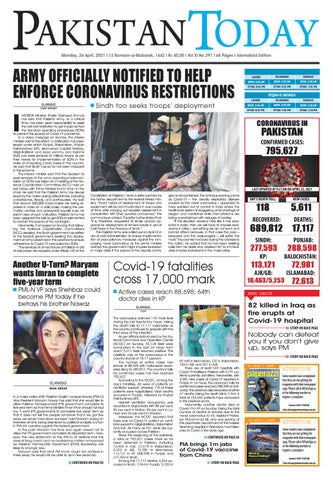
Monday, 26 April, 2021 I 13 Ramzan-ul-Mubarak, 1442 I Rs 40.00 I Vol XI No 297 I 68 Pages I Islamabad Edition
arMy offiCially notified to helP enforCe Coronavirus restriCtions ISLAMABAD
i
g
Staff report
NTerIor Minister Sheikh rasheed Ahmad has said that Pakistan Army, at a critical time, has been given responsibility to assist the civil administration to get implemented the standard operating procedures (SoPs) to prevent the spread of Covid-19 pandemic. In a video message on Sunday, the interior minister said to this effect, a notification has been issued under which Punjab, Balochistan, Khyber Pakhtunkhwa (KP), Islamabad Capital Territory, Gilgit-Baltistan and Azad Jammu and Kashmir (AJK) can seek services of military troops as per their needs for implementation of SoPs in the wake of increasing Covid cases in the country. He said that Sindh has so far not been included in this scheme. The interior minister said that the decision to seek services of the army regarding implementation on SoPs was taken at a meeting of the National Coordination Committee (NCC) held on last Friday with Prime Minister Imran Khan in the chair. He said that the Pakistan Army has always stood by the nation during critical times, including catastrophes, floods, and earthquakes. He said that around 400,000 Covid cases are being reported in India on a daily basis, making the cremation centres and graveyards equally busy. He said in view of such a situation, Pakistan Army has been assigned the task to get SoPs implemented to contain the spread of the contagion. Meanwhile, it emerged on Sunday that following the National Coordination Committee’s (NCC) decision, the Sindh government has written to the federal government, seeking the deployment of army personnel in the province to ensure adherence to Covid-19 precautionary SoPs. “The services of armed forces of Pakistan in aid of civil power are required under Article 245 of the
Sindh too seeks troops’ deployment
islaMabad
karachi
sehr: 3:53 aM
sehr: 4:38 aM
iftar: 6:41 PM
iftar: 6:51 PM
iftar: 7:01 PM
fiqah-e-jafaria lahore
islaMabad
karachi
sehr: 3:44 aM
sehr: 3:43 aM
sehr: 4:29 aM
iftar: 6:51 PM
iftar: 7:01 PM
iftar: 7:10 PM
Coronavirus in
Pakistan
CONFIRMED CASES:
795,627
LAST UPDATED AT 9:27 AM ON APRIL 25, 2021 Constitution of Pakistan,” read a letter penned by the home department to the federal interior ministry. “exact nature of deployment of troops and equipment will be communicated in due course of time after carrying out requisite assessment in consultation with [the] quarters concerned,” the communique added. The letter further stated that, “It is, therefore, requested to kindly accord approval for deployment of Armed Forces in aid of Civil Power in the Province of Sindh.” The Pakistan Army was called out on April 23 in aid of civil administration to ensure implementation of precautionary measures against the rampaging novel coronavirus as the prime minister warned the government might impose lockdown in major cities if the spread of the deadly conta-
another u-turn? Maryam wants imran to complete five-year term g
lahore sehr: 3:54 aM
PML-N VP says Shehbaz could become PM today if he betrays his brother Nawaz
gion is not contained. The ominous warning came as Covid-19 – the deadly respiratory disease caused by the novel coronavirus – appeared to have spiraled out of control in India where the healthcare system is staggering amid shortage of oxygen and medicines while crematoriums are being overwhelmed with deluges of bodies. “If the situation worsens here like it has worsened in India, then we will have to impose lockdowns in cities – something we do not want and cannot afford because, in that case the poor – labourers and the daily-wagers – will suffer the most,” the premier had said during the address to the nation. He added that he had been resisting calls from his aides who advised him to immediately impose lockdowns in the major cities.
Covid-19 fatalities cross 17,000 mark g
Active cases reach 88,698; 64th doctor dies in KP
Mian abrar In a major policy shift, Pakistan Muslim League-Nawaz (PML-N) Vice President Maryam Nawaz has said that she would like to allow Pakistan Tehreek-e-Insaf (PTI) government complete its five-year term so that Prime Minister Imran Khan should not foul cry. “I want (PTI government) to complete five years’ term so that it does not tell the people tomorrow that if we got five years, we would have done wonders,” said Maryam during an interview what is being described by political analysts a U-turn in PML-N’s narrative against the federal government. In the past, Maryam has time and again vowed not to allow the PTI government complete its stipulated term. However, the new statement of the PML-N VP reflects that the vows of long march and no confidence motion announced by Pakistan Democratic Movement (PDM) leadership are likely to change now. Maryam said that what PM Imran could not achieve in three years, he would not be able to do in five years too.
CONTINUED ON PAGE 05
118
5,611
RECOVERED:
DEATHS:
689,812 17,117 SINDH:
PUNJAB:
277,593
288,598
KP:
BALOCHISTAN:
AJK/GB:
ISLAMABAD:
113,121
72,981
16,463/5,253
72,613
82 killed in Iraq as fire erupts at Covid-19 hospital
tLtp
ISLAMABAD
NEW CASES:
MORE INSIDE
ISLAMABAD The coronavirus claimed 118 more lives during the last twenty-four hours, raising the death tally to 17,117 nationwide as the country continues to grapple with the third wave of the infection. As per official data shared by the National Command and operation Centre (NCoC) on Sunday, 55,128 tests were conducted in the last 24 hours from which 5,611 tests returned positive. The positivity rate of the coronavirus in the country stands at 10.17 percent. The number of active cases now stands at 88,698 with nationwide recoveries rising to 689,812. The country’s tally for confirmed cases has now reached 795,627. According to the NCoC, among the day’s fatalities, 40 were of patients on ventilator support, whereas 110 of these patients were hospitalised. Most deaths occurred in Punjab, followed by Khyber Pakhtunkhwa (KP). Highest ventilator occupancy was recorded in Gujranwala with 88 per cent, 85 per cent in Multan, 84 per cent in Lahore and 66 per cent in Mardan. Moreover, the NCoC reported that there was no Covid-19 patient on ventilator support in Gilgit-Baltistan, Balochistan and AJK. As many as 531 vents are currently occupied across Pakistan. Since the beginning of the outbreak, a total of 795,627 cases have so far been detected in Pakistan, including 16,463 in AJK, 21,618 in Balochistan, 5,253 in GB, 72,981 in Islamabad, 113,121 in KP, 288,598 in Punjab and 277,593 in Sindh. Among the 17,117 deaths, 4,593 occurred in Sindh, 7,964 in Punjab, 3,103 in
DAY'S DEATH TOLL:
STORY ON BACK PAGE
Nobody can defeat you if you don’t give up, says PM STORY ON BACK PAGE KP, 660 in Islamabad, 232 in Balochistan, 104 in GB, and 461 in AJK. There are at least 633 hospitals with Covid-19 facilities in Pakistan with 5,791 patients currently admitted. Meanwhile, with 3,056 new cases of Covid-19 reported in Punjab in 24 hours, the province’s tally for confirmed cases reached 288,598 on Saturday. The province also recorded another 67 deaths, taking the death toll to 7,964. A total of 233,655 patients have recovered in the province so far. Meanwhile, another doctor died of Covid-19 in KP on Sunday, taking the total number of deaths of doctors due to the novel coronavirus to 64. Assistant Professor Muhammad Ali, who was serving at the psychiatric department of the Naseer Teaching Hospital in Peshawar, had fallen prey to Covid a few days ago.
CONTINUED ON PAGE 05
PIA brings 1m jabs of Covid-19 vaccine from China STORY ON BACK PAGE
IN TODAY S ISSUE @paperazzimagazine
Issue 397
25 Apr-01 May, 2021
www.paperazzi.com.pk www .paperazzi.com.pk
Anaum hammad "h "how ow you re r respond esppo n d tto o w what h at hhappens ap pens tto o you iis s m more ore iimportant m portant tthan whatt han wha hhappens." ap pens s."
TRENDS
s is for s u i ts
Tak ake some style y cuess f om o our favourite from fashionistas.
ATTENTION Some readers have complained that they are not getting the magazine with their newspaper copy. Please call or WhatsApp us at the following number to register a complaint. Contact: 0307-7338168 irfan.farooq@pakistantoday.com.pk
IN TODAY S ISSUE
ATTENTION Some readers have complained that they are not getting the magazine with their newspaper copy. Please call or WhatsApp us at the following number to register a complaint. Contact: 0307-7338168 irfan.farooq@pakistantoday.com.pk
02
Monday, 26 April, 2021
ISLAMABAD
NEWS
PAkISTAN ReADy To TAlk IF INDIA RevISITS Aug 5 DecISIoNS: QuReShI ANkARA
F
StAff RePoRt
OREIGN Minister Shah Mahmood Qureshi on Sunday said that Pakistan would be happy to talk out differences and resolve outstanding issues through dialogue if India was willing to revisit the unilateral decisions taken on August 5, 2019. “If India is willing to re-visit some of the decisions that they took on August 5, 2019, Pakistan will be more than happy to engage, sit and talk out our differences and sit and through a dialogue resolve the outstanding issues,” the foreign minister said in an interview with Anadolu Agency of Turkey during his two-day visit there. He said that Pakistan had outstanding issues with India including Kashmir, Siachen, Sir Creek, water and other minor issues and the only sensible way forward was the dialogue.
FOREIGN MINISTER SAYS STAKES IN THE AFGHAN PEACE PROCESS ARE VERY HIGH “We cannot afford to go to war, you know, it will be mutually suicidal. And no sensible person will advocate a policy of that nature. So, we need to sit, and we need to talk,” he remarked. He said that it was India, not Pakistan, which ran away from talks and suspended the composite and comprehensive dialogue. He also said that the Indian unilateral actions of August 5, 2019 were against international law, UN Security Council resolutions thereby putting at risk, stability and peace of South Asia. However, he said, one recent development of recommitment to ceasefire during the conversation between the directors general of military operations from
Fazl calls PDM summit session on April 29
Work on CPEC western route in full swing: Asim Bajwa IsLAMABAD
News Desk Pakistan Democratic Movement (PDM) chief Maulana Fazlur Rehman has summoned a summit meeting of the alliance on April 29 in Islamabad. According to INP, estranged allies Pakistan People’s Party (PPP) and Awami National Party (ANP) have not been invited in the PDM session. The PDM session will give its final approval to the decisions of the steering committee, the report said. The opposition alliance will also set its future strategy in view of the departure of the PPP and the ANP, it added. PDM chief Maulana Fazlur Rehman earlier asked the PPP and the ANP to revisit their resignations from the alliance. In a press conference, Fazl said both the parties still have time to reconsider their decision and contact the PDM. He said that PDM is an alliance of the 11 opposition parties, where decisions are made with the consensus and if any party found violating the consensus, then it must be made answerable. Both the parties had the opportunity to summon PDM meeting to give an explanation on the matter, but they decided to part ways with the alliance.
Peshawar BRT to resume today PesHAwAR
both sides was positive development. “So, when they expressed an interest in recommitment, we welcomed it. Kashmiris have welcomed it. And that has, in my view, lowered tensions and has gone well on both sides. Sensible elements on this site and on that side have welcomed this new development,” Qureshi remarked. Moreover, he also referred to Indian Prime Minister Narendra Modi’s messages on Pakistan’s national day and a goodwill message to Prime Minister Imran Khan who also responded positively to it. “So, there is some thought. It is too early to make a value judgment on that,” he remarked. Coming to Afghan peace process,
Qureshi said that the stakes in the process were very high. “The stakes are high, simply for the reason that, God forbid, if there is no agreement, if there is no political settlement, the fear of going back into the 90s, the fear of Afghanistan going into a civil war is looming over our heads. And that is the last thing anyone of us wants. And that is the last thing Pakistan wants.” Regarding the United States’ decision for withdrawal of troops from Afghanistan, the foreign minister said that was one of the very important demands of the Taliban during the negotiations. So, by withdrawing, the Americans have conceded to that demand, he added. “We will certainly try and urge them (Taliban), you know, we will urge them to remain engaged and continue with the peace process, the process that started in Doha, should come to a logical conclusion through the Istanbul conference,” Qureshi remarked.
APP
China-Pakistan Economic Corridor (CPEC) Authority Chairman Lt General (r) Asim Saleem Bajwa on Sunday said that work on the CPEC western route was in full swing. He said that the Hakla-DI Khan motorway was near completion and would likely be opened for traffic in August/September this year. “Hakla-DI Khan Motorway construction work is in full swing, current progress is 86 per cent. Will be commissioned by Aug/Sep,” he said in his tweet. The Chairman informed that with priority on the Western route now, two other segments (Zhob-Quetta, Hoshab-Awaran) had already been started. According to an official in CPEC Authority, some 1,100 kilometres of roads had been completed through the mega-project, while 850 kilometres were under construction. On the western route, he said, the four-lane HaklaDera Ismail Khan motorway was in the final stages. Its total length was 285km, which had been divided into five packages. The first 55km package – which started from Yarik near D I Khan and ended at Rehmani Khel – would be completed on a priority basis, the official told APP. The National Logistics Company (NLC) has completed all infrastructure work of the motorway by keeping in view the international standards. The infrastructure work included construction of road, two interchanges at Abdul Khel and Yarik, six underpasses, four bridges, residential facilities and other
development works. The motorway passes mostly through deserted areas where there is a dearth of green areas, so around 150,000 trees have been planted along the motorway. The motorway would not only provide a fast and comfortable travelling facility for the commuters, but it would also link national highways N-50 and N-55 with the motorway at DI Khan, he said. After the completion, the travelling time between Islamabad and DI Khan would be reduced from existing over five hours to only two and half hours, the official added. Lt Gen Bajwa said that the second part of the western corridor, Yarak-Zhob-Quetta, was 540km long and would decrease the distance from Islamabad to Quetta to only 830km and would reduce travel time to eight hours. Similarly, work on the 146km Hoshab-Awaran motorway has also been started, and would improve connectivity with Gwadar port besides improving the living standards of the people who stay along the road. Talking about the overall progress of CPEC, the authority’s official said that the mega project would move forward with more pace during the current year and the years ahead, which would further strengthen the bilateral relations between Pakistan and China. Their strategic relationship, which was being strengthened with every passing day, was of great importance both on regional as well as international fronts, he said. He added that in the next phase, work on four important sectors, including industry, agriculture, socio-economic development and Gwadar New City would also be done at a fast pace.
INP
Peshawar BRT will resume its service from Monday (tomorrow) after partial suspension for a day on Sunday due to government measures to stem the possible spread of the coronavirus amid the ongoing peak. The transport service remained suspended on Sunday due to government steps to control the spread of the Covid-19. “The service will be temporarily suspended on Sunday due to possible prevention and spread of the coronavirus. Will be activated,” a spokesman for the service said. Recently, BRT Peshawar launched a public service/awareness message for commuters by a child star, Ahmad Shah, who urged transporters to follow the guidelines.
NAB opens probe against two PPP MPs sUkkUR INP
The National Accountability Bureau (NAB) commenced an inquiry against two Pakistan People’s Party (PPP) lawmakers — Aamir Magsi and his brother Nadir Magsi — over purported financial irregularities in the development schemes carried out in Qambar Shahdadkot. The Sukkur chapter of the agency has summoned Qambar Shahdadkot deputy commissioner (DC) along with the record of development schemes carried out between 2008 and 2013 on April 29. Uplift funds worth Rs2 billion were transferred to Jhal Magsi by Nadir and contracts were awarded on favouritism. The contract for the repair of roads damaged in the 2010 flood was given to Bilal Sheikh and others. The agency has asked DC to provide details of Rs850 million that were given to the city from 2008 to 2013. The DC has been asked to provide lists of the development work done by the two lawmakers.
Bilawal demands PM Imran’s resignation over inflation in country kARACHI INP
Pakistan People’s Party (PPP) Chairman Bilawal BhuttoZardari on Sunday demanded the resignation of the prime minister once again, this time stating that PM Imran Khan should accept responsibility for inflation in the country and go home. Bilawal said that leaders around the world think of ways to provide relief to the public but on the other hand, Imran Khan mulls new techniques to collect charity from the masses. People will not forgive the prime minister who imposed heavy taxes on them over demands of the International Monetary Fund (IMF), he added. The PPP chairman maintained that PM Imran has no empathy for poor and said that the only change the Pakistan Tehreek-e-Insaf (PTI) government brought is to provide relief to investors while inflation hits common man hard.
“Those talking against corruption have forced commoners to stand in long queues to get sugar,” the PPP chairman said, adding that the inflation was the highest it had ever been in the country. “A 100 per cent increase in the prices of medicines is tantamount to depriving the common man the right to life,” he added. Bilawal lamented that PM Imran did not seem to care about the parents who were unable to pay their children’s school fee. Bilawal questioned that if three years aren’t enough for the government to bring the “change”, why has medical treatment become so expensive at the government-run hospitals in Khyber Pakhtunkhwa (KP) in the last eight years. On the other hand, Special Assistant to the Chief Minister Punjab Dr Firdous Ashiq Awan said that it is not time for political point-scoring but to save the country and the nation from the coronavirus.
To another question, the foreign minister said that Pakistan could take advantage of its geopolitical position for generating economic activity and this China-Pakistan Economic Corridor (CPEC), Pakistan was providing a huge opportunity to landlocked countries like Afghanistan and the Central Asian republics. “And we want to create a win-win situation so that everybody gains from it. You know, China gains from it, Russia gains from it, Central Asian republics gain from it, and the entire region benefits from this, and it’s not confined to just the region,” he said. Moreover, anyone including the western countries, US or European Union interested in coming and investing in these areas would be welcomed. He said that being a neighbour, Pakistan could only help and facilitate and not make any decisions. However, cautioning against the role of spoilers, the foreign minister said there were elements that had benefited from the war economy. “People have made billions and there are elements outside of Afghanistan who would want Afghanistan to remain unstable because of the use of Afghan soil for their national objectives. So, recognising that there are spoilers, we also recognise there is a huge opportunity, which should not be missed,” he stated.
Punjab procured 856,000 tonnes wheat, says official IsLAMABAD APP
Wheat procurement drive is in full swing in Punjab as 856,000 tonnes of the commodity has so far been procured, said an official of the food department while talking to APP. “The food department has already achieved 25 per cent of its 3.5 million tonnes target since launching the drive to buy grains since April 15,” he said. More than 51 percent of gunny bags have been distributed and the food department has procured 855,934 tonnes of wheat which is 21.29 per cent of its target. Some 1.8 million tonnes of gunny bags have so far been distributed, said an official of the Food department Punjab. The daily arrival of wheat reached as many as 133,000 tonnes on Thursday, up from 90,000 tonnes a day earlier. Harvesting picks momentum in central Punjab as well as in South Punjab, the daily arrival would pick up the pace, he said. It is pertinent to mention that the quantum of the arrival of wheat in the next few days will also indicate the crop size. The country has not crossed 25 million tonnes in the last three years, with Punjab sticking around 18 million tonnes. South Punjab, where farmers have been reporting five to ten maund improvement on last year’s yield, the government was paying at a rate of Rs1,800 per maund, he said and added that wheat production mechanism in Punjab was much improved this year.
PTI Sindh lawmaker joins PPP kARACHI INP
A Sindh Assembly member of Pakistan Tehreek-e-Insaf (PTI) left his party to join the Pakistan People’s Party (PPP) on Sunday. Shaharyar Khan Shar announced his decision to join PPP during a meeting with PPP cochairman and former president Asif Ali Zardari. He won his seat — PS-18 (Ghotki-I) — on a PTI ticket in 2018 general elections. He would now resign from the seat and contest a by-election on a PPP ticket. Reports citing sources said the lawmaker was unhappy with his party leadership during the recent Senate elections.
UNICEF to provide protective gear to Pakistan to fight Covid-19 IsLAMABAD APP
United Nations Children’s Fund (UNICEF) will provide $14.5 million worth of personal protective equipment (PPE) to Pakistan to help contain the spread of a third Covid-19 peak.
The Pakistan wing of the organisation is supporting the Ministry of National Health Services (MoNHS) to procure PPEs kits and medicines worth $14.5 million with funding from World Bank, Asian Development Bank (ADB), and Gavi alliance. The kits will be distributed to staffers
in hospitals, isolation centers, quarantine centres and front-line vaccinators. So far, protection equipment worth $2 million has been handed over to Health Ministry for distribution. UNICEF is arranging the shipment of more kits through World Food Programme (WFP) Transport Common
Services to arrive in Karachi, starting July 13. The WFP flights are being made available for free to all Covid-19 response humanitarian actors. A total of 168 test kits (1,000 tests per kit) with a total value of $2.4 million, funded from World Bank funding are expected to arrive soon.
Monday, 26 April, 2021
ISLAMABAD
NoBody caN defeat you If you doN’t gIve uP, says PM IsLAMABAD
P
stAff RePoRt
RIME Minister Imran Khan has said that a nation cannot be destroyed with a dearth of resources, or even if you flatten them with bombs and tear them apart with wars, but it is destroyed if corruption takes roots in it. In his message to the nation Sunday on the occasion of the 25th anniversary of his party, Pakistan Tehreek-e-Insaf (PTI), the premier classified corruption in two categories: one of which he said is at the grassroots committed by clerical staff at public offices and patwaris, the other, he
IMRAN SAYS HE HAD EVERYTHING BEFORE GETTING INTO POLITICS UNLIKE THOSE WHO BUILT THEIR FORTUNE LATER said, was committed at the top level by the ministers and even the prime ministers themselves. It is the latter form of corruption that really drowns the nations as the entire country would succumb to heaps of debts acquired by those in power, the PM said. He established his argument by giving examples of all the third-world’s developing nations that they too were marred by the same menace of corruption by their ruling class and the same was the
case with Pakistan, which prompted him to start a political party based on this one cornerstone to end corruption from the ruling class. We named our party after justice, the PM said. “When there is justice, there cannot be any instance of corruption.” “Justice means the supremacy of law, meaning the weak and the mighty are equal before the law.” He said that this was the only motivation behind the endeavour he had
set out on 25 years ago today, adding that to a man like him who already had everything, including fame and money, even before choosing to be in politics, seeking justice was the goal, unlike others who had nothing before sliding into politics. “The first 15 years of this struggle were the most gruelling and many of our partners and friends cut off from us saying they were being ridiculed due to the farfetched ideas proposed by the party that had secured no seat,” he said. In the first election we fielded our people we won no seats but “those who do not give up hope, no one can really defeat them”, the PM noted.
Ventilator occupancy reaches 94pc in Lahore public hospitals LAHORe inP
The ventilator occupancy at public hospitals in Punjab on Sunday reached 94 percent due to the increasing number of critical Covid-19 patients. Official figures suggested the bed occupancy in the intensive care and high dependency units of the public hospitals in Lahore was alarming. The patients found it difficult to acquire a ventilator at the eight hospitals of Punjab that are reserved for coronavirus patients. The data showed that out of 84 ventilators available at Mayo Hospital, 81 are currently in use of critical patients. 32 ventilators at the Services Hospital were
also occupied by coronavirus patients. All the ventilators designated for the critical patients at Kot Khawaja Saeed Teaching Hospital and Mian Muhammad Nawaz Sharif Hospital, Jinnah Hospital, General Hospital, and Ganga Ram Hospital have already been occupied. Punjab Health Minister Dr Yasmin Rashid has said that more ventilators are being provided to the hospitals across the province to meet the growing demand. As the country battles a third peak of the pandemic, the higher education department closed down colleges in at least 25 districts across Punjab. With a deteriorating infection situation, the department had decided to close down all colleges falling in the limits of at least 25 districts.
NEWS
03
Baloch journalist shot dead in alleged robbery encounter News Desk A journalist was shot dead in an encounter with two motorbike thieves in the Bank Colony area of Quetta on Saturday evening, it emerged. According to the police, Abdul Wahid Raisani, who worked as a reporter and sub-editor at Daily Azadi newspaper, was on his way home when two men attempted to snatch his motorbike. During the struggle, shots were fired, one of which hit Raisani in the chest. Rescue teams took Raisani to the hospital “immediately” after the firing incident but he could not survive the wound and passed away. Police took the body of the slain journalist into their custody and shifted it to the hospital for further necessary action after the armed men fled from the crime scene. This incident occurred one day after senior journalist and former Press Club president Chaman Akhtar Gulfam survived an assassination attempt. Moreover, the Balochistan Union of Journalist (BUJ) condemned the assassination attack on the journalist and demanded a transparent inquiry into the incident and arrest of the culprits.
Iran bans flights from Pakistan, India TeHRAN Agencies
Panel discusses ways to achieve food, water and energy security LAHORe stAff RePoRt
A holistic approach and reliable database on water resources and their usage across Pakistan is the key to achieving food, water, and energy security in Pakistan — the fifth most climate-vulnerable country in the world, a panel attending the UN Food Systems Summit Independent Dialogue observed. The dialogue, organised by the International Water Management Institute (IWMI) and partners, highlighted the need for transformative approaches to promoting equity and inclusion in WEF nexus governance for sustainable water, energy and food systems. Other outcomes from the discussion, which included contributions from the Sustainable Development Policy Institute (SDPI), Pakistan Council of Research in Water Resources (PCRWR), Global Water Partnership, Pakistan Agricultural Research Council (PARC), stressed the
need for a substantial increase in research and development funds for the agriculture sector through active dialogues with donors and development partners. The participants laid emphasis on improving policy coherence among ministries through better coordination and capacity building and raising awareness among researchers, policymakers, government officials, and farmers about the benefits of WEF nexus modeling approaches to optimise agriculture production. Furthermore, they laid stress on the need for sizable interdisciplinary projects to realise true systems transformation and WEF nexus operationalisation through pilot projects in the Indus Basin of Pakistan that hosts one of the world’s largest contiguous irrigation networks. Conclusions from this event and three other Independent Water Dialogues will contribute to the Global Dialogue titled “Water: the game changer for food systems” on April 27 and ultimately to the UN Food Systems Summit in September.
The objective of the dialogue was to discuss how a shared vision for water and food security in the South Asian country could be achieved in a changing climate. Research shows that water security is posing serious challenges for the social and economic development of Pakistan, an agrarian country of 220 million people, amid the Covid-19 pandemic. IWMI Director General Dr Mark Smith said: “Pakistan is a region that is highly vulnerable to climate change. These conditions are negatively affecting water, agriculture, health, the environment, and other sectors in Pakistan.” “So, managing water risks in the food system is going to be one of the highest priorities in the future food system of Pakistan.” Ghufran Memon, secretary to the Ministry of National Food and Security Research (MNF&SR), said” “Transformation in food systems is among the most powerful ways to make progress towards all 17 Sustainable Development Goals.” “This dialogue explored the views
Imran striving to build welfare state envisioned by Iqbal, Jinnah: minister IsLAMABAD APP
Minister for Information and Broadcast Fawad Chaudhry said on Sunday that Prime Minister Imran Khan was striving for the establishment of a modern Islamic welfare state as envisioned by founding fathers Sir Muhammad Iqbal and Muhammad Ali Jinnah. In a video statement marking the 25th anniversary of Pakistan Tehreek-e-Insaf (PTI), he said only Imran could transform Pakistan following the vision of poet-philosopher Muhammad Iqbal and founding father Quaid-e-Azam Muhammad Ali Jinnah. He said that Imran founded the party 25 years ago on this day, a time when the country’s political scene was dominated by two parties, the Pakistan People’s Party (PPP) and the Pakistan Muslim League-Nawaz (PML-N). Chaudhry said that Imran had started his
struggle against the two-party system and at that time, very few people had any hope that he would be able to defeat the political culture of the time. He said the prime minister based his politics on the slogan of change and promised a “Naya Pakistan.” He added that the slogan meant to lay the foundation of a state in Pakistan in which the powerful and the public would be treated equally by the law. The minister said if Imran had wanted, he could have become prime minister by striking a deal with former president Pervez Musharraf but he never compromised on principles. He further said that the Lahore meeting in October 2011 proved to be a turning point for PTI and Imran became the most popular political leader in the country. He said even today, PTI is the largest party representing the middle class and lower middle class. He said that poor people expect that if anyone can give justice in Pakistan, it is only a PTI government headed by Prime Minister Imran.
of all stakeholders across Pakistan on a sustainable food system and the importance of this water, energy and food nexus in the changing climate.” Mohsin Hafeez, IWMI’s Country Representative for Pakistan said: “Around 80 participants from 12 countries had shared rich and diverse views on key bottlenecks in implementing the operationalization of WEF nexus in the context of Indus Basin.” “There is an urgent need for promoting inter-sectoral cooperation through evidence-based information to ensure water-food-energy security and environmental sustainability for food system transformation in Pakistan,” he added. The last of the UNFSS independent dialogues provided an opportunity for indepth exchanges to take place between diverse actors from across food systems, governments, think tanks, universities and international organisations to shape the pathways, which will lead to equitable and sustainable food systems by 2030.
Iran has suspended all flight operations to and from Pakistan and India because of the dramatic surge in coronavirus cases in the two countries, state-run IRNA news agency reported. IRNA said the decision was made by the country’s Health Ministry and it took effect Saturday at midnight. Mohammad Hassan Zibakhsh, spokesman for Iran’s Civil Aviation Organisation noted there are no routine flights between Iran and India and “flights are operated occasionally.” Several other countries in the region, including the sheikhdoms of the United Arab Emirates (UAE), Oman, and Kuwait, also have banned flights to and from India over the rise in coronavirus cases there. Zibakhsh said flights to and from 41 countries already were prohibited in Iran, while those who want to fly to other countries listed as high risk are required to have a coronavirus test in Iran. Travelers over 8 years old need to submit a negative PCR test within 96 hours of departure and do another test on arrival. Health Ministry spokeswoman Sima Sadat Lari said 18,230 new confirmed cases over 24 hours, bringing Iran’s total on Sunday to more than 2,377,039.
04
Monday, 26 April, 2021
ISLAMABAD
NEWS
MeaSleS outbreak In SIndh leaveS 6th ChIld dead JACOBABAD
a
TLTP
NOTHER child in Jacobabad district of Sindh lost his life on Sunday due to measles outbreak. According to District Health Officer (DHO) Abdul Ghaffar Rind, the child breathed his last at the district hospital, lifting the death toll to 6 in the district. He further said that 122 children are in-
fected with measles in the district. The outbreak of measles cases was reported in northern Sindh districts of Jacobabad and Shikarpur on April 01. The Sindh health department sent its team to the area after several cases of measles were reported in children in Jacobabad, Thul, Garhi Yaseen and other towns. The team also comprised the officials of the World Health Organisation (WHO), UNICEF and the Expanded Programme on
Immunisation (EPI). “In March 75 children infected with measles were brought to the National Institute of Child Health (NICH) in Karachi,” NICH head Dr Jamal Raza said. “In last three months over 160 children were brought to the hospital,” NICH chief said. “50 per cent children of them from other districts were infected with measles,” Dr Raza said. “Measles is a dangerous and deadly dis-
fection. Nearly 1 to 3 of every 1,000 children infected with measles are likely to die from respiratory and neurological complications. Symptoms of the disease usually develop 10–12 days after exposure to an infected person and last 7–10 days. Initial symptoms typically include fever, often greater than 40 °C (104 °F), cough, runny nose, and inflamed eyes. Small white spots may form inside the mouth two or three days after the start of symptoms. A red, flat rash which usually starts on the face and then spreads to the rest of the body begins three to five days after the start of symptoms. Common complications include diarrhea, middle ear infection and pneumonia, which are major cause of deaths of children with measles. Mothers who are immune to measles pass antibodies to their children while they are still in the womb, especially if the mother had acquired immunity through infection rather than vaccination.
ease for children. Most of the parents avoided measles vaccination to children owing to coronavirus and a large number of children remained from inoculation,” Prof Jamal Raza said. “Vaccination is the only safety for children against measles,” he said. Measles is a major cause of the children’s death,” Dr Raza said. According to experts, the respiratory disease is considered to be a highly virulent in-
Man dIeS after kIte StrInG SlItS hIS throat In lahore LAHORE: In an unfortunate incident, a man lost his life due to loss of blood after a razor-sharp kite string slit his throat in Lahore. The ex-army man died in the provincial capital due to the police’s failure to effectively impose ban on kite-flying in city. The incident occurred near Harbanspura Underpass in Lahore, where a citizen named Manzoor 51, a resident of Kahna in Lahore, lost his life after a razor-sharp kite string slit his throat while he was driving a motorbike. The victim was immediately transferred to the Combined Military Hospital (CMH) where he succumbed to the severe injury. Police handed over the body to the family after completing formalities. INP
faMIly looted In broad daylIGht outSIde ShoPPInG Mall In karaChI KARACHI: A family in Karachi was looted at gunpoint by armed men in a broad daylight as they disembarked from their vehicle outside a shopping mall in the city’s Gulistan-e-Jauhar neighbourhood. The video of the entire robbery bid was caught on camera, showing how two armed men deprived a family of their belongings in broad daylight. The incident occurred at around 7:00 pm and the video shows how two men intercepted a vehicle soon after it was parked outside a shopping mall in the Gulistan-eJauhar area. The armed men wearing facemasks approached the driving side as other occupants of the vehicle could be seen disembarking the vehicle and moving towards the mall. One of the armed men could be seen pointing a gun at the driver and collecting valuables from him and later approaching other family members and searching the vehicle for valuables as his other accomplice could be seen roaming behind with a gun in his hand. They later sped away on a motorcycle. INP
Punjab notifies schools closure in 25 districts amid pandemic The government of Punjab has notified closure of schools in 25 districts of the province witnessing over five percent Covid positivity rate, following a decision of the National Command and Operation Centre (NCOC). Sharing a notification on his Twitter account, Punjab Education Minister Murad Raas said that all public and private schools will be closed immediately in the districts stated in the notification till further notice. The districts mentioned in the notification included Lahore, Bahawalnagar, Bahawalpur, Bhakkar, Chakwal, Dera Ghazi Khan, Faisalabad, Gujranwala, Hafizabad, Jhang, Kasur, Khanewal, Khushab, Lodhran, Mandi Bahauddin, Multan, Okara, Pakpattan, Rahimyar Khan, Rawalpindi, Sahiwal, Sargodha, Sheikhupura, Sialkot, Toba Tek Singh. He further clarified that classes for grades 9, 10, 11 and 12 will also be closed in these districts, which resumed from March 26, 2021. The minister further shared that the schools will remain open with the previous schedule in 11 other districts of the province. NEWS DESK
Coronavirus outbreak: Shehbaz extends prayers for Indian people Pakistan Muslim League-Nawaz (PML-N) President and Opposition Leader in National Assembly (NA) Shehbaz Sharif on Sunday has extended prayers for the people of India ‘devastated by covid-19’. In a post on social-networking website Twitter, the PML-N leader wrote, “Humanity transcends religion and nationality at a time of death and disease.” Hope better sense prevails and South Asian countries can focus on ensuring healthcare of our people instead of spending billions on destroying each other, he added. The reaction came after India’s capital New Delhi extended its lockdown as the country’s Covid-19 crisis grew with infections and deaths hitting record highs. NEWS DESK
LAHORE: A view of Lahore Metro Bus at Azadi Chowk with Badshahi Mosque in the background. ONLINE
Lockdown imposed in more areas of Karachi, Lahore NEWS DESK Authorities have imposed smart lockdowns in more areas of Karachi and Lahore on Sunday, as coronavirus cases continue to surge in both cities. According to details, the district administration has imposed micro-smart lockdown in more areas of Karachi’s District Central from April 25 to May 8 due to surge in coronavirus cases. A notification has been issued regarding the imposition of micro-smart lockdown in four towns of the Central district from April 25 to May 8. The lockdown will remain imposed in different areas of Gulbarg, North Karachi, Liaquatabad and North Nazimabad towns. The lockdown has been imposed due to the presence of 46 coronavirus patients in four towns of the district. The micro-smart lockdown has been imposed in seven blocks of Gulbarg Town, Firdos Colony and Block-VIII area in Liaquatabad Town, Sector 11-A and B in North Karachi and Block A, B, L and J in North Nazimabad. According to the notification, all persons have to
wear face masks who are entering or leaving the specific areas, whereas unnecessary movement of the people has also been banned. All business and industrial activities will remain suspended in these areas, while the pillion riding has been banned. All kinds of family gatherings will be banned in the said areas and the coronavirus-positive persons will be quarantined in their homes. The government will take all possible steps for distribution of ration items among the entitled people, the notification added. In Lahore, authorities have imposed a smart lockdown targeting 15 areas till May 7. On the other hand, the smart lockdown in various parts of Punjab has been extended till May 17. As per the standard operating procedures (SOPs) issued by authorities, business centres in Punjab will be closed at 6:00pm while Saturdays and Sundays will be holidays where businesses will remain shuttered. In addition, amusement parks, cinema halls, sports events, cultural festivals, and gatherings will be completely banned during the lockdown.
Govt has left people at mercy of coronavirus: Iqbal NEWS DESK Pakistan Muslim League-Nawaz (PML-N) leader Ahsan Iqbal on Sunday said that incumbent government has left people on mercy of coronavirus. Ahsan Iqbal, while talking to the media, said that the government should be ashamed as only over 900,000 people have been vaccinated against coronavirus in a nation of 220 million. While criticising Prime Minister, Iqbal said that Imran Khan never followed coronavirus related SOPs and now how will people listen to him. On the other hand, deaths from Covid-19 have crossed 17,000 mark in Pakistan as number of positive cases surges to 795,627. According to the latest figures by the National Command and Operation Centre (NCOC) 5,611 persons tested positive for Covid-19 in the past 24 hours.
It’s time for curbing Covid, not point scoring: Firdous SIALKOT STAFF REPORT
Special Assistant to Punjab Chief Minister Dr Firdous Ashiq Awan on Sunday said that it is not time for political point scoring but to save the country and the nation from the coronavirus pandemic. All politicians, including Bilawal Bhutto-Zardari, should put politics aside for some time and play their role to com-
bat coronavirus so that human lives could be saved. She said this while talking to the media at a coronavirus vaccination centre on Sunday. The SACM said that the government had decided to close those districts which had above 5 per cent corona positivity rate. She said that at present hospitals in Punjab were being provided with oxygen and ventilators.
“We have to take all possible precautions to avoid coronavirus as its spread had wreaked havoc on India,” she said. She also said that the cooperation of people was essential to deal with such an emergency and coronavirus could only be defeated with the cooperation of people. The SACM said that all necessary goods would be sent to India on humanitarian basis as a goodwill gesture.
She said that the Punjab government is using all available resources for maximum coronavirus vaccination and is working day and night to prevent the spread of the deadly disease. Firdous said that Punjab government had so far vaccinated more than 934,000 people against coronavirus. On an average, more than 25,000 people are being vaccinated against coronavirus on daily basis, she added.
Monday, 26 April, 2021
IslAMAbAd
CoMplete loCkdown iMposed in Mardan for 7 days
t
NEWS DESK
HE Khyber Pakhtunkhwa (KP) government on Sunday imposed a complete lockdown in Mardan for seven days due to the rise in coronavirus cases. Kamran Bangash, the spokesperson for the provincial government, announced on Sunday that a seven-day complete lockdown would be imposed in Mardan from Monday as the positivity rate of coronavirus cases has crossed the 40 per cent mark there.
pakistan purchases 30.5m doses of Covid-19 vaccine from China ISLAMABAD
He said that pharmacies and shops of essential commodities will remain open. He appealed to the citizens to strictly follow the standard operating procedures (SOPs) to protect themselves against the virus. Earlier in the day, another doctor died in KP due to the virus. As many as 64 doctors have succumbed to the virus in the province since the start of the pandemic. Bangash also visited the Khyber Medical University (KMU) and its Public Health Reference Laboratory (PHRL). He was briefed by Dr Zia Ul Haq, VC KMU and Professor of Public Health, on the recent KMU
progress and future vision. Bangash then visited KMU lab and was briefed on daily activities of PHRL and its efficient role in KP for Covid PCR Testing. He was informed that KMU has done more than 600,000 Covid-19 tests since March 2020 and has increased its daily capacity to 3,000 Covid PCR tests. Bangash appreciated the role of KMU for its contribution and efforts of its staff as a frontline health worker. He said that the Higher Education Department KP under the leadership of CM and governor KP has been able to
news
05
fill all the VC positions in KP purely on merit based and “we have high hopes from them.” He said that the government is closely working with these new VCs to make the KP universities the highest seats of learning, education and research. Bangash said that looking at the potential of KMU staff under the dynamic young leadership, it will soon be one of the top medical universities not only in the country but at the regional level. He said that the contribution of KMU proved the dream of the current government that the university doesn’t only act as a degree awarding body but also contributes and provides solutions to the local problems. He also emphasised the continuity of testing capacity of KMU Lab and further enhancing it. He showed his concern over reports of a growing number of Covid-19 variants across the globe. He also stressed on the need for and adopting newer technologies for detection of Covid19 mutant strains. The vice chancellor updated Bangash about the KMU preparation for establishment and operations of variant detection using sequencing in a few days’ time.
Another U-Turn? Maryam wants Imran to complete five-year term
TLTP
Pakistan has purchased 30.5 million doses of Covid19 vaccine from China, which will soon arrive in the country, to vaccinate the people. According to sources privy to the development, the country has purchased 30.5 million Covid vaccine doses from three Chinese companies. “Pakistan will purchase 20 million jabs of single-dose Covid-19 vaccine from CanSino, besides also purchasing 5.5 million doses from Sinopharm and 5 million from Sinovac,” they said. It is pertinent to mention here that another Pakistan Air Force (PAF) special plane carrying 0.5 million doses of Sinopharm Covid-19 vaccine from China arrived in Pakistan on Saturday. The special plane carrying the vaccine arrived at Islamabad’s Nur Khan Airbase. This was the eighth Covid-19 vaccine consignment that arrived from China. China previously gifted 1.5 million vaccine doses to Islamabad. Separately in another development, three Pakistan International Airlines (PIA) brought one million more vaccine doses. On Thursday, Pakistan had received another shipment of 500,000 doses of a SinoVac coronavirus vaccine from China.
lease, insurance save pia from financial loss in airbus a320 crash KArACHI TLTP
Pakistan International Airlines (PIA) escaped financial loss following the Airbus A-320 crash on May 22, 2020 because the plane was insured. According to annual results of the company for the period ended December 31, 2020, the Airbus A320 was included in the fixed assets of the company as right of use asset (RoUA) in accordance with IFRS 16 ‘Leases’. The aircraft was on dry lease from GE Capital Aviation Services (GECAS). “As per the agreement, insurance for the aircraft was claimed out by the company; however, the settlement of the insurance amount will be directly between the insurance company and GECAS with no significant financial exposure to the company,” it added.
CoNtINuED froM pAgE 01 She said that PTI the government has been shaken and rather it has broken down. “The Jahangir Tareen group is much bigger than it looks. I am not ready to bear the burden of mistakes Imran Khan made. PML-N will not allow Imran Khan escape easily. I want him to complete five year’s term,” she asserted. Maryam said that the PTI has definitely broken down while the PML-N stands stronger than ever. “Every leader of PML-N was jailed but the PML-N came out stronger. PTI is broken today. Imran Khan is
afraid because he sees Shaebaz Sharif as his alternative. If Shehbaz Sharif betrays his brother, he could become prime minister today,” asserted the PML-N leader. The PML-N vice president said that if our goal was to form a government, it was a two-minute game. “But we wanted Pakistan to be run according to the constitution. Establishment and institutions should have no role in forming and overthrowing the governments and every institution must work within its constitutional limits. Although Shehbaz Sharif’s temperament is different from Nawaz Sharif but the only narrative of Nawaz Sharif would prevail in the PML-N. Shehbaz Sharif also accepts Nawaz Sharif’s narrative. I am sick
Malaria-free future is possible: Guterres ISLAMABAD TLTP
Malaria can be defeated if means are embraced tightly, United Nations Secretary General Antonio Guterres said on Sunday, marking World Malaria Day. “Malaria can be defeated. This #WorldMalariaDay, I commend all countries that have reached the ambitious target of zero malaria. Together, they are showing the world that a malaria-free future is possible,” Guterres said on Twitter. The UN chief, however, reminded that several countries, mostly African, are still suffering from the infectious disease. As cited by the UN news website, he said malaria kills more than 400,000 people, mainly children in Africa and infects over 200,000 million every year. Boosting hopes for the elimination of the disease, Guterres asserted: “With robust political commitment, adequate investment and the right mix of strategies, we can reach our common goal of a world free of malaria.” In February, El Salvador became the first country in Central America to be certified for Malaria elimination after proving that the country was Malaria-free for at least three consecutive years, according to the World Health Organization. The WHO grants a certification of malaria elimination when a country has proven that the chain of indigenous transmission has been inter-
rupted nationwide for at least the previous three consecutive years. China, which registered zero indigenous cases in 2016 and has recorded no malaria cases since then, applied last year for the WHO malaria-free certification. According to the UN health body, between 2000 and 2019, the number of countries with less than 100 indigenous malaria infections increased from six to 27, posing as “a strong indicator” that malaria elimination can be achieved. In 2019, Africa accounted for 94% of Malaria cases and deaths worldwide. Roughly 3% of malaria infections were recorded in South-East Asia and 2% in the Eastern Mediterranean region, while the Americas and Western Pacific region each accounted for fewer than 1% of all cases. Malaria is a life-threatening disease caused by parasites that are transmitted to people through the bites of infected female Anopheles mosquitoes. It is preventable and curable. It is an acute febrile illness. In a non-immune individual, symptoms usually appear 10-15 days after the infective mosquito bite. Nearly half the world's population lives in areas at risk of malaria transmission in 87 countries and territories. In 2019, malaria caused an estimated 229 million clinical episodes and 409,000 deaths. An estimated 94% of deaths in 2019 were in Africa, according to the WHO.
of answering this question time and again,” she asserted. Responding another question, Maryam said that the establishment did not want Nawaz to be active in Pakistani politics. “Because if Nawaz Sharif is active in Pakistani politics, then neither the selected nor the selectors will have any role. Now people will stand by the PML-N narrative. They will stand for the development of this country. As soon as the time of election approaches, the people will stand with Nawaz Sharif. The narrative of giving respect to vote would get popular and the people would vote for Nawaz Sharif who will win finally,” asserted Maryam.
Households save additional $5.4tn during pandemic: Moody’s NEWS DESK Households around the globe have accumulated $5.4 trillion in additional savings compared with 2019's spending patterns, Moody’s has said. An amount of $5.4 trillion equates to more than 6 percent of global gross domestic product (GDP). According to the rating agency, booming global consumer confidence suggests people will be willing to spend again as soon as shops, bars and restaurants reopen when coronavirus restrictions are eased. “The combination of an unleashing of significant pent-up demand and overflowing excess saving will drive a surge in consumer spending across the globe as countries approach herd immunity and open up,” said Mark Zandi, chief economist at Moody’s Analytics. The agency estimates that if consumers spend about a third of their excess savings, they will boost global output by just over two percentage points both this year and next. Zandi said excess saving was highest in developed economies, particularly in North America and Europe where lockdowns have been widely implemented and government spending has been high. In the US alone, households have stacked more than $2 trillion in extra savings, even before the $1.9 trillion stimulus programme by President Joe Biden was launched. Statistics, however, show that savings have been largely accumulated by richer households in all regions.
A CASE FOR PROMOTING INSTITUTIONALISED GIVING
A case for promoting institutionalised giving MuJAHID BArELVI Pakistan has a strong tradition of giving that dates back to the inception of the country in 1947. The partition of the subcontinent resulted in the largest mass migration in human history. As a result, individuals and organisations came together to support the rehabilitation of the migrants. Since then, there have been many occasions for Pakistanis to rise above challenges of varying degrees, presenting unique opportunities for people to demonstrate compassion and generosity. Over the past 74 years, Pakistanis have faced tragedies resulting from wars, floods, and earthquakes but we have always come through because of our resilience as a nation. Philanthropy, without doubt, is ingrained in the fabric of our society, which predominantly comprises of a Muslim community. Islam promotes charity not only in the form of Zakat during Ramadan but also
as Sadqa throughout the year. According to a survey conducted by the Pakistan Centre for Philanthropy (PCP), published in 2017, the total philanthropic giving of households in Pakistan was estimated at Rs240 billion, indicating that we contribute over 1 per cent of our GDP as charity. Despite being a developing country that falls in the category of low and middle-income country, Pakistanis have charity to GDP ratio comparable to countries from the developed world such as the UK and Canada. However, the survey also revealed that most donations in Pakistan go to individuals rather than charitable organisations. This finding is concerning because we can achieve more if individual giving is institutionalized. With structured giving, we can convert our nation’s powerful tendency of philanthropy into a more impactful phenomenon. There are many charitable institutions in our country that are excellent examples of achieving such a phenomenon and making
huge, meaningful impacts in Pakistan. Shaukat Khanum Memorial Trust (SKMT) is one such institution which has an enormous operating budget each year and nearly half of it is met with donations. SKMT runs two tertiary care cancer hospitals that provide free of charge treatment to over 75 per cent of all patients. The example of SKMT demonstrates that strengthening institutionalised giving can bring hope and life to thousands of patients who rely on such organisations for survival. The PCP’s report identified four main factors that drives individual tendency of giving and charitable organisations can work on developing these aspects to encourage people to participate in structured giving. First, spontaneous giving is driven by compassion in the moment. Second, religious entities have an infrastructure in place to collect small donations, such as door-to-door campaigns and donation boxes. Third, lack of trust due to distance and fear of misuse of
funds. Fourth, more wealth increases tendency to give to both, individuals and organisations. These claims are supported by trends indicating that organisations that have developed trust with the public because of transparency and accountability, have means to collect small donations, use human stories to inspire compassion in the moment, and are connected with the high-net worth individuals, have enjoyed widespread support amongst the public. There are many credible charitable organisations working in the areas of healthcare, education, et cetera in our country that show accountability to public by publishing their audited financial reports on their websites. There are hospitals where a simple visit to the facility is sufficient to establish that the donations are being spent judiciously. Simply by looking at patients in the outpatient area, one can tell by their dilapidated conditions that they can barely cover travel costs, let alone expensive treatments. Chari-
table hospitals like Shaukat Khanum have gone an extra mile in gaining trust of donors by exhibiting an exceptional commitment to patient safety and services endorsed by international accreditation and delivered on the basis of equality. The services are of the same standard for all patients and dispensed in the same manner whether a patient is selfpaying or receiving financial support. By promoting institutionalized giving, we can channelise support of the public to achieve incredible feats and we have seen this possible in our country where institutions are run with the support of the public to deliver hope. There is a dire need to strengthen the trend of institutionalized giving to maximise impact of philanthropy in the fields of education, healthcare, poverty eradication and many other noble causes in our country. Pakistanis should proudly support credible charitable institutions and promote welfare of their fellow citizens.
Monday, 26 April, 2021
06 COMMENT
Uniting the Muslim Ummah against Islamophobia
Is there a backchannel? Why are Shah Mehmood Qureshi’s denials not convincing?
F
OReIGN Minister Shah Mahmood Qureshi has denied categorically what so many had been speculating knowingly about: that India and Pakistan had been engaging on a number of issues, using backchannels, with third countries mediating. The UAe Foreign Minister, with whom Mr Qureshi had held talks on his recent visit there, had recently come out with a forthright statement that the UAe was facilitating these backchannel talks. The UAe Foreign Minister’s claim was seen as explaining the numerous signs of a thawing of relations, starting from the LoC ceasefire agreement and down to the exchange of good wishes between the two PMs on the occasion of Pakistan’s Republic Day. The goodwill almost extended to a reopening of trade, as Pakistan decided to import cotton and sugar from India, but then reversed the decision the next day, as certain quarters felt that the pace was too fast. There seemed to be something of a reopening, with Prime Minister Imran Khan offering India, which is going through a massive Covid-19 crisis, with almost daily records being set of new cases and deaths, help. Interestingly, Mr Qureshi also tweeted an offer of help. It is almost as if Mr Qureshi, who was one of those who had opposed the reopening of trade, has made amends by his statement about backchannel talks, for an offer that seems prompted more by his heart than his head. Pakistan has to deal with a neighbour that is both committing brutalities upon the Kashmiri people, and dealing with its worst public health crisis since the influenza epidemic years ago. For solid dealings, a clear line is required. The reversals and flip flops that are being witnessed may make certain quarters satisfied, but they do not develop confidence among the intended interlocutors. Two of three parties in the backchannel talks have spoken, one of the principals, and the mediator, and they have contradicted each other. It now remains only for the Indian Foreign Minister to make a claim. But he should not expect to be believed when he speaks, because one of his counterparts will be contradicting him .Pakistani diplomacy finds itself challenged perhaps as never before, and must carry itself through the whole situation, where it will find that it has to deal with those who must strike a deal, but who have invested so much in a hawkish posture, like the BJP government.
MuhaMMad Zahid Rifat
T
he Muslim Ummah has confronted three major problems over varying periods, which are lingering, the unresolved and burning issues of Kashmir and Palestine and the mounting threat to humanity in general and Muslims in particular in the form of Islamophobia in the name of so-called freedom of expression. There is a marked difference in the respect which the believers of Islam and other regions and faiths have for their prophets. Muslim believers respect from their hearts all Messengers of Allah from hazrat Adam to Last of the Prophets hazrat Muhammad (PBUh). Their faith remains incomplete if they do not respect any of them. They have the greatest respect and love for hazrat Muhammad (PBUh) and cannot stand anyone showing disrespect and indulging in blasphemy towards him. Words are not enough to explain the highest esteem in which the Muslims hold their holy Prophet (PBUh).As compared to this, the believers of other religions and faiths not only show disrespect their own prophets but also the Last of the Prophets (PBUh), thus indulging in blasphemy which has come to be known as Islamophobia, a menace which is increasing in the Western world in the name of freedom of expression. In doing so, they hurt sentiments and feelings of the Muslims the world over but they do not care anything about this. Prime Minister Imran Khan talked about the menace of Islamophobia at least twice during last couple of days while addressing a function and addressing the nation, calling for unity among the Muslim Ummah and suggesting to the heads of 50 Muslim states to unanimously give a call to boycott of trade with any Western country where blasphemy is committed and Islamophobia resorted to at the official level or privately in order to put a stop to blasphemy. even boycotting products of any country promoting Islamophobia will be like hitting the economy of that particular country and will be more effective than merely breaking up diplomatic relations. Apparently this is a gigantic task which the PM has taken upon him. he also pledged to lead the campaign himself. Still it is a positive move in the right direction as the collective voice of the Islamc world will certainly and surely will carry more weight and
Crossing $1 billion Success shouldn’t hide barriers to FDI
Lives or profits?
T
he Roshan Digital Accounts for overseas Pakistanis have crossed $1 billion. Understandably, Prime Minister Imran Khan is pleased about this, and had tweeted the success. however, this should not be assumed to be a substitute for Foreign Direct Investment (FDI), which has declined in recent times, and to which there are significant barriers, which have not been removed, even though this was one of the planks on which the present government was elected. The present government should not be too impressed with itself, for it still has to establish the sort of trust which would let Pakistanis send Pakistan the sort of money that the PTI rather overoptimistically predicted would flow in once Mr Khan was elected. however, the PTI would be deluding itself if it thought that the success of the RDAs was because that trust had been established. A closer examination would show that the money came in because the RDA framework allowed for innovative banking, and the creation of a banking product that was more attractive to the depositor than others on offer. The problem is that the barriers to FDI remain. While there has been much work done successfully towards cleaning up the taxation problems that acted as a brake, some area s have not been addressed, such as political stability, which makes potential investors wary about whether their investments might be hit by some radical revision in public policy. There is also the fear of changes made solely to victimize a party which had invested under a previous (rival) government. The PTI has carried outs its share of actions which have given foreign investors the jitters, with the result that instead of foreign investors coming in, there have been instances of those who have already invested here, leaving. Foreign companies cannot be forced to invest. however, they can be persuaded. They cannot be persuaded by appeals to patriotism. As a matter of fact, overseas Pakistanis are left cold by such appeals. The reason the RDAs succeeded was that they were good banking products. In the same way, FDI will only occur if companies fell they will make some money. The government must never forget that.
The drug industry needs to make up its mind aks e Zainab
L
IFe-SAvING drugs are categorized as priceless products, products with exceptional value beyond the standard of market or market value that suits the business. There are many ethical concerns to being in the business of life-saving drugs, like their prices, availability, and profit margins. As far as the prices are concerned, many argue that there is a price for these priceless products. If the companies start charging according to demand and supply, it will create an inappropriate monopoly. Companies claim that they invest hefty amounts in R&D, production, legal requirements and safety measures. So they are bearing high production and operation costs while making such drugs. however, consumers are demanding low prices, but everyone may need them to cope with any life-threatening disease. So there is a clash between business and consumer. The consequence is shortage and unavailability of these drugs in the market as pharma companies are not motivated to produce these drugs on very low-profit margins. Businesses and the authorities need to solve this sensitive issue by creating a mutual benefit system for both. An article argues that the pharmaceutical industry comprises many greedy people trying to make a buck off you and your ailing family member’s illnesses. They neglect the standard method of setting the prices, by demand and supply. Moreover, they charge arbitrary high fees. This industry is doing business based on the voluntary exchange of mutual benefit. however, the companies claim that they are charging high prices because they have assumed that the industry has somehow become able to work outside the constraints of demand and supply. On the supply side, the production cost is very high, and investors are demanding high returns from risky investments. Meanwhile, on the demand side, people are willing to pay to save lives. Production of these drugs is extremely risky and expensive. The pharmaceutical industry has spent $30 billion on research. Not only this, but companies are also paying a healthy amount to FDA, which companies must have to pay to evaluate their product. So if we consider the lump sum amount on R&D that
Dedicated to the legacy of the late Hameed Nizami
Arif Nizami Editor Yousaf Nizami Aziz-ud-Din Ahmad Managing Editor
Joint Editor
Umar Aziz Executive Editor
Lahore – Ph: 042-36300938, 042-36375965
impact than Pakistan’s alone. Imran can easily be ranked amongst the first leaders of the Islamic world to raise the issue of Islamophobia and who continues to forcefully raise his voice for effectively combating this scourge and calling upon the Western countries and their leaders to show respect to the sentiments of the Muslims who cannot stand blasphemy for Prophet Muhammad. he continues to raise his voice unendingly, availing every opportunity when addressing an international gathering or forum. Tackling the menace of Islamophobia was the main theme of his address at the 14th Summit of the Organization of Islamic Countries (OIC) held in Makkah, Saudi Arabia, in June 2019, within months of his coming to power only in August 2018. This was followed by his maiden address to the 74th UN General Assembly session in New York in September 2019 when he mentioned that trends of nationalism, increased global tensions and giving rise to racial and religious hatred and violence against vulnerable minorities had accentuated Islamophobia, Muslims continued to be targeted with impunity in many countries, their shrines destroyed, their Prophet (PBUh) insulted, the holy Quran burnt and all this was being done in the name of freedom of speech. It was on this occasion that the PM called upon the world form to declare an “International Day to Combat Islamophobia” , build a coalition to fight this scourge which most unfortunately splits humanity. In his virtual address to the 75th UN General Assembly session in September 2020 (due to the pandemic of Covid-19), the Prime Minister of Pakistan had called for willful provocations and incitement to hate and violence to be universally outlawed and repeated his demand declaration of an International Day to combat the menace of Islamophobia. Continuing his efforts to highlight the evil impact of Islamophobia in the Western world mainly, Imran addressed letters to the leaders of all Muslim countries in October and November 2020 wherein he had listed an agenda for collective action by the Muslim Ummah against Islamophopbia. he had, as the record goes, also demanded a ban on Islamophobia in any form and manner on Facebook in his letter addressed to Facebook CeO Mark Zuckerberg . It is appreciable that like he has been raising voice for the right of self-determination for the Kashmiris, the PM has also been raising the issue of Islamophobia at all other international forums from time to time including the
I
Karachi – Ph: 021-35381208-9
I
these companies pay is about $80 million. Like any ordinary business, companies in the pharmaceutical industry also want to profit from their investment as they have to spend millions on employees and meet the R&D and other operation costs. Other enterprises reinvest four percent of revenue. This industry reinvests percent.This industry is extremely risky. As drug production is a long-term process, produced by trial and error, a high probability exists of the product’s failure. It is an ongoing debate what prices should be. Whether the comnies should charge hefty fees to keep themselves motivated or accept low profits to make the drugs affordable. Several biotech companies produce cancer drugs according to high market demand and avoid a shortage, but the number of approved drugs is in a single digit, so companies fail to earn from the drugs. Some factors could mitigate prices. The first is to increase the competition. When the competition increases, the small compound is traditionally priced below the costs of cancer drugs. The second factor is improvement in patient selection for therapy. Cancer drugs are set in a way that some patients would benefit. For example, the Cetuximab drug is one of the most expensive antibodies, helps only 10 to 15 percent of cancer patients, but there is no current test to find out the individual’s responsive subset. The government plays an important role pricing, as it is a significant purchaser. The government could also subsidize the industry that would help them to reduce the cost and ultimately the prices. It is challenging for a company to set the price of drugs, where highly challenging scientific innovation is required, and it also focuses on corporate social responsibility. Since scientific progress is driving high cost, ultimately, this progress is saving lives, but they have to be limited. however, the limits are still not defined appropriately. After the price issue, there is availability of lifesaving drugs to all in need. The concern is drugs must be available to every person suffering from deadly diseases. Whether the patient belongs to a developed or developing nation, everyone must have a supply. In the Pakistani context, many researchers have written articles on the shortage of drugs. In 2018, when the currency of Pakistan started devaluing, life-saving drugs began vanishing from the market. All the pharmaceutical companies, either national or multinational,
Islamabad – Ph: 051-2204545
I
Web: www.pakistantoday.com.pk
I
Shanghai Cooperation Organization (SCO) and economic Cooperation Organization (eCO) . Intense diplomatic efforts of Pakistan for months together have started showing positive response from the Muslim Ummah as towards end of last year, a key resolution was adopted by the Organization of Islamic Cooperation (OIC) at Pakistan’s initiative. The 47th OIC Council of Foreign Ministers meeting held in November 2020 in Niamey, Niger, a Pakistan-led resolution on Islamophobia was was unanimously adopted. The resolution among other things authorized the OIC Permanent Missions in New York to jointly table a resolution in the UN General Assembly for designating March 15 as the “International Day to Combat Islamophobia”, urged the OIC members to organize and support various highvisibility events aimed at effectively increasing awareness at all levels about curbing Islamophobia and anti-Muslim hatred, reaffirmed that desecration of the holy Quran and reprinting of caricatures of the holy Prophet (PBUh) were not legitimate expressions of the right of freedom of expression and opinion under international human rights law, called on the OIC Secretary General to continue monitoring the phenomenon of Islamophobia and also called upon the UN Secretary General to initiate a global dialogue on countering rising Islamophobia and promoting inter-faith harmony. In accordance with the mandate given by the OIC Council of Foreign Ministers, Pakistan is continuously pursuing quite actively with other Islamic countries and UN Members to table an OIC Resolution at the UN General Assembly on “International Day to Combat Islamophobia” . Furthermore, Pakistan also joined the OIC Group in New York only last month to commemorate the OICdesignated International Day to Combat Islamophia. Foreigtn Minister Shah Mahmood Qureshi, owing to the prevailing pandemic contributed a video statement. Needless to say, as pledged by the Prime Minister, Pakistan will continue to utilize all available avenues to persistently counter Islamphobia. It is a long drawn battle. But a beginning in the right direction has been made at the initiative of Pakistan. Continuous efforts by the entire Ummah may start showing some signs of impact sooner or later. Pakistan’s missions abroad, particularly in Western countries, must be actively involved in interaction with intelligentsia, public leaders, media people and elected representatives, telling them repeatedly emphatically that if holocaust denial is not acceptable in the West, nor is Islamophobia to the Ummah and believers are ready to die rather than withstanding blashoemy by anyone in respect of the holy Prophet (PBUh). The writer is Lahore-based Freelance Journalist, Columnist and retired Deputy Controller (News) , Radio Pakistan, Islamabad and can be reached at zahidriffat@gmail.com
stopped production because of increased costs. Several national and international companies are manufacturing drugs in Pakistan, but the raw materials and other important inputs are being imported from other countries like India, China, and european states. So with the currency devaluation, the production cost increases. As they cannot raise their prices, so they stop the production of these drugs and they vanish from the market. even in 2020, reports suggest that Pakistan lacks life-saving drugs due to these pricing issues. According to the pharma industry, the medicines produced locally have one standardized price, which is not suitable for companies. That is why they stop manufacturing. Only five companies produce the nitrofurantoin drug. however, now they are not making it because Drug Regulatory Authority Pakistan (DRAP) has approved the retail price of Rs.144, which is not feasible for local manufacture. Despite the lack of these life-saving drugs, many patients are surviving. Availability of these products is very critical as it is a matter of someone’s life. It is not a good thing that any patient gets the reply that there is a shortage of medicine. Whether government or non-governmental, authorities should take action on the lack of these priceless drugs and make them available to every needy customer. As far as ethics are concerned, there is the point that many Pharma Industry companies are not only manufacturing the drugs because of the demand-supply gaps, or they are not meeting their expenses on that particular standardized prices but also they have halted the production for some other reasons. Whenever companies want to increase the retail prices and their profit margins, they artificially make the shortage of these drugs so that demand increase so they could charge any price. Customers would buy their product. After all, it is the concern of their lives. Sometimes we have to decide what is more important. The vast profits the company enjoys, or its ethical and social responsibility towards other stakeholders. The decision is so tough and varies from mind to mind. human life is considered priceless, and you cannot value it monetarily. When you are involved in producing products that are directly concerned with human life, it becomes as difficult to evaluate that product with respect to human life. There are several opinions on the pricing and availability of these drugs. Companies try to balance between their own and consumer’s benefit. The solution is for the authorities to regulate this industry from raw material to the end-user. A proper and standardized channel must ensure the fair allocation and availability of the products everywhere. The writer is a freelance columnist
Email: editorial@pakistantoday.com.pk
Monday, 26 April, 2021
COMMENT 07 Editor’s mail Send your letters to: Letters to Editor, Pakistan Today, 4-Shaarey Fatima Jinnah, Lahore, Pakistan. E-mail: letters@pakistantoday.com.pk Letters should be addressed to Pakistan Today exclusively
Saving lives as a good in itself IN a country where people do not often have basic necessities of life, dreams are often a luxury. In such a situation, it is tempting to question the value of saving someone’s life who has no dreams, crushed under the weight of poverty. Being a regular donor to a cancer hospital, I faced with this dilemma when I came across the story of a cancer patient. He was a father of five children, including four daughters and one disabled son. His first-born, physically and mentally challenged, requires special attention and care by his parents. He works as a labourer and cannot afford to send his children to school. His second son, who is still a young boy, accompanies his father daily to work so they can earn enough to put food on the table for the family. In 2019, he was diagnosed with cancer and successfully treated at Shaukat Khanum memorial Cancer Hospital and research Centre in Lahore. I should have been happy to learn about this cancer survivor but I felt weighed down by a question: we are working so hard to save lives of people who are deprived of having the luxury to be able to dream for themselves or even for their children. However, then I realized that saving a life is not a means to an end, it is a good in itself. We are no ones to judge if a person’s life is worth saving based on his ambitions or dreams. Every life that God has created on Earth, deserves to be loved, respected and saved. As the month of ramzan is coming up and we will be blessed with the opportunity to help others, we must remember that the act of saving lives is a good in itself. ShEikh SalEEm lahorE
China’s military & economic rise in East Asia How it has contributed in making it a credible threat for the USA Hamza Niazi
F
rom being one of the poorest states to the world’s second biggest economy. China has done a marvelous job in every sector whether military, economy, or infrastructure. When President Xi Jinping came to power he had a vision, indeed a dream, of one China. making China great and this vision of his inspired the whole nation of 1.4 billion people. There are different age groups and different communities, communities with a variety of religions, but President Xi’s vision makes them all one. Surveys in various parts of China show the people just love him, because of his vision for China. In the China dream President Shi has dreamt about three main factors for China, power, wealth and respect. It’s not as China was always on the path to success and prosperity, now that it is, it is respected by the world. And there is evidence that during the past 40 years the world is admiring Chinese success. China has shifted from an agricultural state to a global technology manufacturing powerhouse contributing almost 30 percent to the world economy. China is now the world’ second largest economy. China has lifted its 800 million population out of poverty. China’s economy skyrocketed when it joined the WTo in December 2001. This was a major breakthrough. China’s integration cemented its position in the global economy. Companies like Ford, Apple and Nike others started manufacturing products in China due to the cheap labour. Due to the WTo many developed economies started coming to china like the USA and many others, and those economies led China to stand where it is now . In the next 15 years the Chinese economy skyrocketed and one can see from the figures how things moved very fast, faster than anybody expected. Not only in the economic sector, has China also proven itself in the military domain. Since China adopted its open-door policy in 1978, the People’s Liberation Army is building up its military capabilities. The economic growth over the years has helped a lot.military expenditures have skyrocketed fivefold since 2000, although China has downsized its military from six million troops from 40 years ago to two million now. If the 1970s era at that time China had J-6 fighter jets which were outdated. But China now has the J-20, China’s first stealth fighter jet. The J-22 is often compared to the USA’s -22 fifth-generation fighter jets. Ac-
cording to the Pentagon the Chinese Air Force is now the largest in Asia and the third largest in the world. The Chinese military is second only to the military of russia and that of the USA. Its military expenditure is the second largest in the world. China is continuously modifying and building up military capability which poses a constant threat to its hostile neighbours. The branches of the People’s Liberation Army are: Ground Force (975,000 personnel), Navy (240,000 personnel), Air Force (395,000 personnel), rocket Force (100,000 personnel) and Strategic Support (175,000 personnel. The PLA is the world’s largest military force. And the world’s fastest modernizing military force. The skyrocketing progress in economic, military and technological strength has created a serious threat for some of its hostile neighbours and some other states like the USA. The USA on many occasions has accused China of stealing jobs from it. The advancement in technology like the past case of Huawei. This issue disturbed China’s economy very badly. The CIA Director said in an interview that the constant Chinese economic growth was affecting the USA, and it was not very fond of this extreme progress in almost every sector whether economy, the military or technological development. He continuously criticized China for capturing or occupying islands in the South China Sea, another major issue in Sino-US relations.The USA claims China is occupying islands which are rich in minerals and also hold a very important strategic location and can also be used for trading purposes. US Secretary of State mike Pompeo said that China’s threat to India and South East Asian states is one of the reasons US troops are being deployed in other areas. He challenges the actions of Chinese Communist party, that its actions meant that there were threats to India and
It’s not as China was always on the path to success and prosperity, now that it is, it is respected by the world. And there is evidence that during the past 40 years the world is admiring Chinese success.
other states. Pompeo also blamed China for wanting to undo all the progress of NATo. He also blamed China for escalating serious tensions with India in the Ladakh region. The USA is very much involved in the South China dispute and says apart from India, China is also involved in various territorial disputes in the South China Sea and with many East Asians states. In an interview with the Chinese ambassador in India, he said that the 20 Indian Army personnel killed in that incident was not the responsibility of China. When asked how many Chinese army personnel were killed in that incident, he answered that the answer or information would not be able to ease the situation between the two states, but would only escalate the situation. Concluding the above material it can be concluded that the rise of China as an Asian giant, or one can say that the regional dominan, is a constant headache for its adversaries or states like the USA. And most importantly one can conclude after a deep study of Chinese strategies that the Chinese government, the Chinese military is capable of dealing with the opponents like the USA and China is able to tackle serious or one can say dangerous situations. Currently China is rising in a positive way through its massive trade industry in which the foreign developed economies which have been discussed above play a very key role in the skyrocketing progress of China. China’s forceful disposition is showing that China is equipped for taking care of the multitude of threatening nations and can be managed whenever required. Presently China, through the force of its economy, has effectively occupied the regional debate of its neighbors. The military and the monetary ascent of China will help it to make the distinction of China at the global level. China utilized the serene technique to acquire strength as far as the military which is currently difficult for the world forces and furthermore drawing in different nations in such manner as far as the economy. China’s quiet ascent on the planet is growing acceptable justification for China later on legislative issues of the world and give the world another feeling of harmony and financial advancement in spite of the conflicts and the showdowns.
The military and the monetary ascent of China will help it to make the distinction of China at the global level. China utilized the serene technique to acquire strength as far as the military which is currently difficult for the world forces and furthermore drawing in different nations in such manner as far as the economy.
The writer is a freelance columnist
Still waiting THE most effective way to control the virus is to vaccinate a large number of people. For this, the government of Pakistan has taken a good step to vaccinate people. But unfortunately, the government has just started the vaccination process in big cities. on the other hand, people living in remote areas are still waiting for the government that when he will start Covid vaccination process . Yes, it is certainly right that the non of remote areas, has not gotten any vaccine. Though getting vaccine is the best way to defeat the deadly virus Covid-19. But the government is failed in this regard. I urge the government should start vaccination programme in remote areas too as soon as possible. imran Sattar turbat
Now I can breathe A verdict heard around the world, murderer police officer of George Floyd convicted and sentenced to jail. A full federal investigation has been lodged into the police practices in the city of minneapolis. The US justice department stated this murder as unconstitutional and unlawful. Yes, no doubt, a historical verdict for the blacks in America and landmark in the history of justice in the modern world. But the history of hundreds of years of injustice towards blacks will never be eradicated in a single decision but it is inception of better time. There is also a need for systemic change in the socio-cultural fabric of the White dominated society. Now, we can say that it is the first step towards black lives matter and the formation of egalitarian society in the Americas. ammar ul haSSan ChiShty mian Channu
Ullema protest SPECIAL Assistant to Prime minister on Interfaith Harmony Hafiz muhammad Tahir mehmood Ashrafi has said that muttahida Ulema Board will not accept exclusion of Islamic material from the curriculum. Addressing a press conference here on Sunday, he said a one-member minority committee had recommended exclusion of Islamic material from the curriculum and it did not inform even the Punjab Assembly, neither the Supreme Court was aware of the recommendations. He said that representatives of minorities had also rejected such recommendations. He urged citizens to follow the corona standard operating procedures (SoPs) even in mosques and pray for complete elimination of the pandemic. Sohail ali khan iSlamabad
Fast food NoWADAYS, more and more people are affected by health issues such as diabetes and heart diseases, which are linked to over consumption of cheap, and mass –produced food. Some people believe the only solution is to make fast food less affordable by taxing it highly. Despite the severity of the problem, I think this is quite wrong. Increasing the tax on fast food would unfairly penalize people and may not necessarily bring about the desired health benefits. First, fast food is about more than just nutrition. many teenagers spend money on fast food not because they need to eat out but because this is how they socialize. Fast food restaurants provide a safe, convenient place for young people to meet friends. For another group, low income families, fast food can provide an inexpensive treat for their children. Denying people a small pleasure in life could affect their social lives or happiness. Another important point is that if the reasons for taxing fast food is to reduce obesity, it may be in effected. It is true that fast food is high in sugar, salt, and fat, all of which cause weight gain and are detrimental to our health. However, we also know that there are other factors which contribute to the risk of obesity, such as lack of exercise and inappropriate portion size. While home cooked food is generally healthy, this is not always the case. I personally knows a family that used to eat high-fat, home-cooked food in enormous portions. They all suffered from health problems due to obesity. on the other hand, I do understand the point of view of those who say drastic action is needed. If fast food were taxed and became expensive, people would be forced to seek out healthier options. In addition, food producer would have an incentive to provide healthier foods. However, there is likely to be resistance from consumers and producers who want to have a wider choice. To conclude, although imposing a higher tax on fast food could have some positive effects, these would be outweighed by the drawbacks. tariq anjum lahorE
Monday, 26 April, 2021
08 WORLD VIEW
US armS SaleS Since 9/11: Power, Profit or PrUdence? we find considerable evidence that strategic and economic factors drive interests and exerting leverage over the conduct of recipient nations. By arms sales, but no evidence to suggest that risk plays a meaningful role. increasing the military capabilities of the recipient nation, arms sales can— Downside risks are rarely considered explicitly or appear to have ever af- in theory—help allies win wars, deter adversaries, and promote stability or buttress friendly governments against insurgencies and other internal fected the transfer of weapons. moreover, by our measures, the United States has taken increasingly challenges. The attractiveness of arms sales in these cases stems primarily higher risks from 2001 to today. our findings raise important questions from the fact that selling weapons to allies is less risky and less costly than about how well the United States is managing the trade-offs between strat- basing American troops on foreign soil or having them fight alongside alegy, economics, and risk. Critics have long argued that the United States lies, though they also allow the United States to signal intentions to both is too quick to approve sales to nondemocratic clients with poor track allies and potential adversaries. American foreign policy and the flow of American weapons indicate records of human rights. Efforts in Congress to stop arms sales to Saudi Arabia over its intervention in the Yemen civil war are a recent illustration that the strategic logic of arms sales often played an important role during the Cold War. Throughout the Cold War, the United States used of the policy relevance of the debate. And despite the new emarms sales as one element of its strategy for defending Western phasis on preventing civilian casualties, the Trump adminisEurope and containing the Soviet Union around the globe. tration has also highlighted economic security as a THIS IS AN EXTRACT Arms sales are also widely believed to provide the justification for arms sales and is working to increase STRATEGIC STUDIES QUARTERLY FROM THE ABOVE TITLED United States leverage over recipients, especially those the federal government’s role in promoting arms sales Trevor Thrall, Jordan Cohen and Caroline dorminey who rely heavily on the United States for their miliaround the world. This article starts with a brief STUDY. IT EVALUATES ARMS SALES tary capability. The United States has used arms rom 2002 through 2018 the United States sold over $200 billion summary of patterns in US arms sales decisions IN THE POST-9/11 ERA AND FINDS sales to gain access to overseas military bases, presin major conventional weapons to 169 countries. Thirty-one of those and then develops our expectations about the roles EVIDENCE THAT STRATEGIC INTERESTS sure countries to vote with the United States at the countries purchased at least $1 billion in arms. By 2018 the United of strategic, economic, and risk factors in decisionUnited Nations, discourage conflict, and encourage States extended its dominance as the leading exporter of weapons making. Next, we offer our analysis and findings AND ECONOMIC CONSIDERATIONS domestic political reforms. Andrew Shapiro, former with a 36 percent share of the global market compared to 21 percent and consider some potential objections. Finally, we SIGNIFICANTLY IMPACT ARMS SALES assistant secretary of state for political-military affor russia and 6.8 percent for France, the second- and third-ranked ex- present the arms sales risk-reward matrix to help fairs, notes that “when a country acquires an advanced porters. Previous research into US arms sales finds that they are driven policy makers consider the trade-offs between strateBUT NO EVIDENCE THAT RISK U.S. defence system, [it is] not simply buying a product mainly by strategic and economic factors. The conventional view among gic considerations and risk. ASSESSMENT to enhance [its] security, [it is] also seeking a relationinternational relations scholars is that strategic considerations loom largest. ship” with the United States. . . . This engagement helps DOES SO Writing about American decisions whether to provide alliance commitments EXPLAINING PATTERNS OF AMERICAN ARMS build bilateral ties and creates strong incentives for recipient or arms sales to client states, for example, Keren Yahri-milo, Alexander SALES: The United States government regulates the export of countries to maintain good relations with the United States.” There Lanoszka, and Zack Cooper argue that “U.S. decision makers focused pri- all weapons, which fall into one of three broad classes using 15 catmarily on the commonality of security interests and the local military bal- egories in the United States munitions List (USmL). The first class incor- is good reason to expect that strategic considerations play an important role ance in determining which bundles of military assistance to give client porates those things that the United States simply does not allow companies in determining where the United States is willing to sell major conventional states.” This view also appears to prevail in Washington, where policy mak- to sell to foreign customers. This includes anything having to do with nuclear, weapons. And indeed, the historical record suggests that strategic motivations ers see arms sales as a valuable tool of foreign policy that can strengthen biological, and chemical weapons, in accordance with various international were a powerful driver of arms sales during the Cold War. US arms sales bethe military capability of allies, leverage the behavior of recipients, and pro- treaties. This class also includes some high-end weapons technology that is tween 1950 and 1991 were restricted to allies and other nations the United mote regional stability in critical areas worldwide. The main competitor to prohibited from export to preserve America’s qualitative edge. The most vis- States believed were useful partners in the struggle with the Soviet Union. the strategic narrative is the argument that economic considerations play a ible system on this list is the Lockheed martin F-22 raptor. Advanced After the Cold War ended, however, the United States began selling weapons more decisive role in determining arms sales, at times outweighing strategic drones, until very recently, were also seen as too technologically sensitive to a much broader set of customers, including nations formerly part of the Soviet bloc as the global strategic landscape changed. In the wake of 9/11, considerations. Though selling weapons to other governments is a matter to allow for widespread export. The second class includes small and light weapons (SALW), along with the war on terror has been a major driver of American foreign policy, and of US policy, the revenues from arms sales accrue directly to American certain types of ammunition and equipment, that the government allows com- arms sales patterns have shifted yet again as a result. companies. Presidents and members of Congress are well panies to sell directly to foreign customers with minimal government interaware that arms sales represent jobs and corporate vention through direct commercial sales (DCS). Even though small arms ECONOMIC CONSIDERATIONS: There is little doubt among scholars profits for Americans and American companies. SINCE 2002, sales are not always approved, critics have complained about the dev- or policy makers that the pursuit of profit and other economic benefits has President Trump has repeatedly echoed this raastating effects of lightly regulated sales of small arms abroad. The always driven arms sales. For advocates, the economic benefits from arms tionale publicly. reflecting on a major deal AMERICAN ARMS EXPORTS implicit presumption behind these sales is that these weapons are sales are obvious and come in the form of exports, employment, economies with Saudi Arabia, he stated, “It will create HAVE RANGED BETWEEN $15 unlikely to spawn large-scale negative consequences and thus need of scale, and the general health of the defense industrial base. The United hundreds of thousands of jobs, tremendous no risk assessment and only minimal oversight. SALWs exported States has long been the world’s leading arms exporter. Since 2002, American AND $75 BILLION PER YEAR, economic development, and much additional via fall in categories 1 through 3 of the USmL, everything arms exports have ranged between $15 and $75 billion per year, representing wealth for the United States.” REPRESENTING AS MUCH AS 4 TO fromDCS as much as 4 to 5 percent of total American exports annually. The civilian ammunition for close assault weapons to flamethrowers. Trump’s desire to create wealth from 5 PERCENT OF TOTAL In 2018, US companies sold almost $30 billion of these defense industry employs almost two million people, and though American arms sales has been more transparent than weapons to 29 different nations. The third class includes what are military spending provides the majority of revenue for most defense firms, most, but every president since Clinton has AMERICAN EXPORTS categorized as major conventional weapons (mCW). Categories 4 exports can help sustain jobs and keep plants open. Arms sales advocates made clear in policy documents that economic ANNUALLY through 15 of the USmL include planes, tanks, ships, missiles, and every- also argue that exports help lower costs for the Pentagon. By increasing the benefits are a key consideration of the arms sales thing in between. Since World War II the United States has been the domi- total number of orders for expensive weapons systems like the F-35, exports approval process. Another factor receiving little explicit can in theory shrink the per unit cost for the US military and nant exporter of mCWs, and its 36 percent global market share attests to discussion in previous work about government decision-making lower downstream costs for spare parts. others also note is risk sensitivity—specifically, how risk is measured. All arms transfers, in- this. This weapons category not only is the greatest influencer of the global that competing in the global market can help preserve cluding those with important strategic rationales, carry the risk of negative balance of power but also is the crux of arguments about the strategic IN 2018, US the innovative capability and financial well-being of strategic and humanitarian consequences. recent history presents many ex- nature of arms sales. Thus, this category is the focus of our article. For COMPANIES SOLD American defense firms. amples. These cases run the gamut from weapons falling into the hands of a country to purchase mCWs from the United States, it must first place motives for pursuing arms exports criminals, terrorist groups, or rogue regimes; to weapons being used by re- a request with the Pentagon or State Department. The two agencies ALMOST $30 BILLION OF haveEconomic been more explicit since the end of the Cold cipient governments to commit human rights violations against their own then work together to assess the strategic and political implications of THESE WEAPONS TO 29 War. For arms sales advocates, increased exports people; to accidentally amplifying conflicts and arms races; and in several the proposed purchase. The risk assessment required by the Arms Exgrew more important as the United States military port Control Act is carried out by country-level teams, after which the cases, to American weapons being used against American troops on the batDIFFERENT budget drew down and domestic procurement of bigtlefield. Every arms sale is thus a calculated gamble that the expected strate- administration makes a final decision. If approved, the State Department NATIONS ticket items began to shrink. Boosting arms exports also gic and economic benefits will outweigh the potential costs. The risk does issues a notification of the sale to Congress. Congress has between 15 and fits neatly with the Clinton administration’s focus on the not have to be zero, but any negative consequences must be low enough to 30 days (depending on the recipient) to review the sale and, if there is oppomake the decision worth it in the long run. In recognition of the risks of arms sition, to pass a resolution in both chambers to block the sale. After the re- economy more generally. Presidents Bush and obama continued in the same transfers, the US government has taken steps to tilt the odds in favor of pos- view period has passed, the sale becomes official and the delivery of weapons vein, with arms sales increasing considerably after the terrorist attacks of can take place. To date, Congress has passed just one bill in an effort to block 9/11. In 2010, discussing reforms to arms export regulations, President itive outcomes—at least on paper. In 1976 Congress passed the Arms Export Control Act requiring the ex- a sale (to Saudi Arabia in 2019) since the Arms Export Control Act was obama stated that “by enhancing the competitiveness of our manufacturing ecutive branch to conduct a risk assessment before approving a major arms passed in 1976. However, it has used the threat of blocking a sale to alter the and technology sectors, they’ll help us not just increase exports and create sale to ensure that it “would not contribute to an arms race, aid in the devel- terms of a deal on a few other occasions. This record of approval seems to jobs, but strengthen our national security as well.” The most explicit statement of the importance of economic motives apopment of weapons of mass destruction, support international terrorism, in- nullify any concern over the risk of inaction (non-sale). For perspective, Concrease the possibility of outbreak or escalation of conflict, or prejudice the gress has been notified of 1,970 arms sales, 707 of which were of major con- peared in the Trump administration’s update of the US Conventional Arms Transfer Policy in 2018, asserting that “when a proposed transfer is in the development of bilateral or multilateral arms control or nonproliferation ventional weapons. national security interest, which includes our economic security, and in our agreements or other arrangements.” The United States amplified the importance of risk sensitivity in the THE LOGICS OF ARMS SALES: As noted, the two most prominent ex- foreign policy interest, the executive branch will advocate strongly on behalf arms sales process when in 1997 Congress passed the first version of the planations for the pattern of American arms sales are strategic and economic of United States companies.” In short, the question is not whether economic Leahy Law, designed to prohibit security assistance—including arms trans- considerations. The role of risk assessment has received considerably less motives affect US arms sales decisions, but how powerful they are relative attention despite US law and policy. making to other considerations. Though up until the Trump administration American fers—to military units for which there was credible information implicating the debate interesting are the trade-offs policy has always articulated the importance of strategic considerations, critthem in the commission of gross violations of human rights. Since then the and tensions within the process. Sole ics complain that strategy often seems to take a back seat to the profit motive. law has been expanded, becoming a permanent part of the Foreign AssisFROM A STRATEGIC focus on maximizing any one of the The defense industry spends a great deal of time and money lobbying Washtance Act in 2008. more generally, presidents from Jimmy Carter onward PERSPECTIVE, ARMS SALES goals in the arms sales process ington’s policy makers to keep arms sales flowing. Beyond millions in camhave all issued policy directives emphasizing the care that the United would require making conces- paign contributions and other soft-money contributions to both parties, the States must take when considering selling weapons abroad. The Trump HAVE MANY PURPOSES, BUT THEIR on other goals. Selling defense industry has worked hard to make sure the most visible benefits of administration’s update of the Conventional Arms Transfer Policy, for IMPACT OCCURS THROUGH TWO BASIC sions weapons without any concern arms exports—factories and the jobs that go with them—are well distributed example, adds new emphasis on preventing civilian casualties caused MECHANISMS: SHIFTING THE LOCAL OR for who receives them in the at- in congressional districts throughout the country. The result, critics argue, is by American weapons in the hands of its clients. Though it makes sense to imagine that all three factors play a role REGIONAL BALANCE OF POWER IN FAVOR tempt to maximize economic a tendency to sell weapons to almost any nation that wants them, regardless benefits, for example, would in- of whether the United States has a strong strategic interest in doing so and in decisions about how much to sell to which countries, we are aware OF AMERICAN INTERESTS AND evitably raise the risk of negative what risks might be associated with the sales. of no study attempting to assess their relative importance. How strateoutcomes and confound the purgic is the arms export process? other things being equal, one expects EXERTING LEVERAGE OVER THE A. Trevor Thrall is an associate professor in the Schar School of Policy suit of strategic goals. minimizing arms sales to be higher where the strategic value is high. It is less certain, CONDUCT OF RECIPIENT risk, on the other hand, would limit and Government at George Mason University and a senior fellow at the Cato on the other hand, what to expect in the absence of clear strategic benefits. NATIONS the ability to pursue economic and Institute. His publications include US Grand Strategy in the 21st Century: In such cases, is the promise of economic benefits enough for the United strategic gains. By definition, then, US arms The Case for Restraint (London: Routledge, 2018). Jordan Cohen is a PhD States to approve arms sales even where the risks of negative consequences sales reflect these tradeoffs, whether made strate- student in the Schar School of Policy and Government at George Mason are significant? The existing literature offers little insight into how much University. Caroline Dorminey is a policy director at Women’s Action for impact the risk assessment process has on decisions to approve arms sales. gically or by default. New Directions where she handles a portfolio of nuclear policy, arms control, one can imagine that pressing strategic considerations will overrule concerns about risk, especially in cases where the risks are long term, but how STRATEGIC CONSIDERATIONS: From a strategic perspective, arms and defense politics issues. She is an expert with the Forum on the Arms much does risk matter in cases where the only benefits are economic? sales have many purposes, but their impact occurs through two basic mech- Trade and a contributor to the Pentagon Budget Campaign. She holds a Based on our analysis of a range of strategic, economic, and risk factors, anisms: shifting the local or regional balance of power in favor of American master’s degree in international relations from the University of Chicago.
f
monday, 26 April, 2021
BuSIneSS 09
ISLAmABAd Fiscal deficit narrows to 2.9pc in 7MFY21 MONITORING REPORT The country’s fiscal deficit fell to 2.9 per cent of GDP in the first seven months of FY21 compared to 3.2pc in the corresponding period last year mainly due to substantial increase in net federal revenue receipts and effective management of expenditures. According to a local media report that analysed data released by the Ministry of Finance’s monthly economic update and outlook, the primary balance posted a surplus of Rs416 billion (0.9pc) during July-January 2020-21 against the surplus of Rs153bn (0.3pc of GDP) in the same period of FY20, showing a visible improvement. On the other hand, in the last four months, oil prices and international food prices have been rising continuously. In February-April 2020 period, the international commodity prices were declining and during that period the CPI level actually declined. This low base effect may temporarily push year-on-year inflation higher in the next few months. However, the government measures to ensure smooth supply especially through Ramzan Package will ease out inflationary pressures. For next month it is expected to remain between 7.9pc and 9.5pc. On the external side, during July-February FY21, exports of goods and services, as compiled in the Balance of Payments reached $19.9bn as compared to $20.3bn in the same period of last year. Likewise imports of goods and services reached $37.3bn this year against $35.7bn last year, which represents an increase of 4.5pc. However, in February 2021, 3.2pc growth was seen on yearon-year basis. Eight months performance indicates that it will remain on track and the current fiscal year would end up meeting the set target.
FBR gIVes AddITIonAl PoweRs To IR’s InTellIgenCe wIng FoR deTeCTIng TAx eVAsIon ISLAMABAD
T
TLTP
HE Federal Board of Revenue (FBR) has given additional powers to the Directorate of Intelligence and Investigation (I&I) Inland Revenue to access business premises for detecting tax evasion and revenue leakages. The FBR through a notification authorised IR’s intelligence wing’s DG to carry out intelligence activities, access and verification of business premises, access to records, documents or computer system, intelligence gather-
ing on all tax related issues including under-reporting, tax evasion and revenue leakages. The directorate has been authorised to collect information, records, documents from any person including taxpayer and third party-relating to financial transactions like investment and expenses, etc., and details of persons who are involved in such activities. The FBR has directed the directorate to process information and take necessary action on the basis of information provided by any other organisation, agency or department under the
relevant provisions of Income Tax Ordinance, 2001. Further, the directorate has been asked to utilise the information obtained through establishment of linkages by the FBR with all major national, provincial other databases to collect relevant information. The FBR also asked the DG I&I to identify cases of income tax evasion and carry out inquiry, investigation, whichever is deemed fit, to retrieve the loss of revenue to identify, investigate and prosecute cases of tax evasion and/or offences punishable under the Income Tax Ordinance, 2001.
Lease, insurance save PIA from financial loss in Airbus A320 crash Car production increases 20pc during 9MFY21
IT exports surge 58pc during March MONITORING REPORT
ISLAMABAD
Pakistan’s IT exports soared 58 per cent during March 2021 against the corresponding period of last fiscal year. According to a report by Arif Habib Limited, Information technology (IT) exports touched $213 million last month. Moreover, technology products worth $1.512 billion were exported during the first nine months of fiscal year 2020-21, contributing 35pc to the overall services exports and reporting a 44pc year-onyear (YoY) jump, revealed the data. It may be mentioned here that Systems Limited, one of the largest IT services and products exporters listed on Pakistan Stock Exchange (PSX), recently posted all-time high yearly revenue of Rs10 billion and reported a profit of Rs2.1 billion.
APP
Volkswagen warns of worsening output hit from chip shortage BERLIN/LONDON
KARACHI
AGENCIES
TLTP
Volkswagen AG has warned managers to prepare for a bigger production hit in the second quarter than the first due to a global chip shortage, the Financial Times reported on Saturday. “We are being told from the suppliers and within the Volkswagen Group that we need to face considerable challenges in the second quarter, probably more challenging than the first quarter,” Wayne Griffiths, president of Volkswagen’s Spanish brand Seat, told the FT. Griffiths added that the shortage was the “biggest challenge” the company faces at the moment. Volkswagen has said it expects chip supply to remain tight in the coming months, adding it could not provide visibility for the full year.
Pakistan International Airlines (PIA) escaped financial loss following the Airbus A-320 crash on May 22, 2020 because the plane was insured. According to annual results of the company for the period ended December 31, 2020, the Airbus A-320 was included in the fixed assets of the company as right of use asset (RoUA) in accordance with IFRS 16 ‘Leases’. The aircraft was on dry lease from GE Capital Aviation Services (GECAS). “As per the agreement, insurance for the aircraft was claimed out by the company; however, the settlement of the insurance amount will be directly between the insurance company and GECAS with no significant financial exposure to the company,” it added.
Accordingly, the company has derecognised the RoUA and its corresponding lease liability amounting to Rs155.77 million and Rs329.62 million respectively and the remaining balance (a gain of Rs173.85 million) is credited to statement of profit or loss on termination of lease, the report said. “Furthermore, the company [PIA] has obtained passenger and third party liability insurance under which all the affected families and third parties on ground were eligible for compensation from the insurance company and the company is not liable for any further claims,” it added. The background of the unfortunate accident revealed that Pakistan International Airlines (PIA) flight PK 8303 was a scheduled domestic flight from Allama Iqbal International Airport Lahore to Jinnah International Airport Karachi.
Jabberwock Ventures raises close to $20m in Series-B round for startups Cheetay, Swyft LAHORE TAIMOOR HASSAN
Jabberwock Ventures, the parent company of online food delivery platform Cheetay Logistics and Swyft Delivery Solutions, has reportedly raised close to $20 million in Series-B round. Rumour-mill in the market had earlier suggested that Cheetay Logistics had raised as much as $25 million in Series-B round. However, sources tell Profit that the size of the Series-B round is less than but close to $20 million dollars, and the funds have been raised by Jabberwock Ventures rather than Cheetay or Swyft alone. The funds, therefore, are likely going to be deployed towards the operations of
Further, the directorate is required to share and disseminate actionable information and corroborating evidence, where required, through written reports or information reports or otherwise to authorities or officers in the headquarters and field formations of the FBR for further proceedings. Moreover, the FBR has given the DG I&I to process, investigate and prosecute complaints of tax evasion to process, investigate and prosecute information shared by other agencies and to carry out any other work or function that may be assigned to it.
both the startups. Profit reached out to Jabberwock Ventures and Cheetay Logistics CEO Majid Khan to learn about the facts of the round. He, however, refused to comment citing confidentiality concerns of the company. Cheetay was co-founded by brothers Ahmad Khan and Majid Khan in 2015 as an online food delivery platform. Cheetay was essentially a competitor to FoodPanda in the food delivery space but launched grocery delivery at the beginning of the pandemic last year, dropshipping grocery items from physical stores to the customers. In the grocery delivery space, it is also a competitor to FoodPanda, as well as Gro-
cerApp, Airlift, and 24Seven.pk. In September 2019, Cheetay had closed a $7.8 million Series-A round, also raised by Jabberwock Ventures. The company has earlier raised $3.8 million in Series-A round extensions, bringing the total raised by Cheetay in Series-A funding to $11.6 million. On the other hand, Swyft Delivery Solutions is a shipment delivery company helmed by one Muhammad Uns as the chief executive officer. Jabberwock CEO Majid Khan serves as the director of Swyft Delivery Solutions. The startup was launched in late 2019. The Series-B round by Jabberwock Ventures comes amid a series of large funding round announcements by startups in
Pakistan this year. Earlier this month, Truck It In announced raising $1.5 million in a pre-seed round. Last month, fintech company SadaPay had announced raising $7.2 million in a seed round, whereas the online B2B marketplace Bazaar had raised as much as $6.5 million in seed funding at the beginning of this year. Jabberwock’s Series-B round is among the largest raised by a startup in Pakistan. Last year in September, Bykea raised $13 million in their Series-B round. Other notable Series-B rounds raised by startups affiliated with Pakistan are KeepTruckin, Zameen.com, and Careem that raised $18 million, $9 million, and $10 million respectively, according to data from Crunchbase.
The production of cars in the country has witnessed an increase of 20.09 per cent during the nine months of current financial year (9MFY21) compared to the corresponding period of last year. During the (July-March) period, as many as 106,439 cars were manufactured against the production of 88,628 units, according to Pakistan Automobile Manufacturing Association (PAMA). As per details, the production of Honda cars went up by 64.95 per cent from 11,188 units to 18,455 units during the months under review whereas the production of Suzuki Swift also rose by 40.47 per cent from 1,292 units to 1,815 units. However, the production of Toyota Corolla went down from 21,240 units to 13,259 units, showing a decrease of 37.57 per cent.The production of Suzuki Cultus increased from 10,312 units to 11,689 units, witnessing an increase of 13.35 per cent while the production of Suzuki Wagon-R also witnessed an increase of 7.79 per cent from 6,991 units to 7,536 units during 9MFY21. Meanwhile, the production of Suzuki Bolan surged by 58.82 per cent from 4,151 units to 6,593 units whereas the production of Suzuki Alto decreased from 33,454 units to 25,181 units, witnessing a drop of 24.72 per cent, the data added.
Panasonic to buy AI logistics firm Blue Yonder for $7.1bn
TOKYO AGENCIES
Panasonic will buy American AI supply chain software firm Blue Yonder for $7.1 billion, the Japanese company said Friday. The deal will make Blue Yonder a wholly owned subsidiary of the Japanese electronics giant, which has held 20 percent of the US firm’s shares since July last year. Following regulatory approval, the deal will be one of the biggest acquisitions in Panasonic’s history. Blue Yonder has more than 3,000 clients worldwide, including multinationals Walmart and Coca Cola as well as airlines and couriers such as FedEx. “The need for more intelligent, autonomous and edge-aware supply chains has been dramatically heightened by the Covid-19 pandemic,” Panasonic said in a statement, citing “drastic shifts in supply demand” due to virus lockdowns.
Monday, 26 April, 2021
10 FOREIGN NEWS
ISLAMABAD
MyanMar activists deride asean-junta consensus, vow to continue protests
M
AGENCIES
YANMAR'S pro-democracy activists sharply criticised an agreement between the country's junta chief and Southeast Asian leaders to end a violent post-coup crisis and vowed on Sunday to continue protesting. Some scattered protests took place in Myanmar's big cities on Sunday, a day after the meeting of the Association of Southeast Asian Nations (ASEAN) with Senior General Min Aung Hlaing in Indonesia reached a consensus to end the turmoil in Myanmar, but gave no timeline. "Whether it is ASEAN or the U.N., they will only speak from outside saying 'don’t fight but negotiate and solve the issues'. But that doesn’t reflect Myanmar’s ground situation," said Khin Sandar from a protest group called the General Strikes Collaboration Committee. "We will continue the protests," she told Reuters by phone. According to a statement from ASEAN chair Brunei, a consensus was reached in Indonesia's capital Jakarta on five points - ending violence, constructive dialogue among all parties, a special ASEAN envoy, acceptance of aid and a visit by the envoy to Myan-
mar. The five-point consensus did not mention political prisoners, although the statement said the meeting heard calls for their release. A draft statement circulating the day before the summit included the release of political prisoners as a consensus point, said three sources familiar with the document. But in the final statement, the language on political prisoners was unexpectedly watered down, they added. read more As Saturday's statement was issued in Jakarta, at least three soldiers were killed and several injured in an armed clash with a local militia in the town of Mindat in western Myanmar, the Chin state Human Rights Organisation said. The militia, armed with hunting rifles, attacked the troops after several protesters were arrested, it said. ASEAN leaders had wanted a commitment from Min Aung Hlaing to restrain his security forces, which the Assistance Association for Political Prisoners (AAPP) says have killed 748 people since a civil disobedience movement erupted to challenge his Feb. 1 coup against the elected government of Aung San Suu Kyi. AAPP, a Myanmar activist group, says over 3,300 are in detention. "We realized that whatever the outcome from the ASEAN meeting, it will not reflect
what people want," said Wai Aung a protest organiser in Yangon. "We will keep up protests and strikes till the military regime completely fails." 'SLAP ON THE FACE': Several people took to social media to criticise the deal. "ASEAN's statement is a slap on the face of the people who have been abused, killed and terrorised by the military," said a Facebook user called Mawchi Tun. "We do not need your help with that mindset and approach." Aaron Htwe, another Facebook user, wrote: "Who will pay the price for the over 700 innocent lives?" Phil Robertson, deputy Asia director of Human Rights Watch, said it was unfortunate that only the junta chief represented Myanmar at the meeting. "Not only were the representatives of the Myanmar people not invited to the Jakarta meeting but they also got left out of the consensus that ASEAN is now patting itself on the back for reaching," he said in a statement. "The lack of a clear timeline for action, and ASEAN's well known weakness in implementing the decisions and plans that it issues, are real concerns that no one should overlook." The ASEAN gathering was the first coordinated international effort to ease the cri-
sis in Myanmar, an impoverished country that neighbours China, India and Thailand and has been in turmoil since the coup. Besides the protests, deaths and arrests, a nationwide strike has crippled economic activity. Myanmar's parallel National Unity Government (NUG), comprised of pro-democracy figures, remnants of Suu Kyi's ousted administration and representatives of armed ethnic groups, said it welcomed the consensus reached but added the junta had to be
held to its promises. "We look forward to firm action by ASEAN to follow up its decisions and to restore our democracy," said Dr. Sasa, spokesman for the NUG. Besides the junta chief, the leaders of Indonesia, Vietnam, Singapore, Malaysia, Cambodia and Brunei were at the meeting, along with the foreign ministers of Laos, Thailand and the Philippines. The NUG was not invited but spoke privately to some of the participating countries before the meeting.
Top US commander in Afghanistan says steps to end military mission launched india asks twitter to take down some tweets critical of its covid-19 handling AGENCIES The Indian government asked social media platform Twitter to take down dozens of tweets, including some by local lawmakers, that were critical of India’s handling of the coronavirus outbreak, as cases of Covid-19 again hit a world record. Twitter has withheld some of the tweets after the legal request by the Indian government, a company spokeswoman told Reuters on Saturday. The government made an emergency order to censor the tweets, Twitter disclosed on Lumen database, a Harvard University project. In the government’s legal request, dated April 23 and disclosed on Lumen, 21 tweets were mentioned. Among them were tweets from a lawmaker named Revnath Reddy, a minister in the state of West Bengal named Moloy Ghatak and a filmmaker named Avinash Das. The law cited in the government’s request was the Information Technology Act, 2000. “When we receive a valid legal request, we review it under both the Twitter Rules and local law,” the Twitter spokeswoman said in an emailed statement. “If the content violates Twitter’s rules, the content will be removed from the service. If it is determined to be illegal in a particular jurisdiction, but not in violation of the Twitter Rules, we may withhold access to the content in India only,” she said. The spokeswoman confirmed that Twitter had notified account holders directly about withholding their content and let them know that it received a legal order pertaining to their tweets. The development was reported earlier by technology news website TechCrunch, which said that Twitter was not the only platform affected by the order. Overwhelmed hospitals in India begged for oxygen supplies on Saturday as the country’s coronavirus infections soared in what the Delhi high court called a “tsunami”, setting a world record for cases for a third consecutive day. India is in the grip of a rampaging second wave of the pandemic, hitting a rate of one Covid-19 death in just under every four minutes in Delhi as the capital’s underfunded health system buckles. The number of cases across the country of around 1.3 billion people rose by 346,786, the health ministry said on Saturday, for a total of 16.6 million cases. Covid-19 deaths rose by 2,624, to a total of 189,544, according to Saturday’s figures. Health experts said India became complacent in the winter when new cases were running at about 10,000 a day and seemed to be under control. Authorities lifted restrictions, allowing the resumption of big gatherings, including large festivals and political rallies for local elections.
AGENCIES The commander of foreign forces in Afghanistan, U.S. Army General Scott Miller, on Sunday said an orderly withdrawal of foreign forces and the handing over of military bases and equipment to the Afghan forces had begun. Miller said he was acting on orders based on U.S. President Joe Biden's decision to end America's longest war, deeming the prolonged and intractable battle in Afghanistan no longer aligned with American priorities. Earlier this month Biden said he would withdraw troops from Afghanistan before Sept. 11, the 20th anniversary of the militant attacks on the World Trade Centre and the Pentagon that launched the Afghan war. Miller, who has been commanding the U.S. forces and the NATO Resolute Support Mission in Afghanistan in their fight against the Taliban and other Islamist militant groups since 2018, said foreign forces will continue to have "the military means and capa-
bility to fully protect themselves during the ongoing retrograde and will support the Afghan security forces." "I've had the opportunity to talk to Taliban members with the Taliban Political Commission, and I've told them a return to violence, an effort to force a military decision, would be a tragedy for Afghanistan and the
Afghan people," Miller told reporters in the capital Kabul. The Taliban ruled Afghanistan from 1996 to 2001, when they were ousted by U.S.-led forces. Since then they have waged a long-running insurgency and now control wide swathes of territory. Security experts in recent weeks
said they doubt if the Taliban will allow U.S. forces, whom they call invaders, to peacefully exit the country at a time when clashes between the Afghan forces and the Taliban have not ebbed. Foreign force withdrawal is slated to begin on May 1, in line with an agreement with the Taliban in 2020. "As we retrograde to zero U.S. forces, we will turn over the (military) bases primarily to the (Afghan) Ministry of Defense and other Afghan forces," Miller said adding that the Taliban have committed to break their relationship with al Qaeda, the Islamist extremist group. The Taliban government's sheltering of Al-Qaeda was the key reason for the U.S. invasion of Afghanistan after the September 2001 attacks. A United Nations report in January said there were as many as 500 al Qaeda fighters in Afghanistan and that the Taliban maintained a close relationship with them. The Taliban denies al Qaeda presence in Afghanistan.
Biden declares Armenian genocide. Here’s what we know about 1915 WASHINGTON AGENCIES
US President Joe Biden said on Saturday that the 1915 massacres and forced deportation of Armenians in the Ottoman Empire constituted genocide, a move that infuriated Turkey and further strained frayed ties between the two NATO allies. Here is some background to the issue. WHAT HAPPENED IN 1915? In the late 19th century the Ottoman Empire’s roughly two million Armenians began to assert nationalist aspirations. Repression by Ottoman irregulars, mainly Kurds, led to the massacre of tens of thousands of Armenians in 1894-1896 in eastern Anatolia, now eastern Turkey. Several thousand more were killed in Constantinople, now Istanbul, in August 1896 after Armenian militants seized the Ottoman Bank. As the Ottomans fought Russian forces in eastern Anatolia in World War I, many Armenians formed partisan groups to assist the invading Russian armies.
On April 24, 1915, the Ottoman Empire arrested and ultimately killed hundreds of the Armenian intelligentsia. In May 1915, Ottoman commanders began the mass deportation of Armenians from eastern Anatolia. Thousands were marched south towards Syria and Mesopotamia. Armenians say some 1.5 million died in massacres or of starvation and exhaustion in the desert. WHAT DOES TURKEY SAY? The Turkish republic, established in 1923 after the Ottoman empire collapsed, has always denied there was a systematic campaign to annihilate Armenians. It says that thousands of Turks and Armenians died in inter-ethnic violence as the empire started to fall apart and fought a Russian invasion of its eastern provinces during World War I. HOW ARE TURKISH-ARMENIAN RELATIONS NOW? Seeking to bury a century of hostility, the two countries signed a peace accord in 2009 which called for the creation of a commission of international ex-
perts to study the 1915 killings, which Armenia insisted should be declared a genocide. They agreed to establish diplomatic ties and open their border, subject to parliamentary approval of the deal. But Yerevan and Ankara accused each other of trying to re-write the texts, and within six months the ratification was suspended. Armenia formally scrapped the deal in 2018. Last year, Turkey strongly supported Azerbaijan in its six-week conflict with Armenia over the enclave of Nagorno-Karabakh, when Azeri forces recaptured territory from Armenian troops. WHAT DO OTHER COUNTRIES SAY? The 1915 killings have been recognised as genocide in dozens of countries. French President Emmanuel Macron and Italy’s lower house of parliament officially declared in 2019 that the events constituted genocide. Macron decreed that April 24 should be a day of annual commemoration. In the same year, both chambers of the US Congress passed resolutions saying the United States should commemorate the killings as genocide.
Monday, 26 April, 2021
SPORTS 11
ISLAMABAD
HaSan foUr-for, rizwan 91* lead PakiStan to SerieS win ZIMBABWE HAD THEIR MOMENTS IN THE DECIDER BUT A MIDDLE-OVERS’ SLOWDOWN DASHED THEIR HOPES
PAKISTAN 165 FOR 3 (RIZWAN 91*, BABAR 52, JONGWE 3-37) BEAT ZIMBABWE 141 FOR 7 (MADHEVERE 59, MARUMANI 35, HASAN 4-18, RAUF 234) BY 24 RUNS
HARARE
H
AGENCIES
ASAN ALI and Mohammad Hasnain saved Pakistan the blushes and secured them a T20I series win over Zimbabwe, who have gone 24 bilateral rubbers without a T20I trophy now. Zimbabwe had a chance of pulling off a surprise win and completing their third-highest-successful chase after Wesley Madhevere’s second career half-century took them to 78 for 1 at the halfway stage, well on track to reach the target of 166. But they were unable to maintain their scoring rate and it ballooned on them in the next few overs, thanks to pressure from Hasnain and Ali, who forced a collapse. Zimbabwe lost six wickets for 39 runs from midway into the 14th over and finished 24 runs short. Ali picked up a career-best 4 for 18 and reached a landmark 150 T20 wickets as he finished as Pakistan’s best bowler on the day. He received good support from Hasnain, who got 1 for 26, as Pakistan recovered well after their other seamers leaked runs. Scoring was more free-flowing than it has been in the series so far, with Pakistan notching up the highest total on a fresh pitch. Their middle order was not required after a 126-run second-wicket stand between Babar Azam and Mohammad Rizwan took them to a competitive total. Rizwan capped off fantastic whiteball form on this tour with his fourth half-century in seven T20Is and once again dominated the leg side. He scored 70 of his 91 runs in that region. Alongside him was Azam, who complimented Rizwan with runs all around and a milestone of his own. Pakistan’s captain is now the fastest to 2000 T20I runs. BABAR TAKES OFF: As much as there will be debate over which names will rotate through the big three (or is it four or five?) batters in international cricket, there could be
none over one of them, which must occupy a spot at the moment. Azam added another achievement to his list when he became the fastest player to 2000 T20 runs, leapfrogging Virat Kohli and getting there in four fewer innings. He got there with a beautiful drive through extra cover after dancing down the track to meet Ryan Burl’s legspin. That was the first boundary in his innings, and it came off the 21st ball he faced, and was followed immediately by another off a short ball and a third in Burl’s next over, when he hit a flighted ball over the bowler’s head. He was happy to play a supporting role to Rizwan, though, as he reached his 18th T20I half-century. SWEET SIXES: After 16 overs without a
six, Rizwan breached the boundary off a Luke Jongwe waist-high full-toss that he sent over square leg. To make matters worse, Jongwe had to bowl the ball again, and he took the pace off to ensure Rizwan could not inflict similar damage. But the floodgates had opened. Rizwan hit two more sixes, over fine leg, off Richard Ngarava and Blessing Muzarabani to propel Pakistan to a total over 150. Rizwan finished on an unbeaten 89, his seventh score of over fifty in his last 11 T20I innings. JONGWE’S JUMP TO THE TOP: Jongwe has become Zimbabwe’s highest wicket-taker against Pakistan in T20Is, and leads the bowling charts by some distance. He claimed nine wickets across the three matches at an average of 8.55 and took 3 for
33 in this one, all big wickets. His first came in his opening over when he attempted a wide yorker, which became an ankle-high full-toss that Sharjeel Khan hit with the toe-end of the bat to Muzarabani. Jongwe bowled two mid-innings overs, one of which went for 14 runs, and was then tasked with the final over where he dismissed Azam and Fakhar Zaman in successive deliveries. Azam fell to a slower ball as he tried to clear longon and was caught just inside the boundary by Burl. Zaman went exactly the same way and tried to smash a low full-toss over the boundary. Burl had to make some ground to get to the ball, and took it low down. Jongwe conceded just seven runs in that over to ensure Zimbabwe finished strongly. POWER IN THE POWERPLAY: Zim-
Dimuth Karunaratne thrives on game of patience REVAMPED BATTING APPROACH YIELDS SRI LANKA CAPTAIN’S HIGHEST TEST SCORE PALLEKELE AGENCIES
Be patient until you get settled at the crease, then trust yourself to catch up on the scoring rate later. This, essentially, is what Dimuth Karunaratne told himself as he made a start on the innings that produced his highest Test score. Karunaratne’s 244 off 437 balls was the highest individual score by a Sri Lanka batsman since 2014, and only their second double century in six years. It allowed the hosts to surpass Bangladesh’s 541 for 7 declared, and made safe their situation in the game.
Karunaratne said three failures during the recent Tests in the West Indies had prompted a re-think in his Test batting approach, and helped yield these results. He’d made scores of 12, 3 and 1 in the Caribbean, before finishing that tour with a 75. “In the West Indies I was trying to score runs quickly in the first few overs and really get among the runs,” he said. “But because that was unsuccessful I talked to the coach and asked him what I was doing wrong. He said as an opener just wait until you get set, because when you do that you make a big score, and that’s your game.” While Karunaratne’s opening partner, Lahiru Thirimanne, made a brisk start, Karunaratne scored only 16 from his first 65 deliveries. “I tried to leave the ball a lot when I started here, and properly get settled,” he said. “I know that when I get set, I can catch up on the scoring rate later. That’s what I applied here. Even in home conditions, I wanted to make that my game-
plan. I got good support from Thiri, who was scoring quickly in that period, so I was able to take my time.” Karunaratne has made big hundreds before - five of his 11 centuries now having brought scores of 150 or higher. He was desperate to capitalise on the easy pace of this surface. No pitch in Sri Lanka has yielded a draw in almost seven years. “On this pitch a fifty wasn’t enough for me,” he said. “I saw that almost everyone in the Bangladesh team got a fifty. I’m not the kind of player who’s satisfied with just getting a fifty on this kind of pitch. I wanted to turn my 50 into a hundred and my hundred into a onefifty. And you very rarely get pitches like this in Sri Lanka - you generally get tracks that turn a lot. And when you go overseas, you get a lot of seaming conditions. I wanted to get the maximum out of this pitch.” Karunaratne was also on the field on all five days - totalling well over 26
hours of playing time. His own innings, which went for 656 minutes had come after he’d been on the field captaining for 780 minutes - Bangladesh having batted for 173 overs. “When you play a Test you have to be mentally prepared to be on the field all five days, whether that’s fielding or batting,” Karunaratne said. “Yes, you can feel it in your body when you’ve been fielding a couple of days, but when you get a chance to bat, you’ve got to take that opportunity. “Even in the West Indies I got a start a couple of times but couldn’t make a big score. So once I got a start and got set here, I really wanted to bat long here, especially as they’d already made a big score. I was able to do that. I’m tired, but I really enjoyed it, and when you’re enjoying it you don’t feel the fatigue so much. On day five, we wanted to declare once we got to certain score, but if we hadn’t wanted to do that, I could have batted all day today as well.”
Zidane says Real not good enough in attack against Betis but title race not over MADRID COULD FALL FIVE POINTS BEHIND THEIR ATLETICO WITH FIVE GAMES TO GO SHOULD THEIR RIVALS WIN AT ATHLETIC BILBAO MADRID AGENCIES
Real Madrid coach Zinedine Zidane conceded his side were missing a cutting edge in attack after they drew 0-0 at home to Real Betis on Saturday to further dent their La Liga title hopes. Just as in last week’s 0-0 draw at Getafe, Real looked toothless in attack and barely threatened their opponents, coming closest to scoring when Brazilian forward Rodrygo aimed a cross for the box but ended up striking the bar.
“We were missing a lot of things in attack today,” Zidane told reporters. “We gave the ball away a lot and we’re not very sharp up front. We were good in defence but we’ve dropped two points.” Real moved one point behind leaders Atletico two weeks ago after beating Barcelona 2-1 but they could fall five points behind their city rivals with five games to go should their city rivals win at Athletic Bilbao on Sunday. Zidane, however, would not dwell on whether his side had lost momentum in what is set to be a thrilling four-way title race, with Barcelona and Sevilla also in with a chance of catching Atletico. “There’s five games left which is still a long way to go and we’re going to keep on fighting. La Liga did not end for us tonight, the other teams still have to play,” he added. Real host Chelsea in a Champions League semi-final first leg on Tuesday and were handed a boost ahead of the tie with the return of Eden Hazard, who looked sharp and over his long-running injury woes when he came on as a late substitute. “We’re very happy to see Eden again, he’s a player
who is going to offer us a lot. He looked in very good shape,” said Zidane, adding that he hoped left back Ferland Mendy and midfielder Toni Kroos would also return in time to face Chelsea.
CMYK
babwe registered the most productive powerplay of the series and scored 48 runs in their six overs for the loss of just one wicket. The decision to use Madhevere to open the innings paid off handsomely as he set the tone and took 11 runs off the first over, including back-to-back boundaries off Hasnain. He went on to show his ability on both sides with a strong drive off Hasnain and a powerful pull off Faheem Ashraf. Tarisai Musakanda contributed ten off 11 balls before he was hit high on the back leg and given out lbw. Zimbabwe hit seven fours in the powerplay compared to Pakistan’s six. Madhevere went on to score his second T20I half-century, and second against Pakistan, which he brought up with a drive through the covers off the 37th ball he faced. Hasnain and Hasan tighten the nooseDespite a climbing required run-rate, Zimbabwe would have considered themselves on track at the end of the 13th over, on 101 for 1. After two fairly expensive overs, Hasnain was brought back to bowl the 14th. His first was full on off stump but Madhevere was unable to hit it through the covers as planned. The next rushed Madhevere and he got a single. The third ball did the damage as Tadiwanashe Marumani tried to hoick it over midwicket but inside-edged on to his stumps. That ended a 65-run second-wicket partnership and brought Brendan Taylor to the crease. He saw off two dot balls before getting a single, which meant the over only cost two runs and Pakistan were back in it. At the other end, Ashraf conceded five runs in the next over before Ali replaced Hasnain and seized the advantage. Zimbabwe needed to score more than 11 runs an over for the last five and Madhevere knew that. He tried to hook a Hasan slower ball but skied it and Sarfaraz Ahmed took a good catch to the sounds of Ali’s “boom” celebrations. Three balls later, Regis Chakabva paddled a ball to short fine-leg to depart for a first-ball duck. Ali took 2 for 4 in that over and then returned to end the contest in the penultimate over. Zimbabwe needed 34 off the last 12 balls and Sean Williams had to go big. He tried to hit a slower ball over midwicket but with a still-injured left hand, he wasn’t able to find the middle of the bat and holed out to Ashraf in the deep. That wicket gave Ali career-best returns in T20Is.
Man Utd fans protest against Glazer family’s ownership MANCHESTER: Hundreds of Manchester United supporters gathered outside Old Trafford on Saturday to demonstrate against the Glazer family’s ownership after the club was involved in plans to join the nowfailed European Super League, British media reported. Manchester United were among six Premier League clubs who signed up for the breakaway league before withdrawing on Tuesday amid a storm of protest from fans, players and the British government. The club was bought by the American Glazer family for 790 million pounds ($1.1 billion) in 2005. Although it has been listed on the New York Stock Exchange since 2012, the Glazers retain majority ownership. Club supporters assembled by the Trinity Statue outside the ground on Saturday and set off yellow and green flares - colours synonymous with fan protests against the Glazer family, the Manchester Evening News reported. Protest signs read “United against greed” and “Glazers out”, according to Sky Sports. Manchester United executive vice-chairman Ed Woodward, one of the leading figures in the breakaway project, said on Tuesday he would step down from his role at the end of 2021. Liverpool, owned by Fenway Sports Group and another of the English clubs involved in the Super League, also saw around 150 fans protest on Saturday before a match with Newcastle United. AGENCIES
Man City’s Guardiola says Sterling must seize opportunities LONDON: Manchester City boss Pep Guardiola said he has full confidence in Raheem Sterling despite the England forward falling down the pecking order and backed the 26-year-old to use his chances to force his way back into the starting side. Sterling’s dip in form has meant that Gabriel Jesus, Phil Foden and Riyad Mahrez have featured more regularly for the Premier League leaders this season. “Raheem is an extraordinary player. He was, is and will be,” Guradiola told reporters ahead of Sunday’s League Cup final with Tottenham Hotspur. “He maybe hasn’t played as regularly as previous seasons. Phil and Riyad are in top form. “... But the opportunity will come and he has to be ready to show his quality, be fresh in his mind and play the incredible strengths he has. The only way is to let him play.” AGENCIES
Monday, 26 April, 2021
PrAyer Timings
newS
82 kIlled In IrAq As fIre eruPts At CovId-19 hosPItAl A AGENCIEs
T least 82 people were killed and more than 100 injured in a fire that broke out in the coronavirus intensive care unit of a Baghdad hospital, sparking anger and prompting the suspension of top officials in a country with a long-dilapidated health infrastructure. The blaze on Saturday night at the Ibn al-Khatib Hospital in the Iraqi capital was sparked by an accident that caused an oxygen tank to explode, according to medical sources. The health ministry announced on Sunday that 82 people were killed and 110 were injured in the blaze, while the Iraqi Human Rights Commission said 28 of the victims were patients who had to be taken off ventilators to escape the flames. The flames spread quickly, according to civil defence officials, as “the hospital had no fire protection system and false ceilings allowed the flames to spread to highly flammable products”. In response to the fire, Prime Minister Mustafa al-Kadhemi suspended Health Minister Hassan al-Tamimi amid angry calls on social media for him to be sacked, as part of a probe that would also include the governor of Baghdad.
IRAQI PM SUSPENDS HEALTH MINISTER AND REFERS HIM FOR INVESTIGATION IN RESPONSE TO DEADLY FIRE AT A BAGHDAD HOSPITAL
The prime minister also declared three days of national mourning, while parliament said it would devote its Monday session to the tragedy. Patients’ relatives scrambled during the blaze to save their loved ones. Ahmed Zaki, who was visiting his brother when the fire broke out, described people jumping out of windows as the fire spread quickly throughout the unit equipped to treat COVID-19 patients. “In the beginning there was an explosion,” he said. “People were jumping … Doctors fell on the cars. Everyone was jumping.” ‘HOLD THEM ACCOUNTABLE’: AlKadhimi earlier on Sunday fired the director-general of the Baghdad Health Department in the al-Rusafa area, where the hospital is located. He also sacked the director of Ibh al-Khatib Hospital and its director of engineering and maintenance, according to a statement from the health ministry and his office. After the fire first broke out, al-Khad-
himi held an emergency meeting at the headquarters of the Baghdad Operations Command, which coordinates Iraqi security forces, according to a statement on his Twitter account. In the meeting he said the incident amounted to negligence. “Negligence in such matters is not a mistake, but a crime for which all negligent parties must bear responsibility,” he said. He gave Iraqi authorities 24 hours to present the results of an investigation. Iraq’s healthcare system, already ruined by decades of sanctions, war and neglect, has been stretched even further by the coronavirus crisis. Al Jazeera’s Simona Foltyn, reporting from Baghdad, said the death toll was likely to rise because many of the injured had severe burns. There were 30 patients and dozens of relatives in the ICU – reserved for the capital’s most severe Covid cases – at the time the fire started. Videos on social media showed firefight-
ers trying to extinguish flames at the hospital on the southeastern outskirts of the Iraqi capital, as patients and their relatives tried to flee the building. At least two doctors at the scene confirmed they believed an oxygen cylinder had caused the flames that raged through the second floor of the hospital. NO CENTRAL OXYGEN SUPPLY: Iraqi hospitals do not usually have a central supply of oxygen and patients who need it are given a cylinder that is placed by their bed. Given staff shortages, relatives are sometimes required to change the cylinders, a doctor told Al Jazeera. “The majority of the victims died because they had to be moved and were taken off ventilators, while the others were suffocated by the smoke,” the civil defence said. The health ministry, which did not put out a statement until several hours after the fire, said it had “saved more than 200 patients”. The fire triggered outrage on social media in spite of the prime minister’s inves-
FAJR SUNRISE
ZUHR
ASR MAGHRIB ISHA
3:56
12:06
4:51
5:26
6:46
8:17
tigation announcement. “That is not enough for Iraqis,” Foltyn said. “We often hear the government promising investigations but we rarely see the results or the government officials responsible for what appears to be neglect or mismanagement being brought to account.” In a statement, the government’s human rights commission said the incident was “a crime against patients exhausted by Covid-19 who put their lives in the hands of the health ministry and its institutions and instead of being treated, perished in flames”. The fire is thought to have started when an oxygen tank exploded and spread quickly because the hospital ‘had no fire protection system’ [Thaier al-Sudani/Reuters] Baghdad Governor Mohammed Jaber called on the health ministry “to establish a commission of inquiry so that those who did not do their jobs may be brought to justice”. UN envoy to Iraq Jeannine HennisPlasschaert expressed “shock and pain” over the incident in a statement and called for stronger protection measures in hospitals. The total number of people who have been infected with Covid-19 in Iraq is 102,528 including 15,217 deaths, the health ministry said on Saturday. Iraq launched its coronavirus vaccination campaign last month and has received nearly 650,000 doses of different vaccines – the majority by donation or through the COVAX programme, which is helping lower and middle-income nations to procure vaccines. Health authorities have faced an uphill battle to convince Iraqis to get vaccinated in the face of widespread scepticism over the jab and public reluctance to wear masks since the start of the pandemic.
Modi says India shaken by coronavirus ‘storm’, US readies help AGENCIEs
PIA brings 1m jabs of Covid-19 vaccine from China BEIJING APP
Special aircraft of the Pakistan International Airlines (PIA) carrying a consignment of one million jabs of Covid-19 vaccine from China left for Pakistan on Sunday as the country’s delicate health system is bracing for an imminent peak of coronavirus cases. “Three PIA Boeing 777 aircraft have brought one million doses. The aircraft had left for China on Saturday,” Arab News quoted PIA spokesperson Abdullah Niazi as saying. “The first two planes returned in early hours of the day,” he said, adding the third plane is expected to land in Islamabad in the late afternoon. Qadir Bux Sangi, PIA country manager in China, told APP the national flag carrier will also airlift an additional two million doses of the vaccine on April 29. He said two special aircraft and a regular PIA flight was utilised to airlift the doses from China. Government officials, as well as the health authorities, believe, and have repeatedly warned, that the already-stretched health system is unable to handle the lurking influx of Covid-19 patients. In the cities of Karachi and Lahore, hospitals are already struggling because of a sharp increase in Covid-19 patients in recent days. The government launched the nationwide Covid-19 vaccination for the general public, starting with older people, in March. The drive began with a focus on the oldest people in the community, generally over the age of 80. The vaccination of people aged 50 and above began on April 21. The National Command and Operation Centre (NCOC) had started a registration drive for people in the age group on March 30. Earlier this week, Minister of State for Health Dr Faisal Sultan announced that by the end of June, the government would have a stock of 17 million coronavirus vaccine jabs but stopped short of identifying the producer. “The challenge [for the government] is to deploy and use them. The number of people who have registered is in the hundreds of thousands, not millions, yet we need to vaccinate 40 to 50 million by the end of this year,” he said in an interview. When asked, the minister rejected the criticism that Pakistan has not been as proactive in obtaining the shots compared to its regional neighbours. “Until about a week ago, there were about 65 countries where vaccination rollouts had begun and 130 have yet to begin. Pakistan began its programme 24 days ago. So, we cannot say we began late […],” he said. “[…] you cannot compare us to countries like the US, a 150-year old democracy that put a man on the moon in 1969.” According to a senior Chinese official, the vaccine cooperation between Pakistan and China reflects the mutual assistance understanding between the two nations as all-weather strategic and cooperative partners.
Prime Minister Narendra Modi urged all citizens to be vaccinated and exercise caution, saying the “storm” of infections had shaken India, as the country set a new global record of the most number of Covid-19 infections in a day. The United States said it was deeply concerned by the massive surge in coronavirus cases in India and would rapidly send aid. The number of cases surged by 349,691 in the past 24 hours, the fourth straight day of record peaks. Hospitals in Delhi and across the country are turning away patients after running out of medical oxygen and beds. “We were confident, our spirits were up after successfully tackling the first wave, but this storm has shaken the nation,” Modi said in a radio address. His government has faced criticism that it let its guard down earlier this year, allowed big religious and political gatherings to take place when India’s cases fell to below 10,000 a day and did not plan for boosted healthcare systems. Hospitals and doctors have put out urgent notices saying they are unable to cope with the rush of patients. Outside a Sikh temple in Ghaziabad city on the outskirts of Delhi, the street resembled an emergency ward of a hospital, but crammed with cars carrying Covid-19 patients gasping for breath as they were hooked up to hand held oxygen tanks.
Elsewhere, people were arranging stretchers and oxygen cylinders outside hospitals as they desperately pleaded for authorities to take patients in, Reuters photographers said. “Every day, it the same situation, we are left with two hours of oxygen, we only get assurances from the authorities,” one doctor said on television. Delhi’s Chief Minister Arvind Kejriwal extended a lockdown in the capital that had been due to end on Monday for a week. Covid-19 is killing one person every four minutes in the city. Epidemiologists and virologists say more infectious variants of the virus, including an Indian one known as B.1.6.1.7, have fuelled the ferocious surge. Doctors at New Delhi’s All India Institute of Medical Sciences have found that one patient is now infecting up to nine in 10 contacts, compared with up to four last year. DEATHS SOAR: India, a country of 1.3 billion people, has recorded a total of 16.96 million infections and 192,311 coronavirus deaths, after 2,767 more died overnight, health ministry data showed. In the last month alone, daily cases have gone up eight times and deaths by 10 times. Health experts say the death count is probably far higher. “Our hearts go out to the Indian people in the midst of the horrific Covid-19 outbreak,” U.S. Secretary of State Anthony Blinken said on Twitter. “We are working closely with our partners in the Indian government, and we will rapidly deploy additional support to the people of India and
India’s health care heroes.” CRITICISM OF UNITED STATES: The United States has faced criticism in India for its export controls on raw materials for vaccines put in place via the Defense Production Act and an associated export embargo in February. The Serum Institute of India (SII), the world’s biggest vaccine maker, this month urged President Joe Biden to lift the block on exports of raw materials that is hurting its production of AstraZeneca shots. Others such as U.S. Congressman Raja Krishnamoorthi urged the Biden administration to release unused vaccines to India. “When people in India and elsewhere desperately need help, we can’t let vaccines sit in a warehouse, we need to get them where they’ll save lives,” he said. German Chancellor Angela Merkel expressed her “sympathy on the terrible suffering” that the pandemic had brought to India, her chief spokesman Steffen Seibert said in a statement. “Germany stands in solidarity with India and is urgently preparing a mission of support.” The surge in India is expected to peak in midMay with the daily count of infections reaching half a million, the Indian Express said, citing an internal government assessment. The newspaper said V.K. Paul, a Covid-19 task force leader, made the presentation during a meeting with Modi and state chief ministers and said the health infrastructure in heavily populated states is not adequate to cope.
Surging Covid-19 cases may hit investors’ confidence hard at PSX KARACHI TLTP
Surging coronavirus cases across the country amid looming fear of complete lockdown may hit investors’ confidence hard at the Pakistan Stock Exchange (PSX) during this week. According to analysts at Arif Habib Limited, the National Command and Operation Centre (NCOC) has advised stricter restrictions and shorter work hours, adding a complete lockdown on a national level has been ruled out. This will be a sigh of relief for the business community, though the third wave of the novel coronavirus remains a key risk for the market. The analysts said that the strong re-
sult season appears to be a solid indicator of the economic and corporate recovery. The benchmark KSE-100 of Pakistan Stock Exchange is currently trading at a PER of 6.7x (2021) compared to Asia Pacific regional average of 16.1x while offering a dividend yield of 7.2 percent versus 2.6 percent offered by the region. The benchmark KSE-100 index remained under pressure last week due to heavy selling on investors’ concerns over rising Covid-19 cases, catalysing the fear of strict curb imposed in high disease prevailing cities. Over the week, the market saw four bearish and one bullish sessions. The KSE-100 Index shed 599 points (-1.32 percent) to close at 44,706
points last week. Sector-wise, the index was led down by oil & gas exploration companies as they took away 210 points from the index during the week due to lower oil and gas production in 3QFY21. This was followed by cement (-169 points), power generation & distribution companies (-97 points), textile composite (-87 points) and Chemical (-79 points). Scripwise major losers were OGDC (-96 points), HUBC (-76 points), PPL (56 points), POL (-51 points) and SYS (-48 points). Meanwhile, the KSE All Share Market Cap decreased by Rs115.2 billion over the week, being recorded at Rs7.79 trillion as compared to a Market Cap of Rs7.9 trillion recorded
Published by Arif Nizami at Plot # 7, Al-Baber Centre, F/8 Markaz, Islamabad, for PT Print (Pvt) Limited. Ph: 051-2204545. Email: newsroom@pakistantoday.com.pk
last week. Figures released by NCCPL showed that foreigners appeared as net buyers during the week as they purchased a net $7.3million worth of stocks during the week with foreign corporates doing the bulk of buying amounting to $5.15 million. On the domestic front, investors remained net sellers with major selling was reported by mutual funds ($7.7 million), companies ($5.34 million), and banks/DFIs ($0.56 million). Other significant transactions included $3.59 million, $2.43 million, $0.178 million, and $0.127 million worth of stocks bought by individuals, brokers, other organisations, and insurance companies respectively.