Saturday, 24 April, 2021 I 11 Ramzan-ul-Mubarak, 1442 I Rs 15.00 I Vol XI No 296 I 12 Pages I Islamabad Edition
Pakistan army to helP enforCe Covid-19 restriCtions: Pm ISLAMABAD
W
g
iNp
ARNINg that Pakistan could face the same situation as in India, Prime Minister Imran Khan on Friday appealed to the public to adhere to the government-prescribed standard operating procedures (SOPs) to control the third wave of the coronavirus. Briefing the media after chairing a meeting of the National Coordination Committee (NCC) on Covid-19, Prime Minister Khan said that if the SOPs are not followed, the government will be compelled to impose a lockdown. “People are telling me to impose a lockdown today, but we are not going to do so because, and I keep repeating this, daily wagers and labourers will suffer the most.” “The situation in India is worsening as people are not getting enough oxygen. Pakistan could also face a similar situation if the SOPs are not followed,” the prime minister warned. “I appeal to the public to follow the SOPs religiously. The lockdown could be avoided if people cooperate and take precautions,” he stressed, advising the masses to put on a mask while venturing out. “Pakistan was the only country which had kept mosques open last year during Ramadan. I was proud of the way our religious scholars and imams informed the people about precautionary measures,” he added. Prime Minister Imran announced that the government will seek the Pakistan Army and Ranges’ help to enforce the SOPs. Addressing concerns about the slow pace of Covid-19 vaccination, he said that there is a shortage of vaccine worldwide, assuring that the
Imran says lockdown will be imposed in big cities if situation worsens
fiqah-e-hanfia lahore
islaMabad
karachi
sehr: 3:57 aM
sehr: 3:56 aM
sehr: 4:41 aM
iftar: 6:40 PM
iftar: 6:50 PM
iftar: 6:59 PM
fiqah-e-jafaria lahore
islaMabad
karachi
sehr: 3:47 aM
sehr: 3:46 aM
sehr: 4:31 aM
iftar: 6:50 PM
iftar: 7:00 PM
iftar: 7:09 PM
Coronavirus in
Pakistan
CONFIRMED CASES:
784,108
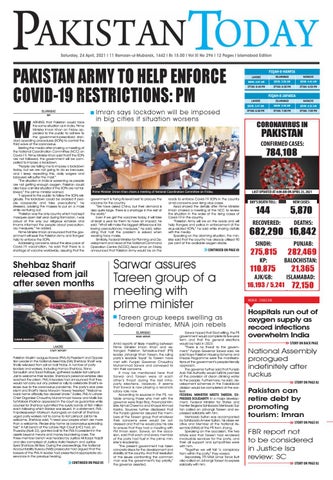
Prime Minister Imran Khan chairs a meeting of National Coordination Committee on Friday.
government is trying its level best to procure the vaccine for the country. “We have asked China, but their demand is also quite large. There is a shortage in the rest of the world.” Even if we get the vaccines today, it will take at least a year for them to have an impact, he said. “What will make the biggest difference is following precautionary measures,” he said, reiterating that half the problem is solved when wearing face masks. Similarly, Federal Minister for Planning and Development and Head of the National Command Operation Centre (NCOC) Asad Umar on Friday announced that Pakistan Army would be on the
Shehbaz Sharif released from jail after seven months
roads to enforce Covid-19 SOPs in the country amid concerns over rising virus cases. Asad shared the details after Prime Minister Imran chaired a meeting of the NCC to review the situation in the wake of the rising cases of Covid-19 in the country. “Pakistan Army will be on the roads and will help Rangers and police in enforcement of the virus-related SOPs,” he said while sharing details with the media. Speaking on the alarming situation, the minister said that the country has already utilised 90 per cent of the available oxygen stocks.
Sarwar assures Tareen group of a meeting with prime minister g
Tareen group keeps swelling as federal minister, MNA join rebels ISLAMABAD MiaN abrar
Zubair MahfooZ
LAHORE Staff report
Pakistan Muslim League-Nawaz (PML-N) President and Opposition Leader in the National Assembly (NA) Shehbaz Sharif was finally released from jail on bail Friday. A number of party leaders and workers, including Hamza Shehbaz, Rana Sanaullah and Saad Rafique, gathered outside Kot Lakhpat Jail to welcome their leader. Shehbaz’s personal vehicles also reached the prison. PML-N leaders had announced that they would not carry out any protest or rally to celebrate Sharif’s release due to the coronavirus pandemic. The party’s vice president and Sharif’s niece Maryam Nawaz tweeted: “Welcome back home officially too dearest Uncle.” Earlier, PML-N Lahore Chief Organiser Chaudhry Muhammad Nawaz and Malik Saiful Malook Khokhar appeared in the court as guarantors while counsel for Shehbaz submitted the surety bonds of Rs5 million each following which Robkar was issued. In a statement, PMLN spokesperson Marriyum Aurangzeb on behalf of Shehbaz urged party workers not to come to Kot Lakhpat Jail for his welcome. Shehbaz said, “I need your prayers which are more than a welcome. Please stay home as coronavirus spreading fast.” A full bench of the Lahore High Court (LHC) had, on Thursday (April 22), granted bail to the PML-N president in the assets beyond means and money laundering case. The three-member bench was headed by Justice Ali Baqar Najafi and also comprised of Justice Aalia Neelum and Justice Syed Shahbaz Ali Rizvi. During the proceedings, the National Accountability Bureau (NAB) prosecutor had argued that the lawyers of the PML-N leader had presented inappropriate observance in the previous hearing.
CONTINUED ON PAGE 05
CONTINUED ON PAGE 05
Amid reports of likely meeting between Prime Minister Imran Khan and estranged Pakistan Tehreek-e-Insaf (PTI) leader Jahangir Khan Tareen, the ruling party’s leaders ‘loyal’ to Tareen have met with Punjab governor Chaudhry Muhammad Sarwar and conveyed to him their concerns. It may be mentioned here that Sarwar and Tareen were at each other ’s throat during the last intraparty elections. However, it seems that Sarwar is now playing a reconciliator y role now. According to sources in the PTI, notable among those who met with the governor were Raja Riaz, Provincial Minister Ajmal Cheema and Khayal Ahmad Kastro. Sources further disclosed that the Punjab governor assured the members of the Tareen group that whatever their concerns were would be addressed and that he would play his role to ensure that they had a meeting with PM Imran soon. Sarwar, on the occasion, said that each and every member of the party had trust in the prime minister’s leadership. “The present government has taken concrete steps for the development and stability of the country. And that resolution of the issues confronting the common man was the government’s top priority,” the governor asserted.
Sarwar hoped that god willing, the PTI government would complete its five-year term and that the general elections would be held in 2023. “There is no threat to the government,” Punjab governor Sarwar said. He said Naya Pakistan Housing Scheme and Ehsaas Programme were the manifestations of the government’s people-friendly approach. The governor further said that Punjab Aab Pak Authority would fulfil its promise of the provision of clean drinking water to the people. Furthermore, he said, development schemes in the Faisalabad division would be completed at the earliest. FEDERAL MINISTER MEETS TAREEN, EXPRESSES SOLIDARITY: In a major development, Federal Minister for States and Frontier Regions Sahibzada Mehboob Sultan called on Jahangir Tareen and expressed solidarity with him. Mehboob Sultan was accompanied by Sahibzada Ameer Sultan, his close relative and Member of the National Assembly (MNA) of the PTI from Jhang. Speaking on the occasion, the two MNAs said that Tareen had rendered invaluable services for the party, and their all support and sympathies were with him. “Together we will foil ‘a conspiracy from within the party,” they vowed. Separately, PTI MNA Umar Tanvir Butt also called on Jahangir Tareen to express solidarity with him.
LAST UPDATED AT 4:00 AM ON APRIL 23, 2021
DAY'S DEATH TOLL:
NEW CASES:
144
5,870
RECOVERED:
DEATHS:
682,290 16,842 SINDH:
PUNJAB:
275,815
282,469
KP:
BALOCHISTAN:
AJK/GB:
ISLAMABAD:
110,875
16,193 / 5,241
21,365 72,150
MORE INSIDE
Hospitals run out of oxygen supply as record infections overwhelm India STORY ON BACK PAGE
National Assembly prorogued indefinitely after ruckus STORY ON PAGE 02
Pakistan can retire debt by promoting tourism: Imran STORY ON PAGE 03
FBR report not to be considered in Justice Isa review: SC STORY ON PAGE 02
02
Saturday, 24 April, 2021
ISLAMABAD
NEWS
NAtIoNAl Assembly Prorogued INdefINItely After ruCkus ISLAMABAD
t
STAFF REPORT
HE National Assembly (NA) session was prorogued indefinitely without holding a debate on the expulsion of the French ambassador as the opposition members surrounded the speaker’s dais to register their protest. The National Assembly held its session to deliberate the matter of the French ambassador’s expulsion. On April 19, the resolution on the issue of the French envoy’s expulsion from Pakistan was tabled in the assembly in line with the agreement between the government and banned Tehreek-eLabbaik Pakistan (TLP). On Thursday, NA Speaker Asad Qaiser had sought names from parliamentary leaders of all parties having representation in the NA for inclusion in the proposed special committee of the house to take up the resolution on the issue of French envoy. However, once the session began on Friday, lawmakers from Pakistan Muslim League-Nawaz (PML-N), Pakistan People’s Party (PPP) and Jamiat Ulema Islam-Fazl (JUI-F) asked that they be allowed to speak on the point of contention. Moreover, they gathered near the speaker’s podium and raised slogans after being refused time to speak. According to details, Deputy Speaker Qasim Suri was presiding over the assembly session on Friday. The opposition members wanted to speak on a point of contention.
But the deputy speaker did not pay heed The deputy speaker was asked to let former prime minister Raja Pervez Ashraf and PML-N leader Ahsan Iqbal speak during the session, which he did not allow. PML-N leader Ahsan Iqbal insisted the deputy speaker allow PPP leader Raja Ashraf to raise his point, but the deputy speaker rejected his plea. On this, both the PPP and PML-N along with JUI-F boycotted the question-answer session and started raising hue and cry. The opposition members encircled the speaker’s dais and raised slogans of “Labbaik Ya Rasool Allah and Tajdar Khatam Nabuwat (Peace Be Upon Him)”. Some of them were holding up placards as well. The deputy speaker tried to calm down the opposition members but the animated parliamentarians were not ready to listen to him. The session was adjourned. Speaking to media outside the NA, Ashraf slammed the deputy speakers’s move to adjourn, stressing that the opposition lawmakers wanted to ask the government about the agreement that was signed with the proscribed TLP and debate on the resolution presented in the assembly. “Under which law was the TLP was banned and why was the previous agreement [between the government and the outfit] not implemented?” asked the former prime minister. “The government escaped by adjourning the house after we protested. We wanted to debate on the Khatm-e-Nabuwwat resolution and the attack on Absar Alam,” chimed in
16 PIA staffers stranded in Canada after flight ban for 30 days NEWS DESK Canada has suspended all passenger flights from India and Pakistan for 30 days, starting from Friday, due to increased Covid-19 cases detected in travellers arriving from these countries. “Given the higher number of cases of Covid-19 detected in air passengers arriving in Canada from India and Pakistan [...] I am suspending all commercial and private passenger flights arriving in Canada from India and Pakistan for 30 days,” Omar Alghabra, Canadian minister for transport, told a news conference. “This is a temporary measure, while we assess the evolving situation and determine appropriate measures going forward,” he added. The ban, which takes effect at 09:30am PST, Friday, does not affect cargo flights. Alghabra said Canada would not hesitate to bar flights from other nations if needed. On the other hand, Pakistan International Airlines (PIA) has cancelled all flights to Canada. According to the spokesperson of the PIA, all the flights to Canada have been cancelled due to the ban on flights from Pakistan to Canada. A 16-member PIA crew also stranded in Toronto due to flight cancellations. The 16member cockpit and cabin crew were scheduled to leave Canada for Pakistan on Saturday. The ministry said that 35 flights from India had arrived in Canada in the past week, with a large number of passengers infected with the coronavirus. It is to be noted that the Covid-19 cases have reached an alarming situation in India as more than 300,000 cases were reported on Thursday while 2,256 corona patients lost their lives. India currently has the second-highest number of corona cases in the world after the United States. The UAE officials also announced an air travel ban in view of the deteriorating situation in India.
Pakistan extends travel curbs on 23 countries till 30th amid Covid-19 NEWS DESK The Civil Aviation Authority (CAA) on Friday extended travel restrictions for international passengers arriving from 23 countries in its Category C till April 30 due to the Covid-19 pandemic. The CAA issued a new notification regarding the extension of travel restrictions on Category C countries following the directives of the National Command and Operation Centre (NCOC). Those coming from countries in Category C will have to take prior permission from the National Command and Operations Centre (NCOC). The nationals, NICOPs and POC card holders will also be banned from arriving in Pakistan. China, Saudi Arabia, New Zealand, Japan and Australia are among the ‘Category A’ countries, according to CAA. The travellers from these 20 countries (Category A) will not have to present their Covid reports for boarding or landing in Pakistan. However, those coming from countries in Category B will have to make sure a negative Covid PCR report at a maximum of 90 hours prior to boarding. The rest of Covid SOPs will remain the same and their implementation will be mandatory, the CAA said. The new travel restrictions will remain in effect until April 30.
Ahsan Iqbal, who also lashed out against the incumbent government for the curbed freedom of media. He maintained that the oppression of dissenting voices, as well as the freedom of the press, had been going on for a while. Earlier, the assembly condemned the Quetta blast and prayed for the martyred
souls. It also prayed for the forgiveness of late Khyber Pakhtunkhwa (KP) Inspector General of Police (IGP) Nasir Durrani. A one-minute silence was also observed in the assembly on the demise of NA member Dr Ramesh Kumar’s brother. While condemning the blast, the PMLN leader told the media that it was the
Pakistan Tehreek-e-Insaf (PTI) which had failed to protect the people of Pakistan. “Terrorism has been rearing its ugly head for the past few months now,” he said. “However, this government’s priority is not to deal with terrorism; rather, its priorities are making fake cases against the PML-N,” added the former interior minister.
FBR report not to be considered in Justice Isa review: SC NEWS DESK A report compiled by the Federal Board of Revenue (FBR) which pertains to Supreme Court judge Justice Qazi Faez Isa and his family's financial matters will not be looked into by the top court, Justice Umar Ata Bandial remarked on Friday. Instead, the bench will leave it to the Supreme Judicial Council (SJC) to decide what to do with the report. The above was said during today's hearing of a 10-member 'full court' bench, headed by Justice Bandial. Therein, the bench was overlooking a review petition filed by Justice Isa, who has challenged the top court's decision on the presidential reference filed against him. On the occasion, the government's counsel, Additional Attorney General (AAG) Amir Rehman informed the bench that the SC had given its verdict on the case by taking into account all the facts and the law, as well as having heard out the judge in question. “This review petition can therefore not be accepted merely on the assertion that the reference was not heard properly,” Rehman argued. Citing Article 187 on the Constitution, Rehman explained the jurisdiction of the Supreme Court, further stating that under the same article the apex court can issue in any case a verdict without having to listen to the defendant. The AAG argued that the earlier bench’s decision to send the case to the Federal Board of Revenue (FBR) could therefore not be considered 'incorrect'. Rehman maintained that the court may issue any order through its powers. “The information that the SJC has received cannot be declared illegal,” Rehman said, referring to the report compiled by the FBR on Justice Isa and family's financial affairs on the orders of a smaller bench of the apex court. He further claimed that Justice Isa's lawyer himself had requested to send the case to the FBR. At this point, Justice Ise interrupting the government counsel and said that the AAG was misrepresenting the facts, asserting that his lawyer had made no such claim. Justice Isa, in indignation, asked if the AAG was at liberty to
claim whatever he wished, to which Justice Manzoor Malik responded by asking the petitioner to sit down and allow the counsel to conclude his arguments. “If the government lawyer gives arguments like these, we will be here the whole night,” Justice Isa complained. Ignoring the repeated
again backed up his fellow bench member and said AAG Amir Rehman was a man of calm demeanour. As the proceedings resumed, Justice Mansoor Ali Shah said that he had some questions for the government lawyer. “The reference that the federal government filed has been declared
request to sit down, Justice Isa continued to criticise the government, saying that it had ruined two years of his family’s life. He also asked the bench what right this lawyer had to ruin any more of it. “Qazi sahab, please let the argument proceed,” Justice Malik asked once again. Justice Malik assured the petitioner that the court was well-acquainted with the court record. Justice Baqar reiterated the same. “If someone says something [wrong], I cannot remain quiet,” Justice Isa said in response. “The statements that the federal government lawyer is referring to are not part of the case record,” insisted Justice Isa, and went on to accuse Rehman of issuing statements "papers in his pocket”. The AAG, defending himself, stated that his job was to present his arguments, and it was the court’s job to accept them, not Justice Isa’s. “You keep giving your arguments, don't start with your analysis,” Justice Malik snapped back at the AAG. After this, the justice attempted to lighten the mood and complimented Justice Isa on his tie. “[Justice] Qazi seems to be in a good mood today. Let's keep it that way,” Justice Malik said. Justice Maqbool Baqar once
illegal,” noted Justice Shah. He wondered if that did not also mean that the federal government’s case had ended. “Tell us, then: what is your role in this case?” asked Justice Shah. AAG responded to the judge's query on the role of a federal representative by stating that a lawyer must follow the instructions of his client. Justice Isa interjected and stated that he had accepted this fact and asked the court to move on. However, Justice Bandial reminded the petitioner that the "arguments are for the court, not for your personal satisfaction". Justice Malik therein advised Justice Isa to continue reading the Quran, which he had been reading during the hearing. He added that the amount of time Justice Isa wasted intervening could have allowed the AAG to finish his arguments. AAG Rehman, once more attempting to continue his arguments, reminded the court that the FBR has already sent its report to the SJC. However, the SC itself "has not given any direction to the SJC", he explained. He added that since the report was already submitted, the present case could be considered merely an 'academic' one.
“And this court usually is at ease over questions that are of an academic nature,” recalled the AAG. AAG Rehman also stated that even if the SC's verdict on the presidential ordinance was withdrawn, the SJC would still have the right to investigate based on the report. At this, Justice Munib Akhtar inquired that, if the review petition is accepted, would it come into effect from today or from June 2020, wherein it was originally issued. Moreover, he informed that should the court elect to retract its previous decision, all actions taken as a result of that decision will also be deemed null and void. “The facts remain facts — they cannot be eliminated,” Justice Umar Ata Bandial remarked at the judge’s observation. He recalled that a case of a similar nature had come before the apex court 11 years ago. “In that case as well, the arguments had proceeded with patience. Keep in mind that we have to make a decision based on the principles of justice,” said Justice Bandial. After making his observation, Justice Bandial maintained that the court would not concern itself with the FBR report. Moving on, the SC judge recalled that the bench had asked three questions from Justice Isa. However, Justice Isa had argued that the questions were posed on the basis of the aforementioned and prima facie controversial report, he added. Ergo, Justice Bandial once more clarified that the bench was not looking at the FBR report in the case. At this, AAG Amir Rehman reiterated his previous statement of the SJC maintaining the right to seek the information. “[Nonetheless,] the FBR report cannot be central for us,” Justice Bandial said. He added that the SJC can instead review the facts under which the FBR report was formed. “The nature of this case is very different,” remarked Justice Bandial. At this, the bench adjourned the hearing of the case till Monday and directed AAG Amir Rehman to complete his arguments in the next hearing.
Saturday, 24 April, 2021
ISLAMABAD
NEWS
PAkiSTAn CAn reTire debT by PromoTinG TouriSm: imrAn MURREE
P
STAFF REPORT
RIMe Minister Imran Khan on Friday launched various development projects in Murree, including establishment of Kohsar University and up-gradation of TB Sanatorium Hospital. Addressing the launching ceremony, the prime minister said that the government is focusing on developing new tourist destinations to promote tourism and provide jobs to local people. He said that tourism is the future of Pakistan and Kohsar University will contribute a lot in this regard. PM Imran said, “We can retire our debt by promoting tourism in all parts of the
BUZDAR SAYS RS7.8BN TO BE SPENT ON DIFFERENT UPLIFT SCHEMES country.” He said that Switzerland earns around $80 billion every year through tourism. He also said that Switzerland has developed tourism as a science and launched courses in hospitality management and “we can also earn more by developing our northern areas and other tourist spots across Pakistan.” He added that the tourism sector has been flourishing in Pakistan with double pace every year. The prime minister, on the occasion also planted a sapling under the Clean and Green campaign. He distributed cheques among the deserving people under ehsas Programme as well as loans under Kamyab Jawan
Programme. “Several tourist spots could be established in KP and Gilgit Baltistan,” the prime minister pointed out while emphasising as to how the incumbent government has played its role in promoting tourism in the country. He lamented the previous leaders for neglecting tourism and utilising government’s resources. “A family in Murree spent Rs830 million from the national exchequer on their home,” he said. The prime minister further lamented that Punjab House of Murree was previously used by ministers, who spent millions from national exchequer.
It is pertinent to mention that Punjab House of Murree has also been included in the Kohsar University to expand its premises and academic blocks while special disciplines of Hotel Management and promotion of tourism are being introduced in the university besides other faculties. Speaking on the occasion, Punjab Chief Minister Sardar Usman Buzdar said that Murree enjoys the position of being the prime tourist spot in the country while Kahuta and Kotli Sattian also attracts sightseers because of their serene beauty. The CM said that the PTI government is working to develop the best facilities for the
03
visitors in Murree and adjoining areas. He said that Rs7.80 billion will be spent on different development schemes to provide better facilities as promotion of tourism is an important agenda of PTI government. The foundation stone of Kohsar University and attached study centre has been laid where tourism and hotel career development management classes will be started, he announced. Along with it, the upgradation of boys and girls’ colleges of Kahuta, Kotli Sattian and Kalar Syedan has been laid and Municipal Committee Murree has been given the status of a municipal corporation, he added. The CM disclosed that additional deputy commissioner and SP are being posted to improve administrative affairs. New building by-laws are also being implemented and a ban on new constructions has been lifted, he stated. The CM affirmed that the emergency of THQ hospital Kahuta will be upgraded along with the upgradation of Samli Sanatorium. A dialysis unit and trauma centre will also be established, he continued. A parking plaza is being constructed in Jhika Gali in publicprivate partnership mode to save visitors from parking difficulties. Meanwhile, he said that projects like tourist highways and provision and drainage of water will also be started to resolve such issues.
ATC decides acquits high-profile ‘target killers’ KARACHI INP
An anti-terrorism court (ATC) on Friday decided 54 cases linked to a raid at Muttahida Qaumi Movement-Pakistan (MQM-P) headquarters Nine-Zero after six years, acquitting the high profile target killers in a case pertaining to recovery of explosive material. According to details, the ATC acquitted 12 suspects including Faisal aka Mota, Ubaid aka K2, Nadir Shah, Amir, Imtiaz, Abdul Qadir, Kazim Raza, Muhammad Amir, Shakeel, Mahmood Hasan and others in cases pertaining to charges under arms and explosives acts. In another case, a suspect named Faisal was found guilty of possessing illegal arms and was sentenced to imprisonment for 10 years while another suspect, Farhan Shabbir, was sentenced to eight-year imprisonment under similar charges. The Sindh Rangers on March 12, 2015, early morning raided at the MQM headquarters, Nine-Zero, had arrested several convicted and wanted criminals. A huge quantity of arms and ammunition, walkie talkies, binoculars and other military gear used by NATO forces were also seized during the operation. The Rangers spokesperson in his statement had said that the arms cache recovered by the paramilitary personnel during the operation included LMGs, SMGs, M4 rifles, G3 rifles, Repeaters and pistols. The statement read that the law enforcers were provided 107 arms licences, out of which 71 were bona fide, while 36 licenses did not match with recovered weapons.
Govt prioritise Sindh’s development: President Alvi NEWS DESK President Dr Arif Alvi has said that progress and prosperity of the people of Sindh is a priority of Prime Minister Imran Khan. The president said this while talking to Governor Sindh Imran Ismail, who called on him on Friday and exchanged views on the projects initiated by the federal government for the province. The president said that the federal government is taking all possible measures to address problems of people, and the projects launched for public welfare are a manifestation of it. The president said that the solution to problems of the province lies in mutual consultations and reconciliatory approach. He said that representatives of all political parties will have to demonstrate a responsible behaviour to address issues of people. President Alvi said that the federal government will continue providing utmost cooperation for development of Karachi while considering its importance as being the economic hub of the country. He said that provision of modern civic facilities and completion of mega development projects in Karachi is need of the hour. The president said that the policy of smart lockdown introduced by Prime Minister Imran Khan has helped much of Pakistan's fight against the coronavirus. He said that the entire world has acknowledged the efforts of Pakistan to prevent the spread of Covid-19 pandemic.
ISLAMABAD: Prime Minister Imran Khan meets Punjab Chief Minister Usman Buzdar who called on him on Friday.
Court orders auction of Nawaz Sharif’s seized properties ISLAMABAD STAFF REPORT
An accountability court on Friday accepted a petition filed by the National Accountability Bureau (NAB) Rawalpindi for the auction of the seized properties owned by former prime minister Nawaz Sharif. The NAB’s decision to auction the Pakistan Muslim League-Nawaz (PML-N) supreme leader’s assets comes after he was declared a proclaimed offender in the Toshakhana reference. After the accountability court’s approval, the concerned provincial governments will be able to auction Nawaz’s properties wherever they are located. The accountability judge directed the authorities concerned to auction the former premier’s moveable and immoveable properties and deposit the money to be earned through the auction into the national exchequer. The bureau, through its Deputy Prosecutor General Sardar Muzaffar Khan Abbasi, filed the application. Abbasi stated that the accountability court had declared Nawaz a proclaimed offender in the Toshakhana reference. Despite a lapse of six months, the former premier did not surrender himself before the court, he
added. He recalled that the court had declared Nawaz a proclaimed offender on August 17 and ordered attaching his property on Oct 1. He pleaded with the court to allow auction of the properties of Sharif in accordance with the law. The court has ordered the Lahore deputy commissioner and Sheikhupura to submit a report on the matter within 60 days. Nawaz’s vehicles should also be auctioned within 30 days, the court further ordered. The vehicles will be seized and sold with the help of the police, the court said. The court also ordered the seizure of any funds in Nawaz’s bank accounts and their deposit in the public exchequer. However, the accountability court said only those properties on which the Sharif family hasn’t raised objections can be auctioned. Meanwhile, the chairman of the Securities and exchange Commission of Pakistan (SeCP) has been directed to sell shares owned by Nawaz in four companies. Proceeds from the sale should be deposited in the national treasury, the court said. According to a NAB report, Nawaz has shares in four companies: 467,950 shares in Mohammad Bukhsh Textile Mills, 343,425 shares in Hudaibiya Paper Mills
Ltd, 22,213 shares in Hudaibiya engineering Co (Pvt) Ltd and 48,806 shares in Ittefaq Textile Mills Ltd. He also has eight accounts in private banks, including three foreign currency accounts. The NAB said Nawaz had over Rs600,000 in five accounts and 566 euros, $698, and GBP498 in foreign currency accounts. Nawaz also has nine properties to his name in Lahore, Sheikhupura, Murree and Abbottabad. These include 135 Upper Mall Lahore; 936 kanals, 10 marla and 85 feet of agricultural land in Mauza Manak Lahore; a 12-acre guava orchid; 299 kanals and 12 marla of agricultural land in Mauza Baokisani; 103 kanals and 6 marla of agricultural land in Mauza Mall, Raiwind; 312 kanals and 14 marla of agricultural land in Mauza Sultankay, Lahore; 14 kanals and 5 marla of agricultural land in Mauza Manddiali, Ferozabad; 65 kanals and 4 marla of agricultural land in Mauza Ferozwattan, Sheikhpura; Bungalow 24-A & B and B3, Hall Road, Murree; and a house measuring 15 kanals and 15 marla in Changla Gali, Abbottabad. The former PM also has a Toyota Land Cruiser model 2010 (LeB 10-1957), a Mercedes model 1973 (LHD-280), a Mercedes Benz model 1991 (IDH-78), a tractor model 2011 (LeS 11-778) and a tractor model 2015 (LeS-15-6024).
Govt committed to achieving sustained economic growth: Tarin ISLAMABAD TLTP
Minister for Finance and Revenue Shaukat Tarin has reiterated the firm resolve of the government in achieving macro-economic stability and sustained economic growth by following a consultative process. The finance minister said this during a meeting with Najy Benhassine, country director of the World Bank Group, who made a courtesy call on him on Friday. extending a warm welcome, the finance minister
lauded the pivotal role being played by the World Bank in strengthening governance and service delivery through institutional reforms & human capital development in Pakistan over the years. He appreciated the swift and timely assistance extended by the World Bank Group for stimulating economic recovery during Covid-19 pandemic. He apprised the country director that the first economic Advisory Council (eAC) meeting had decided to work towards reinvigorating the productive sectors of the economy. The eAC will facilitate sound economic planning by chalking out short, medium and long term
plans (with firm timelines) to set the course for an inclusive and sustained economic growth, he added. He stated that the continued support of the World Bank, as a major development partner, is critical to attaining fiscal consolidation, improved service delivery and good governance in Pakistan. The country director felicitated the finance minister on assuming his new responsibility and thanked the government of Pakistan for continuous support and facilitation in completion of the ongoing projects and programmes.
04
Saturday, 24 April, 2021
ISLAMABAD
NEWS
Govt makes arranGements to provide human resources for south punjab LahoRE
t
SHAHAB OMER
HE Punjab government has made arrangements to allocate 32 per cent quota in government jobs to provide human resources to South Punjab and it has also prepared a summary of amendments to the Punjab Civil Servants Act, 1974, Pakistan Today learnt on Friday. Provincial Finance Minister Makhdoom Hashim Jawan Bakht claimed that the allotment of a land for the construction of a per-
manent secretariat in South Punjab and acquisition of buildings for temporary offices and relocated departments will be finalised before the end of current fiscal year. A meeting was held at the Chief Minister's House on Friday, in which Bakht and Special Assistant to Punjab Chief Minister Dr Firdous Ashiq Awan gave briefings on the development of South Punjab. During the briefings, Bakht said that in the budget for the next financial year, the details of the annual development programme of South Punjab and the use of
inet of Punjab, including the federal government, was committed to the development of South Punjab and all the obstacles were being discouraged. “Until the establishment of a separate province, the basic problems of the region are being solved, including lack of resources, adequate representation in government jobs and local level problems of the public sector. The establishment of a separate secretariat will not only improve the administrative affairs of South Punjab but also facilitate the employees posted in government depart-
funds will be published in the form of a separate book. “These details will prove that the budget allocated for South Punjab under the present regime was spent in South Punjab only. Contrary to the past, no cuts were made to the funds announced in the budget until the end of the year and those were not used elsewhere. This year, as in the current financial year, a business-friendly budget will be presented to restore the lives of those affected by Covid-19,” the minister said. The minister claimed that the entire cab-
Bilawal slams PTI regime over devastation of agriculture sector ISLaMaBad INP
Pakistan Peoples’ Party (PPP) Chairman Bilawal Bhutto Zardari has slammed the Pakistan Tehreek-e-Insaf (PTI) regime over the devastation of agriculture sector, saying it is shameful that an agrarian country has been compelled to import cotton, sugar and wheat. According to the statement issued from Bilawal House’s Media Cell on Friday, the chairman said that the simultaneous import of wheat, sugar and cotton is an evidence of the ineptitude of the federal government and marks a dark day in the history of the country. “Imran Khan has brought us to the verge of collapse. If Imran Khan does not change his anti-agriculture policies, then farmers would be on the front in our protests against the government,” he warned. Bilawal pointed out that cotton production in Pak-
istan has fallen by 34 per cent to its lowest level in 30 years. Pakistan’s famed textile industry too is on the verge of collapse because of the cotton crisis. He said that selected Prime Minister Imran Khan had imposed an agricultural emergency with a budget of Rs65 billion, which was not implemented anywhere. Cotton, chili, tomato, onion, rice, sugarcane and other crops were affected during rains but the government did not offer any incentive or compensation to the farmers, he stated. The chairman further said that while farmers are struggling to repay their agricultural loans and fertilizer prices are skyrocketing, Imran Khan mocks farmers by claiming that everything is fine. The inept agricultural policies of the PTI government led to tomato farmers dumping their crop for nothing and yet the prime minister remained unconcerned, he added. Bilawal said that when PPP took over the federal
government, wheat was being procured from abroad but within a year Pakistan became a wheat exporting country. However, the PTI regime, instead of compensating farmers at Rs2,000 per 40 kilograms of wheat, decided to import substandard wheat at Rs2,750 per 40 kilograms. “The history would not be kind to the prime minister. It would be written that as farmers were protesting against [Indian Prime Minister Narendra] Modi in New Delhi, farmers in Lahore were protesting against Pakistan’s Modi, Imran Khan,” he said. “Imran Khan’s politicised police in Lahore martyred a farmer during their violent and highhanded handling of the peaceful and constitutional farmers’ movement.” “If electricity could be subsidised for industries, then why not for the agriculture sector,” the PPP chairman questioned and demanded that urgent steps be taken to provide relief to the agriculture sector or else a new crisis would soon plague the country.
Pakistan Navy conducts operation to rescue stranded seafarers MohaMMad azaM Khan In pursuance of established national objectives, Pakistan Navy (PN) always actively participate in Humanitarian Assistance and Disaster Relief (HADR) operations under the ambit of Military Operations Other Than War (MOOTW). On March 21, a report of a Tanzania-flagged ocean tugboat being lost in water in Red Sea with sixPakistani crew members onboard was aired on the social and electronic media. Upon confirmation of the report and directions from the relevant ministries, PN ship Zulfiquar, which was deployed
in North Arabian Sea for regional maritime security patrol, was tasked by the Naval Headquarters to expeditiously head towards Red Sea to provide technical, medical and humanitarian assistance to the crew of the tugboat. In addition to that, efforts were also made by PN to provide assistance to the stranded ship through friendly navies in the Red Sea region. The provision of support through earliest possible means was also coordinated with MoMA, MoFA, PMSA and PNSC, which lead to delivery of ration, medicines and fresh water to the stranded crew
through Pakistan merchant ship MT Khairpur. By the time, ship Zulfiquar sailed a long voyage of 2200 nautical miles to provide assistance to the crew of the tugboat despite challenging sea conditions. The onerous task was to locate the vessel in the first place in the vast expanses of turbulent Red Sea. The situation was compounded by the fact that communication could not be established with the vessel. The crew was also not responding on satellite telephone for several days, likely due to nonavailability of power supply onboard. After strenuous ef-
forts, the tugboat was located and grounded by ship Zulfiquarnear the coast of Egypt. Despite challenging conditions in Red Sea,the PN ship, after obtaining requisite diplomatic clearance, closed the vessel to access the situation for subsequent rescue efforts. Subsequently, necessary coordination was undertaken with Egyptian Navy as the vessel was grounded on Egyptian territory. Thereon, the crew was rescued and the PN ship proceeded in vicinity of Egyptian Berenice Naval Base to receive the crew. How-
Sarina reminds Alvi about non-implementation of Quetta Inquiry Commission report ISLAMABAD: Sarina Isa, wife of Supreme Court (SC) Judge Justice Qazi Faez Isa, has written a letter to President Dr Arif Alvi, in which she has regretted non-implementation on the Quetta Inquiry Commission report. In the letter, she said that the suicide attack at the car parking of Serena Hotel in Quetta was unfortunate and so were terrorist attacks on the people belonging to the Hazara community. She reminded the president that her husband Justice Qazi Faez Isa had compiled a report on a terrorist incident in Quetta on August 8, 2016, titled Quetta Inquiry Commission Report. “Had there been implementation on the report, such incidents could have been averted,” Sarina wrote in the letter. She said that it is beyond her comprehension as to why the report was not implemented. INP
ever, it was informed through diplomatic channels that the crew was handed over to Pakistan's embassy in Egypt. Finally efforts by PN paid off. Despite several challenges, including identity issue, the crew was successfully recovered and repatriated back to Pakistan. The marathon rescue operation by PN thousands of miles away from homeland is quintessentialof PN’s commitment to protect the maritime interests of Pakistan and respond to call of duty.
ments. People will not have to travel to the capital to solve their problems. The allocation of quotas in jobs will improve the administrative arrangements for the deployment of employees from the respective districts for the provision of services in South Punjab,” he said. “The budget for the next financial year will introduce measures that will help in job restoration and business growth. A comprehensive plan for the protection of SMEs is being formulated in the next budget. The provincial government has the resources to fight coronavirus. The health department was provided funds timely as per its need and the required resources will be provided in the next budget as well. The process of issuing Insaf Health Insurance Card in two districts of Punjab will be completed this year while in the next fiscal year, all the remaining districts will also have access to all the benefits without any allocation.
WOMAN HACKS HUSBAND TO DEATH GUJRAT: The police in Gujrat area of Karyanwala solved a blind murder case on Friday and arrested a woman for murdering her husband. A few days ago, a woman, Jaziba Sehar, with the help of her lover, had hacked to death her husband Mohammad Shafiq. INP
Saturday, 24 April, 2021
ISLAMABAD
NEWS
Facial recognition should be banned, EU privacy watchdog says agenCieS Facial recognition should be banned in Europe because of its "deep and non-democratic intrusion" into people's private lives, EU privacy watchdog the European Data Protection Supervisor (EDPS) said on Friday. The comments come two days after the European Commission proposed draft rules that would allow facial recognition to be used to search for missing children or criminals and in cases of terrorist attacks. The draft rules, which need to be thrashed out with EU countries and the European Parliament, are an attempt by the Commission to set global rules for artificial intelligence, a technology dominated by China and the United States. The privacy watchdog said it regretted that the Commission had not heeded its earlier call to ban facial recognition in public spaces. "A stricter approach is necessary given that remote biometric identification, where AI may contribute to unprecedented developments, presents extremely high risks of deep and non-democratic intrusion into individuals' private lives," it said in a statement."The EDPS will focus in particular on setting precise boundaries for those tools and systems which may present risks for the fundamental rights to data protection and privacy."The Commission's proposals have drawn criticism from civil rights groups, concerned about loopholes that may allow authoritarian governments to abuse AI to clamp down on people's rights.
Pakistan Army to help enforce Covid-19 restrictions: PM Continued from page 01 He added that steps would be taken to improve the oxygen supply. The NCOC head said that the country is witnessing a surge in Covid-19 cases and plans are in the making to impose further travel restrictions from abroad. “Effective testing will also be performed on the travellers from abroad,” he said. Asad said that restaurants will remain closed until Eid, with a complete ban on indoor and outdoor dine-in. “We have restricted attendance in offices to 50 per cent with duty hours restricted to 2:00 pm,” he said adding that the business centres will be closed by 6:00 pm in the country in the wake of rising cases. “Shopping will only be allowed in the morning,” he said while urging citizens to avoid waiting for the last three to five days for Eid shopping. He further shared that all schools in areas witnessing a positivity rate of five per cent will remain shut.Pakistan on Friday has reported 144 more coronavirus-related deaths during the last 24 hours, lifting the overall death toll to 16,842. According to the NCOC on Covid-19, the country reported 144 more deaths due to the pandemic, while 5,870 new cases were reported during the said period. The national tally of confirmed cases climbed to 784,108 as 5,870 new infections surfaced during the past 24 hours. As many as 53,870 samples were tested, out of which nearly 5,870 turned out to be positive with a 10.90 per cent positivity rate.
05
AnothEr blow to PDM: GilAni, ShEhzAD byPASS MUSADDiq in DECiDinG SEnAtE StAnDinG CoMMittEES iSLamaBad MIAN ABRAR
In a new twist to the tale of widening gulf between the opposition alliance of Pakistan Democratic Movement (PDM), the Leader of the Opposition in the Senate Syed Yousaf Raza Gillani of the Pakistan People’s Party (PPP) the refused to allow the Pakistan Muslim LeagueNawaz (PML-N) delegation to join a meeting held to decide the chairpersons of Senate Standing Committees. A source in PML-N, requesting not being identified, told Pakistan Today that the PML-N delegation, led by Senator Musaddiq Malik, was invited by Chairman Senate Sadiq Sanjrani to join a meeting held with Leader of the House Dr Wasim Shehzad and Leader of the Opposition Yousaf Raza Gilani to decide the division of the chairpersons of the Standing Committees between the treasury and opposition benches. However, the source said that Musaddiq Malik and others kept waiting outside but were not allowed to come in and join the meeting. “When we arrived at the invitation of the Senate chairman’s office, we waited for a long time but were not called in. When Dr Musaddiq Malik went in and met
the chairman, he found out that a meeting of the leader of the house and leader of the opposition was taking place to decide the chairpersons of the Standing Committees. The leader of the house and the leader of the opposition conveyed to Dr Musaddiq Malik they did not him to join,” the source said. The source said Musaddiq Malik told that the Senate chairman had formally invited them to join the meeting regarding the standing committees. It is pertinent here to mention that the PML-N had formed an independent opposition group after Gillani became the leader of the opposition in the upper house.
"It was decided in the meeting with the chairman that all three parties should participate. However, we were very upset. We asked the chairman of the senate how you would run the house," argued the PML-N leader. The source said that if the opposition leader did not involve the PML-N then how will the opposition alliance would work. “If we do not have a role in the opposition then what signal is Gillani is giving us. Should we leave the opposition, avoid coming to the house? How we will participate in Senate proceedings if we are not allowed to exercise our rights?” the PML-N leader argued. The source said that Senator Musaddiq told the Senate chairman that the PML-N delegation had arrived at the chairman’s invitation and not by force. “However, we are now told in a message from the leader of the house that you are not needed. Now we will decide for ourselves our future course,” he argued. Dr Musaddiq said that it was "surprising" that PPP friends said they had nothing to do with the message. The source said that the Senate chairman told the PML-N delegation that it was a matter between the leader of the house and the leader of opposition.
Shehbaz Sharif released from jail after seven months Continued from page 01 After hearing the arguments from both sides, the court granted bail to Shehbaz and directed him to submit two surety bonds worth Rs5 million each. In the written short order, the full bench had stated that the bail of Shehbaz was approved due to the delay in the trial. The court also directed Shehbaz to submit two surety bonds of Rs5 million each in the trial court against which the bail was granted. An accountability court earlier on Friday has issued robkar for the release of the PML-N president from Kot Lakhpat Jail in the money laundering case. According to details, judge Sheikh Sajjad has accepted the two surety bonds worth Rs5 million each for the release of the PML-N leader. The LHC on Thursday had approved the post-arrest bail request of Shehbaz in the assets beyond means and money laundering case, wherein the verdict had
been announced by a three-member full bench constituted by LHC Chief Justice Muhammad Qasim Khan on Monday to decide afresh the request after a division bench gave a split decision on it last week. Headed by Justice Ali Baqar Najafi, the bench comprising Justice Alia Neelum and Justice Syed Shahbaz Ali Rizvi had resumed hearing on Wednesday. The new bench had constituted after the members of the division bench issued a split decision on Shehbaz’s bail petition, sending the matter to the Chief Justice Khan for the nomination of a referee judge. Justice Sardar Mohammad Sarfraz Dogar, who had headed the bench, allowed the petition, while its other member, Justice Asjad Javed Ghural, dismissed the same on merits. Shehbaz had moved the high court for post-arrest bail in the reference — filed by the National Accountability Bureau (NAB) — in March, five months
after he was sent to jail on judicial remand by a trial court. The dirty money watchdog had arrested Shehbaz in September after the LHC denied him further relief of pre-arrest bail in the case. In his bail request, Shehbaz had alleged the NAB proceedings against him had been prompted by mala fide intention, ulterior motive, and considerations extraneous to law. He had said that the registration of a series of cases in quick succession against him and his repeated arrests at the behest of the government had been a classic example of misuse of the process of NAB to muffle the voice of the opposition. He also had said that the bureau failed to collect any evidence of any corruption, kickbacks, misuse of any public office for personal gain by him throughout his political career. THE CASE: Sharif, along with his son
Punjab Assembly opposition leader and PML-N Vice President Hamza Shehbaz, was indicted in November in the Rs7 billion reference involving charges of money laundering and assets beyond means. The reference mainly accuses Shehbaz of being a beneficiary of the assets held in the name of his family members and frontmen, who had no sources to acquire such assets. It says the family members and the frontmen of the family received fake foreign remittances of billions in their personal bank accounts. In addition to these remittances, the bureau says, billions of rupees were laundered by way of foreign pay orders, which were deposited in the personal bank accounts of Hamza and his brother Suleman Shehbaz. The reference further says Shehbaz and his family failed to justify the sources of funds used for the acquisition of assets.
SpaceX rocketship launches 4 astronauts on NASA mission to space station agenCieS NASA and Elon Musk’s commercial rocket company SpaceX launched a new four-astronaut team on a flight to the International Space Station on Friday, the first crew ever propelled into orbit by a rocket booster recycled from a previous spaceflight. The company's Crew Dragon capsule Endeavour, also making its second flight, streaked into the darkened pre-dawn sky atop a SpaceX Falcon 9 rocket as its nine Merlin engines roared to life at 5:49 a.m. (0949 GMT) from NASA's Kennedy Space Center in Florida. The blast-off from Cape Canaveral was aired live on NASA TV. The crew is due to arrive at the space station, orbiting some 250 miles (400 km) above Earth, early on Saturday following a flight of about 23 hours. On the way they will have time to dine on pre-packaged meals and snacks and to get some sleep. Within 10 minutes of launch, the rocket's second stage had delivered the crew capsule to Earth orbit, traveling at nearly 17,000 miles per hour, according to launch commentators. The rocket's first stage, meanwhile, descended back to Earth and touched down safely on a landing platform floating in the Atlantic on a drone ship affectionately named Of Course I Still Love You. The mission marks the second "opera-
tional" space station team launched by NASA aboard a Crew Dragon capsule since human spaceflights resumed from American soil last year, following a nine-year hiatus at the end of the U.S. space shuttle program in 2011. It is also the third crewed flight launched into orbit in 11 months under NASA's fledgling public-private partnership with SpaceX, the rocket company founded in 2002 by
Musk, who is also CEO of electric car maker Tesla Inc (TSLA.O). The first was an out-and-back test mission carrying just two astronauts into orbit last May, followed by SpaceX's maiden flight of a full-fledged four-member space station crew in November. "The future's looking good. I think we're at the dawn of a new era of space exploration," the billionaire entrepreneur said at a
briefing with NASA officials after watching the liftoff from launch control. Friday's Crew 2 team consists of two NASA astronauts - mission commander Shane Kimbrough, 53, and pilot Megan McArthur, 49 - along with Japanese astronaut Akihiko Hoshide, 52, and fellow mission specialist Thomas Pesquet, 43, a French engineer from the European Space Agency. A video camera mounted inside the crew capsule showed the four helmeted astronauts, dressed in white flight suits and black boots, seated side by side at the controls of the capsule early in their journey. About two hours later, relaxing in their weightless environment, they hosted a brief tour of the cabin for NASA TV's audience. "The ride was really smooth, and we couldn't have asked for anything better," McArthur said. "Hope you enjoyed the show." Pesquet held the camera up to one of the capsule's windows, giving viewers a glimpse of Madagascar from orbit. LONG-DURATION MISSION: They are expected to spend about six months aboard the orbiting research platform conducting science experiments and maintenance before returning to Earth. The four members of Crew 1, sent to the space station in November, are slated to fly home on April 28. The Crew 2 mission made a bit of spaceflight history due to the fact that its Falcon 9
rocket blasted off with the same first-stage booster that lofted Crew 1 into orbit five months ago, marking the first time a previously flown booster has ever been re-used in a crewed launch. Reusable booster vehicles, designed to fly themselves back to Earth and land safely rather than fall into the sea after launch, are at the heart of a re-usable rocket strategy that SpaceX helped pioneer to make spaceflight more economical. SpaceX has logged dozens of Falcon 9 booster return landings, and the company has refurbished and re-used most of them, some for multiple flights. But all of those flights, until Friday's mission, only carried cargo. Crew 2's pilot, McArthur, made a bit of history herself as the first female pilot of the Crew Dragon and the second person from her family to ride aboard the SpaceX capsule. She is married to NASA astronaut Bob Behnken, who flew the SpaceX demonstration flight with fellow astronaut Doug Hurley last year. The same Crew Dragon was used for that flight as well. If all goes well, Crew 2 will be welcomed aboard the space station Saturday by the four Crew 1 astronauts - three from NASA and one from the Japan Aerospace Exploration Agency JAXA. Two Russian cosmonauts and a U.S. astronaut who shared a Soyuz flight to the space station are also aboard.
Saturday, 24 April, 2021
06 COMMENT
India’s hybrid warfare against Pakistan
No rest for Mian Shahbaz Sharif The difficult task ahead
F
inALLY, after more than six months in custody, PML(n) President shahbaz sharif has been granted post-arrest bail in a money laundering reference. He was brought back home in a procession by jubilant party workers, shouting slogans and showering flower petals on his car. despite the stress that he must have undergone, Mr sharif looked cool. Back home, Mr sharif has a busy schedule awaiting him. Being the party president he would now take over the leadership of the PML(n) which was being piloted in his absence by Vice President Maryam nawaz who followed a confrontational policy towards the government and the establishment at the behest of her father. Being a more cautious politician, shahbaz sharif would personally prefer a noncombative stance towards the establishment. He is however not known to have disagreed with his elder brother in the past. He will hold consultations with party leaders and convey his views about the future line of action to Mian nawaz sharif, but is likely to follow whatever is decided by the elder brother. Mr sharif is also the Leader of the Opposition in the national Assembly. He is therefore required to take other opposition parties along. The opposition however is not as united now as it was when it elected him as its leader. Over time divisions have emerged between the PML(n) and PPP which are getting more complicated by the day. in the nA-249 Karachi by-election the PPP has put up its own candidate despite an agreement to support the PML(n)’s candidate. There are already two separate opposition groups in the senate and the PML(n)’s group does not recognize sen. Yusuf Raza gilani as opposition leader in the senate. A similar development is likely to take place in the national Assembly unless shahbaz sharif is able to mediate. inside the national Assembly the opposition is arrayed against speaker Asad Qaiser who has consistently acted as a PTi loyalist rather than an independent custodian of the House. This has led to a serious confrontation between PML(n) senior Vice President shahid Khaqan Abbasi and speaker Asad Qaiser. The situation requires a united stand by the entire opposition against the way the speaker is conducting the nA. Mian shahbaz sharif has his work cut out for him and it’s sure going to be hard.
No need for conventional warfare Rabia Riaz Mughal
“T
He ultimate victory in war is the one gained without bloodshed,” said sun Tzu centuries ago. But it is as relevant today as it was back then, as the world has seen the replacement of conventional warfare with grey or hybrid warfare, where the victory is affixed in the long term, without direct carnage. in this warfare the eventual triumph is not achieved using a prompt conquest, but the idea revolves around decapitating the nemesis state by indirect fluid means. it is a postmodern military strategy, and strategies are the methods of acquiring utmost potential over an adversary, in any challenging period of time or space. some basic facets of hybrid warfare that distinguish it from regular conventional warfare are that the foe is not scissile, but complex to discrete it. it is a mix of traditional and nontraditional approaches, and most importantly cyberspace is involved, which causes further complications. in south Asia, india wanted to be a hegemonic nation since her independence. ironically, she detonated a nuclear weapon in 1974 terming it as a peaceful nuclear test, codenamed smiling Buddha. To counter this threat at its western border, and after the secession of the eastern wing in 1971, Pakistan felt the urge to attain nuclear capability, so that a credible nuclear deterrence could be established. Ultimately, when both the states attained nuclear capability, the concept of total war was diminished, and a new idea of averting war emerged to circumvent Mutual Assured destruction. Here the strategy of hybrid warfare gained momentum in indian strategic thinking. There are three main objectives of india’s hybrid warfare strategy against Pakistan: damage /subvert, dispirit, deteriorate To procure these 3ds india has executed hybrid warfare at different fronts: Proxy/ delegate warfare: Under this kind of warfare come the non-state actors that cause terrorist activities in the rival state, as such groups are aided and braced by india to undertake radicalized activities in Pakistan. Certain groups involved in such activities can be categorized as: insurgent/revolutionary groups that attempt to alter the ideological basis of state, like the Hizb-Ut-Tahrir’s attempt to collapse ideological prop of state by a military coup in 2015-16. Fomenter/instigators: these pressure groups use violence to attain their objectives, for example the
Economic Advisory Council Good intentions, but where’s the work?
P
RiMe MinisTeR imran Khan identified three tasks for the economic Advisory Council while chairing it, though these are all tasks which have been created by the commissions or omissions of his own government. The instruction to the eAC to recommend measures to bring down inflation does not account for the fact that apart from such self-generated crises as the wheat or sugar shortages, the price of inputs has gone out of the reach of the common man and made manufacturing uncompetitive. The instruction to prevent any further rise in electricity tariffs, even though the government no longer can control nePRA’s decisions in this regard. Bringing this task to the eAC after having agreed a massive rise to the iMF is also merely a good intention expressed too late. The task of making recommendations for renegotiating with the iMF does not seem very realistic, considering that the iMF deal was only made because the country needed it so badly, something which the iMF knew only too well in the entire negotiating process. The eAC, convened for the first time past the midway mark, seems to have been given tasks that the PTi had claimed it had already planned before coming to power. While the economy is being given priority by Prime Minister imran Khan, he faces the clamour from other crises of governance, the latest of which came in the shape of the TLP protests. The totally unpredictable covid-19 pandemic remains, and is very relevant to the task set the eAC: bringing the pandemic under control requires the sort of lockdown that Mr Khan believes the economy cannot afford. Mr Khan might find he is putting too much on the eAC’s plate, testing it too much like a magic wand to make the grim economic reality disappear. He should realize that that requires much hard work and attention to detail, which he must put in himself, to ensure that his decisions are helpful to the economy and the common man, and not harmful, as they were in generating the sugar and wheat shortages and price spirals.
Attitudes must change zainab naziR “Unka khaandan nahin achha, humay wo pasand nahin aye, larki bhi nahin pasand aai (kyunke wo tumhari pasand hai…”)
W
eddings in Pakistan are a celebration of families, not individuals. More people, more gossip, more fun. in our society, a marriage takes place between two families of the same socio-economic background, two tribes, two clans, two ethnic groups, everything and everybody; but not two paramours. in a country like ours, with very few chances to explore and meet new people, where unchaperoned interaction among both the genders is not an easy take or an everyday affair, finding a partner for one’s child appears magical. We belong to a culture where we are indoctrinated to fulfill the desires of our parents and respect them. But sometimes, choosing between what feels right and peaceful, and being acquiescent to parents, becomes very antithetical. Most Pakistani parents love to oppose love marriages. Opposing love marriages has become a symbol of responsible and correct parenting. This pressure of responsibility badly affects their child’s happiness. it is the man and the woman who says, “i do!” But what and who makes them do that? Parents force their children to marry whom they want. Most Pakistani families prefer arranged marriages because marriages outside their boundaries often lead to kidnaps and killings. The dichotomy between ‘love’ and ‘arranged’ marriages has always seemed a bit unyielding to be a serious reflection of the real face of society. The convenience of these labels allow people to form perceptions about every single relation. Tell the rishta aunty at the wedding that it was a love marriage and she will get apparitions of secret meetings, shared love
Arif Nizami Editor Managing Editor
Joint Editor
Umar Aziz Executive Editor
Lahore – Ph: 042-36300938, 042-36375965
Hybrid warfare undertaken by India against Pakistan has multiple effects and has largely affected the economic, social, psychological, and security conditions. Some of those are, the civil-military gap, social unrest, cultural manipulations, defamation of Pakistan globally, segregating activities, information terrorism by espionage, economic unrest, and many more. Pakistan needs an immediate counter strategy to counter India’s hybrid warfare strategy.
Love marriage - a sin
Dedicated to the legacy of the late Hameed Nizami
Yousaf Nizami Aziz-ud-Din Ahmad
BLA and BRA which are funded by india, as disclosed by Kalbushan Jhadav. Conservative/rightist groups: these extremist groups are created to oppose the state, such as the TTP (Tehreek-e-Taliban Pakistan), got allied with india to conduct terrorist activities in Pakistani territory. dissident/sectarians: such groups are created to segregate the nemesis nation, as the Mukti Bahini’s waged civil war in east Pakistan supported by india, as was confirmed by PM narendra Modi in Bangladesh back in 2015. Mercenaries/ hirelings: such masses are hired to create chaos in the adversary state, by harming a state’s repute on the global map, defamation, and devouring the public’s trust of its leadership by carrying out a set propaganda, such as the Pashtun Tahafuz Movement. information warfare: in this peculiar facet of hybrid warfare, false information and propagandas are circulated among masses, which consequently give rise to wrong perceptions in them. Media and actors are important tools of this warfare, as words can manipulate, alter and even ignite the perceptions. information is used as a weapon in ways like espionage and propaganda and so on. This warfare is not confined to the military only, but is deeply penetrated in the lives of masses, institutions, politics and most dreadfully its use is casual for terrorists. An example of this can be seen in the form of billboards, and ads published back in 2017 in the UsA with the writing “Free Balochistan” on them. in that happening, information technology was used by the indian government in such areas to defame Pakistan worldwide. Cyberwarfare: Cyberspace is an emerging threat to the national security of Pakistan. information circulation under high encryptions is no more an arduous task. This very characteristic is widely used by india to develop predatory shots against Pakistan. A
I
Karachi – Ph: 021-35381208-9
I
recent example can be seen in the form of a cloaked cyber operation, conducted by india after the Pulwama crisis escalation, in which security institutions and mercantile assets of Pakistan were targetted. Pakistan’s Foreign Office was targeted and websites were brought down by hacking. Cyberwarfare may include, sabotage, cyberintelligence, cyber-weaponry and espionage techniques as its tools. economic warfare: This type of warfare is used to damage the economy, which is the backbone of the adversary state, by pushing it down to its knees, and hence compelling it to act accordingly. Pakistan is a limpid victim of economic warfare, as india is investing much to keep Pakistan’s economy inert and immobile. energy crisis, Hydro-warfare, and weak financial institutions are some basic elements of this warfare. Psychological warfare: it’s a famous saying that, “if you are frightened of me, you will pay attention to me”. india is using this technique to psychologicaly hit the people of Pakistan. Both states are nuclear powers, there is no real chance of full-scale war, but by continuous military developments and modifications in the form of the “Cold start doctrine”, and now “new Land Warfare doctrine”, india is trying to impose an assertive image over Pakistan. Political warfare: in this aspect of hybrid warfare, political means are utilized in a legal lawfare to lean down the enemy in global grounds. in 2019, the Finance Minister of Pakistan. requested the Financial Action Task Force (FATF) to eliminate india from the Asia-Pacific joint group, because india intended to blacklist Pakistan for its own internal political goals. india’s political hybrid warfare further includes, political lobbying, global trade containment, and blockades against Pakistan. Hybrid warfare undertaken by india against Pakistan has multiple effects and has largely affected the economic, social, psychological, and security conditions. some of those are, the civil-military gap, social unrest, cultural manipulations, defamation of Pakistan globally, segregating activities, information terrorism by espionage, economic unrest, and many more. Pakistan needs an immediate counter strategy to counter india’s hybrid warfare strategy. The policy or doctrine needs to be very comprehensive to cover the entire spectrum of this waged warfare.
letters and romantic encounters. Tell your friends and colleagues that it was arranged and you can see the sympathetic look in their eyes. For us and in our society, marriage is a sacrosanct union. it is a social institution in which dowry is customary. For many people in Pakistan, marriage is a one-time event which is celebrated and glorified by societal approval. According to different studies, most of the people in Pakistan opt for arranged marriages due to their parents’ pressure. Very less percentage opt for love marriage due to their families not agreeing and other such issues. What we need to understand is that an arranged marriage is different from a forced marriage. But in our part of the world, arranged marriages are most of the time forced marriages. Parents “force” their children to enter a marriage; where both the partners feel trapped. The obsession of Pakistani parents with the marriage of their children is unrivalled. For them, the ingredients to a happy marriage include good looks, wealth, education and social status. Fair complexion is a must, and a dark personality can be compromised upon. Tall height is a must, low moral values become acceptable. Rich family background is a must, empty hearts and emotions are considered fine. Our marriage culture and the obsession attached to it is the main reason why so many capable young men and women are unhappy, borderline depressed and unstable in their lives. it hinders them from showing their potential, from being their best, most productive selves. Adults are not allowed to marry the person of their choice. Arranged marriage has become a tradition in our society. The sense of accomplishment and satisfaction of an arranged marriage can only be experienced by one’s parents. no one else is responsible for cheapening and corrupting the institution of love marriage, but us. Women are expected to meet the parents of men where they are looked upon as vegetables in a sunday bazaar. Those same parents who promise to make compromises for their “son’s happiness” sit there and
Islamabad – Ph: 051-2204545
I
Web: www.pakistantoday.com.pk
I
The writer is a freelance columnist
find flaws in that dolled-up capsicum. Unfortunately, this whole scenario becomes a joyride for the visitors, but it proves detrimental to a female’s mental health and self-respect. A woman is blamed for loving a man. Her morals are questioned and in some cases she’s the one who is labelled “characterless.” Females are expected to forget their rights, be the target for the bullseye and even then get rejected for not being worthy enough to fall in love with the sugar plums of their parents. in most of the cases, men are considered innocent, while women are assumed to be the merciless creatures who snatch away “good sons” from their parents. Love is not a new concept for humans. Love marriage is not something big. it is rather a positive step for our society. it paves way to social equality and breaks the conventions underlying marriage. it promotes tolerance as it gives rise to a new class of people who are emotionally mature. Moreover, love promotes successful, happy and lifelong marriages. Love marriage has become a sin in our society. Forced marriage has become a global and national problem. Forced marriages and the ghettoisation are incomprehensible. different societal, cultural and religious traditions govern our arranged marriages. Times have changed and now our culture needs to gather peace. Younger people should have the right to choose their own life partner. There is no law against love marriage in our country but it is something that is looked down upon. Love marriages are discouraged due to cultural conservatism. it is really difficult to predict whether our mindsets regarding love marriage would change or not, whether we would start respecting others’ choices or not and whether we would allow our children to choose their own partners. We need to understand that companionship, understanding and emotional and physical compatibility is of much more importance than carrying the tag of an “arranged marriage”. Caste and creed are not the determinants of a successful and happy marriage. The younger generation prefers creating families and homes around companionship and understanding. it is time for parents to shed caste and creed, as this matters very less in the ultimate happiness of their children and future generations. The writer is a freelance columnist
Email: editorial@pakistantoday.com.pk
Saturday, 24 April, 2021
COMMENT 07 Editor’s mail Send your letters to: Letters to Editor, Pakistan today, 4-Shaarey Fatima Jinnah, Lahore, Pakistan. E-mail: letters@pakistantoday.com.pk Letters should be addressed to Pakistan today exclusively
Kashmir questions the legitimacy of the UN
Dynamics of India-Bangladesh relations 50 years in, the events of 1971 still cast a shadow
Dr rajkumar Singh
O
ther things apart, the timing and occasion of Indian PM Narendra Modi’s two-day visit to Bangladesh beginning on 26 March 2021 was important. the timing was chosen keeping in view the emotionally peak timings of the State Assembly elections in the North-east India, including in Assam and West Bengal, and if not uppermost, it was definitely in mind to take political mileage from the occasion. here, counted the multi-layered relations of Bangladesh to the people of this region which is going to cast their valuable vote in favour or against the Bharatiya Janata Party, whose charismatic leader landed in Dhaka, just a day before the starting of the first phase of election segments in both states. In any way, it cannot be called chance, but a calculated move of the party and the Government to win over the hearts of a large number of people who are closely attached to Bangladesh socially, economically, emotionally and religiously. however, there is no question mark on the occasion of the visit as it was the 50th anniversary of the country’s independence, the most important day in the history of any nation. Since the partition of the Subcontinent in 1947, the eastern part of Pakistan suffered a lot on many fronts and ultimately took its own course at the beginning of 1971 which paved the way of its independence by the end of the year. Sheikh Mujibur rahman, the father of present Prime Minister Sheikh hasina, not only struggled hard to achieve freedom, but also sacrificed his life in 1975, when Independence itself was like a new-born baby. the emergence of east Pakistan or east Bengal as an independent nation in early 1972 was an event of paramount significance for the politics of Asia, more especially for the future of Indo-Pak relations. As India played a very positive role in the independence of Bangladesh, relations between the two started on a hopeful note when India’s then Prime Minister Indira Gandhi visited Dhaka on 19 March 1972 and signed with Bangladesh a treaty of Friendship, Cooperation and Peace which not only laid but strengthened the overall relations based on mutual understanding. Formerly an integral part of Pakistan, it also remained a part of India before the partition of 1947. this common background provided them an extended relationship not limited to politics only. Although India’s relations with Bangladesh
in the last 50 years remained peaceful and cooperative, border disputes between them, Dhaka’s close understandings with the Organisation of the Islamic Conference and the country’s soft attitude towards terror groups residing in Bangladesh, have been a source of difference in the smooth sailing of their relations. Likewise, in the 1980s Bangladesh and India were also poles apart in terms of Cold War alliances, but they, came closer after the coming of globalisation and economic liberalisation in South Asia and sharing the dais in SAArC meetings in different countries’ capitals and, as a result, now they are the largest trading partners in the region. A major contention between them on sharing of the Ganga waters in the river hoogly was resolved in the year 1996. their dispute over teen Bigha Corridor and the issue of the indefinite nature of lease was resolved between them in 1992 and 2011 respectively. From the beginning till date the issue of illegal immigrants remained a cause of concern for both. With the coming of BJP government in May 2014, a new focus has been given to improve India’s relations with neighbours, including SAArC countries in the region. Under the policy, Prime Minister Narendra Modi visited Bangladesh in 2015.this visit of the Indian Prime Minister paved the way for the signing of as many as 22 agreements which, among others, extended a $2 billion line of credit to Bangladesh. Under these agreements, India’s reliance Power agreed to invest $3 billion to set up a 3000 MW LNG-based power plant. In the same sector, Adani Power agreed to set up a 1600 MW coal-fired power plant. In addition, other signed agreements related to maritime safety cooperation, curbing human trafficking and fake Indian currency. In response, a return visit was paid to India by Bangladeshi Prime Minister Sheikh hasina in 2017. During these visits the two countries resolved several long pending issues and other agreements of mutual benefit were signed. highlights of these visits include the resolution of long-pending land and maritime boundaries asserting the issue of enclaves, and the conclusion of over 90 instruments comprising high-tech areas and an increased volume of trade between the two countries. earlier, after the coming to office of the BJP, its external Affairs Minister Sushma Swaraj visited Bangladesh in June 2014. In course of her visit she concluded various agreements to boost ties and strengthen relations between the two countries. In line with this, 2018 and 2019 proved no less important in Indo-Bangladeshi relations as their relations in economic, defence, border se-
curity and other sectors touched a new height. In 2018, the leaders of India and Bangladesh inaugurated the 130-km long Friendship pipeline to supply 400,000 metric tonne of diesel to Bangladesh. In September, the same year, Bangladesh cabinet approved the draft of a proposed agreement with India to allow it to use the Chittagong and Mongla sea ports for transporting goods to and from its land-locked northeastern states. In the defence sector too, India fully co-operated with Dhaka and in March 2019 New Delhi’s Chief of Army Staff visited Bangladesh and held fruitful talks with his counterpart in order to boost up the defence-related arrangements and sharing intelligence. earlier, a series of Memoranda of Understandings in areas of defence were signed when Sheikh hasina visited New Delhi in 2017. these apart, their exchange of visits and mutual understandings include the necessities of border security management, joint military training exercises and energy co-operation. In response to the invitation extended by Sheikh hasina, Modi paid an official visit to Dhaka on 26-27 March 2021, especially to join the Golden Jubilee celebrations of the Independence of Bangladesh. the occasion was also symbolized as the half-a-century strengthened, mature and strong bilateral relations between the two countries. In course of the visit, the Indian Prime Minister, apart from taking part in the event at National Parade Ground, met M uhammad Abdul hamid, the President of Bangladesh, and Dr. A. K. Abdul Menon, Dhaka’s Foreign Minister, and discussed with them issues of mutual understanding and benefit. On the last day of the visit (27 March) the two Prime Ministers and the visiting delegation held extensive exchange of views on matters of mutual benefits and expressed satisfaction on the progress of their relationship. In the Joint Communiqué issued at the end of the visit on 27 March 2021, the two Prime Ministers expressed happiness over the continued exchange of high-level visits including Sheikh hasina’s visit to New Delhi in October 2019 and the virtual summit between them on 17 December 2020. In a major breakthrough, the two Prime Ministers signed five MoUs in areas of connectivity, commerce, information technology and sports to strengthen further the bilateral ties between the two nations and work together for development in days to come.
In response to the invitation extended by Sheikh Hasina, Modi paid an official visit to Dhaka on 26-27 March 2021, especially to join the Golden Jubilee celebrations of the Independence of Bangladesh. The occasion was also symbolized as the half-a-century strengthened, mature and strong bilateral relations between the two countries
The writer is head of the political science department of the B.N.Mandal University, Madhepura, Bihar, India. He can be reached at rajkumarsinghpg@gmail.com
Dr. Ghulam Nabi Fai, Secretary General, World Kashmir Awareness Forum reminded the world powers of their pledge given to the people of Kashmir as early as in 1948. he said when the Kashmir dispute erupted in 1947-1948, the world powers championed the stand that the future status of Kashmir must be ascertained in accordance with the wishes and aspirations of the people of the territory. the United States, Great Britain and France were principal sponsors of the resolution # 47, which was adopted by the Security Council on April 21, 1948, and which was based on that unchallenged principle. Fai added that the Security Council discussed the question exhaustively from January to April 1948. Since both India and Pakistan desired that the question of final settlement should be decided through an impartial plebiscite, the Council developed proposals based on the common ground between them. the Indian point of view was unambiguously clarified by its Prime Minister, Pandit Nehru when he said: “If, after a proper plebiscite, the people of Kashmir said, ‘we do not want to be with India’; we are committed to accept it though it might pain us. We will not send an army against them. We will accept that however hurt we might feel about it. We will change the constitution, if necessary.” the resolution # 47 of 1948 was not the resolution in the routine sense of the term. Its provisions were negotiated in detail by the Council with India and Pakistan and it was only after the consent of both Governments was explicitly obtained that they were endorsed by the Security Council. they thus constitute a binding and solemn international agreement about the settlement of the Kashmir dispute, Fai said. Fai articulated that there was much in the submissions that was controversial between India and Pakistan, but the proposal of a plebiscite was not. this is clear from the statement made on 28 January 1948 by the President of the Council. he said: “ ... the documents at our disposal show agreement between the parties on the three following points: (1) the question as to whether the State of Jammu and Kashmir will accede to India or to Pakistan shall be decided by plebiscite; (2) this plebiscite must be conducted under conditions, which will ensure complete impartiality; (3) the plebiscite will therefore be held under the auspices of the United Nations.” Fai warned that Kashmir cannot be ignored, perhaps for no other reason than the conflict there has gone on for 73 years and seems destined to continue as long as the Indian armed forces continue to occupy the region. the potential for genocide is very real and massive killings have already occurred in the past. the tens of thousands who have been killed along with vast human rights abuses seem to go on without end. the UN high Commissioner on human rights has recommended an independent, impartial and international mission to visit Kashmir and be given free and complete access to establish an objective assessment of the claims made by the two sides. Of course the Indian government continues to ignore such calls for investigation, because it believes that such ruthless tactics are the only way to deal with opposition to its policies. Such policies are almost a guarantee that yet another great tragedy in the UN’s history will occur. “the decades-long Kashmir issue has caused agony to Kashmiris, to Pakistan and to India itself and the simple, rational measures that would be needed for its solution is not out of sight. All that is needed is going back —- yes, going back —- to the point of agreement which historically existed beyond doubt between India and Pakistan and jointly resolving to retrieve it with such modifications as are necessitated by the passage of time. Fai appealed the United Nations Secretary General – the custodian of the human rights – to provide the leadership in protecting the human and political rights of the people of Kashmir; and use his influence to enable them to exercise their inherent right to self-determination. Dr Gulam Nabi Fai lahorE
Tragic event A tragic event of rape has raised hew and cries among Baloch. A 10 years old child Murad Ameer hailing from hoshab, Punjgoor district was raped by a security personal. It has raised the anger among all public. Since this is not the first in history of Baloch, Security personal has been notorious of committing such shameful act. It was rape a case that compelled Nawab Akbar khan to seek rebellion. Such act committed by the security forces further hostiles the delicate relationship between Pakistan and Balochistan . this would be a black spot for Baloch reputation since they are ready to kill or die for their reputation. Such acts are really heart threating as nobody can be able to conceal the hearts of victim family. In order to save the little ones of our country, such Monsters who commit rape should be hanged publicly. NaSram NaSEEm awaraN
Handling sexual violence rAPe cases are increasing day by day and we couldn’t solve this rising issue. there are numbers of rape victims who have not been given justice and it is a positive response for the rapists to become more monsterous. It is shameful for all pakistanis along with government who are weak enough to raise voices. In the history you couldn’t find any justification done to the rape victims though we all knoe that it would be hard to live after being named a victim of rape but still we are silent and our government is silent. If it is a country,It should devote the right to each of the citizen. It is still a far cry for the victims of rape. We want justice for the victims of rape. Erum aSaDullah TurbaT
Saturday, 24 April, 2021
08 WORLD VIEW
WhaT afghaNisTaN Teaches us abouT imperialism THE AMERICAN IMPERIAL PROJECT IN AFGHANISTAN WAS A BUNCH OF NGOS, AND CONTRACTORS IN THE DEFENSE DEPARTMENT MAKING MONEY, AND AVERAGE MEN AND WOMEN LOSING LIVES FOR NOTHING
natIonal IntErEst
i
SumanTRa maiTRa
was only seventeen years old when 9/11 happened. That’s when I decided to study military strategy and foreign policy. Not long afterwards, jihadists attacked the Indian parliament in December 2001. Generations of people grew up in the next twenty years, including yours truly. One thing that remained constant was this raging imperial policing in the background, distant from the lives of most, while disproportionately and severely affecting the lives of those who lost lives and limbs. The potential withdrawal from Afghanistan on the twentieth anniversary of 9/11, attack on the United States, gives the world an opportunity to reflect on the changing nature of imperial policing in the region, and why it failed. A scholar must question the terminology of war should consider that there ceased to be a war in Afghanistan around the surge in 2007, which is when everyone understood that maintaining troops in the country was a losing cause. ever since then it has been what could be truly termed as an imperial law and order policing mission on the frontiers of civilization. This is a frame of reference that is critically important because it helps people to understand what
went wrong in Afghanistan and what to avoid in the future. Wars are the ultimate act of great power. This great-power flex should have a specific end game and a determined war aim. It could be punitive, or total, depending on the threat. Britain, for example, maintained its empire by the threat of short punitive campaigns, a lesson it catastrophically forgot as it grew complacent. Any war drains resources and lives. It should ideally be to defend very narrow national interests or to ensure survival against an expansionist great power, not to spread values in a region where all values are alien. Regions are shaped by their own history. It is best to be vigilant and maintain the balance of power in regions of core interest, such as Western europe and the Indo-Pacific region, rather than to try and shape semi-feudal societies elsewhere. Imperialism, on the other hand, for good and for bad, in some particular ways at least, had been historically a socially liberalizing force. The abolition of Sati or widow-burning in India was due to General Sir Charles Napier. The crackdown on thugs and the establishment of science colleges were due to Lords Bentinck, Rippon, Lansdowne, and elgin. The Indian civil and judicial services, as well as modern higher education in India, were established by these people. The desperate laments of the American generals, from retired Army Gen. David Petraeus to Joint Chiefs of Staff Chairman Mark Milley, to columnists like Max Boot, to countless DoD “analysts” attributed in the Afghanistan Papers was to, likewise, highlight the advances in women’s rights in Afghanistan. It was not, and should not have been, the war aim of the
United States. Still, the credit goes to them, for being honest and noting that the United States spent trillions of dollars and lost thousands of lives so that its bureaucrats could pose for photo-ops at the University of Kabul, capitalizing on those rare few pockets where the government writ was barely workable. So, why did this lumbering imperial endeavor go on for so long, before grinding to a halt and ultimately fail? here’s one hypothesis: this American imperial project wasn’t for the benefit of average Americans, in a way, classic imperialism would have been. During the British empire, for example, a random Scotsman could go and start a company from Adelaide to Alberta. The American imperial project in Afghanistan was a bunch of NGOs, and contractors in the defense department making money, and average men and women losing lives for nothing. A random bloke from South Carolina wouldn’t have gone to Kandahar, to start a shop, get married and settle down for the next century at least . . . thereby making the project doomed from the start. There is no dedicated civil service and the higher-education system currently in the United States that is comparable to what the utterly disciplined Victorian public schooling produced during the height of the British empire, which drove proud generations of Britains to ensure that the empire remained a martial but overall liberalizing force, to have the requisite brains trust under the purest form of meritocracy, something, incidentally, that China is doing now promoting its Belt-and-Road project and debt-trap diplomacy. There are hundreds of thousands of Chinese civilians working from Central Asia to Africa, starting businesses,
Those calling publicly for violence against Muslims and Christians are no friends of nation PM MODI MUST IN CLEAR LANGUAGE TELL THE INDIAN PEOPLE AND THE WORLD THAT HIS GOVERNMENT WILL PROTECT TOLERANCE, DECENCY AND EQUAL HUMAN RIGHTS
IndIan ExprEss
T
Rajmohan Gandhi
he idea that a nation belongs to its dominant section, be that section racial, tribal, linguistic or religious, has been termed ethnonationalism. True believers would like to see democracy’s mansion of equality submerged. In its place, they would have a pyramid of hierarchies where those dominating are sharply demarcated from the dominated. ethnonationalism is an academic word for the raw force feeding on hate and contempt. Much of the Indian subcontinent saw this force erupt in violence in 1947. The region that became Bangladesh faced the outburst in 1971. Delhi experienced it in 1984, the Balkans in the 1990s, Rwanda in 1994, Gujarat in 2002. In recent years, the idea of ethnonationalism has made global strides. Bringing countries like Poland, hungary, Brazil and Turkey under its sway, it has appealed also to many in long-established democracies, including the US. Last winter, its rising tide was arrested when American voters rejected Trump. When, in the wake of the January 6 attack on the Capitol, the FBI publicly named “domestic terrorism” by white nationalist groups as a serious threat, it was putting in place a fresh reinforcement against the tide. Far-right Trump-backers
in the US Congress, including Marjorie Taylor Greene of Georgia and Matt Gaetz of Florida, both in the lower house, want such tide-breakers removed. Fortunately for lovers of democracy, these elements received a pushback when the house’s Republican leadership frontally denounced a call for preserving a “uniquely AngloSaxon” culture in the US. Reportedly endorsed by Greene and Gaetz, this call was unmistakable code for a white-dominated America. Rebuffing it, Kevin McCarthy, who leads the Republicans in the lower chamber, tweeted that America “isn’t built on identity, race, or religion,” adding, “The Republican Party is the party of Lincoln and the party of more opportunity for all Americans — not nativist dog whistles.” Liz Cheney, ranked third in the house’s Republican leadership, declared: “We teach our children the values of tolerance, decency and moral courage. Racism, nativism, and anti-Semitism are evil.” It is impossible for me not to contrast these candid words with the apparent silence of Narendra Modi, Amit Shah and J P Nadda at the widely publicised words of persons like Yati Narsinghanand, the chief priest of Ghaziabad’s Dasna Mandir. I have seen no denials anywhere of published reports that Yati Narsinghanand has urged hindus to “stop behaving like eunuchs”, “buy the best weapons (you) can” and “finish off” Muslims. People like Narsinghanand see no need for dog-whistles or code language. They show no fear of the law. even more troublingly, their words do not seem to invite any objection from those who are running India. The silence from influential quarters that allowed some nations to fall from democracy and the rule of law into violent extremism seems an ominous presence in today’s India. Is India an isolated small land that can shut the world off and do as it pleases? half our livelihood comes from trading with the world. Millions of Indians live elsewhere, including in the Gulf and other Muslim-majority lands. People of Indianorigin help in the running of major nations, including the US, the UK, Canada and Ireland. The defence of India’s borders de-
pends on supplies from other countries. Our lives hang on vaccines devised abroad. Modi wants friendship from Bangladesh, a role in Afghanistan, more trade with the Gulf, oil from Iran, Iraq and Saudi Arabia, and, in these tough Covid times, the understanding of the world as a whole, including democracies like the US. If he thinks that all this will be forthcoming even if his government remains silent in the face of open calls for hate and violence against Muslims and Christians, then the conclusion may indeed be drawn that the cave is his preferred home. he surely knows that those calling publicly for violence against India’s Muslims and Christians have no goodwill for him or his government. In fact, they are creating problems for him. Modi must in clear language tell the Indian people and the world that his government will protect tolerance, decency and equal human rights. Though he was killed 73 years ago, Gandhi remains an object of dislike for India’s ethnonationalists, who see virtue in hating the Other, the paraya, the “not apna”. however, since Modi claims to respect him, let me recall two observations that Gandhi made about a hundred years ago, long before freedom was near. Rejecting the option of whipping up hatred against the British, Gandhi wrote in August 1925: “I cannot love Muslims or hindus and hate englishmen. By a long course of prayerful discipline, I have ceased for over forty years to hate anybody.” (Young India, August 6, 1925). A year later, he repeated the thought: “We cannot love one another if we hate englishmen. We cannot love the Japanese and hate englishmen. We must either let the law of love rule us through and through or not at all. Love among ourselves based on hatred of others breaks down under the slightest pressure…” (The hindu, August 11, 1926) Whether it targets the englishman or the Muslim, hate remains hate. And, like Covid, it is no one’s friend. The writer is research professor at Centre for South Asian and Middle Eastern Studies, University of Illinois at Urbana Champaign.
and managing constructions, although they have not gone taken the exact same path as imperial Britain—at least not yet. An empire needs two things, material prosperity, and ideological zeal. The average American lacked both in the last twenty years. In reality, this imperial project in Afghanistan and the greater Middle east will be studied as a case study of the largest failed global redistribution project worth trillions of dollars, money that could have been used for so many other things. The same amount of money spent on Pushto translators, road projects, and salaries of a bunch of gender activists lecturing on human rights, could have been spent on fortifying America’s southern border, fixing the opioid crisis, and boosting a counter to the Belt and Road Initiative that China is using, providing jobs for millions of Americans helping in infrastructure and banking projects across the globe. The Chinese economy, after all, is subservient to state power and state aims, and the Chinese gains are somehow redistributed to the Chinese people. The American system wasn’t. It benefitted those specialized groups of people who are in the NGO business, or who were tied to the gravy train of the defense departments. Nothing for the state, or for the people. In a way, a few Republicans perhaps saved the United States from a longer quagmire. Britain managed to transform the parliamentary system and rule of law in India because there was already a refined Mughal/Maratha/Sikh/Nawabi state structure in place. easy to build up and improve on that. Britain failed in Afghanistan because there weren’t any state structures. De-
spite Max Boot’s ridiculous history lesson about the world crying out for “enlightened englishmen in jodhpurs and pith helmets,” the British were wise enough to know that it’s impossible to change a country that won’t change on its own. Under those circumstances, the prudent realist way is to cut losses and understand which regions of the world are worth the investment. The British strategy in Afghanistan after 1842 was punitive deterrence, supporting local warlords in the establishment of a brutal order, and long-range punitive campaigns when that fails, which is not dissimilar to what a classical counter-insurgency should be, something which many military commanders have forgotten. The world is starting to realize that China is much better at producing a whole class of technocrats than the United States. This is the logical aim of a hyper-selective education system that has embraced a ruthless form of meritocracy not because it is fair or benevolent, but because it is required to build a cadre for the coming imperialism. This was not initially considered by the United States. Thus, some element of republicanism is theoretically at odds with imperial instincts and hegemony, a contrast America solved momentarily with the elimination of the military draft and establishing specialized all-volunteer armed forces, but which is increasingly an unworkable social contract. Nowhere was it more visible than in Afghanistan. Dr. Sumantra Maitra is an elected Early Career Research member at the Royal Historical Society.
Joe Biden’s Modi operandi TO DATE BIDEN ADMINISTRATION HAS SAID ALMOST NOTHING ABOUT THE GROWING HUMAN RIGHTS AND DEMOCRACY CRISIS IN INDIA UNDER MODI
polItIco
N
nahaL TooSi
AReNDRA MODI must be so happy. even though the Indian prime minister lost a powerful ally when voters booted Donald Trump — the kind of friend who attended a “howdy Modi!” rally — Joe Biden is turning out to be a decent buddy, too. In fact, the Biden administration has made it clear it sees India as a valuable partner on multiple fronts, from confronting China to Covid-19 vaccine production. Modi was among the first world leaders that Biden “met” (it was virtual, and part of a group called the Quad). Defense Secretary Lloyd Austin made sure to stop by India on his first trip abroad. A recent document laying out the administration’s national security philosophy specifically says “we will deepen our partnership with India.” This is the same Biden administration that has promised to defend democracy against the rise of autocrats and put human rights “at the center of American foreign policy.” To date it has said almost nothing about the growing human rights and democracy crisis in India under Modi. Freedom house recently downgraded India from free to partly free “due to a multiyear pattern in which the hindu nationalist government and its allies have presided over rising violence and discriminatory policies
affecting the Muslim population and pursued a crackdown on expressions of dissent by the media, academics, civil society groups, and protesters.” Critics of the Biden approach understand the geopolitical importance of India. But they also point out that Biden and his aides undermine America’s reputation if they say they care about human rights and democracy but look away from India. The administration also invites accusations of hypocrisy given that some of the human rights violations in India, especially crackdowns on Muslims, echo actions in China that Biden has loudly criticized. The Biden administration may soon face a test on this front. Next week, the U.S. Commission on International Religious Freedom is due to release its annual report. Last year, the commission urged then-Secretary of State Mike Pompeo to designate India as a “country of particular concern” because of the erosion of religious freedoms there. Pompeo didn’t do it. If the commission makes the same recommendation this year, will Secretary of State Antony Blinken follow it? Asked about the relationship with India, a senior Biden administration official offered this: “U.S. officials engage regularly with the government of India on our shared commitment to democratic values — the bedrock for the U.S.-India relationship — in keeping with India’s democratic values, pluralistic society, and history of tolerance.” Indian embassy officials said the U.S. and India have several areas where they should cooperate, including energy and the digital space. “India is a vibrant democracy with the rule of law, constitutionally guaranteed rights and independent institutions to safeguard them,” an Indian embassy official added. Apropos of all this, the bipartisan Task Force on U.S. Strategy to Support Democracy and Counter Authoritarianism just released a major report about the global decline in democracy and what America should do to reverse that trend. The task force was convened by Freedom house, the Center for Strategic and International Studies and the McCain Institute.
Saturday, 24 April, 2021
BUSINESS 09
ISLAMABAD Wall Street sees long road ahead as Intel seeks to regain market share AGENCIES Intel Corp's (INTC.O) shares fell 7% on Friday as Wall Street analysts raised concerns about how soon the chipmaker can close the gap with rivals as it spends billions of dollars to increase manufacturing. In recent years, Intel has struggled with building new manufacturing technology causing it to fall behind rivals Advanced Micro Devices Inc (AMD.O) and Nvidia Corp (NVDA.O) in the race to make smaller chips with a faster processing speed. Patrick Gelsinger, who returned to the company as CEO this year, has announced plans to spend as much as $20 billion to build two factories and open its factories to other chip makers and advance chip manufacturing capacity. "There are significant issues that must be overcome if this is to be a success, with investment ahead of time and profits unlikely until after 2025 if not later," Atlantic Equities analyst Ianjit Bhatti said. "In the near term (2-3 years), we do not believe that Intel has an answer to AMD's market share gains." On Thursday, Intel announced its second-quarter profit forecast that fell short of analysts' average expectation. The company's Chief Financial Officer George Davis told Reuters that the lower profits were because the company was investing in ramping up its new 10-nanometer and 7-nanonmeter manufacturing technologies. read more Gelsinger has also announced plans to make chips for car plants at its factories to help alleviate a global chip shortage that has hit the automotive industry. read more Analysts were largely on the sidelines; 26 of the 40 covering the stock have a "hold" or lower rating. Fourteen analysts have a "buy" or higher rating on the stock. The current median price target on the stock is $65, as per Refinitiv data. "The shortage...is going to require spending on a mammoth scale for chipmakers. Spending that Intel can ill-afford as it attempts to reclaim its title as the most valuable chipmaker in the U.S.," said Samuel Indyk, senior analyst at uk.Investing.com.
BItcoIn SInkS BeloW $50,000 aS cryptoS StumBle over BIden tax planS
B
AGENCIES
ITCOIN and other cryptocurrencies suffered hefty losses on Friday on concern that U.S. President Joe Biden's plan to raise capital gains taxes will curb investment in digital assets. The selloff came after reports that the Biden administration is planning a raft of proposed changes to the U.S. tax code, including a plan to nearly double taxes on capital gains to 39.6% for people earning more than $1 million. Bitcoin, the biggest and most popular cryptocurrency , slumped 5% to $48,8867, falling below the $50,000 mark for the first time since early March, while smaller rivals Ether and XRP fell around 7%. The tax plans jolted markets, prompting investors to book profits in stocks and other risk assets, which have rallied massively on hopes of a solid economic recovery. Levies on investment gains were reported to be in line for record increases. "Bitcoin headed South today after President Biden signalled that he wanted to raise capital gains tax in the US," said Jeffrey Halley, senior market analyst, Asia Pacific, at OANDA. "Now whether that happens or not, many bitcoin investors are probably sitting on some substantial capital gains if
they stayed the course over the past year." "I firmly believe that developed market regulation and/or taxation remain the crypto markets' Achilles Heel," he added. Bitcoin is on track for a 15% loss on the week, though it is still up 65% since the start of the year read more . Ether dropped more than 10% on the day to as low as $2,107, a day after climbing to a record $2,645.97. But while social media lit up with posts about the plan hurting cryptocurrencies, and individual investors complaining about losses, some traders and analysts said declines are likely to be
temporary. The exchange rates and logos of Bitcoin (BTH), Ether (ETH), Litecoin (LTC) and Bitcoin Cash (BCH) are seen on the display of a cryptocurrency ATM of blockchain payment service provider Vaerdex at the headquarters of Swiss Falcon Private Bank in Zurich, Switzerland May 29, 2019. REUTERS/Arnd Wiegmann The exchange rates and logos of Bitcoin (BTH), Ether (ETH), Litecoin (LTC) and Bitcoin Cash (BCH) are seen on the display of a cryptocurrency ATM of blockchain payment service provider Vaerdex at the headquarters of Swiss
Falcon Private Bank in Zurich, Switzerland May 29, 2019. REUTERS/Arnd Wiegmann"I don't think Biden's taxes plans will have a big impact on bitcoin," said Ruud Feltkamp, CEO at automated crypto trading bot Cryptohopper. "Bitcoin has only gone up for a long time, it is only natural to see a consolidation. Traders are simply cashing in on winnings." Others also remained bullish on bitcoin's long term prospects, but noted it might take time before prices start increasing again. "There are reasons to believe the overall trend will remain bullish unless the price drops below $40k," said Ulrik Lykke, executive director at crypto hedge fund ARK36. "At the moment, we are not convinced that the trend will reverse into a bear market but we acknowledge it may take some time before the demand overtakes the supply again in the medium to short term." Shares of cryptocurrency exchange Coinbase (COIN.O) also fell around 4% to $282 in U.S. pre-market trading, marking the lowest level since its listing earlier this month. The listing had driven bitcoin prices to $65,000, before pulling back 25% in the following days. "The Coinbase listing – the ultimate poacher-turned-gamekeeper moment might have been the high watermark for Bitcoin," said Neil Wilson, chief market analyst at Markets.com.
US manufacturing, new homes sales underscore booming economy AGENCIES U.S. factory activity powered ahead in early April, though manufacturers increasingly struggled to source raw materials and other inputs as a reopening economy leads to a boom in domestic demand, which could slow momentum in the months ahead. The flow of strong economic data continued with another report on Friday showing new home sales racing to a more than 14-1/2-year high in March. The economy is being boosted by the White House's massive $1.9 trillion Covid-19 pandemic rescue package and increased vaccinations against the virus. Retail sales jumped to a record high in March and hiring accelerated, cementing expectations for robust growth in the first quarter and setting up the economy for what could be its best performance in nearly four decades. Data firm IHS Markit said its flash U.S. manufacturing PMI increased to 60.6 in the first half of this month. That was the highest reading since the series started in May 2007 and followed 59.1 in March. Economists polled by Reuters had forecast the index rising to 60.5 in early April. A reading above 50 indicates growth in manufacturing, which accounts for 11.9% of the U.S. economy. "The U.S. economy is enjoying a strong start to the second quarter, firing on all cylinders as loosening virus restrictions, an impressive vaccine roll-out, a brighter outlook and stimulus measures all helped boost demand," said Chris Williamson, chief business economist at IHS Markit. More than half of American adults have had at least one vaccine dose, according to the U.S. Centers for Disease Control and Prevention (CDC). A third of U.S. adults are fully vaccinated. That, together with the fiscal stimulus, has allowed for broader economic re-engagement. But the strong demand is pushing against supply
constraints. The pandemic has disrupted labor at factories and their suppliers, causing shortages that are boosting prices of materials and other inputs. The IHS Markit survey's measure of prices paid by manufacturers jumped to the highest level since July 2008. It attributed the higher input prices to "severe supplier shortages and marked rises in transportation fees. " The continued rise in input costs is one of many factors expected to drive inflation above the Federal Reserve's 2% inflation target this year. Fed Chair Jerome Powell has expressed confidence that the supply chains will adapt and become more efficient, and prevent prices from remaining higher for a sustained period. According to IHS Market supply shortages were
causing backlogs of uncompleted work "of a magnitude not surpassed for over seven years." The raw material squeeze is most evident in the automobile industry, where a global semiconductor shortage has forced production cuts at motor vehicle assembly plants. Supply challenges have also spilled over to the housing market, where builders are struggling with record lumber prices, threatening to worsen an already acute shortage of previously owned homes available for sale. A report from the Commerce Department on Friday showed new single-family home sales surged 20.7% to a seasonally adjusted annual rate of 1.021 million units last month, the highest since August 2006. The sales pace blew past economists' expectations for 886,000 units. The market for new homes is benefit-
ing from the dearth of previously owned home. "Demand is causing new homes to be bought virtually as soon as they hit the market," said from Robert Frick, corporate economist at Navy Federal Credit Union in Vienna, Virginia. The data helped to lift stocks on Wall Street. The dollar fell against a basket of currencies. U.S. Treasury prices were lower. TIGHT INVENTORY: The pandemic is driving demand for bigger and more expensive accommodations as millions of Americans continued to work from home and attend classes remotely. Homebuilders, however, are also grappling with shortages of land and workers. New home sales are drawn from a sample of houses selected from building permits. Sales soared 66.8% yearon-year in March. Sales surged in the South, Midwest and Northeast, but fell in the West. They were concentrated in the $200,000-$399,999 price range. Sales below the $200,000 price bracket, the sought-after segment of the market, accounted for only 3% of transactions last month. The median new house price rose 0.8% from a year earlier to $330,800 in March. The National Association of Realtors reported on Thursday that sales of previously owned homes declined for a second straight month in March, with prices hitting an all-time high as supply remained near record lows. There were 307,000 new homes on the market last month, unchanged from February. At March's sales pace it would take 3.6 months to clear the supply, down from 4.4 months in February. "Inventories remain tight and while that should be a positive for home building activity, a lack of availability will likely remain a headwind for sales in the near term," said Rubeela Farooqi, chief U.S. economist at High Frequency Economics in White Plains, New York. About 74% of homes sold last month were either under construction or yet to be built.
Biden plans 'real money' for jobs training, unions, economic adviser says AGENCIES President Joe Biden wants to put "real money" toward helping laid-off workers get new jobs in growth industries like green energy and healthcare as part of his $2.3 trillion jobs and infrastructure package, a top economic adviser said. Biden is attempting a delicate balancing act as he calls for a reshaping of the nation's energy industry by reducing reliance on fossil fuels and coal-powered electric plants to meet aggressive climate emission goals.
Those industries offer high-paying, union jobs that Biden promised to replace while courting the blue-collar vote on the campaign trail. "What we're trying to do here is put some real money where our mouths are," Jared Bernstein, who serves on the White House Council of Economic Advisers, told Reuters. "You don't just train somebody for a job that might or might not exist. Instead, you look around the corner and see where labor demand is going to be next year." A $40 billion job-training plan in the infrastructure proposal would help workers
who lost jobs through no fault of their own land a new job in a growth industry, and direct income to help them pay the bills while training and utilize case managers to navigate the system, he said. The training funding is part of a package of measures included in Biden's plan that seeks to boost unions. The Democratic president has promised to build union jobs in the United States, which he sees as key to building back a stronger middle class. In 2020, some 35 percent of public-sector employees could collectively bargain for
wages and benefits, while just 6.3 percent of the private sector was unionized. But roughly half of U.S. states block public employees from collective bargaining. That "is by far the biggest barrier," said a senior White House official. The White House wants to guarantee public workers across the country the right to collective bargaining, expand apprentice programs and ensure that all federally funded construction projects use union labor. Biden is seeking a further $38 billion in funding to expand union apprentice pro-
grams, a gateway to a union job, which the White House says will create 1 million to 2 million registered apprenticeship slots, to fill the demand created by the spending on new construction projects. Biden and Democrats delivered on a high-priority item for unions when they included an $83 billion pension bailout in the Covid relief bill passed in March. Labor leaders, facing declining enrollment that is crushing their self-funded retirement systems, say the money will shore up to 200 plans.
Saturday, 24 April, 2021
10 FOREIGN NEWS
ISLAMABAD
ScoreS injured in jeruSalem claSheS between iSraeliS and PaleStinianS JERUsALEM
a
AGENCIES
FTER a night of violence in Jerusalem, Israeli police made over 50 arrests and Palestinian medics said 100 were injured during clashes in the contested city at the core of the Israeli-Palestinian conflict. From late Thursday night into early Friday, police in riot gear and on horseback fought to keep apart two groups of protesters — Palestinian youth hurling firecrackers and setting fire to garbage bins, and ultra-nationalist Israelis chanting anti-Arab slogans. Police deployed armoured vehicles spraying foul-smelling skunk water towards the two groups — Palestinians gathered around Jerusalem's historic Damascus Gate and hundreds of right-wing Israelis several hundred metres away. Clashes and other violent incidents between Palestinians and Israelis have occurred nightly since the start of the Muslim fasting month of Ramazan. Palestinians say police have tried to prevent them from holding their usual Ramazan evening gatherings outside Damascus Gate, a historic landmark on the north side of the Old City and adjacent to several Palestinian neighbourhoods. Meanwhile, videos on social media purporting to show Palestinian youth slapping or otherwise assaulting ultra-Orthodox Jews
in the city have drawn protests by Israelis and calls by far-right politicians for tougher police action. The violence appeared to give way to relative calm by mid-day on Friday, with around 60,000 Muslim worshippers filing past police in the Old City to attend noon prayers at Al Aqsa Mosque. But with more clashes expected later, the incidents threaten to break a sustained period of relative quiet in the holy city. On Thursday night, hundreds of ultranationalist Israelis marched through central Jerusalem towards the Damascus Gate, which police had barricaded as a precaution. As they marched, many chanted "Death to Arabs" and some waved banners reading: "Death to terrorists". One participant, David, 40, said he lived far from Jerusalem but "came here to support my own people", adding: "I'm Jewish and I'm a patriot and I'm proud of my country." Police fired skunk water at the Israelis, pushing them away from their position at the Old City's New Gate — just 600 metres away from Palestinians gathered at Damascus Gate — and towards Jerusalem's central Jaffa Road. US SEEKS RETURN TO CALM: In a statement in English, Hebrew and Arabic, the US Embassy said it was "deeply concerned" about the violence and urged an end to incitement and a return to calm. The anti-Arab slogans drew a reproach
Yangon protests press aSean ahead of summit with junta leader YANgoN AGENCIES
Protesters marched through downtown Yangon Friday to demand that regional leaders "stand with Myanmar people", ahead of a weekend ASEAN summit attended by junta leader Min Aung Hlaing. The country has been in turmoil since February 1, when the military ousted civilian leader Aung San Suu Kyi in a lightning coup. Using violence and lethal force to quell a nationwide uprising, security forces have killed at least 739 people in near-daily crackdowns, according to a local monitoring group. Coup leader Min Aung Hlaing is set to take part Saturday (today) in a summit of regional leaders -- as part of the 10-country Association of Southeast Asian Nations (ASEAN) -- to address Myanmar's mounting crisis. The meeting of ASEAN leaders and foreign ministers has drawn widespread criticism from activists, human rights groups and protesters for including the military regime. In commercial hub Yangon -- where the anti-coup movement had laid low in recent weeks due to fear of crackdowns -- protesters returned to the streets, flashing three-finger salutes of resistance. "Mother Suu and leaders -- release them immediately!" they shouted as they marched quickly past the Sule Pagoda in downtown Yangon. "What do we want? Democracy!" The protesters came from different Yangon townships, some carrying signs that read "ASEAN please stand with Myanmar people" and "ASEAN do you need more blood... to make the right decision?" Also angered by the bloc's invitation to Min Aung Hlaing was the so-called National Unity Government -- a group of ousted Myanmar lawmakers attempting to run a shadow administration. On Thursday, they called on Interpol to arrest the senior general -- the same day Myanmar state media announced the lawmakers in hiding were wanted for high treason. Amnesty International's Emerlynne Gil called ASEAN's handling of Myanmar the "biggest test in its history". "The Indonesian authorities and other ASEAN member states cannot ignore the fact Min Aung Hlaing is suspected of the most serious crimes of concern to the international community as a whole," she said. The US, EU and Britain have already imposed sanctions on top military brass, as well as on some army-linked businesses. Before the coup, Min Aung Hlaing was already facing international sanctions over his army's role in the Rohingya crisis.
from far-right Israeli politician Itamar BenGvir, who said he was "against such chants," while defending the Israelis' right to protest. He told radio station Tel Aviv 102 FM: "There are many Arabs among us who are loyal. But I certainly think that those of them among us who lynch, who beat up, cause harm — they should be roughed up, they should be thrown out of here." Asked what he meant by "roughed up",
Ben-Gvir said it meant prosecuting them and also "if we manage to pass legislation, also throwing them out of the country." As Palestinians heard reports of the Israeli crowd approaching, they gathered near Damascus Gate with ambulances racing up and down crowded backstreets with sirens blaring. Police sealed off the area to prevent the Israeli and Palestinian crowds from poten-
tially meeting. The Palestinians dragged garbage bins, some of them ablaze, into the roads on their side to disrupt police and block them from their side. Some discharged small fireworks towards police. In all, police said they arrested over 50 people overnight, without distinguishing between Israelis and Palestinians. The Palestine Red Crescent said 100 Palestinians had been injured, with 21 taken to hospital but none of them serious. RAMAZAN DISPUTE: The Palestinian clashes with Israeli police began with the start of Ramazan, on April 13. Palestinians say police have tried to prevent them from holding their usual Ramazan evening gatherings outside Damascus Gate. "Palestinians love to relax in this area after evening prayers at Al Aqsa Mosque, but the occupation (Israel) doesn't like it. It's a matter of sovereignty," said Jerusalem resident Mohammad Abu Al-Homus. Police say the measure is part of efforts to ensure Muslims can safely get to the main Islamic prayer site, revered by Muslims as the Noble Sanctuary and by Jews as the Temple Mount. Israel claims all of Jerusalem, including the eastern sector captured in the 1967 Middle East war, as its capital. Palestinians seek to make East Jerusalem, including its Muslim, Christian and Jewish holy sites, capital of a future state.
At least 130 migrants feared drowned in Mediterranean as capsized boat, bodies found MILAN AGENCIES
A search in the Mediterranean sea for boats packed with migrants has found ten bodies floating near a capsized rubber boat that was believed to have been carrying 130 people, the French humanitarian organisation SOS Mediterranee said. Another wooden boat was still missing with about 40 migrants aboard, a spokesperson for SOS Mediterranee said on Friday. The civil hotline Alarm Phone had reported three boats were in distress on
Wednesday, prompting SOS Mediterranee to launch a search “in very rough seas, with up to 6-metre waves”, the non-government organisation said in a news release issued earlier. Three merchant vessels helped the charity’s own rescue ship Ocean Viking search for the boats in international waters, northeast of the Libyan city of Tripoli. SOS Mediterranee said merchant ship MY ROSE found three bodies in the water and an airplane of EU border agency Frontex spotted the rubber boat soon after. When Ocean Viking arrived on the scene it did not find any sur-
vivors but there were ten bodies in the water nearby. The statement issued on Twitter carried a photograph of a capsized black rubber boat. A spokesperson for the NGO said he had no information on the third boat that Alarm Phone had said was in distress. Conflict-ridden Libya is a major route for migrants seeking to reach Europe. The French NGO said more than 350 people have died this year in the Central Mediterranean making the perilous voyage. “States abandon their responsibility to coordinate Search and Rescue operations, leaving private actors and
civil society to fill the deadly void they leave behind,” SOS Mediterranee said in its statement. The UN agencies called for reactivating state-led search and rescue operations in the Mediterranean and for a halt to returning migrants to “unsafe ports”. The UN’s International Organization for Migration (IOM) said in a report at the end of March that last year more than 2,200 people perished at sea. The true toll is probably far higher as aid groups reported at least five “invisible shipwrecks” that were never confirmed as they left no survivors.
Russia orders troops back to base after buildup near Ukraine Moscow AGENCIES
Russia announced on Thursday it was ordering troops back to base from the area near the border with Ukraine, apparently calling an end to a buildup of tens of thousands of soldiers that had alarmed the West. The currencies of both Russia and Ukraine rose sharply after the announcement, signalling relief among investors just hours after Russia also ended war games in Crimea, the peninsula it occupied and annexed from Ukraine in 2014. A confirmed pullout of the troops brought in on top of the permanent contingent will likely be welcomed by Western countries that had been expressing alarm at the prospect of further Russian intervention in eastern Ukraine. Russian-backed separatists have been fighting the Ukrainian government in the region since 2014. The Ukrainian president’s spokeswoman said this month that Russia had more than 40,000 troops deployed on Ukraine’s eastern border and over 40,000 in Crimea. Around 50,000 of them were new deployments, she said. Moscow has not provided any troop numbers. In a tweet, President VolodymyrZelenskiy said Ukraine "welcomes any steps to decrease the military presence & deescalate the situation in Donbas (eastern Ukraine)", adding "Grateful to interna-
tional partners for their support". Foreign Minister DmytroKuleba had told Reuters Kyiv did not know whether Moscow intended to launch an attack or not, and said the West must make clear it would stand with Ukraine if Russia did so. "So it can go in either direction now," Kuleba said. "And this is why the reaction of the West, the consolidated reaction of the West, is so important now, to prevent Putin ... from making that decision." US State Department spokesman Ned Price said Washington was aware of Russia's announcement and was watching the situation on the border closely. "We've heard words. I think what we'll be looking for is action," Price said. Russian Defence Minister Sergei Shoigu said he had ordered troops involved in exercises to return to their bases by May 1, as they had completed what he called an "inspection" in the border area. "I believe the objectives of the snap inspection have been fully achieved. The troops have demonstrated their ability to provide a credible defence for the country," Shoigu said. EQUIPMENT LEFT: Military hardware was to be left at a training ground near the city of Voronezh, about six hours' drive from Ukraine, so that it could be used again later this year in another big scheduled exercise. Hours earlier, Shoigu had attended manoeuvres in Crimea, which Moscow said involved 10,000
troops and more than 40 warships. Russia also announced it had arrested a Ukrainian man in Crimea as a spy. The troop buildup near Ukraine was one of several issues that have raised tensions between Russia and the West. Last week, the United States tightened sanctions on Russia over accusations that it had hacked computers and meddled in US elections, and the Czech Republic accused Moscow of a role in deadly explosions at an arms dump in 2014. Both countries expelled Russian diplomats, prompting angry denials and tit-for-tat expulsions by Moscow. Western countries have also urged Russia to free jailed hunger-striking opposition figure Alexei Navalny, with Washington warning of "consequences" should he die in prison. Russia says the West should not interfere. In a major speech on Wednesday, President Vladimir Putin sounded a defiant note, warning Western countries not to cross unspecified "red lines". But Putin is also participating this week in a climate summit organised by US President Joe Biden. In Moscow, the Kremlin said Putin was aware of an invitation from Ukrainian President VolodymyrZelenskiy to meet to discuss the crisis. “If the president considers it necessary, he will reply himself. I have nothing to say on that now,” spokesman Dmitry Peskov said.
Saturday, 24 April, 2021
SPORTS 11
ISLAMABAD
ZimBaBwe shOck PakistaN with 19-ruN wiN iN secONd t20i iN harare HARARE
Z
Nadal reaches Barcelona Open quarter-finals after battling win over Nishikori BARCELONA AGENCIES
Rafael Nadal needed to go the distance for the second successive day in Barcelona before beating Japan’s Kei Nishikori to make the last-eight and stay on course for a 12th title at the tournament. The world number three triumphed 6-0, 2-6, 6-2 over 2014 and 2015 champion Nishikori and next faces Britain’s Cameron Norrie, a fellow left-hander, for a place in the semi-finals. Nadal, who suffered a surprise quarter-final exit at the Monte Carlo Masters last week, had also required three sets to beat Belarusian qualifier Ilya Ivashka, ranked at 111, in his Barcelona opener on Wednesday. Former world number four Nishikori, now down at 39 in the rankings, was left to regret converting just two of 13 break points carved out against the man who also beat him in the 2016 Barcelona final. “I think I played much better than yesterday; that’s a very important thing for me,” Nadal said on court after his 12th win in 14 meetings with Nishikori. “The level of positive energy was higher, so I’m very satisfied.” World number 58 Norrie progressed when Belgian eighth seed David Goffin retired with a right leg injury in the second set. Nadal beat Norrie in their only previous meeting in straight sets in the Australian Open third round in February. Second seed Stefanos Tsitsipas, the champion in Monte Carlo, eased into the lasteight with a 7-5, 6-3 victory Australian 14th seed Alex de Minaur. Tsitsipas next faces 11th seeded Canadian Felix Auger-Aliassime who got the better of compatriot Denis Shapovalov 6-2, 6-3. “I was happy with my level today,” said Auger-Aliassime. “It’s never easy to play against him and it’s great to have won in straight sets. The next match won’t be easy, a tough challenge.” Russian third seed Andrey Rublev, the runner-up to Tsitsipas in Monte Carlo, claimed a 6-4, 6-7 (4/7), 6-4 victory over Spain’s Albert RamosVinolas in two and a half hours. Rublev, who has a tour-leading 26 wins in 2021, fired 35 winners past the Spanish clay-courter. He has an intriguing quarterfinal against red-hot Italian teenager and 11th seed Jannik Sinner who beat fifth seed Roberto Bautista Agut 7-6 (11/9), 6-2. It was Sinner’s third win over the veteran Spaniard this year.
AGENCIES
IMBABWE pulled off a shock 19-run win over Pakistan, successfully defending 118 to win the second T20 international in Harare and level the three-match series at 1-1. Zimbabwe were sent into bat first, and despite a feisty 34 from Tinashe Kamunhukamwe, posted only a paltry 1189 as wickets tumbled at regular intervals. But Pakistan, who beat South Africa 3-1 in a four-match series earlier this month, fell short in a laboured chase and were ultimately bowled out for 99. Luke Jongwe emerged as the home hero as he took the important wickets of Mohammad Rizwan (13) and touring captain Babar Azam (41) to finish with fine figures of 4-18. It was the lowest total defended in a T20 international in Harare and a first win for Zimbabwe over Pakistan in their past 15 T20Is. Zimbabwe bowled with accuracy and fielded without mistakes to make up for a poor performance in Wednesday's first T20 and set up a deciding contest in the last of the three-match series on Sunday. "It was a big turnaround for us after the first game," stand-in skipper Brendan Taylor said afterwards. "I'd be lying if I said I was confident after our batting, but we dug deep and managed to squeeze Pakistan and our commitment and determination got us
ZIMBABWE 118 FOR 9 (KAMUNHUKAMWE 34, HASNAIN 2-19) BEAT PAKISTAN 99 (BABAR 41, JONGWE 4-18, BURL 221) BY 19 RUNS over the line." Babar said, "We played poor cricket. Credit to Zimbabwe who came back so strongly today. We continue to struggle in the middle order, but we need guys to
step up. The wicket was similar to the other day, but it was double-paced. That is not an excuse, we are a professional side, and we should have chased this down."
Player of the match, Jongwe, thanked his teammates and coach and said, "It was a bit difficult later on in the innings. I kept on changing the pace and working on my strengths."
Sri Lanka 229-3 at stumps, trail Bangladesh by 312 runs PALLEKELE AGENCIES
Dimuth Karunaratne led Sri Lanka to 229-3 in its first innings at stumps on the third day of the first test, still 312 runs behind Bangladesh’s mammoth 541-7. There was little threat from Bangladesh seamers when the Sri Lankans started their reply but the two spinners — Taijul Islam and Mehidy Hasan — were rewarded for some tight bowling on Friday. Karunaratne is Sri Lanka’s best player of spin bowling and the captain countered the threat well, but his team needs at least two more big partnerships. Karunaratne batted for more than five hours for his 85 not out as play
was extended on day three to catch up for time lost due to bad light on Thursday. Karunaratne was given out leg before wicket to Taijul (1-56 off 20 overs) but the decision was overturned after the batsman reviewed with the ball missing by some margin. Lahiru Thirimanne (58) was cruising with some cracking strokes before he was dismissed in the final ball before tea by Hasan (1-60 off 24 overs) to make it 114-1. Despite the excellent batting conditions, Oshada Fernando was caught down legside to Taskin Ahmed’s delivery for 20. Sloppy footwork from Angelo Mathews resulted in his dismissal for 25. The experienced campaigner went on the back foot to a full delivery from Taijul that
SRI LANKA 229 FOR 3 (KARUNARATNE 85 NOT OUT, THIRIMANNE 58, TASKIN 1-35) TRAIL BANGLADESH 541 FOR 7 DEC (SHANTO 163, MOMINUL 127, VISHWA FERNANDO 4-96) BY 312 RUNS
he should have played on the front foot. The ball sneaked past the bat and crashed onto the stumps. Karunaratne and Dhananjaya de Silva (26 not out) have added 39 runs for the fourth wicket as Sri Lanka saw off some tense moments without any further damage. Bangladesh went for some quick runs in the morning when play started with its overnight total on 474-4. Mushfiqur Rahim finished on 68 not out as the declaration came. Vishwa Fernando picked up 4-96 while Suranga Lakmal, Lahiru Kumara and Dhananjaya de Silva gained a wicket apiece. Sri Lanka confirmed that Kumara is nursing a hamstring injury and his availability for the rest of the game will be known Saturday morning. Thirimanne felt that the game is heading for a draw. “There’s not much happening on this wicket. The track is very slow,“ Thirimanne said. “We need to apply ourselves and bat through day four ... Personally, I think this game is heading for a high-scoring draw.” But Bangladesh is hoping for more than a draw. “We are definitely playing for a win,“ Taijul said.
Vardy ends goal drought as Leicester boost top-four hopes with West Brom win LONDON AGENCIES
Jamie Vardy ended his two-month goal drought as Leicester blitzed West Brom 3-0 on Thursday to strengthen their grip on a Premier League top-four place and snuff out the Baggies’ revival. Brendan Rodgers’ men were wobbling after losing their previous two top-flight matches but produced a dazzling attacking display against the insipid visitors at the King Power Stadium. First-half goals from Jamie Vardy, Jonny Evans and Kelechi Iheanacho gave West Brom a mountain to climb and Leicester kept a firm grip on the match after the break. Third-placed Leicester, whose implosion at the end of last season cost them a Champions League place, now have a valuable four-point lead over Chelsea and West Ham, with just six games to go. Rodgers praised Leicester’s attitude, saying he was only focusing on his own team in the battle for a Champions League spot. “Jamie Vardy has done it throughout his career and Kelechi Iheanacho is now showing his qualities – he can still improve as he is still making too many mistakes, but he is getting in there,” he told BT Sport. “This group will sometimes lose games but they are so honest and they want to be better. When you have that it is the dream ticket. It is all you can ask for as a coach.” James Maddison made his first start
CMYK
since February as the FA Cup finalists took a firm grip on the match and they could easily have scored five or six goals in a onesided opening 45 minutes. Sam Allardyce’s West Brom had beaten Chelsea and Southampton to give themselves a glimmer of hope that they could survive but they remain in 19th spot, nine points from safety, and look doomed. VARDY DROUGHT: Vardy returned to the scoresheet when he swept in Timothy Castagne’s pass after the pair had broken clear, putting the Foxes in front midway through the first half. It was Vardy’s first goal in 12 appearances for Leicester in all competitions, ending his longest run without a goal for the club since 2016. Defender Evans doubled the home side’s lead against his former club in the 26th minute when he headed in Youri Tielemans’ corner. Iheanacho continued his fine form, making it 3-0 when he collected Vardy’s pass and fired past Sam Johnstone. It could have been even worse for the Baggies. A heavy touch from Iheanacho cost him when he was through one on one with Johnstone and he later fired over from close range while Castagne hit a post. Leicester maintained their grip on the game in the second half but lacked their earlier sharpness in attacking areas. West Brom were a sporadic threat as the game wore on but never seriously threatened a comeback as Leicester celebrated a vital three points.
Saturday, 24 April, 2021
PRAyER TimingS
NEWS
FAJR SUNRISE
ZUHR
ASR MAGHRIB ISHA
3:59
12:06
4:50
5:28
6:45
8:14
hospitals run out of oxygEn supply as rEcord infEctions ovErwhElM india
d
AGENCIES
ELHI hospitals issued desperate appeals for oxygen on Friday and 13 Covid patients died in a fire, as India’s healthcare system buckles under a new wave of infections. The surge in cases, blamed on a new virus variant and the government allowing “super spreader” public events to go ahead, saw another 330,000 new infections and 2,000 deaths reported in the past 24 hours. The latest in a string of fires at hospitals broke out on the outskirts of Mumbai early Friday morning, a local official told AFP. It has since been put out and the cause was being investigated. “There were 17 patients inside when a fire broke out in the ICU of Vijay Vallabh Hospital, out of which 13 died and four have been shifted to other facilities,” fire department official Morrison Khavari said. India’s healthcare system has long suffered from underfunding and the new Covid outbreak has seen critical shortages in oxygen, drugs and hospital beds, sparking desperate pleas for help. Earlier this week, 22 Covid-19 patients died at another hospital in the same state of Maharashtra when the oxygen supply to their ventilators was disrupted by a leak. India has recorded more than four million infections this month, dashing hopes at the start of the year that it may have seen the worst of the pandemic. This mistaken belief led the government to lower its guard, allowing most activity to return almost to normal, including weddings and permitting spectators at cricket matches. The vast Kumbh Mela festival, one of the world’s biggest religious gatherings, held in the city of Haridwar between Jan-
Edhi offErs hElp to india in lEttEr to Modi NEWS DESK
uary and this week, attracted an estimated 25 million Hindu pilgrims, mostly without masks or social distancing. Several state elections have seen big campaign rallies including one by Prime Minister Narendra Modi in Kolkata that drew an estimated crowd of 800,000. Many parts of the country have now tightened restrictions, with the capital in lockdown and all non-essential services banned in Maharashtra. The northern state of Uttar Pradesh, home to 240 million people, goes into a shutdown this weekend. The United Arab Emirates on Thursday became the latest country to impose travel restrictions on India, suspending
flights on one of the world’s busiest air corridors. Canada also halted flights from India as well as Pakistan. CRISIS MEETINGS: Modi was set on Friday to hold at least three crisis meetings on oxygen supplies and the availability of critical medicines. Hospitals in New Delhi have been posting daily desperate appeals for oxygen to the state and national government. “SOS — less than an hour’s oxygen supplies at Max Smart Hospital & Max Hospital Saket,” one of the biggest private hospital chains in India said on Twitter early Friday morning. “Over 700 patients admitted, need immediate assistance.” At least six hospi-
tals ran out of oxygen supplies in the Indian capital late Thursday night before deliveries arrived in the early hours. Medical oxygen tanker trunks have been doing supply runs around the clock in a number of states and air force transport planes have started airlifting big oxygen tanks around the country. The first “Oxygen Express” train left the southern industrial hub of Vizag on Thursday headed for Maharashtra with trucks carrying supplies on board. India has now recorded more than 16 million cases and 187,000 deaths from the coronavirus. Per capita numbers are however much lower than in many other countries.
The son of the famous philanthropist and Edhi Foundation Chairman Faisal Edhi has extended an olive branch to the Indian premier in the form of a letter wherein the chairman expressed his concern over India’s struggle with the pandemic and offered to help. “We, at the Edhi Foundation, have been closely following the current impact that the Covid-19 crisis has had on the people of India. “We are very sorry to hear about the exceptionally heavy impact that the pandemic has had on your country, where a tremendous number of people are suffering immensely,” said Faisal in his letter. He said the Edhi Foundation sympathised with India during this difficult time and offered help in the form of “a fleet of 50 ambulances along with our services to assist you in addressing, and further circumventing, the current health conditions”. The son of Abdul Sattar stated in the letter that “we wish to lend you our full support, without any inconvenience to you, which is why we will arrange all the necessary supplies that our team needs to assist the people of India.” “Importantly, we are not requesting any other assistance from you, as we are providing the fuel, food, and other necessary amenities that our team will require,” he added. “Our team consists of emergency medical technicians, office staff, drivers, and supporting staff,” he explained. “We are willing and ready to deploy our team into any critical areas of concern at your direction without hesitation,” he said, explaining that the only thing his foundation needed was permission to enter India. “We look forward to assisting you in managing the current humanitarian crises, and hope only to provide our help in whatever way that we can, for the benefit of the people of India.”
Afghan peace imperative for stable, prosperous region: FM
dollar climbs to rs153.87 as rupee falls for fifth day KARACHI
ISLAMABAD TLTP
Foreign Minister Shah Mahmood Qureshi has said that peace in Afghanistan is imperative for stability in Pakistan and the region. The foreign minister said this while speaking at a trilateral conference of Pakistan, Afghanistan and Turkey, and for peace in Afghanistan in Istanbul on Friday. Afghan Foreign Minister Hanif Atmar participated in the conference via video-link. Qureshi said that Pakistan has been continuing its sincere reconciliatory efforts for peace in Afghanistan. He said that all stakeholders to the Afghan problem will have to play their constructive role to materialise the dream of a peaceful, stable and prosperous Afghanistan. He emphasised the need for formulating a comprehensive and implementable plan regarding a time-bound and dignified
repatriation of Afghan refugees. During the conference, views were also exchanged on promoting economic cooperation, enhancing interactions, challenges to regional peace, and dignified repatriation of Afghan refugees. It may be added that the trilateral process comprising Pakistan, Turkey, and Afghanistan has been in place since 2007. Later, addressing the joint press briefing after the conclusion of the trilateral conference, along with his Turkish counterpart in Istanbul on Friday, Foreign Minister Qureshi has reiterated Pakistan's commitment to continue its sincere, conciliatory efforts for peace in Afghanistan. The foreign minister said that peace in Afghanistan will open up new avenues for the development of ties within and outside the region. He stressed that at this crucial stage all parties concerned should cease this great opportunity and sit on the table for this purpose.
TLTP
Pakistani rupee continued losing streak against the US dollar for the fifth straight day on Friday and was weakened by another 41 paisas (0.27 per cent) in the interbank. According to the State Bank of Pakistan, the US dollar opened at Rs153.46 and closed at Rs153.87. Within the open market, rupee was traded at 153.50/154.50 per dollar. The rupee has lost Rs1.05 against the greenback during this week, while it has gained Rs14.18 against the greenback in fiscal year 2020-21 and appreciation has been Rs5.96 in the current year. Currency dealers said that the market witnessed demand for the foreign currency due to two weekly holidays ahead. They said that the corporate sector was seen engaged in buying the greenback to repatriate profit and dividends to their parent companies abroad. They, however, said that the buffer stock of foreign exchange reserves, home remittances and export receipts would help the local currency to make gains in coming days.
Pakistan urges world to do more on climate change ISLAMABAD STAFF REPORT
Pakistan has called upon the global community to ‘do more’ on the global climate action to protect the world community from unfolding deleterious impacts of climate change. Addressing the US-initiated Leaders’ Summit, the Special Assistant to the Prime Minister on Climate Change Amin Aslam said that the world needs to get off the warpath with nature, which would only exacerbate disasters. Aslam highlighted that Pakistan is striving to be a part of the solution, through naturebased initiatives, and is committed to not add to the problem of climate change. He said Pakistan is doing its “share” in combating climate change and was committed to switching to 60 percent clean energy in the next decade.
Leaders from 40 countries are attending the two-day virtual summit, which started on Earth Day with big pledges from the world’s major carbon emitters, China, the US, India and Russia. US President Biden, who is hosting the summit, made the biggest pledge, promising to cut his country’s carbon emissions by 50 to 52pc from 2005 levels. Prime Minister Yoshihide Suga raised Japan’s target for cutting emissions to 46pc by 2030, up from 26pc. Canadian Prime Minister Justin Trudeau pledged to reduce his country’s emissions by 40 to 45pc by 2030 below 2005 levels, up from 30pc. Chinese President Xi Jinping said the country will achieve net zero emissions by 2060. Russian President Vladimir Putin pro-
Published by Arif Nizami at Plot # 7, Al-Baber Centre, F/8 Markaz, Islamabad, for PT Print (Pvt) Limited. Ph: 051-2204545. Email: newsroom@pakistantoday.com.pk
posed giving preferential treatment for foreign investment in clean energy projects, but also blamed the US for the climate crisis. “It is no secret that the conditions that facilitated global warming and associated problems go way back,” he said. Indian Prime Minister Narendra Modi said he and President Biden were launching the India-US Climate and Clean Energy Agenda 2030 partnership to “help mobilize investments, demonstrate clean technologies, and enable green collaborations.” When US President Joe Biden last month invited 40 world leaders to the Leaders Summit on Climate, Pakistan was not initially on the list, prompting PM Khan to openly express his displeasure over the snub. Islamabad’s climate adviser eventually received an invitation earlier this month.