Saturday, 17 April, 2021 I 4 Ramzan-ul-Mubarak, 1442 I Rs 15.00 I Vol XI No 289 I 12 Pages I Islamabad Edition
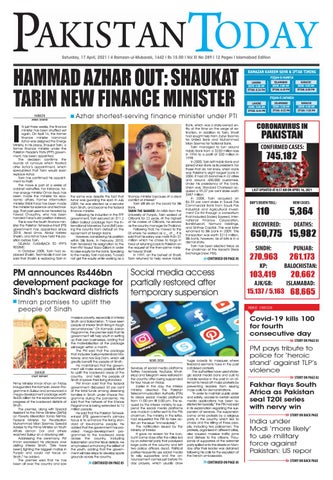
Hammad azHar out: sHaukat tarin new finanCe minister kARACHI
i
aRiba Shahid
N just three weeks, the finance minister has been shuffled yet again. On April 16, the former finance minister Hammad Azhar was assigned the Energy Ministry. In his place, Shaukat Tarin, a former finance minister under the Pakistan People’s Party (PPP) government, has been appointed. The decision confirms the rounds of rumours which floated after Azhar’s appointment, which speculated that Tarin would soon replace Azhar. Tarin has confirmed his appointment to Profit. The move is part of a series of cabinet reshuffles. For instance, former energy minister Omar Ayub has been made the minister for economic affairs. Former information minister Shibli Faraz has been made the minister for science and technology. That post used to be headed by Fawad Chaudhry, who has been handed Faraz’s old position instead. This is now the fourth finance minister the Pakistan Tehreek-e-Insaf (PTI) government has appointed since 2018. Asad Umar, Abdul Hafeez Sheikh, and Azhar have held this position before Tarin. DEJAVU: FLASHBACK TO PPP’S REGIME: In October 2008, Tarin had replaced Shaikh. Technically it can be said that Shaikh is replacing Tarin in
g
Azhar shortest-ser ving finance minister under PTI
the same way despite the fact that Azhar was guarding the spot. In July 2009, he was elected as a senator from Sindh, and became the federal finance minister. Following his induction in the PPP government, Tarin secured an $11.2 billion bailout package from the International Monetary Fund (IMF) saving the country from default on the repayment of foreign loans. However, considering his position within Silk Bank, In February 2010, Tarin tendered his resignation to the then-PM Yousuf Raza Gillani in order to raise equity for the bank. Speaking to the media, Tarin had said, “I could not get the equity while working as a
finance minister because of a clear conflict of interest.” Tarin still sits on the board for Silk Bank. TARIN THE BANKER: An MBA from the University of Punjab, Tarin worked at Citibank for 22 years. At the highest of his career at Citibank, he served as the country manager for Thailand. Following that, he moved to the US where he worked as a _ at _. It is said that his salary was more than $1 million which he chose to forgo in favor of returning back to Pakistan on the request of the then-prime minister Nawaz Sharif. In 1997, on the behest of Sharif, Tarin returned to help revive Habib
Bank, which was a state-owned entity at the time on the verge of extinction. In addition to Tarin, Sharif had sought help from Zubyr Soomro for United Bank and Muhammad Mian Soomro for National Bank. Tarin managed to turn around Habib Bank from a $230 million loss in 1996 to a profit of $30 million in 1998. In 2000, Tarin left Habib Bank and joined Union Bank as its president. For those that do not know, Union bank was Pakistan’s eight largest bank in 2006. It had 65 branches in 22 cities and around 400,000 customers. Under his presidency of the bank, Union was, Standard Chartered acquired a 95.37 per cent stake worth $487 million. In 2008, Tarin acquired an 86.55 per cent stake in Saudi Pak Commercial Bank from Saudi Pak Industrial and Agricultural Investment Co ltd through a consortium that included Sadeq Sayeed, International Finance Corporation, BankMuscat, Nomura Holdings, and Sinthos Capital. This was later renamed to Silk bank in 2009. This transaction was worth $213 million, Silk bank, however, as of late is in a dismal state. Tarin has been elected twice as the chairman of the Karachi Stock Exchange (now: PSX).
CONTINUED ON PAGE 05
Social media access PM announces Rs446bn development package for partially restored after Sindh’s backward districts temporary suspension g
Imran promises to uplift the people of Sindh
sUkkUR Staff RepoRt
Prime Minister Imran Khan on Friday inaugurated the Kamyab Jawan Programme in Sukkur and announced a mega-development package worth Rs446 billion for the socio-economic progress of the backward districts of Sindh. The premier, along with Special Assistant to the Prime Minister (SAPM) on Poverty Alleviation Sania Nishtar, Federal Minister for Privatisation Muhammad Mian Soomro, Special Adviser to the Prime Minister on Youth Affairs Usman Dar and others reached Sukkur on a day-long visit. Addressing the ceremony, PM Imran expressed his pleasure over visiting interior Sindh. “[We have been] fighting the biggest mafias in Punjab and could not focus on Sindh,” he added. The premier said that he has been all over the country and saw
massive poverty, especially in interior Sindh and Balochistan. “I have seen people of interior Sindh living in tough circumstances.” On Kamyab Jawan Programme, the premier said that his government will help youth in setting up their own businesses, adding that the materialisation of the package will begin within a month. The PM said that the package that includes Sukkur-Hyderabad Motorway and Nai Gaj Dam, which will greatly benefit the people of Sindh. He maintained that the government will make every possible effort to uplift the backward areas of the country, and help the people of Sindh improve their living standard. PM Imran said that the federal government disbursed 33 per cent of the total funds among deserving families in Sindh under Ehsaas Programme during the pandemic. He said that the network of the Ehsaas Programme is being extended to 12 million people. He said that the Pakistan Tehreeke-Insaf (PTI) government’s primary focus is to enhance the living standard of low-income people. He added that the government has provided mega-development programmes to the backward areas across the country, including Balochistan and the tribal districts. He emphasised enhancing the skillset of the youth, adding that the government will take steps to develop sports grounds across the country.
CONTINUED ON PAGE 05
RaMaZan kaReeM sehR & iftaR tiMinG fiqah-e-hanfia islaMabad sehR: 4:08 aM iftaR: 6:43 PM
lahoRe sehR: 4:08 aM iftaR: 6:34 PM
kaRachi sehR: 4:50 aM iftaR: 6:55 PM
fiqah-e-JafaRia islaMabad sehR: 3:58 aM iftaR: 6:53 PM
lahoRe sehR: 3:58 aM iftaR: 6:44 PM
kaRachi sehR: 4:40 aM iftaR: 7:05 PM
Coronavirus in
Pakistan
CONFIRMED CASES:
745,182
LAST UPDATED AT 8:57 AM ON APRIL 16, 2021
DAY'S DEATH TOLL:
NEW CASES:
110
5,364
RECOVERED:
DEATHS:
650,775 15,982 SINDH:
PUNJAB:
270,963
261,173
KP:
BALOCHISTAN:
103,419
20,662
AJK/GB: ISLAMABAD: 15,137 / 5,163 68,665 MORE INSIDE
Covid-19 kills 100 for fourth consecutive day STORY ON PAGE 03
News Desk Services of social media platforms Twitter, Facebook, YouTube, WhatsApp and Telegram were restored in the country after being suspended for four hours on Friday. Earlier in the day, the interior ministry directed the Pakistan Telecommunication Authority (PTA) to block social media platforms from 11:00 am till 3:00 pm. The request by the interior ministry to suspend the social media platforms was made in a letter sent to the PTA chairman. The ministry, in the letter, had requested the PTA to take action on the issue “immediately”. The notification issued by the Ministry of Interior It gave no reason for the ban, but it came days after the rallies led by an extremist party that paralysed large parts of the country and left two police officers dead. Political parties frequently use social media to rally supporters and the announcement comes just before Friday prayers, which usually draw
huge crowds to mosques where firebrand sermons have in the past catalysed protests. The authorities have used strategic social media bans and cuts to mobile service in the past in an attempt to head off major protests by preventing leaders from issuing mass calls for demonstrations. “In order to maintain public order and safety, access to certain social media applications has been restricted temporarily,” the PTA had said in its explanation regarding the suspension of services. The suspension came amid protests by a religious party in the country which led to chaos and the killing of three people, including two policemen. The protests, organised in different cities, also caused massive traffic jams and distress to the citizens. Thousands of supporters of the extremist party spilled onto the streets on Monday after their leader was detained following his calls for the expulsion of the French ambassador.
CONTINUED ON PAGE 05
PM pays tribute to police for ‘heroic stand’ against TLP’s violence STORY ON PAGE 02
Fakhar flays South Africa as Pakistan seal T20I series with nervy win STORY ON BACK PAGE
India under Modi ‘more likely’ to use military force against Pakistan: US repor STORY ON BACK PAGE
02
Saturday, 17 April, 2021
ISLAMABAD
NEWS
PM PAys TRIbuTE To PoLICE foR ‘hERoIC sTAnd’ AgAInsT TLP’s vIoLEnCE IsLAMABAD
P
aPP
RIME Minister Imran Khan on Friday paid tribute to the police force for their heroic stand against organised violence, what he said, was intended to create chaos to blackmail the government. The prime minister, in a tweet, said that four police personnel were martyred and over 600 were injured during the protests. He was referring to the recent violent protests by now defunct Tahreek-e-Labbaik Pakistan (TLP) in different cities after the arrest of the party chief. “I want to pay special tribute to our police force for their heroic stand against organised violence intended to create chaos to blackmail govt,” he said. The prime minister said that the nation was indebted to those heroes and that the
RASHEED SAYS NOBODY WOULD BE ALLOWED TO BLACKMAIL THE STATE government would look after the families of the martyrs. Meanwhile, Interior Minister Sheikh Rasheed Ahmed on Friday visited the Combined Military Hospital (CMH) and District Headquarters Hospital Rawalpindi to inquire about the health of policemen and personnel of Pakistan Rangers, who injured during a clash with TLP supporters. He said that the security personnel bravely tackled the situation and foiled an attempt to create chaos across the country. He, appreciating the security personnel, said that they handled the mobs in a professional manner. The minister said that no one would be allowed to blackmail the state, adding that strict action would be taken against those
involved in violent and destructive activities. Separately, Federal Minister for Science and Technology Fawad Chaudhry on Friday said that a special cell comprising NADRA, Safe City Lahore and other agencies has been set up, which has been helping in identification of the people involved in violence against the police through videos. In a tweet, the minister said that dozens of people have been identified so far and action is being taken against them under the anti-terrorism act. He said that the district administration will also monitor all speeches. NO RELIGION OR CONSTITUTION ALLOWS VIOLENCE AGAINST PEOPLE: During the National Assembly (NA) session on Friday, Minister of State for
Parliamentary Affairs Ali Muhammad Khan, while responding to a point of order, said that no religion or constitution allows violence against people and the writ of the government would be maintained through strict action against those trying to create chaos. The minister of state said that “we believe in Finality of Prophethood, and our objective is to follow the teachings of Holy Prophet (Peace Be Upon Him) and preach his message to whole humanity”. He said that no one can be allowed to misguide the people in the name of religion and the government would ensure law and order in the country. He also said that the situation has returned to normalcy in the country after the steps taken by the
government to deal with the violent protests of a religious group, and all the roads have been also opened. The minister of state said that no group can be allowed to disturb the law and order situation and dictate its terms to the government. He said that neither the religion nor the constitution allows attacks on the police personnel. The minister recalled that both the houses of the parliament passed unanimous resolutions strongly condemning the publication of blasphemous caricatures in France. He said that Prime Minister Imran raised the issue strongly at every world forum while he also wrote letters to heads of all Islamic countries to have a dialogue with the West to sideline few such elements among them. The speaker said that “we are all Aashiq-e-Rasool (PBUH) and can sacrifice our lives” for his sanctity. The minister said that an agreement was made with a religious party to present their demands in the parliament and to implement its final decision. During the negotiation process, they gave a call to people to come out on April 20 which was unfair, he added. About the speaker’s direction for presence of minister for interior in the House during the debate, he assured that the minister would take the House into confidence on Monday.
President approves new CCI body with Qibla Ayaz as chief President Dr Arif Alvi has approved appointments in Council of Islamic Ideology (CCI) with Dr Qibla Ayaz has been appointed as the chairman of the council. The appointment of new members was approved for 12 vacant seats in the council under Article 228 of the Constitution. Dr Umair Mahmood Siddiqui from Karachi University and Pir Abul Hassan Muhammad Shah of Bhairah Sharif have been appointed as members. Muhammad Hassan Haseebur Rehman and Maulana Hamidul Haq Haqqani of Darul Uloom Haqqania, Akora, Khattak, Allama Muhammad Hussain Akbar, Syed Ziaullah Shah Bukhari and Pirzada Junaid Amin have also been appointed as members. Hafiz Muhammad Tahir Mahmood Ashrafi, Mufti Muhammad Zubair, Syed Muhammad Habib Irfani, and Maulana Naseem Ali Shah have also been appointed as members of the CII. News Desk
PEMRA bans TLP coverage on national media being proscribed entity ISLAMABAD: The Pakistan Electronic Media Regulatory Authority (PEMRA) on Friday banned the coverage of the issues related to the banned Tehreek-eLabbaik Pakistan (TLP) on national media (television and radio) as the outfit was listed as proscribed organisation by the government. In a communique sent to all satellite TV channels and FM radio stations, the authority referred to the Ministry of Interior’s notification in which it said the government has “declared Tehreek-e-Labbaik Pakistan as a proscribed organisation” for engaging in acts of terrorism and acting in a manner prejudicial to the peace and security of the country. The notification added that the PEMRA (Television Broadcast Station Operation) Regulation, 2012, and the Electronic Media Code of Conduct, 2015, required that programmes “shall conform to the laws of the country’. Additionally, Clause 3(3) of the Electronic Media Code of Conduct, 2015, ‘prohibits media coverage to proscribed organisations”. “Therefore, […] while exercising powers conferred under Section 27 of PEMRA Ordinance, 2002, as amended [by] PEMRA (Amendment) Act, 2007, media coverage of Tehreek Labbaik-e-Pakistan is banned,” the PEMRA letter dated April 15 said. It directed all satellite TV channel and FM radio licensees to “restrain from providing any kind of media coverage to this organisation”. On Thursday, the government had banned TLP, whose activists staged three days of violent protests across the country this week after their leader’s arrest. A notification declaring TLP as a proscribed organisation was issued by the Ministry of Interior shortly after the federal cabinet approved a summary to ban the party. The notification stated: “The federal government has reasonable grounds to believe that the TLP is engaged in terrorism, [has] acted in a manner prejudicial to the peace and security of the country, [was] involved in creating anarchy in the country by intimidating the public, caused grievous bodily harm, hurt and death to the personnel of law enforcement agencies and innocent by-standers, attacked civilians and officials, created wide-scale hurdles, threatened, abused and promoted hatred, vandalised and ransacked public and government properties including vehicles and caused arson, blocked essential health supplies to hospitals, and has threatened, coerced, intimidated, and overawed the government [and] the public and created sense of fear and insecurity in the society and the public at large.” Copies of the notification were sent to authorities concerned, including the secretaries of different ministries and divisions, State Bank of Pakistan (SBP) governor, Election Commission of Pakistan (ECP) secretary and director general passports. MiaN abrar
RAWALPINDI: Muslims offer Friday prayer on the first Friday of the holy month of Ramadan at the Jamia Mosque. iNP
Punjab approves billions for uplift projects LAHORe staff rePort
The government of Punjab released funds to the tune of billions of rupees for different uplift schemes, including water, sanitation, road construction and education, across the province on Friday. Punjab Chief Minister Sardar Usman Buzdar chaired the meeting of the Cabinet Standing Committee for Finance to decide about the release of funds to development projects. The meeting was told that 6 metallic roads projects will be completed at a cost of Rs190million in Lahore. The meeting, in principle, approved to develop four model graveyards in Lahore through Shehr-e-Khamoshan Authority. Approval of water supply schemes was also granted for Chichawatni and Harappa. Both the projects were announced by the chief minister during his Sahiwal visit. It was decided to build a modern bus stand in Mianwali, while the sewerage and drainage project in the bus stand will be completed with a cost of Rs130 million. Four development projects were approved for Mianwali city along with the approval of five roads construction schemes. The CM approved funds for the upgradation of THQ hospital Minchinabad with a cost of Rs370 million. Expansion in the premises of Khawaja Ghulam Fareed mausoleum at Kot Mithan was approved and a boundary wall and marble floor will be constructed there.
CM MEETS WITH HEIRS OF POLICE MARTYRS, INQUIRES AFTER THE INJURED Different schemes of provision of water for drinking and irrigation purposes under the Koh-e-Suleman Development Authority were also approved. The meeting was told that numerous projects will be completed with an amount of Rs5.71 billion under the Koh-e-Suleman Improvement Project. Bridge and the metallic road will be constructed at Sanghar Nullah and Rs39.7 million will be spent to complete the water supply scheme at Sakhi Sarwar. The meeting also approved Rs500 million each for Baba Farid University Pakpattan, Koh-e-Suleman University, Rajanpur, and University of Hafizabad. In principle approval was accorded to give 8,000 laptops to rural markaz-e-maal while the CM directed to give 2,200 laptops to backward areas’ colleges. The meeting further approved giving the status of associate colleges to five colleges. Meanwhile, Chief Minister Buzdar met with the bereaved heirs of martyred police constables Muhammad Afzal and Muhammad Imran at Police Lines Qila Gujjar Singh and extended sympathies to them. The CM offered Fateha for the departed souls and sympathised with the bereaved families. He announced to provide employment and education to the children of the martyrs and the shaheed package will also be given to the martyrs’ families. The CM directed the IG to complete
formalities for hiring Hafza Afzal, the MSc Chemistry graduate daughter of martyred constable Muhammad Afzal. He also consoled Naziran Bibi, mother of Muhammad Imran, and said that “every police official is your son” and further assured the heirs that the Punjab government will extend full support to them. Later, the CM visited Jinnah Hospital to inquire after the injured police officials. He presented flowers to the injured officials and directed to provide the best medical facilities to constable Rizwan Ali who is almost paralysed due to the torture of the protesters. “Every effort should be made for the treatment of Rizwan Ali as I want to see him standing on his feet,” the CM directed. He also inquired after injured constables Muhammad Amin, Muhammad Farooq and Hakim Ali. Hakim Ali thanked the CM and vowed to return to his job for protecting the life and property of the people. The CM appreciated the sacrifices and passion of police officials adding that the nation salutes them. The police martyrs package will be further honed, he added. The treatment of the injured will be fully monitored, and the best healthcare facilities will be provided, he said. Punjab remained peaceful today and the Jumma prayer was offered peacefully due to the sacrifices of the police. The valour and commitment of police are praiseworthy, he further said.
Nawaz, Fazl discuss future strategy, agree to stick to PDM agenda News Desk Jamiat Ulema-e-Islam Fazl (JUI-F) and Pakistan Democratic Movement (PDM) chief Maulana Fazlur Rehman on Friday contacted Pakistan Muslim League Nawaz (PML-N) supreme leader Nawaz Sharif to discuss the opposition’s future strategy, including matters related to the long march. According to INP, both the leaders discussed the
country’s overall political situation and the situation which developed after resignations of the Pakistan People’s Party (PPP) and Awami National Party (ANP) from PDM. Both the leaders agreed to move forward against the Pakistan Tehreek-e-Insaf (PTI) government and stick to the agenda of the PDM. The PPP and the ANP have parted their ways with the PDM over the issuance of show-cause notice. Earlier this week, JUI-F and PDM chief Fazl asked
the PPP and the ANP to reconsider their decision of resigning from the alliance. Meanwhile, PPP senior leader Chaudhary Manzoor, in an interaction with reporters, had said that PPP would not reconsider its decision of quitting the opposition’s alliance. Commenting over Pakistan Muslim LeagueNawaz (PML-N) President Shehbaz Sharif’s bail, Manzoor had said that “Shehbaz Sharif got bail as a result of the deal”.
Saturday, 17 April, 2021
ISLAMABAD
NEWS
03
Covid-19 kills 100 for fourth CoNseCutive dAy ISLAMABAD
t
TLTP
HE novel coronavirus has claimed 110 more lives in Pakistan during the past 24 hours, surging the overall death toll to 15,982, said the National Command and Operation Centre (NCOC) on Friday. According to the NCOC, 5,364 new infections were reported during the aforementioned period and the positivity rate stood at 8.31 percent. The health facilities across the country conducted 64,481 coronavirus detection tests, taking the total number of Covid-19 tests to 11,007,252 since the first case was reported. Amid a third wave of the pandemic, the country has reported 739,818 Covid-19 cases so far since the beginning of the pandemic last year. The number of active cases stands at 77,294 with the nationwide recoveries rising to 646,652.
NCOC ALLOWS 2 MORE MEDICAL CENTRES IN KARACHI TO VACCINATE PEOPLE The coronavirus situation has deteriorated further in Pakistan leading to stringent restrictions from the NCOC to curb the spread of the virus. Sindh currently leads the provinces and federating units with 270,310 cases, Punjab is second with 258,441 cases, Khyber Pakhtunkhwa (KP) has reported 102,290 cases, Islamabad 68,066 cases, Balochistan 20,580 cases, Azad Jammu and Kashmir (AJK) 14,978 cases, and Gilgit-Baltistan (GB) 5,153 cases. Around 10 per cent of coronavirus patients reported in Islamabad Capital Territory (ICT) and Rawalpindi district are children below the age of 10 years, health department officials confirmed. Islamabad‘s District Health Officer
COVID-19 CURBS ON PUBLIC TRANSPORT, TRADE ACTIVITIES INTENSIFIED IN CAPITAL ISLAMABAD: The Islamabad administration intensified restrictions on public transport and commercial activities following National Command and Operation Centre (NCOC) guidelines to curb Covid-19 cases on Friday. Islamabad Deputy Commissioner (DC) Muhammed Hamza Shafqaat announced that public transport to and from Islamabad was being banned from 12:00 midnight following the guidelines of the NCOC. He said, in his Twitter message, that all commercial activities will be banned across Islamabad on Saturday and Sunday. Shafqaat added that the ban is also imposed on outdoor dining, public parks and other gatherings. Earlier on April 4, the NCOC had suspended inter-provincial transport for two days a week (Saturday and Sunday) while keeping in view the recent spike in Covid-19 cases amid the third wave of the disease. The NCOC had restricted inter-provincial public transport only on weekends. However, cargo trucks, containers, medical and emergency services will be exempted from the restrictions. The new restrictions will come into force from the 10th of April and will continue to remain effective till 25th of April, it ordered. NCOC had further announced that Pakistan Railways will continue to operate passenger trains seven days a week with 70 per cent occupancy. TLTP
(DHO) Dr Zaeem Zia said that at least 7,052 child patients, from newborn to 10 years of age, have been diagnosed with Covid-19. However, the DHO added that most of the children have recovered from the disease. “The phenomenon is not new nor has there been any significant increase in the number of child cases in the recent past,” explained Dr Zia. He added that the 10 percent included children who have been diagnosed with the virus since the pandemic began. The NCOC on Friday allowed two more medical centres in the city to administer coronavirus vaccines to the masses. The NCOC has allowed the Indus Hospital
and the Tabba Heart Institute to vaccinate those who qualify to be administered the coronavirus vaccine jab. There are now six vaccination centres in total in Karachi. In Karachi,
Ziauddin Hospital, the South City Hospital, OMI, Hashmanis Hospital, the Indus Hospital and the Tabba Heart Institute are providing the coronavirus vaccines to people.
SINDH CHANGES MARKET TIMINGS, CLOSURE DAYS AS COVID-19 CASES INCREASE KARACHI: The Sindh Home Department issued new directives regarding the markets and trade centres for their timings and closure days on Friday. The directives issued by the Sindh home department impose new restrictions in a bid to curb the coronavirus which will be made effective till May 16. Under the new instructions, trade activities will be completely closed on Saturday and Sunday, whereas the timing of the markets and trade centres were also changed. The markets and trade centres will be allowed to remain open till 6:00 pm. However, the shops selling essential commodities will be exempted from the restrictions. All kinds of political, cultural, social and sports activities will be banned, as well as restaurants will be restricted to provide indoor dining facilities. Outdoor food facilities will be allowed from Iftar timing till 12:00 midnight. After 12:00 midnight, restaurants and food shops will be allowed to continue home delivery and take away facilities. The home department asked mosque administration to organise Taraweeh gatherings in open areas. The committees comprising representatives of local administration and clerics will implement the regulations. Shrines, dargahs will be completely closed, whereas indoor and outdoor events will be completely banned. Inter-provincial transport services will also be closed on Saturday and Sunday, the notification read. Meanwhile, Sindh Chief Minister Murad Ali Shah on Friday said in a daily Covid briefing that the province has conceded 561 new infections in the 24hour period of testing with three casualties. In the past 24 hours period, the CM said that 11,623 tests were conducted throughout the province out of which 561 were diagnosed as Covid positive. On the same day, the briefing noted that 404 previously infected patients posted recovery from the virus in the province which means so far 259,792 have recovered across Sindh after the virus. With three new deaths reported today, the total Covid deaths for the province reached 4,544, CM Murad confirmed in his briefings. It may be noted that out of total 561 cases of Sindh, 278 (or almost 50 per cent) belong to Karachi. TLTP
Govt needs to get Tarin elected as senator within 6 months ISLAMABAD
TARIN MAY HANDLE NFC BETTER
GhuLam abbas
As the government has decided to appoint Shaukat Fayyaz Ahmed Tarin as the new minister of finance and revenue, it needs to get him elected as the member of parliament within six months to have him continue in office. In yet another shuffle in the federal cabinet, Prime Minister Imran Khan on Friday removed Hammad Azhar from the Finance Ministry less than a month after his appointment and replaced him with Tarin. Prime Minister Imran, instead of appointing Tarin as his adviser on finance, appointed the banking wizard as the finance minister, for which, as per law, he needs to be a member of parliament within six months. While most ministers have to be elected representatives – i.e. members of the National Assembly (NA) or Senate – there is a clause in the Constitution that allows short-term appointments of non-elected ministers. According to clause nine of Article 91 of the Constitution, a non-elected person can be appointed a federal minister for six months once during the five-year tenure of the NA. “A minister, who, for any period of six consecutive months, is not a member of the National Assembly, shall, at the expiration of that period, cease to be a minister and shall not before the dissolution of that assembly be again appointed a minister unless he is elected a member of that assembly,” reads the clause. It is worth mentioning here that Tarin had become a senator and the federal finance minister in former president Asif Ali Zardari’s government. According to an official at the Finance Ministry,
Tarin, who was the finance minister during the Pakistan People’s Party (PPP) tenure, would help the government in resolving many issues. As he had completed the 7th National Finance Commission (NFC), he may play an important role in resolving the longstanding issues related to the next NFC. No NFC award was given after the 7th NFC as differences between the Centre and provinces remained unresolved. As Tarin had also signed the International Monetary Fund (IMF) programme during the PPP government, he may also handle matters with the IMF to complete the existing loan programme signed by the Pakistan Tehreek-e-Insaf (PTI) government. Islamabad had signed the 39-month bailout programme with the IMF to avert sovereign default because of a balance-of-payment crisis. As the finance minister under the PPP government, Tarin had signed the bailout programme with the IMF under that government and concluded the seventh NFC Award. However, he left the ministry without completing his tenure to start his own bank, Silk Bank, where he served on the top slot. These changes come at a time when Pakistan has just received another $500 million from the IMF as part of the $6 billion bailout package it signed in July 2019. The third and latest tranche of the program brings the total borrowing for budget support to $2 billion. Tarin was already a member of the prime minister’s Economic Advisory Council. He is a banker by profession and worked as the president of HBL in 1997.
In 2000, he built Union Bank, which was later sold to Standard Chartered Bank. Earlier this month, it was reported that the government had made an offer to Tarin to join the federal cabinet as special assistant or adviser to the PM, but he linked his joining the federal cabinet with the decision
‘CPC willing to partner with allies to create peaceful, prosperous, beautiful world’ ISLAMABAD akif Rashid
China’s Federal Minister Song Tao has said that the Communist Party of China (CPC) is willing to shoulder its responsibility and play its role in creating a peaceful, safe, prosperous, open and beautiful world together with the political parties in other countries. Song, the minister for International Department of the Central Committee of the CPC, expressed these views while addressing the participants of a thematic briefing took place in Hangzhou, East China’s Zhejiang Province. Pakistan Today’s Islamabad representative also attended the online event. According to a statement issued by
the Chinese Embassy, the ceremony was held to showcase Zhejiang’s achievements in practicing Chinese President Xi Jinping’s thought on socialism with Chinese characteristics for a new era. The event, co-hosted by the International Department of the Central Committee of the CPC and the CPC Zhejiang Provincial Committee, was themed on ‘Drawing up and following through the Blueprint’, reviewed the course of the CPC’s efforts to fight for the fundamental interests of the Chinese since its founding, and showcased the country’s outstanding achievements in pursuing a new development vision, a new development paradigm and highquality development. Song said at the briefing that the
CPC is destined to ensure the well-being of the people and rejuvenate the country. He also said that under the leadership of the CPC, China has won the battle against poverty. Zhejiang has witnessed huge improvements after pursuing the Double-Eight Strategy for 18 years, according to Yuan Jiajun, Party secretary of Zhejiang. Yuan elaborated on the province’s practice in innovative development, coordinated development, green development, open development and shared growth. He expressed hopes that all foreign diplomats and guests will introduce Zhejiang and China to their people and said that Zhejiang will enhance its cooperation with other countries in anti-
pandemic, science and technology, as well as economy and trade matters. Five guests were invited to share about Zhejiang’s economic development and stories of residents’ lives, including Ma Jun, deputy director of Hangzhou municipal development and reform commission, and Mohammad Falah Nasser, a Jordanian businessman in Yiwu. Nearly 400 representatives of political parties from more than 70 countries participated in the thematic briefing online. Foreign guests congratulated the CPC on its upcoming 100th anniversary and spoke highly of the achievements made by the Party in epidemic prevention and control, and poverty elimination.
on an accountability reference that he has been facing for nearly a decade. He had that said he would not accept the offer, which he claimed had been made for a second time, unless a case against him filed by the National Accountability Bureau (NAB) was disposed of.
Nepal’s Annapurna conquered by Pakistanis for first time NEWS DESK Sirbaz Khan and Muhammad Abdul Joshi became the first Pakistani climbers to summit the treacherous 8,091-metre Annapurna peak in Nepal on Friday. On March 23, Sirbaz Khan, Muhammad Abdul Joshi, Saad Munawar and Kamran Ali became the first climbers to raise the Pakistani flag at the basecamp of the world’s 10th highest peak. According to details shared by the climbers’ teammates on social media, the duo made their first summit push on April 13, the second on April 14, and finally managed to reach the top on Friday at 1:17pm. They undertook the expedition to honour late Pakistani mountaineer Muhammad Ali Sadpara who went missing on K2, the world’s second highest peak, along with his companions, Icelandic mountaineer John Snorri Sigurjónsson and Chilean mountaineer Juan Pablo Mohr Prieto, on February 5, while attempting to summit the ‘savage mountain’ in winter.
Saturday, 17 April, 2021
04
ISLAMABAD
NEWS
Sindh CM approVES rS30bn for SafE City projECt KARACHI
S
STAFF REPORT
INDH Chief Minister Syed Murad Ali Shah on Friday approved Rs30 billion for the Safe City project, under which 10,000 CCTV cameras would be installed in the city in three phases and each phase would be completed within 12 months starting from the next financial year, 2021-22. According to the press release issued in this regard, the CM was chairing a meeting to review the progress of the Safe City Project. The meeting was attended by IT Minister Taimoor Talpur, Chief Secretary Umtaz
Shah, P&D Chairman Mohammad Waseem, Home ACS Usman Chachar, PSCM Sajid Jamal Abro, Finance Secretary Hassan Naqvi, Safe City Project In-charge Additional Inspector General (IG) Imran Yakoob Minhas, the provincial head of NRTC Brig (r) Nayar, NRTC General Manager (GM) Sohail Anjum and others. The meeting was told that the National Radio & Telecommunication Corporation (NRTC) has submitted technical and financial proposals which needed to be evaluated by the evaluation committee. The chief minister approved the constitution of a nine-member technical committee under the chief operating officer (CEO) of
the safe city project to evaluate the NRTC proposal. He also approved the proposal of assigning the charge of CEO to Muquddus Haider and chief technical officer to Tabasum Abbsi. Notifications for the evaluation committee, CEO and technical officers would be issued. The technical committee will evaluate the technical and financial proposal in line with PC-I documents and would also evaluate the project phasing as recommended by NRTC in consultation with the P&D Department. The technical committee will also look after the overall activities of the project execution, including its execution.
The chief minister approved the execution plan under which 10,000 cameras would be installed in three phases and each phase would be completed within 12 months. In the first phase, cameras would be installed at all the entry/exit points of the city and in district South for Rs9.9 billion. In the second phase, cameras would be installed in three districts, to be selected later on for Rs9.8 billion. In the third and the concluding phase, three more districts would be covered for Rs9.7 billion. The chief minister directed the finance department to arrange Rs10 billion for the first phase in the next financial year. “I want to start the project at the start
of next financial year, 2021-22,” he said and also directed P&D Chairman Waseem to start the approval of the PC-1 from all the relevant forums by the end of the current financial year. CM Murad was told that 8,000 cameras would be of 12 MP and 2,000 of eight MP. In this way, 10,000 cameras would be installed at over 2,000 locations with solar back up. There would be a central and regional command centre and a database centres. He was told that at present 2,196 cameras were installed at 538 locations in the city, of them 1,201 belonged to KMC, 198 IT department and 155 to Sindh police.
Share videos to raise donations with SnackVideo-Edhi initiative SnackVideo has partnered with NGO Edhi Foundation to provide an indoor opportunity to people to support the vulnerable during the holy month of Ramadan. By sharing videos with the hashtag #EidwithEdhi on SnackVideo, people can help donate Rs10 per video to children and families suffering from poverty, famine or poor health. The total amount of videos will eventually decide the total donations given by Edhi Foundation. So each and every effort really counts. Everyone can also get points to redeem gifts by uploading creative Ramazan content with the hashtag #EidReward or by simply viewing videos from different category pages like #EidQuotes, #EidRecipe, #EidDrama and #EidSaeed. The hashtag series encourage people to document their wonderful meals and pastimes at sehr and iftar hours to showcase their loving care and deep concerns to those in need. Last Wednesday marked the beginning of Ramadan, 2021 and SnackVideo has provided a chance for people to share their smiles and shine other's life. There is no better chance than now to support people in their sufferings and make this time of year a source of hope. PR
LAHORE: People supplicate after Friday prayer at Badshahi Mosque in the provincial capital. ZUBAIR MEHFOOZ K-Electric’s Chief Executive Officer Moonis Alvi and Chief Distribution Officer Amer Zia visited different areas to review progress on the company’s plan for rain mitigation measures on critical infrastructure ahead of the 2021 monsoon season. The KE is investing Rs1.5 billion to rehabilitate, elevate and reconstruct power distribution system in areas affected by inclement weather last year. The project is on track and expected to be completed by June this year. In addition to raise the height of vulnerable substations, the KE is also installing aerial bundled cables and replacing deteriorated underground cables and aged switching gear with new equipment to protect the system and ensure a stable electricity supply for the citizens of Karachi. PR
BankIslami, one of the Pakistan’s fastest growing Islamic finance institutions, has partnered with TPL Life to offer a consolidated Covid-19 coverage plan for customers. The package is a complete Shariah compliant takaful plan for entire family with up to RS30,000 initial benefits upon diagnosis and further Hospital Cash Assistance for each member under the only Covid Protection Shield available to individuals. PR
CPEC guarantor of progressive future of Pakistan: Sarwar LAHORE INP
Governor Punjab Chaudhry Mohammad Sarwar has said that the China-Pakistan Economic Corridor (CPEC) is a guarantor of the progressive future of Pakistan. He said that the projects under CPEC, which is the manifestation of PakistanChina friendship, will be completed on time. According to details, during a meeting held at Governor House, Lahore on Friday, Chairman CPEC Authority Lieutenant General (r) Asim Saleem Bajwa apprised Sarwar about the ongoing projects of CPEC and various economic aspects also came under discussion while Sarwar appreciated the role of Bajwa in the country's economic development, particularly in CPEC.
Speaking on the occasion, Sarwar said that the CPEC is a guarantor of the progressive future of Pakistan and the projects of CPEC will continue to yield positive results, adding that China and Pakistan have a long-standing friendship and both the countries stand by each other in challenging times. “Pakistan is on the road to progress under the leadership of Prime Minister Imran Khan. CPEC is an important project that can change the destiny of Pakistan and it has the support of the public as well as the government of Pakistan. Before the PTI came to power, there was talk of bankruptcy of the country but under the leadership of Prime Minister Imran Khan, the PTI saved the country from bankruptcy and now the country’s economy is improving. Today, all international institutions are acknowledging Pakistan's eco-
NTDC establishes central control centre to monitor stability of power system LAHORE PR
In compliance with the directions of Ministry of Energy, the National Transmission & Despatch Company Limited (NTDC) has established a Central Control Centre (CCC) at New Kotlakhpat grid station to monitor and keep a close liaison with NPCC and all DISCOs during Sehr, Iftar and Traweeh hours. The CCC will monitor stability of the power system. NTDC Managing Director (MD) Engineer Dr Khawaja Rif-
fat Hassan visited the CCC and checked the arrangements. He said that the CCC will work round the clock under the super-
vision of general manager (Asset Management) North and a dedicated team will look after continuous and uninterrupted power
supply to all distribution companies across the country. He said that in order to meet any emergency, Regional Control Centres (RCC) of asset management have also been established in Islamabad, Multan, Hyderabad and Quetta. The MD further said that in case of a fault at any grid station or transmission nine of NTDC across the country, the control centre will monitor the team mobilisation and material directly and latest information will be shared with the Ministry of Energy (Power Division) and respective DISCOs.
nomic growth and stability, and there is increased investment in all sectors, including the industrial sector,” Sarwar said. Bajwa said that the work on the CPEC projects is being expedited, adding that it is a pilot project of cooperation be-
tween Pakistan and China. All projects will be completed on time. With CPEC, Pakistan is heading towards economic growth and more employment opportunities are being created for the people under CPEC, he added.
Saturday, 17 april, 2021
iSlaMabad
THAw iN PAKiSTAN-iNdiA TeNSioNS iS 'TAcTicAL': exPeRTS KaracHi
U
ANADOLU AGENCY
NITED Arab Emirates-brokered backdoor diplomacy has brought a thaw in otherwise mounting tensions between nuclear-armed Pakistan and India, but it is no more than a “tactical move,” say local experts. Senior Pakistani and Indian intelligence officials held a series of secret meetings in Dubai in January this year in an attempt to stem the escalating tensions along the Line of Control (LoC), a de facto border that divides the disputed Kashmir valley between the two neighbors. Last month, the two militaries agreed to honor the 2003 cease-fire along the LoC, followed by an exchange of letters between the two premiers, which was widely viewed as an outcome of the backdoor diplomacy. The UAE’s ambassador to the US, Yousef Al Otaiba, confirmed Wednesday that the Gulf state is mediating between New Delhi and Islamabad to help them reach a “healthy and functional” relationship. Addressing a virtual session with Stanford University's Hoover Institution, Otaiba said his country had a role behind the cease-fire at the Kashmir border, which hopefully ultimately would get relations back to a “healthy level.” “The ongoing cease-fire [at the Kash-
UAE-BROKERED BACKDOOR DIPLOMACY HAS CALMED MOUNTING TENSIONS BETWEEN TWO SIDES mir border] is certainly the outcome of the backdoor diplomacy, which is benefitting Kashmiris living on both sides of the border,” retired Lt. Gen. Talat Masood, an Islamabad-based defense analyst, told Anadolu Agency. “But this is all merely tactical. How long this (thaw) survives, we’ll have to wait and see,” said Masood, who served in the Pakistan Army from 1952 to 1990. This, he added, is not the first time that back-channel contacts have helped ease tensions between the two arch rivals. “It has happened on several occasions,” he said. Echoing Masood’s view, Ikram Sehgal, a Karachi-based defense and security expert, appeared to be skeptical about the significance of the latest developments. “Certainly, the UAE has interests both in India and Pakistan, and it will do its best to normalize things between the two neighbors. But in the given circumstances, it will not last long,” Sehgal told Anadolu Agency, referring to a host of land and sea disputes between the two neighbors, mainly over Kashmir. “One should try to be optimistic about these developments, which, although, are not very significant,” he maintained. Relations between India and Pakistan plummeted to a new low after August
US sanctions Pakistani company for interference in 2020 elections NEWS DESK
2019, when India scrapped the longstanding special status of Jammu and Kashmir, prompting Islamabad to downgrade its diplomatic ties with New Delhi. Islamabad says the normalisation of ties with New Delhi is linked to a review of the Aug. 5 decision and ultimate resolution of the Kashmir dispute. 'NO CHANGE IN STANCE ON KASHMIR': Masood does not see any change in both countries’ stand on Kashmir following the back-channel diplomacy. “There is a zero chance of change in India’s current position on Kashmir. It will not reverse its August 2019 decision because it feels that Pakistan cannot do anything except for diplomatic lobbying,” he went on to argue, adding “New Delhi is more interested in talks on trade, business and tourism, whereas Islamabad’s focus is on Kashmir.” “India will be happy with backdoor or open diplomacy as long as it serves to maintain the current status on Kashmir,” he further said. “In my opinion, open and backdoor diplomatic contacts will continue, however the level of flexibility to resolve the disputes is the most important factor to watch.” Sharing a similar view, Sehgal, who is editor of a local defense magazine, Defense Journal of Pakistan, said New
Massage parlour accused of inflicting injuries, evading responsibility LaHorE AKIF RASHID
United States President Joe Biden has signed an executive order sanctioning 32 individuals that interfered in the 2020 elections on behalf of a Russian network, including 10 individuals from a Pakistan. The order, titled ‘Executive Order Blocking Property With Respect To Specified Harmful Foreign Activities Of The Government Of The Russian Federation’, was issued on Thursday. Therein, a Pakistani company by the name Second Eye Solution, also known as Forwarders, was declared as part of the network that created and sold fraudulent identities and assisted the Internet Research Agency (IRA) in concealing its identity to evade sanctions. The IRA is a Russian troll farm that Office of Foreign Assets Control, OFAC, designated pursuant to E.O. 13848 in 2018 for interfering in the 2016 presidential election.
Schools to reopen in Punjab, KP from April 19 NEWS DESK Schools will reopen for grade 9 to 12 from April 19 in Punjab and Khyber Pakhtunkhwa (KP). This development comes days after the provincial governments closed educational institutions over increasing coronavirus cases. Punjab Education Minister Murad Ras said that classes will be held on Monday and Thursday. He added that classes will resume in Lahore, Rawalpindi, Faisalabad, Sheikhupura, Gujranwala, Gujrat, Sialkot, Multan, TT Singh, Sargodha, Bahawalpur, Rahim Yar Khan, and DG Khan. Classes for grade 1-8 in high-risk districts will begin studies after Eidul Fitr, he further said.
A local massage parlour in Lahore has been accused of offering massages to clients from untrained personnel, leading to serious injuries to the aforementioned clients, including models based in Lahore. Hafsah Haq, a model and founder of a local dance academy, took to social media to highlight the injuries she sustained due to her treatment at Arammish Spa. Portraying her experience with the popular parlour, Haq said that she had gone in for a full-body, deep tissue massage on March 13 and bruises appeared on her left leg a day afterwards. According to the model, this injury was aggravated while she was teaching a dance class, and had to be rushed to DHA Medical Centre. After two checkups at the medical centre, Dr Sharjeel told her that the brown bruising was indicative of internal bleeding, and was likely a result of the massage itself, said Haq. Thereafter, she was shifted to Evercare Hospital in Nespak Housing Society and underwent an ultrasound. The procedure showed muscle strain and revealed that the damage had extended to her ankle and hamstring. Due to the injury leaving her bedridden, the model experience major muscle atrophy on both her legs, which also resulted in a loosened kneecap on her left leg. Dr
Sajid Mehmood, who was overseeing the physical therapy for Haq at Evercare, indicated in his notes – which Pakistan Today has a copy of – that the most probable cause of the injury was “excessive massage of specific muscle”. During this time, the model had been in contact with Arammish to try and obtain some form of recompensation for the damages she incurred physically, mentally and financially. Haq said that she has been in contact with the head of public relations at the spa. Whilst arguing her case, the spa had initially told Haq that they would investigate the matter. She had been arguing that the local masseuse she had been placed in the care of was inexperienced and led to her injuries. However, Arammish, after its investigation, claimed that they had never had Haq as a client. They asserted that Haq’s photograph had been shown to their employees, but no one recalled the model coming in, further alleging that her appointment was not in their records. On the other hand, Haq asserts she has witnesses to whom she had spoken before going to the spa and afterwards, once the injuries were visible. The spa offered to recompense her for her troubles through free procedures at their Gulberg outlet, such as a free “facial”. To this, the model replied: “I cannot sleep some nights because of the pain and taking up some complimentary serv-
Social media access partially restored after temporary suspension coNtiNuED from pagE 01 The protests have largely been cleared. But in Lahore, supporters continued a sitin at a seminary that serves as the party headquarters despite the circulation of a handwritten plea from leader Saad Rizvi to end the protests. Later on Friday, Minister for Interior Sheikh Rasheed Ahmed apologised for the government’s move to shut down social media services temporarily across the country, saying that it was done keeping
Delhi’s “downplaying” of actual issues with Islamabad is the main hurdle in the normalisation of ties. CHINA FACTOR: The two experts believe that normalization of ties between Pakistan and India will benefit both countries but may offend Islamabad’s longtime ally China. “Normalisation of ties [with Pakistan] will help India focus on China and the economy, whereas it will benefit Islamabad in terms of trade and the economy,” Masood said, adding that the move, however, may irk China, which sees India as a US proxy in the region. Sehgal said “China is our diehard supporter on Kashmir and other issues. We cannot afford to displease it at the cost of relations with India.” India and China confront each other along the Line of Actual Control (LAC), a de facto border line between the two nations in the Ladakh region of the disputed Jammu and Kashmir region, where 20 Indian soldiers were killed last June. Border tensions between the two countries span over seven decades. China claims territory in India’s northeast, while New Delhi accuses Beijing of occupying its territory in the Aksai Chin plateau in the Himalayas, including part of the Ladakh region. “This is all not as simple as it seems. Many geopolitical and geoeconomic factors are involved in this process,” said Masood. “We may say it’s another good beginning, but a rocky terrain lies ahead.”
in mind the masses’ best interest. The interior minister said that WhatsApp, Instagram, and Facebook were suspended across the country as the government feared the members of the proscribed organisation would call for protests after Friday prayers. Rasheed said that the government has defeated those spreading terrorism and inciting violence in the country, adding that the government would try to ensure people were not caused any further inconveniences related to social media. “The ones
who stopped oxygen [vans] and ambulances [from reaching hospitals during protests] were defeated today. We have banned them [the proscribed organisation] and we will move for their dissolution as well,” he said. The government will block their passports, identity cards, and bank accounts too, the interior minister added. CRACKDOWN ON SOCIAL MEDIA BEGINS: The Counter-Terrorism Department (CTD) of Sindh on Friday declared a crackdown on the social media
ices does not seem adequate or appropriate”. She maintained that the spa had “upturned her life”, adding that she was “not allowed to walk” and that she had spent an exorbitant amount of money in physical therapy already. Moreover, another client of Arammish, who wishes to remain anonymous, said that she had a similar experience recently, wherein she “got [her] back and leg muscles damaged” instead of being relaxed after the massage. The client added that she was forced to stay on bed rest for a week. Showing her support to Haq, another model, Farwa Ali Kazmi, said that she always refuses to get massages from local masseuses to avoid these types of situations. The model opined that local masseuses are not certified, adding that “they’re not therapists”. Haq said that she has forwarded the medical details and has repeatedly tried to contact the spa, but they have refused to reply. According to the call records between the model and Arammish, they last spoke on April 9. Hafsah Haq took her complaints to social media in an effort to get the wellness spa’s attention. However, it emerged that the spa had blocked her on social media. Pakistan Today reached out to the PR head at Arammish Spa but received no answer by the time of filing of this report.
accounts used by the now proscribed religious party for actively inciting violence in the port city and “glorifying the assaults on law enforcement personnel.” CTD Deputy Inspector-General Omar Shahid Hamid said that the terrorism watchdog has set about on a strategy with Federal Investigation Agency’s (FIA) cybercrime wing to identify people using social media accounts to spread hate and stir up violence in the demonstrations. “CTD has initiated action against individuals who used social media to incite violence, spread hate and glorified the assaults on law enforcement personnel. A list of TLP related social media accounts have been identified and a complaint lodged with FIA’s Cybercrime Wing,” he tweeted.
newS
05
PML-N asserts PM has failed after latest cabinet reshuffle NEWS DESK Pakistan Muslim League-Nawaz (PML-N) stalwart and spokesperson for Nawaz Sharif Muhammad Zubair on Friday said that the latest reshuffle of the cabinet is proof positive of Prime Minister Imran Khan “failing at his job”. “In less than three years, this is the fourth finance minister to take up the portfolio,” he said, further asserting that no improvement would come from these changes. Earlier, the PM office notified that it has been decided to give the portfolio of the Ministry of Finance and Revenue to Shaukat Tareen. Fawad Chaudhry is the new minister for information and broadcasting. Muhammad Hammad Azhar has been given the portfolio of energy, Makhdoom Khusro Bakhtiar minister for industries and production, Senator Shibli Faraz minister for science and technology and Omar Ayub Khan has been given the portfolio of economic affairs.In this regard, Parliamentary Secretary for Railways Farrukh Habib said that Prime Minister Imran has full rights to reshuffle the cabinet to achieve better performance.
Hammad Azhar out: Shaukat Tarin new finance minister coNtiNuED from pagE 01 PROBLEMS WITH NAB: Tarin faces longstanding trouble with NAB over the famous Rental Power Project case. The case has been ongoing for nine years. In 2012, the Supreme Court (SC) scrapped all deals made by the government with rental power plants set up since 2006 by declaring them illegal, non-transparent, and invalid. In addition, the SC ordered advanced payments made to nine RPPs along with interest to be recovered. On the request of NAB, the names of all suspects in the RPP case were put on the Exit Control List (ECL). What remains controversial is the fact that Tarin was averse to the idea of RPPs while NAB has accused him of approving RPP contracts during his time as finance minister during PPP’s regime. Due to this case, the then-PM Raja Pervez Ashraf was titled Raja Rental. In 2013, during proceedings, the NAB team questioned Tarin regarding his role in the RPP scandal, specifically questioning who cleared the payment for Naudero II RPP. Tarin maintained that he did so after the approval from Gillani and Ashraf, the minister for water and power at the time. As per Tarin he refused to approve the 50MW power project in Naudero without the approval of Gilani and the sponsor – Asian Development Bank. Citing the problems associated with the case, Tarin asked for the case to be dismissed before he takes up the job of finance minister. IS HE RELATED TO TAREEN? On April 1, 2021, Dawn reported that Tarin is a cousin of senior PTI leader Jehangir Tareen, another individual facing trouble with NAB. However, despite the similarity in name and trouble with NAB, the two are not related. A link that did exist was that Tarin was a member of the Economic and Finance Committee created by PM Imran with Tareen the convener of the committee. Another indirect link that Profit was able to establish is that in 2010, Silk Bank had made term finance certificates investment in JDW Sugar Mills Limited, where Tareen is CEO. 38400 certificates were held worth Rs 149,333 in 2010.
PM announces Rs446bn development package for Sindh’s backward districts coNtiNuED from pagE 01 The premier asked the Sindh government to review its decision of cancellation of the no-objection certificate (NOC) of developing Bundal Island near Karachi for the economic progress of the people of Sindh as well as other parts of the country. Investors were ready to invest around Rs40 billion for the development of the island, but the Sindh government cancelled the project, he added. On the occasion, Prime Minister Imran distributed cheques among deserving people under Kamyab Jawan Programme. SAPM Dr Sania briefed the prime minister on the emergency cash programme. The Rs446 billion development package envisages the construction of the Nai Gaj dam, which will help irrigate 28,800 acres of land and the 306-kilometre long Sukkur-Hyderabad motorway. 200,000 acres of land will also be rehabilitated which will create livelihood opportunities for the people. Under the package, gas supply will be ensured to 160 villages in the deprived districts of the province whilst the provision of thirty thousand annual electricity connections is also part of it. Education reforms are also part of the Sindh package under which the ratio of higher education will be brought to 52 per cent whilst for quality education teacher-student ratio will be brought at 1:20. 14 passport offices will also be upgraded.
Saturday, 17 April, 2021
06 COMMENT
Online classes during the second wave
Cabinet reshuffle Where is Imran’s much-vaunted team?
T
HE main highlight of the current Cabinet reshuffle has been the return of Shaukat Tarin to the Finance Ministry after 11 years. The man who replaced him back then, Dr Hafeez Sheikh, had been dropped now for reasons that will define Mr Tarin’s tenure: the failure to control inflation, and his lacking a seat in Parliament. One thing emerging from Mr Tarin’s induction is that the government must see its way to finding him a seat in the Senate. He needed that seat during his last tenure, so that he could chair the national Finance Commission to a successful award. He replaces Hammad azhar, the freshman Mna, whose brief tenure was marred immediately by the issue of trade with India, which he had approved while chairing an ECC meeting, only to see it shot down the next day when it went to the full Cabinet. Mr Tarin brings to the office expertise, different from Dr Sheikh, who is essentially an academic, as he is a lifelong banker, and who is stepping down as the head of a bank he himself heads. Mr Tarin should handle the inflation plaguing the economy if, as expected, he does what he thinks is right, rather than what is convenient, as he has always done. Mr azhar may have been relieved of the Finance Ministry, but he will still have to deal with the IMF. Its deep interest in the ballooning circular debt means that, as Energy Minister, Mr azhar will still have to explain not why the government’s policies have failed to control prices, but why circular debt has not been reigned in. His predecessor, Omer ayub Khan, has gone to Economic affairs, where he will face the task of conducting a census in October which, unlike the previous one, will be uncontroversial and not face the objections of the 2017 exercise. One of the promises of Mr Khan was that he would produce through a good team. The crucial Finance Ministry has been patchy. The very first minister, asad Umar, had to be removed, and the experience with Dr Sheikh was no better, even though Mr Khan had to take much intra-party flak for allowing in someone without stakes in Pakistan. Mr Tarin will hopefully mean a new beginning, even if he is an old hand. The swopping of the Science and Information portfolios is also seen as the comeback of an old hand, with Fawad Chaudhry returning to his old stamping ground.
Without smartphones, online teaching is inadequate
RAYEES AHMAD KUMAR
W
ITH the reopening of schools in Kashmir on March 1st this year, both parents as well as students were overjoyed to see the good days ahead. Schools in the entire Valley have been closed since 5 august 2019 when Indian Parliament abrogated articles 35a and 370 of the Constitution, thereby nullifying the special status Kashmir had been granted constitutionally decades before. In March 2020 these schools were again shut with the outbreak of the covid-19 pandemic and the announcement of lockdown later throughout the globe. The wheels of normal life were choked and almost every sector got badly affected. However the most affected sector was the education sector of every state. So in order to compensate for the academic loss of schoolgoing children, it was decided to launch the virtual mode of academic activity. Imparting education through online mode was thus thought to be the only option. In the absence of high speed internet, it did not prove as successful as was expected last year. This year in the month of March when government authorities decided to reopen the schools with all covid-19 SOPs in place, all the stakeholders expressed their pleasure about this move. Suddenly when there was a surge in daily covid-19 cases re-
Once again left in the lurch Pakistan required to fight the USA’s war
T
HE US troops will start leaving afghanistan in lockstep with naTO forces from May 1, completing the withdrawal by august 11, the 20th anniversary of the 9/11 terrorist attack. Secretary of State antony Blinken flew to Kabul to convey the message personally. He apprised COaS Gen Qamar Javed Bajwa of the decision through a phone call. While in Kabul Mr Blinken also called upon other countries in the region, “especially Pakistan” to support afghanistan after the US departure. The sudden withdrawal would demoralize afghan government and troops. a considerable section of the afghan population comprising women, minority groups and dissidents that had enjoyed freedoms after the defeat of the afghan Taliban, would feel betrayed. The sudden departure would boost the Taliban’s morale, who will take credit for defeating the superpower, the USa, and forcing it to retreat on their terms. Most of the afghan rural area is currently under the control of the afghan Taliban who also occupy the hinterland outside the government-controlled cities and major towns where they have set up a parallel administration. The afghan Taliban’s advance had been mostly stemmed by the allied air forces. The government’s security forces may not be able to withstand the afghan Taliban’s onslaught combined with terrorist attacks. The USa wants neighbouring countries, especially Pakistan, to fill the vacuum created by its departure. This gives one a sense of déjà vu. In1989 soon after the withdrawal of Soviet troops from afghanistan, the USa declared it had achieved its aims and withdrew from the region leaving Pakistan to hold the baby. Pakistan had to pay a heavy price for helping the USa. It had to provide shelter to millions of afghan refugees. It was flooded with modern weapons and heroin and lost thousands of civilians and law enforcement personnel as a result of attacks by mujahideen turned terrorists. The sudden US departure while a civil war looms on the horizon would create conditions suiting terrorist groups like the Tehreek-i-Taliban Pakistan (TTP), Baloch separatists, Daesh and al Qaeda to target Pakistan. The offer by TTP to TLP for joint attacks in Pakistan should not go unnoticed. Pakistan needs to hold urgent talks with China, Russia, Turkey and Iran to devise a joint strategy to deal with the crises brewing in afghanistan.
Do our textbooks teach what really happened?
ZAinAb nAZiR “Every record has been destroyed or falsified, every book rewritten, every picture has been repainted, every statue and street building has been renamed, every date has been altered. And the process is continuing day by day and minute by minute. History has stopped. Nothing exists except an endless present in which the Party is always right.”—George Orwell
M
an is fascinated by the spirit of inquisitiveness. By connecting the past with the present, we apprehend the continuity and solidarity of the ages. In Pakistan, history has always been a controversial subject. It has been a fascinating tale of man’s evolution, of his march on the road to civilization, the mirror of what humanity thought and did during many centuries which have rolled into oblivion. The story of mankind is thrilling and depressing, at once a tribute to the greatness of man and a sad commentary on his silly mistakes. all the prejudices and preconceived notions that
Arif Nizami Editor Managing Editor
Joint Editor
Umar Aziz Executive Editor
Lahore – Ph: 042-36300938, 042-36375965
Caging the faculty members in these deserted schools in the name of oncampus online classes is beyond one’s understanding.
The fault in our textbooks
Dedicated to the legacy of the late Hameed Nizami
Yousaf Nizami Aziz-ud-Din Ahmad
ported in almost every district of the Valley, it was ordered to switch over to the odd-even mode in the schools in order to check the spread of pandemic. However, during the previous week when the number of reported covid-19 cases was doubled, an order from the state disaster management agency, which mandated the shutting of the normal classroom activity, disappointed every student and parent, as well as civil society groups. During the pandemic situation and in other tough times, the loss of every sector can be somehow compensated, but the academic loss of our future generation is very hard to be compensated. So every attempt is being made both at administrative and societal level to save the future of our children by keeping the window of education open for them utilising all available resources and means. The resumption of online classes from classes 1 to 12 in all schools on-campus by the faculty members of respective institutions, was mandated through the government’s order to compensate the academic loss of the children. This government move to facilitate the academic learning of children is viewed from different angles by the stakeholders and non-stakeholders of the society. Why only the schools have been shut and gardens, parks and other recreational activities have been kept open to invite mass gatherings of people, is raising many questions in the minds of people. It can undoubtedly be said that we are in the second dangerous wave of covid-19 hese days and it demands strong measures to be put in place to restrict the further spread of disease. However, shutting the schools and keeping all other activities running by the administration doesn’t seem a wise decision. From the experience of last year’s online mode of teaching, it can be said that it doesn’t yield good results. For students of higher classes and the students of private schools, it can prove a good option in these tough times but for children of primary, upper primary and even secondary classes and the students of public schools, it is hard to believe that it can yield good
I
Karachi – Ph: 021-35381208-9
I
results because of many reasons. In government schools, children of downtrodden and economically weaker backgrounds are mostly enrolled, whose families can’t afford the educational expenses of their children if admitted in private schools. They enrol their children in public schools due to soft financial pressures in view of the free textbooks, free uniform, free admission and free mid-day meals in these schools. They can’t afford to buy smartphones or monthly expensive recharge packs to facilitate the academic learning of their children. So the concept of online classes is meaningless for such sections of the society. If you believe me , I am the class teacher of 7th class in my school and there are 33 students enrolled in my class. When a week before, I created a Whatsapp group for Class 7th it was found that only three students out of all the 33 possessed a smartphone in the family. Similarly we have 27 students in our 10th class of the school. Out of these 27 students only seven or eight students are attending the online daily classes. The rest of the students don’t have access to a smartphone. This is the melancholic story of one public school, how many such schools would be presenting the same picture if analysed statistically. a number of students revealed that their parents sold either their cattle or some other article in the home to fetch a smartphone for their children. In view of such circumstances it can be opined that instead of mitigating the sufferings of the downtrodden section of society, the launching of online mode of teaching during this second wave of covid-19 has put both the students and their parents further in mental trauma. Further caging the faculty members in these deserted schools in the name of on-campus online classes is beyond one’s understanding. If all the students have access to smartphones , the online mode of teaching can be much fruitful even if the lessons are conducted at home by the teachers but the major shortcoming in conducting these classes is the lack of smartphones among the children of poor background. To compensate for the academic loss of students and to save the future of the next generation , a comprehensive plan needs to be formulated in order to both save the academic loss of students as well as protecting the parents from being tortured financially.
we develop, have their roots in our school education, the stories we hear at home and around. However, what we mostly believe is generally the books, they seem truly authentic. The misinformation in Pakistani textbooks are the fruit of the poisonous tree of historical revisionism. The content of Pakistan’s textbooks has often been pointed out and criticized by different sources, including many within Pakistan, for sometimes promoting religious intolerance, hatred, ethnic conflicts and a stereotypical portrayal of minorities. Since the 1970s, our school textbooks have unintentionally taught hatred towards India and its inhabitants. The Pakistani school curriculum witnessed some major changes during General Zia-ul- haq’s Islamization. The emphasis of the curriculum is not much about Pakistan’s cultural heritage. Instead, it aims to show that Pakistan’s cultural linkage and heritage is with the arab world. This curriculum totally ignores the fact that Pakistan has many minorities living in the country. Hence, the students are not introduced to other cultures and there is no concept of cultural harmony, equality, tolerance and other social factors. In fact, even the Muslim history is taught from the perspective of one sectarian group. The textbooks provoke the sentiments of the students and promote extremism and fanaticism in the young and fresh minds of the Pakistani students. The most deliberate lie in textbook accounts of Pakistan’s history is by virtue of omission, which is in effect the denial of our multicultural, multi-ethnic and multi-religious past. among many examples, the wars of 1965 and 1971, and the partition of 1947 are the reason for the falsehood that lies in our distorted
Islamabad – Ph: 051-2204545
The writer teaches at Govt Secondary School Anderwan Ganderbal, Union Territory of Kashmir, India
view of nationalism. In our textbooks, these wars are glorified in the name of “jihad”. Unfortunately, peace initiatives are largely ignored in our textbooks. Rather than letting children learn from our past mistakes and errors, we show them a false and blurred picture. Thus, we repeat the same mistakes generation after generation. We don’t have any understanding or sense of the wrong history that is being taught to us. In the USa, a movement called “The lies my teacher told me” was started, from a 1995 book of that name, which examined US history textbooks, and found that they propagated a false, Eurocentric and mythologized view of US history. So, through the same lens we can review Pakistan’s textbooks to explore the contradiction between the actual and the taught events. Textbooks represent the political perspectives and national ideologies of our government system. The curriculum that we are currently following in our institutions carries false references, a one-sided history and a biased approach. The curriculum and textbook politics has always remained a hurdle in the path of progress and improvement of our education sector. The problem of biased textbooks can be resolved. Many great researchers have postulated that textbooks serve as an opportunity and potential vehicle to eliminate the existing hatred and intolerance in Pakistani society. Our textbooks are our golden doors. They define our legacy. The standard of a good book is not the morality or the life values it teaches, but the limit to which it develops the thinking power of an ordinary man, and that it induces us to be just and moral. Our textbooks should be revised to produce good pedagogy. The government should devise policies to prevent religious extremism and intolerance. This effort would help achieve a balance of power and control on the path of national progress.
Our textbooks should be revised to produce good pedagogy. The government should devise policies to prevent religious extremism and intolerance. This effort would help achieve a balance of power and control on the path of national progress
I
Web: www.pakistantoday.com.pk
I
The writer is a freelance columnist
Email: editorial@pakistantoday.com.pk
Saturday, 17 April, 2021
COMMENT 07 Editor’s mail Send your letters to: Letters to Editor, Pakistan Today, 4-Shaarey Fatima Jinnah, Lahore, Pakistan. E-mail: letters@pakistantoday.com.pk Letters should be addressed to Pakistan Today exclusively
Kashmir crisis: A challenge to world conscience
India’s changing nuclear status The deal with the USA allowed much expansion
DR RAjKUMAR SingH
I
nDIa’S nuclear power is expected to undergo a significant expansion in the coming years in part due to the Indo-US Civil nuclear agreement. This agreement will allow India to carry out trade of nuclear fuel and technologies with other countries and significantly enhance its power generation capacity. The international trade in nuclear material, equipment and technology is largely determined by the nuclear Suppliers’ Group (nSG), an informal group of 45 countries. Members include the USa, Russia, France and the United Kingdom. India has been kept out of this informal arrangement and therefore denied access to trade in nuclear materials, equipment and various kinds of technologies. nuclear technology provides a plentiful and non-polluting source of power to meet its energy needs. To increase the share of nuclear power in its energy mix, India needs to break out of the confines imposed by inadequate reserves of natural uranium, and by international embargoes that have constrained its nuclear programme for over three decades. In the circumstances, India made a Civil nuclear agreement with the USa on 18 July 2005 to overcome the growing energy deficit. The essence of what was agreed in Washington was a shared understanding of India’s growing energy needs. as a result of the understanding reached between the two countries, the USa had committed itself to a series of steps to enable bilateral and international cooperation in nuclear energy. These include adjusting domestic policies, and working with allies to adjust relevant international regimes. There was also a positive mention of possible fuel supply to the first two nuclear power reactors at Tarapur. US support was also indicated for India’s inclusion as a fuel partner in the International Thermonuclear Experimental Research Project and the Generation-IV International Forum. Surely, the nuclear understanding with the USa has created a great opportunity for international cooperation in the area. In favour and against there was a large amount of opinions and analyses of nuclear experts about the Civil nuclear Energy Cooperation with the USa. ashley J. Tellis, a US analyst argued that the Indo-US nuclear was attractive to India because it gave it access to far more options on its civil nuclear programme than would otherwise be the case, primarily by ending its isolation from the international nuclear commu-
nity. These options included access to latest technologies, access to higher unit output reactors which are more economical, access to global finance for building reactors, ability to export its indigenous smaller reactor size, pressurised heavy-water reactors, better information flow for its research community, and many more. Finally, the deal also gives India two options that are relatively independent from the three-stage programme, at least in terms of their dependencies on success or failure. The first option is that India can opt to stay with the first-stage reactors as long as the global supply of uranium lasts. The plus side of this is that it covers any risk from short-term delays or failures in implementing the three-stage programme. On the negative side, this is an option that is antithetical to the underlying objective of energy independence through the exploitation of thorium. also, according to one foreign analyst, the deal could over time result in India being weaned away from its threephase nuclear programme involving fast bredeer reactors and advanced pressurized heavy-water reactors. This would occur if India becomes confident that it would assure supplies of relatively cheap natural uranium, including from australia. In any case, this distant possibility cannot be ruled out. The Indian commentators, including anil Kakodkar, the then chairman of the atomic Energy Commission, Indian government’s official position and Indian defence establishment, have consciously welcomed the nuclear deal. Most of the Indian commentators have found in it an opportunity for India that would enable the country to end its international isolation on the nuclear front and obtain a de facto acknowledgement of it as a nuclear state to some degree. In addition to it being able to obtain the uranium that would increase the success potential of its three-stage programme, as well as its efforts to build a “minimum credible nuclear deterrent. anil Kakodkar made the comment publicly in a milder and conscious way keeping the country’s indigenous fast breeder programme out of the ambit of international safeguards, saying, ‘in the long run’ the energy that will come out from the nuclear fuel resources available in India should always come from the larger share of the nuclear energy programme…..and, our strategy should be such that the integrity and autonomy of our being able to develop the three- stage nuclear power programme, be maintained; we cannot compromise that.” The Indian government, on various occa-
sions, reiterated its position clearly that India’s indigenous three-stage programme is unaffected by the Indo-US nuclear deal and its full autonomy has been preserved. However, one view within the Indian defence establishment considered that the deal “has for all practical purposes capped Indian ability to field-test and proof high-yield nuclear weapons till sometime in future when Indian three-stage nuclear fuel cyclebased on thorium fuel matures into mainstream power production, thus eliminating Indian dependence on imported nuclear fuel from nSG countries. Likewise, both right and left-wing political parties opposed the deal in the Parliament.The left feared the deal would make the country subservient to US interests, while the right felt it would limit further nuclear testing. after being exempted from nSGs restrictions, India had also signed nuclear agreements with Mongolia, namibia, argentina, Kazakhstan and South Korea. With Mongolia. India signed a crucial civil nuclear agreement on 15h June 2009 for the supply of uranium to India, during Prime Minister Manmohan Singh’s visit to Mongoli,a making it the fifth nation in the world to seal a civil nuclear pact with India. The Memorandum of Understanding on development of cooperation in the field of peaceful uses of radioactive minerals and nuclear energy was signed by senior officials in the department of atomic energy of the two countries. The five agreements signed on 2 September 2009, including one on civil nuclear energy which allows for supply of uranium from the african country namibia, which is the fifth largest producer of uranium in the world. The Indo-namibian agreement in peaceful uses of nuclear energy allows for supply of uranium and setting up of reactors. India signed two agreements with argentina and Canada, on civil nuclear cooperation, on 14 October 2009, and 28 June 2010, respectively. On 6 november 2012, India and Canada finalised their 2010 nuclear export agreement, opening the way for Canada to begin uranium exports to India. On 16 april 2011 and 25 July 2011, India signed nuclear cooperation agreements with Kazakistan and South Korea respectively for peaceful uses of atomic energy and participation in India’s nuclear expansion programme.
One view within the Indian defence establishment considered that the deal “has for all practical purposes capped Indian ability to field-test and proof high-yield nuclear weapons till sometime in future when Indian threestage nuclear fuel cycle-based on thorium fuel matures into mainstream power production, thus eliminating Indian dependence on imported nuclear fuel from NSG countries
The writer is head of the political science department of the B.N.Mandal University, Madhepura, Bihar, India. He can be reached at rajkumarsinghpg@gmail.com
BEnJaMIn Franklin, a signer of the U.S. Declaration of Independence from Britain, and a man responsible for negotiating a treaty between the colonies and France, asked, “When will mankind be convinced and agree to settle their difficulties by arbitration?” Perhaps the simple answer to that is that it will occur when power is distributed among men in such a way that it cannot be abused by any individual or nation, and that both personal and national sovereignty is once and for all respected. Inventors cannot stand confusion. They look for ways to simplify, to turn what is thought to be unrelated into a unity of parts that mean something or that can be used in a practical way. no doubt he viewed war as stupidity, a useless way of dealing with problems. as an ambassador for the colonies to Great Britain between 1767 and 1775, he sought constructive relations between the two countries. He was in fact a loyalist, a man who believed that the king should have more power (it was simpler), but became a patriot and ultimately a believer in liberty and the self-determination of those who wanted to escape tyranny, It was through Franklin’s agency, his power of persuasion, and perhaps France’s discomfort with growing British strength, that France aided the american colonies and brought balance to what might have been a lost cause for the american Revolution. Franklin obviously believed that resistance by the colonies was a preferable route to capitulation. “They that can give up essential liberty to obtain a little temporary safety “ he wrote, “deserve neither safety nor liberty.” With sufficient resistance one has the strength to demand negotiations if winning outright isn’t in the cards. a man who is weak can demand nothing. The need for both resistance and arbitration in the case of Kashmir is obviously needed, but we have a balance of power problem just as the colonies did in the beginning. India’s 900,000-plus troops stationed in Kashmir combined with its control over local law enforcement presents a difficult if not insurmountable challenge to those willing to resist the foreign occupation. The presence of such a large number of troops plus seventy-three years of conflict would seem to most observers a clear indication that Kashmir’s differences with India are intractable and irresolvable given the persistent resistance, despite the serious imbalance of power between the two. While a lot has been said during the last few sessions of the United nations General assembly about international peace and security on one side and conflict resolution on the other, all emphasized the need for cooperation and not confrontation. Third party engagement or facilitation is needed as it yielded results in persuading India and Pakistan to reach a ceasefire agreement on February 25, 2021 after a lapse of 18 years. Dr Ghulam Nabi Fai lahorE
Religious extremism a Punjab Police constable Muhammad afzal, neither a French citizen nor a close acquaintance of French ambassador, got brutally killed by the people who entitle themselves as staunch lovers of Prophet Muhammad SaW. He was a muslim, who got the name Muhammad and he had love for Prophet Muhammad SaW, but he was beaten to death by his own Muslim brothers. He had no power to sent back French ambassador home nor he had money to pay back France $18 billion. His biggest mistake was to serve his duty diligently and save public properties from the goons wandering in the city on the name of Prophet Muhammad SaW namoos. They cannot justify these brutal attacks, damaging public properties and impede public comfort on the name Prophet Muhammad SaW. It’s religious barbarism and hooliganism. KaShaN KhaN iSlamabaD
Congrats Babar Azam I feel honored to congratulate the Pakistan captain Babar azam as he has gained the no.1 ranked in ODI batsman ranking table overtaking Indian skipper Virat Kohli. The extraordinary performance of the young skipper in the format of the One Day International (ODI) helped him to avail this milestone. according to a news report Babar had started the three-match ODI series against South africa 20 points behind Kohli and finished eight points ahead of the India batsman, earning 28 points in the series. Due to his everlasting efforts, he has joined the company of stalwarts like abbas, Miandad and Yousuf who had peaked to the top in the ODI batting table in their times and Babar is the fourth Pakistani batsman to achieve the honor. I congrats Babar azam for his achievement and I wish him best of luck for some more achievements in future. according to a news report Babar had started the three-match ODI series against South africa 20 points behind Kohli and finished eight points ahead of the India batsman, earning 28 points in the series. Due to his everlasting efforts, he has joined the company of stalwarts like abbas, Miandad and Yousuf who had peaked to the top in the ODI batting table in their times and Babar is the fourth Pakistani batsman to achieve the honor. I congrats Babar azam for his achievement and I wish him best of luck for some more achievements in future. baKhtiyar PhullaN KEch turbat
Crossing the roads by bridges On my way to university I saw a woman crossing the road with three children. Fortunately, nothing happened but while crossing they stopped a truck in front of them which can be dangerous. It’s not like that they had to walk too much, the bridge was a few steps away. Most of the people severely injure by road accidents just because they don’t use bridges to cross the road. Government has built bridges on the roads with heavy traffic but people don’t use them because they have to climb some stairs. Whenever an accident happen we wholly blame the driver for driving recklessly but where there are bridges it is our fault to cross the roads. Through the columns of your newspaper I want to draw the attention towards this issue as it involves people’s lives because just to save a few minutes they don’t use bridges to cross the road which is really dangerous. aSma ZulFiqar Karachi
Saturday, 17 April, 2021
08 WORLD VIEW
SouTh AfricA iS puTTing profiT before Yemeni liveS THE SOUTH AFRICAN STATE HAS ABANDONED ITS COMMITMENT TO HUMAN RIGHTS TO PROFIT FROM WEAPONS DEALS. IN SO DOING, IT HAS BECOME COMPLICIT IN WAR CRIMES IN YEMEN AL JAZEERA ZEN MATHE / MICHAEL MARCHANT
D
eMOCRATIC South Africa’s commitment to human rights has never been solely inward-looking. Its constitutional order was crafted with a deep awareness of the South African apartheid state’s complicity in human rights violations in other countries, as well as a recognition that the crime of apartheid itself was enabled and supported by the regime’s corporate and state allies around the world. In this context, Democratic South Africa committed itself to fulfilling the human rights of people in the country, while also “championing the values of human rights [and] democracy” around the world. Yet, faced with the world’s worst contemporary humanitarian crisis in Yemen, the South African state has abandoned this commitment to human rights in exchange for the chance to profit from weapons deals. In so doing, it has become complicit in war crimes in Yemen. Since 2015, Yemen has been the epicentre of a complex and regionalised civil war. Thousands of combatants have been killed and, according to United Nations reports, civilians have also been deliberately targeted in the brutal conflict, in violation of international law. The aerial and ground bombing of vital infrastructure, as well as endless blockades of goods and aid, has resulted in up to 16 million Yemenis having inadequate access to food and up to 18 million having no access to safe water. This suffering is now being exacerbated by the Covid-19 pandemic. While all parties to the conflict are implicated in numerous violations of international humanitarian law, the evidence suggests that Saudi Arabia and the United Arab emirates have repeatedly targeted civilians with both air and ground attacks. The UN has also expressed concern that the Saudi Arabia-led coalition is using starvation as a tactic in the war, in violation of international law. CORPORATIONS CASH IN ON THE WAR: South Africa has repeatedly expressed concern about the humanitarian suffering in Yemen. At international forums, South African officials have urged all parties to respect international law and to find a solution to the conflict. Yet, at the same time, the South African state has hypocritically given the green light to arms companies to sell weapons to both Saudi Arabia and the UAe, two of the main parties accused of committing war crimes in Yemen. Open Secrets’ new investigative report, Profiting from misery – South Africa’s complicity in war crimes in Yemen, reveals that since the war in Yemen began, Saudi Arabia and the UAe have become the key market for South African weapons. In 2013, a little
more than 3 percent of South African weapons exports went to these two states. In 2015 and 2016, this was up to 42.1 and 48.9 per cent, respectively. Since the war in Yemen broke out, South African weapons worth more than 8 billion rands ($550m) have been sold to Saudi Arabia and the UAe. The United Nations Group of eminent experts on Yemen and Amnesty International have identified many of these South African weapons in Yemen. These include drones, surveillance equipment, armoured vehicles, and most notoriously, 120mm mortar bombs, whose remnants were discovered at the site of an attack on civilians in the Yemeni city of hodeidah. Two independent investigations, one of them by the UN experts group on Yemen, found it most likely that these mortars were manufactured by South African arms firm Rheinmetall Denel Munitions (RDM). RDM is a joint venture between German arms company Rheinmetall Waffe Munition Gmbh (which holds a 51 per cent stake) and South African state-owned arms company Denel (with 49 per cent). RDM not only sells weapons to Saudi Arabia and the UAe, but has also established a munitions factory in Saudi Arabia in 2016. The factory specialises in, among other things, the production of 120mm mortar bombs. All of this has occurred in apparent contravention of South Africa’s legal requirement to prohibit exports to countries that may use them to commit human rights violations or exacerbate conflicts. All indications are that South Africa’s arms trade regulator, the National Conventional Arms Control Committee (NCACC), continues to approve permits to export weapons to Saudi Arabia and the UAe, despite the extensive public evidence of war crimes committed by those states. IN POOR COMPANY: South Africa is one of the numerous states profiting from the conflict in Yemen. In this, it finds itself in the same camp as powerful countries that have long foregone any genuine commitment to human rights in favour of a powerful military industrial complex. embarrassingly, South Africa now risks falling behind even these states in ending the supply of weapons to this conflict. The United States and the United Kingdom have been comfortably the largest suppliers of weapons to the conflict in Yemen. Between 2015 and 2018, the US topped the list – delivering about $10bn and $3bn worth of weapons to Saudi Arabia and the UAe, respectively. These deliveries constitute only about 10 per cent of the weapon offers made to Saudi Arabia and the UAe during this period. In May 2019, the Trump administration vetoed three bipartisan bills that would have blocked the sale of US arms to Saudi Arabia. Invoking a provision of American arms con-
trol laws that is hardly ever used, it bypassed Congress and authorised “billions of dollars in weapons sales to Middle east allies”. The UK, for its part, has nearly singlehandedly kept the Saudi Air Force in the air and able to carry out a relentless sixyear aerial bombing campaign that has included more than 22,000 individual air attacks. British company BAe Systems alone received 15 billion pounds ($20.5bn) in revenue from Saudi Arabia between 2015 and 2019. Despite this, there are efforts in both countries to limit or end this supply, precisely because of the overwhelming evidence of war crimes and humanitarian disaster in Yemen. In January 2021, the US imposed a temporary freeze on the sale of US weapons to Saudi Arabia and is inspecting UAe purchases as it reviews “billions of dollars in weapons transactions approved by former President Donald Trump”. This is a welcome development, though it is unlikely to lead to a permanent ban at this stage. In the UK, upholding an application by the CAAT (Campaign Against Arms Trade), the Supreme Court set aside export permits for weapons to Saudi Arabia in June 2019, citing the failure to take into account the evidence of war crimes in Yemen. While the temporary freeze on exports was short-lived, the matter is again before the UK courts. Sadly, when Open Secrets asked the NCACC whether it had taken evidence of war crimes in Yemen into account, or the presence of South African weapons in Yemen, it only said these issues had not been brought to it through formal channels. It thus currently continues to approve export permits. IS SOUTH AFRICA ALSO A BACKDOOR FOR WEAPONS TO YEMEN? Germany, another top supplier of weapons to the conflict in Yemen, was among the first to put a ban in place. In March 2018, a new coalition government in Germany im-
posed a ban on the export of any weapons from Germany to Saudi Arabia and other countries “directly involved” in the Yemen civil war. The ban has been strengthened and extended several times since and remains in effect. Despite the ban, Rheinmetall subsidiaries around the world including RDM in South Africa, have continued to supply weapons to Saudi Arabia. Activists have raised concerns that this is part of a pattern of “offshoring”, whereby Rheinmetall and other european arms companies use subsidiaries in other parts of the world to sidestep domestic bans. By 2019, Rheinmetall had direct or indirect holdings in a staggering 156 companies and offices or production facilities in 129 locations across 32 countries. This places Rheinmetall in a prime position to do precisely this. In addition to the 120mm mortar remnants found at the site of an attack in hodeidah, that have been identified as likely produced by South Africa’s RDM, Rheinmetall’s Italian subsidiary has also been implicated in supplying weapons used in civilian attacks in Yemen. Remnants of bombs used in an air attack by the SaudiUAe coalition on Deir al-hajari in northwest Yemen in 2016 were identified as being manufactured by RWM Italia – a Rheinmetall subsidiary in Italy. That attack killed a family of six, including a pregnant woman and her four young children. The year 2021 brought the welcome news that Italy had followed the US and halted arms exports to the UAe and Saudi Arabia. The Italian ban on weapons exports to Saudi Arabia and the UAe has been termed a “historic” decision by campaign groups, as it is not a suspension but rather a permanent and complete block on the sale of weapons to the Gulf countries. According to Amnesty International, the cancelling of this licence alone would stop the supply of more than 12,700 bombs to the UAe and Saudi Arabia.
Time to end South Africa’s complicity in the war in Yemen: The Italian ban and others like it make South Africa’s next move even more important. With countries around the world finally starting to take the necessary steps to slow or halt the export of weapons to countries that are using them in Yemen, South Africa has a choice to make. Will it continue to ignore the evidence of war crimes and attacks on civilians in Yemen? If it chooses to do so, companies like Rheinmetall will continue to use South Africa for exports despite domestic restrictions on sales to countries with dubious human rights records. Instead, South Africa should choose to recommit to a human rights-based approach to foreign policy and acknowledge its domestic and international legal obligations and stop the flow of weapons to Yemen’s conflict with immediate effect. For the suffering in Yemen to end, corporations in South Africa too must stop profiteering from this unjust war. Zen Mathe holds a BA International Studies from Stellenbosch University. She also holds a PGDip in Sustainable Development from Stellenbosch University’s School of Public Leadership. As a postgraduate researcher at the Centre for Complex Systems in Transition (CST) she engaged in research around State Capture and governance issues. She is currently working as a researcher at Open Secrets and completing her MPhil. Michael Marchant works as a researcher at Open Secrets, focusing on investigations and advocacy. He is simultaneously completing his LLB at the University of South Africa. Michael holds an MSc in International Development from the University of Edinburgh, as well as a PPE(Hons) from the University of Cape Town. He was the lead researcher on Apartheid Guns & Money: A Tale of Profit.
What did 20 years of western intervention in Afghanistan achieve? Ruination BRITAIN’S JUSTIFICATIONS FOR INVADING WERE HAVING INFLUENCE AND DETERRING TERROR. THEY ARE JUST NEO-IMPERIALIST PLATITUDES GUARDIAN
T
SIMON JENKINS
he longest, most pointless and unsuccessful war that Britain has fought in the past 70 years – its intervention in Afghanistan – is to end in September. I doubt anyone will notice. Nations celebrate victories, not defeats. Twenty years ago the United States decided to relieve its 9/11 agony not just by blasting Osama bin Laden’s base in the Afghan mountains, but by toppling the entire Afghan regime. This was despite young Taliban moderates declaring Bin Laden an “unwelcome guest” and the regime demanding he leave. The US then decided not just to blast Kabul but invited NATO to launder its action as a matter of global security. Britain had no dog in this fight and only joined because Tony Blair liked George W Bush. American and British troops roamed the country, signing up warlords or setting up new governors. Visiting Kabul at the time, I was told of NATO’s ambition to wipe out terror, build a new democracy, liberate women and create a “friend in the region”. I had an eerie sense of Britain in 1839 embarking on the First Afghan War. Most Americans at the time wanted to get out, and
concentrate on nation-building in Iraq. It was the British who were eager to stay. Blair even sent a minister, Clare Short, to eliminate the poppy crop. Whatever she did, it increased production from six provinces to 28, and raised poppy revenue to a record $2.3bn (£1.7bn). Spin forward to 2005, and the British army was in full imperial mode, itching to march south with 3,400 troops and conquer Pashtun helmand. The British commander, General David Richards, was adamant that it would be just a matter of winning hearts and minds in friendly “inkspot” towns. his defence secretary, John Reid, hoped this would be achieved “without firing one shot”. They had fun giving their operations names such as Achilles, Pickaxe-handle, Sledgehammer hit, eagle’s eye, Red Dagger and Blue Sword. everything in helmand went wrong. The expedition had to be salvaged by 10,000 American marines. 454 Britons died. The Russians, who had been forced out of Afghanistan a decade before, were privately amazed at the ineptitude of the western operations – and publicly delighted. Gordon Brown, by then prime minister, was forced implausibly to explain in 2009 that British troops were dying in helmand to make Britain’s streets safe. Since then, most of NATO has retreated, hoping
against hope that diplomacy would rescue the Kabul government and the west from abject humiliation. Three US presidents have pledged various forms of “surge and depart”, but lacked the political nerve to go through with them. even Joe Biden has extended a May deadline to September. each has done just enough to keep the puppet regime in Kabul safe without returning to full-scale imperial rule. America’s 2,300 troops and their air support will now leave, as will Britain’s 750 (as one senior UK defence source told the Guardian: “If they [the US] go, we’ll all have to go,”). For the US, the cost has been high: 2,216 dead and more than $2tn spent. Billions in “aid” are said to have left Afghanistan, much of it to the Dubai property market. The cost to Afghan civilians has been appalling, put at between 50,000 and 100,000 deaths over the two decades, all in retaliation for “hosting” the 9/11 attackers. Is that what we call western values? As a senior US official said this week, when President Biden fixed his new deadline: “The threat against the homeland from Afghanistan is at a level we can address.” That has surely been the case for years in Britain as in America, yet we are still there. The latest peace talks in Qatar are going nowhere. The reason is obvious: that the Taliban need only to wait for
September, when they can do as they choose. The current regime may hold Kabul for a while, but if it can barely govern with American help, it can hardly do so alone. Left alone back in 2001, the Taliban leadership – with which US intelligence was already liaising – would have dealt with Bin Laden. It would have been held in check by its local warlords and by the Pakistani army. Instead, the Pashtun have been left to rampage for two decades, financed by western heroin users. The worst it has suffered is the decimation of its senior figures by US drones, to absolutely no effect. Afghanistan will need these people to contain another product of NATO intervention: the country is now a focus of IS activity. What has the US and UK intervention achieved? The military theorist Gen Sir Rupert Smith, in his book The Utility of Force, has pointed out that modern armies are almost useless in counter-insurgency wars. They have roamed the Middle east from Afghanistan to Libya, “creating one ruined nation after another”. Britain’s sole justification is the hoary Foreign Office cliche about having influence, deterring terror and standing tall in the world. They are neo-imperialist vacuities. In a world of apologies, some mighty big ones are due in September. Simon Jenkins is a Guardian columnist
saturday, 17 april, 2021
Business 09
islamaBad
China'S GDP jumPS reCorD 18.3PC but PoSt-CoviD reCovery Seen loSinG Steam BEIJING
C
AGENCIES
HINA’S economic recovery quickened sharply in the first quarter to record growth of 18.3% from last year’s deep coronavirus slump, propelled by stronger demand at home and abroad and continued government support for smaller firms. But the brisk expansion, heavily skewed by the plunge in activity a year earlier, is expected to moderate later this year as the government turns its attention to reining in financial risks in overheating parts of the economy. While the jump in gross domestic product (GDP) undershot the 19% forecast by economists in a Reuters poll, the official data showed it was the fastest growth since quarterly records began in 1992 and up from 6.5% in the fourth quarter last year. “The upshot is that with the economy already above its pre-virus trend and policy support being withdrawn, China’s post-Covid rebound is levelling off,” said Julian Evans-Pritchard, senior china economist at Capital Economics. “We expect quarter-on-quarter growth to remain modest during the rest of this year as the recent boom in construction and exports unwinds, pulling activity back towards trend.” Aided by strict virus containment measures and emergency relief for businesses, the economy has recovered from a steep 6.8% slump in the first three months of 2020, when an outbreak of COVID-19 in the central city of Wuhan rapidly became a crippling pandemic that has killed about 3 million worldwide. China’s rebound has been led by exports as factories
S&P 500, Dow hit record highs on bank earnings boost AGENCIES The S&P 500 and the Dow hit record highs on Friday after Morgan Stanley wrapped up quarterly earnings reports from the big U.S. banks with a profit surge, while optimism about a solid economic rebound put the main indexes on course for weekly gains. Nine of the 11 S&P indexes were trading higher, with only the communication services and information technology indexes edging lower after outperforming in the previous session. Wall Street’s three main indexes have bounced this month as upbeat economic data, a solid start to the first-quarter corporate earnings season and the Federal Reserve’s pledge to keep interest rates low despite higher inflation boosted demand, particularly for richly valued technology stocks. Morgan Stanley reported a 150% jump in quarterly profit on Friday, joining JPMorgan Chase & Co, Goldman Sachs Group Inc and Bank of America in reinforcing hopes of a swift economic recovery. Still, the investment bank’s shares fell 1.2% as it also disclosed an almost $1 billion loss from the collapse of private fund Archegos. Shares of JPMorgan, Goldman Sachs, Bank of America, Citigroup Inc and Wells Fargo and Co were up as much as 1.6%. “So far, the financial sector has reported very strong earnings and that could be key for this earnings season,” said Peter Cardillo, chief market economist at Spartan Capital Securities in New York. “There seems to be a new burst of enthusiasm, also bec use we have a back off in (bond) yields. It is certainly helpful in terms of risk.” Global equities also hit record highs as China’s GDP grew at a record 18.3% in the first quarter. A separate set of numbers on Thursday showed U.S. retail sales rose by the most in 10 months in March and weekly jobless claims fell for the week ended April 10.
raced to fill overseas orders and more recently a steady pickup in consumption as shoppers returned to restaurants, malls and car dealerships. Retail sales increased 34.2% year-on-year in March, beating a 28.0% gain expected by analysts and stronger than the 33.8% jump seen in the first two months of the
year. Other data, however, showed a moderation in expansion with quarter-on-quarter growth slowing to 0.6% in January-March from a revised 3.2% in the previous quarter, missing expectations for a 1.5% increase. Factory output grew 14.1% year-on-year in March, slowing from a 35.1% surge in the January-February pe-
riod and lagging a forecast 17.2% rise. SLOWDOWN EXPECTED: National Bureau of Statistics spokeswoman Liu Aihua told a news conference on Friday while the economy started 2021 on a firm footing, the services sector and smaller firms still faced challenges, while consumer inflation was likely to remain moderate. Data last week showed consumer prices rising at only a modest pace in March, even as factory gate inflation hit a near three-year high. “Looking forward, the trend of normalisation may continue for the rest of the year, and domestic consumption is expected to be the major growth driver,” said Chaoping Zhu, global market strategist at J.P. Morgan Asset Management in Shanghai. “In terms of policy response, the central bank and fiscal authorities are returning to a more neutral stance, although some selective measures might be continued in order to support the small and medium-sized enterprises.” Li Wei, economist at Standard Chartered in Shanghai, expected second-quarter growth to slow to 7%. FOCUS ON RISKS: The world’s second-largest economy is expected to grow 8.6% in 2021, according to a Reuters poll, which would easily beat the government’s 2021 annual growth target of above 6%. China’s GDP grew just 2.3% rise last year, its weakest expansion in 44 years but still making it the only major economy to avoid contraction as other industrial powers struggled with the pandemic hit. With the economy back on a more solid footing, China’s central bank is turning its focus to cooling credit growth to help contain financial risks. However, it is treading cautiously to avoid derailing the recovery with policymakers vowing not to make any sudden policy shifts.
Biden White House's secret weapon on infrastructure: small businesses AGENCIES The Biden administration is seeking to leverage a secret weapon in its bid to get corporate America to pay for a sweeping jobs and infrastructure package: the nation’s some 30 million small businesses. The White House’s effort, previously unreported, seeks to harness the political popularity of small businesses and the current agitation among them over a tax structure many view as generous to larger, billion-dollar corporations like Walmart Inc and Amazon.com Inc over Main Street establishments. In doing so, the White House believes it has allies that will serve as an antidote to the large national trade groups – like the U.S. Chamber of Commerce and The Business Roundtable – who have come out in favor of infrastructure investment but strongly against President Joe Biden’s plan to raise the corporate tax rate from 21% to %28. Biden is also seeking to limit the ability of American firms to avoid taxes by shifting profits overseas. Biden’s plan faces stiff opposition from Republican lawmakers who are more likely to dig in their heels than be swayed by small business sentiment. Reuters has learned that in recent weeks, White House officials have held a spate of private briefings with small business leaders to explain Biden’s more than $2 trillion-dollar plan, which includes money for traditional infrastructure projects alongside addressing domestic policy priorities like climate change and racial equity. ‘LEVEL THE PLAYING FIELD’: On Tuesday, White House economic advisers and the head of the Small Business Administration, Isabel Guzman,
joined thousands of local small business leaders on a call to detail the plan and field questions. The issue of tax fairness was a major theme. “The Made in America tax plan will help level the playing field between small businesses and large multinational corporations, by ensuring that big corporations can’t escape or eliminate the taxes they owe by offshoring jobs and profits in the United States, and pay a lower tax rate than small businesses,” Isabel Guzman, administrator of the U.S. Small Business Administration, told business leaders on Tuesday. Most small businesses are pass-through businesses like limited-liability organizations and S-corporations that don’t pay a corporate tax. Instead, the owners report business income and pay the tax on their personal tax returns. Depending on the income, small business owners could pay anywhere from 10% to 37% on their income. Fortune 500 companies, on the other hand, paid an average rate of 11.3% in 2018, due to tax deductions and other measures that lower their tax liability, according to the Institute of Taxation and Economic Policy. A White House official involved in the effort told Reuters that the “vast majority” of small businesses will be spared a tax increase under the president’s plan. “Our message to them is you’re absolutely not going to be impacted by the additional taxes on large multi-national corporations, but what you will benefit from is all the programs,” the White House official said. Michael Canty, President of Ohio-based Alloy Precision Technologies, says he will not be part of the vast majority spared from Biden’s tax plan. His
manufacturing company employs roughly 85 people and is formed as a C-corp under the federal tax code and subject to the corporate tax rate. He said the proposal amounts to a 33 percent increase is his company’s taxes and warned that it will make companies like his less competitive in the global marketplace. “We have already started a hiring freeze. Between the tax increase and what we see as a tough regulatory environment, we have to prepare,” Canty said. Frank Knapp owns a one-man public relations firm in South Carolina and is the co-chair of Small Business for America’s Future, which represents some 85,000 small businesses across the country. The group has polled its members routinely in the past few years and the results show the Republican tax cuts passed under President Donald Trump in 2017 were wildly unpopular with members who viewed them as a big giveaway to big businesses. Recent polling by his organization shows 65% of members support increasing taxes on large corporations, Knapp says. A recent Quinnipiac University poll showed that a plurality of Americans - 44% compared to 38% support Biden’s plan. Support grows for the infrastructure plan if it is funded by raising taxes on corporations, with 53% supporting it and 39% opposed. Knapp says he sees the role of his organization as debunking what he calls the myth that American businesses oppose raising the corporate tax rate. He says opposing lawmakers have already started to use the argument that the package would hurt small businesses and weaken employment in the nation’s largest sector.
Clean crude? Oil firms use offsets to claim green barrels AGENCIES In January, Occidental Petroleum announced it had accomplished something no oil company had done before: It sold a shipload of crude that it said was 100% carbon-neutral. While the two-million-barrel cargo to India was destined to produce more than a million tons of planet-warming carbon over its lifecycle, from well to tailpipe, the Texas-based driller said it had completely offset that impact by purchasing carbon credits under a U.N.-sponsored program called CORSIA. Carbon credits are financial instruments generated by projects that reduce or avert greenhouse-gas emissions such as mass tree plantings or solar power farms. The projects’ owners can sell the credits to polluting companies, who then use them to make claims of offsetting their carbon emissions.
Details of the Occidental transaction have not been previously reported. Two sources involved in the deal told Reuters that the driller paid about $1.3 million for the credits – or about 65 cents per barrel. Oil currently sells for more than $60 a barrel. Occidental and the U.N. program say such credits make the two-million-barrel cargo carbon-neutral because they represent an equivalent amount of greenhouse gas removed from the atmosphere by the projects generating the credits. The arrangement reflects a growing trend. Oil-and-gas companies worldwide are increasingly trying to market their products as cleaner using a range of controversial methods, including buying credits, powering drilling operations with renewable power and investing in expensive and commercially unproven technology to capture and store emissions.
The moves are designed to secure a future for the fossil fuel industry in a world where investors, activists and regulators demand action to stop climate change. In some cases they are also designed for profit: Companies have begun seeking a premium price for what they call cleaner petroleum products. Although carbon credits do nothing to reduce the pollution from a given barrel of oil, proponents of offset programs argue that credit purchases help finance clean-energy efforts that otherwise would not be profitable. Critics blast such programs as smokeand-mirrors public relations efforts that allow polluters to scrub their image while they continue to profit from climate damage. Oil company claims of clean fuels through offseting are like "a tobacco company saying they sell nicotine-free cigarettes
because they paid someone else to sell some chewing gum," said David Turnbull, a spokesman for Washington-based Oil Change International, an advocacy group opposing fossil fuels. NO CLEAR STANDARDS: Carbon credit programs range from national efforts to global ones like the Carbon Offsetting and Reduction Scheme for International Aviation
run by the United Nations. Companies and nonprofit organizations such as VERRA and SustainCERT are charged with issuing and verifying credits under these programs. They certify that the projects generating credits are leading to the promised amount of reduced emissions and would not have been built without the credit income.
Saturday, 17 April, 2021
10 FOREIGN NEWS
ISLAMABAD
IrAn SAyS It hAS bEgUn EnrIchIng UrAnIUm to 60 pEr cEnt, ItS hIghESt lEvEl yEt TEHRAN AGENCIES
Iran said Friday it has begun producing uranium at 60 per cent purity, in another breach of its commitments to the international community which is concerned about its nuclear programme. The country had declared it would sharply ramp up its enrichment of uranium on Tuesday, two days after an attack on its Natanz nuclear facility that it blamed on arch-foe Israel. The announcement cast a shadow over talks in Vienna aimed at salvaging the 2015 nuclear deal between Iran and world powers that then US president Donald Trump abandoned almost three years ago. Ali Akbar Salehi, head of the Atomic Energy Organisation of Iran, on Friday confirmed the country was now producing uranium enriched to 60 per cent purity. "The enrichment of uranium to 60 per cent is underway at the Martyr Ahmadi Roshan nuclear facility" in Natanz, he said, quoted by Tasnim news agency. "We are now getting nine grams (almost a third of an ounce) per hour," Salehi said later on state television. While production was underway, scientists at Natanz were still working on how to install the two centrifuge lines Iran said would be dedicated to 60 per cent enrichment operations, Salehi said. He added that that could see Iran's production of 60 per cent enriched uranium fall
to six grams an hour, but added that it would continue to make 20 per cent enriched uranium on the same two lines. The move to enrich uranium to 60 per cent purity takes Iran closer to the 90 per cent level required for use in a nuclear weapon.
At least eight slain at Indianapolis FedEx facility in latest US mass shooting INDIANAPOLIS AGENCIES
A gunman fatally shotat least eight people at a FedEx facility in Indianapolis and wounded several other before taking his own life, police said early on Friday, in the latest in a rash of mass shootings across the United States in recent weeks. At least 30 people have been killed in US mass shootings in the last month alone, reigniting a fiery debate over gun control and the US constitutional right to bear arms as the country struggles to emerge from a lingering coronavirus pandemic. The latest rampage unfolded at a FedEx (FDX.N) operations centre near the Indianapolis International Airport, after 11 p.m. local time on Thursday night. A worker at the air freight fatality told local television station WRTV that he was eating when he heard what sounded like "two loud metal clangs" followed by more shots. "Somebody went behind their car to the trunk and then got another gun," he said, adding: "Then I saw one body on the floor." Indianapolis police spokeswoman Genae Cook told local reporters the authorities had "arrived to an active shooter incident." "Preliminary information is that the alleged shooter has taken his own life here at the scene," she said. Five people were taken to hospitals with gunshot wounds, while "multiple" others had walked into hospitals nearby. Two more were treated at the facility itself by medical staff and released, according to the police. One of the people taken to a hospital was in critical condition, Cook said. No further information about the victims, the suspect or the suspect's possible motive was immediately available. A White House official said President Joe Biden will be briefed on the shooting. Earlier in April, weeks after taking office, President Joe Biden announced limited measures to tackle gun violence that included a crackdown on self-assembled "ghost guns." It may prove much more difficult to enact more stringent federal gun control measures, which require the support of Congress and face fierce opposition from many Republicans. The Indianapolis police department's deputy chief, Craig McCartt, told CNN that police did not fire any shots in the incident. "There seems to be a lack of conflict resolution skills and people are way too quick to pick up a gun and solve their problems with a gun today," he said. "But everyone should be concerned about the frequency that these are happening." Television footage showed victims' families, friends and work colleagues, all with face masks on due to the pandemic and most holding their mobile phones, at a "family unification centre" set up by authorities in a nearby hotel. A FedEx spokesman said the company was "deeply shocked and saddened" by the loss of its team members. He did not clarify if all those killed were FedEx employees. "Our most heartfelt sympathies are with all those affected by this senseless act of violence. The safety of our team members is our top priority, and we are fully cooperating with investigating authorities," he added. Indianapolis Mayor Joe Hogsett wrote on Twitter early on Friday: "This morning, Indianapolis residents are confronted with the horrific news of yet another mass shooting, an act of violence that senselessly claimed the lives of eight of our neighbours."
Iran has gradually rolled back its nuclear commitments since 2019, a year after the US withdrew from the accord and began imposing sanctions. The 2015 deal known formally as the Joint Comprehensive Plan of Action, or JCPOA, gave Iran relief from sanctions in
return for curbs on its nuclear programme. 'POSITIVE' NUCLEAR TALKS: Under the accord, Iran had committed to keep enrichment to 3.67 per cent, though it had stepped this up to 20 per cent in January. Negotiations aimed at ensuring the return of the United States to the JCPOA and the lifting
of sanctions resumed this week in Vienna. Russia's ambassador to the UN in Vienna, Mikhail Ulyanov, tweeted after the latest round of talks on Thursday that the "general impression is positive". The head of the Iranian delegation, Abbas Araghchi, was more cautious at the end of the meeting. Araghchi stressed Iran wanted to avoid the talks "dragging on" and that they had to "take place in a well-defined framework and within an acceptable time period". He also stated that the planned rise in enrichment levels was in order to "meet some of the country's medical needs". The European Union has rejected this argument, with its external affairs spokesperson Peter Stano saying there was "no credible or plausible civilian justification" for the move. The talks involved delegations from the remaining parties to the JCPOA following the US pullout -- Britain, China, France, Germany and Russia as well as Iran. Britain, France and Germany had expressed "grave concern" over Iran's latest enrichment move. Iran says the step is a response to Israel's "nuclear terrorism" after an explosion knocked out power at its Natanz enrichment plant on Sunday. Israel has neither confirmed nor denied involvement, but public radio reports in the country said it was a sabotage operation by the Mossad spy agency, citing unnamed intelligence sources.
Opponents of Myanmar coup form unity government, aim for 'federal democracy' YANGON AGENCIES
Opponents of Myanmar's junta announced a National Unity Government on Friday including ousted members of parliament and leaders of anti-coup protests and ethnic minorities, saying their aim was to end military rule and restore democracy. Myanmar has been in turmoil since the February 1 coup that ousted a civilian government led by democracy champion Aung San Suu Kyi which had held power for five years and was starting its second term after a landslide election victory in November. People have taken to the streets day after day to demand the restoration of democracy, defying crackdowns by the security forces in which more than 700 people have been killed, according to a monitoring group. At the same time, political leaders, including ousted members of parliament from Suu Kyi's party, have been trying to organise to show the country and the outside world that they and not the generals are the legitimate political authority. "Please welcome the people's government," veteran democracy activist Min KoNaing said in a
10-minute video address announcing the formation of the National Unity Government. While setting out few positions, Min KoNaing said the will of the people was the unity government's priority, while acknowledging the scale of the task at hand. "We're trying to get this out from the roots so we have to sacrifice a lot," he said, referring to the junta. A spokesman for the junta could not be reached for comment. The generals justified their takeover with accusations of fraud in the November election won by Suu Kyi's party, though the election commission dismissed the objections. One of the unity's government's primary objectives will be to win international support and recognition. Its minister of international cooperation, Dr Sasa, told reporters the United States and Britain had recognised Venezuelan opposition leader Juan Guaido as the legitimate leader of that country. "We are the democratically elected leaders of Myanmar," said Sasa, who goes by one name. "So if the free and democratic world rejects us that means they reject democracy." International pressure has also been building on the Myanmar military, particularly from Western governments that have imposed
Hong Kong tycoon Jimmy Lai among democracy leaders jailed for protests HONG KONG AGENCIES
Hong Kong media tycoon Jimmy Lai was jailed for 12 months on Friday for helping to lead one of the city's biggest-ever protests. He was one of several leading activists to be sentenced, including Hong Kong's so-called “father of democracy” Martin Lee. They were found guilty earlier this month of organising and participating in a massive protest in August 2019, where an estimated 1.7 million people marched in opposition to a bill that would have allowed suspects to be extradited to mainland China for trial. The protest was not authorised by the police. Their convictions and sentencing were the latest blow to the city’s flagging democracy movement, amid an ongoing crackdown by Beijing and Hong Kong authorities on dissent in the semi-autonomous Chinese city. Lai, the founder of Hong Kong’s Apple Daily tabloid, was sentenced to 12 months in prison for unauthorised assembly. He was later given an additional 14 years for a separate unauthorised as-
sembly case. Prior to sentencing, he was remanded in jail on other charges, including collusion with foreign forces to intervene in the city’s affairs – a new crime under a national security law imposed on the city in 2020 by the central government in Beijing. Lee, an 82-year-old lawyer and former lawmaker known for his advocacy of human rights and democracy in the city, had his sentence of 11 months in prison suspended after his age was taken into consideration. Lawyers Albert Ho and Margaret Ng both had their 12-month jail sentences suspended. Former lawmaker Leung Kwok-hung was sentenced to 18 months, while another former legislator, CydHo, was given a jail sentence of eight months. Their convictions were the latest blow to the city's flagging democracy movement, amid an ongoing crackdown by Beijing and Hong Kong authorities on dissent in the semi-autonomous Chinese city. APPLAUSE GREETS DEFENDANT'S COURT STATEMENT: Lai was brought to the court earlier Friday from custody, where he was being held after arrest under Beijing's new national security law. Seven of the defendants who had earlier pleaded
limited sanctions, though the generals have a long record of dismissing what they see as outside interference. The unity government released a list of office holders including members of ethnic minorities and protest leaders, underlining the unity of purpose between the pro-democracy movement and autonomyseeking minority communities, some of whom have battled the central government for decades. Suu Kyi, who has been in detention since the coup, was listed as state counsellor, the post she held in government. The only known communication she has had with the outside world since the coup has been monitored video calls with her lawyers. A spokesman for the democratic politicians said while they could not inform her about the unity government, he was sure she was aware of what was happening. 'SILENT STRIKE': Sasa told Reuters the objective was to end violence, restore democracy and build a "federal democratic union". The military, while playing lip service to the idea of federalism, has long seen itself as the core power holding the country together. Unity government leaders said they intended to form a federal army and were in talks with ethnic minority forces.
not guilty submitted their mitigation on Friday morning. "There is no right so precious to the people of Hong Kong as the freedom of expression and the freedom of peaceful assembly," said Ng, who discharged her legal team and gave her statement in person. She added that she's prepared to stand with and stand up for the people who "in the last resort, had to give collective expression of their anguish and urge the government to respond". "I stand the law's good servant but the people's first," said Ng, whose submission ended with a round of loud applause in courtroom. Judge Amanda Woodcock earlier said in her verdict that the march had caused serious traffic disruption and the fact it was peaceful was no defence. "I'm ready for the sentencing and I'm proud that I can walk with the people of HK in this road for democracy," former lawmaker Lee Cheuk-yan said outside court ahead of the hearing. "We'll walk together through the storm even in darkness." Under Hong Kong's controversial new security law, the city's residents can be held legally liable for any speech opposing China's government and the ruling Communist Part or perceived colluding with hostile foreign political groups or individuals. Electoral changes mean just 20 out of 90 Legislative Council members will be directly elected and Beijing will retain even tighter control over the body that picks Hong Kong's future chief executives.
Saturday, 17 April, 2021
SPORTS 11
ISLAMABAD
romA hold AjAx to AdvAnce to europA leAgue semi-finAls AgAinst mAn united ROME
r
AGENCIES
OMA'S Edin Dzeko scored the equaliser in a 1-1 draw against Ajax on the night to advance to the Europa League semi-finals 32 on aggregate in Rome on Thursday. The last Italian team left in European competition held off the Dutch to set up a final-four clash with Manchester United who beat Granada. Roma had won the first leg 2-1 in Amsterdam, but suffered against the Dutch who dominated early in the Stadio Olimpico taking the lead after the break with a Brian Brobbey goal. Dzeko tapped in with 18 minutes to go as the hosts held on to reach the final four of a European competition for the second time in four seasons after the Champions League in 2018. "We were pragmatic. We knew we were at an advantage after the first leg and did well to manage this," said Roma coach Paulo Fonseca. "We're proud to represent Italy, and satisfied to be in the semi-finals." Roma's hopes of reaching the Champions League next season could depend on their success in the Europa League as they sit seventh in Serie A. Jordan Veretout had an early chance to put the hosts ahead but his effort was ruled offside after eight minutes. Roma goalkeeper Pau Lopez's clumsy pass almost handed Ajax their first goal before Amadou Diawara
blocked a Dusan Tadic effort. Ajax lost defender Sean Klaiber to a muscular injury after 22 minutes with Perr Schuurs coming on in his place. But Ajax controlled possession without being able to break through against a solid Roma defence and Lopez. The breakthrough came four minutes after the interval when Schuurs sent the ball over the top for second-half substitute Brobbey who beat the out-rushing Lopez. It was 19-year-old's third goal in the competition since the Dutch side entered at the knockout stage. The Roma keeper denied Brobbey a second ten minutes later before Tadic sent in the rebound which was ruled out after a VAR review for a foul on Henrikh Mkhitaryan in the build-up. Roma were on the scoreboard after 72 minutes with Bosnian Dzeko tapping in off a Riccardo Calafiori cross to beat Maarten Stekelenburg for his 30th European goal with Roma and 117th overall. Four-time European champions Ajax were unable to snatch another goal which would have pushed the game into extra-time. "We knew we were facing a great team, today we showed that we're continuing to grow," said Roma captain Lorenzo Pellegrini of the three-time Serie A champions who have not won a league title in two decades. "This semi-final has an important meaning, we want to become a great team in the shortest possible time. "Now we enjoy the evening then from tomorrow we will think about Manchester United."
ArsenAl eAse pAst slAviA prAgue into semi-finAl PRAGUE AGENCIES Arsenal scored three goals within six minutes of the first half to reach the Europa League semi-finals as they eased past hosts Slavia Prague 4-0 on Thursday. Nicolas Pepe, Alexandre Lacazette and Bukayo Saka crammed their goals in between the 18th and 24th minutes and Lacazette then added another in the second half to round off the score and a 5-1 aggregate win. Arsenal will face Spain's Villarreal in the semi-finals starting on April 29. The Gunners must win the Europa League to qualify for next season's Champions League as they are languishing in ninth place in the Premier League. "It was great to see the players, how they approached the game and how brave they were," said Arsenal manager Mikel Arteta, hailing the game as "a sample of the efficiency you need to win matches in Europe". "Games are decided in both boxes and we were ruthless in both of them today. We kept a clean sheet, we scored four and we could have scored more." Pepe opened the scoring as he beat Slavia goalkeeper Ondrej Kolar at the post from close range. He was set up by Emile Smith Rowe who had shaken off two Slavia defenders and nutmegged another with the final pass. Lacazette added a second from the penalty spot three minutes
Tokyo Olympics chief commits to Games as infections surge
later after Slavia midfielder Jakub Hromada had brought down Saka inside the box. The Frenchman, wearing the captain's band for the night, waited for Kolar to move and beat him with a shot into the bottom corner. Slavia's game plan crumbled and Saka made it 3-0 another three minutes later with a low left-footed shot from just outside the box that landed neatly in the bottom corner. 'THEY COULDN'T STOP US': "It was fantastic from start to finish," Saka told BT Sport. "I think we showed real character. We kept going, we were really strong in the first half and pretty much killed the game in the first half." "The way we pressed, they couldn't get out and the control we had over the game, the movement, the rotations, they couldn't stop us," added the 19-year-old winger. Lacazette scored his second of the night with a left-footer on 77 minutes after Pepe had found him unmarked near the penalty spot. Arsenal missed captain Pierre-Emerick Aubameyang, who is recovering from malaria, and Danish midfielder Martin Odegaard, who has an ankle injury. Slavia were without centre-back Ondrej Kudela, who is serving a 10-match ban on charges he had racially abused Glasgow Rangers midfielder Glen Kamara in a Europa League game in March. Slavia, who saw off Leicester earlier in the knock-out stages and who lead the Czech league with a 16-point cushion, made four changes at half-time, but they failed to create a decent chance throughout the game.
Chelsea seek to derail Man City quadruple bid as fans return LONDON AGENCIES
TOKYO AGENCIES
Tokyo's Olympics chief said on Friday that Japan was committed to holding a safe Games this summer, as a surge in Covid19 cases prompted an expansion of contagion controls and with fresh calls for the Games to again be postponed or cancelled. The government expanded quasiemergency measures to 10 regions as a fourth wave of infections spread, casting more doubt on whether the Olympics can be held in Tokyo in fewer than 100 days. "We're not thinking of cancelling the Olympics," Tokyo 2020 President Seiko Hashimoto said, speaking on behalf of the organising committee. "We will continue to do what we can to implement a thorough safety regimen that will make people feel complete safety." The government added Aichi, Kanagawa, Saitama, and Chiba to six other prefectures already under contagion controls, including the cities of Tokyo and Osaka. Japan's top health experts have acknowledged that the Covid-19 pandemic has entered a fourth wave. Daily cases in Osaka reached a record 1,209 on Friday, driven by a virulent strain of the virus first identified in Britain. New infections in Tokyo were 729 on Thursday, the most since early February when most of the nation was under a state of emergency. Almost two-thirds of Japanese said the Olympics should be cancelled or postponed, a Jiji news poll showed on Friday.
A senior ruling party official said on Thursday that cancelling this year's Olympics remains an option if the coronavirus situation becomes too dire. A scaled-back torch relay is already underway. Olympic organisers said on Friday that on the main island of Okinawa in Japan's southernmost Okinawa prefecture they would stage the relay in restricted areas without spectators instead of on public roads. Overseas fans have been barred from the Games and officials say that domestic fans may be kept out too. Underscoring the difficulties of planning during the pandemic, Tokyo Olympic organisers postponed another test event, the BMX freestyle cycling scheduled for April 24-25, because of the impact on scheduling from the Covid-19 situation. Olympic and government officials have said further postponement of the Games is out of the question. But a groundswell of health experts have said it's too risky to hold the Games this summer. Compounding the problem is Japan's relatively slow inoculation push, which began February using imported vaccines. Japan has exhibited "poor performance" in containing virus transmission, along with limited testing capacity and a slow vaccination rollout, according to a commentary of health experts published in the British Medical Journal on Wednesday. "Plans to hold the Olympic and Paralympic games this summer must be reconsidered as a matter of urgency," wrote lead author Kazuki Shimizu of the London
School of Economics. "Holding Tokyo 2020 for domestic political and economic purposes--ignoring scientific and moral imperatives--is contradictory to Japan's commitment to global health and human security." A survey of more than 1,000 Japanese doctors last month showed that 75 per cent believed it was better to postpone the Games, according to physician referral company Ishinotomo. Kyoto University professor Hiroshi Nishiura, an advisor to the government's pandemic response, urged in a magazine commentary this week that authorities postpone the Olympics one year to allow for more time to vaccinate the public. Japan began its inoculation push in February, later than most major economies. Only 0.9 per cent of the Japanese public have received their first shot so far, compared with 2.5 per cent in South Korea, and 48 per cent in the United Kingdom. Japan's government denied reports last week that it would prioritise athletes for vaccination. Australia is one nation considering such a move. Japanese Prime Minister Yoshihide Suga said on Thursday the government would do "everything possible" to prevent further contagion ahead of the Games. Suga, currently on a state visit to the United States, will have a call with Pfizer Inc CEO Albert Bourla on Saturday, Japan's vaccine chief Taro Kono told reporters. Kono would not comment on the subject of the call, but local media reported that Suga would request more vaccines.
CMYK
Thomas Tuchel's Chelsea potentially have two chances to torpedo Manchester City's bid for an unprecedented quadruple -- but can end the chase as early as Saturday (today), when the two sides clash in an FA Cup semi-final. In-form Chelsea will fancy their chances at Wembley in a match that could serve as a dress rehearsal for the Champions League final. Leicester take on Southampton in front of returning fans in the other semi, while there is a clutch of Premier League matches that will influence the outcome of the topfour race and the relegation battle. Pep Guardiola said after Wednesday's victory against Borussia Dortmund that sealed their place in the Champions League semi-finals that he and his players would drink some "good wine". The Catalan manager will hope for another reason to celebrate at Wembley this weekend but will be wary after 10-man Leeds handed them a rare league defeat last week. Chelsea, revitalised since Tuchel replaced Frank Lampard in January, will pose a formidable threat to City and their dreams of winning four trophies. The club have suffered just two defeats under the German -- including the 1-0 loss to Porto in the second leg of this week's Champions League quarter-final -- and are in the battle for a top-four place as well as silverware. Liverpool are desperate to return to the Champions League next season after their midweek defeat in the quarter-finals against Real Madrid. Klopp's men, in sixth place in the Premier League, are three points behind fourthplaced West Ham and two points behind Chelsea. Leicester, in third, look vulnerable after successive defeats. "I would say I am naturally confident, but that doesn't mean we will end up there," said Klopp, referring to Liverpool's top-four hopes. "We just can read the table, we know the points, we know the situation and stuff like this." Liverpool face a buoyant Leeds on Monday -- after Marcelo Bielsa outfoxed Guardiola last week -- but apart from a tricky test against Manchester United, their fixture list looks kind. West Brom boss Sam Allardyce has a proud record of never being relegated from the Premier League and this week he will be hoping Newcastle slip up at home to
high-flying West Ham. West Brom still face monumental odds -- they are eight points behind 17th-placed Newcastle with just seven games to play -- but they have won their past two matches. "It gives the players hope and belief," said Allardyce after their 3-0 win over Southampton. "We have got it down to eight points but games are running out." Burnley, a point ahead of Newcastle, face a difficult match away to second-placed Manchester United. Third-from-bottom Fulham for a long time looked the most likely team in the bottom three to escape but they now look doomed after four consecutive defeats. Leicester are hoping to reach the FA Cup final for the first time since 1969 in front of fans -- with the semi-final serving as a test event for the return of supporters after the coronavirus shutdown. Wembley will welcome 4,000 spectators for the Leicester v Southampton match on Sunday but they will be a mixture of local residents and key workers. The FA Cup final on May 15 is set to host 21,000 fans. The test events are part of the government's roadmap out of lockdown following one of the world's most successful vaccination drives.
Saturday, 17 April, 2021
pRayeR timingS
NEWS
FAJR SUNRISE
ZUHR
ASR MAGHRIB ISHA
4:07
12:07
4:48
5:35
6:40
8:08
FAKhAr FlAyS SOuth AFricA AS PAKiStAn SeAl t20i SerieS with nervy win PRETORIA
P
agencieS
AKISTAN'S Fakhar Zaman struck a blazing half-century as they survived a scare to seal a three-wicket victory over depleted South Africa with a ball to spare and win the fourmatch Twenty20 International series 31 on Friday. South Africa, missing most of their regular players either through injury or having been released to play in the Indian Premier League, were sent in to bat but could only muster 144 all out in 19.3 overs. Fakhar then blasted 60 from 34 balls in Pakistan’s reply as he put on 91 for the second wicket with captain Babar Azam (24 from 23), and at that stage the tourists were cruising to victory needing 53 from 65 balls with nine wickets in hand. But when both were out in one over from seamer Lizaad Williams (239), a flurry of wickets and some tight bowling brought South Africa back into the game. The winning runs were eventually scored by Mohammad Nawaz (25 from 21) as he hooked Williams to the midwicket boundary for six off the penul-
timate ball of the match to complete a memorable series win. Only three players reached double figures in South Africa’s innings, with Rassie van der Dussen (52 from 36) and Janneman Malan (33 from 28) the major contributors. They were held in check by some excellent seam bowling from Faheem Ashraf (3-17 in four overs), Hasan Ali (3-40) and Haris Rauf (2-18) but, as has been the case throughout the series, there was also some poor shot selection. Babar said, "I want to thank the South African board for the facilities they have provided on and off the field. We have really enjoyed this tour despite the quarantine and everything. Once the set batsmen got out, a bit of pressure came onto the middle order today. We will sit down and talk PAKISTAN about it and give the players confidence so they can make 149 FOR 7 (ZAMAN 60, up for the mistakes they have NAWAZ 25 NOT OUT, made. As for my performance, it was all about giving MAGALA 2-33) BEAT SOUTH 100 per cent, enjoying my AFRICA (VAN DER DUSSEN 52, cricket, and do what the ASHRAF 3-17, ALI 3-40) 144 team need." Full-strength Pakistan also won the threeBY THREE WICKETS match One-Day International series 2-1.
India under Modi ‘more likely’ to use military force against Pakistan: US report ISLAMABAD tLtp
Under the leadership of Indian Prime Minister Narendra Modi, India is more likely “to respond with military force” to provocations from Pakistan, heightening the risk of conflict between the nucleararmed neighbours, a United States intelligence report sent to Congress this week said. Ties between India and Pakistan have been frozen since the suicide bombing of an Indian military convoy in Kashmir in 2019 that India said was carried out by “Pakistan-based militants” (Islamabad denies state complicity) and because of which New Delhi sent warplanes into Pakistan. Islamabad shot down an Indian fighter jet and captured its pilot in a subsequent aerial dogfight. In August of the same year, India’s prime minister withdrew Indian Occupied Kashmir’s (IOK) autonomy in order to tighten his grip over the territory, provoking outrage in Pakistan and the downgrading of
diplomatic ties and suspension of bilateral trade. Both India and Pakistan rule Kashmir in part but claim the Himalayan valley in full. “Although a general war between India and Pakistan is unlikely, crises between the two are likely to become more intense, risking an escalatory cycle,” said the annual threat assessment report for 2021 prepared by the office of the US Director of National Intelligence (DNI) and sent to Congress. “Under the leadership of Prime Minister Narendra Modi, India is more likely than in the past to respond with military force to perceived or real Pakistani provocations, and heightened tensions raise the risk of conflict between the two nuclear-armed neighbours, with violent unrest in Kashmir or a militant attack in India being potential flashpoints.” “The tensions between nuclear-armed India and Pakistan remain a concern for the world,” the report said, referring to regional conflicts that continue to fuel humanitarian crises, undermine stability, and threaten US persons and interests.
India and Pakistan have fought three wars and had tense ties since gaining independence from British colonial rule in 1947. But in a rare sign of rapprochement, they held the first meeting in three years of a commission on water rights from the Indus River in March. In February, the two nations announced a rare agreement to stop firing on the bitterly-contested border in Kashmir. This week, the United Arab Emirates envoy to Washington said that the UAE had played a role in getting long time rivals India and Pakistan to agree to a ceasefire amid tensions over disputed Kashmir. Speaking in a video released Wednesday by Stanford University’s Hoover Institution, Yousef AlOtaiba acknowledged an Emirati role “in bringing the Kashmir escalation down.” “We try to be helpful where we have influence with two different countries,” Al-Otaiba told HR McMaster, a former national security adviser to Trump. “India and Pakistan was the most recent one.”
Durable peace in South Asia linked with resolution of Kashmir dispute: FO ISLAMABAD Staff RepoRt
Foreign Office (FO) Spokesperson Zahid Hafeez Chaudhri has said that durable peace, security and development in South Asia hinge on peaceful resolution of longstanding Kashmir issue. While responding to a question at weeklynews briefing in Islamabad on Friday, the FO spokesperson said that both Pakistan and India need to discuss all outstanding issues, including the Jammu and Kashmir dispute with a view to seek peaceful resolution of this longstanding dispute as per international legitimacy. Kashmir dispute remains central point to any meaningful engagement between India and Pakistan but unfortunately, India vitiated the environment through its illegal and unilateral actions of August 5, 2019, he added. Chaudhri said that the onus is therefore on New Delhi to create an enabling environment for a meaningful and result-oriented dialogue between Pakistan and India. Regarding the role of a third-party facilitation in resolution of Kashmir dispute, he said that Pakistan has always maintained that the international community has an important role to play in averting risk to peace and stability in the region.
Taliban unlikely to close door on talks despite US delay: experts ISLAMABAD tLtp
The Afghan Taliban are expected to continue cooperating with the United States on peace negotiations with the Afghan government despite rejecting US President Joe Biden’s decision to withdraw American troops by September, experts say. US officials said that the withdrawal would begin on May 1 – the deadline by which US troops were to have left under a deal agreed to by the insurgents and the Trump administration that paved the way for Taliban participation in peace talks. All combat forces will leave the country by September 11, Washington said. The insurgent group responded by withdrawing from talks scheduled to take place in Istanbul on April 24. Taliban spokesman Muhammad Naeem said the insurgents would not participate “in any conference that shall make decisions about Afghanistan” until foreign forces “completely withdraw from our homeland”. Analysts said that the US decision and the Taliban response were expected. The insurgents repeatedly refused to compromise on the May 1 withdrawal date and the Biden administration said on several occasions that the deadline was not feasible. “American policies are driven by many domestic and international factors,” said for-
mer Afghan intelligence chief Rahmatullah Nabil. Moves made by Iran, North Korea, Russia and China “all affect the Americans’ policies in Afghanistan because they feel they are wasting resources and blood in Afghanistan”, he said. But Nabil does not believe the talks have collapsed entirely. He said that the Taliban would try to renegotiate a new deal with the US, with Pakistan acting as mediators. “Americans want to give concessions to
the Taliban in return for extension of the withdrawal timeline,” he said. Jonathan Schroden, a research programme director at the CNA think tank in the US, shared that view. “I find it more likely that they will re-engage at some point, because that’s required by the US-Taliban agreement, which remains the path to getting two more things that the Taliban want: the release of the rest of their prisoners and sanctions relief,” he
said. Some Afghan officials expressed relief over the extension of the US deadline because it allows the Afghan government time to employ diplomatic and political tools in the face of flailing talks. An Afghan official said that the government would make the best of the situation. “It gives the government some more time, but maybe not enough, to build pressure on Taliban and Pakistan to agree to a ceasefire,” the official said. But Taliban might increase the level of violence in Afghanistan to put pressure on the US and the Afghan government. “Taliban’s actions to date have made quite clear that they see violence as their primary lever for exerting pressure on the government alongside negotiations and I don’t see any reason to believe they will change their view on that just because the US is withdrawing,” Schroden said. Nabil said that a lack of coordination among the Taliban ranks, particularly between the group’s armed and political arms, further contributed to the chaos and violence. Hekmatullah Azamy, deputy director of Centre for Conflict and Peace Studies, said that unlike the previous talks, the Taliban’s military office was set to attend the Istanbul meetings alongside its political representatives. “That was problematic because they are less keen on negotiating and more focused on the continuation of the mil-
Published by Arif Nizami at Plot # 7, Al-Baber Centre, F/8 Markaz, Islamabad, for PT Print (Pvt) Limited. Ph: 051-2204545. Email: newsroom@pakistantoday.com.pk
itary aspect of the conflict,” he said. Azamy said that many Taliban armed factions believed they had already achieved a military victory with the deal agreed to with the Trump administration last year. Those factions were unwilling to cede to demands for a ceasefire during peace talks or the extension of the US withdrawal deadline, he said. But Taliban political negotiators hoped to seek the release of another 7,000 prisoners and the removal of their leaders from a UN blacklist in exchange for a deadline extension of four to six months. “That was never formally communicated [to the US] earlier, due to this internal friction,” Azamy said. The Taliban’s armed wing threatened more violence against US forces if foreign troops remained in the country past the May 1 deadline. “If the agreement is breached and foreign forces fail to exit our country on the specified date, problems will certainly be compounded and those who failed to comply with the agreement will be held liable,” said Zabihullah Mujahid, another spokesman for the insurgents. But Schroden said that he expected the US to react aggressively if the Taliban attacked or seriously threatened US and NATO forces as they withdrew. “I fear it will get worse before it’s better,” Schroden said.