In partnership with
Profit
‘RELIEF AFTER SHOCK HIKE’: PM CUTS PETROL LEVY BY RS80, PRICE DOWN TO RS378 PER LITRE Saturday, 4 April, 2026 | 15 Shawwal, 1447
g
PREMIER SHEHBAZ ANNOUNCES RELIEF HOURS AFTER PETROL PRICE HIKED 43PC, DIESEL 55PC AMID GLOBAL OIL SHOCK
g
STRESSES GULF CONFLICT DRIVES UNPRECEDENTED FUEL CRISIS, SAYING GOVT ROLLS OUT SUBSIDIES FOR BIKERS, TRANSPORTERS, FARMERS g
P
Rs 20.00 | Vol XVII No 9 | 8 Pages | Lahore Edition
g
SAYS CABINET TO FORGO SALARIES FOR SIX MONTHS UNDER AUSTERITY PUSH, WITH RAIL FARES FROZEN, NATIONWIDE RELIEF PACKAGE UNVEILED
SAYS TRIED TO SHIELD PUBLIC FROM INFLATION FOR WEEKS, DESCRIBING SITUATION AS A ‘HARSH REALITY’
Govt freezes toll tax hike, increase in rail fares ISLAMABAD
staff Correspondent
ISLAMABAD
saleem Jadoon
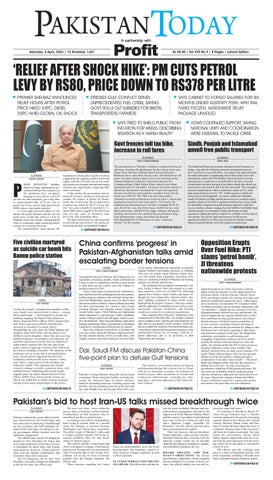
RIME MINISTER Shehbaz Sharif on Friday announced an immediate Rs80 per litre reduction in the petroleum levy on petrol, bringing its price down to Rs378 per litre for end consumers, just a day after an unprecedented hike of 43 per cent in petrol and 55 per cent in high-speed diesel (HSD) prices, state media reported. In a late-night televised address to the nation, the prime minister said the revised petrol price would take effect at 12am on Saturday across the country, offering partial relief to consumers amid mounting public concern over soaring fuel costs. The announcement came against the
backdrop of a sharp spike in global oil prices triggered by the ongoing conflict in the Gulf region, with the US-Israel war on Iran sending shockwaves through international energy markets and significantly impacting Pakistan’s economy. A day earlier, the government had announced a massive increase in fuel prices to cushion the impact of global oil shocks. Under the revised rates, the ex-depot price of petrol was raised by Rs137.23 per litre (42.7 per cent) to Rs458.41 from Rs321.17, while HSD prices surged by Rs184.49 per litre (55 per cent) to Rs520.35 from Rs335.86, with immediate effect. The price of kerosene was also increased by Rs34.08 per litre to Rs457.80, further intensifying pressure on household budgets.
Five civilian martyred as suicide car bomb hits Bannu police station
At least five people, including four members of the same family, were martyred and 13 others — among them a policeman — were injured in a suicide car bombing targeting the Domel Police Station in Bannu, Regional Police Officer (RPO) Sajjad Khan said. Police and rescue officials identified the deceased as members of a single family: Naqeebullah, his wife, their son Tufail Subhan, and daughter Sadaf. RPO Khan said the injured were shifted to nearby hospitals, where they are receiving medical treatment. According to eyewitnesses, the powerful explosion occurred when an explosivesladen vehicle rammed into the rear side of the police station, triggering a massive blast followed by a heavy exchange of gunfire. The intensity of the explosion was so severe that it was heard miles away. Initial reports suggested that the blast completely destroyed the police station’s sentry post, while a large portion of the building was reduced to rubble. The explosion also caused extensive damage to nearby residential areas, with multiple houses collapsing and several people trapped under the debris. Bannu District Police Officer (DPO) Yasir Afridi said the attack was effectively foiled due to timely security measures and the professional preparedness of the police.
Sindh, Punjab and Islamabad unveil free public transport ISLAMABAD
CONTINUED ON PAGE 03
CONTINUED ON PAGE 03
CONTINUED ON PAGE 03
China confirms 'progress' in Pakistan-Afghanistan talks amid escalating border tensions Negotiations between Pakistan and Afghanistan are reportedly advancing steadily, China confirmed on Friday, as the two neighbours continue to seek an end to their most serious conflict since the Taliban returned to power in 2021. China, which shares a western border with both nations, has been actively mediating between the countries, holding frequent telephone calls with their foreign ministers and dispatching a special envoy for face-to-face discussions earlier in March. Chinese officials described the latest developments as a “positive step” toward restoring dialogue and reducing tensions along the volatile border region. “Both Pakistan and Afghanistan attach importance to, and welcome, China’s mediation, and are willing to sit down for talks again, which is a positive development,” Mao Ning said during a daily press briefing, underlining China’s commitment to facilitating constructive communication between the two nations. Since the outbreak of hostilities in October last year, the conflict along the Pakistan-Afghanistan border has claimed dozens of lives on both sides, with Afghan civilians reportedly bearing the heaviest brunt
of the clashes. Islamabad has repeatedly accused the Afghan Taliban of providing sanctuary to militants who carry out attacks inside Pakistan. Kabul, however, has denied these allegations, describing militancy as a domestic problem of Pakistan and warning against cross-border interference. The escalation has prompted international concern. Earlier in March, both sides agreed to a weeklong ceasefire on the eve of Eidul Fitr, following appeals from Türkiye, Saudi Arabia, and Qatar. Although the truce temporarily reduced clashes, sporadic fighting continued in some border areas, highlighting the fragility of peace. China has emphasised its approach to mediation as one of close communication, dialogue facilitation, and building conditions conducive to sustained negotiations. Mao explained that China has “maintained close communication with both sides via multiple channels and at multiple levels” and has provided platforms for talks that are acceptable to both countries. While she did not confirm the location of the latest meetings, previous reports indicate that discussions took place in the northwestern Chinese city of Urumqi, a hub for regional diplomacy due to its proximity to both Afghanistan and Pakistan.
Dar, Saudi FM discuss Pakistan-China five-point plan to defuse Gulf tensions ISLAMABAD
staff report
news desk
The Sindh and Punjab governments announced relief measures on Friday, a day after the federal government raised petrol prices by Rs137 per litre to a record Rs458.4. According to the reported details, the latest petrol price is significantly above the increase seen in the international market after PM Shehbaz Sharif decided to raise the petroleum levy on petrol to a record Rs160.61 per litre. It was the second major fuel price increase in less than a month after diesel and petrol prices were raised by Rs55 per litre last month. The cumulative increase in petrol prices within a month now stands at 63%, while high-speed diesel has risen by 75%. Sindh announces subsidy for motorcyclists and transporters. At a press conference in Karachi, Sindh CM Murad Ali Shah said the provincial govt would provide a monthly subsidy of Rs2,000 to registered motorcyclists across Sindh. He said public transport and goods transport operators would also receive monthly subsidies ranging from Rs70,000 to Rs100,000. Shah said the measure was intended to reduce the burden on daily commuters, adding that petrol would not be available at lower rates at fuel stations. He said the application process would become operational within two to three days and that the subsidy would be linked to national identity cards and registered motorcycles.
BEIJING
BANNU
VOWS CONTINUED SUPPORT, SAYING NATIONAL UNITY AND COORDINATION WERE ESSENTIAL TO TACKLE CRISIS
The government on Thursday withdrew a planned increase in toll taxes, freezing all adjustments for the current fiscal year, while Prime Minister Shehbaz Sharif directed Pakistan Railways not to raise fares for any class. The decision on toll taxes was taken during a high-level review meeting of the National Highway Authority, chaired by Minister for Communications Abdul Aleem Khan, aimed at providing immediate relief to the public. Acting on the prime minister’s directives, the minister rescinded the 25 per cent quarterly increase in toll taxes and ordered a complete freeze for the fiscal year 2025-26. The NHA was also instructed to withdraw its earlier notification issued on April 1, which had proposed revised toll rates from April 5. Previously, the authority had announced new toll rates, including Rs70 for cars, Rs150 for vans, Rs250 for buses, Rs300 for two- and three-axle trucks, and Rs550 for larger vehicles. During the meeting, the minister also outlined the government’s longterm infrastructure vision, describing the Karachi Port-Hyderabad M-10 Motorway as a key “economic lifeline” for the country.
staff Correspondent
staff report
g
Pakistan’s Foreign Minister Ishaq Dar and his Saudi counterpart, Prince Faisal bin Farhan, on Friday discussed the Pakistan-China five-point initiative aimed at promoting dialogue, fostering peace and stability, and de-escalating tensions in the Gulf and the wider Middle East, the Foreign Office (FO) said.
The initiative, put forward jointly by Beijing and Islamabad during Dar’s recent visit to China, calls for an immediate ceasefire, the initiation of inclusive peace talks, protection of civilian and commercial infrastructure—including key shipping lanes—and strict adherence to the United Nations Charter.
Opposition Erupts Over Fuel Hike: PTI slams 'petrol bomb', JI threatens nationwide protests ISLAMABAD
staff Correspondent
Opposition parties on Friday launched a scathing attack on the government over the sharp increase in petroleum prices, with the Pakistan Tehreek-i-Insaf (PTI) and Jamaat-i-Islami (JI) warning of protests and political mobilisation against the move. Addressing a press conference in Islamabad, PTI Chairman Gohar Ali Khan said petrol was an essential commodity with “no alternative,” adding that any increase in its price disproportionately affected the poor and farmers. He acknowledged that the ongoing Middle East conflict had contributed to rising global prices, but claimed that the increase in Pakistan had exceeded that of several countries, including Vietnam and Nigeria. Gohar also criticised the government for failing to take Parliament into confidence regarding its diplomatic and economic response to the crisis. He alleged that authorities were unable to curb hoarding and smuggling of petroleum products and were instead passing the burden of the petroleum levy onto the public. He announced that the PTI would convene an all-party conference on the issue, inviting “likeminded” political forces to chart a joint response. PTI leader Taimur Saleem Jhagra, who was also present, lashed out at the government, terming the hike a continuation of an earlier “petrol bomb.” “The petrol bomb was dropped earlier, and now this increase is adding fuel to the fire,” he said, criticising the government’s handling of fuel pricing decisions. He also took aim at Shehbaz Sharif, saying the prime minister should have addressed the nation directly on the issue. Meanwhile, Jamaat-e-Islami chief Hafiz Naeem ur Rehman warned of a countrywide protest movement if the price hike was not withdrawn.
Pakistan’s bid to host Iran-US talks missed breakthrough twice CONTINUED ON PAGE 03
ISLAMABAD
staff report
Pakistan’s behind-the-scenes effort to facilitate contact between the United States and Iran came close to producing a breakthrough on two occasions, but both attempts collapsed at the final stage, according to a senior government official familiar with the diplomatic engagement. The official said a senior US delegation headed by Vice President JD Vance had twice been prepared in recent days to travel to Islamabad for direct talks with Iranian representatives. However, Tehran asked for more time for internal consultations and eventually chose not to take part. The US delegation, led by their Vice President, was ready to depart for Islamabad in the last few days, the official said.
We were very close... twice within the last ten days, to hosting a critical meeting. Unfortunately, on both occasions, Iran reconsidered and did not send its team. According to the official, Islamabad has been trying to present itself as a neutral venue for dialogue as tensions between Washington and Tehran have intensified. The effort is part of Pakistan’s wider push to reduce regional tensions following increased hostilities after US and Israeli strikes on Iranian targets. The official said the United States had shown willingness to engage, while Iran appeared more hesitant and was assessing the risks of entering talks in the current environment. Let me say, we were a bit disappointed with the Iranian response, the official said. Their concerns regarding the United
States are understandable, given the recent developments, but diplomacy should always be given a chance especially at such a critical juncture. PLANNED TEHRAN VISIT DID NOT GO AHEAD: The official also said that be-
CONTINUED ON PAGE 03
fore the latest escalation, Pakistan had considered direct engagement with Iran at the highest level. Prime Minister Shehbaz Sharif and the country’s top military leadership had been ready to travel to Tehran for talks with Iran’s Supreme Leader, Ayatollah Ali Khamenei, who the official said had since been assassinated in the conflict. That visit, however, did not take place. Iranian authorities, citing security concerns, informed Pakistan that a meeting with the Supreme Leader would not be possible under the prevailing circumstances, prompting Islamabad to postpone the trip.
RIYADH MEETING AND PAKISTAN’S OBJECTIONS: The official said Pakistan’s diplomatic role has extended beyond mediation. Its criticism of Israel’s actions, the official added, was not well re-
CONTINUED ON PAGE 03
ceived by some Gulf states. At a meeting in Riyadh on March 19, where foreign ministers from 12 Muslim countries gathered to discuss the worsening regional situation, the official said Turkish Foreign Minister Hakan Fidan and Pakistan’s Foreign Minister Ishaq Dar were in a bilateral meeting when Fidan received a call from his Iranian counterpart. Dar later joined the conversation, during which Abbas Argachi urged both countries to ensure that the joint statement from the meeting would not be one-sided or excessively critical of Iran. The official said this exchange took place at a time of heightened tension, with sirens reportedly sounding in Riyadh amid fears of possible Iranian retaliatory strikes.
CONTINUED ON PAGE 03