Epaper_26-1-17 ISB

Page 1


S ta f f R e p o R t

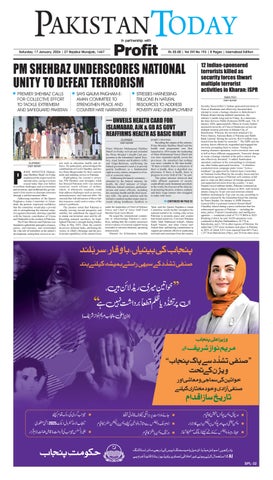
R I M E M I N I S T E R Muhammad Shehbaz Sharif on Friday emphasized the urgent need for national unity saying it is more crucial today than ever before to confront challenges such as extremism and terrorism, and reaffirmed the government’s firm resolve to eliminate terrorism through a unified national effort

Addressing members of the Qaumi Paigham-e-Aman Committee in Islamabad, the premier expressed confidence that the committee would play a pivotal role in strengthening the national narrative against extremism drawing a parallel with the historic contribution of Ulema and Mashaekh in the creation of Pakistan

tors such as education, health, and defence He particularly acknowledged the contributions of Cecil Chaudhry and Justice Rana Bhagwandas for their commitment and enduring service to Pakistan

Highlighting the country s potential PM Shehbaz said Almighty Allah has blessed Pakistan with vast natural resources worth trillions of dollars, which, if effectively explored, could help address challenges such as poverty unemployment and national debt He stressed that full utilization of these hidden treasures could resolve many of the nation s problems

The Prime Minister said Pakistan was founded to uphold the principles of peace, justice, and tolerance, and commended the vital role of minorities in the nation’s development noting their services in sec-

Tarar said the Qaumi Paigham-e-Aman Committee would further strengthen the national narrative by visiting cities across Pakistan to promote peace and counter hate-based narratives Convener Maulana Hafiz Tahir Mahmood Ashrafi, Allama Ragib Naeemi and other Ulema reaffirmed their unflinching commitment to support government efforts in eradicating terrorism and extremism from the country g

The premier noted that Pakistan is steadily moving toward prosperity and stability but underlined the urgent need to stamp out terrorism once and for all Recalling national sacrifices he highlighted Pakistan s strength during Markae-Haq in May 2025, when the country decisively defeated India, attributing the victory to Allah’s blessings and the professional capabilities of the armed forces

under the leadership of Chief of Defence Forces and Chief of Army Staff Field Marshal Syed Asim Munir He urged the international community to acknowledge Pakistan’s sacrifices, adding that the country possesses solid evidence of external support being extended to terrorist elements operating domestically Minister for Information Attaullah

WORLD BANK URGES PAKISTAN

TGwadar railway projec t clears feasibility stage, set

for board approval

Govt abolishes personal baggage route for used c ar impor ts, tightens gift and transfer rules

the local market The policy further extends minimum safety environmental and regulatory standards to vehicles imported under these schemes, aligning them with requirements applicable to commercial imports The detailed standards will be notified by the Ministry of Industries and Production or the Engineering Development Board Officials said the amendments aim to streamline used vehicle imports and address misuse of existing schemes

Earlier in January the Federal Cabinet ratified the Economic Coordination Committee (ECC) decision of December 9, 2025, allowing overseas Pakistanis to import used vehicles up to three years old under two schemes

CONTINUED FROM PAGE 01

“If a labourer falls ill and leaves this world without treatment his children are left in permanent darkness Healthcare is the right of every Pakistani whether a prime minister or a street vendor, he added

Congratulating Federal Health Minister Mustafa Kamal, the secretary health and their entire team on the revival of the programme, the prime minister urged them to ensure transparent implementation through third-party monitoring so that treatment was provided at the right facilities and according to prescribed standards He expressed confidence that honest execution of the initiative would not only serve the people but also bring reward in both this world and the hereafter

Expressing hope for swift and effective implementation he said the programme would be personally monitored through visits and inspections in coordination with Islamabad s health leadership parliamentarians, the chief minister of Gilgit-Baltistan and the prime minister of AJK

Responding to a demand for extending the programme to Sindh the prime minister said the proposal was valid and assured that he would personally take up the matter with the chief minister of Sindh He noted that the programme was progressing rapidly in Punjab, where billions of rupees were being spent on healthcare, and congratulated the Punjab government on its efforts He added that while other provinces had their own health initiatives, efforts would be made to ensure similar facilities nationwide

The prime minister expressed the hope that the Prime Minister s Health Card programme would continue to gain momentum across the country, bringing relief to millions of families “May Allah help us in serving the people,” he said, offering prayers for the success of the initiative and the pros-

perity of Pakistan

Earlier, Federal Minister for National Health Services, Regulations and Coordination Mustafa Kamal said the revival of the Prime Minister ’s Health Card would provide free cashless healthcare to nearly 10 million residents of Islamabad Capital Territory Azad Jammu and Kashmir and GilgitBaltistan He said the programme ensured that citizens could receive treatment without worrying about affordability during moments of pain and distress

The minister said that within four to five weeks, a programme that had become inactive was fully revived terming it a major administrative achievement He stressed that healthcare should not be confined to treating illness alone Healthcare means preventing people from becoming patients ensuring safe childbirth, vaccinating children, providing clean drinking water and strengthening preventive care,” he said Sharing operational details Kamal said around 70 hospitals were being empanelled under the Prime Minister s Health Card across Islamabad AJK and Gilgit-Baltistan including 20 additional hospitals in Islamabad alone He added that cardholders from these regions living in Karachi would also be able to access treatment at 16 designated hospitals in the city He noted that Sindh remains the only province where the Prime Minister ’s Health Card is not yet operational while Punjab Khyber Pakhtunkhwa Balochistan and the federal territories are already covered

Referring to proposals discussed earlier, the minister said a plan covering 10 rural and urban districts of Sindh at an estimated cost of Rs24 billion had been prepared “If funding is provided for just two years the programme can become self-sustaining from the third year onward he said expressing hope that healthcare deprivation in Sindh could also be addressed

PSX

COMMENT

A Turkiye -Saudi Arabia-Pakistan defence agreement could create a new factor in the Middle East

TH E confirmation by the Pakistani Defence Production Minister that Pakistan, Saudi Arabia and Turkiye were engaged in talks on a defence agreement and that a draft agreement would now be considered by all three countries raises new possibilities for the Middle East and possibly Europe, though Turkish Foreign Minister Hakan Fidan was quick at a press conference in Istanbul to say that no agreement had been signed The agreement would bring together two of the most militarily capable Muslim countries along with the richest It would also bring together three of the most important US allies in the greater Middle East, and it is likely that Turkiye will have to do the most due diligence on the agreement, to make sure it does not clash with any of its commitments as a member of NATO

The most interesting aspect is that no defence minister has spoken on the issue, which would indicate that the agreement would be focused on defence production rather than the developing of an alliance system After all Turkiye and Saudi Arabia have divergent interests with respect at Iran, with which the former has good relations, and which the latter has only recently made up after Chinese intervention Neither of them want to join in any confrontation with India, with which Pakistan had a conflict last summer On the other hand, Turco-Pakistani cooperation in aerospace and nava; ventures has been considerable and Saudi capital may act as a force multiplier for both countries At the same time, the agreement does not bring Turkiye into the military agreement between Saudi Arabia and Pakistan just as it does not bring the latter two into NATO However the natural thrust of the alliance is the same: Israel It has of late been more active than usual, and its attack on Qatar showed that being allied to the USA is no safeguard against it

Not only do all three have to deal with populations which are upset about the Israeli genocide in Gaza, but they have to protect themselves In the circumstances since last year s Israeli bombing of Iran and Pakistan s success against India it seems to have dawned on all three that cooperation is the only way forward The agreement, when it comes, will oblige all three states to coordinate their foreign policies That will carry its own consequences

Dedicated to the legac y of late Hameed Nizami Arif Nizami (Late) Founding Editor

M A Niazi Editor Pakistan Today Babar Nizami Editor Profit

Iran in the eye of the storm

IR A N is in the grip of the worst unrest it has seen in years Though this is not a new phenomenon as the Islamic Republic regime has faced protests in the past and survived them it is nevertheless battle hardened in this regard

However, this time the intensity of the protests, combined with the fragility of a government under immense economic pressure cannot be easily ignored

To top it off global geopolitics stirred by the Trump presidency is also proving to be a catalyst Regardless of the outcome it is interesting to examine that a conservative Iran is perhaps disliked by its own citizenry and the Iranian diaspora, but not necessarily by its neighbouring countries

If we look at the big picture since the Islamic Revolution of 1979 Iran’s neighbours especially its Arab neighbours appear to have been net gainers Pre-revolutionary Iran was the staunchest ally of the USA in the region one of the largest oil exporters and a scientifically and technologically advanced country among its peers With the Khomeini-led revolution, Iran faced US-backed sanctions political upheavals and wars Its economy became fragmented and its society deeply polarized Saudi Arabia although diplomatically opposed to the revolution quietly earned centrestage as the main ally of the West in the region, a position that stood vacant after Iran s abdication from that role As a result, the stature and global importance of Saudi Arabia increased significantly

The UAE especially Dubai has been one of the biggest beneficiaries of the cultural decline of Beirut in Lebanon and Karachi in Pakistan but the major impetus came from Iran s conversion from an open society into an ultra-orthodox and closed one Dubai lacked what its twin Abu Dhabi possessed, oil, but it compensated by offering a culturally open environment with social liberties that had largely ceased to exist elsewhere in the region It offered a vibrant nightlife and other attractions drawing pleasure seeking tourists from across the region and beyond On top of that, it became a dumping ground for moneyrich elites from South Asia and the wider region Perhaps the UAE may also not favour a secular Iran and would be content with the status quo there

We need to remember that when something radically new happens it initially creates awe and surprise However, if that situation prevails for a longer duration, it creates a new set of beneficiaries who learn how to use the new realities to their advantage This adaptation eventually becomes normalized and any change to it is resisted much like resistance to change before it Similar arguments can be made in the context of Pakistan and Turkey For Pakistan the reasoning is fairly straightforward It feels safer on its western border with Iran under the present power arrangement, because the emergence of a nationalist Iranian state with potentially deep ties to the USA and Israel could compromise Pakistan s geopolitical relevance So far Pakistan has served US interests in the context of a radical regime in Afghanistan and a theocratic Iran that consistently chanted marg bar America If this situation changes, Pakistan would need to reshuffle its priorities, which have been deeply entrenched in the status quo of a conservative Iran for nearly 50 years To some extent the same applies to Turkey After emerging from periods of martial law Turkey became a tourist hub and a necessary US ally within NATO, largely because it borders two major US rivals, Russia and Iran If Iran is removed from that equation, Turkey loses a significant portion of its strategic importance China too could be potentially disadvantaged It has relied on Iranian oil to meet its ever growing energy needs particularly in scenarios where the USA might exert pressure through its influence over oilproducing countries in the region So far, China could count on Iran as a reliable supplier in a worst-case scenario However, if the current arrangements in Iran cannot be maintained those oil lines could dry

The unfolding developments in Iran could give rise to highly perplexing situations, creating dilemmas few imagined possible As noted at the beginning of this analysis, there is a contradiction between the interests of IranÊs neighbours and those of its protesters. Regardless of national pride, Iranians may not be able to remain immune to regional interference if the current status quo collapses. A transition to a democratic order in the absence of a credible interim authority would be extremely fragile . It is a complex situation, and it is likely to become even more volatile in the days ahead.

s

define legitimacy, and influence policymaking It s not merely about who wins on the kinetic battlefield, but whose story prevails in the global court of public opinion The launch of the Balochistan Studies Project by the Middle East Media Research Institute (MEMRI) serves as a clinical case study in how academic initiatives are weaponized to serve the strategic interests and can function as tools of geopolitical rivalries To understand why an institute in Washington is suddenly obsessed with Balochi media, one must look at its lineage To the casual observer translating regional media might seem a benign pursuit of scholarship However viewed through the lens of Israel s historical military doctrine and its deepening alignment with New Delhi, the project emerges as a calculated effort to redefine Balochistan MEMRI was founded in 1998 by Yigal Carmon, a former high-ranking officer in Israeli military intelligence For decades the institute has curated extremist translations to portray Muslim-majority states as inherently unstable The BSP announced on 12 June 2025, is a continuation of this pattern, but with a sharper, more focused edge Information warfare is often misunderstood as simple propaganda In reality it is the systematic use of information to achieve a competitive advantage aiming to influence the decision-making of adversaries and the perceptions of neutrals For Pakistan, Balochistan has become the ultimate gray zone where kinetic operations (military force) and non-kinetic operations (narrative control) overlap The globalization of a local insurgency through the weaponization of selective translation vide BSP marks a pivotal moment in this evolution: The methodology employed by MEMRI is a masterclass in the DIME (Diplomatic, Informational, Military, Economic) framework of power By meticulously translating the charters of militant groups like the Baloch Liberation Army (BLA) and the statements of self-exiled leaders the BSP achieves two primary objectives First it sanitizes the image of violent actors for a Western audience By framing these movements through the lens of secularism,

women s rights, and pro-Western values, the project builds a moral bridge between the insurgents and the corridors of power in the West Second it targets the “E” in the DIME model: the Economy Balochistan is the linchpin of the China-Pakistan Economic Corridor (CPEC) By consistently highlighting instability and presenting the province as an occupied territory,” these information operations create a riskheavy environment that aims to deter Chinese investment The narrative is clear: if the world views Balochistan not as a sovereign province but as a contested zone of liberation the legal and ethical framework for international business and diplomatic engagement shifts overnight Yet, this intellectual offensive does not exist in a vacuum; it is the “software” that guides “hardware” on the ground The role of the “Indo-Israel nexus” is central to this 5th Generation Warfare (5GW) matrix Pakistan s security establishment has long pointed to the 2016 arrest of Kulbhushan Jadhav as evidence of external facilitation In 2025, this cooperation has reached a high-tech zenith During the height of the Pakistan India escalation, India deployed dozens of Israeli-manufactured Harop suicide drones to neutralize Pakistan s air defence This synergy creates a pincer movement against Pakistan While India provides the physical proximity and historical links to regional insurgencies, Israel provides the epistemic

terrain the intellectual and digital infrastructure to globalize the narrative By publishing secessionist maps and flags under the guise of “research,” MEMRI normalizes territorial fragmentation in the minds of Western think tanks, paving the way for eventual policy lobbying and potentially more overt support

However information warfare does not create grievances out of thin air it exploits existing fissures The persistent sense of socio-economic marginalization among the Baloch youth and the lack of political agency in the province provide the “raw material” for external narrative-shaping

To counter the strategic encroachment of the Balochistan Studies Project and similar IW initiatives Islamabad needs a paradigm shift This begins with acknowledging that Balochistan is a political problem with a security dimension, not a security problem with a political dimension

The BSP and its proponents understand that in modern conflict the side that tells the most compelling story wins regardless of whether that story is complete Pakistan s challenge is to move beyond the reactive denial phase and begin telling a better, more inclusive story of its own A story where the Baloch people are the protagonists of their own development, not just pawns on a geopolitical chessboard Until then the information frontier will remain a playground for those who seek to fragment the federation through the stroke of a translator s pen

The writer can be reached at skhattak792@gmail com

The BSP and its proponents understand that in modern conflict, the side that tells the most compelling story wins regardless of whether that story is complete. PakistanÊs challenge is to move beyond the reactive „denial‰ phase and begin telling a better, more inclusive story of its own. A story where the Baloch people are the protagonists of their own development, not just pawns on a geopolitical chessboard.

Grain gains matter

WHEAT is a cornerstone of national food security as well as rural livelihood, serving as the staple diet for over 200 million people and providing essential by-products for livestock feed and agro-based industries Despite its importance, national wheat productivity remains well below potential During 2023-24 wheat was cultivated on 9 73 million hectares and produced 31 8 million tonnes but the average yield (3 268kg/ha) remained far lower than the potential yield of 5 000 to 8 000 kg/ha

This persistent gap is driven by multiple constraints, such as inefficient irrigation, imbalanced fertiliser use, delayed sowing, poor crop rotation, low seed quality, and limited adoption of climate-smart technologies

Post-harvest losses and weak extension services further exacerbate the problem Addressing these challenges requires integrated researchbased interventions supported by strong institutional frame-works Proper land preparation is crucial for achieving the productive potential of wheat, influencing all growth stages from germination to grain formation Optimised tillage practices, such as a sequence of mouldboard ploughing, disc harrowing, rotavation and planking, can increase yields by 13-30 per cent Laser land-levelling is also important enhancing irrigation uniformity reducing runoff and improving water-use efficiency

Research shows that laser levelling needs to be repeated every three years, which significantly increases net income and reduces water use by more than half compared to the traditional methods These improvements can really lay the foundation for better plant establishment and more sustainable wheat production

The sowing method plays a very decisive role in wheat productivity Conventional methods that are commonly used lead to poor germination and high water consumption In contrast modern sowing techniques, such as ridge planting, raised-bed planting, and drill sowing, can increase yields by 9-22pc while significantly improving water-use efficiency Each method requires specific tillage sequences and irrigation practices to maximise performance

Equally important is the alignment of suitable wheat varieties with appropriate row spacing and timely sowing Delayed sowing can reduce yields by 8-64pc while early sowing enables various varieties to escape heat stress and disease, resulting in higher productivity

Poor weed control and disease manage-ment practices result in 1725pc losses in the wheat yield, which is also threatened by fungal diseases, including rust, loose smut, and root rot, that can reduce the yields by up to 50pc Early planting combined with balanced fertilisation can help mitigate rust infestation across various wheat varieties Balanced fertiliser use and efficient irrigation scheduling represent additional pillars of sustainable wheat production Excessive irrigation in conventional systems leads to nutrient leaching, shallow water tables, waterlogging,

Shafiq KhattaK

FE D E R A L minister for communica-

tions Abdul Aleem Khan, addressing his party workers in Kamoke the other day, said that for a sustainable solution to long neglected governance and service delivery to the masses in the far-flung areas of the country there was an imperative need for creation of more provinces He suggested division of Punjab in four provinces and similar number units in the other existing provinces He observed that new provinces will save people’s time and energy and ensure resolution of their problems at their doorstep The demand for creation of more provinces has been resonating in the country with fluctuating

jority with the help of its mentors at the time of merger of the Muhaz with PTI and pledged that it would make South Punjab a separate province within 100 days of coming into power That surely was a political hoax to say the least in view of the fact that it involved a host of considerations and pre-requisites in creating a separate province including economic viability and the existence of necessary paraphernalia and administrative structures to run a province In the absence of these ingredients any claim to create a new province amounted to blatant attempts to hoodwink the people for narrow political ends

have used this slogan sporadically to gain political mileage out of the prevailing political environment In the present scenario the demand for creation of more provinces is tantamount to the politicians and parties trying to exploit the prevailing political ambience for their narrow political ends

It is interesting to note that those who defected from the PML(N) ranks before the 2018 elections and formed Janoobi Punjab Sooba Muhaz never raised the issue while they were part of the PTI government These turncoats actually invented a justification for their betrayal at the fag-end of the PML(N) government to try their fortunes on another platform which in their estimation was likely to rule the roost after next elections Their joining PTI removed all the haze about the game that has been played behind the scenes PTI welcomed the saleable horses and electables in the hope of getting more seats in the upcoming elections or even winning a ma-

Probably the revolutionary who had cast off his cloak to become a traditional power grabber did not know that a new province could not be created through any administrative order or political ambition It can only be done according to Article 239 (4) of the Constitution which says A Bill to amend the Constitution which would have the effect of altering the limits of a Province shall not be presented to the President for assent unless it has been passed by the provincial assembly of the concerned province by two third majority of its total membership ” The first requirement therefore is support of the affected existing provinces Creating provinces on linguistic or ethnic basis is fraught with great dangers In an environment when Pakistan is confronted with internal and external dangers that pose an existential threat to the country, which requires strengthening of the state edifice and governing apparatus any talk of dividing it further on linguistic or ethnic basis is absolutely unjustifiable Demands for more provinces largely represent populist slogans targeting Pakistani desires for instant short cuts to good governance They confuse the functions of provincial and district governments There is therefore a need to improve governance instead of adven-

turing with the idea of more provinces

The real issue is about improving governance and regrettably the political parties instead of resolving real problems through improvement in governance, have been focusing on serving their narrow and transient political interests The constitution of Pakistan does provide the solution to the problems regarding governance and development of the deprived areas There is a need to translate those constitutional provisions into reality After the 18th Amendment the provinces have been given the required autonomy and the right to own and use their resources for the benefit of the people Improving governance depends on devising mechanisms to implement those constitutional provisions in letter and spirit The solution to the problems indicated by the proponents of more

provinces lies in strengthening the local bodies in conformity with Article 140A Our constitution stipulates a three-tier system of governance that is local government provincial government and the federal government Local Bodies are meant

As is evident from the foregoing, the people do not need more provinces on administrative or ethno-linguistic basis They want their problems to be resolved at the local level which can be done only through strengthening the local government as per the Constitution and implementation of the 18th amendment in letter and spirit It is therefore incumbent upon the political parties to shun their traditional politics of befooling the people and show honesty of purpose in resolving their problems through improved governance in consonance with the Constitution

and

That leaves the

with little else except to fire however many

formidable capability, but one that Is-

If the regime’s overthrow were then to cause domestic turmoil this might be acceptable for Netanyahu An Iran wracked by internal conflict could not threaten Israel And the simple fact that the two countries are some 800 miles apart would shield Israel from the worst of the consequences But America’s other friends in the region –particularly those located closer to Iran – would fervently disagree with almost all of the above Soon after achieving power in Saudi Arabia, it is true that Crown Prince Mohammed denounced Khamenei as the “new Hitler of the

missile defences but the simple fact that it has far more territory to defend and is much closer to Iran means that it cannot be as confident as Israel about fending off an attack Hence Saudi officials have already tried to reduce the risk of Iranian retaliation by telling the AFP news agency: Saudi Arabia has informed Tehran directly that it will not be part of any military action taken against it, and that its territory and airspace will not be used for that purpose ” All of the Gulf states share Saudi Arabia s fears Qatar hosts Al Udeid Air Base the largest US military facility in the Middle East and a possible launch pad for any further military action against Iran Last June Iran responded to America’s raid on its nuclear plants by firing 19 missiles at Qatar not enough to penetrate the state s defences and inflict casualties – at least on that occasion –but a signal of the constant danger

gramme had advanced to the point where the country was effectively a threshold state; it had the technical expertise, the infrastructure and the necessary material to develop a nuclear weapon but had made a political decision to refrain from doing so

So it was no surprise that, on Tuesday, Sheikh Mohammed bin Abdulrahman the Qatari prime minister should have spoken by phone to Ali Larijani the secretary of Iran s Supreme National Security Council Afterwards, an official statement pointedly emphasised Qatar s backing of all de-escalation efforts, as well as peaceful solutions to enhance security and stability in the region” If Trump wishes to strike Iran while reducing the risk to Qatar by not using Al Udeid, he could launch America s strike planes from an aircraft

ON LY a few years ago many Arab states particularly in the Gulf may have viewed a US regime change attack on Iran favourably For decades, they regarded Iran with deep suspicion, often treating it as the region’s primary threat But now as US President Donald Trump reportedly mulls exactly such an attack Arab leaders including Gulf rulers long at odds with Tehran are lobbying the US administration not to strike Iran For 27 months, Arab leaders have watched Israel’s rampage throughout the region, in pursuit of its “Greater Israel” project, an expansionist biblical vision for territory spanning from the Euphrates River in Iraq to the Nile River in Egypt

To this end Israel has significantly expanded its illegal occupation of Arab lands Not only has Israel carried out genocide in Gaza and indicated its plans to take the territory over, but it has also deepened its hold in the West Bank, Syria and Lebanon

Perhaps most alarming for Arab leaders after months of Netanyahu openly declaring his expansionist ambitions was Israel s unprecedented assault on Qatar, a US ally, in September 2025 That escalation had been preceded only a few months earlier, in June, by Israel convincing the US to bomb Iran in an assault aimed at destroying Iran’s nuclear programme and ensuring Israel remains the region s sole nuclear power In short Israel s aim of absolute regional hegemony has never been clearer and a US strike on Iran would represent both an extension of Israeli aggression and an expansion of its regional power This is the structural shift at the heart of Arab opposition to a potential US-Israel attack on Iran

ISRAELI EXPANSIONISM: Although Israel has attempted to distance itself from a possible US strike on Iran, evidence suggests it is actively fuelling ongoing anti-regime protests that have helped precipitate the most recent American interference Earlier this month both former US Secretary of State Mike Pompeo and current Israeli Heritage Minister Amichai Eliyahu suggested that Israeli

Malik MuhaMMad ashraf

Trump accepts Nobel medal from Venezuelan opposition leader M achado

growth to

their peoples Outlining China s approach to future ties, Xi proposed four key areas of cooperation First, he said both countries should be partners of mutual respect noting that 55 years of diplomatic relations despite ups and downs have offered valuable lessons He emphasized respect for each other s sovereignty territorial integrity political systems and chosen development paths Second, Xi called for

interests Third, Xi highlighted the importance of mutual trust, describing people-topeople exchanges as the most enduring foundation of bilateral relations He called for greater cooperation in education culture tourism sports and sub-national exchanges, as well as easier personnel movement to strengthen public support Fourth, Xi urged collaboration on global challenges warning that a divided world cannot effectively address common problems He said the

PFUC delegation visits UOL Well-Being Centre, calls for wider focus on mental health LAHORE s ta f f r e p o r t (PFUC) visited the Well-Being Centre established at The University of Lahore (UOL) where the initiative aimed at promoting mental and psychological health among students and staff was highlighted Director UOL Well-Being Centre Prof Dr Shamaila Asad briefed the delegation on the objectives services and working mechanism of the centre The delegation comprised renowned motivational speaker Qasim Ali Shah, PFUC Chairman and anchorperson Farrukh Shahbaz Warraich,

CBD Punjab announces grand open auc tion 2026, reinforcing Punjab’s vision as a regional economic hub

a Memorandum of Understanding (MoU) with ZTE Corporation and its authorized distributor Siccotel for a first-of-its-kind partnership aimed at expanding inclusive access to next-generation devices for customers across Pakistan The MoU establishes a strategic collaboration to significantly broaden

To further enhance affordability and adoption, the partnership will also introduce Buy Now Pay Later (BNPL) schemes enabling customers to access advanced smartphones through flexible payment options

QURESHI, UMAR PUSH FRESH ‘CHARTER OF DEMOCRACY’ AS

PTI LEADERS CALL FOR TALKS TO END POLITICAL DEADLOCK

REJECTS

DIALOGUE COMMITTEE,

Auditor (BS-11) in the office of the Military Accountant General Rawalpindi thereby fulfilling the statutory requirement for pension It further observed that following the 2001 amendment to the Civil Servants Act the qualifying service for pension had been reduced from 25 years to 20 years, a condition already satisfied by the petitioner Rejecting the contention that the petitioner was not entitled to pension due to a 13-year delay in submitting his application, the Supreme Court held that the right to pension accrues immediately upon retirement or acceptance of resignation and cannot be extinguished merely because of delay The judgment categorically stated that neither the doctrine of laches nor the law of limitation applies to pension claims The bench also criticised the misinterpretation of CSR Regulation 418, clarifying that the provision pertains to the counting of service and does not provide

Cour t orders arrest and immediate presentation of Imaan Mazari, Hadi Ali Chatha

on February 8 Sanaullah said any initiation of talks or meeting with Imran Khan would only be possible after the Feb 8 protest Speaking to a TV channel the PM s aide said the government had maintained contact with PTI leaders regarding dialogue, noting that several of them are in favour of negotiations with the government ” He added “Whenever politicians come to the table for talks problems get solved and a way gets paved

Sanaullah reiterated that many PTI leaders were inclined towards negotiations but whenever they meet us they say that the PTI founder is not in favour of any sort of dialogue with the government ” In December, PTI had denied dialogue until a “level-playing field” was ensured through its ongoing street movement an agitation campaign against the government

The adviser said PTI s arrangements speeches, and mobilisation efforts for the Feb 8 protest indicated that the party remained firm on its decision “However, the PTI leaders think that if they get to meet Imran they could convince him to postpone the protest and initiate dialogue with the government he added

When asked about any meeting between PTI leaders and Imran, Sanaullah said: “They have gone too far now; any initiation of dialogues or

for the complete forfeiture of pension It ruled that resignation by itself does not deprive an employee of pension particularly where the requisite length of qualifying service has already been completed Terming the decisions of the tribunal and the department as being based on a misunderstanding of the law the Supreme Court converted the petition into an appeal and allowed it directing the concerned authorities to grant full pensionary benefits to Muhammad Usman in accordance with the law

Reiterating its earlier precedents, the apex court once again underscored that pension is a vested and protected right which cannot be taken away on administrative procedural or technical grounds

meeting with Imran Khan can be possible only after Feb 8 They are preparing for the protest at full throttle so meeting them before that would not be possible He also indicated that the government would address the upcoming protests administratively predicting that PTI would likely emerge unsuccessful Sanaullah urged the party to return to parliamentary processes and committee proceedings from which they had abstained Earlier, PTI leader Barrister Ali Zafar had stated that no dialogue could occur until the government permitted meetings with Imran maintaining that the party s stance remained aligned with Imran Khan s directives Prime Minister Shehbaz Sharif has reiterated his offer for talks with the opposition, emphasizing that dialogue could proceed only on legitimate matters

the Constitution through Advocate Asif Niswana President of the Lahore High Court Bar Association The Punjab government the inspector general of prisons, and the superintendent of Adiala Jail have been named as respondents According to the petition, Bushra Bibi is currently incarcerated at Adiala Jail and under the Pakistan Prison Rules her immediate family members

are entitled to meet her on designated visitation days which are scheduled every Tuesday The petitioner stated that despite multiple attempts, the jail superintendent has refused to grant permission for the meeting The petition argues that the denial is unlawful arbitrary and without justification noting that the petitioner has not been informed of any security concern or legal restriction that would prevent the visit It states that Mubashra Khawar Maneka, being the real biological daughter of Bushra Bibi is deeply concerned about her mother s physical emotional and psychological well-being Bushra Bibi is serving a seven-year sentence in the £190 million corruption case and was also recently sentenced to 17 years imprisonment in the Toshakhana-II case related to the purchase of an expensive

jewellery set gifted to former prime minister Imran Khan The petition maintains that prisoners are entitled to family visitation under the Pakistan Prison Rules and the Constitution subject only to reasonable security regulations It contends that the continued refusal has caused mental anguish and emotional distress to the petitioner and violates fundamental rights guaranteed under Articles 9 and 14 of the Constitution, which ensure dignity, liberty and humane treatment, including for prisoners The petitioner has requested the court to direct the jail authorities to arrange an immediate meeting with her mother on any designated visitation day and to declare the denial of visitation to immediate family members without lawful justification as illegal and unconstitutional

Turn static files into dynamic content formats.

Create a flipbook
Issuu converts static files into: digital portfolios, online yearbooks, online catalogs, digital photo albums and more. Sign up and create your flipbook.