In partnership with
Profit
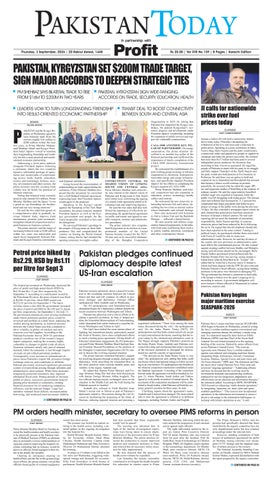
PAKISTAN, KYRGYZSTAN SET $200M TRADE TARGET, SIGN MAJOR ACCORDS TO DEEPEN STRATEGIC TIES Thursday, 3 September, 2026 | 20 Rabiul Awwal, 1448
g
PM SHEHBAZ SAYS BILATERAL TRADE TO RISE FROM $16M TO $200M IN TWO YEARS
PAKISTAN, KYRGYZSTAN SIGN WIDE-RANGING ACCORDS ON TRADE, SECURITY, EDUCATION, HEALTH
LEADERS VOW TO TURN LONGSTANDING FRIENDSHIP INTO RESULT-ORIENTED ECONOMIC PARTNERSHIP
P
g
g
BISHKEK
g
TRANSIT DEAL TO BOOST CONNECTIVITY BETWEEN SOUTH AND CENTRAL ASIA
Organization in 2025–26, noting that Pakistan had supported the Kyrgyz candidacy. He praised Kyrgyzstan’s economic progress and development under President Japarov’s leadership, including the expansion of public services and support for vulnerable communities.
saLeeM Jadoon
AKISTAN and the Kyrgyz Republic on Wednesday agreed to raise bilateral trade from the current roughly $16 million to $200 million within the next two years, as Prime Minister Muhammad Shehbaz Sharif and Kyrgyz President Sadyr Japarov vowed to translate their longstanding friendship and brotherly ties into a more practical and resultsoriented economic partnership. Addressing a joint press stakeout alongside President Japarov following a ceremony where the two countries signed a substantial package of agreements and memoranda of understanding across trade, health, education, science and technology, defence, security, environment and other sectors, the prime minister said the existing trade volume was far below the potential of bilateral relations. Noting that bilateral trade currently stood at only around $16 million, Prime Minister Shehbaz said the figure “is not a patch on our friendship, our brotherhood and our very strong relations.” He said the two sides had agreed on a comprehensive plan to gradually increase bilateral trade, improve trade mechanisms, promote joint investment, strengthen industrial cooperation and expand business-to-business contacts. The prime minister said the target of increasing bilateral trade to $200 million within two years was achievable and urged closer engagement between Pakistani and Kyrgyz business communities
and financial institutions. Going beyond the memorandum of understanding on trade signed during the ceremony, Prime Minister Shehbaz proposed that the document be converted into a full-fledged bilateral agreement, expressing hope that President Japarov would agree to the proposal. Speaking in the Kyrgyz capital against the backdrop of the Tien Shan mountains, the prime minister thanked President Japarov as well as the Kyrgyz government and people for the warm hospitality extended to him and his delegation. He conveyed Pakistan’s greetings to the people of Kyrgyzstan on their Independence Day and congratulated the country on hosting the World Nomad Games, noting that he had attended the opening ceremony two nights earlier.
Petrol price hiked by Rs2.29, HSD by Rs1.11 per litre for Sept 3 ISLAMABAD
staff report
The federal government on Wednesday increased the price of petrol and high-speed diesel (HSD) by Rs2.29 and Rs1.11 per litre, respectively, for September 3. According to a notification issued by the Petroleum Division, the price of petrol was fixed at Rs346.16 per litre, while HSD would cost Rs372.03 per litre for September 3. The latest revision comes a day after the government increased the price of petrol and HSD by Rs1.08 and 51 paisas per litre, respectively, for September 2. On July 17, the government announced a new pricing mechanism under which petroleum product prices would be reviewed and notified on a daily basis, replacing the weekly pricing mechanism, as renewed tensions between the United States and Iran continued to drive volatility in global oil markets and raise concerns over fuel supplies. According to the Pakistan Economic Survey 2024-25, petroleum products constitute one of the country's largest import categories, making the economy highly vulnerable to changes in global crude oil prices. Domestic refineries satisfy only part of national demand, while the remainder is met through imports of crude oil and refined petroleum products. Consequently, every increase in international oil prices raises Pakistan's import bill, pressures foreign exchange reserves, and contributes to inflation. Pakistan previously exercised significant government control over petroleum pricing through subsidies and administrative interventions. While these measures temporarily protected consumers, they imposed substantial fiscal costs. During periods of elevated global oil prices, successive governments delayed passing price increases to consumers, creating financial pressures for oil marketing companies, refineries, and the national budget. Large fuel subsidies widened fiscal deficits, increased public borrowing, and weakened macroeconomic stability.
CONTINUED ON PAGE 03
Rs 20.00 | Vol XVII No 159 | 8 Pages | Karachi Edition
CONNECTIVITY CENTRAL TO SHARED VISION OF LINKING SOUTH AND CENTRAL ASIA: Prime Minister Shehbaz said connectivity was central to the shared vision of Pakistan and Kyrgyzstan to link South and Central Asia, welcoming the signing of a transit trade agreement aimed at facilitating trade and improving logistics. He said the two sides had also reaffirmed the importance of effectively implementing the quadrilateral agreement on traffic and transit and agreed to simplify transport, customs and administrative procedures. The prime minister also congratulated Kyrgyzstan on its election as a nonpermanent member of the United Nations Security Council for the 2027– 28 term and on its successful chairmanship of the Shanghai Cooperation
CASA-1000 ANOTHER KEY PILLAR OF PARTNERSHIP: On energy cooperation, the prime minister described it as another key pillar of the bilateral partnership and reaffirmed the importance of timely completion of the CASA-1000 electricity transmission project. He welcomed the establishment of a joint working group on energy to advance cooperation in electricity, hydropower, renewable energy and energy infrastructure, and specifically thanked President Japarov for his efforts in completing the Kyrgyz segment of CASA-1000. Prime Minister Shehbaz said bilateral cooperation had also expanded in education, science, technology, health, culture and tourism. He welcomed the new sister-city relationship between Osh and Lahore, describing the two cities as ancient centres whose landmarks and cultural heritage — from sites associated with Solomon in Osh to Lahore Fort and the Badshahi Mosque — reflected a shared history. He said security and defence cooperation featured prominently in the talks, with both sides reaffirming their resolve to jointly combat terrorism, extremism and other contemporary threats.
CONTINUED ON PAGE 03
Pakistan pledges continued diplomacy despite latest US-Iran escalation ISLAMABAD Mian abrar
Pakistan remains optimistic about a peaceful resolution to the escalating tensions between the United States and Iran and will continue its efforts to promote dialogue and diplomacy, Foreign Office spokesperson Tahir Andrabi said on Wednesday. The FO spokesperson said Islamabad had not abandoned hopes for a diplomatic solution despite the recent escalation between Washington and Tehran. Pakistan has played an active role in efforts to facilitate a peaceful resolution. In June, it helped mediate the Islamabad Memorandum of Understanding, while Islamabad had earlier brokered a ceasefire between Washington and Tehran in April. The April truce halted the most intense phase of fighting, but intermittent attacks, particularly around the Strait of Hormuz, have since complicated efforts to reach a lasting peace agreement. Giving details of Pakistan’s diplomatic engagement, the FO spokesperson said Prime Minister Shehbaz Sharif had met Iranian President Masoud Pezeshkian on the sidelines of the Shanghai Cooperation Organisation (SCO) summit to discuss the evolving regional situation. The prime minister reiterated Pakistan’s support for resolving disputes through restraint, dialogue and diplomacy, while describing the Islamabad MoU as the most practical route towards durable peace and stability in the region, Andrabi said. He added that Deputy Prime Minister and Foreign Minister Ishaq Dar had also held discussions with Iranian Foreign Minister Abbas Araghchi. The two officials had previously exchanged views on the situation in the Middle East and the Gulf during the Makkah summit in Istanbul. Andrabi also referred to Field Marshal Asim Munir’s recent visit to Tehran as part of Pakistan’s diplomatic initiative. Discussions during the visit focused on facilitating the reopening of the Strait of Hormuz, reducing regional tensions and pursuing a
JI calls for nationwide strike over fuel prices today ISLAMABAD
staff Correspondent
Jamaat-e-Islami (JI) will hold a nationwide shutterdown strike today (Thursday) demanding the withdrawal of the levy and taxes and a reduction in petrol prices. Speaking at a press conference at Idara Noor-e-Haq, Hafiz Naeem said the party would hold a countrywide strike and appealed to people to support its campaign and make the protest successful. He claimed that more than Rs17 billion had been paid to several independent power producers for electricity that, according to him, was never generated. He urged the people of Pakistan to stand with his party in its struggle and fully support Thursday's strike. Hafiz Naeem said the party would also hold protests at five locations in Peshawar. He said there was an option to hold and expand sit-ins in Islamabad and Rawalpindi but stressed that Jamaat-e-Islami would continue its protests peacefully. He accused what he called the sugar, IPP, tax and sugarcane mafias of benefiting at the expense of ordinary people. He said the sugar industry benefited whether sugar was exported or imported, while the public was left struggling with rising prices. The Jamaat chief said inflation had increased by 11.2 percent but complained that major journalists had failed to give proper coverage to the public sit-in during the previous 18 days. He also criticised a newspaper report which, he said, claimed that petrol prices had been increased because of Jamaat-e-Islami's protest. He said such reporting did not meet the standards of journalistic responsibility. Hafiz Naeem said that, in contrast, electricity prices had been reduced by Rs16 following the sit-in. He argued that this development should also have been reported in the same context. Turning to political issues, he questioned whether those associated with Form-45 would be able to create new administrative units. However, he said any division of the country into new provinces or administrative units must follow the constitutional process. He also warned against creating conflict between Sindhis and Muhajirs, saying such divisions should not be encouraged. Hafiz Naeem further questioned which political side the Pakistan Peoples Party was serving, saying Jamaat-eIslami knew what he described as its “A team”. He added that he would have become mayor if Jamaat-eIslami had been aligned with the PPP. He also criticised Pakistan Tehreek-e-Insaf officials, saying those holding positions in the party were themselves damaging PTI. The government has formed a committee to hold talks with Jamaat-e-Islami over the party's ongoing sit-in, according to sources. A government delegation will meet Jamaat-e-Islami officials at Mansoorah in Lahore tomorrow, sources said.
Pakistan Navy begins major maritime exercise SEASPARK-2026 KARACHI
negotiated settlement. “These were among the main issues discussed during the visit,” the spokesperson said. On the Indus Waters Treaty (IWT), FO spokesperson said that India cannot selectively accept or reject international decisions, asserting that the recent ruling by the international arbitration court in The Hague strongly supports Pakistan’s position on the Indus Waters Treaty. Andrabi said Pakistan welcomed the ruling and maintained that India’s rejection of the decision amounted to disregard for international law and the sanctity of agreements. “The decision on the Indus Waters Treaty is very clear,” the spokesperson said, adding that India could not choose which international rulings to follow according to its convenience. FO spokesperson also briefed on the trilateral cooperation mechanism established under the Makkah Agreement. A meeting of the committee formed under the agreement was held in Istanbul on August 31, where Pakistan, Saudi Arabia and Türkiye agreed to work jointly on matters of mutual interest. The secretariat of the cooperation mechanism will be established in Saudi Arabia, while Pakistan will hold the secretary general’s position for three years, he said. Clarifying reports about the agreement’s name, Andrabi said it had not been changed. The issue related only to how the agreement is referred to in different languages, including Turkish, Arabic and English.
staff report
Pakistan Navy’s major maritime exercise SEASPARK2026 began in Karachi on Wednesday, aimed at testing the force’s combat readiness against conventional and emerging maritime threats, the military’s media wing said. In a statement issued by Inter-Services Public Relations (ISPR) said that Chief of the Naval Staff Admiral Naveed Ashraf presided over the opening briefing of the exercise, flanked by senior officers from across Pakistan’s Armed Forces. "The exercise rigorously tests Pakistan Navy’s combat readiness against conventional and emerging maritime threats, integrating Ships, Submarines, Aircraft, Unmanned Systems, Marines, Special Forces and joint Army and Air Force elements," ISPR said. The statement said that the naval chief visited Pakistan Navy Fleet units and reviewed “ongoing operations”. "Addressing officers and men, he stressed that the evolving security environment demands uncompromising readiness, enhanced tri-service integration, adaptability and effectiveness across physical and information domains,” the statement added. According to ISPR, SEASPARK2026 focused on rehearsing “multi-domain operations” by integrating “maritime, air, land, cyber and spaceenabled capabilities”. "The exercise also incorporated operations in the information environment to secure a decisive advantage in the information battlespace, in lockstep with kinetic operations at sea,” it said.
PM orders health minister, secretary to oversee PIMS reforms in person ISLAMABAD
staff report
Prime Minister Shehbaz Sharif on Tuesday directed the health minister and health secretary to be physically present at the Pakistan Institute of Medical Sciences (PIMS) on alternate days to personally oversee implementation of measures aimed at improving the hospital’s facilities, reiterating that no leniency would be shown to officials found negligent in their duties in the deadly fire incident. Chairing an emergency meeting on health affairs and the fire at the gynaecology ward of Pims, the prime minister vowed that officials found guilty of criminal negligence
would face strict action. The premier was briefed on matters relating to the health sector, including a detailed update on the ongoing investigation into the hospital fire. Health Minister Mustafa Kamal, Minister for Economic Affairs Ahad Khan Cheema, Health Secretary Captain (retd) Muhammad Mahmood and Pims Executive Director Dr Muhammad Salman attended the meeting. As many as 14 infants were killed in the fire early last Wednesday, triggering widespread outrage and demands for accountability from lawmakers in both houses of parliament. Health Minister Mustafa Kamal
had also assured that those responsible would “not be spared”. The meeting was informed that, in light of the interim investigation report, steps were being taken to ensure implementation of the decisions taken by Prime Minister Shehbaz. The prime minister directed the authorities to ensure improved medical and treatment facilities at Pims and ordered that all necessary safety measures be fully implemented. He also directed that the process of health-sector reforms be expedited. Last Saturday, the inquiry committee constituted to investigate the deadly hospital fire submitted its interim report to Prime
Minister Shehbaz, following which the premier ordered the suspension of and criminal action against eight officials. The eight individuals named in the report are former Pims Executive Director Prof Dr Imran Sikandar, who was removed from his post after the incident; Prof Dr Sadia Riaz, head of neonatology at Children Hospital, PIMS; Dr Nagham, senior registrar in the neonatology department; Dr Mutahir Shah, joint executive director, MCH; Ch Waris Ali Raza, joint executive director (non-medical), Pims; Dr Nosheela Amjad, director, MCH; Dr Abdul Rehman, director general, CES, CDA; and Muhammad Usman, assistant director (security).
The Prime Minister’s Office said the premier had specifically directed that those identified by the inquiry committee face not only departmental action but also criminal proceedings under the relevant laws. However, standing committees of both houses of parliament questioned the probe on Monday, raising concerns over incomplete CCTV footage and the disputed number of infants present in the nursery. The National Assembly Standing Committee on Health, chaired by MNA Mahesh Kumar Malani, expressed dissatisfaction with the report prepared by the inquiry committee.
CONTINUED ON PAGE 03