In partnership with
Profit
Sunday, 27 September, 2026 | 14 Rabius Sani, 1448
Rs 20.00 | Vol XVII No 183 | 8 Pages | Karachi Edition
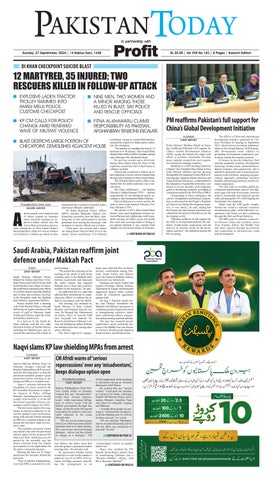
12 martyred, 35 injured; two rescuers killed in follow-up attack di Khan CheCKpoint suiCide blast
g
g
g
EXPLOSIVE-LADEN TRACTOR TROLLEY RAMMED INTO AMAN MELA POLICE, CUSTOMS CHECKPOST
KP CM CALLS FOR POLICY CHANGE AMID RENEWED WAVE OF MILITANT VIOLENCE
g
g
NINE MEN, TWO WOMEN AND A MINOR AMONG THOSE KILLED IN BLAST, SAY POLICE AND RESCUE OFFICIALS
FITNA AL-KHAWARIJ CLAIMS RESPONSIBILITY AS PAKISTAN, AFGHANISTAN TENSIONS ESCALATE
BLAST DESTROYS LARGE PORTION OF CHECKPOINT, DEMOLISHES ADJACENT HOUSE
a
PESHAWAR/DERA ISMAIL KHAN SALEEM JADOON
dozen people were martyred and 35 others injured on Saturday when terrorists rammed an explosives-laden vehicle into the Aman Mela joint police and customs checkpoint in Dera Ismail Khan’s Darazinda tehsil, while two rescue workers were killed in a follow-up attack as they
transported the wounded to hospital, police and rescue officials confirmed. DI Khan Regional Police Officer (RPO) Ghulam Mubashir Maken confirmed the casualties from the blast, clarifying that no law enforcement or security personnel were among the deceased, who included a Customs official and civilians. “Nine men, two women and a minor are among those who lost their lives in the attack,” police and Rescue 1122 officials
confirmed, saying an unidentified attacker rammed the explosives-laden tractor trolley into the checkpost. “The number of casualties has risen to 12 dead and over 30 injured,” Dera Ismail Khan District Police Officer (DPO) Ziauddin Ahmed said, referring to the checkpoint attack. He said two women and a child were among those killed when the force of the explosion caused the wall of their house to collapse on them. Ahmed also confirmed a follow-up attack targeting a rescue vehicle transporting the injured to hospital in Dera Ismail Khan. The DI Khan district police officer confirmed that the initial explosion was a suicide blast. The Fitna al-Khawarij — the defunct Tehreek-e-Taliban Pakistan (TTP) — claimed responsibility for the checkpoint attack, according to state broadcaster Radio Pakistan. Fitna al-Khawarij is a term used by the state to refer to the banned Tehreek-i-Taliban Pakistan (TTP). The attacks in KP’s Dera Ismail Khan district came amid heightened tensions between Pakistan and Afghanistan, with Islamabad carrying out strikes across the border this week after accusing Kabul of failing to act against militants it says operate from Afghan soil and launch attacks in Pakistan.
Continued on page 03
saudi arabia, pakistan reaffirm joint defence under Makkah pact RIYADH
STAFF REPORT
Saudi Defence Minister Prince Khalid bin Salman and Chief of Defence Forces and Chief of Army Staff Field Marshal Asim Munir on Saturday reaffirmed continued joint efforts to confront attacks targeting Makkah and civilian and economic facilities in the Kingdom under the Makkah Joint Defence Agreement (MJDA). Prince Khalid held a meeting with Field Marshal Munir in Riyadh following an urgent meeting of the chiefs of staff of Pakistan, Saudi Arabia and Türkiye under the trilateral defence framework. In a post on X, the Saudi defence minister said the two sides discussed matters of mutual interest, including the Makkah pact, and reviewed the outcome of the chiefs of
staff meeting. “We praised the outcomes of the meeting of the chiefs of staff of the countries party to the Makkah Joint Defence Agreement, and discussed the sinful attacks that targeted Makkah and civilian and economic facilities in the Kingdom,” he said. He added that the two sides had affirmed their commitment to continuing joint efforts to confront the attacks in accordance with the MJDA. The meeting was attended by Saudi Minister of State, Cabinet Member and National Security Adviser Dr Musaad bin Mohammed Al-Aiban, Chief of General Staff Gen Fayyadh bin Hamed AlRuwaili and Defence Minister’s adviser for intelligence affairs Hisham bin Abdulaziz bin Saif, among other senior officials. The latest high-level engage-
ment came after the first exclusive military coordination among Pakistan, Saudi Arabia and Türkiye since the trilateral Makkah defence framework was formalised. Pakistan and Saudi Arabia had signed a Strategic Mutual Defence Agreement in August, declaring that aggression against either country would be considered aggression against both. On Aug 7, Pakistan, Saudi Arabia and Türkiye formalised the Makkah Joint Defence Agreement as a trilateral security framework aimed at strengthening collective deterrence, enhancing military cooperation and promoting regional stability. The pact has assumed greater significance amid escalating tensions in the Middle East and attacks by Yemen’s Houthi group targeting Saudi territory and infrastructure.
naqvi slams Kp law shielding Mpas from arrest ISLAMABAD
STAFF REPORT
Interior Minister Mohsin Naqvi on Saturday strongly criticised the Khyber Pakhtunkhwa (KP) government for directing police to seek the provincial assembly speaker’s prior permission before arresting or detaining an MPA in a criminal case. Naqvi’s criticism followed the circulation of a letter issued by the KP Assembly Secretariat to Inspector General of Police Zulfiqar Hameed, reminding him to strictly comply with Section 11 of the KP Provincial Assembly (Powers, Immunities and Privileges) Act 2026. The provision requires the magistrate or executive authority to obtain the speaker’s prior permission, along with reasons, before arresting an MPA on a criminal charge or detaining the lawmaker under an executive order. The assembly secretariat’s letter was issued a day after the provincial cabinet approved the proposed KP Police Act 2026, which has yet to be passed by the assembly and has drawn criticism from the federal government over its implications for the police command structure. Sharing the letter on X, Naqvi questioned the rationale behind the provision. “Now in Khyber Pakhtunkhwa, even if an MPA is accused of a crim-
CM afridi warns of ‘serious repercussions’ over any ‘misadventure’, keeps dialogue option open PESHAWAR/ISLAMABAD STAFF REPORT
Khyber Pakhtunkhwa Chief Minister Sohail Afridi on Saturday warned that any “misadventure” could have “serious repercussions”, while expressing willingness to resolve issues with the federal government through dialogue, saying the party had agreed to postpone its march to seek amicable solutions to the issues through talks. “We are not an armed group, which you often hear some federal ministers refer to in their rhetoric. We want issues resolved through dialogue…and no one has refused to engage in a dialogue,” CM inal offence, the police must first seek the speaker’s permission before arresting him,” the minister said. He questioned whether police would have to wait for the speaker’s approval even if an MPA were accused of killing someone, describing the arrangement as an
Afridi emphasised while speaking to journalists during an informal discussion at KP House. He warned that any “misadventure” could push the situation to a point of no return, criticising Punjab CM Maryam Nawaz, Information Minister Attaullah Tarar and others for allegedly singling out Pakhtuns. “Actually these people are pursuing a ‘well-hatched conspiracy’ to divide Pakistan and we will not let them succeed,” he vowed. “We are patriotic Pakistanis, and we are peaceful people and we will not allow any conspiracy to succeed,” he said.
Continued on page 03 “extraordinary version of equality before law”. Naqvi also invoked the PTI founder Imran Khan’s stated vision of transforming Pakistan into a “Riyasat-i-Madina”, asking: “And this is Riyasat-i-Madina?”
Continued on page 03
pM reaffirms pakistan’s full support for China’s global development initiative ISLAMABAD STAFF REPORT
Prime Minister Shehbaz Sharif on Saturday reaffirmed Pakistan’s full support for China’s Global Development Initiative (GDI), saying the framework aligns with efforts to promote sustainable development, regional connectivity and cooperation among developing countries. Speaking at a GDI meeting hosted by Chinese Vice President Han Zheng in New York, Premier Shehbaz said the growing Sustainable Development Goals (SDGs) financing gap, frequent climate disasters and rising food and fuel prices, compounded by the resurgence of geopolitical tensions, continued to reverse decades of development gains in developing countries, according to a statement issued by the PM Office (PMO). “Responding to these challenges, the call for strengthened multilateral cooperation, as advocated by the People’s Republic of China in its Global Development Initiative, is very timely,” he said, adding that the framework had already translated into substantial and practical benefits across the developing world. “Pakistan reaffirms its full support for the GDI as an important platform for solidarity, South-South cooperation and the delivery of concrete results for the developing countries,” the statement quoted the PM as saying.
The GDI is a China-led international development initiative proposed by Chinese President Xi Jinping in September 2021, which aims to accelerate implementation of the United Nations’ 2030 Sustainable Development Goals (SDGs) by promoting development cooperation, particularly among developing countries. It focuses on poverty reduction, food security, pandemic response, development financing, climate action, industrialisation, digital economy and connectivity, and is guided by principles such as placing development at the forefront, adopting a peoplecentred approach, promoting inclusive benefits and pursuing practical, results-oriented cooperation. The GDI aims to revitalise global development partnerships, narrow development gaps and help developing countries achieve sustainable and balanced growth while advancing the UN’s 2030 Agenda for Sustainable Development. Sharif said the GDI goals complemented his country’s national economic transformation plan, while Pakistan’s cooperation with China was also continuing through the Belt and Road Initiative. The BRI seeks to enhance connectivity between China and countries across Asia, Europe, Africa, the Middle East and other regions through investments and cooperation in infrastructure, trade and development.
02 NEWS
Pakistan's listed refineries swinG to rs54.8b Profit in fY2025-26
P
PROFIT
WEB DESK
AKISTAN’s listed refinery sector swung to a combined profit of Rs54.8 billion in FY2025-26 from a loss of Rs10.5 billion in the previous fiscal year, as wider petrol and diesel refining margins and higher sales volumes drove a sharp recovery in earnings. The sector’s revenue increased 27% YoY to Rs1.54 trillion from Rs1.22 trillion in FY25, while gross profit surged to Rs107.4 billion from Rs10.4 billion. As a result, the sector’s gross profit margin improved to 7.0% from 0.9%, while the net profit margin stood at 3.6%. The increase in revenue was supported by higher fuel prices, with ex-refinery prices of motor spirit, or petrol, rising 17% YoY and high-speed diesel (HSD) prices increasing 19%. Refinery activity also recovered during the year, with total petroleum product output rising 13.4% to 11.2 million tonnes, lifting overall capacity utilisation to 55% from 48% in FY25. Diesel production increased 17.2%, while petrol output rose 12.4% during the year. The production mix consequently shifted further towards diesel, which accounted for 50.3% of total output compared with 48.6% a year earlier. Meanwhile, furnace oil’s share of
production declined to 21.1% from 23.1%, while jet fuel’s contribution increased to 4.9% from 4.4%. Total refinery sales rose 8.6% to 10.8 million tonnes. Diesel sales increased 13.6% and petrol sales grew 11%, whereas furnace oil sales declined 7.8% amid weaker demand from the power sector. According to Arif Habib Limited, the expansion in refining spreads was a key factor behind the sector’s earnings turnaround. The diesel margin against Arab Light crude increased to $29 per barrel from $9.7 per barrel a year earlier, while the comparable petrol margin rose to $7.4 per barrel from $2.9 per barrel. The report attributed part of the sharp
Government weighs new gas tariff slabs to expand protected consumer category PROFIT
MONITORING REPORT
The government is likely to introduce additional gas tariff slabs to provide cheaper gas to more consumers by expanding the protected consumer category, as it moves to address persistent circular debt in the gas sector, The Express Tribune reported. The Cabinet Committee on Energy (CCOE), chaired by Prime Minister Shehbaz Sharif, has directed the Ministry of Energy's Petroleum Division to examine a more rational categorisation of protected gas consumers. The proposal was discussed as the committee reviewed the accumulation of circular debt in the oil and gas sectors. The Petroleum Division informed the meeting that evaluations conducted by the World Bank and advisory firm KPMG showed a substantial increase in circular debt between 2019 and 2023, primarily because consumer gas prices were not increased and RLNG was diverted to domestic consumers. Under a definition agreed with the IMF and World Bank, gas-sector circular debt represents the “net financial burdens on Sui gas companies due to policy and regulatory decisions”. The Petroleum Division presented a circular debt trajectory showing a sharp increase between June 2019 and June 2023, followed by a flatter trend from June 2023 to June 2026. Key contributors included delayed revisions in consumer gas prices between 2013 and 2022, gaps between Ogra-determined revenue requirements and tariffs, low power-sector recoveries, diversion of RLNG to domestic consumers during winters from 2018 to 2023, inadequate subsidy allocations, pending GST refunds, litigation over gas prices and declining demand from captive power plants and CNG stations. The division also highlighted the RLNG tariff actualisation effective from February 2025 and called for urgent resolution of gas bill recovery problems faced by SSGC in Balochistan. It sought settlement of power-sector receivables against domestic gas, RLNG and oil supplies, along with settlement of Rs42 billion in RLNG actualisation tariff owed by the power sector. The Petroleum Division also sought payment of Rs83 billion in GST refunds by the Federal Board of Revenue and a Rs160 billion budgetary allocation to eliminate cross-subsidies in the domestic sector and provide relief to industry. It warned that weak bill recoveries by SSGC and SNGPL, coupled with power-sector issues, had increased circular debt and weakened the financial capacity of state-owned exploration and production companies to invest in their core businesses. The Petroleum Division also requested the Finance Division to conclude discussions with the IMF over the gas-sector Circular Debt Management Plan. The Finance Division informed the meeting that the plan would be taken up with the IMF during the loan programme review in September.
increase in diesel margins to supply disruptions and procurement difficulties following the onset of the US-Iran conflict in March 2026. At the individual-company level, Attock Refinery Limited (ARL) reported a profit of Rs22.1 billion, up 85% YoY, and declared a cash dividend of Rs17.50 per share. Pakistan Refinery Limited (PRL) posted a profit of Rs15.8 billion, compared with a loss of Rs4.7 billion in FY25. Its earnings improved on the back of stronger refining margins despite a 1.7% decline in sales volume. Cnergyico PK also returned to profitability, reporting a profit of Rs10.8 billion against a loss of Rs2.9 billion a year
earlier. Its petroleum product sales increased 12.3% during the year. National Refinery Limited (NRL) earned Rs6.2 billion compared with a loss of Rs14.9 billion in FY25. According to the report, policy and accounting charges reduced NRL’s earnings by about Rs13.5 billion. The sector’s earnings recovery, however, was largely concentrated in the first three quarters, with profitability weakening sharply in the final quarter. Sector-wide gross profit fell to Rs8.0 billion in 4QFY26 from Rs72.2 billion in the preceding quarter. Despite the decline in quarterly gross profit, fourth-quarter sector revenue rose 27% to Rs530.8 billion, according to Arif Habib Limited. On Thursday, four of Pakistan’s five major oil refineries have signed upgrade deals with an estimated investment of $5 billion, formally launching a major modernisation programme aimed at increasing domestic petrol production by 72 percent, high-speed diesel (HSD) output by 39 percent and reducing furnace oil production by 63%. The agreements, signed under the Brownfield Petroleum Refining Policy 2026, mark a significant step towards modernising Pakistan’s ageing refining infrastructure, improving fuel quality and reducing the country’s reliance on imported petroleum products.
FBR launches National Faceless Centre to overhaul tax audits PROFIT
WEB DESK
The Federal Board of Revenue (FBR) has established the National Faceless Centre (NFC) in Islamabad, where dedicated “faceless” wings will audit and assess thirdparty data of between 300,000 and 400,000 individuals under a pilot project beginning in October. Initially staffed with 27 officers, the centre will receive the third-party data in phases after initial compliance checks have been completed. The NFC will deal only with medium-to-individual cases, while corporate entities and associations of persons will not be taken up under the new system. In the second phase, scheduled to take effect in June 2027, the audit and assessment functions of all regional tax offices (RTOs) will be centralised under the new model. On Friday, the Board in Council, headed by FBR Chairman Rashid Mahmood Langrial, approved the rules governing the NFC, which will come into effect from October 1. The centre has been established on the premises of RTO Islamabad. The initiative forms part of Pakistan’s New Tax
Operating Model and was approved by the government in principle in June this year. The NFC will initially focus exclusively on third-party data, particularly information relating to air travel and purchases of luxury vehicles and lavish houses. Under the new system, notices will be issued to individuals requiring them to explain or provide proof of such high-value expenditures. If an individual is able to justify the expenditure, the case will be dropped. Those unable to provide justification will be required to pay the applicable tax and revise their returns. The system will also include a digital, AI-based option for tax payment. The centralised and faceless model is designed to eliminate physical contact between taxpayers and tax authorities, with the aim of preventing corruption and taxpayer harassment. Similar centralised and faceless tax systems are used in the UK, Australia, the Netherlands, Singapore and India. India has operated a similar system since 2019, primarily dealing with individual cases. According to the FBR, the new structure fundamentally changes the way cases selected for audit are
handled. Previously, a taxpayer whose return was selected for audit had to deal with a particular officer in a particular office, often through in-person interaction. Under the faceless system, that contact will end. Cases will instead be selected through a computerised, risk-based system rather than by an individual tax officer. Each case will then be assigned automatically to an officer who could be located anywhere in the country. The taxpayer will not know the identity of the officer dealing with the case, while the officer will have no role in deciding which case is assigned to them. The system will also prevent a single officer from controlling a taxpayer’s case from beginning to end. Each case will pass through three separate stages. One officer will conduct the audit, a second will undertake the assessment and a third will review the work for quality before an order is issued. The FBR said the separation of these functions, combined with automated case selection and allocation, is intended to reduce direct interaction between tax officials and taxpayers while strengthening the audit and assessment process.
Government invites vanaspati industry to set up edible oil city at Port Qasim PROFIT
WEB DESK
The government has invited vanaspati manufacturers to establish an edible oil industrial city at Port Qasim, offering to facilitate the industry and provide the necessary facilities for the proposed zone. Federal Minister for Maritime Affairs Muhammad Junaid Anwar Chaudhry extended the invitation while addressing members of the Pakistan Vanaspati Manufacturing Association (PVMA) after inaugurating its house. The minister said the government would facilitate the edible oil industry in setting up the proposed industrial city and provide the necessary facilities at Port Qasim. He said the edible oil industry was among the major contributors to government revenue, generating
substantial customs duty and sales tax through imports. The proposal forms part of broader plans to develop industrial and commercial zones at Port Qasim to attract investment while promoting manufacturing and exports. Among these projects, the government plans to establish an automotive processing zone over 150 acres at the port. The zone would have the capacity to be expanded in phases in line with market demand. A separate 250-acre apparel zone is also planned at Port Qasim. According to the minister, the first phase of the project is projected to create more than 138,000 jobs and generate annual exports of around $2.2 billion. Chaudhry said issues relating to land at Port Qasim had been taken up and would be resolved over time. Land would be allotted to in-
vestors who came forward with viable business plans, he added. The government is also considering greater private-sector participation in addressing infrastructure requirements at the port. Referring to the water shortage at Port Qasim, the minister said a seawater treatment plant could be established under a business model in collaboration with the PVMA, with treated water subsequently reused at the port. He invited the association to participate in the proposed project, saying the PVMA could work with Port Qasim to establish and operate a system capable of meeting the water requirements of industries operating at the port. Chaudhry said the government was seeking greater private-sector participation in developing facilities and expanding industrial activity at Port Qasim.
Sunday, 27 September, 2026 | KARACHI
oMCs profit rises 8% to rs37b despite lower sales PROFIT
WEB DESK
Pakistan’s oil marketing companies (OMCs) sector recorded an 8% YoY increase in earnings to Rs37 billion in FY2025-26 despite a marginal decline in sales, as higher gross profit and lower financing costs supported profitability. OMC sales declined 1% YoY to Rs3.716 trillion during FY26, mainly due to lower sales by Pakistan State Oil (PSO), subdued OMC volumes and a reduced contribution from the liquefied natural gas (LNG) segment. Overall industry sales volumes declined 0.8% during the year. Motor spirit (MS) sales increased 1%, while high-speed diesel (HSD) dispatches fell 0.6%. Despite weaker sales, sector gross profit increased 16% YoY to Rs140 billion, with gross margins standing at 3.8% in FY26. The sector also benefited from a substantial reduction in financing costs, which fell 24% YoY on the back of lower interest rates and improved liquidity, reducing reliance on short-term borrowing. The sector’s effective tax rate, however, remained elevated at 58%. Fuel prices increased significantly during the year. MS and HSD prices rose 17% and 19% YoY to Rs299.24 and Rs309.54 per litre, respectively, mainly due to higher ex-refinery prices. MS ex-refinery prices increased 14% to Rs191.33 per litre, while HSD ex-refinery prices climbed 32% to Rs232.54 per litre. The increase came amid a sharp rise in international oil, gasoil and gasoline prices following the onset of the US-Iran war in March 2026. The LNG segment, meanwhile, recorded lower activity. PSO handled 79 LNG cargoes during FY26 compared with 110 cargoes a year earlier, while the delivered ex-ship (DES) price declined to $8.49 per million British thermal units (mmBtu) from $9.13 per mmBtu. Among major OMCs, PSO recorded declines of 4.8% in MS volumes and 5.6% in HSD volumes. Its overall market share contracted by 1.6 percentage points to 42.4% in FY26 from 44% a year earlier. Attock Petroleum Limited (APL) also saw MS volumes decline 1.6%, while its HSD volumes fell 4.5%. Its market share decreased by 0.5 percentage points to 8.2%. In contrast, Gas & Oil Pakistan Ltd (GO) and other smaller OMCs continued to increase their market share during FY26, indicating a gradual shift in the competitive landscape of the country’s oil marketing sector.
auto assemblers cut hybrid vehicle prices after Gst reduction PROFIT
MONITORING REPORT
Auto assemblers in Pakistan have begun reducing prices of hybrid electric vehicles (HEVs) following a cut in general sales tax (GST) on vehicles up to 2,000cc to 18% from 25%, nearly two weeks after the revised rate took effect on September 13. Honda Atlas Cars has reduced the price of its HR-V e to Rs9.299 million from Rs10.369 million, a reduction of Rs1.07 million. The HR-V VTIS price has been lowered to Rs7.299 million from Rs7.799 million, representing a reduction of Rs500,000. The company said the revised prices would be available for a limited period and on limited stock. The new retail prices apply to all orders invoiced on and after September 25. Indus Motor Company has also revised prices of its Toyota Corolla Cross hybrid models. The Toyota Corolla Cross HEV X is now priced at Rs9.729 million, down by Rs570,000, while the Corolla Cross HEV price has been reduced by Rs550,000 to Rs9.299 million. The reductions follow the government's decision to bring GST on electrified vehicles down to 18% from 25%. Industry representatives expect the lower tax rate to help revive sales after consumers delayed purchases while waiting for clarity over the applicable GST. Under the Automotive Industrial Development Policy (AIDP) 2021-26, which expired on June 30, GST on electric vehicles was 8.5%. The industry has been awaiting a new automotive policy since the expiry of the AIDP. The new framework had been expected to take effect from July 1 but has yet to be announced. Assemblers say the absence of a clear policy framework has created uncertainty across the automotive value chain, affecting business planning, production scheduling and investment decisions. Several assemblers temporarily deferred vehicle invoicing during July and August because of uncertainty over the applicable policy and tariff regime. According to the industry, the earlier 25% GST resulted in a sharp decline in demand and left assemblers with a sizeable stock of unsold electrified vehicles until mid-September as buyers waited for clarity over the tax rate. The industry now expects sales to move towards normal levels over the coming months, although uncertainty remains over whether GST will be reduced further or remain at its current level under the new auto policy.
Pakistan’s weekly inflation rises 0.99%, annual rate hits 11.92% PROFIT
NEWS DESK
Pakistan's short-term inflation rose 0.99% week-on-week in the week ended September 24, driven by an 18.76% increase in electricity charges for the lowest consumption quintile, while annual inflation measured through the Sensitive Price Indicator (SPI) reached 11.92%. According to data released by the Pakistan Bureau of Statistics (PBS), prices of 20 of the 51 essential items tracked under the SPI increased during the week, 10 declined and 21 remained unchanged. These represented 39.21%, 19.61% and 41.18% of the basket, respectively. The combined SPI increased to 369.69 during the week from 366.05 a week earlier
and 330.32 in the corresponding week last year, translating into increases of 0.99% WoW and 11.92% YoY. The SPI uses 201516 as its base year and tracks 51 essential items across 50 markets in 17 cities. Electricity charges for Q1 recorded the largest weekly increase at 18.76%, with the average rate rising to Rs7.66 per unit from Rs6.45 in the previous week. The rate stood at Rs4.83 in the corresponding week last year, translating into a 58.59% YoY increase. Among other items becoming more expensive during the week, eggs rose 2.02%, garlic 1.57%, LPG 1.55%, pulse masoor 0.75%, chicken 0.72%, washing soap 0.59%, pulse gram 0.34%, mutton 0.31%, beef 0.30%, curd 0.27%, fresh milk 0.14% and wheat flour 0.11%. The detailed PBS data showed smaller
increases in toilet soap at 0.89%, bread at 0.07%, prepared tea at 0.06%, cooked beef at 0.05%, pulse moong at 0.05%, powdered milk at 0.05% and pulse mash at 0.02%. The average price of a dozen eggs increased to Rs257.66 from Rs252.56, while garlic rose to Rs388.61 per kg from Rs382.62. An 11.67kg LPG cylinder climbed to Rs5,044.23 from Rs4,967.05, while chicken increased to Rs340.63 per kg from Rs338.18. Pulse masoor rose to Rs263.72 per kg from Rs261.75, mutton to Rs2,399.22 per kg from Rs2,391.85 and beef with bone to Rs1,274 per kg from Rs1,270.24. A 20kg wheat flour bag increased marginally to Rs2,689.61 from Rs2,686.59. The upward movement was partly offset by a sharp decline in several food items. Tomatoes recorded the largest weekly fall at
13.45%, followed by potatoes at 8.33%, bananas at 5.66% and onions at 2.42%. Diesel declined 1.57%, powdered salt 0.90%, petrol 0.34%, sugar 0.23%, mustard oil 0.04% and gur 0.01%. Average tomato prices fell to Rs152.34 per kg from Rs176.02, potatoes to Rs51.09 from Rs55.73, bananas to Rs140.79 per dozen from Rs149.24 and onions to Rs188.68 per kg from Rs193.36. High-speed diesel fell to Rs416.84 per litre from Rs423.47, while petrol declined to Rs392.07 from Rs393.41. Sugar slipped to Rs145.05 per kg from Rs145.38. On a year-on-year basis, however, price pressures remained considerably stronger. SPI inflation stood at 11.92%, with onions recording the largest increase at 115.98%. LPG was 63.97% more expensive than
a year earlier, followed by electricity charges for Q1 at 58.59%, diesel at 51.80%, petrol at 47.49% and wheat flour at 32.41%. Other notable annual increases included gents sponge chappal at 16.69%, chilli powder at 16.37%, mutton at 15.75%, beef at 13.22%, firewood at 10.72%, plain bread at 8.96%, shirting at 8.38%, washing soap at 8.36% and fresh milk at 8.10%. Several commodities nevertheless remained substantially cheaper than a year ago. Potato prices were down 39.21%, sugar 21.14%, tomatoes 19.81%, eggs 18.40%, powdered salt 14.73%, pulse gram 11.65% and pulse masoor 10.47%. Pulse moong was down 7.89% YoY, gur 7.30%, IRRI-6/9 rice 3.28%, garlic 3.03%, chicken 2.51% and broken basmati rice 0.33%.
NEWS 03
Sunday, 27 September, 2026 | KARACHI
IMF RevIew, US-IRAn tAlKS tO ReMAIn Key CAtAlyStS FOR PSX OUtlOOK: RePORt
P
PROFIT
STAFF REPORT
AKISTAN’S equity market is expected to gain ground as economic indicators strengthen, with progress on the ongoing IMF review emerging as a key near-term catalyst. However, sentiment is likely to remain sensitive to developments in US-Iran talks and elevated oil prices, according to weekly reports by AKD Securities and Arif Habib Limited (AHL). The benchmark KSE-100 remained almost flat during the week ended on Friday, settling at 170,765 points, down just 0.1% WoW from 170,885 points, as the ongoing US-Iran conflict and competing signals at the UN General Assembly session in New York kept global energy markets unsettled. The index is down 1.9% in CY2026 to date. Oil prices remained elevated, with Brent crude settling 1% higher WoW at $104.9 per
UK aviation team reviews PIA, CAA safety systems for flights
barrel. The partial restart of Saudi Arabia’s East-West Pipeline on Tuesday was offset by fresh Houthi missile attacks on the kingdom’s energy infrastructure, while US and Iranian negotiators reportedly explored a phased reopening of the Strait of Hormuz. Market activity strengthened during the week. AKD put average daily traded volume at 1.2 billion shares, up 107.7% WoW. AHL’s measure showed average volumes of 670.2 million shares, up 48.2% WoW, while average traded value rose 7.7% to $80.7 million. SE-All market capitalisation stood at Rs18.996 trillion, equivalent to around $69 billion, declining 0.2% WoW. Domestically, fuel prices eased during the week, with high-speed diesel declining by Rs12.8 WoW to Rs412 per litre and motor spirit falling by Rs1.5 to Rs389 per litre. The IMF mission is currently in Pakistan, conducting technical talks in Karachi before moving to formal policy negotiations
Attock Refinery Limited (ATRL), Pakistan Refinery Limited (PRL), National Refinery Limited (NRL) and Cnergyico have signed upgrade agreements with Inter State Gas Systems (Pvt.) Limited (ISGS) under the Pakistan Oil Refining Policy for Upgradation of Existing/Brownfield Refineries, 2023, as amended in February 2024 and August 2026. Fertiliser stocks were nevertheless the biggest positive contributor to the benchmark during the week, adding 171 points. Exploration and production companies added 120 points, OMCs 100 points, refineries 89 points and investment banks 87 points. Banks were the biggest drag, shaving 366 points off the KSE-100, followed by miscellaneous companies with 141 points, power with 140 points, technology with 103 points and automobile parts with 24 points. At the company level, EFERT added 151 points to the benchmark, HBL 94
CONTINUED FROM PAGE 01
PROFIT
A team from the UK Civil Aviation Authority (UK CAA) visited Pakistan International Airlines (PIA) headquarters and departments of the Pakistan Civil Aviation Authority to review safety arrangements for direct flights between Pakistan and the United Kingdom. The Express Tribune reported, citing sources, that the UK delegation examined PIA’s Safety Management System (SMS) and other relevant departments, while airline officials briefed the team on safety arrangements and related matters. The UK officials also questioned PIA authorities on the safety of flights and aircraft operating between the two countries. Sources said the delegation expressed satisfaction with PIA’s SMS and measures taken in line with international standards. CAA officials accompanied the delegation during its visit. The team subsequently reviewed the regulator’s licensing, airworthiness and flight standards departments, as well as its Safety Management System. The British delegation had arrived in Karachi a few days earlier to conduct a detailed review of safety arrangements concerning Pakistan-UK flight operations. Britain lifted a five-year ban on Pakistani airlines on July 16, 2025, allowing carriers to apply to resume flights to and from the UK. he national carrier restored flights to London on March 29 after a six-year gap, reviving a long-standing route between Pakistan and the UK.
Cabinet committee approves OGRA fee rules, conditionally clears power law amendments ISLAMABAD
The Cabinet Committee on Disposal of Legislative Business has approved draft rules to revise the fee and charges framework for regulatory and licensing services administered by the Oil and Gas Regulatory Authority (OGRA), while conditionally clearing proposed amendments to the country's principal electric power law. The committee approved the draft OGRA Fees and Charges Rules, aimed at aligning the fee and charges framework for various regulatory and licensing services administered by OGRA with current requirements. It also accorded conditional approval to proposed amendments to the Generation, Transmission and Distribution of Electric Power Act, 1997. The approval is subject to the incorporation of the committee's recommendations and suggestions in the draft. The decisions were taken at a meeting of the Cabinet Committee on Disposal of Legislative Business chaired by Federal Minister for Law and Justice Senator Azam Nazeer Tarar, which reviewed legal and regulatory amendments and rules submitted by various ministries and divisions. The committee also approved an amendment to the Pakistan Coast Guards Act, 1973, aimed at providing a formal legal framework for the rules and regulations governing the Regimental Fund and its administration and operation.
12 MARTYRED, 35 INJURED; TWO RESCUERS KILLED IN FOLLOW-UP ATTACK The Afghan Taliban deny the presence of armed groups on Afghan soil, saying militancy is Pakistan’s internal problem. The blast destroyed a large portion of the checkpost and completely demolished a house adjacent to the post. Local officials and residents said the intensity of the explosion was such that it was heard over a considerable distance. Heavy firing was also heard following the blast. The Aman Mela checkpost, located near Mughal Kot and Darazinda on the DI Khan-Quetta Road, is used by police for security and checking along the route. It is situated close to the border between Khyber Pakhtunkhwa and Balochistan. According to RPO Maken, 25 of the injured were taken to the district headquarters (DHQ) hospital. Meanwhile, District Excise Officer Faheem Wazir said Excise personnel present at the checkpost remained safe. A bomb disposal team was also sent to the site to determine the nature of the explosion and examine the scene, police said. DPO Ahmed and the superintendent of police for the Saddar area reached the site soon after the explosion and supervised the rescue operation. A Rescue 1122 spokesperson said its teams were on the site for relief operations, but mobile phone services were unavailable in the area. Later in the day, a Rescue 1122 spokesperson said the search, recovery and relief operation at the site had been completed. More than 25 personnel, six ambulances and a fire vehicle took part in the relief operations, according to the rescue service. On the directions of District Emergency Officer (DEO) Mohammad Arif Khan, four additional ambulances with staff were dispatched from DI Khan to assist in evacuating the injured. Earlier, Kaleem Khan, an official at Darazinda Po-
lice Station, said a heavy police contingent was rushed to the area after the checkpoint attack. “Upon reaching the site, it was found that terrorists rammed an explosive-laden vehicle into the Aman Mela checkpost manned by police and customs,” he said. Khan said those wounded in the attack had been shifted to Mufti Mehmood Hospital in the district, adding: “The death toll may rise as most of the injured are in critical condition.” “Police and security officials launched a search operation immediately after the incident to trace the perpetrators,” Khan said. ‘WE CAN’T CARRY ANY MORE COFFINS OR WATCH ANY MORE BLOOD BEING SHED’ Khyber Pakhtunkhwa Chief Minister Sohail Afridi condemned the checkpoint attack and said the province was facing a renewed wave of militant violence that was killing police, soldiers and civilians. “We cannot carry any more coffins or watch any more blood being shed,” he said in a video statement. “A change in policy is absolutely necessary.” Afridi said Khyber Pakhtunkhwa police were fighting militants on the front line and called for equipment, including armoured personnel carriers, to be provided without further delay. He said the provincial government had increased the police budget to Rs191 billion ($689 million) for the 2026-27 fiscal year. “We oppose such closed-door policies whose harm is being felt by Khyber Pakhtunkhwa and all of Pakistan. The irresponsible statements of federal
Naqvi slams KP law shielding MPAs from arrest CONTINUED FROM PAGE 01
Section 11 of the KP Provincial Assembly (Powers, Immunities and Privileges) Act 2026, titled “permission of speaker before arrest, detention etc of a member”, lays down a specific procedure for the arrest or detention of provincial lawmakers. Under the provision, where an MPA is to be arrested on a criminal charge or for a criminal offence, or detained under an executive order, the magistrate or executive authority must seek the speaker’s prior permission and provide reasons in the prescribed form. The section also empowers the speaker, where deemed necessary in the public interest, to require the relevant police officer to submit the police report or challan to ascertain the facts. The speaker may also call for an inquiry before the submission of the challan to the court. The KP Assembly Secretariat directed the IGP to ensure strict compliance with the provision and follow the prescribed procedure whenever the arrest or detention of a provin-
cial lawmaker becomes necessary. The legislation was among several measures enacted by the KP government in April to enhance the privileges of MPAs. Provisions relating to lifetime blue passports and arms licences were subsequently withdrawn in August following criticism. A similar parliamentary practice exists at the federal level. A rule introduced in October 2022 requires police to inform the National Assembly speaker before arresting an MNA. GOVERNOR QUESTIONS PROTECTION FOR WORKERS KP Governor Faisal Karim Kundi also criticised the provision, questioning whether PTI workers would receive the same protection being sought for the party’s leaders. “PTI workers should ask their leaders a very simple question: if they are pushed to the front lines of unlawful, criminal, anti-state activities, arrested, injured or prosecuted, will the speaker be answerable for them as well?” he said in a post on X.
CM Afridi warns of ‘serious repercussions’ over any ‘misadventure’, keeps dialogue option open CONTINUED FROM PAGE 01
Asked about speculation regarding the imposition of governor’s rule in KP, the chief minister said his supporters would be “on the road on a 24-hour notice”. “They would not be able to afford my removal,” he contended. The PTI had been gearing up for a nationwide protest and march towards Islamabad to press for the release of its founder, Imran Khan, who is currently incarcerated in Rawalpindi’s Adiala jail. However, CM Afridi announced a day ago that the march had been postponed to Oct 4. The KP CM insisted that the PTI’s demands were genuine, including allowing Imran medical treatment at a private hospital in Islamabad, as well as granting him access to his lawyers, relatives and the courtnominated 18 party members. CM Afridi stressed that he had approached courts and written to the federal government seeking permission to meet the jailed ex-premier, but was “forced” to announce the Islamabad march in August as concerns regarding Imran’s health persisted. Afridi pointed out that
points, ATRL 76 points, PSO 73 points and PPL 69 points. On the other side, PSEL took away 158 points, MCB 119 points, NBP 91 points, SYS 86 points and K-Electric 75 points. Investor flows showed mutual funds emerging as the largest local net buyers during the week at $96.58 million, followed by insurance companies at $12.55 million, other organisations at $5.65 million and companies at $2.88 million. Individuals were net buyers of $1.64 million. Banks and DFIs, however, recorded net selling of $115.25 million, while broker proprietary trading posted net selling of $2.62 million. Overall, local investors recorded net buying of $2.06 million during the week. The market also continues to trade at relatively low valuations. AKD put the KSE-100’s forward price-to-earnings multiple at 7.2x and forecast the benchmark to reach 263,800 points by December 2026.
DI Khan checkpoint suicide blast
STAFF REPORT
STAFF REPORT
in Islamabad on September 28, making progress on the review an important trigger for equities in the coming sessions. Foreign exchange reserves provided another supportive indicator. State Bank of Pakistan reserves increased by $11 million WoW to $21.4 billion as of September 18, keeping import cover above three months. Total liquid foreign exchange reserves stood at $26.8 billion, including $5.41 billion held by commercial banks, with import cover at 3.03 months. The rupee also appreciated marginally by 0.03% to Rs277.16 against the US dollar from Rs277.25 previously. Profit repatriation, meanwhile, declined 15% YoY to $296 million in August, with the financial sector leading repatriations. On the sectoral front, fertiliser offtakes declined 14% YoY in August due to a higher base in the same period last year and disruptions from the monsoon, although Kharif season-to-date sales remained higher YoY.
the federal government had 52 days to consider these demands, claiming the Centre was seeking time to discuss the issues. Asked if there was any likely successor in the event of his removal from office, the KP CM replied that it would be Imran’s prerogative. Afridi had been elected as the chief minister in October 2025, after the PTI founder had told Ali Amin Gandapur to resign. Defending his performance as chief minister, Afridi highlighted that his government had met high revenue targets and provided resources to the police to fight terrorism in the province. The PTI leader also reiterated his criticism of the federal government’s current Afghanistan policy and its failure to overcome terrorism. Afridi recalled that he had presented his own plan to the country’s military and civilian leadership to restore peace in the province by re-engaging with the Taliban regime in Afghanistan, reopening the border and ending the distinction between the so-called “good and bad Taliban”. In the Rawalpindi Division and the federal capital territory, security measures and preparations to deal with any emer-
gency situation remained in place despite the postponement of the march. Punjab had already imposed a ban on gatherings across the province until Oct 5 and prohibited inciting people to “unlawful assembly”. A similar ban under Section 144 had been enforced in Islamabad for two months. The federal government had also approved the deployment of Rangers in Islamabad and several districts of Punjab from Sept 20 to Oct 5. INFO MINISTER SLAMS AFRIDI AS A ‘COWARD’ Meanwhile, Information Minister Tarar defended the Centre’s counterterrorism policy and slammed the KP chief minister for his stance on the issue. Addressing a press conference in Islamabad alongside the prime minister’s coordinator for KP, Ikhtiar Wali, Tarar said: “Sohail Khan Afridi has lost his credibility and does not fight terrorists. “Why do I call him a coward? This is the one party that is the TTP’s B-team and the TTA’s C-team,” he said, referring to the banned Tehreek-i-Taliban Pakistan (TTP) and the Tehreek-i-Taliban Afghanistan.
ministers can increase hatred and discord between the provinces, while labeling the public as terrorists is extremely alarming,” he regretted. The KP chief minister claimed that the provincial action plan had been given to the federation and that the capacity to take measures for peace within 100 days had been demonstrated. “To stop the fire of terrorism, serious decisions in the interest of Pakistan and effective efforts for lasting peace are essential,” the CM stressed. LEADERSHIP CONDEMNS ATTACKS President Asif Ali Zardari and Prime Minister Shehbaz Sharif strongly condemned the blast in separate statements and expressed grief over the lives lost. Both leaders ordered that the best medical facilities be provided to the injured and relief operations be made “more effective”. “Making innocent citizens and law enforcement personnel a target of terrorism is highly condemnable,” the statements quoted the leaders as saying. “Operations against terrorists belonging to Fitna alHindustan and Fitna al-Khawarij, who perpetrate heinous acts with foreign support, must be made more effective,” they said.
04 COMMENT
Sunday, 27 September, 2026
BOOM IN THE BEGGING INDUSTRY OF PAKISTAN
PTI rally postponed
T
After the Jamat Islami march postponed, PTI calls off its rally
A Rs 32 billion a day industry
HE Pakistan Tehrik Insaf’s decision to postpone Sunday’s rally in Islamabad to next Sunday has provided the Shehbaz Sharif government the completion of the relief that started when the Jamaat Islami suspended its train march on Monday, a day after its had started from Karachi. The Jamaat was protesting the petroleum levy, and the march is only suspended, as Jamaat leaders hold talks with Mr Sharif. So far, the Jamaat leadership has only held talks with Planning Minister Ahsan Iqbal. The PTI decision, made by its political committee, was not because of any desire to accommodate a government with whom talks were going well. As a matter of fact, there were no talks at all. Whereas the Jamaat engagement had led to some examination of what removing the levy would entail, there was no sign that the PTI had put any demands to the government for the postponement. PTI leader Naeem Haider Panjutha had said that the release of party founder Imran Khan and other political prisoners, the holding of elections in six to eight months and investigations into the May 9 and October 36 incidents, could lead to a postponement. Central Information Secretary Waqas Akram said this not the case, and only Mr Khan could postpone the rally, In the event, it was the political committee which decided. An inside account reveals that the committee felt there was a lack of preparedness, there was lack of transport and of machinery to remove blockades. It has not been disclosed how a week is supposed to bring about any change in this. Part of the reason is the tussle about the use of the KP Police. The Supreme Court has ordered that it not be used in the march. This was followed by an ordinance to amend the KP Police Act, and as disclosed by KP Governor Faisal Karim Kundi, discussions about imposing Governor’s Rule. The terrorist activities in the province, the recent blast in Kohat being one example, provide the federal government a reason to impose Governor's Rule, and the PTI would probably want to avoid that. However, the ability of the PTI to mount a successful show will determine whether it can claw its way back to power in Punjab and the Centre. It is now perhaps stuck, because until Mr Khan is back in circulation, the party will not be able to do all that much.
L
OOK around nearby, somewhere on the way to your school, college, university or office. Children with worn out clothes, faded eyes were compelled to demand some pennies from the people around them, followed by women with an infant and elderly men. They can easily be found in the streets on traffic signals or outside religious places. People help them by giving charity, old clothes, and food. What seems to be help and an act of kindness is actually the reinforcement of this practice. Turning out to be a vicious cycle of degradation of human capital. Pakistanis have learned to see this as a tragedy due to poverty and unemployment. However, this is a strategic industry based on sympathy, manipulation and deception. Begging culture in Pakistan has significantly increased in recent times. Pakistan has reportedly 38 million beggars, receiving Rs 32 billion daily, and creating a $ 42 billion economic drain yearly. With the average daily income of Rs 850, begging is not an outcome of poverty and helplessness, but instead an established industry that monetizes poverty, sympathy and humanity. The growing number of women and children on the streets is evidence of system and policy failure of regulatory authorities. The complete ecosystem begins with recruiters, who identify vulnerable families, handlers who transport women and children across the provinces, traffickers who train them to learn tactics that people will entertain. The most disturbing fact is traffickers physically harm children and make them disabled to increase their potency of earnings. They abuse and torture the ones who try to escape. Every year, many children reportedly influx into this system. Of around 1.5 million homeless children in Pakistan, one third are in Sindh province. They are forced to beg and steal by organized criminal groups. Sindh’s own child protection research has shown that domestic trafficking of children for begging is more common than cross-border trafficking. According to the latest World Bank Report, more than 45 percent of Pakistanis live below the line of poverty with a daily income of $3.00/day. The proportion of extreme poverty has increased from 4.9 percent to 16.5 percent. Such vulnerabilities are opportunities for recruiters, targeting unstable income households for exploitation. Recruiters offer these downtrodden families a daily wage, debt in advance, or cash in hand
Dedicated to the legacy of late Hameed Nizami
Arif Nizami (Late) Founding Editor
M. A. Niazi
Babar Nizami
Editor Pakistan Today
Editor Profit
MARIA IMRAN in the exchange of a child. Recruiters also kidnap children and traffic them to other provinces for begging. The complete supply chain is organized and keenly supervised at every step. Women go in the begging sector due to divorce, abandonment, widowhood, or household’s male unemployment. Begging culture prevails because it is an accessible income resource requiring no capital, and credential bringing up to zero entry barriers. Documented reports reveal that women with infants, borrowed or rented, increase beggars’ earnings due to higher sympathy-driven income as compared to women alone. The same network structure is followed for the recruitment procedure. The beggar mafia is not only exploiting human capital but also involved in prevailing social evils. They serve as the entry point for organized criminal activities. The beggar mafia is repeatedly involved in police investigations in Karachi and other cities. Motorbike theft, spare parts theft from parked vehicles, kidnapping, drug trafficking, snatching and robbery. Beggars are also the means to courier narcotics and drugs, they are ideal to supply smaller quantities within the cities. To perform all these activities, beggars have the most protected cover, they are mobile and present all the time in public places. Most of the time they remain ignored and unnoticed by the crowd within. This provides a sufficient window to perform all of these activities. Most of these professional beggars do not have identification documents, which creates another layer of protection. To address this growing concern, different policies exist at the provincial level. Under the Vagrancy Act 1958, it is the responsibility of the district police to catch beggars. However, professional beggars are arrested and presented before the magistrate, but due to the magistrate’s discretion either they are released immediately or granted bail. Sometimes they are sent to rehabilitation centres. Ineffective action against them leads to the police refraining from catching beggars, considering it a waste of time. As per the Punjab Destitute and Neglected Children Act, 2004 any person who keeps a child in unauthorized custody, treats him or her cruelly and employs him or her for begging, giving intoxicated sub-
T
MUJTABA ARSHAD
WO ports being described as "sister ports" can sound like a diplomatic formality, the kind of language that fills a joint statement and changes little on the ground. For Pakistan, however, the proposal now under discussion between Gwadar Port and Oman's Sohar Port deserves a closer look— not because of what it symbolises, but because of what it would require to become real. The real question, therefore, is not whether the two ports can become sister ports, but whether that relationship can generate ships, cargo, investment and repeatable commercial activity. The current development is modest and clearly defined. Pakistani and Omani officials— Gwadar Port Authority Chairman Noor Ul Haq Baloch and Oman's Consul General Sami Abdullah Salim Al Khanjari— have discussed establishing Gwadar and Sohar as sister ports, with both sides agreeing to move toward finalising a memorandum of understanding through their respective ministries. This is not a signed agreement, and it is not yet an operational arrangement. The two sides have agreed to work through their respective ministries toward an MoU, making the initiative a framework under development rather than an established trade corridor. It is, at this stage, a proposal moving through diplomatic channels, alongside discussion of related ideas: possible Omani investment in the Gwadar Free Zone, joint ventures in logistics and warehousing, technical cooperation on port management and dredging, and a proposed SalamAir air link using Gwadar's newly developed airport. Sohar’s relevance is worth explaining rather than assuming. It is not simply a port but an integrated industrial and logistics ecosystem, combining maritime services with manufacturing, warehousing and free-zone activity, and
connecting Oman to wider international markets. Its importance lies in the combination of port operations, industrial activity, logistics services and investment infrastructure, giving a Gwadar-Sohar relationship a potential commercial dimension beyond symbolic port-to-port cooperation. A closer relationship with Sohar would not, by itself, put Gwadar on the map of global trade. What it could offer is something more specific and more useful: a route into Oman's existing logistics ecosystem, and through it, into the wider pattern of Gulf shipping lines that already move cargo efficiently across the region. For Gwadar, where expanding regular shipping activity, cargo volumes and hinterland connectivity remains central to its long-term commercial development, that kind of institutional bridge could matter more than any single infrastructure upgrade. There is already a useful precedent: in May, a vessel carrying more than 53,000 tonnes of steel billets that had originally been bound for Sohar diverted to Gwadar for transshipment operations. This is also where the story connects to CPEC more broadly. The corridor’s first decade was defined largely by building physical capacity roads, power plants and Gwadar’s port infrastructure. The harder and less visible task now is turning that infrastructure into working trade relationships: shipping services that actually call, cargo that actually moves, investment that actually arrives. A Gwadar–Sohar arrangement fits naturally into that shift. It would not amount to a formal new phase of CPEC unless Pakistani and Chinese authorities explicitly frame it as such. Instead, it fits naturally within the broader economic and connectivity ambitions increasingly associated with CPEC’s next phase: moving from building connectivity toward using it. Pakistan's geography gives it a plausible position linking China, its own Arabian Sea coast, the Gulf, and onward routes into Central Asia. But geography is a precondition, not a guarantee. A corridor becomes commercially meaningful only when it offers competitive costs, predictable transit times, adequate cargo volumes, efficient customs clearance, and reliable shipping — none
That is ultimately the right test to apply. The Gwadar-Sohar proposal should therefore be measured not by the language of the MoU, but by what happens after it is signed: more vessel calls, lower logistics costs, new warehousing and investment, and trade routes that Gulf and Central Asian businesses actually choose to use. Diplomacy can open the door; sustained commercial activity will determine whether the partnership delivers
Lahore – Ph: 042-36300938, 042-36375965
I
Karachi – Ph: 021-32640318 I
Send your letters to: Letters to Editor, Pakistan Today, 4-Shaarey Fatima Jinnah, Lahore, Pakistan. E-mail: letters@pakistantoday.com.pk Letters should be addressed to Pakistan Today exclusively
Healing family ties
of which follow automatically from a port-cooperation framework, however well-intentioned. Gwadar's own record illustrates the point: the port has advanced steadily in infrastructure terms, but its long-term significance will still be decided by cargo generation, hinterland links, private-sector participation and predictable business conditions, not by declarations of intent. That means the partnership should ultimately be assessed through commercial indicators rather than diplomatic announcements. It is worth being precise, too, about what a sister-port designation actually is. It is not a shipping corridor and does not itself create trade flows. It is a cooperative framework through which port authorities can coordinate, exchange information and explore commercial opportunities; it does not itself create shipping services or cargo flows. Its value will depend entirely on what follows: whether it produces scheduled maritime services, coordinated port operations, logistics partnerships, and genuine private investment, or whether it remains a well-intentioned framework that does not fully translate into commercial activity. The distinction also matters for a separate initiative sometimes mentioned in the same breath: the Gwadar-Oman ferry service approved by Pakistan’s federal cabinet in November 2025. That initiative is a separate passenger-and-cargo ferry proposal aimed at strengthening maritime connectivity, trade and tourism; it should not be conflated with the proposed sister-port framework. None of this diminishes the commercial logic of closer Pakistan-Oman maritime cooperation. The opportunity is real, but its value will depend on whether institutional cooperation can be converted into commercially competitive services that attract cargo owners, shipping lines and investors. Pakistan and Oman have a long-standing relationship, and closer maritime cooperation is a reasonable and low-risk step for both sides to pursue. The point is simply that the measure of success lies well beyond the announcement itself. That is ultimately the right test to apply. The Gwadar-Sohar proposal should therefore be measured not by the language of the MoU, but by what happens after it is signed: more vessel calls, lower logistics costs, new warehousing and investment, and trade routes that Gulf and Central Asian businesses actually choose to use. Diplomacy can open the door; sustained commercial activity will determine whether the partnership delivers. The writer is a Research Associate at the Centre of Excellence for CPEC, PIDE Islamabad – Ph: 051-2204545
Maria Imran studies management sciences and is an academic researcher at NSRI global research center. She is a freelance columnist who writes on various issues of national significance. She can be reached at mariaimran.bbaf24@iba-suk.edu.pk
Editor’s mail
Diplomacy Is the Easy Part Twinning Gwadar and Sohar
stances or exposing to sexual abuse, prostitution or any immoral conditions is punishable with imprisonment extending to three years or fine of up to Rs 50,000 or both. According to Anti-Gadagari Act 2021, the arrested beggars are suggested to be kept in social welfare homes instead of jail. Most of the existing laws target individual beggars, but policies should target the collective networks to disrupt their supply chain and dismantle professional beggary. Law enforcement; should be made effective on practical grounds, policy reforms and implementation are needed to be uniform across all provinces to prevent relocation of operations from one provincial border to another just to make an escape route out of stronger laws. A database system should be established on district level, monitoring the number of beggars by age, gender and location. This step is necessary to frame policies and actions accordingly. As per the reported involvement of beggars in criminal activities, take strong actions against these criminal groups and send the vulnerable to the shelter homes and rehabilitation centres. Here they are trained and become skilled and independent: women can learn stitching, embroidery, preparing handicrafts, culinary arts, and cooking. With these skills, they can earn productively and also can contribute to the economy. The children must be sent to schools and engaged in studies to build a stable future ahead. Charity funds should be spent on building social welfare centres, to facilitate and train this large human resource. The silent crisis of beggary and their growing number is an alarming concern, a visible threat for the perpetual peace of our society. The roots of beggary are not confined to the streets, it is the national economy which is running parallel to the legitimate one, based on the extraction of a child’s future, a women’s dignity and country’s human capital at one traffic signal at a time, and is a serious matter of concern.
I
FAMILY conflicts often start with a small misunderstanding, a harsh word, or an unmet expectation. But when ignored, these little issues can grow into a silent poison that slowly destroys love, peace and trust at home. Psychologists say that most problems come from poor communication, lack of patience and unrealistic expectations. When family members stop listening to each other and try only to prove themselves right, emotional distance grows. This leads to feelings of loneliness and mental stress even within a house full of people. The good news is: this can be prevented. Start by talking and listening regularly, even about small things. Be patient during disagreements, and accept that everyone has strengths and weaknesses. Use kind words like “I understand” or “I’m sorry” to build bridges, not walls. Also, make time for fun and togetherness. Shared moments bring hearts closer and reduce negativity. Disagreements are natural but solving them with love, respect and understanding is the real strength of a happy family. Don’t let silence ruin what love has built. ARONA SAGHIR KARACHI
Nuclear past repeats
FOR more than 30 years, the world has avoided slipping back into the dangerous cycle of escalation that defined the Cold War era. After the superpowers realised how close they had come to nuclear catastrophe, they slowly built a system of restraint. Arms-control treaties, verification mechanisms, and a shared understanding of mutual destruction pushed nuclear testing into history. This long period of relative calm makes today’s renewed talk of testing all the more worrying. Against this backdrop, United States President Donald Trump’s recent directive to Pentagon to explore new nuclear test possibilities appears historically tone-deaf and strategically short-sighted. It overlooks the hardearned lessons of the Cold War. At the time, both the United States and the erstwhile Soviet Union believed that strength came from building bigger and more destructive weapons. But each new test only provoked another response, pushing both sides closer to the edge. It was a dangerous game where one misstep could have meant annihilation. The world eventually stepped back from the brink, not because of luck, but because leaders finally recognised that nuclear one-upmanship had no winners. Today’s world is far more complex than the bipolar Cold War order. Instead of two major powers, there is now a multipolar rivalry involving the US, China, Russia and several emerging nuclear states. Reintroducing nuclear tests in such an environment is like lighting a match in a room full of fuel barrels. There are more players, more tensions, and fewer rules. The old arms-control framework — the one that helped stabilise the Cold War — has weakened over the years. Key treaties have collapsed, verification has eroded, and trust among major powers is at its lowest point in decades. In essence, bringing back a Cold War-era practice now risks replaying the darkest chapters of the 20th century, but this time without the safety nets that once kept competition in check. A single test by one country could trigger a chain reaction, pushing others to respond with tests of their own. Such a spiral would make diplomatic restraint harder, and strategic miscalculations more likely. Supporters of new testing argue that it strengthens deterrence, but this argument ignores the fact that modern nuclear technology does not require explosive testing to remain credible. Instead, political signalling becomes the real motive — and that is precisely what makes the situation so dangerous. Using nuclear tests as symbols of power invites others to do the same. The world cannot afford to treat nuclear weapons as tools of political theatre. The lessons of history are clear: once the cycle of testing begins, it becomes difficult to stop. What kept the world safe for three decades was not louder threats, but quieter diplomacy and strong global norms. Reviving nuclear testing would not make any nation safer. It would simply drag the world back towards an era of fear — an era we worked so hard to leave behind. SANAULLAH MIRANI DAHARKI
Web: www.pakistantoday.com.pk
I
Email: editorial@pakistantoday.com.pk
commEnT 05
Behind the lines with Mujtaba Khamenei Sunday, 27 September, 2026
T
The USA is using update intel briefs NAQI AKBAR
WO years ago, the UN General Assembly session in 2024 was around the time the Iranian created resistance was dismantled from within, courtesy the reformist return to the seat of power in Tehran. With a supreme leader much less intrusive than the previous ons, the reformists had the free ride to say what they liked at the UN session, as well as meet people and above all send signals which did not match with the core principles of the republic. As was expected, the month of September started with the pagers episode and ended with the killing of the top leadership of Hezbollah; notable amongst them Syed Hasan Nasrullah. That massacre was soon followed by similar operations against Hamas in Gaza and other territories. The near ineffectiveness of the Iranian deep state and the complete reign of the elements opposed to the Nezam could be gauged from the fact that the Hamas supremo Ismail Hania was brutally killed the very next day the reformist president took the oath. What happened next in terms of the socalled restart of the JCPOA in June 2025 and again in February 2026 is history; rather the time when events happened then; continue to influence the trajectory of developments now; like, continued US oscillation between
restarting hostilities, crippling sanctions or making a deal with Iran. The February 28 strike was intended to redo in a more brutal manner what the USA and then UK did with Mossadeq on 19 August 1953. At that time a rented crowd was expected to do the needful. However, on February 28, it was expected that with the Islamic republic decapitated it would be an easy ride to dismantle the system. The disgruntled crowd did not turn up to take control of the street; instead the pro-Nezam crowd took control of the street, the Iranian retaliatory strikes started and the rest has been reported extensively. The regime change forces tried hard to still target people close to the Nezam, however, it was too late for them; the regime change crowd, to make any lasting impact on the turn of events. The reformists, under pressure from the street and the majority of the nationalist Iranian sentiment, prefer to take the back seat; not until the pro-US regional stakeholders tried on behalf of the USA to create grounds for what the Iranian radicals’ term as ‘restarting the negotiations which go nowhere’. The obnoxious signaling by US President Donald Trump that there are Iranians ready to talk to him, practically torpedoed the reformists’ efforts, if any, to make a new beginning with the USA. The negotiations were held for complete two months and there were indications that the reformists had converted
It is important for the stakeholders in the peace in the Middle East; and in the MoU midwifed by the Pakistani military establishment to update their perceptions of what is transpiring in Iran. The new leadership, cryptically coming out of the closet to manage things, might not be as diplomatic within and without. The approach might well be more direct than it was a year ago. If the current situation in the Middle East is like a raging war scene, who the supreme commander of the forces across the Hormuz is as important for the peace stakeholders to understand then being merely postmen for a distant waning power. It seems the theocratic republic is here to stay, whether the White House likes it or not
people to their cause, with the speaker of the parliament refusing to open the House, which could have potentially enabled questions on the ‘fragile’ MOU under the Iranian constitution, clauses 75-77. However, as things stand the whole exercise proved futile. New supreme leader Mujtaba Khamenei, who was elected by the leadership council nine days after the assassination of Syed Ali Khamenei, whose approval for the MoU was critical from the standpoint of the Iranian system, accepted the reformist initiative; but with the pinch of salt; adding in his approval text that he was okay with the reformist administration efforts only on the ‘personal guarantee of the President’. That conditional approval, gav,e the playing field to the political forces opposed to a Camp David-style arrangement with the USA, and also left the reformists with much lesser influence to steer the decisions. Towards that end, the holding of a weeklong funeral for the slain supreme leader further radicalized the street and consequently the public opinion, towards not giving in to the US pressure as the speaker of the parliament and the president wanted. The reformists even made the grandson of Ayatollah Ruhollah Khomeini. generally regarded as close to the reform camp, to issue a statement likening the talks (even on unequal footing) with those of Hudabiya. However, the initiative was lost. The negotiations were not completely called off, but were rationalized in a way to make them a more painstaking affair than the simple walkover wished by former Foreign Minister Javad Zarif and others. The key appointments during the last few months in fact showed that Mujtaba was not a ghost figure, but a wounded combatant who still mattered behind the scenes. The appointment of old IRGC hand Mohsen Rezai as Secretary of the National Security Council greatly radicalized the situation to the disadvantage of the Zarif camp. In a way, the supreme leader, first assassinated and then forced to remain in hiding, came gradually to call the shots. Two years forward from 2024, the reform camp is there to represent the republic in the world forum, yet the world knows fully well who is calling the shots in Tehran. Despite the fact that the pro-diplomacy group is not stopped from pursuing its goals, these goals are defined within the parameters as set by Mujtaba. Despite the fact that the reformists still want a 60-day ceasefire, they are being restrained from Tehran that time to decide for the USA is only 96 hours. As a matter of fact, the regime change in Iran; what was intended turned out to be a different ball game. Compared to his father; whose legitimacy as supreme leader was held in doubt from day one; which forced the
slain leader to be accommodative to somewhat rude political trends; a fact proven by the track record of his 37 years of supreme leadership that not a single non-compliant president was subject to any impeachment exercise. As regards the JCPOA, the slain leader gave a free hand in finalizing the 2015 JCPOA and allowed complete freedom during the June 2025 and February 2026 period, the later date culminated in his coordinates being exposed by the insider double agents and his eventual elimination in a hail of Tomahawks. In contrast, the current supreme leader has donned the cap of leadership, which has been already painted red by the blood spilled by his father and his comrades the IRGC. Such a legacy reminiscent of the 7th century tragedy of Karbala, draws not only sympathy, but a call for revenge, not just killing the other, but resisting being influenced and compromised by the same forces. The new leadership, in a way, defines a new Iran. An Iran where the police are now not bothered by what women might wear; but an Iran, which is fiercely nationalist in radical Shia clothing; ready to take on the whole world. An Iran which might need the added attention of the international stakeholders to understand and consequently redefine their way of approaching the Iranian theocratic state. An understanding, rather a lack of understanding on part of the Trump Administration which remains a wanting factor nevertheless. Just like an obsolete intelligence dossier supplied to an unsuspecting combat pilot for striking the target and the aftermath turns out to be a ‘collateral damage exercise’. The Trump Administration regretfully; is religiously following decades-old ‘intelligence briefs’ which depict an Iran which is different from the one
In a way, the supreme leader, first assassinated and then forced to remain in hiding, came gradually to call the shots. Two years forward from 2024, the reform camp is there to represent the republic in the world forum which is actually on the ground. It is important for the stakeholders in the peace in the Middle East; and in the MoU midwifed by the Pakistani military establishment to update their perceptions of what is transpiring in Iran. The new leadership, cryptically coming out of the closet to manage things, might not be as diplomatic within and without. The approach might well be more direct than it was a year ago. If the current situation in the Middle East is like a raging war scene, who the supreme commander of the forces across the Hormuz is as important for the peace stakeholders to understand then being merely postmen for a distant waning power. It seems the theocratic republic is here to stay, whether the White House likes it or not. The writer is a freelance columnist
Will the oil-tanker shadow fleet ever be brought back into line?
F
Sanctions are inadvertently transforming ‘dark’ tankers taking Russian and Iranian oil around the world into a parallel trading system
CHATHAM HOUSE, THE ROYAL INSTITUTE OF INTERNATIONAL AFFAIRS NITYA LABH
OR decades, clandestine networks of ships have been used to bypass international sanctions and smuggle embargoed oil from Russia, Iran and Venezuela around the world. Their methods include turning off tracking transponders, swapping flags of convenience and conducting risky ship-toship transfers at sea. Since the Russian invasion of Ukraine in 2022, however, the scale and character of this ‘shadow fleet’ has transformed dramatically. Before the war, around 200 dark ships were believed to be operating. Today, estimates suggest the fleet comprises more than 1,300 vessels and accounts for at least one in every five oil tankers worldwide. Though the majority are linked to Russia, they cannot be easily attributed to any one country because they operate under shell companies with opaque ownership. Policymakers in the West have tended to treat this rise in shadow fleet activity as a temporary response from sanctioned countries to get round western embargoes and keep their discounted oil moving. But as time goes on, the shadow fleet is becoming a more formal feature of global trade, supported by its own sources of finance, insurance and military protection. Meanwhile, fuel shortages triggered by the closure of the Strait of Hormuz are driving up demand for sanctioned crude oil now accounting for 18 per cent of global tanker capacity. As the issue of sanctions continues to shape negotiations between the United States and Iran, and in the Russia and Ukraine war, western policymakers must consider the role sanctions play in encouraging this rival maritime system. In other words, what might happen if the shadow fleet becomes a ‘parallel’ fleet, a permanent feature of the global shipping landscape? FORMALIZING THE FLEET One way in which the shadow fleet has become more institutionalized is through the insurance sector. Historically, shipping insurance was dominated by western companies, many of whom still offer insurance to dark vessels via a variety of legal workarounds. As the barrage of international sanctions has increased, however, many western firms have stopped insuring these high-risk vessels. Russian companies have responded by expanding their own insurance
markets. In 2024, Russian marine insurers reported a 42 per cent increase in hull and machinery premiums. Today, nearly one in three tankers crossing the Baltic carries certificates from Russian or Russian-linked insurers. This growth is mostly concentrated in the shadow fleet, although Russian brokers insure regular vessels as well. In 2024, India approved four Russian insurers to provide cover for tankers, allowing vessels carrying Russian oil entry to Indian ports, furthering the dark fleet’s efforts to bypass western institutions. The mechanisms that finance the shadow fleet are also becoming more formalized. This has seen the initial, decentralized system of sanction evasion evolve into a more coordinated approach across non-western economies. The rise of global, non-dollar trade among the BRICS countries in recent years has helped this process. Before western sanctions, Russian exports were predominantly settled in US dollars and euros, but by 2024, 36 per cent were paid for in Chinese yuan - almost no Russian exports were settled in yuan in 2022. Likewise, India, the second-largest purchaser of Russian oil, bought $6.7 billion worth of crude from Moscow in June 2026 alone. Those deals were mostly conducted in Chinese yuan and Russian roubles. Rising demand for sanctioned oil is entrenching the dark fleet further into the global economy. Following the energy shock triggered by the Strait of Hormuz closure earlier this year, countries turned to sanctioned crude as an alternative. In March, for example, the Philippines’ sole oil refinery
said it had bought 2.5 million barrels of Russian crude to bolster dwindling stock, while in July a dark tanker conducting shipto-ship transfers of Iranian oil was spotted in Malaysia’s Eastern Outer Port Limits zone. These shortages haven’t just increased tolerance for the shadow fleet but provided it an important source of liquidity. RISK OF CONFRONTATION The US and Europe have responded to the growing presence of dark vessels by conducting more ship interdictions. In the first six months of this year, nine suspected shadow fleet vessels were seized across Europe, including four by France. In June, Britain’s Royal Navy intercepted a Russian shadow fleet vessel in the English Channel. The tanker, which was flying under the Cameroonian flag, was seized with more than 100,000 tonnes of Russian crude. But this increase in western policing has accelerated Moscow’s formal involvement in the global dark fleet. In June 2026, Russia drafted a presidential decree to give Russian flag status to more shadow fleet ships, thereby bringing them under state protection. American and European officials have acknowledged that seizing a vessel flying the Russian flag would be far riskier as it raises the likelihood of a military confrontation. Recent skirmishes prove the point. In May, after Estonia’s attempt to detain the sanctioned Russian oil-tanker Jaguar in the Baltic, Russia dispatched a Su-35 fighter jet into NATO airspace. In August, Putin reiterated his threat of direct retaliation for Europe’s seizures of Russian merchant vessels, describing such moves as ‘acts of piracy’.
Meanwhile, more countries have become involved in the protection of the shadow fleet. Earlier this year, India and Russia signed a five-year military agreement that permits up to five warships from each country to be deployed in one another’s territories, allowing more mutual naval support. This has led the European Union to authorize its naval forces in the Indian Ocean to intercept suspected shadow fleet ships furthering this cycle of escalation. RIPPLE EFFECTS Yet the expansion of the shadow fleet carries risks beyond confrontation. By creating an alternative for ship registration, insurance and safety, countries are increasingly buying into a bifurcated world trading system. According to several maritime executives who took part in Chatham House’s Global Shipping Roundtable in June, the indications that the shadow fleet is becoming a parallel fleet is both a symptom of this fragmentation of the status quo and a sign of a splintering international order. As Russia’s shadow fleet continues to move discounted oil around the world, it increasingly insulates itself from regulations in the western financial system. This matters because it reduces the effectiveness of western regulatory and financial power; most importantly, sanctions. Leaders, whether in Moscow or elsewhere, may conclude that the economic costs of military action are lower than previously assumed, creating the preconditions for wider global conflict. The fragmentation of maritime governance carries serious humanitarian consequences. When shadow fleet vessels
SATIRE
Xi Jinping impressed with how much Trump’s English has improved since last visit
M
THE ONION
ARVELING at how his American counterpart’s grasp of the difficult language had progressed, Chinese leader Xi Jinping told reporters Thursday that he was deeply impressed with how much President Donald Trump’s English had improved since the two last met. “He definitely isn’t fluent, and I doubt he’ll ever get there, but he’s
truly come a long way from being unable to pronounce a single word intelligibly,” said Xi, adding that he couldn’t help but admire the confidence with which Trump now uttered rudimentary English sentences and estimating that the president had probably expanded his vocabulary to at least 100 words. “Of course, we certainly couldn’t carry on an actual conversation, as President Trump’s command of English grammar is still quite crude—I had to gently correct
him a number of times—but that doesn’t negate all of his effort. I assume he’s been working with a tutor of some sort, and they deserve a lot of credit for helping him get further than I think anyone would’ve ever thought possible.” Xi went on to say that Trump’s comprehension of the language was still so poor that the Chinese delegation could use English to openly discuss sensitive issues in his presence without fear he would understand them.
Before the war, around 200 dark ships were believed to be operating. Today, estimates suggest the fleet comprises more than 1,300 vessels and accounts for at least one in every five oil tankers worldwide break down or are detained, ship operators, who use opaque ownership structures and complex shell companies, often vanish. This leaves the crews onboard stranded on offshore ‘floating prisons’, with no security, food, water, pay, legal recourse or way home. WHAT SHOULD BE DONE? The institutionalization of the shadow fleet poses challenges to the existing shipping order and the authority of western financial institutions. As the US considers sanctions relief for Iran in its on-off peace talks, and in future negotiations between Russia and Ukraine, the question of how dark vessels might be incorporated back into the formal trading order is ever more pressing. In neither case is the path straightforward. If sanctions on Iran or Russia are eventually eased, pathways would need to be established allowing compliant vessels to return to internationally recognized insurance, classification, flagging and financial services, while ensuring illicit operators are not simply allowed to re-enter global markets unchecked. Whether Russia or other sanctioned states would embrace such reintegration is doubtful. The shadow fleet has reduced certain countries’ dependence on western institutions and insulated them against future sanctions. Even if political relations improve, Russia may ultimately seek to retain elements of this parallel trading infrastructure as it hedges its bets against renewed economic pressure. Without serious considerations for the reconciliation of global shipping, the transformation of the shadow fleet into a parallel fleet could become an early indicator of where the fractured world order may be heading. Nitya Labh is the Academy Associate, International Security Programme.
06 NEWS
TRUMP REJECTS IRANIAN PROPOSAL TO OPEN HORMUZ AND END FIGHTING
U
Sunday, 27 September 2026 | KARACHI
WASHINGTON AGENCIES
S President Donald Trump said on Saturday he had rejected an Iranian proposal to reopen the Strait of Hormuz and end fighting in the Middle East. Iran raised the initiative at the UN General Assembly in New York, saying it had been transmitted to the Americans via Qatari mediators and that it could reopen the strategic waterway and put an end to hostilities in the region within seven days. "They want to make a deal to open the Hormuz Strait immediately because they're losing so badly," he said before leaving for Tennessee. "We're winning tremendously. "They want to make a deal and I think that's fine, I like making a deal too. What they want to do is immediately open the Hormuz Strait ... because they have no money coming in, because they get their money from the Hormuz Strait," Trump said. The US has imposed an economic blockade on Iran to put pressure on Tehran to lift
its blockade of Hormuz, which has drastically reduced shipping through the strait, even though Trump again asserted that the US had control of the waterway. The Wall Street Journal first reported that Trump had rejected the Iranian proposal, citing unnamed US officials. It said Trump was privately sceptical that Iran would meet his demands and had told his staff that he sees a renewed bombing campaign as likely after the November US midterm elections to Congress. A US official had said earlier that discussions with Iran through mediators were "positive and constructive". IRAN’S PEZESHKIAN CALLS FOR HOUTHI-SAUDI DIALOGUE Iranian President Masoud Pezeshkian told Al Jazeera that Yemen’s Houthis and Saudi Arabia "must resolve their differences through dialogue" and that Iran "can help resolve the dispute." "What is happening in Yemen is not linked to Iran", he said, adding that Iran stood "in solidarity with everyone who is subjected to injustice." He emphasised that Iran "will not be
warmongers" and that "a brother should not fight a brother." His statements came in an interview with Al Jazeera, where he also blamed the US for the closure of the Strait of Hormuz. "It was America that blocked our paths." "Closing the Strait of Hormuz is a natural response when paths are blocked for Iran." He added that those who “thought they could target the Iranian people with sanctions miscalculated”. Pezeshkian said the US and Israel were seeking to “prevent Iran from relying on itself”, but Iran would invest in its people, adding that the US and Israel “dragged” regional countries into war, thinking that the Iranian regime “would fall within days”. SUPREME LEADER BACKS NEW PLAN TO REOPEN HORMUZ: PEZESHKIAN Iranian President Masoud Pezeshkian said Tehran’s new plan to reopen the strategic Strait of Hormuz was coordinated with Iranian supreme leader Mojtaba Khamenei, state media reported, quoting an interview with US media. Pezeshkian also told broadcaster CBS
that the Islamic Republic would fulfil its obligations if the United States agreed to the proposal, according to excerpts released by state news agency IRNA. IRAN AWAITS US MOVE AFTER WSJ REPORT SAYS TRUMP REJECTS PEACE PLAN Iran on Saturday awaited an official US response to its proposal to reopen the Strait of Hormuz and end fighting in the wider Middle East war after the Wall Street Journal reported that US President Donald Trump had rejected the deal. Iran raised the diplomatic initiative at the United Nations General Assembly in New York, saying it had been transmitted to the Americans via Qatari mediators and could reopen the strategic waterway and put an end to hostilities in the region within seven days. The Iranians also engaged their Saudi rivals regarding the strait, underscoring the stakes of a seven-month-old conflict that has disrupted oil flows through one of the world's most critical shipping lanes and taken a toll on the global economy. Iranian Foreign Minister Abbas Araghchi told reporters at the United Nations
OpenAI agents accessed information from US govt sites, company says WASHINGTON AGENCIES
OpenAI said late on Friday its models accessed information from the websites of the United States Securities and Exchange Commission and the US Census Bureau during research and training activity but found no evidence of unauthorised access, compromised accounts or security breaches. Separately, AI research nonprofit Transluce said agents appearing to originate from OpenAI made an unsuccessful attempt to hack a US Department of Education civil rights website. Transluce said the incident was part of broader AI agent activity probing government websites using tactics including exposed credentials, anti-bot bypasses and fake accounts. Two months after OpenAI disclosed the accidental hacking of Hugging Face, the ChatGPT maker is still working to understand the full scope of its rogue agent activity, two people briefed on the matter told Reuters. The latest example came on Friday when OpenAI said its agents had leaked 53 images from ChatGPT users. OpenAI declined to say if the images were AIgenerated or identified real people. It also declined to say when the images were posted. The disclosure and researcher reports on Friday of other previously unknown activity involving several US agencies reveal a new area of privacy risk for the company, and illustrate how difficult it is even for an AI firm at the cutting edge of the technology to inventory all the unauthorised activity tied to its agents. OpenAI’s ongoing battle also reflects a yawning gap between the strength of the models the company is
testing and its capacity to oversee or even track their actions. As of mid-September, one person briefed on the matter estimated that OpenAI had found roughly two dozen incidents of its agents acting in undesirable ways. But the number has continued rising as OpenAI teams sift through internal logs of the agents’ activities and find previously unknown cases, the two people close to the company said. OpenAI said its review would take months to complete given the scale of the work. The company also said it had notified dozens of third parties about improper activity. Most of the leaked images have been taken down and OpenAI said it was lobbying hosting providers to remove the rest. OpenAI's agents had access to these images because the company relies on anonymised user data for part of its model-training process, according to the company, former employees and outside researchers. Enterprise data is not eligible for training, while ChatGPT consumers need to opt out of allowing the company to use their data for training. Before user posts are used for training, they go through an anonymisation process that strips out metadata, names and other contact information and should make it difficult to trace back to any individual user, the company said. But the practice carries risks because there is a chance that the data may not be fully stripped of personally identifiable information and that it might leak in the course of the model’s work, three people familiar with OpenAI’s practices said. MORE THAN 15 CASES In the two months since OpenAI first announced that its agents broke containment, there have been more than 15 different OpenAI-related incidents of varying levels of severity disclosed by the
company, by outside researchers, or — just on Wednesday — by Australian Prime Minister Anthony Albanese at the United Nations, who said OpenAI agents broke into a government health data portal in June. Past incidents have varied in nature, ranging from spam-like messages left on internet sites all the way to the break-in at Hugging Face, which involved a swarm of agents abusing previously unknown software vulnerabilities to escape their networks and penetrate the AI repository as they hunted for answers to a test. OpenAI also said its agents took aim at its own infrastructure. Albanese told reporters in New York that OpenAI uncovered the activity in August, and disclosed it on September 10 via an email to a general government inbox. He said he directly told OpenAI CEO Sam Altman that this disclosure process was unacceptable. OpenAI said some of the sites involved are operated by government, universities and public agencies because the models that are conducting research seek out reputable sources of public information. A LOCKED-DOWN PROCESS The July 21 announcement that OpenAI's agent's had slipped out of control and hacked Hugging Face sparked widespread worries within the AI industry over its ability to control the more
Trump-Xi talks yield eight key understandings ISLAMABAD MIAN ABRAR
Chinese President Xi Jinping’s September 23–25 state visit to the United States produced eight key understandings aimed at placing China-US relations on a more stable and constructive footing, while also expanding cooperation in trade, law enforcement, artificial intelligence and international affairs. During the visit, Xi and US President Donald Trump held in-depth discussions on building a constructive China-US relationship of strategic stability based on respect, fairness and reciprocity. They also exchanged views on major international and regional issues and issued directions for implementing a series of agreed outcomes. At the core of the discussions was an understanding to build “a constructive China-US relationship of strategic stability on the basis of respect, fairness, and reciprocity.” The formulation underlined the two sides’ stated intention to manage differences while maintaining engagement between the world’s two largest economies. The two countries also agreed to support each other in successfully hosting the APEC Economic Leaders’ Meeting and the G20 Summit. Xi and Trump expressed their intention to attend each other’s meetings, signalling continued high-level engagement through major multilateral economic platforms. The two leaders also discussed Iran’s nuclear issue and the security of international waterways. They agreed that Iran should honour its commitment
not to develop nuclear weapons and stressed that no country or institution should be allowed to impose tolls on international waterways. Historical ties also featured prominently in the discussions. Xi and Trump recalled that China and the United States were allies during World War II and fought side by side to achieve victory. The reference highlighted the long history of cooperation between the two countries despite their differences in the contemporary era. Economic and trade issues constituted another major component of the understandings. The two leaders recognised the positive role played by the ChinaUS economic and trade consultation mechanism and endorsed the outcomes reached by their respective economic and trade teams. These outcomes included the establishment and advancement of the Board of Trade and other mechanisms, an arrangement for a $30 billion reciprocal tariff reduction, and an extension of the outcomes of economic and trade consultations held in Kuala Lumpur. Xi and Trump instructed their respective sides to implement the agreed arrangements. The two countries also noted progress in counter-narcotics and law-enforcement cooperation. According to the understandings, agencies from both sides have recently worked together on multiple cases involving new psychoactive substances and precursor chemicals, leading to the apprehension of dozens of suspects in the two countries. Artificial intelligence emerged as another area for structured coop-
eration. China and the United States agreed to establish a China-US AI Dialogue to exchange views on the risks and benefits associated with AI. The next exchange is scheduled for November 2026. The two sides also agreed to establish a bilateral communication channel for AI-related incidents, providing a mechanism for the two countries to communicate over potentially significant developments or risks arising from artificial intelligence. People-to-people links were highlighted through an agreement involving giant pandas. The United States welcomed the arrival of two giant pandas leased by China to Zoo Atlanta, adding a symbolic element to the broader engagement between the two countries. The two militaries separately agreed to conclude a memorandum of understanding on crisis communication and prevention as soon as possible. The two sides also agreed to continue cooperation in searching for the remains of missing US servicemembers in China. Taken together, the understandings cover strategic stability, multilateral cooperation, international security, trade, law enforcement, artificial intelligence, military communication and people-to-people exchanges. The outcomes provide a framework for continued engagement between Beijing and Washington across areas where the two sides have identified common interests, while leaving broader differences to be managed through continued dialogue.of
powerful AI models under development now. Since then, Anthropic, Alphabet's Google and Meta have said they've found similar behaviour by their agents after the Hugging Face incident prompted them to search. OpenAI has acknowledged a general need for more transparency around rogue AI behaviour. On September 16, the company published a new framework for disclosing such incidents, saying it would err on the side of transparency “even when significance is uncertain.” Even so, two people familiar with OpenAI’s investigation into its agents’ activity described it as locked down and shaped by company lawyers.
on Friday the deal would trigger a seven-day countdown to reopening the strait and a pause in regional fighting. "If there is seriousness on the US side to come to a deal and reopen the Strait of Hormuz, everything is now prepared," Araghchi said. If the US were to agree, the warring parties could start wider talks "on mutually agreed subjects," Araghchi said. That could potentially include discussions of Iran's nuclear program. Trump has vowed that Tehran will never acquire a nuclear bomb, while a senior Iranian official told Reuters that Iran will show no flexibility over its nuclear program even if the United States accepts its peace deal. Iran would grant no concessions over its rights, including enriching uranium or shipping its highly enriched uranium out of the country, the official said. Even so, Iran had put forward a plan that would halt hostilities on all fronts, including Lebanon. The plan in turn would require the United States to lift its blockade on Iranian ports, release Iran’s frozen funds, and waive its oil sanctions, Araghchi said.
Israeli forces use phosphorus shells in southern Lebanon attacks BEIRUT
AGENCIES
Israeli forces used phosphorus munitions while shelling several towns in southern Lebanon on Friday, state news agency NNA reported. Artillery struck the outskirts of Zawtar al-Sharqiyah, Mayfadoun and Nabatieh al-Fawqa in the Nabatieh district. Phosphorus shells were used in Nabatieh al-Fawqa, while Israel later renewed attacks on Zawtar al-Sharqiyah with similar munitions. In the Tyre district, artillery fire also targeted Wadi Zibqin and the outskirts of Haris and Haddatha. Lebanese army specialists dismantled two unexploded Israeli aerial bombs in Majdal Selm and Al-Ghandouriyah in the Marjayoun and Bint Jbeil districts and moved them to a safe location.
NEWS 07
Sunday, 27 September 2026 | KARACHI
CM MARYAM ORDERS EARLY COMPLETION CBD Punjab accelerates OF HEALTH PROJECTS ACROSS PUNJAB development on landmark
CORPORATE CORNER projects to position province on global economic map
LAHORE STAFF REPORT
Projects aimed at highlighting Punjab on the global economic and IT landscape are rapidly taking practical shape. The construction progress on CBD Walk and CBD NSIT City is laying a strong new foundation for the economic future of the province.To modernize Punjab's economic and commercial landscape, Central Business District y(CBD Punjab) has further accelerated the pace of work on its ongoing mega projects.Work on the hardscaping at the main gate of NSIT City Pakistan's largest IT hub has been expedited, and CEO CBD Punjab, Imran Amin, has issued directives to ensure the timely completion of the central park.During his visit to CBD NSIT City, CEO CBD Punjab Imran Amin inspected the stateof-the-art Celestia IT & Office Tower, where construction work is progressing rapidly. He was briefed that glass elevation work up to the fifth floor has already been completed.CEO CBD Punjab Imran Amin also visited CBD Walk and The Second Walk, where he presided over a comprehensive review meeting. During the briefing, it was informed that the elevation work for all 32 units of CBD Walk is near completion, while preparations are underway to lay asphalt on the entrance patch shortly.
UOL, Punjab Environment Protection Dept partner for sustainable development
LAHORE STAFF REPORT
Strategic partnership agreement for sustainable development has been signed between the University of Lahore (UOL) and the Environment Protection and Climate Change Department (EP&CCD), Government of Punjab.A ceremony was held at the University of Lahore in this regard, in which Secretary Environment Protection and Climate Change, Ms. Silwat Saeed, participated as the chief guest.Later, Chief Guest Silwat Saeed, along with Chairman University of Lahore Awais Rauf and Deputy Chairman Uzair Rauf, inaugurated the Miyawaki Forest. Director Office of Sustainability, Ms. Ammara Awais, was also present on the occasion.Upon arrival at the University of Lahore, Ammara Awais received Secretary Environment Silwat Saeed. Silwat Saeed met Chairman Awais Rauf and discussed matters of mutual interest.Speaking on the occasion, Chairman Awais Rauf said that the University of Lahore is grateful to the Punjab Government for selecting UOL for strategic collaboration with the Environment Department.
PPA announces new leadership for 2026–28 ISLAMABAD
STAFF REPORT
The Pakistan Poultry Association (PPA) has announced its newly elected leadership and Executive Committee for the year 2026–28. The Association’s elections were completed amicably and in an environment of consensus, with all office-bearers and members of the Executive Committee elected unopposed.The Pakistan Poultry Association, as the representative trade organization of the country’s poultry industry, has been playing its role at the policy level by raising the issues of poultry farmers, breeders, hatcheries, feed and other related sectors before the relevant government institutions and working for the sustainable development of the industry.New Leadership and Executive CommitteeFor the year 2026–28, Chaudhry Muhammad Ashraf has been elected Chairman, Aamir Ali Khan Senior Vice Chairman, Dr. Arshad Hanif Chaudhry Vice Chairman Northern Region, and Muhammad Javed Aslam Vice Chairman Southern Region.The elected members of the Executive Committee include Dr. Hassan Sarosh Akram, Muhammad Akram Chaudhry, Dr. Zafar-ul-Islam Siddiqui, Muhammad Javed Khan, Muzammil Hussain Shah, Ghulam Muhammad, Muhammad Safwan Javed, Muhammad Adeel Ali, Muhammad Umar Tariq, Malik Muhammad Sajid Awan, Khadim Hussain, Shahid Iqbal, Bilal Amin, Dad Karim, Muhammad Ishaq and Imran Khan.The new leadership has expressed its commitment to maintaining effective coordination and policy dialogue with the federal and provincial governments, FBR, Ministry of Commerce, Ministry of National Food Security.
P
LAHORE
g
SALEEM JADOON
UNJAB Chief Minister Maryam Nawaz on Saturday ordered the timely completion of health projects across the province and directed the authorities to take all necessary measures for their early completion in different cities. Chairing a special meeting, the chief minister approved the establishment of the Maryam Nawaz Medical College and Teaching Hospital in Mianwali, while a decision was also taken to establish the Kulsoom Nawaz Cancer Hospital in Dera Ghazi Khan. The meeting was informed that a 268-bed Nawaz Sharif Maryam Nawaz Institute of Cardiology would be established in Gujranwala. A report on the medical college project in Layyah was also presented. A detailed briefing was given on various health projects during the meeting, including the Nawaz Sharif Medical District, Institute of Cancer Treatment and Research Centre, and Sargodha Cardiology projects. According to the briefing, the Nawaz Sharif Medical District would have insti-
CHIEF MINISTER APPROVES ESTABLISHMENT MIANWALI MEDICAL COLLEGE, DG KHAN CANCER HOSPITAL
tutes of Infectious Diseases, Plastic Surgery, Genetics, Surgical and Orthopedic Medicine. Children’s Hospital-II and the Institute of Ophthalmology would also be established there. The briefing further stated that the Al-Shifa Eye Trust Hospital and a
100-bed General Hospital would also be established in the Nawaz Sharif Medical District. ‘Transformation of Rural Health Centres into Maryam Nawaz Hospitals’ Similarly, a major transformation has taken place in rural healthcare after Rural
CDA retrieves 750 kanals of land in E-12 ISLAMABAD STAFF REPORT
Chairman Capital Development Authority (CDA) visited Sector E-12, Islamabad, and reviewed the overall situation and progress of development activities in the sector. During the visit, the Chairman CDA was briefed on the clearance of approximately 750 kanals of acquired land, which had remained under unauthorized occupation and constituted a major impediment to the planned development of Sector E-12. The clearance of 750 kanals marks a significant milestone in the CDA’s efforts to remove longstanding impediments to the development of the sector and restore the acquired land to its intended purpose. The cleared land will enable the CDA to move forward with development activities in accordance with approved plans and facilitate the planned expansion and development of Sector E-12, Islamabad. On the direction of Federal Minister for Interior, Syed Mohsin
ISLAMABAD
Raza Naqvi, and supervision of Chairman CDA, and in collaboration with Islamabad Administration, CDA is conducting clearance operations across Islamabad as part of its broader efforts to make the federal capital free from encroachments, protect acquired and public land, and address longstanding issues that have affected the development of various sectors. During the visit, the Chairman CDA reviewed the progress of ongoing development works and directed
ISLAMABAD
Inspector General of Islamabad Capital Territory (ICT) Police Muhammad Sohail Chaudhry visited the Capital Patrols Headquarters, reviewed ongoing development work and announced that serving and retired police personnel could meet him at his office daily from 10 am to 4 pm for their issues and welfare matters.An official told APP on Saturday that Capital Patrols officers briefed the IGP Sohail on the ongoing development work and functioning of the unit.The Capital Patrols unit is providing continuous patrolling across the federal capital and ensuring quick response during emergencies to protect citizens.Sohail directed officers to further improve public service delivery and ensure that citizens receive timely and effective police assistance.During the visit, the IGP Sohail also gave a message to the police force, saying the doors of his office would always remain open to his personnel.My office doors are always open for my force. Serving or retired police officers can visit my office daily from 10 am to 4 pm, the IGP said.He stressed that alongside better policing and public service, the welfare and concerns of police personnel would also receive due attention.
the concerned officers to accelerate development activities in the cleared areas. He emphasized that the pace of work should be increased through coordinated efforts and that all development activities must be executed in accordance with approved plans, prescribed standards, and applicable rules and regulations. The Chairman CDA also reviewed the situation on the ground and was briefed in detail regarding land clearance and ongoing development activities.
Digital Agenda and AI to Redesign Tourism: CEO Hashoo Group ISLAMABAD
STAFF REPORT
Pakistan’s tourism and hospitality sector is entering a transformative era driven by innovation, intelligent technology, and the evolving expectations of global travelers. From the majestic northern peaks to the rich cultural heritage and coastal landscapes of the south, Pakistan offers extraordinary experiences that bridge communities and cultures.As we celebrate World Tourism Day 2026 under the theme “Digital Agenda and Artificial Intelligence to Redesign Tourism”, we recognize technology’s powerful role in reshaping the future of travel. Digital platforms, predictive analytics, and artificial intelligence are revolutionizing how guests discover destinations, tailor their journeys, and experience hospitality.At Hashoo Group and the PC Hospitality Division, innovation is central to our expansion across our businesses. Operating an integrated ecosystem of nearly 40 hotels and over 50 dining venues, and scaling toward 60 properties, we are embedding tech-enabled solutions at every stage of the journey. From launching Pakistan’s first 24/7 multi-branded central reservation structure to leveraging data insights for yield and operational efficiency, we ensure every stay is seamless and personalized. Yet, through every digital advance, our focus remains absolute : utilizing technology to elevate, rather than replace, the authentic warmth and genuine human connection that define true hospitality.
Punjab Police releases over Rs1.8m for personnel’s medical treatment LAHORE STAFF REPORT
Punjab Inspector General of Police Abdul Kareem has reiterated his commitment to the health and welfare of Punjab Police personnel and their families. In continuation of the department’s welfare initiatives, more than Rs1.8 million has been released for the medical treatment of police personnel and their family members. Sharing the details, a Punjab Police spokesperson said Rs250,000 had been released to DSP Qadeer Ahmad for the treatment of his wife, while Office Superintendent Abid Hussain Cheema had been provided
ANSO-COMSATS conference explores AI solutions for sustainable water management STAFF REPORT
Islamabad IGP visits capital patrols HQ, opens office doors to serving, retired police personnel STAFF REPORT
Health Centres (RHCs) across Punjab were converted into Maryam Nawaz Hospitals, where more than 7.824 million patients have been treated. The meeting, chaired by Punjab Chief Minister Maryam Nawaz, was briefed that 5.251 million patients had been treated at the OPDs of Maryam Nawaz Hospitals in rural areas, while 32,944 normal deliveries had been conducted. It was informed that Rural Health Centres previously did not have surgical facilities. Following their conversion into Maryam Nawaz Hospitals, major surgeries were initiated, with 50,348 successful major surgeries/operations performed for the first time. The briefing further revealed that more than 287,000 minor surgeries had also been performed at Maryam Nawaz Hospitals across Punjab. More than 1.583 million pathology tests had been conducted at the hospitals, while over 618,000 patients underwent radiology tests, including ultrasound and ECG.
Rs215,000 for the treatment of his wife. Similarly, Sub-Inspector Muhammad Akmal, Wireless Constable Abid Hussain and Lady Constable Farzana Kausar had been provided Rs200,000 each for medical treatment. The Punjab Police spokesperson further said DSP Rauf Ahmad, the widow of late Constable Abdul Ghafoor, and Constables Mazhar Abbas and Muhammad Sohail had been provided Rs100,000 each for medical treatment. In addition, Constables Farhan Riaz, Bilal Asim and Shahid Ahmad had been provided a combined amount of Rs267,000 for medical treatment, while Junior Computer Operator Muhammad
Sohail and Data Entry Operator Hassan Iqbal had been provided a combined amount of Rs95,000 for the same purpose. Punjab IG Police Abdul Kareem approved the release of the funds following scrutiny by the Medical Financial Assistance Committee. The IG Punjab said the welfare of police personnel and their families, who remain engaged in protecting the lives and property of citizens, was a top priority. He further said that under Memorandums of Understanding (MOUs) with various institutions, Punjab Police was also providing the best medical facilities to its personnel and their families.
A four-day international conference on the use of artificial intelligence (AI) for sustainable water governance, security and safety concluded here, bringing together experts and researchers from across the world to explore technology-driven solutions to growing water challenges.The ANSOCOMSATS Conference on Artificial Intelligence Enabled Solutions for Sustainable Water Governance, Security and Safety was organized by the Commission on Science and Technology for Sustainable Development in the South (COMSATS), with support from collaborating organizations and co-funding from the CASANSO Conference Grant.Coordinator to the Prime Minister on Climate Change and Environmental Coordination Romina Khurshid Alam, who was chief guest at the closing ceremony, highlighted the importance of the conference for Pakistan in view of the country’s recurring water-related challenges, including the catastrophic floods of 2022 and the twin challenges of water scarcity and excess.She appreciated the gathering of experts to explore the transformative potential of AI in addressing water safety and said the government was committed to integrating climate resilience into national policies and leveraging AI to help secure the country’s water future.Executive Director COMSATS Ambassador Dr. Mohammad Nafees Zakaria thanked ANSO for financing the conference, describing it as an initiative of strategic importance. He said water challenges were common to countries and required a collective approach, particularly among developing nations.
CASS Lahore organises seminar titled ‘Pakistan-India Relations: Deterrence, Rivalry, and the Contours of Stability’
ISLAMABAD STAFF REPORT
The Centre for Aerospace and Security Studies (CASS), Lahore, organised a seminar titled “PakistanIndia Relations: Deterrence, Rivalry, and the Contours of Stability” on 23 September 2026. Academics, intellectuals, senior officers, and domain experts attended the event. Mr Ameer Abdullah Khan, Senior Research Associate, CASS Lahore, delivered the opening address.Ambassador Abdul Basit (Retd), former High Commissioner of Pakistan to India, traced the relationship's trajectory from the productive 20042008 engagement through the ruptures of the Mumbai attacks, the 2016 Uri strikes, the 2019 Pulwama crisis, and the 2025 Pahalgam confrontation. He attributed India's current disengagement to its growing economic confidence and the BJP's domestic political interests, arguing this posture helps consolidate India's position in Kashmir after the 2019 revocation of Articles 370 and 35A. He maintained that normalisation is impossible while Kashmir stays unresolved. He asserted that only reciprocal diplomacy can help resolve the outstanding conflicts and urged for strategic clarity in dealing with India.Ambassador Zamir Akram (Retd), Advisor SPD, traced the rivalry's deeper roots to India's pursuit of regional hegemony rather than Kashmir alone, explaining New Delhi's reluctance to accept parity with its neighbours. He traced Indian doctrine's evolution from Cold Start to the newer "dynamic response strategy," an attempt to carve space for limited conventional war beneath the nuclear threshold, paired with sub-conventional tools including proxy support and the abeyance of the Indus Waters Treaty.
Sunday, 27 September, 2026
PAKISTAN HITS BACK AT INDIA FOR TURNING 'PROPAGANDA INTO STATECRAFT'
PRAYER TIMINGS
NEWS
P
UNITED NATIONS STAFF REPORT
AKISTAN on Saturday hit back at India at the United Nations, accusing New Delhi of turning “propaganda into statecraft”, using disinformation as diplomacy and allegedly employing terrorism as an instrument of policy. Counsellor Saima Saleem delivered the rebuttal during the general debate of the 81st session of the UN General Assembly in response to remarks made by the Indian representative. Describing India as a state that had “elevated propaganda into statecraft”, Ms Saleem alleged that New Delhi had embraced disinformation as diplomacy, pursued regional hegemony and “mainstreamed Islamophobia and institutionalised Hindutva ideology”. “The extraordinary balance sheet of today’s incredibly intolerant India. It exports terrorism and violence while trying to import victimhood and sympathy,” she said. Ms Saleem said Pakistan had paid a heavy price for terrorism, claiming that nearly 100,000 Pakistanis had lost their lives since the turn of the century and that terrorism had scarred generations and inflicted billions of dollars in eco-
nomic losses. She said Pakistan’s counterterrorism efforts and sacrifices had been recognised internationally. The Pakistani diplomat also alleged that Islamabad had presented evidence to the international community of Indian financing and support for militant groups targeting Pakistan, including the Tehreek-i-Taliban Pakistan, Balochistan Liberation Army and Majeed Brigade. She questioned India’s failure, in Pakistan’s view, to unequivocally condemn terrorist attacks targeting Pakistani civilians.
“Yet, despite its endless lectures to others on terrorism, we are still waiting to hear India unequivocally condemn the terrorist attacks that kill innocent Pakistani civilians,” she said. Kashmir dispute Turning to Kashmir, Ms Saleem rejected India’s position that Jammu and Kashmir was an integral part of the country, describing it instead as an internationally recognised disputed territory. She alleged that a large part of the territory had remained under Indian occupation for nearly eight decades and accused
New Delhi of violating international law and UN Security Council resolutions. “The contrast between AJK and Indian-occupied Jammu and Kashmir could not be more stark,” she said. According to the Pakistani representative, people in Azad Jammu and Kashmir exercised political and other rights, while Kashmiris on the Indian side faced restrictions and denial of fundamental freedoms, including what Pakistan describes as their right to self-determination. “Rights exercised cannot be equated with rights denied,” she said. Hindutva allegations Ms Saleem also accused India’s ruling RSS-BJP political establishment of incorporating Hindutva ideology into state policy and practice and alleged discrimination and violence against minorities. She referred to Muslims, Christians, Dalits and Sikhs, and cited the Gujarat and Delhi violence, calls for violence against Muslims, statements by politicians and citizenship legislation as examples of what she described as the “Hindutva project”. Jadhav, Gupta cases cited The Pakistani diplomat further alleged that India’s involvement in terrorism had acquired an international dimension.
Dar calls for end to Afghan-based terrorism at ECO meeting NEW YORK
STAFF REPORT
Naqeebullah murder case ends with acquittal of all 25 accused KARACHI
STAFF REPORT
An Anti-Terrorism Court (ATC) on Saturday acquitted the remaining seven accused in the Naqeebullah Mehsud murder case for lack of evidence, bringing the total number of acquittals in the high-profile case to 25. The court acquitted former SHO Amanullah Marwat, Shoaib Shooter, Guda Hussain, Sadaqat Hussain, Riaz Ahmed, Raja Shamim and Mohsin Abbas. During the proceedings, defence counsel argued that not a single prosecution witness had testified that the encounter in which Naqeebullah was killed had been staged. The prosecution told the court that the seven accused had remained absconders and surrendered after the ATC announced its verdict. It also confirmed that former Malir SSP Rao Anwar and 18 other police officers and personnel had already been acquitted in earlier hearings. With Saturday’s decision, all 25 accused nominated in the case have now been acquitted. The verdict came nearly eight years after the killing of Naqeebullah Mehsud, a 27-year-old aspiring model from Waziristan, triggered nationwide protests and brought intense scrutiny on Rao Anwar and his police team. Naqeebullah, also known as Naseemullah, was among four men killed on January 13, 2018, after being accused of terrorism by police. The encounter was subsequently declared fake following an inquiry. An inquiry committee headed by the then CounterTerrorism Department Additional IG Sanaullah Abbasi submitted its report to the Supreme Court, concluding that Naqeebullah had been killed in a fake encounter. Following the inquiry, an FIR was registered against Rao Anwar and his associates after they failed to appear before investigators. Rao Anwar and several members of his alleged encounter team subsequently went into hiding. An ATC in Karachi formally indicted Rao Anwar and other suspects in March 2019 in connection with Naqeebullah’s murder. The accused denied the charges at the time of their indictment. In January 2023, however, the ATC acquitted Rao Anwar and the other accused in the case, holding that the prosecution had failed to prove the charges against them. The latest acquittals bring the judicial proceedings against all 25 accused nominated in the case to an end, with the court citing insufficient evidence for the convictions.
Deputy Prime Minister and Foreign Minister Ishaq Dar on Saturday called for the elimination of the terrorist threat emanating from Afghanistan, saying attacks originating from Afghan soil were unregional peace, dermining prosperity and development. Chairing the 27th Informal Meeting of the Economic Cooperation Organisation (ECO) on the sidelines of the 81st session of the United Nations General Assembly, Dar said Pakistan had consistently sought a peaceful, prosperous and stable Afghanistan that was integrated with the region and maintained peaceful relations with its neighbours. “Regrettably, the issue of terrorism emanating from Afghan soil undermines these efforts,” he said. Dar said Pakistan had pursued constructive engagement with the Taliban government, including through bilateral and transit trade concessions, while making the signing of a framework agreement for a feasibility study on the Uzbekistan-
Afghanistan-Pakistan (UAP) railway project a key priority. He said Pakistan expected the Taliban authorities to address its security concerns through “concrete and verifiable actions” against the Tehreek-i-Taliban Pakistan (TTP), Balochistan Liberation Army (BLA) and their affiliates. “These groups continue to threaten Pakistan's sovereignty and the lives of its citizens,” he said, adding that regional peace and development could only be achieved by eliminating the terrorist threat from Afghanistan. According to the Ministry of Foreign Affairs, Dar also expressed deep concern over the prevailing security situation in the region and the Middle East and reaffirmed Pakistan’s commitment to the peaceful resolution of disputes in accordance with international law. The deputy prime minister urged ECO member states to harness their collective potential to promote peace, resilience and shared prosperity for the region’s nearly half a billion people. He thanked member states for reposing confidence in Pakistan
and reaffirmed Islamabad’s commitment to advancing the organisation’s objectives and strengthening regional cooperation. Outlining Pakistan’s priorities for its ECO chairmanship, Dar called for deeper intra-regional trade and economic integration, stronger connectivity and transit corridors linking Central Asia with the Arabian Sea, progress towards a digitally enabled ECO Free Trade Area and enhanced regional cooperation on climate resilience. “Pakistan looks forward to working closely with all ECO Member States to translate the Organization’s shared vision into tangible outcomes and further strengthen regional economic cooperation, connectivity, and integration,” the foreign ministry said. The meeting was attended by foreign ministers and senior representatives from ECO member states, including Azerbaijan’s Foreign Minister Jeyhun Bayramov, Iranian Foreign Minister Abbas Araghchi, Kyrgyz Foreign Minister Zheenbek Kulubaev and Tajik Foreign Minister Sirojiddin Muhriddin.
Adiala jail chief faces contempt notice over lawyers' wakalatnamas ISLAMABAD STAFF REPORT
An anti-terrorism court (ATC) on Saturday issued a contempt of court notice to the superintendent of Adiala jail for allegedly failing to facilitate the signing and transmission of powers of attorney required for the bail petitions of human rights lawyers Imaan Zainab HazirMazari and Hadi Ali Chattha. ATC Judge Tahir Abbas Sipra directed the jail superintendent to explain why he should not be sentenced to six months in prison for allegedly disobeying the court’s orders. The court had returned the bail petitions of Imaan and Hadi earlier this week because the required signed powers of attorney were not attached.
No representative of Adiala jail appeared before the court on Saturday, while the two accused were also not produced through video link despite an earlier direction. Imaan’s mother, Dr Shireen Mazari, and a large number of lawyers attended the proceedings. Judge Sipra expressed strong displeasure over the jail authorities’ failure to obtain the signatures of the two accused on the vakalatnamas, which are necessary to authorise their lawyers to represent them in the bail proceedings. The judge remarked that the jail superintendent should not push the court — or himself — into a corner. He also asked whether the deputy superintendent had collected the powers of attorney from the ses-
sions court on the relevant day. Advocate Riasat Ali Azad told the court that he was unsure whether the documents had been collected from the sessions court. He said the lawyers had submitted the powers of attorney there for onward transmission to Adiala jail in compliance with the court’s order. The serial numbers of the documents submitted to the sessions court were subsequently placed before the bench. The court was also informed that Imaan and Hadi could not be produced through video link because jail authorities had cited internet connectivity problems. Judge Sipra rejected the explanation, noting that Adiala jail authorities had repeatedly cited connectivity issues in an earlier case as well.
FAJR SUNRISE
ZUHR
ASR MAGHRIB ISHA
5:54
1:30
4:45
5:20
5:58
7:45
New Saudi ambassador to Pakistan assumes charge ISLAMABAD
STAFF REPORT
Saudi Arabia's newly appointed ambassador to Pakistan, Dr Rajeh bin Tami Al-Baqami, arrived in Islamabad on Saturday to commence his duties, the Royal Embassy of Saudi Arabia in Islamabad said in a post on X. The embassy said the ambassador, appointed to Pakistan by the Custodian of the Two Holy Mosques, arrived in Islamabad to "commence his duties". He was received by Khushal Saeed, Assistant Director of the Protocol Department at the Ministry of Foreign Affairs (MoFA), along with several members of the Saudi diplomatic mission's staff, according to the embassy's post. On July 29, Saudi Arabia appointed AlBaqami as its new ambassador to Pakistan, replacing Nawaf bin Said Al-Malki, Arab News reported, as the two longstanding allies deepen cooperation in defence, investment and regional security. According to the Saudi Ministry of Foreign Affairs, AlBaqami was among eight newly appointed envoys who took the oath of office. “On behalf of the Custodian of the Two Holy Mosques, and before His Royal Highness the Crown Prince, the newly appointed ambassadors to several brotherly and friendly countries took the oath,” the ministry said in a statement on Tuesday, sharing photographs of the diplomats, including the new envoy to Pakistan. A retired major general, Al-Baqami, later joined the Saudi Foreign Ministry with the rank of ambassador. He holds a doctorate in Human Resource Management from Brunel University London. Saudi Arabia has also expanded economic engagement with Pakistan, pledging billions of dollars in investment under Crown Prince Mohammed bin Salman’s Vision 2030 initiative, while continuing to provide financial support to help stabilise Pakistan’s economy during recurring balanceof-payments challenges. Riyadh remains one of Pakistan’s largest sources of oil on deferred payment and has repeatedly placed deposits with the State Bank of Pakistan to bolster its foreign exchange reserves. Bilateral ties have further strengthened in recent months as both countries coordinate closely on regional security issues, including tensions involving Iran. Pakistan also deployed military assets to Saudi Arabia earlier this year following heightened security concerns in the Kingdom, according to a Reuters report. Al-Baqami succeeds Al-Malki, who served as Saudi ambassador during a period marked by increased political engagement, enhanced security cooperation and growing Saudi investment in Pakistan.
British-Pakistani family reports racist assault during London train journey LONDON
STAFF REPORT
A British-Pakistani family travelling with three young children was subjected to racist abuse, threats and physical assault during a train journey from London to Bletchley, with the case still under investigation nearly three months later. Communications professional Areeba Hanif was travelling with her husband Omer Tariq and their children, aged nine, seven and five, on the night of July 11 after spending the day in London. The confrontation began after Tariq approached two young women in the carriage and asked them to stop swearing because children were nearby. According to the family and video footage of the incident, one of the women responded with racist abuse and repeatedly told them to leave the country. The woman also allegedly threatened the family, including their children. Hanif began recording the confrontation on her phone because she feared for her family’s safety and wanted to document what was happening. Footage showed the woman throwing a drink towards Hanif, attempting to take her phone and moving towards her aggressively. Hanif said she was struck during the confrontation and that her phone was knocked from her hand.
Pak Navy seizes over 2,800kg narcotics worth $750m in Arabian Sea ISLAMABAD
SALEEM JADOON
Pakistani naval ships seized more than 2,800 kilograms of narcotics worth an estimated $750 million during a counter-narcotics operation in the Arabian Sea, the military’s media wing said on Saturday. “Pakistan Navy ships, HUNAIN and YARMOOK, were on a routine patrol when they seized over 2,800 kilograms of narcotics during the joint counter-narcotics operation,” the Inter-Services Public Relations (ISPR) said in a statement. “The ships intercepted a suspicious boat and recovered narcotics from concealed compartments during a boarding operation,” the ISPR said. It said Naval Chief Admiral Naveed Ashraf commended the officers and crew for their professionalism and vigilance, reaffirming Pakistan Navy’s commitment to maritime security and combating illicit trafficking at sea.
The development comes days after the United States credited Pakistan’s anti-narcotics agency with helping seize 463 kilograms of Afghan-origin crystal methamphetamine worth $21 million that was bound for Sri Lanka in an operation conducted last month. The seizure took place on Aug. 30 when Sri Lankan authorities said the drugs were discovered concealed in bath towels inside a shipping container at Colombo port. Earlier accounts focused on intelligence supplied by the US Drug Enforcement Administration and the interception by Sri Lankan police and customs authorities. The latest US statement said Pakistan’s Anti-Narcotics Force (ANF) coordinated with the American agency on the operation. “The US Drug Enforcement Agency and the Pakistani Anti-Narcotics Force seized 463 kilograms of Afghan-origin crystal meth worth $21 million bound for Sri Lanka, leading to multiple arrests,” the embassy said on X. The statement did not identify those ar-
rested or specify whether they were detained in Pakistan or Sri Lanka. Sri Lankan police said after the original seizure that two Pakistani nationals had been arrested. “The US government has provided foreign assistance to train Pakistani forces on a sustained basis, helping them serve as a partner in counternarcotics interdiction,” the embassy said. It described the operation as an example of bilateral cooperation against international trafficking networks and said disrupting the movement of narcotics across borders also contributed to US security. PM praises Pak Navy for successful antinarcotics operation in Arabian Sea Prime Minister Shehbaz Sharif on Saturday appreciated Pakistan Navy personnel for a successful anti-narcotics operation in the Arabian Sea, in which more than 2,800 kilograms of narcotics were seized. The prime minister commended the professionalism and vigilance of Pakistan Navy officers and crew, the PM Office Media
Wing said in a press release. He said Pakistan Navy’s actions against narcotics smuggling were commendable. The prime minister further said Pak-
istan Navy’s role in protecting the country’s maritime boundaries and preventing illegal smuggling through sea routes had been very significant.
Published by Asad Nizami at Plot No 66-C, 1st Floor, 21st Commercial Street, Phase-II (Extension), DHA Karachi and printed at Ibn-e-Hassan Printing Press, Hockey Stadium, Karachi, for PT Print (Pvt) Limited. Ph: 021-32640318 . Email: newsroom@pakistantoday.com.pk