In partnership with Sunday, 9 August, 2026 | 25 Safar, 1448
Profit
Rs 20.00 | Vol XVII No 135 | 8 Pages | Lahore Edition
NOW IS 'BEST TIME' TO END WAR AS IRAN 'VICTORIOUS': PEZESHKIAN
I
TEHRAN
AGENCIES
RAN’s President Masoud Pezeshkian has said right now is the “best time” for a peace agreement with the US as his country is considered “victorious” in the war, given that Washington recognises the rights of Iran and its people, IRNA reports. He told the media: “If there is sometimes talk of reaching an agreement, I believe that now is the best time for an agreement; because there is cohesion, strength, and unity in the country, and as far as I know, Iran is considered victorious and powerful in this war and this conflict.“ The president continued: “In such circumstances, we can pursue our rights and demands through dialogue. They must accept to recognise our rights and ensure them. Naturally, we also demand nothing but the rights of our country and people.” He answered a query, saying: “Almost every day we discuss how we should manage this process so that we can get out of the situation of neither war nor peace and be able to reach an understanding within the framework
Iran-Oman Strait deal nears but Hormuz reopening remains uncertain TEHRAN
AGENCIES
Iran said on Saturday that it was close to reaching an agreement with Oman on a new shipping arrangement through the Strait of Hormuz but stressed that the deal alone would not be sufficient to reopen the vital waterway, as tensions continued over the strategic energy route. Iranian Foreign Minister Abbas Araqchi said Tehran and Muscat were “very close” to an understanding on a new shipping route through the strait. He, however, linked the reopening of the water-
way to broader conditions, including compensation from the United States. The remarks came after a US official said Washington expected an agreement between Iran and Oman soon that could help restore normal oil traffic through the strait. Iranian officials have outlined several conditions for easing restrictions on the waterway. Secretary of Iran’s Supreme National Security Council Mohammad Baqer Zolqadr called for an end to US threats and military action against Iran and its regional allies, the lifting of sanctions and blockade measures, and the release of Iranian assets.
of which our own fundamental beliefs and values are preserved, while at the same time disappointing the enemy from any greed or hope of attacking our country.”
Iranian President Masoud Pezeshkian has stressed the need to maintain internal cohesion in the current situation, cautioning that the US and Israel may seek to cre-
ate division within Iran, IRNA reports.
CONTINUED ON PAGE 03
02 NEWS
Sunday, 9 August, 2026 | LAHORE
48% VANASPATI GHEE, 75% REFINED PALM OIL, 44% PACKAGED MILK SAMPLES FOUND SUBSTANDARD
A
PROFIT
MONITORING REPORT
BOUT 48% of vanaspati ghee samples, 75% of refined palm oil samples and 44% of packaged milk samples collected from markets nationwide were found substandard and could pose serious heart disease risks, according to findings the Ministry of Planning released on Friday. The findings were based on 491 samples of vanaspati ghee, edible oil and packaged milk, tested by the Pakistan Council of Scientific and Industrial Research (PCSIR) and reviewed at a meeting of the National Price Monitoring Committee (NPMC) chaired by Federal Minister for Planning Ahsan Iqbal. Of the 491 samples, 176 failed to meet required specifications, a non-conformance rate of approximately 36%. The consolidated findings were submitted by the Pakistan Standards and Quality Control Authority (PSQCA), with 315 samples found conforming to national quality standards.
Among vanaspati ghee samples, 98 out of 204, or 48%, failed to meet standards. For blended cooking oil, 40 out of 146 samples, or 27%, failed. For packaged liquid milk, 26 out of 104 samples, roughly one-fourth, did not meet standards. Eight out of 18 milk powder samples, three out of four refined palm oil samples, and one out of 13 refined canola oil samples also failed to conform. One sample showed milk fat content
of just 0.8%, against a minimum requirement of 3.5%. Samples from leading multinational milk producers were found compliant, while quality issues were concentrated among relatively unknown local brands. Iqbal took serious note of growing public concern over rising cardiovascular disease and other non-communicable illnesses, particularly among younger Pakistanis. He directed provincial
governments, regional administrations and relevant regulatory authorities to conduct a nationwide survey of loose, unpackaged edible oil, ghee and milk sold across the country. The assessment was carried out on the planning minister's directions and presented by the Ministry of Science and Technology through PCSIR. Separately, the Pakistan Bureau of Statistics briefed the committee that headline inflation declined to 9.2% in July 2026. Natural gas remained the largest contributor to inflation, while housing, wheat flour, fresh milk and petrol continued to exert upward pressure on prices. Lower prices of sugar, potatoes and chicken helped moderate overall inflation. The committee also raised concern over significant wholesale-retail price differences across cities. Iqbal directed provincial governments and district administrations to investigate these market distortions and propose measures to reduce price gaps and ensure fair pricing for consumers.
SBP injects Rs3.28tr through OMOs to maintain market liquidity PROFIT NEWS DESK
Pakistan approves Rs4.3b grant to fight power sector cases in international courts PROFIT
MONITORING REPORT
Pakistan has approved a Rs4.3 billion grant to defend the government in a series of high-value arbitration cases filed by power sector investors, as it continues to spend billions of rupees fighting international litigation that raises questions about the consistency of its investment policy, The Express Tribune reported. The grant covers cases involving independent power producers and K-Electric shareholders in international tribunals, including reimbursement of legal costs already paid by the Private Power and Infrastructure Board (PPIB) and the Central Power Purchasing Agency-Guarantee (CPPA-G), along with adjustment of advances released by CPPA-G plus accrued markup. These cases have been filed by different local and international investors alleging breach of contracts by the government of Pakistan. Earlier, in a case related to the Reko Diq copper and gold mining project, an international court imposed a $6 billion penalty on Pakistan. The government later reached a settlement with the Canadian firm involved in the project. The decision to approve the grant follows concerns that delays in paying legal fees could weaken Pakistan's defence in ongoing international proceedings. Among the active cases, three arbitration proceedings have been initiated by Star Hydropower Limited before the London Court of International Arbitration. Halmore Power owner Karim-ud-Din has also filed an investor-state arbitration under the UK-Pakistan Bilateral Investment Treaty, and a separate arbitration has been triggered by major shareholders of K-Electric under the Organisation of Islamic Cooperation (OIC) Investment Agreement. Halmore Power has reportedly claimed around $80 million in damages over alleged discriminatory treatment and coercive contract renegotiation related to a 225-megawatt power project. K-Electric's foreign shareholders have challenged alleged regulatory interference, including delays in the proposed sale of shares to Shanghai Electric Power, non-payment of outstanding dues, and disputes over tariffs and consumers. The Power Division estimates arbitration-related expenditures will reach Rs1.179 billion for the current financial year and Rs3.794 billion for FY2026-27 and FY2027-28 combined. As no budget allocation had been made, the ministry sought a supplementary grant to meet immediate payment obligations and reimburse expenditures already incurred by government entities. The Ministry of Law and Justice, the Office of the Attorney General of Pakistan, PPIB and CPPA-G supported the proposal, with the Attorney General emphasising the need to prioritise the matter to safeguard Pakistan's legal interests internationally.
The State Bank of Pakistan (SBP) injected Rs3.28 trillion through Reverse Repo Purchase and Shariah-compliant Mudarabah-based Open Market Operations (OMO) on Friday to maintain liquidity in the market. The central bank conducted the Open Market Operation, Reverse Repo Purchase (Injection), for 10 and 14-day tenors on August 7, 2026, injecting Rs2.66 trillion against 23 bids, while a further Rs620 billion was injected through the Shariah
Compliant Mudarabah-based OMO. For the 14-day Reverse Repo Purchase tenor, the SBP received 17 bids cumulatively offering Rs2.97 trillion at rates of return ranging between 11.51% and 11.56%. The bank accepted Rs2.5 trillion against all 17 quotes at 11.51%. Of the Rs1,577 billion offered at that rate, the SBP accepted Rs1,111.35 billion on a pro-rata basis. For the 10-day tenor, the SBP received 6 bids offering Rs156.6 billion cumulatively, at rates ranging between 11.54% and 11.56%. The bank accepted 5 of the quotes
in full, at a rate of 11.54%. Separately, under the Shariahcompliant Mudarabah-based OMO, the SBP received 6 quotes for the 10-day tenor offering Rs170 billion at rates between 11.55% and 11.58%. All 6 bids were accepted in full, at a rate of 11.55%. For the 14-day tenor under this facility, the SBP received 4 bids offering Rs487 billion at rates ranging between 11.52% and 11.56%. The bank accepted Rs450 billion at 11.52%. Of the Rs385 billion offered at that rate, the SBP accepted Rs348 billion on a pro-rata basis.
IFC to invest $20m in Pakistan's leading plastic packaging manufacturer to boost export competitiveness PROFIT
NEWS DESK
The International Finance Corporation (IFC), a member of the World Bank Group, has announced an investment of up to $20 million in Novatex Limited, Pakistan's leading plastic packaging manufacturer, to support the import of essential raw materials and equipment, aimed at strengthening export competitiveness, sustaining jobs and promoting environmentally sustainable production, a World Bank news release said on Friday. The IFC said the financing would help strengthen Pakistan's packaging industry, which serves key export-oriented sectors including food processing, pharmaceuticals and consumer goods. The investment would enable Novatex to import critical raw ma-
terials and machinery, ensuring a stable domestic supply of plastic packaging materials. This is expected to reduce reliance on imports and enhance the resilience of local supply chains. The financing is also expected to help sustain employment, preserve export earnings and protect downstream industries from supply disruptions. The investment supports IFC's sustainability agenda, as Novatex operates large-scale polyethylene terephthalate (PET) recycling plants and is expanding its recycled PET (rPET) production capacity. This contributes to Pakistan's transition toward a circular economy in the packaging sector. IFC will also assist the company in aligning its operations with the corporation's environmental and social performance standards.
"Pakistan's long-term economic growth depends on sustaining competitive, export-oriented industries that create jobs, generate foreign exchange, and invest for the future," said Wagner Albuquerque de Almeida, IFC Director for Manufacturing, Agribusiness and Services for the Middle East and Central Asia. He said IFC's investment in Novatex would help sustain employment, support export competitiveness, strengthen the resilience of a key manufacturing sector, and advance more sustainable production practices. Novatex Chief Executive Officer Rizwan Diwan described IFC as an important financial partner for Pakistani corporates, saying the investment marked the beginning of a broader partnership between the two organisations.
Nepra approves recovery of Rs9.8 billion from consumers for June FCA PROFIT
MONITORING REPORT
The National Electric Power Regulatory Authority (Nepra) has approved a positive Fuel Charges Adjustment (FCA) of Re0.75 per unit for Discos and K-Electric, allowing recovery of Rs9.8 billion from consumers for June 2026. The approved rate is well below the Rs1.20 per unit sought by the Central Power Purchasing Agency-Guaranteed (CPPA-G) at a public hearing on July 29, 2026, which would have recovered Rs15.68 billion, citing higher RLNG costs. Nepra determined the actual FCA impact at Re0.7503 per unit. The adjustment will reflect in consumer bills for August 2026. The regulator raised concerns over partial loading charges of Rs4.9 billion, roughly Rs1 billion higher than June 2025. CPPA-G attributed these to reduced daytime
Pakistan, Belarus discuss local currency payment mechanisms to boost bilateral trade PROFIT
NEWS DESK
Ambassador of the Republic of Belarus to Pakistan Andrei Metelitsa met Federal Minister for Commerce Jam Kamal Khan on Friday to review bilateral economic relations and preparations for the upcoming session of the Pakistan-Belarus Joint Ministerial Commission, with talks covering trade payment mechanisms, sectoral cooperation and labour ties. Both sides expressed satisfaction over growing momentum in bilateral engagements and reaffirmed their commitment to strengthening trade, investment and industrial cooperation, a release said. Jam Kamal Khan noted that warm relations between the Prime Minister of Pakistan and the President of Belarus had provided strong political impetus to bilateral ties. He said mutual understanding between the two leaders had opened new avenues for practical cooperation across multiple sectors. Discussions focused on facilitating bilateral transactions and identifying practical financial arrangements for businesses in both countries. Both sides agreed that financial institutions and technical experts should continue consultations on secure payment mechanisms, including local-currency settlements and other alternative arrangements. The minister said an effective financial mechanism would help businesses fully benefit from bilateral trade potential. He noted significant opportunities for cooperation in agriculture, fertilizers, engineering goods, tractors, heavy machinery, energy products and food commodities. The meeting also reviewed labour cooperation. The Belarusian ambassador said the number of Pakistani workers employed in Belarus had increased considerably, with demand for skilled workers continuing to grow. Both sides agreed to promote transparent recruitment, skills matching and closer institutional coordination to expand employment opportunities for Pakistani workers. The minister appreciated Belarus's engineering and industrial capabilities, particularly in tractors, trucks and agricultural machinery, and welcomed the gradual revival of cooperation in these sectors.
PIACL board approves one-month bonus for employees in first meeting under private management PROFIT
MONITORING REPORT
Pakistan International Airlines Corporation Limited (PIACL) will pay employees a bonus equal to one month's basic salary, under a decision approved by the airline's Board of Directors at its 102nd board meeting on Friday, the first since control shifted to private management. Management said the move signals the new leadership's priority to invest in staff from the outset, tying the workforce more closely to the airline's transformation and growth plans. Officials described it as recognition of employee dedication, timed ahead of upcoming operational milestones, route revivals and service upgrades. "Our workforce is the backbone of PIACL's revival," the Board chairman said. He said putting employee welfare and motivation first "from day one" was meant to build a foundation of excellence, accountability and commercial viability for the national carrier.
Pakistan's sports goods exports rise 10% to $424.35 million in FY26 PROFIT
NEWS DESK
demand from rising rooftop solar generation, with plants running at partial load during solar hours. Nepra also questioned Guddu 747's open-cycle operation since 2021, with ISMO reporting a shortfall of 128 GWh and a financial impact of about Rs300 million compared to combined-cycle mode. On reduced nuclear generation, ISMO said K-3 was on partial outage due to reactor issues, while Chashma C-2 and C-4 faced forced outages.
CPPA-G noted that continuous plant operations can lead to technical issues, with nuclear outages involving complex considerations being addressed by relevant entities. On lower gas-based generation compared to June 2025, the ministry said RLNG shortages, partly tied to the prevailing international situation, led to avoidance of costly spot cargoes, with RFO and HSD plants dispatched only when necessary for system stability.
Pakistan's sports goods exports rose 10.08% during fiscal year 2025-26, reaching $424.349 million, up from $385.502 million in the same period last year, according to data released by the Pakistan Bureau of Statistics (PBS). Football exports rose 11.72%, climbing from $229.782 million to $256.723 million during the year. Glove exports fell 5.91%, declining from $63.307 million to $59.567 million. Exports of all other sports goods surged 16.93% to $108.059 million, up from $92.413 million last year. On a year-on-year basis, sports goods exports fell 28.08% in June 2026 compared to the same month last year, recorded at $26.164 million against $36.378 million in June 2025. During the month, football, glove and other sports goods exports declined 38.90%, 11.27% and 12.52%, respectively. On a month-on-month basis, exports also fell 35.04% in June 2026, compared to $40.275 million in May 2026.
Weekly SPI-based inflation rises 0.28%, annual figure at 9.29% PROFIT
NEWS DESK
The Sensitive Price Indicator (SPI)-based weekly inflation increased by 0.28% during the week ended August 6, 2026, for the combined consumption group, the Pakistan Bureau of Statistics (PBS) reported on Friday. On a year-on-year basis, the SPI rose 9.29%.
The SPI for the week under review climbed to 358.60 points from 357.61 points the previous week. The weekly SPI, with base year 201516=100, covers 17 urban centres and 51 essential items across all expenditure groups. The SPI for the lowest consumption group, up to Rs17,732, increased 0.43% to 347.11 points from 345.63 points. Consumption groups of Rs17,73322,888, Rs22,889-29,517, Rs29,518-
44,175 and above Rs44,175 saw increases of 0.41%, 0.36%, 0.34% and 0.20%, respectively. Out of 51 items, prices of 20 items (39.22%) increased, 9 items (17.65%) decreased, while 22 items (43.13%) remained unchanged during the week. On a week-on-week basis, onions rose 10.14%, followed by chicken at 9.19%, toilet soap at 3.68%, pulse gram at 2.43%, chilies powder at 1.01%, mustard oil at
0.99%, tea at 0.57%, wheat flour at 0.52%, vegetable ghee (1kg) at 0.37%, firewood at 0.32%, beef at 0.32% and washing soap at 0.08%. Tomatoes fell 6.82%, followed by LPG at 1.90%, hi-speed diesel at 1.66%, bananas at 1.20%, petrol at 0.63%, sugar at 0.51%, plain bread at 0.29%, eggs at 0.09% and potatoes at 0.09%. On a year-on-year basis, potatoes declined 30.65%, followed by pulse gram at
17.86%, sugar at 17.60%, chicken at 15.65%, salt powder at 14.09%, pulse masoor at 13.02% and pulse moong at 6.25%. Major annual increases were recorded in tomatoes at 178.03%, onions at 84.65%, wheat flour at 80.02%, LPG at 53.83%, diesel at 34.44%, petrol at 25.97%, gents sponge chappal at 16.69%, chilies powder at 16.37%, mutton at 16.12%, bananas at 15.11%, beef at 13.81% and plain bread at 9.37%, according to the PBS.
NEWS 03
Sunday, 9 August, 2026 | LAHORE
12 INVESTORS, INCLUDING TURKISH AND CHINESE FIRMS, VIE FOR FESCO IN MAJOR POWER SECTOR PRIVATISATION PUSH
T
PROFIT
AHMAD AHMADANI
HE Privatisation Commission has received Expressions of Interest (EOIs) from 12 domestic and international investors seeking to acquire a 51% to 100% stake, along with management control, in Faisalabad Electric Supply Company (FESCO). The Commission announced on Friday that the response represents one of the strongest investor turnouts for the privatisation of an electricity distribution company (DISCO), reflecting growing confidence in the government's power sector reform agenda and the commercial potential of the country's electricity distribution business. The interested parties comprise three companies from Türkiye, one from China and eight leading Pakistani business groups. The foreign investors include Aktor Elektrik
Enerji Yatırımları San. ve Tic. A.Ş., Genvera Enerji A.Ş. (Celik Group) and Cengiz Enerji Sanayii ve Ticaret A.Ş. from Türkiye, along with Jiang Xi Electric Power Construction from China. The Pakistani bidders include Engro Energy Limited, Sapphire Fibers Limited, Hub Power Holdings and Lucky Cement, Shirazi Investments (Atlas Group), Maple Leaf Cement and Kohinoor Textile, Nishat Mills Limited and Pak Elektron Limited, Artistic Milliners (Private) Limited, and K-Electric Limited. Among the bidders, a consortium led by Nishat Group has obtained the Request for Statement of Qualification (RSOQ) for FESCO's divestment, according to separate filings submitted to the Pakistan Stock Exchange (PSX) on Thursday. Read This: Nishat Group-led consortium seeks FESCO privatisation, secures qualification document The seven-member consortium includes
Pakgen Limited (formerly Pakgen Power Limited), Lalpir Limited (formerly Lalpir Power Limited), Nishat Mills Limited, Nishat Power Limited, Nishat Chunian Power Limited, Kohinoor Energy Limited and Pak Elektron Limited. embers have designated Pakgen Limited as Lead Consortium Member, authorised to conduct all business on behalf of the consortium during the privatisation process. Kohinoor Energy and Pak Elektron have separately confirmed the designation. Each company clarified it has not assumed any binding obligation as of the disclosure date, with the transaction remaining subject to pre-qualification by the Privatisation Commission and regulatory approvals. Separately, Sapphire Fibres Limited also obtained the RSOQ for FESCO's privatisation, disclosed to the PSX on Friday. The company's board has approved participation in the transaction, though no binding obli-
gation has been assumed yet. Sapphire Fibres said it may form a consortium once necessary approvals are granted. According to the Privatisation Commission, the strong response follows extensive domestic and international roadshows held over the past six months to engage potential strategic investors. The Commission said the participation of prominent local conglomerates alongside foreign companies demonstrates increasing investor confidence in Pakistan's economic reforms and the government's commitment to a transparent and competitive privatisation process. Adviser to the Prime Minister on Privatisation and Chairman of the Privatisation Commission Muhammad Ali termed the response an important milestone in the privatisation of DISCOs, saying the overwhelming investor interest reflects confidence in the future of Pakistan's electricity distribution sector.
Pakistan nears comprehensive licensing regime for virtual asset service providers, says crypto advisor PROFIT
STAFF REPORT
Pakistan is moving closer to establishing a comprehensive licensing regime for virtual asset service providers, marking a significant milestone for the country's virtual assets sector, said Minister of State and Chairman of the Pakistan Virtual Assets Regulatory Authority (PVARA), Bilal Bin Saqib.
He made the remarks while chairing PVARA's third meeting, convened to review progress on developing a regulatory framework for virtual assets. The meeting was attended by senior officials, including the State Bank governor, finance secretary, law secretary, chairman of the Securities and Exchange Commission of Pakistan (SECP), chairman of the Pakistan Digital Authority, and other high-level
representatives. Participants reviewed progress on the regulatory framework, with particular focus on human resource and licensing regulations. Officials noted that Pakistan is now nearing the establishment of a full licensing system for virtual asset service providers. Bin Saqib described the progress as a key milestone for the sector, saying the upcoming regulatory framework would
be transparent, modern and risk-based, aimed at promoting responsible innovation, ensuring market transparency, and safeguarding consumers and investors. He reiterated PVARA's commitment to building a secure, transparent and internationally aligned regulatory environment, adding that the authority would continue working to encourage responsible investment and support the growth of the digital economy.
Maritime ministry forms panel to design fish export incentive scheme PROFIT STAFF REPORT
Federal Minister for Maritime Affairs Muhammad Junaid Anwar Chaudhry has constituted a four-member committee to finalise a performance-based fish export incentive scheme aimed at boosting seafood exports without altering the existing tax regime. Chairing a meeting, the minister said the proposed scheme would reward incremental export growth while keeping the current tax structure intact, aiming to improve the seafood industry's competi-
tiveness and attract investment. He said this was the right time to draw businesses toward Pakistan's fisheries sector, adding that better incentives and closer engagement with exporters would help lift seafood exports and the sector's contribution to the national economy. The committee, headed by Fisheries Development Commissioner Dr Muhammad Hafeez-ur-Rehman, includes Korangi Fish Harbour Authority Director General Dr Shahid, Marine Fisheries Department Director General Dr Mansoor Wasan, and Assistant Commissioner
Fisheries Muhammad Farhan Khan. The panel has been asked to review the proposed incentive mechanism and submit recommendations within a week. It will also prepare proposals for national awards recognising outstanding fish exporters and consult industry stakeholders before finalising the framework. Dr Mansoor Wasan told the meeting that targeted incentives and stronger coordination with exporters could enhance the competitiveness of Pakistan's seafood industry in international markets. The minister said seafood exports reached $568 million in FY2025-26,
calling fisheries an important source of export earnings and employment. He said the government is pursuing measures to expand seafood exports, improve quality standards and strengthen international competitiveness through targeted incentives and closer industry collaboration. Chaudhry directed the committee to engage exporters, processors and other stakeholders to develop practical recommendations for increasing exports, promoting value addition, and strengthening Pakistan's position in global seafood markets.
Govt forms high-powered committee to avert nationwide goods transporters' strike PROFIT STAFF REPORT
The federal government has constituted a high-level committee to engage with the All Pakistan Goods Transporters Association and prevent a nationwide strike that could disrupt the movement of goods and cause inconvenience to the public. The move comes after goods transporters and oil tankers began parking their vehicles nationwide from Friday night ahead of a wheel-jam strike planned for Saturday, following the breakdown of talks with the government over uniform enforcement of the axle-load limit. The Ministry of Communications said in a notification that the committee, constituted on the directives
of the Prime Minister's Office, will engage and negotiate with the transporters' body to resolve their grievances. The committee will be headed by the Minister for Communications, who has been designated as its convener, while the Minister for Petroleum will also be a member of the body. The committee includes the Secretary, Ministry of Communications; Secretary, Ministry of Petroleum; Chief Executive Officer of the National Highway Authority (NHA); Inspector General of the National Highways and Motorway Police (NH&MP); all provincial transport ministers; and all provincial secretaries of transport departments. The committee has also been tasked with devising a strategy to contain and prevent the planned strike, with the stated objective of ensuring that the public does not
Now is 'best time' to end war as Iran 'victorious': Pezeshkian CONTINUED FROM PAGE 01
Speaking at a press conference, he said: “The United States, Israel and their analysts themselves know that a country can no longer be forced to surrender and accept demands through war and missiles, but this can be done through disagreement, division and internal conflicts.”He further said that Tehran’s position toward the US remained unchanged despite recent diplomacy, defending the MoU signed between the two countries and insisting Iran has made no concessions, Anadolu reported.“The US is colonialist, the US is criminal, and the Islamic Republic remains the Islamic Republic. There is no doubt about that,” he said. Pezeshkian, however, argued that diplomacy had compelled Washington to negotiate with Tehran.Iran’s President Masoud Pezeshkian has said his country’s relations with neighbouring countries are improving, while reiterating that the US was “truly unreliable” for Tehran, according to IRNA.Asked about attacks on Gulf countries, Pezeshkian acknowledged that it was a “complicated” situation but asserted, “We could not allow Iran to be attacked from the territory of a country and not respond.” He added, “Despite these issues, our relations with regional countries are improving. “Pakistan is now cooperating with all its might. Afghanistan is also cooperating very well. Turkmenistan is cooperating well; Russia and Iraq also helped us well. In the case of Azerbaijan, despite some political issues, dialogue and interaction have continued,” he was quoted as saying. On the US, Pezeshkian said, “America is truly unreliable for us, but in any case, if we can move forward a little and solve the problem, we are trying to achieve it.”
face inconvenience as a result of the industrial action. On the other hand, spokesman for All Pakistan Goods Transport Itehad and All Pakistan Goods Transport Owners Association President Mohammad Owais Chaudhry Advocate said negotiations with Federal Minister for Communications Abdul Aleem Khan had ended without a breakthrough, with the strike involving edible oil tankers, petroleum oil tankers, trucks, trailers and other intercity loading vehicles. He said that key demands include uniform enforcement of the axle-load limit, permission for 10-wheel vehicles to carry up to 35 tonnes, lower diesel prices and toll taxes, and withdrawal of certain customs and highway patrol powers.
He said the Commission would now engage with the prequalified investors during the due diligence stage while discussing the contours of the post-privatisation regime. Private sector participation is expected to improve operational efficiency, modernise distribution infrastructure, strengthen customer services, reduce system losses and support a financially sustainable power sector. The Commission said the EOIs and Statements of Qualification (SOQs) will now undergo evaluation against approved prequalification criteria. Successful applicants will be prequalified and granted access to the Virtual Data Room (VDR) for detailed buy-side due diligence. FESCO is one of three DISCOs included in Batch-I of the federal government's privatisation programme, alongside Gujranwala Electric Power Company (GEPCO) and Islamabad Electric Supply Company (IESCO).
Jura Energy brings Maru-3 gas development well into production in Punjab PROFIT
STAFF REPORT
Jura Energy Corporation, a Canadian energy company, announced that its development well Maru-3, located in the Maru Lease in Punjab, Pakistan, has been completed and brought into production. The company said the well was completed in the Pirkoh Limestone formation of Eocene age. Jura holds a 10.66% working interest in the Maru Lease, which is operated by Oil and Gas Development Company Limited. The Maru Lease spans approximately 15.41 square kilometres and sits across Rahim Yar Khan in Punjab and Ghotki in Sindh. During a postcompletion test on a 64/64 inch choke, the well flowed conventional natural gas at an average rate of approximately 1.02MMcf/d, with an average wellhead flowing pressure of around 105 psi. Jura said Maru-3 was drilled to a total measured depth of 951 metres. Following tie-in with production facilities, the well is now producing approximately 0.7MMcf/d of gas. The company expects production to increase following a production build-up survey and acid stimulation, currently planned for the fourth quarter of 2026. Jura Energy Corporation is a publicly listed energy company incorporated in Alberta, Canada, engaged in the exploration, development and production of petroleum and natural gas properties in Pakistan. It operates in the country through its wholly-owned subsidiaries, Spud Energy Pty Limited (SEPL) and Frontier Holdings Limited (FHL), both of which hold working interests in various exploration licences and leases across Pakistan.
Ex-FO OMC volumes hit 1.43m tons in July, highest for the month since 2021 PROFIT
STAFF REPORT
Ex-FO OMC volumes hit 1.43 million tons in July, highest for the month since 2021 Oil Marketing Companies (OMCs) volumes, excluding furnace oil (ex-FO), rose to 1.43 million tons in July 2026, with an increase of 18.5% year-on-year, marking the highest July sales figure since July 2021, according to data compiled by Arif Habib Limited. The recovery was driven by lower retail fuel prices, improving farm economics, higher agricultural activity, and a gradual pickup in economic and automobile activity, supporting both motor spirit (MS) and high-speed diesel (HSD) demand. Historically, ex-FO volumes remained broadly range-bound at around 1.0-1.2 million tons during July 2011 to July 2016. Volumes then rose sharply to 1.53 million tons in July 2017, before peaking at 1.57 million tons in July 2021 on stronger economic activity. Volumes fell sharply to 1.09 million tons in July 2022 following record fuel prices, elevated inflation and slower economic activity. Demand remained subdued through July 2023 to July 2024.
KSE-100 rises 3% WoW, geopolitical developments to remain key sentiment driver: report PROFIT STAFF REPORT
Pakistan's equity market is expected to build on its recent momentum, with improving economic indicators, easing geopolitical tensions and an ongoing corporate earnings season serving as key supports for the KSE-100 in the coming weeks, even as risks tied to the Middle East conflict and domestic political developments continue to weigh on sentiment, three brokerage firms said in separate notices. The KSE-100 Index closed the week up 3.0% (+5,336 points) at 181,430 points, snapping a three-week losing streak, according to IMS Research. The rally was driven by improving hopes for a US-Iran deal and a sharp decline in oil prices, with Arab Light crude falling roughly 15% weekon-week to $76.1 per barrel, aided by Iran-Oman talks aimed at restoring the Strait of Hormuz to its pre-conflict position. Banks were the standout sector, contributing 1,919 points to the index according to AKD Research, or 1,715.69 points as per Arif Habib Lim-
ited's calculation, followed by Cement (705.09 points), Fertilizer (650.31 points), E&Ps (547.27 points) and Power (330.77 points). Strong 2QCY26 earnings from major banks, including Habib Bank, Meezan Bank and MCB Bank, underpinned the sector's gains. National CPI for July 2026 came in at 9.2% year-on-year, moderating from 11.1% in June but running higher than expected, marking the fourth consecutive month of single-digit inflation after a stretch of double-digit readings. On trade, the Pakistan Bureau of Statistics recorded a deficit of $3.9 billion for July 2026. The deficit narrowed roughly 15% month-on-month on the back of a 31.1% MoM jump in exports to $2.9 billion, even as imports rose 18.0% YoY to $6.9 billion. In the debt market, the government raised funds through both Treasury bill and Pakistan Investment Bond auctions during the week. Rs882 billion was raised via T-bills, with yields falling 0-10 basis points across tenors, and Rs474 billion was raised via PIBs, with yields rising 16-26 basis points. On August 4, Rs939.1 billion was
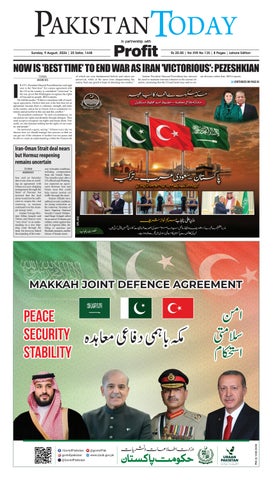
raised in a T-bill auction against a Rs400 billion target, with cut-off yields easing across all tenors except the 1-month, and the bulk, Rs325.3 billion, allocated to the 6-month tenor. SBP reserves rose $13 million weekon-week to $17.0 billion as of July 31, with total reserves touching $22.5 billion, with $17.0 billion held by the SBP and $5.4 billion by the commercial banks, lifting import cover to 2.51 months. The Pakistani rupee firmed slightly, strengthening 0.2% week-onweek to close near Rs 277.7 per dollar. On the industrial front, petroleum offtakes rebounded sharply, rising 23% year-on-year to roughly 1.5 million tons in July, the highest for any July since 2021, driven by lower fuel prices and recovering demand. Cement dispatches also picked up, climbing 6% year-on-year to between 4.48 and 4.5 million tons, with growth concentrated in the North region. Beyond markets, the week's major developments included Turkey, Saudi Arabia and Pakistan signing a joint defence agreement, OPEC+ raising September oil output by 188,000 barrels per day,
and the government advancing its gas sector reform roadmap. Trading activity told a more cautious story than the price gains suggested. AKD reported average daily traded volume falling 29% week-onweek to 934 million shares, while IMS recorded a 9.9% WoW decline to 749 million shares, alongside a 7.0% rise in average daily traded value to roughly $122 million. On the flow side, mutual funds were the largest net buyers among local investors, with net inflows of $13.2 million, while banks were the largest net sellers, offloading a net $11.2 million, according to AHL's NCCPL-sourced data. Among foreign investors, overseas Pakistanis bought a net $2.9 million, while foreign corporates sold a net $4.78 million. Individual stock performance was led by GADT, up 23.9% week-onweek, followed by POWER (+16.2%), CNERGY (+11.2%), NPL (+9.7%) and BOP (+8.9%). On the downside, MEHT fell 22.8%, followed by IBFL (-13.4%), PGLC (-2.9%), KTML (2.7%) and SHFA (-2.4%). Sector-wise, Jute, Textile Spinning and Property
04 COMMENT
Sunday, 9 August, 2026
When Lawmakers Become Local Project Managers
Diplomatic moves
I
I
Pakistan finds itself at the centre of efforts against Israel
T would be a mistake to see the Makkah Defence Agreement as happening in a vacuum. While it does not supersede the Pakistan-Saudi Arabia Strategic Mutual Defence Agreement, it is in its backdrop. Unfortunately, it is likely to further raise hackles in Israel, where there has already been talk of a ‘Sunni Resistance’ as opposed to a ‘Shia Resistance’, and of the need to eliminate it just as the ‘Shia Axis’ is being eliminated. It is worth noting that the concept of a ‘Sunni Resistance’ has only arisen after the USA and Israel attacked Iran. That the MDA was signed even before resolution of the Gulf of Hormuz crisis shows how intense is the pressure for these countries to cooperate, and to do so publicly. Pakistan is part of an intensifying diplomatic environment, and the tendency of that is opposed to Israel. Pakistan is in the midst of attempts to mediate between the USA and Iran in a conflict that seems to have entered an on-again off-again phase, with another US pause in attacks which has brought international oil prices down, but which is only temporary, and will fade with the next renewal of hostilities. However, Pakistan and Iran continue to work on increasing relations, whatever the USA or Israel might think. This was seen in the recent meeting of Power Minister Awais Leghari and Iranian Ambassador to Pakistan Raza Amiri Moghaddam, where increased energy cooperation was discussed. However, Pakistan found itself in direct conflict with Israel in joining the Foreign Ministers of eight Islamic countries in condemning Israeli actions in Gaza and the West Bank. The Board of Peace has not brought calm to Gaza, where the Israeli military has continued its depredations even after the ceasefire, while in the West Bank, not only does Israel continue to uproot Palestinian communities, but extremist ministers continue to lead invasions of the Masjid Al-Aqsa. At the same time, the meeting of Somali Defence Minister Ahmed Moallim Fiqi with CDS Field Marshal Asim Munir is also likely to upset Tel Aviv because of the Israeli recognition of Somaliland in 2025, which was clearly a tactical move, as the secession of Somaliland had occurred in 1991. Military cooperation with Somalia could only be directed at Somaliland, and thus would work against Israel. Pakistan is working on lines which cross Israel right at the time Pakistan is trying to mend fences with the USA. As the USA is totally backing Israel, it is clearly at cross-purposes with the USA.
Pakistan’s Politics of Patronage RIZWAN AHMAD
N an operational democracy, elections are not merely contests for power; they are a process through which citizens choose individuals who will shape the future of their country. The central responsibility of elected representatives is to create laws, hold governments accountable, and provide direction on major national and provincial challenges. Yet in Pakistan, politics has increasingly moved toward a model where legislators are often judged less by their contribution to lawmaking and more by their ability to deliver small development projects in their constituencies. This transformation has created a serious question about the purpose of representative institutions. Are members of assemblies being elected to become lawmakers, or are they being pushed into the role of municipal administrators because local government systems remain weak? One of the major challenges in Pakistani politics is the high cost of election campaigns. Many candidates spend substantial amounts of money to secure electoral victories. Campaign gatherings, publicity, transportation, political organization, and maintaining networks require significant financial resources. As the cost of entering politics rises, concerns naturally emerge about whether public office is becoming an investment where candidates expect returns after gaining power. Once elected, representatives receive salaries, allowances, security arrangements, official facilities, and administrative support funded by taxpayers. These benefits exist because public officials perform important duties on behalf of the state. However, public confidence declines when citizens believe that political positions provide privileges without corresponding accountability and performance. The problem is not that elected representatives receive compensation. A professional democracy requires properly supported officials. The problem arises when public resources and political authority appear disconnected from the core responsibilities of governance. Holding public office should mean greater responsibility, not simply greater access to government resources. A visible example of this issue is the role many legislators play in constituency development. Members of national and provincial assemblies often spend considerable time focusing on street construction, road repairs, drainage projects, streetlights, and other local matters. These issues directly affect citizens’ daily lives and cannot be ignored. However, these responsibilities traditionally belong to local governments, municipal bodies, and district administrations. When legislators become involved primarily in local development work, the larger purpose of assemblies is weakened. A provincial or national assembly should be a place where representatives debate education reforms, healthcare policies, economic strate-
Dedicated to the legacy of late Hameed Nizami
Arif Nizami (Late) Founding Editor
gies, taxation systems, employment opportunities, and institutional improvements. A country’s future cannot be built only through roads and streets; it requires strong laws, effective institutions, and long term planning. The situation reflects a deeper structural problem: the weakness of local government in Pakistan. For decades, local institutions have struggled to achieve consistent authority, resources, and independence. As a result, citizens often approach members of assemblies for basic community needs because they see them as the most powerful available representatives. Politicians, in turn, rely on development projects to maintain public support. This creates a cycle of dependency. Voters expect personal attention and local projects, while politicians use development schemes to strengthen political influence. Meanwhile, the important work of legislation and policy making receives less attention. A democracy cannot mature if political success depends mainly on distributing development funds rather than improving governance systems. A stronger local government structure could help resolve this imbalance. Elected mayors, councils, and municipal representatives should have the authority and resources to manage local issues. They should be responsible for roads, sanitation, water supply, urban planning, and neighbourhood services. Members of parliament and provincial assemblies should then be free to focus on legislation, oversight, and policy. Another major issue is accountability. Democracy does not end on election day. Citizens must be able to evaluate whether their representatives are fulfilling their responsibilities. Political parties should encourage lawmakers to focus on legislative performance rather than only constituency projects. Parliamentary debates, committee work, policy proposals, and oversight of government departments should become important measures of political success. Campaign finance reform is also necessary. When elections become extremely expensive, ordinary citizens with talent and public commitment may find it difficult to participate. Greater transparency in political funding and stricter enforcement of election rules can help reduce the influence of money in politics. However, institutional reform alone is not enough. Society must also change how it evaluates politicians. A representative who introduces effective
Babar Nizami Editor Profit
Modern-Day Economic Warfare
T
MARIA IMRAN
HE contemporary international system is increasingly shaped by the fusion of economics and geopolitical rivalry. Trade is no longer simply a channel of cooperation, mutual gains, and economic growth. Instead, it has been transformed into a strategic instrument of economic statecraft through which states attempt to exert pressure on rivals, influence political regimes, and protect national interests by imposing tariffs, sanctions, export restrictions, and exercising control over trade routes and chokepoints. This shift is reflected vividly in contemporary world politics: wars are no longer confined to kinetic battlefields; trade wars and economic coercion are once again central to great power competition. The lines between geopolitics and geoeconomics have blurred as rivalries spill onto economic grounds. This essay argues that the weaponisation of trade has re-emerged as the defining feature of modern diplomacy and economic statecraft, and that whatever institutional integration the liberal international order achieved is now structurally imperilled. The post-Cold War era was widely associated with globalization, liberal institutionalism, and economic integration. Economic interdependence was once expected to reduce conflict by aligning state interests through commercial exchange— the Kantian promise of a pacified international order. Yet the empirical record of the early 21st century has delivered a systematic refutation of this optimism: interdependence has created new forms of vulnerability, more volatile commerce, and imaginary borders of strategic tolerance. The higher the degree of interdependence, the greater are the chances of exploitation by the large partner in asymmetrical relationships.
States that control strategic trade routes, financial systems, energy resources, and supply chains can use them as instruments of structural coercion. Contemporary warfare exploits interdependence as a lever of asymmetric pressure. Take, for instance, the US–China trade war, the European Union’s sanctions on Russia, and Iran’s latent capacity to interdict the Strait of Hormuz; these blockades and restriction policies mirror the logic of the French Continental System and the British naval blockades of the Napoleonic era. Welcome to a centuries-old pattern of economic statecraft, reconstituted for the 21st century. It all ends where it started, erosion of trade liberalization and a 180-degree reversal. Trade war produces wider systemic effects rather than remaining confined to bilateral disputes; it draws in third-party states and disrupts broader networks. The adverse consequences fall most heavily on developing countries. Tariffs are not merely a fiscal instrument to protect domestic industry; they are embedded in reciprocal political contests and deployed as; signals of resolve within hegemonic competition. In 2024, the USA intensified its tariff regime against China, imposing punitive levies on electric vehicles, batteries, semiconductors, steel, and aluminum. The WTO has reported that escalating reciprocal tariffs and spreading trade policy uncertainty have reduced global merchandise trade by 1.5 percent in 2025. New York Federal Reserve analysis found that the average effective tariff rate on US imports rose from 2.6 percent to 13 percent over the course of 2025; a fivefold increase within a single year. Sanctions are not simply punitive restrictions; they are precisely calibrated interventions designed to exploit structural asymmetries within the global financial architecture. Energy weaponisation deepens this logic, because oil and gas are not ordinary commodities; they are strategic resources tied to state revenue, industrial capacity, and national security. In the case of Iran, US sanctions have repeatedly targeted the petroleum sector. The US Treasury announced in 2025 fresh designations targeting Iranian oil networks, including China-based refineries purchasing Iranian petroleum, extending extraterritorial coercion deep into the domestic economies of third-party states. These measures illustrate how sanctions function not by physically controlling oil re-
Recognizing this delivery gap between the promise of liberal interdependence and the reality of weaponized commerce is essential to understanding the gradual fracturing of the liberal order, and should be clear to the states that they must navigate the consequences of a global trading order increasingly bent to the service of hegemonic statecraft rather than shared prosperity
Lahore – Ph: 042-36300938, 042-36375965
I
Karachi – Ph: 021-32640318 I
serves, but by obstructing the target's ability to sell, ship, insure, and receive payment. Yet sanctions carry structural limitations: they also incentivize resistance, strategic realignment, and the construction of dollar-bypass payment systems, as Russia’s pivot toward yuan-denominated trade with China demonstrates. Shipping routes and maritime chokepoints are not simply geographic passages. Rather turned into strategic economic arteries through which energy, raw materials, manufactured goods, and food move across the global system. The Strait of Hormuz exemplifies why chokepoints matter in modern economic warfare. UNCTAD stated in March 2026 that the Strait carries approximately a quarter of global seaborne oil trade as well as significant volumes of liquefied natural gas and fertilisers. UNCTAD further warned that disruptions at Hormuz are already generating ripple effects across global trade and development, while the WTO has identified the Middle East conflict and energy shocks as major downside risks to 2026 trade growth. Iran's latent capacity to interdict the Strait constitutes a form of structural deterrence, a coercive instrument that operates through threat as much as through action. The distributional consequences of trade weaponisation are profoundly asymmetric. Great powers possess the institutional depth and policy instruments to absorb the costs of economic warfare, at least in the short- to mediumterm. Developing and least-developed states, by contrast are, structurally exposed to its consequences without any meaningful capacity to shape the conflict dynamics that generate them. The commodity price volatility induced by US–China tariff escalation, the energy price shocks triggered by the Russia–Ukraine conflict and associated sanctions, and logistics disruptions flowing from Red Sea instability have all disproportionately impacted low-income economies dependent on imported food, fuel, and intermediate goods. Therefore, the weaponisation of trade is not only a question of strategy and power, but also a challenge to international economic justice for developing countries and to the normative foundations of the multilateral trading order. Economic interdependence has not eliminated interstate conflict; it has transformed and, in some respects, intensified it. The liberal peace hypothesis that commercial exchange generates pacifying incentives has underestimated the degree to which states would learn to exploit the structural features of interdependence as instruments of coercion. Modern economic warfare reveals a world in which the global economy functions simultaneously as a theatre of cooperation and a theatre of structural conflict. Recognizing this delivery gap between the promise of liberal interdependence and the reality of weaponized commerce is essential to understanding the gradual fracturing of the liberal order, and should be clear to the states that they must navigate the consequences of a global trading order increasingly bent to the service of hegemonic statecraft rather than shared prosperity. The writer can be reached at mariaimran.bbaf24@iba-suk.edu.pk
Islamabad – Ph: 051-2204545
The writer is a freelance columnist
For democracy to succeed, Pakistan must redefine the meaning of political leadership. A legislatorÊs greatest achievement should not be acting as a mayor or councillor. It should be becoming a true representative of the people and a builder of a stronger state
Free Trade or Forced Compliance? M. A. Niazi
Editor Pakistan Today
legislation, improves government accountability, or helps reform a failing institution may create a greater impact than one who completes several small construction projects. Visible projects attract immediate attention, but strong policies shape the future. Pakistan faces enormous challenges, including economic pressures, population growth, unemployment, education gaps, and healthcare needs. These problems require serious legislative attention and policy solutions. Assemblies should be centres of debate and reform, not merely offices for distributing development funds. The purpose of democracy is not to create a competition over who can deliver the most local projects. The purpose is to create a system where citizens’ voices influence decisions, where governments are accountable, and where institutions work effectively. Pakistan needs a political culture where public service replaces personal advantage, where lawmakers are valued for their ideas rather than their ability to provide favours, and where institutions not individuals deliver services to citizens. An elected position should never be considered a reward for winning an expensive campaign. It is a responsibility given by the people. The true legacy of a politician should not be measured by the number of roads constructed during their term, but by the quality of laws passed, institutions strengthened, and opportunities created for future generations. For democracy to succeed, Pakistan must redefine the meaning of political leadership. A legislator’s greatest achievement should not be acting as a mayor or councillor. It should be becoming a true representative of the people and a builder of a stronger state.
I
Editor’s mail
Send your letters to: Letters to Editor, Pakistan Today, 4-Shaarey Fatima Jinnah, Lahore, Pakistan. E-mail: letters@pakistantoday.com.pk Letters should be addressed to Pakistan Today exclusively
Green deficit
OUR immediate environment in the city of Kamalia echoes the sad reminiscences of verdant areas. This condition is much more than a visual deficiency; it also becomes an ever-important health and social exclusion issue that primarily affects women and their children. The absence of adequate green patches deprives community of outdoor activities. Buy vitamins and supplements A park is a priceless place for physical exercise. It is ideal for walking, jogging and many other activities for keeping one fit and healthy while avoiding chronic diseases. it also provides engagement, relaxation and mental clarity. Our government must step in and prioritise green spaces by redeveloping vacant or underutilised lots into open public parks. The city government can offer the land and core infrastructure, while the people can share through volunteer planting initiatives, community cleanups and upkeep work. Kamalia deserves more than what it has now. If only we worked together, especially our women and children, to reclaim parks for healthier, happier and more active living. ASWAD KHAN KAMALIA, PUNJAB
Game revival
IN many Pakistani cities, young people spend their evenings with little to do other than scroll on their phones or wander the streets. This lack of healthy engagement not only wastes their energy but can also push them towards unproductive or risky activities. One simple, community-driven solution could make a huge difference — reviving night cricket. In the past, night cricket tournaments brought neighbourhoods together. They offered a safe space for youth to play, compete and bond. They also reduced idle street gatherings that sometimes led to disputes or petty crimes. With proper lighting, basic security and local sponsorships, night cricket can once again become a positive outlet for our young generation. Cities like Karachi, Lahore and Rawalpindi have many empty grounds that could be transformed into lively, family-friendly night cricket spots. Even small-scale matches in parks can create a sense of unity and healthy competition. Local authorities, sports boards and community groups should work together to make this happen. Sports have the power to unite, inspire and protect our communities. Let’s bring back night cricket — not just as a game, but as an investment in safer, happier and healthier cities. JUNAID MALIK SUKKUR
Billing scam
THERE is something deeply broken in the way we are being treated as electricity consumers. We’re not just being overcharged but also being dismissed, ignored and manipulated. The recent publications by the Auditor General of Pakistan exposes how agricultural tube-wells were overbilled by Rs148 billion — yes, billion — with no proper justification. Similar things are happening to ordinary households like mine. What’s the point of regulations if no one is forced to follow them?. My electricity bill never matches my consumption. There’s no breakdown. No data. And when I try to raise a complaint, I’m met with sheer silence. How is it fair that DISCOs can charge people at their own will, without any oversight? If the audit system itself couldn’t get proper records from these companies, then how can an ordinary citizen expect justice? The government has not issued any public response, and the ministries’ response is just a blame game. We are not cattle to be herded and looted. We are citizens. We have rights. And we are tired of being robbed in broad daylight with no one to protect us. How long will this go on? When will someone finally listen? SAIMA AHMED LAHORE
Web: www.pakistantoday.com.pk
I
Email: editorial@pakistantoday.com.pk
Dissecting a decomposing Body Sunday, 9 August, 2026
T
COMMENT 05
More provinces won’t solve the problem NAQI AKBAR
HE print and electronic media and the blogger media are aflush with remedies to correct the system. The trigger has been the federal interior minister, generally regarded by the general public, the media, the international stakeholders as well as the common man on the street as what is coined as a term, a ‘regime insider’. For obvious reasons, the assertions of that day whose curtainraisers were flashed before the event by the Twitter handles known to be connected with the military establishment, stating that ‘important talk’ is likely to be delivered by the incumbent interior minister, was not a talk straight from the heart, whose Indian equivalent the ‘Mun ki Baat’ is practised by the incumbent Indian PM now and then. The statements of thce day were actually nothing, but a controlled sharing of ideas with the media and the general public to gauge the public opinion, the pressure groups’ reaction and the reaction of the political groups; many of the sections of the society preferred to keep mum or look the other way. In journalistic jargon, it is called a ‘controlled leakage of information’ to initiate a debate. As was expected, the blogger media, the influencer media and the general public initiated a debate which was not expected to yield any constitutional results, but to keep the forums ‘confused about’ what is likely in store for the system, being ‘apparently’ run according to the 1973 Constitution. The so-called straight talk of that day
was taken up by another section of the society, not necessarily linked to any opposition movement as a confession by a person no less than a regime figure. To elaborate further, if one strolls through the history of the country, all the planners in the Ayub era knew that the dispensation deliberately stood for creating a polity led by a few rich with masses of poor following them, allowed to live the sustenance through controlled wages/salaries, a general discouragement to negotiate or the absence of the trade unionism, a system facilitating the ‘capitalist surplus’. However, again it was the regime insider of those days, the late Dr. Mahbub ul Haque, the economist who planned the development paradigm based on creating haves and have-nots who blew the truth in the form of his most famous policy note or paper; ‘The seven sins of economic planning’ in which he was dangerously frank in stating that the country economy and resources were being led by none other than the infamous 22 families. That revelation set the pattern for many political movements, as the people of Pakistan were less regimented and were enthusiastic to come on the street to balance things out with the establishment of those days. It would not be an exaggeration to state that the western and eastern wings of Pakistan were able to deduce the findings according to the political discourse. The Eastern wing decided to end the journey, while the western wing thought in opportune to give alternate worldviews a chance to restart the things. Coming back to August 2026, the debate on creation of many provinces to solve the problems of the state has still not kicked off
Transgressing a closed territory, what is needed is to infuse life into the system and eliminate disillusionment are not the remedies suggested by that very system. A transition from a hard state to a democratic state; a utopian wish, rather than a Âdangerous utopian wishÊ, is what is needed rather than structural amendments which fail to dent the status quo. Or are cosmetic in nature⁄..another amendment practically will only benefit the decomposing structure, but will fail to deliver the goods
the debate as it should have. The reasons for that emanate from the mediocre political leadership available in the political spectrum. With the two major parties’ partners in the spoils in the corridors of the power and the “odd man out” or the political party out of favour, there is simply an absence of any live debate ever to be initiated in the forums, whether it is Parliament, the campuses or even the meek intelligentsia. For obvious reasons and based on the experience of statehood during the last four years, the ideas expressed by the ‘insider’ are likely to be encapsulated in the form of another amendment in the constitution. The amendments as previously dealt with will be ritually debated and then will be passed unanimously on the basis of ‘hidden recommendations’. Assuming that the amendments are implemented country wide; does the framework have the potential to solve the problems as is claimed by the proponents? A somewhat cynical assertion on the ongoing state of affairs only concludes the fact that it is like dissecting an already infected or decomposed body, where each dissected piece of body or flesh will be carrying the bacteria or the contradictions present in the other dissected piece of flesh. To begin with, new administrative units might apparently divide the load of the overloaded provincial entities. The socalled remedy suggested is again centred around the logic of dividing the load. However, the proposal is faulty on two counts. The international practices usually divide the service delivery of the state to three tiers; the local government, the provincial government and the federal or the central government. The problems of service delivery generally debated by the proponents of the new provinces’ theory can be easily tackled within the three tiers; with the assumption that the ToRs and SoPs are de-
fined in a manner that no tier encroaches upon the other in any way. In the case of Pakistan, the map of encroachment is political and the administrative boundary takes a back seat for all practical purposes. To understand the mechanism in Pakistan, it is important to observe that urban infrastructure development is the domain around the world; of the local city council and even in the rural areas. In that context; the interior minister, the prime minister, and the chief minister have no business on the count that a certain bridge has not been built or why it has to be built. However, in Pakistan the rationale for any project starts with the participation of the listed office bearers or the related political governments. If the new provinces are created, the election of the office bearers will invariably have the political character, which will be more dominant that the local factors logic. With the political factor overriding, it is a foregone conclusion that the administrative fine tuning will take a back seat and the people for whom the so-called amendments are likely to be done, will still be on the receiving end. The emerging scenario, where the resource crunch has been the wanting factor between the federation and the federating units, adding new federating units, creating secretariats for them while not actually solving the issues, is not likely a cost benefit solution. The fault lies in the ToRs and the SoPs, so far followed without any revision based on the technological strides in the work flows all over the globe. What is important is not the creation of administrative units which might increase the size of the chronically ‘inefficient’ government but how the so-called public, referred to in that day's PowerPoint presentation, is to be facilitated. Here it is important to note that the
IMF intervention with the FBR has been one such model which can be replicated for the administrative units so far working, meaning the provinces. A better efficient on-line government which is facilitated by the federal government in the form of supply of electricity, phone and mobile data coverage across the country is more important than many brick and mortar structures whose utility might not be that effective in ensuring instant delivery of service without toiling to reach the physical premises of the offices. Towards that end, what is needed is the introduction of local government within the umbrella of the provincial set-up. That is one aspect of the reason why the public is disillusioned with the system, and even the people running that system are equally disillusioned. What needs to be addressed are not the administrative steps which can be written as an amendment, debated superficially, passed and promulgated. What is important for the establishment is to enforce an impression that there are no VIPs and no hoi-polloi in the system. There is a rule of law for everyone. If the deep state, the visible state and the political structures are not able to inspire the faith of the man on the street in the system; new plans are likely to fall flat. Transgressing a closed territory, what is needed is to infuse life into the system and eliminate disillusionment are not the remedies suggested by that very system. A transition from a hard state to a democratic state; a utopian wish, rather than a ‘dangerous utopian wish’, is what is needed rather than structural amendments which fail to dent the status quo. Or are cosmetic in nature…..another amendment practically will only benefit the decomposing structure, but will fail to deliver the goods. The writer is a freelance columnist
What message has the Mecca defense pact sent to Washington?
O
For Washington, the message coming out of Mecca is a bitter pill GLOBAL TIMES
N Friday in the holy city of Mecca, Saudi Arabia, Pakistan and Turkey signed a major deal that is already shaking up global public opinion. Some Western media wasted no time slapping a familiar label on it: the "NATO-style" pact. The Mecca Joint Defense Agreement is intended to strengthen collective deterrence against any act of aggression and stipulates that an armed attack against any one of the three would be regarded as an attack on all, according to Reuters. Yet, comparing this agreement to NATO is way too soon. As Ding Long, a professor at the Middle East Studies Institute of Shanghai International Studies University, told the Global Times, the Mecca Agreement remains, for now, a
framework of political intent, since it lacks the integrated military command structures, joint logistics, and institutional machinery that define a true, battle-tested alliance like NATO. “The term ‘NATO-style’ is more of a rhetorical label that reflects both the strategic wariness of the West and some other non-Muslim countries regarding the first-ever appearance of such collective defense provisions in the Islamic world, and the narrative intent to frame it as a tool for confrontation between specific blocs,” he added. Scratch beneath the surface, however, and the true weight of the agreement becomes impossible to ignore. As the Associated Press laid out, this trio brings together an oil-rich country (Saudi Arabia), a nuclear power (Pakistan) as well as NATO’s secondlargest army and a rapidly growing defense industry (Turkey). Amid the ongoing conflicts in the Mid-
dle East, the trilateral defense agreement is essentially a turbocharged evolution of last year's mutual defense pact between Riyadh and Islamabad. The defense pact is open to other regional countries, and it remains to be seen how many will join in the future. Granted, this blueprint is bound to redraw the regional map. It pushes Gulf capitals away from rigid, single-pole dependence and toward a multi-source balancing act, while giving Turkey a fast-track path from peripheral NATO member to core security architect in the Islamic world. At the same time, although it throws up a much-needed shield against Iran, it also risks cornering Tehran into far more unpredictable countermeasures. Step back, and a much bigger picture comes into focus: As Middle East conflicts spiral, regional countries are waking up to the fact that they can no longer rely solely on US security guarantees, even if an alliance with the US is unlikely to crumble in the near future. For decades, the playbook in the Gulf
was simple and almost transactional: write big checks, outsource your survival, and let a superpower across the ocean keep the peace. But when real war finally came knocking, that safety net turned out to be an illusion. Instead of getting shielded, Gulf states watched US forces scramble just to save their own skin, all while dragging the entire neighborhood deeper into the crossfire. This brutal reality has left US allies across the region fundamentally questioning the traditional security paradigm of relying on Washington for security. For Washington, the message coming out of Mecca is a bitter pill. The trust deficit that’s been brewing for years has finally cracked wide open. Rather than keeping its faith in a US umbrella that leaks whenever it storms, Riyadh has decided to hedge its bets by stitching together an independent security arrangement with Ankara and Islamabad – a blunt, public verdict on just how much the US security umbrella is truly worth today.
This leaves Washington backed into a classic geopolitical dilemma: Double down with ironclad security guarantees, and the US completely torpedoes its own strategy of military retrenchment. Look the other way and shrug, and its remaining grip on the region slips through its fingers, leaving the US to watch a multi-polar Middle East spin permanently out of reach. Then again, Washington might just have to get used to the view. A multi-polar world is the stubborn reality of an age where major regional players refuse to be treated as disposable pawns on someone else's chessboard. When the very “protector” you relied on becomes the source of risk, you stop putting your faith in empty promises and start keeping your security in your own hands. The Mecca agreement is merely the latest shockwave of such a global shift rippling across the Gulf. With the deal now signed in Mecca, the pendulum of Middle East geopolitics has officially swung toward selfreliance and multi-polarity.
Mossad sacks architects of its failed regime change dream
M
Mossad chief Roman Gofman has ousted two senior officials behind a failed plan to topple Islamic Republic of Iran TEHRAN TIMES
FARDIN MOLAEI
ONTHS before the onset of the US-Israel war against Iran, Reza Pahlavi, the son of Iran's last Shah, undertook a visit to the occupied territories. During this trip, he held meetings with Benjamin Netanyahu, senior Mossad officials, and several influential Knesset members. According to accounts published in various media outlets, an assessment was conveyed to the Israeli side during these meetings suggesting that, in the event of a military operation against Iran, initial pressures could catalyze widespread domestic protests and ultimately lead to the collapse of the Islamic Republic. Based on these same accounts, relying on such an estimation, Mossad formulated a "regime change" scenario alongside the military option and presented it to US President Donald Trump. Some Israeli analysts and US officials have revealed that Benjamin Netanyahu had previously proposed this same scenario to former American presidents, but they had declined to endorse such a plan. Apparently, either due to inexperience in the world of politics, or due to optimism, or due to his deal-making disposition, Trump was deceived by Netanyahu and entered into an endless campaign with Iran. But their cal-
culations were wrong, and they failed. The trajectory of developments on the ground proved contrary to these initial projections. The scenario's architects' expectation of widespread uprisings and the swift disintegration of Iran's political structure failed to materialize. On the contrary, many observers contend that external attacks actually bolstered national solidarity across various segments of Iranian society, prompting a significant portion of public opinion notwithstanding internal political divergences to rally in support of the nation's sovereignty and territorial integrity against external threats. DADI THE FIRST DOMINO In the wake of this failed assessment, speculation regarding an intelligence failure within Mossad intensified. David "Dadi" Barnea, who had led Mossad since June 2021, stepped down from his post in June 2026 after completing a five-year term, with Roman Gofman named as his successor. Although official Israeli sources characterized the end of Barnea's tenure as part of the organization's standard leadership rotation, certain Israeli media outlets linked this development to the outcomes of operations against Iran and flawed intelligence evaluations. The leadership changes within Mossad were not confined to the replacement of its director. Israel's Channel 12 reported that Roman Gofman, the new Mossad chief, in his initial moves, dismissed the organiza-
tion's deputy director and another senior intelligence official. The outlet claimed these changes followed the failure of efforts to achieve Israel's strategic objectives concerning the Islamic Republic of Iran. According to this report, the dismissed deputy director, identified only by the initial "A.," had been regarded as a primary candidate to succeed Barnea. In contrast, Benjamin Netanyahu's office, while confirming the management changes, stated that these decisions were made within the framework of the new Mossad director's plan to establish a fresh management team and prepare the organization's structure to meet the security challenges of the coming years. In recent weeks, the publication of interviews with former Mossad officials has also revived debate within Israeli media and security circles concerning the role of psychological operations, cognitive warfare, and efforts to influence Iranian public opinion. In these interviews, it has been claimed that over the past years, in addition to intelligence and military operations, Mossad made extensive investments in media warfare and influence operations aimed at driving a wedge between Iranian society and the state. Nevertheless, the outcome of these developments demonstrated that many of the initial assessments regarding Iranian society's response were incongruent with on-theground realities a matter now discussed by some Israeli analysts as one of Tel Aviv's most significant miscalculations and intelli-
gence errors concerning Iran, although official Israeli authorities have not formally confirmed such an interpretation to date. MOSSAD'S STRATEGY UNDER FRESH SCRUTINY The departure of Barnea and the restructuring of Mossad have reignited debate over one of the most controversial aspects of the recent conflict with Iran: whether Israeli intelligence expected military pressure and psychological operations to trigger political change inside the Islamic Republic. An interview published in the Israeli media with the former head of a previously undisclosed Mossad influence operations branch has provided a rare glimpse into the agency's thinking during the years leading up to the conflict. While many of the interview's assertions cannot be independently verified, the account sheds light on the importance Mossad allegedly attached to information warfare, social media campaigns and efforts to undermine confidence in Iran's governing institutions. According to the interview, Mossad established a dedicated influence operations branch in 2021 as part of a broad organizational reform introduced after Barnea assumed leadership of the agency. The official interviewed claimed that the new department was tasked with developing non-military methods to influence public opinion in Iran and Lebanon, combining intelligence analysis with media operations, online networks, and psychological warfare.
The interview further alleged that Mossad gradually shifted from relying primarily on covert kinetic operations toward integrating influence campaigns designed to weaken confidence in Iranian institutions. Among the methods described were the use of social media networks, fictitious online accounts, AI-generated influencers and carefully timed publication of sensitive information concerning Iranian officials. Perhaps the most significant claim concerns Mossad's expectations before Israel's military campaign against Iran. According to the interview, the agency believed that combining military strikes with sustained influence operations could widen the gap between the Iranian government and segments of society, eventually encouraging broader political unrest. The interview also asserted that this assessment formed part of discussions with senior Israeli and American decision-makers before military operations commenced. The same interview acknowledged, however, that these expectations were not realized during the conflict. While the former official argued that influence campaigns require months or even years to produce political effects, he conceded that the Iranian political system remained in place after the fighting ended. The material provided for this report argues that Israeli planners expected military operations to coincide with widespread domestic unrest capable of fundamentally altering Iran's political landscape. It further stated that these expectations proved inaccu-
06 news
US General pUSHeD fOr Iran War Off-raMp aS TrUMp TeaM WeIGHeD rISkS
G
sunday, 9 August 2026 | lAhore
WASHINGTON AGENCIES
eN Dan Caine, the top US military officer, privately urged senior officials in President Donald Trump’s administration to find a way to scale down the war with Iran as doubts grew over the effectiveness of available military options and the risk of a broader regional backlash, CNN reported on Friday. Caine, chairman of the Joint Chiefs of Staff, raised those concerns in discussions with senior officials including CIA Director John Ratcliffe, Secretary of State Marco Rubio and Vice President JD Vance, the network said, citing three people familiar with the talks. Caine and other officials assessed that airpower alone was unlikely to force Tehran to accept US demands, even as Trump remained opposed to a ground invasion. Caine warned Trump about the military risks, while also say-
ing US forces could still inflict major damage on Iran if ordered to intensify the campaign. ESCALATION CONCERNS INSIDE ADMINISTRATION Senior officials were also said to have viewed a proposed escalation in late July with skepticism, partly because of fears that Iran could retaliate against US allies and energy infrastructure in the region. Trump later postponed the operation after Gulf partners warned of possible attacks, CNN said. The report also pointed to mounting concern over depleted US weapons inventories, including air-defence interceptors and other precision munitions, a factor that could limit Washington’s ability to sustain a long conflict. Administration officials are now seeking an outcome Trump could present as a political win while still preserving room for diplomacy. One option under discussion is a possible agreement to reopen the Strait of Hormuz.
Us seeks diplomatic off-ramp as Iran war strains military options WASHINGTON AGENCIES
Senior United States officials are exploring a diplomatic path to ease the war with Iran as military options appear increasingly constrained, with Chairman of the Joint Chiefs of Staff Gen Dan Caine privately warning that further escalation could bring limited gains and wider risks. Caine raised those concerns with top officials including CIA Director John Ratcliffe, Secretary of State Marco Rubio and Vice President JD Vance, CNN reported,
citing people familiar with the discussions. He and other senior officials believe airpower alone is unlikely to force Tehran to accept US demands, even as President Donald Trump has remained opposed to a ground invasion. The debate inside Washington comes as the administration looks for an outcome Trump could present as a political win while still leaving room for diplomacy. CNN said Caine had also told Trump that US forces could inflict major damage on Iran if ordered to step up the campaign, but warned about the military risks involved.
sustainable Materials: Can Pakistan Grow Future from waste?
W
MUHAMMAD SHAYAN HAYAT
HeN plastic was first invented in 1862 by Alexander Parkes, made from cellulose and acting similar to wax in its moldable properties, a future where 460 million metric tonnes of his invention pollute our environment every year was one beyond imagination. However, this is our reality, a reality where this number is expected to triple by 2060 if left unchecked. Materials: every object around us has a material story. The chair we sit on, the packaging around our food, the bricks in our walls, the dashboard of a car, and even the phone case in our hand all begin somewhere. Some begin as petroleum, some as minerals dug from the earth, and some as trees cut down and processed into paper or timber. For decades, the modern world has chosen materials mainly because they are cheap, strong, and easy to mass-produce. But now, another question has become unavoidable: what happens after we throw them away? This question matters deeply for countries like Pakistan. Our cities are expanding, consumption is increasing, and waste management systems are already under pressure. According to the International Trade Administration, Pakistan generates around 50.79 million tons of solid waste every year, and this amount is increasing by more than 2.4 percent annually. Much of this waste is dumped, burned, or left unmanaged, creating health and environmental problems in urban areas. Globally, the situation is just as concerning. The United Nations environment Programme reports that humanity produces more than 400 million tonnes of plastic each year. Plastic has been useful in medicine, transport, food safety, and countless daily applications, but its careless use has created one of the most visible pollution problems of the modern age. If current trends continue, plastic waste could nearly triple by 2060. This is where sustainable materials enter the conversation. What are sustainable materials? Sustainable materials are not simply “natural” materials. A material is sustainable when it can perform its function while reducing harm across its whole life cycle: how it is produced, how much energy it consumes, how long it lasts, whether it can be repaired or reused, and what happens when it reaches the end of its life. This means the answer is not always as simple as replacing plastic with paper or concrete with wood. Sometimes a biodegradable material may require
heavy chemical processing. Sometimes a reusable plastic container may be better than a weak “eco-friendly” item that breaks after one use. In materials science, the real test is not how green something looks, but how it behaves from production to disposal. For Pakistan, this thinking is important. We do not only need imported “green” products. We need materials that match local resources, climate, industries, and affordability. From agricultural waste to useful products Pakistan is an agricultural country, and agriculture produces large amounts of residues: rice husks, wheat straw, sugarcane bagasse, cotton stalks, corn cobs, and other plant waste. Much of this biomass is burned, discarded, or underused. But in the world of sustainable materials, this waste can become a resource. Plant-based fibers contain cellulose, hemicellulose, and lignin, which can be used to produce boards, packaging, insulation panels, composites, and even advanced nanomaterials. Scientia has previously highlighted jute as a valuable natural fiber for nanotechnology because of its celluloserich structure and potential in applications such as energy storage, coatings, polymer composites, and sensors. Similar thinking can be applied to Pakistan’s own agricultural residues. Rice husk ash can be used in cementitious materials. Sugarcane bagasse can be processed into boards and biodegradable packaging. Cotton waste can be used in recycled textiles or composite fillers. Instead of seeing crop residue as something to burn, we can see it as a raw material waiting for engineering. Mycelium: the material grown by fungi Among the most fascinating sustainable materials is mycelium. Mycelium is the root-like network of fungi. When grown on agricultural waste, it binds particles together like a natural glue. After drying or heat treatment, it can form lightweight packaging, insulation panels, acoustic boards, decorative products, and experimental construction materials. The idea sounds futuristic, but the process is surprisingly biological. A fungus is given a substrate such as sawdust, straw, husk, or paper waste. Over several days, the mycelium spreads through the material, digesting part of it and binding it into a solid structure. The grown object can then be dried to stop further growth. The result is a material that can be lightweight, biodegradable, and partly made from waste. Mycelium composites are especially promising as replacements for expanded polystyrene foam in packaging. Anyone who has opened a parcel has seen the problem: plastic foam protects products well, but it is difficult to recycle and breaks into
persistent fragments. Mycelium packaging, on the other hand, can be shaped in molds and composted under suitable conditions. However, mycelium is not a miracle material. It may struggle with water resistance, long-term durability, mass production, and consistency. These are not reasons to reject it; they are research questions. Pakistani students and researchers can test local fungi, local agricultural waste, and local manufacturing methods to see where mycelium truly works. The construction problem One of the largest material challenges in the world is construction. Cement and concrete are essential for housing, roads, bridges, and public infrastructure. Yet cement production is a major source of carbon dioxide emissions, with global cement manufacturing often estimated at around 8 percent of total global CO₂ emissions. This creates a difficult balance. Countries like Pakistan need more housing and infrastructure, not less. Sustainable development cannot mean telling people they do not deserve roads, schools, hospitals, or safe homes. The challenge is to build better. Sustainable construction materials could include low-carbon cement blends, recycled aggregate, compressed earth blocks, bamboo, engineered timber, rice husk ash concrete, and insulation made from agricultural fibers. even small improvements can matter because construction happens at such a large scale. If a city reduces the carbon footprint of its bricks, concrete, and insulation, the impact is far greater than changing one consumer product. Pakistan’s hot climate also makes insulation important. A poorly insulated building needs more air-conditioning, which increases energy demand. Materials made from fibers, cork, hemp, mycelium, or recycled textiles can help reduce heat transfer. In this way, sustainable materials are not only about waste; they are also about energy, comfort, and public health. Plastics still need smarter thinking It is easy to say, “ban plastic,” but the real world is more complicated. Plastic is used in hospitals, food packaging, electrical insulation, water pipes, and vehicles. The problem is not that plastic exists; the problem is that we use it carelessly, especially for short-lived disposable products. A smarter approach includes reducing unnecessary singleuse plastic, improving recycling, designing products for reuse, and developing biodegradable alternatives only where they actually make sense. For example, biodegradable packaging may be useful for food waste systems if it can break down in local composting conditions. But if it ends up in open dumps without proper treatment, its benefits may be
limited. This is why sustainable materials must be connected to waste systems. A compostable cup is only useful if composting exists. A recyclable bottle is only useful if collection and recycling infrastructure are available. Material innovation and municipal planning must work together. Why this matters for young researchers Sustainable materials offer an exciting opportunity for students in Pakistan because the field combines biology, chemistry, engineering, design, and environmental science. A student can begin with a simple question: Can rice husk make a stronger brick? Can sugarcane bagasse become packaging? Can textile waste be turned into insulation? Can mycelium grow on local crop residue? Can a natural fiber composite replace a plastic part in a low-cost product? These questions may sound small, but many technologies begin as small experiments. What matters is careful testing. A material must be measured for strength, water absorption, fire resistance, biodegradation, cost, and safety. It must be compared with existing materials honestly. Sustainability should not become a slogan; it should become evidence. Pakistan also has a practical advantage. We have agricultural residues, textile waste, young engineers, universities, and growing environmental awareness. What is often missing is the bridge between research and industry. If universities, small manufacturers, farmers, and entrepreneurs work together, sustainable materials can move from lab samples to real products. The future may be circular The old model of materials is linear: take, make, use, throw away. The future must be circular: design, use, reuse, repair, recycle, regenerate. In a circular economy, waste from one process becomes input for another. Agricultural waste becomes packaging. Textile waste becomes insulation. Plastic waste becomes feedstock for new products. Buildings are designed so materials can be recovered instead of buried. For Pakistan, this is not only an environmental idea. It is an economic opportunity. Sustainable materials can create local industries, reduce import dependence, support farmers, and generate green jobs. They can also help cities manage waste and reduce pollution. But the transition must be realistic. Not every natural material is automatically sustainable. Not every synthetic material is automatically bad. The future will require a mix: better plastics, better recycling, bio-based composites, lowcarbon construction, smarter design, and stronger public systems. The material world is changing. The question is whether Pakistan will only import that change or help create it.
Trump’s new birthright citizenship orders face another court fight US
AGENCIES
US President Donald Trump has launched a fresh attempt to narrow birthright citizenship, signing two executive orders after the Supreme Court struck down his earlier policy in June. The new measures are largely aimed at so-called birth tourism, but legal scholars cited in the debate said that part of the effort is likely to face immediate constitutional challenges because the court has already reaffirmed broad citizenship protections for children born on US soil. FRESH PUSH AFTER SUPREME COURT SETBACK Trump’s first order on the issue came on the opening day of his second term in January 2025, targeting immigrants who were in the United States unlawfully as well as some who were there temporarily on legal visas, including workers and students. But in Trump v Barbara on June 30, the Supreme Court invalidated that policy, ruling 6-3 that it conflicted with the 14th Amendment’s citizenship guarantee for those born in the United States who are “subject to the jurisdiction thereof”. In the majority opinion, Chief Justice John Roberts wrote that citizenship has long meant “the right to have rights to freely participate in our political community” and said the framers of the 14th Amendment extended that promise to “every freeborn person in the land”.
CONCERNS OVER ESCALATION AND WEAPONS STOCKS Senior officials were said to be doubtful about a proposed escalation in late July, partly because of fears that Iran could retaliate against US allies and vital energy infrastructure in the region. Trump later postponed that operation after Gulf partners warned of possible attacks. Another pressure point has been the state of US weapons inventories. Concerns have grown over reduced stocks of airdefence interceptors and other precision munitions, a factor that could limit Washington's ability to sustain a longer conflict.
Youth protests leave Modi facing broader questions in India NEW DELHI
AGENCIES
India’s government is still dealing with the political impact of youth-led protests that forced the resignation of the education minister, with unrest over exam leaks widening into a broader expression of anger over jobs, opportunity and public institutions. The minister stepped down on July 25, marking a rare retreat for Prime Minister Narendra Modi, who has cultivated an image of political firmness for more than a decade. Since then, authorities have tried to calm discontent by increasing penalties for leaking exam papers, while police in several cities have withdrawn cases against protesters after criticism over the use of force. MOVEMENT GREW BEYOND EXAM SCANDAL What began as outrage over exam irregularities spread from New Delhi to other cities and developed into a wider youth movement under the banner of the online Cockroach Janta Party, or CJP. For many young Indians, the controversy came to reflect deeper frustration over unemployment, limited economic opportunity and declining trust in institutions. Although the main wave of demonstrations has largely subsided after key demands were met, protests are continuing in Jharkhand in eastern India, underlining that the anger has not fully ebbed. The CJP has said it will hold a “nationwide listening tour” focused on the concerns of young Indians while continuing to support agitation over exam-related grievances. DIGITAL TACTICS AND SURVEILLANCE CONCERNS The protests also highlighted a changing online battlefield. Demonstrators used social media to mobilise support and spread their message, while Modi — already a prominent user of X — has turned to Instagram, posting his first vertical videos to connect with younger audiences.
Hamas says ready for next phase of Gaza plan CAIRO
AGENCIES
Hamas said on Saturday it was prepared to move ahead with the next stage of a US-backed Gaza plan and called on Washington to press Israel to implement it. A Hamas official told AFP that the group and other factions had informed mediators they were ready to begin the second phase if Israel approved it and started carrying out its part of the agreement. The official said, "Hamas and other factions have confirmed to mediators their readiness to begin implementing the agreement and move to the second phase, provided it receives Israeli approval and that Israel begins implementing the agreement." The official also said, "Hamas is urging the US administration to exert pressure on Israel to compel it to abide by the agreement and move to the second phase." The latest stage of the plan would see Hamas hand over its weapons to a new Palestinian governing committee in Gaza. President Donald Trump had described Hamas's acceptance of disarmament last week as a breakthrough, while his Board of Peace said Israel would gradually withdraw from much of the territory. Israel, however, has publicly disputed that understanding. Prime Minister Benjamin Netanyahu said on Tuesday that Israel had not agreed to the "draft" presented by the Board of Peace.
Typhoon Dolphin batters Okinawa as China closes ports before landfall JAPAN’S
AGENTIS
Typhoon Dolphin swept across Japan's southern Okinawa prefecture on Saturday, leaving six people injured, disrupting flights and knocking out electricity to tens of thousands of buildings, while Chinese authorities shut ports and ferries as the storm moved towards the country's east coast. Japanese authorities said five elderly people in Okinawa suffered non-life-threatening injuries, including three who fell in strong winds. Another person was injured in Kagoshima prefecture. Power outages affected nearly 39,000 buildings in Kagoshima and just over 12,000 in Okinawa. Domestic carriers ANA and Japan Airlines cancelled flights to and from Okinawa as the typhoon brought maximum sustained winds of 162 kilometres per hour and gusts of up to 216kph. Okinawa and Amami Island in Kagoshima prefecture were expected to bear the brunt of the storm in Japan. CHINA RAISES ALERTS In China, Dolphin was designated an orange-category typhoon, the country's second-highest level, ahead of expected landfall between late Sunday and early Monday. Authorities also raised the emergency response level by one notch to level III amid concerns over flooding and landslides.
NEWS 07
Sunday, 9 August 2026 | LAHORE
CORPORATE CORNER
CBD Punjab CEO reviews mega projects, directs timely completion with highest quality standards
LAHORE STAFF REPORT
Chief Executive Officer of the Punjab Central Business District Development Authority (PCBDDA), also known as Central Business District Punjab (CBD Punjab), Imran Amin, conducted a comprehensive inspection of the Authority’s ongoing mega projects, including CBD Vertex, CBD Walk and NSIT City, to review construction progress and ensure their timely completion.The CEO was accompanied by Executive Director Technical Riaz Hussain, Director Project Management Asif Iqbal, Director Construction Asif Babar, Director Architecture and Planning Sameer Aftab Sial, along with senior officials from NESPAK and representatives of the contractors.During detailed briefings at the project sites, officials apprised the CEO of key technical milestones achieved. At CBD Vertex, finishing works are progressing rapidly, with the installation of exterior elevation tiles and digital screens nearing completion. Epoxy flooring and the advanced parking management system are also in the final stages.At CBD Walk, the grey structures of all units have been completed, while exterior elevation tile work is progressing swiftly. Other finishing and development works are also being carried out in accordance with the project timelines.
PREDA hosts inaugural PREDAXIS Conference to advance PR, Digital, Event Management and Activations Industries
CM MARyAM ORDERS SutHRA PunjAB REvAMP, zERO-tOlERAnCE On POOR ClEAnlInESS
P g
PUNJAB CM EXPANDS CLEANLINESS DRIVE TO PRIVATE, COOPERATIVE HOUSING SOCIETIES LAHORE
SALEEM JADOON
UNJAB Chief Minister Maryam Nawaz on Saturday directed authorities to further improve the performance of the Suthra Punjab programme across the province, ordering that cleanliness be ensured not only in public spaces but also in cooperative and private housing societies, while specific timings be fixed for waste removal from commercial areas. Chairing a special review meeting on the Suthra Punjab programme, the chief minister ordered the use of uniform dustbins and garbage bags in markets, bazaars and commercial areas and directed that waste from such areas be removed according to fixed timings. She ordered the washing and cleaning of main roads at 5am and stressed the need for regular cleaning of streets and neighbourhoods. She also directed that cleanliness of vacant plots be taken up. The Punjab CM ordered payment to Suthra Punjab workers by the fifth of every month and sought monthly reports from the companies concerned regarding payment of salaries to workers. She also directed early clearance of outstanding
dues to Suthra Punjab contractors and ordered immediate action in case of any delay in payment of workers’ salaries. She directed that door-to-door waste collection be ensured across the province and assigned Additional Deputy Commissioners (Social Services) the task of monitoring the cleanliness situation. The chief minister ordered that requirements for sanitation workers and mechanical machinery be assessed and
met according to local needs. She also directed special attention to cleanliness around schools, colleges, universities and hospitals, as well as parks and green belts, ordering the removal of empty bottles, juice boxes and other waste. She ordered measures for cleaning urban areas around railway tracks across the province and directed that entry and exit points of cities be cleaned daily and on time.
Every Pakistani holds their head high with pride over ‘Makkah Defence Agreement’: Azma Bokhari LAHORE
STAFF REPORT
step for peace and security. “Congratulations to the Muslim
Ummah on this historic achievement,” she added.
Punjab Police spends over Rs1.2b on personnel welfare KARACHI STAFF REPORT
Pakistan Public Relations, Event Management, Digital and Activations Association (PREDA) today successfully hosted PREDAXIS: Minus the Gatekeep, its inaugural industry conference. Championing open dialogue, knowledge-sharing and greater collaboration, the conference brought together some of Pakistan's foremost business leaders, marketers, agency professionals, digital specialists, event experts, creators, academics and media practitioners for a day of thought-provoking dialogue on the future of the industries it represents. Held at the Mövenpick Hotel, Karachi, the conference marked a milestone for PREDA, opening with a keynote by Academy Awardwinning filmmaker Sharmeen Obaid-Chinoy on connection, influence and purpose-driven collaboration rooted in trust. Obaid-Chinoy added, “The greatest transformations I have witnessed have never begun with money, or technology, or power. They began with one person refusing to accept that the world had to remain exactly as it began.
ICMA Pakistan’s Future of Finance Summit 2026 Highlights Financial Innovation, Reform Momentum
LAHORE STAFF REPORT
Punjab Police has spent more than Rs1.2 billion on the welfare and wellbeing of its personnel and their families during the current year, with substantial funds allocated for children’s education, daughters’ marriages, medical treatment, retirement support and other financial assistance. According to details shared by the Punjab Police Spokesperson on Saturday, more than Rs376.8 million
KARACHI The Institute of Cost and Management Accountants of Pakistan (ICMA Pakistan) successfully organized the Future of Finance Summit 2026 – Karachi Edition at the Pearl Continental Hotel, Karachi, under the theme “Innovation in Financial Sector and Sustainable Value Creation.” The Summit brought together policymakers, regulators, financial-sector leaders, corporate executives, investors, professional accountants and other key stakeholders to deliberate on Pakistan’s evolving financial landscape and future economic direction.Opening the Summit, Mr. Azeem Hussain Siddiqui, President, ICMA Pakistan, shared the history and institutional journey of ICMA Pakistan, highlighting its contribution to the development of the management accounting profession.
has been disbursed as educational scholarships for the children of police employees, while more than Rs344 million has been provided to the daughters of police employees in the form of wedding gifts. Similarly, more than Rs169.5 million has been released to assist police employees and their families with medical treatment, while more than Rs181.1 million has been paid to police employees under retirement grants. The Punjab Police Spokesper-
son further said that more than Rs89.4 million has been provided to the families of police employees under the maintenance allowance. An amount of Rs38.3 million has also been provided to the families of police personnel to meet funeral expenses, while more than Rs9.2 million has been released to police personnel as immediate financial assistance. The spokesperson said the welfare initiatives reflected Punjab Police’s continued efforts to provide financial support to its personnel and their families and help them cope with educational, medical, matrimonial, retirement and other essential needs. Punjab IG Police Abdul Kareem said efforts to alleviate the difficulties faced by police employees and their families would continue through income generated from the Police Welfare Fund and other welfare resources. He reiterated the commitment to extending welfare support to police personnel and their families and ensuring that available welfare resources continued to be utilised for their well-being.
The Embassy of the Republic of Indonesia in Islamabad organized a vibrant lead-up event featuring traditional games, popular sport competition, Archipelagic cuisine, and community gathering, as part of a series of events ahead of Indonesia’s 81st Independence Anniversary.The program was started by community gym program at Garuda Lawn, inside the Embassy’s premises. Indonesian embassy holds event ahead of 81st Independence anniversary.Hundreds of Indonesian nationals and their families gathered following the gymnastic movements demonstrated by Rama Fauzan, Indonesian student at the International Islamic University Islamabad (IIUI) along with his Pakistani counterpart, Maryam,said a release issued here on Saturday.The event was graced by Chandra W. Sukotjo, Ambassador of Indonesia to Pakistan, accompanied by his spouse, Tamara Y. Sukotjo. The occasion was also attended by Indonesian nationals living in various cities in Pakistan from different backgrounds.Alongside the Indonesian diplomats and their families, there were Indonesian students, pilots, journalists, staff members at several international organizations based in Pakistan, and housewives married to Pakistanis. Among the participants was Herwening Wiji Kalpiko of Bio Farma who has been in Pakistan to closely work with the Pakistani counterparts for potential jointvaccine production.In his welcoming remarks, Ambassador Chandra W. Sukotjo expressed his pleasure at seeing Indonesian and Pakistani friends gathered together. “Your presence reflects the enduring friendship and strong people-to-people bonds between the two brotherly countries, as we celebrate together the Indonesia’s Independence Day with the motto, ‘Indonesia Berdaulat, Adil dan Makmur” (Indonesia Sovereign, Just, and Prosperous),” said Ambassador welcoming all Indonesian nationals at the Embassy as their home.Keeping warm and welcoming spirit of the occasion, guests were presented with red and white shirts featuring a Batik pattern from Kalimantan, showcasing Indonesia’s rich cultural heritage and national pride.
PC Hospitality Expands Footprint with Grand Opening of Arena by PC DHA Multan
CAP calls for stronger food safety enforcement, modern testing laboratories in Sindh KARACHI
STAFF REPORT
STAFF REPORT
Indonesian embassy holds event ahead of 81st Independence anniversary ISLAMABAD
STAFF REPORT
Punjab Minister for Information and Culture Azma Bokhari, reacting to the “Makkah Defence Agreement” between Pakistan, Saudi Arabia and Türkiye, said that, Alhamdulillah, every Pakistani holds their head high with pride today. Future generations will remember the Makkah Joint Defence Agreement as a glorious chapter of unity. Saudi Crown Prince and Prime Minister Mohammed bin Salman, President of Türkiye Recep Tayyip Erdoğan, and Prime Minister of Pakistan Muhammad Shehbaz Sharif have taken a historic
Deputy commissioners were directed to maintain continuous contact and hold regular meetings with relevant contractors and managing directors of WASAs. The chief minister also ordered uniform uniforms for field monitoring officers and branding of their motorcycles. The Punjab CM directed that standard operating procedures (SOPs) be formulated to assess performance at every level, from Suthra Punjab workers to officers, with particular focus on cleanliness in vegetable and fruit markets. She ordered that in case of violation of the SOPs, contractors should first be given 24 hours to improve their performance before a fine was imposed. “Imposing fines is not our objective; the focus should be on ensuring cleanliness,” she said, adding that a zero-tolerance policy should be adopted against those who failed to perform under Suthra Punjab. The chief minister also directed regular cleaning of Suthra Punjab vehicles, containers and waste collection points, stressing that cleaning efforts should extend beyond main roads to streets and neighbourhoods. “Suthra Punjab is very close to my heart. We will have to work harder to achieve better results,” she said.
The Consumers Association of Pakistan (CAP) has called for stronger enforcement of food safety laws in Sindh and urged the provincial government to establish modern foodtesting laboratories to ensure scientific, timely and reliable testing of food products. The demand was made at the 17th Consumers Food Safety & Quality Conference and Awards 2026, organised by CAP in collaboration with the Sindh Food Authority at Pearl-Continental Hotel, Karachi.Held under the theme “Smart Food Safety: Technology, Data & Stronger Regulations,” the conference brought together senior government officials, regulators, diplomats, representatives of the food industry, hospitality professionals, chefs and consumer-rights advocates to discuss food safety, quality standards and consumer protection.Sindh Minister for Industries and Commerce Jam Ikramullah Dharejo, Chairman Competition Commission of Pak-
istan Farid Ahmed Tarar and the Secretary Food, Government of Sindh, representing Sindh Minister for Food Makhdoom Mehboob Zaman, attended the conference as chief guests.Senator Amir Waliuddin Chishti, Senator Abdul Qayum Soomro and Director General Sindh Food Authority Shahzad Fazal Abbasi attended as guests of honour. Addressing the gathering, CAP Chairman Kaukab Iqbal said food safety was a fundamental consumer right and stressed that the existing
approach to food inspection needed to evolve into a preventive, scientific and technology-based He called upon the Sindh government and the Sindh Food Authority to establish modern food-testing laboratory facilities capable of conducting timely and scientifically sound analysis of food samples.Mr Iqbal said that inspection alone could not effectively address the growing challenges of adulteration, contamination and substandard food products.
MULTAN STAFF REPORT
Pearl-Continental (PC), the hospitality division of Hashoo Group, has officially taken over Arena by Pearl-Continental DHA Multan, a state-of-the-art event and hospitality destination designed to welcome unique gatherings and celebrations in South Punjab. The grand opening ceremony was held at Arena by Pearl-Continental, Multan, and was attended by senior leadership of PC Hospitality, DHA Multan management, and distinguished guests from across the city.The opening marks the second collaboration between PC Hospitality and DHA Multan, following the successful launch of Rumanza by PearlContinental, Pakistan’s first five-star golf resort. With the addition of Arena by Pearl-Continental, the partnership further strengthens DHA Multan’s position as a destination offering world-class lifestyle, hospitality, and entertainment experiences.Arena by Pearl-Continental DHA Multan joins the award-winning PC Signature Collection as its third property, following the successful launches of Rumanza by PearlContinental Multan and Cecil by Pearl-Continental Murree.
GOODS TRANSPORTERS BEGIN INDEFINITE NATIONWIDE STRIKE AS TALKS FAIL
Sunday, 9 August, 2026
PRAYER TIMINGS
NEWS
T
ISLAMABAD
STAFF REPORT
HE All Pakistan Goods Transporters Alliance on Saturday announced an indefinite nationwide strike after talks with the federal and Sindh governments failed to resolve their longstanding demands, raising concerns about disruptions to freight movement and economic activity. Alliance President Malik Shehzad Awan, speaking at a press conference in Karachi, said goods transporters would keep their vehicles off the roads from August 8 until their demands were formally accepted and notified by the government. He said negotiations held on Friday with federal and Sindh government representatives failed to produce a settlement, alleging that authorities were not serious about addressing the transporters’ grievances. Representatives of the federal government, including the communications minister, communications secretary, National Highway Authority chairman and inspector general of motorways, attended the talks. Officials from the Sindh government, including the Karachi commissioner, transport secretary, excise secretary and senior traffic and transport
officials, also participated. Awan said vehicles carrying import and export containers would be allowed to continue operating until August 10 to ensure cargo already in transit reached its destinations. He described the planned wheel-jam as a peaceful strike, saying transporters would park their vehicles rather than block roads. However, he warned that any attempt to intimidate or pressure their leadership could result in trucks and
Mir Raza's body exhumed as murder-suicide mystery deepens KARACHI
STAFF REPORT
trailers being brought onto major roads. The alliance has constituted a committee to negotiate with the government and given authorities two days to accept its demands. Awan warned that failure to reach an agreement would prompt transporters to march towards governor houses in all provinces. He also called for the resignation of the federal petroleum minister, Punjab transport and mass transit minister and Punjab senior minister, accusing the au-
Inclusive dialogue, mutual trust key to addressing shared challenges: Dar ISLAMABAD
STAFF REPORT
The body of 25-year-old businessman Mir Raza Ali was exhumed in Karachi on Saturday after the Sindh government restored the original eight-member medical board to conduct a fresh examination, amid a controversy over the circumstances surrounding his death. Raza’s father’s lawyer, Advocate Jibran Nasir, said the exhumation was conducted in the presence of the investigation officer, all eight members of the medical team, the victim’s parents and a judicial magistrate. Raza, who owned eatery Wafflix, went missing on July 28. His body was recovered a day later from bushes near Shahi Qila Ground in Gulistan-i-Jauhar with a gunshot wound. His family maintains that he was kidnapped, tortured and murdered, while investigators have continued to examine the possibility that he died by suicide. Nasir said the medical examination was expected to clarify whether the fatal injury was self-inflicted or resulted from murder.
thorities of ignoring the financial difficulties faced by the transport sector. Highlighting the industry's financial burden, Awan said a single trailer paid around Rs2.4 million annually in toll taxes while transporters were also facing e-challans, which he described as an additional hardship. He warned that the continued deadlock could adversely affect the national economy by disrupting the movement of goods across the country. Meanwhile, the All Pakistan Petrol Pumps Owners Association has separately urged the Petroleum Ministry to review the mechanism for determining fuel prices on a daily basis. In a letter to the petroleum minister, APPPOA Vice Chairman Nouman Ali Butt pointed out that the two-week period agreed upon for reviewing the daily pricing mechanism had expired. He called for an immediate review of the policy in consultation with petrol pump owners and other stakeholders before further decisions were taken. The transporters’ strike, coupled with concerns over the fuel-pricing mechanism, could add further pressure to Pakistan’s already cost-sensitive freight and supply chains.
Deputy Prime Minister and Foreign Minister Senator Mohammad Ishaq Dar on Saturday reaffirmed Pakistan’s full support for ASEAN’s efforts to promote regional peace, stability, prosperity and sustainable development, stressing that inclusive dialogue, mutual trust and international cooperation remained the most effective means of addressing shared challenges. In a message marking the 59th anniversary of the Association of Asian Nations Southeast (ASEAN), the DPM/FM said Pakistan remained committed to working closely with ASEAN to advance a shared vision of a peaceful, prosperous and integrated re-
gion. “As the Association of Southeast Asian Nations (ASEAN) continues its journey of regional integration and community-building, Pakistan remains committed to working closely with ASEAN in advancing our shared vision of a peaceful, prosperous and integrated region,” he said. Extending felicitations on behalf of the Government and people of Pakistan, Dar also congratulated ASEAN Secretary-General Dr Kao Kim Hourn on his exemplary leadership and steadfast efforts to advance ASEAN’s vision of regional cooperation, resilience and prosperity, the Spokesperson for the Ministry of Foreign Affairs said in a press release. “ASEAN Day celebrates the enduring spirit of unity, solidarity, and cooperation that has brought
the nations of Southeast Asia together. Pakistan joins its ASEAN friends in commemorating this important occasion and to reaffirm our enduring friendship and partnership with the region,” he added. Dar said ASEAN stood as a remarkable model of regional integration and collective progress, with significant achievements in economic development, social cohesion and diplomatic engagement. “Pakistan deeply appreciates ASEAN’s pivotal role in advancing peace, stability, and prosperity in the Asia-Pacific region. ASEAN Day also provides an opportunity to reaffirm the importance of regional cooperation while celebrating the rich cultural diversity and historical heritage of Southeast Asia,” he added.
FAJR SUNRISE
ZUHR
ASR MAGHRIB ISHA
5:22
1:30
5:15
4:40
6:55
8:45
Captain martyred, seven terrorists killed in Hangu operation ISLAMABAD
STAFF CORRESPONDENT
A Pakistan Army captain was martyred while seven terrorists were killed during an intelligence-based operation in Hangu district of Khyber Pakhtunkhwa, the military’s media wing said on Saturday. According to Inter-Services Public Relations (ISPR), security forces launched the operation in Hangu on Friday after receiving intelligence about the presence of terrorists belonging to Fitna al Khawarij, the state’s term for militants of the banned Tehreek-i-Taliban Pakistan (TTP). Troops effectively engaged the militants during the operation, forcing them to take refuge inside a mosque, ISPR said, alleging that the terrorists disregarded the sanctity of the place of worship. In the ensuing exchange of fire, seven terrorists were killed, while weapons and ammunition were recovered from their possession. The militants were reportedly involved in attacks against security forces and law enforcement agencies as well as the killing of civilians. During the operation, 27-year-old Captain Hamza Akram, a resident of Narowal, embraced martyrdom while leading his troops and pursuing the terrorists, ISPR said. A sanitisation operation was subsequently launched in the area to eliminate any remaining militants. President Asif Ali Zardari paid tribute to Captain Akram, saying the nation remained indebted to the sacrifices of its armed forces personnel who laid down their lives defending the country. Prime Minister Shehbaz Sharif also expressed grief over the officer’s martyrdom and commended the security forces for eliminating the seven terrorists. He reiterated that operations against Fitna al Khawarij would continue until the complete elimination of terrorism. “The sacrifices rendered by our brave armed forces and law-enforcement agencies for the defence, peace and security of the country and nation will not go in vain,” the prime minister said. Interior Minister Mohsin Naqvi also paid tribute to Captain Akram, saying the officer had made the ultimate sacrifice for the homeland. The latest operation came a day after ISPR reported the killing of 10 terrorists in two separate engagements in Khyber Pakhtunkhwa. Eight militants were killed while attempting to attack security forces’ checkposts in Azam Warsak, South Waziristan, while two others were eliminated in Dir district.
Published by Asad Nizami at Qandeel Printing Press, 4 Queens Road, Lahore, for PT Print (Pvt) Limited. Ph: 042-36300938, 042-36375965. Email: newsroom@pakistantoday.com.pk