In partnership with
Profit
ARAGHCHI, CDF MUNIR DISCUSS REGIONAL DEVELOPMENTS, DIPLOMATIC EFFORTS AMID NEW US SANCTIONS THREAT Monday, 24 August, 2026 | 10 Rabiul Awwal, 1448
g
I
BOTH LEADERS REVIEW LATEST REGIONAL DEVELOPMENTS, DISCUSS VARIOUS ASPECTS OF CURRENT SITUATION IN PHONE TALK
ISLAMABAD/TEHRAN STAFF REPORT
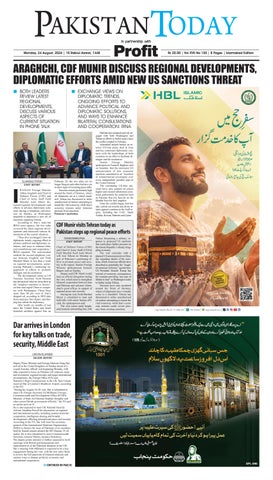
RANIAN Foreign Minister Abbas Araghchi and Chief of Defence Forces (CDF) and Chief of Army Staff Field Marshal Asim Munir discussed regional developments and efforts to advance diplomatic solutions during a telephone conversation on Sunday, as Washington prepared to announce a new set of sanctions targeting Tehran. According to Iran’s state-run IRNA news agency, the two sides reviewed the latest regional developments and discussed various dimensions of the current situation. “They also exchanged views on diplomatic trends, ongoing efforts to advance political and diplomatic solutions, and ways to enhance bilateral consultations and cooperation,” IRNA reported. The conversation marked the second telephone contact between Araghchi and Field Marshal Munir in less than a week on regional developments, underscoring Pakistan’s continuing engagement in efforts to promote dialogue and de-escalation. The development comes as US Treasury Secretary Scott Bessent has threatened what he described as the “toughest sanctions in history” on Iran and urged China to cooperate with Washington. China buys more than 80 per cent of Iran’s shipped oil, according to 2025 data from analytics firm Kpler, and Beijing has called for diplomacy. After nearly six months of war since the United States and Israel launched airstrikes against Iran on
g
EXCHANGE VIEWS ON DIPLOMATIC TRENDS, ONGOING EFFORTS TO ADVANCE POLITICAL AND DIPLOMATIC SOLUTIONS, AND WAYS TO ENHANCE BILATERAL CONSULTATIONS AND COOPERATION: IRNA
February 28, the two sides are no longer firing at each other but have yet to show signs of resuming peace talks. Tensions remain particularly high around the Strait of Hormuz, where oil shipments are at a virtual standstill. Tehran has threatened to strike unauthorised oil tankers attempting to transit the vital waterway, while Iran’s economy remains under immense pressure from sanctions. Pakistan’s mediation
Pakistan has remained actively engaged with both Washington and Tehran in efforts to broker peace since the conflict erupted in February. Islamabad helped broker an interim US-Iran peace deal in June and has continued diplomatic contacts with the leaderships of both countries in an effort to facilitate dialogue and de-escalation. Iranian Foreign Ministry spokesperson Esmaeil Baghaei said on Saturday that the imminent US announcement of new economic sanctions amounted to an “assertion of extraterritorial sovereignty over every independent member state of the United Nations.” The continuing US-Iran tensions have also pushed oil prices higher and created inflationary pressures, particularly for countries such as Pakistan that rely heavily on the Middle East for fuel supplies. Since the conflict began, Iran has also carried out missile and drone attacks against countries in the Gulf region, including the UAE, Saudi Arabia, Kuwait, Bahrain and Qatar.
CdF Munir visits tehran today as pakistan steps up regional peace efforts TEHRAN/RAWALPINDI STAFF REPORT
Chief of Defence Forces (CDF) and Chief of Army Staff (COAS) Field Marshal Syed Asim Munir will visit Tehran on Monday as part of Pakistan’s continuing efforts to promote peace and security in the region, Iranian Foreign Ministry spokesperson Esmaeil Baqaei said on Sunday. Baqaei said CDF Munir would lead an official delegation during the visit, which aims to strengthen bilateral cooperation between Iran and Pakistan and advance Islamabad’s good offices in support of regional peace and security. During his visit, Field Marshal Munir is scheduled to meet and hold talks with senior Iranian officials, the spokesperson said. The visit comes amid heightened tensions surrounding Iran, with
dar arrives in London for key talks on trade, security, Middle east LONDON/ISLAMABAD SALEEM JADOON
Deputy Prime Minister and Foreign Minister Ishaq Dar arrived in the United Kingdom on Sunday ahead of a crucial four-day official visit beginning Monday, with talks expected to focus on Pakistan-UK relations, trade and investment, regional security and major international developments, the Foreign Office (FO) said. Pakistan’s High Commissioner to the UK Tipu Usman received Dar at London’s Heathrow Airport, according to the FO. “During his August 24-28 visit, Dar is scheduled to meet UK Foreign Secretary Ed Miliband, Foreign, Commonwealth and Development Office (FCDO) Minister of State for Pakistan Stephen Doughty and other senior British government officials,” the FO said an earlier post on X. He is also expected to meet UK National Security Adviser Jonathan Powell for discussions on regional and international security, including counter-terrorism cooperation, intelligence-sharing and broader developments affecting international peace and security. According to the FO, Dar will meet the secretarygeneral of the International Maritime Organization (IMO) to discuss the issue of Pakistani crew members held by Somali pirates aboard the MT Honour 25 oil tanker. He is also scheduled to meet Commonwealth Secretary-General Shirley Ayorkor Botchwey. The deputy prime minister is further expected to hold meetings with British parliamentarians and representatives of the Pakistani diaspora in the UK. Dar’s meeting with Miliband is expected to be a key engagement during the visit, with the two sides likely to review the full spectrum of bilateral relations and explore ways to deepen political, economic and institutional cooperation.
Continued on page 03
Tehran threatening a military response to proposed US sanctions that could place further pressure on the Islamic Republic’s already struggling economy. The visit coincides with a planned US announcement on Monday regarding details of the sanctions, which American officials have described as potentially the “toughest sanctions in history” against Iran. US President Donald Trump has warned of economic consequences for countries providing “any type of lifeline to Iran” as Washington seeks to further isolate Tehran. Tensions have also escalated around the Strait of Hormuz, where oil shipments have virtually come to a standstill. Tehran has threatened to strike unauthorised oil tankers attempting to transit the vital waterway, while Iran’s economy remains under severe pressure from existing sanctions.
Rs 20.00 | Vol XVII No 150 | 8 Pages | Islamabad Edition
02 newS
DIGITAL PRINTING SECTOR SEEN AS NEW AVENUE FOR INDUSTRIAL GROWTH
T
PROFIT
WEB DESK
HE digital printing and signage industry has been identified as a potential avenue for new investment and industrial expansion, with Lahore Chamber of Commerce and Industry (LCCI) President Faheem Ur Rehman Saigol calling for greater adoption of modern technologies. Addressing the 9th International Digital Printing and Signage Exhibition, DPS World Pakistan, at Expo Centre Lahore, Saigol said technological advancement in the sector could improve the competitiveness of Pakistani businesses in regional and international markets. The exhibition, organised by FAKT Exhibitions, brought together around 150 local and international companies, which displayed printing machinery, digital technologies and signage solutions.
Saigol said the sector had substantial room for expansion in advertising, retail, packaging, branding and industrial applications, making technology adoption important for businesses seeking new markets and opportunities. He also called for closer coordination between the government, chambers of commerce and industry to facilitate technology-based businesses and encourage innovation. According to Saigol, exhibitions of this nature can contribute to technology transfer while creating opportunities for business-to-business linkages, investment and market development. During his visit, the LCCI president inspected various exhibition stalls and met exhibitors and business representatives. FAKT Exhibitions CEO Saleem Khan Tanoli briefed him on the objectives of the exhibition and the participation of local and international companies.
PROFIT
PROFIT
1,330 road crashes leave eight dead, 1,571 injured across Punjab LAHORE
STAFF REPORT
At least eight people were killed and 1,571 others injured in 1,330 road traffic crashes (RTCs) reported across all 38 districts of Punjab during the last 24 hours, highlighting the growing road safety crisis in the province, particularly involving motorcyclists. According to the Emergency Services Department (ESD), 777 seriously injured victims were shifted to different hospitals for treatment, while 794 people who sustained minor injuries were treated at the crash sites by Rescue Medical Teams, helping reduce the burden on hospitals. The ESD analysis showed that motorbikes were involved in 80 per cent of the road traffic crashes, underscoring the urgent need for effective enforcement of traffic laws, strict adherence to lane discipline and greater road safety awareness to curb the rising number of RTCs. The data further revealed that the victims included 888 drivers, 78 underage drivers, 160 pedestrians and 531 passengers, reflecting the broad impact of road crashes on motorists and other road users. Lahore recorded the highest number of crashes, with 224 RTCs affecting 272 people, placing the provincial capital at the top of the list. Multan stood second with 78 RTCs involving 78 victims, while Faisalabad ranked third with 53 crashes and 53 victims. The detailed statistics showed that 1,579 victims were affected in the reported road traffic crashes, including 1,262 males and 317 females. Of the total victims, 345 were under 18 years of age, 780 were between 18 and 40 years, while 454 were above 40 years of age. The vehicle-wise analysis showed that 1,450 motorbikes, 86 auto-rickshaws, 137 motorcars, 31 vans, 12 passenger buses, 36 trucks and 68 other types of vehicles and slow-moving carts were involved in the reported road traffic accidents. The figures, according to the ESD, underline the need for stronger enforcement of traffic regulations, particularly for motorcyclists, alongside strict lane discipline and greater compliance with road safety rules to prevent avoidable loss of life and injuries.
Dar directs timely execution of major development schemes WEB DESK
Shehbaz pushes agricultural reforms with focus on research and technology WEB DESK
Monday, 24 August, 2026 | ISlAMAbAD
Prime Minister Muhammad Shehbaz Sharif has called for a broader overhaul of Pakistan’s agricultural research system, directing authorities to make greater use of research institutions, modern technology and artificial intelligence to improve farm productivity and strengthen the country’s agriculture sector. The prime minister, while reviewing agricultural reforms and policy measures on Saturday, approved the master plan for the National Agricultural Research Centre (NARC) and ordered its implementation on a priority basis. Under the plan, NARC will be divided into seven districts and will include five centres of excellence, reference laboratories, a biorepository and additional research facilities. A private-sector research park, centre for international cooperation, living laboratory and public discovery park are also part of the proposed structure. Shehbaz also directed that NARC and the Pakistan Agricultural Research Council be made more effective and that their research work be brought in line with international standards. Improving productivity among small and medium-scale farmers remained a key focus of the meeting, with the prime minister directing
authorities to provide them maximum support. He ordered certified companies to ensure farmers receive quality seeds and called for a comprehensive national system for estimating crop production to be developed in consultation with stakeholders. The government is also expanding the use of technology in agriculture. Officials briefed the meeting on the Pakistan Tobacco Board Automation Project, a SUPARCO-backed crop assessment programme and an artificial intelligence application for identifying plants and pests. Several short-term technology initiatives have already entered implementation. The meeting was informed that implementation of priority measures under the Agriculture Innovation and Growth Plan 2026-27 had been accelerated. The programme covers farmer financing, agricultural machinery, digitalisation, modern technology, research, capacity building and food security. Measures under the plan include Kisan Ghar refinance, crop insurance, electronic warehouse receipt financing, farm machinery financing and the Prime Minister’s National District Development Programme. The prime minister further directed authorities to benefit from the experience of students who returned last year after receiving agricultural training in China. For this
year’s training programme, he ordered that selection be based strictly on merit and transparency. Officials also briefed the meeting on efforts to expand organic agriculture and improve rural incomes and exports. Cotton and date clusters in Balochistan are being developed as pilot areas for organic production, while work is continuing on a national organic policy and standards, group certification and a digital traceability mechanism. The government is seeking to connect research and certification with storage, processing and access to international markets to strengthen agricultural value chains and improve the export potential of domestic commodities. The Ministry of National Food Security and Research also presented updates on agricultural reforms, wheat demand, cultivated area and estimates for the upcoming crop. The meeting was attended by Federal Ministers Ahsan Khan Cheema, Azam Nazeer Tarar and Rana Tanveer Hussain, and Prime Minister’s Coordinator for Agriculture Ahmed Umair. Deputy Prime Minister and Foreign Minister Senator Muhammad Ishaq Dar, Finance Minister Muhammad Aurangzeb, Prime Minister’s Adviser Muhammad Ali, Minister of State Bilal Azhar Kayani, Special Assistant Tariq Bajwa and senior officials participated through video link.
Government moves to restructure first batch of DISCOs PROFIT
WEB DESK
The government has taken a step towards restructuring three power distribution companies after the Cabinet Committee on Privatisation (CCoP) approved a plan covering FESCO, GEPCO and IESCO. Under the approved arrangement, land assets currently held by the three distribution companies will be carved out and placed under the government-owned Power Holding Company, which will act as the holding company. The restructuring is to be executed through a Scheme of Arrangement (SoA) that will be submitted to the Securities and Exchange Commission of Pakistan (SECP). Deputy Prime Minister and Foreign Minister Senator Mohammad Ishaq Dar chaired the CCoP meeting on Saturday and instructed relevant authorities to move quickly on implementation of the approved plan. Dar said the government’s privatisation programme was intended to improve the quality of services delivered by DISCOs while bringing down their losses. The meeting was attended by Power Minister Sardar
Awais Ahmad Khan Leghari, Finance Minister Muhammad Aurangzeb, Adviser to the Prime Minister on Privatisation Muhammad Ali, Minister of State for Finance and Railways, SAPM Tariq Bajwa, and secretaries and senior officials from the Power Division, Privatisation Commission, Finance, Commerce and Economic Affairs divisions, FBR and other relevant departments.
Deputy Prime Minister and Foreign Minister Senator Mohammad Ishaq Dar has directed federal and provincial authorities to maintain coordination and ensure timely execution of major development projects reviewed by the Executive Committee of the National Economic Council (Ecnec). Chairing the committee’s meeting on Saturday, Dar stressed the need for efficient implementation of approved development schemes and effective utilisation of public development resources. The meeting reviewed the status of a wide range of projects covering transport, electricity distribution, hydropower, water, infrastructure, poverty alleviation and education. Among the schemes discussed was the Khawazakhela-Besham Expressway, along with electricity distribution efficiency improvement projects for the Lahore Electric Supply Company (LESCO), Hyderabad Electric Supply Company (HESCO) and Peshawar Electric Power Company (PESCO). The committee also examined progress on the Tarbela 5th Extension Hydropower Project, the Southern Punjab Poverty Alleviation Project and the Fulbright Scholarship Support Programme. Various water, connectivity and infrastructure schemes were also placed before the committee. Ecnec considered revised PC-Is and reviewed compliance and progress reports for ongoing development projects as part of efforts to improve implementation and resource utilisation. Dar directed the concerned authorities to take coordinated and timely action on the projects, saying sustained implementation was necessary to maintain momentum in the government’s broader economic development and connectivity programme.
Bank of Khyber signs MoU with livestock & dairy development department to facilitate veterinary mobility scheme PROFIT
AZIZ BUNERI
Bank of Khyber (BoK) has signed a Memorandum of Understanding (MoU) with the Livestock and Dairy Development Department (Extension), Government of Khyber Pakhtunkhwa, for the Annual Development Program (ADP) project titled; Expansion of Veterinary Health Services Through Provision of Mobility i.e. Motor Bikes to Unemployed Veterinary Graduates Doctor Veterinary Medicine (DVM) in Khyber Pakhtunkhwa. Under the initiative, the Livestock Department has allocated funds, with BoK, exclusively responsible for executing the scheme and disbursing interest-free loans. The project aims to provide customized motorbikes equipped with specialized storage units for medicines to unemployed DVM graduates \ diploma holders in case of unavailability of graduates on a cost-recovery, interest-free basis. The motorbikes will be distributed across districts of Khyber Pakhtunkhwa to enhance rural veterinary outreach and improve access to animal health services. The MoU was signed by Gul Buhar Khan, Group Head Retail Banking, BoK, and Dr. Asal Khan, Director General Livestock, Khyber Pakhtunkhwa, in the presence of Khurshed Khattak, Minister for Livestock, Khyber Pakhtunkhwa. Jawad Tajik, Divisional Head, BoK, shared the technical aspects of the financing mechanism. The initiative reflects BoK’s commitment as a leading provincial financial institution to supporting the welfare and economic empowerment of the people of Khyber Pakhtunkhwa, while further strengthening its longstanding collaboration with the Government of Khyber Pakhtunkhwa.
Our surgeons, Chinese technology. Your heart! CITY NOTES M.A. NIAZI
RICKET seems to be going according to expectations, but other sports do not. At the recent Commonwealth Games in Glasgow for example, where one woman athlete managed a bronze in boxing, another athlete, a man, also got what he wanted, not a medal, but to disappear. Or was he inspired by the four members of the Ugandan boxing squad who also disappeared? I hope they advised him properly on what to do: the first step, it seems, is to burn your passport. That was old advice, for in this day and age, if they get your name, NADRA can trace you. I don’t know about Uganda, though. Maybe for its citizens it’s enough to burn your passport, Anyway, the news of our boxer disappearing raises fears of one or more of our cricketers doing the same thing. Our boys just went down to a huge defeat in the First Test against England. It’s bad enough going down to an innings defeat, which means that
C
you couldn’t get as many runs in two innings as the other buys got in one. As the hapless Pakistan captain, Salman Ali Agha, said after the match: “England outplayed us in every department.” I’ve noticed that that’s what losing captains have got to say after every game. No one is telling the truth: we played Shan Masood. In the West Indies, he got a century in the First Test. But we still lost the match. Then he was injured, and had to be left out in the Second Test. We won the match. But he recovered for this match, and we went down with a thud, losing by an innings and 143 runs, which means a right royal thumping. The only glimmer of light was that local hero Harry Brook did not get a century, getting out for 90. Babar Azam, the new captain, stayed out of the match. Did he know something? Or was he really hurt? Bangladesh beating Australia was indeed a surprise, But normality was restored to the universe after they went down by an innings. Sri Lanka of course is working on diplomacy by going down to \india in the First Test. I wouldn’t suggest a medical board. It
seems that it needs an order from the Supreme Court. Like the one Imran Khan got, which led to him being taken to PIMS instead of Shifa Eye Hospital. I blame KP CM Sohail Afridi for this. His earlier talk of a Release Imran Force seems to have spooked the government, even though he had denied it in court. The government, a highly unreliable source tells me, was afraid that he was waiting for Imran to be transferred to a private hospital, following which he would burst in at the head of a group of armed men, and free Imran from durance vile. The problem is that this is exactly the sort of stunt that Imran is willing to admire. It seems that he has found in Sohail Afridi the sort of man he needed as KP CM, just as he had got in Usman Buzdar an intellectual equal. But Afridi is clearly a man of action, and after getting Imran to escape, would have taken him on a hi-speed motor chase on the Motorway, with himself at the wheel in a dash for freedom. I hear that Imran was disappointed when Trump chickened out of that brilliant plan in which Trump would have cut a hole in the roof of \\imran’s cell while hanging from a
helicopter. Trump refused to hang from the rope, and was not going to let anyone else do that. Speaking of freedom, it seems that the police plan for security on Independence Day worked. I mean, no one got killed while executing wheelies on a motorbike. It seems that the lads have come to understand that Independence does not include freedom
from life. Freedom from life seems to be on offer at the Punjab Institute of Cardiology, where they are to start heart transplants, using Chinese technology. Right. Pakistani surgeons. Chinese technology. Might as well do a wheelie. At least you’d have some fun at the end of your life.
nEWs 03
PETROLEUM DEALERS’ MARGIN RISES 15.5% TO RS9.98 PER LITRE AFTER
Monday, 24 August, 2026 | IsLAMABAD
T
PROFIT
AHMAD AHMADANI
HE Petroleum Division has notified a Rs1.34 per litre increase in the profit margin of petroleum dealers, raising their margin on Motor Spirit (MS) and High-Speed Diesel (HSD) to Rs9.98 from Rs8.64 per litre following the Federal Cabinet’s ratification of the decision. The revised margin represents an increase of around 15.5%. The Economic Coordination Committee (ECC) had approved the increase on August 14, 2026, based on a summary submitted by the Petroleum Division titled “Revision of Dealers Margins on Petro-
leum Products Motor Spirit (MS) and High-Speed Diesel (HSD).” The Federal Cabinet subsequently ratified the ECC decision on August 20, according to the official decision issued by the Cabinet Division. The cabinet considered the summary submitted by the Cabinet Division and formally endorsed the decision taken by the ECC at its August 14 meeting, clearing the way for the Petroleum Division to notify the revised dealers’ margin. The timing of the decision coincided with a planned nationwide strike by petroleum dealers, who had been demanding an increase in their margins. Dealers had threatened an indefinite strike that could have disrupted fuel supplies at filling sta-
tions across the country. The ECC approved the increase on August 14, one day before the dealers were scheduled to begin their strike. The committee also convened on Independence Day, a public holiday. The sequence of events was therefore that the ECC approved the Rs1.34 per litre increase on August 14, followed by the Federal Cabinet’s ratification on August 20 and the Petroleum Division’s notification of the revised margin. The official record confirms the timing of the ECC approval and subsequent cabinet ratification but does not establish whether the threat of a nationwide strike influenced the timing of the ECC decision.
Tarar urges young officers to adopt responsible communication strategies ISLAMABAD
STAFF REPORT
Federal Minister for Information and Broadcasting, Attaullah Tarar urged young civil servants to perform their responsibilities with integrity, professionalism and a strong sense of responsibility while keeping the national interest paramount. Addressing 217 probationary officers of the 54th Common Training Programme (CTP) during their visit to the Ministry of Information and Broadcasting’s Digital Communication Department, he said effective government communication played a vital role in promoting transparency, providing accurate information to the public and strengthening trust in state institutions. The minister said the Common Training Programme was playing an im-
portant role in enhancing the professional capabilities of government officers and preparing them for effective public service. He stressed that in the current digital age, effectively countering misinformation and misleading content had become imperative, requiring professional, timely and responsible communication strategies. Tarar urged the young officers to serve Pakistan with humility, commitment and a strong sense of responsibility, and to discharge their official duties with integrity and professional competence. The 217-member delegation comprised 117 male and 100 female probationers from 12 occupational groups and services of the federal government. The probationers were given a detailed briefing on the role of the Ministry of Information and Broadcasting, government
NDMA disburses aid to 34 Balochistan mine victim families ISLAMABAD
STAFF RE[PRT
The National Disaster Management Authority (NDMA), on the directives of Prime Minister Muhammad Shehbaz Sharif, on Sunday distributed ex-gratia assistance of Rs two million each to the bereaved families of 34 coal-mine workers who were killed in a tragic mining incident in Balochistan on July 30, providing immediate financial support to the affected families. The cheques were handed over in Shangla, Khyber Pakhtunkhwa, by an NDMA team in coordination with local representative Dr Ibadullah Khan. The federal assistance reflected the government’s solidarity with the bereaved families and its commitment to supporting communities affected by disasters and tragedies. The initiative also underscored the government’s resolve to safeguard the lives and welfare of workers employed in high-risk sectors, while extending timely assistance to families facing hardship after the loss of their loved ones.
Schools in Punjab to reopen today after three-month long summer vacations LAHORE
STAFF REPORT
It is time for children to go back to schools, which will reopen in Punjab, including Lahore, tomorrow after three-month-long summer vacations. Summer vacations for all public and private schools and colleges in Punjab officially began on May 22, 2026. The announcement came as a relief to students and teachers alike as the country reeled from a hot spell with temperatures expected to remain high in the coming days. Making an announcement, Punjab Education Minister Rana Sikandar Hayat had, on May 11, 2026, said that a three-month-long summer vacation for schools in the province would begin on May 22. In a statement, he said that schools in the province would then open on August 24. The minister also posted the same on his official Facebook account. In April, schools in the province were advised to alter working hours or declare early summer holidays due to excessive heat, which has prevailed over parts of the country over the past few weeks.
communication, formulation and projection of the national narrative, digital communication, public awareness and countering misinformation. They were also briefed on the use of digital communication for public outreach and disseminating information about national policies and government initiatives. The probationary officers appreciated the briefing and expressed keen interest in the role of government communication and digital media in strengthening public outreach. SEVERE WEATHER HALTS EFFORT TO RETRIEVE DR ASMA’S BODY FROM SPANTIK Meanwhile, Federal Minister for Information and Broadcasting Attaullah Tarar said the rescue team tasked with retrieving the body of Dr. Asma from Spantik Mountain in the Karakoram
range had to turn back due to severe weather conditions. In a post on social media platform X, the minister said the team had reached almost near Camp-3, but heavy snowfall and strong winds forced it to return to Camp-2. He said high-altitude porters were expected to reach Camp-3 and bring the body down to the base camp, but the adverse weather had hampered the retrieval operation. Tarar said a helicopter had been authorised and coordination had been established between the Gilgit-Baltistan government and the FCNA, while alternate arrangements were also in place. “Whatever can be done in these circumstances, will be done,” he said. The minister added that Prime Minister Shehbaz Sharif was being kept updated on the situation.
Dar arrives in London for key talks on trade, security, Middle East CONTINUED FROM PAGE 01
The discussions are expected to cover trade and investment, cultural cooperation, people-to-people contacts and the contribution of the Pakistani diaspora in Britain. The two foreign ministers are also expected to exchange views on major regional and international developments, particularly the rapidly evolving situation in the Middle East. The visit comes as Pakistan seeks to consolidate its increasingly visible diplomatic role in regional and international affairs and translate recent engagements into stronger ties with major global partners. Diplomatic sources said the visit would provide an opportunity to further strengthen Pakistan-UK relations and discuss a broad range of bilateral, regional and international issues. They said Pakistan’s recent role in facilitating peace efforts and de-escalation in the Middle East had enhanced its diplomatic profile, with major powers, including the UK, acknowledging Islamabad’s contribution to regional stability and mediation efforts. The sources also pointed to the Makkah Joint Defence Agreement between Pakistan, Saudi Arabia and Türkiye, saying the trilateral arrangement had further
highlighted Pakistan’s role in collective security, strategic cooperation and regional peace. As part of his multilateral engagements, Dar is expected to meet IMO Secretary-General Arsenio Dominguez. The meeting will focus on Pakistan’s longstanding cooperation with the IMO and its commitment to safe, secure and efficient international shipping. The visit also builds on recent Pakistan-UK understandings in economic and security cooperation. In July, the two countries agreed to intensify bilateral trade engagement and strengthen business-to-business cooperation, while exploring the possibility of upgrading the existing Trade Dialogue into a more structured economic and trade framework. In June, Pakistan and the UK also agreed to enhance cooperation in counter-terrorism, combating illegal migration and human smuggling, institutional collaboration and police training. The understanding was reached during a meeting between Interior Minister Mohsin Naqvi and British Minister of State for the Middle East, South Asia and the UN Hamish Falconer. Dar’s visit comes at a time when Pakistan is seeking to broaden and deepen engagement with key international partners amid rapidly changing geopolitical dynamics.
ISLAMABAD Chairman Pakistan Ulema Council and Secretary General International Tazeem-e-Haramain Sharifain Council, Hafiz Muhammad Tahir Mehmood Ashrafi, met Federal Minister for Religious Affairs and Interfaith Harmony Sardar Muhammad Yousaf and discussed a range of issues, including the proposed International Seerat Conference, Hajj arrangements and efforts to promote interfaith and intra-faith harmony in the country. During the meeting, Ashrafi appreciated the Federal Minister and the Ministry of Religious Affairs and Interfaith Harmony for the
ISLAMABAD
STAFF REPORT
Chairman Senate Syed Yousaf Raza Gilani said Pakistan held a unique position in the world owing to its rich heritage, culture, traditions, handicrafts, fine arts, literature and products created by the skilled hands of its people. The creativity and hard work of Pakistani artisans were playing an important role in projecting the country’s positive image at the global level. While inaugurating Pakistan Interiors Furniture Expo, Islamabad Edition, as the chief guest, Syed Yousaf Raza Gilani said that Pakistan was blessed with immense talent and abundant natural resources. Pakistani artisans and skilled individuals, through their exceptional abilities, dedication and creative efforts, were making a name for themselves not only nationally but also internationally, said a news release issued here on Sunday. He said that embroidery, furniture, handicrafts and other products made in Pakistan had established a distinctive identity in international markets. These products had become an important representation of Pakistan’s cultural heritage and a source of recognition for the country. Gilani said that exhibitions of this nature provided talented artisans, designers and creative professionals with an excellent opportunity to showcase their skills and took their products to wider markets. Such expos not only promoted Pakistani art, culture and craftsmanship but also contributed to economic growth and strengthen business and commercial activities. Chairman Senate congratulated the organizers and management of the Pakistan Interiors Furniture Expo on successfully organizing the exhibition and expressed his best wishes for its continued success. He hoped that such activities would help showcase Pakistan’s art, culture, craftsmanship and entrepreneurial potential at the international level.
Tarbela 5th Extension Project to add 1,960MW to national grid in 2026-27 ISLAMABAD
STAFF REORT
The government has planned to add 1,960 megawatts of hydropower capacity under the power generation commissioning schedule for 2026-27, with three units of the Tarbela 5th Extension Project accounting for the bulk of the planned hydel addition. According to power generation schedule for projects to be commissioned from July 2026 to June 2027, available with Wealth Pakistan, five hydropower entries being developed or refurbished by the Water and Power Development Authority (WAPDA) account for a combined capacity of 1,960MW. This represents about 51.8% of the total 3,787.24MW capacity listed in the schedule. The largest contribution will
come from three 510MW units of the Tarbela 5th Extension Project in Khyber Pakhtunkhwa. Unit-I is scheduled for commissioning in September 2026, followed by Unit-II in November and UnitIII in December. Together, the three Tarbela units will add 1,530MW, accounting for about 78%
Ashrafi, Yousaf discuss International Seerat Conference, Hajj arrangements, interfaith harmony STAFF REPORT
Pakistan’s rich heritage, culture reflect its unique global identity: Senate chairman
arrangements made for pilgrims during the previous Hajj and the measures being undertaken for the facilitation of pilgrims during the current year. He said the Ministry had taken valuable and commendable steps over the past two years to improve services and facilities for Hajj pilgrims. Discussing the International Seerat Conference, Ashrafi expressed confidence that the conference would provide a positive, effective and comprehensive roadmap, in the light of the Seerah of the Holy Prophet Muhammad (Peace Be Upon Him), to address challenges confronting the younger generation of Pakistan and the Muslim world. The meeting also discussed further strengthening coordination and cooperation
between the National Paigham-e-Aman Committee and the Ministry of Religious Affairs and Interfaith Harmony to promote interfaith and intra-faith harmony, religious tolerance and national unity across the country. Sardar Muhammad Yousaf thanked Ashrafi for his visit and appreciated the role of the National Paigham-e-Aman Committee and the Pakistan Ulema Council in promoting interfaith and intra-faith harmony, tolerance and national unity. The Federal Minister paid tribute to the religious leadership and organizations for their continued efforts towards strengthening peaceful coexistence, mutual respect and unity in the country.
of the hydropower capacity listed in the schedule and more than 40% of the programme’s overall capacity. The commissioning timetable places most of the planned hydropower addition in the first half of fiscal year 2026-27, with all three Tarbela units scheduled to become operational by December 2026. Another major addition will come from the first 360MW unit of the Dasu Hydropower Project in Khyber Pakhtunkhwa. According to the schedule, the WAPDA project is due for commissioning in May 2027. The Dasu unit represents about 18.4% of the 1,960MW hydropower capacity covered by the schedule. The remaining 70MW will come from the refurbishment of Units 9 and 10 at Mangla in Azad Jammu and Kashmir, which is scheduled for June 2027.
Apart from hydropower, the schedule lists 301.9MW under the photovoltaic market and 49.2MW under the wind market, both with commercial operation dates of July 2026. It also lists 1,476.14MW of net-metering solar capacity under power distribution companies. Hydropower constitutes the largest generation source in the schedule, with the Tarbela units alone accounting for the majority of the planned hydel capacity. Tarbela and Dasu together account for 1,890MW, while refurbishment of the two Mangla units contributes another 70MW. If the projects proceed according to the stated commissioning dates, the scheduled hydropower additions and refurbishment will bring 1,960MW of capacity into operation by June 2027.
04 COMMENT
Monday, 24 August, 2026
Dealing better with the climate change crisis
Petroleum Levy
The Government has grown to rely on the petroleum levy to meet its international commitments
T
Improving economic approaches
HE government hopes to collect Rs 1.676 trillion this year in the petroleum levy, assuming an average of Rs 50 per litre, The levy had to be lowered during the present crisis, to avoid too much hardship for the consumer, but it has tp bring it back to the higher level. Though Petroleum Minister Ali Pervaiz Malik did not say so in his written reply tp a question in the National Assembly, it levy will probably have to be raised to compensate for the period it remained below Rs 80 per litre. \\\mr \mslik said more than once that the levy had to be maintained so as to ‘meet international commitments’, which is shorthand for fulfilling IMF conditionalities. What became apparent is the government is relying on this levy to help meet its financial targets. With the total budget outlay for FY27 pitched at Rs 18.87 trillion, the petroleum levy estimated ist almost 10 percent of this. The government has thus placed itself in a false position, It finds itself too dependent on the ley as a revenue stream to be able to get rid of it easily, even though now it serves no purpose other than to help the government achieve the revenue targets set for it by the IMF. The levy is not supposed to loom so large on the horizon of the government, being meant solely as a sort of fiscal flywheel the government could use to keep the fuel price stable. Stability has long gone out of the window, and the government has found that it cannot get rid of the levy, even though removing it would mean one of the reductions in the fuel price that it seeks so anxiously. The reduction that was carried out in diesel prices by negotiating with the refineries shows how eager the government is to find some way of easing the pressure on the consumer. Fuel prices not only affect the consumer directly, but because they are an input in transport. The aim of the most recent Jamat Islami protest, the total removal of the petroleum levy, is thus apparently logical, but also impossible to achievement, because of those same ‘internatioanal commitments’ the government hides behind. The federal government also probably has no objection to the fact that it keeps the entire proceeds of the levy, which does not form part of the Federal divisible pool.
W
HILE the climate change crisis is getting bigger by the year, and at a fast pace, at the same time, sadly the needed efforts to effectively deal with this– and associated ‘Pandemicene’ phenomena– have not received needed attention by big polluting countries in general, and multilateral platforms like annual ‘Conference of the Parties’ (COP) meetings, and by Bretton Woods institutions. Having said that, among big polluters traditionally, China has given significant attention to develop its green economy over the years, and therefore, it will likely provide a much-needed strong impetus to the effort against climate change crisis, if it hosts COP meetings in 2028, as it reportedly is considering to propose in this direction, as pointed out by an August 21, Bloomberg published article ‘China said to weigh potential bid to host UN Climate Summit’. The article indicated in this regard ‘China is considering a proposal to host the annual United Nations climate summit in 2028, a move that would signal the country’s intent to show greater global leadership on the issue. Officials in Beijing are debating the merits of a potential bid to stage the conference — which attracted more than 42,000 attendees last year in Belém, Brazil… China’s Foreign Ministry said in a statement that isn’t aware of the situation, though the
Here, the role of climate finance is immense in dealing with this crisis, along with lightening the global debt burdens on countries to enhance their fiscal space by improving the debt sustainability framework, and overall global financial system. More broadly, there is a need to improve the underlying approaches to better deal with climate change crisis, like shifting away from neoliberal, and austerity-based philosophical underpinnings of global economic policy
Dedicated to the legacy of late Hameed Nizami
Arif Nizami (Late) Founding Editor
M. A. Niazi
Babar Nizami
Editor Pakistan Today
Editor Profit
I
IBRAHIM AFTAB
N a country where real estate and gold have long reigned as the assets of choice, a quiet revolution is unfolding on the trading floor. Equity markets are widely regarded as a benchmark of investor confidence and overall economic growth, and the Pakistan Stock Exchange (PSX) has emerged as one of the few standout performers in Pakistan's otherwise challenging economic environment. By the end of 2025, it had delivered an average annual return of around 60 percent, making it one of the bestperforming equity markets in the world. More importantly, it attracted a new generation of investors: during fiscal year 2025–26, a record 190,277 new accounts were added— a 48 percent increase in a single year, the highest growth ever recorded in PSX's history. This reflects growing retail participation, especially among young investors— a positive sign for an economy where only about 15 percent of GDP is invested in the equity market, while the majority of the public still seeks quick gains in the highly speculative and extractive real estate sector. Overall macroeconomic stability— a sharp fall in inflation (before the Iran war), successive interest rate cuts by the State Bank of Pakistan (also before the war), rising central bank reserves, and Pakistan's unusually strong diplomatic standing— has driven this rally. Although the growth has been outstanding, caution is warranted: Pakistan's equity market remains relatively small. As of June 2026, it is valued at around $59 billion, one of the lowest valuations in Asia, and equities remain the least favored domestic asset class, with real estate, gold, and the auto sector still dominating investor preference. This dynamic cuts both ways: it raises the market's perceived risk, but also points to greater upside potential, since most listed companies still trade at low price-to-earnings ratios. The main drivers of this remarkable growth have been the banking, fertilizer, energy, and cement sectors. Critics argue that these sectors benefit disproportionately from favorable government policies— subsidies, eased regulation, and access to cheap inputs such as gas and electricity— while the federal government remains the banking sector's most preferred client, often at the expense of the private sector. There is some substance to these claims, but it is worth remembering that such sectoral concentration is a common feature of markets internationally. In the USA, for example, Tesla, Microsoft, NVIDIA, Meta, Alphabet, and Amazon accounted for two-thirds of the S&P 500's gains in 2023, despite representing only 31 percent of the index's total market capitalization. An even starker example is South Korea's KOSPI index, where just two companies— Samsung and SK Hynix— account for 56 percent of the index, making it one of the most concentrated markets in the world. In recent years, several companies have entered sectors that were previously unfamiliar to them or long dominated by established players, particularly in IT and retail. These firms have shown that, with capable management and a
DR. OMER JAVED
country will continue to support COP events.’ Hence, while China reportedly weighs in proposing for holding COP28 meetings, it is indeed clear the big steps the country has taken in tackling the climate change crisis, where the same Bloomberg published article indicated ‘President Xi Jinping has made environmental protection a key theme of his leadership, and China aims to significantly enhance its “influence, guiding capacity, shaping power and moral appeal in global climate governance,” through 2030, according to a plan published last month by the Ministry of Ecology and Environment, the National Development and Reform Commission, and other key agencies.’ Here, the role of climate finance is immense in dealing with this crisis, along with lightening the global debt burdens on countries to enhance their fiscal space by improving the debt sustainability framework, and overall global financial system. More broadly, there is a need to improve the underlying approaches to better deal with climate change crisis, like shifting away from neoliberal, and austerity-based philosophical underpinnings of global economic policy. Highlighting the outdated nature of framework to assess global debt sustainability, and which therefore needs to be improved to better approach dealing with the climate change crisis, an August 20, ‘African Business’ published article ‘The debt sustainability analysis Africa actually needs’ taking the example of Africa, proposes improvement in the framework for the continent as ‘Africa does not need a looser framework. It needs a more complete one: universal rather than income-segregated; probabilistic rather than categorical; independent enough not to reproduce the mispricing it is meant to assess; and capable of analysing liabilities alongside the assets and productive capacity they create. There is also a governance lesson. The LIC [Lower-Income Countries]-DSF [Debt Sustainability Framework] was designed principally by IMF and World Bank staff and approved through institutions in which low-income countries have limited decision-making power. LICs were consulted during the original design process, but they did not hold the pen. A framework that governs development financing so consequentially should be co-authored by the countries it assesses.’ Overall, the global financial system needs to improve, if it has to effectively tackle climate change cri-
PSX: Beyond the Rally
Editor’s mail
Border infrastructure lacking
bounce back even stronger this time. However, the long-term success of the PSX will not be measured only by how high the index climbs, but by whether the institution develops into a strong capital market— one where businesses can finance innovation directly, rather than lobbying for interest rate cuts because banks are unwilling to finance them. Raising capital through equity markets is the preferred route in the West, whereas in Pakistan the opposite is generally true. Shifting toward equity financing would not only widen access to capital for businesses, but would also let ordinary citizens become partners in the country's biggest firms. Beyond the recent surge in share prices, then, the greatest gains for Pakistan's capital market may still lie ahead. The writer is a freelance columnist
However, the long-term success of the PSX will not be measured only by how high the index climbs, but by whether the institution develops into a strong capital market· one where businesses can finance innovation directly, rather than lobbying for interest rate cuts because banks are unwilling to finance them. Raising capital through equity markets is the preferred route in the West, whereas in Pakistan the opposite is generally true. Shifting toward equity financing would not only widen access to capital for businesses, but would also let ordinary citizens become partners in the country's biggest firms. Beyond the recent surge in share prices, then, the greatest gains for Pakistan's capital market may still lie ahead
Lahore – Ph: 042-36300938, 042-36375965
I
Karachi – Ph: 021-32640318 I
Islamabad – Ph: 051-2204545
The writer holds PhD in Economics degree from the University of Barcelona, and previously worked at International Monetary Fund.Prior to this, he did MSc. in Economics from the University of York (United Kingdom), and worked at the Ministry of Economic Affairs & Statistics (Pakistan), among other places. He is author of Springer published book (2016) ‘The economic impact of International Monetary Fund programmes: institutional quality, macroeconomic stabilization and economic growth’.He tweets @omerjaved7
Send your letters to: Letters to Editor, Pakistan Today, 4-Shaarey Fatima Jinnah, Lahore, Pakistan. E-mail: letters@pakistantoday.com.pk Letters should be addressed to Pakistan Today exclusively
What Pakistan's record stock market boom reveals— and conceals— about the economy
broad strategic vision, Pakistani companies can compete in technologically advanced manufacturing and create real value— even in sectors like automobiles that have traditionally been dominated by a handful of players— and can do so not only locally but in export markets as well. MARKETS ARE DRIVEN BY expectations and sentiment. The recent Middle East conflict, and the supply chain bottlenecks created by the resulting energy crisis, have further shocked the global economy. Inflation is already rising, the State Bank has already raised interest rates, and this shock looks set to hurt both the global and Pakistani economies through higher prices. Yet despite the crisis, markets have shown resilience— they have recovered quickly and have not fallen to the levels many experts predicted at the start of the war, given its magnitude. This suggests the market is well-positioned to
sis, a September 18, ‘Project Syndicate’ (PS) published article ‘The world needs bigger and better financial firefighters’ indicated in this regard ‘To ensure adequate liquidity for emerging market and developing economies (EMDEs), the international financial architecture must be transformed to make the IMF, the World Bank, and other multilateral institutions larger, more equitable, and less focused on austerity. There should be coordinated regulations to direct private capital toward productive growth and structural change in EMDEs during booms, and incentives to keep capital in these countries during busts. … The health of the world economy, and the livelihoods of billions of people, depend on bigger and better financial firefighters. If their capacity remains constrained, the legitimacy of the Bretton Woods institutions will weaken, and progress on global challenges such as climate change will remain elusive.’ Moreover, the serious lacking of the current financial system with regard to effectively playing their role in dealing global health related emergencies – where as earlier indicated, climate change crisis is closely related with the ‘Pandemicene’ phenomenon – an August 17, PS published article ‘Ebola is back-and the IMF’s relief fund is empty’ pointed out ‘Almost every major global health emergency has exposed the same flaw in the international financial system. When disaster strikes, the institutions built to support affected countries must scramble to raise money for relief funds. Twelve years ago, when the Ebola virus was ravaging Guinea, Liberia, and Sierra Leone, the world discovered that the International Monetary Fund—the global economy’s firefighter—had no instrument to provide debt relief during a public-health catastrophe. The IMF did have a related mechanism for crisis response: the Post-Catastrophe Debt Relief Trust Fund, created in the wake of Haiti’s devastating 2010 earthquake to provide debt relief to countries struck by natural disasters. But a fast-moving epidemic proved to be a different kind of emergency entirely, and the PCDR Trust had no mandate to respond.’ Moreover, the article provided a creative idea to improve financial support response by IMF, as follows: ‘The IMF holds approximately 90.5 million troy ounces of gold, a legacy from the Bretton Woods era when member countries paid their quotas in bullion. This gold sits on the books at a historical cost of $45 per ounce. At today’s market price of around $4,000 per ounce, it represents an unrealized profit of roughly $357.9 billion. In its current state, the IMF’s gold generates no income. But if a small fraction were sold—incrementally, to avoid disrupting markets—the proceeds could seed a permanent endowment capable of funding the IMF’s subsidy accounts indefinitely.’
I
BORDER management in Pakistan has largely been underdeveloped and quite inefficient. Most border crossing points, particularly in Balochistan, such as BP-250, Mand, Pishin and Panjgur, lack modern and essential facilities, and, therefore, cannot be considered fully established Customs stations or terminals. Mand and Panjgur operate without terminal operators. After a prolonged delay, the National Logistics Cell (NLC) has finally estab- lished a cargo terminal with a weighbridge at BP-250. However, developing a fully equipped terminal will require time. At present, cargo arriving from Iran is cleared using primitive and conventional methods. There is no proper mechanism for inspecting LPG cargo, with rotametres being used to check goods. Consignments requiring laboratory tests face delays owing to the absence of modern labo- ratory servises, resulting in goods being referred to Karachi. Essential services, such as quarantine operations, phytosanitary controls and food safety inspections, take significantly longer time due to staff shortages and the lack of dedicated offices at border points. Banking facilities are also unavailable at most stations. Alarmingly, even a stable internet connectivity is absent, limiting traders’ ability to file goods declarations (GDs) and make online payments. This lack of modern infrastructure undermines trade competitiveness and does weaken regional connectivity. Even boarding and lodging facilities for Customs staff are poor since these land border stations are located at considerable distances from central urban areas. It is noteworthy that this region hosts one of Pakistan’s most critical trade corridors, highlighting the urgent need for robust infrastructure development to strengthen regional connectivity. Key initiatives, such as China-Pakistan Economic Corridor (CPEC), Central Asia Regional Economic Cooperation (CAREC), bilateral trade with Iran, and connectivity with Central Asian Republics (CARs), are heavily reliant on these routes. At present, a significant volume of LPG destined for Punjab is transported through these land corridors, while a portion of Afghan transit trade is routed through Gwadar. In the coming years, trade activity in the region is expected to expand substantially due to transit trade agreements with the CARs, increased utilisation of Gwadar port, anticipated growth in transit and trans-shipment operations, bilateral trade with Iran, and the implementation of Transports Internationaux Routiers (TIR) operations. Furthermore, the establishment of common border markets, along with the opening of new border crossing points and checkposts, is likely to further boost trade at various land stations. To address these challenges, the federal government must prioritise the develop-ment of modern infrastructure at these long-neglected land border stations. Adequate physical infrastructure, modern equipment and gadgets, trained human resources, and operational facilities are essential to meet the requirements. Equally important is the development of digital infrastructure to modernise the trade environment and enhance efficiency. SHAHID ALI ABBASI KARACHI
Turbat cash crisis
TURBAT has been facing a lack of ATM for quite some time, even though consistent complaints have been made by citizens. Despite being the second the second most populated city in Balochistan, there are still not enough ATMs. Citizens often have to wait for hours on end when they need to withdraw money. And even after hours of waiting, many people often return home empty-handed as machines either lack cash or fail to process transactions — leaving them without their funds. The government of Balochistan must pay heed to the inconvenience that our people are facing and provide more bank branches as well as ATMs in Turbat so that people do not have to go home empty-handed. MUZZAMIL KARIM TURBAT, KECH
Web: www.pakistantoday.com.pk
I
Email: editorial@pakistantoday.com.pk
China’s Fusion Breakthrough Monday, 24 August, 2026
Death knell for the Oil Age?
QAMAR BASHIR For more than a century, global economic and geopolitical power has revolved around energy. Coal powered industrialization; oil transformed transportation, warfare and international commerce; natural gas became another artery of modern civilization. Control of these resources— and the routes carrying them— created fortunes, alliances, dependencies and conflicts. China’s rapidly advancing nuclear-fusion programme now raises an extraordinary possibility: technology may eventually loosen the relationship between energy, geography and geopolitical power. Its celebrated “artificial sun” refers to experimental fusion machines designed to reproduce the fundamental process that powers stars. But China's recent achievements are remarkable enough without exaggeration. They demonstrate that fusion is moving progressively from theoretical physics toward an immensely difficult engineering challenge— and potentially, one day, toward electricity generation.
The scale of that challenge is illustrated by China's enormous new superconducting fusion magnet. The toroidal-field magnet weighs approximately 582 tonnes and measures about 21 metres by 12 metres. Its function is extraordinary: creating the magnetic environment necessary for controlling plasma at temperatures no ordinary physical container could withstand. Chinese scientific authorities say its magnetic-energy storage capability substantially exceeds that of the comparable ITER system. The apparent contradiction at the heart of fusion engineering is astonishing. Plasma must reach temperatures of tens or even hundreds of millions of degrees, while superconducting magnetic systems operate at extremely low cryogenic temperatures. Scientists must therefore maintain one of the hottest environments humanity can create extraordinarily close to some of its coldest engineered equipment, while preventing either environment from destroying the other. The magnets create what can be imagined as an invisible cage. Fusion plasma consists of electrically charged particles, which respond to powerful magnetic fields. Instead of attempting to build a material wall capable of directly containing such temperatures— something impossible with existing materials— the tokamak uses magnetic confinement to keep most of the plasma separated from the reactor walls. China's EAST— Experimental Advanced Superconducting Tokamak— has already demonstrated the importance of long-duration confinement. In January 2025, EAST maintained high-confinement plasma for 1,066 seconds, or 17 minutes and 46 seconds, breaking its previous 403-second record. The achievement did not produce commercial electricity, but it demonstrated progress toward one of fusion's essential requirements:
The oil age will not end tomorrow, nor will fusion automatically replace every existing energy source. But technological revolutions rarely announce precisely when an established economic order has reached its peak. They advance experiment by experiment until the economics suddenly begin changing. ChinaÊs laboratories are demonstrating that an alternative energy order is becoming scientifically imaginable and increasingly technologically tangible. The bell has not yet tolled for oil· but China may already be forging it
sustaining controlled, high-performance plasma for increasingly long periods. China followed this with another significant development in August 2026. EAST researchers experimentally accessed a theorized “density-free regime,” maintaining stable plasma at densities beyond conventional limits. Density matters enormously because useful fusion requires enough fuel particles to interact, yet increasing plasma density has historically created instability problems. Overcoming that constraint could provide another pathway toward the conditions required for fusion ignition. citeturn0search1China is now attempting to connect these scientific achievements with engineering. Its next-generation Burning Plasma Experimental Superconducting Tokamak, BEST, is scheduled for completion by the end of 2027. According to the Chinese Academy of Sciences, BEST is intended to conduct deuterium-tritium burning-plasma experiments targeting 20–200 MW of fusion power and net energy gain. China is therefore moving beyond merely producing extremely hot plasma toward attempting to demonstrate whether fusion can become an energy-producing system. This progression is no longer isolated from national economic planning. China's 15th Five-Year Plan, covering 2026–2030, identifies nuclear fusion among the future industries Beijing intends to cultivate alongside quantum technology, hydrogen, biomanufacturing, artificial intelligence-related technologies and 6G. Fusion is therefore increasingly being approached not merely as laboratory research but as a potential future industrial sector. China did not begin this journey alone. Its early superconducting tokamak experience benefited from Soviet technology, including the T-7 machine transferred and reconstructed as HT-7 during the 1990s. But China used that foundation to develop domestic expertise in superconducting magnets, plasma physics, cryogenics, materials, diagnostics and precision engineering. What began partly through technology acquisition has evolved into an increasingly indigenous scientific and manufacturing ecosystem. China is also not alone in the global fusion race. The USA has pursued laserdriven inertial confinement at the National Ignition Facility while US laboratories and private companies simultaneously pursue magnetic-confinement systems. Europe, Japan, South Korea, India and Russia remain deeply involved in fusion research, while ITER represents a vast multinational effort. Fusion is consequently becoming a technological competition involving several different scientific pathways. This competition could ulti-
COMMENT 05
mately prove more consequential than competition for another oilfield. Modern strategic geography rests heavily upon fossil fuels. The Persian Gulf, Strait of Hormuz, pipelines crossing Eurasia, LNG terminals and maritime transportation routes possess enormous importance because interruption of energy supplies can cripple economies. Major powers therefore devote military, diplomatic and financial resources to protecting access to energy and the routes through which it moves. Commercial fusion could gradually change this equation. If countries eventually become capable of manufacturing enormous quantities of reliable electricity domestically from fusion, their dependence upon distant oilfields and vulnerable transportation corridors would decline. Hormuz and other chokepoints would remain important to world trade, but their capacity to threaten the entire global energy system could diminish. The greatest economic shock would fall upon countries heavily dependent upon hydrocarbons. Governments whose budgets, exports and foreign-exchange earnings rely substantially upon oil and gas would confront declining demand and potentially lower prices. Those that convert today's petroleum wealth into education, technology, manufacturing and diversified investment could survive and prosper. Those that remain overwhelmingly dependent upon extracting hydrocarbons could face profound structural adjustment. If fusion eventually becomes reliable and economical, inexpensive electricity could power massive desalination plants, produce hydrogen and synthetic fuels, electrify transportation and industrial processes, support cleaner steel production, operate enormous AI data centres and potentially enable large-scale carbon removal. Instead of humanity simply dividing today's energy market differently, the total amount of useful energy available to civilization could expand dramatically. For developing countries, that could be transformational. Energy poverty restricts industry, agriculture, healthcare, education,
water availability and technological progress. Abundant electricity could remove one of the most persistent constraints upon economic development and provide poorer societies opportunities that historically required access to coal, oil or gas. In a fusion age, strategic advantage could increasingly belong to countries possessing scientific talent, superconducting technology, advanced materials, artificial intelligence, plasma-control expertise, precision manufacturing and intellectual property. Economic power could gradually migrate from nations fortunate enough to possess hydrocarbons beneath their soil toward nations capable of manufacturing sophisticated energy systems above it. The Chinese direction is unmistakable. EAST's long-duration confinement, the 2026 density breakthrough, the enormous superconducting magnet, BEST's scheduled 2027 completion and China's decision to elevate fusion within its national industrial strategy collectively demonstrate a progression from understanding fusion toward engineering fusion. That progression should command the attention of every hydrocarbon-dependent economy. The oil age will not end tomorrow, nor will fusion automatically replace every existing energy source. But technological revolutions rarely announce precisely when an established economic order has reached its peak. They advance experiment by experiment until the economics suddenly begin changing. China has not yet sounded the death knell for the oil age. But its laboratories are demonstrating that an alternative energy order is becoming scientifically imaginable and increasingly technologically tangible. The bell has not yet tolled for oil—but China may already be forging it.
The writer retired as Press Secretary the President, and is former Press Minister at Embassy of Pakistan to France and former MD, Shalimar Recording & Broadcasting Company Limited
Washington has failed to strangle Iran’s economy
“A
The Trump administration’s trade and financial squeeze has hurt Tehran, but it has not toppled the regime’s productive backbone while civilians bear the brunt EL PAIS
IGNACIO FARIZA AND ALI FALAHI
N economic D-Day.” Donald Trump’s vocabulary is as narrow as it is hyperbolic. But his threat, issued Wednesday, falls into a new category. Referring to June 6, 1944 — the day of the Normandy landings that changed the course of modern history — the U.S. president warned that Iran was facing “the most crushing economic operation ever taken against any country.” Yet, nearly six months into the U.S. offensive against Tehran, its economy, though damaged, is far from derailed: if any society is used to coping with decades of sanctions and autarky, it is the Islamic Republic. Under decades of Western sanctions, Iranian authorities have long prepared for a resistance economy: import substitution, decentralization of power plants and a welloiled apparatus to evade oil sanctions, drawing lessons from the recent Russian case, which itself was built on lessons learned from Iran. In practice: a dense phantom fleet and a black market for crude that becomes particularly deep and prolific in times of self-imposed global scarcity, as now. “Time is a very important factor in this war of resistance. And, so far, Iran has shown greater resilience than the United States,” says Alam Saleh, honorary associate professor of politics and international relations for Iran and the Middle East at the Australian National University, from Tehran. In March, senior Iranian officials suggested they had enough economic ammuni-
F
THE FINANCIAL TIMES THE EDITORIAL BOARD
OR most of this century, tech companies in the US have mostly been given a free pass to do what they want. They have taken full advantage of that freedom to build some of the biggest and most profitable businesses in history that have transformed our world, for better and worse. The Trump administration, in particular, has largely disavowed federal regulation and let the market rip. But it is now becoming increasingly clear that public opinion, the US courts and Congress are turning against Big Tech. The techlash is for real. Perhaps the most telling change is that public opinion has grown fearful of the technology that underpins the extraordinary US stock market surge. According to the latest poll from the Pew Research Centre, 40 per
tion to withstand up to a year of war. Almost six months later, the prevailing sense is that it is Trump who urgently needs to end a conflict that, with midterm elections around the corner, has sunk his approval rating to 33%, the lowest since he became president and one of the lowest levels with which a U.S. leader has gone into legislative elections. Iran today faces a sweeping U.S. commercial and financial embargo. Also frozen are assets worth tens of billions; some recent estimates put them above $100 billion, and their thaw was on the negotiating table at moments when both sides seemed closest to a real peace agreement. In theory, the naval blockade prevents Tehran from exporting fossil fuel, although in practice evasion mechanisms appear to be delivering better results than expected. Many Revolutionary Guard officials and senior state figures have been sanctioned for terrorism. Iranian finances are a huge black box. Official data are scarce and unreliable, and the ones that are reliable, such as World Bank figures, are out of date: between March 2025 and March 2026, according to its numbers, GDP contracted by 2.7% compared with the same period the previous year. That statistic, however, captures only a small part of the conflict — the initial phase — and not the harshest period, after Washington in April announced its own blockade of the Strait of Hormuz to prevent Tehran from selling oil and gas, its main source of financing. Also in spring, the International Monetary Fund projected a sharp 6.1% decline for the current year, a forecast it revised in July to a 5.4% drop because of “better-than-expected oil export performance [although it sold much less, it did so at notably higher
prices] and a certain easing of restrictions on the country’s exports.” That latter caveat is now more uncertain than ever. Whether 6% or 5%, a contraction that would be disastrous anywhere else does not seem so severe for a nation used to deep recessions in recent decades. “There is food security and the country does not depend on imports for many staples,” Saleh adds by voice message. The expert concedes, however, that “prices have risen.” And considerably: inflation is running above 80% year-on-year, hitting the most vulnerable groups particularly hard. Food prices have surged even more: over the past 12 months they have more than doubled, according to the latest available data. FROM RESISTANCE TO ATTRITION Farzaneh (a fictitious name used for fear of reprisals), a civil servant living in Tehran, tells EL PAÍS by phone of the sharp deterioration in purchasing power for families like hers: “Our entire salary goes to daily expenses.” She criticizes the insufficiency of public aid: current payments — one million tomans (almost $6 at the official exchange rate) per person per month — “amount to roughly a kilo of meat or two kilos of chicken.” Many, she says, have had to cut even medical spending. “I don’t know how we’ll hold on another six months or a year.” Her testimony reflects a reality common to virtually every episode of economic sanctions: the main blow from restrictions and — for Iran — the subsequent U.S. maritime blockade has been borne mostly by the population, not the regime. The already battered middle class has shrunk and weakened, eroding one of the main engines of social change. But pressure on the political elite has barely
The US techlash is real According to the latest poll from the Pew Research Centre, 40 per cent of US adults say AI will have a negative impact on society over the next 20 years. Only 16 per cent expect it to be positive
cent of US adults say AI will have a negative impact on society over the next 20 years. Only 16 per cent expect it to be positive. As Meta’s chief executive Mark Zuckerberg wrote in a recent essay on AI, if industry leaders keep warning that the technology will automate away jobs and may even threaten humanity, it is no surprise that people are anxious. That concern has led to public resistance to the building of the giant data centres needed to run AI. Even Texas, which had been actively courting tech companies,
has frozen approvals of data centre projects pending an audit. Public pressure has also encouraged politicians to push AI-related bills in all 50 US states, with 146 acts being passed in 2025. This legislation ranges widely from child safety, privacy and deepfakes to algorithmic bias. Goaded by the big tech companies, the Trump administration attempted to impose a 10-year moratorium on all state AI legislation to prevent an unhelpful patchwork of regulations. But in a rare display of
climbed a few points: it goes little beyond where it stood before thousands of Iranians took to the streets earlier this year demanding better living conditions. That moment was chosen by the United States and Israel to bomb Iran while urging Iranians to rise up against the ayatollahs and seize power. Far from that outcome, the opposite happened: just when the regime seemed weakest, the missile strikes led part of the population to rally around the flag. Exaggerated nationalism against a common enemy. A boomerang effect. It is not unreasonable to suggest that the United States and Israel may be waiting for a new wave of protests, especially if pressure on Iran’s energy system increases, which, despite its resilience, remains one of its major Achilles’ heels. A possible rise in gasoline prices or even the introduction of some form of fuel rationing could become a new flashpoint of social unrest. The precedent of past protests over fuel prices makes this scenario particularly sensitive, although its political consequences are for now hard to predict. “Sanctions cannot be labeled a failure simply because the economy is still functioning,” argues a finance expert living in Tehran, speaking on condition of anonymity. “Iran operates as a survival economy, but rial depreciation makes almost everything more expensive, reducing household purchasing power,” he writes by message. “If pressure persists, Iran could move from a survival economy to an attrition economy,” progressively degrading its productive capacity. “If the pressure continues for too long,” adds the director of a company that builds petrochemical complexes, based in Shiraz, “the problem will be less about how much oil we can sell and more about parts, maintenance, repairs, investment, and wear and tear on facilities.” Tehran has shown a huge
ability to circumvent sanctions after years of managing its energy resources and seeking alternative trade routes, but everything has a limit. SHIFT IN ABU DHABI While waiting to see what concrete actions will result from this umpteenth round of threats from Trump, there is one factor that suggests the damage Tehran will suffer this time could be greater than before. And it doesn’t exactly come from the White House, but rather from a neighbor — the United Arab Emirates — which is fed up with Iranian missiles and with the closure of the Strait of Hormuz, the main route through which its fossil fuel exports flow. Tuesday night’s announcement that it would end commercial — and, more importantly, financial — relations with the Islamic Republic is a warning bell whose consequences for Iran’s economy are currently unpredictable. Though at odds because of its close ties to the West, the UAE had become Iran’s main supplier and the third destination for its battered exports, often to be re-exported to third countries. “Iranian companies have spent decades building large trade networks and making contacts in the United Arab Emirates,” Cyrus Razzaghi, founder and chief executive of Tehran-based consultancy Ara Enterprise, with offices across the Middle East, told Bloomberg. “In that sense, the Emirati embargo could be much more effective and potentially more damaging than U.S. and European sanctions.” Less than 48 hours after Abu Dhabi’s move — the most forceful since it closed its embassy in Tehran in March — Trump warned of “tremendous economic consequences” for any country that allows its financial institutions, companies, airports, or government entities to give “any type of lifeline to Iran.”
bipartisanship, Congress rebuffed that move. It is now even pushing federal AI-related legislation of its own, most recently on surveillance pricing, even though the White House may shoot down such initiatives. The US courts are also adopting a tougher approach. US regulators had previously attempted to pursue antitrust cases against the big tech companies, albeit with little success. Even when Google was found in 2024 to be operating an “illegal monopoly”, the court refrained from imposing any really punitive remedies. But this week opening arguments began in a landmark trial in a federal courtroom in Oakland, California. Some 29 US states are suing Meta over allegations that its Facebook and Instagram platforms designed addictive features that harmed children’s mental health, and violated children’s privacy. Meta has denied all charges. Two recent rulings have already sig-
nalled a change in the climate. Earlier this month, a New Mexico court fined Meta a total of $942mn and ordered it to improve its safety practices to protect children. Lawyers expect a flood of similar litigation in other states, even if Meta is appealing against the ruling. In California, a judge also ruled that engagement-based algorithms were not protected under the freedom of speech rights enshrined in the First Amendment, as the tech companies have long claimed. If upheld, this ruling would ensure state legislation aiming to protect children from social media addiction could be enforced, with big implications for how all social networks are run. Rather than fighting rearguard court actions, tech companies would be best advised to heed the changing political and legal mood. They should redouble their efforts to run safer, privacy-preserving services that demonstrably serve the public interest as well as consumers’ needs.
06 NEWS
TRUMP HITS BACK AT CANADA AFTER RETALIATORY TARIFFS ANNOUNCEMENT
U
WASHINGTON, DC AGENICES
S President Donald Trump hit back at Canada on Sunday after Prime Minister Mark Carney announced retaliatory tariffs on the United States following a breakdown in trade negotiations. “Canada wants the benefits of being a state, without being one!!!” Trump said in a post on Truth Social. “They have also charged our great farmers, for many years, massive amounts of tariffs. No more!!!” he said. Carney said on Saturday that new Canadian tariffs would take effect on September 8, notably targeting the US steel
and dairy industries. New 50 per cent US tariffs impacting about $20 billion worth of goods, or 5.5pc of Canadian exports to the US, came into force on Saturday. Impacted products range from hockey sticks to cement. “You’re at war when you get attacked. We got attacked,” Carney said a day earlier. New Canadian tariffs will notably target the US steel and dairy industries and take effect on September 8. More details would come next week, Carney said. Trump had previously said Washington “should be able to have a deal with Canada,” citing his “good relationship” with Carney. But on Saturday, Canada’s prime minister said Trump set conditions that were ulti-
The Most Important AI Revolution Isn’t Happening Inside Silicon Valley
E
ALI DAR
Very few weeks, Artificial Intelligence seems to produce another headline. A new model. A larger investment. A faster processor. A company valued in the hundreds of billions. The conversation has become almost entirely centered on the race to build more powerful machines. I follow these developments with genuine interest. But I often find myself wondering whether we are all looking in the wrong direction. History has a curious habit of reminding us that the inventors of transformative technologies are not always the ones who transform society. James Watt improved the steam engine. It was factories that transformed economies. The internet was built by engineers. It was entrepreneurs, educators, governments and ordinary citizens who changed the way we lived because of it. Technology begins the story. Institutions decide how the story ends. That distinction has occupied my thoughts for some time. Perhaps because I spend more time thinking about government than algorithms. Perhaps because the questions that matter most are no longer technolog-
ical. They are institutional. People often speak about bureaucracy as though it were an outdated mistake waiting to be dismantled. I see it differently. Modern government was designed for the world in which it existed. Information travelled slowly. Documents moved from one office to another because there was no practical alternative. Decisions climbed through layers of administration because knowledge itself moved through those same layers. Those systems were not inefficient by accident. They were remarkably effective for their time. They created order, consistency and accountability. They allowed governments to function at a scale that had previously been impossible. The challenge today is not that bureaucracy failed. The challenge is that the world around it has changed more quickly than bureaucracy itself. For the first time in history, governments are not struggling because they lack information. They are struggling because they have too much of it. A district administration receives more information in a single week than previous generations of public servants might have encountered in an entire year. Hospitals generate enormous volumes of clinical data. Schools continuously measure educational outcomes. Agriculture increasingly depends upon satellite imagery, weather intelligence and real-time market information. The constraint is no longer access. It is interpretation. That, I believe, changes everything. Artificial Intelligence is often described as a technological revolution. I am beginning to think it is something else. It is an institutional revolution. It’s greatest contribution may not be writing
reports or generating images. It’s greatest contribution may be helping institutions distinguish what is important from what is merely available. That is a subtle difference. It is also an enormously important one. Governments have spent the past two decades becoming digital. That was necessary. Files became electronic. Services moved online. Citizens could access information without standing in long queues. These were meaningful achievements. Yet digitisation should never be confused with transformation. Replacing paper with screens does not automatically produce better judgement. A digital government stores information more efficiently. An intelligent government learns from it. There is a profound difference between the two. One preserves knowledge. The other improves decisions. This is why I believe the next chapter of public administration will not be defined by technology alone. It will be defined by institutional learning. Can governments recognise emerging problems before they become crises? Can public services adapt more quickly to changing circumstances? Can policymakers spend less time searching for information and more time exercising judgement? These are leadership questions. Technology merely provides new tools with which to answer them. Around the world, different countries are beginning to explore these possibilities in different ways. Estonia has shown what becomes possible when digital infrastructure is treated as a public utility rather than a technical project. Singapore continues to demonstrate that institutional discipline remains one
of the greatest competitive advantages any nation can possess. Neither model should be copied uncritically. Every society carries its own history, institutions and public expectations. Punjab will do the same. Our objective should never be to imitate another government’s technology. It should be to strengthen our own capacity to govern. That is the thinking behind The Office of AI. Contrary to popular perception, its purpose is not simply to introduce Artificial Intelligence into government. Technology, on its own, has never transformed institutions. People do. Leadership does. Culture does. The real ambition is more demanding than digital transformation. It is to cultivate public institutions that learn continuously, coordinate more effectively and ultimately deliver better outcomes for citizens. That is a much harder challenge. It is also a far more worthwhile one. I suspect history will remember this period rather differently from the way we describe it today. It may not be remembered as the moment machines became intelligent. It may be remembered as the moment governments were compelled to become more thoughtful. Perhaps that is the real revolution. Not smarter software but smarter institutions. And if that proves to be true, the defining governments of this century will not be those that purchased the most advanced technology. They will be the ones that developed the wisdom to use it well. The Author is a software engineer by education, business leader and Advisor to the Punjab Chief Minister on Artificial Intelligence and Special Initiatives. He writes on the future of governance, Artificial Intelligence, digital transformation and public policy.
Monday, 24 August 2026 | ISLAMABAD
mately unacceptable even though earlier talks had been positive. “In recent days, the United States proposed new terms that were uneconomic, unfair and undermined the net benefits for Canada, and called into question the reliability of any deal,” Carney said in Ottawa. “We cannot accept what they’ve offered, and we will not give what they’ve asked.” US Trade Representative Jamieson Greer told the New York Times on Saturday that the US had offered to reduce its tariffs on steel, aluminium and autos, as well as eliminate a recently imposed tariff on Canadian lumber. Greer said those measures would have given Canada “the most preferential treatment of any trading partner,” according to the Times. Greer told Fox News on Saturday that Washington was “moving forward with measures that respond to Canadian retaliation.” He said no new talks were planned with Canadian negotiators. A senior US official characterised this week’s talks in Washington as candid and not acrimonious.
Indian national arrested in US over fraud and money laundering charges WASHINGTON AGENCIES
A 21-year-old man from India’s Gujarat state has been arrested in the United States on charges including fraud and money laundering. According to the US Department of Justice, the Indian national allegedly acted as a financial facilitator for a fraud network. According to US authorities, the fraud caused losses of $7.5 million to victims aged between 59 and 87. Indian news outlet Firstpost reported that the accused, who is of Indian origin, fled to Canada after appearing before a US court. He was later arrested in Canada following a US request. US Attorney Bill Easley said criminal organisations operating in India were involved in widespread violence, including targeted killings, extortion and kidnapping. The recent arrests of Indian nationals involved in alleged criminal activities have also renewed scrutiny of the United States’ stricter visa restrictions on Indian citizens. TALIBAN REGIME IMPOSES COMPLETE BAN ON PROTESTS ACROSS AFGHANISTAN Meanwhile, the Taliban regime in Afghanistan has imposed a complete ban on all forms of protest across the country under a newly approved police law. According to Afghan media, Taliban supreme leader Hibatullah Akhundzada has approved the new Qanoon-e-Shurta (Police Law), which defines the powers, duties, and responsibilities of different departments within the police force. The Afghan Ministry of Justice formally issued the new law on Saturday. Under Article 50 of the legislation, all kinds of demonstrations are prohibited anywhere in Afghanistan. The Taliban recently renamed its police force “Shurta”, replacing the previous designation. The new law also includes provisions regarding the treatment of detainees and accused persons. It states that police personnel must avoid taking any action during an arrest that could harm the physical health or human dignity of a person taken into custody. Under the law, prisoners or accused persons cannot be beaten with batons, whips or cables, or subjected to any other form of physical abuse without a court order.
Nordic nations say they have lost confidence Israeli defense minister threatens Gaza in Infantino and Fifa governance assassinations, evacuations over balloon launches EL AVIV AGENCIES
Israeli Defence Minister Israel Katz threatened on Sunday to carry out assassinations and evacuate residential neighbourhoods in the Gaza Strip over the launch of balloons and kites toward Israeli settlements near the enclave. In recent days, Israeli media alleged that several kites launched from Gaza had landed near settlements adjacent to the enclave, noting that they were not carrying explosives. Katz said in a statement cited by Israel Hayom newspaper that he had instructed the Israeli army to “act forcefully” against the launch of balloons, kites and drones from Gaza and take measures to prevent them. Katz said in a statement cited by Israel Hayom newspaper that he had instructed the Israeli army
to “act forcefully” against the launch of balloons, kites and drones from Gaza. PHOTO: ANADOLU Israeli Defence Minister Israel Katz threatened on Sunday to carry out assassinations and evacuate residential neighbourhoods in the Gaza Strip over the launch of balloons and kites toward Israeli settlements near the enclave. In recent days, Israeli media alleged that several kites launched from Gaza had landed near settlements adjacent to the enclave, noting that they were not carrying explosives. Katz said in a statement cited by Israel Hayom newspaper that he had instructed the Israeli army to “act forcefully” against the launch of balloons, kites and drones from Gaza and take measures to prevent them. The measures would include “thwarting Hamas leaders re-
DUBAI (AGENCIES): Six Nordic football associations delivered a united blow to Fifa President Gianni Infantino on Sunday, declaring they had lost confidence in his leadership while demanding sweeping governance reforms at world football’s governing body. The six Nordic Fifa members — Denmark, Finland, Iceland, Norway, Sweden and the Faroe Islands — met in Helsinki and issued a rare joint statement backing calls for Infantino’s resignation from three major regional confederations. They also supported demands for an independent investigation into his controversial proposal to sell a stake in events like the World Cup to private equity investors, a plan that was quickly abandoned in the face of global backlash.
sponsible for the launches and the operatives themselves, and evacuating neighbourhoods and areas from which the launches are carried,” he added. Katz described every launch as “a military action in every respect,” threatening to pursue anyone who “organises, carries out or
permits the launches.” “A balloon is like a kite, and a kite is like a drone, whether it carries explosives or not,” he said. The Israeli army has killed more than 73,000 Palestinians and injured over 174,000 others in a brutal offensive since October 2023.
Syria says contacts with Israel halted after airbase attack DAMASCUS
AGENCIES
Syrian Foreign Minister Asaad al-Shaibani said on Sunday that contacts between Syria and Israel were suspended after Tel Aviv struck the Abu al-Duhur airbase in northern Syria, but expected negotiations on a security agreement to resume “soon.” “We expect negotiations with Israel on a security agreement to resume soon, which we hope will lead to its withdrawal from Syrian territory,” Shaibani said in an interview with Western media, as cited by Syria Alikhbaria TV. He urged Israel to seize a “historic opportunity,” stressing that “the door remains open to diplomacy.” Shaibani said Syria’s immediate priority is to halt Israeli attacks and take confidencebuilding measures.
He said the negotiating track was suspended following the Iran-Israel war and expressed hope that talks would resume in the coming period. he minister disclosed that direct contacts with Israel stopped after an Israeli airstrike targeted the Abu al-Duhur airbase in the northern Idlib province on August 18. “We do not trust Israel at present,” he said. Shaibani said Israel bombed the facility despite Damascus having informed it that the site “would not become a Turkish base.” He nevertheless affirmed that Syria would continue relying on Turkish assistance in military training and cooperation. “We will not dispense with this support,” he said. Shaibani described communication with Israel as “necessary, given that it is a party that constantly threatens Syria’s security,” but said Damascus did not want such contacts to
continue without producing results. SECURITY AGREEMENT The foreign minister said Damascus and Tel Aviv reached understandings earlier this year on most provisions of a proposed security agreement. “Almost everything was agreed upon on paper,” he said. According to Shaibani, the proposed agreement would require Israel to refrain from attacking Syria or interfering in its internal affairs, halt its military operations and withdraw from territories it seized following the fall of Bashar al-Assad’s regime. It would also establish several security zones near the border, including “a buffer zone where only the United Nations would be present,” alongside other areas where Syrian forces would be deployed at varying levels, he added. Shaibani accused Israel of seeking to avoid finalizing the agreement.
NEWS 07
Monday, 24 August 2026 | ISLAMABAD
PUNJAB ENTERS NEW ERA OF DEVELOPMENT, TECHNOLOGY WITH EXPANDING PUBLIC SERVICES: CM MARYAM
CORPORATE CORNER
NUR Shanakht Leadership Program promotes national identity among youth LAHORE STAFF REPORT
NUR Foundation, an institution of Fatima Memorial Hospital, held the closing ceremony of its NUR Shanakht Leadership Program, Summer Programs 2026 at FMH. The program is designed to nurture young people with strong character, leadership skills, a deeper sense of national identity and social responsibility. Drawing inspiration from Allama Iqbal’s concept of “Fard-e-Kamil,” the program seeks to reconnect young people with their cultural and national identity while also creating meaningful opportunities to promote the Urdu language, literary expression and constructive dialogue. The ceremony commenced with the recitation of the Holy Quran, the National Anthem and Kalame-Iqbal. A special video showcased memorable moments and activities from the Summer Programs, while students demonstrated their creative and intellectual abilities. Participants shared their experiences, followed by reflections from parents and mentors. Addressing the gathering, Mrs. Shahima Rehman, Chairperson, Fatima Memorial Hospital, Prof. Dr. Tayyab Abbas, Prof. Dr. Farooq Anwar, Mansoor Jamal Butt, and Farhan Sherazi emphasized the importance of character, national consciousness and responsible leadership in shaping the next generation.
Grand Eid Miladun Nabi gathering held in Karachi by Haji Muhammad Rafique Pardesi
KARACHI STAFF REPORT
Barkati Foundation, with the support of HMR Waterfront, organized a grand Eid Miladun Nabi gathering in Karachi on Sunday, bringing together prominent religious scholars, Naat reciters, students and members of the community. The gathering commenced at Numaish Chowrangi and concluded at New Memon Masjid, Bolton Market, Karachi. The programme was held from 2:00 PM to 5:30 PM and featured special addresses on Seeratun Nabi, highlighting the blessed life, noble character and teachings of the Holy Prophet Muhammad (PBUH). Naat recitations, religious speeches and special prayers were also part of the programme. According to the organizers, approximately 15,000 students of religious seminaries, scholars, engineers, doctors and other members of the community were expected to participate in the gathering. Prominent religious personalities who participated in the gathering included Haji Muhammad Nasir Qadri, Haji Abdul Samad Qadri, Qari Haji Muhammad Naeem Qadri, Muhammad Hafiz Naqshbandi, Mufti Muhammad Qasim Usmani, Syed Qaim Ali Shah, Muhammad Yasir Barkati, Hafiz Bilal Qadri and Muhammad Imran Ashrafi. In their addresses, the speakers emphasized the importance of following the teachings and Sunnah of the Holy Prophet Muhammad (PBUH), while promoting the values of peace, brotherhood, unity, compassion and mutual respect in society. The event also focused on engaging the younger generation with the exemplary life, character and teachings of the Holy Prophet Muhammad (PBUH), while reinforcing the message of love, harmony and unity.
PUNJAB CM ORDERS RELIEF, RESCUE MEASURES IN LAYYAH, SAYS PEOPLE OF OTHER PROVINCES BENEFITTING FROM PUNJAB DEVELOPMENT, TECHNOLOGY
P
g
LAHORE
SALEEM JADOON
UNJAB Chief Minister Maryam Nawaz on Sunday directed authorities to intensify relief and rescue operations in river erosion-hit areas of Layyah and ensure immediate support to affected families, while asserting that Punjab had entered a new era of development and technology with expanding health, transport and technology-enabled public services. The chief minister issued the directives during a meeting with Punjab Assembly members Muhammad Zubair Khan and Shazia Hayat, in which political matters, development projects and issues confronting the people of Lodhran were discussed. The lawmakers apprised Maryam of public grievances in their constituencies, and she directed them to remain focused on resolving people’s problems and continue efforts for their early redressal. The MPAs appreciated the completion of the Multan-Vehari Road and thanked the chief minister on behalf of the people for launching the electrobus service in Lodhran. They said the service had
gained popularity and was setting new records of success on the Shahida Islam Hospital, Dunyapur, Kacheri Chowk, Milad Chowk and Kehror Pakka routes. They also lauded the chief minister’s health initiatives, saying they had received public appreciation. CM Maryam said people from other provinces were also benefiting from Punjab’s hospitals and educational institutions. She said the Jinnah Institute of Cardiology in Lahore and cath labs in various districts were fully operational, adding that Punjab had truly entered an
era of development and technology. She said Punjab would take the lead in technology-enabled public services through the Punjab eBiz and Maryam Ki Dastak portals. Meanwhile, the chief minister directed Special Assistant to the Chief Minister and Inspection Team Shoaib Mirza to visit river erosion-hit areas of Layyah and oversee relief and rescue operations. On her instructions, Shoaib Mirza visited Mouza Samra Nasheeb on the outskirts of Layyah, inspected the affected areas, met residents and assessed
Spotify celebrates Atif Aslam’s Subah Aye Na with fans and artists in Karachi KARACHI
ISLAMABAD
STAFF REPORT
classic “Hum Kis Gali Ja Rahe Hain”, bringing together some of Pakistan’s most recognizable creative voices in a moment that had fans talking. Spotify also put Atif’s most dedicated listeners at the heart of the celebration. In a surprise moment, two Spotify Premium fans were invited onstage to honor the artist and present him with a special guitar. Both were among the top
10% of Atif Aslam listeners on Spotify in Pakistan. Atif also reflected on Subah Aye Na, the journey behind the album and the relationship he has built with listeners throughout more than two decades of music. The release marks a new chapter for the artist while carrying forward a connection with fans that continues to evolve across generations and borders.
Seerah of Holy Prophet complete code of life, says Sindh governor
KARACHI STAFF REPORT
The Seerah of the Holy Prophet Muhammad (PBUH) provides a complete code of life and serves as a beacon of guidance for all humanity, Sindh Governor Syed Muhammad Nehal Hashmi said on Saturday, stressing the need to ac-
quaint the younger generation with the teachings and practical example of the Holy Prophet. He was addressing a Seerat-unNabi seminar held at Governor House Karachi under his auspices, which was attended by prominent Ulema, Mashaaikh, scholars, academics, teachers and distinguished personalities from various walks of life.
The Sindh governor said the lives of Muslims must be shaped according to the teachings of the Holy Prophet, adding that positive and meaningful change could be brought about in society by following the Seerah. He stressed that Seerah Nabawi was not merely meant to be read but adopted and reflected in practical life. Hashmi underscored that introducing the younger generation to the Seerah of the Holy Prophet had become an important need of the present time, as its teachings could provide guidance in developing individuals and building a better society. Earlier, Maulana Mufti Taqi Usmani said the personality whose Seerah was being discussed at the seminar represented the greatest model for humanity.
Food import trend offers opportunity to strengthen local food, agri sectors: APBF LAHORE
STAFF REPORT
The All Pakistan Business Forum (APBF) has said that the latest food trade figures offer Pakistan an important opportunity to strengthen domestic agriculture, expand food processing and improve value addition, while welcoming the encouraging recovery in food exports at the start of the new fiscal year. In a joint statement, APBF President
JazzWorld backs Google’s Digital Pasban initiative to advance digital safety in Pakistan
STAFF REPORT
To celebrate the release of “Atif Aslam’s” highly anticipated new album, “Subah Aye Na”, Spotify brought the excitement surrounding the project to Karachi for a night that quickly became a cultural moment of its own. Atif Aslam was joined by Spotify Premium fans, creators, influencers and members of Pakistan’s artist community for an immersive celebration inspired by the world of Subah Aye Na. From fan moments to unexpected collaborations onstage, highlights from the evening quickly travelled beyond the room and across social media. At the center of the night was Atif himself, who took to the stage for a live performance that had the room singing along. One of the evening’s standout moments came when Fahad Mustafa, “Talha Anjum” and “Asim Azhar” joined him onstage for a rendition of his
Syed Maaz Mahmood and Chairman Ibrahim Qureshi said that Pakistan's food imports rising to $805.5 million in July should serve as a reminder of the enormous potential available for local industry, farmers and investors to gradually replace import dependence with competitive domestic production. They said the increase in imports, particularly edible oil and pulses, highlights sectors where Pakistan can encourage investment, improve productivity
losses caused by river erosion. Maryam directed authorities to take immediate measures to mitigate losses and remove all hurdles in relief and rescue operations. Officials of the Irrigation Department and the Provincial Disaster Management Authority (PDMA) were summoned to the affected area, while necessary machinery was mobilised. The special assistant supervised the shifting of residents and their belongings to safer locations. Food and other essential supplies were arranged for affected families, while dry rations were also distributed. A special committee has been constituted on the chief minister’s directive to assess the damage caused by river erosion, determine losses to farmers’ land, houses and other property, and submit a report. Maryam also directed authorities to propose measures to protect Samra Nasheeb from river erosion in the future. Deputy Commissioner Layyah Asif Ali Dogar and other district administration officials were present to supervise relief and rescue operations. Shoaib Mirza said the administration and relevant departments were working round the clock under the leadership of Chief Minister Maryam Nawaz to provide immediate relief to the affected people.
and develop stronger value chains. “Pakistan has a large agricultural base, a sizeable consumer market and an expanding food-processing industry. The current import trend should be viewed as an opportunity to identify gaps in domestic production and turn them into new avenues for investment and growth,” Syed Maaz Mahmood said. He said that greater investment in oilseed cultivation, modern farming, improved seed varieties, irrigation effi-
ciency and processing facilities could help Pakistan progressively reduce its dependence on imported edible oil. The APBF president said that the rising demand for food products also reflected the size and potential of Pakistan's domestic market. With appropriate planning, a significant portion of this demand could be met through locally produced and processed products, creating new opportunities for farmers, small businesses and the manufacturing sector.
JazzWorld has partnered with Google as part of Digital Pasban, a national online safety initiative launched by Google with Tech Valley as a key partner. The initiative aims to reach 200,000 households nationwide through localized Urdulanguage safety resources, instructional videos, parental toolkits, school-based safety clinics, and community outreach. Through the partnership, JazzWorld will support greater awareness of responsible and safe digital participation, helping families understand online opportunities and risks. “As more of our lives move online, helping families navigate the digital world safely and confidently is becoming increasingly important. At JazzWorld, our responsibility goes beyond connecting people; it includes helping families understand the digital environment and make informed, responsible choices. Digital Pasban is a meaningful step in bringing practical safety tools, awareness and guidance to parents and children. We are proud to partner with Google and other stakeholders to help build a safer, more inclusive and digitally empowered Pakistan.” said Aamir Ibrahim, CEO JazzWorld.
Freight costs surge manifold as industry faces logistics strike aftershocks: BMP ISLAMABAD
STAFF REPORT
The Federation of Pakistan Chambers of Commerce and Industry’s Businessmen Panel (BMP) has said that Pakistan's export sector has been hit by a fresh logistics shock after the nine-day goods transport strike, with exporters now facing an extraordinary increase in sea freight rates, a shortage of shipping space and mounting costs on delayed cargo. Former FPCCI president and BMP Chairman Mian Anjum Nisar said the strike may have ended, but its consequences are now being felt at ports, factories and in export markets. Containers that could not reach Karachi Port and Port Qasim during the disruption missed scheduled vessels, leaving exporters scrambling to secure space on subsequent shipments at sharply higher freight rates. According to information shared by exporters, freight charges to the US West Coast have surged from around $1,800 to as high as $8,500 per container, while rates to the US East Coast have reportedly risen from $1,800 to $8,000 per container. Additional General Rate Increases, surcharges and other carrier charges have further increased the burden. Mian Anjum Nisar said these developments have placed Pakistani exporters in an extremely difficult position. “An exporter cannot remain competitive when freight charges suddenly rise by more than 300 percent. This is not a small increase in the cost of doing business; it can wipe out the margin on an entire export order,” he said. He said the disruption in domestic transport created a serious bottleneck in the export supply chain. Thousands of containers remained stuck at factories and warehouses and could not reach the ports within terminal cut-off times.
CDA approves 23 commercial building plans, tightens design rules to spur investment ISLAMABAD
STAFF REPORT
The Capital Development Authority (CDA) has approved 23 commercial building plans out of 32 cases placed before its Design Vetting Committee (DVC) during four meetings, as part of efforts to facilitate investment, streamline construction approvals and remove unnecessary delays in Islamabad. According to details, the DVC reviewed 40 commercial building plan cases during meetings held on June 4, June 16, July 30 and
August 20, 2026. Of these, eight cases were withdrawn by architects and sponsors before the meetings because of incomplete documentation and failure to fulfil required prerequisites. Of the remaining 32 cases presented before the committee, 23 were approved. Some cases were deferred mainly because architects failed to properly present basic parking requirements, fundamental planning parameters and designs. The deferred cases will be resubmitted to the DVC after completion of the required parking and design parameters. The DVC has also issued
an advisory to architects in this regard. The move, in line with the directions of Prime Minister Shehbaz Sharif, Interior Minister Mohsin Naqvi and CDA Chairman and Chief Commissioner Islamabad Sohail Ashraf, reflects the authority’s commitment to promoting investment and facilitating business processes while ensuring public safety. The CDA is also assigning greater responsibility to owners and architects/consultants. At the time of issuance of the final DVC approval letter, the names of owners and architects/consultants will be clearly
mentioned, while their names will also be displayed at construction sites. This will enable legal proceedings against owners and concerned architects/consultants in case of unauthorised changes to approved designs. The authority said regulatory procedures in the construction sector were being simplified and streamlined without compromising safety. It is also working to bring all pending cases before the DVC and resolve them at the earliest. A committee comprising officers from relevant CDA formations has additionally been constituted to examine cases deferred
because of anomalies or ambiguities in existing bylaws. It will review parking parameters, commercial regulations and other related matters before submitting proposals. The CDA said applicants whose cases were not being placed before the DVC could approach the Member Planning or Chairman’s Office to register complaints, besides using the authority’s online portal. The authority said the approvals would help create greater investment opportunities in Islamabad and contribute to the capital’s construction and development.
SINDH SEEKS JUDICIAL PROBE INTO MIR RAZA MURDER AS FAMILY WANTS JIT
Monday, 24 August, 2026
PRAYER TIMINGS
NEWS
T
KARACHI
STAFF REPORT
HE Sindh government on Sunday reiterated its decision to approach the chief justice of the Sindh High Court for the establishment of a judicial commission to determine whether the investigation into the death of Mir Raza Ali was being conducted impartially and in accordance with the law, as the victim’s family rejected the move and announced plans to approach the high court for formation of a joint investigation team (JIT). The government’s decision came days after Raza’s parents, Mir Hussain and Mariam, approached Chief Minister Murad Ali Shah through their counsel Jibran Nasir, seeking his direct supervision of the investigation and expressing serious reservations over the manner in which the case was being probed. However, reacting to the provincial government’s announcement, Nasir said the family would move the Sindh High Court on Monday against the proposed judicial commission and seek formation of a JIT involving other law-enforcement and intelligence agencies. A statement issued by the Sindh chief minister’s office said the family’s letter had been received with “compassion and the utmost seriousness”. “After carefully considering the concerns expressed by the family, the government of Sindh has decided to request the honourable chief justice of the Sindh High Court to establish a judicial commission to conduct an impartial and transparent inquiry,” the statement said. The proposed commission would determine whether the investigation was being conducted impartially and in accordance with law and identify any in-
vestigative angle or evidence requiring further probe. It would also determine whether “any police officer, medico-legal officer or other official committed negligence, dereliction of duty, professional misconduct, suppression or manipulation of evidence, or any unlawful act, omission or cover-up”. The commission could recommend further investigation, forensic analysis and appropriate legal or departmental action wherever warranted. “For the effective discharge of its mandate, the commission shall exercise all powers available to it under the Sindh Tribunals of Inquiry Ordinance, 1969, including the powers of a civil court to summon and enforce the attendance of witnesses, examine them on oath, and require the discovery and production of documents and other records,” the statement said. It added that all government departments, agencies and officials had been directed to extend full cooperation to the commission and provide every record, document and other assistance sought by
Bad weather halts recovery of Dr Asma’s body from Spantik Peak GILGIT
STAFF REPORT
it. The Home Department would provide the necessary secretariat support. The commission would submit its report, along with findings and recommendations, to the Sindh government within 30 days of its constitution, or within such extended period as might be allowed where necessary for a complete and fair inquiry. “The commission will be fully empowered to examine the conduct of the investigation and recommend appropriate action in accordance with law,” the statement said. The government also expressed solidarity with Raza’s family in their time of grief. Family rejects proposed commission Nasir, however, strongly objected to the government’s decision, saying the family had not been consulted and that the terms of reference of the proposed inquiry had not been made public. “Forming a judicial commission without informing the family of Mir Raza, nor making the terms of reference of the inquiry public. Why are other law enforcement agencies not engaged and a
JIT [is not] formed? Why is the criminal conduct of police officers not investigated?” he wrote on X. He said the family would approach the high court on Monday seeking a JIT and opposing the judicial commission. Nasir also questioned the timing of the government’s decision, pointing out that police were yet to submit their investigation report before the magistrate. “Before the submission of the police report, why has the Sindh govt announced a judicial commission? Is it because they know the outcome of the police investigation and they disagree with it?” he questioned. In a video message, Raza’s family also rejected the government’s decision. His sister Alishba, sitting alongside her parents, said the family came to know about the decision through the media. “On August 24, the police are to submit their report. But if there is no report yet, on what basis are they making this decision?” she asked. “We, as a family, are not standing for this decision. We have been saying this since the beginning that we do not trust how the proceedings are going on,” she said. Alishba said the family had still not received any response to its letter to the chief minister. “We want more law enforcement and intel agencies to be a part of this; we want a JIT,” she said, adding that the family would approach the court on Monday. She said the family had also sent a message to the Sindh home minister seeking a copy of the government’s decision. The case Raza, a 25-year-old businessman and graduate of the Institute of Business Administration, was found dead with a gunshot wound in bushes in Karachi’s Gulistan-i-Jauhar on July 29, a day after he was reported missing.
22 cricket greats urge PM to ensure Imran’s court-ordered medical care ISLAMABAD AGENCIES
Bad weather and heavy snowfall on Sunday halted efforts to recover the body of Pakistani climber Dr Asma Mushtaq from Spantik Peak in Gilgit-Baltistan’s Shigar district, with a six-member high-altitude rescue team forced to retreat to Base Camp as officials prioritised the safety of rescuers. The 34-year-old doctor died on Thursday at an altitude of around 6,250 metres while descending from the summit of the 7,027-metre Spantik, also known as Golden Peak, after suffering from highaltitude sickness. Her body remains at Camp 3. Baltistan Division Commissioner Kamal Khan said the six-member team of high-altitude porters had reached Camp 2 and attempted to proceed towards Camp 3, but heavy rain, continuous snowfall and extremely strong winds forced them to abandon the effort and return to Base Camp. “Due to continuous heavy snowfall and extremely strong winds, conditions have become very dangerous and risky,” he said, adding that the team could not safely remain at Camp 2. The commissioner said the rescue team had reached Base Camp safely and further efforts would be considered once weather conditions improved. “The mission is being undertaken under extremely challenging high-altitude and weather conditions, and the safety of the recovery team remains a priority,” he said. According to a statement issued by Alpine Club of Pakistan (ACP) General Secretary Ayaz Shigri on Saturday, Dr Mushtaq’s body was lying at approximately 6,400 metres. “The recovery team departed yesterday (Friday) and reached Camp 2 today (Saturday), but operations have been halted due to heavy snowfall,” the statement said, adding that the team had been advised to return to Base Camp and wait for a suitable weather window. Approval for a mercy mission involving helicopter rescue on humanitarian grounds was also being pursued with the support of the Pakistan Army, the ACP said. The recovery operation, involving climbers from different teams, is being coordinated by Dr Mushtaq’s own expedition company in coordination with the tourism department, local government and ACP. The ACP said the circumstances surrounding Dr Mushtaq’s death, as well as the conduct and response of the expedition company, would be fully investigated once the teams were safely down and her body recovered. Any necessary action would follow the findings. The club also clarified that it was Pakistan’s national federation for mountaineering and sport climbing and not a rescue organisation with dedicated resources. Search, rescue and related activities depend on government resources, while Pakistan currently lacks a dedicated and properly established high-altitude rescue system.
Twenty-two international cricketers, including 21 former captains, have written to Prime Minister Shehbaz Sharif urging him to ensure medical treatment for former prime minister Imran Khan in line with recent Supreme Court directives, ESPN Cricinfo reported on Sunday. The former cricketers said the Supreme Court had directed that Imran be transferred to hospital for examination by a medical board comprising his personal physicians and his sister, Dr Uzma Khan, while also reinstating weekly family visits. “These were very welcome steps,” the former cricketers said in the letter cited by ESPN Cricinfo. However, they expressed concern that Imran’s hospital stay lasted only a few hours and claimed that the court’s directives had not been fully implemented. On August 18, the Supreme Court directed the government to move Imran to Islamabad’s Shifa International Hospital, a private facility, within two days for examination and treatment by a multi-
disciplinary medical board. It later emerged that Imran had instead been taken to the government-run Pakistan Institute of Medical Sciences (Pims). Reports also said he could not undergo a recommended computed tomography angiography (CTA) at Pims because the required facilities were unavailable. According to ESPN Cricinfo, the former cricketers claimed in their letter that Imran was examined by a state-appointed team rather than the medical board directed by the court, declared “medically fit” and returned to Adiala Jail before
the court-mandated board could complete its assessment. They called for allowing the Supreme Court-directed medical board, including Imran’s own doctors, to conduct a full and independent assessment of his health, particularly his reported loss of vision in his right eye. They also urged authorities to honour the weekly family visits reinstated by the court without interruption or administrative delay and provide Imran with the recommended treatment without delay following the medical assessment.
FAJR SUNRISE
ZUHR
ASR MAGHRIB ISHA
5:32
1:30
5:15
4:50
PROFIT
Pakistan’s economy has started FY2026-27 with improvements across several key indicators, but sustaining the momentum will require stronger exports, productive investment, fiscal discipline and human capital development, Federal Minister for Planning, Development and Special Initiatives Professor Ahsan Iqbal said on Saturday. Presenting the August Monthly Development Update, Iqbal said the country had emerged from a difficult period of economic adjustment and was now seeking to convert hard-earned stability into sustainable growth through the government’s URAAN Pakistan initiative.
8:30
First Lady demands swift, transparent probe into Hina Javed murder as husband, servant remanded ISLAMABAD
STAFF REPORT
First Lady Aseefa Bhutto Zardari on Sunday called for a “swift and transparent” investigation into the death of Hina Javed in Rawalpindi, urging the Punjab government to ensure a “thorough probe” and bring those responsible for the brutal incident to justice. According to a statement issued by the President Secretariat Media Wing, Aseefa extended her condolences to Hina’s family and strongly condemned the reported killing. She called upon the authorities to ensure that anyone found responsible was brought to justice and made an example of to deter such incidents in future. She also urged the Punjab government to conduct a thorough inquiry and proper investigation into the case, while calling for stronger measures to protect women and prevent similar incidents. She expressed concern over violence against women and stressed the need for effective steps to ensure their safety. Husband And Servant Remanded In Police Custody Meanwhile, a duty magistrate in Rawalpindi on Sunday remanded Hina’s husband and a domestic servant in police custody for three days in connection with the murder case. The suspects were produced before the duty magistrate by Civil Lines police, who sought their physical remand for further investigation. The court granted the three-day remand and directed police to submit a progress report upon its completion. Hina Javed, 45, was found dead inside the bathroom of a second-floor apartment in the Askari Apartments in Rawalpindi’s Lalkurti area on Thursday evening. Police said her body bore signs of torture, with her hands tied behind her back and a wire fastened around her neck and tied to the shower rod. A murder case was registered at Civil Lines police station on Aug 20 following a complaint by Hina’s brother, Fahid Javed, under Sections 302 (premeditated murder) and 34 (common intention) of the Pakistan Penal Code. According to the FIR, Fahid alleged that his sister was murdered by her husband Faisal Asghar, fatherin-law Asghar Ali Fayyaz and their domestic servant Zeeshan. Police have taken the husband and domestic worker into custody for questioning, while the investigation is continuing. Fahid told police that he received a telephone call from Hina’s father-in-law at 6:53pm on Thursday informing him of an emergency at the residence. He said he rushed to the apartment with other family members and arrived at 7:23pm, where he found his sister’s body in the bathroom. The complainant alleged that Hina had been subjected to severe torture and mistreatment by her husband and claimed she might also have been administered a poisonous substance before her death. Hina had married Faisal Asghar in November 2025, around nine months before her death. Her family has also alleged that she had faced abuse in the past, although the claims remain part of the ongoing investigation. An initial post-mortem examination indicated a strangulation mark around her neck, an injury below her right lip and bleeding. Police said forensic evidence and the final post-mortem findings were awaited to establish the exact cause and circumstances of her death.
Pakistan, Bahrain discuss defence, security ties as ISI chief meets crown prince MANAMA/ISLAMABAD STAFF REPORT
Inter-Services Intelligence (ISI) chief Lt Gen Muhammad Asim Malik met Bahrain’s Crown Prince and Commander of the Bahrain Defence Force Salman bin Hamad Al Khalifa on Sunday, with the two sides discussing ways to strengthen bilateral cooperation as well as the latest regional and international developments. According to Bahrain’s state-run Bahrain News Agency (BNA), the meeting was held at the official royal residence, Riffa Palace. The crown prince affirmed the depth of PakistanBahrain bilateral relations, which he said continued to strengthen through a shared commitment to furthering
ties and achieving common goals. He emphasised the importance of continued efforts to deepen joint coordination across various fields, contributing to the mutual prosperity and growth of both countries, the report said. The meeting also covered ways to enhance cooperation, the latest regional and international developments and matters of mutual interest. The crown prince highlighted Pakistan’s “critical role, alongside its allies, in strengthening the foundations of regional security and stability”. Lt Gen Malik expressed gratitude to the crown prince for his commitment to further developing bilateral ties and wished Bahrain continued progress and prosperity, according to the report. Bahrain’s Minister of the Prime Minister’s Court, Finance Minister, Deputy Interior Minister, Deputy Na-
tional Security Adviser and Deputy Secretary-General of the Supreme Defence Council also attended the meeting. The engagement comes amid intensified PakistanBahrain diplomatic and defence contacts, with the two countries seeking to further strengthen cooperation in the security and defence domains. Around two weeks ago, Bahraini Foreign Minister Dr Abdullatif bin Rashid Al Zayani held a telephone conversation with Deputy Prime Minister and Foreign Minister Ishaq Dar to congratulate Pakistan on the signing of the Makkah Joint Defence Agreement. According to Pakistan’s Foreign Office, the Bahraini foreign minister also expressed his intention to visit Pakistan in the near future during the conversation.
Pakistan enters new fiscal year with improved economic indicators: Ahsan WEB DESK
6:45
The minister pointed to a 13% year-onyear increase in workers’ remittances in July, which reached $3.6 billion compared with $3.2 billion a year earlier. Remittances had totalled a record $41.6 billion in FY2025-26, providing support to Pakistan’s foreign exchange position and millions of households. Export performance also strengthened at the start of the new fiscal year. Goods exports rose 9.4% to $3.0 billion in July 2026 from $2.8 billion in July 2025, while combined exports of goods and services increased 13% to $3.9 billion from $3.5 billion. Surgical goods exports grew 16.3%, followed by food at 8.0%, leather goods at 7.8% and textiles at 3.9%. ICT exports reached $417 million during the month, reflecting the expanding contribution of technology and
digital services to export earnings. At the same time, imports of goods and services increased 13% to $7.3 billion from $6.5 billion. Iqbal said the rise reflected stronger domestic economic activity and demand for productive and capital goods. Despite the higher import bill, the current account deficit remained contained at $328 million in July, compared with $529 million in the same month last year. Manufacturing figures also reflected a broad recovery. Large-Scale Manufacturing expanded by an average 5.0% during FY2025-26, reversing a 0.7% contraction recorded in the preceding year. Sixteen of the 22 LSM sectors registered growth, led by automobiles at 57.8%. Transport equipment followed with 42.4%
growth, while electrical equipment, tobacco and food posted increases of 14.3%, 12.6% and 7.0%, respectively. On the price front, CPI inflation eased to 9.2% in July 2026 from 11.7% in May. Iqbal said the government was continuing to monitor prices through the National Price Monitoring Committee, particularly supply chains, the quality of essential commodities and administrative measures aimed at keeping basic goods affordable. Fiscal performance also improved, with FBR tax collection rising 8.4% year-on-year to Rs820.9 billion in July FY2026-27 from Rs757.4 billion. The fiscal deficit narrowed to 2.6% of GDP in FY2025-26 from 5.4% in FY202425, which Iqbal described as the lowest
Published by Asad Nizami at Plot # 7, Al-Baber Centre, F/8 Markaz, Islamabad, for PT Print (Pvt) Limited. Ph: 051-2204545. Email: newsroom@pakistantoday.com.pk
level in two decades. The planning minister said development spending was also being subjected to greater prioritisation. The Ministry of Planning authorised Rs211.327 billion, or 21.1%, during July under the Finance Division’s release strategy for priority development projects. The CDWP reviewed 27 agenda items during the month, including 22 projects, four position papers and one concept clearance proposal. It approved nine projects, three position papers and one concept clearance proposal, while nine projects were referred to ECNEC. Three projects were deferred, while one project and one position paper were returned to their sponsors for further consideration.